CN101845112B - Preparation method of high-flexibility nuclear magnetic resonance imaging contrast agents based on high molecular nanometer particles - Google Patents
Preparation method of high-flexibility nuclear magnetic resonance imaging contrast agents based on high molecular nanometer particles Download PDFInfo
- Publication number
- CN101845112B CN101845112B CN2010101907272A CN201010190727A CN101845112B CN 101845112 B CN101845112 B CN 101845112B CN 2010101907272 A CN2010101907272 A CN 2010101907272A CN 201010190727 A CN201010190727 A CN 201010190727A CN 101845112 B CN101845112 B CN 101845112B
- Authority
- CN
- China
- Prior art keywords
- formula
- dota
- derivatives
- dtpa
- magnetic resonance
- Prior art date
- Legal status (The legal status is an assumption and is not a legal conclusion. Google has not performed a legal analysis and makes no representation as to the accuracy of the status listed.)
- Expired - Fee Related
Links
Images


Landscapes
- Medicines Containing Antibodies Or Antigens For Use As Internal Diagnostic Agents (AREA)
Abstract
本发明涉及核磁共振成像造影剂,具体涉及一种通过细乳液聚合制备的基于高分子纳米粒子的高灵敏性核磁共振成像造影剂的方法。由带有长链烷烃的1,4,7,10-四氮杂环十二烷与钆的配合物(简称Gd-DOTA)或二乙三胺五乙酸与钆的配合物(简称Gd-DTPA)与高分子单体进行细乳液聚合制备;所述的带有长链烷烃的Gd-DOTA衍生物(简称Gd-DOTA衍生物)和带有长链烷烃的Gd-DTPA衍生物(简称Gd-DTPA衍生物)分别具有式1和式2的结构,

The invention relates to a nuclear magnetic resonance imaging contrast agent, in particular to a method for preparing a high-sensitivity nuclear magnetic resonance imaging contrast agent based on polymer nanoparticles by miniemulsion polymerization. The complex of 1,4,7,10-tetraazacyclododecane with long-chain alkanes and gadolinium (referred to as Gd-DOTA) or the complex of diethylenetriaminepentaacetic acid and gadolinium (referred to as Gd-DTPA ) and polymer monomers are prepared by miniemulsion polymerization; the Gd-DOTA derivatives with long-chain alkanes (Gd-DOTA derivatives for short) and the Gd-DTPA derivatives with long-chain alkanes (Gd- for short) DTPA derivatives) have the structures of formula 1 and formula 2 respectively,
Description
技术领域technical field
本发明涉及核磁共振成像造影剂,具体涉及一种通过细乳液聚合制备的基于高分子纳米粒子的高灵敏性核磁共振成像造影剂的方法。The invention relates to a nuclear magnetic resonance imaging contrast agent, in particular to a method for preparing a high-sensitivity nuclear magnetic resonance imaging contrast agent based on polymer nanoparticles by miniemulsion polymerization.
背景技术Background technique
核磁共振成像(MRI)技术在现代医学诊断领域受到了前所未有的重视与应用,它可以在避免离子辐射的条件下提供给人们高质量的三维软组织成像图片,是现代医学领域进行病情诊断的主要技术之一。MRI所得到的信号强度主要取决于检查部位的氢核密度和水质子的驰豫速率,人体内不同组织之间、正常组织与该组织中的病变组织之间氢核密度和弛豫时间的差异是MRI技术可以区分人体不同组织和同一组织病变与否的主要依据。但由于正常组织与病变组织的驰豫时间存在一定的重叠,因此临床上有超过35%的MRI需要采用注射核磁共振成像造影剂的方法来提高成像质量。Magnetic resonance imaging (MRI) technology has received unprecedented attention and application in the field of modern medical diagnosis. It can provide people with high-quality three-dimensional soft tissue imaging pictures under the condition of avoiding ion radiation. It is the main technology for disease diagnosis in the field of modern medicine. one. The signal intensity obtained by MRI mainly depends on the hydrogen nucleus density and the relaxation rate of water protons at the examination site, and the difference in hydrogen nucleus density and relaxation time between different tissues in the human body, between normal tissues and diseased tissues in the same tissue It is the main basis for MRI technology to distinguish between different tissues of the human body and whether the same tissue is diseased or not. However, since there is a certain overlap between the relaxation times of normal tissue and diseased tissue, more than 35% of MRI clinically need to inject MRI contrast agent to improve the imaging quality.
目前应用于临床的顺磁性金属配合物造影剂主要有:Gd-DOTA(Dotarem,多它灵)、Gd-HP-DO3A(ProHance,普络显思)、Gd-BT-DO3A(Gadovist)、Gd-DTPA(Magnevist,马根维显)、Gd-DTPA-BMA(Omniscan,欧乃影)、Gd-DTPA-BMEA(Mallinckrodt)、Gd-BOPTA(MultihHance,莫迪司)、Gd-EOB-DTPA(Primovist)和MS-325(Vasovist)等。这些小分子核磁共振成像造影剂虽然具备稳定、低毒和良好的成像效果,但由于驰豫速率较低,每次需要注射较多的造影剂,这就增加了一些潜在的安全隐患,并且这些造影剂分子在人体的排泄速度较快,容易从血管渗透到细胞质,不利于血管成像。虽然有研究表明将小分子造影剂与树状大分子通过某些化学建结合能大大提高其驰豫速率,并且延长其在血液中的循环时间(J Biol Inorg Chem(2007)12:406-420),但其应用受到树状大分子合成与提纯困难的制约。也有研究发现,带有长链烷烃的小分子造影剂在较高浓度的水溶液中以胶束状态存在(J Biol Inorg Chem(2002)7:757-769),此时的造影剂也具有较高的驰豫率,但是,由于胶束在浓度较低的情况下不能稳定存在,这直接导致其不能在临床得以应用。因此,制备一种在人体具有适当长的停留时间,并且具有较高驰豫率和稳定性的核磁共振成像造影剂就显得非常必要。The paramagnetic metal complex contrast agents currently used in clinical practice mainly include: Gd-DOTA (Dotarem, Dotalin), Gd-HP-DO3A (ProHance, Proxians), Gd-BT-DO3A (Gadovist), Gd -DTPA (Magnevist, Magnevist), Gd-DTPA-BMA (Omniscan, Omniscan), Gd-DTPA-BMEA (Mallinckrodt), Gd-BOPTA (MultihHance, Modus), Gd-EOB-DTPA (Primovist) and MS -325 (Vasovist) and others. Although these small-molecule MRI contrast agents are stable, low-toxic and have good imaging effects, due to the low relaxation rate, more contrast agents need to be injected each time, which increases some potential safety hazards, and these The excretion rate of contrast agent molecules in the human body is fast, and it is easy to penetrate from the blood vessels to the cytoplasm, which is not conducive to blood vessel imaging. Although studies have shown that combining small molecule contrast agents with dendrimers through certain chemical constructions can greatly increase their relaxation rate and prolong their circulation time in blood (J Biol Inorg Chem (2007) 12: 406-420 ), but its application is restricted by the difficulties in the synthesis and purification of dendrimers. Studies have also found that small molecule contrast agents with long-chain alkanes exist in a micellar state in a higher concentration of aqueous solution (J Biol Inorg Chem (2002) 7: 757-769), and the contrast agents at this time also have higher However, because micelles cannot exist stably at low concentrations, this directly leads to their inability to be applied clinically. Therefore, it is very necessary to prepare a magnetic resonance imaging contrast agent with a suitably long residence time in the human body and a relatively high relaxation rate and stability.
发明内容Contents of the invention
本发明目的在于利用细乳液聚合的机理制备一种表面负载有含钆配合物的高分子纳米球,此高分子纳米球可用作核磁共振成像的造影剂,其具有制备简单、驰豫率较高、性能稳定、分子量和体内停留时间可控等优点。The purpose of the present invention is to use the mechanism of miniemulsion polymerization to prepare a polymer nanosphere loaded with a gadolinium-containing complex on the surface. The polymer nanosphere can be used as a contrast agent for nuclear magnetic resonance imaging. High performance, stable performance, controllable molecular weight and in vivo residence time, etc.
DOTA和DTPA与钆形成的配合物具有较高的热力学和动力学稳定性,因此临床上多用它们做为钆离子的配体。DOTA和DTPA以及Gd-DOTA和Gd-DTPA都具有良好的水溶性,当在DOTA或DTPA中一个氮原子上引出一条长烷烃链时,整个分子就具有亲水亲油的双亲性质,因此可以做为表面活性剂使用。这些表面活性剂与一些油性高分子单体一起进行细乳液聚合的时候,依靠长烷烃链与高分子的疏水-疏水相互作用使得其负载在高分子纳米球表面。由于高分子纳米球具有很大的分子量,所以可以降低整个球体的旋转速率,提高了每个分子的旋转相关时间τR,从而提高了其驰豫率。此外,可以通过控制高分子的分子量来调节其在人体中的排泄速度。为了提高聚合后乳液的稳定性,本发明使用了混合表面活性剂,即将Gd-DOTA或Gd-DTPA的衍生物与一些具有生物相容性的商品化表面活性剂共同使用,实验证明这样制备出的乳液更加稳定。The complexes formed by DOTA and DTPA and gadolinium have high thermodynamic and kinetic stability, so they are often used as ligands of gadolinium ions in clinical practice. DOTA and DTPA and Gd-DOTA and Gd-DTPA all have good water solubility. When a long alkane chain is drawn on a nitrogen atom in DOTA or DTPA, the entire molecule has a hydrophilic and lipophilic amphiphilic property, so it can be made Used as a surfactant. When these surfactants carry out miniemulsion polymerization with some oily macromolecular monomers, they rely on the hydrophobic-hydrophobic interaction between long alkane chains and macromolecules to make them loaded on the surface of macromolecular nanospheres. Since the polymer nanosphere has a large molecular weight, the rotation rate of the entire sphere can be reduced, and the rotation-related time τ R of each molecule can be increased, thereby increasing its relaxation rate. In addition, the excretion rate in the human body can be adjusted by controlling the molecular weight of the polymer. In order to improve the stability of the emulsion after polymerization, the present invention uses a mixed surfactant, that is, derivatives of Gd-DOTA or Gd-DTPA are used together with some commercially available surfactants with biocompatibility, and experiments have proved that the emulsions are more stable.
一种基于高分子纳米粒子的高灵敏性核磁共振成像造影剂的制备方法,是由带有长链烷烃的1,4,7,10-四氮杂环十二烷与钆的配合物(简称Gd-DOTA)或二乙三胺五乙酸与钆的配合物(简称Gd-DTPA)与高分子单体进行细乳液聚合制备;所述的带有长链烷烃的Gd-DOTA衍生物(简称Gd-DOTA衍生物)和带有长链烷烃的Gd-DTPA衍生物(简称Gd-DTPA衍生物)分别具有式1和式2的结构,A preparation method of a high-sensitivity nuclear magnetic resonance imaging contrast agent based on polymer nanoparticles, which is a complex of 1,4,7,10-tetraazacyclododecane and gadolinium with long-chain alkanes (referred to as Gd-DOTA) or the complex of diethylenetriaminepentaacetic acid and gadolinium (Gd-DTPA for short) and macromolecular monomers are prepared by miniemulsion polymerization; -DOTA derivatives) and Gd-DTPA derivatives (abbreviated as Gd-DTPA derivatives) with long-chain alkane have structures of

式1 式2
其中n的值为8-24。Wherein the value of n is 8-24.
又一方案,本发明造影剂的制备方法是由带有长烷烃链的DOTA或DTPA衍生物先与高分子单体进行细乳液聚合再与钆配位制备。所述的带有长链烷烃的DOTA衍生物(简称DOTA衍生物)和带有长链烷烃的DTPA衍生物(简称DTPA衍生物)分别具有式3和式4的结构:In yet another solution, the preparation method of the contrast agent of the present invention is prepared by performing miniemulsion polymerization with polymer monomers on DOTA or DTPA derivatives with long alkane chains, and then coordinating with gadolinium. The DOTA derivatives with long-chain alkanes (DOTA derivatives for short) and the DTPA derivatives with long-chain alkanes (DTPA derivatives for short) have the structures of formula 3 and

式3 式4Formula 3 Formula 4
其中n的值为8-24。Wherein the value of n is 8-24.
所述聚合所用的高分子单体为苯乙烯、二乙烯基苯、甲基丙烯酸甲酯、甲基丙烯酸乙酯、甲基丙烯酸叔丁酯、丙烯酸甲酯、丙烯酸乙酯、丙烯酸丁酯、丙烯酸叔丁酯、丙烯酰胺中的一种或几种。The polymer monomer used in the polymerization is styrene, divinylbenzene, methyl methacrylate, ethyl methacrylate, tert-butyl methacrylate, methyl acrylate, ethyl acrylate, butyl acrylate, acrylic acid One or more of tert-butyl ester and acrylamide.
上述细乳液聚合使用的表面活性剂为Gd-DOTA衍生物或Gd-DTPA衍生物与其它表面活性剂的混合物,或者为DOTA衍生物或DTPA衍生物与其它表面活性剂的混合物。The surfactant used in the miniemulsion polymerization is a mixture of Gd-DOTA derivatives or Gd-DTPA derivatives and other surfactants, or a mixture of DOTA derivatives or DTPA derivatives and other surfactants.
所述的其它表面活性剂,是吐温20、吐温40、吐温60、吐温80、司盘20、司盘40、司盘60、司盘80、聚乙烯醇、阿拉伯胶、聚环氧乙烷-聚环氧丙烷-聚环氧乙烷(简称PEG-PPG-PEG)三嵌段共聚物中的任意一种或几种。The other surfactants mentioned are Tween 20, Tween 40, Tween 60, Tween 80, Span 20, Span 40, Span 60, Span 80, polyvinyl alcohol, gum arabic, polycyclo Any one or more of ethylene oxide-polypropylene oxide-polyethylene oxide (referred to as PEG-PPG-PEG) triblock copolymers.
整个制备过程有两种方案,其一包含以下步骤:The whole preparation process has two schemes, one of which includes the following steps:
(1)、Gd-DOTA和Gd-DTPA衍生物的制备(J.Org.Chem.1999,64,2683-2689;Synlett,2006,17,2815-2817)。(1) Preparation of Gd-DOTA and Gd-DTPA derivatives (J. Org. Chem. 1999, 64, 2683-2689; Synlett, 2006, 17, 2815-2817).
((2)、细乳液聚合:称取10毫克-2000毫克的Gd-DOTA或Gd-DTPA衍生物和5毫克-2000毫克的其它表面活性剂,加入5毫升-500毫升的去离子水,搅拌至完全溶解,然后加入100毫克-5000毫克高分子单体、十六醇和偶氮二异丁腈的混合物,搅拌10~60分钟,再超声5~20分钟,通氮气10~30分钟后,迅速升温至60~90℃,反应5-10小时,冷却过滤,得稳定的高分子乳液。((2), miniemulsion polymerization: take by weighing 10 mg-2000 mg of Gd-DOTA or Gd-DTPA derivatives and 5 mg-2000 mg of other surfactants, add 5 ml-500 ml of deionized water, stir until completely dissolved, then add 100mg-5000mg of polymer monomer, hexadecyl alcohol and azobisisobutyronitrile mixture, stir for 10-60 minutes, then ultrasonic for 5-20 minutes, after nitrogen gas for 10-30 minutes, quickly Raise the temperature to 60-90°C, react for 5-10 hours, cool and filter to obtain a stable polymer emulsion.
(3)、透析除去小分子:将聚合得到的乳液装入水性透析袋中(最高透过分子量为3000左右),在去离子水中搅拌下透析3~6天,最后所得乳液即可用来测试。(3) Dialysis to remove small molecules: put the polymerized emulsion into a water-based dialysis bag (the highest permeation molecular weight is about 3000), dialyze in deionized water for 3-6 days with stirring, and the obtained emulsion can be used for testing.
(4)、驰豫率测定:驰豫率及成像效果用西门子Trio 3T磁共振成像设备进行测定,先将造影剂乳液稀释成若干不同浓度的溶液,盛放在1.5毫升的离心管中,在3T磁共振成像仪上采用反转恢复法进行成像操作,通过图象的亮度可以计算出每个浓度溶液的横向驰豫时间(T1),再通过公式:(4) Determination of relaxation rate: The relaxation rate and imaging effect were measured with Siemens Trio 3T magnetic resonance imaging equipment. First, the contrast agent emulsion was diluted into solutions of several different concentrations, placed in a 1.5 ml centrifuge tube, and placed in a 1.5 ml centrifuge tube. The 3T magnetic resonance imager adopts the inversion recovery method for imaging operation, and the transverse relaxation time (T 1 ) of each concentration solution can be calculated through the brightness of the image, and then through the formula:
c.r1+1/TW=1/T1 cr 1 +1/T W =1/T 1
计算出每个浓度下的T1(其中c为钆含量,TW为水分子的横向驰豫时间),最后通过计算机拟合得到造影剂的驰豫率r1。其中钆含量利用全谱直读等离子体发射光谱(ICP-AES)进行测定。T 1 at each concentration is calculated (where c is the gadolinium content, T W is the transverse relaxation time of water molecules), and finally the relaxation rate r 1 of the contrast agent is obtained by computer fitting. Wherein the content of gadolinium is measured by full-spectrum direct-reading plasma emission spectrometry (ICP-AES).
其二包括以下步骤:The second includes the following steps:
(1)、DOTA和DTPA衍生物的制备(J.Org.Chem.1999,64,2683-2689;Synlett,2006,17,2815-2817)。(1) Preparation of DOTA and DTPA derivatives (J. Org. Chem. 1999, 64, 2683-2689; Synlett, 2006, 17, 2815-2817).
(2)、细乳液聚合:称取10毫克-2000毫克的DOTA或DTPA衍生物和5毫克-2000毫克其它表面活性剂,加入5毫升-500毫升的去离子水,搅拌至完全溶解,然后加入100毫克-5000毫克高分子单体、十六醇和偶氮二异丁腈的混合物,搅拌10~40分钟,再超声5~20分钟,通氮气10~30分钟后,迅速升温至60~90℃,反应5~10小时,冷却过滤,得稳定的高分子乳液。(2), miniemulsion polymerization: Weigh 10 mg-2000 mg of DOTA or DTPA derivatives and 5 mg-2000 mg of other surfactants, add 5 ml-500 ml of deionized water, stir until completely dissolved, and then add 100mg-5000mg mixture of macromolecular monomer, cetyl alcohol and azobisisobutyronitrile, stirred for 10-40 minutes, then ultrasonicated for 5-20 minutes, and then heated to 60-90°C after 10-30 minutes of nitrogen gas , react for 5 to 10 hours, cool and filter to obtain a stable polymer emulsion.
(3)、与钆进行配位:取一定量的聚合后乳液,将PH用盐酸和氢氧化钠调至5~9,然后缓慢滴加氯化钆水溶液,滴加完后20~50℃下反应24小时。(3) Coordination with gadolinium: Take a certain amount of emulsion after polymerization, adjust the pH to 5-9 with hydrochloric acid and sodium hydroxide, then slowly add aqueous solution of gadolinium chloride dropwise, and after the dropwise addition, put it at 20-50°C React for 24 hours.
(4)、透析除去小分子:将配位后的乳液装入水性透析袋中(最高透过分子量为3000左右),在去离子水中搅拌下透析3~6天,除去多余的钆离子及其它小分子量物质,最后所得乳液即可用于测试。(4) Dialysis to remove small molecules: Put the complexed emulsion into a water-based dialysis bag (the highest permeation molecular weight is about 3000), and dialyze in deionized water for 3 to 6 days with stirring to remove excess gadolinium ions and other For small molecular weight substances, the resulting emulsion can be used for testing.
(5)、驰豫率测定:驰豫率及成像效果用西门子Trio 3T磁共振成像设备进行测定,先将造影剂乳液稀释成若干不同浓度的溶液,盛放在1.5毫升的离心管中,在3T磁共振成像仪上采用反转恢复法进行成像操作,通过图象的亮度可以计算出每个浓度溶液的横向驰豫时间(T1),再通过公式:(5) Determination of relaxation rate: The relaxation rate and imaging effect were measured with Siemens Trio 3T magnetic resonance imaging equipment. First, the contrast agent emulsion was diluted into solutions of different concentrations, placed in a 1.5 ml centrifuge tube, and placed in a 1.5 ml centrifuge tube. The 3T magnetic resonance imager adopts the inversion recovery method for imaging operation, and the transverse relaxation time (T 1 ) of each concentration solution can be calculated through the brightness of the image, and then through the formula:
c.r1+1/TW=1/T1 cr 1 +1/T W =1/T 1
计算出每个浓度下的T1(其中c为钆含量,TW为水分子的横向驰豫时间),最后通过计算机拟合得到造影剂的驰豫率r1。其中钆含量利用全谱直读等离子体发射光谱(ICP-AES)进行测定。T 1 at each concentration is calculated (where c is the gadolinium content, T W is the transverse relaxation time of water molecules), and finally the relaxation rate r 1 of the contrast agent is obtained by computer fitting. Wherein the content of gadolinium is measured by full-spectrum direct-reading plasma emission spectrometry (ICP-AES).
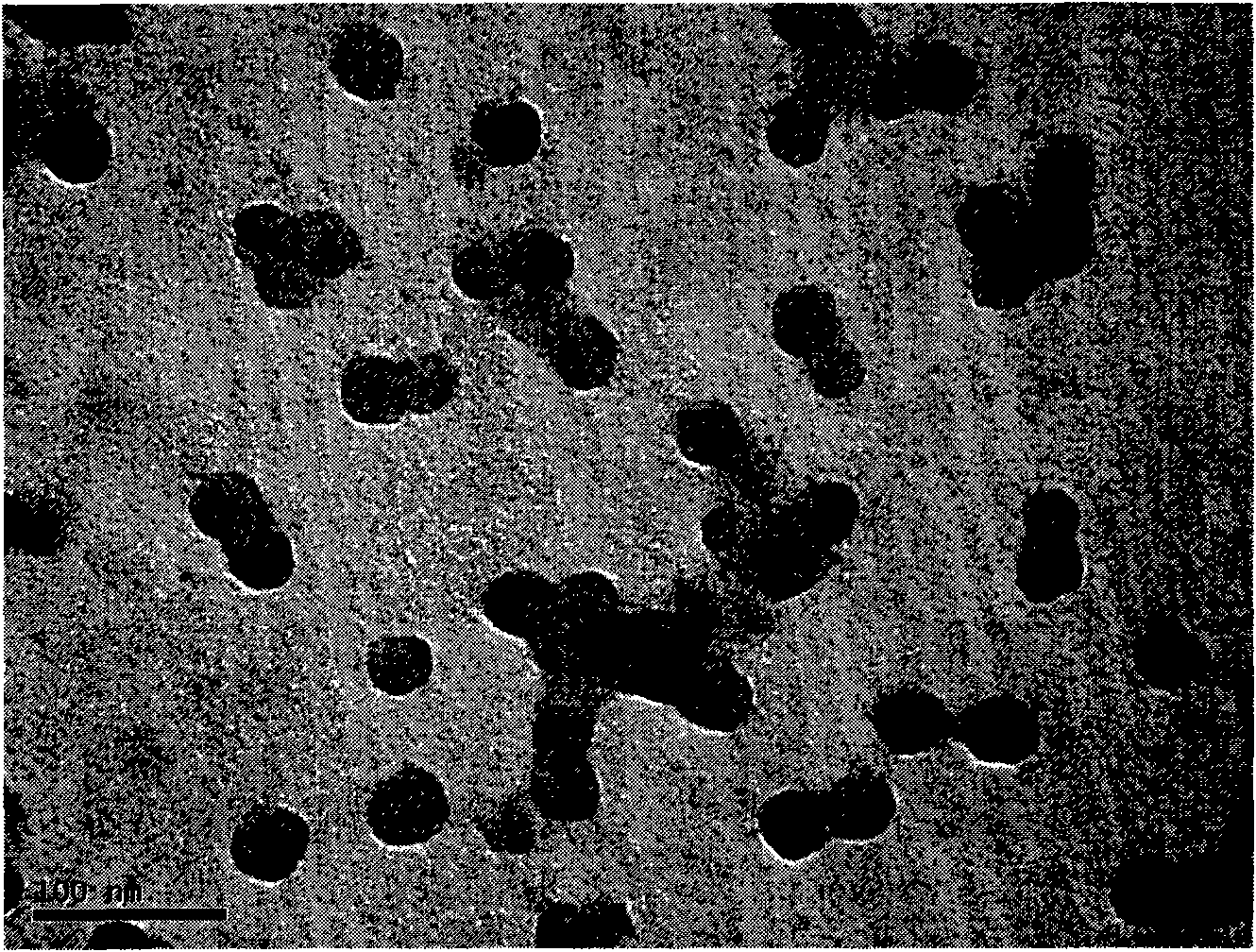
通过TEM观察细乳液聚合得到的高分子为载体的造影剂的直径在20~50纳米之间,呈现较好的均匀性和稳定性。磁共振成像实验测得Gd-DOTA系列的以高分子为载体的造影剂驰豫率为11.1mMS-1,比临床应用值(4.2mMS-1)提高了将尽两倍;Gd-DTPA系列的以高分子为载体的造影剂驰豫率为6.6mMS-1,比临床应用值(4.3mMS-1)提高超过50%。Observed by TEM, the diameter of the polymer-carrier contrast agent obtained by miniemulsion polymerization is between 20 and 50 nanometers, showing good uniformity and stability. Magnetic resonance imaging experiments show that the relaxation rate of Gd-DOTA series of contrast agents with polymer as the carrier is 11.1mMS -1 , which is almost twice as high as the clinical application value (4.2mMS -1 ); Gd-DTPA series The relaxation rate of the contrast agent with polymer as the carrier is 6.6mMS -1 , which is more than 50% higher than the clinical application value (4.3mMS -1 ).
附图说明Description of drawings
图1为按照实施例3细乳液聚合得到的高分子核磁共振成像造影剂的TEM图。Fig. 1 is a TEM image of a polymer nuclear magnetic resonance imaging contrast agent obtained by miniemulsion polymerization according to Example 3.
图2为按照实施例3细乳液聚合得到的高分子核磁共振成像造影剂的SEM图。Fig. 2 is a SEM image of the polymer nuclear magnetic resonance imaging contrast agent obtained by miniemulsion polymerization according to Example 3.
图3为按照实施例3得到的高分子核磁共振成像造影剂横向驰豫时间(T1)的倒数随钆浓度的变化图。Fig. 3 is a diagram showing the variation of the reciprocal of the transverse relaxation time (T 1 ) of the polymer nuclear magnetic resonance imaging contrast agent obtained according to Example 3 with the concentration of gadolinium.
图4为按照实施例3得到的高分子核磁共振成像造影剂成像效果随钆浓度的变化图。FIG. 4 is a diagram showing the variation of the imaging effect of the polymer nuclear magnetic resonance imaging contrast agent with the concentration of gadolinium obtained according to Example 3. FIG.
图5为按照实施例10细乳液聚合得到的高分子核磁共振成像造影剂的TEM图。Fig. 5 is a TEM image of the polymer nuclear magnetic resonance imaging contrast agent obtained by miniemulsion polymerization according to Example 10.
图6为按照实施例10细乳液聚合得到的高分子核磁共振成像造影剂的SEM图。Fig. 6 is a SEM image of the polymer nuclear magnetic resonance imaging contrast agent obtained by miniemulsion polymerization according to Example 10.
图7为按照实施例10得到的高分子核磁共振成像造影剂横向驰豫时间(T1)的倒数随钆浓度的变化图。Fig. 7 is a diagram showing the variation of the reciprocal of the transverse relaxation time (T 1 ) of the polymer nuclear magnetic resonance imaging contrast agent obtained according to Example 10 with the concentration of gadolinium.
图8为按照实施例10得到的高分子核磁共振成像造影剂成像效果随钆浓度的变化图。FIG. 8 is a diagram showing the variation of the imaging effect of the polymer nuclear magnetic resonance imaging contrast agent obtained according to Example 10 with the concentration of gadolinium.
具体实施方式Detailed ways
下面结合具体实施例对本发明做进一步详述。The present invention will be described in further detail below in conjunction with specific embodiments.
实施例1Example 1
DOTA衍生物的制备:10g的三乙烯基四胺与10g的40%的乙二醛水溶液在乙腈中,冰浴反应2小时,然后加入4-10毫升的二溴乙烷和40g碳酸钾,60~80℃下反应24小时,冷却过滤,用少量二氯甲烷溶解后用正己烷沉淀,将溶液旋干,过柱提纯,所得产物与1.5当量的碘代十六烷在60℃的甲苯中反应4~6天,除去溶剂,用乙醚洗涤,加入10当量的盐酸羟胺,在乙醇中回流2小时,除去溶剂,加入氢氧化钠水溶液,用氯仿萃取三次,除去氯仿后,加盐酸沉淀,将沉淀在乙醇中重结晶,再碱化、萃取、干燥,所得产物在40~100℃的水溶液中与溴乙酸反应4-10小时,PH保持8~11之间,反应后将PH调至中性,冷却静置,有白色固体析出,即为DOTA的衍生物(式3)。Preparation of DOTA derivatives: 10g of triethylenetetramine and 10g of 40% aqueous solution of glyoxal in acetonitrile, reacted in ice bath for 2 hours, then added 4-10 ml of dibromoethane and 40g of potassium carbonate, 60 React at ~80°C for 24 hours, cool and filter, dissolve with a small amount of dichloromethane and precipitate with n-hexane, spin the solution to dryness, and purify through the column, and react the obtained product with 1.5 equivalents of hexadecane iodide in toluene at 60°C After 4 to 6 days, remove the solvent, wash with ether, add 10 equivalents of hydroxylamine hydrochloride, reflux in ethanol for 2 hours, remove the solvent, add aqueous sodium hydroxide solution, extract three times with chloroform, remove chloroform, add hydrochloric acid to precipitate, and precipitate Recrystallize in ethanol, alkalization, extraction, and drying. The resulting product is reacted with bromoacetic acid in an aqueous solution at 40-100°C for 4-10 hours, and the pH is kept between 8 and 11. After the reaction, the pH is adjusted to neutral. After cooling and standing, a white solid precipitates out, which is the derivative of DOTA (Formula 3).
实施例2Example 2
Gd-DOTA的衍生物的制备:取200mg的DOTA的衍生物溶于5ml水中,PH调至5-8,加入1.2当量的氯化钆,20~100℃下反应24小时,再将PH调至9左右,用微孔滤膜过滤,过离子交换树脂,除去溶剂水,即得与Gd-DOTA的衍生物(式1)。Preparation of Gd-DOTA derivatives: Dissolve 200mg of DOTA derivatives in 5ml of water, adjust the pH to 5-8, add 1.2 equivalents of gadolinium chloride, react at 20-100°C for 24 hours, and then adjust the pH to 9 or so, filter with a microporous membrane, pass through an ion exchange resin, and remove the solvent water to obtain a derivative with Gd-DOTA (Formula 1).
实施例3Example 3
按照摩尔量1∶2~4∶1称取一定量的Gd-DOTA和吐温60,加入5~20毫升的去离子水,完全溶解后加入0.1~0.4g的苯乙烯、0.1~0.2g的二乙烯基苯、2~20毫克的十六醇、2~20毫克的AIBN,60~90℃氮气保护下下反应6~10小时,过滤后透析3~6天,所得乳液分散均匀,乳胶粒的直径为20~50纳米(如图1),配制不同浓度的溶液,采用磁共振成像仪进行驰豫率测定,横向驰豫时间与钆离子浓度呈良好的线性关系(如图2),最终计算得横向驰豫速率r1=8.9mMS-1,随着钆离子浓度的下降,成像的亮度也随之呈现下降趋势(如图3)。Weigh a certain amount of Gd-DOTA and Tween 60 according to the molar ratio of 1:2 to 4:1, add 5 to 20 ml of deionized water, add 0.1 to 0.4 g of styrene, 0.1 to 0.2 g of Divinylbenzene, 2-20 mg of cetyl alcohol, 2-20 mg of AIBN, 60-90 ° C under the protection of nitrogen, reacted for 6-10 hours, filtered and dialyzed for 3-6 days, the obtained emulsion was uniformly dispersed, and the latex particles The diameter is 20-50 nanometers (as shown in Figure 1), and solutions with different concentrations are prepared, and the relaxation rate is measured by a magnetic resonance imaging instrument. The transverse relaxation time has a good linear relationship with the concentration of gadolinium ions (as shown in Figure 2). The calculated transverse relaxation rate r 1 =8.9mMS -1 , as the concentration of gadolinium ions decreases, the brightness of the imaging also shows a downward trend (as shown in Figure 3 ).
实施例4Example 4
按照摩尔量1∶2~4∶1称取一定量的Gd-DOTA和吐温80,加入5~20毫升的去离子水,完全溶解后加入0.1~0.4g的苯乙烯、0.1~0.2g的二乙烯基苯、2~20毫克的十六醇、2~20毫克的AIBN,60~90℃氮气保护下反应6~10小时,过滤后透析3~6天,所得乳液分散均匀,乳胶粒的直径为20~100纳米,配制不同浓度的溶液,采用磁共振成像仪进行驰豫速率测定,横向驰豫时间与钆离子浓度呈良好的线性关系,最终计算得横向驰豫速率r1=7~11mMS-1,随着钆离子浓度的下降,成像的亮度也随之呈现下降趋势。Weigh a certain amount of Gd-DOTA and Tween 80 according to the molar ratio of 1:2 to 4:1, add 5 to 20 ml of deionized water, add 0.1 to 0.4 g of styrene, 0.1 to 0.2 g of Divinylbenzene, 2-20 mg of cetyl alcohol, 2-20 mg of AIBN, 60-90 ° C under the protection of nitrogen, reacted for 6-10 hours, filtered and dialyzed for 3-6 days, the obtained emulsion was uniformly dispersed, and the latex particle The diameter is 20-100 nanometers, and solutions with different concentrations are prepared, and the relaxation rate is measured by a magnetic resonance imaging instrument. The transverse relaxation time has a good linear relationship with the concentration of gadolinium ions. 11mMS -1 , as the concentration of gadolinium ions decreases, the brightness of the imaging also shows a downward trend.
实施例5Example 5
按照摩尔量1∶2~4∶1称取一定量的Gd-DOTA和聚乙烯醇,加入5~20毫升的去离子水,完全溶解后加入0.1~0.4g的苯乙烯、0.1~0.2g的二乙烯基苯、2~20mg的十六醇、2~20mg的AIBN,60~90℃氮气保护下反应6~10小时,过滤后透析3~6天,得稳定均匀半透明的乳液,测试性能与实施例1相近。Weigh a certain amount of Gd-DOTA and polyvinyl alcohol according to the molar ratio of 1:2 to 4:1, add 5 to 20 ml of deionized water, add 0.1 to 0.4 g of styrene, 0.1 to 0.2 g of Divinylbenzene, 2-20mg of cetyl alcohol, 2-20mg of AIBN, react under nitrogen protection at 60-90°C for 6-10 hours, filter and dialyze for 3-6 days to obtain a stable and uniform translucent emulsion, test performance Close to Example 1.
实施例6Example 6
按照摩尔量1∶2~4∶1称取一定量的Gd-DOTA和PEG-PPG-PEG,加入5~20毫升的去离子水,完全溶解后加入0.1~0.4g的苯乙烯、0.1~0.2g的二乙烯基苯、2~20mg的十六醇、2~20mg的AIBN,60~90℃氮气保护下反应6~10小时,过滤后透析3~6天,得稳定均匀半透明的乳液,测试性能与实施例1相近。Weigh a certain amount of Gd-DOTA and PEG-PPG-PEG according to the molar weight of 1:2~4:1, add 5~20 ml of deionized water, add 0.1~0.4g of styrene, 0.1~0.2 g of divinylbenzene, 2-20 mg of cetyl alcohol, 2-20 mg of AIBN, react under nitrogen protection at 60-90°C for 6-10 hours, filter and dialyze for 3-6 days to obtain a stable and uniform translucent emulsion. Test performance is close to Example 1.
实施例7Example 7
按照摩尔量1∶2~4∶1称取一定量的Gd-DOTA和吐温60,加入5~20毫升的去离子水,完全溶解后加入0.1~0.4g的甲基丙烯酸甲酯、0.1~0.2g的二乙烯基苯、4~20毫克的丙烯酰胺、2~20毫克的十六醇、2~20毫克的AIBN,60~90℃氮气保护下反应6~10小时,过滤后透析3~6天,得均匀稳定的乳液,测试性能与实施例1相近。Weigh a certain amount of Gd-DOTA and Tween 60 according to the molar ratio of 1:2 to 4:1, add 5 to 20 ml of deionized water, add 0.1 to 0.4 g of methyl methacrylate, 0.1 to 20 ml of deionized water after completely dissolving 0.2g of divinylbenzene, 4-20mg of acrylamide, 2-20mg of cetyl alcohol, 2-20mg of AIBN, react under nitrogen protection at 60-90℃ for 6-10 hours, filter and dialyze for 3- After 6 days, a uniform and stable emulsion was obtained, and the test performance was close to that of Example 1.
实施例8Example 8
DTPA衍生物的制备:取二乙三胺10g和溴代十六烷3g在乙醇中90℃下反应6小时,停止加热后继续搅拌15~20小时。旋蒸除去溶剂,得到淡黄色粗产物用二氯甲烷和饱和氯化钠萃取,取下层有机相,旋蒸除去溶剂,真空烘干。所得固体与溴乙酸的水溶液在四氢呋喃中90℃下反应6小时,同时滴加氢氧化钠溶液保持pH 8~12之间。加HCl调节pH至约1~3,旋蒸除去溶剂,固体用冰乙醇洗,抽滤,固体重新溶于水(pH=8),加HCl调节pH至约1~3,静置,有白色固体析出,即为DTPA衍生物(式4)。Preparation of DTPA derivatives: 10 g of diethylenetriamine and 3 g of hexadecane bromide were reacted in ethanol at 90° C. for 6 hours, and stirring was continued for 15 to 20 hours after stopping heating. The solvent was removed by rotary evaporation, and the light yellow crude product obtained was extracted with dichloromethane and saturated sodium chloride. The lower organic phase was removed, the solvent was removed by rotary evaporation, and dried in vacuum. The resulting solid was reacted with an aqueous solution of bromoacetic acid in tetrahydrofuran at 90°C for 6 hours, while sodium hydroxide solution was added dropwise to keep the pH between 8 and 12. Add HCl to adjust the pH to about 1-3, remove the solvent by rotary evaporation, wash the solid with ice ethanol, filter with suction, re-dissolve the solid in water (pH=8), add HCl to adjust the pH to about 1-3, stand still, and have a white color The solid precipitated out is the DTPA derivative (Formula 4).
实施例9Example 9
Gd-DTPA的衍生物的制备:取200mg的DTPA的衍生物溶于5ml水中,PH调至5-8,加入1.2当量的氯化钆,20~100℃下反应24小时,再讲PH调至9左右,用微孔滤膜过滤,过离子交换树脂,除去溶剂水,即得与Gd-DTPA的衍生物(式2)。Preparation of Gd-DTPA derivatives: Dissolve 200mg of DTPA derivatives in 5ml of water, adjust the pH to 5-8, add 1.2 equivalents of gadolinium chloride, react at 20-100°C for 24 hours, and then adjust the pH to 9 or so, filter with a microporous membrane, pass through an ion exchange resin, and remove the solvent water to obtain a derivative with Gd-DTPA (Formula 2).
实施例10Example 10
按照摩尔量1∶2~5∶1称取一定量的Gd-DTPA和吐温60,加入5~20毫升的去离子水,完全溶解后加入0.1~0.4g的苯乙烯、0.01~0.02g的二乙烯基苯、2~20毫克的十六醇、2~20毫克的AIBN,40~100℃氮气保护下反应6~10小时,过滤后透析3~6天,所得乳液分散均匀,配制不同浓度的溶液,采用磁共振成像仪进行驰豫速率测定,横向驰豫时间与钆离子浓度呈良好的线性关系(如图2),最终计算得横向驰豫速率r1=6~9mM-1S-1。Weigh a certain amount of Gd-DTPA and Tween 60 according to the molar weight of 1:2~5:1, add 5~20 ml of deionized water, add 0.1~0.4g of styrene, 0.01~0.02g of Divinylbenzene, 2-20 mg of cetyl alcohol, 2-20 mg of AIBN, react under nitrogen protection at 40-100°C for 6-10 hours, filter and dialyze for 3-6 days, the obtained emulsion is uniformly dispersed, and prepared with different concentrations solution, the relaxation rate was measured using a magnetic resonance imaging instrument, and the transverse relaxation time had a good linear relationship with the concentration of gadolinium ions (as shown in Figure 2). The final calculated transverse relaxation rate r 1 =6~9mM -1 S - 1 .
实施例11Example 11
按照摩尔量1∶2~5∶1称取一定量的Gd-DTPA和吐温80,加入5~20毫升的去离子水,完全溶解后加入0.1~0.4g的苯乙烯、0.01~0.02g的二乙烯基苯、2~20毫克的十六醇、2~20毫克的AIBN,40~100℃氮气保护下反应6~10小时,过滤后透析3~6天,所得乳液分散均匀,测试性能与实施例10相近。Weigh a certain amount of Gd-DTPA and Tween 80 according to the molar weight of 1:2~5:1, add 5~20 ml of deionized water, add 0.1~0.4g of styrene, 0.01~0.02g of Divinylbenzene, 2-20 mg of cetyl alcohol, 2-20 mg of AIBN, reacted for 6-10 hours under nitrogen protection at 40-100 ° C, filtered and dialyzed for 3-6 days, the obtained emulsion was uniformly dispersed, and the test performance was consistent with Example 10 is similar.
实施例12Example 12
按照摩尔量1∶2~5∶1称取一定量的Gd-DTPA阿拉伯胶,加入5~20毫升的去离子水,完全溶解后加入0.1~0.4g的苯乙烯、0.01~0.02g的二乙烯基苯、2~20毫克的十六醇、2~20毫克的AIBN,40~100℃氮气保护下反应6~10小时,过滤后透析3~6天,所得乳液分散均匀,测试性能与实施例10相近。Weigh a certain amount of Gd-DTPA gum arabic according to the molar weight of 1:2~5:1, add 5~20 ml of deionized water, add 0.1~0.4g of styrene and 0.01~0.02g of diethylene after completely dissolving Benzene, 2-20 mg of cetyl alcohol, 2-20 mg of AIBN, reacted under nitrogen protection at 40-100 ° C for 6-10 hours, filtered and dialyzed for 3-6 days, the obtained emulsion was uniformly dispersed, and the test performance was the same as that of the examples 10 is close.
实施例13Example 13
按照摩尔量1∶2~5∶1称取一定量的Gd-DTPA和聚乙烯醇,加入5~20毫升的去离子水,完全溶解后加入0.1~0.4g的甲基丙烯酸甲酯、0.01~0.02g的二乙烯基苯、4~20毫克的丙烯酰胺、2~20毫克的十六醇、2~20毫克的AIBN,40~100℃氮气保护下反应6~10小时,过滤后透析3~6天,所得乳液分散均匀,测试性能与实施例10相近。Weigh a certain amount of Gd-DTPA and polyvinyl alcohol according to the molar weight of 1:2~5:1, add 5~20 ml of deionized water, add 0.1~0.4g of methyl methacrylate, 0.01~ 0.02g of divinylbenzene, 4-20mg of acrylamide, 2-20mg of cetyl alcohol, 2-20mg of AIBN, react under nitrogen protection at 40-100°C for 6-10 hours, filter and dialyze for 3- After 6 days, the obtained emulsion was uniformly dispersed, and the test performance was similar to that of Example 10.
实施例14Example 14
按照摩尔量1∶2~5∶1称取一定量的Gd-DTPA和吐温60,加入5~20毫升的去离子水,完全溶解后加入0.1~0.4g的甲基丙烯酸甲酯、0.01~0.02g的二乙烯基苯、4~20毫克的丙烯酰胺、2~20毫克的十六醇、2~20毫克的AIBN,40~100℃氮气保护下反应6~10小时,过滤后透析3~6天,所得乳液分散均匀,测试性能与实施例10相近。Weigh a certain amount of Gd-DTPA and Tween 60 according to the molar weight of 1:2~5:1, add 5~20 ml of deionized water, add 0.1~0.4g of methyl methacrylate, 0.01~ 0.02g of divinylbenzene, 4-20mg of acrylamide, 2-20mg of cetyl alcohol, 2-20mg of AIBN, react under nitrogen protection at 40-100°C for 6-10 hours, filter and dialyze for 3- After 6 days, the obtained emulsion was uniformly dispersed, and the test performance was similar to that of Example 10.
Claims (4)


Priority Applications (1)
| Application Number | Priority Date | Filing Date | Title |
|---|---|---|---|
| CN2010101907272A CN101845112B (en) | 2010-06-02 | 2010-06-02 | Preparation method of high-flexibility nuclear magnetic resonance imaging contrast agents based on high molecular nanometer particles |
Applications Claiming Priority (1)
| Application Number | Priority Date | Filing Date | Title |
|---|---|---|---|
| CN2010101907272A CN101845112B (en) | 2010-06-02 | 2010-06-02 | Preparation method of high-flexibility nuclear magnetic resonance imaging contrast agents based on high molecular nanometer particles |
Publications (2)
| Publication Number | Publication Date |
|---|---|
| CN101845112A CN101845112A (en) | 2010-09-29 |
| CN101845112B true CN101845112B (en) | 2011-09-14 |
Family
ID=42769942
Family Applications (1)
| Application Number | Title | Priority Date | Filing Date |
|---|---|---|---|
| CN2010101907272A Expired - Fee Related CN101845112B (en) | 2010-06-02 | 2010-06-02 | Preparation method of high-flexibility nuclear magnetic resonance imaging contrast agents based on high molecular nanometer particles |
Country Status (1)
| Country | Link |
|---|---|
| CN (1) | CN101845112B (en) |
Cited By (1)
| Publication number | Priority date | Publication date | Assignee | Title |
|---|---|---|---|---|
| CN102908634A (en) * | 2012-11-14 | 2013-02-06 | 华东理工大学 | Double-strand quaternary ammonium type nuclear magnetic resonance imaging contrast agent and preparation method thereof |
Families Citing this family (5)
| Publication number | Priority date | Publication date | Assignee | Title |
|---|---|---|---|---|
| CN104740655B (en) * | 2015-02-13 | 2018-01-19 | 华东理工大学 | One kind has NMR contrast agent of hyperhydrated constant and preparation method thereof |
| CN108084106A (en) * | 2018-01-22 | 2018-05-29 | 合肥工业大学 | A kind of diolefin crosslinking agent containing DO3A and its application for preparing nanometer polymer base contrast agent |
| CN110575762B (en) * | 2018-06-07 | 2024-03-26 | 温州大学新材料与产业技术研究院 | Preparation method of organic alkyl gadolinium aqueous dispersion system |
| GB2620653A (en) * | 2022-03-16 | 2024-01-17 | Wenzhou Institute Univ Of Chinese Academy Of Sciences | Cyclic GD (III) complex, preparation method therefor and application thereof |
| CN114560821B (en) * | 2022-03-16 | 2024-08-27 | 国科温州研究院(温州生物材料与工程研究所) | A cyclic Gd(III) complex and its preparation method and application |
Citations (3)
| Publication number | Priority date | Publication date | Assignee | Title |
|---|---|---|---|---|
| EP0883610B1 (en) * | 1996-02-26 | 2000-07-12 | Schering Aktiengesellschaft | Process for preparing 1,4,7,10-tetraazacyclododecane and its derivatives |
| CN1333695A (en) * | 1998-12-23 | 2002-01-30 | 伯拉考成像股份公司 | Blood Pool Agents for MRI Diagnosis |
| EP0708761B1 (en) * | 1994-05-11 | 2002-08-14 | BRACCO International B.V. | Enhanced relaxivity monomeric and multimeric compounds |
-
2010
- 2010-06-02 CN CN2010101907272A patent/CN101845112B/en not_active Expired - Fee Related
Patent Citations (3)
| Publication number | Priority date | Publication date | Assignee | Title |
|---|---|---|---|---|
| EP0708761B1 (en) * | 1994-05-11 | 2002-08-14 | BRACCO International B.V. | Enhanced relaxivity monomeric and multimeric compounds |
| EP0883610B1 (en) * | 1996-02-26 | 2000-07-12 | Schering Aktiengesellschaft | Process for preparing 1,4,7,10-tetraazacyclododecane and its derivatives |
| CN1333695A (en) * | 1998-12-23 | 2002-01-30 | 伯拉考成像股份公司 | Blood Pool Agents for MRI Diagnosis |
Cited By (2)
| Publication number | Priority date | Publication date | Assignee | Title |
|---|---|---|---|---|
| CN102908634A (en) * | 2012-11-14 | 2013-02-06 | 华东理工大学 | Double-strand quaternary ammonium type nuclear magnetic resonance imaging contrast agent and preparation method thereof |
| CN102908634B (en) * | 2012-11-14 | 2015-07-01 | 华东理工大学 | Double-strand quaternary ammonium type nuclear magnetic resonance imaging contrast agent and preparation method thereof |
Also Published As
| Publication number | Publication date |
|---|---|
| CN101845112A (en) | 2010-09-29 |
Similar Documents
| Publication | Publication Date | Title |
|---|---|---|
| Li et al. | Macromolecular ligands for gadolinium MRI contrast agents | |
| Zhao et al. | Interfacial engineered gadolinium oxide nanoparticles for magnetic resonance imaging guided microenvironment-mediated synergetic chemodynamic/photothermal therapy | |
| CN101845112B (en) | Preparation method of high-flexibility nuclear magnetic resonance imaging contrast agents based on high molecular nanometer particles | |
| Cai et al. | Metal–organic framework‐based nanomedicine platforms for drug delivery and molecular imaging | |
| Li et al. | Amphiphilic multiarm star block copolymer-based multifunctional unimolecular micelles for cancer targeted drug delivery and MR imaging | |
| Zhu et al. | Magnetic, fluorescent, and thermo-responsive Fe3O4/rare earth incorporated poly (St-NIPAM) core–shell colloidal nanoparticles in multimodal optical/magnetic resonance imaging probes | |
| Zhu et al. | Surface modification of Gd nanoparticles with pH-responsive block copolymers for use as smart MRI contrast agents | |
| Jin et al. | Electrospun contrast‐agent‐loaded fibers for colon‐targeted MRI | |
| CN106390143B (en) | Tumor-targeted NMR/fluorescence dual-modality imaging contrast agent and its preparation and application | |
| Wang et al. | Multifunctional PS@ CS@ Au–Fe 3 O 4–FA nanocomposites for CT, MR and fluorescence imaging guided targeted-photothermal therapy of cancer cells | |
| CN104906600B (en) | A kind of superparamagnetic nano particle and its preparation method and application | |
| Wang et al. | Magneto-fluorescent nanoparticles with high-intensity NIR emission, T 1-and T 2-weighted MR for multimodal specific tumor imaging | |
| CN105920624A (en) | MRI and PTT diagnosis and treatment integration functional microsphere with core-shell structure and preparation method thereof | |
| Wei et al. | Rapidly liver-clearable rare-earth core–shell nanoprobe for dual-modal breast cancer imaging in the second near-infrared window | |
| Shao et al. | A novel one‐step synthesis of Gd3+‐incorporated mesoporous SiO2 nanoparticles for use as an efficient MRI contrast agent | |
| CN102772807A (en) | High-water-solubility nuclear magnetic resonance imaging contrast agent and preparation method thereof | |
| Xu et al. | Co‐assembly of Gd (III)‐based metallosurfactant and conjugated polymer nanoparticles in organosilica cross‐linked block copolymer micelles for highly efficient MRI and fluorescent bimodal imaging | |
| CN102294040A (en) | Magnetic nanometer polymer vesicle for magnetic resonance imaging and medicine carrier and preparation method of magnetic nanometer polymer vesicle | |
| Adkins et al. | High relaxivity MRI imaging reagents from bimodal star polymers | |
| Han et al. | Hyperbranched Polymeric 19F MRI Contrast Agents with Long T 2 Relaxation Time Based on β-Cyclodextrin and Phosphorycholine | |
| CN102908634B (en) | Double-strand quaternary ammonium type nuclear magnetic resonance imaging contrast agent and preparation method thereof | |
| CN103690971B (en) | A kind of supperparamagnetic particles, preparation method and its usage with rheumatoid arthritis position targeting | |
| CN116041247A (en) | A photothermal reagent, photothermal reagent nanoparticles and preparation method thereof | |
| CN106310297B (en) | Multifunctional macromolecule prodrug nanoscale medicine delivery system and preparation method and purposes | |
| Ly et al. | Nano-assemblies of cationic mPEG brush block copolymers with gadolinium polyoxotungstate [Gd (W 5 O 18) 2] 9− form stable, high relaxivity MRI contrast agents |
Legal Events
| Date | Code | Title | Description |
|---|---|---|---|
| C06 | Publication | ||
| PB01 | Publication | ||
| C10 | Entry into substantive examination | ||
| SE01 | Entry into force of request for substantive examination | ||
| C14 | Grant of patent or utility model | ||
| GR01 | Patent grant | ||
| CF01 | Termination of patent right due to non-payment of annual fee |
Granted publication date: 20110914 Termination date: 20150602 |
|
| EXPY | Termination of patent right or utility model |