CN102403406A - Preparation method for back contact type silicon solar cell - Google Patents
Preparation method for back contact type silicon solar cell Download PDFInfo
- Publication number
- CN102403406A CN102403406A CN2011103740324A CN201110374032A CN102403406A CN 102403406 A CN102403406 A CN 102403406A CN 2011103740324 A CN2011103740324 A CN 2011103740324A CN 201110374032 A CN201110374032 A CN 201110374032A CN 102403406 A CN102403406 A CN 102403406A
- Authority
- CN
- China
- Prior art keywords
- solar cell
- film
- preparation
- hole
- silicon solar
- Prior art date
- Legal status (The legal status is an assumption and is not a legal conclusion. Google has not performed a legal analysis and makes no representation as to the accuracy of the status listed.)
- Granted
Links
- XUIMIQQOPSSXEZ-UHFFFAOYSA-N Silicon Chemical compound [Si] XUIMIQQOPSSXEZ-UHFFFAOYSA-N 0.000 title claims abstract description 99
- 229910052710 silicon Inorganic materials 0.000 title claims abstract description 96
- 239000010703 silicon Substances 0.000 title claims abstract description 96
- 238000002360 preparation method Methods 0.000 title claims abstract description 18
- 239000011248 coating agent Substances 0.000 claims abstract description 21
- 238000000576 coating method Methods 0.000 claims abstract description 21
- 229910052751 metal Inorganic materials 0.000 claims abstract description 16
- 239000002184 metal Substances 0.000 claims abstract description 16
- 238000002161 passivation Methods 0.000 claims abstract description 15
- 238000009792 diffusion process Methods 0.000 claims abstract description 6
- 239000010408 film Substances 0.000 claims description 69
- 229910006404 SnO 2 Inorganic materials 0.000 claims description 12
- 239000010409 thin film Substances 0.000 claims description 8
- 238000005530 etching Methods 0.000 claims description 7
- 230000002093 peripheral effect Effects 0.000 claims description 6
- RZVAJINKPMORJF-UHFFFAOYSA-N Acetaminophen Chemical compound CC(=O)NC1=CC=C(O)C=C1 RZVAJINKPMORJF-UHFFFAOYSA-N 0.000 claims 2
- HIVGXUNKSAJJDN-UHFFFAOYSA-N [Si].[P] Chemical compound [Si].[P] HIVGXUNKSAJJDN-UHFFFAOYSA-N 0.000 claims 2
- 239000006117 anti-reflective coating Substances 0.000 claims 2
- 235000008216 herbs Nutrition 0.000 claims 2
- 238000007747 plating Methods 0.000 claims 2
- 239000005297 pyrex Substances 0.000 claims 2
- 210000002268 wool Anatomy 0.000 claims 2
- 238000000034 method Methods 0.000 abstract description 24
- 238000006243 chemical reaction Methods 0.000 abstract description 9
- 238000013467 fragmentation Methods 0.000 abstract 1
- 238000006062 fragmentation reaction Methods 0.000 abstract 1
- 235000012431 wafers Nutrition 0.000 description 50
- 238000010586 diagram Methods 0.000 description 10
- 238000000623 plasma-assisted chemical vapour deposition Methods 0.000 description 7
- 238000007738 vacuum evaporation Methods 0.000 description 7
- 238000004544 sputter deposition Methods 0.000 description 5
- KRHYYFGTRYWZRS-UHFFFAOYSA-N Fluorane Chemical compound F KRHYYFGTRYWZRS-UHFFFAOYSA-N 0.000 description 4
- BQCADISMDOOEFD-UHFFFAOYSA-N Silver Chemical compound [Ag] BQCADISMDOOEFD-UHFFFAOYSA-N 0.000 description 4
- 229910052782 aluminium Inorganic materials 0.000 description 4
- 238000001755 magnetron sputter deposition Methods 0.000 description 4
- 238000004519 manufacturing process Methods 0.000 description 4
- 229910052709 silver Inorganic materials 0.000 description 4
- 239000004332 silver Substances 0.000 description 4
- 238000007740 vapor deposition Methods 0.000 description 4
- XAGFODPZIPBFFR-UHFFFAOYSA-N aluminium Chemical compound [Al] XAGFODPZIPBFFR-UHFFFAOYSA-N 0.000 description 3
- 229910052796 boron Inorganic materials 0.000 description 3
- 239000005388 borosilicate glass Substances 0.000 description 3
- 238000005516 engineering process Methods 0.000 description 3
- 238000009413 insulation Methods 0.000 description 3
- 239000005360 phosphosilicate glass Substances 0.000 description 3
- 239000002002 slurry Substances 0.000 description 3
- ZOXJGFHDIHLPTG-UHFFFAOYSA-N Boron Chemical compound [B] ZOXJGFHDIHLPTG-UHFFFAOYSA-N 0.000 description 2
- OAICVXFJPJFONN-UHFFFAOYSA-N Phosphorus Chemical compound [P] OAICVXFJPJFONN-UHFFFAOYSA-N 0.000 description 2
- 229910052581 Si3N4 Inorganic materials 0.000 description 2
- VYPSYNLAJGMNEJ-UHFFFAOYSA-N Silicium dioxide Chemical compound O=[Si]=O VYPSYNLAJGMNEJ-UHFFFAOYSA-N 0.000 description 2
- 230000000903 blocking effect Effects 0.000 description 2
- 238000003486 chemical etching Methods 0.000 description 2
- 238000005229 chemical vapour deposition Methods 0.000 description 2
- 239000002131 composite material Substances 0.000 description 2
- 238000005553 drilling Methods 0.000 description 2
- 230000000694 effects Effects 0.000 description 2
- 238000010438 heat treatment Methods 0.000 description 2
- 230000031700 light absorption Effects 0.000 description 2
- 229910052698 phosphorus Inorganic materials 0.000 description 2
- 239000011574 phosphorus Substances 0.000 description 2
- HQVNEWCFYHHQES-UHFFFAOYSA-N silicon nitride Chemical compound N12[Si]34N5[Si]62N3[Si]51N64 HQVNEWCFYHHQES-UHFFFAOYSA-N 0.000 description 2
- 239000007921 spray Substances 0.000 description 2
- 238000005507 spraying Methods 0.000 description 2
- 230000005540 biological transmission Effects 0.000 description 1
- 229910021419 crystalline silicon Inorganic materials 0.000 description 1
- 239000002019 doping agent Substances 0.000 description 1
- 239000002803 fossil fuel Substances 0.000 description 1
- 229910052733 gallium Inorganic materials 0.000 description 1
- 239000003292 glue Substances 0.000 description 1
- BHEPBYXIRTUNPN-UHFFFAOYSA-N hydridophosphorus(.) (triplet) Chemical compound [PH] BHEPBYXIRTUNPN-UHFFFAOYSA-N 0.000 description 1
- 229910052738 indium Inorganic materials 0.000 description 1
- 229910003437 indium oxide Inorganic materials 0.000 description 1
- PJXISJQVUVHSOJ-UHFFFAOYSA-N indium(iii) oxide Chemical compound [O-2].[O-2].[O-2].[In+3].[In+3] PJXISJQVUVHSOJ-UHFFFAOYSA-N 0.000 description 1
- 238000007641 inkjet printing Methods 0.000 description 1
- 238000011031 large-scale manufacturing process Methods 0.000 description 1
- 150000002739 metals Chemical class 0.000 description 1
- 239000000203 mixture Substances 0.000 description 1
- 238000012986 modification Methods 0.000 description 1
- 230000004048 modification Effects 0.000 description 1
- 229910021426 porous silicon Inorganic materials 0.000 description 1
- 238000010248 power generation Methods 0.000 description 1
- 239000002994 raw material Substances 0.000 description 1
- 238000007650 screen-printing Methods 0.000 description 1
- 239000004065 semiconductor Substances 0.000 description 1
- 239000000377 silicon dioxide Substances 0.000 description 1
- 235000012239 silicon dioxide Nutrition 0.000 description 1
- 239000002210 silicon-based material Substances 0.000 description 1
- 238000003980 solgel method Methods 0.000 description 1
- 238000004528 spin coating Methods 0.000 description 1
- 239000000126 substance Substances 0.000 description 1
Images


Classifications
-
- Y—GENERAL TAGGING OF NEW TECHNOLOGICAL DEVELOPMENTS; GENERAL TAGGING OF CROSS-SECTIONAL TECHNOLOGIES SPANNING OVER SEVERAL SECTIONS OF THE IPC; TECHNICAL SUBJECTS COVERED BY FORMER USPC CROSS-REFERENCE ART COLLECTIONS [XRACs] AND DIGESTS
- Y02—TECHNOLOGIES OR APPLICATIONS FOR MITIGATION OR ADAPTATION AGAINST CLIMATE CHANGE
- Y02P—CLIMATE CHANGE MITIGATION TECHNOLOGIES IN THE PRODUCTION OR PROCESSING OF GOODS
- Y02P70/00—Climate change mitigation technologies in the production process for final industrial or consumer products
- Y02P70/50—Manufacturing or production processes characterised by the final manufactured product
Landscapes
- Photovoltaic Devices (AREA)
Abstract
本发明公开了一种背接触硅太阳能电池的制备方法,包括如下步骤:(1)在硅片的受光面进行制绒,然后开设孔洞;(2)在上述硅片的受光面进行涂源扩散制结,在受光面和孔洞内形成PN结;(3)在上述受光面和孔洞内的PN结上设置透明导电膜;(4)周边刻蚀,然后在硅片受光面的透明导电膜上镀设减反射膜;(5)在上述硅片的非镀膜面上制备贯孔电极、背金属电极、背钝化场,即可得到所述背接触硅太阳能电池;所述贯孔电极与透明导电膜电连通。本发明制备得到的背接触硅太阳能电池的受光面没有电极遮挡,避免了遮光损失,显著提高了光电转化效率;需要开设的孔洞也大大减少,从而大大降低了碎片率,而且简化了制备工序。
The invention discloses a method for preparing a back-contact silicon solar cell, which comprises the following steps: (1) performing texturing on the light-receiving surface of a silicon wafer, and then opening holes; (2) performing coating source diffusion on the light-receiving surface of the silicon wafer Make a junction, form a PN junction on the light-receiving surface and the hole; (3) set a transparent conductive film on the above-mentioned light-receiving surface and the PN junction in the hole; (5) prepare a through-hole electrode, a back metal electrode, and a back passivation field on the non-coated surface of the above-mentioned silicon wafer to obtain the back-contact silicon solar cell; the through-hole electrode and the transparent The conductive film is in electrical communication. The light-receiving surface of the back-contact silicon solar cell prepared by the invention is not shielded by electrodes, which avoids light-shielding loss and significantly improves the photoelectric conversion efficiency; the number of holes to be opened is also greatly reduced, thereby greatly reducing the fragmentation rate and simplifying the preparation process.
Description
技术领域 technical field
本发明涉及一种背接触硅太阳能电池的制备方法,属于晶体硅太阳电池制造领域。 The invention relates to a method for preparing a back-contact silicon solar cell, belonging to the field of crystalline silicon solar cell manufacturing.
背景技术 Background technique
常规的化石燃料日益消耗殆尽,在现有的可持续能源中,太阳能无疑是一种最清洁、最普遍和最有潜力的替代能源。目前,在所有的太阳能电池中,硅太阳能电池是得到大范围商业推广的太阳能电池之一,这是由于硅材料在地壳中有着极为丰富的储量,同时硅太阳能电池相比其他类型的太阳能电池,有着优异的电学性能和机械性能,硅太阳能电池在光伏领域占据着重要的地位。因此,研发高性价比的硅太阳能电池已经成为各国光伏企业的主要研究方向之一。 Conventional fossil fuels are being exhausted day by day. Among the existing sustainable energy sources, solar energy is undoubtedly the cleanest, most common and most potential alternative energy source. At present, among all solar cells, silicon solar cells are one of the solar cells that have been widely commercialized. This is due to the extremely abundant reserves of silicon materials in the earth's crust. With excellent electrical and mechanical properties, silicon solar cells occupy an important position in the field of photovoltaics. Therefore, developing cost-effective silicon solar cells has become one of the main research directions of photovoltaic companies in various countries.
硅太阳能电池的发电原理是基于半导体PN结的光伏效应。目前太阳能电池有很多种类和结构,比较普遍的做法是将太阳能电池的正负极分别置于其受光面和背光面,同类太阳能电池可通过低电阻的金属实现正负互联。然而,这类太阳能电池因其受光面上很多区面积被电极遮挡而存在较大的遮光损失,从而损失了一部分电流。 The power generation principle of silicon solar cells is based on the photovoltaic effect of semiconductor PN junctions. At present, there are many types and structures of solar cells. The more common method is to place the positive and negative electrodes of the solar cell on the light-receiving side and the backlight side respectively. Similar solar cells can realize positive and negative interconnection through low-resistance metals. However, this type of solar cell has a large shading loss because many areas on the light-receiving surface are blocked by electrodes, thus losing a part of the current.
为改善上述结构带来的光电转化的损失,现有多种结构的太阳能电池被开发,其中有一类称为“背接触”电池,其特点是电池的正负极均设于背光面,该结构可减少受光面的遮光损失,增加光电转换效率,而且有利于太阳能电池之间的相互连接。 In order to improve the loss of photoelectric conversion caused by the above structure, solar cells with various structures have been developed, among which there is a type called "back contact" cell, which is characterized in that the positive and negative electrodes of the cell are both arranged on the backlight surface. The shading loss of the light-receiving surface can be reduced, the photoelectric conversion efficiency can be increased, and the interconnection between solar cells can be facilitated.
现有技术中,实现“背接触”太阳能电池器件有以下几种方案: In the prior art, there are several schemes for realizing "back contact" solar cell devices:
一种是PN结设置在器件的背光面,而受光面没有PN结,可参考文献(R.A. Sinton, Y. Kwark, J.Y. Gan, R.M. Swanson, IEEE Electron Device Letters, Vol. ED- 7. No. 10, October 1986);该结构的电池需要质量极佳的硅片(主要是少数载流子寿命足够大),以保证受光面产生的电流能穿越整个基区达到背光面的电极;所以,该类太阳太阳能电池对原材料十分挑剔,在目前的制造水平下很难有大规模推广,而且制造成本很高。 One is that the PN junction is set on the backlight surface of the device, and there is no PN junction on the light-receiving surface. Please refer to the literature (R.A. Sinton, Y. Kwark, J.Y. Gan, R.M. Swanson, IEEE Electron Device Letters, Vol. ED- 7. No. 10 , October 1986); the cell with this structure needs a silicon wafer with excellent quality (mainly the minority carrier lifetime is large enough) to ensure that the current generated by the light-receiving surface can pass through the entire base region to reach the electrode on the backlight surface; therefore, this type Solar cells are very picky about raw materials, and it is difficult to promote them on a large scale under the current manufacturing level, and the manufacturing cost is very high.
第二种方案是MWT电池(Metal wrap through),其PN结仍然做在器件的受光面,同时制作十几至几十个贯穿整个器件的孔洞,孔洞内壁设有低电阻的电极与受光面电极相连接;于是受光面产生的光电流可由孔洞内电极传导至器件的背光面相应电极处。该方案很好地解决了前述背接触太阳能电池的弱点,可以利用现有水平的硅片生产制造更高光电转化效率的太阳能电池,同时几乎不增加成本。目前已有多个专利公开了其相应技术,如WO2010126346、JP2010080576、JP2010080578、US20100276772、 US20090188550、US20090178707和KR1020100098993等,这些结构的共同特征是受光面还保留少部分的电极,因而还会存在一定的遮光损失,影响了光电转化效率的进一步提高。 The second solution is MWT battery (Metal wrap through). The PN junction is still made on the light-receiving surface of the device. At the same time, dozens to dozens of holes are made throughout the entire device. The inner wall of the hole is equipped with low-resistance electrodes and light-receiving surface electrodes. Then the photocurrent generated by the light-receiving surface can be conducted from the electrode in the hole to the corresponding electrode on the backlight surface of the device. This solution well solves the aforementioned weakness of the back-contact solar cell, and can use the existing level of silicon wafers to produce solar cells with higher photoelectric conversion efficiency, while hardly increasing the cost. Many patents have disclosed their corresponding technologies, such as WO2010126346, JP2010080576, JP2010080578, US20100276772, US20090188550, US20090178707 and KR1020100098993. The loss affects the further improvement of photoelectric conversion efficiency.
为了解决上述问题,又有研究者提出了受光面无电极的新结构电池器件(Emitter wrap through,简称EWT);其特点是PN结仍然做在器件的受光面,同时制作数万个贯穿整个器件的孔洞,孔内壁高浓度掺杂有PN结,且通过低电阻的电极与背光面的相应电极连接,于是受光面产生的光电流可由孔洞内电极传导至器件的背光面处。多个专利涉及了相应技术,如US7851696、CA2596827、US7144751、CA2530743、US20090320922、US20110086466、WO2005006402、CA2530684、US7649141、WO2005018007、WO2005076959、WO2005076960、WO2006029250、US7863084以及KR1020110011053。尽管该技术避免了正面电极带来的遮光损失,但是为了保证受光面电流无损失地传输至背面,需要设置上万个孔洞,且孔洞内需要形成高浓度掺杂,这些条件既导致了其制备工艺十分复杂,成本高;同时,过多的孔洞也影响了器件的机械强度,生产时会出现大量硅片破碎的情况。 In order to solve the above problems, some researchers have proposed a new structure battery device (Emitter wrap through, referred to as EWT) with no electrodes on the light-receiving surface; its characteristic is that the PN junction is still made on the light-receiving surface of the device, and tens of thousands of them are made throughout the entire device at the same time. The inner wall of the hole is doped with a high concentration of PN junctions, and is connected to the corresponding electrode on the backlight surface through a low-resistance electrode, so the photocurrent generated by the light-receiving surface can be conducted to the backlight surface of the device by the electrode in the hole.多个专利涉及了相应技术,如US7851696、CA2596827、US7144751、CA2530743、US20090320922、US20110086466、WO2005006402、CA2530684、US7649141、WO2005018007、WO2005076959、WO2005076960、WO2006029250、US7863084以及KR1020110011053。 Although this technology avoids the shading loss caused by the front electrode, in order to ensure that the current on the light-receiving surface is transmitted to the back without loss, tens of thousands of holes need to be set, and high-concentration doping needs to be formed in the holes. These conditions have led to its preparation. The process is very complicated and the cost is high; at the same time, too many holes also affect the mechanical strength of the device, and a large number of silicon wafers will be broken during production.
发明内容 Contents of the invention
本发明目的是提供一种背接触硅太阳能电池的制备方法。 The object of the present invention is to provide a method for preparing a back-contact silicon solar cell.
为达到上述目的,本发明采用的技术方案是:一种背接触硅太阳能电池的制备方法,包括如下步骤: In order to achieve the above object, the technical solution adopted in the present invention is: a method for preparing a back-contact silicon solar cell, comprising the steps of:
(1) 在硅片的受光面进行制绒,然后开设孔洞; (1) Carry out texturing on the light-receiving surface of the silicon wafer, and then open holes;
(2) 在上述硅片的受光面进行涂源扩散制结,在受光面和孔洞内形成PN结; (2) Carry out coating source diffusion junction on the light-receiving surface of the above-mentioned silicon wafer, and form a PN junction on the light-receiving surface and the hole;
(3) 去除磷硅或硼硅玻璃后,在上述受光面和孔洞内的PN结上设置透明导电膜; (3) After removing the phosphosilicate or borosilicate glass, set a transparent conductive film on the light-receiving surface and the PN junction in the hole;
(4) 周边刻蚀,去除硅片周边的透明导电膜;然后在硅片受光面的透明导电膜上镀设减反射膜; (4) Peripheral etching to remove the transparent conductive film around the silicon wafer; then plate an anti-reflection film on the transparent conductive film on the light-receiving surface of the silicon wafer;
(5) 在上述硅片的非镀膜面上制备贯孔电极、背金属电极、背钝化场,即可得到所述背接触硅太阳能电池;所述贯孔电极与透明导电膜电连通。 (5) Prepare a through-hole electrode, a back metal electrode, and a back passivation field on the non-coated surface of the above-mentioned silicon wafer to obtain the back-contact silicon solar cell; the through-hole electrode is electrically connected to the transparent conductive film.
上文中,所述硅片可以是p型或n型。所述背钝化场是与所述硅片导电类型相同的掺杂物质或者介质钝化膜,或者是两种均有。背钝化场和背金属电极电连通,且两者与贯孔电极仅靠空气绝缘隔离且电极极性相反。 In the above, the silicon wafer may be p-type or n-type. The back passivation field is a dopant substance or a dielectric passivation film of the same conductivity type as that of the silicon chip, or both. The back passivation field is electrically connected to the back metal electrode, and the two are isolated from the through-hole electrode only by air insulation, and the electrode polarity is opposite.
所述步骤(5)中的硅片的非镀膜面是指硅片未镀设减反膜的面,即硅片非镀减反射膜面。 The non-coated surface of the silicon wafer in the step (5) refers to the surface of the silicon wafer that is not coated with an antireflection coating, that is, the surface of the silicon wafer that is not coated with an antireflection coating.
所述涂源扩散制结是现有技术,是指采用丝网印刷或旋涂或喷墨打印的方式将含有掺杂元素成分的浆料或溶液或墨水覆盖在需要制结的硅片表面,再经过高温处理即得到PN结。所述掺杂元素成分,是指含磷或者硼元素,比如p型硅片应覆盖含掺磷元素的浆料或溶液或墨水,而n型硅片应覆盖含掺硼元素的浆料或溶液或墨水。 The coating source diffusion junction is an existing technology, which refers to the use of screen printing, spin coating or inkjet printing to cover the slurry or solution or ink containing doping elements on the surface of the silicon wafer that needs to be junctioned. After high temperature treatment, a PN junction is obtained. The doping element composition refers to elements containing phosphorus or boron. For example, a p-type silicon chip should be covered with a slurry or solution or ink containing a phosphorus-doped element, while an n-type silicon chip should be covered with a slurry or solution containing a boron-doped element. or ink.
上述技术方案中,所述步骤(1)中孔洞的数量为2~500个。优选的,所述步骤(1)中孔洞的数量为9~100个。 In the above technical solution, the number of holes in the step (1) is 2 to 500. Preferably, the number of holes in the step (1) is 9-100.
上述技术方案中,所述步骤(3)中的透明导电膜为ITO薄膜、SnO2薄膜、In2O3薄膜、ZnO薄膜、Cd2SnO4薄膜或FTO薄膜。这些都是现有技术,其中,ITO薄膜是指锡掺杂的氧化铟透明导电膜,FTO薄膜是指SnO2掺杂F的透明导电膜。当然,上述透明导电膜还可以选自CuGaO2、CuInO2、SrCu2O2,或ZnO掺B、Al、Ga、In等。 In the above technical solution, the transparent conductive film in the step (3) is an ITO film, a SnO 2 film, an In 2 O 3 film, a ZnO film, a Cd 2 SnO 4 film or an FTO film. These are all prior art, wherein, ITO thin film refers to tin-doped indium oxide transparent conductive film, and FTO thin film refers to SnO 2 Doped F transparent conductive film. Certainly, the above-mentioned transparent conductive film may also be selected from CuGaO 2 , CuInO 2 , SrCu 2 O 2 , or ZnO doped with B, Al, Ga, In, etc.
上述技术方案中,所述步骤(3)中的透明导电膜的厚度为80~1000 nm。优选的,所述透明导电膜的厚度为100~500 nm。 In the above technical scheme, the thickness of the transparent conductive film in the step (3) is 80-1000 nm. Preferably, the thickness of the transparent conductive film is 100-500 nm.
与之相应的另一种技术方案,一种背接触硅太阳能电池的制备方法,包括如下步骤: Another corresponding technical solution, a method for preparing a back-contact silicon solar cell, comprises the following steps:
(1) 在硅片表面开设孔洞,然后在其受光面进行制绒; (1) Open holes on the surface of the silicon wafer, and then make texture on the light-receiving surface;
(2) 在上述硅片的受光面进行涂源扩散制结,在受光面和孔洞内形成PN结; (2) Carry out coating source diffusion junction on the light-receiving surface of the above-mentioned silicon wafer, and form a PN junction on the light-receiving surface and the hole;
(3) 去除磷硅或硼硅玻璃后,在上述受光面和孔洞内的PN结上设置透明导电膜; (3) After removing the phosphosilicate or borosilicate glass, set a transparent conductive film on the light-receiving surface and the PN junction in the hole;
(4) 周边刻蚀,去除硅片周边的透明导电膜;然后在硅片受光面的透明导电膜上镀设减反射膜; (4) Peripheral etching to remove the transparent conductive film around the silicon wafer; then plate an anti-reflection film on the transparent conductive film on the light-receiving surface of the silicon wafer;
(5) 在上述硅片的非镀膜面上制备贯孔电极、背金属电极、背钝化场,即可得到所述背接触硅太阳能电池;所述贯孔电极与透明导电膜电连通。 (5) Prepare a through-hole electrode, a back metal electrode, and a back passivation field on the non-coated surface of the above-mentioned silicon wafer to obtain the back-contact silicon solar cell; the through-hole electrode is electrically connected to the transparent conductive film.
上述技术方案中,所述步骤(1)中孔洞的数量为2~500个。 In the above technical solution, the number of holes in the step (1) is 2 to 500.
上述技术方案中,所述步骤(3)中的透明导电膜为ITO薄膜、SnO2薄膜、In2O3薄膜、ZnO薄膜、Cd2SnO4薄膜或FTO薄膜。 In the above technical solution, the transparent conductive film in the step (3) is an ITO film, a SnO 2 film, an In 2 O 3 film, a ZnO film, a Cd 2 SnO 4 film or an FTO film.
上述技术方案中,所述步骤(3)中的透明导电膜的厚度为80~1000 nm。 In the above technical scheme, the thickness of the transparent conductive film in the step (3) is 80-1000 nm.
由于上述技术方案运用,本发明与现有技术相比具有下列优点: Due to the use of the above-mentioned technical solutions, the present invention has the following advantages compared with the prior art:
1.本发明制备得到了一种新的背接触硅太阳能电池,与现有的MWT电池相比,本发明的电池受光面没有电极遮挡,避免了遮光损失,显著提高了光电转化效率;与现有的EWT电池相比,本发明的电池需要开设的孔洞大大减少,因而大大降低了碎片率,而且简化了制备工序。 1. The present invention has prepared a new back-contact silicon solar cell. Compared with the existing MWT cell, the light-receiving surface of the cell of the present invention has no electrode shielding, avoids the loss of light shielding, and significantly improves the photoelectric conversion efficiency; compared with the existing MWT cell Compared with the EWT battery, the battery of the present invention needs to greatly reduce the number of holes, thereby greatly reducing the debris rate and simplifying the preparation process.
2.本发明的制备方法简单,且不需要高质量的硅片,因而成本低廉、适于规模化生产。 2. The preparation method of the invention is simple and does not require high-quality silicon chips, so the cost is low and it is suitable for large-scale production.
3.本发明利用透明导电膜代替受光面上的电极,兼顾了透光与电流收集,因而没有受光面电极的遮挡,显著提高了光电转化效率,且外观统一美观。 3. The invention uses a transparent conductive film to replace the electrodes on the light-receiving surface, taking into account both light transmission and current collection, so there is no shielding by the electrodes on the light-receiving surface, the photoelectric conversion efficiency is significantly improved, and the appearance is uniform and beautiful.
附图说明 Description of drawings
附图1~8是本发明实施例一的制备过程示意图; Accompanying drawing 1~8 is the preparation process schematic diagram of the embodiment of the present invention one;
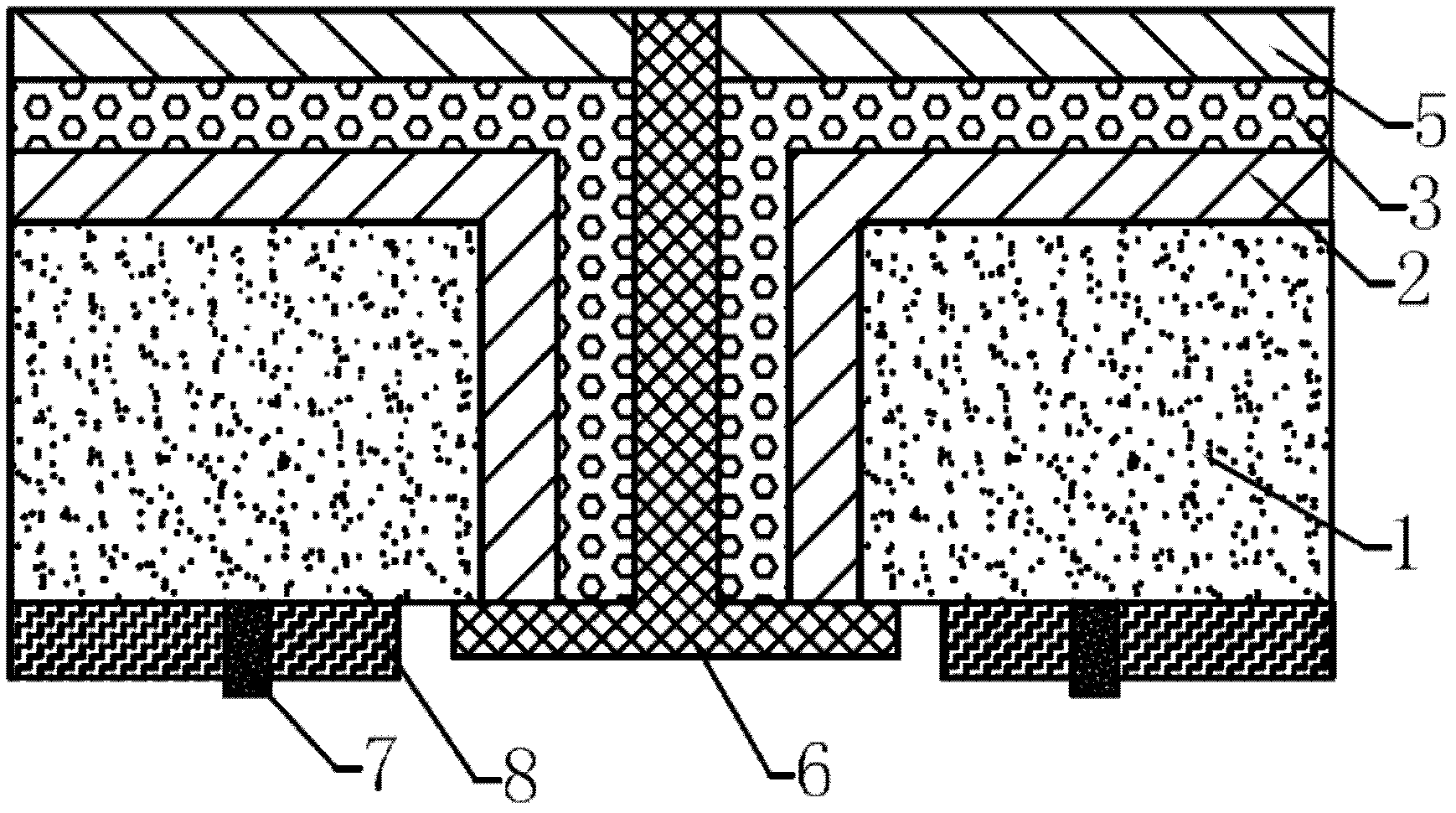
附图9是本发明实施例一中背接触硅太阳能电池的结构示意图。 FIG. 9 is a schematic structural diagram of a back-contact silicon solar cell in Embodiment 1 of the present invention.
其中:1、硅片;2、PN结;3、透明导电ITO薄膜;4、孔洞;5、减反射膜;6、贯孔电极;7、背金属电极;8、背钝化场。 Among them: 1. Silicon wafer; 2. PN junction; 3. Transparent conductive ITO film; 4. Hole; 5. Anti-reflection film; 6. Through-hole electrode; 7. Back metal electrode; 8. Back passivation field.
具体实施方式 Detailed ways
下面结合实施例对本发明作进一步描述: The present invention will be further described below in conjunction with embodiment:
实施例一 Embodiment one
参见图1~9所示,一种背接触硅太阳能电池的制备方法,硅片为p型,包括如下步骤: Referring to Figures 1 to 9, a method for preparing a back-contact silicon solar cell, the silicon wafer is p-type, includes the following steps:
第一步,制绒,其目的是通过化学反应使原本光亮的硅片表面形成凸凹不平的结构以延长光在其表面的传播路径,从而提高硅片1对光的吸收;制绒后硅片的结构示意图如图1所示; The first step is texturing, the purpose of which is to form an uneven structure on the surface of the original bright silicon wafer through chemical reaction to prolong the propagation path of light on its surface, thereby improving the absorption of light by the silicon wafer 1; the silicon wafer after texturing The schematic diagram of the structure is shown in Figure 1;
第二步,在硅片上开设孔洞4,数目为100个,其作用是在孔洞4内可以设置电极将电池片受光面的电流引到电池片的背光面,这样就可以使得电池片的正极和负极都位于电池片的背面;可以采用激光、机械钻孔或化学腐蚀的方式进行开孔;开孔后硅片的结构示意图如图2所示;
The second step is to open
第三步,在硅片受光面丝网印刷含磷浆料,经过800℃热处理后在受光面形成PN结2,同时孔洞4内壁也形成PN结2,再用氢氟酸去除磷硅玻璃;形成PN结后的结构示意图如图3所示;
The third step is to screen-print phosphorus-containing paste on the light-receiving surface of the silicon wafer, and form a
第四步,将500nm厚的透明导电ITO薄膜3镀在PN结上,包括孔洞4内壁和硅片周边,如图4所示;这里透明导电ITO薄膜的目的是代替传统的金属电极,有效地收集传导受光面产生的光电流,而不遮挡入射光;镀ITO薄膜的方法有很多种,比如磁控溅射、有机金属气相沉积、真空蒸发法、化学气相沉积法、喷涂法、溶胶-凝胶法、静电喷雾辅助气相沉积等方法;在本实施例中,ITO薄膜采用磁控溅射的方式镀膜;
The fourth step is to plate a 500nm thick transparent
第五步,周边刻蚀,目的是去除孔硅片周边的透明导电ITO薄膜,避免短路;在本发明实施例中,采用等离子气体对硅片1的侧面刻蚀15min,其中等离子气体中SF6的流量为200scm,O2的流量为30scm,N2的流量为300scm,压力选择为100Pa,辉光功率选择为700W;硅片周边刻蚀后的结构示意图如图5所示; The fifth step, peripheral etching, the purpose is to remove the transparent conductive ITO film around the porous silicon wafer to avoid short circuit; in the embodiment of the present invention, the side of the silicon wafer 1 is etched for 15 minutes with plasma gas, wherein SF in the plasma gas 6 The flow rate of O2 is 200scm, the flow rate of O2 is 30scm, the flow rate of N2 is 300scm, the pressure is selected as 100Pa, and the glow power is selected as 700W; the schematic diagram of the silicon wafer after etching is shown in Figure 5;
第六步,在透明导电ITO薄膜3上镀氮化硅减反射膜5,该膜的作用是减小阳光的反射,最大限度地利用太阳能;在本实施例中,采用PECVD(Plasma Enhanced Chemical Vapor Deposition,等离子体增强化学气相沉积法)在硅片上形成减反射膜;镀减反射膜5后硅片的结构示意图如图6所示;
The sixth step is to coat the silicon
第七步,在硅片非镀减反射膜面上丝网印刷贯孔电极6作为负极;在本实施例中,还可以通过真空蒸发、溅射等方法将贯孔电极6沉积在硅片1上;制备贯孔电极6与透明导电ITO薄膜3电连通,其的结构示意图如图7所示;
The seventh step is to screen-print the through-hole electrode 6 on the non-plated anti-reflection film surface of the silicon wafer as the negative electrode; in this embodiment, the through-hole electrode 6 can also be deposited on the silicon wafer 1 by vacuum evaporation, sputtering, etc. Above; the through-hole electrode 6 is prepared to be electrically connected with the transparent
第八步,在硅片非镀减反射膜面上丝网印刷背金属电极7作为正极;在本实施例中,还可以通过真空蒸发、溅射等方法将背金属电极7沉积在硅片上;制备背电极7的结构示意图如图8所示; In the eighth step, screen print the back metal electrode 7 on the non-plated anti-reflection film surface of the silicon wafer as the positive electrode; in this embodiment, the back metal electrode 7 can also be deposited on the silicon wafer by methods such as vacuum evaporation and sputtering ; The structural schematic diagram of preparing the back electrode 7 is shown in FIG. 8 ;
第九步,在硅片非镀减反射膜面上丝网印刷铝背钝化场8;在本实施例中,还可以通过真空蒸发、溅射等方法将铝背钝化场沉积在硅片上;制备铝背钝化场8的结构示意图如图9所示;其中,背钝化场8与背金属电极7电连通,这两者与贯孔电极6仅靠空气绝缘隔离。 The ninth step is to screen-print the aluminum back passivation field 8 on the non-plated antireflection film surface of the silicon wafer; in this embodiment, the aluminum back passivation field can also be deposited on the silicon wafer by methods such as vacuum evaporation and sputtering. Above; a schematic diagram of the structure of the aluminum back passivation field 8 is shown in FIG. 9 ; wherein, the back passivation field 8 is electrically connected to the back metal electrode 7 , and the two are isolated from the through-hole electrode 6 only by air insulation.
图9是根据本发明方法制备得到的背接触硅太阳能电池的结构示意图。 Fig. 9 is a schematic structural view of a back-contact silicon solar cell prepared according to the method of the present invention.
实施例二 Embodiment two
一种背接触硅太阳能电池的制备方法,硅片为n型,包括如下步骤: A method for preparing a back-contact silicon solar cell, the silicon wafer is n-type, comprising the steps of:
第一步,制绒;其目的是通过化学反应使原本光亮的硅片表面形成凸凹不平的结构以延长光在其表面的传播路径,从而提高硅片对光的吸收; The first step is texturing; its purpose is to form an uneven structure on the surface of the originally bright silicon wafer through chemical reaction to prolong the propagation path of light on its surface, thereby improving the absorption of light by the silicon wafer;
第二步,在硅片上开设孔洞,数目为60个,其作用是在通孔内可以设置电极将电池片受光面的电流引到电池片的背光面,这样就可以使得电池片的正极和负极都位于电池片的背面;在本实施例中,可以采用激光、机械钻孔或化学腐蚀的方式进行开孔; The second step is to open holes on the silicon wafer, the number of which is 60, and its function is to set electrodes in the through holes to lead the current from the light-receiving surface of the battery to the backlight surface of the battery, so that the positive electrode and the backlight of the battery can be connected. The negative electrodes are all located on the back of the battery sheet; in this embodiment, laser, mechanical drilling or chemical etching can be used to open holes;
第三步,在硅片的表面丝网印刷含硼浆料,经过800℃热处理后在受光面形成PN结,同时孔洞内壁也形成PN结,并用氢氟酸去除硼硅玻璃; The third step is to screen-print boron-containing paste on the surface of the silicon wafer, and form a PN junction on the light-receiving surface after heat treatment at 800 ° C. At the same time, a PN junction is also formed on the inner wall of the hole, and the borosilicate glass is removed with hydrofluoric acid;
第四步,将300 nm厚的透明导电SnO2:F薄膜(FTO)镀在PN结上,包括孔洞内壁和硅片周边;这里透明导电SnO2:F薄膜的目的是代替传统的金属电极,有效地收集传导受光面产生的光电流,而不遮挡入射光;镀SnO2:F薄膜的方法有很多种,比如磁控溅射、有机金属气相沉积、真空蒸发法、化学气相沉积法、喷涂法、溶胶-凝胶法、静电喷雾辅助气相沉积等方法;在实施例中,SnO2:F薄膜采用磁控溅射方法镀膜; The fourth step is to plate a 300 nm thick transparent conductive SnO 2 :F film (FTO) on the PN junction, including the inner wall of the hole and the periphery of the silicon wafer; the purpose of the transparent conductive SnO 2 :F film here is to replace the traditional metal electrode, Effectively collect the photocurrent generated by conducting the light-receiving surface without blocking the incident light; there are many methods for coating SnO 2 : F thin films, such as magnetron sputtering, organic metal vapor deposition, vacuum evaporation, chemical vapor deposition, spraying method, sol-gel method, electrostatic spray assisted vapor deposition and other methods; in the embodiment, the SnO 2 :F film is coated by magnetron sputtering method;
第五步,周边刻蚀;目的是去除周边的透明导电SnO2:F薄膜和PN结,避免短路;在实施例中,采用等离子气体对硅片的侧面刻蚀15min,其中等离子气体中SF6的流量为200scm,O2的流量为30scm,N2的流量为300scm,压力选择为100Pa,辉光功率选择为700W; The fifth step, peripheral etching; the purpose is to remove the surrounding transparent conductive SnO 2 : F thin film and PN junction, to avoid short circuit; in an embodiment, adopt plasma gas to etch the side of the silicon wafer for 15min, wherein SF in the plasma gas 6 The flow rate of O2 is 200scm, the flow rate of O2 is 30scm, the flow rate of N2 is 300scm, the pressure is 100Pa, and the glow power is 700W;
第六步,采用PECVD(Plasma Enhanced Chemical Vapor Deposition,等离子体增强化学气相沉积法)在SnO2:F薄膜上镀二氧化硅减反射膜,该膜的作用是减小阳光的反射,最大限度地利用太阳能;在本实施例中,在硅片上形成减反射膜; The sixth step is to use PECVD (Plasma Enhanced Chemical Vapor Deposition, plasma enhanced chemical vapor deposition method) to coat the silicon dioxide anti-reflection film on the SnO 2 :F film. The function of this film is to reduce the reflection of sunlight and maximize the Utilize solar energy; in this embodiment, form anti-reflection film on silicon chip;
第七步,在硅片非镀减反射膜面上丝网印刷贯孔银电极作为正极;在本实施例中,还可以通过真空蒸发、溅射等方法将贯孔电极沉积在硅片上;制备贯孔电极与透明导电SnO2:F薄膜电学连通; The seventh step is to screen-print a through-hole silver electrode on the non-plated anti-reflection film surface of the silicon wafer as the positive electrode; in this embodiment, the through-hole electrode can also be deposited on the silicon wafer by methods such as vacuum evaporation and sputtering; Prepare the through-hole electrode to be electrically connected with the transparent conductive SnO 2 :F film;
第八步,在硅片非镀减反射膜面上丝网印刷背银电极作为负极;在本实施例中,还可以通过真空蒸发、溅射等方法将背电极沉积在硅片上; In the eighth step, screen print the back silver electrode on the non-plated anti-reflection film surface of the silicon wafer as the negative electrode; in this embodiment, the back electrode can also be deposited on the silicon wafer by methods such as vacuum evaporation and sputtering;
第九步,在硅片非镀减反射膜面进行丝网印刷磷浆掺杂并用PECVD法生长氮化硅,作为复合的背钝化场;其中,复合背钝化层与背银电极电学连通,这两者与贯孔银电极仅靠空气绝缘隔离;即可得到背接触硅太阳能电池。 The ninth step is to screen-print phosphorous paste doping on the non-plated anti-reflection film surface of the silicon wafer and grow silicon nitride by PECVD method as a composite back passivation field; wherein, the composite back passivation layer is electrically connected to the back silver electrode , the two are isolated from the through-hole silver electrode only by air insulation; the back contact silicon solar cell can be obtained.
以上所述仅是本申请的优选实施方式,使本领域技术人员能够理解或实现本申请。对这些实施例的多种修改对本领域的技术人员来说将是显而易见的,本文中所定义的一般原理可以在不脱离本申请的精神或范围的情况下,在其它实施例中实现。因此,本申请将不会被限制于本文所示的这些实施例,而是要符合与本文所公开的原理和新颖特点相一致的最宽的范围。 The above descriptions are only preferred embodiments of the present application, enabling those skilled in the art to understand or implement the present application. Various modifications to these embodiments will be readily apparent to those skilled in the art, and the general principles defined herein may be implemented in other embodiments without departing from the spirit or scope of the application. Therefore, the present application will not be limited to the embodiments shown herein, but is to be accorded the widest scope consistent with the principles and novel features disclosed herein.
Claims (10)
Priority Applications (1)
| Application Number | Priority Date | Filing Date | Title |
|---|---|---|---|
| CN2011103740324A CN102403406B (en) | 2011-11-22 | 2011-11-22 | Preparation method for back contact type silicon solar cell |
Applications Claiming Priority (1)
| Application Number | Priority Date | Filing Date | Title |
|---|---|---|---|
| CN2011103740324A CN102403406B (en) | 2011-11-22 | 2011-11-22 | Preparation method for back contact type silicon solar cell |
Publications (2)
| Publication Number | Publication Date |
|---|---|
| CN102403406A true CN102403406A (en) | 2012-04-04 |
| CN102403406B CN102403406B (en) | 2013-12-04 |
Family
ID=45885413
Family Applications (1)
| Application Number | Title | Priority Date | Filing Date |
|---|---|---|---|
| CN2011103740324A Active CN102403406B (en) | 2011-11-22 | 2011-11-22 | Preparation method for back contact type silicon solar cell |
Country Status (1)
| Country | Link |
|---|---|
| CN (1) | CN102403406B (en) |
Cited By (3)
| Publication number | Priority date | Publication date | Assignee | Title |
|---|---|---|---|---|
| CN102629641A (en) * | 2012-04-13 | 2012-08-08 | 苏州阿特斯阳光电力科技有限公司 | Preparation method of back contact silicon solar cell |
| CN102683494A (en) * | 2012-05-27 | 2012-09-19 | 苏州阿特斯阳光电力科技有限公司 | Preparation method of double-sided back contact solar cell |
| CN102694069A (en) * | 2012-05-27 | 2012-09-26 | 苏州阿特斯阳光电力科技有限公司 | Method for preparing N-type double-sided back-contact crystalline silicon solar battery |
Citations (6)
| Publication number | Priority date | Publication date | Assignee | Title |
|---|---|---|---|---|
| CN1813356A (en) * | 2003-06-26 | 2006-08-02 | 日出能源公司 | Back contact solar cell with integrated conductive vias and method of manufacture |
| CN101088159A (en) * | 2004-09-07 | 2007-12-12 | 日出能源公司 | Process and fabrication methods for emitter wrap through back contact solar cells |
| US20110120548A1 (en) * | 2009-11-20 | 2011-05-26 | Industrial Technology Research Institute | Solar cell structure and method of making |
| CN102132423A (en) * | 2008-08-27 | 2011-07-20 | 应用材料股份有限公司 | Back Contact Solar Module |
| WO2011105907A1 (en) * | 2010-02-26 | 2011-09-01 | Stichting Energieonderzoek Centrum Nederland | Method of fabrication of a back-contacted photovoltaic cell, and back-contacted photovoltaic cell made by such a method |
| CN102184976A (en) * | 2011-06-10 | 2011-09-14 | 山东力诺太阳能电力股份有限公司 | Back contact heterojunction solar battery |
-
2011
- 2011-11-22 CN CN2011103740324A patent/CN102403406B/en active Active
Patent Citations (6)
| Publication number | Priority date | Publication date | Assignee | Title |
|---|---|---|---|---|
| CN1813356A (en) * | 2003-06-26 | 2006-08-02 | 日出能源公司 | Back contact solar cell with integrated conductive vias and method of manufacture |
| CN101088159A (en) * | 2004-09-07 | 2007-12-12 | 日出能源公司 | Process and fabrication methods for emitter wrap through back contact solar cells |
| CN102132423A (en) * | 2008-08-27 | 2011-07-20 | 应用材料股份有限公司 | Back Contact Solar Module |
| US20110120548A1 (en) * | 2009-11-20 | 2011-05-26 | Industrial Technology Research Institute | Solar cell structure and method of making |
| WO2011105907A1 (en) * | 2010-02-26 | 2011-09-01 | Stichting Energieonderzoek Centrum Nederland | Method of fabrication of a back-contacted photovoltaic cell, and back-contacted photovoltaic cell made by such a method |
| CN102184976A (en) * | 2011-06-10 | 2011-09-14 | 山东力诺太阳能电力股份有限公司 | Back contact heterojunction solar battery |
Cited By (5)
| Publication number | Priority date | Publication date | Assignee | Title |
|---|---|---|---|---|
| CN102629641A (en) * | 2012-04-13 | 2012-08-08 | 苏州阿特斯阳光电力科技有限公司 | Preparation method of back contact silicon solar cell |
| CN102629641B (en) * | 2012-04-13 | 2014-08-06 | 苏州阿特斯阳光电力科技有限公司 | Preparation method of back contact silicon solar cell |
| CN102683494A (en) * | 2012-05-27 | 2012-09-19 | 苏州阿特斯阳光电力科技有限公司 | Preparation method of double-sided back contact solar cell |
| CN102694069A (en) * | 2012-05-27 | 2012-09-26 | 苏州阿特斯阳光电力科技有限公司 | Method for preparing N-type double-sided back-contact crystalline silicon solar battery |
| CN102694069B (en) * | 2012-05-27 | 2015-05-20 | 苏州阿特斯阳光电力科技有限公司 | Method for preparing N-type double-sided back-contact crystalline silicon solar battery |
Also Published As
| Publication number | Publication date |
|---|---|
| CN102403406B (en) | 2013-12-04 |
Similar Documents
| Publication | Publication Date | Title |
|---|---|---|
| CN102208486B (en) | Preparation method of MWT (Metal Wrap Through) solar cell | |
| TWI718703B (en) | Solar cell and manufacturing method thereof | |
| KR101000064B1 (en) | Heterojunction solar cell and its manufacturing method | |
| CN102623517B (en) | Back contact type crystalline silicon solar cell and production method thereof | |
| CN102468365B (en) | Manufacturing method of double-sided solar cell | |
| CN102064216A (en) | Novel crystalline silicon solar cell and manufacturing method thereof | |
| CN101882650A (en) | Preparation method of solar cell with charge buried layer | |
| CN101651163B (en) | Thin film type solar cell and method for manufacturing the same | |
| JP3205613U (en) | Heterojunction solar cell structure | |
| CN102956723B (en) | A kind of solar cell and preparation method thereof | |
| CN108666376A (en) | A kind of p-type back contacts solar cell and preparation method thereof | |
| CN102185030A (en) | Preparation method of back contact HIT solar battery based on N-type silicon wafer | |
| CN118658895B (en) | Heterojunction solar cell and preparation method thereof, photovoltaic module | |
| KR101612133B1 (en) | Metal Wrap Through type solar cell and method for fabricating the same | |
| CN120603382A (en) | Hybrid passivated back contact solar cell and preparation method thereof | |
| CN111524982A (en) | Solar cell | |
| CN108461554A (en) | Full back-contact heterojunction solar battery and preparation method thereof | |
| CN102403406B (en) | Preparation method for back contact type silicon solar cell | |
| CN202977438U (en) | Full back contact crystalline silicon cell | |
| JP5645734B2 (en) | Solar cell element | |
| CN202076297U (en) | Back contact HIT solar cell structure based on P-type silicon chip | |
| CN102403404A (en) | Preparation method for back contact type photovoltaic cell | |
| CN104900730A (en) | Gold nanoparticle surface plasmon polariton-based crystalline silicon heterojunction with intrinsic thin-layer (HIT) solar cell | |
| CN210156405U (en) | Heterojunction cell structure with hydrogen annealed TCO conductive film | |
| TWI415272B (en) | Method for manufacturing point contact of solar cell back surface |
Legal Events
| Date | Code | Title | Description |
|---|---|---|---|
| C06 | Publication | ||
| PB01 | Publication | ||
| C10 | Entry into substantive examination | ||
| SE01 | Entry into force of request for substantive examination | ||
| C14 | Grant of patent or utility model | ||
| GR01 | Patent grant | ||
| CP01 | Change in the name or title of a patent holder | ||
| CP01 | Change in the name or title of a patent holder |
Address after: 215129 Suzhou high tech Zone, Jiangsu Province, Lu Shan Road, No. 199, No. Co-patentee after: Artes sunshine Power Group Co. Ltd. Patentee after: Suzhou Canadian Solar Inc. Address before: 215129 Suzhou high tech Zone, Jiangsu Province, Lu Shan Road, No. 199, No. Co-patentee before: Canadian (China) Investment Co., Ltd. Patentee before: Suzhou Canadian Solar Inc. |
|
| CP03 | Change of name, title or address | ||
| CP03 | Change of name, title or address |
Address after: No. 199, deer mountain road, Suzhou high tech Zone, Jiangsu Province Patentee after: CSI Cells Co.,Ltd. Patentee after: Atlas sunshine Power Group Co.,Ltd. Address before: 215129 199 deer Road, Suzhou hi tech Development Zone, Jiangsu, Suzhou Patentee before: CSI Cells Co.,Ltd. Patentee before: CSI SOLAR POWER GROUP Co.,Ltd. |