CN1053788A - Pyridyloxypyrimidine derivatives, process for their preparation, and herbicide compositions containing the derivatives as active ingredients - Google Patents
Pyridyloxypyrimidine derivatives, process for their preparation, and herbicide compositions containing the derivatives as active ingredients Download PDFInfo
- Publication number
- CN1053788A CN1053788A CN91100612A CN91100612A CN1053788A CN 1053788 A CN1053788 A CN 1053788A CN 91100612 A CN91100612 A CN 91100612A CN 91100612 A CN91100612 A CN 91100612A CN 1053788 A CN1053788 A CN 1053788A
- Authority
- CN
- China
- Prior art keywords
- represented
- formyl
- acetal
- structural formula
- group
- Prior art date
- Legal status (The legal status is an assumption and is not a legal conclusion. Google has not performed a legal analysis and makes no representation as to the accuracy of the status listed.)
- Pending
Links
Classifications
-
- C—CHEMISTRY; METALLURGY
- C07—ORGANIC CHEMISTRY
- C07D—HETEROCYCLIC COMPOUNDS
- C07D401/00—Heterocyclic compounds containing two or more hetero rings, having nitrogen atoms as the only ring hetero atoms, at least one ring being a six-membered ring with only one nitrogen atom
- C07D401/02—Heterocyclic compounds containing two or more hetero rings, having nitrogen atoms as the only ring hetero atoms, at least one ring being a six-membered ring with only one nitrogen atom containing two hetero rings
- C07D401/12—Heterocyclic compounds containing two or more hetero rings, having nitrogen atoms as the only ring hetero atoms, at least one ring being a six-membered ring with only one nitrogen atom containing two hetero rings linked by a chain containing hetero atoms as chain links
-
- A—HUMAN NECESSITIES
- A01—AGRICULTURE; FORESTRY; ANIMAL HUSBANDRY; HUNTING; TRAPPING; FISHING
- A01N—PRESERVATION OF BODIES OF HUMANS OR ANIMALS OR PLANTS OR PARTS THEREOF; BIOCIDES, e.g. AS DISINFECTANTS, AS PESTICIDES OR AS HERBICIDES; PEST REPELLANTS OR ATTRACTANTS; PLANT GROWTH REGULATORS
- A01N43/00—Biocides, pest repellants or attractants, or plant growth regulators containing heterocyclic compounds
- A01N43/48—Biocides, pest repellants or attractants, or plant growth regulators containing heterocyclic compounds having rings with two nitrogen atoms as the only ring hetero atoms
- A01N43/54—1,3-Diazines; Hydrogenated 1,3-diazines
Landscapes
- Chemical & Material Sciences (AREA)
- Organic Chemistry (AREA)
- Life Sciences & Earth Sciences (AREA)
- Agronomy & Crop Science (AREA)
- Pest Control & Pesticides (AREA)
- Plant Pathology (AREA)
- Health & Medical Sciences (AREA)
- Engineering & Computer Science (AREA)
- Dentistry (AREA)
- General Health & Medical Sciences (AREA)
- Wood Science & Technology (AREA)
- Zoology (AREA)
- Environmental Sciences (AREA)
- Agricultural Chemicals And Associated Chemicals (AREA)
- Plural Heterocyclic Compounds (AREA)
Abstract
由以下结构式(I)表示的吡啶基氧嘧啶衍生物:Pyridyloxypyrimidine derivatives represented by the following structural formula (I):
[I] 其中R表示甲酰基或由 表示的乙缩醛基,R1和 R2相同或不同,并各自表示一个具有1-4个碳原子 的烷基,或者R1与R2偶合在一起并表示一个具有 2-3个碳原子的亚烷基R3;该衍生物的制备方法以 及含有一种或多种该衍生物作为有效成分的除草剂 组合物。 [I] wherein R represents formyl or by represents an acetal group, R 1 and R 2 are the same or different, and each represent an alkyl group with 1-4 carbon atoms, or R 1 and R 2 are coupled together and represent an alkyl group with 2-3 carbon atoms The alkylene group R 3 ; the preparation method of the derivative and the herbicide composition containing one or more of the derivative as an active ingredient.
Description
本发明涉及新的吡啶基氧嘧啶衍生物,其制备方法以及含有一种或多种这些衍生物作为活性成分的除草剂组合物。The present invention relates to novel pyridyloxypyrimidine derivatives, processes for their preparation and herbicidal compositions containing one or more of these derivatives as active ingredients.
例如,在日本专利公开No.000084/1989、日本专利公开No.210202/1989和日本专利公开No.250378/1989中所公开的,已知在2-位置上含有一个吡啶基氧基的嘧啶衍生物具有除草活性。For example, as disclosed in Japanese Patent Laid-Open No. 000084/1989, Japanese Patent Laid-Open No. 210202/1989 and Japanese Patent Laid-Open No. 250378/1989, it is known that pyridyloxy derivatives containing a pyridyloxy group at the 2-position have herbicidal activity.
然而,在这些公开文献中所述的化合物限于在吡啶环上含有羧酸基或基团或其酯或酯类作为取代基的那些化合物,而其它取代基在上述公开文献中根本没有研究。此外,这些化合物伴随有实际问题,当用作除草剂时,它们对某些作物有损害并且没有足够的选择性。However, the compounds described in these publications are limited to those containing a carboxylic acid group or group or its ester or esters as a substituent on the pyridine ring, and other substituents are not investigated at all in the above publications. Furthermore, these compounds are accompanied by practical problems in that they are damaging to certain crops and not sufficiently selective when used as herbicides.
本发明为了克服上述问题继续进行了广泛的研究。结果,发现特殊结构的吡啶基氧嘧啶衍生物具有优良的除草作用并且用于作物,如大豆(Glycine max)、棉花(Gossypium indicum)和玉米(Zea maize)具有优良的可靠性。The present inventors have continued extensive research in order to overcome the above-mentioned problems. As a result, it was found that pyridyloxypyrimidine derivatives of special structure have excellent herbicidal action and are used in crops such as soybean (Glycine max), cotton (Gossypium indicum) and corn (Zea maize) with excellent reliability.
本发明的第一个目的是提供新的吡啶基氧嘧啶衍生物。The first object of the present invention is to provide novel pyridyloxypyrimidine derivatives.
本发明的第二个目的是提供一种制备吡啶基氧嘧啶衍生物的方法。The second object of the present invention is to provide a method for preparing pyridyloxypyrimidine derivatives.
本发明的第三个目的是提供选择的除草剂组合物,这些组合物对杂草可显示优良的除草作用而对经济作物无损害。A third object of the present invention is to provide selected herbicidal compositions which can exhibit excellent herbicidal effects on weeds without damage to commercial crops.
本发明新的化合物是由下式〔Ⅰ〕表示的吡啶基氧嘧啶衍生物:The novel compounds of the present invention are pyridyloxypyrimidine derivatives represented by the following formula [I]:

其中R指甲酰基或由 
在本发明中,上述吡啶基氧嘧啶衍生物可以用以下方式制备。In the present invention, the above-mentioned pyridyloxypyrimidine derivatives can be produced in the following manner.
在式〔Ⅰ〕的吡啶基氧嘧啶衍生物情况下,其中R表示甲酰基,即由下式表示的2-(2-甲酰基-3-吡啶基氧)-4,6-二甲氧基嘧啶:In the case of pyridyloxypyrimidine derivatives of formula [I], wherein R represents formyl, that is, 2-(2-formyl-3-pyridyloxy)-4,6-dimethoxy represented by Pyrimidine:
该化合物可通过下述方法A和B中任一方法得到:This compound can be obtained by any one of the following methods A and B:
方法AMethod A
由下式〔Ⅲ〕表示的2-甲酰基-3-羟基吡啶:2-formyl-3-hydroxypyridine represented by the following formula [III]:
和由下式〔Ⅳ〕表示的2-卤-4,6-二甲氧基嘧啶:and 2-halo-4,6-dimethoxypyrimidine represented by the following formula [IV]:
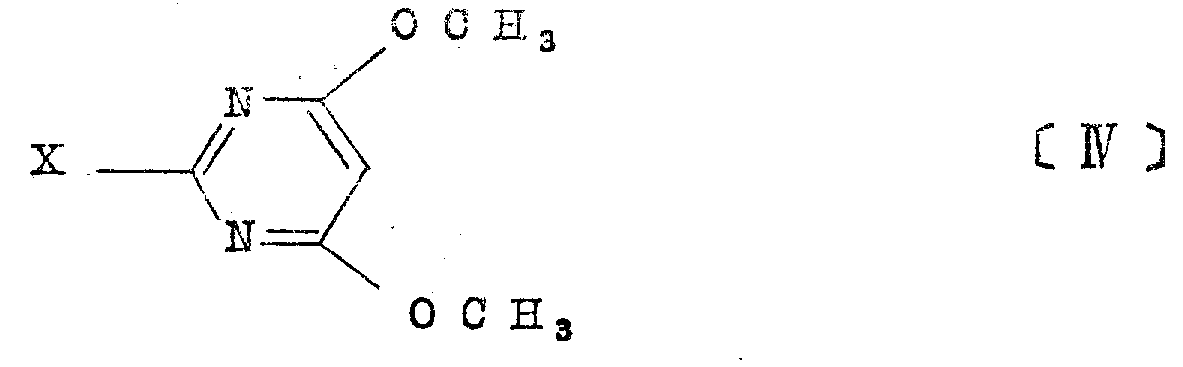
(其中X表示氯、溴或碘原子)在碱存在下反应。(where X represents chlorine, bromine or iodine atom) in the presence of a base to react.
方法BMethod B
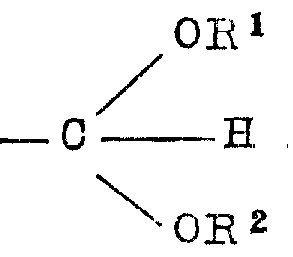
由式〔Ⅲ〕表示的2-甲酰基-3-羟基吡啶中的甲酰基转化成由 
3-羟基-2-吡啶羧基缩醛在碱存在下与式〔Ⅳ〕的2-卤-4,6-二甲氧基嘧啶反应,得到由下式〔Ⅵ〕表示的3-(2-嘧啶基氧)-2-吡啶羧基缩醛:3-hydroxyl-2-pyridine carboxyl acetal reacts with 2-halogen-4,6-dimethoxypyrimidine of formula [IV] in the presence of a base to obtain 3-(2-pyrimidine represented by the following formula [VI] Oxygen)-2-pyridinecarboxy acetal:
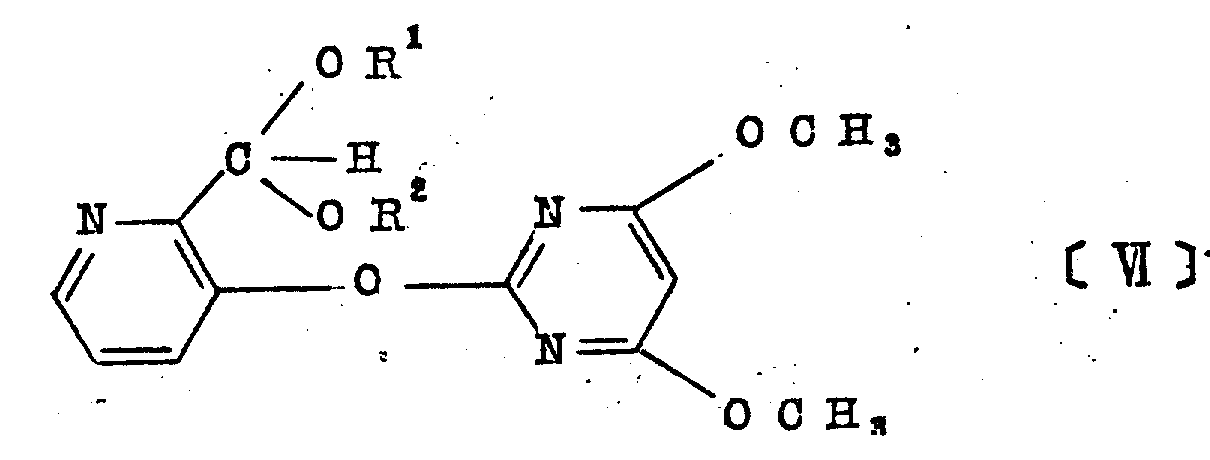
然后,3-(2-嘧啶基氧)-2-吡啶羧基缩醛的乙缩醛基转化成一个甲酰基。Then, the acetal group of the 3-(2-pyrimidinyloxy)-2-pyridinecarboxy acetal is converted into a formyl group.
另一方面,在式〔Ⅰ〕的吡啶基氧嘧啶衍生物(其中R表示一个乙缩醛基),即由式〔Ⅵ〕表示的3-(2-嘧啶基氧)-2-吡啶羧基缩醛的情况下,该化合物可通过以下方法C和D中任一方法得到。On the other hand, in the pyridyloxypyrimidine derivatives of formula [I] (wherein R represents an acetal group), that is, 3-(2-pyrimidinyloxy)-2-pyridine carboxycondensate represented by formula [VI] In the case of an aldehyde, the compound can be obtained by either of methods C and D below.
方法CMethod C
如上面方法B中所述,由式〔Ⅲ〕的2-甲酰基-3-羟基吡啶衍生的并由式〔Ⅴ〕表示的3-羟基-2-吡啶羧基缩醛与式〔Ⅳ〕的2-卤-4,6-二甲氧基吡啶在碱存在下反应。As described in the above method B, 3-hydroxy-2-pyridine carboxyl acetal derived from 2-formyl-3-hydroxypyridine of formula [III] and represented by formula [V] is combined with 2 of formula [IV] - Halo-4,6-dimethoxypyridine reacts in the presence of a base.
方法DMethod D
将由上述方法A得到并由式〔Ⅱ〕表示的2-(2-甲酰基-3-吡啶基氧)-4,6-二甲氧基嘧啶的甲酰基转化成由 表示的乙缩醛基得到目的化合物。The formyl group of 2-(2-formyl-3-pyridyloxy)-4,6-dimethoxypyrimidine obtained by the above method A and represented by formula [II] is converted into The indicated acetal group yields the desired compound.
本发明的选择性除草剂组合物含有一种或多种式〔Ⅰ〕所表示的吡啶基氧嘧啶衍生物作为活性成分。The selective herbicidal composition of the present invention contains one or more pyridyloxypyrimidine derivatives represented by the formula [I] as an active ingredient.
本发明的除草剂组合物以低的使用比例对在农业上引起麻烦的多种杂草显示出显著的除草活性,并具有广泛的除草范围。而且,它们可以对旱地的经济作物,如玉米、大豆和棉花非常安全地使用。它们显示出杰出的选择性。它们作为选择性除草剂组合物的性能优于常规的除草剂组合物。而且它们可以通过单独处理控制范围直到多年生难处理杂草的多种杂草而没有失效,从而是非常有用的除草剂组合物。The herbicidal composition of the present invention exhibits remarkable herbicidal activity against various weeds causing troubles in agriculture at a low use rate, and has a wide herbicidal range. Also, they can be used very safely on dryland commercial crops such as corn, soybeans and cotton. They show outstanding selectivity. Their performance as selective herbicidal compositions is superior to conventional herbicidal compositions. Furthermore, they can be used as very useful herbicide compositions by individually treating a variety of weeds ranging from control to perennial intractable weeds without failure.
在式〔Ⅰ〕中R表示 
在R1和R2偶合在一起以表示一个亚烷基R3时,该亚烷基的特定实例包括乙烯、丙烯和甲基乙烯基团。When R1 and R2 are coupled together to represent an alkylene group R3 , specific examples of the alkylene group include ethylene, propylene and methylvinyl groups.
本发明化合物的制备方法可由下面反应图所概括:The preparation method of compound of the present invention can be summarized by following reaction scheme:
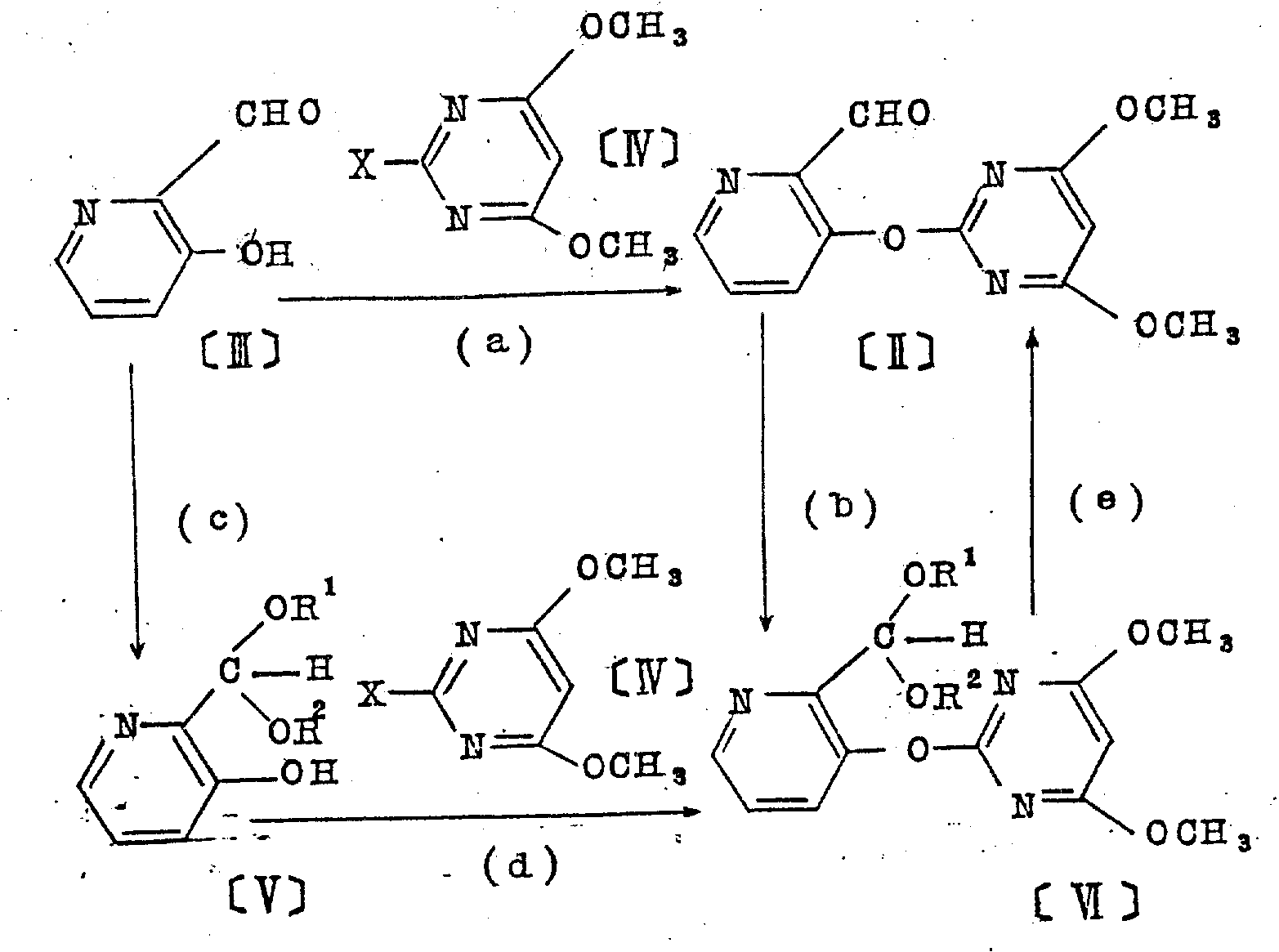
即式〔Ⅱ〕所表示的2-(2-甲酰基-3-吡啶基氧)-4,6-二甲氧基嘧啶可通过步骤(a)(方法A)或通过步骤(c)→(d)→(e)(方法B)制备。另一方面,由式〔Ⅵ〕所表示的每个3-(2-嘧啶基氧)-2-吡啶羧基缩醛可通过步骤(c)→(d)(方法c)或步骤(a)→(b)(方法D)得到。That is, 2-(2-formyl-3-pyridyl oxygen)-4,6-dimethoxypyrimidine represented by formula (II) can be passed through step (a) (method A) or by step (c)→( d) → (e) (Method B) Preparation. On the other hand, each 3-(2-pyrimidinyloxy)-2-pyridinecarboxy acetal represented by the formula [VI] can be obtained by step (c) → (d) (method c) or step (a) → (b) (method D) obtained.
上述每个步骤将在后面详尽描述。Each of the above steps will be described in detail later.
步骤(a)和(d)Steps (a) and (d)
步骤(a)和(d)在完全相同的条件下进行。Steps (a) and (d) are carried out under exactly the same conditions.
化合物〔Ⅱ〕和〔Ⅵ〕可各自通过将相应由式〔Ⅶ〕表示的3-羟基吡啶:Compounds [II] and [VI] can be obtained by preparing the corresponding 3-hydroxypyridine represented by the formula [VII]:

(其中R具有式〔Ⅰ〕所定义的相同含义,当R表示一个甲酰基时,表示化合物〔Ⅲ〕,当R表示一个乙缩醛基时,是指化合物〔V〕)与由下式〔Ⅳ〕表示的2-卤-4,6-二甲氧基嘧啶一起:(wherein R has the same meaning defined by formula [I], when R represents a formyl group, it represents compound [III], when R represents an acetal group, it refers to compound [V]) and by the following formula [ Ⅳ] together with 2-halo-4,6-dimethoxypyrimidines:

(其中X表示氯、溴或碘原子)在惰性溶剂中,在碱存在下,在50℃至溶剂的沸点温度范围内,经1-10小时加热制备。(where X represents a chlorine, bromine or iodine atom) prepared by heating in an inert solvent in the presence of a base at a temperature ranging from 50°C to the boiling point of the solvent for 1-10 hours.
化合物〔Ⅲ〕可通过Journal of American Chemical Society,81,3933(1959)所公开的方法制备,而化合物〔Ⅴ〕可由化合物〔Ⅲ〕通过下面要描述的步骤(C)得到。Compound [III] can be produced by the method disclosed in Journal of American Chemical Society, 81, 3933 (1959), and compound [V] can be obtained from compound [III] by the step (C) to be described below.
碱的例证包括碱金属,如金属钠和金属钾;碱金属氢氧化物,如氢氧化钠和氢氧化钾;碱金属碳酸盐,如碳酸钠和碳酸钾。Examples of the base include alkali metals such as metal sodium and metal potassium; alkali metal hydroxides such as sodium hydroxide and potassium hydroxide; alkali metal carbonates such as sodium carbonate and potassium carbonate.
典型的惰性溶剂包括芳烃类,如苯、甲苯和二甲苯、;醚类,如四氢呋喃、二噁烷和二甘醇二甲醚;酮类,如丙酮和甲基乙基酮;非质子极性溶剂类,如二甲基甲酰胺、二甲基乙酰胺、二甲基咪唑啉酮和二甲亚砜;乙腈和水。Typical inert solvents include aromatics, such as benzene, toluene, and xylene; ethers, such as tetrahydrofuran, dioxane, and diglyme; ketones, such as acetone and methyl ethyl ketone; aprotic polar Solvents such as dimethylformamide, dimethylacetamide, dimethylimidazolinone, and dimethylsulfoxide; acetonitrile and water.
步骤(b)和(c)Steps (b) and (c)
步骤(b)和(c)在完全相同的条件下进行。通常,可完全应用将甲酰基转化成乙缩醛基的方法。这些方法下面将专门描述。Steps (b) and (c) are carried out under exactly the same conditions. In general, methods for converting formyl groups to acetal groups are fully applicable. These methods are specifically described below.
(ⅰ)在酸催化剂存在下使醇反应的方法:(i) A method of reacting alcohols in the presence of an acid catalyst:
在酸存在下使相应的醇反应。醇可以从其化学计算量至大过量范围的量使用,后者包括作溶剂所用的部分。反应溶剂的例证包括芳烃类,如苯、甲苯和二甲苯;醚类,如四氢呋喃、二噁烷和二甘醇二甲醚;非质子极性溶剂,如二甲基甲酰胺、二甲基乙酰胺、二甲基咪唑啉酮和二甲亚砜和乙腈。The corresponding alcohols are reacted in the presence of acids. Alcohols can be used in amounts ranging from their stoichiometric amounts to large excesses, the latter including the portion used as solvent. Examples of reaction solvents include aromatic hydrocarbons such as benzene, toluene, and xylene; ethers such as tetrahydrofuran, dioxane, and diglyme; aprotic polar solvents such as dimethylformamide, dimethylethyl ether, and amides, dimethylimidazolinone and dimethyl sulfoxide and acetonitrile.
作为醇使用的二羟醇,如乙二醇或丙二醇可以将甲酰基转化成环乙缩醛基,其中 
酸的例证包括无机酸,如盐酸和硫酸;以及有机磺酸类,如甲磺酸、苯磺酸和对甲苯磺酸。反应温度可以从0℃至沸点范围内。然而,合乎要求的是在从20℃至沸点范围内进行反应。尽管反应时间根据反应温度而变化,但通常在1-10小时内反应可以达到完全。Illustrative acids include inorganic acids such as hydrochloric acid and sulfuric acid; and organic sulfonic acids such as methanesulfonic acid, benzenesulfonic acid and p-toluenesulfonic acid. The reaction temperature may range from 0°C to boiling point. However, it is desirable to conduct the reaction in the range from 20°C to the boiling point. Although the reaction time varies depending on the reaction temperature, the reaction is usually completed within 1 to 10 hours.
(ⅱ)使原甲酸酯反应的方法:(ii) Method for reacting orthoformate:
也可以通过使相应的原甲酸酯反应很容易地得到乙缩醛。原甲酸酯可以过量使用,包括作为溶剂使用的部分,或相应的醇作为溶剂也可使用。在某些情况下也可使用对反应惰性的其它溶剂。在许多场合,通过添加弱酸性物质,如氯化铵作为催化剂可以使反应平稳地进行。尽管反应温度可以从0℃至沸点范围内变动,但合乎要求的是在从50℃至沸点的温度下进行反应。反应通常在2-8小时内达到完全。(ⅲ)缩醛转移作用:Acetals can also be readily obtained by reacting the corresponding orthoformates. The orthoformate may be used in excess, including the portion used as solvent, or the corresponding alcohol may also be used as solvent. Other solvents that are inert to the reaction can also be used in some cases. In many occasions, the reaction can be carried out smoothly by adding a weakly acidic substance, such as ammonium chloride, as a catalyst. Although the reaction temperature may range from 0°C to the boiling point, it is desirable to conduct the reaction at a temperature from 50°C to the boiling point. The reaction usually goes to completion within 2-8 hours. (iii) Acetal transfer:
为了得到不对称的乙缩醛,在由方法(ⅰ)或(ⅱ)得到的对称乙缩醛上进行缩醛转移作用。即在酸存在下使对称乙缩醛与高级醇反应可得到一种不对称乙缩醛,其中对称乙缩醛中的一个烷氧基被取代。作为催化剂所用的酸与上述方法(ⅰ)中所提到的酸相类似。相应的醇可以过量使用。作为一种可选择方案,也可使用对反应惰性的溶剂。也可使用与上述方法(ⅰ)中所提到的类似的溶剂作溶剂。在这一反应中,也副产出其中起始对称乙缩醛的两个烷氧基都被取代的对称乙缩醛。反应温度可以在20℃至沸点范围内,而反应时间可以在2-10小时范围内。To obtain the asymmetric acetal, transacetalization is carried out on the symmetrical acetal obtained by process (i) or (ii). That is, asymmetric acetals can be obtained by reacting symmetrical acetals with higher alcohols in the presence of acids, in which an alkoxy group in the symmetrical acetals is substituted. The acids used as catalysts are similar to those mentioned above in the process (i). The corresponding alcohol can be used in excess. As an alternative, solvents that are inert to the reaction can also be used. Solvents similar to those mentioned in the above method (i) can also be used as solvents. In this reaction, symmetric acetals are also by-produced in which both alkoxy groups of the starting symmetric acetal are substituted. The reaction temperature may range from 20°C to the boiling point, and the reaction time may range from 2 to 10 hours.
步骤(e)step (e)
可以使用使乙缩醛转化成其相应的醛的常规反应条件。然而,使用无机酸,如盐酸或硫酸不能得到优良的产率。合乎要求的是在适度条件下同时使用弱酸或N-羟基苯磺酰胺进行反应。特别好的是N-羟基苯磺酰胺。通过将乙缩醛溶解在对反应惰性的含水溶剂中,添加弱酸或N-羟基苯磺酰胺进行反应,然后将反应混合物保持在0-100℃,较好的是20-80℃。反应时间可以在30分钟至5小时范围内,但通常在1-2小时内反应达到完全。Conventional reaction conditions for converting acetals to their corresponding aldehydes may be used. However, good yields cannot be obtained using mineral acids such as hydrochloric acid or sulfuric acid. It is desirable to carry out the reaction simultaneously with a weak acid or N-hydroxybenzenesulfonamide under mild conditions. Particularly preferred is N-hydroxybenzenesulfonamide. The reaction is carried out by dissolving the acetal in an inert aqueous solvent, adding a weak acid or N-hydroxybenzenesulfonamide, and then keeping the reaction mixture at 0-100°C, preferably 20-80°C. The reaction time can range from 30 minutes to 5 hours, but usually the reaction is complete within 1-2 hours.
含有一种或多种由式〔Ⅰ〕所表示的化合物的本发明除草剂组合物对在稻田或旱地中引起麻烦的有害杂草作用非常有效。在稻田中,它们对非常麻烦的禾本科杂草,如稗、稻状粃壳草(Leersia oryzoides)和芦苇;非常麻烦的莎草科杂草,如油莎草、异型莎草、Cyperus seroyinus、麓草、Scirpus nipponicus、木贼状荸荠(Eleocharis kuroguwai)、牛毛毡和Fimbristylis miliacea;非常麻烦的矢尖科杂草,如矮慈菇(Sagittaria pygmaea)、矢尖和窄叶水车前草;以及阔叶杂草,如鸭舌草(Monochoria vaginalis)、分枝节节菜和欧防风显示出非常好的除草效果。在旱地中,它们对阔叶杂草,如繁缕、藜、荠菜、反枝苋、高田菁和青麻;禾本科杂草,如稗、狗尾草、马唐、牛筋草、早熟禾、草原看麦娘、燕麦、野燕麦、匍匐冰草、旱雀麦、狗牙草、匍茎剪股颖、帚状莎草、绢状剪股颖、Singlegrass、秋稷、假高梁、Shattercane和毛野黍;莎草科杂草,如碎米莎草;特别是多年生难处理杂草,如假高梁、Shattercane和鸭茅显示出极好的除草效果。The herbicidal composition of the present invention containing one or more compounds represented by the formula [I] is very effective against harmful weeds causing troubles in paddy fields or dry fields. In paddy fields, they control very troublesome grass weeds such as barnyardgrass, Leersia oryzoides, and reeds; Pinegrass, Scirpus nipponicus, Horsetail water chestnut (Eleocharis kuroguwai), Cattlewort, and Fimbristylis miliacea; very troublesome sagittaria weeds such as Sagittaria pygmaea, sagittaria pygmaea, sagittaria pygmaea, and narrow-leaved water plantain; and Broad-leaved weeds such as Monochoria vaginalis, knotweed and parsnip showed very good weed control. In dry land, they are effective against broad-leaved weeds, such as chickweed, quinoa, shepherd's purse, amaranthus, tamarind and green hemp; grass weeds, such as barnyardgrass, foxtail, crabgrass, goosegrass, bluegrass, prairie Oatmeal, Oats, Wild Oats, Creeping Wheatgrass, Brome, Bermudagrass, Stemgrass, Broom Sedge, Silky Bentgrass, Singlegrass, Autumn Grass, False Sorghum, Shattercane, and Trichosanthes Millet; Cyperaceae weeds, such as sedge; especially perennial difficult-to-manage weeds, such as false sorghum, Shattercane and Dactylis show excellent herbicidal effect.
如从后面试验1中所述的试验结果中将会得知,在对据信是由式〔Ⅰ〕表示的本发明化合物的目标位置的ALS(乙酰乳酸合成酶)的酶含量活性抑制试验中,发现含有一种或多种本发明化合物的除草剂组合物对杂草,如稗、假高梁和狗尾草显示出高度抑制活性。相反,它们对阔叶作物,如豌豆、棉花和花生未显示出抑制活性。这些结果表明,豌豆、棉花、花生等对本发明的除草剂组合物显示出高度耐药性。在罐中试验时,也发现它们对作物,如玉米、大豆、棉花、甜菜、花生、向日葵、油菜、土豆和草地未显出任何损害或甚至任何极为轻微的损害。根据施用的方法,它们也可用于禾本科作物,如小麦、稻、大麦和甘蔗而无任何损害。然而要注意,本发明除草剂组合物的用途不限于这些作物。As will be known from the test results described in Test 1 later, in the enzyme content activity inhibition test of ALS (acetolactate synthase) at the target site of the compound of the present invention believed to be represented by the formula [I] , found that herbicidal compositions containing one or more compounds of the present invention exhibit high inhibitory activity against weeds such as barnyardgrass, false sorghum and foxtail. In contrast, they showed no inhibitory activity against broadleaf crops such as pea, cotton and peanut. These results indicated that pea, cotton, peanut, etc. showed high resistance to the herbicide composition of the present invention. They were also found to show no damage or even any very slight damage to crops such as corn, soybean, cotton, sugar beet, peanut, sunflower, canola, potato and grass when tested in pots. Depending on the method of application, they can also be used on gramineous crops such as wheat, rice, barley and sugar cane without any damage. It should be noted, however, that the use of the herbicidal composition of the present invention is not limited to these crops.
含有一种或多种由式〔Ⅰ〕表示的本发明化合物的除草剂组合物对所有施用方法,如土壤施用、土壤掺合、叶面施用和区域施用都是有效的。它们可以0.01公斤/公顷-10公斤/公顷(以活性成分计)的广范围施用比例使用。然而作为标准,较好的是以0.1公斤/公顷-5公斤/公顷的施用比例使用它们。The herbicidal composition containing one or more compounds of the present invention represented by the formula [I] is effective for all application methods such as soil application, soil incorporation, foliar application and area application. They can be used at a wide range of application rates from 0.01 kg/ha to 10 kg/ha (active ingredient). As a standard, however, it is preferred to use them at an application rate of 0.1 kg/ha to 5 kg/ha.
顺便提一下,本发明的化合物也用作吡啶基氧嘧啶除草剂的中间产品。Incidentally, the compounds of the present invention are also useful as intermediate products of pyridyloxopyrimidine herbicides.
在使用作为除草剂的本发明式〔Ⅰ〕化合物时,它们可以纯净形式施加在要处理的杂草上。然而,通常将它们与惰性液体载体或固体载体混合并形成普通使用的配方形式,如粉末、颗粒、可湿性粉末、乳液或可流性配方。如配方需要,也可添加一种或多种辅助剂。When using the compounds of the formula [I] of the present invention as herbicides, they may be applied in a pure form to the weeds to be treated. Usually, however, they are mixed with an inert liquid carrier or solid carrier and brought into commonly used formulation forms, such as powders, granules, wettable powders, emulsions or flowable formulations. One or more auxiliary agents may also be added as required by the formulation.
只要是可用在常规农业或园艺化学药品中的任何载体,不管是固体或液体,都可使用。所以,对载体没有特殊的限制。Any carrier, whether solid or liquid, can be used as long as it is usable in conventional agricultural or horticultural chemicals. Therefore, there is no particular limitation on the carrier.
典型的固体载体包括无机粉末,如粘土、滑石、膨润土、碳酸钙、硅藻土和白碳;有机粉末,如玉米屑、大豆粉和淀粉;高分子化合物,如石油树脂、聚乙烯醇和聚二醇;尿素和石蜡。例证性液体载体包括多种有机溶剂,如二甲苯、甲基萘和烷基苯;各种油类,如植物油;和水。Typical solid carriers include inorganic powders, such as clay, talc, bentonite, calcium carbonate, diatomaceous earth, and white carbon; organic powders, such as corn flour, soybean flour, and starch; alcohols; urea and paraffin. Exemplary liquid carriers include various organic solvents, such as xylenes, methylnaphthalenes, and alkylbenzenes; various oils, such as vegetable oils; and water.
通常在农业或园艺化学药品中使用的表面活性剂、粘合剂(例如木素磺酸、藻酸、聚乙烯醇、阿拉伯树胶、羧甲基纤维素钠)、稳定剂(例如为防止氧化的酚化合物、硫羟化合物和高级脂肪酸酯类;作为pH调节剂的磷酸盐类;以及在某些场合,光稳定剂类)等等,可单独或结合使用作为辅助剂。在某些场合,也可以掺合工业杀菌剂、防腐剂等以控制细菌和霉菌。Surfactants, binders (such as lignosulfonic acid, alginic acid, polyvinyl alcohol, gum arabic, sodium carboxymethylcellulose), stabilizers (such as Phenolic compounds, thiol compounds and higher fatty acid esters; phosphates as pH regulators; and in some cases, light stabilizers), etc., can be used alone or in combination as auxiliary agents. In some cases, industrial fungicides, preservatives, etc. can also be blended to control bacteria and mold.
如果需要可以单独或结合使用非离子、阴离子、阳离子和两性表面活性剂作为典型的表面活性剂。可以使用那些通过将环氧乙烷(例如商品名“X-77”或商品名“Neugen EA80”)或氧化丙烯添加到烷基酚类、高级醇类、烷基萘酚类、高级脂肪酸类、脂肪酸酯类等中而得到的作为较佳的非离子型表面活性剂。较佳的典型阴离子表面活性剂包括烷基磺酸盐类(例如商品名“Neopelex”)、烷基硫酸酯、磷酸酯以及烷基酚类、烷基萘酚类、高级醇类、高级脂肪酸类、脂肪酸酯类等。木素磺酸盐类(例如商品名“Sunekis”)也是较佳的实例。Nonionic, anionic, cationic and amphoteric surfactants may be used alone or in combination as typical surfactants if desired. Those obtained by adding ethylene oxide (such as trade name "X-77" or trade name "Neugen EA80") or propylene oxide to alkylphenols, higher alcohols, alkylnaphthols, higher fatty acids, Fatty acid esters and the like are preferred nonionic surfactants. Preferred typical anionic surfactants include alkyl sulfonates (such as the trade name "Neopelex"), alkyl sulfates, phosphates, and alkylphenols, alkylnaphthols, higher alcohols, higher fatty acids , fatty acid esters, etc. Lignosulfonates such as the trade name "Sunekis" are also preferred examples.
在本发明除草剂组合物中每个式〔Ⅰ〕化合物的含量根据配方而变化。通常,在粉末中可为0.05-20%(重量),在可湿性粉末中为1-50%(重量),在颗粒中为0.05-15%(重量),在乳液中为1-50%(重量),在可流性配方中为1-50%(重量)和在无水可流性配方中为1-50%(重量)。较好的是,在粉末中可为0.5-5%(重量),在可湿性粉末中为10-40%(重量),在颗粒中为0.5-8%(重量),在乳液中为5-20%(重量),在可流性配方中为10-30%(重量),在无水可流性配方中为10-40%(重量)。The content of each compound of the formula [I] in the herbicidal composition of the present invention varies depending on the formulation. Typically, it can be 0.05-20% (by weight) in powders, 1-50% (by weight) in wettable powders, 0.05-15% (by weight) in granules, and 1-50% (by weight) in emulsions ( weight), 1-50% by weight in flowable formulations and 1-50% by weight in anhydrous flowable formulations. Preferably, it can be 0.5-5% (weight) in powder, 10-40% (weight) in wettable powder, 0.5-8% (weight) in granule, and 5-5% (weight) in emulsion. 20% by weight, 10-30% by weight in flowable formulations, 10-40% by weight in anhydrous flowable formulations.
辅助剂的总含量可为0-80%(重量)。载体的含量为由100%(重量)除去作为活性成分的化合物和辅助剂的含量所得到的值。The total content of adjuvants may be 0-80% by weight. The content of the carrier is a value obtained by excluding the content of the compound as the active ingredient and the auxiliary agent from 100% by weight.
含有一种或多种由式〔Ⅰ〕表示的化合物的本发明除草剂组合物可以和一种或多种其它除草剂或一种或多种农业化学药品,如杀菌剂、杀虫剂和植物生长调节剂、肥料以及土壤改良剂一起配合,更不用说同时联合使用。在一些场合,联合效果可以预料到。The herbicidal composition of the present invention containing one or more compounds represented by formula [I] can be combined with one or more other herbicides or one or more agricultural chemicals such as fungicides, insecticides and plant Growth regulators, fertilizers, and soil conditioners work together, let alone at the same time. In some cases, joint effects can be expected.
此处所用的术语“其它除草剂”可以指含有一种或多种以下化合物作为活性成分的那些除草剂,不过不需要限于这些。The term "other herbicides" as used herein may refer to those herbicides containing one or more of the following compounds as active ingredients, but need not be limited thereto.
3,6-二氯-2-甲氧基苯甲酸(dicamba)3,6-dichloro-2-methoxybenzoic acid (dicamba)
2,5-二氯-3-氨基苯甲酸(amiben)2,5-dichloro-3-aminobenzoic acid (amiben)
4-氯-2,2-二甲基-N-戊酰苯胺(monalide)4-Chloro-2,2-dimethyl-N-pentanoylanilide (monalide)
3,4-二氯-N-丙酰苯胺(Propanil)3,4-Dichloro-N-propionanilide (Propanil)
3,4-二氯-2-甲基丙烯酰基-N-酰苯胺(dicryl)3,4-Dichloro-2-methacryloyl-N-anilide (dicryl)
3,4-二氯环丙烷羧基-N-酰苯胺(Crypromid)3,4-Dichlorocyclopropanecarboxy-N-anilide (Crypromid)
3,4-二氯-2-甲基-N-五酰苯胺(Karsil)3,4-Dichloro-2-methyl-N-pentanilide (Karsil)
N,N-二甲基-2,2-二苯基乙酰胺(diphenamide)N,N-Dimethyl-2,2-diphenylacetamide (diphenamide)
N-萘基邻氨甲酰苯甲酸(naptalam)N-naphthylphthalene (naptalam)
N-(1,1-二甲基苄基)-2-溴-叔丁基-乙酰胺(buromobutide)N-(1,1-Dimethylbenzyl)-2-bromo-tert-butyl-acetamide (buromobutide)
2-苯并噻唑-2-基氧-N-甲基-N-乙酰苯胺-(mefenasate)2-Benzothiazol-2-yloxy-N-methyl-N-acetanilide-(mefenasate)
1,1-二甲基-3-苯脲(fenuron)1,1-Dimethyl-3-phenylurea (fenuron)
3-(4-氯苯基)-1,1-二甲脲(monuron)3-(4-Chlorophenyl)-1,1-dimethylurea (monuron)
3-(4-氯苯基)-1-甲氧基-1-甲脲(monoliuron)3-(4-Chlorophenyl)-1-methoxy-1-methylurea (monoliuron)
1-(2-甲基环己基)-3-苯脲(Siduron)1-(2-Methylcyclohexyl)-3-phenylurea (Siduron)
1,1-二甲基-3-(3-三氟甲基苯基)脲(fluometuron)1,1-Dimethyl-3-(3-trifluoromethylphenyl)urea (fluometuron)
3-(3,4-二氯苯基)-1,1-二甲脲(diuron)3-(3,4-dichlorophenyl)-1,1-dimethylurea (diuron)
3-(3,4-二氯苯基)-1-甲氧基-1-甲脲(linuron)3-(3,4-dichlorophenyl)-1-methoxy-1-methylurea (linuron)
3-(3-氯-4-甲基苯基)-1,1-二甲脲(chlortoluron)3-(3-Chloro-4-methylphenyl)-1,1-dimethylurea (chlortoluron)
3-〔3-〔N-叔丁基氨基甲酰基氧〕苯基〕-1,1-二甲脲(Karbutilate)3-[3-[N-tert-butylcarbamoyloxy]phenyl]-1,1-dimethylurea (Karbutilate)
1-(α,α-二甲基苄基)-3-(4-甲基苯基)脲(dymron)1-(α,α-Dimethylbenzyl)-3-(4-methylphenyl)urea (dymron)
3-(4-异丙基苯基)-1,1-二甲脲(isoproturon)3-(4-isopropylphenyl)-1,1-dimethylurea (isoproturon)
3-(2-苯并噻唑基)-1,3-二甲脲(methabenzthiazuron)3-(2-Benzothiazolyl)-1,3-dimethylurea (methabenzthiazuron)
3-(2-苯并噻唑基)-1-甲脲(benzthiazuron)3-(2-Benzothiazolyl)-1-methylurea (benzthiazuron)
3-(六氢-4,7-亚甲基茚满-5-基)-1,1-二甲脲(noruron)3-(Hexahydro-4,7-methyleneindan-5-yl)-1,1-dimethylurea (noruron)
3-〔5-(1,1-二甲基乙基)-1,3,4-噻重氮-2-基〕-1,3-二甲脲(tebuthiuron)3-[5-(1,1-Dimethylethyl)-1,3,4-thiadiazo-2-yl]-1,3-dimethylurea (tebuthiuron)
3-(5-叔丁基异恶唑-3-基)-1,1-二甲脲(isouron)3-(5-tert-butylisoxazol-3-yl)-1,1-dimethylurea (isouron)
2-氯-4,6-双(乙基氨基)-1,3,5-三嗪(Simazine)2-Chloro-4,6-bis(ethylamino)-1,3,5-triazine (Simazine)
2-氯-4-乙基氨基-6-异丙基氨基1,3,5-三嗪(atrazine)2-Chloro-4-ethylamino-6-isopropylamino 1,3,5-triazine (atrazine)
2-氯-4,6-双(异丙基氨基)-1,3,5-三嗪(propazine)2-Chloro-4,6-bis(isopropylamino)-1,3,5-triazine (propazine)
2-(2-氯-4-乙基氨基-1,3,5-三嗪-6-基-氨基)-2-甲基丙腈(cyanazine)2-(2-Chloro-4-ethylamino-1,3,5-triazin-6-yl-amino)-2-methylpropionitrile (cyanazine)
2-甲氧基-4,6-双(异丙基氨基)-1,3,5-三嗪(prometon)2-methoxy-4,6-bis(isopropylamino)-1,3,5-triazine (prometon)
2-甲硫基-4,6-双(乙基氨基)-1,3,5-三嗪(Simetryne)2-Methylthio-4,6-bis(ethylamino)-1,3,5-triazine (Simetryne)
2-甲硫基-4,6-双(异丙基氨基)-1,3,5-三嗪(prometryne)2-Methylthio-4,6-bis(isopropylamino)-1,3,5-triazine (prometryne)
2-甲硫基-4-甲基氨基-6-异丙基氨基-1,3,5-三嗪(ametryne)2-Methylthio-4-methylamino-6-isopropylamino-1,3,5-triazine (atryne)
2-甲硫基-4-异丙基氨基-6-甲基氨基-1,3,5-三嗪(desmetryne)2-Methylthio-4-isopropylamino-6-methylamino-1,3,5-triazine (desmetryne)
4-氨基-6-叔丁基-3-甲硫基-1,2,3-三嗪-5(4H)-酮(metribuzin)4-Amino-6-tert-butyl-3-methylthio-1,2,3-triazin-5(4H)-one (metribuzin)
3-环己基-6-二甲基氨基-1-甲基-1,3,5-三嗪-2,4-(1H,3H)-二酮(hexazinone)3-cyclohexyl-6-dimethylamino-1-methyl-1,3,5-triazine-2,4-(1H,3H)-dione (hexazinone)
2-氯-N-异丙基-N-乙酰苯胺(propachlor)2-Chloro-N-isopropyl-N-acetanilide (propachlor)
N-甲氧基甲基-2′,6′-二乙基-2-氯-N-乙酰苯胺(alachlor)N-methoxymethyl-2′,6′-diethyl-2-chloro-N-acetanilide (alachlor)
2-氯-2′,6′-二乙基-N-(丁氧基甲基)乙酰苯胺(butachlor)2-Chloro-2′,6′-diethyl-N-(butoxymethyl)acetanilide (butachlor)
2-氯-2′-乙基-6′-甲基-N-(2-甲氧基-1-甲基乙基)乙酰苯胺(metolachlor)2-Chloro-2′-ethyl-6′-methyl-N-(2-methoxy-1-methylethyl)acetanilide (metolachlor)
N,N-二烯丙基-2-氯乙酰胺(allidochlor)N,N-diallyl-2-chloroacetamide (allidochlor)
2,6-二硝基-N,N-二丙基-4-三氟甲基苯胺(trifluralin)2,6-Dinitro-N,N-dipropyl-4-trifluoromethylaniline (trifluralin)
3,4-二甲基-2,6-二硝基-N-1-乙基丙基苯胺(pendimethalin)3,4-Dimethyl-2,6-dinitro-N-1-ethylpropylaniline (pendimethalin)
2-氯-N-(4-甲氧基-6-甲基-1,3,5-三嗪-2-基-氨基羰基)苯磺酰胺(chlorosulfuron)2-Chloro-N-(4-methoxy-6-methyl-1,3,5-triazin-2-yl-aminocarbonyl)benzenesulfonamide (chlorosulfuron)
甲基2-〔3-(4-甲氧基-6-甲基-1,3,5-三嗪-2-基)脲基磺酰〕苯甲酸酯(metsulfurone-methyl)Methyl 2-[3-(4-methoxy-6-methyl-1,3,5-triazin-2-yl)ureidosulfonyl]benzoate (metsulfurone-methyl)
甲基2-〔3-(4,6-二甲基嘧啶-2-基)脲基磺酰〕苯甲酸酯(Sulfometuron-methyl)Methyl 2-[3-(4,6-dimethylpyrimidin-2-yl)ureidosulfonyl]benzoate (Sulfometuron-methyl)
甲基2-〔3-(4,6-二甲氧基嘧啶-2-基)脲基磺酰〕苯甲酸酯(bensulfuron)Methyl 2-[3-(4,6-dimethoxypyrimidin-2-yl)ureidosulfonyl]benzoate (bensulfuron)
乙基2-〔3-(4-氯-6-甲氧基嘧啶-2-基)脲基磺酰〕苯甲酸酯(chlorinuron)Ethyl 2-[3-(4-chloro-6-methoxypyrimidin-2-yl)ureidosulfonyl]benzoate (chlorinuron)
3-〔(4-甲氧基-6-甲基-1,3,5-三嗪-2-基)脲基磺酰〕-2-噻吩羧酸(thiameturon)3-[(4-Methoxy-6-methyl-1,3,5-triazin-2-yl)ureidosulfonyl]-2-thiophenecarboxylic acid (thiameturon)
异丙胺2-(4-异丙基-4-甲基-5-氧-2-咪唑啉-2-基)烟酸酯(imazapyr)Isopropylamine 2-(4-isopropyl-4-methyl-5-oxo-2-imidazolin-2-yl)nicotinate (Imazapyr)
2-(4-异丙基-4-甲基-5-氧-2-咪唑啉-2-基)-3-喹啉酸(imazaquin)2-(4-Isopropyl-4-methyl-5-oxo-2-imidazolin-2-yl)-3-quinolinic acid (imazaquin)
2-(4-异丙基-4-甲基-5-氧-2-咪唑啉-2-基)-5-乙基-3-吡啶羧酸(imazethapyr)2-(4-Isopropyl-4-methyl-5-oxo-2-imidazolin-2-yl)-5-ethyl-3-pyridinecarboxylic acid (imazethapyr)
甲基2-(4-异丙基-4-甲基-5-氧-2-咪唑啉-2-基)-3(4)-苯甲酸酯(imazamethabenzo)Methyl 2-(4-isopropyl-4-methyl-5-oxo-2-imidazolin-2-yl)-3(4)-benzoate (imazamethabenzo)
3-异丙基-1H-2,1,3-苯并噻唑-4(3H)-酮-2,2-二氧化物(bentazon)3-isopropyl-1H-2,1,3-benzothiazole-4(3H)-one-2,2-dioxide (bentazon)
5-溴-3-仲丁基-6-甲基尿嘧啶(bromacil)5-Bromo-3-sec-butyl-6-methyluracil (bromacil)
3,5-二溴-4-羟基苄腈(bromoxynil)3,5-dibromo-4-hydroxybenzonitrile (bromoxynil)
4-羟基-3,5-碘苄腈(ioxynil)4-Hydroxy-3,5-iodobenzonitrile (ioxynil)
N-(膦酰基甲基)甘氨酸(glyphosate)N-(phosphonomethyl)glycine (glyphosate)
实施例Example
下面将通过如下实施例专门叙述本发明某些化合物的制备The preparation of some compounds of the present invention will be specifically described below through the following examples
实施例1Example 1
4,6-二甲氧基-2-(2-甲酰基-3-吡啶基氧)嘧啶(化合物No.1)的合成〔步骤(a)〕Synthesis of 4,6-Dimethoxy-2-(2-formyl-3-pyridyloxy)pyrimidine (Compound No.1) [Step (a)]
将2-甲酰基-羟基吡啶(12.3克)溶解在100毫升二甲基甲酰胺中,随后以小份额添加4.0克60%的氢化钠。在室温下将形成的混合物搅拌片刻。气泡平息后添加17.5克2-氯-4,6-二甲氧基嘧啶,随后加热至100℃。在相同温度继续加热3小时后,在减压下回收二甲基甲酰胺。在硅胶柱上通过色层分离(溶剂:正己烷/乙酸乙酯=7/3)将残余物分级,由此得到以熔点为96-98℃晶体形式的15克4,6-二甲氧基-2-(2-甲酰基-3-吡啶基氧)嘧啶目的化合物。2-Formyl-hydroxypyridine (12.3 g) was dissolved in 100 ml of dimethylformamide, followed by the addition of 4.0 g of 60% sodium hydride in small portions. The resulting mixture was stirred at room temperature for a while. After the bubbles had subsided, 17.5 g of 2-chloro-4,6-dimethoxypyrimidine were added, followed by heating to 100°C. After continuing heating at the same temperature for 3 hours, dimethylformamide was recovered under reduced pressure. The residue was fractionated by chromatography on a silica gel column (solvent: n-hexane/ethyl acetate = 7/3), thereby obtaining 15 g of 4,6-dimethoxy in the form of crystals with a melting point of 96-98°C -2-(2-Formyl-3-pyridyloxy)pyrimidines.
IR(KBr)(cm-1):2720;1710IR (KBr) (cm -1 ): 2720; 1710
NMR(CDCl3):3.80(6H,s)、5.81(1H,s)、7.59(1H,dd,J=4.3Hz,8.1Hz)、7.68(1H,dd,J=1.6Hz,8.1Hz)、8.71(1H,dd,J=1.6Hz,4.3Hz)、10.15(1H,s)。NMR (CDCl 3 ): 3.80 (6H, s), 5.81 (1H, s), 7.59 (1H, dd, J = 4.3Hz, 8.1Hz), 7.68 (1H, dd, J = 1.6Hz, 8.1Hz), 8.71 (1H, dd, J = 1.6Hz, 4.3Hz), 10.15 (1H, s).
实施例2Example 2
3-(4,6-二甲氧基-2-嘧啶基氧)-2-吡啶羧基醛二甲基缩醛(化合物No.2)的合成〔步骤(b)〕Synthesis of 3-(4,6-dimethoxy-2-pyrimidinyloxy)-2-pyridinecarboxaldehyde dimethyl acetal (compound No.2) [step (b)]
将由53.0克3-(4,6-二甲氧基-2-嘧啶基氧)-2-甲酰基吡啶、30.7克乙基原甲酸酯、0.48克氯化铵和500毫升甲醇组成的混合物于回流点在搅拌下加热5小时。反应混合物冷却到室温后,过滤出沉淀。在减压下浓缩滤液以使得到56.1克3-(4,6-二甲氧基-2-嘧啶基氧)-2-吡啶羧基醛二甲基缩醛(产率:90%)。在硅胶柱上通过色层分离得到提纯的产物。A mixture consisting of 53.0 g of 3-(4,6-dimethoxy-2-pyrimidinyloxy)-2-formylpyridine, 30.7 g of ethyl orthoformate, 0.48 g of ammonium chloride and 500 ml of methanol was The reflux point was heated with stirring for 5 hours. After the reaction mixture was cooled to room temperature, the precipitate was filtered off. The filtrate was concentrated under reduced pressure to obtain 56.1 g of 3-(4,6-dimethoxy-2-pyrimidinyloxy)-2-pyridinecarboxaldehyde dimethyl acetal (yield: 90%). The purified product is obtained by chromatography on a silica gel column.
实施例3Example 3
3-(4,6-二甲氧基-2-嘧啶基氧)-2-吡啶羧基醛异丙基甲基缩醛(化合物No.5)的合成〔缩醛转移作用〕Synthesis of 3-(4,6-dimethoxy-2-pyrimidinyloxy)-2-pyridinecarboxyaldehyde isopropylmethyl acetal (Compound No.5) [Acetal transfer]
将2.00克3-(4,6-二甲氧基-2-嘧啶基氧)-2-吡啶羧基醛二甲基缩醛,0.39克异丙醇和催化量(0.05克)的对甲苯磺酸加到50毫升甲苯中。使用装有水阀的回流冷凝器,将得到的混合物回流4小时。通过水阀除去生成的甲醇。在反应完全后,在减压下蒸出溶剂,在硅胶柱上通过色层分离提纯残余物,从而得到0.85克3-(4.6-二甲氧基-2-嘧啶基氧)2-吡啶羧基醛异丙基甲基缩醛(产率:41%)Add 2.00 g of 3-(4,6-dimethoxy-2-pyrimidinyloxy)-2-pyridinecarboxaldehyde dimethyl acetal, 0.39 g of isopropanol and a catalytic amount (0.05 g) of p-toluenesulfonic acid into 50 ml of toluene. The resulting mixture was refluxed for 4 hours using a reflux condenser fitted with a water valve. The methanol formed was removed through a water valve. After the reaction was complete, the solvent was distilled off under reduced pressure, and the residue was purified by chromatography on a silica gel column to obtain 0.85 g of 3-(4.6-dimethoxy-2-pyrimidinyloxy) 2-pyridinecarboxyaldehyde Isopropyl methyl acetal (yield: 41%)
实施例4Example 4
3-羟基-2-(4-甲基-1,3-二氧戊环(dioxoran)-2-基)吡啶(中间产物)的合成〔步骤(c)〕Synthesis of 3-hydroxy-2-(4-methyl-1,3-dioxoran-2-yl)pyridine (intermediate product) [step (c)]
将2.00克(16.3毫升)2-甲酰基-3-羟基吡啶,1.85克(24.4毫摩尔)1,2-丙二醇和催化量(0.05克)的对甲苯磺酸加到50毫升甲苯中。使用装有水阀的回流冷凝器,将得到的混合物在搅拌下回流以除去水。6小时后反应结束,将反应混合物浓缩,并在硅胶柱上通过色层分离提纯残余物,从而得到1.43克3-羟基-2-(4-甲基-1,3-二氧戊环-2-基)吡啶(产率:48.6%)2.00 g (16.3 ml) of 2-formyl-3-hydroxypyridine, 1.85 g (24.4 mmol) of 1,2-propanediol and a catalytic amount (0.05 g) of p-toluenesulfonic acid were added to 50 ml of toluene. The resulting mixture was refluxed with stirring to remove water using a reflux condenser equipped with a water valve. After 6 hours the reaction was complete, the reaction mixture was concentrated, and the residue was purified by chromatography on a silica gel column to obtain 1.43 g of 3-hydroxy-2-(4-methyl-1,3-dioxolane-2 -yl)pyridine (yield: 48.6%)
实施例5Example 5
3-(4,6-二甲氧基-2-嘧啶基氧)-2-吡啶羧基醛二乙基缩醛(化合物No.3)的合成〔步骤(d)〕Synthesis of 3-(4,6-dimethoxy-2-pyrimidinyloxy)-2-pyridinecarboxyaldehyde diethyl acetal (Compound No.3) [Step (d)]
在搅拌下将氢化钠(7.0克)加到300毫升二甲基咪唑烷酮中,随后在室温下逐步添加37.5克3-羟基-2-吡啶羧基醛二乙基缩醛。加热放出气泡以使混合物的温度升至55℃。将该混合物于90-95℃加热1小时后,加入31.6克2-氯-4,6-二甲氧基嘧啶。将反应混合物于100-120℃加热8小时以使反应完成。将反应混合物冷却到室温,加入500毫升水,然后用700毫升乙酸乙酯分份萃取三次。将有机层合并,用水洗涤,然后用无水硫酸钠干燥。然后将溶剂蒸发出去,从而获得87.4克油状残余物。通过硅胶色层分离(正己烷/乙酸乙酯=1∶1)将残余物提纯,以获得54.6克3-(4,6-二甲氧基-2-嘧啶基氧)-2-吡啶羧基醛二乙基缩醛(产率90%)。Sodium hydride (7.0 g) was added to 300 ml of dimethylimidazolidinone with stirring, followed by the gradual addition of 37.5 g of 3-hydroxy-2-pyridinecarboxaldehyde diethyl acetal at room temperature. The temperature of the mixture was raised to 55°C by heating to release bubbles. After heating the mixture at 90-95°C for 1 hour, 31.6 g of 2-chloro-4,6-dimethoxypyrimidine were added. The reaction mixture was heated at 100-120°C for 8 hours to complete the reaction. The reaction mixture was cooled to room temperature, 500 ml of water was added, and extracted three times with 700 ml of ethyl acetate in portions. The organic layers were combined, washed with water, and dried over anhydrous sodium sulfate. The solvent was then evaporated off to obtain 87.4 g of an oily residue. The residue was purified by silica gel chromatography (n-hexane/ethyl acetate = 1:1) to obtain 54.6 g of 3-(4,6-dimethoxy-2-pyrimidinyloxy)-2-pyridinecarboxyaldehyde Diethyl acetal (90% yield).
实施例6Example 6
4,6-二甲氧基-2-(2-甲酰基-3-吡啶基氧)嘧啶(化合物No.1)的合成〔步骤(e)〕Synthesis of 4,6-Dimethoxy-2-(2-formyl-3-pyridyloxy)pyrimidine (Compound No.1) [Step (e)]
在搅拌下向由400毫升二噁烷和400毫升水组成的混合物中加入42.6克3-(4,6-二甲氧基-2-嘧啶基氧)-2-吡啶羧基醛二乙基缩醛和22克N-羟基苯氨磺酰。将反应混合物于80-85℃加热1小时以使反应完成。然后将低沸点物质整体蒸馏,再在减压下蒸出低沸点物质。向残余物中加入300毫升盐水并用300毫升乙酸乙酯萃取。将有机层硫酸钠干燥再减压浓缩,从而获得56.6克油状残余物。在硅胶柱(正己烷/乙酸乙酯=1∶1)上通过色层分离提纯该残余物以获得19.2克4,6-二甲氧基-2-(2-甲酰基-3-吡啶基氧)嘧啶(产率:54%)。To a mixture consisting of 400 ml of dioxane and 400 ml of water was added 42.6 g of 3-(4,6-dimethoxy-2-pyrimidinyloxy)-2-pyridinecarboxaldehyde diethyl acetal under stirring and 22 grams of N-hydroxyphenylsulfonamide. The reaction mixture was heated at 80-85°C for 1 hour to complete the reaction. The low boiling point substances are then distilled as a whole, and then the low boiling point substances are distilled off under reduced pressure. To the residue was added 300 mL of brine and extracted with 300 mL of ethyl acetate. The organic layer was dried over sodium sulfate and concentrated under reduced pressure to obtain 56.6 g of an oily residue. The residue was purified by chromatography on a silica gel column (n-hexane/ethyl acetate = 1:1) to obtain 19.2 g of 4,6-dimethoxy-2-(2-formyl-3-pyridyloxy ) pyrimidine (yield: 54%).
按照其在实施例中的步骤制备的本发明化合物归纳入表1。应注意到化合物No.4、6、7和8是分别通过下列合成途径制备的:The compounds of the present invention prepared according to the steps in the Examples are listed in Table 1. It should be noted that compound No.4, 6, 7 and 8 are prepared by the following synthetic routes respectively:
化合物No.4:步骤(a)→步骤(b)Compound No.4: Step (a) → Step (b)
化合物No.6:以类似实施例4的方法制备中间产物,然后进行步骤(d)。Compound No.6: An intermediate product was prepared in a manner similar to that of Example 4, followed by step (d).
化合物No.7:使用实施例4获得的中间产物进行步骤(d)。Compound No.7: Use the intermediate product obtained in Example 4 to carry out step (d).
化合物No.8:以类似实施例4的方法制备中间产物,然后进行步骤(d)。Compound No.8: An intermediate product was prepared in a manner similar to that of Example 4, followed by step (d).


配方实例recipe example
本发明的某些除草化合物的配方实例叙述如下。Formulation examples of certain herbicidal compounds of the present invention are described below.
配方实例1:(可湿性粉末)Formulation example 1: (wettable powder)
将20份重量本发明化合物No.2、2份重量的“Neopelex”(商用标志,Kao Corporation产品,十二烷基苯磺酸钠)、1份重量的“Neugen EA80”(商用名称,Daiichi Kogyo Seiyaku Industries,Ltd.产品;聚氧乙烯壬苯基醚)、5份重量的白碳和72份重量的硅藻土充分研磨和混合获得一种可湿性粉末。20 parts by weight of the present compound No.2, 2 parts by weight of "Neopelex" (commercial designation, product of Kao Corporation, sodium dodecylbenzenesulfonate), 1 part by weight of "Neugen EA80" (trade name, Daiichi Kogyo Seiyaku Industries, Ltd. product; polyoxyethylene nonphenyl ether), 5 parts by weight of white carbon and 72 parts by weight of diatomaceous earth were thoroughly ground and mixed to obtain a wettable powder.
配方实例2:(可湿性粉末)Formulation example 2: (wettable powder)
将20份重量本发明化合物No.7、2份重量烷基苯磺酸钠、1份重量的聚氧乙烯烷基苯基醚和77份重量的“Zeaklite”(由Zeaklite Kogyo Industries,Ltd.提供的硅石的商用名称)充分研磨和混合获得一种可湿性粉末。20 parts by weight of Compound No.7 of the present invention, 2 parts by weight of sodium alkylbenzenesulfonate, 1 part by weight of polyoxyethylene alkylphenyl ether and 77 parts by weight of "Zeaklite" (provided by Zeaklite Kogyo Industries, Ltd. commercial name for silica) well ground and mixed to obtain a wettable powder.
配方实例3:(可湿性粉末)Formulation example 3: (wettable powder)
将50份重量本发明化合物No.6、5份重量白碳、6份重量聚氧乙烯烷苯基醚、2份重量木素磺酸钠和37份重量的硅藻土,在Jet-O-Miser中,充分研磨和混合获得一种可湿性粉末。With 50 parts by weight of compound No.6 of the present invention, 5 parts by weight of white carbon, 6 parts by weight of polyoxyethylene alkylphenyl ether, 2 parts by weight of sodium lignosulfonate and 37 parts by weight of diatomaceous earth, in Jet-O- In Miser, grind and mix well to obtain a wettable powder.
配方实例4:(可流性配方)Formulation Example 4: (Fluidity Formulation)
通过将76.7份重量的水加到20份重量的本发明化合物No.1、2份重量的木素磺酸钠、0.3份重量的黄原树胶(Xanthangum)和1份重量聚氧乙烯烷芳基醚的混合物中,将其混合,然后在砂磨床上精细研磨所得的混合物,从而获得一种可流性配方。By adding 76.7 parts by weight of water to 20 parts by weight of the present compound No.1, 2 parts by weight of sodium lignosulfonate, 0.3 parts by weight of xanthan gum (Xanthangum) and 1 part by weight of polyoxyethylene alkaryl ether, blend it and then finely grind the resulting mixture on a sand grinder to obtain a flowable formulation.
配方实例5:(可流性配方)Formulation example 5: (flowability formula)
将30份重量本发明的化合物No.2和10份重量“Sun EKisu P252”(商用名称,Sanyo-Kokusaku pulp Co.,Ltd.产品;木素磺酸钠)在50份重量水中的溶液通过湿磨并混合,然后添加并混合0.2份重量“Kelzan S”(商用名称,Kelco Corp.产品;黄原树胶)在9.6份重量水中中的溶液和0.2份重量的“Deltop”(商用标志,Takeda chemical Industries,Ltd.;有机的碘防腐剂),从而获得一种可流动性配方。A solution of 30 parts by weight of Compound No.2 of the present invention and 10 parts by weight of "Sun EKisu P252" (commercial name, Sanyo-Kokusaku pulp Co., Ltd. product; sodium lignosulfonate) in 50 parts by weight of water was passed through wet Grind and mix, then add and mix a solution of 0.2 parts by weight of "Kelzan S" (commercial name, product of Kelco Corp.; xanthan gum) in 9.6 parts by weight of water and 0.2 parts by weight of "Deltop" (commercial designation, Takeda chemical Industries, Ltd.; organic iodine preservative), thus obtaining a flowable formulation.
配方实例6:(粉末)Formulation example 6: (powder)
将1份重量的本发明化合物No.1、0.5份重量的“Emulgen 910”(商用名称,Kao Corporation产品;聚氧乙烯壬苯基醚)和98.5份重量的高岭土,充分研磨和混合获得一种粉末。With 1 part by weight of the compound No.1 of the present invention, 0.5 parts by weight of "Emulgen 910" (commercial name, product of Kao Corporation; polyoxyethylene nonyl phenyl ether) and 98.5 parts by weight of kaolin, fully ground and mixed to obtain a powder.
配方实例7:(粉末)Formulation example 7: (powder)
将3份重量的本发明化合物NO.7、3份重量的木素磺酸钠,2份重量的聚氧乙烯烷芳基醚和92份重量的粘土研磨和混合,获得一种粉末。3 parts by weight of the present compound No. 7, 3 parts by weight of sodium lignosulfonate, 2 parts by weight of polyoxyethylene alkaryl ether and 92 parts by weight of clay were ground and mixed to obtain a powder.
配方实例8:(无水可流性配方)Formulation Example 8: (Anhydrous Flowability Formulation)
将60份重量的经细磨的本发明化合物NO.1、5份重量的烷基苯磺酸钠和35份重量的聚丙二醇聚乙二醇醚混合,获得一种无水可流性配方。60 parts by weight of finely ground compound No. 1 of the present invention, 5 parts by weight of sodium alkylbenzene sulfonate and 35 parts by weight of polypropylene glycol polyethylene glycol ether were mixed to obtain an anhydrous flowable formulation.
配方实例9:(颗粒)Formulation Example 9: (Granules)
将1份重量的经细磨的本发明化合物NO.6、2份重量的“Neopelex”(商用标志,如上所述)、2份重量的“Sun Ekisu P252”(商用名称,如上所述)、70份重量的膨润土和23份重量的滑石充分混合。向所得混合物中加入适量的水使其润湿,继而通过小型注射成型机将它挤成小丸。将小丸于30-60℃在空气中干燥后压成颗粒,用筛分机将颗粒分级以收集0.3-2毫米的颗粒。1 part by weight of finely ground compound NO.6 of the present invention, 2 parts by weight of "Neopelex" (commercial logo, as mentioned above), 2 parts by weight of "Sun Ekisu P252" (commercial name, as mentioned above), 70 parts by weight of bentonite and 23 parts by weight of talc were thoroughly mixed. An appropriate amount of water is added to the resulting mixture to make it moist, and then it is extruded into pellets through a small injection molding machine. The pellets are dried in air at 30-60° C. and pressed into granules, and the granules are classified by a sieving machine to collect granules of 0.3-2 mm.
配方实例10:(颗粒)Formulation example 10: (granule)
将1份重量的经细磨的本发明化合物No.1、2份重量的“Gosenol GL-05s”(商用名称,Nippon Synthetic chemical Industry Co.,Ltd.产品;PVA)、2份重量“Sun Ekisu P-252”(商用名称,如上所述)和95份重量的粘土充分混合。向所得混合物中加入适量的水使其润湿,继而通过小型注射成型机将它挤成小丸,将小丸在空气中于60-90℃干燥后压成颗粒,用筛分机将颗粒分级以收集0.3-1毫米的颗粒。1 part by weight of finely ground Compound No. 1 of the present invention, 2 parts by weight of "Gosenol GL-05s" (commercial name, product of Nippon Synthetic chemical Industry Co., Ltd.; PVA), 2 parts by weight of "Sun Ekisu P-252" (commercial designation, above) and 95 parts by weight of clay are thoroughly mixed. Add an appropriate amount of water to the resulting mixture to make it moist, then extrude it into pellets through a small injection molding machine, dry the pellets in the air at 60-90°C and press them into granules, and classify the granules with a sieving machine to collect 0.3 -1 mm particles.
配方实例11:(乳液)Formulation example 11: (emulsion)
将10份重量的本发明化合物No.4、10份重量“Sorpole 800A”(商用名称,Toho chemical Industries Co.,Ltd.产品;一种非离子/阴离子表面活性剂混合物)和80份重量的邻二甲苯混合成乳液。10 parts by weight of Compound No.4 of the present invention, 10 parts by weight of "Sorpole 800A" (commercial name, Toho chemical Industries Co., Ltd. product; a nonionic/anionic surfactant mixture) and 80 parts by weight of ortho Xylene mixed into an emulsion.
除草活性试验Herbicidal activity test
本发明某些化合物的除草活性试验在以下叙述。The herbicidal activity tests of certain compounds of the present invention are described below.
试验1:ALS(乙酰乳酸合成酶)除草试验Test 1: ALS (Acetolactate Synthase) Weed Control Test
为确定在作物和杂草之间的酶含量中的选择性,使用豌豆作为阔叶作物的代表,稗作为禾本科杂草的代表进行ALS除草试验。To determine the selectivity in the enzyme content between crops and weeds, ALS herbicide tests were carried out using pea as a representative of broadleaf crops and barnyardgrass as a representative of gramineous weeds.
在使豌豆和稗的种子在暗处在25℃下发芽8-14天之后,部分纯的乙酰乳酸合成酶悬浮液(悬浮液A)按照文献plant physiology,75,827-831中所述的方法由幼苗分别获得。在试管内称一种试验化合物0.5毫克,继而加入0.15毫升20mM K2HPO4溶液和0.25毫升由40mM K2HPO4、40mM丙酮酸钠、1mM TPP、1mM MgCl2和20μM FAD组成的反应作用物介质,以制备0.4毫升反应溶液(该液B)。向0.4毫升溶液B中加入0.1毫升悬浮液A。将所得混合物在控制于30℃的恒温水浴中摇动1小时后,将50μl6N的硫酸加入使反应中止。After germinating pea and barnyardgrass seeds at 25°C in the dark for 8-14 days, a partially pure suspension of acetolactate synthase (suspension A) was prepared according to the method described in the literature plant physiology, 75, 827-831 Obtained separately from seedlings. Weigh 0.5 mg of a test compound in a test tube, then add 0.15 ml of 20 mM K 2 HPO 4 solution and 0.25 ml of a reactant consisting of 40 mM K 2 HPO 4 , 40 mM sodium pyruvate, 1 mM TPP, 1 mM MgCl 2 and 20 μM FAD Medium to prepare 0.4 ml of reaction solution (solution B). To 0.4 ml of solution B was added 0.1 ml of suspension A. After the resulting mixture was shaken for 1 hour in a constant temperature water bath controlled at 30°C, 50 µl of 6N sulfuric acid was added to terminate the reaction.
接着,将终止反应的液态混合物移至控制在60℃的恒温水浴中并加热15分钟。然后加入0.5毫升0.5%肌酸溶液和0.5毫升5%碱性α-萘酚溶液,再将所得混合物于60℃保持15分钟。结果试验溶液成为粉红色。上述操作之后,使用分光光度计测量试验溶液525nm处的吸光度(试验化合物的吸光度①)。Next, the reaction-terminated liquid mixture was moved to a constant temperature water bath controlled at 60° C. and heated for 15 minutes. Then 0.5 ml of 0.5% creatine solution and 0.5 ml of 5% basic α-naphthol solution were added, and the resulting mixture was kept at 60°C for 15 minutes. As a result, the test solution turned pink. After the above operation, the absorbance of the test solution at 525 nm (absorbance of the test compound ①) was measured using a spectrophotometer.
另一方面,同时测量将部分溶液B(所说的部分不含试验化合物)经上述操作所得溶液的吸光度(Blank的吸光度②),和将另一部分溶液B(所说的部分含50μl6N硫酸作为试验化合物)经上述操作所得的另一份溶液的吸光度(硫酸终止的吸光度③)。在分别测量所得数值的基础上,在10ppm(5μg/0.5ml)每种化合物的酶反应除草率按照下式确定。其结果列于表2。On the other hand, simultaneously measure the absorbance (absorbance ② of Blank) of a part of solution B (the said part does not contain the test compound) of the solution obtained by the above operation, and the other part of the solution B (the said part contains 50 μl of 6N sulfuric acid as the test compound). Compound) the absorbance of another solution obtained by the above operation (absorbance of sulfuric acid terminated ③). On the basis of the respective measured values, the enzyme reaction herbicidal rate of each compound at 10 ppm (5 µg/0.5 ml) was determined according to the following formula. The results are listed in Table 2.
酶反应除草率=(1- (①-③)/(②-③) )×100%Enzyme reaction herbicide rate = (1- (①-③)/(②-③) )×100%
附带说明的是,对比化合物A和B指的是以下化合物(这也适用于试验2和3)。Incidentally, Comparative Compounds A and B refer to the following compounds (this also applies to Tests 2 and 3).
A:A:

(在日本专利公开No.000084/1989中公开的化合物)(Compound disclosed in Japanese Patent Laid-Open No. 000084/1989)
B:B:
(在日本专利公开No.174059/1987中公开的化合物)(Compound disclosed in Japanese Patent Laid-Open No. 174059/1987)
此试验的结果表明,本发明的化合物在酶含量中对禾本科杂草,例如稗显示出强除草作用,但对阔叶作物,如豌豆则不显示去除作用,换句话说,即有明显的选择性。The results of this test show that the compound of the present invention shows a strong herbicidal effect on grass weeds, such as barnyardgrass, but does not show a removal effect on broad-leaved crops, such as peas, in other words, there is a significant selective.
表2:酶反应除草试验结果Table 2: Results of enzyme reaction weeding test
试验2:旱地土壤施用试验Trial 2: Dryland Soil Application Trial
将树脂制的1/2500公亩的罐子装满旱地土壤。施肥之后,将大豆、玉米和棉花播种并加2-3厘米的土壤复盖层。将反枝苋、园叶牵牛(Ipomoea purpurea)、藜、稗、狗尾草、马唐、草原看麦娘和假高梁的种子与土壤均匀混合,在温室中使其发芽。一天后(种子出土之前),将由配方实例1所述方法相似的方式预先确定每种试验化合物的量而制备可湿性粉末,用水稀释,然后使用压力操作的ULV(超低容量)喷雾器以10升/公亩的施用量均匀喷洒。30天后观察对作物和杂草的影响。结果示于表3,其中每种试验植物的危险程度和对每种作物的损害程度通过将该试验植物和作物的风干重量与在未经处理的罐中相应植物和作物的风干重量相比较而确定并按下述标准列出:Fill resinous 1/2500 acre pots with upland soil. After fertilization, soybeans, corn and cotton are sown with a 2-3 cm soil cover. Seeds of amaranthus retroflexus, morning glory (Ipomoea purpurea), quinoa, barnyardgrass, foxtail, crabgrass, meadowsweet and false sorghum were uniformly mixed with soil and allowed to germinate in a greenhouse. One day later (before the seeds emerged), wettable powders were prepared by predetermining the amount of each test compound in a manner similar to that described in Formulation Example 1, diluted with water, and sprayed in 10 liters using a pressure-operated ULV (ultra-low volume) sprayer. The application rate per are sprayed evenly. The effects on crops and weeds were observed after 30 days. The results are shown in Table 3, where the degree of danger for each test plant and the degree of damage to each crop was determined by comparing the dry weight of the test plants and crops with the corresponding plants and crops in untreated pots. Identify and list by the following criteria:
试验的结果表明,用式〔Ⅰ〕表示的本发明的化合物在土壤处理中呈现出对禾本科杂草,包括稗杂草和多年生杂草的高度除草作用,并且对作物,如大豆、棉花和玉米可以极为安全地使用。The results of the test show that the compound of the present invention represented by formula (I) exhibits a high herbicidal effect on grass weeds, including barnyard weeds and perennial weeds in soil treatment, and has a strong effect on crops such as soybeans, cotton and Corn is extremely safe to use.
试验3:旱地叶面施用试验Trial 3: Dryland Foliar Application Trial
将树脂制1/10000公亩的罐子用旱地的土壤装满。分别将反枝苋、园叶牵牛(Ipomoea pupurea)、藜、草原看麦娘、假高梁、稗、狗尾草、马唐、大豆、玉米和棉花分别播种并使其在温室中发芽。当每种植物生长到2-3个叶片的阶段时,将按配方实例11所述方法类似的方式按预先确定的每种试验化合物的量配制的乳液用水稀释,然后使用压力操作的ULV(超低容量)喷雾器以预定的施用率喷洒。施用率控制在5升/公亩。在喷洒除草剂后第30天观察对作物和杂草的影响。其结果列于表4,其中每种试验植物的危险程度和对每种作物的损害程度以类似试验2的方式列出。Resin 1/10000 are pots were filled with dry land soil. Amaranth retroflexus, morning glory (Ipomoea pupurea), quinoa, prairie wheatgrass, false sorghum, barnyardgrass, foxtail, crabgrass, soybean, corn and cotton were sown and germinated in the greenhouse. When each plant grows to the stage of 2-3 leaves, the emulsion prepared in the amount of each test compound predetermined by the method similar to the method described in formula example 11 is diluted with water, and then the pressure-operated ULV (ultra low volume) sprayer at a predetermined application rate. The application rate was controlled at 5 liters/are. The effects on crops and weeds were observed 30 days after spraying the herbicides. The results are shown in Table 4, in which the degree of danger for each test plant and the degree of damage to each crop are listed in a similar manner to Test 2.
该试验结果表明,由式〔Ⅰ〕所表示的本发明的化合物在叶面施用时,对于禾本科杂草,包括某些阔叶杂草和多年生杂草具有高度的除草效果,并对作物,例如大豆、棉花和玉米可以极安全地使用。The test results show that the compound of the present invention represented by the formula (I) has a high herbicidal effect on grass weeds, including certain broad-leaved weeds and perennial weeds, and has a high degree of herbicidal effect on crops, For example soybeans, cotton and corn are extremely safe to use.


试验4:埋没条件下的土壤处理(出土前处理)Experiment 4: Soil treatment under buried conditions (pre-emergence treatment)
用土壤将1/5000公亩的Wagner罐装满。将稗、灯心草和矮慈菇(Sagittaria pygmaea)的种子或块茎在埋没条件下播种或栽植。将两对经预先培养的稻秧(2-3叶片阶段)移种到每个罐中并在温室中使其发育。每对由两株稻秧组成。一天后(种子出土之前),使用按照配方实例9所述相类似的方法处理预定试验组合物的量而制备的颗粒处理每个罐。30天后观察种子的出土状态和稻子的损害状态。结果归纳于表5。在该表中,试验植物的危险程度和稻秧的损害程度以类似于例2的方式列出。Fill Wagner pots 1/5000 of an acre with soil. Seeds or tubers of barnyardgrass, rush and Sagittaria pygmaea were sown or planted under cover. Two pairs of pre-cultured rice seedlings (2-3 leaf stage) were transplanted into each pot and allowed to develop in the greenhouse. Each pair consists of two rice seedlings. One day later (before the seeds emerged), each pot was treated with granules prepared in a manner similar to that described in Formulation Example 9 for the amount of the intended test composition. After 30 days, the emergence state of the seeds and the damage state of the rice were observed. The results are summarized in Table 5. In this table, the degree of danger of the test plants and the degree of damage of rice seedlings are listed in a manner similar to Example 2.
试验5:埋没条件下的土壤处理(生长期间处理)Trial 5: Soil treatment under buried conditions (treatment during growth)
将1/5000公亩的Wagner罐用土壤装满。将稗、灯心草和矮慈菇(Sagittaria pygmaea)的种子或块茎在埋没条件下播种或栽植。将两对经预先培养的稻秧(2-3叶片阶段)移植到每个罐中并在温室中使其生长。每对由两株稻秧组成。当稗生长到两个叶片阶段时,使用按配方实例9所述类似的方法处理预定试验组合物的量而制备的颗粒对每个罐进行处理。30天后观察种子的出土状态和稻秧的损害状态。将结果归纳在表6中。在该表内,试验植物的危险程度和稻秧的损害程度以类似于例2的方式列出。1/5000 acre Wagner pots were filled with soil. Seeds or tubers of barnyardgrass, rush and Sagittaria pygmaea were sown or planted under cover. Two pairs of precultured rice seedlings (2-3 leaf stage) were transplanted into each pot and grown in a greenhouse. Each pair consists of two rice seedlings. When barnyardgrass was grown to the two leaf stage, each pot was treated with pellets prepared in a manner similar to that described in Formulation Example 9 for the amount of the predetermined test composition. After 30 days, the emergence state of the seeds and the damage state of rice seedlings were observed. The results are summarized in Table 6. In this table, the degree of danger of the test plants and the degree of damage of rice seedlings are listed in a manner similar to Example 2.
表4和表5的结果表明,由式〔Ⅰ〕表示的本发明的化合物对禾本科杂草,包括某些阔叶杂草和多年生杂草在埋没条件下的土壤处理中呈现出高度的除草效果,并可以极低损害的条件下用于稻子。The results of Table 4 and Table 5 show that the compounds of the present invention represented by the formula (I) exhibit a high degree of herbicidal effect on gramineous weeds, including certain broad-leaved weeds and perennial weeds in the soil treatment under buried conditions. effect and can be used on rice with very little damage.

Claims (5)


Applications Claiming Priority (2)
| Application Number | Priority Date | Filing Date | Title |
|---|---|---|---|
| JP33482389 | 1989-12-26 | ||
| JP334823/89 | 1989-12-26 |
Publications (1)
| Publication Number | Publication Date |
|---|---|
| CN1053788A true CN1053788A (en) | 1991-08-14 |
Family
ID=18281616
Family Applications (1)
| Application Number | Title | Priority Date | Filing Date |
|---|---|---|---|
| CN91100612A Pending CN1053788A (en) | 1989-12-26 | 1990-12-24 | Pyridyloxypyrimidine derivatives, process for their preparation, and herbicide compositions containing the derivatives as active ingredients |
Country Status (5)
| Country | Link |
|---|---|
| US (1) | US5129937A (en) |
| EP (1) | EP0435186A3 (en) |
| KR (1) | KR910011842A (en) |
| CN (1) | CN1053788A (en) |
| BR (1) | BR9006558A (en) |
Families Citing this family (5)
| Publication number | Priority date | Publication date | Assignee | Title |
|---|---|---|---|---|
| DE4025338A1 (en) * | 1990-08-10 | 1992-02-13 | Bayer Ag | SUBSTITUTED PYRIDINE |
| GB9102423D0 (en) * | 1991-02-05 | 1991-03-20 | Ciba Geigy Ag | Pryimidinyl-and triazinylsalicyl-and-picolinylaldehyde derivatives |
| DE4217928A1 (en) * | 1992-05-30 | 1993-12-02 | Hoechst Ag | Aceto:lactase synthase inhibiting herbicide compsn. - contg. new or known (hetero)aryloxy cpd. as safener, giving increased selectivity esp. in cereals or maize |
| EP0608862A1 (en) * | 1993-01-27 | 1994-08-03 | Lucky Ltd. | Novel 6-chloro-2-(4,6-dimethoxypyrimidin-2-yl) oxybenzoic acid ester derivatives, processes for their production an a method for their application as herbicides |
| AU3087195A (en) * | 1994-08-02 | 1996-03-04 | Nippon Soda Co., Ltd. | Oxazole derivative, process for producing the same, and herbicide |
Family Cites Families (9)
| Publication number | Priority date | Publication date | Assignee | Title |
|---|---|---|---|---|
| EP0223406B1 (en) * | 1985-10-15 | 1990-08-29 | Kumiai Chemical Industry Co., Ltd. | Pyrimidine derivatives and herbicidal uses thereof |
| JPH082883B2 (en) * | 1986-06-06 | 1996-01-17 | クミアイ化学工業株式会社 | 2-Phenoxypyrimidine derivative and herbicide |
| AU587539B2 (en) * | 1986-06-14 | 1989-08-17 | Ihara Chemical Industry Co. Ltd. | Picolinic acid derivatives and herbicidal compositions |
| DE3851773T2 (en) * | 1987-04-14 | 1995-04-20 | Ihara Chemical Ind Co | 2-phenoxypyrimidine derivatives and herbicidal compositions. |
| US4923501A (en) * | 1987-11-04 | 1990-05-08 | Kumiai Chemical Industry Co., Ltd. | Pyrimidine derivatives, processes for their production, and herbicidal method and compositions |
| JP2640664B2 (en) * | 1988-03-31 | 1997-08-13 | クミアイ化学工業株式会社 | Pyrimidine derivatives and herbicides |
| DE3832237A1 (en) * | 1988-09-22 | 1990-03-29 | Basf Ag | AROMATIC CARBONATEURED DERIVATIVES, PROCESS FOR THEIR PREPARATION AND THEIR USE AS HERBICIDES |
| JPH0290671A (en) * | 1988-09-28 | 1990-03-30 | Nec Corp | Manufacture of semiconductor integrated circuit |
| DE3841432A1 (en) * | 1988-12-09 | 1990-06-21 | Basf Ag | PYRIDE DERIVATIVES AND THEIR USE AS HERBICIDES |
-
1990
- 1990-12-21 US US07/630,983 patent/US5129937A/en not_active Expired - Fee Related
- 1990-12-21 EP EP19900125078 patent/EP0435186A3/en not_active Withdrawn
- 1990-12-21 BR BR909006558A patent/BR9006558A/en not_active Application Discontinuation
- 1990-12-24 CN CN91100612A patent/CN1053788A/en active Pending
- 1990-12-26 KR KR1019900021768A patent/KR910011842A/en not_active Ceased
Also Published As
| Publication number | Publication date |
|---|---|
| BR9006558A (en) | 1991-10-01 |
| KR910011842A (en) | 1991-08-07 |
| US5129937A (en) | 1992-07-14 |
| EP0435186A2 (en) | 1991-07-03 |
| EP0435186A3 (en) | 1991-11-27 |
Similar Documents
| Publication | Publication Date | Title |
|---|---|---|
| CN1208325C (en) | 2-Pyrimidinyloxy-N-ureidophenylbenzylamine compound, preparation method and use thereof | |
| CN1177835C (en) | Substituted Benzoylcyclohexanediones | |
| CN1100262A (en) | new herbicide | |
| CN1527812A (en) | Novel substituted aniline derivatives having herbicidal activity | |
| CN1052238A (en) | Replace 1,2, N '-(2-pyridine radicals) the aldehyde hydrazone of 4-triazol [4,3-α] pyridine and replacement and as herbicide applications | |
| CN1048853A (en) | The compound of weeding | |
| CN1043707A (en) | Pyrimidine derivatives and their preparation and use as herbicides | |
| CN1080637A (en) | Pyridine derivate and preparation method thereof contains the herbicidal composition and the herbicidal methods thereof of this derivative | |
| CN1052852A (en) | Pyrimidine or triazine derivatives and herbicide compositions containing them | |
| CN1067061C (en) | Herbicidal substituted 1-phenyl or 1-pyridinyl-benzotriazoles | |
| CN1146560C (en) | Substituted benzoylpyrazoles as herbicides | |
| CN1229355C (en) | Substituted fluoroalkoxyphenylsulfonylureas | |
| CN87100994A (en) | 1H-Imidazole-5-carboxylic acid derivatives | |
| CN1162405C (en) | Substituted benzoylketones, process for their preparation and their use as herbicides | |
| CN1277964A (en) | Pyrazole derivatives and herbicides made from such derivatives | |
| CN1268615C (en) | Substituted benzoylcyclohexenones | |
| CN88100208A (en) | Triazinedione Herbicides | |
| CN1053788A (en) | Pyridyloxypyrimidine derivatives, process for their preparation, and herbicide compositions containing the derivatives as active ingredients | |
| CN87100436A (en) | Substituted pyridinesulfonamide compounds, herbicides containing such compounds, and methods for preparing such compounds | |
| CN1042729C (en) | N-sulfonyl carboxylic amide derivative incluoding an N-containing 6-member aromatic ring, or the salf of the game, method for producting the same, and pesticide including herbicide | |
| CN87106464A (en) | 3-perfluoroalkyl-5-replacement-oxygen-different- triazole derivative its preparation method and contain the weedicide of this compound | |
| CN1166642C (en) | 2-Pyrimidinyloxy-N-amidophenylbenzylamine compounds, preparation method and use thereof | |
| CN1054126C (en) | Phenylimidazole derivatives, processes for production thereof, herbicides comprising said derivatives, and usages of said herbicides | |
| CN1061650C (en) | 1-cycloalkenyl tetrazolinones | |
| CN1032137C (en) | Process for preparing substituted pyridine sulfonamides |
Legal Events
| Date | Code | Title | Description |
|---|---|---|---|
| C06 | Publication | ||
| PB01 | Publication | ||
| C10 | Entry into substantive examination | ||
| SE01 | Entry into force of request for substantive examination | ||
| C01 | Deemed withdrawal of patent application (patent law 1993) | ||
| WD01 | Invention patent application deemed withdrawn after publication |