Technology for preparing perforated bricks by using clay glass powder to coat garbage for granulation
Technical Field
The invention belongs to the field of building inorganic materials and environmental protection, and particularly relates to a technology for preparing a perforated brick by using clay glass powder coated garbage for granulation.
Background
Along with the continuous improvement of the living standard of people and the rapid development of industrial and agricultural production, more and more garbage is generated. The garbage not only seriously affects the daily life of people, but also causes great damage to the environment, threatens the environment in which human beings rely on to live, threatens the life health of human beings, and simultaneously causes great waste of resources. The garbage is large in quantity, complex and various in components, and polluting, resource and social. The garbage disposal is a major issue in front of human beings, and the garbage disposal is not only related to the quality of life of people, but also related to the sustainable development of human beings. Classified recovery and cyclic utilization, landfill, biodegradation and incineration power generation are common treatment methods for the garbage at present. Although people can classify, recycle and reuse garbage containing recycled paper, plastic, rubber, metal, electronic products and the like by simple mechanical and manual means, a large amount of domestic and industrial garbage cannot be recycled by simple mechanical and manual means. Landfill garbage is the simplest and most widely used garbage disposal method with the lowest cost, but occupies a large amount of land and can cause serious environmental pollution around a landfill site; the incineration of garbage has large investment for power generation, high cost for tail gas treatment, high operation cost and easy generation of new pollution such as dioxin; the biodegradation method has high requirement on garbage classification, long decomposition time and can generate foul smell to pollute the environment.
The garbage disposal is a significant problem faced by human development, and relates to the important matters of protection of human living environment, harmony between human and nature, resource recycling and sustainable development. The garbage is used as energy to fire the building bricks, so that the effects of saving energy, reducing emission, changing waste into valuable, saving resources and the like can be exerted. Some related invention technologies utilize garbage to directly prepare or calcine the building brick and disclose the technology. The invention discloses a method for preparing building section building block bricks by using building garbage and domestic garbage as raw materials (application number: 00610009635.3). The invention discloses a method for preparing building section building block bricks by using building garbage brickmaking technology, namely, the building garbage, coal gangue, domestic garbage, perlite, furnace ash, cement, adhesive, curing agent, sterilizing agent, light-screening agent, moisture-proof agent and other materials are directly formed into bricks, but the stability and the sanitary and environmental protection performance of the products prepared without high-temperature calcination cannot be guaranteed; the invention patent 'domestic waste incineration and recycling process (application No. 201510533006. X)' discloses a technology for calcining bricks by using waste, the waste is crushed and fermented, then is incinerated in a furnace for power generation, the incinerated coke residue and fly ash are collected and then are mixed with shale soil, coal gangue and polluted soil of a native living garbage landfill to prepare blanks, and then are fired, but the technology adopts the waste to directly calcine, so that the danger of generating dioxin with great harm is increased; the invention discloses a garbage treatment and brick making process flow (application No. 201410190664.9). The garbage brick making technology is characterized in that garbage, coal cinder and clay are treated, mixed and formed and then directly sent to a kiln for calcination. In a word, the prior art for manufacturing building bricks by utilizing garbage has some defects, for example, the garbage and a main body material are pressed into bricks by adding a binder under high pressure at normal temperature, the mechanical properties, particularly the stability and the sanitation and environmental protection of the material cannot be guaranteed, and the danger of harmful gas generation is increased by directly calcining the bricks by the garbage or simply mixing the garbage into a brick blank for high-temperature oxidation and combustion.
Aiming at the defects in the prior art, the technology utilizes shale as a main material, takes clay, kaolin tailings, coal slag, household garbage, waste glass, papermaking sludge and the like as auxiliary materials, adopts a granulation technology to prepare clay glass powder coated combustible garbage pellets, then mixes the clay glass powder coated combustible garbage pellets with the shale main material to be pressed into green bricks, and generates porous bricks through high-temperature calcination, so that the danger caused by harmful gas can be effectively eliminated. The technology can save energy, reduce emission, is economical and practical, reduces the energy consumption of the single brick to zero, is simple and practical in technical method, can avoid the generation of harmful gas, really plays important roles in saving energy, reducing emission and eliminating the generation of the harmful gas, can increase economic benefit, and plays an active role in the aspects of environmental protection, resource recycling and the like.
Disclosure of Invention
The invention aims to provide a technology for preparing porous bricks by using clay glass powder to coat garbage and granulating. The technology can save energy, reduce emission, is economical and practical, reduces the energy consumption of the single brick to zero, is simple and practical in technical method, can avoid the generation of harmful gas, really plays important roles of energy conservation, emission reduction, zero emission of the harmful gas and zero pollution, can increase economic benefit, and plays an active role in the aspects of environmental protection, resource recycling and the like.
In order to achieve the purpose, the invention adopts the following technical scheme:
(1) firstly, sorting some wastes with high utilization value from household garbage by adopting simple machinery or by means of manual work, and then crushing the sorted household garbage by using a crusher;
(2) weighing and mixing the crushed household garbage, the coal cinder and the paper-making sludge of the combustible according to the weight ratio of 1: 1-1.5: 0.2-0.4, wherein the weight of the crushed household garbage and the paper-making sludge is converted into solid content by the weight of the crushed household garbage and the paper-making sludge on a dry basis;
(3) uniformly mixing the household garbage, the coal cinder and the papermaking sludge, and pressing the mixture in a granulator to prepare garbage spherulites with the diameter of 1-2 cm;
(4) crushing waste glass into glass powder by using a crusher, weighing and uniformly mixing clay, kaolin tailings and glass powder according to the weight ratio of 1: 0.3-0.5: 0.2-0.3 to form an outer coating material, adding water to control the total moisture content in the coating material to be 5-10 wt%, fully mixing the uniformly mixed coating material with water, covering the mixture with plastic cloth and curing for 4-8 hours;
(5) coating cured coating materials with the thickness of 0.2-0.4 cm on the outer surface of the garbage spherulites by using a coating machine to obtain coated garbage spherulites (shown in figure 1);
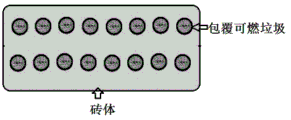
(6) crushing shale into crushed shale particles, adding water for curing, and pressing the cured crushed shale particles and the coated garbage spherulites into wet green bricks according to the required specification and size by using a brick making machine (as shown in figure 2);
(7) the wet green bricks are pre-dried at room temperature to form dry green bricks, then the dry green bricks are sent into a kiln, further dried and heated at a low temperature region, and then calcined at a high temperature region to obtain porous brick products (as shown in figure 3).
The waste embedded in the coated waste pellets in the intermediate temperature zone in the green brick will be slowly oxidized to release heat and raise the internal temperature of the brick body, while carbon dioxide, chlorine-containing compounds, nitrogen-containing compounds, metal compounds, dioxins and various organic compounds not completely combusted will be generated. The generated gases can slowly diffuse outwards through the gaps of the coating layer, and some gases can be absorbed by the outer layer coating material and the brick body material and react with the coating material and the brick body material to form stable inorganic materials in the diffusion process, and some gases can be continuously deeply oxidized, even oxidized and decomposed, and penetrate into material lattices in the form of atomic ions to be stably fixed in the materials to form harmless stable inorganic materials.
Because the garbage is coated and limited in the small unsmooth space, the garbage is oxidized under the condition of low temperature and oxygen deficiency, so that the generation of dioxin can be effectively reduced, and a small amount of dioxin generated in the coated local small space is completely oxidized and removed in the process of slowly penetrating through the coating layer and the inner brick body, so that the safety of tail gas emission is ensured. The glass powder added in the coating layer can be softened at a medium temperature of 500-800 ℃, and can easily generate silicate with some metal oxides including heavy metals generated in the oxidation process of the garbage, so that the heavy metal oxides generated in the oxidation process of the garbage can be effectively prevented from being discharged along with tail gas. The inorganic material of the coating layer contains alkaline metal oxides such as Al, Na, Ca, Mg and the like, and can effectively absorb acidic substances such as chlorine-containing compounds, nitrogen-containing compounds and the like generated in the oxidation process of the garbage in the coating layer. In addition, ash generated in the oxidation process of the garbage in the coating layer is trapped in the coating layer so as to avoid being discharged along with tail gas. The garbage in the coating layer is completely oxidized to form a cavity in the brick body, but the garbage in the coating layer releases heat energy in the oxidation process and generates high temperature around the garbage, so that the coating layer can form a compact and stable structure, and the mechanical property of the whole material can be improved.
The invention has the following remarkable advantages:
the clay, kaolin tailings and waste glass powder are used as coating materials, combustible garbage such as coal cinder, household garbage, paper sludge and the like is used as fuel, the fuel is coated by the coating materials, various harmful gases and ash contents generated in the oxidation process of the garbage in the coating layer can be effectively retained in the coating layer and form stable materials with the coating layer, so that the tail gas emission of the building brick in the firing process can be effectively controlled to reach the industrial standard, and meanwhile, the coating layer forms a compact and stable structure and is beneficial to improving the mechanical property of the whole material, so that the performance of the porous brick can reach the corresponding national A-level standard. The invention can change waste into valuable, save energy, reduce emission, protect environment, save resources and the like, can fully utilize the original kiln production equipment and firing process, eliminate harmful gas, reduce production cost, improve economic efficiency and have practical social significance.
Drawings
FIG. 1 is a schematic view of the structure of coated waste pellets.
FIG. 2 is a schematic sectional view of a green brick structure.
Fig. 3 is a schematic cross-sectional view of a perforated tile product.
Detailed Description
For further disclosure, but not limitation, the present invention is described in further detail below with reference to examples.
Example 1
A technology for preparing perforated bricks by using clay glass powder to coat garbage for granulation comprises the following specific steps:
(1) firstly, sorting some wastes with high utilization value from household garbage by adopting simple machinery or by means of manual work, and then crushing the sorted household garbage by using a crusher;
(2) weighing 100 kg of household garbage, 120 kg of coal cinder and 30 kg of paper making sludge according to the weight ratio of 1:1.2:0.3 of the crushed household garbage, the coal cinder and the paper making sludge of combustible materials, and mixing, wherein the weight of the crushed household garbage and the paper making sludge is converted into solid content by the weight of the crushed household garbage and the paper making sludge;
(3) after being uniformly mixed, the household garbage, the coal cinder and the paper sludge are pressed into garbage spherulites with the diameter of 1.2cm in a granulator;
(4) crushing waste glass into glass powder by using a crusher, respectively weighing 100 kg of clay, 40 kg of kaolin tailings and 20 kg of glass powder according to the weight ratio of 1:0.4:0.2, uniformly mixing the clay, the kaolin tailings and the glass powder to form an outer coating material, adding water to control the total water content in the coating material to be 5wt%, fully mixing the uniformly mixed coating material with the water, covering the coating material with a plastic cloth, and curing for 6 hours;
(5) coating cured coating materials with the thickness of 0.3cm on the outer surface of the garbage spherulites by using a coating machine to obtain coated garbage spherulites;
(6) crushing shale into crushed shale particles, adding water for curing, and pressing the cured crushed shale particles and the coated garbage spherulites into wet green bricks according to the required specification and size by using a brick making machine;
(7) and pre-air-drying the wet green bricks at room temperature to obtain dry green bricks, then feeding the dry green bricks into a kiln, and further air-drying and heating the dry green bricks in a low-temperature area to obtain the porous bricks.
Example 2
A technology for preparing perforated bricks by using clay glass powder to coat garbage for granulation comprises the following specific steps:
(1) firstly, sorting some wastes with high utilization value from household garbage by adopting simple machinery or by means of manual work, and then crushing the sorted household garbage by using a crusher;
(2) respectively weighing 100 kg of household garbage, 110 kg of coal cinder and 35 kg of paper making sludge of combustible materials according to the weight ratio of 1:1.1:0.35, and mixing, wherein the weight of the crushed household garbage and the paper making sludge is converted into solid content when the weight is reduced to dry weight;
(3) after being uniformly mixed, the household garbage, the coal cinder and the paper sludge are pressed into garbage spherulites with the diameter of 1.3cm in a granulator;
(4) crushing waste glass into glass powder by using a crusher, respectively weighing 100 kg of clay, 30 kg of kaolin tailings and 25 kg of glass powder according to the weight ratio of 1:0.3:0.25 of the clay, the kaolin tailings and the glass powder, uniformly mixing to form an outer coating material, adding water to control the total water content in the coating material to be 7wt%, fully mixing the uniformly mixed coating material with the water, covering the coating material with a plastic cloth, and curing for 5 hours;
(5) coating cured coating materials with the thickness of 0.3cm on the outer surface of the garbage spherulites by using a coating machine to obtain coated garbage spherulites;
(6) crushing shale into crushed shale particles, adding water for curing, and pressing the cured crushed shale particles and the coated garbage spherulites into wet green bricks according to the required specification and size by using a brick making machine;
(7) and pre-air-drying the wet green bricks at room temperature to obtain dry green bricks, then feeding the dry green bricks into a kiln, and further air-drying and heating the dry green bricks in a low-temperature area to obtain the porous bricks.
Example 3
A technology for preparing perforated bricks by using clay glass powder to coat garbage for granulation comprises the following specific steps:
(1) firstly, sorting some wastes with high utilization value from household garbage by adopting simple machinery or by means of manual work, and then crushing the sorted household garbage by using a crusher;
(2) weighing 100 kg of household garbage, 135 kg of cinder and 20 kg of dried papermaking sludge respectively according to the weight ratio of 1:1.35:0.2 of the crushed household garbage, the cinder and the papermaking sludge of combustible materials, and mixing, wherein the weight of the crushed household garbage and the papermaking sludge is converted into solid content when the weight is dried;
(3) after being uniformly mixed, the household garbage, the coal cinder and the paper sludge are pressed into garbage spherulites with the diameter of 1.5cm in a granulator;
(4) crushing waste glass into glass powder by using a crusher, respectively weighing 100 kg of clay, 30 kg of kaolin tailings and 30 kg of glass powder according to the weight ratio of 1:0.3:0.3, uniformly mixing the clay, the kaolin tailings and the glass powder to form an outer coating material, adding water to control the total water content in the coating material to be 8wt%, fully mixing the uniformly mixed coating material with the water, covering the coating material with a plastic cloth, and curing for 8 hours;
(5) coating cured coating materials with the thickness of 0.4cm on the outer surface of the garbage spherulites by using a coating machine to obtain coated garbage spherulites;
(6) crushing shale into crushed shale particles, adding water for curing, and pressing the cured crushed shale particles and the coated garbage spherulites into wet green bricks according to the required specification and size by using a brick making machine;
(7) and pre-air-drying the wet green bricks at room temperature to obtain dry green bricks, then feeding the dry green bricks into a kiln, and further air-drying and heating the dry green bricks in a low-temperature area to obtain the porous bricks.
All technical indexes and tail gas detection result values of the final product perforated brick are as follows: the voidage is more than or equal to 26 percent, the average value of the compressive strength is more than or equal to 15.0MPa, and the average value of the 5-hour water boiling absorption rate is 18 percent and the maximum value is 20 percent. Dioxin is not detected in the tail gas of the chimney, and the emission of nitrogen oxide in 24 hours is less than 200mg/m3The discharge amount of sulfur-containing compounds in 24 hours is less than 60 mg/m3The discharge amount of particulate matter is less than 20 mg/m in 24 hours3。
Dry weight reduction algorithm: respectively weighing 1 kg of domestic garbage or papermaking sludge, and drying at 120 ℃ for 12 hours, wherein the dried weight is the dry weight.
The above description is only a preferred embodiment of the present invention, and all equivalent changes and modifications made in accordance with the claims of the present invention should be covered by the present invention.