CN106957826B - Virus inactivating agent and application thereof - Google Patents
Virus inactivating agent and application thereof Download PDFInfo
- Publication number
- CN106957826B CN106957826B CN201710148704.7A CN201710148704A CN106957826B CN 106957826 B CN106957826 B CN 106957826B CN 201710148704 A CN201710148704 A CN 201710148704A CN 106957826 B CN106957826 B CN 106957826B
- Authority
- CN
- China
- Prior art keywords
- virus
- filtering
- filtrate
- precipitate
- water
- Prior art date
- Legal status (The legal status is an assumption and is not a legal conclusion. Google has not performed a legal analysis and makes no representation as to the accuracy of the status listed.)
- Active
Links
- 241000700605 Viruses Species 0.000 title claims abstract description 81
- 230000000415 inactivating effect Effects 0.000 title claims abstract description 17
- 230000000937 inactivator Effects 0.000 claims abstract description 24
- 239000003814 drug Substances 0.000 claims abstract description 9
- 238000002360 preparation method Methods 0.000 claims abstract description 9
- 241001529453 unidentified herpesvirus Species 0.000 claims abstract description 6
- 241000712461 unidentified influenza virus Species 0.000 claims abstract description 6
- 241001430294 unidentified retrovirus Species 0.000 claims abstract description 6
- LFQSCWFLJHTTHZ-UHFFFAOYSA-N Ethanol Chemical compound CCO LFQSCWFLJHTTHZ-UHFFFAOYSA-N 0.000 claims description 24
- 239000002244 precipitate Substances 0.000 claims description 21
- 239000000706 filtrate Substances 0.000 claims description 18
- 238000001914 filtration Methods 0.000 claims description 18
- XLYOFNOQVPJJNP-UHFFFAOYSA-N water Substances O XLYOFNOQVPJJNP-UHFFFAOYSA-N 0.000 claims description 18
- 239000006228 supernatant Substances 0.000 claims description 13
- VEXZGXHMUGYJMC-UHFFFAOYSA-N Hydrochloric acid Chemical compound Cl VEXZGXHMUGYJMC-UHFFFAOYSA-N 0.000 claims description 12
- 238000001035 drying Methods 0.000 claims description 12
- 238000002156 mixing Methods 0.000 claims description 11
- KJPRLNWUNMBNBZ-QPJJXVBHSA-N (E)-cinnamaldehyde Chemical compound O=C\C=C\C1=CC=CC=C1 KJPRLNWUNMBNBZ-QPJJXVBHSA-N 0.000 claims description 10
- 229940117916 cinnamic aldehyde Drugs 0.000 claims description 10
- KJPRLNWUNMBNBZ-UHFFFAOYSA-N cinnamic aldehyde Natural products O=CC=CC1=CC=CC=C1 KJPRLNWUNMBNBZ-UHFFFAOYSA-N 0.000 claims description 10
- 239000003795 chemical substances by application Substances 0.000 claims description 9
- 238000000034 method Methods 0.000 claims description 7
- 238000010298 pulverizing process Methods 0.000 claims description 6
- 230000002829 reductive effect Effects 0.000 claims description 6
- 238000003756 stirring Methods 0.000 claims description 4
- 238000002791 soaking Methods 0.000 claims description 2
- 235000020230 cinnamon extract Nutrition 0.000 abstract description 18
- 208000015181 infectious disease Diseases 0.000 abstract description 11
- 230000000694 effects Effects 0.000 abstract description 10
- 230000002779 inactivation Effects 0.000 abstract description 7
- 229940079593 drug Drugs 0.000 abstract description 5
- 101710091045 Envelope protein Proteins 0.000 abstract description 2
- 101710188315 Protein X Proteins 0.000 abstract description 2
- 102100021696 Syncytin-1 Human genes 0.000 abstract description 2
- 230000003321 amplification Effects 0.000 abstract description 2
- 238000003199 nucleic acid amplification method Methods 0.000 abstract description 2
- 238000011160 research Methods 0.000 abstract description 2
- 241000699670 Mus sp. Species 0.000 description 29
- 239000000243 solution Substances 0.000 description 26
- 241000723347 Cinnamomum Species 0.000 description 16
- 235000017803 cinnamon Nutrition 0.000 description 16
- 210000004027 cell Anatomy 0.000 description 13
- WSFSSNUMVMOOMR-UHFFFAOYSA-N Formaldehyde Chemical compound O=C WSFSSNUMVMOOMR-UHFFFAOYSA-N 0.000 description 12
- 210000004072 lung Anatomy 0.000 description 11
- 239000000463 material Substances 0.000 description 10
- 230000000840 anti-viral effect Effects 0.000 description 9
- 238000002474 experimental method Methods 0.000 description 9
- 150000001875 compounds Chemical class 0.000 description 8
- 230000005764 inhibitory process Effects 0.000 description 8
- 238000012360 testing method Methods 0.000 description 8
- 241000699666 Mus <mouse, genus> Species 0.000 description 7
- 230000004083 survival effect Effects 0.000 description 7
- 241000700588 Human alphaherpesvirus 1 Species 0.000 description 6
- 239000000427 antigen Substances 0.000 description 6
- 102000036639 antigens Human genes 0.000 description 6
- 108091007433 antigens Proteins 0.000 description 6
- 230000000120 cytopathologic effect Effects 0.000 description 6
- 238000000605 extraction Methods 0.000 description 6
- 239000002994 raw material Substances 0.000 description 6
- 210000003501 vero cell Anatomy 0.000 description 6
- 230000035931 haemagglutination Effects 0.000 description 5
- 229940031551 inactivated vaccine Drugs 0.000 description 5
- 229960005486 vaccine Drugs 0.000 description 5
- 230000037396 body weight Effects 0.000 description 4
- 210000000987 immune system Anatomy 0.000 description 4
- 230000002401 inhibitory effect Effects 0.000 description 4
- 239000007788 liquid Substances 0.000 description 4
- 108090000623 proteins and genes Proteins 0.000 description 4
- 230000003612 virological effect Effects 0.000 description 4
- 244000080208 Canella winterana Species 0.000 description 3
- 235000008499 Canella winterana Nutrition 0.000 description 3
- 102400000888 Cholecystokinin-8 Human genes 0.000 description 3
- 101800005151 Cholecystokinin-8 Proteins 0.000 description 3
- IAZDPXIOMUYVGZ-UHFFFAOYSA-N Dimethylsulphoxide Chemical compound CS(C)=O IAZDPXIOMUYVGZ-UHFFFAOYSA-N 0.000 description 3
- 241001465754 Metazoa Species 0.000 description 3
- 230000002378 acidificating effect Effects 0.000 description 3
- 229940017545 cinnamon bark Drugs 0.000 description 3
- 244000052769 pathogen Species 0.000 description 3
- 239000008055 phosphate buffer solution Substances 0.000 description 3
- 238000007873 sieving Methods 0.000 description 3
- 230000009385 viral infection Effects 0.000 description 3
- 244000037364 Cinnamomum aromaticum Species 0.000 description 2
- 235000014489 Cinnamomum aromaticum Nutrition 0.000 description 2
- 241000713772 Human immunodeficiency virus 1 Species 0.000 description 2
- 230000004663 cell proliferation Effects 0.000 description 2
- 230000003833 cell viability Effects 0.000 description 2
- 238000012200 cell viability kit Methods 0.000 description 2
- 230000008859 change Effects 0.000 description 2
- 239000003153 chemical reaction reagent Substances 0.000 description 2
- 238000011161 development Methods 0.000 description 2
- 238000010586 diagram Methods 0.000 description 2
- 150000004676 glycans Chemical class 0.000 description 2
- 238000011534 incubation Methods 0.000 description 2
- 238000011081 inoculation Methods 0.000 description 2
- 238000012423 maintenance Methods 0.000 description 2
- 230000001717 pathogenic effect Effects 0.000 description 2
- 229920001282 polysaccharide Polymers 0.000 description 2
- 239000005017 polysaccharide Substances 0.000 description 2
- 230000001681 protective effect Effects 0.000 description 2
- 102000004169 proteins and genes Human genes 0.000 description 2
- IZTQOLKUZKXIRV-YRVFCXMDSA-N sincalide Chemical compound C([C@@H](C(=O)N[C@@H](CCSC)C(=O)NCC(=O)N[C@@H](CC=1C2=CC=CC=C2NC=1)C(=O)N[C@@H](CCSC)C(=O)N[C@@H](CC(O)=O)C(=O)N[C@@H](CC=1C=CC=CC=1)C(N)=O)NC(=O)[C@@H](N)CC(O)=O)C1=CC=C(OS(O)(=O)=O)C=C1 IZTQOLKUZKXIRV-YRVFCXMDSA-N 0.000 description 2
- 102000016912 Aldehyde Reductase Human genes 0.000 description 1
- 108010053754 Aldehyde reductase Proteins 0.000 description 1
- 206010002091 Anaesthesia Diseases 0.000 description 1
- 208000031648 Body Weight Changes Diseases 0.000 description 1
- 108091003079 Bovine Serum Albumin Proteins 0.000 description 1
- 108090000565 Capsid Proteins Proteins 0.000 description 1
- 101710132601 Capsid protein Proteins 0.000 description 1
- 102100023321 Ceruloplasmin Human genes 0.000 description 1
- 235000021511 Cinnamomum cassia Nutrition 0.000 description 1
- 244000223760 Cinnamomum zeylanicum Species 0.000 description 1
- 235000004310 Cinnamomum zeylanicum Nutrition 0.000 description 1
- 101710094648 Coat protein Proteins 0.000 description 1
- 241000037488 Coccoloba pubescens Species 0.000 description 1
- 241000196324 Embryophyta Species 0.000 description 1
- 241000628997 Flos Species 0.000 description 1
- 102100021181 Golgi phosphoprotein 3 Human genes 0.000 description 1
- 206010069767 H1N1 influenza Diseases 0.000 description 1
- 229940124873 Influenza virus vaccine Drugs 0.000 description 1
- 208000032376 Lung infection Diseases 0.000 description 1
- 101710125418 Major capsid protein Proteins 0.000 description 1
- 101710141454 Nucleoprotein Proteins 0.000 description 1
- 101710083689 Probable capsid protein Proteins 0.000 description 1
- 244000184734 Pyrus japonica Species 0.000 description 1
- 208000036142 Viral infection Diseases 0.000 description 1
- 244000000001 Virome Species 0.000 description 1
- 230000009471 action Effects 0.000 description 1
- 230000004520 agglutination Effects 0.000 description 1
- 230000002776 aggregation Effects 0.000 description 1
- 238000004220 aggregation Methods 0.000 description 1
- 230000004075 alteration Effects 0.000 description 1
- 230000037005 anaesthesia Effects 0.000 description 1
- 238000010171 animal model Methods 0.000 description 1
- 230000000844 anti-bacterial effect Effects 0.000 description 1
- 230000003171 anti-complementary effect Effects 0.000 description 1
- 230000003110 anti-inflammatory effect Effects 0.000 description 1
- 230000000259 anti-tumor effect Effects 0.000 description 1
- 239000003963 antioxidant agent Substances 0.000 description 1
- 230000003078 antioxidant effect Effects 0.000 description 1
- 238000003556 assay Methods 0.000 description 1
- 229940031567 attenuated vaccine Drugs 0.000 description 1
- 210000004369 blood Anatomy 0.000 description 1
- 239000008280 blood Substances 0.000 description 1
- 230000004579 body weight change Effects 0.000 description 1
- 210000005252 bulbus oculi Anatomy 0.000 description 1
- 230000000711 cancerogenic effect Effects 0.000 description 1
- 231100000357 carcinogen Toxicity 0.000 description 1
- 239000003183 carcinogenic agent Substances 0.000 description 1
- 210000000748 cardiovascular system Anatomy 0.000 description 1
- 239000006143 cell culture medium Substances 0.000 description 1
- 238000012054 celltiter-glo Methods 0.000 description 1
- 210000003169 central nervous system Anatomy 0.000 description 1
- 238000005119 centrifugation Methods 0.000 description 1
- 230000015271 coagulation Effects 0.000 description 1
- 238000005345 coagulation Methods 0.000 description 1
- 230000001276 controlling effect Effects 0.000 description 1
- 238000004132 cross linking Methods 0.000 description 1
- 230000003247 decreasing effect Effects 0.000 description 1
- 238000001514 detection method Methods 0.000 description 1
- 210000002249 digestive system Anatomy 0.000 description 1
- 201000010099 disease Diseases 0.000 description 1
- 208000037265 diseases, disorders, signs and symptoms Diseases 0.000 description 1
- 210000000750 endocrine system Anatomy 0.000 description 1
- 210000003743 erythrocyte Anatomy 0.000 description 1
- 239000012894 fetal calf serum Substances 0.000 description 1
- 239000001963 growth medium Substances 0.000 description 1
- 241000411851 herbal medicine Species 0.000 description 1
- 230000002218 hypoglycaemic effect Effects 0.000 description 1
- 230000001900 immune effect Effects 0.000 description 1
- 230000002163 immunogen Effects 0.000 description 1
- 230000005847 immunogenicity Effects 0.000 description 1
- 230000016784 immunoglobulin production Effects 0.000 description 1
- 238000000338 in vitro Methods 0.000 description 1
- 238000011065 in-situ storage Methods 0.000 description 1
- 230000002458 infectious effect Effects 0.000 description 1
- 206010022000 influenza Diseases 0.000 description 1
- 239000004615 ingredient Substances 0.000 description 1
- 239000002085 irritant Substances 0.000 description 1
- 231100000021 irritant Toxicity 0.000 description 1
- 230000007794 irritation Effects 0.000 description 1
- 210000003292 kidney cell Anatomy 0.000 description 1
- 238000004519 manufacturing process Methods 0.000 description 1
- 239000002609 medium Substances 0.000 description 1
- 239000011259 mixed solution Substances 0.000 description 1
- 239000000203 mixture Substances 0.000 description 1
- 238000012986 modification Methods 0.000 description 1
- 230000004048 modification Effects 0.000 description 1
- 230000003472 neutralizing effect Effects 0.000 description 1
- 231100000065 noncytotoxic Toxicity 0.000 description 1
- 239000002773 nucleotide Substances 0.000 description 1
- 125000003729 nucleotide group Chemical group 0.000 description 1
- 239000002245 particle Substances 0.000 description 1
- 230000000144 pharmacologic effect Effects 0.000 description 1
- 150000008442 polyphenolic compounds Chemical class 0.000 description 1
- 235000013824 polyphenols Nutrition 0.000 description 1
- 239000013641 positive control Substances 0.000 description 1
- 230000002265 prevention Effects 0.000 description 1
- 125000002924 primary amino group Chemical group [H]N([H])* 0.000 description 1
- 239000000047 product Substances 0.000 description 1
- 230000000644 propagated effect Effects 0.000 description 1
- 230000001105 regulatory effect Effects 0.000 description 1
- 238000003757 reverse transcription PCR Methods 0.000 description 1
- 210000002966 serum Anatomy 0.000 description 1
- 239000002356 single layer Substances 0.000 description 1
- 238000007711 solidification Methods 0.000 description 1
- 230000008023 solidification Effects 0.000 description 1
- 239000008223 sterile water Substances 0.000 description 1
- 238000003860 storage Methods 0.000 description 1
- 239000000126 substance Substances 0.000 description 1
- 239000000725 suspension Substances 0.000 description 1
- 201000010740 swine influenza Diseases 0.000 description 1
- 230000005727 virus proliferation Effects 0.000 description 1
Images


Classifications
-
- C—CHEMISTRY; METALLURGY
- C12—BIOCHEMISTRY; BEER; SPIRITS; WINE; VINEGAR; MICROBIOLOGY; ENZYMOLOGY; MUTATION OR GENETIC ENGINEERING
- C12N—MICROORGANISMS OR ENZYMES; COMPOSITIONS THEREOF; PROPAGATING, PRESERVING, OR MAINTAINING MICROORGANISMS; MUTATION OR GENETIC ENGINEERING; CULTURE MEDIA
- C12N7/00—Viruses; Bacteriophages; Compositions thereof; Preparation or purification thereof
-
- C—CHEMISTRY; METALLURGY
- C12—BIOCHEMISTRY; BEER; SPIRITS; WINE; VINEGAR; MICROBIOLOGY; ENZYMOLOGY; MUTATION OR GENETIC ENGINEERING
- C12N—MICROORGANISMS OR ENZYMES; COMPOSITIONS THEREOF; PROPAGATING, PRESERVING, OR MAINTAINING MICROORGANISMS; MUTATION OR GENETIC ENGINEERING; CULTURE MEDIA
- C12N2710/00—MICROORGANISMS OR ENZYMES; COMPOSITIONS THEREOF; PROPAGATING, PRESERVING, OR MAINTAINING MICROORGANISMS; MUTATION OR GENETIC ENGINEERING; CULTURE MEDIA dsDNA viruses
- C12N2710/00011—Details
- C12N2710/16011—Herpesviridae
- C12N2710/16061—Methods of inactivation or attenuation
- C12N2710/16063—Methods of inactivation or attenuation by chemical treatment
-
- C—CHEMISTRY; METALLURGY
- C12—BIOCHEMISTRY; BEER; SPIRITS; WINE; VINEGAR; MICROBIOLOGY; ENZYMOLOGY; MUTATION OR GENETIC ENGINEERING
- C12N—MICROORGANISMS OR ENZYMES; COMPOSITIONS THEREOF; PROPAGATING, PRESERVING, OR MAINTAINING MICROORGANISMS; MUTATION OR GENETIC ENGINEERING; CULTURE MEDIA
- C12N2740/00—Reverse transcribing RNA viruses
- C12N2740/00011—Details
- C12N2740/10011—Retroviridae
- C12N2740/10061—Methods of inactivation or attenuation
- C12N2740/10063—Methods of inactivation or attenuation by chemical treatment
-
- C—CHEMISTRY; METALLURGY
- C12—BIOCHEMISTRY; BEER; SPIRITS; WINE; VINEGAR; MICROBIOLOGY; ENZYMOLOGY; MUTATION OR GENETIC ENGINEERING
- C12N—MICROORGANISMS OR ENZYMES; COMPOSITIONS THEREOF; PROPAGATING, PRESERVING, OR MAINTAINING MICROORGANISMS; MUTATION OR GENETIC ENGINEERING; CULTURE MEDIA
- C12N2760/00—MICROORGANISMS OR ENZYMES; COMPOSITIONS THEREOF; PROPAGATING, PRESERVING, OR MAINTAINING MICROORGANISMS; MUTATION OR GENETIC ENGINEERING; CULTURE MEDIA ssRNA viruses negative-sense
- C12N2760/00011—Details
- C12N2760/16011—Orthomyxoviridae
- C12N2760/16111—Influenzavirus A, i.e. influenza A virus
- C12N2760/16161—Methods of inactivation or attenuation
- C12N2760/16163—Methods of inactivation or attenuation by chemical treatment
-
- C—CHEMISTRY; METALLURGY
- C12—BIOCHEMISTRY; BEER; SPIRITS; WINE; VINEGAR; MICROBIOLOGY; ENZYMOLOGY; MUTATION OR GENETIC ENGINEERING
- C12N—MICROORGANISMS OR ENZYMES; COMPOSITIONS THEREOF; PROPAGATING, PRESERVING, OR MAINTAINING MICROORGANISMS; MUTATION OR GENETIC ENGINEERING; CULTURE MEDIA
- C12N2760/00—MICROORGANISMS OR ENZYMES; COMPOSITIONS THEREOF; PROPAGATING, PRESERVING, OR MAINTAINING MICROORGANISMS; MUTATION OR GENETIC ENGINEERING; CULTURE MEDIA ssRNA viruses negative-sense
- C12N2760/00011—Details
- C12N2760/16011—Orthomyxoviridae
- C12N2760/16211—Influenzavirus B, i.e. influenza B virus
- C12N2760/16261—Methods of inactivation or attenuation
- C12N2760/16263—Methods of inactivation or attenuation by chemical treatment
-
- C—CHEMISTRY; METALLURGY
- C12—BIOCHEMISTRY; BEER; SPIRITS; WINE; VINEGAR; MICROBIOLOGY; ENZYMOLOGY; MUTATION OR GENETIC ENGINEERING
- C12N—MICROORGANISMS OR ENZYMES; COMPOSITIONS THEREOF; PROPAGATING, PRESERVING, OR MAINTAINING MICROORGANISMS; MUTATION OR GENETIC ENGINEERING; CULTURE MEDIA
- C12N2760/00—MICROORGANISMS OR ENZYMES; COMPOSITIONS THEREOF; PROPAGATING, PRESERVING, OR MAINTAINING MICROORGANISMS; MUTATION OR GENETIC ENGINEERING; CULTURE MEDIA ssRNA viruses negative-sense
- C12N2760/00011—Details
- C12N2760/16011—Orthomyxoviridae
- C12N2760/16311—Influenzavirus C, i.e. influenza C virus
- C12N2760/16361—Methods of inactivation or attenuation
- C12N2760/16363—Methods of inactivation or attenuation by chemical treatment
-
- C—CHEMISTRY; METALLURGY
- C12—BIOCHEMISTRY; BEER; SPIRITS; WINE; VINEGAR; MICROBIOLOGY; ENZYMOLOGY; MUTATION OR GENETIC ENGINEERING
- C12N—MICROORGANISMS OR ENZYMES; COMPOSITIONS THEREOF; PROPAGATING, PRESERVING, OR MAINTAINING MICROORGANISMS; MUTATION OR GENETIC ENGINEERING; CULTURE MEDIA
- C12N2760/00—MICROORGANISMS OR ENZYMES; COMPOSITIONS THEREOF; PROPAGATING, PRESERVING, OR MAINTAINING MICROORGANISMS; MUTATION OR GENETIC ENGINEERING; CULTURE MEDIA ssRNA viruses negative-sense
- C12N2760/00011—Details
- C12N2760/18011—Paramyxoviridae
- C12N2760/18061—Methods of inactivation or attenuation
- C12N2760/18063—Methods of inactivation or attenuation by chemical treatment
Landscapes
- Life Sciences & Earth Sciences (AREA)
- Chemical & Material Sciences (AREA)
- Health & Medical Sciences (AREA)
- Genetics & Genomics (AREA)
- Organic Chemistry (AREA)
- Zoology (AREA)
- Engineering & Computer Science (AREA)
- Bioinformatics & Cheminformatics (AREA)
- Wood Science & Technology (AREA)
- Medicinal Chemistry (AREA)
- Biotechnology (AREA)
- Microbiology (AREA)
- Biomedical Technology (AREA)
- Virology (AREA)
- Biochemistry (AREA)
- General Engineering & Computer Science (AREA)
- General Health & Medical Sciences (AREA)
- Immunology (AREA)
- Medicines Containing Plant Substances (AREA)
Abstract
The invention discloses a virus inactivator and application thereof. The virus inactivator is a cinnamon extract with a final concentration of 0.5-1 mg/ml. The application is the application of the virus inactivator in the preparation of drugs for inactivating paramyxovirus, herpes virus, retrovirus and influenza virus. The invention discloses a virus inactivation effect of a cinnamon extract (KPC-rg 1), and researches show that the extract can be rapidly and strongly combined with envelope protein of a virus shell at normal temperature, so that the virus is inactivated, loses infection and amplification capabilities, and has antigenicity.
Description
Technical Field
The invention belongs to the technical field of medicines, and particularly relates to a virus inactivating agent and application thereof.
Background
At present, the main vaccines applied at home and abroad comprise attenuated vaccines and inactivated vaccines. Because the production process of the inactivated vaccine is simple, safe, convenient to use and easy to store, and can stimulate animals to generate high-titer antibodies and remarkable vaccine protection effect, the development of the high-quality and high-efficiency inactivated vaccine is the most effective means for preventing and controlling various virus infection diseases. Inactivated vaccines, as the name implies, are vaccines made by inactivating infectious live pathogens by suitable physical or chemical means such that the pathogens are rendered non-pathogenic, but remain immunogenic.
The traditional virus inactivator formaldehyde is a carcinogen with strong irritation. It can act on the amino-containing nucleotide base of virus and also on the virus coat protein. When formaldehyde acts on virus capsid protein, protein cross-linking or virus particle aggregation is easy to occur, so that the neutralizing immunogenicity of pathogen protein is seriously damaged. The formaldehyde is used for long inactivation time, and the treatment is generally carried out at 37-39 ℃ for more than 24 hours or longer; the residual free formaldehyde can produce an irritant reaction after being injected into the body along with the vaccine. Therefore, on the premise of ensuring absolute safety of inactivation, the method improves inactivation speed, shortens inactivation time, reduces loss of effective antigen, and is a development target of a novel virus inactivator.
Cinnamon is a common Chinese medicinal material, is listed as the superior product from Shen nong Ben Cao Jing, and has been recorded in important herbal medicines of all generations. Cinnamon and its contained ingredients have various pharmacological actions, and commonly reported activities include antibacterial, antioxidant, hypoglycemic, aldose reductase resistant, anti-inflammatory, anticomplementary, antitumor activities, and regulating action on digestive system, cardiovascular system, immune system, central nervous system, and endocrine system. Cinnamon has been used for the prevention and treatment of viral infections in very few reports.
Disclosure of Invention
The first object of the present invention is to provide a virus inactivating agent; the second purpose is to provide the application of the virus inactivator.
The first purpose of the invention is realized by that the virus inactivator is cinnamon extract with the final concentration of 0.5-1 mg/ml.
The second object of the present invention is achieved by the use of the virus inactivating agent for preparing a medicament for inactivating paramyxovirus, herpesvirus, retrovirus, and influenza virus.
The invention discloses a virus inactivation effect of a cinnamon extract (KPC-rg 1), and researches show that the extract can be rapidly and strongly combined with envelope protein of a virus shell at normal temperature, so that the virus is inactivated, loses infection and amplification capabilities, and has antigenicity.
The cinnamon provided by the invention comprises: cortex Cinnamomi, Cinnamomum zeylanicum, HUANANGGUI, ramulus Cinnamomi Blumeae Balsamiferae, YINXIANG, cortex Cinnamomi Japonici, flos Lonicerae, cortex Cinnamomi Japonici, and cortex Cinnamomi; preferably, the cinnamon comprises: cinnamon, cinnamon bark of large leaf and cinnamon bark of Ceylon blue; more preferably, the cinnamon comprises: cinnamon and cassia twig, cortex cinnamomi japonica thunb.
The plant part of cinnamon is bark.
The method for inactivating viruses by the inactivator is to inactivate virus liquid to be inactivated by the virus inactivator at 4-37 ℃.
Drawings
FIG. 1 is a schematic diagram showing the inhibitory effect of cinnamon extract (KPC-rg 1) as a virus inactivator on vero cell proliferation;
FIG. 2 is a schematic diagram showing the effect of HSV-1 and KPC-rg1 on cell morphology following infection of cells with HSV-1 virus;
FIG. 3 is a schematic representation of the change in HSV-1 viral titer following KPC-rg1 treatment;
FIG. 4 is a graph showing the body weight changes of H1N1 after challenge;
FIG. 5 is a schematic representation of hemagglutination inhibition titers against H1N1 virus in mouse sera;
FIG. 6 is a graph showing RNA copy number of H1N1 virus M gene in lung of mice at day 3 after infection and at experimental end point (day 28).
Detailed Description
The present invention is further illustrated by the following examples and the accompanying drawings, but the present invention is not limited thereto in any way, and any modifications or alterations based on the teaching of the present invention are within the scope of the present invention.
The virus inactivator is a cinnamon extract with a final concentration of 0.5-1 mg/ml.
The virus inactivator also comprises cinnamaldehyde with the weight percentage of 1-5% of cinnamon extract;
the cinnamon extract is cinnamon water extract prepared under the condition that the PH value is 1-5.
The cinnamon extract is prepared by taking cinnamon as a raw material through the steps of pretreatment, extraction and post-treatment, and specifically comprises the following steps:
A. pretreatment: crushing and sieving a material a of a raw material cinnamon for later use;
B. extraction: adding water which is 3-30 times of the weight of the material a into the material a, extracting for 1-3 times at the temperature of 4-80 ℃ for 1-24 hours each time, and combining the extracting solutions to obtain an extracting solution b;
C. and (3) post-treatment: concentrating the extracting solution b until the relative density is 1.01-1.05 to obtain a concentrated solution c, adding the concentrated solution c into an acidic phosphate buffer solution, adjusting the pH value to 1-5 by hydrochloric acid, standing for 8-24 h, and taking a precipitate as the cinnamon extract; adding cinnamaldehyde with the weight percentage of 1-5% of the precipitate part, and uniformly mixing to obtain the target virus inactivator.
The cinnamon extract is prepared by taking cinnamon as a raw material through the steps of pretreatment, extraction and post-treatment, and specifically comprises the following steps:
A. pretreatment: crushing and sieving a material a of a raw material cinnamon for later use;
B. extraction: adding water which is 3-12 times of the weight of the material a into the material a, extracting for 1-3 times at the temperature of 4-40 ℃ for 1-8 hours each time, and combining the extracting solutions to obtain an extracting solution b;
C. and (3) post-treatment: concentrating the extracting solution b to a relative density of 1.01-1.05 to obtain a concentrated solution c, adding the concentrated solution c into an acidic phosphate buffer solution with a pH value of 3-6, adjusting the pH value to 2-4 with hydrochloric acid, standing for 8-24 h, and taking a precipitate as the cinnamon extract; adding cinnamaldehyde with the weight percentage of 1-5% of the precipitate part, and uniformly mixing to obtain the target virus inactivator.
The cinnamon extract is prepared by taking cinnamon as a raw material through the steps of pretreatment, extraction and post-treatment, and specifically comprises the following steps:
A. pretreatment: crushing and sieving a material a of a raw material cinnamon for later use;
B. extraction: adding 10 times of water to the material a, extracting at 20 deg.C for 3 times (2 hr each time), and mixing extractive solutions to obtain extractive solution b;
C. and (3) post-treatment: concentrating the extracting solution b to a relative density of 1.01-1.05 to obtain a concentrated solution c, adding the concentrated solution c into an acidic phosphate buffer solution with a pH value of 6, adjusting the pH value to 3 with hydrochloric acid, standing for 12h, and taking a precipitate part, namely the cinnamon extract; adding cinnamaldehyde with the weight percentage of 1-5% of the precipitate part, and uniformly mixing to obtain the target virus inactivator.
The application of the virus inactivating agent is the application of the virus inactivating agent in the preparation of medicaments for inactivating paramyxovirus, herpes virus, retrovirus and influenza virus.
The virus inactivator is applied to preparing vaccines for inactivating paramyxovirus, herpes virus, retrovirus and influenza virus.
The preparation method of the inactivated paramyxovirus, herpesvirus, retrovirus and influenza virus vaccine comprises the following steps:
A. preparing an antigen solution;
B. adding a cinnamon extract with the concentration of 0.5-1 mg/ml into an antigen solution, fully mixing uniformly, and placing the mixed solution at the temperature of 20-30 ℃ for shake incubation for 5-10 min to obtain a target inactivated vaccine; wherein the proportion of the cinnamon extract to the antigen liquid is 1: 2.5 (wherein cinnamon extract is in mass units and virus is in hemagglutination units).
The antigen solution is prepared by inoculating the virus into host cells according to the inoculation amount of 1-3% of the volume percentage, replacing the culture solution with a maintenance solution when the host cells grow to 40-90%, and collecting the virus after maintaining and observing for 48-72 hours to obtain the antigen solution.
The culture solution is selected correspondingly according to different virus host cells (different virus host cells and different culture media); the maintenance liquid is a culture liquid containing 2% fetal calf serum.
The invention is further illustrated by the following specific examples:
EXAMPLE 1 preparation of Virus inactivating agent
The method comprises the following steps: pulverizing cortex Cinnamomi, soaking in 3 times of water at 4 deg.C for 1 time, and extracting for 1 hr. Step two: filtering, and collecting filtrate and residue. Step three: adding ethanol into the filtrate until the ethanol content reaches 65%, and standing. And step four, centrifuging, and reserving the supernatant and storing the precipitate. Step five: and taking the supernatant obtained in the fourth step, concentrating under reduced pressure, and drying in vacuum. Step six: dissolving in water, and filtering. Step seven: the filtrate was adjusted to pH 5 with dilute hydrochloric acid. Step eight: filtering, taking the precipitate and drying. Mixing the fourth step, the eighth step and commercial cinnamaldehyde according to the proportion of 10:10:0.5 to obtain the virus inactivator.
EXAMPLE 2 preparation of Virus inactivating agent
The method comprises the following steps: pulverizing cortex Cinnamomi, and stirring with 8 times of water at room temperature (20 deg.C) for 3 times, each for two hours. Step two: filtering, and collecting filtrate and residue. Step three: adding ethanol into the filtrate until the ethanol content reaches 80%, and standing. And step four, centrifuging, reserving the supernatant and reserving the precipitate. Step five: and 4, concentrating the supernatant obtained in the fourth step under reduced pressure, and drying in vacuum. Step six: dissolving in water, and filtering. Step seven: the filtrate was adjusted to pH 2 with dilute hydrochloric acid. Step eight: filtering, taking the precipitate and drying. Mixing the fourth step, the eighth step and commercial cinnamaldehyde according to the proportion of 10:10:0.5 to obtain the virus inactivator.
Example 3 preparation of total polysaccharide and total polyphenol of Cinnamomum cassia bark
Preparing the cinnamon bark total polysaccharide: the method comprises the following steps: pulverizing cortex Cinnamomi, extracting with 30 times of water at 80 deg.C under stirring for 3 times, each for 24 hr. Step two: filtering, and collecting filtrate and residue. Step three: adding ethanol into the filtrate until the ethanol content reaches 90%, and standing. And step four, centrifuging, reserving the supernatant and reserving the precipitate. Step five: and 4, concentrating the supernatant obtained in the fourth step under reduced pressure, and drying in vacuum. Step six: dissolving in water, and filtering. Step seven: the filtrate was adjusted to pH 1 with dilute hydrochloric acid. Step eight: filtering, taking the precipitate and drying. Mixing the fourth step, the eighth step and commercial cinnamaldehyde according to the proportion of 10:10:0.5 to obtain the virus inactivator.
Example 6
Inhibitory Effect of KPC-rg1 on vero cell proliferation
Vero cells plated in 96-well plates at 37 ℃ with 5% C02Adding cortex Cinnamomi extract (kpc-rg 1) with different concentrations after the incubator is overnight full of monolayer, respectively setting experimental group, cell control group, and blank control group, detecting OD value with CCK8 kit after 48 hr, and determining the OD value according to formulaAnd calculating the cell survival rate. The results show that there is no cytotoxic effect on vero cells when the concentration of kpc-rg1 is less than 0.05 mg/ml. See figure 1 for specific data.
Example 7
Inhibition of HSV-1 viral activity by KPC-rg1
40ug/ml of KPC-rg1 and Mol =0.1 HSV-1 virus solution were incubated at 4 ℃ for 24 hours, added to a 96-well plate plated with vero cells, and after 24 hours of incubation, cell morphology was observed under a microscope with virus control and cell control (no virus, medium only), and the TCID50 value of the virus suspension was calculated. The result shows that KPC-rg1 has obvious inactivation effect on HSV-1 virus and plays a good role in protecting vero cells. The specific experimental results are shown in fig. 2 and 3.
Example 8
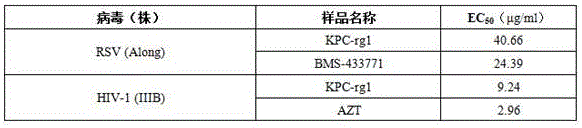
In vitro antiviral Activity test of KPC-rg1 against RSV and HIV-1 viruses
Sample preparation: KPC-rg1 was dissolved in sterile water to 8 mg/ml and heated in a water bath at 80 ℃ for 15 minutes. After centrifugation of the solution at 2000 RPM for 2 minutes, the supernatant was stored at 4 ℃ as a KPC-rg1 stock. In the EC50 assay experiments, KPC-rg1 and the reference compound were diluted 3-fold to test 8 concentration points, each concentration tested in duplicate wells. The highest concentration tested was 1000. mu.g/ml. The final concentration of DMSO in the cell culture medium was 0.5%. And antiviral activity was tested according to the following method:
TABLE 1 antiviral Experimental methods List
RSV Along virus cytopathic experiment: cells were seeded at a certain density (table 1) in a microplate and cultured overnight at 37 ℃ in a 5% CO2 incubator. The following day, pre-mixes of varying concentrations of compound and virus (table 1) were added to the cell plates and incubated at 37 ℃ with 5% CO2 for 3-5 days until the cytopathic effect in the virus control wells was complete. Cell viability was then measured using the CCK8 cell viability assay kit as indicated for the test reagents. The antiviral activity at different concentrations of the compound is determined by the inhibitory effect on the cytopathic effect caused by the virus. All data were calibrated against a blank infection control. EC50 was calculated analytically by GraphPadPrism software.
HIV-1 virus cytopathic experiment: the test compound and the reference compound were diluted in two fold and mixed with the virus (table 1), and then the mixture of the compound and the virus and MT-4 cells were added to the microplate and incubated in a 5% CO2 incubator at 33 ℃ or 37 ℃ for 2-6 days until the cytopathic effect in the virus control wells was complete. Cell viability was then measured using CCK8 or CellTiter Glo cell viability assay kit as indicated for the detection reagents. The antiviral activity of the compounds at different concentrations is determined by the inhibitory effect on the cytopathic effect caused by the virus. EC50 was calculated analytically by GraphPad Prism software.
The results show that the antiviral activity of all reference compounds of the antiviral activity test in the test is in accordance with the expectation, and the test result is reliable. The antiviral activity of KPC-rg1 is similar to that of positive control drug, and has better activity inhibition effect on two viruses, and the result is shown in Table 2.
TABLE 2 list of antiviral activities of cinnamon extract
Example 9
The anti-influenza virus effect of KPC-rg1 and the animal protection effect generated by KPC-rg1 induced "in situ solidification immune effect" are verified
Grouping of Experimental materials with animals
Test samples: KPC-rg1
Experimental virus strains: H1N1 (A/Puerto Rico/8/1934). The virus was propagated by dog kidney cells. The HA titer (HAU) of the virus strain was found to be 256 prior to storage at-70 ℃; the experimental virus was 250 HAU.
Experimental animals and groups: mice of 28-30 days of age.
A) PBS control group: 6 mice.
B) Virome (PR 8 challenge group): 8 mice (250 HAU/mouse).
C) KPC-rg1 administration group, total 8 mice.
Experimental methods
The indicated doses of KPC-rg1 (100 ug/tube) were pre-incubated with appropriate amounts of PBS for 5-10 min at room temperature with the virus (250 HAU/tube). Mice of 28-30 days of age were inoculated with either the pre-mixed KPC-rg 1/virus solution or virus solution. The total volume of KPC-rg 1/virus in PBS was 50 ul/mouse. Anesthesia was performed prior to inoculation. PBS was used as blank control. Mice were observed for 28-day survival levels. And mouse sera were collected from the eyeball blood collection at the end of the experiment (28 days) and tested for hemagglutination inhibition titer against H1N1 virus (HI titer) in mouse sera by the erythrocyte agglutination inhibition experiment (HI). The coagulation inhibition result is ≧ 20, which is the positive effective HI titer. n = 3. Meanwhile, obtaining mouse lungs on the 3 rd day after infection and at the experimental end point (28 days), extracting total lung RNA, and detecting the copy number of the virus M gene RNA of H1N1 virus in the lungs of each group of mice by RT-PCR.
Results of the experiment
Survival of mice on day 28
TABLE 3 survival level of groups of mice for 28 days
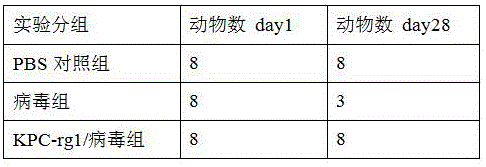
The mice in the challenge group died on the third day after challenge, and died by half within one week after challenge, with a survival rate of 37.5% (5 mice died in total of 8 mice). The KPC-rg1 group did not die after challenge, and survival rate was one hundred percent. The body weight and survival results reveal that the drug has significant protective effects on mice.
The change of body weight of the mice is shown in FIG. 4
The body weight of mice in the control PBS group steadily increased, while the body weight of mice in the challenge group involved in virus challenge, KPC-rg1 group, decreased after challenge, and gradually recovered and increased after one week.
The hemagglutination inhibition titers (antibody levels) of the mice are shown in FIG. 5
After 28 days of infection, 128 hemagglutination inhibition titers can be detected in the serum of mice in the challenge group and the KPC-rg1 group, which shows that the challenge of the virus to the mice leads the immune system of the mice to generate corresponding antibodies and protectiveness.
The viral load in the lungs of mice was measured as shown in FIG. 6
And (3) detecting the lung infection condition of the virus 3 days after the virus attack, wherein the lung virus load of each group of mice reaches 7 times of 10 and every 50mg of the lung, and the virus infection and proliferation condition in the mouse lung is shown. At the end of the experiment, 28 days, the lung viral load of the mice in the challenge group can not be detected, which indicates that the virus is cleared by the immune system of the mice. The above results reveal the progression of the virus from infection to clearance of the lung.
In combination with the above results, the virus had infected the lungs of all groups of mice after challenge, resulting in over half of the death of the challenge group within one week after infection. And the mice in the KPC-rg1 group do not die, which shows that the medicament has obvious protective effect on the mice attacked by the H1N1 influenza virus. Mice in the challenge group and the drug group which survive 28 days after infection have significant antibody production, and the virus is also eliminated by the immune system of the body.
Claims (2)
1. A virus inactivator is characterized in that the preparation method of the virus inactivator comprises the following steps:
the method comprises the following steps: pulverizing cortex Cinnamomi, soaking and extracting with 3 times of water at 4 deg.C for 1 time for 1 hr; filtering, collecting filtrate, and collecting residue; adding ethanol into the filtrate until the ethanol content reaches 65%, and standing; centrifuging, reserving supernatant, and reserving a precipitate; step two: taking the supernatant obtained in the step one, concentrating under reduced pressure, and drying in vacuum; dissolving in water, and filtering; adjusting the pH value of the filtrate to 5 by using dilute hydrochloric acid; filtering, taking the precipitate, and drying; mixing the precipitates obtained in the first step and the second step with commercially available cinnamaldehyde according to the ratio of 10:10:0.5 to obtain the virus inactivator;
or, the first step: pulverizing cortex Cinnamomi, stirring with 8 times of water at 20 deg.C for 3 times, each for 2 hr; filtering, collecting filtrate, and collecting residue; adding ethanol into the filtrate until the ethanol content reaches 80%, and standing; centrifuging, reserving supernatant, and reserving a precipitate; step two: concentrating the supernatant in the step one under reduced pressure, and drying in vacuum; dissolving in water, and filtering; adjusting the pH value of the filtrate to 2 by using dilute hydrochloric acid; filtering, taking the precipitate, and drying; mixing the precipitates obtained in the first step and the second step with commercially available cinnamaldehyde according to the ratio of 10:10:0.5 to obtain the virus inactivator;
or, the first step: pulverizing cortex Cinnamomi, extracting with 30 times of water at 80 deg.C under stirring for 3 times, each for 24 hr; filtering, collecting filtrate, and collecting residue; adding ethanol into the filtrate until the ethanol content reaches 90%, and standing; centrifuging, reserving supernatant, and reserving a precipitate; step two: concentrating the supernatant in the step one under reduced pressure, and drying in vacuum; dissolving in water, and filtering; adjusting the pH value of the filtrate to 1 by using dilute hydrochloric acid; filtering, taking the precipitate, and drying; and (3) mixing the precipitates obtained in the first step and the second step with commercially available cinnamaldehyde according to the ratio of 10:10:0.5 to obtain the virus inactivator.
2. Use of the virus inactivating agent of claim 1, for the preparation of a medicament for inactivating paramyxovirus, herpesvirus, retrovirus or influenza virus.
Priority Applications (1)
| Application Number | Priority Date | Filing Date | Title |
|---|---|---|---|
| CN201710148704.7A CN106957826B (en) | 2017-03-14 | 2017-03-14 | Virus inactivating agent and application thereof |
Applications Claiming Priority (1)
| Application Number | Priority Date | Filing Date | Title |
|---|---|---|---|
| CN201710148704.7A CN106957826B (en) | 2017-03-14 | 2017-03-14 | Virus inactivating agent and application thereof |
Publications (2)
| Publication Number | Publication Date |
|---|---|
| CN106957826A CN106957826A (en) | 2017-07-18 |
| CN106957826B true CN106957826B (en) | 2020-02-07 |
Family
ID=59470645
Family Applications (1)
| Application Number | Title | Priority Date | Filing Date |
|---|---|---|---|
| CN201710148704.7A Active CN106957826B (en) | 2017-03-14 | 2017-03-14 | Virus inactivating agent and application thereof |
Country Status (1)
| Country | Link |
|---|---|
| CN (1) | CN106957826B (en) |
Families Citing this family (1)
| Publication number | Priority date | Publication date | Assignee | Title |
|---|---|---|---|---|
| CN112294868B (en) * | 2019-07-31 | 2023-11-21 | 昆明扬添生物科技有限公司 | Medicine for inactivating virus, sterilizing and activating immunity of organism |
Citations (4)
| Publication number | Priority date | Publication date | Assignee | Title |
|---|---|---|---|---|
| CN1897958A (en) * | 2003-12-24 | 2007-01-17 | 特拉维夫大学拉玛特有限公司 | Antiviral preparations obtained from a natural cinnamon extract |
| CN101460066A (en) * | 2006-03-23 | 2009-06-17 | 草药科学新加坡私人有限公司 | Extracts and methods comprising cinnamon species |
| CN106397624A (en) * | 2016-11-03 | 2017-02-15 | 宜春学院 | Aqueous extraction method of cinnamon polysaccharides |
| CN106606539A (en) * | 2016-12-16 | 2017-05-03 | 昆药集团股份有限公司 | Application of cinnamon polyphenol composition |
-
2017
- 2017-03-14 CN CN201710148704.7A patent/CN106957826B/en active Active
Patent Citations (4)
| Publication number | Priority date | Publication date | Assignee | Title |
|---|---|---|---|---|
| CN1897958A (en) * | 2003-12-24 | 2007-01-17 | 特拉维夫大学拉玛特有限公司 | Antiviral preparations obtained from a natural cinnamon extract |
| CN101460066A (en) * | 2006-03-23 | 2009-06-17 | 草药科学新加坡私人有限公司 | Extracts and methods comprising cinnamon species |
| CN106397624A (en) * | 2016-11-03 | 2017-02-15 | 宜春学院 | Aqueous extraction method of cinnamon polysaccharides |
| CN106606539A (en) * | 2016-12-16 | 2017-05-03 | 昆药集团股份有限公司 | Application of cinnamon polyphenol composition |
Also Published As
| Publication number | Publication date |
|---|---|
| CN106957826A (en) | 2017-07-18 |
Similar Documents
| Publication | Publication Date | Title |
|---|---|---|
| CN113151191B (en) | Newcastle disease virus rVI-HZ strain of pigeon origin gene VI and its application | |
| CN112791179B (en) | Combined vaccine for preventing hand-foot-and-mouth disease and preparation method and application thereof | |
| CN113082049B (en) | New application of potassium iodide or composition containing potassium iodide in preparation of drugs for treating African swine fever | |
| CN112717128A (en) | Combined vaccine for preventing hand-foot-and-mouth disease and preparation method and application thereof | |
| CN104250637B (en) | One plant of bird flu H9N2 subtype virus strain and its application | |
| CN114984035A (en) | Application of glycyrrhiza polysaccharide in preparation of preparation for resisting porcine pseudorabies virus infection | |
| CN117045667A (en) | The use of hyperoside against equine herpesvirus type 8 infection | |
| CN114377127B (en) | Triple egg yolk antibody preparation and preparation method and application thereof | |
| US20030054047A1 (en) | Pharmaceutical composition for the treatment of viral infection | |
| CN111973587B (en) | Application of quercetin in preparation of anti-grass carp reovirus medicine | |
| CN101695511A (en) | Pomegranate rind extract and production method and application thereof | |
| CN104257745A (en) | Selfheal polyose extractive and preparation method, preparation and application thereof | |
| CN107468682B (en) | Application of mangiferin in preparation of antiviral drugs | |
| CN102533673B (en) | Chicken infectious bursal disease very virulent cell adapted strain and application thereof | |
| CN102166276B (en) | Traditional Chinese medicine composition for preventing and treating influenza A and preparation method and application thereof | |
| CN103735599B (en) | Herba laggera extract and application in anti-Alphavirus flu pharmaceutical for the composition | |
| CN104758340B (en) | Coffee mesitoyl quinine acid extract and its preparation method and application in a kind of folium lonicerae | |
| CN106552148B (en) | Pharmaceutical composition for resisting H7N9 avian influenza virus | |
| CN106957826A (en) | A kind of virus inactivator and its application | |
| CN115227738B (en) | Application of perilla leaf extract in preparing antiviral drugs | |
| CN111603526A (en) | Application of compound honeysuckle detoxification drug in preparation of antiviral drug | |
| CN119326769B (en) | Application of tripterine in preparation of EHV-8 resistant medicament | |
| CN117018047B (en) | Application of Saxifraga herba water extract in the preparation of anti-porcine reproductive and respiratory syndrome virus drugs | |
| CN117205213B (en) | The use of alkaloids in the preparation of fish viral neuronecrosis drugs | |
| KR101679206B1 (en) | Composition for the prevention and treatment of antiviral comprising extracts of crude drug complex |
Legal Events
| Date | Code | Title | Description |
|---|---|---|---|
| PB01 | Publication | ||
| PB01 | Publication | ||
| SE01 | Entry into force of request for substantive examination | ||
| SE01 | Entry into force of request for substantive examination | ||
| GR01 | Patent grant | ||
| GR01 | Patent grant |