Disclosure of Invention
The invention provides a quality detection method of dendrobium candidum, which is characterized in that the variety of dendrobium candidum medicinal materials is identified through first-generation sequencing, related characteristic fingerprint models of chemical micromolecule components in the dendrobium candidum are established by screening variables through a Lasso method, and the quality of the dendrobium candidum medicinal materials is accurately evaluated through first-generation sequencing and the related characteristic fingerprint models.
The purpose of the invention is realized by the following technical scheme:
a quality detection method of Dendrobium candidum comprises the following steps:
1) with ITS-26 SE: 5 'GAATTCCCCGGTTCGCTCGCCGTTAC 3';
ITS-17 SE: 5 'ACGAATTCATGGTCCGGTGAAGTGTTCG 3' is used as a primer to carry out PCR amplification sequencing so as to identify the variety of the dendrobium to be detected as a dendrobium candidum sample;
2) performing chromatographic detection on a dendrobium candidum sample with the sample capacity of n to obtain detection data with chemical small molecular components of schaftoside and/or naringenin as reference components;
3) respectively carrying out fingerprint detection on the samples to obtain fingerprint peak area values of all chemical components of the dendrobium candidum;
4) taking the content value of the schaftoside and/or naringenin in chromatographic data as a response variable, taking the peak area value of other components in a fingerprint as an independent variable to establish an analysis model, screening variables by a Lasso (the Least adsorbed library scattering and Selection operator) method to establish a fingerprint model of related characteristics of chemical small molecular components, wherein the basic model is as follows:
y=XTβ+ε
wherein y is a response variable, and y ═ y1,y2,...,yn)T(ii) a X is a matrix, X ═ X1,x2,...,xn)T;E(ε)=0;Var(ε)=σ2In(ii) a Epsilon is a random error term of the model; σ is the standard deviation of the random error term; n is the sample size; i isnIs an n × n unit array.
The random term is assumed to obey classical assumptions, namely:
(1) the random term has a zero mean, E (εi|xi)=0;
(2) The random terms have the same variance, Var (ε)i|xi)=σ2;
(3) Random term no sequence dependence, Cov (ε)i,εj)=0,i≠j;
(4) ε obeys a normal distributioni~N(0,σ2)。
The variance matrix of the random term is one diagonal of sigma2And 0 elsewhere, as follows:
wherein, I
nIs a unit array of n x n, n being the sample size of the data,
further, the Lasso method is implemented by calculating according to formula i:
in formula I, n is the sample size; p is a radical of
*Is a variable number; p is the dimension of the sample; y ═ y
1,y
2,...,y
n)
T∈R
nIs a response variable; x ═ x
1,x
2,...,x
n)
TA design matrix of n × p, containing all candidate independent variables having an influence on the response variable; lambda is an adjusting parameter;
is a penalty function; beta is a
0Is the intercept term of the formula, i.e., the value of the response variable y when all the independent variables x are 0; beta is a
jIs the independent variable x
jCoefficient of (2), i.e. argument x
jThe degree of influence on the response variable y.
Further, the selection method of the lambda is a K-fold cross-validation method:
wherein K is 5 or 10.
Further, the analysis model is a sub-model with the minimum CV value.
Further, the selection of λ follows the GCV criterion, which is defined as:
wherein, SSEkIs the sum of the residual squares of the CV submodels containing k variables, df is trace { P (λ) }; trace represents the trace of the matrix. In linear algebra, the sum of the elements on the main diagonal (diagonal from top left to bottom right) of an n × n matrix a is called the trace (or trace number) of the matrix a, and is generally denoted as tr (a). That is, df is equal to the sum of all elements on the main diagonal in the matrix P (λ).
Further, the analysis model is a sub-model with the minimum GCV value.
Further, when the chromatographic data shows the ultra-high dimensional condition, firstly, the following SIS (sure Independence screening) method is adopted to screen variables, and then the Lasso method is utilized to process the variables;
SIS:Mγ={1≤i≤p:|ωiis the first | γ n | larger }
Wherein M is*={1≤i≤p:βiNot equal to 0 represents a subscript set of non-zero coefficients in the true model; s ═ M*L represents the number of nonzero coefficients; ω ═ ω (ω)1,ω2,...,ωp)T=XTy; for any given γ ∈ (0,1), the p elements of ω are arranged and defined from large to small in absolute value; at this time, if gamma n is less than n, M is selectedγThe independent variable corresponding to the middle subscript is reduced from the ultrahigh dimension to the dimension d (d is less than or equal to n); wherein d ═ n or d ═ n/log n]。
The invention also provides application of the method in quality control of the dendrobium candidum.
Compared with the prior art, the invention has at least the following advantages:
(a) according to the method, ITS-26SE and ITS-17SE are used as primers to determine the characteristic sequence of the dendrobium medicinal material so as to determine that the dendrobium medicinal material is a dendrobium candidum variety; then, taking chromatographic data of schaftoside and/or naringenin as independent variables, and taking chromatographic data of other components in the detection data as dependent variables to establish a linear regression model of micromolecule components and the fingerprint spectrum, so that the quality evaluation of the dendrobium medicinal material is more accurate;
(b) the method adopts the Lasso method to perform variable selection on the dendrobium candidum fingerprint, thereby effectively solving the problem of dimension disaster;
(c) the invention reduces the dimension of the original fingerprint, establishes the fingerprint of the related characteristics of the chemical micromolecule components of the dendrobium candidum, and has stronger pertinence and applicability to the content explanation of the single chemical micromolecule component;
(d) according to the invention, the correlation analysis of the chemical micromolecule component content is realized through the related characteristic fingerprint of the chemical micromolecule component of the dendrobium candidum, and the quality of the dendrobium candidum medicinal material can be effectively identified and controlled;
(e) when chromatographic data shows the condition of ultrahigh dimension, the SIS method is adopted to reduce the dimension, and then the Lasso method is used for processing.
Detailed Description
The present invention will be further described with reference to the following drawings and examples, which are illustrative only and not intended to be limiting, and the scope of the present invention is not limited thereby.
Example 1 Primary sequencing of Dendrobium mexicana
First generation sequencing primer sequence:
ITS-26SE:5’GAATTCCCCGGTTCGCTCGCCGTTAC 3’;
ITS-17SE:5’ACGAATTCATGGTCCGGTGAAGTGTTCG 3’。
the amplification sequencing parameters were: performing PCR circulation after denaturation at 98 ℃ for 2min, wherein the PCR circulation parameter is 98 ℃ for 20 s; 30s at 52 ℃; 1min at 68 ℃, 38 cycles, 7min at 68 ℃, setting the temperature preservation at 4 ℃ after the amplification is finished, and performing first-generation molecular sequencing.
Identifying the variety of the dendrobium to be detected as dendrobium candidum by first-generation sequencing.
Example 2 extraction method of Dendrobium mexicanum
Taking a dendrobium candidum dry sample, crushing the dendrobium candidum by a crusher, sieving the dendrobium candidum dry sample by a pharmacopoeia sieve (the aperture is 0.335mm), precisely weighing 1.000g of dendrobium candidum powder (the weighing error cannot exceed 0.2%), putting the dendrobium powder into a 100mL conical flask, respectively adding 50mL of 75% methanol (V water: V methanol: 25:75), performing ultrasonic treatment at room temperature for 30min, taking out the dendrobium powder, filtering, performing rotary evaporation and concentration on the filtrate until the dendrobium powder is dry, dissolving the dendrobium powder by using a 75% methanol solvent (V water: V methanol: 25:75), finally transferring the dendrobium powder into a 10mL volumetric flask to perform constant volume and shaking uniformly, and filtering the dendrobium candidum sample by using a 0.45 mu m microporous filter membrane to obtain a dendrobium candid.
Example 3 chromatographic detection method of Dendrobium mexicanum extract
Preparation of control solution
Precisely weighing schaftoside 4.10mg and naringenin 4.08mg respectively, placing into 10ml volumetric flasks respectively, adding 75% (V/V) methanol to dissolve and dilute, and shaking up to obtain stock solutions. Refrigerating at 4 deg.C in refrigerator.
And precisely absorbing a certain amount of reference substance stock solutions respectively, diluting with 75% methanol, and accurately preparing a schaftoside and naringenin mixed reference substance solution. The ingredients were diluted to prepare 7 concentration points by different dilution ratios. Injecting into high performance liquid chromatograph.
② a sample extraction and treatment method for measuring the content of small molecular components of dendrobium candidum:
weighing 1.00g of the powder (sieved by a third sieve), precisely weighing, placing in a 100ml volumetric flask, precisely adding 50ml of methanol-water (75:25), carrying out ultrasonic treatment (power 250W and frequency 40kHz) for 30 minutes, cooling, filtering, carrying out rotary evaporation and concentration on the filtrate until the filtrate is dry, dissolving the filtrate with 5ml of methanol-water (75:25), filtering the supernatant with a 0.45 mu m microporous filter membrane, and taking the subsequent filtrate to obtain the product.
③ measuring the chromatographic conditions of the small molecular component content of the dendrobium candidum:
chromatographic conditions are as follows:
content determination chromatographic conditions: grace Allitima C18 column (250mm 4.6mm, 5 μm); the mobile phase adopts a binary gradient elution system, and the A phase: 0.2% acetic acid-water, phase B: acetonitrile; gradient elution procedure as in table 1; measuring naringenin at wavelength of 290nm, and measuring schaftoside at wavelength of 334 nm; the reference wavelength is 500nm, and the column temperature is 30 ℃; the flow rate was 1.0mL/min, and the amount of sample was 20. mu.L.
Fingerprint chromatogram conditions: grace Allitima C18 chromatography column, preferably 250mm × 4.6mm, 5 μm standard; mobile phase: phase A: 0.4% acetic acid +20mmol/L ammonium acetate in water, phase B: acetonitrile; gradient elution: 0-12 min: 2% -15% of phase B, 12-35 min: 15% -24% of phase B, 35-45 min: 24% -36% of phase B, 45-60 min: 36-75% of phase B, 60-80 min: 75-95% of phase B; the flow rate is 1.0 mL/min; the column temperature is 30 ℃; the sample volume is 20 mu L; the detection wavelength is 280 nm.
TABLE 1 elution gradient for determination of the content of small molecular components of Dendrobium candidum
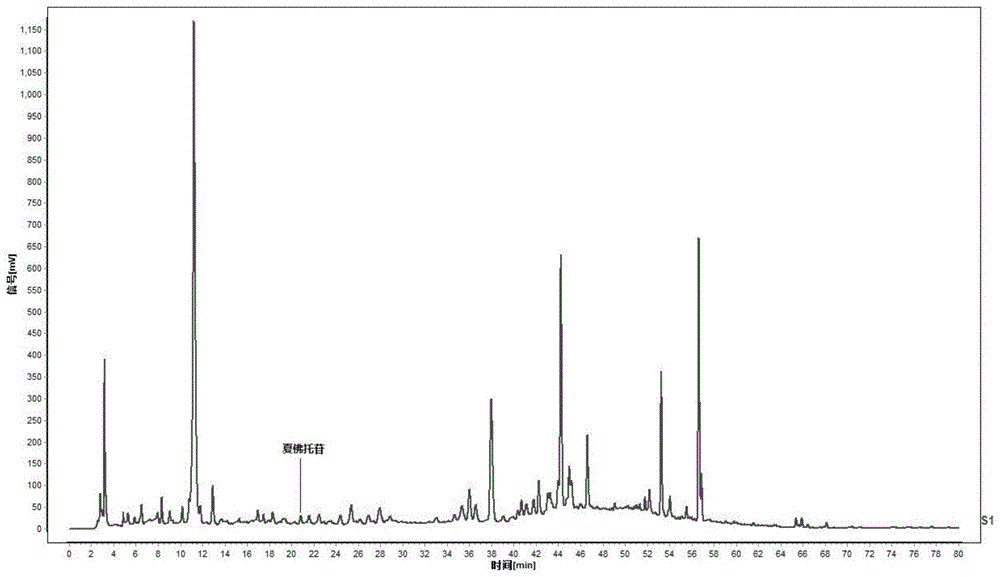
FIG. 1 is a fingerprint chromatogram of the whole components of Dendrobium officinale Kimura et Migo, with a detection wavelength of 280 nm;
FIG. 2 is a chart of the detection map of a standard sample of schaftoside (peak 1);
FIG. 3 is a chart of a detection map of a naringenin (peak 2) standard sample;
FIG. 4 is a detection map of schaftoside (peak No. 1) in Dendrobium officinale;
FIG. 5 is a detection spectrum of naringenin (peak No. 2) in Dendrobium officinale.
Example 4 establishment of fingerprint of characteristic of Dendrobium mexicanum related to schaftoside
1. Preparation of dendrobe sample solution
Taking a dried dendrobium sample, crushing the dendrobium sample by using a crusher, sieving the dendrobium sample by using a pharmacopoeia sieve (the aperture is 0.335mm), precisely weighing 1.000g of dendrobium powder (the weighing error cannot exceed 0.2%), placing the dendrobium powder into a 100mL conical flask, respectively adding 50mL of 75% methanol (V water: V methanol: 25:75), performing ultrasonic treatment at room temperature for 30min, taking out the dendrobium powder, filtering, performing rotary evaporation and concentration on the filtrate until the dendrobium powder is dried, dissolving the dendrobium powder by using a 75% methanol solvent (V water: V methanol: 25:75), finally transferring the dendrobium powder into a 10mL volumetric flask to fix the volume, shaking the dendrobium powder uniformly, and filtering the dendrobium powder by using a 0.45 mu m microporous filter membrane to obtain the. Table 2 shows the linear relationship of the obtained control schaftoside.
TABLE 2 Linear relationship table of the reference schaftoside
2. Method for establishing fingerprint spectrum of related characteristics of dendrobium candidum schaftoside
The first step is as follows: calculating correlation coefficients of all covariates x and y;
the second step is that: arranging the absolute values of the correlation coefficients from large to small, and selecting the first 2 √ n covariates, which are marked as x _1, x _2, … and x _ p;
the third step: and performing linear regression on y and x _1, x _2, … and x _ p, and performing variable selection by adopting a Lasso method.
The first part of the lasso (least Absolute Shrinkage and Selection operator) function represents the goodness of model fitting, and the second part can be considered as penalty. The method compresses small coefficients toward 0, and once a certain coefficient is compressed to 0, the corresponding variable is deleted. It is just like filtering with a "sieve", and the variables that have little influence are sieved off at a time. The smaller the λ, the more variables in the model the larger the λ, the larger the contraction, and the fewer variables are selected. While the Lasso method is a continuous, ordered process with small variance. When the adjusting parameters are large enough, the punishment item has the effect of forcibly setting the estimated values of some coefficients to be 0, so that the Lasso method can perform variable selection and can obtain a sparse model.
When the independent variable is p and the sample size is n, and when p > n, the SIS method is adopted to reduce the dimension, and then the Lasso method is adopted to screen the variable.
SIS Mγ={1≤i≤p:|ωiIs the first | γ n | larger }
Wherein M is*={1≤i≤p:βiNot equal to 0 represents a subscript set of non-zero coefficients in the true model; s ═ M*L represents the number of nonzero coefficients; ω ═ ω (ω)1,ω2,...,ωp)T=XTy; for any given γ ∈ (0,1), the p elements of ω are arranged and defined from large to small in absolute value; at this time, if gamma n is less than n, M is selectedγThe independent variable corresponding to the middle subscript reduces the ultrahigh dimension to d (d is less than or equal to n) dimension; wherein d ═ n or d ═ n/log n]。
The linear model screened by the Lasso method is:
wherein, yiIs the ith response variable, y ═ y1,y2,...,yn)';XiIs PnX1 order covariate, X ═ X1,x2,...,xn)';εiIs a mean of 0 and a variance of σ2I.d, E (E) ═ 0, and Var (E) ═ σ2In。
The random term is assumed to obey classical assumptions, namely:
(1) the random term has a zero mean, E (εi|xi)=0;
(2) The random terms have the same variance, Var (ε)i|xi)=σ2;
(3) Random term no sequence dependence, Cov (ε)i,εj)=0,i≠j;
(4) ε obeys a normal distributioni~N(0,σ2)。
The variance matrix of the random term is one diagonal of sigma2And 0 elsewhere, as follows:
wherein, I
nIs a unit array of n x n, n being the sample size of the data,
for simultaneous variable selection and parameter estimation, the Lasso method is implemented by penalizing the minimization of the least squares objective function formula i.
Wherein y ═ y1,y2,...,yn)T∈RnIs a response variable vector. Taking dendrobe data as an example, each dendrobe has two response variable sequences (schaftoside (mu g/g) and naringenin (mu g/g)). The response variable is affected by the independent variable, typically y is a continuous variable.
x=(x1,x2,...,xn)TA matrix is designed for n × p, containing all candidate independent variables that have an effect on the response variable.
p is the dimension of the sample and n is the sample volume. In the dendrobe data, the dimension p is far larger than the sample capacity n, so the least square estimation is not applicable any more, and a variable selection method is required to be adopted for model estimation.
β=(β1,β2,...,βp)TIs a p-dimensional parameter.
For the penalty function, λ is the adjustment parameter. In the variable selection method, the balance between the model fitting goodness and the punishment degree for the number of the selected variables is embodied by different criteria, and is realized by directly selecting the adjusting parameters, and different lambda values correspond to different punishment degrees. The larger the lambda is, the stronger the compression degree is, the fewer the non-zero parameters obtained by final estimation are, and the most common method for selecting the lambda is a K-fold cross-validation method:
in general, K can be 5 or 10.
The GCV criterion is an approximation of the CV criterion when K is taken to be n, and is defined as:
wherein, SSEkIs the sum of the squared residuals of the CV submodel containing k variables, df is trace { P (λ) }. For the selection of the final optimal model, the sub-model with the minimum CV value or GCV value can be taken.
With a linear model, variable screening is important work because the initial independent variables p are 434, the sample size n is 13, and p > n. After SIS dimensionality reduction, a Lasso method is adopted to screen variables.
The Lasso method resulted from 4 of the variables, with an R-square of 0.8725.
The variables from which the Lasso method screens and their corresponding coefficients are listed in table 3 below, where the first column is the number of the selected variable, the second column is the corresponding coefficient, the third column is the coefficient variance, and the fourth column is the test P value.
TABLE 3 Lasso method selected variables and their corresponding coefficients
The results in table 3 show the results of the screening with schaftoside as the response variable: column 1 is the variable selected by the Lasso method, that is, the variables 241, 148, 183, 383 are selected, and the corresponding p values (column 4) are all less than the significance level 0.05, and have significance difference. The meanings of the above independent variables: and aligning the fingerprint peaks of n batches of samples (n is not less than 10) of dendrobium candidum according to the retention time.
Column 2 is the beta parameter value for each variable. The beta value is positive, which indicates that the variable has positive influence on the dendrobium schaftoside micromolecule; the beta value is negative, which indicates that the variable has negative influence on the dendrobium schaftoside micromolecule. The absolute value of the beta value shows the influence degree of the variable on the dendrobium schaftoside micromolecule. Specifically, in table 3, the effect of variable 148 on dendrobe schaftoside small molecules is positive; the influence of the variables 241, 183, 383 on the dendrobe schaftoside small molecules is negative, wherein the negative influence of the variable 183 is larger.
Example 5 establishment of fingerprint spectrum of characteristic related to naringenin of Dendrobium mexicanum
1. Preparation of control solutions
Precisely weighing naringenin 4.08mg, placing in a 10ml volumetric flask, adding 75% methanol for dissolving and diluting, shaking up to obtain stock solution. Refrigerating at 4 deg.C in refrigerator. Precisely sucking a certain amount of reference substance stock solution, adding 75% methanol for dilution, and accurately preparing naringenin reference substance solution. The components are diluted to prepare 7 concentration points through different dilution ratios, and the concentration points are injected into a high performance liquid chromatograph. Table 4 shows the linear relationship of naringenin, which is the control product obtained.
TABLE 4 reference naringenin linear relationship table
2. Establishment of naringenin related characteristic fingerprint spectrum
With a linear model, variable screening is important work because the initial independent variables p are 434, the sample size n is 17, and p > n. The invention adopts a Lasso method to screen variables.
The Lasso method resulted from 4 of the variables, with an R-square of 0.7399.
The variables from which the Lasso method screens and their corresponding coefficients are listed in table 5 below, where the first column is the input selected variable number, the second column is the corresponding coefficient, the third column is the coefficient variance, and the fourth column is the test P value.
TABLE 5 Lasso method selected variables and their corresponding coefficients
The results in table 5 show the results with naringenin as the independent variable: the variables selected by the Lasso method are shown in column 1, namely, the variables 262, 324, 421 and 392 are selected, and the p values (column 4) of the variables are all less than the significance level of 0.05, and have significance differences. The meanings of the above independent variables: aligning the fingerprint peak area values of n batches of samples (n is not less than 10) of dendrobium candidum according to the retention time.
Column 2 gives the beta parameter values for each variable in particular. The beta value is positive, which indicates that the variable has positive influence on the dendrobe naringenin micromolecules; the beta value is negative, which indicates that the variable has negative influence on the dendrobium naringenin micromolecule. The absolute value of the beta value shows the degree of influence of the variable on the dendrobium naringenin small molecules. Specifically, in table 5, the effect of variables 324, 421, 392 on dendrobe naringenin small molecules is positive, with variable 421 having a greater effect on dendrobe naringenin small molecules; the effect of variable 262 on the small dendrobii naringenin molecules is negative.
According to the results of the first generation molecular data, the technology can clearly distinguish the dendrobium candidum from other dendrobium candidum, has the function of identifying species, and can use a first generation sequencing molecular sequence as the identification index of the species. Meanwhile, the contents of two chemical micromolecules of the characteristic fingerprint of the dendrobium candidum are stable in each sample in the species, can be clearly distinguished from other dendrobium, and can also be used as one of identification indexes of the species. Therefore, a generation of data and a fingerprint map can be used as indexes for identifying the species, and the generation of data and the fingerprint map have the following association relationship: (1) when the first generation data identification sample is dendrobium candidum, the fingerprint of the sample has specific characteristics, namely, the first generation data can identify the species and the fingerprint characteristics of the species can be known; (2) when the fingerprint identification sample is dendrobium candidum, generation data can be deduced. Therefore, the two are sufficient requirements, and the fingerprint characteristics of the species are stable in each representative sample, so that the content of the drug effect components of the species can be determined. Therefore, the first generation sequencing data and the fingerprint spectrum can be used as the identification indexes of the species and can be used as the evaluation indexes of the medicinal materials. If first-generation sequencing and fingerprint spectrum are respectively adopted for determination in variety identification and quality evaluation, the identification results of the two methods can be combined together, so that the identification result of the dendrobium medicinal material is more accurate and reliable.
Example 7 first-generation sequencing of Dendrobium mexicanum and application of fingerprint of related characteristics of small molecular components in quality evaluation of Dendrobium officinale
1. Determining the sequence of the dendrobium medicinal material to be detected by using the next generation sequencing primer sequence and the amplification sequencing parameter, and identifying the dendrobium medicinal material to be detected as the dendrobium candidum medicinal material.
First generation sequencing primer sequence:
ITS-26SE:5’GAATTCCCCGGTTCGCTCGCCGTTAC 3’;
ITS-17SE:5’ACGAATTCATGGTCCGGTGAAGTGTTCG 3’;
the amplification sequencing parameters were: performing PCR circulation after denaturation at 98 ℃ for 2min, wherein the PCR circulation parameter is 98 ℃ for 20 s; 30s at 52 ℃; 1min at 68 ℃, 38 cycles, 7min at 68 ℃, and setting the temperature preservation at 4 ℃ after the amplification is finished.
Through the sequencing, the medicinal material to be detected is determined to be the dendrobium candidum variety.
2. Preparation of test sample
Precisely weighing dendrobium candidum powder, placing the dendrobium candidum powder into a 100ml volumetric flask, precisely adding 50ml of methanol-water with the volume ratio of 75:25 into each 1g of sample, carrying out ultrasonic treatment for 30 minutes at the power of 250W and the frequency of 40kHz, cooling, filtering, carrying out rotary evaporation and concentration on the filtrate until the filtrate is dried, correspondingly dissolving each 1g of dendrobium candidum powder with 5ml of methanol-water with the volume ratio of 75:25, passing the supernatant through a 0.45 mu m microporous filter membrane, and taking the subsequent filtrate to obtain the sample for measuring the content of the micromolecule components of the dendrobium candidum.
3. Chromatographic detection
Chromatographic conditions are as follows:
a chromatographic column: grace Allitima C18 chromatography column (250 mm. times.4.6 mm, 5 μm); mobile phase: phase A: 0.4% acetic acid +20mmol/L ammonium acetate in water, phase B: acetonitrile; gradient elution: 0-12 min, 2-15% of B, 12-35 min, 15-24% of B, 35-45 min and 24-36% of B; 45-60 min, 36-75% B; 60-80 min, 75-95% B, and the flow rate is 1.0 mL/min; the column temperature is 30 ℃; the sample volume is 20 mu L; the detection wavelength is 280 nm.
The sample preparation method comprises the following steps:
weighing 1.00g of the powder (sieved by a third sieve), precisely weighing, placing in a 100ml volumetric flask, precisely adding 50ml of methanol-water (75:25), carrying out ultrasonic treatment (power 250W and frequency 40kHz) for 30 minutes, cooling, filtering, carrying out rotary evaporation and concentration on the filtrate until the filtrate is dry, dissolving the filtrate with 5ml of methanol-water (75:25), filtering the supernatant with a 0.45 mu m microporous filter membrane, and taking the subsequent filtrate to obtain the product.
During detection, measuring a full-component fingerprint chromatogram with the wavelength of 280nm, and comparing the obtained full-component fingerprint chromatogram with the fingerprint chromatogram which is the comparison in figure 1 in a similarity manner; the similarity is more than 0.85, and the quality is qualified.
The traditional Chinese medicine fingerprint is characterized by associating pharmacodynamic activity control with various quantitative characteristics which are obtained by detection of an analytical instrument and reflect the distribution of complex chemical substance components contained in the traditional Chinese medicinal materials, semi-finished products and traditional Chinese medicines (or botanicals), integrally reflecting the types, the quantities and the content characteristics of the chemical substance components contained in the traditional Chinese medicinal materials, the semi-finished products and the traditional Chinese medicines (or botanicals) macroscopically, and energetically revealing the spectrum of potential complex biological activity information characteristics.
According to the method, firstly, the types of the dendrobium are determined through first-generation sequencing, then the relevance research is carried out by measuring the content data of the small molecular components of the dendrobium and the whole peak area of the fingerprint of the dendrobium, and the intrinsic relevance of the dendrobium is found out through relevant data modeling, so that the quality of the dendrobium can be comprehensively evaluated, the quality of the dendrobium candidum medicinal material can be effectively and accurately identified and controlled, the analysis result is more reliable, and the interference of other types of dendrobium medicinal materials is avoided.
The above description is only for the preferred embodiment of the present invention, but the scope of the present invention is not limited thereto, and any changes or substitutions that can be easily conceived by those skilled in the art within the technical scope of the present invention are also included in the scope of the present invention. Therefore, the protection scope of the present invention shall be subject to the protection scope of the claims.