CN109454792B - A kind of water-based polyurethane dipping gloves and production method thereof - Google Patents
A kind of water-based polyurethane dipping gloves and production method thereof Download PDFInfo
- Publication number
- CN109454792B CN109454792B CN201811111426.9A CN201811111426A CN109454792B CN 109454792 B CN109454792 B CN 109454792B CN 201811111426 A CN201811111426 A CN 201811111426A CN 109454792 B CN109454792 B CN 109454792B
- Authority
- CN
- China
- Prior art keywords
- water
- parts
- drying
- based polyurethane
- dipping
- Prior art date
- Legal status (The legal status is an assumption and is not a legal conclusion. Google has not performed a legal analysis and makes no representation as to the accuracy of the status listed.)
- Active
Links
Images

Classifications
-
- B—PERFORMING OPERATIONS; TRANSPORTING
- B29—WORKING OF PLASTICS; WORKING OF SUBSTANCES IN A PLASTIC STATE IN GENERAL
- B29C—SHAPING OR JOINING OF PLASTICS; SHAPING OF MATERIAL IN A PLASTIC STATE, NOT OTHERWISE PROVIDED FOR; AFTER-TREATMENT OF THE SHAPED PRODUCTS, e.g. REPAIRING
- B29C41/00—Shaping by coating a mould, core or other substrate, i.e. by depositing material and stripping-off the shaped article; Apparatus therefor
- B29C41/003—Shaping by coating a mould, core or other substrate, i.e. by depositing material and stripping-off the shaped article; Apparatus therefor characterised by the choice of material
-
- A—HUMAN NECESSITIES
- A41—WEARING APPAREL
- A41D—OUTERWEAR; PROTECTIVE GARMENTS; ACCESSORIES
- A41D19/00—Gloves
- A41D19/0055—Plastic or rubber gloves
-
- A—HUMAN NECESSITIES
- A41—WEARING APPAREL
- A41D—OUTERWEAR; PROTECTIVE GARMENTS; ACCESSORIES
- A41D19/00—Gloves
- A41D19/015—Protective gloves
-
- B—PERFORMING OPERATIONS; TRANSPORTING
- B29—WORKING OF PLASTICS; WORKING OF SUBSTANCES IN A PLASTIC STATE IN GENERAL
- B29C—SHAPING OR JOINING OF PLASTICS; SHAPING OF MATERIAL IN A PLASTIC STATE, NOT OTHERWISE PROVIDED FOR; AFTER-TREATMENT OF THE SHAPED PRODUCTS, e.g. REPAIRING
- B29C41/00—Shaping by coating a mould, core or other substrate, i.e. by depositing material and stripping-off the shaped article; Apparatus therefor
- B29C41/02—Shaping by coating a mould, core or other substrate, i.e. by depositing material and stripping-off the shaped article; Apparatus therefor for making articles of definite length, i.e. discrete articles
- B29C41/14—Dipping a core
-
- B—PERFORMING OPERATIONS; TRANSPORTING
- B29—WORKING OF PLASTICS; WORKING OF SUBSTANCES IN A PLASTIC STATE IN GENERAL
- B29C—SHAPING OR JOINING OF PLASTICS; SHAPING OF MATERIAL IN A PLASTIC STATE, NOT OTHERWISE PROVIDED FOR; AFTER-TREATMENT OF THE SHAPED PRODUCTS, e.g. REPAIRING
- B29C41/00—Shaping by coating a mould, core or other substrate, i.e. by depositing material and stripping-off the shaped article; Apparatus therefor
- B29C41/34—Component parts, details or accessories; Auxiliary operations
-
- A—HUMAN NECESSITIES
- A41—WEARING APPAREL
- A41D—OUTERWEAR; PROTECTIVE GARMENTS; ACCESSORIES
- A41D2400/00—Functions or special features of garments
- A41D2400/80—Friction or grip reinforcement
Landscapes
- Engineering & Computer Science (AREA)
- Mechanical Engineering (AREA)
- Textile Engineering (AREA)
- Gloves (AREA)
Abstract
本发明提供了防护手套领域内的一种水性聚氨酯浸胶手套的生产方法及其用途,包括:步骤S1,制备手套芯:使用涤棉混纺材料或全化纤材料经针织工艺制作手套芯;步骤S2,套模预热:将所述手套芯套入手模上,并进行预热;步骤S3,浸凝固剂:将所述手模浸入凝固剂;步骤S4,浸泡清洗;步骤S5,浸胶液;步骤S6,滴胶;步骤S7,烘干;步骤S8,脱模,冷却得到浸胶手套。本发明方法所制手套具有超耐磨、环保、透气性好,色牢度好、穿戴舒适等优点,且操作方便,节约能源,降低企业生产成本。
The present invention provides a method for producing water-based polyurethane dipped gloves in the field of protective gloves and uses thereof, including: step S1, preparing the glove core: using polyester-cotton blended material or full chemical fiber material to make the glove core through a knitting process; step S2 , preheating the sleeve mold: the glove core is sleeved on the hand mold and preheated; step S3, dipping the coagulant: dipping the hand mold into the coagulant; step S4, soaking and cleaning; step S5, dipping glue; Step S6, dispensing glue; Step S7, drying; Step S8, demoulding, and cooling to obtain the dipped gloves. The gloves prepared by the method of the invention have the advantages of super wear resistance, environmental protection, good air permeability, good color fastness, comfortable wearing and the like, and are convenient to operate, save energy and reduce the production cost of enterprises.
Description
技术领域technical field
本发明涉及防护手套领域,特别是一种水性聚氨酯浸胶手套生产的技术领域。The invention relates to the field of protective gloves, in particular to the technical field of production of water-based polyurethane dipping gloves.
背景技术Background technique
水性聚氨酯(WPU)以水作为分散剂代替有机溶剂,具有无毒、不易燃、运输安全、环境友好等优点,但水性聚氨酯在耐水性、耐溶剂性、力学性能、耐磨性等方面存在着不足。Water-based polyurethane (WPU) uses water as a dispersant instead of organic solvent, which has the advantages of non-toxic, non-flammable, safe transportation, and environmental friendliness. insufficient.
同时,水性聚氨酯因水的存在,使得水性聚氨酯比溶剂型聚氨酯干燥时间长如采用高固含量的水性聚氨酯作为材料,则存在透气性差等缺点,同时也增加生产成本。At the same time, due to the presence of water, water-based polyurethane has a longer drying time than solvent-based polyurethane. If water-based polyurethane with high solid content is used as the material, there are disadvantages such as poor air permeability, which also increases production costs.
因此,如何针对上述现有技术所存在的缺点进行研发改良,实为相关业界所需努力研发的目标,本申请设计人有鉴于此,乃思及创作的意念,遂以多年的经验加以设计,经多方探讨并试作样品试验,及多次修正改良,乃推出本申请。Therefore, how to carry out research and development improvement in view of the shortcomings of the above-mentioned existing technology is actually the goal of the relevant industry to strive for research and development. In view of this, the designer of the present application has thought about the idea of creation, and designed it with many years of experience. After many discussions and trial samples, and many revisions and improvements, this application is launched.
例如申请号为CN201410555865.4的一种聚氨酯多层浸胶手套的生产工艺,其特征在于:其步骤为:For example, the production process of a kind of polyurethane multi-layer dipping gloves whose application number is CN201410555865.4 is characterized in that: the steps are:
a.预热:手模预热至50-60℃,在手模上套上手套芯;a. Preheating: preheat the hand mold to 50-60℃, and put the glove core on the hand mold;
b.套模:套上手套芯后保持上述温度继续预热4-6min;b. Sleeve mold: After putting on the glove core, keep the above temperature and continue to preheat for 4-6min;
c.一次浸胶:保持上述温度,将手套芯在油性聚氨酯胶液中浸胶液1s;c. One dip: keep the above temperature, dip the glove core in the oily polyurethane glue for 1s;
d.滴胶:在浸胶池上滴胶2-3min;d. Glue: Drop glue on the dipping tank for 2-3min;
e.匀胶:在浸胶池上匀胶4-5min;e. Evening glue: glue evenly on the dipping tank for 4-5min;
f.浸凝固剂:在凝固池中浸凝固剂8-10min,凝固剂为纯净水;f. Immersion coagulant: Immerse coagulant in the coagulation tank for 8-10min, and the coagulant is pure water;
g.浸泡:在50-70℃的水中浸泡50-60min;g. Soaking: soak in water at 50-70℃ for 50-60min;
h.烘烤:在80-90℃温度下烘烤4-5min;h. Baking: Bake at 80-90℃ for 4-5min;
i.二次浸胶:将h步骤经过一次浸胶的手套芯在油性聚氨酯胶液中再次浸胶液1s;然后滴胶和匀胶,在凝固池中二次浸凝固剂,经过浸泡和烘烤后进行三次浸胶,依此进行多次浸胶;i. Secondary dipping: dip the glove core that has been dipped once in step h in oily polyurethane glue for 1 s again; then glue and homogenize, dip the coagulant in the coagulation tank for a second time, soak and bake After baking, carry out dipping three times, and then carry out multiple dipping;
j.脱模:最后经过冷却脱模得产品。j. Demoulding: Finally, the product is obtained by cooling and demoulding.
上述技术存在选用高固含量的水性聚氨酯作为原材料,致使透气性较差,舒适感差,且使用高固含量的水性聚氨酯作为原材料成本也较高。In the above technology, waterborne polyurethane with high solid content is selected as the raw material, resulting in poor air permeability and poor comfort, and the cost of using waterborne polyurethane with high solid content as raw material is also high.
例如申请号为CN201810149798.4的中国发明专利公开了一种油性PU-丁腈双层复合橡胶手套的生产方法,其特征在于,包括:For example, the Chinese invention patent with the application number of CN201810149798.4 discloses a method for producing oily PU-nitrile-butadiene double-layer composite rubber gloves, which is characterized in that it includes:
步骤S1,浸渍油性PU树脂胶料:将手套胚浸渍油性PU树脂胶料,所述油性PU树脂胶料包含按质量份数计且混合调配的90-120份油性PU树脂、250~800份DMF、0.2~1.5份消泡剂和0.2~2份流平剂;Step S1, dipping the oily PU resin compound: dipping the glove embryo into the oily PU resin compound, the oily PU resin compound comprising 90-120 parts of oily PU resin, 250-800 parts of DMF in parts by mass and mixed and prepared , 0.2 to 1.5 parts of defoamer and 0.2 to 2 parts of leveling agent;
步骤S2,滴胶及水洗:将步骤S1经油性PU树脂浸渍后的手套滴胶放置,后放入水中泡洗,取出后烘干;Step S2, glue dispensing and water washing: place the glove glued after being impregnated with the oily PU resin in step S1, put it into water for soaking and washing, take it out and dry it;
步骤S3,浸渍丁腈胶乳胶料:将经步骤S2处理的手套浸渍丁腈胶乳胶料,所述丁腈胶乳胶料包含按质量份数计且混合调配的90~120份丁腈胶乳,0.5~4份增稠剂,0~4份交联剂,5~10份水;Step S3, dipping nitrile latex material: dipping the gloves processed in step S2 with nitrile latex material, the nitrile latex material includes 90-120 parts by mass of nitrile latex mixed and prepared, 0.5 ~4 parts thickener, 0-4 parts cross-linking agent, 5-10 parts water;
步骤S4,硫化烘干:将经步骤S3处理的手套,经硫化烘干制得油性PU-丁腈双层复合橡胶手套。Step S4, vulcanization and drying: the gloves treated in step S3 are vulcanized and dried to obtain oily PU-nitrile double-layer composite rubber gloves.
上述发明在耐油耐化学腐蚀方面能实现良好的技术效果,但在耐磨、抗拉伸强度等机械性能方面就显得不足。The above invention can achieve good technical effects in terms of oil resistance and chemical corrosion resistance, but it is insufficient in terms of mechanical properties such as wear resistance and tensile strength.
例如申请号为CN201310727250.0的中国发明专利公开了一种水性PU涂层手套生产方法,包括:For example, the Chinese invention patent with the application number CN201310727250.0 discloses a method for producing water-based PU coated gloves, including:
步骤S1:将一针织手套浸入一凝固剂中,进行淋凝固剂处理;Step S1: a knitted glove is immersed in a coagulant, and the coagulant treatment is carried out;
步骤S2:将该手套浸入一涂层剂中,其中,该涂层剂由以下组分组成:86%水性PU树脂,7%填充料,2%消光粉,1.5%耐磨剂,及3.5%增稠剂;及将该手套浸入一固化剂,进行淋浆和匀浆处理。Step S2: immerse the glove in a coating agent, wherein the coating agent is composed of the following components: 86% water-based PU resin, 7% filler, 2% matting powder, 1.5% wear-resistant agent, and 3.5% thickening agent; and immersing the glove in a curing agent, drenching and homogenizing.
上述技术方案具有操作简单,使用方便,但因仅仅将手套浸入一涂层剂中,使得结构不牢,手套表面的涂层非常容易脱落,导致无法达到涂层的防护效果。The above technical solution has the advantages of simple operation and convenient use, but because the glove is only immersed in a coating agent, the structure is not strong, and the coating on the surface of the glove is very easy to fall off, so that the protective effect of the coating cannot be achieved.
发明内容SUMMARY OF THE INVENTION
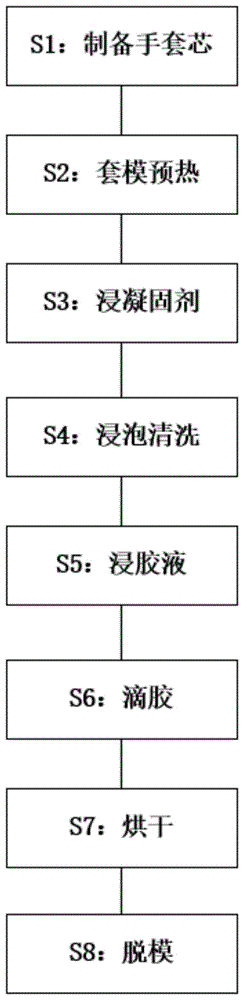
鉴于上述技术问题,本发明提供一种耐磨环保透气的水性聚氨浸胶手套的生产方法。一种水性聚氨酯浸胶手套的生产方法,其特征在于,包括:In view of the above-mentioned technical problems, the present invention provides a production method of wear-resistant, environmentally friendly and breathable water-based polyurethane dipped gloves. A method for producing water-based polyurethane dipping gloves, comprising:
步骤S1,制作手套芯:使用涤棉混纺材料或全化纤材料经针织工艺制作手套芯;Step S1, making the glove core: using polyester-cotton blended material or full chemical fiber material to make the glove core through a knitting process;
步骤S2,套模预热:将所述手套芯套入手模上,并进行预热;Step S2, preheating the sleeve mold: the glove core is sleeved on the hand mold and preheated;
步骤S3,浸凝固剂:将所述手模浸入凝固剂;Step S3, dipping the coagulant: dipping the hand mold into the coagulant;
步骤S4,浸泡清洗:将浸有凝固剂的所述手模浸泡清洗;Step S4, soaking and cleaning: soaking and cleaning the hand mold soaked with the coagulant;
步骤S5,浸胶液:将经步骤S4的所述手模浸入水性聚氨酯胶浆液中,所述水性聚氨酯胶液包括按重量份数计90-100份水性聚氨酯、2-10份耐磨助剂、3-5份增稠剂、5-10份水;Step S5, dipping solution: immerse the hand mold in step S4 into a water-based polyurethane glue solution, and the water-based polyurethane glue solution includes 90-100 parts by weight of water-based polyurethane, 2-10 parts of wear-resistant additives , 3-5 parts thickener, 5-10 parts water;
步骤S6,滴胶:提升手模,滴流手套芯上多余的胶液;Step S6, dispensing: lifting the hand mold and dripping excess glue on the glove core;
步骤S7,烘干:将经步骤S6处理的手套芯放入烘干装置中进行烘干处理;Step S7, drying: put the glove core processed in step S6 into a drying device for drying;
步骤S8,脱模:手套坯经步骤S7烘干后脱模,冷却得到浸胶手套。Step S8, demoulding: the glove blank is demolded after drying in step S7, and cooled to obtain dipped gloves.
优选的,所述步骤S5中耐磨助剂为硅酮乳液,其重量份数为2-6份。Preferably, in the step S5, the wear-resisting aid is a silicone emulsion, and its parts by weight are 2-6 parts.
优选的,所述步骤S5中耐磨助剂为二氧化硅纳米分散液,其重量份数为6-10份。Preferably, in the step S5, the wear-resisting aid is a silica nano-dispersion, and its parts by weight are 6-10 parts by weight.
优选的,所述步骤S3中凝固剂按重量份数包括12份金属盐清液、1.5份水基型粘着剂、2份甲醇以及84.5份水混合调制而成。Preferably, in the step S3, the coagulant is prepared by mixing 12 parts of metal salt clear liquid, 1.5 parts of water-based adhesive, 2 parts of methanol and 84.5 parts of water by weight.
优选的,所述金属盐为氯化钠、氯化钾、硫酸铝、硫酸镁,所述水基型粘着剂为丙烯酸系水基粘着剂。Preferably, the metal salt is sodium chloride, potassium chloride, aluminum sulfate, magnesium sulfate, and the water-based adhesive is an acrylic water-based adhesive.
优选的,所述步骤S2中使用固含量为20%-25%的水性聚氨酯。Preferably, water-based polyurethane with a solid content of 20%-25% is used in the step S2.
优选的,所述步骤S7中,烘干工序采用梯度升温烘干工艺。Preferably, in the step S7, the drying process adopts a gradient heating drying process.
优选的,所述梯度升温烘干工艺为先采用85℃~100℃升温烘干,烘干时间30~45min后,再采用120℃~140℃升温烘干,烘干时间为75-90min。Preferably, the gradient heating and drying process is to first use 85°C to 100°C for heating and drying, and after drying for 30 to 45 minutes, then use 120°C to 140°C for heating and drying, and the drying time is 75-90 minutes.
优选的,所述步骤S2中增稠剂为纤维素或纤维素钠。Preferably, the thickener in the step S2 is cellulose or sodium cellulose.
相应的,一种水性聚氨酯浸胶手套,根据权利要求1-9任一项所述的水性聚氨酯浸胶手套的生产方法所制。Correspondingly, a water-based polyurethane dipped glove is prepared according to the production method of the water-based polyurethane dipped glove according to any one of claims 1-9.
与现有技术相比,本发明具有如下的有益效果Compared with the prior art, the present invention has the following beneficial effects
(1)水性聚氨酯溶液与引入的助剂硅酮乳液或二氧化硅分散液混合后,利用合理的烘干工艺,使两者能够以最佳的状态结合,实现手套浸胶层耐磨度的大幅提高,为不加助剂前的3-5倍。(1) After mixing the water-based polyurethane solution with the introduced additive silicone emulsion or silica dispersion, use a reasonable drying process to combine the two in the best state to achieve the best wear resistance of the glove dipping layer. It is greatly improved, 3-5 times of that before adding additives.
(2)在水性聚氨酯浸胶手套工艺烘干程序中,选取合理烘干温度采用梯度烘干工艺,使得手套浸胶层的表面平整光滑,将产生气泡的概率降低到最低,提高产品合格率,同时有效降低能耗,提高生产效率。(2) In the drying procedure of the water-based polyurethane dipping glove process, a reasonable drying temperature is selected and a gradient drying process is adopted to make the surface of the glove dipping layer smooth and smooth, reduce the probability of generating air bubbles to a minimum, and improve the product qualification rate. At the same time, it can effectively reduce energy consumption and improve production efficiency.
(3)采用低固含量的水性聚氨酯材料,提高了手套产品在拉伸强度、断裂伸长率等方面的机械性能。(3) The use of water-based polyurethane material with low solid content improves the mechanical properties of the glove product in terms of tensile strength and elongation at break.
(4)水性PU浸胶手套制作过程中不使用有毒有机溶剂,包括聚氨酯和色浆都是以水为介质的,因此无有机挥发无污染、无有毒的DMF产生。(4) No toxic organic solvents are used in the production process of water-based PU dipped gloves, including polyurethane and color paste, which are all based on water, so there is no organic volatilization, no pollution, and no toxic DMF.
附图说明Description of drawings
通过阅读参照以下附图对非限制性实施例所作的详细描述,本发明的其它特征、目的和优点将会变得更明显:Other features, objects and advantages of the present invention will become more apparent by reading the detailed description of non-limiting embodiments with reference to the following drawings:
图1为本发明水性聚氨酯浸胶手套生产方法的流程图。Fig. 1 is the flow chart of the production method of water-based polyurethane dipping gloves of the present invention.
具体实施例specific embodiment
以下实施例将有助于本领域的技术人员进一步理解本发明,但不以任何形式限制本发明。应当指出的是,对本领域的普通技术人员来说,在不脱离本发明构思的前提下,还可以做出若干变形和改进,这些都属于本发明的保护范围。The following examples will help those skilled in the art to further understand the present invention, but do not limit the present invention in any form. It should be pointed out that for those skilled in the art, without departing from the concept of the present invention, several modifications and improvements can be made, which all belong to the protection scope of the present invention.
实施例1Example 1
步骤S1,制备手套芯:用涤棉混纺材料,通过10针、13针、15针或18针针织工艺加工成手套坯;Step S1, preparing the glove core: using polyester-cotton blended material, through 10-needle, 13-needle, 15-needle or 18-needle knitting process, it is processed into glove blank;
步骤S2,套模预热:将针织的手套芯套入手模上,采用30-40℃的温度预预热30min;Step S2, preheating the sleeve mold: the knitted glove core is sleeved on the hand mold, and preheated at a temperature of 30-40°C for 30 minutes;
步骤S3,浸凝固剂:将套有手套芯的手模浸入凝固剂,所述凝固剂按重量份数由12份氯化钠、氯化钾、硫酸铝或硫酸镁中的一种金属盐清液、1.5份丙烯酸系水基型粘着剂、2份甲醇和84.5份水混合调制而成;Step S3, immersing the coagulant: the hand mold covered with the glove core is immersed in the coagulant, and the coagulant is cleaned by a metal salt in 12 parts of sodium chloride, potassium chloride, aluminum sulfate or magnesium sulfate by parts by weight. Liquid, 1.5 parts of acrylic water-based adhesive, 2 parts of methanol and 84.5 parts of water mixed and prepared;
步骤S4,浸泡清洗;将浸有凝固剂的所述手模浸泡、清洗,所用浸泡的溶液为纯净水,浸泡40min后进行清洗;Step S4, soaking and cleaning; soaking and cleaning the hand mold soaked with the coagulant, the solution used for soaking is pure water, soaking for 40min and then cleaning;
步骤S5,浸胶液:将经步骤S4的所述手模浸入水性聚氨酯胶浆液中,所述水性聚氨酯胶液的制备首先将100份固含量为20-25%的水性聚氨酯与2份硅酮乳液搅拌均匀充分混合,再使用5份纤维素或纤维素钠与10份水调制粘度为2000mpa.s;Step S5, dipping solution: immerse the hand mold in step S4 into the water-based polyurethane glue solution. To prepare the water-based polyurethane glue solution, firstly, 100 parts of water-based polyurethane with a solid content of 20-25% and 2 parts of silicone The emulsion is stirred evenly and fully mixed, and then use 5 parts of cellulose or cellulose sodium and 10 parts of water to adjust the viscosity to 2000mpa.s;
步骤S6,滴胶:提升手模静置20min,将手套芯上多余的胶液滴流干净;Step S6, glue dispensing: lift the hand mold and let it stand for 20 minutes, and drain off the excess glue droplets on the glove core;
步骤S7,烘干:将经步骤S6处理的手套芯放入烘干装置中,先采用85干燥45min后,再采用140℃干燥75min;Step S7, drying: put the glove core processed in step S6 into the drying device, first use 85°C to dry for 45min, and then use 140°C to dry for 75min;
步骤S8,脱模:手套坯经步骤S7烘干后脱模,冷却得到浸胶手套。Step S8, demoulding: the glove blank is demolded after drying in step S7, and cooled to obtain dipped gloves.
实施例2Example 2
实施例2与实施例1的基本相同,区别在于:Example 2 is basically the same as Example 1, the difference is:
步骤S5,浸胶液:将经步骤S4的所述手模浸入水性聚氨酯胶浆液中,所述水性聚氨酯胶液的制备首先将94份固含量为25%的水性聚氨酯与6份硅酮乳液搅拌均匀充分混合,再使用3-5份增稠剂与10份水调制粘度为2000mpa.s。Step S5, dipping solution: immerse the hand mold in step S4 into the water-based polyurethane glue solution, the preparation of the water-based polyurethane glue solution firstly stirs 94 parts of water-based polyurethane with a solid content of 25% and 6 parts of silicone emulsion Mix evenly and thoroughly, and then use 3-5 parts of thickener and 10 parts of water to adjust the viscosity to 2000mpa.s.
实施例3Example 3
实施例2与实施例1的基本相同,区别在于:Example 2 is basically the same as Example 1, the difference is:
步骤S5,浸胶液:将经步骤S4的所述手模浸入水性聚氨酯胶浆液中,所述水性聚氨酯胶液的制备首先将90份固含量为25%的水性聚氨酯与10份硅酮乳液搅拌均匀充分混合,再使用3-5份增稠剂与10份水调制粘度为2000mpa.s。Step S5, dipping solution: immerse the hand mold in step S4 into the water-based polyurethane glue solution, the preparation of the water-based polyurethane glue solution firstly stirs 90 parts of water-based polyurethane with a solid content of 25% and 10 parts of silicone emulsion Mix evenly and thoroughly, and then use 3-5 parts of thickener and 10 parts of water to adjust the viscosity to 2000mpa.s.
实施例4Example 4
实施例4与实施例1基本相同,区别在于:Example 4 is basically the same as Example 1, the difference is:
步骤S5,浸胶液:将经步骤S4的所述手模浸入水性聚氨酯胶浆液中,所述水性聚氨酯胶液的制备首先将100份固含量为25%的水性聚氨酯与2份二氧化硅纳米分散液搅拌均匀充分混合,再使用3-5份增稠剂与10份水调制粘度为2000mpa.s。Step S5, dipping solution: immerse the hand mold in step S4 into the water-based polyurethane glue solution, the preparation of the water-based polyurethane glue solution is firstly 100 parts of water-based polyurethane with a solid content of 25% and 2 parts of silica nanoparticles The dispersion liquid is stirred evenly and fully mixed, and then use 3-5 parts of thickener and 10 parts of water to adjust the viscosity to 2000mpa.s.
实施例5Example 5
实施例5与实施例1基本相同,区别在于:Embodiment 5 is basically the same as embodiment 1, the difference is:
步骤S5,浸胶液:将经步骤S4的所述手模浸入水性聚氨酯胶浆液中,所述水性聚氨酯胶液的制备首先将94份固含量为25%的水性聚氨酯与6份二氧化硅纳米分散液搅拌均匀充分混合,再使用3-5份增稠剂与10份水调制粘度为2000mpa.s。Step S5, dipping solution: immerse the hand mold in step S4 into the water-based polyurethane glue solution, the preparation of the water-based polyurethane glue solution is firstly 94 parts of water-based polyurethane with a solid content of 25% and 6 parts of silica nanoparticles The dispersion liquid is stirred evenly and fully mixed, and then use 3-5 parts of thickener and 10 parts of water to adjust the viscosity to 2000mpa.s.
实施例6Example 6
实施例3与实施例1基本相同,区别在于:Embodiment 3 is basically the same as embodiment 1, the difference is:
步骤S5,浸胶液:将经步骤S4的所述手模浸入水性聚氨酯胶浆液中,所述水性聚氨酯胶液的制备首先将90份固含量为25%的水性聚氨酯与10份二氧化硅纳米分散液搅拌均匀充分混合,再使用3-5份增稠剂与10份水调制粘度为2000mpa.s。Step S5, dipping solution: immerse the hand mold in step S4 into the water-based polyurethane glue solution. The preparation of the water-based polyurethane glue solution is to firstly prepare 90 parts of water-based polyurethane with a solid content of 25% and 10 parts of silica nanoparticles. The dispersion liquid is stirred evenly and fully mixed, and then use 3-5 parts of thickener and 10 parts of water to adjust the viscosity to 2000mpa.s.
实施例7Example 7
实施例9与实施例1基本相同,区别在于:Embodiment 9 is basically the same as embodiment 1, the difference is:
步骤S7,烘干:将经步骤S6处理的手套芯放入烘干装置中,先采用90干燥40min后,再采用130℃干燥80min;Step S7, drying: put the glove core processed in step S6 into a drying device, first use 90°C to dry for 40min, and then use 130°C to dry for 80min;
实施例8Example 8
实施例10与实施例1基本相同,区别在于:Embodiment 10 is basically the same as embodiment 1, the difference is:
步骤S7,烘干:将经步骤S6处理的手套芯放入烘干装置中,先采用100干燥30min后,再采用120℃干燥90min;Step S7, drying: put the glove core processed in step S6 into the drying device, first use 100°C for 30min drying, and then use 120°C for 90min drying;
对比例1Comparative Example 1
对比例1与实施例1基本相同,主要区别在于:Comparative Example 1 is basically the same as Example 1, and the main difference is:
步骤S5,浸胶液:将经步骤S4的所述手模浸入水性聚氨酯胶浆液中,所述水性聚氨酯胶液的制备首先将100份固含量为25%的水性聚氨酯,再使用3-5份增稠剂,5-10份水调制粘度为2000mpa.s;Step S5, dipping solution: immerse the hand mold in step S4 into the water-based polyurethane glue solution. The preparation of the water-based polyurethane glue solution is to firstly use 100 parts of water-based polyurethane with a solid content of 25%, and then use 3-5 parts of water-based polyurethane glue. Thickener, 5-10 parts of water to adjust the viscosity to 2000mpa.s;
对比例2Comparative Example 2
对比例2与实施例1基本相同,主要区别在于:Comparative example 2 is basically the same as embodiment 1, and the main difference is:
步骤S3,浸凝固剂:将套有手套芯的手模浸入凝固剂,所述凝固剂按重量份数由8份钠盐或钾盐或铝盐或镁盐中的一种金属盐清液、1份丙烯酸系水基型粘着剂、1份甲醇和90份水混合调制而成。Step S3, immersion coagulant: the hand mold covered with the glove core is immersed in the coagulant, and the coagulant is composed of 8 parts by weight of a metal salt clear liquid in sodium salt or potassium salt or aluminum salt or magnesium salt, It is prepared by mixing 1 part of acrylic water-based adhesive, 1 part of methanol and 90 parts of water.
对比例3Comparative Example 3
对比例3与实施例1基本相同,主要区别在于:Comparative example 3 is basically the same as embodiment 1, and the main difference is:
步骤S8,烘干:待胶面不流动后进行烘干,采用80℃-140℃干燥120分钟。Step S8, drying: drying is carried out after the glue surface does not flow, and drying is carried out at 80°C-140°C for 120 minutes.
对比例4Comparative Example 4
对比例4与实施例1基本相同,主要区别在于:步骤S5,浸胶液:将经步骤S4的所述手模浸入水性聚氨酯胶浆液中,所述水性聚氨酯胶液的制备首先将100份固含量为35%的水性聚氨酯与2份硅酮乳液搅拌均匀充分混合,再使用5份增稠剂与10份水调制粘度为2000mpa.s。Comparative Example 4 is basically the same as Example 1, the main difference is: step S5, dipping solution: immerse the hand mold in step S4 into the water-based polyurethane glue solution, the preparation of the water-based polyurethane glue solution is firstly 100 parts of solid The water-based polyurethane with a content of 35% and 2 parts of silicone emulsion are stirred and mixed well, and then 5 parts of thickener and 10 parts of water are used to adjust the viscosity to 2000mpa.s.
实施例1-11与对比例1-4的实施方案中主要区别如表1:The main differences in the embodiments of Examples 1-11 and Comparative Examples 1-4 are shown in Table 1:
表1实施例与对比例的实验条件The experimental conditions of table 1 embodiment and comparative example


通过同样的实验,分别对上述实施例与对比例制作的手套的浸胶层进行耐磨损率、断裂伸长率、拉伸强度、表面平整度以及耐磨色牢度测试,测试方法介绍如下:Through the same experiment, the wear resistance, elongation at break, tensile strength, surface flatness and color fastness to abrasion were tested on the dipping layers of the gloves made by the above examples and comparative examples respectively. The test methods are introduced as follows :
1)耐磨损率测试方法:1) Test method for wear resistance rate:
采用GT7012-T型Taber耐磨耗试验仪,按GB/T 17682006(等采用ISO 77842∶1997)测定涂膜的磨损量,样品尺寸为Φ10mm,磨损用橡胶砂轮为C10橡胶轮,负荷为250g,每个样品测试的转数为1000转。耐磨性以胶膜在一定负载和转速下的质量磨损率来表示,磨损率(S)按如下公式计算:GT7012-T Taber abrasion resistance tester was used to measure the wear amount of the coating film according to GB/T 17682006 (ISO 77842:1997, etc.), the sample size was Φ10mm, the rubber grinding wheel used for wear was C10 rubber wheel, and the load was 250g. The number of revolutions tested for each sample was 1000 revolutions. The wear resistance is expressed by the mass wear rate of the film under a certain load and rotation speed, and the wear rate (S) is calculated according to the following formula:

其中,M和Mo分别为测试前和测试后涂膜的质量(g,精确到0.0001g)。Among them, M and Mo are the mass (g, accurate to 0.0001g) of the coating film before and after the test, respectively.
2)断裂伸长率与拉伸强度测试方法:2) Test methods for elongation at break and tensile strength:
采用QBT 2710-2005《皮革物理和机械试验抗张强度和伸长率的测定》的方法测定。Measured by the method of QBT 2710-2005 "Determination of Tensile Strength and Elongation of Leather Physical and Mechanical Test".
3)表面平整度:3) Surface flatness:
采用SEM表面扫描,将样品干胶膜切片,经喷金处理后,采用扫描式电子显微镜对其进行表面扫描,观察胶膜表面形貌,加速电压为5.0kV。Using SEM surface scanning, the dry adhesive film of the sample was sliced, and after being sprayed with gold, the surface was scanned by a scanning electron microscope to observe the surface morphology of the adhesive film, and the accelerating voltage was 5.0 kV.
经上述测试结果如表2所示:The above test results are shown in Table 2:
表2Table 2
根据表2中显示的测试结果,结合表1中各实施方案的主要区别点,对发明突出的有益效果做如下说明:According to the test results shown in Table 2, combined with the main differences of the embodiments in Table 1, the outstanding beneficial effects of the invention are described as follows:
(一)耐磨损率方面(1) In terms of wear resistance
表2显示,实施例1-6所制样品的耐磨损率均小于0.5%,而在耐磨损率较为明显的为对比例1与对比例3,分别为1.86%、1.27%,通过表1可知:Table 2 shows that the wear resistance rates of the samples prepared in Examples 1-6 are all less than 0.5%, while the wear resistance rates of Comparative Example 1 and Comparative Example 3 are more obvious, which are 1.86% and 1.27% respectively. 1 know that:
1)对比例1相对于实施例1-6方案的主要区别在于未加入任何耐磨剂。1) The main difference between Comparative Example 1 and the schemes of Examples 1-6 is that no anti-wear agent is added.
2)对比例3相对于实施例1-6方案主要区别在于烘干温度采用持续升温加热烘干工艺。2) The main difference of Comparative Example 3 with respect to the schemes of Examples 1-6 is that the drying temperature adopts a continuous heating and drying process.
由上述不同点可知:It can be seen from the above differences that:
1)胶液中添加硅酮乳液或二氧化硅纳米分散液后,样品的耐磨损率相比较不添加耐磨助剂提高了3倍以上;1) After adding silicone emulsion or silica nano-dispersion to the glue, the wear resistance rate of the sample is increased by more than 3 times compared with no wear additive;
2)烘干温度采用梯度升温烘干工艺相比持续升温的烘干工艺,样品的耐磨损率提高了50%。2) Compared with the drying process of continuous heating, the drying temperature adopts the gradient heating drying process, and the wear resistance rate of the sample is increased by 50%.
综上所述,耐磨损率在耐磨剂硅酮乳液或二氧化硅杂化分散液与梯度烘干工艺协同作用下的表现出良好的效果,主要机理阐述如下:In summary, the wear resistance rate shows a good effect under the synergistic effect of the anti-wear agent silicone emulsion or silica hybrid dispersion and the gradient drying process. The main mechanism is described as follows:
当烘干温度选择80-100℃烘干30-45分钟后,使得体系中的水份先挥发一部分,以防止高温沸腾产生气泡,对水性聚氨酯的膜的形成起到了良好的效果,使得生产出的手套产品表面平整光滑,当再采用120-140℃高温烘干75-90分钟,对水性聚氨酯与助剂硅酮乳液或二氧化硅纳米分散液的交联起到了较佳的效果,使得硅酮乳液或二氧化硅纳米分散液能够很好的与水性聚氨酯溶液相融合,能够使得硅酮粒子或二氧化硅纳米粒子均匀地嵌入水性聚氨酯形成的膜中。从对比例3采用80-140℃持续烘干形成的手套产品表面具有针眼凹凸状可以证明,采用持续烘干的方式,将会产生气泡。此时采用梯度加温的方式,可有效降低能耗,提高产品合格率,提高生产效率。When the drying temperature is selected to be 80-100°C for 30-45 minutes, the water in the system will be volatilized first to prevent bubbles from boiling at high temperature, which has a good effect on the formation of water-based polyurethane film, making the production of The surface of the glove product is smooth and smooth. When it is dried at a high temperature of 120-140 ° C for 75-90 minutes, it has a good effect on the cross-linking of the water-based polyurethane and the auxiliary silicone emulsion or silica nano-dispersion, making the silicone The ketone emulsion or the silica nano-dispersion can be well integrated with the aqueous polyurethane solution, so that the silicone particles or the silica nanoparticles can be uniformly embedded in the film formed by the aqueous polyurethane. From Comparative Example 3, the surface of the glove product formed by continuous drying at 80-140° C. has pinhole concavo-convex shape, which can prove that air bubbles will be generated by the continuous drying method. At this time, the gradient heating method can effectively reduce energy consumption, improve product qualification rate and improve production efficiency.
硅酮主要因表面张力较小,能够降低涂膜表面的摩擦系数,因而能够大大提高水性聚氨酯浸胶层表面的耐磨损系数;而二氧化硅纳米粒子主要因硬度相对较大,在摩擦过程中承担摩擦作用力因而使得水性聚氨酯浸胶层的耐磨损性能大大提高。Silicone is mainly due to its small surface tension, which can reduce the friction coefficient on the surface of the coating film, so it can greatly improve the wear resistance coefficient of the surface of the water-based polyurethane dipping layer. Therefore, the wear resistance of the water-based polyurethane dipping layer is greatly improved.
另外,对比实施例1-3三种实施方案,其区别点在于水性聚氨酯与助剂的混合液中,硅酮乳液的含量不同,分别为2%、6%与10%,而耐磨损率分别为0.25%、0.35%、0.43%,其主要原因在于硅酮的表面张力较小,能够降低涂膜表面的摩擦系数,因而减摩抗磨性能提高,但硅酮和聚氨酯树脂的相容性不好,低表面张力的硅酮会向涂膜表面迁移,当其质量分数进一步增大时,涂膜表面的硅酮导致摩擦过程中磨损量增加。In addition, comparing the three embodiments of Examples 1-3, the difference is that the content of the silicone emulsion in the mixed solution of the water-based polyurethane and the auxiliary agent is different, which are 2%, 6% and 10% respectively, and the wear resistance rate is different. They are 0.25%, 0.35%, and 0.43%, respectively. The main reason is that the surface tension of silicone is small, which can reduce the friction coefficient on the surface of the coating film, so the anti-friction and anti-wear performance is improved, but the compatibility of silicone and polyurethane resin. Not good, the silicone with low surface tension will migrate to the surface of the coating film. When its mass fraction is further increased, the silicone on the surface of the coating film will lead to an increase in the amount of wear during friction.
通过对实施例4-6三种实施方案的对比,其区别点在于水性聚氨酯与助剂二氧化硅纳米分散液的混合液中,二氧化硅纳米分散液的含量不同,分别为2%、6%与10%,而耐磨损率分别为0.48%、0.34%、0.28%,其主要原因在于树脂基体在摩擦过程中,容易产生粘着磨损,形成磨屑,造成高的磨损量,引入纳米二氧化硅分散液后,其中的纳米SiO2粒子在摩擦过程中承担摩擦作用力,导致树脂的本体摩擦转变为树脂界面和SiO2作为支撑结构的摩擦,而无机纳米粒子比聚氨酯树脂基体的硬度和耐磨性好,摩擦的进一步进行必须以先磨去无机粒子为代价,从而导致体系的磨损量减小,所以混合液中纳米二氧化硅分散液质量分数越高,涂膜中所含纳米SiO2无机粒子越多,其耐磨性越好。By comparing the three embodiments of Examples 4-6, the difference is that the content of the silica nano-dispersion in the mixture of water-based polyurethane and auxiliary silica nano-dispersion is different, which are 2%, 6%, and 6% respectively. % and 10%, and the wear resistance rates are 0.48%, 0.34%, and 0.28%, respectively. The main reason is that the resin matrix is prone to adhesive wear during the friction process, forming wear debris, resulting in high wear. After the silica dispersion, the nano- SiO2 particles in it bear the frictional force during the friction process, which leads to the transformation of the bulk friction of the resin into the friction of the resin interface and the SiO2 as the supporting structure, while the inorganic nanoparticles are harder than the polyurethane resin matrix and The wear resistance is good, and the further friction must be at the expense of first grinding off the inorganic particles, which leads to a decrease in the wear amount of the system. Therefore, the higher the mass fraction of the nano-silica dispersion in the mixed solution, the more nano-SiO contained in the coating film. 2 The more inorganic particles, the better the wear resistance.
3)表2显示,实施例1与对比例2两种方案的效果主要由两点不同,微观上,对比例2所制样品的耐磨损率小于实施例1样品的耐磨损率,耐磨损率分别为0.25%与0.62%,宏观上,其主要表现在平整度上,实施例1的表面平整光滑,而对比例2的表面粗糙,两种方案的主要不同点在于使用的凝固剂中的含量不同,通过实验两种不同含量的凝固剂,得出如下表结果:3) Table 2 shows that the effects of the two schemes of Example 1 and Comparative Example 2 are mainly different from two points. Microscopically, the wear resistance rate of the sample prepared in Comparative Example 2 is lower than that of the sample in Example 1, and the The wear rates are 0.25% and 0.62% respectively. Macroscopically, it is mainly reflected in the flatness. The surface of Example 1 is smooth and smooth, while the surface of Comparative Example 2 is rough. The main difference between the two schemes is the coagulant used. The content of the coagulant is different. Through the experiment of two different coagulants, the following table results are obtained:
上表表明,实施例1对手套芯的定型质量较好,因其成膜性较好,对比例2中的方案的成膜速度较慢,要想获得较好的膜,需要较长的时间,将增大生产成本。The above table shows that the setting quality of the glove core in Example 1 is better, because of its better film-forming properties, and the film-forming speed of the scheme in Comparative Example 2 is slower, and it takes a long time to obtain a better film. , will increase the production cost.
(二)拉伸强度与断裂伸长率的提高(2) The improvement of tensile strength and elongation at break
表1中显示,对比例4相比实施例1,其主要区别在于使用固含量不同的水性聚氨酯,实施例1方案中使用的水性聚氨酯的固含量为20-25%,而对比例4方案中使用的水性聚氨酯的固含量为35-45%,As shown in Table 1, the main difference between Comparative Example 4 and Example 1 is the use of water-based polyurethanes with different solid contents. The solid content of the water-based polyurethane used in the scheme of Example 1 is 20-25%, while The solid content of the water-based polyurethane used is 35-45%,
表2中显示,相比实施例1,对比例4在拉伸强度与断裂伸长率方面有明显的下降,具体机理主要有两点:As shown in Table 2, compared with Example 1, Comparative Example 4 has a significant decrease in tensile strength and elongation at break, and the specific mechanisms mainly include two points:
1)从宏观上讲,主要与表面平整度有关,即手套浸胶层表面越平整光滑,断裂伸长率与拉伸强度越好,当表面针眼状凹凸越多,水性聚氨酯形成的浸胶层断裂伸长率与拉伸强度越差;1) From a macro perspective, it is mainly related to the surface flatness, that is, the smoother the surface of the glove dipping layer, the better the elongation at break and tensile strength. The worse the elongation at break and the tensile strength;
2)从微观理论层面上讲,水性聚氨酯的成膜过程主要分三阶段:2) From a microscopic theoretical level, the film-forming process of waterborne polyurethane is mainly divided into three stages:
(1)首先聚合物乳液中的水分蒸发,乳液粒子紧密堆积,水和水溶性物质充满在乳液粒子的空隙之间。(1) First, the water in the polymer emulsion evaporates, the emulsion particles are tightly packed, and water and water-soluble substances are filled between the voids of the emulsion particles.
(2)随着水分的不断挥发,聚合物乳液粒子表面吸附的保护层被破坏,间隙越来越小形成毛细管,毛细管作用迫使乳液粒子变形,聚合物乳液粒子逐步由球形变为斜方形十二面体,直至粒子间的界面消失。(2) With the continuous volatilization of water, the protective layer adsorbed on the surface of the polymer emulsion particles is destroyed, and the gaps become smaller and smaller to form capillaries. The capillary action forces the emulsion particles to deform, and the polymer emulsion particles gradually change from spherical to rhombus. until the interface between particles disappears.
(3)最后乳液粒子中呈线团状的聚合物相互靠近、高分子链相互扩散,线团结构相互融合,最终形成连续的聚合物涂层。(3) Finally, the polymers in the form of coils in the emulsion particles approach each other, the polymer chains diffuse each other, and the coil structures merge with each other, and finally a continuous polymer coating is formed.
在乳液成膜的过程中,水性聚氨酯能否形成连续的聚氨酯膜,温度条件对膜的性能影响很大。烘干温度过低,水性聚氨酯无法成膜,而当烘干温度过高时,则会有气泡产生从而影响膜连续性。In the process of emulsion film formation, whether water-based polyurethane can form a continuous polyurethane film, temperature conditions have a great influence on the performance of the film. If the drying temperature is too low, the water-based polyurethane cannot form a film, and when the drying temperature is too high, air bubbles will be generated, which will affect the continuity of the film.
而当采用80-100℃烘干30-45分钟后,再使用120-140℃烘干75-90分钟的方案时,水性聚氨酯与助剂硅酮乳液或二氧化硅分散液形成的混合液能够形成连续的膜,即分子间的连接不会或很少出现断裂现象,提高了膜的断裂伸长率与拉伸强度。而对比例2、对比例3中的后一阶段的烘干温度最高值为150℃与160℃,则是由于温度高于140℃时,会有气泡产生从而影响膜的力学性能。However, when drying at 80-100 °C for 30-45 minutes, and then drying at 120-140 °C for 75-90 minutes, the mixed solution formed by water-based polyurethane and auxiliary silicone emulsion or silica dispersion can be A continuous film is formed, that is, the connection between the molecules does not or rarely breaks, and the elongation at break and tensile strength of the film are improved. The maximum drying temperature of the latter stage in Comparative Example 2 and Comparative Example 3 is 150°C and 160°C, because when the temperature is higher than 140°C, bubbles will be generated, which will affect the mechanical properties of the film.
另外,固含量不同的水性聚氨酯材料对上述区别也产生了较大的影响:In addition, water-based polyurethane materials with different solid contents also have a greater impact on the above differences:
1)从宏观上讲,同样条件下固含量高的水性聚氨酯相比固含量低的水性聚氨酯,在成膜后表面平整度有所下降,当水性聚氨酯固含量从20-25%变为35-45%时,手套浸胶层表面平整度从平整光滑下降到表面平整直至表面粗糙,主要是因为固含量低时,体系反应粘度小,反应均匀,有助于提高胶膜的平整度,胶膜越平整光滑,就表明混合液在成膜时物质分子间融合越均匀充分,就能大大降低气泡的形成,从而使得物质分子间不会发生断裂,而且排列紧密均匀,从而提高胶膜的断裂伸长率与拉伸强度。1) From a macro point of view, the surface flatness of water-based polyurethane with high solid content under the same conditions is lower than that of water-based polyurethane with low solid content. At 45%, the surface flatness of the glove dipping layer drops from flat and smooth to flat to rough, mainly because when the solid content is low, the reaction viscosity of the system is small and the reaction is uniform, which helps to improve the flatness of the adhesive film. The smoother and smoother the mixture is, the more uniform and sufficient the intermolecular fusion of the mixture is during film formation, and the formation of bubbles can be greatly reduced, so that the intermolecular breakage will not occur, and the arrangement will be tight and uniform, thereby improving the breaking elongation of the film. Elongation and tensile strength.
2)从微观上将,随着固含量的增加,材料的拉伸强度呈下降趋势,主要是因为固含量越低,分子链运动越容易,分子链间的排列越紧密,软硬段间的分离程度越大,拉伸强度越好,反之随着固含量的增加,分子链间运动受阻,分离越难,拉伸强度越差。2) Microscopically, as the solid content increases, the tensile strength of the material tends to decrease, mainly because the lower the solid content, the easier the movement of the molecular chains, the tighter the arrangement between the molecular chains, and the more rigidity between the soft and hard segments. The greater the degree of separation, the better the tensile strength. On the contrary, with the increase of solid content, the movement between molecular chains is hindered, the separation is more difficult, and the tensile strength is worse.
综上所述,本发明水性聚氨酯浸胶手套的制备方法取得了较佳的技术效果,利用本法明的制备方法,可以得到超耐磨、耐磨色牢度高、透气性好、穿戴舒适、体验感好的防护手套,同时使用固含量低的水性聚氨酯,节约了企业的生产成本。To sum up, the preparation method of the water-based polyurethane dipped gloves of the present invention has achieved good technical effects, and by using the preparation method of this method, it can obtain super wear resistance, high color fastness to wear, good air permeability, and comfortable wearing. , Protective gloves with good experience, and the use of water-based polyurethane with low solid content at the same time, saving the production cost of enterprises.
需要说明的是,本文可提供包含特定值的参数的示范,但这些参数无需确切等于相应的值,而是可在可接受的误差容限或设计约束内近似于相应值。实施例中提到的方向用语,例如“上”、“下”、“前”、“后”、“左”、“右”等,仅是参考附图的方向,并非用来限制本申请的保护范围。此外,除非特别描述或必须依序发生的步骤,上述步骤的顺序并无限制于以上所列,且可根据所需设计而变化或重新排列。并且上述实施例可基于设计及可靠度的考虑,彼此混合搭配使用或与其他实施例混合搭配使用,即不同实施例中的技术特征可以自由组合形成更多的实施例。It should be noted that demonstrations of parameters including specific values may be provided herein, but these parameters need not be exactly equal to the corresponding values, but may be approximated within acceptable error tolerances or design constraints. The directional terms mentioned in the examples, such as "up", "down", "front", "rear", "left", "right", etc., are only for referring to the directions of the drawings, and are not intended to limit the present application. protected range. Furthermore, unless specifically described or the steps must occur sequentially, the order of the above steps is not limited to those listed above, and may be varied or rearranged according to the desired design. And the above embodiments can be mixed and matched with each other or with other embodiments based on the consideration of design and reliability, that is, the technical features in different embodiments can be freely combined to form more embodiments.
以上对本发明的具体实施例进行了描述。需要理解的是,本发明并不局限于上述特定实施方式,本领域技术人员可以在权利要求的范围内做出各种变形或修改,这并不影响本发明的实质内容。Specific embodiments of the present invention have been described above. It should be understood that the present invention is not limited to the above-mentioned specific embodiments, and those skilled in the art can make various variations or modifications within the scope of the claims, which do not affect the essential content of the present invention.
Claims (3)
Priority Applications (1)
| Application Number | Priority Date | Filing Date | Title |
|---|---|---|---|
| CN201811111426.9A CN109454792B (en) | 2018-09-23 | 2018-09-23 | A kind of water-based polyurethane dipping gloves and production method thereof |
Applications Claiming Priority (1)
| Application Number | Priority Date | Filing Date | Title |
|---|---|---|---|
| CN201811111426.9A CN109454792B (en) | 2018-09-23 | 2018-09-23 | A kind of water-based polyurethane dipping gloves and production method thereof |
Publications (2)
| Publication Number | Publication Date |
|---|---|
| CN109454792A CN109454792A (en) | 2019-03-12 |
| CN109454792B true CN109454792B (en) | 2020-12-01 |
Family
ID=65606889
Family Applications (1)
| Application Number | Title | Priority Date | Filing Date |
|---|---|---|---|
| CN201811111426.9A Active CN109454792B (en) | 2018-09-23 | 2018-09-23 | A kind of water-based polyurethane dipping gloves and production method thereof |
Country Status (1)
| Country | Link |
|---|---|
| CN (1) | CN109454792B (en) |
Cited By (1)
| Publication number | Priority date | Publication date | Assignee | Title |
|---|---|---|---|---|
| EP4574384A1 (en) * | 2023-12-18 | 2025-06-25 | HuiHong (Nantong) Safety Products Co., Ltd. | Method for making anti-slip gloves |
Families Citing this family (10)
| Publication number | Priority date | Publication date | Assignee | Title |
|---|---|---|---|---|
| CN110128811A (en) * | 2019-04-30 | 2019-08-16 | 鸿瀚防护科技南通有限公司 | A rubber-dipped composite material that enhances the cut resistance of gloves |
| CN111040417B (en) * | 2019-12-24 | 2022-01-28 | 上海华峰新材料研发科技有限公司 | Preparation method of water-based matte polyurethane dipped gloves |
| CN111391207A (en) * | 2020-03-12 | 2020-07-10 | 南通金斯顿防护用品有限公司 | Dipped glove and manufacturing process thereof |
| CN111493424A (en) * | 2020-04-14 | 2020-08-07 | 浙江康隆达特种防护科技股份有限公司 | Preparation method of special coating safety gloves |
| CN112647312B (en) * | 2020-12-09 | 2021-12-21 | 魔力薇薇(上海)服饰科技有限公司 | Biodegradable glove and preparation method thereof |
| CN113142721B (en) * | 2021-05-28 | 2024-04-02 | 嘉鸿手套实业有限公司 | A cut-resistant and puncture-resistant industrial protective glove |
| CN113502663A (en) * | 2021-06-01 | 2021-10-15 | 华懋(厦门)特种材料有限公司 | Rain-proof fabric coating and rain-proof fabric production process |
| CN113208199B (en) * | 2021-06-08 | 2022-11-18 | 雅蒂诗(广州)时装有限公司 | Preparation method of wrinkled bright piece one-piece dress and one-piece dress prepared by same |
| CN113737531B (en) * | 2021-09-26 | 2023-10-20 | 深圳市联星服装辅料有限公司 | Dipping liquid, aqueous polyurethane dipping polyester rope and preparation method thereof |
| CN117209811A (en) * | 2023-09-22 | 2023-12-12 | 江苏恒辉安防股份有限公司 | A method for preparing self-deodorizing and highly wear-resistant water-based PU coated gloves |
Citations (5)
| Publication number | Priority date | Publication date | Assignee | Title |
|---|---|---|---|---|
| CN103637437A (en) * | 2013-11-12 | 2014-03-19 | 青岛劲手劳保用品有限公司 | Five-finger reinforced type work protective glove and preparation method thereof |
| CN105199367A (en) * | 2015-10-20 | 2015-12-30 | 南通强生安全防护科技有限公司 | Water-based PU slurry and preparation method as well as application thereof |
| CN106835720A (en) * | 2017-01-17 | 2017-06-13 | 南通强生安全防护科技股份有限公司 | A kind of preparation method of NBR latex frosted gloves |
| CN107259680A (en) * | 2017-08-14 | 2017-10-20 | 上海深禾聚合物材料有限公司 | A kind of dipped gloves production technology |
| CN108384222A (en) * | 2018-02-28 | 2018-08-10 | 山东星宇手套有限公司 | A kind of aqueous polyurethane coating gloves and preparation method thereof |
Family Cites Families (3)
| Publication number | Priority date | Publication date | Assignee | Title |
|---|---|---|---|---|
| KR101892303B1 (en) * | 2010-03-16 | 2018-08-27 | 도레이 카부시키가이샤 | Sheet-like material and method for producing same |
| CN103976490B (en) * | 2014-04-14 | 2016-01-20 | 山东星宇手套有限公司 | The preparation method of the wear-resisting dipped gloves of a kind of butyronitrile |
| CN105297449B (en) * | 2015-07-30 | 2017-06-06 | 四川大学 | Water-based wear-resistant and scratch-resistant surface treatment agent for artificial leather and synthetic leather and its preparation method |
-
2018
- 2018-09-23 CN CN201811111426.9A patent/CN109454792B/en active Active
Patent Citations (5)
| Publication number | Priority date | Publication date | Assignee | Title |
|---|---|---|---|---|
| CN103637437A (en) * | 2013-11-12 | 2014-03-19 | 青岛劲手劳保用品有限公司 | Five-finger reinforced type work protective glove and preparation method thereof |
| CN105199367A (en) * | 2015-10-20 | 2015-12-30 | 南通强生安全防护科技有限公司 | Water-based PU slurry and preparation method as well as application thereof |
| CN106835720A (en) * | 2017-01-17 | 2017-06-13 | 南通强生安全防护科技股份有限公司 | A kind of preparation method of NBR latex frosted gloves |
| CN107259680A (en) * | 2017-08-14 | 2017-10-20 | 上海深禾聚合物材料有限公司 | A kind of dipped gloves production technology |
| CN108384222A (en) * | 2018-02-28 | 2018-08-10 | 山东星宇手套有限公司 | A kind of aqueous polyurethane coating gloves and preparation method thereof |
Cited By (1)
| Publication number | Priority date | Publication date | Assignee | Title |
|---|---|---|---|---|
| EP4574384A1 (en) * | 2023-12-18 | 2025-06-25 | HuiHong (Nantong) Safety Products Co., Ltd. | Method for making anti-slip gloves |
Also Published As
| Publication number | Publication date |
|---|---|
| CN109454792A (en) | 2019-03-12 |
Similar Documents
| Publication | Publication Date | Title |
|---|---|---|
| CN109454792B (en) | A kind of water-based polyurethane dipping gloves and production method thereof | |
| CN108384079B (en) | A kind of preparation method of nitrile rubber wrinkled gloves | |
| CN105837956B (en) | A kind of fibre reinforced ethylene propylene diene rubber anti-yaw damper material and preparation method | |
| CN107299539A (en) | A kind of aqueous polyurethane wet method automobile leather and preparation method thereof | |
| CN104449357A (en) | Transparent super-hydrophobic coating material and method for preparing transparent super-hydrophobic coating by transparent super-hydrophobic coating material | |
| CN102669855A (en) | Waterborne polyurethane coating glove and production process thereof | |
| CN106750618A (en) | A kind of latex and the method that latex product is prepared using the latex | |
| CN108586856A (en) | NBR latex composite mortar and preparation method thereof, butyronitrile gloves and preparation method thereof | |
| CN108299689A (en) | Natural latex composite slurry and preparation method thereof, protective gloves and preparation method thereof | |
| CN107459668B (en) | Self-repairing super-hydrophobic anti-drag elastomer film and preparation method thereof | |
| CN102675701B (en) | Rubber composition with low compression heat and small rolling resistance | |
| CN108587453A (en) | One kind " one-step method " lubricity organosilicon ice-covering-proof coating and preparation method thereof | |
| CN107411871B (en) | A kind of multi-layer sandwich type polyurethane condom and preparation method thereof | |
| CN107163810A (en) | A kind of low VOC TPO automotive interior materials and preparation method thereof | |
| CN110551355B (en) | Modified styrene-butadiene rubber and preparation method thereof, rubber composition, vulcanized rubber and preparation method and application thereof | |
| CN115336828A (en) | A kind of anti-static oil-proof work gloves and preparation method thereof | |
| CN106700158A (en) | High-strength rubber composition, vulcanized rubber and preparation method and application of vulcanized rubber | |
| CN113529431B (en) | High-performance silica gel glove and preparation method thereof | |
| CN110551254B (en) | Modified styrene-butadiene rubber and preparation method thereof, rubber composition, vulcanized rubber and preparation method and application thereof | |
| CN107892817A (en) | Liquid silastic for artificial leather | |
| CN110128936A (en) | Surface treating agent for synthetic leather and preparation method thereof | |
| CN114292452B (en) | Rubber pitted impregnated gloves and manufacturing method thereof | |
| CN107177242B (en) | Alcohol-resistant thermoplastic polyolefin automotive interior material and preparation method thereof | |
| CN111331768B (en) | Preparation method of butyronitrile microcellular foam anti-slip gloves | |
| CN108913289A (en) | A kind of fluorine-containing stemness release agent and preparation method thereof |
Legal Events
| Date | Code | Title | Description |
|---|---|---|---|
| PB01 | Publication | ||
| PB01 | Publication | ||
| SE01 | Entry into force of request for substantive examination | ||
| SE01 | Entry into force of request for substantive examination | ||
| GR01 | Patent grant | ||
| GR01 | Patent grant | ||
| PE01 | Entry into force of the registration of the contract for pledge of patent right | ||
| PE01 | Entry into force of the registration of the contract for pledge of patent right |
Denomination of invention: A water-based polyurethane dip glove and its production method Granted publication date: 20201201 Pledgee: Rudong sub branch of Bank of China Ltd. Pledgor: NANTONG JIADELI SAFETY PRODUCTS Co.,Ltd. Registration number: Y2025980028018 |
|
| PC01 | Cancellation of the registration of the contract for pledge of patent right | ||
| PC01 | Cancellation of the registration of the contract for pledge of patent right |
Granted publication date: 20201201 Pledgee: Rudong sub branch of Bank of China Ltd. Pledgor: NANTONG JIADELI SAFETY PRODUCTS Co.,Ltd. Registration number: Y2025980028018 |