Disclosure of Invention
In view of this, the embodiment of the present invention provides an admittance control method for a robot to avoid a singular position type, which can avoid shaking generated at the moment of applying a virtual constraint force in a human-computer interaction process, and can achieve decoupling of translational and rotational motions in a cartesian space.
In order to achieve the above purpose, the embodiments of the present invention provide the following technical solutions:
an admittance control method for a robot to avoid a singular position type comprises the following steps:
determining performance indexes of a target robot according to a current joint angle of the target robot, wherein the performance indexes at least comprise a translation performance index and a rotation performance index;
determining a deformation amount and a stiffness vector of a virtual constraint based on the translation performance index and the rotation performance index;
determining a target virtual constraint force based on the deformation amount of the virtual constraint and the stiffness vector;
and determining a target joint angle based on the target virtual constraint force.
Optionally, the determining the performance index of the target robot according to the current joint angle of the target robot includes:
determining a mapping matrix from the joint space velocity of the target robot to the terminal cartesian space velocity of the target robot according to the current joint angle of the target robot, wherein the mapping matrix comprises a translation matrix and a rotation matrix;
determining the minimum singular value of the translation matrix as the translation performance index;
and determining the minimum singular value of the rotation matrix as the rotation performance index.
Optionally, the determining a mapping matrix of the joint space velocity of the target robot to the terminal cartesian space velocity of the target robot according to the current joint angle of the target robot includes:
substituting the current joint angle of the target robot into a formula
Determining a translation matrix
And a rotation matrix
Optionally, the determining the deformation amount and the stiffness vector of the virtual constraint based on the translation performance index and the rotation performance index includes:
judging whether the performance index is larger than a first threshold value, if so, determining that the deformation quantity and the rigidity vector of the virtual constraint are first preset values;
if not, according to the formula
Determining a deformation amount of the virtual constraint, wherein k
i(w) is the amount of deformation of the virtual constraint, w
thiTo a safe threshold, w
criIs the lowest critical value, and lambda is the amplification factor; and calculating the performance index gradient after the target robot moves for the preset displacement, and determining the maximum value of the directional gradient in the performance index gradient as the stiffness vector.
Optionally, the calculating a gradient of the performance index after the target robot moves the preset displacement includes:
acquiring a first joint angle after the target robot moves for a preset displacement;
determining a performance index corresponding to the first joint angle;
and determining the gradient of the performance index of the target robot after moving the preset displacement based on the performance index corresponding to the first joint angle.
Optionally, the determining a maximum value of each directional gradient in the performance indicator gradients as the stiffness vector includes:
according to the formula
Determining the stiffness vector, wherein A
ijFor the stiffness vector, max is the max-valued operation,
the virtual minute displacement corresponding to the maximum value is taken.
Optionally, the determining a target virtual constraint force based on the deformation amount of the virtual constraint and the stiffness vector includes:
according to the formula
And
determining the target virtual restraining force, wherein F
vThe target virtual restraining force is used.
Optionally, the determining a target joint angle based on the target virtual constraint force includes:
substituting the target virtual constraint force into a dynamic model
Determining the current speed of the target robot;
based on the current speed, according to the formula
And
and determining the target joint angle.
An admittance control device of a robot evading a singular position type, comprising:
the system comprises a first determination module, a second determination module and a third determination module, wherein the first determination module is used for determining performance indexes of a target robot according to a current joint angle of the target robot, and the performance indexes at least comprise a translation performance index and a rotation performance index;
a second determination module, configured to determine a deformation amount and a stiffness vector of a virtual constraint based on the translation performance index and the rotation performance index;
a third determination module, configured to determine a target virtual constraint force based on the deformation amount of the virtual constraint and the stiffness vector;
and the fourth determination module is used for determining a target joint angle based on the target virtual constraint force.
An admittance control system for a robot to avoid a singular position type comprises a control device for the robot to avoid the singular position type.
Based on the technical scheme, the embodiment of the invention provides an admittance control method, device and system for a robot to avoid a singular position type. I.e. a decoupling of the translational and rotational movements in cartesian space is achieved. Then, deformation quantity and rigidity vector of the virtual constraint are determined based on the translation performance index and the rotation performance index. And determining a target virtual constraint force based on the deformation amount of the virtual constraint and the rigidity vector. And determining a target joint angle based on the target virtual constraint force. Therefore, the robot performance index is measured by adopting the minimum singular value of the Jacobian matrix of the robot, whether the robot is close to the singular position type or not is judged, and the shaking generated at the moment of applying the virtual constraint force in the human-computer interaction process can be avoided due to the small gradient variance of the performance index in the scheme.
Detailed Description
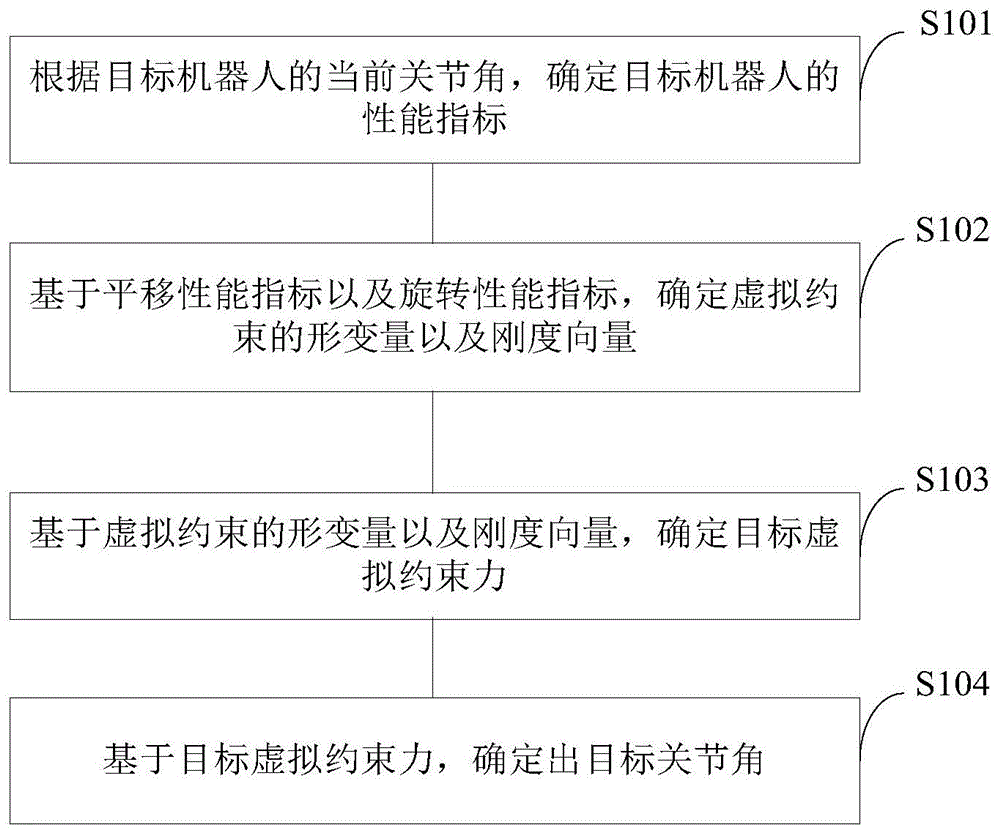
Referring to fig. 1, fig. 1 is a schematic flowchart of an admittance control method for a robot to avoid a singular position type according to an embodiment of the present invention, where the admittance control method includes:
s101, determining the performance index of the target robot according to the current joint angle of the target robot.
Wherein the performance indicators at least comprise a translation performance indicator and a rotation performance indicator. Specifically, as shown in fig. 2, an embodiment of the present invention further provides a specific implementation manner for determining a performance index of a target robot according to a current joint angle of the target robot, including the steps of:
s201, determining a mapping matrix from the joint space speed of the target robot to the terminal Cartesian space speed of the target robot according to the current joint angle of the target robot, wherein the mapping matrix comprises a translation matrix and a rotation matrix;
s202, determining the minimum singular value of the translation matrix as the translation performance index;
s203, determining the minimum singular value of the rotation matrix as the rotation performance index.
With reference to the foregoing embodiments, as shown in fig. 3, an embodiment of the present invention further provides a specific implementation step of determining a mapping matrix from the joint space velocity of the target robot to the terminal cartesian space velocity of the target robot according to the current joint angle of the target robot, including:
s301, substituting the current joint angle of the target robot into a formula
Determining a translation matrix
And a rotation matrix
S102, determining a deformation amount and a rigidity vector of a virtual constraint based on the translation performance index and the rotation performance index;
specifically, as shown in fig. 4, an embodiment of the present invention provides a specific implementation manner for determining a deformation amount and a stiffness vector of a virtual constraint based on the translation performance index and the rotation performance index, including:
s401, judging whether the performance index is larger than a first threshold value or not, and if so, determining that the deformation quantity of the virtual constraint and the rigidity vector are both first preset values;
if not, according to the formula
Determining a deformation amount of the virtual constraint, wherein k
i(w) is the amount of deformation of the virtual constraint, w
thiTo a safe threshold, w
criIs the lowest critical value, and lambda is the amplification factor; and calculating the performance index gradient after the target robot moves for the preset displacement, and determining the maximum value of the directional gradient in the performance index gradient as the stiffness vector.
Wherein, the calculating of the gradient of the performance index after the target robot moves the preset displacement can be determined in a manner as shown in fig. 5, and includes the steps of:
s501, obtaining a first joint angle after the target robot moves for preset displacement;
s502, determining a performance index corresponding to the first joint angle;
and S503, determining the gradient of the performance index after the target robot moves for the preset displacement based on the performance index corresponding to the first joint angle.
Specifically, as shown in fig. 6, an embodiment of the present invention further provides a specific implementation step of determining a maximum value of each directional gradient in the performance index gradient as the stiffness vector, where the specific implementation step includes:
s601, according to the formula
Determining the stiffness vector, wherein A
ijFor the stiffness vector, max is the max-valued operation,
the virtual minute displacement corresponding to the maximum value is taken.
S103, determining a target virtual constraint force based on the deformation quantity of the virtual constraint and the stiffness vector;
specifically, as shown in fig. 7, an embodiment of the present invention further provides a specific implementation manner for determining a target virtual constraint force based on the deformation amount of the virtual constraint and the stiffness vector, including the steps of:
s701, according to the formula
And
determining the target virtual restraining force, wherein F
vThe target virtual restraining force is used.
And S104, determining a target joint angle based on the target virtual constraint force.
Specifically, as shown in fig. 8, an embodiment of the present invention further provides a specific implementation manner for determining a target joint angle based on the target virtual constraint force, including the steps of:
s801, substituting the target virtual constraint force into a dynamic model
Determining the current speed of the target robot;
s802, based on the current speed, according to the formula
And
and determining the target joint angle.
By combining the steps, it can be known that the admittance control method for avoiding the singular bit pattern of the robot provided by the embodiment of the invention controls the robot to move based on the admittance control model, adopts the minimum singular value of the Jacobian matrix of the robot to measure the performance index of the robot, and realizes the decoupling of the translation and rotation movements in the singular avoiding process.
Fig. 9-11 are combined schematically, where fig. 9 is a flowchart of an admittance control method for a robot to avoid a singular bit type according to an embodiment of the present invention; FIG. 10 is a flowchart illustrating a real-time singular bit avoiding process based on the minimum singular value of Jacobian matrix of a robot according to the present invention; FIG. 11 is a flow chart of calculating a virtual restraining force according to the present invention. The specific implementation steps of this embodiment are as follows:
step S1: determining an admittance control model of the robot as follows:
the sampling time interval is dt; wherein M is
d,
Respectively mass and damping matrices; v, the number of the first and second electrodes,
the velocity of the robot tip in cartesian space and the external forces acting on the robot tip, respectively.
Step S2, adding virtual restraint force acting on the tail end to avoid the robot moving to a singular position type
According to the superposition principle, the dynamic model after adding the virtual constraint force is as follows:
step S3, according to the current joint angle of the robot
Based on the minimum singular value, respectively calculating the performance indexes of the robot end effector:
wherein w
t,w
rRespectively are translation and rotation performance indexes;
the performance index w of the end effector in S3 is determined as follows:
s31 root ofCalculating a mapping matrix from the space velocity of the robot joint to the Cartesian space velocity of the robot tail end according to the joint angle q of the current robot, namely a Jacobian matrix
Wherein
J
T(q) is the translational component, J
R(q) is the rotational component;
wherein,
performing pseudo-inverse operation;
s32 calculating separately
And
has a minimum singular value of w
TAnd w
R:
Svd is singular value operation of a calculation matrix, sqrt is evolution operation, and min is minimum value operation;
step S4, the restraining force is equivalent to a non-linear spring according to the performance index w obtained in the step S3
TAnd w
RCalculating the amount of deformation k of the virtual constraint
i(w), and a stiffness vector A
ij(ii) a Wherein, i is 1,2, i is 1, and i is 2, and i is a translation component, and i is a rotation component; j is 1,2,3, and is 3 direction vectors of the robot end coordinate system, each of which is
j-1 represents
And so on;
s41 if wi>wthiThen k isi(w) 0, spring rate vector Aij=0;
S42 if w
i≤w
thiThen, then
Proceed to step S5 to calculate the spring rate vector A
ij(ii) a Wherein w
thiTo a safe threshold, w
criIs the lowest critical value, and lambda is the amplification factor;
step S5, respectively giving micro displacement ds to the tail end of the robot in the direction of 3 coordinate axes of a Cartesian space, and calculating the performance index gradient ▽ w after the robot moves plus ds and minus ds+And ▽ w-Obtaining the maximum value A of each directional gradientij;
Maximum gradient A of robot performance index in S5ijThe following method is adopted for determination:
s51, assume at jkGiven a virtual small displacement in direction, ds ═ jke-5(ii) a Wherein k is 1,2, and k is 1 represents jkThe positive direction of the j coordinate axis is the same, and k is 2, which represents that the positive direction of the j coordinate axis is opposite;
and S52, calculating the inverse of the velocity Jacobian matrix corresponding to the current q according to S31 as follows:
s53 Joint Angle after distal translation ds
S54, repeating the step S3 to calculate the performance index of the end effector corresponding to the current joint angle q
And S55, calculating the gradient of the performance index of the robot: if it is not
Then
Otherwise
S56, calculating the maximum value of the gradient of the performance index of the robot as follows:
wherein max is the maximum value operation,
symbol operation of ds corresponding to the maximum value is taken;
step S6, according to the spring deformation k in S4
i(w) and spring rate vector A
ijCalculating a virtual restraining force acting on the tip as
And (5) substituting the virtual constraint force into the dynamic model in the step S2, and calculating the current speed of the robot terminal as follows: v ═ M
d/dt+C
d)
-1*(M
d*v
last/dt+F
h+F
v) (ii) a Calculating the velocity of the current joint angle according to the Jacobian matrix calculated in the step S52;
the joint angle at the next moment is obtained as follows:
and when each joint of the robot moves to q, the q is the current position.
Step S7: repeating the steps S3 to S6 realizes real-time avoidance of singular bit patterns in admittance control.
Therefore, the performance index of the robot is measured by adopting the minimum singular value of the Jacobian matrix of the robot, and whether the robot is close to a singular position type is judged; the method can be more flexible and more accurate to avoid singular position types, and avoids shaking generated at the moment of applying virtual constraint force in the human-computer interaction process.
In addition, the decoupling of the translation and the rotation of the end effector in the Cartesian space can be realized in the singularity avoidance process; besides the realization of coupled motion, the device can also independently control the translation and rotation motion, and set different parameters in the motion process to realize more flexible motion.
On the basis of the above embodiment, an embodiment of the present invention further provides an admittance control device of a robot avoiding a singular position type, as shown in fig. 12, including:
a first determining module 121, configured to determine performance indicators of a target robot according to a current joint angle of the target robot, where the performance indicators include at least a translation performance indicator and a rotation performance indicator;
a second determining module 122, configured to determine a deformation amount and a stiffness vector of a virtual constraint based on the translation performance index and the rotation performance index;
a third determining module 123, configured to determine a target virtual constraint force based on the deformation amount of the virtual constraint and the stiffness vector;
a fourth determining module 124, configured to determine a target joint angle based on the target virtual restraining force.
The working principle of the device is described in the above embodiments of the method, and will not be described repeatedly.
Besides, the invention also provides an admittance control system of the robot for avoiding the singularity position type, which comprises the control device of the robot for avoiding the singularity position type. The working principle of the system is as follows.
The control device comprises a processor and a memory, wherein the first determining module, the second determining module, the third determining module, the fourth determining module and the like are stored in the memory as program units, and the processor executes the program units stored in the memory to realize corresponding functions.
The processor comprises a kernel, and the kernel calls the corresponding program unit from the memory. The kernel can be set to be one or more than one, and the jitter generated at the moment of applying the virtual constraint force in the human-computer interaction process is avoided by adjusting the kernel parameters.
An embodiment of the present invention provides a storage medium having a program stored thereon, the program implementing the admittance control method when executed by a processor.
The embodiment of the invention provides a processor, which is used for running a program, wherein the admittance control method is executed when the program runs.
An embodiment of the present invention provides an apparatus, as shown in fig. 13, the apparatus includes at least one processor 131, at least one memory 132 connected to the processor, and a bus 133; the processor and the memory complete mutual communication through a bus; the processor is used for calling the program instructions in the memory so as to execute the screen display device method. The device herein may be a server, a PC, a PAD, a mobile phone, etc.
The present application further provides a computer program product adapted to perform a program for initializing the following method steps when executed on a data processing device:
an admittance control method for a robot to avoid a singular position type comprises the following steps:
determining performance indexes of a target robot according to a current joint angle of the target robot, wherein the performance indexes at least comprise a translation performance index and a rotation performance index;
determining a deformation amount and a stiffness vector of a virtual constraint based on the translation performance index and the rotation performance index;
determining a target virtual constraint force based on the deformation amount of the virtual constraint and the stiffness vector;
and determining a target joint angle based on the target virtual constraint force.
Optionally, the determining the performance index of the target robot according to the current joint angle of the target robot includes:
determining a mapping matrix from the joint space velocity of the target robot to the terminal cartesian space velocity of the target robot according to the current joint angle of the target robot, wherein the mapping matrix comprises a translation matrix and a rotation matrix;
determining the minimum singular value of the translation matrix as the translation performance index;
and determining the minimum singular value of the rotation matrix as the rotation performance index.
Optionally, the determining a mapping matrix of the joint space velocity of the target robot to the terminal cartesian space velocity of the target robot according to the current joint angle of the target robot includes:
substituting the current joint angle of the target robot into a formula
Determining a translation matrix
And a rotation matrix
Optionally, the determining the deformation amount and the stiffness vector of the virtual constraint based on the translation performance index and the rotation performance index includes:
judging whether the performance index is larger than a first threshold value, if so, determining that the deformation quantity and the rigidity vector of the virtual constraint are first preset values;
if not, according to the formula
Determining a deformation amount of the virtual constraint, wherein k
i(w) is the amount of deformation of the virtual constraint, w
thiTo a safe threshold, w
criIs the lowest critical value, and lambda is the amplification factor; and calculating the performance index gradient of the target robot after moving the preset displacement to ensureAnd determining the maximum value of the directional gradient in the performance index gradient as the stiffness vector.
Optionally, the calculating a gradient of the performance index after the target robot moves the preset displacement includes:
acquiring a first joint angle after the target robot moves for a preset displacement;
determining a performance index corresponding to the first joint angle;
and determining the gradient of the performance index of the target robot after moving the preset displacement based on the performance index corresponding to the first joint angle.
Optionally, the determining a maximum value of each directional gradient in the performance indicator gradients as the stiffness vector includes:
according to the formula
Determining the stiffness vector, wherein A
ijFor the stiffness vector, max is the max-valued operation,
the virtual minute displacement corresponding to the maximum value is taken.
Optionally, the determining a target virtual constraint force based on the deformation amount of the virtual constraint and the stiffness vector includes:
according to the formula
And
determining the target virtual restraining force, wherein F
vThe target virtual restraining force is used.
Optionally, the determining a target joint angle based on the target virtual constraint force includes:
substituting the target virtual constraint force into a dynamic model
Determining the current speed of the target robot;
based on the current speed, according to the formula
And
and determining the target joint angle.
To sum up, the embodiment of the invention provides an admittance control method, device and system for a robot to avoid singular position type. I.e. a decoupling of the translational and rotational movements in cartesian space is achieved. Then, deformation quantity and rigidity vector of the virtual constraint are determined based on the translation performance index and the rotation performance index. And determining a target virtual constraint force based on the deformation amount of the virtual constraint and the rigidity vector. And determining a target joint angle based on the target virtual constraint force. Therefore, the robot performance index is measured by adopting the minimum singular value of the Jacobian matrix of the robot, whether the robot is close to the singular position type or not is judged, and the shaking generated at the moment of applying the virtual constraint force in the human-computer interaction process can be avoided due to the small gradient variance of the performance index in the scheme.
The embodiments in the present description are described in a parallel or progressive manner, each embodiment focuses on differences from other embodiments, and the same and similar parts among the embodiments are referred to each other. The device disclosed by the embodiment corresponds to the method disclosed by the embodiment, so that the description is simple, and the relevant points can be referred to the method part for description.
Those of skill would further appreciate that the various illustrative elements and algorithm steps described in connection with the embodiments disclosed herein may be implemented as electronic hardware, computer software, or combinations of both, and that the various illustrative components and steps have been described above generally in terms of their functionality in order to clearly illustrate this interchangeability of hardware and software. Whether such functionality is implemented as hardware or software depends upon the particular application and design constraints imposed on the implementation. Skilled artisans may implement the described functionality in varying ways for each particular application, but such implementation decisions should not be interpreted as causing a departure from the scope of the present invention.
The steps of a method or algorithm described in connection with the embodiments disclosed herein may be embodied directly in hardware, in a software module executed by a processor, or in a combination of the two. A software module may reside in Random Access Memory (RAM), memory, Read Only Memory (ROM), electrically programmable ROM, electrically erasable programmable ROM, registers, hard disk, a removable disk, a CD-ROM, or any other form of storage medium known in the art.
The previous description of the disclosed embodiments is provided to enable any person skilled in the art to make or use the present invention. Various modifications to these embodiments will be readily apparent to those skilled in the art, and the generic principles defined herein may be applied to other embodiments without departing from the spirit or scope of the invention. Thus, the present invention is not intended to be limited to the embodiments shown herein but is to be accorded the widest scope consistent with the principles and novel features disclosed herein.