CN112803473A - Method for improving reliability of extra-high voltage direct current access power system with wind power uncertainty - Google Patents

Method for improving reliability of extra-high voltage direct current access power system with wind power uncertainty Download PDF

Info

Publication number
CN112803473A
CN112803473A CN202011561272.0A CN202011561272A CN112803473A CN 112803473 A CN112803473 A CN 112803473A CN 202011561272 A CN202011561272 A CN 202011561272A CN 112803473 A CN112803473 A CN 112803473A
Authority
CN
China
Prior art keywords
node
power
power system
converter
current
Prior art date
Legal status (The legal status is an assumption and is not a legal conclusion. Google has not performed a legal analysis and makes no representation as to the accuracy of the status listed.)
Granted
Application number
CN202011561272.0A
Other languages
Chinese (zh)
Other versions
CN112803473B (en
Inventor
项中明
殷伟斌
吴一峰
徐立中
张思
陶欢
杨晓雷
丁磊明
唐律
李洋
梁梓杨
丁一
Current Assignee (The listed assignees may be inaccurate. Google has not performed a legal analysis and makes no representation or warranty as to the accuracy of the list.)
Zhejiang University ZJU
State Grid Zhejiang Electric Power Co Ltd
Jiaxing Power Supply Co of State Grid Zhejiang Electric Power Co Ltd
Original Assignee
Zhejiang University ZJU
State Grid Zhejiang Electric Power Co Ltd
Jiaxing Power Supply Co of State Grid Zhejiang Electric Power Co Ltd
Priority date (The priority date is an assumption and is not a legal conclusion. Google has not performed a legal analysis and makes no representation as to the accuracy of the date listed.)
Filing date
Publication date
Application filed by Zhejiang University ZJU, State Grid Zhejiang Electric Power Co Ltd, Jiaxing Power Supply Co of State Grid Zhejiang Electric Power Co Ltd filed Critical Zhejiang University ZJU
Priority to CN202011561272.0A priority Critical patent/CN112803473B/en
Publication of CN112803473A publication Critical patent/CN112803473A/en
Application granted granted Critical
Publication of CN112803473B publication Critical patent/CN112803473B/en
Active legal-status Critical Current
Anticipated expiration legal-status Critical

Links

Images

Classifications

    • HELECTRICITY
    • H02GENERATION; CONVERSION OR DISTRIBUTION OF ELECTRIC POWER
    • H02JELECTRIC POWER NETWORKS; CIRCUIT ARRANGEMENTS OR SYSTEMS FOR SUPPLYING OR DISTRIBUTING ELECTRIC POWER; SYSTEMS FOR STORING ELECTRIC ENERGY
    • H02J3/00Circuit arrangements for AC mains or AC distribution networks
    • H02J3/38Arrangements for feeding a single network from two or more generators or sources in parallel; Arrangements for feeding already energised networks from additional generators or sources in parallel
    • H02J3/381Dispersed generators
    • HELECTRICITY
    • H02GENERATION; CONVERSION OR DISTRIBUTION OF ELECTRIC POWER
    • H02JELECTRIC POWER NETWORKS; CIRCUIT ARRANGEMENTS OR SYSTEMS FOR SUPPLYING OR DISTRIBUTING ELECTRIC POWER; SYSTEMS FOR STORING ELECTRIC ENERGY
    • H02J3/00Circuit arrangements for AC mains or AC distribution networks
    • H02J3/04Arrangements for connecting networks of the same frequency but supplied from different sources
    • H02J3/06Controlling the transfer of power between connected networks; Controlling load sharing between connected networks
    • HELECTRICITY
    • H02GENERATION; CONVERSION OR DISTRIBUTION OF ELECTRIC POWER
    • H02JELECTRIC POWER NETWORKS; CIRCUIT ARRANGEMENTS OR SYSTEMS FOR SUPPLYING OR DISTRIBUTING ELECTRIC POWER; SYSTEMS FOR STORING ELECTRIC ENERGY
    • H02J3/00Circuit arrangements for AC mains or AC distribution networks
    • H02J3/36Arrangements for transfer of electric power between AC networks via high-voltage DC [HVDC] links; Arrangements for transfer of electric power between generators and networks via HVDC links
    • HELECTRICITY
    • H02GENERATION; CONVERSION OR DISTRIBUTION OF ELECTRIC POWER
    • H02JELECTRIC POWER NETWORKS; CIRCUIT ARRANGEMENTS OR SYSTEMS FOR SUPPLYING OR DISTRIBUTING ELECTRIC POWER; SYSTEMS FOR STORING ELECTRIC ENERGY
    • H02J3/00Circuit arrangements for AC mains or AC distribution networks
    • H02J3/38Arrangements for feeding a single network from two or more generators or sources in parallel; Arrangements for feeding already energised networks from additional generators or sources in parallel
    • H02J3/46Controlling the sharing of generated power between the generators, sources or networks
    • H02J3/466Scheduling or selectively controlling the operation of the generators or sources, e.g. connecting or disconnecting generators to meet a demand
    • HELECTRICITY
    • H02GENERATION; CONVERSION OR DISTRIBUTION OF ELECTRIC POWER
    • H02JELECTRIC POWER NETWORKS; CIRCUIT ARRANGEMENTS OR SYSTEMS FOR SUPPLYING OR DISTRIBUTING ELECTRIC POWER; SYSTEMS FOR STORING ELECTRIC ENERGY
    • H02J3/00Circuit arrangements for AC mains or AC distribution networks
    • H02J3/38Arrangements for feeding a single network from two or more generators or sources in parallel; Arrangements for feeding already energised networks from additional generators or sources in parallel
    • H02J3/46Controlling the sharing of generated power between the generators, sources or networks
    • H02J3/48Controlling the sharing of active power
    • HELECTRICITY
    • H02GENERATION; CONVERSION OR DISTRIBUTION OF ELECTRIC POWER
    • H02JELECTRIC POWER NETWORKS; CIRCUIT ARRANGEMENTS OR SYSTEMS FOR SUPPLYING OR DISTRIBUTING ELECTRIC POWER; SYSTEMS FOR STORING ELECTRIC ENERGY
    • H02J3/00Circuit arrangements for AC mains or AC distribution networks
    • H02J3/38Arrangements for feeding a single network from two or more generators or sources in parallel; Arrangements for feeding already energised networks from additional generators or sources in parallel
    • H02J3/46Controlling the sharing of generated power between the generators, sources or networks
    • H02J3/50Controlling the sharing of reactive power
    • HELECTRICITY
    • H02GENERATION; CONVERSION OR DISTRIBUTION OF ELECTRIC POWER
    • H02JELECTRIC POWER NETWORKS; CIRCUIT ARRANGEMENTS OR SYSTEMS FOR SUPPLYING OR DISTRIBUTING ELECTRIC POWER; SYSTEMS FOR STORING ELECTRIC ENERGY
    • H02J2101/00Supply or distribution of decentralised, dispersed or local electric power generation
    • H02J2101/20Dispersed power generation using renewable energy sources
    • HELECTRICITY
    • H02GENERATION; CONVERSION OR DISTRIBUTION OF ELECTRIC POWER
    • H02JELECTRIC POWER NETWORKS; CIRCUIT ARRANGEMENTS OR SYSTEMS FOR SUPPLYING OR DISTRIBUTING ELECTRIC POWER; SYSTEMS FOR STORING ELECTRIC ENERGY
    • H02J2101/00Supply or distribution of decentralised, dispersed or local electric power generation
    • H02J2101/20Dispersed power generation using renewable energy sources
    • H02J2101/28Wind energy
    • HELECTRICITY
    • H02GENERATION; CONVERSION OR DISTRIBUTION OF ELECTRIC POWER
    • H02JELECTRIC POWER NETWORKS; CIRCUIT ARRANGEMENTS OR SYSTEMS FOR SUPPLYING OR DISTRIBUTING ELECTRIC POWER; SYSTEMS FOR STORING ELECTRIC ENERGY
    • H02J2101/00Supply or distribution of decentralised, dispersed or local electric power generation
    • H02J2101/40Hybrid power plants, i.e. a plurality of different generation technologies being operated at one power plant
    • HELECTRICITY
    • H02GENERATION; CONVERSION OR DISTRIBUTION OF ELECTRIC POWER
    • H02JELECTRIC POWER NETWORKS; CIRCUIT ARRANGEMENTS OR SYSTEMS FOR SUPPLYING OR DISTRIBUTING ELECTRIC POWER; SYSTEMS FOR STORING ELECTRIC ENERGY
    • H02J2103/00Details of circuit arrangements for mains or AC distribution networks
    • H02J2103/30Simulating, planning, modelling, reliability check or computer assisted design [CAD] of electric power networks
    • HELECTRICITY
    • H02GENERATION; CONVERSION OR DISTRIBUTION OF ELECTRIC POWER
    • H02JELECTRIC POWER NETWORKS; CIRCUIT ARRANGEMENTS OR SYSTEMS FOR SUPPLYING OR DISTRIBUTING ELECTRIC POWER; SYSTEMS FOR STORING ELECTRIC ENERGY
    • H02J2103/00Details of circuit arrangements for mains or AC distribution networks
    • H02J2103/30Simulating, planning, modelling, reliability check or computer assisted design [CAD] of electric power networks
    • H02J2103/35Grid-level management of power transmission or distribution systems, e.g. load flow analysis or active network management
    • YGENERAL TAGGING OF NEW TECHNOLOGICAL DEVELOPMENTS; GENERAL TAGGING OF CROSS-SECTIONAL TECHNOLOGIES SPANNING OVER SEVERAL SECTIONS OF THE IPC; TECHNICAL SUBJECTS COVERED BY FORMER USPC CROSS-REFERENCE ART COLLECTIONS [XRACs] AND DIGESTS
    • Y02TECHNOLOGIES OR APPLICATIONS FOR MITIGATION OR ADAPTATION AGAINST CLIMATE CHANGE
    • Y02EREDUCTION OF GREENHOUSE GAS [GHG] EMISSIONS, RELATED TO ENERGY GENERATION, TRANSMISSION OR DISTRIBUTION
    • Y02E10/00Energy generation through renewable energy sources
    • Y02E10/70Wind energy
    • Y02E10/76Power conversion electric or electronic aspects
    • YGENERAL TAGGING OF NEW TECHNOLOGICAL DEVELOPMENTS; GENERAL TAGGING OF CROSS-SECTIONAL TECHNOLOGIES SPANNING OVER SEVERAL SECTIONS OF THE IPC; TECHNICAL SUBJECTS COVERED BY FORMER USPC CROSS-REFERENCE ART COLLECTIONS [XRACs] AND DIGESTS
    • Y02TECHNOLOGIES OR APPLICATIONS FOR MITIGATION OR ADAPTATION AGAINST CLIMATE CHANGE
    • Y02EREDUCTION OF GREENHOUSE GAS [GHG] EMISSIONS, RELATED TO ENERGY GENERATION, TRANSMISSION OR DISTRIBUTION
    • Y02E60/00Enabling technologies; Technologies with a potential or indirect contribution to GHG emissions mitigation
    • Y02E60/60Arrangements for transfer of electric power between AC networks or generators via a high voltage DC link [HVCD]

Landscapes

  • Engineering & Computer Science (AREA)
  • Power Engineering (AREA)
  • Supply And Distribution Of Alternating Current (AREA)
  • Control Of Eletrric Generators (AREA)

Abstract

本发明公开了一种风电不确定性的特高压直流接入电力系统可靠性提高方法。包括以下步骤:利用威布尔分布模型模拟风速的累计概率分布;对风速的累计概率分布进行处理得到获得模拟风速,获得风力发电出力;获得含换流器的交直流耦合方程;确定换流器所在节点的节点功率平衡模型;利用含换流器的交直流耦合方程和换流器所在节点的节点功率平衡模型,建立最优调度模型;最优调度模型根据风力发电出力、可用换流器数量和发电机组可用情况进行模型求解获得负荷减少的量,由负荷减少的量计算供电不足电量,根据供电不足电量进行提高电力系统的可靠性。本发明有效对特高压直流和风电接入的电力系统进行可靠性分析,采取有效的措施保证电力系统的可靠运行。

Figure 202011561272

The invention discloses a method for improving the reliability of an ultra-high voltage direct current access power system with wind power uncertainty. The method includes the following steps: using the Weibull distribution model to simulate the cumulative probability distribution of the wind speed; processing the cumulative probability distribution of the wind speed to obtain the simulated wind speed and wind power generation output; obtaining the AC-DC coupling equation including the converter; determining where the converter is located The node power balance model of the node; using the AC-DC coupling equation including the converter and the node power balance model of the node where the converter is located, the optimal dispatch model is established; the optimal dispatch model is based on the wind power output, the number of available converters and According to the availability of the generator set, the model is solved to obtain the amount of load reduction, and the insufficient amount of power supply is calculated from the amount of load reduction, and the reliability of the power system is improved according to the insufficient amount of power supply. The present invention effectively performs reliability analysis on the power system connected to the ultra-high voltage direct current and wind power, and takes effective measures to ensure the reliable operation of the power system.

Figure 202011561272

Description

Method for improving reliability of extra-high voltage direct current access power system with wind power uncertainty
Technical Field
The invention relates to a reliability improving method for an electric power system, in particular to a method for improving the reliability of an extra-high voltage direct current access electric power system based on the number of converters and considering wind power uncertainty.
Background
Currently, with the increasingly prominent problems of energy, environment and climate change, the development of renewable energy becomes a new trend of world energy development; in addition, resources in east economic areas of China are poor, but the demand for electric energy is gradually increased, and extra-high voltage trans-regional power transmission becomes the key point for solving the conflict of imbalance of common demand in power regions. However, large-scale application of wind power generation and high-proportion ultrahigh voltage access have influence on the reliability of the power system, for example, wind power has output uncertainty, and faults of extra-high voltage direct current all cause shortage of power supply, so that the safe operation of the power system is challenged.
The reliability analysis of the existing extra-high voltage direct current access power system is complex, the solving dimension is large, the solving difficulty is large, and the reliability analysis importance of the receiving end power system is further increased because a large amount of wind power is accessed into the receiving end power system.
Disclosure of Invention
In order to solve the problems and requirements in the background art, the invention provides a method for improving the reliability of an extra-high voltage direct current access power system based on the number of converters and considering the uncertainty of wind power so as to achieve the aim of improving the operation reliability of the power system.
The technical scheme of the invention is as follows:
the invention comprises the following steps:
step 1: simulating the cumulative probability distribution of the wind speed by using a Weibull distribution model;
step 2: processing the cumulative probability distribution of the wind speed to obtain a simulated wind speed, calculating the simulated wind speed according to the relation between the wind power generation output and the simulated wind speed to obtain the wind power generation output, and realizing uncertainty simulation of the wind power generation output;
and step 3: according to a quasi-steady state model of a current converter in a current converter station of a power system, obtaining an alternating current-direct current coupling equation containing the current converter;
and 4, step 4: obtaining the relation between the number and the power of the converters according to an alternating current-direct current power flow equation of the power system, obtaining power balance equations of nodes where the respective converters are located, and determining a node power balance model of the nodes where the converters are located;
and 5: establishing an optimal scheduling model by using an alternating current-direct current coupling equation containing a current converter and a node power balance model of a node where the current converter is located;
step 6: determining the number of the available converters and the available condition of the generator set according to the reliability parameters of the power system, simultaneously acquiring the wind power generation output, inputting the number of the available converters, the available condition of the generator set and the wind power generation output into an optimal scheduling model, carrying out model solution on the optimal scheduling model according to the data to obtain the load reduction amount, calculating the power supply shortage amount according to the load reduction amount, and finally improving the reliability of the power system according to the power supply shortage amount.
The step 1 specifically comprises the following steps:
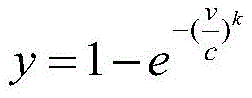
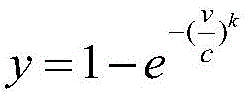
the Weibull distribution model simulates the cumulative probability distribution of wind speed, and the formula is as follows:
Figure BDA0002860738900000021
in the formula, v is a simulated wind speed, c is a scale parameter, k is a shape parameter, y represents the corresponding probability when the simulated wind speed v appears, and y satisfies the condition that y is more than or equal to 0 and less than or equal to 1.
The step 2 specifically comprises the following steps:
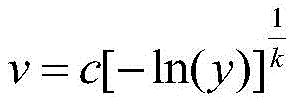
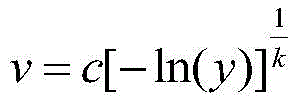
the cumulative probability distribution of the wind speed is processed to obtain the wind speed in Weibull distribution, and the wind speed in Weibull distribution is randomly valued to obtain a simulated wind speed, wherein the formula is as follows:
Figure BDA0002860738900000022
wherein v is a simulated wind speed, c is a scale parameter, k is a shape parameter, the probability y corresponding to the occurrence of the simulated wind speed v satisfies that y is more than or equal to 0 and less than or equal to 1, and the probability y corresponding to the occurrence of the simulated wind speed v is randomly valued in the range of [0,1 ];
calculating the simulated wind speed according to the relationship between the wind power generation output and the simulated wind speed to obtain the wind power generation output corresponding to the simulated wind speed, wherein the relationship between the wind power generation output and the simulated wind speed is as follows:
Figure BDA0002860738900000023
wherein, PwOutputting power for wind power generation; prRated output of the fan; v. ofciTo cut into the wind speed; v. ofcoTo cut off the wind speed; is the rated wind speed.
The step 3 specifically comprises the following steps:
according to a quasi-steady state model of a converter in a power system converter station, an AC-DC coupling equation containing the converter is established according to the following formula:
Figure BDA0002860738900000024
Figure BDA0002860738900000031
Figure BDA0002860738900000032
in the formula, VtThe voltage of the alternating current side in the power system; i istThe current is the current of an alternating current side in the power system; vdThe voltage of the direct current side in the power system; i isdThe current is the current of a direct current side in the power system; k is a radical ofTThe transformation ratio of the converter transformer between the direct current side and the alternating current side; n is a radical ofTThe number of the current converters; xcIs the equivalent impedance of the inverter; thetadA control angle set for the converter during commutation;
Figure BDA0002860738900000033
is the power phase angle on the AC side; k is a radical ofγTo consider the commutation effect coefficient; and pi is the circumferential ratio.
The step 4 specifically comprises the following steps:
obtaining the relation between the number and the power of the converters according to an alternating current-direct current power flow equation of the power system, obtaining the power balance equation of the node where each converter is located by using the relation between the number and the power of the converters and the following formula, and modeling the power balance equation of the node where the converters are located to obtain a power balance equation model of the node where the converters are located;
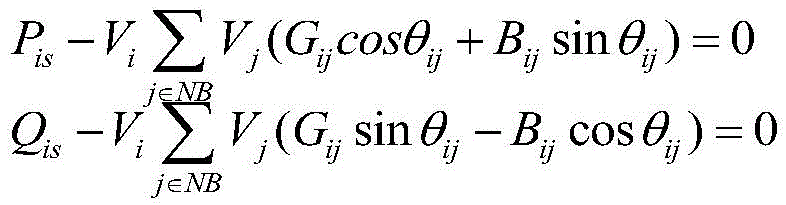
the power balance equation at the node i where the current converter is located in the power system is as follows:
Figure BDA0002860738900000034
Figure BDA0002860738900000035
wherein, PisActive power input for node i; qisReactive power input for node i; viIs the voltage at node i; vjIs the voltage at node j; NB is a collection of nodes in the power system; gijIs the real part of the admittance of line ij; b isijThe imaginary part of the admittance for line ij; the line ij is a connecting line between the node i and the node j; thetaijIs the phase angle difference between node i and node j; n is a radical ofTThe number of the current converters; vdThe voltage of the direct current side in the power system; i isdIs the current on the dc side of the power system,
Figure BDA0002860738900000036
is the power phase angle of the node i on the alternating current side.
The step 5 specifically comprises the following steps:
obtaining constraint conditions by using an alternating current-direct current coupling equation containing a current converter and a node power balance model of a node where the current converter is located, and establishing an optimal scheduling model meeting the constraint conditions; under the condition of given variable data, the optimal scheduling model optimizes the output of the scheduling generator set and reasonably reduces the load, so that the sum of the power generation cost and the load reduction cost of the power system is minimum, wherein the given variable data comprises the number of available converters, the available condition of the generator set and the wind power generation output;
the objective function of the optimal scheduling model is that the sum of the power generation cost and the load reduction cost of the power system is minimum, and the formula is as follows:
Figure BDA0002860738900000037
in the formula, TC is the sum of the power generation cost and the load reduction cost of the power system; NG is the set of all generator sets in the power system; cn() Is a power generation cost function of the generator set n; pG,nIs the active output of the generator set n; the VOLL is the cost corresponding to the reduction of the unit load of the power system; delta PlaodAn amount of load reduction for the power system;
the constraint conditions specifically comprise node energy balance constraint, node voltage constraint, generator set output constraint, load reduction constraint, line power flow constraint, direct current variable constraint and control station control mode constraint;
1) node energy balance constraints
The node energy balance constraint comprises a power balance equation of a node where the converter is located and a power balance equation of a pure alternating current node, wherein the pure alternating current node is a node without a converter station, and the pure alternating current node comprises a node of the generator set and a common node;
the power balance equation of the node where the converter is located is shown as the following formula:
Figure BDA0002860738900000041
wherein, PisActive power input by a node i; qisReactive power input for node i; viIs the voltage at node i; vjIs the voltage at node j; NB is a collection of nodes in the power system; gijIs the real part of the admittance of line ij; b isijThe imaginary part of the admittance for line ij; the line ij is a connecting line between the node i and the node j; thetaijIs the phase angle difference between the node and the node j; n is a radical ofTThe number of the current converters; vdThe voltage of the direct current side in the power system; i isdThe current is the current of a direct current side in the power system;
Figure BDA0002860738900000042
the power phase angle of the node i at the alternating current side;
the power balance equation of the pure alternating current node is shown as follows:
Figure BDA0002860738900000043
wherein, PisActive power input by a node i; qisReactive power input for node i; viIs the voltage at node i; vjIs the voltage at node j; NB is a collection of nodes in the power system; gijIs the real part of the admittance of line ij; b isijThe imaginary part of the admittance for line ij; the line ij is a connecting line between the node i and the node j;
2) node voltage constraint
Vmin≤Vi≤Vmax
Wherein, ViIs the voltage at node i; vminIs the node voltage lower limit; vmaxIs the upper limit of the node voltage;
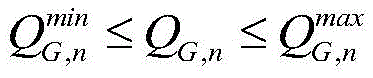
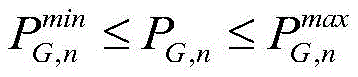
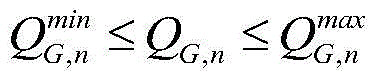
3) generator set output restraint
Figure BDA0002860738900000044
Figure BDA0002860738900000045
Wherein, PG,nActive power output of the generator set n; qG,nActive power output of the generator set n; the active output minimum value of the generator set n is obtained;
Figure BDA0002860738900000046
is the most active power output of the generator set nA large value;
Figure BDA0002860738900000047
the minimum reactive output of the generator set n;
Figure BDA0002860738900000048
the maximum reactive output value of the generator set n is obtained;
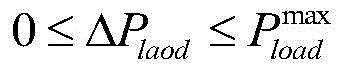
4) load reduction constraint
Figure BDA0002860738900000051
Wherein: delta PlaodAn amount of load reduction for the power system;
Figure BDA0002860738900000052
is the maximum allowable load reduction of the power system;
5) line flow constraint
Figure BDA0002860738900000053
Wherein, ViIs the voltage at node i; vjIs the voltage at node j; gijIs the real part of the admittance of line ij; the line ij is a connecting line between the node i and the node j;
Figure BDA0002860738900000054
is the lower line capacity limit of line ij;
Figure BDA0002860738900000055
is the upper line capacity limit of line ij;
6) direct current variable constraint
Vd,k-NT(kT,kVt,k cosθd,k-Xc,kId,k)=0
Figure BDA0002860738900000056
Figure BDA0002860738900000057
Wherein, Vd,kFor the DC side voltage, N, at converter station k in the power systemTIs the number of inverters, kT,kIs the transformation ratio of the converter transformer at converter station k; vt,kThe voltage of the alternating current side at a converter station k in the power system; thetad,kSetting a control angle for a converter at a converter station k; xc,kEquivalent impedance of a current converter at a converter station k; i isd,kThe current is the current on the direct current side at a converter station k in the power system; k is a radical ofγ,kThe phase change effect coefficient at the converter station k is obtained;
Figure BDA0002860738900000058
is the power phase angle at the AC side at the converter station k; gd,kjIs the element of the kth row and the jth column of the node conductance matrix; n iscIs a set of converter stations; the signs respectively correspond to a rectifier for converting AC into DC and an inverter for converting DC into AC;
7) converter station control mode constraints
Id,k-Icon,k=0
cosθd,k-cosθcon,k=0
Wherein, Icon,kSetting a current setting value for the converter station k in a constant current control mode; thetacon,kAnd setting a control angle setting value for the converter station k in a fixed control angle control mode.
The number of the converter stations in the power system is less than that of the generator sets.
The reliability parameters comprise reliability parameters of the current converter and reliability parameters of the generator set.
The wind power uncertainty is obtained through Weibull distribution simulation, the wind power output condition is obtained through calculation by a method of obtaining random numbers, simulation of the wind power output uncertainty is achieved, in addition, the optimal scheduling model is calculated by using the number of converters and the available condition of the generator set as conditions, and a reliability analysis result is obtained.
The invention has the beneficial effects that:
1) the invention adopts a Weibull distribution simulation method and a converter-based AC/DC model method, which are less influenced by the distribution characteristics of power data, and can effectively converge to an optimal solution by using an interior point method to obtain a stable analysis result.
2) The invention simultaneously considers the uncertainty of wind power generation and the fault probability of the extra-high voltage direct current, carries out reliability simulation analysis on the power system, and carries out effective measures aiming at the analysis result, thereby achieving the purpose of improving the operation reliability of the power system.
Drawings
FIG. 1 is a flow chart of the technical solution of the present invention;
FIG. 2 is a topology block diagram of a 24-node power system of an embodiment of the present invention;
fig. 3 is a result of reliability analysis and determination for 5 scenarios in embodiment of the present invention.
Detailed Description
The method of the present invention will be further described with reference to the following examples and the accompanying drawings.
The embodiment of the invention and the implementation process thereof are as follows:
the extra-high voltage refers to a voltage of direct current voltage +/-800 kV and alternating current voltage over 1000 kV.
As shown in fig. 1, step 1: simulating the cumulative probability distribution of wind speed by using a Weibull distribution model according to the wind speed distribution in most areas with a certain rule;
the Weibull distribution model simulates the cumulative probability distribution of wind speed, and the formula is as follows:
Figure BDA0002860738900000061
in the formula, v is a simulated wind speed, c is a scale parameter, k is a shape parameter, y represents the corresponding probability when the simulated wind speed v appears, and y satisfies the condition that y is more than or equal to 0 and less than or equal to 1. The simulated wind speed v is a variable value, and c and k are determined known parameters.
Step 2: processing the cumulative probability distribution of the wind speed to obtain a simulated wind speed, calculating the simulated wind speed according to the relation between the wind power generation output and the simulated wind speed to obtain the wind power generation output, and realizing uncertainty simulation of the wind power generation output;
the cumulative probability distribution of the wind speed is processed to obtain the wind speed in Weibull distribution, and the wind speed in Weibull distribution is randomly valued to obtain a simulated wind speed, wherein the formula is as follows:
Figure BDA0002860738900000062
the above formula is a pair formula
Figure BDA0002860738900000063
Obtaining the inverse result; wherein v is the simulated wind speed, c is the scale parameter, k is the shape parameter, the probability y corresponding to the simulated wind speed v is more than or equal to 0 and less than or equal to 1, and the probability y corresponding to the simulated wind speed v is [0,1]]Randomly taking values in the range of (1);
calculating the simulated wind speed according to the relationship between the wind power generation output and the simulated wind speed to obtain the wind power generation output corresponding to the simulated wind speed, wherein the relationship between the wind power generation output and the simulated wind speed, namely the output characteristic function of the wind power generation is as follows:
Figure BDA0002860738900000071
wherein, PwOutputting power for wind power generation; prRated output of the fan; v. ofciTo cut into the wind speed; v. ofcoTo cut off the wind speed; v. ofrIs the rated wind speed.
And step 3: according to a quasi-steady state model of a current converter in a current converter station of a power system, obtaining an alternating current-direct current coupling equation containing the current converter;
according to a quasi-steady state model of a converter in a power system converter station, an AC-DC coupling equation containing the converter is established according to the following formula:
Figure BDA0002860738900000072
Figure BDA0002860738900000073
Figure BDA0002860738900000074
in the formula, VtThe voltage of the alternating current side in the power system; i istThe current is the current of an alternating current side in the power system; vdThe voltage of the direct current side in the power system; i isdThe current is the current of a direct current side in the power system; k is a radical ofTThe transformation ratio of the converter transformer between the direct current side and the alternating current side; n is a radical ofTThe number of the current converters; xcIs the equivalent impedance of the inverter; thetadA control angle set for the converter during commutation;
Figure BDA0002860738900000075
is the power phase angle on the AC side; k is a radical ofγIn order to consider the commutation effect coefficient, 0.995 is selected in the patent; and pi is the circumferential ratio.
And 4, step 4: obtaining the relation between the number and the power of the converters according to an alternating current-direct current power flow equation of the power system, obtaining power balance equations of nodes where the respective converters are located, and determining a node power balance model of the nodes where the converters are located;
obtaining the relation between the number and the power of converters according to an alternating current-direct current flow equation of a power system, obtaining a power balance equation of a node where the converters are located by using the relation between the number and the power of the converters and a formula, wherein a converter station comprises a plurality of converters, namely the node where the converters are located is the node where the converter station is located, the power system is composed of nodes, the nodes are connection points among branches in the power system, a wind generating set, the converter station and a generating set are all located on the nodes, and modeling is carried out on the power balance equation of the node where the converters are located to obtain a power balance equation model of the node where the converters are located;
the power balance equation at the node i where the current converter is located in the power system is as follows:
Figure BDA0002860738900000076
Figure BDA0002860738900000077
wherein, PisActive power input for node i; qisReactive power input for node i; viIs the voltage at node i; vjIs the voltage at node j; NB is a collection of nodes in the power system; gijIs the real part of the admittance of line ij; b isijThe imaginary part of the admittance for line ij; the line ij is a connecting line between the node i and the node j; thetaijIs the phase angle difference between node i and node j; n is a radical ofTThe number of the current converters; vdThe voltage of the direct current side in the power system; i isdIs the current on the dc side of the power system,
Figure BDA0002860738900000084
is the power phase angle of the node i on the alternating current side.
And 5: establishing an optimal scheduling model by using an alternating current-direct current coupling equation containing a current converter and a node power balance model of a node where the current converter is located;
obtaining constraint conditions by using an alternating current-direct current coupling equation containing a current converter and a node power balance model of a node where the current converter is located, and establishing an optimal scheduling model meeting the constraint conditions; under the condition of given variable data, the optimal scheduling model optimizes the output of the scheduling generator set and reasonably reduces the load, so that the sum of the power generation cost and the load reduction cost of the power system is minimum, wherein the given variable data comprises the number of available converters, the available condition of the generator set and the wind power generation output;
the objective function of the optimal scheduling model is that the sum of the power generation cost and the load reduction cost of the power system is minimum, and the formula is as follows:
Figure BDA0002860738900000081
in the formula, TC is the sum of the power generation cost and the load reduction cost of the power system; NG is the set of all generator sets in the power system; cn() Is a power generation cost function of the generator set n; pG,nIs the active output of the generator set n; the VOLL is the cost corresponding to the reduction of the unit load of the power system; delta PlaodAn amount of load reduction for the power system;
the constraint conditions specifically comprise node energy balance constraint, node voltage constraint, generator set output constraint, load reduction constraint, line power flow constraint, direct current variable constraint and control station control mode constraint;
1) node energy balance constraints
The node energy balance constraint comprises a power balance equation of a node where the converter is located and a power balance equation of a pure alternating current node, wherein the pure alternating current node is a node without a converter station, and the pure alternating current node comprises a node of the generator set and a common node;
the power balance equation of the node where the converter is located is shown as the following formula:
Figure BDA0002860738900000082
Figure BDA0002860738900000083
wherein, PisActive power input by a node i; qisReactive power input for node i; viIs the voltage at node i; vjIs the voltage at node j; NB is a collection of nodes in the power system; gijIs the real part of the admittance of line ij; b isijThe imaginary part of the admittance for line ij; the line ij is a connecting line between the node i and the node j; thetaijIs the phase between node i and node jAn angular difference; n is a radical ofTThe number of the current converters; vdThe voltage of the direct current side in the power system; i isdThe current is the current of a direct current side in the power system;
Figure BDA0002860738900000091
the power phase angle of the node i at the alternating current side;
the power balance equation of the pure alternating current node is shown as follows:
Figure BDA0002860738900000092
Figure BDA0002860738900000093
wherein, PisActive power input by a node i; qisReactive power input for node i; viIs the voltage at node i; vjIs the voltage at node j; NB is a collection of nodes in the power system; gijIs the real part of the admittance of line ij; b isijThe imaginary part of the admittance for line ij; the line ij is a connecting line between the node i and the node j;
2) node voltage constraint
Vmin≤Vi≤Vmax
Wherein: viIs the voltage at node i; vminIs the node voltage lower limit; vmaxIs the upper node voltage limit.
3) Generator set output restraint
Figure BDA0002860738900000094
Figure BDA0002860738900000095
Wherein: pG,nActive power output of the generator set n; qG,nActive power output of the generator set n;
Figure BDA0002860738900000096
the active output minimum value of the generator set n is obtained;
Figure BDA0002860738900000097
the active output maximum value of the generator set n is obtained;
Figure BDA0002860738900000098
the minimum reactive output of the generator set n;
Figure BDA0002860738900000099
the maximum reactive output value of the generator set n is obtained;
4) reducing load constraints
Figure BDA00028607389000000910
Wherein: delta PlaodA value of load reduction for the power system;
Figure BDA00028607389000000911
is the maximum allowable load reduction of the power system;
5) line flow constraint
Figure BDA00028607389000000912
Wherein, ViIs the voltage at node i; vjIs the voltage at node j; gijIs the real part of the admittance of line ij; the line ij is a connecting line between the node i and the node j;
Figure BDA00028607389000000913
is the lower line capacity limit of line ij;
Figure BDA00028607389000000914
is the upper line capacity limit of line ij;
6) direct current variable constraint
Vd,k-NT(kT,kVt,k cosθd,k-Xc,kId,k)=0
Figure BDA0002860738900000101
Figure BDA0002860738900000102
Wherein, Vd,kFor the DC side voltage, N, at converter station k in the power systemTIs the number of inverters, kT,kIs the transformation ratio of the converter transformer at converter station k; vt,kThe voltage of the alternating current side at a converter station k in the power system; thetad,kSetting a control angle for a converter at a converter station k; xc,kEquivalent impedance of a current converter at a converter station k; i isd,kThe current is the current on the direct current side at a converter station k in the power system; k is a radical ofγ,kThe phase change effect coefficient at the converter station k is obtained;
Figure BDA0002860738900000103
is the power phase angle at the AC side at the converter station k; gd,kjIs the element of the kth row and the jth column of the node conductance matrix; n iscIs a set of converter stations; the signs respectively correspond to a rectifier for converting AC into DC and an inverter for converting DC into AC;
7) converter station control mode constraints
Id,k-Icon,k=0
cosθd,k-cosθcon,k=0
Wherein, Icon,kSetting a current setting value for the converter station k in a constant current control mode; thetacon,kAnd setting a control angle setting value for the converter station k in a fixed control angle control mode.
Step 6: randomly simulating the number of available converters and the available condition of a generator set according to the reliability parameters of the power system, and inputting wind power to the optimal scheduling modelThe optimal scheduling model solves the optimal scheduling model according to the number of available converters, the available condition of the generator set and the wind power generation size, and obtains the load reduction quantity delta P after the optimal schedulinglaodAnd according to the amount of load reduction Δ PlaodAnd calculating the insufficient power supply quantity EENS, and improving the reliability of the power system based on the insufficient power supply quantity EENS.
Specifically, the uncertain output of the wind power generation is simulated based on the acquisition mode of the wind power output in the step 1 and the step 2.
And then randomly simulating the number of the available converters by using the reliability parameters, wherein the reliability parameters comprise the reliability parameters of the converters and the reliability parameters of the generator set, and taking a maximum of 4 converters as an example, the available converters are calculated by the following method:
Figure BDA0002860738900000104
wherein N isTIs the number of converters and is determined by a random analog quantity x, and the random analog quantity x is in [0,1]]Randomly taking values in the range; and a, b, c and d are reliability parameters of the converter.
Then, whether the generator set can be obtained by the random simulation of the reliability parameters of the generator set or not is determined, and the calculation method is as follows:
Figure BDA0002860738900000111
the method comprises the following steps that S is the available condition of a generator set, if S is 1, the generator set can be effectively scheduled and used, if S is 0, the generator set cannot be used, and the generator set is not included in an optimized scheduling model; the available condition of the generator set is determined by a random independent variable z, and the random independent variable z takes a value randomly in the range of [0,1 ]; the FOR is a reliability parameter of the generator set.
And finally, substituting the values into the optimal scheduling mode in the step 5 after obtaining the wind power generation output, the number of available converters and the available conditions of the generator setModeling and solving to obtain the load reduction quantity delta P of the power systemlaodBased on the amount of load reduction Δ PlaodCalculating the power supply shortage EENS, wherein the power supply shortage EENS calculation method comprises the following steps:
EENS=ΔPload·8760
reliability of the power system is improved based on the power supply shortage EENS.
According to the power supply shortage EENS, the reliability of the power system is improved, and the method specifically comprises the following steps:
if the power supply shortage EENS is larger than the set value of the operation requirement, the reliability of the power system is not expected, and the reliability of the power system can be improved by adopting a method of modifying the wind power generation access proportion and the extra-high voltage direct current access proportion;
if the power supply shortage EENS is smaller than the set value of the operation requirement, the reliability of the power system reaches the expectation, and no processing is performed.
Examples
The reliability condition of a 24-node power system is analyzed and judged, the 24-node topological structure is shown in fig. 2, wherein a node 17 comprises a converter station, nodes 18, 21, 22 and the like comprise a generator set, and nodes 1, 16 and 23 comprise a wind generator set. The original load capacity of the power system is 2500 MW; a Weibull distribution scale parameter c, and a shape parameter k of 7 and 2 respectively; the cut-in wind speed, cut-off wind speed and rated wind speed are 3m/s, 20m/s and 13.5 m/s. The number of the available current converters is 4 at most; selecting the power supply shortage as a reliability analysis index (the smaller the value is, the better the value is); 5 different scenes are selected for analyzing the reliability. The conditions of the extra-high voltage direct current access capacity and the wind power generation access capacity in different proportions are shown in table 1:
Figure BDA0002860738900000112
Figure BDA0002860738900000121
the reliability analysis results of the above 5 scenarios are shown in fig. 3.
As can be seen from fig. 3, in the scenario 1, that is, when the ratio of the extra-high voltage direct current to the wind power generation is low, the reliability of the power system is good; when the proportion of the extra-high voltage direct current to the wind power generation is increased, the power supply shortage of the power system is higher and higher; in a scene 4, the ratio of the extra-high voltage direct current to the wind power generation is the highest, and the power supply shortage reaches the maximum, which shows that the reliability of the power system is poor at the moment, and corresponding measures need to be taken to improve the reliability.
As can be seen from fig. 3, the method of the present invention can effectively perform reliability analysis on the power system to which the extra-high voltage direct current and the wind power with uncertain output are connected, and improve the reliability of the power system according to the power supply shortage amount EENS, specifically:
if the power supply shortage EENS is larger than the set value of the operation requirement, the reliability of the power system is not expected, and the reliability of the power system can be improved by adopting a method of modifying the wind power generation access proportion and the extra-high voltage direct current access proportion;
if the power supply shortage EENS is smaller than the set value of the operation requirement, the reliability of the power system reaches the expectation, and no processing is performed. Therefore, the electric power system is helped to reasonably set the extra-high voltage direct current access amount and the wind power generation access amount, and the reliable operation of the electric power system is ensured.

Claims (8)

1. The method for improving the reliability of the extra-high voltage direct current access power system with wind power uncertainty is characterized by comprising the following steps of:
step 1: simulating the cumulative probability distribution of the wind speed by using a Weibull distribution model;
step 2: processing the cumulative probability distribution of the wind speed to obtain a simulated wind speed, calculating the simulated wind speed according to the relation between the wind power generation output and the simulated wind speed to obtain the wind power generation output, and realizing uncertainty simulation of the wind power generation output;
and step 3: according to a quasi-steady state model of a current converter in a current converter station of a power system, obtaining an alternating current-direct current coupling equation containing the current converter;
and 4, step 4: obtaining the relation between the number and the power of the converters according to an alternating current-direct current power flow equation of the power system, obtaining power balance equations of nodes where the respective converters are located, and determining a node power balance model of the nodes where the converters are located;
and 5: establishing an optimal scheduling model by using an alternating current-direct current coupling equation containing a current converter and a node power balance model of a node where the current converter is located;
step 6: determining the number of the available converters and the available condition of the generator set according to the reliability parameters of the power system, simultaneously acquiring the wind power generation output, inputting the number of the available converters, the available condition of the generator set and the wind power generation output into an optimal scheduling model, carrying out model solution on the optimal scheduling model according to the data to obtain the load reduction amount, calculating the power supply shortage amount according to the load reduction amount, and finally improving the reliability of the power system according to the power supply shortage amount.
2. The method for improving the reliability of the extra-high voltage direct current access power system with the wind power uncertainty according to claim 1, is characterized in that: the step 1 specifically comprises the following steps:
the Weibull distribution model simulates the cumulative probability distribution of wind speed, and the formula is as follows:
Figure FDA0002860738890000011
in the formula, v is a simulated wind speed, c is a scale parameter, k is a shape parameter, y represents the corresponding probability when the simulated wind speed v appears, and y satisfies the condition that y is more than or equal to 0 and less than or equal to 1.
3. The method for improving the reliability of the extra-high voltage direct current access power system with the wind power uncertainty according to claim 1, is characterized in that: the step 2 specifically comprises the following steps:
the cumulative probability distribution of the wind speed is processed to obtain the wind speed in Weibull distribution, and the wind speed in Weibull distribution is randomly valued to obtain a simulated wind speed, wherein the formula is as follows:
Figure FDA0002860738890000021
wherein v is a simulated wind speed, c is a scale parameter, k is a shape parameter, the probability y corresponding to the occurrence of the simulated wind speed v satisfies that y is more than or equal to 0 and less than or equal to 1, and the probability y corresponding to the occurrence of the simulated wind speed v is randomly valued in the range of [0,1 ];
calculating the simulated wind speed according to the relationship between the wind power generation output and the simulated wind speed to obtain the wind power generation output corresponding to the simulated wind speed, wherein the relationship between the wind power generation output and the simulated wind speed is as follows:
Figure FDA0002860738890000022
wherein, PwOutputting power for wind power generation; prRated output of the fan; v. ofciTo cut into the wind speed; v. ofcoTo cut off the wind speed; is the rated wind speed.
4. The method for improving the reliability of the extra-high voltage direct current access power system with the wind power uncertainty according to claim 1, is characterized in that: the step 3 specifically comprises the following steps:
according to a quasi-steady state model of a converter in a power system converter station, an AC-DC coupling equation containing the converter is established according to the following formula:
Figure FDA0002860738890000023
Figure FDA0002860738890000024
Figure FDA0002860738890000025
in the formula, VtThe voltage of the alternating current side in the power system; i istThe current is the current of an alternating current side in the power system; vdThe voltage of the direct current side in the power system; i isdThe current is the current of a direct current side in the power system; k is a radical ofTThe transformation ratio of the converter transformer between the direct current side and the alternating current side; n is a radical ofTThe number of the current converters; xcIs the equivalent impedance of the inverter; thetadA control angle set for the converter during commutation;
Figure FDA0002860738890000026
is the power phase angle on the AC side; k is a radical ofγTo consider the commutation effect coefficient; and pi is the circumferential ratio.
5. The method for improving the reliability of the extra-high voltage direct current access power system with the wind power uncertainty according to claim 1, is characterized in that: the step 4 specifically comprises the following steps:
obtaining the relation between the number and the power of the converters according to an alternating current-direct current power flow equation of the power system, obtaining the power balance equation of the node where each converter is located by using the relation between the number and the power of the converters and the following formula, and modeling the power balance equation of the node where the converters are located to obtain a power balance equation model of the node where the converters are located;
the power balance equation at the node i where the current converter is located in the power system is as follows:
Figure FDA0002860738890000031
Figure FDA0002860738890000032
wherein, PisActive power input for node i; qisReactive power input for node i; viIs the voltage at node i; vjIs the voltage at node j; NB is a collection of nodes in the power system; gijIs the real part of the admittance of line ij; b isijThe imaginary part of the admittance for line ij; the line ij is a connecting line between the node i and the node j; thetaijIs the phase angle difference between node i and node j; n is a radical ofTThe number of the current converters; vdThe voltage of the direct current side in the power system; i isdIs the current on the dc side of the power system,
Figure FDA0002860738890000035
is the power phase angle of the node i on the alternating current side.
6. The method for improving the reliability of the extra-high voltage direct current access power system with the wind power uncertainty according to claim 1, is characterized in that: the step 5 specifically comprises the following steps:
obtaining constraint conditions by using an alternating current-direct current coupling equation containing a current converter and a node power balance model of a node where the current converter is located, and establishing an optimal scheduling model meeting the constraint conditions; under the given variable data, the optimal scheduling model optimizes the output of the scheduling generator set and reasonably reduces the load requirement, so that the sum of the power generation cost and the load reduction cost of the power system is minimum;
the objective function of the optimal scheduling model is that the sum of the power generation cost and the load reduction cost of the power system is minimum, and the formula is as follows:
Figure FDA0002860738890000033
in the formula, TC is the sum of the power generation cost and the load reduction cost of the power system; NG is the set of all generator sets in the power system; cn() Is a power generation cost function of the generator set n; pG,nIs the active output of the generator set n; the VOLL is the cost corresponding to the reduction of the unit load of the power system; delta PlaodAn amount of load reduction for the power system;
the constraint conditions specifically comprise node energy balance constraint, node voltage constraint, generator set output constraint, load reduction constraint, line power flow constraint, direct current variable constraint and control station control mode constraint;
1) node energy balance constraints
The node energy balance constraint comprises a power balance equation of a node where the converter is located and a power balance equation of a pure alternating current node, wherein the pure alternating current node is a node without a converter station, and the pure alternating current node comprises a node of the generator set and a common node;
the power balance equation of the node where the converter is located is shown as the following formula:
Figure FDA0002860738890000034
wherein, PisActive power input by a node i; qisReactive power input for node i; viIs the voltage at node i; vjIs the voltage at node j; NB is a collection of nodes in the power system; gijIs the real part of the admittance of line ij; b isijThe imaginary part of the admittance for line ij; the line ij is a connecting line between the node i and the node j; thetaijIs the phase angle difference between the node and the node j; n is a radical ofTThe number of the current converters; vdThe voltage of the direct current side in the power system; i isdThe current is the current of a direct current side in the power system;
Figure FDA0002860738890000041
the power phase angle of the node i at the alternating current side;
the power balance equation of the pure alternating current node is shown as follows:
Figure FDA0002860738890000042
wherein, PisActive power input by a node i; qisReactive power input for node i; viIs the voltage at node i; vjIs the voltage at node j; NB is a collection of nodes in the power system; gijIs the real part of the admittance of line ij; b isijThe imaginary part of the admittance for line ij; the line ij is a connecting line between the node i and the node j;
2) node voltage constraint
Vmin≤Vi≤Vmax
Wherein, ViIs the voltage at node i; vminIs the node voltage lower limit; vmaxIs the upper limit of the node voltage;
3) generator set output restraint
Figure FDA0002860738890000043
Figure FDA0002860738890000044
Wherein, PG,nActive power output of the generator set n; qG,nActive power output of the generator set n; the active output minimum value of the generator set n is obtained;
Figure FDA0002860738890000045
the active output maximum value of the generator set n is obtained;
Figure FDA0002860738890000046
the minimum reactive output of the generator set n;
Figure FDA0002860738890000047
the maximum reactive output value of the generator set n is obtained;
4) load reduction constraint
Figure FDA0002860738890000048
Wherein: delta PlaodAn amount of load reduction for the power system;
Figure FDA0002860738890000049
is the maximum allowable load reduction of the power systemA large value;
5) line flow constraint
Figure FDA00028607388900000410
Wherein, ViIs the voltage at node i; vjIs the voltage at node j; gijIs the real part of the admittance of line ij; the line ij is a connecting line between the node i and the node j;
Figure FDA00028607388900000411
is the lower line capacity limit of line ij;
Figure FDA00028607388900000412
is the upper line capacity limit of line ij;
6) direct current variable constraint
Vd,k-NT(kT,kVt,kcosθd,k-Xc,kId,k)=0
Figure FDA00028607388900000413
Wherein, Vd,kFor the DC side voltage, N, at converter station k in the power systemTIs the number of inverters, kT,kIs the transformation ratio of the converter transformer at converter station k; vt,kThe voltage of the alternating current side at a converter station k in the power system; thetad,kSetting a control angle for a converter at a converter station k; xc,kEquivalent impedance of a current converter at a converter station k; i isd,kThe current is the current on the direct current side at a converter station k in the power system; k is a radical ofγ,kThe phase change effect coefficient at the converter station k is obtained;
Figure FDA0002860738890000051
is the power phase angle at the AC side at the converter station k; gd,kjIs the element of the kth row and the jth column of the node conductance matrix; n iscIs a set of converter stations; positive and negativeThe numbers respectively correspond to a rectifier for converting AC into DC and an inverter for converting DC into AC;
7) converter station control mode constraints
Id,k-Icon,k=0
cosθd,k-cosθcon,k=0
Wherein, Icon,kSetting a current setting value for the converter station k in a constant current control mode; thetacon,kAnd setting a control angle setting value for the converter station k in a fixed control angle control mode.
7. The method for improving the reliability of the extra-high voltage direct current access power system with the wind power uncertainty according to claim 1, is characterized in that: the number of the converter stations in the power system is less than that of the generator sets.
8. The method for improving the reliability of the extra-high voltage direct current access power system with the wind power uncertainty according to claim 1, is characterized in that: the reliability parameters comprise reliability parameters of the current converter and reliability parameters of the generator set.
CN202011561272.0A 2020-12-25 2020-12-25 Method for improving reliability of extra-high voltage direct current access power system with uncertain wind power Active CN112803473B (en)

Priority Applications (1)

Application Number Priority Date Filing Date Title
CN202011561272.0A CN112803473B (en) 2020-12-25 2020-12-25 Method for improving reliability of extra-high voltage direct current access power system with uncertain wind power

Applications Claiming Priority (1)

Application Number Priority Date Filing Date Title
CN202011561272.0A CN112803473B (en) 2020-12-25 2020-12-25 Method for improving reliability of extra-high voltage direct current access power system with uncertain wind power

Publications (2)

Publication Number Publication Date
CN112803473A true CN112803473A (en) 2021-05-14
CN112803473B CN112803473B (en) 2022-11-29

Family

ID=75804954

Family Applications (1)

Application Number Title Priority Date Filing Date
CN202011561272.0A Active CN112803473B (en) 2020-12-25 2020-12-25 Method for improving reliability of extra-high voltage direct current access power system with uncertain wind power

Country Status (1)

Country Link
CN (1) CN112803473B (en)

Citations (7)

* Cited by examiner, † Cited by third party
Publication number Priority date Publication date Assignee Title
CN102545201A (en) * 2011-12-27 2012-07-04 上海交通大学 A Method for Establishing Small-Signal Model of HVDC Transmission
CN106877336A (en) * 2017-03-14 2017-06-20 长沙理工大学 A kind of AC and DC power system Continuation power flow for considering wind-powered electricity generation randomness
CN108565865A (en) * 2018-05-02 2018-09-21 浙江大学 A kind of alternating current-direct current combined hybrid system methods of risk assessment containing wind-powered electricity generation
CN108808680A (en) * 2017-04-27 2018-11-13 华北电力大学(保定) A kind of interregional ability to transmit electricity computational methods of wind fire bundling alternating current-direct current delivery system
CN108879664A (en) * 2018-06-29 2018-11-23 国网山东省电力公司电力科学研究院 On-line voltage stability assessment method for AC and DC systems based on wide-area measurement
CN108964061A (en) * 2018-07-23 2018-12-07 长沙理工大学 A new probabilistic dynamic continuous power flow method for AC/DC power systems with wind power considering the static characteristics of load frequency and voltage
US20200083710A1 (en) * 2017-05-05 2020-03-12 General Electric Company System and method for reactive power control of a wind farm

Patent Citations (7)

* Cited by examiner, † Cited by third party
Publication number Priority date Publication date Assignee Title
CN102545201A (en) * 2011-12-27 2012-07-04 上海交通大学 A Method for Establishing Small-Signal Model of HVDC Transmission
CN106877336A (en) * 2017-03-14 2017-06-20 长沙理工大学 A kind of AC and DC power system Continuation power flow for considering wind-powered electricity generation randomness
CN108808680A (en) * 2017-04-27 2018-11-13 华北电力大学(保定) A kind of interregional ability to transmit electricity computational methods of wind fire bundling alternating current-direct current delivery system
US20200083710A1 (en) * 2017-05-05 2020-03-12 General Electric Company System and method for reactive power control of a wind farm
CN108565865A (en) * 2018-05-02 2018-09-21 浙江大学 A kind of alternating current-direct current combined hybrid system methods of risk assessment containing wind-powered electricity generation
CN108879664A (en) * 2018-06-29 2018-11-23 国网山东省电力公司电力科学研究院 On-line voltage stability assessment method for AC and DC systems based on wide-area measurement
CN108964061A (en) * 2018-07-23 2018-12-07 长沙理工大学 A new probabilistic dynamic continuous power flow method for AC/DC power systems with wind power considering the static characteristics of load frequency and voltage

Non-Patent Citations (2)

* Cited by examiner, † Cited by third party
Title
徐立中等: "考虑风电随机性的微网多时间尺度能量优化调度", 《电力系统保护与控制》 *
李清: "交直流互联电网运行优化模型及算法研究", 《中国博士学位论文全文数据库 工程科技Ⅱ辑》 *

Also Published As

Publication number Publication date
CN112803473B (en) 2022-11-29

Similar Documents

Publication Publication Date Title
CN113300353B (en) A method and device for calculating power grid partition load margin considering N-1 reliability
CN113378360B (en) Adaptability test method and system for new energy units connected to dual-high power system
Bompard et al. A multi-site real-time co-simulation platform for the testing of control strategies of distributed storage and V2G in distribution networks
CN114491886A (en) General modeling method and device for active power distribution network containing multi-type distributed new energy
CN119556585A (en) A hardware-in-the-loop simulation test method and device for a grid-connected energy storage converter
CN115173467A (en) Wind power plant simulation system and method through flexible direct current grid connection and storage medium
CN104537161B (en) A kind of medium voltage distribution network diagnostic analysis method based on power supply safety standard
CN113224788B (en) Static voltage stability evaluation method for AC/DC hybrid power grid with wind power access
CN103887792A (en) Modeling method of low-voltage distribution network with distributed power supply
CN112347595A (en) A frequency elastic force evaluation method for multi-DC feeding into the receiving-end power grid
CN105279297B (en) A kind of PSS/E electric system equivalence methods based on engineer application
CN116565939A (en) A real-time simulation test method and system for connecting large-scale wind farms to power grids
CN116700040A (en) A Digital Electromagnetic Transient Simulation System and Method for a Flexible DC Transmission Project
Kuri et al. Dynamic model reduction based on coherency and genetic optimization methodology
Ramasubramanian et al. Ability of positive sequence aggregated distributed energy resource model to represent unbalanced tripping of distribution inverters
CN112803473A (en) Method for improving reliability of extra-high voltage direct current access power system with wind power uncertainty
Sajeevan et al. Optimal allocation and sizing of distributed generation using artificial bee colony algorithm
CN112329231A (en) Voltage elastic force evaluation method suitable for alternating current-direct current series-parallel connection receiving end power grid
CN110096767B (en) Cascading failure simulation method for alternating current-direct current series-parallel power grid
CN119448409A (en) Simulation modeling system, method, device, electronic device and storage medium
CN113887005B (en) Simulation modeling method and device for AC/DC power system
Alla et al. Impact analysis of evs and ders on the bulk grid through t&d co-simulation
CN107871033A (en) Improved power system network frequency equivalence method
CN114006415A (en) Method, system and medium for evaluating improvement of new energy accepting capacity of distribution network
Yang et al. Dynamic Equivalent Research Based on Fuzzy C-means

Legal Events

Date Code Title Description
PB01 Publication
PB01 Publication
SE01 Entry into force of request for substantive examination
GR01 Patent grant
GR01 Patent grant