CN112972764B - Polyether-ether-ketone bone repair material with multi-scale holes and preparation method thereof - Google Patents

Polyether-ether-ketone bone repair material with multi-scale holes and preparation method thereof Download PDF

Info

Publication number
CN112972764B
CN112972764B CN202110293853.9A CN202110293853A CN112972764B CN 112972764 B CN112972764 B CN 112972764B CN 202110293853 A CN202110293853 A CN 202110293853A CN 112972764 B CN112972764 B CN 112972764B
Authority
CN
China
Prior art keywords
polyetheretherketone
polyether
bone repair
repair material
sheet
Prior art date
Legal status (The legal status is an assumption and is not a legal conclusion. Google has not performed a legal analysis and makes no representation as to the accuracy of the status listed.)
Active
Application number
CN202110293853.9A
Other languages
Chinese (zh)
Other versions
CN112972764A (en
Inventor
张淑玲
梅笑寒
吴同华
梁留博
彭鑫
王贵宾
Current Assignee (The listed assignees may be inaccurate. Google has not performed a legal analysis and makes no representation or warranty as to the accuracy of the list.)
Changchun Huawoqi Material Technology Co ltd
Original Assignee
Jilin University
Priority date (The priority date is an assumption and is not a legal conclusion. Google has not performed a legal analysis and makes no representation as to the accuracy of the date listed.)
Filing date
Publication date
Application filed by Jilin University filed Critical Jilin University
Priority to CN202110293853.9A priority Critical patent/CN112972764B/en
Publication of CN112972764A publication Critical patent/CN112972764A/en
Application granted granted Critical
Publication of CN112972764B publication Critical patent/CN112972764B/en
Active legal-status Critical Current
Anticipated expiration legal-status Critical

Links

Images

Classifications

    • AHUMAN NECESSITIES
    • A61MEDICAL OR VETERINARY SCIENCE; HYGIENE
    • A61LMETHODS OR APPARATUS FOR STERILISING MATERIALS OR OBJECTS IN GENERAL; DISINFECTION, STERILISATION OR DEODORISATION OF AIR; CHEMICAL ASPECTS OF BANDAGES, DRESSINGS, ABSORBENT PADS OR SURGICAL ARTICLES; MATERIALS FOR BANDAGES, DRESSINGS, ABSORBENT PADS OR SURGICAL ARTICLES
    • A61L27/00Materials for grafts or prostheses or for coating grafts or prostheses
    • A61L27/14Macromolecular materials
    • A61L27/18Macromolecular materials obtained otherwise than by reactions only involving carbon-to-carbon unsaturated bonds
    • AHUMAN NECESSITIES
    • A61MEDICAL OR VETERINARY SCIENCE; HYGIENE
    • A61LMETHODS OR APPARATUS FOR STERILISING MATERIALS OR OBJECTS IN GENERAL; DISINFECTION, STERILISATION OR DEODORISATION OF AIR; CHEMICAL ASPECTS OF BANDAGES, DRESSINGS, ABSORBENT PADS OR SURGICAL ARTICLES; MATERIALS FOR BANDAGES, DRESSINGS, ABSORBENT PADS OR SURGICAL ARTICLES
    • A61L27/00Materials for grafts or prostheses or for coating grafts or prostheses
    • A61L27/50Materials characterised by their function or physical properties, e.g. injectable or lubricating compositions, shape-memory materials, surface modified materials
    • A61L27/56Porous materials, e.g. foams or sponges
    • CCHEMISTRY; METALLURGY
    • C08ORGANIC MACROMOLECULAR COMPOUNDS; THEIR PREPARATION OR CHEMICAL WORKING-UP; COMPOSITIONS BASED THEREON
    • C08JWORKING-UP; GENERAL PROCESSES OF COMPOUNDING; AFTER-TREATMENT NOT COVERED BY SUBCLASSES C08B, C08C, C08F, C08G or C08H
    • C08J9/00Working-up of macromolecular substances to porous or cellular articles or materials; After-treatment thereof
    • C08J9/04Working-up of macromolecular substances to porous or cellular articles or materials; After-treatment thereof using blowing gases generated by a previously added blowing agent
    • C08J9/12Working-up of macromolecular substances to porous or cellular articles or materials; After-treatment thereof using blowing gases generated by a previously added blowing agent by a physical blowing agent
    • C08J9/122Hydrogen, oxygen, CO2, nitrogen or noble gases
    • CCHEMISTRY; METALLURGY
    • C08ORGANIC MACROMOLECULAR COMPOUNDS; THEIR PREPARATION OR CHEMICAL WORKING-UP; COMPOSITIONS BASED THEREON
    • C08JWORKING-UP; GENERAL PROCESSES OF COMPOUNDING; AFTER-TREATMENT NOT COVERED BY SUBCLASSES C08B, C08C, C08F, C08G or C08H
    • C08J9/00Working-up of macromolecular substances to porous or cellular articles or materials; After-treatment thereof
    • C08J9/36After-treatment
    • C08J9/40Impregnation
    • AHUMAN NECESSITIES
    • A61MEDICAL OR VETERINARY SCIENCE; HYGIENE
    • A61LMETHODS OR APPARATUS FOR STERILISING MATERIALS OR OBJECTS IN GENERAL; DISINFECTION, STERILISATION OR DEODORISATION OF AIR; CHEMICAL ASPECTS OF BANDAGES, DRESSINGS, ABSORBENT PADS OR SURGICAL ARTICLES; MATERIALS FOR BANDAGES, DRESSINGS, ABSORBENT PADS OR SURGICAL ARTICLES
    • A61L2430/00Materials or treatment for tissue regeneration
    • A61L2430/02Materials or treatment for tissue regeneration for reconstruction of bones; weight-bearing implants
    • CCHEMISTRY; METALLURGY
    • C08ORGANIC MACROMOLECULAR COMPOUNDS; THEIR PREPARATION OR CHEMICAL WORKING-UP; COMPOSITIONS BASED THEREON
    • C08JWORKING-UP; GENERAL PROCESSES OF COMPOUNDING; AFTER-TREATMENT NOT COVERED BY SUBCLASSES C08B, C08C, C08F, C08G or C08H
    • C08J2203/00Foams characterized by the expanding agent
    • C08J2203/06CO2, N2 or noble gases
    • CCHEMISTRY; METALLURGY
    • C08ORGANIC MACROMOLECULAR COMPOUNDS; THEIR PREPARATION OR CHEMICAL WORKING-UP; COMPOSITIONS BASED THEREON
    • C08JWORKING-UP; GENERAL PROCESSES OF COMPOUNDING; AFTER-TREATMENT NOT COVERED BY SUBCLASSES C08B, C08C, C08F, C08G or C08H
    • C08J2203/00Foams characterized by the expanding agent
    • C08J2203/08Supercritical fluid
    • CCHEMISTRY; METALLURGY
    • C08ORGANIC MACROMOLECULAR COMPOUNDS; THEIR PREPARATION OR CHEMICAL WORKING-UP; COMPOSITIONS BASED THEREON
    • C08JWORKING-UP; GENERAL PROCESSES OF COMPOUNDING; AFTER-TREATMENT NOT COVERED BY SUBCLASSES C08B, C08C, C08F, C08G or C08H
    • C08J2361/00Characterised by the use of condensation polymers of aldehydes or ketones; Derivatives of such polymers
    • C08J2361/04Condensation polymers of aldehydes or ketones with phenols only
    • C08J2361/16Condensation polymers of aldehydes or ketones with phenols only of ketones with phenols

Landscapes

  • Chemical & Material Sciences (AREA)
  • Health & Medical Sciences (AREA)
  • Medicinal Chemistry (AREA)
  • Chemical Kinetics & Catalysis (AREA)
  • Dermatology (AREA)
  • Epidemiology (AREA)
  • Polymers & Plastics (AREA)
  • Organic Chemistry (AREA)
  • Engineering & Computer Science (AREA)
  • Oral & Maxillofacial Surgery (AREA)
  • Transplantation (AREA)
  • Materials Engineering (AREA)
  • Life Sciences & Earth Sciences (AREA)
  • Animal Behavior & Ethology (AREA)
  • General Health & Medical Sciences (AREA)
  • Public Health (AREA)
  • Veterinary Medicine (AREA)
  • Dispersion Chemistry (AREA)
  • Materials For Medical Uses (AREA)

Abstract

一种具有多尺度孔的聚醚醚酮骨修复材料及其制备方法,属于医用生物材料技术领域。首先是将聚醚醚酮粒料热压成板材,清洗烘干后在超临界二氧化碳发泡装置中得到部分发泡的聚醚醚酮板材,然后在浓硫酸与甲烷磺酸的混酸溶液中进行磺化,水热处理、真空烘干后得到所述的具有多尺度孔的聚醚醚酮骨修复材料。本发明磺化得到的小尺寸的微纳米孔有利于早期成骨细胞的粘附,超临界二氧化碳发泡得到的大尺寸的微米孔有利于后期骨组织的长入,简单的两步操作使得材料具有多级孔结构,促进骨修复。与使用制孔剂的制孔技术相比,超临界二氧化碳发泡技术不会有制孔剂去除不彻底等问题,确保了材料应用于生物医学领域的可能性。

Figure 202110293853

A polyetheretherketone bone repair material with multi-scale pores and a preparation method thereof belong to the technical field of medical biological materials. First, the polyetheretherketone pellets are hot-pressed into sheets, washed and dried, and partially foamed polyetheretherketone sheets are obtained in a supercritical carbon dioxide foaming device, and then the polyetheretherketone sheet is obtained in a mixed acid solution of concentrated sulfuric acid and methanesulfonic acid. After sulfonation, hydrothermal treatment and vacuum drying, the polyetheretherketone bone repair material with multi-scale pores is obtained. The small-sized micro-nano pores obtained by the sulfonation of the present invention are beneficial to the adhesion of early osteoblasts, and the large-sized micro-pores obtained by supercritical carbon dioxide foaming are beneficial to the ingrowth of bone tissue in the later stage. The simple two-step operation makes the material Has a multi-level pore structure to promote bone repair. Compared with the pore-forming technology using a pore-forming agent, the supercritical carbon dioxide foaming technology does not have the problem of incomplete removal of the pore-forming agent, which ensures the possibility of the material being used in the biomedical field.

Figure 202110293853

Description

Polyether-ether-ketone bone repair material with multi-scale holes and preparation method thereof
Technical Field
The invention belongs to the technical field of medical biomaterials, and particularly relates to a polyetheretherketone bone repair material with multi-scale holes and a preparation method thereof.
Background
Polyetheretherketone (PEEK) is a semi-crystalline thermoplastic polymer that can be easily processed into a variety of shapes to meet the needs of clinical implants. In addition, the elastic modulus (3-5 GPa) and the density of the polyether-ether-ketone are closer to those of human bones (about 18GPa), which are far lower than those of metal implants, so that stress shielding can be effectively reduced; meanwhile, the polyether-ether-ketone has the excellent performances of no toxicity, high temperature resistance, chemical corrosion resistance, ray penetrability and the like, so that the polyether-ether-ketone becomes one of the most promising materials for replacing metal implants. However, due to the hydrophobic surface and biological inertia of the polyether-ether-ketone, the integration effect with the bone after being implanted into the body is poor, and the clinical application of the polyether-ether-ketone is limited. Therefore, modification of polyetheretherketone to enhance its osteointegrative capacity is particularly important.
One of the effective methods for improving the binding ability of the polyetheretherketone material to bone is to introduce a three-dimensional porous structure on the surface of the polyetheretherketone. The three-dimensional porous structure allows various soft and hard tissues to grow into the material, and provides more bonding sites for the bone and the material, so that the implant is bonded with the surrounding tissues more stably. The supercritical carbon dioxide foaming method can obtain large-size cells of 200-600 microns, is beneficial to growth of bone tissues, is green, nontoxic and pollution-free, and can prevent gas from escaping to generate cells in the foaming process and remaining in the material. Sulfonating polyether-ether-ketone to make the surface of polyether-ether-ketone have small size less than 10 μm, increasing the roughness of the material, and introducing sulfonic acid group (-SO)3H) The hydrophilicity is enhanced, and the early cell adhesion is facilitated.
Chinese patent CN111939319A discloses a bioactive porous polyetheretherketone material and a preparation method and application thereof, wherein a salt particle leaching method is mainly used for preparing the porous polyetheretherketone material, and a pore-forming agent is selected from sodium chloride (NaCl) particles, but the method is likely to cause incomplete removal when the pore-forming agent is removed at the later stage. Chinese patent CN108310457B discloses a preparation method of a polyetheretherketone bone defect repair material, which mainly utilizes concentrated sulfuric acid and concentrated nitric acid to prepare mixed acid solution according to a certain proportion, and then carries out acid etching treatment on the polyetheretherketone to obtain a polyetheretherketone surface which only has small-size cells less than 10 mu m, but not has large-size cells more than 200 mu m, is not beneficial to bone tissues, blood vessels and the like to grow in, and limits the application of the material.
Disclosure of Invention
The invention aims to provide a polyetheretherketone bone repair material with multi-scale holes and a preparation method thereof, so as to meet the clinical application requirements of polyetheretherketone.
The preparation method of the polyetheretherketone bone repair material with the multi-scale holes comprises the following steps:
(1) hot-pressing the polyether-ether-ketone granules (the melt index is 16-25 g/10min, the melt index determination conditions are that the test temperature is 400 ℃ and the load is 5Kg) into polyether-ether-ketone plates with the thickness of 1.5-3 mm at the temperature of 370-390 ℃ and the pressure of 2.0-5.0 MPa;
(2) ultrasonically cleaning the polyether-ether-ketone plate obtained in the step (1) by distilled water, ethanol and acetone for 2-4 times respectively for 5-15 min each time, and then drying under vacuum at 70-90 ℃;
(3) placing the polyetheretherketone sheet cleaned in the step (2) in a supercritical carbon dioxide foaming device, and foaming at 330-340 ℃ and 7.5-10 MPa for 20-30 min, wherein the pressure relief time is 20-30 s, so as to obtain a partially foamed polyetheretherketone sheet;
(4) mixing concentrated sulfuric acid with mass fraction of 98% and methane sulfonic acid according to a mass ratio of 1: 8-12, preparing a mixed acid solution, immersing the partially foamed polyether-ether-ketone plate obtained in the step (3) in the mixed acid solution, violently stirring for 3-5 min for sulfonation treatment, and then putting the sulfonated polyether-ether-ketone plate into distilled water to terminate sulfonation reaction; taking out the sulfonated partially foamed polyether-ether-ketone plate, sequentially and respectively ultrasonically cleaning the sulfonated partially foamed polyether-ether-ketone plate for 2-4 times by using distilled water and acetone for 5-15 min each time, removing concentrated sulfuric acid and methane sulfonic acid remained on the surface, and then drying the sulfonated partially foamed polyether-ether-ketone plate at 70-90 ℃ in vacuum;
(5) carrying out hydrothermal treatment on the sulfonated partially foamed polyether-ether-ketone sheet obtained in the step (4) at 110-130 ℃ for 4-6 h so as to further reduce the sulfur content on the surface of the material and achieve the purpose of reducing the cytotoxicity of the material; and then drying the bone repairing material at 90-110 ℃ in vacuum to obtain the polyetheretherketone bone repairing material with the multi-scale holes.
Compared with the prior art, the invention has the following advantages:
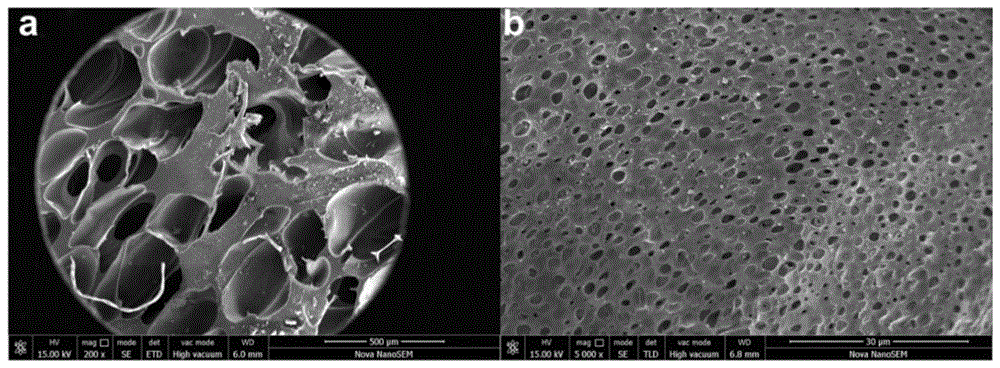
(1) according to the polyether-ether-ketone bone repair material obtained by the invention, the sulfonated micro-nano holes (smaller than 10 microns, as shown in figure 2(b)) with small sizes are beneficial to the adhesion of early osteoblasts, the supercritical carbon dioxide foamed micro-nano holes (200-600 microns, as shown in figure 2(a)) with large sizes are beneficial to the growth of later bone tissues, and the material has a multi-scale hole structure through simple two-step operation, so that the bone repair is promoted.
(2) Compared with the hole making technology using the hole making agent, the supercritical carbon dioxide foaming technology does not have the problems of incomplete removal of the hole making agent and the like, and ensures the possibility of applying the material to the biomedical field.
(3) The operation method is simple, has low cost and is an effective means for modifying the polyether-ether-ketone.
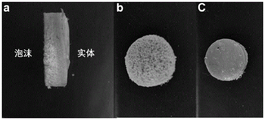
The sample obtained by the supercritical carbon dioxide foaming method in step (3) is partially foamed, as shown in fig. 1, that is, a part of the sample is a polyetheretherketone entity, and a part of the sample is polyetheretherketone foam (porous polyetheretherketone), which is different from CN 107177052A. According to the invention, the foaming pressure is set to be 7.5-10 MPa and is lower than that in the four embodiments of CN107177052A, the foaming time is controlled within 30min, and the lower foaming pressure and the shorter foaming time are not enough to enable CO to be generated2Sufficiently into the peek matrix to result in a partially foamed sample. In addition, the pressure relief time is controlled to be more than 20s, and the longer pressure relief time is equivalent to prolonging CO2The effective time for diffusion from the peek matrix to the pores, which favors cell growth, results in larger cell sizes. The partially foamed sample is prepared, and the advantage is that the solid part can play a supporting role, so that the sample has certain mechanical properties; the foam part can facilitate the growth of bone tissue in later periodHigh sample bone repair capacity.
Drawings
FIG. 1: a photograph of a partially foamed polyetheretherketone sample obtained by the supercritical carbon dioxide foaming method in example 1; wherein, the drawing (a) is a front view, the left side is polyether ether ketone (FPEEK) with large-size cells of 200-600 mu m after foaming, and the right side is an unfoamed polyether ether ketone (PEEK) entity; the picture (b) is a photo of FPEEK with large-size cells of 200-600 mu m after foaming; panel (c) is a photograph of an unfoamed PEEK entity;
FIG. 2: scanning electron microscope pictures of the surface of the polyetheretherketone obtained by different methods in example 1; wherein (a) and (b) are SEM low power lens and high power lens images of firstly foaming and then Sulfonating (SFPEEK) of the PEEK wafer;
FIG. 3: the proliferation data chart of the PEEK cells obtained in example 2 is processed by different methods; wherein the abscissa is the cell culture time and the ordinate is the absorbance value at a wavelength of 450 nm.
FIG. 4: data plots of polyetheretherketone alkaline phosphatase (ALP) activity obtained in example 3 by different methods; wherein the abscissa is cell culture time and the ordinate is alkaline phosphatase (ALP) activity;
FIG. 5: example 4 is a graph of staining pattern and quantitative analysis result data of Alizarin Red (ARS) of polyetheretherketone obtained by different methods. The abscissa is four groups of different materials and the ordinate is the absorbance value at a wavelength of 550 nm.
Detailed Description
Example 1
The polyether-ether-ketone pellets (with a melt index of 22g/10min, purchased from Changchong Jida engineering research Co., Ltd.) are placed in a vacuum hot press, hot-pressed into a polyether-ether-ketone plate with the thickness of 2mm under the conditions of 375 ℃ and 2MPa, the polyether-ether-ketone plate is cut into a wafer with the diameter of 14mm, the wafer is sequentially and respectively ultrasonically cleaned for 3 times by distilled water, ethanol and acetone for 10min each time, and then the wafer is vacuum-dried at 80 ℃, and the obtained sample is named as PEEK. And then placing the PEEK wafer in a supercritical carbon dioxide foaming device, foaming for 25min at 335 ℃ and 10MPa, releasing pressure for 25s, obtaining macropores with the size of 200-600 mu m on the surface of the PEEK wafer, and naming the macropores as FPEEK. And then, immersing the polyetheretherketone wafer and the foamed polyetheretherketone wafer in a mixed acid solution for sulfonation (the mass ratio of concentrated sulfuric acid with the mass fraction of 98% to methanesulfonic acid is 1: 10) for 4min, taking out, placing in distilled water to terminate sulfonation reaction, sequentially and respectively ultrasonically cleaning for 3 times by using distilled water and acetone for 10min each time, and then drying in vacuum at 80 ℃. Then transferring the mixture into a high-temperature hydrothermal kettle, treating the mixture for 5 hours at the temperature of 120 ℃, and then drying the mixture in vacuum at the temperature of 100 ℃. The unfoamed sulfonated polyetheretherketone wafer is named SPEEK, and the first foamed and then sulfonated polyetheretherketone wafer is named SFPEEK.
Fig. 2(a) and (b) are SEM low and high power mirror images of peek wafers first foamed and then sulfonated. As can be seen from the figure, the polyether ether ketone (SFPEEK) which is foamed before sulfonated has cells with a large size of more than 200 μm and cells with a small size of less than 10 μm obtained by sulfonation at the cell wall, and the sulfonation time is short, so that the large cell collapse is not caused basically, and the cell structure can not be seen on the surface.
Example 2
The samples before and after modification obtained in example 1 were sterilized by a high-temperature sterilizer. Then placed in a 24-well cell culture plate, each well being dropped at a density of 1X 10⁴cell/mL rat bone marrow mesenchymal stem cell (rBMSCs) suspension, which was then placed in a cell culture chamber at 37 ℃ and 5% carbon dioxide saturation humidity, and the culture medium (low-sugar DMEM medium containing 10% fetal bovine serum) was changed every 2 days. After the cells were cultured for 1, 4, and 7 days, the 24-well plate was taken out from the cell incubator, the old culture solution was aspirated, 200. mu.L of a new culture solution containing 10% CCK-8(CCK-8, Beyotime, Shanghai, China) was added, and then placed in the cell incubator, after 1 hour, it was taken out, 100. mu.L of each well was dropped into the 96-well plate, and the absorbance value of each well was measured at a wavelength of 450nm using a microplate reader (iMark, Bio-Rad, USA).
FIG. 3 is a graph showing the proliferation data of PEEK cells processed by different methods, and as shown in FIG. 3, different samples obtained in example 1 showed the phenomenon of promoting cell proliferation with time. While the three groups of treated samples exhibited lower cell proliferation than the polyetheretherketone disks (PEEK) at days 1 and 4, the three groups of treated samples all showed better cell proliferation than the polyetheretherketone disks (PEEK) when the time was extended to day 7, with the best effect of the first-foamed and then-sulfonated polyetheretherketone disks (SFPEEK) highlighting the best biological activity of the multi-scale pore structure samples.
Example 3
The samples before and after modification obtained in example 1 were sterilized by a high-temperature sterilizer. Then placed in a 24-well cell culture plate, each well being dropped at a density of 3X 10⁴cell/mL suspension of mesenchymal stem cells (rBMSCs) in bone marrow, which was then placed in a cell culture chamber at 37 ℃ and 5% carbon dioxide saturation humidity, and the culture medium (low-sugar DMEM medium containing 10% fetal bovine serum) was changed every 2 days. After the cells were cultured for 7 to 14 days, the 24-well culture plate was taken out from the cell incubator, the old culture solution was aspirated, and washed 3 times with PBS for 15min each, after which it was lysed with 0.5% Triton-100 for 1 hour, and the cell lysate was collected. Alkaline phosphatase (ALP) activity was then obtained according to the procedures of alkaline phosphatase kit (NanjingJiancheng, Nanjinking, China) and BCA protein concentration assay kit (BCAProteinassaykit, Shanghai, China).
Fig. 4 is a data graph of activity of polyetheretherketone alkaline phosphatase (ALP) obtained by different processes, and as shown in fig. 4, a first-foamed and then-sulfonated polyetheretherketone disc (SFPEEK) shows the highest activity of alkaline phosphatase (ALP), indicating that the multi-scale pore structure is beneficial for differentiation of bone marrow mesenchymal stem cells into osteoblasts and is significantly enhanced with time.
Example 4
The samples before and after modification obtained in example 1 were sterilized by a high-temperature sterilizer. Then placed in a 24-well cell culture plate, each well being dropped at a density of 3X 10⁴cell/mL suspension of mesenchymal stem cells (rBMSCs) in bone marrow, which was then placed in a cell culture chamber at 37 ℃ and 5% carbon dioxide saturation humidity, and the culture medium (low-sugar DMEM medium containing 10% fetal bovine serum) was changed every 2 days. When the cells were cultured to day 21, the 24-well plate was taken out from the cell incubatorSucking out old culture solution, washing for 3 times by PBS (phosphate buffer solution), fixing by 4% paraformaldehyde at room temperature, dripping 1mL of 1% alizarin red solution into each hole, sucking out the alizarin red solution of each hole after 30min, washing for 3 times by double distilled water for 15min each time, and observing the calcium nodule condition of each group of samples. Then 200. mu.L of 10% cetylpyridinium chloride (CPC) solution was dropped per well, and after incubation for 30min, the absorbance value was measured at a wavelength of 550nm with a microplate reader (iMark, Bio-Rad, USA).
Fig. 5 is a data diagram of quantitative analysis results of polyetheretherketone Alizarin Red (ARS) obtained by different methods, and as shown in fig. 5, the quantitative result of the first-foamed and then-sulfonated polyetheretherketone wafer (SFPEEK) is the highest of the four groups of materials, indicating that the multi-scale pore structure has the most significant osteogenesis inducing effect.
Claims (2)

1.一种具有多尺度孔的聚醚醚酮骨修复材料的制备方法,其步骤如下:1. a preparation method of a polyetheretherketone bone repair material with multi-scale pores, the steps of which are as follows: (1)将熔融指数为16~25g/10min的聚醚醚酮粒料在370~390℃、2.0~5.0MPa下热压成1.5~3mm厚的聚醚醚酮板材;(1) The polyetheretherketone pellets with a melt index of 16~25g/10min are hot-pressed at 370~390℃ and 2.0~5.0MPa into a polyetheretherketone sheet with a thickness of 1.5~3mm; (2)将步骤(1)得到的聚醚醚酮板材依次经蒸馏水、乙醇、丙酮分别超声清洗2~4次,每次5~15min,之后在真空、70~90℃下烘干;(2) The polyether ether ketone sheet obtained in step (1) is subjected to ultrasonic cleaning for 2 to 4 times with distilled water, ethanol and acetone, respectively, for 5 to 15 minutes each time, and then dried in vacuum at 70 to 90 °C; (3)将步骤(2)清洗后的聚醚醚酮板材放置在超临界二氧化碳发泡装置中,在330~340℃、7.5~10MPa下发泡25min,卸压时间为25s,得到部分发泡的聚醚醚酮板材;(3) The polyetheretherketone sheet cleaned in step (2) is placed in a supercritical carbon dioxide foaming device, foamed for 25min at 330~340°C and 7.5~10MPa, and the pressure relief time is 25s to obtain partial foaming of polyetheretherketone sheet; (4)将质量分数98%的浓硫酸与甲烷磺酸按质量比1:8~12配成混酸溶液,将步骤(3)得到的附着在聚醚醚酮板材上的部分发泡的聚醚醚酮板材浸没在该混酸溶液中,剧烈搅拌3~5min进行磺化处理,然后放入蒸馏水中终止磺化反应;将经过磺化处理的部分发泡的聚醚醚酮板材取出后依次用蒸馏水、丙酮分别超声清洗2~4次,每次5~15min,去除表面残留的浓硫酸和甲烷磺酸,然后在真空、70~90℃下烘干;(4) A mixed acid solution is prepared with 98% concentrated sulfuric acid and methanesulfonic acid in a mass ratio of 1:8 to 12, and the partially foamed polyether attached to the polyetheretherketone sheet obtained in step (3) is prepared The ether ketone sheet is immersed in the mixed acid solution, vigorously stirred for 3 to 5 minutes for sulfonation treatment, and then placed in distilled water to terminate the sulfonation reaction; and acetone were ultrasonically cleaned for 2~4 times, 5~15min each time, to remove the residual concentrated sulfuric acid and methanesulfonic acid on the surface, and then dried under vacuum at 70~90℃; (5)将步骤(4)得到的磺化聚醚醚酮泡沫在110~130℃下水热处理4~6h,然后在真空、90~110℃下烘干,从而得到的具有多尺度孔的聚醚醚酮骨修复材料。(5) The sulfonated polyetheretherketone foam obtained in step (4) is hydrothermally treated at 110~130°C for 4~6h, and then dried under vacuum at 90~110°C, thereby obtaining polyether with multi-scale pores. Ether ketone bone repair material. 2.一种具有多尺度孔的聚醚醚酮骨修复材料,其特征在于:是由权利要求1所述的方法制备得到。2 . A polyether ether ketone bone repair material with multi-scale pores, characterized in that: it is prepared by the method of claim 1 .
CN202110293853.9A 2021-03-19 2021-03-19 Polyether-ether-ketone bone repair material with multi-scale holes and preparation method thereof Active CN112972764B (en)

Priority Applications (1)

Application Number Priority Date Filing Date Title
CN202110293853.9A CN112972764B (en) 2021-03-19 2021-03-19 Polyether-ether-ketone bone repair material with multi-scale holes and preparation method thereof

Applications Claiming Priority (1)

Application Number Priority Date Filing Date Title
CN202110293853.9A CN112972764B (en) 2021-03-19 2021-03-19 Polyether-ether-ketone bone repair material with multi-scale holes and preparation method thereof

Publications (2)

Publication Number Publication Date
CN112972764A CN112972764A (en) 2021-06-18
CN112972764B true CN112972764B (en) 2022-04-26

Family

ID=76333355

Family Applications (1)

Application Number Title Priority Date Filing Date
CN202110293853.9A Active CN112972764B (en) 2021-03-19 2021-03-19 Polyether-ether-ketone bone repair material with multi-scale holes and preparation method thereof

Country Status (1)

Country Link
CN (1) CN112972764B (en)

Families Citing this family (7)

* Cited by examiner, † Cited by third party
Publication number Priority date Publication date Assignee Title
CN113527749B (en) * 2021-07-15 2022-08-02 山东大学 A method for preparing multi-scale porous structures on the surface of polyetheretherketone
CN113817215B (en) * 2021-09-29 2023-01-17 复旦大学 Artificial bone material without loss of elastic modulus and preparation method and application thereof
CN113754918B (en) * 2021-09-29 2022-11-08 复旦大学 Surface-modified polyether-ether-ketone material and preparation method and application thereof
CN113769165B (en) * 2021-10-27 2022-07-01 广东工业大学 A sulfonated polyetheretherketone-based bone repair composite material
CN114870077B (en) * 2022-05-18 2023-07-07 南方科技大学 A kind of polyether ether ketone support and its preparation method, application
CN115806650B (en) * 2022-12-29 2024-07-02 山东君昊高性能聚合物有限公司 Method for preparing implant-grade polyether-ether-ketone by subcritical technology purification
CN117427213A (en) * 2023-11-29 2024-01-23 广东工业大学 Bone repair polymer material and preparation method

Citations (3)

* Cited by examiner, † Cited by third party
Publication number Priority date Publication date Assignee Title
CN103462729A (en) * 2012-06-07 2013-12-25 中南大学 Preparation method of bionic artificial bone with multistage [micrometer/nanometer] pore structure
CN106823010A (en) * 2016-12-28 2017-06-13 四川国纳科技有限公司 The purposes of bioabsorbable polyphosphate amino acid copolymer material
CN110204778A (en) * 2019-06-17 2019-09-06 四川大学 A kind of preparation method of the polymeric foamable material with graded pore structure

Family Cites Families (9)

* Cited by examiner, † Cited by third party
Publication number Priority date Publication date Assignee Title
GB0015430D0 (en) * 2000-06-24 2000-08-16 Victrex Mfg Ltd Bio-compatible polymeric materials
EP1878450A1 (en) * 2006-07-10 2008-01-16 Ecole Polytechnique Federale De Lausanne (Epfl) Cellular gradient polymer composites
CN101237056B (en) * 2008-02-28 2011-05-11 武汉理工大学 Fuel battery proton exchange film with anti-penetration layer and its making method
CN101717504B (en) * 2009-11-27 2011-08-24 清华大学 Method for modifying sulfonated polyaryetherketone and method for preparing polymer electrolyte material
CN102924743A (en) * 2012-11-29 2013-02-13 吉林大学 Method for preparing crystalline polyether-ether-ketone foam material
CN103113129A (en) * 2013-01-31 2013-05-22 华南理工大学 Preparation method and application of a kind of hierarchical porous bioactive ceramics
CN103977451B (en) * 2014-05-19 2015-09-02 吉林大学 The 3D of tantalum coating multi-stage porous polyether-ether-ketone artificial bone scaffold prints manufacture method
CN104497344B (en) * 2014-12-29 2017-09-01 中国科学院上海硅酸盐研究所 A kind of method being modified to polyether-ether-ketone surface
CN107177052B (en) * 2017-07-18 2020-03-20 吉林大学 Light polyether-ether-ketone or composite material plate with different crystallinities and preparation method thereof

Patent Citations (3)

* Cited by examiner, † Cited by third party
Publication number Priority date Publication date Assignee Title
CN103462729A (en) * 2012-06-07 2013-12-25 中南大学 Preparation method of bionic artificial bone with multistage [micrometer/nanometer] pore structure
CN106823010A (en) * 2016-12-28 2017-06-13 四川国纳科技有限公司 The purposes of bioabsorbable polyphosphate amino acid copolymer material
CN110204778A (en) * 2019-06-17 2019-09-06 四川大学 A kind of preparation method of the polymeric foamable material with graded pore structure

Non-Patent Citations (2)

* Cited by examiner, † Cited by third party
Title
Effect of supercritical carbon dioxide on the crystallization behavior of poly(ether ether ketone);Wang, D等;《Journal of polymer science part B-polyer physics》;20071101;第45卷(第21期);2927-2936 *
高性能聚芳醚酮泡沫材料的制备与性能研究;王辉;《中国优秀硕士学位论文全文数据库 工程科技Ⅰ辑》;20130815;全文 *

Also Published As

Publication number Publication date
CN112972764A (en) 2021-06-18

Similar Documents

Publication Publication Date Title
CN112972764B (en) Polyether-ether-ketone bone repair material with multi-scale holes and preparation method thereof
CN112972760B (en) Endothelial extracellular matrix loaded 3D printing bone defect repair support and preparation method thereof
CN110947031B (en) A kind of bone tissue engineering scaffold material with high biological activity and its preparation method and application
CN108503877B (en) A kind of method for surface modification of PEEK
CN102600508B (en) Porcine arterial vacuum lyophilization acellular matrix, as well as preparation method and application thereof
CN113101419B (en) Hydrogel stent with polydopamine coating and preparation method thereof
CN109106987B (en) A kind of bone implant with both mechanical adaptability and osteogenic activity and preparation method thereof
CN115404209B (en) Marrow mesenchymal stem cell extracellular vesicle and acquisition and application thereof
CN114870077A (en) Polyether-ether-ketone support and preparation method and application thereof
CN117427212A (en) Biological functional porous polyether-ether-ketone bone tissue scaffold material and preparation method thereof
CN110101903B (en) A hypoxia-inducible BG composite scaffold and its application
CN116870255B (en) Extracellular matrix high-retention decellularized meniscus and preparation method thereof
CN104971386A (en) Silk protein scaffold material and preparation method thereof
KR20210103984A (en) Heart extracellular matrix-derived scaffold for culture and transplantation of cardiac organoid and preparing method thereof
CN115970054A (en) 3D printed porous bone scaffold loaded with silicon nitride and its preparation method and application
CN114712557A (en) Hydrogel reinforced biological bone calcium apatite scaffold and manufacturing method thereof
CN119119412A (en) A three-dimensional scaffold with bioenergetic activity and a preparation method thereof
CN104107454A (en) Bone tissue porous scaffold material and preparation method thereof
CN118600398A (en) A method for treating magnesium-doped hydroxyapatite coating by femtosecond laser loading
CN106178117A (en) A kind of PLL DBM porous composite bone graft material, its preparation method and application
CN114042190A (en) Bioactive bone powder containing cell membrane and preparation method thereof
CN114028613A (en) Functional bone repair composite scaffold, preparation method and application
CN117018280B (en) Periosteum material for promoting local endogenous bone regeneration and repair and preparation method thereof
CN115920135B (en) Bone repair material and preparation method thereof
CN113117149A (en) Bone-like hydroxyapatite-collagen composite scaffold and preparation method thereof

Legal Events

Date Code Title Description
PB01 Publication
PB01 Publication
SE01 Entry into force of request for substantive examination
GR01 Patent grant
GR01 Patent grant
TR01 Transfer of patent right

Effective date of registration: 20251118

Address after: 130102 Jilin Province, Changchun City, Beihu Science and Technology Development Zone, Shengbei Avenue No. 3333, Phase I Industrial Building of Changchun Beihu Science and Technology Park, 2nd Floor, Room 201-5

Patentee after: Changchun Huawoqi Material Technology Co.,Ltd.

Country or region after: China

Address before: 130012 No.2699 Qianjin Street, Changchun hi tech Industrial Development Zone, Changchun City, Jilin Province

Patentee before: Jilin University

Country or region before: China

TR01 Transfer of patent right