Strain gauge for chip stress test
Technical Field
The invention belongs to the field of strain gauges, and relates to a strain gauge for chip stress test.
Background
In order to prevent various possible failure problems of the chip (such as BGA chip mounting, circuit board mounting stress, mechanical vibration and the like), quantitatively evaluating and identifying harmful processes of the chip with excessive stress in the processes of component assembly, testing, mechanical mounting, transportation and the like, the stress distribution condition of the chip under various stress states needs to be tested.
The common resistance strain gauge can realize the measurement of the stress distribution of a part to be tested, and the strain gauges for the test mainly comprise three types: firstly, a plurality of single-axis strain gauges are arranged, secondly, overlapped pattern type strain gauges are used, and thirdly, strain patterns of 3-8 groups of measuring grids are used.
In the process of chip testing, the existing strain gauge is used, and the following problems mainly exist: the surface area of the chip is small, the arrangement area of the strain gauge is limited, more test points cannot be arranged, the test result cannot reflect the stress-strain distribution condition, and the difference between the stress-strain distribution condition and the stress distribution cloud chart is large.
Disclosure of Invention
The invention aims to overcome the defects of the prior art and provide the strain gauge for the chip stress test, so that the test points of the strain gauge are increased, and the accuracy of the test result is improved.
In order to achieve the purpose, the invention adopts the following technical scheme to realize the purpose:
the strain gauge for the chip stress test comprises 4-20 groups of measurement grids arranged on the same strain gauge substrate, wherein an even number of groups of measurement grids are arranged in each row, and each group of measurement grids comprises at least three uniaxial measurement grids in different directions.
Preferably, each single-axis measuring grid is provided with a weld spot, which is provided on two opposite sides or four sides of the strain gauge.
Preferably, the included angle between the uniaxial measurement grids is 0-180 ℃.
Preferably, the resistance of each uniaxial measurement grid is in the range of 120 Ω to 1000 Ω.
Preferably, the distance between each group of measuring grids is 4-10 mm.
Preferably, the strain gauge comprises 2-4 same strain gauge substrates, 4-20 groups of measurement grids are equally divided by all the strain gauge substrates, and the strain gauges are bonded among all the strain gauge substrates.
Preferably, a heat sink is placed on top of the strain gage, with the strain gage pads outside the area of the chip package or capped heat sink.
Preferably, the strain gauge comprises a base film and a cover film, wherein the base film and the cover film are phenolic resin, epoxy resin, polyurethane, polyether-ether-ketone or polyimide films with the thickness of 10-50 μm.
Preferably, the strain gauge is connected to the test instrument in a three wire system.
Preferably, the welding spot of the strain gauge is connected with one end of a connecting wire, the other end of the connecting wire is connected with a test wire, and the diameter and the hardness of the connecting wire are both smaller than those of the test wire.
Compared with the prior art, the invention has the following beneficial effects:
according to the invention, the measurement grids are arranged through 4-20 groups of measurement grids on the substrate of the strain gauge, each group of measurement grids comprises at least three uniaxial measurement grids in different directions, so that the test points of the strain gauge are increased in the limited area of the strain gauge, the measurement of the stress conditions of the object to be tested in different gradients and all directions can be realized, and the accuracy of the test result is improved.
Furthermore, the welding points of the strain gauge can be led out from two sides for arrangement. And when the number of welding spots is more, the welding spots can be arranged in a four-side lead-out mode.
Furthermore, the strain gauge is split, so that the number of the measurement grids on each measurement grid substrate is not too large, and the preparation difficulty is reduced.
Furthermore, the welding spot is designed outside the chip packaging or capping heat radiator area, so that the welding spot can be prevented from influencing the surface attachment of the heat radiator chip.
Furthermore, the base film and the cover film which are thinner can enable the strain gauge to be better attached to the surface of the chip with curvature.
Furthermore, the strain gauge and the testing instrument are connected in a three-wire system mode, so that the influence of the resistance of a connecting wire between the strain gauge and the testing instrument on a testing result can be reduced.
Furthermore, the thin and soft connecting lead is led out from the welding point and then is connected with the test lead in a switching mode, so that the connection reliability of the lead in the drop test is guaranteed.
Drawings
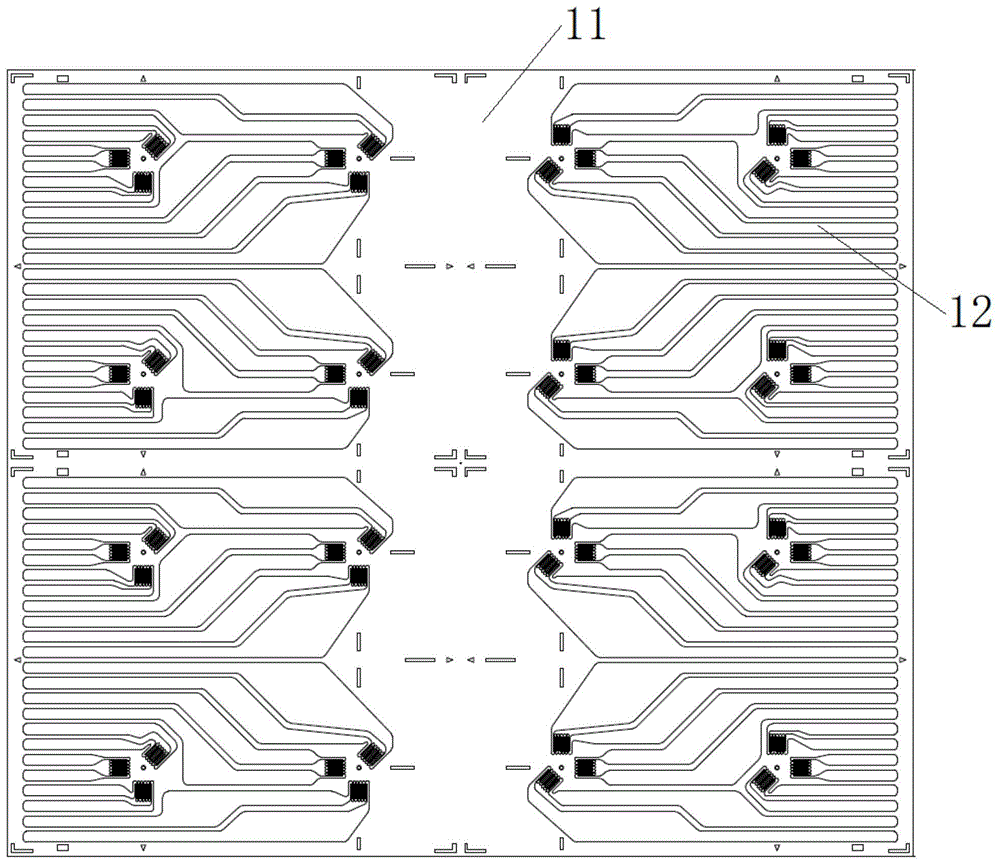
FIG. 1 is a schematic view of the strain gage measurement grating of this patent.
Fig. 2 is a schematic diagram of the strain gauge of this patent divided into four pieces.
Fig. 3 is a schematic diagram of two-side lead-out arrangement of solder joints in the present patent.
FIG. 4 is a schematic diagram of the solder joint four-side lead-out arrangement of this patent.
Fig. 5 is a schematic diagram of a first three wire connection for the strain gage of this patent.
Fig. 6 is a schematic diagram of a second three wire connection for the strain gage of this patent.
FIG. 7 is a diagram illustrating a first application state of a strain gauge according to the present invention.
Fig. 8 is a diagram illustrating a second application state of the strain gauge according to the present invention.
Wherein: 1-radiator, 2-chip body, 3-chip substrate, 4-PCB, 5-strain gauge, 6-patch glue layer, 7-welding spot, 8-strain gauge lead, 9-connecting lead and 10-testing lead; 11-a strain gauge substrate; 12-measuring grid.
Detailed Description
The invention is described in further detail below with reference to the accompanying drawings:
the strain gauge 5 for the chip stress test comprises 4-20 groups of measurement grids 12 arranged on the same strain gauge substrate 11, wherein the distance between each group of measurement grids 12 is as follows: 4-10 mm. Each row is provided with a plurality of groups of measuring grids 12, each group of measuring grids 12 comprises 3 or more single-axis measuring grids in different directions, and the included angle between the single-axis measuring grids is 0-180 ℃. The resistance of each uniaxial measuring grid ranges from 120 omega to 1000 omega, and the welding points 7 led out by each grid can be distributed in the four sides of the whole strain gauge 5.
As shown in fig. 1, the strain gauge 5 of this embodiment is designed with 16 sets of measurement grids 12 at regular intervals in a region of 27 × 26mm, wherein each set includes 3 uniaxial measurement grids in different directions, and the 3 uniaxial measurement grids are 0 ° direction, 90 ° direction and 135 ° direction in total for 48 uniaxial measurement grids.
If the strain gauge 5 is provided with too many measurement grids 12, it may cause difficulty in manufacturing the strain gauge 5. At this time, the whole strain gauge 5 can be divided into 2-4 pieces according to the repeatability of the measuring grid 12, and after each piece is manufactured independently, the pieces are bonded together according to the graph before division through the cover layer, so that the strain gauge 5 with complete graph is formed.
As shown in fig. 2, the pattern in fig. 1 is divided into 4 pieces, each piece is separately produced, and the pieces are bonded together by a cover layer according to the pattern before division to form the strain gauge 5 with a complete pattern. The strain gauge 5 can achieve the testing effect of the strain gauge 5 in fig. 1, and the production and the manufacture are easier.
The single-axis measuring grids are provided with welding spots 7, and the welding spots 7 are arranged on two opposite sides or four sides of the strain gauge 5.
Fig. 3 and 4 show two arrangements of the solder bumps 7 present in the present invention. The welding points 7 of the strain gauge 5 can be led out from two sides for arrangement. And when the number of the welding spots 7 is large, the welding spots can be arranged in a four-side lead-out mode.
The solder joints 7 affect the adhesion of the heat spreader 1 to the surface of the chip. By designing the location of the solder joints 7 outside the area of the chip package or capped heat sink 1, the influence of the solder joints 7 can be avoided.
The thickness of the strain gauge 5 affects its own adherence to the chip surface. When selecting materials, the base film with thinner thickness is selected, so that the strain gauge 5 can be better attached to the surface of the chip with curvature. The base film and the cover film with proper thickness are selected, and the phenolic resin, the epoxy resin, the polyurethane, the polyether ether ketone or the polyimide film with the thickness of 10-50 mu m is adopted.
In order to reduce the influence of the resistance of the connecting lead 9 between the strain gauge 5 and the strain gauge for acquiring data on the test result, a three-wire system mode is adopted for connection. One scheme is as follows: each uniaxial measuring grid is designed with two welding spots 7, one of which leads out a conducting wire and the other leads out two conducting wires. The other scheme is as follows: each uniaxial measuring grid is designed with three welding points 7, and each welding point 7 leads out a conducting wire.
As shown in fig. 4, when only two solder joints 7 are designed for each uniaxial sensitive grid, the three-wire method is: two wires are led out from one welding point 7, and one wire is led out from the other welding point 7.
As shown in fig. 5, three welding points 7 can be designed for each single-axis sensitive grating when the strain gauge 5 is designed graphically, and the three-wire connection method is as follows: each welding point 7 is led out by a lead.
Solder joint 7 is connected with strainometer wire 8, and for guaranteeing that the wire is connected reliably in falling, strainometer wire 8 includes connecting wire 9 and test wire 10, and accessible solder joint 7 draws connecting wire 9 earlier and switching test wire 10 again, and connecting wire 9 diameter and hardness all are less than test wire 10, fixes partial wire on PCB board 4 simultaneously, guarantees the reliability of wire connection in the test process.
When the strain gauge 5 is connected with a lead, the part led out from the welding point 7 is firstly connected with a short (200 mm-500 mm) section of connecting lead 9, so that the stress concentration at the welding point 7 caused by the hard lead is avoided. The connection lead 9 is preferably silver-plated wire, enameled wire, polytetrafluoroethylene wire, or PVC wire with a diameter of 0.3mm or less. After the connecting wire 9 is connected, a longer (1000 mm-5000 mm) section of testing wire 10 is connected, and the testing wire 10 recommends using three-core PVC, TPE and polytetrafluoroethylene flat cables with the diameter phi of 0.3 mm-phi 1.5 mm.
Fig. 7 and 8 show the application of the strain gauge 5 in a chip stress testing device, the chip stress testing device comprises a radiator 1, the strain gauge 5, a patch adhesive layer 6, a chip body 2, a chip substrate 3 and a PCB 4 which are sequentially arranged from top to bottom, the strain gauge 5 is fixed on a concave or convex chip with different curvatures on the surface by using the patch adhesive, the radiator 1 is covered above the strain gauge 5, and the chip is fixed on the PCB 4 through the substrate. The welding spot 7 is positioned outside the contact area of the radiator 1 and the chip, a strain gauge lead 8 is led out of the welding spot 7, and the tail end of the lead is connected with a test instrument.
The strain gauge 5 design technology for chip stress testing is combined with the strain gauge 5 manufacturing technology and the stress testing technology, so that the accurate adjustment and measurement of the stress distribution of the chip can be realized. Through tests, the repeatability (the average value/standard deviation of 3 times of tests) of the strain gauge 5 is within-2% to + 2%, and the stress distribution conditions of the chip under different falling states can be reflected in real time.
Table 1 loading repetitive data record table
The above-mentioned contents are only for illustrating the technical idea of the present invention, and the protection scope of the present invention is not limited thereby, and any modification made on the basis of the technical idea of the present invention falls within the protection scope of the claims of the present invention.