Disclosure of Invention
In order to improve the heat insulation effect of the covering slag, the application provides the continuous casting crystallizer covering slag and the preparation method thereof.
The continuous casting crystallizer covering slag and the preparation method thereof adopt the following technical scheme:
in a first aspect, a mold flux for a continuous casting mold comprises the following composition SiO224.00-31.00 parts of CaO26.00-33.00 parts of Al2O35.40-5.70 parts of Fe2O3Not more than 3.00 parts of MgO not more than 3.00 parts of Na2O and Li26.50-10.50 parts of O and CaF23.50-7.50 parts of ZrO24.5-5.5 parts of Y2O33.5 to 4.5 portions.
By adopting the technical scheme, the zirconia has the advantages of high melting point, difficult oxidation and the like, has stable chemical property, good heat insulation effect, corrosion resistance and oxidation resistance under specific high-temperature environment, is non-volatile and pollution-free, is a refractory material with good performance,
when the mold flux is added to the liquid level of the molten steel, the mold flux is melted due to the high temperature of the molten steel, and the mold flux forms a three-layer structure, namely a liquid slag layer, a sintered layer and a powder slag layer. Because the crystallizer rocks, make and form the gap between casting blank and the crystallizer wall, the liquid slag layer flows into between casting blank and the crystallizer wall, play the role of lubricating and controlling heat transfer, because add zirconia in the covering slag, zirconia is high temperature resistant, chemical stability, and the heat-proof quality is good, can be better reduce the heat transfer efficiency of covering slag, reduce because the casting blank cooling rate is too fast, thus make the casting blank produce the cracked possibility, in addition, still avoided the phenomenon that the covering slag carburizes to the casting blank surface.
The zirconium oxide is added into the covering slag, the heat transfer efficiency of the covering slag is well controlled, but the zirconium oxide increases the viscosity of a liquid slag layer of the covering slag, and the liquid slag layer is not beneficial to permeating into a gap between a crystallizer and a casting blank, so that the casting blank is not easy to pull out from the crystallizer, and even a viscous breakout accident is caused.
The zirconium oxide and the yttrium oxide have synergistic effect, so that the heat transfer performance of the covering slag is improved, the viscosity of liquid covering slag is not weakened, and the possibility of generating cracks in a casting blank is reduced.
Alternatively, the Na2O and Li2The weight ratio of 0 is 1:1-2: 1.
By adopting the technical scheme, Na2O and Li2O can destroy the chain structure of the casting powder, reduce the viscosity of the liquid slag layer of the casting powder, and simultaneously reduce the crystallization temperature, Na2O and Li20 is more than 2:1, the casting powder is easy to separate out nepheline and is not beneficial to lubrication, and Na2O and Li20 is less than 1:1 by weight, affecting the mold fluxCrystallization rate and vitrification degree.
Optionally, the CaO and SiO2In a weight ratio of 0.95: 1-1.15:1.
By adopting the technical scheme, CaO and SiO2The alkalinity is an important index of the capability of reacting the covering slag to absorb inclusions in the molten steel, and the alkalinity is properly improved, so that the covering slag is favorable for absorbing the inclusions in the molten steel.
On the other hand, the preparation method of the continuous casting crystallizer casting powder is to prepare SiO224.00-31.00 parts of CaO26.00-33.00 parts of Al2O35.40-5.70 parts of Fe2O3Not more than 3.00 parts of MgO not more than 3.00 parts of Na2O and Li26.50-10.50 parts of O and CaF23.50-7.50 parts of ZrO24.5-5.5 parts of Y2O33.5 to 4.5 portions of the powder slag of the finished product of the covering slag are obtained after uniform mixing and grinding.
Optionally, the finished mold flux powder is dried.
By adopting the technical scheme, the content of water in the casting powder is reduced, so that the quality of a casting blank is not influenced.
Optionally, the milling process uses a ball mill.
Optionally, the particle size of the finished product of the covering slag powder is 100-200 meshes.
By adopting the technical scheme, the particle density is fine, which is beneficial to melting the casting powder, but the particle density is too fine, so that the liquid film is not beneficial to controlling the heat transfer temperature after passing.
Optionally, the finished mold flux is stored in a dry environment.
In summary, the present application has the following beneficial effects:
1. when the mold flux is added to the liquid level of the molten steel, the mold flux is melted due to the high temperature of the molten steel, and the mold flux forms a three-layer structure, namely a liquid slag layer, a sintered layer and a powder slag layer. Because the crystallizer rocks, make and form the gap between casting blank and the crystallizer wall, the liquid slag layer flows into between casting blank and the crystallizer wall, play the role of lubricating and controlling heat transfer, because add zirconia in the covering slag, zirconia is high temperature resistant, chemical stability, and the heat-proof quality is good, can be better reduce the heat transfer efficiency of covering slag, reduce because the casting blank cooling rate is too fast, thus make the casting blank produce the cracked possibility, in addition, still avoided the phenomenon that the covering slag carburizes to the casting blank surface.
2. CaO and SiO2The alkalinity is an important index of the capability of reacting the covering slag to absorb inclusions in the molten steel, and the alkalinity is properly improved, so that the covering slag is favorable for absorbing the inclusions in the molten steel.
Detailed Description
The present application will be described in further detail with reference to examples.
Examples
Example 1
The continuous casting crystallizer casting powder comprises the following components of SiO224.00kg、CaO26.00kg、Al2O35.40kg、Fe2O33.00kg、MgO3.00kg、Na2O and Li206.5kg、CaF23.50-7.50 parts of ZrO24.5-5.5 parts of Y2O33.5-4.5 parts of Na2O and Li2The weight ratio of 0 is 1: 1.
A preparation method of continuous casting crystallizer casting powder comprises the following steps: mixing 24.00kgSiO2、26.00kgCaO、5.40kgAl2O3、3.00kgFe2O3、3.00kgMgO、3.50kgCaF2、4.5kgZrO2、3.5kgY2O3、6.50kgNa2O and Li20, uniformly mixing, grinding by using a ball mill, and drying to obtain the finished product of the covering slag powder, wherein the particle size of the finished product of the covering slag powder corresponds to 100 meshes, and Na is contained in the powder2O and Li20 weight ratio of 1:1, CaO and SiO2The weight ratio of (1.08): 1.
examples 2 to 9 and comparative examples 1 to 2
Examples 2 to 9 and comparative examples 1 to 2 are different from example 1 in the ratio of raw materials, and specific ratios of raw materials are shown in tables 1 to 1 and tables 1 to 2.
TABLE 1-1 raw material ratios of examples 2-9 and comparative examples 1-2
Tables 1-1 the mass of each example was set to 1kg and the remaining data were homogeneously expressed as follows:
TABLE 1-2 raw material compounding ratio of examples 2-9 and comparative examples 1-2
Performance test
Viscosity test: and testing the viscosity of the casting powder according to a standard YB/T185-2017 continuous casting powder viscosity test method.
The heat transfer efficiency test method comprises the following steps: and testing the heat flux density of the casting powder by using an HF-200 crystallizer slag film heat flux simulator.
The heat flow test slag film preparation step: at 1300 ℃, 350g of prepared slag materials are uniformly mixed and then put into a graphite crucible, the graphite crucible is added into a silicon-molybdenum furnace, the temperature is raised, the melting and the stirring are uniform, after the temperature of a hearth reaches 1400 ℃, a stirring rod is used for uniformly melting protective slag, a lifting arm is started after the position of a sensor is positioned at the center of the furnace tube to drive a positioning sensor to descend to the slag liquid level, and the sensor can immediately and automatically ascend when contacting the liquid level. And the lifting arm descends again to drive the copper probe to be immersed into the slag liquid, the sensor starts timing, and the sensor below the slag liquid surface is taken out after 80s to obtain a solid liquid film adhered to the sensor and the water temperature of the inlet and the outlet automatically acquired by the computer.
The heat flux density of the slag film is calculated as follows: phi W C delta T/(F1000)
Phi-heat flow density, Mw m-2(ii) a Cooling water flow rate of W-heat flow sensor, kg.s-1(ii) a Delta T-temperature difference of water at the inlet and the outlet of the heat flow sensor, DEG C; effective heat transfer area, m, of F-heat flow sensor2(ii) a C-specific Heat of Water, kg · (kg ℃)-1。
The following table shows the viscosity and heat flow density for examples 2-9 and comparative examples 1-2:
TABLE 2 viscosity vs. Heat flow Density for examples 2-9 and comparative examples 1-2
Example 2 improved SiO compared to example 12Content of (3), data show, SiO2In a specific range, SiO2The content is increased, so that the protective slag forms a glass phase, which is beneficial to lubricating a casting blank;
compared with the embodiment 1, the embodiment 3 improves the content of CaO, and the data show that the content of CaO is in a specific range, the content of CaO is improved, the viscosity of the casting powder is obviously reduced, and the capacity of absorbing impurities is improved;
al in example 4 in comparison with example 12O3The content is unchanged, and the viscosity is unchanged;
fe in example 5 compared to example 12O3While the viscosity of the mold flux was not changed, it was confirmed that the content of (B) in Fe was reduced2O3The content of (b) does not affect the viscosity of the mold flux within a specific range;
compared with the embodiment 1, the MgO content in the embodiment 6 is reduced, the viscosity of the mold flux is increased, the MgO content is in a specific range, the MgO can reduce the viscosity and the solidifying point of the mold flux, the fluidity of the mold flux is increased, and the chemical stability of the mold flux is favorable;
CaF in example 6 in comparison with example 12The content is reduced, the viscosity of the casting powder is increased, and CaF is increased within a specific content range2The content of (3) can reduce the viscosity of the mold flux;
example 1 and examples 7 to 8 in combination with comparative examples 1 to 2 found that ZrO2In a specific range, ZrO2Increase in the content ofAnd the viscosity of the casting powder is increased, the heat flow density of the casting powder is reduced, the heat insulation performance of the casting powder is improved, and the possibility that the casting blank cracks due to the fact that the cooling speed of the casting blank is too high is reduced.
Examples 10 to 14 and comparative examples 3 to 4
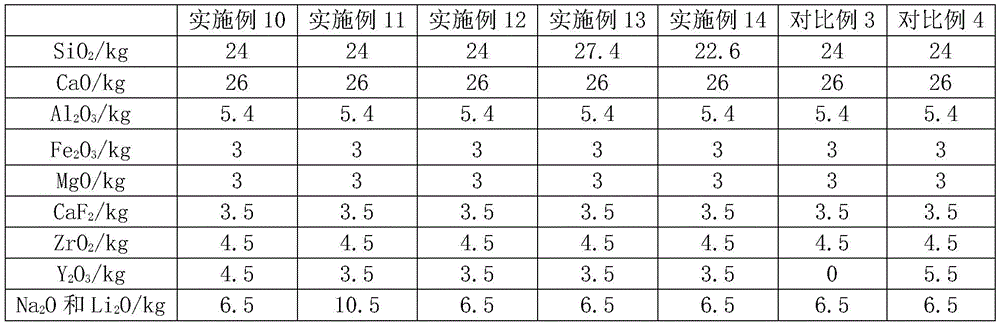
Examples 10 to 14 and comparative examples 3 to 4 are different from example 1 in the ratio of raw materials, and specific ratios of raw materials are shown in tables 3 to 1 and 3 to 2.
TABLE 3-1 raw material compounding ratios of examples 10 to 14 and comparative examples 3 to 4
The mass of each example is set to 1kg in tables 3-1 and the remaining data are homogeneously expressed as follows:
TABLE 3-2 raw material compounding ratios of examples 10 to 14 and comparative examples 3 to 4
| |
Example 10
|
Example 11
|
Example 12
|
Example 13
|
Example 14
|
Comparative example 3
|
Comparative example 4
|
| SiO2/kg
|
0.30
|
0.29
|
0.30
|
0.33
|
0.29
|
0.32
|
0.29
|
| CaO/kg
|
0.32
|
0.31
|
0.33
|
0.31
|
0.33
|
0.34
|
0.32
|
| Al2O3/kg
|
0.07
|
0.06
|
0.07
|
0.07
|
0.07
|
0.07
|
0.07
|
| Fe2O3/kg
|
0.04
|
0.04
|
0.04
|
0.04
|
0.04
|
0.04
|
0.04
|
| MgO/kg
|
0.04
|
0.04
|
0.04
|
0.04
|
0.04
|
0.04
|
0.04
|
| CaF2/kg
|
0.04
|
0.04
|
0.04
|
0.04
|
0.04
|
0.05
|
0.04
|
| ZrO2/kg
|
0.06
|
0.05
|
0.06
|
0.05
|
0.06
|
0.06
|
0.06
|
| Y2O3/kg
|
0.06
|
0.04
|
0.04
|
0.04
|
0.04
|
0.00
|
0.07
|
| Na2O and Li2O/kg
|
0.08
|
0.13
|
0.08
|
0.08
|
0.08
|
0.09
|
0.08
|
| Na2O/Li20
|
1
|
1
|
2
|
1
|
1
|
1
|
1
|
| CaO/SiO2 |
1.08
|
1.08
|
1.08
|
0.95
|
1.15
|
1.08
|
1.08 |
The following table shows the viscosity and heat flow density for examples 10-14 and comparative examples 3-4:
TABLE 4 viscosity vs. Heat flow Density for examples 10-14 and comparative examples 3-4
Example 10 increased Y compared to example 12O3In a specific content range, Y is increased2O3The viscosity of the mold flux is reduced, and the heat flux density of the mold flux is reduced;
example 1 and example 10 in combination with comparative examples 3 to 4, it was found that within a specific content range, Y2O3The higher the content of (A), the lower the viscosity of the mold flux, and with ZrO2In cooperation, the heat flux density of the mold flux is reduced, that is, the heat insulating property of the mold flux is synergistically increased.
Example 11 increased Na over example 12O and Li20 content of Na in the mold flux2O and Li20 can destroy the network structure of the silicate, and can reduce the viscosity of the mold flux within a specific content range.
Example 12 increased Na over example 12O/Li20, in a specific content range, Na2The increase in O content increases the tendency to crystallize, and nepheline is likely to precipitate, which is not favorable for lubrication.
In comparison with example 1, examples 13 to 14 show that in the specified content range, CaO/SiO2The ratio of (2) is increased, namely the alkalinity is increased, the crystallization is improved, and the heat transfer is reduced.
The present embodiment is only for explaining the present application, and it is not limited to the present application, and those skilled in the art can make modifications of the present embodiment without inventive contribution as needed after reading the present specification, but all of them are protected by patent law within the scope of the claims of the present application.