CN115242593A - Modulation method for multiplicative multiple access channel in symbiotic wireless communication system - Google Patents
Modulation method for multiplicative multiple access channel in symbiotic wireless communication system Download PDFInfo
- Publication number
- CN115242593A CN115242593A CN202210859166.3A CN202210859166A CN115242593A CN 115242593 A CN115242593 A CN 115242593A CN 202210859166 A CN202210859166 A CN 202210859166A CN 115242593 A CN115242593 A CN 115242593A
- Authority
- CN
- China
- Prior art keywords
- primary
- transmitter
- secondary transmitter
- wireless communication
- combined signal
- Prior art date
- Legal status (The legal status is an assumption and is not a legal conclusion. Google has not performed a legal analysis and makes no representation as to the accuracy of the status listed.)
- Granted
Links
Images


Classifications
-
- H—ELECTRICITY
- H04—ELECTRIC COMMUNICATION TECHNIQUE
- H04L—TRANSMISSION OF DIGITAL INFORMATION, e.g. TELEGRAPHIC COMMUNICATION
- H04L27/00—Modulated-carrier systems
- H04L27/32—Carrier systems characterised by combinations of two or more of the types covered by groups H04L27/02, H04L27/10, H04L27/18 or H04L27/26
- H04L27/34—Amplitude- and phase-modulated carrier systems, e.g. quadrature-amplitude modulated carrier systems
- H04L27/3405—Modifications of the signal space to increase the efficiency of transmission, e.g. reduction of the bit error rate, bandwidth, or average power
-
- H—ELECTRICITY
- H04—ELECTRIC COMMUNICATION TECHNIQUE
- H04L—TRANSMISSION OF DIGITAL INFORMATION, e.g. TELEGRAPHIC COMMUNICATION
- H04L27/00—Modulated-carrier systems
- H04L27/32—Carrier systems characterised by combinations of two or more of the types covered by groups H04L27/02, H04L27/10, H04L27/18 or H04L27/26
- H04L27/34—Amplitude- and phase-modulated carrier systems, e.g. quadrature-amplitude modulated carrier systems
- H04L27/36—Modulator circuits; Transmitter circuits
-
- Y—GENERAL TAGGING OF NEW TECHNOLOGICAL DEVELOPMENTS; GENERAL TAGGING OF CROSS-SECTIONAL TECHNOLOGIES SPANNING OVER SEVERAL SECTIONS OF THE IPC; TECHNICAL SUBJECTS COVERED BY FORMER USPC CROSS-REFERENCE ART COLLECTIONS [XRACs] AND DIGESTS
- Y02—TECHNOLOGIES OR APPLICATIONS FOR MITIGATION OR ADAPTATION AGAINST CLIMATE CHANGE
- Y02D—CLIMATE CHANGE MITIGATION TECHNOLOGIES IN INFORMATION AND COMMUNICATION TECHNOLOGIES [ICT], I.E. INFORMATION AND COMMUNICATION TECHNOLOGIES AIMING AT THE REDUCTION OF THEIR OWN ENERGY USE
- Y02D30/00—Reducing energy consumption in communication networks
- Y02D30/70—Reducing energy consumption in communication networks in wireless communication networks
Landscapes
- Engineering & Computer Science (AREA)
- Computer Networks & Wireless Communication (AREA)
- Signal Processing (AREA)
- Digital Transmission Methods That Use Modulated Carrier Waves (AREA)
Abstract
本发明属于无线通信技术领域,尤其涉及一种用于共生无线通信系统中乘性多址接入信道的调制方法。本发明的方案包含两个分量,一部分是符号时不变分量,用于辅助主系统的信息传输;另一部分是符号时变分量,用于传输次系统的信息。该方案融合了次发射机辅助和信息传输的两个功能。同时,因为次发射机采用的是无源反向散射技术,所以这两个分量之和的模要小于一,通过调节这两个分量的能量大小,可以折中主次通信系统的误码率性能。本发明提出一种针对共生无线通信中乘性多址接入信道的调制方案设计。该调制方案同时具有传输自身信息以及辅助通信的功能,方案实施简单,具有很强的应用价值。

The present invention belongs to the technical field of wireless communication, and in particular relates to a modulation method for a multiplicative multiple access channel in a symbiotic wireless communication system. The scheme of the present invention includes two components, one part is the symbol time-invariant component, which is used to assist the information transmission of the primary system; the other part is the symbol time-varying component, which is used to transmit the information of the secondary system. The scheme combines the two functions of secondary transmitter assistance and information transmission. At the same time, because the secondary transmitter adopts passive backscattering technology, the sum of the two components has a mode less than one. By adjusting the energy of these two components, the bit error rate of the primary and secondary communication systems can be compromised. performance. The present invention proposes a modulation scheme design for a multiplicative multiple access channel in symbiotic wireless communication. The modulation scheme has the functions of transmitting its own information and assisting communication at the same time. The scheme is simple to implement and has strong application value.
Description
技术领域technical field
本发明属于无线通信技术领域,尤其涉及一种用于共生无线通信系统中乘性多址接入信道的调制方法。The present invention belongs to the technical field of wireless communication, and in particular relates to a modulation method for a multiplicative multiple access channel in a symbiotic wireless communication system.
背景技术Background technique
未来第六代移动通信(6G)旨在通过万物互联为人类提供沉浸式的极致体验。随着虚拟现实、增强现实等新型无线应用的快速发展与涌现,预计在6G时代,无线设备的连接密度将高达107个/km2,这使得未来无线通信系统将面临着巨连接,巨流量等需求带来的严峻挑战。The future sixth-generation mobile communication (6G) aims to provide human beings with an immersive and extreme experience through the Internet of Everything. With the rapid development and emergence of new wireless applications such as virtual reality and augmented reality, it is expected that in the 6G era, the connection density of wireless devices will be as high as 10 7 /km 2 , which will make the future wireless communication system face huge connections and huge traffic. Serious challenges brought about by other demands.
最近,共生无线通信,又称作认知反向散射通信,因其高能量效率,高频谱效率的特性,被认为是解决上述挑战的关键技术之一。一个典型的共生无线通信系统包含一个主发射机,一个次发射机以及一个协作式接收机。其中次发射机利用反向散射通信技术将自己的信息调制在来自主发射机的射频信号上,并将调制后的信号反射到协作式接收机处。协作式接收机会联合解调来自主次发射机的信号。次发射机的调制技术,也成为“空中调制”,会导致主次发射机的信号相乘在一起。因此,共生无线通信系统也可以被建模成一个乘性多址接入信道。Recently, symbiotic wireless communication, also known as cognitive backscatter communication, has been regarded as one of the key technologies to solve the above challenges due to its high energy efficiency and high spectral efficiency. A typical symbiotic wireless communication system consists of a primary transmitter, a secondary transmitter and a cooperative receiver. The secondary transmitter uses backscatter communication technology to modulate its own information on the radio frequency signal from the primary transmitter, and reflects the modulated signal to the cooperative receiver. Cooperative receivers jointly demodulate the signals from the primary and secondary transmitters. The modulation technique of the secondary transmitter, also known as "over-the-air modulation", causes the signals of the primary and secondary transmitters to be multiplied together. Therefore, the symbiotic wireless communication system can also be modeled as a multiplicative multiple access channel.
传统的空中调制方式只关注于传输次发射机的信息,而忽略了对主发射机信号传输的影响。特别地,在主发射机和协作式接收机之间的直接链路被阻挡的时候,模糊性问题导致协作接收机无法解调主次发射机的发送信号,造成严重的误码率性能损失。因此,需要设计一种新型的空中调制方案来提升主次发射机信号的误码率性能。The traditional over-the-air modulation method only focuses on transmitting the information of the secondary transmitter, while ignoring the influence on the signal transmission of the primary transmitter. In particular, when the direct link between the primary transmitter and the cooperative receiver is blocked, the ambiguity problem causes the cooperative receiver to be unable to demodulate the transmitted signals of the primary and secondary transmitters, resulting in severe BER performance loss. Therefore, a new type of over-the-air modulation scheme needs to be designed to improve the bit error rate performance of the primary and secondary transmitter signals.
发明内容SUMMARY OF THE INVENTION
本发明提出一种针对共生无线通信系统中乘性多址接入信道的调制方法,同时提供了一种所提调制方案的参数优化方法。The present invention proposes a modulation method for a multiplicative multiple access channel in a symbiotic wireless communication system, and also provides a parameter optimization method of the modulation scheme.
本发明提出一种新型的空中调制方案。该方案包含两个分量,一部分是符号时不变分量,用于辅助主系统的信息传输;另一部分是符号时变分量,用于传输次系统的信息。该方案融合了次发射机辅助和信息传输的两个功能。同时,因为次发射机采用的是无源反向散射技术,所以这两个分量之和的模要小于一。The present invention proposes a novel over-the-air modulation scheme. The scheme contains two components, one is the symbol time-invariant component, which is used to assist the information transmission of the primary system; the other is the symbol time-varying component, which is used to transmit the information of the secondary system. The scheme combines the two functions of secondary transmitter assistance and information transmission. At the same time, because the secondary transmitter adopts passive backscattering technology, the mode of the sum of these two components is less than one.
在本发明的方案中,通过调节这两个分量的能量大小,可以折中主次通信系统的误码率性能。具体来讲,符号时不变分量的能量越大,对主系统的辅助效果更好,从而主系统的误码率性能也越好。但是随着符号时不变分量的能量增加,符号时变分量的能量就会减小,从而降低了次系统的误码率性能。因此这两个分量的设计对于提升主次通信系统的误码率至关重要,需要对这两个分量进行联合的优化设计。In the solution of the present invention, by adjusting the energy of these two components, the bit error rate performance of the primary and secondary communication systems can be compromised. Specifically, the larger the energy of the symbol time-invariant component, the better the auxiliary effect to the main system, and the better the bit error rate performance of the main system. However, as the energy of the symbol time-invariant component increases, the energy of the symbol time-variant component decreases, thereby reducing the bit error rate performance of the subsystem. Therefore, the design of these two components is very important to improve the bit error rate of the primary and secondary communication systems, and it is necessary to jointly optimize the design of these two components.
本发明考虑如图1所示的共生无线通信系统模型,包括一个主发射机,一个次发射机以及一个协作式接收机,每一个设备均配置单天线。该系统模型对应于实际应用场景中的智能家居模型,其中物联网传感器利用反向散射技术将采集的环境信息调制到来自WiFi的射频信号上,并将调制的信号反射至智能手机。这样,智能手机就能联合解调来自WiFi接入点的信息和物联网传感器的环境信息。The present invention considers the symbiotic wireless communication system model shown in FIG. 1 , which includes a primary transmitter, a secondary transmitter and a cooperative receiver, and each device is configured with a single antenna. This system model corresponds to the smart home model in the actual application scenario, in which the IoT sensor modulates the collected environmental information onto the RF signal from WiFi using backscattering technology, and reflects the modulated signal to the smartphone. In this way, smartphones can jointly demodulate information from WiFi access points and environmental information from IoT sensors.
紧接着,介绍该通信系统的链路传输模型。令h∈C表示从主发射机到协作式接收机的信道,g1∈C表示从主发射机到次发射机的信道,g2∈C表示从次发射机到协作式接收机的信道。Next, the link transmission model of the communication system is introduced. Let h∈C denote the channel from the primary transmitter to the cooperative receiver, g 1 ∈ C the channel from the primary transmitter to the secondary transmitter, and g 2 ∈ C the channel from the secondary transmitter to the cooperative receiver.
另外,令


其中g=ρg1g2,ρ表示次发射机设备的反射效率;z(n)表示协作式接收机端的加性噪声,服从复高斯分布
根据公式(1),本发明提出的调制方案表示如下According to formula (1), the modulation scheme proposed by the present invention is expressed as follows

其中α表示用于辅助主系统信息传输的符号时不变分量;βc(n)表示用于传输次系统信息的符号时变分量,β在本文中被叫做乘性因子。where α represents the symbol time-invariant component used to assist the transmission of primary system information; βc(n) represents the symbol time-varying component used to transmit secondary system information, and β is called a multiplicative factor in this paper.
通过利用公式(2)中的调制方案,协作接收机处的接收信号可以表示为By utilizing the modulation scheme in Equation (2), the received signal at the cooperative receiver can be expressed as

从公式(3)可以看出,次发射机和主发射机的符号以相乘的方式出现在接收信号中,因此共生无线通信系统也可以被建模为一个乘性多址接入信道。It can be seen from equation (3) that the symbols of the secondary transmitter and the primary transmitter appear in the received signal in a multiplicative manner, so the symbiotic wireless communication system can also be modeled as a multiplicative multiple access channel.
令x(n)表示由主次发射机信号构成的组合信号,表示为Let x(n) denote the combined signal composed of the primary and secondary transmitter signals, denoted as

则接收信号可以被重新写为then the received signal can be rewritten as

下面给出提出接收机设计方案。首先解调组合信号,然后再将根据组合信号到主次信号的映射规则得到解调的主次信号。解调步骤如下The proposed receiver design scheme is given below. First demodulate the combined signal, and then obtain the demodulated primary and secondary signals according to the mapping rule of the combined signal to the primary and secondary signals. The demodulation steps are as follows
第一步:
第二步:
其中
从上述两个解调步骤可以看出,主次发射机信号的误码率和组合信号的误码率相关。如果想保证主次发射机信号的误码率,首先需要保证组合信号能被正确解调,然后需要设计一个比特映射规则使得从组合信号到主次发射机信号映射时的错误比特数最少。注意到调制方案中的参数α和β会影响组合信号的解调性能以及比特映射规则。因此需要对这两个重要参数进行优化,以提升组合信号的误码率性能,进而提升主次发射机信号的性能。It can be seen from the above two demodulation steps that the bit error rate of the primary and secondary transmitter signals is related to the bit error rate of the combined signal. If you want to ensure the bit error rate of the primary and secondary transmitter signals, you first need to ensure that the combined signal can be correctly demodulated, and then you need to design a bit mapping rule to minimize the number of erroneous bits when mapping from the combined signal to the primary and secondary transmitter signals. Note that the parameters α and β in the modulation scheme affect the demodulation performance of the combined signal as well as the bit mapping rules. Therefore, it is necessary to optimize these two important parameters to improve the bit error rate performance of the combined signal, thereby improving the performance of the primary and secondary transmitter signals.
本发明的有益效果是:本发明提出一种针对共生无线通信中乘性多址接入信道的调制方案设计。该调制方案同时具有传输自身信息以及辅助通信的功能,方案实施简单,具有很强的应用价值。The beneficial effects of the present invention are as follows: the present invention proposes a modulation scheme design for a multiplicative multiple access channel in symbiotic wireless communication. The modulation scheme has the functions of transmitting its own information and assisting communication at the same time. The scheme is simple to implement and has strong application value.
附图说明Description of drawings
图1示出了本发明的系统组成示意图;Fig. 1 shows the system composition schematic diagram of the present invention;
图2示出了本发明中组合信号的比特映射规则图;Fig. 2 shows the bit mapping rule diagram of combined signal in the present invention;
图3为本发明中组合信号的误码率性能图;Fig. 3 is the bit error rate performance diagram of combined signal in the present invention;
图4为本发明中主发射机信号的误码率性能图;Fig. 4 is the bit error rate performance diagram of the main transmitter signal in the present invention;
图5为本发明中次发射机信号的误码率性能图。FIG. 5 is a graph showing the bit error rate performance of the secondary transmitter signal in the present invention.
具体实施方式Detailed ways
下面结合实施方案和附图,详细描述本发明的技术方案。The technical solutions of the present invention will be described in detail below with reference to the embodiments and the accompanying drawings.
以一典型的共生无线通信系统为例。如图1所示,本发明考虑主发射机,次发射机,协作式接收机均配备单天线。令



其中h表示主发射机到协作式接收机的直接链路信道;g=ρg1g2,ρ表示次发射机设备的反射效率,g1表示从主发射机到次发射机的信道,g2表示从次发射机到协作式接收机的信道;z(n)表示协作式接收机端的加性噪声,服从复高斯分布
令x(n)表示由主次发射机信号构成的组合信号,表示为Let x(n) denote the combined signal composed of the primary and secondary transmitter signals, denoted as

那么协作接收机处的接收信号可以重新写为Then the received signal at the cooperative receiver can be rewritten as

协作接收机解调主次发射机信号的步骤为:先利用最大似然检测器解调组合信号,然后再根据组合信号到主次发射机信号的比特映射规则得到解调的主次发射机信号。具体可表示为以下两个步骤The steps of the cooperative receiver to demodulate the signals of the primary and secondary transmitters are: firstly use the maximum likelihood detector to demodulate the combined signal, and then obtain the demodulated primary and secondary transmitter signals according to the bit mapping rule of the combined signal to the primary and secondary transmitter signals . Specifically, it can be expressed as the following two steps
第一步:
第二步:
其中
从以上两个步骤可以看出,主次发射机信号的误码率和组合信号的误码率相关。如果想保证主次发射机信号的误码率,首先需要使得组合信号能被准确解调,然后需要设计一个比特映射规则来降低映射时错误的比特数。由于本发明所提方案中的两个参数α和β会影响组合信号的最小欧式距离以及比特映射规则,所以需要对这两个参数进行设计优化来提升主次发射机信号的误码率性能。It can be seen from the above two steps that the bit error rate of the primary and secondary transmitter signals is related to the bit error rate of the combined signal. If you want to ensure the bit error rate of the primary and secondary transmitter signals, you need to make the combined signal can be accurately demodulated, and then you need to design a bit mapping rule to reduce the number of erroneous bits during mapping. Since the two parameters α and β in the proposed scheme will affect the minimum Euclidean distance and the bit mapping rule of the combined signal, it is necessary to design and optimize these two parameters to improve the bit error rate performance of the primary and secondary transmitter signals.
以
根据文献“J.G.Proakis and M.Salehi,Digital communications.McGraw-hillNew York,2001,vol.4”,组合信号的最小欧式距离和组合信号的相邻星座点之间的汉明距离会分别影响组合信号的解调性能和比特映射规则。分析如下According to the document "J.G.Proakis and M.Salehi, Digital communications. McGraw-hill New York, 2001, vol.4", the minimum Euclidean distance of the combined signal and the Hamming distance between adjacent constellation points of the combined signal will affect the combined signal respectively demodulation performance and bit mapping rules. analyse as below
1)最小欧式距离:因为最小距离越大,组合信号的解调性能越好,所以本发明的目标是最大化组合信号的最小欧氏距离,表示为1) Minimum Euclidean distance: because the larger the minimum distance, the better the demodulation performance of the combined signal, so the goal of the present invention is to maximize the minimum Euclidean distance of the combined signal, expressed as

其中Dm,l定义为Dm,l=|xm-xl|,
2)相邻星座点之间的汉明距离:根据文献“J.G.Proakis and M.Salehi,Digitalcommunications.McGraw-hill New York,2001,vol.4”,解调的时候最容易判错的情况是把邻近的点判断成真正发送的点。因此,一旦有符号判错时,则希望错误的比特数越少越好。本发明假设主次发射机信号采用经典的格雷编码形式,即主次发射机的星座点符号分别映射成比特序列{00,01,11,10}和{1,0}。那么,组合信号表示为有3个比特的符号,其中前两个比特表示主发射机信号,最后一个比特表示次发射机信号。如图2所示,图2(a)给出了主发射机信号的比特映射方式。给定主次发射机信号的比特映射方式时,组合信号的比特映射方式由参数α和β来决定。从公式(9)中看出,组合信号可以看成是主发射机信号的旋转,其中相位旋转取决于

总的来说,在这两个条件下

图2(b)中的比特映射方式I:Bit mapping mode 1 in Fig. 2 (b):
同一象限中相邻的两个符号之间只有1比特不同,There is only 1 bit difference between two adjacent symbols in the same quadrant,
不同象限中的相邻符号之间有2个比特不同。Adjacent symbols in different quadrants differ by 2 bits.
图2(c)中的比特映射方式II:Bit mapping mode II in Figure 2(c):
同一象限中相邻的两个符号之间有3个比特不同,There are 3 bits different between two adjacent symbols in the same quadrant,
不同象限中的相邻符号之间有2个比特不同。Adjacent symbols in different quadrants differ by 2 bits.
因此,本发明采用图2(b)中的比特映射方式,因为该方式的平均汉明距离更小。为了满足比特映射方式I,参数需要满足以下条件:Therefore, the present invention adopts the bit-mapping method in Fig. 2(b) because the average Hamming distance of this method is smaller. In order to meet the bit mapping method I, the parameters need to meet the following conditions:


将上述的两个最小欧式距离和相邻星座点之间汉明距离考虑在内,建模以下优化问题Taking into account the above two minimum Euclidean distances and the Hamming distance between adjacent constellation points, the following optimization problem is modeled
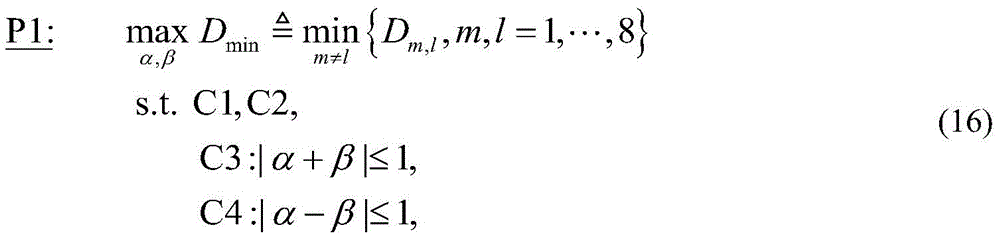
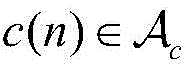
其中C3,C4表示次发射机的反射系数模小于1的约束,即|α+βc(n)|≤1,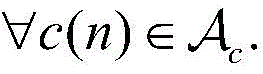
本发明根据上述优化问题提出如下优化方法。首先在给定符号时不变分量



在给定符号时不变分量




其中in



其中root(·)表示等式的根。where root( ) represents the root of the equation.
接下来,只用分析最小欧式距离

通过分析,可以发现


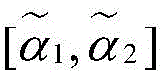


于是,问题P1的最优解分以下五种情况表示Therefore, the optimal solution of the problem P1 is divided into the following five situations:
1):|h/g|=0,即直接链路被遮挡。最优的组合信号构成一个标准的8PSK的星座图,最优解表示为1): |h/g|=0, that is, the direct link is blocked. The optimal combined signal forms a standard 8PSK constellation diagram, and the optimal solution is expressed as
α*=cos(π/8),β*=-jsin(π/8). (22)α * = cos(π/8), β * = -jsin(π/8). (22)
2)0<|h/g|<1,最优的组合信号构成一个放缩的8PSK的星座图,放缩因子为(1+tan2(π/8))(|h/g|+|α*|)2。最优解表示为2) 0<|h/g|<1, the optimal combined signal constitutes a scaled 8PSK constellation diagram, and the scaling factor is (1+tan 2 (π/8))(|h/g|+| α * |) 2 . The optimal solution is expressed as

其中
3)

其中
4)


其中
5)
如下将给出仿真结果验证上述调制方案相比于传统调制方案的优越性。传统调制方案定义为The simulation results will be given below to verify the superiority of the above modulation scheme compared to the traditional modulation scheme. The traditional modulation scheme is defined as

考虑所有的信道服从瑞利衰落信道模型,反射链路的信噪比定义为Considering that all channels obey the Rayleigh fading channel model, the signal-to-noise ratio of the reflected link is defined as

其中

图3比较了在不同信道强度比值的情况下,组合信号的误码率随着反射链路信噪比变化的曲线。结果显示,传统调制方案在直接链路被阻挡,即的情况下,协作式接收机解调信号的时候,由于主次发射机信号乘积的原因,会有模糊性问题。从而导致误码率为0.5。应用所提调制方案之后,能明显看出所提方案的优越性,极大地提升了组合信号的误码率性能。Figure 3 compares the curve of the bit error rate of the combined signal as a function of the signal-to-noise ratio of the reflected link for different channel strength ratios. The results show that the traditional modulation scheme will have ambiguity problems when the direct link is blocked, that is, when the cooperative receiver demodulates the signal, due to the product of the primary and secondary transmitter signals. This results in a bit error rate of 0.5. After applying the proposed modulation scheme, the superiority of the proposed scheme can be clearly seen, which greatly improves the bit error rate performance of the combined signal.
图4和图5分别比较了在不同信道强度比值的情况下,主发射机信号和次发射机信号的误码率随着反射链路信噪比变化的曲线。结果显示,相较于传统调制方案而言,尤其是直接链路较弱的情况下,所提调制方案可以大幅度提升主次发射机信号的误码率,展示了所提调制方案的优越性。Figures 4 and 5 respectively compare the curves of the bit error rate of the primary transmitter signal and the secondary transmitter signal as a function of the signal-to-noise ratio of the reflected link under different channel strength ratios. The results show that compared with the traditional modulation scheme, especially when the direct link is weak, the proposed modulation scheme can greatly improve the bit error rate of the primary and secondary transmitter signals, demonstrating the superiority of the proposed modulation scheme .
Claims (2)





Priority Applications (1)
| Application Number | Priority Date | Filing Date | Title |
|---|---|---|---|
| CN202210859166.3A CN115242593B (en) | 2022-07-21 | 2022-07-21 | Modulation method for multiplicative multiple access channel in symbiotic wireless communication system |
Applications Claiming Priority (1)
| Application Number | Priority Date | Filing Date | Title |
|---|---|---|---|
| CN202210859166.3A CN115242593B (en) | 2022-07-21 | 2022-07-21 | Modulation method for multiplicative multiple access channel in symbiotic wireless communication system |
Publications (2)
| Publication Number | Publication Date |
|---|---|
| CN115242593A true CN115242593A (en) | 2022-10-25 |
| CN115242593B CN115242593B (en) | 2023-06-23 |
Family
ID=83674313
Family Applications (1)
| Application Number | Title | Priority Date | Filing Date |
|---|---|---|---|
| CN202210859166.3A Active CN115242593B (en) | 2022-07-21 | 2022-07-21 | Modulation method for multiplicative multiple access channel in symbiotic wireless communication system |
Country Status (1)
| Country | Link |
|---|---|
| CN (1) | CN115242593B (en) |
Cited By (2)
| Publication number | Priority date | Publication date | Assignee | Title |
|---|---|---|---|---|
| CN116980010A (en) * | 2023-07-20 | 2023-10-31 | 电子科技大学长三角研究院(湖州) | A block modulation method for symbiotic wireless communication systems based on smart metasurfaces |
| WO2025044961A1 (en) * | 2023-08-25 | 2025-03-06 | 维沃移动通信有限公司 | Information sending method and apparatus, information receiving method and apparatus, communication device, and readable storage medium |
Citations (6)
| Publication number | Priority date | Publication date | Assignee | Title |
|---|---|---|---|---|
| AU2003903826A0 (en) * | 2003-07-24 | 2003-08-07 | University Of South Australia | An ofdm receiver structure |
| CN101001218A (en) * | 2006-01-09 | 2007-07-18 | 电子科技大学中山学院 | A New Blind Method for Channel Estimation in Wireless Communication Systems |
| CN107135017A (en) * | 2017-04-28 | 2017-09-05 | 电子科技大学 | Backscatter communication system signal method of sending and receiving |
| CN113099534A (en) * | 2021-03-29 | 2021-07-09 | 西北工业大学 | Resource allocation method of environment backscattering communication system |
| WO2022016856A1 (en) * | 2020-07-21 | 2022-01-27 | 浙江大学 | Cooperative receiving method and system based on air interface information fusion |
| CN114157333A (en) * | 2021-10-28 | 2022-03-08 | 电子科技大学长三角研究院(湖州) | Novel symbiotic wireless communication system based on reconfigurable intelligent surface |
-
2022
- 2022-07-21 CN CN202210859166.3A patent/CN115242593B/en active Active
Patent Citations (6)
| Publication number | Priority date | Publication date | Assignee | Title |
|---|---|---|---|---|
| AU2003903826A0 (en) * | 2003-07-24 | 2003-08-07 | University Of South Australia | An ofdm receiver structure |
| CN101001218A (en) * | 2006-01-09 | 2007-07-18 | 电子科技大学中山学院 | A New Blind Method for Channel Estimation in Wireless Communication Systems |
| CN107135017A (en) * | 2017-04-28 | 2017-09-05 | 电子科技大学 | Backscatter communication system signal method of sending and receiving |
| WO2022016856A1 (en) * | 2020-07-21 | 2022-01-27 | 浙江大学 | Cooperative receiving method and system based on air interface information fusion |
| CN113099534A (en) * | 2021-03-29 | 2021-07-09 | 西北工业大学 | Resource allocation method of environment backscattering communication system |
| CN114157333A (en) * | 2021-10-28 | 2022-03-08 | 电子科技大学长三角研究院(湖州) | Novel symbiotic wireless communication system based on reconfigurable intelligent surface |
Cited By (2)
| Publication number | Priority date | Publication date | Assignee | Title |
|---|---|---|---|---|
| CN116980010A (en) * | 2023-07-20 | 2023-10-31 | 电子科技大学长三角研究院(湖州) | A block modulation method for symbiotic wireless communication systems based on smart metasurfaces |
| WO2025044961A1 (en) * | 2023-08-25 | 2025-03-06 | 维沃移动通信有限公司 | Information sending method and apparatus, information receiving method and apparatus, communication device, and readable storage medium |
Also Published As
| Publication number | Publication date |
|---|---|
| CN115242593B (en) | 2023-06-23 |
Similar Documents
| Publication | Publication Date | Title |
|---|---|---|
| CN113395224B (en) | Backscattering communication method, device and system | |
| JP4563455B2 (en) | Method and apparatus for calculating log approximation rate for decoding in receiver of mobile communication system | |
| CN102790747B (en) | Mapping method for spacial modulation system | |
| CN101902420B (en) | Continuous phase differential phase-shift keying modulation and demodulation method in signs | |
| KR102061653B1 (en) | Method and apparatus for bit to simbol mapping in wireless communication system | |
| CN115242593B (en) | Modulation method for multiplicative multiple access channel in symbiotic wireless communication system | |
| CN101047688B (en) | Method and device for estimating signal noise ratio | |
| CN116886481B (en) | A layered LoRa modulation communication system and method | |
| CN101529846A (en) | QAM receiver | |
| CN110099024B (en) | Method for transmitting frame synchronous code hidden in information code | |
| CN115580513A (en) | A Modulation and Demodulation Method of Frequency Shifting Chirp Spread Spectrum Index | |
| CN111901269B (en) | Gaussian frequency shift keying modulation method, device and system with variable modulation index | |
| CN101938333B (en) | Calculation Method of Gray Coding π/M-MPSK Modulation Soft Bit Information | |
| CN106452652B (en) | A kind of MPI suppression method based on chaos wireless communication system | |
| CN103095636B (en) | Differential ball modulation method | |
| CN110138415A (en) | The frequency point method of determining interference of frequency hopping communications | |
| CN111049775B (en) | Ultra-reliable low-delay transmission method for short data packets enabled by large-scale single-input multi-output system | |
| US7860191B2 (en) | Optimal two-layer coherent demodulation for D-PSK (Differential Phase Shift Keying) | |
| CN118631627A (en) | Time-domain dispersion modulation and demodulation method for broadband wireless transmission in low signal-to-noise ratio environment | |
| US12143252B2 (en) | Higher bit rate modulation format for polar transmitter | |
| CN116980010B (en) | Intelligent super-surface-based symbiotic wireless communication system block modulation method | |
| CN111212001A (en) | A Joint Channel Estimation Method for Translating Special QPSK Systems | |
| CN111131107B (en) | An adaptive soft demodulation method based on 5G downlink shared channel state | |
| CN112134825B (en) | Low-complexity high-performance GFSK baseband timing synchronization method | |
| CN110034808B (en) | An enhanced spatial modulation transmission method for railway communication antenna grouping |
Legal Events
| Date | Code | Title | Description |
|---|---|---|---|
| PB01 | Publication | ||
| PB01 | Publication | ||
| SE01 | Entry into force of request for substantive examination | ||
| SE01 | Entry into force of request for substantive examination | ||
| GR01 | Patent grant | ||
| GR01 | Patent grant |