CN1362995A - Sulfohydrolases, corresponding amino acid and nucleotide sequence, sulfohydrolase preparations, processes, and products thereof - Google Patents
Sulfohydrolases, corresponding amino acid and nucleotide sequence, sulfohydrolase preparations, processes, and products thereof Download PDFInfo
- Publication number
- CN1362995A CN1362995A CN00810155A CN00810155A CN1362995A CN 1362995 A CN1362995 A CN 1362995A CN 00810155 A CN00810155 A CN 00810155A CN 00810155 A CN00810155 A CN 00810155A CN 1362995 A CN1362995 A CN 1362995A
- Authority
- CN
- China
- Prior art keywords
- carrageenan
- sulfohydrolase
- sequence
- seq
- acid sequence
- Prior art date
- Legal status (The legal status is an assumption and is not a legal conclusion. Google has not performed a legal analysis and makes no representation as to the accuracy of the status listed.)
- Pending
Links
Classifications
-
- C—CHEMISTRY; METALLURGY
- C08—ORGANIC MACROMOLECULAR COMPOUNDS; THEIR PREPARATION OR CHEMICAL WORKING-UP; COMPOSITIONS BASED THEREON
- C08B—POLYSACCHARIDES; DERIVATIVES THEREOF
- C08B37/00—Preparation of polysaccharides not provided for in groups C08B1/00 - C08B35/00; Derivatives thereof
- C08B37/0006—Homoglycans, i.e. polysaccharides having a main chain consisting of one single sugar, e.g. colominic acid
- C08B37/0036—Galactans; Derivatives thereof
-
- C—CHEMISTRY; METALLURGY
- C08—ORGANIC MACROMOLECULAR COMPOUNDS; THEIR PREPARATION OR CHEMICAL WORKING-UP; COMPOSITIONS BASED THEREON
- C08B—POLYSACCHARIDES; DERIVATIVES THEREOF
- C08B37/00—Preparation of polysaccharides not provided for in groups C08B1/00 - C08B35/00; Derivatives thereof
- C08B37/0006—Homoglycans, i.e. polysaccharides having a main chain consisting of one single sugar, e.g. colominic acid
- C08B37/0036—Galactans; Derivatives thereof
- C08B37/0042—Carragenan or carragen, i.e. D-galactose and 3,6-anhydro-D-galactose, both partially sulfated, e.g. from red algae Chondrus crispus or Gigantia stellata; kappa-Carragenan; iota-Carragenan; lambda-Carragenan; Derivatives thereof
-
- C—CHEMISTRY; METALLURGY
- C12—BIOCHEMISTRY; BEER; SPIRITS; WINE; VINEGAR; MICROBIOLOGY; ENZYMOLOGY; MUTATION OR GENETIC ENGINEERING
- C12N—MICROORGANISMS OR ENZYMES; COMPOSITIONS THEREOF; PROPAGATING, PRESERVING, OR MAINTAINING MICROORGANISMS; MUTATION OR GENETIC ENGINEERING; CULTURE MEDIA
- C12N9/00—Enzymes; Proenzymes; Compositions thereof; Processes for preparing, activating, inhibiting, separating or purifying enzymes
- C12N9/14—Hydrolases (3)
Landscapes
- Chemical & Material Sciences (AREA)
- Life Sciences & Earth Sciences (AREA)
- Health & Medical Sciences (AREA)
- Engineering & Computer Science (AREA)
- Organic Chemistry (AREA)
- Medicinal Chemistry (AREA)
- General Health & Medical Sciences (AREA)
- Molecular Biology (AREA)
- Biochemistry (AREA)
- Polymers & Plastics (AREA)
- Chemical Kinetics & Catalysis (AREA)
- Materials Engineering (AREA)
- Bioinformatics & Cheminformatics (AREA)
- Zoology (AREA)
- Wood Science & Technology (AREA)
- Genetics & Genomics (AREA)
- Microbiology (AREA)
- Biotechnology (AREA)
- Biomedical Technology (AREA)
- General Engineering & Computer Science (AREA)
- Preparation Of Compounds By Using Micro-Organisms (AREA)
- Enzymes And Modification Thereof (AREA)
- Polysaccharides And Polysaccharide Derivatives (AREA)
Abstract
本发明提供了基于蛋白质总量纯度水平至少为约40wt.%的纯化的磺基水解酶,分离的核酸序列和氨基酸序列,和纯化至少一种磺基水解酶的方法,包括将海藻提取物进行分级分离获得级分;将至少一个级分进行苯基琼脂糖凝胶层析获得含有至少一种磺基水解酶的琼脂糖凝胶级分。本发明还提供了用基于蛋白质总量纯度水平至少为约40wt.%的分离的磺基水解酶修饰的酶促修饰的化合物,以及一种酶促修饰硫酸化的化合物的方法,所述方法包括将至少一种基于蛋白质总量纯度水平至少为约40wt.%的磺基水解酶与硫酸化的化合物形成反应混合物,温育该反应混合物以从硫酸化的化合物中除去硫酸酯基团,形成酶促修饰的化合物。本发明还涉及一种酶促修饰硫酸化的化合物的方法,所述方法包括将第一种磺基水解酶与硫酸化的化合物温育,以从硫酸化的化合物中除去硫酸酯基团,形成中间化合物;接着将第二种磺基水解酶与中间化合物温育,以除去硫酸酯基团,形成酶促修饰的化合物。本发明还提供了一种从海藻中提取nu-和mu-角叉菜聚糖之一的方法,包括:将海藻分散于含有K2CO3的盐溶液中,形成分散液;过滤此分散液获得液体;超滤此分散液以除去盐;浓缩液体;将液体的pH调节为大约8-8.5;从液体中沉淀nu-和mu-角叉菜聚糖之一。The present invention provides purified sulfohydrolases having a purity level of at least about 40 wt.% based on total protein, isolated nucleic acid sequences and amino acid sequences, and methods of purifying at least one sulfohydrolase comprising subjecting seaweed extracts to Fractionation is obtained by fractionation; at least one fraction is subjected to phenyl sepharose chromatography to obtain an sepharose fraction containing at least one sulfohydrolase. The present invention also provides an enzymatically modified compound modified with an isolated sulfohydrolase having a purity level of at least about 40 wt.% based on total protein, and a method of enzymatically modifying a sulfated compound, the method comprising Forming a reaction mixture with at least one sulfohydrolase having a purity level of at least about 40 wt.% based on the total amount of protein and a sulfated compound, incubating the reaction mixture to remove sulfate groups from the sulfated compound to form the enzyme Compounds that promote modification. The present invention also relates to a method of enzymatically modifying a sulfated compound comprising incubating a first sulfohydrolase with the sulfated compound to remove the sulfate group from the sulfated compound to form an intermediate compound; followed by incubating a second sulfohydrolase with the intermediate compound to remove the sulfate group and form an enzymatically modified compound. The present invention also provides a method for extracting one of nu- and mu-carrageenan from seaweed, comprising: dispersing the seaweed in a salt solution containing K2CO3 to form a dispersion; filtering the dispersion obtaining a liquid; ultrafiltering the dispersion to remove salts; concentrating the liquid; adjusting the pH of the liquid to about 8-8.5; precipitating one of the nu- and mu-carrageenans from the liquid.
Description
相关申请交叉参考:Related application cross-references:
本申请根据35U.S.C.§119(e)要求在1999年5月10日申请的美国临时专利申请No.60/133376的优先权,其内容全部并入参考。This application claims priority under 35 U.S.C. §119(e) to U.S. Provisional Patent Application No. 60/133,376, filed May 10, 1999, the contents of which are incorporated by reference in their entirety.
发明背景Background of the invention
1.发明领域1. Field of invention
本发明涉及磺基水解酶,如半乳聚糖磺基水解酶,如nu-和mu-角叉菜聚糖磺基水解酶。本发明涉及磺基水解酶的氨基酸和核苷酸序列。本发明还涉及酶促修饰硫酸化的化合物,如半乳聚糖。例如,酶促修饰可包括修饰硫酸化的半乳聚糖性质,如凝胶性,如通过除去硫酸酯基团及在半乳聚糖的糖结构中的环位置之间形成桥区。本发明还涉及从海藻中提取nu-角叉菜聚糖的方法。本发明还涉及酶促修饰的化合物。The present invention relates to sulfohydrolases, such as galactan sulfohydrolases, such as nu- and mu-carrageenan sulfohydrolases. The present invention relates to amino acid and nucleotide sequences of sulfohydrolases. The present invention also relates to the enzymatic modification of sulfated compounds, such as galactan. For example, enzymatic modification can include modifying sulfated galactan properties, such as gelling properties, such as by removing sulfate groups and forming bridge regions between ring positions in the sugar structure of the galactan. The present invention also relates to a method for extracting nu-carrageenan from seaweed. The present invention also relates to enzymatically modified compounds.
2.背景阐述2. Background
水状胶体,可广泛的限定为是在存在水的情况下产生凝胶的物质,部分由于其流变学性质而使用,也可对稳定性有益处。Hydrocolloids, which can be broadly defined as substances that form gels in the presence of water, are used in part for their rheological properties and may also be beneficial for stability.
水状胶体有许多类别。一种分类方法将这些类别分为溢乳物,如阿拉伯胶,茄替胶,刺梧桐树胶,talha,和黄芪胶;提取物,如从褐色海藻中提取的海藻酸盐,从红色海藻中提取的琼脂,角叉菜聚糖,和furcelleran,及从陆地植物中提取的konjak(葡甘露聚糖),瓜耳胶,果胶和阿拉伯半乳聚糖;生物聚合物,如黄原胶;化学修饰的水状胶体,如纤维素制品,包括羧甲基纤维素,羟丙基纤维素,和羧甲基羟甲基纤维素;及中间形式,如微晶纤维素。There are many classes of hydrocolloids. One method of classification divides these categories into milk extracts, such as acacia, ghatti, karaya, talha, and tragacanth; extracts, such as alginate from brown seaweed, and alginate from red seaweed Agar, carrageenan, and furcelleran, and konjak (glucomannan), guar gum, pectin, and arabinogalactan from land plants; biopolymers, such as xanthan gum; chemical modifications Hydrocolloids, such as cellulose products, including carboxymethylcellulose, hydroxypropylcellulose, and carboxymethylhydroxymethylcellulose; and intermediate forms, such as microcrystalline cellulose.
红色海藻已知是称为琼脂和角叉菜聚糖的工业凝胶和增稠用细胞壁硫酸化半乳聚糖的原料。它们由通过交替α(1-3)或β(1-4)键连接的半乳糖吡喃糖残基的线性主链组成。尽管所有β连接的残基呈D-构型,但是α(1-4)连接的半乳糖单位在琼脂中呈L-构型,在角叉菜聚糖中呈D-构型。Red seaweed is known to be the source of cell wall sulfated galactans known as agar and carrageenan for industrial gelation and thickening. They consist of a linear backbone of galactopyranose residues linked by alternating α(1-3) or β(1-4) linkages. While all β-linked residues are in the D-configuration, the α(1-4)-linked galactose units are in the L-configuration in agar and the D-configuration in carrageenan.
琼脂是通过或多或少加热的碱性溶液(100-120℃)从干燥的藻类中提取的。在过滤后,使琼脂溶液成为凝胶,加压脱水,干燥及磨碎,如ARMISEN等,“琼脂的生产和使用”,商业海藻产物的生产和利用,FAO渔业技术文献,288,pp1-57(1987)所述,该文献全文并入参考。提取琼脂的海藻原料包括石花菜属,鸡毛菜属,Gelidiella,和江篱属,如STANLEY,“角叉菜聚糖的生产,性质和使用”,商业海藻产物的生产和利用,FAO渔业技术文献,288,pp116-146(1987)所述,该文献全文并入参考。Agar is extracted from dried algae by a more or less heated alkaline solution (100-120°C). After filtration, the agar solution is made into a gel, dehydrated under pressure, dried and ground, such as ARMISEN, etc., "Production and Use of Agar", Production and Utilization of Commercial Seaweed Products, FAO Fisheries Technical Documentation, 288, pp1-57 (1987), which is incorporated by reference in its entirety. Seaweed raw materials for extracting agar include Gelidium, Chipotle, Gelidiella, and Grapes, such as STANLEY, "Carrageenan Production, Properties, and Use", Production and Utilization of Commercial Seaweed Products, FAO Fisheries Technical Documentation , 288, pp116-146 (1987), which is incorporated by reference in its entirety.
角叉菜聚糖是分离自红色海藻的天然水溶的硫酸化半乳聚糖家族的通称。角叉菜聚糖的增稠和凝胶性用于食品和化妆品配方中,如THERKELSEN,“角叉菜聚糖”,工业用凝胶:多糖及其衍生物,3rded,pp145-180,(1993),和DeRUITER等,“角叉菜聚糖生物技术”,食品科学及技术趋势,第8卷,pp389-395(1997)所述,这两个文献均全文并入参考。Carrageenan is a generic name for a family of naturally water-soluble sulfated galactan isolated from red seaweed. Thickening and gelling properties of carrageenan used in food and cosmetic formulations, such as THERKELSEN, "Carrageenan", Gels for industrial use: polysaccharides and their derivatives, 3rded, pp145-180, (1993 ), and DeRUITER et al., "Carrageenan Biotechnology," Trends in Food Science and Technology, Vol. 8, pp 389-395 (1997), both of which are incorporated by reference in their entirety.
角叉菜聚糖的海藻原料包括麒麟菜属(如刺麒麟菜(E.spinosum),耳突麒麟菜(E.cottonii)(=Kappaphycus alvarezii),和E.denticulatum),Chondrus(如C.crispus),Calliblepharis(如C.jubata),和Gigartina(如G.radula和G.stellata)。Seaweed sources of carrageenan include Eucheuma (e.g. E. spinosum, E. cottonii (= Kappaphycus alvarezii), and E. denticulatum), Chondrus (e.g. C. crispus ), Calliblepharis (eg C. jubata), and Gigartina (eg G. radula and G. stellata).
角叉菜聚糖是线性的,部分硫酸化的半乳聚糖,主要由α(1-4)连接的D-半乳糖吡喃糖或3,6-脱水-D-半乳糖吡喃糖残基和β(1-3)连接的半乳糖吡喃糖残基的重复二聚体组成。如上所述,琼脂类似地也是线性的,部分硫酸化的半乳聚糖的相似结构,除了α(1-4)连接的D-半乳糖吡喃糖残基是L-形式的。角叉菜聚糖发生的一些结构主要不同之处在于二聚体主链上硫酸酯基团的数目和位置,及二聚体的各个残基是以左手(4C1)或右手(C4)“椅型”构象存在。这些结构包括kappa(κ),iota(ι),lambda(λ),theta(θ),mu(μ),和nu(v),如下所示。iota-,lambda和theta-角叉菜聚糖含有3,6-脱水桥,而nu-,mu-,和lambda-角叉菜聚糖不含有此桥。另外,nu-,mu-,和lambda-角叉菜聚糖的α连接的单位的构象,不同于含有脱水桥的角叉菜聚糖,阻止足够的螺旋聚集。螺旋聚集是重要的,因为螺旋促进凝胶形成。在这点上,kappa角叉菜聚糖形成坚硬的脆性凝胶,而iota角叉菜聚糖形成弹性的柔软的凝胶,lambda角叉菜聚糖是非凝胶化的增稠剂。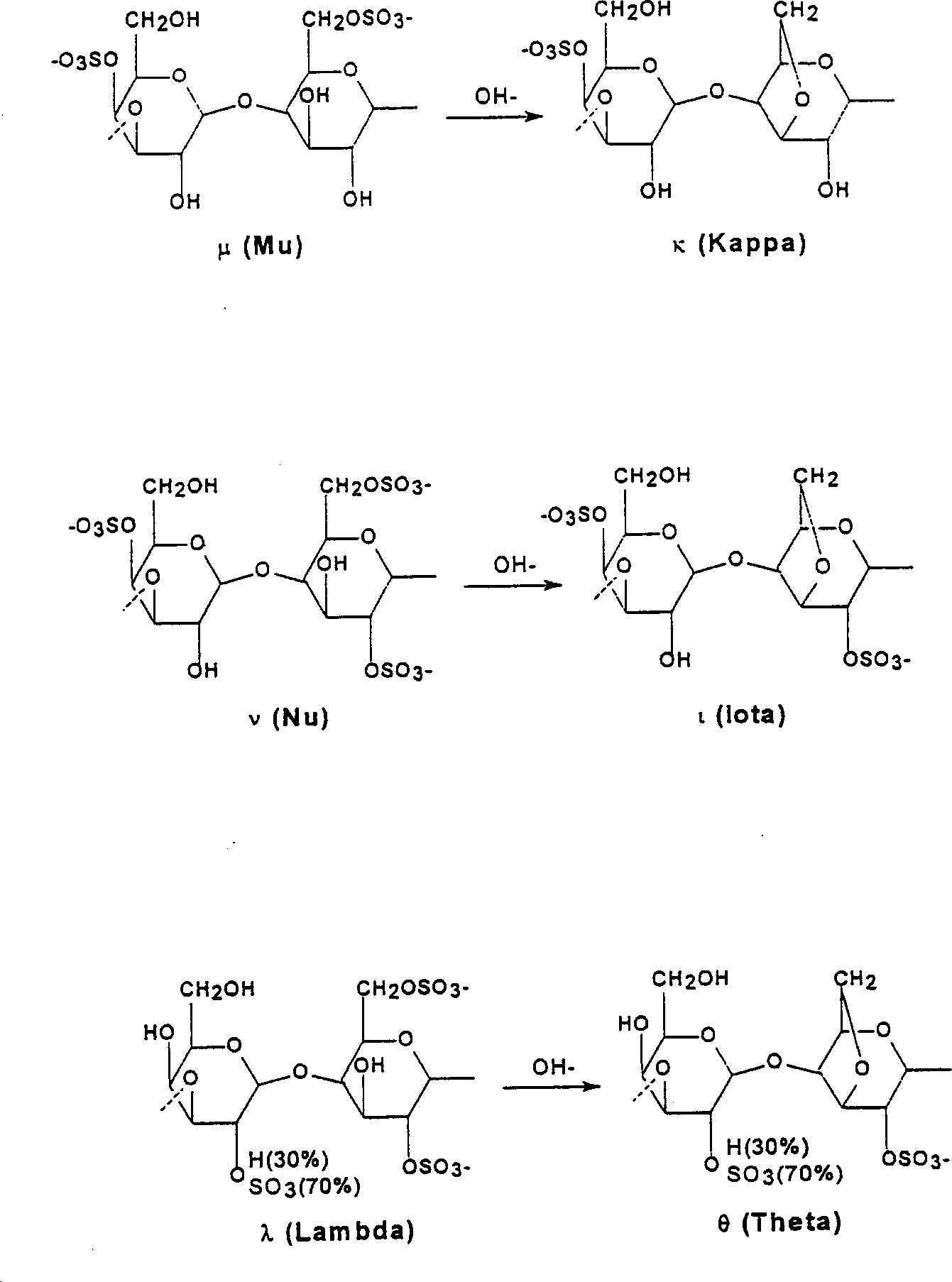
角叉菜聚糖中SO3 -的数量相当多,并在0-40%之间(w/w)变化,产生高负电荷的聚合物。理想的kappa,iota和lambda角叉菜聚糖二聚体分别具有1,2和3个硫酸酯基团,产生典型的硫酸酯含量分别为22%,32%和38%(w/w)。然而,因为海藻物种或批次不同硫酸酯在商业提取物中可发生较大变化。硫酸酯键在化学上是非常稳定的,且没有明显或实用的化学方法修饰硫酸酯水平或分布的同时不降低聚合物的分子量,除了在碱处理期间从前体角叉菜聚糖中除去6-O-硫酸酯。The amount of SO 3 − in carrageenan is considerable and varies between 0-40% (w/w), resulting in a highly negatively charged polymer. Ideal kappa, iota and lambda carrageenan dimers have 1, 2 and 3 sulfate groups, respectively, yielding typical sulfate contents of 22%, 32% and 38% (w/w), respectively. However, sulfate esters can vary widely in commercial extracts because of seaweed species or batches. Sulfate linkages are chemically very stable, and there is no obvious or practical chemical way to modify sulfate levels or distribution without reducing the molecular weight of the polymer, other than the removal of 6- O-sulfate.
角叉菜聚糖是从红色海藻中,通过在水溶液中煮沸,有时在碱性条件下煮沸,随后经过滤,浓缩,沉淀和干燥而商业性提取的。沉淀可通过另加入乙醇,或通过用盐凝胶化随后加压此凝胶而进行,如STANLEY,“角叉菜聚糖的生产,性质和使用”,商业海藻产物的生产和利用,FAO渔业技术文献,288,pp116-146(1987)所述,该文献全文并入参考。半精制角叉菜聚糖也是通过用碱处理海藻,随后用水彻底清洗而产生的。这些处理改良了角叉菜聚糖的凝胶化性质,并除去了大部分蛋白质,色素和小代谢产物;这种制备物还含有其它聚合物如纤维素物质,如HOFFMANN等,“分离步骤对Eucheuma Cottonii角叉菜聚糖的分子组合物和物理性质的作用”,水状胶体食品,9,pp281-289(1995),所述文献全文并入参考。Carrageenan is commercially extracted from red seaweed by boiling in aqueous solution, sometimes under alkaline conditions, followed by filtration, concentration, precipitation and drying. Precipitation can be performed by additional addition of ethanol, or by gelation with salt followed by pressurization of the gel, see STANLEY, "Carrageenan Production, Properties and Uses", Production and Utilization of Commercial Seaweed Products, FAO Fisheries Technical Literature, 288, pp 116-146 (1987), which is incorporated by reference in its entirety. Semi-refined carrageenan is also produced by treating seaweed with alkali, followed by thorough washing with water. These treatments improved the gelling properties of carrageenan and removed most of the proteins, pigments and small metabolites; this preparation also contained other polymers such as cellulosic substances, such as HOFFMANN et al., "The separation step is Effects of molecular composition and physical properties of Eucheuma Cottonii carrageenan", Hydrocolloid Foods, 9, pp281-289 (1995), which is incorporated by reference in its entirety.
非凝胶化的mu-和nu-角叉菜聚糖是分别存在于海藻中的kappa-,iota-角叉菜聚糖的天然前体,并在二聚体单位的α-(1-4)连接的D-半乳糖吡喃糖残基C-6位具有硫酸酯基团。通常认为在强碱处理期间,相伴发生从前体的C-6硫酸酯中消除硫酸酯,及形成3,6-脱水桥。Non-gelling mu- and nu-carrageenan are natural precursors of kappa-, iota-carrageenan, respectively, found in seaweed, and in dimer units of α-(1-4 ) linked D-galactopyranose residue has a sulfate group at the C-6 position. It is generally believed that during strong base treatment, there is concomitant elimination of sulfate from the C-6 sulfate of the precursor, and formation of a 3,6-anhydration bridge.
不同角叉菜聚糖的功能性质(包括螺旋形成,流变学性质及应用)是通过(1)聚合物的分子量,(2)硫酸酯基团的数目及其在碳主链的取代位置,和(3)3,6-脱水半乳糖残基的数目而确定的,如THERKELSEN,“角叉菜聚糖”,工业树脂:多糖及其衍生物,第三版,pp145-180(1993);VIEBKE等,“通过MALLS/GPC定性kappa-,iota-角叉菜聚糖卷曲和螺旋”,碳水聚合物,第27卷,pp145-154(1995);和Le QUESTEL等,“硫酸化的碳水化合物应用于角叉菜聚糖的计算机模式”,Int.J.Biol.Macromol,第17卷,pp161-174(1995),所述文献以其全文并入参考。The functional properties of different carrageenans (including helix formation, rheological properties, and applications) are determined by (1) the molecular weight of the polymer, (2) the number of sulfate groups and their substitution positions on the carbon backbone, and (3) the number of 3,6-anhydrogalactose residues, such as THERKELSEN, "Carrageenan", Industrial Resins: Polysaccharides and Their Derivatives, Third Edition, pp145-180 (1993); VIEBKE et al., "Characterization of kappa-, iota-carrageenan coils and helixes by MALLS/GPC", Carbohydrate Polymers, Vol. 27, pp145-154 (1995); and Le QUESTEL et al., "Sulfated carbohydrates In silico Modeling Applied to Carrageenan", Int. J. Biol. Macromol, Vol. 17, pp 161-174 (1995), which is incorporated by reference in its entirety.
碱处理可对终产物中角叉菜聚糖形式的比率加以某些控制。然而,通常难以推断及获得所需终产物。Alkali treatment allows some control over the ratio of carrageenan forms in the final product. However, it is often difficult to deduce and obtain the desired end product.
已有报道红色海藻脐形紫菜含有磺基水解酶,该酶催化硫酸酯从紫菜聚糖中释放,紫菜聚糖是与琼脂相关的紫菜属中的主要多糖,其含有大约10%(w/w)的3,6-脱水-L-半乳糖。其还含有L-半乳糖-6-硫酸酯。这些L-半乳糖-6-硫酸酯单位可通过部分纯化自亲代海藻提取物的酶的作用,转化成3,6-脱水-L-半乳糖,如REES,“在紫菜聚糖中由L-半乳糖6-硫酸酯单位酶促合成3,6-脱水-L-半乳糖”,生物化学I,81,pp347-352(1961);和REES,“紫菜聚糖的酶促脱硫化”,生物化学I,80,pp449-453(1961),以上文献均全文并入参考。The red seaweed Porphyra umbilicus has been reported to contain a sulfohydrolase that catalyzes the release of sulfate esters from porphyrin, the major polysaccharide in the agar-related Porphyra genus, which contains about 10% (w/w ) of 3,6-anhydro-L-galactose. It also contains L-galactose-6-sulfate. These L-galactose-6-sulfate units can be converted to 3,6-anhydro-L-galactose by the action of enzymes partially purified from extracts of the parent seaweed, such as REES, "In Porphyran from L- Enzymatic synthesis of 3,6-anhydro-L-galactose by galactose 6-sulfate unit", Biochemistry 1, 81, pp347-352 (1961); and REES, "Enzymatic desulfurization of porphyrans", Biol Chemistry I, 80, pp449-453 (1961), all of which are incorporated by reference in their entirety.
另外还有报道生产角叉菜聚糖的红色海藻含有“磺基水解酶”,该酶催化硫酸酯从角叉菜聚糖前体中释放。皱波角叉菜中的磺基水解酶见于WONG等,“皱波角叉菜(红藻纲)中磺基水解酶活性和角叉菜聚糖生物合成”,植物生理学,第61卷,pp663-666(1978),所述文献以其全文并入参考。Calliblepharis jubata中的磺基水解酶见于ZINOUN等,“在红藻Calliblepharis jubata中磺基水解酶活性迹象”,Botanica Marina,第40卷,pp49-53(1997),所述文献以其全文并入参考。Gigartina stellata中磺基水解酶见于LAWSON等,“酶对多糖构象和功能的代谢控制”,自然,第227卷,pp392-93(1970年7月25日),及WONG等,“皱波角叉菜(红藻纲)中磺基水解酶活性和角叉菜聚糖生物合成”,植物生理学,第61卷pp663-666(1978),所述文献以其全文并入参考。这种些酶目前未纯化为均一性,并未有报道提供电泳数据。It has also been reported that carrageenan-producing red seaweeds contain "sulfohydrolases" that catalyze the release of sulfate esters from carrageenan precursors. Sulfohydrolases in Carrageen rugosa are described in WONG et al., "Sulfohydrolase activity and carrageenan biosynthesis in Carrageen rugosa (Rhodophyceae)", Plant Physiology, vol. 61, pp663 -666 (1978), which is incorporated by reference in its entirety. Sulfohydrolases in Calliblepharis jubata are described in ZINOUN et al., "Evidence of Sulfohydrolase Activity in the Red Alga Calliblepharis jubata", Botanica Marina, Vol. 40, pp49-53 (1997), which is incorporated by reference in its entirety . The sulfohydrolases in Gigartina stellata are found in LAWSON et al., "Enzymatic control of polysaccharide conformation and function", Nature, vol. 227, pp392-93 (July 25, 1970), and WONG et al. Sulfohydrolase Activity and Carrageenan Biosynthesis in Vegetable Vegetables (Rhodophyceae)", Plant Physiology, Vol. 61, pp 663-666 (1978), which is incorporated by reference in its entirety. These enzymes are currently not purified to homogeneity, and no reports provide electrophoresis data.
半乳聚糖磺基水解酶的作用模式和特异性程度只在文献中以一般术语加以阐述。如CRAIGIE等,“角叉菜聚糖生物合成”,Proc.Int.Seaweed.Symp.pp369-377(1978),所述文献以其全文并入参考,还不清楚有多少不同特异性的磺基水解酶存在于皱波角叉菜中。一般文献中少有关于磺基水解酶底物的化学结构,酶促作用的终产物,和磺基水解酶对半乳聚糖前体作用程度的阐述。The mode of action and degree of specificity of galactan sulfohydrolases has only been described in general terms in the literature. As in CRAIGIE et al, "Carrageenan Biosynthesis", Proc. Hydrolytic enzymes are present in wrinkled carrageen. The chemical structure of the sulfohydrolase substrate, the end product of the enzymatic action, and the degree of action of the sulfohydrolase on the galactan precursor are rarely described in the general literature.
因此,需要各种具有不同特异性的磺基水解酶,以可用于修饰硫酸化的化合物,如半乳聚糖。Therefore, there is a need for a variety of sulfohydrolases with different specificities that can be used to modify sulfated compounds, such as galactans.
发明概述Summary of the invention
本发明在于提供具有各种特异性的纯化的磺基水解酶。The present invention consists in providing purified sulfohydrolases having various specificities.
本发明还涉及磺基水解酶的氨基酸和核苷酸序列。The invention also relates to amino acid and nucleotide sequences of sulfohydrolases.
本发明涉及酶促修饰硫酸化的化合物的方法。The present invention relates to methods of enzymatically modifying sulfated compounds.
本发明还涉及从海藻中提取角叉菜聚糖的方法。The present invention also relates to a method for extracting carrageenan from seaweed.
本发明还涉及硫酸化的化合物,如半乳聚糖,其已经磺基水解酶修饰,如修饰凝胶化性质。The invention also relates to sulfated compounds, such as galactans, which have been modified by sulfohydrolases, such as to modify gelling properties.
根据一方面,本发明涉及基于总蛋白量纯化水平至少为40wt%的磺基水解酶。纯化水平还可至少为70wt%,90wt%,或95wt%。According to one aspect, the present invention relates to a sulfohydrolase having a purification level of at least 40% by weight based on the total protein amount. The level of purification can also be at least 70 wt%, 90 wt%, or 95 wt%.
根据另一方面,本发明涉及包含SEQ ID NO:17序列的分离的核酸序列。According to another aspect, the present invention relates to an isolated nucleic acid sequence comprising the sequence of SEQ ID NO: 17.
根据又一方面,本发明涉及包含与SEQ ID NO:17序列有至少25%同源性的序列的分离的核酸序列。与SEQ ID NO:17序列的同源性还可至少为50%,80%,或90%。According to yet another aspect, the present invention relates to an isolated nucleic acid sequence comprising a sequence having at least 25% homology to the sequence of SEQ ID NO: 17. The homology to the sequence of SEQ ID NO: 17 may also be at least 50%, 80%, or 90%.
根据另一方面,本发明涉及一种分离的核酸序列,其在杂交条件下与SEQ ID NO:17核酸杂交。According to another aspect, the present invention relates to an isolated nucleic acid sequence which hybridizes to the SEQ ID NO: 17 nucleic acid under hybridization conditions.
根据另一方面,本发明涉及包含SEQ ID NO:18序列的分离的核酸序列。According to another aspect, the present invention relates to an isolated nucleic acid sequence comprising the sequence of SEQ ID NO: 18.
根据另一方面,本发明涉及包含SEQ ID NO:19序列的分离的核酸序列。According to another aspect, the present invention relates to an isolated nucleic acid sequence comprising the sequence of SEQ ID NO: 19.
根据另一方面,本发明涉及包含SEQ ID NO:20序列的分离的核酸序列。According to another aspect, the present invention relates to the isolated nucleic acid sequence that comprises SEQ ID NO:20 sequence.
根据另一方面,本发明涉及包含SEQ ID NO:21序列的分离的核酸序列。According to another aspect, the present invention relates to the isolated nucleic acid sequence that comprises SEQ ID NO:21 sequence.
根据又一方面,本发明涉及包含与SEQ ID NO:18序列有至少25%同源性的序列的分离的核酸序列。与SEQ ID NO:18序列的同源性还可至少为50%,80%,或90%。According to yet another aspect, the present invention relates to an isolated nucleic acid sequence comprising a sequence having at least 25% homology to the sequence of SEQ ID NO: 18. The homology to the sequence of SEQ ID NO: 18 may also be at least 50%, 80%, or 90%.
根据又一方面,本发明涉及包含与SEQ ID NO:19序列有至少90%同源性的序列的分离的核酸序列。According to yet another aspect, the present invention relates to an isolated nucleic acid sequence comprising a sequence having at least 90% homology to the sequence of SEQ ID NO: 19.
根据又一方面,本发明涉及包含与SEQ ID NO:20序列有至少90%同源性的序列的分离的核酸序列。According to yet another aspect, the present invention relates to an isolated nucleic acid sequence comprising a sequence having at least 90% homology to the sequence of SEQ ID NO: 20.
根据又一方面,本发明涉及包含与SEQ ID NO:21序列有至少90%同源性的序列的分离的核酸序列。According to yet another aspect, the present invention relates to an isolated nucleic acid sequence comprising a sequence having at least 90% homology to the sequence of SEQ ID NO: 21.
根据另一方面,本发明涉及一种分离的核酸序列,其在杂交条件下与SEQ ID NO:18核酸杂交。According to another aspect, the present invention relates to an isolated nucleic acid sequence that hybridizes to a SEQ ID NO: 18 nucleic acid under hybridization conditions.
根据另一方面,本发明涉及编码相应于SEQ ID NO:22的氨基酸序列的分离的核酸序列。According to another aspect, the present invention relates to an isolated nucleic acid sequence encoding an amino acid sequence corresponding to SEQ ID NO: 22.
根据另一方面,本发明涉及包含SEQ ID NO:22的氨基酸序列的分离的蛋白质。According to another aspect, the present invention relates to an isolated protein comprising the amino acid sequence of SEQ ID NO: 22.
根据另一方面,本发明涉及包含与SEQ ID NO:22有至少35%同源性的氨基酸序列的分离的蛋白质。与SEQ ID NO:22的同源性还可至少为50%或80%。According to another aspect, the present invention relates to an isolated protein comprising an amino acid sequence having at least 35% homology to SEQ ID NO: 22. The homology to SEQ ID NO: 22 may also be at least 50% or 80%.
根据另一方面,本发明涉及编码相当于SEQ ID NO:23的氨基酸序列的分离的核酸序列。According to another aspect, the present invention relates to an isolated nucleic acid sequence encoding an amino acid sequence corresponding to SEQ ID NO: 23.
根据另一方面,本发明涉及包含SEQ ID NO:23的氨基酸序列的分离的蛋白质。According to another aspect, the present invention relates to an isolated protein comprising the amino acid sequence of SEQ ID NO: 23.
根据另一方面,本发明涉及包含与SEQ ID NO:23有至少20%同源性的氨基酸序列的分离的蛋白质。与SEQ ID NO:22的同源性还可至少为50%或80%。According to another aspect, the present invention relates to an isolated protein comprising an amino acid sequence having at least 20% homology to SEQ ID NO: 23. The homology to SEQ ID NO: 22 may also be at least 50% or 80%.
根据另一方面,本发明涉及纯化至少一种磺基水解酶的方法,包括:将海藻提取物进行分级分离以获得级分;并将至少一种级分进行苯基琼脂糖凝胶层析,以获得含有至少一种磺基水解酶的琼脂糖凝胶级分。According to another aspect, the present invention relates to a method of purifying at least one sulfohydrolase, comprising: subjecting a seaweed extract to fractionation to obtain fractions; and subjecting at least one fraction to phenyl sepharose chromatography, to obtain an agarose gel fraction containing at least one sulfohydrolase.
根据又一方面,本发明涉及一种酶促修饰的化合物,其已通过纯化水平为至少大约40wt%总蛋白量的分离的磺基水解酶修饰。分离的磺基水解酶的纯化水平还可至少为70wt%,90wt%或95wt%。According to yet another aspect, the present invention is directed to an enzymatically modified compound that has been modified by an isolated sulfohydrolase at a level of purification of at least about 40% by weight of the total protein amount. The level of purification of the isolated sulfohydrolase may also be at least 70 wt%, 90 wt% or 95 wt%.
根据另一方面,本发明涉及一种酶促修饰硫酸化的化合物的方法,包括:将纯化水平为至少大约40wt%总蛋白量的分离的磺基水解酶,与硫酸化的化合物组合,形成反应混合物;温育此反应混合物以从硫酸化的化合物中除去硫酸酯基团,形成酶促修饰的化合物。According to another aspect, the present invention relates to a method of enzymatically modifying a sulfated compound comprising: combining an isolated sulfohydrolase at a level of purification of at least about 40% by weight of total protein with a sulfated compound to form a reaction mixture; incubating the reaction mixture to remove the sulfate group from the sulfated compound to form the enzymatically modified compound.
根据另一方面,本发明涉及一种酶促修饰硫酸化的化合物的方法,包括:将硫酸化的化合物与第一种磺基水解酶温育,以从硫酸化的化合物中除去硫酸酯基团,形成中间化合物;随后用第二种磺基水解酶温育此中间化合物,以除去硫酸酯基团,形成酶促修饰的化合物。According to another aspect, the present invention relates to a method of enzymatically modifying a sulfated compound comprising: incubating the sulfated compound with a first sulfohydrolase to remove the sulfate group from the sulfated compound , to form an intermediate compound; this intermediate compound is then incubated with a second sulfohydrolase to remove the sulfate group to form an enzymatically modified compound.
根据另一方面,本发明涉及一种产物,其是通过用蛋白质含量基本由磺基水解酶组成的溶液温育硫酸化的化合物而产生的,所述磺基水解酶进行性除去硫酸酯基团。According to another aspect, the invention relates to a product produced by incubating a sulfated compound with a solution whose protein content consists essentially of a sulfohydrolase that progressively removes sulfate groups .
根据另一方面,本发明涉及一种产物,其是通过用蛋白质含量基本由磺基水解酶组成的溶液温育硫酸化的化合物而产生的,所述磺基水解酶随机除去硫酸酯基团。According to another aspect, the invention relates to a product produced by incubating a sulfated compound with a solution whose protein content consists essentially of a sulfohydrolase that randomly removes sulfate groups.
根据另一方面,本发明涉及一种从海藻中提取nu-或mu-角叉菜聚糖的方法,包括:将海藻分散于含有K2CO3的盐溶液中形成分散系;过滤此分散系获得一种液体;超滤此分散系以除去盐;浓缩此液体;将此液体的pH调节为8-8.5;并从此液体中沉淀nu-或mu-角叉菜聚糖。According to another aspect, the present invention relates to a method for extracting nu- or mu-carrageenan from seaweed, comprising: dispersing the seaweed in a saline solution containing K2CO3 to form a dispersion; filtering the dispersion A liquid is obtained; the dispersion is ultrafiltered to remove salts; the liquid is concentrated; the pH of the liquid is adjusted to 8-8.5; and nu- or mu-carrageenan is precipitated from the liquid.
一方面,磺基水解酶能从水状胶体中除去硫酸酯。水状胶体可以是糖胺聚糖,岩藻聚糖和半乳聚糖之一。In one aspect, sulfohydrolases are capable of removing sulfate esters from hydrocolloids. The hydrocolloid may be one of glycosaminoglycan, fucoidan and galactan.
另一方面,磺基水解酶能从半乳聚糖中除去硫酸酯。On the other hand, sulfohydrolases remove sulfate esters from galactans.
另一方面,半乳聚糖包含角叉菜聚糖。角叉菜聚糖可包括mu-角叉菜聚糖,如包含至少大约50mol%的mu-角叉菜聚糖。角叉菜聚糖可包括nu-角叉菜聚糖,如包含至少大约50mol%的nu-角叉菜聚糖。On the other hand, galactan comprises carrageenan. The carrageenan may comprise mu-carrageenan, such as comprising at least about 50 mol% mu-carrageenan. The carrageenan may comprise nu-carrageenan, such as comprising at least about 50 mole percent nu-carrageenan.
另一方面,半乳聚糖包括琼脂。In another aspect, galactans include agar.
另一方面,磺基水解酶包括6-O-磺基水解酶。In another aspect, sulfohydrolases include 6-O-sulfohydrolases.
另一方面,磺基水解酶能将nu-角叉菜聚糖转变为iota-角叉菜聚糖。On the other hand, sulfohydrolases can convert nu-carrageenan to iota-carrageenan.
另一方面,磺基水解酶能将mu-角叉菜聚糖转变为kappa-角叉菜聚糖。On the other hand, sulfohydrolases can convert mu-carrageenan to kappa-carrageenan.
另一方面,磺基水解酶能除去6-O-硫酸酯以诱导脱水桥形成。On the other hand, sulfohydrolases remove 6-O-sulfate to induce dehydration bridge formation.
另一方面,级分包含硫酸铵级分。In another aspect, the fraction comprises an ammonium sulfate fraction.
另一方面,此方法还包括对至少一种苯基琼脂糖凝胶级分进行DEAE琼脂糖凝胶层析,以获得DEAE琼脂糖凝胶级分。至少一种DEAE琼脂糖凝胶级分可进行肝素琼脂糖凝胶层析。In another aspect, the method further comprises subjecting at least one phenyl sepharose fraction to DEAE sepharose chromatography to obtain a DEAE sepharose fraction. At least one DEAE sepharose fraction can be subjected to heparin sepharose chromatography.
另一方面,温育是在大约0-60℃的温度下进行。In another aspect, incubation is performed at a temperature of about 0-60°C.
另一方面,温育是在pH大约为5.5-9.5的情况下进行。In another aspect, incubation is performed at a pH of about 5.5-9.5.
另一方面,加入反应混合物中的至少一种磺基水解酶是包含于溶液中的,浓度为至少一种磺基水解酶至少为2-85μg/ml。In another aspect, the at least one sulfohydrolase added to the reaction mixture is contained in solution at a concentration of at least 2-85 μg/ml of the at least one sulfohydrolase.
另一方面,反应混合物中硫酸化的化合物的浓度为大约0.012-2%(w/v)。In another aspect, the concentration of the sulfated compound in the reaction mixture is about 0.012-2% (w/v).
另一方面,修饰的化合物包括iota-角叉菜聚糖。In another aspect, the modified compound includes iota-carrageenan.
另一方面,修饰的化合物包括kappa-角叉菜聚糖。In another aspect, the modified compound includes kappa-carrageenan.
另一方面,酶促修饰的化合物包括富含前体的iota-角叉菜聚糖。In another aspect, the enzymatically modified compound includes precursor-enriched iota-carrageenan.
另一方面,酶促修饰的化合物包括富含前体的kappa-角叉菜聚糖。In another aspect, the enzymatically modified compound comprises precursor-enriched kappa-carrageenan.
另一方面,除去硫酸酯包括从半乳聚糖中除去6-硫酸酯基团。In another aspect, removing sulfate comprises removing the 6-sulfate group from the galactan.
另一方面,除去硫酸酯包括将nu-角叉菜聚糖转变为iota-角叉菜聚糖,形成在一定条件下不发生凝胶的产物,所述条件为产物在含有0.1M钾的水溶液中浓度为大约0.7%(w/v),温度为40℃,pH为7。In another aspect, removal of the sulfate ester involves conversion of nu-carrageenan to iota-carrageenan, resulting in a product that does not gel under conditions in which the product is dissolved in an aqueous solution containing 0.1 M potassium The medium concentration is about 0.7% (w/v), the temperature is 40°C, and the pH is 7.
另一方面,第一种磺基水解酶随机除去硫酸酯。On the other hand, the first sulfohydrolase removes sulfate esters randomly.
另一方面,第二种磺基水解酶进行性除去硫酸酯。On the other hand, the second sulfohydrolase removes sulfate esters progressively.
另一方面,海藻包括Spinosum。Seaweeds, on the other hand, include Spinosum.
另一方面,海藻在分散于盐溶液之前是冻干并磨碎的。Seaweed, on the other hand, was freeze-dried and ground before being dispersed in the saline solution.
另一方面,盐溶液还包含KCl。KCl的浓度为大约1-1.5M。On the other hand, saline solutions also contain KCl. The concentration of KCl is about 1-1.5M.
另一方面,在过滤前将分散系静置至少18小时。On the other hand, the dispersion is allowed to stand for at least 18 hours before filtering.
另一方面,浓缩约2-3倍。On the other hand, concentrate about 2-3 times.
另一方面,通过加入碱调节液体的pH。On the other hand, the pH of the liquid is adjusted by adding a base.
另一方面,通过加入异丙醇进行沉淀。On the other hand, precipitation was performed by adding isopropanol.
另一方面,进行透析直至水的电导率稳定在大约2μS/cm以下。On the other hand, dialysis is performed until the conductivity of the water stabilizes below about 2 μS/cm.
另一方面,在沉淀经透析的nu-或mu-角叉菜聚糖之后,将nu-或mu-角叉菜聚糖冻干并磨碎。On the other hand, after precipitation of the dialyzed nu- or mu-carrageenan, the nu- or mu-carrageenan was lyophilized and ground.
另一方面,沉淀的透析的nu-或mu-角叉菜聚糖中nu-或mu-含量为大约18-35mol%。On the other hand, the nu- or mu-content of the precipitated dialyzed nu- or mu-carrageenan is about 18-35 mol%.
另一方面,沉淀的透析的nu-或mu-角叉菜聚糖的分子量为大约700-800kDa。On the other hand, the precipitated dialyzed nu- or mu-carrageenan has a molecular weight of about 700-800 kDa.
发明详述Detailed description of the invention
本文所阐述的是举例说明本发明的各种实施方案,并提供据信是本发明的最实用和最易理解的原理和概念。在这点上,未尝试示出比基本理解本发明所必需的更详细的内容,结合附图本领域技术人员可明白有几种形式可实际应用。What has been set forth herein illustrates various embodiments of the invention and presents what are believed to be the most practical and understandable principles and concepts of the invention. In this regard, no attempt has been made to show more detail than is necessary for a basic understanding of the invention, and it will be apparent to those skilled in the art, in conjunction with the drawings, that several forms may be practiced.
本申请中所有百分率,除非特别说明,均通过基于重量(g)/体积(ml)测定的。因此,例如30%代表30g/100ml样品。All percentages in this application, unless otherwise stated, are determined on a weight (g)/volume (ml) basis. Thus, eg 30% represents 30g/100ml sample.
除非特别说明,提及的化合物或组分,包括化合物或组分自身,以及与其它化合物或组分的组合,如化合物的混合物。Unless otherwise specified, the mentioned compounds or components include the compounds or components themselves, as well as combinations with other compounds or components, such as mixtures of compounds.
在进一步阐述之前,对以下术语进行解释将有助于理解本发明。Before going further, an explanation of the following terms will assist in understanding the present invention.
“半乳聚糖”:一种由半乳糖单位和其它的单位组成的多糖;如琼脂和角叉菜聚糖。半乳聚糖具有至少50mol%的半乳糖单位。"Galactan": A polysaccharide composed of galactose units and other units; eg, agar and carrageenan. Galactans have at least 50 mol% galactose units.
“水状胶体”:一种亲水性多糖或衍生物,例如植物多糖,当将其加入水中时,其膨胀产生黏性分散系或溶液。"Hydrocolloid": A hydrophilic polysaccharide or derivative, such as a plant polysaccharide, which, when added to water, swells to produce a viscous dispersion or solution.
“杂交条件”:将相应核酸移至得自Amersham Pharmacia BiotechAB的尼龙膜上,如SAMBROOK等,分子克隆实验手册,第二版,CSH实验室出版社,冷泉港,NY(1989),所述文献全文并入参考。将此膜在6×SSC,5×Denhart,0.1%SDS和100μg/ml鲑精DNA中,在42℃杂交过夜。SSC是3M NaCl和0.3M柠檬酸钠的水溶液,根据SAMBROOK等,分子克隆实验手册,第二版,CSH实验室出版社,冷泉港,NY(1989)所述程序制备,所述文献全文并入参考。在杂交后,将滤膜在42℃用以下溶液洗15分钟:2×SSC,0.1%SDS;1×SSC,0.1%SDS,并曝光于得自Molecular Dynamics,Uppsala,Sweden光刺激屏,用也得自于Molecular Dynamics,Uppsala,Sweden的Storm扫描。"Hybridization conditions": Move the corresponding nucleic acid onto a nylon membrane obtained from Amersham Pharmacia BiotechAB, such as SAMBROOK et al., Molecular Cloning Experimental Handbook, Second Edition, CSH Laboratory Press, Cold Spring Harbor, NY (1989), described in the literature Incorporated by reference in its entirety. The membrane was hybridized overnight at 42°C in 6xSSC, 5xDenhart, 0.1% SDS and 100 µg/ml salmon sperm DNA. SSC is an aqueous solution of 3M NaCl and 0.3M sodium citrate prepared according to the procedures described in SAMBROOK et al., Molecular Cloning Laboratory Manual, Second Edition, CSH Laboratories Press, Cold Spring Harbor, NY (1989), which is incorporated in its entirety refer to. After hybridization, the filters were washed at 42°C for 15 minutes with the following solutions: 2×SSC, 0.1% SDS; 1×SSC, 0.1% SDS, and exposed to a light stimulation screen obtained from Molecular Dynamics, Uppsala, Sweden, with Storm scan obtained from Molecular Dynamics, Uppsala, Sweden.
为确定两个氨基酸序列或两个核酸序列之间的相同性百分比或同源性百分率,对序列进行最佳对比(例如可将缺口导入第一个氨基酸或核酸序列中,以与第二个氨基酸或核酸序列最佳排列对比)。然后将在相应氨基酸位置或核苷酸位置的氨基酸残基或核苷酸进行对比。当第一个序列中的一个位置由与第二个序列中相应位置的相同氨基酸残基或核苷酸占据时,则分子在这个位置是相同的。两个序列之间的相同性百分比通过序列呈现的相同性位置的数目(即相同性百分比=相同性位置数/位置总数(如重叠位)×100)。优选地,这两个序列是等长的。To determine the percent identity or percent homology between two amino acid sequences or two nucleic acid sequences, the sequences are optimally aligned (for example, gaps may be introduced into the first amino acid or nucleic acid sequence to match the second amino acid sequence). Or the best alignment of nucleic acid sequences). The amino acid residues or nucleotides at corresponding amino acid positions or nucleotide positions are then compared. When a position in the first sequence is occupied by the same amino acid residue or nucleotide as the corresponding position in the second sequence, then the molecules are identical at that position. The percent identity between two sequences is measured by the number of identical positions exhibited by the sequences (ie, percent identity = number of identical positions/total number of positions (eg, overlapping positions) x 100). Preferably, the two sequences are of equal length.
确定两个序列之间的同源性百分比可通过用数学公式进行。优选地,用于对比两个序列的公式非限制性的例如是KARLIN等,美国科学院院报,87,pp2264-2268(1990)所述公式,所述文献以其全文并入参考,KARLIN等,美国科学院院报,90,pp5873-5877(1993)对此公式加以修改,所述内容全文并入参考。这个公式被掺入ALTSCHUL等,分子生物学杂志,215,pp403-410(1990)所述的NBLAST和XBLAST程序中,所述文献以其全文并入参考。可用NBLAST程序,分值=100,字长=12进行BLAST核苷酸检索,以获得同源于本发明磺基水解酶核酸分子的核苷酸序列。可用XBLAST程序,分值=50,字长=3进行BLAST蛋白质检索,以获得同源于本发明磺基水解酶蛋白质分子的氨基酸序列。为进行缺口的序列对比,可利用ALTSCHUL等,核酸研究,25,pp3389-3402(1997)所述的缺口BLAST,所述文献以其全文并入参考。或者,可使用PSI-Blast进行重复检索,其检测分子间的远缘关系。当利用BLAST,缺口的BLAST,和PSI-Blast程序时,可使用各自程序(如XBLAST和NBLAST)的缺省参数。见http://www.ncbi.nlm.nih.gov。另外优选地的用于对比两个序列的公式非限制性的例如是MYERS等,CABIOS,4,pp11-17(1988)所述的公式,所述文献以其全文并入参考。这个公式掺入ALIGN程序(2.0版本)中,该程序是GCG序列对比软件程序包的一部分。当利用ALIGN程序对比氨基酸序列时,可使用PAM120权重残基表,缺口长度罚分12,和缺口罚分4。Determining the percent homology between two sequences can be performed using a mathematical formula. Preferably, a non-limiting example of the formula used to align two sequences is the formula described in KARLIN et al., Proc. Proceedings of the National Academy of Sciences, 90, pp5873-5877 (1993) modified this formula, which is incorporated by reference in its entirety. This formula is incorporated into the NBLAST and XBLAST programs described by ALTSCHUL et al., J. Mol. Biol., 215, pp403-410 (1990), which is incorporated by reference in its entirety. BLAST nucleotide searches can be performed with the NBLAST program, score = 100, wordlength = 12 to obtain nucleotide sequences homologous to sulfohydrolase nucleic acid molecules of the invention. BLAST protein searches can be performed with the XBLAST program, score = 50, wordlength = 3 to obtain amino acid sequences homologous to protein molecules of the sulfohydrolase of the invention. For gapped sequence alignments, Gapped BLAST can be used as described by ALTSCHUL et al., Nucleic Acids Res. 25, pp3389-3402 (1997), which is incorporated by reference in its entirety. Alternatively, repeated searches can be performed using PSI-Blast, which detects distant relationships between molecules. When utilizing the BLAST, Gapped BLAST, and PSI-Blast programs, the default parameters of the respective programs (eg, XBLAST and NBLAST) can be used. See http://www.ncbi.nlm.nih.gov. Another preferred formula for aligning two sequences is for example, without limitation, the formula described by MYERS et al., CABIOS, 4, pp 11-17 (1988), which is incorporated by reference in its entirety. This formula is incorporated into the ALIGN program (version 2.0), which is part of the GCG sequence alignment software package. When using the ALIGN program to align amino acid sequences, a PAM120 weight residue table, a gap length penalty of 12, and a gap penalty of 4 can be used.
总而言之,本发明涉及磺基水解酶的分离和纯化。例如,磺基水解酶可纯化自海藻。磺基水解酶优选能从硫酸化的化合物如角叉菜聚糖中除去硫酸酯。磺基水解酶还可在硫酸化的化合物如角叉菜聚糖上形成3,6-脱水桥。本发明还涉及酶促修饰硫酸化的化合物的方法。本发明还涉及修饰的硫酸化的化合物,如修饰的角叉菜聚糖,如已被修饰为至少具有相应于iota-角叉菜聚糖的部分的nu-角叉菜聚糖,或如已被修饰为至少具有相应于kappa-角叉菜聚糖的部分的mu-角叉菜聚糖。本发明还涉及从海藻中提取角叉菜聚糖的方法。In summary, the present invention relates to the isolation and purification of sulfohydrolases. For example, sulfohydrolases can be purified from algae. The sulfohydrolase is preferably capable of removing sulfate esters from sulfated compounds such as carrageenan. Sulfohydrolases can also form 3,6-anhydro bridges on sulfated compounds such as carrageenan. The present invention also relates to methods of enzymatically modifying sulfated compounds. The invention also relates to modified sulfated compounds, such as modified carrageenan, such as nu-carrageenan that has been modified to have at least a portion corresponding to iota-carrageenan, or as has been mu-carrageenan modified to have at least a portion corresponding to kappa-carrageenan. The present invention also relates to a method for extracting carrageenan from seaweed.
本申请和现有技术领域所提供的指导是:(1)蛋白质纯化和(2)部分氨基酸序列确定;(3)构建和使用探针以确定相应DNA序列位置;和(4)克隆和测序,如下的讨论将能够:(1)分离磺基水解酶;(2)鉴别其氨基酸序列;(3)构建相应DNA序列的探针;和(4)鉴别,分离,纯化和确定编码此酶的DNA序列。见例如SAMBROOK等,分子克隆实验手册,第二版,CSH实验室出版社,冷泉港,NY(1989),所述文献以其全文并入参考。The guidance provided in this application and the prior art is: (1) protein purification and (2) partial amino acid sequence determination; (3) construction and use of probes to determine the corresponding DNA sequence positions; and (4) cloning and sequencing, The following discussion will enable: (1) isolation of the sulfohydrolase; (2) identification of its amino acid sequence; (3) construction of probes for the corresponding DNA sequences; and (4) identification, isolation, purification and determination of the DNA encoding the enzyme sequence. See, eg, SAMBROOK et al., A Laboratory Manual of Molecular Cloning, Second Edition, CSH Laboratory Press, Cold Spring Harbor, NY (1989), which is incorporated by reference in its entirety.
本发明酶促修饰的化合物包括硫酸化的化合物。硫酸化的化合物包括半乳聚糖,糖胺聚糖,和岩藻聚糖。Enzymatically modified compounds of the invention include sulfated compounds. Sulfated compounds include galactans, glycosaminoglycans, and fucoidans.
岩藻聚糖是高度不均一的硫酸化多糖,由不同糖残基组成,如岩藻糖,半乳糖,甘露糖和糖醛酸。岩藻聚糖基团数目及其组成模式相当不同。岩藻聚糖是在褐色海藻和棘皮类动物中产生的。在这点上,岩藻聚糖可来自褐色海藻细胞壁的基质相,其主要含有L-岩藻糖。L-岩藻糖残基通常通过α(1-3)键连接,并在C4位硫酸化。对岩藻聚糖酶促修饰可影响其抗凝聚性质。Fucoidan is a highly heterogeneous sulfated polysaccharide composed of different sugar residues such as fucose, galactose, mannose and uronic acid. The number of fucoidan groups and its composition pattern are quite different. Fucoidan is produced in brown seaweeds and echinoderms. In this regard, fucoidan may be derived from the matrix phase of the brown seaweed cell wall, which mainly contains L-fucose. L-fucose residues are usually linked by α(1-3) bonds and sulfated at the C4 position. Enzymatic modification of fucoidan can affect its anti-aggregation properties.
糖胺聚糖(GAGs)是来自动物胞外基质的硫酸化多糖家族,其包括肝素,硫酸肝素,硫酸软骨素,硫酸皮肤素,和硫酸角质素。GAGs由含有己糖醛酸和己糖胺的二糖重复单位组成。肝素和硫酸肝素是可变的硫酸化糖胺聚糖,其主要由α(1-4)连接的D-艾杜糖醛酸-2-硫酸酯残基或D-葡糖醛酸-2-硫酸酯残基和N-磺基-D-葡糖胺-6-硫酸酯残基组成。对肝素酶促修饰可影响其抗凝血性质。硫酸软骨素和硫酸皮肤素主要由α(1-4)连接的D-艾杜糖醛酸或D-葡糖醛酸和N-磺基-D-葡糖胺-6-硫酸酯残基组成。通常N-乙酰半乳糖胺的C2或C4位是硫酸化的,且硫酸皮肤素中艾杜糖醛酸的C2位也通常是硫酸化的。硫酸角质素多糖由半乳糖和N-乙酰半乳糖胺组成。半乳糖或N-乙酰半乳糖胺的C6位可以是硫酸化的。Glycosaminoglycans (GAGs) are a family of sulfated polysaccharides derived from the extracellular matrix of animals, which include heparin, heparan sulfate, chondroitin sulfate, dermatan sulfate, and keratan sulfate. GAGs consist of disaccharide repeating units containing hexuronic acid and hexosamine. Heparin and heparan sulfate are variable sulfated glycosaminoglycans composed primarily of α(1-4) linked D-iduronic acid-2-sulfate residues or D-glucuronic acid-2- Sulfate residues and N-sulfo-D-glucosamine-6-sulfate residues. Enzymatic modifications to heparin can affect its anticoagulant properties. Chondroitin sulfate and dermatan sulfate are mainly composed of α(1-4) linked D-iduronic acid or D-glucuronic acid and N-sulfo-D-glucosamine-6-sulfate residues . Usually the C2 or C4 position of N-acetylgalactosamine is sulfated, and the C2 position of iduronic acid in dermatan sulfate is also usually sulfated. Keratan sulfate polysaccharide is composed of galactose and N-acetylgalactosamine. The C6 position of galactose or N-acetylgalactosamine may be sulfated.
半乳聚糖可得自许多不同原料。例如,半乳聚糖可得自海藻。半乳聚糖例如包括角叉菜聚糖和琼脂。Galactans are available from many different sources. For example, galactan can be obtained from seaweed. Galactans include, for example, carrageenan and agar.
例如,从海藻中提取琼脂是已知的。例如从海藻中提取琼脂见于SELBY等,“琼脂”,工业树脂:多糖及其衍生物,第三版,(1993),所述文献以其全文并入参考。For example, it is known to extract agar from seaweed. For example, the extraction of agar from seaweed is found in SELBY et al., "Agar", Industrial Resins: Polysaccharides and Derivatives, Third Edition, (1993), which is incorporated by reference in its entirety.
从海藻中提取角叉菜聚糖是已知的。例如,从海藻中提取角叉菜聚糖见于THERKELSEN,“角叉菜聚糖”,工业用树胶:多糖及其衍生物,第三版,(1993),所述文献以其全文并入参考。Extraction of carrageenan from seaweed is known. For example, the extraction of carrageenan from seaweed is found in THERKELSEN, "Carrageenan," Industrial Gums: Polysaccharides and Derivatives, Third Edition, (1993), which is incorporated by reference in its entirety.
本发明还涉及提取高于天然水平的高分子量即分子量在大约500kDa以上的nu-和mn-角叉菜聚糖的方法。基于待提取的角叉菜聚糖,角叉菜聚糖的原料可以是海藻,如Spinosum,Cottonii,和Gigartina radula。The present invention also relates to a method of extracting nu- and mn-carrageenans of high molecular weight above natural levels, ie, having a molecular weight above about 500 kDa. Based on the carrageenan to be extracted, the raw material of the carrageenan may be seaweed such as Spinosum, Cottonii, and Gigartina radula.
海藻可以是冻干,磨碎并分散于浓度优选为大约0.05-0.3M,更优选为0.1-0.15M,最优选为大约0.125M的KCl水溶液中。此分散系还含有浓度优选为0.0005-0.003M,更优选为0.001-0.0015M,最优选为大约0.00125M的K2CO3,以保持碱性环境,即pH优选为大约7-9,更优选为7.5-8.5,最优选为大约7.8-8.3。也可使用相应钙盐,如氯化钙和碳酸钙,但由于这些钙盐溶解性相对低,因此优选钾盐。The seaweed can be freeze-dried, ground and dispersed in an aqueous KCl solution preferably at a concentration of about 0.05-0.3M, more preferably 0.1-0.15M, most preferably about 0.125M. The dispersion also contains K2CO3 at a concentration of preferably 0.0005-0.003M, more preferably 0.001-0.0015M , most preferably about 0.00125M, to maintain an alkaline environment, i.e. a pH of preferably about 7-9, more preferably 7.5-8.5, most preferably about 7.8-8.3. Corresponding calcium salts, such as calcium chloride and calcium carbonate, can also be used, but potassium salts are preferred due to the relatively low solubility of these calcium salts.
将此分散系静置一段时间,优选大约1-72小时,更优选大约16-32小时,最优选大约24小时,温度为大约5-55℃,优选大约22-50℃,更优选大约在室温。The dispersion is allowed to stand for a period of time, preferably about 1-72 hours, more preferably about 16-32 hours, most preferably about 24 hours, at a temperature of about 5-55°C, preferably about 22-50°C, more preferably about room temperature .
在此阶段后,将此分散系过滤。例如,可用加压硅藻土滤膜过滤。After this period, the dispersion is filtered. For example, it can be filtered through a pressurized diatomaceous earth filter.
在过滤之后,优选将此液体例如用30kDa的MWCO-膜超滤或渗滤,以除去过量的盐。在超滤后,通过加入自来水在室温清洗提取物。持续清洗直至电导率低于2mS/cm并且稳定。将此液体优选通过超滤浓缩25-30%。优选用0.1M的NaCl将pH调节为8-8.5。After filtration, the liquid is preferably ultrafiltered or diafiltered, for example with a 30 kDa MWCO-membrane, in order to remove excess salt. After ultrafiltration, the extract was washed at room temperature by adding tap water. Continue cleaning until the conductivity is below 2mS/cm and stabilized. This liquid is concentrated 25-30%, preferably by ultrafiltration. The pH is preferably adjusted to 8-8.5 with 0.1M NaCl.
然后将此液体优选蒸发至大约10-90%,更优选大约30-70%,最优选大约50%。例如,此液体可在真空蒸发器中蒸发。This liquid is then preferably evaporated to about 10-90%, more preferably about 30-70%, most preferably about 50%. For example, this liquid can be evaporated in a vacuum evaporator.
在蒸发后,将pH优选调节为大约7-9,更优选大约7.5-8.5,最优选大约为8。例如,可通过加入1M NaOH将pH调节为8。然后用异丙醇(IPA)沉淀并冻干,如用得自英国BP化学制品公司的100%(v/v)IPA沉淀。After evaporation, the pH is preferably adjusted to about 7-9, more preferably about 7.5-8.5, most preferably about 8. For example, the pH can be adjusted to 8 by adding 1M NaOH. It is then precipitated with isopropanol (IPA) and lyophilized, eg with 100% (v/v) IPA from BP Chemicals, UK.
所得提取物具有富集的nu-或mu-含量,优选大约为15-40mol%,更优选为大约17-30mol%,最优选为大约19-24mol%。所得提取物还具有高分子量,优选大约为500-1100kDa,更优选为600-900kDa,最优选为大约700-800kDa。The resulting extract has an enriched nu- or mu-content, preferably about 15-40 mol%, more preferably about 17-30 mol%, most preferably about 19-24 mol%. The resulting extract also has a high molecular weight, preferably about 500-1100 kDa, more preferably about 600-900 kDa, most preferably about 700-800 kDa.
本发明的磺基水解酶可分离自产生硫酸化半乳聚糖的海藻,如Solieriaceae科(如麒麟菜属,Kappaphycus),杉藻科(如角叉菜属,杉藻属),Furcellariaceae,沙菜科,育叶藻科,Cystocloniaceae(如Calliblepharis),和红毛菜科(如紫菜属)。例如,磺基水解酶的非详尽海藻原料和潜在海藻原料包括刺麒麟菜,耳突麒麟菜(=Kappaphycus alvarezii),Eucheuma denticulatum,皱波角叉菜,Calliblepharis jubata,Gigartina radula,星芒杉藻,和脐形紫菜。The sulfohydrolase of the present invention can be isolated from seaweeds that produce sulfated galactan, such as Solieriaceae (such as Eucheuma, Kappaphycus), Cedaraceae (such as Carrageen, Cedarium), Furcellariaceae, Sand Brassicaceae, Phylophytaceae, Cystocloniaceae (such as Calliblepharis), and Rubiaceae (such as Porphyra). For example, non-exhaustive seaweed sources and potential seaweed sources for sulfohydrolases include Eucheuma, Eucheuma auricularis (= Kappaphycus alvarezii), Eucheuma denticulatum, Carrageen rugosa, Calliblepharis jubata, Gigartina radula, Astragalus, and navel laver.
以下段落阐述了分离磺基水解酶的方法。从本发明所述的纯化方法的指导和实施例中,本领域技术人员可开发另外的分离磺基水解酶的方法。The following paragraphs describe methods for isolating sulfohydrolases. From the guidance and examples of the purification methods described herein, one skilled in the art can develop additional methods for isolating sulfohydrolases.
根据本发明为分离磺基水解酶,通常优选对潜在的酶原料如海藻进行筛选酶活性,以保证相应的酶存在于潜在的酶原料中。如以下更详细的阐述,筛选包括从潜在酶原料中获得粗提物。然后,将此粗提物在各种条件下用于处理各种底物,以一般性地确定粗提物中存在的所有酶活性。通过此信息,本领域技术人员可一般性地确定是否值得对潜在酶原料进行如下所述的进一步纯化,及一般性地确定酶是保持稳定且活性的条件。In order to isolate the sulfohydrolase according to the present invention, it is generally preferred to screen potential enzyme raw materials such as seaweed for enzyme activity, so as to ensure that the corresponding enzyme exists in the potential enzyme raw materials. As explained in more detail below, screening involves obtaining crude extracts from potential enzyme feedstocks. This crude extract was then used to treat various substrates under various conditions to generally determine all enzyme activities present in the crude extract. With this information, one skilled in the art can generally determine whether further purification of a potential enzyme starting material is worthwhile as described below, and generally determine the conditions under which the enzyme remains stable and active.
一种粗提方法例如是从C.crispus中分离酶,可将C.crispus的配子体植物在液氮中冷冻,并研磨成粉末。虽然此粉末可立即使用,以保持粉末中酶的完整性,但此粉末仍可在低温保持直至进一步使用,如在-20℃至-80℃保持。A crude extraction method is, for example, isolating enzymes from C. crispus. The gametophytic plants of C. crispus can be frozen in liquid nitrogen and ground into powder. Although the powder can be used immediately to maintain the integrity of the enzyme in the powder, the powder can still be kept at low temperature until further use, such as at -20°C to -80°C.
然后,此粉末可用缓冲液提取,如含有10mM 2-巯基乙醇和500mM KCl的4体积的50mM Tris-HCl缓冲液(pH9.5)。在离心之后,可将上清用冻(如-20℃)丙酮分级分离,例如以两步方法:(1)从0-30%丙酮饱和液中分级分离;(2)从30-60%丙酮饱和液中分级分离。在每个分级步骤之后,优选例如在4℃,以10000×g离心30分钟。将粒状沉淀溶解于缓冲液中,如含有10mM 2-巯基乙醇的2ml的50mM Tris-HCl缓冲液(pH7.1)。然后,将粒状沉淀以及上清等分透析,如在4℃,用得自美国Spectrum实验室公司,RanchoDominguez,CA的MWCO 6-8000或3500 Spectra/por膜,经含有10mM的2-巯基乙醇的3×3升50mM Tris-HCl缓冲液(pH7.1)透析过夜。粒状沉淀和上清可用于寻找磺基水解酶的活性。This powder can then be extracted with a buffer such as 4 volumes of 50 mM Tris-HCl buffer (pH 9.5) containing 10 mM 2-mercaptoethanol and 500 mM KCl. After centrifugation, the supernatant can be fractionated with frozen (e.g. -20°C) acetone, for example in a two-step process: (1) fractionation from 0-30% acetone saturation; (2) fractionation from 30-60% acetone Fractionation in saturated liquid. After each fractionation step, it is preferably centrifuged at 10000 xg for 30 minutes, for example at 4°C. Dissolve the pellet in buffer, such as 2ml of 50mM Tris-HCl buffer (pH 7.1) containing 10mM 2-mercaptoethanol. Then, the pellet and supernatant aliquots were dialyzed, such as at 4°C, with MWCO 6-8000 or 3500 Spectra/por membranes obtained from Spectrum Laboratories, Inc., Rancho Dominguez, CA, over an ethanol solution containing 10 mM of 2-mercaptoethanol. 3×3 liters of 50mM Tris-HCl buffer (pH7.1) were dialyzed overnight. The pellet and supernatant can be used to look for sulfohydrolase activity.
另一种粗提方法例如是从耳突麒麟菜(=Kappaphycus alvarezii)中分离酶,可将耳突麒麟菜在液氮中冷冻。此耳突麒麟菜可立即使用或在低温下保持直至进一步使用,如在-80℃保持。在提取之前,可将耳突麒麟菜研磨为细末。Another crude extraction method is, for example, isolating the enzyme from Eucheuma auris (=Kappaphycus alvarezii), which can be frozen in liquid nitrogen. The Eucheuma auris can be used immediately or kept at low temperature until further use, eg at -80°C. Eucheuma auris can be ground into a fine powder before extraction.
除非特别指出,以下所有步骤均可在4℃进行。将粉末用缓冲液提取,例如用50mM Tris-HCl(pH9.5)加上500mM KCl和10mM 2-巯基乙醇提取。将所得悬浮液搅拌过夜,然后离心,如用得自美国Beckman Instruments公司,Fullerton,CA的Beckman J2-21,RotorJA20,以10000×g离心75分钟。将上清如前所述用冻丙酮分级分离。在离心之后,收集上清和粒状沉淀。然后,将粒状沉淀以及上清等分进行透析,例如用得自美国Spectrum实验室公司,RanchoDominguez,CA的MWCO 6-8000或3500透析膜,经含有10mM的2-巯基乙醇的4×1升50mM Tris-HCl缓冲液(pH7.1)加上10mM2-巯基乙醇透析20小时。在透析之后,将上清和再溶解的粒状沉淀用于寻找磺基水解酶。All the following steps can be carried out at 4°C unless otherwise specified. The powder is extracted with a buffer such as 50 mM Tris-HCl (pH 9.5) plus 500 mM KCl and 10 mM 2-mercaptoethanol. The resulting suspension was stirred overnight and then centrifuged, eg, with a Beckman J2-21, Rotor JA20, available from Beckman Instruments, Inc., Fullerton, CA, at 10,000 x g for 75 minutes. The supernatant was fractionated with cold acetone as described previously. After centrifugation, the supernatant and pellet were collected. Then, the pellet and supernatant aliquots were dialyzed, for example, with a MWCO 6-8000 or 3500 dialysis membrane from Spectrum Laboratories, Inc., Rancho Dominguez, CA, against 4×1 liter of 50 mM 2-mercaptoethanol containing 10 mM Tris-HCl buffer (pH7.1) plus 10mM 2-mercaptoethanol was dialyzed for 20 hours. After dialysis, the supernatant and redissolved pellet were used to search for sulfohydrolases.
一旦获得粗提物,为确定粗提物是否具有磺基水解酶活性,可进行一些分析。例如,磺基水解酶可从角叉菜聚糖中除去硫酸酯基团,因此测定的游离硫酸根游离硫酸根基团可表示磺基水解酶活性。能除去6-O-硫酸酯的6-O-磺基水解酶,也趋于导致3,6-脱水半乳糖桥形成,并因此诱导黏性增加。因此,测定3,6-脱水半乳糖桥的水平是另一种测定磺基水解酶活性的方法。另外,6-O-磺基水解酶活性与黏性增加相关,因此可测定黏性以表示磺基水解酶活性。Once the crude extract is obtained, several assays can be performed to determine whether the crude extract has sulfohydrolase activity. For example, a sulfohydrolase can remove sulfate groups from carrageenan, and thus free sulfate measured free sulfate groups can be indicative of sulfohydrolase activity. 6-O-sulfohydrolases, which remove 6-O-sulfate, also tend to lead to the formation of 3,6-anhydrogalactose bridges and thus induce an increase in viscosity. Therefore, measuring the level of 3,6-anhydrogalactose bridges is another method for measuring sulfohydrolase activity. In addition, 6-O-sulfohydrolase activity correlates with increased viscosity, so viscosity can be measured as an indication of sulfohydrolase activity.
就测定游离硫酸根游离硫酸根而言,磺基水解酶对角叉菜聚糖的活性在本申请书中是通过一种新的测定游离硫酸根游离硫酸根的方法测定的。一些确定游离硫酸根游离硫酸根的分析已由一些文献阐述,但这些分析费时或费钱。见WONG等,“在皱波角叉菜(红藻纲)中,磺基水解酶活性和角叉菜聚糖生物合成”,植物生理学,第6全,pp663-666(1978);REES,“紫菜聚糖的酶促脱硫化”,生物化学杂志,80,pp449-453(1961);和ZINOUN等,“在红色海藻Calliblepharis jubata中磺基水解酶活性迹象”,Botanica Marina,第40卷,pp49-53(1997),所述文献以其全文并入参考。For the determination of free sulfate, the activity of sulfohydrolases on carrageenan is determined in this application by a novel method for the determination of free sulfate. Some assays to determine free sulfate have been described in the literature, but these analyzes are time-consuming or expensive. See WONG et al., "Sulfohydrolase activity and carrageenan biosynthesis in Carrageenan rugosa (Rhodophyceae)," Plant Physiology, Vol. 6, pp663-666 (1978); REES, " Enzymatic desulfurization of laver glycans", Journal of Biochemistry, 80, pp449-453 (1961); and ZINOUN et al., "Evidence of sulfohydrolase activity in the red seaweed Calliblepharis jubata", Botanica Marina, vol. 40, pp49 -53 (1997), which is incorporated by reference in its entirety.
确定游离硫酸根游离硫酸根水平的新方法,是基于通过高效阴离子交换色谱在8分钟内用自动抑制的电导率检测而确定游离硫酸根游离硫酸根水平。除了快速和完全自动化,此方法还因为可易于检测少如10ppm的游离硫酸根游离硫酸根而具有再现性和敏感性的优点。A new method for the determination of free sulfate levels is based on the determination of free sulfate levels by high performance anion exchange chromatography with auto-suppressed conductivity detection within 8 minutes. In addition to being fast and fully automated, this method has the advantage of reproducibility and sensitivity since free sulfate can be easily detected as little as 10 ppm free sulfate.
例如,磺基水解酶活性可通过测定温育角叉菜聚糖的酶提取物所释放的硫酸根数量而分析。此反应化合物可含有100μl酶样品,50mM Tris-HCl(pH7.1)/10mM 2-巯基乙醇和100μl的1.4%(w/v)角叉菜聚糖。其中,角叉菜聚糖存在于相同缓冲液中,或在得自美国Millipore Corporation,Bedford,MA的MilliQ水中。应指出的是,酶样品可通过任何适当方法获得,如上述粗提方法。然而样品可以是任何其它测定活性所需的样品。除非特别指出,在使用前将酶提取物煮沸10分钟而制备参照混合物。在48℃温育6-15小时之后,通过在得自美国Amicon Bioseparations,Millipore Corporation,Bedford,MA的Microcon-10装置中,在30℃以3320×g离心1小时,从反应混合物中除去角叉菜聚糖。For example, sulfohydrolase activity can be assayed by measuring the amount of sulfate released by incubating an enzyme extract of carrageenan. The reaction composition may contain 100 μl of enzyme sample, 50 mM Tris-HCl (pH 7.1)/10 mM 2-mercaptoethanol and 100 μl of 1.4% (w/v) carrageenan. Wherein, carrageenan was present in the same buffer, or in MilliQ water from Millipore Corporation, Bedford, MA, USA. It should be noted that the enzyme sample may be obtained by any suitable method, such as the crude extraction method described above. However, the sample may be any other sample desired for assaying activity. Unless otherwise noted, reference mixtures were prepared by boiling the enzyme extracts for 10 minutes before use. After incubation at 48°C for 6-15 hours, carrageenan was removed from the reaction mixture by centrifugation at 3320 x g for 1 hour at 30°C in a Microcon-10 apparatus from Amicon Bioseparations, Millipore Corporation, Bedford, MA, USA. Radixan.
存在于Microcon-10装置过滤物中的游离硫酸根游离硫酸根的数量,然后通过HPAEC(高效阴离子层析)分析,使用装备GP40梯度泵,和ED40电化学检测仪的Dionex DX 500层析系统进行分析,所述设备均得自美国Dionex公司,Sunnyvale,CA。将IonPac AS12阴离子层析柱(4×200mm,也得自Dionex公司)安放在AG12 Guard层析柱(4×50mm,也得自Dionex公司)上。洗脱液是9.5mMNa2CO3/0.5mM NaHCO3,在流速为1.5ml/分洗脱。通过ASRS电导率检测阴离子,使用具有电流为50mA的SRS(自动再生抑制器)的阴离子自动再生抑制器ASRS-1(4mm,也得自Dionex公司)进行。Free sulfate present in the filtrate of the Microcon-10 apparatus The amount of free sulfate was then analyzed by HPAEC (High Performance Anion Chromatography) using a Dionex DX 500 chromatography system equipped with a GP40 gradient pump and an ED40 electrochemical detector For analysis, the equipment was obtained from Dionex Company, Sunnyvale, CA. An IonPac AS12 anion chromatography column (4×200 mm, also obtained from Dionex) was mounted on an AG12 Guard chromatography column (4×50 mm, also obtained from Dionex). The eluent was 9.5 mM Na 2 CO 3 /0.5 mM NaHCO 3 at a flow rate of 1.5 ml/min. Anions were detected by ASRS conductivity using an anion self-regenerating suppressor ASRS-1 (4mm, also from Dionex) with a SRS (self-regenerating suppressor) current of 50 mA.
就测定3,6-脱水半乳糖桥而言,可使用另一种方法。在脱硫反应期间产生的3,6-脱水半乳糖桥数量,在本申请中是用JOL等,“分析含有3,6-脱水半乳糖的角叉菜聚糖和琼脂的一种新的高效阴离子交换层析法”,268,pp213-222(1999)所述的方法测定的,所述文献以其全文并入参考。For the determination of 3,6-anhydrogalactose bridges, another method can be used. The number of 3,6-anhydrogalactose bridges generated during the desulfurization reaction was used in this application by JOL et al., "A new efficient anion for the analysis of 3,6-anhydrogalactose-containing carrageenan and agar Exchange Chromatography", 268, determined by the method described in pp213-222 (1999), which is incorporated by reference in its entirety.
就测定黏性水平而言,可在反应混合物中进行粘度测定。反应混合物的粘度是用得自美国Brookfield Engineering实验室,Stoughton,MA的可编程的Brookfield流变仪DV III,自动调温在48℃而直接测定的。用CP52轴以120rpm剪切速率处理10分钟而测定。For determining the level of viscosity, viscosity measurements can be performed in the reaction mixture. The viscosity of the reaction mixture was directly measured with a programmable Brookfield Rheometer DV III from Brookfield Engineering Laboratories, Stoughton, MA, thermostated at 48°C. Measured with a CP52 spindle at a shear rate of 120 rpm for 10 minutes.
一旦例如通过上述筛选鉴别了酶的潜在原料,可根据本发明将磺基水解酶纯化为均一性。通过本发明所述的指导和纯化方法,本领域技术人员可开发出另外的纯化方法。Once a potential starting material for the enzyme has been identified, eg, by the screening described above, the sulfohydrolase can be purified to homogeneity according to the invention. With the guidance and purification methods described herein, one skilled in the art can develop additional purification methods.
下文示出并阐述了从皱波角叉菜中纯化酶的一典型例子;除非特别指出,所有步骤均在4℃进行:
如上所述,除非特别指出在上述纯化过程中所有分级分离和纯化步骤,均在4℃进行。As mentioned above, all fractionation and purification steps in the above purification process were carried out at 4°C unless otherwise specified.
可将皱波角叉菜配子体植物在液氮中冷冻并磨碎。例如,可将冷冻的皱波角叉菜用得自法国Forplex工厂,Billancourt生产的Forplex研磨器自动研磨为小于1mm长的碎片。此“粉末”可立即使用或可在低温保持直至进一步使用,如在-20℃至-80℃保持。Carrageenan rugosa gametophytic plants can be frozen in liquid nitrogen and ground. For example, frozen crinkle carrageen can be automatically ground into pieces less than 1 mm long with a Forplex grinder manufactured by Billancourt, available from the Forplex factory in France. This "powder" can be used immediately or can be kept at low temperature until further use, eg at -20°C to -80°C.
然后可将研磨的皱波角叉菜进行提取。例如,将650g的此冷冻的皱波角叉菜在4℃,在1.5体积(v/w)的提取液(50mM Tris-HCl,pH9.5/500mM KCl/10mM 2-巯基乙醇)中解冻过夜。换而言之,将650g的皱波角叉菜在975ml的缓冲液中解冻。将上清搅拌过夜,然后如以10000×g离心75分钟。The ground crinkle carrageen can then be extracted. For example, 650 g of this frozen wrinkled carrageen was thawed overnight at 4°C in 1.5 volumes (v/w) of the extract solution (50 mM Tris-HCl, pH 9.5/500 mM KCl/10 mM 2-mercaptoethanol) . In other words, 650 g of crumpled carrageen was thawed in 975 ml of buffer. The supernatant was stirred overnight and then centrifuged eg at 10000 xg for 75 minutes.
然后将提取液上清进行分级分离。例如,将上清通过加入硫酸铵调节为30%(NH4)2SO4饱和度(16.4g硫酸铵/100ml样品)。在这点上,此百分率指硫酸铵的百分数,硫酸铵溶液在0℃在3.9M是饱和的。当所有硫酸铵都溶解时,将此混合物静置大约30分钟,然后以24700×g离心60分钟。The extract supernatant was then fractionated. For example, the supernatant was adjusted to 30% (NH 4 ) 2 SO 4 saturation by adding ammonium sulfate (16.4 g ammonium sulfate/100 ml sample). In this regard, the percentages refer to the percentage of ammonium sulfate, which solution is saturated at 3.9 M at 0°C. When all the ammonium sulfate had dissolved, the mixture was allowed to stand for about 30 minutes and then centrifuged at 24700 xg for 60 minutes.
磺基水解酶的活性在粗提物中通常不能检测,有时在硫酸铵上清中也不能检测。这可以是由于在下述苯基琼脂糖凝胶层析期间除去的多糖或蛋白质的干扰所致。苯基琼脂糖凝胶层析的一重要目的是除去藻红蛋白,藻红蛋白是组成角叉菜提取物的主要成分的一种亲水性蛋白质。Sulfohydrolase activity is usually undetectable in the crude extract and sometimes in the ammonium sulfate supernatant. This could be due to interference from polysaccharides or proteins removed during phenyl sepharose chromatography described below. An important purpose of phenyl sepharose chromatography is to remove phycoerythrin, a hydrophilic protein that constitutes the main component of carrageen extract.
在对硫酸铵混合物离心后,收集上清并加样于苯基琼脂糖凝胶层析柱中,如得自瑞典Amersham Pharmacia Biotech AB,Uppsala的苯基琼脂糖凝胶6快速流动(2.0×24cm)层析柱,该层析柱预先用50mMTris-HCl缓冲液(pH8.7),30%饱和度的(NH4)2SO4,500mM KCl和10mM 2-巯基乙醇(缓冲液D)平衡。将此层析柱用此缓冲液清洗,直至流出物在280nm的吸光度可忽略不计。然后将结合的蛋白质用线性降低梯度的(NH4)2SO4洗脱,线性降低梯度的(NH4)2SO4由360ml缓冲液D和360ml无(NH4)2SO4的相同缓冲液(缓冲液C)制备。在梯度末,藻红蛋白以及一些其它蛋白质通常只用缓冲液C洗脱。例如,洗脱可在以下条件下进行:After centrifugation of the ammonium sulphate mixture, the supernatant was collected and loaded onto a phenyl Sepharose chromatography column such as Phenyl Sepharose 6 Fast Flow (2.0 x 24 cm) from Amersham Pharmacia Biotech AB, Uppsala, Sweden. ) chromatography column, which was pre-equilibrated with 50 mM Tris-HCl buffer (pH 8.7), 30% saturation (NH 4 ) 2 SO 4 , 500 mM KCl and 10 mM 2-mercaptoethanol (buffer D). The column was washed with this buffer until the effluent had negligible absorbance at 280 nm. The bound protein was then eluted with a linearly decreasing gradient of (NH 4 ) 2 SO 4 consisting of 360 ml of buffer D and 360 ml of the same buffer without (NH 4 ) 2 SO 4 (Buffer C) preparation. At the end of the gradient, phycoerythrin, as well as some other proteins, usually elutes with Buffer C only. For example, elution can be performed under the following conditions:
缓冲液D:50mM Tris-HCl缓冲液,pH8.7,含有30%饱和度的(NH4)2SO4,500mM KCl,和10mM 2-巯基乙醇。Buffer D: 50 mM Tris-HCl buffer, pH 8.7, containing 30% saturation of (NH 4 ) 2 SO 4 , 500 mM KCl, and 10 mM 2-mercaptoethanol.
缓冲液C:50mM Tris-HCl缓冲液,pH8.7,含有500mM KCl,和10mM 2-巯基乙醇。Buffer C: 50mM Tris-HCl buffer, pH 8.7, containing 500mM KCl, and 10mM 2-mercaptoethanol.
流速:1ml/分钟Flow rate: 1ml/min
级分规格:8ml
上述提取和苯基琼脂糖凝胶层析优选至少进行两次,以具有足够的物质进行接下来的步骤。The above extraction and phenyl sepharose chromatography are preferably performed at least twice in order to have enough material for the next step.
苯基琼脂糖凝胶层析中相应的级分,即后来发现具有磺基水解酶活性的级分,然后可进行透析。例如,可集合活性级分并用得自美国Spectrum Laboratories,Inc.,Rancho Dominguez,CA的MWCO6-8000或3500 Spectra/por膜,经5×10升的含有10mM 2-巯基乙醇的50mM Tris-HCl缓冲液(pH7.1)(缓冲液A)透析36小时。在透析后,检测样品的pH和电导率,并如果需要用缓冲液A调节(即pH7.1及电导率为大约1.7mS/cm)。The corresponding fractions in the phenyl sepharose chromatography, ie the fractions later found to have sulfohydrolase activity, can then be dialyzed. For example, active fractions can be pooled and buffered with 5 x 10 liters of 50 mM Tris-HCl containing 10 mM 2-mercaptoethanol using a MWCO6-8000 or 3500 Spectra/por membrane from Spectrum Laboratories, Inc., Rancho Dominguez, CA, USA. solution (pH7.1) (buffer A) for 36 hours. After dialysis, the pH and conductivity of the samples were checked and adjusted if necessary with buffer A (ie pH 7.1 and conductivity approximately 1.7 mS/cm).
在透析后,将样品进行DEAE琼脂糖凝胶层析。例如,将样品以1ml/分钟的流速应用于预先用缓冲液A平衡的DEAE琼脂糖凝胶层析柱(2.0×22cm)中,该层析柱得自瑞典Amersham Pharmacia BiotechAB,Uppsala。此层析柱可用缓冲液A清洗,直至在280nm的吸光度可忽略不计。然后,可洗脱吸附的蛋白质,如以1ml/分钟流速,用在缓冲液A中的线性NaCl梯度(0-1M)洗脱。例如,可如下进行洗脱:After dialysis, samples were subjected to DEAE Sepharose chromatography. For example, the sample was applied at a flow rate of 1 ml/min to a DEAE Sepharose chromatography column (2.0×22 cm) pre-equilibrated with buffer A, which was obtained from Amersham Pharmacia Biotech AB, Uppsala, Sweden. The column can be washed with buffer A until the absorbance at 280nm is negligible. The adsorbed protein can then be eluted, eg, with a linear NaCl gradient (0-1 M) in buffer A at a flow rate of 1 ml/min. For example, elution can be performed as follows:
缓冲液A:50mM Tris-HCl缓冲液,pH7.1,和10mM 2-巯基乙醇Buffer A: 50mM Tris-HCl buffer, pH 7.1, and 10mM 2-mercaptoethanol
缓冲液B:50mM Tris-HCl缓冲液,pH7.1,和10mM 2-巯基乙醇+1 MNaClBuffer B: 50mM Tris-HCl buffer, pH 7.1, and 10mM 2-mercaptoethanol + 1 MNaCl
级分规格:7.5mlFraction specification: 7.5ml
流速:1ml/分钟
对在650-800mM NaCl梯度洗脱的DEAE琼脂糖凝胶层析级分进行的SDS PAGE分析,通常示出存在一个34.9kDa的单一条带。此条带相当于磺基水解酶II,其在下文加以详细阐述。SDS PAGE analysis of DEAE agarose gel chromatography fractions eluted with a gradient of 650-800 mM NaCl generally showed the presence of a single band at 34.9 kDa. This band corresponds to sulfohydrolase II, which is elaborated below.
除了磺基水解酶II之外,磺基水解酶I在DEAE层析期间在300-600mM NaCl之间洗脱。然而,这些级分通常包含杂质。为分离磺基水解酶I,需要进一步纯化,如透析和半亲和性及阳离子交换层析,例如肝素层析。With the exception of sulfohydrolase II, sulfohydrolase I eluted between 300-600 mM NaCl during DEAE chromatography. However, these fractions often contain impurities. To isolate sulfohydrolase I, further purifications such as dialysis and semi-affinity and cation exchange chromatography, eg heparin chromatography, are required.
例如肝素层析,用580mM NaCl洗脱的级分的一半可用得自美国的Spectrum Laboratories,Inc.,Rancho Dominguez,CA的MWCO6-8000或3500 Spectra/por膜,经缓冲液A透析。然后,可将此级分加样于(流速为1.5ml/分钟)预先用缓冲液A平衡的HiTrap肝素层析柱顶部,该层析柱得自瑞典Amersham Pharmacia Biotech AB,Uppsala。然后将此层析柱可用缓冲液A以流速为1.5ml/分钟清洗,直至在280nm的吸光度可忽略不计。接着将结合的蛋白质用三步增加梯度的NaCl(0-1200mM)洗脱。尤其地,可用如下梯度进行洗脱:For example, in heparin chromatography, half of the fraction eluted with 580 mM NaCl can be dialyzed against buffer A with a MWCO6-8000 or 3500 Spectra/por membrane from Spectrum Laboratories, Inc., Rancho Dominguez, CA, USA. This fraction can then be loaded (at a flow rate of 1.5 ml/min) on top of a HiTrap heparin column pre-equilibrated with buffer A from Amersham Pharmacia Biotech AB, Uppsala, Sweden. The column can then be washed with buffer A at a flow rate of 1.5 ml/min until the absorbance at 280 nm is negligible. Bound protein was then eluted with a three step gradient of increasing NaCl (0-1200 mM). In particular, the following gradient can be used for elution:
缓冲液A:50mM Tris-HCl缓冲液,pH7.1,和10mM 2-巯基乙醇Buffer A: 50mM Tris-HCl buffer, pH 7.1, and 10mM 2-mercaptoethanol
缓冲液B:50mM Tris-HCl缓冲液,pH7.1,和10mM 2-巯基乙醇+1M NaClBuffer B: 50mM Tris-HCl buffer, pH 7.1, and 10mM 2-mercaptoethanol + 1M NaCl
级分规格:1.5mlFraction specification: 1.5ml
流速:1.5ml/分钟
对用1200mM NaCl洗脱的级分进行SDS-PAGE分析显示一个单一的模糊条带,其特征在于分子量为62.1kDa。此条带相当于磺基水解酶I。SDS-PAGE analysis of fractions eluted with 1200 mM NaCl revealed a single faint band characterized by a molecular weight of 62.1 kDa. This band corresponds to sulfohydrolase I.
上述纯化步骤优选用2×600-700g新鲜海藻开始,如上述的650g。用此数量的物质,在DEAE层析后这两种酶均充分分离,但磺基水解酶I仍是未纯化的。上述半亲和性和阳离子交换层析是必需的,以将此酶纯化为均一性。The above purification step preferably starts with 2 x 600-700 g of fresh seaweed, eg 650 g as above. With this amount of material, the two enzymes were well separated after DEAE chromatography, but sulfohydrolase I remained unpurified. The semi-affinity and cation exchange chromatography described above are necessary to purify this enzyme to homogeneity.
Cottonii磺基水解酶也可经类似于上述纯化皱波角叉菜磺基水解酶I和II的步骤进行纯化。Cottonii sulfohydrolases can also be purified by a procedure similar to that described above for the purification of carrageenan sulfohydrolases I and II.
例如,可将cottonii在液氮中冷冻,并在-80℃保持直至进一步使用。在提取之前,将冷冻的cottonii研磨,如在研钵中手工研磨为细末,将液氮用烘炉注入研钵中以使cottonii在研磨期间保持冷冻状态。For example, cottonii can be frozen in liquid nitrogen and kept at -80°C until further use. Prior to extraction, the frozen cottonii is ground, eg, by hand, in a mortar to a fine powder, and liquid nitrogen is oven-filled into the mortar to keep the cottonii frozen during grinding.
为部分纯化cottonii磺基水解酶,以下步骤可在4℃进行。将磨碎的cottonii在缓冲液中提取,如25g的磨碎cottonii在40ml的50mMTris-HCl(pH9.5)+500mM KCl和10mM 2-巯基乙醇中提取。将所得上清用磁性搅拌棒搅拌过夜,然后以10000×g离心75分钟,使用得自美国Beckman Instruments公司,Fullerton,CA的BeckmanJ2-21,Rotor JA20离心。将上清用得自美国Spectrum Laboratories,Inc.,Rancho Dominguez,CA的NWCO6-8000或3500透析膜,经4×1升50mM Tris-HCl(pH8.5)+10mM 2-巯基乙醇透析20小时。在透析之后,将上清以1ml/分钟的流速加样于预先用相同缓冲液平衡的肝素琼脂糖II-S型层析柱(27.5×1cm层析柱,10×0.5cm凝胶规格)的顶部,该层析柱得自英国Millipore,Stonehouse,肝素II-S型琼脂糖凝胶得自美国Sigma Chemical,St.Louis,MO。将此层析柱用此缓冲液清洗直至在280nm的吸光度可忽略不计。然后,吸附的蛋白质可例如用线性NaCl梯度(0-1M)洗脱40分钟。尤其洗脱可用以下梯度进行:To partially purify cottonii sulfohydrolase, the following steps can be performed at 4°C. The ground cottonii is extracted in a buffer, such as the ground cottonii of 25 g is extracted in 40 ml of 50 mM Tris-HCl (pH 9.5)+500 mM KCl and 10 mM 2-mercaptoethanol. The resulting supernatant was stirred overnight with a magnetic stir bar, and then centrifuged at 10,000 x g for 75 minutes using a Beckman J2-21, Rotor JA20 from Beckman Instruments, Fullerton, CA, USA. The supernatant was dialyzed against 4×1 liter of 50 mM Tris-HCl (pH 8.5)+10 mM 2-mercaptoethanol for 20 hours using a NWCO6-8000 or 3500 dialysis membrane from Spectrum Laboratories, Inc., Rancho Dominguez, CA, USA. After dialysis, the supernatant was loaded at a flow rate of 1 ml/min on the heparin sepharose II-S type chromatography column (27.5×1 cm chromatography column, 10×0.5 cm gel specification) equilibrated with the same buffer in advance. Top, the chromatographic column was obtained from Millipore, Stonehouse, UK, and the heparin II-S Sepharose was obtained from Sigma Chemical, St.Louis, MO, USA. The column was washed with this buffer until the absorbance at 280 nm was negligible. Adsorbed proteins can then be eluted, for example, with a linear NaCl gradient (0-1 M) over 40 minutes. In particular, elution can be performed with the following gradient:
缓冲液A:50mM Tris-HCl缓冲液(pH8.5)+10mM 2-巯基乙醇Buffer A: 50mM Tris-HCl buffer (pH8.5)+10mM 2-mercaptoethanol
缓冲液B:50mM Tris-HCl缓冲液(pH8.5)+10mM 2-巯基乙醇+1M NaClBuffer B: 50mM Tris-HCl buffer (pH8.5) + 10mM 2-mercaptoethanol + 1M NaCl
级分规格:2mlFraction specification: 2ml
流速:1ml/分钟
尽管大多数蛋白质在提取中不与肝素琼脂糖结合,但磺基水解酶结合凝胶因为在硫酸根释放和/或粘度提高方面的大部分活性,在后面级分中发现。可将从肝素层析所得级分浓缩13倍,例如通过在得自美国Amicon Bioseparations,Millpore公司,Bedford,MA的Microcon-10装置中,在4℃中以3320×g离心1小时,之后进行SDS-PAGE分析和硝酸银染色,如MERRIL等,“在聚丙烯酰胺凝胶上对蛋白质进行超敏感染色,以示出脑脊液蛋白质中区域性变化”,科学,211,pp1437-1438(1981)所述,所述文献以其全文并入参考。Although most of the protein was not bound to the heparin sepharose in the extraction, the sulfohydrolase bound gel was found in the latter fractions due to most of the activity in sulfate release and/or viscosity increase. Fractions obtained from heparin chromatography can be concentrated 13-fold, e.g., by centrifugation at 3320 x g for 1 hour at 4°C in a Microcon-10 apparatus from Amicon Bioseparations, Millpore, Inc., Bedford, MA, USA, followed by SDS -PAGE analysis and silver nitrate staining as described in MERRIL et al., "Ultrasensitive staining of proteins on polyacrylamide gels to show regional changes in CSF proteins", Science, 211, pp1437-1438 (1981) , which is incorporated by reference in its entirety.
不同活性的级分特征均在于存在两个共同的蛋白质,其中一个分子量为大约65kDa,另一个分子量大约为55kDa。Fractions of different activity were characterized by the presence of two common proteins, one with a molecular weight of approximately 65 kDa and the other with a molecular weight of approximately 55 kDa.
根据本发明,基于样品中蛋白质的总量,磺基水解酶可具有高纯度。基于蛋白质总量磺基水解酶优选纯化为至少大约40wt%,更优选为至少大约50wt%,更优选为至少大约60wt%,更优选为至少大约70wt%,更优选为至少大约80wt%,更优选为至少大约90wt%,更优选为至少大约95wt%,更优选为至少大约99wt%,最优选为100wt%。如下更详细的阐述,此高纯度水平使待修饰的硫酸化的化合物的性质被修饰。According to the invention, the sulfohydrolase can be of high purity based on the total amount of protein in the sample. The sulfohydrolase is preferably purified to at least about 40 wt%, more preferably at least about 50 wt%, more preferably at least about 60 wt%, more preferably at least about 70 wt%, more preferably at least about 80 wt%, more preferably at least about 80 wt%, based on the total amount of protein It is at least about 90 wt%, more preferably at least about 95 wt%, more preferably at least about 99 wt%, most preferably 100 wt%. As explained in more detail below, this high level of purity allows the properties of the sulfated compound to be modified to be modified.
一旦已经纯化磺基水解酶,则可确定其氨基酸序列。这些蛋白质的肽序列可通过常规方法确定,如Edman’s降解法。Once the sulfohydrolase has been purified, its amino acid sequence can be determined. The peptide sequences of these proteins can be determined by conventional methods, such as Edman's degradation method.
为确定这两种磺基水解酶的N-末端氨基酸序列,将磺基水解酶根据上述纯化方法一般性纯化,包括提取,硫酸铵分级分离,苯基琼脂糖凝胶层析,DEAE琼脂糖凝胶层析等。尤其将DEAE琼脂糖凝胶层析的60和61级分浓缩20倍,通过用得自美国AmiconBioseparations,Millpore公司,Bedford,MA的Microcon-10装置,在4℃中以3320×g离心1小时进行浓缩,之后进行SDS PAGE。集合DEAE琼脂糖凝胶层析的38-47级分,并用得自美国SpectrumLaboratories,Inc.,Rancho Dominguez,CA的NWCO6-8000或3500透析膜,经3×3升50mM Tris-HCl(pH7.1)+10mM 2-巯基乙醇在4℃透析6小时。在透析后,将样品的电导率通过用MilliQ水稀释而调节为缓冲液的电导率,MilliQ水得自美国Millipore公司,Bedford,MA。然后将一半样品(57ml)加样于(流速1.5ml/分钟)预先用50mM Tris-HCl(pH7.1)+10mM 2-巯基乙醇平衡的HiTrap肝素层析柱的顶部,该层析柱得自瑞典Pharmacia Biotech AB,Uppsala。将此层析柱用此缓冲液清洗,直至在280nm的吸光度可忽略不计。然后,用增加梯度的NaCl(0-1.2M)洗脱蛋白质。将构成在280nm吸光度洗脱峰值的24,25,26和28级分浓缩13倍,通过用得自美国Amicon Bioseparations,Millpore公司,Bedford,MA的Microcon-10装置,在4℃中以3320×g离心1小时进行浓缩,之后加样于SDS凝胶上进行SDS PAGE。In order to determine the N-terminal amino acid sequences of these two sulfohydrolases, the sulfohydrolases were generally purified according to the above purification methods, including extraction, ammonium sulfate fractionation, phenyl sepharose chromatography, DEAE sepharose Gel chromatography, etc. Specifically, fractions 60 and 61 of the DEAE agarose gel chromatography were concentrated 20-fold by centrifugation at 3320 x g for 1 hour at 4° C. Concentrated, followed by SDS PAGE. Pool the 38-47 fractions of DEAE agarose gel chromatography, and use the NWCO6-8000 or 3500 dialysis membrane that obtains from U.S. SpectrumLaboratories, Inc., Rancho Dominguez, CA, through 3 * 3 liters of 50mM Tris-HCl (pH7.1 )+10mM 2-mercaptoethanol at 4°C for 6 hours. After dialysis, the conductivity of the samples was adjusted to that of the buffer by dilution with MilliQ water from Millipore Corporation, Bedford, MA, USA. Half of the sample (57ml) was then loaded (flow rate 1.5ml/min) on top of a HiTrap heparin column equilibrated with 50mM Tris-HCl (pH7.1) + 10mM 2-mercaptoethanol in advance, obtained from Pharmacia Biotech AB, Uppsala, Sweden. The column was washed with this buffer until the absorbance at 280 nm was negligible. Then, the protein was eluted with an increasing gradient of NaCl (0-1.2M). Fractions 24, 25, 26 and 28 constituting the elution peak at 280 nm absorbance were concentrated 13-fold by using a Microcon-10 device obtained from Amicon Bioseparations, Millpore, Bedford, MA, at 3320 × g at 4 ° C. Concentrate by centrifugation for 1 hour, and then load on an SDS gel for SDS PAGE.
由此,将DEAE层析的两个级分(60和61)以及HiTrap肝素层析的四个级分(24,25,26和28),进行SDS PAGE(12%总单体(丙烯酰胺+N,N’-亚甲双丙烯酰胺)克数/100ml凝胶)以分离酶,根据LAEMMLI,自然,227,pp680-685(1970)所述方法进行,所述文献以其全文并入参考。Thus, two fractions (60 and 61) from the DEAE chromatography and four fractions (24, 25, 26 and 28) from the HiTrap heparin chromatography were subjected to SDS PAGE (12% total monomer (acrylamide + N,N'-methylenebisacrylamide (grams/100ml gel) was isolated by enzyme according to the method described in LAEMMLI, Nature, 227, pp680-685 (1970), which is incorporated by reference in its entirety.
在SDS PAGE之后,将蛋白质移至得自瑞典Pharmacia BiotechAB,Uppsala的“Hybond-P”膜(聚偏二氟乙烯(PVDF)膜)上。此转移在含有50mM硼酸盐的50mM Tris-HCl(pH8.25)缓冲液中,在250mA进行2小时。在转移之后,将蛋白质在100%(w/v)甲醇中固定几秒,然后将此膜在50%(v/v)甲醇和10%(v/v)乙酸中,用0.1%(w/v)的Coomassie Blue R250溶液染色1分钟,CoomassieBlue R250得自美国Bio-Rad实验室,Hercules,CA。将此膜在50%(v/v)甲醇和10%(v/v)乙酸溶液中浸泡4-5分钟而脱色。在用得自美国Millipore公司,Bedford,MA的MilliQ水清洗1-2分钟之后,切下相当于磺基水解酶I和II的条带,并送至法国巴黎Pasteur研究所,以通过Edman’s降解法确定N-末端氨基酸序列。从此试验中,示出磺基水解酶II具有封闭的氨基端,因此其氨基端序列不能确定。对磺基水解酶I进行Edman0’s降解确定N-末端具有SEQID NO:1所示序列。After SDS PAGE, proteins were moved onto "Hybond-P" membranes (polyvinylidene difluoride (PVDF) membranes) from Pharmacia Biotech AB, Uppsala, Sweden. The transfer was performed at 250 mA for 2 hours in 50 mM Tris-HCl (pH 8.25) buffer containing 50 mM borate. After transfer, the proteins were fixed for a few seconds in 100% (w/v) methanol, and the membrane was then treated with 0.1% (w/v) in 50% (v/v) methanol and 10% (v/v) acetic acid. v) Coomassie Blue R250 solution was stained for 1 minute, and Coomassie Blue R250 was obtained from Bio-Rad Laboratories of the United States, Hercules, CA. The membrane was decolorized by soaking in a solution of 50% (v/v) methanol and 10% (v/v) acetic acid for 4-5 minutes. After washing for 1-2 minutes with MilliQ water from Millipore, Bedford, MA, the bands corresponding to sulfohydrolase I and II were excised and sent to Institut Pasteur, Paris, France, for degradation by Edman's method Determine the N-terminal amino acid sequence. From this experiment, it was shown that sulfohydrolase II has a blocked N-terminus, therefore its N-terminal sequence could not be determined. Sulfohydrolase I was subjected to Edman0's degradation to determine that the N-terminal had the sequence shown in SEQ ID NO: 1.
用一些相似方法确定一些内部肽的氨基酸序列。然而在这种情况中,在进行SDS PAGE(12%总单体(丙烯酰胺+N,N’-亚甲双丙烯酰胺)克数/100ml凝胶)之后,不进行分离,SDS PAGE根据LAEMMLI,自然,227,pp680-685(1970)所述方法进行,所述文献以其全文并入参考。尤其在电泳之后,立即将凝胶用在50%(v/v)甲醇和10%(v/v)乙酸中的0.0033%(w/v)酰胺黑溶液染色过夜。然后将此凝胶简单用得自美国Millipore公司,Bedford,MA的MilliQ水清洗(4×10分钟),以除去甲醇和乙酸。然后,将相当于磺基水解酶I和II的条带切下,并在30℃,在装备冷阱RCT90(法国,Jouan)的离心脱水器RC 10.10(法国,Jouan)中脱水大约30分钟,之后送至法国巴黎Pasteur研究所,以进行蛋白酶消化和微量测序,如下所述。Amino acid sequences of some internal peptides were determined by similar methods. In this case, however, no separation was performed after SDS PAGE (12% total monomer (acrylamide+N,N'-methylenebisacrylamide) g/100ml gel), SDS PAGE according to LAEMMLI, Nature, 227, pp 680-685 (1970), which is incorporated by reference in its entirety. Especially immediately after electrophoresis, the gel was stained overnight with a solution of 0.0033% (w/v) amide black in 50% (v/v) methanol and 10% (v/v) acetic acid. The gel was then washed briefly (4 x 10 minutes) with MilliQ water from Millipore Corporation, Bedford, MA, USA to remove methanol and acetic acid. Then, the bands corresponding to sulfohydrolase I and II were excised and dehydrated at 30°C for about 30 minutes in a centrifugal dehydrator RC 10.10 (Jouan, France) equipped with a cold trap RCT90 (Jouan, France), They were then sent to the Institut Pasteur, Paris, France, for protease digestion and microsequencing as described below.
将含有大约15-30μg磺基水解酶I的丙烯酰胺片段,用在350μl的0.05Tris-HCl(pH8.6)/0.03%(w/v)SDS中的0.4μg内切蛋白酶-LysC,在37℃进行蛋白酶酶切18小时。然后将所得肽在250mm×2.1mm的DEAE C18层析柱上进行反相HPLC,DEAE C18层析柱得自法国巴黎CIL CLUZEAU。用在0.1%(v/v)三氟乙酸中2-45%(v/v)梯度的乙腈,以0.2ml/分钟的流速进行洗脱,使许多肽被分离。其中,肽11,12,18,22和25是明显的,收集它们进行测序。这些肽在法国巴黎Pasteur研究所,通过Edman’s降解,用应用生物系统473A自动气相氨基酸测序仪,根据标准方法进行分析,应用生物系统473A自动气相氨基酸测序仪得自美国PE应用生物系统,Foster City,CA。分析结果确定磺基水解酶I包括SEQ IDNO:2-5所述序列。Acrylamide fragments containing approximately 15-30 μg sulfohydrolase I were treated with 0.4 μg endoprotease-LysC in 350 μl of 0.05 Tris-HCl (pH 8.6)/0.03% (w/v) SDS at 37 °C for protease digestion for 18 hours. The obtained peptide was then subjected to reverse phase HPLC on a 250 mm×2.1 mm DEAE C18 column obtained from CIL CLUZEAU, Paris, France. Many peptides were separated by elution with a gradient of 2-45% (v/v) acetonitrile in 0.1% (v/v) trifluoroacetic acid at a flow rate of 0.2 ml/min. Among them, peptides 11, 12, 18, 22 and 25 were apparent, and they were collected for sequencing. The peptides were analyzed by Edman's degradation at the Pasteur Institute in Paris, France, with an Applied Biosystems 473A automated gas-phase amino acid sequencer obtained from Applied Biosystems, Foster City, PE, USA, according to standard methods. ca. Analysis results determined that sulfohydrolase I includes the sequence described in SEQ ID NO: 2-5.
将含有大约10μg经SDS PAGE纯化的磺基水解酶II的丙烯酰胺片段,在600μl的0.05M Tris-HCl(pH8.6)/0.01%(v/v)“Tween20”聚氧化乙烯山梨聚糖单月桂酸脂,和4%(w/v)牛胰蛋白酶中进行蛋白酶酶解,“Tween 20”聚氧化乙烯山梨聚糖单月桂酸酯得自美国USB,Cleveland,OH。在37℃进行18小时蛋白酶消化。将所得胰蛋白酶消化的肽在250mm×2.1mm的DEAE C18层析柱中,通过反相HPLC纯化,DEAE C18层析柱得自法国巴黎CIL CLUZEAU。用2-45%(v/v)梯度的乙腈,以0.2ml/分钟的流速在0.1%(v/v)三氟乙酸中进行洗脱。在分离的肽中,收集肽13,14,24和25,因为它们是最明显的,并在法国巴黎Pasteur研究所通过使用应用生物系统473A自动气相氨基酸测序仪,根据标准方法经Edman’s降解进行分析,所用测序仪得自美国PE应用生物系统,Foster City,CA。分析结果确定磺基水解酶I包括SEQ ID NOS:6-11。The acrylamide fragment containing about 10 μg of sulfohydrolase II purified by SDS PAGE was dissolved in 600 μl of 0.05M Tris-HCl (pH8.6)/0.01% (v/v) “Tween20” polyoxyethylene sorbitan mono Laurate, and 4% (w/v) bovine trypsin for proteolysis, "Tween 20" polyoxyethylene sorbitan monolaurate was obtained from USB, Cleveland, OH, USA. Protease digestion was performed at 37°C for 18 hours. The resulting trypsin-digested peptides were purified by reverse phase HPLC on a 250 mm x 2.1 mm DEAE C18 column obtained from CIL CLUZEAU, Paris, France. Elution was performed with a gradient of 2-45% (v/v) acetonitrile in 0.1% (v/v) trifluoroacetic acid at a flow rate of 0.2 ml/min. Among the isolated peptides, peptides 13, 14, 24 and 25 were collected as they were the most prominent and analyzed by Edman's degradation according to standard methods at the Pasteur Institute in Paris, France by using an Applied Biosystems 473A automated gas-phase amino acid sequencer , the sequencer used was obtained from PE Applied Biosystems, Foster City, CA. As a result of the analysis, it was determined that the sulfohydrolase I comprises SEQ ID NOS: 6-11.
基于以上所示氨基酸序列,对相应的cDNA进行序列探查,以确定磺基水解酶I和II的核苷酸序列。如以下更详细的阐述,mRNA分离自皱波角叉菜,从该mRNA中合成cDNA文库,用基于上述磺基水解酶I和II的氨基酸序列的寡核苷酸获得的PCR片段探查此cDNA文库,并对阳性的cDNAs进行测序。Based on the amino acid sequences shown above, the corresponding cDNAs were sequence probed to determine the nucleotide sequences of sulfohydrolases I and II. As described in more detail below, a cDNA library was synthesized from mRNA isolated from Carrageenan rugosa, and this cDNA library was probed with PCR fragments obtained from oligonucleotides based on the amino acid sequences of sulfohydrolases I and II above. , and sequence the positive cDNAs.
从皱波角叉菜的配子体中制备总RNA,如APT等,“编码褐色海藻巨藻属pyrifera的岩藻黄质叶绿素蛋白的基因家族”,Mol.Gen.Genet.,246,pp455-464(1995)所述,以其全文并入参考。然后,用PolyA T tract mRNA分离系统IV试剂盒纯化mRNA,所用试剂盒得自美国Promega,Madison,WI,根据说明书使用。Preparation of total RNA from gametophytes of Carrageenan rugosa, such as APT et al., "The gene family encoding the fucoxanthin chlorophyll protein of the brown seaweed Macrophylla pyrifera", Mol.Gen.Genet., 246, pp455-464( 1995), which is incorporated by reference in its entirety. Then, the mRNA was purified with the PolyAT tract mRNA isolation system IV kit, which was obtained from Promega, Madison, WI, USA, and used according to the instructions.
一旦分离mRNA,构建皱波角叉菜的cDNA文库。用λZAPII载体cDNA合成试剂盒合成cDNA,所用试剂盒得自美国Stratagene,La Jolla,CA,根据说明书使用。双链cDNA通过琼脂糖凝胶CL-2B层析柱分级分离,所用层析柱得自瑞典Amersham Pharmacia BiotechAB,Uppsala。选择经在丙烯酰胺凝胶(5%)上估计平均大小为600-1500bp的级分,以制备文库。根据生产商说明将cDNA连接于λZAPII载体中,以及转化宿主菌株XL1-Blue MRF’(美国Stratagene,La Jolla,CA)。Once the mRNA was isolated, a cDNA library of Carrageen rugosa was constructed. The cDNA was synthesized with the λZAP II Vector cDNA Synthesis Kit, which was obtained from Stratagene, La Jolla, CA, USA, and used according to the instructions. The double-stranded cDNA was fractionated by Sepharose CL-2B chromatography column, which was obtained from Amersham Pharmacia BiotechAB, Uppsala, Sweden. Fractions estimated to have an average size of 600-1500 bp on an acrylamide gel (5%) were selected to prepare the library. The cDNA was ligated into the λZAP® II vector and transformed into host strain XL1-Blue MRF' (Stratagene, La Jolla, CA, USA) according to the manufacturer's instructions.
探针设计及筛选cDNA文库的方法如下。分别从SEQ ID NO:2和10中设计磺基水解酶I和II的简并的寡核苷酸,对磺基水解酶I而言,其相当于SEQ ID NO:12,对磺基水解酶II而言,相当于SEQID NO:13-14。简并的寡核苷酸SEQ ID NO:12与载体引物SEQ IDNO:16(5’AATACGACTCACTATAG3’)一起使用,通过PCR扩增皱波角叉菜cDNA文库中相当于磺基水解酶I的DNA片段。The method of probe design and screening of cDNA library is as follows. Design of degenerate oligonucleotides for sulfohydrolase I and II from SEQ ID NO: 2 and 10, respectively, for sulfohydrolase I, which corresponds to SEQ ID NO: 12, for sulfohydrolase II is equivalent to SEQ ID NO: 13-14. The degenerate oligonucleotide of SEQ ID NO: 12 was used with vector primer SEQ ID NO: 16 (5'AATACGACTCACTATAG3') to amplify by PCR a DNA fragment corresponding to sulfohydrolase I from a cDNA library of Carrageen rugosa .
简并的寡核苷酸SEQ ID NO:13和14与载体引物SEQ ID NO:15(5’ATTAACCCTCACTAAAG3’)一起使用,通过PCR扩增皱波角叉菜cDNA文库中相当于磺基水解酶II的DNA片段。使用寡核苷酸SEQ ID NO:14和15的第一个PCR提供DNA片段。使用此第一个PCR产物和寡核苷酸SEQ ID NO:15和13,扩增相当于磺基水解酶II的DNA片段。The degenerate oligonucleotides SEQ ID NO: 13 and 14 were used together with the vector primer SEQ ID NO: 15 (5'ATTAACCCTCACTAAAG3') to amplify by PCR the equivalent of sulfohydrolase II from the cDNA library of Carrageenan rugosa of DNA fragments. A first PCR using oligonucleotides SEQ ID NO: 14 and 15 provided DNA fragments. Using this first PCR product and oligonucleotides SEQ ID NO: 15 and 13, a DNA fragment corresponding to sulfohydrolase II was amplified.
将相当于磺基水解酶I基因和磺基水解酶II基因的克隆的DNA片段,用Megaprime试剂盒及1850kBq的32P dCTP,通过随机引发进行标记,Megaprime试剂盒和32P dCTP得自瑞典AmershamPharmacia Biotech AB,Uppsala。所得探针用Sephacryl SR 200纯化并用于筛选皱波角叉菜配子体cDNA文库,Sephacryl SR 200得自瑞典Amersham Pharmacia Biotech AB,Uppsala。Cloned DNA fragments corresponding to the sulfohydrolase I gene and the sulfohydrolase II gene were labeled by random priming with the Megaprime kit and 32 P dCTP of 1850 kBq obtained from AmershamPharmacia, Sweden Biotech AB, Uppsala. The resulting probe was purified using Sephacryl SR 200 from Amersham Pharmacia Biotech AB, Uppsala, Sweden and used to screen a Carrageena rugosa gametophyte cDNA library.
为筛选磺基水解酶I和II,将噬斑移至尼龙膜上,所用尼龙膜得自瑞典Amersham Pharmacia Biotech AB,Uppsala,如SAMBROOK等,分子克隆实验手册,第二版,CSH实验室出版社,冷泉港,NY(1989),所述内容以其全文并入参考。将此膜在65℃,在6×SSC,5×Dehar’t,0.1%SDS和100μg/ml的鲑精DNA中杂交过夜。SSC是3M NaCl和0.3M柠檬酸钠的水溶液,如SAMBROOK等,分子克隆实验手册,第二版,CSH实验室出版社,冷泉港,NY(1989),所述内容以其全文并入参考。在杂交之后,将滤膜用以下溶液清洗15分钟,2×SSC,0.1%SDS;1×SSC,0.1%SDS和0.4×SSC,0.1%SDS,并曝光于光刺激屏,用Storm扫描,光刺激屏得自瑞典Molecular Dynamics,Uppsala,Storm也得自Molecular Dynamics。For screening sulfohydrolases I and II, plaques were moved onto nylon membranes obtained from Amersham Pharmacia Biotech AB, Uppsala, Sweden, such as SAMBROOK, etc., Molecular Cloning Laboratory Manual, 2nd Edition, CSH Laboratory Press , Cold Spring Harbor, NY (1989), the contents of which are incorporated by reference in their entirety. The membrane was hybridized overnight at 65°C in 6xSSC, 5xDehar't, 0.1% SDS and 100µg/ml salmon sperm DNA. SSC is an aqueous solution of 3M NaCl and 0.3M sodium citrate as described in SAMBROOK et al., A Laboratory Manual of Molecular Cloning, Second Edition, CSH Laboratories Press, Cold Spring Harbor, NY (1989), which is incorporated by reference in its entirety. After hybridization, the filters were washed for 15 minutes with the following solutions, 2×SSC, 0.1% SDS; 1×SSC, 0.1% SDS and 0.4×SSC, 0.1% SDS, and exposed to a light stimulation screen, scanned with Storm, light Stimulus screens were from Molecular Dynamics, Sweden, Uppsala, Storm was also from Molecular Dynamics.
就磺基水解酶I而言,使用上述筛选条件,将磺基水解酶I的上述标记的探针用于3次筛选循环中,以从含有磺基水解酶I cDNA的cDNA文库中筛选300000个噬菌体。共有408个阳性噬菌体(1.4%),从中选择30个。在第二循环中,对10个这些噬菌体进行筛选,其中7个是阳性的。这7个阳性噬菌体在第三循环中发现有6个是阳性的。For sulfohydrolase I, using the screening conditions described above, the above-labeled probe for sulfohydrolase I was used in 3 rounds of screening to screen 300,000 entries from a cDNA library containing sulfohydrolase I cDNA Phage. There were 408 positive phages (1.4%), from which 30 were selected. In a second cycle, 10 of these phages were screened, 7 of which were positive. Of these 7 positive phages, 6 were found to be positive in the third cycle.
就磺基水解酶II而言,使用上述筛选条件,将磺基水解酶II的上述标记的探针用于3次筛选循环中,以从含有磺基水解酶II cDNA的cDNA文库中筛选600000个噬菌体。发现有12个阳性噬菌体(1/50000),从中选择10个。在第二循环中,对这些阳性噬菌体进行筛选,其中9个是阳性的。这9个阳性噬菌体在第三循环中发现9个均是阳性的。将这9个阳性cDNA的5’和3’末端进行测序,结果表明这9个阳性cDNA中只有4个相当于磺基水解酶II cDNA。因此,磺基水解酶II基因似乎在角叉菜配子体中弱表达(1/150000cDNAs)。For sulfohydrolase II, using the above screening conditions, the above labeled probe for sulfohydrolase II was used in 3 rounds of screening to screen 600,000 entries from a cDNA library containing sulfohydrolase II cDNA Phage. 12 positive phages were found (1/50000), from which 10 were selected. In the second cycle, these positive phages were screened and 9 of them were positive. Nine of these nine positive phages were found to be positive in the third cycle. The 5' and 3' ends of these 9 positive cDNAs were sequenced, and the results showed that only 4 of these 9 positive cDNAs were equivalent to sulfohydrolase II cDNA. Thus, the sulfohydrolase II gene appears to be weakly expressed (1/150000 cDNAs) in carrageenan gametophytes.
就磺基水解酶I和II而言,根据产品说明书进行体内切除(packaging试剂盒,得自美国Stratagene,La Jolla,CA),对每个cDNA的5’和3’末端进行测序,以能够鉴别它们。特别地,使用具有7-脱氮-dGTP的Thermo-Sequenase核心测序试剂盒测序。测序反应在Vistra DNA自动测序仪725中进行,所用测序仪得自瑞典Molecular Dynamics,Uppsala。For sulfohydrolases I and II, the 5' and 3' ends of each cDNA were sequenced according to the manufacturer's instructions (packaging kit, from Stratagene, La Jolla, CA, USA) to be able to identify they. Specifically, sequencing was performed using the Thermo-Sequenase Core Sequencing Kit with 7-deaza-dGTP. Sequencing reactions were performed on a Vistra DNA Automated Sequencer 725 from Molecular Dynamics, Uppsala, Sweden.
使用上述方法,确定磺基水解酶I cDNA的序列为SEQ ID NO:17。特别地,对一个cDNA充分测序并确定其它cDNA的序列末端。测序结果表明它们是相同的cDNA,5个是全长cDNA,一个是部分长度的cDNA。Using the method described above, the sequence of the sulfohydrolase I cDNA was determined to be SEQ ID NO: 17. In particular, one cDNA is fully sequenced and the sequence ends of the other cDNA are determined. Sequencing results showed that they were the same cDNA, five were full-length cDNAs, and one was a partial-length cDNA.
磺基水解酶I的序列包括ATG起始密码子,信号肽(可能用于从ER分泌至细胞壁),很可能氨基酸在丙氨酸20与赖氨酸21之间断裂,终止密码子和3’UTR(未翻译区)。The sequence of sulfohydrolase I includes an ATG start codon, a signal peptide (possibly for secretion from the ER to the cell wall), a likely amino acid break between alanine 20 and lysine 21, a stop codon and a 3' UTR (Untranslated Region).
由上述方法推测磺基水解酶II cDNA的核苷酸序列是SEQ IDNO:18,19,20和21。很明显这4个cDNA是不同的。其中3个cDNA是全长的(SEQ ID NO:19,20和21),1个可以是部分长度的cDNA(SEQ ID NO:18)。The nucleotide sequence of sulfohydrolase II cDNA deduced by the above method is SEQ ID NO: 18, 19, 20 and 21. It is clear that the 4 cDNAs are different. Three of the cDNAs are full length (SEQ ID NO: 19, 20 and 21), and one may be a partial length cDNA (SEQ ID NO: 18).
从磺基水解酶I和II的核苷酸序列中,可推导相应的氨基酸序列。特别地,发现磺基水解酶I的氨基酸序列是SEQ ID NO:22。磺基水解酶II的氨基酸序列是SEQ ID NO:23。From the nucleotide sequences of sulfohydrolases I and II, the corresponding amino acid sequences can be deduced. In particular, the amino acid sequence of sulfohydrolase I was found to be SEQ ID NO: 22. The amino acid sequence of sulfohydrolase II is SEQ ID NO:23.
关于磺基水解酶I的氨基酸序列,在此序列中发现通过Edman’s降解确定的所有蛋白质微序列。磺基水解酶I的氨基酸序列有长度为20个氨基酸的信号肽。切割位点位于Ala20和Lys21之间。因此,成熟的酶包含594个氨基酸,及含有一个潜在的N-糖基化位点(NFTI;AA 72-75),并与FAD结合结构域有一些相似性。Regarding the amino acid sequence of sulfohydrolase I, all protein microsequences determined by Edman's degradation were found in this sequence. The amino acid sequence of sulfohydrolase I has a signal peptide of 20 amino acids in length. The cleavage site is located between Ala20 and Lys21. Thus, the mature enzyme comprises 594 amino acids, contains a potential N-glycosylation site (NFTI; AA 72-75), and shares some similarity with the FAD-binding domain.
磺基水解酶I的C末端有300个氨基酸以上与衣滴虫reinhardtii的L-氨基酸氧化酶呈22%序列相同性,衣滴虫reinhardtii的L-氨基酸氧化酶由VALLON等,“M(α)的cDNA序列,衣滴虫reinhardtii的L-氨基酸氧化酶的催化亚基(登记号No.U78797):由黄色蛋白的各种变种呈现的一种新序列基序”,植物生理学,115,pp1729-1731(1997)阐述,所述内容以其全文并入参考。在这点上,在许多有机体中发现L-氨基酸氧化酶。它们催化以下反应:
磺基水解酶II长度为279个氨基酸,并含有一个糖基化位点。对磺基水解酶II的序列分析表明,用BLAST软件未发现与NCBI数据库(http://www.ncbi.nlm.nih.gov/BLAST/)中已知序列有明显相似性。Sulfohydrolase II is 279 amino acids in length and contains one glycosylation site. Sequence analysis of sulfohydrolase II showed no significant similarity to known sequences in NCBI database (http://www.ncbi.nlm.nih.gov/BLAST/) using BLAST software.
确定磺基水解酶I和II的氨基酸序列还可精确确定这些酶的分子量。在这点上,通过SDS PAGE估计,磺基水解酶I和II的分子量分别为62.1和34.9kDa。在磺基水解酶I的情况中,此MW略低于从氨基酸序列推导的分子量,后者为66.8kDa。相反,磺基水解酶II的分子量从氨基酸序列计算时,为30.9kDa,略低于由SDS PAGE估计的分子量。Determining the amino acid sequences of sulfohydrolases I and II also allowed precise determination of the molecular weights of these enzymes. At this point, the molecular weights of sulfohydrolases I and II were estimated by SDS PAGE to be 62.1 and 34.9 kDa, respectively. In the case of sulfohydrolase I, this MW is slightly lower than that deduced from the amino acid sequence, which is 66.8 kDa. In contrast, the molecular weight of sulfohydrolase II, when calculated from the amino acid sequence, was 30.9 kDa, slightly lower than that estimated by SDS PAGE.
从这两个序列中,用Mac Molly翻译程序计算理论等电点(pI)。磺基水解酶I和II的pI分别为8.4和9.3。From these two sequences, the theoretical isoelectric point (pI) was calculated with the Mac Molly translation program. The pi of sulfohydrolases I and II were 8.4 and 9.3, respectively.
从磺基水解酶I和II的氨基酸和核苷酸序列中,基于与本文所述磺基水解酶的序列同源性,用已知方法可检测这些磺基水解酶的类似物或同源物,并分离。因此,所有或部分已知酶编码序列可用于构建探针,该探针将选择性地与特定来源的基因组或cDNA文库中存在的相同或高度相似的酶编码序列杂交。特别地,与本发明特异鉴别的序列有至少25%,优选至少50%,更优选至少80%同源性的核苷酸序列属于本发明。相似地,与本发明特异鉴别的序列有至少25%,优选至少50%,更优选至少80%同源性氨基酸序列属于本发明。From the amino acid and nucleotide sequences of sulfohydrolases I and II, based on sequence homology to the sulfohydrolases described herein, analogs or homologues of these sulfohydrolases can be detected using known methods , and separate. Thus, all or part of known enzyme coding sequences can be used to construct probes that will selectively hybridize to identical or highly similar enzyme coding sequences present in genomic or cDNA libraries of a particular source. In particular, nucleotide sequences having at least 25%, preferably at least 50%, more preferably at least 80% homology to the specifically identified sequences of the present invention belong to the present invention. Similarly, at least 25%, preferably at least 50%, more preferably at least 80% homologous amino acid sequences to a sequence specifically identified in the present invention belong to the present invention.
杂交方法包括杂交筛选铺板的cDNA文库,和用相当于保守的序列结构域的寡核苷酸引物经聚合酶链反应(PCR)扩增。见INNIS等,PCR方法及应用指导,科学出版社(1990),所述内容以其全文并入参考。Hybridization methods include hybridization screening of plated cDNA libraries, and amplification by polymerase chain reaction (PCR) with oligonucleotide primers corresponding to conserved sequence domains. See INNIS et al., A Guide to PCR Methods and Applications, Science Press (1990), which is hereby incorporated by reference in its entirety.
另外,关于上述方法的参考文献包括AUSUBEL等,分子生物学通用方法,格林出版公司协会和John Wiley Interscience,(1992);和BERGER等,分子克隆方法指导,科学出版社(1987),所述内容以其全文并入参考。In addition, references on the above methods include AUSUBEL et al., General Methods in Molecular Biology, Green Publishers Association and John Wiley Interscience, (1992); and BERGER et al., A Guide to Molecular Cloning Methods, Science Press (1987), stated Incorporated by reference in its entirety.
例如通过从相应来源中提取DNA和RNA,并用已知磺基水解酶之一的完全或部分序列进行Southern杂交,基因组和cDNA文库筛选可发现同源性磺基水解酶。For example, genomic and cDNA library screening can reveal homologous sulfohydrolases by extracting DNA and RNA from the respective sources and performing Southern hybridization with the complete or partial sequence of one of the known sulfohydrolases.
例如,根据APT所述方法提取总DNA,“编码褐色海藻巨藻属pyrifera中岩藻黄质叶绿素蛋白的基因家族”,Mol.Gen.Genet.,246,pp455-464(1995),所述内容以其全文并入参考。在这点上应指出的是通常非必需用APT所述方式除去多糖。For example, total DNA was extracted according to the method described in APT, "The gene family encoding the fucoxanthin chlorophyll protein in the brown seaweed Macrophylla pyrifera", Mol. Gen. Genet., 246, pp455-464 (1995), the content Incorporated by reference in its entirety. It should be noted at this point that it is generally not necessary to remove polysaccharides in the manner described for APT.
Southern杂交例如可通过在37℃,将7μg的皱波角叉菜,耳突麒麟菜,刺麒麟菜和Gracilaria gracilis的总DNA用60 U的HindIII和80U的EcoRI消化4小时而进行,HindIII得自瑞典AmershamPharmacia Biotech AB,Uppsala;EcoRI得自美国Biolabs,Beverly,MA。在沉淀后,可将消化的DNA再溶解于40μl的100mM Tris(pH7.5)+10mM EDTA中。然后将此片段在0.8%琼脂糖凝胶上分级分离(在35V迁移过夜),之后用“Trans DNA表达真空印迹仪”在真空下移至Hybond-N+膜上,Hybond-N+膜得自瑞典Amersham PharmaciaBiotech AB,Uppsala;Trans DNA表达真空印迹仪得自美国Appligene,Gaithersburg,MD,在生产者所给定的条件下使用。Southern hybridization can be carried out, for example, by digesting 7 μg of total DNA of Carrageena rugosa, Eucheuma auricularia, Eucheuma auris, and Gracilaria gracilis with 60 U of HindIII and 80 U of EcoRI at 37°C for 4 hours. HindIII was obtained from Amersham Pharmacia Biotech AB, Uppsala, Sweden; EcoRI was obtained from Biolabs, Beverly, MA, USA. After precipitation, the digested DNA can be redissolved in 40 μl of 100 mM Tris (pH 7.5) + 10 mM EDTA. This fragment was then fractionated on a 0.8% agarose gel (migrated overnight at 35V), and then transferred to a Hybond-N+ membrane under vacuum using a "Trans DNA Expression Vacuum Blotter", which was obtained from Amersham, Sweden. PharmaciaBiotech AB, Uppsala; Trans DNA Expression Vacuum Blotter was obtained from Appligene, Gaithersburg, MD, USA and used under the conditions given by the manufacturer.
预杂交和杂交就皱波角叉菜而言在60℃,就其它海藻而言在42℃进行,条件如SAMBROOK等,分子克隆实验手册,第二版,CSH实验室出版社,冷泉港,NY(1989),所述内容以其全文并入参考。在杂交后,将此膜如下清洗:Prehybridization and hybridization were carried out at 60°C for Carrageenan rugosa and 42°C for other seaweeds under conditions such as SAMBROOK et al., Molecular Cloning Laboratory Manual, 2nd Edition, CSH Laboratory Press, Cold Spring Harbor, NY (1989), which is incorporated by reference in its entirety. After hybridization, the membrane was washed as follows:
对除皱波角叉菜之外所有海藻而言,For all seaweeds except carrageenan,
2×SSC+0.1%SDS,2×20分钟;和2 x SSC+0.1% SDS, 2 x 20 minutes; and
1×SSC+0.1%SDS,2×15分钟。1×SSC+0.1% SDS, 2×15 minutes.
对皱波角叉菜而言,如上清洗并另用0.5×SSC+0.1%SDS清洗15分钟。For wrinkled carrageen, wash as above and another 15 minutes in 0.5 x SSC + 0.1% SDS.
Southern杂交是用编码磺基水解酶I的部分长度cDNA进行的。在用HindIII和XhoI消化cDNA后,产生二个片段:一个为400bp,另一个为1600bp,HindIII和XhoI均得自瑞典Amersham PharmaciaBiotech AB,Uppsala。然后收集后一个片段,并用ECF随机引发标记和检测系统标记,ECF随机引发标记和检测系统得自瑞典Amersham Pharmacia Biotech AB,Uppsala。标记,杂交和检测根据生产者推荐方法进行。Southern hybridization was performed with a partial length cDNA encoding sulfohydrolase I. After digesting the cDNA with HindIII and XhoI, both were obtained from Amersham Pharmacia Biotech AB, Uppsala, Sweden, resulting in two fragments: one of 400 bp and the other of 1600 bp. The latter fragment was then collected and labeled with the ECF Random Priming Labeling and Detection System, which was obtained from Amersham Pharmacia Biotech AB, Uppsala, Sweden. Labeling, hybridization and detection were performed according to the manufacturer's recommendations.
Southern杂交还可用编码磺基水解酶II的全长cDNA进行。此Southern杂交揭示皱波角叉菜中一条大约2.5kB的主要条带以及3个其它条带(4-1.2kB)。然而,即使在曝光60小时后,在刺麒麟菜和耳突麒麟菜中仍能检测到3条微弱可见的条带,但在Gracilariagracilis中不能检测到。用编码磺基水解酶I的全长cDNA作探针可获得相似结果。Southern hybridization can also be performed with the full-length cDNA encoding sulfohydrolase II. This Southern blot revealed a major band of approximately 2.5 kB and 3 other bands (4-1.2 kB) in Carrageenan rugosa. However, even after 60 hours of exposure, 3 faintly visible bands could still be detected in Eucheuma eunucha and Eucheuma auritidis, but not in Gracilaria gracilis. Similar results were obtained using the full-length cDNA encoding sulfohydrolase I as a probe.
结果概况如下:
所有这些结果表明,在刺麒麟菜,耳突麒麟菜,和Gigartinaskottsbergii中存在同源性磺基水解酶I,在刺麒麟菜,耳突麒麟菜中存在同源性磺基水解酶II,但与各自角叉菜的酶的同源性较低。All these results indicate that there are homologous sulfohydrolase I in Eucheuma eucalyptus, Eucheuma auricularis, and Gigartinaskottsbergii, and homologous sulfohydrolase II in Eucheuma auricularia, Eucheuma auricularia, but with The homology of the respective carrageenan enzymes is low.
几乎纯化的磺基水解酶II与iota-前体温育形成凝胶,而煮沸的酶不形成凝胶,所述几乎纯化的酶是基于样品中总蛋白量已纯化为80-90%(w/w)均一性。将此酶还与4种不同浓度的iota-前体温育。酶量低产生柔软的凝胶,而较多数量的酶产生较硬的凝胶。Almost purified sulfohydrolase II, which has been purified to 80-90% (w/ w) Uniformity. This enzyme was also incubated with 4 different concentrations of iota-precursor. Low amounts of enzyme produced soft gels, while higher amounts of enzyme produced harder gels.
在用磺基水解酶I温育nu-角叉菜聚糖之后,检测到硫酸根释放,但角叉菜聚糖样品的粘度未增加。相反,用磺基水解酶II温育导致硫酸根释放及粘度增加。NMR分析示出所有分离的酶级分将nu-角叉菜聚糖转变为iota-角叉菜聚糖。After incubation of nu-carrageenan with sulfohydrolase I, sulfate release was detected, but the viscosity of the carrageenan samples did not increase. In contrast, incubation with sulfohydrolase II resulted in sulfate release and increased viscosity. NMR analysis showed that all isolated enzyme fractions converted nu-carrageenan to iota-carrageenan.
由于所观测的修饰作用,美国临时申请No.60/133376中的磺基水解酶和脱水酶的先前理论已经废弃。先前理论阐述这两种酶有两种不同功能:(1)一种酶除去nu前体上的C-6硫酸酯,和(2)一种酶形成3,6-脱水半乳糖桥,从而将结构转变为iota-角叉菜聚糖。应指出的是,尽管美国临时申请No.60/133376未能准确阐述此酶的作用模式,但此临时申请揭示了怎样纯化和使用这些酶。The previous theory of sulfohydrolases and dehydratases in US Provisional Application No. 60/133376 has been discarded due to the observed modification. Previous theories state that these two enzymes have two distinct functions: (1) one enzyme removes the C-6 sulfate on the nu precursor, and (2) one enzyme forms a 3,6-anhydrogalactose bridge, thereby Structural transformation to iota-carrageenan. It should be noted that although US Provisional Application No. 60/133376 fails to describe exactly the mode of action of this enzyme, this provisional application discloses how to purify and use these enzymes.
尽管不希望受理论的限制,但现据信磺基水解酶I是随机除去硫酸酯基团的。相反,磺基水解酶II可通过沿分子滑动从而产生iota段而渐进性地起作用,其可与其它相似分子凝聚产生凝胶。While not wishing to be bound by theory, it is now believed that sulfohydrolase I removes sulfate groups randomly. In contrast, sulfohydrolase II can act progressively by sliding along the molecule to produce iota segments, which can condense with other similar molecules to produce gels.
当先用随机酶温育iota-前体,随后灭活及之后用渐进酶温育时,与只用渐进酶所得结果相比粘度较高。似乎是随机酶制备聚合物,以此方式易于渐进酶沿分子滑动。When the iota-precursor was first incubated with the random enzyme, followed by inactivation and then incubated with the progressive enzyme, the viscosity was higher compared to that obtained with the progressive enzyme alone. It appears that random enzymes make polymers in such a way that it is easy for progressive enzymes to slide along the molecule.
通过以上所述,本发明高纯度的磺基水解酶可修饰硫酸化的化合物的性质。As described above, the highly purified sulfohydrolases of the present invention can modify the properties of sulfated compounds.
使用酶的一优点是其能在相对低的温度下工作,如0-60℃,优选20-55℃,更优选37-48℃。因此,酶不需高热以生产角叉菜聚糖凝胶。An advantage of using enzymes is that they can work at relatively low temperatures, such as 0-60°C, preferably 20-55°C, more preferably 37-48°C. Therefore, the enzyme does not require high heat to produce carrageenan gels.
优选在pH为5.5-9.5,更优选为6-9.5,最优选为7-9进行温育。在这点上,用皱波角叉菜磺基水解酶温育优选在pH为6.5-7.5进行。用cottonii磺基水解酶温育优选在pH为8-9.5进行。Incubation is preferably carried out at a pH of 5.5-9.5, more preferably 6-9.5, most preferably 7-9. In this regard, incubation with carrageenan rugosa sulfohydrolase is preferably performed at a pH of 6.5-7.5. Incubation with cottonii sulfohydrolase is preferably performed at a pH of 8-9.5.
含有磺基水解酶的样品的总蛋白浓度优选至少为2-85μg/ml,更优选为10-80μg/ml,最优选为25-70μg/ml。在几乎纯化的磺基水解酶II的情况下,此浓度优选为1-10μg/ml,更优选为2.5-10μg/ml,最优选为2.5-5μg/ml。The total protein concentration of the sample containing the sulfohydrolase is preferably at least 2-85 μg/ml, more preferably 10-80 μg/ml, most preferably 25-70 μg/ml. In the case of nearly purified sulfohydrolase II, this concentration is preferably 1-10 μg/ml, more preferably 2.5-10 μg/ml, most preferably 2.5-5 μg/ml.
反应混合物中底物如角叉菜聚糖的浓度优选为0.012-2%(w/v),更优选为0.12-2%(w/v),最优选为0.7-1.75%(w/v)。The concentration of the substrate such as carrageenan in the reaction mixture is preferably 0.012-2% (w/v), more preferably 0.12-2% (w/v), most preferably 0.7-1.75% (w/v) .
就用cottonii提取物温育而言,其中进行脱硫反应的最佳条件如下:In terms of incubation with cottonii extract, the optimum conditions for desulfurization reaction are as follows:
—底物:终浓度为大约1.5%(w/v)的mu-角叉菜聚糖- Substrate: mu-carrageenan at a final concentration of approximately 1.5% (w/v)
—作为温度函数的活性/稳定性:在48℃温育9小时与在37℃温育16小时或在20℃温育48小时释放同样多的游离硫酸根。- Activity/stability as a function of temperature: Incubation at 48°C for 9 hours released as much free sulfate as 16 hours at 37°C or 48 hours at 20°C.
—作为pH函数的活性/稳定性:Tris-HCl 100mM(pH9.0)+2-巯基乙醇10mM或Bis-tris 100mM(pH8.5)+10mM 2-巯基乙醇似乎是cottonii的磺基水解酶的最适当的缓冲液。- Activity/stability as a function of pH: Tris-HCl 100mM (pH 9.0) + 2-mercaptoethanol 10mM or Bis-tris 100mM (pH 8.5) + 10mM 2-mercaptoethanol appear to be the sulfohydrolases of cottonii the most appropriate buffer.
—蛋白质量:5μg的总蛋白是在Dionex上获得明显信号所需的最小量。- Amount of protein: 5 μg of total protein is the minimum amount required to obtain a noticeable signal on the Dionex.
本发明纯化的磺基水解酶在修饰硫酸化的化合物如角叉菜聚糖中是有效的,例如,根据本发明的1mg酶提取物(在此情况中0-30%丙酮级分)每小时能释放400nmol的硫酸根。Purified sulfohydrolases of the invention are effective in modifying sulfated compounds such as carrageenan, e.g. 1 mg of enzyme extract (in this case 0-30% acetone fraction) according to the invention per hour Can release 400nmol of sulfate.
磺基水解酶I和II可分别使用,或组合使用,以修饰底物,尤其特异修饰角叉菜聚糖中硫酸酯基团和/或脱水桥的数目和分布。本发明高纯度的磺基水解酶尤其用于修饰性质。Sulfohydrolases I and II can be used separately, or in combination, to modify substrates, especially to specifically modify the number and distribution of sulfate groups and/or anhydration bridges in carrageenan. The highly pure sulfohydrolases of the invention are especially useful for modifying properties.
此发现的最直接应用可能是取代现有的化学修饰方法的酶促修饰方法,其中用酶促修饰可使功能性相当(或更好),如食物的凝胶性,粘度,质地更好。The most immediate application of this discovery may be enzymatic modification methods to replace existing chemical modification methods, where functional equivalents (or better), such as food gelatinity, viscosity, and texture, can be achieved with enzymatic modifications.
例如,含有前体且因此不发生胶凝的角叉菜聚糖可经酶促诱导而凝胶化。For example, carrageenan, which contains precursors and therefore does not gel, can be enzymatically induced to gel.
另外例如,nu-角叉菜聚糖可转变为iota-角叉菜聚糖,以形成在一定条件下不发生胶凝的产物,所述条件是在65℃,在pH7,产物的浓度是在含有0.1M钾的水溶液中为大约0.7%(w/v)。As another example, nu-carrageenan can be converted to iota-carrageenan to form a product that does not gel under conditions such as at 65°C, at pH 7, at a concentration of About 0.7% (w/v) in aqueous solution containing 0.1M potassium.
另外,这些酶例如非限制性地具有以下应用:选择性控制3,6-脱水半乳糖残基的诱导;修饰角叉菜聚糖的与硫酸酯基团和3,6-脱水半乳糖残基的数目和分布相关的性质;诱导iota-前体在水溶液系统中的修饰和凝胶化(包括冷却下可溶的角叉菜聚糖溶液和粘膏的冻结,代表性用途包括食品,制药,纺织业,和人体卫生制品,还包括特别的用途如奶制品,尤其奶粉配方,牙膏和其它膏状或浆状制品);控制生产iota-角叉菜聚糖以替代明胶(因为期望此酶提供与当前的碱化方法相比不完全的修饰,这将更好的控制依赖于这种不完全修饰的类明胶性质);只修饰kappa-iota-前体混合物中iota-前体,例如冷水海藻的中性提取物,由此可提供较低的凝胶强度,但提高水结合性以及带来其它新特性;与具有6硫酸酯基团的其它半乳聚糖结构,包括类琼胶一起使用,以及与角叉菜聚糖和琼脂中同源核酸和蛋白质一起使用。In addition, these enzymes have applications such as, but not limited to: selective control of induction of 3,6-anhydrogalactose residues; modification of carrageenan with sulfate groups and 3,6-anhydrogalactose residues The number and distribution-related properties; Induce the modification and gelation of iota-precursors in aqueous systems (including freezing of soluble carrageenan solutions and viscous pastes under cooling, representative uses include food, pharmaceuticals, Textile industry, and personal hygiene products, also including special uses such as dairy products, especially milk powder formula, toothpaste and other paste or slurry products); control production of iota-carrageenan to replace gelatin (because it is expected that this enzyme provides Incomplete modification compared to the current alkalization method, which would be better controlled (depending on the gelatin-like properties of this incomplete modification); only modify iota-precursors in kappa-iota-precursor mixtures, such as cold-water algae Neutral extract of , thus providing lower gel strength but increased water binding and other novel properties; used with other galactan structures with 6 sulfate groups, including agar-like , and with cognate nucleic acids and proteins in carrageenan and agar.
含有前体的角叉菜聚糖可通过注射使用或包被于未烹调的肉类如鸡肉,鲑鱼。如果这种酶包含于混合物中,它们将产生角叉菜聚糖凝胶,因此当烹调肉类时,可防止汁液从肉类中漏出。Carrageenan containing precursors can be used by injection or coated on uncooked meat such as chicken, salmon. If such enzymes are included in the mix, they will create a carrageenan gel, thus preventing the juices from leaking from the meat when it is cooked.
其它可能用途包括如下:Other possible uses include the following:
—通过使用温和条件提取角叉菜聚糖,随后使用酶修饰角叉菜聚糖制备具有高粘度和高凝胶强度的高分子量的角叉菜聚糖;- Preparation of high molecular weight carrageenan with high viscosity and high gel strength by extracting carrageenan using mild conditions followed by enzymatic modification of carrageenan;
—在或接近周围环境温度凝胶化(冷凝),减少或消除需要加热和/或冷却的步骤,如生产酸奶需要产生凝胶。- Gelation (condensation) at or near ambient temperature, reducing or eliminating the need for heating and/or cooling steps, such as the production of yoghurt to produce gel.
本发明通过以下实施例将得以进一步例证。这些实施例非限制本发明的范围。The invention will be further illustrated by the following examples. These examples do not limit the scope of the invention.
除非特别指出,实施例中所有百分率,份数等均是以重量为单位。Unless otherwise specified, all percentages, parts, etc. in the examples are in units of weight.
实施例1-4Example 1-4
这些实施例涉及皱波角叉菜磺基水解酶提取物对不同类型角叉菜聚糖的特异性研究。These examples relate to the study of the specificity of carrageenan rugosa sulfohydrolase extracts for different types of carrageenan.
为研究皱波角叉菜磺基水解酶的特异性,将nu-,mu-,iota-,和kappa-角叉菜聚糖用作底物。Iota-和kappa-角叉菜聚糖通过碱提取形成完全3,6-脱水半乳糖而分离自其海藻原料。含有mu-,nu-或lambda-角叉菜聚糖的富含前体的角叉菜聚糖,是通过用水中性提取而分离的。lambda-角叉菜聚糖分离自经人工拣选的四分孢子体。所有角叉菜聚糖通过在异丙醇中沉淀而回收。下表1中所列的这些角叉菜聚糖是由丹麦Lille Skensved,Hercules公司提供的。To study the specificity of rugosa carrageenan sulfohydrolase, nu-, mu-, iota-, and kappa-carrageenan were used as substrates. Iota- and kappa-carrageenan were isolated from their seaweed raw materials by alkaline extraction to form complete 3,6-anhydrogalactose. Precursor-enriched carrageenan, containing mu-, nu- or lambda-carrageenan, was isolated by neutral extraction with water. lambda-carrageenan isolated from manually selected tetrad sporophytes. All carrageenan was recovered by precipitation in isopropanol. The carrageenans listed in Table 1 below were supplied by Hercules, Lille Skensved, Denmark.
表1
在使用之前,将角叉菜聚糖用10升含有10mM 2-巯基乙醇的50mM Tris-HC(pH7.1)缓冲液,经得自美国Spectrum Laboratories,Inc.,Rancho Dominguez,CA的MWCO 6-8000或3500 Spectra/por膜透析过夜。在透析后,角叉菜聚糖的终浓度为大约1.25%(w/v)。Before use, carrageenan was treated with 10 liters of 50 mM Tris-HC (pH 7.1) buffer containing 10 mM 2-mercaptoethanol, obtained from Spectrum Laboratories, Inc., USA, MWCO 6- 8000 or 3500 Spectra/por membrane dialyzed overnight. After dialysis, the final concentration of carrageenan was approximately 1.25% (w/v).
将皱波角叉菜的配子体植物在液氮中冷冻,并用Forplex研磨仪自动研磨为长度小于1mm的碎片,Forplex研磨仪得自法国ForplexIndustrie,Boulogne Billancourt。将此“粉末”立即使用或在-20℃或-80℃保存直至进一步使用。Gametophyte plants of Carrageenan rugosa were frozen in liquid nitrogen and automatically ground to pieces less than 1 mm in length with a Forplex Mill obtained from Forplex Industrie, Boulogne Billancourt, France. This "powder" was used immediately or stored at -20°C or -80°C until further use.
以如下方式制备皱波角叉菜提取物。将15g研磨的皱波角叉菜用含有10mM 2-巯基乙醇和500mM KCl的4体积(即60ml)的50mMTris-HCl缓冲液(pH9.5)提取。然后将上清用冷冻的(-20℃)丙酮分级分离:进行两步分离:从0-30%饱和度和从30-60%饱和度的丙酮中分离。在这点上,当冷丙酮的饱和度从A%-B%时,加入zml样品中的丙酮体积如下确定:z(B-A)/(100-B)。A wrinkled carrageenan extract was prepared as follows. 15 g of ground rugosa carrageenan were extracted with 4 volumes (ie 60 ml) of 50 mM Tris-HCl buffer (pH 9.5) containing 10 mM 2-mercaptoethanol and 500 mM KCl. The supernatant was then fractionated with chilled (-20°C) acetone: a two-step separation was performed: from 0-30% saturation and from 30-60% saturation acetone. In this regard, when the saturation of cold acetone is from A%-B%, the volume of acetone added to the zml sample is determined as follows: z(B-A)/(100-B).
在每个分级分离步骤之后,在4℃以10000×g离心30分钟。将粒状沉淀溶解于2ml的含有10mM 2-巯基乙醇的50mM Tris-HCl(pH7.1)中。然后将粒状沉淀以及每个上清等分在4℃,用3×3升含有10mM 2-巯基乙醇的50mM Tris-HC(pH7.1)缓冲液,经得自美国Spectrum Laboratories,Inc.,Rancho Dominguez,CA的MWCO6-8000或3500 Spectra/por膜透析过夜。After each fractionation step, centrifuge at 10000 x g for 30 min at 4 °C. Dissolve the pellet in 2ml of 50mM Tris-HCl (pH 7.1) containing 10mM 2-mercaptoethanol. Then the pellet and each supernatant were aliquoted at 4°C with 3×3 liters of 50mM Tris-HC (pH7.1) buffer containing 10mM 2-mercaptoethanol, obtained from Spectrum Laboratories, Inc., Rancho, USA. Dominguez, CA MWCO6-8000 or 3500 Spectra/por membrane dialyzed overnight.
从这些提取物中制备用于筛选活性的反应混合物,其组分如下表2所示。From these extracts a reaction mixture was prepared for screening activity, the composition of which is shown in Table 2 below.
表2
如下表3所示,将上述各种角叉菜聚糖在室温在pH7.1与经上述方式获得的角叉菜提取物温育40小时。每个样品的游离硫酸根数量用本申请所述游离硫酸根分析方法测定。相似地,通过相同方法对每个相应对照组的游离硫酸根数量进行测定,对照组包括相同角叉菜聚糖但不包括角叉菜提取物,如表2所示。每个样品与其对照组之间游离硫酸根的差异是释放的游离硫酸根的相对水平,如下表3所示。表3
如表3所示,角叉菜提取物对nu-角叉菜聚糖是活性的。第一个上清(0-30%丙酮饱和度)和第二个上清(30-60%丙酮饱和度)对mu-角叉菜聚糖也有一些活性,但对该底物的活性与对nu-角叉菜聚糖的活性相比相对较低。As shown in Table 3, the carrageenan extract was active on nu-carrageenan. The first supernatant (0-30% acetone saturation) and the second supernatant (30-60% acetone saturation) also had some activity on mu-carrageenan, but the activity on this substrate was not the same as that on The activity of nu-carrageenan is relatively low.
实施例5-38Example 5-38
如以下实施例所示,为确定皱波角叉菜磺基水解酶的最佳条件,对分级分离的皱波角叉菜提取物进行部分定性,包括不同pH,温度,酶和底物浓度下的活性。从这些实施例中,显示nu-角叉菜聚糖的脱硫化应在48℃,用终浓度为0.7%(w/v)的底物最少进行6-15小时。这些实施例还示出角叉菜提取物特征在于最佳pH为7,用Tris-HCl(50mM,pH7.1+10mM 2-巯基乙醇)作缓冲液。As shown in the following examples, fractionated carrageenan rugosa extracts were partially characterized, including at different pH, temperature, enzyme and substrate concentrations, in order to determine the optimal conditions for the enzyme sulfohydrolase. activity. From these examples it appears that desulfurization of nu-carrageenan should be carried out at 48°C for a minimum of 6-15 hours with a final concentration of 0.7% (w/v) substrate. These examples also show that carrageen extracts are characterized by an optimum pH of 7 using Tris-HCl (50 mM, pH 7.1 + 10 mM 2-mercaptoethanol) as buffer.
除非特别指出,将表1所列的nu-角叉菜聚糖溶解于含有10mM 2-巯基乙醇的Tris-HCl(50mM,pH7.1)缓冲液中,并用得自美国Spectrum Laboratories,Inc.,Rancho Dominguez,CA的MWCO 6-8000或3500 Spectra/por膜,用6×2升相同缓冲液透析24小时。用于反应混合物中的底物终浓度为0.6%(w/v)。Unless otherwise specified, the nu-carrageenan listed in Table 1 was dissolved in Tris-HCl (50 mM, pH 7.1) buffer containing 10 mM 2-mercaptoethanol, and obtained from Spectrum Laboratories, Inc., USA, Rancho Dominguez, CA MWCO 6-8000 or 3500 Spectra/por membranes were dialyzed against 6 x 2 liters of the same buffer for 24 hours. The final concentration of substrate used in the reaction mixture was 0.6% (w/v).
为获得磺基水解酶提取物,将如实施例1-4所述方式研磨为粉末的皱波角叉菜,在-20℃用0-30%或30-60%饱和度的冷丙酮分级分离。To obtain the sulfohydrolase extract, carrageenan rugosa, ground to a powder in the manner described in Examples 1-4, was fractionated at -20°C with cold acetone at 0-30% or 30-60% saturation .
将级分用4×2.5升的50mM Tris-HCl(pH7.1)+10mM 2-巯基乙醇缓冲液透析16小时。从0-30%丙酮饱和度所得皱波角叉菜提取物的蛋白质浓度为大约170μg/ml,这是用牛血清白蛋白作标准,经德国Bio-Rad Laboratories GmbH,Munich的Bio-Rad蛋白质分析测定的。Fractions were dialyzed for 16 hours against 4 x 2.5 liters of 50 mM Tris-HCl (pH 7.1) + 10 mM 2-mercaptoethanol buffer. The protein concentration of carrageenan extract obtained from 0-30% acetone saturation was about 170 μg/ml, which was analyzed by Bio-Rad Protein Analysis, Bio-Rad Laboratories GmbH, Munich, Germany, using bovine serum albumin as standard Measured.
实施例5-13Example 5-13
这些实施例涉及在不同pH皱波角叉菜提取物对nu-角叉菜聚糖的活性。These examples relate to the activity of carrageenan rugosa extract on nu-carrageenan at different pH.
在这些实施例中,将300mg的nu-角叉菜聚糖用6×2升MilliQ水,用MwCO 6-8000或3500Spectra/por膜,透析24小时,MilliQ水得自美国Millipore Corporation,Bedford,MA,MWCO 6-8000或3500 Spectra/por膜得自美国Spectrum Laboratories,Inc.,RanchoDominguez,CA。在透析后角叉菜聚糖的终浓度为1.1%(w/v)。In these examples, 300 mg of nu-carrageenan was dialyzed for 24 hours against 6 x 2 liters of MilliQ water obtained from Millipore Corporation, Bedford, MA, USA, using a MwCO 6-8000 or 3500 Spectra/por membrane , MWCO 6-8000 or 3500 Spectra/por membranes were obtained from Spectrum Laboratories, Inc., Rancho Dominguez, CA, USA. The final concentration of carrageenan after dialysis was 1.1% (w/v).
样品和对照组反应混合物如下表4所示制备。Sample and control reaction mixtures were prepared as shown in Table 4 below.
表4
根据所需的pH,如下表5所示,反应混合物中所用缓冲液如下:Depending on the desired pH, as shown in Table 5 below, the buffers used in the reaction mixture were as follows:
-pH5.5-6.5:100mM MES(2-(N-吗啉代)乙磺酸)+10mM2-巯基乙醇-pH5.5-6.5: 100mM MES (2-(N-morpholino)ethanesulfonic acid)+10mM 2-mercaptoethanol
-pH6.5和7.0:100mM Pipes(哌嗪-N,N’(2-乙磺酸))+10mM 2-巯基乙醇-pH6.5 and 7.0: 100mM Pipes (piperazine-N, N'(2-ethanesulfonic acid))+10mM 2-mercaptoethanol
-pH7.0-9.0:100mM Tris-HCl+10mM 2-巯基乙醇-pH7.0-9.0: 100mM Tris-HCl+10mM 2-Mercaptoethanol
缓冲液的pH在Tris-HCl的情况下通过加入HCl或在MES和Pipes的情况下加入NaOH而改变。The pH of the buffer was changed by adding HCl in the case of Tris-HCl or NaOH in the case of MES and Pipes.
将反应混合物在29℃温育26小时。在温育后,释放的硫酸根数量根据本申请所述游离硫酸根分析方法测定。通过对样品及其相应对照组中游离硫酸根的数量进行对比,计算下表5所示游离硫酸根的相对数量。The reaction mixture was incubated at 29°C for 26 hours. After incubation, the amount of sulfate released was determined according to the free sulfate analysis method described herein. By comparing the amount of free sulfate in the samples and their corresponding controls, the relative amount of free sulfate shown in Table 5 below was calculated.
表5
表5示出皱波角叉菜提取物的最佳pH为大约7。Table 5 shows that the optimal pH of the carrageenan extract is about 7.
实施例14-21Examples 14-21
这些实施例涉及确定作为提取物的蛋白质包括磺基水解酶的数量的函数的皱波角叉菜提取物对nu-角叉菜聚糖的活性。These examples relate to determining the activity of carrageenan rugosa extracts on nu-carrageenan as a function of the amount of proteins of the extract including sulfohydrolases.
样品和对照组反应混合物以下表6所示比例制备。Sample and control reaction mixtures were prepared in the proportions shown in Table 6 below.
表6
将含有不同浓度磺基水解酶提取物的对照组和样品混合物,在30℃在pH7.1温育30小时。在温育之后,释放的硫酸根数量根据本申请所述游离硫酸根分析方法测定。通过对样品及其相应对照组中游离硫酸根的数量进行对比,计算下表7所示游离硫酸根的相对量。Control and sample mixtures containing different concentrations of sulfohydrolase extract were incubated at pH 7.1 at 30°C for 30 hours. After incubation, the amount of sulfate released was determined according to the free sulfate analysis method described herein. By comparing the amount of free sulfate in the samples and their corresponding controls, the relative amounts of free sulfate shown in Table 7 below were calculated.
表7
正如所期望的,酶量增加提高了释放的硫酸根量。As expected, increasing the amount of enzyme increased the amount of sulfate released.
实施例22-32Examples 22-32
这些实施例涉及确定对于不同nu-角叉菜聚糖浓度,皱波角叉菜提取物的活性。These examples relate to determining the activity of carrageenan rugosa extracts for different concentrations of nu-carrageenan.
如上表1所述相同方式制备对照组和样品反应混合物,除了反应混合物的体积降至500μl,即所有成分的体积减少50%,并使用30-60%丙酮饱和度的角叉菜提取物。Control and sample reaction mixtures were prepared in the same manner as described in Table 1 above, except that the volume of the reaction mixture was reduced to 500 μl, ie, the volume of all components was reduced by 50%, and carrageen extract at 30-60% acetone saturation was used.
为确定在脱硫反应期间使用的nu-角叉菜聚糖的最佳浓度,对0-2.5%(w/v)(终浓度)范围内的12种不同浓度的nu-角叉菜聚糖进行测试,如下表8所示。To determine the optimal concentration of nu-carrageenan to use during the desulfurization reaction, 12 different concentrations of nu-carrageenan in the range of 0-2.5% (w/v) (final concentration) were tested. Test, as shown in Table 8 below.
在37℃温育15小时后,释放的硫酸根数量根据本申请所述游离硫酸根分析方法测定。通过对样品及其相应对照组中游离硫酸根的数量进行对比,计算下表8所示游离硫酸根的相对量。表8
表8示出0.7%(w/v)的nu-角叉菜聚糖(反应混合物中的终浓度)是用于通过nu磺基水解酶进行脱硫反应的最佳底物浓度。Table 8 shows that 0.7% (w/v) nu-carrageenan (final concentration in the reaction mixture) is the optimal substrate concentration for desulfurization reaction by nu sulfohydrolases.
实施例33-38Examples 33-38
这些实施例涉及确定在不同温度皱波角叉菜提取物对nu角叉菜聚糖的活性。如以上实施例1-4所述相同方式制备对照组和样品反应混合物,只是使用30-60%丙酮饱和度的角叉菜提取物。These examples relate to determining the activity of carrageenan wrinkled extract on nu carrageenan at different temperatures. Control and sample reaction mixtures were prepared in the same manner as described above in Examples 1-4, except that carrageen extract at 30-60% acetone saturation was used.
将反应混合物在0,13,20,30,37和48℃,在pH7.1进行温育。为测定在不同时间释放的硫酸根量,在上述温度温育0,2,8,26,46和72小时后,取反应混合物的少量等分(大约0.2ml)。The reaction mixture was incubated at pH 7.1 at 0, 13, 20, 30, 37 and 48°C. To determine the amount of sulfate released at different times, a small aliquot (approximately 0.2 ml) of the reaction mixture was taken after 0, 2, 8, 26, 46 and 72 hours of incubation at the above temperature.
表9
表9示出从nu-角叉菜聚糖释放的硫酸根量随着温度提高而增加。尤其地,48℃似乎是粗提物的最佳温度。事实上,在48℃温育8小时与在室温温育40小时释放的硫酸根量相同。Table 9 shows that the amount of sulfate released from nu-carrageenan increases with increasing temperature. In particular, 48°C seems to be the optimum temperature for the crude extract. In fact, incubation at 48°C for 8 hours released the same amount of sulfate as incubation at room temperature for 40 hours.
实施例39-46Examples 39-46
这些实施例涉及研究基于总蛋白含量纯化的皱波角叉菜磺基水解酶II对不同类型角叉菜聚糖的特异性。These examples relate to the study of the specificity of purified carrageenan rugosa sulfohydrolase II for different types of carrageenan based on total protein content.
基于总蛋白含量纯化的皱波角叉菜磺基水解酶II是通过本申请书术方法分离的。尤其地,用650-850mM浓度的NaCl从DEAE层析柱洗脱纯化的皱波角叉菜的级分。对纯化的磺基水解酶II对不同类型角叉菜聚糖的特异性进行测试。尤其地,下表10所示对照组和样品反应混合物是通过用表11所示的角叉菜聚糖产生的。因此,在富含nu的iota-角叉菜聚糖(如表11中“E”制备法所示)上测试纯化的磺基水解酶II。另外在用iotase温育的nu富集的iota-和iota-角叉菜聚糖的酶抗性级分上测试纯化的磺基水解酶II,如以下所述(如表11中“ER”制备法所示)。另外还在中性提取的iota-和kappa-角叉菜聚糖上测试纯化的磺基水解酶II,如以下所述制备(如表11中“N”制备法所示)。另外在nu富集的iota-和mu-富集的kappa-角叉菜聚糖上测试纯化的磺基水解酶II,如以下所述制备(如表11中“C”制备法所示)。Carrageenan rugosa sulfohydrolase II purified on the basis of total protein content was isolated by the method described in the present application. In particular, fractions of purified carrageenan rugosa were eluted from the DEAE chromatography column with NaCl at a concentration of 650-850 mM. The specificity of the purified sulfohydrolase II towards different types of carrageenan was tested. In particular, the control and sample reaction mixtures shown in Table 10 below were generated by using the carrageenans shown in Table 11. Therefore, purified sulfohydrolase II was tested on nu-enriched iota-carrageenan (shown in preparation "E" in Table 11). Purified sulfohydrolase II was additionally tested on enzyme-resistant fractions of nu-enriched iota- and iota-carrageenan incubated with iotase, as described below (prepared as "ER" in Table 11 shown in the law). Purified sulfohydrolase II was also tested on neutrally extracted iota- and kappa-carrageenan, prepared as described below (indicated by "N" preparation in Table 11). Purified sulfohydrolase II was additionally tested on nu-enriched iota- and mu-enriched kappa-carrageenan, prepared as described below (shown as preparation "C" in Table 11).
表11中制备nu富集的iota-角叉菜聚糖的“E”制备法如下。将15kgEucheuma denticulatum用80%(w/v)异丙醇清洗3次,在60℃在干燥室内干燥直至恒重,并研磨为直径为0.5mm的颗粒。将研磨的海藻在50℃在1000升的0.125M KCl/K2CO3(9.15kg KCl和0.17kg)中提取4小时。在提取期间,测定pH值,以保证在8-9之间。如果pH低于8,加入适量的K2CO3。Preparation "E" for the preparation of nu-enriched iota-carrageenan in Table 11 is as follows. 15 kg of Eucheuma denticulatum were washed 3 times with 80% (w/v) isopropanol, dried in a drying room at 60° C. until constant weight, and ground into particles with a diameter of 0.5 mm. The ground seaweed was extracted in 1000 liters of 0.125M KCl/K 2 CO 3 (9.15 kg KCl and 0.17 kg) for 4 hours at 50°C. During the extraction, the pH was measured to ensure it was between 8-9. If the pH is below 8, add an appropriate amount of K2CO3 .
将提取液在kiselgur-滤膜上过滤,并将提取液用自来水UF(超滤)清洗,直至电导率为2mS/cm(<2000μS/cm)或更低,及稳定。然后,将提取液浓缩为总体积为大约65-70升。将pH用0.1MNaOH调节为大约8.5。在这点上,用吸液管加入1-10dl的0.1MNaOH,同时搅拌,并密切监视pH值。在100%(w/v)异丙醇中进行沉淀实验,如果形成沉淀,全部都沉淀。如果沉淀较少,将提取液在以下真空和pH及温度下通过蒸发浓缩。提取液的pH必须不超过9.2。在一些情况中,必须使角叉菜聚糖沉淀过夜。将沉淀的角叉菜聚糖用100%(w/v)异丙醇清洗两次。所有步骤均在室温下进行。将角叉菜聚糖冻干。NMR结果表明前体水平富集为总重量的32%左右。The extract was filtered on a kiselgur-filter, and the extract was washed with tap water UF (ultrafiltration) until the conductivity was 2 mS/cm (<2000 μS/cm) or lower, and stable. Then, the extract was concentrated to a total volume of about 65-70 liters. The pH was adjusted to approximately 8.5 with 0.1M NaOH. At this point, add 1-10 dl of 0.1 M NaOH by pipette while stirring and monitor the pH closely. Precipitation experiments were performed in 100% (w/v) isopropanol, and if a precipitate formed, all precipitated. If there is less precipitation, the extract is concentrated by evaporation under vacuum and pH and temperature as follows. The pH of the extract must not exceed 9.2. In some cases, it was necessary to allow the carrageenan to precipitate overnight. Precipitated carrageenan was washed twice with 100% (w/v) isopropanol. All steps were performed at room temperature. The carrageenan was lyophilized. NMR results indicated that the precursor level was enriched at around 32% of the total weight.
如上表1所示制备iota-角叉菜聚糖的同样方式制备iota-角叉菜聚糖。The iota-carrageenan was prepared in the same manner as the iota-carrageenan shown in Table 1 above.
制备nu富集的iota-角叉菜聚糖和iota-角叉菜聚糖的酶抗性级分(表11的ER方法)如下进行。起始物是通过上述E方法获得的nu富集的iota-角叉菜聚糖,或表1所列的iota-角叉菜聚糖。Preparation of nu-enriched iota-carrageenan and enzyme-resistant fractions of iota-carrageenan (ER method of Table 11) was performed as follows. The starting material was nu-enriched iota-carrageenan obtained by E method above, or the iota-carrageenan listed in Table 1.
在这些起始物中,将1g产生酶抗性的角叉菜聚糖溶解于50mMTris-HCl(pH7.0)+100mM NaCl和5mM CaCl2中。将所得消化混合物在37℃,间隔2小时通过每mg角叉菜聚糖加入0.2U的iota-角叉菜聚糖酶温育4小时,iota-角叉菜聚糖酶已根据POTIN等,“从海产类噬细胞菌属细菌中纯化和定性新的κ-角叉菜聚糖酶”,欧洲生物化学杂志,201,pp241-247(1991)所述纯化,所述内容以其期望并入参考。1单位(U)的酶活性是指在还原糖分析中,每分钟在237nm吸光度增加0.1单位的酶数量,如KIDBY等,“在nm范围内还原糖的常规铁氰化物评估”,分析生物化学,55,pp321-325(1973)所述,所述内容以其全文并入参考。第一种酶抗性级分(ERF1)是在用2体积的50%(v/v)乙醇沉淀后获得的。在4℃以10000×g离心20分钟后,收集粒状沉淀并认为是ERF1。然后将2体积的95%(v/v)乙醇加入上清中。在如前相同条件下离心后,收集粒状沉淀并称为ERF2。将ERF1和ERF2分别再溶解于水中,并用NWCO 6-8000或3500 Spectra/por膜,经5×2升的20mM(NH4)HCO3透析,NWCO 6-8000或3500 Spectra/por膜得自美国SpectrumLaboratories公司,Rancho Dominguez,CA。然后将ERF1和ERF2冻干。Among these starters, 1 g of enzyme-resistant carrageenan was dissolved in 50 mM Tris-HCl (pH 7.0) + 100 mM NaCl and 5 mM CaCl2 . The resulting digestion mixture was incubated at 37°C for 4 hours at 2-hour intervals by adding 0.2 U of iota-carrageenase per mg of carrageenan, which has been developed according to POTIN et al., " Purification and characterization of novel kappa-carrageenases from marine bacteria of the genus Cytophagocystis", purification as described in European Journal of Biochemistry, 201, pp241-247 (1991), the content of which is hereby incorporated by reference . 1 unit (U) of enzyme activity refers to the amount of enzyme that increases the absorbance at 237nm by 0.1 units per minute in reducing sugar analysis, as in KIDBY et al., "Routine ferricyanide evaluation of reducing sugars in the nm range", Analytical Biochemistry , 55, pp321-325 (1973), which is incorporated by reference in its entirety. The first enzyme resistant fraction (ERF1) was obtained after precipitation with 2 volumes of 50% (v/v) ethanol. After centrifugation at 10000 x g for 20 minutes at 4°C, a pellet was collected and considered to be ERF1. Then 2 volumes of 95% (v/v) ethanol were added to the supernatant. After centrifugation under the same conditions as before, the pellet was collected and named ERF2. ERF1 and ERF2 were separately redissolved in water and dialyzed against 5 × 2 liters of 20 mM (NH 4 ) HCO 3 using NWCO 6-8000 or 3500 Spectra/por membranes, obtained from USA Spectrum Laboratories Inc., Rancho Dominguez, CA. ERF1 and ERF2 were then lyophilized.
中性提取方法(即表11中N方法)如下。将表11所列的200g海藻,在10升自来水中在110℃提取35分钟,随后过滤,浓缩及在异丙醇中沉淀,如THERKELSEN,“角叉菜聚糖”,工业树脂:多糖及其衍生物,第三版,pp145-180,(1993),所述内容以其全文并入参考。The neutral extraction method (i.e. method N in Table 11) is as follows. 200 g of seaweed listed in Table 11 was extracted in 10 liters of tap water at 110° C. for 35 minutes, then filtered, concentrated and precipitated in isopropanol, such as THERKELSEN, “Carrageenan”, industrial resins: polysaccharides and Derivatives, Third Edition, pp145-180, (1993), the contents of which are incorporated by reference in their entirety.
C制备方法如上述E制备方法,除了起始物是Cottonii(=Kappaphycus alvarezii)。C was prepared as above for E, except that the starting material was Cottonii (=Kappaphycus alvarezii).
谈及表11,将反应混合物在pH7.1在48℃温育14小时。释放的硫酸根数量根据本申请书所述游离硫酸根分析方法测定。通过对比样品及其相应对照组中游离硫酸根的数量,计算下表11所示游离硫酸根的相对数量。Referring to Table 11, the reaction mixture was incubated at pH 7.1 at 48°C for 14 hours. The amount of sulfate released was determined according to the free sulfate analysis method described in this application. By comparing the amount of free sulfate in the samples and their corresponding controls, the relative amounts of free sulfate shown in Table 11 below were calculated.
表10
表11
如筛选研究所期望的,表11示出皱波角叉菜磺基水解酶II对kappa-角叉菜聚糖或其前体即mu-角叉菜聚糖无活性。皱波角叉菜磺基水解酶II只对从spinosum中经中性提取的iota-角叉菜聚糖或其富集nu的配体有活性。令人惊奇的是,此nu-角叉菜聚糖的ERF1不是磺基水解酶II的良好底物。不期望受理论限制,ERF1据信含有相对高分子量的nu-角叉菜聚糖。所观测的对ERF2有活性及对ERF1无活性还不完全清楚。As expected from the screening studies, Table 11 shows that rugosa carrageenan sulfohydrolase II is inactive on kappa-carrageenan or its precursor, mu-carrageenan. Carrageenan rugosa sulfohydrolase II is active only on neutrally extracted iota-carrageenan from spinosum or its nu-enriched ligand. Surprisingly, ERF1 of this nu-carrageenan is not a good substrate for sulfohydrolase II. Without wishing to be bound by theory, ERF1 is believed to contain relatively high molecular weight nu-carrageenan. The observed activity on ERF2 and inactivity on ERF1 is not fully understood.
实施例47-53Examples 47-53
这些实施例涉及研究温度对基于蛋白质含量纯化的皱波角叉菜磺基水解酶II对不同类型角叉菜聚糖的活性/稳定性的影响。These examples relate to studying the effect of temperature on the activity/stability of purified carrageenan rugosa sulfohydrolase II on different types of carrageenan based on protein content.
基于蛋白质含量纯化的皱波角叉菜磺基水解酶II是通过本申请书所述的方法分离的。尤其地,集合DEAE琼脂糖凝胶层析的59-61级分,并用作磺基水解酶II的原料。Carrageenan rugosa sulfohydrolase II purified on the basis of protein content was isolated by the method described in this application. In particular, fractions 59-61 of DEAE sepharose chromatography were pooled and used as starting material for sulfohydrolase II.
将1体积的DEAE琼脂糖凝胶层析的59-61级分集合,用1体积的在50mM Tris-HCl+10mM 2-巯基乙醇(pH7.1)中的1.4%(w/v)的nu-角叉菜聚糖温育,nu-角叉菜聚糖是根据实施例5-12的方法产生的。以相同方式制备参考混合物,除了酶(纯化的磺基水解酶II)在用nu-角叉菜聚糖温育之前在大气压下煮沸10分钟。The 59-61 fractions of 1 volume of DEAE agarose gel chromatography were pooled with 1 volume of 1.4% (w/v) nu - Incubation of carrageenan, nu-carrageenan produced according to the method of examples 5-12. A reference mixture was prepared in the same manner, except that the enzyme (purified sulfohydrolase II) was boiled at atmospheric pressure for 10 minutes prior to incubation with nu-carrageenan.
如表12所示,将反应混合物以及参考混合物在不同温度下温育,从0℃-60℃。在上述温度下温育3,8,15,24,32和40小时后取等分。结果以通过用本说明书所述的方法测定的释放的硫酸根相对数量表示,作为温育期间的作用结果。As shown in Table 12, the reaction mixture as well as the reference mixture were incubated at different temperatures, from 0°C to 60°C. Aliquots were taken after 3, 8, 15, 24, 32 and 40 hours of incubation at the above temperatures. The results are expressed as the relative amount of sulphate released as a result of the action during the incubation period, as determined by the method described in the specification.
表12
如表12所示,磺基水解酶的活性在48℃活性最大。高于这个温度,由于酶变性而丧失活性。As shown in Table 12, the activity of the sulfohydrolase was maximum at 48°C. Above this temperature, activity is lost due to denaturation of the enzyme.
实施例54-59Examples 54-59
这些实施例涉及对Kappaphycus alvarezii(Cottonii)提取物的磺基水解酶活性进行定性。These examples relate to the characterization of the sulfohydrolase activity of Kappaphycus alvarezii (Cottonii) extracts.
Cottonii是由菲律宾宿雾岛Genu Philippines提供的活产品。将Cottonii在液氮中冷冻运输,并保持在-80℃直至进一步使用。在提取之前,将Cottonii在研磨器中人工研磨为细末,在研磨期间用烘炉导入液氮以保持Cottonii处于冷冻状态。Cottonii is a live product provided by Genu Philippines, Cebu Island, Philippines. Cottonii were shipped frozen in liquid nitrogen and kept at -80 °C until further use. Before extraction, Cottonii was artificially ground into a fine powder in a grinder, and an oven was used to introduce liquid nitrogen during grinding to keep Cottonii in a frozen state.
实施例54-57Examples 54-57
这些实施例涉及用各种Cottonii磺基水解酶提取物处理角叉菜聚糖以筛选活性。如实施例1-4制备皱波角叉菜所述制备Cottonii的提取物。然而在此情况中,进行额外的分级分离步骤,因为上清在冷丙酮中也配成60-85%饱和度。加入的丙酮量如实施例1-4所述计算。在每个分级分离步骤之后,进行如实施例1-4所述的离心。然后将粒状沉淀再溶解于50mM Tris-HCl(pH7.1)+10mM 2-巯基乙醇中,之后在4℃用3×3升的上述缓冲液透析过夜。在透析后样品的体积为大约1.5ml。These examples relate to the treatment of carrageenan with various Cottonii sulfohydrolase extracts to screen for activity. Extracts of Cottonii were prepared as described in Examples 1-4 for the preparation of carrageenan rugosa. In this case, however, an additional fractionation step was performed, since the supernatant was also made to 60-85% saturation in cold acetone. The amount of acetone added was calculated as described in Examples 1-4. After each fractionation step, centrifugation as described in Examples 1-4 was performed. The pellet was then redissolved in 50 mM Tris-HCl (pH 7.1) + 10 mM 2-mercaptoethanol, and then dialyzed overnight at 4° C. against 3×3 liters of the above buffer. The volume of the sample after dialysis was about 1.5 ml.
根据实施例1-4所述产生对照组和样品,除了是从Cottonii而非皱波角叉菜中提取。因此,如下表13所述,在一些情况中,将Cottonii的原始提取物用丙酮分级分离。Controls and samples were generated as described in Examples 1-4, except extracted from Cottonii instead of Carrageen rugosa. Therefore, as described in Table 13 below, in some cases raw extracts of Cottonii were fractionated with acetone.
如表13所示,在25℃用各种提取物与角叉菜聚糖温育40小时。释放的硫酸根量用本申请书中所述方法测定。As shown in Table 13, various extracts were incubated with carrageenan at 25°C for 40 hours. The amount of sulfate released was determined by the method described in the present application.
表13
如表13所示,即使不进行分级分离Cottonii的提取物对mu-角叉菜聚糖也是活性的。从0-30%或从30-60%丙酮中分级分离的相同提取物示出相同底物的较高活性。一个提取物还示出对nu-角叉菜聚糖的活性。As shown in Table 13, the extract of Cottonii was active on mu-carrageenan even without fractionation. The same extracts fractionated from 0-30% or from 30-60% acetone showed higher activity of the same substrates. One extract also showed activity on nu-carrageenan.
实施例58-75Examples 58-75
这些实施例涉及确定Cottonii磺基水解酶在不同mu-角叉菜聚糖浓度的活性。These examples relate to determining the activity of Cottonii sulfohydrolases at different mu-carrageenan concentrations.
将Cottonii提取物的30-60%丙酮级分(粒状沉淀),在4℃用NWCO 6-8000或3500 Spectra/por膜,经3×3升的50mM Tris-HCl(pH7.1)+10mM 2-巯基乙醇透析,NWCO 6-8000或3500Spectra/por膜得自美国Spectrum Laboratories公司,RanchoDominguez,CA。The 30-60% acetone fraction (granular precipitate) of the Cottonii extract was treated with NWCO 6-8000 or 3500 Spectra/por membrane at 4°C through 3×3 liters of 50mM Tris-HCl (pH7.1)+10mM - Mercaptoethanol dialysis, NWCO 6-8000 or 3500 Spectra/por membranes were obtained from Spectrum Laboratories, Inc., Rancho Dominguez, CA.
制备具有表14所列组分的对照组和样品反应混合物。为制备这些反应混合物,制备两种母液。母液1是1.25%(w/v)的mu-角叉菜聚糖,母液2是5%(w/v)的mu-角叉菜聚糖,均在50mMTris-HCl(pH7.1)+10mM 2-巯基乙醇中。在表14中,缓冲液是50mM Tris-HCl(pH7.1)+10mM 2-巯基乙醇。提取物中蛋白质的浓度估计为大约105μg/ml,这是用牛血清白蛋白作标准,经得自德国Bio-Rad Laboratories GmbH,Munich的Bio-Rad蛋白质分析测定的。Control and sample reaction mixtures having the components listed in Table 14 were prepared. To prepare these reaction mixtures, two stock solutions were prepared. Mother solution 1 is 1.25% (w/v) mu-carrageenan, mother solution 2 is 5% (w/v) mu-carrageenan, both in 50mMTris-HCl (pH7.1)+10mM 2-Mercaptoethanol. In Table 14, the buffer is 50 mM Tris-HCl (pH 7.1)+10 mM 2-mercaptoethanol. The concentration of protein in the extract was estimated to be approximately 105 μg/ml as determined by Bio-Rad Protein Assay from Bio-Rad Laboratories GmbH, Munich, Germany, using bovine serum albumin as a standard.
表14
将对照组和样品反应混合物在25℃在pH7.1,与下表15所示的不同浓度的mu-角叉菜聚糖温育40小时。释放的硫酸根的相对量用本说明书所述方法测定。表15
如表15所示,1.75%(w/v)左右的mu-角叉菜聚糖是用于对Cottonii提取物进行脱硫反应的最佳底物浓度。事实上,在此浓度释放的硫酸根量是0.5-1%(w/v)mu-角叉菜聚糖浓度释放的硫酸根量的两倍。As shown in Table 15, mu-carrageenan around 1.75% (w/v) is the optimal substrate concentration for the desulfurization reaction of Cottonii extract. In fact, the amount of sulphate released at this concentration was twice the amount of sulphate released at the concentration of 0.5-1% (w/v) mu-carrageenan.
实施例76-81Examples 76-81
这些实施例涉及确定在不同温度Cottonii磺基水解酶对mu-角叉菜聚糖的活性。These examples relate to determining the activity of Cottonii sulfohydrolases on mu-carrageenan at different temperatures.
将Cottonii提取物的0-30%丙酮级分(粒状沉淀),在4℃用NWCO 6-8000或3500 Spectra/por膜,经3×3升的50mM Tris-HCl(pH7.1)+10mM 2-巯基乙醇透析,NWCO 6-8000或3500Spectra/por膜得自美国Spectrum Laboratories公司,RanchoDominguez,CA。The 0-30% acetone fraction (granular precipitate) of the Cottonii extract was treated with NWCO 6-8000 or 3500 Spectra/por membrane at 4°C through 3×3 liters of 50mM Tris-HCl (pH7.1)+10mM - Mercaptoethanol dialysis, NWCO 6-8000 or 3500 Spectra/por membranes were obtained from Spectrum Laboratories, Inc., Rancho Dominguez, CA.
对照组和样品反应混合物如实施例54-57所述相同方式产生。这样,Cottonii提取物的量为250μl。另外,在样品反应混合物中mu-角叉菜聚糖溶液(在50mM Tris-HCl(pH7.1)+10mM 2-巯基乙醇中浓度为1.25%(w/v))的量为500μl。Control and sample reaction mixtures were generated in the same manner as described in Examples 54-57. Thus, the amount of Cottonii extract was 250 μl. In addition, the amount of mu-carrageenan solution (1.25% (w/v) in 50 mM Tris-HCl (pH 7.1) + 10 mM 2-mercaptoethanol) in the sample reaction mixture was 500 µl.
在pH7.1,在下表16所列不同温度进行温育。在下表所列不同时间取反应混合物的等分,并用本申请书所述方法测定释放的硫酸根的相对量。Incubation was performed at pH 7.1 at various temperatures listed in Table 16 below. Aliquots of the reaction mixture were taken at various times as listed in the table below and the relative amount of sulfate released was determined using the method described in this application.
表16
表16示出尽管提取物在低温度(4℃)有活性,但Cottonii的mu磺基水解酶提取物在48℃呈现最大活性。在这点上,应指出48℃是测试的最高温度,由此提取物在更高温度可能有更高活性。在任何情况下,在48℃,在用酶温育mu-角叉菜聚糖9小时后,明显释放硫酸根。Table 16 shows that the mu sulfohydrolase extract of Cottonii exhibited maximum activity at 48°C, although the extract was active at low temperature (4°C). In this regard, it should be noted that 48°C was the highest temperature tested, whereby extracts may be more active at higher temperatures. In any case, after 9 hours of incubation of mu-carrageenan with the enzyme at 48°C, sulfate was released significantly.
实施例82-95Examples 82-95
这些实施例涉及测定在不同pH Cottonii磺基水解酶对mu-角叉菜聚糖的活性。These examples relate to the determination of the activity of Cottonii sulfohydrolases on mu-carrageenan at different pH.
用于这些实施例中的Cottonii提取物,用牛血清白蛋白作标准,通过Bio-Rad蛋白质分析测定其蛋白质浓度为大约105μg/ml,Bio-Rad蛋白质分析得自德国慕尼黑Bio-Rad Laboratories GmbH。样品和对照组反应混合物如下表17所示制备。表17
在这些实施例中,pH根据实施例5-13的方法变化,实施例5-13涉及确定皱波角叉菜磺基水解酶的活性。除了关于皱波角叉菜所述的缓冲液之外,为确定最佳pH值,使用bis-tris缓冲液(100mMbis tris+2-巯基乙醇10mM),pH8.0-9.5。bis tris是(双〔2-羟乙基〕亚氨基tris〔羟甲基〕甲烷;2-双〔2-羟乙基〕氨基-2-〔羟甲基〕-1,3-丙二醇),其得自美国圣路易斯Sigma Chemical,MO。In these examples, the pH was varied according to the methods of Examples 5-13, which relate to determining the activity of carrageenan rugosa sulfohydrolase. In addition to the buffers described for rugosa, to determine the optimum pH, bis-tris buffer (100 mM bis tris + 2-mercaptoethanol 10 mM), pH 8.0-9.5, was used. bis tris is (bis[2-hydroxyethyl]iminotris[hydroxymethyl]methane; 2-bis[2-hydroxyethyl]amino-2-[hydroxymethyl]-1,3-propanediol), which Obtained from Sigma Chemical, St. Louis, USA.
将反应混合物在48℃温育18小时。在温育后,释放的硫酸根量根据本申请书所述游离硫酸根分析方法测定。通过对比样品和对照组中游离硫酸根的量,计算下表18所示游离硫酸根的相对量。表18
表18示出根据反应混合物中所用的缓冲液,mu-磺基水解酶的最佳pH值在8.2-9.0之间。因此,Cottonii提取物的最佳pH比皱波角叉菜提取物的最佳pH值更碱化。Table 18 shows that the optimal pH for mu-sulfohydrolases is between 8.2-9.0 depending on the buffer used in the reaction mixture. Therefore, the optimum pH of Cottonii extract is more alkaline than that of Carrageen rugosa extract.
实施例96-104和对比例1Embodiment 96-104 and comparative example 1
这些实施例和对比例涉及确定在不同蛋白质量,Cottonii磺基水解酶对mu-角叉菜聚糖的活性。These examples and comparative examples relate to determining the activity of Cottonii sulfohydrolase on mu-carrageenan at different protein amounts.
在实施例和对比例中,Cottonii提取物中蛋白质的浓度测定为105μg/ml。反应混合物中蛋白质的量根据下表19变化。将反应混合物在48℃,在pH7.1温育18小时。In Examples and Comparative Examples, the protein concentration in the Cottonii extract was determined to be 105 μg/ml. The amount of protein in the reaction mixture was varied according to Table 19 below. The reaction mixture was incubated at 48°C, pH 7.1 for 18 hours.
在表19中,缓冲液是50mM Tris-HCl pH7.1+10mM 2-巯基乙醇。根据本说明书所述方法测定的释放的硫酸根量,在下表19中示出。In Table 19, the buffer is 50mM Tris-HCl pH7.1+10mM 2-mercaptoethanol. The amount of sulfate released, determined according to the method described in this specification, is shown in Table 19 below.
表19
表19示出mu磺基水解酶是一种活性酶,因为少如5μg的总蛋白就足以释放显著量的硫酸酯。Table 19 shows that mu sulfohydrolase is an active enzyme, since as little as 5 μg of total protein was sufficient to release significant amounts of sulfate.
实施例105Example 105
此实施例涉及从Cottonii中分离和部分纯化mu磺基水解酶。This example concerns the isolation and partial purification of mu sulfohydrolase from Cottonii.
将50g新鲜Cottonii在液氮中冷冻,并用Grinomix GM200研磨仪研磨,新鲜Cottonii由菲律宾宿务岛Genu提供,Grinomix GM200研磨仪得自德国Retsch BV。然后将此粉末在4℃,在1.5体积,即75ml的50mM Tris-HCl(pH9.5)+10Mm 2-巯基乙醇+500mM KCl中解冻大约60小时。将提取物在4℃以24000×g离心90分钟。50g of fresh Cottonii was frozen in liquid nitrogen and ground with a Grinomix GM200 grinder. Fresh Cottonii was provided by Genu, Cebu Island, Philippines, and the Grinomix GM200 grinder was obtained from Retsch BV, Germany. The powder was then thawed at 4° C. in 1.5 volumes, i.e. 75 ml of 50 mM Tris-HCl (pH 9.5)+10 Mm 2-mercaptoethanol+500 mM KCl for about 60 hours. The extract was centrifuged at 24000 xg for 90 minutes at 4°C.
然后用在50mM Tris-HCl(pH7.1)+10Mm 2-巯基乙醇中1.5%(w/v)的nu或mu-角叉菜聚糖,测试上清的磺基水解酶活性。在48℃用Cottonii提取物温育20小时。此温育混合物含有250μl 50mMTris-HCl(pH7.1)+10Mm 2-巯基乙醇,pH7.1,500μl提取物,和在50mM Tris-HCl(pH7.1)+10mM 2-巯基乙醇中的500μl底物(1.5%(w/v))。释放的硫酸根量通过本申请书所述方法测定。Supernatants were then tested for sulfohydrolase activity with 1.5% (w/v) nu or mu-carrageenan in 50 mM Tris-HCl (pH 7.1) + 10 Mm 2-mercaptoethanol. Incubate with Cottonii extract for 20 hours at 48°C. This incubation mixture contained 250 μl 50 mM Tris-HCl (pH 7.1) + 10 Mm 2-mercaptoethanol, pH 7.1, 500 μl extract, and 500 μl base in 50 mM Tris-HCl (pH 7.1) + 10 mM 2-mercaptoethanol. matter (1.5% (w/v)). The amount of sulfate released was determined by the method described in this application.
iota-前体释放的硫酸根最高(在20小时后80ppm),kappa-前体最低(在20小时后10-30ppm),尤其地,当底物是表1所述的mu-角叉菜聚糖时,释放的硫酸根是11ppm,而当底物是根据实施例39-46所述“C”方法产生的mu-角叉菜聚糖时,释放的游离硫酸根是29ppm。The sulfate released by the iota-precursor was the highest (80 ppm after 20 hours) and the kappa-precursor was the lowest (10-30 ppm after 20 hours), especially when the substrate was mu-carrageenan as described in Table 1 When the substrate was mu-carrageenan produced according to the "C" method described in Examples 39-46, the free sulfate released was 29 ppm.
为进一步纯化磺基水解酶,通过加入16.4g硫酸铵/100ml样品将提取物调节为30%硫酸铵饱和度。在4℃在16小时后,将样品在4℃以24000×g离心90分钟。将上清(40ml)以3ml/分钟流速加样于苯基琼脂糖凝胶6快速流动层析柱(高sub)中,所用层析柱得自瑞典Amersham Pharmacia Biotech AB,Uppsala,并预先用50mMTris-HCl(pH8.7)+10mM 2-巯基乙醇+500mM KCl+30%饱和度的硫酸铵平衡。将此层析柱用此缓冲液清洗,直至在280nm的吸光度可忽略不计。然后,将蛋白质用降低梯度的硫酸铵洗脱,如以下及表20所述。For further purification of the sulfohydrolase, the extract was adjusted to 30% ammonium sulfate saturation by adding 16.4 g ammonium sulfate per 100 ml sample. After 16 hours at 4°C, samples were centrifuged at 24000 xg for 90 minutes at 4°C. The supernatant (40ml) was loaded in the phenyl Sepharose 6 fast flow chromatography column (high sub) with the flow rate of 3ml/min, and the chromatography column used was obtained from Sweden Amersham Pharmacia Biotech AB, Uppsala, and pre-washed with 50mM Tris -HCl(pH8.7)+10mM 2-mercaptoethanol+500mM KCl+30% saturation ammonium sulfate equilibrium. The column was washed with this buffer until the absorbance at 280 nm was negligible. The protein was then eluted with a decreasing gradient of ammonium sulfate as described below and in Table 20.
缓冲液A:50mM Tris-HCl(pH8.7)+10mM 2-巯基乙醇+500mMKCl+30%饱和度的硫酸铵Buffer A: 50mM Tris-HCl (pH8.7)+10mM 2-mercaptoethanol+500mMKCl+30% saturated ammonium sulfate
缓冲液B:50mM Tris-HCl(pH8.7)+10mM 2-巯基乙醇+500mMKClBuffer B: 50mM Tris-HCl (pH8.7) + 10mM 2-mercaptoethanol + 500mM KCl
级分规格:5mlFraction specification: 5ml
流速:3ml/分钟Flow rate: 3ml/min
表20
这些实施例涉及从皱波角叉菜中纯化磺基水解酶I和II。These examples relate to the purification of sulfohydrolases I and II from carrageen rugosa.
从皱波角叉菜中将磺基水解酶I和II均纯化为均一性。酶的提取是用两批0.6-0.7kg的新鲜海藻开始,随后进行两次苯基琼脂糖凝胶层析。集合活性级分(根据释放的硫酸根),利用MWCO 6-8000或3500 Spectra/por膜,用5×10升含有10mM 2-巯基乙醇的50mMTris-HCl缓冲液(pH7.1)(缓冲液A)透析,MWCO 6-8000或3500Spectra/por膜得自美国Spectrum Laboratories,Inc.,RanchoDominguez,CA。然后将透析的级分加样于DEAE琼脂糖凝胶层析柱,产生纯化的磺基水解酶II,DEAE琼脂糖凝胶层析柱得自瑞典Amersham Pharmacia Biotech AB,Uppsala。将含有磺基水解酶I以及一些其它蛋白的一种级分的一半,加样于HiTrap肝素层析柱,产生纯化的磺基水解酶I,HiTrap肝素层析柱得自瑞典AmershamPharmacia Biotech AB,Uppsala。Both sulfohydrolases I and II were purified to homogeneity from carrageenan rugosa. Enzyme extraction was started with two batches of 0.6-0.7 kg of fresh seaweed, followed by two phenyl sepharose chromatography. Active fractions were pooled (according to released sulfate) using MWCO 6-8000 or 3500 Spectra/por membranes with 5 × 10 L of 50 mM Tris-HCl buffer (pH 7.1) containing 10 mM 2-mercaptoethanol (buffer A ) dialysis, MWCO 6-8000 or 3500 Spectra/por membranes were obtained from US Spectrum Laboratories, Inc., Rancho Dominguez, CA. The dialyzed fractions were then loaded on a DEAE Sepharose chromatography column obtained from Amersham Pharmacia Biotech AB, Uppsala, Sweden, resulting in purified sulfohydrolase II. Purified sulfohydrolase I was generated by loading half of one fraction containing sulfohydrolase I along with some other proteins on a HiTrap heparin column obtained from AmershamPharmacia Biotech AB, Uppsala, Sweden .
级分中纯化的磺基水解酶I和II的浓度是非常低的,且用牛血清白蛋白作标准,经Bio-Rad蛋白质分析不能确定,因为溶液中磺基水解酶I和II的数量低于检测限。The concentration of purified sulfohydrolases I and II in the fractions was very low and could not be determined by Bio-Rad protein analysis using bovine serum albumin as a standard due to the low amount of sulfohydrolases I and II in solution at the detection limit.
将下表21所示的反应混合物在48℃温育14小时。在这些反应混合物中,将不同量的几乎纯化的(基于蛋白质总量大约80%(w/v)纯化的)磺基水解酶II,与根据以上实施例39-46所述的“E”方法所得的iota-前体温育,产生凝胶,所用磺基水解酶II的浓度经得自德国慕尼黑Bio-Rad实验室的Bio-Rad蛋白质分析测定为30μg/ml。相反,当将酶在100℃煮沸10分钟后温育时,在相同条件下的温育不能产生凝胶。在温育后,将所有反应混合物在100℃煮沸10分钟,以终止反应。The reaction mixture shown in Table 21 below was incubated at 48°C for 14 hours. In these reaction mixtures, various amounts of nearly purified (approximately 80% (w/v) purified based on total protein) sulfohydrolase II were mixed with the "E" method described above in Examples 39-46. The resulting iota-precursor was incubated to produce a gel at a concentration of sulfohydrolase II of 30 μg/ml as determined by Bio-Rad protein assay from Bio-Rad Laboratories, Munich, Germany. In contrast, when the enzyme was incubated after boiling at 100°C for 10 minutes, incubation under the same conditions failed to produce a gel. After incubation, all reaction mixtures were boiled at 100°C for 10 minutes to terminate the reaction.
对比例2用作对照,并在反应混合物中不加入磺基水解酶而制备。表21
温育的样品的凝胶强度和复数粘度如表22所示测定。表22中的测定法是基于温度变化,其中温度从80℃降至10℃,然后依次从10℃升至80℃。在温度变化期间将样品进行各种变形,并测定所得力。此测试在具有杯状-振动系统(C14)的Bohlin VOR流变仪上进行,Bohlin VOR流变仪得自瑞典Bohlin Reologi AB,Sjobo。扭矩元件为0.24gcm,频率为0.5Hz,振幅为10+80%。Gel strength and complex viscosity of the incubated samples were determined as shown in Table 22. The assays in Table 22 are based on a temperature change in which the temperature is decreased from 80°C to 10°C and then sequentially increased from 10°C to 80°C. The sample is subjected to various deformations during the temperature change and the resulting forces are measured. The test was performed on a Bohlin VOR rheometer with a cup-vibration system (C14) from Bohlin Reologi AB, Sjobo, Sweden. The torque element is 0.24gcm, the frequency is 0.5Hz, and the amplitude is 10+80%.
将力转变为弹粘性模量(分别为G’和G”)和复数粘度(η°)。凝胶温度是当温度降低变化时,其中G’和G”温度交叉,且高于G”时的温度。熔解温度是当温度升高变化时G”高于G’的温度。凝胶强度是指G’凝胶或G’熔解,和在10℃所得的G’。复数粘度(η°)是在10℃的粘度。The force is translated into elastic-viscosity modulus (G' and G", respectively) and complex viscosity (η°). The gel temperature is when the temperature changes, where the G' and G" temperatures cross, and are higher than G" The melting temperature is the temperature at which G" is higher than G' when the temperature changes with increasing temperature. Gel strength refers to G' gel or G' melting, and the resulting G' at 10°C. The complex viscosity (η°) is the viscosity at 10°C.
表22
表22示出凝胶强度和复数粘度随着酶浓度提高而增加,并呈现在大约5μg/ml达到最大值,之后凝胶强度和复数粘度降低,并变得类似于碱处理的iota-角叉菜聚糖。需要一定量的磺基水解酶产生可测定的凝胶,大约为1μg/ml。少量的酶(2.5μg/ml)产生柔软的凝胶,而较多量的酶(5和10μg/ml)产生较硬的凝胶。Table 22 shows that gel strength and complex viscosity increase with increasing enzyme concentration and appear to reach a maximum at approximately 5 μg/ml, after which gel strength and complex viscosity decrease and become similar to base-treated iota-carrageenan Radixan. A certain amount of sulfohydrolase is required to produce a measurable gel, approximately 1 μg/ml. Small amounts of enzyme (2.5 μg/ml) produced soft gels, while higher amounts of enzyme (5 and 10 μg/ml) produced harder gels.
实施例110和对比例3-5Embodiment 110 and comparative examples 3-5
这些实施例涉及用部分纯化的皱波角叉菜提取物温育iota-和nu-角叉菜聚糖。These examples relate to incubation of iota- and nu-carrageenan with partially purified carrageenan rugosa extract.
表24中的iota-和nu-角叉菜聚糖均提取自Eucheumadenticulatum(Spinosum),如下所述。Both iota- and nu-carrageenan in Table 24 were extracted from Eucheumadenticulatum (Spinosum), as described below.
对比例3用作对照,并含有iota-角叉菜聚糖,其是商业提取物,并已用氢氧化钙处理,以充分除去6-O-硫酸酯基团,并用作对照。Comparative Example 3 was used as a control and contained iota-carrageenan, which was a commercial extract and had been treated with calcium hydroxide to sufficiently remove the 6-O-sulfate group, and was used as a control.
以如下方式提取用于对比例4-5和实施例的nu-角叉菜聚糖。将25g冻干并研磨的Spinosum分散于2.5升的0.125M KCl中。在室温提取24小时。用614-200mm的Frisenette滤纸进行过滤,所用滤纸得自丹麦A.G.Frisenette & snner APS,Ebeltoft。由于容易粘结,因此需要更换滤纸,共需更换3次。将液体在冰箱中冷藏(5℃)过夜。然后将液体在Roto-蒸发器RE 120上,在40℃用水浴以2-3rpm蒸发至50%体积,Roto-蒸发器RE120得自瑞士Laboratoriums Technik AG,Flawil。将pH通过加入6滴1M NaOH调节为大约8.0。将角叉菜聚糖用100%(v/v)异丙醇(IPA)沉淀并冻干,异丙醇得自英国BP化学制品有限公司。将nu-角叉菜聚糖人工修整为最大为1cm2的薄片,并以1%(w/v)nu-角叉菜聚糖水平分散于蒸馏水中。将nu-角叉菜聚糖用自来水经Spectra/por膜MWCO 6-8000或3500透析,直至在水中的电导率为1.5μS/cm,Spectra/por膜MWCO 6-8000或3500得自美国SpectrumLaboratories,Inc.,Rancho Dominguez,CA。将nu-角叉菜聚糖的pH调节为9.3,然后将此溶液沉淀并冻干。将冻干的组分在研磨器中研磨。此提取物具有丰富的nu-含量和高分子量。The nu-carrageenan used in Comparative Examples 4-5 and Examples was extracted in the following manner. 25 g of lyophilized and ground Spinosum were dispersed in 2.5 liters of 0.125M KCl. Extract at room temperature for 24 hours. Filtration was performed with 614-200 mm Frisenette filter paper obtained from AG Frisenette & sönner APS, Ebeltoft, Denmark. Because it is easy to stick, the filter paper needs to be replaced, and it needs to be replaced 3 times in total. The liquid was refrigerated (5°C) overnight in the refrigerator. The liquid was then evaporated to 50% volume on a Roto-evaporator RE 120 from Laboratoriums Technik AG, Flawil, Switzerland, at 40° C. with a water bath at 2-3 rpm. The pH was adjusted to approximately 8.0 by adding 6 drops of 1M NaOH. Carrageenan was precipitated with 100% (v/v) isopropanol (IPA) from BP Chemicals Ltd, UK and lyophilized. The nu-carrageenan was manually trimmed into flakes up to 1 cm2 and dispersed horizontally in distilled water at 1% (w/v) nu-carrageenan. The nu-carrageenan was dialyzed with tap water through a Spectra/por membrane MWCO 6-8000 or 3500 until the conductivity in water was 1.5 μS/cm. The Spectra/por membrane MWCO 6-8000 or 3500 was obtained from Spectrum Laboratories, USA, Inc., Rancho Dominguez, CA. The pH of nu-carrageenan was adjusted to 9.3, and the solution was precipitated and lyophilized. The lyophilized components were ground in a grinder. This extract has rich nu-content and high molecular weight.
还示出用来自皱波角叉菜的含有磺基水解酶部分纯化的级分温育nu-角叉菜聚糖的结果。纯化方法一般如本说明书所示方法,即硫酸铵分级分离,苯基琼脂糖凝胶层析,除了用Poros HQ层析代替DEAE琼脂糖凝胶层析。Poros HQ层析柱(4.6×100mm)得自美国Foster市,PerSeptive Biosystems,CA。Poros HQ层析法包括DEAE琼脂糖凝胶层析中所用的相同缓冲液,但洗脱如下及如表23所示进行:Also shown are the results of incubation of nu-carrageenan with partially purified fractions from Carrageenan rugosa containing sulfohydrolase. The purification method is generally the same as the method shown in this manual, that is, ammonium sulfate fractionation, phenyl sepharose chromatography, except that Poros HQ chromatography is used instead of DEAE sepharose chromatography. Poros HQ chromatography column (4.6×100mm) was obtained from PerSeptive Biosystems, Foster, CA. Poros HQ chromatography included the same buffers used in DEAE Sepharose chromatography, but the elution was as follows and performed as shown in Table 23:
缓冲液A:50mM Tris-HCl+10mM 2-巯基乙醇pH7.1Buffer A: 50mM Tris-HCl+10mM 2-mercaptoethanol pH7.1
缓冲液B:50mM Tris-HCl+10mM 2-巯基乙醇+1M NaCl pH7.1Buffer B: 50mM Tris-HCl+10mM 2-mercaptoethanol+1M NaCl pH7.1
流速;2ml/分钟Flow rate; 2ml/min
级分规格:2mlFraction specification: 2ml
表23
集合含有磺基水解酶活性的级分28-37,并如下所述用作酶级分。Fractions 28-37 containing sulfohydrolase activity were pooled and used as enzyme fractions as described below.
将nu-角叉菜聚糖与含有以下成分的混合物温育:1.5ml的1.4%(w/v,在50mM Tris-HCl(pH7.1)+10mM 2-巯基乙醇中)nu-角叉菜聚糖,和1.5ml在50mM Tris-HCl(pH7.1)/10mM 2-巯基乙醇中的酶级分。The nu-carrageenan was incubated with a mixture containing: 1.5 ml of 1.4% (w/v in 50 mM Tris-HCl (pH 7.1) + 10 mM 2-mercaptoethanol) nu-carrageenan Glycans, and 1.5 ml of the enzyme fraction in 50 mM Tris-HCl (pH 7.1)/10 mM 2-mercaptoethanol.
对比例5的参照混合物是用苯基琼脂糖凝胶层析的级分产生的,该级分没有磺基水解酶活性,即不从nu-角叉菜聚糖中释放硫酸根。对比例5涉及确定凝胶化是否是与蛋白质相互作用所致,或凝胶化是否是与磺基水解酶相互作用所致。The reference mixture of comparative example 5 was generated using a fraction chromatographed on phenyl sepharose, which had no sulfohydrolase activity, ie did not release sulfate from nu-carrageenan. Comparative Example 5 involved determining whether the gelation was due to the interaction with the protein, or whether the gelation was due to the interaction with the sulfohydrolase.
在48℃温育20小时后,将角叉菜聚糖通过在30℃在Microcon-10装置上,以3320×g离心1小时而从反应混合物中除去,以如本说明书所述测定释放的游离硫酸根数量,Microcon-10装置购自美国Amicon Bioseparations,Millipore Corporation,Bedford,MA。相反,其它测定法(即半乳糖,3,6AG,和粘度测定)直接在反应混合物中进行。After incubation at 48 °C for 20 h, carrageenan was removed from the reaction mixture by centrifugation at 3320 x g for 1 h at 30 °C on a Microcon-10 apparatus to measure released free The number of sulfate radicals, Microcon-10 device was purchased from American Amicon Bioseparations, Millipore Corporation, Bedford, MA. In contrast, other assays (ie, galactose, 3, 6AG, and viscometry) were performed directly in the reaction mixture.
提取自E.denticulatum(Spinosum)的nu-角叉菜聚糖,和与一些蛋白质或含有皱波角叉菜的两种磺基水解酶的部分纯化的酶级分温育的相同nu-角叉菜聚糖的主要结构特点,在表24中概括。nu-carrageenan extracted from E. denticulatum (Spinosum), and the same nu-carrageenan incubated with some proteins or partially purified enzyme fractions containing two sulfohydrolases of Carrageenan rugosa The main structural features of lentans are summarized in Table 24.
表24的粘度测定是在上述反应混合物中进行的,只是在48℃温育后反应混合物的粘度是用可程序化的DV III型Brookfield流变仪,自动调温在48℃直接测定的,DV III型Brookfield流变仪得自美国Brookfield Engineering Laboratories,Stoughton,MA。用CP52杆以120rpm剪切速率测定10分钟。The viscosity measurement in Table 24 was carried out in the above reaction mixture, except that the viscosity of the reaction mixture after incubation at 48°C was directly measured at 48°C with a programmable DV III type Brookfield rheometer with automatic temperature adjustment, DV A Model III Brookfield Rheometer was obtained from Brookfield Engineering Laboratories, Stoughton, MA, USA. Measured with a CP52 rod at a shear rate of 120 rpm for 10 minutes.
在表24中,磺基水解酶活性是在温育nu角叉菜聚糖的酶提取物基础上,通过测定释放的硫酸根量分析的。过滤物中存在的游离硫酸根量根据本说明书所述方法测定。In Table 24, sulfohydrolase activity was assayed by measuring the amount of sulfate liberated on the basis of incubation of the enzymatic extract of nu carrageenan. The amount of free sulfate present in the filtrate was determined according to the method described in this specification.
表24
表24示出存在磺基水解酶时释放硫酸根,及3,6 AG水平增加导致凝胶形成。Table 24 shows the release of sulfate in the presence of sulfohydrolases and increased levels of 3,6 AG leading to gel formation.
实施例111-116和对比例6-11Embodiment 111-116 and Comparative Examples 6-11
这些实施例涉及用来自皱波角叉菜的磺基水解酶I和II的分离的级分温育nu-角叉菜聚糖,以测定对粘度的作用。These examples relate to incubation of nu-carrageenan with isolated fractions of sulfohydrolases I and II from Carrageenan rugosa to determine the effect on viscosity.
为获得磺基水解酶I和II,纯化方法一般包括本说明书所述的方案。在此唯一不同之处是起始物为2kg。To obtain sulfohydrolases I and II, purification methods generally include the protocols described in this specification. The only difference here is that the starting material is 2 kg.
级分21和40得自相同纯化实验,而级分23和48得自用相同方法分别进行的层析。通常当使用0.6-0.7kg海藻时,在DEAE琼脂糖凝胶层析后首先洗脱磺基水解酶I,而后洗脱磺基水解酶II,这与级分23和48的情况一样。然而,在用2kg海藻进行的纯化中,级分的顺序是相反的,这样磺基水解酶II在级分21中,而磺基水解酶I在级分40中。Fractions 21 and 40 were obtained from the same purification experiment, while fractions 23 and 48 were obtained from separate chromatography using the same method. Usually when 0.6-0.7 kg seaweed was used, sulfohydrolase I was eluted first and then sulfohydrolase II after DEAE sepharose chromatography, as was the case with fractions 23 and 48. However, in the purification with 2 kg of seaweed, the order of the fractions was reversed so that sulfohydrolase II was in fraction 21 and sulfohydrolase I was in fraction 40.
在表25中,“21+nu”,“23+nu”,“40+nu”,和“48+nu”分别表示1ml的级分21,23,40和48(在50mM Tris-HCl+10mM 2-巯基乙醇pH7.1中),2ml MilliQ水,和3ml 1.4%(w/v,在MilliQ水中)nu-角叉菜聚糖的混合物,将此混合物在48℃温育15小时,然后在100℃灭活15分钟,混合物中nu-角叉菜聚糖是通过实施例39-46的“E”方法获得的。对照组包括的混合物进行相同处理,除了使用煮沸的酶,即表25所示“@100”酶。“40+nu+21”,和“23+nu+48”分别表示1ml级分40或23(在50mM Tris-HCl+10mM2-巯基乙醇pH7.1中),2ml MilliQ水,和3ml 1.4%(w/v,在MilliQ水中)nu-角叉菜聚糖的混合物,将此混合物在48℃温育15小时,然后在100℃灭活15分钟,然后向其中分别加入1ml级分21或48(在50mM Tris-HCl+10mM 2-巯基乙醇pH7.1中),接着在48℃温育6小时,混合物中nu-角叉菜聚糖是通过实施例39-46的“E”方法获得的。In Table 25, "21+nu", "23+nu", "40+nu", and "48+nu" represent 1ml of fractions 21, 23, 40 and 48 (in 50mM Tris-HCl+10mM 2-mercaptoethanol pH 7.1), 2ml MilliQ water, and 3ml of a mixture of 1.4% (w/v, in MilliQ water) nu-carrageenan, this mixture was incubated at 48°C for 15 hours, and then in Inactivated at 100°C for 15 minutes, nu-carrageenan in the mixture was obtained by the "E" method of Examples 39-46. A control group consisted of a mixture that was treated identically, except that the boiled enzyme, ie the "@100" enzyme shown in Table 25, was used. "40+nu+21", and "23+nu+48" respectively represent 1ml fraction 40 or 23 (in 50mM Tris-HCl+10mM 2-mercaptoethanol pH7.1), 2ml MilliQ water, and 3ml 1.4% ( w/v, in MilliQ water) a mixture of nu-carrageenan, this mixture was incubated at 48 ° C for 15 hours, then inactivated at 100 ° C for 15 minutes, and then 1 ml of fraction 21 or 48 ( In 50mM Tris-HCl+10mM 2-mercaptoethanol pH 7.1), followed by incubation at 48°C for 6 hours, the nu-carrageenan in the mixture was obtained by the "E" method of Examples 39-46.
结果如下表25所示。The results are shown in Table 25 below.
表25
表25示出在用酶温育nu-角叉菜聚糖后,磺基水解酶I不增加样品粘度,而磺基水解酶II增加样品粘度。Table 25 shows that sulfohydrolase I does not increase sample viscosity, while sulfohydrolase II increases sample viscosity after incubation of nu-carrageenan with the enzyme.
将实施例113和115进行对比示出先用随机酶(磺基水解酶I)温育iota-前体,即nu-角叉菜聚糖,随后灭活并用渐进酶(磺基水解酶II)温育,所得结果与只用渐进酶的结果相比粘度更高。A comparison of Examples 113 and 115 shows that the iota-precursor, nu-carrageenan, is first incubated with a random enzyme (sulfohydrolase I), followed by inactivation and subsequent incubation with a progressive enzyme (sulfohydrolase II). Incubation resulted in higher viscosities compared to that obtained with progressive enzyme alone.
将酶促修饰的样品经NMR分析,以确定这两种酶的作用模式。数据表明这两种酶是磺基水解酶,从iota-前体(nu)的C-6位释放硫酸根,并随后诱导3,6-脱水桥形成。Enzymatically modified samples were analyzed by NMR to determine the mode of action of the two enzymes. The data suggest that these two enzymes are sulfohydrolases, releasing sulfate from the C-6 position of the iota-precursor (nu) and subsequently inducing 3,6-anhydro bridge formation.
测定的温育样品的凝胶强度和复数粘度如表28所示。在表28中,对比例10的样品是通过将表1所列的0.7%(w/v)的iota-角叉菜聚糖,分散于含有2ml的0.5%(w/v)KC和2ml的0.25%(w/v)CaCl2的离子交换水中产生的。将此溶液加热至80℃并蒸发至5ml。对比例11的样品是未用酶处理的nu-角叉菜聚糖。The determined gel strength and complex viscosity of the incubated samples are shown in Table 28. In Table 28, the sample of Comparative Example 10 was dispersed by 0.7% (w/v) iota-carrageenan listed in Table 1 in 0.5% (w/v) KC containing 2ml and 2ml Produced in ion exchanged water with 0.25% (w/v) CaCl 2 . The solution was heated to 80°C and evaporated to 5ml. The sample of Comparative Example 11 was nu-carrageenan not treated with enzyme.
表28中的测定基于表26和27所述的方法。表26示出确定凝胶分布图的方法,起始温度为80℃。表27示出确定熔解分布图的方法,起始温度为10℃。除非表26-27中特别指出,用Bohlin VORRheometer进行测定,如实施例106-109和对比例2所述。The assays in Table 28 are based on the methods described in Tables 26 and 27. Table 26 shows the method for determining the gel profile, starting at 80°C. Table 27 shows the method for determining the melting profile, starting at 10°C. Unless otherwise noted in Tables 26-27, measurements were performed using a Bohlin VORRheometer, as described in Examples 106-109 and Comparative Example 2.
表26
表27
表28
如表28所示,酶制品能影响聚合物的胶凝和熔解温度。酶促修饰的聚合物的粘度低于传统的iota角叉菜聚糖。粘度和胶凝点的不同可以是由于离子和粘度作用所致,并可以针对酶促制备样品而优化。As shown in Table 28, enzyme preparations can affect the gelation and melting temperatures of the polymers. The viscosity of the enzymatically modified polymer is lower than conventional iota carrageenan. Differences in viscosity and gel point can be due to ionic and viscosity effects and can be optimized for enzymatically prepared samples.
本发明结合一些优选的实施方案进行了阐述,因此可更充分理解和应用本发明的各方面,这些实施方案无限制本发明之意。相反,在所附权利要求范围内可对本发明进行修改。序列磺基水解酶IThe present invention has been described in connection with some preferred embodiments so that the various aspects of the invention can be more fully understood and applied, and these embodiments are not intended to limit the invention. Rather, the invention may be modified within the scope of the appended claims. Sequence sulfohydrolase I
NH2-末端NH2-terminal
KEGCETAIVGAGIGGAYSAFRLASP (SEQ ID NO:1)KEGCETAIVGAGIGGAYSAFRLASP (SEQ ID NO: 1)
内部肽internal peptide
GLIGLNNLVTPMEK (SEQ ID NO:2)GLIGLNNLVTPMEK (SEQ ID NO: 2)
MSGVEQVYFDDLHAQLK (SEQ ID NO:3)MSGVEQVYFDDLHAQLK (SEQ ID NO: 3)
EIRDRVEELEKEEDYAK (SEQ ID NO:4)EIRDRVEELEKEEDYAK (SEQ ID NO: 4)
GRTNVYELYAK (SEQ ID NO:5)磺基水解酶IIGRTNVYELYAK (SEQ ID NO:5) sulfohydrolase II
内部肽internal peptide
WVVNIVINGVR (SEQ ID NO:6)WVVNIVINGVR (SEQ ID NO: 6)
QVLELEFTVVR (SEQ ID NO:7)QVLELEFTVVR (SEQ ID NO: 7)
LSPLTFQR (SEQ ID NO:8)LSPLTFQR (SEQ ID NO: 8)
INDNLVYQXGNLPAGK (SEQ ID NO:9)INDNLVYQXGNLPAGK (SEQ ID NO: 9)
NYNIQNTDGSVFR (SEQ ID NO:10)NYNIQNTDGSVFR (SEQ ID NO: 10)
额外的内部肽additional internal peptide
MTVEFQ (SEQ ID NO:11)磺基水解酶I简并寡核苷酸MTBEFQ (SEQ ID NO: 11) Sulfohydrolase I degenerate oligonucleotide
AAR GAR GGR TGY GAR AC (SEQ ID NO:12)磺基水解酶II简并寡核苷酸AAR GAR GGR TGY GAR AC (SEQ ID NO: 12) Sulfohydrolase II degenerate oligonucleotide
GTRTTYTGDATRTTRTAGTT (SEQ ID NO:13)GTRTTYTGDATRTTRTAGTT (SEQ ID NO: 13)
AANACNYWNCCRTCIGTGTT (SEQ ID NO:14)载体引物AANACNYWNCCRTCIGTGTT (SEQ ID NO: 14) vector primer
ATTAACCCTCACTAAAG (SEQ ID NO:15)ATTAACCCTCACTAAAG (SEQ ID NO: 15)
AATACGACTCACTATAG (SEQ ID NO:16)磺基水解酶I核苷酸序列AATACGACTCACTATAG (SEQ ID NO: 16) Sulfohydrolase I Nucleotide Sequence
(SEQ ID NO:17)GACAGCCCTCCCCAACATGGGGCTCACCTACGTTCTTTTGTCTGTTCTTGTCTTACAAGCAACCCACGCACTTGCCAAAGAGGGATGCGAGACCGCTATAGTTGGAGCCGGAATTGGTGGCGCTTATTCTGCCTTCCGTTTGGCAAGCCCATCAGTCTGTATCTTTGAAGCCAACCGTCGCCCAGGAGGGCGCATCTTGACCGTTCGGGATCCAAGCGCCTCGTTTCTGAACTTCACTATTGACCTTGGTGCGTATCGCTACCATCGTGCACACCATCGTCTTGTCCGCCTCGTTGCTGAAGACCTACTCAACCTTCCTGTGGCTTGCTATACGGACTTGCTCAACAACCGAAAAGATTGTCCGGACGCGACGATTCGTCTCTTTTCAACTCGAGGGAACGTGCTTGGAGCTCTTGGAGGCCGGATTGCTCAAGACTTAATAAAGAAGTACGGACCGTTCCTGCCATATGTGATTCAGAGGAGCTTTCGGTGGGGACAAGGAAAGCCCTTGAAGGAAAGACGGACAATGTCTGGGTTGCTAATCGGGCCAAACTCAGTAATCAAAGAGATCCGAGATCGCGTTGAGGAGCTTGAGAAAGAGGAAGACTATGCGAAAGCGATGCAGATTGCGGACGAAATCATTGCGGCAATGCAAGATGGCTCGTACAGAGGGCATCCCGTATTCAGAGATCAGTTTGATGCAAGTCGCGATCCGTGAAGGCTTTACGACAGAGGAGATGCAACTGGAAACGGACTTCTCATTTCTCAGCAGTGTGGAAAGGCGGCAGACGCTAGAATACAACGGGCAGCTTTCAATCAGGCAAATGGCACTAGAAAAGGGACTTATAGGGCTTAACAATCTAGTGACGCCGATGGAGAAGCGGCGTGGAGTGCTACGTAGAGCGGGCATGATCACGCTCGTGGACGGCCTGCTTGAGCGGGCGATGAAGGGCGGTGTGCAGGTACAATATGGGAAGAAGGTCGTGAGAATTACGCGCACCGGAAATGAGAAGAGGCCTATAAGACTCAAGTTCGAGGACGGCGGGATGGTAGAAGTGAAGAACGTGATTCTCAACATTGGCAAGCCGGGGCTGATTGCTCTTGGGCTGGACTCGGAGCCGATGATGAGCACCAAGGAGCCTTTCCGGCGAGCGGTCGAGCGAAACTTTGTGCTGAGCTTATCCAAGACGTATTGTTTCTGGGAAGACGCGTGGTGGTTGACAAAGTTGGGGCAACGGGATGGGCGTATTCAGGTTCCTTCAGATTCGATGCAGTCAATGCGATACCACGATGGACACGTCGTGTGCAAGGACGAGAGAAGGCTTAAAAGTTGCCGTGGCGGATTGCTCGCGTCGTACTCGGGGGGCGATCAGATGGGGCTTGGGGCTGCTTTGCATGCGCACGTGCATAATGCTAAACCGTACACACCGCTGACAAGCAGTGACAACGTAGTGAAATTGATTCCAGGGAAGATGTCTGGAGTAGAGCAAGTATACTTTGATGACCTGCACGCACAAATCAAGCGTGTGCACAAGAGGTCGGTGGAGCGGAAGGGGCTTGACGTGGACAAGGTGATTTCCAAGCCGGCTATGTGCCTATTTGCGGATTGGCGGGAGGTGGGTACTCATGCGGCCATGGGGCCGGGAAAAGGAAGAACGAATGTGTACGAGTTGTACGCTAAACCGGTTAGTGATTTGAGAATCGCACTGGTAAACGAAGCGTGGAGTGGGGACCAAGGGTGGGCGGAGGGGAGCTTGAGAAGCGCAGAGCGGGCGCTGTTCCACCAATTCGGAATGGAGAAGCCAGAGTGGATGGATAAGGAGTATCACCGGTCGGTGATTGAGAGGTACAACCAGGGGTGATTTCGGCGCGGGCATACAGTATGCGTGTCGTTCGTGAAGTTGTAGCAAAGGGCTAATCCTTCCACCTGTCGTCTCGGCGCAAAGAATAAAAGCTCGAAGATTAGTGGTGACGTTAGAAGTAGGCATACAGAACCA磺基水解酶II核苷酸序列(SEQ ID NO:17)GACAGCCCTCCCCAACATGGGGCTCACCTACGTTCTTTTGTCTGTTCTTGTCTTACAAGCAACCCACGCACTTGCCAAAGAGGGATGCGAGACCGCTATAGTTGGAGCCGGAATTGGTGGCGCTTATTCTGCCTTCCGTTTGGCAAGCCCATCAGTCTGTATCTTTGAAGCCAACCGTCGCCCAGGAGGGCGCATCTTGACCGTTCGGGATCCAAGCGCCTCGTTTCTGAACTTCACTATTGACCTTGGTGCGTATCGCTACCATCGTGCACACCATCGTCTTGTCCGCCTCGTTGCTGAAGACCTACTCAACCTTCCTGTGGCTTGCTATACGGACTTGCTCAACAACCGAAAAGATTGTCCGGACGCGACGATTCGTCTCTTTTCAACTCGAGGGAACGTGCTTGGAGCTCTTGGAGGCCGGATTGCTCAAGACTTAATAAAGAAGTACGGACCGTTCCTGCCATATGTGATTCAGAGGAGCTTTCGGTGGGGACAAGGAAAGCCCTTGAAGGAAAGACGGACAATGTCTGGGTTGCTAATCGGGCCAAACTCAGTAATCAAAGAGATCCGAGATCGCGTTGAGGAGCTTGAGAAAGAGGAAGACTATGCGAAAGCGATGCAGATTGCGGACGAAATCATTGCGGCAATGCAAGATGGCTCGTACAGAGGGCATCCCGTATTCAGAGATCAGTTTGATGCAAGTCGCGATCCGTGAAGGCTTTACGACAGAGGAGATGCAACTGGAAACGGACTTCTCATTTCTCAGCAGTGTGGAAAGGCGGCAGACGCTAGAATACAACGGGCAGCTTTCAATCAGGCAAATGGCACTAGAAAAGGGACTTATAGGGCTTAACAATCTAGTGACGCCGATGGAGAAGCGGCGTGGAGTGCTACGTAGAGCGGGCATGATCACGCTCGTGGACGGCCTGCTTGAGCGGGCGATGAAGGGCGGTGTGCAGGTACAATATGGGAAGAAGGTCGTGAGAATTACGCGCACCGGAAATGAGAAGAGGCCTATAAGACTCAAGTTCGAGGACGGCGGGATGGTAGAAGTGAAGAACGTGATTCTCAACATTGGCAAGCCGGGGCTGATTGCTCTTGGGCTGGACTCGGAGCCGATGATGAGCACCAAGGAGCCTTTCCGGCGAGCGGTCGAGCGAAACTTTGTGCTGAGCTTATCCAAGACGTATTGTTTCTGGGAAGACGCGTGGTGGTTGACAAAGTTGGGGCAACGGGATGGGCGTATTCAGGTTCCTTCAGATTCGATGCAGTCAATGCGATACCACGATGGACACGTCGTGTGCAAGGACGAGAGAAGGCTTAAAAGTTGCCGTGGCGGATTGCTCGCGTCGTACTCGGGGGGCGATCAGATGGGGCTTGGGGCTGCTTTGCATGCGCACGTGCATAATGCTAAACCGTACACACCGCTGACAAGCAGTGACAACGTAGTGAAATTGATTCCAGGGAAGATGTCTGGAGTAGAGCAAGTATACTTTGATGACCTGCACGCACAAATCAAGCGTGTGCACAAGAGGTCGGTGGAGCGGAAGGGGCTTGACGTGGACAAGGTGATTTCCAAGCCGGCTATGTGCCTATTTGCGGATTGGCGGGAGGTGGGTACTCATGCGGCCATGGGGCCGGGAAAAGGAAGAACGAATGTGTACGAGTTGTACGCTAAACCGGTTAGTGATTTGAGAATCGCACTGGTAAACGAAGCGTGGAGTGGGGACCAAGGGTGGGCGGAGGGGAGCTTGAGAAGCGCAGAGCGGGCGCTGTTCCACCAATTCGGAATGGAGAAGCCAGAGTGGATGGATAAGGAGTATCACCGGTCGGTGATTGAGAGGTACAACCAGGGGTGATTTCGGCGCGGGCATACAGTATGCGTGTCGTTCGTGAAGTTGTAGCAAAGGGCTAATCCTTCCACCTGTCGTCTCGGCGCAAAGAATAAAAGCTCGAAGATTAGTGGTGACGTTAGAAGTAGGCATACAGAACCA磺基水解酶II核苷酸序列
(SEQ ID NO:18)AAATTTAAAGGAATTTTNAAAAAATTTTAAAGCTTAAATTTGCCATTTGCCATTAAGGTGGGCAATTGTTGGAAAGCGATCGGTTGGGCCTTTTTGTTTTTACGCAAGCTGGAAAAGGGGATTGTGCTCCAAGGCGATTAAGTTGGGTAACGCAAGGGTTTTCCCAGTCAGACGTTGTAAAACGACGGCCAGTGAATTGTAATACGACTCACTATAGGGCGAATTGGGTACCGGGCCCCCCCTCGAGTTTTTTTTTTTTTTTTTTTTTCAGAGGCGAAAGGTGTCGTTTACTGAAATCTCAAGTACGGGAGCAACTCCGCCCATCTCTACTCATCGTTCACTACAAGTTGCAGACACTATTTCACGCTCATCACGAGGTAAGGGAAACGGTACTCGATACCTTTACTCACTCCTCTTAGACAGTGAACTCGAGCTCAAGAACCTGCCTGCCGTCCACGTTCGAGCGGCCCAACCTGCGTTCAACCCTGACTCCGTTGATCACAATGTTGACTACCCACCTTGTGCGGTTATTGAAGCAGTTGTTGAAATGGAACAGCTTGACAGTGTACTTCCCTGGAACCATGTTCGTGAACGACACAGCTTCCTTGCCGGCCGGCAAGTTGCCGCACTGGTACACCAAGTTGTCATTGATACGTCCTCCCTGGGAGCCCGGCGGCCCATCAACGGAAAGGTCGAAATCATCGGACGAATCCCACGCCACGTCCACCACGATCGGCCGCACAACCGTCTGGAATGAGACGCAGTCCCTGGCGTCGGACGTCGCGATCGTGCGGAACACGGACCCATCGGTGTTCTGAATGTTGTAGTTGCGGATCGGAAGACGGATGCAGAGGTCGTCGAGGAAGTCCTCCTGGTTACCCACAGGGCTACGGCGGGAGACACCCCTGAGTTCGCGCTGGAACGTGAGAGGGGAAAGACGGAAGTAGTTTGGCGGGAACGGGTGGCTCAGTCCGTTTGGCCTGTACCTGTTGATGGGGGTGGTGCGTGAGCCCGATTCAACGAGGGCAACGCCAGTTTTGCGGATGCTGCCGAGCGTCCGGCCGCCCGGGAAGTTACGGCAGACGGATGCCTGCAGCCCGGGGGATCCACTAGTTCTAGAGCGGCCGCCACCGCGGTGGAGCTCCAGCTTTTGTTCCCTTTAGTGAGGGTTAATTTCGAGCTTGGCGTAATCATGGTCATAGCTGTTTTCTGTGTGAAATTGGTATCCGCTCACAATTCACACAACATACCAGCCCCGAAACATAAATGTTAAAGCCTGGGTGGCTAATGAGTGAGCTTACTTACATTAATTGGNTTGGCNNTACTTGCCCCTTTTTAAATCGGGGAAACCTTTCNGCCNACTNTNTTAAANAATCGGCCAACCCCCCGGGGANAGGGG (SEQ ID NO:18)AAATTTAAAGGAATTTTNAAAAAATTTTAAAGCTTAAATTTGCCATTTGCCATTAAGGTGGGCAATTGTTGGAAAGCGATCGGTTGGGCCTTTTTGTTTTTACGCAAGCTGGAAAAGGGGATTGTGCTCCAAGGCGATTAAGTTGGGTAACGCAAGGGTTTTCCCAGTCAGACGTTGTAAAACGACGGCCAGTGAATTGTAATACGACTCACTATAGGGCGAATTGGGTACCGGGCCCCCCCTCGAGTTTTTTTTTTTTTTTTTTTTTCAGAGGCGAAAGGTGTCGTTTACTGAAATCTCAAGTACGGGAGCAACTCCGCCCATCTCTACTCATCGTTCACTACAAGTTGCAGACACTATTTCACGCTCATCACGAGGTAAGGGAAACGGTACTCGATACCTTTACTCACTCCTCTTAGACAGTGAACTCGAGCTCAAGAACCTGCCTGCCGTCCACGTTCGAGCGGCCCAACCTGCGTTCAACCCTGACTCCGTTGATCACAATGTTGACTACCCACCTTGTGCGGTTATTGAAGCAGTTGTTGAAATGGAACAGCTTGACAGTGTACTTCCCTGGAACCATGTTCGTGAACGACACAGCTTCCTTGCCGGCCGGCAAGTTGCCGCACTGGTACACCAAGTTGTCATTGATACGTCCTCCCTGGGAGCCCGGCGGCCCATCAACGGAAAGGTCGAAATCATCGGACGAATCCCACGCCACGTCCACCACGATCGGCCGCACAACCGTCTGGAATGAGACGCAGTCCCTGGCGTCGGACGTCGCGATCGTGCGGAACACGGACCCATCGGTGTTCTGAATGTTGTAGTTGCGGATCGGAAGACGGATGCAGAGGTCGTCGAGGAAGTCCTCCTGGTTACCCACAGGGCTACGGCGGGAGACACCCCTGAGTTCGCGCTGGAACGTGAGAGGGGAAAGACGGAAGTAGTTTGGCGGGAACGGGTGGCTCAGTCCGTTTGGCCTGTACCTGTTGATGGGGGTGGTGCGTGAGCCCGATTCAACGAGGGCAACGCCAGTTTTGCGGATGCTGCCGAGCGTCCGGCCGCCCGGGAAGTTACGGCAGACGGATGCCTGCAGCCCGGGGGATCCACTAGTTCTAGAGCGGCCGCCACCGCGGTGGAGCTCCAGCTTTTGTTCCCTTTAGTGAGGGTTAATTTCGAGCTTGGCGTAATCATGGTCATAGCTGTTTTCTGTGTGAAATTGGTATCCGCTCACAATTCACACAACATACCAGCCCCGAAACATAAATGTTAAAGCCTGGGTGGCTAATGAGTGAGCTTACTTACATTAATTGGNTTGGCNNTACTTGCCCCTTTTTAAATCGGGGAAACCTTTCNGCCNACTNTNTTAAANAATCGGCCAACCCCCCGGGGANAGGGG
(SEQ ID NO:19)TTTTTGCCCATTGCCCATCAAGGTGGGCAATTTTTGGAAAGGCGATCGGGTGGGGCCTTTTGGTAATTACGCAAGCTGCAAAAGGGGAATGTGCTGCAAGCCGATTAAGTTGGGTAACGCCAGGGTTTTCCCAGTCAGAACGTTGTAAACGCGGGCAGTGAATTGTAATACGACTCACTATAGGGCGAATTGGGTACCGGGCCCCCCCTCGAGTTTTTTTTTTTTTTTTTTTTTTTTTTTTTTTTTTTTTTTTGGAGATGAAAGGTGTCGTTTACTGATACCAAGTACGGCGCAACTCCGCCCATCTCTACTCATCGTCACTACAGGTTGCAAACACTATTCCACGACCATGACGATTTAAGGGAACGCTACTTGGGACCTTCCACTCATTCCTCTTAGACGGTGAACTCGAGCTCGAGAACCCTCCTGCCGTCCACATTCGACCGCCCCAACCTGCGTTGAATTCTTACCCCGTTGACCACAACGTTCACCACCCACTTCGTACGCTTATTGAAGCAGTTGTTGAAGTGGAACAGCGTGACCGTGTACTTCCCTCGAACCATGTTTTCGAAGGACACAGCTTCCTTGCCGGCCGGAGAGTCGCCGCACGCGGCCACCAAGTTGTCATTGATACGGCCTCCTACAGATCCAGGGGGACCAACAACGGAAAGGTCGAAGTCATCGGACGAATCCCACGCCACGTCCACCACGATCGGCCGCACAACCGTCCGGAATGAAAGGCAGTCCCTGGCGTCCGACGTCGAGATCGTCCGGAACACAGTCCCATCCGTGTTCTGAATGTTGTAGTTGCGGATCGGAAGACGGATGCAGAGGTCGTCGAGGAACTCCTCCTGGTTACCCATGGCGCCACGACGAGCGACGCCCTTGCGGTCGCGCTGGAATGTCAGAGGCGTCAGACGGAAGTAGTTTCTCGGGAACGCGGGTCTCAGTCCATTAGGCCGGTACCTGTTGATCGGCGTGGTGCCTGAGCCTGATTCAATGAGCGCCGCGCCAGTGGTGCGAACGTTGCCGAGCGTTCTCCCGCCGGGGAAGTTACGGCAGATGAATGCTGAGCGGGAGTAGTCTGGCCCGCGGAGAAGGATCTTCGCACCCTTGGGACGCATGGAGCCATCAGCGCGGCAGAAGCGGAACCGGCATGAGCGGCCGCATTGCGCGTTCGCTGTGAAGGCGATAGCGGCCAGGAGAAGGACGAACAGGAATGAAGCGTTCATTGTTGGTATGTGAAGACTGCCGCACCGAAATGAAGGCTGCTGGTGCCGAATTCCTGCAGCCCGGGGGATCCACTAGTTCTAGAGCGGCCGCCACCGCGGTGGAGCTCCAGCTTTTGTTCCCTTTAGTGAGGGTTAATTTCGAGCTTGGCGTAATG(SEQ ID NO:19)TTTTTGCCCATTGCCCATCAAGGTGGGCAATTTTTGGAAAGGCGATCGGGTGGGGCCTTTTGGTAATTACGCAAGCTGCAAAAGGGGAATGTGCTGCAAGCCGATTAAGTTGGGTAACGCCAGGGTTTTCCCAGTCAGAACGTTGTAAACGCGGGCAGTGAATTGTAATACGACTCACTATAGGGCGAATTGGGTACCGGGCCCCCCCTCGAGTTTTTTTTTTTTTTTTTTTTTTTTTTTTTTTTTTTTTTTTGGAGATGAAAGGTGTCGTTTACTGATACCAAGTACGGCGCAACTCCGCCCATCTCTACTCATCGTCACTACAGGTTGCAAACACTATTCCACGACCATGACGATTTAAGGGAACGCTACTTGGGACCTTCCACTCATTCCTCTTAGACGGTGAACTCGAGCTCGAGAACCCTCCTGCCGTCCACATTCGACCGCCCCAACCTGCGTTGAATTCTTACCCCGTTGACCACAACGTTCACCACCCACTTCGTACGCTTATTGAAGCAGTTGTTGAAGTGGAACAGCGTGACCGTGTACTTCCCTCGAACCATGTTTTCGAAGGACACAGCTTCCTTGCCGGCCGGAGAGTCGCCGCACGCGGCCACCAAGTTGTCATTGATACGGCCTCCTACAGATCCAGGGGGACCAACAACGGAAAGGTCGAAGTCATCGGACGAATCCCACGCCACGTCCACCACGATCGGCCGCACAACCGTCCGGAATGAAAGGCAGTCCCTGGCGTCCGACGTCGAGATCGTCCGGAACACAGTCCCATCCGTGTTCTGAATGTTGTAGTTGCGGATCGGAAGACGGATGCAGAGGTCGTCGAGGAACTCCTCCTGGTTACCCATGGCGCCACGACGAGCGACGCCCTTGCGGTCGCGCTGGAATGTCAGAGGCGTCAGACGGAAGTAGTTTCTCGGGAACGCGGGTCTCAGTCCATTAGGCCGGTACCTGTTGATCGGCGTGGTGCCTGAGCCTGATTCAATGAGCGCCGCGCCAGTGGTGCGAACGTTGCCGAGCGTTCTCCCGCCGGGGAAGTTACGGCAGATGAATGCTGAGCGGGAGTAGTCTGGCCCGCGGAGAAGGATCTTCGCACCCTTGGGACGCATGGAGCCATCAGCGCGGCAGAAGCGGAACCGGCATGAGCGGCCGCATTGCGCGTTCGCTGTGAAGGCGATAGCGGCCAGGAGAAGGACGAACAGGAATGAAGCGTTCATTGTTGGTATGTGAAGACTGCCGCACCGAAATGAAGGCTGCTGGTGCCGAATTCCTGCAGCCCGGGGGATCCACTAGTTCTAGAGCGGCCGCCACCGCGGTGGAGCTCCAGCTTTTGTTCCCTTTAGTGAGGGTTAATTTCGAGCTTGGCGTAATG
(SEQ ID NO:20)ATCTCGAAATTAACCCTCACTAAAGGGAACAAAAGCTGGAGCTCCACCGCGGTGGCGGCCGCTCTAGAACTAGTGGATCCCCCGGGCTGCAGGAATTCGGCACCAGCAGCCTTCATTTCGGTGCGGCAGTCTTCACATACCAACAATGAACGCTTCATTCCTGTTCGTCCTTCTCCTGGCCGCTATCGCCTTCACAGCGAACGCCCAATGCGGCCGCTCATGCCGGTTCCGCTTCTGCCGCGCTGATGGCTCCATGCGTCCCAAGGGTGCGAAGGTCCTTCTCCGCGGGCCAGACTACTCCCGCTCAGCATTCATCTGCCGTAACTTCCCTGGCGGGAGAACGCTCGGCAACGTTCGCACCACTGGCGCGGCGCTCATTGAATCAGGCTCAGGCACCACGCCGATCAACAGGTACCGGCCCAATGGACTGAGACCCGCGTTCCCGAGAAACTACTTCCGTCTGACGCCTCTGACATTCCAGCGCGACCGCAAGGGCGTCGCTCGTCGTGGCGCCATGGGTAACCAGGAGGAGTTCCTCGACGACCTCTGCATCCGTCTTCCGATCCGCAACTACAACATTCAGAACAAGGATGGGTCTGTGTTCCGGACGATCTCGACGTCGGACGCCAGGGACTGCCTTTCATTCCGGACGGTTGTGCGGCCGATCGTGGTGGACGTGGCGTGGGATTCGTCCGATGACTTCGACCTTTCCGTTGTTGGTCCCCCTGGATCTGTAGGAGGCCGTATCAATGACAACTTGGTGGCCGCGTGCGGCGACTCTCCGGCCGGCAAGGAAGCTGTGTCCTTCGAAAACATGGTTCGAGGGAAGTACACGGTCACGCTGTTCCACTTCAACAACTGCTTCAATAAGCGTACGAAGTGGGTGGTGAACGTTGTGGTCAACGGGGTAAGGATTCAACGCAGGTTGGGGCGGTCGAATGTGGACGGCAGGAGGGTTCTCGAGCTCGAGTTCACCGTCTAAGAGGAATGAGTGGAAGGTCCCAAGTAGCGTTCCCTTACATCGTCATGGTCGTGGAATAGTGTTTGCAACCTGTAGTGACGATGAGTAGAGATGGGCGGAGTTGCGCCGCACTTGGTATCAGTAAACGACACCTTTCATCTCTGTTCGAAAAAAAAAAAAAAAAAAACTCGAGGGGGGGCCCGGTACCCAATTCGCCCTATAGTGAGTCGAATTACAATTCACTGGCCGCGTTTTACAACGTCGTGACTGGGAAAACCCTGCGTTACCCAACTTAATCGCTTTGAAGACAATCCCTTTTTCCAACTTGGGGTAAAAACCAAAAGGGCCCGCACCATTCGCCTTTCCAAAAATTTGCCCACCCTTAATGGCAAAATGGCAAATTTTAAGCCTTAAATTTTTTTTAAAAATTCCCGTTAAATTTTTTTAAAATAACTTATTTTTTTAACCAATAGGCCCAAATCGGGAAAATCCCTTTTAA(SEQ ID NO:20)ATCTCGAAATTAACCCTCACTAAAGGGAACAAAAGCTGGAGCTCCACCGCGGTGGCGGCCGCTCTAGAACTAGTGGATCCCCCGGGCTGCAGGAATTCGGCACCAGCAGCCTTCATTTCGGTGCGGCAGTCTTCACATACCAACAATGAACGCTTCATTCCTGTTCGTCCTTCTCCTGGCCGCTATCGCCTTCACAGCGAACGCCCAATGCGGCCGCTCATGCCGGTTCCGCTTCTGCCGCGCTGATGGCTCCATGCGTCCCAAGGGTGCGAAGGTCCTTCTCCGCGGGCCAGACTACTCCCGCTCAGCATTCATCTGCCGTAACTTCCCTGGCGGGAGAACGCTCGGCAACGTTCGCACCACTGGCGCGGCGCTCATTGAATCAGGCTCAGGCACCACGCCGATCAACAGGTACCGGCCCAATGGACTGAGACCCGCGTTCCCGAGAAACTACTTCCGTCTGACGCCTCTGACATTCCAGCGCGACCGCAAGGGCGTCGCTCGTCGTGGCGCCATGGGTAACCAGGAGGAGTTCCTCGACGACCTCTGCATCCGTCTTCCGATCCGCAACTACAACATTCAGAACAAGGATGGGTCTGTGTTCCGGACGATCTCGACGTCGGACGCCAGGGACTGCCTTTCATTCCGGACGGTTGTGCGGCCGATCGTGGTGGACGTGGCGTGGGATTCGTCCGATGACTTCGACCTTTCCGTTGTTGGTCCCCCTGGATCTGTAGGAGGCCGTATCAATGACAACTTGGTGGCCGCGTGCGGCGACTCTCCGGCCGGCAAGGAAGCTGTGTCCTTCGAAAACATGGTTCGAGGGAAGTACACGGTCACGCTGTTCCACTTCAACAACTGCTTCAATAAGCGTACGAAGTGGGTGGTGAACGTTGTGGTCAACGGGGTAAGGATTCAACGCAGGTTGGGGCGGTCGAATGTGGACGGCAGGAGGGTTCTCGAGCTCGAGTTCACCGTCTAAGAGGAATGAGTGGAAGGTCCCAAGTAGCGTTCCCTTACATCGTCATGGTCGTGGAATAGTGTTTGCAACCTGTAGTGACGATGAGTAGAGATGGGCGGAGTTGCGCCGCACTTGGTATCAGTAAACGACACCTTTCATCTCTGTTCGAAAAAAAAAAAAAAAAAAACTCGAGGGGGGGCCCGGTACCCAATTCGCCCTATAGTGAGTCGAATTACAATTCACTGGCCGCGTTTTACAACGTCGTGACTGGGAAAACCCTGCGTTACCCAACTTAATCGCTTTGAAGACAATCCCTTTTTCCAACTTGGGGTAAAAACCAAAAGGGCCCGCACCATTCGCCTTTCCAAAAATTTGCCCACCCTTAATGGCAAAATGGCAAATTTTAAGCCTTAAATTTTTTTTAAAAATTCCCGTTAAATTTTTTTAAAATAACTTATTTTTTTAACCAATAGGCCCAAATCGGGAAAATCCCTTTTAA
(SEQ ID NO:21)GAATTCGGCACGAGCAGCCTTCATTTCGGTGCGGCAGTCTTCACATACCAACAATGAACGCTTCATTCCTGTTCGTCCTTCTCCTGGCCGCTATCGCCTTCACAGCGAACGCCCAATGCGGCCGCTCATGCCGGTTCCGCTTCTGCCGCGCTGATGGCTCCATGCGTCCCAAGGGTGCGAAGATCCTTCTCCGCGGGCCAGACTACTCCCGCTCAGCATTCATCTGCCGTAACTTCCCCGGCGGGAGAACGCTCGGCAACGTTCGCACCACTGGCGCGGCGGCTCATTGAATCAGGCTCAGGCACCACGCCGATCAACAGGTACCGGCCCAATGGACTGAGACCCGCGTTCCCGAGAAACTTCTTCCGTCTGACGCCTCTGACATTCCAGCGCGACCGCAAGGGCGTCGCTCGTCGTGGCGCCATGGGTAACCAGGAGGAGTTCCTCGACGACCTCTGCATCCGTCTTCCGATCCGCAACTACAACATTCAGAACAAGGATGGGTCTGTGTTCCGGACGATCTCGACGTCGGACGCCAGGGACTGCCTTTCATTCCGGACGGTTGTGCGGCCGATCGTGGTGGACGTGGCGTGGGATTCGTCCGATGACTTCGACCTTTCCGTTGTTGGTCCCCCTGGATCTGTAGGAGGCCGTATCAATGACAACTTGGTGGCCGCGTGCGGCGACTCTCCGGCCGGCAAGGAAGCTGTGTCCTTCGAAAACATGGTTCGAGGGAAGTACACGGTCACGCTGTTCCACTTCAACAACTGCTTCAATAAGCGTACGAAGTGGGTGGTGAACGTTGTGGTCAACGGGGTAAGGATTCAACGCAGGTTGGGGCGGTCGAATGTGGACGGCAGGAGGGTTCTCGAGCTCGAGTTCACCGTCTAAGAGGAATGAGTGGAAGGTCCCAAGTAGCGTTCCCTTACATCGTCATGGTCGTGGAATAGTGTTTGCAACCTGTAGTGACGATGAGTAGAGATGGGCGGAGTTGCGCCGCACTTGGTATCAGTAAACGACACCTTTCATCTCTGTTCGAAAAAAAAAAAAAAAAAAAAAAAAAACTCGAG磺基水解酶I氰基酸序列(SEQ ID NO:22)MGLTYVLLSVLVLQATHALAKEGCETAIVGAGIGGAYSAFRLASPSVCIFEANRRPGGRILTVRDPSASFLNFTIDLGAYRYHRAHHRLVRLVAEDLLNLPVACYTDLLNNRKDCPDATIRLFSTRGNVLGALGGRIAQDLIKKYGPFLPYVIQRSFRWGQGKPLKERRTMSGLLIGPNSVIKEIRDRVEELEKEEDYAKAMQIADEIIAAMQDGSYRGIPYSEISLMQVAIREGFTTEEMQLETDFSFLSSVERRQTLEYNGQLSIRQMALEKGLIGLNNLVTPMEKRRGVLRRAGMITLVDGLLERAMKGGVQVQYGKKVVRITRTGNEKRPIRLKFEDGGMVEVKNVILNIGKPGLIALGLDSEPMMSTKEPFRRAVERNFVLSLSKTYCFWEDAWWLTKLGQRDGRIQVPSDSMQSMRYHDGHVVCKDERRLKSCRGGLLASYSGGDQMGLGAALHAHVHNAKPYTPLTSSDNVVKLIPGKMSGVEQVYFDDLHAQIKRVHKRSVERKGLDVDKVISKPAMCLFADWREVGTHAAMGPGKGRTNVYELYAKPVSDLRIALVNEAWSGDQGWAEGSLRSAERALFHQFGMEKPEWMDKEYHRSVIERYNQG磺基水解酶II核苷酸序列(SEQ ID NO:23)MNASFLFVLNLAAIAFTANAQCGRSCRFRFCRADGSMRPKGAKILLRGPDYSRSAFICRNFPGGRTLGNVRTTGAALIESGSGTTPINRYRPNGLRPAFPRNFFRLTPLTFQRDRKGVARRGANGNQEEFLDDLCIRLPIRNYNIQNKDGSVFRTISTSDARDCLSFRTVVRPIVVDVAWDSSDDFDLSVVGPPGSVGGRINDNLVAACGDSPAGKEAVSFENMVRGKYTVTLFHFNNCFNKRTKWVVNVVVNGVRIQRRLGRSNVDGRRVLELEFTV(SEQ ID NO:21)GAATTCGGCACGAGCAGCCTTCATTTCGGTGCGGCAGTCTTCACATACCAACAATGAACGCTTCATTCCTGTTCGTCCTTCTCCTGGCCGCTATCGCCTTCACAGCGAACGCCCAATGCGGCCGCTCATGCCGGTTCCGCTTCTGCCGCGCTGATGGCTCCATGCGTCCCAAGGGTGCGAAGATCCTTCTCCGCGGGCCAGACTACTCCCGCTCAGCATTCATCTGCCGTAACTTCCCCGGCGGGAGAACGCTCGGCAACGTTCGCACCACTGGCGCGGCGGCTCATTGAATCAGGCTCAGGCACCACGCCGATCAACAGGTACCGGCCCAATGGACTGAGACCCGCGTTCCCGAGAAACTTCTTCCGTCTGACGCCTCTGACATTCCAGCGCGACCGCAAGGGCGTCGCTCGTCGTGGCGCCATGGGTAACCAGGAGGAGTTCCTCGACGACCTCTGCATCCGTCTTCCGATCCGCAACTACAACATTCAGAACAAGGATGGGTCTGTGTTCCGGACGATCTCGACGTCGGACGCCAGGGACTGCCTTTCATTCCGGACGGTTGTGCGGCCGATCGTGGTGGACGTGGCGTGGGATTCGTCCGATGACTTCGACCTTTCCGTTGTTGGTCCCCCTGGATCTGTAGGAGGCCGTATCAATGACAACTTGGTGGCCGCGTGCGGCGACTCTCCGGCCGGCAAGGAAGCTGTGTCCTTCGAAAACATGGTTCGAGGGAAGTACACGGTCACGCTGTTCCACTTCAACAACTGCTTCAATAAGCGTACGAAGTGGGTGGTGAACGTTGTGGTCAACGGGGTAAGGATTCAACGCAGGTTGGGGCGGTCGAATGTGGACGGCAGGAGGGTTCTCGAGCTCGAGTTCACCGTCTAAGAGGAATGAGTGGAAGGTCCCAAGTAGCGTTCCCTTACATCGTCATGGTCGTGGAATAGTGTTTGCAACCTGTAGTGACGATGAGTAGAGATGGGCGGAGTTGCGCCGCACTTGGTATCAGTAAACGACACCTTTCATCTCTGTTCGAAAAAAAAAAAAAAAAAAAAAAAAAACTCGAG磺基水解酶I氰基酸序列(SEQ ID NO:22)MGLTYVLLSVLVLQATHALAKEGCETAIVGAGIGGAYSAFRLASPSVCIFEANRRPGGRILTVRDPSASFLNFTIDLGAYRYHRAHHRLVRLVAEDLLNLPVACYTDLLNNRKDCPDATIRLFSTRGNVLGALGGRIAQDLIKKYGPFLPYVIQRSFRWGQGKPLKERRTMSGLLIGPNSVIKEIRDRVEELEKEEDYAKAMQIADEIIAAMQDGSYRGIPYSEISLMQVAIREGFTTEEMQLETDFSFLSSVERRQTLEYNGQLSIRQMALEKGLIGLNNLVTPMEKRRGVLRRAGMITLVDGLLERAMKGGVQVQYGKKVVRITRTGNEKRPIRLKFEDGGMVEVKNVILNIGKPGLIALGLDSEPMMSTKEPFRRAVERNFVLSLSKTYCFWEDAWWLTKLGQRDGRIQVPSDSMQSMRYHDGHVVCKDERRLKSCRGGLLASYSGGDQMGLGAALHAHVHNAKPYTPLTSSDNVVKLIPGKMSGVEQVYFDDLHAQIKRVHKRSVERKGLDVDKVISKPAMCLFADWREVGTHAAMGPGKGRTNVYELYAKPVSDLRIALVNEAWSGDQGWAEGSLRSAERALFHQFGMEKPEWMDKEYHRSVIERYNQG磺基水解酶II核苷酸序列(SEQ ID NO:23)MNASFLFVLNLAAIAFTANAQCGRSCRFRFCRADGSMRPKGAKILLRGPDYSRSAFICRNFPGGRTLGNVRTTGAALIESGSGTTPINRYRPNGLRPAFPRNFFRLTPLTFQRDRKGVARRGANGNQEEFLDDLCIRLPIRNYNIQNKDGSVFRTISTSDARDCLSFRTVVRPIVVDVAWDSSDDFDLSVVGPPGSVGGRINDNLVAACGDSPAGKEAVSFENMVRGKYTVTLFHFNNCFNKRTKWVVNVVVNGVRIQRRLGRSNVDGRRVLELEFTV
序列表<110>萨比娜·热尼科Sequence Listing <110> Sabina Genico
伯恩哈德·克洛阿雷Bernhard Cloare
菲利普·波坦Philip Potain
布伯恩·鲁道夫Boon Rudolph
格哈德·德勒伊特Gerhard Deruitt
贝亚·彭尼霍夫Bea Pennyhoff
奥迪勒·理查德<120>磺基水解酶,其相应的氨基酸序列和核苷酸序列,磺基水解酶制备物,方法及其产物<130>P18666的序列公开<140><141><150>60/133,376<151>1999-05-10<160>23<170>PatentIn Ver.2.0<210>1<211>25<212>PRT<213>皱波角叉菜<400>1Lys Glu Gly Cys Glu Thr Ala Ile Val Gly Ala Gly Ile Gly Gly Ala1 5 10 15Tyr Ser Ala Phe Arg Leu Ala Ser ProOdile Richard <120> Sulfohydrolases, their corresponding amino acid sequences and nucleotide sequences, sulphohydrolases preparations, methods and their products <130>Sequence disclosure of P18666<140><141>< 150>60/133,376<151>1999-05-10<160>23<170>PatentIn Ver.2.0<210>1<211>25<212>PRT<213>Crinkled Carrageen<400>1Lys Glu Gly Cys Glu Thr Ala Ile Val Gly Ala Gly Ile Gly Gly Ala1 5 10 15Tyr Ser Ala Phe Arg Leu Ala Ser Pro
20 25<210>2<211>14<212>PRT<213>皱波角叉菜<400>2Gly Leu Ile Gly Leu Asn Asn Leu Val Thr Pro Met Glu Lys1 5 10<210>3<211>17<212>PRT<213>皱波角叉菜<400>3Met Ser Gly Val Glu Gln Val Tyr Phe Asp Asp Leu His Ala Gln Ile1 5 10 15Lys<210>4<211>17<212>PRT<213>皱波角叉菜<400>4Glu Ile Arg Asp Arg Val Glu Glu Leu Glu Lys Glu Glu Asp Tyr Ala1 5 10 15Lys<210>5<211>11<212>PRT<213>皱波角叉菜<400>5Gly Arg Thr Asn Val Tyr Glu Leu Tyr Ala Lys1 5 10<210>6<211>11<212>PRT<213>皱波角叉菜<400>6Trp Val Val Asn Ile Val Ile Asn Gly Val Arg1 5 10<210>7<211>11<212>PRT<213>皱波角叉菜<400>7Gln Val Leu Glu Leu Glu Phe Thr Val Val Arg1 5 10<210>8<211>8<212>PRT<213>皱波角叉菜<400>8Leu Ser Pro Leu Thr Phe Gln Arg1 5<210>9<211>16<212>PRT<213>皱波角叉菜<400>9Ile Asn Asp Asn Leu Val Tyr Gln Xaa Gly Asn Leu Pro Ala Gly Lys1 5 10 15<210>10<211>13<212>PRT<213>皱波角叉菜<400>10Asn Tyr Asn Ile Gln Asn Thr Asp Gly Ser Val Phe Arg1 5 10<210>11<211>6<212>PRT<213>皱波角叉菜<400>11Met Thr Val Glu Phe Gln1 5<210>12<211>17<212>PRT<213>皱波角叉菜<400>12Ala Ala Arg Gly Ala Arg Gly Gly Arg Thr Gly Tyr Gly Ala Arg Ala1 5 10 15Cys<210>13<211>20<212>PRT<213>皱波角叉菜<400>13Gly Thr Arg Thr Thr Tyr Thr Gly Asp Ala Thr Arg Thr Thr Arg Thr1 5 10 15Ala Gly Thr Thr20 25 <210> 2 <211> 14 <212> PRT <213> Wrinkle waves of fork <400> 2gly Leu Ile Gly Leu asn Leu Val THR Pro Met Glu Lys1 5 10 <211> 17 <210> 17 < 212> PRT <213> Wrinkle wave horn fork <400> 3MET Ser Gly Val Gln Val Tyr PHE ASP Leu His Ala Gln Ile1 5 10 15LYS <211> 17 <212> PRT <213> Wrace Corner fork dish <400> 4GLU ILE ARG ASP ARG Val Glu Leu Leu Leu Lys Glu GLU ASP TYR ALA1 5 10 15LYS <210> 5 <212> PRT <213> Wrinkle Forkless <400> 5gly ARG Thr Asn Val Tyr Glu Leu Tyr Ala Lys1 5 10 <210> 6 <212> PRT <213> Wrinkle Corner Fork <400> 6TRP Val Val Ale Val ILE ASN GLY Val ARG1 5 10 <210> 7<211>11<212>PRT<213>wrinkle carrageen<400>7Gln Val Leu Glu Leu Glu Phe Thr Val Val Arg1 5 10<210>8<211>8<212>PRT<213>wrinkle Carrageen<400>8Leu Ser Pro Leu Thr Phe Gln Arg1 5<210>9<211>16<212>PRT<213>Wrinkled Carrageen<400>9Ile Asn Asp Asn Leu Val Tyr Gln Xaa Gly Asn Leu Pro Ala Gly LYS1 5 10 15 <210> 10 <211> 13 <212> PRT <213> Wrinkle Corner Fork <400> 10ASN TYR Asn Ile Gln THR ASP GLY PHE ARG1 5 10 <210> <210> <210> <210> <210> 211>6<212>PRT<213>Crinkle Carrageen<400>11Met Thr Val Glu Phe Gln1 5<210>12<211>17<212>PRT<213>Crinkle Carrageen<400>12Ala Ala ARG GLY ALA ARG GLY GLY ARG THR GLY TYR GLY ALA ALA1 5 10 15CYS <210> 13 <211> 20 <212> PRT <213> Wrinkle Corn Fork <400> 13gly Thr THR THR THR TYR GLY ALA Thr Arg Thr Thr Arg Thr1 5 10 15Ala Gly Thr Thr
20<210>14<211>20<212>PRT<213>皱波角叉菜<400>l4Ala Ala Asn Ala Cys Asn Tyr Trp Asn Cys Cys Arg Thr Cys Ile Gly1 5 10 15Thr Gly Thr Thr20 <210> 14 <211> 20 <212> PRT <213> Wrinkle Corner Fork <400> L4ALA Ala Cys asn Tyr Tyr Tyr Tyr Tys CYS ARG THR CYS ILE GLY1 5 10 15THR GLY THR THR THR THR THR THR THR THR
20<210>15<211>17<212>DNA<213>皱波角叉菜<400>15attaaccctc actaaag 17<210>16<211>17<212>DNA<213>皱波角叉菜<400>16aatacgactc actatag 17<210>17<211>2020<212>DNA<213>皱波角叉菜<400>17gacagccctc cccaacatgg ggctcaccta cgttcttttg tctgttcttg tcttacaagc 60aacccacgca cttgccaaag agggatgcga gaccgctata gttggagccg gaattggtgg 120cgcttattct gccttccgtt tggcaagccc atcagtctgt atctttgaag ccaaccgtcg 180cccaggaggg cgcatcttga ccgttcggga tccaagcgcc tcgtttctga acttcactat 240tgaccttggt gcgtatcgct accatcgtgc acaccatcgt cttgtccgcc tcgttgctga 300agacctactc aaccttcctg tggcttgcta tacggacttg ctcaacaacc gaaaagattg 360tccggacgcg acgattcgtc tcttttcaac tcgagggaac gtgcttggag ctcttggagg 420ccggattgct caagacttaa taaagaagta cggaccgttc ctgccatatg tgattcagag 480gagctttcgg tggggacaag gaaagccctt gaaggaaaga cggacaatgt ctgggttgct 540aatcgggcca aactcagtaa tcaaagagat ccgagatcgc gttgaggagc ttgagaaaga 600ggaagactat gcgaaagcga tgcagattgc ggacgaaatc attgcggcaa tgcaagatgg 660ctcgtacaga ggcatcccgt attcagagat cagtttgatg caagtcgcga tccgtgaagg 720ctttacgaca gaggagatgc aactggaaac ggacttctca tttctcagca gtgtggaaag 780gcggcagacg ctagaataca acgggcagct ttcaatcagg caaatggcac tagaaaaggg 840acttataggg cttaacaatc tagtgacgcc gatggagaag cggcgtggag tgctacgtag 900agcgggcatg atcacgctcg tggacggcct gcttgagcgg gcgatgaagg gcggtgtgca 960ggtacaatat gggaagaagg tcgtgagaat tacgcgcacc ggaaatgaga agaggcctat 1020aagactcaag ttcgaggacg gcgggatggt agaagtgaag aacgtgattc tcaacattgg 1080caagccgggg ctgattgctc ttgggctgga ctcggagccg atgatgagca ccaaggagcc 1140tttccggcga gcggtcgagc gaaactttgt gctgagctta tccaagacgt attgtttctg 1200ggaagacgcg tggtggttga caaagttggg gcaacgggat gggcgtattc aggttccttc 1260agattcgatg cagtcaatgc gataccacga tggacacgtc gtgtgcaagg acgagagaag 1320gcttaaaagt tgccgtggcg gattgctcgc gtcgtactcg gggggcgatc agatggggct 1380tggggctgct ttgcatgcgc acgtgcataa tgctaaaccg tacacaccgc tgacaagcag 1440tgacaacgta gtgaaattga ttccagggaa gatgtctgga gtagagcaag tatactttga 1500tgacctgcac gcacaaatca agcgtgtgca caagaggtcg gtggagcgga aggggcttga 1560cgtggacaag gtgatttcca agccggctat gtgcctattt gcggattggc gggaggtggg 1620tactcatgcg gccatggggc cgggaaaagg aagaacgaat gtgtacgagt tgtacgctaa 1680accggttagt gatttgagaa tcgcactggt aaacgaagcg tggagtgggg accaagggtg 1740ggcggagggg agcttgagaa gcgcagagcg ggcgctgttc caccaattcg gaatggagaa 1800gccagagtgg atggataagg agtatcaccg gtcggtgatt gagaggtaca accaggggtg 1860atttcggcgc gggcatacag tatgcgtgtc gttcgtgaag ttgtagcaaa gggctaatcc 1920ttccacctgt cgtctcggcg caaagaataa aagctcgaag attagtggtg acgttagaag 1980taggcataca gaaccaaaaa aaaaaaaaaa aaaaaaaaaa 2020<210>18<211>1399<212>DNA<213>皱波角叉菜<400>18aaatttaaag gaattttnaa aaaattttaa agcttaaatt tgccatttgc cattaaggtg 60ggcaattgtt ggaaagcgat cggttgggcc tttttgtttt tacgcaagct ggaaaagggg 120attgtgctcc aaggcgatta agttgggtaa cgcaagggtt ttcccagtca gacgttgtaa 180aacgacggcc agtgaattgt aatacgactc actatagggc gaattgggta ccgggccccc 240cctcgagttt tttttttttt ttttttttca gaggcgaaag gtgtcgttta ctgaaatctc 300aagtacggga gcaactccgc ccatctctac tcatcgttca ctacaagttg cagacactat 360ttcacgctca tcacgaggta agggaaacgg tactcgatac ctttactcac tcctcttaga 420cagtgaactc gagctcaaga acctgcctgc cgtccacgtt cgagcggccc aacctgcgtt 480caaccctgac tccgttgatc acaatgttga ctacccacct tgtgcggtta ttgaagcagt 540tgttgaaatg gaacagcttg acagtgtact tccctggaac catgttcgtg aacgacacag 600cttccttgcc ggccggcaag ttgccgcact ggtacaccaa gttgtcattg atacgtcctc 660cctgggagcc cggcggccca tcaacggaaa ggtcgaaatc atcggacgaa tcccacgcca 720cgtccaccac gatcggccgc acaaccgtct ggaatgagac gcagtccctg gcgtcggacg 780tcgcgatcgt gcggaacacg gacccatcgg tgttctgaat gttgtagttg cggatcggaa 840gacggatgca gaggtcgtcg aggaagtcct cctggttacc cacagggcta cggcgggaga 900cacccctgag ttcgcgctgg aacgtgagag gggaaagacg gaagtagttt ggcgggaacg 960ggtggctcag tccgtttggc ctgtacctgt tgatgggggt ggtgcgtgag cccgattcaa 1020cgagggcaac gccagttttg cggatgctgc cgagcgtccg gccgcccggg aagttacggc 1080agacggatgc ctgcagcccg ggggatccac tagttctaga gcggccgcca ccgcggtgga 1140gctccagctt ttgttccctt tagtgagggt taatttcgag cttggcgtaa tcatggtcat 1200agctgttttc tgtgtgaaat tggtatccgc tcacaattca cacaacatac cagccccgaa 1260acataaatgt taaagcctgg gtggctaatg agtgagctta cttacattaa ttggnttggc 1320nntacttgcc cctttttaaa tcggggaaac ctttcngccn actntnttaa anaatcggcc 1380aaccccccgg gganagggg 1399<210>19<211>1387<212>DNA<213>皱波角叉菜<400>19tttttgccca ttgcccatca aggtgggcaa tttttggaaa ggcgatcggg tggggccttt 60tggtaattac gcaagctgca aaaggggaat gtgctgcaag ccgattaagt tgggtaacgc 120cagggttttc ccagtcagaa cgttgtaaac gcgggcagtg aattgtaata cgactcacta 180tagggcgaat tgggtaccgg gccccccctc gagttttttt tttttttttt tttttttttt 240tttttttttt tttggagatg aaaggtgtcg tttactgata ccaagtacgg cgcaactccg 300cccatctcta ctcatcgtca ctacaggttg caaacactat tccacgacca tgacgattta 360agggaacgct acttgggacc ttccactcat tcctcttaga cggtgaactc gagctcgaga 420accctcctgc cgtccacatt cgaccgcccc aacctgcgtt gaattcttac cccgttgacc 480acaacgttca ccacccactt cgtacgctta ttgaagcagt tgttgaagtg gaacagcgtg 540accgtgtact tccctcgaac catgttttcg aaggacacag cttccttgcc ggccggagag 600tcgccgcacg cggccaccaa gttgtcattg atacggcctc ctacagatcc agggggacca 660acaacggaaa ggtcgaagtc atcggacgaa tcccacgcca cgtccaccac gatcggccgc 720acaaccgtcc ggaatgaaag gcagtccctg gcgtccgacg tcgagatcgt ccggaacaca 780gtcccatccg tgttctgaat gttgtagttg cggatcggaa gacggatgca gaggtcgtcg 840aggaactcct cctggttacc catggcgcca cgacgagcga cgcccttgcg gtcgcgctgg 900aatgtcagag gcgtcagacg gaagtagttt ctcgggaacg cgggtctcag tccattaggc 960cggtacctgt tgatcggcgt ggtgcctgag cccgattcaa tgagcgccgc gccagtggtg 1020cgaacgttgc cgagcgttct cccgccgggg aagttacggc agatgaatgc tgagcgggag 1080tagtctggcc cgcggagaag gatcttcgca cccttgggac gcatggagcc atcagcgcgg 1140cagaagcgga accggcatga gcggccgcat tgcgcgttcg ctgtgaaggc gatagcggcc 1200aggagaagga cgaacaggaa tgaagcgttc attgttggta tgtgaagact gccgcaccga 1260aatgaaggct gctggtgccg aattcctgca gcccggggga tccactagtt ctagagcggc 1320cgccaccgcg gtggagctcc agcttttgtt ccctttagtg agggttaatt tcgagcttgg 1380cgtaatg 1387<210>20<211>1460<212>DNA<213>皱波角叉菜<400>20atctcgaaat taaccctcac taaagggaac aaaagctgga gctccaccgc ggtggcggcc 60gctctagaac tagtggatcc cccgggctgc aggaattcgg caccagcagc cttcatttcg 120gtgcggcagt cttcacatac caacaatgaa cgcttcattc ctgttcgtcc ttctcctggc 180cgctatcgcc ttcacagcga acgcccaatg cggccgctca tgccggttcc gcttctgccg 240cgctgatggc tccatgcgtc ccaagggtgc gaaggtcctt ctccgcgggc cagactactc 300ccgctcagca ttcatctgcc gtaacttccc tggcgggaga acgctcggca acgttcgcac 360cactggcgcg gcgctcattg aatcaggctc aggcaccacg ccgatcaaca ggtaccggcc 420caatggactg agacccgcgt tcccgagaaa ctacttccgt ctgacgcctc tgacattcca 480gcgcgaccgc aagggcgtcg ctcgtcgtgg cgccatgggt aaccaggagg agttcctcga 540cgacctctgc atccgtcttc cgatccgcaa ctacaacatt cagaacaagg atgggtctgt 600gttccggacg atctcgacgt cggacgccag ggactgcctt tcattccgga cggttgtgcg 660gccgatcgtg gtggacgtgg cgtgggattc gtccgatgac ttcgaccttt ccgttgttgg 720tccccctgga tctgtaggag gccgtattaa tgacaacttg gtggccgtgt gcggcgactc 780tccggccggc aaggaagctg tgtccttcga aaacatggtt cgagggaagt acacggtcac 840gctgttccac ttcaacaact gcttcaataa gcgtacgaag tgggtggtga acgttgtggt 900caacggggta aggattcaac gcaggttggg gcggtcgaat gtggacggca ggagggttct 960cgagctcgag ttcaccgtct aagaggaatg agtggaaggt cccaagtagc gttcccttac 1020atcgtcatgg tcgtggaata gtgtttgcaa cctgtagtga cgatgagtag agatgggcgg 1080agttgcgccg cacttggtat cagtaaacga cacctttcat ctctgttcga aaaaaaaaaa 1140aaaaaaaact cgaggggggg cccggtaccc aattcgccct atagtgagtc gaattacaat 1200tcactggccg cgttttacaa cgtcgtgact gggaaaaccc tgcgttaccc aacttaatcg 1260ctttgaagac aatccctttt tccaacttgg ggtaaaaacc aaaagggccc gcaccattcg 1320cctttccaaa aatttgccca cccttaatgg caaaatggca aattttaagc cttaaatttt 1380ttttaaaaat tcccgttaaa tttttttaaa ataacttatt tttttaacca ataggcccaa 1440atcgggaaaa tcccttttaa 1460<210> 21<211>1068<212>DNA<213>皱波角叉菜<400>21gaattcggca cgagcagcct tcatttcggt gcggcagtct tcacatacca acaatgaacg 60cttcattcct gttcgtcctt ctcctggccg ctatcgcctt cacagcgaac gcccaatgcg 120gccgctcatg ccggttccgc ttctgccgcg ctgatggttc catgcgtccc aagggtgcga 180agatccttct ccgcgggcca gactactccc gctcagcatt catctgccgt aacttccccg 240gcgggagaac gctcggcaac gttcgcacca ctggcgcggc gctcattgaa tcaggctcag 300gcaccacgcc gatcaacagg taccggccca atggactgag acccgcgttc ccgagaaact 360tcttccgtct gacgcctctg acattccagc gcgaccgcaa gggcgtcgct cgtcgtggcg 420ccatgggtaa ccaggaggag ttcctcgacg acctctgcat ccgtcttccg atccgcaact 480acaacattca gaacaaggat gggtctgtgt tccggacgat ctcgacgtcg gacgccaggg 540actgcctttc attccggacg gttgtgcggc cgatcgtggt ggacgtggcg tgggattcgt 600ccgatgactt cgacctttcc gttgttggtc cccctggatc tgtaggaggc cgtatcaatg 660acaacttggt ggccgcgtgc ggcgactctc cggccggcaa ggaagctgtg tccttcgaaa 720acatggttcg agggaagtac acggtcacgc tgttccactt caacaactgc ttcaataagc 780gtacgaagtg ggtggtgaac gttgtggtca acggggtaag gattcaacgc aggttggggc 840ggtcgaatgt ggacggcagg agggttctcg agctcgagtt caccgtctaa gaggaatgag 900tggaaggtcc caagtagcgt tcccttacat cgtcatggtc gtggaatagt gtttgcaacc 960tgtagtgacg atgagtagag atgggcggag ttgcgccgca cttggtatca gtaaacgaca 1020cctttcatct ctgttcgaaa aaaaaaaaaa aaaaaaaaaa aactcgag 1068<210>22<211>614<212>PRT<213>皱波角叉菜<400>22Met Gly Leu Thr Tyr Val Leu Leu Ser Val Leu Val Leu Gln Ala Thr1 5 10 15His Ala Leu Ala Lys Glu Gly Cys Glu Thr Ala Ile Val Gly Ala Gly20<210>15<211>17<212>DNA<213>Crinkled Carrageen<400>15attaaccctc actaaag 0 16aatacgactc actatag 17<210>17<211>2020<212>DNA<213>皱波角叉菜<400>17gacagccctc cccaacatgg ggctcaccta cgttcttttg tctgttcttg tcttacaagc 60aacccacgca cttgccaaag agggatgcga gaccgctata gttggagccg gaattggtgg 120cgcttattct gccttccgtt tggcaagccc atcagtctgt atctttgaag ccaaccgtcg 180cccaggaggg cgcatcttga ccgttcggga tccaagcgcc tcgtttctga acttcactat 240tgaccttggt gcgtatcgct accatcgtgc acaccatcgt cttgtccgcc tcgttgctga 300agacctactc aaccttcctg tggcttgcta tacggacttg ctcaacaacc gaaaagattg 360tccggacgcg acgattcgtc tcttttcaac tcgagggaac gtgcttggag ctcttggagg 420ccggattgct caagacttaa taaagaagta cggaccgttc ctgccatatg tgattcagag 480gagctttcgg tggggacaag gaaagccctt gaaggaaaga cggacaatgt ctgggttgct 540aatcgggcca aactcagtaa tcaaagagat ccgagatcgc gttgaggagc ttgagaaaga 600ggaagactat gcgaaagcga tgcagattgc ggacgaaatc attgcggcaa tgcaagatgg 660ctcgtacaga ggcatcccgt attcagagat cagtttgatg caagtcgcga tccgtgaagg 720ctttacgaca gaggagatgc aactggaaac ggacttctca tttctcagca gtgtggaaag 780gcggcagacg ctagaataca acgggcagct ttcaatcagg caaatggcac tagaaaaggg 840acttataggg cttaacaatc tagtgacgcc gatggagaag cggcgtggag tgctacgtag 900agcgggcatg atcacgctcg tggacggcct gcttgagcgg gcgatgaagg gcggtgtgca 960ggtacaatat gggaagaagg tcgtgagaat tacgcgcacc ggaaatgaga agaggcctat 1020aagactcaag ttcgaggacg gcgggatggt agaagtgaag aacgtgattc tcaacattgg 1080caagccgggg ctgattgctc ttgggctgga ctcggagccg atgatgagca ccaaggagcc 1140tttccggcga gcggtcgagc gaaactttgt gctgagctta tccaagacgt attgtttctg 1200ggaagacgcg tggtggttga caaagttggg gcaacgggat gggcgtattc aggttccttc 1260agattcgatg cagtcaatgc gataccacga tggacacgtc gtgtgcaagg acgagagaag 1320gcttaaaagt tgccgtggcg gattgctcgc gtcgtactcg gggggcgatc agatggggct 1380tggggctgct ttgcatgcgc acgtgcataa tgctaaaccg tacacaccgc tgacaagcag 1440tgacaacgta gtgaaattga ttccagggaa gatgtctgga gtagagcaag tatactttga 1500tgacctgcac gcacaaatca agcgtgtgca caagaggtcg gtggagcgga aggggcttga 1560cgtggacaag gtgatttcca agccggctat gtgcctattt gcggattggc gggaggtggg 1620tactcatgcg gccatggggc cgggaaaagg aagaacgaat gtgtacgagt tgtacgctaa 1680accggttagt gatttgagaa tcgcactggt aaacgaagcg tggagtgggg accaagggtg 1740ggcggagggg agcttgagaa gcgcagagcg ggcgctgttc caccaattcg gaatggagaa 1800gccagagtgg atggataagg agtatcaccg gtcggtgatt gagaggtaca accaggggtg 1860atttcggcgc gggcatacag tatgcgtgtc gttcgtgaag ttgtagcaaa gggctaatcc 1920ttccacctgt cgtctcggcg caaagaataa aagctcgaag attagtggtg acgttagaag 1980taggcataca gaaccaaaaa aaaaaaaaaa aaaaaaaaaa 2020<210>18<211>1399<212>DNA<213>皱波角叉菜< 400>18aaatttaaag gaattttnaa aaaattttaa agcttaaatt tgccatttgc cattaaggtg 60ggcaattgtt ggaaagcgat cggttgggcc tttttgtttt tacgcaagct ggaaaagggg 120attgtgctcc aaggcgatta agttgggtaa cgcaagggtt ttcccagtca gacgttgtaa 180aacgacggcc agtgaattgt aatacgactc actatagggc gaattgggta ccgggccccc 240cctcgagttt tttttttttt ttttttttca gaggcgaaag gtgtcgttta ctgaaatctc 300aagtacggga gcaactccgc ccatctctac tcatcgttca ctacaagttg cagacactat 360ttcacgctca tcacgaggta agggaaacgg tactcgatac ctttactcac tcctcttaga 420cagtgaactc gagctcaaga acctgcctgc cgtccacgtt cgagcggccc aacctgcgtt 480caaccctgac tccgttgatc acaatgttga ctacccacct tgtgcggtta ttgaagcagt 540tgttgaaatg gaacagcttg acagtgtact tccctggaac catgttcgtg aacgacacag 600cttccttgcc ggccggcaag ttgccgcact ggtacaccaa gttgtcattg atacgtcctc 660cctgggagcc cggcggccca tcaacggaaa ggtcgaaatc atcggacgaa tcccacgcca 720cgtccaccac gatcggccgc acaaccgtct ggaatgagac gcagtccctg gcgtcggacg 780tcgcgatcgt gcggaacacg gacccatcgg tgttctgaat gttgtagttg cggatcggaa 840gacggatgca gaggtcgtcg aggaagtcct cctggttacc cacagggcta cggcgggaga 900cacccctgag ttcgcgctgg aacgtgagag gggaaagacg gaagtagttt ggcgggaacg 960ggtggctcag tccgtttggc ctgtacctgt tgatgggggt ggtgcgtgag cccgattcaa 1020cgagggcaac gccagttttg cggatgctgc cgagcgtccg gccgcccggg aagttacggc 1080agacggatgc ctgcagcccg ggggatccac tagttctaga gcggccgcca ccgcggtgga 1140gctccagctt ttgttccctt tagtgagggt taatttcgag cttggcgtaa tcatggtcat 1200agctgttttc tgtgtgaaat tggtatccgc tcacaattca cacaacatac cagccccgaa 1260acataaatgt taaagcctgg gtggctaatg agtgagctta cttacattaa ttggnttggc 1320nntacttgcc cctttttaaa tcggggaaac ctttcngccn actntnttaa anaatcggcc 1380aaccccccgg gganagggg 1399<210>19<211> 1387<212>DNA<213>皱波角叉菜<400>19tttttgccca ttgcccatca aggtgggcaa tttttggaaa ggcgatcggg tggggccttt 60tggtaattac gcaagctgca aaaggggaat gtgctgcaag ccgattaagt tgggtaacgc 120cagggttttc ccagtcagaa cgttgtaaac gcgggcagtg aattgtaata cgactcacta 180tagggcgaat tgggtaccgg gccccccctc gagttttttt tttttttttt tttttttttt 240tttttttttt tttggagatg aaaggtgtcg tttactgata ccaagtacgg cgcaactccg 300cccatctcta ctcatcgtca ctacaggttg caaacactat tccacgacca tgacgattta 360agggaacgct acttgggacc ttccactcat tcctcttaga cggtgaactc gagctcgaga 420accctcctgc cgtccacatt cgaccgcccc aacctgcgtt gaattcttac cccgttgacc 480acaacgttca ccacccactt cgtacgctta ttgaagcagt tgttgaagtg gaacagcgtg 540accgtgtact tccctcgaac catgttttcg aaggacacag cttccttgcc ggccggagag 600tcgccgcacg cggccaccaa gttgtcattg atacggcctc ctacagatcc agggggacca 660acaacggaaa ggtcgaagtc atcggacgaa tcccacgcca cgtccaccac gatcggccgc 720acaaccgtcc ggaatgaaag gcagtccctg gcgtccgacg tcgagatcgt ccggaacaca 780gtcccatccg tgttctgaat gttgtagttg cggatcggaa gacggatgca gaggtcgtcg 840aggaactcct cctggttacc catggcgcca cgacgagcga cgcccttgcg gtcgcgctgg 900aatgtcagag gcgtcagacg gaagtagttt ctcgggaacg cgggtctcag tccattaggc 960cggtacctgt tgatcggcgt ggtgcctgag cccgattcaa tgagcgccgc gccagtggtg 1020cgaacgttgc cgagcgttct cccgccgggg aagttacggc agatgaatgc tgagcgggag 1080tagtctggcc cgcggagaag gatcttcgca cccttgggac gcatggagcc atcagcgcgg 1140cagaagcgga accggcatga gcggccgcat tgcgcgttcg ctgtgaaggc gatagcggcc 1200aggagaagga cgaacaggaa tgaagcgttc attgttggta tgtgaagact gccgcaccga 1260aatgaaggct gctggtgccg aattcctgca gcccggggga tccactagtt ctagagcggc 1320cgccaccgcg gtggagctcc agcttttgtt ccctttagtg agggttaatt tcgagcttgg 1380cgtaatg 1387<210>20<211>1460<212>DNA<213>皱波角叉菜<400>20atctcgaaat taaccctcac taaagggaac aaaagctgga gctccaccgc ggtggcggcc 60gctctagaac tagtggatcc cccgggctgc aggaattcgg caccagcagc cttcatttcg 120gtgcggcagt cttcacatac caacaatgaa cgcttcattc ctgttcgtcc ttctcctggc 180cgctatcgcc ttcacagcga acgcccaatg cggccgctca tgccggttcc gcttctgccg 240cgctgatggc tccatgcgtc ccaagggtgc gaaggtcctt ctccgcgggc cagactactc 300ccgctcagca ttcatctgcc gtaacttccc tggcgggaga acgctcggca acgttcgcac 360cactggcgcg gcgctcattg aatcaggctc aggcaccacg ccgatcaaca ggtaccggcc 420caatggactg agacccgcgt tcccgagaaa ctacttccgt ctgacgcctc tgacattcca 480gcgcgaccgc aagggcgtcg ctcgtcgtgg cgccatgggt aaccaggagg agttcctcga 540cgacctctgc atccgtcttc cgatccgcaa ctacaacatt cagaacaagg atgggtctgt 600gttccggacg atctcgacgt cggacgccag ggactgcctt tcattccgga cggttgtgcg 660gccgatcgtg gtggacgtgg cgtgggattc gtccgatgac ttcgaccttt ccgttgttgg 720tccccctgga tctgtaggag gccgtattaa tgacaacttg gtggccgtgt gcggcgactc 780tccggccggc aaggaagctg tgtccttcga aaacatggtt cgagggaagt acacggtcac 840gctgttccac ttcaacaact gcttcaataa gcgtacgaag tgggtggtga acgttgtggt 900caacggggta aggattcaac gcaggttggg gcggtcgaat gtggacggca ggagggttct 960cgagctcgag ttcaccgtct aagaggaatg agtggaaggt cccaagtagc gttcccttac 1020atcgtcatgg tcgtggaata gtgtttgcaa cctgtagtga cgatgagtag agatgggcgg 1080agttgcgccg cacttggtat cagtaaacga cacctttcat ctctgttcga aaaaaaaaaa 1140aaaaaaaact cgaggggggg cccggtaccc aattcgccct atagtgagtc gaattacaat 1200tcactggccg cgttttacaa cgtcgtgact gggaaaaccc tgcgttaccc aacttaatcg 1260ctttgaagac aatccctttt tccaacttgg ggtaaaaacc aaaagggccc gcaccattcg 1320cctttccaaa aatttgccca cccttaatgg caaaatggca aattttaagc cttaaatttt 1380ttttaaaaat tcccgttaaa tttttttaaa ataacttatt tttttaacca ataggcccaa 1440atcgggaaaa tcccttttaa 1460<210> 21<211>1068<212>DNA<213>皱波角叉菜<400>21gaattcggca cgagcagcct tcatttcggt gcggcagtct tcacatacca acaatgaacg 60cttcattcct gttcgtcctt ctcctggccg ctatcgcctt cacagcgaac gcccaatgcg 120gccgctcatg ccggttccgc ttctgccgcg ctgatggttc catgcgtccc aagggtgcga 180agatccttct ccgcgggcca gactactccc gctcagcatt catctgccgt aacttccccg 240gcgggagaac gctcggcaac gttcgcacca ctggcgcggc gctcattgaa tcaggctcag 300gcaccacgcc gatcaacagg taccggccca atggactgag acccgcgttc ccgagaaact 360tcttccgtct gacgcctctg acattccagc gcgaccgcaa gggcgtcgct cgtcgtggcg 420ccatgggtaa ccaggaggag ttcctcgacg acctctgcat ccgtcttccg atccgcaact 480acaacattca gaacaaggat gggtctgtgt tccggacgat ctcgacgtcg gacgccaggg 540actgcctttc attccggacg gttgtgcggc cgatcgtggt ggacgtggcg tgggattcgt 600ccgatgactt cgacctttcc gttgttggtc cccctggatc tgtaggaggc cgtatcaatg 660acaacttggt ggccgcgtgc ggcgactctc cggccggcaa ggaagctgtg tccttcgaaa 720acatggttcg agggaagtac acggtcacgc tgttccactt caacaactgc ttcaataagc 780gtacgaagtg ggtggtgaac gttgtggtca acggggtaag gattcaacgc aggttggggc 840ggtcgaatgt ggacggcagg agggttctcg agctcgagtt caccgtctaa gaggaatgag 900tggaaggtcc caagtagcgt tcccttacat cgtcatggtc gtggaatagt gtttgcaacc 960tgtagtgacg atgagtagag atgggcggag ttgcgccgca cttggtatca gtaaacgaca 1020cctttcatct ctgttcgaaa aaaaaaaaaa aaaaaaaaaa aactcgag 1068<210>22<211>614<212>PRT<213>皱波角叉菜<400>22Met Gly Leu Thr Tyr Val Leu Leu Ser Val Leu Val Leu Gln Ala Thr1 5 10 15His Ala Leu Ala Lys Glu Gly Cys Glu Thr Ala Ile Val Gly Ala Gly
20 25 30Ile Gly Gly Ala Tyr Ser Ala Phe Arg Leu Ala Ser Pro Ser Val Cys20 25 30Ile Gly Gly Ala Tyr Ser Ala Phe Arg Leu Ala Ser Pro Ser Val Cys
35 40 45Ile Phe Glu Ala Asn Arg Arg Pro Gly Gly Arg Ile Leu Thr Val Arg35 40 45Ile Phe Glu Ala Asn Arg Arg Pro Gly Gly Arg Ile Leu Thr Val Arg
50 55 60Asp Pro Ser Ala Ser Phe Leu Asn Phe Thr Ile Asp Leu Gly Ala Tyr65 70 75 80Arg Tyr His Arg Ala His His Arg Leu Val Arg Leu Val Ala Glu Asp50 55 60ASP Pro Ser Ala Seru asn Phe THR Ile ASP Leu Gly Ala Tyr65 75 80ARG TYR HIS His His ARG Leu Val Ala Glu ASP
85 90 95Leu Leu Asn Leu Pro Val Ala Cys Tyr Thr Asp Leu Leu Asn Asn Arg85 90 95Leu Leu Asn Leu Pro Val Ala Cys Tyr Thr Asp Leu Leu Asn Asn Arg
100 105 110Lys Asp Cys Pro Asp Ala Thr Ile Arg Leu Phe Ser Thr Arg Gly Asn100 105 110Lys Asp Cys Pro Asp Ala Thr Ile Arg Leu Phe Ser Thr Arg Gly Asn
115 120 125Val Leu Gly Ala Leu Gly Gly Arg Ile Ala Gln Asp Leu Ile Lys Lys115 120 125Val Leu Gly Ala Leu Gly Gly Arg Ile Ala Gln Asp Leu Ile Lys Lys
130 135 140Tyr Gly Pro Phe Leu Pro Tyr Val Ile Gln Arg Ser Phe Arg Trp Gly145 150 155 160Gln Gly Lys Pro Leu Lys Glu Arg Arg Thr Met Ser Gly Leu Leu Ile130 135 140thr Ge Phe Leu Pro Tyr Val Ile Gln ARG Serg Serg Trp Gly145 150 160GLN GLY LYS Prou LYS GLU ARG THR MET Serite Gly Leu Leu Ile
165 170 175Gly Pro Asn Ser Val Ile Lys Glu Ile Arg Asp Arg Val Glu Glu Leu165 170 175Gly Pro Asn Ser Val Ile Lys Glu Ile Arg Asp Arg Val Glu Glu Leu
180 185 190Glu Lys Glu Glu Asp Tyr Ala Lys Ala Met Gln Ile Ala Asp Glu Ile180 185 190 Glu Lys Glu Asp Tyr Ala Lys Ala Met Gln Ile Ala Asp Glu Ile
195 200 205Ile Ala Ala Met Gln Asp Gly Ser Tyr Arg Gly Ile Pro Tyr Ser Glu195 200 205Ile Ala Ala Met Gln Asp Gly Ser Tyr Arg Gly Ile Pro Tyr Ser Glu
210 215 220Ile Ser Leu Met Gln Val Ala Ile Arg Glu Gly Phe Thr Thr Glu Glu225 230 235 240Met Gln Leu Glu Thr Asp Phe Ser Phe Leu Sar Ser Val Glu Arg Arg210 215 220ile Serou Met Gln Val Ala Ile ARG GLU GLY PHE THR THR GLU225 235 240 Met Gln Leu THR ASP PHE Leu Sar Val Glu ARG ARG ARG ARG
245 250 255Gln Thr Leu Glu Tyr Asn Gly Gln Leu Ser Ile Arg Gln Met Ala Leu245 250 255Gln Thr Leu Glu Tyr Asn Gly Gln Leu Ser Ile Arg Gln Met Ala Leu
260 265 270Glu Lys Gly Leu Ile Gly Leu Asn Asn Leu Val Thr Pro Met Glu Lys260 265 270Glu Lys Gly Leu Ile Gly Leu Asn Asn Leu Val Thr Pro Met Glu Lys
275 280 285Arg Arg Gly Val Leu Arg Arg Ala Gly Met Ile Thr Leu Val Asp Gly275 280 285Arg Arg Gly Val Leu Arg Arg Ala Gly Met Ile Thr Leu Val Asp Gly
290 295 300Leu Leu Glu Arg Ala Met Lys Gly Gly Val Gln Val Gln Tyr Gly Lys305 310 315 320Lys Val Val Arg Ile Thr Arg Thr Gly Asn Glu Lys Arg Pro Ile Arg290 295 300leu leu gln value GLN Val Gln Tyr GLY LYS30310 315 320lys Val ARG THR GLU LYS ARG Pro Ile ARG
325 330 335Leu Lys Phe Glu Asp Gly Gly Met Val Glu Val Lys Asn Val Ile Leu325 330 335Leu Lys Phe Glu Asp Gly Gly Met Val Glu Val Lys Asn Val Ile Leu
340 345 350Asn Ile Gly Lys Pro Gly Leu Ile Ala Leu Gly Leu Asp Ser Glu Pro340 345 350Asn Ile Gly Lys Pro Gly Leu Ile Ala Leu Gly Leu Asp Ser Glu Pro
355 360 365Met Met Ser Thr Lys Glu Pro Phe Arg Arg Ala Val Glu Arg Asn Phe355 360 365 Met Met Ser Thr Lys Glu Pro Phe Arg Arg Ala Val Glu Arg Asn Phe
370 375 380Val Leu Ser Leu Ser Lys Thr Tyr Cys Phe Trp Glu Asp Ala Trp Trp385 390 395 400Leu Thr Lys Leu Gly Gln Arg Asp Gly Arg Ile Gln Val Pro Ser Asp370 375 380Val Leu Serou Ser Lys THR TYR CYS PHE TRP GLU ASP ALA TRP TRP385 395 400leu ThR LYS Leu GLN ARG ARG Ile Gln Val Pro Ser ASP
405 410 415Ser Met Gln Ser Met Arg Tyr His Asp Gly His Val Val Cys Lys Asp405 410 415Ser Met Gln Ser Met Arg Tyr His Asp Gly His Val Val Cys Lys Asp
420 425 430Glu Arg Arg Leu Lys Ser Cys Arg Gly Gly Leu Leu Ala Ser Tyr Ser420 425 430Glu Arg Arg Leu Lys Ser Cys Arg Gly Gly Leu Leu Ala Ser Tyr Ser
435 440 445Gly Gly Asp Gln Met Gly Leu Gly Ala Ala Leu His Ala His Val His435 440 445Gly Gly Asp Gln Met Gly Leu Gly Ala Ala Leu His Ala His Val His
450 455 460Asn Ala Lys Pro Tyr Thr Pro Leu Thr Ser Ser Asp Asn Val Val Lys465 470 475 480Leu Ile Pro Gly Lys Met Ser Gly Val Glu Gln Val Tyr Phe Asp Asp450 455 460Asn Ala Lys Pro Tyr Thr Pro Leu Thr Ser Ser Asp Asn Val Val Lys465 470 475 480Leu Ile Pro Gly Lys Met Ser Gly Val Glu Gln Val Tyr Phe Asp Asp
485 490 495Leu His Ala Gln Ile Lys Arg Val His Lys Arg Ser Val Glu Arg Lys485 490 495Leu His Ala Gln Ile Lys Arg Val His Lys Arg Ser Val Glu Arg Lys
500 505 510Gly Leu Asp Val Asp Lys Val Ile Ser Lys Pro Ala Met Cys Leu Phe500 505 510Gly Leu Asp Val Asp Lys Val Ile Ser Lys Pro Ala Met Cys Leu Phe
515 520 525Ala Asp Trp Arg Glu Val Gly Thr His Ala Ala Met Gly Pro Gly Lys515 520 525Ala Asp Trp Arg Glu Val Gly Thr His Ala Ala Met Gly Pro Gly Lys
530 535 540Gly Arg Thr Asn Val Tyr Glu Leu Tyr Ala Lys Pro Val Ser Asp Leu545 550 555 560Arg Ile Ala Leu Val Asn Glu Ala Trp Ser Gly Asp Gln Gly Trp Ala530 535 540Gly ARG THR Asn Val Tyr Glu Leu Tyr Lys Pro Val Seru545 550 560ARG Ile Ala Leu Val Asn GLN GLN GLN GLN GLY TRA TRA ALA
565 570 575Glu Gly Ser Leu Arg Ser Ala Glu Arg Ala Leu Phe His Gln Phe Gly565 570 575Glu Gly Ser Leu Arg Ser Ala Glu Arg Ala Leu Phe His Gln Phe Gly
580 585 590Met Glu Lys Pro Glu Trp Met Asp Lys Glu Tyr His Arg Ser Val Ile580 585 590Met Glu Lys Pro Glu Trp Met Asp Lys Glu Tyr His Arg Ser Val Ile
595 600 605Glu Arg Tyr Asn Gln Gly595 600 605Glu Arg Tyr Asn Gln Gly
610<210>23<211>278<212>PRT<213>皱波角叉菜<400>23Met Asn Ala Ser Phe Leu Phe Val Leu Asn Leu Ala Ala Ile Ala Phe1 5 10 15Thr Ala Asn Ala Gln Cys Gly Arg Ser Cys Arg Phe Arg Phe Cys Arg610 <210> 23 <211> 278 <212> PRT <213> Wrinkle horny forks <400> 23MET Asn Ala Seru Phe Val Leu Ala Ala Ala PHE1 5 10 15thr Ala Gln CYS GLY ARG Ser Cys Arg Phe Arg Phe Cys Arg
20 25 30Ala Asp Gly Ser Met Arg Pro Lys Gly Ala Lys Ile Leu Leu Arg Gly20 25 30Ala Asp Gly Ser Met Arg Pro Lys Gly Ala Lys Ile Leu Leu Arg Gly
35 40 45Pro Asp Tyr Ser Arg Ser Ala Phe Ile Cys Arg Asn Phe Pro Gly Gly35 40 45Pro Asp Tyr Ser Arg Ser Ala Phe Ile Cys Arg Asn Phe Pro Gly Gly
50 55 60Arg Thr Leu Gly Asn Val Arg Thr Thr Gly Ala Ala Leu Ile Glu Ser65 70 75 80Gly Ser Gly Thr Thr Pro Ile Asn Arg Tyr Arg Pro Asn Gly Leu Arg50 55 60arg Thr Leu Gly Asn Val ARG THR THR GLY Ala Ala Leu Ile Glu Ser65 70 75 80GLY SER THR THR Pro ILE Asn ARG Pro ASN GLY Leu ARG
85 90 95Pro Ala Phe Pro Arg Asn Phe Phe Arg Leu Thr Pro Leu Thr Phe Gln85 90 95Pro Ala Phe Pro Arg Asn Phe Phe Arg Leu Thr Pro Leu Thr Phe Gln
100 105 110Arg Asp Arg Lys Gly Val Ala Arg Arg Gly Ala Asn Gly Asn Gln Glu100 105 110Arg Asp Arg Lys Gly Val Ala Arg Arg Gly Ala Asn Gly Asn Gln Glu
115 120 125Glu Phe Leu Asp Asp Leu Cys Ile Arg Leu Pro Ile Arg Asn Tyr Asn115 120 125Glu Phe Leu Asp Asp Leu Cys Ile Arg Leu Pro Ile Arg Asn Tyr Asn
130 135 140Ile Gln Asn Lys Asp Gly Ser Val Phe Arg Thr Ile Ser Thr Ser Asp145 150 155 160Ala Arg Asp Cys Leu Ser Phe Arg Thr Val Val Arg Pro Ile Val Val130 135 140ILE GLN Asn LYS ASP GLY Serg THR Ile Serle Ser THR Serite
165 170 175Asp Val Ala Trp Asp Ser Ser Asp Asp Phe Asp Leu Ser Val Val Gly165 170 175Asp Val Ala Trp Asp Ser Ser Asp Asp Phe Asp Leu Ser Val Val Gly
180 185 190Pro Pro Gly Ser Val Gly Gly Arg Ile Asn Asp Asn Leu Val Ala Ala180 185 190Pro Pro Gly Ser Val Gly Gly Arg Ile Asn Asp Asn Leu Val Ala Ala
195 200 205Cys Gly Asp Ser Pro Ala Gly Lys Glu Ala Val Ser Phe Glu Asn Met195 200 205Cys Gly Asp Ser Pro Ala Gly Lys Glu Ala Val Ser Phe Glu Asn Met
210 215 220Val Arg Gly Lys Tyr Thr Val Thr Leu Phe His Phe Asn Asn Cys Phe225 230 235 240Asn Lys Arg Thr Lys Trp Val Val Asn Val Val Val Asn Gly Val Arg210 215 220VAL AS TYR THR VR Leu PHE HIS PHE ASN CYS PHE225 235 240AS ARG ThR LYSN Val Val Val Val ARG
245 250 255Ile Gln Arg Arg Leu Gly Arg Ser Asn Val Asp Gly Arg Arg Val Leu245 250 255Ile Gln Arg Arg Leu Gly Arg Ser Asn Val Asp Gly Arg Arg Val Leu
260 265 270Glu Leu Glu Phe Thr Val260 265 270Glu Leu Glu Phe Thr Val
275275
Claims (100)
Applications Claiming Priority (2)
| Application Number | Priority Date | Filing Date | Title |
|---|---|---|---|
| US13337699P | 1999-05-10 | 1999-05-10 | |
| US60/133,376 | 1999-05-10 |
Publications (1)
| Publication Number | Publication Date |
|---|---|
| CN1362995A true CN1362995A (en) | 2002-08-07 |
Family
ID=22458322
Family Applications (1)
| Application Number | Title | Priority Date | Filing Date |
|---|---|---|---|
| CN00810155A Pending CN1362995A (en) | 1999-05-10 | 2000-05-09 | Sulfohydrolases, corresponding amino acid and nucleotide sequence, sulfohydrolase preparations, processes, and products thereof |
Country Status (6)
| Country | Link |
|---|---|
| US (2) | US6620604B1 (en) |
| EP (1) | EP1181375A2 (en) |
| JP (1) | JP2003517287A (en) |
| CN (1) | CN1362995A (en) |
| AU (1) | AU4707700A (en) |
| WO (1) | WO2000068395A2 (en) |
Families Citing this family (5)
| Publication number | Priority date | Publication date | Assignee | Title |
|---|---|---|---|---|
| DE10333618B3 (en) * | 2003-07-24 | 2005-03-24 | Saint-Gobain Sekurit Deutschland Gmbh & Co. Kg | Substrate with an electrically conductive coating and a communication window |
| JP2005189104A (en) * | 2003-12-25 | 2005-07-14 | Shimadzu Corp | Protein or peptide concentration separation method |
| US8293285B2 (en) * | 2008-03-14 | 2012-10-23 | Cp Kelco U.S., Inc. | Carrageenan modified by ion-exchange process |
| FR2966163B1 (en) * | 2010-10-15 | 2016-01-29 | Centre Nat Rech Scient | PROCESS FOR THE TRANSFORMATION OF IOTA-CARRAGENANE TO ALPHA CARRAGENANIA USING A NEW CLASS OF 4S-IOTA-CARRAGHENANE SULFATASE |
| WO2025058100A1 (en) * | 2023-09-12 | 2025-03-20 | (주)수파드엘릭사 | Retinoic acid receptor activating peptide and cosmetic composition comprising same |
Family Cites Families (9)
| Publication number | Priority date | Publication date | Assignee | Title |
|---|---|---|---|---|
| US6001627A (en) | 1991-05-02 | 1999-12-14 | Novo Nordisk A/S | Rhamnogalacturonase, corresponding DNA sequence, rhamnogalacturonase containing enzyme preparation and use of the enzyme preparation |
| US5932211A (en) * | 1991-11-12 | 1999-08-03 | Women's And Children's Hospital | Glycosylation variants of iduronate 2-sulfatase |
| JP3113947B2 (en) * | 1992-02-28 | 2000-12-04 | マルキン忠勇株式会社 | Bile acid sulfate sulfatase gene, novel recombinant DNA and method for producing bile acid sulfate sulfatase |
| GB9221163D0 (en) | 1992-10-08 | 1992-11-25 | Nobipol And Protan Biopolymer | Dna compounds |
| GB9321301D0 (en) | 1993-10-15 | 1993-12-08 | Danisco | Enzyme |
| FR2754270B1 (en) | 1996-10-07 | 1998-12-24 | Goemar Lab Sa | GENES CODING FOR IOTA-CARRAGHENASES AND THEIR USE FOR THE PRODUCTION OF CARRAGHENAN BIODEGRADATION ENZYMES |
| FR2754271B1 (en) | 1997-02-03 | 1998-12-24 | Goemar Lab Sa | GENES ENCODING KAPPA-CARRAGHENASES AND THEIR USE FOR THE PRODUCTION OF CARRAGHENAN BIODEGRADATION ENZYMES |
| JP3809277B2 (en) | 1998-03-05 | 2006-08-16 | 生化学工業株式会社 | N-acetylglucosamine-6-O-sulfotransferase polypeptide and DNA encoding the same |
| US6063915A (en) | 1998-07-30 | 2000-05-16 | Hercules Incorporated | Carrageenan compositions and methods for their production |
-
2000
- 2000-05-09 CN CN00810155A patent/CN1362995A/en active Pending
- 2000-05-09 JP JP2000616361A patent/JP2003517287A/en active Pending
- 2000-05-09 EP EP00928913A patent/EP1181375A2/en not_active Withdrawn
- 2000-05-09 US US09/567,003 patent/US6620604B1/en not_active Expired - Fee Related
- 2000-05-09 AU AU47077/00A patent/AU4707700A/en not_active Abandoned
- 2000-05-09 WO PCT/US2000/012531 patent/WO2000068395A2/en not_active Ceased
-
2003
- 2003-07-25 US US10/626,671 patent/US20040101942A1/en not_active Abandoned
Also Published As
| Publication number | Publication date |
|---|---|
| JP2003517287A (en) | 2003-05-27 |
| US20040101942A1 (en) | 2004-05-27 |
| EP1181375A2 (en) | 2002-02-27 |
| AU4707700A (en) | 2000-11-21 |
| WO2000068395A2 (en) | 2000-11-16 |
| WO2000068395A3 (en) | 2001-03-08 |
| US6620604B1 (en) | 2003-09-16 |
Similar Documents
| Publication | Publication Date | Title |
|---|---|---|
| CN1192104C (en) | Application of α-1,4-glucan lyase in the preparation of 1,5-D-anhydrofructose | |
| WO2019055377A1 (en) | Engineered glucosyltransferases | |
| CN1355840A (en) | Genetically modified plant cells and plants with increased activity of amylosucrease protein and branching enzyme | |
| CN1652681A (en) | Barley with altered branching enzyme activity and starch and starch containing products with an increased amylose content | |
| US11180740B2 (en) | Synthesis of glucan comprising beta-1,3 glycosidic linkages with beta-1,3-glucan phosphorylase enzymes | |
| CN118126994B (en) | An alginate lyase that preferentially degrades hybrid brown algae oligosaccharides and its application | |
| CN1191261C (en) | Sulfated fucogalactan | |
| Li et al. | Characterization of a putative glycoside hydrolase family 43 arabinofuranosidase from Aspergillus niger and its potential use in beer production | |
| CN1437650A (en) | Glucuronofucan sulfate | |
| CN1162544C (en) | Gene | |
| JP5210165B2 (en) | Plants with increased amino sugar content | |
| CN1237176C (en) | Method for modifying plant cell wall polysaccharide structure | |
| KR101796060B1 (en) | Agarase generating neoagarooligosaccharide by hydrolyzing agar | |
| CN117844787A (en) | A recombinant pectin lyase PelA and its application | |
| CN108060149A (en) | A kind of preparation method of kanjak mannan oligosaccharides and its special beta-mannase enzyme mutant | |
| CN1520458A (en) | Sulfated Fucoglucuronomannan | |
| US6620604B1 (en) | Sulfohydrolases, corresponding amino acid and nucleotide sequences, sulfohydrolase preparations, processes, and products thereof | |
| CN115044634A (en) | Application of Coprinus cinereus mannase | |
| CN1122109C (en) | α-1,4-glucan lyase and its application in the preparation of 1,5-anhydrofructose | |
| CN113234709A (en) | Incision type alginate lyase and coding gene and application thereof | |
| CN112626052B (en) | Polygalacturonase mutant with improved thermal stability and application thereof | |
| CN110982831B (en) | Application of gene AlgL23 with cold adaptability | |
| JP5858542B2 (en) | Decomposition method of alginic acid | |
| CN1183254C (en) | polypeptide | |
| US20180016565A1 (en) | Mannanase and use thereof |
Legal Events
| Date | Code | Title | Description |
|---|---|---|---|
| C10 | Entry into substantive examination | ||
| SE01 | Entry into force of request for substantive examination | ||
| C06 | Publication | ||
| PB01 | Publication | ||
| C02 | Deemed withdrawal of patent application after publication (patent law 2001) | ||
| WD01 | Invention patent application deemed withdrawn after publication |