CN1429263A - Functional fluid compositions containing epoxide acid scavengers - Google Patents
Functional fluid compositions containing epoxide acid scavengers Download PDFInfo
- Publication number
- CN1429263A CN1429263A CN01809304A CN01809304A CN1429263A CN 1429263 A CN1429263 A CN 1429263A CN 01809304 A CN01809304 A CN 01809304A CN 01809304 A CN01809304 A CN 01809304A CN 1429263 A CN1429263 A CN 1429263A
- Authority
- CN
- China
- Prior art keywords
- composition
- acid scavenger
- alkyl
- acid
- carbon atom
- Prior art date
- Legal status (The legal status is an assumption and is not a legal conclusion. Google has not performed a legal analysis and makes no representation as to the accuracy of the status listed.)
- Granted
Links
Images


Classifications
-
- C—CHEMISTRY; METALLURGY
- C07—ORGANIC CHEMISTRY
- C07D—HETEROCYCLIC COMPOUNDS
- C07D303/00—Compounds containing three-membered rings having one oxygen atom as the only ring hetero atom
- C07D303/02—Compounds containing oxirane rings
- C07D303/12—Compounds containing oxirane rings with hydrocarbon radicals, substituted by singly or doubly bound oxygen atoms
- C07D303/18—Compounds containing oxirane rings with hydrocarbon radicals, substituted by singly or doubly bound oxygen atoms by etherified hydroxyl radicals
- C07D303/20—Ethers with hydroxy compounds containing no oxirane rings
- C07D303/22—Ethers with hydroxy compounds containing no oxirane rings with monohydroxy compounds
-
- C—CHEMISTRY; METALLURGY
- C07—ORGANIC CHEMISTRY
- C07D—HETEROCYCLIC COMPOUNDS
- C07D303/00—Compounds containing three-membered rings having one oxygen atom as the only ring hetero atom
- C07D303/02—Compounds containing oxirane rings
- C07D303/04—Compounds containing oxirane rings containing only hydrogen and carbon atoms in addition to the ring oxygen atoms
-
- C—CHEMISTRY; METALLURGY
- C07—ORGANIC CHEMISTRY
- C07D—HETEROCYCLIC COMPOUNDS
- C07D303/00—Compounds containing three-membered rings having one oxygen atom as the only ring hetero atom
- C07D303/02—Compounds containing oxirane rings
- C07D303/12—Compounds containing oxirane rings with hydrocarbon radicals, substituted by singly or doubly bound oxygen atoms
- C07D303/18—Compounds containing oxirane rings with hydrocarbon radicals, substituted by singly or doubly bound oxygen atoms by etherified hydroxyl radicals
- C07D303/20—Ethers with hydroxy compounds containing no oxirane rings
- C07D303/24—Ethers with hydroxy compounds containing no oxirane rings with polyhydroxy compounds
-
- C—CHEMISTRY; METALLURGY
- C07—ORGANIC CHEMISTRY
- C07D—HETEROCYCLIC COMPOUNDS
- C07D303/00—Compounds containing three-membered rings having one oxygen atom as the only ring hetero atom
- C07D303/02—Compounds containing oxirane rings
- C07D303/12—Compounds containing oxirane rings with hydrocarbon radicals, substituted by singly or doubly bound oxygen atoms
- C07D303/32—Compounds containing oxirane rings with hydrocarbon radicals, substituted by singly or doubly bound oxygen atoms by aldehydo- or ketonic radicals
-
- C—CHEMISTRY; METALLURGY
- C07—ORGANIC CHEMISTRY
- C07F—ACYCLIC, CARBOCYCLIC OR HETEROCYCLIC COMPOUNDS CONTAINING ELEMENTS OTHER THAN CARBON, HYDROGEN, HALOGEN, OXYGEN, NITROGEN, SULFUR, SELENIUM OR TELLURIUM
- C07F9/00—Compounds containing elements of Groups 5 or 15 of the Periodic Table
- C07F9/02—Phosphorus compounds
- C07F9/547—Heterocyclic compounds, e.g. containing phosphorus as a ring hetero atom
- C07F9/6564—Heterocyclic compounds, e.g. containing phosphorus as a ring hetero atom having phosphorus atoms, with or without nitrogen, oxygen, sulfur, selenium or tellurium atoms, as ring hetero atoms
- C07F9/6571—Heterocyclic compounds, e.g. containing phosphorus as a ring hetero atom having phosphorus atoms, with or without nitrogen, oxygen, sulfur, selenium or tellurium atoms, as ring hetero atoms having phosphorus and oxygen atoms as the only ring hetero atoms
- C07F9/6574—Esters of oxyacids of phosphorus
- C07F9/65742—Esters of oxyacids of phosphorus non-condensed with carbocyclic rings or heterocyclic rings or ring systems
-
- C—CHEMISTRY; METALLURGY
- C10—PETROLEUM, GAS OR COKE INDUSTRIES; TECHNICAL GASES CONTAINING CARBON MONOXIDE; FUELS; LUBRICANTS; PEAT
- C10M—LUBRICATING COMPOSITIONS; USE OF CHEMICAL SUBSTANCES EITHER ALONE OR AS LUBRICATING INGREDIENTS IN A LUBRICATING COMPOSITION
- C10M105/00—Lubricating compositions characterised by the base-material being a non-macromolecular organic compound
- C10M105/74—Lubricating compositions characterised by the base-material being a non-macromolecular organic compound containing phosphorus
-
- C—CHEMISTRY; METALLURGY
- C10—PETROLEUM, GAS OR COKE INDUSTRIES; TECHNICAL GASES CONTAINING CARBON MONOXIDE; FUELS; LUBRICANTS; PEAT
- C10M—LUBRICATING COMPOSITIONS; USE OF CHEMICAL SUBSTANCES EITHER ALONE OR AS LUBRICATING INGREDIENTS IN A LUBRICATING COMPOSITION
- C10M129/00—Lubricating compositions characterised by the additive being an organic non-macromolecular compound containing oxygen
- C10M129/02—Lubricating compositions characterised by the additive being an organic non-macromolecular compound containing oxygen having a carbon chain of less than 30 atoms
- C10M129/16—Ethers
- C10M129/18—Epoxides
-
- C—CHEMISTRY; METALLURGY
- C10—PETROLEUM, GAS OR COKE INDUSTRIES; TECHNICAL GASES CONTAINING CARBON MONOXIDE; FUELS; LUBRICANTS; PEAT
- C10M—LUBRICATING COMPOSITIONS; USE OF CHEMICAL SUBSTANCES EITHER ALONE OR AS LUBRICATING INGREDIENTS IN A LUBRICATING COMPOSITION
- C10M129/00—Lubricating compositions characterised by the additive being an organic non-macromolecular compound containing oxygen
- C10M129/02—Lubricating compositions characterised by the additive being an organic non-macromolecular compound containing oxygen having a carbon chain of less than 30 atoms
- C10M129/24—Aldehydes; Ketones
-
- C—CHEMISTRY; METALLURGY
- C10—PETROLEUM, GAS OR COKE INDUSTRIES; TECHNICAL GASES CONTAINING CARBON MONOXIDE; FUELS; LUBRICANTS; PEAT
- C10M—LUBRICATING COMPOSITIONS; USE OF CHEMICAL SUBSTANCES EITHER ALONE OR AS LUBRICATING INGREDIENTS IN A LUBRICATING COMPOSITION
- C10M129/00—Lubricating compositions characterised by the additive being an organic non-macromolecular compound containing oxygen
- C10M129/02—Lubricating compositions characterised by the additive being an organic non-macromolecular compound containing oxygen having a carbon chain of less than 30 atoms
- C10M129/66—Epoxidised acids or esters
-
- C—CHEMISTRY; METALLURGY
- C10—PETROLEUM, GAS OR COKE INDUSTRIES; TECHNICAL GASES CONTAINING CARBON MONOXIDE; FUELS; LUBRICANTS; PEAT
- C10M—LUBRICATING COMPOSITIONS; USE OF CHEMICAL SUBSTANCES EITHER ALONE OR AS LUBRICATING INGREDIENTS IN A LUBRICATING COMPOSITION
- C10M137/00—Lubricating compositions characterised by the additive being an organic non-macromolecular compound containing phosphorus
- C10M137/02—Lubricating compositions characterised by the additive being an organic non-macromolecular compound containing phosphorus having no phosphorus-to-carbon bond
- C10M137/04—Phosphate esters
-
- C—CHEMISTRY; METALLURGY
- C10—PETROLEUM, GAS OR COKE INDUSTRIES; TECHNICAL GASES CONTAINING CARBON MONOXIDE; FUELS; LUBRICANTS; PEAT
- C10M—LUBRICATING COMPOSITIONS; USE OF CHEMICAL SUBSTANCES EITHER ALONE OR AS LUBRICATING INGREDIENTS IN A LUBRICATING COMPOSITION
- C10M139/00—Lubricating compositions characterised by the additive being an organic non-macromolecular compound containing atoms of elements not provided for in groups C10M127/00 - C10M137/00
- C10M139/04—Lubricating compositions characterised by the additive being an organic non-macromolecular compound containing atoms of elements not provided for in groups C10M127/00 - C10M137/00 having a silicon-to-carbon bond, e.g. silanes
-
- C—CHEMISTRY; METALLURGY
- C10—PETROLEUM, GAS OR COKE INDUSTRIES; TECHNICAL GASES CONTAINING CARBON MONOXIDE; FUELS; LUBRICANTS; PEAT
- C10M—LUBRICATING COMPOSITIONS; USE OF CHEMICAL SUBSTANCES EITHER ALONE OR AS LUBRICATING INGREDIENTS IN A LUBRICATING COMPOSITION
- C10M169/00—Lubricating compositions characterised by containing as components a mixture of at least two types of ingredient selected from base-materials, thickeners or additives, covered by the preceding groups, each of these compounds being essential
- C10M169/04—Mixtures of base-materials and additives
-
- C—CHEMISTRY; METALLURGY
- C10—PETROLEUM, GAS OR COKE INDUSTRIES; TECHNICAL GASES CONTAINING CARBON MONOXIDE; FUELS; LUBRICANTS; PEAT
- C10M—LUBRICATING COMPOSITIONS; USE OF CHEMICAL SUBSTANCES EITHER ALONE OR AS LUBRICATING INGREDIENTS IN A LUBRICATING COMPOSITION
- C10M2207/00—Organic non-macromolecular hydrocarbon compounds containing hydrogen, carbon and oxygen as ingredients in lubricant compositions
- C10M2207/04—Ethers; Acetals; Ortho-esters; Ortho-carbonates
- C10M2207/042—Epoxides
-
- C—CHEMISTRY; METALLURGY
- C10—PETROLEUM, GAS OR COKE INDUSTRIES; TECHNICAL GASES CONTAINING CARBON MONOXIDE; FUELS; LUBRICANTS; PEAT
- C10M—LUBRICATING COMPOSITIONS; USE OF CHEMICAL SUBSTANCES EITHER ALONE OR AS LUBRICATING INGREDIENTS IN A LUBRICATING COMPOSITION
- C10M2207/00—Organic non-macromolecular hydrocarbon compounds containing hydrogen, carbon and oxygen as ingredients in lubricant compositions
- C10M2207/08—Aldehydes; Ketones
-
- C—CHEMISTRY; METALLURGY
- C10—PETROLEUM, GAS OR COKE INDUSTRIES; TECHNICAL GASES CONTAINING CARBON MONOXIDE; FUELS; LUBRICANTS; PEAT
- C10M—LUBRICATING COMPOSITIONS; USE OF CHEMICAL SUBSTANCES EITHER ALONE OR AS LUBRICATING INGREDIENTS IN A LUBRICATING COMPOSITION
- C10M2207/00—Organic non-macromolecular hydrocarbon compounds containing hydrogen, carbon and oxygen as ingredients in lubricant compositions
- C10M2207/10—Carboxylix acids; Neutral salts thereof
- C10M2207/24—Epoxidised acids; Ester derivatives thereof
-
- C—CHEMISTRY; METALLURGY
- C10—PETROLEUM, GAS OR COKE INDUSTRIES; TECHNICAL GASES CONTAINING CARBON MONOXIDE; FUELS; LUBRICANTS; PEAT
- C10M—LUBRICATING COMPOSITIONS; USE OF CHEMICAL SUBSTANCES EITHER ALONE OR AS LUBRICATING INGREDIENTS IN A LUBRICATING COMPOSITION
- C10M2223/00—Organic non-macromolecular compounds containing phosphorus as ingredients in lubricant compositions
- C10M2223/003—Organic non-macromolecular compounds containing phosphorus as ingredients in lubricant compositions used as base material
-
- C—CHEMISTRY; METALLURGY
- C10—PETROLEUM, GAS OR COKE INDUSTRIES; TECHNICAL GASES CONTAINING CARBON MONOXIDE; FUELS; LUBRICANTS; PEAT
- C10M—LUBRICATING COMPOSITIONS; USE OF CHEMICAL SUBSTANCES EITHER ALONE OR AS LUBRICATING INGREDIENTS IN A LUBRICATING COMPOSITION
- C10M2223/00—Organic non-macromolecular compounds containing phosphorus as ingredients in lubricant compositions
- C10M2223/02—Organic non-macromolecular compounds containing phosphorus as ingredients in lubricant compositions having no phosphorus-to-carbon bonds
- C10M2223/023—Organic non-macromolecular compounds containing phosphorus as ingredients in lubricant compositions having no phosphorus-to-carbon bonds used as base material
-
- C—CHEMISTRY; METALLURGY
- C10—PETROLEUM, GAS OR COKE INDUSTRIES; TECHNICAL GASES CONTAINING CARBON MONOXIDE; FUELS; LUBRICANTS; PEAT
- C10M—LUBRICATING COMPOSITIONS; USE OF CHEMICAL SUBSTANCES EITHER ALONE OR AS LUBRICATING INGREDIENTS IN A LUBRICATING COMPOSITION
- C10M2223/00—Organic non-macromolecular compounds containing phosphorus as ingredients in lubricant compositions
- C10M2223/02—Organic non-macromolecular compounds containing phosphorus as ingredients in lubricant compositions having no phosphorus-to-carbon bonds
- C10M2223/04—Phosphate esters
-
- C—CHEMISTRY; METALLURGY
- C10—PETROLEUM, GAS OR COKE INDUSTRIES; TECHNICAL GASES CONTAINING CARBON MONOXIDE; FUELS; LUBRICANTS; PEAT
- C10M—LUBRICATING COMPOSITIONS; USE OF CHEMICAL SUBSTANCES EITHER ALONE OR AS LUBRICATING INGREDIENTS IN A LUBRICATING COMPOSITION
- C10M2223/00—Organic non-macromolecular compounds containing phosphorus as ingredients in lubricant compositions
- C10M2223/02—Organic non-macromolecular compounds containing phosphorus as ingredients in lubricant compositions having no phosphorus-to-carbon bonds
- C10M2223/04—Phosphate esters
- C10M2223/0405—Phosphate esters used as base material
-
- C—CHEMISTRY; METALLURGY
- C10—PETROLEUM, GAS OR COKE INDUSTRIES; TECHNICAL GASES CONTAINING CARBON MONOXIDE; FUELS; LUBRICANTS; PEAT
- C10M—LUBRICATING COMPOSITIONS; USE OF CHEMICAL SUBSTANCES EITHER ALONE OR AS LUBRICATING INGREDIENTS IN A LUBRICATING COMPOSITION
- C10M2223/00—Organic non-macromolecular compounds containing phosphorus as ingredients in lubricant compositions
- C10M2223/02—Organic non-macromolecular compounds containing phosphorus as ingredients in lubricant compositions having no phosphorus-to-carbon bonds
- C10M2223/04—Phosphate esters
- C10M2223/041—Triaryl phosphates
-
- C—CHEMISTRY; METALLURGY
- C10—PETROLEUM, GAS OR COKE INDUSTRIES; TECHNICAL GASES CONTAINING CARBON MONOXIDE; FUELS; LUBRICANTS; PEAT
- C10M—LUBRICATING COMPOSITIONS; USE OF CHEMICAL SUBSTANCES EITHER ALONE OR AS LUBRICATING INGREDIENTS IN A LUBRICATING COMPOSITION
- C10M2223/00—Organic non-macromolecular compounds containing phosphorus as ingredients in lubricant compositions
- C10M2223/02—Organic non-macromolecular compounds containing phosphorus as ingredients in lubricant compositions having no phosphorus-to-carbon bonds
- C10M2223/04—Phosphate esters
- C10M2223/042—Metal salts thereof
-
- C—CHEMISTRY; METALLURGY
- C10—PETROLEUM, GAS OR COKE INDUSTRIES; TECHNICAL GASES CONTAINING CARBON MONOXIDE; FUELS; LUBRICANTS; PEAT
- C10M—LUBRICATING COMPOSITIONS; USE OF CHEMICAL SUBSTANCES EITHER ALONE OR AS LUBRICATING INGREDIENTS IN A LUBRICATING COMPOSITION
- C10M2223/00—Organic non-macromolecular compounds containing phosphorus as ingredients in lubricant compositions
- C10M2223/02—Organic non-macromolecular compounds containing phosphorus as ingredients in lubricant compositions having no phosphorus-to-carbon bonds
- C10M2223/049—Phosphite
- C10M2223/0495—Phosphite used as base material
-
- C—CHEMISTRY; METALLURGY
- C10—PETROLEUM, GAS OR COKE INDUSTRIES; TECHNICAL GASES CONTAINING CARBON MONOXIDE; FUELS; LUBRICANTS; PEAT
- C10M—LUBRICATING COMPOSITIONS; USE OF CHEMICAL SUBSTANCES EITHER ALONE OR AS LUBRICATING INGREDIENTS IN A LUBRICATING COMPOSITION
- C10M2223/00—Organic non-macromolecular compounds containing phosphorus as ingredients in lubricant compositions
- C10M2223/06—Organic non-macromolecular compounds containing phosphorus as ingredients in lubricant compositions having phosphorus-to-carbon bonds
- C10M2223/0603—Organic non-macromolecular compounds containing phosphorus as ingredients in lubricant compositions having phosphorus-to-carbon bonds used as base material
-
- C—CHEMISTRY; METALLURGY
- C10—PETROLEUM, GAS OR COKE INDUSTRIES; TECHNICAL GASES CONTAINING CARBON MONOXIDE; FUELS; LUBRICANTS; PEAT
- C10M—LUBRICATING COMPOSITIONS; USE OF CHEMICAL SUBSTANCES EITHER ALONE OR AS LUBRICATING INGREDIENTS IN A LUBRICATING COMPOSITION
- C10M2223/00—Organic non-macromolecular compounds containing phosphorus as ingredients in lubricant compositions
- C10M2223/08—Organic non-macromolecular compounds containing phosphorus as ingredients in lubricant compositions having phosphorus-to-nitrogen bonds
- C10M2223/083—Organic non-macromolecular compounds containing phosphorus as ingredients in lubricant compositions having phosphorus-to-nitrogen bonds used as base material
-
- C—CHEMISTRY; METALLURGY
- C10—PETROLEUM, GAS OR COKE INDUSTRIES; TECHNICAL GASES CONTAINING CARBON MONOXIDE; FUELS; LUBRICANTS; PEAT
- C10M—LUBRICATING COMPOSITIONS; USE OF CHEMICAL SUBSTANCES EITHER ALONE OR AS LUBRICATING INGREDIENTS IN A LUBRICATING COMPOSITION
- C10M2223/00—Organic non-macromolecular compounds containing phosphorus as ingredients in lubricant compositions
- C10M2223/10—Phosphatides, e.g. lecithin, cephalin
- C10M2223/103—Phosphatides, e.g. lecithin, cephalin used as base material
-
- C—CHEMISTRY; METALLURGY
- C10—PETROLEUM, GAS OR COKE INDUSTRIES; TECHNICAL GASES CONTAINING CARBON MONOXIDE; FUELS; LUBRICANTS; PEAT
- C10M—LUBRICATING COMPOSITIONS; USE OF CHEMICAL SUBSTANCES EITHER ALONE OR AS LUBRICATING INGREDIENTS IN A LUBRICATING COMPOSITION
- C10M2227/00—Organic non-macromolecular compounds containing atoms of elements not provided for in groups C10M2203/00, C10M2207/00, C10M2211/00, C10M2215/00, C10M2219/00 or C10M2223/00 as ingredients in lubricant compositions
- C10M2227/04—Organic non-macromolecular compounds containing atoms of elements not provided for in groups C10M2203/00, C10M2207/00, C10M2211/00, C10M2215/00, C10M2219/00 or C10M2223/00 as ingredients in lubricant compositions having a silicon-to-carbon bond, e.g. organo-silanes
-
- C—CHEMISTRY; METALLURGY
- C10—PETROLEUM, GAS OR COKE INDUSTRIES; TECHNICAL GASES CONTAINING CARBON MONOXIDE; FUELS; LUBRICANTS; PEAT
- C10N—INDEXING SCHEME ASSOCIATED WITH SUBCLASS C10M RELATING TO LUBRICATING COMPOSITIONS
- C10N2040/00—Specified use or application for which the lubricating composition is intended
- C10N2040/08—Hydraulic fluids, e.g. brake-fluids
Landscapes
- Chemical & Material Sciences (AREA)
- Organic Chemistry (AREA)
- Chemical Kinetics & Catalysis (AREA)
- General Chemical & Material Sciences (AREA)
- Oil, Petroleum & Natural Gas (AREA)
- Health & Medical Sciences (AREA)
- Life Sciences & Earth Sciences (AREA)
- Biochemistry (AREA)
- General Health & Medical Sciences (AREA)
- Molecular Biology (AREA)
- Lubricants (AREA)
- Epoxy Compounds (AREA)
Abstract
Description
发明背景Background of the invention
本发明涉及含有用作除酸剂的环氧化物的改进的功能性流体组合物。本发明进一步涉及基于磷酸酯的功能性流体,尤其是含有本发明环氧化物除酸剂的基于磷酸酯的液压流体。The present invention relates to improved functional fluid compositions containing epoxides useful as acid scavengers. The present invention further relates to phosphate-based functional fluids, especially phosphate-based hydraulic fluids containing the epoxy acid scavengers of the present invention.
过去,功能性流体曾被用作电子冷却剂、扩散泵液、润滑剂、缓冲液、油脂基料、动力学输送和液压流体、传热流体、热泵液、冷冻设备用液和作为空调系统的过滤介质。用于航空器液压系统以操作不同机械和航空器控制系统的液压流体必须满足严格的功能和使用要求。航空器液压流体最重要的要求是在高温下具有稳定的抗氧化和抗水解降解作用。In the past, functional fluids have been used as electronics coolants, diffusion pump fluids, lubricants, buffers, grease bases, dynamic transmission and hydraulic fluids, heat transfer fluids, heat pump fluids, refrigeration equipment fluids and as air conditioning system fluids. filter media. Hydraulic fluids used in aircraft hydraulic systems to operate various machinery and aircraft control systems must meet stringent functional and usage requirements. The most important requirement for aircraft hydraulic fluids is stable resistance to oxidation and hydrolytic degradation at high temperatures.
美国专利3,723,320、3,941,708和5,464,551公开了在基于磷酸酯的功能性流体中使用的环氧化物除酸剂并且指出优选的环氧化物是3,4-环氧环烷基羧酸酯。这些3,4-环氧环烷基羧酸酯典型地用在目前商业化的基于磷酸酯的功能性流体组合物中,但这些流体使用时易于形成羧酸。在使用基于磷酸酯的功能性流体时,羧酸含量增加进而导致流体的使用寿命降低。尽管专利‘320公开了-CH2OR和-C(O)R取代的环氧环己基化合物的情况,它只是使用环氧化物分子通式的大量环氧环己基化合物中的一种,专利‘708公开了-CH2OR取代的环氧环烷基化合物的情况,它也只是使用环氧化物分子通式的大量环氧环烷基化合物中的一种,但是它们均没有公开或提到羧酸形成的问题以及解决此问题的方案。US Patents 3,723,320, 3,941,708 and 5,464,551 disclose epoxide acid scavengers for use in phosphate ester based functional fluids and indicate that the preferred epoxide is 3,4-epoxycycloalkyl carboxylate. These 3,4-epoxycycloalkyl carboxylates are typically used in currently commercial phosphate-based functional fluid compositions, but these fluids tend to form carboxylic acids when used. When using phosphate ester-based functional fluids, the carboxylic acid content increases which leads to a decrease in the service life of the fluid. Although the '320 patent discloses -CH2OR and -C(O)R substituted epoxycyclohexyl compounds, it is only one of a large number of epoxycyclohexyl compounds using the general formula of the epoxide molecule, the patent' 708 discloses the case of -CH2OR substituted epoxycycloalkyl compounds, which is also only one of a large number of epoxycycloalkyl compounds using the general formula of epoxy, but none of them discloses or mentions carboxy The problem of acid formation and solutions to it.
因而,有必要改进环氧化物除酸剂和改进在使用过程中产生较少羧酸的含这种环氧化物除酸剂的基于磷酸酯的功能性流体。当与目前使用的3,4-环氧环烷基羧酸酯相比时,还有必要改进此环氧化物除酸剂以达到一个可接受的消耗速率。现在已经发现,包含本发明所述环氧化物的基于磷酸酯的功能性流体组合物在使用过程中产生较少的羧酸,同时具有一个可接受的使用消耗速率。Thus, there is a need for improved epoxy acid scavengers and improved phosphate ester-based functional fluids containing such epoxy acid scavengers that generate less carboxylic acid during use. There is also a need to improve the epoxy acid scavengers to achieve an acceptable consumption rate when compared with the currently used 3,4-epoxycycloalkyl carboxylates. It has now been found that phosphate ester-based functional fluid compositions comprising the epoxides of the present invention generate less carboxylic acid during use while having an acceptable consumption rate of use.
发明概述Summary of the invention
本发明的一个目标是提供新型的用作除酸剂的环氧化物化合物,更具体地说就是用在基于磷酸酯的功能性流体中。本发明的另一个目标是提供流体寿命已改进的功能性流体,它在使用环境中使用时能够产生较少的羧酸。本发明的进一步目标是通过在功能性流体组合物中引入本发明所提供的除酸剂来提高基于磷酸酯的功能性流体流体寿命的方法。上述和其它目标均在本发明中实现,以下将有非限制而更具体的描述。It is an object of the present invention to provide novel epoxide compounds useful as acid scavengers, more specifically in phosphate-based functional fluids. Another object of the present invention is to provide functional fluids with improved fluid life which produce less carboxylic acid when used in the environment of use. A further object of the present invention is a method of increasing the fluid life of phosphate-based functional fluids by incorporating the acid scavengers provided by the present invention in functional fluid compositions. The above and other objects are achieved in the present invention, which will be described in more detail without limitation.
根据本发明,提供了在使用中产生低含量羧酸的功能性流体组合物,它的基本组分包含一种磷酸酯和至少一种选自通式(I)环氧化物(如下面描述)、通式(II)环氧化物(如下面描述)或其混合物的除酸剂;其中R1,R2,和R3独立地选自H、-(CH2)n-R和-C(O)-R12,其中R1,R2和R3中的一个或两个是-C(O)-R12或-(CH2)n-R;R4选自H或-CH3;R5,R6,R7和R8独立地选自H、-(CH2)n-R和-C(O)-R12,其中R5,R6,R7和R8中最多两个是-C(O)-R12或-(CH2)n-R;其中R选自H、含1到12个碳原子的直链或支化烷基、含7到12个碳原子的芳烷基、-O-R10、-O-R9-O-R10、或-Si-(OR11)3;R12选自含1到12个碳原子的直链或支化烷基、或含7到12个碳原子的芳烷基,n是1~4的整数,R9是含2到6个碳原子的亚烷基,R10是含1到12个碳原子的烷基,R11是含1到8个碳原子的烷基,R12是含1到12个碳原子的烷基。According to the present invention, there is provided a functional fluid composition producing a low content of carboxylic acid in use, its essential components comprising a phosphoric acid ester and at least one epoxide selected from the general formula (I) (as described below) , acid scavengers of general formula (II) epoxides (as described below) or mixtures thereof; wherein R 1 , R 2 , and R 3 are independently selected from H, -(CH 2 ) n -R and -C( O)-R 12 , wherein R 1 , one or both of R 2 and R 3 are -C(O)-R 12 or -(CH 2 ) n -R; R 4 is selected from H or -CH 3 ; R 5 , R 6 , R 7 and R 8 are independently selected from H, -(CH 2 ) n -R and -C(O)-R 12 , wherein at most two of R 5 , R 6 , R 7 and R 8 One is -C(O)-R 12 or -(CH 2 ) n -R; wherein R is selected from H, straight chain or branched alkyl containing 1 to 12 carbon atoms, Aralkyl, -OR 10 , -OR 9 -OR 10 , Or -Si-(OR 11 ) 3 ; R 12 is selected from a straight chain or branched alkyl group containing 1 to 12 carbon atoms, or an aralkyl group containing 7 to 12 carbon atoms, n is an integer of 1 to 4 , R 9 is an alkylene group containing 2 to 6 carbon atoms, R 10 is an alkyl group containing 1 to 12 carbon atoms, R 11 is an alkyl group containing 1 to 8 carbon atoms, R 12 is an alkyl group containing 1 to 8 carbon atoms An alkyl group of 12 carbon atoms.
根据本发明,进一步提供了一种在功能性流体使用时减少羧酸产生的方法,功能性流体的基本组分包含磷酸酯和至少一种除酸剂,该方法包括在基于磷酸酯的功能性流体中掺混至少一种选自本发明环氧化物的除酸剂。According to the present invention, there is further provided a method for reducing the production of carboxylic acids when using a functional fluid whose essential components comprise phosphate esters and at least one acid scavenger, the method comprising adding a phosphate ester-based functional The fluid is admixed with at least one acid scavenger selected from the epoxides of the present invention.
附图简述Brief description of the drawings
图1到图7是不同配方中环氧化物消耗数据作为使用时间的函数图。按照下面描述的动力学研究步骤条件测试并与对照环氧化物MCS1562进行比较以说明本发明。Figures 1 through 7 are plots of epoxy consumption data as a function of age in different formulations. The conditions were tested according to the kinetic study procedure described below and compared to the control epoxy MCS1562 to illustrate the invention.
图1是按照动力学研究步骤的MCS1562和EOH的环氧化物消耗图。Figure 1 is a graph of the epoxide consumption of MCS1562 and EOH according to the kinetic study procedure.
图2是按照动力学研究步骤的MCS1562、ENB和TMOE的环氧化物消耗图。Figure 2 is a graph of epoxide consumption for MCS1562, ENB and TMOE according to the kinetic study procedure.
图3是按照动力学研究步骤的MCS1562、BOCH、DOCH、BEOCH的环氧化物消耗图。Figure 3 is a graph of epoxide consumption for MCS1562, BOCH, DOCH, BEOCH according to the kinetic study procedure.
图4是按照动力学研究步骤的MCS1562和DODOH的环氧化物消耗图。Figure 4 is a graph of the epoxide consumption of MCS1562 and DODOH according to the kinetic study procedure.
图5是按照动力学研究步骤的MCS1562、KHOH、KPOH和MHOCH的环氧化物消耗图。Figure 5 is a graph of epoxide consumption for MCS1562, KHOH, KPOH and MHOCH according to the kinetic study procedure.
图6是按照动力学研究步骤的MCS1562和BOBH的环氧化物消耗图。Figure 6 is a graph of epoxide consumption for MCS1562 and BOBH according to the kinetic study procedure.
图7是按照动力学研究步骤的MCS1562和OMOO的环氧化物消耗图。Figure 7 is a graph of epoxide consumption for MCS1562 and OMOO according to the kinetic study procedure.
发明详述Detailed description of the invention
本发明的第一个实施方案涉及在使用时能产生低含量羧酸的功能性流体组合物,包含:(a)含磷酸酯的基本组分,和(b)至少一种除酸剂,选自:A first embodiment of the present invention is directed to a functional fluid composition capable of producing low levels of carboxylic acid upon use, comprising: (a) a phosphate ester-containing base component, and (b) at least one acid scavenger selected from since:
(i)通式(I)的环氧化物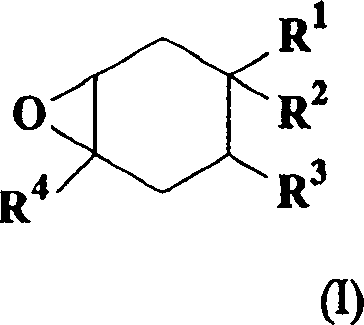
(ii)通式(II)的环氧化物 (ii) Epoxides of general formula (II)
或(iii)其混合物or (iii) mixtures thereof
R1,R2和R3独立地选自H、-(CH2)n-R和-C(O)-R12,R1,R2和R3中的一个或两个是-C(O)-R12或-(CH2)n-R,优选-(CH2)n-R。在一个实施方案中R1和R2是-C(O)-R12或-(CH2)n-R,优选-(CH2)n-R。在另一个实施方案中R1和R3是-C(O)-R12或-(CH2)n-R,优选-(CH2)n-R。在一个优选的实施方案中,R1,R2和R3中的一个是-C(O)-R12或-(CH2)n-R。R4选自H或-CH3,优选H;R5,R6,R7和R8独立地选自H、-(CH2)n-R和-C(O)-R12,R5,R6,R7和R8中最多两个是-C(O)-R12或-(CH2)n-R;在一个优选的实施方案中,R5,R6,R7和R8中的一个是-C(O)-R12或-(CH2)n-R,更优选-(CH2)n-R。R 1 , R 2 and R 3 are independently selected from H, -(CH 2 ) n -R and -C(O)-R 12 , one or both of R 1 , R 2 and R 3 are -C( O)—R 12 or —(CH 2 ) n —R, preferably —(CH 2 ) n —R. In one embodiment R 1 and R 2 are -C(O)-R 12 or -(CH 2 ) n -R, preferably -(CH 2 ) n -R. In another embodiment R1 and R3 are -C(O) -R12 or -( CH2 ) n -R, preferably -( CH2 ) n -R. In a preferred embodiment, one of R 1 , R 2 and R 3 is -C(O)-R 12 or -(CH 2 ) n -R. R 4 is selected from H or -CH 3 , preferably H; R 5 , R 6 , R 7 and R 8 are independently selected from H, -(CH 2 ) n -R and -C(O)-R 12 , R 5 , R 6 , R 7 and R 8 at most two are -C(O)-R 12 or -(CH 2 ) n -R; in a preferred embodiment, R 5 , R 6 , R 7 and R One of 8 is -C(O)-R 12 or -(CH 2 ) n -R, more preferably -(CH 2 ) n -R.
R选自H、含1到12个碳原子(优选6到12个碳原子)的直链或支化烷基、含7到12个碳原子的芳烷基(优选苯基取代烷基,最优选苄基)、-O-R10、-O-R9-O-R10、
本发明合适的环氧化物的例子包括,但不限于,三甲氧基2-(7-氧杂二环[4.1.0]庚-3-基)乙基硅烷(“TMOE”),外-2,3-环氧降冰片烷(“ENB”),3-苄氧基甲基-7-氧杂二环[4.1.0]庚烷(“BOCH”),3-癸氧基甲基-7-氧杂二环[4.1.0]庚烷(“DOCH”),3-正丁氧基乙氧基甲基-7-氧杂二环[4.1.0]庚烷(“BEOCH”),3-(5,5-二甲基-2-氧代-1,3,2-二氧杂磷酰氧甲基)-7-氧杂二环[4.1.0](“DODOH”),3-(2-乙基己氧基甲基)-7-氧杂二环[4.1.0]庚烷(“EOH”),1-(7-氧杂二环[4.1.0]庚-3-基)-1-己酮(“KHOH”),1-(7-氧杂二环[4.1.0]庚-3-基)-1-苯基酮(“KPOH”),4-甲基-3-己氧基甲基-7-氧杂二环[4.1.0]庚烷(“MHOCH”),3-(苯基甲基)-7-氧杂二环[4.1.0]庚烷(“BOBH”),5-正辛氧基甲基-3-氧杂三环[3.2.1.02,4]]辛烷(“OMOO”),其混合物等。Examples of suitable epoxides of the present invention include, but are not limited to, trimethoxy 2-(7-oxabicyclo[4.1.0]hept-3-yl)ethylsilane (“TMOE”), exo-2 , 3-epoxynorbornane ("ENB"), 3-benzyloxymethyl-7-oxabicyclo[4.1.0]heptane ("BOCH"), 3-decyloxymethyl-7 -Oxabicyclo[4.1.0]heptane (“DOCH”), 3-n-butoxyethoxymethyl-7-oxabicyclo[4.1.0]heptane (“BEOCH”), 3 -(5,5-Dimethyl-2-oxo-1,3,2-dioxaphosphoryloxymethyl)-7-oxabicyclo[4.1.0]("DODOH"), 3- (2-Ethylhexyloxymethyl)-7-oxabicyclo[4.1.0]heptane (“EOH”), 1-(7-oxabicyclo[4.1.0]hept-3-yl )-1-hexanone (“KHOH”), 1-(7-oxabicyclo[4.1.0]hept-3-yl)-1-phenylone (“KPOH”), 4-methyl-3 -hexyloxymethyl-7-oxabicyclo[4.1.0]heptane ("MHOCH"), 3-(phenylmethyl)-7-oxabicyclo[4.1.0]heptane (" BOBH"), 5-n-octyloxymethyl-3-oxatricyclo[3.2.1.02,4]]octane ("OMOO"), mixtures thereof, and the like.
对照环氧化物MCS1562是2-乙基己基-3,4-环氧环己烷羧酸酯,一种目前在商业化航空器液压流体组合物中使用的除酸剂,描述于美国专利3,723,320和5,464,551。The reference epoxy MCS1562 is 2-ethylhexyl-3,4-epoxycyclohexanecarboxylate, an acid scavenger currently used in commercial aircraft hydraulic fluid compositions, described in U.S. Patents 3,723,320 and 5,464,551 .
与目前熟知并使用的环氧化物相比,改进的基于磷酸酯的功能性流体中包含本发明环氧化物,在诸如航空器的液压系统中使用时产生很少的羧酸,而且具有可接受的消耗速率。Improved phosphate-based functional fluids comprising the epoxy of the present invention generate less carboxylic acid when used in hydraulic systems such as aircraft and have acceptable consumption rate.
用于本发明的除酸剂是三甲氧基2-(7-氧杂二环[4.1.0]庚-3-基)乙基硅烷(“TMOE”)。此化合物由Aldrich公司(1001 West Saint Ave.,Milwaukee,WI 53233)提供。TMOE的化学结构如下:
本发明另一个合适的除酸剂是ENB。此化合物由Aldrich公司(1001West Saint Ave.,Milwaukee,WI 53233)提供。ENB的化学结构如下:
本发明另一个合适的除酸剂是BOCH。BOCH的化学结构如下: Another suitable acid scavenger for the present invention is BOCH. The chemical structure of BOCH is as follows:
本发明另一个合适的除酸剂是DOCH。DOCH的化学结构如下:
本发明另一个合适的除酸剂是BEOCH。BEOCH的化学结构如下:
本发明中另一个可用作除酸剂的化合物是DODOH。DODOH的化学结构如下:
本发明中另一个可用作除酸剂的化合物是EOH。EOH的化学结构如下:
本发明中另一个可用作除酸剂的化合物是KHOH。KHOH的化学结构如下:
本发明另一个合适的除酸剂是KPOH。KPOH的化学结构如下: Another suitable acid scavenger for the present invention is KPOH. The chemical structure of KPOH is as follows:
本发明另一个合适的除酸剂是MHOCH。MHOCH的化学结构如下: Another suitable acid scavenger for the present invention is MHOCH. The chemical structure of MHOCH is as follows:
本发明另一个合适的除酸剂是BOBH。BOBH的化学结构如下:本发明另一个合适的除酸剂是OOMO。OOMO的化学结构如下: Another suitable acid scavenger for the present invention is BOBH. The chemical structure of BOBH is as follows: Another suitable acid scavenger for the present invention is OOMO. The chemical structure of OOMO is as follows:
本发明的环氧化物当以有效量同改进的功能性流体,如使用基于磷酸酯基本组分的液压流体一起使用时是有用的。典型地,环氧化物的有效量范围在约0.5~约20重量%,优选约4~约8重量%。在一个优选的实施方案中,本发明涉及适合作为航空器液压流体使用的改进的功能性流体组合物。本发明的化合物可以在美国专利5,464,551中公开的组合物中恰当地用作除酸剂。美国专利5,464,551在此以其全部引作参考。The epoxides of the present invention are useful when used in effective amounts with improved functional fluids, such as hydraulic fluids using phosphate ester base components. Typically, effective amounts of epoxides range from about 0.5 to about 20% by weight, preferably from about 4 to about 8% by weight. In a preferred embodiment, the present invention relates to improved functional fluid compositions suitable for use as aircraft hydraulic fluids. The compounds of the present invention may suitably be used as acid scavengers in the compositions disclosed in US Patent No. 5,464,551. US Patent 5,464,551 is hereby incorporated by reference in its entirety.
有效除酸量的本发明除酸剂一般同功能性流体组合物一起使用。本发明的化合物可以类似地用在美国专利3,723,320的组合物中。美国专利3,723,320在此以其全部引作参考。Acid-scavenging effective amounts of the acid scavengers of the present invention are typically used with functional fluid compositions. The compounds of the present invention may similarly be used in the compositions of US Patent 3,723,320. US Patent 3,723,320 is hereby incorporated by reference in its entirety.
通式(I)的化合物一般通过由取代环己烯形成环氧化物来制备。取代环己烯可以从商品原料如环己烯-1-甲醇按照本领域普通技术人员熟知的常规技术来制备。替代地,取代环己烯或最终取代环己烯的前体可以通过二烯如丁二烯或异戊二烯同α,β-不饱和羰基化合物如2-丁烯醛、2-丙烯醛、丙烯酸甲酯、甲基丙烯酸甲酯等的Diels-Alder反应来制备。任选地,Diels-Alder反应产物接着按照本领域普通技术人员熟知的常规技术进一步反应以改变环己烯上的取代。接着采用本领域普通技术人员熟知的常规技术由所需取代环己烯来制备环氧化物。Compounds of general formula (I) are generally prepared by forming epoxides from substituted cyclohexenes. Substituted cyclohexenes can be prepared from commercial starting materials such as cyclohexene-1-methanol according to conventional techniques well known to those of ordinary skill in the art. Alternatively, the substituted cyclohexene or the precursor of the final substituted cyclohexene can be combined with α,β-unsaturated carbonyl compounds such as 2-butenal, 2-propenal, It can be prepared by the Diels-Alder reaction of methyl acrylate and methyl methacrylate. Optionally, the Diels-Alder reaction product is then further reacted to alter the substitution on the cyclohexene according to conventional techniques well known to those of ordinary skill in the art. The epoxide is then prepared from the desired substituted cyclohexene using conventional techniques well known to those of ordinary skill in the art.
一种制备醚取代环己烯的方法是进行使用3-环己烯-1-甲醇和卤代烷或磺酸酯的Williamson合成反应。例如,3-环己烯-1-甲醇同碱如氢氧化钾在二甲基亚砜存在下反应,接着同烷基氯进一步反应。醚取代环己烯接着通过常规技术使用过氧化试剂如间-氯过苯甲酸、过乙酸、过氧化氢、次氯酸钠等转变成环氧化物。One method of preparing ether-substituted cyclohexenes is the Williamson synthesis reaction using 3-cyclohexene-1-methanol and an alkyl halide or sulfonate. For example, 3-cyclohexene-1-methanol is reacted with a base such as potassium hydroxide in the presence of dimethylsulfoxide, followed by a further reaction with an alkyl chloride. The ether substituted cyclohexene is then converted to an epoxide by conventional techniques using peroxidizing reagents such as m-chloroperbenzoic acid, peracetic acid, hydrogen peroxide, sodium hypochlorite, and the like.
通式(II)的化合物一般通过由取代二环[2.2.1]庚-2-烯形成环氧化物来制备。取代的降冰片烯可以由原料如5-降冰片烯-2-甲醇按照本领域普通技术人员熟知的常规技术来制备。替代地,取代降冰片烯或最终取代降冰片烯的前体可以通过环戊二烯和易得的1,1,2,2-取代烯烃反应来制备。接着从所需取代降冰片烯采用本领域普通技术人员熟知的常规技术来制备环氧化物。Compounds of general formula (II) are generally prepared by forming epoxides from substituted bicyclo[2.2.1]hept-2-enes. Substituted norbornenes can be prepared from starting materials such as 5-norbornene-2-methanol according to conventional techniques well known to those of ordinary skill in the art. Alternatively, substituted norbornenes or precursors of eventual substituted norbornenes can be prepared by reacting cyclopentadiene with readily available 1,1,2,2-substituted alkenes. The epoxide is then prepared from the desired substituted norbornene using conventional techniques well known to those of ordinary skill in the art.
醚取代降冰片烯可以采用和上面公开的制备醚取代环己烯相同的技术来制备。Ether-substituted norbornenes can be prepared using the same techniques as disclosed above for the preparation of ether-substituted cyclohexenes.
在上述公开和随后实施例的基础上,其它取代环己烯或降冰片烯化合物的合成对本领域任何普通技术人员而言都是很明显的。The synthesis of other substituted cyclohexene or norbornene compounds will be apparent to anyone of ordinary skill in the art based on the above disclosure and the following examples.
适用于本发明功能性流体基本组分中的磷酸酯是三烷基磷酸酯、三芳基磷酸酯、二烷基芳基磷酸酯、烷基二芳基磷酸酯和其混合物。目前优选的本发明功能性流体基本组分是三烷基磷酸酯和三芳基磷酸酯的混合物。Phosphates suitable for use in the functional fluid base of the present invention are trialkylphosphates, triarylphosphates, dialkylarylphosphates, alkyldiarylphosphates, and mixtures thereof. A presently preferred functional fluid base of the present invention is a mixture of trialkyl phosphates and triaryl phosphates.
本发明中磷酸酯的烷基取代基是C3到C8,优选C4到C5的烷基。优选地,烷基取代基选自正丁基、异丁基、正戊基或异戊基,更优选正丁基和异丁基。在三烷基磷酸酯中,三个烷基取代基可以相同或不同,并且也可使用三烷基磷酸酯的混合物。三烷基磷酸酯的例子包括但不限于,三异丁基磷酸酯、三正丁基磷酸酯、三(异丁基/正丁基)磷酸酯、三异戊基磷酸酯、三正戊基磷酸酯和其混合物。在二烷基芳基磷酸酯中,两个烷基取代基可以相同或不同,并且也可使用二烷基磷酸酯的混合物。The alkyl substituent of the phosphoric acid ester in the present invention is C 3 to C 8 , preferably C 4 to C 5 alkyl. Preferably, the alkyl substituent is selected from n-butyl, isobutyl, n-pentyl or isopentyl, more preferably n-butyl and isobutyl. In trialkylphosphates, the three alkyl substituents may be the same or different, and mixtures of trialkylphosphates may also be used. Examples of trialkyl phosphates include, but are not limited to, triisobutyl phosphate, tri-n-butyl phosphate, tri(isobutyl/n-butyl) phosphate, tri-isoamyl phosphate, tri-n-pentyl Phosphates and mixtures thereof. In dialkylaryl phosphates, the two alkyl substituents may be the same or different, and mixtures of dialkyl phosphates may also be used.
本发明中磷酸酯的芳基取代基典型地是苯基,但也可以是烷基取代的苯基(烷基苯基),其中烷基取代基是C1到C9,优选C3到C4的烷基。烷基取代苯基取代基的非限定性例子包括但不限于,甲苯基(也称为甲基苯基)、乙基苯基、异丙基苯基、异丁基苯基、叔丁基苯基等。三芳基磷酸酯的例子包括但不限于三苯基磷酸酯、三(叔丁基苯基)磷酸酯、三(异丙基苯基)磷酸酯和其混合物。在三芳基磷酸酯和烷基二芳基磷酸酯中,芳基取代基可以相同或不同,且也可使用烷基二芳基磷酸酯和/或三芳基磷酸酯的混合物。The aryl substituent of the phosphate ester of the present invention is typically phenyl, but may also be an alkyl substituted phenyl (alkylphenyl), wherein the alkyl substituent is C 1 to C 9 , preferably C 3 to C 4 alkyl. Non-limiting examples of alkyl substituted phenyl substituents include, but are not limited to, tolyl (also known as methylphenyl), ethylphenyl, isopropylphenyl, isobutylphenyl, t-butylphenyl Base etc. Examples of triaryl phosphates include, but are not limited to, triphenyl phosphate, tris(t-butylphenyl) phosphate, tris(isopropylphenyl) phosphate, and mixtures thereof. In triaryl phosphates and alkyl diaryl phosphates, the aryl substituents may be the same or different, and mixtures of alkyl diaryl phosphates and/or triaryl phosphates may also be used.
作为举例说明用的磷酸酯基本组分包括但不限于此,基本组分包含约20重量%到约100重量%,优选约50重量%到约99重量%的三烷基磷酸酯;0%到约40重量%,优选0%到约35重量%的二烷基芳基磷酸酯;0%到约20重量%,优选0%到约5重量%的烷基二芳基磷酸酯和0%到约20重量%,优选0%到约10重量%的三芳基磷酸酯。Illustrative phosphate ester bases include, but are not limited to, bases comprising from about 20% to about 100% by weight, preferably from about 50% to about 99% by weight, of trialkylphosphates; from 0% to about 99% by weight; About 40% by weight, preferably 0% to about 35% by weight of dialkyl aryl phosphate; 0% to about 20% by weight, preferably 0% to about 5% by weight of alkyl diaryl phosphate and 0% to About 20% by weight, preferably 0% to about 10% by weight triaryl phosphate.
本发明的功能性流体任选包含其他组分如抗氧剂、粘度指数(VI)改进剂、抗腐蚀添加剂、腐蚀抑制剂和消泡剂。当功能性流体是航空器液压流体时,优选组合物进一步包含抗氧剂,粘度指数改进剂和抗腐蚀添加剂。The functional fluids of the present invention optionally contain other components such as antioxidants, viscosity index (VI) improvers, anti-corrosion additives, corrosion inhibitors and anti-foaming agents. When the functional fluid is an aircraft hydraulic fluid, it is preferred that the composition further comprises antioxidants, viscosity index improvers and anti-corrosion additives.
为了限制温度对粘度的影响,组合物可以包括一种聚合物粘度指数改进剂。优选地,粘度指数改进剂包含美国专利3,718,596描述的聚甲基丙烯酸烷基酯类型。一般地,粘度指数改进剂是高分子量的,数均分子量在约50,000~约100,000,重均分子量在约200,000~300,000。优选地,本发明的粘度指数改进剂的分子量范围相对较窄,约95重量%的粘度指数改进剂组分的分子量在约50,000~约1,500,000。粘度指数改进剂所占比例足以赋予一定的动粘度:在210F至少约3.0,优选在约3~约5厘沲之间;在100F至少约9,优选在约9~约15厘沲之间;在-65F不超过约4200厘沲。在组合物中使用粘度指数改进剂也可以赋予优良的剪切稳定性。优选的功能性流体组合物包含约3重量%~约10重量%的粘度指数改进剂。尤其优选的粘度指数改进剂如由Rohmax USA公司以商品名Acryloid_4495出售。粘度指数改进剂通常以在磷酸酯溶剂中的溶液形式提供,优选三烷基磷酸酯如三丁基或三异丁基磷酸酯;或烷基和苯基衍生物的组合。上述粘度指数改进剂比例是以固体(甲基丙烯酸酯聚合物)为基础的。磷酸酯溶剂实际上成了基本组分和磷酸酯比例范围的一部分,如上述讨论的那样反映了磷酸酯可以作为粘度指数改进剂的载体。To limit the effect of temperature on viscosity, the composition may include a polymeric viscosity index improver. Preferably, the viscosity index improver comprises polyalkylmethacrylates of the type described in US Patent 3,718,596. Generally, viscosity index improvers are high molecular weight, having a number average molecular weight in the range of about 50,000 to about 100,000 and a weight average molecular weight in the range of about 200,000 to 300,000. Preferably, the viscosity index improver of the present invention has a relatively narrow molecular weight range, with about 95% by weight of the viscosity index improver component having a molecular weight in the range of about 50,000 to about 1,500,000. The proportion of viscosity index improver is sufficient to impart a certain kinematic viscosity: at least about 3.0 at 210F, preferably between about 3 and about 5 centistokes; at 100F at least about 9, preferably between about 9 and about 15 centistokes; Not to exceed about 4200 centistokes at -65F. The use of viscosity index improvers in the composition can also impart good shear stability. Preferred functional fluid compositions comprise from about 3% to about 10% by weight viscosity index improver. A particularly preferred viscosity index improver is sold under the tradename Acryloid 4495 by the company Rohmax USA. Viscosity index improvers are typically provided as solutions in phosphate ester solvents, preferably trialkyl phosphates such as tributyl or triisobutyl phosphate; or combinations of alkyl and phenyl derivatives. The viscosity index improver ratios above are based on solids (methacrylate polymer). Phosphate ester solvents actually form part of the base components and phosphate ester ratio ranges, as discussed above, reflecting the ability of phosphate esters to serve as vehicles for viscosity index improvers.
可以以有效量引入抗腐蚀剂来抑制流动诱发的电化学腐蚀,更确切地是指ζ腐蚀。抗腐蚀添加剂优选全氟烷基磺酸的碱金属盐,更优选钾盐。此类抗腐蚀剂在美国专利3,679,587中有详细描述。典型地,烷基组分含有约4到约12个碳原子。烷基组分的例子包括但不限于丁基、己基、庚基、辛基、壬基、癸基、十二烷基或其混合物,全氟辛基一般提供最好的性能。尤其优选抗腐蚀剂主要包含全氟辛基磺酸的钾盐,比例在约250到约1000ppm之间,最优选至少约500ppm。The anti-corrosion agent may be introduced in an effective amount to inhibit flow-induced galvanic corrosion, more specifically zeta corrosion. The anti-corrosion additive is preferably an alkali metal salt of perfluoroalkanesulfonic acid, more preferably a potassium salt. Such corrosion inhibitors are described in detail in US Patent 3,679,587. Typically, the alkyl component contains from about 4 to about 12 carbon atoms. Examples of alkyl components include, but are not limited to, butyl, hexyl, heptyl, octyl, nonyl, decyl, dodecyl, or mixtures thereof, with perfluorooctyl generally providing the best performance. It is especially preferred that the corrosion inhibitor consists essentially of the potassium salt of perfluorooctane sulfonic acid in a proportion of between about 250 and about 1000 ppm, most preferably at least about 500 ppm.
本发明组合物还可以包含至少一种抗氧剂添加剂,选自胺抗氧剂、受阻酚和受阻多酚。优选抗氧剂为选自胺抗氧剂、受阻酚和受阻多酚的抗氧剂组合,更优选胺抗氧剂和至少一种受阻酚和/或受阻多酚的组合,最优选胺抗氧剂、受阻酚、和受阻多酚的组合。已经发现通过将苯酚部分地代替受阻多酚可以改进水解稳定性,因此优选组合物包含不超过约1.0重量%,优选不超过约0.7重量%的苯酚如2,4,6-三烷基苯酚。一般优选组合物包含约0.1%~约0.7%的2,4,6-三烷基苯酚,优选2,6-二叔丁基-对-甲苯酚(“Ionol”)。优选组合物进一步包括约0.3%~约1%的受阻多酚化合物,如双(3,5-二烷基-4-羟基芳基)甲烷,如由Albemarle公司以商品名Ethanox_702出售的双(3,5-二叔丁基-4-羟基苯基)甲烷;1,3,5-三烷基-2,4,6-三(3,5-二烷基-4-羟基芳基)芳香族化合物,如由Albemarle公司以商品名Ethanox_330出售的1,3,5-三甲基-2,4,6-三(3,5-二叔丁基-4-羟基苯基)苯,或其混合物。组合物可以包含胺抗氧剂,优选二芳基胺,如苯基-α-萘胺或烷基苯基-α-萘胺,或由Ciba-Geigy公司以商品名Irganox_L-57出售的2,4,4-三甲基戊烯和N-苯基苄基胺的反应产物;二苯基胺、二甲苯基胺,苯基甲苯基胺、4,4’-二氨基二苯基胺、二-对甲氧基二苯基胺或4-环己基-氨基二苯基胺;咔唑化合物如N-甲基咔唑、N-乙基咔唑或3-羟基咔唑;氨基苯酚如N-丁基氨基苯酚,N-甲基-N-戊基氨基苯酚或N-异辛基-对氨基苯酚;氨基二苯基烷烃如氨基二苯基甲烷、4,4’-二氨基二苯基甲烷等,氨基二苯基醚;氨基二苯基硫醚;芳基取代亚烷基二胺如1,2-二-邻甲苯氨基乙烷、1,2-二苯胺基乙烷或1,2-二苯胺基丙烷;氨基联苯如5-羟基-2-氨基联苯等;醛或酮和胺的反应产物如丙酮和二苯基胺的反应产物;络合二芳基胺和酮或醛的反应产物;吗啉如N-(对-羟基苯基)吗啉等;脒如N,N’-双-(羟基苯基)乙脒等;二氢吖啶如9,9’-二甲基-二氢吖啶,苯酚噻嗪如3,7-二丁基苯酚噻嗪或6,6-二辛基苯酚噻嗪;环己胺;或其混合物。优选烷基取代二苯基胺如二(对-辛基苯基)胺。某种胺组分也可作为润滑剂。优选胺抗氧化剂的比例约0.3重量%~约1重量%,优选约0.3重量%~0.7重量%,更优选约0.3重量%~0.5重量%。The compositions of the present invention may also comprise at least one antioxidant additive selected from the group consisting of amine antioxidants, hindered phenols and hindered polyphenols. Preferably the antioxidant is a combination of antioxidants selected from the group consisting of amine antioxidants, hindered phenols and hindered polyphenols, more preferably a combination of an amine antioxidant and at least one hindered phenol and/or hindered polyphenol, most preferably an amine antioxidant combinations of agents, hindered phenols, and hindered polyphenols. It has been found that hydrolytic stability can be improved by partially substituting phenols for hindered polyphenols, therefore it is preferred that the composition comprises no more than about 1.0 wt%, preferably no more than about 0.7 wt% of phenols such as 2,4,6-trialkylphenols. It is generally preferred that the compositions comprise from about 0.1% to about 0.7% of 2,4,6-trialkylphenol, preferably 2,6-di-tert-butyl-p-cresol ("Ionol"). Preferred compositions further comprise from about 0.3% to about 1% of a hindered polyphenol compound, such as bis(3,5-dialkyl-4-hydroxyaryl)methane, such as bis(3 , 5-di-tert-butyl-4-hydroxyphenyl)methane; 1,3,5-trialkyl-2,4,6-tri(3,5-dialkyl-4-hydroxyaryl)aromatic Compounds such as 1,3,5-trimethyl-2,4,6-tris(3,5-di-tert-butyl-4-hydroxyphenyl)benzene sold under the tradename Ethanox-330 by the company Albemarle, or mixtures thereof . The composition may contain an amine antioxidant, preferably a diarylamine such as phenyl-alpha-naphthylamine or alkylphenyl-alpha-naphthylamine, or 2 sold under the tradename Irganox-L-57 by the company Ciba-Geigy, The reaction product of 4,4-trimethylpentene and N-phenylbenzylamine; diphenylamine, xylylamine, phenyltolylamine, 4,4'-diaminodiphenylamine, diphenylamine, - p-methoxydiphenylamine or 4-cyclohexyl-aminodiphenylamine; carbazole compounds such as N-methylcarbazole, N-ethylcarbazole or 3-hydroxycarbazole; aminophenols such as N- Butylaminophenol, N-methyl-N-pentylaminophenol or N-isooctyl-p-aminophenol; aminodiphenylalkanes such as aminodiphenylmethane, 4,4'-diaminodiphenylmethane etc., aminodiphenyl ether; aminodiphenylsulfide; aryl-substituted alkylenediamines such as 1,2-di-o-tolylaminoethane, 1,2-dianilinoethane or 1,2- Diphenylaminopropane; aminobiphenyls such as 5-hydroxy-2-aminobiphenyl, etc.; reaction products of aldehydes or ketones and amines, such as reaction products of acetone and diphenylamine; complexed diarylamines and ketones or aldehydes Reaction products; morpholine such as N-(p-hydroxyphenyl) morpholine, etc.; amidines such as N, N'-bis-(hydroxyphenyl) acetamidine, etc.; dihydroacridine such as 9,9'-dimethyl - dihydroacridines, phenothiazines such as 3,7-dibutylphenothiazine or 6,6-dioctylphenothiazine; cyclohexylamine; or mixtures thereof. Alkyl substituted diphenylamines such as di(p-octylphenyl)amine are preferred. Certain amine components may also act as lubricants. Preferably the proportion of amine antioxidant is about 0.3% to about 1% by weight, preferably about 0.3% to 0.7% by weight, more preferably about 0.3% to 0.5% by weight.
本发明的功能性流体可以包含铜腐蚀抑制剂。如果铜腐蚀抑制剂用在本发明的功能性流体中,则优选铜腐蚀抑制剂包括苯并三唑衍生物,如以商品名Petrolite57068出售的衍生物。这种腐蚀抑制剂的用量足以钝化与液体组合物接触的金属表面,防止在与液体接触的金属表面上形成金属氧化物,从而降低铜在液压流体中的溶解速度,并且也降低可能由铜合金制造的部件的溶解。本发明的功能性流体包含约0.005重量%~约0.09重量%的苯并三唑衍生物,优选约0.02重量%~约0.07重量%。The functional fluids of the present invention may contain copper corrosion inhibitors. If a copper corrosion inhibitor is used in the functional fluid of the present invention, it is preferred that the copper corrosion inhibitor comprises a benzotriazole derivative such as that sold under the tradename Petrolite 57068. The corrosion inhibitor is used in an amount sufficient to passivate the metal surface in contact with the liquid composition, prevent the formation of metal oxides on the metal surface in contact with the liquid, thereby reducing the rate of dissolution of copper in the hydraulic fluid and also reducing the Dissolution of parts made of alloys. The functional fluids of the present invention comprise from about 0.005% to about 0.09% by weight of the benzotriazole derivative, preferably from about 0.02% to about 0.07% by weight.
已知磷酸酯功能性流体可以腐蚀铁合金和铜合金。许多铁腐蚀抑制剂可用于功能性流体中,但是已知在许多情况下它们增加腐蚀速度,因而对液压流体的性能产生有害影响。但是某种4,5-二氢咪唑化合物可以作为有效的铁腐蚀抑制剂,它们不会有害地影响流体的腐蚀性能。有用的4,5-二氢咪唑化合物包括符合如下结构通式的那些:
合适的铁腐蚀抑制剂是4,5-二氢-1H-咪唑和C16-C18脂肪酸(Vanderbilt公司以商品名Vanlube RI-G出售)的缩合产物。和4,5-二氢咪唑一样有效的化合物是2-(8-十七碳烯基)-4,5-二氢-1H-咪唑-1-乙醇(Ciba-GeiGy以商品名Amine-O出售)。为了起到和铁腐蚀抑制剂一样的作用,后一化合物应该和氨基酸衍生物组合使用,如Ciba-Geigy公司以商品名Sarkosyl_-O出售的N-甲基-N-(1-氧代-9-十八碳烯基)甘氨酸。A suitable iron corrosion inhibitor is the condensation product of 4,5-dihydro-1H-imidazole and a C 16 -C 18 fatty acid (sold under the trade name Vanlube RI-G by the company Vanderbilt). A compound as effective as 4,5-dihydroimidazole is 2-(8-heptadecenyl)-4,5-dihydro-1H-imidazole-1-ethanol (sold by Ciba-GeiGy under the tradename Amine-O ). In order to function as an iron corrosion inhibitor, the latter compound should be used in combination with an amino acid derivative such as N-methyl-N-(1-oxo-9 sold under the trade name Sarkosyl-O by the company Ciba-Geigy. -octadecenyl)glycine.
已经发现在本发明的功能性流体中使用其它铁腐蚀抑制剂是有效的,而对腐蚀特性没有不利影响,可接受的铁腐蚀抑制剂包括,例如,Petrolite以商品名Petrolite P-31001出售的产品。Other iron corrosion inhibitors have been found to be effective for use in the functional fluids of the present invention without adversely affecting the corrosion characteristics. Acceptable iron corrosion inhibitors include, for example, the product sold by Petrolite under the trade name Petrolite P-31001 .
必要时本发明的功能性流体也可以包含消泡剂。优选的消泡剂是硅树脂液体,更优选聚烷基硅氧烷,例如Dow Corning公司以商品名DC200出售的聚甲基硅氧烷。优选消泡剂的比例足以在ASTM方法892的测试条件下抑制泡沫的形成。通常组合物的消泡剂含量至少为约0.0005重量%,典型地约0.0001重量%到约0.001重量%。The functional fluid of the present invention may also contain an antifoaming agent if necessary. Preferred anti-foaming agents are silicone fluids, more preferably polyalkylsiloxanes such as polymethicone sold under the tradename DC200 by the company Dow Corning. Preferably the proportion of antifoaming agent is sufficient to inhibit the formation of foam under the test conditions of ASTM Method 892. Typically the antifoaming agent content of the composition is at least about 0.0005% by weight, typically from about 0.0001% to about 0.001% by weight.
优选本发明功能性流体的pH至少为约7.5,更优选约7.5~约9.0。为了获得此范围内的pH和提高组合物的除酸能力,功能性流体可以进一步包括约0.0035重量%~约0.10重量%,优选约0.01重量%~约0.1重量%,最优选约0.02重量%~约0.07重量%的碱金属苯酚盐或其它芳烃盐。优选苯酚钾。除了中和组合物中的酸性组分外,当组合物加到液压系统时,碱金属芳烃盐能够保护金属表面,从而降低腐蚀。Preferably, the functional fluids of the present invention have a pH of at least about 7.5, more preferably from about 7.5 to about 9.0. In order to obtain a pH within this range and improve the acid scavenging ability of the composition, the functional fluid may further comprise from about 0.0035% by weight to about 0.10% by weight, preferably from about 0.01% by weight to about 0.1% by weight, most preferably from about 0.02% by weight to About 0.07% by weight alkali metal phenate or other arene salt. Potassium phenate is preferred. In addition to neutralizing the acidic component of the composition, the alkali metal arene salt protects metal surfaces when the composition is added to a hydraulic system, thereby reducing corrosion.
本发明的第二个实施方案涉及一种在使用功能性流体过程中降低羧酸产生量的方法,功能性流体包含(a)含磷酸酯的基本组分和(b)至少一种除酸剂,该方法包括在功能性流体中掺混至少一种选自下面描述的本发明环氧化物的除酸剂。A second embodiment of the present invention is directed to a method of reducing the production of carboxylic acids during use of a functional fluid comprising (a) a phosphate ester-containing base component and (b) at least one acid scavenger , the method comprising admixing in the functional fluid at least one acid scavenger selected from the epoxides of the present invention described below.
实施例Example
下面的具体实施例阐明了目前已知实施和使用本发明的最佳模式,以有助于对本发明有一个清晰的了解。但是应该理解,尽管指明了优选的方案,但应用本发明的详细公开是通过简单的阐述而给出的,并不构成对本发明的限制,因为根据此详细描述,对本领域的技术人员而言,在本发明精神和范围内的许多改变和修饰将变得非常明显。The following specific examples illustrate the best modes of making and using the invention presently known to facilitate a clear understanding of the invention. However, it should be understood that although the preferred solution is indicated, the detailed disclosure of the application of the present invention is provided by simple illustration and does not constitute a limitation of the present invention, because according to this detailed description, for those skilled in the art, Many changes and modifications that are within the spirit and scope of the invention will become apparent.
如下所示,制备若干本发明的环氧化物来阐述本发明。两种商品化的环氧化物包括TMOE和ENB,它们购自Aldrich公司(1001,WestSaint Ave,Milwaukee,Wisconsin,53233美国),所有其它原材料从Aldrich公司购买并直接使用。As shown below, several inventive epoxides were prepared to illustrate the invention. Two commercially available epoxides including TMOE and ENB were purchased from Aldrich Corporation (1001, West Saint Ave, Milwaukee, Wisconsin, 53233 USA), and all other raw materials were purchased from Aldrich Corporation and used directly.
气相色谱-FID(“GC”)在配有25m×0.32mm HP-5毛细管柱的HP5890型色谱仪上进行,毛细管端接有HP5890A调节器。所用的GC程序如下:起始温度:50℃,起始时间:3min,程序速度:8℃/min,最终温度:280℃,最终时间:5min。Gas chromatography-FID ("GC") was performed on a HP5890 model chromatograph equipped with a 25 m x 0.32 mm HP-5 capillary column terminated with a HP5890A regulator. The GC program used was as follows: start temperature: 50°C, start time: 3 min, program speed: 8°C/min, final temperature: 280°C, final time: 5 min.
气相色谱质谱(EI),(“GC/MS”),从偶联到配有25m×0.32mm HP毛细管柱的HP5890型气相色谱仪上的HP5970质谱检测器获得,配有在70eV电离电压下工作的5970系列质量选择检测器并接有HP5890A调节器。为了确定低分子量挥发性化合物,所用GC程序如下:起始温度:50℃,起始时间:5min,程序速度:20℃/min,最终温度:280℃,最终时间:5min。为了确定高分子量化合物,所用GC程序如下:起始温度:50℃,起始时间:3min,程序速度:8℃/min,最终温度:280℃,最终时间:5min。液相色谱质谱(“LC/MS”)通过直接将样品熔在配有大气压力化学电离装置(APCI)的Finnigan LCQ离子捕获质谱仪中来获得,分子量(MW)使用GC/MS或LC/MS来确定。Gas Chromatography Mass Spectrum (EI), (“GC/MS”), obtained from a HP5970 mass spectrometer coupled to a HP5890 gas chromatograph equipped with a 25 m x 0.32 mm HP capillary column, equipped with an ionization voltage of 70 eV The 5970 series mass selective detector is connected with the HP5890A regulator. For the determination of low molecular weight volatile compounds, the GC program used was as follows: start temperature: 50 °C, start time: 5 min, program speed: 20 °C/min, final temperature: 280 °C, final time: 5 min. For the determination of high molecular weight compounds, the GC program used was as follows: start temperature: 50 °C, start time: 3 min, program speed: 8 °C/min, final temperature: 280 °C, final time: 5 min. Liquid Chromatography Mass Spectrometry ("LC/MS") is obtained by directly melting the sample in a Finnigan LCQ Ion Trapping Mass Spectrometer equipped with an Atmospheric Pressure Chemical Ionization Device (APCI), molecular weight (MW) using GC/MS or LC/MS to make sure.
在Varian 300MHz NMR谱仪上测定NMR谱。除非申明,NMR谱图是以TMS的氘代氯仿(CD3Cl)溶液为内标物获得的,化学位移以偏离TMS的ppm计。NMR spectra were determined on a
实施例1Example 1
EOH的制备Preparation of EOH
A.2-乙基己基甲苯磺酸酯的合成A. Synthesis of 2-ethylhexyl tosylate
一个配有搅拌棒的500mL圆底烧瓶内加入78g(0.60mol)2-乙基己基醇和170mL吡啶,混合物冷却到0℃。在0-5℃将甲苯磺酰氯(120.8g,0.63mol)缓慢加入到上述混合物中。反应进行三小时。将反应混合物倒入1.2L HCl溶液(1M)中,用氯仿(3×200mL)萃取,用水洗涤(3×200mL),并用硫酸钠干燥。蒸发掉有机层,残留物经真空蒸馏得到2-乙基己基甲苯磺酸酯。78g (0.60mol) of 2-ethylhexyl alcohol and 170mL of pyridine were added to a 500mL round bottom flask equipped with a stirring bar, and the mixture was cooled to 0°C. Tosyl chloride (120.8 g, 0.63 mol) was slowly added to the above mixture at 0-5°C. The reaction was carried out for three hours. The reaction mixture was poured into 1.2L HCl solution (1M), extracted with chloroform (3 x 200 mL), washed with water (3 x 200 mL), and dried over sodium sulfate. The organic layer was evaporated and the residue was vacuum distilled to give 2-ethylhexyl tosylate.
B.3-(2-乙基己氧基甲基)环己烯的合成B. Synthesis of 3-(2-ethylhexyloxymethyl)cyclohexene
一个配有机械搅拌器的500mL圆底烧瓶中加入33.6g(0.30mol)环己烯-1-甲醇和260mL DMSO。在40分钟内将氢氧化钠(8.43g,纯度95%;0.334mol)在冰浴中缓慢加入到上述混合物中。上述混合物在0-5℃反应2小时后,反应混合物恢复到室温。在15分钟内将2-乙基己基甲苯磺酸酯(85.2g,0.30mol)缓慢加入到上述混合物中,反应在室温下再进行1小时。接着在60℃反应2小时。反应混合物中加入水(200mL),用氯仿萃取(3×180mL),用水洗涤(2×100mL)。蒸发掉有机层,蒸馏残留物以得到纯产物。Add 33.6g (0.30mol) cyclohexene-1-methanol and 260mL DMSO to a 500mL round bottom flask equipped with a mechanical stirrer. Sodium hydroxide (8.43 g, 95% purity; 0.334 mol) was slowly added to the above mixture in an ice bath over 40 minutes. After the above mixture was reacted at 0-5° C. for 2 hours, the reaction mixture was returned to room temperature. 2-Ethylhexyl tosylate (85.2 g, 0.30 mol) was slowly added to the above mixture within 15 minutes, and the reaction was carried out at room temperature for another 1 hour. Subsequently, the reaction was carried out at 60° C. for 2 hours. Water (200 mL) was added to the reaction mixture, extracted with chloroform (3×180 mL), washed with water (2×100 mL). The organic layer was evaporated and the residue was distilled to give pure product.
C.3-(2-乙基己氧基甲基)-7-氧杂二环[4.1.0]庚烷的合成C. Synthesis of 3-(2-ethylhexyloxymethyl)-7-oxabicyclo[4.1.0]heptane
一个配有搅拌棒的500mL圆底烧瓶中加入22.4g(0.10mol)3-(2-乙基己氧基甲基)环己烯和50mL二氯甲烷。将溶解在二氯甲烷(200mL)中的间氯过苯甲酸(28.3g,纯度85%;0.138mol)在冰浴中1小时内逐滴加入到上述混合物中。上述混合物在室温反应过夜后,过滤反应混合物。固形物用己烷洗涤(3×30mL),过滤沉淀物,50mL己烷加入到滤液中进一步沉淀间氯过苯甲酸。过滤固形物并用己烷洗涤(2×20mL)。蒸发掉溶剂,蒸馏残留物以得到纯产物。Add 22.4g (0.10mol) of 3-(2-ethylhexyloxymethyl)cyclohexene and 50mL of dichloromethane into a 500mL round bottom flask equipped with a stirring bar. m-Chloroperbenzoic acid (28.3 g, 85% purity; 0.138 mol) dissolved in dichloromethane (200 mL) was added dropwise to the above mixture in an ice bath over 1 hour. After the above mixture was reacted overnight at room temperature, the reaction mixture was filtered. The solid was washed with hexane (3 x 30 mL), the precipitate was filtered, and 50 mL of hexane was added to the filtrate to further precipitate m-chloroperbenzoic acid. The solid was filtered and washed with hexanes (2 x 20 mL). The solvent was evaporated and the residue was distilled to give pure product.
1H NMR(CDCl3):3.18(d,2H),3.07(d,2H),3.13(t,1H),3.08(t,2H),2.09(m,2H), 1 H NMR (CDCl 3 ): 3.18 (d, 2H), 3.07 (d, 2H), 3.13 (t, 1H), 3.08 (t, 2H), 2.09 (m, 2H),
1.67(m,2H),1.41(m,1H),1.40(m,1H),1.37-0.90(m,8H),0.82(t,3H),0.80(t,3H).1.67(m, 2H), 1.41(m, 1H), 1.40(m, 1H), 1.37-0.90(m, 8H), 0.82(t, 3H), 0.80(t, 3H).
13C NMR(d-丙酮):11.4,14.5,21.7,23.4,23.4,24.2,24.2,24.3,25.1,27.9,27.9, 13 C NMR (d-acetone): 11.4, 14.5, 21.7, 23.4, 23.4, 24.2, 24.2, 24.3, 25.1, 27.9, 27.9,
28.7,29.4,30.3,30.9,30.9,33.4,39.9,33.9,51.7,52.2,52.9,53.4,74.0,74.2,75,7,28.7, 29.4, 30.3, 30.9, 30.9, 33.4, 39.9, 33.9, 51.7, 52.2, 52.9, 53.4, 74.0, 74.2, 75,7,
76.2.76.2.
Mw=240Mw=240
实施例2Example 2
BOCH的制备Preparation of BOCH
A.3-苄氧基甲基环己烯的合成A. Synthesis of 3-benzyloxymethylcyclohexene
一个配有机械搅拌器的500mL圆底烧瓶中加入19.8g(0.177mol)环己烯-1-甲醇和150mL DMSO。在20分钟内将氢氧化钠(4.90g,纯度95%;0.194mol)在冰浴中缓慢加入到上述混合物中。上述混合物在室温反应1小时后,在15分钟内将30.2g(0.177mol)苄基溴缓慢加入到上述混合物中。反应在60℃下再进行2小时,反应混合物冷却到室温,加入水(200mL),接着用氯仿萃取(3×200mL),用水洗涤(2×250mL),并用硫酸钠干燥。蒸发掉溶剂,蒸馏残留物得到纯产物。A 500mL round bottom flask equipped with a mechanical stirrer was charged with 19.8g (0.177mol) cyclohexene-1-methanol and 150mL DMSO. Sodium hydroxide (4.90 g, 95% purity; 0.194 mol) was slowly added to the above mixture in an ice bath over 20 minutes. After the above mixture was reacted at room temperature for 1 hour, 30.2 g (0.177 mol) of benzyl bromide was slowly added to the above mixture within 15 minutes. The reaction was carried out at 60°C for another 2 hours, the reaction mixture was cooled to room temperature, water (200 mL) was added, followed by extraction with chloroform (3 x 200 mL), washing with water (2 x 250 mL), and drying over sodium sulfate. The solvent was evaporated and the residue was distilled to give pure product.
1H NMR(CDCl3):7.28(5H,Ph),5.56(2H,CH2Ph),4.50(2H,2CH),3.37(2H,CH2O), 1 H NMR (CDCl 3 ): 7.28 (5H, Ph), 5.56 (2H, CH 2 Ph), 4.50 (2H, 2CH), 3.37 (2H, CH 2 O),
1.68-2.20(7H,环 CH2,CH),1.30(2H,环 CH2,CH),130(2H,环 CH2).1.68-2.20(7H, ring CH 2 , CH), 1.30(2H, ring CH 2 , CH), 130(2H, ring CH 2 ).
13C NMR(CDCl3):138.7,128.2,127.4,127.4,127.0,126.0,75.2,72.9,33.9,28.5, 13 C NMR (CDCl 3 ): 138.7, 128.2, 127.4, 127.4, 127.0, 126.0, 75.2, 72.9, 33.9, 28.5,
25.6,24.5.25.6, 24.5.
B.3-苄氧基甲基-7-氧杂二环[4.1.0]庚烷的合成B. Synthesis of 3-benzyloxymethyl-7-oxabicyclo[4.1.0]heptane
一个配有搅拌棒的500mL圆底烧瓶中加入13.1g(0.065mol)3-苄氧基甲基环己烯和100mL二氯甲烷。将溶解在二氯甲烷(80mL)中的过乙酸(15.5g,乙酸中的含量为35重量%;0.065mol)在冰浴中30分钟内逐滴加入到上述混合物中。上述混合物在室温反应24小时后,250mL水加入到上述反应混合物中,水层用二氯甲烷(2×150mL)萃取,合并有机层并用饱和碳酸钠溶液(2×150mL)洗涤,接着用水洗涤(2×150mL)并用硫酸钠干燥。蒸发掉溶剂,蒸馏残留物得到纯产物。Add 13.1 g (0.065 mol) of 3-benzyloxymethylcyclohexene and 100 mL of dichloromethane into a 500 mL round bottom flask equipped with a stirring bar. Peracetic acid (15.5 g, 35% by weight in acetic acid; 0.065 mol) dissolved in dichloromethane (80 mL) was added dropwise to the above mixture over 30 minutes in an ice bath. After the above mixture was reacted at room temperature for 24 hours, 250 mL of water was added to the above reaction mixture, the aqueous layer was extracted with dichloromethane (2×150 mL), and the organic layers were combined and washed with saturated sodium carbonate solution (2×150 mL), followed by washing with water ( 2×150 mL) and dried over sodium sulfate. The solvent was evaporated and the residue was distilled to give pure product.
1H NMR(CDCl3):7.28(5H,Ph),4.45(2H,CH2Ph),3.23(2H,2CHO),3.26(2H, 1 H NMR (CDCl 3 ): 7.28 (5H, Ph), 4.45 (2H, CH 2 Ph), 3.23 (2H, 2CHO), 3.26 (2H,
PhCH2O),3.11(2H,CH2O),1.28-3.10(6H,环 CH2),0.8-1.21(1H,环 CH).PhCH 2 O), 3.11 (2H, CH 2 O), 1.28-3.10 (6H, ring CH 2 ), 0.8-1.21 (1H, ring CH).
13C NMR(CDCl3):138.4,138.3,128.1,127.3,127.2,75.0,74.5,72.8,72.6,52.5,52.3, 13 C NMR (CDCl 3 ): 138.4, 138.3, 128.1, 127.3, 127.2, 75.0, 74.5, 72.8, 72.6, 52.5, 52.3,
51.6,51.1,32.9,29.9,28.1,27.3,24.5,23.7,22.8,21.1.51.6, 51.1, 32.9, 29.9, 28.1, 27.3, 24.5, 23.7, 22.8, 21.1.
Mw=218Mw=218
实施例3Example 3
DOCH的制备Preparation of DOCH
A.3-环己烯-1-甲醇甲苯磺酸酯的合成A. Synthesis of 3-cyclohexene-1-methanol tosylate
一个配有搅拌棒的500mL圆底烧瓶中加入67.2g(0.60mol)3-环己烯-1-甲醇和170mL吡啶。混合物冷却到0℃。甲苯磺酰氯(120.8g,0.63mol)在0-5℃缓慢加入到上述混合物中。反应进行三小时。将反应混合物倒入1.2L HCl溶液(1M)中,用氯仿萃取(3×200mL),用水洗涤(3×200mL),并用硫酸钠干燥。蒸发掉溶剂,真空蒸馏残留物得到甲苯磺酸酯。Add 67.2g (0.60mol) of 3-cyclohexene-1-methanol and 170mL of pyridine into a 500mL round bottom flask equipped with a stirring bar. The mixture was cooled to 0°C. Tosyl chloride (120.8 g, 0.63 mol) was slowly added to the above mixture at 0-5°C. The reaction was carried out for three hours. The reaction mixture was poured into 1.2L HCl solution (1M), extracted with chloroform (3 x 200 mL), washed with water (3 x 200 mL), and dried over sodium sulfate. The solvent was evaporated and the residue was distilled in vacuo to give the tosylate.
B.3-癸氧基甲基环己烯的合成B. Synthesis of 3-decyloxymethylcyclohexene
一个配有机械搅拌器的500mL圆底烧瓶中加入23.7g(0.15mol)癸醇和150mL DMSO。将氢氧化钠(4.22g,纯度95%;0.167mol)在冰浴中20分钟内缓慢加入到上述混合物中。上述混合物在室温反应3小时后,反应混合物冷却到室温。3-环己烯-1-甲醇甲苯磺酸酯(39.9g,0.15mol)在20分钟内缓慢加入到上述混合物中。反应在室温过夜,接着80℃下再进行3小时。反应混合物中加入水(150mL),接着用氯仿萃取(3×150mL),用水洗涤(2×100mL),并用硫酸钠干燥。蒸发掉溶剂,蒸馏残留物得到纯产物。Add 23.7g (0.15mol) decanol and 150mL DMSO to a 500mL round bottom flask equipped with a mechanical stirrer. Sodium hydroxide (4.22 g, 95% purity; 0.167 mol) was slowly added to the above mixture in an ice bath over 20 minutes. After the above mixture was reacted at room temperature for 3 hours, the reaction mixture was cooled to room temperature. 3-Cyclohexene-1-methanol tosylate (39.9 g, 0.15 mol) was slowly added to the above mixture over 20 minutes. The reaction was carried out overnight at room temperature, followed by an additional 3 hours at 80°C. Water (150 mL) was added to the reaction mixture, followed by extraction with chloroform (3 x 150 mL), washing with water (2 x 100 mL), and drying over sodium sulfate. The solvent was evaporated and the residue was distilled to give pure product.
C.3-癸氧基甲基-7-氧杂二环[4.1.0]庚烷的合成C. Synthesis of 3-decyloxymethyl-7-oxabicyclo[4.1.0]heptane
一个配有搅拌棒的500mL圆底烧瓶中加入16.4g(0.065mol)3-癸氧基甲基环己烯和100mL二氯甲烷。将溶解在二氯甲烷(80mL)中的过乙酸(15.5g,乙酸中含量为35重量%;0.065mol)在冰浴中30分钟内逐滴加入到上述混合物中。上述混合物在室温反应过夜后,250mL水加入到上述反应混合物中,水层用二氯甲烷(2×150mL)萃取,合并有机层并用饱和碳酸钠溶液(2×150mL)洗涤,接着用水洗涤(2×150mL)并用硫酸钠干燥。蒸发掉溶剂,蒸馏残留物得到纯产物。Add 16.4g (0.065mol) of 3-decyloxymethylcyclohexene and 100mL of dichloromethane into a 500mL round bottom flask equipped with a stirring bar. Peracetic acid (15.5 g, 35% by weight in acetic acid; 0.065 mol) dissolved in dichloromethane (80 mL) was added dropwise to the above mixture over 30 minutes in an ice bath. After the above mixture was reacted overnight at room temperature, 250 mL of water was added to the above reaction mixture, the aqueous layer was extracted with dichloromethane (2×150 mL), the organic layers were combined and washed with saturated sodium carbonate solution (2×150 mL), followed by washing with water (2 × 150 mL) and dried over sodium sulfate. The solvent was evaporated and the residue was distilled to give pure product.
1H NMR(CDCl3):3.34(2H,OCH2),3.18(2H,2CHO),3.12(2H,CH2O),2.10(2H, 1 H NMR (CDCl 3 ): 3.34 (2H, OCH 2 ), 3.18 (2H, 2CHO), 3.12 (2H, CH 2 O), 2.10 (2H,
环CH2),1.80(2H,环 CH2),1.52(2H,环 CH2),1.42(1H,环 CH),1.27(16H,8ring CH 2 ), 1.80 (2H, ring CH 2 ), 1.52 (2H, ring CH 2 ), 1.42 (1H, ring CH ), 1.27 (16H, 8
CH2),0.87(3H,CH3).CH 2 ), 0.87 (3H, CH 3 ).
13C NMR(CDCl3):75.6,75.1,71.0,70.9,52.5,52.4,51.6,51.1,33.0,31.7,29.9,29.5, 13 C NMR (CDCl 3 ): 75.6, 75.1, 71.0, 70.9, 52.5, 52.4, 51.6, 51.1, 33.0, 31.7, 29.9, 29.5,
29.5,29.5,29.4,29.3,29.2,28.2,27.5,26.0,24.6,23.8,22.9,22.5,21.2,13.9.29.5, 29.5, 29.4, 29.3, 29.2, 28.2, 27.5, 26.0, 24.6, 23.8, 22.9, 22.5, 21.2, 13.9.
Mw=268Mw=268
实施例4Example 4
BEOCH的制备Preparation of BEOCH
A.3-丁氧乙氧甲基环己烯的合成A. Synthesis of 3-butoxyethoxymethylcyclohexene
一个配有机械搅拌器的500mL圆底烧瓶中加入16.7g(0.15mol)2-丁氧基乙醇和150mL DMSO。将氢氧化钠(4.22g,纯度95%;0.167mol)在冰浴中20分钟内缓慢加入到上述混合物中。上述混合物在室温反应3小时后,在20分钟内将39.9g(0.15mol)3-环己烯-1-甲醇甲苯磺酸酯缓慢加入到上述混合物中。反应在室温下过夜,接着在80℃下再进行3小时,反应混合物中加入水(150mL),接着用氯仿萃取(3×150mL),用水洗涤(2×100mL),并用硫酸钠干燥。蒸发掉溶剂,蒸馏残留物得到纯产物。Add 16.7 g (0.15 mol) of 2-butoxyethanol and 150 mL of DMSO to a 500 mL round bottom flask equipped with a mechanical stirrer. Sodium hydroxide (4.22 g, 95% purity; 0.167 mol) was slowly added to the above mixture in an ice bath over 20 minutes. After the above mixture was reacted at room temperature for 3 hours, 39.9 g (0.15 mol) of 3-cyclohexene-1-methanol tosylate was slowly added to the above mixture within 20 minutes. The reaction was carried out overnight at room temperature, followed by further 3 hours at 80 °C. Water (150 mL) was added to the reaction mixture, followed by extraction with chloroform (3 x 150 mL), washing with water (2 x 100 mL), and drying over sodium sulfate. The solvent was evaporated and the residue was distilled to give pure product.
1H NMR(CDCl3):5.64(2H,2CH),3.58(4H,2OCH2),3.47(2H,OCH2),3.35(2H, 1 H NMR (CDCl 3 ): 5.64 (2H, 2CH), 3.58 (4H, 2OCH 2 ), 3.47 (2H, OCH 2 ), 3.35 (2H,
CH2O),1.70-2.26(7H,环 CH,3CH2),1.56(2H,CH2),1.36(2H,CH2),1.24(2H,环CH 2 O), 1.70-2.26 (7H, ring CH, 3CH 2 ), 1.56 (2H, CH 2 ), 1.36 (2H, CH 2 ), 1.24 (2H, ring
CH2),0.92(3H,CH3).CH 2 ), 0.92 (3H, CH 3 ).
13C NMR(CDCl3):126.9,125.9,76.2,71.1,70.3,70.0,33.6,31.6,28.4,25.5, 13 C NMR (CDCl 3 ): 126.9, 125.9, 76.2, 71.1, 70.3, 70.0, 33.6, 31.6, 28.4, 25.5,
24.4,19.2,13.8.24.4, 19.2, 13.8.
B.3-丁氧乙氧甲基-7-氧杂二环[4.1.0]庚烷的合成B. Synthesis of 3-butoxyethoxymethyl-7-oxabicyclo[4.1.0]heptane
一个配有搅拌棒的500mL圆底烧瓶中加入13.78g(0.065mol)3-丁氧乙氧甲基环己烯和100mL二氯甲烷。将溶解在二氯甲烷(80mL)中的过乙酸(15.5g,乙酸中含量为35重量%;0.065mol)在冰浴中30分钟内逐滴加入到上述混合物中。上述混合物在室温反应过夜后,250mL水加入到上述反应混合物中,水层用二氯甲烷(2×150mL)萃取,合并有机层并用饱和碳酸钠溶液(2×150mL)洗涤,接着用水洗涤(2×150mL)并用硫酸钠干燥。蒸发掉溶剂,蒸馏残留物得到纯产物。Add 13.78g (0.065mol) of 3-butoxyethoxymethylcyclohexene and 100mL of dichloromethane into a 500mL round bottom flask equipped with a stirring bar. Peracetic acid (15.5 g, 35% by weight in acetic acid; 0.065 mol) dissolved in dichloromethane (80 mL) was added dropwise to the above mixture over 30 minutes in an ice bath. After the above mixture was reacted overnight at room temperature, 250 mL of water was added to the above reaction mixture, the aqueous layer was extracted with dichloromethane (2×150 mL), the organic layers were combined and washed with saturated sodium carbonate solution (2×150 mL), followed by washing with water (2 × 150 mL) and dried over sodium sulfate. The solvent was evaporated and the residue was distilled to give pure product.
1H NMR(CDCl3):3.55(4H,2OCH2),3.46(2H,OCH2),3.20-3.34(2H,2CHO),3.14 1 H NMR (CDCl 3 ): 3.55 (4H, 2OCH 2 ), 3.46 (2H, OCH 2 ), 3.20-3.34 (2H, 2CHO), 3.14
(2H,CH2O),1.66-2.20(7H,环 CH,3CH2),1.56(2H,CH2),1.36(2H,CH2),0.96-1.20(2H, CH 2 O), 1.66-2.20 (7H, ring CH, 3CH 2 ), 1.56 (2H, CH 2 ), 1.36 (2H, CH 2 ), 0.96-1.20
(2H,环 CH2),0.92(3H,CH3).(2H, ring CH 2 ), 0.92 (3H, CH 3 ).
13C NMR(CDCl3):75.8,75.4,70.7,70.0,69.9,69.7,69.6,52.1,52.0,51.3,50.8,32.6, 13 C NMR (CDCl 3 ): 75.8, 75.4, 70.7, 70.0, 69.9, 69.7, 69.6, 52.1, 52.0, 51.3, 50.8, 32.6,
31.4,29.5,27.9,27.1,24.3,23.5,22.6,20.9,18.9,13.5.31.4, 29.5, 27.9, 27.1, 24.3, 23.5, 22.6, 20.9, 18.9, 13.5.
Mw=228Mw=228
实施例5Example 5
DODOH的制备Preparation of DODOH
A.3-(5,5-二甲基-2-氧代-1,3,2-二氧杂磷酰氧甲基)-环己烯的合成A. Synthesis of 3-(5,5-dimethyl-2-oxo-1,3,2-dioxaphosphoryloxymethyl)-cyclohexene
一个配有搅拌棒的100mL圆底烧瓶中加入15.04g(0.134mol)3-环己烯-1-甲醇、22.52g(0.122mol)2-氯-5,5-二甲基-1,3,2-二氧杂磷酰氧基-2-酮和10.6g(0.134mol)吡啶。上述混合物在80℃下反应3小时后,反应混合物中加入氯仿(100mL),接着用氯仿(2×100mL)洗涤,并用硫酸钠干燥。蒸发掉溶剂,残留物蒸馏得到纯产物。Add 15.04g (0.134mol) 3-cyclohexene-1-methanol, 22.52g (0.122mol) 2-chloro-5,5-dimethyl-1,3 in a 100mL round bottom flask equipped with a stirring bar, 2-dioxaphosphoryloxy-2-one and 10.6 g (0.134 mol) of pyridine. After the above mixture was reacted at 80° C. for 3 hours, chloroform (100 mL) was added to the reaction mixture, followed by washing with chloroform (2×100 mL), and drying over sodium sulfate. The solvent was evaporated and the residue was distilled to give pure product.
1H NMR(CDCl3):5.68(2H,2CH),3.87-4.12(6H,3OCH2),1.76-2.02(4H,2环 1 H NMR (CDCl 3 ): 5.68 (2H, 2CH), 3.87-4.12 (6H, 3OCH 2 ), 1.76-2.02 (4H, 2 rings
CH2),1.74-1.88(2H,环 CH2),1.28-1.43(1H,环 CH),1.25(3H,CH3),0.91(3H,CH 2 ), 1.74-1.88 (2H, ring CH 2 ), 1.28-1.43 (1H, ring CH), 1.25 (3H, CH 3 ), 0.91 (3H,
CH3).CH 3 ).
13C NMR(CDCl3):126.2,124.4,77.0,70.9,70.6,70.5,33.5,33.4,33.4,33.3,26.9, 13 C NMR (CDCl 3 ): 126.2, 124.4, 77.0, 70.9, 70.6, 70.5, 33.5, 33.4, 33.4, 33.3, 26.9,
24.0,23.4,20.7,19.5.24.0, 23.4, 20.7, 19.5.
B.3-(5,5-二甲基-2-氧代-1,3,2-二氧杂磷酰氧甲基)-7-氧杂二环[4.1.0]庚烷的合成B. Synthesis of 3-(5,5-dimethyl-2-oxo-1,3,2-dioxaphosphoryloxymethyl)-7-oxabicyclo[4.1.0]heptane
一个配有搅拌棒的500mL圆底烧瓶中加入15.5g(0.058mol)3-(5,5-二甲基-2-氧代-1,3,2-二氧杂磷酰氧甲基)-1-环己烯和100mL二氯甲烷。将溶解在二氯甲烷(60mL)中的过乙酸(13.76g,乙酸中含量为35重量%;0.058mol)在冰浴中20分钟内逐滴加入到上述混合物中。上述混合物在室温反应过夜后,100mL水加入到上述反应混合物中,水层用二氯甲烷(2×100mL)萃取,合并有机层并用饱和碳酸钠溶液(2×100mL)洗涤,接着用水洗涤(2×100mL)并用硫酸钠干燥。蒸发掉溶剂,蒸馏残留物得到纯产物。Add 15.5g (0.058mol) 3-(5,5-dimethyl-2-oxo-1,3,2-dioxaphosphoryloxymethyl)- 1-Cyclohexene and 100 mL of dichloromethane. Peracetic acid (13.76 g, 35% by weight in acetic acid; 0.058 mol) dissolved in dichloromethane (60 mL) was added dropwise to the above mixture over 20 minutes in an ice bath. After the above mixture was reacted overnight at room temperature, 100 mL of water was added to the above reaction mixture, the aqueous layer was extracted with dichloromethane (2×100 mL), the organic layers were combined and washed with saturated sodium carbonate solution (2×100 mL), followed by washing with water (2 × 100 mL) and dried over sodium sulfate. The solvent was evaporated and the residue was distilled to give pure product.
1H NMR(CDCl3):4.07(1H,CHO),4.03(1H,CHO),3.82-4.00(4H,2OCH2),3.19 1 H NMR (CDCl 3 ): 4.07 (1H, CHO), 4.03 (1H, CHO), 3.82-4.00 (4H, 2OCH 2 ), 3.19
(2H,OCH2),2.10(2H,环 CH2),1.80(2H,环 CH2),1.57(2H,环 CH2),1.24(3H,(2H, OCH 2 ), 2.10 (2H, ring CH 2 ), 1.80 (2H, ring CH 2 ), 1.57 (2H, ring CH 2 ), 1.24 (3H,
CH3),1.08(IH,环 CH),0.90(3H,CH3).CH 3 ), 1.08 (IH, ring CH), 0.90 (3H, CH 3 ).
13C NMR(CDCl3):77.4,77.3,70.8,52.0,51.2,50.5,33.1,33.0,31.8,31.7,30.5,30.4, 13 C NMR (CDCl 3 ): 77.4, 77.3, 70.8, 52.0, 51.2, 50.5, 33.1, 33.0, 31.8, 31.7, 30.5, 30.4,
27.4,26.3,24.0,22.9,22.4,21.2,21.1,20.3,20.0.27.4, 26.3, 24.0, 22.9, 22.4, 21.2, 21.1, 20.3, 20.0.
Mw=276Mw=276
实施例6Example 6
KHOH的制备Preparation of KHOH
A.1-(3-环己烯-1-基)-1-己酮的合成A. Synthesis of 1-(3-cyclohexen-1-yl)-1-hexanone
一个配有机械搅拌器的500mL圆底烧瓶中加入18.9g(0.15mol)3-环己烯-1-羧酸和300mL醚。将132mL己基锂(2.5M己烷溶液,0.33mol)在冰浴中40分钟内缓慢加入到上述混合物中。上述混合物在0℃反应30分钟后,反应混合物恢复到室温。将混合物缓慢地加入到剧烈搅拌着的27mL(0.32mol)浓盐酸和400mL水的混合液中。分离有机相,水相用3×150mL的醚萃取,合并的有机溶液用硫酸钠干燥,蒸发掉溶剂并蒸馏得到纯产物。A 500 mL round bottom flask equipped with a mechanical stirrer was charged with 18.9 g (0.15 mol) of 3-cyclohexene-1-carboxylic acid and 300 mL of ether. 132 mL of hexyllithium (2.5 M in hexane, 0.33 mol) was slowly added to the above mixture in an ice bath over 40 minutes. After the above mixture was reacted at 0° C. for 30 minutes, the reaction mixture was returned to room temperature. The mixture was slowly added to a vigorously stirred mixture of 27 mL (0.32 mol) of concentrated hydrochloric acid and 400 mL of water. The organic phase was separated, the aqueous phase was extracted with 3 x 150 mL of ether, the combined organic solutions were dried over sodium sulfate, the solvent was evaporated and distilled to give pure product.
B.1-(7-氧杂二环[4.1.0]庚-3-基)-1-己酮的合成B. Synthesis of 1-(7-oxabicyclo[4.1.0]hept-3-yl)-1-hexanone
一个配有搅拌棒的500mL圆底烧瓶中加入8.42g(0.0668mol)1-(3-环己烯-1-基)-1-己酮和80mL二氯甲烷。将溶解在二氯甲烷(60mL)中的过乙酸(14.5g,乙酸中含量为35重量%;0.0668mol)在冰浴中20分钟内逐滴加入到上述混合物中。上述混合物在室温反应过夜后,200m水加入到上述反应混合物中,水层用二氯甲烷(2×100mL)萃取,合并有机层并用饱和碳酸钠溶液(2×100mL)洗涤,接着用水洗涤(2×100mL)并用硫酸钠干燥。蒸发掉溶剂,蒸馏残留物得到纯产物。Add 8.42g (0.0668mol) 1-(3-cyclohexen-1-yl)-1-hexanone and 80mL dichloromethane into a 500mL round bottom flask equipped with a stirring bar. Peracetic acid (14.5 g, 35% by weight in acetic acid; 0.0668 mol) dissolved in dichloromethane (60 mL) was added dropwise to the above mixture over 20 minutes in an ice bath. After the above mixture was reacted overnight at room temperature, 200m of water was added to the above reaction mixture, the aqueous layer was extracted with dichloromethane (2×100mL), the organic layers were combined and washed with saturated sodium carbonate solution (2×100mL), followed by washing with water (2 × 100 mL) and dried over sodium sulfate. The solvent was evaporated and the residue was distilled to give pure product.
1H NMR(CDCl3):3.20(2H,2CHO),2.60(1H,CH),2.40(2H,CH2),1.60-2.36(9H, 1 H NMR (CDCl 3 ): 3.20 (2H, 2CHO), 2.60 (1H, CH), 2.40 (2H, CH 2 ), 1.60-2.36 (9H,
CH,4CH2),1.28(8H,4CH2),0.88(3H,CH3).CH, 4CH 2 ), 1.28 (8H, 4CH 2 ), 0.88 (3H, CH 3 ).
13C NMR(d-丙酮):213.1,212.7,52.4,51.7,51.3,50.6,45.1,42.5,40.7,40.3,31.4, 13 C NMR (d-acetone): 213.1, 212.7, 52.4, 51.7, 51.3, 50.6, 45.1, 42.5, 40.7, 40.3, 31.4,
28.7,26.4,25.3,24.2,23.5,23.4,22.8,22.4,22.3,20.6,13.8.28.7, 26.4, 25.3, 24.2, 23.5, 23.4, 22.8, 22.4, 22.3, 20.6, 13.8.
Mw=210Mw=210
实施例7Example 7
KPOH的制备Preparation of KPOH
A.3-环己烯-1-基-苯基酮的合成A. Synthesis of 3-cyclohexen-1-yl-phenyl ketone
一个配有机械搅拌器的500mL圆底烧瓶中加入18.9g(0.15mol)3-环己烯-1-羧酸和300mL醚。将苯基锂(183mL,1.8M己烷溶液,0.33mol)在冰浴中50分钟内缓慢加入到上述混合物中。上述混合物在0℃反应40分钟后,反应混合物恢复到室温。混合物缓慢地加入到剧烈搅拌着的27mL(0.32mol)浓盐酸和400mL水的混合液中。分离有机相,水相用3×150mL的醚萃取,合并的有机溶液用硫酸钠干燥,蒸发掉溶剂并蒸馏得到纯产物。A 500 mL round bottom flask equipped with a mechanical stirrer was charged with 18.9 g (0.15 mol) of 3-cyclohexene-1-carboxylic acid and 300 mL of ether. Phenyllithium (183 mL, 1.8 M in hexane, 0.33 mol) was slowly added to the above mixture in an ice bath over 50 minutes. After the above mixture was reacted at 0° C. for 40 minutes, the reaction mixture was returned to room temperature. The mixture was slowly added to a vigorously stirred mixture of 27 mL (0.32 mol) of concentrated hydrochloric acid and 400 mL of water. The organic phase was separated, the aqueous phase was extracted with 3 x 150 mL of ether, the combined organic solutions were dried over sodium sulfate, the solvent was evaporated and distilled to give pure product.
B.1-(7-氧杂二环[4.1.0]庚-3-基)-1-苯基酮的合成B. Synthesis of 1-(7-oxabicyclo[4.1.0]hept-3-yl)-1-phenyl ketone
一个配有搅拌棒的500mL圆底烧瓶中加入8.45g(0.0454mol)3-环己烯-1-基-苯基酮和80mL二氯甲烷。将溶解在二氯甲烷(60mL)中的过乙酸(12.0g,乙酸中含量为35重量%;0.0503mol)在冰浴中25分钟内逐滴加入到上述混合物。上述混合物在室温反应过夜后,200mL水加入到上述反应混合物中,水层用二氯甲烷(2×100mL)萃取,合并有机层并用饱和碳酸钠溶液(2×100mL)洗涤,接着用水洗涤(2×100mL)并用硫酸钠干燥。蒸发掉溶剂,蒸馏残留物得到纯产物。A 500 mL round bottom flask equipped with a stirring bar was charged with 8.45 g (0.0454 mol) of 3-cyclohexen-1-yl-phenyl ketone and 80 mL of dichloromethane. Peracetic acid (12.0 g, 35% by weight in acetic acid; 0.0503 mol) dissolved in dichloromethane (60 mL) was added dropwise to the above mixture over 25 minutes in an ice bath. After the above mixture was reacted overnight at room temperature, 200 mL of water was added to the above reaction mixture, the aqueous layer was extracted with dichloromethane (2×100 mL), the combined organic layers were washed with saturated sodium carbonate solution (2×100 mL), and then washed with water (2×100 mL). × 100 mL) and dried over sodium sulfate. The solvent was evaporated and the residue was distilled to give pure product.
1H NMR(CDCl3):7.85-7.38(5h,Ph),3.52-3.10(3H,2CHO,1CH),2.24-1.22(6H,3CH2). 1 H NMR (CDCl 3 ): 7.85-7.38 (5h, Ph), 3.52-3.10 (3H, 2CHO, 1CH), 2.24-1.22 (6H, 3CH 2 ).
13C NMR(d-丙酮):202.6,201.4,135.8,135.6,132.8,132.7,128.5,128.1,127.9,52.6, 13 C NMR (d-acetone): 202.6, 201.4, 135.8, 135.6, 132.8, 132.7, 128.5, 128.1, 127.9, 52.6,
52.4,51.7,51.5,50.8,50.6,40.2,37.6,27.2,26.0,24.6,23.4,22.7,21.8.52.4, 51.7, 51.5, 50.8, 50.6, 40.2, 37.6, 27.2, 26.0, 24.6, 23.4, 22.7, 21.8.
Mw=202Mw=202
实施例8Example 8
MHOCH的制备Preparation of MHOCH
A.6-甲基-3-己氧基甲基环己烯的合成A. Synthesis of 6-methyl-3-hexyloxymethylcyclohexene
一个配有机械搅拌器的500mL圆底烧瓶中加入18.9g(0.15mol)6-甲基-3-环己烯甲醇和130mL DMSO。在25分钟内将氢氧化钠(4.22g,纯度95%;0.167mol)在冰浴中缓慢加入到上述混合物中。上述混合物在室温反应2小时后,在25分钟内将己基溴(27.3g 0.165mol)缓慢加入到上述混合物中。反应在室温进行1小时,接着在70℃下过夜。反应混合物中加入水(150mL),接着用氯仿萃取(3×150mL),用水洗涤(2×150mL),并用硫酸钠干燥。蒸发掉溶剂,蒸馏残留物得到纯产物。A 500mL round bottom flask equipped with a mechanical stirrer was charged with 18.9g (0.15mol) of 6-methyl-3-cyclohexenemethanol and 130mL of DMSO. Sodium hydroxide (4.22 g, 95% purity; 0.167 mol) was slowly added to the above mixture in an ice bath over 25 minutes. After the above mixture was reacted at room temperature for 2 hours, hexyl bromide (27.3 g 0.165 mol) was slowly added to the above mixture within 25 minutes. The reaction was carried out at room temperature for 1 hour, followed by overnight at 70°C. Water (150 mL) was added to the reaction mixture, followed by extraction with chloroform (3 x 150 mL), washing with water (2 x 150 mL), and drying over sodium sulfate. The solvent was evaporated and the residue was distilled to give pure product.
B.4-甲基-3-己氧基甲基-7-氧杂二环[4.1.0]庚烷的合成B. Synthesis of 4-methyl-3-hexyloxymethyl-7-oxabicyclo[4.1.0]heptane
一个配有搅拌棒的500mL圆底烧瓶中加入10.86g(0.052mol)5-甲基-4-己氧基甲基环己烯和80mL二氯甲烷。将溶解在二氯甲烷(60mL)中的过乙酸(12.3g,乙酸中含量为35重量%;0.052mol)在冰浴中15分钟内逐滴加入到上述混合物中。上述混合物在室温反应过夜后,200mL水加入到上述反应混合物中,水层用二氯甲烷(2×150mL)萃取,合并有机层并用饱和碳酸钠溶液(2×150mL)洗涤,接着用水洗涤(2×150mL)并用硫酸钠干燥。蒸发掉溶剂,蒸馏残留物得到纯产物。Add 10.86g (0.052mol) of 5-methyl-4-hexyloxymethylcyclohexene and 80mL of dichloromethane into a 500mL round bottom flask equipped with a stirring bar. Peracetic acid (12.3 g, 35% by weight in acetic acid; 0.052 mol) dissolved in dichloromethane (60 mL) was added dropwise to the above mixture over 15 minutes in an ice bath. After the above mixture was reacted overnight at room temperature, 200 mL of water was added to the above reaction mixture, the aqueous layer was extracted with dichloromethane (2×150 mL), the organic layers were combined and washed with saturated sodium carbonate solution (2×150 mL), followed by washing with water (2 × 150 mL) and dried over sodium sulfate. The solvent was evaporated and the residue was distilled to give pure product.
1H NMR(CDCl3):3.42-3.24(4H,2OCH2),3.14(2H,2CHO),2.22-1.40(6H,2CH, 1 H NMR (CDCl 3 ): 3.42-3.24 (4H, 2OCH 2 ), 3.14 (2H, 2CHO), 2.22-1.40 (6H, 2CH,
2CH2),1.30(8H,4CH2),10.86(6H,2CH3).2CH 2 ), 1.30 (8H, 4CH 2 ), 10.86 (6H, 2CH 3 ).
13C NMR(CDCl3):73.0,72.4,71.7,71.0,53.1,52.6,51.8,51.6,39.1,35.8,34.3,33.3, 13 C NMR (CDCl 3 ): 73.0, 72.4, 71.7, 71.0, 53.1, 52.6, 51.8, 51.6, 39.1, 35.8, 34.3, 33.3,
33.1,31.5,31.0,29.5,29.3,29.1,28.0,26.4,25.7,25.3,24.4,22.5,18.9,16.7,15.4,33.1, 31.5, 31.0, 29.5, 29.3, 29.1, 28.0, 26.4, 25.7, 25.3, 24.4, 22.5, 18.9, 16.7, 15.4,
13.9.13.9.
Mw=226.Mw=226.
实施例9Example 9
BOBH的制备Preparation of BOBH
A.(3-环己烯-1-基甲基)苯的合成A. Synthesis of (3-cyclohexen-1-ylmethyl)benzene
一个配有机械搅拌器的500mL圆底烧瓶中加入100mL二甘醇和15.6g(0.18mol,纯度85%)KOH。混合物加热到120℃,直至KOH开始熔化并进入溶液。溶液冷却到85℃后,14.88g(0.08mol)3-环己烯-1-基苯基酮缓慢地加入到上述混合物中。缓慢加热混合物直至回流,并回流2.5小时,接着冷却到室温。反应混合物用3×80mL醚萃取,用硫酸钠干燥合并的有机溶液,蒸发掉溶剂,真空蒸馏残留物得到纯产物。A 500 mL round bottom flask equipped with a mechanical stirrer was added with 100 mL of diethylene glycol and 15.6 g (0.18 mol, purity 85%) of KOH. The mixture was heated to 120°C until the KOH began to melt and go into solution. After the solution was cooled to 85°C, 14.88 g (0.08 mol) of 3-cyclohexen-1-ylphenyl ketone was slowly added to the above mixture. The mixture was heated slowly to reflux for 2.5 hours, then cooled to room temperature. The reaction mixture was extracted with 3 x 80 mL ether, the combined organic solution was dried over sodium sulfate, the solvent was evaporated and the residue was distilled in vacuo to give pure product.
1H NMR(CDCl3);7.11-7.31(5H,Ph),5.63(2H,2CH),2.55(2H,PhCH2),2.01(3H, 1 H NMR (CDCl 3 ); 7.11-7.31 (5H, Ph), 5.63 (2H, 2CH), 2.55 (2H, PhCH 2 ), 2.01 (3H,
CH2,CH),1.84(1HH,CH),1.72(2H,CH2),1,27(1H,CH).CH 2 , CH), 1.84 (1HH, CH), 1.72 (2H, CH 2 ), 1,27 (1H, CH).
13C NMR(CDCl3):140.8,129.0,128.0,126.8,126.2,125.5,43.1,35.6,31.7,28.5, 13 C NMR (CDCl 3 ): 140.8, 129.0, 128.0, 126.8, 126.2, 125.5, 43.1, 35.6, 31.7, 28.5,
25.2.25.2.
B.3-(苯基甲基)-7-氧杂二环[4.1.0]庚烷的合成B. Synthesis of 3-(phenylmethyl)-7-oxabicyclo[4.1.0]heptane
一个配有搅拌棒的500mL圆底烧瓶中加入9.55g(0.056mol)(3-环己烯-1-基甲基)苯和90mL二氯甲烷。将溶解在二氯甲烷(70mL)中的过乙酸(17.5g,乙酸中含量为35重量%;0.073mol)在冰浴中25分钟内逐滴加入到上述混合物中。上述混合物在室温反应7小时后,200mL水加入到上述反应混合物中,水层用氯仿(2×150mL)萃取。合并有机层并用饱和碳酸钠溶液(2×150mL)洗涤,接着用水洗涤(2×150mL)并用硫酸钠干燥。蒸发掉溶剂,真空蒸馏残留物得到纯产物。Add 9.55g (0.056mol) (3-cyclohexen-1-ylmethyl)benzene and 90mL dichloromethane into a 500mL round bottom flask equipped with a stirring bar. Peracetic acid (17.5 g, 35% by weight in acetic acid; 0.073 mol) dissolved in dichloromethane (70 mL) was added dropwise to the above mixture over 25 minutes in an ice bath. After the above mixture was reacted at room temperature for 7 hours, 200 mL of water was added to the above reaction mixture, and the aqueous layer was extracted with chloroform (2×150 mL). The organic layers were combined and washed with saturated sodium carbonate solution (2 x 150 mL), followed by water (2 x 150 mL) and dried over sodium sulfate. The solvent was evaporated and the residue was distilled in vacuo to give pure product.
13C NMR(d-氯仿):140.1,140.0,128.9,128.9,127.9,127.9,125.6,53.0,52.4, 13 C NMR (d-chloroform): 140.1, 140.0, 128.9, 128.9, 127.9, 127.9, 125.6, 53.0, 52.4,
51.6,51.5,43.2,42.6,34.7,31.6,31.4,30.6,26.7,25.1,24.1,23.4.51.6, 51.5, 43.2, 42.6, 34.7, 31.6, 31.4, 30.6, 26.7, 25.1, 24.1, 23.4.
Mw=188.Mw=188.
实施例10Example 10
0M00的制备Preparation of 0M00
A.4-正辛氧基甲基二环[2.2.1]庚-2-烯的合成A. Synthesis of 4-n-octyloxymethylbicyclo[2.2.1]hept-2-ene
一个配有机械搅拌器的500mL圆底烧瓶中加入9.7g(0.075mol)5-降冰片烯-2-甲醇和25mL DMSO。氢氧化钾(7.3g,纯度85%;0.13mol)加入到上述混合物中。上述混合物在室温反应4小时后,15.9g(0.15mol)正辛基溴在25分钟内缓慢加入到上述混合物中。反应在80℃进行3.3小时。反应混合物冷却到室温后,反应混合物与水(100mL)合并,用氯仿萃取(2×150mL),用水洗涤(2×100mL),并用硫酸钠干燥。蒸发掉溶剂,真空蒸馏残留物得到纯产物。A 500mL round bottom flask equipped with a mechanical stirrer was added with 9.7g (0.075mol) of 5-norbornene-2-methanol and 25mL of DMSO. Potassium hydroxide (7.3 g, 85% purity; 0.13 mol) was added to the above mixture. After the above mixture was reacted at room temperature for 4 hours, 15.9 g (0.15 mol) of n-octyl bromide was slowly added to the above mixture over 25 minutes. The reaction was carried out at 80°C for 3.3 hours. After the reaction mixture was cooled to room temperature, the reaction mixture was combined with water (100 mL), extracted with chloroform (2×150 mL), washed with water (2×100 mL), and dried over sodium sulfate. The solvent was evaporated and the residue was distilled in vacuo to give pure product.
1H NMR(主要异构体,CDCl3);6.12(1H,=CH),5.91(1H,=CH),3.35(2H.OCH2), 1 H NMR (major isomer, CDCl 3 ); 6.12 (1H, =CH), 5.91 (1H, =CH), 3.35 (2H.OCH 2 ),
3.12(1H,OCH),2.98(1H,CHO).2.78(1H,环 CH),2.77(1H,环 CH),2.32(1H,3.12 (1H, OCH), 2.98 (1H, CHO). 2.78 (1H, ring CH), 2.77 (1H, ring CH), 2.32 (1H,
环 CH),1.78(1H,环 CH),1.53(3H,环 CH,CH2),1.36(12H,6CH2),0.88(3H,ring CH), 1.78(1H, ring CH), 1.53(3H, ring CH, CH 2 ), 1.36(12H, 6CH 2 ), 0.88(3H,
CH3).CH 3 ).
13C NMR(CDCl3):136.9,136.6.,136.5,132.5,75.5,74.6,71.1.,71.0,49.3,44.9,43.9, 13 C NMR (CDCl 3 ): 136.9, 136.6., 136.5, 132.5, 75.5, 74.6, 71.1., 71.0, 49.3, 44.9, 43.9,
43.6,42.1,41.5,38.8,38.8,31.8,29.7,29.4,29.3,29.1,26.2,22.6.,14.0.43.6, 42.1, 41.5, 38.8, 38.8, 31.8, 29.7, 29.4, 29.3, 29.1, 26.2, 22.6., 14.0.
B.5-正辛氧基甲基-3-氧杂三环[3.2.1.02,4]辛烷的合成B. Synthesis of 5-n-octyloxymethyl-3-oxatricyclo[3.2.1.02,4]octane
一个配有搅拌棒的500mL圆底烧瓶中加入14.3g(0.056mol)4-正辛氧基甲基二环[2.2.1]庚-2-烯和80mL二氯甲烷。将溶解在二氯甲烷(70mL)中的过乙酸(15.6g,乙酸中含量为35重量%;0.072mol)在冰浴中20分钟内逐滴加入到上述混合物中。上述混合物在室温反应3小时后,100mL水加入到上述反应混合物中,有机层用饱和碳酸钠溶液(2×100mL)洗涤,接着用水洗涤(2×100mL)并用硫酸钠干燥。蒸发掉溶剂,真空蒸馏残留物得到纯产物。Add 14.3g (0.056mol) of 4-n-octyloxymethylbicyclo[2.2.1]hept-2-ene and 80mL of dichloromethane into a 500mL round bottom flask equipped with a stirring bar. Peracetic acid (15.6 g, 35% by weight in acetic acid; 0.072 mol) dissolved in dichloromethane (70 mL) was added dropwise to the above mixture over 20 minutes in an ice bath. After the above mixture was reacted at room temperature for 3 hours, 100 mL of water was added to the above reaction mixture, and the organic layer was washed with saturated sodium carbonate solution (2×100 mL), followed by water (2×100 mL) and dried over sodium sulfate. The solvent was evaporated and the residue was distilled in vacuo to give pure product.
1H NMR(CDCl3):3.32-3.48(3H,3OCH),3.08-3.26(3H,3OCH),2.44(2H,CH2),1.76 1 H NMR (CDCl 3 ): 3.32-3.48 (3H, 3OCH), 3.08-3.26 (3H, 3OCH), 2.44 (2H, CH 2 ), 1.76
(2H,环CH2),1.58(3H,CH,CH2),1.28(12H,6CH2),0.88(3H,CH3).(2H, ring CH 2 ), 1.58 (3H, CH, CH 2 ), 1.28 (12H, 6CH 2 ), 0.88 (3H, CH 3 ).
13C NMR(CDCl3):73.5,71.6,71.2,51.9,51.5,51.2,49.6,40.9,39.1,38.3,38.2,37.1, 13 C NMR (CDCl 3 ): 73.5, 71.6, 71.2, 51.9, 51.5, 51.2, 49.6, 40.9, 39.1, 38.3, 38.2, 37.1,
36.8,31.8,30.1,29.7,29.6,29.5,29.3,28.8.,27.2,26.2,26.1,23.3,22.7,14.2.36.8, 31.8, 30.1, 29.7, 29.6, 29.5, 29.3, 28.8., 27.2, 26.2, 26.1, 23.3, 22.7, 14.2.
Mw=252.Mw=252.
实施例11Example 11
动力学研究步骤Kinetic study steps
环氧化物(0.01mol)加入到50g三丁基磷酸酯(含0.3重量%的水)中。萘(1重量%)作为气相色谱内标物加入到上述混合物中。接着将样品密封到玻璃管中并放入163℃烘箱。在选定的时间间隔后采样。样品冷却到室温后,用气相色谱分析样品。保留的环氧化物%以下面的方程计算:Epoxide (0.01 mol) was added to 50 g of tributylphosphate (containing 0.3% by weight of water). Naphthalene (1% by weight) was added to the above mixture as an internal standard for gas chromatography. The samples were then sealed into glass tubes and placed in a 163°C oven. Sample after the selected time interval. After cooling the samples to room temperature, the samples were analyzed by gas chromatography. The % epoxide retained was calculated with the following equation:
保留的环氧化物%=((Ax/Aix))×((Aio/Ao)),Retained epoxide %=((Ax/Aix))×((Aio/Ao)),
其中Ax,Aix:在给定时间的环氧化物和内标物面积where Ax, Aix: area of epoxide and internal standard at a given time
Aio,Ao:初始内标物和环氧化物面积(不加热)Aio, Ao: initial internal standard and epoxy area (without heating)
数据:data:
下面的数据(保留的环氧化物%/时间)通过使用上述动力学研究步骤来获得。本发明环氧化物和对照MCS-1562的环氧化物消耗对比数据绘于图1-7中。本发明环氧化物都会导致功能性流体在使用过程中产生低量的羧酸,同时保持一个可接受的环氧化物消耗速度。The data below (% epoxide retained/time) were obtained using the kinetic study procedure described above. The comparative epoxide consumption data for the epoxides of the present invention and the control MCS-1562 are plotted in Figures 1-7. The epoxides of the present invention all result in low levels of carboxylic acid production in the functional fluid during use while maintaining an acceptable rate of epoxide consumption.
表1 Table 1
CC
时间(小时) MCS1562 EOHTime (Hours) MCS1562 EOH
0.0 100% 100%0.0 100% 100%
24.0 84.0% 85.0%24.0 84.0% 85.0%
51.0 70.0% 74.0%51.0 70.0% 74.0%
72.0 47.0% 59.0%72.0 47.0% 59.0%
144.0 30.0% 26.0%144.0 30.0% 26.0%
264 0% 1.3%264 0% 1.3%
336 0% 0%336 0% 0%
表2 Table 2
时间(小时) MCS1562 ENB TMOETime (Hours) MCS1562 ENB TMOE
0 100% 100% 100%0 100% 100% 100%
24 84.00% 38.40% 11.40%24 84.00% 38.40% 11.40%
51 69.50% 2.00% 5.20%51 69.50% 2.00% 5.20%
72 46.70% 1.60% 3.90%72 46.70% 1.60% 3.90%
144 29.50% 0.50% 1.40%144 29.50% 0.50% 1.40%
264 0 0.30% 0.50%264 0 0.30% 0.50%
336 0 0.80% 0336 0 0.80% 0
表3 table 3
时间(小时) MCS1562 BOCH DOCH BEOCHTime (Hours) MCS1562 BOCH DOCH BEOCH
0 100% 100% 100% 100%0 100% 100% 100% 100%
24 87.2% 87.5% 89.3% 88.4%24 87.2% 87.5% 89.3% 88.4%
48 77.6% 79.2% 79.6% 79.9%48 77.6% 79.2% 79.6% 79.9%
80 64.7% 64.9% 67.8% 68.0%80 64.7% 64.9% 67.8% 68.0%
144 38.4% 36.1% 40.6% 46.4%144 38.4% 36.1% 40.6% 46.4%
194 13.1% 20.0% 22.7% 25.7%194 13.1% 20.0% 22.7% 25.7%
246 0.0% 0.1% 0.2% 6.9%246 0.0% 0.1% 0.2% 6.9%
336 0.0% 0.0% 0.0% 0.0%336 0.0% 0.0% 0.0% 0.0%
表4 Table 4
时间(小时) MCS1562 DODOHTime (Hours) MCS1562 DOH
0 100% 100%0 100% 100%
24 87.2% 76.7%24 87.2% 76.7%
48 77.6% 59.0%48 77.6% 59.0%
80 64.7% 32.6%80 64.7% 32.6%
144 38.4% 1.0%144 38.4% 1.0%
194 13.1% 0.0%194 13.1% 0.0%
246 0.0% 0.0%246 0.0% 0.0%
336 0.0%336 0.0%
表5 table 5
时间(小时) MCS1562 KHOH KPOH MHOCHTime (hour) MCS1562 KHOH KPOH MHOCH
0 100% 100% 100% 100%0 100% 100% 100% 100%
24 87.2% 81.7% 73.5% 85.7%24 87.2% 81.7% 73.5% 85.7%
48 77.6% 62.7% 50.9% 74.8%48 77.6% 62.7% 50.9% 74.8%
80 64.7% 33.3% 5.2% 61.5%80 64.7% 33.3% 5.2% 61.5%
144 38.4% 4.7% 2.7% 32.2%144 38.4% 4.7% 2.7% 32.2%
194 13.1% 0.0% 0.0% 4.9%194 13.1% 0.0% 0.0% 4.9%
246 0.0% 0.0% 0.0% 0.0%246 0.0% 0.0% 0.0% 0.0%
336 0.0%336 0.0%
表6Table 6
时间(小时) MCS1562 BOBHTime (hour) MCS1562 BOBH
0 100% 100%0 100% 100%
24 85.8% 84.1%24 85.8% 84.1%
48 73.3% 72.0%48 73.3% 72.0%
90 48.6% 45.0%90 48.6% 45.0%
142 21.5% 17.3%142 21.5% 17.3%
187 0.0% 4.0%187 0.0% 4.0%
235 0.0% 1.7%235 0.0% 1.7%
264 0.0%264 0.0%
表7Table 7
时间(小时) MCS1562 OMOOTime (Hours) MCS1562 OMOO
0 100% 100%0 100% 100%
24 84.7% 66.8%24 84.7% 66.8%
48 76.4% 53.1%48 76.4% 53.1%
78.5 60.3% 43.4%78.5 60.3% 43.4%
121 35.4% 2.2%121 35.4% 2.2%
148 12.9% 2.5%148 12.9% 2.5%
179 1.0% 2.0%179 1.0% 2.0%
203 0.0% 0.0%203 0.0% 0.0%
尽管根据本文详细阐述的具体实施方案描述了本发明,但是应该理解此描述仅仅是说明而不必局限于此,因为替代实施方案和操作技术对于本领域的技术人员将会很明显(根据公开内容)。因此,不偏离本发明的精神和范围的任何改动均包括在内。While this invention has been described in terms of specific embodiments set forth herein in detail, it is to be understood that this description is illustrative only and is not necessarily limited thereto, as alternative embodiments and techniques of operation will become apparent to those skilled in the art from the disclosure. . Accordingly, any modifications that do not depart from the spirit and scope of the invention are included.
Claims (62)


Applications Claiming Priority (2)
| Application Number | Priority Date | Filing Date | Title |
|---|---|---|---|
| US20295400P | 2000-05-09 | 2000-05-09 | |
| US60/202,954 | 2000-05-09 |
Publications (2)
| Publication Number | Publication Date |
|---|---|
| CN1429263A true CN1429263A (en) | 2003-07-09 |
| CN100350027C CN100350027C (en) | 2007-11-21 |
Family
ID=22751884
Family Applications (1)
| Application Number | Title | Priority Date | Filing Date |
|---|---|---|---|
| CNB018093043A Expired - Fee Related CN100350027C (en) | 2000-05-09 | 2001-05-08 | Functional fluid compositions containing epoxide acid scavengers |
Country Status (9)
| Country | Link |
|---|---|
| US (1) | US7018559B2 (en) |
| EP (1) | EP1285050A2 (en) |
| JP (1) | JP2003532784A (en) |
| CN (1) | CN100350027C (en) |
| AU (2) | AU5960501A (en) |
| BR (1) | BR0110629A (en) |
| CA (1) | CA2408017A1 (en) |
| MX (1) | MXPA02011080A (en) |
| WO (1) | WO2001085881A2 (en) |
Cited By (1)
| Publication number | Priority date | Publication date | Assignee | Title |
|---|---|---|---|---|
| CN112266814A (en) * | 2020-11-11 | 2021-01-26 | 珠海格力节能环保制冷技术研究中心有限公司 | Refrigerator oil, working fluid composition for compressor, and compressor |
Families Citing this family (24)
| Publication number | Priority date | Publication date | Assignee | Title |
|---|---|---|---|---|
| US7606898B1 (en) | 2000-10-24 | 2009-10-20 | Microsoft Corporation | System and method for distributed management of shared computers |
| US7113900B1 (en) | 2000-10-24 | 2006-09-26 | Microsoft Corporation | System and method for logical modeling of distributed computer systems |
| US6717005B2 (en) | 2002-05-13 | 2004-04-06 | Akzo Nobel N.V. | Epoxy-stabilized polyphosphate compositions |
| JP2006505654A (en) * | 2002-11-04 | 2006-02-16 | ソリユテイア・インコーポレイテツド | Functional fluid composition containing an erosion inhibitor |
| US8122106B2 (en) | 2003-03-06 | 2012-02-21 | Microsoft Corporation | Integrating design, deployment, and management phases for systems |
| US7072807B2 (en) | 2003-03-06 | 2006-07-04 | Microsoft Corporation | Architecture for distributed computing system and automated design, deployment, and management of distributed applications |
| US7689676B2 (en) | 2003-03-06 | 2010-03-30 | Microsoft Corporation | Model-based policy application |
| US7890543B2 (en) | 2003-03-06 | 2011-02-15 | Microsoft Corporation | Architecture for distributed computing system and automated design, deployment, and management of distributed applications |
| US7613822B2 (en) | 2003-06-30 | 2009-11-03 | Microsoft Corporation | Network load balancing with session information |
| US7590736B2 (en) | 2003-06-30 | 2009-09-15 | Microsoft Corporation | Flexible network load balancing |
| US7606929B2 (en) | 2003-06-30 | 2009-10-20 | Microsoft Corporation | Network load balancing with connection manipulation |
| US7567504B2 (en) | 2003-06-30 | 2009-07-28 | Microsoft Corporation | Network load balancing with traffic routing |
| US7636917B2 (en) | 2003-06-30 | 2009-12-22 | Microsoft Corporation | Network load balancing with host status information |
| US7778422B2 (en) | 2004-02-27 | 2010-08-17 | Microsoft Corporation | Security associations for devices |
| US20050246529A1 (en) | 2004-04-30 | 2005-11-03 | Microsoft Corporation | Isolated persistent identity storage for authentication of computing devies |
| CN101035833B (en) * | 2004-10-04 | 2010-09-01 | 东亚合成株式会社 | Cyclohexene oxide compound with cyclohexyl or long-chain alkyl and application thereof |
| US7797147B2 (en) | 2005-04-15 | 2010-09-14 | Microsoft Corporation | Model-based system monitoring |
| US8489728B2 (en) | 2005-04-15 | 2013-07-16 | Microsoft Corporation | Model-based system monitoring |
| US8549513B2 (en) | 2005-06-29 | 2013-10-01 | Microsoft Corporation | Model-based virtual system provisioning |
| US7941309B2 (en) | 2005-11-02 | 2011-05-10 | Microsoft Corporation | Modeling IT operations/policies |
| JP2008222677A (en) * | 2007-03-15 | 2008-09-25 | Chisso Corp | Flame retardant and polymer composition using the same |
| US8466096B2 (en) | 2007-04-26 | 2013-06-18 | Afton Chemical Corporation | 1,3,2-dioxaphosphorinane, 2-sulfide derivatives for use as anti-wear additives in lubricant compositions |
| WO2014078702A1 (en) | 2012-11-16 | 2014-05-22 | Basf Se | Lubricant compositions comprising epoxide compounds to improve fluoropolymer seal compatibility |
| CN115636712A (en) * | 2022-11-02 | 2023-01-24 | 山东京博石油化工有限公司 | Preparation method of alkyl alkenyl cyclohexane |
Family Cites Families (13)
| Publication number | Priority date | Publication date | Assignee | Title |
|---|---|---|---|---|
| GB1153546A (en) * | 1966-08-30 | 1969-05-29 | Chevron Res | Hydraulic Fluids |
| BE792993A (en) | 1971-12-20 | 1973-06-19 | Monsanto Co | COMPOSITIONS OF FUNCTIONAL FLUIDS CONTAINING OXIDE STABILIZERS |
| US3941708A (en) | 1974-02-11 | 1976-03-02 | Stauffer Chemical Company | Hydraulic fluid antioxidant system |
| NL179839C (en) | 1974-03-25 | 1986-11-17 | Monsanto Co | METHOD FOR PREPARING A HYDRAULIC FLUID |
| US3941709A (en) * | 1974-03-25 | 1976-03-02 | Monsanto Company | Functional fluid compositions containing epoxide stabilizers |
| US3976585A (en) * | 1974-03-25 | 1976-08-24 | Monsanto Company | Functional fluid compositions containing epoxide stabilizers |
| GB9114127D0 (en) * | 1991-06-29 | 1991-08-14 | Laporte Industries Ltd | Epoxidation |
| ATE166102T1 (en) | 1992-06-11 | 1998-05-15 | Monsanto Co | FUNCTIONAL LIQUID |
| JP3412721B2 (en) * | 1994-12-12 | 2003-06-03 | 新日本石油株式会社 | Refrigerator oil and fluid composition for refrigerator |
| US5711895A (en) * | 1994-12-12 | 1998-01-27 | Nippon Oil Co., Ltd. | Fluid composition for use in a refrigerating machine in which the refrigerating machine oil is at least one hydrocarbon compound of a formula consisting of two phenyl groups joined through an alkylene or alkenylene group |
| JP3935982B2 (en) * | 1995-10-19 | 2007-06-27 | 出光興産株式会社 | Hydraulic fluid composition |
| US6750182B1 (en) * | 1998-10-09 | 2004-06-15 | Exxonmobil Research And Engineering Company | Polar oil based industrial oils with enhanced sludge performance |
| US6235687B1 (en) * | 1998-10-09 | 2001-05-22 | Exxon Research And Engineering Company | Method for producing lubrication oils possessing anti rust properties containing acidic anti rust additive and acid scavengers |
-
2001
- 2001-05-08 AU AU5960501A patent/AU5960501A/en active Pending
- 2001-05-08 US US09/851,072 patent/US7018559B2/en not_active Expired - Lifetime
- 2001-05-08 EP EP01933159A patent/EP1285050A2/en not_active Withdrawn
- 2001-05-08 CA CA002408017A patent/CA2408017A1/en not_active Abandoned
- 2001-05-08 MX MXPA02011080A patent/MXPA02011080A/en active IP Right Grant
- 2001-05-08 CN CNB018093043A patent/CN100350027C/en not_active Expired - Fee Related
- 2001-05-08 WO PCT/US2001/014733 patent/WO2001085881A2/en not_active Ceased
- 2001-05-08 AU AU2001259605A patent/AU2001259605B2/en not_active Ceased
- 2001-05-08 JP JP2001582471A patent/JP2003532784A/en active Pending
- 2001-05-08 BR BR0110629-5A patent/BR0110629A/en not_active Application Discontinuation
Cited By (1)
| Publication number | Priority date | Publication date | Assignee | Title |
|---|---|---|---|---|
| CN112266814A (en) * | 2020-11-11 | 2021-01-26 | 珠海格力节能环保制冷技术研究中心有限公司 | Refrigerator oil, working fluid composition for compressor, and compressor |
Also Published As
| Publication number | Publication date |
|---|---|
| AU5960501A (en) | 2001-11-20 |
| CN100350027C (en) | 2007-11-21 |
| CA2408017A1 (en) | 2001-11-15 |
| US7018559B2 (en) | 2006-03-28 |
| EP1285050A2 (en) | 2003-02-26 |
| WO2001085881A2 (en) | 2001-11-15 |
| MXPA02011080A (en) | 2003-03-10 |
| JP2003532784A (en) | 2003-11-05 |
| AU2001259605B2 (en) | 2006-02-02 |
| BR0110629A (en) | 2003-03-18 |
| WO2001085881A3 (en) | 2002-04-11 |
| US20020033478A1 (en) | 2002-03-21 |
Similar Documents
| Publication | Publication Date | Title |
|---|---|---|
| CN1429263A (en) | Functional fluid compositions containing epoxide acid scavengers | |
| CN1292060C (en) | Grease composition for precision instruments and watch using same | |
| CN1218024C (en) | Lubricating oil composition and watch using same | |
| CN1084551A (en) | Functional fluid | |
| CN1033460C (en) | Lubricating oil for compression type refrigerator | |
| CN1678721A (en) | Lubricating oil for bearing | |
| CN86107859A (en) | substituted phenol stabilizers | |
| CN1036789A (en) | The bleach-activating agent of detergent composition | |
| AU2001259605A1 (en) | Functional fluid compositions containing epoxide acid scavengers | |
| CN1010413B (en) | Cold rolling lubricants for steel | |
| CN1926092A (en) | Preparation of sterically hindered hydroxyphenylcarboxylic acid esters | |
| CN1103888A (en) | lubricating oil composition | |
| CN1140730A (en) | Halogen-containing polymers provided with antistatic agent | |
| CN1015718B (en) | Lubricants containing polyfluorinated compounds as antiwear additives | |
| CN1028243C (en) | Lubricant composition | |
| CN1922125A (en) | Alkyl acetal compound, process for producing the same, and lubricating oil composition | |
| CN101061206A (en) | Benzotriazole compositions | |
| CN1038582C (en) | Benzene derivatives effective against ischemic diseases | |
| CN1902263A (en) | Novel dendrimers with monophosphonic acid end groups, their preparation and use | |
| CN1139100A (en) | Monocarbonates, use thereof and process for preparation of compositions containing monocarbonates | |
| CN1969030A (en) | Lubricating oil composition | |
| CN1047192C (en) | Compression type refrigerator | |
| HK1081221B (en) | Lubricating oil compositions and watch containing the same | |
| HK1081220B (en) | Lubricating oil compositions and watch containing the same | |
| HK1026222A (en) | Lubricating oil for refrigerator with compressor |
Legal Events
| Date | Code | Title | Description |
|---|---|---|---|
| C06 | Publication | ||
| PB01 | Publication | ||
| C10 | Entry into substantive examination | ||
| SE01 | Entry into force of request for substantive examination | ||
| C14 | Grant of patent or utility model | ||
| GR01 | Patent grant | ||
| C17 | Cessation of patent right | ||
| CF01 | Termination of patent right due to non-payment of annual fee |
Granted publication date: 20071121 Termination date: 20110508 |