CN1653029A - High-purity (fluoroalkyl)benzene derivatives and preparation method thereof - Google Patents
High-purity (fluoroalkyl)benzene derivatives and preparation method thereof Download PDFInfo
- Publication number
- CN1653029A CN1653029A CNA038112833A CN03811283A CN1653029A CN 1653029 A CN1653029 A CN 1653029A CN A038112833 A CNA038112833 A CN A038112833A CN 03811283 A CN03811283 A CN 03811283A CN 1653029 A CN1653029 A CN 1653029A
- Authority
- CN
- China
- Prior art keywords
- fluoroalkyl
- reaction
- bis
- group
- trifluoromethyl
- Prior art date
- Legal status (The legal status is an assumption and is not a legal conclusion. Google has not performed a legal analysis and makes no representation as to the accuracy of the status listed.)
- Granted
Links
Classifications
-
- C—CHEMISTRY; METALLURGY
- C07—ORGANIC CHEMISTRY
- C07C—ACYCLIC OR CARBOCYCLIC COMPOUNDS
- C07C45/00—Preparation of compounds having >C = O groups bound only to carbon or hydrogen atoms; Preparation of chelates of such compounds
- C07C45/41—Preparation of compounds having >C = O groups bound only to carbon or hydrogen atoms; Preparation of chelates of such compounds by hydrogenolysis or reduction of carboxylic groups or functional derivatives thereof
-
- C—CHEMISTRY; METALLURGY
- C07—ORGANIC CHEMISTRY
- C07B—GENERAL METHODS OF ORGANIC CHEMISTRY; APPARATUS THEREFOR
- C07B39/00—Halogenation
-
- C—CHEMISTRY; METALLURGY
- C07—ORGANIC CHEMISTRY
- C07C—ACYCLIC OR CARBOCYCLIC COMPOUNDS
- C07C211/00—Compounds containing amino groups bound to a carbon skeleton
- C07C211/01—Compounds containing amino groups bound to a carbon skeleton having amino groups bound to acyclic carbon atoms
- C07C211/26—Compounds containing amino groups bound to a carbon skeleton having amino groups bound to acyclic carbon atoms of an unsaturated carbon skeleton containing at least one six-membered aromatic ring
- C07C211/29—Compounds containing amino groups bound to a carbon skeleton having amino groups bound to acyclic carbon atoms of an unsaturated carbon skeleton containing at least one six-membered aromatic ring the carbon skeleton being further substituted by halogen atoms or by nitro or nitroso groups
-
- C—CHEMISTRY; METALLURGY
- C07—ORGANIC CHEMISTRY
- C07C—ACYCLIC OR CARBOCYCLIC COMPOUNDS
- C07C233/00—Carboxylic acid amides
- C07C233/64—Carboxylic acid amides having carbon atoms of carboxamide groups bound to carbon atoms of six-membered aromatic rings
- C07C233/65—Carboxylic acid amides having carbon atoms of carboxamide groups bound to carbon atoms of six-membered aromatic rings having the nitrogen atoms of the carboxamide groups bound to hydrogen atoms or to carbon atoms of unsubstituted hydrocarbon radicals
-
- C—CHEMISTRY; METALLURGY
- C07—ORGANIC CHEMISTRY
- C07C—ACYCLIC OR CARBOCYCLIC COMPOUNDS
- C07C255/00—Carboxylic acid nitriles
- C07C255/49—Carboxylic acid nitriles having cyano groups bound to carbon atoms of six-membered aromatic rings of a carbon skeleton
- C07C255/50—Carboxylic acid nitriles having cyano groups bound to carbon atoms of six-membered aromatic rings of a carbon skeleton to carbon atoms of non-condensed six-membered aromatic rings
-
- C—CHEMISTRY; METALLURGY
- C07—ORGANIC CHEMISTRY
- C07C—ACYCLIC OR CARBOCYCLIC COMPOUNDS
- C07C29/00—Preparation of compounds having hydroxy or O-metal groups bound to a carbon atom not belonging to a six-membered aromatic ring
- C07C29/132—Preparation of compounds having hydroxy or O-metal groups bound to a carbon atom not belonging to a six-membered aromatic ring by reduction of an oxygen containing functional group
- C07C29/136—Preparation of compounds having hydroxy or O-metal groups bound to a carbon atom not belonging to a six-membered aromatic ring by reduction of an oxygen containing functional group of >C=O containing groups, e.g. —COOH
- C07C29/147—Preparation of compounds having hydroxy or O-metal groups bound to a carbon atom not belonging to a six-membered aromatic ring by reduction of an oxygen containing functional group of >C=O containing groups, e.g. —COOH of carboxylic acids or derivatives thereof
-
- C—CHEMISTRY; METALLURGY
- C07—ORGANIC CHEMISTRY
- C07C—ACYCLIC OR CARBOCYCLIC COMPOUNDS
- C07C39/00—Compounds having at least one hydroxy or O-metal group bound to a carbon atom of a six-membered aromatic ring
- C07C39/24—Halogenated derivatives
-
- C—CHEMISTRY; METALLURGY
- C07—ORGANIC CHEMISTRY
- C07C—ACYCLIC OR CARBOCYCLIC COMPOUNDS
- C07C45/00—Preparation of compounds having >C = O groups bound only to carbon or hydrogen atoms; Preparation of chelates of such compounds
- C07C45/45—Preparation of compounds having >C = O groups bound only to carbon or hydrogen atoms; Preparation of chelates of such compounds by condensation
-
- C—CHEMISTRY; METALLURGY
- C07—ORGANIC CHEMISTRY
- C07C—ACYCLIC OR CARBOCYCLIC COMPOUNDS
- C07C45/00—Preparation of compounds having >C = O groups bound only to carbon or hydrogen atoms; Preparation of chelates of such compounds
- C07C45/61—Preparation of compounds having >C = O groups bound only to carbon or hydrogen atoms; Preparation of chelates of such compounds by reactions not involving the formation of >C = O groups
- C07C45/63—Preparation of compounds having >C = O groups bound only to carbon or hydrogen atoms; Preparation of chelates of such compounds by reactions not involving the formation of >C = O groups by introduction of halogen; by substitution of halogen atoms by other halogen atoms
-
- C—CHEMISTRY; METALLURGY
- C07—ORGANIC CHEMISTRY
- C07C—ACYCLIC OR CARBOCYCLIC COMPOUNDS
- C07C47/00—Compounds having —CHO groups
- C07C47/52—Compounds having —CHO groups bound to carbon atoms of six—membered aromatic rings
- C07C47/55—Compounds having —CHO groups bound to carbon atoms of six—membered aromatic rings containing halogen
-
- C—CHEMISTRY; METALLURGY
- C07—ORGANIC CHEMISTRY
- C07C—ACYCLIC OR CARBOCYCLIC COMPOUNDS
- C07C49/00—Ketones; Ketenes; Dimeric ketenes; Ketonic chelates
- C07C49/76—Ketones containing a keto group bound to a six-membered aromatic ring
- C07C49/80—Ketones containing a keto group bound to a six-membered aromatic ring containing halogen
-
- C—CHEMISTRY; METALLURGY
- C07—ORGANIC CHEMISTRY
- C07C—ACYCLIC OR CARBOCYCLIC COMPOUNDS
- C07C51/00—Preparation of carboxylic acids or their salts, halides or anhydrides
- C07C51/04—Preparation of carboxylic acids or their salts, halides or anhydrides from carboxylic acid halides
-
- C—CHEMISTRY; METALLURGY
- C07—ORGANIC CHEMISTRY
- C07C—ACYCLIC OR CARBOCYCLIC COMPOUNDS
- C07C51/00—Preparation of carboxylic acids or their salts, halides or anhydrides
- C07C51/58—Preparation of carboxylic acid halides
- C07C51/62—Preparation of carboxylic acid halides by reactions not involving the carboxylic acid halide group
-
- C—CHEMISTRY; METALLURGY
- C07—ORGANIC CHEMISTRY
- C07C—ACYCLIC OR CARBOCYCLIC COMPOUNDS
- C07C67/00—Preparation of carboxylic acid esters
- C07C67/30—Preparation of carboxylic acid esters by modifying the acid moiety of the ester, such modification not being an introduction of an ester group
- C07C67/307—Preparation of carboxylic acid esters by modifying the acid moiety of the ester, such modification not being an introduction of an ester group by introduction of halogen; by substitution of halogen atoms by other halogen atoms
Landscapes
- Chemical & Material Sciences (AREA)
- Organic Chemistry (AREA)
- Chemical Kinetics & Catalysis (AREA)
- Engineering & Computer Science (AREA)
- Oil, Petroleum & Natural Gas (AREA)
- Organic Low-Molecular-Weight Compounds And Preparation Thereof (AREA)
- Low-Molecular Organic Synthesis Reactions Using Catalysts (AREA)
Abstract
Description
技术领域technical field
本发明涉及(氟烷基)苯衍生物及其制备方法。尤其是在医药或电子材料等领域中有用的、减少了杂质的高纯度(氟烷基)苯衍生物,特别是涉及3,5-二(三氟甲基)苯甲酸及其衍生物以及其制备方法。高纯度(氟烷基)苯羧酸衍生物类是医药、光致抗蚀剂等电子材料和功能化学品类的有用的中间体。The present invention relates to (fluoroalkyl)benzene derivatives and a preparation method thereof. Especially useful in the fields of medicine or electronic materials, high-purity (fluoroalkyl)benzene derivatives with reduced impurities, especially related to 3,5-bis(trifluoromethyl)benzoic acid and its derivatives and its Preparation. High-purity (fluoroalkyl)benzenecarboxylic acid derivatives are useful intermediates for pharmaceuticals, photoresists and other electronic materials and functional chemicals.
背景技术Background technique
近年来,含氟化合物所具有的特殊性质在以医药、电子材料领域为代表的各个领域中开始受到人们的瞩目,由氟原子的机能所产生的应用不胜枚举。因此,已经有了各种关于向化合物中有效地引入氟原子的方法的研究。作为公知的氟化技术,例如有通过氟气体直接氟化,用HF或KF对具有氯或溴等卤原子的化合物进行卤素-氟置换的所谓的卤素置换法,将氟化氢和吡啶、三乙胺等碱类组合起来的方法,使用高原子价碘例如IF5的方法和电解氟化法等。In recent years, the special properties of fluorine-containing compounds have attracted people's attention in various fields represented by medicine and electronic materials, and the applications generated by the functions of fluorine atoms are too numerous to enumerate. Therefore, there have been various studies on methods for efficiently introducing fluorine atoms into compounds. Known fluorination techniques include, for example, direct fluorination with fluorine gas, and the so-called halogen substitution method in which compounds having halogen atoms such as chlorine or bromine are replaced by fluorine with HF or KF. Hydrogen fluoride, pyridine, triethylamine The method of combining alkalis, the method of using high atomic valence iodine such as IF 5 and the electrolytic fluorination method.
另外,在本发明中,若没有特别的说明,“卤素”是指氟以外的卤素。In addition, in the present invention, "halogen" refers to halogen other than fluorine unless otherwise specified.
其中,从在起始原料中使用卤素化合物等这方面看,卤素-氟置换法还存在不尽如人意的方面,但是该方法可以比较简单地引入氟原子,从而简便地制备所需的含氟化合物,由于具有这些优点,因此被广泛地使用。通过卤素-氟置换法制备氟化合物类的技术例如在Adv.FluorineChem.,1963,(3),181中有详细记载。在该文献中记载的是含有卤原子的脂肪族化合物、芳香族化合物、具有侧链的芳香族化合物、杂环化合物、羧酸、磺酸、硅化合物或者含磷化合物类等和HF、KF、SbF3、SbF5等氟化合物之间的卤素-氟置换反应。Among them, the halogen-fluorine substitution method still has unsatisfactory aspects in view of the use of halogen compounds in the starting materials, etc., but this method can introduce fluorine atoms relatively simply, thereby easily preparing the required fluorine-containing compounds. Compounds are widely used due to these advantages. The technique of preparing fluorine compounds by the halogen-fluorine displacement method is described in detail in Adv. Fluorine Chem., 1963, (3), 181, for example. This document describes aliphatic compounds containing halogen atoms, aromatic compounds, aromatic compounds having side chains, heterocyclic compounds, carboxylic acids, sulfonic acids, silicon compounds or phosphorus-containing compounds, etc., and HF, KF, Halogen-fluorine displacement reaction between SbF 3 , SbF 5 and other fluorine compounds.
为了进行卤素-氟置换反应,必须要有对应于目标化合物的卤化前体,因此卤素引入的技术也已经为人们所熟知。已知的例如有使用氯气、氯化铁、三氯化磷、五氯化磷、亚硫酰二氯、磺酰氯、氯化铝、氯仿、四氯化碳、四氯化钛、光气、N-氯琥珀酰亚胺等的方法,另外为了提高选择性,还有在使用氯气、亚硫酰二氯、磺酰氯等的同时使用沸石X、Y、L、β、丝光沸石等沸石类的方法。In order to carry out the halogen-fluorine displacement reaction, it is necessary to have a halogenated precursor corresponding to the target compound, so the technique of halogen introduction is also well known. Known examples include the use of chlorine gas, ferric chloride, phosphorus trichloride, phosphorus pentachloride, thionyl chloride, sulfuryl chloride, aluminum chloride, chloroform, carbon tetrachloride, titanium tetrachloride, phosgene, In the method of N-chlorosuccinimide, etc., in order to improve the selectivity, there is also a method of using zeolites such as zeolite X, Y, L, β, and mordenite together with chlorine gas, thionyl chloride, sulfuryl chloride, etc. method.
在光照射下使用氯气进行光氯化的方法中,即使是如甲烷等反应性低的分子也可以通过自由基链锁而有效地生成甲基氯。该方法是氯化脂肪族和芳香族化合物的侧链的有效手段。例如在Kirk-Othmer,Encylopedia of Chemical Technology,4th edition中己载的,作为芳香族侧链光氯化反应示例的从甲苯制备苄基氯的制备例等。In photochlorination using chlorine gas under light irradiation, even low-reactivity molecules such as methane can efficiently generate methyl chloride through radical chaining. This method is an efficient means of chlorinating the side chains of aliphatic and aromatic compounds. For example, in Kirk-Othmer, Encylopedia of Chemical Technology, 4th edition, the preparation example of benzyl chloride prepared from toluene as an example of aromatic side chain photochlorination reaction, etc.
适用于光卤化反应的例子不只是脂肪族和芳香族烃,还涉及各种杂环化合物、羧酸、磺酸、硅化合物或含磷化合物类等。Examples suitable for photohalogenation are not only aliphatic and aromatic hydrocarbons, but also various heterocyclic compounds, carboxylic acids, sulfonic acids, silicon compounds or phosphorus-containing compounds, etc.
例如在特开2001-294551号公报中记载了通过3,5-二甲基苯甲酰氯类的光氯化反应制备3,5-二(三氯甲基)苯甲酰氯类的方法。For example, JP-A-2001-294551 describes a method for producing 3,5-bis(trichloromethyl)benzoyl chlorides by photochlorination of 3,5-dimethylbenzoyl chlorides.
但是该方法已经在法国专利820696号(1937年)中公开。即在该专利中揭示了一种用氯气使含有甲基的苯羧酸类的侧链甲基氯化的方法,在实施例10中,具体记载了在光照射下导入氯气,从3,5-二甲基苯甲酰氯制备3,5-二(三氯甲基)苯甲酰氯的具体工序。进一步的在美国专利2,181,554号(1939年)中,公开了一种由3,5-二(三氯甲基)苯甲酰氯通过卤素置换反应,制备3,5-二(三氟甲基)苯甲酰氟的方法,此外还有很多这类文献,不能完全收录。However, this method has been disclosed in French Patent No. 820696 (1937). That is, in this patent, a method for chlorinating the side chain methyl of methyl-containing benzenecarboxylic acids with chlorine gas is disclosed. In Example 10, it is specifically described that chlorine gas is introduced under light irradiation, from 3,5 -Preparation of 3,5-bis(trichloromethyl)benzoyl chloride from dimethylbenzoyl chloride. Further in U.S. Patent No. 2,181,554 (1939), it is disclosed that a kind of 3,5-bis(trifluoromethyl)benzene is prepared by halogen displacement reaction by 3,5-bis(trichloromethyl)benzoyl chloride The method of formyl fluoride, and there are many such literatures, cannot be fully included.
光卤化法和卤素-氟置换法作为公知的技术在引入氟原子时被广泛地运用。但是,由于该方法使用卤化物作为引入氟的前体,因此在最终产品中一定残留有作为杂质的卤素类。作为这种杂质的残留卤素、残留金属类、残留碱金属、或碱土类金属类在医药和电子材料用途等领域中一般都会产生不良影响,在很多情况下必须将其含量减少到ppb以下。作为残留卤素的影响,例如在医药领域中,热源和其它微量杂质可能会对人体产生严重的不良影响,此外,在光致抗蚀剂等电子材料领域中残留氯会对电子设备产生腐蚀。还有,作为残留金属类的影响,例如有,Pd会引起迁移而发生绝缘不良或运作不良,对于化学放大正型抗蚀剂,在使用X射线或电子射线时由于残留的Sb容易产生正-负转换,若在密封剂中含有U、Th等元素会引起软件出错等很多残留杂质元素产生不良影响的事例。因此,强烈希望能够在可能的范围内减少作为杂质的卤素和金属类的残留量。The photohalogenation method and the halogen-fluorine substitution method are widely used as well-known techniques for introducing fluorine atoms. However, since this method uses a halide as a precursor for introducing fluorine, halogens must remain as impurities in the final product. As such impurities, residual halogens, residual metals, residual alkali metals, or alkaline earth metals generally have adverse effects in fields such as medicine and electronic material applications, and their content must be reduced to ppb or less in many cases. As the influence of residual halogen, for example, in the field of medicine, heat sources and other trace impurities may have serious adverse effects on the human body, and in the field of electronic materials such as photoresists, residual chlorine can cause corrosion of electronic equipment. In addition, as the influence of residual metals, for example, Pd causes migration to cause poor insulation or poor operation. For chemically amplified positive resists, when X-rays or electron beams are used, positive- Negative conversion, if U, Th and other elements are contained in the sealant, it will cause software errors and many other cases where many residual impurity elements have adverse effects. Therefore, it is strongly desired to reduce the residual amount of halogens and metals as impurities within the possible range.
发明内容Contents of the invention
本发明旨在提供一种作为医药和电子材料用途等功能化学品中间体有用的、作为杂质的残留卤素类或残留金属的含量减低的(氟烷基)苯衍生物,以及使用简便的光卤化法和卤素-氟置换法制备其的方法。The present invention aims to provide a (fluoroalkyl)benzene derivative which is useful as an intermediate of functional chemicals such as medicine and electronic materials, and which has a reduced content of residual halogens or residual metals as impurities, and a photohalogenated derivative which is easy to use. Method and halogen - fluorine displacement method to prepare its method.
本发明者们为了解决上述课题反复进行了深入的研究,结果发现,在使用作为工业制品容易获得的烷基苯衍生物进行光卤化反应,然后通过卤素-氟置换反应制备(氟烷基)苯衍生物时,将烷基苯衍生物中过渡金属类的含量减小至一定量以下后进行光卤化反应,然后在特定的条件下通过HF充分进行卤素-氟置换反应,且根据需要组合结晶析出、蒸馏、和烃类的热接触等精制手段,可以显著地减少杂质卤素类和杂质元素的残留,从而完成了本发明。The inventors of the present invention have repeatedly conducted intensive studies to solve the above-mentioned problems. As a result, they have found that (fluoroalkyl)benzene can be produced by performing a photohalogenation reaction using an alkylbenzene derivative that is readily available as an industrial product, and then producing a (fluoroalkyl)benzene by a halogen-fluorine displacement reaction. In the case of derivatives, reduce the content of transition metals in alkylbenzene derivatives to a certain amount and then carry out the photohalogenation reaction, and then fully carry out the halogen-fluorine displacement reaction by HF under specific conditions, and combine crystallization as required , distillation, and thermal contact with hydrocarbons and other refining means can significantly reduce the residue of impurity halogens and impurity elements, thereby completing the present invention.
即本发明涉及高纯度(氟烷基)苯衍生物的制备方法,其是通过使用氟以外的卤素进行下述(1)式That is, the present invention relates to the preparation method of high-purity (fluoroalkyl) benzene derivatives, which is to carry out the following (1) formula by using halogen other than fluorine
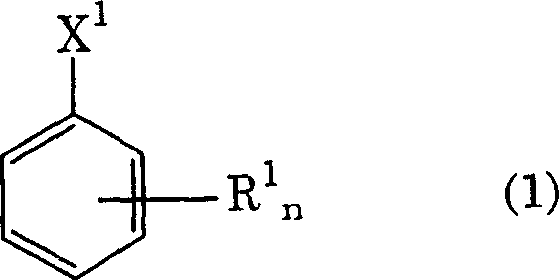
(其中X1表示氢原子、羟基、烷基、芳基、卤原子(包括氟原子)、甲酰基、羧基、硝基、氰基、氨基、羟甲基、氨甲基、氨基甲酰基、磺酸基或卤代羰基(包括氟原子),进一步还表示各自可具有取代基的烷氧基羰基、烷基羰基、芳基羰基、烷氧基或芳氧基;R1表示羧基、卤代羰基(含氟原子)、烷氧基羰基、芳氧基羰基、可有取代基的烷基或可有取代基的芳基;n表示1~5的整数,当n为2~5时,多个R1可以相同或不同;但是R1中的至少一个为烷基。)(Where X1 represents a hydrogen atom, hydroxyl, alkyl, aryl, halogen atom (including fluorine atom), formyl, carboxyl, nitro, cyano, amino, hydroxymethyl, aminomethyl, carbamoyl, sulfo Acid group or halogenated carbonyl (including fluorine atom), further also represents the alkoxycarbonyl, alkylcarbonyl, arylcarbonyl, alkoxyl or aryloxy group that each may have a substituent; R 1 represents carboxyl, halogenated carbonyl (containing a fluorine atom), an alkoxycarbonyl group, an aryloxycarbonyl group, an alkyl group that may have a substituent, or an aryl group that may have a substituent; n represents an integer of 1 to 5, and when n is 2 to 5, multiple R 1 may be the same or different; however at least one of R 1 is alkyl.)
所示的烷基苯衍生物的光卤化反应,卤化上述至少一个烷基,接着在得到的(卤化烷基)苯衍生物中使用HF进行卤素-氟置换反应,制备下述(2)式The photohalogenation reaction of the shown alkylbenzene derivatives, halogenation of at least one of the above-mentioned alkyl groups, and then using HF in the obtained (halogenated alkyl) benzene derivatives to carry out halogen-fluorine displacement reaction to prepare the following (2) formula

(其中X2对应于(1)式的X1,表示氢原子、羟基、氟烷基、芳基、卤原子(含氟原子)、甲酰基、氟羰基、硝基、氰基、氨基、羟基氟甲基、氨基氟甲基、氨基甲酰基、磺酰氟基,进一步还表示各自可被取代的氟烷氧基羰基、氟烷基羰基、芳基羰基、氟烷氧基或芳氧基;R2对应于(1)式的R1表示氟羧酸基、氟烷氧基羰基、芳氧基羰基、可被取代的氟烷基或可被取代的芳基;n和前述同样,当n为2~5时,多个R2可以相同或不同;但是R2中的至少一个为氟烷基。)所示的(氟烷基)苯衍生物的方法,其中,烷基苯衍生物中的3族~12族过渡金属类的原子换算量在500ppm以下,且相对于1摩尔(卤烷基)苯衍生物使用10摩尔以上的HF。(Where X 2 corresponds to X 1 in formula (1), representing a hydrogen atom, hydroxyl group, fluoroalkyl group, aryl group, halogen atom (containing fluorine atom), formyl group, fluorocarbonyl group, nitro group, cyano group, amino group, hydroxyl group Fluoromethyl, aminofluoromethyl, carbamoyl, sulfonyl fluoride, and further represent fluoroalkoxycarbonyl, fluoroalkylcarbonyl, arylcarbonyl, fluoroalkoxy or aryloxy which may be substituted; R 2 corresponds to (1) formula R 1 represents a fluorocarboxylic acid group, a fluoroalkoxycarbonyl group, an aryloxycarbonyl group, a fluoroalkyl group that may be substituted or an aryl group that may be substituted; n is the same as the foregoing, when n When it is 2 to 5, a plurality of R 2 can be the same or different; but at least one of R 2 is a fluoroalkyl group.) The method of (fluoroalkyl) benzene derivatives shown, wherein, in the alkyl benzene derivatives The atomic conversion amount of the group 3-12 transition metals is 500 ppm or less, and 10 moles or more of HF is used with respect to 1 mole of the (haloalkyl)benzene derivative.
具体实施方式Detailed ways
本发明中在第1阶段的侧链卤化反应(氟化除外)中所使用的如结构式(1)所示的烷基苯衍生物是指,具有至少一个可卤化的烷基侧链的化合物,其可以具有多个该烷基侧链以外的取代基。The alkylbenzene derivative shown in structural formula (1) used in the side chain halogenation reaction (except fluorination) in the first stage in the present invention refers to a compound having at least one halogenated alkyl side chain, It may have a plurality of substituents other than the alkyl side chain.
在本发明的制备方法中用作起始原料的烷基苯衍生物如下述式(1)所示。The alkylbenzene derivative used as a starting material in the production method of the present invention is represented by the following formula (1).

式中X1表示氢原子、羟基、烷基、优选碳原子数1~24的烷基、苯基等芳基、卤原子(含氟原子)、甲酰基、羧基、硝基、氨基、羟甲基、氨甲基、氨基甲酰基、磺酸基或卤代羰基(含氟原子)。X1进一步还表示各自可具有取代基的烷氧基羰基、优选(C1-C8烷基)氧基羰基、烷基羰基、优选(C1-C8烷基)羰基、芳基羰基、烷氧基,优选表示(C1-C8烷基)氧基或芳氧基。作为烷基羰基、芳基羰基、烷氧基或芳氧基的取代基,可以列举包括氟的卤素、羟基、烷基和烷氧基。优选X1为羧基、氰基、羟基、甲酰基和氨基。In the formula, X1 represents a hydrogen atom, a hydroxyl group, an alkyl group, an alkyl group with 1 to 24 carbon atoms, an aryl group such as a phenyl group, a halogen atom (containing a fluorine atom), a formyl group, a carboxyl group, a nitro group, an amino group, a methylol group, etc. group, aminomethyl group, carbamoyl group, sulfonic acid group or halogenated carbonyl group (containing fluorine atom). X further also represents an alkoxycarbonyl group which may have a substituent, preferably (C1-C8 alkyl)oxycarbonyl, alkylcarbonyl, preferably (C1-C8 alkyl) carbonyl, arylcarbonyl, alkoxy, Preferably represents (C1-C8 alkyl)oxy or aryloxy. As the substituent of the alkylcarbonyl group, arylcarbonyl group, alkoxy group or aryloxy group, halogen including fluorine, hydroxy group, alkyl group and alkoxy group can be cited. Preferably X 1 is carboxyl, cyano, hydroxy, formyl and amino.
R1表示羧基、卤代羰基(含氟原子)、烷氧基羰基、优选(C1-C8烷基)氧基羰基、芳氧基羰基、可具有取代基的烷基、优选C1-C8烷基、或可具有取代基的芳基。但是R1中的至少一个为烷基。作为烷基或芳基的取代基,可以列举甲基、乙基、丙基、异丙基、苯基和甲基苯基。R1优选甲基、乙基、丙基或异丙基。R 1 represents carboxyl, halogenated carbonyl (containing fluorine atoms), alkoxycarbonyl, preferably (C1-C8 alkyl)oxycarbonyl, aryloxycarbonyl, optionally substituted alkyl, preferably C1-C8 alkyl , or an aryl group which may have a substituent. But at least one of R 1 is an alkyl group. Examples of substituents for the alkyl or aryl group include methyl, ethyl, propyl, isopropyl, phenyl and methylphenyl. R 1 is preferably methyl, ethyl, propyl or isopropyl.
作为该烷基苯衍生物的具体化合物,可以列举4-甲基苯甲醛、4-乙基苯甲醛、2,4-二甲基苯甲醛、2,5-二甲基苯甲醛、3,4-二甲基苯甲醛、3,5-二甲基苯甲醛、2,4,5-三甲基苯甲醛、2,4,6-三甲基苯甲醛、4-异丙基苯甲醛、4-异丁基苯甲醛、4-甲基联苯基甲醛、4-乙基联苯基甲醛、4-正丙基联苯基甲醛、4-正丁基联苯基甲醛、甲基四氢化萘甲醛等烷基苯甲醛类;2-甲基苯甲酸、3-甲基苯甲酸、4-甲基苯甲酸、4-乙基苯甲酸、2,4-二甲基苯甲酸、2,5-二甲基苯甲酸、3,4-二甲基苯甲酸、3,5-二甲基苯甲酸、2,4,5-三甲基苯甲酸、2,4,6-三甲基苯甲酸、4-异丙基苯甲酸、4-异丁基苯甲酸、4-甲基联苯羧酸、4-乙基联苯羧酸、4-正丙基联苯羧酸、4-正丁基联苯羧酸、甲基四氢化萘羧酸等苯羧酸类;该苯羧酸类进行变换得到的酰卤化物类;2,4-二甲基苯酚、2,5-二甲基苯酚、3,4-二甲基苯酚、3,5-二甲基苯酚等烷基苯酚类;3,5-二甲基卤代苯、4-氯-3,5-二甲基苯酚、N,N-二乙基-间甲苯甲酰胺、2,4-二甲基苯磺酸、二(二甲苯基)甲烷等其它的化合物;以及前述化合物的位置异构体等。Specific compounds of the alkylbenzene derivatives include 4-methylbenzaldehyde, 4-ethylbenzaldehyde, 2,4-dimethylbenzaldehyde, 2,5-dimethylbenzaldehyde, 3,4 -Dimethylbenzaldehyde, 3,5-dimethylbenzaldehyde, 2,4,5-trimethylbenzaldehyde, 2,4,6-trimethylbenzaldehyde, 4-isopropylbenzaldehyde, 4 -Isobutylbenzaldehyde, 4-methylbiphenylcarbaldehyde, 4-ethylbiphenylcarbaldehyde, 4-n-propylbiphenylcarbaldehyde, 4-n-butylbiphenylcarbaldehyde, methyltetralin Alkylbenzaldehydes such as formaldehyde; 2-methylbenzoic acid, 3-methylbenzoic acid, 4-methylbenzoic acid, 4-ethylbenzoic acid, 2,4-dimethylbenzoic acid, 2,5- Dimethylbenzoic acid, 3,4-dimethylbenzoic acid, 3,5-dimethylbenzoic acid, 2,4,5-trimethylbenzoic acid, 2,4,6-trimethylbenzoic acid, 4-isopropyl benzoic acid, 4-isobutyl benzoic acid, 4-methyl biphenyl carboxylic acid, 4-ethyl biphenyl carboxylic acid, 4-n-propyl biphenyl carboxylic acid, 4-n-butyl biphenyl carboxylic acid Benzene carboxylic acids such as benzene carboxylic acid and methyl tetrahydronaphthalene carboxylic acid; acid halides obtained by converting the benzene carboxylic acids; 2,4-dimethylphenol, 2,5-dimethylphenol, 3 , 4-dimethylphenol, 3,5-dimethylphenol and other alkylphenols; 3,5-dimethylhalogenated benzene, 4-chloro-3,5-dimethylphenol, N,N- Other compounds such as diethyl-m-toluamide, 2,4-dimethylbenzenesulfonic acid, bis(xylyl)methane; positional isomers of the aforementioned compounds, and the like.
该烷基苯衍生物中所含的3族~12族过渡金属的原子换算总含量(以下称为过渡金属量)在500ppm以下,优选在100ppm以下。特别优选Fe为50ppm以下。当过渡金属量高于500ppm时,在卤化反应中除了希望的侧链卤化以外,容易引起苯环的核卤化等副反应,生成的副产物引起产品中作为杂质的残留卤素类增加。当原料中的过渡金属量超过500ppm时,用蒸馏、或者通过活性炭、硅胶、氧化铝、活性白土、离子交换树脂等的吸附处理,使其减低至500ppm以下。在工业上,过渡金属通常可以在约10ppm以下。The total content in terms of atoms of Group 3 to Group 12 transition metals contained in the alkylbenzene derivative (hereinafter referred to as transition metal content) is 500 ppm or less, preferably 100 ppm or less. Fe is particularly preferably 50 ppm or less. When the amount of transition metal is higher than 500ppm, in addition to the desired side chain halogenation in the halogenation reaction, it is easy to cause side reactions such as nuclear halogenation of the benzene ring, and the generated by-products cause an increase in residual halogens as impurities in the product. When the amount of transition metal in the raw material exceeds 500ppm, it should be reduced to less than 500ppm by distillation or by adsorption treatment of activated carbon, silica gel, alumina, activated clay, ion exchange resin, etc. In industry, transition metals can usually be below about 10 ppm.
在本发明中的侧链卤化中,可以采用作为公知技术的使用氯气、溴气、氯化铁、三氯化磷、五氯化磷、亚硫酰二氯、磺酰氯、氯化铝、氯仿、四氯化碳、四氯化钛、光气、N-氯代琥珀酰亚胺等的方法或在使用氯气、亚硫酰二氯、磺酰氯等的同时使用沸石X、Y、L、β、丝光沸石等沸石类的方法,特别优选光卤化。芳香族化合物的侧链的光卤化是在工业上广泛采用的手段,作为卤素类,可以利用氯、溴、碘等,优选可以比较廉价地获得的氯。卤素类只要是在工业上可获得的,则没有特别的限制,优选其水分含量在100ppm以下的经过干燥的卤素。虽然没有特别的限制,相对于100重量份烷基苯衍生物,卤素类的供应量优选为50~3000重量份,供应速度在0.1g/分钟以上。通常以气体状态在沸腾下(bubbling)将氯供应到反应溶液中,在使用溴、碘时分别以其液体、固体状态供应到反应液中使其反应。反应压力为0.05~0.5MPa,通常在常压下实施反应。卤化反应在50~250℃下,优选在80~200℃下进行,当到达规定温度时供应卤素开始反应。反应时间优选为0.5~24小时。In the side chain halogenation in the present invention, known techniques such as chlorine gas, bromine gas, ferric chloride, phosphorus trichloride, phosphorus pentachloride, thionyl chloride, sulfuryl chloride, aluminum chloride, chloroform, etc. can be used. , carbon tetrachloride, titanium tetrachloride, phosgene, N-chlorosuccinimide, etc., or use zeolite X, Y, L, β together with chlorine gas, thionyl chloride, sulfuryl chloride, etc. , mordenite and other zeolite methods, photohalogenation is particularly preferred. Photohalogenation of side chains of aromatic compounds is a widely used method in industry, and chlorine, bromine, iodine, etc. can be used as halogens, and chlorine, which can be obtained relatively cheaply, is preferable. The halogens are not particularly limited as long as they are industrially available, but dried halogens having a water content of 100 ppm or less are preferred. Although not particularly limited, the supply amount of the halogens is preferably 50 to 3000 parts by weight with respect to 100 parts by weight of the alkylbenzene derivative, and the supply rate is 0.1 g/min or more. Chlorine is usually supplied to the reaction solution under boiling (bubbling) in a gaseous state, and when bromine and iodine are used, they are supplied to the reaction solution in their liquid and solid states, respectively, to be reacted. The reaction pressure is 0.05 to 0.5 MPa, and the reaction is usually carried out under normal pressure. The halogenation reaction is carried out at 50 to 250°C, preferably at 80 to 200°C, and when the predetermined temperature is reached, halogen is supplied to start the reaction. The reaction time is preferably 0.5 to 24 hours.
烷基苯衍生物的侧链的卤化反应在光照射下实施,但是对于光源没有特别的限制,通过将工业上的水银灯或钨灯等作为光源设置在反应器内,可以得到较高的反应活性和对侧链卤化物的选择性。此外使用过氧化苯甲酰、2,2-偶氮二异丁腈等自由基引发剂代替光照射也可以达到提高反应活性的效果。自由基引发剂的用量为少量较好,相对于1重量份作为原料的烷基苯衍生物,使用0.001~0.01重量份即可。这些自由基引发剂即使在光照射下使用也可以没有问题地达到效果。The halogenation reaction of the side chain of the alkylbenzene derivative is carried out under light irradiation, but there is no special limitation on the light source. By setting an industrial mercury lamp or tungsten lamp as a light source in the reactor, a higher reactivity can be obtained. and selectivity for side chain halides. In addition, the use of free radical initiators such as benzoyl peroxide and 2,2-azobisisobutyronitrile instead of light irradiation can also achieve the effect of improving the reaction activity. The usage-amount of a radical initiator is preferably small, and it is enough to use 0.001-0.01 weight part with respect to 1 weight part of the alkylbenzene derivative used as a raw material. These radical initiators can be used without problems even when used under light irradiation.
作为原料的烷基苯衍生物,只要在侧链卤化反应条件下为液体则不一定需要溶剂。为了使原料容易取用,也可以使用溶剂,该卤化反应可以使用惰性的邻二氯苯、氯苯、四氯化碳、苯甲腈等。相对于1重量份的原料烷基苯衍生物,溶剂的用量优选在0.5~100重量份的范围内,更优选在1~50重量份的范围内。The alkylbenzene derivative used as a raw material does not necessarily need a solvent as long as it is liquid under the side chain halogenation reaction conditions. In order to make the raw materials easy to take, a solvent can also be used, and inert o-dichlorobenzene, chlorobenzene, carbon tetrachloride, benzonitrile, etc. can be used for the halogenation reaction. The amount of the solvent used is preferably in the range of 0.5 to 100 parts by weight, more preferably in the range of 1 to 50 parts by weight, based on 1 part by weight of the raw material alkylbenzene derivative.
通过上述作为本发明的第一阶段反应的侧链卤化,得到对应的(卤烷基)苯衍生物。可以列举例如,2-(三卤甲基)苯甲酸、3-(三卤甲基)苯甲酸、4-(三卤甲基)苯甲酸、4-(三卤乙基)苯甲酸、4-(五卤乙基)苯甲酸、2,4-二(三卤甲基)苯甲酸、2,5-二(三卤甲基)苯甲酸、3,4-二(三卤甲基)苯甲酸、3,5-二(三卤甲基)苯甲酸、2,4,5-三(三卤甲基)苯甲酸、2,4,6-三(三卤甲基)苯甲酸、4-(三卤异丙基)苯甲酸、4-(六卤异丙基)苯甲酸、4-(三卤异丁基)苯甲酸、4-(六卤异丁基)苯甲酸、4-(三卤甲基)联苯羧酸、4-(五卤乙基)联苯羧酸、4-(六卤正丙基)联苯羧酸、4-(六卤正丁基)联苯羧酸、(三卤甲基)四氢化萘羧酸等(卤烷基)苯羧酸类;或者这些酸的卤化物类;2,4-二(三卤甲基)苯酚、2,5-二(三卤甲基)苯酚、3,4-二(三卤甲基)苯酚、3,5-二(三卤甲基)苯酚等(卤烷基)苯酚类等。得到的(卤烷基)苯衍生物可以直接用于下一个工序,优选进行公知的蒸馏、结晶析出等精制处理,以尽可能地减少杂质。The corresponding (haloalkyl)benzene derivatives are obtained by the side chain halogenation described above as the first stage reaction of the present invention. Examples include 2-(trihalomethyl)benzoic acid, 3-(trihalomethyl)benzoic acid, 4-(trihalomethyl)benzoic acid, 4-(trihaloethyl)benzoic acid, 4- (Pentahaloethyl)benzoic acid, 2,4-bis(trihalomethyl)benzoic acid, 2,5-bis(trihalomethyl)benzoic acid, 3,4-bis(trihalomethyl)benzoic acid , 3,5-bis(trihalomethyl)benzoic acid, 2,4,5-tri(trihalomethyl)benzoic acid, 2,4,6-tri(trihalomethyl)benzoic acid, 4-( Trihaloisopropyl)benzoic acid, 4-(hexahaloisopropyl)benzoic acid, 4-(trihaloisobutyl)benzoic acid, 4-(hexahaloisobutyl)benzoic acid, 4-(trihaloisobutyl)benzoic acid Methyl) biphenyl carboxylic acid, 4-(pentahaloethyl) biphenyl carboxylic acid, 4-(hexahalo-n-propyl) biphenyl carboxylic acid, 4-(hexahalo-n-butyl) biphenyl carboxylic acid, ( (Haloalkyl)benzenecarboxylic acids such as trihalomethyl)tetralincarboxylic acid; or the halides of these acids; 2,4-bis(trihalomethyl)phenol, 2,5-bis(trihalomethyl)phenol, (haloalkyl)phenols such as methyl)phenol, 3,4-bis(trihalomethyl)phenol, 3,5-bis(trihalomethyl)phenol, and the like. The obtained (haloalkyl)benzene derivative can be directly used in the next step, and is preferably subjected to known purification treatments such as distillation and crystallization to reduce impurities as much as possible.
本发明中的第二阶段反应是第一阶段反应得到的(卤烷基)苯衍生物的卤素-氟置换反应,得到对应的(氟烷基)苯衍生物。该卤素-氟置换反应可以采用例如Adv.Fluorine Chem.,1963,(3)181中记载的公知的方法。The second-stage reaction in the present invention is the halogen-fluorine displacement reaction of the (haloalkyl)benzene derivative obtained in the first-stage reaction to obtain the corresponding (fluoroalkyl)benzene derivative. For this halogen-fluorine substitution reaction, a known method described in Adv. Fluorine Chem., 1963, (3) 181 can be used, for example.
在卤素-氟置换反应中优选使用HF,也可以将ClSO3H、FSO3H、CF3SO3H等哈曼特的酸度函数H0为-10以下的酸类,或者BF3、SbF5、TaF5等路易斯酸和HF同时使用。相对于1摩尔HF,这些酸或路易斯酸使用0.001~0.1摩尔。通常,可以将HF和(卤烷基)苯衍生物一同都填充到耐压反应容器中进行反应,或者以当填充了(卤烷基)苯衍生物的反应容器升温至规定温度的时间点供给HF的方式进行反应。随着反应的进行产生HCl,优选采用通过背压阀排气等手段防止体系内压力的上升。It is preferable to use HF in the halogen-fluorine substitution reaction, but it is also possible to use acids such as ClSO 3 H, FSO 3 H, CF 3 SO 3 H whose acidity function H 0 of Harmant is -10 or less, or BF 3 , SbF 5 , TaF 5 and other Lewis acids and HF are used at the same time. These acids or Lewis acids are used in an amount of 0.001 to 0.1 mol with respect to 1 mol of HF. Usually, both HF and the (haloalkyl)benzene derivative can be filled in a pressure-resistant reaction vessel for the reaction, or can be supplied at a time when the temperature of the reaction vessel filled with the (haloalkyl)benzene derivative is raised to a predetermined temperature. HF way to react. As the reaction proceeds to generate HCl, it is preferable to prevent the pressure in the system from rising by means of exhausting through a back pressure valve.
相对于基准的(卤烷基)苯衍生物,HF使用10~500倍摩尔,优选20~200倍摩尔。当HF少于10倍摩尔时,卤素-氟置换反应不能充分进行,不能以高收率得到所要的(氟烷基)苯衍生物,而且大量的卤化合物在产物中成为杂质残留下来,因此不优选。HF is used at 10 to 500 times mole, preferably 20 to 200 times mole, relative to the standard (haloalkyl)benzene derivative. When HF is less than 10 times the mole, the halogen-fluorine displacement reaction cannot be fully carried out, and the desired (fluoroalkyl) benzene derivative cannot be obtained with a high yield, and a large amount of halogen compounds remain as impurities in the product, so it is not possible preferred.
卤素-氟置换反应在室温附近也可以进行,为了使反应充分进行,优选根据(卤烷基)苯衍生物的种类,在20~400℃的范围内选择适宜的温度。例如对于(卤烷基)苯羧酸类,通常在100℃以上,优选在150~200℃的温度范围内进行0.1~20小时卤素-氟置换反应,此外对于(卤烷基)苯酚类优选在20-100℃的温度、0.1~20小时内进行卤素-氟置换反应。The halogen-fluorine substitution reaction can proceed at around room temperature, but it is preferable to select an appropriate temperature in the range of 20 to 400° C. depending on the type of (haloalkyl)benzene derivative in order to fully proceed the reaction. For example, for (haloalkyl) benzene carboxylic acids, the halogen-fluorine displacement reaction is usually carried out at a temperature above 100°C, preferably at a temperature of 150-200°C for 0.1-20 hours. In addition, for (haloalkyl)phenols, it is preferably The halogen-fluorine displacement reaction is carried out at a temperature of 20-100° C. within 0.1 to 20 hours.
作为通过上述的卤素-氟置换反应得到的(氟烷基)苯衍生物,可以列举例如,2-(三氟甲基)苯甲酸、3-(三氟甲基)苯甲酸、4-(三氟甲基)苯甲酸、4-(三氟乙基)苯甲酸、4-(五氟乙基)苯甲酸、2,4-二(三氟甲基)苯甲酸、2,5-二(三氟甲基)苯甲酸、3,4-二(三氟甲基)苯甲酸、3,5-二(三氟甲基)苯甲酸、2,4,5-三(三氟甲基)苯甲酸、2,4,6-三(三氟甲基)苯甲酸、4-(三氟异丙基)苯甲酸、4-(六氟异丙基)苯甲酸、4-(三氟异丁基)苯甲酸、4-(六氟异丁基)苯甲酸、4-(三氟甲基)联苯羧酸、4-(三氟乙基)联苯羧酸、4-(五氟乙基)联苯羧酸、4-(三氟正丙基)联苯羧酸、4-(六氟正丙基)联苯羧酸、4-(正三氟丁基)联苯羧酸、4-(正六氟丁基)联苯羧酸、(三氟甲基)四氢化萘羧酸等(氟烷基)苯羧酸类、这些酸的氟化物类、2,4-二(三氟甲基)苯酚、2,5-二(三氟甲基)苯酚、3,4-二(三氟甲基)苯酚、3,5-二(三氟甲基)苯酚等(氟烷基)苯酚类等。Examples of (fluoroalkyl)benzene derivatives obtained by the above-mentioned halogen-fluorine substitution reaction include 2-(trifluoromethyl)benzoic acid, 3-(trifluoromethyl)benzoic acid, 4-(trifluoromethyl)benzoic acid, Fluoromethyl)benzoic acid, 4-(trifluoroethyl)benzoic acid, 4-(pentafluoroethyl)benzoic acid, 2,4-bis(trifluoromethyl)benzoic acid, 2,5-bis(trifluoromethyl)benzoic acid Fluoromethyl)benzoic acid, 3,4-bis(trifluoromethyl)benzoic acid, 3,5-bis(trifluoromethyl)benzoic acid, 2,4,5-tris(trifluoromethyl)benzoic acid , 2,4,6-tri(trifluoromethyl)benzoic acid, 4-(trifluoroisopropyl)benzoic acid, 4-(hexafluoroisopropyl)benzoic acid, 4-(trifluoroisobutyl) Benzoic acid, 4-(hexafluoroisobutyl)benzoic acid, 4-(trifluoromethyl)biphenylcarboxylic acid, 4-(trifluoroethyl)biphenylcarboxylic acid, 4-(pentafluoroethyl)biphenylcarboxylic acid Benzenecarboxylic acid, 4-(trifluoro-n-propyl)biphenylcarboxylic acid, 4-(hexafluoro-n-propyl)biphenylcarboxylic acid, 4-(n-trifluorobutyl)biphenylcarboxylic acid, 4-(n-hexafluoro (Fluoroalkyl)benzenecarboxylic acids such as butyl)biphenylcarboxylic acid and (trifluoromethyl)tetralincarboxylic acid, fluorides of these acids, 2,4-bis(trifluoromethyl)phenol, (fluoroalkyl)phenols such as 2,5-bis(trifluoromethyl)phenol, 3,4-bis(trifluoromethyl)phenol, and 3,5-bis(trifluoromethyl)phenol;
依据上述第一和第二阶段的反应条件,在第二阶段中生成的(氟烷基)苯衍生物中卤素杂质(来自于(氟烷基)苯衍生物中的氟以外的卤素)的含量换算为卤原子在1重量%以下,优选在0.5重量%以下,金属杂质的含量换算为金属原子在100ppm以下,优选在50ppm以下。According to the reaction conditions of the first and second stages above, the content of halogen impurities (halogens other than fluorine in the (fluoroalkyl)benzene derivatives) in the (fluoroalkyl)benzene derivatives produced in the second stage The content of halogen atoms is 1% by weight or less, preferably 0.5% by weight or less, and the content of metal impurities is 100 ppm or less, preferably 50 ppm or less in terms of metal atoms.
在前述卤素-氟置换反应中当产物为(氟烷基)苯羧酸氟化物时,卤素-氟置换反应后,除去过量的HF和残留的HCl,然后通过适宜地组合蒸馏、升华、结晶析出等方法,可以进一步减少产物中的杂质。过量的HF和残留的HCl的除去方法没有特别的限制,例如在卤素-氟置换反应器中,在室温下,或通过加热可以馏去过量的HF和残留的HCl。这时若向体系内导入氮气等惰性气体可以促进馏去。该操作压力为常压或减压均可。In the aforementioned halogen-fluorine displacement reaction, when the product is (fluoroalkyl)benzenecarboxylic acid fluoride, after the halogen-fluorine displacement reaction, excess HF and residual HCl are removed, and then through appropriate combination of distillation, sublimation and crystallization Etc. method, can further reduce the impurity in the product. The method for removing excess HF and residual HCl is not particularly limited. For example, excess HF and residual HCl can be distilled off at room temperature or by heating in a halogen-fluorine displacement reactor. At this time, if an inert gas such as nitrogen is introduced into the system, the distillation can be promoted. The operating pressure may be normal pressure or reduced pressure.
此外将反应液供应到有机溶剂回流下的蒸馏塔中,以溶剂蒸气作为热源使HF和HCl气化可以使其和产物气液分离。这时产物移行至蒸馏塔的塔底,成为气体的HF和HCl通过溶剂回流器在下游的冷凝器中被分离,作为液体回收的HF可以再利用。用于该目的的溶剂优选是溶解产物且对反应产物为惰性的烃类,其中优选己烷、苯、甲苯、二甲苯等。操作温度和操作压力可以根据使用的溶剂适宜地决定。In addition, the reaction liquid is supplied to the distillation column under the reflux of the organic solvent, and the vaporization of HF and HCl can be separated from the product gas-liquid by using the solvent vapor as a heat source. At this time, the product moves to the bottom of the distillation tower, and the gaseous HF and HCl are separated in the downstream condenser through the solvent reflux device, and the HF recovered as a liquid can be reused. The solvent used for this purpose is preferably a hydrocarbon which dissolves the product and is inert to the reaction product, among which hexane, benzene, toluene, xylene and the like are preferred. The operating temperature and operating pressure can be appropriately determined according to the solvent used.
作为反应产物的(氟烷基)苯羧酸氟化物在进行了这些操作后,就这样直接地、或进一步经过蒸馏精制,可以得到各种氟烷基化合物。The (fluoroalkyl)benzenecarboxylic acid fluoride which is a reaction product can be obtained as it is directly after these operations or further purified by distillation to obtain various fluoroalkyl compounds.
本发明中所谓的氟烷基化合物是指,例如(氟烷基)苯羧酸、(氟烷基)苯羧酸卤化物、(氟烷基)苯羧酸酯、(氟烷基)苯甲醛、(氟烷基)苯甲腈、(氟烷基)苯羧酰胺等,该氟烷基化合物的精制可以在使馏去卤素-氟置换反应后残留的HF和HCl而得到的(氟烷基)苯衍生物与水、四卤化硅、醇或氨等反应后进行。此外,也可以蒸馏卤素-氟置换反应后的反应混合物,一次性取得精制(氟烷基)苯羧酸氟化物,在变换为该氟烷基化合物后可以进行精制。作为精制操作,通过蒸馏、结晶析出、升华等操作中的任何一种,或者将其适宜地进行组合,可以得到杂质减少的氟烷基化合物。在制备(氟烷基)苯羧酸的情况下,在卤素-氟置换反应结束后,将除去了残留于反应液中的HF和HCl的粗产物、或蒸馏该粗产物得到的精制(氟烷基)苯羧酸氟化物和水反应。该反应即使仅通过和水接触也可以进行,也可以加热。这时,若使用不与水混合、但可以同时溶解(氟烷基)苯羧酸氟化物和反应产物的(氟烷基)苯羧酸的醚类等溶剂,由于容易与水分离所以优选。和水的反应结束后,或者馏去溶剂后,析出的粗(氟烷基)苯羧酸可以通过非极性烃类有机溶剂进行结晶析出而精制。用于结晶析出的溶剂优选戊烷、己烷、庚烷等脂肪烃或苯、甲苯、二甲苯等芳香族烃类。从通用性和容易回收等方面出发,优选己烷、苯、甲苯。这些溶剂可以单独或混合2种以上使用。The so-called fluoroalkyl compounds in the present invention refer to, for example, (fluoroalkyl) benzene carboxylic acid, (fluoroalkyl) benzene carboxylic acid halide, (fluoroalkyl) benzene carboxylate, (fluoroalkyl) benzaldehyde , (fluoroalkyl) benzonitrile, (fluoroalkyl) benzene carboxamide, etc., the purification of the fluoroalkyl compound can be obtained by distilling off the HF and HCl remaining after the halogen-fluorine displacement reaction (fluoroalkyl ) after reacting benzene derivatives with water, silicon tetrahalide, alcohol or ammonia. Alternatively, the reaction mixture after the halogen-fluorine substitution reaction may be distilled to obtain a purified (fluoroalkyl)benzenecarboxylic acid fluoride at one time, which may be purified after conversion to the fluoroalkyl compound. As a purification operation, any one of distillation, crystallization, sublimation, etc., or an appropriate combination thereof can be used to obtain a fluoroalkyl compound with reduced impurities. In the case of producing (fluoroalkyl)benzenecarboxylic acid, after the completion of the halogen-fluorine substitution reaction, the crude product from which HF and HCl remaining in the reaction liquid have been removed, or the refined (fluoroalkyl) obtained by distilling the crude product base) benzenecarboxylic acid fluoride reacts with water. This reaction can be carried out only by contact with water, and heating is also possible. In this case, it is preferable to use a solvent such as an ether of (fluoroalkyl)benzenecarboxylic acid which does not mix with water but can simultaneously dissolve the (fluoroalkyl)benzenecarboxylic acid fluoride and the reaction product, since it is easy to separate from water. After the reaction with water is completed or the solvent is distilled off, the precipitated crude (fluoroalkyl)benzenecarboxylic acid can be purified by crystallization from a non-polar hydrocarbon organic solvent. The solvent used for crystallization is preferably aliphatic hydrocarbons such as pentane, hexane, and heptane, or aromatic hydrocarbons such as benzene, toluene, and xylene. In terms of versatility and easy recovery, hexane, benzene, and toluene are preferred. These solvents can be used individually or in mixture of 2 or more types.
在溶解粗(氟烷基)苯羧酸时,通常在50~200℃的温度范围内进行,从容易操作的角度出发,优选在该溶剂的回流温度下进行。溶剂量可以根据使用溶剂的种类、溶解温度、产物必要的纯度等适宜地决定。一般相对于粗(氟烷基)苯羧酸优选重量比为1~50倍。进行了加热溶解操作的溶液立即趁热过滤除去杂质。除去杂质后,根据需要可以使用活性炭或吸附剂进行脱色处理等。除去杂质后,冷却至室温附近或室温以下析出所要的结晶。结晶的分离可以通过一般所采用过滤,离心分离等固液分离操作而进行。这样得到的结晶本身已经充分减少了杂质,也可以根据需要冲洗结晶。此外,当需要进一步减少杂质时,通过重复进行本操作,可以达到所希望的纯度。通过本发明得到的减少了杂质的(氟烷基)苯羧酸类进一步氢化,可以制备(氟烷基)苄醇类。此外,该苄醇类通过溴化氢等进行羟基置换反应,还可以得到对应的(氟烷基)苄基溴。When dissolving the crude (fluoroalkyl)benzenecarboxylic acid, it is usually carried out at a temperature in the range of 50 to 200° C., and it is preferably carried out at the reflux temperature of the solvent from the viewpoint of easy handling. The amount of solvent can be appropriately determined according to the type of solvent used, the dissolution temperature, the required purity of the product, and the like. Generally, the weight ratio is preferably 1 to 50 times the crude (fluoroalkyl)benzenecarboxylic acid. The solution that has been heated and dissolved is immediately filtered while hot to remove impurities. After removing impurities, decolorization treatment or the like can be performed using activated carbon or an adsorbent as necessary. After removing impurities, cool to around or below room temperature to precipitate the desired crystals. The separation of crystals can be carried out by generally employed solid-liquid separation operations such as filtration and centrifugation. The crystals obtained in this way have been sufficiently reduced in impurities, and the crystals can also be washed if necessary. In addition, when it is necessary to further reduce impurities, the desired purity can be achieved by repeating this operation. The (fluoroalkyl)benzyl alcohols can be prepared by further hydrogenating the (fluoroalkyl)benzene carboxylic acids with reduced impurities obtained in the present invention. In addition, the corresponding (fluoroalkyl)benzyl bromide can also be obtained by subjecting the benzyl alcohols to a hydroxyl substitution reaction with hydrogen bromide or the like.
作为制备(氟烷基)苯羧酸氯化物的方法,可以列举例如,将已说明的卤素-氟置换反应后的(氟烷基)苯羧酸氟化物和四氯化硅反应,或者将前述精制(氟烷基)苯羧酸和磺酰氯或亚硫酰二氯、磷氯化物等反应。特别是由于从羧酸到酰氯的制备比较容易,因此有多种已知的方法。例如可以将精制(氟烷基)苯羧酸溶解于乙腈中,加入过量的亚硫酰二氯,在回流温度下保持几小时后结束反应。通常可以不含催化剂,也可以将氯化锌、吡啶、三乙胺等用作催化剂。除去反应产物中的溶剂和过量的亚硫酰二氯,用蒸馏塔进行蒸馏可以得到高纯度的(氟烷基)苯羧酸酰氯。此外,当需要进一步减少杂质时,可以重复蒸馏,也可以组合分子蒸馏实施蒸馏。As a method for producing (fluoroalkyl)benzenecarboxylic acid chloride, for example, reacting (fluoroalkyl)benzenecarboxylic acid fluoride after the halogen-fluorine displacement reaction described above with silicon tetrachloride, or reacting the aforementioned Refined (fluoroalkyl) benzene carboxylic acid reacts with sulfuryl chloride or thionyl chloride, phosphorus chloride, etc. In particular, since the preparation from carboxylic acids to acid chlorides is relatively easy, various methods are known. For example, the refined (fluoroalkyl)benzenecarboxylic acid can be dissolved in acetonitrile, and excess thionyl chloride can be added, and the reaction can be terminated after being maintained at reflux temperature for several hours. Usually, no catalyst is required, and zinc chloride, pyridine, triethylamine, etc. can also be used as a catalyst. The solvent and excess thionyl chloride in the reaction product are removed, and a distillation tower is used to carry out distillation to obtain high-purity (fluoroalkyl)benzenecarboxylic acid chloride. In addition, when it is necessary to further reduce impurities, distillation can be repeated, and molecular distillation can also be combined to carry out distillation.
在制备(氟烷基)苯甲醛时,使用二甲苯、甲苯等溶剂溶解前述的(氟烷基)苯羧酸氯化物,用氢进行接触还原。该羧酸氯化物的接触还原反应是已知的罗森蒙德法,虽然有时会缺乏可重复性,通过使其与捕捉产生的氯化氢的胺、吡啶或乙酸钠等碱共存,添加喹啉-S(通过喹啉和硫配制),一般都能得到较好的结果。还原所用的催化剂优选钯-碳等。接触还原反应结束后,通过过滤除去包含催化剂的杂质,优选根据需要进行水洗等洗涤操作后进行蒸馏。根据本发明,可以得到减少了杂质的(氟烷基)苯甲醛,当需要进一步减少杂质时,可以重复蒸馏,也可以组合分子蒸馏实施蒸馏。When preparing (fluoroalkyl)benzaldehyde, solvents such as xylene and toluene are used to dissolve the aforementioned (fluoroalkyl)benzenecarboxylic acid chloride, and hydrogen is used for catalytic reduction. The catalytic reduction of carboxylic acid chlorides is known as the Rosenmond method, although sometimes lacking in reproducibility, by making it coexist with a base such as an amine, pyridine, or sodium acetate that captures the hydrogen chloride produced, adding quinoline- S (prepared by quinoline and sulfur), generally can get better results. The catalyst used for the reduction is preferably palladium-carbon or the like. After the catalytic reduction reaction is completed, impurities including the catalyst are removed by filtration, and, if necessary, washing operations such as washing with water are performed, followed by distillation. According to the present invention, the (fluoroalkyl)benzaldehyde with reduced impurities can be obtained, and when the impurities need to be further reduced, the distillation can be repeated, or molecular distillation can be combined for distillation.
在制备(氟烷基)苯羧酸酯的情况下,将卤素-氟置换反应后除去残留的HF和HCl得到粗产物,或者将通过蒸馏该粗产物得到的(氟烷基)苯羧酸氟化物和甲醇或乙醇等醇类反应。本发明为一般公知的由酰卤化物制备酯类的方法,例如可以在过量的甲醇中滴加产物进行反应。这时,优选将通过反应产生的HF在部分冷凝器中回收循环利用,也可以使其与吡啶或三乙胺等碱共存而捕集。该反应可以在室温下进行,通过加热进行升温,在几小时内反应完成。在不能存在碱的情况下,为了除去产生的HF,优选在甲醇的回流温度下进行。从反应液中馏去过量的甲醇,若存在HF或碱等杂质时,通过过滤或水洗等适当的方法除去该杂质后进行蒸馏,可以得到高纯度的(氟烷基)苯羧酸甲酯。此外,当需要进一步减少杂质时,可以重复蒸馏,也可以组合分子蒸馏实施蒸馏。In the case of preparing (fluoroalkyl)benzenecarboxylates, the crude product obtained by removing residual HF and HCl after the halogen-fluorine displacement reaction, or the (fluoroalkyl)benzenecarboxylic acid fluorine obtained by distilling the crude product Compounds react with alcohols such as methanol or ethanol. The present invention is a generally known method for preparing esters from acid halides, for example, the product can be added dropwise to excess methanol for reaction. At this time, it is preferable to recover and recycle HF generated by the reaction in a partial condenser, or it may be collected in the presence of a base such as pyridine or triethylamine. The reaction can be carried out at room temperature, the temperature can be increased by heating, and the reaction is completed within a few hours. In the absence of a base, in order to remove the generated HF, it is preferably carried out at the reflux temperature of methanol. Excess methanol is distilled off from the reaction solution, and if there are impurities such as HF or alkali, the impurities are removed by appropriate methods such as filtration or washing with water, and then distilled to obtain high-purity methyl (fluoroalkyl)benzenecarboxylate. In addition, when it is necessary to further reduce impurities, distillation can be repeated, and molecular distillation can also be combined to carry out distillation.
作为制备(氟烷基)苯羧酸酰胺的方法,可以列举,将卤素-氟置换反应后除去残留的HF和HCl得到粗产物,或者将通过蒸馏该粗产物得到的(氟烷基)苯羧酸氟化物和氨或伯胺、仲胺类反应的方法。本发明也和酯衍生物的制备方法同样地,是一般公知的从酰卤化物制备酰胺类的方法。例如可以向液体氨中滴加(氟烷基)苯羧酸氟化物,在任意的温度下进行反应。这时,为了捕集产生的HF,可以使用过量的氨,优选添加叔胺。在氨或低沸点的胺等蒸气压高的基质的情况下,也可以进行使用氨水溶液和有机溶剂的两相类型的反应,在该体系内HF盐移行至水相,可以减小下一工序中的精制负担。反应结束后,馏去过量的氨等,通过进行水洗操作等除去杂质,然后和(氟烷基)苯羧酸同样地,通过使用己烷等溶剂进行结晶析出,可以得到精制的(氟烷基)苯羧酰胺。此外,当需要进一步减少杂质时,可以重复数次本操作。As a method for preparing (fluoroalkyl)benzenecarboxylic acid amide, it is possible to cite a crude product obtained by removing residual HF and HCl after the halogen-fluorine displacement reaction, or a (fluoroalkyl)benzenecarboxamide obtained by distilling the crude product A method of reacting acid fluoride with ammonia or primary or secondary amines. The present invention is also a generally known method for producing amides from acid halides, similarly to the method for producing ester derivatives. For example, (fluoroalkyl)benzenecarboxylic acid fluoride can be added dropwise to liquid ammonia, and the reaction can be carried out at any temperature. At this time, in order to trap generated HF, excess ammonia may be used, and it is preferable to add a tertiary amine. In the case of a substrate with a high vapor pressure such as ammonia or a low-boiling amine, a two-phase type reaction using an ammonia solution and an organic solvent can also be performed. In this system, the HF salt migrates to the water phase, and the next step can be reduced. Refining burden in . After completion of the reaction, excess ammonia and the like are distilled off, impurities are removed by washing with water, and then, in the same manner as (fluoroalkyl)benzenecarboxylic acid, by crystallization using a solvent such as hexane, purified (fluoroalkyl)benzene can be obtained. ) Benzenecarboxamide. In addition, this operation can be repeated several times when it is necessary to further reduce impurities.
前述的(氟烷基)苯羧酰胺通过脱水剂的脱水反应,可以转化为(氟烷基)苄腈。该反应是已知的从伯酰胺制备腈的反应,可以使用五氧化磷、五氯化磷、亚硫酰二氯等脱水剂。此外,在原料中使用甲磺酰胺、五氯化磷、对甲苯磺酰胺、脲或H3PO4等催化剂,使前述的(氟烷基)苯羧酸在氨的存在下进行脱水反应也同样地可以进行制备。得到的反应产物在馏去溶剂或氨后蒸馏,可以得到高纯度的(氟烷基)苄腈。此外,当需要进一步减少杂质时,可以重复蒸馏,也可以组合分子蒸馏实施蒸馏。The aforementioned (fluoroalkyl)benzenecarboxamide can be converted into (fluoroalkyl)benzonitrile by dehydration reaction with a dehydrating agent. This reaction is a known reaction for preparing nitriles from primary amides, and dehydrating agents such as phosphorus pentoxide, phosphorus pentachloride, and thionyl chloride can be used. In addition, the dehydration reaction of the aforementioned (fluoroalkyl)benzenecarboxylic acid in the presence of ammonia using a catalyst such as methanesulfonamide, phosphorus pentachloride, p-toluenesulfonamide, urea, or H3PO4 as a raw material is also the same. can be prepared. The obtained reaction product is distilled off after distilling off the solvent and ammonia to obtain highly pure (fluoroalkyl)benzonitrile. In addition, when it is necessary to further reduce impurities, distillation can be repeated, and molecular distillation can also be combined to carry out distillation.
如上所述根据本发明,即使基于简便但存在残留卤素等杂质的问题的光卤化法,以及卤素-氟置换法,也可以减小作为产物的(氟烷基)苯衍生物中的残留卤素量或残留金属量,可以制备出作为医药和电子材料用途等的功能化学品中间体有用的高纯度的氟烷基化合物。As described above, according to the present invention, the amount of residual halogen in the (fluoroalkyl)benzene derivative as a product can be reduced even by the photohalogenation method which is simple but has the problem of remaining impurities such as halogen, and the halogen-fluorine substitution method High-purity fluoroalkyl compounds that are useful as functional chemical intermediates for pharmaceutical and electronic material applications can be produced.
下面通过实施例、参考例和比较例对本发明进行具体说明,但是本发明并不受到以下实施例的限定。The present invention will be specifically described below through examples, reference examples and comparative examples, but the present invention is not limited by the following examples.
参考例3,5-二甲基苯甲酰氯的制备Reference example 3, the preparation of 5-dimethylbenzoyl chloride
A方法A method
向具有氮气导入口和冷却回流管的1L的3口烧瓶中,加入300g(2mol)3,5-二甲基苯甲酸、391g(2mol)(三氯甲基)苯、0.28g(0.0017mol)作为催化剂的氯化铁(III)。在氮气气流下在搅拌的同时升温至60℃,保持30分钟。进一步在130℃下进行130分钟的反应。在反应时,产生的氯化氢用碱水溶液洗涤,收集。通过气相色谱分析反应液,结果生成324g(1.92mol)所要的3,5-二甲基苯甲酰氯(收率96%)。进一步通过减压蒸馏分离出292.7g(1.74mol)的3,5-二甲基苯甲酰氯(收率87%)。In a 1L 3-neck flask with a nitrogen inlet and a cooling reflux tube, add 300g (2mol) 3,5-dimethylbenzoic acid, 391g (2mol) (trichloromethyl)benzene, 0.28g (0.0017mol) Iron(III) chloride as catalyst. The temperature was raised to 60° C. with stirring under nitrogen flow and held for 30 minutes. Furthermore, reaction was performed at 130 degreeC for 130 minutes. During the reaction, the hydrogen chloride produced was washed with an aqueous alkali solution and collected. When the reaction solution was analyzed by gas chromatography, 324 g (1.92 mol) of the desired 3,5-dimethylbenzoyl chloride was produced (yield 96%). Further, 292.7 g (1.74 mol) of 3,5-dimethylbenzoyl chloride was isolated by distillation under reduced pressure (87% yield).
B方法Method B
使用和A方法同样的装置,加入300g(2mol)3,5-二甲基苯甲酸、357.2g(3mol)亚硫酰二氯,在氮气气流下在搅拌的同时升温至80℃,在回流下反应3小时。在反应时,产生的二氧化硫和氯化氢用碱水溶液洗涤,收集。分析反应液的结果是,生成310g(1.84mol)所要的3,5-二甲基苯甲酰氯(收率92%)。进一步通过减压蒸馏分离出287g(1.7mol)的3,5-二甲基苯甲酰氯(收率85%)。Using the same device as method A, add 300g (2mol) 3,5-dimethylbenzoic acid, 357.2g (3mol) thionyl dichloride, and raise the temperature to 80°C while stirring under a nitrogen stream. React for 3 hours. During the reaction, the sulfur dioxide and hydrogen chloride produced were washed with an aqueous alkali solution and collected. As a result of analyzing the reaction liquid, 310 g (1.84 mol) of desired 3,5-dimethylbenzoyl chloride was produced (yield 92%). Further, 287 g (1.7 mol) of 3,5-dimethylbenzoyl chloride was isolated by distillation under reduced pressure (85% yield).
C方法C method
向装有气体吹入管、冷却回流管和搅拌机的2L的3口烧瓶中,加入269.7g(2mol)3,5-二甲基苯甲醛、800g邻二氯苯,一边导入氮气一边调整体系内的温度至5℃。然后在氮气中反应液沸腾1小时后,停止氮气的供应,开始供应氯。在供应氯的同时,用水银灯照射6小时,完成光氯化反应。通过气相色谱进行定量分析的结果为,生成1.4mol 3,5-二甲基苯甲酰氯(收率70%)。通过进一步减压蒸馏分离出236g(1.4mol)3,5-二甲基苯甲酰氯(收率68%)。通过ICP进行全元素分析的结果是,3至12族的金属原子的合计残留量为500ppm以下,最多的Fe为10ppm,其次的Zn为30ppm。In a 2L 3-neck flask equipped with a gas blowing tube, a cooling reflux tube and a stirrer, add 269.7g (2mol) 3,5-dimethylbenzaldehyde, 800g o-dichlorobenzene, and adjust the temperature in the system while introducing nitrogen. temperature to 5°C. Then, after the reaction solution was boiled in nitrogen for 1 hour, the supply of nitrogen was stopped, and the supply of chlorine was started. While supplying chlorine, irradiate with a mercury lamp for 6 hours to complete the photochlorination reaction. As a result of quantitative analysis by gas chromatography, 1.4 mol of 3,5-dimethylbenzoyl chloride was produced (yield 70%). 236 g (1.4 mol) of 3,5-dimethylbenzoyl chloride were isolated by further distillation under reduced pressure (68% yield). As a result of all elemental analysis by ICP, the total remaining amount of metal atoms of Groups 3 to 12 was 500 ppm or less, with Fe being the most abundant at 10 ppm and Zn next at 30 ppm.
实施例1Example 1
3,5-二(三氟甲基)苯甲酸的制备Preparation of 3,5-bis(trifluoromethyl)benzoic acid
(1)3,5-二(三氯甲基)苯甲酰氯的制备(1) 3, the preparation of 5-bis (trichloromethyl) benzoyl chloride
向装有高压水银灯装入管、氯气通入管、冷却回流管的500mL的四口烧瓶中,加入250g通过参考例中记载的A方法得到的3,5-二甲基苯甲酰氯,在氮气流通下升温。当内温达到140℃时,将氮气更换为氯气,同时进行水银灯的照射,开始侧链甲基的光氯化反应。每隔一定时间用气相色谱分析反应液,继续反应直至只有3,5-二(三氯甲基)苯甲酰氯的峰出现。光氯化反应需要的时间为22小时,其间供应729.1g(理论量的1.2倍摩尔)氯。3,5-二甲基苯甲酰氯的转化率为100%,3,5-二(三氯甲基)苯甲酰氯的收率为95%。In a 500mL four-necked flask equipped with a high-pressure mercury lamp filling tube, a chlorine gas inlet tube, and a cooling reflux tube, add 250 g of 3,5-dimethylbenzoyl chloride obtained by the A method recorded in the reference example, and circulate it under nitrogen. heat up. When the internal temperature reached 140° C., the nitrogen gas was replaced with chlorine gas, and at the same time, the mercury lamp was irradiated to start the photochlorination reaction of the side chain methyl group. The reaction solution was analyzed by gas chromatography at regular intervals, and the reaction was continued until only the peak of 3,5-bis(trichloromethyl)benzoyl chloride appeared. The time required for the photochlorination reaction was 22 hours, during which 729.1 g (1.2 times the mole of the theoretical amount) of chlorine was supplied. The conversion rate of 3,5-dimethylbenzoyl chloride was 100%, and the yield of 3,5-bis(trichloromethyl)benzoyl chloride was 95%.
进一步进行蒸馏,得到主馏分为146~147℃/3mmHg的517.5g的3,5-二(三氯甲基)苯甲酰氯(收率93%)。从ICP分析的结果可以看出,蒸馏精制的3,5-二(三氯甲基)苯甲酰氯中Ti、Zr、V、Nb、Cr、Mo、W、Mn、Fe、Ru、Co、Rh、Ni分别为10ppm以下。Further distillation was carried out to obtain 517.5 g of 3,5-bis(trichloromethyl)benzoyl chloride (yield 93%) whose main fraction was 146-147° C./3 mmHg. As can be seen from the results of the ICP analysis, Ti, Zr, V, Nb, Cr, Mo, W, Mn, Fe, Ru, Co, Rh and Ni are respectively 10 ppm or less.
(2)3,5-二(三氟甲基)苯酰氟的制备(2) Preparation of 3,5-bis(trifluoromethyl)benzoyl fluoride
向装有冷却回流管的300ml的哈斯特洛伊蚀镍基耐蚀耐热合金C制的高压釜中,加入50g(0.133mol)上述制得的3,5-二(三氯甲基)苯甲酰氯。用氮气置换反应器内部后,加入80g(4mol)无水氟化氢(HF),在搅拌下使内含物升温至150℃。然后保持13小时进行反应。随着反应的进行产生氯化氢,因为使高压釜的内压上升至HF蒸气压以上,所以通过冷却回流管下游测的阀洗涤产生的氯化氢,使内压保持在3MPa。当达到几乎看不到压力上升的阶段时,冷却高压釜完成反应。In the autoclave made of Hastelloy corrosion-resistant nickel-based heat-resistant alloy C of 300ml that cooling reflux tube is housed, add 50g (0.133mol) above-mentioned 3,5-bis(trichloromethyl)benzene acid chloride. After replacing the inside of the reactor with nitrogen, 80 g (4 mol) of anhydrous hydrogen fluoride (HF) was added, and the temperature of the contents was raised to 150° C. while stirring. The reaction was then maintained for 13 hours. Hydrogen chloride is produced along with the progress of the reaction, because the internal pressure of the autoclave is raised above the HF vapor pressure, so the hydrogen chloride produced is washed by cooling the valve downstream of the reflux pipe to keep the internal pressure at 3MPa. When a stage was reached where little pressure rise was seen, the autoclave was cooled to complete the reaction.
在减压下吸引除去未反应的氟化氢和残留的氯化氢,将高压釜中的反应液移送至在氮气氛围下的密闭容器中。对该反应生成液进行部分取样,通过气相色谱分析的结果可以看到,生成0.11mol的目标产物、即氯完全被氟取代的3,5-二(三氟甲基)苯酰氟(收率为83%)。此外根据气相色谱显示的纯度为99.8%,由此可以推定残留氯的量为1wt%以下。Unreacted hydrogen fluoride and residual hydrogen chloride were removed by suction under reduced pressure, and the reaction liquid in the autoclave was transferred to a closed container under a nitrogen atmosphere. Partial sampling is carried out to this reaction product liquid, can see by the result of gas chromatographic analysis, generate the target product of 0.11mol, i.e. 3, the 5-two (trifluoromethyl) benzoyl fluoride that chlorine is replaced by fluorine completely (yield was 83%). In addition, the purity shown by gas chromatography was 99.8%, so the amount of residual chlorine was estimated to be 1 wt% or less.
(3)3,5-二(三氟甲基)苯甲酸的制备(3) 3, the preparation of 5-two (trifluoromethyl) benzoic acid
将上述得到的粗3,5-二(三氟甲基)苯酰氟直接加入到100g乙醚和100g冰水的混合溶剂中。这时,伴随着发热3,5-二(三氟甲基)苯酰氟慢慢水解为3,5-二(三氟甲基)苯甲酸。然后减压馏去溶剂乙醚,得到0.11mol粗3,5-二(三氟甲基)苯甲酸。然后将粗3,5-二(三氟甲基)苯甲酸在己烷回流温度下溶解,趁热过滤。在0℃下结晶析出。通过结晶析出得到的3,5-二(三氟甲基)苯甲酸为针状的结晶,产量为0.094mol(回收率为85%)。The crude 3,5-bis(trifluoromethyl)benzoyl fluoride obtained above was directly added into a mixed solvent of 100 g of diethyl ether and 100 g of ice water. At this time, 3,5-bis(trifluoromethyl)benzoyl fluoride was gradually hydrolyzed to 3,5-bis(trifluoromethyl)benzoic acid accompanied by heat generation. Then, diethyl ether was distilled off under reduced pressure to obtain 0.11 mol of crude 3,5-bis(trifluoromethyl)benzoic acid. The crude 3,5-bis(trifluoromethyl)benzoic acid was then dissolved in hexane at reflux temperature and filtered while hot. Crystallization occurs at 0°C. The 3,5-bis(trifluoromethyl)benzoic acid obtained by crystallization was needle-like crystals, and the yield was 0.094 mol (85% recovery).
由气相色谱显示得到的结晶的纯度为99.9%以上,通过氢氧火焰燃烧装置对结晶中残留的作为杂质的全部氯的量进行定量的结果为500ppm。然后溶解于乙醚后,用水萃取求出的离子性氯的量为50ppm。进一步通过ICP的全元素分析,没有检测到任何的Li、Na、K、Mg、Ca、Sr、Ba、Sc、Y、Ti、Zr、V、Nb、Cr、Mo、W、Mn、Fe、Ru、Co、Rh、Ni、Pd、Pt、Cu、Ag、Au、Zn、Cd、Al、In、Si、Sn、Pb、P、Sb、S。在ICP装置的全元素分析中的检测下限为,对于In、Sb为100ppm,对于Li、K、Pt、Pb、P为50ppm、对于Ti、W、Mo、Al为20ppm,其余的元素为1至10ppm。进一步对于1族和2族的元素,提高精度后通过ICP装置进行定量分析,任何一种都在10ppm以下。The purity of the obtained crystals was shown by gas chromatography to be 99.9% or more, and the amount of total chlorine remaining in the crystals as an impurity was quantified by an oxyhydrogen flame combustion device, and the result was 500 ppm. Then, after dissolving in diethyl ether, the amount of ionic chlorine obtained by extraction with water was 50 ppm. Further through the full element analysis of ICP, no Li, Na, K, Mg, Ca, Sr, Ba, Sc, Y, Ti, Zr, V, Nb, Cr, Mo, W, Mn, Fe, Ru were detected , Co, Rh, Ni, Pd, Pt, Cu, Ag, Au, Zn, Cd, Al, In, Si, Sn, Pb, P, Sb, S. The lower limit of detection in the full elemental analysis of the ICP device is 100ppm for In and Sb, 50ppm for Li, K, Pt, Pb, P, 20ppm for Ti, W, Mo, Al, and 1 to 1 for the rest of the elements. 10ppm. Further, for the elements of group 1 and group 2, the quantitative analysis is carried out by the ICP device after improving the accuracy, and any of them is below 10ppm.
实施例2Example 2
3,5-二(三氟甲基)苯甲酸的制备Preparation of 3,5-bis(trifluoromethyl)benzoic acid
基于实施例1,通过HF进行的卤素-氟置换反应完成后,得到28g的3,5-二(三氟甲基)苯酰氟,对其进行蒸馏,得到22.5g在78-83℃/50mmHg的馏分。使用该馏分,除了进行下述的操作以外,其余按照同样的方法得到20g(0.08mol)3,5-二(三氟甲基)苯甲酸的针状结晶。Based on Example 1, after the completion of the halogen-fluorine displacement reaction by HF, 28 g of 3,5-bis(trifluoromethyl)benzoyl fluoride was obtained, which was distilled to obtain 22.5 g of fractions. Using this fraction, 20 g (0.08 mol) of needle crystals of 3,5-bis(trifluoromethyl)benzoic acid were obtained in the same manner except that the following operations were carried out.
由气相色谱显示产物的纯度为99.9%以上,残留的作为杂质的全部氯的量为50ppm。通过ICP的全元素分析,没有检测到残留元素Li、Na、K、Mg、Ca、Sr、Ba、Sc、Y、Ti、Zr、V、Nb、Cr、Mo、W、Mn、Fe、Ru、Co、Rh、Ni、Pd、Pt、Cu、Ag、Au、Zn、Cd、Al、In、Si、Sn、Pb、P、Sb、S。此外1族和2族元素通过ICP定量分析,任何一种都在10ppm以下。The purity of the product was shown by gas chromatography to be 99.9% or more, and the amount of residual total chlorine as an impurity was 50 ppm. Through the full element analysis of ICP, no residual elements Li, Na, K, Mg, Ca, Sr, Ba, Sc, Y, Ti, Zr, V, Nb, Cr, Mo, W, Mn, Fe, Ru, Co, Rh, Ni, Pd, Pt, Cu, Ag, Au, Zn, Cd, Al, In, Si, Sn, Pb, P, Sb, S. In addition, group 1 and group 2 elements were quantitatively analyzed by ICP, and any of them was below 10 ppm.
实施例3Example 3
3,5-二(三氟甲基)苯甲酰氯的制备Preparation of 3,5-bis(trifluoromethyl)benzoyl chloride
进行与实施例1同样的操作,通过HF进行的卤素-氟置换反应完成后,得到280g的3,5-二(三氟甲基)苯酰氟,对其进行蒸馏,得到225g在78-83℃/50mmHg的馏分。向该馏分中添加5g氯化铝,保持在40℃。然后用2小时滴加49g四氯化硅后,进一步进行2小时的反应。加入分子筛过滤反应混合物,供应到苯回流的蒸馏柱内,除去低沸点成分。过滤柱的下部液体,进一步在减压下在11mmHg进行蒸馏,得到156g从69至70℃的馏分。通过对产物进行NMR分析等,可以看到其为所要的3,5-二(三氟甲基)苯甲酰氯。由气相色谱显示产物的纯度为99.9%以上,通过ICP的全元素分析,没有检测到残留元素Li、Na、K、Mg、Ca、Sr、Ba、Sc、Y、Ti、Zr、V、Nb、Cr、Mo、W、Mn、Fe、Ru、Co、Rh、Ni、Pd、Pt、Cu、Ag、Au、Zn、Cd、Al、In、Si、Sn、Pb、P、Sb、S,1族和2族元素中的任何一种都在1ppm以下。Carry out the same operation as Example 1, after the halogen-fluorine displacement reaction carried out by HF is completed, obtain 280g of 3,5-bis(trifluoromethyl)benzoyl fluoride, it is distilled to obtain 225g at 78-83 ℃/50mmHg fraction. To this fraction was added 5 g of aluminum chloride, kept at 40°C. Then, 49 g of silicon tetrachloride was dripped over 2 hours, and reaction was further performed for 2 hours. Molecular sieves were added to filter the reaction mixture, and it was supplied to a distillation column in which benzene was refluxed to remove low boiling point components. The lower liquid of the column was filtered and further distilled at 11 mmHg under reduced pressure to obtain 156 g of fractions from 69 to 70°C. The product was found to be the desired 3,5-bis(trifluoromethyl)benzoyl chloride by NMR analysis or the like. The purity of the product is shown by gas chromatography to be over 99.9%, and through the full elemental analysis of ICP, no residual elements Li, Na, K, Mg, Ca, Sr, Ba, Sc, Y, Ti, Zr, V, Nb, Cr, Mo, W, Mn, Fe, Ru, Co, Rh, Ni, Pd, Pt, Cu, Ag, Au, Zn, Cd, Al, In, Si, Sn, Pb, P, Sb, S, group 1 and any of the group 2 elements are below 1ppm.
实施例4Example 4
3,5-二(三氟甲基)苯甲酸甲酯的制备Preparation of 3,5-bis(trifluoromethyl)benzoic acid methyl ester
进行与实施例2同样的操作,通过HF进行的卤素-氟置换反应完成后,得到13.8g(0.053mol)的3,5-二(三氟甲基)苯酰氟,将其用60分钟滴加到25.9g(0.8mol)甲醇中,在40℃下反应4小时。通过气相色谱分析,得到14.2g(0.052mol)作为目标产物的3,5-二(三氟甲基)苯甲酸甲酯(收率98%,选择率100%)。进一步通过减压蒸馏,分离出13.9g(0.05mol)的3,5-二(三氟甲基)苯甲酸甲酯(收率96%)。由气相色谱显示其纯度为99%以上,通过ICP的全元素分析,没有检测到Li、Na、K、Mg、Ca、Sr、Ba、Sc、Y、Ti、Zr、V、Nb、Cr、Mo、W、Mn、Fe、Ru、Co、Rh、Ni、Pd、Pt、Cu、Ag、Au、Zn、Cd、Al、In、Si、Sn、Pb、P、Sb、S,1族和2族元素中的任何一种都在1ppm以下。Carry out the same operation as Example 2, after the halogen-fluorine displacement reaction carried out by HF is completed, obtain 13.8g (0.053mol) of 3,5-bis(trifluoromethyl)benzoyl fluoride, which is dripped over 60 minutes Add it to 25.9 g (0.8 mol) of methanol, and react at 40° C. for 4 hours. Gas chromatography analysis gave 14.2 g (0.052 mol) of methyl 3,5-bis(trifluoromethyl)benzoate as the target product (98% yield, 100% selectivity). Further, 13.9 g (0.05 mol) of methyl 3,5-bis(trifluoromethyl)benzoate was isolated by distillation under reduced pressure (96% yield). Its purity is more than 99% as shown by gas chromatography, and Li, Na, K, Mg, Ca, Sr, Ba, Sc, Y, Ti, Zr, V, Nb, Cr, and Mo were not detected by ICP all-element analysis , W, Mn, Fe, Ru, Co, Rh, Ni, Pd, Pt, Cu, Ag, Au, Zn, Cd, Al, In, Si, Sn, Pb, P, Sb, S, group 1 and group 2 Any of the elements are below 1ppm.
实施例5Example 5
3,5-二(三氟甲基)苯甲醛的制备Preparation of 3,5-bis(trifluoromethyl)benzaldehyde
向1L的高压釜中,加入100g(0.36mol)通过和实施例3同样的方法得到的3,5-二(三氟甲基)苯甲酰氯、350g干燥的甲苯、90g(1.08mol)无水的乙酸钠、10.9g 10%钯-碳。向其中加入21.7g喹啉(0.17mol)、3.6g硫(0.11mol),加热回流5小时后,加入用干燥二甲苯稀释至250ml的喹啉-S。高压釜内减压后,导入氢使压力为1MPa。逐次地补充氢同时保持压力在1MPa,在室温下搅拌1小时。使温度为50℃,进一步搅拌2小时后,使温度降到室温,搅拌24小时完成反应。使压力降到常压,过滤反应液,用甲苯洗涤。进一步依序用5%碳酸钠水溶液和水洗涤该溶液,用无水硫酸钠干燥。过滤除去无水硫酸钠后,馏去甲苯,通过气相色谱分析。In a 1L autoclave, add 100g (0.36mol) of 3,5-bis(trifluoromethyl)benzoyl chloride obtained by the same method as in Example 3, 350g of dry toluene, 90g (1.08mol) of anhydrous Sodium acetate, 10.9g 10% palladium-carbon. 21.7 g of quinoline (0.17 mol) and 3.6 g of sulfur (0.11 mol) were added thereto, and after heating to reflux for 5 hours, quinoline-S diluted to 250 ml with dry xylene was added. After the inside of the autoclave was depressurized, hydrogen was introduced to adjust the pressure to 1 MPa. Supplement hydrogen successively while maintaining the pressure at 1 MPa, and stir at room temperature for 1 hour. After the temperature was adjusted to 50° C. and further stirred for 2 hours, the temperature was lowered to room temperature and stirred for 24 hours to complete the reaction. The pressure was reduced to normal pressure, and the reaction solution was filtered and washed with toluene. The solution was further washed sequentially with a 5% aqueous sodium carbonate solution and water, and dried over anhydrous sodium sulfate. After removing anhydrous sodium sulfate by filtration, toluene was distilled off and analyzed by gas chromatography.
其结果是生成65.4g(0.27mol)作为目标产物的3,5-二(三氟甲基)苯甲醛(收率76%),进一步通过减压蒸馏,分离出63.0g(0.27mol)的3,5-二(三氟甲基)苯甲醛(收率72%)。由气相色谱显示其纯度为99%以上,通过ICP的全元素分析,没有检测到Li、Na、K、Mg、Ca、Sr、Ba、Sc、Y、Ti、Zr、V、Nb、Cr、Mo、W、Mn、Fe、Ru、Co、Rh、Ni、Pd、Pt、Cu、Ag、Au、Zn、Cd、Al、In、Si、Sn、Pb、P、Sb、S,1族和2族元素中的任何一种都在1ppm以下。As a result, 65.4 g (0.27 mol) of 3,5-bis(trifluoromethyl)benzaldehyde (yield 76%) was generated as the target product, and 63.0 g (0.27 mol) of 3 was isolated by distillation under reduced pressure. , 5-bis(trifluoromethyl)benzaldehyde (72% yield). Its purity is more than 99% as shown by gas chromatography, and Li, Na, K, Mg, Ca, Sr, Ba, Sc, Y, Ti, Zr, V, Nb, Cr, and Mo were not detected by ICP all-element analysis , W, Mn, Fe, Ru, Co, Rh, Ni, Pd, Pt, Cu, Ag, Au, Zn, Cd, Al, In, Si, Sn, Pb, P, Sb, S, group 1 and group 2 Any of the elements are below 1ppm.
实施例6Example 6
3,5-二(三氟甲基)苯酚的制备Preparation of 3,5-bis(trifluoromethyl)phenol
(1)3,5-二(三氟甲基)苯乙酮的制备(1) 3, the preparation of 5-two (trifluoromethyl) acetophenone
加入9.0g(0.0345mol)通过和实施例2同样的方法得到的3,5-二(三氟甲基)苯酰氟,16mL HMPA,在室温下搅拌30分钟。进一步加入5ml(0.0361mol)四甲基锡和钯-膦催化剂;14mg(0.018mol)PhCH2Pd(PPh3)2Cl,升温至65℃。然后搅拌1小时后,冷却至室温,加入20mL水,分离有机层。用10mL乙醚萃取水层后合并有机溶剂,用20mL水洗涤四次。用硫酸镁干燥该有机层后,通过气相色谱分析的结果看到,生成7.25g(0.0283mol)作为目标产物的3,5-二(三氟甲基)苯乙酮(收率82%)。进一步通过减压蒸馏,分离出3,5-二(三氟甲基)苯乙酮(收率77%)。9.0 g (0.0345 mol) of 3,5-bis(trifluoromethyl)benzoyl fluoride obtained by the same method as in Example 2 and 16 mL of HMPA were added, and stirred at room temperature for 30 minutes. 5ml (0.0361mol) of tetramethyltin and palladium-phosphine catalyst; 14mg (0.018mol) of PhCH 2 Pd(PPh 3 ) 2 Cl were further added, and the temperature was raised to 65°C. After stirring for 1 hour, it was cooled to room temperature, 20 mL of water was added, and the organic layer was separated. The aqueous layer was extracted with 10 mL of ether, and the organic solvents were combined and washed four times with 20 mL of water. After drying the organic layer with magnesium sulfate, gas chromatographic analysis revealed that 7.25 g (0.0283 mol) of 3,5-bis(trifluoromethyl)acetophenone (yield 82%) was produced as the target product. Further, 3,5-bis(trifluoromethyl)acetophenone was isolated by distillation under reduced pressure (yield 77%).
(2)3,5-二(三氟甲基)苯酚的制备(2) 3, the preparation of 5-two (trifluoromethyl) phenol
加入100g(0.39mol)通过上述反应得到的3,5-二(三氟甲基)苯乙酮、155.2g(0.74mol)三氟乙酸酐、400mL氯仿,在氮气下在0℃下搅拌。进一步用30分钟滴加滴液漏斗中的19.7g(0.52mol)90%双氧水,搅拌1小时后,升温到70℃反应5小时。反应结束后温度回到室温,将反应液移送至放入了饱和食盐水的分液漏斗中水洗,然后分离有机层。通过气相色谱分析该有机层,显示生成了57.5g(0.25mol)作为目标产物的3,5-二(三氟甲基)苯酚(收率67%)。进一步通过减压蒸馏,分离出53.3g(0.23mol)的3,5-二(三氟甲基)苯酚(收率63%)。通过气相色谱显示其纯度为99%以上,通过ICP的全元素分析,没有检测到残留元素Li、Na、K、Mg、Ca、Sr、Ba、Sc、Y、Ti、Zr、V、Nb、Cr、Mo、W、Mn、Fe、Ru、Co、Rh、Ni、Pd、Pt、Cu、Ag、Au、Zn、Cd、Al、In、Si、Sn、Pb、P、Sb、S,1族和2族元素中的任何一种也都在1ppm以下。100 g (0.39 mol) of 3,5-bis(trifluoromethyl)acetophenone obtained by the above reaction, 155.2 g (0.74 mol) of trifluoroacetic anhydride, and 400 mL of chloroform were added, and stirred at 0° C. under nitrogen. Further, 19.7 g (0.52 mol) of 90% hydrogen peroxide in the dropping funnel was added dropwise over 30 minutes, and after stirring for 1 hour, the temperature was raised to 70° C. for 5 hours of reaction. After the reaction was completed, the temperature returned to room temperature, and the reaction solution was transferred to a separatory funnel filled with saturated saline for water washing, and then the organic layer was separated. Analysis of the organic layer by gas chromatography revealed that 57.5 g (0.25 mol) of 3,5-bis(trifluoromethyl)phenol was produced as the target product (yield 67%). Further, 53.3 g (0.23 mol) of 3,5-bis(trifluoromethyl)phenol was isolated by vacuum distillation (63% yield). Its purity is above 99% as shown by gas chromatography, and no residual elements Li, Na, K, Mg, Ca, Sr, Ba, Sc, Y, Ti, Zr, V, Nb, Cr were detected by ICP full element analysis , Mo, W, Mn, Fe, Ru, Co, Rh, Ni, Pd, Pt, Cu, Ag, Au, Zn, Cd, Al, In, Si, Sn, Pb, P, Sb, S, Group 1 and Any of the Group 2 elements are also below 1 ppm.
实施例7Example 7
3,5-二(三氟甲基)苯甲酰胺的制备Preparation of 3,5-bis(trifluoromethyl)benzamide
在装有65.5ml(3.8mol)冰冷却的氨水和300g甲苯的3口烧瓶中,用1小时滴加100g(0.38mol)通过和实施例2同样的方法得到的3,5-二(三氟甲基)苯酰氟。滴加结束后,使温度达到30℃开始反应,反应进行5小时。通过气相色谱分析甲苯层,生成了98.8g(0.38mol)作为目标产物的3,5-二(三氟甲基)苯甲酰胺(收率98%,选择率100%)。进一步根据实施例2进行结晶析出,分离出93.9g(0.37mol)的3,5-二(三氟甲基)苯甲酰胺(收率95%)。通过气相色谱显示其纯度为99%以上,通过ICP的全元素分析,没有检测到Li、Na、K、Mg、Ca、Sr、Ba、Sc、Y、Ti、Zr、V、Nb、Cr、Mo、W、Mn、Fe、Ru、Co、Rh、Ni、Pd、Pt、Cu、Ag、Au、Zn、Cd、Al、In、Si、Sn、Pb、P、Sb、S,1族和2族元素中的任何一种也都在1ppm以下。In a 3-necked flask equipped with 65.5ml (3.8mol) of ice-cooled ammonia and 300g of toluene, 100g (0.38mol) of 3,5-bis(trifluoro Methyl)benzoyl fluoride. After completion of the dropwise addition, the temperature was raised to 30° C. to start the reaction, and the reaction was carried out for 5 hours. The toluene layer was analyzed by gas chromatography to yield 98.8 g (0.38 mol) of 3,5-bis(trifluoromethyl)benzamide as the target product (98% yield, 100% selectivity). Further crystallization was carried out according to Example 2, and 93.9 g (0.37 mol) of 3,5-bis(trifluoromethyl)benzamide was isolated (95% yield). Its purity is above 99% as shown by gas chromatography, and Li, Na, K, Mg, Ca, Sr, Ba, Sc, Y, Ti, Zr, V, Nb, Cr, and Mo were not detected by ICP all-element analysis , W, Mn, Fe, Ru, Co, Rh, Ni, Pd, Pt, Cu, Ag, Au, Zn, Cd, Al, In, Si, Sn, Pb, P, Sb, S, group 1 and group 2 Any of the elements are also below 1ppm.
实施例8Example 8
3,5-二(三氟甲基)苄腈的制备Preparation of 3,5-bis(trifluoromethyl)benzonitrile
在2L的三口烧瓶中,加入300g(1.17mol)通过和实施例7同样的方法得到的3,5-二(三氟甲基)苯甲酰胺、183.6g(0.7mol)三苯膦、107.7g(0.7mol)四氯化碳、400ml四氢呋喃,混合液在搅拌下升温至60℃,反应180分钟。进一步加入6g(0.04mol)五氧化磷后,将蒸馏装置安装在烧瓶上,在常温下蒸馏,得到155℃的馏分237.1g。通过气相色谱分析该馏分,得到的作为目标化合物的3,5-二(三氟甲基)苄腈的纯度为99.8%(生成0.99mol,收率85%)。根据ICP的全元素分析,没有检测到Li、Na、K、Mg、Ca、Sr、Ba、Sc、Y、Ti、Zr、V、Nb、Cr、Mo、W、Mn、Fe、Ru、Co、Rh、Ni、Pd、Pt、Cu、Ag、Au、Zn、Cd、Al、In、Si、Sn、Pb、P、Sb、S,1族和2族元素中的任何一种也都在1ppm以下。In a 2L three-necked flask, add 300g (1.17mol) 3,5-bis(trifluoromethyl)benzamide, 183.6g (0.7mol) triphenylphosphine, 107.7g (0.7mol) carbon tetrachloride, 400ml tetrahydrofuran, the mixture was heated to 60°C under stirring, and reacted for 180 minutes. After further adding 6 g (0.04 mol) of phosphorus pentoxide, a distillation apparatus was attached to the flask, and distillation was performed at normal temperature to obtain 237.1 g of a fraction at 155°C. The fraction was analyzed by gas chromatography, and the purity of 3,5-bis(trifluoromethyl)benzonitrile obtained as the target compound was 99.8% (0.99 mol produced, yield 85%). According to the full element analysis of ICP, Li, Na, K, Mg, Ca, Sr, Ba, Sc, Y, Ti, Zr, V, Nb, Cr, Mo, W, Mn, Fe, Ru, Co, Rh, Ni, Pd, Pt, Cu, Ag, Au, Zn, Cd, Al, In, Si, Sn, Pb, P, Sb, S, any of group 1 and group 2 elements are also below 1ppm .
实施例9Example 9
3,5-二(三氟甲基)苄醇的制备Preparation of 3,5-bis(trifluoromethyl)benzyl alcohol
将80g(0.31mol)通过和实施例2同样的方法得到的3,5-二(三氟甲基)苯甲酸缓缓加入到冷却至0℃的氢化铝锂的1.0M乙醚溶液460ml(0.46mol)中。体系内在氮气气流下在搅拌的同时使反应液升温至回流温度(35℃),反应10小时。反应结束后温度冷却至0℃,用15分钟加入20ml水。进一步缓缓加入20ml的15%氢氧化钠水溶液、60ml水。搅拌30分钟后过滤,分离取出有机层,用无水硫酸钠干燥。过滤除去无水硫酸钠后通过气相色谱分析有机层,生成作为目标产物的58.6g(0.24mol)的3,5-二(三氟甲基)苄醇(收率78%,选择率91%)。进一步馏去乙醚,通过减压蒸馏分离出55.9g(0.23mol)的3,5-二(三氟甲基)苄醇(收率74%)。通过气相色谱显示其纯度为99%以上,通过ICP的全元素分析,没有检测到Li、Na、K、Mg、Ca、Sr、Ba、Sc、Y、Ti、Zr、V、Nb、Cr、Mo、W、Mn、Fe、Ru、Co、Rh、Ni、Pd、Pt、Cu、Ag、Au、Zn、Cd、Al、In、Si、Sn、Pb、P、Sb、S,1族和2族元素中的任何一种也都在1ppm以下。80g (0.31mol) of 3,5-bis(trifluoromethyl)benzoic acid obtained by the same method as in Example 2 was slowly added to 460ml (0.46mol) of a 1.0M ether solution of lithium aluminum hydride cooled to 0°C )middle. The temperature of the reaction solution was raised to the reflux temperature (35° C.) while stirring under nitrogen flow in the system, and the reaction was carried out for 10 hours. After the reaction, the temperature was cooled to 0° C., and 20 ml of water was added in 15 minutes. Further, 20 ml of 15% aqueous sodium hydroxide solution and 60 ml of water were gradually added thereto. After stirring for 30 minutes, it was filtered, and the organic layer was separated and dried over anhydrous sodium sulfate. After removing anhydrous sodium sulfate by filtration, the organic layer was analyzed by gas chromatography to produce 58.6 g (0.24 mol) of 3,5-bis(trifluoromethyl)benzyl alcohol as the target product (yield 78%, selectivity 91%) . Diethyl ether was further distilled off, and 55.9 g (0.23 mol) of 3,5-bis(trifluoromethyl)benzyl alcohol was isolated by distillation under reduced pressure (yield 74%). Its purity is above 99% as shown by gas chromatography, and Li, Na, K, Mg, Ca, Sr, Ba, Sc, Y, Ti, Zr, V, Nb, Cr, and Mo were not detected by ICP all-element analysis , W, Mn, Fe, Ru, Co, Rh, Ni, Pd, Pt, Cu, Ag, Au, Zn, Cd, Al, In, Si, Sn, Pb, P, Sb, S, group 1 and group 2 Any of the elements are also below 1ppm.
实施例10Example 10
3,5-二(三氟甲基)苄胺的制备Preparation of 3,5-bis(trifluoromethyl)benzylamine
向300mL的高压釜内加入145.3g(0.60mol)通过和实施例5同样的方法得到的3,5-二(三氟甲基)苯甲醛、60ml含有10.3g(0.60mol)液氨的冷乙醇溶液、2g拉奈镍(Ranay nickel),在氢气加压(9MPa)下保持搅拌升温至40℃反应1小时。进一步在70℃下反应30分钟后冷却,抽去反应液。过滤除去催化剂后通过气相色谱分析,结果生成作为目标产物的128.9g(0.53mol)的3,5-二(三氟甲基)苄胺(收率89%,选择率93%)。进一步通过减压蒸馏,分离出124.0g(0.51mol)的3,5-二(三氟甲基)苄胺(收率85%)。通过气相色谱显示其纯度为99%以上,通过ICP的全元素分析,没有检测到Li、Na、K、Mg、Ca、Sr、Ba、Sc、Y、Ti、Zr、V、Nb、Cr、Mo、W、Mn、Fe、Ru、Co、Rh、Ni、Pd、Pt、Cu、Ag、Au、Zn、Cd、Al、In、Si、Sn、Pb、P、Sb、S,1族和2族元素中的任何一种也都在1ppm以下。In the autoclave of 300mL, add 145.3g (0.60mol) by the 3,5-bis(trifluoromethyl)benzaldehyde that obtains by the same method with embodiment 5, 60ml contain the cold ethanol of 10.3g (0.60mol) liquid ammonia Solution, 2g of Ranay nickel (Ranay nickel), kept stirring under hydrogen pressure (9MPa) and raised the temperature to 40°C for 1 hour to react. After further reacting at 70° C. for 30 minutes, it was cooled, and the reaction liquid was extracted. After removing the catalyst by filtration, analysis by gas chromatography revealed that 128.9 g (0.53 mol) of 3,5-bis(trifluoromethyl)benzylamine (yield 89%, selectivity 93%) was produced as the target product. Further, 124.0 g (0.51 mol) of 3,5-bis(trifluoromethyl)benzylamine was isolated by vacuum distillation (85% yield). Its purity is above 99% as shown by gas chromatography, and Li, Na, K, Mg, Ca, Sr, Ba, Sc, Y, Ti, Zr, V, Nb, Cr, and Mo were not detected by ICP all-element analysis , W, Mn, Fe, Ru, Co, Rh, Ni, Pd, Pt, Cu, Ag, Au, Zn, Cd, Al, In, Si, Sn, Pb, P, Sb, S, group 1 and group 2 Any of the elements are also below 1ppm.
实施例11Example 11
间-(三氟甲基)苯酰氟的制备Preparation of m-(trifluoromethyl)benzoyl fluoride
除了用间-(三氟甲基)苯甲酰氯代替3,5-二(三氟甲基)苯甲酰氯作为原料以外,其余按照和实施例2同样的方法进行。作为目标产物的间-(三氟甲基)苯酰氟的收率为92%,选择率为98%。通过气相色谱显示其纯度为99%以上,通过ICP的全元素分析,没有检测到Li、Na、K、Mg、Ca、Sr、Ba、Sc、Y、Ti、Zr、V、Nb、Cr、Mo、W、Mn、Fe、Ru、Co、Rh、Ni、Pd、Pt、Cu、Ag、Au、Zn、Cd、Al、In、Si、Sn、Pb、P、Sb、S,1族和2族元素中的任何一种也都在1ppm以下。Except using m-(trifluoromethyl)benzoyl chloride instead of 3,5-bis(trifluoromethyl)benzoyl chloride as a raw material, the rest was carried out in the same manner as in Example 2. The yield of m-(trifluoromethyl)benzoyl fluoride as the target product was 92%, and the selectivity was 98%. Its purity is above 99% as shown by gas chromatography, and Li, Na, K, Mg, Ca, Sr, Ba, Sc, Y, Ti, Zr, V, Nb, Cr, and Mo were not detected by ICP all-element analysis , W, Mn, Fe, Ru, Co, Rh, Ni, Pd, Pt, Cu, Ag, Au, Zn, Cd, Al, In, Si, Sn, Pb, P, Sb, S, group 1 and group 2 Any of the elements are also below 1ppm.
比较例1Comparative example 1
除了使用原料中的金属含量为Fe 570ppm、Zn 220ppm、Sn 130ppm的3,5-二甲基苯甲酰氯以外,其余按照和实施例1同样的方法进行。光氯化反应结束后的氯化物的收率相对于实施例1的95%为86%,HF置换反应结束后的3,5-二(三氟甲基)苯甲酸氟化物的纯度为89%,作为杂质的所有的氯残留2.3wt%。Except that the metal content in the raw material used is Fe 570ppm, Zn 220ppm, Sn 3,5-dimethylbenzoyl chloride of 130ppm, all the other carry out according to the same method as embodiment 1. The yield of chloride after the photochlorination reaction is finished is 86% relative to the 95% of Example 1, and the purity of 3,5-bis(trifluoromethyl)benzoic acid fluoride after the HF displacement reaction is 89% , 2.3 wt% of all chlorine remaining as an impurity.
比较例2Comparative example 2
除了在通过HF进行的氟置换反应中相对于基质的HF的加入量变为8倍mol以外,其余按照和实施例1同样的方法进行。光氯化反应结束后的氯化物的收率为94.8%,HF置换反应结束后的3,5-二(三氟甲基)苯甲酸氟化物的纯度为12%,作为杂质的所有的氯残留12.6wt%。The same method as in Example 1 was followed except that the amount of HF added to the substrate in the fluorine substitution reaction with HF was changed to 8-fold mol. The yield of chloride after the photochlorination reaction was completed was 94.8%, the purity of 3,5-bis(trifluoromethyl)benzoic acid fluoride after the completion of the HF displacement reaction was 12%, and all chlorine remained as an impurity 12.6 wt%.
比较例3Comparative example 3
除了将通过HF进行的氟置换反应温度变为130℃,反应时间变为5小时以外,其余按照和实施例1同样的方法进行。3,5-二(三氟甲基)苯酰氟的收率为28%,选择率为41%,3,5-二(三氟甲基)苯甲酸氟化物的纯度为58%。The same method as in Example 1 was carried out except that the temperature of the fluorine substitution reaction by HF was changed to 130° C. and the reaction time was changed to 5 hours. The yield of 3,5-bis(trifluoromethyl)benzoyl fluoride was 28%, the selectivity was 41%, and the purity of 3,5-bis(trifluoromethyl)benzoic acid fluoride was 58%.
比较例4Comparative example 4
除了将反应温度变为100℃,反应时间变为45小时以外,其余按照和比较例3同样的方法进行。3,5-二(三氟甲基)苯酰氟的收率为49%,选择率为58%。Except that the reaction temperature was changed to 100° C. and the reaction time was changed to 45 hours, the procedure was carried out in the same manner as in Comparative Example 3. The yield of 3,5-bis(trifluoromethyl)benzoyl fluoride was 49%, and the selectivity was 58%.
比较例5Comparative Example 5
除了将加入HF摩尔比变为20倍,反应温度变为130℃,反应时间变为12小时以外,其余按照和实施例1同样的方法进行。3,5-二(三氟甲基)苯酰氟的收率为2.9%,选择率为4.2%。Except that the mol ratio of adding HF was changed to 20 times, the reaction temperature was changed to 130° C., and the reaction time was changed to 12 hours, the rest were carried out in the same manner as in Example 1. The yield of 3,5-bis(trifluoromethyl)benzoyl fluoride was 2.9%, and the selectivity was 4.2%.
比较例6Comparative example 6
除了将加入HF摩尔比变为30倍以外,其余按照和比较例5同样的方法进行。3,5-二(三氟甲基)苯酰氟的收率为69%,选择率为89%。The same method as in Comparative Example 5 was carried out except that the molar ratio of HF to be added was changed to 30 times. The yield of 3,5-bis(trifluoromethyl)benzoyl fluoride was 69%, and the selectivity was 89%.
比较例7Comparative Example 7
除了将加入HF摩尔比变为40倍以外,其余按照和比较例5同样的方法进行。3,5-二(三氟甲基)苯酰氟的收率为70%,选择率为90%。The same method as in Comparative Example 5 was carried out except that the molar ratio of HF added was changed to 40 times. The yield of 3,5-bis(trifluoromethyl)benzoyl fluoride was 70%, and the selectivity was 90%.
比较例8Comparative Example 8
除了将反应温度变为130℃,HF的摩尔比变为8以外,其余按照与实施例4同样的方法进行。得到的3,5-二(三氟甲基)苯甲酸甲酯的收率为3.4%,残留的所有的氯的量为3.1wt%。Except that the reaction temperature was changed to 130° C. and the molar ratio of HF was changed to 8, the procedure was carried out in the same manner as in Example 4. The yield of methyl 3,5-bis(trifluoromethyl)benzoate obtained was 3.4%, and the amount of all residual chlorine was 3.1 wt%.
将本发明的实施例1至4和比较例1至8记载在表1中,对效果进行比较。Examples 1 to 4 of the present invention and Comparative Examples 1 to 8 are described in Table 1, and the effects are compared.
表1
*)蒸馏氟置换反应后的产物*) Distillation of products after fluorine displacement reaction
表1(续)
实施例12Example 12
3-(三氟甲基)苯甲酸3-(Trifluoromethyl)benzoic acid
除了用3-(三氯甲基)苯甲酰氯代替3,5-二(三氯甲基)苯甲酰氯作为原料以外,其余按照和实施例1同样的方法进行。作为目标产物的3-(三氟甲基)苯甲酸的收率为92%,选择率为98%。Except that 3-(trichloromethyl)benzoyl chloride was used instead of 3,5-bis(trichloromethyl)benzoyl chloride as a raw material, the rest was carried out in the same manner as in Example 1. The yield of 3-(trifluoromethyl)benzoic acid as the target product was 92%, and the selectivity was 98%.
实施例13Example 13
4-(三氟甲基)苯甲酸4-(Trifluoromethyl)benzoic acid
除了用4-(三氯甲基)苯甲酰氯代替3,5-二(三氯甲基)苯甲酰氯作为原料以外,其余按照和实施例1同样的方法进行。作为目标产物的4-(三氟甲基)苯甲酸的收率为93%。Except that 4-(trichloromethyl)benzoyl chloride was used instead of 3,5-bis(trichloromethyl)benzoyl chloride as a raw material, the rest was carried out in the same manner as in Example 1. The yield of 4-(trifluoromethyl)benzoic acid as the target product was 93%.
实施例14Example 14
2,4-二(三氟甲基)苯甲酸2,4-bis(trifluoromethyl)benzoic acid
除了用2,4-二(三氯甲基)苯甲酰氯代替3,5-二(三氯甲基)苯甲酰氯作为原料以外,其余按照和实施例1同样的方法进行。作为目标产物的2,4-二(三氟甲基)苯甲酸的收率为87%,选择率为97%。Except that 2,4-bis(trichloromethyl)benzoyl chloride was used instead of 3,5-bis(trichloromethyl)benzoyl chloride as a raw material, the rest was carried out in the same manner as in Example 1. The yield of 2,4-bis(trifluoromethyl)benzoic acid as the target product was 87%, and the selectivity was 97%.
实施例15Example 15
3,4-二(三氟甲基)苯甲酸3,4-bis(trifluoromethyl)benzoic acid
除了用3,4-二(三氯甲基)苯甲酰氯代替3,5-二(三氯甲基)苯甲酰氯作为原料以外,其余按照和实施例1同样的方法进行。作为目标产物的3,4-二(三氟甲基)苯甲酸的收率为88%,选择率为98%。Except that 3,4-bis(trichloromethyl)benzoyl chloride was used instead of 3,5-bis(trichloromethyl)benzoyl chloride as a raw material, the rest was carried out in the same manner as in Example 1. The yield of 3,4-bis(trifluoromethyl)benzoic acid as the target product was 88%, and the selectivity was 98%.
实施例16Example 16
4-三氟甲基联苯羧酸4-Trifluoromethylbiphenylcarboxylic acid
除了用4-三氯甲基联苯羧酰氯代替3,5-二(三氯甲基)苯甲酰氯作为原料以外,其余按照和实施例1同样的方法进行。作为目标产物的4-三氟甲基联苯羧酸的收率为90%,选择率为96%。Except that 4-trichloromethylbiphenylcarboxylic acid chloride was used instead of 3,5-bis(trichloromethyl)benzoyl chloride as a raw material, the rest were carried out in the same manner as in Example 1. The yield of 4-trifluoromethylbiphenylcarboxylic acid as the target product was 90%, and the selectivity was 96%.
实施例17~31Examples 17-31
按照从实施例2至实施例16同样的方法得到(氟烷基)苯衍生物。但是在实施例17中进行2次结晶,除此以外最后进行2次蒸馏,减少杂质。得到的(氟烷基)苯衍生物的纯度和残留卤素量和残留金属量汇总后记载在表2中。(Fluoroalkyl)benzene derivatives were obtained in the same manner as in Example 2 to Example 16. However, crystallization was performed twice in Example 17, and distillation was performed twice at the end to reduce impurities. Table 2 summarizes the purity, residual halogen amount, and residual metal amount of the obtained (fluoroalkyl)benzene derivatives.
表2
残留金属:Li、Na、K、Mg、Ca、Sr、Ba、Sc、Y、Ti、Zr、V、Nb、Cr、Mo、W、Mn、Fe、Ru、Co、Rh、Ni、Pd、Pt、Cu、Ag、Au、Zn、Cd、Al、In、Si、Sn、Pb、P、Sb、SResidual metals: Li, Na, K, Mg, Ca, Sr, Ba, Sc, Y, Ti, Zr, V, Nb, Cr, Mo, W, Mn, Fe, Ru, Co, Rh, Ni, Pd, Pt , Cu, Ag, Au, Zn, Cd, Al, In, Si, Sn, Pb, P, Sb, S
比较例9-23Comparative example 9-23
基于实施例17至实施例31,除了将卤素-氟置换反应时HF的摩尔比变为8以外,其余按照同样的方法得到(氟烷基)苯衍生物。在得到的(氟烷基)苯衍生物中,任何一个都残留金属,最少的为50ppm,此外残留氯最少的为1.1wt%。(氟烷基)苯衍生物的纯度在最好的情况下也不过是62%。Based on Examples 17 to 31, except that the molar ratio of HF in the halogen-fluorine substitution reaction was changed to 8, the (fluoroalkyl)benzene derivatives were obtained in the same manner. Among the obtained (fluoroalkyl)benzene derivatives, any of the remaining metals was at least 50 ppm, and the smallest remaining chlorine was at 1.1 wt%. The purity of the (fluoroalkyl)benzene derivative is no more than 62% in the best case.
本发明通过一般难以减少卤素的卤素-氟置换法制备(氟烷基)苯衍生物,提供了一种制备作为医药、电子材料用途等功能化学品中间体有用的、减少了卤素等杂质的(氟烷基)苯衍生物的方法。The present invention prepares (fluoroalkyl)benzene derivatives through the halogen-fluorine substitution method which is generally difficult to reduce halogens, and provides a ( Fluoroalkyl) benzene derivatives.
Claims (9)

Applications Claiming Priority (2)
| Application Number | Priority Date | Filing Date | Title |
|---|---|---|---|
| JP128158/2002 | 2002-04-30 | ||
| JP2002128158A JP2003321406A (en) | 2002-04-30 | 2002-04-30 | High-purity fluoroalkylbenzene derivative and method for producing the same |
Publications (2)
| Publication Number | Publication Date |
|---|---|
| CN1653029A true CN1653029A (en) | 2005-08-10 |
| CN100545140C CN100545140C (en) | 2009-09-30 |
Family
ID=29397261
Family Applications (1)
| Application Number | Title | Priority Date | Filing Date |
|---|---|---|---|
| CNB038112833A Expired - Fee Related CN100545140C (en) | 2002-04-30 | 2003-04-24 | High-purity (fluoroalkyl)benzene derivatives and preparation method thereof |
Country Status (5)
| Country | Link |
|---|---|
| US (1) | US7405331B2 (en) |
| EP (1) | EP1500641A4 (en) |
| JP (1) | JP2003321406A (en) |
| CN (1) | CN100545140C (en) |
| WO (1) | WO2003093212A1 (en) |
Cited By (4)
| Publication number | Priority date | Publication date | Assignee | Title |
|---|---|---|---|---|
| CN104583183A (en) * | 2012-07-24 | 2015-04-29 | 美国陶氏益农公司 | Fluoropicolinoyl fluorides and processes for their preparation |
| CN104693164A (en) * | 2015-03-31 | 2015-06-10 | 衢州康鹏化学有限公司 | Preparation method of 2,2-difluoro methyl piperate |
| CN107417518A (en) * | 2017-07-21 | 2017-12-01 | 淄博飞源化工有限公司 | To trifluoromethylbenzoic acid synthetic method between a kind of neighbour |
| CN118955830A (en) * | 2022-07-05 | 2024-11-15 | 上海衡封新材料科技有限公司 | A phenolic resin, epoxy resin and cured product thereof |
Families Citing this family (5)
| Publication number | Priority date | Publication date | Assignee | Title |
|---|---|---|---|---|
| WO2005091423A1 (en) * | 2004-03-19 | 2005-09-29 | Ube Industries, Ltd. | Nonaqueous electrolyte solution for lithium secondary battery |
| US8541476B2 (en) * | 2007-09-14 | 2013-09-24 | The Trustees Of The University Of Pennsylvania | Compounds for treatment of malignant tumors |
| JP5797476B2 (en) * | 2011-06-24 | 2015-10-21 | 株式会社ダイセル | Process for producing unsaturated carboxylic acid amide composition |
| IL280606B2 (en) * | 2018-10-05 | 2023-10-01 | Du Pont | Process and intermediates for the preparation of certain nematicidal sulfonamides |
| WO2020179859A1 (en) | 2019-03-06 | 2020-09-10 | 第一三共株式会社 | Pyrrolopyrazole derivative |
Family Cites Families (10)
| Publication number | Priority date | Publication date | Assignee | Title |
|---|---|---|---|---|
| US2181554A (en) * | 1936-04-18 | 1939-11-28 | Gen Aniline Works Inc | Benzenecarboxylic acid fluorides containing trifluoromethyl groups and process of preparing them |
| DE707955C (en) * | 1936-04-19 | 1941-07-08 | I G Farbenindustrie Akt Ges | Process for the preparation of fluorinated benzene carboxylic acid derivatives |
| DE1618390C3 (en) * | 1967-03-22 | 1975-01-09 | Farbwerke Hoechst Ag, Vormals Meister Lucius & Bruening, 6000 Frankfurt | Process for the preparation of benzene derivatives with one or more trifluoromethyl groups |
| CA1029746A (en) * | 1973-11-10 | 1978-04-18 | Hoechst Aktiengesellschaft | Process for preparing derivatives of benzene fluorinated in the lateral chains |
| DE3017542A1 (en) * | 1980-05-08 | 1981-11-12 | Bayer Ag, 5090 Leverkusen | METHOD FOR PRODUCING 2-TRIFLUORMETHYLANILINE |
| JPS5823850B2 (en) * | 1980-12-09 | 1983-05-18 | 保土谷化学工業株式会社 | Side chain chlorination method for aromatic compounds |
| JPS5798224A (en) * | 1980-12-09 | 1982-06-18 | Hodogaya Chem Co Ltd | Chlorinating method of side chain in aromatic compound |
| JPS58201732A (en) * | 1982-05-20 | 1983-11-24 | Hodogaya Chem Co Ltd | Post-treatment method of fluorination reaction solution |
| JPS59104328A (en) * | 1982-12-06 | 1984-06-16 | Hodogaya Chem Co Ltd | Continuous production of trifluoromethylbenzenes |
| DE10004717A1 (en) * | 2000-02-03 | 2001-08-09 | Bayer Ag | 3,5-bis-(Trifluoromethyl)-benzoyl chloride preparation in high yield in 4 stages from readily available 3,5-dimethyl-benzoic acid, for use as intermediate for drugs, pesticides or photoresistant |
-
2002
- 2002-04-30 JP JP2002128158A patent/JP2003321406A/en active Pending
-
2003
- 2003-04-24 CN CNB038112833A patent/CN100545140C/en not_active Expired - Fee Related
- 2003-04-24 EP EP03723191A patent/EP1500641A4/en not_active Withdrawn
- 2003-04-24 US US10/512,990 patent/US7405331B2/en not_active Expired - Fee Related
- 2003-04-24 WO PCT/JP2003/005261 patent/WO2003093212A1/en not_active Ceased
Cited By (5)
| Publication number | Priority date | Publication date | Assignee | Title |
|---|---|---|---|---|
| CN104583183A (en) * | 2012-07-24 | 2015-04-29 | 美国陶氏益农公司 | Fluoropicolinoyl fluorides and processes for their preparation |
| CN104583183B (en) * | 2012-07-24 | 2018-05-11 | 美国陶氏益农公司 | Fluorine picolinoyl fluoride and preparation method thereof |
| CN104693164A (en) * | 2015-03-31 | 2015-06-10 | 衢州康鹏化学有限公司 | Preparation method of 2,2-difluoro methyl piperate |
| CN107417518A (en) * | 2017-07-21 | 2017-12-01 | 淄博飞源化工有限公司 | To trifluoromethylbenzoic acid synthetic method between a kind of neighbour |
| CN118955830A (en) * | 2022-07-05 | 2024-11-15 | 上海衡封新材料科技有限公司 | A phenolic resin, epoxy resin and cured product thereof |
Also Published As
| Publication number | Publication date |
|---|---|
| CN100545140C (en) | 2009-09-30 |
| JP2003321406A (en) | 2003-11-11 |
| WO2003093212A1 (en) | 2003-11-13 |
| US20060167324A1 (en) | 2006-07-27 |
| EP1500641A1 (en) | 2005-01-26 |
| US7405331B2 (en) | 2008-07-29 |
| EP1500641A4 (en) | 2006-05-31 |
Similar Documents
| Publication | Publication Date | Title |
|---|---|---|
| CN1209336C (en) | Process for producing 2-halobenzoic acid | |
| CN1489560A (en) | Preparation of fluorine compounds | |
| CN1507371A (en) | Metal bis (trifluoromethanesulfonyl) imide compounds and methods of synthesizing metal bis (trifluoromethanesulfonyl) imide compounds | |
| CN101065346A (en) | Method for the preparation of sevoflurane | |
| CN1223573C (en) | Processes for producing fluorinated ester, fluorinated acyl fluoride, and fluorinated vinyl ether | |
| CN1144796C (en) | Intermediates and process for preparation of optically active octanoic acid derivs. | |
| CN1653029A (en) | High-purity (fluoroalkyl)benzene derivatives and preparation method thereof | |
| CN1409701A (en) | Crystalline form of (S)-2-ethoxy-3-[4-(2-{4-methylsulfonyloxyphenyl}ethoxy)phenyl]propanoic acid | |
| CN1130335C (en) | Process for producing diaryl carbonate | |
| CN1280247C (en) | Preparation for fluro-halogenated ether | |
| US8039680B2 (en) | Process for producing 4-methyl-2,3,5,6-tetrafluorobenzyl alcohol | |
| CN1662302A (en) | Metallic copper catalyst for polyfluoroalkylethyl iodide production and process for producing polyfluoroalkylethyl iodide | |
| CN1747910A (en) | Preparation method of iodine compound and preparation process of high-purity 5-iodo-2-methylbenzoic acid | |
| CN1273422C (en) | Process for producing fluoroalkyl iodide | |
| CN1481357A (en) | Arylbis (perfluoroalkylsulfonyl) methane and metal salts thereof, and process for producing the same | |
| CN1102076C (en) | Method for producing diester carbonate | |
| CN101663257B (en) | Process for producing fluorine-containing compounds | |
| CN1993369A (en) | Synthetic method of terbinafine and derivatives thereof | |
| CN1466564A (en) | Preparation method of fluorine-containing polycarbonyl compound | |
| CN101065347A (en) | Process for preparing phthaloyl chloride | |
| CN1269775C (en) | Selective hydrodehalogenation method | |
| CN1296342C (en) | Production method of alkyne compound | |
| CN1942422A (en) | Method for producing hydrate of fluoroalkyl ketone | |
| CN1239465C (en) | Prepn process of substituted benzene | |
| CN1740146A (en) | Prepn process of 2-fluoro-5-trifluoromethyl benzyl cyanide |
Legal Events
| Date | Code | Title | Description |
|---|---|---|---|
| C06 | Publication | ||
| PB01 | Publication | ||
| C10 | Entry into substantive examination | ||
| SE01 | Entry into force of request for substantive examination | ||
| C14 | Grant of patent or utility model | ||
| GR01 | Patent grant | ||
| C17 | Cessation of patent right | ||
| CF01 | Termination of patent right due to non-payment of annual fee |
Granted publication date: 20090930 Termination date: 20110424 |