CN1753601A - Method for manufacturing components with printed circuits - Google Patents
Method for manufacturing components with printed circuits Download PDFInfo
- Publication number
- CN1753601A CN1753601A CN200510106431.7A CN200510106431A CN1753601A CN 1753601 A CN1753601 A CN 1753601A CN 200510106431 A CN200510106431 A CN 200510106431A CN 1753601 A CN1753601 A CN 1753601A
- Authority
- CN
- China
- Prior art keywords
- opening
- area
- printing
- grid
- substrate surface
- Prior art date
- Legal status (The legal status is an assumption and is not a legal conclusion. Google has not performed a legal analysis and makes no representation as to the accuracy of the status listed.)
- Granted
Links
Images



Classifications
-
- H—ELECTRICITY
- H05—ELECTRIC TECHNIQUES NOT OTHERWISE PROVIDED FOR
- H05K—PRINTED CIRCUITS; CASINGS OR CONSTRUCTIONAL DETAILS OF ELECTRIC APPARATUS; MANUFACTURE OF ASSEMBLAGES OF ELECTRICAL COMPONENTS
- H05K3/00—Apparatus or processes for manufacturing printed circuits
- H05K3/10—Apparatus or processes for manufacturing printed circuits in which conductive material is applied to the insulating support in such a manner as to form the desired conductive pattern
- H05K3/12—Apparatus or processes for manufacturing printed circuits in which conductive material is applied to the insulating support in such a manner as to form the desired conductive pattern using thick film techniques, e.g. printing techniques to apply the conductive material or similar techniques for applying conductive paste or ink patterns
- H05K3/1216—Apparatus or processes for manufacturing printed circuits in which conductive material is applied to the insulating support in such a manner as to form the desired conductive pattern using thick film techniques, e.g. printing techniques to apply the conductive material or similar techniques for applying conductive paste or ink patterns by screen printing or stencil printing
- H05K3/1225—Screens or stencils; Holders therefor
-
- H—ELECTRICITY
- H05—ELECTRIC TECHNIQUES NOT OTHERWISE PROVIDED FOR
- H05K—PRINTED CIRCUITS; CASINGS OR CONSTRUCTIONAL DETAILS OF ELECTRIC APPARATUS; MANUFACTURE OF ASSEMBLAGES OF ELECTRICAL COMPONENTS
- H05K2201/00—Indexing scheme relating to printed circuits covered by H05K1/00
- H05K2201/09—Shape and layout
- H05K2201/09209—Shape and layout details of conductors
- H05K2201/09654—Shape and layout details of conductors covering at least two types of conductors provided for in H05K2201/09218 - H05K2201/095
- H05K2201/09736—Varying thickness of a single conductor; Conductors in the same plane having different thicknesses
Landscapes
- Engineering & Computer Science (AREA)
- Manufacturing & Machinery (AREA)
- Microelectronics & Electronic Packaging (AREA)
- Manufacturing Of Printed Wiring (AREA)
- Printing Methods (AREA)
- Screen Printers (AREA)
Abstract
本发明涉及一种用于制造具有印制电路(24)的部件的方法:将一个具有下部的产品层(4)并至少一个在其上的格栅层(5)的印刷模板(3)放置在衬底表面(1)上,所述产品层具有至少一个下部的开口(6),并且该格栅层具有至少一个设置其上方的上部的开口(7),在其中构造了中间材料区域(10),它们延伸穿过上部的开口,并且将下部的开口部分地遮盖。通过印刷模板将膏糊印刷到衬底表面上并取走印刷模板,其中保留在衬底表面上通过这些开口(6、7)印刷上的材料区域(18,20),并且这些材料区域硬化为在衬底表面上的一个电路中的电路区域。在取走印刷模板后,以有利的方式进行材料区域的均匀化,能够用模板印刷过程的一个步骤形成不同厚度的材料区域。

The invention relates to a method for producing a component with a printed circuit (24): a printing template (3) with a lower product layer (4) and at least one grid layer (5) thereon is placed On the substrate surface (1), the product layer has at least one lower opening (6) and the grid layer has at least one upper opening (7) arranged above it, in which an intermediate material region ( 10), which extend through the upper opening and partially cover the lower opening. The paste is printed onto the substrate surface by means of a printing stencil and the printing stencil is removed, wherein the areas of material (18, 20) printed through the openings (6, 7) remain on the substrate surface and harden to A circuit area within a circuit on the surface of a substrate. After removal of the printing stencil, homogenization of the material areas advantageously takes place, so that material areas of different thicknesses can be formed in one step of the stencil printing process.
Description
技术领域technical field
本发明涉及一种用于制造具有印制电路的部件的方法,其中,所述部件尤其可以应用于汽车电子装置中。The invention relates to a method for producing a component with a printed circuit, wherein the component can be used in particular in automotive electronics.
背景技术Background technique
用于汽车电子装置中的电子电路的衬底,尤其用厚膜技术和低温共烧陶瓷(LTCC)技术制造。在这里,电子印制导线和其它的功能元件,如例如电阻,用丝网印刷技术制造。在丝网印刷技术中,一个厚膜膏糊(Paste)被刮(gerakelt)或印刷穿过在丝网或者模板中的开口到一个印刷衬底上。陶瓷的湿薄膜(Grünfolien)或者是已经烧结的陶瓷衬底可以作为印刷衬底。在接下来的一个燃烧或烧结步骤中由厚膜膏糊制得烧结后的固体结构。Substrates for electronic circuits in automotive electronics are produced, inter alia, using thick-film technology and low-temperature co-fired ceramic (LTCC) technology. Here, electronic conductor tracks and other functional elements, such as resistors, for example, are produced using screen printing technology. In screen printing technology, a thick-film paste is scraped or printed through openings in the screen or stencil onto a printing substrate. Ceramic wet films (Grünfolien) or already sintered ceramic substrates can be used as printing substrates. A sintered solid structure is produced from the thick film paste in a subsequent firing or sintering step.
在传统的丝网或模板印刷技术中,要结构化的材料的涂敷层厚度由丝网或者模板的厚度来确定。在这里,所使用的丝网或者模板具有平的表面,使刮印过程(Rakelvorgang)或印刷过程不受干扰。此外,朝向衬底的面一般也是光滑和平的,以便到衬底获得足够的密封,从而使膏糊不会散开并且精确地形成所期望的印刷图案。In conventional screen or stencil printing techniques, the thickness of the applied layer of the material to be structured is determined by the thickness of the screen or stencil. The screens or stencils used here have a flat surface, so that the scraping or printing process is not disturbed. In addition, the side facing the substrate is also generally smooth and flat in order to obtain a sufficient seal to the substrate so that the paste does not spread and the desired printed pattern is precisely formed.
在丝网和模板印刷过程中,一般在要印刷的材料每单位面积上的特性恒定不变的情况下,印制结构的不同特性通过相应地变化横向宽度在均匀的厚度时来实现。为了构造用于较高电流的印制导线,例如用于将输出级连接到阀控制装置或类似物,相对于简单的信号线,因此构造明显展宽的结构,这些结构在衬底上需要一个相应的面积,这将导致造价增加、及不利的面积需要扩大。相应地,例如由R-膏糊制成不同的R值(电阻值)。In screen and stencil printing processes, generally with constant properties per unit area of the material to be printed, different properties of printed structures are achieved by correspondingly varying transverse widths at uniform thicknesses. In order to form conductor tracks for higher currents, for example for connecting an output stage to a valve control or the like, compared to simple signal lines, significantly wider structures are therefore formed which require a corresponding one on the substrate. The area, which will lead to an increase in cost, and the unfavorable area needs to be expanded. Correspondingly, different R values (resistance values) are produced, for example, from R-paste.
此外,在丝网和模板印刷中,纵横比(Aspektverhltnis),即丝网或者模板中开口的横向尺寸与厚度的比,具有重要意义。在例如20μm范围内的微细结构不能以任意的厚度制造。一般,由于膏糊流变特性及膏糊的流动性能,细微的分辨率(Auflsung)需要一个很小的印刷厚度。由于微型化的不断增加,在电子衬底上必须制造更加微细的结构,这些结构用传统的丝网或模板印刷技术只能以很小的层厚度制造。不过,在衬底中也必需能够实现承载电流能力高于简单的信号线的印制导线和结构。因此,又需要构造较宽的结构。为了构造不同微细的结构,已被公开了,在先后衔接的多个印刷过程中用传统的丝网印刷技术制造不同的结构区域。Furthermore, in screen and stencil printing, the aspect ratio (Aspektverhltnis), ie the ratio of the transverse dimension of the opening in the screen or stencil to the thickness, is of great importance. Microstructures in the range of, for example, 20 μm cannot be produced with arbitrary thicknesses. Generally, fine resolution (Auflsung) requires a small printing thickness due to paste rheology and paste flow properties. Due to increasing miniaturization, ever finer structures have to be produced on electronic substrates, which can only be produced with very small layer thicknesses using conventional screen or stencil printing techniques. However, it is also necessary to be able to realize conductor tracks and structures in the substrate which have a higher current-carrying capacity than simple signal lines. Therefore, it is again necessary to construct a wider structure. In order to form different microstructures, it is known to produce the different structured regions in successive printing processes using conventional screen printing techniques.
另外,不同特性的膏糊可被涂敷。除了金属的结构外,也可以涂敷绝缘的或者陶瓷的和半导体的结构,例如通过电阻膏糊来制造。为了调谐电阻到它特定的值,一方面使用各种具有不同单位面积电阻值的电阻膏糊,例如每单位面积100欧姆或1、10、100千欧姆,另一方面通过面积调配实现精细调配。印制厚度在这里是恒定的。In addition, pastes of different properties can be applied. In addition to metallic structures, insulating or ceramic and semiconducting structures can also be coated, for example produced by resistor paste. In order to tune the resistor to its specific value, on the one hand various resistor pastes with different resistance values per unit area are used, for example 100 ohms or 1, 10, 100 kohms per unit area, and on the other hand fine tuning is achieved by area tuning. The print thickness is constant here.
为了避免加宽的结构,部分地使用凹印(Gravurdruck),其中,构造出具有不同厚度的印刷结构。在这里,首先在一个凹印板上构成或刮出与印刷图案相应的形状。随后在第二步骤中,将凹印板翻转并转印到衬底上,或者相应地将衬底翻转并安放到凹印板上。相对于传统的丝网印刷,因此需要一个附加的工序步骤,从而需要更长的节拍周期。另外,这些凹印板制造上耗费高并造价贵。In order to avoid widened structures, gravure printing is used in some cases, in which printed structures with different thicknesses are formed. In this case, a shape corresponding to the printed pattern is first formed or scratched out on an intaglio printing plate. Then, in a second step, the intaglio printing plate is turned over and transferred onto the substrate, or the substrate is correspondingly turned over and placed on the intaglio printing plate. Compared to conventional screen printing, this requires an additional process step and thus a longer cycle time. In addition, these gravure plates are expensive and expensive to manufacture.
发明内容Contents of the invention
本发明提出了一种用于制造具有印制电路的部件的方法,具有至少以下步骤:将一个具有一个下部的产品层并且至少一个设置在下部的产品层上的格栅层的印刷模板放置在一个衬底的衬底表面上,其中,所述产品层具有至少一个下部的开口,并且该格栅层具有至少一个设置在下部的开口上方的上部的开口,在上部的开口中构造了中间材料区域,它们延伸穿过上部的开口并且将下部的开口部分地遮盖,通过印刷模板将材料膏糊印刷到衬底表面上并且取走印刷模板,其中保留在衬底表面上通过这些开口印刷上的材料区域,并且这些材料区域硬化为在衬底表面上的一个电路的电路区域。The invention proposes a method for producing components with printed circuits, comprising at least the following steps: a printing template having a lower product layer and at least one grid layer arranged on the lower product layer is placed on On the substrate surface of a substrate, wherein the product layer has at least one lower opening and the grid layer has at least one upper opening arranged above the lower opening in which the intermediate material is formed Areas, which extend through the openings of the upper part and partially cover the openings of the lower part, the material paste is printed on the substrate surface through the printing stencil and the printing stencil is removed, wherein the printed stencil remains on the substrate surface through these openings regions of material, and these regions of material harden into circuit regions of a circuit on the surface of the substrate.
本发明的方法具有一些优点。根据本发明,使用一个印刷模板,它具有一个下部产品层和至少一个安置于它上面的上部的格栅层。如同已知的方式,产品层通过它的开口确定要印刷的区域。格栅层具有一些上部的开口,它们可以基本上与产品层的下部的开口相一致或对准,或者也可以比这些下部的开口大一些。这里,中间材料区域在格栅层的上部的开口中延伸,尤其是延伸着一些接片结构,后者具有诸如一些平行的接片,它们将上部的开口分成开口区域或分开口。这样,产品层的下部的开口通过位于它们上方的上部的开口的中间材料区域被部分地遮盖,因此减小了所构成的通孔的整个敞开面积。The method of the invention has several advantages. According to the invention, a printing template is used which has a lower product layer and at least one upper grid layer arranged thereon. In a known manner, the product layer defines, by its openings, the areas to be printed. The grid layer has upper openings which can be substantially coincident or aligned with the lower openings of the product layer, or which can also be larger than these lower openings. In this case, the intermediate material region extends in the upper opening of the grid layer, in particular web structures, such as parallel webs, which divide the upper opening into opening regions or sub-openings. In this way, the lower openings of the product layer are partially covered by the intermediate material regions of the upper openings located above them, so that the overall open area of the formed through-holes is reduced.
在印刷过程中,没有材料膏糊涂敷在中间材料区域中,因此每个被涂敷的材料区域的平均垂直厚度减小了一个系数,该系数作为上部的开口的敞开的开口区域的总面积比下部的开口的面积的面积份额。During printing, no material paste is applied in the intermediate material area, so the average vertical thickness of each applied material area is reduced by a factor as the ratio of the total open area of the upper opening to the open opening area The area share of the area of the lower opening.
为了构造出具有基本均匀的垂直厚度的结构,在印刷上材料膏糊并移走模板后,达到涂敷结构的均匀化(Vergleichmssigung),其方式为:材料膏糊由于其流动性能至少基本上均衡在当前的材料区域内的微细结构。在这里材料膏糊的自身粘滞特性就已经足够。辅助地可以利用一些加速或支持流动特性的措施,例如用紫外线辐射进行照射,或者原理上也可以添加其它的介质,例如软化剂或者溶剂。In order to form structures with a substantially uniform vertical thickness, after printing the material paste and removing the template, homogenization (Vergleichmssigung) of the applied structure is achieved in that the material paste due to its flow properties is at least substantially Upper equalizes the microstructure in the current material region. The inherent viscous properties of the material paste are sufficient here. Auxiliary measures to accelerate or support the flow properties can be used, such as irradiation with ultraviolet radiation, or in principle also other media can be added, such as softeners or solvents.
在各个材料区域的垂直厚度均匀化之后,按照已知的方式对由涂敷的材料膏糊的材料区域通过例如烧结过程硬化。After the homogenization of the vertical thickness of the individual material regions, the material regions pasted with the applied material are hardened in a known manner by, for example, a sintering process.
有利的是,通过这些上部的开口的中间材料区域在所述材料区域中构成微细结构,它们在取掉印刷模板后并且在所述材料区域硬化之前至少部分地流散。It is advantageous if the intermediate material regions passing through these upper openings form microstructures in the material regions which at least partly flow away after the printing stencil has been removed and before the material regions harden.
有利的是,该格栅层具有多个带有一些中间材料区域的上部的开口。Advantageously, the grid layer has a plurality of upper openings with intermediate material regions.
有利的是,这些中间材料区域为格栅状接片结构。Advantageously, these intermediate material regions are grid-like web structures.
有利的是,所述格栅状的接片结构包围成矩形的、最好是方形的开口区域。Advantageously, the grid-like web structure surrounds a rectangular, preferably square, opening area.
有利的是,在这些不同的开口中,构造了一些具有不同的彼此邻近间距平行放置的接片的格栅状的接片结构。It is advantageous if, in the various openings, a grid-like web structure is formed with different webs arranged in parallel at adjacent distances from one another.
有利的是,由这些材料区域构成金属的、陶瓷的、半导体的或者聚合物的部件。Advantageously, metallic, ceramic, semiconductor or polymeric components are formed from these material regions.
本发明的优点一方面在于,它与传统的模板或丝网印刷技术不同,能够在一个印刷步骤中以不同厚度涂敷出一个电子电路的承载电流的和精细的印制导线。这样总是能够达到更好的面积利用效率。另外,印制电阻的电阻值不仅仅通过使用不同的、与材料相关的电阻值或膏糊特性、或者通过横向面积适配、而且也能够通过不同的厚度来调节。这样,能够提高结构的面积利用,并减少所使用的不同电阻膏糊的变化,因此能够以较少的印刷步骤面积优化地使用少数不同的电阻值,因而在时间和费用上均有利。An advantage of the invention is that, unlike conventional stencil or screen printing techniques, it is possible to apply current-carrying and fine conductor tracks of an electronic circuit with different thicknesses in one printing step. This always results in better area utilization. Furthermore, the resistance value of printed resistors can be adjusted not only by using different material-dependent resistance values or paste properties, or by adapting the lateral area, but also by different thicknesses. In this way, the area utilization of the structure can be improved and the variation of the different resistor pastes used can be reduced, thus enabling the area-optimized use of a small number of different resistor values with fewer printing steps, thus advantageous in terms of time and cost.
相对于凹印板的使用,只需一个印刷步骤的简化的加工工序具有优点。Compared to the use of gravure printing plates, the simplified processing sequence, which requires only one printing step, has the advantage.
根据本发明,原则上在产品层上也可以放置多个格栅层。此外,根据本发明还能够采用使用不同材料的多个印刷步骤,其中,印刷步骤的数量能够相对于传统的方法减少。这样,例如可以在一个印刷步骤中印制印制导线并且在另一个印刷步骤中印制不同的电阻。另外,可以在另外一个印刷步骤中印制例如半导体材料。According to the invention, a plurality of grid layers can also be placed on the product layer in principle. Furthermore, several printing steps using different materials can also be used according to the invention, wherein the number of printing steps can be reduced compared to conventional methods. In this way, for example, conductor tracks can be printed in one printing step and different resistors can be printed in another printing step. In addition, for example semiconductor material can be printed in a further printing step.
附图说明Description of drawings
以下借助于所附的几个实施例的图例详细说明本发明。图中所示为:The invention will be described in detail below with the aid of the attached illustrations of several embodiments. The picture shows:
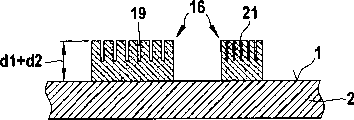
图1本发明的具有产品层和格栅层的印刷模板的一个横截面;Fig. 1 is a cross-section of a printing template with a product layer and a grid layer of the present invention;
图2图1中的产品层和格栅层的俯视图;Figure 2 is a top view of the product layer and grid layer in Figure 1;
图3在格栅层中的不同结构,具有Fig. 3 Different structures in the grid layer, with
a)完全敞开的面积;a) completely open area;
b)缩小的面积份额x1和b) The reduced area share x1 and
c)缩小的面积份额x2<x1;c) The reduced area share x2<x1;
图4a,b在取掉印刷模板之后的方法步骤中的横截面,和本发明的构造元件在材料膏糊均匀化和硬化之后的横截面。4a, b Cross-section in a method step after removal of the printing template, and cross-section of a construction element according to the invention after homogenization and hardening of the material paste.
具体实施方式Detailed ways
在一个本发明的印刷方法中,将一个本发明的印刷模板3放置在一个衬底2的衬底表面1上,该印制模板具有一个下部的产品层4和至少一个上部的格栅层5。In an inventive printing method, a printing template 3 according to the invention is placed on the substrate surface 1 of a
产品层4具有厚度d1和用于在衬底表面1上构造相应结构的穿透的下部的开口6。安放在产品层4上的格栅层5具有厚度d2和上部的开口7,它们在外部轮廓上以有利的方式基本上与产品层4的下部的开口6相应或是套合的。此外替换的方案是,原则上上部的开口7也可以构造得比下部的开口6略大一些。中间材料区域10延伸穿过这些上部的开口7,这些中间材料区域在本实施例中构造成具有单独接片12的接片结构10。这里这些接片12可以例如平行延伸和/或相互交叉。通过这些接片12将各自的上部的开口7划分成一些单个的开口区域14。在图2和3中所示出的接片结构10中,它们分别具有一个矩形格栅的形状,形成了一些规则设置的方形开口区域14。在上部的开口7中构成的开口区域14的整个面积因此小于或者等于所涉及的上部的开口7的敞开面积,这一点特别是在图3a至c中可以看出。The product layer 4 has a thickness d1 and penetrating lower openings 6 for forming corresponding structures on the substrate surface 1 . The
图3a示出了一个没有中间材料及接片结构10的格栅层5,也就是说,开口14的敞开总面积F7与下部的开口6的敞开面积F6之比xa的取值为xa=F7/F6=1。在图3b中相应地得到一个缩小的面积份额xb<1,因为接片结构10部分地盖住或限制了下部的开口6的面积。在图3c中接片结构10的接片12相互更密集地排列,因此面积份额xc<xb。Figure 3a shows a
根据本发明,在一个模板印刷过程中,材料膏糊16穿过开口6和7印刷到衬底表面1上,因此在取掉印刷模板3后,首先获得图4a所示相应于格栅层5、具有厚度d1+d2的材料膏糊的结构。随后材料膏糊16这样流开,使得这些材料区域变平,并且因此紧接着构成较大厚度的第一材料区域18和较小厚度的第二材料区域20。在这里,在每个材料区域18、20中,当前的总体厚度di与面积份额xi相关,为di=d1+xi*d2。材料区域18、20的材料膏糊16随后按照已知的方式硬化,因此构成图4b中所示的部件22,它具有一个由材料区域18、20及在需要的情况下另外的元件组成的印制的电路24。材料区域18、20例如可以是导体、半导体元件或者陶瓷元件。According to the invention, in a stencil printing process, the
Claims (9)
Applications Claiming Priority (2)
| Application Number | Priority Date | Filing Date | Title |
|---|---|---|---|
| DE102004046629.7A DE102004046629B4 (en) | 2004-09-25 | 2004-09-25 | Method for producing a component with a printed circuit |
| DE102004046629.7 | 2004-09-25 |
Publications (2)
| Publication Number | Publication Date |
|---|---|
| CN1753601A true CN1753601A (en) | 2006-03-29 |
| CN1753601B CN1753601B (en) | 2011-08-10 |
Family
ID=36011610
Family Applications (1)
| Application Number | Title | Priority Date | Filing Date |
|---|---|---|---|
| CN200510106431.7A Expired - Lifetime CN1753601B (en) | 2004-09-25 | 2005-09-26 | Method for mfg. part with printed circuit |
Country Status (3)
| Country | Link |
|---|---|
| JP (1) | JP2006100827A (en) |
| CN (1) | CN1753601B (en) |
| DE (1) | DE102004046629B4 (en) |
Cited By (2)
| Publication number | Priority date | Publication date | Assignee | Title |
|---|---|---|---|---|
| CN105196726A (en) * | 2015-10-28 | 2015-12-30 | 上海科闵电子科技有限公司 | Resistor printing method |
| CN111052886A (en) * | 2017-08-08 | 2020-04-21 | 纬湃技术有限公司 | Method for applying a through-hole plating to a circuit board and such a circuit board |
Families Citing this family (3)
| Publication number | Priority date | Publication date | Assignee | Title |
|---|---|---|---|---|
| DE102009054764A1 (en) | 2009-12-16 | 2011-06-22 | Robert Bosch GmbH, 70469 | Method and device for producing a circuit carrier and circuit carrier |
| DE102016220678A1 (en) | 2016-10-21 | 2018-04-26 | Robert Bosch Gmbh | Printing device and printing method for applying a viscous or pasty material |
| DE102019126512A1 (en) * | 2019-10-01 | 2021-04-01 | Hanwha Q Cells Gmbh | Printing screen and screen printing process for contacting solar cells |
Family Cites Families (9)
| Publication number | Priority date | Publication date | Assignee | Title |
|---|---|---|---|---|
| JPS4817362Y1 (en) * | 1970-05-18 | 1973-05-18 | ||
| JPS62162390A (en) * | 1986-01-13 | 1987-07-18 | 沖電気工業株式会社 | Manufacture of thick film printed circuit board |
| JPH01171668U (en) | 1988-05-23 | 1989-12-05 | ||
| JPH02148362U (en) * | 1989-05-18 | 1990-12-17 | ||
| DE4015292A1 (en) | 1990-05-12 | 1991-11-14 | Bosch Gmbh Robert | Printing grid for PCB components - has cut away portions overlying different heights of substrate allowing grid to lie flat on carrier |
| JP3136691B2 (en) | 1991-09-27 | 2001-02-19 | 株式会社村田製作所 | Screen printing plate manufacturing method |
| JP3072830B2 (en) * | 1996-07-06 | 2000-08-07 | アオイ電子株式会社 | Mesh screen for printing |
| GB2359515B (en) * | 2000-02-23 | 2003-12-03 | Kistech Ltd | Method of printing and printing machine |
| DE202004008357U1 (en) * | 2004-05-26 | 2004-08-19 | Laser Job Gmbh | Sieve type printing template for solder printing, especially of SMD circuit boards or for wafer bumping, has a flexible template films with solder deposition holes and a rigid mask that supports the film outside the print area |
-
2004
- 2004-09-25 DE DE102004046629.7A patent/DE102004046629B4/en not_active Expired - Lifetime
-
2005
- 2005-09-26 CN CN200510106431.7A patent/CN1753601B/en not_active Expired - Lifetime
- 2005-09-26 JP JP2005278599A patent/JP2006100827A/en active Pending
Cited By (3)
| Publication number | Priority date | Publication date | Assignee | Title |
|---|---|---|---|---|
| CN105196726A (en) * | 2015-10-28 | 2015-12-30 | 上海科闵电子科技有限公司 | Resistor printing method |
| CN111052886A (en) * | 2017-08-08 | 2020-04-21 | 纬湃技术有限公司 | Method for applying a through-hole plating to a circuit board and such a circuit board |
| CN111052886B (en) * | 2017-08-08 | 2023-05-09 | 纬湃技术有限公司 | Method for applying through-hole plating to a circuit board and such a circuit board |
Also Published As
| Publication number | Publication date |
|---|---|
| DE102004046629B4 (en) | 2019-01-03 |
| JP2006100827A (en) | 2006-04-13 |
| DE102004046629A1 (en) | 2006-03-30 |
| CN1753601B (en) | 2011-08-10 |
Similar Documents
| Publication | Publication Date | Title |
|---|---|---|
| US7653990B2 (en) | Manufacturing method of printed circuit board using an ink jet | |
| US4242401A (en) | Screen-printing mask | |
| CN100431397C (en) | Manufacturing method of ceramic green sheet and manufacturing method of multilayer ceramic electronic part | |
| JPS63261890A (en) | Method of screen printing of circuit pattern | |
| KR101199749B1 (en) | Screen plate, interlayer insulation film, circuit board, active matrix circuit board, and image display apparatus | |
| CN1287686A (en) | Method of manufacturing a multi-layered ceramic substrate | |
| US6794582B2 (en) | Mask for screen printing, the method for producing same and circuit board produced by screen printing with such mask | |
| CN1578593A (en) | Wiring board provided with a resistor and process for manufacturing the same | |
| JPH06143855A (en) | Screen printing plate and manufacturing method thereof | |
| US5807610A (en) | Flex tab thick film metal mask to deposit coating material | |
| CN1753601B (en) | Method for mfg. part with printed circuit | |
| KR20070062971A (en) | Manufacturing method of ceramic electronic parts | |
| US6047637A (en) | Method of paste printing using stencil and masking layer | |
| US5456942A (en) | Method for fabricating a circuit element through a substrate | |
| JP4843978B2 (en) | Method for forming thin film transistor | |
| JP3193896B2 (en) | Method of manufacturing resistor substrate for electronic component | |
| US20080060536A1 (en) | Printing screen and method | |
| JP2002273851A (en) | Method and equipment for screen printing of electrode | |
| JP2006327064A (en) | Screen printing plate and manufacturing method thereof | |
| CN1992238A (en) | Circuit component | |
| KR100997988B1 (en) | Method of Forming Circuit Pattern of Ceramic Green Sheet and Manufacturing Method of Ceramic Substrate | |
| JP2005170055A (en) | Screen mask, its manufacturing method and wiring foundation | |
| JP2007109852A (en) | Thick film having through-hole and method for producing thick film having through-hole | |
| JP2004040029A (en) | Thick film circuit board and method of manufacturing the same | |
| CN1155010C (en) | Built-in finger-shaped flat plate type capacitor resistor and manufacturing method thereof |
Legal Events
| Date | Code | Title | Description |
|---|---|---|---|
| C06 | Publication | ||
| PB01 | Publication | ||
| C10 | Entry into substantive examination | ||
| SE01 | Entry into force of request for substantive examination | ||
| C14 | Grant of patent or utility model | ||
| GR01 | Patent grant | ||
| CX01 | Expiry of patent term |
Granted publication date: 20110810 |
|
| CX01 | Expiry of patent term |