CN1753601B - Method for mfg. part with printed circuit - Google Patents

Method for mfg. part with printed circuit Download PDF

Info

Publication number
CN1753601B
CN1753601B CN200510106431.7A CN200510106431A CN1753601B CN 1753601 B CN1753601 B CN 1753601B CN 200510106431 A CN200510106431 A CN 200510106431A CN 1753601 B CN1753601 B CN 1753601B
Authority
CN
China
Prior art keywords
opening
area
substrate surface
paste
grid
Prior art date
Legal status (The legal status is an assumption and is not a legal conclusion. Google has not performed a legal analysis and makes no representation as to the accuracy of the status listed.)
Expired - Lifetime
Application number
CN200510106431.7A
Other languages
Chinese (zh)
Other versions
CN1753601A (en
Inventor
蒂洛·阿克
安德烈亚斯·默勒
Current Assignee (The listed assignees may be inaccurate. Google has not performed a legal analysis and makes no representation or warranty as to the accuracy of the list.)
Robert Bosch GmbH
Original Assignee
Robert Bosch GmbH
Priority date (The priority date is an assumption and is not a legal conclusion. Google has not performed a legal analysis and makes no representation as to the accuracy of the date listed.)
Filing date
Publication date
Application filed by Robert Bosch GmbH filed Critical Robert Bosch GmbH
Publication of CN1753601A publication Critical patent/CN1753601A/en
Application granted granted Critical
Publication of CN1753601B publication Critical patent/CN1753601B/en
Anticipated expiration legal-status Critical
Expired - Lifetime legal-status Critical Current

Links

Images

Classifications

    • HELECTRICITY
    • H05ELECTRIC TECHNIQUES NOT OTHERWISE PROVIDED FOR
    • H05KPRINTED CIRCUITS; CASINGS OR CONSTRUCTIONAL DETAILS OF ELECTRIC APPARATUS; MANUFACTURE OF ASSEMBLAGES OF ELECTRICAL COMPONENTS
    • H05K3/00Apparatus or processes for manufacturing printed circuits
    • H05K3/10Apparatus or processes for manufacturing printed circuits in which conductive material is applied to the insulating support in such a manner as to form the desired conductive pattern
    • H05K3/12Apparatus or processes for manufacturing printed circuits in which conductive material is applied to the insulating support in such a manner as to form the desired conductive pattern using thick film techniques, e.g. printing techniques to apply the conductive material or similar techniques for applying conductive paste or ink patterns
    • H05K3/1216Apparatus or processes for manufacturing printed circuits in which conductive material is applied to the insulating support in such a manner as to form the desired conductive pattern using thick film techniques, e.g. printing techniques to apply the conductive material or similar techniques for applying conductive paste or ink patterns by screen printing or stencil printing
    • H05K3/1225Screens or stencils; Holders therefor
    • HELECTRICITY
    • H05ELECTRIC TECHNIQUES NOT OTHERWISE PROVIDED FOR
    • H05KPRINTED CIRCUITS; CASINGS OR CONSTRUCTIONAL DETAILS OF ELECTRIC APPARATUS; MANUFACTURE OF ASSEMBLAGES OF ELECTRICAL COMPONENTS
    • H05K2201/00Indexing scheme relating to printed circuits covered by H05K1/00
    • H05K2201/09Shape and layout
    • H05K2201/09209Shape and layout details of conductors
    • H05K2201/09654Shape and layout details of conductors covering at least two types of conductors provided for in H05K2201/09218 - H05K2201/095
    • H05K2201/09736Varying thickness of a single conductor; Conductors in the same plane having different thicknesses

Landscapes

  • Engineering & Computer Science (AREA)
  • Manufacturing & Machinery (AREA)
  • Microelectronics & Electronic Packaging (AREA)
  • Manufacturing Of Printed Wiring (AREA)
  • Printing Methods (AREA)
  • Screen Printers (AREA)

Abstract

本发明涉及一种用于制造具有印制电路的部件的方法:将一个具有下部的产品层并至少一个在其上的格栅层的印刷模板放置在衬底表面上,所述产品层具有至少一个下部的开口,并且该格栅层具有至少一个设置其上方的上部的开口,在其中构造了中间材料区域,它们延伸穿过上部的开口,并且将下部的开口部分地遮盖。通过所述下部的开口和所述上部的开口将膏糊印刷到衬底表面上并取走印刷模板,其中保留在衬底表面上通过所述下部的开口和所述上部的开口印刷上的材料区域,并且这些印刷上的材料区域硬化为在衬底表面上的一个电路中的电路区域。在取走印刷模板后,以有利的方式进行材料区域的均匀化,能够用模板印刷过程的一个步骤形成不同厚度的材料区域。

Figure 200510106431

The invention relates to a method for producing components with printed circuits: a printing template with a lower product layer and at least one grid layer above it is placed on a substrate surface, said product layer having at least A lower opening, and the grid layer has at least one upper opening arranged above it, in which intermediate material regions are formed, which extend through the upper opening and partially cover the lower opening. printing paste onto the substrate surface through the lower opening and the upper opening and removing the printing stencil, wherein the material printed on the substrate surface through the lower opening and the upper opening remains areas, and these areas of printed material harden into a circuit area in a circuit on the substrate surface. After the printing template has been removed, the homogenization of the material areas advantageously takes place, so that material areas of different thicknesses can be formed in one step of the stencil printing process.

Figure 200510106431

Description

Be used to make the method for parts with printed circuit
Technical field
The present invention relates to a kind of method that is used to make the parts with printed circuit, wherein, described parts especially can be applied in the auto electroincs.
Background technology
The substrate that is used for the electronic circuit of auto electroincs is especially used the manufacturing of thick film technology and LTCC (LTCC) technology.Here, electronics printed conductor and other function element as for example resistance, are made with screen printing technique.In screen printing technique, an inventive thick film paste paste (Paste) is scraped (gerakelt) or is printed on opening to a printed substrates that is passed in silk screen or the template.The pottery wet film (Gr ü nfolien) or the ceramic substrate of sintering can be used as printed substrates.In an ensuing burning or sintering step, paste by inventive thick film paste the solid structure behind the sintering.
In traditional silk screen or mould printing technology, the overlay thickness of structurized material to determine by the thickness of silk screen or template.Here, employed silk screen or template have flat surface, make process of scraping (Rakelvorgang) or printing process interference-free.In addition, generally also be smooth peace towards the face of substrate, so that obtain enough sealings, thereby cream stuck with paste can not scatter and accurately form desired printed patterns to substrate.
In silk screen and mould printing process, generally to want under the invariable situation of characteristic on the materials printed per unit area, the different qualities of printing structure is realized when the homogeneous thickness by correspondingly changing transverse width.In order to be configured to the printed conductor of high current, for example be used for output stage is connected to control valve device or analog, with respect to simple holding wire, therefore construct the structure of obvious broadening, these structures need a corresponding area on substrate, this will cause cost to increase, reach disadvantageous area needs to enlarge.Correspondingly, for example paste into different R values (resistance value) by R-cream.
In addition, in silk screen and mould printing, aspect ratio (
Figure G200510106431701D00021
), promptly the ratio of the lateral dimension of silk screen or template split shed and thickness is significant.Fine structure in 20 mu m ranges for example can not be with thickness manufacturing arbitrarily.Generally, because cream is stuck with paste the mobile performance of rheological behavior and cream paste, trickle resolution ( ) need a very little print thickness.Because microminiaturized continuous increase must be made finer structure on electronic substrate, these structures can only be with very little layer thickness manufacturing with traditional silk screen or mould printing technology.But, must be able to realize also that in substrate the loaded current ability is higher than the printed conductor and the structure of simple holding wire.Therefore, need to construct the structure of broad again.In order to construct different fine structures, be disclosed, in a plurality of printing process that successively are connected, make different structural regions with traditional screen printing technique.
In addition, the cream of different qualities paste can be coated.Except the structure of metal, also can apply insulation or pottery and semiconductor structure, for example stick with paste and make by resistance paste.For tuning resistor arrives its specific value, use various resistance pastes to stick with paste on the one hand with different unit area resistance values, for example per unit area is 100 ohm or 1,10,100 kilohm, realizes meticulous allotment by the area allotment on the other hand.It here is constant printing thickness.
For fear of the structure of widening, partly use gravure (Gravurdruck), wherein, construct print structure with different-thickness.Here, at first on a gravure plate, constitute or scrape and the corresponding shape of printed patterns.Subsequently in second step, with the upset of gravure plate and be transferred on the substrate, perhaps correspondingly with the substrate upset and be placed on the gravure plate.With respect to traditional silk screen printing, therefore need an additional process, thereby need the longer beat cycle.In addition, also cost is expensive to expend height in these gravure plate manufacturings.
Summary of the invention
The present invention proposes a kind of method that is used to make parts with printed circuit, have following steps at least: a printing stencil with the grid layer on the gas producing formation of a bottom and the gas producing formation that at least one is arranged on the bottom is placed on the substrate surface of a substrate, wherein, described gas producing formation has the opening of at least one bottom, and this grid layer has the opening on the top of at least one opening that is arranged on bottom top, in the opening on top, constructed the intermediate materials zone, they extend through the opening on top and the opening portion ground of bottom are hidden, the opening by described bottom and the opening on described top are stuck with paste material cream and are printed onto on the substrate surface and take printing stencil away, wherein be retained on the substrate surface by the opening of described bottom and the typographic material area of opening on described top, and these typographic material areas are hardened to the circuit region of a circuit on substrate surface.
Method of the present invention has some advantages.According to the present invention, use a printing stencil, it has a bottom gas producing formation and at least one is placed in the grid layer on the top above it.As known mode, gas producing formation is by the definite zone that will print of its opening.Grid layer has the opening on some tops, and they are can be basically consistent with the opening of the bottom of gas producing formation or aim at, perhaps also can be bigger than the opening of these bottoms.Here, extend in the opening on the top of grid layer in the intermediate materials zone, is especially extending some tab construction, and the latter has such as some parallel contact pin, and they are divided into the opening on top the open area or divide opening.Like this, the intermediate materials zone of opening on the top of the opening of the bottom of gas producing formation by being positioned at their tops is partly hidden, and has therefore reduced the whole open area of the through hole that constituted.
In printing process, not having material cream to stick with paste is coated in the intermediate materials zone, therefore the average vertical thickness of each coated material area has reduced a coefficient, and this coefficient is as the area fraction of the area of the opening of the total area ratio bottom of the open area of opening wide of the opening on top.
Have the basic structure of vertical thickness uniformly in order to construct, after material cream in the printing is stuck with paste and is removed template, reach coating structure homogenizing ( ), its mode is: material cream sticks with paste because the balanced at least basically fine structure in current material area of its mobile performance.Here self viscosity property of sticking with paste of material cream is just enough.Auxiliary ground can utilize some acceleration or support the measure of flow behavior, for example shines with ultraviolet radiation, perhaps also can add other medium on the principle, for example softening agent or solvent.
After the vertical thickness homogenizing of each material area, in known manner the material area of being stuck with paste by the material cream of coating is hardened by for example sintering process.
Advantageously, the intermediate materials zone of the opening by these tops constitutes fine structure in described typographic material area, wherein said typographic material area is after taking down printing stencil and wandering at least in part before described material area sclerosis.
Advantageously, this grid layer has a plurality of openings that have the top in some intermediate materials zones.
Advantageously, these intermediate materials zones are grid-like tab construction.
Advantageously, described grid-like tab construction be surrounded as rectangle, square open area preferably.
Advantageously, in the opening on these different tops, constructed some and had the grid-like tab construction of the contact pin of the different parallel placements of spacing located adjacent one another.
Advantageously, constitute the parts of metal, pottery, semi-conductive or polymer by these material areas.
Advantage of the present invention is that on the one hand it is different with traditional template or screen printing technique, can apply out loaded current and the meticulous printed conductor of an electronic circuit in a print steps with different-thickness.So always can reach better area utilization ratio.In addition, resistance value that the resistance value of printed resistor is not only different by using, relevant with material or cream paste property or adaptive and can regulate by different thickness by horizontal area.Like this, can improve the area utilization of structure, and reduce the variation that employed different resistance paste is stuck with paste, therefore can use the different resistance value of minority area-optimizedly with less print steps, thus all favourable on time and expense.
With respect to the use of gravure plate, only need the manufacturing procedure of the simplification of a print steps to have advantage.
According to the present invention, on gas producing formation, also can place a plurality of grid layers in principle.In addition, can also adopt a plurality of print steps that use different materials according to the present invention, wherein, the quantity of print steps can reduce with respect to traditional method.Like this, for example can in a print steps, print printed conductor and in another print steps, print different resistance.In addition, can in the another one print steps, print for example semi-conducting material.
Description of drawings
Below describe the present invention in detail by means of the legend of appended several embodiment.Shown in the figure be:
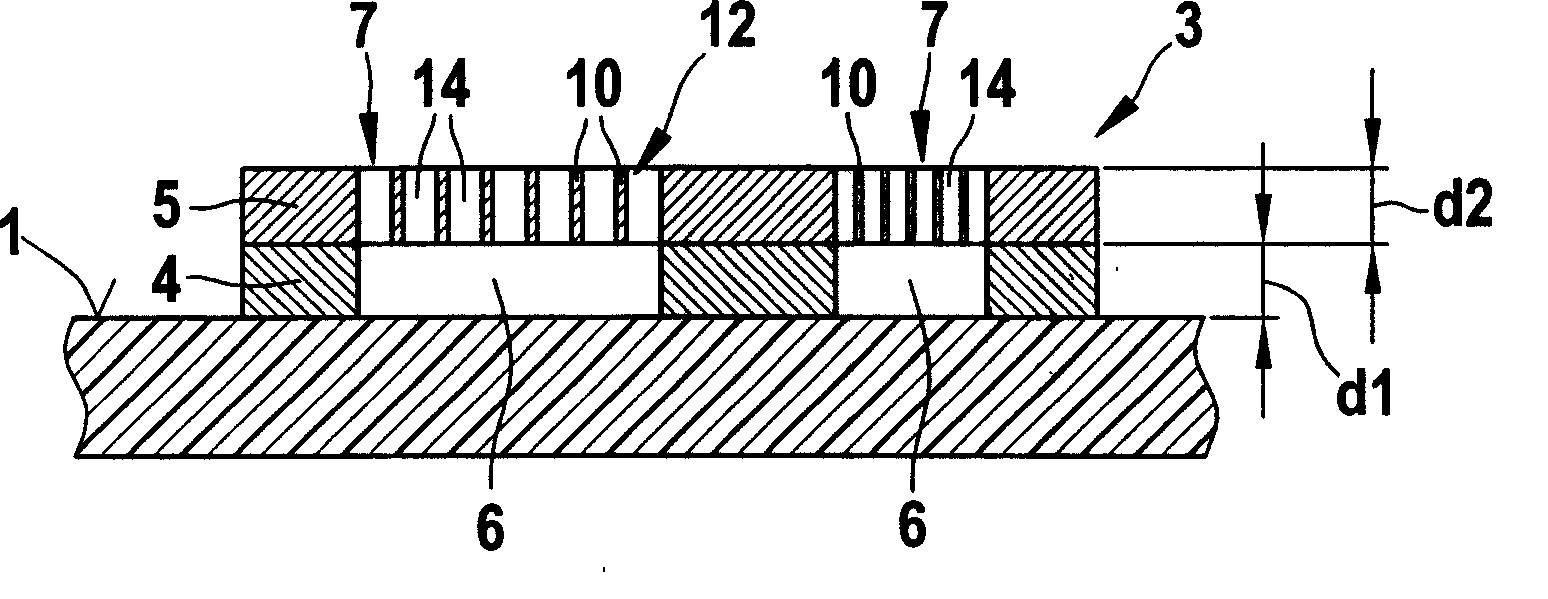
Fig. 1 cross section with printing stencil of gas producing formation and grid layer of the present invention;
The gas producing formation among Fig. 2 Fig. 1 and the vertical view of grid layer;
The different structure of Fig. 3 in grid layer has
A) area that opens wide fully;
B) the area fraction x1 that dwindles and
C) the area fraction x2 that dwindles<x1;
Cross section in Fig. 4 a, the b method step after taking down printing stencil and structure element of the present invention cross section after material cream is stuck with paste homogenizing and sclerosis.
Embodiment
In a printing process of the present invention, a printing stencil 3 of the present invention is placed on the substrate surface 1 of a substrate 2, this printing template has the gas producing formation 4 of a bottom and the grid layer 5 at least one top.
Gas producing formation 4 has thickness d 1 and is used for the opening 6 of the bottom that penetrates of structure corresponding construction on substrate surface 1.Be placed in grid layer 5 on the gas producing formation 4 and have the opening 7 on thickness d 2 and top, they are externally corresponding or fit with the opening 6 of the bottom of gas producing formation 4 basically in an advantageous manner on the profile.The scheme of Ti Huaning is in addition, and the opening 7 on top also can be constructed more biggerly than the opening 6 of bottom in principle.Intermediate materials zone 10 extends through the opening 7 on these tops, and these intermediate materials zones are constructed with the tab construction of independent contact pin 12 in the present embodiment.Here these contact pin 12 can for example extend in parallel and/or intersect mutually.The opening 7 of inciting somebody to action top separately by these contact pin 12 is divided into some single open areas 14.In the tab construction shown in Fig. 2 and 3, they have the shape of a square-grid respectively, have formed the square aperture zone 14 that some rules are provided with.Therefore the whole area of the open area 14 that constitutes in the opening 7 on top is less than or equal to the open area of the opening 7 on related top, this point particularly in Fig. 3 a to c as can be seen.
Fig. 3 a shows a grid layer 5 that does not have intermediate materials and tab construction, that is to say, the unlimited gross area F7 of opening 14 is xa=F7/F6=1 with the value of the ratio xa of the open area F6 of the opening 6 of bottom.In Fig. 3 b, correspondingly obtain the area fraction xb that dwindles<1, because tab construction partly covers or limited the area of the opening 6 of bottom.The contact pin 12 of tab construction is arranged mutually more thick and fast in Fig. 3 c, so area fraction xc<xb.
According to the present invention, in a mould printing process, material cream is stuck with paste 16 and is passed opening 6 and 7 and be printed onto on the substrate surface 1, therefore after taking down printing stencil 3, at first obtains shown in Fig. 4 a corresponding to grid layer 5, has the structure that the material cream of thickness d 1+d2 is stuck with paste.Material cream paste 16 such streams are opened subsequently, make these material areas flatten, and therefore and then constitute first material area 18 of big thickness and second material area 20 of less thickness.Here, in each material area 18,20, current general thickness di is relevant with area fraction xi, is di=d1+xi*d2.The material cream of material area 18,20 is stuck with paste 16 sclerosis in known manner subsequently, so the parts shown in the pie graph 4b 22, and it has a circuit 24 by material area 18,20 and the printing that other element is formed under the situation of needs.Material area 18,20 for example can be conductor, semiconductor element or ceramic component.

Claims (10)

1. one kind is used for the method that manufacturing has the parts of printed circuit (24), has following steps at least:
Printing stencil (3) with the grid layer (5) on the gas producing formation (4) of a bottom and the gas producing formation that at least one is arranged on the bottom is placed on the substrate surface (1) of a substrate (2), wherein, described gas producing formation (4) has the opening (6) of at least one bottom, and this grid layer (5) has the opening (7) on the top of at least one opening that is arranged on this bottom (6) top, in the opening on this top, constructed intermediate materials zone (10), described intermediate materials zone (10) extends through the opening (7) on top and the opening (6) of bottom is partly hidden
The opening (6) by described bottom and the opening (7) on described top are stuck with paste (16) with material cream and are printed onto substrate surface (1) and go up and take away printing stencil (3), wherein being retained in substrate surface (1) goes up by the opening (6) of described bottom and the typographic material area (18 of opening (7) on described top, 20), and
These typographic material areas (18,20) are hardened to the circuit region of the circuit (24) on substrate surface (1).
2. in accordance with the method for claim 1, it is characterized in that: the intermediate materials zone (10) of the opening (7) by these tops is at described typographic material area (18,20) constitute fine structure (19 in, 21), wherein said typographic material area is taking down printing stencil (3) back and was scattering at least in part before described typographic material area (18,20) sclerosis.
3. it is characterized by in accordance with the method for claim 2: described material cream stick with paste (16) structure the typographic material area (18,20) of fine structure (19,21) at the described vertical thickness di that has after wandering be:
di=d1+xi*d2,
Wherein d1 is the thickness of gas producing formation (4), d2 is the thickness of grid layer (5), xi is an area fraction, and this area fraction is by the open area of the opening (6) of bottom and be positioned at composition of proportions between the gross area of the open area of opening wide (14) of opening (7) on top of opening (6) top of bottom.
4. according to one of aforesaid right requirement described method, it is characterized by: this grid layer (5) has a plurality of openings (7) that have the top in some intermediate materials zones (10).
5. according to each described method in the claim 1 to 3, it is characterized by: these intermediate materials zones (10) are grid-like tab construction.
6. it is characterized by in accordance with the method for claim 5: described grid-like tab construction is surrounded as the open area (14) of rectangle.
7. in accordance with the method for claim 6, it is characterized by: in the opening (7) on these different tops, constructed some and had the grid-like tab construction of the contact pin (12) of the different parallel placements of spacing located adjacent one another.
8. according to each described method in the claim 1 to 3, it is characterized by: the parts that constitute metal, pottery, semi-conductive or polymer by these typographic material areas (18,20).
9. according to each described method in the claim 1 to 3, it is characterized by: in a plurality of steps, be coated with the material cream that applies different qualities respectively and stick with paste (16).
10. it is characterized by in accordance with the method for claim 6: described open area (14) are square.
CN200510106431.7A 2004-09-25 2005-09-26 Method for mfg. part with printed circuit Expired - Lifetime CN1753601B (en)

Applications Claiming Priority (2)

Application Number Priority Date Filing Date Title
DE102004046629.7A DE102004046629B4 (en) 2004-09-25 2004-09-25 Method for producing a component with a printed circuit
DE102004046629.7 2004-09-25

Publications (2)

Publication Number Publication Date
CN1753601A CN1753601A (en) 2006-03-29
CN1753601B true CN1753601B (en) 2011-08-10

Family

ID=36011610

Family Applications (1)

Application Number Title Priority Date Filing Date
CN200510106431.7A Expired - Lifetime CN1753601B (en) 2004-09-25 2005-09-26 Method for mfg. part with printed circuit

Country Status (3)

Country Link
JP (1) JP2006100827A (en)
CN (1) CN1753601B (en)
DE (1) DE102004046629B4 (en)

Families Citing this family (5)

* Cited by examiner, † Cited by third party
Publication number Priority date Publication date Assignee Title
DE102009054764A1 (en) 2009-12-16 2011-06-22 Robert Bosch GmbH, 70469 Method and device for producing a circuit carrier and circuit carrier
CN105196726A (en) * 2015-10-28 2015-12-30 上海科闵电子科技有限公司 Resistor printing method
DE102016220678A1 (en) 2016-10-21 2018-04-26 Robert Bosch Gmbh Printing device and printing method for applying a viscous or pasty material
DE102017213838B4 (en) * 2017-08-08 2024-06-13 Vitesco Technologies GmbH Method for through-plating a printed circuit board and such a printed circuit board
DE102019126512A1 (en) * 2019-10-01 2021-04-01 Hanwha Q Cells Gmbh Printing screen and screen printing process for contacting solar cells

Citations (2)

* Cited by examiner, † Cited by third party
Publication number Priority date Publication date Assignee Title
CN1401210A (en) * 2000-02-23 2003-03-05 凯斯技术有限公司 Printing method and printing machine
DE202004008357U1 (en) * 2004-05-26 2004-08-19 Laser Job Gmbh Sieve type printing template for solder printing, especially of SMD circuit boards or for wafer bumping, has a flexible template films with solder deposition holes and a rigid mask that supports the film outside the print area

Family Cites Families (7)

* Cited by examiner, † Cited by third party
Publication number Priority date Publication date Assignee Title
JPS4817362Y1 (en) * 1970-05-18 1973-05-18
JPS62162390A (en) * 1986-01-13 1987-07-18 沖電気工業株式会社 Manufacture of thick film printed circuit board
JPH01171668U (en) 1988-05-23 1989-12-05
JPH02148362U (en) * 1989-05-18 1990-12-17
DE4015292A1 (en) 1990-05-12 1991-11-14 Bosch Gmbh Robert Printing grid for PCB components - has cut away portions overlying different heights of substrate allowing grid to lie flat on carrier
JP3136691B2 (en) 1991-09-27 2001-02-19 株式会社村田製作所 Screen printing plate manufacturing method
JP3072830B2 (en) * 1996-07-06 2000-08-07 アオイ電子株式会社 Mesh screen for printing

Patent Citations (2)

* Cited by examiner, † Cited by third party
Publication number Priority date Publication date Assignee Title
CN1401210A (en) * 2000-02-23 2003-03-05 凯斯技术有限公司 Printing method and printing machine
DE202004008357U1 (en) * 2004-05-26 2004-08-19 Laser Job Gmbh Sieve type printing template for solder printing, especially of SMD circuit boards or for wafer bumping, has a flexible template films with solder deposition holes and a rigid mask that supports the film outside the print area

Also Published As

Publication number Publication date
DE102004046629B4 (en) 2019-01-03
DE102004046629A1 (en) 2006-03-30
JP2006100827A (en) 2006-04-13
CN1753601A (en) 2006-03-29

Similar Documents

Publication Publication Date Title
US4324815A (en) Screen-printing mask and method
US6089151A (en) Method and stencil for extruding material on a substrate
CN102917542A (en) Method for manufacturing copper PCB (Printed Circuit Board) circuit
CN1753601B (en) Method for mfg. part with printed circuit
WO2021004957A1 (en) Ntc thin film thermistor and method for producing an ntc thin film thermistor
US20050195556A1 (en) Method of building multi-layer ceramic chip (MLCC) capacitors
JP2006526897A (en) Polymer thick film resistor, design cell, and manufacturing method thereof
CN1980799A (en) Gravure printing machine and method of manufacturing multilayer ceramic electronic components
JP2000299560A (en) Manufacturing method of ceramic circuit board
DE19609221C1 (en) Process for the production of ceramic multilayer substrates
CN109845416A (en) For applying printing equipment and the printing process of viscosity or paste material
JP3966092B2 (en) Screen printing version
Pudas Gravure-offset printing in the manufacture of ultra-fine-line thick-films for electronics
US20040163234A1 (en) Resistive vias in a substrate
US6007867A (en) Method of manufacturing a thick film circuit with improved dielectric feature definition
JP4928762B2 (en) Method for manufacturing thick film having through hole, and thick film having through hole
JPS6355848B2 (en)
CN101312086B (en) Fabrication method and structure of resistor layout
KR20120022537A (en) Method for producing printed article, printing plate, and paste
JP3890920B2 (en) Apparatus and method for applying paste to electronic component
JP4433583B2 (en) Wiring board
JP2005007747A (en) Printed circuit board manufacturing method, circuit board and solar cell produced by this manufacturing method, and screen printing apparatus
US20050062587A1 (en) Method and structure of a substrate with built-in via hole resistors
JP3193896B2 (en) Method of manufacturing resistor substrate for electronic component
CN213920149U (en) Screen printing plate structure for screen printing

Legal Events

Date Code Title Description
C06 Publication
PB01 Publication
C10 Entry into substantive examination
SE01 Entry into force of request for substantive examination
C14 Grant of patent or utility model
GR01 Patent grant
CX01 Expiry of patent term

Granted publication date: 20110810