CN1856582A - Method for the production of leather and semifinished products, and formulations that are suitable therefor - Google Patents
Method for the production of leather and semifinished products, and formulations that are suitable therefor Download PDFInfo
- Publication number
- CN1856582A CN1856582A CNA2004800278007A CN200480027800A CN1856582A CN 1856582 A CN1856582 A CN 1856582A CN A2004800278007 A CNA2004800278007 A CN A2004800278007A CN 200480027800 A CN200480027800 A CN 200480027800A CN 1856582 A CN1856582 A CN 1856582A
- Authority
- CN
- China
- Prior art keywords
- formula
- unsubstituted
- replacement
- alkyl
- compound
- Prior art date
- Legal status (The legal status is an assumption and is not a legal conclusion. Google has not performed a legal analysis and makes no representation as to the accuracy of the status listed.)
- Pending
Links
Classifications
-
- C—CHEMISTRY; METALLURGY
- C14—SKINS; HIDES; PELTS; LEATHER
- C14C—CHEMICAL TREATMENT OF HIDES, SKINS OR LEATHER, e.g. TANNING, IMPREGNATING, FINISHING; APPARATUS THEREFOR; COMPOSITIONS FOR TANNING
- C14C3/00—Tanning; Compositions for tanning
- C14C3/02—Chemical tanning
- C14C3/08—Chemical tanning by organic agents
- C14C3/16—Chemical tanning by organic agents using aliphatic aldehydes
-
- C—CHEMISTRY; METALLURGY
- C14—SKINS; HIDES; PELTS; LEATHER
- C14C—CHEMICAL TREATMENT OF HIDES, SKINS OR LEATHER, e.g. TANNING, IMPREGNATING, FINISHING; APPARATUS THEREFOR; COMPOSITIONS FOR TANNING
- C14C3/00—Tanning; Compositions for tanning
- C14C3/02—Chemical tanning
- C14C3/08—Chemical tanning by organic agents
- C14C3/22—Chemical tanning by organic agents using polymerisation products
Landscapes
- Chemical & Material Sciences (AREA)
- Chemical Kinetics & Catalysis (AREA)
- General Chemical & Material Sciences (AREA)
- Organic Chemistry (AREA)
- Treatment And Processing Of Natural Fur Or Leather (AREA)
- Compositions Of Macromolecular Compounds (AREA)
- Detergent Compositions (AREA)
Abstract
Description
本发明涉及通过采用如下物质处理毛皮、浸酸裸皮或半成品生产半成品或皮革的方法:The invention relates to a process for the production of semi-finished products or leather by treating pelts, pickled hides or semi-finished products with:
a)至少一种片状硅酸盐和a) at least one sheet silicate and
b)至少一种共聚物,其可通过以下步骤到得到:使以下物质共聚b) at least one copolymer obtainable by copolymerizing
至少一种烯属不饱和二羧酸酐(A),其衍生自至少一种4-8个碳原子的二羧酸,at least one ethylenically unsaturated dicarboxylic anhydride (A) derived from at least one dicarboxylic acid having 4 to 8 carbon atoms,
至少一种乙烯基芳族化合物(B1)或at least one vinylaromatic compound (B1) or
至少一种支化或直链C2-C10-烯烃的低聚物(B2),至少一种平均分子量Mn为300-5000g/mol或者可通过至少3当量的C2-C10-烯烃的低聚获得的低聚物,Oligomers (B2) of at least one branched or linear C 2 -C 10 -olefin, at least one average molecular weight Mn of 300-5000 g/mol or passable by at least 3 equivalents of C 2 -C 10 -olefin The oligomer obtained by the oligomer,
和and
任选地至少一种不同于(A)且含有至少一个杂原子的烯属不饱和单体(C),并且与以下物质反应optionally at least one ethylenically unsaturated monomer (C) different from (A) and containing at least one heteroatom, and reacted with
至少一种式Ia或Ib的化合物(D),at least one compound (D) of formula Ia or Ib,

并且任选采用水或碱性水溶液水解,and optionally hydrolyzed with water or an aqueous alkaline solution,
其中,在式Ia和Ib中,Wherein, in formulas Ia and Ib,
A1相同或不同并且为C2-C6-亚烷基,A 1 are identical or different and are C 2 -C 6 -alkylene,
R1为直链或直链的C1-C20-烷基,且R 1 is linear or linear C 1 -C 20 -alkyl, and
n为1-200的整数。n is an integer of 1-200.
以上定义的共聚单体下面还称作共聚物(b)或(b)共聚物。The comonomers defined above are also referred to below as copolymers (b) or (b) copolymers.
此外,本发明涉及包含如下物质的配制剂Furthermore, the invention relates to formulations comprising
a)至少一种片状硅酸盐和a) at least one sheet silicate and
b)至少一种共聚物,其可通过以下步骤到得到:使以下物质共聚至少一种烯属不饱和二羧酸酐(A),其衍生自至少一种4-8个碳原子的二羧酸,b) at least one copolymer obtainable by copolymerizing at least one ethylenically unsaturated dicarboxylic anhydride (A) derived from at least one dicarboxylic acid having 4 to 8 carbon atoms ,
至少一种乙烯基芳族化合物(B1)或at least one vinylaromatic compound (B1) or
至少一种支化或直链C2-C10-烯烃的低聚物(B2),至少一种平均分子量Mn为300-5000g/mol或者可通过至少3当量的C2-C10-烯烃的低聚获得的低聚物,Oligomers (B2) of at least one branched or linear C 2 -C 10 -olefin, at least one average molecular weight Mn of 300-5000 g/mol or passable by at least 3 equivalents of C 2 -C 10 -olefin The oligomer obtained by the oligomer,
和and
任选地至少一种不同于(A)且含有至少一个杂原子的烯属不饱和单体(C),并且与以下物质反应optionally at least one ethylenically unsaturated monomer (C) different from (A) and containing at least one heteroatom, and reacted with
至少一种式Ia或Ib的化合物(D),at least one compound (D) of formula Ia or Ib,

并且任选采用水或碱性水溶液水解,and optionally hydrolyzed with water or an aqueous alkaline solution,
其中,在式Ia和Ib中,Wherein, in formulas Ia and Ib,
A1相同或不同并且为C2-C6-亚烷基,A 1 are identical or different and are C 2 -C 6 -alkylene,
R1为直链或直链的C1-C20-烷基,且R 1 is linear or linear C 1 -C 20 -alkyl, and
n为1-200的整数。n is an integer of 1-200.
此外,本发明涉及通过新的方法生产的半成品和皮革、制备新的配制剂的方法以及新的半成品和新的皮革的用途。Furthermore, the invention relates to the semi-finished products and leathers produced by the new method, the process for the preparation of the new formulations and the use of the new semi-finished products and the new leathers.
在皮革生产中铬鞣制已经成为重要的化学处理100多年了,例如参见,Ullmann’s Encyclopedia of Industrial Chemistry,第A15卷,第259-282页并且具特别是在第268页以及以下各页,第5版(1990),Verlag ChemieWeinheim。但是,由于生态方面的原因,已在探索铬鞣制的替换方案。在常规铬鞣制中,可利用基于皮革的毛皮重量,用量为1.5-8重量%或甚至更多的铬盐。其中,大部分通常未被结合而进入废水中。尽管可通过采用例如石灰和铁盐的化学处理使废水中没有大量铬,但是获得含有铬的淤泥并且必须在特定的填埋场上处理或者通过昂贵的工艺过程后处理。Chrome tanning has been an important chemical treatment in leather production for over 100 years, see for example, Ullmann's Encyclopedia of Industrial Chemistry, Vol. A15, pp. 259-282 and especially on pp. 268 et seq., 5th edition (1990), Verlag Chemie Weinheim. However, for ecological reasons, alternatives to chrome tanning have been explored. In conventional chrome tanning, chromium salts can be used in amounts of 1.5-8% by weight or even more, based on the hide weight of the leather. Of these, most typically pass unbound into wastewater. Although wastewater can be freed of significant amounts of chromium by chemical treatment using eg lime and iron salts, sludge containing chromium is obtained and has to be disposed of on special landfills or post-processed by costly processes.
此外,例如在分割生皮中和在整平皮革中获得含铬皮革废料,所述废料基于生皮重量占约8-15重量%并且也必须通过昂贵的方法处理。Furthermore, chrome-containing leather wastes are obtained, for example, in splitting hides and in smoothing hides, which represent approximately 8-15% by weight, based on the weight of the hides, and which also have to be disposed of by expensive methods.
已存在许多通过例如使铬鞣制液再循环或铬循环方法降低废水的铬污染的尝试。但是,总的来说这些方法并不令人满意并且特别不能解决含铬皮革废料的问题。There have been many attempts to reduce the chromium contamination of wastewater by eg recirculating the chrome tanning liquor or chrome recycling methods. However, these methods are generally unsatisfactory and do not solve the problem of chrome-containing leather waste in particular.
此外,已知用有机鞣制剂代替部分或所有铬的方法。可提及使用合成鞣制剂,即甲醛和苯酚的磺化缩合物或磺化的萘/甲醛缩合物。此外,还可提及使用植物鞣制剂。但是,上述两类鞣制剂产生高COD的废水并且,由于环境原因,也不可接受。此外,已发现在使用磺化的苯酚/甲醛缩合物的情况下皮革的耐光性经常不令人满意(Ullmann’s Encyclopedia ofIndustrial Chemistry,第A15卷,第259-282页并且具特别是在第270页以及以下各页,第5版(1990),Verlag Chemie Weinheim)。Furthermore, methods are known to replace some or all of the chromium with organic tanning agents. Mention may be made of the use of syntans, ie sulfonated condensates of formaldehyde and phenol or sulfonated naphthalene/formaldehyde condensates. Furthermore, mention may also be made of the use of vegetable tanning agents. However, the above two classes of tanning agents produce high COD wastewater and, for environmental reasons, are also unacceptable. Furthermore, it has been found that the lightfastness of the leather is often unsatisfactory when using sulfonated phenol/formaldehyde condensates (Ullmann's Encyclopedia of Industrial Chemistry, Vol. A15, pp. 259-282 and especially on p. 270 and The following pages, 5th edition (1990), Verlag Chemie Weinheim).
此外,已知使用醛,特别是二醛,例如戊二醛鞣制,参见例如H.Herfeld,Bibliothek des Leders,第III卷,第191页,Umschau VerlagFrankfurt/Main,1984。但是,以下事实是不利的,即收缩温度不高于70℃并且因此当使用少量戊二醛,例如基于毛皮重量,0.5-0.9重量%时仅可使所生产的半成品脱水至不充分的程度。在修整的过程中,在皮革的肉一侧上形成胶粘并不利地影响皮革的质量。Furthermore, tanning with aldehydes, especially dialdehydes, such as glutaraldehyde, is known, see for example H. Herfeld, Bibliothek des Leders, Vol. III, p. 191, Umschau Verlag Frankfurt/Main, 1984. However, it is disadvantageous that the shrinkage temperature is not higher than 70° C. and therefore the semi-finished product produced can only be dehydrated to an insufficient degree when using small amounts of glutaraldehyde, for example 0.5-0.9% by weight, based on the weight of the pelt. During the finishing process, glue forms on the flesh side of the leather and adversely affects the quality of the leather.
在预鞣制过程中使用大量戊二醛的情况下,观察到通常获得完全鞣制的皮革并且随后不再可能如许多制革厂所需要进行可变加工。In the case of the use of large amounts of glutaraldehyde in the pre-tanning process, it has been observed that fully tanned leather is usually obtained and subsequent variable processing as required by many tanneries is no longer possible.
已知戊二醛可以部分或完全缩醛化的形式(例如作为甲缩醛)用于鞣制(Ullmann’s Encyclopedia of Industrial Chemistry,第A15卷,第259-282页并且具特别是在第273页以及以下各页,第5版(1990),Verlag ChemieWeinheim)。但是,所述的鞣制的半成品通常倾向于快速变黄。It is known that glutaraldehyde can be used in tanning in partially or completely acetalized form (e.g. as methylal) (Ullmann's Encyclopedia of Industrial Chemistry, Vol. A15, pp. 259-282 and especially on p. pp., 5th edition (1990), Verlag Chemie Weinheim). However, said tanned semi-finished products generally tend to yellow quickly.
此外,观察到采用戊二醛预鞣制的半成品和皮革在许多情况下难以修整。修整刀具易于粘住并且必须清理。Furthermore, it has been observed that semi-finished products and leathers pretanned with glutaraldehyde are in many cases difficult to recondition. Dressing knives tend to stick and must be cleaned.
本发明的目的是提供生产半成品和皮革的新方法,该方法避免了上述缺点。具体地说,本发明的方法是提供避免上述缺点的鞣制剂。The object of the present invention is to provide a new method for the production of semi-finished products and leather which avoids the disadvantages mentioned above. In particular, the method of the present invention is to provide tanning agents which avoid the disadvantages mentioned above.
我们已发现所述目的通过最初定义的生产半成品或皮革的方法获得。We have found that said objects are achieved by the originally defined method of producing semi-finished products or leather.
在本发明的范围内可以以浸酸裸皮或毛皮为起始原料并通过新的处理方法获得半成品或皮革。在本发明的范围内还可以以半成品为起始原料并通过新的处理方法获得皮革。Within the scope of the invention it is possible to obtain semi-finished products or leathers from pickled pelts or hides as starting material and by means of a new treatment method. Within the scope of the invention it is also possible to obtain leather starting from semi-finished products and by means of novel processing methods.
在本发明的实施方案中,动物生皮的毛皮、浸酸裸皮或半成品例如剥的牛、猪、山羊、绵羊或猎物例如鹿的生皮。动物是例如通过屠宰杀死或死于自然原因对于新方法而言是不重要的。动物生皮可以通过本身已知的方法,例如通过采用碱,例如石灰和含硫试剂(例如NaHS或Na2S或巯基乙酸或2-巯基乙醇或1,4-二巯基丁烷-2,3-二醇)浸灰除角质。In an embodiment of the invention, pelts, pickled hides or semi-finished products of animal hides such as skinned cattle, pigs, goats, sheep or game such as deer hides. It is immaterial to the new method whether the animals were killed, for example by slaughter or from natural causes. Animal hides and hides can be prepared by methods known per se, for example by using a base, such as lime, and a sulfur-containing reagent (such as NaHS or Na 2 S or thioglycolic acid or 2-mercaptoethanol or 1,4-dimercaptobutane-2,3- Glycol) liming to exfoliate.
此外,浸灰生皮(毛皮)可以通过常规方法脱灰、使其软化(bated)并进行机械操作例如用于将生皮去肉。此外,浸灰生皮已浸酸,在该情况下使用术语浸酸裸皮。Furthermore, limed hides (skins) can be delimed by conventional methods, bated and subjected to mechanical manipulations such as for fleshing out the hides. Also, limed hides have been pickled, in which case the term pickled pelt is used.
在本发明的另一个实施方案中,使用已经进行预鞣制或者主要采用一种或多种常规鞣制剂鞣制的半成品作为起始原料,可以将半成品称作蓝湿皮或白湿皮。In another embodiment of the invention, a semi-finished product which has been pre-tanned or tanned mainly with one or more conventional tanning agents is used as starting material, and the semi-finished product can be called wet blue or wet white.
根据本发明,毛皮、浸酸裸皮或半成品采用如下物质处理:According to the invention, pelts, pickled pelts or semi-finished products are treated with the following substances:
(a)至少一种片状硅酸盐和(a) at least one sheet silicate and
(b)至少一种共聚物。(b) at least one copolymer.
根据本发明用作(a)的片状硅酸盐本身是已知的并且通常为铝硅酸盐,所述铝硅酸盐例如作为初级铝硅酸盐的风化产物,即来自于含有二氧化硅和二氧化铝的化合物(其中硅通常为四配位且铝通常为八配位)存在;并且例如以粘土矿物的形式天然存在。片状硅酸盐可称作页硅酸盐并且,在本发明的范围内,还包括叶状硅酸盐和带状硅酸盐。本发明并不限于使用天然存在的粘土矿物;可以使用改性粘土矿作作为片状硅酸盐或合成片状硅酸盐。The sheet silicates used according to the invention as (a) are known per se and are generally aluminosilicates, for example as weathering products of primary aluminosilicates, i.e. from Compounds of silicon and alumina, where silicon is generally four-coordinated and aluminum is usually octa-coordinated, exist; and occur naturally, for example, in the form of clay minerals. Sheet silicates may be referred to as phyllosilicates and, within the scope of the present invention, also include phyllosilicates and band silicates. The present invention is not limited to the use of naturally occurring clay minerals; modified clay minerals can be used as sheet silicates or as synthetic sheet silicates.
在本发明的实施方案中,片状硅酸盐(a)选自页硅酸盐例如高岭石、白云母、蒙脱土、蒙脱石和膨润土,特别是锂蒙脱石。In an embodiment of the invention, the sheet silicate (a) is selected from phyllosilicates such as kaolinite, muscovite, montmorillonite, montmorillonite and bentonite, especially hectorite.
在本发明的实施方案中,所选择的片状硅酸盐(a)是数均粒径最高达2μm,优选最高达1μm的那些片状硅酸盐,可以例如根据1SO 13320-1通过结合的激光衍射和光散射测定粒径和粒径分布。根据ISO 13320-1适用于结合的激光衍射和光散射的装置例如由Malvern售卖。In an embodiment of the invention, the selected sheet silicates (a) are those sheet silicates with a number-average particle diameter of up to 2 μm, preferably up to 1 μm, which can be obtained by combining, for example, according to ISO 13320-1 Particle size and particle size distribution were determined by laser diffraction and light scattering. Devices suitable for combined laser diffraction and light scattering according to ISO 13320-1 are sold, for example, by Malvern.
在本发明的范围内,改性粘土矿物理解为意思是特别是那些由天然粘土矿物通过设定特定的粒径分布获得的片状硅酸盐。Within the scope of the present invention, modified clay minerals are understood to mean, in particular, those sheet silicates which are obtained from natural clay minerals by setting a specific particle size distribution.
在本发明的实施方案中,选择在毛皮、浸酸裸皮或半成品的新处理过程中通过天然粘土矿物的层离制备的那些片状硅酸盐作为片状硅酸盐(a)。为此,可以使用平均粒径最高达50μm或更多并且在新处理过程中原位层离的粘土矿物。当选择相应的粘土矿物时,必须确保粘土矿物在根据本发明的处理条件下层离。这可例如通过单独进行的层离试验实现。优选,层离试验采用如下方式进行:将粘土矿物例如以至少15ml水/g粘土矿物,优选至少19ml水/g粘土矿物的方式悬浮在水中,并且例如在250rpm或更多下搅拌。搅拌可进行至少15分钟,优选至少30分钟。如果例如根据ISO13320-1的粒径测定显示平均粒径(数均)为2μm或更少,优选1μm或更少,或者在层离试验之后,粘土矿物包含粒子具有的数均粒径为0.01-0.5μm的微粒部分和粒子具有的数均粒径为1-5μm,优选1.1-2μm的粗粒部分,则所述粘土矿物适于用在新方法中。In an embodiment of the invention, those sheet silicates produced by delamination of natural clay minerals during the fresh treatment of pelts, pickled hides or semi-finished products are chosen as sheet silicates (a). For this purpose clay minerals can be used which have an average particle size of up to 50 μm or more and which are delaminated in situ during the fresh process. When selecting the corresponding clay minerals, it must be ensured that the clay minerals delaminate under the treatment conditions according to the invention. This can be achieved, for example, by a separate delamination test. Preferably, the delamination test is carried out by suspending the clay mineral in water eg at least 15 ml water/g clay mineral, preferably at least 19 ml water/g clay mineral, and stirring eg at 250 rpm or more. Stirring may be performed for at least 15 minutes, preferably at least 30 minutes. If, for example, the particle size measurement according to ISO13320-1 shows an average particle size (number average) of 2 μm or less, preferably 1 μm or less, or after the delamination test, the clay mineral-containing particles have a number average particle size of 0.01- A fine fraction of 0.5 μm and a coarse fraction of particles having a number-average particle size of 1-5 μm, preferably 1.1-2 μm, the clay mineral is suitable for use in the new process.
在本发明的优选实施方案中,选择那些在用于新方法的过程中通过天然粘土矿物混合物(例如高岭石与膨润土的混合物或高岭石与蒙脱土的混合物)的层离原位制备的片状硅酸盐作为片状硅酸盐(a)。In a preferred embodiment of the present invention, those selected are those prepared in situ by delamination of natural clay mineral mixtures (for example mixtures of kaolinite and bentonite or mixtures of kaolinite and montmorillonite) during use in the novel process sheet silicate as sheet silicate (a).
在本发明的优选实施方案中,选择那些在用于新方法的过程中通过天然粘土矿物混合物的层离原位制备并且例如在层离试验中在层离之后具有双峰粒径分布的片状硅酸盐作为片状硅酸盐(a)。例如,可以使用那些在层离之后包含粒子由数均粒径为0.01-0.5μm的微粒部分和粒子具有的数均粒径为1-5μm,优选1.1-2μm的粗粒部分构成的片状硅酸盐。微粒部分的粒子与粗粒部分的粒子的重量比可以为,例如1∶10-10∶1,优选1∶5-5∶1。In a preferred embodiment of the invention, those platelets are selected which are prepared in situ by delamination of natural clay mineral mixtures during use in the novel process and which have a bimodal particle size distribution after delamination, for example in delamination tests. Silicate as sheet silicate (a). For example, silicon flakes comprising particles having a number average particle diameter of 0.01-0.5 μm in a fine-grained fraction and particles having a number-average particle diameter of 1-5 μm, preferably 1.1-2 μm in a coarse-grained fraction after delamination can be used salt. The weight ratio of particles of the fine fraction to particles of the coarse fraction may be, for example, from 1:10 to 10:1, preferably from 1:5 to 5:1.
在本发明的实施方案中,选择那些用于新方法之前通过天然粘土矿物的层离制备的片状硅酸盐作为片状硅酸盐(a)。层离优选在层离试验的基础上采用如下方式进行:将粘土矿物例如以至少15ml水/g粘土矿物,优选至少19ml水/g粘土矿物的方式悬浮在水中,并且例如在250rpm或更多下搅拌。搅拌可进行至少15分钟,优选至少30分钟。In an embodiment of the present invention, those sheet silicates prepared by delamination of natural clay minerals prior to use in the novel process are selected as sheet silicates (a). Delamination is preferably carried out on the basis of a delamination test in such a way that the clay mineral is suspended in water, for example at least 15 ml water/g clay mineral, preferably at least 19 ml water/g clay mineral, and for example at 250 rpm or more Stir. Stirring may be performed for at least 15 minutes, preferably at least 30 minutes.
在本发明的特定实施方案中,选择那些在用于新方法之前通过天然粘土矿物混合物(例如高岭石与膨润土的混合物或高岭石与蒙脱土的混合物)的层离制备的片状硅酸盐作为片状硅酸盐(a)。In a particular embodiment of the invention, those flaky silicas prepared by delamination of natural clay mineral mixtures, such as kaolinite with bentonite or kaolinite with montmorillonite, are selected prior to use in the novel process. salt as sheet silicate (a).
在本发明的特定实施方案中,选择那些在用于新方法之前通过天然粘土矿物混合物的层离制备并且在层离之后具有双峰粒径分布的片状硅酸盐作为片状硅酸盐(a)。例如,可以使用那些在层离之后由粒子具有的数均粒径为0.01-0.5μm的微粒部分和粒子具有的数均粒径为1-5μm,优选1.1-2μm的粗粒部分构成的片状硅酸盐。微粒部分的粒子与粗粒部分的粒子的重量比可以为,例如1∶10-10∶1,优选1∶5-5∶1。In a particular embodiment of the invention, those sheet silicates prepared by delamination of natural clay mineral mixtures prior to use in the novel process and having a bimodal particle size distribution after delamination are selected as sheet silicates ( a). For example, those in the form of flakes composed of particles having a number-average particle diameter of 0.01-0.5 μm and particles having a number-average particle diameter of 1-5 μm, preferably 1.1-2 μm, after delamination can be used. Silicate. The weight ratio of particles of the fine fraction to particles of the coarse fraction may be, for example, from 1:10 to 10:1, preferably from 1:5 to 5:1.
在本发明的实施方案中,优选在新处理毛皮、浸酸裸皮或半成品之前或期间将能够与片状硅酸盐形成氢桥连的有机物质加入到片状硅酸盐中。所述有机物质的实例是脲、醇、多元醇、碳酸乙二醇酯、碳酸丙二醇酯、有机酰胺、尿烷、糖类、糖类衍生物,例如硝化纤维、磺化纤维和2-乙基己基纤维素。In an embodiment of the invention, organic substances capable of forming hydrogen bridges with the sheet silicate are preferably added to the sheet silicate before or during the fresh treatment of pelts, pickled pelts or semi-finished products. Examples of such organic substances are urea, alcohols, polyols, ethylene carbonate, propylene carbonate, organic amides, urethanes, sugars, sugar derivatives such as nitrocellulose, sulfonated cellulose and 2-ethyl Hexyl cellulose.
根据本发明用作(b)的共聚物包含呈聚合单元形式的如下物质作为共聚单体:The copolymers used according to the invention as (b) comprise as comonomers in the form of polymerized units:
衍生自至少一种4-8个碳原子的二羧酸的至少一种烯属不饱和二羧酸酐(A),例如马来酸酐、衣康酸酐、柠康酸酐和亚甲基丙二酸酐,优选衣康酸酐和马来酸酐,非常特别优选马来酸酐;at least one ethylenically unsaturated dicarboxylic anhydride (A) derived from at least one dicarboxylic acid having 4 to 8 carbon atoms, for example maleic anhydride, itaconic anhydride, citraconic anhydride and methylenemalonic anhydride, Preference is given to itaconic anhydride and maleic anhydride, very particular preference to maleic anhydride;
至少一种乙烯基芳族化合物(B1),例如式V的化合物:At least one vinylaromatic compound (B1), for example a compound of the formula V:

其中R9和R10彼此独立,各自为氢、甲基或乙基,wherein R9 and R10 are independent of each other and each is hydrogen, methyl or ethyl,
R11为甲基或乙基且k为0-2的整数,R9和R10各自优选为氢且k优选为0;或共聚单体(B2)。R 11 is methyl or ethyl and k is an integer of 0-2, R 9 and R 10 are each preferably hydrogen and k is preferably 0; or a comonomer (B2).
适合的共聚单体(B2)是乙烯、丙烯或直链或优选支化C4-C10-烯烃的低聚物,至少一种低聚物具有的平均分子量Mn为300-5000g/mol或通过至少3当量,优选至少4当量的C2-C10-烯烃低聚获得。实例为丙烯、异丁烯、1-戊烯、2-甲基丁-1-烯、1-己烯、2-甲基戊-1-烯、2-甲基己-1-烯、2-乙基戊-1-烯、2-乙基己-1-烯和2-丙基庚-1-烯、1-辛烯和1-癸烯的低聚物,非常特别优选异丁烯的低聚物。Suitable comonomers (B2) are oligomers of ethylene, propylene or linear or preferably branched C4 - C10 -olefins, at least one oligomer having an average molecular weight Mn of 300-5000 g/mol or Obtained by oligomerization of at least 3 equivalents, preferably at least 4 equivalents, of C 2 -C 10 -olefins. Examples are propylene, isobutene, 1-pentene, 2-methylbut-1-ene, 1-hexene, 2-methylpent-1-ene, 2-methylhex-1-ene, 2-ethyl Oligomers of pent-1-ene, 2-ethylhex-1-ene and 2-propylhept-1-ene, 1-octene and 1-decene, very particularly preferably oligomers of isobutene.
共聚单体(B)具有可以以乙烯基、亚乙烯基或烷基亚乙烯基的形式存在的烯属不饱和基团。Comonomers (B) have ethylenically unsaturated groups which may be present in the form of vinyl, vinylidene or alkylvinylidene groups.
上述烯烃彼此之间的共低聚物或上述烯烃与基于(B2),最高达20重量%的乙烯基芳族化合物,例如苯乙烯和α-甲基苯乙烯、C1-C4-烷基苯乙烯,例如2-、3-和4-甲基苯乙烯和4-叔丁基苯乙烯的共低聚物也是适合的。Co-oligomers of the abovementioned olefins with one another or with up to 20% by weight, based on (B2), of vinylaromatic compounds such as styrene and α-methylstyrene, C 1 -C 4 -alkyl Also suitable are the co-oligomers of styrene, for example 2-, 3- and 4-methylstyrene and 4-tert-butylstyrene.
特别优选的共聚单体(B)是平均分子量Mn为300-5000g/mol,优选400-3000g/mol,特别优选500-2300g/mol,非常特别优选550-1000g/mol低聚丙烯和低聚异丁烯,所述平均分子量例如通过凝胶渗透色谱(GPC)测定。此外,特别优选的低聚异丁烯和低聚丙烯是那些通过至少3当量,优选至少4当量的C2-C10-烯烃低聚获得。Particularly preferred comonomers (B) are those with an average molecular weight M n of 300-5000 g/mol, preferably 400-3000 g/mol, particularly preferably 500-2300 g/mol, very particularly preferably 550-1000 g/mol Isobutene, the average molecular weight being determined, for example, by gel permeation chromatography (GPC). Furthermore, particularly preferred oligomeric isobutenes and oligomeric propylenes are those obtained by oligomerization of at least 3 equivalents, preferably at least 4 equivalents, of C 2 -C 10 -olefins.
在本发明的实施方案中,共聚单体(B2)具有的分子量分布Mw/Mn为1.1-3,优选1.5-1.8。In an embodiment of the invention the comonomer (B2) has a molecular weight distribution M w /M n of 1.1-3, preferably 1.5-1.8.
低聚丙烯和低聚异丁烯同样是已知的,并且低聚异丁烯例如通过异丁烯在三氟化硼催化剂的存在下低聚获得,参见例如DE-A 27 02 604。适合的含异丁烯原料是异丁烯本身和含异丁烯的C4-烃气流,例如精制的C4馏分、得自异丁烷脱氢的C4馏分、得自蒸汽裂化器或FCC裂化器(FCC:流化床催化裂化)的C4馏分,条件是相应的C4馏分已基本上没有包含在其中的1,3-丁二烯。通常,异丁烯在C4烃气流中的浓度为40-60重量%。适合的C4烃气流通常应该包含少于500ppm,优选少于200ppm的1,3-丁二烯。Oligomeric propylene and oligomeric isobutene are likewise known, and oligomeric isobutene is obtained, for example, by oligomerization of isobutene in the presence of boron trifluoride catalysts, see eg DE-A 27 02 604 . Suitable isobutene-containing feedstocks are isobutene itself and isobutene-containing C4 -hydrocarbon streams, such as refined C4 cuts, C4 cuts from the dehydrogenation of isobutane, from steam crackers or FCC crackers (FCC: stream bed catalytic cracking), provided that the corresponding C4 fraction has been substantially free of 1,3-butadiene contained therein. Typically, the concentration of isobutene in the C4 hydrocarbon gas stream is 40-60% by weight. A suitable C4 hydrocarbon gas stream should generally contain less than 500 ppm, preferably less than 200 ppm 1,3-butadiene.
乙烯的低聚物是已知的并且可例如作为1-辛烯、1-癸烯、1-十二碳烯、1-十四碳烯、1-十六碳烯、1-十八碳烯和1-二十碳烯商购获得。Oligomers of ethylene are known and are available, for example, as 1-octene, 1-decene, 1-dodecene, 1-tetradecene, 1-hexadecene, 1-octadecene and 1-eicosene are commercially available.
另外的示例性低聚物(B2)的制备本身是已知的;所述方法可见于,例如WO96/23751和WO99/67347,实施例3中。The preparation of further exemplary oligomers (B2) is known per se; the process can be found, for example, in WO96/23751 and WO99/67347, Example 3.
当然,用于新方法的共聚物(b)可包含呈聚合单元形式的乙烯基芳族化合物(B1)和低聚物(B2)。Of course, the copolymer (b) used in the new process may comprise the vinylaromatic compound (B1 ) and the oligomer (B2) in the form of polymerized units.
作为(b)用于新方法的共聚物可包含呈聚合单元形式的至少一种不同于(A)且具有至少一个杂原子的烯属不饱和共聚单体(C)。优选,(C)选自式VI的C3-C8-羧酸衍生物The copolymer used as (b) for the novel process may comprise in the form of polymerized units at least one ethylenically unsaturated comonomer (C) different from (A) and having at least one heteroatom. Preferably, (C) is selected from C 3 -C 8 -carboxylic acid derivatives of formula VI

式VII的不饱和酰胺Unsaturated amides of formula VII

式VIIIa的无环酰胺和式VIIIb的环状酰胺Acyclic amides of formula VIIIa and cyclic amides of formula VIIIb
C1-C20-烷基乙烯基醚,例如甲基乙烯基醚、乙基乙烯基醚、正丙基乙烯基醚、异丙基乙烯基醚、正丁基乙烯基醚、异丁基乙烯基醚、2-乙基己基乙烯基醚或正十八烷基乙烯基醚;C 1 -C 20 -Alkyl vinyl ethers, such as methyl vinyl ether, ethyl vinyl ether, n-propyl vinyl ether, isopropyl vinyl ether, n-butyl vinyl ether, isobutyl vinyl ether base ether, 2-ethylhexyl vinyl ether or n-octadecyl vinyl ether;
烯烃,例如异丁烯;Olefins such as isobutene;
含氮芳族化合物的N-乙烯基衍生物,优选N-乙烯基咪唑、2-甲基-1-乙烯基咪唑、N-乙烯基唑烷酮、N-乙烯基三唑、2-乙烯基吡啶、4-乙烯基吡啶、4-乙烯基吡啶N-氧化物、N-乙烯基咪唑啉、N-乙烯基-2-甲基咪唑啉;α,β-不饱和腈,例如丙烯腈或甲基丙烯腈;N-vinyl derivatives of nitrogen-containing aromatic compounds, preferably N-vinylimidazole, 2-methyl-1-vinylimidazole, N-vinyloxazolidinone, N-vinyltriazole, 2-ethylene Basepyridine, 4-vinylpyridine, 4-vinylpyridine N-oxide, N-vinylimidazoline, N-vinyl-2-methylimidazoline; α, β-unsaturated nitriles such as acrylonitrile or Methacrylonitrile;
式IX的烷氧基化不饱和醚Alkoxylated unsaturated ethers of formula IX
式X的不饱和酯和酰胺Unsaturated esters and amides of formula X
式XI的不饱和酯Unsaturated esters of formula XI

含有磷酸酯、膦酸酯、硫酸酯和磺酸酯基团的共聚单体,例如[2-{(甲基)丙烯酰氧基}乙基]磷酸酯或2-(甲基)丙烯酰胺基-2-甲基-1-丙磺酸;Comonomers containing phosphate, phosphonate, sulfate and sulfonate groups, such as [2-{(meth)acryloyloxy}ethyl]phosphate or 2-(meth)acrylamide groups -2-methyl-1-propanesulfonic acid;
其中in
A1和A2 相同或不同并且为C2-C6-亚烷基,例如-CH2-、-CH(CH3)-、-(CH2)2-、-CH2-CH(CH3)-、-(CH2)3-、-CH2-CH(C2H5)-、-(CH2)4-、-(CH2)5-、-(CH2)6-,优选C2-C4-亚烷基,特别是-(CH2)2-、-CH2-CH(CH3)-和-CH2-CH(C2H5)-;A 1 and A 2 are the same or different and are C 2 -C 6 -alkylene, eg -CH 2 -, -CH(CH 3 )-, -(CH 2 ) 2 -, -CH 2 -CH(CH 3 )-, -(CH 2 ) 3 -, -CH 2 -CH(C 2 H 5 )-, -(CH 2 ) 4 -, -(CH 2 ) 5 -, -(CH 2 ) 6 -, preferably C 2 -C 4 -Alkylene, especially -(CH 2 ) 2 -, -CH 2 -CH(CH 3 )- and -CH 2 -CH(C 2 H 5 )-;
n 为1-200的整数,优选4-25,特别优选7-20。n is an integer of 1-200, preferably 4-25, particularly preferably 7-20.
当然仅在n为大于1的数时基团A1可以不同。The groups A 1 can of course be different only if n is a number greater than 1.
R12和R13 相同或不同并且选自直链和支化的C1-C5-烷基,例如甲基、乙基、正丙基、异丙基、正丁基、异丁基、仲丁基、叔丁基、正戊基、异戊基、仲戊基、新戊基、1,2-二甲基丙基或异戊基,特别优选C1-C4-烷基,例如甲基、乙基、正丙基、异丙基、正丁基、异丁基、仲丁基或叔丁基;R 12 and R 13 are identical or different and are selected from straight-chain and branched C 1 -C 5 -alkyl groups, such as methyl, ethyl, n-propyl, isopropyl, n-butyl, isobutyl, sec- Butyl, tert-butyl, n-pentyl, isopentyl, sec-pentyl, neopentyl, 1,2-dimethylpropyl or isopentyl, particularly preferably C 1 -C 4 -alkyl, for example methyl radical, ethyl, n-propyl, isopropyl, n-butyl, isobutyl, sec-butyl or tert-butyl;
并且特别是氢;and especially hydrogen;
R14 相同或不同并且为支化或直链的C1-C22-烷基,例如甲基、乙基、正丙基、异丙基、正丁基、异丁基、仲丁基、叔丁基、正戊基、异戊基、仲戊基、新戊基、1,2-二甲基丙基、异戊基、正己基、异己基、仲己基、正庚基、正辛基、正壬基、正癸基、正十二烷基或正二十烷基,特别优选C1-C4-烷基,例如甲基、乙基、正丙基、异丙基、正丁基、异丁基、仲丁基或叔丁基;R 14 are identical or different and are branched or straight-chain C 1 -C 22 -alkyl, for example methyl, ethyl, n-propyl, isopropyl, n-butyl, isobutyl, sec-butyl, tert Butyl, n-pentyl, isopentyl, sec-pentyl, neopentyl, 1,2-dimethylpropyl, isopentyl, n-hexyl, isohexyl, sec-hexyl, n-heptyl, n-octyl, n-nonyl, n-decyl, n-dodecyl or n-eicosyl, particularly preferably C 1 -C 4 -alkyl groups such as methyl, ethyl, n-propyl, isopropyl, n-butyl, Isobutyl, sec-butyl or tert-butyl;
或特别优选氢;or particularly preferably hydrogen;
R15 为氢或甲基;R 15 is hydrogen or methyl;
x 为2-6的整数,优选3-5;x is an integer of 2-6, preferably 3-5;
z 为选自0和1的整数,优选1;z is an integer selected from 0 and 1, preferably 1;
a 为0-6的整数,优选0-2;a is an integer of 0-6, preferably 0-2;
R16和R17 相同或不同并且选自氢、直链和支化的C1-C10-烷基,C1-C10-烷基如上定义;R 16 and R 17 are identical or different and are selected from hydrogen, straight-chain and branched C 1 -C 10 -alkyl, C 1 -C 10 -alkyl as defined above;
X 为氧或N-R14;X is oxygen or NR 14 ;
R18 为[A1-O]n-R14,R 18 is [A 1 -O] n -R 14 ,
R19 选自直链和支化的C1-C20-烷基,例如甲基、乙基、正丙基、异丙基、正丁基、异丁基、仲丁基、叔丁基、正戊基、异戊基、仲戊基、新戊基、1,2-二甲基丙基、异戊基、正己基、异己基、仲己基、正庚基、正辛基、正壬基、正癸基、正十二烷基、正十四烷基、正十六烷基、正十八烷基或正二十烷基;优选C1-C14-烷基,例如甲基、乙基、正丙基、异丙基、正丁基、异丁基、仲丁基、叔丁基、正戊基、异戊基、仲戊基、新戊基、1,2-二甲基丙基、异戊基、正己基、异己基、仲己基、正庚基、正辛基、正壬基、正癸基、正十二烷基或正十四烷基;R 19 is selected from straight-chain and branched C 1 -C 20 -alkyl groups, such as methyl, ethyl, n-propyl, i-propyl, n-butyl, i-butyl, sec-butyl, tert-butyl, n-pentyl, isopentyl, sec-pentyl, neopentyl, 1,2-dimethylpropyl, isopentyl, n-hexyl, isohexyl, sec-hexyl, n-heptyl, n-octyl, n-nonyl , n-decyl, n-dodecyl, n-tetradecyl, n-hexadecyl, n-octadecyl or n-eicosyl; preferably C 1 -C 14 -alkyl, such as methyl, ethyl Base, n-propyl, isopropyl, n-butyl, isobutyl, sec-butyl, tert-butyl, n-pentyl, isopentyl, sec-pentyl, neopentyl, 1,2-dimethylpropane radical, isopentyl, n-hexyl, isohexyl, sec-hexyl, n-heptyl, n-octyl, n-nonyl, n-decyl, n-dodecyl or n-tetradecyl;
并且特别是氢或甲基。And especially hydrogen or methyl.
其它变量如上定义。Other variables are as defined above.
作为实例,所选择的式VII的化合物是(甲基)丙烯酰胺,例如丙烯酰胺、N-甲基丙烯酰胺、N,N-二甲基丙烯酰胺、N-乙基丙烯酰胺、N-丙基丙烯酰胺、N-叔丁基丙烯酰胺、N-叔辛基丙烯酰胺、N-十一烷基丙烯酰胺或相应的甲基丙烯酰胺。As an example, selected compounds of formula VII are (meth)acrylamides such as acrylamide, N-methacrylamide, N,N-dimethylacrylamide, N-ethylacrylamide, N-propyl Acrylamide, N-tert-butylacrylamide, N-tert-octylacrylamide, N-undecylacrylamide or the corresponding methacrylamide.
作为实例,所选择的式VIIIa的化合物是N-乙烯基羧酰胺,例如N-乙烯基甲酰胺、N-乙烯基-N-甲基甲酰胺、N-乙烯基乙酰胺或N-乙烯基-N-甲基乙酰胺;作为实例,所选择的式VIIIb的典型化合物是N-乙烯基吡咯烷酮、N-乙烯基-4-哌啶酮和N-乙烯基-ε-己内酰胺。As an example, selected compounds of formula VIIIa are N-vinylcarboxamides such as N-vinylformamide, N-vinyl-N-methylformamide, N-vinylacetamide or N-vinyl- N-methylacetamide; typical compounds of the formula VIIIb selected as examples are N-vinylpyrrolidone, N-vinyl-4-piperidone and N-vinyl-ε-caprolactam.
作为实例,所选择的式X的化合物是(甲基)丙烯酸酯和(甲基)丙烯酰胺,例如N,N-二烷基氨基烷基(甲基)丙烯酸酯或N,N-二烷基氨基烷基甲基丙烯酰胺;实例为N,N-二甲基氨基乙基丙烯酸酯、N,N-二甲基氨基乙基甲基丙烯酸酯、N,N-二乙基氨基乙基丙烯酸酯、N,N-二乙基氨基乙基甲基丙烯酸酯、N,N-二甲基氨基丙基丙烯酸酯、N,N-二甲基氨基丙基甲基丙烯酸酯、N,N-二乙基氨基丙基丙烯酸酯、N,N-二乙基氨基丙基甲基丙烯酸酯、2-(N,N-二甲基氨基)乙基丙烯酰胺、2-(N,N-二甲基氨基)乙基甲基丙烯酰胺、2-(N,N-二乙基氨基)乙基丙烯酰胺、2-(N,N-二乙基氨基)乙基甲基丙烯酰胺、3-(N,N-二甲基氨基)丙基丙烯酰胺和3-(N,N-二甲基氨基)丙基甲基丙烯酰胺。As examples, selected compounds of formula X are (meth)acrylates and (meth)acrylamides, such as N,N-dialkylaminoalkyl(meth)acrylates or N,N-dialkyl Aminoalkylmethacrylamides; examples are N,N-dimethylaminoethyl acrylate, N,N-dimethylaminoethyl methacrylate, N,N-diethylaminoethyl acrylate , N, N-diethylaminoethyl methacrylate, N, N-dimethylaminopropyl methacrylate, N, N-dimethylaminopropyl methacrylate, N, N-diethyl Aminopropyl acrylate, N,N-diethylaminopropyl methacrylate, 2-(N,N-dimethylamino)ethacrylamide, 2-(N,N-dimethylamino ) ethyl methacrylamide, 2-(N, N-diethylamino) ethyl acrylamide, 2-(N, N-diethylamino) ethyl methacrylamide, 3-(N, N -Dimethylamino)propylacrylamide and 3-(N,N-dimethylamino)propylmethacrylamide.
作为实例,所选择的式XI的化合物是醋酸乙烯酯、醋酸烯丙酯、丙酸乙烯酯、丁酸乙烯酯、2-乙基己酸乙烯酯或月桂酸乙烯酯。As an example, selected compounds of the formula XI are vinyl acetate, allyl acetate, vinyl propionate, vinyl butyrate, vinyl 2-ethylhexanoate or vinyl laurate.
例如,共聚物(b)可通过使(A)、(B1)或(B2)和,如果适合,(C)自由基共聚并且与式Ia或Ib的至少一种化合物(D)反应,并且任选采用水或碱性水溶液水解获得:For example, copolymer (b) can be obtained by free-radical copolymerization of (A), (B1) or (B2) and, if appropriate, (C) and reacting with at least one compound (D) of formula Ia or Ib, and optionally It can be obtained by hydrolysis with water or alkaline aqueous solution:

其中,在式Ia和Ib中,R1如下定义:Wherein, in formulas Ia and Ib, R is defined as follows :
R1 为直链或支化的C1-C20-烷基,例如甲基、乙基、正丙基、异丙基、正丁基、异丁基、仲丁基、叔丁基、正戊基、异戊基、仲戊基、新戊基、1,2-二甲基丙基、异戊基、正己基、异己基、仲己基、正庚基、正辛基、正壬基、正癸基、正十二烷基、正十六烷基、正十八烷基或正二十烷基;特别优选C1-C4-烷基,例如甲基、乙基、正丙基、异丙基、正丁基、异丁基、仲丁基或叔丁基。R 1 is straight-chain or branched C 1 -C 20 -alkyl, for example methyl, ethyl, n-propyl, isopropyl, n-butyl, isobutyl, sec-butyl, tert-butyl, n- Pentyl, isopentyl, sec-pentyl, neopentyl, 1,2-dimethylpropyl, isopentyl, n-hexyl, isohexyl, sec-hexyl, n-heptyl, n-octyl, n-nonyl, n-decyl, n-dodecyl, n-hexadecyl, n-octadecyl or n-eicosyl; particular preference is given to C 1 -C 4 -alkyl groups such as methyl, ethyl, n-propyl, Isopropyl, n-butyl, isobutyl, sec-butyl or tert-butyl.
其它变量如上定义。Other variables are as defined above.
式Ia的化合物的具体实例是Specific examples of compounds of formula Ia are
式HO-(CH2CH2O)m-CH3的聚乙二醇,其用甲基端基封端并且其中m为1-200,优选4-100,特别优选4-50Polyethylene glycol of the formula HO—(CH 2 CH 2 O) m —CH 3 , which is terminated with a methyl end group and wherein m is 1-200, preferably 4-100, particularly preferably 4-50
采用甲基端基封端且包含氧化乙烯、氧化丙烯和/或氧化丁烯的嵌段共聚物,其具有的分子量Mw为300-5000g/molBlock copolymers terminated with methyl end groups and comprising ethylene oxide, propylene oxide and/or butylene oxide, having a molecular weight Mw of 300-5000 g/mol
采用甲基端基封端并且包含氧化乙烯、氧化丙烯和/或氧化丁烯的无规共聚物,其具有的分子量Mw为300-5000g/molRandom copolymers terminated with methyl end groups and comprising ethylene oxide, propylene oxide and/or butylene oxide, having a molecular weight Mw of 300 to 5000 g/mol
烷氧基化C2--C30-醇,特别是脂肪醇烷氧基化物,羰基合成醇烷氧基化物或格尔伯特醇烷氧基化物,烷氧基化可采用氧化乙烯、氧化丙烯和/或氧化丁烯进行;实例是含有3-30个氧化乙烯单元的C13-C15-羰基合成醇乙氧基化物、含有3-30个氧化乙烯单元的C13-羰基合成醇乙氧基化物、含有3-30个氧化乙烯单元的C12-C14-脂肪醇乙氧基化物、含有3-30个氧化乙烯单元的C10-羰基合成醇乙氧基化物、含有3-30个氧化乙烯单元的C10-格尔伯特醇乙氧基化物、含有2-20个氧化乙烯单元、2-20个氧化丙烯单元和/或1-5个氧化丁烯单元的C9-C11-羰基合成醇烷氧基化物;含有2-20个氧化乙烯单元、2-20个氧化丙烯单元和/或1-5个氧化丁烯单元的C13-C15-羰基合成醇烷氧基化物;含有2-20个氧化乙烯单元的C4-C20-醇乙氧基化物。Alkoxylates of C 2 -C 30 -alcohols, especially fatty alcohol alkoxylates, oxo alcohol alkoxylates or Guerbet alcohol alkoxylates, alkoxylation with ethylene oxide, oxidized propylene and/or butylene oxide; examples are C 13 -C 15 -oxoalcohol ethoxylates containing 3-30 ethylene oxide units, C 13 -oxoalcohol ethoxylates containing 3-30 ethylene oxide units Oxylates, C 12 -C 14 -fatty alcohol ethoxylates containing 3-30 ethylene oxide units, C 10 -oxoalcohol ethoxylates containing 3-30 ethylene oxide units, containing 3-30 C 10 -Guerbet alcohol ethoxylates of ethylene oxide units, C 9 -C containing 2-20 ethylene oxide units, 2-20 propylene oxide units and/or 1-5 butylene oxide units 11 -Oxoalcohol alkoxylates; C 13 -C 15 -oxoalcohol alkoxylates containing 2-20 ethylene oxide units, 2-20 propylene oxide units and/or 1-5 butylene oxide units compounds; C 4 -C 20 -alcohol ethoxylates containing 2-20 ethylene oxide units.
在本发明的实施方案中,共聚物(b)中摩尔比(A)∶(B1)或(A)∶(B2)为1∶0.1-10,优选1∶0.2-5,特别优选1∶0.3-3。In an embodiment of the present invention, the molar ratio (A):(B1) or (A):(B2) in the copolymer (b) is 1:0.1-10, preferably 1:0.2-5, particularly preferably 1:0.3 -3.
在本发明的实施方案中,共聚物(b)中摩尔比(A)∶(C)为1∶0-1∶10,优选10∶1-1∶5,特别优选5∶1-1∶3。In an embodiment of the present invention, the molar ratio (A):(C) in the copolymer (b) is 1:0-1:10, preferably 10:1-1:5, particularly preferably 5:1-1:3 .
在本发明的实施方案中,共聚物(b)中摩尔比(A)∶[(B1)+(C)]或(A)∶[(B2)+(C)]为2∶1-1∶20,优选1∶1-1∶10,特别优选1∶1-1∶6。In an embodiment of the present invention, the molar ratio (A):[(B1)+(C)] or (A):[(B2)+(C)] in the copolymer (b) is 2:1-1: 20, preferably 1:1-1:10, particularly preferably 1:1-1:6.
用于新方法的共聚物(b)的制备可通过本身已知的方法进行。因此,可以通过溶液聚合、沉淀聚合或在无溶剂的存在下通过本体聚合使单体(A)、(B1)或(B2)和,如果合适的话,(C)彼此共聚,然后使产物与(D)反应。(A)、(B1)或(B2)和,如果合适的话,(C)可呈无规共聚物的形式、作为交替共聚物或作为嵌段共聚物共聚。The preparation of the copolymers (b) used in the new process can be carried out by methods known per se. Thus, monomers (A), (B1) or (B2) and, if appropriate, (C) can be copolymerized with each other by solution polymerization, precipitation polymerization or by bulk polymerization in the absence of solvents, and the product is then combined with ( D) Reaction. (A), (B1) or (B2) and, if appropriate, (C) can be copolymerized in the form of random copolymers, as alternating copolymers or as block copolymers.
用于使(A)、(B1)或(B2)和,如果合适的话,(C)共聚的压力和温度条件通常并不关键。温度为,例如40-200℃,优选60-150℃,且压力为,例如1-10巴,优选1-3巴。The pressure and temperature conditions for the copolymerization of (A), (B1) or (B2) and, if appropriate, (C) are generally not critical. The temperature is, for example, 40-200°C, preferably 60-150°C, and the pressure is, for example, 1-10 bar, preferably 1-3 bar.
适合的溶剂为那些认为对4-8个碳原子的二羧酸的酸酐为惰性的溶剂,特别是丙酮、四氢呋喃和1,4-二烷。适合的沉淀剂为芳烃或脂肪烃,例如甲苯、邻二甲苯、间二甲苯、对二甲苯、乙基苯或一种或多种上述芳烃的混合物、正己烷、石油醚或异十二烷。芳烃和脂肪烃的混合物也是适合的。Suitable solvents are those considered inert to the anhydrides of dicarboxylic acids having 4 to 8 carbon atoms, especially acetone, tetrahydrofuran and 1,4-dioxane. Suitable precipitating agents are aromatic or aliphatic hydrocarbons, for example toluene, o-xylene, m-xylene, p-xylene, ethylbenzene or mixtures of one or more of the aforementioned aromatics, n-hexane, petroleum ether or isododecane. Mixtures of aromatic and aliphatic hydrocarbons are also suitable.
可以使用调节剂,例如巯基乙醇或正十二烷硫醇。适合的用量为,例如0.1-6重量%,基于所有共聚单体的质量。Regulators such as mercaptoethanol or n-dodecylmercaptan may be used. Suitable amounts are, for example, 0.1 to 6% by weight, based on the mass of all comonomers.
有利的是共聚通过引发剂,例如过氧化物或氢过氧化物引发。过氧化物或氢过氧化物的实例是二叔丁基过氧化物、过辛酸叔丁酯、过新戊酸叔丁酯、过-2-乙基己酸叔丁酯、过马来酸叔丁酯、过异丁酸叔丁酯、过氧化苯甲酰、过氧化二乙酰、过氧化琥珀酰、过氧化对氯苯甲酰和过氧化二碳酸二环己酯。还适合的是使用氧化还原引发剂以及偶氮化合物,例如2,2’-偶氮二异丁腈、2,2’-偶氮二(2-甲基丙酸脒)二盐酸盐和2,2’-偶氮二(4-甲氧基-2,4-二甲基戊腈)。通常,这些引发剂以基于所有单体的质量,0.1-20重量%,优选0.2-15重量%的量使用。Advantageously, the copolymerization is initiated by initiators such as peroxides or hydroperoxides. Examples of peroxides or hydroperoxides are di-tert-butyl peroxide, tert-butyl peroctoate, tert-butyl perpivalate, tert-butyl per-2-ethylhexanoate, tert-permaleate Butyl peroxide, tert-butyl perisobutyrate, benzoyl peroxide, diacetyl peroxide, succinyl peroxide, p-chlorobenzoyl peroxide, and dicyclohexyl peroxydicarbonate. Also suitable is the use of redox initiators as well as azo compounds such as 2,2'-azobisisobutyronitrile, 2,2'-azobis(2-methylpropionamide) dihydrochloride and 2 , 2'-Azobis(4-methoxy-2,4-dimethylvaleronitrile). Usually, these initiators are used in an amount of 0.1 to 20% by weight, preferably 0.2 to 15% by weight, based on the mass of all monomers.
上述共聚产生共聚物。获得的共聚物可以通过常规方法,例如再沉淀或未转化单体的抽提除去进行纯化。如果使用溶剂或沉淀剂,可以在共聚结束之后将其例如通过蒸馏除去。The above-mentioned copolymerization produces a copolymer. The copolymers obtained can be purified by conventional methods such as reprecipitation or stripping removal of unconverted monomers. If solvents or precipitants are used, they can be removed, for example by distillation, after the end of the copolymerization.
在本发明的实施方案中,并不使获得的共聚物进行任何额外纯化并立即与(D)反应。In an embodiment of the invention, the copolymer obtained is immediately reacted with (D) without any additional purification.
在本发明的另一个实施方案中,共聚可在总量或部分所使用的化合物(D)的存在下进行。在该实施方案中,可以部分或完全省去使用溶剂或沉淀剂。In another embodiment of the invention, the copolymerization can be carried out in the presence of the total amount or part of the compound (D) used. In this embodiment, the use of solvents or precipitating agents can be partially or completely omitted.
上述共聚物与(D)的反应例如在90-150℃下进行。The reaction of the above-mentioned copolymer with (D) is performed at, for example, 90-150°C.
上述共聚物与(D)的反应例如在1-10巴,优选1-3巴下进行。The reaction of the aforementioned copolymers with (D) is carried out, for example, at 1-10 bar, preferably at 1-3 bar.
(D)的用量可在假定完全转化(D)的情况下计算,并且使用基于(A)例如5-80mol%,优选10-67mol%,特别优选20-50mol%的(D)。The amount of (D) used can be calculated assuming complete conversion of (D) and based on (A) eg 5-80 mol %, preferably 10-67 mol %, particularly preferably 20-50 mol % of (D) is used.
上述共聚物与(D)的反应时间通常为0.5-8小时,优选1-5小时。The reaction time of the above-mentioned copolymer and (D) is usually 0.5-8 hours, preferably 1-5 hours.
上述共聚物与(D)的反应可在不存在或存在催化剂,特别是酸性催化剂(例如硫酸、甲磺酸、对甲苯磺酸、正十二烷基苯磺酸、盐酸或酸性离子交换剂)的情况下进行。The reaction of the abovementioned copolymers with (D) can be carried out in the absence or presence of a catalyst, especially an acidic catalyst (for example sulfuric acid, methanesulfonic acid, p-toluenesulfonic acid, n-dodecylbenzenesulfonic acid, hydrochloric acid or acidic ion exchangers) under the circumstances.
在上述方法的另一个方案中,上述共聚物与(D)的反应在夹带剂的存在下进行,所述夹带剂与如果合适的话在反应中形成的水形成共沸物。In a further variant of the aforementioned process, the reaction of the aforementioned copolymers with (D) is carried out in the presence of entraining agents which form azeotropes with the water formed, if appropriate, in the reaction.
通常,在上述步骤的条件下,(D)与酸酐(A)的羧基和,如果合适的话,与来自(C)的羧基完全反应或反应至一定程度。通常,仍残留少于40mol%作为未转化的(D)。In general, (D) reacts completely or to some extent with the carboxyl group of the anhydride (A) and, if appropriate, with the carboxyl group from (C) under the conditions of the above steps. Typically, less than 40 mol% still remains as unconverted (D).
可以通过本身已知的方法例如提取将未转化的(D)从用于新方法的共聚物(b)中分离出来。Unconverted (D) can be separated from the copolymer (b) used in the new process by methods known per se, eg extraction.
在本发明的实施方案中,将未反应的(D)与用于新方法的共聚物(b)分离的另外的步骤可以省去。在该实施方案中,共聚物(b)与一定比率的未反应的(D)一起用于生产皮革或半成品。In an embodiment of the present invention, the additional step of separating unreacted (D) from the copolymer (b) used in the new process can be omitted. In this embodiment, the copolymer (b) is used together with a certain proportion of unreacted (D) for the production of leather or semi-finished products.
在本发明的实施方案中,在水解之后可向共聚物(b)中加入另外的引发剂并且获得脱臭共聚物(b),所述脱臭共聚物(b)可用于生产皮革或半成品。In an embodiment of the invention, further initiators can be added to the copolymer (b) after hydrolysis and a deodorized copolymer (b) is obtained which can be used for the production of leather or semi-finished products.
在另外的实施方案中,共聚物(b)与水或碱性水溶液反应,获得部分或完全水解的共聚物,所述共聚物在本发明的范围内也包含在(b)之内。In further embodiments, copolymer (b) is reacted with water or an aqueous alkaline solution to obtain a partially or fully hydrolyzed copolymer, which is also included within the scope of the present invention as (b).
根据本发明,如果需要采用(a)至少一种片状硅酸盐和(b)至少一种如上所述可获得的共聚物处理毛皮、浸酸裸皮或半成品,则可以进行两个单独的处理步骤并且首先采用至少一种片状硅酸盐(a)和稍后,例如在再鞣制过程中采用至少一种共聚物(b)处理毛皮、浸酸裸皮或半成品。还可以首先采用至少一种共聚物(b)和稍后,例如在预鞣制的过程中,采用至少一种片状硅酸盐(a)处理毛皮、浸酸裸皮或半成品。According to the invention, if it is desired to treat pelts, pickled hides or semi-finished products with (a) at least one sheet silicate and (b) at least one copolymer obtainable as described above, two separate The treatment step also firstly treats pelts, pickled hides or semi-finished products with at least one sheet silicate (a) and later, for example in a retanning process, with at least one copolymer (b). It is also possible to treat pelts, pickled pelts or semi-finished products first with at least one copolymer (b) and later, for example during pretanning, with at least one sheet silicate (a).
在本发明的实施方案中,在单步操作中,例如在预鞣制过程中、在鞣制过程中或在再鞣制过程中采用至少一种片状硅酸盐(a)和用至少一种共聚物(b)处理毛皮、浸酸裸皮或半成品。In an embodiment of the invention, at least one sheet silicate (a) and at least one copolymer (b) Treatment of pelts, pickled hides or semi-finished products.
在本发明的特定实施方案中,采用至少一种片状硅酸盐(a)和用至少一种共聚物(b)的新处理可重复进行。In a particular embodiment of the invention, the new treatment with at least one sheet silicate (a) and with at least one copolymer (b) can be carried out repeatedly.
在本发明的实施方案中,毛皮、浸酸裸皮或半成品可另外采用(c)至少一种选自式II的二羰基化合物和在水的存在下释放出式II的二羰基化合物的物质的物质处理:In an embodiment of the invention, the pelts, pickled pelts or semi-finished products may additionally employ (c) at least one dicarbonyl compound selected from the group consisting of dicarbonyl compounds of formula II and substances that release dicarbonyl compounds of formula II in the presence of water Substance handling:

各变量如下定义:The variables are defined as follows:
R2和R3相同或不同并且选自:R 2 and R 3 are the same or different and are selected from:
氢;hydrogen;
C1-C12-烷基,例如甲基、乙基、正丙基、异丙基、正丁基、异丁基、仲丁基、叔丁基、正戊基、异戊基、仲戊基、新戊基、1,2-二甲基丙基、异戊基、正己基、异己基、仲己基、正庚基、异庚基、正辛烷、正壬基、正癸基、和正十二烷基;优选C1-C6-烷基,例如甲基、乙基、正丙基、异丙基、正丁基、异丁基、仲丁基、叔丁基、正戊基、异戊基、仲戊基、新戊基、1,2-二甲基丙基、异戊基、正己基、异己基、仲己基,特别优选C1-C4-烷基,例如甲基、乙基、正丙基、异丙基、正丁基、异丁基、仲丁基和叔丁基、非常特别优选甲基;C 1 -C 12 -Alkyl, for example methyl, ethyl, n-propyl, isopropyl, n-butyl, isobutyl, sec-butyl, tert-butyl, n-pentyl, isopentyl, sec-pentyl radical, neopentyl, 1,2-dimethylpropyl, isopentyl, n-hexyl, isohexyl, sec-hexyl, n-heptyl, isoheptyl, n-octane, n-nonyl, n-decyl, and n- Dodecyl; preferably C 1 -C 6 -alkyl, for example methyl, ethyl, n-propyl, isopropyl, n-butyl, isobutyl, sec-butyl, tert-butyl, n-pentyl, Isopentyl, sec-pentyl, neopentyl, 1,2-dimethylpropyl, isopentyl, n-hexyl, isohexyl, sec-hexyl, particularly preferably C 1 -C 4 -alkyl, e.g. methyl, Ethyl, n-propyl, isopropyl, n-butyl, isobutyl, sec-butyl and tert-butyl, very particularly preferably methyl;
C3-C12-环烷基,例如环丙基、环丁基、环戊基、环己基、环庚基、环辛烷、环壬基、环癸基、环十一烷基和环十二烷基,优选环戊基、环己基和环庚基;C 3 -C 12 -cycloalkyl, such as cyclopropyl, cyclobutyl, cyclopentyl, cyclohexyl, cycloheptyl, cyclooctane, cyclononyl, cyclodecyl, cycloundecyl and cyclodeca Dialkyl, preferably cyclopentyl, cyclohexyl and cycloheptyl;
取代的环烷基的实例是:2-甲基环戊基、3-甲基环戊基、顺-2,4-二甲基环戊基、反-2,4-二甲基环戊基、2,2,4,4-四甲基环戊基、2-甲基环己基、3-甲基环己基、4-甲基环己基、顺-2,5-二甲基环己基、反-2,5-二甲基环己基、2,2,5,5-四甲基环己基、2-甲氧基环戊基、2-甲氧基环己基、3-甲氧基环戊基、3-甲氧基环己基、2-氯环戊基、3-氯环戊基、2,4-二氯环戊基、2,2,4,4-四氯环戊基、2-氯环己基、3-氯环己基、4-氯环己基、2,5-二氯环己基、2,2,5,5-四氯环己基、2-硫甲基环戊基、2-硫甲基环己基、3-硫甲基环戊基、3-硫甲基环己基和另外的衍生物;Examples of substituted cycloalkyl groups are: 2-methylcyclopentyl, 3-methylcyclopentyl, cis-2,4-dimethylcyclopentyl, trans-2,4-dimethylcyclopentyl , 2,2,4,4-tetramethylcyclopentyl, 2-methylcyclohexyl, 3-methylcyclohexyl, 4-methylcyclohexyl, cis-2,5-dimethylcyclohexyl, trans -2,5-Dimethylcyclohexyl, 2,2,5,5-tetramethylcyclohexyl, 2-methoxycyclopentyl, 2-methoxycyclohexyl, 3-methoxycyclopentyl , 3-methoxycyclohexyl, 2-chlorocyclopentyl, 3-chlorocyclopentyl, 2,4-dichlorocyclopentyl, 2,2,4,4-tetrachlorocyclopentyl, 2-chlorocyclopentyl Cyclohexyl, 3-chlorocyclohexyl, 4-chlorocyclohexyl, 2,5-dichlorocyclohexyl, 2,2,5,5-tetrachlorocyclohexyl, 2-thiomethylcyclopentyl, 2-thiomethyl Cyclohexyl, 3-thiomethylcyclopentyl, 3-thiomethylcyclohexyl and other derivatives;
C7-C13-芳烷基,优选C7--C12-苯基烷基,例如苄基、1-苯基乙基、2-苯基乙基、1-苯基丙基、2-苯基丙基、3-苯基丙基、neophyl(1-甲基-1-苯基乙基)、1-苯基丁基、2-苯基丁基、3-苯基丁基和4-苯基丁基,特别优选苄基,C 7 -C 13 -aralkyl, preferably C 7 -C 12 -phenylalkyl, for example benzyl, 1-phenylethyl, 2-phenylethyl, 1-phenylpropyl, 2- Phenylpropyl, 3-phenylpropyl, neophyl (1-methyl-1-phenylethyl), 1-phenylbutyl, 2-phenylbutyl, 3-phenylbutyl and 4- Phenylbutyl, particularly preferably benzyl,
C6-C14-芳基,例如苯基、1-萘基、2-萘基、1-蒽基、2-蒽基、9-蒽基、1-菲基、2-菲基、3-菲基、4-菲基和9-菲基,优选苯基、1-萘基和2-萘基,特别优选未取代或由一个或多个以下基团取代的苯基C 6 -C 14 -Aryl, such as phenyl, 1-naphthyl, 2-naphthyl, 1-anthracenyl, 2-anthracenyl, 9-anthracenyl, 1-phenanthrenyl, 2-phenanthrenyl, 3- phenanthrenyl, 4-phenanthrenyl and 9-phenanthrenyl, preferably phenyl, 1-naphthyl and 2-naphthyl, particularly preferably phenyl unsubstituted or substituted by one or more of
-C1-C12-烷基,例如甲基、乙基、正丙基、异丙基、正丁基、异丁基、仲丁基、叔丁基、正戊基、异戊基、仲戊基、新戊基、1,2-二甲基丙基、异戊基、正己基、异己基、仲己基、正庚基、异庚基、正辛烷、正壬基、正癸基和正十二烷基,优选C1-C6-烷基,例如甲基、乙基、正丙基、异丙基、正丁基、异丁基、仲丁基、叔丁基、正戊基、异戊基、仲戊基、新戊基、1,2-二甲基丙基、异戊基、正己基、异己基和仲己基,特别优选C1-C4-烷基,例如甲基、乙基、正丙基、异丙基、正丁基、异丁基、仲丁基和叔丁基;-C 1 -C 12 -Alkyl, for example methyl, ethyl, n-propyl, isopropyl, n-butyl, isobutyl, sec-butyl, tert-butyl, n-pentyl, isopentyl, sec- Pentyl, neopentyl, 1,2-dimethylpropyl, isopentyl, n-hexyl, isohexyl, sec-hexyl, n-heptyl, isoheptyl, n-octane, n-nonyl, n-decyl and n- Dodecyl, preferably C 1 -C 6 -alkyl, for example methyl, ethyl, n-propyl, isopropyl, n-butyl, isobutyl, sec-butyl, tert-butyl, n-pentyl, Isopentyl, sec-pentyl, neopentyl, 1,2-dimethylpropyl, isopentyl, n-hexyl, isohexyl and sec-hexyl, particularly preferably C 1 -C 4 -alkyl, e.g. methyl, Ethyl, n-propyl, isopropyl, n-butyl, isobutyl, sec-butyl and tert-butyl;
-卤素,例如氟、氯、溴和碘,优选氯和溴;- halogen, such as fluorine, chlorine, bromine and iodine, preferably chlorine and bromine;
-C1-C12-烷氧基,优选C1-C6-烷氧基,例如甲氧基、乙氧基、正丙氧基、异丙氧基、正丁氧基、异丁氧基、仲丁氧基、叔丁氧基、正戊氧基、异戊氧基、正己氧基和异己氧基,特别优选甲氧基、乙氧基、正丙氧基和正丁氧基。-C 1 -C 12 -alkoxy, preferably C 1 -C 6 -alkoxy, for example methoxy, ethoxy, n-propoxy, isopropoxy, n-butoxy, isobutoxy , sec-butoxy, tert-butoxy, n-pentoxy, isopentyloxy, n-hexyloxy and isohexyloxy, particularly preferably methoxy, ethoxy, n-propoxy and n-butoxy.
相邻的取代基可彼此连接形成环。Adjacent substituents may be linked to each other to form a ring.
在特定的实施方案中,R2和R3彼此共价键接形成4-至13-元环。因此,R2和R3一起可以是,例如,未取代或由例如C1-C12-烷基或C6-C14-芳基取代的C3-C8-亚烷基。实例是:-(CH2)3-、-(CH2)2-CH(CH3)-、-(CH2)2-CH(C2H5)-、-(CH2)2-CH(C6H5)-、-(CH2)4-、-(CH2)5-、-(CH2)6、-(CH2)7-、-CH(CH3)-CH2-CH2-CH(CH3)-、-CH(CH3)-CH2-CH2-CH2-CH(CH3)-,优选C3-C5-亚烷基,例如-(CH2)3-、-(CH2)4-、-(CH2)5-。In particular embodiments, R2 and R3 are covalently bonded to each other to form a 4- to 13-membered ring. Thus, R 2 and R 3 together may be, for example, C 3 -C 8 -alkylene unsubstituted or substituted by, for example, C 1 -C 12 -alkyl or C 6 -C 14 -aryl. Examples are: -(CH 2 ) 3 -, -(CH 2 ) 2 -CH(CH 3 )-, -(CH 2 ) 2 -CH(C 2 H 5 )-, -(CH 2 ) 2 -CH( C 6 H 5 )-, -(CH 2 ) 4 -, -(CH 2 ) 5 -, -(CH 2 ) 6 , -(CH 2 ) 7 -, -CH(CH 3 )-CH 2 -CH 2 -CH(CH 3 )-, -CH(CH 3 )-CH 2 -CH 2 -CH 2 -CH(CH 3 )-, preferably C 3 -C 5 -alkylene, eg -(CH 2 ) 3 - , -(CH 2 ) 4 -, -(CH 2 ) 5 -.
R2和R3各自非常特别优选为氢。 R2 and R3 are each very particularly preferably hydrogen.
Z选自Z from
单键和single key and
二价有机基团,而所述二价有机基团选自任选取代的C1-C12-亚烷基,例如-CH2-、-CH2-CH2-、-(CH2)3-、-(CH2)4-、-(CH2)5-、-(CH2)6-、-(CH2)7-、-(CH2)8-、-(CH2)9-、-(CH2)10-、-(CH2)11-、-(CH2)12-、顺-或反-CH=CH-、Z-或E-CH2-CH=CH-;优选-CH2-、-CH2-CH2-、-(CH2)3-、-(CH2)4-、-CH(CH3)-、-CH(C6H5)-、-CH(CH3)-CH2-、顺-CH(CH3)-CH(CH3)-、反-CH(CH3)-CH(CH3)-、顺-CH(CH3)-CH(C6H5)-、反-CH(CH3)-CH(C6H6)-、-{CH(CH3)}3-;A divalent organic radical selected from optionally substituted C 1 -C 12 -alkylene radicals such as -CH 2 -, -CH 2 -CH 2 -, -(CH 2 ) 3 -, -(CH 2 ) 4 -, -(CH 2 ) 5 -, -(CH 2 ) 6 -, -(CH 2 ) 7 -, -(CH 2 ) 8 -, -(CH 2 ) 9 -, -(CH 2 ) 10 -, -(CH 2 ) 11 -, -(CH 2 ) 12 -, cis- or trans-CH=CH-, Z- or E-CH 2 -CH=CH-; preferably -CH 2 -, -CH 2 -CH 2 -, -(CH 2 ) 3 -, -(CH 2 ) 4 -, -CH(CH 3 )-, -CH(C 6 H 5 )-, -CH(CH 3 )-CH 2 -, cis-CH(CH 3 )-CH(CH 3 )-, trans-CH(CH 3 )-CH(CH 3 )-, cis-CH(CH 3 )-CH(C 6 H 5 )-, anti-CH(CH 3 )-CH(C 6 H 6 )-, -{CH(CH 3 )} 3 -;
任选取代的C5-C12-亚环烷基,例如反-或顺-1,2-亚环戊基、反-或顺-1,3-亚环戊基、反-或顺-1,3-亚环戊-4-烯基、反-或顺-1,4-亚环己基、反-或顺-1,4-亚环己-2-烯基、反-或顺-1,3-亚环己基、反-或顺-1,2-亚环己基,上述基团任选由一个或多C1-C4-烷基,例如甲基、乙基、正丙基、异丙基、正丁基、仲丁基、异丁基或叔丁基,或一个或多个卤素原子,例如氟、氯、溴或碘取代;或Optionally substituted C 5 -C 12 -cycloalkylene, for example trans- or cis-1,2-cyclopentylene, trans- or cis-1,3-cyclopentylene, trans- or cis-1 , 3-cyclopent-4-enyl, trans-or cis-1,4-cyclohexylene, trans-or cis-1,4-cyclohex-2-enyl, trans-or cis-1, 3-Cyclohexylene, trans- or cis-1,2-cyclohexylene, optionally consisting of one or more C 1 -C 4 -alkyl groups such as methyl, ethyl, n-propyl, isopropyl radical, n-butyl, sec-butyl, isobutyl or tert-butyl, or one or more halogen atoms such as fluorine, chlorine, bromine or iodine; or
任选取代的C6-C14-亚芳基,例如对-亚苯基、间-亚苯基、邻-亚苯基、1,2-亚萘基、1,3-亚萘基、1,4-亚萘基、1,5-亚萘基、1,6-亚萘基、1,7-亚萘基、1,8-亚萘基、2,3-亚萘基、2,7-亚萘基、2,6-亚萘基、1,4-亚蒽基、9,10-亚蒽基、p,p’-亚联苯基,上述基团任选由一个或多C1-C4-烷基,例如甲基、乙基、正丙基、异丙基、正丁基、仲丁基、异丁基或叔丁基,或一个或多个卤素原子,例如氟、氯、溴或碘取代。Optionally substituted C 6 -C 14 -arylene, for example p-phenylene, m-phenylene, o-phenylene, 1,2-naphthylene, 1,3-naphthylene, 1 , 4-naphthylene, 1,5-naphthylene, 1,6-naphthylene, 1,7-naphthylene, 1,8-naphthylene, 2,3-naphthylene, 2,7 -naphthylene, 2,6-naphthylene, 1,4-anthracene, 9,10-anthracene, p,p'-biphenylene, the above groups are optionally composed of one or more C 1 -C4 -Alkyl, such as methyl, ethyl, n-propyl, isopropyl, n-butyl, sec-butyl, isobutyl or tert-butyl, or one or more halogen atoms, such as fluorine, chlorine , bromine or iodine substitution.
在本发明的实施方案中,Z为In an embodiment of the invention, Z is
其中in
R4选自氢;R 4 is selected from hydrogen;
C1-C12-烷基,例如甲基、乙基、正丙基、异丙基、正丁基、异丁基、仲丁基、叔丁基、正戊基、异戊基、仲戊基、新戊基、1,2-二甲基丙基、异戊基、正己基、异己基、仲己基、正庚基、异庚基、正辛烷、正壬基、正癸基和正十二烷基;优选C1-C6-烷基,例如甲基、乙基、正丙基、异丙基、正丁基、异丁基、仲丁基、叔丁基、正戊基、异戊基、仲戊基、新戊基、1,2-二甲基丙基、异戊基、正己基、异己基、仲己基,特别优选C1-C4-烷基,例如甲基、乙基、正丙基、异丙基、正丁基、异丁基、仲丁基和叔丁基,非常特别优选甲基;C 1 -C 12 -Alkyl, for example methyl, ethyl, n-propyl, isopropyl, n-butyl, isobutyl, sec-butyl, tert-butyl, n-pentyl, isopentyl, sec-pentyl Neopentyl, 1,2-dimethylpropyl, isopentyl, n-hexyl, isohexyl, sec-hexyl, n-heptyl, isoheptyl, n-octane, n-nonyl, n-decyl and n-decyl Dialkyl; preferably C 1 -C 6 -alkyl, for example methyl, ethyl, n-propyl, isopropyl, n-butyl, isobutyl, sec-butyl, tert-butyl, n-pentyl, iso Pentyl, sec-pentyl, neopentyl, 1,2-dimethylpropyl, isopentyl, n-hexyl, isohexyl, sec-hexyl, particularly preferably C 1 -C 4 -alkyl, e.g. methyl, ethyl radical, n-propyl, isopropyl, n-butyl, isobutyl, sec-butyl and tert-butyl, very particularly preferably methyl;
C3-C12-环烷基,例如环丙基、环丁基、环戊基、环己基、环庚基、环辛烷、环壬基、环癸基、环十一烷基和环十二烷基,优选环戊基、环己基和环庚基;C 3 -C 12 -cycloalkyl, such as cyclopropyl, cyclobutyl, cyclopentyl, cyclohexyl, cycloheptyl, cyclooctane, cyclononyl, cyclodecyl, cycloundecyl and cyclodeca Dialkyl, preferably cyclopentyl, cyclohexyl and cycloheptyl;
取代的环烷基的实例是:2-甲基环戊基、3-甲基环戊基、顺-2,4-二甲基环戊基、反-2,4-二甲基环戊基、2,2,4,4-四甲基环戊基、2-甲基环己基、3-甲基环己基、4-甲基环己基、顺-2,5-二甲基环己基、反-2,5-二甲基环己基、2,2,5,5-四甲基环己基、2-甲氧基环戊基、2-甲氧基环己基、3-甲氧基环戊基、3-甲氧基环己基、2-氯环戊基、3-氯环戊基、2,4-二氯环戊基、2,2,4,4-四氯环戊基、2-氯环己基、3-氯环己基、4-氯环己基、2,5-二氯环己基、2,2,5,5-四氯环己基、2-硫甲基环戊基、2-硫甲基环己基、3-硫甲基环戊基、3-硫甲基环己基和另外的衍生物;Examples of substituted cycloalkyl groups are: 2-methylcyclopentyl, 3-methylcyclopentyl, cis-2,4-dimethylcyclopentyl, trans-2,4-dimethylcyclopentyl , 2,2,4,4-tetramethylcyclopentyl, 2-methylcyclohexyl, 3-methylcyclohexyl, 4-methylcyclohexyl, cis-2,5-dimethylcyclohexyl, trans -2,5-Dimethylcyclohexyl, 2,2,5,5-tetramethylcyclohexyl, 2-methoxycyclopentyl, 2-methoxycyclohexyl, 3-methoxycyclopentyl , 3-methoxycyclohexyl, 2-chlorocyclopentyl, 3-chlorocyclopentyl, 2,4-dichlorocyclopentyl, 2,2,4,4-tetrachlorocyclopentyl, 2-chlorocyclopentyl Cyclohexyl, 3-chlorocyclohexyl, 4-chlorocyclohexyl, 2,5-dichlorocyclohexyl, 2,2,5,5-tetrachlorocyclohexyl, 2-thiomethylcyclopentyl, 2-thiomethyl Cyclohexyl, 3-thiomethylcyclopentyl, 3-thiomethylcyclohexyl and other derivatives;
C7-C13-芳烷基,优选C7--C12-苯基烷基,例如苄基、1-苯基乙基、2-苯基乙基、1-苯基丙基、2-苯基丙基、3-苯基丙基、neophyl(1-甲基-1-苯基乙基)、1-苯基丁基、2-苯基丁基、3-苯基丁基和4-苯基丁基,特别C 7 -C 13 -aralkyl, preferably C 7 -C 12 -phenylalkyl, for example benzyl, 1-phenylethyl, 2-phenylethyl, 1-phenylpropyl, 2- Phenylpropyl, 3-phenylpropyl, neophyl (1-methyl-1-phenylethyl), 1-phenylbutyl, 2-phenylbutyl, 3-phenylbutyl and 4- Phenylbutyl, especially
优选苄基;Preferably benzyl;
C6-C14-芳基,例如苯基、1-萘基、2-萘基、1-蒽基、2-蒽基、9-蒽基、1-菲基、2-菲基、3-菲基、4-菲基和9-菲基,优选苯基、1-萘基和2-萘基,特别优选苯基,其为未取代或由一个或多个如下基团取代:C 6 -C 14 -Aryl, such as phenyl, 1-naphthyl, 2-naphthyl, 1-anthracenyl, 2-anthracenyl, 9-anthracenyl, 1-phenanthrenyl, 2-phenanthrenyl, 3- phenanthrenyl, 4-phenanthrenyl and 9-phenanthrenyl, preferably phenyl, 1-naphthyl and 2-naphthyl, particularly preferably phenyl, unsubstituted or substituted by one or more of the following groups:
-如上定义的C1-C12-烷基,- C 1 -C 12 -alkyl as defined above,
-如上定义的卤素,- halogen as defined above,
-如上定义的C1-C12-烷氧基;- C 1 -C 12 -alkoxy as defined above;
y 为1-4的整数,优选2或3,非常特别优选3;y is an integer from 1 to 4, preferably 2 or 3, very particularly preferably 3;
R5 相同或不同并且选自氢、取代或未取代的C3-C12-环烷基、C1-C12-烷基、取代或未取代的C6-C14-芳基、C7-C13-芳烷基。R 5 are identical or different and are selected from hydrogen, substituted or unsubstituted C 3 -C 12 -cycloalkyl, C 1 -C 12 -alkyl, substituted or unsubstituted C 6 -C 14 -aryl, C 7 -C 13 -aralkyl.
R4可连接到相邻的R5上或,在y<1的情况下,在每一情况下两个相邻的R5可彼此连接形成环。R 4 may be connected to an adjacent R 5 or, in the case of y<1, in each case two adjacent R 5 may be connected to each other to form a ring.
在本发明的优选实施方案中,代替使用式II的二羰基化合物,可以使用在水的存在下释放式II的羰基化合物的物质。In a preferred embodiment of the invention, instead of using a dicarbonyl compound of formula II, substances which release the carbonyl compound of formula II in the presence of water can be used.
在水的存在下释放式II的二羰基化合物的物质的实例是式II的二羰基化合物与醇,例如C1-C12-烷醇(优选甲醇或乙醇)的水合物、半水合物、缩醛、半缩醛或缩酮和半缩酮和另外的羟醛。Examples of substances which release dicarbonyl compounds of formula II in the presence of water are hydrates, hemihydrates, condensates of dicarbonyl compounds of formula II with alcohols, such as C 1 -C 12 -alkanols (preferably methanol or ethanol). Aldehydes, hemiacetals or ketals and hemiketals and further aldols.
在本发明的实施方案中,所选择的在水的存在下释放式II的二羰基化合物的物质是可通过使至少一种式III的羰基化合物与至少一种式II的二羰基化合物反应获得的物质:In an embodiment of the invention, the selected substance releasing a dicarbonyl compound of formula II in the presence of water is obtainable by reacting at least one carbonyl compound of formula III with at least one dicarbonyl compound of formula II substance:

其中in
R6和R7相同或不同并且选自R 6 and R 7 are the same or different and are selected from
氢;hydrogen;
C1-C12-烷基,例如甲基、乙基、正丙基、异丙基、正丁基、异丁基、仲丁基、叔丁基、正戊基、异戊基、仲戊基、新戊基、1,2-二甲基丙基、异戊基、正己基、异己基、仲己基、正庚基、异庚基、正辛烷、正壬基、正癸基和正十二烷基,优选C1-C6-烷基,例如甲基、乙基、正丙基、异丙基、正丁基、异丁基、仲丁基、叔丁基、正戊基、异戊基、仲戊基、新戊基、1,2-二甲基丙基、异戊基、正己基、异己基和仲己基,特别优选C1-C4-烷基,例如甲基、乙基、正丙基、异丙基、正丁基、异丁基、仲丁基和叔丁基,非常特别优选甲基;C 1 -C 12 -Alkyl, for example methyl, ethyl, n-propyl, isopropyl, n-butyl, isobutyl, sec-butyl, tert-butyl, n-pentyl, isopentyl, sec-pentyl Neopentyl, 1,2-dimethylpropyl, isopentyl, n-hexyl, isohexyl, sec-hexyl, n-heptyl, isoheptyl, n-octane, n-nonyl, n-decyl and n-decyl Dialkyl, preferably C 1 -C 6 -alkyl, such as methyl, ethyl, n-propyl, isopropyl, n-butyl, isobutyl, sec-butyl, tert-butyl, n-pentyl, iso Pentyl, sec-pentyl, neopentyl, 1,2-dimethylpropyl, isopentyl, n-hexyl, isohexyl and sec-hexyl, particularly preferably C 1 -C 4 -alkyl, e.g. methyl, ethyl radical, n-propyl, isopropyl, n-butyl, isobutyl, sec-butyl and tert-butyl, very particularly preferably methyl;
C3-C12-环烷基,例如环丙基、环丁基、环戊基、环己基、环庚基、环辛烷、环壬基、环癸基、环十一烷基和环十二烷基,优选环戊基、环己基和环庚基;C 3 -C 12 -cycloalkyl, such as cyclopropyl, cyclobutyl, cyclopentyl, cyclohexyl, cycloheptyl, cyclooctane, cyclononyl, cyclodecyl, cycloundecyl and cyclodeca Dialkyl, preferably cyclopentyl, cyclohexyl and cycloheptyl;
取代的环烷基的实例是:2-甲基环戊基、3-甲基环戊基、顺-2,4-二甲基环戊基、反-2,4-二甲基环戊基、2,2,4,4-四甲基环戊基、2-甲基环己基、3-甲基环己基、4-甲基环己基、顺-2,5-二甲基环己基、反-2,5-二甲基环己基、2,2,5,5-四甲基环己基、2-甲氧基环戊基、2-甲氧基环己基、3-甲氧基环戊基、3-甲氧基环己基、2-氯环戊基、3-氯环戊基、2,4-二氯环戊基、2,2,4,4-四氯环戊基、2-氯环己基、3-氯环己基、4-氯环己基、2,5-二氯环己基、2,2,5,5-四氯环己基、2-硫甲基环戊基、2-硫甲基环己基、3-硫甲基环戊基、3-硫甲基环己基和另外的衍生物;Examples of substituted cycloalkyl groups are: 2-methylcyclopentyl, 3-methylcyclopentyl, cis-2,4-dimethylcyclopentyl, trans-2,4-dimethylcyclopentyl , 2,2,4,4-tetramethylcyclopentyl, 2-methylcyclohexyl, 3-methylcyclohexyl, 4-methylcyclohexyl, cis-2,5-dimethylcyclohexyl, trans -2,5-Dimethylcyclohexyl, 2,2,5,5-tetramethylcyclohexyl, 2-methoxycyclopentyl, 2-methoxycyclohexyl, 3-methoxycyclopentyl , 3-methoxycyclohexyl, 2-chlorocyclopentyl, 3-chlorocyclopentyl, 2,4-dichlorocyclopentyl, 2,2,4,4-tetrachlorocyclopentyl, 2-chlorocyclopentyl Cyclohexyl, 3-chlorocyclohexyl, 4-chlorocyclohexyl, 2,5-dichlorocyclohexyl, 2,2,5,5-tetrachlorocyclohexyl, 2-thiomethylcyclopentyl, 2-thiomethyl Cyclohexyl, 3-thiomethylcyclopentyl, 3-thiomethylcyclohexyl and other derivatives;
C7-C13-芳烷基,优选C7--C12-苯基烷基,例如苄基、1-苯基乙基、2-苯基乙基、1-苯基丙基、2-苯基丙基、3-苯基丙基、neophyl(1-甲基-1-苯基乙基)、1-苯基丁基、2-苯基丁基、3-苯基丁基和4-苯基丁基,特别优选苄基;C 7 -C 13 -aralkyl, preferably C 7 -C 12 -phenylalkyl, for example benzyl, 1-phenylethyl, 2-phenylethyl, 1-phenylpropyl, 2- Phenylpropyl, 3-phenylpropyl, neophyl (1-methyl-1-phenylethyl), 1-phenylbutyl, 2-phenylbutyl, 3-phenylbutyl and 4- Phenylbutyl, particularly preferably benzyl;
C6-C14-芳基,例如苯基、1-萘基、2-萘基、1-蒽基、2-蒽基、9-蒽基、1-菲基、2-菲基、3-菲基、4-菲基和9-菲基,优选苯基、1-萘基和2-萘基,特别优选苯基,其为未取代或由一个或多个如下基团取代:C 6 -C 14 -Aryl, such as phenyl, 1-naphthyl, 2-naphthyl, 1-anthracenyl, 2-anthracenyl, 9-anthracenyl, 1-phenanthrenyl, 2-phenanthrenyl, 3- phenanthrenyl, 4-phenanthrenyl and 9-phenanthrenyl, preferably phenyl, 1-naphthyl and 2-naphthyl, particularly preferably phenyl, unsubstituted or substituted by one or more of the following groups:
-如上定义的C1-C12-烷基,- C 1 -C 12 -alkyl as defined above,
-如上定义的卤素,- halogen as defined above,
-如上定义的C1-C12-烷氧基。- C 1 -C 12 -alkoxy as defined above.
在优选的实施方案中,式III的羰基化合物或式II的二羰基化合物在相对于各个羰基官能团的α-位中具有至少一个氢原子。In a preferred embodiment, the carbonyl compound of formula III or the dicarbonyl compound of formula II has at least one hydrogen atom in the α-position with respect to the respective carbonyl function.
在本发明的实施方案中,R6和R7可彼此连接形成环。因此,R6和R7一起可以是,例如,未取代或由例如C1-C12-烷基或C6-C14-芳基取代的C1-C8-亚烷基。实例是:-CH2-、-CH(CH3)-、-(CH2)2-、-CH2-CH(CH3)-、-CH2-CH(C2H5)-、-(CH2)3-、-(CH2)2-CH(CH3)-、-(CH2)2-CH(C2H5)-、-(CH2)2-CH(C6H5)-、-(CH2)4-、-(CH2)5-、-(CH2)6-、-(CH2)7-、-CH(CH3)-CH2-CH2-CH(CH3)-、-CH(CH3)-CH2-CH2-CH2-CH(CH3)-,优选C3-C5-亚烷基,例如-(CH2)3-、-(CH2)4-、-(CH2)5-。In an embodiment of the present invention, R6 and R7 may be connected to each other to form a ring. Thus, R 6 and R 7 together may be, for example, C 1 -C 8 -alkylene unsubstituted or substituted by, for example , C 1 -C 12 -alkyl or C 6 -C 14 -aryl. Examples are: -CH 2 -, -CH(CH 3 )-, -(CH 2 ) 2 -, -CH 2 -CH(CH 3 )-, -CH 2 -CH(C 2 H 5 )-, -( CH 2 ) 3 -, -(CH 2 ) 2 -CH(CH 3 )-, -(CH 2 ) 2 -CH(C 2 H 5 )-, -(CH 2 ) 2 -CH(C 6 H 5 ) -, -(CH 2 ) 4 -, -(CH 2 ) 5 -, -(CH 2 ) 6 -, -(CH 2 ) 7 -, -CH(CH 3 )-CH 2 -CH 2 -CH(CH 3 )-, -CH(CH 3 )-CH 2 -CH 2 -CH 2 -CH(CH 3 )-, preferably C 3 -C 5 -alkylene, eg -(CH 2 ) 3 -, -(CH 2 ) 4 -, -(CH 2 ) 5 -.
在本发明的另一个实施方案中,所选择的在水的存在下释放式II的二羰基化合物的物质是可通过使至少一种式III的羰基化合物与至少一种式IVa或IVb的环状化合物反应获得的物质:In another embodiment of the present invention, the selected substance that releases the dicarbonyl compound of formula II in the presence of water is obtained by combining at least one carbonyl compound of formula III with at least one cyclic compound of formula IVa or IVb. The substances obtained by the reaction of the compound:

其中in
X 选自氧、硫和N-R8,特别是氧;X is selected from oxygen, sulfur and NR 8 , especially oxygen;
X 选自氧、硫和N-R8,优选氧;X is selected from oxygen, sulfur and NR 8 , preferably oxygen;
R8 不同或优选相同并且选自R 8 are different or preferably the same and are selected from
氢;hydrogen;
C1-C12-烷基,例如甲基、乙基、正丙基、异丙基、正丁基、异丁基、仲丁基、叔丁基、正戊基、异戊基、仲戊基、新戊基、1,2-二甲基丙基、异戊基、正己基、异己基、仲己基、正庚基、异庚基、正辛烷、正壬基、正癸基和正十二烷基;优选C1-C6-烷基,例如甲基、乙基、正丙基、异丙基、正丁基、异丁基、仲丁基、叔丁基、正戊基、异戊基、仲戊基、新戊基、1,2-二甲基丙基、异戊基、正己基、异己基、C 1 -C 12 -Alkyl, for example methyl, ethyl, n-propyl, isopropyl, n-butyl, isobutyl, sec-butyl, tert-butyl, n-pentyl, isopentyl, sec-pentyl Neopentyl, 1,2-dimethylpropyl, isopentyl, n-hexyl, isohexyl, sec-hexyl, n-heptyl, isoheptyl, n-octane, n-nonyl, n-decyl and n-decyl Dialkyl; preferably C 1 -C 6 -alkyl, for example methyl, ethyl, n-propyl, isopropyl, n-butyl, isobutyl, sec-butyl, tert-butyl, n-pentyl, iso Pentyl, sec-pentyl, neopentyl, 1,2-dimethylpropyl, isopentyl, n-hexyl, isohexyl,
仲己基,特别优选C1-C4-烷基,例如甲基、乙基、正丙基、异丙基、正丁基、异丁基、仲丁基和叔丁基,非常特别优选甲基;sec-hexyl, particularly preferably C 1 -C 4 -alkyl, such as methyl, ethyl, n-propyl, isopropyl, n-butyl, isobutyl, sec-butyl and tert-butyl, very particularly preferably methyl ;
C3-C12-环烷基,例如环丙基、环丁基、环戊基、环己基、环庚基、环辛烷、环壬基、环癸基、环十一烷基和环十二烷基,优选环戊基、环己基和环庚基;C 3 -C 12 -cycloalkyl, such as cyclopropyl, cyclobutyl, cyclopentyl, cyclohexyl, cycloheptyl, cyclooctane, cyclononyl, cyclodecyl, cycloundecyl and cyclodeca Dialkyl, preferably cyclopentyl, cyclohexyl and cycloheptyl;
取代的环烷基:2-甲基环戊基、3-甲基环戊基、顺-2,4-二甲基环戊基、反-2,4-二甲基环戊基、2,2,4,4-四甲基环戊基、2-甲基环己基、3-甲基环己基、4-甲基环己基、顺-2,5-二甲基环己基、反-2,5-二甲基环己基、2,2,5,5-四甲基环己基、2-甲氧基环戊基、2-甲氧基环己基、3-甲氧基环戊基、3-甲氧基环己基、2-氯环戊基、3-氯环戊基、2,4-二氯环戊基、2,2,4,4-四氯环戊基、2-氯环己基、3-氯环己基、4-氯环己基、2,5-二氯环己基、2,2,5,5-四氯环己基、2-硫甲基环戊基、2-硫甲基环己基、3-硫甲基环戊基、3-硫甲基环己基;Substituted cycloalkyl: 2-methylcyclopentyl, 3-methylcyclopentyl, cis-2,4-dimethylcyclopentyl, trans-2,4-dimethylcyclopentyl, 2, 2,4,4-tetramethylcyclopentyl, 2-methylcyclohexyl, 3-methylcyclohexyl, 4-methylcyclohexyl, cis-2,5-dimethylcyclohexyl, trans-2, 5-Dimethylcyclohexyl, 2,2,5,5-tetramethylcyclohexyl, 2-methoxycyclopentyl, 2-methoxycyclohexyl, 3-methoxycyclopentyl, 3- Methoxycyclohexyl, 2-chlorocyclopentyl, 3-chlorocyclopentyl, 2,4-dichlorocyclopentyl, 2,2,4,4-tetrachlorocyclopentyl, 2-chlorocyclohexyl, 3-chlorocyclohexyl, 4-chlorocyclohexyl, 2,5-dichlorocyclohexyl, 2,2,5,5-tetrachlorocyclohexyl, 2-thiomethylcyclopentyl, 2-thiomethylcyclohexyl , 3-thiomethylcyclopentyl, 3-thiomethylcyclohexyl;
C7-C13-芳烷基,优选C7--C12-苯基烷基,例如苄基、1-苯基乙基、2-苯基乙基、1-苯基丙基、2-苯基丙基、3-苯基丙基、neophyl(1-甲基-1-苯基乙基)、1-苯基丁基、2-苯基丁基、3-苯基丁基和4-苯基丁基,特别优选苄基;C 7 -C 13 -aralkyl, preferably C 7 -C 12 -phenylalkyl, for example benzyl, 1-phenylethyl, 2-phenylethyl, 1-phenylpropyl, 2- Phenylpropyl, 3-phenylpropyl, neophyl (1-methyl-1-phenylethyl), 1-phenylbutyl, 2-phenylbutyl, 3-phenylbutyl and 4- Phenylbutyl, particularly preferably benzyl;
C6-C14-芳基,例如苯基、1-萘基、2-萘基、1-蒽基、2-蒽基、9-蒽基、1-菲基、2-菲基、3-菲基、4-菲基和9-菲基,优选苯基、1-萘基和2-萘基,特别优选苯基、未取代或取代的C6-C14-芳基,例如苯基、1-萘基、2-萘基、1-蒽基、2-蒽基、9-蒽基、1-菲基、2-菲基、3-菲基、4-菲基和9-菲基,优选苯基、1-萘基和2-萘基,特别优选苯基,其为未取代或由一个或多个如下基团取代:C 6 -C 14 -Aryl, such as phenyl, 1-naphthyl, 2-naphthyl, 1-anthracenyl, 2-anthracenyl, 9-anthracenyl, 1-phenanthrenyl, 2-phenanthrenyl, 3- phenanthrenyl, 4-phenanthrenyl and 9-phenanthrenyl, preferably phenyl, 1-naphthyl and 2-naphthyl, particularly preferably phenyl, unsubstituted or substituted C 6 -C 14 -aryl, for example phenyl, 1-Naphthyl, 2-Naphthyl, 1-Anthracenyl, 2-Anthracenyl, 9-Anthracenyl, 1-Phenanthryl, 2-Phenanthryl, 3-Phenanthryl, 4-Phenanthryl and 9-Phenanthryl, Preference is given to phenyl, 1-naphthyl and 2-naphthyl, particularly preferably phenyl, which is unsubstituted or substituted by one or more of the following groups:
-如上定义的C1-C12-烷基,- C 1 -C 12 -alkyl as defined above,
-如上定义的卤素,- halogen as defined above,
-如上定义的C1-C12-烷氧基。- C 1 -C 12 -alkoxy as defined above.
甲酰基,formyl,
CO-C1-C12-烷基,例如乙酰基、丙酰基、正丁酰基、异丁酰基、仲丁酰基、叔丁酰基、正戊酰基、异戊酰基、仲戊酰基、正辛酰基、正十二烷酰基;优选CO-C1-C4-烷基,例如乙酰基、丙酰基、正丁酰基、异丁酰基、仲丁酰基、叔丁酰基,非常特别优选乙酰基;CO-C 1 -C 12 -Alkyl, for example acetyl, propionyl, n-butyryl, isobutyryl, sec-butyryl, tert-butyryl, n-valeryl, isovaleryl, sec-valeryl, n-octanoyl, n-dodecanoyl; preferably CO-C 1 -C 4 -alkyl, for example acetyl, propionyl, n-butyryl, isobutyryl, sec-butyryl, tert-butyryl, very particularly preferably acetyl;
CO-C3-C12-环烷基,例如环丙基羰基、环丁基羰基、环戊基羰基、环己基羰基、环庚基羰基、环辛烷羰基、环壬基羰基、环癸基羰基、环十一烷基羰基和环十二烷基羰基,优选环戊基羰基、环己基羰基和环庚基羰基;CO-C 3 -C 12 -Cycloalkyl, e.g. cyclopropylcarbonyl, cyclobutylcarbonyl, cyclopentylcarbonyl, cyclohexylcarbonyl, cycloheptylcarbonyl, cyclooctanecarbonyl, cyclononylcarbonyl, cyclodecyl Carbonyl, cycloundecylcarbonyl and cyclododecylcarbonyl, preferably cyclopentylcarbonyl, cyclohexylcarbonyl and cycloheptylcarbonyl;
取代的环烷基是的实例是:2-甲基环戊基羰基、3-甲基环戊基羰基、2-甲基环己基羰基、3-甲基环己基羰基、4-甲基环己基羰基、顺-2,5-二甲基环己基羰基、反-2,5-二甲基环己基羰基、2-甲氧基环戊基羰基、2-甲氧基环己基羰基、3-甲氧基环戊基羰基、3-甲氧基环己基羰基、2-氯环戊基羰基、3-氯环戊基羰基、2,4-二氯环戊基羰基、2-氯环己基羰基、3-氯环己基羰基、4-氯环己基-羰基、2,5-二氯环己基羰基、2-硫甲基环戊基羰基、2-硫甲基环己基羰基、3-硫甲基环戊基羰基、3-硫甲基环己基;Examples of substituted cycloalkyl are: 2-methylcyclopentylcarbonyl, 3-methylcyclopentylcarbonyl, 2-methylcyclohexylcarbonyl, 3-methylcyclohexylcarbonyl, 4-methylcyclohexyl Carbonyl, cis-2,5-dimethylcyclohexylcarbonyl, trans-2,5-dimethylcyclohexylcarbonyl, 2-methoxycyclopentylcarbonyl, 2-methoxycyclohexylcarbonyl, 3-methylcyclohexylcarbonyl Oxycyclopentylcarbonyl, 3-methoxycyclohexylcarbonyl, 2-chlorocyclopentylcarbonyl, 3-chlorocyclopentylcarbonyl, 2,4-dichlorocyclopentylcarbonyl, 2-chlorocyclohexylcarbonyl, 3-chlorocyclohexylcarbonyl, 4-chlorocyclohexyl-carbonyl, 2,5-dichlorocyclohexylcarbonyl, 2-thiomethylcyclopentylcarbonyl, 2-thiomethylcyclohexylcarbonyl, 3-thiomethyl cyclohexyl Pentylcarbonyl, 3-thiomethylcyclohexyl;
CO-C7-C13-芳烷基,优选CO-C7-C12-苯基烷基,例如苯基乙酰基和ω-苯基丙酰基,特别优选苯基乙酰基,CO-C 7 -C 13 -aralkyl, preferably CO-C 7 -C 12 -phenylalkyl, such as phenylacetyl and ω-phenylpropionyl, particularly preferably phenylacetyl,
CO-C6-C14-芳基,例如苯甲酰基、1-萘甲酰基、2-萘甲酰基、1-蒽甲酰基、2-蒽甲酰基、9-蒽甲酰基、1-菲甲酰基、2-菲甲酰基、3-菲甲酰基、4-菲甲酰基和9-菲甲酰基,优选苯甲酰基、1-萘甲酰基和2-萘甲酰基,特别优选苯甲酰基。CO-C 6 -C 14 -aryl, such as benzoyl, 1-naphthoyl, 2-naphthoyl, 1-anthracenyl, 2-anthracenyl, 9-anthracenyl, 1-phenanthrene Acyl, 2-phenanthroyl, 3-phenanthroyl, 4-phenanthroyl and 9-phenanthroyl, preferably benzoyl, 1-naphthoyl and 2-naphthoyl, particularly preferably benzoyl.
R2和R8可彼此相连形成环。在X为N-R8的情况下,两个基团R8可彼此相连形成环。例如,R8和R2或R8和R5或两个基团R8一起可以是,例如,未取代或由例如C1-C12-烷基或C6-C14-芳基取代的C1-C8-亚烷基。实例是:-CH2-、-CH(CH3)-、-(CH2)2-、-CH2-CH(CH3)-、-CH2-CH(C2H5)-、-(CH2)3-、-(CH2)2-CH(CH3)-、-(CH2)2-CH(C2H5)-、-(CH2)2-CH(C6H5)-、-(CH2)4-、-(CH2)5-、-(CH2)6-、-(CH2)7-、-CH(CH3)-CH2-CH2-CH(CH3)-、-CH(CH3)-CH2-CH2-CH2-CH(CH3)-,优选C3-C5-亚烷基,例如-(CH2)3-、-(CH2)4-、-(CH2)5-;R 2 and R 8 may be connected to each other to form a ring. In case X is NR 8 , two groups R 8 may be connected to each other to form a ring. For example, R8 and R2 or R8 and R5 or both groups R8 together may be, for example, unsubstituted or substituted by, for example, C1 - C12 -alkyl or C6 - C14 -aryl C 1 -C 8 -Alkylene. Examples are: -CH 2 -, -CH(CH 3 )-, -(CH 2 ) 2 -, -CH 2 -CH(CH 3 )-, -CH 2 -CH(C 2 H 5 )-, -( CH 2 ) 3 -, -(CH 2 ) 2 -CH(CH 3 )-, -(CH 2 ) 2 -CH(C 2 H 5 )-, -(CH 2 ) 2 -CH(C 6 H 5 ) -, -(CH 2 ) 4 -, -(CH 2 ) 5 -, -(CH 2 ) 6 -, -(CH 2 ) 7 -, -CH(CH 3 )-CH 2 -CH 2 -CH(CH 3 )-, -CH(CH 3 )-CH 2 -CH 2 -CH 2 -CH(CH 3 )-, preferably C 3 -C 5 -alkylene, eg -(CH 2 ) 3 -, -(CH 2 ) 4 -, -(CH 2 ) 5 -;
y为1-4的整数,特别是2或3;y is an integer of 1-4, especially 2 or 3;
其它变量如上定义。Other variables are as defined above.
在本发明的优选实施方案中,R4和R5和R8各为甲基且y为3。In a preferred embodiment of the invention, R4 and R5 and R8 are each methyl and y is 3.
在本发明特别优选的实施方案中,选择2-甲氧基-2,3-二氢-4H-吡喃(式IVb.1)作为式IVb的化合物。In a particularly preferred embodiment of the invention, 2-methoxy-2,3-dihydro-4H-pyran (formula IVb.1) is chosen as compound of formula IVb.

其中Me为CH3。wherein Me is CH3 .
非常特别优选的式III的羰基化合物是甲乙酮、甲醛并且特别是丙酮。Very particularly preferred carbonyl compounds of the formula III are methyl ethyl ketone, formaldehyde and especially acetone.
根据本发明使用并且在水的存在下释放式II的二羰基化合物的物质可以单体或二聚物的形式存在。The substances used according to the invention and which release the dicarbonyl compound of the formula II in the presence of water can be present in monomeric or dimer form.
根据本发明使用并且在水的存在下释放式II的二羰基化合物和通过使至少一种式III的羰基化合物与至少一种式II的羰基化合物或与至少一种式IVa或IVb的环状化合物反应获得的物质下面还可称作根据本发明使用的加合物。Use according to the invention and release dicarbonyl compounds of the formula II in the presence of water and by combining at least one carbonyl compound of the formula III with at least one carbonyl compound of the formula II or with at least one cyclic compound of the formula IVa or IVb The substances obtained by the reaction are also referred to below as adducts used according to the invention.
根据本发明使用的加合物可以低聚物或聚合物的形式存在。The adducts used according to the invention can be present in oligomeric or polymeric form.
通常,根据本发明使用的加合物作为二聚物、低聚物和聚合物的混合物存在,由于制备该混合物另外可包含式H-X-R8的化合物。根据本发明使用的加合物还可作为与源于存储的杂质,例如脱水产物、氧化产物、水解产物、交联产物或一个或多个反羟醛反应(retroaldol reaction)的产物的混合物存在。下面,所使用的术语加合物不仅包含纯的加合物而且包含作为与源于制备和/或源于存储的杂质的混合物。In general, the adducts used according to the invention are present as mixtures of dimers, oligomers and polymers, which mixtures may additionally contain compounds of the formula HXR 8 due to their preparation. The adducts used according to the invention may also be present as a mixture with impurities originating from storage, such as dehydration products, oxidation products, hydrolysis products, crosslinking products or products of one or more retroaldol reactions. In the following, the term adduct is used to encompass not only the pure adduct but also as a mixture with impurities originating from the preparation and/or originating from storage.
根据本发明使用的加合物可通过使至少一种式III的羰基化合物与至少一种式II的羰基化合物或与至少一种式IVa或IVb的环状化合物反应制备。The adducts used according to the invention can be prepared by reacting at least one carbonyl compound of the formula III with at least one carbonyl compound of the formula II or with at least one cyclic compound of the formula IVa or IVb.
为此,使至少一种式II的羰基化合物或至少一种式IVa或IVb的环状化合物与至少一种式III的羰基化合物反应,式III的羰基化合物以过量最高达1000mol%,优选最高达500mol%,特别优选最高达200mol%的量使用。For this, at least one carbonyl compound of the formula II or at least one cyclic compound of the formula IVa or IVb is reacted with at least one carbonyl compound of the formula III in an excess of up to 1000 mol %, preferably up to 500 mol %, particularly preferably in amounts of up to 200 mol %.
反应优选在0-120℃,特别是20-55℃下进行。反应可在0.1-100巴的任何所需压力下进行,优选在常压下进行。反应可在溶剂,例如水、甲苯、石油醚和正庚烷的存在下进行,但添加溶剂并不是必须的。特别是在式III的羰基化合物在反应条件下为液体时,在反应中使用溶剂不是必要的。The reaction is preferably carried out at 0-120°C, especially 20-55°C. The reaction can be carried out at any desired pressure from 0.1 to 100 bar, preferably at atmospheric pressure. The reaction can be performed in the presence of a solvent such as water, toluene, petroleum ether and n-heptane, but addition of a solvent is not essential. Especially when the carbonyl compound of formula III is liquid under the reaction conditions, it is not necessary to use a solvent in the reaction.
在反应过程中形成的部分或全部水可与在反应过程中形成的H-X-R8一起蒸馏出去。Part or all of the water formed during the reaction can be distilled off together with the HXR 8 formed during the reaction.
反应可在酸性pH下,即在pH为0.5-6.8,优选0.7-4下进行。优选使用一种或多种酸性催化剂。The reaction can be carried out at acidic pH, ie at a pH of 0.5-6.8, preferably 0.7-4. Preference is given to using one or more acidic catalysts.
适合的酸性催化剂是,例如磷酸特别是正磷酸、甲酸、乙酸、酸性硅胶、酸性氧化铝、稀硫酸、磺酸例如甲磺酸或对甲苯磺酸。如果使用非水溶剂,可以想到使用P2O5或分子筛。可以使用0.1-20重量%的催化剂,基于羰基化合物I。Suitable acidic catalysts are, for example, phosphoric acid, especially orthophosphoric acid, formic acid, acetic acid, acid silica gel, acid alumina, dilute sulfuric acid, sulfonic acids such as methanesulfonic acid or p-toluenesulfonic acid. If a non-aqueous solvent is used, it is conceivable to use P2O5 or molecular sieves. From 0.1 to 20% by weight of catalyst, based on carbonyl compound I, can be used.
为了形成根据本发明使用的加合物,有利的是反应时间为10分钟-24小时,优选1-3小时。For the formation of the adducts used according to the invention, advantageous reaction times are from 10 minutes to 24 hours, preferably from 1 to 3 hours.
反应之后,可以处理在反应过程中形成的反应混合物。因此,可以例如通过蒸馏(例如在减压下)将所使用的溶剂部分或全部除去。例如,可将所使用的酸性催化剂例如采用碱性水溶液(例如氢氧化钠溶液或氢氧化钾溶液)中和。还可以将未转化的原料,例如过量的式III的羰基化合物分离出去。特别是在式III的羰基化合物是易挥发的情况下,例如丙酮或甲乙酮,有利的是通过蒸馏将式III的羰基化合物分离出去。After the reaction, the reaction mixture formed during the reaction can be worked up. Thus, the solvent used can be removed partly or completely, for example by distillation, for example under reduced pressure. For example, the acidic catalyst used can be neutralized, for example with an aqueous alkaline solution such as sodium hydroxide solution or potassium hydroxide solution. It is also possible to separate off unconverted starting materials, for example excess carbonyl compounds of the formula III. Particularly in the case where the carbonyl compound of formula III is volatile, such as acetone or methyl ethyl ketone, it is advantageous to separate off the carbonyl compound of formula III by distillation.
在一些情况下,在反应过程中观察到形成多相混合物。在所述情况下,可通过例如倾析或其它本身已知的方法将各个水相除去。In some cases, formation of a heterogeneous mixture was observed during the reaction. In such cases, the individual aqueous phases can be removed, for example, by decantation or other methods known per se.
在上述条件下的反应中,由于制备通常例如通过消除(脱水)、不完全反应至氧化或分子内交联形成副产物和二级产物。在根据本发明使用的加合物的存储过程中,另外例如由于消除水(脱水)。氧化或二聚、低聚或聚合和交联可能发生由存储而产生的副产物。In reactions under the abovementioned conditions, by-products and secondary products are often formed due to the preparation, for example by elimination (dehydration), incomplete reaction to oxidation or intramolecular crosslinking. During storage of the adducts used according to the invention, additionally, for example due to the elimination of water (dehydration). Oxidation or dimerization, oligomerization or polymerization and crosslinking may occur as by-products resulting from storage.
除了采用至少一种片状硅酸盐(a)和至少一种共聚物(b)处理,如果需要采用至少一种式II的二羰基化合物或根据本发明使用的加合物(c)处理毛皮、浸酸裸皮或半成品,则可以例如在预鞣制、鞣制或再鞣制中使用(c)。In addition to the treatment with at least one sheet silicate (a) and at least one copolymer (b), if desired the treatment of the pelt with at least one dicarbonyl compound of the formula II or the adduct (c) used according to the invention , pickled hides or semi-finished products, then (c) can be used, for example, in pretanning, tanning or retanning.
根据本发明,如果需要采用如下物质处理毛皮、浸酸裸皮或半成品According to the invention, if it is desired to treat pelts, pickled hides or semi-finished products with
(a)至少一种片状硅酸盐,(a) at least one sheet silicate,
(b)至少一种如上所述可获得的共聚物,和(b) at least one copolymer obtainable as described above, and
(c)至少一种式II的二羰基化合物或根据本发明使用的加合物,则可以进行两步或甚至三步单独的处理步骤。例如,可以首先例如在预鞣制时或期间采用至少一种片状硅酸盐(a)和至少一种式II的二羰基化合物或根据本发明使用的加合物(c),随后例如在再鞣制期间采用至少一种共聚物(b)处理毛皮或浸酸裸皮。还可以首先例如在预鞣制时或期间采用至少一种共聚物(b),随后例如在再鞣制期间采用至少一种片状硅酸盐(a)和至少一种式II的二羰基化合物或根据本发明使用的加合物(c)处理毛皮或浸酸裸皮。(c) at least one dicarbonyl compound of the formula II or an adduct used according to the invention, two or even three separate work-up steps are then possible. For example, at least one sheet silicate (a) and at least one dicarbonyl compound of the formula II or the adduct (c) used according to the invention can be employed first, for example during or during pretanning, and subsequently, for example, in a further The pelts or pickled hides are treated with at least one copolymer (b) during tanning. It is also possible first to employ at least one copolymer (b), for example during or during pretanning, followed by at least one sheet silicate (a) and at least one dicarbonyl compound of the formula II, for example during retanning or according to The adducts (c) used according to the invention treat pelts or pickled pelts.
还可以首先例如在预鞣制时或期间采用至少一种片状硅酸盐(a)和至少一种共聚物(b),随后例如在再鞣制期间采用至少一种式II的二羰基化合物或根据本发明使用的加合物(c)处理毛皮或浸酸裸皮。还可以首先例如在预鞣制时或期间采用至少一种式II的二羰基化合物或根据本发明使用的加合物(c),随后例如在再鞣制期间采用至少一种片状硅酸盐(a)和至少一种共聚物(b)处理毛皮或浸酸裸皮。It is also possible first to employ at least one sheet silicate (a) and at least one copolymer (b), for example during or during pretanning, and subsequently to employ at least one dicarbonyl compound of the formula II, for example during retanning or according to The adducts (c) used according to the invention treat pelts or pickled pelts. It is also possible first to employ at least one dicarbonyl compound of the formula II or the adduct (c) used according to the invention, for example during or during pretanning, followed by at least one sheet silicate (a ) and at least one copolymer (b) treats pelts or pickled pelts.
还可以首先例如在预鞣制时或期间采用至少一种式II的二羰基化合物或根据本发明使用的加合物(c)和至少一种共聚物(b),随后例如在再鞣制期间采用至少一种片状硅酸盐(a)处理毛皮或浸酸裸皮。还可以首先例如在预鞣制时或期间采用至少一种片状硅酸盐(a),随后例如在再鞣制期间采用至少一种式II的二羰基化合物或根据本发明使用的加合物(c)和至少一种共聚物(b)处理毛皮或浸酸裸皮。It is also possible first to employ at least one dicarbonyl compound of the formula II or the adduct (c) used according to the invention and at least one copolymer (b), for example during or during pretanning, and subsequently for example during retanning with at least one A sheet silicate (a) treated pelts or pickled pelts. It is also possible first to employ at least one sheet silicate (a), for example during or during pretanning, and subsequently to employ at least one dicarbonyl compound of the formula II or the adduct used according to the invention, for example during retanning (c ) and at least one copolymer (b) treats pelts or pickled pelts.
在本发明的实施方案中,以单步操作,例如仅在预鞣制过程中、仅在鞣制过程中或仅在再鞣制过程中采用至少一种片状硅酸盐(a)和用至少一种共聚物(b)和用至少一种式II的二羰基化合物或根据本发明使用的加合物(c)处理毛皮、浸酸裸皮或半成品。In an embodiment of the invention, the use of at least one sheet silicate (a) and the use of at least one Copolymers (b) and treatment of pelts, pickled pelts or semi-finished products with at least one dicarbonyl compound of the formula II or the adducts (c) used according to the invention.
在本发明的特定实施方案中,采用至少一种片状硅酸盐(a)和用至少一种共聚物(b)和用至少一种式II的二羰基化合物或根据本发明使用的加合物(c)的新处理可重复进行。In a particular embodiment of the invention, with at least one sheet silicate (a) and with at least one copolymer (b) and with at least one dicarbonyl compound of the formula II or the adducts used according to the invention The new treatment of substance (c) can be repeated.
在本发明的实施方案中,如果合适的话,可以分多步,采用如下物质处理毛皮、浸酸裸皮或半成品:In an embodiment of the invention, the pelts, pickled hides or semi-finished products may be treated in several steps, if appropriate, with:
(a)0.02-4重量%,优选0.1-1重量%的片状硅酸盐,(a) 0.02-4% by weight, preferably 0.1-1% by weight, of sheet silicates,
(b)0.1-30重量%,优选0.5-10重量%的共聚物和(b) 0.1-30% by weight, preferably 0.5-10% by weight of copolymers and
(c)0-15重量%,优选0.5-5重量%的至少一种式II的二羰基化合物或根据(c) 0-15% by weight, preferably 0.5-5% by weight of at least one dicarbonyl compound of formula II or according to
本发明使用的加合物,Adducts used in the present invention,
在所有情况下,重量百分率均基于毛皮重量。In all cases, weight percents are based on pelt weight.
在本发明的实施方案中,(a)片状硅酸盐∶(b)共聚物∶(c)至少一种式II的二羰基化合物或根据本发明使用的加合物的重量比为1∶1∶0,优选1∶1∶0,特别优选0.2∶1∶0.5。In an embodiment of the invention, the weight ratio of (a) sheet silicate: (b) copolymer: (c) at least one dicarbonyl compound of formula II or adduct used according to the invention is 1: 1:0, preferably 1:1:0, particularly preferably 0.2:1:0.5.
如果需要在预鞣制中或在鞣制中采用至少一种片状硅酸盐(a)和用至少一种共聚物(b)和,如果合适的话,用至少一种式II的二羰基化合物或根据本发明使用的加合物(c)进行毛皮、浸酸裸皮或半成品的新处理,则可以优选使用pH为2.5-4;在进行新处理的同时通常观察到pH增加约0.3-3个单位。pH还可通过加入碱化成分增加0.3-3个单位。If desired in pretanning or in tanning at least one sheet silicate (a) and at least one copolymer (b) and, if appropriate, at least one dicarbonyl compound of the formula II or according to The adduct (c) used in the present invention carries out the new treatment of pelts, pickled hides or semi-finished products, then a pH of 2.5-4 can be preferably used; an increase of about 0.3-3 units in pH is generally observed while carrying out the new treatment . The pH can also be increased by 0.3-3 units by adding an alkalizing component.
在预鞣制中或在鞣制中采用至少一种片状硅酸盐(a)和用至少一种共聚物(b)和,如果合适的话,至少一种式II的二羰基化合物或根据本发明使用的加合物(c)的毛皮、浸酸裸皮或半成品的新处理通常可在10-45℃,优选20-30℃下进行。已证明时间为10分钟-12小时,优选1-3小时是有用的。新处理可在制革厂常用的任何所需的容器内,例如在桶内或在具有内部构件的旋转鼓内通过转鼓加工进行。Using at least one sheet silicate (a) in pretanning or in tanning with at least one copolymer (b) and, if appropriate, at least one dicarbonyl compound of the formula II or according to the invention The fresh treatment of pelts, pickled pelts or semi-finished products of the adduct (c) can generally be carried out at 10-45°C, preferably 20-30°C. Times of 10 minutes to 12 hours, preferably 1 to 3 hours have proven useful. The new treatment can be carried out by drumming in any desired vessel commonly used in tanneries, for example in vats or in rotating drums with internals.
在新处理的方案中,将至少一种片状硅酸盐(a)和至少一种共聚物(b)和,如果合适的话,至少一种式II的二羰基化合物或根据本发明使用的加合物(c)以一部分或以多部分在预鞣制之前或期间加入,在特定的方案中加入到浸酸液本身中。In the variant of the new treatment, at least one sheet silicate (a) and at least one copolymer (b) and, if appropriate, at least one dicarbonyl compound of the formula II or the additive used according to the invention Compound (c) is added in one or more parts before or during pretanning, in a particular variant into the pickling liquor itself.
在新方法另外的方案中,为了处理毛皮、浸酸裸皮或半成品,将至少一种片状硅酸盐(a)和至少一种共聚物(b)和,如果合适的话,至少一种式II的二羰基化合物或根据本发明使用的加合物(c)以一部分或多部分在再鞣制之前或期间加入。该方案在下面还称作新的再鞣制方法。In a further variant of the new process, for the treatment of pelts, pickled hides or semi-finished products, at least one sheet silicate (a) and at least one copolymer (b) and, if appropriate, at least one The dicarbonyl compounds of II or the adducts (c) used according to the invention are added in one or more parts before or during retanning. This solution is also referred to below as the new retanning process.
新的再鞣制方法同样可在常规条件下进行。有利的是选择一步或多步,例如2-6步,浸透步骤并且在浸透步骤之间可进行水洗。在所有情况下在各个浸透步骤中的温度为5-60℃,优选20-45℃。另外可以使用在再鞣制过程中常用的成分,例如加油剂、皮革染料或乳化剂。The new retanning method can also be carried out under conventional conditions. It is advantageous to select one or more steps, for example 2-6 steps, soaking steps and water washing may be carried out between soaking steps. The temperature in each impregnation step is in each case from 5 to 60°C, preferably from 20 to 45°C. In addition, ingredients commonly used in retanning processes, such as oiling agents, leather dyes or emulsifiers, can be used.
如果需要将新方法分为不同的步骤,例如通过在预鞣制中采用至少一种片状硅酸盐(a)和在主要鞣制中采用至少一种共聚物(b)和,如果合适的话,至少一种式II的二羰基化合物或根据本发明使用的加合物(c)处理,则可以使用此外与制革厂中同样常用的条件并且在各个步骤中仅将片状硅酸盐(a)、共聚物(b)和,如果合适的话,式II的二羰基化合物或根据本发明使用的加合物(c)作为外加试剂,如果合适的话,降低常规鞣制剂的用量或省去使用常规鞣制剂。If it is necessary to divide the new process into different steps, for example by using at least one sheet silicate (a) in the pretanning and at least one copolymer (b) in the main tanning and, if appropriate, at least For the treatment of a dicarbonyl compound of the formula II or the adduct (c) used according to the invention, it is then possible to use the same conditions as are customary in tanneries and in each step only the sheet silicate (a) , the copolymer (b) and, if appropriate, the dicarbonyl compound of the formula II or the adduct (c) used according to the invention as additional reagents, if appropriate reducing the amount of conventional tanning agents or omitting the use of conventional tanning agents preparation.
在本发明的实施方案中,毛皮、浸酸裸皮或半成品采用至少一种片状硅酸盐(a)和用至少一种共聚物(b)和,如果合适的话,至少一种式II的二羰基化合物或根据本发明使用的加合物(c)处理,如何合适的话,进行一步或多步制革厂中常用操作,例如采用一种或多种含铬或优选无铬再鞣制剂再鞣制或完全鞣制、酸化、采用例如碳酸氢钠碱化、洗涤和部分干燥,并且随后例如在空气中或在干燥装置中进行干燥直至残留的含水量为5-不多于40重量%或更少,优选不多于30重量%。残留的含水量可通过使用湿度计,例如购自Schrder Prüfmaschinen KG,Weinheim的湿度计Aqua-BoyLMIII测定并且基于皮革或半成品的总量。适合的干燥装置可例如在10-90℃,优选30-70℃下操作以进行新的干燥。适合的干燥装置可在常压或减压下,例如在1-400毫巴,优选10-100毫巴下操作。还可以在空气流中,优选在加热的空气流中进行新的干燥。In an embodiment of the invention, the pelts, pickled hides or semi-finished products employ at least one sheet silicate (a) together with at least one copolymer (b) and, if appropriate, at least one compound of the formula II The dicarbonyl compounds or the adducts (c) used according to the invention are treated, if appropriate, in one or more steps as usual in tanneries, for example retanning with one or more chrome-containing or preferably chrome-free retanning agents. Tanning or complete tanning, acidification, alkalization with, for example, sodium bicarbonate, washing and partial drying, and subsequent drying, for example in air or in a drying apparatus, until a residual moisture content of 5 to not more than 40% by weight or less , preferably not more than 30% by weight. The residual moisture content can be determined by using a hygrometer, for example the hygrometer Aqua-Boy(R ) LMIII from Schröder Prüfmaschinen KG, Weinheim, and is based on the total amount of leather or semi-finished product. A suitable drying unit can be operated, for example, at 10-90°C, preferably 30-70°C, for fresh drying. Suitable drying apparatuses can be operated at normal or reduced pressure, for example at 1-400 mbar, preferably at 10-100 mbar. The fresh drying can also be carried out in an air stream, preferably in a heated air stream.
在本发明的实施方案中,用于进行新的干燥的干燥装置在40-70℃和10-100毫巴下操作。In an embodiment of the invention, the drying apparatus for carrying out the fresh drying is operated at 40-70° C. and 10-100 mbar.
适合的干燥装置的实例是干燥烘箱、真空干燥烘箱和真空干燥器。Examples of suitable drying devices are drying ovens, vacuum drying ovens and vacuum dryers.
在本发明的实施方案中,新的方法以在绷皮框上干燥的形式进行,即根据本发明处理的皮革或半成品借助于夹紧装置,例如夹具干燥。In an embodiment of the invention, the new method is carried out in the form of drying on the stretcher frame, ie the leather or semi-finished product treated according to the invention is dried by means of clamping devices, for example tongs.
在本发明的实施方案中,干燥进行最高达16小时,优选最高达12小时。In an embodiment of the invention drying is carried out for up to 16 hours, preferably up to 12 hours.
此外,本发明涉及配制剂,所述配制剂包含Furthermore, the invention relates to formulations comprising
(a)至少一种片状硅酸盐,(a) at least one sheet silicate,
(b)至少一种共聚物,所述共聚物通过使至少一种衍生自至少一种4-8个碳原子的二羧酸的烯属不饱和二羧酸酐(A)、至少一种乙烯基芳族化合物(B1)或至少一种支化或直链C2-C10-烯烃的低聚物(B2),至少一种平均分子量Mn为300-5000g/mol或者可通过至少3当量的C2-C10-烯烃低聚获得的低聚物,和任选地至少一种不同于(A)且含有至少一个杂原子的烯属不饱和单体(C)共聚,并且与至少一种式Ia或Ib的化合物(D)反应,并且任选采用水或碱性水溶液水解获得;(b) at least one copolymer obtained by making at least one ethylenically unsaturated dicarboxylic anhydride (A) derived from at least one dicarboxylic acid having 4 to 8 carbon atoms, at least one vinyl Aromatic compounds (B1) or oligomers (B2) of at least one branched or linear C 2 -C 10 -olefin, at least one with an average molecular weight M n of 300-5000 g/mol or at least 3 equivalents of Oligomers obtained by oligomerization of C 2 -C 10 -olefins, optionally copolymerized with at least one ethylenically unsaturated monomer (C) different from (A) and containing at least one heteroatom, and with at least one The compound (D) of formula Ia or Ib is reacted and optionally obtained by hydrolysis with water or an aqueous alkaline solution;

其中,在式Ia和Ib中,Wherein, in formulas Ia and Ib,
A1相同或不同并且为C2-C6-亚烷基,A 1 are identical or different and are C 2 -C 6 -alkylene,
R1为直链或支化的C1-C20-烷基,和R 1 is straight-chain or branched C 1 -C 20 -alkyl, and
n为1-200的整数。n is an integer of 1-200.
在本发明的实施方案中,新的配制剂另外包含In an embodiment of the invention, the novel formulation additionally comprises
(c)至少一种选自式II的二羰基化合物和在水的存在下释放式II的二羰基化合物的物质的物质,(c) at least one substance selected from the group consisting of dicarbonyl compounds of formula II and substances that release dicarbonyl compounds of formula II in the presence of water,
其中在式II中:Wherein in formula II:
R2和R3相同或不同并且选自氢、取代或未取代的C3-C12-环烷基、C1-C12-烷基、取代或未取代的C6-C14-芳基、C7-C13-芳烷基,在所有情况下两个相邻基团可彼此连接形成环;R 2 and R 3 are identical or different and are selected from hydrogen, substituted or unsubstituted C 3 -C 12 -cycloalkyl, C 1 -C 12 -alkyl, substituted or unsubstituted C 6 -C 14 -aryl , C 7 -C 13 -aralkyl groups, in each case two adjacent radicals may be linked to each other to form a ring;
Z选自单键和二价有机基团,而二价有机基团选自取代或未取代的C1-C12-亚烷基单元、未取代或取代的C5-C12-亚环烷基和未取代或取代的C6-C14-亚芳基。Z is selected from single bonds and divalent organic groups selected from substituted or unsubstituted C 1 -C 12 -alkylene units, unsubstituted or substituted C 5 -C 12 -cycloalkanes and unsubstituted or substituted C 6 -C 14 -arylene.
新的配制剂特别适于进行新方法的方案,在所述方案中需要以单步操作使用如下物质:The new formulation is particularly suitable for carrying out the protocol of the new method in which it is necessary to use the following substances in a single step operation:
(a)至少一种片状硅酸盐,(a) at least one sheet silicate,
(b)至少一种共聚物和(b) at least one copolymer and
(c)如果合适,式II的二羰基化合物或根据本发明使用的加合物。它们可容易地计量并且以所需比率包含片状硅酸盐(a)、共聚物(b)和,如果合适的话,式II的二羰基化合物和根据本发明使用的加合物(c)。(c) If appropriate, dicarbonyl compounds of the formula II or adducts used according to the invention. They can be metered easily and comprise the sheet silicate (a), the copolymer (b) and, if appropriate, the dicarbonyl compound of the formula II and the adduct (c) used according to the invention in the desired ratio.
在本发明的实施方案中,新的配制剂是含水配制剂。In an embodiment of the invention, the novel formulation is an aqueous formulation.
在本发明的实施方案中,新的配制剂是固含量为10-80重量%,优选30-60重量%的含水配制剂。在本发明的范围内,固体定义为片状硅酸盐(a)、共聚物(b)和式II的二羰基化合物或根据本发明使用的加合物(c)的总和,式II的二羰基化合物和根据本发明使用的加合物(c)的含量可以为零。In an embodiment of the invention, the novel formulations are aqueous formulations with a solids content of 10-80% by weight, preferably 30-60% by weight. Within the scope of the present invention, a solid is defined as the sum of the sheet silicate (a), the copolymer (b) and the dicarbonyl compound of the formula II or the adduct (c) used according to the invention, the dicarbonyl compound of the formula II The content of carbonyl compounds and adducts (c) used according to the invention can be zero.
新的配制剂不仅提供特别方便的计量,而且由于其保存期是有利的。The new formulations not only offer particularly convenient dosing, but are also advantageous due to their shelf life.
此外,本发明还涉及新的含水配制剂的制备。Furthermore, the invention also relates to the preparation of novel aqueous formulations.
新的含水配制剂可通过例如将片状硅酸盐(a)和共聚物(b)在水解之前或之后彼此混合并且另外与水和,如果合适的话,式II的二羰基化合物或根据本发明使用的加合物(c)混合制备。还可以使用如下方法,即首先制备共聚物(b)并使其水解,然后将其与片状硅酸盐(a)和,如果合适的话,式II的二羰基化合物或根据本发明使用的加合物(c)混合。The new aqueous formulations can be prepared, for example, by mixing sheet silicate (a) and copolymer (b) with one another before or after hydrolysis and additionally with water and, if appropriate, a dicarbonyl compound of formula II or according to the invention The adducts (c) used are prepared by mixing. It is also possible to use a method in which the copolymer (b) is first prepared and hydrolyzed and then combined with the sheet silicate (a) and, if appropriate, the dicarbonyl compound of the formula II or the additive used according to the invention. Compound (c) is mixed.
新的配制剂可另外包含加油剂,特别是油和另外的砜鞣制剂和香料,例如柠檬醛。The new formulations may additionally contain fatliquoring agents, especially oils and further sulfone tanning agents and perfumes, such as citral.
在本发明的另一个实施方案中,新的配制剂是粉状配制剂。In another embodiment of the invention, the novel formulation is a powder formulation.
在本发明的另一个实施方案中,新的配制剂是通过喷雾干燥获得的粉状配制剂。In another embodiment of the invention, the novel formulations are pulverulent formulations obtained by spray drying.
除了片状硅酸盐(a)、共聚物(b)和,如果合适的话,式II的二羰基化合物或根据本发明使用的加合物(c)以外,新的粉状配制剂还可包含添加剂。In addition to the sheet silicate (a), the copolymer (b) and, if appropriate, the dicarbonyl compound of the formula II or the adduct (c) used according to the invention, the new pulverulent formulations can also contain additive.
新方法的另一个主题涉及粉状配制剂,所述粉状配制剂包含总计10-100重量%,优选40-90重量%的片状硅酸盐(a)、共聚物(b)和,如果合适的话,式II的二羰基化合物或根据本发明使用的加合物(c)和0-90重量%,优选10-60重量%的一种或多种添加剂。Another subject of the new process relates to pulverulent formulations comprising a total of 10-100% by weight, preferably 40-90% by weight, of sheet silicate (a), copolymer (b) and, if If appropriate, the dicarbonyl compound of the formula II or the adduct (c) used according to the invention and 0-90% by weight, preferably 10-60% by weight, of one or more additives.
合适的添加剂通常为固体颗粒物质。它们优选选自淀粉、二氧化硅(例如呈硅胶形式,特别是呈球状硅胶形式)、氧化铝和硅和铝的混合氧化物。Suitable additives are generally solid particulate materials. They are preferably selected from starch, silicon dioxide (for example in the form of silica gel, especially in the form of spherical silica gel), aluminum oxide and mixed oxides of silicon and aluminum.
新的粉状配制剂可由平均粒径为100nm-0.1mm的微粒构成。粒径取可窄或可宽的粒径分布。可以想到双峰粒径分布。粒子本身可具有不规则或球形形状,优选球形粒子形状。在生产皮革或半成品的新方法中新的粉状配制剂可在特别是卫生的条件下计量。The new pulverulent formulations may consist of microparticles with an average particle size of 100 nm to 0.1 mm. The particle size takes a particle size distribution which may be narrow or broad. Bimodal particle size distributions are conceivable. The particles themselves may have irregular or spherical shapes, preferably spherical particle shapes. The new pulverulent formulations can be metered under especially hygienic conditions in the new process for producing leather or semi-finished products.
此外,本发明涉及新的粉状配制剂的制备方法。新的方法以片状硅酸盐(a)、共聚物(b)和,如果合适的话,式II的二羰基化合物或根据本发明使用的加合物(c)为原料,所述原料呈溶液、悬浮液或乳液存在或作为干性材料存在。Furthermore, the invention relates to a new process for the preparation of pulverulent formulations. The new process starts from a sheet silicate (a), a copolymer (b) and, if appropriate, a dicarbonyl compound of the formula II or an adduct (c) used according to the invention, said starting materials being in solution , suspension or emulsion or as a dry material.
在本发明的实施方案中,将在制备共聚物(b)中获得的分散体或溶液用作原料并将其浓缩至残留含水量为50重量%或更少。然后将它们与片状硅酸盐(a)和,如果合适的话,式II的二羰基化合物或根据本发明使用的加合物(c)混合。In an embodiment of the present invention, the dispersion or solution obtained in the preparation of the copolymer (b) is used as a raw material and concentrated to a residual water content of 50% by weight or less. These are then mixed with sheet silicates (a) and, if appropriate, dicarbonyl compounds of the formula II or adducts (c) used according to the invention.
在本发明的另一个实施方案中,将在制备根据本发明使用的加合物(c)中获得的反应溶液用作原料。已证明有用的是将反应溶液浓缩至残留溶剂含量为50重量%或更少。然后将它们与片状硅酸盐(a)和共聚物(b)混合。In a further embodiment of the invention, the reaction solution obtained in the preparation of the adduct (c) used according to the invention is used as starting material. It has proven useful to concentrate the reaction solution to a residual solvent content of 50% by weight or less. These are then mixed with sheet silicate (a) and copolymer (b).
为了制备新的粉状配制剂,如果需要,另外加入一种或多种添加剂。To prepare new pulverulent formulations, one or more additives are additionally added, if desired.
然后将残留挥发组份除去。优选将所得到的液体、固体或油状浓缩反应溶液在喷雾干燥器中,优选在喷雾塔中粉化。喷雾干燥器对于本领域技术人员而言是已知的并且描述于,例如Vauck/Müller,Grundoperationenchemischer Verfahrenstechnik,VCH Weinheim,1988,第7版,第638-740页和第765-766页和其中引用的文献中。The residual volatile components are then removed. The resulting liquid, solid or oily concentrated reaction solution is preferably pulverized in a spray dryer, preferably in a spray tower. Spray dryers are known to those skilled in the art and are described, for example, in Vauck/Müller, Grundoperationenchemischer Verfahrenstechnik, VCH Weinheim, 1988, 7th edition, pp. 638-740 and 765-766 and cited therein in the literature.
在本发明的实施方案中,新的配制剂包含In an embodiment of the invention, the novel formulation comprises
(a)5-40重量%,优选10-25重量%的片状硅酸盐,(a) 5-40% by weight, preferably 10-25% by weight, of sheet silicates,
(b)5-30重量%,优选10-20重量%的共聚物和(b) 5-30% by weight, preferably 10-20% by weight of copolymers and
(c)20-70重量%,优选30-50重量%的至少一种式II的二羰基化合物或根据本发明使用的加合物,(c) 20-70% by weight, preferably 30-50% by weight, of at least one dicarbonyl compound of the formula II or an adduct used according to the invention,
在所有情况下,重量百分率均基于新的配制剂的总量。In all cases, the percentages by weight are based on the total amount of the new formulation.
此外,本发明涉及通过新方法生产的皮革和半成品。新的半成品和皮革包含片状硅酸盐(a)和共聚物(b)。新的半成品和皮革具有通常有利的品质,例如光滑的纹理、在横截面上均匀鞣制、改进的拉伸强度、更均匀的质地(body)和很少会脱色,特别是变黄。新的皮革可在涂光之后更好地压纹(emboss)。新的半成品可容易地进一步加工,特别易于修整。具体的说,减少了修整刀具的粘着和磨损(修整机的维修要求)。Furthermore, the invention relates to leather and semi-finished products produced by the new method. The new semi-finished products and leathers contain sheet silicate (a) and copolymer (b). New semi-finished products and leathers have generally favorable qualities such as smooth grain, uniform tanning in cross-section, improved tensile strength, more uniform body and less discoloration, especially yellowing. New leathers can be better embossed after varnishing. The new semi-finished product can be easily further processed and is particularly easy to trim. In particular, dressing tool sticking and wear (dressing machine maintenance requirements) are reduced.
在本发明的优选实施方案中,新的半成品和皮革是不使用含铬鞣制剂和不使用含铬再鞣制剂生产的那些。它们具有改进的再浸透性(resoakability)和高的抗生物污染性,并且可利用无铬的皮革废料,例如修整屑料例如作为肥料,而不需昂贵的后处理。In a preferred embodiment of the invention, the new semi-finished products and leathers are those produced without chrome-containing tanning agents and without chrome-containing retanning agents. They have improved resoakability and high resistance to biofouling and can utilize chrome-free leather waste, such as trimmings, for example as fertilizer, without costly aftertreatment.
此外,本发明涉及新的皮革用于生产服装制品,例如鞋、夹克、裤子、腰带和大衣的用途。此外,本发明还涉及使用新的皮革生产服装制品,例如鞋、夹克、裤子、腰带和大衣的方法。Furthermore, the invention relates to the use of the novel leather for the production of articles of clothing, such as shoes, jackets, trousers, belts and coats. Furthermore, the present invention also relates to methods of using the novel leathers to produce articles of clothing, such as shoes, jackets, trousers, belts and coats.
此外,本发明涉及新的皮革用于生产家具例如椅子和沙发的部件的用途。此外,本发明还涉及使用新的皮革生产家具,例如椅子和沙发的部件的方法。Furthermore, the invention relates to the use of the new leather for the production of parts for furniture such as chairs and sofas. Furthermore, the invention relates to a method for producing parts of furniture, such as chairs and sofas, using the new leather.
此外,本发明涉及新的皮革用于生产汽车和汽车零件,例如汽车室内的汽车座椅、中央控制台、仪表板和装饰品的用途。Furthermore, the invention relates to the use of the new leather for the production of automobiles and automobile parts, such as car seats, center consoles, dashboards and trims in the car interior.
特别是在新的皮革用于生产汽车或汽车零件的情况下,观察到即使在再鞣制之后汽车领域中通常规定的水平度也良好以致于可省去劳动密集的再修整。Especially in the case of new leathers for the production of automobiles or automobile parts, it has been observed that even after retanning the levelness normally specified in the automotive sector is so good that labor-intensive refinishing can be dispensed with.
以下实施例解释说明本发明。The following examples illustrate the invention.
1.a)粘土矿物的层离试验1.a) Delamination test of clay minerals
一般方法:General method:
在101容器内将200g根据表2的粘土矿物悬浮再3.8l去离子水中。将淤浆加热至50℃并且使用购自IKA的Ultra-Turrax搅拌器在250rpm下搅拌30分钟。200 g of the clay mineral according to Table 2 were suspended in 3.8 l of deionized water in a 10 l container. The slurry was heated to 50°C and stirred at 250 rpm for 30 minutes using an Ultra-Turrax mixer from IKA.
在所有情况下根据ISO 13320-1通过组合激光衍射和光散射测定粒径。在实施例(a.1)-(a.3)中,在所有情况下测定单峰粒径分布。The particle size was determined in each case by combined laser diffraction and light scattering according to ISO 13320-1. In examples (a.1) to (a.3), a monomodal particle size distribution was determined in each case.
表1:所使用的片状硅酸盐
1.b)制备根据本发明使用的共聚物b)1.b) Preparation of the copolymers used according to the invention b)
根据H.Fikentscher,Cellulose-Chemie, 13(1932),58-64和761-774,在水溶液中于25℃和共聚物浓度为1重量%下测定共聚物(b)的K值。The K value of the copolymer (b) is determined according to H. Fikentscher, Cellulose-Chemie, 13 (1932), 58-64 and 761-774 in aqueous solution at 25° C. and a copolymer concentration of 1% by weight.
1.b.1)作为实例用于共聚物(b)的共聚的合成方法1.b.1) Synthesis method for the copolymerization of copolymer (b) as an example
将108g(1.10mol)马来酸酐溶解在550g(1.10mol)D1(平均分子量Mw为500g/mol的甲基聚乙二醇)中并且在氮气气氛中在搅拌下将其加热至90℃。在该温度下,在2小时内逐滴缓慢加入6g过辛酸叔丁酯和28g(0.28mol)甲基丙烯酸甲酯在114g(1.10mol)苯乙烯中的溶液。然后在150℃下将获得的反应混合物搅拌4小时,形成棕色的油。将其冷却至50℃。将棕色的油摄取至500ml水中并采用25重量%浓度的氢氧化钠溶液使其达到pH6-7。获得低粘度和Fikentscher K值为25(1%在H2O中)的41重量%浓度的聚合物溶液。108 g (1.10 mol) of maleic anhydride were dissolved in 550 g (1.10 mol) of D1 (methyl polyethylene glycol with an average molecular weight Mw of 500 g/mol) and heated to 90° C. under stirring under a nitrogen atmosphere. At this temperature, a solution of 6 g of tert-butyl peroctoate and 28 g (0.28 mol) of methyl methacrylate in 114 g (1.10 mol) of styrene was slowly added dropwise over 2 hours. The resulting reaction mixture was then stirred at 150° C. for 4 hours, forming a brown oil. It was cooled to 50°C. The brown oil was taken up in 500 ml of water and brought to pH 6-7 with 25% strength by weight sodium hydroxide solution. A 41% strength by weight polymer solution of low viscosity and a Fikentscher K value of 25 (1% in H 2 O) was obtained.
为了制备共聚物(b.2),根据表2修改方法。For the preparation of copolymers (b.2), the method was modified according to Table 2.
表2:制备共聚物(b)的合成参数
将根据EP-B1 0 891 430,实施例8使用邻二甲苯作为稀释剂制备的共聚物用作共聚物(b.3).A copolymer prepared according to EP-B1 0 891 430, Example 8 using o-xylene as diluent was used as copolymer (b.3).
1.c)制备根据本发明使用的加合物(c.1)1.c) Preparation of the adducts (c.1) used according to the invention
分子量测定通过凝胶渗透色谱在以下条件下进行:Molecular weight determinations were performed by gel permeation chromatography under the following conditions:
固定相:作为HEMA BIO商购自PSS,Mainz,德国的采用乙二醇二甲基丙烯酸酯交联的甲基丙烯酸羟乙酯凝胶。流速:1.5ml/min,在具有内标物的流动相中浓度1重量%(基于流动相)的加合物(c),流动相:四氢呋喃(THF)30重量%、乙腈10重量%、0.1摩尔NaNO3水溶液30重量%;Stationary phase: Hydroxyethyl methacrylate gel crosslinked with ethylene glycol dimethacrylate, commercially available as HEMA BIO from PSS, Mainz, Germany. Flow rate: 1.5 ml/min, adduct (c) at concentration 1% by weight (based on mobile phase) in mobile phase with internal standard, mobile phase: tetrahydrofuran (THF) 30% by weight, acetonitrile 10% by weight, 0.1 Molar NaNO 3 aqueous solution 30% by weight;
内标物:0.01重量%(基于流动相)的二苯甲酮。Internal standard: 0.01% by weight (based on mobile phase) of benzophenone.
在具有冷凝器、搅拌器和温度计的1升三颈烧瓶中,将128g 2-甲氧基-2,3-二氢-4H-吡喃(式II.1;1.12mol)、128ml水和112g丙酮(2mol)与21g 50重量%浓度硫酸混合并且回流3小时。pH为0.9。In a 1-liter three-necked flask with condenser, stirrer and thermometer, 128 g of 2-methoxy-2,3-dihydro-4H-pyran (formula II.1; 1.12 mol), 128 ml of water and 112 g Acetone (2 mol) was mixed with 21 g of 50% strength by weight sulfuric acid and refluxed for 3 hours. The pH is 0.9.
然后将冷凝器换为蒸馏桥接器并且在70-80℃和1巴下在3小时内将含水丙酮蒸馏出去。The condenser was then replaced by a distillation bridge and the aqueous acetone was distilled off within 3 hours at 70-80° C. and 1 bar.
将混合物冷却至室温并且使用25重量%浓度的氢氧化钠水溶液设定pH为5.2。其后,将混合物转移到分液漏斗中并将约25ml水相分离出来并且丢弃。获得317g呈琥珀色油状产物的加合物(c.1),所述加合物具有宽的摩尔质量分布(Q=5.1)并且Mn为610g。The mixture was cooled to room temperature and the pH was set to 5.2 using 25% strength by weight aqueous sodium hydroxide solution. Afterwards, the mixture was transferred to a separatory funnel and about 25 ml of the aqueous phase were separated and discarded. 317 g of the adduct (c.1) with a broad molar mass distribution (Q=5.1) and an M n of 610 g were obtained as an amber oily product.
2.制备新的含水配制剂2. Preparation of new aqueous formulations
2.1制备新的含水配制剂F2.12.1 Preparation of new aqueous formulations F2.1
在2l容器中,将180g片状硅酸盐(a.1)与340g 40重量%浓度共聚物(b.1)水溶液和550g50重量%浓度的戊二醛水溶液彻底混合。其后,In a 2 l container, 180 g of sheet silicate (a.1) were thoroughly mixed with 340 g of a 40% strength by weight aqueous solution of copolymer (b.1) and 550 g of a 50% strength by weight aqueous solution of glutaraldehyde. Thereafter,

将80g菜籽油加入到所得到的分散体中,借助于10重量%的H2SO4设定pH为6并且通过Ultra-Turrax搅拌器将配制剂搅拌另外10分钟。80 g of rapeseed oil were added to the resulting dispersion, the pH was set to 6 by means of 10% by weight of H 2 SO 4 and the formulation was stirred for a further 10 minutes by means of an Ultra-Turrax stirrer.
2.2制备新的配制剂F2.22.2 Preparation of new formulation F2.2
在2l容器中,将160g片状硅酸盐(a.2)与350g 40重量%浓度共聚物(b.3)水溶液和530g 50重量%浓度的戊二醛水溶液彻底混合。其后,In a 2 l container, 160 g of sheet silicate (a.2) were thoroughly mixed with 350 g of a 40% strength by weight aqueous solution of the copolymer (b.3) and 530 g of a 50% strength by weight aqueous solution of glutaraldehyde. Thereafter,
将40g液体石蜡加入到所得到的分散体中并且通过Ultra-Turrax搅拌器将配制剂搅拌另外10分钟。40 g of liquid paraffin were added to the resulting dispersion and the formulation was stirred for a further 10 minutes by means of an Ultra-Turrax mixer.
2.3制备新的含水配制剂F2.32.3 Preparation of new aqueous formulation F2.3
在2l容器中,将180g片状硅酸盐(a.3)与340g 38重量%浓度共聚物(b.2)水溶液和520g 55重量%浓度的加合物(c.1)水溶液彻底混合。其后,借助于10重量%的H2SO4设定pH为6并且通过Ultra-Turrax搅拌器将配制剂搅拌另外10分钟。In a 2 l container, 180 g of the sheet silicate (a.3) were thoroughly mixed with 340 g of a 38% strength by weight aqueous solution of the copolymer (b.2) and 520 g of a 55% strength by weight aqueous solution of the adduct (c.1). Thereafter, the pH was set to 6 by means of 10% by weight of H 2 SO 4 and the formulation was stirred for a further 10 minutes by means of an Ultra-Turrax stirrer.
3.浸酸裸皮的新处理3. New treatment of pickled bare hide
如果不另外指出,数据(以重量%计)基于浸酸重量。The data (in % by weight) are based on pickling weight, if not stated otherwise.
3.1采用配制剂2.1的新处理3.1 New treatment with formulation 2.1
在10l含有挡板的可旋转鼓内在pH为3.0-3.2和25℃下将5l NaCl水溶液(6Bé)加入到分层厚度为2.5mm的得自牛侧面的浸酸裸皮(浸酸重量各自为约6kg)中,然后进行转鼓加工。In a 10 l rotatable drum with baffles at a pH of 3.0-3.2 and 25°C, 5 l of NaCl aqueous solution (6Bé) was added to pickled hides from the side of cattle with a layer thickness of 2.5 mm (the pickling weights were respectively about 6kg), followed by drumming.
30分钟之后,加入3.5重量%新的配制剂2.1,并且在45分钟之后,加入3重量%得自EP-B0 459 168,实施例K1的砜鞣制剂。转鼓加工另外90分钟之后,将根据US 5,186,846,题目为“Dispersant 1”的实施例制备的萘磺硫酸甲醛缩合物的2∶1混合物(重量比)和甲酸钠在4小时时间内分批加入直至pH为4。After 30 minutes, 3.5% by weight of new formulation 2.1 was added and after 45 minutes, 3% by weight of the sulfone tanning agent from EP-B0 459 168, Example K1 was added. After an additional 90 minutes of drumming, a 2:1 mixture (by weight) of the naphthalenesulfonic sulfate formaldehyde condensate prepared according to the example of US 5,186,846 entitled "Dispersant 1" and sodium formate was added in portions over a period of 4 hours until The pH is 4.
将液体排出并且用水将获得的半成品洗涤两次,部分干燥并且修整成分层厚度为1.8mm。The liquid was drained and the semi-finished product obtained was washed twice with water, partly dried and trimmed to a layer thickness of 1.8 mm.
对于实施例3.2和3.3(根据本发明)和C3.4(比较例),重复上述处理,但分别使用配制剂2.2、2.3或C2.4。For Examples 3.2 and 3.3 (according to the invention) and C3.4 (comparative example), the above treatment was repeated but using formulations 2.2, 2.3 or C2.4 respectively.
类似进行比较试验C4,但代替新的配制剂加入3.5重量%24重量%浓度的戊二醛水溶液。Comparative experiment C4 was carried out analogously, but instead of the new formulation a 3.5% by weight 24% by weight strength aqueous solution of glutaraldehyde was added.
新的半成品的性能特征的测试(参见,表3):Tests of performance characteristics of new semi-finished products (see, Table 3):
修整性通过在修整机上的实验测定。修整机采用旋转刀操作。在差修整性的情况下,刀擦过表面并且在皮革的表面上存在温度升高以致于角质的熔融不可逆地破坏了生皮。修整性的评价根据1(很好)-5(差)和6(不足)的评价体系进行。Dressability was determined experimentally on a finishing machine. The trimmer is operated with rotary knives. In the case of poor grooming, the knife grazes the surface and there is a temperature rise on the surface of the hide such that melting of the cutin irreversibly destroys the hide. The evaluation of the finish was carried out according to the evaluation system of 1 (very good) - 5 (poor) and 6 (poor).
收缩温度根据DIN 53 336(1977年)的方法测定,所述方法如下改进:The shrinkage temperature is determined according to the method of DIN 53 336 (1977), which is modified as follows:
第4.1点:试样具有尺寸3cm·1cm并且未测定厚度。Point 4.1: The sample has a size of 3 cm·1 cm and the thickness is not measured.
第4.2点:每个皮革样品仅测试一个试样而不是2个试样。Point 4.2: Test only one specimen instead of 2 specimens per leather sample.
第6点:略去Point 6: Omit
第7点:略去在减压下在干燥器内干燥。Point 7: Omit drying in a desiccator under reduced pressure.
第8点:当指针移回来时测定收缩温度。Point 8: Measure the shrinkage temperature when the pointer moves back.
表3:鞣制结构和新的半成品的分析评价
4.生产新的皮革和比较试验4. Production of new leather and comparison test
如果不另外指出,数据(以重量%计)基于修整重量。If not stated otherwise, the data (in % by weight) are based on trim weight.
将半成品3.1和3.3各自分成两半。一半在干燥器内在减压下于45℃和80毫巴下干燥10分钟并且下面分别称为半成品3.1T和3.3T。The semi-finished products 3.1 and 3.3 are each divided into two halves. The halves were dried in a desiccator at 45° C. and 80 mbar for 10 minutes under reduced pressure and are referred to below as semi-finished products 3.1T and 3.3T, respectively.
4.1由半成品3.1生产皮革4.14.1 Production of leather from semi-finished products 3.1 4.1
将半成品3.1与以下试剂转鼓加工30分钟:Drum the semi-finished product 3.1 with the following reagents for 30 min:
150重量%水,5重量%得自EP-B 0 459 168,实施例K1的砜鞣制剂和4%的30重量%浓度甲基丙烯酸均聚物水溶液,所述甲基丙烯酸采用NaOH部分中和并且具有如下分析数据:Mn约10000;Fikentscher K值:12(作为1重量%浓度水溶液测定);30重量%浓度溶液的粘度:65mPa·s(DIN EN ISO3219,23℃),pH:5.1。150% by weight of water, 5% by weight of a sulfone tanning agent from EP-B 0 459 168, Example K1 and 4% of a 30% by weight strength aqueous solution of a homopolymer of methacrylic acid partially neutralized with NaOH And has the following analysis data: Mn is about 10000; Fikentscher K value: 12 (measured as a 1% by weight aqueous solution); viscosity of a 30% by weight solution: 65mPa·s (DIN EN ISO3219, 23°C), pH: 5.1.
6重量%植物鞣制剂Tara(BASF Aktiengesellschaft)和2重量%树脂鞣制剂ReluganS(BASF Aktiengesellschaft)和2重量%包含50重量份(固含量)染料的水溶液,而其固体具有如下组成:6% by weight of vegetable tanning agent Tara( R) (BASF Aktiengesellschaft) and 2% by weight of resinous tanning agent Relugan (R) S (BASF Aktiengesellschaft) and 2% by weight of an aqueous solution containing 50 parts by weight (solids content) of dye, while the solids have the following composition:
70重量份得自EP-B0 970 148,实施例2.18的染料,70 parts by weight are obtained from EP-B0 970 148, the dyestuff of embodiment 2.18,
30重量份Acid Brown 75(铁络合物),Color Index 1.7.16。30 parts by weight of Acid Brown 75 (iron complex), Color Index 1.7.16.
然后,转鼓加工在30℃下进行另外2小时。其后,将6重量%脂肪随后以加油剂计量加入并且进行转鼓加工另外60分钟,所述加油剂如在5下所述制备。其后,采用甲酸设定pH为3.2,取出用于测定液体消耗的样品并将液体排出。Drumming was then carried out at 30°C for an additional 2 hours. Thereafter, 6% by weight of fat was subsequently metered in and drummed for a further 60 minutes as a fatliquoring agent prepared as described under 5. Thereafter, the pH was set to 3.2 with formic acid, samples for determination of fluid consumption were taken and the fluid was drained.
如此获得的新皮革4.1每次用100重量%水洗涤两次,潮湿存储过夜,转鼓加工,然后在绷皮框上在50℃下干燥。然后将皮革软化。软化之后,如下评价皮革4.1。The new leather 4.1 thus obtained was washed twice each time with 100% by weight of water, stored damp overnight, drummed and then dried on a stretcher frame at 50°C. The leather is then softened. After softening, the leather is evaluated as follows 4.1.
根据1(很好)-5(差)的评价体系进行评价。液体消耗的评价根据残留染料(消光)和混浊度(加油剂)的标准目测进行,由此计算平均值。Evaluations were performed on a scale of 1 (very good) to 5 (poor). The evaluation of liquid consumption was carried out by standard visual inspection of residual dye (matt) and haze (oiling agent), from which average values were calculated.
实施例4.2-4.3,比较例C4.4Embodiment 4.2-4.3, comparative example C4.4
重复上述方法,但在所有情况下采用新的半成品3.2和3.3或比较的半成品C3.4。获得新的皮革4.2和4.3和比较的皮革C4.4。The above procedure was repeated, but in all cases with the new semi-finished products 3.2 and 3.3 or the comparative semi-finished product C3.4. Obtain new leathers 4.2 and 4.3 and comparative leather C4.4.
实施例4.1T和4.3TExamples 4.1T and 4.3T
在所有情况下采用干燥的半成品3.1T和3.3T重复上述方法,但在所有情况下使用170重量%水代替150重量%水。获得新的皮革4.1T和4.3T。The above procedure was repeated in each case with dry semi-finished products 3.1T and 3.3T, but in each case 170% by weight of water was used instead of 150% by weight of water. Get the new leather 4.1T and 4.3T.
性能特征的评价列于表4中。Evaluations of performance characteristics are listed in Table 4.
表4:新的皮革和比较皮革的性能特征的评价
拉伸强度根据DIN 53328测定。Tensile strength was determined according to DIN 53328.
5.制备实施例4.1-4.4的加油剂5. prepare the oiling agent of embodiment 4.1-4.4
在2l容器中将如下物质混合:In a 2l container mix the following:
230g Mn=1000g/mol且Mw=2000g/mol的聚异丁烯230 g polyisobutene of M n =1000 g/mol and M w =2000 g/mol
30g n-C18H37O-(CH2CH2O)25-OH30g nC 18 H 37 O-(CH 2 CH 2 O) 25 -OH
5g n-C18H37O-(CH2CH2O)80-OH5g nC 18 H 37 O-(CH 2 CH 2 O) 80 -OH
40g 油酸40g oleic acid
230g 亚硫酸化氧化三油精。230g sulfited oxytriolein.
将混合物在搅拌下加热至60℃,并加入470g水和10gn-C16H33O-(CH2CH2O)7-OH。然后将所得到的乳液通过间隙均化器。获得细分散的稳定乳液。The mixture was heated to 60°C with stirring, and 470 g of water and 10 g of n-C 16 H 33 O-(CH 2 CH 2 O) 7 -OH were added. The resulting emulsion was then passed through a gap homogenizer. A finely divided stable emulsion is obtained.
Claims (17)
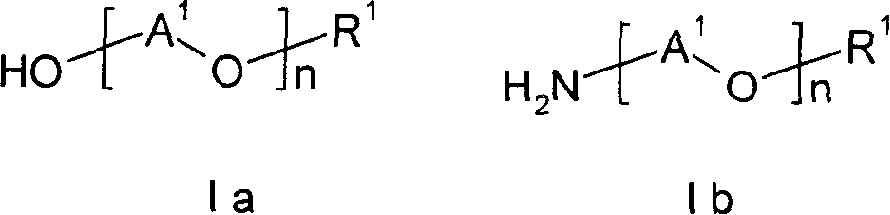


Applications Claiming Priority (2)
| Application Number | Priority Date | Filing Date | Title |
|---|---|---|---|
| DE10345097.1 | 2003-09-26 | ||
| DE10345097A DE10345097A1 (en) | 2003-09-26 | 2003-09-26 | Process for the production of leather and semi-finished products and formulations suitable therefor |
Publications (1)
| Publication Number | Publication Date |
|---|---|
| CN1856582A true CN1856582A (en) | 2006-11-01 |
Family
ID=34353162
Family Applications (1)
| Application Number | Title | Priority Date | Filing Date |
|---|---|---|---|
| CNA2004800278007A Pending CN1856582A (en) | 2003-09-26 | 2004-09-17 | Method for the production of leather and semifinished products, and formulations that are suitable therefor |
Country Status (7)
| Country | Link |
|---|---|
| US (1) | US20070101509A1 (en) |
| EP (1) | EP1670957A1 (en) |
| CN (1) | CN1856582A (en) |
| AR (1) | AR045741A1 (en) |
| BR (1) | BRPI0414399A (en) |
| DE (1) | DE10345097A1 (en) |
| WO (1) | WO2005031007A1 (en) |
Cited By (2)
| Publication number | Priority date | Publication date | Assignee | Title |
|---|---|---|---|---|
| CN102162015A (en) * | 2011-01-21 | 2011-08-24 | 四川德赛尔化工实业有限公司 | Comb-shaped amphiphilic modified styrene-maleic anhydride (SMA) tanning agent and preparation method thereof |
| CN103237903A (en) * | 2010-12-02 | 2013-08-07 | 巴斯夫欧洲公司 | Process for producing leather and aqueous formulations suitable therefor |
Families Citing this family (6)
| Publication number | Priority date | Publication date | Assignee | Title |
|---|---|---|---|---|
| CN100396795C (en) * | 2007-01-25 | 2008-06-25 | 陕西科技大学 | A kind of preparation method of filling foaming type leather retanning agent |
| US8419948B2 (en) * | 2009-11-22 | 2013-04-16 | United Laboratories International, Llc | Wastewater treatment |
| US8642185B2 (en) | 2010-12-02 | 2014-02-04 | Basf Se | Leather production and aqueous formulations suitable therefor |
| US9604979B2 (en) * | 2011-10-03 | 2017-03-28 | Mitsubishi Gas Chemical Company, Inc. | Pyrroloquinoline quinone alcohol adduct |
| CN105838830A (en) * | 2016-05-23 | 2016-08-10 | 四川大学 | A kind of sulfone synthetic tanning agent-nano silicate combined tanning method |
| CN116970746B (en) * | 2023-04-03 | 2025-03-18 | 南京工业大学 | A synthetic tanning agent containing six-membered carbonyl groups and its preparation method and application |
Family Cites Families (4)
| Publication number | Priority date | Publication date | Assignee | Title |
|---|---|---|---|---|
| DE2732217A1 (en) * | 1977-07-16 | 1979-02-01 | Henkel Kgaa | USE OF FINE-PIECE WATER-INSOLUBLE ALKALIAL ALUMINUM SILICATES IN THE MANUFACTURING OF LEATHER |
| DE4014977A1 (en) * | 1990-05-10 | 1991-11-14 | Basf Ag | CONDENSATION PRODUCTS OF PHENOLMONOSULPHONIC ACIDS, DIHYDROXYDIPHENYL SULPHONES, UREA AND FORMALDEHYDE |
| JP3587549B2 (en) * | 1994-05-11 | 2004-11-10 | サカタインクス株式会社 | Anti-slip composition |
| DE19612986A1 (en) * | 1996-04-01 | 1997-10-02 | Basf Ag | Use of copolymers based on ethylenically unsaturated dicarboxylic acids or dicarboxylic acid anhydrides, lower olefins and hydrophobic comonomers for retanning, greasing or hydrophobicizing leather and fur skins |
-
2003
- 2003-09-26 DE DE10345097A patent/DE10345097A1/en not_active Withdrawn
-
2004
- 2004-09-07 AR ARP040103204A patent/AR045741A1/en unknown
- 2004-09-17 WO PCT/EP2004/010437 patent/WO2005031007A1/en not_active Ceased
- 2004-09-17 US US10/572,547 patent/US20070101509A1/en not_active Abandoned
- 2004-09-17 EP EP04765333A patent/EP1670957A1/en not_active Withdrawn
- 2004-09-17 BR BRPI0414399-0A patent/BRPI0414399A/en not_active IP Right Cessation
- 2004-09-17 CN CNA2004800278007A patent/CN1856582A/en active Pending
Cited By (3)
| Publication number | Priority date | Publication date | Assignee | Title |
|---|---|---|---|---|
| CN103237903A (en) * | 2010-12-02 | 2013-08-07 | 巴斯夫欧洲公司 | Process for producing leather and aqueous formulations suitable therefor |
| CN103237903B (en) * | 2010-12-02 | 2016-04-06 | 巴斯夫欧洲公司 | Process for producing leather and aqueous formulations suitable therefor |
| CN102162015A (en) * | 2011-01-21 | 2011-08-24 | 四川德赛尔化工实业有限公司 | Comb-shaped amphiphilic modified styrene-maleic anhydride (SMA) tanning agent and preparation method thereof |
Also Published As
| Publication number | Publication date |
|---|---|
| DE10345097A1 (en) | 2005-04-21 |
| AR045741A1 (en) | 2005-11-09 |
| EP1670957A1 (en) | 2006-06-21 |
| BRPI0414399A (en) | 2006-11-21 |
| US20070101509A1 (en) | 2007-05-10 |
| WO2005031007A1 (en) | 2005-04-07 |
Similar Documents
| Publication | Publication Date | Title |
|---|---|---|
| CN1026249C (en) | Method for treating leather using selected amphiphilic copolymers and leather treated by the method | |
| CN1856582A (en) | Method for the production of leather and semifinished products, and formulations that are suitable therefor | |
| CN1087649A (en) | The graft copolymer of unsaturated monomer and carbohydrate, their production method and application thereof | |
| CN1034209A (en) | Application with fluorinated telomer of hydrophilic group | |
| US6033442A (en) | Use of aqueous solutions or dispersions of copolymers of carboxyl-group-containing monomers, ethylenically unsaturated acetals, ketals or orthocarboxylic acid esters and optionally other copolymerizable monomers as leather tanning agents | |
| CN1160473C (en) | Tanning of leather | |
| CN1498973A (en) | Waterproof leather without contg. Cr | |
| US6200640B1 (en) | Polymer composition and process for treating leather and fur skins | |
| CN1705756A (en) | Method for producing leather | |
| NZ258563A (en) | Copolymer comprising unsaturated acid monomer and a mono methallyl ether of glycerol havng a free hydroxy group and a c12-24 etherified or esterified hydroxy group; treatment of leather | |
| CN1826415A (en) | Preparation of leather with polymer | |
| CN1180749A (en) | Method of treating leather with improved retanning agents | |
| CN1038286A (en) | Sulfonated product of conjugated diene, polymer of the sulfonated product and dispersion composition containing the sulfonated product and/or the polymer | |
| CN1551925A (en) | Polyisobutylene for replacing lanolin in fatliquor for the production of leather, fatliquor, its use and leather produced | |
| KR102490984B1 (en) | Method for producing hydrophobic leather treatment agent | |
| CN1748038A (en) | Method for producing leather | |
| US20070037934A1 (en) | Method for the production of copolymers | |
| CN1856538A (en) | Aqueous dispersions of copolymers, processes for their production and uses thereof | |
| CN1745181A (en) | Adducts based on cyclic compounds and the use thereof as tanning agents and curing agents | |
| US7354457B2 (en) | Tanning agent and curing agent based on dialdehydes | |
| US20080249230A1 (en) | Method for Treating Fibrous Substrates | |
| KR20150045362A (en) | Chrome free leather retanning | |
| CN1788093A (en) | Use of copolymers as auxiliary agents for producing leather | |
| CN1571851A (en) | Leather waterproofing formulation and leather goods waterproofed therewith | |
| CN1993382A (en) | Copolymers, production and use thereof |
Legal Events
| Date | Code | Title | Description |
|---|---|---|---|
| C06 | Publication | ||
| PB01 | Publication | ||
| C10 | Entry into substantive examination | ||
| SE01 | Entry into force of request for substantive examination | ||
| AD01 | Patent right deemed abandoned |
Effective date of abandoning: 20061101 |
|
| C20 | Patent right or utility model deemed to be abandoned or is abandoned |