CN1909902A - Triazole, oxadiazole and thiadiazole derivatives as PPAR modulators for the treatment of diabetes - Google Patents
Triazole, oxadiazole and thiadiazole derivatives as PPAR modulators for the treatment of diabetes Download PDFInfo
- Publication number
- CN1909902A CN1909902A CNA2004800383003A CN200480038300A CN1909902A CN 1909902 A CN1909902 A CN 1909902A CN A2004800383003 A CNA2004800383003 A CN A2004800383003A CN 200480038300 A CN200480038300 A CN 200480038300A CN 1909902 A CN1909902 A CN 1909902A
- Authority
- CN
- China
- Prior art keywords
- alkyl
- compound
- aryl
- hydrogen
- independently selected
- Prior art date
- Legal status (The legal status is an assumption and is not a legal conclusion. Google has not performed a legal analysis and makes no representation as to the accuracy of the status listed.)
- Pending
Links
Classifications
-
- A—HUMAN NECESSITIES
- A61—MEDICAL OR VETERINARY SCIENCE; HYGIENE
- A61K—PREPARATIONS FOR MEDICAL, DENTAL OR TOILETRY PURPOSES
- A61K31/00—Medicinal preparations containing organic active ingredients
- A61K31/33—Heterocyclic compounds
- A61K31/395—Heterocyclic compounds having nitrogen as a ring hetero atom, e.g. guanethidine or rifamycins
- A61K31/41—Heterocyclic compounds having nitrogen as a ring hetero atom, e.g. guanethidine or rifamycins having five-membered rings with two or more ring hetero atoms, at least one of which being nitrogen, e.g. tetrazole
- A61K31/4196—1,2,4-Triazoles
-
- A—HUMAN NECESSITIES
- A61—MEDICAL OR VETERINARY SCIENCE; HYGIENE
- A61K—PREPARATIONS FOR MEDICAL, DENTAL OR TOILETRY PURPOSES
- A61K31/00—Medicinal preparations containing organic active ingredients
- A61K31/33—Heterocyclic compounds
- A61K31/395—Heterocyclic compounds having nitrogen as a ring hetero atom, e.g. guanethidine or rifamycins
- A61K31/41—Heterocyclic compounds having nitrogen as a ring hetero atom, e.g. guanethidine or rifamycins having five-membered rings with two or more ring hetero atoms, at least one of which being nitrogen, e.g. tetrazole
- A61K31/4245—Oxadiazoles
-
- A—HUMAN NECESSITIES
- A61—MEDICAL OR VETERINARY SCIENCE; HYGIENE
- A61K—PREPARATIONS FOR MEDICAL, DENTAL OR TOILETRY PURPOSES
- A61K31/00—Medicinal preparations containing organic active ingredients
- A61K31/33—Heterocyclic compounds
- A61K31/395—Heterocyclic compounds having nitrogen as a ring hetero atom, e.g. guanethidine or rifamycins
- A61K31/41—Heterocyclic compounds having nitrogen as a ring hetero atom, e.g. guanethidine or rifamycins having five-membered rings with two or more ring hetero atoms, at least one of which being nitrogen, e.g. tetrazole
- A61K31/433—Thidiazoles
-
- A—HUMAN NECESSITIES
- A61—MEDICAL OR VETERINARY SCIENCE; HYGIENE
- A61P—SPECIFIC THERAPEUTIC ACTIVITY OF CHEMICAL COMPOUNDS OR MEDICINAL PREPARATIONS
- A61P1/00—Drugs for disorders of the alimentary tract or the digestive system
- A61P1/16—Drugs for disorders of the alimentary tract or the digestive system for liver or gallbladder disorders, e.g. hepatoprotective agents, cholagogues, litholytics
-
- A—HUMAN NECESSITIES
- A61—MEDICAL OR VETERINARY SCIENCE; HYGIENE
- A61P—SPECIFIC THERAPEUTIC ACTIVITY OF CHEMICAL COMPOUNDS OR MEDICINAL PREPARATIONS
- A61P13/00—Drugs for disorders of the urinary system
- A61P13/12—Drugs for disorders of the urinary system of the kidneys
-
- A—HUMAN NECESSITIES
- A61—MEDICAL OR VETERINARY SCIENCE; HYGIENE
- A61P—SPECIFIC THERAPEUTIC ACTIVITY OF CHEMICAL COMPOUNDS OR MEDICINAL PREPARATIONS
- A61P3/00—Drugs for disorders of the metabolism
-
- A—HUMAN NECESSITIES
- A61—MEDICAL OR VETERINARY SCIENCE; HYGIENE
- A61P—SPECIFIC THERAPEUTIC ACTIVITY OF CHEMICAL COMPOUNDS OR MEDICINAL PREPARATIONS
- A61P3/00—Drugs for disorders of the metabolism
- A61P3/04—Anorexiants; Antiobesity agents
-
- A—HUMAN NECESSITIES
- A61—MEDICAL OR VETERINARY SCIENCE; HYGIENE
- A61P—SPECIFIC THERAPEUTIC ACTIVITY OF CHEMICAL COMPOUNDS OR MEDICINAL PREPARATIONS
- A61P3/00—Drugs for disorders of the metabolism
- A61P3/06—Antihyperlipidemics
-
- A—HUMAN NECESSITIES
- A61—MEDICAL OR VETERINARY SCIENCE; HYGIENE
- A61P—SPECIFIC THERAPEUTIC ACTIVITY OF CHEMICAL COMPOUNDS OR MEDICINAL PREPARATIONS
- A61P3/00—Drugs for disorders of the metabolism
- A61P3/08—Drugs for disorders of the metabolism for glucose homeostasis
- A61P3/10—Drugs for disorders of the metabolism for glucose homeostasis for hyperglycaemia, e.g. antidiabetics
-
- A—HUMAN NECESSITIES
- A61—MEDICAL OR VETERINARY SCIENCE; HYGIENE
- A61P—SPECIFIC THERAPEUTIC ACTIVITY OF CHEMICAL COMPOUNDS OR MEDICINAL PREPARATIONS
- A61P31/00—Antiinfectives, i.e. antibiotics, antiseptics, chemotherapeutics
- A61P31/12—Antivirals
-
- A—HUMAN NECESSITIES
- A61—MEDICAL OR VETERINARY SCIENCE; HYGIENE
- A61P—SPECIFIC THERAPEUTIC ACTIVITY OF CHEMICAL COMPOUNDS OR MEDICINAL PREPARATIONS
- A61P43/00—Drugs for specific purposes, not provided for in groups A61P1/00-A61P41/00
-
- A—HUMAN NECESSITIES
- A61—MEDICAL OR VETERINARY SCIENCE; HYGIENE
- A61P—SPECIFIC THERAPEUTIC ACTIVITY OF CHEMICAL COMPOUNDS OR MEDICINAL PREPARATIONS
- A61P7/00—Drugs for disorders of the blood or the extracellular fluid
- A61P7/04—Antihaemorrhagics; Procoagulants; Haemostatic agents; Antifibrinolytic agents
-
- A—HUMAN NECESSITIES
- A61—MEDICAL OR VETERINARY SCIENCE; HYGIENE
- A61P—SPECIFIC THERAPEUTIC ACTIVITY OF CHEMICAL COMPOUNDS OR MEDICINAL PREPARATIONS
- A61P9/00—Drugs for disorders of the cardiovascular system
-
- A—HUMAN NECESSITIES
- A61—MEDICAL OR VETERINARY SCIENCE; HYGIENE
- A61P—SPECIFIC THERAPEUTIC ACTIVITY OF CHEMICAL COMPOUNDS OR MEDICINAL PREPARATIONS
- A61P9/00—Drugs for disorders of the cardiovascular system
- A61P9/10—Drugs for disorders of the cardiovascular system for treating ischaemic or atherosclerotic diseases, e.g. antianginal drugs, coronary vasodilators, drugs for myocardial infarction, retinopathy, cerebrovascula insufficiency, renal arteriosclerosis
-
- A—HUMAN NECESSITIES
- A61—MEDICAL OR VETERINARY SCIENCE; HYGIENE
- A61P—SPECIFIC THERAPEUTIC ACTIVITY OF CHEMICAL COMPOUNDS OR MEDICINAL PREPARATIONS
- A61P9/00—Drugs for disorders of the cardiovascular system
- A61P9/12—Antihypertensives
-
- C—CHEMISTRY; METALLURGY
- C07—ORGANIC CHEMISTRY
- C07D—HETEROCYCLIC COMPOUNDS
- C07D249/00—Heterocyclic compounds containing five-membered rings having three nitrogen atoms as the only ring hetero atoms
- C07D249/02—Heterocyclic compounds containing five-membered rings having three nitrogen atoms as the only ring hetero atoms not condensed with other rings
- C07D249/08—1,2,4-Triazoles; Hydrogenated 1,2,4-triazoles
-
- C—CHEMISTRY; METALLURGY
- C07—ORGANIC CHEMISTRY
- C07D—HETEROCYCLIC COMPOUNDS
- C07D271/00—Heterocyclic compounds containing five-membered rings having two nitrogen atoms and one oxygen atom as the only ring hetero atoms
- C07D271/02—Heterocyclic compounds containing five-membered rings having two nitrogen atoms and one oxygen atom as the only ring hetero atoms not condensed with other rings
- C07D271/10—1,3,4-Oxadiazoles; Hydrogenated 1,3,4-oxadiazoles
- C07D271/107—1,3,4-Oxadiazoles; Hydrogenated 1,3,4-oxadiazoles with two aryl or substituted aryl radicals attached in positions 2 and 5
-
- C—CHEMISTRY; METALLURGY
- C07—ORGANIC CHEMISTRY
- C07D—HETEROCYCLIC COMPOUNDS
- C07D285/00—Heterocyclic compounds containing rings having nitrogen and sulfur atoms as the only ring hetero atoms, not provided for by groups C07D275/00 - C07D283/00
- C07D285/01—Five-membered rings
- C07D285/02—Thiadiazoles; Hydrogenated thiadiazoles
- C07D285/04—Thiadiazoles; Hydrogenated thiadiazoles not condensed with other rings
- C07D285/12—1,3,4-Thiadiazoles; Hydrogenated 1,3,4-thiadiazoles
Landscapes
- Health & Medical Sciences (AREA)
- Chemical & Material Sciences (AREA)
- Organic Chemistry (AREA)
- Life Sciences & Earth Sciences (AREA)
- Medicinal Chemistry (AREA)
- Veterinary Medicine (AREA)
- Public Health (AREA)
- General Health & Medical Sciences (AREA)
- Animal Behavior & Ethology (AREA)
- Pharmacology & Pharmacy (AREA)
- Chemical Kinetics & Catalysis (AREA)
- Nuclear Medicine, Radiotherapy & Molecular Imaging (AREA)
- Bioinformatics & Cheminformatics (AREA)
- Engineering & Computer Science (AREA)
- General Chemical & Material Sciences (AREA)
- Diabetes (AREA)
- Epidemiology (AREA)
- Hematology (AREA)
- Obesity (AREA)
- Cardiology (AREA)
- Heart & Thoracic Surgery (AREA)
- Urology & Nephrology (AREA)
- Endocrinology (AREA)
- Gastroenterology & Hepatology (AREA)
- Child & Adolescent Psychology (AREA)
- Virology (AREA)
- Communicable Diseases (AREA)
- Oncology (AREA)
- Emergency Medicine (AREA)
- Vascular Medicine (AREA)
- Pharmaceuticals Containing Other Organic And Inorganic Compounds (AREA)
- Plural Heterocyclic Compounds (AREA)
- Nitrogen- Or Sulfur-Containing Heterocyclic Ring Compounds With Rings Of Six Or More Members (AREA)
- Heterocyclic Carbon Compounds Containing A Hetero Ring Having Nitrogen And Oxygen As The Only Ring Hetero Atoms (AREA)
- Peptides Or Proteins (AREA)
- Medicinal Preparation (AREA)
- Pyrrole Compounds (AREA)
Abstract
Description
发明背景Background of the invention
过氧化物增殖物激活受体(PPARs)为核激素受体超家族的成员,为介导配体依赖型转录激活和阻遏的多种不同的蛋白质。PPAR分为三种亚型:PPARα、PPARγ和PPARδ。Peroxisome proliferator-activated receptors (PPARs), members of the nuclear hormone receptor superfamily, are a diverse group of proteins that mediate ligand-dependent activation and repression of transcription. PPARs are divided into three subtypes: PPARα, PPARγ, and PPARδ.
各种同种型的表达概况明显互不相同,其中PPARα主要表达于但不限于肝脏;PPARγ主要表达于动物脂肪组织,PPARδ其表达无处不在。对PPAR各同种型和配体的研究揭示了其对与胰岛素抗性和糖尿病以及脂类疾病(如高脂血症和血脂异常症)相关过程的调节作用。PPARγ激动剂(如吡格列酮)可用于治疗非胰岛素依赖型糖尿病。这类PPARγ激动剂与胰岛素敏化作用相关。The expression profiles of the various isoforms are distinct, with PPARα predominantly expressed in, but not limited to, the liver; PPARγ predominantly expressed in animal adipose tissue, and PPARδ ubiquitously expressed. Studies of PPAR isoforms and ligands have revealed their regulatory roles in processes associated with insulin resistance and diabetes, as well as lipid disorders such as hyperlipidemia and dyslipidemia. PPARγ agonists (such as pioglitazone) can be used to treat non-insulin-dependent diabetes mellitus. Such PPARγ agonists are associated with insulin sensitization.
PPARα激动剂(如非诺贝特)可用于治疗高脂血症。尽管没有临床证据显示PPARδ激动剂用于人类,许多临床前的研究表明PPARδ激动剂可用于治疗糖尿病和脂类疾病。PPARα agonists (such as fenofibrate) can be used to treat hyperlipidemia. Although there is no clinical evidence for the use of PPARδ agonists in humans, many preclinical studies have shown that PPARδ agonists can be used in the treatment of diabetes and lipid diseases.
包括代谢综合征(肥胖、胰岛素抗性、高脂血症、高血压和动脉粥样硬化)的疾病的流行继续呈现增长的势头。需要新型的药物来解决患者的临床需要。The prevalence of diseases including metabolic syndrome (obesity, insulin resistance, hyperlipidemia, hypertension and atherosclerosis) continues to increase. Novel drugs are needed to address the clinical needs of patients.
已表明PPARδ作为可能的治疗手段用于调节许多与代谢综合征和粥样动脉硬化相关的许多参数。例如对于肥胖的未患糖尿病的恒河猴,PPARδ激动剂降低了循环的甘油三酯和LDL的水平,减少了基础胰岛素的水平并且增加了HDL的水平(Oliver,W.R.等,Proc NatlAcad Sci 98:5306-5311;2001)。认为使用PPARδ激动剂产生胰岛素敏化作用的原因部分归于减少了myocellular脂类(Dressel,U.等,MolEndocrinol 17:2477-2493;2003)。PPARdelta has been suggested as a possible therapeutic tool for modulating a number of parameters associated with metabolic syndrome and atherosclerosis. For example, in obese non-diabetic rhesus monkeys, PPARδ agonists decreased circulating triglyceride and LDL levels, decreased basal insulin levels and increased HDL levels (Oliver, W.R. et al., Proc Natl Acad Sci 98: 5306-5311; 2001). Insulin sensitization with PPARδ agonists is thought to be due in part to reduction of myocellular lipids (Dressel, U. et al., Mol Endocrinol 17:2477-2493; 2003).
此外,认为动脉粥样硬化是血脂异常导致的疾病并可并发炎性疾病。对于大多数炎症、感染和组织损伤,产生C-反应蛋白(CRP)为急性期的部分反应。在诊断上其为轻度炎症的标志。血浆CRP水平高于3mg/L预示着患冠状动脉疾病的高危险性(J.Clin.Invest 111:1085-1812,2003)。In addition, atherosclerosis is considered to be a disease caused by dyslipidemia and may be complicated by inflammatory diseases. The production of C-reactive protein (CRP) is part of the acute phase response to most inflammations, infections and tissue injuries. It is diagnostically a sign of mild inflammation. A plasma CRP level higher than 3 mg/L indicates a high risk of coronary artery disease (J. Clin. Invest 111: 1085-1812, 2003).
人们认为PPARδ激动剂介导消炎作用。实际上认为,用PPARδ激动剂处理LPS-刺激的巨噬细胞,结果发现降低了iNOS、IL-12和IL-6的表达(Welch,J.S.等,Proc Natl Acad Sci 100:6712-67172003)。PPARdelta agonists are thought to mediate anti-inflammatory effects. Indeed, treatment of LPS-stimulated macrophages with a PPARδ agonist was found to reduce the expression of iNOS, IL-12 and IL-6 (Welch, J.S. et al., Proc Natl Acad Sci 100:6712-6717 2003).
特别希望当活性药物选择性调节PPAR受体亚型时,提供特别需要的药理作用。在某些情况下,希望活性药物选择性调节多于一种PPAR受体亚型以得到所需的药理作用。It is particularly desirable to provide a particularly desirable pharmacological effect when the active drug selectively modulates PPAR receptor subtypes. In some instances, it is desirable for an active drug to selectively modulate more than one PPAR receptor subtype to obtain a desired pharmacological effect.
发明概述Summary of the invention
本发明涉及以下结构式I表示的化合物及其立体异构体、药学上可接受的盐、溶剂合物和水合物:The present invention relates to compounds represented by the following structural formula I and stereoisomers, pharmaceutically acceptable salts, solvates and hydrates thereof:
其中:in:
(a)R1选自氢、C1-C8烷基、C1-C8烯基、C1-C8杂烷基、芳基-C0-4-烷基、芳基-C1-4-杂烷基、杂芳基-C0-4-烷基和C3-C6环烷基芳基-C0-2-烷基,且其中所述C1-C8烷基、C1-C8烯基、芳基-C0-4-烷基、芳基-C1-4-杂烷基、杂芳基-C0-4-烷基、C3-C6环烷基芳基-C0-2-烷基各自任选被1-3个独立选自R1’的取代基取代;(a) R1 is selected from hydrogen, C 1 -C 8 alkyl, C 1 -C 8 alkenyl, C 1 -C 8 heteroalkyl, aryl-C 0-4 -alkyl, aryl-C 1- 4 -heteroalkyl, heteroaryl-C 0-4 -alkyl and C 3 -C 6 cycloalkylaryl-C 0-2 -alkyl, and wherein said C 1 -C 8 alkyl, C 1 -C 8 alkenyl, aryl-C 0-4 -alkyl, aryl-C 1-4 -heteroalkyl, heteroaryl-C 0-4 -alkyl, C 3 -C 6 cycloalkyl Each aryl-C 0-2 -alkyl group is optionally substituted by 1-3 substituents independently selected from R1';
(b)R1’、R26、R27、R28和R31各自独立选自氢、羟基、氰基、硝基、卤素、氧代基、C1-C6烷基、C1-C6烷基-COOR12、C1-C6烷氧基、C1-C6卤代烷基、C1-C6卤代烷氧基、C3-C7环烷基、芳氧基、芳基-C0-4-烷基、杂芳基、杂环烷基、C(O)R13、COOR14、OC(O)R15、OS(O)2R16、N(R17)2、NR18C(O)R19、NR20SO2R21、SR22、S(O)R23、S(O)2R24和S(O)2N(R25)2;R12、R13、R14、R15、R16、R17、R18、R19、R20、R21、R22、R23、R24和R25各自独立选自氢、C1-C6烷基和芳基;(b) R1', R26, R27, R28 and R31 are each independently selected from hydrogen, hydroxyl, cyano, nitro, halogen, oxo, C 1 -C 6 alkyl, C 1 -C 6 alkyl-COOR12 , C 1 -C 6 alkoxy, C 1 -C 6 haloalkyl, C 1 -C 6 haloalkoxy, C 3 -C 7 cycloalkyl, aryloxy, aryl-C 0-4 -alkyl , Heteroaryl, Heterocycloalkyl, C(O)R13, COOR14, OC(O)R15, OS(O) 2 R16, N(R17) 2 , NR18C(O)R19, NR20SO 2 R21, SR22, S (O)R23, S(O) 2R24 and S(O) 2N (R25) 2 ; R12, R13, R14, R15, R16, R17, R18, R19, R20, R21, R22, R23, R24 and R25 each independently selected from hydrogen, C 1 -C 6 alkyl and aryl;
(c)V选自C0-C8烷基和C1-4-杂烷基;(c) V is selected from C 0 -C 8 alkyl and C 1-4 -heteroalkyl;
(d)X选自单键、O、S、S(O)2和N;(d) X is selected from a single bond, O, S, S(O) and N ;
(e)U为脂族连接基,其中所述脂族连接基的一个碳原子任选被O、NH或S置换,并且其中这类脂族连接基任选被1-4个各自独立选自R30的取代基取代;(e) U is an aliphatic linking group, wherein one carbon atom of the aliphatic linking group is optionally replaced by O, NH or S, and wherein such aliphatic linking group is optionally replaced by 1-4 each independently selected from Substituent substitution of R30;
(f)W为N、O或S;(f) W is N, O or S;
(g)Y选自C、O、S、NH和单键;(g) Y is selected from C, O, S, NH and single bonds;
(h)E为C(R3)(R4)A或A且其中(h) E is C(R3)(R4)A or A and wherein
(i)A选自羧基、四唑、C1-C6烷基腈、甲酰胺、磺酰胺和酰基磺酰胺;其中所述磺酰胺、酰基磺酰胺和四唑各自任选被一至两个独立选自R7的基团取代;(i) A is selected from carboxyl, tetrazole, C 1 -C 6 alkyl nitrile, formamide, sulfonamide and acyl sulfonamide; wherein each of the sulfonamide, acyl sulfonamide and tetrazole is optionally replaced by one to two independently Substituted by a group selected from R7;
(ii)各R7独立选自氢、C1-C6卤代烷基、芳基C0-C4烷基和C1-C6烷基;(ii) each R7 is independently selected from hydrogen, C 1 -C 6 haloalkyl, arylC 0 -C 4 alkyl and C 1 -C 6 alkyl;
(iii)R3选自氢、C1-C5烷基和C1-C5烷氧基;和(iii) R3 is selected from hydrogen, C 1 -C 5 alkyl and C 1 -C 5 alkoxy; and
(iv)R4选自H、C1-C5烷基、C1-C5烷氧基、芳氧基、C3-C6环烷基和芳基C0-C4烷基,且R3和R4任选结合形成C3-C4环烷基,其中所述烷基、烷氧基、芳氧基、环烷基和芳基-烷基各自任选被1-3个各自独立选自R26的取代基取代;(iv) R4 is selected from H, C 1 -C 5 alkyl, C 1 -C 5 alkoxy, aryloxy, C 3 -C 6 cycloalkyl and aryl C 0 -C 4 alkyl, and R3 and R4 are optionally combined to form a C 3 -C 4 cycloalkyl group, wherein the alkyl, alkoxy, aryloxy, cycloalkyl and aryl-alkyl are each optionally selected from 1 to 3 independently selected from The substituent of R26 is substituted;
(i)R8选自氢、C1-C4烷基、C1-C4烯基和卤素;(i) R8 is selected from hydrogen, C 1 -C 4 alkyl, C 1 -C 4 alkenyl and halogen;
(j)R9选自氢、C1-C4烷基、C1-C4烯基、卤素、芳基-C0-C4烷基、杂芳基、C1-C6烯丙基和OR29,其中所述芳基-C0-C4烷基、杂芳基各自任选被1-3个独立选自R27的取代基取代;R29选自氢和C1-C4烷基;(j) R9 is selected from hydrogen, C 1 -C 4 alkyl, C 1 -C 4 alkenyl, halogen, aryl-C 0 -C 4 alkyl, heteroaryl, C 1 -C 6 allyl and OR29, wherein the aryl-C 0 -C 4 alkyl and heteroaryl are each optionally substituted by 1-3 substituents independently selected from R27; R29 is selected from hydrogen and C 1 -C 4 alkyl;
(k)R10、R11各自独立选自氢、羟基、氰基、硝基、卤素、氧代基、C1-C6烷基、C1-C6烯基、C1-C6烷基-COOR12”、C0-C6烷氧基、C1-C6卤代烷基、C1-C6卤代烷氧基、C3-C7环烷基、芳基-C0-4-烷基、芳基-C1-4-杂烷基、杂芳基-C0-4-烷基、C3-C6环烷基芳基-C0-2-烷基、芳氧基、C(O)R13’、COOR14’、OC(O)R15’、OS(O)2R16’、N(R17’)2、NR18’C(O)R19’、NR20’SO2R21’、SR22’、S(O)R23’、S(O)2R24’和S(O)2N(R25’)2;其中所述芳基-C0-4-烷基、芳基-C1-4-杂烷基、杂芳基-C0-4-烷基和C3-C6环烷基芳基-C0-2-烷基各自任选被1-3个独立选自R28的取代基取代;其中R10和R11任选与其连接的苯基结合形成5-6元稠合的双环;(k) R10 and R11 are each independently selected from hydrogen, hydroxyl, cyano, nitro, halogen, oxo, C 1 -C 6 alkyl, C 1 -C 6 alkenyl, C 1 -C 6 alkyl- COOR12", C 0 -C 6 alkoxy, C 1 -C 6 haloalkyl, C 1 -C 6 haloalkoxy, C 3 -C 7 cycloalkyl, aryl-C 0-4 -alkyl, aryl Base-C 1-4 -heteroalkyl, heteroaryl-C 0-4 -alkyl, C 3 -C 6 cycloalkylaryl-C 0-2 -alkyl, aryloxy, C(O) R13', COOR14', OC(O)R15', OS(O) 2 R16', N(R17') 2 , NR18'C(O)R19', NR20'SO 2 R21', SR22', S(O )R23', S(O) 2 R24' and S(O) 2 N(R25') 2 ; wherein said aryl-C 0-4 -alkyl, aryl-C 1-4 -heteroalkyl, Heteroaryl-C 0-4 -alkyl and C 3 -C 6 cycloalkylaryl-C 0-2 -alkyl are each optionally substituted by 1-3 substituents independently selected from R28; wherein R10 and R11 is optionally combined with the phenyl group connected to it to form a 5-6 membered fused bicyclic ring;
(1)R12’、R12”、R13’、R14’、R15’、R16’、R17’、R18’、R19’、R20’、R21’、R22’、R23’、R24’和R25’各自独立选自氢、C1-C6烷基和芳基;(1) R12', R12", R13', R14', R15', R16', R17', R18', R19', R20', R21', R22', R23', R24' and R25' are independently selected From hydrogen, C 1 -C 6 alkyl and aryl;
(m)R30选自C1-C6烷基、芳基-C0-4-烷基、芳基-C1-4-杂烷基、杂芳基-C0-4-烷基和C3-C6环烷基芳基-C0-2-烷基,且其中所述C1-C6烷基、芳基-C0-4-烷基、芳基-C1-4-杂烷基、杂芳基-C0-4-烷基和C3-C6环烷基芳基-C0-2-烷基各自任选被1-3个各自独立选自R31的取代基取代;(m) R30 is selected from C 1 -C 6 alkyl, aryl-C 0-4 -alkyl, aryl-C 1-4 -heteroalkyl, heteroaryl-C 0-4 -alkyl and C 3 -C 6 cycloalkylaryl-C 0-2 -alkyl, and wherein said C 1 -C 6 alkyl, aryl-C 0-4 -alkyl, aryl-C 1-4 -hetero Alkyl, heteroaryl-C 0-4 -alkyl and C 3 -C 6 cycloalkylaryl-C 0-2 -alkyl are each optionally substituted by 1-3 substituents each independently selected from R31 ;
(n)R32选自氢、卤素、C1-C6烷基、C1-C6卤代烷基和C1-C6氧代烷基;和(n) R32 is selected from hydrogen, halogen, C 1 -C 6 alkyl, C 1 -C 6 haloalkyl and C 1 -C 6 oxoalkyl; and
(o)----为任选的键,以在指示位置形成双键。(o) ---- is an optional bond to form a double bond at the indicated position.
本发明的另一个实施方案为式Ia的化合物:Another embodiment of the invention is a compound of formula Ia:

本发明的另一个实施方案为式Ib的化合物:Another embodiment of the invention is a compound of formula Ib:

其中W1为O或S。where W1 is O or S.
本发明的另一个实施方案为式Ic的化合物:Another embodiment of the invention is a compound of formula Ic:

本发明的另一个实施方案为式II的化合物:Another embodiment of the invention is a compound of formula II:
及其立体异构体、药学上可接受的盐、溶剂合物和水合物,其中:And stereoisomers, pharmaceutically acceptable salts, solvates and hydrates thereof, wherein:
(a)R1选自氢、C1-C8烷基、C1-C8烯基、芳基-C0-4-烷基、芳基-C1-4-杂烷基、杂芳基-C0-4-烷基和C3-C6环烷基芳基-C0-2-烷基,且其中所述C1-C8烷基、C1-C8烯基、芳基-C0-4-烷基、芳基-C1-4-杂烷基、杂芳基-C0-4-烷基、C3-C6环烷基芳基-C0-2-烷基各自任选被1-3个独立选自R1’的取代基取代;(a) R1 is selected from hydrogen, C 1 -C 8 alkyl, C 1 -C 8 alkenyl, aryl-C 0-4 -alkyl, aryl-C 1-4 -heteroalkyl, heteroaryl -C 0-4 -alkyl and C 3 -C 6 cycloalkylaryl-C 0-2 -alkyl, and wherein said C 1 -C 8 alkyl, C 1 -C 8 alkenyl, aryl -C 0-4 -alkyl, aryl-C 1-4 -heteroalkyl, heteroaryl-C 0-4 -alkyl, C 3 -C 6 cycloalkylaryl-C 0-2 -alk Each group is optionally substituted by 1-3 substituents independently selected from R1';
(b)R1’、R26、R27、R28和R31各自独立选自氢、羟基、氰基、硝基、卤素、氧代基、C1-C6烷基、C1-C6烷基-COOR12、C1-C6烷氧基、C1-C6卤代烷基、C1-C6卤代烷氧基、C3-C7环烷基、芳氧基、芳基-C0-4-烷基、杂芳基、杂环烷基、C(O)R13、COOR14、OC(O)R15、OS(O)2R16、N(R17)2、NR18C(O)R19、NR20SO2R21、SR22、S(O)R23、S(O)2R24和S(O)2N(R25)2;R12、R13、R14、R15、R16、R17、R18、R19、R20、R21、R22、R23、R24和R25各自独立选自氢、C1-C6烷基和芳基;(b) R1', R26, R27, R28 and R31 are each independently selected from hydrogen, hydroxyl, cyano, nitro, halogen, oxo, C 1 -C 6 alkyl, C 1 -C 6 alkyl-COOR12 , C 1 -C 6 alkoxy, C 1 -C 6 haloalkyl, C 1 -C 6 haloalkoxy, C 3 -C 7 cycloalkyl, aryloxy, aryl-C 0-4 -alkyl , Heteroaryl, Heterocycloalkyl, C(O)R13, COOR14, OC(O)R15, OS(O) 2 R16, N(R17) 2 , NR18C(O)R19, NR20SO 2 R21, SR22, S (O)R23, S(O) 2R24 and S(O) 2N (R25) 2 ; R12, R13, R14, R15, R16, R17, R18, R19, R20, R21, R22, R23, R24 and R25 each independently selected from hydrogen, C 1 -C 6 alkyl and aryl;
(c)V选自C0-C8烷基和C1-4-杂烷基;(c) V is selected from C 0 -C 8 alkyl and C 1-4 -heteroalkyl;
(d)X选自单键、O、S、S(O)2和N;(d) X is selected from a single bond, O, S, S(O) and N ;
(e)U为脂族连接基,其中所述脂族连接基的一个碳原子任选被O、NH或S置换,并且其中这类脂族连接基被1-4个各自独立选自R30的取代基取代;(e) U is an aliphatic linking group, wherein one carbon atom of the aliphatic linking group is optionally replaced by O, NH or S, and wherein such aliphatic linking group is replaced by 1-4 each independently selected from R30 substituent substitution;
(f)Y选自C、O、S、NH和单键;(f) Y is selected from C, O, S, NH and single bonds;
(g)E为C(R3)(R4)A或A且其中(g) E is C(R3)(R4)A or A and wherein
(i)A选自羧基、四唑、C1-C6烷基腈、甲酰胺、磺酰胺和酰基磺酰胺;其中所述磺酰胺、酰基磺酰胺和四唑各自任选被一至两个独立选自R7的基团取代;(i) A is selected from carboxyl, tetrazole, C 1 -C 6 alkyl nitrile, formamide, sulfonamide and acyl sulfonamide; wherein each of the sulfonamide, acyl sulfonamide and tetrazole is optionally replaced by one to two independently Substituted by a group selected from R7;
(ii)各R7独立选自氢、C1-C6卤代烷基、芳基C0-C4烷基和C1-C6烷基;(ii) each R7 is independently selected from hydrogen, C 1 -C 6 haloalkyl, aryl C 0 -C 4 alkyl and C 1 -C 6 alkyl;
(iii)R3选自氢、C1-C5烷基和C1-C5烷氧基;和(iii) R3 is selected from hydrogen, C 1 -C 5 alkyl and C 1 -C 5 alkoxy; and
(iv)R4选自H、C1-C5烷基、C1-C5烷氧基、芳氧基、C3-C6环烷基和芳基C0-C4烷基,且R3和R4任选结合形成C3-C4环烷基,其中所述烷基、烷氧基、芳氧基、环烷基和芳基-烷基各自任选被1-3个各自独立选自R26的取代基取代;(iv) R4 is selected from H, C 1 -C 5 alkyl, C 1 -C 5 alkoxy, aryloxy, C 3 -C 6 cycloalkyl and aryl C 0 -C 4 alkyl, and R3 and R4 are optionally combined to form a C 3 -C 4 cycloalkyl group, wherein the alkyl, alkoxy, aryloxy, cycloalkyl and aryl-alkyl are each optionally selected from 1 to 3 independently selected from The substituent of R26 is substituted;
(h)R8选自氢、C1-C4烷基、C1-C4烯基和卤素;(h) R8 is selected from hydrogen, C 1 -C 4 alkyl, C 1 -C 4 alkenyl and halogen;
(i)R9选自氢、C1-C4烷基、C1-C4烯基、卤素、芳基-C0-C4烷基、杂芳基、C1-C6烯丙基和OR29,其中所述芳基-C0-C4烷基、杂芳基各自任选被1-3个独立选自R27的取代基取代;R29选自氢和C1-C4烷基;(i) R9 is selected from hydrogen, C 1 -C 4 alkyl, C 1 -C 4 alkenyl, halogen, aryl-C 0 -C 4 alkyl, heteroaryl, C 1 -C 6 allyl and OR29, wherein the aryl-C 0 -C 4 alkyl and heteroaryl are each optionally substituted by 1-3 substituents independently selected from R27; R29 is selected from hydrogen and C 1 -C 4 alkyl;
(j)R10、R11各自独立选自氢、羟基、氰基、硝基、卤素、氧代基、C1-C6烷基、C1-C6烯基、C1-C6烷基-COOR12”、C0-C6烷氧基、C1-C6卤代烷基、C1-C6卤代烷氧基、C3-C7环烷基、芳基-C0-4-烷基、芳基-C1-4-杂烷基、杂芳基-C0-4-烷基、C3-C6环烷基芳基-C0-2-烷基、芳氧基、C(O)R13’、COOR14’、OC(O)R15’、OS(O)2R16’、N(R17’)2、NR18’C(O)R19’、NR20’SO2R21’、SR22’、S(O)R23’、S(O)2R24’和S(O)2N(R25’)2;其中所述芳基-C0-4-烷基、芳基-C1-4-杂烷基、杂芳基-C0-4-烷基和C3-C6环烷基芳基-C0-2-烷基各自任选被1-3个独立选自R28的取代基取代;其中R10和R11任选与其连接的苯基结合形成5-6元稠合的双环;(j) R10 and R11 are each independently selected from hydrogen, hydroxyl, cyano, nitro, halogen, oxo, C 1 -C 6 alkyl, C 1 -C 6 alkenyl, C 1 -C 6 alkyl- COOR12", C 0 -C 6 alkoxy, C 1 -C 6 haloalkyl, C 1 -C 6 haloalkoxy, C 3 -C 7 cycloalkyl, aryl-C 0-4 -alkyl, aryl Base-C 1-4 -heteroalkyl, heteroaryl-C 0-4 -alkyl, C 3 -C 6 cycloalkylaryl-C 0-2 -alkyl, aryloxy, C(O) R13', COOR14', OC(O)R15', OS(O) 2 R16', N(R17') 2 , NR18'C(O)R19', NR20'SO 2 R21', SR22', S(O )R23', S(O) 2 R24' and S(O) 2 N(R25') 2 ; wherein said aryl-C 0-4 -alkyl, aryl-C 1-4 -heteroalkyl, Heteroaryl-C 0-4 -alkyl and C 3 -C 6 cycloalkylaryl-C 0-2 -alkyl are each optionally substituted by 1-3 substituents independently selected from R28; wherein R10 and R11 is optionally combined with the phenyl group connected to it to form a 5-6 membered fused bicyclic ring;
(k)R12’、R12”、R13’、R14’、R15’、R16’、R17’、R18’、R19’、R20’、R21’、R22’、R23’、R24’和R25’各自独立选自氢、C1-C6烷基和芳基;(k) R12', R12", R13', R14', R15', R16', R17', R18', R19', R20', R21', R22', R23', R24' and R25' are independently selected From hydrogen, C 1 -C 6 alkyl and aryl;
(l)R30选自C1-C6烷基、芳基-C0-4-烷基、芳基-C1-4-杂烷基、杂芳基-C0-4-烷基和C3-C6环烷基芳基-C0-2-烷基,且其中所述C1-C6烷基、芳基-C0-4-烷基、芳基-C1-4-杂烷基、杂芳基-C0-4-烷基和C3-C6环烷基芳基-C0-2-烷基各自任选被1-3个各自独立选自R31的取代基取代;(l) R30 is selected from C 1 -C 6 alkyl, aryl-C 0-4 -alkyl, aryl-C 1-4 -heteroalkyl, heteroaryl-C 0-4 -alkyl and C 3 -C 6 cycloalkylaryl-C 0-2 -alkyl, and wherein said C 1 -C 6 alkyl, aryl-C 0-4 -alkyl, aryl-C 1-4 -hetero Alkyl, heteroaryl-C 0-4 -alkyl and C 3 -C 6 cycloalkylaryl-C 0-2 -alkyl are each optionally substituted by 1-3 substituents each independently selected from R31 ;
(m)R32选自键、氢、卤素、C1-C6烷基、C1-C6卤代烷基和C1-C6氧代烷基;和(m) R32 is selected from the group consisting of bond, hydrogen, halogen, C 1 -C 6 alkyl, C 1 -C 6 haloalkyl and C 1 -C 6 oxoalkyl; and
(n)----为任选的键,以在指示位置形成双键。(n) ---- is an optional bond to form a double bond at the indicated position.
本发明的另一个实施方案为式III的化合物:Another embodiment of the invention is a compound of formula III:
及其立体异构体、药学上可接受的盐、溶剂合物和水合物,and their stereoisomers, pharmaceutically acceptable salts, solvates and hydrates,
其中:in:
(a)R1选自氢、C1-C8烷基、C1-C8烯基、C1-C8杂烷基、芳基-C0-4-烷基、芳基-C1-4-杂烷基、杂芳基-C0-4-烷基和C3-C6环烷基芳基-C0-2-烷基,且其中所述C1-C8烷基、C1-C8烯基、芳基-C0-4-烷基、芳基-C1-4-杂烷基、杂芳基-C0-4-烷基、C3-C6环烷基芳基-C0-2-烷基各自任选被1-3个独立选自R1’的取代基取代;(a) R1 is selected from hydrogen, C 1 -C 8 alkyl, C 1 -C 8 alkenyl, C 1 -C 8 heteroalkyl, aryl-C 0-4 -alkyl, aryl-C 1- 4 -heteroalkyl, heteroaryl-C 0-4 -alkyl and C 3 -C 6 cycloalkylaryl-C 0-2 -alkyl, and wherein said C 1 -C 8 alkyl, C 1 -C 8 alkenyl, aryl-C 0-4 -alkyl, aryl-C 1-4 -heteroalkyl, heteroaryl-C 0-4 -alkyl, C 3 -C 6 cycloalkyl Each aryl-C 0-2 -alkyl group is optionally substituted by 1-3 substituents independently selected from R1';
(b)R1’、R26、R27、R28和R31各自独立选自氢、羟基、氰基、硝基、卤素、氧代基、C1-C6烷基、C1-C6烷基-COOR12、C1-C6烷氧基、C1-C6卤代烷基、C1-C6卤代烷氧基、C3-C7环烷基、芳氧基、芳基-C0-4-烷基、杂芳基、杂环烷基、C(O)R13、COOR14、OC(O)R15、OS(O)2R16、N(R17)2、NR18C(O)R19、NR20SO2R21、SR22、S(O)R23、S(O)2R24和S(O)2N(R25)2;R12、R13、R14、R15、R16、R17、R18、R19、R20、R21、R22、R23、R24和R25各自独立选自氢、C1-C6烷基和芳基;(b) R1', R26, R27, R28 and R31 are each independently selected from hydrogen, hydroxyl, cyano, nitro, halogen, oxo, C 1 -C 6 alkyl, C 1 -C 6 alkyl-COOR12 , C 1 -C 6 alkoxy, C 1 -C 6 haloalkyl, C 1 -C 6 haloalkoxy, C 3 -C 7 cycloalkyl, aryloxy, aryl-C 0-4 -alkyl , Heteroaryl, Heterocycloalkyl, C(O)R13, COOR14, OC(O)R15, OS(O) 2 R16, N(R17) 2 , NR18C(O)R19, NR20SO 2 R21, SR22, S (O)R23, S(O) 2R24 and S(O) 2N (R25) 2 ; R12, R13, R14, R15, R16, R17, R18, R19, R20, R21, R22, R23, R24 and R25 each independently selected from hydrogen, C 1 -C 6 alkyl and aryl;
(c)V选自C0-C8烷基和C1-4杂烷基;(c) V is selected from C 0 -C 8 alkyl and C 1-4 heteroalkyl;
(d)X选自单键、O、S、S(O)2和N;(d) X is selected from a single bond, O, S, S(O) and N ;
(e)U为脂族连接基,其中所述脂族连接基的一个碳原子任选被O、NH或S置换,并且其中这类脂族连接基任选被1-4个各自独立选自R30的取代基取代;(e) U is an aliphatic linking group, wherein one carbon atom of the aliphatic linking group is optionally replaced by O, NH or S, and wherein such aliphatic linking group is optionally replaced by 1-4 each independently selected from Substituent substitution of R30;
(f)Y选自O、S、NH、C和单键;(f) Y is selected from O, S, NH, C and single bonds;
(g)E为C(R3)(R4)A;其中(g) E is C(R3)(R4)A; where
(i)A选自羧基、四唑、C1-C6烷基腈、甲酰胺、磺酰胺和酰基磺酰胺;其中所述磺酰胺、酰基磺酰胺和四唑各自任选被一至两个独立选自R7的基团取代;(i) A is selected from carboxyl, tetrazole, C 1 -C 6 alkyl nitrile, formamide, sulfonamide and acyl sulfonamide; wherein each of the sulfonamide, acyl sulfonamide and tetrazole is optionally replaced by one to two independently Substituted by a group selected from R7;
(ii)各R7独立选自氢、C1-C6卤代烷基、芳基C0-C4烷基和C1-C6烷基;(ii) each R7 is independently selected from hydrogen, C 1 -C 6 haloalkyl, arylC 0 -C 4 alkyl and C 1 -C 6 alkyl;
(iii)R3选自C1-C5烷基和C1-C5烷氧基;和(iii) R3 is selected from C 1 -C 5 alkyl and C 1 -C 5 alkoxy; and
(iv)R4选自H、C1-C5烷基、C1-C5烷氧基、芳氧基、C3-C6环烷基和芳基C0-C4烷基,且R3和R4任选结合形成C3-C4环烷基,其中所述烷基、烷氧基、芳氧基、环烷基和芳基-烷基各自任选被1-3个各自独立选自R26的取代基取代;条件是当Y为O时,R4选自C1-C5烷基、C1-C5烷氧基、芳氧基、C3-C6环烷基和芳基C0-C4烷基,且R3和R4任选结合形成C3-C4环烷基,其中所述烷基、烷氧基、环烷基和芳基-烷基各自任选被1-3个独立选自R26的取代基取代;(iv) R4 is selected from H, C 1 -C 5 alkyl, C 1 -C 5 alkoxy, aryloxy, C 3 -C 6 cycloalkyl and aryl C 0 -C 4 alkyl, and R3 and R4 are optionally combined to form a C 3 -C 4 cycloalkyl group, wherein the alkyl, alkoxy, aryloxy, cycloalkyl and aryl-alkyl are each optionally selected from 1 to 3 independently selected from R26 is substituted with a substituent; provided that when Y is O, R4 is selected from C 1 -C 5 alkyl, C 1 -C 5 alkoxy, aryloxy, C 3 -C 6 cycloalkyl and aryl C 0 -C 4 alkyl, and R3 and R4 are optionally combined to form C 3 -C 4 cycloalkyl, wherein the alkyl, alkoxy, cycloalkyl and aryl-alkyl are each optionally replaced by 1-3 Substituents independently selected from R26 are substituted;
(h)R8选自氢、C1-C4烷基、C1-C4烯基和卤素;(h) R8 is selected from hydrogen, C 1 -C 4 alkyl, C 1 -C 4 alkenyl and halogen;
(i)R9选自氢、C1-C4烷基、C1-C4烯基、卤素、芳基-C0-C4烷基、杂芳基、C1-C6烯丙基和OR29,其中所述芳基-C0-C4烷基、杂芳基各自任选被1-3个独立选自R27的取代基取代;R29选自氢和C1-C4烷基;(i) R9 is selected from hydrogen, C 1 -C 4 alkyl, C 1 -C 4 alkenyl, halogen, aryl-C 0 -C 4 alkyl, heteroaryl, C 1 -C 6 allyl and OR29, wherein the aryl-C 0 -C 4 alkyl and heteroaryl are each optionally substituted by 1-3 substituents independently selected from R27; R29 is selected from hydrogen and C 1 -C 4 alkyl;
(j)R10、R11各自独立选自氢、羟基、氰基、硝基、卤素、氧代基、C1-C6烷基、C1-C6烯基、C1-C6烷基-COOR12”、C0-C6烷氧基、C1-C6卤代烷基、C1-C6卤代烷氧基、C3-C7环烷基、芳基-C0-4-烷基、芳基-C1-4-杂烷基、杂芳基-C0-4-烷基、C3-C6环烷基芳基-C0-2-烷基、芳氧基、C(O)R13’、COOR14’、OC(O)R15’、OS(O)2R16’、N(R17’)2、NR18’C(O)R19’、NR20’SO2R21’、SR22’、S(O)R23’、S(O)2R24’和S(O)2N(R25’)2;其中所述芳基-C0-4-烷基、芳基-C1-4-杂烷基、杂芳基-C0-4-烷基和C3-C6环烷基芳基-C0-2-烷基各自任选被1-3个独立选自R28的取代基取代;其中R10和R11任选与其连接的苯基结合形成5-6元稠合的双环;(j) R10 and R11 are each independently selected from hydrogen, hydroxyl, cyano, nitro, halogen, oxo, C 1 -C 6 alkyl, C 1 -C 6 alkenyl, C 1 -C 6 alkyl- COOR12", C 0 -C 6 alkoxy, C 1 -C 6 haloalkyl, C 1 -C 6 haloalkoxy, C 3 -C 7 cycloalkyl, aryl-C 0-4 -alkyl, aryl Base-C 1-4 -heteroalkyl, heteroaryl-C 0-4 -alkyl, C 3 -C 6 cycloalkylaryl-C 0-2 -alkyl, aryloxy, C(O) R13', COOR14', OC(O)R15', OS(O) 2 R16', N(R17') 2 , NR18'C(O)R19', NR20'SO 2 R21', SR22', S(O )R23', S(O) 2 R24' and S(O) 2 N(R25') 2 ; wherein said aryl-C 0-4 -alkyl, aryl-C 1-4 -heteroalkyl, Heteroaryl-C 0-4 -alkyl and C 3 -C 6 cycloalkylaryl-C 0-2 -alkyl are each optionally substituted by 1-3 substituents independently selected from R28; wherein R10 and R11 is optionally combined with the phenyl group connected to it to form a 5-6 membered fused bicyclic ring;
(k)R12’、R12”、R13’、R14’、R15’、R16’、R17’、R18’、R19’、R20’、R21’、R22’、R23’、R24’和R25’各自独立选自氢、C1-C6烷基和芳基;(k) R12', R12", R13', R14', R15', R16', R17', R18', R19', R20', R21', R22', R23', R24' and R25' are independently selected From hydrogen, C 1 -C 6 alkyl and aryl;
(l)R30选自C1-C6烷基、芳基-C0-4-烷基、芳基-C1-4-杂烷基、杂芳基-C0-4-烷基和C3-C6环烷基芳基-C0-2-烷基,且其中所述C1-C6烷基、芳基-C0-4-烷基、芳基-C1-4-杂烷基、杂芳基-C0-4-烷基和C3-C6环烷基芳基-C0-2-烷基各自任选被1-3个各自独立选自R31的取代基取代;(l) R30 is selected from C 1 -C 6 alkyl, aryl-C 0-4 -alkyl, aryl-C 1-4 -heteroalkyl, heteroaryl-C 0-4 -alkyl and C 3 -C 6 cycloalkylaryl-C 0-2 -alkyl, and wherein said C 1 -C 6 alkyl, aryl-C 0-4 -alkyl, aryl-C 1-4 -hetero Alkyl, heteroaryl-C 0-4 -alkyl and C 3 -C 6 cycloalkylaryl-C 0-2 -alkyl are each optionally substituted by 1-3 substituents each independently selected from R31 ;
(m)R32选自键、氢、卤素、C1-C6烷基、C1-C6卤代烷基和C1-C6氧代烷基;和(m) R32 is selected from the group consisting of bond, hydrogen, halogen, C 1 -C 6 alkyl, C 1 -C 6 haloalkyl and C 1 -C 6 oxoalkyl; and
(n)----为任选的键,以在指示位置形成双键。(n) ---- is an optional bond to form a double bond at the indicated position.
在一个实施方案中,本发明还涉及药物组合物,所述药物组合物包含至少一种本发明的混合物或其药学上可接受的盐、溶剂合物、水合物或立体异构体以及药学上可接受的载体。In one embodiment, the present invention also relates to a pharmaceutical composition comprising at least one mixture of the present invention or a pharmaceutically acceptable salt, solvate, hydrate or stereoisomer thereof and a pharmaceutically acceptable acceptable carrier.
在另一个实施方案中,本发明涉及一种选择性调节PPARδ受体的方法,所述方法包括将所述受体与至少一种结构式I表示的化合物或其药学上可接受的盐、溶剂合物、水合物或立体异构体接触。In another embodiment, the present invention relates to a method for selectively modulating a PPARδ receptor, said method comprising mixing said receptor with at least one compound represented by structural formula I or a pharmaceutically acceptable salt or solvate thereof compounds, hydrates or stereoisomers.
在另一个实施方案中,本发明涉及一种调节PPARα、β、γ和/或δ受体中的一种或多种的方法。In another embodiment, the invention relates to a method of modulating one or more of PPAR alpha, beta, gamma and/or delta receptors.
在另一个实施方案中,本发明涉及一种制备结构式I表示的化合物的方法。In another embodiment, the present invention is directed to a method of preparing a compound represented by structural formula I.
认为本发明的化合物能够有效治疗和/或预防代谢疾病、II型糖尿病、高血糖、高脂血、肥胖、coagaulopathy,、高血压、动脉粥样硬化和其他与代谢疾病相关的疾病以及心血管疾病。本发明的化合还可用于降低纤维蛋白原、提高HDL水平、治疗肾病、控制所需的体重、治疗demyelinating疾病、治疗特定的病毒感染以及治疗肝病。此外,与目前用于治疗这类病症的化合物相比,本发明的化合物产生较少的临床副作用。The compounds of the present invention are believed to be effective in the treatment and/or prevention of metabolic diseases, type II diabetes, hyperglycemia, hyperlipidemia, obesity, coagaulopathy, hypertension, atherosclerosis and other diseases associated with metabolic diseases and cardiovascular diseases . The compounds of the invention are also useful for lowering fibrinogen, increasing HDL levels, treating kidney disease, controlling desired body weight, treating demyelinating diseases, treating certain viral infections, and treating liver disease. Furthermore, the compounds of the present invention produce fewer clinical side effects than compounds currently used to treat such disorders.
发明详述Detailed description of the invention
用于描述本发明的术语具有如下含义。Terms used to describe the present invention have the following meanings.
本文所用的术语″脂族连接基″或″脂族基团″表示仅由碳和氢组成的非芳族基团并且可任选包含一个和多个不饱和单元,如双和/或叁键(本文中也称作″烯基″和″炔基″)。脂族或脂族基团可为直链、支链(这两种情况本文中也称作″烷基″)或环状的(本文中也称作″环烷基)。当脂族基团为直链或支链时,通常包含约1-约10个碳原子,更通常的情况是包含约1-约6个碳原子。当脂族基团为环状时,包含约3-约1O个碳原子,更通常的情况是包含约3-约7个碳原子。脂族基团优选为C1-C10直链或支链烷基(即完全饱和的脂族基团),更优选C1-C6直链或支链烷基。实例包括但不限于甲基、乙基、丙基、正丙基、异丙基、正丁基、仲丁基和叔丁基。其他实例包括但不限于环丙基、环戊基、环己基、环戊基、环己基等。这类脂族连接基任选被1-4个各自独立选自R30的取代基取代。可优选所述脂族连接基被0-2个各自独立选自R30的取代基取代。此外,可优选所述脂族连接基的一个碳被O、NH或S置换。最后,可优选所述脂族连接基为纯粹的烷基,即没有碳原子被O、NH或S置换。The term "aliphatic linking group" or "aliphatic group" as used herein means a non-aromatic group consisting only of carbon and hydrogen and which may optionally contain one or more units of unsaturation, such as double and/or triple bonds (also referred to herein as "alkenyl" and "alkynyl"). An aliphatic or aliphatic group may be straight chain, branched (both cases are also referred to herein as "alkyl"), or cyclic (also referred to herein as "cycloalkyl"). When an aliphatic group When straight or branched, it usually contains about 1 to about 10 carbon atoms, more usually about 1 to about 6 carbon atoms. When the aliphatic group is cyclic, it contains about 3 to about 10 carbon atoms, more usually about 3 to about 7 carbon atoms. The aliphatic group is preferably a C 1 -C 10 straight or branched chain alkyl group (i.e. a fully saturated aliphatic group), more preferably C 1 -C 6 straight or branched chain alkyl. Examples include, but are not limited to, methyl, ethyl, propyl, n-propyl, isopropyl, n-butyl, sec-butyl, and tert-butyl. Other examples include But not limited to cyclopropyl, cyclopentyl, cyclohexyl, cyclopentyl, cyclohexyl, etc. This type of aliphatic linking group is optionally substituted by 1-4 substituents independently selected from R30. Preferably, the aliphatic The aliphatic linking group is substituted by 0-2 substituents each independently selected from R30. In addition, it may be preferred that one carbon of the aliphatic linking group is replaced by O, NH or S. Finally, it may be preferred that the aliphatic linking group is Pure alkyl, ie no carbon atoms replaced by O, NH or S.
除非另有说明,否则术语″烷基″是指直链或支链饱和构型的指定碳原子数目的那些烷基。本文所用的“C0烷基”是指不存在碳,因而代表键。″烷基″的实例包括但不限于甲基、乙基、正丙基、异丙基、正丁基、异丁基、仲丁基和叔丁基、戊基、己基、异戊基等。如上定义的烷基可任选被如上述实施方案中提到的指定数目的取代基取代。本文所用的术语“氧代烷基”是指被“=O”取代基取代的指定碳原子数目的烷基。Unless otherwise indicated, the term "alkyl" refers to those alkyl groups with the indicated number of carbon atoms in a straight or branched saturated configuration. As used herein, "C 0 alkyl" means the absence of carbon and thus represents a bond. Examples of "alkyl" include, but are not limited to, methyl, ethyl, n-propyl, isopropyl, n-butyl, isobutyl, sec- and tert-butyl, pentyl, hexyl, isopentyl, and the like. Alkyl as defined above may be optionally substituted with the indicated number of substituents as mentioned in the above embodiments. As used herein, the term "oxoalkyl" refers to an alkyl group of the indicated number of carbon atoms substituted with a "=O" substituent.
术语″烯基″是指直链或支链构型的具有特定碳原子数目并且具有至少一个碳-碳双键的烃链,该碳-碳双键可存在于链上的任何位置,例如乙烯基、丙烯基、丁烯基、戊烯基、乙烯基、烯丙基(alkyl)、2-丁烯基等。如上定义的烯基可任选被指定数目的如上述实施方案中提到的取代基取代。The term "alkenyl" refers to a hydrocarbon chain having the specified number of carbon atoms in a straight or branched configuration and having at least one carbon-carbon double bond which may be present anywhere on the chain, for example ethylene group, propenyl, butenyl, pentenyl, vinyl, allyl (alkyl), 2-butenyl, etc. Alkenyl as defined above may be optionally substituted with the indicated number of substituents as mentioned in the above embodiments.
术语″炔基″指直链或支链构型的具有特定碳原子数目并且具有至少一个碳-碳叁键的烃链,该碳-碳叁键可存在于链上的任何位置。炔基的实例有乙炔基。如上定义的炔基可任选被指定数目的如上述实施方案中提到的取代基取代。The term "alkynyl" refers to a hydrocarbon chain having the specified number of carbon atoms in a straight or branched configuration and having at least one carbon-carbon triple bond, which may be present anywhere on the chain. An example of an alkynyl group is ethynyl. Alkynyl as defined above may be optionally substituted with the indicated number of substituents as mentioned in the above embodiments.
术语“杂烷基”是指具有特定碳原子数目的直链或支链的烃链,其中至少一个碳原子被选自O、N和S的杂原子置换。The term "heteroalkyl" refers to a straight or branched hydrocarbon chain having the specified number of carbon atoms in which at least one carbon atom is replaced by a heteroatom selected from O, N and S.
术语″环烷基″是指包含一个或多个3-12个碳原子(通常为3-7个碳原子)的环的饱和或部分饱和的碳环。环烷基的实例包括但不限于环丙基、环丁基、环戊基、环己基和环庚基等。“环烷基芳基”是指与环烷基稠合的芳基,“环烷基芳基-烷基”是指环烷基芳基通过烷基与母体分子连接。如上定义的环烷基可任选被指定数目的如上述实施方案中提到的取代基取代。The term "cycloalkyl" refers to a saturated or partially saturated carbocyclic ring comprising one or more rings of 3-12 carbon atoms, usually 3-7 carbon atoms. Examples of cycloalkyl include, but are not limited to, cyclopropyl, cyclobutyl, cyclopentyl, cyclohexyl, cycloheptyl, and the like. "Cycloalkylaryl" means an aryl group fused to a cycloalkyl group, and "cycloalkylaryl-alkyl" means a cycloalkylaryl group attached to the parent molecule through an alkyl group. Cycloalkyl as defined above may be optionally substituted with the indicated number of substituents as mentioned in the above embodiments.
术语″卤素″是指氟、氯、溴和碘。The term "halogen" refers to fluorine, chlorine, bromine and iodine.
术语″卤代烷基″为被一个或多个选自氟、氯、溴和碘的卤素原子取代的C1-C6烷基。卤代烷基的实例为三氟甲基(CF3)。The term "haloalkyl" is a C1 - C6 alkyl group substituted with one or more halogen atoms selected from fluorine, chlorine, bromine and iodine. An example of haloalkyl is trifluoromethyl ( CF3 ).
术语″烷氧基″表示通过桥氧连接的指定碳原子数的烷基,例如甲氧基、乙氧基、丙氧基、异丙氧基、丁氧基、叔丁氧基、戊氧基等。如上定义的烷氧基可任选被指定数目的如上述实施方案中提到的取代基取代。The term "alkoxy" means an alkyl group of the indicated number of carbon atoms attached through a bridging oxygen, for example methoxy, ethoxy, propoxy, isopropoxy, butoxy, tert-butoxy, pentyloxy wait. Alkoxy as defined above may be optionally substituted with the indicated number of substituents as mentioned in the above embodiments.
术语″卤代烷氧基″表示通过桥氧连接C1-C6卤代烷基,例如OCF3。如上定义的卤代烷氧基可任选被指定数目的如上述实施方案中提到的取代基取代。The term "haloalkoxy" means a C 1 -C 6 haloalkyl group attached through an oxygen bridge, eg OCF 3 . Haloalkoxy as defined above may be optionally substituted with the indicated number of substituents as mentioned in the above embodiments.
术语″芳基″包括碳环芳环体系(例如苯基)、稠合的多环芳环体系(例如萘基和蒽基)以及与碳环非芳环体系稠合的芳环体系(例如1,2,3,4-四氢萘基)。如上定义的“芳基”可任选被指定数目的如上述实施方案中提到的取代基取代。The term "aryl" includes carbocyclic aromatic ring systems (such as phenyl), fused polycyclic aromatic ring systems (such as naphthyl and anthracenyl), and aromatic ring systems fused to carbocyclic non-aromatic ring systems (such as 1 , 2,3,4-tetrahydronaphthyl). "Aryl" as defined above may be optionally substituted with the indicated number of substituents as mentioned in the above embodiments.
术语“芳基烷基”是指通过烷基与母体分子连接的芳基烷基,该芳基烷基还可任选被被指定数目的如上述实施方案中提到的取代基取代。当芳基烷基为芳基C0烷基时,则所述芳基直接与母体分子连接。同样,芳基杂烷基是指通过杂烷基与母体分子相连的芳基。The term "arylalkyl" refers to an arylalkyl group attached to the parent molecule through an alkyl group, which arylalkyl group may also be optionally substituted with the indicated number of substituents as mentioned in the above embodiments. When arylalkyl is arylCOalkyl , then the aryl is directly attached to the parent molecule. Likewise, arylheteroalkyl refers to an aryl group attached to the parent molecule through a heteroalkyl group.
术语“酰基”是指烷基羰基、芳基羰基和杂芳基羰基类。The term "acyl" refers to the alkylcarbonyl, arylcarbonyl and heteroarylcarbonyl species.
本文所用的术语″杂芳基″为具有至少一个杂原子如N、S或O的芳环体系,包括含有一个或多个选自O、N和S的杂原子的5-14个碳原子的单环、双环或三环芳环。如上定义的″杂芳基″可任选被指定数目的如上述实施方案中提到的取代基取代。杂芳基的实例包括但不限于呋喃基、吲哚基、噻吩基、噻唑基、咪唑基、异唑基(isoxazoyl)、唑基、吡唑基、吡咯基、吡嗪基、吡啶基、嘧啶基(pyrimidyl)、嘧啶基(pyrimidinyl)、嘌呤基、噌啉基、苯并呋喃基、苯并噻吩基、苯并三唑基、苯并唑基、喹啉基、异唑基(isoxazolyl)、异喹啉基等。术语“杂芳基烷基”是指通过杂芳基烷基的烷基部分与母体分子连接的杂芳基。The term "heteroaryl" as used herein is an aromatic ring system having at least one heteroatom such as N, S or O, including 5-14 carbon atoms containing one or more heteroatoms selected from O, N and S Monocyclic, bicyclic or tricyclic aromatic rings. The "heteroaryl" as defined above may be optionally substituted with the indicated number of substituents as mentioned in the above embodiments. Examples of heteroaryl include, but are not limited to, furyl, indolyl, thienyl, thiazolyl, imidazolyl, isoxazoyl, oxazolyl, pyrazolyl, pyrrolyl, pyrazinyl, pyridyl , pyrimidyl, pyrimidinyl, purinyl, cinnolinyl, benzofuryl, benzothienyl, benzotriazolyl, benzoxazolyl, quinolinyl, isoxazolyl (isoxazolyl), isoquinolyl, etc. The term "heteroarylalkyl" refers to a heteroaryl group attached to the parent molecule through the alkyl portion of the heteroarylalkyl group.
术语″杂环烷基″是指包含一个或多个O、N或S的非芳环,包括含有一个或多个选自O、N或S的杂原子的5-14个碳原子的单环、双环或三环非芳环。如上定义的″杂环烷基″可任选被指定数目的如上述实施方案中提到的取代基取代。杂环烷基的实例包括但不限于吗啉基、哌啶基、哌嗪基、吡咯烷基和硫代吗啉基。本文所用的烷基包括完全饱和的直链和直链的烃基。The term "heterocycloalkyl" refers to a non-aromatic ring containing one or more O, N or S, including monocyclic rings of 5-14 carbon atoms containing one or more heteroatoms selected from O, N or S , bicyclic or tricyclic non-aromatic rings. The "heterocycloalkyl" as defined above may be optionally substituted with the indicated number of substituents as mentioned in the above embodiments. Examples of heterocycloalkyl include, but are not limited to, morpholinyl, piperidinyl, piperazinyl, pyrrolidinyl, and thiomorpholinyl. Alkyl as used herein includes fully saturated straight chain and straight chain hydrocarbyl groups.
当“----”作为任选的键在五元杂环中形成双键时,可能的杂环包括:When "----" is used as an optional bond to form a double bond in a five-membered heterocycle, possible heterocycles include:

本文所用的短语“选择性调节”是指化合物对规定的PPAR受体的EC50较其他PPAR受体亚型的EC50至少低10倍。As used herein, the phrase "selectively modulates" means that a compound has an EC50 for a defined PPAR receptor that is at least 10-fold lower than the EC50 for other PPAR receptor subtypes.
已提议将PPARδ与控制基础和应激产生的抗炎性作用的选择性协阻抑物(BCL-6)联合使用或分开使用(Lee,C-H.等,Science 302:453-4572003)。认为PPARδ激动剂可用于缓和其他炎症如类风湿性关节炎发作时的关节和相关组织的炎症、相关的自身免疫性疾病、骨关节炎以及种种其他炎性疾病、克罗恩氏病和牛皮癣。PPARδ has been proposed to be used in combination or separately with a selective co-repressor (BCL-6) that controls basal and stress-induced anti-inflammatory effects (Lee, C-H. et al., Science 302:453-457 2003). PPARdelta agonists are believed to be useful in alleviating other inflammatory conditions such as inflammation of the joints and associated tissues during flares of rheumatoid arthritis, related autoimmune diseases, osteoarthritis and a variety of other inflammatory diseases, Crohn's disease and psoriasis.
当结构式I表示的化合物具有多于一个手性取代基时,该化合物可以非对映异构形式存在。可通过本领域技术人员公知的方法将非对映异构对分离,例如色谱法或结晶法,各对映异构对中的单个对映体可使用本领域技术人员熟悉的方法分离。本发明包括结构式I的化合物的各种非对映异构体及其混合物。When a compound of formula I has more than one chiral substituent, the compound may exist in diastereoisomeric forms. Diastereomeric pairs can be separated by methods well known to those skilled in the art, such as chromatography or crystallization, and the individual enantiomers of each enantiomeric pair can be separated using methods familiar to those skilled in the art. The present invention includes the various diastereoisomers of the compounds of formula I and mixtures thereof.
某些结构式I的化合物可以不同的可分离的稳定构象形式存在。由于围绕不对称单键的旋转受阻(如由于空间位阻或环张力引起)产生的扭曲不对称,使得可分离出不同的构象异构体。本发明包括结构式I的化合物的各构象异构体及其混合物。Certain compounds of formula I can exist in different separable stable conformational forms. Different conformers can be isolated due to twisted asymmetry arising from hindered rotation about an asymmetric single bond (eg, due to steric hindrance or ring strain). The present invention includes each conformational isomer of the compound of formula I and mixtures thereof.
某些结构式I的化合物可以两性离子的形式存在,因此本发明包括结构式I的化合物的各两性离子形式及其化合物。Certain compounds of formula I may exist in zwitterionic form, thus the present invention includes each zwitterionic form of a compound of formula I and compounds thereof.
″药学上可接受的盐″是指认为可用于临床和/或兽用的结构式I的化合物的盐。典型的药学上可接受的盐包括那些通过本发明的化合物与无机或有机酸或有机或无机碱反应制备的盐。这类盐分别被称作酸加成盐和碱加成盐。应当认识到,形成本发明任何盐的一部分的特定反荷离子并不关键,只要整体的盐是可药用的,并且反荷离子不给作为整体的盐带来不良性质即可。这些盐可通过本领域技术人员公知的方法制备。"Pharmaceutically acceptable salt" refers to a salt of a compound of formula I that is considered clinically and/or veterinary. Typical pharmaceutically acceptable salts include those prepared by reacting a compound of this invention with an inorganic or organic acid or an organic or inorganic base. Such salts are known as acid addition salts and base addition salts, respectively. It should be recognized that the particular counterion forming part of any salt of the invention is not critical, provided that the salt as a whole is pharmaceutically acceptable and that the counterion does not confer undesirable properties on the salt as a whole. These salts can be prepared by methods known to those skilled in the art.
术语“活性组分”是指结构式I化合物以及这些化合物的异构体、盐、溶剂合物和水合物。The term "active ingredient" refers to compounds of formula I as well as isomers, salts, solvates and hydrates of these compounds.
术语“药学上可接受”是指载体、稀释剂、赋形剂和盐与组合物的其他组分在药学上相容。本发明药物组合物可通过本领域已知的方法使用众所周知且易于获得的组分制得。The term "pharmaceutically acceptable" means that the carrier, diluent, excipient and salt are pharmaceutically compatible with the other components of the composition. The pharmaceutical compositions of the present invention may be prepared by methods known in the art using well known and readily available ingredients.
“预防”是指降低接受者发生或发展任何本文所述病症的可能性。术语“预防”特别用于易患特定疾病的患者。"Preventing" means reducing the likelihood of a recipient developing or developing any of the conditions described herein. The term "prophylaxis" is used especially for patients predisposed to a particular disease.
“治疗”是指调节疾病或病症,并防止或缓和其进一步发展或者改善与该疾病或病症有关的综合征。"Treating" means modulating a disease or condition and preventing or alleviating its further development or ameliorating syndromes associated with the disease or condition.
“药物有效量”是指将在组织、系统或哺乳动物中引起生物或医疗反应的活性成分的量。这样的量可以出于预防目的给予认为易于发展成疾病或病症的患者。当出于预防目的对患者给药时,这样的量还可以有效地预防病症或减轻病症的严重程度。这样的量包括足以调节选择的PPAR受体或预防或调节疾病或病症的量。通常,式I化合物的有效量为0.02-5000mg/天。优选有效量为1-1,500mg/天。优选剂量为1-1,000mg/天。最优选的剂量为1-100mg/天。"Pharmaceutically effective amount" refers to the amount of active ingredient that will elicit a biological or medical response in a tissue, system or mammal. Such amounts may be administered for prophylactic purposes to patients considered susceptible to developing a disease or condition. Such amounts are also effective to prevent or lessen the severity of the condition when administered to a patient prophylactically. Such amounts include amounts sufficient to modulate a selected PPAR receptor or prevent or modulate a disease or condition. Usually, the effective amount of the compound of formula I is 0.02-5000 mg/day. A preferred effective amount is 1-1,500 mg/day. The preferred dosage is 1-1,000 mg/day. The most preferred dosage is 1-100 mg/day.
所需的剂量可为单剂量或以适当的间隔给药的分剂量形式。The desired dose may be presented in a single dose or in divided doses administered at appropriate intervals.
“哺乳动物”是哺乳类动物个体。哺乳类动物包括人、猴子、黑猩猩、大猩猩、牛、猪、马、羊、狗、猫、小鼠和大鼠。A "mammal" is an individual mammalian animal. Mammals include humans, monkeys, chimpanzees, gorillas, cows, pigs, horses, sheep, dogs, cats, mice and rats.
最优选对人给药。本发明化合物和组合物可用于治疗和/或预防心血管疾病、提高血清HDL胆固醇水平、降低血清甘油三酯水平和降低血清LDL胆固醇水平。高甘油三酯和LDL水平以及低HDL水平是发展成心脏病、中风和循环系统病症和疾病的危险因素。Administration to humans is most preferred. The compounds and compositions of the present invention can be used to treat and/or prevent cardiovascular diseases, increase serum HDL cholesterol levels, lower serum triglyceride levels and lower serum LDL cholesterol levels. High triglyceride and LDL levels as well as low HDL levels are risk factors for developing heart disease, stroke and circulatory disorders and diseases.
此外,本发明的组合物和化合物可降低患者发生意外心脏疾病的可能性。医生将知道如何确定会受益于本发明化合物和组合物给药的人。In addition, the compositions and compounds of the present invention reduce the likelihood of a patient suffering from unexpected cardiac disease. A physician will know how to identify persons who would benefit from administration of the compounds and compositions of the invention.
本发明化合物和组合物还可用于治疗和/或预防肥胖症。The compounds and compositions of the invention are also useful in the treatment and/or prevention of obesity.
此外,本发明化合物和组合物可用于治疗和/或预防非胰岛素依赖性糖尿病(NIDDM),同时减轻患者的体重或不使其体重增加。另外,本发明化合物和组合物可用于治疗或预防急性或暂时性胰岛素敏感性病症例如在手术、创伤、心肌梗塞等后发生的这样的病症。医生将知道如何确定会受益于本发明化合物和组合物给药的人。In addition, the compounds and compositions of the present invention are useful in the treatment and/or prevention of non-insulin dependent diabetes mellitus (NIDDM) while reducing or not gaining the patient's body weight. In addition, the compounds and compositions of the present invention are useful in the treatment or prevention of acute or transient insulin sensitivity disorders such as those occurring after surgery, trauma, myocardial infarction, and the like. A physician will know how to identify persons who would benefit from administration of the compounds and compositions of the invention.
本发明还提供了治疗和/或预防人或非人哺乳动物中高血糖的方法,包括给予有此需要的患有高血糖的人或非人哺乳动物有效量的如上定义的活性成分。The present invention also provides a method for treating and/or preventing hyperglycemia in a human or non-human mammal, comprising administering an effective amount of an active ingredient as defined above to a human or non-human mammal suffering from hyperglycemia in need thereof.
本发明还涉及上述式I化合物在制备用于治疗PPAR受体介导的病症的药物中的应用。The present invention also relates to the use of the above-mentioned compound of formula I in the preparation of medicines for treating diseases mediated by PPAR receptors.
治疗有效量的结构式I化合物可用于制备用于下述方面的药物:治疗哺乳动物,特别是人的代谢综合征、糖尿病,肥胖症,降低甘油三酯水平,降低血清LDL水平,提高血浆高密度脂蛋白水平,和治疗、预防或减小发展成动脉粥样硬化的危险性,以及预防或降低首次发生或后来发生动脉粥样硬化性疾病的危险性。一般情况下,治疗有效量的本发明化合物通常将患者的血清甘油三酯水平降低约20%或更多,并提高患者血清HDL水平。HDL水平优选被提高约30%或更多。此外,用于预防或治疗NIDDM的治疗有效量的化合物通常将患者的血糖水平、更具体来说HbAlc降低约0.7%或更多。The therapeutically effective amount of the compound of structural formula I can be used for the preparation of medicines for the following aspects: treating mammals, especially human metabolic syndrome, diabetes, obesity, reducing triglyceride levels, reducing serum LDL levels, increasing plasma hyperdensity Lipoprotein levels, and treating, preventing or reducing the risk of developing atherosclerosis, and preventing or reducing the risk of first or subsequent atherosclerotic disease. In general, a therapeutically effective amount of a compound of the invention typically lowers a patient's serum triglyceride levels by about 20% or more and increases the patient's serum HDL levels. HDL levels are preferably increased by about 30% or more. Furthermore, a therapeutically effective amount of a compound for preventing or treating NIDDM generally lowers the patient's blood glucose levels, more specifically HbA1c, by about 0.7% or more.
当在本文中使用时,代谢综合征包括前驱糖尿病性胰岛素抗性综合征及其所带来的并发症、胰岛素抗性、非胰岛素依赖性糖尿病、异常脂血症、高血糖肥胖症、凝血病、高血压以及与糖尿病有关的其他并发症。本文所述的方法和治疗包括治疗上述病症,并且还包括治疗和/或预防任一种或任意组合的下列病症:前驱糖尿病性胰岛素抗性综合征、其所带来的并发症、胰岛素抗性、II型或非胰岛素依赖性糖尿病、异常脂血症、高血糖、肥胖症和与糖尿病有关的并发症,包括心血管疾病、尤其是动脉粥样硬化。此外,本文所述方法和治疗包括以上所述的这些,以及包括治疗和/或预防任一种或任意组合的下列病症:成人呼吸窘迫综合征、类风湿性关节炎、脱髓鞘疾病、Chrohne’疾病、哮喘、系统性红斑狼疮、牛皮癣和粘液囊炎。As used herein, metabolic syndrome includes prediabetic insulin resistance syndrome and its attendant complications, insulin resistance, non-insulin dependent diabetes mellitus, dyslipidemia, hyperglycemic obesity, coagulopathy , high blood pressure, and other complications associated with diabetes. The methods and treatments described herein include the treatment of the conditions described above, and also include the treatment and/or prevention of any one or any combination of the following conditions: prediabetic insulin resistance syndrome, complications thereof, insulin resistance , type II or non-insulin-dependent diabetes mellitus, dyslipidemia, hyperglycemia, obesity and complications associated with diabetes, including cardiovascular disease, especially atherosclerosis. In addition, the methods and treatments described herein include those described above, as well as treatment and/or prevention of any one or any combination of the following conditions: Adult Respiratory Distress Syndrome, Rheumatoid Arthritis, Demyelinating Disease, Chrohne 'Diseases, asthma, systemic lupus erythematosus, psoriasis and bursitis.
按照与本文详述相同的一般方式配制和给予本发明组合物。根据所需的治疗目标,本发明化合物可以有效地单独使用或者与一种或多种另外的活性剂联合使用。联合治疗包括给予含有结构式I化合物、其立体异构体、盐、溶剂合物和/或水合物(“活性成分”)和一种或多种另外的活性剂的单一剂型药物组合物,以及将活性成分与各种活性剂在分开的药物制剂中给予。例如,活性成分与胰岛素促分泌剂例如双胍类、噻唑烷二酮类、磺酰脲类、胰岛素或α-葡糖苷酶抑制剂可以在单一口服剂型组合物例如片剂或胶囊中对患者给药,或者各药物在分开的口服制剂中给药。当使用分开的制剂时,活性成分与一种或多种另外的活性剂可基本上同时给药,即并行给药,或者在错开的时间给药,即顺序给药;应当理解,联合治疗包括所有这些方案。Compositions of the invention are formulated and administered in the same general manner as detailed herein. Depending on the desired therapeutic goal, the compounds of the present invention may be effectively used alone or in combination with one or more additional active agents. Combination therapy includes the administration of a single dosage form pharmaceutical composition comprising a compound of formula I, its stereoisomers, salts, solvates and/or hydrates ("active ingredient") and one or more additional active agents, and The active ingredient is administered with each active agent in separate pharmaceutical formulations. For example, the active ingredient and an insulin secretagogue such as a biguanide, a thiazolidinedione, a sulfonylurea, insulin or an alpha-glucosidase inhibitor can be administered to a patient in a single oral dosage form composition such as a tablet or capsule , or each drug is administered in separate oral formulations. When separate formulations are used, the active ingredient and the one or more additional active agents may be administered substantially simultaneously, i.e. concurrently, or at staggered times, i.e. sequentially; it will be understood that combination therapy includes All these programs.
联合治疗或预防动脉粥样硬化的一个实例可以是这样的,其中将活性成分与一种或多种下列活性剂联合给药:抗高脂血剂;血浆HDL增高剂;抗高胆固醇血剂、贝特类药物(fibrates)、维生素、阿司匹林等。如上所述,可将活性成分与一种以上的另外的活性剂联合给药。An example of combination therapy or prevention of atherosclerosis may be one in which the active ingredient is administered in combination with one or more of the following: antihyperlipidemic agents; plasma HDL-increasing agents; antihypercholesterolemic agents, Fibrates, vitamins, aspirin, etc. As noted above, the active ingredient may be administered in combination with more than one additional active agent.
联合治疗的另一实例是用于治疗糖尿病和相关病症,其中可将活性成分与例如磺酰脲类、双胍类、噻唑烷二酮类、α-葡糖苷酶抑制剂、其他胰岛素促分泌剂、胰岛素以及上述用于治疗动脉粥样硬化的活性剂有效地联合使用。Another example of combination therapy is for the treatment of diabetes and related disorders, where the active ingredients may be combined with, for example, sulfonylureas, biguanides, thiazolidinediones, alpha-glucosidase inhibitors, other insulin secretagogues, Insulin is effectively used in combination with the above-mentioned active agents for the treatment of atherosclerosis.
本发明的活性成分具有有价值的药理性质,并且可用于包含治疗有效量的本发明的活性成分和一种或多种可药用赋形剂的药物组合物中。赋形剂是惰性物质,例如但不限于载体、稀释剂、填充剂、矫味剂、甜味剂、润滑剂、助溶剂、悬浮剂、润湿剂、粘合剂、崩解剂、包封材料和其他常规辅助剂。适当的制剂取决于所选的给药途径。药物制剂一般含有约1-约99%重量的本发明的活性组分。The active ingredients of the invention have valuable pharmacological properties and can be used in pharmaceutical compositions comprising a therapeutically effective amount of the active ingredients of the invention and one or more pharmaceutically acceptable excipients. Excipients are inert substances such as, but not limited to, carriers, diluents, fillers, flavorants, sweeteners, lubricants, solubilizers, suspending agents, wetting agents, binders, disintegrants, encapsulating agents materials and other conventional auxiliaries. Proper formulation is dependent on the route of administration chosen. Pharmaceutical formulations generally contain from about 1 to about 99% by weight of the active ingredient of the invention.
药物制剂优选是单位剂型。“单位剂型”是含有适于对受治疗人或其他哺乳动物给药的单位剂量的物理不连续单位。例如,单位剂型可以是胶囊或片剂,或多个胶囊或片剂。“单位剂量”是预先确定的本发明活性化合物与一种或多种可药用赋形剂的量,这样的剂量经计算确定能够产生所需疗效。根据所涉及的特定治疗,活性组分在单位剂型中的量可以在约0.1-约1500毫克或更高的范围内改变或调节。可优选单位剂量为约1mg-约1000mg。The pharmaceutical formulations are preferably in unit dosage form. A "unit dosage form" is a physically discrete unit containing a unitary dosage suitable for administration to the human human or other mammal to be treated. For example, the unit dosage form can be a capsule or tablet, or a plurality of capsules or tablets. A "unit dose" is a predetermined quantity of an active compound of the invention, together with one or more pharmaceutically acceptable excipients, calculated to produce the desired therapeutic effect. The amount of active ingredient in a unit dosage form may be varied or adjusted from about 0.1 to about 1500 milligrams or more depending on the particular treatment involved. It may be preferred that the unit dosage is from about 1 mg to about 1000 mg.
使用本发明化合物的给药方案由医疗或兽医领域技术人员根据多种因素选择,这些因素包括但不限于受治疗者的种类、年龄、体重、性别和身体状况、所治疗病症的严重程度、给药途径、受治疗者的代谢水平和排泄功能、所用的剂型、所用的特定化合物及其盐等。Dosing regimens for compounds of the present invention are selected by those skilled in the medical or veterinary arts on the basis of a variety of factors including, but not limited to, the species, age, weight, sex, and physical condition of the subject, the severity of the condition being treated, the The drug route, the metabolic level and excretory function of the subject, the dosage form used, the specific compound used and its salt, etc.
含有结构式I化合物或其盐的组合物最好以单位剂型提供,优选给予包含约1-约500mg的单位剂型,当然应当容易地理解到,实际给予的一种或多种结构式I的化合物的量由医生视所有的相关情况而定。Compositions containing a compound of formula I or a salt thereof are preferably presented in unit dosage form, preferably administered in a unit dosage form comprising from about 1 to about 500 mg, although it should be readily understood that the amount of one or more compounds of formula I actually administered To be determined by a physician depending on all relevant circumstances.
本发明化合物优选以单次日剂量给药,或者总的日剂量每天分两次、三次或更多次给药。当给药是经透皮形式进行时,给药当然是连续的。The compounds of the invention are preferably administered in a single daily dose, or the total daily dose is administered in two, three or more divided doses per day. When the administration is in transdermal form, the administration will, of course, be continuous.
本发明药物组合物的合适的给药途径包括例如经口、眼、直肠、粘膜、局部或肠给药;非胃肠道给药(推注或滴注),包括肌内、皮下、髓内,以及鞘内、直接的心室内、静脉内、腹膜内、鼻内或眼内注射给药。本发明化合物还可以在靶向给药系统中给药,例如在包被有内皮细胞特异性抗体的脂质体中给药。Suitable routes of administration of the pharmaceutical compositions of the present invention include, for example, oral, ophthalmic, rectal, mucosal, topical or intestinal administration; parenteral administration (bolus or instillation), including intramuscular, subcutaneous, intramedullary , and intrathecal, direct intraventricular, intravenous, intraperitoneal, intranasal or intraocular injection administration. Compounds of the invention may also be administered in targeted delivery systems, such as liposomes coated with endothelial cell-specific antibodies.
固体形式的制剂包括粉剂、片剂和胶囊剂。Solid form preparations include powders, tablets, and capsules.
无菌液体制剂包括混悬剂、乳剂、糖浆剂和酏剂。Sterile liquid preparations include suspensions, emulsions, syrups and elixirs.
本发明的药物组合物可以本身已知的方法(例如常规的混合、溶解、成粒、包糖衣、磨细、乳化、包囊、包埋或冻干法)制备。The pharmaceutical compositions of the present invention can be prepared by methods known per se (eg conventional mixing, dissolving, granulating, sugar-coating, levigating, emulsifying, encapsulating, entrapping or lyophilizing methods).
以下的药物制剂1和2仅用于举例说明,而不是以任何方式限制本发明的范围。The following pharmaceutical formulations 1 and 2 are for illustration only and do not limit the scope of the present invention in any way.
制剂1Preparation 1
使用以下成分制备硬明胶胶囊:Prepare hard gelatin capsules using the following ingredients:
量 quantity
(mg/胶囊) (mg/capsule)
活性成分 250Active ingredient 250
干燥的淀粉 200dry starch 200
硬脂酸镁 10Magnesium stearate 10
总计 460mgTotal 460mg
制剂2Preparation 2
使用以下成分制备片剂:Tablets are prepared using the following ingredients:
量 quantity
(mg/片剂) (mg/tablet)
活性成分 250Active ingredient 250
微晶纤维素 400Microcrystalline Cellulose 400
热解法二氧化硅 10Fumed silica 10
硬脂酸 5Stearic acid 5
总计 665mgTotal 665mg
将各组分混合并压制成每片665mg的片剂。The ingredients were mixed and compressed into tablets of 665 mg each.
在本发明化合物的另一个实施方案中,所述化合物经放射性标记(例如用碳-14)或氚化。这样的放射标记或氚化的化合物可用作体外测定的参考标准以鉴定新的选择性PPAR受体激动剂。In another embodiment of the compounds of the invention said compounds are radiolabeled (eg with carbon-14) or tritiated. Such radiolabeled or tritiated compounds can be used as reference standards in in vitro assays to identify new selective PPAR receptor agonists.
本发明的化合物可用于调节胰岛素分泌并用作研究手段。优选本发明范围内的某些化合物和条件。以表格形式列出的以下条件、发明实施方案和化合物特征可独立组合以得到各种优选的化合物和方法条件。以下列出的本发明的实施方案并非以任何方式限制本发明的范围。The compounds of the invention are useful for modulating insulin secretion and as research tools. Certain compounds and conditions within the scope of the invention are preferred. The following conditions, inventive embodiments and compound features listed in tabular form can be independently combined to obtain various preferred compound and process conditions. The embodiments of the invention listed below are not intended to limit the scope of the invention in any way.
式I化合物的某些优选的特征为:Certain preferred features of compounds of formula I are:
(a)R3为甲基;(a) R3 is methyl;
(b)R4为氢;(b) R4 is hydrogen;
(c)R3和R4均为氢;(c) R3 and R4 are both hydrogen;
(d)R3和R4均为甲基;(d) R3 and R4 are methyl;
(e)A为羧基;(e) A is carboxyl;
(f)X为-O-;(f) X is -O-;
(g)X为-S-;(g) X is -S-;
(h)X为单键;(h) X is a single bond;
(i)U为CH(R30);(i) U is CH(R30);
(j)U为CH2CH(R30);(j) U is CH2CH (R30);
(k)U为CH2CH(R30)CH2;(k) U is CH2CH (R30) CH2 ;
(l)U为CH2N(R30)CH2;(l) U is CH 2 N(R30)CH 2 ;
(m)U为CH2OCH2;(m ) U is CH2OCH2 ;
(n)U为CH2CH2CH2;(n ) U is CH2CH2CH2 ;
(o)U为CH2;(o) U is CH2 ;
(p)U为CH2NHCH2;(p ) U is CH2NHCH2 ;
(q)U为CH2N(CH3)CH2;(q) U is CH2N ( CH3 ) CH2 ;
(r)U为CH2N(CH(CH3)2)CH2;(r) U is CH2N (CH( CH3 ) 2 ) CH2 ;
(s)U为CH2N(CH2CH2CH3)CH2;(s) U is CH2N ( CH2CH2CH3 ) CH2 ;
(t)U为CH2N(CH2CH3)CH2;(t) U is CH2N ( CH2CH3 ) CH2 ;
(u)W为N;(u) W is N;
(v)W为O;(v) W is O;
(w)W为S;(w) W is S;
(x)R30为CH3;(x) R30 is CH3 ;
(y)R30为苯基;(y) R30 is phenyl;
(z)R30为CH2CH2CH2CH3;(z) R30 is CH2CH2CH2CH3 ;
(aa)R30为CH2CH2CF3;(aa) R30 is CH2CH2CF3 ;
(bb)R30为CH2CH=CH2;(bb) R30 is CH2CH = CH2 ;
(cc)R30为CH(CH3)2;(cc) R30 is CH( CH3 ) 2 ;
(dd)R30为CH2CH2CH3; ( dd) R30 is CH2CH2CH3 ;
(ee)R30为CH2CH3;(ee) R30 is CH2CH3 ;
(ff)R9为甲基;(ff) R Be methyl;
(gg)R9为氢;(gg) R9 is hydrogen;
(hh)R9为C1-C3烷基;(hh) R9 is C 1 -C 3 alkyl;
(ii)R8为甲基;(ii) R8 is methyl;
(jj)R8和R9均为氢;(jj) R8 and R9 are both hydrogen;
(kk)R10为CF3;(kk) R10 is CF 3 ;
(ll)R10为卤代烷基;(11) R10 is haloalkyl;
(mm)R10为卤代烷氧基;(mm) R10 is haloalkoxy;
(nn)R11为氢;(nn) R11 is hydrogen;
(oo)R10和R11均为氢;(oo) both R10 and R11 are hydrogen;
(pp)R11为卤代烷基;(pp) R11 is haloalkyl;
(qq)R10和R11结合形成稠合的双环;(qq) R10 and R11 combine to form a fused bicyclic ring;
(rr)R10和R11与其连接的苯基一起形成萘基取代基;(rr) R10 and R11 together with the phenyl to which they are attached form a naphthyl substituent;
(ss)R1为任选取代的C2-C3芳基烷基;(ss) R1 is optionally substituted C 2 -C 3 arylalkyl;
(tt)R1为取代的C2芳基烷基;(tt) R1 is a substituted C2 arylalkyl group;
(uu)R1为C1-C8杂烷基;(uu) R1 is C 1 -C 8 heteroalkyl;
(vv)R1为杂烷基,其中一个碳原子被氧置换;(vv) R1 is heteroalkyl, wherein one carbon atom is replaced by oxygen;
(ww)R1为杂烷基,其中两个碳原子被氧置换;(ww) R1 is heteroalkyl, wherein two carbon atoms are replaced by oxygen;
(xx)R1被一个R1’取代;(xx) R1 is replaced by an R1';
(yy)R1为C1-C3烯基;(yy) R1 is C 1 -C 3 alkenyl;
(zz)R1为C1-C4氧代烷基;(zz) R1 is C 1 -C 4 oxoalkyl;
(aaa)R1为C1-C4烷基;(aaa) R1 is C 1 -C 4 alkyl;
(bbb)R32为氢;(bbb) R32 is hydrogen;
(ccc)五元环中的----均在式I指示的位置形成双键;(ccc) in the five-membered ring ---- all form a double bond at the position indicated by formula I;
(ddd)V为键;(ddd) V is a bond;
(eee)V为C1-C3烷基;(eee) V is C 1 -C 3 alkyl;
(fff)V为CH2;(fff) V is CH 2 ;
(ggg)V为CH2CH2;(ggg)V is CH2CH2 ;
(hhh)V为CH2CH2CH2;(hhh) V is CH2CH2CH2 ;
(iii)Y为O;(iii) Y is O;
(jjj)Y为S;(jjj)Y is S;
(kkk)Y为C;(kkk)Y is C;
(lll)Y为C、NH或键;(lll) Y is C, NH or a bond;
(mmm)E为C(R3)(R4)A;(mmm)E is C(R3)(R4)A;
(nnn)R3为氢;(nnn) R3 is hydrogen;
(ooo)R3为C1-C2烷基;(ooo) R3 is C 1 -C 2 alkyl;
(ppp)R4为C1-C2烷基;(ppp) R4 is C 1 -C 2 alkyl;
(qqq)R3和R4均为氢;(qqq) R3 and R4 are both hydrogen;
(rrr)R3和R4均为甲基;(rrr) R3 and R4 are both methyl;
(sss)A为COOH;(sss) A is COOH;
(ttt)脂族连接基为饱和的;(ttt) the aliphatic linker is saturated;
(uuu)脂族连接基被C1-C3烷基取代;(uuu) the aliphatic linker is substituted by C 1 -C 3 alkyl;
(vvv)脂族连接基被1-3个各自独立选自R30的取代基取代;(vvv) the aliphatic linker is substituted by 1-3 substituents independently selected from R30;
(www)脂族连接基被1-2个各自独立选自R30的取代基取代;(www) the aliphatic linker is substituted by 1-2 substituents independently selected from R30;
(xxx)脂族连接基为C1-C3烷基;(xxx) aliphatic linking group is C 1 -C 3 alkyl;
(yyy)脂族连接基为C1-C2烷基;(yyy) aliphatic linking group is C 1 -C 2 alkyl;
(zzz)脂族连接基为C1-C3烷基且一个碳被-O-置换;(zzz) the aliphatic linker is C 1 -C 3 alkyl and one carbon is replaced by -O-;
(aaaa)式IV的化合物:(aaaa) Compounds of formula IV:
IV;IV;
(bbbb)结构式V的化合物:(bbbb) compounds of structural formula V:
(cccc)结构式VI的化合物:(cccc) compounds of structural formula VI:

(dddd)结构式VII的化合物:(dddd) compounds of structural formula VII:

(eeee)结构式VIII的化合物:(eeee) compounds of structural formula VIII:

(ffff)结构式VIIIa的化合物:(ffff) compounds of structural formula VIIIa:

VIIIa;VIIIa;
(gggg)结构式IX的化合物:(gggg) the compound of structural formula IX:
(hhhh)结构式X的化合物:(hhhh) Compounds of formula X:

(iiii)结构式XI的化合物:(iii) Compounds of formula XI:

(jjjj)结构式XII的化合物:(jjjj) Compounds of formula XII:

(kkkk)结构式XIII的化合物:(kkkk) compounds of structural formula XIII:

XIII;XIII;
(llll)芳基为苯基;(llll) aryl is phenyl;
(mmmm)芳基为萘基;(mmmm) aryl is naphthyl;
(nnnn)选择性调节δ受体的式I的化合物;(nnnn) a compound of formula I that selectively modulates delta receptors;
(oooo)一种如本文所述的为调节γ受体和δ受体的PPAR共激动剂(coagaonist)的活性成分;(oooo) an active ingredient as described herein that is a PPAR coagaonist that modulates gamma receptors and delta receptors;
(pppp)一种如本文所述的用于治疗心血管疾病的活性成分;(pppp) an active ingredient as described herein for use in the treatment of cardiovascular disease;
(qqqq)一种如本文所述的用于治疗代谢疾病的活性成分;(qqqq) an active ingredient as described herein for use in the treatment of a metabolic disease;
(rrrr)一种用于控制肥胖的活性成分;(rrrr) an active ingredient for controlling obesity;
(ssss)一种用于治疗糖尿病的活性成分;(ssss) an active ingredient for use in the treatment of diabetes;
(tttt)一种为PPAR受体激动剂的活性成分;(tttt) an active ingredient that is a PPAR receptor agonist;
(uuuu)一种式I的化合物,所述化合物选自2-甲基-2-{4-[3-(5-萘-2-基甲基-2H-[1,2,4]三唑-3-基)-苯氧基}丙酸。(uuuu) A compound of formula I selected from the group consisting of 2-methyl-2-{4-[3-(5-naphthalene-2-ylmethyl-2H-[1,2,4]triazoles -3-yl)-phenoxy}propionic acid.
流程1Process 1
式I的+/-异构体+/- isomers of formula I
式I的化合物通过将碳酰肼(carknyl hydrazone)1a与腈1b反应或者通过碳酰肼与腈1c反应来得到中间体2来制备。形成三唑核2的反应在强碱(如钠、锂或钾的醇盐或者钠、锂或钾的氢氧化物)存在下、在介于室温和混合物的回流温度之间的反应温度下、在极性质子溶剂如低分子量链烷醇(例如甲醇、乙醇、正丙醇或异丙醇)中进行。在碱(例如钠、锂或钾的碳酸氢盐或碳酸盐)存在下、在介于室温和混合物的回流温度之间的反应温度下、在极性质子惰性溶剂(例如乙腈、丙酮或DMF)中用伯或仲烷基卤R-Z将化合物2烷基化,其中R的定义包括R32和R1的定义。如果Z为Cl或Br,可加入催化性的KI将R-Z原位置换为活性更高的烷基化试剂R-I,从而有利于彻底烷基化。用R烷基化得到区域专一性的混合物并且从而得到式I的旋光异构体。Compounds of formula I are prepared by reacting carknyl hydrazone 1a with nitrile 1b or by reacting carknyl hydrazone with nitrile 1c to give intermediate 2. The reaction to form the triazole nucleus 2 is carried out in the presence of a strong base such as a sodium, lithium or potassium alkoxide or a sodium, lithium or potassium hydroxide, at a reaction temperature between room temperature and the reflux temperature of the mixture, Carried out in polar protic solvents such as low molecular weight alkanols (eg methanol, ethanol, n-propanol or isopropanol). In the presence of a base such as bicarbonate or carbonate of sodium, lithium or potassium, at a reaction temperature between room temperature and the reflux temperature of the mixture, in a polar aprotic solvent such as acetonitrile, acetone or DMF ) is alkylated with primary or secondary alkyl halide R-Z, wherein the definition of R includes the definition of R32 and R1. If Z is Cl or Br, catalytic KI can be added to replace R-Z with a more active alkylating agent R-I, which is conducive to complete alkylation. Alkylation with R gives regiospecific mixtures and thus optical isomers of formula I.
由于通过手性色谱将式I的外消旋化合物拆分并分离成纯的异构体,因此有时需要对式I的外消旋混合物进行官能团调整,以使该混合物在手性色谱过程中得到最佳分离。本发明预期并且为有机反应操作领域技术人员所理解的官能团调节包括在可行的条件下将羧酸衍生物转化为低分子量的酯(如甲酯或乙酯)或转化为具有空间位阻的酯(如叔丁酯)。或者如合成领域技术人员所理解,在可行的情况下,在极性质子溶剂(如甲醇或乙醇)中用钠、锂或钾的氢氧化物皂化低分子量的酯或者在弱极性质子惰性溶剂(二氯甲烷或二氯乙烷)中用TFA水解具有位阻的酯(叔丁酯)将酯官能团调整为游离羧酸。Since racemic compounds of formula I are resolved and separated into pure isomers by chiral chromatography, it is sometimes necessary to perform functional group adjustments to racemic mixtures of formula I so that the mixture can be obtained during chiral chromatography. best separation. Modulation of functional groups contemplated by the present invention and understood by those skilled in the art of organic reaction manipulation involves conversion of carboxylic acid derivatives to low molecular weight esters such as methyl or ethyl esters or to sterically hindered esters under feasible conditions (such as tert-butyl ester). Alternatively, saponification of low molecular weight esters with sodium, lithium, or potassium hydroxides in polar protic solvents such as methanol or ethanol, or in weakly polar aprotic solvents, as will be appreciated by those skilled in the art of synthesis The ester function was adjusted to the free carboxylic acid by hydrolysis of the hindered ester (tert-butyl ester) with TFA in (dichloromethane or dichloroethane).
其他官能团处理包括在可行的情况下用低分子量的链烷二醇和强酸(例如tosic acid和硫酸)将酮或醛转化为缩酮和缩醛。或者用强酸和水合的低级链烷醇或用BBr3的二氯甲烷或二氯乙烷溶液将缩醛和缩酮(如果存在)转化为相应的羰基化合物。Other functional group manipulations include conversion of ketones or aldehydes to ketals and acetals with low molecular weight alkanediols and strong acids such as tosic acid and sulfuric acid where feasible. Alternatively acetals and ketals (if present) are converted to the corresponding carbonyls with strong acids and hydrated lower alkanols or with BBr3 in dichloromethane or dichloroethane.
用于上述流程的原料通常可购自商品,特别是腈化合物1c和1b可购自商品。其他式1c和1b的腈可按照有机合成领域公知的方法由以下原料制得:1)将市售或已知的羧酸转化为伯酰胺,随后用Vilsmeier试剂脱水,或2)将市售或已知的醛(carboxaldehyde)转化为肟,随后用Vilsmeier试剂脱水。The raw materials used in the above schemes are generally commercially available, especially the nitrile compounds 1c and 1b are commercially available. Other nitriles of formula 1c and 1b can be prepared from the following starting materials according to methods well known in the field of organic synthesis: 1) conversion of commercially available or known carboxylic acids into primary amides followed by dehydration with Vilsmeier reagent, or 2) commercially available or Known carboxaldehydes are converted to oximes followed by dehydration with Vilsmeier reagent.
式1a和1d的腙在碱(如吡啶、三乙胺或钠、锂、钾的碳酸氢盐或碳酸盐)的存在下,由相应的羧酸或酰氯和肼在二氯甲烷或二氯乙烷中制备。制备式1a或1d的产物的特别有用的方法为Xu,Yanping等人在J.Med.Chem.46(24)(2003)5121-5124页中提出的方法,其中使用市售或已知的羧酸,按照类似的反应合成1a或1d。The hydrazone of formula 1a and 1d is in the presence of base (such as pyridine, triethylamine or sodium, lithium, potassium bicarbonate or carbonate), by corresponding carboxylic acid or acid chloride and hydrazine in dichloromethane or dichloro Prepared in ethane. A particularly useful method for the preparation of products of formula 1a or 1d is the method proposed by Xu, Yanping et al. in J.Med.Chem.46(24)(2003) 5121-5124, wherein commercially available or known carboxyl Acid, synthesize 1a or 1d according to the similar reaction.
制备1(化合物1)Preparation 1 (Compound 1)
实施例2A(化合物2A)Example 2A (Compound 2A)

将化合物1或制备1的化合物[Xu等人,Loc.Sit.(2003)](1.34g,4mmol)溶于甲醇(30ml)中。往该溶液中加入4-甲基苄腈(1.04g,8mmol),随后加入甲醇钠(75mg)。在搅拌下将反应物加热回流(约80℃)24小时。用乙酸乙酯(50ml)稀释。用水(3×60ml)洗涤乙酸乙酯,经硫酸钠干燥并用旋转蒸发器浓缩,得到油状的残余物。残余物通过硅胶柱纯化,得到油状的实施例2A的化合物(670mg)。Compound 1 or the compound of Preparation 1 [Xu et al., Loc. Sit. (2003)] (1.34 g, 4 mmol) was dissolved in methanol (30 ml). To this solution was added 4-methylbenzonitrile (1.04 g, 8 mmol), followed by sodium methoxide (75 mg). The reaction was heated to reflux (ca. 80° C.) for 24 hours with stirring. Dilute with ethyl acetate (50ml). The ethyl acetate was washed with water (3 x 60ml), dried over sodium sulfate and concentrated on a rotary evaporator to give an oily residue. The residue was purified by silica gel column to obtain the compound of Example 2A (670 mg) as an oil.
m/z:M+1450。m/z: M+1450.
实施例2B-2DExamples 2B-2D
按照实施例2A的方法,使用下表所示的适合的腈,由制备1的化合物得到下表所示的合成实施例2B-2D的化合物。Compounds of Synthesis Examples 2B-2D shown in the table below were obtained from the compound of Preparation 1 according to the method of Example 2A, using the appropriate nitrile shown in the table below.

实施例3AExample 3A

将实施例2A的化合物(120mg)溶于50%TFA-二氯甲烷(5ml)。在室温下将该化合物搅拌18小时。用旋转蒸发器除去溶剂并在高真空下干燥残余物,得到油状物(101mg)。The compound of Example 2A (120 mg) was dissolved in 50% TFA-dichloromethane (5 ml). The compound was stirred at room temperature for 18 hours. The solvent was removed on a rotary evaporator and the residue was dried under high vacuum to give an oil (101 mg).
m/z:394(M+1)。m/z: 394 (M+1).
实施例3B-3DExample 3B-3D
按照实施例3A的方法,使用适当的实施例2B-2D的叔丁酯进行TFA介导的水解得到下表所示的合成实施例3B-3C的化合物。Following the procedure of Example 3A, TFA-mediated hydrolysis using the appropriate tert-butyl ester of Examples 2B-2D afforded the compounds of Synthetic Examples 3B-3C shown in the table below.

实施例4AExample 4A
往实施例2A的化合物(70mg)的无水DMF(1.5ml)溶液中加入2-乙氧基乙基溴(0.1ml),随后加入无水粉末状碳酸钾。在50℃下将反应混合物加热搅拌18小时。用乙酸乙酯(30ml)稀释并用水(3×30ml)洗涤乙酸乙酯。用硫酸钠干燥乙酸乙酯层,并用旋转蒸发器浓缩,得到油状残余物。残余物通过硅胶柱纯化,得到油状的约40-60实施例4A的区域异构混合物(62mg)。To a solution of the compound of Example 2A (70 mg) in anhydrous DMF (1.5 ml) was added 2-ethoxyethyl bromide (0.1 ml), followed by anhydrous powdered potassium carbonate. The reaction mixture was stirred with heating at 50°C for 18 hours. Diluted with ethyl acetate (30ml) and washed ethyl acetate with water (3 x 30ml). The ethyl acetate layer was dried over sodium sulfate and concentrated on a rotary evaporator to give an oily residue. The residue was purified by silica gel column to give the regioisomeric mixture of about 40-60 Example 4A as an oil (62 mg).
m/z:522(M+1)。m/z: 522 (M+1).
实施例4B-4FExamples 4B-4F
按照实施例4A的方法,使用下表所示的适合的烷基溴,由实施例2A的化合物得到下表所示的合成实施例4B-4F的化合物。Following the method of Example 4A, using the appropriate alkyl bromide shown in the table below, the compounds of Synthesis Examples 4B-4F shown in the table below were obtained from the compound of Example 2A.
实施例5AExample 5A

将实施例4A的三唑混合物(61mg)溶于50%TFA-二氯甲烷(4ml)。将该混合物在室温下搅拌4小时。用旋转蒸发器除去溶剂并在高真空下干燥残余物,得到油状的实施例5A的区域异构混合物(30mg)。m/z:466(M+1)。The triazole mixture of Example 4A (61 mg) was dissolved in 50% TFA-dichloromethane (4 ml). The mixture was stirred at room temperature for 4 hours. The solvent was removed on a rotary evaporator and the residue was dried under high vacuum to give the regioisomeric mixture of Example 5A as an oil (30 mg). m/z: 466 (M+1).
实施例5B-5FExamples 5B-5F
按照实施例5A的方法,使用实施例4E-4C的叔丁酯进行TFA介导的水解,得到下表所示的合成实施例5B-5F的化合物。According to the method of Example 5A, TFA-mediated hydrolysis was carried out using the tert-butyl esters of Examples 4E-4C to obtain the compounds of Synthetic Examples 5B-5F shown in the following table.
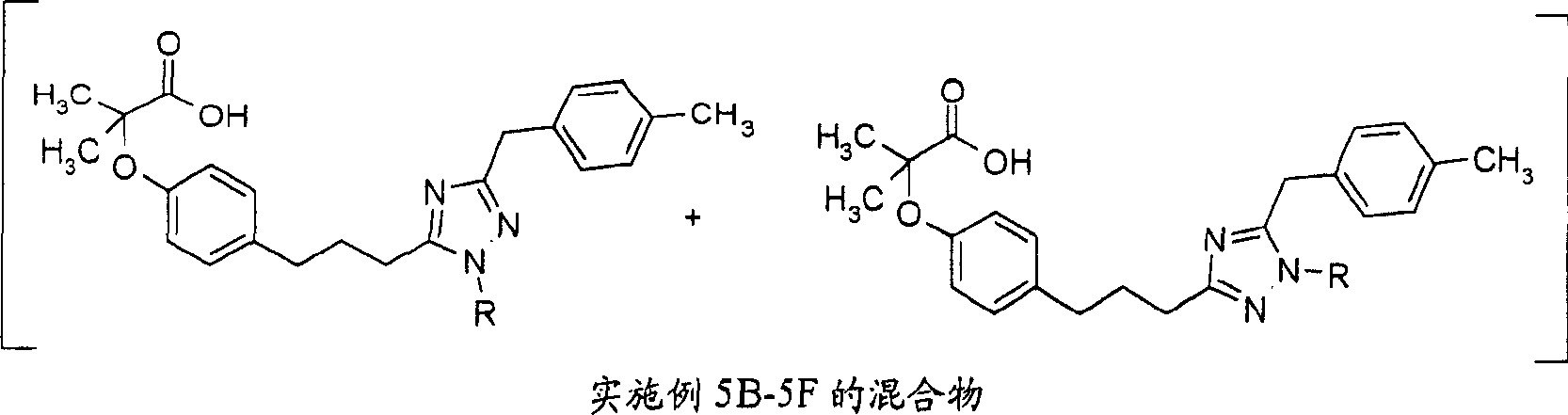
实施例6和7Examples 6 and 7
往实施例5A制得的混合物(70mg)的甲醇(25ml)溶液中加入浓硫酸。将该反应混合物在室温下搅拌18小时。除去大部分溶剂并用乙酸乙酯(30ml)稀释残余物。用水(3×30ml)洗涤乙酸乙酯层,经硫酸钠干燥,用旋转蒸发器浓缩,得到油状残余物(71mg)。所得残余物通过手性HPLC柱纯化,得到纯的实施例6和7的化合物。To a solution of the mixture prepared in Example 5A (70 mg) in methanol (25 ml) was added concentrated sulfuric acid. The reaction mixture was stirred at room temperature for 18 hours. Most of the solvent was removed and the residue was diluted with ethyl acetate (30ml). The ethyl acetate layer was washed with water (3 x 30ml), dried over sodium sulfate and concentrated on a rotary evaporator to give an oily residue (71mg). The resulting residue was purified by chiral HPLC column to give pure compounds of Examples 6 and 7.
实施例6:(15mg),m/z:480(M+1)。Example 6: (15 mg), m/z: 480 (M+1).

实施例7:(19mg),m/z:480(M+1)。Example 7: (19 mg), m/z: 480 (M+1).

实施例8Example 8

将实施例6的三唑酯(15mg)溶于甲醇(2ml)。往该溶液中加入2N氢氧化钠水溶液(1ml)。在室温下将该混合物搅拌2小时。用旋转蒸发器蒸发溶剂并将残余物溶解于水(5ml)。用0.1M盐酸将该溶液酸化至pH为约3,得到乳状溶液。用二氯甲烷(3×10ml)萃取该混合物。用硫酸钠干燥合并的二氯甲烷层,用旋转蒸发器浓缩,随后真空干燥得到实施例8的产物(11mg)。The triazole ester of Example 6 (15 mg) was dissolved in methanol (2 ml). To this solution was added 2N aqueous sodium hydroxide solution (1 ml). The mixture was stirred at room temperature for 2 hours. The solvent was evaporated using a rotary evaporator and the residue was dissolved in water (5ml). The solution was acidified to a pH of about 3 with 0.1M hydrochloric acid to give a milky solution. The mixture was extracted with dichloromethane (3 x 10ml). The combined dichloromethane layers were dried over sodium sulfate, concentrated on a rotary evaporator, and dried in vacuo to give the product of Example 8 (11 mg).
m/z:466(M+1)。m/z: 466 (M+1).
实施例9Example 9
按照实施例8的方法,使用实施例6的酯进行氢氧化钠介导的水解,得到合成实施例9的化合物。m/z:466(M+1)。According to the method of Example 8, the ester of Example 6 was used for sodium hydroxide-mediated hydrolysis to obtain the compound of Synthesis Example 9. m/z: 466 (M+1).
实施例9aExample 9a
使用实施例3A和流程I的通用方法得到合成实施例9a的化合物。m/z:436.3。The compound of Synthetic Example 9a was obtained using the general procedure of Example 3A and Scheme I. m/z: 436.3.
实施例10Example 10
2-甲基-2-(4-{3-[5-(4-三氟甲基-苯基)-2H-[1,2,4]三唑-3-基]-丙基}-苯氧基)-丙酸叔丁酯2-Methyl-2-(4-{3-[5-(4-trifluoromethyl-phenyl)-2H-[1,2,4]triazol-3-yl]-propyl}-benzene Oxy)-tert-butyl propionate
往2-[4-(3-肼基羰基-丙基)-苯氧基]-2-甲基-丙酸叔丁酯(0.5g,1.5mmol)的甲醇(5ml)溶液中加入4-(三氟甲基)苄腈(0.51g,3.0mol)和叔丁醇钾(0.023g,0.21mmol)。将该混合物在回流下搅拌过夜,加入另外的0.2当量的叔丁醇钾,将反应物搅拌24小时。用水猝灭粗产物,真空除去甲醇,用乙酸乙酯萃取水层。分离有机层,经硫酸镁干燥,真空浓缩。采用Biotage(己烷/乙酸乙酯4∶1)纯化粗产物,得到0.32g(44%)浅黄色油状的实施例10的标题化合物。MS数据(ES+)m/z 490.6[M+H]。4-( Trifluoromethyl)benzonitrile (0.51 g, 3.0 mol) and potassium tert-butoxide (0.023 g, 0.21 mmol). The mixture was stirred overnight at reflux, an additional 0.2 equivalents of potassium tert-butoxide was added and the reaction was stirred for 24 hours. The crude product was quenched with water, the methanol was removed in vacuo and the aqueous layer was extracted with ethyl acetate. The organic layer was separated, dried over magnesium sulfate, and concentrated in vacuo. The crude product was purified using Biotage (hexane/ethyl acetate 4:1) to afford 0.32 g (44%) of the title compound of Example 10 as a pale yellow oil. MS data (ES + ) m/z 490.6 [M+H].
实施例11Example 11
2-甲基-2-(4-{3-[5-(4-三氟甲基-苯基)-2H-[1,2,4]三唑-3-基]-丙基}-苯氧基)-丙酸2-Methyl-2-(4-{3-[5-(4-trifluoromethyl-phenyl)-2H-[1,2,4]triazol-3-yl]-propyl}-benzene Oxy)-propionic acid

往实施例10产物(0.65g,1.33mmol)的二氯甲烷(6.5ml)溶液中加入TFA(0.31ml,3.98mmol)。在室温下将该混合物搅拌过夜。通过TLC分析表明仍存在大量的原料。真空除去溶剂和残留的TFA。通过快速柱层析(己烷/乙酸乙酯2∶1和1∶1)纯化粗产物,得到0.16g(28%)白色固体状的实施例10的产物,回收0.4g原料。MS数据(ES+)m/z434.3[M+H]。To a solution of the product from Example 10 (0.65 g, 1.33 mmol) in dichloromethane (6.5 mL) was added TFA (0.31 mL, 3.98 mmol). The mixture was stirred overnight at room temperature. Analysis by TLC indicated substantial starting material was still present. Solvent and residual TFA were removed in vacuo. The crude product was purified by flash column chromatography (hexane/ethyl acetate 2:1 and 1:1) to afford 0.16 g (28%) of the product of Example 10 as a white solid, 0.4 g of starting material was recovered. MS data (ES + ) m/z 434.3 [M+H].
流程2Process 2

R30a为R30或H。R30a is R30 or H.
流程2的通用方法General method for process 2
往上述市售原料(1.0mmol)的乙酸乙酯(5ml/mmol)溶液中加入BnBr(1.1mmol)和Ag2O(1.1mmol)。将该反应物回流过夜。用TLC(己烷/乙酸乙酯1∶1)监测反应进行情况。反应物经Celite硅藻土过滤并真空除去溶剂。通过快速层析(己烷和己烷/乙酸乙酯20%)纯化粗产物,得到流程2式A化合物。To a solution of the above commercially available material (1.0 mmol) in ethyl acetate (5 ml/mmol) was added BnBr (1.1 mmol) and Ag2O (1.1 mmol). The reaction was refluxed overnight. The progress of the reaction was monitored by TLC (hexane/ethyl acetate 1:1). The reaction was filtered through Celite and the solvent was removed in vacuo. The crude product was purified by flash chromatography (hexane and hexane/ethyl acetate 20%) to afford the compound of formula A in Scheme 2.
将流程2式A的苄基衍生物(1.0mmol)溶于乙醇(0.8M)。随后加入一水合肼(3.0mmol)。在室温下将该混合物搅拌过夜。用TLC(己烷/乙酸乙酯4∶1)监测反应进行情况。真空除去溶剂。将残余物溶解于乙酸乙酯并用水洗涤。干燥并浓缩有机层。无需进一步纯化直接使用粗产物。往流程2式B的酰肼化合物(1.0mmol)的甲醇(2.4M)溶液中加入4-(三氟甲基)苄腈(2.0mol)和叔丁醇钾(0.6mmol)。将该混合物回流24小时。用TLC(己烷/乙酸乙酯4∶1)监测反应进行情况。用水猝灭粗产物,真空除去甲醇,用乙酸乙酯萃取水层。分离有机层,经硫酸镁干燥,真空浓缩。采用Biotage(己烷/乙酸乙酯4∶1)纯化粗产物,得到流程2式C化合物。The benzyl derivative of Formula A of Scheme 2 (1.0 mmol) was dissolved in ethanol (0.8M). Hydrazine monohydrate (3.0 mmol) was then added. The mixture was stirred overnight at room temperature. The progress of the reaction was monitored by TLC (hexane/ethyl acetate 4:1). Solvent was removed in vacuo. The residue was dissolved in ethyl acetate and washed with water. The organic layer was dried and concentrated. The crude product was used without further purification. 4-(Trifluoromethyl)benzonitrile (2.0 mol) and potassium tert-butoxide (0.6 mmol) were added to a solution of the hydrazide compound (1.0 mmol) of formula B in Scheme 2 in methanol (2.4 M). The mixture was refluxed for 24 hours. The progress of the reaction was monitored by TLC (hexane/ethyl acetate 4:1). The crude product was quenched with water, the methanol was removed in vacuo and the aqueous layer was extracted with ethyl acetate. The organic layer was separated, dried over magnesium sulfate, and concentrated in vacuo. The crude product was purified by Biotage (Hexane/EtOAc 4:1) to give the compound of formula C in Scheme 2.

三唑烷基化:往流程2的相应的三唑衍生物C(1.0mmol)的THF(5ml/mmol)溶液中加入粉状KOH(2.2mmol)、R-I(Br)(2.0mmol)和Bu4NBr(0.2mmol)。在室温下将该混合物搅拌过夜。用TLC(己烷/乙酸乙酯4∶1)监测反应进行情况。用水猝灭粗产物并加入乙酸乙酯。用乙酸乙酯萃取水层(2次)。分离有机层,经硫酸镁干燥,真空浓缩。采用Biotage(己烷/乙酸乙酯7∶1和4∶1)纯化粗产物,得到流程2式D化合物。Triazole alkylation: To a solution of the corresponding triazole derivative C (1.0 mmol) of Scheme 2 in THF (5 ml/mmol) was added powdered KOH (2.2 mmol), RI(Br) (2.0 mmol) and Bu 4 NBr (0.2 mmol). The mixture was stirred overnight at room temperature. The progress of the reaction was monitored by TLC (hexane/ethyl acetate 4:1). The crude product was quenched with water and ethyl acetate was added. The aqueous layer was extracted with ethyl acetate (2 times). The organic layer was separated, dried over magnesium sulfate, and concentrated in vacuo. The crude product was purified by Biotage (Hexane/EtOAc 7:1 and 4:1) to give the compound of Formula D in Scheme 2.
往流程2式D的三唑化合物(1.0mmol)的乙醇(5ml/mmol)溶液中加入Pd(C)(10-20%重量)和NH4 +COO-(10-20mmol)。在80℃下将该混合物搅拌过夜。用TLC监测反应进行情况。反应物经Celite硅藻土过滤并真空除去溶剂。采用Biotage(己烷/乙酸乙酯1∶1)纯化粗产物,得到流程2式E化合物。Pd(C) (10-20% by weight) and NH 4 + COO − (10-20 mmol) were added to the ethanol (5 ml/mmol) solution of the triazole compound (1.0 mmol) of formula D in scheme 2. The mixture was stirred overnight at 80°C. The progress of the reaction was monitored by TLC. The reaction was filtered through Celite and the solvent was removed in vacuo. The crude product was purified by Biotage (Hexane/Ethyl Acetate 1:1) to give the compound of Formula E in Scheme 2.
流程2AProcess 2A
往流程2a的相应的三唑衍生物(C)(1.0mmol)的DMSO(20ml/mmol)溶液中加入碳酸钾(1.1mmol)和4-氟-硝基苯(1.0mmol),在90℃下将混合物搅拌过夜。用TLC(己烷/乙酸乙酯4∶1)监测反应进行情况。用冰水猝灭反应混合物并加入DCM。再用20%的DCM/甲醇萃取。合并有机层并经硫酸镁干燥,真空浓缩。用快速层析(己烷/乙酸乙酯9∶1)纯化粗产物,得到流程2A式D化合物。Add potassium carbonate (1.1mmol) and 4-fluoro-nitrobenzene (1.0mmol) to the DMSO (20ml/mmol) solution of the corresponding triazole derivative (C) (1.0mmol) of scheme 2a, at 90°C The mixture was stirred overnight. The progress of the reaction was monitored by TLC (hexane/ethyl acetate 4:1). The reaction mixture was quenched with ice water and DCM was added. Extract again with 20% DCM/methanol. The organic layers were combined and dried over magnesium sulfate, concentrated in vacuo. The crude product was purified by flash chromatography (hexane/ethyl acetate 9:1) to afford the compound of formula D, Scheme 2A.
往流程2a式D的三唑衍生物(1.0mmol)的乙醇(5ml/mmol)溶液中加入Pd(C)(10%重量)。在氢气气氛下将该混合物搅拌过夜。用TLC监测反应进行情况。该溶液经Celite硅藻土过滤并真空除去溶剂。该粗产物(流程2A式E的产物)无需进一步纯化直接使用。To a solution of the triazole derivative of formula D of Scheme 2a (1.0 mmol) in ethanol (5 ml/mmol) was added Pd(C) (10% by weight). The mixture was stirred overnight under hydrogen atmosphere. The progress of the reaction was monitored by TLC. The solution was filtered through Celite and the solvent was removed in vacuo. The crude product (product of Scheme 2A, Formula E) was used without further purification.
在0℃下往流程2A式E的相应的三唑衍生物(1.0mmol)在混合溶剂(THF/CH3COOH 8∶1)(8ml/mmol)的溶液中加入2N HCl溶液(10.0mmol),在该温度下将该化合物搅拌5分钟。随后依次加入NaNO2(1.0mmol)的水溶液(0.32M)和3%H2O2溶液。在0℃下将该反应混合物搅拌30分钟,随后在室温下搅拌1小时。接着加入乙酸乙酯并用水萃取该混合物。有机层经硫酸镁干燥并真空浓缩。采用Biotage(己烷/乙酸乙酯9∶1)纯化粗产物,得到流程2A式F化合物(产率17%)。Add 2N HCl solution (10.0mmol) to the solution of the corresponding triazole derivative (1.0mmol) in the mixed solvent (THF/CH 3 COOH 8:1) (8ml/mmol) of Scheme 2A formula E at 0°C, The compound was stirred at this temperature for 5 minutes. Then NaNO2 (1.0 mmol) in water (0.32M) and 3% H2O2 solution were added sequentially . The reaction mixture was stirred at 0 °C for 30 minutes, then at room temperature for 1 hour. Then ethyl acetate was added and the mixture was extracted with water. The organic layer was dried over magnesium sulfate and concentrated in vacuo. The crude product was purified by Biotage (Hexane/EtOAc 9:1) to give the compound of formula F in Scheme 2A (yield 17%).
往流程2A式F化合物(1.0mmol)的乙醇(5ml/mmol)溶液中加入Pd(C)(10-20%重量)和NH4 +COO-(10-20mmol)。在80℃下将该混合物搅拌过夜。用TLC监测反应进行情况。反应物经Celite硅藻土过滤并真空除去溶剂。用Biotage(己烷/乙酸乙酯1∶1)纯化粗产物,得到流程2a式F化合物。Pd(C) (10-20% by weight) and NH 4 + COO − (10-20 mmol) were added to the ethanol (5 ml/mmol) solution of compound F (1.0 mmol) in Scheme 2A. The mixture was stirred overnight at 80°C. The progress of the reaction was monitored by TLC. The reaction was filtered through Celite and the solvent was removed in vacuo. The crude product was purified by Biotage (Hexane/EtOAc 1:1) to give the compound of Formula F, Scheme 2a.

Mitsounobu反应:往流程2的三唑衍生物E(1.0mmol)的THF/DCM混合物(1∶1)(10ml/mmol)溶液中加入headpiece(2mmol)、Bu3P(2.0mmol)和TMAD(2.0mmol)。在室温下将该混合物搅拌10-20分钟。用TLC监测反应进行情况。减压除去溶剂,随后加入水和乙醚。分离有机层并与2N NaOH溶液搅拌10分钟。萃取该混合物,用硫酸镁干燥有机层,真空浓缩。采用Biotage(己烷/乙酸乙酯9∶1)纯化粗产物,得到流程2式F化合物。Mitsounobu reaction: Add headpiece (2mmol), Bu 3 P (2.0mmol) and TMAD (2.0 mmol). The mixture was stirred at room temperature for 10-20 minutes. The progress of the reaction was monitored by TLC. The solvent was removed under reduced pressure, followed by the addition of water and ether. The organic layer was separated and stirred with 2N NaOH solution for 10 minutes. The mixture was extracted, and the organic layer was dried over magnesium sulfate and concentrated in vacuo. The crude product was purified by Biotage (Hexane/EtOAc 9:1) to give the compound of Formula F in Scheme 2.
往流程2的三唑衍生物F(1.0mmol)的乙醇/THF混合物(1∶1)(10ml/mmol)溶液中加入2N KOH溶液(10mmol),在室温下将该混合物搅拌过夜。用TLC监测反应进行情况。减压除去溶剂,随后加入水和乙酸乙酯。加入1N HCl溶液直到pH为5-7。萃取该混合物,用水洗涤有机层,分离,经硫酸镁干燥,真空浓缩。得到流程2式G化合物。To a solution of triazole derivative F (1.0 mmol) in Scheme 2 in ethanol/THF mixture (1:1) (10 ml/mmol) was added 2N KOH solution (10 mmol), and the mixture was stirred overnight at room temperature. The progress of the reaction was monitored by TLC. The solvent was removed under reduced pressure, followed by the addition of water and ethyl acetate. 1N HCl solution was added until the pH was 5-7. The mixture was extracted and the organic layer was washed with water, separated, dried over magnesium sulfate and concentrated in vacuo. The compound of formula G in scheme 2 is obtained.
实施例13的合成Synthesis of Example 13
制备2preparation 2

往羟乙酸甲酯(50g,0.56mol)的乙酸乙酯(300ml)溶液中加入BnBr(72.7ml,0.61mol,1.1当量)和Ag2O(141.6g,0.61mol,1.1当量),在搅拌下将该混合物回流过夜。用TLC(己烷/乙酸乙酯1∶1)监测反应进行情况。反应物经Celite硅藻土过滤并真空除去溶剂。使油状物通过快速硅胶柱并吸附于其上,在快速硅胶柱(500g)的顶部加入20%乙酸乙酯/己烷进行洗脱,得到75.8g(75%产率)无色油状物。Add BnBr (72.7ml, 0.61mol, 1.1 equivalent) and Ag 2 O (141.6g, 0.61mol, 1.1 equivalent) to the ethyl acetate (300ml) solution of methyl glycolate (50g, 0.56mol), under stirring The mixture was refluxed overnight. The progress of the reaction was monitored by TLC (hexane/ethyl acetate 1:1). The reaction was filtered through Celite and the solvent was removed in vacuo. The oil was passed through and adsorbed to a flash silica gel column and eluted with 20% ethyl acetate/hexanes on top of the flash silica column (500 g) to give 75.8 g (75% yield) of a colorless oil.
制备3preparation 3

将制备2的产物(7.5g,41.6mmol)溶于乙醇(100ml)。随后加入一水合肼(6.05ml,124.9mmol),在室温下将该混合物搅拌过夜。用TLC(己烷/乙酸乙酯4∶1)监视反应的进行情况。减压除去溶剂,将残余物溶解于乙酸乙酯并用水洗涤。干燥有机层并浓缩,粗产物无需纯化直接使用。The product from Preparation 2 (7.5g, 41.6mmol) was dissolved in ethanol (100ml). Hydrazine monohydrate (6.05ml, 124.9mmol) was then added and the mixture was stirred overnight at room temperature. The progress of the reaction was monitored by TLC (hexane/ethyl acetate 4:1). The solvent was removed under reduced pressure, the residue was dissolved in ethyl acetate and washed with water. The organic layer was dried and concentrated, and the crude product was used without purification.
制备4preparation 4

往制备3得到的产物的甲醇(100ml)溶液中加入4-(三氟甲基)苄腈(14.2g,83.2mmol)和叔丁醇钾(2.8g,25mmol),将混合物搅拌回流24小时。用TLC(己烷/乙酸乙酯4∶1)监测反应进行情况。用水猝灭粗产物,真空除去甲醇。用乙酸乙酯萃取有机层。分离有机层,经硫酸镁干燥,真空浓缩。采用快速层析(己烷/乙酸乙酯4∶1)纯化粗产物,得到11.2g(产率81%)白色固体状的制备4的产物。To a methanol (100ml) solution of the product obtained in Preparation 3 were added 4-(trifluoromethyl)benzonitrile (14.2g, 83.2mmol) and potassium tert-butoxide (2.8g, 25mmol), and the mixture was stirred at reflux for 24 hours. The progress of the reaction was monitored by TLC (hexane/ethyl acetate 4:1). The crude product was quenched with water and methanol was removed in vacuo. The organic layer was extracted with ethyl acetate. The organic layer was separated, dried over magnesium sulfate, and concentrated in vacuo. The crude product was purified by flash chromatography (hexane/ethyl acetate 4:1) to afford 11.2 g (81% yield) of the product of Preparation 4 as a white solid.
制备5Preparation 5

往制备4得到的产物(1.0g,3.0mmol)的THF(15ml)溶液中加入粉状KOH(0.37g,6.6mmol)、EtI(0.48ml,6.0mmol)和Bu4NBr(0.19g,0.6mmol),将该混合物在室温下搅拌过夜。用TLC(己烷/乙酸乙酯4∶1)监测反应进行情况。用水猝灭粗产物并加入乙酸乙酯。用乙酸乙酯萃取水层(2次)。分离有机层,经硫酸镁干燥,真空浓缩。采用快速层析(己烷/乙酸乙酯9∶1)纯化粗产物,得到1.09g(产率99%)白色固体状的制备5的产物。To a solution of the product from Preparation 4 (1.0 g, 3.0 mmol) in THF (15 ml) was added powdered KOH (0.37 g, 6.6 mmol), EtI (0.48 ml, 6.0 mmol) and Bu4NBr (0.19 g, 0.6 mmol) ), and the mixture was stirred overnight at room temperature. The progress of the reaction was monitored by TLC (hexane/ethyl acetate 4:1). The crude product was quenched with water and ethyl acetate was added. The aqueous layer was extracted with ethyl acetate (2 times). The organic layer was separated, dried over magnesium sulfate, and concentrated in vacuo. The crude product was purified by flash chromatography (hexane/ethyl acetate 9:1) to afford 1.09 g (99% yield) of the product of Preparation 5 as a white solid.
制备6Preparation 6
往制备5得到的产物(1.05g,2.9mmol)的乙醇(25ml)溶液中加入Pd(C)(20%重量)和NH4 +COO-(1.83g,10.0mmol),在80℃下将该混合物搅拌6小时。用TLC(己烷/乙酸乙酯4∶1)监测反应进行情况。反应物经Celite硅藻土过滤并减压除去溶剂,得到0.88g白色固体状的制备6的产物,无需进一步纯化直接使用。Pd(C) (20% by weight) and NH 4 + COO - (1.83g, 10.0mmol) were added to the ethanol (25ml) solution of the product (1.05g, 2.9mmol) obtained in Preparation 5, and the The mixture was stirred for 6 hours. The progress of the reaction was monitored by TLC (hexane/ethyl acetate 4:1). The reaction was filtered through Celite and the solvent was removed under reduced pressure to afford 0.88 g of the product of Preparation 6 as a white solid, which was used without further purification.
制备7Preparation 7

往制备6得到的产物(0.88g,2.9mmol)的THF/DCM混合物(1∶1)(15+15ml)溶液中加入headpiece(1.38g,5.8mmol)、Bu3P(1.44ml,5.8mmol)和TMAD(0.99g,5.8mmol),将该混合物在室温下搅拌1小时。用TLC(己烷/乙酸乙酯1∶1)监测反应进行情况。真空除去溶剂,随后加入水和乙醚。分离有机层并与2N NaOH溶液一起搅拌10分钟。萃取该混合物,有机层经硫酸镁干燥,真空浓缩。采用Biotage[40+S](己烷/乙酸乙酯9∶1)纯化粗产物,得到0.99g(产率70%)白色固体状的制备7的产物。MS数据(ES+)m/z 492.3[M+H]。残留350mg含杂化合物(B部分)。Add headpiece (1.38g, 5.8mmol), Bu 3 P (1.44ml, 5.8mmol) to the solution of the product obtained in Preparation 6 (0.88g, 2.9mmol) in THF/DCM mixture (1:1) (15+15ml) and TMAD (0.99 g, 5.8 mmol), and the mixture was stirred at room temperature for 1 hour. The progress of the reaction was monitored by TLC (hexane/ethyl acetate 1:1). The solvent was removed in vacuo, followed by the addition of water and ether. The organic layer was separated and stirred with 2N NaOH solution for 10 minutes. The mixture was extracted and the organic layer was dried over magnesium sulfate and concentrated in vacuo. The crude product was purified using Biotage [40+S] (hexane/ethyl acetate 9:1) to afford 0.99 g (70% yield) of the product of Preparation 7 as a white solid. MS data (ES + ) m/z 492.3 [M+H]. 350 mg of hetero-containing compound (Part B) remained.
实施例13Example 13

往制备7得到的产物(0.98g,1.99mmol)的乙醇/THF混合物(1∶1)(10+10ml)溶液中加入2N KOH溶液(10ml,19.9mmol),将该混合物在室温下搅拌过夜。用TLC(己烷/乙酸乙酯1∶1)监测反应进行情况。真空除去溶剂,随后加入水和乙醚,将该化合物搅拌2分钟。分离有机层并在水相中加入1N HCl溶液直到pH为5-7。滤出白色固体沉淀并用水洗涤。真空干燥,得到0.80g(87%产率)实施例13的产物(纯度97%)。MS数据(ES+)m/z 464.2[M+H]。To a solution of the product obtained in Preparation 7 (0.98g, 1.99mmol) in an ethanol/THF mixture (1:1) (10+10ml) was added 2N KOH solution (10ml, 19.9mmol), and the mixture was stirred at room temperature overnight. The progress of the reaction was monitored by TLC (hexane/ethyl acetate 1:1). The solvent was removed in vacuo, water and ether were added and the mixture was stirred for 2 minutes. The organic layer was separated and 1N HCl solution was added to the aqueous phase until the pH was 5-7. The white solid precipitated was filtered off and washed with water. Drying in vacuo afforded 0.80 g (87% yield) of the product of Example 13 (97% purity). MS data (ES + ) m/z 464.2 [M+H].
按照与制备实施例13产物的相同方法制备实施例12和14-34的产物。The products of Examples 12 and 14-34 were prepared in the same manner as the product of Example 13 was prepared.


流程3Process 3

流程3的通用方法General method for process 3
往溴代酯衍生物(流程3式H化合物)(1.2mmol)的MeCN(5ml/mmol)溶液中加入碳酸钾(3.0mmol)和流程3式A化合物(1.0mmol)。将该混合物搅拌回流过夜。用TLC(己烷/乙酸乙酯4∶1)监测反应进行情况。减压除去溶剂,随后加入水和乙酸乙酯。萃取该混合物,用硫酸镁干燥有机层,真空浓缩。采用快速层析(己烷/乙酸乙酯6∶1)纯化粗产物,得到流程3式B的化合物。Potassium carbonate (3.0 mmol) and compound A of scheme 3 (1.0 mmol) were added to a solution of the bromoester derivative (compound of formula H in scheme 3) (1.2 mmol) in MeCN (5 ml/mmol). The mixture was stirred at reflux overnight. The progress of the reaction was monitored by TLC (hexane/ethyl acetate 4:1). The solvent was removed under reduced pressure, followed by the addition of water and ethyl acetate. The mixture was extracted, and the organic layer was dried over magnesium sulfate and concentrated in vacuo. The crude product was purified by flash chromatography (hexane/ethyl acetate 6:1) to give the compound of formula B in Scheme 3 .
将流程3式B的酯化合物(1.0mmol)溶于乙醇(0.8M)。随后加入一水合肼(3.0mmol)。在室温下将该混合物搅拌过夜。用TLC(己烷/乙酸乙酯4∶1)监测反应进行情况。真空除去溶剂。将残余物溶解于乙酸乙酯并用水洗涤。干燥有机层并浓缩。粗产物无需纯化直接使用。往流程C式3的酰肼化合物(1.0mmol)的乙醇溶液(2.4M)中加入4-(三氟甲基)苄腈(2.0mol)和叔丁醇钾(0.6mmol)。将该混合物搅拌回流24小时。用TLC(己烷/乙酸乙酯4∶1)监测反应进行情况。用水猝灭粗产物,真空除去甲醇,用乙酸乙酯萃取有机层。分离有机层,经硫酸镁干燥,真空浓缩。采用Biotage(己烷/乙酸乙酯6∶1)纯化粗产物,得到无色油状的流程3式F的化合物。The ester compound (1.0 mmol) of Scheme 3 formula B was dissolved in ethanol (0.8M). Hydrazine monohydrate (3.0 mmol) was then added. The mixture was stirred overnight at room temperature. The progress of the reaction was monitored by TLC (hexane/ethyl acetate 4:1). Solvent was removed in vacuo. The residue was dissolved in ethyl acetate and washed with water. The organic layer was dried and concentrated. The crude product was used directly without purification. To an ethanol solution (2.4M) of the hydrazide compound (1.0 mmol) of Formula 3 in Scheme C was added 4-(trifluoromethyl)benzonitrile (2.0 mol) and potassium tert-butoxide (0.6 mmol). The mixture was stirred at reflux for 24 hours. The progress of the reaction was monitored by TLC (hexane/ethyl acetate 4:1). The crude product was quenched with water, the methanol was removed in vacuo and the organic layer was extracted with ethyl acetate. The organic layer was separated, dried over magnesium sulfate, and concentrated in vacuo. The crude product was purified by Biotage (Hexane/EtOAc 6:1) to give the compound of Scheme 3, Formula F as a colorless oil.
往流程3式F三唑衍生物(1.0mmol)的乙醇/THF混合物(1∶1)(10ml/mmol)溶液中加入2N KOH溶液(10mmol)。在室温下将该混合物搅拌过夜。用TLC监测反应进行情况。真空除去溶剂,随后加入水和乙酸乙酯。加入1N HCl溶液直到pH为5-7。萃取该混合物,用水洗涤有机层,分离,经硫酸镁干燥,真空浓缩。得到白色固体状的流程3式G的化合物。2N KOH solution (10mmol) was added to the solution of the triazole derivative (1.0mmol) of formula F in Scheme 3 in ethanol/THF mixture (1:1) (10ml/mmol). The mixture was stirred overnight at room temperature. The progress of the reaction was monitored by TLC. The solvent was removed in vacuo, followed by the addition of water and ethyl acetate. 1N HCl solution was added until the pH was 5-7. The mixture was extracted and the organic layer was washed with water, separated, dried over magnesium sulfate and concentrated in vacuo. Compound G of Scheme 3 was obtained as a white solid.
实施例36的合成Synthesis of Example 36
制备8Preparation 8
往市售溴代酯衍生物(2.54ml,26.8mmol)的MeCN(100ml)溶液中加入碳酸钾(9.23g,66.9mmol)和headpiece(5.0g,22.3mmol),将该混合物搅拌回流过夜。用TLC(己烷/乙酸乙酯4∶1)监测反应进行情况。真空除去溶剂,随后加入水和乙酸乙酯。萃取该混合物,用硫酸镁干燥有机层并真空浓缩。采用快速层析(己烷/乙酸乙酯19∶1)纯化粗产物,得到无色油状的制备8的产物(6.59g)。To a commercial bromoester derivative (2.54ml, 26.8mmol) in MeCN (100ml) was added potassium carbonate (9.23g, 66.9mmol) and headpiece (5.0g, 22.3mmol), and the mixture was stirred and refluxed overnight. The progress of the reaction was monitored by TLC (hexane/ethyl acetate 4:1). The solvent was removed in vacuo, followed by the addition of water and ethyl acetate. The mixture was extracted, and the organic layer was dried over magnesium sulfate and concentrated in vacuo. The crude product was purified by flash chromatography (hexane/ethyl acetate 19:1) to give the product of Preparation 8 (6.59 g) as a colorless oil.
制备9Preparation 9

将制备8(6.59g,22.3mmol)的产物溶于乙醇(30ml)。随后加入一水合肼(4.32ml,89.2mmol),在室温下将该混合物搅拌过夜。用TLC(己烷/乙酸乙酯4∶1)监测反应进行情况。真空除去溶剂。将残余物溶解于乙酸乙酯并用水洗涤。干燥有机层并浓缩。制备9的粗产物无需进一步纯化直接使用。The product from Preparation 8 (6.59g, 22.3mmol) was dissolved in ethanol (30ml). Hydrazine monohydrate (4.32ml, 89.2mmol) was then added and the mixture was stirred overnight at room temperature. The progress of the reaction was monitored by TLC (hexane/ethyl acetate 4:1). Solvent was removed in vacuo. The residue was dissolved in ethyl acetate and washed with water. The organic layer was dried and concentrated. The crude product of Preparation 9 was used without further purification.
制备10Prepare 10

往制备9的酰肼(3.22g,10.9mmol)的乙醇(50ml)溶液中加入4-(三氟甲基)苄腈(4.72g,27.6mmol)和叔丁醇钾(0.93g,8.3mmol),将该混合物搅拌回流24小时。用TLC(己烷/乙酸乙酯4∶1)监测反应进行情况。用水猝灭粗产物,真空除去甲醇。用乙酸乙酯萃取有机层。分离有机层,经硫酸镁干燥,真空浓缩。采用Biotage(己烷/乙酸乙酯9∶1至6∶1)纯化粗产物,得到白色固体状的制备10的产物(得到2.28g,两个步骤的产率为47%)。To a solution of the hydrazide (3.22g, 10.9mmol) of Preparation 9 in ethanol (50ml) was added 4-(trifluoromethyl)benzonitrile (4.72g, 27.6mmol) and potassium tert-butoxide (0.93g, 8.3mmol) , and the mixture was stirred at reflux for 24 hours. The progress of the reaction was monitored by TLC (hexane/ethyl acetate 4:1). The crude product was quenched with water and methanol was removed in vacuo. The organic layer was extracted with ethyl acetate. The organic layer was separated, dried over magnesium sulfate, and concentrated in vacuo. The crude product was purified using Biotage (hexanes/ethyl acetate 9:1 to 6:1) to give the product of Preparation 10 as a white solid (2.28 g obtained, 47% yield over two steps).
实施例36Example 36
往制备10得到的产物(200mg,0.45mmol)的乙醇/THF混合物(1∶1)(8ml)溶液中加入2N KOH溶液(2.7ml,4.5mmol),在室温下将该混合物搅拌过夜。用TLC监测反应进行情况。真空除去溶剂,随后加入水和乙酸乙酯。加入1N HCl溶液直到pH为5-7。萃取该混合物,用水洗涤有机层,分离,经硫酸镁干燥,真空浓缩。得到白色固体状的实施例36的产物(164mg,产率87%)。To a solution of the product obtained in Preparation 10 (200mg, 0.45mmol) in an ethanol/THF mixture (1:1) (8ml) was added 2N KOH solution (2.7ml, 4.5mmol), and the mixture was stirred overnight at room temperature. The progress of the reaction was monitored by TLC. The solvent was removed in vacuo, followed by the addition of water and ethyl acetate. 1N HCl solution was added until the pH was 5-7. The mixture was extracted and the organic layer was washed with water, separated, dried over magnesium sulfate and concentrated in vacuo. The product of Example 36 was obtained as a white solid (164 mg, 87% yield).
按照与制备实施例36产物的相同方法,制备实施例35、37和38的化合物。Compounds of Examples 35, 37 and 38 were prepared in the same manner as the product of Example 36 was prepared.


流程4Process 4

流程4的通用方法General method for process 4
往流程4式A化合物(1.5mmol)的甲醇(5ml)溶液中加入4-(三氟甲基)苄腈(3.0mol)和叔丁醇钾(0.21mmol),将该混合物搅拌回流过夜。加入另外的0.2当量的叔丁醇钾,并将该反应物搅拌24小时。用水猝灭粗产物,真空除去甲醇,用乙酸乙酯萃取水层。分离有机层,经硫酸镁干燥,真空浓缩。用Biotage(己烷/乙酸乙酯4∶1)纯化粗产物,得到流程4式B化合物。4-(Trifluoromethyl)benzonitrile (3.0 mol) and potassium tert-butoxide (0.21 mmol) were added to a solution of compound A (1.5 mmol) in Scheme 4 in methanol (5 ml), and the mixture was stirred and refluxed overnight. An additional 0.2 equivalents of potassium tert-butoxide was added and the reaction was stirred for 24 hours. The crude product was quenched with water, the methanol was removed in vacuo and the aqueous layer was extracted with ethyl acetate. The organic layer was separated, dried over magnesium sulfate, and concentrated in vacuo. The crude product was purified by Biotage (Hexane/EtOAc 4:1) to give the compound of Formula B in Scheme 4.
R=烷基R = alkyl
三唑烷基化:往流程4式B相应三唑化合物(1.0mmol)的THF(5ml/mmol)溶液中加入粉状KOH(2.2mmol)、R-I(Br)(2.0mmol)和Bu4NBr(0.2mmol),在室温下将该混合物搅拌过夜。用TLC(己烷/乙酸乙酯4∶1)监测反应进行情况。用水猝灭粗产物并加入乙酸乙酯。用乙酸乙酯萃取水层(2次)。分离有机层,经硫酸镁干燥,真空浓缩。用Biotage(己烷/乙酸乙酯7∶1和4∶1)纯化粗产物,得到流程4式C化合物。Triazole alkylation: Add powdery KOH (2.2mmol), RI(Br) (2.0mmol) and Bu NBr ( 0.2 mmol), and the mixture was stirred overnight at room temperature. The progress of the reaction was monitored by TLC (hexane/ethyl acetate 4:1). The crude product was quenched with water and ethyl acetate was added. The aqueous layer was extracted with ethyl acetate (2 times). The organic layer was separated, dried over magnesium sulfate, and concentrated in vacuo. The crude product was purified by Biotage (Hexane/EtOAc 7:1 and 4:1) to give the compound of Formula C of Scheme 4.
R=芳基(Ph和p-CF3-Ph)R = aryl (Ph and p-CF 3 -Ph)
偶合反应:在氮气气氛下,往流程4式B相应三唑衍生物(1.2mmol)的无水二烷溶液中加入芳基碘(1.0mmol)、碳酸钾(2.0mmol)、Cu(OAc)2(0.01mmol)和反式-1,2-二氨基环己烷(0.07mmol)。在110℃下将该混合物搅拌过夜。用TLC(己烷/乙酸乙酯4∶1)监测反应进行情况。反应混合物经Celite硅藻土过滤,用水萃取有机层。用乙酸乙酯萃取水层(2次),分离有机层,经硫酸镁干燥,真空浓缩。采用Biotage(己烷/乙酸乙酯9∶1)纯化粗产物,得到流程4式C化合物。Coupling reaction: under nitrogen atmosphere, add aryl iodide (1.0mmol), potassium carbonate (2.0mmol), Cu(OAc) to the anhydrous dioxane solution of the corresponding triazole derivative (1.2mmol) in Scheme 4 formula B 2 (0.01 mmol) and trans-1,2-diaminocyclohexane (0.07 mmol). The mixture was stirred overnight at 110°C. The progress of the reaction was monitored by TLC (hexane/ethyl acetate 4:1). The reaction mixture was filtered through Celite, and the organic layer was extracted with water. The aqueous layer was extracted with ethyl acetate (2x), and the organic layer was separated, dried over magnesium sulfate, and concentrated in vacuo. The crude product was purified by Biotage (Hexane/EtOAc 9:1) to give the compound of formula C in Scheme 4.
流程4aProcess 4a
R=芳基(o-F-Ph)R = aryl (o-F-Ph)
往式B相应三唑化合物(1.0mmol)的DMSO(20ml/mmol)溶液中加入碳酸钾(1.1mmol)和3,4-二氟-硝基苯(1.0mmol),在90℃下将该混合物搅拌过夜。用TLC(己烷/乙酸乙酯4∶1)监测反应进行情况。用冰水猝灭粗产物,随后加入DCM。用20%DCM/甲醇进行第二次萃取。合并有机层,经硫酸镁干燥,真空浓缩。用快速层析(己烷/乙酸乙酯9∶1)纯化粗产物,得到流程4a式Ba化合物。Add potassium carbonate (1.1mmol) and 3,4-difluoro-nitrobenzene (1.0mmol) to the DMSO (20ml/mmol) solution of the corresponding triazole compound (1.0mmol) of formula B, and the mixture is Stir overnight. The progress of the reaction was monitored by TLC (hexane/ethyl acetate 4:1). The crude product was quenched with ice water followed by addition of DCM. A second extraction was performed with 20% DCM/methanol. The organic layers were combined, dried over magnesium sulfate, and concentrated in vacuo. Purification of the crude product by flash chromatography (hexane/ethyl acetate 9:1) affords the compound Ba of Scheme 4a.
往三唑衍生物(1.0mmol)的醇(5ml/mmol)溶液中加入Pd(C)(10%重量)。在氢气气氛下将该混合物搅拌过夜。用TLC监测反应进行情况。溶液混合物经Celite硅藻土过滤并减压除去溶剂,粗产物可未经纯化直接使用。To a solution of the triazole derivative (1.0 mmol) in alcohol (5 ml/mmol) was added Pd(C) (10% by weight). The mixture was stirred overnight under hydrogen atmosphere. The progress of the reaction was monitored by TLC. The solution mixture was filtered through Celite and the solvent was removed under reduced pressure, the crude product was used without purification.
在0℃下往流程4a式Bb相应三唑化合物(1.0mmol)的混合溶剂(THF/CH3COOH 8∶1)(8ml/mmol)溶液中加入2N HCl溶液(10.0mmol)。在该温度下将混合物搅拌5分钟,加入NaNO2(1.0mmol)的水溶液(0.32M),随后加入3%H2O2溶液(0.56ml)。在0℃下将反应混合物搅拌30分钟,随后在室温下搅拌1小时。接着加入乙酸乙酯并用水萃取混合物。用硫酸镁干燥有机层并真空浓缩。采用Biotage(己烷/乙酸乙酯9∶1)纯化粗产物,得到流程4a式C化合物。2N HCl solution (10.0 mmol) was added to the solution of the corresponding triazole compound (1.0 mmol) of formula Bb in Scheme 4a in a mixed solvent (THF/CH 3 COOH 8:1) (8 ml/mmol) at 0°C. The mixture was stirred at this temperature for 5 minutes and NaNO2 (1.0 mmol) in water (0.32M) was added followed by 3% H2O2 solution (0.56ml). The reaction mixture was stirred at 0°C for 30 minutes, then at room temperature for 1 hour. Then ethyl acetate was added and the mixture was extracted with water. The organic layer was dried over magnesium sulfate and concentrated in vacuo. The crude product was purified by Biotage (Hexane/EtOAc 9:1) to give the compound of Formula C, Scheme 4a.
往流程4式C化合物(1.0mmol)的二氯甲烷(5ml)溶液中加入TFA(过量),在室温下将该混合物搅拌过夜。用TLC(己烷/乙酸乙酯1∶1)监测反应进行情况。真空除去溶剂和残余的TFA。将残余物溶于DCM并用碳酸氢钠饱和溶液洗涤。用硫酸镁干燥有机层并真空浓缩。得到流程4式D化合物。To a solution of the compound of Formula C of Scheme 4 (1.0 mmol) in dichloromethane (5 ml) was added TFA (excess), and the mixture was stirred at room temperature overnight. The progress of the reaction was monitored by TLC (hexane/ethyl acetate 1:1). Solvent and residual TFA were removed in vacuo. The residue was dissolved in DCM and washed with saturated sodium bicarbonate solution. The organic layer was dried over magnesium sulfate and concentrated in vacuo. The compound of formula D in scheme 4 is obtained.
往流程4式D相应三唑化合物(1.0mmol)的乙醇(8ml/mmol)溶液中加入I2(2.0mmol)和AgSO4(2.0mmol),在室温下将该混合物搅拌过夜。用TLC(己烷/乙酸乙酯4∶1)监测反应进行情况。用水猝灭粗产物并加入乙酸乙酯。用乙酸乙酯萃取水层(2次)。分离有机层,经硫酸镁干燥,真空浓缩。用Biotage(己烷/乙酸乙酯7∶1和4∶1)纯化粗产物,得到流程4式E化合物。I 2 (2.0 mmol) and AgSO 4 (2.0 mmol) were added to the ethanol (8 ml/mmol) solution of the corresponding triazole compound (1.0 mmol) of formula D in scheme 4, and the mixture was stirred overnight at room temperature. The progress of the reaction was monitored by TLC (hexane/ethyl acetate 4:1). The crude product was quenched with water and ethyl acetate was added. The aqueous layer was extracted with ethyl acetate (2 times). The organic layer was separated, dried over magnesium sulfate, and concentrated in vacuo. The crude product was purified by Biotage (hexane/ethyl acetate 7:1 and 4:1) to give the compound of formula E in Scheme 4.
在氮气气氛,往流程4式E相应三唑化合物(1.0mmol)的无水二烷溶液中(10ml/mmol)加入MeB(OH)2(3.0mmol)、CsF(3.0mmol)和PdCl3(dppf)(0.16mmol)。在80℃下将混合物搅拌过夜。用LC/MS监测反应进行情况。冷却反应物,经Celite硅藻土过滤,随后真空除去溶剂。用快速层析(己烷/乙酸乙酯7∶1和4∶1的混合物)纯化粗产物,得到流程4式F化合物。In a nitrogen atmosphere, add MeB(OH) 2 (3.0mmol), CsF (3.0mmol) and PdCl 3 ( dppf) (0.16 mmol). The mixture was stirred overnight at 80 °C. The progress of the reaction was monitored by LC/MS. The reaction was cooled, filtered through Celite, and the solvent was removed in vacuo. The crude product was purified by flash chromatography (Hexane/EtOAc 7:1 and 4:1 mixtures) to give the compound of Formula F, Scheme 4.
往流程4式F化合物(1.0mmol)的二氯甲烷(5ml)溶液中加入TFA(过量),在室温下将该混合物搅拌过夜。用TLC(己烷/乙酸乙酯1∶1)监测反应进行情况。真空除去溶剂和残余的TFA。将残余物溶于DCM并用碳酸氢钠饱和溶液洗涤。用硫酸镁干燥有机层并真空浓缩。得到流程4式G化合物。To a solution of compound F (1.0 mmol) in scheme 4 in dichloromethane (5 ml) was added TFA (excess) and the mixture was stirred overnight at room temperature. The progress of the reaction was monitored by TLC (hexane/ethyl acetate 1:1). Solvent and residual TFA were removed in vacuo. The residue was dissolved in DCM and washed with saturated sodium bicarbonate solution. The organic layer was dried over magnesium sulfate and concentrated in vacuo. The compound of formula G in scheme 4 is obtained.
实施例47的合成Synthesis of Example 47
制备11Preparation 11

往上述A(0.5g,1.5mmol)的甲醇(5ml)溶液中加入4-(三氟甲基)苄腈(0.51g,3.0mol)和叔丁醇钾(0.023g,0.21mmol)并将该混合物回流过夜。加入另外的0.2当量的叔丁醇钾,将反应物搅拌24小时。用水猝灭粗产物,真空除去甲醇。用乙酸乙酯萃取有机层。分离有机层,经硫酸镁干燥,真空浓缩。用Biotage(己烷/乙酸乙酯4∶1)纯化粗产物,得到0.32g(44%)浅黄色油状的制备11的产物。MS数据(ES+)m/z 490.6[M+H]。4-(Trifluoromethyl)benzonitrile (0.51 g, 3.0 mol) and potassium tert-butoxide (0.023 g, 0.21 mmol) were added to a methanol (5 ml) solution of the above A (0.5 g, 1.5 mmol) and the The mixture was refluxed overnight. An additional 0.2 equivalents of potassium tert-butoxide was added and the reaction was stirred for 24 hours. The crude product was quenched with water and methanol was removed in vacuo. The organic layer was extracted with ethyl acetate. The organic layer was separated, dried over magnesium sulfate, and concentrated in vacuo. The crude product was purified by Biotage (hexane/ethyl acetate 4:1) to afford 0.32 g (44%) of the product of Preparation 11 as a pale yellow oil. MS data (ES + ) m/z 490.6 [M+H].
制备12Preparation 12

往制备11得到的产物(0.75g,1.5mmol)的THF(5ml)溶液中加入粉状KOH(0.14g,2.45mmol)、MeI(0.14ml,2.3mmol)和Bu4NBr(0.05g,0.15mmol),在室温下将该混合物搅拌过夜。用TLC(己烷/乙酸乙酯4∶1)监测反应进行情况。用水猝灭粗产物并加入乙酸乙酯。用乙酸乙酯萃取水层(2次)。分离有机层,经硫酸镁干燥,真空浓缩。用快速层析(己烷/乙酸乙酯9∶1)纯化粗产物,得到0.51g(产率66%)白色固体状的制备12的产物。To a solution of the product from Preparation 11 (0.75 g, 1.5 mmol) in THF (5 ml) was added powdered KOH (0.14 g, 2.45 mmol), MeI (0.14 ml, 2.3 mmol) and Bu4NBr (0.05 g, 0.15 mmol) ), and the mixture was stirred overnight at room temperature. The progress of the reaction was monitored by TLC (hexane/ethyl acetate 4:1). The crude product was quenched with water and ethyl acetate was added. The aqueous layer was extracted with ethyl acetate (2 times). The organic layer was separated, dried over magnesium sulfate, and concentrated in vacuo. The crude product was purified by flash chromatography (hexane/ethyl acetate 9:1) to afford 0.51 g (66% yield) of the product of Preparation 12 as a white solid.
制备13Preparation 13

往制备12得到的产物(0.25g,0.5mmol)的乙醇(5ml)溶液中加入I2(0.2g,0.8mmol)和AgSO4(0.25g,0.8mmol),在室温下将该混合物搅拌过夜。用TLC(己烷/乙酸乙酯4∶1)监测反应进行情况。用水猝灭粗产物并加入乙酸乙酯。用乙酸乙酯萃取水层(2次)。分离有机层,经硫酸镁干燥,真空浓缩。采用Biotage(己烷/乙酸乙酯9∶1)纯化粗产物,得到0.15g(48%产率)白色固体状的制备13的产物。To a solution of the product obtained in Preparation 12 (0.25g, 0.5mmol) in ethanol (5ml) was added I 2 (0.2g, 0.8mmol) and AgSO 4 (0.25g, 0.8mmol), and the mixture was stirred overnight at room temperature. The progress of the reaction was monitored by TLC (hexane/ethyl acetate 4:1). The crude product was quenched with water and ethyl acetate was added. The aqueous layer was extracted with ethyl acetate (2 times). The organic layer was separated, dried over magnesium sulfate, and concentrated in vacuo. The crude product was purified using Biotage (hexane/ethyl acetate 9:1) to afford 0.15 g (48% yield) of the product of Preparation 13 as a white solid.
制备14Preparation 14
在氮气气氛下,往制备13的产物(0.15g,0.24mmol)的无水二烷(2ml)溶液中加入MeB(OH)2(0.04g,0.71mmol)、CsF(0.11g,0.71mmol)和PdCl2(dppf)(0.03g,0.04mmol),将混合物在80℃下搅拌过夜。用LC/MS监测反应进行情况。冷却反应物并随后通过Celite硅藻土过滤,真空除去溶剂。采用快速层析(己烷/乙酸乙酯4∶1混合物)纯化粗产物,得到0.09g(72%产率)白色固体状的制备14的产物。To a solution of the product from Preparation 13 (0.15 g, 0.24 mmol) in anhydrous dioxane (2 ml) was added MeB(OH) 2 (0.04 g, 0.71 mmol), CsF (0.11 g, 0.71 mmol) under nitrogen atmosphere and PdCl 2 (dppf) (0.03 g, 0.04 mmol), the mixture was stirred at 80° C. overnight. The progress of the reaction was monitored by LC/MS. The reaction was cooled and then filtered through Celite and the solvent was removed in vacuo. The crude product was purified by flash chromatography (hexane/ethyl acetate 4:1 mixture) to afford 0.09 g (72% yield) of the product of Preparation 14 as a white solid.
实施例47Example 47

往制备14得到的产物(0.09g,0.17mmol)在二氯甲烷(5ml)中的溶液中加入TFA(过量),在室温下将该混合物搅拌过夜。用TLC(己烷/乙酸乙酯4∶1)监测反应进行情况。真空除去溶剂和残余的TFA。将残余物溶于DCM并用碳酸氢钠饱和溶液洗涤。用硫酸镁干燥有机层并真空浓缩。得到0.05g(92%产率)固体形式的实施例47的产物。To a solution of the product from Preparation 14 (0.09 g, 0.17 mmol) in dichloromethane (5 ml) was added TFA (excess) and the mixture was stirred at room temperature overnight. The progress of the reaction was monitored by TLC (hexane/ethyl acetate 4:1). Solvent and residual TFA were removed in vacuo. The residue was dissolved in DCM and washed with saturated sodium bicarbonate solution. The organic layer was dried over magnesium sulfate and concentrated in vacuo. 0.05 g (92% yield) of the product of example 47 were obtained as a solid.
按照制备实施例47的类似方法,制备实施例39-46和48-52的化合物。Following a procedure analogous to the preparation of Example 47, the compounds of Examples 39-46 and 48-52 were prepared.


流程5Process 5

流程5中的R为R1或R32。R in process 5 is R1 or R32.
流程5的通用方法General method for process 5
往流程5式A化合物(1.0mmol)的乙醇(8ml/mmol)溶液中加入I2(1.1mmol)和AgSO4(1.1mmol),在室温下将该混合物搅拌过夜。用TLC(己烷/乙酸乙酯4∶1)监测反应进行情况。用水猝灭粗产物并加入乙酸乙酯。用乙酸乙酯萃取水层(2次)。分离有机层,经硫酸镁干燥,真空浓缩。采用Biotage(己烷/乙酸乙酯9∶1)纯化粗产物,得到流程5式B化合物。I 2 (1.1 mmol) and AgSO 4 (1.1 mmol) were added to a solution of compound A (1.0 mmol) in scheme 5 in ethanol (8 ml/mmol), and the mixture was stirred overnight at room temperature. The progress of the reaction was monitored by TLC (hexane/ethyl acetate 4:1). The crude product was quenched with water and ethyl acetate was added. The aqueous layer was extracted with ethyl acetate (2 times). The organic layer was separated, dried over magnesium sulfate, and concentrated in vacuo. The crude product was purified by Biotage (Hexane/EtOAc 9:1) to give the compound of Formula B in Scheme 5.
在氮气气氛下,往流程5式B化合物(1.0mmol)的无水二烷(10ml/mmol)溶液中加入MeB(OH)2(3.0mmol)、CsF(3.0mmol)和PdCl2(dppf)(0.16mmol),将混合物在80℃下搅拌过夜。用LC/MS监测反应进行情况。将反应物冷却并经Celite硅藻土过滤,随后真空除去溶剂。用快速层析(己烷/乙酸乙酯19∶1混合物)纯化粗产物,得到流程5式C化合物。Under nitrogen atmosphere, add MeB(OH) 2 (3.0mmol), CsF (3.0mmol) and PdCl 2 (dppf) to the solution of formula B compound (1.0mmol) in Scheme 5 in anhydrous dioxane (10ml/mmol) (0.16 mmol), the mixture was stirred overnight at 80°C. The progress of the reaction was monitored by LC/MS. The reaction was cooled and filtered through Celite, then the solvent was removed in vacuo. The crude product was purified by flash chromatography (Hexane/EtOAc 19:1 mixture) to give the compound of Formula C, Scheme 5.
将流程5式C化合物(1.0mmol)溶于乙醇(0.8M)。随后加入一水合肼(3.0mmol),在室温下将该混合物搅拌过夜。用TLC(己烷/乙酸乙酯4∶1)监测反应进行情况。真空除去溶剂。将残余物溶解于乙酸乙酯并用水洗涤。干燥有机层并浓缩,随后粗产物无需进一步纯化直接使用。往流程5式D酰肼化合物(1.0mmol)的甲醇(2.4M)溶液中加入4-(三氟甲基)苄腈(2.0mol)和叔丁醇钾(0.6mmol)。将该混合物回流24小时。用TLC(己烷/乙酸乙酯4∶1)监测反应进行情况。用水猝灭粗产物,真空除去甲醇,用乙酸乙酯萃取有机层。分离有机层,经硫酸镁干燥,真空浓缩。用Biotage(己烷/乙酸乙酯4∶1和2∶1)纯化粗产物,得到流程5式E化合物。Compound of Formula C of Scheme 5 (1.0 mmol) was dissolved in ethanol (0.8M). Hydrazine monohydrate (3.0 mmol) was then added and the mixture was stirred overnight at room temperature. The progress of the reaction was monitored by TLC (hexane/ethyl acetate 4:1). Solvent was removed in vacuo. The residue was dissolved in ethyl acetate and washed with water. The organic layer was dried and concentrated, then the crude product was used without further purification. To a solution of the hydrazide compound of formula D of Scheme 5 (1.0 mmol) in methanol (2.4 M) was added 4-(trifluoromethyl)benzonitrile (2.0 mol) and potassium tert-butoxide (0.6 mmol). The mixture was refluxed for 24 hours. The progress of the reaction was monitored by TLC (hexane/ethyl acetate 4:1). The crude product was quenched with water, the methanol was removed in vacuo and the organic layer was extracted with ethyl acetate. The organic layer was separated, dried over magnesium sulfate, and concentrated in vacuo. The crude product was purified by Biotage (Hexane/EtOAc 4:1 and 2:1) to give the compound of Formula E, Scheme 5.
往流程5式E化合物(1.0mmol)的二氯甲烷(5ml)溶液中加入TFA(过量),在室温下将该混合物搅拌过夜。用TLC(己烷/乙酸乙酯1∶1)监测反应进行情况。真空除去溶剂和残余的TFA。将残余物溶于DCM并用碳酸氢钠饱和溶液洗涤。用硫酸镁干燥有机层并真空浓缩。得到纯净固体形式的流程5式F化合物。To a solution of the compound of Formula E of Scheme 5 (1.0 mmol) in dichloromethane (5 ml) was added TFA (excess) and the mixture was stirred overnight at room temperature. The progress of the reaction was monitored by TLC (hexane/ethyl acetate 1:1). Solvent and residual TFA were removed in vacuo. The residue was dissolved in DCM and washed with saturated sodium bicarbonate solution. The organic layer was dried over magnesium sulfate and concentrated in vacuo. The compound of Formula F of Scheme 5 is obtained as a pure solid.
往流程5式E相应三唑衍生物(1.0mmol)的THF(5ml/mmol)溶液中加入粉状KOH(2.2mmol)、R-I(Br)(2.0mmol)和Bu4NBr(0.2mmol),在室温下将该混合物搅拌过夜。用TLC(己烷/乙酸乙酯4∶1)监测反应进行情况。用水猝灭粗产物并加入乙酸乙酯。用乙酸乙酯萃取水层(2次),分离有机层,经硫酸镁干燥,真空浓缩。采用Biotage(己烷/乙酸乙酯7∶1和4∶1)纯化粗产物,得到白色固体状的流程5式G化合物。Add powdered KOH (2.2mmol), RI(Br) (2.0mmol) and Bu NBr ( 0.2mmol ) to the THF (5ml/mmol) solution of the corresponding triazole derivative (1.0mmol) of scheme 5 formula E, in The mixture was stirred overnight at room temperature. The progress of the reaction was monitored by TLC (hexane/ethyl acetate 4:1). The crude product was quenched with water and ethyl acetate was added. The aqueous layer was extracted with ethyl acetate (2x), and the organic layer was separated, dried over magnesium sulfate, and concentrated in vacuo. The crude product was purified by Biotage (Hexane/EtOAc 7:1 and 4:1) to give the compound of Formula G of Scheme 5 as a white solid.
往流程5式G化合物(1.0mmol)的二氯甲烷(5ml)溶液中加入TFA(过量),在室温下将该混合物搅拌过夜。用TLC(己烷/乙酸乙酯1∶1)监测反应进行情况。真空除去溶剂和残余的TFA。将残余物溶于DCM并用碳酸氢钠饱和溶液洗涤。用硫酸镁干燥有机层并真空浓缩。得到固体形式的流程5式H化合物。To a solution of the compound of formula G of Scheme 5 (1.0 mmol) in dichloromethane (5 ml) was added TFA (excess) and the mixture was stirred at room temperature overnight. The progress of the reaction was monitored by TLC (hexane/ethyl acetate 1:1). Solvent and residual TFA were removed in vacuo. The residue was dissolved in DCM and washed with saturated sodium bicarbonate solution. The organic layer was dried over magnesium sulfate and concentrated in vacuo. The compound of formula H of Scheme 5 is obtained as a solid.
实施例54的合成Synthesis of Example 54
制备15Preparation 15
往相应三唑衍生物(上述化合物A)(20g,64.4mmol)的乙醇(65ml)溶液中加入I2(18.2g,71.4mmol)和AgSO4(22.2g,71.4mmol),在室温下将该混合物搅拌过夜。用TLC(己烷/乙酸乙酯4∶1)监测反应进行情况。用水猝灭粗产物并加入乙酸乙酯。用乙酸乙酯萃取水层(2次)。分离有机层,经硫酸镁干燥,真空浓缩。采用Biotage(己烷/乙酸乙酯9∶1)纯化粗产物,得到白色固体状的制备15的产物(m=15.8g,产率56%)。Add I 2 (18.2 g, 71.4 mmol) and AgSO 4 (22.2 g, 71.4 mmol) to a solution of the corresponding triazole derivative (compound A) (20 g, 64.4 mmol) in ethanol (65 ml) at room temperature. The mixture was stirred overnight. The progress of the reaction was monitored by TLC (hexane/ethyl acetate 4:1). The crude product was quenched with water and ethyl acetate was added. The aqueous layer was extracted with ethyl acetate (2 times). The organic layer was separated, dried over magnesium sulfate, and concentrated in vacuo. The crude product was purified by Biotage (hexane/ethyl acetate 9:1) to give the product of Preparation 15 (m = 15.8 g, 56% yield) as a white solid.
制备16Preparation 16

在氮气气氛下,往制备15得到的产物(15.8g,36.4mmol)的无水二烷(40ml)溶液中加入MeB(OH)2(3.48g,58.2mmol)、CsF(13.8g,91.0mmol)和PdCl2(dppf)(4.75g,5.82mmol),将混合物在80℃下搅拌过夜。用LC/MS监测反应进行情况。冷却反应物并随后通过Celite硅藻土过滤,真空除去溶剂。采用快速层析(己烷/乙酸乙酯19∶l混合物)纯化粗产物,得到7.75g(66%产率)白色固体状的制备16的产物。To a solution of the product obtained in Preparation 15 (15.8 g, 36.4 mmol) in anhydrous dioxane (40 ml) was added MeB(OH) 2 (3.48 g, 58.2 mmol), CsF (13.8 g, 91.0 mmol) under nitrogen atmosphere ) and PdCl 2 (dppf) (4.75 g, 5.82 mmol), and the mixture was stirred at 80° C. overnight. The progress of the reaction was monitored by LC/MS. The reaction was cooled and then filtered through Celite and the solvent was removed in vacuo. The crude product was purified by flash chromatography (hexane/ethyl acetate 19:1 mixture) to afford 7.75 g (66% yield) of the product of Preparation 16 as a white solid.
制备17Preparation 17

将制备16的产物(7.75g,24.04mmol)溶于乙醇(50ml)。随后加入一水合肼(4.66ml,96.2mmol)。在室温下将该混合物搅拌过夜。用TLC(己烷/乙酸乙酯9∶1)监测反应进行情况。真空除去溶剂。将残余物溶解于乙酸乙酯并用水洗涤。干燥有机层并浓缩。制备17的产物无需进一步纯化直接使用。The product from Preparation 16 (7.75g, 24.04mmol) was dissolved in ethanol (50ml). Hydrazine monohydrate (4.66ml, 96.2mmol) was then added. The mixture was stirred overnight at room temperature. The progress of the reaction was monitored by TLC (hexane/ethyl acetate 9:1). Solvent was removed in vacuo. The residue was dissolved in ethyl acetate and washed with water. The organic layer was dried and concentrated. The product of Preparation 17 was used without further purification.
制备18Preparation 18

往制备17得到的产物(24.04mmol)的乙醇(50ml)溶液中加入4-(三氟甲基)苄腈(8.2g,48.08mmol)和叔丁醇钾(1.62g,14.42mmol),将该混合物搅拌回流48小时。用TLC(己烷/乙酸乙酯4∶1)监测反应进行情况。用水猝灭粗产物,真空除去甲醇。用乙酸乙酯萃取水层。分离有机层,经硫酸镁干燥,真空浓缩。用快速层析(己烷/乙酸乙酯4∶1和2∶1)纯化粗产物,得到2.5g(产率22%)制备18的产物。4-(trifluoromethyl)benzonitrile (8.2 g, 48.08 mmol) and potassium tert-butoxide (1.62 g, 14.42 mmol) were added to a solution of the product (24.04 mmol) obtained in Preparation 17 in ethanol (50 ml), and the The mixture was stirred at reflux for 48 hours. The progress of the reaction was monitored by TLC (hexane/ethyl acetate 4:1). The crude product was quenched with water and methanol was removed in vacuo. The aqueous layer was extracted with ethyl acetate. The organic layer was separated, dried over magnesium sulfate, and concentrated in vacuo. The crude product was purified by flash chromatography (hexane/ethyl acetate 4:1 and 2:1) to afford 2.5 g (22% yield) of the product of preparation 18.
制备19Preparation 19

往制备18得到的产物(0.25g,0.52mmol)的THF(5ml)溶液中加入粉状KOH(0.065g,1.16mmol)、PrI(0.10ml,1.04mmol)和Bu4NBr(0.033g,0.10mmol),在室温下将该混合物搅拌过夜。用TLC(己烷/乙酸乙酯4∶1)监测反应进行情况。用水猝灭粗产物并加入乙酸乙酯。用乙酸乙酯萃取水层(2次)。分离有机层,经硫酸镁干燥,真空浓缩。用快速层析(己烷/乙酸乙酯9∶1)纯化粗产物,得到0.13g(产率48%)制备19的产物。To a solution of the product from Preparation 18 (0.25 g, 0.52 mmol) in THF (5 ml) was added powdered KOH (0.065 g, 1.16 mmol), PrI (0.10 ml, 1.04 mmol) and Bu4NBr (0.033 g, 0.10 mmol) ), and the mixture was stirred overnight at room temperature. The progress of the reaction was monitored by TLC (hexane/ethyl acetate 4:1). The crude product was quenched with water and ethyl acetate was added. The aqueous layer was extracted with ethyl acetate (2 times). The organic layer was separated, dried over magnesium sulfate, and concentrated in vacuo. The crude product was purified by flash chromatography (hexane/ethyl acetate 9:1) to afford 0.13 g (48% yield) of the product of preparation 19.
实施例54Example 54

往制备19得到的产物(0.09g,0.17mmol)的二氯甲烷(5ml)溶液中加入TFA(过量),在室温下将该混合物搅拌过夜。用TLC(己烷/乙酸乙酯1∶1)监测反应进行情况。真空除去溶剂和残余的TFA。将残余物溶于DCM并用碳酸氢钠饱和溶液洗涤。用硫酸镁干燥有机层并真空浓缩。得到0.06g(产率72%)固体形式的实施例54的产物。To a solution of the product from Preparation 19 (0.09 g, 0.17 mmol) in dichloromethane (5 ml) was added TFA (excess) and the mixture was stirred at room temperature overnight. The progress of the reaction was monitored by TLC (hexane/ethyl acetate 1:1). Solvent and residual TFA were removed in vacuo. The residue was dissolved in DCM and washed with saturated sodium bicarbonate solution. The organic layer was dried over magnesium sulfate and concentrated in vacuo. 0.06 g (72% yield) of the product of example 54 were obtained in the form of a solid.
按照制备实施例54的类似方法,制备实施例53的化合物。Following a procedure analogous to the preparation of Example 54, the compound of Example 53 was prepared.
流程6Process 6

流程6中的R为R1或R32。R in Scheme 6 is R1 or R32.
流程6aProcess 6a

流程process
6b6b
流程6的通用方法General method for process 6
往羟乙酸甲酯(50g,0.56mol)的乙酸乙酯(300ml)溶液中加入BnBr(72.7ml,0.61mol,1.1当量)和Ag2O(141.6g,0.61mol,1.1当量),在搅拌下将该混合物回流过夜。用TLC(己烷/乙酸乙酯1∶1)监测反应进行情况。反应物经Celite硅藻土过滤并真空除去溶剂。使油状物通过快速硅胶柱并吸附于其上,在快速硅胶柱(500g)的顶部加入20%乙酸乙酯/己烷进行洗脱,得到75.8g(产率75%)流程6式A化合物。Add BnBr (72.7ml, 0.61mol, 1.1 equivalent) and Ag 2 O (141.6g, 0.61mol, 1.1 equivalent) to the ethyl acetate (300ml) solution of methyl glycolate (50g, 0.56mol), under stirring The mixture was refluxed overnight. The progress of the reaction was monitored by TLC (hexane/ethyl acetate 1:1). The reaction was filtered through Celite and the solvent was removed in vacuo. The oil was passed through and adsorbed on a flash silica gel column, and eluted with 20% ethyl acetate/hexane on top of a flash silica gel column (500 g) to obtain 75.8 g (75% yield) of the compound of formula A in scheme 6.
将流程6式A苄基衍生物(1.0mmol)溶于乙醇(0.8M),随后加入一水合肼(3.0mmol)。在室温下将该混合物搅拌过夜。用TLC(己烷/乙酸乙酯4∶1)监测反应进行情况。真空除去溶剂。将残余物溶解于乙酸乙酯并用水洗涤。干燥有机层并浓缩。粗产物无需纯化直接使用。往流程6式B酰肼化合物(1.0mmol)的甲醇溶液(2.4M)中加入4-(三氟甲基)苄腈(2.0mol)和叔丁醇钾(0.6mmol),随后将该混合物回流24小时。用TLC(己烷/乙酸乙酯4∶1)监测反应进行情况。用水猝灭粗产物,真空除去甲醇。用乙酸乙酯萃取水层。分离有机层,经硫酸镁干燥,真空浓缩。采用Biotage(己烷/乙酸乙酯4∶1)纯化粗产物,得到流程6式C化合物。The benzyl derivative of Formula A of Scheme 6 (1.0 mmol) was dissolved in ethanol (0.8 M), followed by the addition of hydrazine monohydrate (3.0 mmol). The mixture was stirred overnight at room temperature. The progress of the reaction was monitored by TLC (hexane/ethyl acetate 4:1). Solvent was removed in vacuo. The residue was dissolved in ethyl acetate and washed with water. The organic layer was dried and concentrated. The crude product was used directly without purification. Add 4-(trifluoromethyl)benzonitrile (2.0mol) and potassium tert-butoxide (0.6mmol) to a methanol solution (2.4M) of a hydrazide compound of formula B (1.0mmol) in Scheme 6, and then reflux the mixture 24 hours. The progress of the reaction was monitored by TLC (hexane/ethyl acetate 4:1). The crude product was quenched with water and methanol was removed in vacuo. The aqueous layer was extracted with ethyl acetate. The organic layer was separated, dried over magnesium sulfate, and concentrated in vacuo. The crude product was purified by Biotage (Hexane/EtOAc 4:1) to give the compound of Formula C in Scheme 6.
R=Me或MeOCH2CH2 R=Me or MeOCH 2 CH 2
三唑烷基化:往流程6式C相应三唑化合物(1.0mmol)的THF(5ml/mmol)溶液中加入粉状KOH(2.2mmol)、R-I(Br)(2.0mmol)和Bu4NBr(0.2mmol),在室温下将该混合物搅拌过夜。用TLC(己烷/乙酸乙酯4∶1)监测反应进行情况。用水猝灭粗产物并加入乙酸乙酯。用乙酸乙酯萃取水层(2次)。分离有机层,经硫酸镁干燥,真空浓缩。采用Biotage(己烷/乙酸乙酯4∶1)纯化粗产物,得到流程6式D化合物。Triazole alkylation: Add powdered KOH (2.2 mmol), RI(Br) (2.0 mmol) and Bu NBr ( 0.2 mmol), and the mixture was stirred overnight at room temperature. The progress of the reaction was monitored by TLC (hexane/ethyl acetate 4:1). The crude product was quenched with water and ethyl acetate was added. The aqueous layer was extracted with ethyl acetate (2 times). The organic layer was separated, dried over magnesium sulfate, and concentrated in vacuo. The crude product was purified by Biotage (Hexane/EtOAc 4:1) to give the compound of Formula D in Scheme 6.
往流程6式D三唑化合物(1.0mmol)的乙醇(5ml/mmol)溶液中加入Pd(C)(10-20%重量)和NH4 +COO-(10-20mmol),在80℃下将该混合物搅拌过夜。用TLC监测反应进行情况。反应物经Celite硅藻土过滤并真空除去溶剂。采用Biotage(己烷/乙酸乙酯1∶1)纯化粗产物,得到流程6式E化合物。Add Pd (C) (10-20% by weight) and NH 4 + COO - (10-20mmol) in the ethanol (5ml/mmol) solution of scheme 6 formula D triazole compound (1.0mmol), at 80 ℃ The mixture was stirred overnight. The progress of the reaction was monitored by TLC. The reaction was filtered through Celite and the solvent was removed in vacuo. The crude product was purified by Biotage (Hexane/EtOAc 1:1) to give the compound of Formula E in Scheme 6.
在0℃下往流程6式E三唑衍生物(1.0mmol)的无水DMF(10ml)溶液中加入NaH(2.1mmol,60%),将该混合物在室温下搅拌15分钟,冷却至0℃,加入苄基溴(流程6化合物F)(1.5mmol)的无水DMF(5ml)溶液。在室温下将该反应混合物搅拌30分钟,加入甲醇,随后加入水。真空除去甲醇,用乙酸乙酯萃取水层。有机层用水和盐水洗涤,经硫酸镁干燥,过滤并减压浓缩。采用Biotage(己烷/乙酸乙酯4∶1)纯化粗产物,得到流程6式G化合物。Add NaH (2.1 mmol, 60%) to a solution of triazole derivative (1.0 mmol) in scheme 6 formula E in anhydrous DMF (10 ml) at 0 ° C, stir the mixture at room temperature for 15 minutes, and cool to 0 ° C , a solution of benzyl bromide (Scheme 6 compound F) (1.5 mmol) in anhydrous DMF (5 ml) was added. The reaction mixture was stirred at room temperature for 30 minutes, methanol was added followed by water. Methanol was removed in vacuo and the aqueous layer was extracted with ethyl acetate. The organic layer was washed with water and brine, dried over magnesium sulfate, filtered and concentrated under reduced pressure. The crude product was purified by Biotage (Hexane/EtOAc 4:1) to give the compound of Formula G in Scheme 6.
往流程6式G三唑衍生物(1.0mmol)的乙醇/THF混合物(1∶1)(10ml/mmol)溶液中加入2N KOH溶液(10mmol),在室温下将该混合物搅拌过夜。用TLC监测反应进行情况。减压除去溶剂,随后加入水和乙酸乙酯。加入1N HCl溶液直到pH为5-7。萃取该混合物,用水洗涤有机层,分离,经硫酸镁干燥,真空浓缩。得到白色固体状的流程6式H化合物产物。2N KOH solution (10 mmol) was added to a solution of the triazole derivative (1.0 mmol) of formula G in scheme 6 in ethanol/THF mixture (1:1) (10 ml/mmol), and the mixture was stirred overnight at room temperature. The progress of the reaction was monitored by TLC. The solvent was removed under reduced pressure, followed by the addition of water and ethyl acetate. 1N HCl solution was added until the pH was 5-7. The mixture was extracted and the organic layer was washed with water, separated, dried over magnesium sulfate and concentrated in vacuo. The product of Formula H, Scheme 6, was obtained as a white solid.
实施例55的合成Synthesis of Example 55
制备19Preparation 19

往羟乙酸甲酯(50g,0.56mol)的乙酸乙酯(300ml)溶液中加入BnBr(72.7ml,0.61mol,1.1当量)和Ag2O(141.6g,0.61mol,1.1当量),在搅拌下将该混合物回流过夜。用TLC(己烷/乙酸乙酯1∶1)监测反应进行情况。反应物经Celite硅藻土过滤并真空除去溶剂。将所得油状物通过快速硅胶柱并吸附于其上。在快速硅胶柱(500g)的顶部加入20%乙酸乙酯/己烷进行洗脱,得到75.8g(产率75%)无色油状的制备19的产物。Add BnBr (72.7ml, 0.61mol, 1.1 equivalent) and Ag 2 O (141.6g, 0.61mol, 1.1 equivalent) to the ethyl acetate (300ml) solution of methyl glycolate (50g, 0.56mol), under stirring The mixture was refluxed overnight. The progress of the reaction was monitored by TLC (hexane/ethyl acetate 1:1). The reaction was filtered through Celite and the solvent was removed in vacuo. The resulting oil was passed through a flash silica gel column and absorbed thereon. Elution on top of a flash silica gel column (500 g) with 20% ethyl acetate/hexanes afforded 75.8 g (75% yield) of the product of Preparation 19 as a colorless oil.
制备20Preparation 20

将制备19的产物(7.5g,41.6mmol)溶于乙醇(100ml)。随后加入一水合肼(6.05ml,124.9mmol),在室温下将该混合物搅拌过夜。用TLC(己烷/乙酸乙酯4∶1)监测反应进行情况。真空除去溶剂。将残余物溶解于乙酸乙酯并用水洗涤。干燥有机层并浓缩。制备20的产物无需进一步纯化直接使用。The product from Preparation 19 (7.5g, 41.6mmol) was dissolved in ethanol (100ml). Hydrazine monohydrate (6.05ml, 124.9mmol) was then added and the mixture was stirred overnight at room temperature. The progress of the reaction was monitored by TLC (hexane/ethyl acetate 4:1). Solvent was removed in vacuo. The residue was dissolved in ethyl acetate and washed with water. The organic layer was dried and concentrated. The product of Preparation 20 was used without further purification.
制备21Preparation 21

往制备20得到的产物的甲醇(100ml)溶液中加入4-(三氟甲基)苄腈(14.2g,83.2mmol)和叔丁醇钾(2.8g,25mmol),将该混合物回流24小时。用TLC(己烷/乙酸乙酯4∶1)监测反应进行情况。用水猝灭粗产物,真空除去甲醇。用乙酸乙酯萃取水层。分离有机层,经硫酸镁干燥,真空浓缩。采用快速层析(己烷/乙酸乙酯4∶1)纯化粗产物,得到11.2g(81%产率)白色固体状的制备21的产物。To a methanol (100ml) solution of the product obtained in Preparation 20 were added 4-(trifluoromethyl)benzonitrile (14.2g, 83.2mmol) and potassium tert-butoxide (2.8g, 25mmol), and the mixture was refluxed for 24 hours. The progress of the reaction was monitored by TLC (hexane/ethyl acetate 4:1). The crude product was quenched with water and methanol was removed in vacuo. The aqueous layer was extracted with ethyl acetate. The organic layer was separated, dried over magnesium sulfate, and concentrated in vacuo. The crude product was purified by flash chromatography (hexane/ethyl acetate 4:1) to afford 11.2 g (81% yield) of the product of Preparation 21 as a white solid.
制备22Preparation 22
往制备21得到的产物(1.0g,3.0mmol)的THF(15ml)溶液中加入粉状KOH(0.27g,4.8mmol)、MeI(0.28ml,4.5mmol)和Bu4NBr(0.09g,0.3mmol),在室温下将该混合物搅拌过夜。用TLC(己烷/乙酸乙酯4∶1)监测反应进行情况。用水猝灭粗产物并加入乙酸乙酯。用乙酸乙酯萃取水层(2次)。分离有机层,经硫酸镁干燥,真空浓缩。采用Biotage(己烷/乙酸乙酯4∶1)纯化粗产物,得到制备22的产物(1.04g)。To a solution of the product from Preparation 21 (1.0 g, 3.0 mmol) in THF (15 ml) was added powdered KOH (0.27 g, 4.8 mmol), MeI (0.28 ml, 4.5 mmol) and Bu4NBr (0.09 g, 0.3 mmol) ), and the mixture was stirred overnight at room temperature. The progress of the reaction was monitored by TLC (hexane/ethyl acetate 4:1). The crude product was quenched with water and ethyl acetate was added. The aqueous layer was extracted with ethyl acetate (2 times). The organic layer was separated, dried over magnesium sulfate, and concentrated in vacuo. The crude product was purified using Biotage (hexane/ethyl acetate 4:1) to give the product of Preparation 22 (1.04 g).
制备23Preparation 23
往制备22得到的产物(1.04g,3.0mmol)的乙醇(15ml)溶液中加入Pd(C)(10-20%重量)和NH4 +COO-(1.89g,30mmol),在80℃下将该混合物搅拌过夜。用TLC监测反应进行情况。反应物经Celite硅藻土过滤并真空除去溶剂。采用Biotage(己烷/乙酸乙酯1∶1)纯化粗产物,得到制备23的产物(0.59g,产率76%)。Add Pd(C) (10-20% by weight) and NH 4 + COO - (1.89g, 30mmol) to the ethanol (15ml) solution of the product (1.04g, 3.0mmol) obtained in preparation 22, at 80 ℃ The mixture was stirred overnight. The progress of the reaction was monitored by TLC. The reaction was filtered through Celite and the solvent was removed in vacuo. The crude product was purified using Biotage (hexane/ethyl acetate 1:1) to give the product of Preparation 23 (0.59 g, 76% yield).
制备24Preparation 24

在0℃下往制备23得到的产物(0.28g,1.09mmol)的无水DMF(10ml)溶液中加入NaH(0.091g,2.29mmol,60%),将该混合物在室温下搅拌15分钟。再次冷却至0℃并加入在无水DMF(5ml)中的苄基溴化合物A(0.68g,1.63mmol),在室温下将反应混合物搅拌30分钟。加入甲醇,随后加入水。真空除去甲醇,用乙酸乙酯萃取水层。有机层用水和盐水洗涤,经硫酸镁干燥,过滤并减压浓缩。用Biotage(己烷/乙酸乙酯4∶1)纯化粗产物,得到白色固体状的制备24的产物(0.39g,产率70%)。To a solution of the product obtained in Preparation 23 (0.28g, 1.09mmol) in anhydrous DMF (10ml) was added NaH (0.091g, 2.29mmol, 60%) at 0°C, and the mixture was stirred at room temperature for 15 minutes. Cool to 0 °C again and add benzyl bromide compound A (0.68 g, 1.63 mmol) in anhydrous DMF (5 ml) and stir the reaction mixture at room temperature for 30 minutes. Methanol was added followed by water. Methanol was removed in vacuo and the aqueous layer was extracted with ethyl acetate. The organic layer was washed with water and brine, dried over magnesium sulfate, filtered and concentrated under reduced pressure. The crude product was purified by Biotage (hexane/ethyl acetate 4:1) to give the product of Preparation 24 (0.39 g, 70% yield) as a white solid.
实施例55Example 55

往制备24得到的产物(0.1g,0.21mmol)的乙醇/THF混合物(1∶1)(2ml)溶液中加入2N KOH溶液(1.05ml,2.1mmol),在室温下将该混合物搅拌过夜。用TLC监测反应进行情况。减压除去溶剂,随后加入水和乙酸乙酯。加入1N HCl直到pH为5-7。萃取该混合物,用水洗涤有机层,分离,经硫酸镁干燥,真空浓缩。得到白色固体状的实施例55的产物(65mg,产率69%)。To a solution of the product obtained in Preparation 24 (0.1 g, 0.21 mmol) in an ethanol/THF mixture (1:1) (2 ml) was added 2N KOH solution (1.05 ml, 2.1 mmol), and the mixture was stirred at room temperature overnight. The progress of the reaction was monitored by TLC. The solvent was removed under reduced pressure, followed by the addition of water and ethyl acetate. 1N HCl was added until the pH was 5-7. The mixture was extracted and the organic layer was washed with water, separated, dried over magnesium sulfate and concentrated in vacuo. The product of Example 55 was obtained as a white solid (65 mg, 69% yield).
按照与制备实施例55类似的方法,制备实施例56的产物。Following a method similar to that of Example 55, the product of Example 56 was prepared.
流程7Process 7
制备25Preparation 25

在0℃下将氢化钠(369mg,9.2mmol)在DMF(25ml)中制成浆状物,随后一次性加入4-甲氧基苯酚(1.15g,9.2mmol)。搅拌30分钟后,一次性加入2-溴丙酸乙酯(1.391g,7.7mmol),将反应混合物在室温下静置过夜。用1N HCl猝灭该反应混合物,随后用乙酸乙酯萃取。合并有机相,经硫酸镁干燥,蒸发。采用硅胶层析纯化残余物(30%乙酸乙酯/己烷),得到983.1mg透明粘稠油状的制备25的化合物(57.2%)。MS=225(M+H+);242(M+NH4 +)。Sodium hydride (369mg, 9.2mmol) was slurried in DMF (25ml) at 0°C, followed by the addition of 4-methoxyphenol (1.15g, 9.2mmol) in one portion. After stirring for 30 minutes, ethyl 2-bromopropionate (1.391 g, 7.7 mmol) was added in one portion, and the reaction mixture was allowed to stand overnight at room temperature. The reaction mixture was quenched with 1N HCl, followed by extraction with ethyl acetate. The combined organic phases were dried over magnesium sulfate and evaporated. The residue was purified by silica gel chromatography (30% ethyl acetate/hexanes) to afford 983.1 mg of the compound of Preparation 25 (57.2%) as a clear viscous oil. MS = 225 (M+H + ); 242 (M + NH 4 + ).
制备26Preparation 26

将制备26的产物(983mg,4.4mmol)溶于甲醇(10ml),往该混合物中加入1N NaOH(10ml)。在室温下搅拌12小时。随后蒸发溶剂,将残余物溶解于1N HCl(20ml)并用乙酸乙酯萃取。合并有机相,经硫酸镁干燥,蒸发。无需进一步纯化直接使用该粗产物(767.5mg,89%)。MS=195(M-H-);214(M+NH4 +)。The product of Preparation 26 (983mg, 4.4mmol) was dissolved in methanol (10ml) and 1N NaOH (10ml) was added to the mixture. Stir at room temperature for 12 hours. The solvent was then evaporated and the residue was dissolved in 1N HCl (20ml) and extracted with ethyl acetate. The combined organic phases were dried over magnesium sulfate and evaporated. The crude product (767.5 mg, 89%) was used without further purification. MS = 195 (MH - ); 214 (M+NH 4 + ).
制备27Preparation 27

将制备26的产物(100mg,0.5mmol)溶于二氯甲烷(10ml)并加入EDC(117mg,0.6mmol),随后加入HOBT(83mg,0.6mmol),搅拌5分钟。接着一次性加入4-(三氟甲基)苯甲酰肼(104mg,0.5mmol),随后加入吡啶(0.124ml,1.5mmol),在室温下搅拌过夜。随后用饱和碳酸氢钠溶液和1N HCl洗涤该反应混合物。有机层经硫酸镁干燥并蒸发。采用硅胶层析(50%乙酸乙酯/己烷)纯化残余物,得到127.8mg白色固体状的制备27的产物(65.6%)。MS=383(M+H+);381(M-H-)。The product of Preparation 26 (100mg, 0.5mmol) was dissolved in dichloromethane (10ml) and EDC (117mg, 0.6mmol) was added followed by HOBT (83mg, 0.6mmol) and stirred for 5 minutes. Then 4-(trifluoromethyl)benzohydrazide (104mg, 0.5mmol) was added in one portion, followed by pyridine (0.124ml, 1.5mmol) and stirred overnight at room temperature. The reaction mixture was then washed with saturated sodium bicarbonate solution and 1N HCl. The organic layer was dried over magnesium sulfate and evaporated. The residue was purified by silica gel chromatography (50% ethyl acetate/hexanes) to afford 127.8 mg of the product of Preparation 27 (65.6%) as a white solid. MS = 383 (M+H + ); 381 (MH - ).
制备28Preparation 28
将制备27的产物(127mg,0.33mmol)溶于甲苯(5ml)。往其中加入Lawesson试剂(134mg,0.33mmol),将反应混合物加热回流2小时。随后冷却反应物并用20ml乙酸乙酯稀释。用饱和碳酸氢盐溶液洗涤,有机层经硫酸镁干燥并蒸发。采用硅胶层析(15%乙酸乙酯/己烷)纯化残余物,得到103.8mg白色固体状的制备28的产物(82.2%)。MS=381(M+H+)。The product from Preparation 27 (127mg, 0.33mmol) was dissolved in toluene (5ml). Lawesson's reagent (134 mg, 0.33 mmol) was added thereto, and the reaction mixture was heated to reflux for 2 hours. The reaction was then cooled and diluted with 20 mL of ethyl acetate. Washed with saturated bicarbonate solution, the organic layer was dried over magnesium sulfate and evaporated. The residue was purified by silica gel chromatography (15% ethyl acetate/hexanes) to afford 103.8 mg of the product of Preparation 28 as a white solid (82.2%). MS = 381 (M+H + ).
制备29Preparation 29
将制备28的产物(100mg,0.26mmol)溶于二氯甲烷(5ml)。随后将该混合物冷却至0℃,加入三溴化硼(0.788ml,0.79mmol)。2小时后,用饱和碳酸氢盐猝灭该反应,用20ml乙酸乙酯萃取。有机相经硫酸镁干燥并蒸发。得到87.2mg灰白色固体状的制备29的产物(98.4%)。MS=337&338(M+H+)。The product of Preparation 28 (100mg, 0.26mmol) was dissolved in dichloromethane (5ml). The mixture was then cooled to 0°C and boron tribromide (0.788ml, 0.79mmol) was added. After 2 hours, the reaction was quenched with saturated bicarbonate and extracted with 20 mL of ethyl acetate. The organic phase was dried over magnesium sulfate and evaporated. Obtained 87.2 mg of the product of Preparation 29 (98.4%) as an off-white solid. MS = 337 & 338 (M+H + ).
制备30Prepare 30

将2-(4-羟基-2-甲基-苯氧基)-2-甲基-丙酸乙酯(73.6mg,0.31mmol)溶于DMF。往该混合物中加入氢化钠(12.4mg,0.31mmol)并在室温下搅拌5分钟。随后一次性加入制备29的产物(87mg,0.26mmol),将反应继续进行2小时。用饱和氯化铵猝灭该反应并用乙酸乙酯萃取。有机层经硫酸镁干燥并蒸发。采用硅胶层析(15%乙酸乙酯/己烷)纯化残余物,得到59.7mg透明油状的制备30的产物(46.8%)。MS=495(M+H+)。2-(4-Hydroxy-2-methyl-phenoxy)-2-methyl-propionic acid ethyl ester (73.6 mg, 0.31 mmol) was dissolved in DMF. Sodium hydride (12.4 mg, 0.31 mmol) was added to the mixture and stirred at room temperature for 5 minutes. The product of Preparation 29 (87 mg, 0.26 mmol) was then added in one portion and the reaction was continued for 2 hours. The reaction was quenched with saturated ammonium chloride and extracted with ethyl acetate. The organic layer was dried over magnesium sulfate and evaporated. The residue was purified by silica gel chromatography (15% ethyl acetate/hexanes) to afford 59.7 mg of the product of Preparation 30 as a clear oil (46.8%). MS = 495 (M+H + ).
实施例57Example 57

外消旋
将制剂30的产物(59mg,0.12mmol)溶于甲醇(2ml)。往该混合物中加入1N NaOH溶液(2ml)。12小时后用1N HCl溶液使反应物pH为6并用乙酸乙酯萃取。有机层经硫酸镁干燥并蒸发。有机层经硫酸镁干燥并蒸发。先采用硅胶层析(50%乙酸乙酯/己烷)随后采用反相HPLC(40-90%梯度@140ml/min 30分钟,柱50×250mm,mm,C18Symmetry柱)纯化该残余物,得到7.1mg白色固体状的实施例57的产物(12.7%)。MS=467(M+H+)。The product of formulation 30 (59mg, 0.12mmol) was dissolved in methanol (2ml). To this mixture was added 1N NaOH solution (2ml). After 12 hours the reaction was brought to pH 6 with 1N HCl solution and extracted with ethyl acetate. The organic layer was dried over magnesium sulfate and evaporated. The organic layer was dried over magnesium sulfate and evaporated. The residue was purified by silica gel chromatography (50% ethyl acetate/hexanes) followed by reverse phase HPLC (40-90% gradient @ 140ml/min for 30 minutes, column 50 x 250mm, mm, C18 Symmetry column) to give 7.1 mg of the product of Example 57 as a white solid (12.7%). MS = 467 (M+H + ).
流程8Process 8
制备31Preparation 31
在配有短径回流冷凝器的圆底烧瓶中加入4-(三氟甲基)苯甲酰肼(5g,24.5mmol),往其中加入原甲酸三甲酯(4ml,36.7mmol),随后加入对甲苯磺酸(46.6mmg,0.24mmol)。加热至100℃并蒸除甲醇。2小时后,不再收集到甲醇,将体系的压力降低至300微米以除去原甲酸三甲酯。将残余固体冷却并溶于乙酸乙酯。用饱和碳酸氢盐溶液洗涤,合并有机相,经硫酸镁干燥,蒸发。粗产物(5.2g,99%)无需进一步纯化直接使用。MS=215(M+H+)。In a round bottom flask equipped with a short diameter reflux condenser was added 4-(trifluoromethyl)benzohydrazide (5 g, 24.5 mmol), to which was added trimethyl orthoformate (4 ml, 36.7 mmol), followed by p-Toluenesulfonic acid (46.6 mmg, 0.24 mmol). Heat to 100°C and distill off the methanol. After 2 hours, no more methanol had been collected and the system pressure was reduced to 300 microns to remove trimethyl orthoformate. The residual solid was cooled and dissolved in ethyl acetate. Wash with saturated bicarbonate solution, combine the organic phases, dry over magnesium sulfate and evaporate. The crude product (5.2 g, 99%) was used without further purification. MS = 215 (M+H + ).
制备32Preparation 32
将制剂31(500mg,2.3mmol)的产物溶于THF并冷却至-78℃。往该混合物中加入叔丁基锂(1.5ml,1.7M溶液)并搅拌30分钟。随后加入乙醛(0.157ml,2.8mmol),在6小时内让反应混合物缓慢升至室温。随后用饱和氯化铵溶液猝灭该反应并用乙酸乙酯萃取。经硫酸镁干燥合并的有机层并蒸发。采用硅胶层析(20%乙酸乙酯/己烷)纯化该残余物,得到24mg白色固体状的制备32的产物(3.9%)。The product of Formulation 31 (500 mg, 2.3 mmol) was dissolved in THF and cooled to -78 °C. To the mixture was added tert-butyllithium (1.5 mL, 1.7M solution) and stirred for 30 minutes. Acetaldehyde (0.157ml, 2.8mmol) was then added and the reaction mixture was allowed to warm slowly to room temperature over 6 hours. The reaction was then quenched with saturated ammonium chloride solution and extracted with ethyl acetate. The combined organic layers were dried over magnesium sulfate and evaporated. The residue was purified by silica gel chromatography (20% ethyl acetate/hexanes) to afford 24 mg of the product of Preparation 32 (3.9%) as a white solid.
制备33Preparation 33

将制剂32的产物(24mg,0.09mmol)溶于甲苯(2ml)并加入2-(4-羟基-2-甲基-苯氧基)-2-甲基-丙酸乙酯(26.5mg,0.11mmol)。用氮气往该混合物中鼓泡15分钟。随后加入ADDP(35.1mg,0.135mmol),加入Bu3P(0.034ml,0.135mmol),在室温下将该反应混合物搅拌18小时。随后,用20ml乙酸乙酯稀释该反应混合物并用盐水洗涤。有机层经硫酸镁干燥并蒸发。采用硅胶层析(20%乙酸乙酯/己烷)纯化该残余物,得到24.4mg白色固体状的制备33的产物(54.9%)。MS=479(M+H+)。The product of formulation 32 (24 mg, 0.09 mmol) was dissolved in toluene (2 ml) and ethyl 2-(4-hydroxy-2-methyl-phenoxy)-2-methyl-propionate (26.5 mg, 0.11 mmol). Nitrogen was bubbled through the mixture for 15 minutes. Then ADDP (35.1 mg, 0.135 mmol) was added, Bu3P (0.034 ml, 0.135 mmol) was added and the reaction mixture was stirred at room temperature for 18 hours. Subsequently, the reaction mixture was diluted with 20 ml of ethyl acetate and washed with brine. The organic layer was dried over magnesium sulfate and evaporated. The residue was purified by silica gel chromatography (20% ethyl acetate/hexanes) to afford 24.4 mg of the product of Preparation 33 (54.9%) as a white solid. MS = 479 (M+H + ).
实施例58Example 58

外消旋
将制备33的产物(59mg,0.12mmol)溶于甲醇(2ml)。往其中加入1N NaOH溶液(2ml)。12小时后用1N HCl溶液使反应混合物的pH=6并用乙酸乙酯萃取。有机层经硫酸镁干燥并蒸发。先采用硅胶层析(50%乙酸乙酯/己烷)随后采用反相HPLC(40-90%梯度@140ml/分钟,30分钟,50×250mm,mm,C18 Symmetry柱上)纯化该残余物,得到8.6mg白色固体状的实施例58的产物(9.5%)。MS=451(M+H+)。The product of Preparation 33 (59mg, 0.12mmol) was dissolved in methanol (2ml). 1N NaOH solution (2 ml) was added thereto. After 12 hours the reaction mixture was brought to pH=6 with 1N HCl solution and extracted with ethyl acetate. The organic layer was dried over magnesium sulfate and evaporated. The residue was purified by silica gel chromatography (50% ethyl acetate/hexane) followed by reverse phase HPLC (40-90% gradient @ 140 ml/min, 30 min, 50 x 250 mm, mm, on a C18 Symmetry column), 8.6 mg of the product of Example 58 were obtained as a white solid (9.5%). MS = 451 (M+H + ).
实施例59Example 59
本领域普通技术人员按照与实施例57相同的方法,使用2-(4-羟基甲基-苯氧基)-2-甲基-丙酸乙酯(162mg,0.67mmol)作为亲核试剂,2-溴甲基-5-(4-三氟甲基-苯基)-[1,3,4]噻二唑(200mg,0.62mmol)作为亲电试剂(如制备30所述),随后按照实施例57中描述的方法进行皂化,可制备实施例59的化合物。采用硅胶层析(20%乙酸乙酯/己烷)纯化后,得到粘稠油状的实施例59的产物60.2mg(21.5%)。MS=451(M-H-)。Those of ordinary skill in the art followed the same method as in Example 57, using ethyl 2-(4-hydroxymethyl-phenoxy)-2-methyl-propionate (162 mg, 0.67 mmol) as a nucleophile, 2 -Bromomethyl-5-(4-trifluoromethyl-phenyl)-[1,3,4]thiadiazole (200 mg, 0.62 mmol) as electrophile (as described in Preparation 30), followed by The compound of Example 59 can be prepared by saponification as described in Example 57. Purification by silica gel chromatography (20% ethyl acetate/hexanes) afforded the product of Example 59 as a viscous oil, 60.2 mg (21.5%). MS = 451 (MH - ).
实施例60Example 60
本领域普通技术人员按照与实施例57相同的方法,使用2-甲基-2-(4-甲基氨基甲基-苯氧基)-丙酸乙酯(171mg,0.67mmol)作为亲核试剂,2-溴甲基-5-(4-三氟甲基-苯基)-[1,3,4]噻二唑(200mg,0.62mmol)作为亲电试剂(如制备30所述),随后按照实施例57中描述的方法进行皂化,可得到实施例60的化合物。采用硅胶层析(10%甲醇/二氯甲烷)纯化后,得到75.3mg(26.3%)粘稠油状的实施例60的产物。Those of ordinary skill in the art follow the same method as in Example 57, using ethyl 2-methyl-2-(4-methylaminomethyl-phenoxy)-propionate (171 mg, 0.67 mmol) as a nucleophile , 2-Bromomethyl-5-(4-trifluoromethyl-phenyl)-[1,3,4]thiadiazole (200 mg, 0.62 mmol) as electrophile (as described in Preparation 30), followed by Saponification as described in Example 57 affords the compound of Example 60. Purification by silica gel chromatography (10% methanol/dichloromethane) afforded 75.3 mg (26.3%) of the product of Example 60 as a viscous oil.
MS=464(M-H-)。MS = 464 (MH - ).
实施例61Example 61
本领域普通技术人员按照与实施例57相同的方法,使用2-(4-乙基氨基甲基-苯氧基)-2-甲基-丙酸乙酯(180.6mg,0.67mmol)作为亲核试剂,2-溴甲基-5-(4-三氟甲基-苯基)-[1,3,4]噻二唑(200mg,0.62mmol)作为亲电试剂(如制备30所述),随后按照实施例57中描述的方法进行皂化,可得到实施例61的化合物。采用硅胶层析(10%甲醇/二氯甲烷)纯化后,得到24.3mg(8.3%)粘稠油状的实施例61的产物。MS=478(M-H-)。Those of ordinary skill in the art follow the same method as in Example 57, using 2-(4-ethylaminomethyl-phenoxy)-2-methyl-propionic acid ethyl ester (180.6 mg, 0.67 mmol) as the nucleophilic Reagent, 2-Bromomethyl-5-(4-trifluoromethyl-phenyl)-[1,3,4]thiadiazole (200 mg, 0.62 mmol) as electrophile (as described in Preparation 30), Subsequent saponification as described in Example 57 affords the compound of Example 61. Purification by silica gel chromatography (10% methanol/dichloromethane) afforded 24.3 mg (8.3%) of the product of Example 61 as a viscous oil. MS = 478 (MH - ).
制备34Preparation 34
将制剂31的产物(500mg,2.3mmol)溶于THF并冷却至-78℃。往其中加入叔丁基锂(1.5ml,1.7M溶液)并搅拌30分钟。随后加入丙醛(0.202ml,2.8mmol),在6小时内让反应混合物缓慢升至室温。随后用饱和氯化铵溶液猝灭该反应,再用乙酸乙酯萃取。有机层经硫酸镁干燥并蒸发。采用硅胶层析(20%乙酸乙酯/己烷)纯化该残余物,得到白色固体状的99.8mg制备34的产物(15.7%)。The product of formulation 31 (500 mg, 2.3 mmol) was dissolved in THF and cooled to -78°C. To this was added tert-butyllithium (1.5ml, 1.7M solution) and stirred for 30 minutes. Propionaldehyde (0.202ml, 2.8mmol) was then added and the reaction mixture was allowed to warm slowly to room temperature over 6 hours. The reaction was then quenched with saturated ammonium chloride solution and extracted with ethyl acetate. The organic layer was dried over magnesium sulfate and evaporated. The residue was purified by silica gel chromatography (20% ethyl acetate/hexanes) to afford 99.8 mg of the product of Preparation 34 as a white solid (15.7%).
制备35Preparation 35
将制剂34的产物(99mg,0.36mmol)溶于甲苯(5ml)并加入2-(4-羟基-2-甲基-苯氧基)-2-甲基-丙酸乙酯(105mg,0.43mmol)。用氮气往该混合物中鼓泡15分钟。随后加入ADDP(139mg,0.54mmol),再加入Bu3P(111.5mg,0.54mmol),在室温下将反应混合物搅拌18小时。随后,用20ml乙酸乙酯稀释反应混合物并用盐水洗涤。有机层经硫酸镁干燥并蒸发。采用硅胶层析(20%乙酸乙酯/己烷)纯化该残余物,得到63.0mg白色固体状的制备35的产物(34.8%)。MS=493(M+H+)。The product of formulation 34 (99 mg, 0.36 mmol) was dissolved in toluene (5 ml) and ethyl 2-(4-hydroxy-2-methyl-phenoxy)-2-methyl-propionate (105 mg, 0.43 mmol) was added ). Nitrogen was bubbled through the mixture for 15 minutes. ADDP (139mg, 0.54mmol) was then added followed by Bu3P (111.5mg, 0.54mmol) and the reaction mixture was stirred at room temperature for 18 hours. Subsequently, the reaction mixture was diluted with 20 ml of ethyl acetate and washed with brine. The organic layer was dried over magnesium sulfate and evaporated. The residue was purified by silica gel chromatography (20% ethyl acetate/hexanes) to afford 63.0 mg of the product of Preparation 35 (34.8%) as a white solid. MS = 493 (M+H + ).
实施例62Example 62

外消旋
将制备35的产物(63mg,0.13mmol)溶于甲醇(2ml)。往该混合物中加入1N NaOH溶液(2ml)。12小时后用1N HCl溶液使反应混合物的pH=6并用乙酸乙酯萃取。有机层经硫酸镁干燥并蒸发。采用硅胶层析(50%乙酸乙酯/己烷)随后采用反相HPLC(40-90%梯度@140ml/分钟,30分钟,50×250mm,mm,C18 Symmetry柱)纯化该残余物,得到9.7mg白色固体状的实施例62的化合物(16.3%)。MS=465(M+H+)。The product of Preparation 35 (63mg, 0.13mmol) was dissolved in methanol (2ml). To this mixture was added 1N NaOH solution (2ml). After 12 hours the reaction mixture was brought to pH=6 with 1N HCl solution and extracted with ethyl acetate. The organic layer was dried over magnesium sulfate and evaporated. The residue was purified by silica gel chromatography (50% ethyl acetate/hexane) followed by reverse phase HPLC (40-90% gradient @ 140ml/min, 30min, 50 x 250mm, mm, C18 Symmetry column) to give 9.7 mg of the compound of Example 62 as a white solid (16.3%). MS = 465 (M+H + ).
流程9Process 9

制备36Preparation 36

在15分钟内往0℃的酰肼(上述化合物1)(13.7g,76mmol)在二氯甲烷(200ml)和吡啶(20ml)中的溶液中加入对三氟甲基苯甲酰氯,将反应物搅拌30分钟。随后倾入5N HCl(200ml)中。用乙醚(250ml)和乙酸乙酯(250ml)萃取该溶液。依次用H2O(200ml)和盐水(200ml)洗涤合并的萃取液,经硫酸钠干燥、过滤并浓缩。将粗制的半固体与10%乙醚/己烷一起研磨,沉淀出所需的白色固体状的制备36的产物(23.4g,88%)。1H NMR(CDCl3)δ10.64(s,1H),10.07(s,1H),8.09(m,2H),7.93(m,2H),7.40(m,5H),4.64(s,2H),4.11(s,2H)。To a solution of hydrazide (compound 1 above) (13.7 g, 76 mmol) in dichloromethane (200 ml) and pyridine (20 ml) at 0° C. within 15 minutes, p-trifluoromethylbenzoyl chloride was added, and the reactant Stir for 30 minutes. Then it was poured into 5N HCl (200ml). The solution was extracted with ether (250ml) and ethyl acetate (250ml). The combined extracts were washed sequentially with H2O (200ml) and brine (200ml), dried over sodium sulfate, filtered and concentrated. The crude semi-solid was triturated with 10% ether/hexanes to precipitate the desired product of Preparation 36 as a white solid (23.4 g, 88%). 1 H NMR (CDCl 3 ) δ10.64(s, 1H), 10.07(s, 1H), 8.09(m, 2H), 7.93(m, 2H), 7.40(m, 5H), 4.64(s, 2H) , 4.11(s, 2H).
制备37Preparation 37

将制备36的产物(12.0g,34.1mmol)和Lawesson试剂(16.5g,40.9mmol)的甲苯(200ml)溶液加热回流4小时,随后冷却至室温,倾入水(400ml)中。用乙醚(200ml)和乙酸乙酯(400ml)萃取该混合物。用盐水(250ml)洗涤合并的有机萃取液、经硫酸钠干燥、过滤并浓缩。采用MPLC(0%-10%-15%-20%乙酸乙酯/己烷,梯度洗脱)纯化粗产物,得到透明油状的制备37的产物(11.2g,93%)。1H NMR(CDCl3)δ8.10(d,J=8.4Hz,2H),7.75(d,J=8.4Hz,2H),7.37(m,5H),4.99(s,2H),4.70(s,2H)。A solution of the product of Preparation 36 (12.0 g, 34.1 mmol) and Lawesson's reagent (16.5 g, 40.9 mmol) in toluene (200 mL) was heated at reflux for 4 hours, then cooled to room temperature and poured into water (400 mL). The mixture was extracted with diethyl ether (200ml) and ethyl acetate (400ml). The combined organic extracts were washed with brine (250ml), dried over sodium sulfate, filtered and concentrated. The crude product was purified by MPLC (0%-10%-15%-20% ethyl acetate/hexanes, gradient elution) to give the product of Preparation 37 (11.2 g, 93%) as a clear oil. 1 H NMR (CDCl 3 ) δ8.10(d, J=8.4Hz, 2H), 7.75(d, J=8.4Hz, 2H), 7.37(m, 5H), 4.99(s, 2H), 4.70(s , 2H).
制备38Preparation 38

在15分钟内往0℃的制备37的产物(9.8g,27.9mmol)的二氯甲烷(120ml)溶液中加入BBr3溶液(42ml,1M的二氯甲烷溶液,42mmol)。反应在0℃下继续进行15分钟后,将反应混合物倾入半饱和的NaHCO3(500ml)中。用乙醚(250ml)和乙酸乙酯(300ml)萃取混合物。用盐水(250ml)洗涤合并的有机萃取液,经硫酸钠干燥,过滤并浓缩,得到白色固体。将粗产物与10%乙醚/己烷一起研磨,沉淀出所需的白色固体状的制备38的产物(7.0g,>95%)。1H NMR(CDCl3)δ8.09(d,J=8.4Hx,2H),7.60(d,J=8.4Hz,2H),5.16(s,2H),2.40-2.60(br s,1H)。To a solution of the product from Preparation 37 (9.8g, 27.9mmol) in dichloromethane (120ml) at 0°C was added a solution of BBr3 (42ml, 1M in dichloromethane, 42mmol) over 15 minutes. After the reaction was continued at 0°C for 15 minutes, the reaction mixture was poured into half-saturated NaHCO3 (500ml). The mixture was extracted with diethyl ether (250ml) and ethyl acetate (300ml). The combined organic extracts were washed with brine (250ml), dried over sodium sulfate, filtered and concentrated to give a white solid. The crude product was triturated with 10% ether/hexanes and the desired product of Preparation 38 precipitated as a white solid (7.0 g, >95%). 1 H NMR (CDCl 3 ) δ8.09 (d, J=8.4Hx, 2H), 7.60 (d, J=8.4Hz, 2H), 5.16 (s, 2H), 2.40-2.60 (br s, 1H).
制备39Preparation 39

让氮气鼓泡通过制备38的产物(0.125g,0.48mmol)与苯酚化合物2(0.119g,0.50mmol)在甲苯(5ml)中的溶液,历时10分钟。将该溶液冷却至0℃,加入三正丁基膦(0.180ml,0.72mmol),随后加入(1,1’)-偶氮二羰基-二哌啶(ADDP)(0.182g,0.72mmol)。5分钟后,让该反应混合物升至室温并搅拌16小时。随后将该反应混合物倾入半饱和NaHCO3(25ml)中。用乙醚(25ml)和乙酸乙酯(25ml)萃取该混合物。用盐水(25ml)洗涤合并的有机萃取液,经硫酸钠干燥,过滤并浓缩。通过MPLC(0%-5%-8%-12%乙酸乙酯/己烷)纯化粗产物,得到白色泡沫形式的制备39的产物(0.138g,x%)。1H NMR(CDCl3)δ8.11(d,J=8.4Hz,2H),7.77(d,J=8.4Hz,1H),6.72(s,1H),6.65(m,1H),6.56(d,J=3.2Hz,1H),5.48(s,2H),4.27(q,J=7.2Hz,2H),2.19(s,3H),1.55(s,6H),1.32(t,J=7.2Hz,3H)。Nitrogen was bubbled through a solution of the product of Preparation 38 (0.125 g, 0.48 mmol) and phenolic compound 2 (0.119 g, 0.50 mmol) in toluene (5 ml) for 10 min. The solution was cooled to 0°C and tri-n-butylphosphine (0.180ml, 0.72mmol) was added followed by (1,1')-azobiscarbonyl-dipiperidine (ADDP) (0.182g, 0.72mmol). After 5 minutes, the reaction mixture was allowed to warm to room temperature and stirred for 16 hours. The reaction mixture was then poured into half-saturated NaHCO3 (25ml). The mixture was extracted with ether (25ml) and ethyl acetate (25ml). The combined organic extracts were washed with brine (25ml), dried over sodium sulfate, filtered and concentrated. The crude product was purified by MPLC (0%-5%-8%-12% ethyl acetate/hexanes) to give the product of Preparation 39 as a white foam (0.138 g, x%). 1 H NMR (CDCl 3 ) δ8.11(d, J=8.4Hz, 2H), 7.77(d, J=8.4Hz, 1H), 6.72(s, 1H), 6.65(m, 1H), 6.56(d , J=3.2Hz, 1H), 5.48(s, 2H), 4.27(q, J=7.2Hz, 2H), 2.19(s, 3H), 1.55(s, 6H), 1.32(t, J=7.2Hz , 3H).
实施例63Example 63
将制备39的产物(0.138g,0.29mmol)在乙醇(5ml)和2N NaOH(1ml)中的溶液在40℃下加热1小时。将该混合物倾入1N HCl(20ml)并用乙醚(20ml)和乙酸乙酯(2×20ml)萃取。用盐水(25ml)洗涤合并的有机萃取液,经硫酸钠干燥过滤并浓缩。采用硅胶层析(35%乙酸乙酯/2%HOAc的己烷溶液)纯化粗产物,得到白色固体状的实施例59的产物(0.102g,77%)。LRMS 453.1(M++H)。A solution of the product of Preparation 39 (0.138 g, 0.29 mmol) in ethanol (5 ml) and 2N NaOH (1 ml) was heated at 40 °C for 1 hour. The mixture was poured into 1N HCl (20ml) and extracted with ether (20ml) and ethyl acetate (2x20ml). The combined organic extracts were washed with brine (25ml), dried over sodium sulfate filtered and concentrated. The crude product was purified by silica gel chromatography (35% ethyl acetate/2% HOAc in hexanes) to afford the product of Example 59 as a white solid (0.102 g, 77%). LRMS 453.1(M++H).
制备40Preparation 40
按照制备39的方法进行该反应。将制备38的产物(0.125g,0.48mmol)和苯酚化合物3(如上所述)(0.112g,0.50mmol)反应,得到白色泡沫状的制备40的化合物(0.124g,55%)。1H NMR(CDCl3)δ8.08(d,J=8.2Hz,2H),7.74(d,J=8.2Hz,2H),6.89(m,2H),6.75(m,2H),5.47(s,2H),4.23(q,J=7.2Hz,2H),1.52(s,6H),1.27(t,J=7.2Hz,3H)。The reaction was carried out as in Preparation 39. The product of Preparation 38 (0.125 g, 0.48 mmol) was reacted with the phenol compound 3 (as above) (0.112 g, 0.50 mmol) to give the compound of Preparation 40 (0.124 g, 55%) as a white foam. 1 H NMR (CDCl 3 ) δ8.08(d, J=8.2Hz, 2H), 7.74(d, J=8.2Hz, 2H), 6.89(m, 2H), 6.75(m, 2H), 5.47(s , 2H), 4.23(q, J=7.2Hz, 2H), 1.52(s, 6H), 1.27(t, J=7.2Hz, 3H).
实施例64Example 64
按照实施例63的方法进行该反应。将制备40的产物(0.124g,0.27mmol)水解,得到白色泡沫状的实施例60的产物(0.082g,69%)。LRMS439.1(M++H)。The reaction was carried out according to the method of Example 63. The product of Preparation 40 (0.124 g, 0.27 mmol) was hydrolyzed to give the product of Example 60 (0.082 g, 69%) as a white foam. LRMS439.1 (M++H).
流程10Process 10

制备41Preparation 41
将氯化氢气体鼓泡通过0℃的对三氟甲基苄腈(5.50g,32.1mmol)在乙醇(9.4ml,161mmol)和甲苯(50ml)中的溶液,历时30分钟。除去冷却浴,将溶液在室温下搁置16小时。将该混合物浓缩,得到中间体亚氨酸盐(imidate salt),将该盐加至邻二甲苯(165ml)中。加入酰肼化合物1(制备36的方法)(5.78g,32.1mmol)的邻二甲苯(10ml)溶液,在30分钟内滴加Et3N(4.47ml,32.1mmol),将溶液搅拌2小时,加热回流2.5小时,冷却至室温并保持16小时。将该溶液倾入半饱和的NaHCO3(250ml)中并用乙酸乙酯(2×200ml)萃取。用盐水(250ml)洗涤合并的有机相,经硫酸钠干燥,过滤并浓缩。采用硅胶层析(0%-15%-20%-25%-35%的乙酸乙酯/己烷)纯化粗产物,得到白色固体状的制备41的产物(0.53g,5%)。1H NMR(CDCl3)δ7.79(d,J=8.0Hz,2H),7.72(d,J=8.0Hz,2H),7.30-7.40(m,5H),4.83(s,2H),4.70(s,2H)。Hydrogen chloride gas was bubbled through a solution of p-trifluoromethylbenzonitrile (5.50 g, 32.1 mmol) in ethanol (9.4 ml, 161 mmol) and toluene (50 ml) at 0° C. for 30 minutes. The cooling bath was removed and the solution was left at room temperature for 16 hours. The mixture was concentrated to give the intermediate imidate salt which was added to o-xylene (165ml). A solution of hydrazide compound 1 (method for preparing 36) (5.78 g, 32.1 mmol) in o-xylene (10 ml) was added, Et 3 N (4.47 ml, 32.1 mmol) was added dropwise within 30 minutes, and the solution was stirred for 2 hours, Heat to reflux for 2.5 hours, cool to room temperature and hold for 16 hours. The solution was poured into half-saturated NaHCO3 (250ml) and extracted with ethyl acetate (2x200ml). The combined organic phases were washed with brine (250ml), dried over sodium sulfate, filtered and concentrated. The crude product was purified by silica gel chromatography (0%-15%-20%-25%-35% ethyl acetate/hexanes) to afford the product of Preparation 41 (0.53 g, 5%) as a white solid. 1 H NMR (CDCl 3 ) δ7.79(d, J=8.0Hz, 2H), 7.72(d, J=8.0Hz, 2H), 7.30-7.40(m, 5H), 4.83(s, 2H), 4.70 (s, 2H).
制备42Preparation 42
将40℃的制备41产物(0.53g,1.59mmol)和10%Pd-C(0.10g)在甲醇(30ml)和THF(10ml)中的溶液暴露于40psi的H2(气体)中24小时。用N2(气体)冲洗该混合物,随后经Celite硅藻土过滤,得到的澄清溶液,经浓缩,得到白色固体状的制备42的产物(0.24g,62%)。1HNMR(CDCl3)δ8.18(d,J=8.0Hz,2H),7.70(d,J=8.0Hz,2H),5.00(s,2H)。A solution of the product of Preparation 41 (0.53 g, 1.59 mmol) and 10% Pd—C (0.10 g) in methanol (30 ml) and THF (10 ml) at 40° C. was exposed to 40 psi of H 2 (g) for 24 hours. The mixture was flushed with N2 (g), then filtered through Celite to give a clear solution which was concentrated to give the product of Preparation 42 as a white solid (0.24 g, 62%). 1 H NMR (CDCl 3 ) δ 8.18 (d, J=8.0Hz, 2H), 7.70 (d, J=8.0Hz, 2H), 5.00 (s, 2H).
制备43Preparation 43

按照制备39的方法,由制备42的产物(0.050g,0.20mmol)和酚2(0.051g,0.21mmol)制得制备43的产物,得到澄清油状的制备43的产物(0.072g,76%)。1H NMR(CDCl3)δ8.20(d,J=8.4Hz,2H),7.78(d,J=8.4Hz,2H),6.85(s,1H),6.68(m,2H),5.27(s,2H),4.25(q,J=7.2Hz,2H),2.22(s,3H),1.54(s,6H),1.28(t,J=7.2Hz,3H)。Following the procedure of Preparation 39, the product of Preparation 43 was prepared from the product of Preparation 42 (0.050 g, 0.20 mmol) and phenol 2 (0.051 g, 0.21 mmol) to give the product of Preparation 43 (0.072 g, 76%) as a clear oil . 1 H NMR (CDCl 3 ) δ8.20(d, J=8.4Hz, 2H), 7.78(d, J=8.4Hz, 2H), 6.85(s, 1H), 6.68(m, 2H), 5.27(s , 2H), 4.25(q, J=7.2Hz, 2H), 2.22(s, 3H), 1.54(s, 6H), 1.28(t, J=7.2Hz, 3H).
实施例65Example 65
按照实施例63的方法,由制备43的产物制备实施例65的产物,得到白色固体状的实施例65的产物(0.070g,>95%)。LRMS 455.1(M++H)。Following the method of Example 63, the product of Example 65 was prepared from the product of Preparation 43 to obtain the product of Example 65 as a white solid (0.070 g, >95%). LRMS 455.1(M++H).
按照流程4的方法制备实施例66的产物,按照流程2的方法制备实施例67的产物。The product of Example 66 was prepared according to the method of Scheme 4, and the product of Example 67 was prepared according to the method of Scheme 2.

按照流程2中描述的方法制备实施例68-73的产物,按照流程6a和/或6b中描述的方法制备实施例74-76的产物。The products of Examples 68-73 were prepared according to the method described in Scheme 2 and the products of Examples 74-76 were prepared according to the method described in Scheme 6a and/or 6b.


流程11Process 11

流程11的通用方法General method for process 11
在装有标准蒸馏装置的圆底烧瓶中将酰肼化合物A(100mmol)悬浮于原甲酸三甲酯(150mmol)和对甲苯磺酸一水合物(1.5mmol)中。加热至90℃直到生成沉淀,随后加热至120℃。蒸除甲醇。用HPLC和TLC(己烷/乙酸乙酯1∶1)监测反应进行的情况。将黄色油状物溶于乙酸乙酯中,并用水、盐水洗涤,经硫酸镁干燥并真空浓缩。采用硅胶层析(己烷/乙酸乙酯9∶1-7∶3)纯化粗产物,得到流程11式B化合物。Hydrazide Compound A (100 mmol) was suspended in trimethyl orthoformate (150 mmol) and p-toluenesulfonic acid monohydrate (1.5 mmol) in a round bottom flask equipped with a standard distillation apparatus. Heat to 90°C until a precipitate forms, then heat to 120°C. Methanol was distilled off. The progress of the reaction was monitored by HPLC and TLC (hexane/ethyl acetate 1:1). The yellow oil was dissolved in ethyl acetate and washed with water, brine, dried over magnesium sulfate and concentrated in vacuo. The crude product was purified by silica gel chromatography (hexane/ethyl acetate 9:1-7:3) to obtain the compound of formula B in scheme 11 .
在氮气气氛下往冷却的(-78℃)二唑化合物B(10mmol)的THF(33ml)溶液中滴加nBuLi(1.6M的己烷溶液,10mmol)。40分钟后,加入MgBr2·乙醚(10mmol),将冷却浴升至-45℃并在-45℃下将得到的浆状物再搅拌1.5小时。加入醛(9mmol)的THF(11ml)溶液,将反应温度升至-20℃并在该温度下再搅拌2.5小时。用HLPC和TLC(己烷/乙酸乙酯8∶2)监视反应的进行情况。用氯化铵溶液猝灭该粗产物并加入乙酸乙酯。水层用乙酸乙酯萃取两次。分离有机层,用水、盐水洗涤有机层,经硫酸镁干燥,过滤并真空浓缩。采用硅胶层析(己烷/乙酸乙酯95∶5-85∶15)纯化粗产物,得到流程11式C化合物。To a cooled (-78°C) solution of oxadiazole compound B (10 mmol) in THF (33 ml) was added nBuLi (1.6M in hexane, 10 mmol) dropwise under nitrogen atmosphere. After 40 minutes, MgBr2 -ether (10 mmol) was added, the cooling bath was raised to -45°C and the resulting slurry was stirred at -45°C for a further 1.5 hours. A solution of aldehyde (9 mmol) in THF (11 ml) was added, the reaction temperature was raised to -20°C and stirred at this temperature for a further 2.5 hours. The progress of the reaction was monitored by HLPC and TLC (hexane/ethyl acetate 8:2). The crude product was quenched with ammonium chloride solution and ethyl acetate was added. The aqueous layer was extracted twice with ethyl acetate. The organic layer was separated, washed with water, brine, dried over magnesium sulfate, filtered and concentrated in vacuo. The crude product was purified by silica gel chromatography (hexane/ethyl acetate 95:5-85:15) to obtain the compound of formula C in scheme 11 .
Mitsounobu反应:在0℃下往已经脱气数次的二唑C(1.0mmol)和酚(化合物D)(2mmol)的甲苯(20ml)溶液中加入Bu3P(2.0mmol)和ADDP(2.0mmol)。在室温下将该混合物搅拌过夜。用TLC监测反应进行情况。真空除去溶剂,与乙醚一起研磨,滤除得到的沉淀。用2NNaOH溶液、水和盐水洗涤滤液,经硫酸镁干燥并真空浓缩。采用硅胶层析(己烷/乙酸乙酯95∶5-85∶15)纯化粗产物,得到流程11式E的化合物。Mitsounobu reaction: Bu 3 P (2.0 mmol) and ADDP (2.0 mmol). The mixture was stirred overnight at room temperature. The progress of the reaction was monitored by TLC. The solvent was removed in vacuo, triturated with ether and the resulting precipitate filtered off. The filtrate was washed with 2N NaOH solution, water and brine, dried over magnesium sulfate and concentrated in vacuo. The crude product was purified by silica gel chromatography (hexane/ethyl acetate 95:5-85:15) to obtain the compound of formula E in scheme 11 .
水解:往二唑C(1.0mmol)在乙醇/THF混合物(1∶1)(40ml)的溶液中加入2N KOH溶液(1.5ml),在室温下将该混合物搅拌过夜。用TLC(己烷/乙酸乙酯1∶1)和HPLC监测反应进行情况。加入乙酸乙酯和水,加入6N HCl溶液将pH调整至6。分离两相,水层用乙酸乙酯萃取两次,用水、盐水洗涤有机层,经硫酸镁干燥,过滤并真空浓缩。用ISCO(己烷-TFA 0.05%/丙酮9∶1-85∶15)纯化粗产物,得到流程11式F的酸化合物。Hydrolysis: To a solution of oxadiazole C (1.0 mmol) in ethanol/THF mixture (1:1) (40 ml) was added 2N KOH solution (1.5 ml), and the mixture was stirred overnight at room temperature. The progress of the reaction was monitored by TLC (hexane/ethyl acetate 1:1) and HPLC. Ethyl acetate and water were added, and the pH was adjusted to 6 by addition of 6N HCl solution. The two phases were separated, the aqueous layer was extracted twice with ethyl acetate, the organic layer was washed with water, brine, dried over magnesium sulfate, filtered and concentrated in vacuo. The crude product was purified by ISCO (hexane-TFA 0.05%/acetone 9:1-85:15) to give the acid compound of Formula F in Scheme 11.
Head H2的制备Preparation of Head H2

将对苄氧基苯酚(300mmol)溶于甲腈(750ml),分次加入Cs2CO3(360mmol),随后加入溴衍生物。得到的混合物回流过夜。冷却,通过Celite硅藻土垫过滤,真空浓缩。采用硅胶层析(己烷/乙酸乙酯8∶2)纯化,得到化合物H1,产率为94%。p-Benzyloxyphenol (300mmol) was dissolved in formonitrile (750ml), and Cs 2 CO 3 (360mmol) was added in portions, followed by the bromine derivative. The resulting mixture was refluxed overnight. Cool, filter through a pad of Celite, and concentrate in vacuo. Purification by silica gel chromatography (hexane/ethyl acetate 8:2) afforded compound H1 with a yield of 94%.
往H1(282mmol)的乙醇(940ml)溶液中加入Pd-C(10%重量)。在室温、氮气气氛下搅拌该混合物。经Celite硅藻土垫过滤,除去溶剂并采用Biotage(己烷/乙酸乙酯7∶3)纯化,得到化合物H2,产率为64%。To a solution of H1 (282 mmol) in ethanol (940 ml) was added Pd-C (10% by weight). The mixture was stirred at room temperature under nitrogen atmosphere. Filtration through a pad of Celite, removal of solvent and purification using Biotage (hexane/ethyl acetate 7:3) afforded compound H2 in 64% yield.
Head H4的制备Preparation of Head H4

将原料醛(45mmol)溶于THF∶乙醇(95∶5ml)中,冷却至0℃,分次加入NaBH4,直到通过TLC未检测到原料。在0℃下用1N HCl猝灭该反应物并加入乙酸乙酯。将pH调整至6。分离两相,用乙酸乙酯萃取两次。用水、盐水洗涤,经硫酸镁干燥、过滤并真空浓缩。采用硅胶层析,得到醇H3,产率为95%。The starting aldehyde (45 mmol) was dissolved in THF:ethanol (95:5 ml), cooled to 0° C., and NaBH 4 was added in portions until no starting material was detected by TLC. The reaction was quenched with 1N HCl at 0°C and ethyl acetate was added. Adjust the pH to 6. The two phases were separated and extracted twice with ethyl acetate. Washed with water, brine, dried over magnesium sulfate, filtered and concentrated in vacuo. Using silica gel chromatography, alcohol H3 was obtained in 95% yield.
往H3(42.7mmol)的乙醇(430ml)溶液中加入Pd-C(10%重量)。在室温、氮气气氛下将该混合物搅拌6小时。经Celite硅藻土垫过滤,除去溶剂并采用硅胶层析(己烷/乙酸乙酯7∶3)纯化,得到化合物H4,产率为76%。To a solution of H3 (42.7 mmol) in ethanol (430 mL) was added Pd-C (10% by weight). The mixture was stirred at room temperature under nitrogen atmosphere for 6 hours. Filtration through a pad of Celite, removal of solvent and purification by silica gel chromatography (hexane/ethyl acetate 7:3) gave compound H4 in 76% yield.
Head H7的制备Preparation of Head H7
将硫醇(100mmol)溶于甲醇(170ml),冷却至0℃并分批加入I2(0.5mmol)和NaHCO3(2.8mmol)。得到的混合物在室温下搅拌过夜。减压除去溶剂,采用硅胶层析纯化残余物,得到化合物H5,产率83%。The thiol (100 mmol) was dissolved in methanol (170 ml), cooled to 0°C and I 2 (0.5 mmol) and NaHCO 3 (2.8 mmol) were added in portions. The resulting mixture was stirred overnight at room temperature. The solvent was removed under reduced pressure, and the residue was purified by silica gel chromatography to obtain compound H5 in 83% yield.
将二硫化物H5(70mmol)溶于甲腈(110ml),加入Cs2CO3(3.5mmol),搅拌10分钟,随后加入溴衍生物(210mmol)。回流过夜。用TLC(己烷/乙酸乙酯7∶3)监测反应进行情况。冷却至室温,经Celite硅藻土垫过滤,真空浓缩,采用硅胶层析(己烷-己烷/乙酸乙酯4∶1)纯化残余物,得到化合物H6,产率为51%。Disulfide H5 (70mmol) was dissolved in methanol (110ml), Cs 2 CO 3 (3.5mmol) was added and stirred for 10 minutes, followed by bromine derivative (210mmol). Reflux overnight. The progress of the reaction was monitored by TLC (hexane/ethyl acetate 7:3). Cool to room temperature, filter through a pad of Celite, concentrate in vacuo, and purify the residue by silica gel chromatography (hexane-hexane/ethyl acetate 4:1) to afford compound H6 in 51% yield.
将H6(6mmol)溶于THF∶乙醇(16∶5ml),在0℃下分次加入NaBH4直到未检出原料。在0℃下用1N HCl溶液猝灭反应物并加入乙酸乙酯。将pH调整至4。分离两相,用乙酸乙酯萃取。用水、盐水洗涤,经硫酸镁干燥,过滤并浓缩。采用硅胶层析(己烷-己烷/乙酸乙酯95∶5)纯化,得到H7,产率为99%。H6 (6mmol) was dissolved in THF:ethanol (16:5ml), and NaBH4 was added in portions at 0°C until no starting material was detected. The reaction was quenched with 1N HCl solution at 0°C and ethyl acetate was added. Adjust the pH to 4. The two phases were separated and extracted with ethyl acetate. Washed with water, brine, dried over magnesium sulfate, filtered and concentrated. Purification by silica gel chromatography (hexane-hexane/ethyl acetate 95:5) gave H7 in 99% yield.
制备52Preparation 52
在装有标准蒸馏装置的圆底烧瓶中将酰肼(5g)悬浮于原甲酸三甲酯(4.0ml)和对甲苯磺酸一水合物(47mg)中。加热至90℃直到观察到沉淀形成,随后加热至120℃。蒸除甲醇,得到黄色油状物。将该黄色油状物溶于乙酸乙酯并用水、盐水洗涤,经硫酸镁干燥并真空浓缩。采用硅胶柱色谱纯化粗产物(己烷/乙酸乙酯9∶1-7∶3),得到白色固体状的制备52的产物(95%)。Hydrazide (5 g) was suspended in trimethyl orthoformate (4.0 ml) and p-toluenesulfonic acid monohydrate (47 mg) in a round bottom flask fitted with a standard distillation apparatus. Heat to 90°C until precipitate formation is observed, then heat to 120°C. Methanol was distilled off to give a yellow oil. The yellow oil was dissolved in ethyl acetate and washed with water, brine, dried over magnesium sulfate and concentrated in vacuo. The crude product was purified by column chromatography on silica gel (hexane/ethyl acetate 9:1-7:3) to give the product of Preparation 52 as a white solid (95%).
制备53Preparation 53

在氮气气氛下往冷却至-78℃的制备52的产物(500mg)的THF(20ml)溶液中滴加nBuLi(1.51ml,1.7M的戊烷溶液)。40分钟后,加入MgBr2·乙醚(10mmol),将冷却浴升温至-45℃,在-45℃下将得到的浆状物再搅拌1.5小时,加入乙醛(0.157ml)的THF(10ml)溶液,将反应温度升至-20℃并在该温度下再搅拌2.5小时。用氯化铵溶液猝灭粗物质并加入乙酸乙酯。水层用乙酸乙酯萃取两次。分离有机层,用水、盐水洗涤,并用硫酸镁干燥,过滤并真空浓缩。采用硅胶层析(己烷/乙酸乙酯95∶5-85∶15)纯化粗产物,得到制备53的产物(22%)。To a solution of the product from Preparation 52 (500mg) in THF (20ml) cooled to -78°C was added nBuLi (1.51ml, 1.7M in pentane) dropwise under nitrogen atmosphere. After 40 minutes, MgBr 2 ether (10 mmol) was added, the cooling bath was warmed to -45°C, the resulting slurry was stirred at -45°C for another 1.5 hours, acetaldehyde (0.157ml) in THF (10ml) was added solution, the reaction temperature was raised to -20°C and stirred at this temperature for an additional 2.5 hours. The crude material was quenched with ammonium chloride solution and ethyl acetate was added. The aqueous layer was extracted twice with ethyl acetate. The organic layer was separated, washed with water, brine, dried over magnesium sulfate, filtered and concentrated in vacuo. The crude product was purified by silica gel chromatography (hexane/ethyl acetate 95:5-85:15) to give the product of Preparation 53 (22%).
制备54Preparation 54
Mitsounobu反应:在0℃下往已经脱气数次的制备53的产物(24mg)与酚(26.5mg)的甲苯(2ml)溶液中加入Bu3P(0.035ml)和ADDP(35mg)。在室温下将该混合物搅拌过夜。真空除去溶剂,残余物与乙醚一起研磨,滤除得到的沉淀。用2N NaOH溶液洗涤滤液,用水、盐水洗涤,经硫酸镁干燥,真空浓缩。采用硅胶层析(己烷/乙酸乙酯95∶5-85∶15)纯化粗产物,得到制备54的产物(55%)。Mitsounobu reaction: To a solution of the product of Preparation 53 (24mg) and phenol (26.5mg) in toluene (2ml) which had been degassed several times was added Bu3P (0.035ml) and ADDP (35mg) at 0°C. The mixture was stirred overnight at room temperature. The solvent was removed in vacuo, the residue was triturated with ether and the resulting precipitate was filtered off. The filtrate was washed with 2N NaOH solution, water, brine, dried over magnesium sulfate and concentrated in vacuo. The crude product was purified by silica gel chromatography (hexane/ethyl acetate 95:5-85:15) to give the product of Preparation 54 (55%).
实施例77Example 77
往制备54的产物(24mg)的乙醇/THF混合物(1∶1)(4ml)溶液加入2N KOH溶液(1.5ml),在室温下将该混合物搅拌过夜。加入乙酸乙酯和水,加入1N HCl溶液将pH调节至6。分离两相,水层用乙酸乙酯萃取两次,用水、盐水洗涤有机层,经硫酸镁干燥,过滤并真空浓缩。采用硅胶层析(己烷/乙酸乙酯95∶5-85∶15)纯化粗产物,得到实施例77的产物(90%)。To a solution of the product of Preparation 54 (24mg) in an ethanol/THF mixture (1:1) (4ml) was added 2N KOH solution (1.5ml) and the mixture was stirred at room temperature overnight. Ethyl acetate and water were added and the pH was adjusted to 6 by addition of 1N HCl solution. The two phases were separated, the aqueous layer was extracted twice with ethyl acetate, the organic layer was washed with water, brine, dried over magnesium sulfate, filtered and concentrated in vacuo. The crude product was purified by silica gel chromatography (hexane/ethyl acetate 95:5-85:15) to give the product of Example 77 (90%).
按照与制备实施例77类似的方法制备实施例78、81、84、85和88-90的产物。The products of Examples 78, 81, 84, 85 and 88-90 were prepared in a similar manner to that of Example 77.


流程12Process 12

流程12的通用方法General method for process 12
往酚A(10mmol)与碳酸钾在甲腈(10ml)中的悬浮液中加入市售的酯原料(10mmol)。将混合物回流过夜。用TLC(己烷/乙酸乙酯9∶1)监测反应进行情况。冷却、经Celite硅藻土垫过滤并真空除去溶剂。采用硅胶层析(己烷-己烷/乙酸乙酯9∶1)纯化粗产物,得到流程12式B化合物。To a suspension of phenol A (10 mmol) and potassium carbonate in formionitrile (10 mL) was added commercially available ester material (10 mmol). The mixture was refluxed overnight. The progress of the reaction was monitored by TLC (hexane/ethyl acetate 9:1). Cool, filter through a pad of Celite and remove solvent in vacuo. The crude product was purified by silica gel chromatography (hexane-hexane/ethyl acetate 9:1) to give the compound of formula B in Scheme 12.
将甲酯B(10mmol)溶于乙醇(12.5ml)。随后加入一水合肼(40mmol)。在室温下将该混合物搅拌过夜。用TLC监测反应进行情况(己烷/乙酸乙酯9∶1)。真空除去溶剂。将残余物溶解于乙酸乙酯并用水洗涤。有机层经硫酸镁干燥并浓缩。粗产物无需纯化直接使用。Methyl ester B (10 mmol) was dissolved in ethanol (12.5 ml). Hydrazine monohydrate (40 mmol) was then added. The mixture was stirred overnight at room temperature. The progress of the reaction was monitored by TLC (hexane/ethyl acetate 9:1). Solvent was removed in vacuo. The residue was dissolved in ethyl acetate and washed with water. The organic layer was dried over magnesium sulfate and concentrated. The crude product was used directly without purification.
将酰肼C(10mmol)溶于THF(25ml)。随后在0℃下加入三乙胺,将所得溶液搅拌5分钟,随后在-30℃下滴加酰氯(11mmol)。在该温度下搅拌混合物45分钟,随后在室温下搅拌过夜。采用HPLC和TLC(己烷/乙酸乙酯1∶1)监视反应的进行情况。用水猝灭该粗产物,加入乙酸乙酯。分离有机层,经硫酸镁干燥,真空浓缩。采用硅胶层析(己烷/乙酸乙酯9∶1-7.3)纯化粗产物,得到流程12式D化合物。Hydrazide C (10 mmol) was dissolved in THF (25 ml). Triethylamine was then added at 0°C and the resulting solution was stirred for 5 minutes, followed by the dropwise addition of acid chloride (11 mmol) at -30°C. The mixture was stirred at this temperature for 45 minutes, then at room temperature overnight. The progress of the reaction was monitored by HPLC and TLC (hexane/ethyl acetate 1:1). The crude product was quenched with water and ethyl acetate was added. The organic layer was separated, dried over magnesium sulfate, and concentrated in vacuo. The crude product was purified by silica gel chromatography (hexane/ethyl acetate 9:1-7.3) to obtain the compound of formula D in Scheme 12.
将化合物D(10mmol)溶于甲苯(100ml),加入Lawesson试剂(20.0mmol)。将混合物回流4小时。用TLC(己烷/乙酸乙酯4∶1)监测反应进行情况。真空除去溶剂。采用硅胶层析(己烷-己烷/乙酸乙酯85∶15)纯化残余物,得到流程12式E化合物。Compound D (10 mmol) was dissolved in toluene (100 ml), and Lawesson's reagent (20.0 mmol) was added. The mixture was refluxed for 4 hours. The progress of the reaction was monitored by TLC (hexane/ethyl acetate 4:1). Solvent was removed in vacuo. The residue was purified by silica gel chromatography (hexane-hexane/ethyl acetate 85:15) to give the compound of formula E in Scheme 12.
往噻二唑E(1.0mmol)的乙醇/THF混合物(1∶1)(40ml)溶液中加入2N KOH溶液(1.5ml),在室温下将该混合物搅拌过夜。用TLC(己烷/乙酸乙酯1∶1)和HPLC监测反应进行情况。加入乙酸乙酯和水,加入6N HCl溶液将pH调节至6。分离两相,水层用乙酸乙酯萃取两次,用水、盐水洗涤有机相,经硫酸镁干燥,过滤并真空干燥。采用ISCO(己烷-TFA 0.05%/丙酮9∶1-85∶15)纯化粗产物,得到流程12的酸F。To a solution of thiadiazole E (1.0 mmol) in an ethanol/THF mixture (1:1) (40 ml) was added 2N KOH solution (1.5 ml), and the mixture was stirred at room temperature overnight. The progress of the reaction was monitored by TLC (hexane/ethyl acetate 1:1) and HPLC. Ethyl acetate and water were added, and the pH was adjusted to 6 by addition of 6N HCl solution. The two phases were separated, the aqueous layer was extracted twice with ethyl acetate, the organic phase was washed with water, brine, dried over magnesium sulfate, filtered and dried in vacuo. The crude product was purified by ISCO (hexane-TFA 0.05%/acetone 9:1-85:15) to afford acid F of Scheme 12.
实施例91的实验方法The experimental method of embodiment 91
制备55Preparation 55
往酚A(224mg)与碳酸钾在甲腈(10ml)中的悬浮液中加入市售原料(167mg)。将混合物回流过夜。冷却,经Celite硅藻土垫过滤并真空除去溶剂。采用硅胶层析纯化粗产物(己烷-己烷/乙酸乙酯9∶1),得到制备55的产物,产率95%。To a suspension of phenol A (224mg) and potassium carbonate in formionitrile (10ml) was added the commercially available material (167mg). The mixture was refluxed overnight. Cool, filter through a pad of Celite and remove solvent in vacuo. The crude product was purified by silica gel chromatography (hexane-hexane/ethyl acetate 9:1) to give the product of Preparation 55 in 95% yield.
制备56Preparation 56

将制备55的产物(300mg)溶于乙醇(12.5ml)。随后加入一水合肼(190mg)。在室温下将该混合物搅拌过夜。真空除去溶剂,将残余物溶解于乙酸乙酯并用水洗涤。有机层经硫酸镁干燥并浓缩。粗产物无需进一步纯化直接使用。The product of Preparation 55 (300mg) was dissolved in ethanol (12.5ml). Hydrazine monohydrate (190 mg) was then added. The mixture was stirred overnight at room temperature. The solvent was removed in vacuo, the residue was dissolved in ethyl acetate and washed with water. The organic layer was dried over magnesium sulfate and concentrated. The crude product was used without further purification.
制备57Preparation 57
将制备56的产物(300mg)溶于THF(25ml)。在0℃下加入三乙胺并将所得溶液搅拌5分钟,随后在-30℃下滴加市售的酰氯(160mg)。在该温度下将该混合物搅拌45分钟,随后在室温下搅拌过夜。用水猝灭粗产物并加入乙酸乙酯。分离有机层,经硫酸镁干燥,真空浓缩。采用硅胶层析(己烷/乙酸乙酯9∶1-7.3)纯化粗产物,得到制备57的产物,两步的产率为60%。The product of Preparation 56 (300mg) was dissolved in THF (25ml). Triethylamine was added at 0°C and the resulting solution was stirred for 5 minutes, followed by the dropwise addition of commercially available acid chloride (160 mg) at -30°C. The mixture was stirred at this temperature for 45 minutes, then at room temperature overnight. The crude product was quenched with water and ethyl acetate was added. The organic layer was separated, dried over magnesium sulfate, and concentrated in vacuo. The crude product was purified by silica gel chromatography (hexane/ethyl acetate 9:1-7.3) to afford the product of Preparation 57 in 60% yield over two steps.
制备58Preparation 58
将制备57的产物(127mg)溶于甲苯(5ml)并加入Lawesson试剂(134mg)。将混合物回流4小时。减压除去溶剂,采用硅胶层析(己烷-己烷/乙酸乙酯85∶15)纯化残余物,得到制备58的产物,产率60%。The product of Preparation 57 (127mg) was dissolved in toluene (5ml) and Lawesson's reagent (134mg) was added. The mixture was refluxed for 4 hours. The solvent was removed under reduced pressure and the residue was purified by silica gel chromatography (hexane-hexane/ethyl acetate 85:15) to give the product of Preparation 58 in 60% yield.
实施例91Example 91

往制备58产物(24mg)的乙醇/THF混合物(1∶1)(4ml)溶液中加入2N KOH溶液(1.5ml),在室温下将该混合物搅拌过夜。加入乙酸乙酯和水,加入1N HCl溶液将pH调节至6。分离两相,用乙酸乙酯萃取水相两次,有机相用水、盐水洗涤,经硫酸镁干燥,过滤并真空干燥。采用硅胶层析纯化粗产物,得到实施例91的产物(90%)。To a solution of the product of Preparation 58 (24mg) in an ethanol/THF mixture (1:1) (4ml) was added 2N KOH solution (1.5ml) and the mixture was stirred at room temperature overnight. Ethyl acetate and water were added and the pH was adjusted to 6 by addition of 1N HCl solution. The two phases were separated, the aqueous phase was extracted twice with ethyl acetate, the organic phase was washed with water, brine, dried over magnesium sulfate, filtered and dried in vacuo. The crude product was purified by silica gel chromatography to afford the product of Example 91 (90%).
使用类似于制备实施例91的方法制备实施例94的产物。The product of Example 94 was prepared using a method similar to that of Example 91.

流程13Process 13

流程13的实验方法Experimental method for process 13
在装有标准蒸馏装置的圆底烧瓶中加入酰肼(100mmol)、原甲酸三甲酯(150mmol)和对甲苯磺酸一水合物(1.5mmol)。加热至90℃直到得到沉淀,随后加热至120℃。蒸除甲醇后得到油状物。采用HPLC和THC(己烷/乙酸乙酯1∶1)监测反应的进行情况。将该油状物溶于乙酸乙酯,用水、盐水洗涤,经硫酸镁干燥,真空浓缩。采用硅胶层析(己烷/乙酸乙酯9∶1-7∶3)纯化粗产物,得到流程13式A的二唑化合物。Hydrazide (100 mmol), trimethyl orthoformate (150 mmol) and p-toluenesulfonic acid monohydrate (1.5 mmol) were charged in a round bottom flask equipped with a standard distillation apparatus. Heat to 90°C until a precipitate is obtained, then heat to 120°C. An oil was obtained after distilling off the methanol. The progress of the reaction was monitored by HPLC and THC (hexane/ethyl acetate 1:1). The oil was dissolved in ethyl acetate, washed with water, brine, dried over magnesium sulfate and concentrated in vacuo. The crude product was purified by silica gel chromatography (hexane/ethyl acetate 9:1-7:3) to obtain the oxadiazole compound of formula A in Scheme 13.
在氮气气氛下往冷却至-78℃的二唑(10mmol)的THF(33ml)溶液中滴加nBuLi(1.6M的己烷溶液,10mmol)。40分钟后,加入MgBr2·乙醚(10mmol),将冷却浴升温至-45℃,在-45℃下将得到的浆状物再搅拌1.5小时。加入醛(9mmol)的THF(11ml)溶液,将反应温度升至-20℃,在该温度下再搅拌2.5小时。采用HLPC和TLC(己烷/乙酸乙酯8∶2)监测反应的进行情况。用氯化铵溶液猝灭该粗产物并加入乙酸乙酯。水层用乙酸乙酯萃取两次。分离有机层,用水、盐水洗涤,经硫酸镁干燥,过滤并真空干燥。采用硅胶层析(己烷/乙酸乙酯95∶5-85∶15)纯化粗产物,得到流程13式B化合物。To a solution of oxadiazole (10 mmol) in THF (33 ml) cooled to -78°C was added nBuLi (1.6M in hexane, 10 mmol) dropwise under nitrogen atmosphere. After 40 minutes, MgBr2 -ether (10 mmol) was added, the cooling bath was warmed to -45°C, and the resulting slurry was stirred at -45°C for an additional 1.5 hours. A solution of aldehyde (9 mmol) in THF (11 ml) was added, the reaction temperature was raised to -20°C and stirred at this temperature for a further 2.5 hours. The progress of the reaction was monitored by HLPC and TLC (hexane/ethyl acetate 8:2). The crude product was quenched with ammonium chloride solution and ethyl acetate was added. The aqueous layer was extracted twice with ethyl acetate. The organic layer was separated, washed with water, brine, dried over magnesium sulfate, filtered and dried in vacuo. The crude product was purified by silica gel chromatography (hexane/ethyl acetate 95:5-85:15) to obtain the compound of formula B in Scheme 13.
往二唑B(1.0mmol)与溴衍生物C(1.1mmol)的甲腈(2.5ml)溶液中加入Cs2CO3(1.3mmol),在室温下将所得的混合物搅拌过夜。用TLC(己烷/乙酸乙酯4∶1)监测反应进行情况。经Celite硅藻土垫过滤。真空除去溶剂。采用硅胶层析(己烷/乙酸乙酯95∶5-85∶15)纯化粗产物,得到流程13式D化合物。To a solution of oxadiazole B (1.0 mmol) and bromine derivative C (1.1 mmol) in cartonitrile (2.5 ml) was added Cs 2 CO 3 (1.3 mmol), and the resulting mixture was stirred at room temperature overnight. The progress of the reaction was monitored by TLC (hexane/ethyl acetate 4:1). Filter through a pad of Celite. Solvent was removed in vacuo. The crude product was purified by silica gel chromatography (hexane/ethyl acetate 95:5-85:15) to obtain the compound of formula D in Scheme 13.
往二唑D(1.0mmol)的乙醇/THF混合物(1∶1)(40ml)溶液中加入2N KOH溶液(1.5ml),在室温下将该混合物搅拌过夜。用TLC(己烷/乙酸乙酯1∶1)和HPLC监测反应进行情况。加入乙酸乙酯和水,加入6N HCl溶液将pH调节至6。分离两相,用乙酸乙酯萃取水相两次,有机相用水、盐水洗涤,经硫酸镁干燥,过滤并真空干燥。采用ISCO(己烷-TFA 0.05%/丙酮9∶1-85∶15)纯化粗产物,得到流程13的酸E。To a solution of oxadiazole D (1.0 mmol) in ethanol/THF mixture (1:1) (40 ml) was added 2N KOH solution (1.5 ml), and the mixture was stirred at room temperature overnight. The progress of the reaction was monitored by TLC (hexane/ethyl acetate 1:1) and HPLC. Ethyl acetate and water were added, and the pH was adjusted to 6 by addition of 6N HCl solution. The two phases were separated, the aqueous phase was extracted twice with ethyl acetate, the organic phase was washed with water, brine, dried over magnesium sulfate, filtered and dried in vacuo. The crude product was purified by ISCO (hexane-TFA 0.05%/acetone 9:1-85:15) to afford acid E of Scheme 13.
溴衍生物的制备Preparation of Bromine Derivatives
Head H9的制备Preparation of Head H9
将酚(154mmol)溶于乙醇(513ml),加入碳酸钾(600mmol)和硫酸镁,随后加入溴衍生物(231mmol)。将得到的混合物回流过夜。冷却,经Celite硅藻土垫过滤,真空浓缩。采用硅胶层析(己烷/乙酸乙酯8∶2)纯化,得到化合物H8,产率53%。Phenol (154mmol) was dissolved in ethanol (513ml) and potassium carbonate (600mmol) and magnesium sulfate were added followed by bromine derivative (231mmol). The resulting mixture was refluxed overnight. Cool, filter through a pad of Celite, and concentrate in vacuo. Purification by silica gel chromatography (hexane/ethyl acetate 8:2) afforded compound H8 in 53% yield.
在0℃下将H8(13mmol)溶于二氯甲烷(130ml),分批加入CBr4,随后分批加入PPh3。在0℃下将混合物搅拌2小时。用TLC(己烷/乙酸乙酯4∶1)监测反应进行情况。除去溶剂。采用硅胶层析(己烷/乙酸乙酯9∶1)纯化,得到H9,产率95%。H8 (13mmol) was dissolved in dichloromethane (130ml) at 0°C and CBr4 was added in portions, followed by PPh3 in portions. The mixture was stirred at 0°C for 2 hours. The progress of the reaction was monitored by TLC (hexane/ethyl acetate 4:1). Solvent was removed. Purification by silica gel chromatography (hexane/ethyl acetate 9:1) afforded H9 in 95% yield.
实施例97的实验方法The experimental method of embodiment 97
制备59Preparation 59

在装有标准蒸馏装置的圆底烧瓶中将酰肼(5g)悬浮于原甲酸三甲酯(4.0ml)和对甲苯磺酸一水合物(47mg)中。加热至90℃直到观察到沉淀形成,随后加热至120℃。蒸除甲醇得到黄色油状物。将所述黄色油状物溶于乙酸乙酯并用水、盐水洗涤,经硫酸镁干燥并真空浓缩。采用硅胶层析(己烷/乙酸乙酯9∶1-7∶3)纯化粗产物,得到白色固体状的制备59的产物(95%)。Hydrazide (5 g) was suspended in trimethyl orthoformate (4.0 ml) and p-toluenesulfonic acid monohydrate (47 mg) in a round bottom flask fitted with a standard distillation apparatus. Heat to 90°C until precipitate formation is observed, then heat to 120°C. Evaporation of methanol gave a yellow oil. The yellow oil was dissolved in ethyl acetate and washed with water, brine, dried over magnesium sulfate and concentrated in vacuo. The crude product was purified by silica gel chromatography (hexane/ethyl acetate 9:1-7:3) to afford the product of Preparation 59 as a white solid (95%).
制备60Prepare 60
在氮气气氛下往冷却至-78℃的二唑(500mg)的THF(20ml)溶液中滴加nBuLi(1.51ml,1.7M的戊烷溶液)。40分钟后,加入MgBr2·乙醚(10mmol),将冷却浴升温至-45℃,在-45℃下将所得的浆状物继续搅拌1.5小时。加入丁醛(0.157ml)的THF(10ml)溶液。将反应温度升至-20℃并在该温度下继续搅拌2.5小时。用氯化铵溶液猝灭该粗产物并加入乙酸乙酯。水层用乙酸乙酯萃取两次。分离有机层,用水、盐水洗涤,经硫酸镁干燥,过滤并真空干燥。采用硅胶层析(己烷/乙酸乙酯95∶5-85∶15)纯化粗产物,得到制备60的产物(25%)。To a solution of oxadiazole (500mg) in THF (20ml) cooled to -78°C was added dropwise nBuLi (1.51ml, 1.7M in pentane) under nitrogen atmosphere. After 40 minutes, MgBr2 -ether (10 mmol) was added, the cooling bath was warmed to -45°C, and the resulting slurry was stirred at -45°C for an additional 1.5 hours. A solution of butyraldehyde (0.157ml) in THF (10ml) was added. The reaction temperature was raised to -20°C and stirring was continued at this temperature for 2.5 hours. The crude product was quenched with ammonium chloride solution and ethyl acetate was added. The aqueous layer was extracted twice with ethyl acetate. The organic layer was separated, washed with water, brine, dried over magnesium sulfate, filtered and dried in vacuo. The crude product was purified by silica gel chromatography (hexane/ethyl acetate 95:5-85:15) to give the product of Preparation 60 (25%).
制备61Preparation 61

往制备60的产物(80mg)和溴衍生物(217mg)的甲腈(5ml)溶液中加入Cs2CO3(213mg),在室温下将得到的混合物搅拌过夜。经Celite硅藻土垫过滤。真空除去溶剂。采用硅胶层析(己烷/乙酸乙酯95∶5-85∶15)纯化,得到制备61的产物,产率90%。To a solution of the product of Preparation 60 (80mg) and the bromine derivative (217mg) in carbonitrile (5ml) was added Cs2CO3 ( 213mg ) and the resulting mixture was stirred at room temperature overnight. Filter through a pad of Celite. Solvent was removed in vacuo. Purification by silica gel chromatography (hexane/ethyl acetate 95:5-85:15) afforded the product of Preparation 61 in 90% yield.
实施例97Example 97

往制备61的产物(24mg)的乙醇/THF混合物(1∶1)(4ml)溶液中加入2N KOH溶液(1.5ml),在室温下将该混合物搅拌过夜。加入乙酸乙酯和水,加入1N HCl溶液将pH调节至6。分离两相,用乙酸乙酯萃取水相两次,有机相用水、盐水洗涤,经硫酸镁干燥,过滤并真空干燥。采用硅胶层析纯化粗产物,得到实施例97的产物(85%)。To a solution of the product of Preparation 61 (24mg) in an ethanol/THF mixture (1:1) (4ml) was added 2N KOH solution (1.5ml) and the mixture was stirred at room temperature overnight. Ethyl acetate and water were added and the pH was adjusted to 6 by addition of 1N HCl solution. The two phases were separated, the aqueous phase was extracted twice with ethyl acetate, the organic phase was washed with water, brine, dried over magnesium sulfate, filtered and dried in vacuo. The crude product was purified by silica gel chromatography to afford the product of Example 97 (85%).
采用类似于制备实施例97的方法制备实施例100的产物。The product of Example 100 was prepared in a manner similar to that of Example 97.

流程14Process 14
流程14的实验方法Experimental method for process 14
对于W=O:For W=O:
市售可得的酰肼(1当量)在DCM中制成浆状物,随后依次加入酰氯(1.1当量)和三乙胺(2当量)。在氮气气氛和室温下搅拌12小时。随后用1N HCl猝灭反应并用DCM萃取。有机层经硫酸镁干燥并蒸发。用乙酸乙酯重结晶得到的固体。Commercially available hydrazide (1 equiv) was slurried in DCM, followed by the addition of acid chloride (1.1 equiv) followed by triethylamine (2 equiv). Stir under nitrogen atmosphere at room temperature for 12 hours. The reaction was then quenched with 1N HCl and extracted with DCM. The organic layer was dried over magnesium sulfate and evaporated. The resulting solid was recrystallized from ethyl acetate.
将该物质溶于吡啶并加入甲苯磺酰氯(1.5当量),将混合物回流18小时。将反应物冷却,用乙酸乙酯稀释并用1N HCl、饱和碳酸氢盐和水洗涤。有机层经硫酸镁干燥并蒸发。采用柱色谱(20%乙酸乙酯/己烷)纯化残余物,得到流程14式A化合物。This material was dissolved in pyridine and tosyl chloride (1.5 equiv) was added and the mixture was refluxed for 18 hours. The reaction was cooled, diluted with ethyl acetate and washed with 1N HCl, saturated bicarbonate and water. The organic layer was dried over magnesium sulfate and evaporated. The residue was purified by column chromatography (20% ethyl acetate/hexanes) to afford compounds of Formula A, Scheme 14.
将该物质溶于DCM并冷却至0℃,在10分钟内加入BBr3(3当量)。在2小时内让反应物升至室温。用乙酸乙酯稀释反应物,用饱和碳酸氢盐和1N HCl洗涤。有机层经硫酸镁干燥并蒸发。This material was dissolved in DCM and cooled to 0 °C, BBr3 (3 equiv) was added over 10 min. The reaction was allowed to warm to room temperature over 2 hours. The reaction was diluted with ethyl acetate, washed with saturated bicarbonate and 1N HCl. The organic layer was dried over magnesium sulfate and evaporated.
将所得固体溶于DCM中并加入PBr3(1.2当量)。在室温下搅拌该混合物2小时,用水洗涤,有机层经硫酸镁干燥并蒸发,得到流程14式B化合物,该化合物无需纯化直接使用。The resulting solid was dissolved in DCM and PBr3 (1.2 equiv) was added. The mixture was stirred at room temperature for 2 hours, washed with water, and the organic layer was dried over magnesium sulfate and evaporated to give the compound of formula B in Scheme 14, which was used without purification.
对于W=S:For W=S:
酰肼(1当量)在DCM中制成浆状物,随后依次加入酰氯(1.1当量)和三乙胺(2当量)。在氮气气氛和室温下搅拌12小时。随后用1NHCl猝灭反应物并用DCM萃取。有机层经硫酸镁干燥并蒸发。在乙酸乙酯中重结晶该固体。Hydrazide (1 equiv) was slurried in DCM, followed by the addition of acid chloride (1.1 equiv) followed by triethylamine (2 equiv). Stir under nitrogen atmosphere at room temperature for 12 hours. The reaction was then quenched with 1N HCl and extracted with DCM. The organic layer was dried over magnesium sulfate and evaporated. The solid was recrystallized from ethyl acetate.
将该物质溶于吡啶并加入甲苯磺酰氯(1.5当量),将混合物回流18小时。将反应物冷却,用乙酸乙酯稀释并用1N HCl、饱和碳酸氢盐和水洗涤。有机层经硫酸镁干燥并蒸发。采用柱色谱(20%乙酸乙酯/己烷)纯化残余物,得到流程14式A化合物。This material was dissolved in pyridine and tosyl chloride (1.5 equiv) was added and the mixture was refluxed for 18 hours. The reaction was cooled, diluted with ethyl acetate and washed with 1N HCl, saturated bicarbonate and water. The organic layer was dried over magnesium sulfate and evaporated. The residue was purified by column chromatography (20% ethyl acetate/hexanes) to afford compounds of Formula A, Scheme 14.
将该物质溶于DCM并冷却至0℃,在10分钟内加入BBr3(3当量)。在2小时内让反应物升至室温。用乙酸乙酯稀释反应物,用饱和碳酸氢盐和1N HCl洗涤。有机层经硫酸镁干燥并蒸发。This material was dissolved in DCM and cooled to 0 °C, BBr3 (3 equiv) was added over 10 min. The reaction was allowed to warm to room temperature over 2 hours. The reaction was diluted with ethyl acetate, washed with saturated bicarbonate and 1N HCl. The organic layer was dried over magnesium sulfate and evaporated.
化合物D的合成:Synthesis of Compound D:
将适合的胺headpiece(式C的化合物)溶于DMF并冷却至0℃。往其中加入NaH(1当量)并搅拌30分钟。加入化合物B(0.9当量)并让该反应物缓慢升至室温。在原料完全消耗后,用饱和氯化铵猝灭反应物并用乙酸乙酯萃取。有机层经硫酸镁干燥并蒸发。采用柱层析(20%乙酸乙酯/己烷)纯化残余物,得到流程14式D的化合物。The appropriate amine headpiece (compound of formula C) was dissolved in DMF and cooled to 0°C. To this was added NaH (1 equiv) and stirred for 30 minutes. Compound B (0.9 equiv) was added and the reaction was allowed to warm to room temperature slowly. After complete consumption of starting material, the reaction was quenched with saturated ammonium chloride and extracted with ethyl acetate. The organic layer was dried over magnesium sulfate and evaporated. The residue was purified by column chromatography (20% ethyl acetate/hexanes) to provide compounds of Formula D in Scheme 14.
化合物E的合成:Synthesis of Compound E:
往式D化合物(1.0mmol)的甲醇/THF混合物(1∶1)(40ml)溶液中加入1N NaOH溶液(1.5ml),在室温下将该混合物搅拌过夜。用TLC(己烷/乙酸乙酯1∶1)和HPLC监测反应进行情况。加入乙酸乙酯和水。加入1N HCl溶液将pH调节至6。分离两相,用乙酸乙酯萃取水相两次,有机相用水、盐水洗涤,经硫酸镁干燥,过滤并真空干燥。采用柱层析(30%乙酸乙酯/己烷)纯化残余物,得到产物E。To a solution of the compound of formula D (1.0 mmol) in a methanol/THF mixture (1:1) (40 ml) was added 1N NaOH solution (1.5 ml), and the mixture was stirred at room temperature overnight. The progress of the reaction was monitored by TLC (hexane/ethyl acetate 1:1) and HPLC. Ethyl acetate and water were added. The pH was adjusted to 6 by adding 1N HCl solution. The two phases were separated, the aqueous phase was extracted twice with ethyl acetate, the organic phase was washed with water, brine, dried over magnesium sulfate, filtered and dried in vacuo. The residue was purified by column chromatography (30% ethyl acetate/hexanes) to afford the product E.
实施例104的实验方法The experimental method of embodiment 104
制备62Preparation 62

4-三氟甲基苯甲酰肼(benzhydrazine)(1g)在DCM(25ml)中制成浆状物,往该混合物中加入苄氧基乙酰氯(0.837ml),随后加入三乙胺(1.37ml)。在氮气气氛室温下搅拌12小时。随后用1N HCl猝灭反应,用DCM萃取。有机层经硫酸镁干燥并蒸发。在乙酸乙酯中重结晶固体(93%)。4-Trifluoromethylbenzoyl hydrazide (benzhydrazine) (1 g) was slurried in DCM (25 ml), and to this mixture was added benzyloxyacetyl chloride (0.837 ml), followed by triethylamine (1.37 ml). ml). Stir at room temperature under nitrogen atmosphere for 12 hours. The reaction was then quenched with 1N HCl and extracted with DCM. The organic layer was dried over magnesium sulfate and evaporated. The solid (93%) was recrystallized from ethyl acetate.
将该物质溶于甲苯并加入Lawsen试剂(3g),将该混合物回流18小时。随后,冷却该反应并用乙酸乙酯稀释,用1N HCl、饱和碳酸氢盐和水洗涤。有机层经硫酸镁干燥并蒸发。采用柱色谱(20%乙酸乙酯/己烷)纯化该残余物,得到浅黄色固体状的制备62的产物(80%)。This material was dissolved in toluene and Lawsen's reagent (3 g) was added and the mixture was refluxed for 18 hours. Subsequently, the reaction was cooled and diluted with ethyl acetate, washed with 1N HCl, saturated bicarbonate and water. The organic layer was dried over magnesium sulfate and evaporated. The residue was purified by column chromatography (20% ethyl acetate/hexanes) to give the product of Preparation 62 as a pale yellow solid (80%).
制备63Preparation 63

将制备62的产物(100mg)溶于DCM(5ml)并冷却至0℃。在10分钟内往混合物中加入BBr3(0.788ml))。在2小时内让反应物升至室温。用乙酸乙酯稀释反应物并用饱和碳酸氢盐和1N HCl洗涤。有机相经硫酸镁干燥并蒸发,得到灰白色固体状的制备63的产物(98%)。The product of Preparation 62 (100 mg) was dissolved in DCM (5 ml) and cooled to 0°C. BBr3 (0.788ml) was added to the mixture within 10 minutes. The reaction was allowed to warm to room temperature over 2 hours. The reaction was diluted with ethyl acetate and washed with saturated bicarbonate and 1N HCl. The organic phase was dried over magnesium sulfate and evaporated to give the product of Preparation 63 as an off-white solid (98%).
制备64Preparation 64
将headpiece(429mg)溶于乙腈(20ml)并冷却至0℃。往所得混合物中加入CsCO3(1g)和制备63的产物(500mg),随后让反应物缓慢升至室温。原料完全消耗后,用饱和氯化铵猝灭反应物并用乙酸乙酯萃取。有机相经硫酸镁干燥并蒸发。采用柱层析(20%乙酸乙酯/己烷)纯化残余物,得到制备64的产物(62%)。The headpiece (429mg) was dissolved in acetonitrile (20ml) and cooled to 0°C. To the resulting mixture was added CsCO3 (1 g) and the product of Preparation 63 (500 mg) and the reaction was allowed to warm slowly to room temperature. After complete consumption of starting material, the reaction was quenched with saturated ammonium chloride and extracted with ethyl acetate. The organic phase was dried over magnesium sulfate and evaporated. The residue was purified by column chromatography (20% ethyl acetate/hexanes) to give the product of Preparation 64 (62%).
实施例104Example 104

往制备64的产物(24mg)的乙醇/THF混合物(1∶1)(4ml)溶液中加入2N KOH溶液(1.5ml),在室温下将该混合物搅拌过夜。加入乙酸乙酯和水,加入1N HCl溶液将pH调节至6。分离两相,用乙酸乙酯萃取水相两次,有机相用水、盐水洗涤,经硫酸镁干燥,过滤并真空浓缩。采用硅胶层析(己烷/乙酸乙酯95∶5-85∶15)纯化粗产物,得到实施例104的产物(80%)。To a solution of the product of Preparation 64 (24mg) in an ethanol/THF mixture (1:1) (4ml) was added 2N KOH solution (1.5ml) and the mixture was stirred at room temperature overnight. Ethyl acetate and water were added and the pH was adjusted to 6 by addition of 1N HCl solution. The two phases were separated, the aqueous phase was extracted twice with ethyl acetate, the organic phase was washed with water, brine, dried over magnesium sulfate, filtered and concentrated in vacuo. The crude product was purified by silica gel chromatography (hexane/ethyl acetate 95:5-85:15) to give the product of Example 104 (80%).
采用类似于制备实施例104的方法制备实施例105-112的产物。The products of Examples 105-112 were prepared in a manner similar to that of Example 104.


实施例113Example 113
实施例3C化合物的赖氨酸盐The lysine salt of the compound of embodiment 3C
往装有203mg实施例3c的小瓶中加入7ml甲醇,加热至约60℃。随后加入0.5ml L-赖氨酸(在水中,1摩尔等量)。冷却至室温。在氮气气氛下蒸发至干。加入7ml异丙醇后得到固体悬浮液。将小瓶加热至约80℃,加入水直到溶解(总计2ml)。让小瓶冷却至室温过夜,真空过滤分离固体。熔点:起始温度(Thermal:Onset)227.8℃To the vial containing 203 mg of Example 3c was added 7 ml of methanol and heated to about 60°C. Then 0.5 ml L-lysine (1 molar equivalent in water) was added. Cool to room temperature. Evaporate to dryness under nitrogen atmosphere. A solid suspension was obtained after addition of 7 ml of isopropanol. The vial was heated to about 80°C and water was added until dissolved (total 2ml). The vial was allowed to cool to room temperature overnight and the solid was isolated by vacuum filtration. Melting point: Initial temperature (Thermal: Onset) 227.8°C
实施例114Example 114
将实施例3C的化合物(2.00g,0.00455m)在20.0ml IPA中制成浆状物并加热至70℃。将热的混浊/雾状溶液过滤并用1.5ml IPA洗涤,将得到的滤液加热至70℃。在另一个容器中,将L-赖氨酸(681mg,0.00466m,1.0当量;Aldrich 97%)在水(2.00ml)中制成浆状物,在50℃的水浴中短暂加热溶解为澄清的溶液。在70℃、35分钟内往游离酸溶液中滴加L-赖氨酸溶液。在70℃下将该粘稠、浆状物继续搅拌5小时,随后停止加热,让其冷至室温1小时。得到的浆状物在冰浴中继续冷却1小时,过滤,用冷IPA清洗,真空/40℃干燥过夜,得到白色晶体状的实施例3C产物的L-赖氨酸盐(2.44g,产率91%重量)。熔点227.6℃The compound of Example 3C (2.00 g, 0.00455m) was slurried in 20.0 ml IPA and heated to 70°C. The hot cloudy/foggy solution was filtered and washed with 1.5ml IPA and the resulting filtrate was heated to 70°C. In a separate vessel, L-lysine (681 mg, 0.00466m, 1.0 equiv; Aldrich 97%) was slurried in water (2.00 ml) and dissolved by heating briefly in a water bath at 50°C to a clear solution. Add L-lysine solution dropwise to the free acid solution at 70°C within 35 minutes. The viscous, slurry was stirred for an additional 5 hours at 70°C, then the heat was turned off and allowed to cool to room temperature for 1 hour. The resulting slurry was further cooled in an ice bath for 1 hour, filtered, washed with cold IPA, and dried overnight under vacuum/40°C to obtain the L-lysine salt of the product of Example 3C as white crystals (2.44 g, yield 91% by weight). Melting point 227.6°C
实施例115Example 115
将实施例114的产物(0.50g,0.00087m)在甲醇(13ml)和水(3.0ml)中制成浆状物并加热至60℃。真空浓缩该溶液,除去约6.0g溶剂。在60℃下加热该溶液并在10分钟内滴加IPA(10ml),在加入过程中保持温度为60℃。再次浓缩溶液,除去约8.4g溶剂。随后在60℃、10分钟内滴加IPA(10ml)。真空浓缩该浆状物,除去约4.9g溶剂,在5分钟内加入最后量的IPA(5ml)(热)。在60℃下短暂加热浆状物,让其冷却至室温,随后在冰浴中冷却1小时。过滤,用IPA清洗,在40℃下真空干燥过夜,得到白色晶体产物(404mg;HPLC:以面积计算的产率为97.4%,以重量计算的产率为81%,HPLC:以面积计算的校正产率为86.6%)。熔点:起始温度220.19℃The product of Example 114 (0.50g, 0.00087m) was slurried in methanol (13ml) and water (3.0ml) and heated to 60°C. The solution was concentrated in vacuo to remove about 6.0 g of solvent. The solution was heated at 60°C and IPA (10ml) was added dropwise over 10 minutes, maintaining the temperature at 60°C during the addition. The solution was concentrated again, removing about 8.4 g of solvent. IPA (10ml) was then added dropwise at 60°C over 10 minutes. The slurry was concentrated in vacuo to remove about 4.9 g of solvent and the final amount of IPA (5 ml) was added over 5 minutes (hot). The slurry was heated briefly at 60°C, allowed to cool to room temperature, then cooled in an ice bath for 1 hour. Filtration, washing with IPA, and drying under vacuum at 40 °C overnight gave the product as white crystals (404 mg; HPLC: 97.4% by area, 81% by weight, HPLC: calibrated by area Yield 86.6%). Melting point: starting temperature 220.19°C
实施例116Example 116
将实施例3C的产物的盐酸盐(2.00g,0.0043m)(可使用游离碱形式)在水(15ml)、二氯甲烷(15ml)和甲醇(5ml)中制成浆状物。加入5NNaOH(1.80ml,2.1当量)直到pH=11。分离各层,用另外的二氯甲烷(15ml)萃取水层。合并并丢弃有机层。往水相中加入新鲜的二氯甲烷(15ml),随后在剧烈搅拌下加入1N HCl(15ml)。分离各层,用额外的二氯甲烷(15ml)萃取水层并合并有机层。往混浊的有机层中加入乙酸乙酯(5ml)和甲醇(5ml)以防止盐酸盐过早结晶,随后用硫酸钠干燥有机层,过滤,清洗并真空浓缩,得到11g乳白色溶液。用原料作为晶种使该溶液结晶,在室温下搅拌使得产物结晶。过滤并用二氯甲烷清洗,随后真空/室温干燥过夜,得到白色双折射固体(669mg,以重量计算的产率为33%,经HPLC校正的产率为38%,HPLC:以面积计算的纯度为98.1%)。熔点:起始温度162.44℃The hydrochloride salt of the product of Example 3C (2.00 g, 0.0043m) (free base form may be used) was slurried in water (15ml), dichloromethane (15ml) and methanol (5ml). 5N NaOH (1.80ml, 2.1eq) was added until pH=11. The layers were separated and the aqueous layer was extracted with additional dichloromethane (15ml). Combine and discard the organic layers. Fresh dichloromethane (15ml) was added to the aqueous phase, followed by 1N HCl (15ml) with vigorous stirring. The layers were separated, the aqueous layer was extracted with additional dichloromethane (15ml) and the organic layers were combined. Ethyl acetate (5ml) and methanol (5ml) were added to the turbid organic layer to prevent premature crystallization of the hydrochloride, then the organic layer was dried over sodium sulfate, filtered, washed and concentrated in vacuo to give 11 g of a milky white solution. The solution was seeded with starting material and stirred at room temperature to crystallize the product. Filtration and washing with dichloromethane followed by vacuum/room temperature drying overnight afforded a white birefringent solid (669 mg, 33% yield by weight, 38% yield corrected by HPLC, HPLC: purity by area was 98.1%). Melting point: initial temperature 162.44°C
外消旋混合物的分离Separation of racemic mixtures
实施例的外消旋混合物的各异构体通过HPLC分离。
生物测定biometrics
结合与其转染实验binding and transfection experiments
通过下述方法测定化合物调节PPARα受体的体外效力。使用SPA技术,用PPAR受体进行DNA-依赖性结合(ABCD结合)。使用氚标记的PPARα激动剂作为放射性配体以用本发明化合物产生置换曲线和得到IC50值。共转染测定是在CV-1细胞中进行的。报道质粒含有酰基CoA氧化酶(AOX)PPRE和虫萤光素酶报道cDNA的上游TK促进子。使用含有CMV促进子的质粒组成性地表达合适的PPAR。对于PPARα,CV-1细胞中的内源性PPARγ的干扰是个问题。为了消除这样的干扰,使用这样的GAL4嵌合系统,其中转染的PPAR的DNA结合域被GAL4的DNA结合域替代,并且使用GAL4应答元件来代替AOX PPRE。测定相对于PPARα激动剂参照分子的共转染效力。通过计算机拟合浓度-应答曲线,或者在某些情况下在一个高的激动剂浓度下(10μM)测定效力。The in vitro efficacy of compounds in modulating PPAR[alpha] receptors was determined by the method described below. DNA-dependent binding (ABCD binding) with PPAR receptors using SPA technology. Tritiated PPAR[alpha] agonists were used as radioligands to generate displacement curves and IC50 values with compounds of the invention. Co-transfection assays were performed in CV-1 cells. The reporter plasmid contains the upstream TK promoter of the acyl-CoA oxidase (AOX) PPRE and luciferase reporter cDNA. Appropriate PPARs were expressed constitutively using plasmids containing the CMV promoter. As for PPARα, interference of endogenous PPARγ in CV-1 cells was a problem. To eliminate such interference, a GAL4 chimeric system was used in which the DNA binding domain of the transfected PPAR was replaced by that of GAL4, and a GAL4 response element was used instead of the AOX PPRE. Co-transfection efficacy was determined relative to a PPARα agonist reference molecule. Efficacy was determined by computer fitting of concentration-response curves, or in some cases at a high agonist concentration (10 [mu]M).
进行这些实验来评价本发明化合物结合和/或激活各种核转录因子,特别是huPPARα(“hu”是指“人”)的能力。这些实验提供了关于本发明化合物的效力和选择性的体外数据。此外,将本发明化合物的结合和共转染数据与作用于huPPARα的市售化合物的相应数据进行比较。These experiments were performed to evaluate the ability of compounds of the invention to bind and/or activate various nuclear transcription factors, particularly huPPARα ("hu" means "human"). These experiments provide in vitro data on the potency and selectivity of the compounds of the invention. In addition, binding and co-transfection data for compounds of the invention were compared to corresponding data for commercially available compounds acting on huPPAR[alpha].
特别可用于调节PPAR受体的本发明化合物的结合和共转染效力值分别≤100nM和≥50%。Compounds of the invention that are particularly useful for modulating PPAR receptors have binding and co-transfection potency values < 100 nM and > 50%, respectively.
在HuapoAI转基因小鼠中评价甘油三酯减少和HDL胆固醇增加Evaluation of Triglyceride Reduction and HDL Cholesterol Increase in HuapoAI Transgenic Mice
研究了本发明化合物对人apoAI小鼠中的HDL和甘油三酯水平的作用。对于每种测试化合物,让7-8周龄的人apoAI转基因雄性小鼠(C57BL/6-tgn(apoal)lrub,Jackson Laboratory,Bar Harbor,ME)在单独的笼子中适应新环境2周,期间给它们提供可自由摄取的标准食物(Purina 5001)和水。适应新环境后,称重小鼠和食物,按照体重随机分配到测试组(n=5)中。使用29规格、1-1/2英寸弯曲的进料针(Popper & Sons)通过管饲法每日对小鼠给药,给药8天。用于对照、测试化合物和阳性对照(非诺贝特100mg/kg)的溶媒是含有0.25%吐温80(w/v)的1%羧甲基纤维素(w/v)。所有小鼠每天都是在早晨6-8点给药,给药体积是0.2ml。在结束之前,称重动物和食物,计算体重改变和食物摄取量。最后一次给药3小时后,用二氧化碳将小鼠安乐死,通过心脏穿刺取血(0.5-1.0ml)。处死后,将肝脏、心脏和附睾脂肪切下来,并称重。让血样凝结,通过离心从血液中分离出血清。The effect of compounds of the invention on HDL and triglyceride levels in human apoAI mice was studied. For each test compound, 7-8 week-old human apoAI transgenic male mice (C57BL/6-tgn(apoal)lrub, Jackson Laboratory, Bar Harbor, ME) were acclimatized in separate cages for 2 weeks, during which They were provided with standard chow (Purina 5001) and water ad libitum. After adapting to the new environment, the mice were weighed and fed, and randomly assigned to the test group (n=5) according to body weight. Mice were dosed daily for 8 days by gavage using a 29 gauge, 1-1/2 inch curved feeding needle (Popper & Sons). The vehicle for the control, test compound and positive control (fenofibrate 100 mg/kg) was 1% carboxymethylcellulose (w/v) containing 0.25% Tween 80 (w/v). All mice were dosed every day at 6-8 o'clock in the morning, and the dosed volume was 0.2 ml. Before closing, the animals and food were weighed, and body weight changes and food intake were calculated. Three hours after the last dose, mice were euthanized with carbon dioxide and blood (0.5-1.0 ml) was collected by cardiac puncture. After sacrifice, the liver, heart and epididymal fat were excised and weighed. The blood sample is allowed to clot and the serum is separated from the blood by centrifugation.
使用市售试剂(例如得自Sigma#339-1000和Roche#450061,分别用于测定甘油三酯和胆固醇),通过比色法测定胆固醇和甘油三酯。由公开文献(McGowan M.W.等人,Clin Chem 29:538-542,1983;AllainC.C.等人,Clin Chem 20:470-475,1974)对方法作些改进。使用200μl试剂以一式两份的方式测定甘油三酯和总胆固醇的市售标准样品、市售质量对照血浆和样本。将另一等分试样的样本加到含有200μl水的孔中,以给每一样本提供空白对照。将培养板在平板震动器上于室温培养,分别在500nm和540nm读取关于总胆固醇和甘油三酯的吸收度。阳性对照的值总是在预期范围内,样本的变异系数低于10%。为了将测定间变异减至最小,实验的所有样本同时测定。Cholesterol and triglycerides were determined colorimetrically using commercially available reagents (eg, from Sigma #339-1000 and Roche #450061 for determination of triglycerides and cholesterol, respectively). The method was modified somewhat from published literature (McGowan M.W. et al., Clin Chem 29:538-542, 1983; Allain C.C. et al., Clin Chem 20:470-475, 1974). Commercial standards of triglycerides and total cholesterol, commercial quality control plasma and samples were assayed in duplicate using 200 μl of reagent. Another aliquot of sample was added to wells containing 200 [mu]l of water to provide a blank control for each sample. The plates were incubated on a plate shaker at room temperature and the absorbance was read at 500 nm and 540 nm for total cholesterol and triglycerides, respectively. The values of the positive control were always within the expected range and the coefficient of variation of the samples was below 10%. To minimize inter-assay variability, all samples in the experiment were assayed simultaneously.
分离出血清脂蛋白,通过偶联到在线检测系统上的快速蛋白液相色谱法(FPLC)定量测定胆固醇。将样本施加到Superose 6HR尺寸排阻柱(Amersham Pharmacia Biotech)上,用磷酸盐缓冲盐水-EDTA以0.5ml/分钟的速度洗脱。将胆固醇试剂(Roche Diagnostics Chol/HP704036)以0.16ml/分钟的速度与柱流出物经由T-连接混合,让该混合物流经浸在37℃水浴的15m×0.5mm id结合管道反应器。在液体流中在505nm监测在胆固醇存在下产生的有色产物,并将监测器中的模拟电压转化成用于收集和分析的数字信号。将相应于胆固醇浓度改变的电压改变对时间绘图,使用Perkin Elmer Turbochrome软件计算相应于极低密度脂蛋白(VLDL)、低密度脂蛋白(LDL)和高密度脂蛋白(HDL)的洗脱的曲线下面积。Serum lipoproteins were separated, and cholesterol was quantified by fast protein liquid chromatography (FPLC) coupled to an on-line detection system. Samples were applied to a Superose 6HR size exclusion column (Amersham Pharmacia Biotech) and eluted with phosphate buffered saline-EDTA at 0.5 ml/min. Cholesterol reagent (Roche Diagnostics Chol/HP704036) was mixed with the column effluent via a T-junction at a rate of 0.16ml/min and the mixture was passed through a 15m x 0.5mm id junction tube reactor immersed in a 37°C water bath. The colored product generated in the presence of cholesterol was monitored at 505 nm in the liquid stream and the analog voltage in the monitor was converted to a digital signal for collection and analysis. The voltage change corresponding to the change in cholesterol concentration was plotted against time, and the curves corresponding to the elution of very low-density lipoprotein (VLDL), low-density lipoprotein (LDL) and high-density lipoprotein (HDL) were calculated using Perkin Elmer Turbochrome software Lower area.
将施用本发明化合物的小鼠中的甘油三酯血清水平与接受溶媒的小鼠进行比较,以鉴定可用于降低甘油三酯的化合物。一般情况下,施用30mg/kg的剂量后,与对照相比,甘油三酯下降大于或等于30%(百分之三十),表明化合物可特别用于降低甘油三酯水平。Serum levels of triglycerides in mice administered compounds of the invention are compared to mice receiving vehicle to identify compounds useful for lowering triglycerides. Typically, following administration of a dose of 30 mg/kg, triglycerides were reduced by greater than or equal to 30% (thirty percent) compared to controls, indicating that compounds are particularly useful for lowering triglyceride levels.
将接受本发明化合物的小鼠中的HDL血清水平的增加百分比与接受溶媒的小鼠进行比较,以鉴定可特别用于提高HDL水平的本发明化合物。一般情况下,施用30mg/kg的剂量后,HDL水平增加大于或等于25%(百分之二十五),表明化合物可特别用于增加HDL水平。The percent increase in HDL serum levels in mice receiving compounds of the invention is compared to mice receiving vehicle to identify compounds of the invention that are particularly useful for increasing HDL levels. Typically, HDL levels were increased by greater than or equal to 25% (twenty-five percent) following administration of a dose of 30 mg/kg, indicating that compounds are particularly useful for increasing HDL levels.
选择既能降低甘油三酯水平,又能增加HDL水平的本发明化合物可是特别理想的。然而,能降低甘油三酯水平或增加HDL水平的化合物也符合要求。It may be particularly desirable to select compounds of the invention that both lower triglyceride levels and increase HDL levels. However, compounds that lower triglyceride levels or increase HDL levels also qualify.
评价db/db小鼠中的葡萄糖水平Evaluation of glucose levels in db/db mice
测定给雄性db/db小鼠施用不同剂量水平的不同的本发明化合物和PPARγ激动剂rosiglitazone(BRL49653)或PPARα激动剂非诺贝特和对照物对血糖的影响。The effect on blood glucose of male db/db mice administered different dose levels of different compounds of the present invention and PPARγ agonist rosiglitazone (BRL49653) or PPARα agonist fenofibrate and controls was determined.
将5周龄雄性糖尿病(db/db)小鼠[例如C57BlKs/j-m+/+Lepr(db),Jackson Laboratory,Bar Harbor,ME]或瘦的littermates以每个笼子6只的比例饲养,让它们一直能获得食物和水。适应新环境2周后,通过耳朵切迹标记确定小鼠的身份,称重,并经由尾静脉采血来测定初始葡萄糖水平。通过下述方法从未禁食的动物采集血液(100μl):将每只小鼠包在手巾中,用解剖刀切开尾巴的末梢,将血液从尾巴挤到肝素化的毛细管中。用凝胶分离器将血液排放到肝素化的微容器内,并保持在冰上。在4℃离心后获得了血浆,立即测定葡萄糖。当测定所有样本中的葡萄糖和甘油三酯时,将剩余血浆冷冻直至实验完成。根据初始葡萄糖水平和体重将动物分组。从接下来的第二天早晨开始,通过管饲法每天对动物给药,给药7天。治疗是用测试化合物(30mg/kg)、阳性对照剂(30mg/kg)或溶媒[1%羧甲基纤维素(w/v)/0.25%吐温80(w/v);0.3ml/小鼠]进行的。在第7天,给药3小时后,将小鼠称重并采血(尾静脉)。第7次给药24小时后(即第8天),再次对动物采血(尾静脉)。测定在第0、7和8天得自清醒动物的样本的葡萄糖。采血24小时后,称重动物,并进行最后一次给药。在第8天给药3小时后,通过吸入异氟烷将动物麻醉,并经由心脏穿刺获得血液(0.5-0.7ml)。将全血转移到血清分离器管中,用冰冷却并让其凝结。在4℃离心后获得血清,冷冻直至分析化合物水平。通过颈脱臼处死后,切下肝脏、心脏和附睾脂肪块并称重。5-week-old male diabetic (db/db) mice [e.g. C57BlKs/j-m+/+Lepr(db), Jackson Laboratory, Bar Harbor, ME] or lean littermates were housed at a ratio of 6 per cage, allowing They have always had access to food and water. After 2 weeks of acclimatization, mice were identified by ear notch marking, weighed, and bled via tail vein to determine initial glucose levels. Blood (100 μl) was collected from non-fasted animals by wrapping each mouse in a towel, cutting the tip of the tail with a scalpel, and squeezing blood from the tail into a heparinized capillary. Drain blood into heparinized microvessels using a gel separator and keep on ice. Plasma was obtained after centrifugation at 4[deg.] C. and glucose was measured immediately. When glucose and triglycerides were determined in all samples, the remaining plasma was frozen until completion of the experiment. Animals were grouped according to initial glucose level and body weight. Animals were dosed daily by gavage starting the next morning for 7 days. Treatment was with test compound (30 mg/kg), positive control (30 mg/kg) or vehicle [1% carboxymethylcellulose (w/v)/0.25% Tween 80 (w/v); 0.3 ml/hour Mouse] carried out. On day 7, 3 hours after dosing, mice were weighed and bled (tail vein). Twenty-four hours after the seventh administration (ie, day 8), the animals were again bled (tail vein). Glucose was measured in samples obtained from conscious animals on days 0, 7 and 8. Twenty-four hours after blood collection, animals were weighed and a final dose was administered. Three hours after dosing on day 8, animals were anesthetized by isoflurane inhalation and blood (0.5-0.7 ml) was obtained via cardiac puncture. Transfer whole blood to a serum separator tube, chill on ice and allow to clot. Serum was obtained after centrifugation at 4°C and frozen until assayed for compound levels. After sacrifice by cervical dislocation, the liver, heart and epididymal fat mass were excised and weighed.
使用市售试剂,通过比色法测定葡萄糖。依据生产商的说明,由公开的文献(McGowan,M.W.,Artiss,J.D.,Strandbergh,D.R.&Zak,B.Clin Chem,20:470-5(1974)和Keston,A.葡萄糖的特异性比色酶分析试剂.Abstract of papers 129th Meeting ACS,31C(1956))对方法作些改进;并且根据每摩尔被分析物所释放的过氧化氢的摩尔数,与Trinder首先描述的显色反应结合起来(Trinder,P.使用具有另一氧受体的葡萄糖氧化酶测定血液中的葡萄糖.Ann Clin Biochem,6:24(1969))。所产生的染料的吸收度与样本中的被分析物线性相关。在我们的实验室中对该测定作进一步改变以用于96孔格式中。使用200μl试剂以一式两份的方式测定葡萄糖的市售标准样品、市售质量对照血浆和样本(2或5μl/孔)。将另一等分试样的样本吸移到第3个孔中,在200μl水中稀释,以给每一样本提供空白对照。将培养板在平板震动器(DPC Micormix 5)上于室温培养18分钟以测定葡萄糖,在平板读数器上在500nm读取吸收度。将样本吸收度与标准曲线作比较(对于葡萄糖是100-800)。质量对照样本的值总是在预期范围内,样本的变异系数低于10%。为了将测定间变异减至最小,实验的所有样本同时测定。Glucose was determined colorimetrically using commercially available reagents. Specific colorimetric enzyme analysis of glucose from published literature (McGowan, M.W., Artiss, J.D., Strandbergh, D.R. & Zak, B. Clin Chem, 20:470-5 (1974) and Keston, A. Reagent.Abstract of papers 129th Meeting ACS, 31C (1956)) make some improvements to the method; And according to the moles of hydrogen peroxide released per mole of analyte, combine with the color reaction first described by Trinder (Trinder, P. Determination of glucose in blood using glucose oxidase with another oxygen acceptor. Ann Clin Biochem, 6:24 (1969)). The absorbance of the resulting dye is linearly related to the analyte in the sample. This assay was further adapted for use in a 96-well format in our laboratory. Commercial standards of glucose, commercial quality control plasma and samples (2 or 5 μl/well) of glucose were assayed in duplicate using 200 μl of reagent. Another aliquot of sample was pipetted into a third well and diluted in 200 [mu]l of water to provide a blank control for each sample. Glucose was measured by incubating the plate on a plate shaker (DPC Micormix 5) for 18 minutes at room temperature and absorbance was read at 500 nm on a plate reader. The sample absorbance is compared to the standard curve (100-800 for glucose). Values for quality control samples were always within the expected range, with samples having a coefficient of variation below 10%. To minimize inter-assay variability, all samples in the experiment were assayed simultaneously.
评价本发明化合物对Ay小鼠体重、脂肪质量、葡萄糖和胰岛素水平的影响Evaluation of the effects of compounds of the present invention on body weight, fat mass, glucose and insulin levels in Ay mice
雌性Ay小鼠female Ay mice
将雌性Ay小鼠单独饲养,保持在标准条件下(22℃,12小时光照:黑暗循环),在整个实验期间让其能自由摄取食物和水。在20周龄时,根据体重和如通过DEXA扫描所估计的身体脂肪含量将小鼠随机分配到溶媒对照组和治疗组中(N=6)。然后在开始光照循环后1小时(例如约早晨7点)通过管饲法给予小鼠溶媒或本发明化合物(50mg/kg),给药18天。在实验期间每天测定体重。在第14天,将小鼠保持在单独的代谢室中,以进行能量消耗和燃料利用的间接量热法评估。在第18天,再次对小鼠进行DEXA扫描以测定治疗后的身体组成。Female A y mice were housed individually, maintained under standard conditions (22°C, 12 h light:dark cycle) with free access to food and water throughout the experiment. At 20 weeks of age, mice were randomized into vehicle control and treatment groups (N=6) based on body weight and body fat content as estimated by DEXA scans. The mice were then administered vehicle or the compound of the present invention (50 mg/kg) by gavage 1 hour after the start of the light cycle (eg, about 7:00 am) for 18 days. Body weights were determined daily during the experiment. On day 14, mice were maintained in separate metabolic chambers for indirect calorimetric assessment of energy expenditure and fuel utilization. On day 18, the mice were again subjected to DEXA scans to determine post-treatment body composition.
评价口服给药化合物18天后在体重、脂肪质量和瘦肉质量方面的结果,并鉴定哪些本发明化合物可特别用于保持理想体重和/或提高所需的瘦肉与脂肪质量比例。The results of 18 days of oral dosing of the compounds in terms of body weight, fat mass and lean mass are evaluated and which compounds of the invention are particularly useful for maintaining ideal body weight and/or increasing a desired lean to fat mass ratio.
间接量热法测定表明,在黑暗循环期间,在治疗的动物中呼吸商(RQ)有显著下降[0.864±0.013(对照)vs.0.803±0.007(治疗);p<0.001]。RQ下降是在动物活动(黑暗)循环期间脂肪利用增加的指示。此外,治疗的动物表现出显著高于对照动物的能量消耗速度,这表明本发明的化合物是特别符合要求。Indirect calorimetry measurements showed a significant decrease in respiratory quotient (RQ) in treated animals during the dark cycle [0.864±0.013 (control) vs. 0.803±0.007 (treated); p<0.001]. A drop in RQ is indicative of increased fat utilization during the animal's activity (dark) cycle. Furthermore, the treated animals exhibited a significantly higher rate of energy expenditure than the control animals, suggesting that the compounds of the invention are particularly desirable.
雄性KK/Ay小鼠male KK/A y mice
将雄性KK/Ay小鼠单独饲养,保持在标准条件下(22℃,12小时光照:黑暗循环),在整个实验期间让其能自由摄取食物和水。在20周龄时,根据血浆葡萄糖水平将小鼠随机分配到溶媒对照组和治疗组中。然后在开始光照循环后1小时(早晨7点)通过管饲法给小鼠施用溶媒或本发明化合物(30mg/kg),给药14天。在第14天测定血浆葡萄糖、甘油三酯和胰岛素水平。Male KK/ Ay mice were housed individually, maintained under standard conditions (22°C, 12 hr light:dark cycle) with free access to food and water throughout the experiment. At 20 weeks of age, mice were randomly assigned to vehicle control and treatment groups based on plasma glucose levels. The mice were then administered vehicle or the compound of the present invention (30 mg/kg) by gavage 1 hour after the start of the light cycle (7:00 am) for 14 days. Plasma glucose, triglyceride and insulin levels were measured on day 14.
评价口服施用化合物14天在血浆葡萄糖、甘油三酯和胰岛素方面的结果,以鉴定出可能特别理想的本发明化合物。The results of 14 days of oral administration of compounds were evaluated in terms of plasma glucose, triglycerides and insulin to identify potentially particularly desirable compounds of the invention.
证明降低LDL-胆固醇、总胆固醇和甘油三酯的作用的方法Approach to Demonstrating Lowering of LDL-Cholesterol, Total Cholesterol, and Triglycerides
在使用前,给重80-120g的雄性叙利亚仓鼠(Harlan SpragueDawley)提供高脂肪的富含胆固醇的饮食2-3周。在实验期间让动物自由摄取食物和水。在这些条件下,仓鼠变得血胆固醇过多,表现出180-280mg/dl的血浆胆固醇水平(喂养正常食物的仓鼠的总血浆胆固醇水平为100-150mg/dl)。使用GroupOptimizeV211.xls程序,根据其总胆固醇水平将具有高血浆胆固醇(180mg/dl以及以上)的仓鼠随机分配到治疗组中。Male Syrian hamsters (Harlan Sprague Dawley) weighing 80-120 g were fed a high-fat cholesterol-rich diet for 2-3 weeks prior to use. Animals were given free access to food and water during the experiment. Under these conditions, hamsters became hypercholesterolemic, exhibiting plasma cholesterol levels of 180-280 mg/dl (hamsters fed normal chow had total plasma cholesterol levels of 100-150 mg/dl). Hamsters with high plasma cholesterol (180 mg/dl and above) were randomly assigned to treatment groups based on their total cholesterol levels using the GroupOptimizeV211.xls program.
将本发明化合物溶解在含水溶媒(含有CMC和吐温80)中,这样每只仓鼠每天通过管饲法接受一次约1ml溶液,剂量为3和30mg/kg体重。将非诺贝特(Sigma Chemical,在相同载体中制成悬浮液)作为已知的α-激动剂对照以200mg/kg的剂量施用,空白对照是单独的溶媒。给药每天在早晨进行,进行14天。The compound of the present invention was dissolved in an aqueous vehicle (containing CMC and Tween 80) so that each hamster received about 1 ml of the solution once a day by gavage at doses of 3 and 30 mg/kg body weight. Fenofibrate (Sigma Chemical, suspended in the same vehicle) was administered at a dose of 200 mg/kg as a known alpha-agonist control, which was vehicle alone. Dosing was performed daily in the morning for 14 days.
定量测定血浆脂质:Quantitative determination of plasma lipids:
在测试的最后一天,给药2小时后,在异氟烷麻醉下,从仓鼠的眶下静脉窦采血(400μl)。将血样收集到在冰浴中冷却的肝素化微离心管中。通过短暂离心从血细胞中分离出血浆样本。通过按照生产商的说明,在Monarch装置(Instrumentation Laboratory)上自动进行的酶测定来确定总胆固醇和甘油三酯。通过下述方法分离出血浆脂蛋白(VLDL、LDL和HDL):将25μl收集的血浆样本注射到FPLC系统中,用磷酸盐缓冲盐水以0.5ml/分钟的速度经由保持在室温的Superose 6 HR 10/30柱(Pharmacia)洗脱。通过将洗脱排放物与Cholesterol/HP试剂(例如Roche Lab System;以0.12ml/分钟的速度输注)在保持在37℃的编结反应线圈中进行柱后培养来完成所分离的血浆的检测和表征。所形成的颜色的强度与胆固醇浓度成比例,并在505nm通过光度法测定。On the last day of the test, 2 hours after administration, blood (400 μl) was collected from the infraorbital sinus of the hamster under isoflurane anesthesia. Blood samples were collected into heparinized microcentrifuge tubes chilled in an ice bath. Plasma samples were separated from blood cells by brief centrifugation. Total cholesterol and triglycerides were determined by enzymatic assays performed automatically on a Monarch apparatus (Instrumentation Laboratory) following the manufacturer's instructions. Plasma lipoproteins (VLDL, LDL, and HDL) were separated by the following method: 25 μl of the collected plasma samples were injected into the FPLC system with phosphate-buffered saline at a rate of 0.5ml/min via Superose 6 HR 10 maintained at room temperature. /30 column (Pharmacia) elution. Detection and detection of the separated plasma is accomplished by post-column incubation of the eluted effluent with Cholesterol/HP reagent (e.g. Roche Lab System; infused at a rate of 0.12ml/min) in a braided reaction coil maintained at 37°C. characterization. The intensity of the color formed is proportional to the cholesterol concentration and is measured photometrically at 505 nm.
研究了施用本发明化合物14天的作用,这种作用是用相对于载体组LDL水平的下降百分比表示的。特别需要的化合物的LDL降低效力显著强于非诺贝特。与溶媒相比,将LDL降低大于或等于30%(百分之三十)的本发明化合物可能是特别希望的。The effect of administering the compounds of the invention for 14 days, expressed as a percentage reduction in LDL levels relative to the vehicle group, was studied. The LDL-lowering potency of particularly desirable compounds is significantly greater than that of fenofibrate. Compounds of the invention that lower LDL by greater than or equal to 30 percent (thirty percent) relative to vehicle may be particularly desirable.
还研究了本发明化合物降低总胆固醇和甘油三酯的作用。将用本发明化合物治疗14天后关于总胆固醇和甘油三酯降低的数据与溶媒进行比较,以鉴定出特别理想的化合物。在相同实验条件下,已知对照化合物非诺贝特没有表现出显著效力。The compounds of the invention were also studied for their effect on lowering total cholesterol and triglycerides. Data on reductions in total cholesterol and triglycerides after 14 days of treatment with compounds of the invention were compared to vehicle to identify particularly desirable compounds. Under the same experimental conditions, the known control compound fenofibrate showed no significant efficacy.
证明PPAR调节剂减少血纤蛋白原的作用的方法Method of demonstrating the effect of PPAR modulators to reduce fibrinogen
Zucker肥胖大鼠模型:Zucker obesity rat model:
研究本发明化合物降低血纤蛋白原的作用的活体阶段(LifePhase)是相同化合物抗糖尿病研究的活体阶段操作的一部分。在治疗的最后一天(第14天),将动物置于手术麻醉下,通过心脏穿刺将~3ml血液收集到含有柠檬酸盐缓冲液的注射器中。将血样冷却,在4℃离心以分离出血浆,在进行血纤蛋白原测定之前于-70℃贮藏。The LifePhase study of the fibrinogen-lowering effect of the compounds of the invention was part of a LifePhase procedure for the anti-diabetic study of the same compounds. On the last day of treatment (day 14), animals were placed under surgical anesthesia and -3 ml blood was collected by cardiac puncture into a syringe containing citrate buffer. Blood samples were cooled, centrifuged at 4°C to separate plasma, and stored at -70°C prior to fibrinogen assay.
定量测定大鼠血浆血纤蛋白原:Quantitative determination of rat plasma fibrinogen:
按照生产商的说明,使用由凝聚装置构成的市售测定系统定量测定大鼠血浆血纤蛋白原。大体来说,从每份标本中取100μl血浆,用缓冲液进行1/20稀释。将稀释的血浆在37℃培养240秒。然后加入50微升凝固试剂凝血酶溶液(由仪器生产商以标准浓度提供)。由仪器监测凝固时间—相对于标准样本定量测定的血纤蛋白原浓度的函数。降低血纤蛋白原水平的能力大于溶媒的化合物可能是特别理想的。Rat plasma fibrinogen was quantified using a commercially available assay system consisting of a coagulation apparatus following the manufacturer's instructions. In general, 100 μl of plasma was taken from each specimen and diluted 1/20 with buffer. Diluted plasma was incubated at 37°C for 240 seconds. Then 50 microliters of coagulation reagent thrombin solution (provided by the instrument manufacturer in standard concentration) was added. The clotting time was instrumentally monitored as a function of the fibrinogen concentration quantified relative to a standard sample. Compounds that are more capable of reducing fibrinogen levels than vehicle may be particularly desirable.
本发明化合物还在Zucker大鼠中也产生了降低胆固醇和甘油三酯的作用。The compounds of the present invention also produced cholesterol and triglyceride lowering effects in Zucker rats.
证明本发明化合物抗体重增加和抗食欲作用的方法Method of Demonstrating Antibody Weight Gaining and Anti-Anorexigenic Effects of Compounds of the Invention
在Zucker肥胖大鼠1或ZDF大鼠2模型中的14天实验:14-day experiment in Zucker obese rat 1 or ZDF rat 2 models:
在治疗之前,将年龄和体重差别不大的没有糖尿病的雄性Zucker肥胖大鼠(Charles River Laboratories,Wilmington,MA)或雄性ZDF大鼠(Genetic Models,Inc,Indianapolis,IN)适应新环境1周。在实验期间,让大鼠能自由摄取标准食物和水。Nondiabetic male Zucker obese rats (Charles River Laboratories, Wilmington, MA) or male ZDF rats (Genetic Models, Inc, Indianapolis, IN) of similar age and body weight were acclimated to the new environment for 1 week prior to treatment. During the experiment, the rats were given free access to standard food and water.
将本发明的化合物溶解在含水溶媒中,这样每只大鼠每天通过管饲法接受一次约1ml溶液,剂量为0.1、0.3、1和3mg/kg体重。将非诺贝特(Sigma Chemical,制成在同样载体中的悬浮液)—一种已知的α-激动剂,以300mg/kg的剂量施用,溶媒作为对照。给药在每天早晨进行,给药14天。在实验期间,监测体重和食物摄取量。使用该测定,确定本发明化合物使得体重显著下降。The compound of the present invention was dissolved in an aqueous vehicle so that each rat received about 1 ml of the solution once a day by gavage at doses of 0.1, 0.3, 1 and 3 mg/kg body weight. Fenofibrate (Sigma Chemical, prepared as a suspension in the same vehicle), a known alpha-agonist, was administered at a dose of 300 mg/kg, and vehicle served as a control. Dosing was performed every morning for 14 days. During the experiment, body weight and food intake were monitored. Using this assay, it was determined that the compounds of the invention caused a significant reduction in body weight.
说明PPARδ受体体内活性的方法Method for elucidating the activity of PPARdelta receptors in vivo
该方法具体可用于测定本发明化合物的体内PPARδ受体活化作用,以确定该化合物对于该受体同种型的体外活性明显高于PPATγ同种型。This method is particularly useful for assaying in vivo PPAR[delta] receptor activation of compounds of the invention to determine that the compound is significantly more active in vitro at this receptor isoform than the PPAT[gamma] isoform.
在使用前至少一周给8-9周龄的雄性PPARα小鼠(129s4 SvJae-PPARa<tm1Gonz>mice;Jackson Laboratories)提供可自由摄取的标准食物(Purina 5001)和水。在整个实验期间提供可自由摄取的食物和水。使用GroupOptimizeV211.xls程序,小鼠按照体重随机分配到五个测试组中。Male PPARα mice (129s4 SvJae-PPARa<tm1Gonz> mice; Jackson Laboratories), 8-9 weeks of age, were provided with standard chow (Purina 5001 ) and water ad libitum for at least one week prior to use. Food and water were provided ad libitum throughout the experiment. Using the GroupOptimizeV211.xls program, mice were randomly assigned to five test groups according to body weight.
将本发明的化合物悬浮于1%(重量/体积)羧甲基纤维素和0.25%Tween 80的含水溶媒中,每天通过管饲法以每kg体重0.2-20mg的量给予每只小鼠约0.2ml的该溶液。每个实验的对照组的小鼠仅平行给予溶媒。每天早晨给予该剂量,共计7天。The compound of the present invention was suspended in an aqueous medium of 1% (weight/volume) carboxymethylcellulose and 0.25% Tween 80, and each mouse was given about 0.2 mg/kg body weight by gavage every day. ml of the solution. The mice in the control group of each experiment were given vehicle only in parallel. This dose was given every morning for 7 days.
给药的最后一天,用二氧化碳窒息3小时将小鼠安乐死。通过心脏抽取血液样品,置于含EDTA的微型离心管中并冷却于冰中。通过尸体剖检收集肝脏,在液氮中快速冷冻并贮存在-80℃下。为了从肝脏中分离RNA,将5-10mg冷冻的肝脏置于700μl 1x Nucleic AcidLysis溶液中(Applied Biosystems Inc.,Foster City,CA),使用手持组织浸渍器(Biospec Products Inc.,Bartlesville,OK)均化。组织匀浆经ABITissue预滤器(Applied Biosystems Inc.,Foster City,CA)过滤并收集在ABI 6100 Nucleic Acid prep station(Applied Biosystems Inc.,Foster City,CA)上的深孔板上。随后将经过滤的匀浆加载于RNA分离板上,接着在ABI 6100上进行RNA Tissue-Filter-DNA方法。分离的RNA用150μl无核糖核酸酶的水洗脱。为了进行定性分析,将9μl分离的RNA溶液加载在1%TBE琼脂糖凝胶上,用溴化乙锭荧光剂显影。On the last day of dosing, mice were euthanized by carbon dioxide asphyxiation for 3 h. Blood samples were drawn via the heart, placed in microcentrifuge tubes containing EDTA and chilled in ice. Livers were collected by necropsy, snap frozen in liquid nitrogen and stored at -80°C. To isolate RNA from liver, 5–10 mg of frozen liver was placed in 700 μl of 1x Nucleic AcidLysis solution (Applied Biosystems Inc., Foster City, CA) and homogenized using a hand-held tissue macerator (Biospec Products Inc., Bartlesville, OK). change. Tissue homogenates were filtered through an ABITissue prefilter (Applied Biosystems Inc., Foster City, CA) and collected in deep well plates on an ABI 6100 Nucleic Acid prep station (Applied Biosystems Inc., Foster City, CA). The filtered homogenate was then loaded onto RNA isolation plates, followed by the RNA Tissue-Filter-DNA method on the ABI 6100. The isolated RNA was eluted with 150 μl RNase-free water. For qualitative analysis, 9 μl of the isolated RNA solution was loaded on a 1% TBE agarose gel and visualized with ethidium bromide fluorescer.
使用ABI High Capacity Archive Kit(Applied Biosystems Inc.,Foster City,CA)合成互补DNA(cDNA)。立刻按照生产商的方案(RTBuffer,dNTP,Random Primers,MultiScribe RT(50U/μl),无核糖核酸酶的水)制备2x反转录酶Master Mix。对于每个反应,将50μl 2x RTMaster Mix加入温育在循环变温器中的PCR管中的50μl分离的RNA中(在25℃下10分钟,随后在37℃下2小时)。以1∶100的比例将得到的cDNA制剂稀释在dH2O中分析实时PCR。cDNA的标准曲线以1∶20、1∶100、1∶400、1∶2000、1∶10,0000的比例稀释用于最后的定量分析。Complementary DNA (cDNA) was synthesized using the ABI High Capacity Archive Kit (Applied Biosystems Inc., Foster City, CA). Immediately prepare 2x Reverse Transcriptase Master Mix according to the manufacturer's protocol (RTBuffer, dNTP, Random Primers, MultiScribe RT (50U/μl), RNase-free water). For each reaction, 50 μl of 2x RTMaster Mix was added to 50 μl of isolated RNA incubated in PCR tubes in a thermocycler (10 min at 25°C, followed by 2 hours at 37°C). The resulting cDNA preparation was diluted 1:100 in dH2O for real-time PCR analysis. The standard curve of cDNA was diluted in ratios of 1:20, 1:100, 1:400, 1:2000, 1:10,0000 for the final quantitative analysis.
用于小鼠Cyp4A1基因表达的实时PCR Master Mix混合物中包含:The Real-Time PCR Master Mix for Mouse Cyp4A1 Gene Expression contains:
1X Taqman Universal PCR Master Mix(Applied Biosystems Inc.,Foster City,CA)1X Taqman Universal PCR Master Mix (Applied Biosystems Inc., Foster City, CA)
6毫摩尔最终浓度的正向引物(Qiagen/Operon Technologies,Alameda,CA)Forward primer (Qiagen/Operon Technologies, Alameda, CA) at a final concentration of 6 mM
6毫摩尔最终浓度的反向引物(Qiagen/Operon Technologies,Alameda,CA)Reverse primer (Qiagen/Operon Technologies, Alameda, CA) at 6 mM final concentration
0.15毫摩尔最终浓度的Probe(5’6-FAM和3’Tamra-Q;Qiagen/Operon Technologies,Alameda,CA);Probe (5'6-FAM and 3'Tamra-Q; Qiagen/Operon Technologies, Alameda, CA) at a final concentration of 0.15 millimolar;
无核糖核酸酶的水至10微升;RNase-free water to 10 µl;
用于18S核糖体核糖核酸控制基因表达的实时PCR Master Mix混合物包含:The real-time PCR Master Mix for 18S ribosomal ribonucleic acid to control gene expression contains:
1X Taqman Universal PCR Master Mix(Applied Biosystems Inc.,Foster City,CA)1X Taqman Universal PCR Master Mix (Applied Biosystems Inc., Foster City, CA)
0.34毫摩尔Probe/Primer TaqManRibosomal RNA ControlReagents#4308329 Applied Biosystems Inc.,Foster City,CA)0.34 mmol Probe/Primer TaqMan (Ribosomal RNA Control Reagents #4308329 Applied Biosystems Inc., Foster City, CA)
无核糖核酸酶的水至10微升;RNase-free water to 10 µl;
对于实时PCR分析,分别将6ul Master Mix溶液(Cyp4A1或18S)和4ul稀释的cDNA或标准曲线样品加入384孔板的各孔中(对于标准样品n=2;对于未知样品n=4)。使用ABI 7900HT标准通用RT-PCR循环方案进行反应。使用SDS 2.1(Applied Biosystems Inc.,FosterCity,CA)分析数据。按照标准曲线值自动计算各个样品的平均值和标准偏差。使用Microsoft Excel 2000计算5只小鼠组成的各组的平均值。用服用化合物组的平均值除以服用溶媒组的平均值。设定服用溶媒组的值为1.0来确定相对于服用溶媒组的诱导倍数(foldinduction),各组平均值倍数的变化表示为诱导倍数除以服用溶媒组的值(1.0).数据使用Jandel SigmaPlot 8.0记录。For real-time PCR analysis, 6ul Master Mix solution (Cyp4A1 or 18S) and 4ul diluted cDNA or standard curve samples were added to each well of a 384-well plate (n=2 for standard samples; n=4 for unknown samples). The reaction was performed using the ABI 7900HT standard general RT-PCR cycling protocol. Data were analyzed using SDS 2.1 (Applied Biosystems Inc., Foster City, CA). The mean and standard deviation of each sample are automatically calculated from the standard curve values. Average values for groups of 5 mice were calculated using Microsoft Excel 2000. The average of the compound-administered group was divided by the average of the vehicle-administered group. The value of the vehicle group was set at 1.0 to determine the fold induction relative to the vehicle group, and the mean fold change for each group was expressed as the fold induction divided by the value of the vehicle group (1.0). The data was obtained using Jandel SigmaPlot 8.0 Record.
猴子研究monkey research
有效性研究Effectiveness research
本发明的化合物可在脂血异常(dyslipidemic)的恒河猴模型中试验。肥胖、未患糖尿病的恒河猴口服28天后,测定各剂量下的HDL-c升高并于处理前的水平比较。同时测定各剂量下的LDL胆固醇水平。测定C-反应蛋白水平并与处理前比较。The compounds of the present invention can be tested in a rhesus monkey model of dyslipideemia. After oral administration for 28 days in obese and non-diabetic rhesus monkeys, the increase of HDL-c at each dose was measured and compared with the level before treatment. At the same time, the LDL cholesterol level at each dose was determined. C-reactive protein levels were measured and compared to pre-treatment.
在非洲绿猴模型中式1化合物也表现出可提高血浆HDL-胆固醇水平,其作用方式类似于上述恒河猴模型。In the African green monkey model, the compound of formula 1 also shows that it can increase the plasma HDL-cholesterol level, and its mode of action is similar to the above-mentioned rhesus monkey model.
对两组猴子进行逐渐加大剂量的研究,研究由以下步骤组成:1周基线测定,9周治疗(溶媒,式I化合物)和4周洗出。在基线测定期间,分成三组的猴子每日给予一次溶媒,共给予7天。每日给予一次在溶媒中的被测式I化合物,给予3周,随后以更高的浓度每日给予一次(剂量可为双倍),给予3周,随后以更高的浓度每日给予一次(剂量可为最近剂量的双倍),给予3周。治疗完后,每日一次给予两组猴子溶媒并继续监测6周。Two groups of monkeys were subjected to a escalating dose study consisting of a 1-week baseline assay, 9-week treatment (vehicle, compound of formula I) and a 4-week washout. During the baseline assay, monkeys divided into three groups were given vehicle once daily for 7 days. Test compound of formula I in vehicle once daily for 3 weeks, then once daily at a higher concentration (dosage can be doubled) for 3 weeks, then once daily at a higher concentration (Dose can be double the latest dose), given for 3 weeks. After treatment, both groups of monkeys were given vehicle once daily and continued to be monitored for 6 weeks.
使动物禁食一夜,随后给予镇静剂,在1(溶媒)、2、3、4、6、7、9、10、12和14周后测定体重和采集血液。Animals were fasted overnight and subsequently sedated, body weights were measured and blood was collected after 1 (vehicle), 2, 3, 4, 6, 7, 9, 10, 12 and 14 weeks.
测定的各参数例如为:The parameters measured are, for example:
体重weight
总血浆胆固醇total plasma cholesterol
HDLHDL
LDLLDL
甘油三酯Triglycerides
胰岛素insulin
葡萄糖glucose
4、7和10周的PK参数(每种剂量的最后一周的血浆药物浓度)PK parameters (plasma drug concentrations in the last week of each dose) at weeks 4, 7, and 10
ApoAIApoAI
ApoAIIApoAII
ApoBApoB
ApoCIIIApoCIII
肝酶(SGPT,SGOT,□GT)Liver enzymes (SGPT, SGOT, GT)
完全血细胞计数complete blood count
此外,在适当的情况下,还可进行其他测定,这些测定与上述研究设计一致。In addition, other assays, consistent with the study design described above, were performed where appropriate.
等价物equivalent
虽然已经用优选的实施方案特别表明和描述了本发明,但是本领域技术人员应当理解,可在不背离由权利要求书所限定的本发明范围的情况下对其作不同形式和细节的改变。While the present invention has been particularly shown and described in terms of preferred embodiments, it will be understood by those skilled in the art that changes in various forms and details may be made therein without departing from the scope of the invention as defined in the claims.
Claims (84)


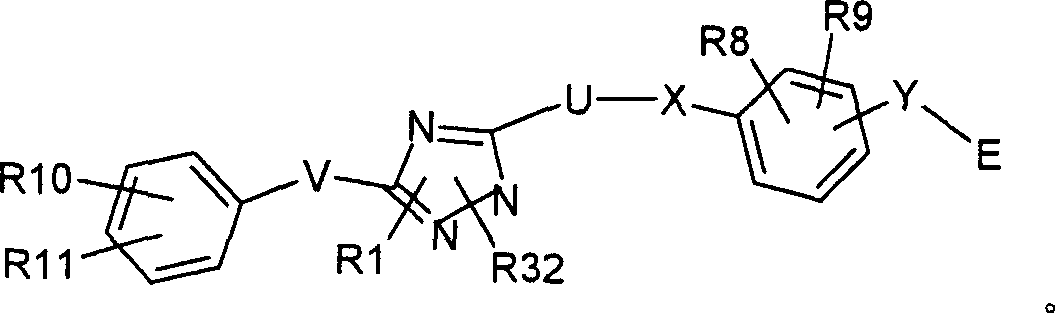


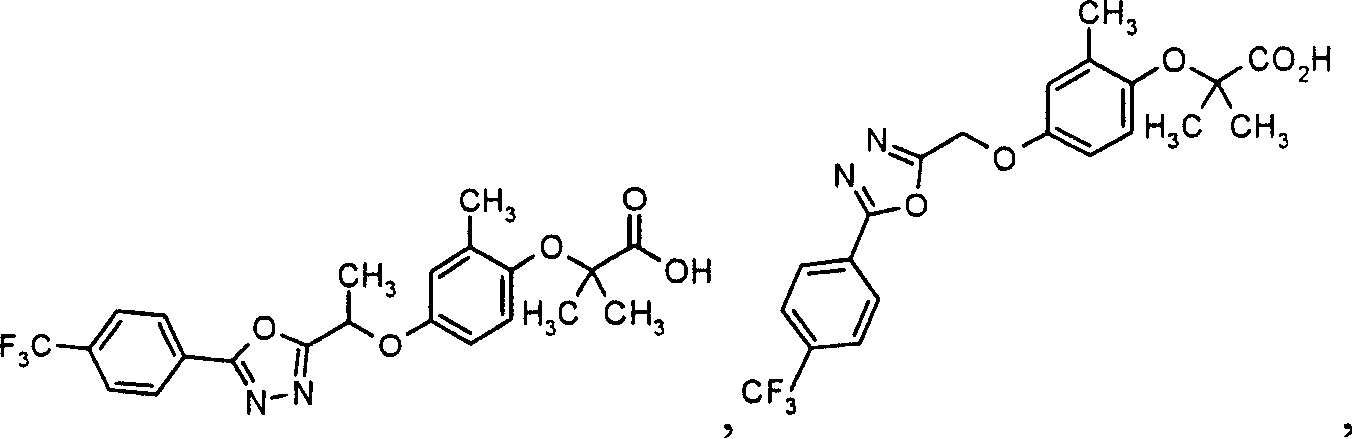


Applications Claiming Priority (8)
| Application Number | Priority Date | Filing Date | Title |
|---|---|---|---|
| US53232003P | 2003-12-22 | 2003-12-22 | |
| US60/532,320 | 2003-12-22 | ||
| US58656304P | 2004-07-09 | 2004-07-09 | |
| US60/586,563 | 2004-07-09 | ||
| EP04380158.8 | 2004-07-21 | ||
| EP04380159.6 | 2004-07-21 | ||
| EP04380158 | 2004-07-21 | ||
| EP04380159 | 2004-07-21 |
Publications (1)
| Publication Number | Publication Date |
|---|---|
| CN1909902A true CN1909902A (en) | 2007-02-07 |
Family
ID=34753767
Family Applications (1)
| Application Number | Title | Priority Date | Filing Date |
|---|---|---|---|
| CNA2004800383003A Pending CN1909902A (en) | 2003-12-22 | 2004-12-21 | Triazole, oxadiazole and thiadiazole derivatives as PPAR modulators for the treatment of diabetes |
Country Status (8)
| Country | Link |
|---|---|
| US (1) | US7507832B2 (en) |
| EP (1) | EP1725231A1 (en) |
| JP (1) | JP2007515484A (en) |
| CN (1) | CN1909902A (en) |
| AU (1) | AU2004311909A1 (en) |
| BR (1) | BRPI0417947A (en) |
| CA (1) | CA2549385A1 (en) |
| WO (1) | WO2005065683A1 (en) |
Cited By (16)
| Publication number | Priority date | Publication date | Assignee | Title |
|---|---|---|---|---|
| CN101863852A (en) * | 2010-06-29 | 2010-10-20 | 沈阳航空航天大学 | Aromatic diamine containing 1,3,4-oxadiazole heterocyclic structure and preparation method thereof |
| CN102076671A (en) * | 2008-07-03 | 2011-05-25 | 安斯泰来制药有限公司 | Triazole derivative or salt thereof |
| CN102365273A (en) * | 2009-01-28 | 2012-02-29 | 赛诺菲 | Thiadiazole and oxadiazole derivatives, preparation thereof, and therapeutic use thereof |
| CN103467406A (en) * | 2013-09-03 | 2013-12-25 | 浙江医药高等专科学校 | Halogen-substituted tetrazole carboxylic acid compounds, and preparation method and application thereof |
| CN103467407A (en) * | 2013-09-03 | 2013-12-25 | 浙江医药高等专科学校 | Tetrazole carboxylic acid compounds and application thereof |
| CN103467398A (en) * | 2013-09-03 | 2013-12-25 | 浙江医药高等专科学校 | Triazole amide compounds, and preparation method and application thereof in resisting diabetes |
| CN103467399A (en) * | 2013-09-03 | 2013-12-25 | 浙江医药高等专科学校 | Triazole amide compounds, and preparation method and application thereof |
| CN103467405A (en) * | 2013-09-03 | 2013-12-25 | 浙江医药高等专科学校 | Tetrazole carboxylic acid compounds, and preparation method and application thereof |
| CN103467408A (en) * | 2013-09-03 | 2013-12-25 | 浙江医药高等专科学校 | Tetrazole carboxylic acid compounds and application thereof |
| CN103467409A (en) * | 2013-09-03 | 2013-12-25 | 浙江医药高等专科学校 | Substituted tetrazole carboxylic acid compounds and application thereof |
| CN103483281A (en) * | 2013-09-03 | 2014-01-01 | 浙江医药高等专科学校 | Triazole amide compound and preparing method and antidiabetic function thereof |
| CN103483282A (en) * | 2013-09-03 | 2014-01-01 | 浙江医药高等专科学校 | Phenyl-substituted triazole amide compounds and application |
| CN103554043A (en) * | 2013-09-03 | 2014-02-05 | 浙江医药高等专科学校 | Phenyl-substituted triazole amide compounds and application |
| CN106632125A (en) * | 2016-10-08 | 2017-05-10 | 李纪焕 | Three-component synthesis method of alkylaryl substituted oxadiazole compound |
| US12220412B2 (en) | 2018-11-20 | 2025-02-11 | Sparrow Pharmaceuticals, Inc. | Methods for administering corticosteroids |
| US12329745B2 (en) | 2022-05-16 | 2025-06-17 | Sparrow Pharmaceuticals, Inc. | Methods and compositions for treating glucocorticoid excess |
Families Citing this family (22)
| Publication number | Priority date | Publication date | Assignee | Title |
|---|---|---|---|---|
| US7816385B2 (en) * | 2002-12-20 | 2010-10-19 | High Point Pharmaceuticals, Llc | Dimeric dicarboxylic acid derivatives, their preparation and use |
| JP2007284352A (en) * | 2004-08-05 | 2007-11-01 | Dai Ichi Seiyaku Co Ltd | Pyrazole derivative |
| JP4882748B2 (en) | 2004-09-16 | 2012-02-22 | アステラス製薬株式会社 | Triazole derivative or salt thereof |
| CN101141957A (en) * | 2005-02-03 | 2008-03-12 | Irm责任有限公司 | Compounds and compositions as PPAR modulators |
| RU2008113210A (en) * | 2005-10-06 | 2009-10-10 | Санофи-Авентис (Fr) | 4-Oxy-N- [1, 3, 4] -thiadiazole-2-ylbenzenesulfonamides, methods for their preparation and their use as pharmaceutical preparations |
| DK2029547T3 (en) | 2006-05-24 | 2010-07-26 | Lilly Co Eli | FXR agonists |
| AU2007267692B2 (en) * | 2006-05-24 | 2012-06-14 | Eli Lilly And Company | Compounds and methods for modulating FXR |
| KR20090010092A (en) * | 2006-05-30 | 2009-01-28 | 아스트라제네카 아베 | 1,3,4-oxadiazole derivatives as DVAT1 inhibitors |
| NZ572586A (en) * | 2006-05-30 | 2011-03-31 | Astrazeneca Ab | Substituted 5-phenylamino-1,3,4-oxadiazol-2-ylcarbonylamino-4-phenoxy-cyclohexane carboxylic acid as inhibitors of acetyl coenzyme a diacylglycerol acyltransferase |
| RU2527177C2 (en) | 2007-12-20 | 2014-08-27 | Энвиво Фармасьютикалз, Инк. | Tetrasubstituted benzenes |
| JP2010018531A (en) * | 2008-07-09 | 2010-01-28 | Sumitomo Seika Chem Co Ltd | Method for producing 3-benzyloxybenzenethiol |
| JP2012506386A (en) * | 2008-10-21 | 2012-03-15 | メタボレックス, インコーポレイテッド | Aryl GPR120 receptor agonist and uses thereof |
| FR2941457A1 (en) * | 2009-01-28 | 2010-07-30 | Sanofi Aventis | New thiadiazole and oxadiazole derivatives are triglyceride biosynthesis inhibitors useful to treat or prevent e.g. obesity, dyslipidemia, hepatic steatosis, insulin resistance, metabolic syndrome, coronary heart disease and hypertension |
| BR112013001138A2 (en) | 2010-07-16 | 2016-07-05 | Abbvie Inc | phosphine binders for catalytic reactions |
| WO2012009699A2 (en) | 2010-07-16 | 2012-01-19 | Abbott Laboratories | Process for preparing antiviral compounds |
| US8975443B2 (en) | 2010-07-16 | 2015-03-10 | Abbvie Inc. | Phosphine ligands for catalytic reactions |
| US9255074B2 (en) | 2010-07-16 | 2016-02-09 | Abbvie Inc. | Process for preparing antiviral compounds |
| AU2011296737A1 (en) | 2010-08-31 | 2013-04-11 | Snu R&Db Foundation | Use of the fetal reprogramming of a PPAR delta agonist |
| UA112418C2 (en) | 2010-09-07 | 2016-09-12 | Астеллас Фарма Інк. | THERAPEUTIC DISEASE |
| JP2015131783A (en) * | 2014-01-14 | 2015-07-23 | 株式会社日本ファインケム | Method for producing aryl-1,2,4-triazole derivative |
| SG11201908947QA (en) * | 2017-03-30 | 2019-10-30 | Bristol Myers Squibb Co | Process for the preparation of 6-(cyclopropaneamido)-4-((2-methoxy-3-(1-methyl-1h-1,2,4-triazol-3-yl)phenyl)amino)-n-(methyl-d3)pyridazine-3-carboxamide |
| KR102750722B1 (en) * | 2022-03-16 | 2025-01-09 | 재단법인 대구경북첨단의료산업진흥재단 | Thiadiazole compounds and pharmaceutical composition for preventing or treating inflammatory diseases comprising the same |
Family Cites Families (6)
| Publication number | Priority date | Publication date | Assignee | Title |
|---|---|---|---|---|
| US3637672A (en) * | 1968-07-09 | 1972-01-25 | Osaka Seika Kogyo Kk | Azole compounds |
| DE4031158A1 (en) * | 1990-04-21 | 1991-10-24 | Bayer Ag | ARYLOXYCARBONYL COMPOUNDS |
| JPH05202038A (en) * | 1992-01-30 | 1993-08-10 | Sumitomo Chem Co Ltd | Azole derivative, its production and herbicide containing the same as active ingredient |
| WO1997003967A1 (en) * | 1995-07-22 | 1997-02-06 | Rhone-Poulenc Rorer Limited | Substituted aromatic compounds and their pharmaceutical use |
| GB0029974D0 (en) | 2000-12-08 | 2001-01-24 | Glaxo Group Ltd | Chemical compounds |
| US6875780B2 (en) | 2002-04-05 | 2005-04-05 | Warner-Lambert Company | Compounds that modulate PPAR activity and methods for their preparation |
-
2004
- 2004-12-21 BR BRPI0417947-1A patent/BRPI0417947A/en not_active IP Right Cessation
- 2004-12-21 CN CNA2004800383003A patent/CN1909902A/en active Pending
- 2004-12-21 WO PCT/US2004/039775 patent/WO2005065683A1/en not_active Ceased
- 2004-12-21 JP JP2006547018A patent/JP2007515484A/en active Pending
- 2004-12-21 EP EP04812321A patent/EP1725231A1/en not_active Withdrawn
- 2004-12-21 CA CA002549385A patent/CA2549385A1/en not_active Abandoned
- 2004-12-21 US US10/580,202 patent/US7507832B2/en not_active Expired - Fee Related
- 2004-12-21 AU AU2004311909A patent/AU2004311909A1/en not_active Abandoned
Cited By (25)
| Publication number | Priority date | Publication date | Assignee | Title |
|---|---|---|---|---|
| CN102076671A (en) * | 2008-07-03 | 2011-05-25 | 安斯泰来制药有限公司 | Triazole derivative or salt thereof |
| US8377923B2 (en) | 2008-07-03 | 2013-02-19 | Astellas Pharma Inc. | Triazole derivative or salt thereof |
| CN102076671B (en) * | 2008-07-03 | 2013-05-15 | 安斯泰来制药有限公司 | Triazole derivative or salt thereof |
| CN102365273A (en) * | 2009-01-28 | 2012-02-29 | 赛诺菲 | Thiadiazole and oxadiazole derivatives, preparation thereof, and therapeutic use thereof |
| CN101863852A (en) * | 2010-06-29 | 2010-10-20 | 沈阳航空航天大学 | Aromatic diamine containing 1,3,4-oxadiazole heterocyclic structure and preparation method thereof |
| CN101863852B (en) * | 2010-06-29 | 2011-09-21 | 沈阳航空航天大学 | Aromatic diamine containing 1,3,4-oxadiazole heterocyclic structure and preparation method thereof |
| CN103467409A (en) * | 2013-09-03 | 2013-12-25 | 浙江医药高等专科学校 | Substituted tetrazole carboxylic acid compounds and application thereof |
| CN103554043A (en) * | 2013-09-03 | 2014-02-05 | 浙江医药高等专科学校 | Phenyl-substituted triazole amide compounds and application |
| CN103467398A (en) * | 2013-09-03 | 2013-12-25 | 浙江医药高等专科学校 | Triazole amide compounds, and preparation method and application thereof in resisting diabetes |
| CN103467399A (en) * | 2013-09-03 | 2013-12-25 | 浙江医药高等专科学校 | Triazole amide compounds, and preparation method and application thereof |
| CN103467405A (en) * | 2013-09-03 | 2013-12-25 | 浙江医药高等专科学校 | Tetrazole carboxylic acid compounds, and preparation method and application thereof |
| CN103467408A (en) * | 2013-09-03 | 2013-12-25 | 浙江医药高等专科学校 | Tetrazole carboxylic acid compounds and application thereof |
| CN103467406A (en) * | 2013-09-03 | 2013-12-25 | 浙江医药高等专科学校 | Halogen-substituted tetrazole carboxylic acid compounds, and preparation method and application thereof |
| CN103483281A (en) * | 2013-09-03 | 2014-01-01 | 浙江医药高等专科学校 | Triazole amide compound and preparing method and antidiabetic function thereof |
| CN103483282A (en) * | 2013-09-03 | 2014-01-01 | 浙江医药高等专科学校 | Phenyl-substituted triazole amide compounds and application |
| CN103467407A (en) * | 2013-09-03 | 2013-12-25 | 浙江医药高等专科学校 | Tetrazole carboxylic acid compounds and application thereof |
| CN103467406B (en) * | 2013-09-03 | 2014-12-17 | 浙江医药高等专科学校 | Halogen-substituted tetrazole carboxylic acid compounds, and preparation method and application thereof |
| CN103467399B (en) * | 2013-09-03 | 2015-01-07 | 浙江医药高等专科学校 | Triazole amide compound, its preparation method and its use |
| CN103467398B (en) * | 2013-09-03 | 2015-01-21 | 浙江医药高等专科学校 | Triazole amide compounds, and preparation method and application thereof in resisting diabetes |
| CN103467408B (en) * | 2013-09-03 | 2015-01-21 | 浙江医药高等专科学校 | Tetrazole carboxylic acid compounds and application thereof |
| CN103554043B (en) * | 2013-09-03 | 2015-04-01 | 浙江医药高等专科学校 | Phenyl-substituted triazole amide compounds and application |
| CN103467407B (en) * | 2013-09-03 | 2015-04-22 | 浙江医药高等专科学校 | Tetrazole carboxylic acid compounds and application thereof |
| CN106632125A (en) * | 2016-10-08 | 2017-05-10 | 李纪焕 | Three-component synthesis method of alkylaryl substituted oxadiazole compound |
| US12220412B2 (en) | 2018-11-20 | 2025-02-11 | Sparrow Pharmaceuticals, Inc. | Methods for administering corticosteroids |
| US12329745B2 (en) | 2022-05-16 | 2025-06-17 | Sparrow Pharmaceuticals, Inc. | Methods and compositions for treating glucocorticoid excess |
Also Published As
| Publication number | Publication date |
|---|---|
| BRPI0417947A (en) | 2007-04-17 |
| US20070112045A1 (en) | 2007-05-17 |
| CA2549385A1 (en) | 2005-07-21 |
| AU2004311909A1 (en) | 2005-07-21 |
| JP2007515484A (en) | 2007-06-14 |
| US7507832B2 (en) | 2009-03-24 |
| EP1725231A1 (en) | 2006-11-29 |
| WO2005065683A1 (en) | 2005-07-21 |
Similar Documents
| Publication | Publication Date | Title |
|---|---|---|
| CN1157368C (en) | Human Peroxisome Proliferator-Activated Receptor (PPAR) Alpha Agonist-Substituted Phenylpropionic Acid Derivatives | |
| CN1093124C (en) | Substituted 4-hydroxy-phenylalcanoic acid derivatives with activity to ppar-'gamma' | |
| CN1293042C (en) | Aromatic amino acid derivative and pharmaceutical composition thereof | |
| CN1293076C (en) | Activator for peroxisome proliferator-activated receptor delta | |
| CN1215059C (en) | Novel heterocyclic compounds and salts thereof and medicinal use of same | |
| CN1058969C (en) | Novel substd. guanidine derivs., process for prodn. thereof, and pharmaceutical uses thereof | |
| CN1095839C (en) | 4,5-diaryl oxazole derivatives | |
| CN1235870C (en) | Novel use of phenyl hetero alkylamine derivatives | |
| CN1578659A (en) | Modulators of peroxisome proliferator-activated receptors (PPARs) | |
| CN1649820A (en) | Compound for regulating PPAR activity and preparation method thereof | |
| CN101048402A (en) | Carbazole derivative, solvate thereof, or pharmaceutically acceptable salt thereof | |
| CN1681763A (en) | Chemical compounds | |
| CN101035774A (en) | Modulators of CRTH-2 receptor activity for the treatment of prostaglandin D2 mediated diseases | |
| CN1678578A (en) | Indole compounds with antidiabetic activity | |
| CN1544420A (en) | Inhibition of RAF Kinases by Substituted Heterocyclic Ureas | |
| CN1671659A (en) | Novel substituted indoles | |
| CN1638768A (en) | Thiazole and oxazole derivatives that modulate PPAR activity | |
| CN1147250A (en) | Naphthalene derivatives as prostaglandin I2 agonists | |
| CN1070173C (en) | Benzoylguanidine derivatives used as medicines | |
| CN1674892A (en) | Hetero biaryl derivatives as matrix metalloproteinase inhibitors | |
| CN1761657A (en) | EP4 receptor antagonists | |
| CN1780822A (en) | Use of derivatives of 2, 4-dihydro- 1,2,4 triazole-3-thione as inhibitors of the enzyme myeloperoxidase (MPO) | |
| CN1558897A (en) | oral antidiabetic agents | |
| CN1182129C (en) | Benzopyran Derivatives with Leukotriene Antagonism | |
| CN1913778A (en) | Aminocyclopentyl pyridopyrazinone modulators of chemokine receptor activity |
Legal Events
| Date | Code | Title | Description |
|---|---|---|---|
| C06 | Publication | ||
| PB01 | Publication | ||
| C10 | Entry into substantive examination | ||
| SE01 | Entry into force of request for substantive examination | ||
| C12 | Rejection of a patent application after its publication | ||
| RJ01 | Rejection of invention patent application after publication |
Open date: 20070207 |