DE602004012425T2 - NEW POLYMERS - Google Patents
NEW POLYMERS Download PDFInfo
- Publication number
- DE602004012425T2 DE602004012425T2 DE602004012425T DE602004012425T DE602004012425T2 DE 602004012425 T2 DE602004012425 T2 DE 602004012425T2 DE 602004012425 T DE602004012425 T DE 602004012425T DE 602004012425 T DE602004012425 T DE 602004012425T DE 602004012425 T2 DE602004012425 T2 DE 602004012425T2
- Authority
- DE
- Germany
- Prior art keywords
- acid
- sup
- group
- alkyl
- polymer
- Prior art date
- Legal status (The legal status is an assumption and is not a legal conclusion. Google has not performed a legal analysis and makes no representation as to the accuracy of the status listed.)
- Expired - Fee Related
Links
Classifications
-
- C—CHEMISTRY; METALLURGY
- C09—DYES; PAINTS; POLISHES; NATURAL RESINS; ADHESIVES; COMPOSITIONS NOT OTHERWISE PROVIDED FOR; APPLICATIONS OF MATERIALS NOT OTHERWISE PROVIDED FOR
- C09D—COATING COMPOSITIONS, e.g. PAINTS, VARNISHES OR LACQUERS; FILLING PASTES; CHEMICAL PAINT OR INK REMOVERS; INKS; CORRECTING FLUIDS; WOODSTAINS; PASTES OR SOLIDS FOR COLOURING OR PRINTING; USE OF MATERIALS THEREFOR
- C09D5/00—Coating compositions, e.g. paints, varnishes or lacquers, characterised by their physical nature or the effects produced; Filling pastes
- C09D5/08—Anti-corrosive paints
- C09D5/082—Anti-corrosive paints characterised by the anti-corrosive pigment
-
- C—CHEMISTRY; METALLURGY
- C08—ORGANIC MACROMOLECULAR COMPOUNDS; THEIR PREPARATION OR CHEMICAL WORKING-UP; COMPOSITIONS BASED THEREON
- C08F—MACROMOLECULAR COMPOUNDS OBTAINED BY REACTIONS ONLY INVOLVING CARBON-TO-CARBON UNSATURATED BONDS
- C08F220/00—Copolymers of compounds having one or more unsaturated aliphatic radicals, each having only one carbon-to-carbon double bond, and only one being terminated by only one carboxyl radical or a salt, anhydride ester, amide, imide or nitrile thereof
- C08F220/02—Monocarboxylic acids having less than ten carbon atoms; Derivatives thereof
- C08F220/04—Acids; Metal salts or ammonium salts thereof
- C08F220/06—Acrylic acid; Methacrylic acid; Metal salts or ammonium salts thereof
-
- C—CHEMISTRY; METALLURGY
- C08—ORGANIC MACROMOLECULAR COMPOUNDS; THEIR PREPARATION OR CHEMICAL WORKING-UP; COMPOSITIONS BASED THEREON
- C08F—MACROMOLECULAR COMPOUNDS OBTAINED BY REACTIONS ONLY INVOLVING CARBON-TO-CARBON UNSATURATED BONDS
- C08F228/00—Copolymers of compounds having one or more unsaturated aliphatic radicals, each having only one carbon-to-carbon double bond, and at least one being terminated by a bond to sulfur or by a heterocyclic ring containing sulfur
- C08F228/02—Copolymers of compounds having one or more unsaturated aliphatic radicals, each having only one carbon-to-carbon double bond, and at least one being terminated by a bond to sulfur or by a heterocyclic ring containing sulfur by a bond to sulfur
-
- C—CHEMISTRY; METALLURGY
- C08—ORGANIC MACROMOLECULAR COMPOUNDS; THEIR PREPARATION OR CHEMICAL WORKING-UP; COMPOSITIONS BASED THEREON
- C08F—MACROMOLECULAR COMPOUNDS OBTAINED BY REACTIONS ONLY INVOLVING CARBON-TO-CARBON UNSATURATED BONDS
- C08F230/00—Copolymers of compounds having one or more unsaturated aliphatic radicals, each having only one carbon-to-carbon double bond, and containing phosphorus, selenium, tellurium or a metal
- C08F230/02—Copolymers of compounds having one or more unsaturated aliphatic radicals, each having only one carbon-to-carbon double bond, and containing phosphorus, selenium, tellurium or a metal containing phosphorus
Landscapes
- Chemical & Material Sciences (AREA)
- Organic Chemistry (AREA)
- Health & Medical Sciences (AREA)
- Chemical Kinetics & Catalysis (AREA)
- Medicinal Chemistry (AREA)
- Polymers & Plastics (AREA)
- Life Sciences & Earth Sciences (AREA)
- Engineering & Computer Science (AREA)
- Materials Engineering (AREA)
- Wood Science & Technology (AREA)
- Addition Polymer Or Copolymer, Post-Treatments, Or Chemical Modifications (AREA)
- Preventing Corrosion Or Incrustation Of Metals (AREA)
- Detergent Compositions (AREA)
- Polyesters Or Polycarbonates (AREA)
- Organic Low-Molecular-Weight Compounds And Preparation Thereof (AREA)
Abstract
Description
Die Erfindung betrifft neue Polymere, ein Verfahren zur Herstellung dieser Polymerer und die Verwendung dieser Polymeren.The The invention relates to novel polymers, a process for the preparation this polymer and the use of these polymers.
Die
Die
Erfindung stellt daher ein Polymeres der Formel (I) bereit 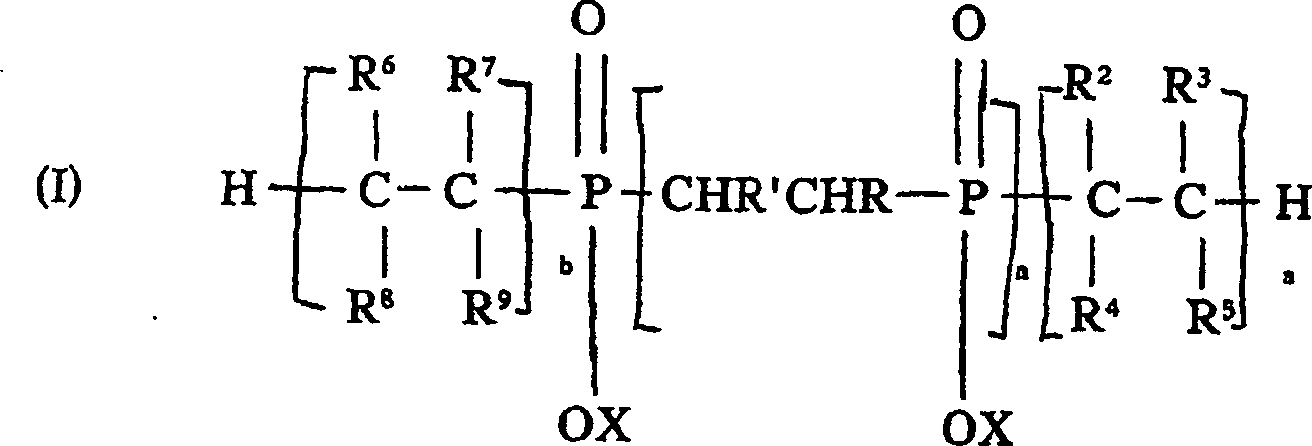
X ist Wasserstoff oder ein Kation oder eine Alkylgruppe;
einer
der Reste R2, R3,
R4, R5 ist eine
Phosphonat- oder Sulfonatgruppe, und die restlichen von R2, R3, R4,
R5 sind jeweils unabhängig ausgewählt unter Wasserstoff, Alkyl,
Aryl, Alkaryl, Alkoxy, Hydroxy, Hydroxy- oder Carboxy-substituiertem Alkyl,
Phosphonat- oder Sulfonatgruppen, und a ist eine Zahl von 1 bis
5;
R6, R7,
R8, R9 sind jeweils
unabhängig
ausgewählt
unter Wasserstoff, Alkyl, Aryl, Alkaryl, Hydroxy, Alkoxy, Hydroxy-
oder Carboxy-substituierten Alkyl- oder Carboxygruppen, und b ist
eine Zahl von 5 bis 200.The invention therefore provides a polymer of formula (I)
X is hydrogen or a cation or an alkyl group;
one of R 2 , R 3 , R 4 , R 5 is a phosphonate or sulfonate group and the remainder of R 2 , R 3 , R 4 , R 5 are each independently selected from hydrogen, alkyl, aryl, alkaryl, alkoxy , Hydroxy, hydroxy or carboxy-substituted alkyl, phosphonate or sulfonate groups, and a is a number from 1 to 5;
R 6 , R 7 , R 8 , R 9 are each independently selected from hydrogen, alkyl, aryl, alkaryl, hydroxy, alkoxy, hydroxy or carboxy-substituted alkyl or carboxy groups, and b is a number from 5 to 200.
Weiterhin
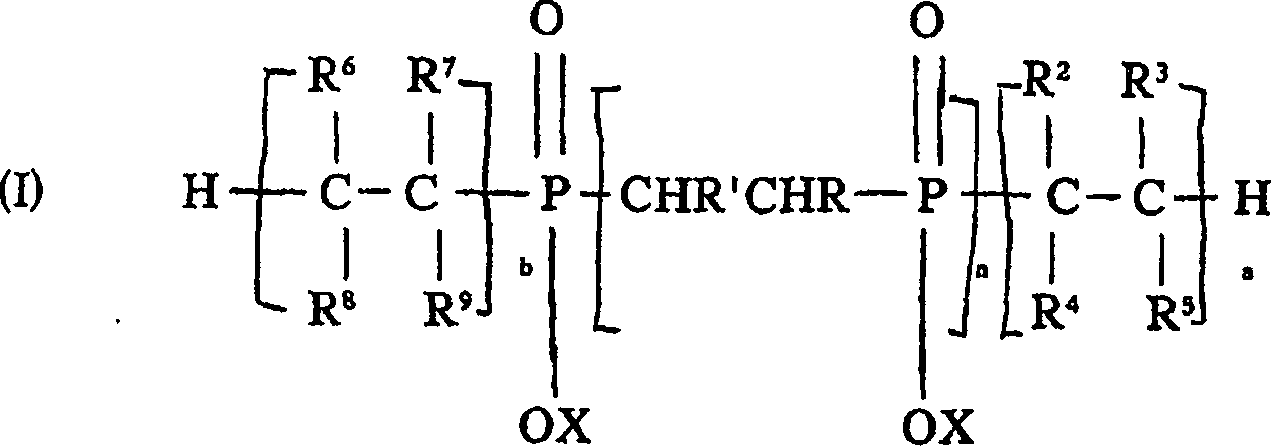
bereitgestellt wird ein Polymeres der Formel (V) 
X ist Wasserstoff oder ein Kation oder eine Alkylgruppe;
R2, R3, R4,
R5 sind jeweils unabhängig ausgewählt unter Wasserstoff, Alkyl,
Aryl, Alkaryl, Alkoxy, Hydroxy, Hydroxy- oder Carboxy-substituiertem
Alkyl, Phosphonat- oder Sulfonatgruppen, und a ist eine Zahl von
1 bis 5;
R6, R7,
R8, R9 sind jeweils
unabhängig
ausgewählt
unter Wasserstoff, Alkyl, Aryl, Alkaryl, Hydroxy, Alkoxy, Hydroxy-
oder Carboxy-substituierten Alkyl-, Sulfonat- oder Carboxygruppen, und b ist eine
Zahl von 5 bis 200.Furthermore provided is a polymer of the formula (V)
X is hydrogen or a cation or an alkyl group;
R 2 , R 3 , R 4 , R 5 are each independently selected from hydrogen, alkyl, aryl, alkaryl, alkoxy, hydroxy, hydroxy or carboxy-substituted alkyl, phosphonate or sulfonate groups, and a is a number from 1 to 5 ;
R 6 , R 7 , R 8 , R 9 are each independently selected from hydrogen, alkyl, aryl, alkaryl, hydroxy, alkoxy, hydroxy or carboxy-substituted alkyl, sulfonate or carboxy groups, and b is a number from 5 to 200th
Die
vorliegende Erfindung betrifft weiterhin ein Verfahren zur Herstellung
des Polymeren der Formel (I) oder der Formel (V), wobei das Verfahren
die Reaktion umfasst von:
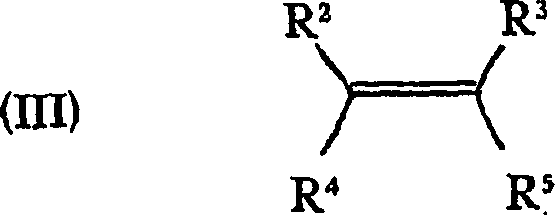
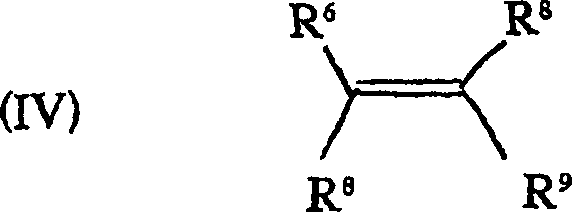
1) einer Verbindung der Formel (II) 


1) a compound of the formula (II)
Das Monomere (III) ist vorzugsweise aus der Gruppe ausgewählt, bestehend aus Vinylphosphonsäure (VPA), Vinyliden-1,1-Diphosphonsäure (VDPA) und Vinylsulfonsäure (VSA).The Monomers (III) is preferably selected from the group consisting from vinylphosphonic acid (VPA), Vinylidene-1,1-diphosphonic (VDPA) and vinylsulfonic acid (VSA).
Der Initiator ist vorzugsweise Natriumpersulfat (Na2S2O8). Alternativ dazu kann der Initiator Wasserstoffperoxid, eine Azoverbindung, wie Azo-bis-isobutyronitril, ein organisches Peroxid oder eine Quelle von ultravioletter oder ionisierender Strahlung sein.The initiator is preferably sodium persulfate (Na 2 S 2 O 8 ). Alternatively, the initiator may be hydrogen peroxide, an azo compound such as azo-bis-isobutyronitrile, an organic peroxide, or a source of ultraviolet or ionizing radiation.
Das Monomere (IV) ist vorzugsweise eine ungesättigte Carbonsäure wie Acrylsäure. Alternativ dazu können andere ungesättigte Monocarbonsäuren oder Dicarbonsäuren verwendet werden (wie Methacrylsäure, Fumarsäure, Maleinsäure, Itaconsäure, Aconitsäure, Mesaconsäure, Citraconsäure, Crotonsäure, Isocrotonsäure, Angelicasäure, Tiglinsäure und deren wasserlösliche Salze).The Monomers (IV) is preferably an unsaturated carboxylic acid such as Acrylic acid. Alternatively, you can other unsaturated Monocarboxylic acids or dicarboxylic acids used (such as methacrylic acid, fumaric acid, maleic acid, itaconic, aconitic, mesaconic, citraconic, crotonic, isocrotonic, Angelic acid, tiglic and their water-soluble Salts).
Die Reaktion kann bei einer Temperatur von 60 bis 110°C durchgeführt werden. Vorzugsweise wird die Reaktion bei einer Temperatur von etwa 95°C durchgeführt.The Reaction can be carried out at a temperature of 60 to 110 ° C. Preferably, the reaction is carried out at a temperature of about 95 ° C.
Nach der vorliegenden Erfindung hergestellte Polymere können zur Inhibierung von Ablagerungen in einem wässrigen System verwendet werden, zum Beispiel in Boilern, Kühlsystemen, Entsalzungsanlagen, geothermischen Wässern und Erdölfeld-Salzlösung.To Polymers prepared by the present invention can be used for Inhibition of deposits used in an aqueous system for example in boilers, cooling systems, Desalination plants, geothermal waters and oilfield salt solution.
Nach der vorliegenden Erfindung hergestellte Polymere können in funktionellen Flüssigkeiten auf wässriger Basis wie hydraulischen Flüssigkeiten, Gleitmitteln, Schneidflüssigkeiten und Erdölfeld-Bohrspülschlämmen verwendet werden.To Polymers prepared by the present invention can be used in functional fluids on watery Base like hydraulic fluids, Lubricants, cutting fluids and petroleum field drilling muds become.
Insbesondere können nach der vorliegenden Erfindung hergestellte Polymere bei der Auspreßbehandlung von Erdöl-Bohrlöchern verwendet werden. Sie sind besonders wirksam bei der Inhibierung der Bildung von Bariumsulfat-Ablagerungen und/oder Calciumcarbonat-Ablagerungen in Erdölfeldern. Beispielsweise wird das Loch in Ölbohrlöchern normalerweise mit einem wässrigen oberflächenaktiven Mittel ausgespült, um eine wasserbenetzbare Oberfläche zu erhalten, und wird dann anschließend mit einer Lösung des Inhibitors imprägniert. Dann werden Calciumsalze in situ gebildet, entweder durch Calcium in der Gesteinsformation (wenn letztere Kalkstein enthält) oder durch vorherige oder spätere Behandlung des Loches mit einer wässrigen Lösung eines Calciumsalzes (wenn die Gesteinsformation Sandstein enthält).Especially can polymers prepared by the present invention in the extrusion treatment used by petroleum wells become. They are particularly effective in inhibiting the formation of barium sulfate deposits and / or calcium carbonate deposits in oilfields. For example the hole in oil wells normally with an aqueous surfactants Medium rinsed out to a water-wettable surface to receive, and then with a solution of the Inhibitors impregnated. Then calcium salts are formed in situ, either by calcium in the rock formation (if the latter contains limestone) or by previous or later Treatment of the hole with an aqueous solution of a calcium salt (if the rock formation contains sandstone).
Wirksame Konzentrationen liegen typisch im Bereich von 1 bis 200 ppm. Zum Beispiel können 1,5 bis 20 ppm, bevorzugter 2 bis 10 ppm einen nützlichen Korrosionsschutz ergeben. Allerdings sind für einen vorbeugenden Schutz gegen Ablagerungen in einem Ölfeld, in dem Bariumsulfat ein Problem ist, Konzentrationen im Bereich von 5 bis 500 ppm, speziell 8 bis 25 ppm, z. B. 10 bis 20 ppm bevorzugt.Effective concentrations typically range from 1 to 200 ppm. For example, 1.5 to 20 ppm, more preferably 2 to 10 ppm can provide useful corrosion protection. However, for a pre diffractive protection against deposits in an oil field in which barium sulfate is a problem, concentrations ranging from 5 to 500 ppm, especially 8 to 25 ppm, e.g. B. 10 to 20 ppm preferred.
Die Polymeren der vorliegenden Erfindung können in Kombination miteinander und/oder in Verbindung mit anderen Wasserbehandlungsmitteln verwendet werden, einschließlich: oberflächenaktive Mittel (z. B. C10-20-Alkylbenzolsulfonate, C10-20-Olefinsulfonate, C10-20-Alkylsulfate, C10-20-Alkyl-1 bis 15 Mol-Ethersulfate, C10-20-Paraffinsulfonate, C10-20-Seifen, C10-20-Alkylphenolsulfate, Sulfosuccinate, Sulfosuccinamate, Ligninsulfonate, Fettsäureestersulfonate, C10-20-Alkylphenolethersulfate, C10-20-Alkylethanolamidsulfate, C10-20-alpha-Sulfofettsäuresalze, C10-20-Acylsarcosinate, Isethionate, C10-20-Acyltauride, C10-20-Alkylhydrogenphosphate), nicht-ionische oberflächenaktive Mittel (z. B. ethoxylierte natürliche oder synthetische Fettsäuren, Ethoxy/Propylenoxy-Blockcopolymere, ethoxylierte Fettsäureamide, Mono- oder Dialkanolamide, Aminoxide und C10-20-Acylsorbitan- und/oder -glycerylethoxylate), amphotere oberflächenaktive Mittel (z. B. Betaine, Sulfobetaine und/oder quaternisierte Imidazoline), und/oder kationische oberflächenaktive Mittel (z. B. Benzalkoniumsalze, C10-20-Alkyltrimethylammoniumsalze und/oder C10-20-Alkyltrimethyl- oder -tris(hydroxymethyl)phosphoniumsalze); Sequestriermittel, Chelatisiermittel, Korrosionsinhibitoren und/oder anderen Schwellenwertmittel (z. B. Natriumtripolyphosphat, Natriumethylendiamintetraacetat, Natriumnitrilotriacetat, Tetrakaliumpyrophosphat, Acetodiphosphonsäure und deren Salze, Ammoniumtrismethylenphosphonsäure und deren Salze, Etylendiamintetrakis(methylenphosphon)säure und deren Salze, Diethylentriaminpentakis(methylenphosphon)säure, Hexamethylendiamintetrakis(methylenphosphon)säure, Bis-Hexamethylentriaminpentakis(methylenphosphon)säure und Ethanolamin-bis(methylenphosphon)säure und deren Salze); Tolytriazol und Gemische von Nitrat-, Benzoat-, HHP- und/oder PTCB-Bioziden (z. B. Tetrakis(hydroxymethyl)-phosphoniumsalze, Formaldehyd, Glutaraldehyd); oxidierende Biozide und/oder Bleichmittel (z. B. Chlor, Chlordioxid, Wasserstoffperoxid, Natriumperborat); Schaumsteuerungsmittel wie Silicon-Antischaummittel, acetylenische Diole; Sauerstofffänger wie Hydrazine und/oder Hydroxylamine; pH-Regulatoren und/oder Puffermittel wie Amine, Borste, Citrate und/oder Acetate; Chromsalze; Zinksalze; und/oder Wasserbehandlungsmittel wie polymere Dispergiermitel und Koagulatoren einschließlich Polymalein-, Polyacryl- und Polyvinylsulfonsäuren und deren Salze, Stärken und/oder Carboxymethylcellulose und/oder Molybdate. Die Erfindung stellt weiterhin Formulierungen bereit, die eine wirksame Menge eines erfindungsgemäßen Produktes wie zuvor beschrieben umfasst und ein beliebiges der zuvor genannten bekannten Wasserbehandlungsmittel. Derartige Formulierungen können zum Beispiel von 5 bis 95 Gewichts-% eines Produktes nach der vorliegenden Erfindung enthalten und 5 bis 90 Gewichts-% von einem oder mehreren der zuvor genannten Wasserbehandlungsmittel.The polymers of the present invention may be used in combination with each other and / or in conjunction with other water treatment agents, including: surfactants (e.g., C 10-20 alkyl benzene sulfonates, C 10-20 olefin sulfonates, C 10-20 alkyl sulfates, C 10-20 alkyl 1 to 15 mole ether sulfates, C 10 to 20 paraffinsulfonates, C 10 to 20 soaps, C 10 to 20 alkylphenol sulfates, sulfosuccinates, sulfosuccinamates, lignosulfonates, fatty acid ester sulfonates, C 10 to 20 alkylphenol ether sulfates, C 10-20 alkyl ethanolamide sulfates, C 10-20 alpha-sulfofatty acid salts, C 10-20 acyl sarcosinates, isethionates, C 10-20 acyl taurides, C 10-20 alkyl hydrogen phosphates), nonionic surfactants (e.g. ethoxylated natural or synthetic fatty acids, ethoxy / propyleneoxy block copolymers, ethoxylated fatty acid amides, mono- or dialkanolamides, amine oxides and C 10-20 acylsorbitan and / or glyceryl ethoxylates), amphoteric surfactants (e.g., betaines, sulfob etaine and / or quaternized imidazolines), and / or cationic surfactants (e.g. Benzalkonium salts, C 10-20 alkyltrimethylammonium salts and / or C 10-20 alkyltrimethyl or tris (hydroxymethyl) phosphonium salts); Sequestering agents, chelating agents, corrosion inhibitors and / or other threshold agents (eg sodium tripolyphosphate, sodium ethylenediaminetetraacetate, sodium nitrilotriacetate, tetrapotassium pyrophosphate, acetodiphosphonic acid and its salts, ammonium tris-methylenephosphonic acid and its salts, ethylenediaminetetrakis (methylenephosphonic) acid and its salts, diethylenetriaminepentakis (methylenephosphonic) acid, hexamethylenediamine tetrakis ( methylenephosphonic) acid, bis-hexamethylenetriaminepentakis (methylenephosphonic) acid and ethanolamine-bis (methylenephosphonic) acid and salts thereof); Tolytriazole and mixtures of nitrate, benzoate, HHP and / or PTCB biocides (eg, tetrakis (hydroxymethyl) phosphonium salts, formaldehyde, glutaraldehyde); oxidizing biocides and / or bleaching agents (eg, chlorine, chlorine dioxide, hydrogen peroxide, sodium perborate); Foam control agents such as silicone antifoams, acetylenic diols; Oxygen scavengers such as hydrazines and / or hydroxylamines; pH regulators and / or buffering agents such as amines, bristles, citrates and / or acetates; Chromium salts; Zinc salts; and / or water treatment agents such as polymeric dispersants and coagulants including polymaleic, polyacrylic and polyvinylsulfonic acids and their salts, starches and / or carboxymethylcellulose and / or molybdate. The invention further provides formulations comprising an effective amount of a product of the invention as described above and any of the foregoing known water treatment agents. Such formulations may contain, for example, from 5 to 95% by weight of a product of the present invention and from 5 to 90% by weight of one or more of the aforementioned water treatment agents.
Nach einer weiteren Ausführungsform stellt die vorliegende Erfindung ein Korrisions-inhibierendes Pigment bereit, das eine feste Zusammensetzung darstellt, hergestellt durch Reaktion einer konzentrierten wäßrigen Lösung eines wasserlöslichen Polymeren oder Telomeren nach der Erfindung mit einer Base oder einem Salz von Calcium, Zink, Barium, Aluminium oder einem anderen mehrwertigen Metall und Ausfällung eines festen Salzes.To a further embodiment The present invention provides a corrosion-inhibiting pigment ready, which represents a solid composition, manufactured by Reaction of a concentrated aqueous solution of a water-soluble Polymers or telomers according to the invention with a base or a Salt of calcium, zinc, barium, aluminum or another polyvalent Metal and precipitation of a solid salt.
Nach einer weiteren Ausführungsform stellt die vorliegende Erfindung eine Korrisions-inhibierende Beschichtungszusammensetzung bereit, die ein Pigment enthält, wie in dem unmittelbar vorhergehenden Abschnitt beschrieben.To a further embodiment The present invention provides a corrosion inhibiting coating composition ready, which contains a pigment, as described in the immediately preceding section.
Das Korrosions-inhibierende Pigment kann gelöst oder dispergiert sein in einer Farbe, einem Isolierlack, Emaillelack, Pigmentlack oder in einer anderen Überzugsformulierung, um die Korrosions-inhibierende Beschichtungszusammensetzung zu bilden. Die Formulierung kann weiterhin einen flüssigen Träger wie Wasser umfassen oder ein flüchtiges organisches Lösungsmittel einschließlich Lösungsbenzin, Terpentin, Ketone, Ester und/oder ein aromatisches Kohlenwasserstoff-Lösungsmittel und/oder ein trocknendes Öl wie Leinöl, Sojaöl, China-Holzöl oder dehydriertes Rizinusöl, die in dem genannten flüchtigen organischen Lösungsmittel gelöst sein können oder in dem genannten Wasser emulgiert sein können.The Corrosion inhibiting pigment may be dissolved or dispersed in a paint, an insulating varnish, enamel varnish, pigment varnish or in another coating formulation, to form the corrosion-inhibiting coating composition. The formulation may further comprise a liquid carrier such as water or a fleeting organic solvent including Mineral spirits, Turpentine, ketones, esters and / or an aromatic hydrocarbon solvent and / or a drying oil like Linseed oil, soybean oil, China wood oil or dehydrated Castor oil, which in the said volatile be dissolved organic solvent can or emulsified in said water.
Die Formulierung kann typischerweise auch ein Harz enthalten, z. B. ein Polyester, Harnstoff-Formaldehyd-, Melamin-, Acryl-, Alkyd-, Polyurethan-, Vinylchlorid-, Vinylacetat-, Phenol- oder Epoxy-Harz, gelöst oder dispergiert darin und/oder ein dispergiertes Pigment. Es wird bevorzugt, dass das Pigment ein anderes Korrosions-inhibierendes Pigment sein kann oder andere Korrosions-inhibierende Pigmente umfassen kann, wie Bleimennige, Kalium-Zinkchromat, metallisches Zink oder Aluminiumpulver oder Zinkoxid und/oder dass die Formulierung ein oder mehrere andere oben genannte Korrosionsinhibitoren zusätzlich zu den Korrosions-inhibierenden Pigmenten der Erfindung enthalten sollte.The Formulation may also typically include a resin, e.g. B. a polyester, urea-formaldehyde, melamine, acrylic, alkyd, Polyurethane, vinyl chloride, vinyl acetate, phenolic or epoxy resin, solved or dispersed therein and / or a dispersed pigment. It is preferred the pigment may be another corrosion-inhibiting pigment may or may include other corrosion inhibiting pigments, such as Red lead, potassium zinc chromate, metallic zinc or aluminum powder or zinc oxide and / or that the formulation has one or more others above-mentioned corrosion inhibitors in addition to the corrosion-inhibiting Should contain pigments of the invention.
Die Beschichtungszusammensetzungen können zusätzlich ein beliebiges der bekannten Farbingredienzien enthalten, einschließlich von Pigmenten wie Titandioxid, Eisenoxid, Ruß, Phthalocyaninpigmente oder Aluminiumstearate, chlorierter Kautschuk, Polystyrol, Polyorganosiloxane, Asphalt, Benetzungsmittel, Dispergiermittel, Emulgatoren, Biozide, Flockungsmittel, Schiffs-Antifoulingmittel, Antischäummittel, Verdickungsmittel, Flammschutzmittel, Fluoreszensmittel, Aerosoltreibmittel, Talkum, Ton und/oder Weichmacher.The coating compositions may additionally contain any of the known color ingredients, including pigments such as titanium dioxide, iron oxide, carbon black, phthalocyanine pigments or Aluminum stearates, chlorinated rubber, polystyrene, polyorganosiloxanes, asphalt, wetting agents, dispersants, emulsifiers, biocides, flocculants, marine antifoulants, anti-foaming agents, thickeners, flame retardants, fluorescers, aerosol propellants, talc, clay and / or plasticizers.
Alternativ dazu können die wasserlöslichen Korrosions-inhibierenden Pigmente der Erfindung dazu verwendet werden, eine Korrosions-inhibierende Behandlung für Metalloberflächen, wie Stahl, Aluminium und Aluminiumlegierungen, nach der maschinellen Bearbeitung und vor der Lagerung, der Beschichtung, dem Elektroplattieren, dem Polieren oder Ätzen bereitzustellen. Normalerweise wird das Arbeitsobjekt mit einer wässrigen Lösung beschichtet, die wenigstens eine wirksame Menge des Korrosions-inhibierenden Pigmentes enthält, z. B. 10 bis 500 ppm, vorzugsweise 25 bis 300 ppm, insbesondere 20 bis 200 ppm, speziell 25 bis 100 ppm, noch spezieller 30 bis 80 ppm.alternative can do this the water-soluble Corrosion-inhibiting pigments of the invention are used to a corrosion-inhibiting treatment for metal surfaces, such as Steel, aluminum and aluminum alloys, according to the machine Processing and before storage, coating, electroplating, polishing or etching provide. Normally the work object becomes with a watery solution coated, containing at least an effective amount of the corrosion inhibiting Contains pigment, z. B. 10 to 500 ppm, preferably 25 to 300 ppm, in particular 20 to 200 ppm, especially 25 to 100 ppm, more specifically 30 to 80 ppm.
Nach dem Kontakt der Korrosions-inhibierenden Lösung kann das Arbeitsobjekt gespült und/oder einer oder mehreren Beschichtungs- oder Endbearbeitungsbehandlung(en) unterworfen werden, wie Harzbeschichtung, Lackieren, Emaillieren, elektrophoretische Beschichtung, Spratzen, Dampfbeschichtung, Elektroabscheidung, Ätzen, chemisches oder elektrisches Polieren, oder es kann zwischengelagert werden.To the contact of the corrosion-inhibiting solution, the work object rinsed and / or one or more coating or finishing treatment (s) such as resin coating, painting, enameling, electrophoretic coating, sputtering, vapor coating, electrodeposition, etching, chemical or electric polishing, or it can be stored temporarily.
Für die Lagerung kann das Arbeitsobjekt eingefettet werden, jedoch ist ein Vorteil der Behandlung mit einem Korrosions-inhibierenden Pigment der vorliegenden Erfindung, dass ein Einfetten und damit das nachfolgende Entfetten vermieden werden kann.For storage the work object can be greased, but is an advantage the treatment with a corrosion-inhibiting pigment of the present Invention that greasing and thus the subsequent degreasing can be avoided.
Das Polymer der vorliegenden Erfindung kann in feste oder flüssige Reinigungszusammensetzungen eingebracht werden. Es wirkt als Verschmutzungsentferner und kann helfen, vorhandene Gleichungen zu stabilisieren. Es zeigt eine wertvolle Reinungsmittel-aufbauende Wirkung durch die Maskierung von Calcium. Typischerweise wird es in Reinigungszusammensetzungen in Mengen von 0,5 bis 20 Gewicht-% der Zusammensetzung eingesetzt.The Polymer of the present invention may be incorporated into solid or liquid detergent compositions become. It acts as a pollution remover and can help existing ones To stabilize equations. It shows a valuable solvent-building-up Effect of masking calcium. Typically it will in cleaning compositions in amounts of 0.5 to 20% by weight the composition used.
Die flüssige Reinigungszusammensetzung enthält vorzugsweise 5 bis 50%, z. B. 10 bis 40 Gewichts-% oberflächenaktives Mittel, 5 bis 60%, z. B. 10 bis 40 Gewichts-% Builder, 20 bis 75 Gewichts-% z. B. 50 bis 70 Gewichts-% Wasser und 0,1 bis 25 Gewichts-% des Polymeren. Die flüssige Reinigungszusammensetzung enthält vorzugsweise auch übliche Mengen an geringeren Begleitstoffen, einschließlich Enzymen, Schmutzträgern wie Natriumcarboxymethylcellulose, optischen Aufhellern, Farbstoffen, Parfümen, Konservierungsmitteln und Schaummodifikatoren.The liquid Cleaning composition contains preferably 5 to 50%, z. B. 10 to 40% by weight surface-active Medium, 5 to 60%, z. B. 10 to 40% by weight of builder, 20 to 75 Weight% z. B. 50 to 70% by weight of water and 0.1 to 25% by weight of the polymer. The liquid Cleaning composition contains preferably also usual Quantities of minor contaminants, including enzymes, soil carriers such as Sodium carboxymethyl cellulose, optical brighteners, dyes, perfumes, Preservatives and foam modifiers.
Der Builder umfasst vorzugsweise Nicht-Phosphat-Builder wie Zeolith, Carbonat, Citrat, Nitrilotriacetat und Ethylendiamintetraacetat.Of the Builder preferably comprises non-phosphate builders such as zeolite, Carbonate, citrate, nitrilotriacetate and ethylenediaminetetraacetate.
Die feste Reinigungszusammensetzung kann von 1 bis 90 Gewichts-% oberflächenaktives Mittel enthalten, üblicherweise 2 bis 70%, z. B. 3 bis 60%, speziell 4 bis 50%, bevorzugt 5 bis 40%, bevorzugter 6 bis 30%, am bevorzugtesten 7 bis 20 Gewichts-% des oberflächenaktiven Mittels.The Solid cleaning composition can be from 1 to 90% by weight surface-active Contain funds, usually 2 to 70%, z. B. 3 to 60%, especially 4 to 50%, preferably 5 to 40%, more preferably 6 to 30%, most preferably 7 to 20% by weight of the surface-active Agent.
Das oberflächenaktive Mittel kann z. B. sein oder kann umfassen ein oder mehrere anionische oberflächenaktive Mittel wie ein Alkylbenzolsulfat, Alkylsufat, Alkylethersulfat, Paraffinsufonat, Olefinsulfonat, Alkylethersulfonat, Alkylphenylsulfat, Alkylphenylethersulfat, Alkylsulfosuccinat, Alkylisethionat, Alkylsarcosinat, Seife, Alkylethercarboxylat, Alkyletherpolycarboxylat, Alkyltaurid, Alkylphosphat, Alkyletherphosphat oder Alkyl- oder Thiol-verkappte Polyelektrolyten wie eine Alkylthiol-verkappte Polymaleinsäure.The surfactants Medium can z. B. may or may include one or more anionic surfactants Agents such as an alkylbenzene sulfate, alkylsulfate, alkyl ether sulfate, Paraffinsulfonate, olefinsulfonate, alkyl ether sulfonate, alkyl phenyl sulfate, Alkyl phenyl ether sulfate, alkyl sulfosuccinate, alkyl isethionate, alkyl sarcosinate, soap, Alkyl ether carboxylate, alkyl ether polycarboxylate, alkyl tauride, alkyl phosphate, Alkyl ether phosphate or alkyl or thiol-capped polyelectrolytes such as an alkylthiol-capped polymaleic acid.
Die Bezugnahmen auf „Alkyl"gruppen in dem Absatz unmittelbar zuvor beziehen sich auf geradkettige oder verzweigte C8-22-Alkyl- oder -Alkenylgruppen. „Ether" bezieht sich auf Glyceryl, auf Mono- oder Poly-ethylenoxy oder auf Mono- oder Poly-propylenoxy. Das Kation bei den zuvor genannten anionischen oberflächenaktiven Mitteln ist üblicherweise Natrium, kann jedoch auch Kalium sein oder Mono-, Di- oder Trialkylolamin. Weniger üblich kann das Kation Lithium, Ammonium, Calcium, Magnesium, Zink oder ein Mono-, Di- oder Trialkylamin wie Isopropylamin oder Trimethylamin sein.The references to "alkyl" groups in the paragraph immediately above refer to straight or branched C 8-22 alkyl or alkenyl groups. "Ether" refers to glyceryl, to mono- or poly-ethyleneoxy or to mono- or poly -propylenoxy. The cation in the aforementioned anionic surfactants is usually sodium, but may also be potassium or mono-, di- or trialkylolamine. Less commonly, the cation may be lithium, ammonium, calcium, magnesium, zinc or a mono-, di- or trialkylamine such as isopropylamine or trimethylamine.
Das oberflächenaktive Mittel kann auch sein oder kann umfassen ein oder mehrere nicht-ionische oberflächenaktive Mittel wie die polyalkoxylierten Derivate von Alkoholen, Carbonsäuren, Alkylphenolen, Alkylaminen, Alkanolamiden oder Glycerin- oder Sorbitanestern, worin jede Verbindung eine „Alkly"gruppe hat, wie zuvor definiert, und die Polyalkylenoxy-Gruppe 1 bis 50, z. B. 1 bis 10 Ethylenoxygruppen umfasst.The surfactants Agent may also be or may include one or more nonionic surfactants Agents such as the polyalkoxylated derivatives of alcohols, carboxylic acids, alkylphenols, Alkylamines, alkanolamides or glycerol or sorbitan esters, wherein Each compound has an "Alkly" group as before defined, and the polyalkyleneoxy group 1 to 50, z. B. 1 to 10 Includes ethyleneoxy groups.
Die vorliegende Erfindung wird durch die nachfolgenden Beispiele erläutert.The The present invention will be illustrated by the following examples.
Vergleichsbeispiel 1Comparative Example 1
Ein
Phosphor-basiertes Oligomeres wurde hergestellt wie in der
Vergleichsbeispiel 2Comparative Example 2
VPA (0,109 Mol) wurde zu 28,8 g des Produktes von Beispiel 1 in einem Rundkolben gegeben, der mit einem Temperaturfühler und einem Rückflusskühler ausgestattet war. Das Gemisch wurde auf 85°C erhitzt. Natriumpersulfat (0,0054 Mol) wurde in Wasser (5 ml) über 45 Minuten hinzugegeben, gefolgt von einer 30-minütigen Alterung. Dabei erhielt man eine viskose Flüssigkeit, die durch 31P-NMR charakterisiert wurde.VPA (0.109 mol) was added to 28.8 g of the product of Example 1 in a round bottom flask equipped with a temperature probe and a reflux condenser. The mixture was heated to 85 ° C. Sodium persulfate (0.0054 mol) was added in water (5 ml) over 45 minutes, followed by aging for 30 minutes. This gave a viscous liquid which was characterized by 31 P-NMR.
Beispiel 3Example 3
Die viskose Flüssigkeit von Beispiel 2 (0,0112 Mol) wurde auf einen pH-Wert von 4,5 mit Natriumhydroxid (48% Gew/Gew, 0,08 Mol) eingestellt, mit Wasser (30 g) verdünnt und in einen mit Rückflusskühler und Temperaturfühler ausgestatteten Rundkolben überführt. Die Lösung wurde auf 60–110°C (vorzugsweise 85°C) erhitzt. Acrylsäure (0,224 Mol) wurde auf pH 4,5 mit Natriumhydroxid (48% Gew/Gew, 0,157 Mol) eingestellt und dann mit Wasser (114 g) verdünnt. Diese Lösung und Natriumpersulfat (0,0112 Mol) in Wasser (18 g) wurden parallel unter Verwendung von Schlauchpumpen über 4 Stunden zugegeben, gefolgt von einer 30-minütigen Alterung.The viscous liquid from Example 2 (0.0112 mol) was added to pH 4.5 Sodium hydroxide (48% w / w, 0.08 mol) adjusted with water (30 g) diluted and in a with reflux condenser and temperature sensor equipped Transferred round-bottomed flask. The solution was at 60-110 ° C (preferably 85 ° C). acrylic acid (0.224 mol) was adjusted to pH 4.5 with sodium hydroxide (48% w / w, 0.157 And then diluted with water (114 g). These solution and sodium persulfate (0.0112 mol) in water (18 g) became parallel followed by using peristaltic pumps over 4 hours from a 30-minute drive Aging.
Das Produkt wurde durch isokratische Gelpermeationschrotographie mit RI-Detektierung analysiert. Die Kalkulierung der Molekulargewichte erfolgte unter einer engen Standardkalibrierung unter Verwendung von Poly(acrylsäure)-Kalibriermitteln mit einem definierten Peak bzw. massegemitteltem Mp und Mw. Ein Molekulargewicht von 3823 g/Mol wurde ermittelt.The product was analyzed by isocratic gel permeation chromatography with RI detection. The calculation of the molecular weights was carried out under a narrow standard calibration using poly (acrylic acid) calibrants with a defined peak or weight average M p and M w . A molecular weight of 3823 g / mol was determined.
Versuchsbedingungentest conditions
- Versuchstemperatur: 121°C, 5 bar (500 kPa)Test temperature: 121 ° C, 5 bar (500 kPa)
Versuchsmedium – Ein synthetisches
Formationswasser (produziertes Wasser), das einem 50:50-Gemisch
von Formationswasser: Meerwasser entspricht, wobei diese die folgenden
Zusammensetzungen hatten:
- Versuchs-pH – Der pH-Wert von beiden Wässern wird auf pH 4,90 ± 0,05 @ 25°C gepuffert durch Einbeziehung von 0,01 M Essigsäure/Natrivacetat-Puffer.Trial pH - The pH of both waters is adjusted to pH 4.90 ± 0.05 @ 25 ° C buffered by incorporation of 0.01 M acetic acid / sodium acetate buffer.
- Inhibitorkonzentration – Der Durchlauf beginnt mit einem anfänglichen Inhibitorniveau von 160 mg/l (aktive Säure) in dem kombinierten Fluß, und die Konzentration wird verringert in 20 mg/l-Schritten, wobei eine vollständige Rohrreinigung und ein Waschzyklus zwischen jeder schrittweisen Verringerung durchgeführt wurde.Inhibitor Concentration - The Pass starts with an initial one Inhibitor level of 160 mg / L (active acid) in the combined flow, and the Concentration is reduced in 20 mg / l increments, with a full tube cleaning and a wash cycle was performed between each incremental reduction.
- Zykluszeit – Jedes Inhibitorniveau wurde für 30 Minuten bewertet, bevor das nächste d. h. niedrigere Niveau begonnen wurde. Der Druck über jede enge Bohrwindung wurde kontinuierlich beobachtet und durch einen Personalcomputer mit der Advantech „Genie"-Datenerfassung und einer Steuerungssoftware aufgezeichnet.Cycle Time - Each Inhibitor level was for Rated 30 minutes before the next d. H. lower level was started. The pressure over each tight bore was observed continuously and by a personal computer with the Advantech "Genie" data collection and recorded a control software.
- Ausfallkriterium und MIC – In Abwesenheit eines Inhibitors und unter diesen Umständen wird das Rohr schnell mit Ablagerungen blockiert. Um praktisch eine vollständige und irreversible Blockierung der Rohres zu vermeiden, werden die Salzlösungsflüsse beendet und die Rohrreinigung begonnen, wenn der Druckabfall 1 psia (6,89 kPa) erreicht. Bei der Bewertung der Inhibitoren wird der Inhibitor bei diesem Niveau als Ausfall betrachtet, wenn der Druck innerhalb der 30 Minuten-Zykluszeit 1 psia (6,89 kPa) überschreitet. Die minimale Inhibitorkonzentration MIC liegt daher offensichtlich irgendwo zwischen dem „Ausfallniveau" und der vorherigen Konzentration, bei der das Rohr für 30 Minuten im wesentlichen sauber blieb.Failure Criterion and MIC - In the absence of an inhibitor and under these circumstances, the tube is quickly blocked with deposits. In order to avoid virtually complete and irreversible blockage of the tube, saline flows are stopped and tube cleaning is started when the pressure drop is 1 psia (6.89 kPa). In the evaluation of the inhibitors, the inhibitor is considered as failure at this level when the pressure exceeds 1 psia (6.89 kPa) within the 30 minute cycle time. The minimum inhibitor concentration MIC is therefore obviously somewhere between the "failure level" and the previous concentration, where the tube remained essentially clean for 30 minutes.
ErgebnisseResults
Es
wurde gefunden, dass das Polymere gemäß der vorliegenden Erfindung
beim Versuch zur Ablagerungsinhibierung gegenüber anderen Produkten überlegen
war, wie unten in der Tabelle 1 gezeigt. Tabelle 1 Versuch zur Ablagerungsinhibierung
- (i) eine Phosphonat-end-verkappte Poly(acryl)säure(i) a phosphonate-end-capped poly (acrylic) acid
- (ii) ein Phosphonat-endverkapptes Copolymeres von Vinylsulfonsäure und Acrylsäure(ii) a phosphonate end-capped copolymer of vinylsulfonic acid and acrylic acid
Adsorption an SandsteinAdsorption on sandstone
Versuchsbedingungentest conditions
10
g säuregewascher
gebrochener Clashach-Sandstein mit einer Partikelgröße von 150–710 μm wurde mit
20 ml einer 500 mg/l Polymerlösung
bei dem gewünschten
pH-Wert vermischt, in eine dicht verschlossene Flasche gebracht
und in einem Ofen bei 95°C
für 20
Stunden erhitzt. Nach dieser Zeit wurde die Lösung durch ein 0,45 μm Membranfilter
filtriert und auf den Polymergehalt durch turbidimetrische Bestimmung
mit einem „Hyamine
1622" analysiert.
Die Anfangs-Polymerkonzentration
wurde ebenso bestimmt, und die Menge des Polymerverlustes durch
Adsorption an den Sand wurde nach der Formel berechnet: 
ErgebnisseResults
Es wurde gefunden, dass das Polymere nach der vorliegenden Erfindung überlegene Adsorptionseigenschaften hat im Vergleich mit anderen Produkten. Dies wird in der dazugehörigen Zeichnung erläutert.It was found to be superior to the polymer of the present invention Has adsorption properties compared with other products. This will be in the associated Drawing explained.
Claims (24)

Applications Claiming Priority (3)
| Application Number | Priority Date | Filing Date | Title |
|---|---|---|---|
| GBGB0320496.3A GB0320496D0 (en) | 2003-09-02 | 2003-09-02 | Novel polymers |
| GB0320496 | 2003-09-02 | ||
| PCT/GB2004/003730 WO2005023904A1 (en) | 2003-09-02 | 2004-09-02 | Novel polymers |
Publications (2)
| Publication Number | Publication Date |
|---|---|
| DE602004012425D1 DE602004012425D1 (en) | 2008-04-24 |
| DE602004012425T2 true DE602004012425T2 (en) | 2009-04-23 |
Family
ID=28686745
Family Applications (1)
| Application Number | Title | Priority Date | Filing Date |
|---|---|---|---|
| DE602004012425T Expired - Fee Related DE602004012425T2 (en) | 2003-09-02 | 2004-09-02 | NEW POLYMERS |
Country Status (7)
| Country | Link |
|---|---|
| US (1) | US20070149720A1 (en) |
| EP (1) | EP1668064B1 (en) |
| AT (1) | ATE388983T1 (en) |
| DE (1) | DE602004012425T2 (en) |
| ES (1) | ES2298813T3 (en) |
| GB (1) | GB0320496D0 (en) |
| WO (1) | WO2005023904A1 (en) |
Families Citing this family (7)
| Publication number | Priority date | Publication date | Assignee | Title |
|---|---|---|---|---|
| US7741265B2 (en) | 2007-08-14 | 2010-06-22 | S.C. Johnson & Son, Inc. | Hard surface cleaner with extended residual cleaning benefit |
| US20140054229A1 (en) * | 2012-08-21 | 2014-02-27 | Marcelo Costa | Compositions and processes for deoiling aqueous streams with talc |
| US10442711B2 (en) | 2013-03-15 | 2019-10-15 | Sabre Intellectual Property Holdings Llc | Method and system for the treatment of produced water and fluids with chlorine dioxide for reuse |
| US9238587B2 (en) | 2013-03-15 | 2016-01-19 | Sabre Intellectual Property Holdings Llc | Method and system for the treatment of water and fluids with chlorine dioxide |
| US8789592B2 (en) | 2013-04-24 | 2014-07-29 | Sabre Intellectual Property Holdings Llc | Flooding operations employing chlorine dioxide |
| WO2016116616A1 (en) * | 2015-01-23 | 2016-07-28 | Basf Se | Desalination of polyaryl ethers from a melt polymerisation method |
| EP3247737B1 (en) * | 2015-01-23 | 2018-10-24 | Basf Se | Desalination of polyaryl ethers by means of melt extraction |
Family Cites Families (2)
| Publication number | Priority date | Publication date | Assignee | Title |
|---|---|---|---|---|
| GB9703951D0 (en) * | 1997-02-26 | 1997-04-16 | Albright & Wilson Uk Ltd | Novel phosphino derivatives |
| CA2399017C (en) * | 2000-02-02 | 2010-11-30 | Rhodia Consumer Specialties Limited | Novel phosphorus compounds |
-
2003
- 2003-09-02 GB GBGB0320496.3A patent/GB0320496D0/en not_active Ceased
-
2004
- 2004-09-02 US US10/568,852 patent/US20070149720A1/en not_active Abandoned
- 2004-09-02 AT AT04768279T patent/ATE388983T1/en not_active IP Right Cessation
- 2004-09-02 WO PCT/GB2004/003730 patent/WO2005023904A1/en not_active Ceased
- 2004-09-02 DE DE602004012425T patent/DE602004012425T2/en not_active Expired - Fee Related
- 2004-09-02 EP EP04768279A patent/EP1668064B1/en not_active Expired - Lifetime
- 2004-09-02 ES ES04768279T patent/ES2298813T3/en not_active Expired - Lifetime
Also Published As
| Publication number | Publication date |
|---|---|
| ES2298813T3 (en) | 2008-05-16 |
| GB0320496D0 (en) | 2003-10-01 |
| WO2005023904A1 (en) | 2005-03-17 |
| EP1668064A1 (en) | 2006-06-14 |
| EP1668064B1 (en) | 2008-03-12 |
| ATE388983T1 (en) | 2008-03-15 |
| US20070149720A1 (en) | 2007-06-28 |
| DE602004012425D1 (en) | 2008-04-24 |
Similar Documents
| Publication | Publication Date | Title |
|---|---|---|
| DE60100849T2 (en) | NEW PHOSPHORIC CONNECTIONS | |
| DE69812753T2 (en) | New phosphino derivatives | |
| CN1326889C (en) | Corrosive poison composition | |
| EP0150706B1 (en) | Cotelomer compounds | |
| EP1652825B1 (en) | Method for producing Hydrophobically modified polymers | |
| EP2670523B1 (en) | Low molecular mass, phosphorus-containing polyacrylic acids and use thereof as scale inhibitors in water-carrying systems | |
| WO2007020220A1 (en) | Polymer composition for corrosion protection | |
| DE4107322A1 (en) | COMPOSITION FOR THE TREATMENT OF AQUEOUS SYSTEMS | |
| DE2201289A1 (en) | Process for removing corrosion nodules from a metallic substrate and for preventing further corrosion | |
| WO2013020937A1 (en) | Polymer blends as coating inhibitors in water-carrying systems | |
| JPS6034798A (en) | Disprsing method of inorganic substance in aqueous system and precipitation control of usual hard ion salt | |
| DE69119717T2 (en) | Corrosion prevention | |
| DE69003013T2 (en) | Polymers containing aminophosphonates. | |
| EP1668064B1 (en) | Novel polymers | |
| EP2742075B1 (en) | Copolymers made of isoprenol, monoethylenically unsaturated monocarboxylic acids and sulphonic acids, process for producing same and use of same as deposit inhibitors in systems conveying water | |
| DE68926840T2 (en) | Phosphonic compounds | |
| EP2734556B1 (en) | Process for producing maleic acid-isoprenol copolymers | |
| EP0563729A2 (en) | Alkenylaminoalkane-1,1-disphosphonic acid derivatives and its copolymers with unsaturated carboxylic acids | |
| EP0495355A1 (en) | Copolymers of diallylaminoalkylene phosphonates and unsaturated carboxylic acids | |
| WO1997016464A1 (en) | Use of polycarboxylic acid semi-amides as scale inhibitors | |
| DE3909075A1 (en) | Novel polymers | |
| WO2006134140A1 (en) | Use of copolymers containing alkylene oxide units as an additive to aqueous systems | |
| EP2118156B1 (en) | Process and polymer for preventing ba/sr scale with incorporated detectable phosphorus functionality | |
| EP1181251A1 (en) | Utilization of maleic acid copolymers as inhibitors of calcium oxalate coatings | |
| EP2121775A1 (en) | Process and polymer for preventing ba/sr scale with detectable phosphorus functionality |
Legal Events
| Date | Code | Title | Description |
|---|---|---|---|
| 8364 | No opposition during term of opposition | ||
| 8339 | Ceased/non-payment of the annual fee |