DE69920248T2 - RADIATION-HARDENABLE ADHESIVE - Google Patents
RADIATION-HARDENABLE ADHESIVE Download PDFInfo
- Publication number
- DE69920248T2 DE69920248T2 DE69920248T DE69920248T DE69920248T2 DE 69920248 T2 DE69920248 T2 DE 69920248T2 DE 69920248 T DE69920248 T DE 69920248T DE 69920248 T DE69920248 T DE 69920248T DE 69920248 T2 DE69920248 T2 DE 69920248T2
- Authority
- DE
- Germany
- Prior art keywords
- radiation
- adhesive composition
- weight
- composition according
- curable
- Prior art date
- Legal status (The legal status is an assumption and is not a legal conclusion. Google has not performed a legal analysis and makes no representation as to the accuracy of the status listed.)
- Expired - Lifetime
Links
- 239000000853 adhesive Substances 0.000 title claims abstract description 61
- 230000001070 adhesive effect Effects 0.000 title claims abstract description 61
- 229920001400 block copolymer Polymers 0.000 claims abstract description 45
- 230000005855 radiation Effects 0.000 claims abstract description 42
- KAKZBPTYRLMSJV-UHFFFAOYSA-N Butadiene Chemical compound C=CC=C KAKZBPTYRLMSJV-UHFFFAOYSA-N 0.000 claims abstract description 38
- 229920005989 resin Polymers 0.000 claims abstract description 27
- 239000011347 resin Substances 0.000 claims abstract description 27
- 239000003381 stabilizer Substances 0.000 claims abstract description 26
- 229920002554 vinyl polymer Polymers 0.000 claims abstract description 13
- 229920006395 saturated elastomer Polymers 0.000 claims abstract description 10
- 230000009477 glass transition Effects 0.000 claims abstract description 6
- 238000000113 differential scanning calorimetry Methods 0.000 claims abstract description 4
- 239000000203 mixture Substances 0.000 claims description 67
- 239000003963 antioxidant agent Substances 0.000 claims description 17
- 125000004432 carbon atom Chemical group C* 0.000 claims description 15
- 125000000217 alkyl group Chemical group 0.000 claims description 12
- 230000003078 antioxidant effect Effects 0.000 claims description 11
- 150000001875 compounds Chemical class 0.000 claims description 8
- 238000010168 coupling process Methods 0.000 claims description 8
- 229910052739 hydrogen Inorganic materials 0.000 claims description 8
- 230000008878 coupling Effects 0.000 claims description 7
- 238000005859 coupling reaction Methods 0.000 claims description 7
- 239000001257 hydrogen Substances 0.000 claims description 7
- -1 phenolic acrylates Chemical class 0.000 claims description 7
- 239000003795 chemical substances by application Substances 0.000 claims description 6
- 239000007822 coupling agent Substances 0.000 claims description 6
- 125000000113 cyclohexyl group Chemical group [H]C1([H])C([H])([H])C([H])([H])C([H])(*)C([H])([H])C1([H])[H] 0.000 claims description 6
- 125000001511 cyclopentyl group Chemical group [H]C1([H])C([H])([H])C([H])([H])C([H])(*)C1([H])[H] 0.000 claims description 6
- 230000001965 increasing effect Effects 0.000 claims description 6
- 125000000999 tert-butyl group Chemical group [H]C([H])([H])C(*)(C([H])([H])[H])C([H])([H])[H] 0.000 claims description 6
- 125000001973 tert-pentyl group Chemical group [H]C([H])([H])C([H])([H])C(*)(C([H])([H])[H])C([H])([H])[H] 0.000 claims description 6
- 239000012943 hotmelt Substances 0.000 claims description 5
- 150000004945 aromatic hydrocarbons Chemical class 0.000 claims description 4
- 125000000391 vinyl group Chemical group [H]C([*])=C([H])[H] 0.000 claims description 4
- 239000004215 Carbon black (E152) Substances 0.000 claims description 3
- 229930195733 hydrocarbon Natural products 0.000 claims description 3
- 150000002430 hydrocarbons Chemical class 0.000 claims description 3
- 150000002734 metacrylic acid derivatives Chemical class 0.000 claims description 3
- 238000005510 radiation hardening Methods 0.000 claims description 3
- 125000003342 alkenyl group Chemical group 0.000 claims description 2
- 238000000465 moulding Methods 0.000 claims description 2
- 125000004435 hydrogen atom Chemical group [H]* 0.000 claims 2
- 125000000753 cycloalkyl group Chemical group 0.000 claims 1
- ISWSIDIOOBJBQZ-UHFFFAOYSA-N phenol group Chemical group C1(=CC=CC=C1)O ISWSIDIOOBJBQZ-UHFFFAOYSA-N 0.000 claims 1
- 239000013032 Hydrocarbon resin Substances 0.000 abstract description 9
- 229920006270 hydrocarbon resin Polymers 0.000 abstract description 9
- 239000003999 initiator Substances 0.000 abstract 1
- 239000004831 Hot glue Substances 0.000 description 13
- 238000009472 formulation Methods 0.000 description 9
- KWVGIHKZDCUPEU-UHFFFAOYSA-N 2,2-dimethoxy-2-phenylacetophenone Chemical compound C=1C=CC=CC=1C(OC)(OC)C(=O)C1=CC=CC=C1 KWVGIHKZDCUPEU-UHFFFAOYSA-N 0.000 description 8
- PPBRXRYQALVLMV-UHFFFAOYSA-N Styrene Chemical compound C=CC1=CC=CC=C1 PPBRXRYQALVLMV-UHFFFAOYSA-N 0.000 description 8
- 238000000576 coating method Methods 0.000 description 8
- 229920002633 Kraton (polymer) Polymers 0.000 description 5
- RWCCWEUUXYIKHB-UHFFFAOYSA-N benzophenone Chemical compound C=1C=CC=CC=1C(=O)C1=CC=CC=C1 RWCCWEUUXYIKHB-UHFFFAOYSA-N 0.000 description 5
- 238000001723 curing Methods 0.000 description 5
- 238000010894 electron beam technology Methods 0.000 description 5
- 238000002156 mixing Methods 0.000 description 5
- BPSIOYPQMFLKFR-UHFFFAOYSA-N trimethoxy-[3-(oxiran-2-ylmethoxy)propyl]silane Chemical compound CO[Si](OC)(OC)CCCOCC1CO1 BPSIOYPQMFLKFR-UHFFFAOYSA-N 0.000 description 5
- UFHFLCQGNIYNRP-UHFFFAOYSA-N Hydrogen Chemical compound [H][H] UFHFLCQGNIYNRP-UHFFFAOYSA-N 0.000 description 4
- 241000765083 Ondina Species 0.000 description 4
- JKIJEFPNVSHHEI-UHFFFAOYSA-N Phenol, 2,4-bis(1,1-dimethylethyl)-, phosphite (3:1) Chemical compound CC(C)(C)C1=CC(C(C)(C)C)=CC=C1OP(OC=1C(=CC(=CC=1)C(C)(C)C)C(C)(C)C)OC1=CC=C(C(C)(C)C)C=C1C(C)(C)C JKIJEFPNVSHHEI-UHFFFAOYSA-N 0.000 description 4
- 239000012965 benzophenone Substances 0.000 description 4
- 238000004132 cross linking Methods 0.000 description 4
- 238000005227 gel permeation chromatography Methods 0.000 description 4
- 238000000034 method Methods 0.000 description 4
- 229920000728 polyester Polymers 0.000 description 4
- 229910001220 stainless steel Inorganic materials 0.000 description 4
- 239000010935 stainless steel Substances 0.000 description 4
- 238000012360 testing method Methods 0.000 description 4
- WXPWZZHELZEVPO-UHFFFAOYSA-N (4-methylphenyl)-phenylmethanone Chemical compound C1=CC(C)=CC=C1C(=O)C1=CC=CC=C1 WXPWZZHELZEVPO-UHFFFAOYSA-N 0.000 description 3
- LWRBVKNFOYUCNP-UHFFFAOYSA-N 2-methyl-1-(4-methylsulfanylphenyl)-2-morpholin-4-ylpropan-1-one Chemical compound C1=CC(SC)=CC=C1C(=O)C(C)(C)N1CCOCC1 LWRBVKNFOYUCNP-UHFFFAOYSA-N 0.000 description 3
- LYCAIKOWRPUZTN-UHFFFAOYSA-N Ethylene glycol Chemical compound OCCO LYCAIKOWRPUZTN-UHFFFAOYSA-N 0.000 description 3
- VSVVZZQIUJXYQA-UHFFFAOYSA-N [3-(3-dodecylsulfanylpropanoyloxy)-2,2-bis(3-dodecylsulfanylpropanoyloxymethyl)propyl] 3-dodecylsulfanylpropanoate Chemical compound CCCCCCCCCCCCSCCC(=O)OCC(COC(=O)CCSCCCCCCCCCCCC)(COC(=O)CCSCCCCCCCCCCCC)COC(=O)CCSCCCCCCCCCCCC VSVVZZQIUJXYQA-UHFFFAOYSA-N 0.000 description 3
- BGYHLZZASRKEJE-UHFFFAOYSA-N [3-[3-(3,5-ditert-butyl-4-hydroxyphenyl)propanoyloxy]-2,2-bis[3-(3,5-ditert-butyl-4-hydroxyphenyl)propanoyloxymethyl]propyl] 3-(3,5-ditert-butyl-4-hydroxyphenyl)propanoate Chemical compound CC(C)(C)C1=C(O)C(C(C)(C)C)=CC(CCC(=O)OCC(COC(=O)CCC=2C=C(C(O)=C(C=2)C(C)(C)C)C(C)(C)C)(COC(=O)CCC=2C=C(C(O)=C(C=2)C(C)(C)C)C(C)(C)C)COC(=O)CCC=2C=C(C(O)=C(C=2)C(C)(C)C)C(C)(C)C)=C1 BGYHLZZASRKEJE-UHFFFAOYSA-N 0.000 description 3
- 125000003118 aryl group Chemical group 0.000 description 3
- 238000001879 gelation Methods 0.000 description 3
- 150000002431 hydrogen Chemical class 0.000 description 3
- 239000003607 modifier Substances 0.000 description 3
- HPAFOABSQZMTHE-UHFFFAOYSA-N phenyl-(2,4,6-trimethylphenyl)methanone Chemical compound CC1=CC(C)=CC(C)=C1C(=O)C1=CC=CC=C1 HPAFOABSQZMTHE-UHFFFAOYSA-N 0.000 description 3
- 229920000642 polymer Polymers 0.000 description 3
- 150000003512 tertiary amines Chemical class 0.000 description 3
- MGMXGCZJYUCMGY-UHFFFAOYSA-N tris(4-nonylphenyl) phosphite Chemical compound C1=CC(CCCCCCCCC)=CC=C1OP(OC=1C=CC(CCCCCCCCC)=CC=1)OC1=CC=C(CCCCCCCCC)C=C1 MGMXGCZJYUCMGY-UHFFFAOYSA-N 0.000 description 3
- DHKHKXVYLBGOIT-UHFFFAOYSA-N 1,1-Diethoxyethane Chemical compound CCOC(C)OCC DHKHKXVYLBGOIT-UHFFFAOYSA-N 0.000 description 2
- VPBZZPOGZPKYKX-UHFFFAOYSA-N 1,2-diethoxypropane Chemical compound CCOCC(C)OCC VPBZZPOGZPKYKX-UHFFFAOYSA-N 0.000 description 2
- IKVYHNPVKUNCJM-UHFFFAOYSA-N 4-propan-2-ylthioxanthen-9-one Chemical compound S1C2=CC=CC=C2C(=O)C2=C1C(C(C)C)=CC=C2 IKVYHNPVKUNCJM-UHFFFAOYSA-N 0.000 description 2
- IJGRMHOSHXDMSA-UHFFFAOYSA-N Atomic nitrogen Chemical compound N#N IJGRMHOSHXDMSA-UHFFFAOYSA-N 0.000 description 2
- 239000005062 Polybutadiene Substances 0.000 description 2
- 239000004793 Polystyrene Substances 0.000 description 2
- 238000003848 UV Light-Curing Methods 0.000 description 2
- IORUEKDKNHHQAL-UHFFFAOYSA-N [2-tert-butyl-6-[(3-tert-butyl-2-hydroxy-5-methylphenyl)methyl]-4-methylphenyl] prop-2-enoate Chemical compound CC(C)(C)C1=CC(C)=CC(CC=2C(=C(C=C(C)C=2)C(C)(C)C)OC(=O)C=C)=C1O IORUEKDKNHHQAL-UHFFFAOYSA-N 0.000 description 2
- 125000003545 alkoxy group Chemical group 0.000 description 2
- 125000004414 alkyl thio group Chemical group 0.000 description 2
- 239000012298 atmosphere Substances 0.000 description 2
- 125000002915 carbonyl group Chemical group [*:2]C([*:1])=O 0.000 description 2
- 230000015556 catabolic process Effects 0.000 description 2
- 238000006243 chemical reaction Methods 0.000 description 2
- 238000004891 communication Methods 0.000 description 2
- 230000000052 comparative effect Effects 0.000 description 2
- 238000006731 degradation reaction Methods 0.000 description 2
- 150000001983 dialkylethers Chemical class 0.000 description 2
- 150000002148 esters Chemical class 0.000 description 2
- 150000002170 ethers Chemical class 0.000 description 2
- 235000011389 fruit/vegetable juice Nutrition 0.000 description 2
- 230000004927 fusion Effects 0.000 description 2
- 238000004519 manufacturing process Methods 0.000 description 2
- 125000002496 methyl group Chemical group [H]C([H])([H])* 0.000 description 2
- 239000002245 particle Substances 0.000 description 2
- 150000002989 phenols Chemical class 0.000 description 2
- 125000001997 phenyl group Chemical group [H]C1=C([H])C([H])=C(*)C([H])=C1[H] 0.000 description 2
- 229920002857 polybutadiene Polymers 0.000 description 2
- 229920002223 polystyrene Polymers 0.000 description 2
- 238000001228 spectrum Methods 0.000 description 2
- 239000000758 substrate Substances 0.000 description 2
- 238000009281 ultraviolet germicidal irradiation Methods 0.000 description 2
- NVZWEEGUWXZOKI-UHFFFAOYSA-N 1-ethenyl-2-methylbenzene Chemical compound CC1=CC=CC=C1C=C NVZWEEGUWXZOKI-UHFFFAOYSA-N 0.000 description 1
- QEDJMOONZLUIMC-UHFFFAOYSA-N 1-tert-butyl-4-ethenylbenzene Chemical compound CC(C)(C)C1=CC=C(C=C)C=C1 QEDJMOONZLUIMC-UHFFFAOYSA-N 0.000 description 1
- HBKBEZURJSNABK-MWJPAGEPSA-N 2,3-dihydroxypropyl (1r,4ar,4br,10ar)-1,4a-dimethyl-7-propan-2-yl-2,3,4,4b,5,6,10,10a-octahydrophenanthrene-1-carboxylate Chemical compound C([C@@H]12)CC(C(C)C)=CC1=CC[C@@H]1[C@]2(C)CCC[C@@]1(C)C(=O)OCC(O)CO HBKBEZURJSNABK-MWJPAGEPSA-N 0.000 description 1
- GHNBXRQAFVCOJI-UHFFFAOYSA-N 2-[2-[1-[2-hydroxy-3,5-bis(2-methylbutan-2-yl)phenyl]ethyl]-4,6-bis(2-methylbutan-2-yl)phenyl]prop-2-enoic acid Chemical compound CCC(C)(C)C1=CC(C(C)(C)CC)=CC(C(C)C=2C(=C(C=C(C=2)C(C)(C)CC)C(C)(C)CC)C(=C)C(O)=O)=C1O GHNBXRQAFVCOJI-UHFFFAOYSA-N 0.000 description 1
- SCVJRXQHFJXZFZ-KVQBGUIXSA-N 2-amino-9-[(2r,4s,5r)-4-hydroxy-5-(hydroxymethyl)oxolan-2-yl]-3h-purine-6-thione Chemical class C1=2NC(N)=NC(=S)C=2N=CN1[C@H]1C[C@H](O)[C@@H](CO)O1 SCVJRXQHFJXZFZ-KVQBGUIXSA-N 0.000 description 1
- KTALPKYXQZGAEG-UHFFFAOYSA-N 2-propan-2-ylthioxanthen-9-one Chemical compound C1=CC=C2C(=O)C3=CC(C(C)C)=CC=C3SC2=C1 KTALPKYXQZGAEG-UHFFFAOYSA-N 0.000 description 1
- WPMYUUITDBHVQZ-UHFFFAOYSA-N 3-(3,5-ditert-butyl-4-hydroxyphenyl)propanoic acid Chemical compound CC(C)(C)C1=CC(CCC(O)=O)=CC(C(C)(C)C)=C1O WPMYUUITDBHVQZ-UHFFFAOYSA-N 0.000 description 1
- JLBJTVDPSNHSKJ-UHFFFAOYSA-N 4-Methylstyrene Chemical compound CC1=CC=C(C=C)C=C1 JLBJTVDPSNHSKJ-UHFFFAOYSA-N 0.000 description 1
- APMOEFCWQRJOPS-UHFFFAOYSA-N 5-ethenyl-1,5-dimethylcyclohexa-1,3-diene Chemical compound CC1=CC=CC(C)(C=C)C1 APMOEFCWQRJOPS-UHFFFAOYSA-N 0.000 description 1
- RSWGJHLUYNHPMX-UHFFFAOYSA-N Abietic-Saeure Natural products C12CCC(C(C)C)=CC2=CCC2C1(C)CCCC2(C)C(O)=O RSWGJHLUYNHPMX-UHFFFAOYSA-N 0.000 description 1
- VIZORQUEIQEFRT-UHFFFAOYSA-N Diethyl adipate Chemical compound CCOC(=O)CCCCC(=O)OCC VIZORQUEIQEFRT-UHFFFAOYSA-N 0.000 description 1
- RPNUMPOLZDHAAY-UHFFFAOYSA-N Diethylenetriamine Chemical compound NCCNCCN RPNUMPOLZDHAAY-UHFFFAOYSA-N 0.000 description 1
- UDSFAEKRVUSQDD-UHFFFAOYSA-N Dimethyl adipate Chemical compound COC(=O)CCCCC(=O)OC UDSFAEKRVUSQDD-UHFFFAOYSA-N 0.000 description 1
- VGGSQFUCUMXWEO-UHFFFAOYSA-N Ethene Chemical compound C=C VGGSQFUCUMXWEO-UHFFFAOYSA-N 0.000 description 1
- 239000002879 Lewis base Substances 0.000 description 1
- KHPCPRHQVVSZAH-HUOMCSJISA-N Rosin Natural products O(C/C=C/c1ccccc1)[C@H]1[C@H](O)[C@@H](O)[C@@H](O)[C@@H](CO)O1 KHPCPRHQVVSZAH-HUOMCSJISA-N 0.000 description 1
- 229910003902 SiCl 4 Inorganic materials 0.000 description 1
- NINIDFKCEFEMDL-UHFFFAOYSA-N Sulfur Chemical compound [S] NINIDFKCEFEMDL-UHFFFAOYSA-N 0.000 description 1
- 239000007983 Tris buffer Substances 0.000 description 1
- STLLXWLDRUVCHL-UHFFFAOYSA-N [2-[1-[2-hydroxy-3,5-bis(2-methylbutan-2-yl)phenyl]ethyl]-4,6-bis(2-methylbutan-2-yl)phenyl] prop-2-enoate Chemical compound CCC(C)(C)C1=CC(C(C)(C)CC)=CC(C(C)C=2C(=C(C=C(C=2)C(C)(C)CC)C(C)(C)CC)OC(=O)C=C)=C1O STLLXWLDRUVCHL-UHFFFAOYSA-N 0.000 description 1
- 238000000862 absorption spectrum Methods 0.000 description 1
- 230000001464 adherent effect Effects 0.000 description 1
- XYLMUPLGERFSHI-UHFFFAOYSA-N alpha-Methylstyrene Chemical compound CC(=C)C1=CC=CC=C1 XYLMUPLGERFSHI-UHFFFAOYSA-N 0.000 description 1
- 229910052782 aluminium Inorganic materials 0.000 description 1
- XAGFODPZIPBFFR-UHFFFAOYSA-N aluminium Chemical compound [Al] XAGFODPZIPBFFR-UHFFFAOYSA-N 0.000 description 1
- 150000001412 amines Chemical class 0.000 description 1
- 238000010539 anionic addition polymerization reaction Methods 0.000 description 1
- 150000004982 aromatic amines Chemical class 0.000 description 1
- QVGXLLKOCUKJST-UHFFFAOYSA-N atomic oxygen Chemical compound [O] QVGXLLKOCUKJST-UHFFFAOYSA-N 0.000 description 1
- 239000002585 base Substances 0.000 description 1
- 230000005540 biological transmission Effects 0.000 description 1
- 150000001728 carbonyl compounds Chemical class 0.000 description 1
- 239000011248 coating agent Substances 0.000 description 1
- 239000008199 coating composition Substances 0.000 description 1
- 150000001993 dienes Chemical class 0.000 description 1
- 238000009826 distribution Methods 0.000 description 1
- 125000003438 dodecyl group Chemical group [H]C([H])([H])C([H])([H])C([H])([H])C([H])([H])C([H])([H])C([H])([H])C([H])([H])C([H])([H])C([H])([H])C([H])([H])C([H])([H])C([H])([H])* 0.000 description 1
- 230000002708 enhancing effect Effects 0.000 description 1
- 239000000374 eutectic mixture Substances 0.000 description 1
- 230000007717 exclusion Effects 0.000 description 1
- 239000012530 fluid Substances 0.000 description 1
- 239000003292 glue Substances 0.000 description 1
- 150000002334 glycols Chemical class 0.000 description 1
- 239000011261 inert gas Substances 0.000 description 1
- 239000004615 ingredient Substances 0.000 description 1
- 230000005865 ionizing radiation Effects 0.000 description 1
- 150000007527 lewis bases Chemical class 0.000 description 1
- 239000007788 liquid Substances 0.000 description 1
- 239000000463 material Substances 0.000 description 1
- 238000005259 measurement Methods 0.000 description 1
- 230000007246 mechanism Effects 0.000 description 1
- 229910052751 metal Inorganic materials 0.000 description 1
- 239000002184 metal Substances 0.000 description 1
- VNWKTOKETHGBQD-UHFFFAOYSA-N methane Chemical compound C VNWKTOKETHGBQD-UHFFFAOYSA-N 0.000 description 1
- 239000000178 monomer Substances 0.000 description 1
- 229910052757 nitrogen Inorganic materials 0.000 description 1
- 150000002902 organometallic compounds Chemical class 0.000 description 1
- 229910052760 oxygen Inorganic materials 0.000 description 1
- 239000001301 oxygen Substances 0.000 description 1
- 239000002530 phenolic antioxidant Substances 0.000 description 1
- AQSJGOWTSHOLKH-UHFFFAOYSA-N phosphite(3-) Chemical class [O-]P([O-])[O-] AQSJGOWTSHOLKH-UHFFFAOYSA-N 0.000 description 1
- OJMIONKXNSYLSR-UHFFFAOYSA-N phosphorous acid Chemical compound OP(O)O OJMIONKXNSYLSR-UHFFFAOYSA-N 0.000 description 1
- 230000000379 polymerizing effect Effects 0.000 description 1
- 238000012545 processing Methods 0.000 description 1
- 238000003847 radiation curing Methods 0.000 description 1
- 230000009257 reactivity Effects 0.000 description 1
- 238000011160 research Methods 0.000 description 1
- 230000000979 retarding effect Effects 0.000 description 1
- 238000012552 review Methods 0.000 description 1
- 239000000565 sealant Substances 0.000 description 1
- 230000035945 sensitivity Effects 0.000 description 1
- FDNAPBUWERUEDA-UHFFFAOYSA-N silicon tetrachloride Chemical compound Cl[Si](Cl)(Cl)Cl FDNAPBUWERUEDA-UHFFFAOYSA-N 0.000 description 1
- 239000002904 solvent Substances 0.000 description 1
- 238000009987 spinning Methods 0.000 description 1
- 229920006132 styrene block copolymer Polymers 0.000 description 1
- 229920000468 styrene butadiene styrene block copolymer Polymers 0.000 description 1
- 239000000126 substance Substances 0.000 description 1
- 229910052717 sulfur Inorganic materials 0.000 description 1
- 239000011593 sulfur Substances 0.000 description 1
- 150000003464 sulfur compounds Chemical class 0.000 description 1
- NUMQCACRALPSHD-UHFFFAOYSA-N tert-butyl ethyl ether Chemical compound CCOC(C)(C)C NUMQCACRALPSHD-UHFFFAOYSA-N 0.000 description 1
- LFQCEHFDDXELDD-UHFFFAOYSA-N tetramethyl orthosilicate Chemical compound CO[Si](OC)(OC)OC LFQCEHFDDXELDD-UHFFFAOYSA-N 0.000 description 1
- 229920002725 thermoplastic elastomer Polymers 0.000 description 1
- KHPCPRHQVVSZAH-UHFFFAOYSA-N trans-cinnamyl beta-D-glucopyranoside Natural products OC1C(O)C(O)C(CO)OC1OCC=CC1=CC=CC=C1 KHPCPRHQVVSZAH-UHFFFAOYSA-N 0.000 description 1
Classifications
-
- C—CHEMISTRY; METALLURGY
- C09—DYES; PAINTS; POLISHES; NATURAL RESINS; ADHESIVES; COMPOSITIONS NOT OTHERWISE PROVIDED FOR; APPLICATIONS OF MATERIALS NOT OTHERWISE PROVIDED FOR
- C09J—ADHESIVES; NON-MECHANICAL ASPECTS OF ADHESIVE PROCESSES IN GENERAL; ADHESIVE PROCESSES NOT PROVIDED FOR ELSEWHERE; USE OF MATERIALS AS ADHESIVES
- C09J153/00—Adhesives based on block copolymers containing at least one sequence of a polymer obtained by reactions only involving carbon-to-carbon unsaturated bonds; Adhesives based on derivatives of such polymers
- C09J153/02—Vinyl aromatic monomers and conjugated dienes
-
- C—CHEMISTRY; METALLURGY
- C08—ORGANIC MACROMOLECULAR COMPOUNDS; THEIR PREPARATION OR CHEMICAL WORKING-UP; COMPOSITIONS BASED THEREON
- C08L—COMPOSITIONS OF MACROMOLECULAR COMPOUNDS
- C08L2666/00—Composition of polymers characterized by a further compound in the blend, being organic macromolecular compounds, natural resins, waxes or and bituminous materials, non-macromolecular organic substances, inorganic substances or characterized by their function in the composition
- C08L2666/02—Organic macromolecular compounds, natural resins, waxes or and bituminous materials
Landscapes
- Chemical & Material Sciences (AREA)
- Chemical Kinetics & Catalysis (AREA)
- Organic Chemistry (AREA)
- Adhesives Or Adhesive Processes (AREA)
- Adhesive Tapes (AREA)
Abstract
Description
Gebiet der ErfindungTerritory of invention
Die vorliegende Erfindung betrifft Klebstoffe, insbesondere strahlungshärtbare Klebstoffe, die eine hohe Abschälhaftung und hohe Temperaturbeständigkeit aufweisen. Die vorliegende Erfindung betrifft weiterhin Formteile, die den Klebstoff enthalten.The The present invention relates to adhesives, in particular radiation-curable adhesives, the high peel adhesion and high temperature resistance exhibit. The present invention further relates to moldings, containing the glue.
Hintergrund der Erfindungbackground the invention
Strahlungshärtbare Klebstoffe sind aus dem Stand der Technik gut bekannt. Kürzlich entwickelte Shell Chemicals Blockcopolymere, die Styrolblöcke und Butadienblöcke enthalten, wobei die Butadienblöcke einen 1,2-Vinylgehalt von mehr als 25 Gewichts-% aufwiesen. Eines dieser Blockcopolymere wird unter dem Markennamen KRATON D-KX-222 vertrieben und wurde speziell so entwickelt, dass er durch Strahlung härtbar ist (KRATON ist ein Warenzeichen).Radiation-curable adhesives are well known in the art. Recently developed Shell Chemicals Block copolymers, the styrene blocks and butadiene blocks containing the butadiene blocks have a 1,2-vinyl content of more than 25% by weight. One this block copolymer is sold under the trade name KRATON D-KX-222 distributed and was specially developed by radiation is curable (KRATON is a trademark).
Der hohe Vinylgehalt von KRATON D-KX222, der für schnelles Härten durch Strahlung, insbesondere für schnelles UV-Härten notwendig ist, führt in einem Heißschmelzbehälter zu einer größeren Neigung zur Gelbildung als Standardstyrol-Butadien-Styrol-Blockcopolymere, die Butadien mit einem 1,2-Vinylgehalt von bis zu 25 Gewichts-% enthalten. Es wurde beobachtet, dass in Klebstoffen, die während 16 Stunden bei 160°C gealtert wurden, Gel gebildet wurde. Viele Anwendungen erfordern jedoch eine Gel-freie Zeit von 14 Stunden bei 160 °C.Of the high vinyl content of KRATON D-KX222, which allows for fast curing Radiation, especially for fast UV curing necessary, leads in a hot melt container too a greater inclination for gelation as standard styrene-butadiene-styrene block copolymers, the butadiene with a 1,2-vinyl content of up to 25% by weight. It was observed that in Adhesives that during Aged for 16 hours at 160 ° C were formed, gel was formed. However, many applications require one Gel-free time of 14 hours at 160 ° C.
Wie in der „Communication from SRTCL 1-98", veröffentlicht vom Shell Forschungs- und Technologiezentrum Louvain-la-Neuve im Januar 1998, berichtet wurde, wurde dieses Problem durch Verwenden einer Kombination verschiedener Stabilisatoren gelöst. Spezielle Beispiele, die erwähnt wurden, sind eine Kombination aus IRGANOX 1010 und IRGAFOS 168, wahlweise in Kombination mit IRGANOX 3052, und eine Kombination aus SUMILIZER GS und SUMILIZER TP-D. IRGANOX und IRGAFOS sind Warenzeichen und IRGANOX- und IRGAFOS-Stabilisatoren sind von Ciba-Geigy kommerziell erhältlich. SUMILIZER ist ein Warenzeichen und SUMILIZER-Stabilisatoren sind von Sumitomo kommerziell erhältlich.As in the "Communication from SRTCL 1-98 ", released from the Shell Research and Technology Center Louvain-la-Neuve im January 1998, this problem was reported by using a combination of different stabilizers solved. Specific Examples that mentioned are a combination of IRGANOX 1010 and IRGAFOS 168, optionally in combination with IRGANOX 3052, and a combination from SUMILIZER GS and SUMILIZER TP-D. IRGANOX and IRGAFOS are trademarks and IRGANOX and IRGAFOS stabilizers are commercially available from Ciba-Geigy available. SUMILIZER is a trademark and SUMILIZER stabilizers are commercially available from Sumitomo.
Diese wirksamen Stabilisatorsysteme zum Verzögerung der Gelbildung in Klebstoffen, die in einem Heißschmelzbehälter gelagert werden, sind nur dann im praktischen Sinne verwendbar, wenn sie nicht die durch die Strahlungshärtung induzierte Gelbildung verzögern. Wie in der vorstehend erwähnten Communication berichtet wird, stellte dies trotz der Tatsache, dass zum Beispiel SUMILIZER GS und IRGANOX 3052 Antigelbildungsmittel sind, keinerlei Problem dar.These effective stabilizer systems for retarding gelation in adhesives, stored in a hot melt container are only usable in the practical sense if they are not by the radiation hardening delay induced gelation. As in the aforementioned Communication is reported, this despite the fact that for example SUMILIZER GS and IRGANOX 3052 antigelling agent are no problem.
Die Leistungsfähigkeit dieser und anderer Stabilisatorkombinationen in Klebstoffzusammensetzungen, die Blockcopolymere mit hohem Vinylgehalt enthalten, wurde ebenfalls in der EP-B-0243956 berichtet.The capacity these and other stabilizer combinations in adhesive compositions, The high vinyl block copolymers also became reported in EP-B-0243956.
Strahlungshärtbare Heißschmelzklebstoffe, die Blockcopolymere enthalten, die Butadienblöcke mit einem hohen 1,2-Vinylgehalt aufweisen, wurden in der WO 93/24547 und WO 97/29140 beschrieben.Radiation-curable hot-melt adhesives, containing the block copolymers, butadiene blocks with a high 1,2-vinyl content have been described in WO 93/24547 and WO 97/29140.
Die WO 97/29140 offenbart eine Klebstoffzusammensetzung, die 100 Teile eines Blockcopolymers, 75 Teile eines vollständig gesättigten Öls und 225 Teile eines teilweise hydrierten Kohlenwasserstoffharzes (HERCULES MBG 264) enthält. Die Tg betrug –16°C (HERCULES MBG ist ein Warenzeichen).The WO 97/29140 discloses an adhesive composition comprising 100 parts a block copolymer, 75 parts of a fully saturated oil and 225 parts of a partial hydrogenated hydrocarbon resin (HERCULES MBG 264). The Tg was -16 ° C (HERCULES MBG is a trademark).
Die WO 97/29140 offenbart weiterhin Klebstoffzusammensetzungen, die eher flüssige Harze zur Erhöhung der Klebrigkeit als ein teilweises oder vollständig gesättigtes Öl enthalten. Insbesondere ist jedoch für Heißschmelzklebstoffzusammensetzungen die Scherhaftungsversagenstemperatur für Hochtemperaturanwendungen zu niedrig. Überdies erhöht die Verwendung von flüssigen Harzen zur Erhöhung der Klebrigkeit den Preis der gesamten Klebstoffformulierung und die maximale Härtungsgeschwindigkeit ist nicht genügend groß. Die WO 93/24547 offenbart eine Klebstoffzusammensetzung, die 100 Teile eines Blockcopolymers, 15 Teile eines vollständig gesättigten Öls und 90 Teile eines teilweise hydrierten Kohlenwasserstoffharzes (FORAL 85) enthält. Die Tg betrug –18 °C (FORAL ist ein Warenzeichen).The WO 97/29140 further discloses adhesive compositions which rather fluid Resins to increase the stickiness as a partially or completely saturated oil. In particular however, for hot melt adhesive compositions the shear bond failure temperature for high temperature applications too low. moreover elevated the use of liquid Resins to increase the stickiness the price of the total adhesive formulation and the maximum curing speed is not big enough. The WO 93/24547 discloses an adhesive composition comprising 100 parts a block copolymer, 15 parts of a fully saturated oil and 90 parts of a partial hydrogenated hydrocarbon resin (FORAL 85). The Tg was -18 ° C (FORAL is a trademark).
Es ist immer noch ein Bedarf an verbesserten strahlungshärtbaren Klebstoffzusammensetzungen vorhanden. Insbesondere wäre es wünschenswert, wenn ein strahlungshärtbarer Klebstoff, vorzugsweise ein strahlungshärtbarer Heißschmelzklebstoff gefunden werden könnte, der den Anforderungen für die meistgefragten Klebebandanwendungen, wie zum Beispiel einer hohen Abschälhaftung, entsprechend dem Abschälhaftungs-180°-Test (ASTM-D330M-83), vorzugsweise in Kombination mit einer hohen Scherhaftungsversagenstemperatur (SAFT), genügt.There is still a need for improved radiation curable adhesive compositions. In particular, it would be desirable if a radiation curable adhesive, preferably a radiation curable hot melt adhesive, could be found to meet the requirements for the most sought-after tape applications, such as high peel adhesion, according to peel-off Adhesion 180 ° test (ASTM-D330M-83), preferably in combination with a high shear bond failure temperature (SAFT), is sufficient.
Derartige Klebstoffe sind nun gefunden worden.such Adhesives have now been found.
Zusammenfassung der ErfindungSummary of the invention
Gemäß einem ersten Aspekt betrifft die vorliegende Erfindung daher einen strahlungshärtbaren Klebstoff, umfassend
- (a) ein Blockcopolymer, umfassend wenigstens zwei monoalkenylaromatische Kohlenwasserstoffblöcke und wenigstens einen Butadienblock, wobei der 1,2-Vinylgehalt im Butadienblock wenigstens 25 Gewichts-% beträgt;
- (b) von 100 bis 300 Gewichtsteile eines Harzes zur Erhöhung der Klebrigkeit auf 100 Gewichtsteile eines Blockcopolymers, wobei das Harz zur Erhöhung der Klebrigkeit ein teilweise hydriertes Harz ist, das einen Ungesättigtheitsindex (Ui) im Bereich von 3 bis 25% aufweist;
- (c) 5 bis 100 Gewichtsteile eines teilweise oder vollständig gesättigten Öls;
- (d) wahlweise einen Photoinitiator; und
- (e) einen oder mehrere Stabilisatoren;
- (a) a block copolymer comprising at least two monoalkenyl aromatic hydrocarbon blocks and at least one butadiene block, wherein the 1,2-vinyl content in the butadiene block is at least 25% by weight;
- (b) from 100 to 300 parts by weight of a tackifying resin per 100 parts by weight of a block copolymer, wherein the tackifying resin is a partially hydrogenated resin having an unsaturation index (Ui) in the range of 3 to 25%;
- (c) 5 to 100 parts by weight of a partially or fully saturated oil;
- (d) optionally, a photoinitiator; and
- (e) one or more stabilizers;
Gemäß einem zweiten Aspekt betrifft die vorliegende Erfindung eine durch Strahlung gehärtete Klebstoffzusammensetzung, die durch Strahlungshärten einer durch Strahlung härtbaren Heißschmelzklebstoffzusammensetzung, wie sie hierin beschrieben ist, erhältlich ist.According to one second aspect, the present invention relates to radiation hardened Adhesive composition obtained by radiation curing by radiation curable Hot melt adhesive composition, as described herein.
Gemäß einem dritten Aspekt betrifft die vorliegende Erfindung Formteile, die eine durch Strahlung härtbare Heißschmelzklebstoffzusammensetzung, wie sie hierin beschrieben ist, oder eine durch Strahlung gehärtete Klebstoffzusammensetzung, wie sie hierin beschrieben ist, enthalten.According to one Third aspect, the present invention relates to molded parts, the a radiation curable Hot melt adhesive composition, as described herein, or a radiation-cured adhesive composition, as described herein.
Gemäß einem vierten Aspekt betrifft die vorliegende Erfindung ein Band, das eine Lage einer durch Strahlung härtbaren Heißschmelzklebstoffzusammensetzung, wie sie hierin beschrieben ist, oder eine durch Strahlung gehärtete Klebstoffzusammensetzung, wie sie hierin beschrieben ist, die auf eine Folie als Schicht aufgebracht wurde, umfasst.According to one Fourth aspect, the present invention relates to a tape, the a layer of a radiation curable hot melt adhesive composition, as described herein, or a radiation-cured adhesive composition, as described herein applied to a film as a layer was included.
Genaue Beschreibung der ErfindungPrecise description the invention
Blockcopolymere sind dem Fachmann gut bekannt. Blockcopolymere werden typischerweise durch anionische Polymerisation hergestellt. Die Herstellung von Blockcopolymeren ist dem Fachmann gut bekannt und wurde zum Beispiel in den US Patenten 3.265,765; 3,231,635; 3,149,182; 3,238,173; 3,239,478; 3,431,323; Re. 27,145 und in vielen Handbüchern, einschließlich „Thermoplastic Elastomers, a comprehensive review" (1987), herausgegeben von N. R. Legge, G. Holden, H. E. Schroeder, Hanser Verlag, beschrieben.block copolymers are well known to those skilled in the art. Block copolymers typically become produced by anionic polymerization. The production of Block copolymers are well known to those skilled in the art and have been exemplified in US Patents 3,265,765; 3,231,635; 3,149,182; 3,238,173; 3,239,478; 3,431,323; Re. 27,145 and in many manuals, including "Thermoplastic Elastomers, a Comprehensive Review "(1987), edited by N.R. Legge, G. Holden, H.E. Schroeder, Hanser Verlag.
Der 1,2-Vinylgehalt im Butadienblock kann durch Polymerisieren von Butadien in Gegenwart eines Modifikators auf über 25% erhöht werden.Of the 1,2-vinyl content in the butadiene block can be achieved by polymerizing butadiene increased to over 25% in the presence of a modifier.
Modifikatoren, die geeigneterweise für diesen Zweck verwendet werden, können aus der Gruppe, bestehend aus Ethern, Aminen und anderen Lewisbasen und insbesondere aus der Gruppe, bestehend aus Dialkylethern von Glycolen ausgewählt werden. Besonders bevorzugte Modifikatoren werden aus Dialkylether von Ethylenglycol, der dieselben oder unterschiedliche endständige Alkoxygruppen enthält und gegebenenfalls einen Alkylsubstituenten auf dem mittleren Ethylenradikal trägt, wie zum Beispiel Monoglycolether, Diglycolether, Diethoxyethan, 1,2-Diethoxypropan, 1-Ethoxy-, 2-tert-Butoxyethan, wovon 1,2-Diethoxypropan besonders bevorzugt ist, ausgewählt.modifiers suitable for can be used for this purpose from the group consisting of ethers, amines and other Lewis bases and in particular from the group consisting of dialkyl ethers of Glycols selected become. Particularly preferred modifiers are selected from dialkyl ethers of Ethylene glycol having the same or different terminal alkoxy groups contains and optionally an alkyl substituent on the middle ethylene radical wearing, such as monoglycol ethers, diglycol ethers, diethoxyethane, 1,2-diethoxypropane, 1-ethoxy-, 2-tert-butoxyethane, of which 1,2-diethoxypropane is particularly preferred.
Der 1,2-Vinylgehalt im Butadienblock liegt vorzugsweise im Bereich von 30 bis 70 Gewichts-%, bevorzugter im Bereich von 35 bis 65 Gewichts-%.Of the 1,2-vinyl content in the butadiene block is preferably in the range of 30 to 70% by weight, more preferably in the range of 35 to 65% by weight.
Das monoalkenylaromatische Monomer wird typischerweise aus Styrol, C1-C4-Alkylstyrol und C1-C4-Dialkylstyrol, insbesondere Styrol, α-Methylstyrol, o-Methylstyrol oder p-Methylstyrol, 1,3-Dimethylstyrol, p-tert-Butylstyrol oder Mischungen davon, besonders bevorzugt Styrol, ausgewählt.The monoalkenyl aromatic monomer is typically selected from styrene, C 1 -C 4 alkylstyrene and C 1 -C 4 dialkylstyrene, especially styrene, α-methylstyrene, o-methylstyrene or p-methylstyrene, 1,3-dimethylstyrene, p-tert-butylstyrene or mixtures thereof, more preferably styrene.
Das Blockcopolymer weist vorzugsweise einen monoalkenylaromatischen Kohlenwasserstoffgehalt im Bereich von 10 bis 50 Gewichts-%, bevorzugter im Bereich von 12 bis 35 Gewichts-% auf.The Block copolymer preferably has a monoalkenyl aromatic Hydrocarbon content in the range of 10 to 50% by weight, more preferably in the range of 12 to 35% by weight.
Das Blockcopolymer kann linear oder radial sein und weist typischerweise die Struktur A-B-A oder (A-B)nY auf, wobei n eine ganze Zahl von 2 bis 100, vorzugsweise 2 bis 20 besonders bevorzugt 2 bis 6 ist und Y der Rest eines Kopplungsmittels ist, wobei A ein Poly(monoalkenylaromatischer Kohlenwasserstoff)block und B ein Poly(butadien)block ist.The Block copolymer may be linear or radial and typically the structure A-B-A or (A-B) nY, where n is an integer of 2 to 100, preferably 2 to 20, more preferably 2 to 6, and Y is the residue of a coupling agent, wherein A is a poly (monoalkenylaromatic Hydrocarbon) block and B is a poly (butadiene) block.
Gemäß einer besonders bevorzugten Ausführungsform weist das Blockcopolymer die allgemeine Struktur (AB)pX(B1)q auf, wobei A ein Poly(monoalkenylaromatischer Kohlenwasserstoff block und B und B1 gleiche oder verschiedene Poly(butadien)blöcke sind, wobei X der Rest eines mehrwertigen Kopplungsmittels ist, das ein Maximum an aktiven Stellen (m) im Bereich von 3 bis 6 aufweist, wobei der Zahlenmittelwert von p im Bereich von 1,5 bis (m – 0,5) liegt und der Zahlenmittelwert von q im Bereich von 0,5 bis (m – 1,5) liegt. Es ist klar, dass wenn p im Mittel 1,5 ist, das Blockcopolymer eine Mischung von Blockcopolymeren ist, wobei eine Komponente die Struktur (AB)1X(B)q' und eine weitere Komponente die Struktur (AB)2X(B)q'' aufweist. Dementsprechend umfasst diese Mischung ein Blockcopolymer, das wenigstens zwei monoalkenylaromatische Kohlenwasserstoffblöcke umfasst.According to a particularly preferred embodiment, the block copolymer has the general structure (AB) p X (B 1 ) q , where A is a poly (monoalkenylaromatic hydrocarbon block and B and B 1 are the same or different poly (butadiene) blocks, where X is the radical a polyvalent coupling agent having a maximum of active sites (m) in the range of 3 to 6, wherein the number average of p is in the range of 1.5 to (m - 0.5) and the number average of q is in the range of It is clear that when p is on average 1.5, the block copolymer is a mixture of block copolymers with one component having the structure (AB) 1 X (B) q '. and another component having the structure (AB) 2 X (B) q "Accordingly, this mixture comprises a block copolymer comprising at least two monoalkenyl aromatic hydrocarbon blocks.
Die mittlere Summe von p und q beträgt vorzugsweise weniger als m und die Kopplungsleistungsfähigkeit beträgt weniger als 95% und bevorzugter mehr als 55%. Die Summe der p- und q-Werte beträgt vorzugsweise mehr als 2.The is the mean sum of p and q preferably less than m and the coupling performance is less than 95% and more preferably more than 55%. The sum of p and q values are preferably more than 2.
Die Kopplungsleistungsfähigkeit, so wie sie hier verwendet wird, ist die Kopplungsleistungsfähigkeit (in Gewichts-%) entsprechend der Bestimmung durch Gelpermeationschromatographie (GPC) des gesamten Kopplungsprozesses.The Coupling efficiency, as used herein is the coupling performance (in% by weight) as determined by gel permeation chromatography (GPC) of the entire coupling process.
Einem Fachmann ist klar, dass die Summe der p- und q-Werte durch die Kopplungsleistungsfähigkeit (CE) bestimmt ist.a It is clear to the person skilled in the art that the sum of the p and q values is determined by the coupling performance (CE). is determined.
Gemäß einer besonders bevorzugten Ausführungsform liegt die Kopplungsleistungsfähigkeit im Bereich von 60 bis 95%, bevorzugter im Bereich von 75 bis 92% und besonders bevorzugt im Bereich von 80 bis 91%.According to one particularly preferred embodiment is the coupling performance in the range of 60 to 95%, more preferably in the range of 75 to 92% and more preferably in the range of 80 to 91%.
Die vorstehenden Blockcopolymere können geeigneterweise Klebstoffdichtungsmassen und Beschichtungszusammensetzungen, die in ihrer Endform durch Strahlung gehärtet werden, sowie Zusammensetzungen, die in ihrer Endform nicht gehärtet werden, beigemengt werden.The Above block copolymers can suitably adhesive sealants and coating compositions, which are cured in their final form by radiation, and compositions, which are not cured in their final form be added.
Diese Blockcopolymere zeigen eine Kombination aus:
- – einer optimalen Ausgewogenheit von W-Reaktivität/Schmelzviskosität, aufgrund ihres hohen Poly(konjugiertes Dien)-Molekulargewichts und dem in einer radialen Struktur enthaltenem Vinylgehalt.
- – einer Verteilung der einzelnen Moleküle der Zusammensetzung, wobei einige davon besonders im Hinblick auf die UV-Sensibilität (hohes Molekulargewicht) geeignet sind, während es bei kleineren Molekülen scheint, dass sie vor und nach dem UV-Härten eine hohe Klebrigkeitseigenschaft verleihen.
- – die Mischungen der erhaltenen Blockcopolymere zeigen in der vollständigen Klebstoffzusammensetzung unter üblichen Verarbeitungstemperaturen eine signifikant verringerte Heißschmelzviskosität.
- An optimum balance of W reactivity / melt viscosity due to its high poly (conjugated diene) molecular weight and vinyl content contained in a radial structure.
- A distribution of the individual molecules of the composition, some of which are particularly suitable with regard to the UV sensitivity (high molecular weight), while with smaller molecules it seems that they give a high tackiness property before and after the UV curing.
- The blends of the resulting block copolymers show a significantly reduced hot melt viscosity in the complete adhesive composition under usual processing temperatures.
Die entsprechenden Zahlenmittelwerte von p und q in den radialen mehrarmigen Blockcopolymeren liegen im Bereich von 1,5 bis m – 1,5, wobei m die maximale Funktionalität des Kopplungsmittels darstellt.The corresponding number average values of p and q in the radial multi-arm Block copolymers are in the range of 1.5 to m - 1.5, wherein m the maximum functionality represents the coupling agent.
Bevorzugter sind die radialen mehrarmigen Blockcopolymere von dreiwertigen oder vierwertigen Kopplungsmitteln abgeleitet.preferred are the radial multi-arm block copolymers of trivalent or derived tetravalent coupling agents.
Gemäß einer der bevorzugten Ausführungsformen wird ein dreiwertiges oder ein vierwertiges Kopplungsmittel, wie zum Beispiel Trinonylphenylphosphit, Tetrachlorsilan (SiCl4), Tetramethoxysilan (Si(OMe)4), Diethyladipat, Dimethyladipat und gamma-Glycidoxypropyltrimethoxysilan (gamma-GPTS), bevorzugter gamma-GPTS oder Trinonylphenylphosphit verwendet.According to one of the preferred embodiments, a trivalent or tetravalent coupling agent is used, such as trinonylphenyl phosphite, tetrachlorosilane (SiCl 4 ), tetramethoxysilane (Si (OMe) 4 ), diethyl adipate, dimethyl adipate and gamma-glycidoxypropyltrimethoxysilane (gamma-GPTS), more preferably gamma-GPTS or trinonylphenyl phosphite.
Die A Blöcke in den Blockcopolymeren weisen im allgemeinen ein massegemitteltes Molekulargewicht im Bereich von 5000 bis 50000, vorzugsweise von 7000 bis 25000 und besonders bevorzugt von 9000 bis 17000 auf. In den Blockcopolymeren können die B und B1 Blöcke dasselbe oder ein unterschiedliches scheinbares Molekulargewicht im Bereich von 15000 bis 250000 und vorzugsweise von 20000 bis 100000 aufweisen.The A blocks in the block copolymers generally have a weight average molecular weight in the range of 5,000 to 50,000, preferably 7,000 to 25,000, and more preferably 9,000 to 17,000. In the block copolymers, the B and B1 blocks may be the same or different sham having a molecular weight in the range from 15,000 to 250,000 and preferably from 20,000 to 100,000.
Die Blockcopolymere der vorliegenden Erfindung weisen vorzugsweise ein gesamtes scheinbares Molekulargewicht im Bereich von 50000 bis 500000, bevorzugter von 150000 bis 350000 auf.The Block copolymers of the present invention preferably have one total apparent molecular weight in the range of 50,000 to 500,000, more preferably from 150,000 to 350,000.
Der Ausdruck „scheinbares Molekulargewicht", wie er in der Beschreibung durchwegs verwendet wird, bedeutet das Molekulargewicht eines Polymers, entsprechend der Messung mit Gelpermeationschromatographie (GPC) unter Verwendung von Polystyrolkalibrierungsstandards (entsprechend ASTM 3536).Of the Expression "apparent Molecular weight " as used throughout the description, that means Molecular weight of a polymer as measured by gel permeation chromatography (GPC) using polystyrene calibration standards (corresponding to ASTM 3536).
Harze zur Erhöhung der Klebrigkeit sind dem Fachmann gut bekannt und eine große Vielzahl verschiedener Harze zur Erhöhung der Klebrigkeit ist handelsüblich. Das in der vorliegenden Erfindung zu verwendende Harz zur Erhöhung der Klebrigkeit ist vorzugsweise ein teilweise hydriertes Kohlenwasserstoffharz oder ein Harzester.resins to increase Tackiness is well known to those skilled in the art and a great variety various resins to increase the stickiness is commercial. The resin to be used in the present invention for increasing the Tackiness is preferably a partially hydrogenated hydrocarbon resin or a rosin ester.
Das teilweise hydrierte Harz zur Erhöhung der Klebrigkeit weist vorzugsweise einen Ungesättigtheitsindex (Ui) im Bereich von 5 bis 22%, bevorzugter von 7 bis 20%, insbesondere von 7 bis 17% auf. Wird eine Mischung aus Harzen zur Erhöhung der Klebrigkeit verwendet, sollte die Mischung vorzugsweise einen Ungesättigtheitsindex in einem der vorstehenden Bereiche aufweisen.The partially hydrogenated resin to increase the stickiness preferably has an unsaturation index (Ui) in the range from 5 to 22%, more preferably from 7 to 20%, especially from 7 to 17% up. If a mixture of tackifying resins is used, Preferably, the mixture should have an unsaturation index in one of the have protruding areas.
Der Ungesättigtheitsindex wird durch 13C NMR, entsprechend dem in der kanadischen Patentbeschreibung CA 1337218, auf deren Offenbarungsgehalt hier vollumfänglich Bezug genommen wird, ausgeführten Verfahren bestimmt.The unsaturation index is determined by 13 C NMR in accordance with the procedure set forth in Canadian Patent Specification CA 1337218, the disclosure of which is fully incorporated herein by reference.
Das Harz zur Erhöhung der Klebrigkeit weist typischerweise einen Erweichungspunkt von mindestens 70°C, vorzugsweise im Bereich von 75 bis 125°C und besonders bevorzugt von 80 bis 105°C auf, entsprechend der Bestimmung durch das Ring- und Kugelverfahren (ASTM E28).The Resin to increase the tack typically has a softening point of at least 70 ° C, preferably in the range of 75 to 125 ° C and more preferably of 80 to 105 ° C on, as determined by the ring and ball method (ASTM E28).
Entsprechend einer besonders bevorzugten Ausführungsform ist das Harz zur Erhöhung der Klebrigkeit ein teilweise hydriertes Kohlenwasserstoffharz.Corresponding a particularly preferred embodiment is the resin to increase the stickiness is a partially hydrogenated hydrocarbon resin.
Das Harz zur Erhöhung der Klebrigkeit ist vorzugsweise in einer Menge von 100 bis 220 Gewichtsteilen auf 100 Gewichtsteile Blockcopolymer, bevorzugter von 150 bis 200 Gewichtsteilen auf 100 Gewichtsteile Blockcopolymer vorhanden.The Resin to increase the tackiness is preferably in an amount of 100 to 220 Parts by weight per 100 parts by weight of block copolymer, more preferably from 150 to 200 parts by weight per 100 parts by weight of block copolymer available.
Die strahlungshärtbare Klebstoffzusammensetzung der vorliegenden Erfindung umfasst weiterhin ein teilweise oder vollständig gesättigtes Öl. Das teilweise oder vollständig gesättigte Öl ist vorzugsweise ein naphthenisches Öl.The radiation Adhesive composition of the present invention further comprises a partial or complete saturated oil. That partly or completely saturated oil is preferable a naphthenic oil.
Das teilweise oder vollständig gesättigte Öl ist vorzugsweise in einer Menge von 10 bis 75, bevorzugter von 15 bis 70 Gewichtsteilen auf 100 Gewichtsteile Blockcopolymer vorhanden.The partially or completely saturated oil is preferable in an amount of 10 to 75, more preferably 15 to 70 parts by weight to 100 parts by weight of block copolymer present.
Das Blockcopolymer, das Harz zur Erhöhung der Klebrigkeit und das Öl werden derart zugemischt, dass die Glasübergangstemperatur (Tg) wenigstens –15°C, vorzugsweise wenigstens –13°C und besonders bevorzugt wenigstens –12°C beträgt. Die Glasübergangstemperatur beträgt nicht mehr als – 5°C, vorzugsweise nicht mehr als –7°C und besonders bevorzugt nicht mehr als –8°C, entsprechend der Berechnung durch die gut bekannte Fox-Gleichung, basierend auf Differentialscanningkalorimetrie (DSC).The Block copolymer, the resin to increase the stickiness and the oil are mixed in such a way that the glass transition temperature (Tg) at least -15 ° C, preferably at least -13 ° C, and more preferably at least -12 ° C is. The Glass transition temperature is not more than -5 ° C, preferably not more than -7 ° C and more preferable not more than -8 ° C, accordingly Calculated by the well-known Fox equation based on Differential Scanning Calorimetry (DSC).

WTPE, W Harz und W Öl sind Gewichtsbruchteile des (der) Polybutadienblocks (-blöcke) der Blockcopolymere des Harzes zur Erhöhung der Klebrigkeit beziehungsweise des Öls. Der Gewichtsbruchteil von WTPE ist als das Gewicht des (der) Polybutadienblocks (-blöcke) (wTB) geteilt durch [wTB + Gewicht des Harzes + Gewicht des Öls] definiert.wtPE, W resin and W oil are weight fractions of the polybutadiene block (s) (s) Block copolymers of the resin for increasing the tackiness, respectively of the oil. The weight fraction of WTPE is the weight of the polybutadiene block (s) (-blocks) (wTB) divided by [wTB + weight of resin + weight of oil].
TgTPE, Tg Harz und Tg Öl sind die Glasübergangstemperaturen des (der) Butadienblocks (-blöcke) des Blockcopolymers, des Harzes zur Erhöhung der Klebrigkeit beziehungsweise des Öls.TgTPE, Tg resin and Tg oil are the glass transition temperatures of the butadiene block (s) of the Block copolymer, the resin for increasing the tackiness, respectively of the oil.
Die Gesamtmenge an Blockcopolymer in der Zusammensetzung beträgt vorzugsweise von 20 bis 50 Gewichts-%, bevorzugter von 25 bis 45 Gewichts-% und besonders bevorzugt von 27 bis weniger als 35 Gewichts-%.The total amount of the block copolymer in the composition is preferably from 20 to 50% by weight, more preferably from 25 to 45% by weight, and particularly preferably from 27 to less than 35% Ge wichts-%.
Wie vorstehend aufgezeigt wurde, können die Zusammensetzungen der vorliegenden Erfindung in Abhängigkeit von der endgültigen Verwendung der Zusammensetzungen gehärtet werden. Ein derartiges Härten wird durch Bestrahlung mit ionisierender Hochenergiestrahlung, wie zum Beispiel Bestrahlung durch Elektronenstrahlen oder durch UV-Strahlung durchgeführt.As has been demonstrated above the compositions of the present invention depending from the final Use of the compositions are cured. Such a thing Hardening will by irradiation with ionizing high energy radiation, such as Example irradiation by electron beams or by UV radiation carried out.
Die Elektronenstrahlung oder ionisierende Hochenergiestrahlung, die zum Ausführen der Vernetzungsreaktion verwendet wird, kann von jeder geeigneten Quelle, wie zum Beispiel von einem Kernreaktor, einem Elektronenstrahl-Erzeuger, einem Resonanzübertragungsbeschleuniger, einem Van de Graaf Elektronenbeschleuniger, einem Lineac Elektronenbeschleuniger, einem Betratron, einem Synchrotron und einem Zyklotron erhalten werden, Die Strahlung aus diesen Quellen wird ionisierende Strahlung, wie zum Beispiel Elektronen, Protonen, Neutronen, Deuteronen, gamma-Strahlung, Röntgenstrahlung, alpha-Teilchen und beta-Teilchen erzeugen.The Electron radiation or ionizing high energy radiation, the to run the crosslinking reaction can be used by any suitable source, such as from a nuclear reactor, an electron beam generator, a resonance transmission accelerator, a Van de Graaf electron accelerator, a Lineac electron accelerator, received a Betratron, a synchrotron and a cyclotron The radiation from these sources becomes ionizing radiation, such as electrons, protons, neutrons, deuterons, gamma radiation, X-rays, produce alpha particles and beta particles.
Die Vernetzungsreaktion wird praktischerweise bei Raumtemperatur ausgeführt, jedoch kann sie auf Wunsch bei tieferen oder erhöhten Temperaturen durchgeführt werden.The Crosslinking reaction is conveniently carried out at room temperature, however If desired, it can be carried out at lower or elevated temperatures.
Es gibt keine Notwendigkeit für einen strengen Luftausschluß während der UV-Bestrahlung. Daher ist es nicht notwendig, die Vernetzung durch UV-Bestrahlung der Zusammensetzung, wobei diese zwischen zwei Substraten schichtweise angeordnet ist, wie beispielsweise bei der Verwendung der Zusammensetzung als Verbindungsschicht zwischen diesen Substraten, oder in einer nach Evakuierung mit einer sauerstofffreien inerten Atmosphäre gefüllten gesonderten Apparatur durchzuführen.It there is no need for a strict exclusion of air during the UV irradiation. Therefore, it is not necessary to network through UV irradiation of the composition, taking these between two substrates layered, such as in use the composition as a bonding layer between these substrates, or in one after evacuation with an oxygen-free inert the atmosphere filled to carry out separate equipment.
Dem Fachmann ist klar, dass die Härtung durch Bestrahlung in einer Sauerstoff-enthaltenden Atmosphäre, wie zum Beispiel Luft, für signifikante Kostenersparnisse sorgt.the Specialist is clear that the cure by irradiation in an oxygen-containing atmosphere, such as for example air, for provides significant cost savings.
Die zur Erzeugung einer ausreichenden Härtung erforderliche Strahlungsmenge hängt vor allem von der Art und Konzentration des verwendeten Blockcopolymers und dem Ungesättigtheitsgehalt in der Zusammensetzung ab. Geeignete Strahlungsdosen von Elektronenstrahlung liegen typischerweise im Bereich von 0,5 bis 8 Mrad, vorzugsweise von 4 Mrad bis 8 Mrad und besonders bevorzugt von 5 Mrad bis 7 Mrad.The Amount of radiation required to produce sufficient curing depends on all of the type and concentration of the block copolymer used and the unsaturation content in the composition. Suitable radiation doses of electron radiation typically range from 0.5 to 8 Mrads, preferably from 4 Mrad to 8 Mrad and most preferably from 5 Mrad to 7 Mrad.
Die Klebstoffzusammensetzungen können vorzugsweise durch Aussetzen gegenüber ultravioletter Strahlung über eine Zeitdauer, die zur Ausführung der gewünschten Menge an Vernetzung ausreicht, gehärtet werden. Wird die Verwendung von ultraviolettem Licht beabsichtigt, so wird die Klebstoffzusammensetzung üblicherweise mit von 0,2 bis 30 Gewichtsteilen Photoinitiator auf 100 Gewichtsteile Blockcopolymer formuliert. Jeder der bekannten Photoinitiatoren kann verwendet werden.The Adhesive compositions can preferably by exposure to ultraviolet radiation over a Duration of execution the desired Amount of crosslinking is sufficient, hardened. Will the use of ultraviolet light, the adhesive composition will become conventional with from 0.2 to 30 parts by weight of photoinitiator per 100 parts by weight Formulated block copolymer. Each of the known photoinitiators can be used.
Der
Photoinitiator wird, sofern vorhanden, vorzugsweise aus der Gruppe
ausgewählt,
bestehend aus: 
- (1) Benzophenon mit der allgemeinen Formel (I), wobei R1 bis R6 unabhängig voneinander Wasserstoff oder eine Alkylgruppe mit 1 bis 4 Kohlenstoffatomen, vorzugsweise Methyl, darstellen und wobei R7 und/oder R8 dasselbe wie R1 bis R6 bedeuten oder eine Alkoxygruppe mit 1 bis 4 Kohlenstoffatomen darstellen, und wobei n einen Wert von 0, 1 oder 2 aufweist, wahlweise in Kombination mit wenigstens einem tertiären Amin,
- (2) eine Schwefel-enthaltende Carbonylverbindung, wobei die
Carbonylgruppe an wenigstens einen aromatischen Ring direkt gebunden
ist und vorzugsweise die allgemeine Formel
II aufweist, wobei R9, R10 und R11 jeweils Wasserstoff, Alkyl mit 1 bis 4 Kohlenstoffatomen oder Alkylthio mit 1 bis 4 Kohlenstoffatomen darstellen können, und

- (3) und Mischungen von (1) und (2).
- (1) Benzophenone represented by the general formula (I) wherein R 1 to R 6 are independently hydrogen or an alkyl group having 1 to 4 carbon atoms, preferably methyl, and R 7 and / or R 8 are the same as R 1 to R 6 or represent an alkoxy group having 1 to 4 carbon atoms, and wherein n has a value of 0, 1 or 2, optionally in combination with at least one tertiary amine,
- (2) a sulfur-containing carbonyl compound wherein the carbonyl group is directly attached to at least one aromatic ring, and preferably the general one Formula II wherein R 9 , R 10 and R 11 are each hydrogen, alkyl of 1 to 4 carbon atoms or alkylthio of 1 to 4 carbon atoms, and
- (3) and mixtures of (1) and (2).
Beispiele für geeignete Verbindungen der Kategorie (1) sind Benzophenon, 2,4,6-Trimethylbenzophenon, 4-Methylbenzophenon und eine eutaktische Mischung aus 2,4,6-Trimethylbenzophenon und 4-Methylbenzophenon (ESACURE TZT) und 2,2-Dimethoxy-1,2-diphenylethan-1-on (IRGACURE 651) (ESACURE und IRGACURE sind Warenzeichen). Diese Verbindungen können in Kombination mit tertiären Aminen, wie zum Beispiel UVECRYL 7100 (UVECRYL ist ein Warenzeichen) verwendet werden.Examples for suitable Category (1) compounds are benzophenone, 2,4,6-trimethylbenzophenone, 4-methylbenzophenone and an eutectic mixture of 2,4,6-trimethylbenzophenone and 4-methylbenzophenone (ESACURE TZT) and 2,2-dimethoxy-1,2-diphenylethane-1-one (IRGACURE 651) (ESACURE and IRGACURE are trademarks). These connections can in combination with tertiary Amines, such as UVECRYL 7100 (UVECRYL is a trademark) be used.
Kategorie (2) umfasst Verbindungen, wie zum Beispiel 2-Methyl-1-[4-methylthio)phenyl]-2-morpholinpropan-1-on, das als IRGACURE 907 kommerziell erhältlich ist.category (2) includes compounds such as 2-methyl-1- [4-methylthio) phenyl] -2-morpholinopropan-1-one, which is commercially available as IRGACURE 907.
Ein Beispiel geeigneter Mischungen (Kategorie (3)) ist eine Mischung aus 15 Gewichts-% einer Mischung aus 2-Isopropylthioxanthon und 4-Isopropylthioxanthon und 4-Isopropylthioxanthon, und 85 Gewichts-% einer Mischung aus 2,4,6-Trimethylbenzophenon und 4-Methylbenzophenon. Diese Mischung ist unter dem Markennamen ESACURE X15 handelsüblich.One Example of suitable mixtures (category (3)) is a mixture from 15% by weight of a mixture of 2-isopropylthioxanthone and 4-isopropylthioxanthone and 4-isopropylthioxanthone, and 85% by weight of a mixture of 2,4,6-trimethylbenzophenone and 4-methylbenzophenone. This mix is under the brand name ESACURE X15 commercially available.
In einer bevorzugten Ausführungsform der vorliegenden Erfindung wird der Photoinitiator aus der Gruppe, bestehend aus (i) Benzophenon, (ii) einer Mischung aus Benzophenon und einem tertiärem Amin, das eine Carbonylgruppe enthält, die direkt an wenigstens einen aromatischen Ring gebunden ist, (iii) 2-Methyl-1-[4-(methylthio)phenyl]-2-morpholinpropan-1-on (IRGACURE 907), (iv) 2,2-Dimethoxy-1,2-diphenylethan-1-on (IRGACURE 651), wovon (iii) und (iv) besonders bevorzugt sind, ausgewählt.In a preferred embodiment of the present invention, the photoinitiator is selected from the group consisting of consisting of (i) benzophenone, (ii) a mixture of benzophenone and a tertiary Amine containing a carbonyl group attached directly to at least an aromatic ring is attached, (iii) 2-methyl-1- [4- (methylthio) phenyl] -2-morpholinopropan-1-one (IRGACURE 907), (iv) 2,2-dimethoxy-1,2-diphenylethane-1-one (IRGACURE 651), of which (iii) and (iv) are particularly preferred.
Es ist klar, dass die Bestrahlungsdauer von der Strahlungsintensität, der Menge und speziellen Art der verwendeten ultravioletten Sensibilisierungsverbindung, der Dicke der zu härtenden (Klebstoff-) Schicht, u. s. w. abhängen wird. Der Photoinitiator kann vorzugsweise in einer Menge im Bereich von 1 bis 10 Gewichtsteilen auf 100 Gewichtsteile Blockcopolymer und bevorzugter in einer Menge im Bereich von 1 bis 5 Gewichtsteilen enthalten sein.It it is clear that the duration of irradiation depends on the radiation intensity, the amount and specific type of ultraviolet sensitizer compound used, the thickness of the to be hardened (Adhesive) layer, u. s. w. will depend. The photoinitiator may preferably be in an amount in the range of 1 to 10 parts by weight 100 parts by weight of block copolymer, and more preferably in an amount be included in the range of 1 to 5 parts by weight.
Die zum Vernetzen der Blockcopolymerzusammensetzung der vorliegenden Erfindung verwendete UV-Strahlung kann im Prinzip jede UV-Quelle sein, die ein Ausgabespektrum aufweist, das ein oder mehrere Peaks bei Wellenlängen zwischen 200 und 500 Nanometern (nm) zeigt. Besonders geeignete UV-Quellen sind Fusion-Glühlampen. H- und D-Glühlampen (lineare Leistung 118 W/cm (300 W/Inch) und 236 W/cm (600 W/Inch)) sind besonders verwendbar, obwohl auch eine Kombination von D- und H-Glühlampen in geeigneter Weise angewandt werden können.The for crosslinking the block copolymer composition of the present invention UV radiation used in the invention can in principle be any UV source which has an output spectrum containing one or more peaks at wavelengths between 200 and 500 nanometers (nm). Particularly suitable UV sources are fusion incandescent. H and D bulbs (linear power 118 W / cm (300 W / inch) and 236 W / cm (600 W / inch)) are particularly useful, although a combination of D and H-bulbs can be suitably applied.
Es ist klar, dass das Ausgabespektrum jeder UV-Quelle im Wesentlichen mit dem Absorptionsspektrum des Photoinitiators übereinstimmen muss.It it is clear that the output spectrum of each UV source is essentially must match the absorption spectrum of the photoinitiator.
Die Belichtung mit UV-Strahlung kann durch jedes bekannte Verfahren durchgeführt werden. Ein geeignetes Verfahren ist zum Beispiel das Belichten einer Probe, entweder in einer von einer heißen Schmelze erhaltenen Schicht oder in einer durch Lösungsmittelbeschichten erhaltenen Schicht, mit UV-Strahlung, indem die Probe mit einer bestimmten Geschwindigkeit (ausgedrückt in Metern pro Minute, m/min) unter der UV-Quelle vorbeigeführt wird. Bei Bedarf kann die Strahlenexponierung ein oder mehrere Male wiederholt werden, indem zum Beispiel die Probe wiederholt unter der UV-Quelle vorbeigeführt wird oder indem die Probe unter zwei oder mehreren in einer Reihe angeordneten Lampen vorbeigeführt wird, um eine ausreichende Härtung zu erreichen. Je geringer die Gesamtstrahlungsdosis und je höher die Geschwindigkeit ist, mit der die Probe unter der UV-Quelle vorbeigeführt werden kann, um eine ausreichende und zufriedenstellende Härtung zu erhalten, umso besser ist die Härtungsfähigkeit der Probe.Exposure to UV radiation can be carried out by any known method. For example, one suitable method is to expose a sample, either in a hot melt layer or in a solvent-coated layer, to UV radiation by spinning the sample at a certain rate (expressed in meters per minute, m / min ) is passed under the UV source. If necessary, the radiation exposure may be repeated one or more times, for example by repeatedly passing the sample under the UV source or by passing the sample under two or more lamps arranged in a row to obtain sufficient cure. The lower the total radiation dose and the higher the rate at which the sample can be passed under the UV source to obtain sufficient and satisfactory cure; the better the hardenability of the sample.
Stabilisatoren werden typischerweise den handelsüblichen Verbindungen zugesetzt, um die Bestandteile während der Herstellung und Verwendung der Klebstoffzusammensetzungen gegen Abbau zu schützen, ohne jedoch die Strahlungshärtung des Polymers zu stören.stabilizers are typically added to the commercial compounds, around the ingredients during the manufacture and use of the adhesive compositions against To protect without degradation however, the radiation hardening of the polymer.
Häufig sind Kombinationen von Stabilisatoren wirksamer aufgrund der verschiedenen Abbaumechanismen, denen die verschiedenen Polymere ausgesetzt sind.Frequently Combinations of stabilizers more effective due to the different Degradation mechanisms to which the various polymers are exposed.
Für diesen Zweck sind bestimmte sterisch gehinderte Phenole, Organometallverbindungen, aromatische Amine, aromatische Phosphite und Schwefelverbindungen verwendbar.For this Purpose are certain sterically hindered phenols, organometallic compounds, aromatic amines, aromatic phosphites and sulfur compounds usable.
Beispiele wirksamer Arten dieser Materialien umfassen phenolische Antioxidationsmittel, Thioverbindungen und Tris(nonylierte Phenyl)phosphite.Examples effective types of these materials include phenolic antioxidants, Thio compounds and tris (nonylated phenyl) phosphites.
Im Allgemeinen sind in der Klebstoffzusammensetzung einer oder mehrere Stabilisatoren von 0,01 Gewichts-% bis 5,0 Gewichts-% enthalten.in the Generally, in the adhesive composition, one or more Stabilizers from 0.01% by weight to 5.0% by weight.
Die strahlungshärtbare Heißschmelzklebstoffzusammensetzung der vorliegenden Erfindung enthält vorzugsweise zwei oder mehrere Stabilisatoren, die aus wenigstens zwei der Stabilisatorenkategorien der Antigelbildungsmittel, primären Antioxidationsmittel und sekundären Antioxidationsmittel ausgewählt sind. Bevorzugter sind zwei oder mehrere Stabilisatoren aus einer Kombination der folgenden Stabilisatorenkategorien der Antigelbildungsmittel und sekundären Antioxidationsmittel; oder primären Antioxidationsmittel und sekundären Antioxidationsmittel; oder aus einer Kombination von allen drei Stabilisatorenkategorien ausgewählt. Diese Stabilisatorenkategorien sind dem Fachmann gut bekannt und in jeder dieser Kategorien ist eine große Vielzahl an Stabilisatoren handelsüblich.The radiation Hot melt adhesive composition of the present invention preferably contains two or more stabilizers consisting of at least two of the stabilizer categories antigelling agent, primary Antioxidant and secondary Antioxidant selected are. More preferred are two or more stabilizers of one Combination of the following stabilizer categories of antigelling agents and secondary Antioxidants; or primary Antioxidant and secondary Antioxidants; or a combination of all three Stabilizer categories selected. These Stabilizer categories are well known to those skilled in the art and in each of these categories is a great variety to stabilizers commercially available.
Das
Antigelbildungsmittel wird vorzugsweise aus der Gruppe, bestehend
aus phenolischen Acrylaten oder Methacrylaten, bevorzugter aus phenolischen
Acrylaten oder Methacrylaten ausgewählt, die durch die allgemeine
Formel (III) dargestellt sind: 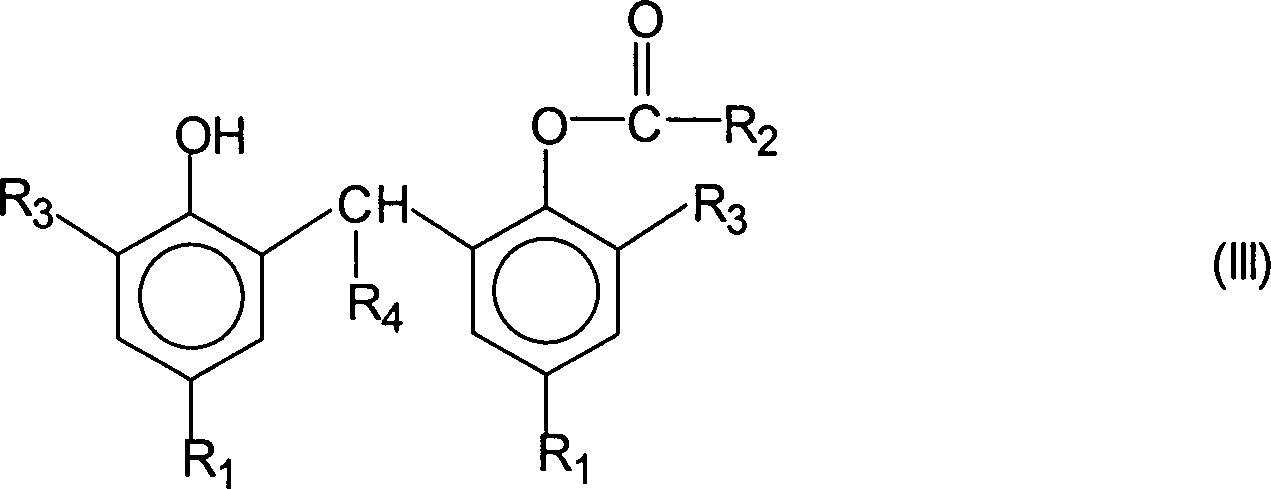
Das
sekundäre
Antioxidationsmittel ist vorzugsweise aus der Gruppe ausgewählt, bestehend
aus Verbindungen, die durch die allgemeine Formel (IV) oder (V)
dargestellt sind: 
Gemäß einer besonders bevorzugten Ausführungsform wird eine Mischung aus zwei sekundären Antioxidationsmitteln, die aus der Gruppe (V) ausgewählt sind, verwendet, wobei das erste sekundäre Antioxidationsmittel aus denjenigen Verbindungen ausgewählt ist, worin R6 und R7 unabhängig voneinander aus einer tert-Butyl-, einer tert-Pentyl-, einer Cyclopentyl- oder einer Cyclohexylgruppe ausgewählt sind, wie zum Beispiel IRGAFOS 168, und wobei das zweite sekundäre Antioxidationsmittel aus denjenigen Verbindungen ausgewählt ist, worin R6 eine Alkylgruppe ist, die 5 bis 15 Kohlenstoffatome aufweist und R7 Wasserstoff ist, wie zum Beispiel TNPP (Trisnonylphenylphosphit). IRGAFOS 168 ist ein Markenname für Tris(2,4-ditertiär-butylphenyl)phosphit.According to a particularly preferred embodiment, a mixture of two secondary antioxidants selected from group (V) is used, wherein the first secondary antioxidant is selected from those compounds wherein R 6 and R 7 are independently selected from a tert-butyl group. , a tert-pentyl, a cyclopentyl or a cyclohexyl group, such as IRGAFOS 168, and wherein the second secondary antioxidant is selected from those compounds wherein R 6 is an alkyl group having 5 to 15 carbon atoms and R 7 Is hydrogen, such as TNPP (trisnonylphenyl phosphite). IRGAFOS 168 is a trade name for tris (2,4-di-tertiary-butylphenyl) phosphite.
Das primäre Antioxidationsmittel wird vorzugsweise aus der Gruppe, bestehend aus sterisch gehinderten phenolischen Verbindungen, ausgewählt.The primary Antioxidant is preferably selected from the group consisting from hindered phenolic compounds.
Gemäß einer bevorzugten Ausführungsform sind drei Stabilisatoren vorhanden, wobei jeder aus einer verschiedenen Stabilisatorenkategorie ausgewählt ist.According to one preferred embodiment There are three stabilizers, each made up of a different one Stabilizer category selected is.
Besonders bevorzugt sind wenigstens zwei Stabilisatoren vorhanden, wobei einer aus Antigelbildungsmitteln und ein anderer Stabilisator aus sekundären Antioxidationsmitteln ausgewählt ist. Die Erfindung wird weiterhin durch die folgenden Beispiele erläutert.Especially Preferably, at least two stabilizers are present, with one antigelling agents and another stabilizer of secondary antioxidants selected is. The invention is further illustrated by the following examples explained.
Beispiele 1–8Examples 1-8
Acht strahlungshärtbare Heißschmelzklebstoffe wurde durch Mischen und Kombinieren der in Tabelle 1 gezeigten der Klebstoffformulierungen 1 bis 8 hergestellt. Das Mischen und Kombinieren wurde in einem 300 g Z-Blatt-Mischer unter Stickstoff als Schutzgas ausgeführt.eight radiation Hot melt adhesives was prepared by mixing and combining those shown in Table 1 Adhesive formulations 1 to 8 produced. Mixing and Combining was used as inert gas in a 300 g Z-blade mixer under nitrogen executed.
Dann wurden die strahlungshärtbaren Heißschmelzklebstoffe mit einem Chemsultant HM100 Laborbeschichtungsgerät auf einer 36 μm Polyester- (PET) Folie aufgetragen. Die Klebstoffbeschichtungen wiesen eine Dicke von 40 ± 2 μm oder 60 ± 2 μm auf.Then were the radiation-curable Hot melt adhesives with a Chemsultant HM100 laboratory coating device on one 36 μm polyester (PET) film applied. The adhesive coatings had one Thickness of 40 ± 2 μm or 60 ± 2 μm.
Die Klebstoffbeschichtungen wurden durch UV-Strahlung gehärtet, indem die Klebstoffbeschichtungen mit einer Geschwindigkeit von 5 m/min unter einer Kombination von zwei F-300 Birnen D und H von Fusion (120 W/cm) vorbeigeführt wurden. Die UV-Strahlen wurden gerade auf die Klebstoffoberfläche in Gegenwart von Luft fokussiert. Die Abschälhaftung bei 180° und die Scherhaftungsversagenstemperatur (SAFT) wurden vor und nach dem Härten bestimmt. Die Ergebnisse werden in Tabelle 2 berichtet.The Adhesive coatings were cured by UV radiation by the adhesive coatings at a speed of 5 m / min under a combination of two F-300 bulbs D and H from Fusion (120 W / cm) passed were. The UV rays were just applied to the adhesive surface in the presence of Air focused. The peel adhesion at 180 ° and the shear bond failure temperature (SAFT) was before and after the hardening certainly. The results are reported in Table 2.
Die
Abschälhaftung
bei 180° wurde
entsprechend der ASTM-D330M-83
gemessen. Die SAFT wurde folgendermaßen bestimmt:
Der SAFT-Test
wird in einem Umluftofen, der mit einer elektromechanischen Vorrichtung
ausgestattet ist, die die schrittweise Erhöhung der Temperatur überwacht,
ausgeführt.
Innerhalb des Ofens sind Halterungen an den Seitenwänden angebracht,
auf die sechs Aluminiumgestelle in einem Winkel von 2° gesetzt
werden können.
Diese Gestelle tragen 6 Metall(Edelstahl) Platten, auf die die Bandproben
aufgebracht werden. Diese Platten ruhen gegen eine schmale Rippe,
in die 6 Schlitze geschnitten sind; Der freie Teil der beschichteten Folie,
an dem die Gewichte aufgehängt
sind, geht an diesen Schlitzen entlang.The peel adhesion at 180 ° was measured according to ASTM-D330M-83. The juice was determined as follows:
The SAFT test is carried out in a convection oven equipped with an electromechanical device that monitors the incremental increase in temperature. Within the oven, brackets are mounted on the side walls, on which six aluminum racks can be set at an angle of 2 °. These racks carry 6 metal (stainless steel) plates to which the tape samples are applied. These plates rest against a narrow rib into which 6 slots are cut; The free part of the coated film on which the weights are suspended goes along these slots.
Ein Ende des Streifens wird zentriert und teilweise auf eine Edelstahlplatte geklemmt; das andere Ende des Streifens wird so gehalten, dass es die Platte nicht berührt, aber unterhalb davon positioniert ist. Der Streifen wird fest gegen die Edelstahlplatte gepresst, wobei ein Einschluß von Luftblasen vermieden wird. Der anhaftende Teil des Streifens wird in einem Abstand von einem Inch (2,5 cm) von der Edelstahlkante aus geschnitten. Die Oberfläche beträgt dann 2,5 cm × 2,5 cm (1 Inch2). Schließlich werden die Testproben während 24 Stunden gelagert.One end of the strip is centered and partially clamped on a stainless steel plate; The other end of the strip is held so that it does not touch the plate but is positioned below it. The strip is pressed firmly against the stainless steel plate, avoiding the inclusion of air bubbles. The adherent portion of the strip is cut at a distance of one inch (2.5 cm) from the stainless steel edge. The surface is then 2.5 cm x 2.5 cm (1 in 2 ). Finally, the test samples are stored for 24 hours.
Die Gestelle mit den Proben werden in dem Ofen angebracht und Gewichte von 500 Gramm werden an das freie Ende des Streifens gehängt und mit „Hofmann" Schlauchklemmen festgeklemmt.The Racks with the samples are placed in the oven and weights of 500 grams are hung on the free end of the strip and with "Hofmann" hose clamps clamped.
Diese Gewichte werden anfangs von einer Grundplatte getragen, die mittels eines „Laborboys" nach oben und nach unten bewegt werden kann. Genau vor dem Beginn des Tests wird die Grundplatte so nach unten bewegt, dass die Gewichte nun frei über den mikro- oder photoelektrischen Schaltern hängen. Diese Schalter sind mit einem Zähler verbunden. Die Temperatur in dem Ofen wird auf einem digitalen Thermometer angezeigt.These weights are initially carried by a baseplate, which by means of a "Laborboys" after can be moved up and down. Exactly before the start of the test, the base plate is moved down so that the weights now hang freely over the micro- or photoelectric switches. These switches are connected to a counter. The temperature in the oven is displayed on a digital thermometer.
Wenn ein Streifen fällt, fällt das Gewicht auf den Mikroschalter und der Zeitnehmer wird angehalten. Ist die Zeit bis zum Versagen bekannt, kann die Temperatur, bei der das Versagen auftrat, aus dem Diagramm von berechneter Zeit/Temperatur abgelesen werden. Der SAFT-Wert ist der Durchschnitt aus zwei Temperaturen, die mit zwei Proben aufgezeichnet wurden.If a streak falls, that is true Weight on the microswitch and the timer is stopped. is the time known to failure, the temperature at which the failure occurred from the graph of calculated time / temperature be read. The SAFT value is the average of two temperatures, recorded with two samples.
Vergleichsbeispiel AComparative example A
Ein weiterer strahlungshärtbarer Heißschmelzklebstoff wurde durch Mischen und Kombinieren der Klebstoffformulierung A auf dieselbe Weise wie in den Beispielen 1–8 hergestellt. Die Zusammensetzung der Klebstoffformulierung A ist ebenfalls in Tabelle 1 gezeigt. Die Klebstoffformulierung A enthielt ein vollständig hydriertes Kohlenwasserstoffharz zur Erhöhung der Klebrigkeit (RAGALITE R91), das einen Ungesättigtheitsindex (Ui) von 0,9% aufwies) (REGALITE ist ein Warenzeichen).One further radiation-curable Hot melt adhesive was prepared by mixing and combining the adhesive formulation A prepared in the same manner as in Examples 1-8. The composition the adhesive formulation A is also shown in Table 1. Adhesive Formulation A contained a fully hydrogenated hydrocarbon resin to increase stickiness (RAGALITE R91), which has a 0.9% unsaturation index (Ui) ) (REGALITE is a trademark).
Die
Klebstoffbeschichtungen wurden hergestellt und die Beschichtungen
wurden wie in den Beispielen 1–8
gehärtet.
Die Abschälhaftung
bei 180° und
die Scherhaftungsversagenstemperatur (SAFT) wurden vor und nach
dem Härten
bestimmt. Die Ergebnisse werden in Tabelle 2 berichtet. 
- KX222
- KRATON D KX222, ein Styrol-Blockcopolymer mit idealisierter Struktur (AB)2X(B)2, wobei A ein Polystyrolblock und B ein Butadienblock mit einem 1,2-Vinylgehalt von 57 Gewichts-% ist. X ist gamma-GPTS. Die Kopplungsleistungsfähigkeit beträgt 89%.
- REGALITE S101
- ist ein teilweise hydriertes Kohlenwasserstoffharz zur Erhöhung der Klebrigkeit. (Ui beträgt 8%).
- MBG 264
- Hercules MBG 264, ein teilweise hydriertes Kohlenwasserstoffharz zur Erhöhung der Klebrigkeit mit einem Ungesättigtheitsindex von 19,7%.
- REGALITE R91
- ist ein vollständig hydriertes Kohlenwasserstoffharz zur Erhöhung der Klebrigkeit mit einem Ungesättigtheitsindex von 0,9%.
- ONDINA 68
- ist ein gesättigtes naphthenisches Öl mit einem Ungesättigtheitsindex von 2,1% (ONDINA ist ein Warenzeichen).
- IRGACURE 651
- Photoinitiator (2,2-Dimethoxy-1,2-diphenylethan-1-on).
- SUMILIZER GS
- 2-[1-(2-Hydroxy-3,5-di-tert-pentylphenyl)ethyl]-4,6-di-tert-pentylphenylacrylat.
- SUMILIZER TP-D
- (RSC2H4COOCH2)4-C, worin R eine Dodecylgruppe ist.
- KX222
- KRATON D KX222, an idealized styrene block copolymer (AB) 2X (B) 2, where A is a polystyrene block and B is a butadiene block with a 1,2-vinyl content of 57% by weight. X is gamma-GPTS. The coupling performance is 89%.
- REGALITE S101
- is a partially hydrogenated hydrocarbon resin for increasing tackiness. (Ui is 8%).
- MBG 264
- Hercules MBG 264, a partially hydrogenated hydrocarbon resin to increase tackiness with an unsaturation index of 19.7%.
- REGALITE R91
- is a fully hydrogenated hydrocarbon resin to increase tackiness with a 0.9% unsaturation index.
- ONDINA 68
- is a saturated naphthenic oil with an unsaturation index of 2.1% (ONDINA is a trademark).
- IRGACURE 651
- Photoinitiator (2,2-dimethoxy-1,2-diphenylethane-1-one).
- SUMILIZER GS
- 2- [1- (2-hydroxy-3,5-di-tert-pentylphenyl) ethyl] -4,6-di-tert-pentylphenyl acrylate.
- SUMILIZER TP-D
- (RSC 2 H 4 COOCH 2 ) 4 -C, wherein R is a dodecyl group.
Tabelle
2 
Beispiele 9–16Examples 9-16
Acht strahlungshärtbare Heißschmelzklebstoffe wurden durch Mischen und Kombinieren der in Tabelle 3 gezeigten Klebstoffformulierungen 9 bis 16 hergestellt.eight radiation Hot melt adhesives were prepared by mixing and combining those shown in Table 3 Adhesive formulations 9 to 16 produced.
Dann wurden die durch Strahlung härtbaren Heißschmelzklebstoffe auf eine Polyester- (PET) Folie aufgetragen. Die Klebstoffbeschichtungen wiesen eine Dicke von ungefähr 40 μm auf.Then were the radiation curable Hot melt adhesives applied to a polyester (PET) film. The adhesive coatings had a thickness of approximately 40 μm.
Die Klebstoffbeschichtungen wurden durch Bestrahlung mit Elektronenstrahlen gehärtet. Die Elektronenstrahlhärtungsdosis betrug 6 Mrad.The Adhesive coatings were made by irradiation with electron beams hardened. The electron beam hardening dose was 6 Mrad.
Die SAFT und Abschälhaftung bei 180° wurden vor und nach dem Härten bestimmt und entsprechend der Beschreibung in den Beispielen 1–8 gemessen.The JUICE and peel adhesion at 180 ° were before and after hardening determined and measured as described in Examples 1-8.
Die Ergebnisse werden in Tabelle 3 berichtet.The Results are reported in Table 3.
Vergleichsbeispiel BComparative example B
Ein
weiterer durch Strahlung härtbarer
Heißschmelzklebstoff
wurde durch Mischen und Kombinieren der Klebstoffformulierung B,
Auftragen und Härten
durch Bestrahlung mit Elektronenstrahlen wie in den Beispielen 9–16 hergestellt.
Die Zusammensetzung der Klebstoffformulierung B und die Ergebnisse
von SAFT- und Abschälhaftungsmessungen
werden ebenfalls in Tabelle 3 bereichtet. Die Klebstoffformulierung
B wies ein Tg von –16°C auf. 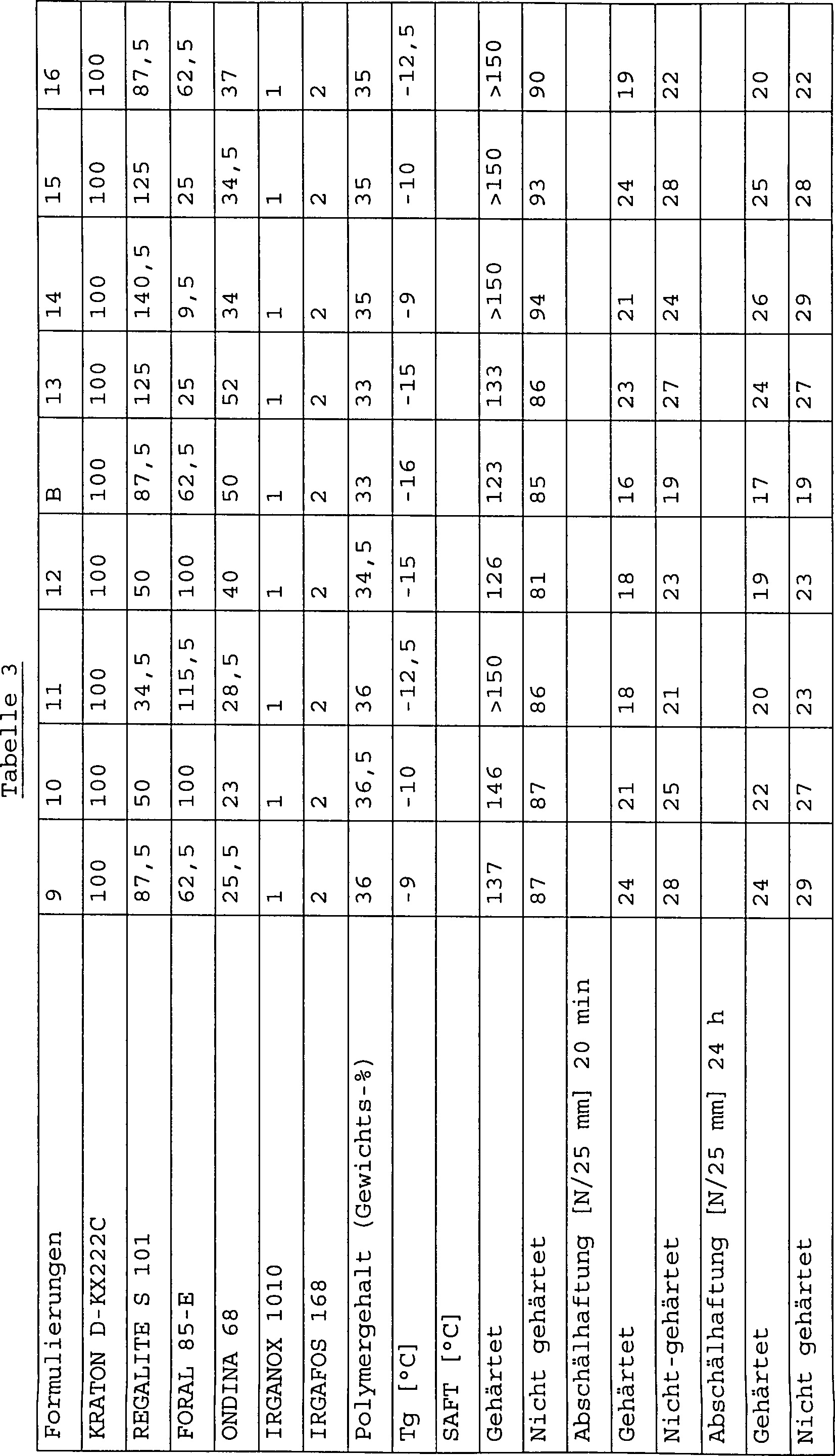
- FORAL 85-E
- ist ein teilweise hydrierter Harzester zur Erhöhung der Klebrigkeit, der einen Ui von 19,5% aufweist.
- IRGANOX 1010
- ist Tetrakis-ethylen(3,5-di-tert-butyl-4-hydroxyhydrocinnamat)methan (primäres Antioxidationsmittel).
- FORAL 85-E
- is a partially hydrogenated tackiness enhancing resin ester having a 19.5% Ui.
- IRGANOX 1010
- is tetrakis-ethylene (3,5-di-tert-butyl-4-hydroxyhydrocinnamate) methane (primary antioxidant).
Claims (14)
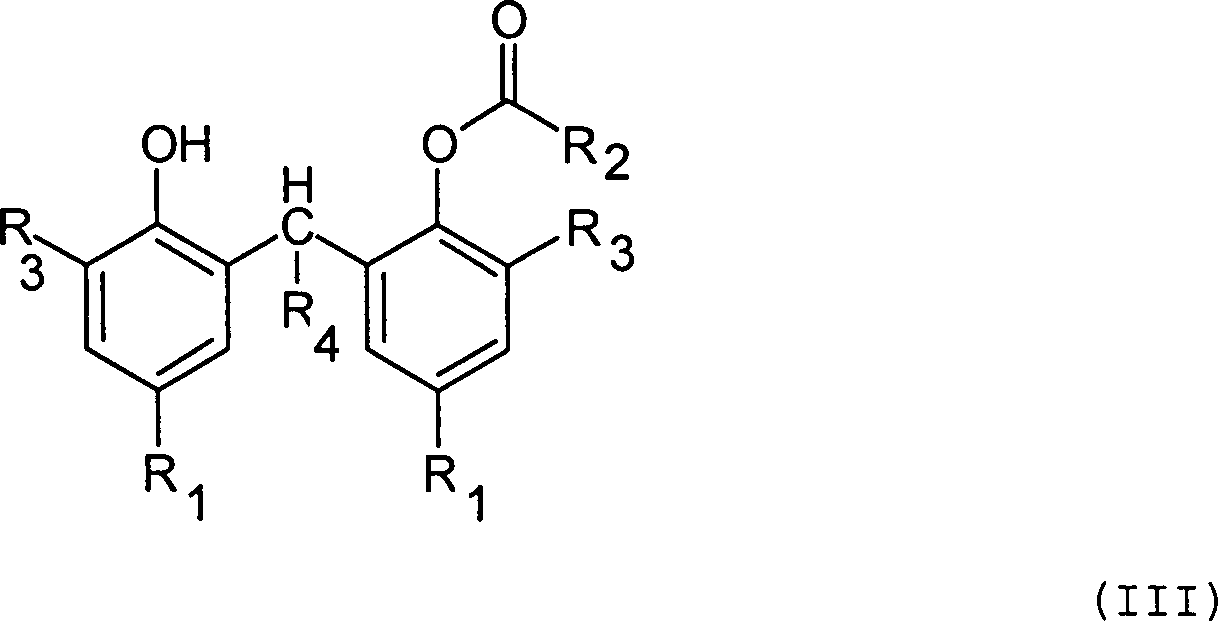
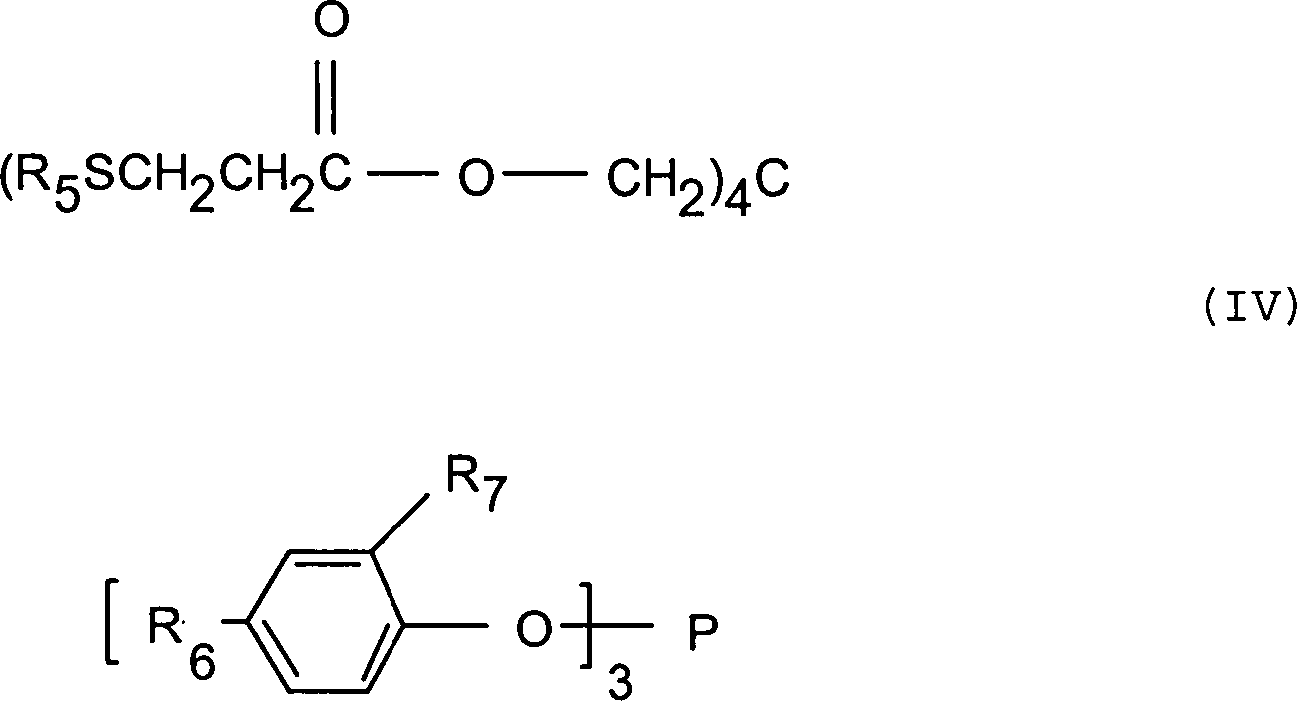
Applications Claiming Priority (3)
| Application Number | Priority Date | Filing Date | Title |
|---|---|---|---|
| EP98308255 | 1998-10-09 | ||
| EP98308255 | 1998-10-09 | ||
| PCT/EP1999/007759 WO2000022062A1 (en) | 1998-10-09 | 1999-10-08 | Radiation-curable adhesive |
Publications (2)
| Publication Number | Publication Date |
|---|---|
| DE69920248D1 DE69920248D1 (en) | 2004-10-21 |
| DE69920248T2 true DE69920248T2 (en) | 2005-01-27 |
Family
ID=8235096
Family Applications (1)
| Application Number | Title | Priority Date | Filing Date |
|---|---|---|---|
| DE69920248T Expired - Lifetime DE69920248T2 (en) | 1998-10-09 | 1999-10-08 | RADIATION-HARDENABLE ADHESIVE |
Country Status (6)
| Country | Link |
|---|---|
| EP (1) | EP1123362B1 (en) |
| JP (1) | JP2002527568A (en) |
| AT (1) | ATE276326T1 (en) |
| AU (1) | AU6472099A (en) |
| DE (1) | DE69920248T2 (en) |
| WO (1) | WO2000022062A1 (en) |
Families Citing this family (15)
| Publication number | Priority date | Publication date | Assignee | Title |
|---|---|---|---|---|
| EP1360258B1 (en) | 2000-01-31 | 2007-03-14 | H.B. Fuller Licensing & Financing, Inc. | Radiation curable adhesive compositions comprising block copolymers having vinyl functionalized polydiene blocks |
| DE10212049A1 (en) | 2002-03-19 | 2003-10-02 | Tesa Ag | PSA and process for the preparation thereof |
| DE10234369A1 (en) | 2002-07-27 | 2004-02-12 | Henkel Kgaa | Radiation-crosslinkable hotmelt PSAs |
| US7262242B2 (en) | 2004-02-18 | 2007-08-28 | Eastman Chemical Company | Aromatic/acrylate tackifier resin and acrylic polymer blends |
| US7332540B2 (en) | 2004-02-18 | 2008-02-19 | Eastman Chemical Company | Aromatic-acrylate tackifier resins |
| US7238732B2 (en) | 2004-02-18 | 2007-07-03 | Eastman Chemical Company | Radiation-curable adhesive compositions |
| DE102005006282A1 (en) | 2005-02-10 | 2006-08-24 | Henkel Kgaa | Radiation-crosslinkable hot melt pressure sensitive adhesives |
| JP5129556B2 (en) * | 2007-12-14 | 2013-01-30 | サンスター技研株式会社 | Adhesive composition |
| DE102008056980A1 (en) * | 2008-11-12 | 2010-05-20 | Tesa Se | Radiation crosslinkable, foamed self-adhesive based on vinylaromatic block copolymers |
| EP3357968B1 (en) | 2015-09-30 | 2025-10-15 | Zeon Corporation | Block copolymer composition and hot melt adhesive composition |
| CN107057618B (en) * | 2017-06-05 | 2018-10-26 | 湖北大学 | A kind of medical pressure sensitive adhesive of cross-linking radiation and preparation method thereof |
| DE102018204463A1 (en) * | 2018-03-23 | 2019-09-26 | Tesa Se | Weather-resistant adhesive with good flowability and adhesive tapes based thereon |
| FR3098520B1 (en) * | 2019-07-10 | 2022-07-22 | Bostik Sa | HMPSA curable under UV irradiation |
| DE102021201094A1 (en) | 2021-02-05 | 2022-08-11 | Tesa Se | Polyvinylaromatic-polydiene block copolymer-based pressure-sensitive adhesives with increased thermal shear strength |
| JP2024018177A (en) * | 2022-07-29 | 2024-02-08 | アイカ工業株式会社 | Photocurable hot melt composition |
Family Cites Families (8)
| Publication number | Priority date | Publication date | Assignee | Title |
|---|---|---|---|---|
| US4792584A (en) * | 1986-05-02 | 1988-12-20 | Asahi Kasei Kogyo Kabushiki Kaisha | Adhesive compositions |
| US5104921A (en) * | 1988-02-17 | 1992-04-14 | Shell Oil Company | Radiation cured polymer composition |
| TW274086B (en) * | 1992-06-04 | 1996-04-11 | Shell Internat Res Schappej Bv | |
| US5804663A (en) * | 1995-03-16 | 1998-09-08 | Shell Oil Company | Radiation sensitive vinyl aromatic block copolymers and compositions containing them |
| US5777039A (en) * | 1996-02-09 | 1998-07-07 | Shell Oil Company | Vinyl aromatic block copolymers and compositions containing them |
| US5916959A (en) * | 1996-03-29 | 1999-06-29 | H.B. Fuller Licensing & Financing, Inc. | Radial styrene-isoprene-styrene based hot melt pressure sensitive adhesive |
| US6172156B1 (en) * | 1996-07-03 | 2001-01-09 | H. B. Fuller Licensing & Financing, Inc. | Cohesively failing hot melt pressure sensitive adhesive |
| EP1091998B1 (en) * | 1998-06-29 | 2004-08-04 | KRATON Polymers Research B.V. | Photo-curable polymer composition and flexographic printing plates containing the same |
-
1999
- 1999-10-08 AT AT99952572T patent/ATE276326T1/en not_active IP Right Cessation
- 1999-10-08 JP JP2000575958A patent/JP2002527568A/en active Pending
- 1999-10-08 EP EP99952572A patent/EP1123362B1/en not_active Expired - Lifetime
- 1999-10-08 WO PCT/EP1999/007759 patent/WO2000022062A1/en not_active Ceased
- 1999-10-08 DE DE69920248T patent/DE69920248T2/en not_active Expired - Lifetime
- 1999-10-08 AU AU64720/99A patent/AU6472099A/en not_active Abandoned
Also Published As
| Publication number | Publication date |
|---|---|
| DE69920248D1 (en) | 2004-10-21 |
| EP1123362B1 (en) | 2004-09-15 |
| ATE276326T1 (en) | 2004-10-15 |
| JP2002527568A (en) | 2002-08-27 |
| EP1123362A1 (en) | 2001-08-16 |
| AU6472099A (en) | 2000-05-01 |
| WO2000022062A1 (en) | 2000-04-20 |
Similar Documents
| Publication | Publication Date | Title |
|---|---|---|
| DE69920248T2 (en) | RADIATION-HARDENABLE ADHESIVE | |
| DE69304328T2 (en) | VINYLAROMATIC BLOCK COPOLYMERS HIGHLY SENSITIVE TO RAY NETWORKING AND COMPOSITIONS CONTAINING THEM | |
| DE602005001556T2 (en) | RADIATION-CURABLE ADHESIVE COMPOSITION | |
| DE60033159T2 (en) | BY THE ENERGY HARDENABLE COMPOSITION FOR PREPARING A PRESSURE-SENSITIVE ADHESIVE | |
| DE60127306T2 (en) | RADIATION-HARDENABLE ADHESIVE COMPOSITIONS COMPRISED BLOCK COPOLYMERS WITH VINYL-FUNCTIONALIZED POLYBUTADEN BLOCKS | |
| DE69434507T2 (en) | Pressure-sensitive adhesive composition and adhesive tape using same | |
| DE3851094T2 (en) | A thermoplastic polymer, a compatible, curable urethane polyalkylene polyol prepolymer and a tackifier-containing heat-resistant reactive urethane hot melt adhesive composition. | |
| DE69408474T2 (en) | HYDRATED MULTIBLOCK POLYMERS FOR ADHESIVES | |
| DE10008842C1 (en) | Method of reducing flow viscosity of polyacrylate composition, used as adhesive, involves mixing (co)polyacrylate(s) with (co)polyacrylate(s) with lower molecular weight and ultraviolet-curable functional groups | |
| DE69403775T2 (en) | Block copolymer with end blocks of different molecular weights | |
| DE68907397T2 (en) | Liquid photopolymerizable composition, viscoelastic product obtained from this composition and process for producing this viscoelastic product. | |
| DE69919172T2 (en) | PHOTOCURABLE POLYMER COMPOSITION AND FLEXO PRINTING PLATES THEREOF | |
| JP3675842B2 (en) | Vinyl aromatic block copolymers and compositions containing them | |
| DE69833800T2 (en) | MELT ADHESIVES FROM BLOCK COPOLYMERS, METHOD FOR THEIR PRODUCTION AND OBJECTS THEREFOR | |
| DE3015463C2 (en) | Process for the production of pressure-sensitive hot-melt adhesive coatings on substrates | |
| DE112008001404T5 (en) | Photohardenable pressure-sensitive adhesive composition | |
| DE3105343A1 (en) | "PHOTOACTIVE MIXTURE OF ACRYLIC MONOMERS AND CHROMOPHOR-SUBSTITUTED HALOGENMETHYL-S-TRIAZINE AND PRODUCTS PRODUCED THEREOF AND METHOD FOR THE PRODUCTION THEREOF | |
| DE69931817T2 (en) | PHOTOHÄRTBARE POLYMER COMPOSITION AND THESE FLEXODRUCKPLATTEN CONTAINING | |
| DE102007063021A1 (en) | Self-adhesive tape consisting of adhesive mass layer on supporting layer, is subjected to corona treatment to improve adhesive shear strength | |
| EP0258719A2 (en) | Two-layer system | |
| DE102015217131A1 (en) | Adhesive resin-modified pressure-sensitive adhesive | |
| DE69016406T2 (en) | ADHESIVE COMPOSITION. | |
| EP1370590B1 (en) | Method for producing crosslinked acrylate hot-melt adhesive compounds | |
| DE2813544A1 (en) | IRRADIATED PRESSURE SENSITIVE ADHESIVE COMPOSITIONS | |
| DE3134157C2 (en) | Polycarbonate bodies with a coating and process for their manufacture |
Legal Events
| Date | Code | Title | Description |
|---|---|---|---|
| 8364 | No opposition during term of opposition | ||
| 8328 | Change in the person/name/address of the agent |
Representative=s name: STOLMAR SCHEELE & PARTNER, 80331 MUENCHEN |