DE69923402T2 - POLYALKYLENE NAPHTHALATE, COMPOSITION, MILK AND METHOD FOR THE PRODUCTION THEREOF - Google Patents
POLYALKYLENE NAPHTHALATE, COMPOSITION, MILK AND METHOD FOR THE PRODUCTION THEREOF Download PDFInfo
- Publication number
- DE69923402T2 DE69923402T2 DE1999623402 DE69923402T DE69923402T2 DE 69923402 T2 DE69923402 T2 DE 69923402T2 DE 1999623402 DE1999623402 DE 1999623402 DE 69923402 T DE69923402 T DE 69923402T DE 69923402 T2 DE69923402 T2 DE 69923402T2
- Authority
- DE
- Germany
- Prior art keywords
- polyalkylene naphthalate
- compound
- naphthalate
- composition
- film according
- Prior art date
- Legal status (The legal status is an assumption and is not a legal conclusion. Google has not performed a legal analysis and makes no representation as to the accuracy of the status listed.)
- Expired - Lifetime
Links
- 229920001281 polyalkylene Polymers 0.000 title claims description 93
- 239000000203 mixture Substances 0.000 title claims description 43
- 238000000034 method Methods 0.000 title claims description 29
- 238000004519 manufacturing process Methods 0.000 title description 10
- 239000008267 milk Substances 0.000 title 1
- 210000004080 milk Anatomy 0.000 title 1
- 235000013336 milk Nutrition 0.000 title 1
- 125000005487 naphthalate group Chemical group 0.000 claims description 91
- LYCAIKOWRPUZTN-UHFFFAOYSA-N Ethylene glycol Chemical compound OCCO LYCAIKOWRPUZTN-UHFFFAOYSA-N 0.000 claims description 63
- 239000002245 particle Substances 0.000 claims description 62
- -1 phosphonium sulfonate compound Chemical class 0.000 claims description 50
- 239000010419 fine particle Substances 0.000 claims description 34
- 125000000524 functional group Chemical group 0.000 claims description 31
- 239000011575 calcium Substances 0.000 claims description 30
- 239000011777 magnesium Substances 0.000 claims description 30
- 150000001463 antimony compounds Chemical class 0.000 claims description 28
- OFOBLEOULBTSOW-UHFFFAOYSA-N Malonic acid Chemical compound OC(=O)CC(O)=O OFOBLEOULBTSOW-UHFFFAOYSA-N 0.000 claims description 22
- WGCNASOHLSPBMP-UHFFFAOYSA-N hydroxyacetaldehyde Natural products OCC=O WGCNASOHLSPBMP-UHFFFAOYSA-N 0.000 claims description 21
- 229910052698 phosphorus Inorganic materials 0.000 claims description 20
- 229920000728 polyester Polymers 0.000 claims description 20
- 125000004432 carbon atom Chemical group C* 0.000 claims description 19
- 230000014509 gene expression Effects 0.000 claims description 17
- 229940043430 calcium compound Drugs 0.000 claims description 16
- 150000001674 calcium compounds Chemical class 0.000 claims description 16
- 150000002681 magnesium compounds Chemical class 0.000 claims description 16
- 239000011574 phosphorus Substances 0.000 claims description 14
- DNIAPMSPPWPWGF-UHFFFAOYSA-N Propylene glycol Chemical compound CC(O)CO DNIAPMSPPWPWGF-UHFFFAOYSA-N 0.000 claims description 12
- 125000001931 aliphatic group Chemical group 0.000 claims description 12
- 125000003118 aryl group Chemical group 0.000 claims description 12
- 229910052787 antimony Inorganic materials 0.000 claims description 11
- 229920003207 poly(ethylene-2,6-naphthalate) Polymers 0.000 claims description 11
- 239000011112 polyethylene naphthalate Substances 0.000 claims description 11
- KKEYFWRCBNTPAC-UHFFFAOYSA-N Terephthalic acid Chemical compound OC(=O)C1=CC=C(C(O)=O)C=C1 KKEYFWRCBNTPAC-UHFFFAOYSA-N 0.000 claims description 10
- 229910052791 calcium Inorganic materials 0.000 claims description 10
- 150000001875 compounds Chemical class 0.000 claims description 10
- QQVIHTHCMHWDBS-UHFFFAOYSA-N isophthalic acid Chemical compound OC(=O)C1=CC=CC(C(O)=O)=C1 QQVIHTHCMHWDBS-UHFFFAOYSA-N 0.000 claims description 10
- 229910052749 magnesium Inorganic materials 0.000 claims description 10
- 230000008569 process Effects 0.000 claims description 10
- VYPSYNLAJGMNEJ-UHFFFAOYSA-N Silicium dioxide Chemical compound O=[Si]=O VYPSYNLAJGMNEJ-UHFFFAOYSA-N 0.000 claims description 8
- WERYXYBDKMZEQL-UHFFFAOYSA-N butane-1,4-diol Chemical compound OCCCCO WERYXYBDKMZEQL-UHFFFAOYSA-N 0.000 claims description 8
- KYTZHLUVELPASH-UHFFFAOYSA-N naphthalene-1,2-dicarboxylic acid Chemical compound C1=CC=CC2=C(C(O)=O)C(C(=O)O)=CC=C21 KYTZHLUVELPASH-UHFFFAOYSA-N 0.000 claims description 8
- 238000006068 polycondensation reaction Methods 0.000 claims description 8
- 125000000217 alkyl group Chemical group 0.000 claims description 7
- 125000004435 hydrogen atom Chemical group [H]* 0.000 claims description 7
- 125000001997 phenyl group Chemical group [H]C1=C([H])C([H])=C(*)C([H])=C1[H] 0.000 claims description 5
- GWEVSGVZZGPLCZ-UHFFFAOYSA-N Titan oxide Chemical compound O=[Ti]=O GWEVSGVZZGPLCZ-UHFFFAOYSA-N 0.000 claims description 4
- 125000001797 benzyl group Chemical group [H]C1=C([H])C([H])=C(C([H])=C1[H])C([H])([H])* 0.000 claims description 4
- 125000003178 carboxy group Chemical group [H]OC(*)=O 0.000 claims description 4
- 239000011148 porous material Substances 0.000 claims description 4
- PNEYBMLMFCGWSK-UHFFFAOYSA-N aluminium oxide Inorganic materials [O-2].[O-2].[O-2].[Al+3].[Al+3] PNEYBMLMFCGWSK-UHFFFAOYSA-N 0.000 claims description 3
- 238000006243 chemical reaction Methods 0.000 claims description 3
- 150000003018 phosphorus compounds Chemical class 0.000 claims description 3
- OGIDPMRJRNCKJF-UHFFFAOYSA-N titanium oxide Inorganic materials [Ti]=O OGIDPMRJRNCKJF-UHFFFAOYSA-N 0.000 claims description 2
- 125000004185 ester group Chemical group 0.000 claims 1
- 150000002148 esters Chemical class 0.000 claims 1
- 238000005809 transesterification reaction Methods 0.000 description 24
- MTHSVFCYNBDYFN-UHFFFAOYSA-N diethylene glycol Chemical compound OCCOCCO MTHSVFCYNBDYFN-UHFFFAOYSA-N 0.000 description 20
- 229920000642 polymer Polymers 0.000 description 19
- 239000003054 catalyst Substances 0.000 description 17
- BDHFUVZGWQCTTF-UHFFFAOYSA-M sulfonate Chemical compound [O-]S(=O)=O BDHFUVZGWQCTTF-UHFFFAOYSA-M 0.000 description 17
- ADCOVFLJGNWWNZ-UHFFFAOYSA-N antimony trioxide Chemical compound O=[Sb]O[Sb]=O ADCOVFLJGNWWNZ-UHFFFAOYSA-N 0.000 description 16
- 238000001816 cooling Methods 0.000 description 15
- 239000011888 foil Substances 0.000 description 15
- 125000005496 phosphonium group Chemical group 0.000 description 15
- 230000015572 biosynthetic process Effects 0.000 description 11
- ISPYQTSUDJAMAB-UHFFFAOYSA-N 2-chlorophenol Chemical compound OC1=CC=CC=C1Cl ISPYQTSUDJAMAB-UHFFFAOYSA-N 0.000 description 8
- 239000007809 chemical reaction catalyst Substances 0.000 description 8
- WVLBCYQITXONBZ-UHFFFAOYSA-N trimethyl phosphate Chemical compound COP(=O)(OC)OC WVLBCYQITXONBZ-UHFFFAOYSA-N 0.000 description 8
- XGYQCXAJJSNIJB-UHFFFAOYSA-M 3,5-dicarboxybenzenesulfonate;tetrabutylphosphanium Chemical compound OC(=O)C1=CC(C(O)=O)=CC(S([O-])(=O)=O)=C1.CCCC[P+](CCCC)(CCCC)CCCC XGYQCXAJJSNIJB-UHFFFAOYSA-M 0.000 description 7
- XQKKWWCELHKGKB-UHFFFAOYSA-L calcium acetate monohydrate Chemical compound O.[Ca+2].CC([O-])=O.CC([O-])=O XQKKWWCELHKGKB-UHFFFAOYSA-L 0.000 description 7
- 238000005266 casting Methods 0.000 description 7
- 238000000151 deposition Methods 0.000 description 7
- 230000008021 deposition Effects 0.000 description 7
- 229920006267 polyester film Polymers 0.000 description 7
- 238000004804 winding Methods 0.000 description 7
- 238000006116 polymerization reaction Methods 0.000 description 6
- SRSXLGNVWSONIS-UHFFFAOYSA-M benzenesulfonate Chemical compound [O-]S(=O)(=O)C1=CC=CC=C1 SRSXLGNVWSONIS-UHFFFAOYSA-M 0.000 description 5
- 229940077388 benzenesulfonate Drugs 0.000 description 5
- 239000001639 calcium acetate Substances 0.000 description 5
- 229960005147 calcium acetate Drugs 0.000 description 5
- 235000011092 calcium acetate Nutrition 0.000 description 5
- 238000005119 centrifugation Methods 0.000 description 5
- 230000001965 increasing effect Effects 0.000 description 5
- UEGPKNKPLBYCNK-UHFFFAOYSA-L magnesium acetate Chemical compound [Mg+2].CC([O-])=O.CC([O-])=O UEGPKNKPLBYCNK-UHFFFAOYSA-L 0.000 description 5
- 229940069446 magnesium acetate Drugs 0.000 description 5
- 239000011654 magnesium acetate Substances 0.000 description 5
- 235000011285 magnesium acetate Nutrition 0.000 description 5
- 229920006290 polyethylene naphthalate film Polymers 0.000 description 5
- 239000000243 solution Substances 0.000 description 5
- BJQWBACJIAKDTJ-UHFFFAOYSA-N tetrabutylphosphanium Chemical compound CCCC[P+](CCCC)(CCCC)CCCC BJQWBACJIAKDTJ-UHFFFAOYSA-N 0.000 description 5
- WATWJIUSRGPENY-UHFFFAOYSA-N antimony atom Chemical compound [Sb] WATWJIUSRGPENY-UHFFFAOYSA-N 0.000 description 4
- 230000007547 defect Effects 0.000 description 4
- GYUVMLBYMPKZAZ-UHFFFAOYSA-N dimethyl naphthalene-2,6-dicarboxylate Chemical compound C1=C(C(=O)OC)C=CC2=CC(C(=O)OC)=CC=C21 GYUVMLBYMPKZAZ-UHFFFAOYSA-N 0.000 description 4
- ZUOUZKKEUPVFJK-UHFFFAOYSA-N diphenyl Chemical group C1=CC=CC=C1C1=CC=CC=C1 ZUOUZKKEUPVFJK-UHFFFAOYSA-N 0.000 description 4
- 230000000694 effects Effects 0.000 description 4
- 150000002500 ions Chemical class 0.000 description 4
- 239000000047 product Substances 0.000 description 4
- XLYOFNOQVPJJNP-UHFFFAOYSA-N water Substances O XLYOFNOQVPJJNP-UHFFFAOYSA-N 0.000 description 4
- OKKJLVBELUTLKV-UHFFFAOYSA-N Methanol Chemical compound OC OKKJLVBELUTLKV-UHFFFAOYSA-N 0.000 description 3
- HEMHJVSKTPXQMS-UHFFFAOYSA-M Sodium hydroxide Chemical compound [OH-].[Na+] HEMHJVSKTPXQMS-UHFFFAOYSA-M 0.000 description 3
- 230000002411 adverse Effects 0.000 description 3
- 239000011362 coarse particle Substances 0.000 description 3
- 230000007423 decrease Effects 0.000 description 3
- 238000010438 heat treatment Methods 0.000 description 3
- 239000010410 layer Substances 0.000 description 3
- 238000002360 preparation method Methods 0.000 description 3
- 238000010791 quenching Methods 0.000 description 3
- 230000000171 quenching effect Effects 0.000 description 3
- 239000002994 raw material Substances 0.000 description 3
- 230000003068 static effect Effects 0.000 description 3
- 239000000126 substance Substances 0.000 description 3
- USFPINLPPFWTJW-UHFFFAOYSA-N tetraphenylphosphonium Chemical compound C1=CC=CC=C1[P+](C=1C=CC=CC=1)(C=1C=CC=CC=1)C1=CC=CC=C1 USFPINLPPFWTJW-UHFFFAOYSA-N 0.000 description 3
- OYPRJOBELJOOCE-UHFFFAOYSA-N Calcium Chemical compound [Ca] OYPRJOBELJOOCE-UHFFFAOYSA-N 0.000 description 2
- FYYHWMGAXLPEAU-UHFFFAOYSA-N Magnesium Chemical compound [Mg] FYYHWMGAXLPEAU-UHFFFAOYSA-N 0.000 description 2
- UFWIBTONFRDIAS-UHFFFAOYSA-N Naphthalene Chemical compound C1=CC=CC2=CC=CC=C21 UFWIBTONFRDIAS-UHFFFAOYSA-N 0.000 description 2
- NBIIXXVUZAFLBC-UHFFFAOYSA-N Phosphoric acid Chemical compound OP(O)(O)=O NBIIXXVUZAFLBC-UHFFFAOYSA-N 0.000 description 2
- MCMNRKCIXSYSNV-UHFFFAOYSA-N Zirconium dioxide Chemical compound O=[Zr]=O MCMNRKCIXSYSNV-UHFFFAOYSA-N 0.000 description 2
- YIMQCDZDWXUDCA-UHFFFAOYSA-N [4-(hydroxymethyl)cyclohexyl]methanol Chemical compound OCC1CCC(CO)CC1 YIMQCDZDWXUDCA-UHFFFAOYSA-N 0.000 description 2
- 238000005299 abrasion Methods 0.000 description 2
- 239000002253 acid Substances 0.000 description 2
- WNLRTRBMVRJNCN-UHFFFAOYSA-N adipic acid Chemical compound OC(=O)CCCCC(O)=O WNLRTRBMVRJNCN-UHFFFAOYSA-N 0.000 description 2
- 238000005054 agglomeration Methods 0.000 description 2
- 230000002776 aggregation Effects 0.000 description 2
- 125000005907 alkyl ester group Chemical group 0.000 description 2
- 229910052782 aluminium Inorganic materials 0.000 description 2
- XAGFODPZIPBFFR-UHFFFAOYSA-N aluminium Chemical compound [Al] XAGFODPZIPBFFR-UHFFFAOYSA-N 0.000 description 2
- 239000004305 biphenyl Chemical group 0.000 description 2
- 235000010290 biphenyl Nutrition 0.000 description 2
- 229940067460 calcium acetate monohydrate Drugs 0.000 description 2
- 230000000052 comparative effect Effects 0.000 description 2
- 150000001991 dicarboxylic acids Chemical class 0.000 description 2
- WOZVHXUHUFLZGK-UHFFFAOYSA-N dimethyl terephthalate Chemical compound COC(=O)C1=CC=C(C(=O)OC)C=C1 WOZVHXUHUFLZGK-UHFFFAOYSA-N 0.000 description 2
- 239000012153 distilled water Substances 0.000 description 2
- 230000003028 elevating effect Effects 0.000 description 2
- 238000005886 esterification reaction Methods 0.000 description 2
- 125000001495 ethyl group Chemical group [H]C([H])([H])C([H])([H])* 0.000 description 2
- 239000011521 glass Substances 0.000 description 2
- 230000001771 impaired effect Effects 0.000 description 2
- 229940097364 magnesium acetate tetrahydrate Drugs 0.000 description 2
- XKPKPGCRSHFTKM-UHFFFAOYSA-L magnesium;diacetate;tetrahydrate Chemical compound O.O.O.O.[Mg+2].CC([O-])=O.CC([O-])=O XKPKPGCRSHFTKM-UHFFFAOYSA-L 0.000 description 2
- 239000000155 melt Substances 0.000 description 2
- 238000002844 melting Methods 0.000 description 2
- 230000008018 melting Effects 0.000 description 2
- 229910052751 metal Inorganic materials 0.000 description 2
- 125000002496 methyl group Chemical group [H]C([H])([H])* 0.000 description 2
- 125000001624 naphthyl group Chemical group 0.000 description 2
- 239000003960 organic solvent Substances 0.000 description 2
- 239000008188 pellet Substances 0.000 description 2
- XNGIFLGASWRNHJ-UHFFFAOYSA-N phthalic acid Chemical compound OC(=O)C1=CC=CC=C1C(O)=O XNGIFLGASWRNHJ-UHFFFAOYSA-N 0.000 description 2
- 230000000704 physical effect Effects 0.000 description 2
- CYIDZMCFTVVTJO-UHFFFAOYSA-N pyromellitic acid Chemical compound OC(=O)C1=CC(C(O)=O)=C(C(O)=O)C=C1C(O)=O CYIDZMCFTVVTJO-UHFFFAOYSA-N 0.000 description 2
- CXMXRPHRNRROMY-UHFFFAOYSA-N sebacic acid Chemical compound OC(=O)CCCCCCCCC(O)=O CXMXRPHRNRROMY-UHFFFAOYSA-N 0.000 description 2
- 239000000377 silicon dioxide Substances 0.000 description 2
- 238000004544 sputter deposition Methods 0.000 description 2
- 239000006228 supernatant Substances 0.000 description 2
- ARCGXLSVLAOJQL-UHFFFAOYSA-N trimellitic acid Chemical compound OC(=O)C1=CC=C(C(O)=O)C(C(O)=O)=C1 ARCGXLSVLAOJQL-UHFFFAOYSA-N 0.000 description 2
- IMYPQWUDICWEMO-UHFFFAOYSA-M 3,5-bis(carboxymethoxy)benzenesulfonate tetrabutylphosphanium Chemical compound C(=O)(O)COC=1C=C(C=C(C1)OCC(=O)O)S(=O)(=O)[O-].C(CCC)[P+](CCCC)(CCCC)CCCC IMYPQWUDICWEMO-UHFFFAOYSA-M 0.000 description 1
- CBWVBSDTSDMLST-UHFFFAOYSA-M 3,5-bis(carboxymethoxy)benzenesulfonate;tributyl(ethyl)phosphanium Chemical compound CCCC[P+](CC)(CCCC)CCCC.OC(=O)COC1=CC(OCC(O)=O)=CC(S([O-])(=O)=O)=C1 CBWVBSDTSDMLST-UHFFFAOYSA-M 0.000 description 1
- MDJDSMCAEWPLOY-UHFFFAOYSA-M 3,5-dicarboxybenzenesulfonate;tetraphenylphosphanium Chemical compound OC(=O)C1=CC(C(O)=O)=CC(S([O-])(=O)=O)=C1.C1=CC=CC=C1[P+](C=1C=CC=CC=1)(C=1C=CC=CC=1)C1=CC=CC=C1 MDJDSMCAEWPLOY-UHFFFAOYSA-M 0.000 description 1
- FJLXSXDWZGPAON-UHFFFAOYSA-M 3,5-dicarboxybenzenesulfonate;tributyl(ethyl)phosphanium Chemical compound CCCC[P+](CC)(CCCC)CCCC.OC(=O)C1=CC(C(O)=O)=CC(S([O-])(=O)=O)=C1 FJLXSXDWZGPAON-UHFFFAOYSA-M 0.000 description 1
- VFKIRCDMLCGCGR-UHFFFAOYSA-M 3,5-dicarboxybenzenesulfonate;tributyl(phenyl)phosphanium Chemical compound OC(=O)C1=CC(C(O)=O)=CC(S([O-])(=O)=O)=C1.CCCC[P+](CCCC)(CCCC)C1=CC=CC=C1 VFKIRCDMLCGCGR-UHFFFAOYSA-M 0.000 description 1
- FNPKKPGLKXHXMS-UHFFFAOYSA-M 3,7-dicarboxynaphthalene-1-sulfonate;tetrabutylphosphanium Chemical compound CCCC[P+](CCCC)(CCCC)CCCC.C1=C(C(O)=O)C=C(S([O-])(=O)=O)C2=CC(C(=O)O)=CC=C21 FNPKKPGLKXHXMS-UHFFFAOYSA-M 0.000 description 1
- FJKROLUGYXJWQN-UHFFFAOYSA-N 4-hydroxybenzoic acid Chemical compound OC(=O)C1=CC=C(O)C=C1 FJKROLUGYXJWQN-UHFFFAOYSA-N 0.000 description 1
- QEJTYELLYJUKHT-UHFFFAOYSA-M C(=O)(O)COC=1C=C(C=C(C1)OCC(=O)O)S(=O)(=O)[O-].C(C1=CC=CC=C1)[P+](CCCC)(CCCC)CCCC Chemical compound C(=O)(O)COC=1C=C(C=C(C1)OCC(=O)O)S(=O)(=O)[O-].C(C1=CC=CC=C1)[P+](CCCC)(CCCC)CCCC QEJTYELLYJUKHT-UHFFFAOYSA-M 0.000 description 1
- RKDPWTRUTXZDAL-UHFFFAOYSA-M C(=O)(O)COC=1C=C(C=C(C1)OCC(=O)O)S(=O)(=O)[O-].C1(=CC=CC=C1)[P+](CCCC)(CCCC)CCCC Chemical compound C(=O)(O)COC=1C=C(C=C(C1)OCC(=O)O)S(=O)(=O)[O-].C1(=CC=CC=C1)[P+](CCCC)(CCCC)CCCC RKDPWTRUTXZDAL-UHFFFAOYSA-M 0.000 description 1
- SNRUBQQJIBEYMU-UHFFFAOYSA-N Dodecane Natural products CCCCCCCCCCCC SNRUBQQJIBEYMU-UHFFFAOYSA-N 0.000 description 1
- UFHFLCQGNIYNRP-UHFFFAOYSA-N Hydrogen Chemical compound [H][H] UFHFLCQGNIYNRP-UHFFFAOYSA-N 0.000 description 1
- OAICVXFJPJFONN-UHFFFAOYSA-N Phosphorus Chemical compound [P] OAICVXFJPJFONN-UHFFFAOYSA-N 0.000 description 1
- 239000004793 Polystyrene Substances 0.000 description 1
- KDYFGRWQOYBRFD-UHFFFAOYSA-N Succinic acid Natural products OC(=O)CCC(O)=O KDYFGRWQOYBRFD-UHFFFAOYSA-N 0.000 description 1
- ORLQHILJRHBSAY-UHFFFAOYSA-N [1-(hydroxymethyl)cyclohexyl]methanol Chemical compound OCC1(CO)CCCCC1 ORLQHILJRHBSAY-UHFFFAOYSA-N 0.000 description 1
- 150000001242 acetic acid derivatives Chemical class 0.000 description 1
- 150000007513 acids Chemical class 0.000 description 1
- NIXOWILDQLNWCW-UHFFFAOYSA-N acrylic acid group Chemical group C(C=C)(=O)O NIXOWILDQLNWCW-UHFFFAOYSA-N 0.000 description 1
- 239000000654 additive Substances 0.000 description 1
- 239000001361 adipic acid Substances 0.000 description 1
- 235000011037 adipic acid Nutrition 0.000 description 1
- 229910000147 aluminium phosphate Inorganic materials 0.000 description 1
- 238000004458 analytical method Methods 0.000 description 1
- LJCFOYOSGPHIOO-UHFFFAOYSA-N antimony pentoxide Chemical compound O=[Sb](=O)O[Sb](=O)=O LJCFOYOSGPHIOO-UHFFFAOYSA-N 0.000 description 1
- 239000003963 antioxidant agent Substances 0.000 description 1
- 230000003078 antioxidant effect Effects 0.000 description 1
- 239000007864 aqueous solution Substances 0.000 description 1
- YQRZRKWMGDBFCJ-UHFFFAOYSA-M benzyl(tributyl)phosphanium;3,5-dicarboxybenzenesulfonate Chemical compound OC(=O)C1=CC(C(O)=O)=CC(S([O-])(=O)=O)=C1.CCCC[P+](CCCC)(CCCC)CC1=CC=CC=C1 YQRZRKWMGDBFCJ-UHFFFAOYSA-M 0.000 description 1
- 230000005540 biological transmission Effects 0.000 description 1
- KDYFGRWQOYBRFD-NUQCWPJISA-N butanedioic acid Chemical compound O[14C](=O)CC[14C](O)=O KDYFGRWQOYBRFD-NUQCWPJISA-N 0.000 description 1
- 125000000484 butyl group Chemical group [H]C([*])([H])C([H])([H])C([H])([H])C([H])([H])[H] 0.000 description 1
- GSIJUELRBDQAAX-UHFFFAOYSA-M butyl(triphenyl)phosphanium;3,5-dicarboxybenzenesulfonate Chemical compound OC(=O)C1=CC(C(O)=O)=CC(S([O-])(=O)=O)=C1.C=1C=CC=CC=1[P+](C=1C=CC=CC=1)(CCCC)C1=CC=CC=C1 GSIJUELRBDQAAX-UHFFFAOYSA-M 0.000 description 1
- 150000004649 carbonic acid derivatives Chemical class 0.000 description 1
- 150000007942 carboxylates Chemical class 0.000 description 1
- 230000015556 catabolic process Effects 0.000 description 1
- 230000008859 change Effects 0.000 description 1
- 150000001805 chlorine compounds Chemical class 0.000 description 1
- 239000011247 coating layer Substances 0.000 description 1
- 229920001577 copolymer Polymers 0.000 description 1
- 229920006037 cross link polymer Polymers 0.000 description 1
- 238000002425 crystallisation Methods 0.000 description 1
- 230000008025 crystallization Effects 0.000 description 1
- 238000010908 decantation Methods 0.000 description 1
- 238000006731 degradation reaction Methods 0.000 description 1
- CSNCOKSAYUDNIE-UHFFFAOYSA-N diethyl naphthalene-2,6-dicarboxylate Chemical compound C1=C(C(=O)OCC)C=CC2=CC(C(=O)OCC)=CC=C21 CSNCOKSAYUDNIE-UHFFFAOYSA-N 0.000 description 1
- VNGOYPQMJFJDLV-UHFFFAOYSA-N dimethyl benzene-1,3-dicarboxylate Chemical compound COC(=O)C1=CC=CC(C(=O)OC)=C1 VNGOYPQMJFJDLV-UHFFFAOYSA-N 0.000 description 1
- JGJWEXOAAXEJMW-UHFFFAOYSA-N dimethyl naphthalene-1,2-dicarboxylate Chemical compound C1=CC=CC2=C(C(=O)OC)C(C(=O)OC)=CC=C21 JGJWEXOAAXEJMW-UHFFFAOYSA-N 0.000 description 1
- WYIBAMPRACRCOM-UHFFFAOYSA-N dimethyl naphthalene-2,7-dicarboxylate Chemical compound C1=CC(C(=O)OC)=CC2=CC(C(=O)OC)=CC=C21 WYIBAMPRACRCOM-UHFFFAOYSA-N 0.000 description 1
- 150000002009 diols Chemical group 0.000 description 1
- 239000006185 dispersion Substances 0.000 description 1
- 238000004090 dissolution Methods 0.000 description 1
- 125000003438 dodecyl group Chemical group [H]C([H])([H])C([H])([H])C([H])([H])C([H])([H])C([H])([H])C([H])([H])C([H])([H])C([H])([H])C([H])([H])C([H])([H])C([H])([H])C([H])([H])* 0.000 description 1
- 239000000428 dust Substances 0.000 description 1
- 238000010891 electric arc Methods 0.000 description 1
- 238000005516 engineering process Methods 0.000 description 1
- 230000032050 esterification Effects 0.000 description 1
- 239000000835 fiber Substances 0.000 description 1
- 239000010408 film Substances 0.000 description 1
- 239000000706 filtrate Substances 0.000 description 1
- 238000001914 filtration Methods 0.000 description 1
- PCHJSUWPFVWCPO-UHFFFAOYSA-N gold Chemical compound [Au] PCHJSUWPFVWCPO-UHFFFAOYSA-N 0.000 description 1
- 239000010931 gold Substances 0.000 description 1
- 229910052737 gold Inorganic materials 0.000 description 1
- 229910052739 hydrogen Inorganic materials 0.000 description 1
- 239000001257 hydrogen Substances 0.000 description 1
- 125000002887 hydroxy group Chemical group [H]O* 0.000 description 1
- 230000006872 improvement Effects 0.000 description 1
- 239000012535 impurity Substances 0.000 description 1
- 230000003993 interaction Effects 0.000 description 1
- 238000011835 investigation Methods 0.000 description 1
- 125000001449 isopropyl group Chemical group [H]C([H])([H])C([H])(*)C([H])([H])[H] 0.000 description 1
- CYPPCCJJKNISFK-UHFFFAOYSA-J kaolinite Chemical compound [OH-].[OH-].[OH-].[OH-].[Al+3].[Al+3].[O-][Si](=O)O[Si]([O-])=O CYPPCCJJKNISFK-UHFFFAOYSA-J 0.000 description 1
- 229910052622 kaolinite Inorganic materials 0.000 description 1
- 239000000463 material Substances 0.000 description 1
- 239000002184 metal Substances 0.000 description 1
- 150000002736 metal compounds Chemical class 0.000 description 1
- 125000004108 n-butyl group Chemical group [H]C([H])([H])C([H])([H])C([H])([H])C([H])([H])* 0.000 description 1
- 125000004123 n-propyl group Chemical group [H]C([H])([H])C([H])([H])C([H])([H])* 0.000 description 1
- RXOHFPCZGPKIRD-UHFFFAOYSA-N naphthalene-2,6-dicarboxylic acid Chemical compound C1=C(C(O)=O)C=CC2=CC(C(=O)O)=CC=C21 RXOHFPCZGPKIRD-UHFFFAOYSA-N 0.000 description 1
- WPUMVKJOWWJPRK-UHFFFAOYSA-N naphthalene-2,7-dicarboxylic acid Chemical compound C1=CC(C(O)=O)=CC2=CC(C(=O)O)=CC=C21 WPUMVKJOWWJPRK-UHFFFAOYSA-N 0.000 description 1
- SLCVBVWXLSEKPL-UHFFFAOYSA-N neopentyl glycol Chemical compound OCC(C)(C)CO SLCVBVWXLSEKPL-UHFFFAOYSA-N 0.000 description 1
- 230000003287 optical effect Effects 0.000 description 1
- 239000011146 organic particle Substances 0.000 description 1
- XYFCBTPGUUZFHI-UHFFFAOYSA-O phosphonium Chemical compound [PH4+] XYFCBTPGUUZFHI-UHFFFAOYSA-O 0.000 description 1
- 229920001515 polyalkylene glycol Polymers 0.000 description 1
- 229920000139 polyethylene terephthalate Polymers 0.000 description 1
- 239000005020 polyethylene terephthalate Substances 0.000 description 1
- 239000002685 polymerization catalyst Substances 0.000 description 1
- 229920006324 polyoxymethylene Polymers 0.000 description 1
- 229920002223 polystyrene Polymers 0.000 description 1
- 125000001436 propyl group Chemical group [H]C([*])([H])C([H])([H])C([H])([H])[H] 0.000 description 1
- 230000009467 reduction Effects 0.000 description 1
- 238000001226 reprecipitation Methods 0.000 description 1
- 239000011347 resin Substances 0.000 description 1
- 229920005989 resin Polymers 0.000 description 1
- 239000011734 sodium Substances 0.000 description 1
- 229910052708 sodium Inorganic materials 0.000 description 1
- 238000000992 sputter etching Methods 0.000 description 1
- 239000003381 stabilizer Substances 0.000 description 1
- 125000004079 stearyl group Chemical group [H]C([*])([H])C([H])([H])C([H])([H])C([H])([H])C([H])([H])C([H])([H])C([H])([H])C([H])([H])C([H])([H])C([H])([H])C([H])([H])C([H])([H])C([H])([H])C([H])([H])C([H])([H])C([H])([H])C([H])([H])C([H])([H])[H] 0.000 description 1
- 125000001273 sulfonato group Chemical group [O-]S(*)(=O)=O 0.000 description 1
- 230000001629 suppression Effects 0.000 description 1
- 230000003746 surface roughness Effects 0.000 description 1
- 238000003786 synthesis reaction Methods 0.000 description 1
- 239000000454 talc Substances 0.000 description 1
- 229910052623 talc Inorganic materials 0.000 description 1
- 238000002834 transmittance Methods 0.000 description 1
- STCOOQWBFONSKY-UHFFFAOYSA-N tributyl phosphate Chemical compound CCCCOP(=O)(OCCCC)OCCCC STCOOQWBFONSKY-UHFFFAOYSA-N 0.000 description 1
- DQWPFSLDHJDLRL-UHFFFAOYSA-N triethyl phosphate Chemical compound CCOP(=O)(OCC)OCC DQWPFSLDHJDLRL-UHFFFAOYSA-N 0.000 description 1
- 229910052725 zinc Inorganic materials 0.000 description 1
Classifications
-
- C—CHEMISTRY; METALLURGY
- C08—ORGANIC MACROMOLECULAR COMPOUNDS; THEIR PREPARATION OR CHEMICAL WORKING-UP; COMPOSITIONS BASED THEREON
- C08G—MACROMOLECULAR COMPOUNDS OBTAINED OTHERWISE THAN BY REACTIONS ONLY INVOLVING UNSATURATED CARBON-TO-CARBON BONDS
- C08G63/00—Macromolecular compounds obtained by reactions forming a carboxylic ester link in the main chain of the macromolecule
- C08G63/02—Polyesters derived from hydroxycarboxylic acids or from polycarboxylic acids and polyhydroxy compounds
- C08G63/12—Polyesters derived from hydroxycarboxylic acids or from polycarboxylic acids and polyhydroxy compounds derived from polycarboxylic acids and polyhydroxy compounds
- C08G63/16—Dicarboxylic acids and dihydroxy compounds
- C08G63/18—Dicarboxylic acids and dihydroxy compounds the acids or hydroxy compounds containing carbocyclic rings
- C08G63/181—Acids containing aromatic rings
- C08G63/185—Acids containing aromatic rings containing two or more aromatic rings
- C08G63/187—Acids containing aromatic rings containing two or more aromatic rings containing condensed aromatic rings
- C08G63/189—Acids containing aromatic rings containing two or more aromatic rings containing condensed aromatic rings containing a naphthalene ring
-
- C—CHEMISTRY; METALLURGY
- C08—ORGANIC MACROMOLECULAR COMPOUNDS; THEIR PREPARATION OR CHEMICAL WORKING-UP; COMPOSITIONS BASED THEREON
- C08L—COMPOSITIONS OF MACROMOLECULAR COMPOUNDS
- C08L67/00—Compositions of polyesters obtained by reactions forming a carboxylic ester link in the main chain; Compositions of derivatives of such polymers
- C08L67/02—Polyesters derived from dicarboxylic acids and dihydroxy compounds
-
- B—PERFORMING OPERATIONS; TRANSPORTING
- B29—WORKING OF PLASTICS; WORKING OF SUBSTANCES IN A PLASTIC STATE IN GENERAL
- B29C—SHAPING OR JOINING OF PLASTICS; SHAPING OF MATERIAL IN A PLASTIC STATE, NOT OTHERWISE PROVIDED FOR; AFTER-TREATMENT OF THE SHAPED PRODUCTS, e.g. REPAIRING
- B29C55/00—Shaping by stretching, e.g. drawing through a die; Apparatus therefor
- B29C55/02—Shaping by stretching, e.g. drawing through a die; Apparatus therefor of plates or sheets
- B29C55/10—Shaping by stretching, e.g. drawing through a die; Apparatus therefor of plates or sheets multiaxial
- B29C55/12—Shaping by stretching, e.g. drawing through a die; Apparatus therefor of plates or sheets multiaxial biaxial
-
- C—CHEMISTRY; METALLURGY
- C08—ORGANIC MACROMOLECULAR COMPOUNDS; THEIR PREPARATION OR CHEMICAL WORKING-UP; COMPOSITIONS BASED THEREON
- C08G—MACROMOLECULAR COMPOUNDS OBTAINED OTHERWISE THAN BY REACTIONS ONLY INVOLVING UNSATURATED CARBON-TO-CARBON BONDS
- C08G63/00—Macromolecular compounds obtained by reactions forming a carboxylic ester link in the main chain of the macromolecule
- C08G63/78—Preparation processes
- C08G63/82—Preparation processes characterised by the catalyst used
-
- C—CHEMISTRY; METALLURGY
- C08—ORGANIC MACROMOLECULAR COMPOUNDS; THEIR PREPARATION OR CHEMICAL WORKING-UP; COMPOSITIONS BASED THEREON
- C08J—WORKING-UP; GENERAL PROCESSES OF COMPOUNDING; AFTER-TREATMENT NOT COVERED BY SUBCLASSES C08B, C08C, C08F, C08G or C08H
- C08J5/00—Manufacture of articles or shaped materials containing macromolecular substances
- C08J5/18—Manufacture of films or sheets
-
- C—CHEMISTRY; METALLURGY
- C08—ORGANIC MACROMOLECULAR COMPOUNDS; THEIR PREPARATION OR CHEMICAL WORKING-UP; COMPOSITIONS BASED THEREON
- C08K—Use of inorganic or non-macromolecular organic substances as compounding ingredients
- C08K3/00—Use of inorganic substances as compounding ingredients
-
- C—CHEMISTRY; METALLURGY
- C08—ORGANIC MACROMOLECULAR COMPOUNDS; THEIR PREPARATION OR CHEMICAL WORKING-UP; COMPOSITIONS BASED THEREON
- C08K—Use of inorganic or non-macromolecular organic substances as compounding ingredients
- C08K3/00—Use of inorganic substances as compounding ingredients
- C08K3/18—Oxygen-containing compounds, e.g. metal carbonyls
- C08K3/20—Oxides; Hydroxides
- C08K3/22—Oxides; Hydroxides of metals
- C08K3/2279—Oxides; Hydroxides of metals of antimony
-
- C—CHEMISTRY; METALLURGY
- C08—ORGANIC MACROMOLECULAR COMPOUNDS; THEIR PREPARATION OR CHEMICAL WORKING-UP; COMPOSITIONS BASED THEREON
- C08K—Use of inorganic or non-macromolecular organic substances as compounding ingredients
- C08K3/00—Use of inorganic substances as compounding ingredients
- C08K3/34—Silicon-containing compounds
- C08K3/36—Silica
-
- C—CHEMISTRY; METALLURGY
- C08—ORGANIC MACROMOLECULAR COMPOUNDS; THEIR PREPARATION OR CHEMICAL WORKING-UP; COMPOSITIONS BASED THEREON
- C08K—Use of inorganic or non-macromolecular organic substances as compounding ingredients
- C08K5/00—Use of organic ingredients
- C08K5/04—Oxygen-containing compounds
- C08K5/09—Carboxylic acids; Metal salts thereof; Anhydrides thereof
- C08K5/098—Metal salts of carboxylic acids
-
- C—CHEMISTRY; METALLURGY
- C08—ORGANIC MACROMOLECULAR COMPOUNDS; THEIR PREPARATION OR CHEMICAL WORKING-UP; COMPOSITIONS BASED THEREON
- C08K—Use of inorganic or non-macromolecular organic substances as compounding ingredients
- C08K5/00—Use of organic ingredients
- C08K5/36—Sulfur-, selenium-, or tellurium-containing compounds
- C08K5/41—Compounds containing sulfur bound to oxygen
- C08K5/42—Sulfonic acids; Derivatives thereof
-
- C—CHEMISTRY; METALLURGY
- C08—ORGANIC MACROMOLECULAR COMPOUNDS; THEIR PREPARATION OR CHEMICAL WORKING-UP; COMPOSITIONS BASED THEREON
- C08K—Use of inorganic or non-macromolecular organic substances as compounding ingredients
- C08K5/00—Use of organic ingredients
- C08K5/49—Phosphorus-containing compounds
-
- C—CHEMISTRY; METALLURGY
- C08—ORGANIC MACROMOLECULAR COMPOUNDS; THEIR PREPARATION OR CHEMICAL WORKING-UP; COMPOSITIONS BASED THEREON
- C08K—Use of inorganic or non-macromolecular organic substances as compounding ingredients
- C08K7/00—Use of ingredients characterised by shape
- C08K7/16—Solid spheres
- C08K7/18—Solid spheres inorganic
-
- G—PHYSICS
- G11—INFORMATION STORAGE
- G11B—INFORMATION STORAGE BASED ON RELATIVE MOVEMENT BETWEEN RECORD CARRIER AND TRANSDUCER
- G11B5/00—Recording by magnetisation or demagnetisation of a record carrier; Reproducing by magnetic means; Record carriers therefor
- G11B5/62—Record carriers characterised by the selection of the material
- G11B5/73—Base layers, i.e. all non-magnetic layers lying under a lowermost magnetic recording layer, e.g. including any non-magnetic layer in between a first magnetic recording layer and either an underlying substrate or a soft magnetic underlayer
- G11B5/739—Magnetic recording media substrates
- G11B5/73923—Organic polymer substrates
- G11B5/73927—Polyester substrates, e.g. polyethylene terephthalate
- G11B5/73929—Polyester substrates, e.g. polyethylene terephthalate comprising naphthalene ring compounds, e.g. polyethylene naphthalate substrates
-
- C—CHEMISTRY; METALLURGY
- C08—ORGANIC MACROMOLECULAR COMPOUNDS; THEIR PREPARATION OR CHEMICAL WORKING-UP; COMPOSITIONS BASED THEREON
- C08G—MACROMOLECULAR COMPOUNDS OBTAINED OTHERWISE THAN BY REACTIONS ONLY INVOLVING UNSATURATED CARBON-TO-CARBON BONDS
- C08G63/00—Macromolecular compounds obtained by reactions forming a carboxylic ester link in the main chain of the macromolecule
- C08G63/78—Preparation processes
- C08G63/82—Preparation processes characterised by the catalyst used
- C08G63/85—Germanium, tin, lead, arsenic, antimony, bismuth, titanium, zirconium, hafnium, vanadium, niobium, tantalum, or compounds thereof
- C08G63/86—Germanium, antimony, or compounds thereof
- C08G63/866—Antimony or compounds thereof
-
- C—CHEMISTRY; METALLURGY
- C08—ORGANIC MACROMOLECULAR COMPOUNDS; THEIR PREPARATION OR CHEMICAL WORKING-UP; COMPOSITIONS BASED THEREON
- C08G—MACROMOLECULAR COMPOUNDS OBTAINED OTHERWISE THAN BY REACTIONS ONLY INVOLVING UNSATURATED CARBON-TO-CARBON BONDS
- C08G63/00—Macromolecular compounds obtained by reactions forming a carboxylic ester link in the main chain of the macromolecule
- C08G63/78—Preparation processes
- C08G63/82—Preparation processes characterised by the catalyst used
- C08G63/87—Non-metals or inter-compounds thereof
-
- C—CHEMISTRY; METALLURGY
- C08—ORGANIC MACROMOLECULAR COMPOUNDS; THEIR PREPARATION OR CHEMICAL WORKING-UP; COMPOSITIONS BASED THEREON
- C08K—Use of inorganic or non-macromolecular organic substances as compounding ingredients
- C08K2201/00—Specific properties of additives
- C08K2201/002—Physical properties
- C08K2201/006—Additives being defined by their surface area
-
- Y—GENERAL TAGGING OF NEW TECHNOLOGICAL DEVELOPMENTS; GENERAL TAGGING OF CROSS-SECTIONAL TECHNOLOGIES SPANNING OVER SEVERAL SECTIONS OF THE IPC; TECHNICAL SUBJECTS COVERED BY FORMER USPC CROSS-REFERENCE ART COLLECTIONS [XRACs] AND DIGESTS
- Y10—TECHNICAL SUBJECTS COVERED BY FORMER USPC
- Y10S—TECHNICAL SUBJECTS COVERED BY FORMER USPC CROSS-REFERENCE ART COLLECTIONS [XRACs] AND DIGESTS
- Y10S428/00—Stock material or miscellaneous articles
- Y10S428/91—Product with molecular orientation
-
- Y—GENERAL TAGGING OF NEW TECHNOLOGICAL DEVELOPMENTS; GENERAL TAGGING OF CROSS-SECTIONAL TECHNOLOGIES SPANNING OVER SEVERAL SECTIONS OF THE IPC; TECHNICAL SUBJECTS COVERED BY FORMER USPC CROSS-REFERENCE ART COLLECTIONS [XRACs] AND DIGESTS
- Y10—TECHNICAL SUBJECTS COVERED BY FORMER USPC
- Y10T—TECHNICAL SUBJECTS COVERED BY FORMER US CLASSIFICATION
- Y10T428/00—Stock material or miscellaneous articles
- Y10T428/25—Web or sheet containing structurally defined element or component and including a second component containing structurally defined particles
- Y10T428/256—Heavy metal or aluminum or compound thereof
-
- Y—GENERAL TAGGING OF NEW TECHNOLOGICAL DEVELOPMENTS; GENERAL TAGGING OF CROSS-SECTIONAL TECHNOLOGIES SPANNING OVER SEVERAL SECTIONS OF THE IPC; TECHNICAL SUBJECTS COVERED BY FORMER USPC CROSS-REFERENCE ART COLLECTIONS [XRACs] AND DIGESTS
- Y10—TECHNICAL SUBJECTS COVERED BY FORMER USPC
- Y10T—TECHNICAL SUBJECTS COVERED BY FORMER US CLASSIFICATION
- Y10T428/00—Stock material or miscellaneous articles
- Y10T428/25—Web or sheet containing structurally defined element or component and including a second component containing structurally defined particles
- Y10T428/256—Heavy metal or aluminum or compound thereof
- Y10T428/257—Iron oxide or aluminum oxide
-
- Y—GENERAL TAGGING OF NEW TECHNOLOGICAL DEVELOPMENTS; GENERAL TAGGING OF CROSS-SECTIONAL TECHNOLOGIES SPANNING OVER SEVERAL SECTIONS OF THE IPC; TECHNICAL SUBJECTS COVERED BY FORMER USPC CROSS-REFERENCE ART COLLECTIONS [XRACs] AND DIGESTS
- Y10—TECHNICAL SUBJECTS COVERED BY FORMER USPC
- Y10T—TECHNICAL SUBJECTS COVERED BY FORMER US CLASSIFICATION
- Y10T428/00—Stock material or miscellaneous articles
- Y10T428/25—Web or sheet containing structurally defined element or component and including a second component containing structurally defined particles
- Y10T428/258—Alkali metal or alkaline earth metal or compound thereof
-
- Y—GENERAL TAGGING OF NEW TECHNOLOGICAL DEVELOPMENTS; GENERAL TAGGING OF CROSS-SECTIONAL TECHNOLOGIES SPANNING OVER SEVERAL SECTIONS OF THE IPC; TECHNICAL SUBJECTS COVERED BY FORMER USPC CROSS-REFERENCE ART COLLECTIONS [XRACs] AND DIGESTS
- Y10—TECHNICAL SUBJECTS COVERED BY FORMER USPC
- Y10T—TECHNICAL SUBJECTS COVERED BY FORMER US CLASSIFICATION
- Y10T428/00—Stock material or miscellaneous articles
- Y10T428/25—Web or sheet containing structurally defined element or component and including a second component containing structurally defined particles
- Y10T428/259—Silicic material
-
- Y—GENERAL TAGGING OF NEW TECHNOLOGICAL DEVELOPMENTS; GENERAL TAGGING OF CROSS-SECTIONAL TECHNOLOGIES SPANNING OVER SEVERAL SECTIONS OF THE IPC; TECHNICAL SUBJECTS COVERED BY FORMER USPC CROSS-REFERENCE ART COLLECTIONS [XRACs] AND DIGESTS
- Y10—TECHNICAL SUBJECTS COVERED BY FORMER USPC
- Y10T—TECHNICAL SUBJECTS COVERED BY FORMER US CLASSIFICATION
- Y10T428/00—Stock material or miscellaneous articles
- Y10T428/31504—Composite [nonstructural laminate]
- Y10T428/31786—Of polyester [e.g., alkyd, etc.]
Landscapes
- Chemical & Material Sciences (AREA)
- Health & Medical Sciences (AREA)
- Chemical Kinetics & Catalysis (AREA)
- Medicinal Chemistry (AREA)
- Polymers & Plastics (AREA)
- Organic Chemistry (AREA)
- Engineering & Computer Science (AREA)
- Manufacturing & Machinery (AREA)
- Materials Engineering (AREA)
- Mechanical Engineering (AREA)
- Polyesters Or Polycarbonates (AREA)
- Manufacture Of Macromolecular Shaped Articles (AREA)
Description
Gebiet der ErfindungField of the invention
Die vorliegende Erfindung bezieht sich auf ein Polyalkylennaphthalat, eine Zusammensetzung und eine Folie daraus und Verfahren zu ihrer Herstellung. Spezieller bezieht sie sich auf ein Polyalkylennaphthalat, enthaltend eine Antimonverbindung und eine spezielle quaternäre Phosphoniumsulfonatverbindung in speziellen Mengen, eine daraus hergestellte Folie und Verfahren zu ihrer Herstellung.The The present invention relates to a polyalkylene naphthalate, a composition and a film thereof and methods for their use Production. More particularly, it relates to a polyalkylene naphthalate containing an antimony compound and a specific quaternary phosphonium sulfonate compound in special quantities, a film and process made from them for their production.
Stand der TechnikState of the art
Von den Polyalkylennaphthalaten, die Naphthalindicarbonsäure als eine Hauptdicarbonsäurekomponente und ein aliphatisches Glykol als eine Hauptglykolkomponente umfassen, wird Polyethylennaphthalat weit verbreitet in Fasern, Folien, Harzen und dergleichen aufgrund seiner ausgezeichneten physikalischen und chemischen Eigenschaften verwendet. Von diesen wird eine Polyethylennaphthalatfolie als eine Basisfolie für einen Photofilm und ein Magnetband verwendet, was die Kosten und Eigenschaften, wie Festigkeit, Wärmebeständigkeit und chemische Beständigkeit, in Einklang bringt.From the polyalkylene naphthalates, the naphthalenedicarboxylic acid as a major dicarboxylic acid component and an aliphatic glycol as a main glycol component, For example, polyethylene naphthalate is widely used in fibers, films, resins and the like due to its excellent physical and chemical Properties used. Of these, a polyethylene naphthalate film as a base film for one Photo film and a magnetic tape used, what the cost and characteristics, such as strength, heat resistance and chemical resistance, reconciles.
Die Polyethylennaphthalatfolie wird durch dasselbe Verfahren wie das für eine Polyesterfolie, wie eine Polyethylenterephthalatfolie, hergestellt.The Polyethylene naphthalate film is prepared by the same method as that for one Polyester film, such as a polyethylene terephthalate produced.
Polyesterfolien werden im allgemeinen durch Quenchen eines Polyesters in Folienform, die aus einer Extruderdüse auf die Oberfläche einer Rotationskühltrommel schmelzextrudiert wurde, und deren Strecken in sowohl Längs- als auch Querrichtungen hergestellt. Um die Oberflächenfehler einer Folie zu entfernen und die Dic keneinheitlichkeit davon zu verbessern, muß die Haftung zwischen dem schmelzextrudierten Polyester in Folienform und der Oberfläche der Rotationskühltrommel verbessert werden. Als Mittel zur Verbesserung der Haftung gibt es ein bekanntes Verfahren, bei dem eine Metalldrahtelektrode (hierin nachstehend als „elektrostatischer Draht" bezeichnet) zwischen einer Extruderdüse und der Oberfläche einer Rotationskühltrommel bereitgestellt wird, um die statische Ladung auf der Oberfläche einer Schmelze in Folienform anzulegen (hierin nachstehend als „elektrostatisches Gießverfahren" bezeichnet).polyester films are generally obtained by quenching a polyester in film form, from an extruder die on the surface a rotary cooling drum was melt-extruded, and their lengths in both longitudinal and also produced transverse directions. To remove the surface defects of a foil and to improve the uniformity of it, the liability must between the melt-extruded polyester in film form and the surface the rotary cooling drum be improved. As a means of improving adhesion there It is a known method in which a metal wire electrode (herein hereinafter referred to as "electrostatic Wire ") between an extruder die and the surface a rotary cooling drum is provided to the static charge on the surface of a Apply melt in film form (hereinafter referred to as "electrostatic Casting method ").
Das Verringern der Produktionskosten durch Erhöhen der Produktivität bei der Bildung einer Folie ist so wichtig wie die Verbesserung der Qualität einer Folie. Zu diesem Zweck ist die Verbesserung der Filmbildungsgeschwindigkeit durch Erhöhen der Drehzahl der Rotationskühltrommel am effektivsten. Wenn jedoch die Drehzahl der Rotationskühltrommel in dem obigen elektrostatischen Gießverfahren erhöht wird, verringert sich die Menge der Flächeneinheit der statischen Ladung auf der Oberfläche des Produktes in Folienform und die Haftung zwischen der Rotationskühltrommel und dem Produkt in Folienform verringert sich, wodurch Oberflächenfehler auf der Oberfläche der Folie erzeugt werden oder die Foliendicke nicht einheitlich ist. Um diese Haftung zu verbessern, können Mittel zur Erhöhung der Menge an statischer Ladung auf dem geschmolzenen Polyester durch Erhöhen der Spannung, die an die Elektrode angelegt werden soll, eingesetzt werden. Wenn die Anlegungsspannung übermäßig erhöht wird, kann Bogenentladung zwischen der Elektrode und der Rotationskühltrommel auftreten, kann das Produkt in Folienform auf der Kühltrommel zerbrochen werden und kann die Oberfläche der Kühltrommel beschädigt werden. Deshalb ist es im wesentlichen unmöglich, die Spannung, die an die Elektrode angelegt werden soll, auf ein höheres Niveau als ein vorbestimmtes Niveau zu erhöhen.The Reduce production costs by increasing productivity at the time of production Forming a film is as important as improving the quality of a film Foil. For this purpose, the improvement of the film formation speed by elevating the speed of the rotary cooling drum most effective. However, if the speed of the rotary cooling drum is increased in the above electrostatic casting process, the amount of area unit decreases the static charge on the surface of the product in foil form and the adhesion between the rotary cooling drum and the product in Foil shape decreases, causing surface defects on the surface of the Foil are produced or the film thickness is not uniform. To improve this liability, funds can be used to increase the Amount of static charge on the molten polyester Increase the voltage to be applied to the electrode used become. If the application voltage is excessively increased, arc discharge may occur can occur between the electrode and the rotary cooling drum, the Product in foil form on the cooling drum can be broken and the surface of the cooling drum can be damaged. That's why it's essentially impossible to pick up the tension the electrode is to be applied to a higher level than a predetermined one Level to increase.
Um diese Einschränkung dieses elektrostatischen Gießverfahrens zu überwinden und eine Polyesterfolie effizient durch Erhöhen der Filmbildungsgeschwindigkeit herzustellen, werden verschiedene Verfahren zum Verringern des Widerstandes eines geschmolzenen Polyesters vorgeschlagen.Around this restriction this electrostatic casting process to overcome and a polyester film efficiently by increasing the film-forming speed Various methods of reducing resistance will be made proposed a molten polyester.
Die Verfahren umfassen beispielsweise eines (JP-B 7-5675), bei dem eine geschmolzene Polyesterfolie, die einen Wechselstrom-Volumenwiderstand von 6,5 × 10⁸ Ωcm oder weniger aufweist und in der Polymerkette 0,1 bis 45 mmol-% eines quaternären Phosphoniumsulfonats mit einer Ester-bildenden funktionalen Gruppe, basierend auf einer Dicarbonsäurekomponente, die den Polyester bildet, enthält, verwendet wird.The methods include, for example, a (JP-B 7-5675) in which a molten polyester film having an AC volume resistivity of 6.5 × 10 8 Ωcm or less and in the polymer chain 0.1 to 45 mmol% of a quaternary Phosphonium sulfonate having an ester-forming functional group based on a dicarboxylic acid component which forms the polyester.
Ein Katalysator wird im allgemeinen für die Herstellung eines Polyesters verwendet. Vorzugsweise wird eine Antimonverbindung weit verbreitet verwendet, da sie eine hohe Polymerisationsgeschwindigkeit aufweist und verschiedene ausgezeichnete Eigenschaften hat, wie die Wärmestabilität des erhaltenen Polyesters, die Menge einer terminalen Carboxylgruppe und Erweichungspunkt. Jedoch ist es bekannt, daß die Antimonverbindung oftmals bei den Herstellungsverfahren eines Polymers und einer Folie abgeschieden werden und die abgeschiedenen Teilchen kleine Rauhigkeitsspitzen auf der Oberfläche einer Folie bilden (JP-A 8-53541).One Catalyst is generally used for the preparation of a polyester used. Preferably, an antimony compound is widely used used because it has a high polymerization rate and has various excellent properties, such as the thermal stability of the obtained Polyester, the amount of a terminal carboxyl group and softening point. However, it is known that the Antimony compound often in the production processes of a polymer and a film and the deposited particles small roughness peaks on the surface of a film form (JP-A 8-53541).
JP-A 8-104744 offenbart ein Verfahren zur Erhaltung einer Folie mit ausgezeichneter Oberflächenflachheit durch Unterdrücken der Bildung von feinen Unregelmäßigkeiten auf der Oberfläche der Folie, verursacht durch die Abscheidung einer Katalysatorkomponente, wie eine Antimonverbindung, und einer Folie mit ausgezeichneter elektrostatischen Haftung zum Zeitpunkt der Filmbildung bei der Herstellung einer Polyethylennaphthalatfolie. Bei dem Verfahren werden eine Calciumverbindung, Magnesiumverbindung, Phosphorverbindung und Antimonverbindung zu dem Polyethylennaphthalat in speziellen Mengen und einem speziellen Verhältnis zugegeben.JP-A 8-104744 discloses a method of obtaining a film having excellent Surface flatness by suppressing the formation of fine irregularities on the surface the film caused by the deposition of a catalyst component, like an antimony compound, and a film with excellent electrostatic adhesion at the time of film formation at the Preparation of a polyethylene naphthalate film. In the process are a calcium compound, magnesium compound, phosphorus compound and antimony compound to the polyethylene naphthalate in specific Quantities and a special ratio added.
Jedoch ist herausgefunden worden, daß es schwierig ist, die Bildung von feinen Rauhigkeitsspitzen, die durch die Abscheidung einer Katalysatorkomponente verursacht werden, und dadurch verursachte Schwierigkeiten sogar mittels der Technologien zur Auswahl von einem der oben vorgeschlagenen Katalysatorkomponenten und Optimieren der Menge der Katalysatorkomponente vollständig zu verhindern.however it has been found out that it difficult is the formation of fine roughness peaks through causing the deposition of a catalyst component, and thereby causing difficulties even by means of the technologies for selecting one of the above-proposed catalyst components and optimizing the amount of the catalyst component completely prevent.
Speziell in einer Folie für ein hochdichtes magnetisches Aufzeichnungsmaterial, das durch ein metallabgeschiedenes Videoband gekennzeichnet ist, welches Oberflä chenflachheit und Einheitlichkeit erfordert, verursacht die Existenz von feinen Rauhigkeitsspitzen auf der Oberfläche der Folie einen nachteiligen Fehler.specially in a slide for a high-density magnetic recording material formed by metallabeschiedenes videotape is marked, which Oberflä chenflachheit and requires unity, causes the existence of fine Roughness peaks on the surface of the film an adverse Error.
Es ist ebenso herausgefunden worden, daß, wenn die Filmbildungsgeschwindigkeit erhöht wird, um die Produktivität zum Zeitpunkt der Bildung einer Polyalkylennaphthalatfolie zu verbessern, die Abscheidung einer Antimonverbindung, die als ein Katalysator verwendet wird, einen Einfluß auf die maximale Aufwickelgeschwindigkeit zum Zeitpunkt der Filmbildung ausübt.It It has also been found that when the filming speed elevated is going to increase productivity at the time of forming a polyalkylene naphthalate film, the deposition of an antimony compound acting as a catalyst is used, an influence on the maximum take-up speed at the time of film formation exercises.
Außerdem ist herausgefunden worden, daß die Abscheidung der Antimonverbindung ebenso mit der Filmbildungsstabilität zum Zeitpunkt der Filmbildung verbunden ist.Besides that is found out that the Deposition of the antimony compound as well with the film-forming stability at the time the film formation is connected.
Das heißt, es ist entdeckt worden, daß die maximale Aufwickelgeschwindigkeit erhöht werden kann und eine homogene Folie stabil und industriell vorteilhaft durch Unterdrückung der Bildung von groben Teilchen, die durch die Abscheidung der Antimonverbindung verursacht werden, und durch Kontrollieren der Größe und Anzahl an groben Teilchen, wenn sie gebildet werden, hergestellt werden kann.The is called, it has been discovered that the maximum winding speed can be increased and a homogeneous Film stable and industrially advantageous by suppression of Formation of coarse particles by deposition of the antimony compound caused by controlling the size and number of coarse particles when they are formed can.
Problem, das durch die Erfindung gelöst werden sollProblem by the Invention solved shall be
Die Erfinder der vorliegenden Erfindung fanden heraus, daß, wenn ein quaternäres Phosphoniumsulfonat mit einer Ester-bildenden funktionalen Gruppe zugegeben wird, um eine Polyalkylennaphthalatfolie in Gegenwart einer Antimonverbindung als ein Katalysator herzustellen, sich die Anzahl an fein abgeschiedenen Teilchen, die als reduziertes Antimon betrachtet werden, in der Folie im Verhältnis zu der Konzentration des quaternären Phosphoniumsulfonats erhöht.The Inventors of the present invention found that when a quaternary one Phosphonium sulfonate having an ester-forming functional group is added to a polyalkylene naphthalate in the presence to produce an antimony compound as a catalyst, the Number of finely separated particles as reduced antimony be considered in the film in relation to the concentration of the quaternary Phosphonium sulfonate increases.
Es ist entdeckt worden, daß ausgezeichnete Haftung an die Rotationskühltrommel erreicht wird, schnelle Aufwickelgeschwindigkeit erreicht wird und stabile Folienproduktivität erhalten wird, wenn eine Folie aus einem Polyalkylennaphthalat hergestellt wird, welches durch Optimieren der Konzentrationen und des Verhältnisses der Antimonverbindung und des quaternären Phosphoniumsulfonats mit einer Esterbildenden funktionalen Gruppe in Übereinstimmung mit dem elektrostatischen Gieß verfahren erhalten wird. Es ist ebenso herausgefunden worden, daß die erhaltene Folie ausgezeichnete Oberflächenflachheit und Einheitlichkeit aufweist und zur Verwendung bei hochdichten magnetischen Aufzeichnungsmedien geeignet ist.It has been discovered to be excellent Adhesion to the rotary cooling drum is achieved, fast winding speed is achieved and stable film productivity is obtained when a film made from a polyalkylene naphthalate which is done by optimizing the concentrations and the ratio the antimony compound and the quaternary phosphoniumsulfonate with an ester-forming functional group in accordance with the electrostatic Casting process is obtained. It has also been found that the obtained Foil excellent surface flatness and uniformity and for use in high density magnetic recording media is suitable.
Mittel zur Lösung des ProblemsMeans of solving the problem
Die
vorliegende Erfindung ist basierend auf den obigen Ergebnissen erreicht
worden, und ist ein Polyalkylennaphthalat für eine Folie, die eine Naphthalindicarbonsäurekomponente
als eine Hauptdicarbonsäurekomponente
und eine aliphatische Glykolkomponente als eine Hauptglykolkomponente
umfaßt
und (a) eine Antimonverbindung und (b) eine Einheit einer quaternären Phosphoniumsulfonatverbindung
mit einer Ester-bildenden funktionalen Gruppe in derartigen Mengen
enthält,
welche die folgenden Ausdrücke
(1) und (2) erfüllen:
Die vorliegende Erfindung wird hierin nachstehend ausführlich beschrieben.The The present invention will be described in detail hereinafter.
Das erfindungsgemäße Polyalkylennaphthalat ist ein Polyester, der eine Naphthalindicarbonsäurekomponente als eine Hauptdicarbonsäurekomponente und eine aliphatische Glykolkomponente als eine Hauptglykolkomponente umfaßt. Unter dem Ausdruck „Haupt" ist zu verstehen, daß Alkylennaphthalateinheiten mindestens 70 Mol-%, vorzugsweise mindestens 80 Mol-% der Gesamtheit aller wiederkehrenden Einheiten, welche den Polyester bilden, ausmachen.The Polyalkylene naphthalate according to the invention is a polyester containing a naphthalenedicarboxylic acid component as a main dicarboxylic acid component and an aliphatic glycol component as a main glycol component includes. By the term "main" is meant that alkylene naphthalate units at least 70 mole%, preferably at least 80 mole% of the total of all recurring units that make up the polyester.
Das Polyalkylennaphthalat ist im wesentlichen linear und weist ausgezeichnete Filmbildungseigenschaften, insbesondere Filmbildungseigenschaften durch Schmelzformen auf.The Polyalkylene naphthalate is substantially linear and has excellent properties Film-forming properties, in particular film-forming properties by melt-forming.
Bevorzugte Beispiele der Naphthalindicarbonsäure umfassen 2,6-Naphthalindicarbonsäure, 2,7-Naphthalindicarbonsäure und dergleichen, wenn ein direktes Veresterungsverfahren eingesetzt wird. Wenn das Polymer durch ein Umesterungsverfahren hergestellt wird, können Niederalkylester von diesen Dicarbonsäuren als ein Rohmaterial eingesetzt werden.preferred Examples of the naphthalenedicarboxylic acid include 2,6-naphthalenedicarboxylic acid, 2,7-naphthalenedicarboxylic acid and like when used a direct esterification process becomes. When the polymer is made by a transesterification process will, can Lower alkyl esters of these dicarboxylic acids are used as a raw material become.
Diese Niederalkylester umfassen beispielsweise Dimethyl-2,6-naphthalindicarboxylat, Diethyl-2,6-naphthalindicarboxylat, Dimethyl-2,7-naphthalindicarboxylat und dergleichen. Von diesen ist Dimethyl-2,6-naphthalindicarboxylat bevorzugt, da es industriell leichter erworben werden kann.These Lower alkyl esters include, for example, dimethyl 2,6-naphthalenedicarboxylate, Diethyl 2,6-naphthalene dicarboxylate, dimethyl 2,7-naphthalenedicarboxylate and the same. Of these, dimethyl 2,6-naphthalenedicarboxylate preferred because it can be purchased more easily industrially.
Illustrative Beispiele des aliphatischen Glykols in der vorliegenden Erfindung umfassen Polymethylenglykole mit 2 bis 10 Kohlenstoffatomen, wie Ethylenglykol, Propylenglykol, 1,4-Butandiol und 1,4-Cyclohexandimethanol; und alicyclische Diole, wie Cyclohexandimethanol. Von diesen sind Ethylenglykol, Propylenglykol und 1,4-Butandiol bevorzugt, und Ethylenglykol ist am stärksten bevorzugt.illustrative Examples of the aliphatic glycol in the present invention include polymethylene glycols having 2 to 10 carbon atoms, such as Ethylene glycol, propylene glycol, 1,4-butanediol and 1,4-cyclohexanedimethanol; and alicyclic diols such as cyclohexanedimethanol. Of these are Ethylene glycol, propylene glycol and 1,4-butanediol are preferred, and ethylene glycol is strongest prefers.
Der erfindungsgemäße Polyester kann ein Copolymer sein, das durch Copolymerisieren einer kleinen Menge eines Comonomers in Grenzen, die die charakteristischen Eigenschaften des Polyesters nicht beeinträchtigen, erhalten wird.Of the inventive polyester may be a copolymer obtained by copolymerizing a small amount of a comonomer within limits that have the characteristics of the polyester, is obtained.
Diese dritte Komponente ist vorzugsweise ein Diol, wie Diethylenglykol, Neopentylglykol, Polyalkylenglykol oder 1,4-Cyclohexandimethanol als eine Glykolkomponente. Von diesen ist Diethylenglykol bevorzugt.These third component is preferably a diol, such as diethylene glycol, Neopentyl glycol, polyalkylene glycol or 1,4-cyclohexanedimethanol as a glycol component. Of these, diethylene glycol is preferred.
Der Gehalt der Diethylenglykoleinheit in dem Polyalkylennaphthalat beträgt vorzugsweise 0,4 bis 3 Gew.-%, besonders bevorzugt 0,8 bis 2 Gew.-%. Wenn der Gehalt der Diethylenglykoleinheit kleiner als 0,4 Gew.-% ist, kann die Kristallisierung eines Polymers nicht unterdrückt werden und die Schmelzenergie wird groß, wodurch ein nicht geschmolzenes Polymer zum Zeitpunkt der Filmbildung übrigbleibt und große Rauhigkeitsspitzen nachteilig auf der Oberfläche der Folie gebildet werden. Wenn andererseits der Gehalt größer als 3 Gew.-% ist, verringert sich die Fe stigkeit nach der Filmbildung, wie Young'sche Modul, was zur verschlechterten Haltbarkeit führt.Of the Content of the diethylene glycol unit in the polyalkylene naphthalate is preferably 0.4 to 3 wt .-%, particularly preferably 0.8 to 2 wt .-%. If the Content of the diethylene glycol unit is less than 0.4% by weight the crystallization of a polymer can not be suppressed and the melting energy gets big, whereby an unmelted polymer remains at the time of film formation and big Roughness peaks are disadvantageously formed on the surface of the film. On the other hand, if the content is greater than 3 Wt .-%, the Fe strength decreases after film formation, like Young's module, which leads to deteriorated durability.
Illustrative Beispiele einer Dicarbonsäurekomponente als die dritte Komponente in dem erfindungsgemäßen Polyalkylennaphthalat umfassen Dicarbonsäuren, wie Terephthalsäure, Isophthalsäure, Bernsteinsäure, Adipinsäure, Sebacinsäure und Phthalsäure; Ester-bildende Derivate davon; polyfunktionale Polycarbonsäuren, wie Trimellithsäure und Pyromellithsäure; und Ester-bildende Derivate davon. Von diesen sind Terephthalsäure, Isophthalsäure und Ester-bildende Derivate davon (wie Dimethylterephthalat und Dimethylisophthalat) bevorzugt. Eine Terephthalsäurekomponente oder eine Isophthalsäurekomponente ist vorzugsweise in einer Menge von 20 Mol-% oder weniger, basierend auf der Gesamtheit aller Dicarbonsäurekomponenten, enthalten, um zu verhindern, daß die Wirkung der vorliegenden Erfindung beeinträchtigt wird. Die Menge davon beträgt besonders bevorzugt 10 Mol-% oder weniger.illustrative Examples of a dicarboxylic acid component as the third component in the polyalkylene naphthalate of the invention dicarboxylic acids, like terephthalic acid, isophthalic acid, Succinic acid, adipic acid, sebacic and phthalic acid; Ester-forming derivatives thereof; polyfunctional polycarboxylic acids, such as trimellitic and pyromellitic acid; and ester-forming derivatives thereof. Of these, terephthalic acid, isophthalic acid and Ester-forming derivatives thereof (such as dimethyl terephthalate and dimethyl isophthalate) prefers. A terephthalic acid component or an isophthalic acid component is preferably in an amount of 20 mol% or less based on the totality of all dicarboxylic acid components, to prevent the Effect of the present invention is impaired. The amount of it is special preferably 10 mol% or less.
Das Polyalkylennaphthalat der vorliegenden Erfindung kann eine Komponente enthalten, die aus einer Oxycarbonsäurekomponente stammt, wie eine aromatische Oxysäurekomponente, veranschaulicht durch Hydroxybenzoesäure, und eine aliphatische Oxysäure, veranschaulicht durch ω-Hydroxycapronsäure, so lange es den Gegenstand der vorliegenden Erfindung nicht beeinträchtigt.The Polyalkylene naphthalate of the present invention may be a component which originates from an oxycarboxylic acid component, such as a aromatic oxyacid component, exemplified by hydroxybenzoic acid, and an aliphatic one oxyacid exemplified by ω-hydroxycaproic acid, so long as it does not affect the subject matter of the present invention.
Es ist besonders vorteilhaft, daß das erfindungsgemäße Polyalkylennaphthalat Ethylen-2,6-naphthalat oder Ethylen-2,7-naphthalat in einer Menge von mindestens 80 Mol-%, vorzugsweise mindestens 90 Mol-%, basierend auf der Gesamtheit aller wiederkehrenden Einheiten, enthalten sollte.It is particularly advantageous that the polyalkylene naphthalate according to the invention comprises ethylene-2,6-naphthalate or ethylene-2,7-naphthalate in an amount of at least 80 mol%, preferably at least 90 mol%, based on the totality of all repeating units should contain.
Das erfindungsgemäße Polyalkylennaphthalat kann außerdem Additive, wie einen optischen Stabilisator, Antioxidationsmittel und Lichtabschirmmittel, wenn erforderlich, in Grenzen, die die physikalischen Eigenschaften, wie Oberflächenflachheit und Trockenheißluft-Abbaubeständigkeit, nicht beeinträchtigen, enthalten.The Polyalkylene naphthalate according to the invention can also Additives, such as an optical stabilizer, antioxidant and light shielding means, if necessary, within limits that the physical properties, such as surface flatness and dry hot air degradation resistance, do not interfere contain.
Das erfindungsgemäße Polyalkylennaphthalat kann durch ein an sich bekanntes Verfahren hergestellt werden. Beispielsweise wird es vorzugsweise durch Unterwerfen des Ester-bildenden Derivats von Naphthalindicarbonsäure und eines aliphatischen Glykols einer Umesterungsreaktion während dessen Erhitzens in Gegenwart eines Umesterungskatalysators und dann einer Polykondensationsreaktion in Gegenwart eines Polykondensationskatalysators hergestellt.The Polyalkylene naphthalate according to the invention can be prepared by a per se known method. For example it is preferably by subjecting the ester-forming derivative of naphthalenedicarboxylic acid and an aliphatic glycol of a transesterification reaction during it Heating in the presence of a transesterification catalyst and then a Polycondensation reaction in the presence of a polycondensation catalyst produced.
Der obige Polyester weist vorzugsweise eine Grenzviskosität, gemessen bei 35 °C in o-Chlorphenol, von 0,4 bis 0,9, besonders bevorzugt 0,45 bis 0,75 auf (der Ausdruck „Grenzviskosität" in der folgenden Beschreibung bezieht sich auf einen Wert, der bei 35 °C in o-Chlorphenol gemessen wird, wenn nicht anders angegeben).Of the The above polyester preferably has an intrinsic viscosity measured at 35 ° C in o-chlorophenol, from 0.4 to 0.9, more preferably 0.45 to 0.75 (the term "intrinsic viscosity" in the following Description refers to a value at 35 ° C in o-chlorophenol is measured, unless otherwise stated).
Die
Menge einer Antimonverbindung als Katalysator in dem erfindungsgemäßen Polyalkylennaphthalat
muß den
folgenden Ausdruck (1) erfüllen:
Die Menge an Sb liegt besonders bevorzugt zwischen 10 und 60 mmol%. Wenn die Menge größer als 80 mmol% ist, werden wahrscheinlich schwarze Fremdstoffe, die aus Antimon stammen, gebildet, und die Oberflächenflachheit der erhaltenen Folie ist nicht zufriedenstellend. Wenn die Menge von Sb zu klein ist, wird eine Polymerisationsreaktion nicht stattfinden.The Amount of Sb is more preferably between 10 and 60 mmol%. If the amount is greater than 80 mmol% is likely to be black foreign matter, which consists of antimony originate, formed, and the surface flatness of the obtained Foil is not satisfactory. If the amount of Sb is too small is, a polymerization reaction will not take place.
Die Antimonverbindung, die in der vorliegenden Erfindung verwendet werden kann, ist nicht besonders eingeschränkt, aber Antimontrioxid und Antimonpentaoxid können als die Antimonverbindung verwendet werden. Von diesen ist Antimontrioxid besonders bevorzugt.The Antimony compound used in the present invention may, is not particularly limited, but antimony trioxide and Antimony pentaoxide can used as the antimony compound. Of these, antimony trioxide is particularly preferred.
In der vorliegenden Erfindung kann die Antimonverbindung vor Beginn einer Umesterungsreaktion, während der Umesterungsreaktion oder nach der Umesterungsreaktion und noch vor einer Polykondensationsreaktion zugegeben werden.In In the present invention, the antimony compound can be used before starting a transesterification reaction while the transesterification reaction or after the transesterification reaction and still be added before a polycondensation reaction.
In
der vorliegenden Erfindung muß die
Menge des quaternären
Phosphoniumsulfonats mit einer Ester-bildenden funktionalen Gruppe
den folgenden Ausdruck (2) erfüllen:
vorzugsweise den
folgenden Ausdruck (2'):
preferably the following expression (2 '):
Das Verhältnis S/Sb liegt am stärksten bevorzugt zwischen 0,01 und 0,2.The relationship S / Sb is the strongest preferably between 0.01 and 0.2.
Wenn das Verhältnis S/Sb größer als 0,4 ist, werden wahrscheinlich schwarze Fremdstoffe, die aus Antimon stammen, gebildet, und die Oberflächenflachheit der erhaltenen Folie ist nicht zufriedenstellend. Wenn das Verhältnis 0 ist, existiert kein quaternäres Phosphoniumsulfonat mit einer Ester-bildenden funktionalen Gruppe, was zu schlechter elektrostatischer Haftung und geringer Folienproduktivität führt.If The relationship S / Sb greater than 0.4, probably black impurities, which are made of antimony originate, formed, and the surface flatness of the obtained Foil is not satisfactory. If the ratio is 0, there is no quaternary Phosphonium sulfonate having an ester-forming functional group, resulting in poor electrostatic adhesion and low film productivity.
Das
quaternäre
Phosphoniumsulfonat mit einer Ester-bildenden funktionalen Gruppe,
das in der vorliegenden Erfindung verwendet werden kann, ist vorzugsweise
eine Verbindung, die durch die folgende Formel dargestellt wird: 
In der obigen Formel ist A eine Gruppe, die einen aromatischen Ring enthält und 6 bis 18 Kohlenstoffatome aufweist, vorzugsweise eine Gruppe, die ein Benzolgerüst, Naphthalingerüst oder Biphenylgerüst enthält. Der Wasserstoff des aromatischen Kerns des aromatischen Rings kann durch einen Alkylrest mit 1 bis 12 Kohlenstoffatomen oder dergleichen zusätzlich zu Y1, Y2 und einer quaternären Phosphoniumsulfonatgruppe substituiert werden.In the above formula, A is a group containing an aromatic ring and having 6 to 18 carbon atoms, preferably a group containing a benzene skeleton, naphthalene skeleton or biphenyl skeleton. The hydrogen of the aromatic nucleus of the aromatic ring may be substituted by an alkyl group having 1 to 12 carbon atoms or the like in addition to Y 1 , Y 2 and a quaternary phosphonium sulfonate group.
Y1 und Y2 sind jeweils ein Wasserstoffatom oder eine Ester-bildenden funktionale Gruppe, aber beide können nicht gleichzeitig ein Wasserstoffatom sein. Illustrative Beispiele der Ester-bildenden funktionalen Gruppe umfassen -COOH, -COOR', -OCOR', -(CH2)mOH, -(OCH2)mOH und dergleichen. In diesen Gruppen ist R' ein Niederalkylrest mit 1 bis 4 Kohlenstoffatomen oder eine Phenylgruppe, und m ist eine ganze Zahl von 1 bis 10. R' ist vorzugsweise Methyl, Ethyl, n-Propyl, iso-Propyl oder n-Butyl.Y 1 and Y 2 are each a hydrogen atom or an ester-forming functional group, but both can not simultaneously be a hydrogen atom. Illustrative examples of the ester-forming functional group include -COOH, -COOR ', -OCOR', - (CH 2 ) mOH, - (OCH 2 ) m OH, and the like. In these groups, R 'is a lower alkyl group having 1 to 4 carbon atoms or a phenyl group, and m is an integer of 1 to 10. R' is preferably methyl, ethyl, n-propyl, iso-propyl or n-butyl.
R1, R2, R3 und R4, die den Basisteil (P+R1R2R3R4) eines quaternären Phosphoniumsulfonats bilden, sind gleich oder unterschiedlich und jeweils ein Alkylrest mit 1 bis 18 Kohlenstoffatomen, eine Benzylgruppe oder Arylrest mit 6 bis 12 Kohlenstoffatomen. Der Alkylrest mit 1 bis 18 Kohlenstoffatomen ist Methyl, Ethyl, Propyl, Butyl, Dodecyl, Stearyl oder dergleichen. Der Arylrest mit 6 bis 12 Kohlenstoffatomen ist beispielsweise Phenyl, Naphthyl, Biphenyl oder dergleichen.R 1 , R 2 , R 3 and R 4 forming the base portion (P + R 1 R 2 R 3 R 4 ) of a quaternary phosphonium sulfonate are the same or different and each is an alkyl group having 1 to 18 carbon atoms, a benzyl group or aryl group with 6 to 12 carbon atoms. The alkyl group having 1 to 18 carbon atoms is methyl, ethyl, propyl, butyl, dodecyl, stearyl or the like. The aryl group having 6 to 12 carbon atoms is, for example, phenyl, naphthyl, biphenyl or the like.
Bevorzugte Beispiele des quaternären Phosphoniumsulfonats umfassen Tetrabutylphosphonium-3,5-dicarboxybenzolsulfonat, Ethyltributylphosphonium-3,5-dicarboxybenzolsulfonat, Benzyltributylphosphonium-3,5-dicarboxybenzolsulfonat, Phenyltributylphosphonium-3,5-dicarboxybenzolsulfonat, Tetraphenylphosphonium-3,5-dicarboxybenzolsulfonat, Butyltriphenylphosphonium-3,5-dicarboxybenzolsulfonat, Tetrabutylphosphonium-3,5-dicarboxymethoxybenzolsulfonat, Ethyltributylphosphonium-3,5-dicarboxymethoxybenzolsulfonat, Benzyltributylphosphonium-3,5-dicarboxymethoxybenzolsulfonat, Phenyltributylphosphonium-3,5-dicarboxymethoxybenzolsulfonat, Tetrabutylphosphonium-3,5-di(β-hydroxyethoxycarbonyl)benzolsulfonat, Tetraphenylphosphonium-3,5-di(β-hydroxyethoxycarbonyl)benzolsulfonat, Tetrabutylphosphonium-3-dicarboxybenzolsulfonat, Tetraphenylphosphonium-3-dicarboxybenzol sulfonat, Tetrabutylphosphonium-3-di(β-hydroxyethoxycarbonyl)benzolsulfonat, Tetraphenylphosphonium-3-di(β-hydroxyethoxycarbonyl)benzolsulfonat, Tetrabutylphosphonium-4-di(β-hydroxyethoxycarbonyl)benzolsulfonat, Bisphenol-A-3,3-di(tetrabutylphosphoniumsulfonat), Tetrabutylphosphonium-2,6-dicarboxynaphthalin-4-sulfonat und dergleichen. Diese quaternären Phosphoniumsulfonate können allein oder in Kombination von zwei oder mehreren verwendet werden.preferred Examples of the quaternary Phosphonium sulfonate include tetrabutylphosphonium 3,5-dicarboxybenzenesulfonate, Ethyltributylphosphonium 3,5-dicarboxybenzenesulfonate, benzyltributylphosphonium 3,5-dicarboxybenzenesulfonate, Phenyltributylphosphonium 3,5-dicarboxybenzenesulfonate, tetraphenylphosphonium 3,5-dicarboxybenzenesulfonate, Butyltriphenylphosphonium 3,5-dicarboxybenzenesulfonate, tetrabutylphosphonium 3,5-dicarboxymethoxybenzenesulfonate, Ethyltributylphosphonium 3,5-dicarboxymethoxybenzolsulfonat, Benzyltributylphosphonium 3,5-dicarboxymethoxybenzenesulfonate, phenyltributylphosphonium 3,5-dicarboxymethoxybenzenesulfonate, Tetrabutylphosphonium 3,5-di (β-hydroxyethoxycarbonyl) benzenesulfonate, Tetraphenylphosphonium 3,5-di (β-hydroxyethoxycarbonyl) benzenesulfonate, Tetrabutylphosphonium 3-dicarboxybenzenesulfonate, tetraphenylphosphonium 3-dicarboxybenzene sulfonate, Tetrabutylphosphonium 3-di (β-hydroxyethoxycarbonyl) benzenesulfonate, Tetraphenylphosphonium 3-di (β-hydroxyethoxycarbonyl) benzenesulfonate, Tetrabutylphosphonium 4-di (β-hydroxyethoxycarbonyl) benzenesulfonate, Bisphenol-A-3,3-di (tetrabutylphosphonium sulfonate), tetrabutylphosphonium-2,6-dicarboxynaphthalene-4-sulfonate and the like. These quaternaries Phosphonium sulfonates can used alone or in combination of two or more.
Das obige quaternäre Phosphoniumsulfonat ist vorzugsweise in dem erfindungsgemäßen Polyalkylennaphthalat enthalten, um sicherzustellen, daß das Polyalkylennaphthalat einen WS-Volumenwiderstand von 2,0 × 10⁸ Ωcm oder weniger aufweisen sollte, während es geschmolzen ist. Das Polyalkylennaphthalat mit einem WS-Volumenwiderstand von 2,0 × 10⁸ Ωcm oder weniger, kann, während es geschmolzen ist, eine ausreichende Menge an Ladung bereitstellen, um fest an der Kühltrommel zu haften, die sich relativ schnell dreht, und kann eine Filmbildungsgeschwindigkeit, die einer der Gegenstände der vorliegenden Erfindung ist, verbessern.The above quaternary phosphonium sulfonate is preferably contained in the polyalkylene naphthalate of the present invention to ensure that the polyalkylene naphthalate should have a WS volume resistivity of 2.0 × 10 8 Ωcm or less while melted. The polyalkylene naphthalate having a volume resistivity of 2.0 × 10 8 Ωcm or less, while molten, can provide a sufficient amount of charge to firmly adhere to the cooling drum, which rotates relatively quickly, and can provide a film-forming speed , which is one of the objects of the present invention, improve.
In der vorliegenden Erfindung kann das obige quaternäre Phosphoniumsulfonat in der Hauptkette oder am Ende des Polyalkylennaphthalats enthalten sein, das heißt, copolymerisiert oder einfach in das Polymer gemischt. In irgendeinem der obigen Zustände kann die Filmbildungsgeschwindigkeit verbessert werden.In In the present invention, the above quaternary phosphonium sulfonate in the main chain or at the end of the polyalkylene naphthalate be, that is, copolymerized or simply mixed into the polymer. In any the above states the film formation speed can be improved.
In der vorliegenden Erfindung weist das Polyalkylennaphthalat vorzugsweise einen WS-Volumenwiderstand von 2,0 × 10⁸ bis 6,0 × 10⁶ Ωcm auf, während es geschmolzen ist.In the present invention, the polyalkylene naphthalate preferably has an WS volume was 2.0 × 10 8 to 6.0 × 10 6 Ωcm while it was molten.
In der vorliegenden Erfindung kann, damit das quaternäre Phosphoniumsulfonat mit einer Ester-bildenden funktionalen Gruppe in dem Polyalkylennaphthalat enthalten ist, das quaternäre Phosphoniumsulfonat in einem gewünschten Stadium zugegeben werden, bevor die Synthese des obigen Polyalkylennaphthalats beendet ist. Vorzugsweise wird es vor Beginn der Polykondensationsreaktion des Polyalkylennaphthalats zugegeben.In of the present invention, so that the quaternary phosphonium sulfonate with an ester-forming functional group in the polyalkylene naphthalate is included, the quaternary Phosphonium sulfonate in a desired Stage are added before the synthesis of the above polyalkylene naphthalate ends is. Preferably, it will be before the beginning of the polycondensation reaction of the polyalkylene naphthalate.
Alternativ wird ein Polyalkylennaphthalat, das ein quaternäres Phosphoniumsulfonat mit einer Ester-bildenden funktionalen Gruppe enthält, zunächst in einer höheren Konzentration als die obige Konzentration hergestellt und dann mit einem Polyalkylennaphthalat, das keine quaternäre Phosphoniumsulfonatkomponente enthält, in dem Folienherstellungsverfahren gemischt, um den Gehalt des quaternären Phosphoniumsulfonats auf ein vorbestimmtes Niveau zu kontrollieren, und dann wird die resultierende Mischung geschmolzen und zu einer Folie geformt.alternative is a polyalkylene naphthalate, which is a quaternary phosphoniumsulfonate with contains an ester-forming functional group, initially in a higher concentration prepared as the above concentration and then with a polyalkylene naphthalate, that is not a quaternary Phosphoniumsulfonate component in the film-making process mixed to the content of the quaternary phosphonium sulfonate to control a predetermined level, and then the resulting Melted mixture and formed into a foil.
Gemäß den Untersuchungen,
die durch die Erfinder der vorliegenden Erfindung durchgeführt wurden, ist
herausgefunden worden, daß das
erfindungsgemäße Polyalkylennaphthalat
außerdem
vorzugsweise eine Calciumverbindung, eine Magnesiumverbindung und
eine Phosphorverbindung in derartigen Mengen enthält, welche
die folgenden Ausdrücke
(3) bis (5) erfüllen:
Die
Calciumverbindung, Magnesiumverbindung und Phosphorverbindung werden
vorzugsweise in derartigen Mengen zugegeben, welche die folgenden
Ausdrücke
(3'), (4') und (5') erfüllen:
Die Calciumverbindung und die Magnesiumverbindung, die in der vorliegenden Erfindung verwendet werden können, sind vorzugsweise Oxide, Chloride, Carbonate, Carboxylate oder dergleichen von Ca und Mg, besonders bevorzugt Acetate, das heißt, Calciumacetat bzw. Magnesiumacetat.The Calcium compound and the magnesium compound used in the present Invention can be used are preferably oxides, chlorides, carbonates, carboxylates or the like of Ca and Mg, more preferably acetates, that is, calcium acetate or magnesium acetate.
In der vorliegenden Erfindung können die Calciumverbindung und die Magnesiumverbindung in jeder Stufe des Herstellungsverfahrens eines Polyesters zugegeben werden.In of the present invention the calcium compound and the magnesium compound in each step of the production process of a polyester.
Die Calciumverbindung und die Magnesiumverbindung weisen die Wirkung der Verringerung des Widerstandes des erfindungsgemäßen Polyalkylennaphthalats auf, wenn das Polymer geschmolzen wird. Jedoch können diese Verbindungen ebenso als ein Umesterungsreaktionskatalysator verwendet werden, wenn eine Umesterungsreaktion zwischen Dimethylnaphthalindicarboxylat und einem aliphatischen Glykol in der Herstellungsstufe durchgeführt wird.The Calcium compound and the magnesium compound have the effect the reduction of the resistance of the polyalkylene naphthalate according to the invention when the polymer is melted. However, these compounds may as well be used as a transesterification reaction catalyst, if a Transesterification reaction between dimethylnaphthalene dicarboxylate and an aliphatic glycol is carried out in the preparation stage.
Wenn sie als ein Umesterungsreaktionskatalysator verwendet werden, werden sie vor Beginn der Umesterungsreaktion zugegeben.If they are used as a transesterification reaction catalyst they were added before the beginning of the transesterification reaction.
Das Timing der Zugabe dieser Verbindungen ist nicht besonders eingeschränkt, wenn sie nicht als Umesterungsreaktionskatalysator fungieren müssen. Jedoch werden diese Verbindungen vorzugsweise zugegeben, bevor die Grenzviskosität des Reaktionspolymers 0,2 erreicht, da diese Verbindungen ohne weiteres in dem Polymer gleichmäßig dispergiert werden können. Was die Zugabereihenfolge dieser Verbindungen betrifft, können diese Verbindungen gleichzeitig oder zu unterschiedlichen Zeiten zugegeben werden.The timing of adding these compounds is not particularly limited if they do not have to function as a transesterification reaction catalyst. However, these compounds are preferably added before the intrinsic viscosity of the reaction polymer reaches 0.2, since these compounds can be uniformly dispersed in the polymer. As for the order of addition of these compounds, these compounds may be added simultaneously or at different times.
Was die Mengen der Calciumverbindung und der Magnesiumverbindung, die in der vorliegenden Erfindung zugegeben werden, betrifft, werden die Magnesiumverbindung und die Calciumverbindung, die in einem Reaktionssystem löslich sind, als Umesterungskatalysatoren in derartigen Mengen zugegeben, daß der Gesamtgehalt an Mg und Ca 10 bis 120 mmol%, vorzugsweise 20 bis 110 mmol%, besonders bevorzugt 30 bis 100 mmol%, bezogen auf die Gesamtheit aller Dicarbonsäurekomponenten, betragen sollte, um ein Polyalkylennaphthalin durch ein Umesterungsverfahren zu erhalten. Die Einheit „mmol%" in der folgenden Beschreibung stellt die Menge von jedem Element in der Einheit von mmol% dar, bezogen auf die Gesamtheit aller Dicarbonsäurekomponenten.What the amounts of the calcium compound and the magnesium compound, the in the present invention the magnesium compound and the calcium compound, in one Reaction system soluble are added as transesterification catalysts in such amounts, that the total content Mg and Ca 10 to 120 mmol%, preferably 20 to 110 mmol%, especially preferably 30 to 100 mmol%, based on the totality of all dicarboxylic acid components, should be to a polyalkylene naphthalene by a transesterification process to obtain. The unit "mmol%" in the following Description represents the amount of each item in the unit of mmol%, based on the total of all dicarboxylic acid components.
Wenn der Gesamtgehalt größer als 120 mmol% ist, ist die Oberflächenflachheit der gebildeten Folie aufgrund des Einflusses von abgeschiedenen Teilchen des restlichen Katalysators nachteilig. Wenn andererseits der Gesamtgehalt kleiner als 10 mmol% ist, wird die Umesterungsreaktion unvollständig und die anschließende Polymerisationsreaktion wird ungünstig langsam.If the total salary is greater than 120 mmol%, is the surface flatness the film formed due to the influence of deposited Particles of the residual catalyst adversely. On the other hand the total content is less than 10 mmol%, becomes the transesterification reaction incomplete and the subsequent one Polymerization reaction becomes unfavorable slowly.
Das Molverhältnis (Mg/Ca) von Magnesium zu Calcium beträgt 0,5 bis 10, vorzugsweise 0,5 bis 9,0, besonders bevorzugt 2,0 bis 8,0. Wenn das Verhältnis kleiner als 0,5 ist, ist die Oberflächenflachheit der gebildeten Folie aufgrund des Einflusses von abgeschiedenen Teilchen des restlichen Katalysators nicht zufriedenstellend.The molar ratio (Mg / Ca) from magnesium to calcium is 0.5 to 10, preferably 0.5 to 9.0, more preferably 2.0 to 8.0. If the ratio is smaller is 0.5, is the surface flatness the film formed due to the influence of deposited Particles of the remaining catalyst unsatisfactory.
Wenn das Verhältnis größer als 10 ist, sind die charakteristischen Eigenschaften der gebildeten Folie nachteilig.If The relationship greater than 10, the characteristic properties of the formed Film disadvantageous.
Die Phosphorverbindung wird außerdem zugegeben, um einen Teil der Umesterungsreaktionskatalysatoren zu deaktivieren. Das Molverhältnis der Gesamtmenge der Umesterungsreaktionskatalysatoren, das heißt Calcium und Magnesium, zu der Gesamtmenge an Phosphor, der das quaternäre Phosphoniumsulfonat mit einer Ester-bildenden funktionalen Gruppe enthält, nämlich (Mg + Ca)/P, beträgt 0,5 bis 8,0, vorzugsweise 1,0 bis 7,0, besonders bevorzugt 2,0 bis 7,0.The Phosphorus compound will be added as well added to a portion of the transesterification reaction catalysts deactivate. The molar ratio the total amount of transesterification reaction catalysts, that is calcium and magnesium, to the total amount of phosphorus containing the quaternary phosphonium sulfonate contains an ester-forming functional group, namely (Mg + Ca) / P is 0.5 to 8.0, preferably 1.0 to 7.0, more preferably 2.0 to 7.0.
Wenn dieses Verhältnis größer als 8 ist, ist die Oberflächenflachheit der gebildeten Folie aufgrund des Einflusses von abgeschiedenen Teilchen des restlichen Katalysators nachteilig. Wenn andererseits das Verhältnis kleiner als 0,5 ist, wird die Antimonverbindung als ein Polymerisationskatalysator durch die Phosphorverbindung, deren Menge im Vergleich zu den Umesterungsreaktionskatalysatoren überschüssig ist, deaktiviert, wodurch eine Polymerisationsreaktion im wesentlichen lange dauert und sich die Produktivität verringert.If this ratio greater than 8 is the surface flatness the film formed due to the influence of deposited Particles of the residual catalyst adversely. On the other hand The relationship is less than 0.5, the antimony compound becomes a polymerization catalyst by the phosphorus compound, the amount of which is excessive compared to the transesterification reaction catalysts, deactivated, whereby a polymerization reaction substantially takes a long time and reduces productivity.
In der vorliegenden Erfindung wird die Phosphorverbindung vorzugsweise zugegeben, nachdem die Umesterungsreaktion oder Veresterungsreaktion im wesentlichen beendet ist. Die gesamte Menge der Phosphorverbindung kann gleichzeitig oder geteilt in zwei oder mehrer Teile zugegeben und zwei- oder mehrmals zugegeben werden.In In the present invention, the phosphorus compound is preferably added after the transesterification reaction or esterification reaction is essentially completed. The total amount of phosphorus compound may be added simultaneously or divided into two or more parts and added two or more times.
Die Phosphorverbindung, die in der vorliegenden Erfindung verwendet werden kann, ist vorzugsweise Trimethylphosphat, Triethylphosphat, Tri-n-butylphosphat, Phosphorsäure oder dergleichen. Von diesen ist Trimethylphosphat stärker bevorzugt.The Phosphorus compound used in the present invention is preferably trimethyl phosphate, triethyl phosphate, Tri-n-butyl phosphate, phosphoric acid or similar. Of these, trimethyl phosphate is more preferable.
In der vorliegenden Erfindung kann eine Spur von einer anderen Metallverbindung, wie eine Zn-, Co-, Mn-, K- oder Na-Verbindung, in Grenzen enthalten sein, die den Gegenstand der vorliegenden Erfindung nicht verhindern.In In the present invention, a trace of another metal compound, such as a Zn, Co, Mn, K or Na compound, contained within limits which do not prevent the subject of the present invention.
Das modifizierte Polyalkylennaphthalat, das in der vorliegenden Erfindung erhalten wird, enthält kein oder kaum nicht gelöstes Polymer, das durch Katalysatoren gebildet wird, weist ausgezeichnete Filmbildungseigenschaften auf und ist als Rohmaterial zur Bildung einer Folie für hochdichtes magnetisches Aufzeichnungsmedium besonders nützlich.The modified polyalkylene naphthalate used in the present invention is obtained contains no or hardly solved Polymer formed by catalysts has excellent properties Film forming properties and is as a raw material for education a foil for high density magnetic recording medium particularly useful.
Ein Mittel zur Formung des erfindungsgemäßen modifizierten Polyalkylennaphthalats zu einer Folie kann ein bekanntes Verfahren sein. Beispielsweise wird ein getrocknetes Polyalkylennaphthalat geschmolzen und zu einer Folie bei einer Temperatur von [Tm] bis [Tm + 65]°C (Tm ist der Schmelzpunkt °C eines Polyalkylennaphthalats) extrudiert und durch Quenchen verfestigt, wodurch eine nicht-gestreckte Folie (oder Bogen) erhalten wird. Die nicht-gestreckte Folie wird dann durch ein im wesentlichen biaxiales Streckungsverfahren gestreckt, welches das Strecken der nicht-gestreckten Folie zunächst in Längsrichtung und dann in Querrichtung oder in zunächst Querrichtung und dann Längsrichtung umfaßt. Die Strecktemperatur, Streckverhältnisse und dergleichen werden gemäß den an sich bekannten Mitteln und Bedingungen ausgewählt.A means for forming the modified polyalkylene naphthalate of the present invention into a film may be a known method. For example, a dried polyalkylene naphthalate is melted and extruded into a film at a temperature of [Tm] to [Tm + 65] ° C (Tm is the melting point ° C of a polyalkylene naphthalate) and solidified by quenching, whereby an unstretched film (or sheet ) is obtained. The unstretched film is then stretched by a substantially biaxial stretching process which comprises stretching the unstretched film first in the longitudinal direction and then in the transverse direction or in the first transverse direction and then in the longitudinal direction. The stretching temperature, stretching ratios and the like are selected according to the means and conditions known per se.
Gemäß der vorliegenden Erfindung kann eine Folie mit ausgezeichneter Oberflächenflachheit erhalten werden und ein Polyalkylennaphthalat, das leicht in eine Folie bei einer hohen Aufwickelgeschwindigkeit aufgrund seiner ausgezeichneten elektrostatischen Haftung geformt werden kann und das daher hohe Produktivität aufweist, kann erhalten werden.According to the present Invention may be a film having excellent surface flatness and a polyalkylene naphthalate readily available in one Film at a high take-up speed due to its excellent electrostatic adhesion can be formed and therefore high productivity can be obtained.
Die Erfinder der vorliegenden Erfindung führten weitere Untersuchungen in bezug auf die Herstellung einer Folie aus dem erfindungsgemäßen Polyalkylennaphthalat durch und fanden heraus, daß, wenn eine Folie aus einer Zusammensetzung mit inerten feinen Teilchen von spezieller Form, die gleichmäßig in einem Polymer dispergiert werden, hergestellt wird, werden die Schlüpfrigkeit und die Laufdauerhaftigkeit der Folie weiter verbessert, ohne die Oberflächenflachheit und die Oberflächenhomogenität zu beeinträchtigen.The Inventors of the present invention conducted further investigations with respect to the production of a film from the polyalkylene naphthalate according to the invention through and found out that, if a film of an inert fine particle composition of special shape, even in one Polymer are prepared, the slipperiness and the running durability of the film further improved without the Surface flatness and affect the surface homogeneity.
Deshalb
wird gemäß der vorliegenden
Erfindung eine Polyalkylennaphthalatzusammensetzung für eine Folie
bereitgestellt, die das Polyalkylennaphthalat umfaßt, wobei
das Polyalkylennaphthalat eine Naphthalindicarbonsäurekomponente
als eine Hauptdicarbonsäurekomponente
und eine aliphatische Glykolkomponente als eine Hauptglykolkomponente
umfaßt,
und (a) eine Antimonverbindung und (b) eine Einheit einer quaternären Phosphoniumsulfonatverbindung
mit einer Ester-bildenden funktionalen Gruppe in derartigen Mengen
enthält,
welche die folgenden Ausdrücke
(1) und (2) erfüllen:
In der Polyalkylennaphthalatzusammensetzung sind die Typen und das Verhältnis der Polymerkomponenten, Antimonverbindung, quaternären Phosphoniumsulfonats, Magnesiumverbindung, Calciumverbindung und Phosphorverbindung des Polyalky lennaphthalats bereits ausführlich beschrieben worden. Deshalb wird die Beschreibung von diesen in dem folgenden Text weggelassen. Die inerten feinen Teilchen werden hierin nachstehend detailliert erläutert.In The polyalkylene naphthalate compositions are the types and the relationship the polymer components, antimony compound, quaternary phosphonium sulfonate, Magnesium compound, calcium compound and phosphorus compound of Polyalky lennaphthalats have already been described in detail. Therefore, the description of them will be omitted in the following text. The inert fine particles will be detailed hereinafter explained.
Die inerten feinen Teilchen, die in der erfindungsgemäßen Zusammensetzung verwendet werden, müssen einen durchschnittlichen Teilchendurchmesser von 0,01 bis 0,5 μm, vorzugsweise 0,03 bis 0,4 μm aufweisen. Wenn der durchschnittliche Teilchendurchmesser kleiner als 0,01 μm ist, weist die erhaltene Folie unzureichende Schlüpfrigkeit und Abriebbeständigkeit auf. Wenn die durchschnittliche Teilchengröße größer als 4,5 μm ist, wird die Oberflächenrauhigkeit zu groß und die Folienflachheit wird beeinträchtigt, wodurch es unmöglich wird, Flachheit zu erhalten, die für die Basisfolie eines hochdichten magnetischen Aufzeichnungsmediums erforderlich ist.The inert fine particles present in the composition of the invention must be used an average particle diameter of 0.01 to 0.5 μm, preferably 0.03 to 0.4 μm exhibit. When the average particle diameter becomes smaller as 0.01 μm is, the resulting film has insufficient lubricity and abrasion resistance on. If the average particle size is larger than 4.5 μm the surface roughness too big and the film flatness is impaired, making it impossible will get flatness, which for the base film of a high-density magnetic recording medium is required.
Nur ein Typ oder zwei oder mehrere unterschiedliche Typen von inerten feinen Teilchen können verwendet werden. Wenn zwei oder mehrere unterschiedliche Typen von inerten feinen Teilchen verwendet werden, können inerte feine Teilchen, die sich in der Art oder der Teilchengröße unterscheiden, verwendet werden, oder eine Kombination von inerten feinen Teilchen, die sich sowohl in der Art als auch in der Teilchengröße unterscheiden, kann verwendet werden.Just one type or two or more different types of inert fine particles can be used. If two or more different types of inert fine particles, inert fine particles, which differ in type or particle size used be, or a combination of inert fine particles that are can differ in both type and particle size become.
Die erfindungsgemäße Polyalkylennaphthalatzusammensetzung enthält inerte feine Teilchen der obigen Größe. Die inerten feinen Teilchen, die hierin verwendet werden können, sind anorganische feine Teilchen, wie Silica, Titanoxid, Aluminiumoxid, Zirkoniumoxid, Kaolinit oder Talk, oder organische feine Teilchen, wie ein vernetztes Polymer, veranschaulicht durch vernetztes Polystyrol, vernetztes Acryl und vernetzte Polyester. Von diesen sind inerte anorganische feine Teilchen mit einer Hydroxylgruppe mit einer Affinität für das Polymer auf der Oberfläche, wie Silicateilchen, Titanoxidteilchen und Aluminiumoxidteilchen, bevorzugt.The Polyalkylene naphthalate composition according to the invention contains inert fine particles of the above size. The inert fine particles, which can be used herein are inorganic fine particles such as silica, titania, alumina, Zirconia, kaolinite or talc, or organic fine particles, such as a crosslinked polymer exemplified by crosslinked polystyrene, crosslinked acrylic and cross-linked polyester. Of these are inert inorganic fine particles having a hydroxyl group having an affinity for the polymer on the surface, such as silica particles, titanium oxide particles and alumina particles, prefers.
Die Formen dieser Teilchen sind nicht besonders eingeschränkt, aber kugelförmige monodisperse anorganische feine Teilchen sind besonders bevorzugt, um die Oberfläche der Folie flacher und einheitlicher zu machen.The shapes of these particles are not particularly limited, but spherical monodisperse Organic fine particles are particularly preferred to make the surface of the film flatter and more uniform.
Wenn
kugelförmige
monodisperse anorganische feine Teilchen verwendet werden, weisen
sie vorzugsweise einen Volumenkugelkoeffizient (ϕ), der
durch die folgende Gleichung (6) definiert wird, von 0,30 bis π/6 auf. Dieser
Bereich bedeutet, daß die
Teilchen eine Kugelform oder eine Form nahe einer Kugelform aufweisen.
V kann leicht aus dem durchschnittlichen Teilchendurchmesser berechnet werden. d kann ebenso leicht durch Beobachten der Teilchen unter einem Rasterelektronenmikroskop, welches davon Photos macht, und deren Analysieren erhalten werden.V can be easily calculated from the average particle diameter become. d can just as easily by observing the particles below a scanning electron microscope, which makes photos of, and their analysis is obtained.
Die kugelförmigen monodispersen anorganischen feinen Teilchen weisen vorzugsweise eine Porenkapazität von 1,0 ml/g oder weniger auf. Wenn die Porenkapazität größer als 1,0 ml/g ist, werden die Teilchen leicht zerbrechen, wodurch das Brechen in dem Filmbildungsschritt verursacht und die Laufdauerhaftigkeit eines Produktes verschlechtert wird.The spherical monodisperse inorganic fine particles are preferable a pore capacity of 1.0 ml / g or less. If the pore capacity is greater than 1.0 ml / g, the particles are likely to break, causing the Breaking caused in the film-forming step and the running durability of a product is deteriorated.
Die kugelförmigen monodispersen anorganischen feinen Teilchen weisen vorzugsweise eine spezifische Oberfläche von 100 m2/g oder weniger auf. Wenn die spezifische Oberfläche größer als 100 m2/g ist, wächst die Wechselwirkung zwischen den Teilchen, wodurch die Agglomeration der Teilchen leicht auftritt und sich die Dispergierbarkeit der Teilchen verschlechtert.The spherical monodisperse inorganic fine particles preferably have a specific surface area of 100 m 2 / g or less. When the specific surface area is larger than 100 m 2 / g, the interaction between the particles increases, whereby the agglomeration of the particles easily occurs and the dispersibility of the particles deteriorates.
In der vorliegenden Erfindung sind Silicateilchen mit einem Teilchendurchmesser, einer Form, einer Porenkapazität und spezifischen Oberfläche, die die obigen Bedingungen erfüllen, besonders effektiv und bevorzugt.In of the present invention are silica particles having a particle diameter, a mold, a pore capacity and specific surface, that meet the above conditions, especially effective and preferred.
In der vorliegenden Erfindung beträgt die Menge der zugegebenen inerten feinen Teilchen 0,01 bis 10 Gew.-%, vorzugsweise 0,01 bis 5 Gew.-%, besonders bevorzugt 0,02 bis 1 Gew.-%, bezogen auf das Polyalkylennaphthalat. Wenn diese Menge größer als 10 Gew.-% ist, kann keine ausreichende Dispergierbarkeit erhalten werden. Wenn andererseits die Menge kleiner als 0,01 Gew.-% ist, wird eine Wirkung, die durch das Zugeben der Teilchen erhalten wird, nicht vollständig entfaltet.In of the present invention the amount of the inert fine particles added is 0.01 to 10% by weight, preferably 0.01 to 5% by weight, particularly preferably 0.02 to 1% by weight, based on the polyalkylene naphthalate. If this amount is greater than 10 wt .-%, can not obtain sufficient dispersibility become. On the other hand, if the amount is less than 0.01% by weight, becomes an effect obtained by adding the particles not completely unfolded.
Außerdem werden die inerten feinen Teilchen, die in der erhaltenen Polyalkylennaphthalatzusammensetzung enthalten sind, gleichmäßig dispergiert. Deshalb kann eine Folie erhalten werden, die kaum dem Brechen von Teilchen, die in der Folie enthalten sind, unterliegen und eine einheitliche Oberfläche und ausgezeichnete Schlüpfrigkeit und Abriebbeständigkeit aufweisen, wenn eine Polyalkylennaphthalatfolie gestreckt wird.In addition, will the inert fine particles contained in the obtained polyalkylene naphthalate composition are uniformly dispersed. Therefore, a film can be obtained which hardly breaks Particles that are contained in the film, subject and a uniform surface and excellent slipperiness and abrasion resistance when a polyalkylene naphthalate film is stretched.
Das in der vorliegenden Erfindung erhaltene Polyalkylennaphthalat enthält kein oder kaum nicht gelöstes Polymer, das durch Katalysatoren gebildet wird, weist ausgezeichnete Filmbildungseigenschaften auf und ist als Rohmaterial zur Bildung einer Basisfolie für ein hochdichtes magnetisches Aufzeichnungsmedium besonders nützlich.The polyalkylene naphthalate obtained in the present invention contains no or hardly solved Polymer formed by catalysts has excellent properties Film forming properties and is as a raw material for education a base film for a high-density magnetic recording medium is particularly useful.
BeispieleExamples
Die folgenden Beispiele werden angegeben, um die vorliegende Erfindung weiter zu erläutern. Verschiedene physikalische Eigenschaften und charakteristische Eigenschaften in den folgenden Beispielen werden gemessen und durch die folgenden Verfahren definiert.The The following examples are given to illustrate the present invention to explain further. Different physical properties and characteristics in the following examples are measured and by the following Defined procedure.
(1) Flachheit(1) flatness
Die Oberfläche eines Folienstückes wird mit Aluminium gesputtert und mit Differenzialinterferenzlicht durch ein Lichtmikroskop belichtet, um so eine Fläche von 3 mm × 3 mm bei einer Vergrößerung von 200X zu beobachten. Die Anzahl an Teilchen, die als Rauhigkeitsspitzen betrachtet werden, welche durch die Abscheidung von Antimon gebildet werden, wird gezählt, um die Flachheit der Folie zu bewerten. Die Anzahl an Rauhigkeitsspitzen, die durch die inerten feinen Teilchen gebildet werden, wird von der Zählung abgezogen. Das heißt, die Zählung von Rauhigkeitsspitzen, einschließlich denen, die durch die inerten feinen Teilchen gebildet werden, wird durch das folgende Verfahren erhalten.The surface of a piece of film is sputtered with aluminum and exposed to differential interference light through a light microscope to observe an area of 3 mm x 3 mm at a magnification of 200X. The number of particles, which are considered as roughness peaks caused by the deposition Antimony is counted to evaluate the flatness of the film. The number of roughness peaks formed by the inert fine particles is subtracted from the count. That is, the count of roughness peaks including those formed by the inert fine particles is obtained by the following method.
Teilchen, die als Rauhigkeitsspitzen betrachtet werden können, werden markiert und gezählt.particles which can be considered as roughness peaks are marked and counted.
Danach wird Aluminium auf der Oberfläche der Folie mit einer wässerigen Lösung aus Natriumhydroxid entfernt und dann wird die Oberfläche der Folie schrittweise mit der Sputtervorrichtung (1B-2 Ion Coater) von Eiko Engineering Co., Ltd. ionengeätzt. Kohlenstoffaufdampfen wird in jedem Schritt durchgeführt und die markierten Teilchen werden unter einem Rasterelektronenmikroskop beobachtet, um herauszufinden, ob irgendwelche der markierten Teilchen durch die inerten feinen Teilchen gebildet werden. Wenn die markierten Teilchen die umfassen, die durch die inerten feinen Teilchen gebildet werden (wie Agglomerate von inerten feinen Teilchen), wird die Flachheit aus einem Wert bewertet, der durch Abziehen der Anzahl von Teilchen von der obigen Zählung erhalten wird.After that Aluminum becomes on the surface the film with an aqueous solution removed from sodium hydroxide and then the surface of the Slide gradually with the sputtering device (1B-2 Ion Coater) of Eiko Engineering Co., Ltd. ion etched. Kohlenstoffaufdampfen is performed in each step and the labeled particles are under a scanning electron microscope observed to find out if any of the labeled particles formed by the inert fine particles. If the marked particles those formed by the inert fine particles (like agglomerates of inert fine particles), the flatness becomes valued from a value obtained by subtracting the number of particles from the above count is obtained.
<Kriterien><Criteria>
-
- ⨀:⨀:
- 20 oder weniger Rauhigkeitsspitzen pro mm2 20 or less roughness peaks per mm 2
- O:O:
- 21 bis 40 Rauhigkeitsspitzen pro mm2 21 to 40 roughness peaks per mm 2
- X:X:
- 40 bis 99 Rauhigkeitsspitzen pro mm2 40 to 99 roughness peaks per mm 2
- XX:XX:
- 100 oder mehr Rauhigkeitsspitzen pro mm2 100 or more roughness peaks per mm 2
(2) abgeschiedene Teilchen in dem Polymer(2) deposited particles in the polymer
Wenn eine Polyesterfolie eine Magnetschicht und eine „in-line"-Beschichtungsschicht aufweist, werden diese Schichten abgelöst und mit stark alkalischem Wasser oder einem organischen Lösungsmittel entfernt, und dann wird die Folie vollständig mit destilliertem Wasser gewaschen und getrocknet. Selbst wenn die Polyesterfolie keine Magnetschicht und dergleichen aufweist, wird sie trotzdem vollständig mit destilliertem Wasser gewaschen, um Substanzen zu entfernen, die an der Oberfläche haften, und getrocknet.If a polyester film has a magnetic layer and an "in-line" coating layer these layers are replaced and with strongly alkaline water or an organic solvent removed, and then the foil is completely covered with distilled water washed and dried. Even if the polyester film does not have a magnetic layer and the like, it is still completely with washed with distilled water to remove substances that on the surface stick and dried.
100 Gramm der Polyesterfolie werden gesammelt, auf 120 bis 140 °C erhitzt, während 1 kg o-Chlorphenol zugegeben und gerührt wird, und bei dieser Temperatur für etwa 3 bis 5 Stunden gehalten, um den Polyester zu lösen. Wenn ein kristallisierter Teil sich nicht löst, wird erhitztes o-Chlorphenol gequencht und dann wird der obige Auflösungsvorgang erneut durchgeführt.100 Grams of polyester film are collected, heated to 120-140 ° C, while 1 kg of o-chlorophenol is added and stirred, and at this temperature for about Held for 3 to 5 hours to dissolve the polyester. If a crystallized Part does not dissolve, is quenched heated o-chlorophenol and then the above dissolution process carried out again.
Um Staub oder dergleichen, der in dem Polyester enthalten ist, zu entfernen, wird die obige o-Chlorphenollösung mit einem G-1-Glasfilter filtriert und das Gewicht des Rests wird von dem Gewicht der Probe abgezogen.Around To remove dust or the like contained in the polyester becomes the above o-chlorophenol solution filtered with a G-1 glass filter and the weight of the rest is subtracted from the weight of the sample.
Das Filtrat, das durch die Filtration mit dem G-1-Glasfilter erhalten wird, wird mit dem Superzentrifugalabscheider (55P-7, Rotortyp RP-30-2) von Hitachi, Ltd. bei 30.000 U/min für 1 Stunde zentrifugiert, um grobe Teilchen, die in der o-Chlorphenollösung enthalten sind, abzutrennen. Die Abscheidung von Teilchen wird durch das Messen der Lichtdurchlässigkeit der o-Chlorphenollösung vor und nach der Zentrifugation und das Überprüfen, ob der Wert, 375 μm, der Lichtdurchlässigkeit der Lösung nach der Zentrifugation höher oder derselbe wie der vor der Zentrifugation ist, bestätigt. Nach der Zentrifugation wird der Überstand durch Dekantierung entfernt, um abgetrennte Teilchen zu extrahieren. Da es einen Fall gibt, wo eine Polyesterkomponente in den abgetrennten Teilchen durch unvollständige Zentrifugation enthalten ist, wird o-Chlorphenol mit normaler Temperatur zu den extrahierten abgetrennten Teilchen zugegeben, um die abgetrennten Teilchen gleichmäßig mit einem Ultraschallzerstäuber zu dispergieren, und dann wird das Gemisch der Superzentrifugation unterzogen. Dieser Vorgang muß wiederholt werden, bis die Wiederausfällung der Polyesterkomponente nicht mehr gesehen wird, nachdem eine überschüssige Menge eines organischen Lösungsmittels, wie Methanol, zu diesem Überstand zugegeben wird.The Filtrate obtained by filtration with the G-1 glass filter is used with the super centrifugal separator (55P-7, rotor type RP-30-2) from Hitachi, Ltd. centrifuged at 30,000 rpm for 1 hour to to separate coarse particles contained in the o-chlorophenol solution. The deposition of particles is determined by measuring the light transmission the o-chlorophenol solution before and after centrifugation and checking if the value, 375 μm, the light transmittance the solution higher after centrifugation or the same as that before the centrifugation is confirmed. To the centrifugation becomes the supernatant removed by decantation to extract separated particles. Since there is a case where a polyester component is in the separated Particles through incomplete Centrifugation is included, is o-chlorophenol at normal temperature added to the separated separated particles to the separated Particles evenly with an ultrasonic atomizer to disperse, and then the mixture of supercentrifugation subjected. This process must be repeated until the re-precipitation the polyester component is no longer seen after an excess amount an organic solvent, such as methanol, to this supernatant is added.
Die so extrahierten abgetrennten Teilchen (A) werden unter Vakuum bei 100 °C für 8 Stunden getrocknet und abgewogen. Die erhaltenen abgetrennten Teilchen sind abgeschiedene Teilchen, die aus Katalysatormetallelementen stammen.The thus separated separated particles (A) are added under vacuum 100 ° C for 8 hours dried and weighed. The resulting separated particles are deposited particles derived from catalyst metal elements.
(3) elektrostatische Haftung(3) electrostatic adhesion
Das Polymer wird bei 180 °C getrocknet, bei 305 °C schmelzextrudiert und durch Quenchen auf einer Gießtrommel, die bei 40 °C gehalten wurde, verfestigt, um eine nicht-gestreckte Folie zu erhalten. Die elektrostatische Haftung wird aus der Aufwickelgeschwindigkeit bewertet, bei der die Folie fest mit einer geringen Dickenuneinheitlichkeit durch ein elektrostatisches Pinning-Verfahren aufgewickelt werden kann.
- O:
- Aufwickelgeschwindigkeit von 40 m/min oder mehr
- Δ:
- Aufwickelgeschwindigkeit von 30 m/min oder mehr und weniger als 40 m/min
- X:
- Aufwickelgeschwindigkeit von weniger als 30 m/min
- O:
- Winding speed of 40 m / min or more
- Δ:
- Winding speed of 30 m / min or more and less than 40 m / min
- X:
- Winding speed of less than 30 m / min
(4) Dispergierbarkeit(4) dispersibility
Ein Probenfolienstück wird auf dem Probentisch eines Rasterelektronenmikroskops befestigt und die Oberfläche der Folie wird mit der Sputtervorrichtung (1B-2 Ion Coater) von Eiko Engineering Co., Ltd. unter den folgenden Bedingungen ionengeätzt.One Sample film piece is mounted on the sample stage of a scanning electron microscope and the surface The film is coated with the sputtering device (1B-2 Ion Coater) of Eiko Engineering Co., Ltd. ion etched under the following conditions.
Was die Bedingungen betrifft, wird die Probe in einen Zylinderbehälter gegeben, wird der Vakuumgrad auf etwa 5 × 10⁻² Torr erhöht und die Ionenätzung wird bei einer Spannung von 0,90 kV und einem Strom von 5 mA für etwa 5 Minuten durchgeführt. Außerdem wird die Oberfläche der Folie mit Gold durch dieselbe Vorrichtung gesputtert und eine Fläche von 5 μm × 10 μm wird bei einer Vergrößerung von 5.000X unter einem Rasterelektronenmikroskop beobachtet, um die Agglomeration der Teilchen zu beobachten und zu bewerten.
- O:
- weniger als 15 % aller Teilchen innerhalb des Meßbereiches liegen als agglomerierte Teilchen vor
- Δ:
- 15 % oder mehr und weniger als 30 % aller Teilchen innerhalb des Meßbereiches liegen als agglomerierte Teilchen vor
- X:
- 30 % oder mehr aller Teilchen innerhalb des Meßbereiches liegen als agglomerierte Teilchen vor.
- O:
- less than 15% of all particles within the measuring range are present as agglomerated particles
- Δ:
- 15% or more and less than 30% of all particles within the measuring range are present as agglomerated particles
- X:
- 30% or more of all particles within the measuring range are present as agglomerated particles.
(5) durchschnittliche Teilchendurchmesser der Teilchen(5) average Particle diameter of the particles
Der durchschnittliche Teilchendurchmesser der Teilchen wird durch das folgende Verfahren gemessen.Of the average particle diameter of the particles is determined by the the following methods were measured.
Wasser wird zu einer Dispersion, hergestellt durch Dispergieren inerter organischer Teilchen in einem Medium, zugegeben, um eine Lösung mit niedriger Konzentration herzustellen, und dann wird der durchschnittliche Teilchendurchmesser der Teilchen mit dem Zentrifugalteilchengrößenanalysator (CAPA-500) von Shimadzu Corporation gemessen.water becomes a dispersion prepared by dispersing inert organic particles in a medium, added to a solution with low concentration, and then the average Particle diameter of the particles with the centrifugal particle size analyzer (CAPA-500) measured by Shimadzu Corporation.
(6) Folienherstellungsstabilität(6) Film-forming stability
Die Folienherstellungsstabilität wird aus der Dickenuneinheitlichkeit bewertet, wenn eine Folie bei einer Aufwickelgeschwindigkeit von 50 m/min hergestellt wird. Das heißt, ein Probenfolienstück mit einer Breite von 2 m wird aus der erhaltenen Folie geschnitten und die Dicke der Folie wird mit dem Elektronenmikrometer von Anritsu Denshi Co., Ltd. gemessen, um Veränderungen in der Dicke und den Durchschnittswert zu erhalten, um so die Folienherstellungsstabilität auf der Grundlage folgender Kriterien zu bewerten.The Film production stability is evaluated from the thickness unevenness when a film at a winding speed of 50 m / min is produced. The is called, a rehearsal foil piece with a width of 2 m is cut from the obtained film and the thickness of the film is measured with the Anritsu electron micrometer Denshi Co., Ltd. measured to change in thickness and to obtain the average value so as to increase the film manufacturing stability on the Based on the following criteria.
<Kriterien><Criteria>
-
- ⨀:⨀:
- Der Unterschied zwischen der durchschnittlichen Dicke und maximalen oder minimalen Dicke beträgt weniger als 0,3 μm.The difference between the average thickness and maximum or minimum thickness is less than 0.3 μm.
- O:O:
- Der Unterschied zwischen der durchschnittlichen Dicke und der maximalen oder minimalen Dicke beträgt 0,3 μm oder mehr und weniger als 0,5 μm.The difference between the average thickness and the maximum or minimum thickness is 0.3 μm or more and less than 0.5 μm.
- X:X:
- Der Unterschied zwischen der durchschnittlichen Dicke und der maximalen oder minimalen Dicke beträgt 0,5 μm oder mehr.The difference between the average thickness and the maximum or minimum thickness is 0.5 μm or more.
Beispiele 1 bis 3Examples 1 to 3
Diethylenglykol wurde zu 100 Teilen Dimethyl-2,6-naphthalindicarboxylat und 60 Teilen Ethylenglykol in Gegenwart von Magnesiumacetattetrahydrat und Calciumacetatmonohydrat als Umesterungsreaktionskatalysatoren in einer solchen Menge zugegeben, daß sein Gehalt in dem Polymer 0,7 Gew.-% betragen wird.diethylene glycol was added to 100 parts of dimethyl 2,6-naphthalenedicarboxylate and 60 parts Ethylene glycol in the presence of magnesium acetate tetrahydrate and calcium acetate monohydrate added as transesterification reaction catalysts in such an amount that be Content in the polymer will be 0.7 wt .-%.
Eine Umesterungsreaktion wurde gemäß einem allgemein verwendeten Verfahren durchgeführt und dann wurde Trimethylphosphat zugegeben, um im wesentlichen die Umesterungsreaktion zu beenden.A Transesterification reaction was carried out according to a generally used procedures and then became trimethyl phosphate added to substantially complete the transesterification reaction.
Danach wurde ein Gemisch aus Antimontrioxid und Tetrabutylphosphonium-3,5-dicarboxybenzolsulfonat zugegeben. Dann wurde das Gemisch zu einer Polymerisationsvorrichtung übertragen und eine Polykondensationsreaktion wurde gemäß einem allgemein verwendeten Verfahren bei einem Vakuumdruck von 26,7 Pa oder weniger durch Erhöhen der Temperatur auf 295 °C übertragen, um modifiziertes Polyethylennaphthalat mit einer Grenzviskosität von 0,61 zu erhalten. Dieses modifizierte Polyethylennaphthalat wies einen WS-Volumenwiderstand bei 290 °C von 3,1 × 10⁷ Ωcm auf.Thereafter, a mixture of antimony trioxide and tetrabutylphosphonium 3,5-dicarboxybenzenesulfonate was added. Then, the mixture was transferred to a polymerization apparatus, and a polycondensation reaction was transferred by a generally used method at a vacuum pressure of 26.7 Pa or less by elevating the temperature to 295 ° C to obtain modified polyethylene naphthalate having an intrinsic viscosity of 0.61. This modified polyethylene naphthalate had an AC volume resistivity at 290 ° C of 3.1 x 10 7 Ωcm.
Die Menge des verwendeten Tetrabutylphosphonium-3,5-dicarboxybenzolsulfonats, Magnesiumacetats, Calciumacetats, Trimethylphosphats und Antimontrioxids ist wie in Tabelle 1 gezeigt.The Amount of tetrabutylphosphonium 3,5-dicarboxybenzenesulfonate used, Magnesium acetate, calcium acetate, trimethyl phosphate and antimony trioxide is as shown in Table 1.
Pellets von diesem modifiziertem Polyethylennaphthalat wurden bei 170 °C für 3 Stunden getrocknet, zu einem Trichter eines Extruders zugeführt, auf eine Dicke von 200 μm durch eine 1-mm-Breitschlitzdüse bei einer Schmelztemperatur von 290 °C schmelzextrudiert, ungefähr 0,3 s dem Oberflächenfinish mit einer linearen Elektrode unterzogen und fest an einer Rotationskühltrommel mit einer Oberflächentemperatur von 20 °C geklebt und verfestigt. Zu diesem Zeitpunkt betrug die maximale Gießgeschwindigkeit, bei der eine gekühlte Folie genau durch allmähliches Erhöhen der Geschwindigkeit der Kühltrommel ohne Erzeugung von Oberflächenfehlern auf der Folie, die durch schlechte Haftung verursacht werden, hergestellt werden konnte, 50 m/min. Danach wurde diese nicht-gestreckte Folie bei 75 °C vorerhitzt, auf das 3,6fache zwischen langsamen und schnellen Walzen durch Erhitzen mit einem einzelnen Dunkelstrahler mit einer Oberflächentemperatur von 90 °C von 15 mm über der Folie gestreckt und dann in einen Spannrahmen gespannt, um auf das 3,9fache in Querrichtung bei 105 °C zu strecken. Die erhaltene biaxial gestreckte Folie wurde bei 230 °C für 5 Sekunden heißfixiert, um eine 14 μm dicke heißfixierte, biaxial gestreckte, modifizierte Polyethylennaphthalatfolie zu erhalten.pellets of this modified polyethylene naphthalate were at 170 ° C for 3 hours dried, fed to a hopper of an extruder a thickness of 200 microns through a 1 mm slot die melt extruded at a melt temperature of 290 ° C, about 0.3 s the surface finish subjected to a linear electrode and fixed to a rotary cooling drum with a surface temperature glued at 20 ° C and solidified. At this time, the maximum casting speed was with a cooled foil exactly by gradual Increase the speed of the cooling drum without generation of surface defects produced on the film caused by poor adhesion could be 50 m / min. After that, this non-stretched film became at 75 ° C preheated to 3.6 times between slow and fast rolls by heating with a single dark radiator having a surface temperature from 90 ° C of 15 mm over stretched the film and then stretched in a tenter to get up 3.9 times in the transverse direction at 105 ° C to stretch. The obtained biaxially stretched film was heat set at 230 ° C for 5 seconds, by a 14 μm thick heat-fixed, biaxially stretched, modified polyethylene naphthalate film.
Was die charakteristischen Eigenschaften dieser Folien betrifft, wie in Tabelle 1 und Tabelle 2 gezeigt, wiesen die Folien eine geringe Anzahl von abgeschiedenen Teilchen und ausgezeichnete Flachheit und elektrostatische Haftung auf.What the characteristic features of these foils concerns how shown in Table 1 and Table 2, the films had a low Number of deposited particles and excellent flatness and electrostatic adhesion.
Vergleichsbeispiele 1 bis 4Comparative Examples 1 to 4
Modifizierte Polyethylennaphthalatfolien wurden in derselben Weise wie in Beispiel 1 erhalten, außer daß die Mengen an Tetrabutylphosphonium-3,5-dicarboxybenzol sulfonat, Magnesiumacetat, Trimethylphosphat, Calciumacetat, Diethylenglykol und Antimontrioxid verändert wurden, wie in Tabelle 1 gezeigt. Was die charakteristischen Eigenschaften dieser Folien betrifft, wie in Tabelle 1 und Tabelle 2 gezeigt, wiesen die Folien geringe Flachheit und eine große Anzahl von abgeschiedenen Teilchen auf.modified Polyethylene naphthalate films were prepared in the same manner as in Example 1, except that the quantities tetrabutylphosphonium 3,5-dicarboxybenzene sulfonate, magnesium acetate, Trimethyl phosphate, calcium acetate, diethylene glycol and antimony trioxide changed were as shown in Table 1. What the characteristic properties of these films, as shown in Table 1 and Table 2, the films had low flatness and a large number of deposited Particles on.
Tabelle
1 
Tabelle
2 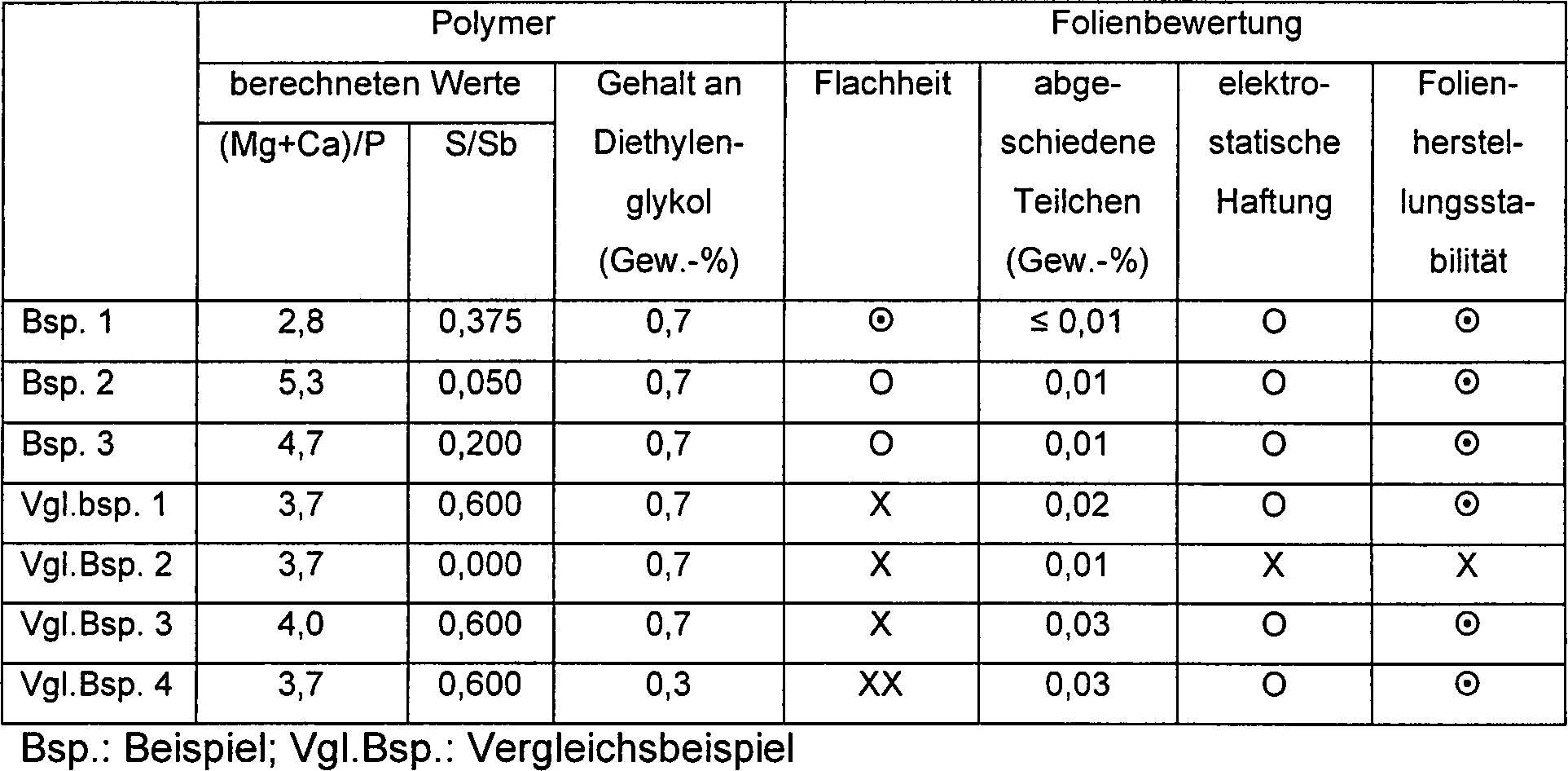
Beispiele 4 bis 9Examples 4 to 9
Diethylenglykol wurde zu 100 Teilen Dimethyl-2,6-naphthalindicarboxylat und 60 Teilen Ethlyenglykol in der Gegenwart von Magnesiumacetattetrahydrat und Calciumacetatmonohydrat als Umesterungsreaktionskatalysatoren in solch einer Menge zugegeben, daß sein Gehalt in dem Polymer 0,7 Gew.-% betragen wird.diethylene glycol was added to 100 parts of dimethyl 2,6-naphthalenedicarboxylate and 60 parts Ethylene glycol in the presence of magnesium acetate tetrahydrate and Calcium acetate monohydrate as transesterification reaction catalysts in to be added to such an amount Content in the polymer will be 0.7 wt .-%.
Eine Umesterungsreaktion wurde gemäß einem allgemein verwendeten Verfahren durchgeführt und dann wurde Trimethylphosphat zugegeben, um im wesentlichen die Umesterungsreaktion zu beenden.A Transesterification reaction was carried out according to a generally used procedures and then became trimethyl phosphate added to substantially complete the transesterification reaction.
Danach wurden Antimontrioxid und Tetrabutylphosphonium-3,5-dicarboxybenzolsulfonat zugegeben. Kugelförmiges Siliciumdioxid mit einem durchschnittlichen Teilchendurchmesser von 0,06 μm wurde außerdem zu einer Konzentration in dem Polymer von 0,05 Gew.-% zugegeben. Das resultierende Gemisch wurde dann zu einer Polymerisationsvorrichtung übertragen und eine Polykondensationsreaktion wurde gemäß einem allgemein verwendeten Verfahren bei einem Vakuumdruck von 26,7 Pa oder weniger durch Erhöhen der Temperatur auf 295 °C durchgeführt, um eine Polyethylennaphthalatzusammensetzung mit einer Grenzviskosität von 0,61 zu erhalten. Diese Polyethylennaphthalatzusammensetzung wies einen WS-Volumenwiderstand bei 290 °C von 3,1 × 10⁷ Ωcm auf.Thereafter, antimony trioxide and tetrabutylphosphonium 3,5-dicarboxybenzenesulfonate were added. Spherical silica having an average particle diameter of 0.06 μm was further added to a concentration in the polymer of 0.05 wt%. The resulting mixture was then transferred to a polymerization apparatus, and a polycondensation reaction was conducted according to a commonly used method at a vacuum pressure of 26.7 Pa or less by raising the temperature to 295 ° C to obtain a polyethylene naphthalate composition having an intrinsic viscosity sity of 0.61. This polyethylene naphthalate composition had a volume resistivity at 290 ° C of 3.1 x 10 7 Ωcm.
Die Pellets von diesem Polyethylennaphthalat wurden bei 170 °C für 3 Stunden getrocknet, zu dem Trichter eines Extruders zugeführt, auf eine Dicke von 200 μm durch eine 1-mm-Breitschlitzdüse bei einer Schmelztemperatur von 290 °C schmelzextrudiert, 0,3 s dem Oberflächenfinish mit einer linearen Elektrode unterzogen und fest an eine Rotationskühltrommel mit einer Oberflächentemperatur von 20 °C geklebt und verfestigt. Zu diesem Zeitpunkt betrug die maximale Gießgeschwindigkeit, bei der eine gekühlte Folie genau durch allmähliches Erhöhen der Geschwindigkeit der Kühltrommel ohne Erzeugung von Oberflächenfehlern auf der Folie, die durch schlechte Haftung verursacht wurden, hergestellt werden konnte, 50 m/min. Danach wurde diese nicht-gestreckte Folie bei 75 °C vorerhitzt, auf das 3,6fache zwischen langsamen und schnellen Walzen durch Erhitzen mit einem einzelnen Dunkelstrahler mit einer Oberflächentemperatur von 900 °C aus 15 mm über der Folie gestreckt und dann in einem Spannrahmen gespannt, um auf das 3,9fache in Querrichtung bei 105 °C zu strecken. Die erhaltene biaxial gestreckte Folie wurde bei 230 °C für 5 Sekunden heißfixiert, um eine 14 μm dicke heißfixierte, biaxial gestreckte Folie zu erhalten.The Pellets of this polyethylene naphthalate were at 170 ° C for 3 hours dried, fed to the hopper of an extruder a thickness of 200 microns through a 1 mm slot die melt extruded at a melt temperature of 290 ° C, 0.3 s surface finish subjected to a linear electrode and fixed to a rotary cooling drum with a surface temperature from 20 ° C glued and solidified. At this time, the maximum was casting speed, at the one cooled Slide exactly through gradual Increase the speed of the cooling drum without generation of surface defects produced on the film caused by poor adhesion could be 50 m / min. After that, this non-stretched film became at 75 ° C preheated, up to 3.6 times between slow and fast rollers Heating with a single dark radiator with a surface temperature from 900 ° C from 15 mm over stretched out the film and then stretched in a tenter to stand up 3.9 times in the transverse direction at 105 ° C to stretch. The obtained biaxially stretched film was heat set at 230 ° C for 5 seconds, by a 14 μm thick heat-fixed, to obtain biaxially stretched film.
Die Mengen an Tetrabutylphosphonium-3,5-dicarboxybenzolsulfonat, Magnesiumacetat, Calciumacetat, Trimethylphosphat und Antimontrioxid und der Typ, die Menge und der durchschnittliche Teilchendurchmesser der inerten feinen Teilchen, die zugegeben werden sollen, wurden verändert, wie in Tabelle 3, Tabelle 4 und Tabelle 5 gezeigt. Die charakteristischen Eigenschaften dieser Folien werden in Tabelle 3, Tabelle 4 und Tabelle 5 gezeigt.The Amounts of tetrabutylphosphonium 3,5-dicarboxybenzenesulfonate, magnesium acetate, Calcium acetate, trimethyl phosphate and antimony trioxide and the type the amount and average particle diameter of the inert fine particles to be added have been changed, such as in Table 3, Table 4 and Table 5. The characteristic Properties of these films are shown in Table 3, Table 4 and Table 5 shown.
Vergleichsbeispiele 5 bis 7Comparative Examples 5 to 7
Polyethylennaphthalatfolien wurden in derselben Weise wie in Beispiel 4 erhalten, außer, daß die Mengen an Tetrabutylphosphonium-3,5-dicarboxybenzolsulfonat, Magnesiumacetat, Trimethylphosphat, Calciumacetat, Diethylenglykol und Antimontrioxid und der Typ, die Menge und der durchschnittliche Teilchendurchmesser der inerten feinen Teilchen, die zugegeben werden sollen, verändert wurden, wie in Tabelle 3, Tabelle 4 und Tabelle 5 gezeigt. Die charakteristischen Eigenschaften von diesen Folien werden in Tabelle 3, Tabelle 4 und Tabelle 5 gezeigt.polyethylene naphthalate were obtained in the same manner as in Example 4 except that the amounts tetrabutylphosphonium 3,5-dicarboxybenzenesulfonate, magnesium acetate, Trimethyl phosphate, calcium acetate, diethylene glycol and antimony trioxide and the type, amount, and average particle diameter the inert fine particles to be added have been changed, as shown in Table 3, Table 4 and Table 5. The characteristic Properties of these films are shown in Table 3, Table 4 and Table 5 is shown.
Tabelle
3 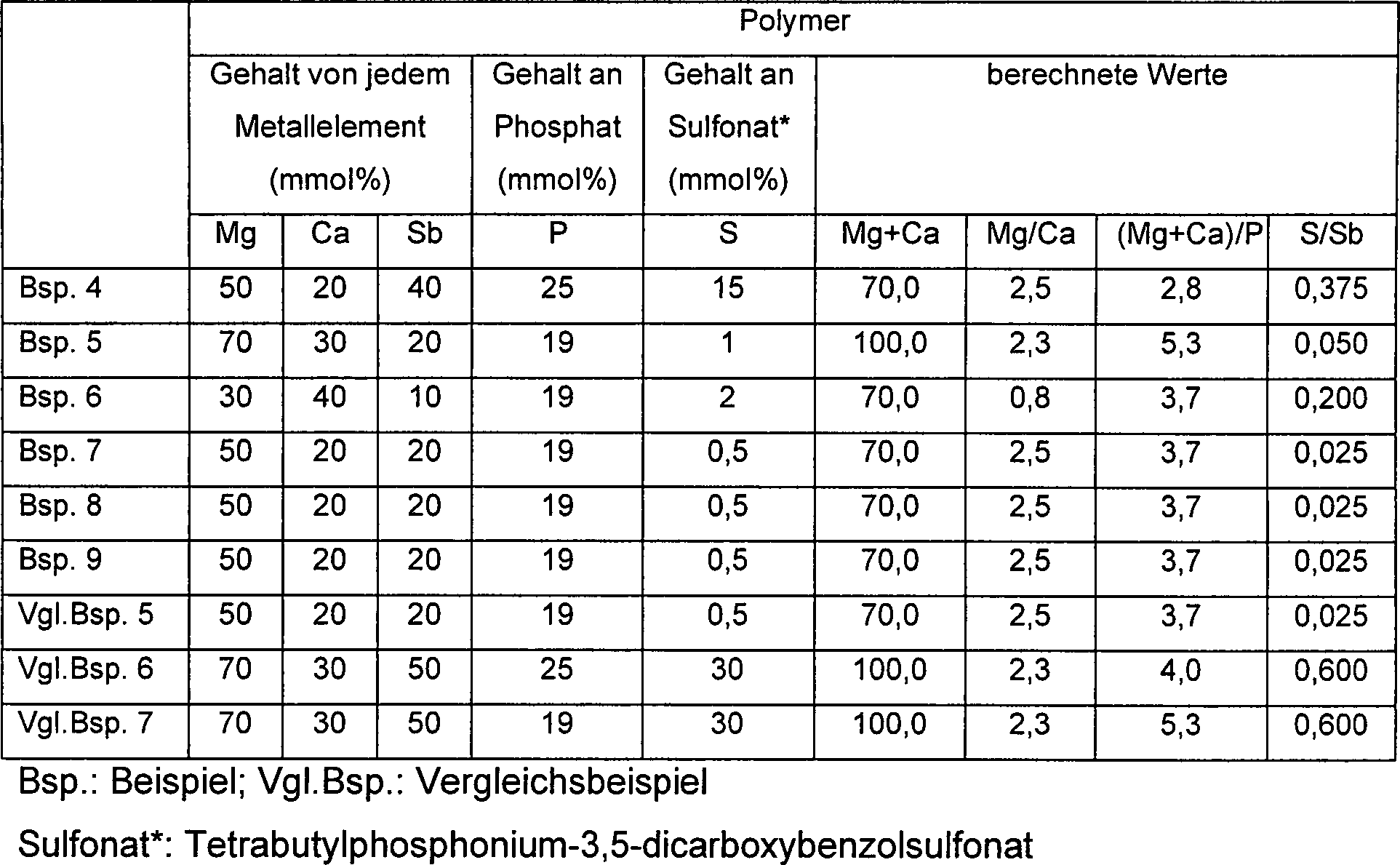
Tabelle
4 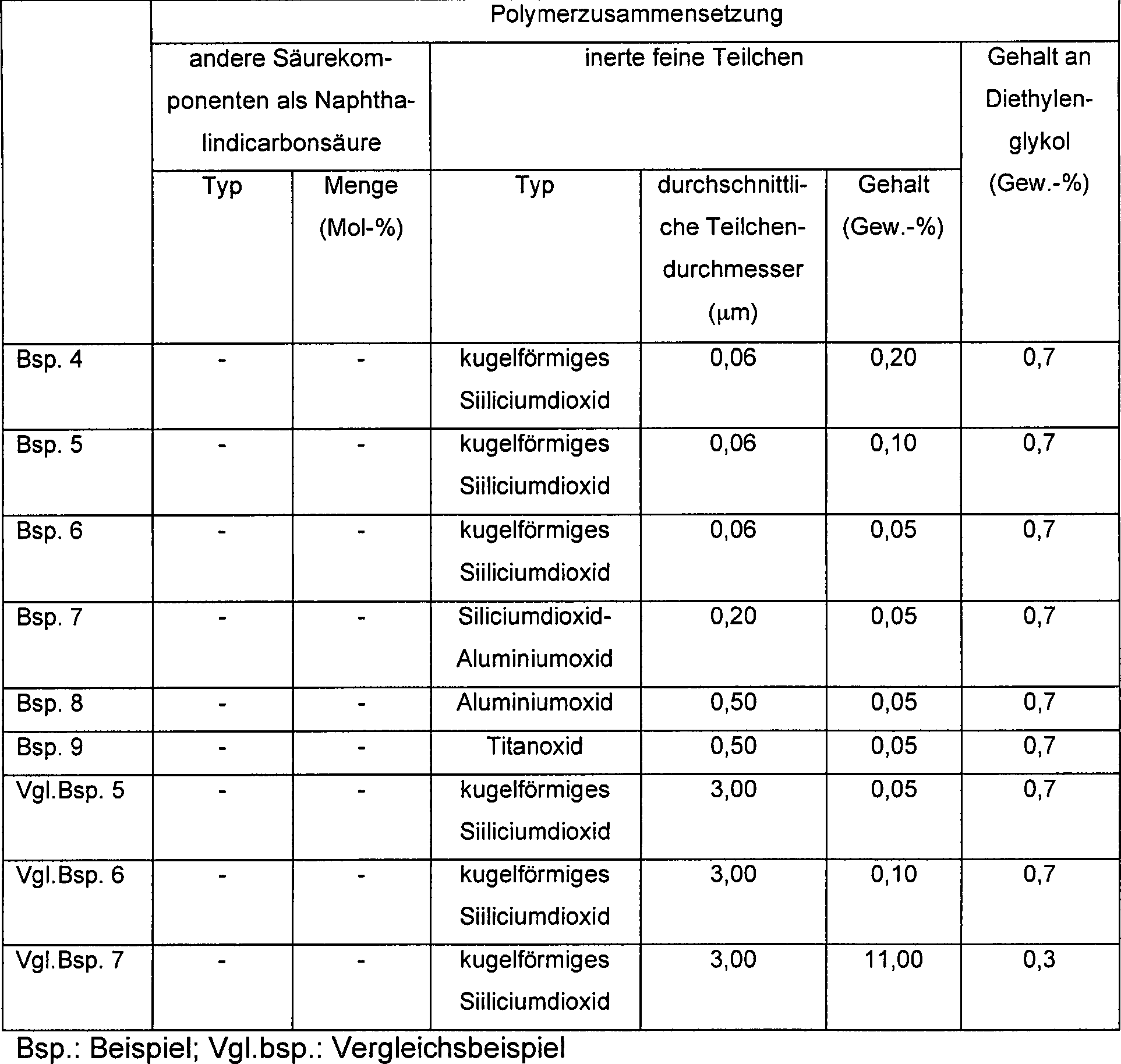
Tabelle
5 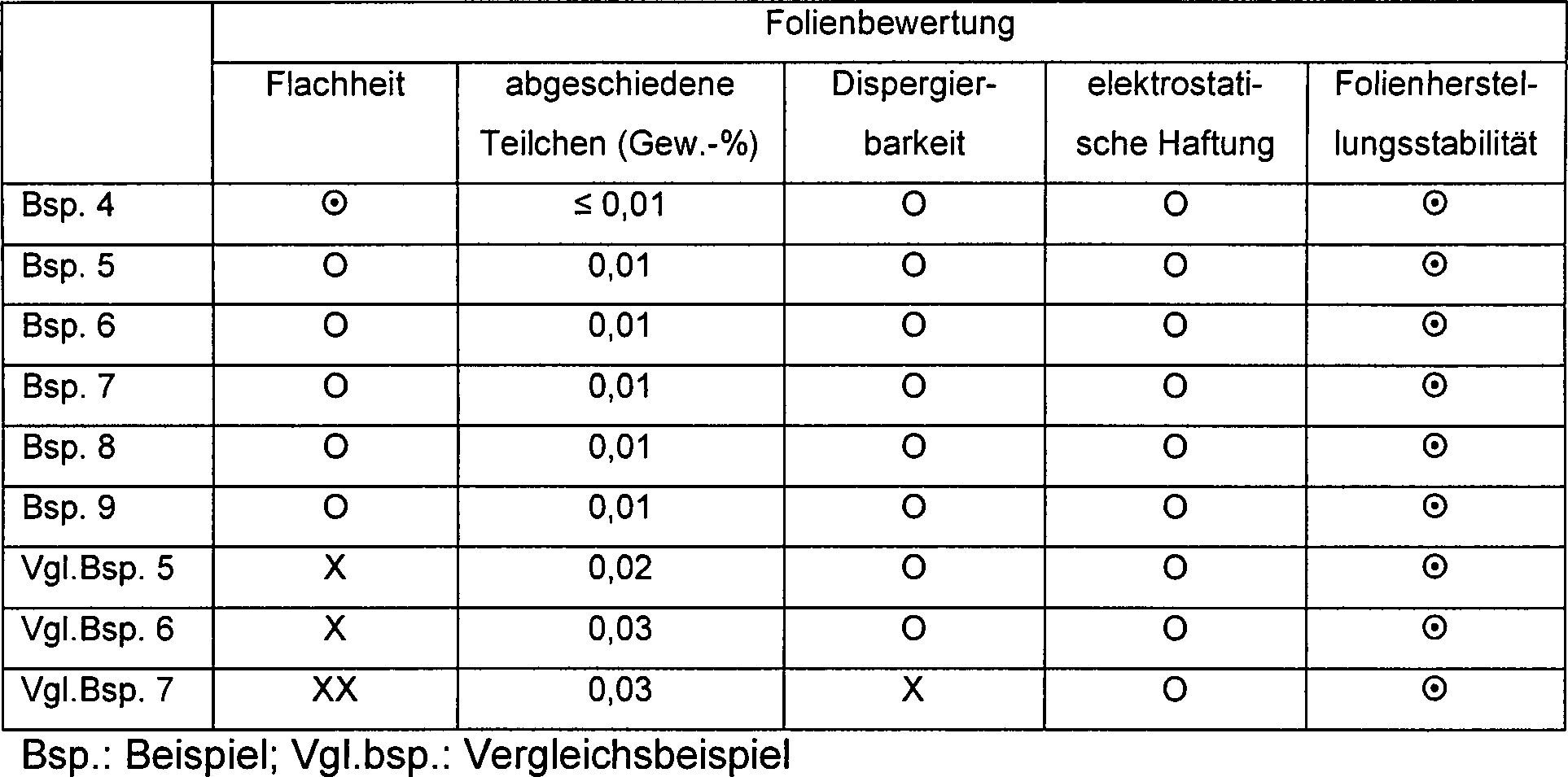
Wie aus den obigen Ergebnissen hervorgeht, weist das erfindungsgemäße Polyalkylennaphthalat eine ausgezeichnete elektrostatische Haftung und schnelle Aufwickeleigenschaften auf, wenn eine Folie gebildet wird, und die erhaltene Folie weist keine Dickenuneinheitlichkeit und ausgezeichnete Oberflächenflachheit auf.As From the above results, shows the polyalkylene naphthalate according to the invention excellent electrostatic adhesion and fast winding properties when a film is formed, and the resulting film has no thickness unevenness and excellent surface flatness on.
Wirkung der ErfindungEffect of the invention
Gemäß der Erfindung kann ein Polyalkylennaphthalat, das ausgezeichnete elektrostatische Haftung aufweist und zur Bildung einer Folie für ein magnetisches Aufzeichnungsmedium, insbesondere hochdichtes magnetisches Aufzeichnungsmedium, nützlich ist, effizient hergestellt werden.According to the invention For example, a polyalkylene naphthalate which is excellent in electrostatic Has adhesion and to form a film for a magnetic recording medium, In particular, high-density magnetic recording medium is useful be made efficiently.
Claims (28)
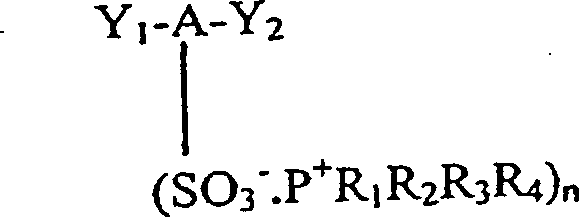

Applications Claiming Priority (5)
| Application Number | Priority Date | Filing Date | Title |
|---|---|---|---|
| JP9961098 | 1998-04-10 | ||
| JP9961098 | 1998-04-10 | ||
| JP12483198 | 1998-05-07 | ||
| JP12483198 | 1998-05-07 | ||
| PCT/JP1999/001846 WO1999052963A1 (en) | 1998-04-10 | 1999-04-07 | Polyalkylene naphthalate, composition thereof, film, and processes for producing these |
Publications (2)
| Publication Number | Publication Date |
|---|---|
| DE69923402D1 DE69923402D1 (en) | 2005-03-03 |
| DE69923402T2 true DE69923402T2 (en) | 2005-12-22 |
Family
ID=26440729
Family Applications (1)
| Application Number | Title | Priority Date | Filing Date |
|---|---|---|---|
| DE1999623402 Expired - Lifetime DE69923402T2 (en) | 1998-04-10 | 1999-04-07 | POLYALKYLENE NAPHTHALATE, COMPOSITION, MILK AND METHOD FOR THE PRODUCTION THEREOF |
Country Status (7)
| Country | Link |
|---|---|
| US (1) | US6228975B1 (en) |
| EP (1) | EP0989149B1 (en) |
| JP (1) | JP3420253B2 (en) |
| KR (1) | KR100515997B1 (en) |
| DE (1) | DE69923402T2 (en) |
| TW (1) | TW541239B (en) |
| WO (1) | WO1999052963A1 (en) |
Family Cites Families (11)
| Publication number | Priority date | Publication date | Assignee | Title |
|---|---|---|---|---|
| WO1990008171A1 (en) | 1989-01-10 | 1990-07-26 | Teijin Limited | Aromatic polyester film and production thereof |
| JPH0551439A (en) * | 1991-08-23 | 1993-03-02 | Teijin Ltd | Polyester manufacturing method |
| JP2915208B2 (en) * | 1992-06-26 | 1999-07-05 | 帝人株式会社 | Polyester production method |
| JP3083702B2 (en) * | 1993-04-07 | 2000-09-04 | 帝人株式会社 | Method for producing polyethylene naphthalate |
| JP3749551B2 (en) | 1993-09-20 | 2006-03-01 | 帝人株式会社 | Polyethylene naphthalate composition for photographic materials |
| JP3297539B2 (en) | 1994-08-11 | 2002-07-02 | 帝人株式会社 | Polyester and method for producing the same |
| JP3160161B2 (en) | 1994-10-06 | 2001-04-23 | 帝人株式会社 | Method for producing polyethylene naphthalate |
| JPH098171A (en) | 1995-06-15 | 1997-01-10 | Nippon Micron Kk | Semiconductor package |
| JP3399767B2 (en) | 1997-02-13 | 2003-04-21 | 帝人株式会社 | Permanent antistatic polycarbonate film or sheet and method for producing them |
| JP4018804B2 (en) | 1997-04-25 | 2007-12-05 | 帝人株式会社 | Method for producing aromatic polyester |
| EP0874015B1 (en) * | 1997-04-25 | 2004-02-25 | Teijin Limited | Process for producing aromatic polyester |
-
1999
- 1999-04-03 TW TW88105390A patent/TW541239B/en not_active IP Right Cessation
- 1999-04-07 JP JP55147699A patent/JP3420253B2/en not_active Expired - Lifetime
- 1999-04-07 EP EP19990913569 patent/EP0989149B1/en not_active Expired - Lifetime
- 1999-04-07 KR KR10-1999-7011536A patent/KR100515997B1/en not_active Expired - Fee Related
- 1999-04-07 WO PCT/JP1999/001846 patent/WO1999052963A1/en not_active Ceased
- 1999-04-07 US US09/445,347 patent/US6228975B1/en not_active Expired - Lifetime
- 1999-04-07 DE DE1999623402 patent/DE69923402T2/en not_active Expired - Lifetime
Also Published As
| Publication number | Publication date |
|---|---|
| KR100515997B1 (en) | 2005-09-21 |
| EP0989149A4 (en) | 2002-03-20 |
| JP3420253B2 (en) | 2003-06-23 |
| KR20010013529A (en) | 2001-02-26 |
| EP0989149A1 (en) | 2000-03-29 |
| TW541239B (en) | 2003-07-11 |
| WO1999052963A1 (en) | 1999-10-21 |
| US6228975B1 (en) | 2001-05-08 |
| DE69923402D1 (en) | 2005-03-03 |
| EP0989149B1 (en) | 2005-01-26 |
Similar Documents
| Publication | Publication Date | Title |
|---|---|---|
| DE60118082T2 (en) | Polyester film and magnetic recording medium using this | |
| DE69821820T2 (en) | Process for the preparation of an aromatic polyester | |
| DE2807147A1 (en) | TWO-AXIS ORIENTED POLYESTER FILM AND PROCESS FOR ITS MANUFACTURING | |
| DE69922919T2 (en) | BIAXIALLY ORIENTED POLYESTER FOIL FOR THERMAL TRANSFER BELT AND LAMINATED FILM CONTAINING THEREOF, AND METHOD OF PRODUCTION THEREOF | |
| DE69818036T2 (en) | BIAXIAL-ORIENTED POLYESTER FILM FOR MAGNETIC RECORDING MEDIA | |
| DE69332109T2 (en) | Film laminate | |
| DE3750319T2 (en) | Polyester compositions, processes for their production, polyester films, polyester films for magnetic tapes and films made therefrom for capacitors. | |
| DE69233633T2 (en) | Polyester film for magnetic recording | |
| DE19814710A1 (en) | Multilayer, biaxially oriented polyester film, process for its production and its use as magnetic tape film | |
| DE69124793T2 (en) | POLYESTER FILM FOR MAGNETIC RECORD CARRIERS | |
| DE69831310T2 (en) | BIAXIALLY ORIENTED FILM | |
| DE69330327T2 (en) | Biaxially oriented polyester film for magnetic recording medium | |
| DE69202628T2 (en) | Multi-layer polyester film for HD magnetic disk. | |
| DE69233066T2 (en) | Magnetic tape made from a biaxially oriented, unidirectionally expanded polyethylene -2,6-naphthalate film | |
| DE69331627T2 (en) | Polyester films for magnetic recordings | |
| DE60034864T2 (en) | COMPOSITE FILM FOR CONDENSER, MANUFACTURING METHOD AND SUPPORT FILM THEREFOR | |
| DE60023298T2 (en) | MAGNETIC RECORDING FILM AND BASIC FILM THEREFOR | |
| EP1717266B1 (en) | Black film of thermoplastic polyester | |
| DE69327489T2 (en) | Biaxially oriented film | |
| DE69923402T2 (en) | POLYALKYLENE NAPHTHALATE, COMPOSITION, MILK AND METHOD FOR THE PRODUCTION THEREOF | |
| DE60008153T2 (en) | Biaxially stretched, multi-layer polyester film | |
| DE69220932T2 (en) | POLYESTER COMPOSITION AND BIAXIAL ORIENTED POLYESTER FILM MADE THEREOF | |
| DE4426457A1 (en) | Polyester film for image-forming transfer material | |
| DE60030635T2 (en) | Magnetic recording medium and polyester film therefor | |
| DE69214535T2 (en) | Multi-layer polyethylene naphthalate film for a magnetic recording medium with high recording density |
Legal Events
| Date | Code | Title | Description |
|---|---|---|---|
| 8364 | No opposition during term of opposition |