EP0000852A1 - Procédé de traitement des cultures utilisant des dérivés de dichloroacétamide ou de trichloroacétamide, nouveaux dérivés de dichloroacétamide ou de trichloroacétamide utilisables à cet effet et procédé pour leur préparation - Google Patents
Procédé de traitement des cultures utilisant des dérivés de dichloroacétamide ou de trichloroacétamide, nouveaux dérivés de dichloroacétamide ou de trichloroacétamide utilisables à cet effet et procédé pour leur préparation Download PDFInfo
- Publication number
- EP0000852A1 EP0000852A1 EP7878400063A EP78400063A EP0000852A1 EP 0000852 A1 EP0000852 A1 EP 0000852A1 EP 7878400063 A EP7878400063 A EP 7878400063A EP 78400063 A EP78400063 A EP 78400063A EP 0000852 A1 EP0000852 A1 EP 0000852A1
- Authority
- EP
- European Patent Office
- Prior art keywords
- formula
- group
- compounds
- chlorine
- ethyl
- Prior art date
- Legal status (The legal status is an assumption and is not a legal conclusion. Google has not performed a legal analysis and makes no representation as to the accuracy of the status listed.)
- Granted
Links
- 0 C*(C)*[N+](C)[O-] Chemical compound C*(C)*[N+](C)[O-] 0.000 description 1
Classifications
-
- A—HUMAN NECESSITIES
- A01—AGRICULTURE; FORESTRY; ANIMAL HUSBANDRY; HUNTING; TRAPPING; FISHING
- A01N—PRESERVATION OF BODIES OF HUMANS OR ANIMALS OR PLANTS OR PARTS THEREOF; BIOCIDES, e.g. AS DISINFECTANTS, AS PESTICIDES OR AS HERBICIDES; PEST REPELLANTS OR ATTRACTANTS; PLANT GROWTH REGULATORS
- A01N25/00—Biocides, pest repellants or attractants, or plant growth regulators, characterised by their forms, or by their non-active ingredients or by their methods of application, e.g. seed treatment or sequential application; Substances for reducing the noxious effect of the active ingredients to organisms other than pests
- A01N25/32—Ingredients for reducing the noxious effect of the active substances to organisms other than pests, e.g. toxicity reducing compositions, self-destructing compositions
Definitions
- the subject of the present invention is new derivatives of dichloroacetamide and trichloroacetamide, their methods of preparation and their application as herbicide antidotes.
- herbicide antidote products which have the property of giving herbicides increased selectivity or new selectivities, without harming their herbicidal quality.
- the antidote makes disappear completely or at least in large part, the phytotoxicity of the herbicide with respect to the cultivated plant without reducing its phytotoxicity with regard to undesirable plants.
- herbicide antidote products have for example been described in French patents Nos. 2,133,793, 2,212,336, 2,215,170, 2,228,065, 2,309,546 and 2,310,348 and in US'Nos patents 3,867,444 ; 3,923,494, 3,931,313 and 3,959,304.
- the present invention aims to obtain chemically new and active compounds also as antidotes to herbicides.
- R 1 represents a dichloromethyl or trichloromethyl group
- X 1 represents a chlorine or fluorine atom
- X 2 represents a chlorine or fluorine atom
- X 3 represents a hydrogen, chlorine or fluorine atom
- R 2 represents an amino group HH 2 or a group in which R 3 is a hydrogen atom or an alkyl, haloalkyl, alkenyl, haloalkenyl, arylalkyl, arylhaloalkyl, cycloalkyl, halocycloalkyl, alkoxyalkyl, haloalkoxyalkyl or aryl group, the latter optionally being substituted by one or two halogen atoms or by an alkyl, alkoxy, nitro or haloalkyl group.
- the alkyl, alkenyl, alkoxy chains of the alkyl, haloalkyl, alkenyl, haloalkenyl, arylalkyl, arylhaloalkyl, alkoxyalkyl and haloalkoxyalkyl groups preferably have 1 to 5 carbon atoms
- the cycloalkyl and halocycloalkyl groups preferably have 3 to 6 carbon atoms
- aryl and aryl preferably denote phenyl and phenyl respectively and the halogen substituent of the aryl group is preferably a chlorine atom.
- the present invention relates to all of the compounds of formula (I), it relates more particularly to those of these compounds for which R 2 is NH 2 or a group wherein R ' 3 is a hydrogen atom, an alkyl group having 1 to 5 carbon atoms, an alkenyl group having 2 to 5 carbon atoms, a haloalkyl group having 1 to 5 carbon atoms and 1 to 7 d atoms 'halogen, or a phenyl group substituted by one or two chlorine atoms.
- R ' 3 is a haloalkyl group, it is preferably a group wherein Y 1 is a chlorine or fluorine atom, Y 2 is a chlorine or fluorine atom and Y 3 is a hydrogen, chlorine or fluorine atom.
- the reactions (1), (2), (3), (4) are preferably carried out in an inert solvent such as for example a linear or cyclic ether, an aliphatic or aromatic hydrocarbon or a chlorinated derivative of an aliphatic or aromatic hydrocarbon , at a temperature between -30 ° C and + 60 ° C and preferably between - 15 ° C and + 30 ° C.
- the hydrochloric acid formed in the reaction is neutralized, as it is formed, by a mineral base such as for example an alkali or alkaline earth metal hydroxide or by a tertiary amine such as for example triethylamine or pyridine.
- the product of formula (I) formed is isolated in the brot state by elimination of the solvent by distillation. It can be purified, for example by recrystallization, or used as it is.
- the compounds of formula (I) for which R 2 is an NH 2 group, which are identical to the compounds of formula (II), and the compounds of formula (III) can be prepared by the action of ammonia on the chlorinated derivatives of formulas (IV) and (V).
- the reaction is carried out in the same solvents as those used for reactions (1) to (4) and preferably in a cyclic ether such as, for example, tetrahydrofuran.
- the chlorinated derivative of formula (IV) or (V) is introduced into the solvent saturated with am oniac, at a temperature of between -30 ° C. and + 30 ° C.
- the ammonium chloride formed is removed by filtration and the compound of formula (II) or (III) is isolated in the raw state by elimination of the solvent. It can be purified by recrystallization or used as such, in particular for carrying out reactions (1) or (2).
- the compounds of formula (IV) and (V) can be prepared by the action of thionyl chlorur on the hydroxylated compounds of formulas: in which R 1 , R 3 , X 1 , X 2 , X 3 have the same meanings as in formula (I).
- the reaction can be carried out, in the presence or not of a solvent, with an excess of thionyl chloride, at a temperature between 50 ° C. and 80 ° C.
- the solvent used can be identical to those used to carry out reactions (1) to (4). In the case where one operates without solvent, and also when one operates with certain solvents such as CCl 4 or hexane, the compound of formula (IV) or (V) precipitates and can be isolated by filtration.
- the compound of formula (IV) or (V) does not precipitate. It is then possible either to isolate the product by evaporating the solvent under vacuum, or to directly use the medium obtained at the end of the reaction for the continuation of the process leading to the compounds (I), without isolating the products (IV) or (V).
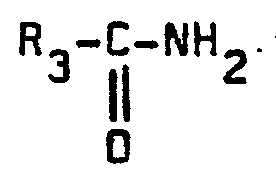
- the hydroxylated compounds of formulas (VI) or (VII) can be prepared by the action of an amide of formula on a halogenated aldehyde of formula following the procedures described by Joseph P.LAROCCA, John. M. LEONARD, Warren. E. WEAVER [Journal of Organic Chemistry 16, 47-50, (1951)] and by A. BOUCHERLE, G. CARRAZ, J. VIGIER [Bull. Trav. Soc. Pharm. Lyon 10 (1), 3-10, (1966)].
- the compounds of formula (I) can be used, as herbicide antidotes, for the treatment of crops. They protect cultivated plants against damage caused by herbicides, and this at doses of herbicides effective against undesirable plants.
- the compounds of formula (I) can in particular be used in combination with herbicides belonging to the families of chloroacetanilides, ureas, triazines, carbamates, uracils and more especially thiolcarbamates.
- herbicides belonging to the families of chloroacetanilides, ureas, triazines, carbamates, uracils and more especially thiolcarbamates.
- EPTC N-dipropyl thiolcarbamate
- butylate ethyl N, N-diisobutyl thiolcarbamate (butylate)
- the compounds of formula (I) can be incorporated, jointly with the herbicide or separately, in compositions which contain, in addition to the active material (that is to say the antidote compound and optionally the herbicide ), inert additives usually used in agriculture to facilitate the conservation, implementation and penetration into plants of active products, such as mineral fillers (talc, silica, kieselguhr, diatomaceous earth, clay, etc.), diluents various organic (mineral oils, organic solvents), surfactants, antioxidants and stabilizers.
- active material that is to say the antidote compound and optionally the herbicide
- inert additives usually used in agriculture to facilitate the conservation, implementation and penetration into plants of active products, such as mineral fillers (talc, silica, kieselguhr, diatomaceous earth, clay, etc.), diluents various organic (mineral oils, organic solvents), surfactants, antioxidants and stabilizers.
- Such com p OSi tions can be in the form of
- the content of antidote compound can vary from 10% to 90% by weight.
- the content of antidote compound can vary from 0.09% to 50% by weight, that in herbicide from 1% to 90% by weight, the ratio by weight of antidote products being between 0.001 and 10.
- the antidote compounds according to the invention can be applied to the soil at the same time as the herbicide, pre-emergence or post-emergence of the crop.
- the dose of antidote product provided can vary from 100 g to 5000 g per hectare.
- compositions containing the antidote product and the herbicide simultaneously such as those mentioned above.
- the antidote compounds according to the invention can also be applied to the soil at a time different from that of the treatment with the herbicide, pre-emergence or post-emergence of the crop, the dose of antidote product provided being the same as above. They can in particular be applied to soils containing herbicide residues in order to protect crops against the residual activity of these residues.
- the antidote compounds according to the invention can also be applied to the seed of the crop to be protected, said seed then being sown in soil already treated with the herbicide or which will be treated with the herbicide.
- the dose of antidote provided can vary from 10 g to 500 g per quintal of seed.
- a brown solid is obtained which is recrystallized from a 50/50 carbon tetrachloride-hexane mixture. 15.3 g are thus obtained (ie a yield of 40.4%) of N - [(2,2-dichloroacetamido-1) ethyl] o-chlorobenzamide, melting point 179-180 ° C.
- N - [(2,2-dichloro-1 amino-1) ethyl] dichloroacetamide used as starting material can be prepared as indicated in Example 14.
- N - [(2,2,2-amino-trichloro-1) ethyl] formamide By replacing the N - [(2,2,2-amino-trichloro-1) ethyl] formamide by the N - [(2,2,2-amino-trichloro-1) ethyl] acetamide, N - [(2,2-trichloro-2,2,2, dichloroacetamido-1) ethyl] acetamide is obtained, with a yield of 61.5%, of melting point 239-240 ° C.
- the N - [(2,2,2-trichlora-1 amino-1) ethyl] acetamide used as starting material is prepared according to the method used to prepare the N - [(trichlbro-2,2,2 amino-1) ethyl] trichloroacetamide, but by replacing the 100 g of N - [(tetrachloro-1,2,2,2) ethyl] trichloroacetamide with 320 g of N - [(tetrachloro-1,2,2,2) ethyl] acetamide (1, 42 mole). The addition to THF saturated with ammonia is carried out in 1 h 45 '.
- N - [(2,2-dichloro-1-hydroxy) ethyl] dichloroacetamide (0.87 mole) prepared as indicated above and 300 g of thionyl chloride are introduced into a 500 ml reactor, with stirring. (2.5 moles). We bring to reflux for 2 h 3D. 300 ml of hexane are added to facilitate precipitation during cooling. After filtration, 175 g of N - [(2,2,2-trichloro) ethyl] dichloroacetamide are obtained (ie a yield of 77.5 in the form of a white solid with melting point 77-78 ° C.
- a soil consisting of two parts by weight of clay and three parts by weight of sand, is spread in plastic trays of dimensions 18 x 12 x 5 cm. On this soil we sow, in 4 furrows of 0.5 cm deep, 10 corn seeds, variety "Sandrina”, and 10 barley seeds, variety "Rika”.
- the seedlings thus produced are separated into 3 batches, each batch containing 5 trays.
- On the 1st batch spread a layer, 2 cm thick, of soil that has not undergone any treatment.
- On the 2nd batch spread a layer, 2 cm thick, of soil in which a naturally phytotoxic herbicide has been incorporated by careful mixing. corn but at the dose where it is applied.
- the herbicide and the antidote are formulated in the form of aqueous suspensions.
- the quantities of herbicide applied correspond to doses of herbicides of 5 kg and 10 kg / ha.
- the amounts of antidote product provided correspond to doses equal to one tenth of the doses of the herbicide, ie 0.5 and 1 kg g / ha.
- the herbicide used is EPTC or ethyl N, N-dipropyl thiolcarbamate.
- the antidote products tested are the compounds of Examples 1 to 15.
- the batches of trays, once treated, are placed in a greenhouse maintained at 20 ° C and at a humidity rate of 70%. 12 and 20 days after treatment (D + 12; D + 20), the batches are examined and the herbicidal efficacy of the "antidote + .herbicide" combination is determined on the one hand, and the efficacy on the other hand antidote for the compound according to the invention tested.
- the antidote E efficacy is evaluated by measuring the average height of the maize plants in the three batches.
- A denotes the average size of the maize plants in the untreated control lots
- B the average size of the maize plants in the lots treated with the herbicide alone
- C the average size of the corn plants in the lots treated with l herbicide and antidote.
- Example 1 the product of Example 1 was tested according to the method described in the previous example, but by varying the dose of the antidote product relative to that of the associated herbicide (E P T C).
- the herbicide was applied at a dose of 5 kg / ha and the product of Example 1 at the doses 0 kg / ha (tests with herbicide alone), 0.312 kg / ha, 0.625 kg / ha, 1.250 kg / ha and 2,500 kg / ha.
Landscapes
- Life Sciences & Earth Sciences (AREA)
- General Health & Medical Sciences (AREA)
- Health & Medical Sciences (AREA)
- Toxicology (AREA)
- Pest Control & Pesticides (AREA)
- Plant Pathology (AREA)
- Agronomy & Crop Science (AREA)
- Engineering & Computer Science (AREA)
- Dentistry (AREA)
- Wood Science & Technology (AREA)
- Zoology (AREA)
- Environmental Sciences (AREA)
- Agricultural Chemicals And Associated Chemicals (AREA)
- Organic Low-Molecular-Weight Compounds And Preparation Thereof (AREA)
Abstract
Description
- Le présente invention a pour objet de nouveaux dérivés de dichloroacétamide et trichloroacétamide, leurs procédés de préparation et leur application en tant qu'antidotes d'herbicides.
- Les herbicides existant actuellement peuvent être classés en deux catégories : les herbicides totaux, qui détruisent toutes les plantes, et les herbicides sélectifs. Ces derniers, qui sont les plus précieux en agriculture, permettent de détruire les mauvaises herbes présentes dans les cultures sans nuire à la plante cultivée et sont dits, pour cette raison, sélectifs de la plante cultivée. Malheureusement il arrive que cette sélectivité ne soit pas parfaite à la dose. d'emploi et que les herbicides sélectifs présentent une certaine phytotoxicité vis-à-vis de la plante cultivée.
- Aussi utilise-t-on, en association avec les herbicides, des produits dits antidotes d'herbicides qui ont la propriété de conférer aux herbicides une sélectivité accrue ou des sélectivités nouvelles, sans nuire à leur qualité herbicide. Autrement dit l'antidote fait disparaitre totalement ou tout au moins en grande partie, la phytotoxicité de l'herbicide vis-à-vis de la plante cultivée sans réduire sa phytotoxicité vis-à-vis des plantes indésirables.
- De tels produits antidotes d'herbicides ont par exemple été décrits dans les brevets français Nos 2.133.793, 2.212.336, 2.215.170, 2.228.065, 2.309.546 et 2.310.348 et dans les brevets US'Nos 3.867.444; 3.923.494, 3.931.313 et 3.959.304.
- La présente invention a pour but l'obtention de composés chimiquement nouveaux et actifs eux aussi comme antidotes d'herbicides.
- * Les composés selon l'invention peuvent être représentés par la formule générale :
-


- Dans les définitions données ci-dessus pour R3, les chaînes alkyle, alkényle, alcoxy des groupes alkyle, haloalkyle, alkényle, haloalkényle, arylalkyle, arylhaloalkyle, alcoxyalkyle et haloalcoxyalkyle ont de préférence 1 à 5 atomés de carbone, les groupes cycloalkyle et halocycloalkyle ont de préférence 3 à 6 atomes de carbone, les groupes haloal- kyle, haloalkényle, arylhaloalkyle, halocycloalkyle, haloalcoxyalkyle pnt de préférence 1 à 7 atomes d'halogène pris parmi les atomes de chlore, brome ou fluor, aryl et aryle désignent de préférence respectivement phényl et phényle et le substituant halogène du groupe aryle est de préférence un atome de chlore.
- Bien que la présente invention concerne l'ensemble des composés de formule (I), elle a plus particulièrement pour objet ceux de ces composés pour lesquels R2 est NH2 ou un groupe


- Les composée de formule (I) pour lesquels R2 est un groupe

- 1) action d'un chlorure d'acide de formule


- 2) action d'un chlorure d'acide de formule






- . Dans les formules (II), (III), (IV), (V) ci-dessus ainsi que dans celles des chlorures d'acide et amides, X1, X2, X3, R1 et R3 ont les mêmes significations que dans la formule (I).
- Les réactions (1), (2), (3), (4) sont effectuées de préférence dans un solvant inerte tel par exemple un éther linéaire ou cyclique, un hydrocarbure aliphatique ou aromatique ou un dérivé chloré d'un hydrocarbure aliphatique ou aromatique, à une température comprise entre -30°C et + 60°C et de préférence entre - 15°C et + 30°C. L'acide chlorhydrique formé dans la réaction est neutralisé, au fur et à mesure de sa formation, par une base minérale comme par exemple un hydroxyde de métal alcalin ou alcalino-terreux ou par une amine tertiaire comme par exemple la triéthylamine ou la pyridine. Après séparation par extraction à l'eau ou par fil- tration du chlorure de la base minérale ou du chlorhydrate de l'smine, le produit de formule (I) formé est isolé à l'état brot par élimination du solvant par distillation. Il peut être purifié, par exemple par recristallisation, ou utilisé tel quel.
- Les composés de formule (I) pour lesquels R2 est un groupe NH2, qui sont identiques aux composés de formule (II), et les composés de formule (III) peuvent être préparés par action de l'ammoniac sur les dérivés chlorés de formules (IV) et (V). La réaction est réalisée dans les mêmes solvants que ceux utilisés pour les réactions (1) à (4) et de préférence dans un éther cyclique come par exemple le tétrahydrofuranne. Le dérivé chloré de formule (IV) ou (V) est introduit dans le solvant saturé en am oniac, à une température comprise -entre -30°C et + 30°C. Le chorure d'ammonium formé est éliminé par filtration et le composé de formule (II) ou (III) est isolé à l'état brut par éimination du solvant. Il peut être purifié par recristallistion ou utilisé tel quel, en particulier pour effectuer le réactions (1) ou (2).
- Les pomposés de formule (IV) et (V) peuvent être préparés par action du chlorur de thionyle sur les composés hydroxylés de formules :


- Les composés hydroxylés de formules (VI) ou (VII) peuvent être préparés par action d'un amide de formule


- Les composés de formule (III) pour lesquels R3 est autre qu'un atome d'hydrogène sont nouveaux et font partie en tant que tels de l'invention. Comme exemples de composés de formule (III) nouveaux on peut citer en particulier ceux pour lesquels on a simultanément X1 = X2 = X3 = Cl et R3 = monochlorométhyl, trichlorométhyl, pentachloro-1,2,3,3,3 propyl, trifluorométhyl, méthyl, o-chlorophényl, p-chlorophényl, p-méthylphényl, m-trifluorométhylphényl, dichloro-2,4 phényl ou dichloro-3,4 phényl.
- Certains des composés de formules (IV), (V), (VI), (VII) sont aussi des produits nouveaux. Comme tels on peut citer en particulier les composés répondant à la formule :

- Les composés de formule (I) peuvent être utilisés, en tant qu'antidotes d'herbicides, pour le traitement des cultures. Ils protègent les plantes cultivées contre les dommages occasionnés par les herbicides, et ce aux doses d'herbicides efficaces vis-à-vis des plantes indésirables.
- Les composés de formule (I) peuvent en particulier être employés en association avec les herbicides appartenant aux familles des chloroacétanilides, urées, triazines, carbamates, uraciles et plus spécialement des thiolcarbamates. Comme tels on peut citer par exemple le N,N-dipropyl thiolcarbamate d'éthyle (EPTC), le N,N-diisobutyl thiolcarbamate d'éthyle (butylate), le N,N-dipropyl thiolcarbamate de propyle, le N,N-diéthyl thiolcarbamate d'éthyle (éthiolate), le N,N-cy- clohexaméthylène thiolcarbamate d'éthyle (molinate), le N-éthyl N-cyclohexyl thiolcarbamate d'éthyle (cycloate), le N,N-diisopropyl thiolcarbamate de dichloro-2,3 propényle (dial- late), le N,N-diisopropyl thiolcarbamate d'éthyle, le N-(chloro-3 phényl) carbamate de chloro-4 butynyle-2 (barban), la (chloro-3 méthyl-4 phényl)-3 diméthyl-1,1 urée (chiobitruron), la (dichloro-3,4 phényl)-3 méthoxy-1 méthyl-1 urée (linuron), la (dichloro-3,4 phényl)-3 diméthyl-1,1 urée, la N-chloroacétyl N-isopropyl aniline (propachlor), la diéthyl-2,6 N-chloroacétyl N-méthoxyméthyl aniline (alachlor), la chloro-2 éthylamino-4 isopropylamino-6 triazina-1,3,5 (atrazine), la chloro-2 bis (éthylamino)-4,6 triazine-1,3,5 la chloro-2 cyclopropylamino-4 isopropylamino-6 triazine-1,3,5 et leurs combinaisons. Le rapport en poids produit antidote à employer herbicide peut varier beaucoup selon la nature de l'herbicide concerné. Ce rapport est en général compris entre 0,001 et 10, et le plus souvent entre 0,01 et 5.
- Pour leur mise en oeuvre les composés de formule (I) peuvent être incorporés, conjointement avec l'herbicide ou séparément, dans des compositions qui contiennent, outre la matière active (c'est-à-dire le composé antidote et éventuellement l'herbicide), les additifs inertes habituellement utilisés en agriculture pour faciliter la conservation, la mise en oeuvre et la pénétration dans les plantes des produits actifs, tels que charges minérales (talc, silice, kieselguhr, terre de diatomées, argile etc..), diluants organiques divers (huiles minérales, solvants organiques), tensioactifs, antioxydants et stabilisants. De telles composi- tions peuvent se présente sous la forme de poudres mouillables, solutions émulsifiables dans l'eau, granulés ou toute autre forme en usage dans le domaine des herbicides. Dans les compositions contenant seulement un composé antidote selon l'invention et des additifs inertes, la teneur en compo- sé antidote peut varier de 10 % à 90 % en poids. Dans les compositions contenant un composé antidote selon l'invention, un herbicide et des additifs inertes, la teneur en composé antidote peut varier de 0,09 % à 50 % en poids, celle en herbicide de 1 % à 90 % en poids, le rapport en poids produits antidote étant compris entre 0,001 et 10. herbicide
- Les composés antidotes selon l'invention peuvent être appliqués sur le sol en même temps que l'herbicide, en prélevée ou en post-levée de la culture. La dose en produit antidote apportée peut varier de 100 g à 5000 g par hectare. Pour une telle application il est avantageux d'utiliser des compositions contenant simultanément le produit antidote et l'herbicide, telles que celles citées précédemment.
- Les composés antidotes selon l'invention peuvent aussi être appliqués sur le sol à une époque différente de celle du traitement par l'herbicide, en pré-levée ou en post-levée de la culture, la dose en produit antidote apportée étant la même que ci-dessus. Ils peuvent en particulier être appliqués sur des sols contenant des résidus d'herbicide afin de protéger les cultures contre l'activité rémanente de ces résidus.
- Enfin les composés antidotes selon l'invention peuvent aus'si être appliqués sur la semence de la culture à protéger, ladite semence étant ensuite semée dans une terre déjà traitée avec l'herbicide ou qui sera traitée avec l'herbicide. Pour le traitement des semences la dose en produit antidote apportée peut varier de 10 g à 500 g par quintal de semence.
- Les exemples suivants illustrent l'invention sans la limiter.
-

- On dissout 19,15 g (0,1 mole) de N-[trichloro-2,2,2 amino-1) ethyl] formamide dans 200 ml de tétrahydrofuranne (THF). On ajoute 10,1 g de triéthylamine (0,1 mole). En maintenant la température à 15°C, on ajoute sous agitation, en environ 30 minutes, 14,75 g de chlorure de dichloroacétyle (0,1 mole) dissous dans 100 ml de THF. On maintient ensuite 1/2 heure sous agitation en laissant revenir à la température ambiante. On filtre le précipité de chlorhydrate de triéthylamine. On élimine le THF par distillation sous vide. Au cours de la distillation, il se forme un produit cristallisé qui est séparé. Ce produit est recristallisé dans un mélange benzène-hexane 50-50. On obtient ainsi 24,5 g (soit un rendement de 81 %) de N-[trichloro-2,2,2 dichloroacétamido-1) éthyl]formamide, de point de fusion 141-142°C.
-

-

- On dissout 10,2 g de dichloroacétamide (0,08 mole) dans 150 ml de chloroforme. On ajoute 10 g de triéthylamine (0,1 mole). En maintenant la température au voisinage de 0°C, on ajoute sous agitation, en environ 1 h, 23,5 g de N-[(tétrachloro-1,2,2,2) éthyl]dichloroacétamide (0,08 mole) dissous dans 150 ml de chloroforme. On laisse revenir à température ambiante sous agitation, puis on reprend par 1 litre d'eau. Après décantation, la phase organique est séparée et lavée deux fois avec 500 ml d'eau, puis séchée sur sulfate de magnésium. Le chloroforme est distillé sous vide et on obtient un solide qui est recristallisé dans l'hexane. On obtient ainsi 24,5 g de N-[(trichloro-2,2,2 dichloroacétemido-1) éthyl]dichloroecétemide (soit un rendement de 79,5 %), de point de fusion 249-250°C.
-

-

- En opérant comme dans l'exemple n° 3, mais en remplaçant les 10,2 g de dichloroacétamide par 6,96 g d'iso- butyramide (0,08 mole), on obtient 21 g (soit un rendement de 76,3 %) de N-[(trichloro-2,2,2 dichloroacétamido-1) éthyl]isobutyramide de point de fusion 264-265°C.
-

- On opère comme dans l'exemple 1, en remplaçant les 19,15 g de N-[(trichloro-2,2,2 amino-1) éthyl] formamide par 24,7 g de N- [(trichloro-2,2,2 amino-1),éthyl] trichloroacétamide (0,08 mole). On obtient ainsi 21,8 g (soit un rendement de 65 %)de N-[(trichloro-2,2,2 dichloroacétamido-1) éthyl]trichloroacétamide de point de fusion 184-185°C.
- Le N-[(trichlorc-2,2,2 amino-1) éthyl]trichloroacétamide utilisé comme produit de départ peut être préparé comme suit :
- On sature 300 ml de THF par de l'ammoniac gazeuxtet on maintient cette saturation pendant toute la durée de l'opération. En maintenant la température à 0°C, on ajoute sous agitation, en environ 1 h, 100 g de N-[(tétra- chloro-1,2,2,2) éthyl]trichloroacétamide (0,3 mole). Le précipité de chlorure d'ammonium qui s'est formé est séparé par filtration. Le THF est ensuite séparé par distillation sous vide. On obtient ainsi 59 g de N- [(trichloro-2,2,2 amino-1) éthyl]trichloroacétamide (soit un rendement de 62,7 %) sous la forme d'un solide blanc de point de fusion 132-133°C. EXEMPLE N° 7 - Préparation du composé:

- On opère comme dans l'exemple 1, en remplaçant les 19,15 g de N-[(trichlorc-2,2,2 amino-1) éthyl]formamide par 18,2 g de N-[(trichlorc-2,2,2 amino-1) éthyl] o-chlorobenzamide (0,06 mole) et en utilisant 10,3 g de chlorure de dichloroacétyle (0,07 mole) au lieu de 14,75 g. On obtient ainsi, après évaporation du solvant, 23 g (soit un rendement de 79,5 %) de N-[(trichlorc-2,2,2 dichloroacétamido-1) éthyl] o-chlorobenzamide de point de fusion 214-215°C.
- Le N- [(trichloro-2,2,2 amino-1) éthyl]o-chlorobenzamide utilisé comme produit de départ peut être préparé comme suit :
- On opère comme pour la préparàtion du N-[(trichloro-2,2,2 amino-1) éthyl]trichloroacétamide Mais en remplaçant les 100 g de N-[(tétrachloro-1,2,2,2) éthyl]trichloroacétamide par 100 g de N-[(tétrachloro-1,2,2,2) éthyl] o-chlorobenzamide (0,31 mole). On obtient 89 g (soit un rendement de 94,7 %) de N- [(trichloro-2,2,2 emino-1) éthyl] o-chlorobenzamide, solide blanc de point de fusion 169-170°C.
- Cl

- On dissout 24 g de N-[dichloro-2,2 amino-1) éthyl]dichloroacétamide (0,1 mole) dans 300 ml de tétrahydrofuranne (THF). On ajoute 10,1 g de triéthylamine (0,1 mole). En maintenant la température à 20-25°C, on ajoute sous agitation, en environ 15 minutes, 17,5 g de chlorure d'o-chlo- robenzoyle (0,1 mole) dissous dans 50 ml de THF. On maintient ensuite 1 heure sous agitation en laissant revenir à la température ambiante. On filtre le précipité de chlorhydrate de triéthylamine. On sépare le THF par distillation sous vide. On obtient un solide brun qui est recristallisé dans un mélange tétrachlorure de carbone-hexane 50/50. On obtient ainsi 15,3 g (soit un rendement de 40,4 %) de N-[(dichloro-2,2 dichloroacétamido-1) éthyl] o-chlorobenzamide de point de fusion 179-180°C.
- Le N-[(dichloro-2,2 amino-1) éthyl]dichloroacétamide utilisé comme produit de départ peut être préparé comme indiqué à l'exemple 14.
-

- On opère comme dans l'exemple 8, en remplaçant les 17,5 g de chlorure d'o-chlorobenzoyle par 11 g de chlorure d'isobutyryle (0,103 mole). On obtient ainsi 17,7 g (soit un rendement de 57,1 %) de N-[(dichloro-2,2-isobutyramido-1) éthy]dichloracétamide de point de fusion 189-190°C. EXEMPLE N° 10 - Préparation du composé de formule

- On opère comme dans l'exemple B, en remplaçant les 17,5 g de chlorure d'o-chlorobenzoyle par 10 g de chlorure d'acryloyle (0,11 mole). On obtient ainsi 12,8 g (soit un rendement de 43,5 %) de N -[(dichloro-2,2 acrylamido-1) éthyl]dichlcroacétamide.
-

- On dissout 6,4 g de dichlnroacétamide (0,05 mole) dans 50 ml de THF. On ajoute 7 g de triéthylamine (0,07 mole). En maintenant la température à 0°C, on ajoute sous agitation, en environ 15 minutes, 12,3 g de N-[(trifluoro-2,2,2 chloro-1) éthy]dichloroacétamide (0,05 mole) dissous dans 20 ml de THF. On maintient ensuite trois heures sous agitation en laissant revenir à la température ambiante. On filtre le chlorhydrate de triéthylamine. Le THF est éliminé par distillation sous vide. On obtient ainsi 15 g (soit un rendement de 89 %) de N-[(trifluoro-2,2,2 dichloroacétamido-1) éthyl]dichloroacétamide sous la forme d'un liquide visqueux brun.
- Le N- [(trifluoro-2,2,2 chloro-1) éthyl]dichloroacétamide utilisé comme produit de départ peut être préparé comme suit :
- On dissout dans 150 ml de benzène 19,2 g de dichloroacétamide (0,15 mole) et on ajoute, en 15 minutes environ, 22 g d'hydrate de fluoral (0,2 mole) et 1 ml d'acide sulfurique. On porte à reflux pendant 6 h sous agitation. Après refroidissement et filtration, on obtient 26,5 g de N-[(trifluoro-2,2,2 hydroxy-1) éthyl] dichloroacétamide (soit un rendement de 78 %), sous la forme d'un solide blanc de point de fusion 70-71°C.
- Dans un réacteur de 100 ml, on introduit sous agitation 5,5 g de N-[(trifluoro-2,2,2 hydroxy-1) éthyl] dichloroacétamide (0,025 mole) et 7,5 g de chlorure de thionyle (0,06 mole). On porte à reflux pendant 3 heures, puis on ajoute 30 ml d'hexane pour faciliter la précipitation au cours du refroidissement. Après filtratinn, nn obtient 4,4 g de N[(trifluoro-2,2,2 chloro-1) éthyl]dichloroacétamide (soit un rendement de 72 %), sous la forme d'un solide blanc de point de fusion 54-55°C.
-

- En opérant cnmme à l'exemple 1, mais en remplaçant le N-[(trichloro-2,2,2 amino-1) éthy] formamide par le N-[(trichloro-2,2,2 amino-1) éthyl]acétamide, on obtient, avec un rendement de 61,5 %, le N-[(trichloro-2,2,2, dichloroacétamido-1) éthyl]acétamide, de point de fusion 239-240° C.
- Le N-[(trichlora-2,2,2 amino-1) éthyl]acétamide utilisé comme produit de départ est préparé suivant la méthode employée pour préparer le N-[(trichlbro-2,2,2 amino-1) éthyl]trichloroacétamide, mais en remplaçant les 100 g de N-[(tétrachloro-1,2,2,2) éthyl] trichloroacétamide par 320 g de N-[(tétrachloro-1,2,2,2) éthyl]acétamide (1,42 mole). L'addition au THF saturé d'ammoniac s'effectue en 1 h 45'. On obtient 262 g de N-[(trichloro-2,2,2 amino-1) éthyl]acé - tamide (soit un rendement de 89,6 %), sous la forme d'un solide blanc de point de fusion 134-135°C.
-

- En opérant comme à l'exemple 0, mais en remplaçant le chlorure d'o-chlorobenzoyle par le chlorure de p-mé- thoxybenzoyle, on obtient, avec un rendement de 70,9 %, le N-[(dichloro-2,2 dichloroacétamido-1) éthyl]p-mtthoxy- benzamide, de point de fusion 171-172°C.
-

- On dissout dans 60 ml de benzène 64 g de dichloroacétamide (0,5 mole) et on ajoute, en 10 minutes environ,'68 g de dichloroacétaldéhyde (0,6 mole) et 1 ml d'acide sulfurique. On porte à reflux pendant 5 heures et on évapore le solvant et l'excès de dichloroacétaldéhyde sous vide. On obtient ainsi 118 g de N -[(dichloro-2,2 hydroxy-1) éthyl]dichloroacétamide brut (soit un rendement de 98 %), sous la forme d'un liquide visqueux pratiquement incolore.

- 'Dans un réacteur de 500 ml, on introduit sous agitation 210 g de N-[(dichloro-2,2 hydroxy-1) éthyl] dichloroacétamide (0,87 mole) préparé comme indiqué ci-dessus et 300 g de chlorure de thionyle (2,5 moles). On por- 'te à reflux pendant 2 h 3D'. On ajoute 300 ml d'hexane pour faciliter la précipitation au cours du refroidissement. Après filtration, on obtient 175 g de N-[(trichloro-2,2,1) éthyl]dichloroacétamide (soit un rendement de 77,5 sous la forme d'un solide blanc de point de fusion 77-78°C.
- On sature 600 ml de THF par de l'ammoniac gazeux et on maintient cette saturation pendant toute la durée de l'opération suivante. En maintenant la température à 0°C, on ajoute sous agitation, en environ 1 heure, 130 g de N-[(trichloro-2,2,1) éthyl]dichloroacétamide (0,5 mole) préparé comme indiqué ci-dessus. Le chlorure d'ammonium formé est séparé par filtration. Le THF est ensuite évaporé sous vide. On obtient ainsi 95,4 g de N-[(dichloro-2,2 amino-1) éthyl dichlornacétamide (soit un rendement de 79,5 %) sous la forme d'un solide blanc de point de fusion 96-97°C. EXEMPLE N° 15 - Préparation du composé de formule :

- En-opérant comme à l'exemple 3, mais en remplaçant le dichloroacétamide et le N-[(tétrachloro-1,2,2,2) éthyl]dichloroacétamide par respectivement le formamide et le N-[(trichloro-1,2,2) éthyl]dichloroacétamide, on obtient, avec un rendement de 74,6 %, le N-[(dichloro-2,2 dichloroacétamido-1) éthyl]formamide, de point de fusion 79-80°C.
-

- En opérant comme à l'exemple 3, mais en remplaçant le dichloroacétamide et le N-[(tétrachloro-1,2,2,2) éthyl] dichloroecétamide par respectivement l'acétamide et le N -[(trichloro-1,2,2) éthyl]dichloroacétamide, on obtient, avec un rendement de 78 %, le N-[(dichlorc-2,2 dichloroacétamido-1) éthyl]acétamide, de point de fusion 63-64°C.
- Un sol, constitué de deux parties en poids d'argile et trois parties en poids de sable, est épandu dans des .barquettes en plastique de dimensions 18 x 12 x 5 cm. Sur ce sol on sème, selon 4 sillons de 0,5 cm de profondeur, 10 graines de mais, variété "Sandrina", et 10 graines d'orge, variété "Rika".
- Les semis ainsi réalisés sont séparés en 3 lots, chaque lot contenant 5 barquettes. Sur le ler lot on répand une couche, de 2 cm d'épaisseur, d'une terre n'ayant subi aucun traitement. Sur le 2ème lot on répand une couche, d'épaisseur 2 cm, d'une terre dans laquelle on a incorporé par brassage soigné un herbicide naturellement phytotoxique pour le mais à la dose où il est appliqué. Enfin, sur le 3ème lot, on répand une couche, d'épaisseur 2 cm, d'une terre dans laquelle on a incorporé le même herbicide que pour le 2ème lot, à la même dose, et un produit antidote selon l'invention.
- Pour leur incorporation dans la terre l'herbicide et le produit antidote sont formulés sous forme de suspensidns aqueuses. Les quantités d'herbicide apportées correspondent à des doses d'herbicides de 5 kg et 10 kg/ha. Les quantités de produit antidote apportées correspondent à des doses égales au dixième des doses de l'herbicide, soit 0,5 et 1 kg/ha. L'herbicide utilisé est l'E.P.T.C. ou N,N-dipropyl thiolcarbamate d'éthyle. Les produits antidote testés sont les composés des exemples 1 à 15.
- Les lots de barquettes, une fois traités, sont placés dans une serre maintenue à 20°C et à un taux d'hygrométrie de 70 %. 12 et 20 jours après le traitement (J + 12; J + 20), les lots sont examinés et on détermine d'une part l'efficacité herbicide de l'association "antidote +.herbicide", d'autre part l'efficacité antidote du composé selon l'invention testé. L'efficacité antidote E est évaluée en mesurant la hauteur moyenne des plants de mais dans les trois lots. Elle est donnée par la formule :

- On constate que, dans tous les essais réalisés avec les associations "antidote + herbicide" à faible dose ou à forte dose, les orges, qui servent ici de plantes adventices de référence, sont détruite à 100 %, ce qui prouve ,que l'efficacité herbicide vis-à-vis des graminacées n'est pas réduite par les produits selon l'invention.
- Les résultats concernant l'efficacité antidote E sont rassemblés dans le tableau de la page 20.
- On voit que les composés des exemples 1, 3, 4, 9, 11 et 14, associés à l'E.P.T.C., ont une efficacité antidote particulièrement marquée.
- Dans le présent essai, le produit de l'exemple 1 a été testé suivant la méthode décrite dans l'exemple précédent, mais en faisant varier la dose du produit antidote par rapport à celle de l'herbicide associé (E P T C).
- L'herbicide a été appliqué à la dose de 5 kg/ha et le produit de l'exemple 1 aux doses 0 kg/ha (essais avec herbicide seul), 0,312 kg/ha, 0, 625 kg/ha, 1,250 kg/ha et 2,500 kg/ha.
- Les notations, effectuées au jour_J + 20, ont donné pour l'efficatité antidote E les résultats du tableau ci-dessous :

- Ce tableau montre que l'efficacité antidote croit avec la dose du composé de l'exemple 1 et que ce composé ne présente pas de phytotoxicité vis-à-vis du mais, même à la dose la plus élevée.
- Quant au pouvoir herbicide de ltE P T C vis-à-vis des plantes adventices (orge), il n'est pas réduit par les doses croissantes de composé antidote.

Claims (23)


Applications Claiming Priority (2)
| Application Number | Priority Date | Filing Date | Title |
|---|---|---|---|
| FR7723866 | 1977-08-03 | ||
| FR7723866A FR2399408A1 (fr) | 1977-08-03 | 1977-08-03 | Derives de dichloroacetamide et trichloroacetamide antidotes d'herbicides |
Publications (2)
| Publication Number | Publication Date |
|---|---|
| EP0000852A1 true EP0000852A1 (fr) | 1979-02-21 |
| EP0000852B1 EP0000852B1 (fr) | 1982-08-25 |
Family
ID=9194171
Family Applications (1)
| Application Number | Title | Priority Date | Filing Date |
|---|---|---|---|
| EP78400063A Expired EP0000852B1 (fr) | 1977-08-03 | 1978-07-21 | Procédé de traitement des cultures utilisant des dérivés de dichloroacétamide ou de trichloroacétamide, nouveaux dérivés de dichloroacétamide ou de trichloroacétamide utilisables à cet effet et procédé pour leur préparation |
Country Status (11)
| Country | Link |
|---|---|
| US (1) | US4330323A (fr) |
| EP (1) | EP0000852B1 (fr) |
| BR (1) | BR7804963A (fr) |
| CA (1) | CA1116632A (fr) |
| DE (1) | DE2862004D1 (fr) |
| DK (1) | DK314678A (fr) |
| ES (1) | ES472304A1 (fr) |
| FR (1) | FR2399408A1 (fr) |
| IT (1) | IT1172893B (fr) |
| PT (1) | PT68222A (fr) |
| RO (1) | RO76179A (fr) |
Families Citing this family (3)
| Publication number | Priority date | Publication date | Assignee | Title |
|---|---|---|---|---|
| HU183997B (en) * | 1982-07-14 | 1984-06-28 | Noevenyvedelmi Kutato Intezet | Herbicide and antidote composition resp. containing thiolcarba mate derivative and/or chloroacetanilide derivatives as herbicide and/or substituted acetamide antidote |
| JPS61293956A (ja) * | 1985-06-21 | 1986-12-24 | Tokuyama Soda Co Ltd | クロロアセトアミド化合物及びその製造方法 |
| US5201933A (en) * | 1988-08-01 | 1993-04-13 | Monsanto Company | Safening herbicidal benzoic acid derivatives |
Citations (6)
| Publication number | Priority date | Publication date | Assignee | Title |
|---|---|---|---|---|
| US2742501A (en) * | 1951-06-11 | 1956-04-17 | Glanzstoff Ag | Method of producing alkylidene bis-amides |
| DE1186467B (de) * | 1963-01-25 | 1965-02-04 | Bayer Ag | Verfahren zur Herstellung von acylierten beta, beta, beta-Trichloracetaldehyd-aminale |
| DE1617459A1 (de) * | 1966-03-18 | 1971-04-08 | Bayer Ag | Amidale halogenierter aliphatischer Aldehyde |
| DE2047258A1 (en) * | 1970-03-18 | 1971-10-07 | VEB Chemiekombinat Bitterfeld, χ 4400 Bitterfeld | Unsymmetrical n,n-trichloroethylidene-bis-amides |
| US3923494A (en) * | 1973-05-24 | 1975-12-02 | Stauffer Chemical Co | Gem-bis amide herbicide antidote compositions and methods of use |
| FR2340927A1 (fr) * | 1976-02-12 | 1977-09-09 | Fisons Ltd | Nouveaux derives de chloral, leur procede de preparation et leur application comme fongicides |
Family Cites Families (5)
| Publication number | Priority date | Publication date | Assignee | Title |
|---|---|---|---|---|
| DE1617457U (de) | 1950-11-07 | 1950-12-14 | Anton Grimm | Kleiderbuegel. |
| GB1054347A (fr) * | 1964-10-29 | |||
| BE756062A (fr) * | 1969-09-11 | 1971-03-11 | Boehringer Sohn Ingelheim | Derives de 1,1,1-trichlorethane leurs procedes de fabrication et leur utilisation en tant que substances biocides |
| DD105113A1 (fr) | 1973-01-31 | 1974-04-12 | ||
| DE2358592A1 (de) | 1973-11-24 | 1975-06-05 | Bayer Ag | Antimikrobielle mittel |
-
1977
- 1977-08-03 FR FR7723866A patent/FR2399408A1/fr active Granted
-
1978
- 1978-06-27 PT PT68222A patent/PT68222A/fr unknown
- 1978-07-13 DK DK314678A patent/DK314678A/da unknown
- 1978-07-21 EP EP78400063A patent/EP0000852B1/fr not_active Expired
- 1978-07-21 DE DE7878400063T patent/DE2862004D1/de not_active Expired
- 1978-07-28 IT IT68804/78A patent/IT1172893B/it active
- 1978-08-02 ES ES472304A patent/ES472304A1/es not_active Expired
- 1978-08-02 RO RO7894872A patent/RO76179A/fr unknown
- 1978-08-02 BR BR7804963A patent/BR7804963A/pt unknown
- 1978-08-03 CA CA000308656A patent/CA1116632A/fr not_active Expired
-
1979
- 1979-05-25 US US06/042,478 patent/US4330323A/en not_active Expired - Lifetime
Patent Citations (6)
| Publication number | Priority date | Publication date | Assignee | Title |
|---|---|---|---|---|
| US2742501A (en) * | 1951-06-11 | 1956-04-17 | Glanzstoff Ag | Method of producing alkylidene bis-amides |
| DE1186467B (de) * | 1963-01-25 | 1965-02-04 | Bayer Ag | Verfahren zur Herstellung von acylierten beta, beta, beta-Trichloracetaldehyd-aminale |
| DE1617459A1 (de) * | 1966-03-18 | 1971-04-08 | Bayer Ag | Amidale halogenierter aliphatischer Aldehyde |
| DE2047258A1 (en) * | 1970-03-18 | 1971-10-07 | VEB Chemiekombinat Bitterfeld, χ 4400 Bitterfeld | Unsymmetrical n,n-trichloroethylidene-bis-amides |
| US3923494A (en) * | 1973-05-24 | 1975-12-02 | Stauffer Chemical Co | Gem-bis amide herbicide antidote compositions and methods of use |
| FR2340927A1 (fr) * | 1976-02-12 | 1977-09-09 | Fisons Ltd | Nouveaux derives de chloral, leur procede de preparation et leur application comme fongicides |
Also Published As
| Publication number | Publication date |
|---|---|
| BR7804963A (pt) | 1979-03-13 |
| PT68222A (fr) | 1978-07-01 |
| ES472304A1 (es) | 1979-10-01 |
| FR2399408B1 (fr) | 1980-03-21 |
| DE2862004D1 (en) | 1982-10-21 |
| US4330323A (en) | 1982-05-18 |
| RO76179A (fr) | 1982-04-12 |
| DK314678A (da) | 1979-02-04 |
| CA1116632A (fr) | 1982-01-19 |
| FR2399408A1 (fr) | 1979-03-02 |
| IT7868804A0 (it) | 1978-07-28 |
| IT1172893B (it) | 1987-06-18 |
| EP0000852B1 (fr) | 1982-08-25 |
Similar Documents
| Publication | Publication Date | Title |
|---|---|---|
| DE2946524A1 (de) | Azolyloxy-carbonsaeure-n-oxy-amide, verfahren zu ihrer herstellung und ihre verwendung als herbizide | |
| US4337081A (en) | 5-Amido-3-trihalomethyl-1,2,4-thiadiazoles and their use as herbicides | |
| CA1087183A (fr) | Derives heterocycliques antidotes contre herbicides | |
| US4326077A (en) | N-Haloacetylphenylamino carbonyl cyclic intermediates | |
| FR2460936A1 (fr) | Derives de pyridazines et leur application comme fongicides | |
| US4033754A (en) | Substituted cyclohexene esters | |
| FR2518547A1 (fr) | Derives de l'acide propionique-2 phenoxy substitue et leur utilisation comme herbicides | |
| US4008067A (en) | Oxacyclohexane derivatives | |
| EP0000852B1 (fr) | Procédé de traitement des cultures utilisant des dérivés de dichloroacétamide ou de trichloroacétamide, nouveaux dérivés de dichloroacétamide ou de trichloroacétamide utilisables à cet effet et procédé pour leur préparation | |
| JPS62153283A (ja) | ピラゾ−ル化合物 | |
| EP0253291B1 (fr) | 5-Iminométhyl-haloacyloxazolidines avec une activité inhibitoire sur la phytotoxicité d'herbicides | |
| US4288384A (en) | N-Cyanoalkyl haloacetamides herbicidal antidotes | |
| US4650516A (en) | α-halo-Ω-haloalkylamides herbicidal antidotes | |
| FR2555579A1 (fr) | Nouveaux derives de pyridylacetonitriles, leur preparation et leur utilisation comme antifongiques dans le domaine agricole | |
| CH554886A (fr) | Procede de preparation de thiadiazoles. | |
| FR2462430A1 (fr) | Nouvelles 1,2,4-triazolidine-3,5-dithiones trisubstituees en positions 1, 2 et 4, composition les contenant et leur utilisation comme herbicides et comme substances de croissance des plantes | |
| FR2604174A1 (fr) | Nouveaux derives de la 5-pyrazolone, leur procede de preparation et leur utilisation comme herbicides | |
| EP0032948A1 (fr) | Spirooxazolidines et thiazolidines comme antidotes herbicides | |
| US4335053A (en) | N-cyanobenzyl haloacetamides | |
| CH556862A (en) | 1-(1,3,4-Thiadiazol-2-yl)-urea derivs as herbicides - and fungicides, prepd. from 2-amino-1,3,4-thiadiazoles | |
| EP0037527A1 (fr) | Acétanilides substitués, procédé pour les préparer et leur utilisation comme herbicides | |
| BE897291A (fr) | Acetamides substitues possedant des proprietes d'antidotes, leur preparation compositions antidotes contenant ces composes et compositions herbicides selectives contenant ces antidotes | |
| US4207090A (en) | Amino ester derivatives of 3-trihalomethyl-1,2,4-thiadiazoles and their use as herbicides | |
| US4228290A (en) | Amino ester derivatives of 3-trihalomethyl-1,2,4-thiadiazoles | |
| US4207089A (en) | Thiolcarbamate derivatives of 3-trihalomethyl-1,2,4-thiadiazoles and their use as herbicides |
Legal Events
| Date | Code | Title | Description |
|---|---|---|---|
| PUAI | Public reference made under article 153(3) epc to a published international application that has entered the european phase |
Free format text: ORIGINAL CODE: 0009012 |
|
| AK | Designated contracting states |
Designated state(s): BE DE FR GB LU NL |
|
| 17P | Request for examination filed | ||
| DET | De: translation of patent claims | ||
| GRAA | (expected) grant |
Free format text: ORIGINAL CODE: 0009210 |
|
| AK | Designated contracting states |
Designated state(s): BE DE FR GB LU NL |
|
| REF | Corresponds to: |
Ref document number: 2862004 Country of ref document: DE Date of ref document: 19821021 |
|
| GBPC | Gb: european patent ceased through non-payment of renewal fee | ||
| PGFP | Annual fee paid to national office [announced via postgrant information from national office to epo] |
Ref country code: LU Payment date: 19830622 Year of fee payment: 6 |
|
| PG25 | Lapsed in a contracting state [announced via postgrant information from national office to epo] |
Ref country code: LU Free format text: LAPSE BECAUSE OF NON-PAYMENT OF DUE FEES Effective date: 19830731 |
|
| REG | Reference to a national code |
Ref country code: FR Ref legal event code: TP |
|
| REG | Reference to a national code |
Ref country code: GB Ref legal event code: 732 |
|
| PGFP | Annual fee paid to national office [announced via postgrant information from national office to epo] |
Ref country code: NL Payment date: 19870731 Year of fee payment: 10 |
|
| PG25 | Lapsed in a contracting state [announced via postgrant information from national office to epo] |
Ref country code: NL Effective date: 19900201 |
|
| NLV4 | Nl: lapsed or anulled due to non-payment of the annual fee | ||
| PGFP | Annual fee paid to national office [announced via postgrant information from national office to epo] |
Ref country code: GB Payment date: 19920624 Year of fee payment: 15 |
|
| PGFP | Annual fee paid to national office [announced via postgrant information from national office to epo] |
Ref country code: BE Payment date: 19920702 Year of fee payment: 15 |
|
| PGFP | Annual fee paid to national office [announced via postgrant information from national office to epo] |
Ref country code: DE Payment date: 19920930 Year of fee payment: 15 |
|
| PG25 | Lapsed in a contracting state [announced via postgrant information from national office to epo] |
Ref country code: GB Effective date: 19930721 |
|
| PG25 | Lapsed in a contracting state [announced via postgrant information from national office to epo] |
Ref country code: BE Effective date: 19930731 |
|
| BERE | Be: lapsed |
Owner name: STAUFFER CHEMICAL B.V. Effective date: 19930731 |
|
| GBPC | Gb: european patent ceased through non-payment of renewal fee |
Effective date: 19930721 |
|
| PG25 | Lapsed in a contracting state [announced via postgrant information from national office to epo] |
Ref country code: DE Effective date: 19940401 |
|
| PGFP | Annual fee paid to national office [announced via postgrant information from national office to epo] |
Ref country code: FR Payment date: 19970709 Year of fee payment: 20 |
|
| PLBE | No opposition filed within time limit |
Free format text: ORIGINAL CODE: 0009261 |
|
| STAA | Information on the status of an ep patent application or granted ep patent |
Free format text: STATUS: NO OPPOSITION FILED WITHIN TIME LIMIT |