EP0001416B1 - Système électronique de contrôle d'un parc de stationnement - Google Patents
Système électronique de contrôle d'un parc de stationnement Download PDFInfo
- Publication number
- EP0001416B1 EP0001416B1 EP78100937A EP78100937A EP0001416B1 EP 0001416 B1 EP0001416 B1 EP 0001416B1 EP 78100937 A EP78100937 A EP 78100937A EP 78100937 A EP78100937 A EP 78100937A EP 0001416 B1 EP0001416 B1 EP 0001416B1
- Authority
- EP
- European Patent Office
- Prior art keywords
- time
- parking
- departure
- individual
- deleted
- Prior art date
- Legal status (The legal status is an assumption and is not a legal conclusion. Google has not performed a legal analysis and makes no representation as to the accuracy of the status listed.)
- Expired
Links
- 238000000034 method Methods 0.000 claims description 15
- 238000012544 monitoring process Methods 0.000 claims description 10
- 230000033764 rhythmic process Effects 0.000 claims description 4
- 230000003111 delayed effect Effects 0.000 claims 1
- 238000012217 deletion Methods 0.000 claims 1
- 230000037430 deletion Effects 0.000 claims 1
- 230000000694 effects Effects 0.000 claims 1
- 230000015654 memory Effects 0.000 description 45
- 230000005540 biological transmission Effects 0.000 description 8
- 230000006870 function Effects 0.000 description 5
- 238000010586 diagram Methods 0.000 description 2
- 238000012545 processing Methods 0.000 description 2
- 230000001960 triggered effect Effects 0.000 description 2
- 238000013461 design Methods 0.000 description 1
- 238000003780 insertion Methods 0.000 description 1
- 230000037431 insertion Effects 0.000 description 1
- 230000000717 retained effect Effects 0.000 description 1
- 230000003442 weekly effect Effects 0.000 description 1
Images

Classifications
-
- G—PHYSICS
- G07—CHECKING-DEVICES
- G07F—COIN-FREED OR LIKE APPARATUS
- G07F17/00—Coin-freed apparatus for hiring articles; Coin-freed facilities or services
- G07F17/24—Coin-freed apparatus for hiring articles; Coin-freed facilities or services for parking meters
-
- G—PHYSICS
- G07—CHECKING-DEVICES
- G07B—TICKET-ISSUING APPARATUS; FARE-REGISTERING APPARATUS; FRANKING APPARATUS
- G07B15/00—Arrangements or apparatus for collecting fares, tolls or entrance fees at one or more control points
- G07B15/02—Arrangements or apparatus for collecting fares, tolls or entrance fees at one or more control points taking into account a variable factor such as distance or time, e.g. for passenger transport, parking systems or car rental systems
Definitions
- the invention relates to an electronic parking garage monitoring system in which a central control device interacts with a large number of individual parking lot meters connected to the control device.
- the top priority is that they must be as flexible as possible in terms of tariff structure, i.e. it must be possible to provide different tariffs for weekdays than for Saturdays or Sundays and public holidays, it must be possible to provide free parking times, and it must be possible to park a vehicle there for a longer period of time and still keep the vehicle owner with the correct tariff to charge.
- a variety of coins should of course be usable.
- Another requirement is that control over the payment of fees for each individual parking space should be as simple and inexpensive as possible.
- the parking customer has the requirement that he should be freed from complicated calculation processes based on a tabular overview of the tariff data if possible. If possible, the customer should be able to read from the parking meter after each coin insertion without having to do his own calculations until when he has paid his parking fees in this parking garage.
- ticket providers Another known surveillance system for parking garages are the so-called ticket providers.
- a ticket provider is described, for example, in US Pat. No. 3,952,850.
- a ticket printer is set up at a central place within, for example, a parking deck, to which the vehicle owner has to go in order to insert his fees and then a so-called ticket receive.
- the current time of day and the time of departure after each coin is inserted are shown on a display board within this ticket dispenser, which is calculated for the parking customer after the coin has been inserted.
- the customer has reached the correct departure time using the coin slot, he presses a button and the ticket is printed on which the departure time is printed.
- the departure time is deleted from the ticket issuer's display board, since the ticket issuer must be ready for the next parking customer.
- the parking customer then has to go back to his vehicle with the ticket and attach it behind the windshield so that it is visible from the outside. It is understandable that these ticket providers are only reluctantly accepted by the parking customers, because customers who are not subscribed to a specific parking space generally do not know the parking garage in question and then spend a lot of time looking for the ticket provider Take the ticket and go back to the vehicle. In addition, with this system, the operator of the parking garage has to put up with a considerable control effort because of the confusion.
- the aim of the present invention was therefore to create a monitoring system for parking garages, in which, as in the known parking meters, each individual parking space is provided with a display device assigned to this space.
- the individual parking meter in question should, however, be as flexible as possible in terms of its tariff structure, with the aim of saving the park customer cumbersome calculations based on tariff tables, etc. by showing him immediately what the departure time permitted for the coin inserted is for him.
- the system should be such that it makes it as easy as possible to check whether a vehicle that has been parked at a specific location has been legitimately parked there or how much the paid parking time was exceeded.
- the use of a microcomputer for each single-place parking meter has emerged as the only solution that is economically justifiable.
- each single-place parking meter has a microprocessor to which the current time of day and the tariff data are supplied by the central control device, that when valid tariff coins are inserted, the microprocessor determines the departure time from the supplied tariff data and the current time of day and displays it digitally will that the current time of day is compared with the departure time during the paid parking time and the display is deleted if they match; that the departure time of the current or last parking process remains stored even after the digital display has gone out until at the beginning of a new parking process and that the last departure time is visible on the digital display again by a switching operation initiated by a control person.
- each customer can immediately see on the display device of his individual parking meter when inserting tariff coins, up to which point in time he has paid his parking fee with this coin. If several coins are inserted one after the other, the parking time is extended accordingly, the corresponding departure time calculation process taking into account all entered tariff data and can take place for a period up to a week in advance. As long as this departure time has not been reached, the display on the parking meter remains so that a controller can see at any time whether the fee for the vehicle parked here is still paid. As soon as the paid parking time is exceeded on a parking meter, the display goes out, so that the controller can immediately see that the parking time has been exceeded.
- the monitoring system is designed in such a way that the last departure time is displayed again by a switching device that can only be operated by the controller. The controller can then immediately determine by how much the parking time has been exceeded by comparing it with the current time.
- the monitoring system also comprises a so-called follow-up control, with the aid of which the parking customer and the controller can be shown or granted a certain additional waiting time.
- This run-on control is designed in such a way that special characters are switched on when the display goes out when the departure time up to which the payment has been made is reached.
- special characters for example a dash in a 7-segment display, can also be controlled so that they appear simultaneously on all display positions and are then deleted in places in a certain rhythm.
- this follow-up control can control the special character display so that when the paid parking time has expired, a line initially appears at four display positions. The lines are deleted every 5 minutes so that the characters are no longer available after 20 minutes.
- the parking garage monitoring system consists of a central control device ZST and single-place parking meters EP 1, EP 2, EP 3, EP 4, EP 5 etc., which are assigned to the individual parking spaces in the parking garage.
- the ZST control unit and the single-place parking meters are connected to one another via a common transmission line Ü.
- the data traffic on this transmission line Ü only takes place in the direction from the control unit ZST to the parking meters EP 1 ....
- an adjustment panel ET is provided as well as a clock U, a power supply part SV and a processor part PZ.
- this consists of a setting unit T for the tariff, MB for the minimum amount of the parking fee to be paid and AZ for the start time of the respective tariff size.
- the individual display elements for the set values are arranged in rows and columns.
- a display roller with the digits 0 to 9 is provided behind the ET setting table, which is individually visible through a window W. can be made.
- Each individual display roller is provided with a knurled wheel R, which can be used to set the display roller to the desired number.
- other setting and display means such as rotary switches or the like can of course also be used.
- To the right of the setting units T, MB, AZ is a setting unit WT for the days of the week.
- Zero tariffs can also be taken into account on the corresponding days of the week. So you can see from the last line of the ET setting table that on Sundays - switch So in the on position, all other switches in the off position - you can park for free, because all switches in the setting units T, MB and AZ can be parked are in the zero position. Instead of entering the starting time of the respective tariff on the setting unit AZ, this unit can possibly also be used with additional setting positions to specify a certain parking period.
- the clock U contains a time pulse generator ZG and a time coding device C, with the aid of which the pulses given by the time pulse generator are counted and converted into a digital time display so that they can be displayed by the electronic 7-segment display A in digital form.
- the clock U also contains display lamp Wo for Monday to Sunday, the lamp which is assigned to the current day of the week lighting up.
- the power supply unit SV contains the usual components for maintaining the voltage constant, for adjusting the voltage, etc.
- the processor unit PZ contains the transmission part ÜT. This receives the data from the various setting units T, MB, AZ and WT, so that they are available on demand. The data can be changed at any time using the T, MB, AZ and WT setting units.
- the memory also continuously receives the current time from the coding device C in the clock U and the indication of the respective day of the week.
- the memory continuously works together with the transmission part ÜT, which is connected via the line Ü to the individual parking meters EP 1 to EP 5 ....
- the transmission part UT works in such a way that it queries the content of the memory at regular intervals and transmits it to the single-place parking meters EP, i.e.
- the tariff data and the current time are transmitted continuously and repeatedly.
- Each of the single-place parking meters EP 1 to EP 5 has the same equipment.
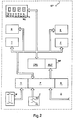
- a functional diagram of these single-place parking meters is shown in FIG. 2. Since the single-place parking meters are implemented with the aid of a microcomputer, each of these single-place parking meters contains a microprocessor MP, which contains the usual central unit CPU and the sequence control ALP.
- the sequence control ALP receives its commands from the program memory P. This defines the traffic between the display A, the various memory parts G, T, E, Z, the coin validator M, the function input F and the central control device ZST via the transmission line Ü.
- the display A in each individual parking meter EP is essentially structured like the display A of the clock in the central control, i.e. there are four display positions of an electronic 7-segment display. This also includes 7 indicator lights Wo, which are marked with the days of the week Monday to Sunday. A time display appears in digital form on the four display positions of display A, and at the same time one of the lamps of the weekly display Wo burns.
- the memory parts G, T, E, and Z are shown here as individual memories because this simplifies the overview in connection with the functional description. However, it must be pointed out that, of course, all of these memories are integrated in a common module, which is a read-write memory and where different memory locations each represent one of the four individual memories shown. These four memory parts are the charge memory G, the tariff memory T, the result memory E and the time of day memory Z.
- the time of day memory Z receives the current time of day from the central control unit ZST. What is stored here matches what is displayed by means of the clock U in the central control unit ZST.
- the result memory E also contains a time, namely the departure time by which the parking customer has paid his parking fee.
- the content of the result memory E is displayed on the display unit A until the parking fee is paid or until the parking space is occupied if a sensor is present.
- the tariff memory T serves the data from the Setting units T, MB, AZ and WT are specified, to be saved within each individual parking meter EP and to be available for the calculation of the parking time.
- the charge memory G is only required if coins are thrown into the single-place parking meter EP in order to determine the departure time from the current time of day and the parking time to be calculated in accordance with the charges. The operation will be described later.
- the coin validator M is a unit with the aid of which, on the one hand, a inserted coin is checked as to whether it represents a permissible tariff coin or whether it is an impermissible coin or a counterfeit or the like.
- the coin validator M is shown in Fig. 2 so that it contains a plurality of contacts. Any valid, i.e. A contact is assigned to each permitted tariff coin. How the coins are processed in detail will be described later in connection with the functioning of the device.
- a function control unit F is also provided, which according to FIG. 2 has two contacts K 1 and K 2; one contact K 1 represents a switch that can be closed, for example, by a key or the like by the supervisor in order to trigger a control process.
- the second contact K 2 is intended to clarify a sensor that responds when a vehicle enters the parking box. Certain functions within the single-place parking meter EP can also be triggered by such a sensor, as represented by the contact K 2.
- the coin validator M is set up for three coin types, 0.50 DM, 1.00 DM and 2.00 DM. Each of these coins closes another of the contacts in the coin validator M under the control of the coin validator.
- the signals given by this are transmitted by the microprocessor MP encodes and then generates a corresponding default in the fee memory G. For example, a 0.50 DM coin would cause five pulses to be stored in the fee memory G, while a 1.00 DM coin would bring 10 pulses into the fee memory G and a 2. - DM coin 20 pulses.
- the individual tariff data are now in the tariff memory T, for example.
- the fee memory G is then gradually counted empty and a corresponding number of minutes is added to the content of the time of day memory Z, which corresponds to the respectively valid in Tariff memory T corresponds to the stored tariff.
- the result is then stored in the result memory E.
- This calculation process is carried out for each coin inserted, at the end of each individual calculation process the content of the result memory appears on the display A.
- Fig. 2 in this Einzelplatzparkuhr the parking fee is paid until Monday 9 23:00. But the current time is obtained from the central control unit ZST with Thursday 18 ° 5am.
- the parking customer parking has therefore paid his parking fee for about four days in advance.
- the content of the result memory E is compared again and again with the content of the current time of day memory Z by means of the central processing unit CPU.
- display A is deleted.
- the central unit CPU and a follow-up control N in the form of a specific subroutine in the program memory P now cause a number of special characters to appear on the display.
- these special characters can consist of the middle bar of the four display positions being switched on, so that four lines appear next to each other on display A. These four lines indicate that the parking customer, if he has not yet picked up his vehicle, has only briefly exceeded the paid parking time.
- the run-on control N deletes one line after the other on the display A, from which one can see at the same time by how much the parking time has been exceeded. Assuming that, for example, a display position is completely deleted every 5 minutes, the controller can simultaneously recognize when the waiting period has expired.
- the program memory P is programmed so that the result memory E, which was available during the actual parking time of the display A, retains its content and only then is deleted when a new coin has been inserted or the contact K 2 was opened beforehand. This means that the old parking customer has left or that a new parking customer has appeared. The content of the result memory E is retained in the time until the new parking customer arrives.
- this message in any case deletes the result memory E. If the parking customer drives away before his time credit has been used up, the same will expire.
- the process according to (b) can be repeated any number of times until it is reported by contact K 2 or by inserting a coin that the old parking customer has left or a new one has arrived.
Landscapes
- Physics & Mathematics (AREA)
- General Physics & Mathematics (AREA)
- Business, Economics & Management (AREA)
- Finance (AREA)
- Devices For Checking Fares Or Tickets At Control Points (AREA)
- Management, Administration, Business Operations System, And Electronic Commerce (AREA)
- Time Recorders, Dirve Recorders, Access Control (AREA)
- Traffic Control Systems (AREA)
Claims (11)
Applications Claiming Priority (2)
| Application Number | Priority Date | Filing Date | Title |
|---|---|---|---|
| DE19772744768 DE2744768A1 (de) | 1977-10-05 | 1977-10-05 | Elektronisches parkhausueberwachungssystem |
| DE2744768 | 1977-10-05 |
Publications (2)
| Publication Number | Publication Date |
|---|---|
| EP0001416A1 EP0001416A1 (fr) | 1979-04-18 |
| EP0001416B1 true EP0001416B1 (fr) | 1981-05-06 |
Family
ID=6020704
Family Applications (1)
| Application Number | Title | Priority Date | Filing Date |
|---|---|---|---|
| EP78100937A Expired EP0001416B1 (fr) | 1977-10-05 | 1978-09-20 | Système électronique de contrôle d'un parc de stationnement |
Country Status (4)
| Country | Link |
|---|---|
| US (1) | US4228519A (fr) |
| EP (1) | EP0001416B1 (fr) |
| JP (1) | JPS5462000A (fr) |
| DE (1) | DE2744768A1 (fr) |
Families Citing this family (24)
| Publication number | Priority date | Publication date | Assignee | Title |
|---|---|---|---|---|
| US4379334A (en) * | 1980-10-28 | 1983-04-05 | Allright Auto Parks, Inc. | Electronic parking meter |
| SE433014B (sv) * | 1982-02-04 | 1984-04-30 | Cale Ind Ab | Parkeringsanleggning, foretredesvis for cyklar |
| US4532418A (en) * | 1982-08-30 | 1985-07-30 | The Detroit Edison Company | Microprocessor electric vehicle charging and parking meter system structure and method |
| SE437735B (sv) * | 1983-10-13 | 1985-03-11 | Andersson Carl Axel | Parkeringsautomat |
| FR2583186B1 (fr) * | 1985-06-07 | 1987-10-02 | Flonic Sa | Systeme de gestion de stationnement payant |
| FR2584515B1 (fr) * | 1985-07-02 | 1987-10-02 | Flonic Sa | Systeme d'interconnexion de bornes a memoire |
| US4817131A (en) * | 1986-06-20 | 1989-03-28 | Badger Meter, Inc. | Automatic meter reading system |
| US4880097A (en) * | 1987-04-16 | 1989-11-14 | Pom Incorporated | Park card system for electronic parking meter |
| US4967895A (en) * | 1987-04-16 | 1990-11-06 | Pom, Incorporated | Parameter control system for electronic parking meter |
| US4827206A (en) * | 1987-04-16 | 1989-05-02 | Pom, Incorporated | Solar power system for electronic parking meter |
| US4823928A (en) * | 1987-04-16 | 1989-04-25 | Pom Incorporated | Electronic parking meter system |
| US4895238A (en) * | 1987-04-16 | 1990-01-23 | Pom, Incorporated | Coin discriminator for electronic parking meter |
| US5103957A (en) * | 1989-06-15 | 1992-04-14 | Am/Pm Parking Systems, Inc. | Programmable electronic parking meter with communications interface |
| US5263118A (en) * | 1990-03-13 | 1993-11-16 | Applied Voice Technology, Inc. | Parking ticket enforcement system |
| US5091727A (en) * | 1990-10-14 | 1992-02-25 | Shahjahan Mahmood | Fully optimized automatic parking facility management system |
| US5360095A (en) * | 1992-04-07 | 1994-11-01 | Pom Incorporated | Power conserving electronic parking meter |
| US5507378A (en) * | 1994-11-03 | 1996-04-16 | Tricom Corporation | Coin box receptacle |
| JP2001505677A (ja) * | 1996-08-09 | 2001-04-24 | クリークラー・アゲノール | パーキングメータ |
| US6037880A (en) * | 1996-09-23 | 2000-03-14 | Manion; Jeffrey Charles | Integrated parking meter system |
| US6243028B1 (en) | 1996-12-13 | 2001-06-05 | Agenor Krygler | Parking meter |
| KR20020005350A (ko) * | 2000-07-06 | 2002-01-17 | 김선용 | 노상주차 관리장치 |
| US20070016539A1 (en) * | 2005-07-13 | 2007-01-18 | Eric Groft | Smart meter parking system |
| IL206919A0 (en) | 2009-07-13 | 2010-12-30 | Innova Park Llc | Meterless remote parking monitoring system and process |
| US9672741B2 (en) | 2015-06-08 | 2017-06-06 | Inrix Inc. | Parking occupancy estimation |
Family Cites Families (16)
| Publication number | Priority date | Publication date | Assignee | Title |
|---|---|---|---|---|
| US3603960A (en) * | 1969-02-25 | 1971-09-07 | Albert Sanchez | Parking charge display device |
| US3641314A (en) * | 1970-04-10 | 1972-02-08 | Aaron L Abramson | Time coded, coin control gate system |
| JPS4934899A (fr) * | 1972-07-28 | 1974-03-30 | ||
| JPS49118500A (fr) * | 1973-03-12 | 1974-11-12 | ||
| US3948375A (en) * | 1973-07-09 | 1976-04-06 | Selby Jr Clark L | Self-enforcing parking system |
| CH589329A5 (fr) * | 1974-11-15 | 1977-06-30 | Kolben Felix David | |
| SE377504B (fr) * | 1974-01-21 | 1975-07-07 | Cale Ind Ab | |
| SE381354B (sv) * | 1974-04-17 | 1975-12-01 | Knorring A Von | Parkeringsautomat |
| US3930363A (en) * | 1974-07-19 | 1976-01-06 | Burrell R. Rubenstein | Parking meter |
| JPS5848950B2 (ja) * | 1975-01-08 | 1983-11-01 | 株式会社東芝 | 料金収受装置 |
| US4005571A (en) * | 1975-11-06 | 1977-02-01 | Emanuel Wolff | Elapsed time reminder with conversion of calendar days into elapsed time |
| US4031991A (en) * | 1975-12-29 | 1977-06-28 | Qonaar Corporation | Coin operated electronic parking meter |
| FR2339216A1 (fr) * | 1976-01-21 | 1977-08-19 | Euro Export | Perfectionnements aux parcmetres |
| DE2606856A1 (de) * | 1976-02-20 | 1977-08-25 | Vdo Schindling | Zeitkontrollsystem |
| CH595667A5 (fr) * | 1976-02-16 | 1978-02-15 | Vdo Schindling | |
| DE2608844A1 (de) * | 1976-03-04 | 1977-09-08 | Vdo Schindling | Zeitkontrollsystem |
-
1977
- 1977-10-05 DE DE19772744768 patent/DE2744768A1/de not_active Withdrawn
-
1978
- 1978-09-20 EP EP78100937A patent/EP0001416B1/fr not_active Expired
- 1978-10-03 JP JP12190778A patent/JPS5462000A/ja active Pending
- 1978-10-04 US US05/948,407 patent/US4228519A/en not_active Expired - Lifetime
Also Published As
| Publication number | Publication date |
|---|---|
| EP0001416A1 (fr) | 1979-04-18 |
| JPS5462000A (en) | 1979-05-18 |
| DE2744768A1 (de) | 1979-04-19 |
| US4228519A (en) | 1980-10-14 |
Similar Documents
| Publication | Publication Date | Title |
|---|---|---|
| EP0001416B1 (fr) | Système électronique de contrôle d'un parc de stationnement | |
| EP0006403B1 (fr) | Système de compartiments verrouillables commandé par un processeur central | |
| DE69012439T2 (de) | Tragbare Parkzeitmessvorrichtung und Verfahren zum Betreiben derselben. | |
| DE4233675A1 (de) | Muenzbetaetigtes spiel | |
| DE2747437A1 (de) | Gebuehrenanzeigevorrichtung | |
| DE68916933T2 (de) | Vorrichtung und parkkreditkarten mit kontinuierlich einstellbarer parkgebührrate. | |
| DE69109075T2 (de) | Kontrollvorrichtung in einem Buchhaltungssystem für gesetzlich geregeltes Parken. | |
| DE3143047C2 (de) | Parkzeitanzeigevorrichtung | |
| DE2304127A1 (de) | Fahrkarten- und wechselgeldausgabesystem | |
| EP1326218A2 (fr) | Parcmètre | |
| DE4314003A1 (de) | Zeitkontrollvorrichtung | |
| DE2423684A1 (de) | Vorrichtung zum automatischen betrieb eines fahrzeugparkplatzes, -parkhauses od. dgl | |
| EP0103812B1 (fr) | Taximètre électronique avec mémoire du temps réel | |
| DE1524614B2 (de) | Verfahren und vorrichtung zur ermittlung und erhebung von parkgebuehren | |
| DE2039768C (de) | Vorrichtung zur Tarifumschaltung von vorzugsweise in Parkhäusern aufgestellten Parkuhren | |
| EP0917693B1 (fr) | Parcmetre | |
| DE1524614C3 (de) | Verfahren und Vorrichtung zur Ermittlung und Erhebung von Parkgebühren | |
| DE2233563A1 (de) | Automatische abfertigungsanlage fuer kostenpflichtige parkplaetze | |
| DE2721112A1 (de) | Automat zur abgabe von scheinen mit bestimmter gueltigkeitsdauer, insbesondere von parkscheinen | |
| DE2039768B2 (de) | Vorrichtung zur tarifumschaltung von vorzugsweise in parkhaeusern aufgestellten parkuhren | |
| WO1991002332A1 (fr) | Procede et dispositif pour gerer le coefficient d'occupation d'installations soumises au paiement d'une taxe | |
| EP1038273A1 (fr) | Appareil automatique pour parking | |
| EP0467209A2 (fr) | Compteur de distance | |
| AT236151B (de) | Verkaufsautomat für Fahrkarten | |
| EP0658860B1 (fr) | Taximètre |
Legal Events
| Date | Code | Title | Description |
|---|---|---|---|
| PUAI | Public reference made under article 153(3) epc to a published international application that has entered the european phase |
Free format text: ORIGINAL CODE: 0009012 |
|
| AK | Designated contracting states |
Designated state(s): CH FR GB NL SE |
|
| 17P | Request for examination filed | ||
| GRAA | (expected) grant |
Free format text: ORIGINAL CODE: 0009210 |
|
| AK | Designated contracting states |
Designated state(s): CH FR GB NL SE |
|
| PGFP | Annual fee paid to national office [announced via postgrant information from national office to epo] |
Ref country code: SE Payment date: 19810731 Year of fee payment: 4 |
|
| PGFP | Annual fee paid to national office [announced via postgrant information from national office to epo] |
Ref country code: FR Payment date: 19810814 Year of fee payment: 4 |
|
| PGFP | Annual fee paid to national office [announced via postgrant information from national office to epo] |
Ref country code: NL Payment date: 19810930 Year of fee payment: 4 |
|
| PG25 | Lapsed in a contracting state [announced via postgrant information from national office to epo] |
Ref country code: SE Effective date: 19820903 |
|
| PG25 | Lapsed in a contracting state [announced via postgrant information from national office to epo] |
Ref country code: NL Effective date: 19830401 |
|
| NLV4 | Nl: lapsed or anulled due to non-payment of the annual fee | ||
| PG25 | Lapsed in a contracting state [announced via postgrant information from national office to epo] |
Ref country code: FR Free format text: LAPSE BECAUSE OF NON-PAYMENT OF DUE FEES Effective date: 19830630 |
|
| REG | Reference to a national code |
Ref country code: FR Ref legal event code: ST |
|
| PGFP | Annual fee paid to national office [announced via postgrant information from national office to epo] |
Ref country code: CH Payment date: 19830822 Year of fee payment: 6 |
|
| GBPC | Gb: european patent ceased through non-payment of renewal fee | ||
| PG25 | Lapsed in a contracting state [announced via postgrant information from national office to epo] |
Ref country code: CH Effective date: 19840930 |
|
| REG | Reference to a national code |
Ref country code: CH Ref legal event code: PL |
|
| PG25 | Lapsed in a contracting state [announced via postgrant information from national office to epo] |
Ref country code: GB Effective date: 19881117 |
|
| EUG | Se: european patent has lapsed |
Ref document number: 78100937.8 Effective date: 19850611 |
|
| PLBE | No opposition filed within time limit |
Free format text: ORIGINAL CODE: 0009261 |
|
| STAA | Information on the status of an ep patent application or granted ep patent |
Free format text: STATUS: NO OPPOSITION FILED WITHIN TIME LIMIT |