EP0001596A2 - Procédé de fabrication de polycondensats urée-formaldéhyde aqueux - Google Patents
Procédé de fabrication de polycondensats urée-formaldéhyde aqueux Download PDFInfo
- Publication number
- EP0001596A2 EP0001596A2 EP78101079A EP78101079A EP0001596A2 EP 0001596 A2 EP0001596 A2 EP 0001596A2 EP 78101079 A EP78101079 A EP 78101079A EP 78101079 A EP78101079 A EP 78101079A EP 0001596 A2 EP0001596 A2 EP 0001596A2
- Authority
- EP
- European Patent Office
- Prior art keywords
- formaldehyde
- urea
- molar ratio
- aqueous
- solution
- Prior art date
- Legal status (The legal status is an assumption and is not a legal conclusion. Google has not performed a legal analysis and makes no representation as to the accuracy of the status listed.)
- Granted
Links
- 238000000034 method Methods 0.000 title claims description 19
- 229920001807 Urea-formaldehyde Polymers 0.000 title claims description 9
- ODGAOXROABLFNM-UHFFFAOYSA-N polynoxylin Chemical compound O=C.NC(N)=O ODGAOXROABLFNM-UHFFFAOYSA-N 0.000 title claims description 7
- 239000007859 condensation product Substances 0.000 title claims description 4
- 238000004519 manufacturing process Methods 0.000 title description 8
- WSFSSNUMVMOOMR-UHFFFAOYSA-N Formaldehyde Chemical compound O=C WSFSSNUMVMOOMR-UHFFFAOYSA-N 0.000 claims abstract description 122
- XSQUKJJJFZCRTK-UHFFFAOYSA-N Urea Chemical compound NC(N)=O XSQUKJJJFZCRTK-UHFFFAOYSA-N 0.000 claims abstract description 63
- 229920005989 resin Polymers 0.000 claims abstract description 45
- 239000011347 resin Substances 0.000 claims abstract description 45
- 239000004202 carbamide Substances 0.000 claims abstract description 32
- 239000003292 glue Substances 0.000 claims abstract description 29
- JDSHMPZPIAZGSV-UHFFFAOYSA-N melamine Chemical compound NC1=NC(N)=NC(N)=N1 JDSHMPZPIAZGSV-UHFFFAOYSA-N 0.000 claims abstract description 12
- 229920000877 Melamine resin Polymers 0.000 claims abstract description 10
- 239000000203 mixture Substances 0.000 claims abstract description 9
- 239000002023 wood Substances 0.000 claims abstract description 7
- 229920003180 amino resin Polymers 0.000 claims abstract description 5
- 230000005494 condensation Effects 0.000 claims description 13
- 238000009833 condensation Methods 0.000 claims description 12
- 238000006243 chemical reaction Methods 0.000 claims description 11
- XLYOFNOQVPJJNP-UHFFFAOYSA-N water Substances O XLYOFNOQVPJJNP-UHFFFAOYSA-N 0.000 claims description 11
- 239000000853 adhesive Substances 0.000 claims description 9
- 239000007795 chemical reaction product Substances 0.000 claims description 6
- 239000011093 chipboard Substances 0.000 claims description 5
- 238000002360 preparation method Methods 0.000 claims description 5
- -1 methylol compound Chemical class 0.000 abstract description 3
- OKKJLVBELUTLKV-UHFFFAOYSA-N methanol Natural products OC OKKJLVBELUTLKV-UHFFFAOYSA-N 0.000 abstract 2
- 239000000243 solution Substances 0.000 description 41
- HEMHJVSKTPXQMS-UHFFFAOYSA-M Sodium hydroxide Chemical compound [OH-].[Na+] HEMHJVSKTPXQMS-UHFFFAOYSA-M 0.000 description 15
- 238000009826 distribution Methods 0.000 description 14
- 239000000047 product Substances 0.000 description 11
- ZMXDDKWLCZADIW-UHFFFAOYSA-N N,N-Dimethylformamide Chemical compound CN(C)C=O ZMXDDKWLCZADIW-UHFFFAOYSA-N 0.000 description 8
- 239000012141 concentrate Substances 0.000 description 8
- 230000001070 adhesive effect Effects 0.000 description 7
- 238000004026 adhesive bonding Methods 0.000 description 6
- BDAGIHXWWSANSR-UHFFFAOYSA-N methanoic acid Natural products OC=O BDAGIHXWWSANSR-UHFFFAOYSA-N 0.000 description 6
- 239000000463 material Substances 0.000 description 5
- 239000002245 particle Substances 0.000 description 5
- 238000005227 gel permeation chromatography Methods 0.000 description 4
- 239000007787 solid Substances 0.000 description 4
- 239000002904 solvent Substances 0.000 description 4
- OSWFIVFLDKOXQC-UHFFFAOYSA-N 4-(3-methoxyphenyl)aniline Chemical compound COC1=CC=CC(C=2C=CC(N)=CC=2)=C1 OSWFIVFLDKOXQC-UHFFFAOYSA-N 0.000 description 3
- 235000019253 formic acid Nutrition 0.000 description 3
- WSFSSNUMVMOOMR-NJFSPNSNSA-N methanone Chemical compound O=[14CH2] WSFSSNUMVMOOMR-NJFSPNSNSA-N 0.000 description 3
- 238000002156 mixing Methods 0.000 description 3
- 238000003825 pressing Methods 0.000 description 3
- 238000003756 stirring Methods 0.000 description 3
- 238000012360 testing method Methods 0.000 description 3
- 239000000654 additive Substances 0.000 description 2
- 150000008044 alkali metal hydroxides Chemical class 0.000 description 2
- 239000007864 aqueous solution Substances 0.000 description 2
- 230000000694 effects Effects 0.000 description 2
- 239000008098 formaldehyde solution Substances 0.000 description 2
- 238000005259 measurement Methods 0.000 description 2
- 229940056960 melamin Drugs 0.000 description 2
- 229920000642 polymer Polymers 0.000 description 2
- 239000002994 raw material Substances 0.000 description 2
- 239000003643 water by type Substances 0.000 description 2
- LSNNMFCWUKXFEE-UHFFFAOYSA-N Sulfurous acid Chemical compound OS(O)=O LSNNMFCWUKXFEE-UHFFFAOYSA-N 0.000 description 1
- 229920002522 Wood fibre Polymers 0.000 description 1
- 239000003929 acidic solution Substances 0.000 description 1
- 238000001311 chemical methods and process Methods 0.000 description 1
- 238000005520 cutting process Methods 0.000 description 1
- 230000018044 dehydration Effects 0.000 description 1
- 238000006297 dehydration reaction Methods 0.000 description 1
- 230000001419 dependent effect Effects 0.000 description 1
- 238000007865 diluting Methods 0.000 description 1
- 238000010438 heat treatment Methods 0.000 description 1
- 238000011835 investigation Methods 0.000 description 1
- 229920002521 macromolecule Polymers 0.000 description 1
- 230000007935 neutral effect Effects 0.000 description 1
- 229920001568 phenolic resin Polymers 0.000 description 1
- 238000012545 processing Methods 0.000 description 1
- 238000003860 storage Methods 0.000 description 1
- 238000013517 stratification Methods 0.000 description 1
- 239000000126 substance Substances 0.000 description 1
- 230000007704 transition Effects 0.000 description 1
- 210000002700 urine Anatomy 0.000 description 1
- 239000002699 waste material Substances 0.000 description 1
- 239000002025 wood fiber Substances 0.000 description 1
Images



Classifications
-
- C—CHEMISTRY; METALLURGY
- C09—DYES; PAINTS; POLISHES; NATURAL RESINS; ADHESIVES; COMPOSITIONS NOT OTHERWISE PROVIDED FOR; APPLICATIONS OF MATERIALS NOT OTHERWISE PROVIDED FOR
- C09J—ADHESIVES; NON-MECHANICAL ASPECTS OF ADHESIVE PROCESSES IN GENERAL; ADHESIVE PROCESSES NOT PROVIDED FOR ELSEWHERE; USE OF MATERIALS AS ADHESIVES
- C09J161/00—Adhesives based on condensation polymers of aldehydes or ketones; Adhesives based on derivatives of such polymers
- C09J161/20—Condensation polymers of aldehydes or ketones with only compounds containing hydrogen attached to nitrogen
- C09J161/30—Condensation polymers of aldehydes or ketones with only compounds containing hydrogen attached to nitrogen of aldehydes with heterocyclic and acyclic or carbocyclic compounds
-
- C—CHEMISTRY; METALLURGY
- C08—ORGANIC MACROMOLECULAR COMPOUNDS; THEIR PREPARATION OR CHEMICAL WORKING-UP; COMPOSITIONS BASED THEREON
- C08G—MACROMOLECULAR COMPOUNDS OBTAINED OTHERWISE THAN BY REACTIONS ONLY INVOLVING UNSATURATED CARBON-TO-CARBON BONDS
- C08G12/00—Condensation polymers of aldehydes or ketones with only compounds containing hydrogen attached to nitrogen
- C08G12/02—Condensation polymers of aldehydes or ketones with only compounds containing hydrogen attached to nitrogen of aldehydes
- C08G12/04—Condensation polymers of aldehydes or ketones with only compounds containing hydrogen attached to nitrogen of aldehydes with acyclic or carbocyclic compounds
- C08G12/10—Condensation polymers of aldehydes or ketones with only compounds containing hydrogen attached to nitrogen of aldehydes with acyclic or carbocyclic compounds with acyclic compounds having the moiety X=C(—N<)2 in which X is O, S or —N
- C08G12/12—Ureas; Thioureas
-
- C—CHEMISTRY; METALLURGY
- C08—ORGANIC MACROMOLECULAR COMPOUNDS; THEIR PREPARATION OR CHEMICAL WORKING-UP; COMPOSITIONS BASED THEREON
- C08G—MACROMOLECULAR COMPOUNDS OBTAINED OTHERWISE THAN BY REACTIONS ONLY INVOLVING UNSATURATED CARBON-TO-CARBON BONDS
- C08G12/00—Condensation polymers of aldehydes or ketones with only compounds containing hydrogen attached to nitrogen
- C08G12/02—Condensation polymers of aldehydes or ketones with only compounds containing hydrogen attached to nitrogen of aldehydes
- C08G12/26—Condensation polymers of aldehydes or ketones with only compounds containing hydrogen attached to nitrogen of aldehydes with heterocyclic compounds
- C08G12/34—Condensation polymers of aldehydes or ketones with only compounds containing hydrogen attached to nitrogen of aldehydes with heterocyclic compounds and acyclic or carbocyclic compounds
- C08G12/36—Ureas; Thioureas
- C08G12/38—Ureas; Thioureas and melamines
-
- C—CHEMISTRY; METALLURGY
- C09—DYES; PAINTS; POLISHES; NATURAL RESINS; ADHESIVES; COMPOSITIONS NOT OTHERWISE PROVIDED FOR; APPLICATIONS OF MATERIALS NOT OTHERWISE PROVIDED FOR
- C09J—ADHESIVES; NON-MECHANICAL ASPECTS OF ADHESIVE PROCESSES IN GENERAL; ADHESIVE PROCESSES NOT PROVIDED FOR ELSEWHERE; USE OF MATERIALS AS ADHESIVES
- C09J161/00—Adhesives based on condensation polymers of aldehydes or ketones; Adhesives based on derivatives of such polymers
- C09J161/20—Condensation polymers of aldehydes or ketones with only compounds containing hydrogen attached to nitrogen
- C09J161/22—Condensation polymers of aldehydes or ketones with only compounds containing hydrogen attached to nitrogen of aldehydes with acyclic or carbocyclic compounds
- C09J161/24—Condensation polymers of aldehydes or ketones with only compounds containing hydrogen attached to nitrogen of aldehydes with acyclic or carbocyclic compounds with urea or thiourea
Definitions
- the invention relates to a process for the production of aminoplastic resins consisting essentially of urea and formaldehyde, the aqueous solutions of which are suitable for gluing (gluing) wood or for producing wood-based materials and have improved pre-adhesive or cold-adhesive properties.
- cold tack refers to the property of an adhesive to hold the parts of the material to be bonded together by cohesion in the moist state, ie even before setting or curing.
- the invention has set itself the task of improving the cold stickiness and other desired properties of aminoplastic glue resins by measures in the condensation.
- resin (C) The resin product according to the invention obtained in this way is also referred to below as resin (C) (the labels above have nothing to do with the names customary in the chemistry of phenoplasts).
- the process for producing the cold-adhesive glue resin solutions succeeds within the specified characteristic limits with good success, but particularly good properties of the resins, also with regard to the properties of the materials to be produced therewith, are achieved under the preferred conditions explained below. In addition, it is advisable to adhere to the rules known to the person skilled in the art, in particular not to select any conditions that can be regarded as extremes acting in the same direction.
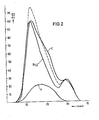
- the mode of operation of the invention appears to be based on the fact that the resin solution contains molecules of three different size classes. In any case, the investigation of the molecular weight distribution has shown that there is a distribution with three German maxima.
- GPC gel permeation chromatography
- the distribution curves shown as an appendix to the following examples are relative refractive indices measured as a function of the throughput quantity (v).
- the curves thus represent the mass frequency of the MG distribution.
- the products which were used to prepare the resins according to the invention also show that as a conventional glue resin with a low F: H ratio, resin (B) and the formaldehyde addition product with a high F: H ratio (A) have a molecular weight distribution which is in principle found in the end product.
- urea possibly partially - e.g. up to 40% by weight - replaced by melamine
- aqueous formaldehyde are first converted to precondensates which tend to be low molecular weight.
- This process proceeds most rapidly under weakly alkaline conditions (pH 8 to 9) and is therefore conducted under the influence of small amounts of alkali metal hydroxide in order to counter the tendency to decrease the pH.
- Urea can of course also be used in the form of the industrially customary concentrated aqueous solutions and up to about 40% by weight of the urea can be replaced by melamine, if this is desired.
- the use of melamine is e.g. important for the water resistance of the glues.
- glue resins (B) are also suitable as a urea source for the production of glue resins (B)
- addition products of formaldehyde and urea which are technically common suppliers of formaldehyde.
- Such addition products can, for example, according to DE-OS 16 43 705, 17 68 987, 19 51 877 and DE-AS 16 45 016 or DE-PS 1 239 290 can be obtained.
- They generally have an F: H molar ratio of 5: 1 to 3: 1 and, as explained below, also serve later for reaction with the resin products described here in advance. In this context, they are referred to as glue component A.
- the aqueous precondensates which tend to have a dry content of 30 to 70% after the alkaline reaction phase, are adjusted to pH 3 to 5.5, preferably 4 to 4.5 (for example by adding formic acid) and are then condensed to at the beginning of water intolerance, ie as far as possible.
- the condensation temperature 80 to 100 ° C
- the condensation generally 10 to 30 minutes to complete.
- the cloud point is determined which is at 3 to 30 ° C, preferably 5 to 20 ° C, i.e. should be water intolerance starting at room temperature.
- precondensate (A) formaldehyde-rich precondensates
- precondensate (A) formaldehyde-rich precondensates
- the condensation is interrupted by adding alkali metal hydroxide solution up to a pH of 6.5 to 7.5 (neutral point) and enough urea is added that a molar ratio of 1: 1 to 1.7: 1 , preferably 1: 1 to 1.5: 1 is achieved; a molar ratio of 1.2: 1 to 1.4: 1 is particularly preferred.
- the urine The condensate accumulates in a known manner; if necessary, the aqueous resin solution obtained can be concentrated to a solids content of 55 to 70%, preferably 55 to 60%, preferably under reduced pressure.
- the diluted resin solution is designated B 1 in the examples, while it is listed as B 2 after the concentration.
- the resin solution B 2 has a density of 1.26 to 1.29 (g / cm 3 ), 0.1 to 0.3% free formaldehyde, 8 to 12% N-methylol content, a viscosity of 400 to 1,200 mPa.s (see table la to b).
- a high-molecular resin is difficult to process directly as glue because of its difficult handling and also has a disadvantage in that it apparently lacks the low-molecular components which are considered responsible for the glue's binding to the wood fiber ; the result is a strong tendency of such wood materials to swell (presumably because the impregnating effect of the glue is lacking) and a reduced transverse tensile strength.
- the invention is based, simplified, on the fact that such an unusual resin, although obtained in a manner known per se, is mixed with a special "solvent".
- the solvent used is a urea-containing formaldehyde concentrate (A), as described above. Suitable formaldehyde concentrates are also commercially available.
- the formaldehyde concentrates mentioned are obtained either by introducing gaseous formaldehyde into alkaline urea solutions or into acidic solutions of urea precondensates which have a certain minimum molar ratio; they are a convenient form of handling concentrated formaldehyde solutions. They are not suitable as adhesives (glues).
- the resin (B or B 2 ) is mixed with the formaldehyde-rich concentrate (A) in an amount such that a (mixture total) molar ratio of, for example, 1.1 to 1.8: 1. Since this range can overlap with the range of the molar ratio of the resin B in question, the rule is that the mixture changes with the formaldehyde addition product A, the molar ratio changes by at least 0.1 (ie increased).
- the glue component A is then allowed to react with the glue component B 2 at temperatures from 20 to 60 ° C. for 2 to 24 hours, and the reaction product obtained is a solution of a resin C with optimal "cold tack properties".
- the quantity ratio of the glue component A to the glue component B 2 can be selected depending on the property values of both and the desired setting of the molar ratio of urea to formaldehyde in the finished reaction product C (for example 3 to 30 parts of A to 100 parts of B 2 , each based on solid based on solid).
- the resin solution B 1 obtained in this way is then concentrated, for example in a suitable vacuum evaporator, by removing water to a density of 1.286 (g / cm 3 ), then cooled to room temperature and the resin solution B 2 is obtained (for data see Table 1; technical data) Data of a particle board made from it, Table 1). .
- Each 100 parts by weight of resin solution B 2 is mixed with approx. 34 parts by weight of a urea-containing formaldehyde concentrate, which is referred to below as A 50 and has a molar ratio of formaldehyde to urea of 3.9: 1 (for other data see Table 1) at room temperature in one Mixing kettle mixed.
- the reaction now set in is allowed to proceed for about 24 hours. After that there is no significant change and the resin solution is ready to use.
- a product C according to the invention having the properties shown in Table 1 is obtained.
- the distribution of the molecular sizes determined by gel permeation chromatography is shown in Figure 1.
- Trü b ungshuidom In this case, a sample of 10 ml is placed in a test tube, granulated, mixed with 10 ml hot water and stirring make - cools. The temperature read when a milky cloudiness occurs is the cloud point sought.
- the resin solution B 1 obtained is concentrated to a density of 1.276 by dehydration.
- a resin solution B 2 with the properties shown in Table 1 is obtained.
- the glued chips are carefully placed into a mold (press box) by hand, with no stratification of the individual chip part sizes (pouring time about 1 to 3 minutes).
- the chips thus deposited are pressed together in a cold press in the press box (at 20 to 25 ° C. and 50 to 60% relative atmospheric humidity) to a certain press cake height (for example 24 mm) (press pressure about 20 kp / mm 2 , press time 20 minutes).
- a certain press cake height for example 24 mm
- press pressure about 20 kp / mm 2 , press time 20 minutes
- the cold-pressed press cake is removed from the press frame and left free in the room for 10 minutes; then measure the thickness of the press cake in at least 8 places and calculate an average.
- the average height of the cold-pressed press cake after 10 minutes (h) serves as a measure of the cold tack in percent (cold tack index):
- the springback method is a realistic method.
- a standard of comparison should always be included.
- the size of the cold tack depends on many test conditions: room temperature, air humidity, mixer type and mixing size (dimensions), particle size distribution and change in particle size distribution during mixing, pressing conditions such as: thickness and size of the press cake, chip moisture, cutting temperature, pressing pressure, closing speed of the cold press, gluing time of the Chips, pouring time of the glued Chips, bulk weight and pouring process. Such parameters must be kept constant in order to achieve reliable comparison values.
Landscapes
- Chemical & Material Sciences (AREA)
- Organic Chemistry (AREA)
- Health & Medical Sciences (AREA)
- Chemical Kinetics & Catalysis (AREA)
- Medicinal Chemistry (AREA)
- Polymers & Plastics (AREA)
- Phenolic Resins Or Amino Resins (AREA)
Applications Claiming Priority (2)
| Application Number | Priority Date | Filing Date | Title |
|---|---|---|---|
| DE19772747830 DE2747830A1 (de) | 1977-10-26 | 1977-10-26 | Verfahren zur herstellung von holzleimen |
| DE2747830 | 1977-10-26 |
Publications (3)
| Publication Number | Publication Date |
|---|---|
| EP0001596A2 true EP0001596A2 (fr) | 1979-05-02 |
| EP0001596A3 EP0001596A3 (en) | 1979-07-11 |
| EP0001596B1 EP0001596B1 (fr) | 1982-05-26 |
Family
ID=6022206
Family Applications (1)
| Application Number | Title | Priority Date | Filing Date |
|---|---|---|---|
| EP78101079A Expired EP0001596B1 (fr) | 1977-10-26 | 1978-10-06 | Procédé de fabrication de polycondensats urée-formaldéhyde aqueux |
Country Status (5)
| Country | Link |
|---|---|
| EP (1) | EP0001596B1 (fr) |
| AT (1) | AT362850B (fr) |
| DE (2) | DE2747830A1 (fr) |
| DK (1) | DK473878A (fr) |
| IT (1) | IT1099447B (fr) |
Cited By (10)
| Publication number | Priority date | Publication date | Assignee | Title |
|---|---|---|---|---|
| EP0062389A1 (fr) * | 1981-04-07 | 1982-10-13 | METHANOL CHEMIE NEDERLAND V.o.F. | Fabrication de panneaux de particules et liant |
| EP0062900A1 (fr) * | 1981-04-15 | 1982-10-20 | BASF Aktiengesellschaft | Procédé de préparation de colles |
| FR2592382A1 (fr) * | 1985-12-30 | 1987-07-03 | Charbonnages Ste Chimique | Procede de fabrication de resines aminoplastes modifiees par un isocyanate |
| US4812366A (en) * | 1988-01-25 | 1989-03-14 | Borden Inc. | Viscosity adjustment of ammoniated urea-formaldehyde resin compositions by addition of dried urea-formaldehyde powder |
| FR2625206A1 (fr) * | 1987-12-23 | 1989-06-30 | Charbonnages Ste Chimique | Nouveau procede de fabrication de resines uree-formol contenant de la melamine |
| AU612829B2 (en) * | 1988-04-29 | 1991-07-18 | Norsolor | New process for manufacturing urea/formaldehyde resins |
| EP0743331A4 (fr) * | 1994-02-08 | 1997-01-07 | N T Predpr Ligand | Procede d'obtention d'une resine de carbamide-formaldehyde et condensat destine a sa production |
| NL1014433C2 (nl) * | 2000-02-18 | 2001-08-22 | Dsm Nv | Lijmsamenstelling met verhoogde uithardingssnelheid. |
| WO2013144226A1 (fr) * | 2012-03-29 | 2013-10-03 | Basf Se | Colle uf renforcée avec de la mélamine, renfermant jusqu'à 0,9 % de mélamine, pour la production de panneaux de fibres de densité moyenne |
| US9080086B2 (en) | 2012-03-29 | 2015-07-14 | Basf Se | Melamine-reinforced UF glues with up to 0.9% of melamine for producing medium-density fiberboard |
Family Cites Families (3)
| Publication number | Priority date | Publication date | Assignee | Title |
|---|---|---|---|---|
| DE1570240C3 (de) * | 1965-02-17 | 1982-05-27 | Basf Ag, 6700 Ludwigshafen | Verfahren zur Herstellung von Tränkharzen |
| DE2334380B1 (de) * | 1973-07-06 | 1974-09-05 | Basf Ag | Verfahren zur Herstellung eines Holzleims |
| DE2454769A1 (de) * | 1974-11-19 | 1976-05-26 | Basf Ag | Verfahren zur herstellung reaktionsfaehiger harnstoff-formaldehyd-kondensationsprodukte |
-
1977
- 1977-10-26 DE DE19772747830 patent/DE2747830A1/de active Pending
-
1978
- 1978-10-06 DE DE7878101079T patent/DE2861866D1/de not_active Expired
- 1978-10-06 EP EP78101079A patent/EP0001596B1/fr not_active Expired
- 1978-10-23 IT IT29016/78A patent/IT1099447B/it active
- 1978-10-25 DK DK473878A patent/DK473878A/da not_active Application Discontinuation
- 1978-10-25 AT AT0764478A patent/AT362850B/de not_active IP Right Cessation
Cited By (14)
| Publication number | Priority date | Publication date | Assignee | Title |
|---|---|---|---|---|
| EP0062389A1 (fr) * | 1981-04-07 | 1982-10-13 | METHANOL CHEMIE NEDERLAND V.o.F. | Fabrication de panneaux de particules et liant |
| EP0062900A1 (fr) * | 1981-04-15 | 1982-10-20 | BASF Aktiengesellschaft | Procédé de préparation de colles |
| FR2592382A1 (fr) * | 1985-12-30 | 1987-07-03 | Charbonnages Ste Chimique | Procede de fabrication de resines aminoplastes modifiees par un isocyanate |
| EP0232642A1 (fr) * | 1985-12-30 | 1987-08-19 | Elf Atochem S.A. | Procédé de fabrication de résines aminoplastes modifiées par un isocyanate |
| US5008365A (en) * | 1987-12-23 | 1991-04-16 | Norsolor (Orkem Group) | Process for the manufacture of urea-formaldehyde resins containing melamine |
| FR2625206A1 (fr) * | 1987-12-23 | 1989-06-30 | Charbonnages Ste Chimique | Nouveau procede de fabrication de resines uree-formol contenant de la melamine |
| US4812366A (en) * | 1988-01-25 | 1989-03-14 | Borden Inc. | Viscosity adjustment of ammoniated urea-formaldehyde resin compositions by addition of dried urea-formaldehyde powder |
| AU612829B2 (en) * | 1988-04-29 | 1991-07-18 | Norsolor | New process for manufacturing urea/formaldehyde resins |
| EP0743331A4 (fr) * | 1994-02-08 | 1997-01-07 | N T Predpr Ligand | Procede d'obtention d'une resine de carbamide-formaldehyde et condensat destine a sa production |
| NL1014433C2 (nl) * | 2000-02-18 | 2001-08-22 | Dsm Nv | Lijmsamenstelling met verhoogde uithardingssnelheid. |
| WO2001060937A1 (fr) * | 2000-02-18 | 2001-08-23 | Dsm N.V. | Composition adhesive avec vitesse de vulcanisation superieure |
| AU2001237802B2 (en) * | 2000-02-18 | 2004-11-25 | Oci Nitrogen B.V. | Adhesive composition with increased cure rate |
| WO2013144226A1 (fr) * | 2012-03-29 | 2013-10-03 | Basf Se | Colle uf renforcée avec de la mélamine, renfermant jusqu'à 0,9 % de mélamine, pour la production de panneaux de fibres de densité moyenne |
| US9080086B2 (en) | 2012-03-29 | 2015-07-14 | Basf Se | Melamine-reinforced UF glues with up to 0.9% of melamine for producing medium-density fiberboard |
Also Published As
| Publication number | Publication date |
|---|---|
| DK473878A (da) | 1979-04-27 |
| IT7829016A0 (it) | 1978-10-23 |
| ATA764478A (de) | 1980-11-15 |
| DE2861866D1 (en) | 1982-07-15 |
| DE2747830A1 (de) | 1979-05-10 |
| AT362850B (de) | 1981-06-25 |
| EP0001596A3 (en) | 1979-07-11 |
| EP0001596B1 (fr) | 1982-05-26 |
| IT1099447B (it) | 1985-09-18 |
Similar Documents
| Publication | Publication Date | Title |
|---|---|---|
| EP0001596B1 (fr) | Procédé de fabrication de polycondensats urée-formaldéhyde aqueux | |
| AT397965B (de) | Verfahren zur herstellung von harnstoff- formaldehyd-harzen, verfahren zur herstellung eines bindemittels, verfahren zur herstellung eines gebundenen lignocellulose-materials und verwendungen | |
| EP0006112A1 (fr) | Procédé de préparation de résines d'urée formaldéhyde thermodurcissables et leur utilisation pour l'imprégnation et/ou le revêtement de couches superficielles de laminés à base de bois | |
| EP0069267B1 (fr) | Procédé de préparation de cocondensats collants résistant aux intempéries | |
| DE749553C (de) | Verfahren zur Herstellung von kationenaustauschenden Kunstharzen | |
| DE2135738C3 (de) | Verfahren zur Herstellung von lagerstabilen Harnstoff-Formaldehyd-Tränkharzen | |
| DE2262197C2 (de) | Verfahren zur kontinuierlichen Herstellung von Harnstoff-Formaldehyd-Harzen | |
| US3547868A (en) | Phenol-modified urea-formaldehyde resins and method of making same | |
| DE3852994T2 (de) | Verfahren zur Herstellung von Klebstoffen auf Basis von wässrigen Harnstoff-Formaldehyd-Harzen. | |
| CH366670A (de) | Verfahren zur Herstellung einer wässrigen Lösung eines Harzes aus einem Phenol und Formaldehyd | |
| EP0003798B1 (fr) | Procédé de préparation de résines aminoplastes modifiées | |
| DE2617232C2 (de) | Wässrige Lösungen von verätherten Melamin-Formaldehyd-Harzen, deren Herstellung und Anwendung | |
| EP0052212B1 (fr) | Procédé de préparation de résines aminoplastes | |
| DE3708739A1 (de) | Alkalisch kondensierte harnstoff-phenol-formaldehyd-harzloesung, verfahren zu ihrer herstellung und ihre verwendung bei der herstellung von spanplatten | |
| EP0053762B1 (fr) | Procédé de préparation de colles | |
| EP0062900B1 (fr) | Procédé de préparation de colles | |
| EP0048877B1 (fr) | Procédé de préparation de colles à base de résines urée-formaldéhyde | |
| DE3125874A1 (de) | Verfahren zur herstellung von wetterfest verleimenden mischkondensaten | |
| DE2133820A1 (de) | Verfahren zur herstellung von niedermolekularen, veraetherten methylolharnstoffen bzw. -thioharnstoffen | |
| DE3346679A1 (de) | Herstellung von harnstoff-formaldehyd-kondensaten und ihre verwendung | |
| EP0047910B1 (fr) | Procédé de préparation de solutions d'aminoplastes | |
| DE3781260T2 (de) | Verfahren zur herstellung von aminoplastbindemitteln. | |
| AT212017B (de) | Heißpreß-Formmassen | |
| AT163630B (de) | Verfahren zur Herstellung wasserlöslicher methylierter Methylolmelamine | |
| CH432839A (de) | Verfahren zur Herstellung mit Wasser mischbarer Methylolmelaminalkylätherharze |
Legal Events
| Date | Code | Title | Description |
|---|---|---|---|
| PUAI | Public reference made under article 153(3) epc to a published international application that has entered the european phase |
Free format text: ORIGINAL CODE: 0009012 |
|
| AK | Designated contracting states |
Designated state(s): BE CH DE FR GB NL |
|
| PUAL | Search report despatched |
Free format text: ORIGINAL CODE: 0009013 |
|
| AK | Designated contracting states |
Designated state(s): BE CH DE FR GB NL |
|
| 17P | Request for examination filed | ||
| GRAA | (expected) grant |
Free format text: ORIGINAL CODE: 0009210 |
|
| AK | Designated contracting states |
Designated state(s): BE CH DE FR GB NL |
|
| REF | Corresponds to: |
Ref document number: 2861866 Country of ref document: DE Date of ref document: 19820715 |
|
| PGFP | Annual fee paid to national office [announced via postgrant information from national office to epo] |
Ref country code: FR Payment date: 19840924 Year of fee payment: 7 |
|
| PGFP | Annual fee paid to national office [announced via postgrant information from national office to epo] |
Ref country code: DE Payment date: 19840926 Year of fee payment: 7 |
|
| PGFP | Annual fee paid to national office [announced via postgrant information from national office to epo] |
Ref country code: CH Payment date: 19840927 Year of fee payment: 7 |
|
| PGFP | Annual fee paid to national office [announced via postgrant information from national office to epo] |
Ref country code: BE Payment date: 19840930 Year of fee payment: 7 |
|
| PGFP | Annual fee paid to national office [announced via postgrant information from national office to epo] |
Ref country code: NL Payment date: 19871031 Year of fee payment: 10 |
|
| PG25 | Lapsed in a contracting state [announced via postgrant information from national office to epo] |
Ref country code: GB Effective date: 19891006 |
|
| PG25 | Lapsed in a contracting state [announced via postgrant information from national office to epo] |
Ref country code: DE Effective date: 19891019 |
|
| PG25 | Lapsed in a contracting state [announced via postgrant information from national office to epo] |
Ref country code: CH Effective date: 19891031 Ref country code: BE Effective date: 19891031 |
|
| BERE | Be: lapsed |
Owner name: BASF A.G. Effective date: 19891031 |
|
| PG25 | Lapsed in a contracting state [announced via postgrant information from national office to epo] |
Ref country code: NL Effective date: 19900501 |
|
| GBPC | Gb: european patent ceased through non-payment of renewal fee | ||
| NLV4 | Nl: lapsed or anulled due to non-payment of the annual fee | ||
| PG25 | Lapsed in a contracting state [announced via postgrant information from national office to epo] |
Ref country code: FR Effective date: 19900629 |
|
| REG | Reference to a national code |
Ref country code: CH Ref legal event code: PL |
|
| REG | Reference to a national code |
Ref country code: FR Ref legal event code: ST |
|
| PLBE | No opposition filed within time limit |
Free format text: ORIGINAL CODE: 0009261 |
|
| STAA | Information on the status of an ep patent application or granted ep patent |
Free format text: STATUS: NO OPPOSITION FILED WITHIN TIME LIMIT |