EP0001949B1 - Nouvelles compositions lubrifiantes contenant du phosphore et de l'azote - Google Patents
Nouvelles compositions lubrifiantes contenant du phosphore et de l'azote Download PDFInfo
- Publication number
- EP0001949B1 EP0001949B1 EP78400149A EP78400149A EP0001949B1 EP 0001949 B1 EP0001949 B1 EP 0001949B1 EP 78400149 A EP78400149 A EP 78400149A EP 78400149 A EP78400149 A EP 78400149A EP 0001949 B1 EP0001949 B1 EP 0001949B1
- Authority
- EP
- European Patent Office
- Prior art keywords
- radical
- mole
- nitrogen
- formula
- dihexylisothiocyanothiophosphate
- Prior art date
- Legal status (The legal status is an assumption and is not a legal conclusion. Google has not performed a legal analysis and makes no representation as to the accuracy of the status listed.)
- Expired
Links
- 239000000203 mixture Substances 0.000 title claims description 73
- IJGRMHOSHXDMSA-UHFFFAOYSA-N Atomic nitrogen Chemical compound N#N IJGRMHOSHXDMSA-UHFFFAOYSA-N 0.000 title claims description 35
- 229910052757 nitrogen Inorganic materials 0.000 title claims description 19
- OAICVXFJPJFONN-UHFFFAOYSA-N Phosphorus Chemical compound [P] OAICVXFJPJFONN-UHFFFAOYSA-N 0.000 title claims description 10
- 229910052698 phosphorus Inorganic materials 0.000 title claims description 10
- 239000011574 phosphorus Substances 0.000 title claims description 10
- 239000000314 lubricant Substances 0.000 title description 3
- 229910052760 oxygen Inorganic materials 0.000 claims description 176
- 229910052739 hydrogen Inorganic materials 0.000 claims description 40
- 239000001257 hydrogen Substances 0.000 claims description 40
- 238000006243 chemical reaction Methods 0.000 claims description 32
- -1 triethoxysilyl group Chemical group 0.000 claims description 32
- 239000000654 additive Substances 0.000 claims description 18
- 230000000996 additive effect Effects 0.000 claims description 15
- YNAVUWVOSKDBBP-UHFFFAOYSA-N Morpholine Chemical compound C1COCCN1 YNAVUWVOSKDBBP-UHFFFAOYSA-N 0.000 claims description 9
- 125000004432 carbon atom Chemical group C* 0.000 claims description 9
- PAFZNILMFXTMIY-UHFFFAOYSA-N cyclohexylamine Chemical compound NC1CCCCC1 PAFZNILMFXTMIY-UHFFFAOYSA-N 0.000 claims description 9
- PAYRUJLWNCNPSJ-UHFFFAOYSA-N Aniline Chemical compound NC1=CC=CC=C1 PAYRUJLWNCNPSJ-UHFFFAOYSA-N 0.000 claims description 8
- NINIDFKCEFEMDL-UHFFFAOYSA-N Sulfur Chemical group [S] NINIDFKCEFEMDL-UHFFFAOYSA-N 0.000 claims description 7
- CIUQDSCDWFSTQR-UHFFFAOYSA-N [C]1=CC=CC=C1 Chemical group [C]1=CC=CC=C1 CIUQDSCDWFSTQR-UHFFFAOYSA-N 0.000 claims description 7
- WYTZZXDRDKSJID-UHFFFAOYSA-N (3-aminopropyl)triethoxysilane Chemical compound CCO[Si](OCC)(OCC)CCCN WYTZZXDRDKSJID-UHFFFAOYSA-N 0.000 claims description 6
- 150000001875 compounds Chemical class 0.000 claims description 6
- 125000002887 hydroxy group Chemical group [H]O* 0.000 claims description 6
- 239000012948 isocyanate Substances 0.000 claims description 6
- 150000002513 isocyanates Chemical class 0.000 claims description 6
- CDAWCLOXVUBKRW-UHFFFAOYSA-N 2-aminophenol Chemical compound NC1=CC=CC=C1O CDAWCLOXVUBKRW-UHFFFAOYSA-N 0.000 claims description 5
- 239000010687 lubricating oil Substances 0.000 claims description 5
- VIUDTWATMPPKEL-UHFFFAOYSA-N 3-(trifluoromethyl)aniline Chemical compound NC1=CC=CC(C(F)(F)F)=C1 VIUDTWATMPPKEL-UHFFFAOYSA-N 0.000 claims description 4
- 150000002540 isothiocyanates Chemical class 0.000 claims description 4
- 239000001301 oxygen Substances 0.000 claims description 4
- 125000001997 phenyl group Chemical group [H]C1=C([H])C([H])=C(*)C([H])=C1[H] 0.000 claims description 4
- 229920000768 polyamine Polymers 0.000 claims description 4
- QGZKDVFQNNGYKY-UHFFFAOYSA-N Ammonia Chemical compound N QGZKDVFQNNGYKY-UHFFFAOYSA-N 0.000 claims description 3
- 125000002490 anilino group Chemical group [H]N(*)C1=C([H])C([H])=C([H])C([H])=C1[H] 0.000 claims description 3
- QVGXLLKOCUKJST-UHFFFAOYSA-N atomic oxygen Chemical compound [O] QVGXLLKOCUKJST-UHFFFAOYSA-N 0.000 claims description 3
- 125000000623 heterocyclic group Chemical group 0.000 claims description 3
- 230000001050 lubricating effect Effects 0.000 claims description 3
- 125000004433 nitrogen atom Chemical group N* 0.000 claims description 3
- JWYUFVNJZUSCSM-UHFFFAOYSA-N 2-aminobenzimidazole Chemical compound C1=CC=C2NC(N)=NC2=C1 JWYUFVNJZUSCSM-UHFFFAOYSA-N 0.000 claims description 2
- UHGULLIUJBCTEF-UHFFFAOYSA-N 2-aminobenzothiazole Chemical compound C1=CC=C2SC(N)=NC2=C1 UHGULLIUJBCTEF-UHFFFAOYSA-N 0.000 claims description 2
- 239000005069 Extreme pressure additive Substances 0.000 claims description 2
- 229910021529 ammonia Inorganic materials 0.000 claims description 2
- 239000007866 anti-wear additive Substances 0.000 claims description 2
- ZBKFYXZXZJPWNQ-UHFFFAOYSA-N isothiocyanate group Chemical group [N-]=C=S ZBKFYXZXZJPWNQ-UHFFFAOYSA-N 0.000 claims description 2
- 229920001281 polyalkylene Polymers 0.000 claims description 2
- 125000005592 polycycloalkyl group Polymers 0.000 claims description 2
- 125000003396 thiol group Chemical group [H]S* 0.000 claims description 2
- 125000002023 trifluoromethyl group Chemical group FC(F)(F)* 0.000 claims description 2
- 239000005864 Sulphur Substances 0.000 claims 2
- FSQRFUGYAUIJRO-UHFFFAOYSA-N [O-]P(O)(O)=[S+]N=C=S Chemical compound [O-]P(O)(O)=[S+]N=C=S FSQRFUGYAUIJRO-UHFFFAOYSA-N 0.000 claims 2
- 125000006686 (C1-C24) alkyl group Chemical group 0.000 claims 1
- JVUFOLHEAQXISM-UHFFFAOYSA-N 3-[2-[bis[2-(3-aminopropoxy)ethyl]amino]ethoxy]propan-1-amine Chemical compound NCCCOCCN(CCOCCCN)CCOCCCN JVUFOLHEAQXISM-UHFFFAOYSA-N 0.000 claims 1
- GDGIVSREGUOIJZ-UHFFFAOYSA-N 5-amino-3h-1,3,4-thiadiazole-2-thione Chemical compound NC1=NN=C(S)S1 GDGIVSREGUOIJZ-UHFFFAOYSA-N 0.000 claims 1
- 125000004435 hydrogen atom Chemical class [H]* 0.000 claims 1
- MPSUGQWRVNRJEE-UHFFFAOYSA-N triazol-1-amine Chemical compound NN1C=CN=N1 MPSUGQWRVNRJEE-UHFFFAOYSA-N 0.000 claims 1
- UFHFLCQGNIYNRP-UHFFFAOYSA-N Hydrogen Chemical compound [H][H] UFHFLCQGNIYNRP-UHFFFAOYSA-N 0.000 description 38
- 239000000047 product Substances 0.000 description 38
- 238000004458 analytical method Methods 0.000 description 37
- 238000002360 preparation method Methods 0.000 description 31
- YXFVVABEGXRONW-UHFFFAOYSA-N Toluene Chemical compound CC1=CC=CC=C1 YXFVVABEGXRONW-UHFFFAOYSA-N 0.000 description 27
- OFBQJSOFQDEBGM-UHFFFAOYSA-N Pentane Chemical compound CCCCC OFBQJSOFQDEBGM-UHFFFAOYSA-N 0.000 description 26
- UMGDCJDMYOKAJW-UHFFFAOYSA-N thiourea Chemical compound NC(N)=S UMGDCJDMYOKAJW-UHFFFAOYSA-N 0.000 description 24
- WEHWNAOGRSTTBQ-UHFFFAOYSA-N dipropylamine Chemical compound CCCNCCC WEHWNAOGRSTTBQ-UHFFFAOYSA-N 0.000 description 18
- 150000003254 radicals Chemical class 0.000 description 18
- XSQUKJJJFZCRTK-UHFFFAOYSA-N Urea Natural products NC(N)=O XSQUKJJJFZCRTK-UHFFFAOYSA-N 0.000 description 16
- 239000003921 oil Substances 0.000 description 16
- 229910052717 sulfur Inorganic materials 0.000 description 12
- VLKZOEOYAKHREP-UHFFFAOYSA-N n-Hexane Chemical compound CCCCCC VLKZOEOYAKHREP-UHFFFAOYSA-N 0.000 description 11
- CSCPPACGZOOCGX-UHFFFAOYSA-N Acetone Chemical compound CC(C)=O CSCPPACGZOOCGX-UHFFFAOYSA-N 0.000 description 10
- 238000000034 method Methods 0.000 description 10
- 0 CC*CCCC1CCCC1 Chemical compound CC*CCCC1CCCC1 0.000 description 9
- 150000001412 amines Chemical class 0.000 description 9
- HQABUPZFAYXKJW-UHFFFAOYSA-N butan-1-amine Chemical compound CCCCN HQABUPZFAYXKJW-UHFFFAOYSA-N 0.000 description 8
- GNOIPBMMFNIUFM-UHFFFAOYSA-N hexamethylphosphoric triamide Chemical compound CN(C)P(=O)(N(C)C)N(C)C GNOIPBMMFNIUFM-UHFFFAOYSA-N 0.000 description 8
- UHOVQNZJYSORNB-UHFFFAOYSA-N Benzene Chemical compound C1=CC=CC=C1 UHOVQNZJYSORNB-UHFFFAOYSA-N 0.000 description 7
- 239000007983 Tris buffer Substances 0.000 description 6
- ZNNZYHKDIALBAK-UHFFFAOYSA-M potassium thiocyanate Chemical compound [K+].[S-]C#N ZNNZYHKDIALBAK-UHFFFAOYSA-M 0.000 description 6
- 229940116357 potassium thiocyanate Drugs 0.000 description 6
- 239000002671 adjuvant Substances 0.000 description 5
- 241001080024 Telles Species 0.000 description 4
- IOJUPLGTWVMSFF-UHFFFAOYSA-N benzothiazole Chemical compound C1=CC=C2SC=NC2=C1 IOJUPLGTWVMSFF-UHFFFAOYSA-N 0.000 description 4
- NAQMVNRVTILPCV-UHFFFAOYSA-N hexane-1,6-diamine Chemical compound NCCCCCCN NAQMVNRVTILPCV-UHFFFAOYSA-N 0.000 description 4
- 230000003647 oxidation Effects 0.000 description 4
- 238000007254 oxidation reaction Methods 0.000 description 4
- 239000002904 solvent Substances 0.000 description 4
- KZNICNPSHKQLFF-UHFFFAOYSA-N succinimide Chemical compound O=C1CCC(=O)N1 KZNICNPSHKQLFF-UHFFFAOYSA-N 0.000 description 4
- BMVXCPBXGZKUPN-UHFFFAOYSA-N 1-hexanamine Chemical compound CCCCCCN BMVXCPBXGZKUPN-UHFFFAOYSA-N 0.000 description 3
- ZMXDDKWLCZADIW-UHFFFAOYSA-N N,N-Dimethylformamide Chemical compound CN(C)C=O ZMXDDKWLCZADIW-UHFFFAOYSA-N 0.000 description 3
- 230000003078 antioxidant effect Effects 0.000 description 3
- 125000004429 atom Chemical group 0.000 description 3
- 239000002199 base oil Substances 0.000 description 3
- JRBPAEWTRLWTQC-UHFFFAOYSA-N dodecylamine Chemical compound CCCCCCCCCCCCN JRBPAEWTRLWTQC-UHFFFAOYSA-N 0.000 description 3
- DVYAXKVXYQZRTI-UHFFFAOYSA-N n-phenyl-n-(trifluoromethyl)thiohydroxylamine Chemical compound FC(F)(F)N(S)C1=CC=CC=C1 DVYAXKVXYQZRTI-UHFFFAOYSA-N 0.000 description 3
- 239000000243 solution Substances 0.000 description 3
- XLYOFNOQVPJJNP-UHFFFAOYSA-N water Chemical compound O XLYOFNOQVPJJNP-UHFFFAOYSA-N 0.000 description 3
- FALRKNHUBBKYCC-UHFFFAOYSA-N 2-(chloromethyl)pyridine-3-carbonitrile Chemical compound ClCC1=NC=CC=C1C#N FALRKNHUBBKYCC-UHFFFAOYSA-N 0.000 description 2
- HZAXFHJVJLSVMW-UHFFFAOYSA-N 2-Aminoethan-1-ol Chemical compound NCCO HZAXFHJVJLSVMW-UHFFFAOYSA-N 0.000 description 2
- AOUTYLYTXIASDX-UHFFFAOYSA-N 3-triethoxysilylpropylthiourea Chemical compound CCO[Si](OCC)(OCC)CCCNC(N)=S AOUTYLYTXIASDX-UHFFFAOYSA-N 0.000 description 2
- MHZGKXUYDGKKIU-UHFFFAOYSA-N Decylamine Chemical compound CCCCCCCCCCN MHZGKXUYDGKKIU-UHFFFAOYSA-N 0.000 description 2
- IAZDPXIOMUYVGZ-UHFFFAOYSA-N Dimethylsulphoxide Chemical compound CS(C)=O IAZDPXIOMUYVGZ-UHFFFAOYSA-N 0.000 description 2
- AVXURJPOCDRRFD-UHFFFAOYSA-N Hydroxylamine Chemical class ON AVXURJPOCDRRFD-UHFFFAOYSA-N 0.000 description 2
- 229920002367 Polyisobutene Polymers 0.000 description 2
- WUGQZFFCHPXWKQ-UHFFFAOYSA-N Propanolamine Chemical compound NCCCO WUGQZFFCHPXWKQ-UHFFFAOYSA-N 0.000 description 2
- HCHKCACWOHOZIP-UHFFFAOYSA-N Zinc Chemical compound [Zn] HCHKCACWOHOZIP-UHFFFAOYSA-N 0.000 description 2
- AJAIDDQUQXQZSV-UHFFFAOYSA-N [[2,3-di(nonyl)phenyl]-isothiocyanato-lambda4-sulfanylidene]-trihydroxy-lambda5-phosphane Chemical compound CCCCCCCCCC1=C(C(=CC=C1)S(=P(O)(O)O)N=C=S)CCCCCCCCC AJAIDDQUQXQZSV-UHFFFAOYSA-N 0.000 description 2
- 125000000217 alkyl group Chemical group 0.000 description 2
- 239000004202 carbamide Substances 0.000 description 2
- 238000009833 condensation Methods 0.000 description 2
- 230000005494 condensation Effects 0.000 description 2
- PSYDSRLQABJJAD-UHFFFAOYSA-N dodecylthiourea Chemical compound CCCCCCCCCCCCNC(N)=S PSYDSRLQABJJAD-UHFFFAOYSA-N 0.000 description 2
- 238000000921 elemental analysis Methods 0.000 description 2
- 125000004836 hexamethylene group Chemical group [H]C([H])([*:2])C([H])([H])C([H])([H])C([H])([H])C([H])([H])C([H])([H])[*:1] 0.000 description 2
- FPYJFEHAWHCUMM-UHFFFAOYSA-N maleic anhydride Chemical compound O=C1OC(=O)C=C1 FPYJFEHAWHCUMM-UHFFFAOYSA-N 0.000 description 2
- 150000002829 nitrogen Chemical class 0.000 description 2
- 229910017464 nitrogen compound Inorganic materials 0.000 description 2
- 150000002830 nitrogen compounds Chemical class 0.000 description 2
- GKKCIDNWFBPDBW-UHFFFAOYSA-M potassium cyanate Chemical compound [K]OC#N GKKCIDNWFBPDBW-UHFFFAOYSA-M 0.000 description 2
- 239000002244 precipitate Substances 0.000 description 2
- 229940014800 succinic anhydride Drugs 0.000 description 2
- 229960002317 succinimide Drugs 0.000 description 2
- 239000011593 sulfur Substances 0.000 description 2
- 230000009466 transformation Effects 0.000 description 2
- 239000011701 zinc Substances 0.000 description 2
- 229910052725 zinc Inorganic materials 0.000 description 2
- SXYOAESUCSYJNZ-UHFFFAOYSA-L zinc;bis(6-methylheptoxy)-sulfanylidene-sulfido-$l^{5}-phosphane Chemical compound [Zn+2].CC(C)CCCCCOP([S-])(=S)OCCCCCC(C)C.CC(C)CCCCCOP([S-])(=S)OCCCCCC(C)C SXYOAESUCSYJNZ-UHFFFAOYSA-L 0.000 description 2
- VYBCFZXLXJUFPM-UHFFFAOYSA-N (2-hydroxyphenyl)thiourea Chemical compound NC(=S)NC1=CC=CC=C1O VYBCFZXLXJUFPM-UHFFFAOYSA-N 0.000 description 1
- YMMZYAJGXZUMCU-UHFFFAOYSA-N (carbamothioylamino)-oxido-oxophosphanium Chemical class P(=O)(=O)NC(=S)N YMMZYAJGXZUMCU-UHFFFAOYSA-N 0.000 description 1
- GEYOCULIXLDCMW-UHFFFAOYSA-N 1,2-phenylenediamine Chemical compound NC1=CC=CC=C1N GEYOCULIXLDCMW-UHFFFAOYSA-N 0.000 description 1
- VQOXUMQBYILCKR-UHFFFAOYSA-N 1-Tridecene Chemical group CCCCCCCCCCCC=C VQOXUMQBYILCKR-UHFFFAOYSA-N 0.000 description 1
- ZJEHRMYJNACSLL-UHFFFAOYSA-N 1-[butoxy(chloro)phosphoryl]oxybutane Chemical compound CCCCOP(Cl)(=O)OCCCC ZJEHRMYJNACSLL-UHFFFAOYSA-N 0.000 description 1
- PIXASLFUIBPUPU-UHFFFAOYSA-N 1-[chloro(hexoxy)phosphoryl]oxyhexane Chemical compound CCCCCCOP(Cl)(=O)OCCCCCC PIXASLFUIBPUPU-UHFFFAOYSA-N 0.000 description 1
- SLMDQOMBRAMXSN-UHFFFAOYSA-N 1h-benzimidazol-2-ylthiourea Chemical compound C1=CC=C2NC(NC(=S)N)=NC2=C1 SLMDQOMBRAMXSN-UHFFFAOYSA-N 0.000 description 1
- VILCJCGEZXAXTO-UHFFFAOYSA-N 2,2,2-tetramine Chemical compound NCCNCCNCCN VILCJCGEZXAXTO-UHFFFAOYSA-N 0.000 description 1
- LTHNHFOGQMKPOV-UHFFFAOYSA-N 2-ethylhexan-1-amine Chemical compound CCCCC(CC)CN LTHNHFOGQMKPOV-UHFFFAOYSA-N 0.000 description 1
- QOQKMMGDQNWDOD-UHFFFAOYSA-N 2-ethylhexylthiourea Chemical compound C(C)C(CNC(S)=N)CCCC QOQKMMGDQNWDOD-UHFFFAOYSA-N 0.000 description 1
- JHZBQQQKYXSKAM-UHFFFAOYSA-N 2-propylhexylthiourea Chemical compound C(CCC)C(CNC(=S)N)CCC JHZBQQQKYXSKAM-UHFFFAOYSA-N 0.000 description 1
- HCXJFMDOHDNDCC-UHFFFAOYSA-N 5-$l^{1}-oxidanyl-3,4-dihydropyrrol-2-one Chemical group O=C1CCC(=O)[N]1 HCXJFMDOHDNDCC-UHFFFAOYSA-N 0.000 description 1
- FFBXUSAOAMJAML-UHFFFAOYSA-N CC(CNC(C)=S)S Chemical compound CC(CNC(C)=S)S FFBXUSAOAMJAML-UHFFFAOYSA-N 0.000 description 1
- YIKWORNCCDQUSE-UHFFFAOYSA-N CCCCCCCCCC1=CC=CC([S+]=P([O-])(O)Cl)=C1CCCCCCCCC Chemical compound CCCCCCCCCC1=CC=CC([S+]=P([O-])(O)Cl)=C1CCCCCCCCC YIKWORNCCDQUSE-UHFFFAOYSA-N 0.000 description 1
- MYMOFIZGZYHOMD-UHFFFAOYSA-N Dioxygen Chemical compound O=O MYMOFIZGZYHOMD-UHFFFAOYSA-N 0.000 description 1
- PIICEJLVQHRZGT-UHFFFAOYSA-N Ethylenediamine Chemical compound NCCN PIICEJLVQHRZGT-UHFFFAOYSA-N 0.000 description 1
- DBYKPCKNXLXOJB-UHFFFAOYSA-N FC(NC(NCC1=CC=CC=C1)=S)(F)F Chemical compound FC(NC(NCC1=CC=CC=C1)=S)(F)F DBYKPCKNXLXOJB-UHFFFAOYSA-N 0.000 description 1
- SECXISVLQFMRJM-UHFFFAOYSA-N N-Methylpyrrolidone Chemical compound CN1CCCC1=O SECXISVLQFMRJM-UHFFFAOYSA-N 0.000 description 1
- NLRKCXQQSUWLCH-UHFFFAOYSA-N O=Nc1ccccc1 Chemical compound O=Nc1ccccc1 NLRKCXQQSUWLCH-UHFFFAOYSA-N 0.000 description 1
- PMZURENOXWZQFD-UHFFFAOYSA-L Sodium Sulfate Chemical compound [Na+].[Na+].[O-]S([O-])(=O)=O PMZURENOXWZQFD-UHFFFAOYSA-L 0.000 description 1
- ZWZCDCHUSHEKGL-UHFFFAOYSA-N [[2,3-di(nonyl)phenyl]-(trihydroxy-lambda5-phosphanylidene)-lambda4-sulfanyl] thiocyanate Chemical compound CCCCCCCCCC1=C(C(=CC=C1)S(=P(O)(O)O)SC#N)CCCCCCCCC ZWZCDCHUSHEKGL-UHFFFAOYSA-N 0.000 description 1
- 239000002253 acid Substances 0.000 description 1
- 125000001931 aliphatic group Chemical group 0.000 description 1
- 125000005263 alkylenediamine group Chemical group 0.000 description 1
- 229940095054 ammoniac Drugs 0.000 description 1
- 230000003254 anti-foaming effect Effects 0.000 description 1
- 239000003963 antioxidant agent Substances 0.000 description 1
- 239000000010 aprotic solvent Substances 0.000 description 1
- UCGFRIAOVLXVKL-UHFFFAOYSA-N benzylthiourea Chemical compound NC(=S)NCC1=CC=CC=C1 UCGFRIAOVLXVKL-UHFFFAOYSA-N 0.000 description 1
- 230000005540 biological transmission Effects 0.000 description 1
- GMEGXJPUFRVCPX-UHFFFAOYSA-N butylthiourea Chemical compound CCCCNC(N)=S GMEGXJPUFRVCPX-UHFFFAOYSA-N 0.000 description 1
- 125000001951 carbamoylamino group Chemical group C(N)(=O)N* 0.000 description 1
- DXHPZXWIPWDXHJ-UHFFFAOYSA-N carbon monosulfide Chemical compound [S+]#[C-] DXHPZXWIPWDXHJ-UHFFFAOYSA-N 0.000 description 1
- 238000005266 casting Methods 0.000 description 1
- 239000003054 catalyst Substances 0.000 description 1
- 238000001816 cooling Methods 0.000 description 1
- 238000005260 corrosion Methods 0.000 description 1
- 239000010730 cutting oil Substances 0.000 description 1
- LEEHHPPLIOFGSC-UHFFFAOYSA-N cyclohexylthiourea Chemical compound NC(=S)NC1CCCCC1 LEEHHPPLIOFGSC-UHFFFAOYSA-N 0.000 description 1
- GSNUNTMZZWSJCW-UHFFFAOYSA-N decylthiourea Chemical compound CCCCCCCCCCNC(N)=S GSNUNTMZZWSJCW-UHFFFAOYSA-N 0.000 description 1
- 150000004985 diamines Chemical class 0.000 description 1
- ZBCBWPMODOFKDW-UHFFFAOYSA-N diethanolamine Chemical compound OCCNCCO ZBCBWPMODOFKDW-UHFFFAOYSA-N 0.000 description 1
- 238000004821 distillation Methods 0.000 description 1
- 239000012153 distilled water Substances 0.000 description 1
- SNRUBQQJIBEYMU-UHFFFAOYSA-N dodecane Chemical class CCCCCCCCCCCC SNRUBQQJIBEYMU-UHFFFAOYSA-N 0.000 description 1
- 150000002148 esters Chemical class 0.000 description 1
- 239000012530 fluid Substances 0.000 description 1
- 238000010438 heat treatment Methods 0.000 description 1
- LMYQWQCDUHNQLF-UHFFFAOYSA-N hexylthiourea Chemical compound CCCCCCNC(N)=S LMYQWQCDUHNQLF-UHFFFAOYSA-N 0.000 description 1
- 229930195733 hydrocarbon Natural products 0.000 description 1
- 150000002430 hydrocarbons Chemical class 0.000 description 1
- 125000002757 morpholinyl group Chemical group 0.000 description 1
- QJGQUHMNIGDVPM-UHFFFAOYSA-N nitrogen(.) Chemical compound [N] QJGQUHMNIGDVPM-UHFFFAOYSA-N 0.000 description 1
- TVMXDCGIABBOFY-UHFFFAOYSA-N octane Chemical compound CCCCCCCC TVMXDCGIABBOFY-UHFFFAOYSA-N 0.000 description 1
- 230000001590 oxidative effect Effects 0.000 description 1
- 150000004986 phenylenediamines Chemical class 0.000 description 1
- 150000008298 phosphoramidates Chemical class 0.000 description 1
- 229920000728 polyester Polymers 0.000 description 1
- 229920000570 polyether Polymers 0.000 description 1
- 150000003141 primary amines Chemical class 0.000 description 1
- 238000010992 reflux Methods 0.000 description 1
- 229910052938 sodium sulfate Inorganic materials 0.000 description 1
- 235000011152 sodium sulphate Nutrition 0.000 description 1
- 239000007858 starting material Substances 0.000 description 1
- 238000003756 stirring Methods 0.000 description 1
- PXQLVRUNWNTZOS-UHFFFAOYSA-N sulfanyl Chemical class [SH] PXQLVRUNWNTZOS-UHFFFAOYSA-N 0.000 description 1
- 125000004434 sulfur atom Chemical group 0.000 description 1
- FAGUFWYHJQFNRV-UHFFFAOYSA-N tetraethylenepentamine Chemical compound NCCNCCNCCNCCN FAGUFWYHJQFNRV-UHFFFAOYSA-N 0.000 description 1
- 229960001124 trientine Drugs 0.000 description 1
- 238000005292 vacuum distillation Methods 0.000 description 1
- 238000005406 washing Methods 0.000 description 1
- 238000003466 welding Methods 0.000 description 1
Classifications
-
- C—CHEMISTRY; METALLURGY
- C07—ORGANIC CHEMISTRY
- C07F—ACYCLIC, CARBOCYCLIC OR HETEROCYCLIC COMPOUNDS CONTAINING ELEMENTS OTHER THAN CARBON, HYDROGEN, HALOGEN, OXYGEN, NITROGEN, SULFUR, SELENIUM OR TELLURIUM
- C07F9/00—Compounds containing elements of Groups 5 or 15 of the Periodic Table
- C07F9/02—Phosphorus compounds
- C07F9/547—Heterocyclic compounds, e.g. containing phosphorus as a ring hetero atom
- C07F9/6536—Heterocyclic compounds, e.g. containing phosphorus as a ring hetero atom having nitrogen and sulfur atoms with or without oxygen atoms, as the only ring hetero atoms
- C07F9/6539—Five-membered rings
- C07F9/6541—Five-membered rings condensed with carbocyclic rings or carbocyclic ring systems
-
- C—CHEMISTRY; METALLURGY
- C07—ORGANIC CHEMISTRY
- C07F—ACYCLIC, CARBOCYCLIC OR HETEROCYCLIC COMPOUNDS CONTAINING ELEMENTS OTHER THAN CARBON, HYDROGEN, HALOGEN, OXYGEN, NITROGEN, SULFUR, SELENIUM OR TELLURIUM
- C07F9/00—Compounds containing elements of Groups 5 or 15 of the Periodic Table
- C07F9/02—Phosphorus compounds
- C07F9/06—Phosphorus compounds without P—C bonds
- C07F9/22—Amides of acids of phosphorus
- C07F9/24—Esteramides
- C07F9/2454—Esteramides the amide moiety containing a substituent or a structure which is considered as characteristic
- C07F9/2479—Compounds containing the structure P(=X)n-N-acyl, P(=X)n-N-heteroatom, P(=X)n-N-CN (X = O, S, Se; n = 0, 1)
- C07F9/2487—Compounds containing the structure P(=X)n-N-acyl, P(=X)n-N-heteroatom, P(=X)n-N-CN (X = O, S, Se; n = 0, 1) containing the structure P(=X)n-N-C(=X) (X = O, S, Se; n = 0, 1)
-
- C—CHEMISTRY; METALLURGY
- C07—ORGANIC CHEMISTRY
- C07F—ACYCLIC, CARBOCYCLIC OR HETEROCYCLIC COMPOUNDS CONTAINING ELEMENTS OTHER THAN CARBON, HYDROGEN, HALOGEN, OXYGEN, NITROGEN, SULFUR, SELENIUM OR TELLURIUM
- C07F9/00—Compounds containing elements of Groups 5 or 15 of the Periodic Table
- C07F9/02—Phosphorus compounds
- C07F9/547—Heterocyclic compounds, e.g. containing phosphorus as a ring hetero atom
- C07F9/645—Heterocyclic compounds, e.g. containing phosphorus as a ring hetero atom having two nitrogen atoms as the only ring hetero atoms
- C07F9/6503—Five-membered rings
- C07F9/6506—Five-membered rings having the nitrogen atoms in positions 1 and 3
- C07F9/65068—Five-membered rings having the nitrogen atoms in positions 1 and 3 condensed with carbocyclic rings or carbocyclic ring systems
-
- C—CHEMISTRY; METALLURGY
- C07—ORGANIC CHEMISTRY
- C07F—ACYCLIC, CARBOCYCLIC OR HETEROCYCLIC COMPOUNDS CONTAINING ELEMENTS OTHER THAN CARBON, HYDROGEN, HALOGEN, OXYGEN, NITROGEN, SULFUR, SELENIUM OR TELLURIUM
- C07F9/00—Compounds containing elements of Groups 5 or 15 of the Periodic Table
- C07F9/02—Phosphorus compounds
- C07F9/547—Heterocyclic compounds, e.g. containing phosphorus as a ring hetero atom
- C07F9/6515—Heterocyclic compounds, e.g. containing phosphorus as a ring hetero atom having three nitrogen atoms as the only ring hetero atoms
- C07F9/6518—Five-membered rings
-
- C—CHEMISTRY; METALLURGY
- C07—ORGANIC CHEMISTRY
- C07F—ACYCLIC, CARBOCYCLIC OR HETEROCYCLIC COMPOUNDS CONTAINING ELEMENTS OTHER THAN CARBON, HYDROGEN, HALOGEN, OXYGEN, NITROGEN, SULFUR, SELENIUM OR TELLURIUM
- C07F9/00—Compounds containing elements of Groups 5 or 15 of the Periodic Table
- C07F9/02—Phosphorus compounds
- C07F9/547—Heterocyclic compounds, e.g. containing phosphorus as a ring hetero atom
- C07F9/6527—Heterocyclic compounds, e.g. containing phosphorus as a ring hetero atom having nitrogen and oxygen atoms as the only ring hetero atoms
- C07F9/6533—Six-membered rings
-
- C—CHEMISTRY; METALLURGY
- C07—ORGANIC CHEMISTRY
- C07F—ACYCLIC, CARBOCYCLIC OR HETEROCYCLIC COMPOUNDS CONTAINING ELEMENTS OTHER THAN CARBON, HYDROGEN, HALOGEN, OXYGEN, NITROGEN, SULFUR, SELENIUM OR TELLURIUM
- C07F9/00—Compounds containing elements of Groups 5 or 15 of the Periodic Table
- C07F9/02—Phosphorus compounds
- C07F9/547—Heterocyclic compounds, e.g. containing phosphorus as a ring hetero atom
- C07F9/6536—Heterocyclic compounds, e.g. containing phosphorus as a ring hetero atom having nitrogen and sulfur atoms with or without oxygen atoms, as the only ring hetero atoms
- C07F9/6539—Five-membered rings
- C07F9/65392—Five-membered rings containing two nitrogen atoms
- C07F9/65395—Five-membered rings containing two nitrogen atoms having the two nitrogen atoms in positions 1 and 2
-
- C—CHEMISTRY; METALLURGY
- C10—PETROLEUM, GAS OR COKE INDUSTRIES; TECHNICAL GASES CONTAINING CARBON MONOXIDE; FUELS; LUBRICANTS; PEAT
- C10M—LUBRICATING COMPOSITIONS; USE OF CHEMICAL SUBSTANCES EITHER ALONE OR AS LUBRICATING INGREDIENTS IN A LUBRICATING COMPOSITION
- C10M137/00—Lubricating compositions characterised by the additive being an organic non-macromolecular compound containing phosphorus
- C10M137/16—Lubricating compositions characterised by the additive being an organic non-macromolecular compound containing phosphorus having a phosphorus-to-nitrogen bond
-
- C—CHEMISTRY; METALLURGY
- C10—PETROLEUM, GAS OR COKE INDUSTRIES; TECHNICAL GASES CONTAINING CARBON MONOXIDE; FUELS; LUBRICANTS; PEAT
- C10M—LUBRICATING COMPOSITIONS; USE OF CHEMICAL SUBSTANCES EITHER ALONE OR AS LUBRICATING INGREDIENTS IN A LUBRICATING COMPOSITION
- C10M2223/00—Organic non-macromolecular compounds containing phosphorus as ingredients in lubricant compositions
-
- C—CHEMISTRY; METALLURGY
- C10—PETROLEUM, GAS OR COKE INDUSTRIES; TECHNICAL GASES CONTAINING CARBON MONOXIDE; FUELS; LUBRICANTS; PEAT
- C10M—LUBRICATING COMPOSITIONS; USE OF CHEMICAL SUBSTANCES EITHER ALONE OR AS LUBRICATING INGREDIENTS IN A LUBRICATING COMPOSITION
- C10M2223/00—Organic non-macromolecular compounds containing phosphorus as ingredients in lubricant compositions
- C10M2223/02—Organic non-macromolecular compounds containing phosphorus as ingredients in lubricant compositions having no phosphorus-to-carbon bonds
- C10M2223/04—Phosphate esters
-
- C—CHEMISTRY; METALLURGY
- C10—PETROLEUM, GAS OR COKE INDUSTRIES; TECHNICAL GASES CONTAINING CARBON MONOXIDE; FUELS; LUBRICANTS; PEAT
- C10M—LUBRICATING COMPOSITIONS; USE OF CHEMICAL SUBSTANCES EITHER ALONE OR AS LUBRICATING INGREDIENTS IN A LUBRICATING COMPOSITION
- C10M2223/00—Organic non-macromolecular compounds containing phosphorus as ingredients in lubricant compositions
- C10M2223/02—Organic non-macromolecular compounds containing phosphorus as ingredients in lubricant compositions having no phosphorus-to-carbon bonds
- C10M2223/04—Phosphate esters
- C10M2223/042—Metal salts thereof
-
- C—CHEMISTRY; METALLURGY
- C10—PETROLEUM, GAS OR COKE INDUSTRIES; TECHNICAL GASES CONTAINING CARBON MONOXIDE; FUELS; LUBRICANTS; PEAT
- C10M—LUBRICATING COMPOSITIONS; USE OF CHEMICAL SUBSTANCES EITHER ALONE OR AS LUBRICATING INGREDIENTS IN A LUBRICATING COMPOSITION
- C10M2223/00—Organic non-macromolecular compounds containing phosphorus as ingredients in lubricant compositions
- C10M2223/02—Organic non-macromolecular compounds containing phosphorus as ingredients in lubricant compositions having no phosphorus-to-carbon bonds
- C10M2223/04—Phosphate esters
- C10M2223/047—Thioderivatives not containing metallic elements
-
- C—CHEMISTRY; METALLURGY
- C10—PETROLEUM, GAS OR COKE INDUSTRIES; TECHNICAL GASES CONTAINING CARBON MONOXIDE; FUELS; LUBRICANTS; PEAT
- C10M—LUBRICATING COMPOSITIONS; USE OF CHEMICAL SUBSTANCES EITHER ALONE OR AS LUBRICATING INGREDIENTS IN A LUBRICATING COMPOSITION
- C10M2223/00—Organic non-macromolecular compounds containing phosphorus as ingredients in lubricant compositions
- C10M2223/08—Organic non-macromolecular compounds containing phosphorus as ingredients in lubricant compositions having phosphorus-to-nitrogen bonds
-
- C—CHEMISTRY; METALLURGY
- C10—PETROLEUM, GAS OR COKE INDUSTRIES; TECHNICAL GASES CONTAINING CARBON MONOXIDE; FUELS; LUBRICANTS; PEAT
- C10M—LUBRICATING COMPOSITIONS; USE OF CHEMICAL SUBSTANCES EITHER ALONE OR AS LUBRICATING INGREDIENTS IN A LUBRICATING COMPOSITION
- C10M2227/00—Organic non-macromolecular compounds containing atoms of elements not provided for in groups C10M2203/00, C10M2207/00, C10M2211/00, C10M2215/00, C10M2219/00 or C10M2223/00 as ingredients in lubricant compositions
- C10M2227/04—Organic non-macromolecular compounds containing atoms of elements not provided for in groups C10M2203/00, C10M2207/00, C10M2211/00, C10M2215/00, C10M2219/00 or C10M2223/00 as ingredients in lubricant compositions having a silicon-to-carbon bond, e.g. organo-silanes
-
- C—CHEMISTRY; METALLURGY
- C10—PETROLEUM, GAS OR COKE INDUSTRIES; TECHNICAL GASES CONTAINING CARBON MONOXIDE; FUELS; LUBRICANTS; PEAT
- C10N—INDEXING SCHEME ASSOCIATED WITH SUBCLASS C10M RELATING TO LUBRICATING COMPOSITIONS
- C10N2040/00—Specified use or application for which the lubricating composition is intended
- C10N2040/04—Oil-bath; Gear-boxes; Automatic transmissions; Traction drives
-
- C—CHEMISTRY; METALLURGY
- C10—PETROLEUM, GAS OR COKE INDUSTRIES; TECHNICAL GASES CONTAINING CARBON MONOXIDE; FUELS; LUBRICANTS; PEAT
- C10N—INDEXING SCHEME ASSOCIATED WITH SUBCLASS C10M RELATING TO LUBRICATING COMPOSITIONS
- C10N2040/00—Specified use or application for which the lubricating composition is intended
- C10N2040/04—Oil-bath; Gear-boxes; Automatic transmissions; Traction drives
- C10N2040/042—Oil-bath; Gear-boxes; Automatic transmissions; Traction drives for automatic transmissions
-
- C—CHEMISTRY; METALLURGY
- C10—PETROLEUM, GAS OR COKE INDUSTRIES; TECHNICAL GASES CONTAINING CARBON MONOXIDE; FUELS; LUBRICANTS; PEAT
- C10N—INDEXING SCHEME ASSOCIATED WITH SUBCLASS C10M RELATING TO LUBRICATING COMPOSITIONS
- C10N2040/00—Specified use or application for which the lubricating composition is intended
- C10N2040/04—Oil-bath; Gear-boxes; Automatic transmissions; Traction drives
- C10N2040/044—Oil-bath; Gear-boxes; Automatic transmissions; Traction drives for manual transmissions
-
- C—CHEMISTRY; METALLURGY
- C10—PETROLEUM, GAS OR COKE INDUSTRIES; TECHNICAL GASES CONTAINING CARBON MONOXIDE; FUELS; LUBRICANTS; PEAT
- C10N—INDEXING SCHEME ASSOCIATED WITH SUBCLASS C10M RELATING TO LUBRICATING COMPOSITIONS
- C10N2040/00—Specified use or application for which the lubricating composition is intended
- C10N2040/04—Oil-bath; Gear-boxes; Automatic transmissions; Traction drives
- C10N2040/046—Oil-bath; Gear-boxes; Automatic transmissions; Traction drives for traction drives
-
- C—CHEMISTRY; METALLURGY
- C10—PETROLEUM, GAS OR COKE INDUSTRIES; TECHNICAL GASES CONTAINING CARBON MONOXIDE; FUELS; LUBRICANTS; PEAT
- C10N—INDEXING SCHEME ASSOCIATED WITH SUBCLASS C10M RELATING TO LUBRICATING COMPOSITIONS
- C10N2040/00—Specified use or application for which the lubricating composition is intended
- C10N2040/08—Hydraulic fluids, e.g. brake-fluids
-
- C—CHEMISTRY; METALLURGY
- C10—PETROLEUM, GAS OR COKE INDUSTRIES; TECHNICAL GASES CONTAINING CARBON MONOXIDE; FUELS; LUBRICANTS; PEAT
- C10N—INDEXING SCHEME ASSOCIATED WITH SUBCLASS C10M RELATING TO LUBRICATING COMPOSITIONS
- C10N2040/00—Specified use or application for which the lubricating composition is intended
- C10N2040/20—Metal working
- C10N2040/22—Metal working with essential removal of material, e.g. cutting, grinding or drilling
Definitions
- the present invention relates to new lubricating compositions containing phosphorus and nitrogen having improved extreme-pressure and anti-wear properties.
- the Applicant has found new lubricant compositions having even higher performance.
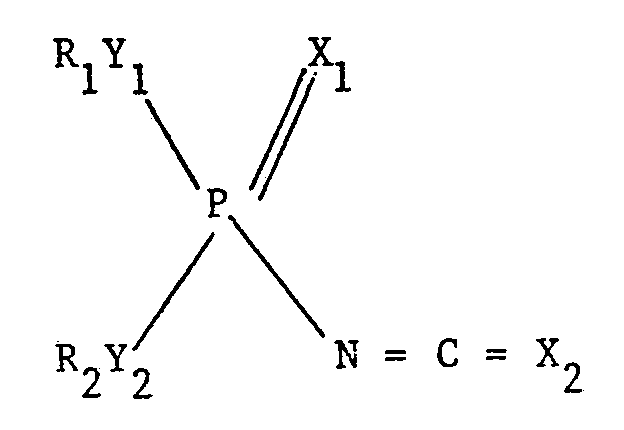
- compositions which are the subject of the invention comprising at least one lubricating oil and at least one extreme pressure and antiwear additive containing phosphorus and nitrogen are characterized in that said additive contains at least one unit of formula: where Y 1 , Y 2 , X 1 and X 2 are similar or different and represent an oxygen or sulfur atom; R 1 and R 2 are similar or different and represent an optionally branched C 3 -C 20 alkyl radical, preferably C 4 -C 12 , an optionally branched C 3 -C 24 alkenyl radical, preferably C 3 - C 18 , a phenyl radical, a phenyl radical substituted by at least one C 1 -C 24 , preferably C 1 -C 12 , alkyl group or by a C 3 -C 10 , preferably C 5, cycloalkyl radical -C 8 ; and in that it is obtained by the action of a compound chosen from isocyanates and isothiocyanates of formula (I): where
- the phosphorus and nitrogen derivatives used in the compositions which are the subject of the invention are. prepared by the action of an isocyanate or isothiocyanate of formula (I) on a nitrogenous compound as defined above, according to a ratio of number of isocyanate or isothiocyanate groups / number of active NH groups of between 0.5 and 1.25
- the reaction is carried out at a temperature between 20 and 100 ° C, preferably between 20 and 70 ° C, for 1/2 hour to 10 hours, preferably for 3/4 hours to 8 hours.
- reaction can optionally be carried out in the presence of an aliphatic (pentane, hexane %) or benzene (benzene, toluene ”) solvent optionally in admixture with an aprotic solvent polar (hexa methylphosphorotriamide, N-methyl-pyrolidone, dimethylformamide, dimethylsulfoxide ).
- the product is then washed, dried and purified.
- the lubricating oils used in said compositions can be natural oils with a viscosity of between 20.6 cst and 541 is at 37.8 ° C (or between 100 and 2,500 SUS at 100 ° F) or synthetic or semi-synthetic bases (synthetic hydrocarbons, esters, polyesters, polyethers) of comparable viscosities.
- the amounts of phosphorus and nitrogen derivatives which can be introduced into the compositions which are the subject of the invention are between 0.2 and 10% by weight of said composition.
- These amounts of additives are a function of the future use of the compositions, namely as oils for engine, gearbox or automatic transmission, hydraulic fluid or cutting oil for the mechanical industry.
- compositions which are the subject of the invention may also contain antioxidant, anti-corrosion, anti-foaming, detergent-dispersing adjuvants, other extreme pressure and antiwear adjuvants, etc., without any problem relating to compatibility or loss of performance level.
- compositions which are the subject of the invention can be prepared by dissolving the additive in the base oil, or, when other adjuvants must be present, by dissolving the additive in the base oil added with said adjuvants or by dissolving the additive in said adjuvants and adding the base oil.
- the yield relative to the reacted starting material is 87%.
- the O, O dihexylisothiocyanothiophosphate used can be prepared as follows:
- the mixture is heated at the end of the casting, under reflux of acetone, for 2 hours; allowed to cool and then decanted the acetone solution; the precipitate is washed with 500 ml of dry acetone.
- the conversion rate is 89%.
- the yield is 98%.
- the conversion rate is 87.7%.
- the yield is 100%.
- the conversion rate is 90.2%.
- the yield is 100%.
- the conversion rate is 92.3%.
- the yield is 91.3%.
- the conversion rate is 71.3%.
- the yield is 45%.
- the conversion rate is 82%.
- the yield is 45.5%.
- the conversion rate is 81%.
- the yield is 100%.
- the transformation rate is 85%.
- the yield is 100%.
- the conversion rate is 73%.
- the yield is 100%.
- the conversion rate is 80.7%.
- the yield is 91.4%.
- the conversion rate is 7.8%.
- the yield is 91.2%.
- the conversion rate is 38%.
- the yield is 77%.
- the conversion rate is 45%.
- the yield is 80%.
- the conversion rate is 75%.
- the yield is 72%.
- the yield is 100%.
- the conversion rate is 100%.
- the yield is 100%.
- the conversion rate is 100%.
- the yield is 100%.
- the conversion rate is 90%.
- the yield is 86%.
- the mixture is heated for 2 h 30 min at 45 ° C.
- the conversion rate is 92%.
- the yield is 100%.
- O, O dihexylisothiocyanophosphate can be obtained under conditions equivalent to those described in Example 1, to obtain 1'0,0 dihexylisothiocyanothiophosphate from potassium thiocyanate and O, O dihexyl-chlorophosphate.
- composition of the product obtained determined by elementary analysis is as follows:
- the conversion rate is 93.5%.
- the yield is 98%.
- the conversion rate is 86%.
- the yield is 92.5%.
- N (S, S dihexylphosphorothiono) N (hydrogen) -N '(dipropyl) thiourea of formula:
- the yield is 84%.
- the S, S dihexylisothiocyanothiophosphate used can be obtained under conditions equivalent to those described in Example 1, to obtain O, O dihexylisothiocyanothiophosphate from potassium thiocyanate and from S, S dihexylchlorothiophosphate.
- composition of the product obtained determined by elementary analysis is as follows:
- the conversion rate is 94%.
- the yield is 97%.
- the O, O diallylisothiocyanothiophosphate used can be obtained under conditions equivalent to those described in Example 1, to obtain 1'0,0 dihexylisothiocyanothiophosphate, from potassium thiocyanate and O, O diallylchlorothiophosphate.
- composition of the product obtained determined by elementary analysis is as follows:
- the conversion rate is 92%.
- the yield is 100%.
- the O, O dibutylisothiocyanothiophosphate used can be obtained under conditions equivalent to those described in Example 1, to obtain O, O dibutylisothiocyanothiophosphate from potassium thiocyanate and from 0.0 dibutylchlorophosphate.
- composition of the product obtained determined by elemental analysis is as follows:
- the conversion rate is 90%.
- the yield is 98%.
- the O, O dinonylphenylthiocyanothiophosphate used can be obtained under conditions equivalent to those described in Example 1 to obtain the O, O dihexylisothiocyanothiophosphate from potassium thiocyanate and from 0.00 dinonylphenylchlorothiophosphate.
- composition of the product obtained determined by elementary analysis is as follows:
- the transformation rate is 95%.
- the yield is 98%.
- the O, O dihexylisocyanothiophosphate used can be obtained under conditions equivalent to those described in Example 1, from potassium isocyanate and from O, O dihexylchlorothiophosphate.
- composition of the product obtained determined by elementary analysis is as follows:
- the conversion rate is 94%.
- the yield is 96%.
- the O, O dihexylisocyanophosphate used can be obtained under conditions equivalent to those described in Example 23 from potassium isocyanate and from O, O dihexylchlorophosphate.
- composition of the product obtained determined by elementary analysis is as follows:
- a lubricant composition is prepared by adding to an IOW 30 oil an amount of product obtained in one of examples 1 to 31, corresponding to 0.9% of phosphorus by weight.
- the resistance to oxidation of this composition is evaluated by the Mobil oxidation test consisting in oxidizing 33 g of oil containing the additive, by heating it to 180 ° C. for 48 hours in the presence of oxidation catalysts (Pb -Cu) under an air flow of 13.9 l / h and measure the increase in viscosity at 210 ° F (98.9 ° C) of the oxidized oil compared to the new oil.
- Mobil oxidation test consisting in oxidizing 33 g of oil containing the additive, by heating it to 180 ° C. for 48 hours in the presence of oxidation catalysts (Pb -Cu) under an air flow of 13.9 l / h and measure the increase in viscosity at 210 ° F (98.9 ° C) of the oxidized oil compared to the new oil.
- compositions which are the subject of the invention have a very good general level of performance with regard to their mechanical properties and exhibit good performance of these performances despite oxidation.
- the antioxidant properties are also very good.
- Lubricating compositions are prepared by adding to an IOW 30 oil the product prepared in Example 2, at different concentrations.
- compositions are tested according to the methods described in the previous example; these compositions are also tested on a 4-ball machine under a load of 150 kg.
- compositions have a very good general level of performance with regard to their mechanical and antioxidant properties even at low additive concentration.
Landscapes
- Chemical & Material Sciences (AREA)
- Organic Chemistry (AREA)
- Health & Medical Sciences (AREA)
- Life Sciences & Earth Sciences (AREA)
- Biochemistry (AREA)
- General Health & Medical Sciences (AREA)
- Molecular Biology (AREA)
- Crystallography & Structural Chemistry (AREA)
- Chemical Kinetics & Catalysis (AREA)
- General Chemical & Material Sciences (AREA)
- Oil, Petroleum & Natural Gas (AREA)
- Lubricants (AREA)
Description
- La présente invention vise de nouvelles compositions lubrifiantes contenant du phosphore et de l'azote possédant des propriétés extrême-pression et anti-usure améliorées.
- On trouve dans le commerce un certain nombre d'additifs contenant notamment du phosphore et de l'azote permettant d'améliorer les propriétés mécaniques des huiles lubrifiantes ; parmi ceux-ci, on peut noter la famille des phosphoramidates tels que ceux décrits dans le brevet amérivain n° 3 810 838. On peut noter également (brevet américain n° 3117 150) des dérivés de phosphothiourées préparés par action d'un dithiophosphate halogéné substitué sur une amine primaire puis action du produit obtenu sur du sulfure de carbone ; ces produits permettent en particulier d'améliorer les propriétés extrême-pression et anti-usure des huiles lubrifiantes.
- La demanderesse a trouvé de nouvelles compositions lubrifiantes ayant des performances encore supérieures.
- Les nouvelles compositions objet de l'invention comprenant au moins une huile lubrifiante et au moins un additif extrême-pression et anti-usure contenant du phosphore et de l'azote sont caractérisées en ce que ledit additif contient au moins un motif de formule :

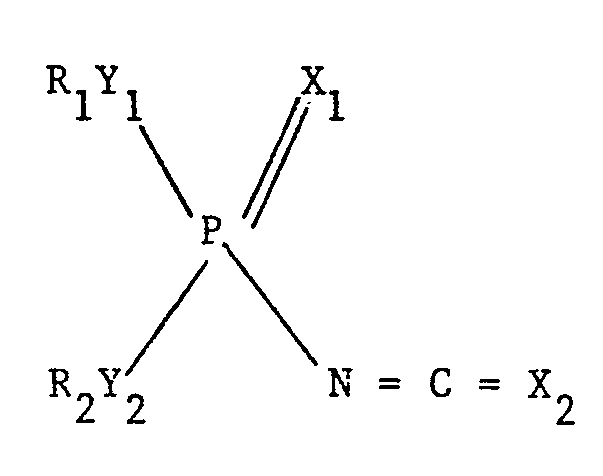
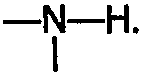
- Les deux valences restantes de l'atome d'azote dudit composé azoté sont de préférence satisfaites par:
- - de l'hydrogène
- - un radical alkyle en C1-C24, de préférence en C1-C18, éventuellement substitué par un groupe hydroxy ou triéthoxysilyle ;
- - un radical alkylène en C2-C12
- - le radical aza-7 dioxa-4,10 tridécylène N substitué par un groupe oxa-3' hexylène
- - un radical alkényle en C3-C24, de préférence en C3-C18
- - un radical alkynyle en C3-C16, de préférence en C3-C8
- - un radical cycloalkyle en C5-C12, de préférence en Cs-Cg
- - un radical polycycloalkyle en C9-C18
- - un radical phényle éventuellement substitué par un groupe hydroxy, trifluorométhyle, mercapto- trifluorométhyle ou anilino
- - un radical hétérocyclique azoté éventuellement accolé à un cycle benzénique
- - un radical hétérocyclique contenant de l'azote et du soufre comme hétéroéléments et accolé à un cycle benzénique
- - un radical hétérocyclique contenant de l'azote et du soufre comme hétéroéléments et substitué par un groupe mercapto
- - un radical organique formant avec ledit atome d'azote un hétérocycle contenant éventuellement de l'oxygène comme autre hétéroélément.
- Parmi les composés azotés correspondant à ce type préférentiel on peut citer :
- - l'ammoniac
- - les alkylmonoamines primaires ou secondaires en C3-C12 ; telles que la butylamine, l'hexylamine, la décylamine, la diéthyl-2 hexylamine, la dodécylamine, la dipropylamine.
- - les hydroxymonoamines en C3-C12, telles que l'éthanolamine, la propanolamine, la diéthanol- amine, la dipropanolamine.
- - les alkylènediamines en C2-C12, telles que l'hexaméthylènediamine, l'éthylènediamine.
- - les polyamines telles que les polyalkylènes amines, la tris(oxa-3 amino-6 hexyl)amine.
- - les alkénylsuccinimides dérivés des amines ci-dessus citées et dont le radical alkényle présente plus de 30 atomes de carbone.
- - les alkénylamines dérivées des amines ci-dessus citées et dont le radical alkényle présente plus de 20 atomes de carbone.
- - le γ-aminopropyl triéthoxysilane.
- - la cyclohexylamine.
- - l'aniline.
- - l'o-aminophénol.
- - le m-trifluorométhylaniline.
- - le mercaptotrifluorométhylaniline.
- - le N(butyl-2 pentyl) N' (phénylènediamine).
- - l'amino-3 triazole-1,2,3.
- - l'amino-2 benzothiazole.
- - l'amino-2 benzimidazole.
- - l'amino-5 mercapto-2 thiadiazole-1,3,4.
- - la morpholine.
- Parmi les isocyanates ou isothiocyanates répondant à la formule I, on peut citer les produits de formule :


- Les dérivés du phosphore et de l'azote entrant dans les compositions objet de l'invention, sont . préparés par action d'un isocyanate ou isothiocyanate de formule (I) sur un composé azoté tel que défini ci-dessus, selon un rapport nombre de groupements isocyanate ou isothiocyanate/nombre de groupements NH actifs compris entre 0,5 et 1,25
- La réaction est effectuée à une température comprise entre 20 et 100 °C, de préférence entre 20 et 70 °C, pendant 1/2 heure à 10 heures, de préférence pendant 3/4 heures à 8 heures.
- La réaction peut éventuellement être réalisée en présence d'un solvant aliphatique (pentane, hexane...) ou benzénique (benzène, toluène...) éventuellement en mélange avec un solvant aprotique polaire (hexa méthylphosphorotriamide, N-méthyl-pyrolidone, diméthylformamide, diméthylsulfoxyde...).
- Le produit est ensuite lavé, séché et purifié.
- Les huiles lubrifiantes entrant dans lesdites compositions peuvent être des huiles naturelles de viscosité comprise entre 20,6 cst et 541 est à 37,8 °C (soit entre 100 et 2 500 SUS à 100 °F) ou des bases synthétiques ou semi-synthétiques (hydrocarbures synthétiques, esters, polyesters, polyéthers) de viscosités comparables.
- Les quantités de dérivés phosphorés et azotés que l'on peut introduire dans les compositions objet de l'invention, sont comprises entre 0,2 et 10 % en poids de ladite composition. Ces quantités d'additifs sont fonction de l'utilisation future des compositions à savoir comme huiles pour moteur, boîte à vitesse ou transmission automatique, fluide hydraulique ou huile de coupe pour l'industrie mécanique.
- Les compositions objet de l'invention peuvent également contenir des adjuvants antioxydants, anticorrosion, antimousse, détergents-dispersants, d'autres adjuvants extrême-pression et antiusure... sans qu'il ne résulte de problème lié à la compatibilité ou une perte de niveau des performances.
- Cesdites compositions objet de l'invention peuvent être préparées par dissolution de l'additif dans l'huile de base, soit, lorsque d'autres adjuvants doivent être présents, par dissolution de l'additif dans l'huile de base additionnée desdits adjuvants ou par dissolution de l'additif dans lesdits adjuvants et addition de l'huile de base.
- Les exemples suivants sont donnés à titre indicatif et ne peuvent être considérés comme une limite du domaine et de l'esprit de l'invention.
- Préparation de la N(O,O dihéxylphosphorothiono)-N(hydrogéno)-N'(hydrogéno) N'(hexyl) thiourée de formule :

- Dans un ballon tricol de 250 ml, on charge 48,5 g (soit 0,15 mole) d'O,O dihexylisothiocyanothiophosphate, puis on coule goutte à goutte pendant 30 mn 17g (soit 0,165 mole) d'hexylamine. On maintient pendant 45 mn la température de 24-25 °C. On obtient un milieu homogène coloré.
- On coule alors 60 ml de pentane ; la solution organique obtenue est lavée par 50 ml d'eau distillée, décantée, puis séchée sur sulfate de sodium.
- On obtient, après distillation sous vide du pentane, 58 g d'une huile dont la composition déterminée par analyse élémentaire est la suivante :

- Le rendement par rapport au produit de départ ayant réagi est de 87 %.
- L'O,O dihexylisothiocyanothiophosphate mis en oeuvre, peut être préparé de la manière suivante :
- Dans un ballon tricol de 3 litres, on charge sous agitation 361 g (soit 3,72 moles) de thiocyanate de potassium et 1 d'acétone sec, puis on coule en 3 h 40 mn, 1 015 g (spit 3,38 moles) d'O,O dihexylchlorothiophosphate en maintenant la température à 25-30 °C ; il se forme un précipité de KCI.
- On chauffe, en fin de coulée, sous reflux d'acétone, pendant 2 heures ; on laisse refroidir puis on décante la solution acétonique ; le précipité est lavé avec 500 ml d'acétone sec.
- Les solutions acétoniques sont réunies puis distillées sous vide. On récupère ainsi 771 g d'O,O dihexylisothiocyanothiophosphate, ce que confirme l'analyse élémentaire :

- Préparation de la N(O,O dihexylphosphorothiono)-N hydrogéno-N' (dipropyl) thiourée de formule :

- L'opération décrite à l'exemple 1 est réalisée en présence de :
- - 32,3 g (soit 0,1 mole) d'O,O dihexylisothiocyanothiophosphate,
- - 10 g (soit 0,1.mole) de dipropylamine.
- On obtient 40 g d'une huile dont la composition déterminée par analyse élémentaire est la suivante :

- Le taux de transformation est de 89 %.
- Le rendement est de 98 %.
- Préparation de la N(O,O dihexylphosphorothiono)-N hydrogéno-N' (hydrogéno) N'(décyl) thiourée de formule :

- L'opération décrite à l'exemple 1 est réalisée en présence de :
- - 32,3 g (soit 0,1 mole) d'O,O dihexylisothiocyanothiophosphate,
- - 17,5 g (soit 0,1 mole) de décylamine.
- On obtient 47 g de produit dont la composition déterminée par analyse élémentaire est la suivante :

- Le taux de transformation est de 87,7 %.
- Le rendement est de 100 %.
- Préparation de la N(O,O dihexylphosphorothiono)-N hydrogéno-N' (hydrogéno)-N' (dodécyl) thiourée de formule

- L'opération décrite à l'exemple 1 est réalisée en présence de :
- - 32,3 g (soit 0,1 mole) d'O,O dihexylisothiocyanothiophosphate,
- - 20,5 g (soit 0,11 mole) de dodécylamine solubilisée dans 70 ml de pentane.
- On obtient 50 g d'une huile dont la composition déterminée par analyse élémentaire est la suivante :
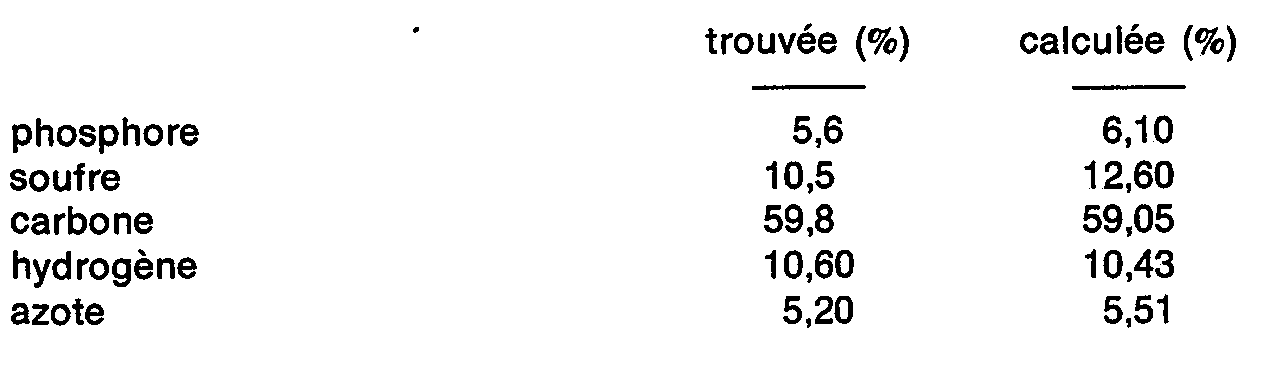
- Le taux de transformation est de 90,2 %.
- Le rendement est de 100 %.
- Préparation de la N(O,O dihexylphosphorothiono)-N(hydrogéno)-N' (hydrogéno)-N' (cyclohexyl) thiourée de formule :

- L'opération décrite dans l'exemple 1 est réalisée en présence de :
- - 48,5 g (soit 0,15 mole) d'(O,O dihexylisothiocyanothiophosphate),
- - 16,5 g (soit 0,165 mole) de cyclohexylamine.
- On obtient 62 g d'une huile dont la composition déterminée par analyse élémentaire est la suivante :

- Le taux de transformation est de 92,3 %.
- Le rendement est de 91,3 %.
- Préparation de la N(O,O dihexylphosphorothiono)-N hydrogéno-N' hydrogéno-N' (benzyle) thiourée de formule :

- L'opération décrite à l'exemple 1 est réalisée en présence de :
- - 32,3 g (soit 0,1 mole) d'O,O dihexylisothiocyanothiophosphate,
- - 10,5 g (soit 0,11 mole) d'aniline.
- Le produit obtenu est repris par 50 ml de pentane. Après lavage et distillation du solvant, on obtient 41 g d'une huile dont la composition déterminée par analyse élémentaire est la suivante :

- Le taux de transformation est de 71,3 %.
- Le rendement est de 45 %.
- Préparation de la N(O,O dihexylphosphorothiono)-N (hydrogéno)-N' (hydrogéno)-N' (o-hydroxyphé- nyl) thiourée de formule :

- On charge dans un ballon tricol de 250 ml, 32,3 g (soit 0,1 mole) d'O,O dihexylisothiocyanothiophosphate, 12 g (soit 0,11 mole) d'o-aminophénol et 50 ml de toluène. On ajoute 5 ml d'hexaméthylphospho- triamide et on chauffe pendant 2 h 30 mn à 50 °C. Une fois refroidi le milieu est lavé avec 50 ml d'eau ; on décante puis on distille le solvant sous vide.
- On obtient 42 g d'une huile dont la composition déterminée par analyse élémentaire est la suivante :

- Le taux de transformation est de 82 %.
- Le rendement est de 45,5 %.
- Préparation de la N(O,O dihexylphosphorothiono)-N (hydrogéno)-N' (hydrogéno)-N' (butyl) thiourée de formule :

- L'opération décrite à l'exemple 1 est réalisée en présence de :
- - 32,3 g (soit 0,1 mole) d'O,O dihexylisothiocyanothiophosphate,
- - 8 g (soit 0,11 mole) de butylamine,
- On obtient 38 g d'une huile dont la composition déterminée par analyse élémentaire est la suivante :

- Le taux de transformation est de 81 %.
- Le rendement est de 100%.
- Préparation de la N(O,O dihexylphosphorothiono)-N (hydrogéno)-N' (hydrogéno)-N' (éthyl-2 hexyl)thiourée de formule :

- L'opération décrite à l'exemple 8 est réalisée en présence de :
- - 32,3 g (soit 0,1 mole) d'O,O dihexylisothiocyanothiophosphate
- - 14,2 g (soit 0,11 mole) d'éthyl-2 hexylamine
- On obtient 44 g- d'un produit visqueux dont la composition déterminée par analyse élémentaire est la suivante :

- Le taux de transformation est de 85 %.
- Le rendement est de 100 %.
- Préparation de la N(O,O dihexylphosphorothiono)-N (hydrogéno)-N' (hydrogéno)-N' (1,2,3 triazyl-
- 5)thiourée de formule :

- On charge dans un ballon de 250 ml, 48,5 g (soit 0,15 mole) d'O,O dihexylisothiocyanothiophosphate, 14 g d'amino-3 triazol-1,2,3 et 30 ml de pentane. Ce milieu est chauffé à 50° puis on ajoute 30 ml d'hexaméthylphosphotriamide. L'opération dure 7 h 30. Après refroidissement, on lave le milieu à l'aide de 2 fois 60 ml d'eau, on décante puis on élimine le solvant par distillation sous vide.
- On obtient 59 g de produit dont la composition déterminée par analyse élémentaire est la suivante :

- Le taux de transformation est de 73 %.
- Le rendement est de 100 %.
- Préparation de la N(O,O dihexylphosphorothiono)-N (hydrogéno)-N' (hydrogéno)-N' (benzothiazyl-2)thiourée de formule :

- L'opération décrite à l'exemple 13 est réalisée en présence de :
- - 39 g (soit 0,12 mole) d'O,O dihexylisothiocyanothiophosphate
- - 20 g (soit 0,132 mole) d'amino-2 benzothiazole
- - 50 ml d'hexamethylphosphotriamide
- On obtient 58 g d'un produit dont la composition déterminée par analyse élémentaire est la suivante :

- Le taux de transformation est de 80,7 %.
- Le rendement est de 91,4 %.
- Préparation de la N(O,O dihexylphosphorothiono)-N (hydrogéno)-N' (mercaptothiadiazole-1,3,4)thiourée de formule :

- L'opération décrite à l'exemple 10 est réalisée en présence de :
- - 32,3 g (soit 0,1 mole) d'O,O dihexylisothiocyanothiophosphate
- - 14,6 g (soit 0,11 mole) d'amino-5 mercapto-2 thiadiazole-1,3,4
- - 50 ml de toluène
- - 50 ml d'hexaméthylphosphotriamide
- On obtient 44 g de produit dont la composition déterminée par analyse élémentaire est la suivante :

- Le taux de transformation est de 7,8 %.
- Le rendement est de 91,2 %.
- Préparation de la N(O,O dihexylphosphorothiono)-N (hydrogéno)-N' (hydrogéno)-N' (benzimidazo- lyl)thiourée de formule :

- L'opération décrite dans l'exemple 10 est réalisée en présence de :
- - 32,3 g (soit 0,10 mole) d'O,O dihexylisothiocyanothiophosphate
- - 14,6 g (soit 0,11 mole) d'amino-2 benzimidazole
- - 50 ml de toluène
- - 50 ml d'hexaméthylphosphorotriamide
- On obtient 47 g de produit dont la composition déterminée par analyse élémentaire est la suivante :
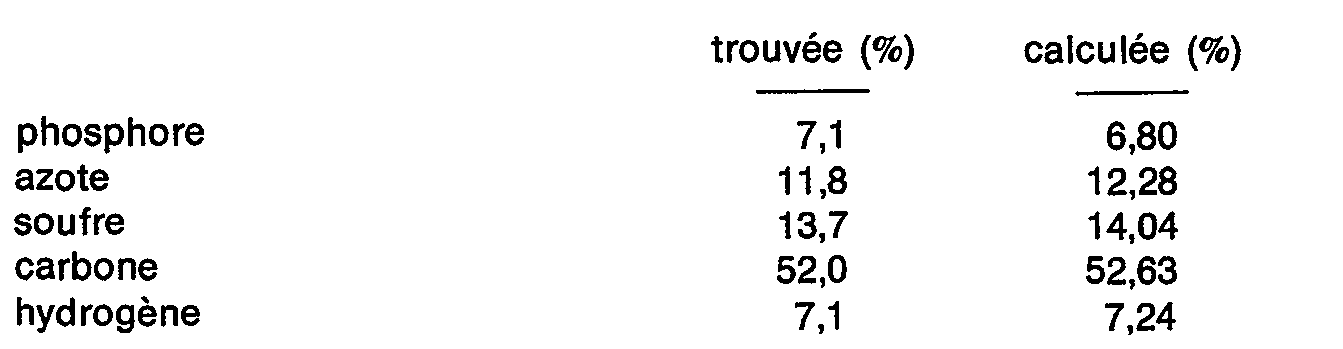
- Le taux de transformation est de 38 %.
- Le rendement est de 77 %.
- Préparation de la N(O,O dihexylphosphorothiono)-N (hydrogéno)-N' (morpholinyl)thiourée de fomule :

- L'opération décrite à l'exemple 10 est réalisée en présence de :
- - 32,3 g (soit 0,10 mole) d'O,O dihexylisothiocyanothiophosphate
- - 9,6 g (soit 0,11 mole) de morpholine
- - 50 ml de toluène
- - 50 ml d'hexaméthylphosphorotriamide
- On obtient 38 g de produit dont la composition déterminée par analyse élémentaire est la suivante :

- Le taux de transformation est de 45 %.
- Le rendement est de 80 %.
- Préparation de la N(O,O dihexylphosphorothiono)-N (hydrogéno)-N' (hydrogéno)-N' (trifluoromé- thyl-3 benzyl)thiourée de formule :

- L'opération décrite à l'exemple 1 est réalisée en présence de :
- - 32,3 g (soit 0,10 mole) d'O,O dihexylisothiocyanothiophosphate
- - 16,25 g (0,11 mole) de m-trifluorométhylaniline
- - 60 ml de pentane
- On obtient 47 g de produit dont la composition déterminée par analyse élémentaire est la suivante :

- Le taux de transformation est de 75 %.
- Le rendement est de 72 %.
- Préparation de la N(O,O dihexylphosphorothiono)-N (hydrogéno)-N' (mercaptotrifluorométhylben- zyl)thiourée de formule :

- L'opération décrite à l'exemple 1 est réalisée en présence de :
- - 32,3 g (soit 0,1 mole) d'O,O dihexylisothiocyanothiophosphate
- - 21,2 g (soit 0,11 mole) de mercaptotrifluorométhylaniline
- - 60 ml de pentane
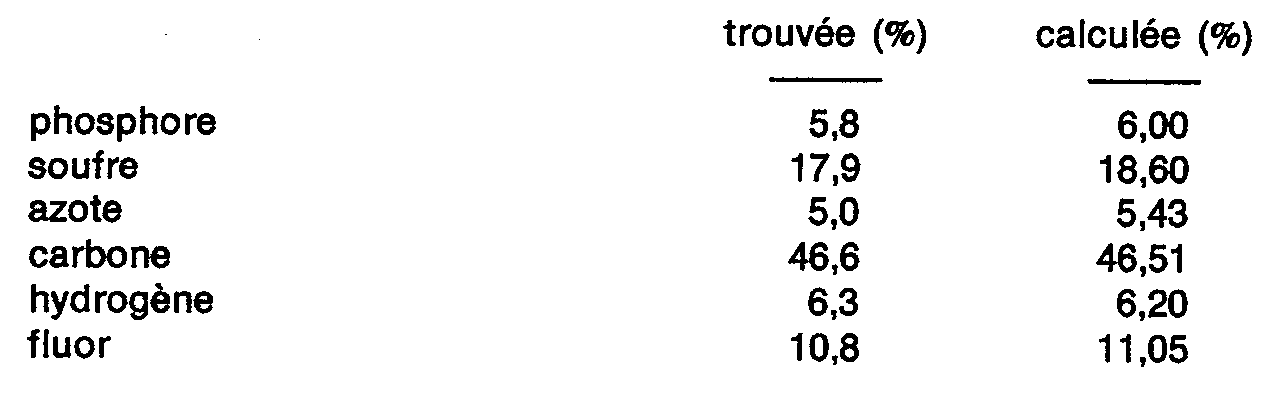
- On obtient 46 g de produit dont la composition déterminée par analyse élémentaire est la suivante :
- Préparation de la N(O,O dihexylphosphorothiono)-N (hydrogéno)-N' (hydrogéno)-N' (triéthoxysilyl- propyl)thiourée de formule :

- L'opération décrite à l'exemple 1 est réalisée en présence de :
- - 32,3 g (soit 0,1 mole) d'O,O dihexylisothiocyanothiophosphate
- - 24,2 g (soit 0,11 mole) de γ-aminopropyltriéthoxysilane
- - 50 ml de toluène
- On obtient 48 g de produit dont la composition déterminée par analyse élémentaire est la suivante :

- le taux de transformation est de 100 %.
- Le rendement est de 100 %.
- Préparation de la tris [[3(O,O dihexylphosphorothiono) ureido] 6 oxa-3-hexyl] amine, de formule :

- L'opération décrite à l'exemple 1 est réalisée en présence de :
- - 48 g (soit 0,15 mole) d'O,O dihexylisothiocyanothiophosphate
- - 17,6 g (soit 0,055 mole) de tris (amino-6 oxa-3 hexyl) amine
- - 70 ml de toluène
- On obtient 59 g de produit dont la composition déterminée par analyse élémentaire est la suivante :

- Le taux de transformation est de 100 %.
- Le rendement est de 100 %.
- Préparation de la N(O,O dihexylphosphorothiono)-N (hydrogéno)-N' (p-anilinophényl)-N' (butyl-2 pentyl)thiourée de formule :

- L'opération décrite à l'exemple 1 est réalisée en présence de
- - 32,3 g (soit 0,10 mole) d'O,O dihexylisothiocyanothiophosphate
- - 34 g (soit 0,11 mole) de N(butyl-2 pentyl)N' phénylène diamine
- - 60 ml de toluène
- On obtient 60 g de produit dont la composition déterminée par analyse élémentaire est la suivante :

- Le taux de transformation est de 100 %.
- Le rendement est de 100 %.
- Préparation du bis[N(O,O dihexylphosphorothiono)N (hydrogéno-N' (hydrogéno)thiourée] hexylène de formule :

- L'opération décrite à l'exemple 1 est réalisée en présence de :
- - 51,6 g (soit 0,16 mole) d'O,O dihexylisothiocyanothiophosphate
- - 10,2 g (soit 0,088 mole) d'hexaméthylènediamine
- - 40 ml de toluène
- On obtient 56 g de produit dont la composition déterminée par analyse élémentaire est la suivante :

- Le taux de transformation est de 90 %.
- Le rendement est de 86 %.
- Préparation de mélanges de tris (O,O dihexylphosphorothionothiocarbamyl) (polyisobuténylsuccini- mido)1 tétraza 3,6,9,12 dodécanes.
- Dans un ballon tricol de 250 ml, on charge 24,5 g (0,076 mole) d'O,O dihexylisothiocyanothiophosphate et 84,5 (soit 0,076 at-g d'azote actif) d'un monopolyisobuténylsuccinimide contenant 3,10 % d'azote dont 1,26 % d'azote actif et provenant de la réaction de la tétraéthylène-pentamine et d'un anhydride polyisobuténylsuccinique d'indice d'acide égal à 74, obtenu par condensation de l'anhydride maléique sur un polyisobutène de masse moléculaire moyenne en nombre de 1 000. Le mélange est chauffé pendant 2 h 30 mn à 50 °C.
- On obtient 87 g de produit dont la composition détrminée par analyse élémentaire est la suivante :

- Préparation du bis (0,0 dihexylphosphorothiono thio carbamyl)3-6 bis (polyisobuténylsuccini- mido)1-8 diazo-3-6 d'octane
- Dans un ballon tricol de 250 ml, on charge 7 g (soit 0,0217 mole) d'O,O dihexylisothiocyanothiophosphate, et 55 g (soit 0,0217 at-g d'azote actif) d'un bis polyisobuténylsuccinimide contenant 1,2 % d'azote dont 0,6 % d'azote actif et provenant de la réaction de la triéthylène-tétramine et d'un anhydride polyisobuténylsuccinique d'indice égal à 74, obtenu par condensation de l'anhydride maléique sur un polyisobutène de masse moléculaire moyenne en nombre de 1 000.
- Le mélange est chauffé pendant 2 h 30 mn à 45 °C.
- On obtient 62 g de produit dont la composition déterminée par analyse élémentaire est la suivante :

- Préparation de la N(O,O dihexylphosphoro)-N (hydrogéno)-N' (dipropyl)thiourée de formule :

- Selon un mode opératoire équivalent à celui décrit à l'exemple 1, on met en contact :
- - 15,35 g (soit 0,05 mole) d'O,O dihexylisothiocyanophosphate
- - 5,05 g (soit 0,05 mole) de dipropylamine
- pendant 4 heures à température ambiante.
- On obtient 21 g de produit dont la composition déterminée par analyse élémentaire est la suivante :

- Le taux de transformation est de 92 %.
- Le rendement est de 100 %.
- L'O,O dihexylisothiocyanophosphate peut être obtenu dans des conditions équivalentes à celles décrites à l'exemple 1, pour obtenir 1'0,0 dihexylisothiocyanothiophosphate à partir de thiocyanate de potassium et d'O,O dihexyl-chlorophosphate.
- La composition du produit obtenu déterminée par analyse élémentaire est la suivante :

- Préparation de la N(O,O dihexylphosphoro)-N (hydrogéno)-N' (hydrogéno)-N' (dodécyl)thiourée de formule :

- Selon un mode opératoire équivalent à celui décrit à l'exemple 4, on met en contact :
- 30,7 g (soit 0,10 mole) d'O,O dihexylisothiocyanophosphate
- 20,5 g (soit 0,11 mole) de dodécylamine
- On obtient 47 g de produit dont la composition déterminée par analyse élémentaire est la suivante :

- Le taux de transformation est de 93,5 %.
- Le rendement est de 98 %.
- Préparation de la N(O,O dihexylphosphoro)-N (hydrogéno)N' (hydrogéno)N' (triéthoxysilylpro- pyl)thiourée de formule :

- - 24,2 g (soit 0,11 mole) de γ-aminopropyltriéthoxysilane.
- On obtient 52 g de produit dont la composition déterminée par analyse élémentaire est la suivante :

- Le taux de transformation est de 86 %.
- Le rendement est de 92,5%.
- Préparation de la N(S,S dihexylphosphorothiono)=N (hydrogéno)-N' (dipropyl)thiourée de formule :

- Selon un mode opératoire équivalent à celui décrit à l'exemple 1, on met en contact :
- - 35,5 g (0,1 mole) de S,S dihexylisothiocyanothiophosphate
- - 10 g (0,1 mole) de dipropylamine
- On obtient 41 g de produit dont la composition déterminée par analyse élémentaire est la suivante :

- Le taux de transformation des de 79 %.
- Le rendement est de 84 %.
- Le S,S dihexylisothiocyanothiophosphate utilisé peut être obtenu dans des conditions équivalentes à celles décrites à l'exemple 1, pour obtenir l'O,O dihexylisothiocyanothiophosphate à partir de thiocyanate de potassium et de S,S dihexylchlorothiophosphate.
- La composition du produit obtenu déterminée par analyse élémentaire est la suivante :

- Préparation de la N(O,O diallylphosphorothiono)-N (hydrogéno)-N' (dipropyl)thiourée de formule :

- Selon un mode opératoire équivalent à celui décrit à l'exemple 1, on met en contact :
- - 23,5 g (0,1 mole) d'O,O diallylisothiocyanothiophosphate
- - 10 g (0,1 mole) de dipropylamine
- On obtient 30 g d'un produit dont la composition déterminée par analyse élémentaire est la suivante :

- Le taux de transformation est de 94 %.
- Le rendement est de 97 %.
- L'O,O diallylisothiocyanothiophosphate utilisé peut être obtenu dans des conditions équivalentes à celles décrites dans l'exemple 1, pour obtenir 1'0,0 dihexylisothiocyanothiophosphate, à partir de thiocyanate de potassium et de l'O,O diallylchlorothiophosphate.
- La composition du produit obtenu déterminée par analyse élémentaire est la suivante :

- Préparation de la N(O,O dibutylphosphorothiono)-N (hydrogéno)N' (dipropyl)thiourée de formule :

- Selon un mode opératoire équivalent à celui décrit à l'exemple 1, on met en contact :
- - 26,5 g (0,1 mole) d'O,O dibutylisothiocyanothiophosphate
- - 10 g (0,1 mole) de dipropylamine
- On obtient 34 g d'un produit dont la composition déterminée par analyse élémentaire est la suivante :

- Le taux de transformation est de 92 %.
- Le rendement est de 100 %.
- L'O,O dibutylisothiocyanothiophosphate utilisé peut être obtenu dans des conditions équivalentes à celles décrites dans l'exemple 1, pour obtenir l'O,O dibutylisothiocyanothiophosphate à partir du thiocyanate de potassium et de 1'0,0 dibutylchlorophosphate.
- La composition du produit obtenu déterminée par analye élémentaire est la suivante :
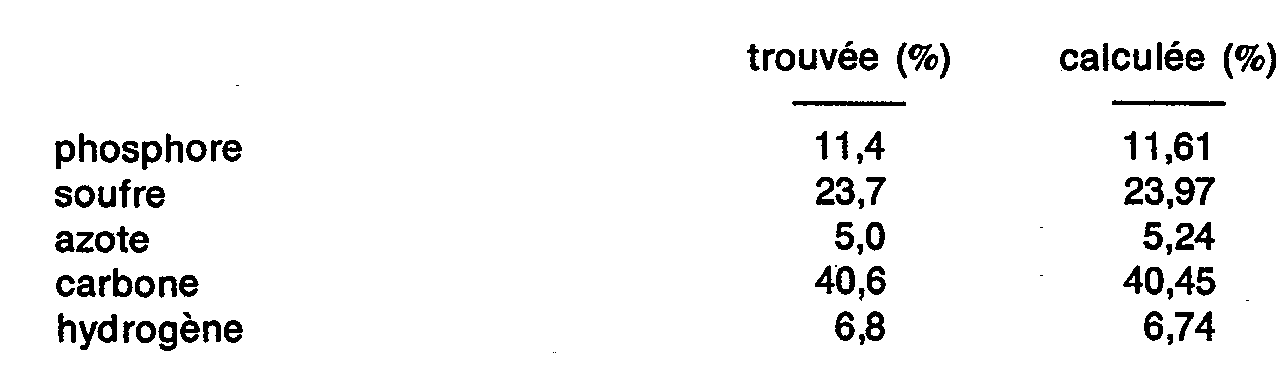
- Préparation de la N(O,O dinonylphénylphosphorothiono)-N (hydrogéno)-N' (dipropyl)thiourée de formule:

- - 10,0 g (0,1 mole) de dipropylamine
- - 55,9 g (0,1 mole) d'O,O dinonylphénylisothiocyanothiophosphate
- On obtient 62 g d'un produit dont la composition déterminée par analyse élémentaire est la suivante :

- Le taux de transformation est de 90 %.
- Le rendement est de 98 %.
- L'O,O dinonylphénylthiocyanothiophosphate utilisé peut être obtenu dans des conditions équivalentes à celles décrites dans l'exemple 1 pour obtenir l'O,O dihexylisothiocyanothiophosphate à partir de thiocyanate de potassium et de 1'0,0 dinonylphénylchlorothiophosphate.
- La composition du produit obtenu déterminée par analyse élémentaire est la suivante :

- Préparation de la N(O,O dihexylphosphorothiono)-N (hydrogéno)-N' (dipropyl)urée de formule :

- Selon un mode opératoire équialent à celui décrit à l'exemple 1, on met en contact :
- - 30,7 g (0,1 mole) d'O,O dihexylisocyanothiophosphate
- - 10 g (0,1 mole) de dipropylamine
- On obtient 38 g d'une huile dont la composition déterminée par analyse élémentaire est la suivante :

- Le taux de transformation est de 95%.
- Le rendement est de 98 %.
- L'O,O dihexylisocyanothiophosphate utilisé peut être obtenu dans des conditions équivalentes à celles décrites dans l'exemple 1, à partir d'isocyanate de potassium et de l'O,O dihexylchlorothiophosphate.
- La composition du produit obtenu déterminée par analyse élémentaire est la suivante :

- Préparation de la N(O,O dihexylphosphoro)-N (hydrogéno)-N' (dipropyl)urée de formule :

- Selon un mode opératoire équivalent à celui décrit à l'exemple 1, on met en contact :
- - 29,1 g (0,1 mole) d'O,O dihexylisocyanophosphate
- - 10 g (0,1 mole) de dipropylamine
- On obtient 37 g d'une huile dont la composition déterminée par analyse élémentaire est la suivante :

- Le taux de transformation est de 94 %.
- Le rendement est de 96 %.
- L'O,O dihexylisocyanophosphate utilisé peut être obtenu dans des conditions équivalentes à celles décrites à l'exemple 23 à partir de l'isocyanate de potassium et de l'O,O dihexylchlorophosphate.
- La composition du produit obtenu déterminée par analyse élémentaire est la suivante :

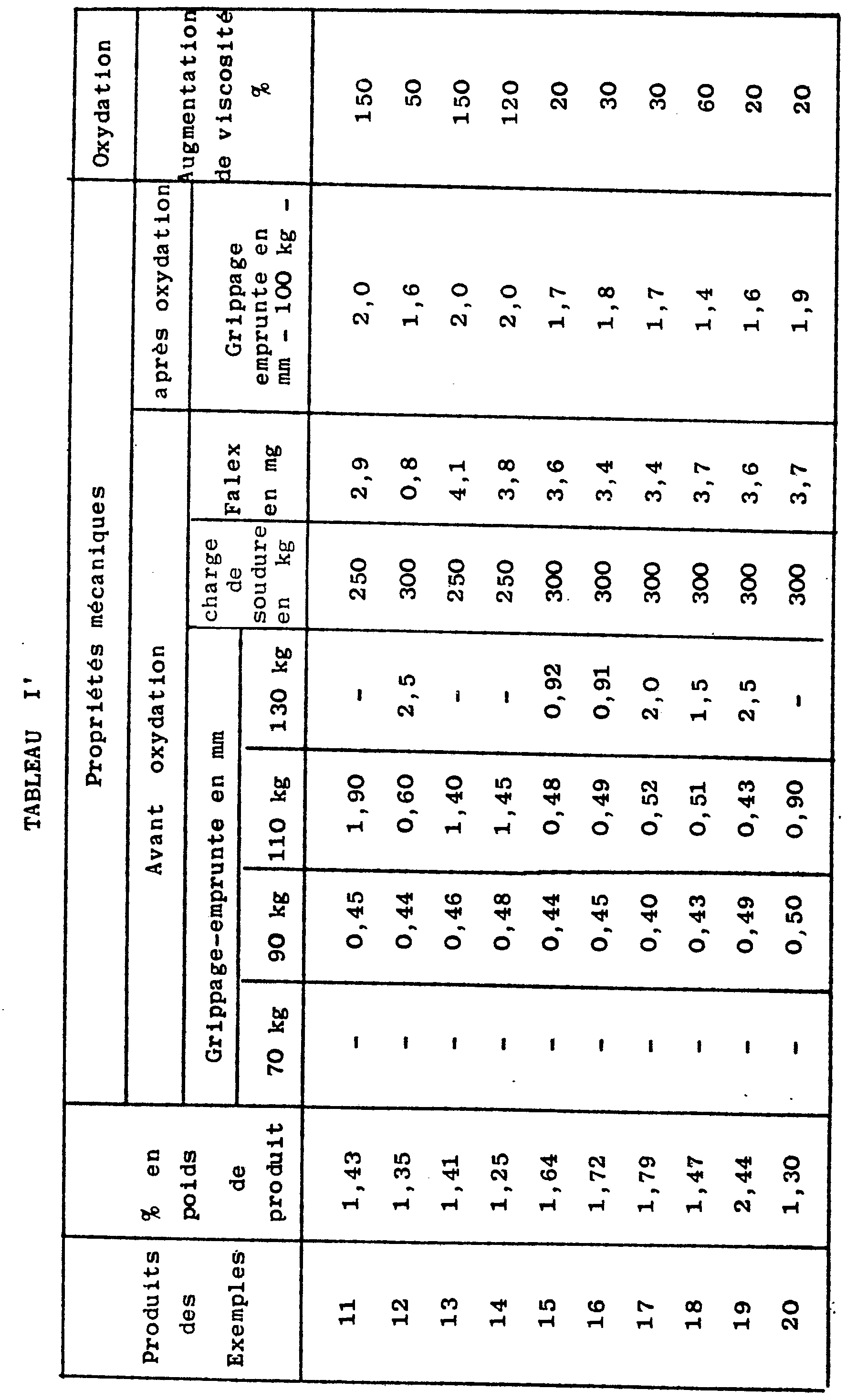
- On prépare une composition lubrifiante par addition à une huile IOW 30 d'une quantité de produit obtenu à l'un des exemples 1 à 31, correspondant à 0,9 % de phosphore en poids.
- Les propriétés mécaniques de cette composition sont testées sur :
- 1. Machine 4 billes selon la norme ASTM D 2 783-69 T; ce test donne le diamètre en mm de l'empreinte sous une charge de grippage de 70, 90, 110 et 130 kg ainsi que la charge de soudure en kg.
- 2. Machine Falex ; ce test donne l'usure de l'axe (c'est-à-dire de l'éprouvette d'usure) en mg au bout de 30 mn sous une pression de 500 Ibs (271,5 kg).
- La tenue à l'oxydation de cette composition est évaluée par le test d'oxydation Mobil consistant à oxyder 33 g d'huile contenant l'additif, en la chauffant à 180 °C pendant 48 heures en présence de catalyseurs d'oxydation (Pb-Cu) sous un débit d'air de 13,9 l/h et à mesurer l'augmentation de viscosité à 210 °F (98,9 °C) de l'huile oxydée par rapport à l'huile neuve.
- Des tests comparables sont réalisés sur des compositions dans lesquelles le produit de l'un des exemples 1 à 31, est remplacé par la même quantité, exprimée en % de phosphore, et l'un des additifs du commerce suivants, contenant tous du phosphore et de l'azote, à l'exception de l'additif G :
- - additif A « TLA 202 » commercialisé par TEXACO Inc.
- - additif B « Improvex 33 » commercialisé par RHONE-POULENC
- - additif C : « Ortholéum 535 » commercialisé par DU PONT DE NEMOURS
- - additif D : « Eca 5 215 » commercialisé par EXXON
- - additif E : « Oloa 259 » commercialisé par ORONITE
- - additif F : « Lubrizol 797 » commercialisé par LUBRIZOL
- - additif G : « à base d'un mélange d'alkyldithiophosphate
- On constate que les compositions faisant l'objet de l'invention possèdent un très bon niveau général de performances en ce qui concerne leurs propriétés mécaniques et présentent une bonne tenue de ces performances malgré l'oxydation. Les propriétés antioxydantes sont également très bonnes.
- On prépare des compositions lubrifiantes par addition à une huile IOW 30 du produit préparé à l'exemple 2, à différentes concentrations.
- Ces compositions sont testées selon les méthodes décrites à l'exemple précédent ; on teste en outre ces compositions sur Machine 4 billes sous une charge de 150 kg.
- Le résultat de ces tests figure au tableau II.
- On constate que ces compositions possèdent un très bon niveau général de performances en ce qui concerne leurs propriétés mécaniques et antioxydantes même à basse concentration en additif.



en maintenant la température à 30 °C pendant 1 heure, et en reprenant le produit par 50 ml de pentane.
pendant 2 h 30 mn à 50 °C.
pendant 1 h 30 à 65 °C.
pendant 3 heures à 50 °C.
pendant 3 heures à 50 °C.
pendant 1 heure à 28 °C.
pendant 2 heures à 35 °C.
pendant 1 h 30 mn à 35 °C.
pendant 2 heures à 50 °C.
pendant 2 h 30 min à 45 °C.
pendant 1 heure à 27 °C.
pendant 3/4 heures à 25 °C.
de zinc dont les radicaux alkyl contiennent de 4 à 6 atomes de carbone.
Le résultat de l'ensemble de ces tests figure aux tableaux I, l', I", et 1"'.
Claims (9)



Applications Claiming Priority (2)
| Application Number | Priority Date | Filing Date | Title |
|---|---|---|---|
| FR7732857A FR2407978A1 (fr) | 1977-11-02 | 1977-11-02 | Nouvelles compositions lubrifiantes contenant du phosphore et de l'azote |
| FR7732857 | 1977-11-02 |
Publications (2)
| Publication Number | Publication Date |
|---|---|
| EP0001949A1 EP0001949A1 (fr) | 1979-05-16 |
| EP0001949B1 true EP0001949B1 (fr) | 1981-07-29 |
Family
ID=9197137
Family Applications (1)
| Application Number | Title | Priority Date | Filing Date |
|---|---|---|---|
| EP78400149A Expired EP0001949B1 (fr) | 1977-11-02 | 1978-10-26 | Nouvelles compositions lubrifiantes contenant du phosphore et de l'azote |
Country Status (12)
| Country | Link |
|---|---|
| US (1) | US4224171A (fr) |
| EP (1) | EP0001949B1 (fr) |
| JP (1) | JPS54145708A (fr) |
| AT (1) | AT366092B (fr) |
| BR (1) | BR7807194A (fr) |
| CA (1) | CA1109450A (fr) |
| DE (1) | DE2860887D1 (fr) |
| ES (1) | ES474754A1 (fr) |
| FR (1) | FR2407978A1 (fr) |
| IT (1) | IT7851715A0 (fr) |
| MX (1) | MX4436E (fr) |
| ZA (1) | ZA786155B (fr) |
Family Cites Families (8)
| Publication number | Priority date | Publication date | Assignee | Title |
|---|---|---|---|---|
| US2733207A (en) * | 1956-01-31 | Phosphorus and sulfur containing | ||
| US2566288A (en) * | 1950-06-03 | 1951-08-28 | American Cyanamid Co | Dialkyldithiophosphatomethylureas |
| CH314635A (de) * | 1953-04-16 | 1956-06-30 | Ciba Geigy | Verfahren zur Herstellung von neuen, Phosphor enthaltenden organischen Verbindungen |
| US3117150A (en) * | 1961-06-29 | 1964-01-07 | Cities Service Res & Dev Co | Thiourea derivatives of thiophosphates |
| DE1173469B (de) * | 1962-12-22 | 1964-07-09 | Bayer Ag | Verfahren zur Herstellung von Phosphor-isocyaniddichloriden bzw. -bromiden |
| US3646134A (en) * | 1968-11-28 | 1972-02-29 | Hoechst Ag | Bis-methylene-amides of phosphoric acids and their thio-derivatives |
| US3794699A (en) * | 1972-04-10 | 1974-02-26 | Chevron Res | N-(s,s-dialkyldithiophospho)ureas |
| DE2344197A1 (de) * | 1973-09-01 | 1975-03-27 | Dynamit Nobel Ag | Funktionelle organophosphonsaeureester als konservierende haftvermittler oder ueberzuege fuer metalle |
-
1977
- 1977-11-02 FR FR7732857A patent/FR2407978A1/fr active Granted
-
1978
- 1978-10-23 US US05/953,884 patent/US4224171A/en not_active Expired - Lifetime
- 1978-10-26 DE DE7878400149T patent/DE2860887D1/de not_active Expired
- 1978-10-26 EP EP78400149A patent/EP0001949B1/fr not_active Expired
- 1978-10-31 MX MX787507U patent/MX4436E/es unknown
- 1978-10-31 AT AT0778878A patent/AT366092B/de not_active IP Right Cessation
- 1978-10-31 IT IT7851715A patent/IT7851715A0/it unknown
- 1978-10-31 CA CA315,451A patent/CA1109450A/fr not_active Expired
- 1978-10-31 BR BR7807194A patent/BR7807194A/pt unknown
- 1978-11-01 ZA ZA00786155A patent/ZA786155B/xx unknown
- 1978-11-02 ES ES474754A patent/ES474754A1/es not_active Expired
- 1978-11-02 JP JP13469678A patent/JPS54145708A/ja active Pending
Also Published As
| Publication number | Publication date |
|---|---|
| DE2860887D1 (en) | 1981-10-29 |
| AT366092B (de) | 1982-03-10 |
| ZA786155B (en) | 1979-12-27 |
| ATA778878A (de) | 1981-07-15 |
| JPS54145708A (en) | 1979-11-14 |
| BR7807194A (pt) | 1979-06-12 |
| ES474754A1 (es) | 1979-03-16 |
| CA1109450A (fr) | 1981-09-22 |
| FR2407978B1 (fr) | 1980-08-08 |
| IT7851715A0 (it) | 1978-10-31 |
| FR2407978A1 (fr) | 1979-06-01 |
| MX4436E (es) | 1982-05-04 |
| EP0001949A1 (fr) | 1979-05-16 |
| US4224171A (en) | 1980-09-23 |
Similar Documents
| Publication | Publication Date | Title |
|---|---|---|
| FR2504550A1 (fr) | Additif pour huile lubrifiante contenant des complexes de molybdene et des amines aromatiques | |
| FR2503179A1 (fr) | Additifs pour huiles lubrifiantes contenant des complexes de molybdene et des composes organiques sulfures | |
| FR2470154A1 (fr) | Compositions contenant du molybdene et lubrifiants et combustibles contenant ces compositions | |
| FR2485032A1 (fr) | Composition d'huile lubrifiante contenant un complexe de succinimide et de di-(alkyle inferieur)-dithiophosphate de metal soluble dans l'huile | |
| US4654156A (en) | Sulfurized olefins as antiwear additives and compositions thereof | |
| EP0002158B1 (fr) | Alcénylsuccinimides, leur procédé de préparation et leur emploi comme additifs pour lubrifiants | |
| JPS62270697A (ja) | 潤滑油組成物 | |
| EP0001949B1 (fr) | Nouvelles compositions lubrifiantes contenant du phosphore et de l'azote | |
| FR2484441A1 (fr) | Derives thiomolybdeniques d'alcenylsuccinimides dispersants, et lubrifiants en contenant | |
| EP0196362A2 (fr) | Thiadiazole polymérisé comme additif pour lubrifiant | |
| FR2475570A1 (fr) | Compositions de benzotriazole dispersables dans des lubrifiants composes et procedes pour leur preparation | |
| FR2460324A1 (fr) | Procede de production d'un compose contenant du molybdene, produit obtenu et composition d'huile lubrifiante le contenant | |
| US5073279A (en) | Sulfur coupled hydrocarbyl derived mercaptobenzothiazole adducts as multifunctional antiwear additives and compositions containing same | |
| CA1113940A (fr) | Compositions a base d'alcenylsuccinimides, derives de la tris(amino-5 thia-3 pentyl) amine, leur procede de preparation et leur application comme additifs pour lubrifiants | |
| EP0016675B1 (fr) | Dithiophosphates métalliques sulfurisés et leur application comme additifs pour huiles lubrifiantes | |
| FR2460321A1 (fr) | Procede de production de composes de molybdene, produits obtenus et composition d'huile lubrifiante les contenant | |
| US5215549A (en) | Thioester derived hindered phenols and aryl-amines as antioxidant and antiwear additives | |
| JPH04182494A (ja) | 有機モリブデン化合物及びその用途 | |
| JP2957012B2 (ja) | 内燃機関用潤滑油 | |
| US20040029746A1 (en) | Cyclic aminothioureas as additives for lubricating oils | |
| FR2529912A1 (fr) | Procede de preparation de dithiobenzoates de metaux, et compositions hydrocarbonees lubrifiantes contenant un tel additif | |
| US5198131A (en) | Dialkano- and trialkanol amine-derived thioester multifunctional antiwear additives | |
| WO1998046708A1 (fr) | Utilisation de surfactants de bas poids moleculaires comme agents ameliorant la filtrabilite dans des lubrifiants hydrauliques | |
| US20040029742A1 (en) | Bicyclic thioureas as additives for lubricating oils | |
| US20040029745A1 (en) | Cyclic nitroxyl compounds as additives for lubricating oils |
Legal Events
| Date | Code | Title | Description |
|---|---|---|---|
| PUAI | Public reference made under article 153(3) epc to a published international application that has entered the european phase |
Free format text: ORIGINAL CODE: 0009012 |
|
| AK | Designated contracting states |
Designated state(s): BE CH DE GB NL SE |
|
| 17P | Request for examination filed | ||
| GRAA | (expected) grant |
Free format text: ORIGINAL CODE: 0009210 |
|
| AK | Designated contracting states |
Designated state(s): BE CH DE GB NL SE |
|
| REF | Corresponds to: |
Ref document number: 2860887 Country of ref document: DE Date of ref document: 19811029 |
|
| PGFP | Annual fee paid to national office [announced via postgrant information from national office to epo] |
Ref country code: DE Payment date: 19830830 Year of fee payment: 6 |
|
| PGFP | Annual fee paid to national office [announced via postgrant information from national office to epo] |
Ref country code: BE Payment date: 19830831 Year of fee payment: 6 |
|
| PGFP | Annual fee paid to national office [announced via postgrant information from national office to epo] |
Ref country code: CH Payment date: 19831007 Year of fee payment: 6 |
|
| PGFP | Annual fee paid to national office [announced via postgrant information from national office to epo] |
Ref country code: SE Payment date: 19831031 Year of fee payment: 6 Ref country code: NL Payment date: 19831031 Year of fee payment: 6 |
|
| PG25 | Lapsed in a contracting state [announced via postgrant information from national office to epo] |
Ref country code: SE Effective date: 19841027 |
|
| PG25 | Lapsed in a contracting state [announced via postgrant information from national office to epo] |
Ref country code: CH Effective date: 19841031 Ref country code: BE Effective date: 19841031 |
|
| BERE | Be: lapsed |
Owner name: DROGIL Effective date: 19841026 |
|
| PG25 | Lapsed in a contracting state [announced via postgrant information from national office to epo] |
Ref country code: NL Effective date: 19850501 |
|
| GBPC | Gb: european patent ceased through non-payment of renewal fee | ||
| NLV4 | Nl: lapsed or anulled due to non-payment of the annual fee | ||
| REG | Reference to a national code |
Ref country code: CH Ref legal event code: PL |
|
| PG25 | Lapsed in a contracting state [announced via postgrant information from national office to epo] |
Ref country code: DE Effective date: 19850702 |
|
| PG25 | Lapsed in a contracting state [announced via postgrant information from national office to epo] |
Ref country code: GB Effective date: 19881117 |
|
| EUG | Se: european patent has lapsed |
Ref document number: 78400149.7 Effective date: 19851007 |
|
| PLBE | No opposition filed within time limit |
Free format text: ORIGINAL CODE: 0009261 |
|
| STAA | Information on the status of an ep patent application or granted ep patent |
Free format text: STATUS: NO OPPOSITION FILED WITHIN TIME LIMIT |