EP0002812A2 - Phenoxy-alkyl-oxazoline, ihre Herstellung, sie enthaltende Mittel sowie deren Verwendung als Herbizide - Google Patents
Phenoxy-alkyl-oxazoline, ihre Herstellung, sie enthaltende Mittel sowie deren Verwendung als Herbizide Download PDFInfo
- Publication number
- EP0002812A2 EP0002812A2 EP78101806A EP78101806A EP0002812A2 EP 0002812 A2 EP0002812 A2 EP 0002812A2 EP 78101806 A EP78101806 A EP 78101806A EP 78101806 A EP78101806 A EP 78101806A EP 0002812 A2 EP0002812 A2 EP 0002812A2
- Authority
- EP
- European Patent Office
- Prior art keywords
- phenoxy
- formula
- alkyl
- halogen
- cyano
- Prior art date
- Legal status (The legal status is an assumption and is not a legal conclusion. Google has not performed a legal analysis and makes no representation as to the accuracy of the status listed.)
- Granted
Links
Classifications
-
- C—CHEMISTRY; METALLURGY
- C07—ORGANIC CHEMISTRY
- C07D—HETEROCYCLIC COMPOUNDS
- C07D263/00—Heterocyclic compounds containing 1,3-oxazole or hydrogenated 1,3-oxazole rings
- C07D263/02—Heterocyclic compounds containing 1,3-oxazole or hydrogenated 1,3-oxazole rings not condensed with other rings
- C07D263/08—Heterocyclic compounds containing 1,3-oxazole or hydrogenated 1,3-oxazole rings not condensed with other rings having one double bond between ring members or between a ring member and a non-ring member
- C07D263/10—Heterocyclic compounds containing 1,3-oxazole or hydrogenated 1,3-oxazole rings not condensed with other rings having one double bond between ring members or between a ring member and a non-ring member with only hydrogen atoms, hydrocarbon or substituted hydrocarbon radicals, directly attached to ring carbon atoms
- C07D263/14—Heterocyclic compounds containing 1,3-oxazole or hydrogenated 1,3-oxazole rings not condensed with other rings having one double bond between ring members or between a ring member and a non-ring member with only hydrogen atoms, hydrocarbon or substituted hydrocarbon radicals, directly attached to ring carbon atoms with radicals substituted by oxygen atoms
-
- A—HUMAN NECESSITIES
- A01—AGRICULTURE; FORESTRY; ANIMAL HUSBANDRY; HUNTING; TRAPPING; FISHING
- A01N—PRESERVATION OF BODIES OF HUMANS OR ANIMALS OR PLANTS OR PARTS THEREOF; BIOCIDES, e.g. AS DISINFECTANTS, AS PESTICIDES OR AS HERBICIDES; PEST REPELLANTS OR ATTRACTANTS; PLANT GROWTH REGULATORS
- A01N43/00—Biocides, pest repellants or attractants, or plant growth regulators containing heterocyclic compounds
- A01N43/72—Biocides, pest repellants or attractants, or plant growth regulators containing heterocyclic compounds having rings with nitrogen atoms and oxygen or sulfur atoms as ring hetero atoms
- A01N43/74—Biocides, pest repellants or attractants, or plant growth regulators containing heterocyclic compounds having rings with nitrogen atoms and oxygen or sulfur atoms as ring hetero atoms five-membered rings with one nitrogen atom and either one oxygen atom or one sulfur atom in positions 1,3
- A01N43/76—1,3-Oxazoles; Hydrogenated 1,3-oxazoles
Definitions
- the present invention relates to novel, herbicidally active, nucleus-substituted phenoxy-alkyl-oxazolines, processes for their preparation, further herbicidal compositions which contain these new compounds as active compounds, and processes for the selective control of grass-like weeds in crop plants.
- Halogen means any halogen atom; chlorine or bromine are preferred.
- This invention opens up a new group of phenoxy-alkyl-oxazolidines which show herbicidal activity in small amounts.
- the new active compounds of the formula I according to the present invention have a good herbicidal action, mainly directed against grasses, especially in the case of post-emergent use and can be used as weed agents in monocotyledonous and dicotyledonous crops.
- phenoxy-alkyl-oxazolines of the present invention are not very toxic to warm-blooded animals and their use should not cause any problems.
- the proposed application rates are between 0.1 and 5 kg per hectare.
- the new compounds of the formula I are prepared by reactions known per se in chemical synthesis.
- phenoxy-alkyl-ethyleneimides of the formula II wherein R and Z have the meaning given under formula I by rearrangement of the aziridinyl amide under the influence of iodide ion in a solvent.
- Aprotic water-soluble solvents such as low molecular weight alcohols, ketones, dimethylformamide, dimethyl sulfoxide, but also chlorinated hydrocarbons are particularly suitable as solvents.
- the ring closure takes place in the presence of a base, e.g. an alkali metal hydroxide or a quaternary ammonium hydroxide when X represents a halogen atom or a sulfonic acid residue, but under acidic conditions, e.g. in the presence of sulfuric acid when X represents the hydroxyl group.
- a base e.g. an alkali metal hydroxide or a quaternary ammonium hydroxide when X represents a halogen atom or a sulfonic acid residue
- the catalysts for the ring closure are the alkali metal salts or tertiary ammonium salts of halides and sulfonic acids.
- the ring is closed at room temperature, the reaction mixture can be heated to boiling to accelerate the process.
- Another way of producing the phenoxy-alkyl-oxazolines of the formula I is to use a para-phenoxy-phenol or para-pyrid-2-yloxy-phenol of the formula IV wherein Z represents a phenyl or pyridyl radical defined under formula I, with a 2-oxazoline-alkyl halide of the formula V. wherein Hal represents a halogen atom and R has the meaning given under formula I, condensed in the presence of an acid-binding agent.
- This reaction is also carried out in a water-miscible solvent or in a halogenated hydrocarbon at normal pressure and at a temperature which can be between room temperature and the boiling point of the reaction mixture. Cooking is preferably carried out under reflux.
- Aqueous alkali metal hydroxides such as KOH and NaOH, as well as other basic substances such as ammonia, carbonates, (K 2 CO 3 , NaHC0 3 ) alcoholates (NaOCH 3 ' K-tert.butylate) but also organic bases such as triethylamine etc. can be used as the acid-binding agent . If an organic base, for example pyridine, is already used as the solvent, this also serves as an acid-binding agent.
- the starting materials of the formula II are best obtained by amidation from the corresponding phenoxy-phenoxy-propionic acids and pyridyloxy-phenoxy-propionic acids, as described, e.g. in German Offenlegungsschriften No. 2,223,894, 2,531,643, 2,546,251 and 2,652,384.
- the amidation takes place according to methods known per se by reacting the halides or the anhydride of these acids with ethyleneimine, the corresponding haloethylamines or a 2-aminoethylsulfonate.
- the new a- [4- (phenoxy-phenoxy] - and a- [4- (pyridyloxy) -phenoxy] alkyl-oxazolines show a strong herbicidal action when applied in relatively low amounts.
- the new active compounds of the formula I can be used as herbicides in the pre-emergence process, and in particular also in the post-emergence process. Their effect is directed primarily against monocotyledon weeds, they can be used for selective weed control in dicotyledonous crops, e.g. in soy. However, they are also suitable for selective weed control in certain monocotyledonous crops, e.g. in cereals like wheat and barley.
- the uses are not very toxic to warm-blooded animals; the application rates are advantageously between 0.1 and 5 kg of active ingredient per hectare.
- the present invention also relates to herbicidal compositions which comprise a compound of the formula I as an active component.
- herbicidal compositions which comprise a compound of the formula I as an active component.
- Such agents can be present in the usual way as solid formulations (dusts, scattering agents, granules), as water-dispersible concentrates (wettable powders, emulsions, emulsion concentrates and pastes) or as solutions and are formulated according to known techniques with appropriate additives and carriers.
- the content of active ingredient in the agents described above is between 0.1 to 95%, preferably between 1 to 80%.
- Application forms can be diluted down to 0.001%.
- the application rates are generally 0.1 to 10 kg ai / ha, preferably 0.25 to 5 kg ai / ha.
- the active ingredients of Formula 1 can be formulated, for example, as follows (parts mean parts by weight):
- the active ingredients are mixed and ground with the carriers.
- the active substance is mixed with epichlorohydrin and dissolved in 6 parts of acetone, whereupon polyethylene glycol and cetylpolyethylene glycol ether are added.
- the solution thus obtained is sprayed onto kaolin and then evaporated in vacuo.
- the specified active ingredient is drawn onto the corresponding carrier substances (kaolin and chalk) and then mixed and ground. Spray powder of excellent wettability and suspension is obtained. Suspensions of any desired active ingredient concentration can be obtained from such wettable powders by dilution with water. Such suspensions are used to control weeds and un grasses used in pre-emergence crops.
- the active ingredient is intimately mixed and ground with the additives in suitable devices.
- a paste is obtained, from which suspensions of any desired concentration can be prepared by dilution with water.
- the suspensions are suitable for the treatment of lawns.
- This concentrate can be diluted with water to emulsions to suitable concentrations.
- the active compounds according to the invention are also interesting combination partners for a number of herbicides of the phenylurea and triazine series in cereal crops, maize and sugar cane. in fruit and wine growing.
Landscapes
- Life Sciences & Earth Sciences (AREA)
- Organic Chemistry (AREA)
- Chemical & Material Sciences (AREA)
- Health & Medical Sciences (AREA)
- Plant Pathology (AREA)
- Engineering & Computer Science (AREA)
- Dentistry (AREA)
- General Health & Medical Sciences (AREA)
- Wood Science & Technology (AREA)
- Zoology (AREA)
- Environmental Sciences (AREA)
- Pest Control & Pesticides (AREA)
- Agronomy & Crop Science (AREA)
- Agricultural Chemicals And Associated Chemicals (AREA)
- Heterocyclic Carbon Compounds Containing A Hetero Ring Having Nitrogen And Oxygen As The Only Ring Hetero Atoms (AREA)
- Plural Heterocyclic Compounds (AREA)
Abstract
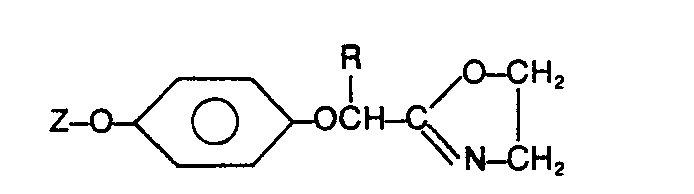
- R Wasserstoff oder Methyl
- Z einen substituierten Phenyl- oder Pyridylrest,

- R, Halogen, Trifluormethyl, Cyano, Nitro,
- R2 Wasserstoff, Halogen, Cyano,
- R3 Halogen, Trifluormethyl, Cyano und
- n die Zahl 1 oder 2 bedeuten. Diese Verbindungen haben herbizide Wirkung.
Description
- Die vorliegende Erfindung betrifft neue , herbizid wirksame , kernsubstituierte Phenoxy-alkyl-oxazoline, Verfahren zu ihrer Herstellung, ferner herbizide Mittel, die diese neuen Verbindungen als Wirkstoffe enthalten, sowie Verfahren zur selektiven Bekämpfung grasartiger Unkräuter in Kulturpflanzungen.
- Die neuen Wirkstoffe entsprechen der Formel I

- R Wasserstoff oder Methyl und
- Z einen substituierten Phenylrest- oder Pyrid-2-yl- rest

- R1 Halogen, Trifluormethyl, Cyano, Nitro,
- R2 Wasserstoff, Halogen, Cyano,
- R3 Halogen, Trifluormethyl, Cyano und
- n die Zahl 1 oder 2.
- Unter Halogen wird jedes Halogenatom verstanden, bevorzugt sind Chlor oder Brom.
- Aus der US Patentschrift No. 3 877 921 ist bekannt, dass man Phenoxyalkyloxazoline als Herbizide und Wuchsregulatoren verwenden kann. In der DOS 2 613 697 werden herbizide Mittel beschrieben, welche als Wirkstoffe ähnliche Phenoxy-phenoxy-alkyl-heterocyclen enthalten.
- Diese Erfindung erschliesst eine neue Gruppe von Phenoxy-alkyl-oxazolidinen, die in geringen Aufwandmengen herbizide Wirkung zeigen.
- Die neuen Wirkstoffe der Formel I gemäas vorliegender Erfindung besitzen eine gute, hauptsächlich gegen Gräser gerichtete Herbizidwirkung, vor allem bei post-emergenter Anwendung und können in mono- und dikotylen Kulturen als Unkrautmittel eingesetzt werden.
- Die Phenoxy-alkyl-oxazoline vorliegender Erfindung sind wenig giftig für Warmblüter und ihre Anwendung dürfte keine Probleme verursachen. Die vorgeschlagenen Aufwandmengen liegen zwischen 0,1 und 5 kg pro Hektar.
- Die Herstellung der neuen Verbindungen der Formel I erfolgt nach an sich bekannten Reaktionen der chemischen Synthese.
- Gemäss einem ersten Verfahren werden Phenoxy-alkyl-äthylenimide der Formel II

- Anstelle des Aethylenimides kann auch ein Phenoxy-alkyl-äthylamid der Formel III

- Als Lösungsmittel kommen vor allem aprotische wasserlösliche in Frage, wie niedermolekulare Alkohole, Ketone, Dimethylformamid, Dimethylsulfoxyd aber auch chlorierte Kohlenwasserstoffe.
- Der Ringschluss erfolgt in Gegenwart einer Base, wie z.B. einem Alkalymetallhydroxyd oder einer quaternären Ammoniumhydroxyd, wenn X ein Halogenatom oder einen Sulfonsäurerest bedeutet, jedoch unter sauren Bedingungen, z.B. in Gegenwart von Schwefelsäure, wenn X die Hydroxylgruppe bedeutet.
- Als Katalysatoren für den Ringschluss kommen die Alkalimetallsalze oder tertiären Ammoniumsalze von Halogeniden und Sulfonsäuren in Frage.
- Der Ringschluss erfolgt bereits bei Raumtemperatur, zur Beschleunigung des Vorganges kann das Reaktionsgemisch bis zum Sieden erwärmt werden.
- Ein weiterer Weg, die Phenoxy-alkyl-oxazoline der Formel I herzustellen, besteht darin, dass man einen para-Phenoxy-phenol oder para-Pyrid-2-yloxy-phenol der Formel IV


R die unter Formel I gegebene Bedeutung hat, in Gegenwart eines säurebindenden Mittels kondensiert. - Diese Reaktion wird ebenfalls in einem mit Wasser mischbaren Lösungsmittel oder aber in einem Halogenkohlenwasserstoff vorgenommen,bei Normaldruck und einer Temperatur die zwischen Raumtemperatur und dem Siedepunkt des Reaktionsgemisches liegen kann. Vorzugsweise wird dabei unter Rückfluss gekocht.
- Als säurebindendes Mittel können wässerige Alkalimetallhydroxyde wie KOH und NaOH, sowie andere basische Stoffe wie Ammoniak, Karbonate, (K2CO3, NaHC03) Alkoholate (NaOCH3' K-tert.butylat) aber auch organische Basen wie Triäthylamin etc. verwendet werden. Falls als Lösungsmittel bereits eine organische Base z.B. Pyridin verwendet wird, so dient dieses zugleich als säurebindendes Mittel.
- Die Ausgangsstoffe der Formel II sind am besten durch Amidierung aus den entsprechenden Phenoxy-phenoxy-propionsäuren und Pyridyloxy-phenoxy-propionsäuren, wie sie z.B. in den Deutschen Offenlegungsschriften No. 2 223 894, 2 531 643, 2 546 251 und 2 652 384 beschrieben worden sind.
- Die Amidierung geschieht nach an sich bekannten Methoden durch Umsetzen der Halogenide oder des Anhydrides dieser Säuren mit Aethylenimin,den entsprechenden Halogen- äthylaminen oder einem 2-Amino-äthyl-sulfonat.
- Die nachfolgenden Beispiele veranschaulichen ein erfindungsgemässes Herstellungsverfahren für solche Verbindungen. Die Temperaturen darin sind in Celsiusgraden angegeben, Teile und Prozentangaben beziehen sich auf das Gewicht. Weitere in entsprechender Weise hergestellte Verbindungen sind in der anschliessenden Tabelle aufgeführt.
- Zu 39 g (0,1 Mol) α-[4-(3',5'-Dichlor-pyrid-2'yl)-oxy- phenoxy]-propionsäure-chloräthylamid in 500 ml Methylenchlorid werden 50 g 50%ige NaOH und 1 g Tetrabutylammoniumbromid zugegeben. Nach 4-stündigem Rühren bei Raumtemperatur werden 50 ml Wasser zugegeben, die Methylenchloridphase abgetrennt, mit Magnesiumsulfat getrocknet und eingedampft. Zum öligen Rückstand wird wenig Aether zugegeben. Das dabei kristallisierende Produkt wird abfiltriert und getrocknet. Man erhält 25,3 g Endprodukt mit einem Schmelzpunkt von 111-113°.
- Eine Suspension von 25,4 g 4-(4'-Trifluormethyl-phenoxy)-phenol, 23,6 g a-Brompropionsäure-2-chloräthylamid und 20 g wasserfreiem Kaliumcarbonat in 250 ml Aethylenmethyl-keton wird während 18 Std. bei RUckflusstemperatur gerührt, filtriert und das Filtrat am Vakuum eingedampft. Der ölige Rückstand (19,5 g) wird in 75 ml Methylenchlorid gelöst, mit 2,5 g Tetrabutylammonium-hydrogensulfat und 2,51 g Natriumhydroxyd in 25 ml Wasser versetzt und unter Stickstoffatmosphäre während 3 Std. bei Raumtemperatur gerührt. Die Methylenchloridphase wird abgetrennt, mit Wasser gewaschen, getrocknet und am Vakuum eingedampft. Man erhält 13,6 g der Titelverbindung

- In analoger Weise werden folgende Verbindungen hergestellt:


- Die neuen a-[4-(Phenoxy-phenoxy]- und a-[4-(Pyridyloxy)-phenoxy]-alkyl-oxazoline zeigen bei relativ niederen Aufwandmengen eine starke herbizide Wirkung.
- Die neuen Wirkstoffe der Formel I sind als Herbizide im Vorauflauf-, als insbesondere auch im NachauflaufVerfahren brauchbar. Ihre Wirkung richtet sich vor allem gegen monocotyle Unkräuter, sie können zur selektiven Unkrautbekämpfung bei dikotylen Pflanzenkulturen eingesetzt werden, wie z.B. in Soja. Sie eignen sich jedoch ebenfalls zur selektiven Unkrautbekämpfung in gewissen monocotyledonen Kulturen, z.B. in Getreiden wie Weizen und Gerste .
- Die Verwendungen sind wenig giftig für Warmblüter; die Aufwandmengen liegen vorteilhaft zwischen 0,1 und 5 kg Wirkstoff pro Hektar.
- Die vorliegende Erfindung betrifft auch herbizide Mittel, welche eine Verbindung der Formel I als aktive Komponente enthalten. Solche Mittel können in üblicher Weise als feste Formulierungen (Stäubemittel, Streumittel, Granulate), als in Wasser dispergierbare Konzentrate (Spritzpulver, Emulsionen, Emulsionskonzentrate und Pasten) oder als Lösungen vorliegen und werden nach bekannten Techniken mit entsprechenden Zuschlag- und Trägerstoffen formuliert.
- Die Herstellung erfindungsgemässer Mittel erfolgt in an sich bekannter Weise durch inniges Vermischen und Vermahlen von Wirkstoffen der Formel I mit geeigneten Trägerstoffen, gegebenenfalls unter Zusatz von gegenüber den Wirkstoffen inerten Uispersions- oder Lösungsmitteln. Die Wirkstoffe können in den folgenden Aufarbeitungsformen vorliegen und angewendet werden:
- feste Aufarbeitungsformen: Stäubemittel, Streumittel, Granulate, Umhullungsgranulate Imprägnierungsgranulate und Homogengranulate;
- in Wasser dispergierbare Wirkstoffkonzentrate: Spritzpulver, (wettable powder), Pasten, Emulsionen:
- flussige Aufarbeitungsformen: Lösungen.
- Der Gehalt an Wirkstoff in den oben beschriebenen Mitteln liegt zwischen 0,1 bis 95%, bevorzugt zwischen 1 bis 80%. Anwendungsformen können bis hinab zu 0,001% verdunnt werden. Die Aufwandmengen betragen in der Regel 0,1 bis 10 kg AS/ha, vorzugsweise 0,25 bis 5 kg AS/ha. Die Wirkstoffe der Formel 1 können beispielsweise wie folgt formuliert werden (Teile bedeuten Gewichtsteile):
- Zur Herstellung eines a) 5%igen und b) 2%igen Stäubemittels werden die folgenden Stoffe verwendet:

- Die Wirkstoffe werden mit den Trägerstoffen vermischt und vermahlen.
- Zur Herstellung eines 5%igen Granulates werden die folgenden Stoffe verwendet:

- Die Aktivsubstanz wird mit Epichlorhydrin vermischt und in 6 Teilen Aceton gelöst, hierauf werden Polyäthylenglykol und Cetylpolyäthylenglykoläther zugesetzt. Die so erhaltene Lösung wird auf Kaolin aufgesprüht und anschliessend im Vakuum verdampft.
- Zur Herstellung eines a) 50%igen, b) 25%igen und c) 10%igen Spritzpulvers werden folgende Bestandteile verwendet:

- Der angegebene Wirkstoff wird auf die entsprechenden Trägerstoffe (Kaolin und Kreide) aufgezogen und anschliessend vermischt und vermahlen. Man erhält Spritzpulver von vorzüglicher Benetzbarkeit und Schwebefähigkeit. Aus solchen Spritzpulvern können durch Verdünnen mit Wasser Suspensionen jeder gewünschten Wirkstoffkonzentration erhalten werden. Derartige Suspensionen werden zur Bekämpfung von Unkräutern und Ungräsern in Kulturpflanzungen im Vorauflaufverfahren verwendet.
- Zur Herstellung einer 45%igen Paste werden folgende Stoffe verwendet:

- Der Wirkstoff wird mit den Zuschlagstoffen in dazu geeigneten Geräten innig vermischt und vermahlen. Man erhält eine Paste, aus der sich durch Verdünnen mit Wasser Suspensionen jeder gewünschten Konzentration herstellen lassen. Die Suspensionen eignen sich zur Behandlung von Rasenanlagen.
- Zur Herstellung eines 25%igen Emulsionskonzentrates werden

- Anstatt des jeweiligen in den vorhergehenden Formulierungsbeispielen angegebenen Wirkstoffs kann auch eine andere der von der Formel I umfassten Verbindungen verwendet werden.
- Die erfindungsgemässen Wirkstoffe sind auch interessante Kombinationspartner für eine Reihe von Herbiziden der Phenylharnstoff- und Triazinreihe in Getreidekulturen, Mais, Zuckerrohr bezw. im Obst- und Weinbau.
- Zum Nachweis der Brauchbarkeit als Herbizide (pre- und post-emergent) dienten folgende Testmethoden:
- Im Gewächshaus wird unmittelbar nach der Einsaat der Versuchspflanzen in Saatschalen die Erdoberfläche mit einer wässerigen Suspension der Wirkstoffe, erhalten aus einem 25%-igen Spritzpulver, behandelt. Es wurden vier verschiedene Konzentrationsreihen angewendet, entsprechend 4, 2, 1 und 0,5 kg Wirksubstanz pro Hektar. Die Saatschalen werden im Gewächshaus bei 22-25°C und 50-70% rel. Luftfeuchtigkeit gehalten und der Versuch nach 3 Wochen ausgewertet und die Resultate nach folgender Notenskala bonitiert:
- 0 = Pflanzen ungeschädigt ( wie unbehandelte Kontrolle).
- 1-9 = Zwischenstufen der Schädigung
- 10 = Pflanzen abgestorben
- Eine grössere Anzahl Unkräuter und Kulturpflanzen, sowohl monocotyle wie dicotyle, wurden im Gewächshaus nach dem Auflaufen (im 4-bis-6-Blattstadium) mit einer wässrigen Wirkstoffemulsion in Dosierungen von 0,5; 1; 2 und 4 kg Wirksubstanz pro Hektar auf die Pflanzen gespritzt und diese bei 24°-26°C und 45-60% rel. Luftfeuchtigkeit gehalten. 5 Tage und 15 Tage nach Behandlung wird der Versuch ausgewertet und das Ergebnis wie im pre-emergent-Versuch nach derselben Notenskala bonitiert.
- Ein im Oktober mit Winterweizen der Sorte "TAM 101" angesätes Feld wurde im nächsten Frühjahr, im März, 5 Monate nach der Saat), wenn der Weizen das 2-3 Blatt-Stadium erreicht hatte und avena fatua (Flughafer) das prominenteste Unkraut im 1-5 Blatt-Stadium anzutreffen war, parzellenweise mit verdünnten wässrigen Wirkstoffemulsionen behandelt, so dass die Parzellen je mit 2, 1.5, 1, 0.75 und 0.5 kg Wirkstoff pro Hektar besprüht wurden. Der Versuch wurde nach 37 Tagen, Ende April ausgewertet und der Zustand des Weizens und des Flughafers gemäss der obenstehenden Skala bonitiert. Die Resultate sind in der untenstehenden Tabelle zusammengefasst:

- A = 2-[5-(3',5'-Dichlorpyridyl-2'-oxy)-phenoxy)]-propionsäure-methylester bekannt aus der DOS 2 546 251 oder der USP 4 046 553
- Hoe 23 408 = 2-[4-(2',4'-Dichlorphenoxy)-phenoxy]-propionsäure-methylester, bekannt aus DOS 2 223 894 oder USP 3 953 442
- Ein Mitte Februar mit Sommergerste vom Typ "CM-67" angesätes Feld wurde nach 42 Tagen, Ende März als die Gerste das 4-6 Blatt-Stadium und avena fatua, das am meisten verbreitete Unkraut das 5-7 Blatt-Stadium erreicht hatten, parzellenweise mit verdünnten wässerigen Wirkstoffemulsionen behandelt, so dass die Parzellen je mit 2, 1.5, 1, 0.75 und 5 kg Wirkstoff pro Hektar besprüht wurden. Der Versuch wurde nach 22 Tagen, im April ausgewertet und der Zustand der Pflanzen gemäss der oben gegebenen Skala bonitiert. Die Resultate sind in der untenstehenden Tabelle zusammengefasst.

- Diese Konzentration wurde nicht geprüft.
Claims (9)


R die unter Formel I, Anspruch 1 gegebene Bedeutung hat, in Gegenwart eines säurebindenden Mictels kondensiert.
Applications Claiming Priority (2)
| Application Number | Priority Date | Filing Date | Title |
|---|---|---|---|
| CH2/78 | 1978-01-02 | ||
| CH278 | 1978-01-02 |
Publications (3)
| Publication Number | Publication Date |
|---|---|
| EP0002812A2 true EP0002812A2 (de) | 1979-07-11 |
| EP0002812A3 EP0002812A3 (en) | 1979-07-25 |
| EP0002812B1 EP0002812B1 (de) | 1982-02-03 |
Family
ID=4177191
Family Applications (1)
| Application Number | Title | Priority Date | Filing Date |
|---|---|---|---|
| EP78101806A Expired EP0002812B1 (de) | 1978-01-02 | 1978-12-21 | Phenoxy-alkyl-oxazoline, ihre Herstellung, sie enthaltende Mittel sowie deren Verwendung als Herbizide |
Country Status (6)
| Country | Link |
|---|---|
| US (1) | US4225336A (de) |
| EP (1) | EP0002812B1 (de) |
| BR (1) | BR7808549A (de) |
| CA (1) | CA1100972A (de) |
| DE (1) | DE2861615D1 (de) |
| IL (1) | IL56348A (de) |
Cited By (2)
| Publication number | Priority date | Publication date | Assignee | Title |
|---|---|---|---|---|
| EP0432661A3 (en) * | 1989-12-09 | 1992-03-04 | Yashima Chemical Industrial Co., Ltd. | 2-substituted phenyl-2-oxazoline or thiazoline derivatives, process for producing the same and insecticides and acaricides containing the same |
| EP0544093A1 (de) * | 1991-11-27 | 1993-06-02 | American Cyanamid Company | 4-Carboxy-2-Aryloxyphenoxyalkyl substituierte heterocyclische Verbindungen, verwendbar als Herbizide |
Families Citing this family (6)
| Publication number | Priority date | Publication date | Assignee | Title |
|---|---|---|---|---|
| US4289884A (en) * | 1979-01-08 | 1981-09-15 | Shell Oil Company | Herbicidal tetrahydrofuran derivatives |
| JPS55139306A (en) | 1979-04-19 | 1980-10-31 | Chugai Pharmaceut Co Ltd | Plant growth regulator |
| ATE5478T1 (de) * | 1980-03-05 | 1983-12-15 | Ciba-Geigy Ag | Herbizid wirkende 2-nitro-5-phenoxyphenyloxazole, -oxazine, -imidazole, -pyrimidine und - thiazole, ihre herstellung und verwendung. |
| US4775410A (en) * | 1985-08-19 | 1988-10-04 | Sandoz Ltd. | 2-[4-(2-pyridinyloxy)phenoxy]propionyl-2-oxazolidinones |
| ES2128529T3 (es) * | 1993-11-26 | 1999-05-16 | Ube Industries | Derivados de oxazolina, procedimiento para su preparacion y composiciones agricolas y horticolas para el control de organismos nocivos que los contienen. |
| PE20160664A1 (es) | 2013-06-27 | 2016-07-09 | Pfizer | Compuestos heteroaromaticos y su uso como ligandos d1 de dopamina |
Family Cites Families (5)
| Publication number | Priority date | Publication date | Assignee | Title |
|---|---|---|---|---|
| US3877921A (en) * | 1971-06-28 | 1975-04-15 | Scott & Sons Co O M | Herbicidal Phenoxyalkyloxazolines |
| US3778445A (en) * | 1971-06-28 | 1973-12-11 | Scott & Sons Co O M | Phenoxyalkyloxazolines |
| DK154074C (da) * | 1974-10-17 | 1989-02-27 | Ishihara Sangyo Kaisha | Alfa-(4-(5 eller 3,5 substitueret pyridyl-2-oxy)-phenoxy)-alkan-carboxylsyrer eller derivater deraf til anvendelse som herbicider, herbicidt middel samt fremgangsmaader til bekaempelse af ukrudt |
| US4133675A (en) * | 1976-07-23 | 1979-01-09 | Ciba-Geigy Corporation | Pyridyloxy-phenoxy-alkanecarboxylic acid derivatives which are effective as herbicides and as agents regulating plant growth |
| BE862325A (fr) * | 1977-12-27 | 1978-06-27 | Ciba Geigy | Nouveaux derives d'acide pyridyloxy-phenoxypropionique ayant une action herbicide et phytoregulatrice |
-
1978
- 1978-12-21 DE DE7878101806T patent/DE2861615D1/de not_active Expired
- 1978-12-21 EP EP78101806A patent/EP0002812B1/de not_active Expired
- 1978-12-28 BR BR7808549A patent/BR7808549A/pt unknown
- 1978-12-29 CA CA318,803A patent/CA1100972A/en not_active Expired
-
1979
- 1979-01-01 IL IL56348A patent/IL56348A/xx unknown
- 1979-07-30 US US06/062,191 patent/US4225336A/en not_active Expired - Lifetime
Cited By (3)
| Publication number | Priority date | Publication date | Assignee | Title |
|---|---|---|---|---|
| EP0432661A3 (en) * | 1989-12-09 | 1992-03-04 | Yashima Chemical Industrial Co., Ltd. | 2-substituted phenyl-2-oxazoline or thiazoline derivatives, process for producing the same and insecticides and acaricides containing the same |
| US5141948A (en) * | 1989-12-09 | 1992-08-25 | Yashima Chemical Industrial Co., Ltd. | 2-substituted phenyl-2-oxazoline or thiazoline derivatives, process for producing the same and insecticides and acaricides containing the same |
| EP0544093A1 (de) * | 1991-11-27 | 1993-06-02 | American Cyanamid Company | 4-Carboxy-2-Aryloxyphenoxyalkyl substituierte heterocyclische Verbindungen, verwendbar als Herbizide |
Also Published As
| Publication number | Publication date |
|---|---|
| IL56348A0 (en) | 1979-03-12 |
| IL56348A (en) | 1982-02-28 |
| EP0002812B1 (de) | 1982-02-03 |
| DE2861615D1 (en) | 1982-03-11 |
| CA1100972A (en) | 1981-05-12 |
| US4225336A (en) | 1980-09-30 |
| EP0002812A3 (en) | 1979-07-25 |
| BR7808549A (pt) | 1979-08-14 |
Similar Documents
| Publication | Publication Date | Title |
|---|---|---|
| EP0003313B1 (de) | Neue Pyridyloxy-phenoxy-alpha-propionsäure-aminoalkyl-ester mit herbizider Wirkung,ihre Herstellung, sie enthaltende Mittel und deren Verwendung | |
| DE2732846C2 (de) | ||
| EP0003114B1 (de) | Herbizid wirksame ungesättigte Ester von 4-(3',5'-Dihalogenpyridyl -(2')-oxy)-alpha-phenoxypropionsäuren, Verfahren zu ihrer Herstellung sowie sie enthaltende herbizide Mittel und deren Verwendung | |
| EP0004317B1 (de) | Neue Phenoxy-alkancarbonsäurederivate, deren Herstellung, sie enthaltende herbizide Mittel und deren Verwendung | |
| EP0014684A2 (de) | 2-Substituierte 5-Phenoxy-phenylphosphonsäurederivate, Verfahren zu ihrer Herstellung und ihre Verwendung als Herbizide | |
| DD143389A5 (de) | Herbizide zum selektiven bekaempfen von grasartigen unkraeutern | |
| EP0002812B1 (de) | Phenoxy-alkyl-oxazoline, ihre Herstellung, sie enthaltende Mittel sowie deren Verwendung als Herbizide | |
| EP0036390B1 (de) | Diphenyläther-Harnstoffe mit herbizider Wirkung | |
| EP0003295B1 (de) | Neue Phenoxy-phenoxy-alkancarbonsäurederivate mit herbizider Wirkung, deren Herstellung, sie enthaltende Mittel und deren Verwendung | |
| DE2637886C2 (de) | ||
| EP0008624B1 (de) | Ester von O-(Pyridyloxy-phenyl)-milchsäuren, Verfahren zu ihrer Herstellung und ihre Verwendung als Herbizide und Pflanzenwachstumsregulatoren | |
| EP0007089B1 (de) | Acylanilide mit herbicider und fungicider Wirkung, Verfahren zu ihrer Herstellung und ihre Verwendung | |
| EP0003297B1 (de) | Neue Phenoxy-alkyl-oxazoline, deren Herstellung, sie enthaltende herbizide Mittel und deren Verwendung | |
| DE2732442A1 (de) | Neue phenoxy-phenoxy-alkancarbonsaeurederivate | |
| EP0030922B1 (de) | Äthinyl-Phenylharnstoffe, Verfahren zu deren Herstellung und deren Verwendung als Herbizide | |
| EP0001641B1 (de) | 2-(2'-Nitro-5-(2"-chlor-4"-trifluormethylphenoxy)-phenoxy)-propionsäure-methoxyäthylester, ein diesen Ester als Wirkstoff enthaltendes Mittel und dessen Verwendung als Herbizid. | |
| EP0086375B1 (de) | Pyridinderivate, ihre Herstellung und Verwendung | |
| EP0005709B1 (de) | Herbizid wirksame substituierte Diphenylätherderivate, diese als Wirkstoffe enthaltende herbizide Mittel und deren Verwendung | |
| CH618322A5 (de) | ||
| EP0003059B1 (de) | Herbizid wirksame 4-(p-Phenoxy-phenoxy)-alpha-propionsäure-alkoxyalkylamide, Verfahren zu ihrer Herstellung und sie enthaltende herbizide Mittel und deren Verwendung | |
| EP0003517B1 (de) | Cyanomethylester der 4-(p-Trifluormethylphenoxy)-alpha-phenoxy-propionsäure, Verfahren zu seiner Herstellung und ihn als Wirkstoff enthaltendes herbizides Mittel und dessen Verwendung | |
| EP0016731B1 (de) | Meta-Cyanoalkoxy-Phenylharnstoffe mit herbizider Wirkung, deren Herstellung und sie enthaltende Mittel | |
| EP0035475A1 (de) | Herbizid wirkende 2-Nitro-5-phenoxyphenyl-oxazole, -oxazine, -imidazole, -pyrimidine und -thiazole, ihre Herstellung und Verwendung | |
| DE2738653A1 (de) | 5-pyrimidincarbonitrile, verfahren zu deren herstellung und deren verwendung als herbizide | |
| CH625940A5 (en) | A composition for regulating the growth of plants containing, as active ingredient, 3-pyridinol compounds |
Legal Events
| Date | Code | Title | Description |
|---|---|---|---|
| PUAI | Public reference made under article 153(3) epc to a published international application that has entered the european phase |
Free format text: ORIGINAL CODE: 0009012 |
|
| PUAL | Search report despatched |
Free format text: ORIGINAL CODE: 0009013 |
|
| AK | Designated contracting states |
Designated state(s): BE CH DE FR GB IT NL |
|
| AK | Designated contracting states |
Designated state(s): BE CH DE FR GB IT NL |
|
| 17P | Request for examination filed | ||
| ITF | It: translation for a ep patent filed | ||
| GRAA | (expected) grant |
Free format text: ORIGINAL CODE: 0009210 |
|
| AK | Designated contracting states |
Designated state(s): BE CH DE FR GB IT NL |
|
| REF | Corresponds to: |
Ref document number: 2861615 Country of ref document: DE Date of ref document: 19820311 |
|
| PGFP | Annual fee paid to national office [announced via postgrant information from national office to epo] |
Ref country code: NL Payment date: 19821231 Year of fee payment: 5 |
|
| PGFP | Annual fee paid to national office [announced via postgrant information from national office to epo] |
Ref country code: CH Payment date: 19831104 Year of fee payment: 6 |
|
| PG25 | Lapsed in a contracting state [announced via postgrant information from national office to epo] |
Ref country code: NL Effective date: 19840701 |
|
| NLV4 | Nl: lapsed or anulled due to non-payment of the annual fee | ||
| PGFP | Annual fee paid to national office [announced via postgrant information from national office to epo] |
Ref country code: DE Payment date: 19841107 Year of fee payment: 7 |
|
| PGFP | Annual fee paid to national office [announced via postgrant information from national office to epo] |
Ref country code: FR Payment date: 19841129 Year of fee payment: 7 |
|
| PGFP | Annual fee paid to national office [announced via postgrant information from national office to epo] |
Ref country code: BE Payment date: 19841231 Year of fee payment: 7 |
|
| PG25 | Lapsed in a contracting state [announced via postgrant information from national office to epo] |
Ref country code: CH Effective date: 19871231 Ref country code: BE Effective date: 19871231 |
|
| BERE | Be: lapsed |
Owner name: CIBA-GEIGY A.G. Effective date: 19871231 |
|
| GBPC | Gb: european patent ceased through non-payment of renewal fee | ||
| PG25 | Lapsed in a contracting state [announced via postgrant information from national office to epo] |
Ref country code: FR Free format text: LAPSE BECAUSE OF NON-PAYMENT OF DUE FEES Effective date: 19880831 |
|
| REG | Reference to a national code |
Ref country code: CH Ref legal event code: PL |
|
| PG25 | Lapsed in a contracting state [announced via postgrant information from national office to epo] |
Ref country code: DE Effective date: 19880901 |
|
| REG | Reference to a national code |
Ref country code: FR Ref legal event code: ST |
|
| PG25 | Lapsed in a contracting state [announced via postgrant information from national office to epo] |
Ref country code: GB Free format text: LAPSE BECAUSE OF NON-PAYMENT OF DUE FEES Effective date: 19881117 |
|
| PLBE | No opposition filed within time limit |
Free format text: ORIGINAL CODE: 0009261 |
|
| STAA | Information on the status of an ep patent application or granted ep patent |
Free format text: STATUS: NO OPPOSITION FILED WITHIN TIME LIMIT |