EP0003183A1 - Agents tensioactifs éthoxylés-propoxylés et procédé de récupération d'huile à l'aide de ces agents. - Google Patents
Agents tensioactifs éthoxylés-propoxylés et procédé de récupération d'huile à l'aide de ces agents. Download PDFInfo
- Publication number
- EP0003183A1 EP0003183A1 EP79300069A EP79300069A EP0003183A1 EP 0003183 A1 EP0003183 A1 EP 0003183A1 EP 79300069 A EP79300069 A EP 79300069A EP 79300069 A EP79300069 A EP 79300069A EP 0003183 A1 EP0003183 A1 EP 0003183A1
- Authority
- EP
- European Patent Office
- Prior art keywords
- surfactant
- oil
- microemulsion
- surfactants
- formation
- Prior art date
- Legal status (The legal status is an assumption and is not a legal conclusion. Google has not performed a legal analysis and makes no representation as to the accuracy of the status listed.)
- Granted
Links
- 239000004094 surface-active agent Substances 0.000 title claims abstract description 225
- 238000000034 method Methods 0.000 title claims abstract description 48
- 230000015572 biosynthetic process Effects 0.000 claims abstract description 65
- 125000004432 carbon atom Chemical group C* 0.000 claims abstract description 14
- UHOVQNZJYSORNB-UHFFFAOYSA-N monobenzene Natural products C1=CC=CC=C1 UHOVQNZJYSORNB-UHFFFAOYSA-N 0.000 claims abstract description 12
- 125000000217 alkyl group Chemical group 0.000 claims abstract description 10
- 125000003342 alkenyl group Chemical group 0.000 claims abstract description 8
- 150000001768 cations Chemical group 0.000 claims abstract description 7
- 125000003118 aryl group Chemical group 0.000 claims abstract description 5
- 239000003921 oil Substances 0.000 claims description 85
- 239000004530 micro-emulsion Substances 0.000 claims description 71
- XLYOFNOQVPJJNP-UHFFFAOYSA-N water Substances O XLYOFNOQVPJJNP-UHFFFAOYSA-N 0.000 claims description 59
- 150000003839 salts Chemical class 0.000 claims description 54
- HPALAKNZSZLMCH-UHFFFAOYSA-M sodium;chloride;hydrate Chemical compound O.[Na+].[Cl-] HPALAKNZSZLMCH-UHFFFAOYSA-M 0.000 claims description 49
- 239000012267 brine Substances 0.000 claims description 48
- -1 alkyl radical Chemical class 0.000 claims description 37
- 239000000203 mixture Substances 0.000 claims description 33
- 238000011084 recovery Methods 0.000 claims description 31
- 239000012530 fluid Substances 0.000 claims description 28
- 230000000694 effects Effects 0.000 claims description 22
- QAOWNCQODCNURD-UHFFFAOYSA-L Sulfate Chemical compound [O-]S([O-])(=O)=O QAOWNCQODCNURD-UHFFFAOYSA-L 0.000 claims description 13
- 239000002562 thickening agent Substances 0.000 claims description 8
- 238000002347 injection Methods 0.000 claims description 7
- 239000007924 injection Substances 0.000 claims description 7
- 239000006184 cosolvent Substances 0.000 claims description 6
- 229910019142 PO4 Inorganic materials 0.000 claims description 4
- 238000009472 formulation Methods 0.000 claims description 4
- 125000004435 hydrogen atom Chemical group [H]* 0.000 claims description 4
- TUJKJAMUKRIRHC-UHFFFAOYSA-N hydroxyl Chemical compound [OH] TUJKJAMUKRIRHC-UHFFFAOYSA-N 0.000 claims description 4
- NBIIXXVUZAFLBC-UHFFFAOYSA-K phosphate Chemical compound [O-]P([O-])([O-])=O NBIIXXVUZAFLBC-UHFFFAOYSA-K 0.000 claims description 4
- 239000010452 phosphate Substances 0.000 claims description 4
- 150000005840 aryl radicals Chemical class 0.000 claims description 3
- 125000000753 cycloalkyl group Chemical group 0.000 claims description 3
- 150000003254 radicals Chemical class 0.000 claims description 3
- JXLHNMVSKXFWAO-UHFFFAOYSA-N azane;7-fluoro-2,1,3-benzoxadiazole-4-sulfonic acid Chemical compound N.OS(=O)(=O)C1=CC=C(F)C2=NON=C12 JXLHNMVSKXFWAO-UHFFFAOYSA-N 0.000 claims 2
- 229910021653 sulphate ion Inorganic materials 0.000 claims 1
- 150000001875 compounds Chemical class 0.000 description 38
- 125000001301 ethoxy group Chemical group [H]C([H])([H])C([H])([H])O* 0.000 description 25
- IAYPIBMASNFSPL-UHFFFAOYSA-N Ethylene oxide Chemical compound C1CO1 IAYPIBMASNFSPL-UHFFFAOYSA-N 0.000 description 21
- 239000000463 material Substances 0.000 description 20
- 239000000243 solution Substances 0.000 description 19
- HEMHJVSKTPXQMS-UHFFFAOYSA-M Sodium hydroxide Chemical compound [OH-].[Na+] HEMHJVSKTPXQMS-UHFFFAOYSA-M 0.000 description 17
- 239000010779 crude oil Substances 0.000 description 16
- 125000002572 propoxy group Chemical group [*]OC([H])([H])C(C([H])([H])[H])([H])[H] 0.000 description 16
- 238000012360 testing method Methods 0.000 description 13
- 230000008901 benefit Effects 0.000 description 12
- 230000008569 process Effects 0.000 description 12
- 230000007928 solubilization Effects 0.000 description 11
- 238000005063 solubilization Methods 0.000 description 11
- 239000000126 substance Substances 0.000 description 11
- AKEJUJNQAAGONA-UHFFFAOYSA-N sulfur trioxide Inorganic materials O=S(=O)=O AKEJUJNQAAGONA-UHFFFAOYSA-N 0.000 description 11
- TWRXJAOTZQYOKJ-UHFFFAOYSA-L Magnesium chloride Chemical compound [Mg+2].[Cl-].[Cl-] TWRXJAOTZQYOKJ-UHFFFAOYSA-L 0.000 description 10
- GOOHAUXETOMSMM-UHFFFAOYSA-N Propylene oxide Chemical compound CC1CO1 GOOHAUXETOMSMM-UHFFFAOYSA-N 0.000 description 10
- FAPWRFPIFSIZLT-UHFFFAOYSA-M Sodium chloride Chemical compound [Na+].[Cl-] FAPWRFPIFSIZLT-UHFFFAOYSA-M 0.000 description 10
- 239000000047 product Substances 0.000 description 10
- LFQSCWFLJHTTHZ-UHFFFAOYSA-N Ethanol Chemical compound CCO LFQSCWFLJHTTHZ-UHFFFAOYSA-N 0.000 description 9
- 230000008859 change Effects 0.000 description 9
- 239000003795 chemical substances by application Substances 0.000 description 8
- 238000006073 displacement reaction Methods 0.000 description 7
- 238000007046 ethoxylation reaction Methods 0.000 description 7
- 239000002243 precursor Substances 0.000 description 7
- 239000002904 solvent Substances 0.000 description 7
- BDHFUVZGWQCTTF-UHFFFAOYSA-M sulfonate Chemical compound [O-]S(=O)=O BDHFUVZGWQCTTF-UHFFFAOYSA-M 0.000 description 7
- KWYUFKZDYYNOTN-UHFFFAOYSA-M Potassium hydroxide Chemical compound [OH-].[K+] KWYUFKZDYYNOTN-UHFFFAOYSA-M 0.000 description 6
- 150000001298 alcohols Chemical class 0.000 description 6
- 229910052783 alkali metal Inorganic materials 0.000 description 6
- 238000013461 design Methods 0.000 description 6
- 239000000499 gel Substances 0.000 description 6
- 229910052751 metal Inorganic materials 0.000 description 6
- 239000002184 metal Substances 0.000 description 6
- 239000012071 phase Substances 0.000 description 6
- 125000001273 sulfonato group Chemical group [O-]S(*)(=O)=O 0.000 description 6
- 238000006424 Flood reaction Methods 0.000 description 5
- 239000002585 base Substances 0.000 description 5
- 239000001110 calcium chloride Substances 0.000 description 5
- 229910001628 calcium chloride Inorganic materials 0.000 description 5
- 230000001965 increasing effect Effects 0.000 description 5
- 229910001629 magnesium chloride Inorganic materials 0.000 description 5
- 238000004519 manufacturing process Methods 0.000 description 5
- 239000003208 petroleum Substances 0.000 description 5
- 239000011148 porous material Substances 0.000 description 5
- 238000002360 preparation method Methods 0.000 description 5
- 238000000926 separation method Methods 0.000 description 5
- 239000011780 sodium chloride Substances 0.000 description 5
- IJGRMHOSHXDMSA-UHFFFAOYSA-N Atomic nitrogen Chemical compound N#N IJGRMHOSHXDMSA-UHFFFAOYSA-N 0.000 description 4
- DGAQECJNVWCQMB-PUAWFVPOSA-M Ilexoside XXIX Chemical compound C[C@@H]1CC[C@@]2(CC[C@@]3(C(=CC[C@H]4[C@]3(CC[C@@H]5[C@@]4(CC[C@@H](C5(C)C)OS(=O)(=O)[O-])C)C)[C@@H]2[C@]1(C)O)C)C(=O)O[C@H]6[C@@H]([C@H]([C@@H]([C@H](O6)CO)O)O)O.[Na+] DGAQECJNVWCQMB-PUAWFVPOSA-M 0.000 description 4
- 150000001340 alkali metals Chemical class 0.000 description 4
- 150000007942 carboxylates Chemical group 0.000 description 4
- 238000006243 chemical reaction Methods 0.000 description 4
- 230000003247 decreasing effect Effects 0.000 description 4
- 239000002283 diesel fuel Substances 0.000 description 4
- 238000002156 mixing Methods 0.000 description 4
- 238000005191 phase separation Methods 0.000 description 4
- 230000019635 sulfation Effects 0.000 description 4
- 238000005670 sulfation reaction Methods 0.000 description 4
- 150000008053 sultones Chemical class 0.000 description 4
- 229940087291 tridecyl alcohol Drugs 0.000 description 4
- HIXDQWDOVZUNNA-UHFFFAOYSA-N 2-(3,4-dimethoxyphenyl)-5-hydroxy-7-methoxychromen-4-one Chemical compound C=1C(OC)=CC(O)=C(C(C=2)=O)C=1OC=2C1=CC=C(OC)C(OC)=C1 HIXDQWDOVZUNNA-UHFFFAOYSA-N 0.000 description 3
- OYPRJOBELJOOCE-UHFFFAOYSA-N Calcium Chemical compound [Ca] OYPRJOBELJOOCE-UHFFFAOYSA-N 0.000 description 3
- UXVMQQNJUSDDNG-UHFFFAOYSA-L Calcium chloride Chemical compound [Cl-].[Cl-].[Ca+2] UXVMQQNJUSDDNG-UHFFFAOYSA-L 0.000 description 3
- YXFVVABEGXRONW-UHFFFAOYSA-N Toluene Chemical group CC1=CC=CC=C1 YXFVVABEGXRONW-UHFFFAOYSA-N 0.000 description 3
- 239000003945 anionic surfactant Substances 0.000 description 3
- 229920001222 biopolymer Polymers 0.000 description 3
- 238000013375 chromatographic separation Methods 0.000 description 3
- 230000007423 decrease Effects 0.000 description 3
- 239000003599 detergent Substances 0.000 description 3
- RTZKZFJDLAIYFH-UHFFFAOYSA-N ether Substances CCOCC RTZKZFJDLAIYFH-UHFFFAOYSA-N 0.000 description 3
- 238000002474 experimental method Methods 0.000 description 3
- 229910017053 inorganic salt Inorganic materials 0.000 description 3
- 238000007689 inspection Methods 0.000 description 3
- 230000003993 interaction Effects 0.000 description 3
- 125000002496 methyl group Chemical group [H]C([H])([H])* 0.000 description 3
- 230000035945 sensitivity Effects 0.000 description 3
- 239000011734 sodium Substances 0.000 description 3
- 239000000758 substrate Substances 0.000 description 3
- 238000006277 sulfonation reaction Methods 0.000 description 3
- KFZMGEQAYNKOFK-UHFFFAOYSA-N Isopropanol Chemical compound CC(C)O KFZMGEQAYNKOFK-UHFFFAOYSA-N 0.000 description 2
- WHXSMMKQMYFTQS-UHFFFAOYSA-N Lithium Chemical compound [Li] WHXSMMKQMYFTQS-UHFFFAOYSA-N 0.000 description 2
- ZLMJMSJWJFRBEC-UHFFFAOYSA-N Potassium Chemical compound [K] ZLMJMSJWJFRBEC-UHFFFAOYSA-N 0.000 description 2
- ATUOYWHBWRKTHZ-UHFFFAOYSA-N Propane Chemical compound CCC ATUOYWHBWRKTHZ-UHFFFAOYSA-N 0.000 description 2
- WQDUMFSSJAZKTM-UHFFFAOYSA-N Sodium methoxide Chemical compound [Na+].[O-]C WQDUMFSSJAZKTM-UHFFFAOYSA-N 0.000 description 2
- DKGAVHZHDRPRBM-UHFFFAOYSA-N Tert-Butanol Chemical compound CC(C)(C)O DKGAVHZHDRPRBM-UHFFFAOYSA-N 0.000 description 2
- 239000002253 acid Substances 0.000 description 2
- 230000002411 adverse Effects 0.000 description 2
- 125000003545 alkoxy group Chemical group 0.000 description 2
- 125000002877 alkyl aryl group Chemical group 0.000 description 2
- 125000005037 alkyl phenyl group Chemical group 0.000 description 2
- 150000001412 amines Chemical class 0.000 description 2
- 239000012736 aqueous medium Substances 0.000 description 2
- 239000007864 aqueous solution Substances 0.000 description 2
- WTEOIRVLGSZEPR-UHFFFAOYSA-N boron trifluoride Chemical compound FB(F)F WTEOIRVLGSZEPR-UHFFFAOYSA-N 0.000 description 2
- 150000001732 carboxylic acid derivatives Chemical class 0.000 description 2
- 238000011161 development Methods 0.000 description 2
- 238000009826 distribution Methods 0.000 description 2
- LQZZUXJYWNFBMV-UHFFFAOYSA-N dodecan-1-ol Chemical compound CCCCCCCCCCCCO LQZZUXJYWNFBMV-UHFFFAOYSA-N 0.000 description 2
- 238000005516 engineering process Methods 0.000 description 2
- 230000002708 enhancing effect Effects 0.000 description 2
- 125000001495 ethyl group Chemical group [H]C([H])([H])C([H])([H])* 0.000 description 2
- 239000008398 formation water Substances 0.000 description 2
- 230000007062 hydrolysis Effects 0.000 description 2
- 238000006460 hydrolysis reaction Methods 0.000 description 2
- 238000010348 incorporation Methods 0.000 description 2
- ZXEKIIBDNHEJCQ-UHFFFAOYSA-N isobutanol Chemical compound CC(C)CO ZXEKIIBDNHEJCQ-UHFFFAOYSA-N 0.000 description 2
- 239000011968 lewis acid catalyst Substances 0.000 description 2
- 229910052744 lithium Inorganic materials 0.000 description 2
- 239000002609 medium Substances 0.000 description 2
- 229910052757 nitrogen Inorganic materials 0.000 description 2
- VLTRZXGMWDSKGL-UHFFFAOYSA-N perchloric acid Chemical compound OCl(=O)(=O)=O VLTRZXGMWDSKGL-UHFFFAOYSA-N 0.000 description 2
- 150000002989 phenols Chemical class 0.000 description 2
- 229920002401 polyacrylamide Polymers 0.000 description 2
- 229910052700 potassium Inorganic materials 0.000 description 2
- 239000011591 potassium Substances 0.000 description 2
- BWHMMNNQKKPAPP-UHFFFAOYSA-L potassium carbonate Chemical compound [K+].[K+].[O-]C([O-])=O BWHMMNNQKKPAPP-UHFFFAOYSA-L 0.000 description 2
- 238000001556 precipitation Methods 0.000 description 2
- 125000001436 propyl group Chemical group [H]C([*])([H])C([H])([H])C([H])([H])[H] 0.000 description 2
- 230000002829 reductive effect Effects 0.000 description 2
- 239000011435 rock Substances 0.000 description 2
- 229920006395 saturated elastomer Polymers 0.000 description 2
- 229910052708 sodium Inorganic materials 0.000 description 2
- 239000007787 solid Substances 0.000 description 2
- 238000001179 sorption measurement Methods 0.000 description 2
- 241000894007 species Species 0.000 description 2
- 150000003871 sulfonates Chemical class 0.000 description 2
- 150000003467 sulfuric acid derivatives Chemical class 0.000 description 2
- JOXIMZWYDAKGHI-UHFFFAOYSA-N toluene-4-sulfonic acid Chemical compound CC1=CC=C(S(O)(=O)=O)C=C1 JOXIMZWYDAKGHI-UHFFFAOYSA-N 0.000 description 2
- FSSPGSAQUIYDCN-UHFFFAOYSA-N 1,3-Propane sultone Chemical compound O=S1(=O)CCCO1 FSSPGSAQUIYDCN-UHFFFAOYSA-N 0.000 description 1
- CSHOPPGMNYULAD-UHFFFAOYSA-N 1-tridecoxytridecane Chemical compound CCCCCCCCCCCCCOCCCCCCCCCCCCC CSHOPPGMNYULAD-UHFFFAOYSA-N 0.000 description 1
- QWBBPBRQALCEIZ-UHFFFAOYSA-N 2,3-dimethylphenol Chemical compound CC1=CC=CC(O)=C1C QWBBPBRQALCEIZ-UHFFFAOYSA-N 0.000 description 1
- VIQKNUMVXOVXAX-UHFFFAOYSA-N 2-hydroxyethenesulfonic acid Chemical compound OC=CS(O)(=O)=O VIQKNUMVXOVXAX-UHFFFAOYSA-N 0.000 description 1
- QTWJRLJHJPIABL-UHFFFAOYSA-N 2-methylphenol;3-methylphenol;4-methylphenol Chemical compound CC1=CC=C(O)C=C1.CC1=CC=CC(O)=C1.CC1=CC=CC=C1O QTWJRLJHJPIABL-UHFFFAOYSA-N 0.000 description 1
- BFFQFGGITJXTFP-UHFFFAOYSA-N 3-methyldioxetane Chemical compound CC1COO1 BFFQFGGITJXTFP-UHFFFAOYSA-N 0.000 description 1
- QGZKDVFQNNGYKY-UHFFFAOYSA-O Ammonium Chemical compound [NH4+] QGZKDVFQNNGYKY-UHFFFAOYSA-O 0.000 description 1
- 238000012935 Averaging Methods 0.000 description 1
- 229910015900 BF3 Inorganic materials 0.000 description 1
- 239000004215 Carbon black (E152) Substances 0.000 description 1
- 239000004593 Epoxy Substances 0.000 description 1
- 241000237858 Gastropoda Species 0.000 description 1
- CTQNGGLPUBDAKN-UHFFFAOYSA-N O-Xylene Chemical group CC1=CC=CC=C1C CTQNGGLPUBDAKN-UHFFFAOYSA-N 0.000 description 1
- QAOWNCQODCNURD-UHFFFAOYSA-N Sulfuric acid Chemical class OS(O)(=O)=O QAOWNCQODCNURD-UHFFFAOYSA-N 0.000 description 1
- 229910021626 Tin(II) chloride Inorganic materials 0.000 description 1
- 150000007513 acids Chemical class 0.000 description 1
- 229920006322 acrylamide copolymer Polymers 0.000 description 1
- 239000011149 active material Substances 0.000 description 1
- 239000008186 active pharmaceutical agent Substances 0.000 description 1
- 229910052784 alkaline earth metal Inorganic materials 0.000 description 1
- 150000001342 alkaline earth metals Chemical class 0.000 description 1
- 230000029936 alkylation Effects 0.000 description 1
- 238000005804 alkylation reaction Methods 0.000 description 1
- 238000004458 analytical method Methods 0.000 description 1
- 230000003466 anti-cipated effect Effects 0.000 description 1
- 238000013459 approach Methods 0.000 description 1
- 239000008346 aqueous phase Substances 0.000 description 1
- 125000004429 atom Chemical group 0.000 description 1
- 229910052788 barium Inorganic materials 0.000 description 1
- DSAJWYNOEDNPEQ-UHFFFAOYSA-N barium atom Chemical compound [Ba] DSAJWYNOEDNPEQ-UHFFFAOYSA-N 0.000 description 1
- 239000001273 butane Substances 0.000 description 1
- 125000000484 butyl group Chemical group [H]C([*])([H])C([H])([H])C([H])([H])C([H])([H])[H] 0.000 description 1
- 239000011575 calcium Substances 0.000 description 1
- 229910052791 calcium Inorganic materials 0.000 description 1
- 229910052799 carbon Inorganic materials 0.000 description 1
- 230000021523 carboxylation Effects 0.000 description 1
- 238000006473 carboxylation reaction Methods 0.000 description 1
- 239000003054 catalyst Substances 0.000 description 1
- 239000007795 chemical reaction product Substances 0.000 description 1
- HMPHJJBZKIZRHG-UHFFFAOYSA-N chloromethanesulfonic acid Chemical compound OS(=O)(=O)CCl HMPHJJBZKIZRHG-UHFFFAOYSA-N 0.000 description 1
- 238000000975 co-precipitation Methods 0.000 description 1
- 230000000052 comparative effect Effects 0.000 description 1
- 238000007796 conventional method Methods 0.000 description 1
- 238000001816 cooling Methods 0.000 description 1
- 125000004122 cyclic group Chemical group 0.000 description 1
- 125000000113 cyclohexyl group Chemical group [H]C1([H])C([H])([H])C([H])([H])C([H])(*)C([H])([H])C1([H])[H] 0.000 description 1
- 125000001511 cyclopentyl group Chemical group [H]C1([H])C([H])([H])C([H])([H])C([H])(*)C1([H])[H] 0.000 description 1
- 230000002939 deleterious effect Effects 0.000 description 1
- 238000012217 deletion Methods 0.000 description 1
- 230000037430 deletion Effects 0.000 description 1
- 230000001419 dependent effect Effects 0.000 description 1
- 230000001627 detrimental effect Effects 0.000 description 1
- WPCPXPTZTOMGRF-UHFFFAOYSA-K di(butanoyloxy)alumanyl butanoate Chemical compound [Al+3].CCCC([O-])=O.CCCC([O-])=O.CCCC([O-])=O WPCPXPTZTOMGRF-UHFFFAOYSA-K 0.000 description 1
- 230000003467 diminishing effect Effects 0.000 description 1
- YWEUIGNSBFLMFL-UHFFFAOYSA-N diphosphonate Chemical compound O=P(=O)OP(=O)=O YWEUIGNSBFLMFL-UHFFFAOYSA-N 0.000 description 1
- 238000004821 distillation Methods 0.000 description 1
- NLVXSWCKKBEXTG-UHFFFAOYSA-M ethenesulfonate Chemical compound [O-]S(=O)(=O)C=C NLVXSWCKKBEXTG-UHFFFAOYSA-M 0.000 description 1
- 238000013213 extrapolation Methods 0.000 description 1
- 230000002349 favourable effect Effects 0.000 description 1
- UQSQSQZYBQSBJZ-UHFFFAOYSA-N fluorosulfonic acid Chemical compound OS(F)(=O)=O UQSQSQZYBQSBJZ-UHFFFAOYSA-N 0.000 description 1
- 150000004676 glycans Chemical class 0.000 description 1
- 230000005484 gravity Effects 0.000 description 1
- 229910052736 halogen Inorganic materials 0.000 description 1
- 239000008233 hard water Substances 0.000 description 1
- QNVRIHYSUZMSGM-UHFFFAOYSA-N hexan-2-ol Chemical class CCCCC(C)O QNVRIHYSUZMSGM-UHFFFAOYSA-N 0.000 description 1
- 229930195733 hydrocarbon Natural products 0.000 description 1
- 150000002430 hydrocarbons Chemical class 0.000 description 1
- 230000003301 hydrolyzing effect Effects 0.000 description 1
- 125000002887 hydroxy group Chemical group [H]O* 0.000 description 1
- 238000011065 in-situ storage Methods 0.000 description 1
- 239000004615 ingredient Substances 0.000 description 1
- 238000003780 insertion Methods 0.000 description 1
- 230000037431 insertion Effects 0.000 description 1
- 150000002500 ions Chemical class 0.000 description 1
- 238000009533 lab test Methods 0.000 description 1
- 150000002596 lactones Chemical class 0.000 description 1
- 230000000670 limiting effect Effects 0.000 description 1
- 239000007788 liquid Substances 0.000 description 1
- 239000011159 matrix material Substances 0.000 description 1
- 229910021645 metal ion Inorganic materials 0.000 description 1
- 230000004048 modification Effects 0.000 description 1
- 238000012986 modification Methods 0.000 description 1
- OFBQJSOFQDEBGM-UHFFFAOYSA-N n-pentane Natural products CCCCC OFBQJSOFQDEBGM-UHFFFAOYSA-N 0.000 description 1
- SJWFXCIHNDVPSH-UHFFFAOYSA-N octan-2-ol Chemical class CCCCCCC(C)O SJWFXCIHNDVPSH-UHFFFAOYSA-N 0.000 description 1
- 239000002332 oil field water Substances 0.000 description 1
- MHYFEEDKONKGEB-UHFFFAOYSA-N oxathiane 2,2-dioxide Chemical compound O=S1(=O)CCCCO1 MHYFEEDKONKGEB-UHFFFAOYSA-N 0.000 description 1
- 125000000963 oxybis(methylene) group Chemical group [H]C([H])(*)OC([H])([H])* 0.000 description 1
- 239000002245 particle Substances 0.000 description 1
- 125000002467 phosphate group Chemical group [H]OP(=O)(O[H])O[*] 0.000 description 1
- DLYUQMMRRRQYAE-UHFFFAOYSA-N phosphorus pentoxide Inorganic materials O1P(O2)(=O)OP3(=O)OP1(=O)OP2(=O)O3 DLYUQMMRRRQYAE-UHFFFAOYSA-N 0.000 description 1
- 229920001282 polysaccharide Polymers 0.000 description 1
- 239000005017 polysaccharide Substances 0.000 description 1
- 229910000027 potassium carbonate Inorganic materials 0.000 description 1
- 239000002244 precipitate Substances 0.000 description 1
- 150000003138 primary alcohols Chemical class 0.000 description 1
- IKNCGYCHMGNBCP-UHFFFAOYSA-N propan-1-olate Chemical compound CCC[O-] IKNCGYCHMGNBCP-UHFFFAOYSA-N 0.000 description 1
- 239000001294 propane Substances 0.000 description 1
- 125000004368 propenyl group Chemical group C(=CC)* 0.000 description 1
- 239000011541 reaction mixture Substances 0.000 description 1
- 230000009467 reduction Effects 0.000 description 1
- 230000000717 retained effect Effects 0.000 description 1
- 239000004576 sand Substances 0.000 description 1
- CDBYLPFSWZWCQE-UHFFFAOYSA-L sodium carbonate Substances [Na+].[Na+].[O-]C([O-])=O CDBYLPFSWZWCQE-UHFFFAOYSA-L 0.000 description 1
- 229910000029 sodium carbonate Inorganic materials 0.000 description 1
- NESLWCLHZZISNB-UHFFFAOYSA-M sodium phenolate Chemical compound [Na+].[O-]C1=CC=CC=C1 NESLWCLHZZISNB-UHFFFAOYSA-M 0.000 description 1
- 230000001502 supplementing effect Effects 0.000 description 1
- 230000002277 temperature effect Effects 0.000 description 1
- AXZWODMDQAVCJE-UHFFFAOYSA-L tin(II) chloride (anhydrous) Chemical compound [Cl-].[Cl-].[Sn+2] AXZWODMDQAVCJE-UHFFFAOYSA-L 0.000 description 1
- 125000000391 vinyl group Chemical group [H]C([*])=C([H])[H] 0.000 description 1
- 229920002554 vinyl polymer Polymers 0.000 description 1
- 229920003169 water-soluble polymer Polymers 0.000 description 1
- 239000008096 xylene Chemical group 0.000 description 1
Images
Classifications
-
- C—CHEMISTRY; METALLURGY
- C09—DYES; PAINTS; POLISHES; NATURAL RESINS; ADHESIVES; COMPOSITIONS NOT OTHERWISE PROVIDED FOR; APPLICATIONS OF MATERIALS NOT OTHERWISE PROVIDED FOR
- C09K—MATERIALS FOR MISCELLANEOUS APPLICATIONS, NOT PROVIDED FOR ELSEWHERE
- C09K8/00—Compositions for drilling of boreholes or wells; Compositions for treating boreholes or wells, e.g. for completion or for remedial operations
- C09K8/58—Compositions for enhanced recovery methods for obtaining hydrocarbons, i.e. for improving the mobility of the oil, e.g. displacing fluids
- C09K8/584—Compositions for enhanced recovery methods for obtaining hydrocarbons, i.e. for improving the mobility of the oil, e.g. displacing fluids characterised by the use of specific surfactants
-
- Y—GENERAL TAGGING OF NEW TECHNOLOGICAL DEVELOPMENTS; GENERAL TAGGING OF CROSS-SECTIONAL TECHNOLOGIES SPANNING OVER SEVERAL SECTIONS OF THE IPC; TECHNICAL SUBJECTS COVERED BY FORMER USPC CROSS-REFERENCE ART COLLECTIONS [XRACs] AND DIGESTS
- Y10—TECHNICAL SUBJECTS COVERED BY FORMER USPC
- Y10S—TECHNICAL SUBJECTS COVERED BY FORMER USPC CROSS-REFERENCE ART COLLECTIONS [XRACs] AND DIGESTS
- Y10S516/00—Colloid systems and wetting agents; subcombinations thereof; processes of
- Y10S516/01—Wetting, emulsifying, dispersing, or stabilizing agents
- Y10S516/02—Organic and inorganic agents containing, except water
-
- Y—GENERAL TAGGING OF NEW TECHNOLOGICAL DEVELOPMENTS; GENERAL TAGGING OF CROSS-SECTIONAL TECHNOLOGIES SPANNING OVER SEVERAL SECTIONS OF THE IPC; TECHNICAL SUBJECTS COVERED BY FORMER USPC CROSS-REFERENCE ART COLLECTIONS [XRACs] AND DIGESTS
- Y10—TECHNICAL SUBJECTS COVERED BY FORMER USPC
- Y10S—TECHNICAL SUBJECTS COVERED BY FORMER USPC CROSS-REFERENCE ART COLLECTIONS [XRACs] AND DIGESTS
- Y10S516/00—Colloid systems and wetting agents; subcombinations thereof; processes of
- Y10S516/01—Wetting, emulsifying, dispersing, or stabilizing agents
- Y10S516/03—Organic sulfoxy compound containing
- Y10S516/04—Protein or carboxylic compound containing
Definitions
- This invention relates to a method for recovering oil fron a subterranean formation, and more particularly to special surfactant syatems to be used with waterflooding techniques to improve the oil displacenent efficiency of waterfloods.
- Waterflooding is by far the most economical and widely practised of secondary recovery methods. In such a process, water or other aqueous fluid is introduced through injection wells to drive oil through the formation to offset producing wells. Much of the current work in secondary recovery technology has been directed toward improving the efficiency of waterflooding processes.
- Surface-active agents or surfactants are one class of materials which have been proposed for improving the efficiency of waterflooding processes.
- Much of the oil that is retained in the reservoir after a typical waterflood is in the form of discontinuous globules or discrete droplets which are trapped within the pore spaces of the reservoir.
- surfactants in general and anionic surfactants in particular is their tendency to be depleted from the injected solution as the solution moves through the reservoir.
- the surface-active agent is removed from the waterflood solution as it moves through the reservoir, the agent is not available to act at the oil/water interface. Quite naturally, surfactant depletion decreases oil recovery efficiency.
- the efficiency of the oil displacement is strongly affected by (1) the rate of surfactant loss and (2) the surface activity (extent of lowering of the oil/water interfacial tension) of the surfactant.
- anionic surfactants Another difficulty observed in the use o.f many anionic surfactants is the inability of the surfactant to exhibit high surface activity in high temperature reservoirs (i.e., temperatures of about 120° F or more) and/or in aqueous solutions containing high concentrations of inorganic salts.
- many oilfield brines e.g. formation brines which are considered herein to contain high concentrations of inorganic salts, generally contain over 2% NaCl and over 0.5% CaCl 2 and MgCl 2 total; concentrations of ovcr 4% NaCl and 2% CaCl 2 and MgCl 2 are common.
- formation brine includes not only brine originally present in the fermation but also brines subsequently introduced into the formation, e.g. during flooding operations.
- formation brines are encountered which do not contain such high concentrations of inorganic salts, but generally such brines are less common and in any event still contain what would be considered "high" concentrations of inorganic salts by most standards.
- surfactants useful as detergents in hard water contemplate salt concentrations which are orders of magnitude less, e.g. sodium chloride concentrations no higher than about 0.2% and combined calcium and magnesium chloride concentrations of no more than 0.5. In fact, most detergent surfactants are entirely unsuited for use in reservoir environments.
- This sensitivity is important because in commercial operations concentrations may'vary from time to time and because the concentration of the surfactant composition will vary as it moves through the formation because of mixing with in-situ water, non-uniform movement and the like. This results in both surfactant loss to the formation and loss of surface activity.
- a major cause of the problems associated with the use of polyalkoxylated surfactants is due to the fact that as the fluid containing these surfactants moves through a formation, a chromatographic-type separation of surfactant components takes place. This may be better understood by considering the general chemical composition of a polyalkoxylated surfactant. Generally, such surfactants are prepared by alkoxylating a suitable organic substrate using a strong base or a Lewis acid catalyst such as sodium hydroxide, BF 3 or the like, followed by sulfation or sulfonation.
- the resulting product may be purified to some extent, the resulting "pure" surfactant ultimately used in the field is, in reality, a mixere of discrete compounds, each having been alkoxylated to a different extent.
- the resulting product when ethoxylating a primary alcohol, ROH, the resulting product may be represented as RO (EO) 4 . 2 H (where EO represents the ethoxy group (C 2 H 4 O) and the subscript 4.2 indicates the average number of ethoxy groups).
- the product comprises a mixture of adducts and unreacted alcohols, for example and so forth, in different proportions such that an average value of 4.2 ethoxy groups has been achieved. It has been found that each component compound demonstrates a substantially different surface activity at a given concentration of inorganic salts.
- surfactant may possess some properties similar to a purified, single component surfactant and may give acceptable results in small scale laboratory tests, field results can vary substantially due to extensive chromatographic-type separation of one or more components during flooding.
- co-surfactants a mixture of two (or more) different types of surfactants (co-surfactants) are utilized, such as the approach suggested in U.S. Patent No. 3,811,505, issued to Fluornoy et al.
- each separated component is in a similar environment, i.e. reservoir brine of a given inorganic salt concentration.
- reservoir brine of a given inorganic salt concentration.
- all remaining components exist in an unacceptable environment. In other words, all other discrete components, when separated, will demonstrate poor surface active properties in the reservoir brine.
- the present invention relates to a flooding process and a composition used in such flooding process, which alleviates the above problems.
- a process is provided for recovering oil from a subterranean formation wherein fluid containing a surfactant is injected into the formation.
- the surfactant provides a high degree of surface activity in reservoirs having a high concentration of inorganic salts.
- the surfactant is a compound characterized by the general formula: wherein
- Y is a sulfate or sulfonate group and R 1 is a branched alkyl radical having at least-two branching groups.
- m and n each range between about 2 and about 6. Ranges of optimum average numbers of propoxy and ethoxy groups (m End n) for different salt concentrations have been discovered and this further enhances the advantages of these surfactants.
- the surfactant system of the invention is, therefore, highly effective in brines commonly found in oil field environments.
- the agents of this invention can be used in various fluids including an aqueous solution, an oil solution, a microemulsion which is miscible with the crude oil and/or formation water, or a microemulsion which is immiscible with the formation crude oil and/or formation water.
- the agents as provided in this invention have good resistance to precipitation and adsorption when passing through a formation and will effectively reduce interfacial tension between the injected fluid and the in-place crude oil even in brine environments wherein high concentrations of inorganic salts exist. Moreover, the sulfonates in particular exhibit very good resistance to hydrolysis in high-temperature reservoirs.
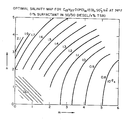
- the drawing is a plot illustrating optimal combinations of propoxy and ethoxy groups in a surfactant of the invention for given salt concentrations at 74°F and in admixture with diesel fuel.
- these agents can be used in any type of surfactant flooding process for recovering crude oil from a subterranean oil-bearing formation. They arc particularly useful in reservoirs having high concentrations of inorganic salts.
- a solution which contains an effective amount of a surface-active agent which is a compound having the general formula: wherein
- Y is a suitable hydrophilic group or substituted hydrophlilic group such as, for example, the sulfate, sulfonate, phosphate or carboxylate radical.
- R 1 is a branched alkyl radical having at least two branching groups and Y is a sulfate or sulfonate group.
- Y is a sulfonate group
- the preferred structure of Y may be characterized by the following general formula: wherein
- the surfactant of the present invention is not a pure substance in the strict sense, but really a mixture of components distributed such that m and n are the resulting average values.
- Surfactants of the general formula of compound (a) can be prepared in a number of ways. For the sake of brevity and clarity, however, only the preferred method of preparation will be presented herein.
- Suitable precursors of compound (a) include a C 6-24 linear or branched alcohol, a C 6-24 methyl phenol, or a C 6-24 dimethyl phenol.
- the precursor is a branched-chain alcohol having at least two branching groups. More preferably, the branched chain alcohol contains from 10 to 16 carbon atoms per molecule.
- the symbol C 6-24 is used herein to designate an alkyl radical having from 6 to 24 carbon atoms per molecule.'
- any isomers or substituted derivatives of these precursors are suitable in the practice of this invention.
- the use of a branched chain alcohol having from 10 to 16 carbon atoms is especially preferred and results in improved salinity and multivalent cation tolerance.
- the alcohol or substituted derivative is reacted with propylene oxide (PO) to yield an alkyl oxypropylene ether or an alkyl phenyl oxypropylene ether.
- the average number of propylene oxide units i.e., the value of m
- m ranges from a value of about 2 to a value of about 6.
- oxypropylene ether is then reacted with ethylene oxide (EO) to yield an alkyl oxypropylene oxyethylene ether or an alkyl phenyl oxypropylene oxyethylene ether.
- EO ethylene oxide
- the average number of ethylene oxide units added i.e., the value of n
- n ranges between about 2 and about 6.
- alkoxylation reaction can be achieved using a strong base or Lewis acid catalyst such as NaOH, KOH, BF 3 or SnCl 2 .
- bases include sodium phenolate and alkali metal alkoxides such as sodium methoxide or propoxide.
- suitable acids include BF 3 -etherate, p-toluene sulfonic acid, fluorosulfonic acid, aluminum butyrate and perchloric acid. The following example will serve to illustrate an alkoxylation procedure.
- a total of 453 g (2.27 moles) of i-tridecyl alcohol and 6 g of dry sodium hydroxide was charged to a 2-liter stirred autoclave reactor.
- the reactor was purged with nitrogen and heated to approximately 140°C.
- Four hundred grams of propylene oxide (6.90 moles) were delivered to the reactor over a period of about an hour.
- the reaction temperature was increased to about 160°C until reactor pressure dropped to a constant value.
- the reaction mixture was then cooled to about 140°C, after which 399 g of ethylene oxide (9.07 moles) were delivered to the reactor over about a one-half hour period.
- the reaction tem erature was again raised to about 160°C and maintained until the pressure dropped to a constant value.
- hydrophilic group a suitable hydrophilic group (Y).
- suitable groups include the sulfate group, the sulfonate group, the phosphate group and the carboxylate group.
- the hydrophilic group is sulfate or sulfonate.
- Example 2 The product from Example 1 was added to a wiped film reactor at a rate of about 12 g (0.0214 g-moles) per minute. Sulfur trioxide, diluted in a stream of dry nitrogen, was then introduced at a rate of 2.0 g (0.0250 g-moles) per minute. The sulfate acid product was collected continuously at the, outlet of the reactor. The resulting product was then neutralized with fifty weight per cent sodium hydroxide solution to give a surfactant of composition i-C 13 H 27 O(C 3 H 6 O) 3 (C 2 H 4 O) 4 SO 3 - Na + .
- alkoxylated compounds While a large number of suitable alkoxylated compounds may be prepared, each must be prepared by a method which introduces propoxy groups first and ethoxy groups second.
- the sulfation step can be omitted and the resulting propoxylated ethoxylated composition may be reacted with any suitable alkali metal (including, for example, sodium, potassium, or lithium) as the next step to form a sulfonate surfactant.
- alkali metal including, for example, sodium, potassium, or lithium
- the reaction product will be referred to herein as a metal etherate for the sake of brevity.
- the metal etherate can be reacted with a large number of compounds to yield surfactants generally characterized by compound (a).
- the metal etherate may be reacted with chloromethyl sulfonate, vinyl sulfonate, 1,3-propane sultone, or 1,4-butane sultone to prepare compounds having a general structure where R 3 is a hydrogen atom.
- the metal etherate may also be reacted with 3-methylpropane sultone, or 4-methylbutane sultone, to prepare compounds having a structural formula where R 3 is a methyl group.
- the metal etherate also may be reacted with hydroxyvinyl sulfonate, 3-hydroxypropane sultone, or 4-hydroxybutane sultone to prepare compounds having a structure where R 3 is a hydroxyl group.
- the sultones used for the sulfonation of the metal etherate are cyclic esters of hydroxysulfonic acids.
- the name sultone is derived from their formal resemblance to lactones.
- Considerable literature has been devoted to sultones and the chemistry of the propane and butane sultones in well known to the art. See, for example, R. F. Fisher, Industrial and Engineering Chemistry, Vol. 56 No. 3, March 1964, pp. 41-45.
- the propoxylated ethoxylated material can be reacted with phosphorus pentoxide to form a phosphate.
- a catalyst such as BF 3 -etherate complex may be used.
- the resulting product is then neutralized with an alkali metal base such as sodium or potassium hydroxide, or sodium or potassium carbonate, or the like, to form an alkali metal salt.
- a carboxylate group may be incorporated into the propoxylated ethoxylated material by any number of well-known methods.
- the propoxylated ethoxylated material may be reacted with a halogen carboxylic acid to result in a carboxylic acid.
- the alcoholie end group - CH 2 OH can simply be oxidized under well-known conditions to yield a carboxylic acid.
- the resulting product is then neutralized using an alkali metal base to form a carboxylate surfactant having the general formula of compound (a).
- the drawing illustrates this feature. It was prepared from experimental data using brines composed of various percentages of a formation brine (specifically Tar Springs Brine, hereinafter "TSB”) having the composition shown in Table I.
- TLB Tar Springs Brine
- contour labelled 1.0 corresponds to 100% TSB and has a brine composition identical to that shown in TABLE I.
- the contour labelled 1.5 has 50% more of each component listed in TABLE I than does TSB, and so on.
- the flooding fluid has a concentration of inorganic salts on the order of 110% TSB
- an optimum brine composition e.g. optimal salinity
- the curves defining the optimum ratio are not always linear. Further, there is a region for simultaneously low m and n values that defines surfactants which, if used, give undesirable gels.
- m and n should preferably be greater than about two.
- the delineating summation value may, however, vary depending on the nature, chain length, or branching of the substrate which is alkoxylated, on the temperature, the nature of the oil, the type and amount of co-surfactant or co-solvent (if any), and the quantity and type of unreacted alcohol and alkoxylates.
- the change in optimal salinity is at least 2 times greater than the change seen for the propoxylated-ethoxylated surfactants. It follows that the salt sensitivity of the component species in the ethoxylated-only surfactants is much greater than that of surfactants prepared through propoxylation followed by ethoxylation.
- Suitable surfactants may include compounds wherein R 1 is the i-tridecyl group, i-hexadecyl group, i-decyl group, or i-dodecyl benzene, toluene or xylene group; R 2 may be a methyl, ethyl, propyl, butyl, cyclopentyl, cyclohexyl, or benzene radical (in the case of a sultone); R 3 can be a hydrogen atom, a methyl, ethyl, propyl, vinyl, propenyl, or hydroxyl radical. It is contemplated that when R 1 contains an aromatic group, the group will be a single benzene radical which will always be alkyl or alkenyl substituted.
- X can include alkali metals such as sodium, potassium and lithium, alkaline earth metals such as calcium and barium, amines including alkanol amines and their oxyalkylated adducts, and ammonium.
- alkali metals such as sodium, potassium and lithium
- alkaline earth metals such as calcium and barium
- amines including alkanol amines and their oxyalkylated adducts, and ammonium.
- R l , R 2 , R3and X will be apparent to those skilled in the art, and the specific examples listed should not be construed as limiting.
- a surfactant and the surfactants of this invention have an amphiphilic structure; that is, the molecules are composed of groups which have opposite solubility tendencies.
- the molecules For use in oil recovery operations the molecules should have at least one predominantly lipophilic or oil-soluble group and at least one predominantly hydrophilic or water-soluble group. "These are present in a certain ratio or balance. Where the correct balance is achieved, the surfactant will be able to solubilize relatively large amounts of both oil and water at or near optimal salinity.
- Such balanced surfactants are highly surface active and have been found very effective for oil recovery.
- an important feature of surfactants of the present invention is that the presence of the propoxy groups between the lipophilic group and the ethoxy chain/hydrophilic group (Y) modifies the overall hydrophile-water interaction energy, thus permitting accurate design of surfactants having the desired balance.
- Y ethoxy chain/hydrophilic group
- Surface-active agents in accordance with this invention can be formulated which exhibit this desired oil-water solubilization for use in the adverse environments of high-temperature reservoirs and/or high salt concentration environments.
- a large number of the component compounds of the surfactant used will exhibit similar or equivalent surface active properties for a given formation brine thereby substantially diminishing the problems ordinarily associated with chromatographic separation during flooding operations. While separation still occurs, as with other surfactants, a large number of the components still give acceptable surface activities under reservoir conditions, significantly enhancing recovery.
- such compounds can be formulated by propoxylating and ethoxylating the lipophilic group in a specific order; the properties of a surfactant may further be varied by adjusting the relative size and character of the hydrophilic or lipophilic portion of the surface-active molecule.
- the oil solubility of surfactants is related to the molecular weight of the lipophilic (oil-soluble) portion of the molecule. Since a surfactant's affinity for water generally increases faster than its affinity for oil as temperature increases, the ability to increase a surfactant's oil solubility can be very important.
- the surfactants of this invention, characterized by compound (a), can be designed to take into account adverse temperature effects by choosing R 1 of a suitable molecular weight to exhibit a desired oil solubility for a particular reservoir temperature.
- surfactants of the present invention may'be further enhanced by using a branched chain alkyl lipophilic portion.:
- the surface active properties of the resulting surfactant are less sensitive to salinity or higher concentrations of multivalent cations. That is, many of the discrete compounds that comprise the surfactant mixture demonstrate similar surface active properties.
- the inorganic salt concentrations of the flooding fluid can be adjusted to match that of the formation; if chromatographic-type separation of component compounds occurs, effective reduction of oil-water interfacial tension still takes place.
- variations in salt concentrations within the formation e.g. due to mixing or concentration inhomogeneities, do not affect surfactant performance to the extent experienced with surfactants used previously.
- the surfactant system may be further optimized by choosing the specific appropriate propylene oxide and ethylene oxide combination. This simply means that a choice in made as to the component compounds which predominate in the distribution of compounds which comprises the surfactant.
- a choice in made as to the component compounds which predominate in the distribution of compounds which comprises the surfactant exists for various salt concentrations.
- a family of curves defining this relationship can be derived (for example, the optimal salinity map of the drawing). This family of curves may be used in determining the best surfactants (i.e. set f(m, n) ⁇ ) for a given salt concentration for a particular formation and crude oil.
- a sulfate, sulfonate, phosphate, or carboxylate type surfactant should be used and the relative hydrophilic-lipophilic balance which will be most effective and efficient in recovering'oil will depend to a large extent on the physical and chemical characteristics of a particular formation.
- sulfates and sulfonate-type surfactants have been found to be effective in general, and are therefore preferred.
- use of a C 10-16 branched alcohol as the alkoxylation precursor is also preferred, since a good hydrophilic-lipophilic balance has been found to be achieved thereby.
- the surface-active agents of this invention can be used in any flooding process where a surfactant is introduced into a formation for the purpose of recovering crude oil. Accordingly, the process of the present invention finds application in aqueous surfactant solutions. Still further, the surface active agents may be used in liquid hydrocarbon solution in those recovery techniques in which an oil solvent is employed to provide a miscible displacement of the crude oil within the formation.
- the surfactants also have special applicability in "microemulsions.”
- microemulsion as used herein is defined as a stable, transparent or translucent micellar solution of oil, water, and one or more surfactants.
- the solution may optionally contain co-sur factants and/or cosolvents.
- These microemulsions may be water-external, oil-external, or may fall into that class of micellar structures in which there is apparently no identifiable external phase.
- the microemulcions may be single- phase solutions which can take up additional quantities of oil or water without phase separation.
- the microemulsions may be immiscible with oil, water, or both.
- microemulsion-oil and microemulsion-water interfacial tensions must be low when phase separation occurs.
- the microemulsion for use in a specific application is designed by first ascertaining information concerning the oil-bearing formation from which oil is to be recovered.
- the oil from the formation is analyzed to determine its physical and chemical characteristics.
- water from the formation is analyzed to determine the quantity and type of ionic substances present.
- the formation temperature is also determined by conventional means.
- Microemulsions are then formulated on the basis of the information obtained from the subterranean formation.
- the oil be one which has physical and chemical characteristics approximating the characteristics of the crude oil of the subterranean formation.
- the aqueous medium employed in the formation of the microemulsion of the present invention can be pure water, but is preferably a brine.
- the best salt concentrations for any particular microemulsion system will depend, among other criteria, on the salt concentrations of the formation brine. Therefore, most preferably formation brine, or am aqueous medium having similar physical and chemical characteristics thereto, is employed.
- the third essential component of the microemulsion of the present invention is a surfactant having a formula as characterized by this invention.
- a suitable surfactant ii i tridecyl ether (FO) m (EO)n sulfate, wherein the values of m and n preferably are selected using guidance from the drawing for a given salt concentration to further optimize the surface-active properties of the surfactant for a particular reservoir.
- a particularly suitable surfactant is i-C 13 H 27 O(PO) 4 (EO) 3 SO 3 - Na + . It must be emphasized at this point that similar information cannot be obtained from the drawing for a different temperature, crude or qualitatively different brine. Rather, the drawing must be appropriately reconstructed.
- the proportions of oil, water, and surfactant are not particularly critical as long as the same are sufficient to provide a microemulsion. Accordingly, the amount of water and the amount of oil can vary within wide limits. It is noted, however, that it has been discovered that the method of the present invention is applicable to the use of both water-external microemulsions and oil-external microemulsions as well as those micellar structures in which no particular external phase is discernible. Therefore, in the microemulsions of this invention, it is sufficient that the surfactant be employed in an amount effective to produce the desired microemulsion.
- the surfactant is employed in an amount from about 1% to about 20% based upon the volume of the microemulsion, and preferably between about 2% and about 12%.
- concentration possible is utilized so that a correspondingly large bank size can be used to compensate for deleterious effects of reservoir heterogeneity, and the upper limits are based upon economic considerations.
- the microemulsion can contain one or more co-surfactants and/or co-solvents.
- the co-surfactants or cc- solvents can be employed, for example, to adjust the viscosity of the microemulsion.
- the co-solvent is employed in an amount of from about 0.1% to about 14% based upon the volume of the microeuulsion.
- Many surface-active materials having a lipophilic portion can be effectively utilized as a co-surfactant or co-solvent in the environment of the present invention.
- the co-surfactants or co-solvent which have been found to be particularly effective include, but are not limited to, alcohols, ethoxylated alcohols, sulfated ethoxylated alcohols, sulfonated ethoxylated alcohols, ethoxylated phenols, sulfated ethoxylateù phenols, and synthetic sulfonates.
- the alcohols which are used as co-solvents are generally C 3-20 aliphatic alcohols including, for example, isopropanol, isobutanol, t-butanol, and various amyl alcohols, 1 and 2-hexanols, 1 and 2-octanols and dodecanol.
- co-surfactants and co-solvents can sometimes be used to advantage, it is a noteworthy and significant feature of the surfactants of this invention that such co-surfactants or co-solvents are often not required. This is thought to be a consequence of the complex nature of these surfactants inasmuch as many values of m and n are represented. Hence, a whole range of co-surfactants and co-solvents is already "built-in.”
- the fluids containing the surfactants of the present invention can optionally include a thickener for mobility control.
- Typical thickeners include water-soluble polymers including polysaccharides, such as those sold under the tradename "Kelzan XC" by Kelco Corporation; another typical example is Biopolymer 1035 sold by Pfizer, Inc.
- Other thickeners include high molecular weight polyacrylamides and acrylamide copolymers, more specifically, for example, partially hydrolized polyacrylamides such as those sold under the tradename "Pusher” by Dow Chemical Company.
- Another specific example of a suitable thickener is the improved biopolymer of U.S. Patent Application No. 630,468.
- the thickeners are employed in the microemulsion in an amount sufficient to create a favorable mobility ratio between the microemulsion and the fluids being displaced by the microemulsion.
- surfactants of the present invention exhibit good compatability characteristics with such mobility control agents.
- Many known surfactants cannot be utilized with such agents because of various incompatibility problems, such as coprecipitation or loss of surface activity.
- Microemulsions for injection into a formation and which use surfactants of the present invention are further illustrated by the following Table II, wherein all components are reported as volume percents based on the total microemulsion volume, except that inorganic salts are reported in g/1.
- the surfactant used in formulations prepared according to Table II are generally characterized by compound "a” and the particular compound used will be governed by the principles discussed previously and; more specifically, by the concentration of inorganic salts in the formation brine. In particular, the average values of m and n will be determined by the inorganic salt content. Most preferably, the concentration of inorganic salts will be substantially equivalent to that of the formation brine of the reservoir being flooded.
- the microemulsion is first injected into the subterranean formation in the form of a slug followed by the injection of thickened water and thereafter unthickened water.
- the slug of microemulsion is injected into the subterranean formation in a quantity selected to be large enough to effectively displace the crude oil in the formation to one or more production wells.
- the thickened water which is injected after the slug of microemulsion can be any conventional thickened water used as a driving fluid in microemulsion flooding processes.
- unthickened water is injected as a flooding medium. Any of these fluids can contain the surfactants of the present invention.
- the thickened and unthickened water act as driving fluids to drive the microemulsion slug through the subterranean formation and the microemulsion slug displaces crude oil trapped therein. The displaced oil is driven to the production means and then to the surface of the earth.
- the invention is further illustrated by the following tests which were performed to determine the surface active properties of surfactants of the present invention. Similar tests were performed using surfactants wherein the precursor has been (a) ethoxylated-omly; (b) propoxplated-oniy; and (c) ethoxylated and then propoxylated.
- V /V The solubilization parameter, V /V , has been found to provide a good indication of surface activity.
- C ⁇ The optimal salinity, C ⁇ , for a given surfactant approximately equals that concentration of inorganic salts in the microemulsion at which a low interfacial tension exists for both the microemulsion-oil interface and the microemulsion-water interface. Thus, it represents an optimum balance of acceptably low interfacial tensions. It will be noted that the data from Table III for C versus m and n do not always exactly fall on the appropriate curve from the family of iso-C ⁇ curves shown in the drawing. The reason for this is that uncertainty in the data requires the use of an averaging procedure in determining the best location for each curve.
- C ⁇ is expressed as percent Tar Springs Brine (TSB), previously defined in Table I.
- TDS Tar Springs Brine
- This brine contained approximately 104,000 ppm total dissolved solids (TDS), of which Na+ and Cl ions accounted for about 100,000 ppm. The remaining 4,000 ppm of TDS were accounted for by Ca++ and Mg++ ions and other trace substances.
- the final oil saturation, S of indicates the ultimate amount of residual oil in the formation after the flooding process has been completed.
- Example 3 following will illustrate the preparation of various microemulsion systems for determining C ⁇ and solubilization parameters, and Example 4 will illustrate the core flooding tests. It should be understood that the invention is in no way limited to these examples. In the examples, brine, surfactant and oil concentrations are presented as percent by volume.
- Microemulsion compositions for determining C ⁇ and V o /V s reported in Table III were prepared by mixing equal volumes of water containing varying proportions of dissolved solids (related to the TDS of the formation brine from the field) and a diesel oil.
- the oil used approximated the physical and chemical characteristics of a particular formation crude oil (Loudon crude).
- the volume of oil and volume of water taken up by each microemulsion was measured, and the volumetric ratio of oil to surfactant (V /V ) was calculated.
- the solubilization parameters (V o /V s and V w /V s ) for each microemulsion system were determined by varying the salinity of the aqueous phase in the microemulsion. By plotting the resulting parameter values versus salinity, their intersection determines the optimal salinity (C ⁇ ).
- microemulsions were then prepared having compositions as defined in Table III and were subjected to core displacement tests using slugs of each microemulsion driven by thickened water having a salinity of about 70% TSB.
- each microemulsion tested had been prepared at or near its optimal salinity for the particular surfactant and oil used in the microemulsion.
- the only microemulsions of Table III which were not formulated under optimal salinity conditions for displacement tests were for materials A, C and I.
- Example 4 is presented to illustrate the procedure followed in core displacement tests of the various microemulsions listed in Table III.
- the selected microemulsion was injected into a Berea sandstone core to determine the efficiency of an oil recovery process.
- the core used in these tests was a section of Berea sandstone having a cross-section of 1 inch by 1 inch and a length of 24 inches.
- Each test core had a perceabil- ity to brine of approximately 400 millidarcies and was mounted in epoxy with tap-fittings at each end for injection and production of fluids.
- the cores Prior to conducting the displacement test, the cores were flooded with oil and brine to approximate the oil and water saturations that would exist in an oil reservoir which had been flooded to the point that no further oil could be produced.
- the core was first saturated with a brine solution having 104,000 ppm TDS of the composi. tion described previously (TSB).
- TDS brine solution having 104,000 ppm TDS of the composi. tion described previously
- the core was then flooded with a 32-34 0 API gravity oil from the Loudon Field in Illinois, until no further brine could be produced.
- the core was then once again flooded with brine to remove all of the oil which could be recovered by a conventional waterflooding process.
- the quantities of oil and water remaining in the cores approximated those in a reservoir which had been water-flooded to a residual oil saturation.
- the residual oil in this core was approximately 35% of the pore volume of the core; the remaining 65% was saturated with brine. Precise values are
- a microemulsion solution having a composition listed in Table III was injected into the water-flooded core. Injection of this microemulsion solution was continued until approximately 0.2 pore volumes of fluid had been injected. The microemulsion solution was followed by a brine solution containing about 750 ppm of a biopolymer thickening agent in 70% TSB until oil production ceased. The viscosity of this brine solution was about 12 centipoises. These fluids were injected at an average frontal velocity of approximately one foot per day. The final oil saturation was obtained by measuring the incremental oil recovery.
- surfactants K-M are single component surfactants (i.e. surfactants which have been purified extensively to yield a single species).
- the remaining surfactant materials are distributions of compounds, as discussed previously.
- comparison of optimal salinities (C ⁇ ) indicates that the use of these surfactants in field flooding would present significant problems with chromatographic-type separation in the formation.
- the C 0 values for the ethoxylated-only materials demonstrate the potential problems for field operations.
- surfactant K (with only one ethoxy group) gives a gel.
- surfactants I and J, and L-N Each time an ethoxy group is added (surfactants I and J, and L-N), a large jump in optimal salinity results.
- a change of one ethoxy group in moving from surfactant I to surfactant J causes a jump in optimal salinity of about 45%.
- the ethoxylated-only material C values range from no optimal value (gel) to greater than 220% over a relatively narrow range of ethoxy groups
- the propoxylated-ethoxylated material C ⁇ values range from 96% to 135% TDS over a very broad range of m and n values. This further illustrates why many of the components of surfactants of the present invention may be separated during flooding, and yet still retain good surface activity in reservoir brine.
- Table IV summarizes possible surfactants and illustrates the extent that the various C values deviate from that value desired (140% TSB). Listed therein are those ethoxylated-only surfactants that lie nearest the contour labelled 1.4 and also the values of a parameter ⁇ . This parameter is the absolute value of the difference between the desired optimal salinity and the actual optimal salinity for the surfactant in question, expressed in % TSB. For ethoxylated-only surfactants, the smallest deviation shown is 30% TSB. Hence, Table IV illustrates that there are no ethoxylated-only surfactants clearly suitable for use in the above described reservoir.
- Surfactants A-E and 0-Q all have the general formula of compound (a) and were manufactured in accordance with the teachings of this invention wherein propoxylation is followed by ethoxylation. Very good oil recoveries were obtained for surfactants B, D, and Q. Moderately good oil recovery was obtained for surfactant E. In all of these floods, the core and the microemulsion contained brine near the optimal salinity for each system. Note further that Q is a 50/50 mixture of 0 and P, thus demonstrating that surfactants of type (a) can often be mixed together and yield good oil' recovery, provided the optimal salinity of the mixture has the appropriate value. Although the solubilization parameters for 0, P and Q have not been measured, they should be high.
Landscapes
- Chemical & Material Sciences (AREA)
- Oil, Petroleum & Natural Gas (AREA)
- Life Sciences & Earth Sciences (AREA)
- General Life Sciences & Earth Sciences (AREA)
- Engineering & Computer Science (AREA)
- Materials Engineering (AREA)
- Organic Chemistry (AREA)
- Organic Low-Molecular-Weight Compounds And Preparation Thereof (AREA)
- Emulsifying, Dispersing, Foam-Producing Or Wetting Agents (AREA)
- Fats And Perfumes (AREA)
Applications Claiming Priority (2)
| Application Number | Priority Date | Filing Date | Title |
|---|---|---|---|
| US870313 | 1978-01-18 | ||
| US05/870,313 US4293428A (en) | 1978-01-18 | 1978-01-18 | Propoxylated ethoxylated surfactants and method of recovering oil therewith |
Publications (2)
| Publication Number | Publication Date |
|---|---|
| EP0003183A1 true EP0003183A1 (fr) | 1979-07-25 |
| EP0003183B1 EP0003183B1 (fr) | 1982-03-31 |
Family
ID=25355121
Family Applications (1)
| Application Number | Title | Priority Date | Filing Date |
|---|---|---|---|
| EP79300069A Expired EP0003183B1 (fr) | 1978-01-18 | 1979-01-16 | Agents tensioactifs éthoxylés-propoxylés et procédé de récupération d'huile à l'aide de ces agents. |
Country Status (5)
| Country | Link |
|---|---|
| US (1) | US4293428A (fr) |
| EP (1) | EP0003183B1 (fr) |
| CA (1) | CA1107750A (fr) |
| DE (1) | DE2962369D1 (fr) |
| NO (1) | NO148384C (fr) |
Cited By (17)
| Publication number | Priority date | Publication date | Assignee | Title |
|---|---|---|---|---|
| GB2141731A (en) * | 1983-06-20 | 1985-01-03 | Loyd Wardwell Jones | Oil recovery surfactant composition |
| EP0149173A1 (fr) * | 1983-12-30 | 1985-07-24 | Hoechst Aktiengesellschaft | Sufonates de glycidyle d'éthers du tributylphénol, procédés pour leur préparation et leur utilisation |
| US4601836A (en) * | 1981-10-13 | 1986-07-22 | Jones L W | Phosphate ester/alcohol micellar solutions in well acidizing |
| EP0207312A3 (en) * | 1985-06-29 | 1987-11-11 | Huls Aktiengesellschaft | Method for the recovery of oil from underground formations |
| US6057284A (en) * | 1996-05-30 | 2000-05-02 | Basf Aktiengesellschaft | Iso-tridecanolalkoxylates in block form as low-foam or antifoaming surfactants |
| WO2009100298A1 (fr) * | 2008-02-07 | 2009-08-13 | Shell Oil Company | Procédé et composition pour une récupération accrue d’hydrocarbures |
| WO2009124922A1 (fr) * | 2008-04-10 | 2009-10-15 | Basf Se | Nouveaux tensioactifs à base d'alcools ramifiés, destinés à l'exploitation tertiaire de pétrole |
| US8465668B2 (en) | 2007-10-16 | 2013-06-18 | Basf Se | Surfactants with a polyethersulfonate structure method for production thereof and use thereof for tertiary crude oil production |
| US8513168B2 (en) | 2008-02-07 | 2013-08-20 | Shell Oil Company | Method and composition for enhanced hydrocarbons recovery |
| US8596367B2 (en) | 2010-03-10 | 2013-12-03 | Basf Se | Process for producing mineral oil using surfactants based on C16C18-containing alkyl propoxy surfactants |
| US8664167B2 (en) | 2008-02-07 | 2014-03-04 | Shell Oil Company | Method and composition for enhanced hydrocarbons recovery |
| US8759261B2 (en) | 2008-02-07 | 2014-06-24 | Shell Oil Company | Method and composition for enhanced hydrocarbons recovery |
| US9102862B2 (en) | 2008-02-07 | 2015-08-11 | Shell Oil Company | Method and composition for enhanced hydrocarbons recovery |
| US9109152B2 (en) | 2009-09-10 | 2015-08-18 | Board Of Regents, The University Of Texas System | Compositions and methods for controlling the stability of ethersulfate surfactants at elevated temperatures |
| US9732270B2 (en) | 2013-01-25 | 2017-08-15 | Sasol Germany Gmbh | Highly concentrated, water-free amine salts of hydrocarbon alkoxysulfates and use and method using aqueous dilutions of the same |
| EP2688977B1 (fr) | 2011-03-24 | 2017-11-01 | SASOL Germany GmbH | Sels de sulfates d'alkylpolyalcoxy très concentrés doués d'écoulement |
| EP3633008A1 (fr) | 2010-03-10 | 2020-04-08 | Basf Se | Formulations tensioactives aqueuses pour procédés de transport de pétrole à l'aide des tensioactifs à base de tensioactifs alkylpropoxylés contenant c16c18 |
Families Citing this family (79)
| Publication number | Priority date | Publication date | Assignee | Title |
|---|---|---|---|---|
| JPS5716097A (en) * | 1980-07-04 | 1982-01-27 | Lion Corp | Production of deodorized alkyl ether sulfate aqueous concentrate |
| DE3033927C2 (de) * | 1980-09-10 | 1982-09-09 | Chemische Werke Hüls AG, 4370 Marl | Verfahren zur Gewinnung von weitgehend emulsionsfreiem Öl aus einer unterirdischen Lagerstätte |
| EP0047370B1 (fr) * | 1980-09-10 | 1983-08-17 | Hüls Aktiengesellschaft | Procédé pour la récupération de pétrole d'une formation souterraine |
| US4406798A (en) * | 1981-08-24 | 1983-09-27 | Pfizer Inc. | Surfactant enhanced injectivity of xanthan mobility control solutions for tertiary oil recovery |
| DE3268795D1 (en) * | 1981-09-01 | 1986-03-13 | Huels Chemische Werke Ag | Process for recovery oil from a subterranean formation |
| US4448697A (en) * | 1982-01-22 | 1984-05-15 | Texaco Inc. | Secondary recovery process |
| US4493774A (en) * | 1982-02-18 | 1985-01-15 | Exxon Production Research Co. | Method for improving injectivities of biopolymer solutions |
| US4452708A (en) * | 1982-02-18 | 1984-06-05 | Exxon Production Research Co. | Oil recovery method using sulfonate surfactants derived from extracted aromatic feedstocks |
| US4465602A (en) * | 1982-06-11 | 1984-08-14 | Texaco Inc. | Oil recovery method utilizing an alkylarylpolyalkoxyalkylene sulfonate |
| US4466891A (en) * | 1982-07-02 | 1984-08-21 | Texaco Inc. | Glyceryl ether sulfonates for use in oil recovery fluids and processes |
| DE3307712A1 (de) * | 1983-03-04 | 1984-09-06 | Chemische Werke Hüls AG, 4370 Marl | Verfahren zur gewinnung von oel aus speichergestein |
| US4738789A (en) * | 1983-06-20 | 1988-04-19 | Jones L W | Surfactant solvent composition |
| US4882075A (en) * | 1983-06-20 | 1989-11-21 | Jones L W | Acidic surfactant solvent composition |
| US4585065A (en) * | 1984-11-15 | 1986-04-29 | Halliburton Company | Methods of increasing hydrocarbon production from subterranean formations |
| JPS61136577A (ja) * | 1984-12-06 | 1986-06-24 | Lion Corp | 石油回収用流体 |
| NO165797C (no) * | 1985-01-03 | 1991-04-10 | Berol Kemi Ab | Overflateaktiv forbindelse og emulsjon inneholdende denne, samt anvendelse derav. |
| DE3531214A1 (de) * | 1985-08-31 | 1987-03-05 | Huels Chemische Werke Ag | Verfahren zur injektivitaetserhoehung von einpressbohrungen bei der oelfoerderung mittels wasserfluten |
| US5068043A (en) * | 1985-11-12 | 1991-11-26 | Shell Oil Company | Preformed surfactant-optimized aqueous alkaline flood |
| US4980087A (en) * | 1986-01-15 | 1990-12-25 | Sandoz Ltd. | Ether sulfates of a mixture of branched 1-decanols |
| US4879399A (en) * | 1986-01-15 | 1989-11-07 | Sandoz Ltd. | Ether sulfates of a mixture of branched 1-decanols |
| US4811788A (en) * | 1986-02-13 | 1989-03-14 | The Standard Oil Company | Surfactant combinations and enhanced oil recovery method employing same |
| DE3607090A1 (de) * | 1986-03-05 | 1987-09-10 | Huels Chemische Werke Ag | Verfahren zum transport von schweroelen |
| US4690217A (en) * | 1986-08-15 | 1987-09-01 | Amoco Corporation | Process for water injectivity improvement treatment of water injection wells |
| DE3644386A1 (de) * | 1986-12-24 | 1988-07-07 | Huels Chemische Werke Ag | Verfahren zur gewinnung von erdoel aus einer unterirdischen lagerstaette durch tensidfluten |
| US4828032A (en) * | 1987-10-15 | 1989-05-09 | Exxon Production Research Company | Oil recovery process using alkyl hydroxyaromatic dianionic surfactants as mobility control agents |
| US4894173A (en) * | 1988-06-08 | 1990-01-16 | The Standard Oil Company | Divalent ion tolerant aromatic sulfonates |
| US4836283A (en) * | 1988-06-08 | 1989-06-06 | The Standard Oil Company | Divalent ion tolerant aromatic sulfonates |
| US4892660A (en) * | 1988-10-17 | 1990-01-09 | Exxon Research And Engineering Company | Pressure induced surfactant recovery during ultrafiltration of water-oil emulsions |
| US4959490A (en) * | 1988-11-14 | 1990-09-25 | Exxon Production Research Company | Process for manufacturing disulfonate surfactants |
| US5076363A (en) * | 1989-01-31 | 1991-12-31 | The Standard Oil Company | Surfactant-polymer composition and method of enhanced oil recovery |
| US4979564A (en) * | 1989-01-31 | 1990-12-25 | The Standard Oil Company | Method of enhanced oil recovery using low tension viscous waterflood |
| US4886120A (en) * | 1989-02-01 | 1989-12-12 | Conoco Inc. | Process for secondary oil recovery utilizing propoxylated ethoxylated surfactants in seawater |
| US4944346A (en) * | 1989-12-11 | 1990-07-31 | Atlantic Richfield Company | Ether sulfoxide compounds for enhanced oil recovery |
| US5282984A (en) * | 1990-06-25 | 1994-02-01 | Texaco Inc. | Generating bitumen-in-water dispersions and emulsions |
| US5311943A (en) * | 1992-10-19 | 1994-05-17 | Shell Oil Company | Blends of propoxy and ethoxy surfactants |
| US5843317A (en) * | 1997-02-26 | 1998-12-01 | Rhodia Inc. | Recovery and reuse of anionic surfactants from aqueous solutions |
| US6013185A (en) * | 1997-09-25 | 2000-01-11 | Rhodia Inc. | Recovery and reuse of nonionic surfactants from aqueous solutions |
| US6828281B1 (en) * | 2000-06-16 | 2004-12-07 | Akzo Nobel Surface Chemistry Llc | Surfactant blends for aqueous solutions useful for improving oil recovery |
| US7956013B2 (en) * | 2006-11-30 | 2011-06-07 | Basf Se | Compositions having pH-dependent viscosity, thickener systems containing the same, and uses therefor |
| US7427588B2 (en) * | 2007-01-12 | 2008-09-23 | Paul Daniel Berger | Ether sulfonate surfactants and process for making same |
| US8235120B2 (en) * | 2007-07-03 | 2012-08-07 | Baker Hughes Incorporated | Mesophase fluids with extended chain surfactants for downhole treatments |
| US20090078414A1 (en) * | 2007-09-25 | 2009-03-26 | Schlumberger Technology Corp. | Chemically enhanced thermal recovery of heavy oil |
| JP5281278B2 (ja) * | 2007-12-11 | 2013-09-04 | 花王株式会社 | 乳化重合用界面活性剤組成物 |
| CA2740198C (fr) * | 2008-10-15 | 2016-10-04 | Dow Global Technologies Llc | Compositions pour la recuperation de petrole et procedes d'utilisation de ces compositions |
| JP5571367B2 (ja) * | 2008-12-25 | 2014-08-13 | 花王株式会社 | 界面活性剤組成物 |
| RU2528326C2 (ru) * | 2009-09-29 | 2014-09-10 | Когниз АйПи Менеджмент ГмбХ | Применение алк (ен) ил олигогликозидов в процессах с повышенным извлечением нефти |
| BR112012008667A2 (pt) * | 2009-10-14 | 2016-04-19 | Basf Se | processo para produção de petróleo mineral, e, formulação aquosa de tensoativo |
| US8607865B2 (en) | 2010-03-10 | 2013-12-17 | Basf Se | Process for extracting mineral oil using surfactants based on butylene oxide-containing alkyl alkoxylates |
| US8741130B2 (en) | 2010-04-08 | 2014-06-03 | Nalco Company | Method for resolving emulsions in enhanced oil recovery operations |
| AR081549A1 (es) * | 2010-05-25 | 2012-10-03 | Univ Texas | Formulaciones de polimeros alcalinos sin surfactante para recuperar petroleo crudo reactivo |
| US20110315604A1 (en) | 2010-06-24 | 2011-12-29 | Nguyen Duy T | Method for resolving emulsions in enhanced oil recovery operations |
| MX2013007488A (es) * | 2010-12-29 | 2013-08-15 | Shell Int Research | Metodo y composicion para recuperacion mejorada de hidrocarburos de una formacion que contiene petroleo crudo. |
| US9650558B2 (en) * | 2011-02-02 | 2017-05-16 | Baker Hughes Incorporated | Oil field treatment fluids |
| EP2694616A4 (fr) | 2011-04-05 | 2014-09-03 | Montgomery Chemicals Llc | Procédé et compositions pour la récupération assistée du pétrole |
| WO2012143433A1 (fr) | 2011-04-20 | 2012-10-26 | 1/7Shell Internationale Research Maatschappij B.V. | Procédé et composition pour la récupération d'hydrocarbure améliorée |
| EP2791270A1 (fr) | 2011-12-13 | 2014-10-22 | Board Of Regents, The University Of Texas System | Compositions de co-solvant léger |
| DE102012003224A1 (de) * | 2012-02-20 | 2013-08-22 | Sasol Germany Gmbh | Bohrspülflüssigkeit, Verwendung und Verfahren unter Verwendung der Bohrspülflüssigkeit |
| US10016733B2 (en) | 2012-09-29 | 2018-07-10 | Dow Global Technologies Llc | Anionic surfactant compositions and use thereof |
| US9988571B2 (en) * | 2012-10-01 | 2018-06-05 | Huntsman Petrochemical Llc | Surfactant formulation for release of underground fossil fluids |
| CN103965851A (zh) * | 2013-02-05 | 2014-08-06 | 中国石油化工股份有限公司 | 复合表面活性剂及制备方法 |
| AR094914A1 (es) | 2013-02-28 | 2015-09-09 | Univ Texas | Composición tensioactiva codisolvente de fenol-etoxilato |
| US9555385B2 (en) * | 2013-03-08 | 2017-01-31 | Dow Global Technologies Llc | Anionic surfactant compositions and use thereof |
| US20160237337A1 (en) | 2013-09-26 | 2016-08-18 | Shell Oil Company | Composition and method for enhanced hydrocarbon recovery |
| US20160215200A1 (en) | 2013-09-26 | 2016-07-28 | Shell Oil Company | Composition and method for enhanced hydrocarbon recovery |
| US20160230079A1 (en) | 2013-09-26 | 2016-08-11 | Shell Oil Company | Composition and method for enhanced hydrocarbon recovery |
| US9663703B2 (en) | 2014-04-25 | 2017-05-30 | James George Clements | Method and compositions for enhanced oil recovery |
| EP3298102A1 (fr) | 2015-05-22 | 2018-03-28 | Clariant International Ltd | Procédé pour le traitement acceptable sur le plan environnemental d'émulsions dans des opérations de récupération chimiquement assistée du pétrole |
| CN106590586B (zh) * | 2015-10-20 | 2022-04-01 | 中国石油化工股份有限公司 | 用于三次采油的驱油剂 |
| MX2018012089A (es) | 2016-04-03 | 2019-01-10 | Stepan Co | Metodos mejorados de recuperacion de petroleo. |
| CA3060346A1 (fr) * | 2017-06-08 | 2018-12-13 | Huntsman Petrochemical Llc | Tensioactifs polyphenylmethanol |
| EP3710555A1 (fr) | 2017-11-14 | 2020-09-23 | Total S.A. | Composition tensioactive pour réinjection d'eau produite |
| WO2019236846A1 (fr) | 2018-06-06 | 2019-12-12 | The Board Of Regents Of The University Of Oklahoma | Fluides viscoélastiques et procédés d'utilisation |
| CN109158050A (zh) * | 2018-09-10 | 2019-01-08 | 上海邦高化学有限公司 | 腰果酚型阴-非离子表面活性剂及其制备方法与应用 |
| CN109504549B (zh) * | 2018-09-26 | 2021-03-16 | 武汉奥克特种化学有限公司 | 一种环保型低泡耐碱增溶剂的制备及其应用 |
| AR118835A1 (es) | 2019-05-03 | 2021-11-03 | Sasol Performance Chemicals Gmbh | Fluidos de inyección que comprenden surfactantes aniónicos y alcoholes alcoxilados y el uso de tales fluidos en procesos de recuperación de petróleo mejorada |
| CN111087606A (zh) * | 2019-11-20 | 2020-05-01 | 大庆油田有限责任公司 | 一种驱油用双长链烷基聚氧乙烯-聚氧丙烯醚硫酸盐表面活性剂及其制备方法 |
| CN111073621A (zh) * | 2019-11-20 | 2020-04-28 | 大庆油田有限责任公司 | 一种驱油用双长链阴-非复合型表面活性剂及其制备方法 |
| US12686809B2 (en) * | 2020-11-30 | 2026-07-21 | University Of Wyoming | Methods and formulations for treating oil-containing porous media for oil recovery |
| CN119662279B (zh) * | 2023-09-20 | 2025-09-19 | 大庆油田有限责任公司 | 二聚醇醚羧酸盐表面活性剂及其制备方法和压驱一体化体系及应用 |
Citations (4)
| Publication number | Priority date | Publication date | Assignee | Title |
|---|---|---|---|---|
| US3827497A (en) * | 1973-02-01 | 1974-08-06 | Sun Oil Co | Oil recovery process using aqueous surfactant compositions |
| US3981361A (en) * | 1975-07-31 | 1976-09-21 | Exxon Production Research Company | Oil recovery method using microemulsions |
| US4077471A (en) * | 1976-12-01 | 1978-03-07 | Texaco Inc. | Surfactant oil recovery process usable in high temperature, high salinity formations |
| FR2382495A1 (fr) * | 1977-03-03 | 1978-09-29 | Texaco Development Corp | Preparation de sulfonates d'ether |
Family Cites Families (16)
| Publication number | Priority date | Publication date | Assignee | Title |
|---|---|---|---|---|
| US2174761A (en) * | 1935-04-13 | 1939-10-03 | Ig Farbenindustrie Ag | Condensation products derived from hydroxy compounds and method of producing them |
| NL128245C (fr) * | 1951-05-31 | |||
| US2674619A (en) * | 1953-10-19 | 1954-04-06 | Wyandotte Chemicals Corp | Polyoxyalkylene compounds |
| US2978409A (en) * | 1957-07-09 | 1961-04-04 | Rohm & Haas | Composition and method for the elimination of water-block in oil wells |
| US3036130A (en) * | 1957-09-10 | 1962-05-22 | Wyandotte Chemicals Corp | Mixtures of novel conjugated polyoxyethylene-polyoxypropylene compounds |
| US3110736A (en) * | 1958-09-15 | 1963-11-12 | Petrolite Corp | Certain oxyalkylated polyols |
| US3513009A (en) * | 1965-12-27 | 1970-05-19 | Nat Gypsum Co | Method of forming fissured acoustical panel |
| US3565939A (en) * | 1967-06-09 | 1971-02-23 | Standard Chem Products Inc | Partial neutralization of sulfates of ethoxylated alcohols |
| US3508612A (en) * | 1968-08-15 | 1970-04-28 | Shell Oil Co | Waterflood oil recovery using calciumcompatible mixture of anionic surfactants |
| US3890239A (en) * | 1973-02-01 | 1975-06-17 | Sun Oil Co | Surfactant compositions useful in oil recovery processes |
| US4043922A (en) * | 1974-03-15 | 1977-08-23 | Texaco Inc. | Secondary oil recovery process using oxyalkylated additives |
| US4108193A (en) * | 1976-03-08 | 1978-08-22 | Texaco Inc. | Pipeline method for transporting viscous hydrocarbons |
| US4134415A (en) * | 1976-03-08 | 1979-01-16 | Texaco Inc. | Pipeline transportation of heavy crude oil |
| US4110229A (en) * | 1976-12-01 | 1978-08-29 | Texaco Inc. | Salinity tolerant surfactant oil recovery process |
| US4125156A (en) * | 1977-06-06 | 1978-11-14 | Phillips Petroleum Company | Aqueous surfactant systems for in situ multiphase microemulsion formation |
| US4181178A (en) * | 1977-12-12 | 1980-01-01 | Mobil Oil Corporation | Oil recovery by waterflooding with thickened surfactant solutions |
-
1978
- 1978-01-18 US US05/870,313 patent/US4293428A/en not_active Expired - Lifetime
-
1979
- 1979-01-09 CA CA319,351A patent/CA1107750A/fr not_active Expired
- 1979-01-16 NO NO790146A patent/NO148384C/no unknown
- 1979-01-16 DE DE7979300069T patent/DE2962369D1/de not_active Expired
- 1979-01-16 EP EP79300069A patent/EP0003183B1/fr not_active Expired
Patent Citations (4)
| Publication number | Priority date | Publication date | Assignee | Title |
|---|---|---|---|---|
| US3827497A (en) * | 1973-02-01 | 1974-08-06 | Sun Oil Co | Oil recovery process using aqueous surfactant compositions |
| US3981361A (en) * | 1975-07-31 | 1976-09-21 | Exxon Production Research Company | Oil recovery method using microemulsions |
| US4077471A (en) * | 1976-12-01 | 1978-03-07 | Texaco Inc. | Surfactant oil recovery process usable in high temperature, high salinity formations |
| FR2382495A1 (fr) * | 1977-03-03 | 1978-09-29 | Texaco Development Corp | Preparation de sulfonates d'ether |
Cited By (25)
| Publication number | Priority date | Publication date | Assignee | Title |
|---|---|---|---|---|
| US4601836A (en) * | 1981-10-13 | 1986-07-22 | Jones L W | Phosphate ester/alcohol micellar solutions in well acidizing |
| GB2141731A (en) * | 1983-06-20 | 1985-01-03 | Loyd Wardwell Jones | Oil recovery surfactant composition |
| EP0149173A1 (fr) * | 1983-12-30 | 1985-07-24 | Hoechst Aktiengesellschaft | Sufonates de glycidyle d'éthers du tributylphénol, procédés pour leur préparation et leur utilisation |
| EP0207312A3 (en) * | 1985-06-29 | 1987-11-11 | Huls Aktiengesellschaft | Method for the recovery of oil from underground formations |
| US6057284A (en) * | 1996-05-30 | 2000-05-02 | Basf Aktiengesellschaft | Iso-tridecanolalkoxylates in block form as low-foam or antifoaming surfactants |
| US8465668B2 (en) | 2007-10-16 | 2013-06-18 | Basf Se | Surfactants with a polyethersulfonate structure method for production thereof and use thereof for tertiary crude oil production |
| WO2009100298A1 (fr) * | 2008-02-07 | 2009-08-13 | Shell Oil Company | Procédé et composition pour une récupération accrue d’hydrocarbures |
| US8664166B2 (en) | 2008-02-07 | 2014-03-04 | Shell Oil Company | Method and composition for enhanced hydrocarbons recovery |
| CN101970601A (zh) * | 2008-02-07 | 2011-02-09 | 国际壳牌研究有限公司 | 强化烃采收的方法和组合物 |
| EA024070B1 (ru) * | 2008-02-07 | 2016-08-31 | Шелл Интернэшнл Рисерч Маатсхаппий Б.В. | Способ и композиция для улучшенного извлечения углеводородов |
| US9102862B2 (en) | 2008-02-07 | 2015-08-11 | Shell Oil Company | Method and composition for enhanced hydrocarbons recovery |
| US8513168B2 (en) | 2008-02-07 | 2013-08-20 | Shell Oil Company | Method and composition for enhanced hydrocarbons recovery |
| US8759261B2 (en) | 2008-02-07 | 2014-06-24 | Shell Oil Company | Method and composition for enhanced hydrocarbons recovery |
| US8664167B2 (en) | 2008-02-07 | 2014-03-04 | Shell Oil Company | Method and composition for enhanced hydrocarbons recovery |
| WO2009124922A1 (fr) * | 2008-04-10 | 2009-10-15 | Basf Se | Nouveaux tensioactifs à base d'alcools ramifiés, destinés à l'exploitation tertiaire de pétrole |
| US8124658B2 (en) | 2008-04-10 | 2012-02-28 | Basf Se | Surfactants for tertiary mineral oil extraction based on branched alcohols |
| US8080588B2 (en) | 2008-04-10 | 2011-12-20 | Basf Se | Surfactants for tertiary mineral oil extraction based on branched alcohols |
| US9109152B2 (en) | 2009-09-10 | 2015-08-18 | Board Of Regents, The University Of Texas System | Compositions and methods for controlling the stability of ethersulfate surfactants at elevated temperatures |
| US8596367B2 (en) | 2010-03-10 | 2013-12-03 | Basf Se | Process for producing mineral oil using surfactants based on C16C18-containing alkyl propoxy surfactants |
| US9505973B2 (en) | 2010-03-10 | 2016-11-29 | Basf Se | Process for producing mineral oil using surfactants based on C16C18-containing alkyl propoxy surfactants |
| EP3633008A1 (fr) | 2010-03-10 | 2020-04-08 | Basf Se | Formulations tensioactives aqueuses pour procédés de transport de pétrole à l'aide des tensioactifs à base de tensioactifs alkylpropoxylés contenant c16c18 |
| EP2688977B1 (fr) | 2011-03-24 | 2017-11-01 | SASOL Germany GmbH | Sels de sulfates d'alkylpolyalcoxy très concentrés doués d'écoulement |
| EP2688977B2 (fr) † | 2011-03-24 | 2020-06-03 | SASOL Germany GmbH | Sels de sulfates d'alkylpolyalcoxy très concentrés doués d'écoulement |
| US9732270B2 (en) | 2013-01-25 | 2017-08-15 | Sasol Germany Gmbh | Highly concentrated, water-free amine salts of hydrocarbon alkoxysulfates and use and method using aqueous dilutions of the same |
| US9758718B2 (en) | 2013-01-25 | 2017-09-12 | Sasol Germany Gmbh | Highly concentrated, water-free amine salts of hydrocarbon alkoxysulfates and use and method using aqueous dilutions of the same |
Also Published As
| Publication number | Publication date |
|---|---|
| NO148384C (no) | 1983-10-05 |
| US4293428A (en) | 1981-10-06 |
| EP0003183B1 (fr) | 1982-03-31 |
| NO790146L (no) | 1979-07-19 |
| DE2962369D1 (en) | 1982-05-06 |
| CA1107750A (fr) | 1981-08-25 |
| NO148384B (no) | 1983-06-20 |
Similar Documents
| Publication | Publication Date | Title |
|---|---|---|
| EP0003183B1 (fr) | Agents tensioactifs éthoxylés-propoxylés et procédé de récupération d'huile à l'aide de ces agents. | |
| US3977471A (en) | Oil recovery method using a surfactant | |
| US3981361A (en) | Oil recovery method using microemulsions | |
| US4463806A (en) | Method for surfactant waterflooding in a high brine environment | |
| US3373809A (en) | Microemulsion oil recovery process | |
| US3943160A (en) | Heat-stable calcium-compatible waterflood surfactant | |
| US3827497A (en) | Oil recovery process using aqueous surfactant compositions | |
| US3983940A (en) | Water-external microemulsion and method of recovering oil therewith | |
| CA1097052A (fr) | Systemes tensio-actifs aqueux formant in situ des micro-emulsions multiphases | |
| US4165785A (en) | Surfactant water flooding oil recovery process | |
| US4825950A (en) | Method of enhanced oil recovery using a stabilized polymer combination in chemical flood | |
| CN103189468A (zh) | 烷氧基羧酸盐表面活性剂 | |
| US4448697A (en) | Secondary recovery process | |
| US4154301A (en) | Surfactant oil recovery process usable in a formation having high salinity connate water | |
| US3638728A (en) | Secondary oil recovery process with incremental injection of surfactant slugs | |
| GB2168094A (en) | Micellar slug for oil recovery | |
| US4886120A (en) | Process for secondary oil recovery utilizing propoxylated ethoxylated surfactants in seawater | |
| JP2018053257A (ja) | 地下の化石流体を放出させるための界面活性製剤 | |
| US4371444A (en) | Process for secondary recovery | |
| US4421168A (en) | Surfactant waterflooding with graded salinity drive for oil recovery | |
| EP0032072A1 (fr) | Compositions de tensides pour l'amélioration des procédés de récupération d'huile | |
| US4460481A (en) | Surfactant waterflooding enhanced oil recovery process | |
| US4288334A (en) | Process for secondary recovery of hydrocarbons | |
| US5311943A (en) | Blends of propoxy and ethoxy surfactants | |
| US4438002A (en) | Surfactant flooding solution |
Legal Events
| Date | Code | Title | Description |
|---|---|---|---|
| PUAI | Public reference made under article 153(3) epc to a published international application that has entered the european phase |
Free format text: ORIGINAL CODE: 0009012 |
|
| AK | Designated contracting states |
Designated state(s): DE FR GB |
|
| 17P | Request for examination filed | ||
| GRAA | (expected) grant |
Free format text: ORIGINAL CODE: 0009210 |
|
| AK | Designated contracting states |
Designated state(s): DE FR GB |
|
| REF | Corresponds to: |
Ref document number: 2962369 Country of ref document: DE Date of ref document: 19820506 |
|
| PGFP | Annual fee paid to national office [announced via postgrant information from national office to epo] |
Ref country code: FR Payment date: 19841129 Year of fee payment: 7 |
|
| PG25 | Lapsed in a contracting state [announced via postgrant information from national office to epo] |
Ref country code: FR Free format text: LAPSE BECAUSE OF NON-PAYMENT OF DUE FEES Effective date: 19880930 |
|
| REG | Reference to a national code |
Ref country code: FR Ref legal event code: ST |
|
| PGFP | Annual fee paid to national office [announced via postgrant information from national office to epo] |
Ref country code: DE Payment date: 19891212 Year of fee payment: 12 |
|
| PG25 | Lapsed in a contracting state [announced via postgrant information from national office to epo] |
Ref country code: DE Effective date: 19911001 |
|
| PGFP | Annual fee paid to national office [announced via postgrant information from national office to epo] |
Ref country code: GB Payment date: 19941128 Year of fee payment: 17 |
|
| PG25 | Lapsed in a contracting state [announced via postgrant information from national office to epo] |
Ref country code: GB Effective date: 19960116 |
|
| GBPC | Gb: european patent ceased through non-payment of renewal fee |
Effective date: 19960116 |
|
| PLBE | No opposition filed within time limit |
Free format text: ORIGINAL CODE: 0009261 |
|
| STAA | Information on the status of an ep patent application or granted ep patent |
Free format text: STATUS: NO OPPOSITION FILED WITHIN TIME LIMIT |