EP0003316A2 - Stereospezifisches Verfahren für die Herstellung von 2-Oxiranyl-1,4-benzodioxanen - Google Patents
Stereospezifisches Verfahren für die Herstellung von 2-Oxiranyl-1,4-benzodioxanen Download PDFInfo
- Publication number
- EP0003316A2 EP0003316A2 EP79100133A EP79100133A EP0003316A2 EP 0003316 A2 EP0003316 A2 EP 0003316A2 EP 79100133 A EP79100133 A EP 79100133A EP 79100133 A EP79100133 A EP 79100133A EP 0003316 A2 EP0003316 A2 EP 0003316A2
- Authority
- EP
- European Patent Office
- Prior art keywords
- formula
- starting materials
- erythro
- compound
- strong
- Prior art date
- Legal status (The legal status is an assumption and is not a legal conclusion. Google has not performed a legal analysis and makes no representation as to the accuracy of the status listed.)
- Granted
Links
- 238000000034 method Methods 0.000 title claims abstract description 40
- 230000000707 stereoselective effect Effects 0.000 title claims abstract description 5
- 238000002360 preparation method Methods 0.000 title claims description 5
- LDWQUOIUYGBUPN-UHFFFAOYSA-N 3-(oxiran-2-yl)-2,3-dihydro-1,4-benzodioxine Chemical class C1OC1C1OC2=CC=CC=C2OC1 LDWQUOIUYGBUPN-UHFFFAOYSA-N 0.000 title 1
- 150000001875 compounds Chemical class 0.000 claims abstract description 36
- 239000002585 base Substances 0.000 claims abstract description 13
- 125000002030 1,2-phenylene group Chemical group [H]C1=C([H])C([*:1])=C([*:2])C([H])=C1[H] 0.000 claims abstract description 10
- 239000001257 hydrogen Substances 0.000 claims abstract description 9
- 229910052739 hydrogen Inorganic materials 0.000 claims abstract description 9
- UFHFLCQGNIYNRP-UHFFFAOYSA-N Hydrogen Chemical compound [H][H] UFHFLCQGNIYNRP-UHFFFAOYSA-N 0.000 claims abstract description 8
- 229910052783 alkali metal Inorganic materials 0.000 claims abstract description 8
- 125000000449 nitro group Chemical group [O-][N+](*)=O 0.000 claims abstract description 8
- 125000002023 trifluoromethyl group Chemical group FC(F)(F)* 0.000 claims abstract description 8
- 150000001340 alkali metals Chemical group 0.000 claims abstract description 7
- 125000000217 alkyl group Chemical group 0.000 claims abstract description 7
- 125000001424 substituent group Chemical group 0.000 claims abstract description 7
- 125000003545 alkoxy group Chemical group 0.000 claims abstract description 6
- 125000005530 alkylenedioxy group Chemical group 0.000 claims abstract description 6
- 125000005843 halogen group Chemical group 0.000 claims abstract description 5
- 125000000051 benzyloxy group Chemical group [H]C1=C([H])C([H])=C(C([H])=C1[H])C([H])([H])O* 0.000 claims abstract description 4
- 125000002485 formyl group Chemical group [H]C(*)=O 0.000 claims abstract description 4
- 229910052736 halogen Inorganic materials 0.000 claims abstract description 4
- 150000002367 halogens Chemical class 0.000 claims abstract description 4
- 125000002887 hydroxy group Chemical group [H]O* 0.000 claims abstract description 4
- 125000000466 oxiranyl group Chemical group 0.000 claims abstract description 4
- HTSGKJQDMSTCGS-UHFFFAOYSA-N 1,4-bis(4-chlorophenyl)-2-(4-methylphenyl)sulfonylbutane-1,4-dione Chemical compound C1=CC(C)=CC=C1S(=O)(=O)C(C(=O)C=1C=CC(Cl)=CC=1)CC(=O)C1=CC=C(Cl)C=C1 HTSGKJQDMSTCGS-UHFFFAOYSA-N 0.000 claims abstract 2
- QJGQUHMNIGDVPM-UHFFFAOYSA-N nitrogen group Chemical group [N] QJGQUHMNIGDVPM-UHFFFAOYSA-N 0.000 claims abstract 2
- HEMHJVSKTPXQMS-UHFFFAOYSA-M sodium hydroxide Inorganic materials [OH-].[Na+] HEMHJVSKTPXQMS-UHFFFAOYSA-M 0.000 claims description 38
- 239000007858 starting material Substances 0.000 claims description 29
- 238000006243 chemical reaction Methods 0.000 claims description 11
- 229910052801 chlorine Inorganic materials 0.000 claims description 10
- 239000000460 chlorine Substances 0.000 claims description 9
- ULGZDMOVFRHVEP-RWJQBGPGSA-N Erythromycin Chemical class O([C@@H]1[C@@H](C)C(=O)O[C@@H]([C@@]([C@H](O)[C@@H](C)C(=O)[C@H](C)C[C@@](C)(O)[C@H](O[C@H]2[C@@H]([C@H](C[C@@H](C)O2)N(C)C)O)[C@H]1C)(C)O)CC)[C@H]1C[C@@](C)(OC)[C@@H](O)[C@H](C)O1 ULGZDMOVFRHVEP-RWJQBGPGSA-N 0.000 claims description 8
- ZAMOUSCENKQFHK-UHFFFAOYSA-N Chlorine atom Chemical compound [Cl] ZAMOUSCENKQFHK-UHFFFAOYSA-N 0.000 claims description 7
- 238000009833 condensation Methods 0.000 claims description 6
- 230000005494 condensation Effects 0.000 claims description 6
- 125000001477 organic nitrogen group Chemical group 0.000 claims description 6
- KWYUFKZDYYNOTN-UHFFFAOYSA-M Potassium hydroxide Chemical compound [OH-].[K+] KWYUFKZDYYNOTN-UHFFFAOYSA-M 0.000 claims description 5
- WKBOTKDWSSQWDR-UHFFFAOYSA-N Bromine atom Chemical compound [Br] WKBOTKDWSSQWDR-UHFFFAOYSA-N 0.000 claims description 4
- DGAQECJNVWCQMB-PUAWFVPOSA-M Ilexoside XXIX Chemical compound C[C@@H]1CC[C@@]2(CC[C@@]3(C(=CC[C@H]4[C@]3(CC[C@@H]5[C@@]4(CC[C@@H](C5(C)C)OS(=O)(=O)[O-])C)C)[C@@H]2[C@]1(C)O)C)C(=O)O[C@H]6[C@@H]([C@H]([C@@H]([C@H](O6)CO)O)O)O.[Na+] DGAQECJNVWCQMB-PUAWFVPOSA-M 0.000 claims description 4
- GDTBXPJZTBHREO-UHFFFAOYSA-N bromine Substances BrBr GDTBXPJZTBHREO-UHFFFAOYSA-N 0.000 claims description 4
- 229910052794 bromium Inorganic materials 0.000 claims description 4
- 125000004432 carbon atom Chemical group C* 0.000 claims description 4
- 125000002496 methyl group Chemical group [H]C([H])([H])* 0.000 claims description 3
- 150000003839 salts Chemical class 0.000 claims description 3
- 229910052708 sodium Inorganic materials 0.000 claims description 3
- 239000011734 sodium Substances 0.000 claims description 3
- BBBZXQOBYPRGAV-UHFFFAOYSA-N (4-methoxy-1,3-benzodioxin-4-yl) hypofluorite Chemical compound COC1(C2=C(C=CC=C2)OCO1)OF BBBZXQOBYPRGAV-UHFFFAOYSA-N 0.000 claims description 2
- 150000008044 alkali metal hydroxides Chemical class 0.000 claims description 2
- MUMHLNVTWIKASW-UHFFFAOYSA-N benzyl hypofluorite Chemical compound FOCC1=CC=CC=C1 MUMHLNVTWIKASW-UHFFFAOYSA-N 0.000 claims description 2
- 125000001309 chloro group Chemical group Cl* 0.000 claims description 2
- 239000013067 intermediate product Substances 0.000 claims 1
- 238000004519 manufacturing process Methods 0.000 abstract description 3
- YMWUJEATGCHHMB-UHFFFAOYSA-N Dichloromethane Chemical compound ClCCl YMWUJEATGCHHMB-UHFFFAOYSA-N 0.000 description 39
- RTZKZFJDLAIYFH-UHFFFAOYSA-N Diethyl ether Chemical compound CCOCC RTZKZFJDLAIYFH-UHFFFAOYSA-N 0.000 description 31
- 239000000203 mixture Substances 0.000 description 23
- XLYOFNOQVPJJNP-UHFFFAOYSA-N water Substances O XLYOFNOQVPJJNP-UHFFFAOYSA-N 0.000 description 19
- -1 benzyl-trimethyl ammonium radical Chemical class 0.000 description 16
- 239000000155 melt Substances 0.000 description 14
- OKKJLVBELUTLKV-UHFFFAOYSA-N Methanol Chemical compound OC OKKJLVBELUTLKV-UHFFFAOYSA-N 0.000 description 12
- ZMXDDKWLCZADIW-UHFFFAOYSA-N N,N-Dimethylformamide Chemical compound CN(C)C=O ZMXDDKWLCZADIW-UHFFFAOYSA-N 0.000 description 12
- 239000000047 product Substances 0.000 description 12
- 239000011541 reaction mixture Substances 0.000 description 12
- GEHJYWRUCIMESM-UHFFFAOYSA-L sodium sulfite Chemical compound [Na+].[Na+].[O-]S([O-])=O GEHJYWRUCIMESM-UHFFFAOYSA-L 0.000 description 12
- 238000003756 stirring Methods 0.000 description 11
- KFZMGEQAYNKOFK-UHFFFAOYSA-N Isopropanol Chemical compound CC(C)O KFZMGEQAYNKOFK-UHFFFAOYSA-N 0.000 description 10
- VDZOOKBUILJEDG-UHFFFAOYSA-M tetrabutylammonium hydroxide Chemical compound [OH-].CCCC[N+](CCCC)(CCCC)CCCC VDZOOKBUILJEDG-UHFFFAOYSA-M 0.000 description 10
- XEKOWRVHYACXOJ-UHFFFAOYSA-N Ethyl acetate Chemical compound CCOC(C)=O XEKOWRVHYACXOJ-UHFFFAOYSA-N 0.000 description 9
- UIIMBOGNXHQVGW-UHFFFAOYSA-M Sodium bicarbonate Chemical compound [Na+].OC([O-])=O UIIMBOGNXHQVGW-UHFFFAOYSA-M 0.000 description 8
- 238000010992 reflux Methods 0.000 description 8
- NHQDETIJWKXCTC-UHFFFAOYSA-N 3-chloroperbenzoic acid Chemical compound OOC(=O)C1=CC=CC(Cl)=C1 NHQDETIJWKXCTC-UHFFFAOYSA-N 0.000 description 7
- 239000000706 filtrate Substances 0.000 description 7
- UHOVQNZJYSORNB-UHFFFAOYSA-N Benzene Chemical compound C1=CC=CC=C1 UHOVQNZJYSORNB-UHFFFAOYSA-N 0.000 description 6
- HEDRZPFGACZZDS-UHFFFAOYSA-N Chloroform Chemical compound ClC(Cl)Cl HEDRZPFGACZZDS-UHFFFAOYSA-N 0.000 description 6
- LFQSCWFLJHTTHZ-UHFFFAOYSA-N Ethanol Chemical compound CCO LFQSCWFLJHTTHZ-UHFFFAOYSA-N 0.000 description 6
- 238000009835 boiling Methods 0.000 description 6
- YCIMNLLNPGFGHC-UHFFFAOYSA-N catechol Chemical compound OC1=CC=CC=C1O YCIMNLLNPGFGHC-UHFFFAOYSA-N 0.000 description 6
- 238000001816 cooling Methods 0.000 description 6
- 238000000655 nuclear magnetic resonance spectrum Methods 0.000 description 6
- 235000010265 sodium sulphite Nutrition 0.000 description 6
- 125000005210 alkyl ammonium group Chemical group 0.000 description 4
- 239000012299 nitrogen atmosphere Substances 0.000 description 4
- GEOWCLRLLWTHDN-UHFFFAOYSA-N phenyl formate Chemical compound O=COC1=CC=CC=C1 GEOWCLRLLWTHDN-UHFFFAOYSA-N 0.000 description 4
- SMQUZDBALVYZAC-UHFFFAOYSA-N salicylaldehyde Chemical compound OC1=CC=CC=C1C=O SMQUZDBALVYZAC-UHFFFAOYSA-N 0.000 description 4
- 229910000030 sodium bicarbonate Inorganic materials 0.000 description 4
- 235000017557 sodium bicarbonate Nutrition 0.000 description 4
- VEXZGXHMUGYJMC-UHFFFAOYSA-N Hydrochloric acid Chemical compound Cl VEXZGXHMUGYJMC-UHFFFAOYSA-N 0.000 description 3
- 150000001336 alkenes Chemical class 0.000 description 3
- 239000003054 catalyst Substances 0.000 description 3
- 239000003153 chemical reaction reagent Substances 0.000 description 3
- 239000003795 chemical substances by application Substances 0.000 description 3
- 239000003921 oil Substances 0.000 description 3
- 239000012044 organic layer Substances 0.000 description 3
- 230000003647 oxidation Effects 0.000 description 3
- 238000007254 oxidation reaction Methods 0.000 description 3
- 150000002924 oxiranes Chemical class 0.000 description 3
- 125000004430 oxygen atom Chemical group O* 0.000 description 3
- 150000004965 peroxy acids Chemical class 0.000 description 3
- FQDIANVAWVHZIR-OWOJBTEDSA-N trans-1,4-Dichlorobutene Chemical compound ClC\C=C\CCl FQDIANVAWVHZIR-OWOJBTEDSA-N 0.000 description 3
- VUSYFNXNYLAECV-IMJSIDKUSA-N (2r,3r)-2,3-bis(chloromethyl)oxirane Chemical compound ClC[C@@H]1O[C@H]1CCl VUSYFNXNYLAECV-IMJSIDKUSA-N 0.000 description 2
- GLVYLTSKTCWWJR-UHFFFAOYSA-N 2-carbonoperoxoylbenzoic acid Chemical compound OOC(=O)C1=CC=CC=C1C(O)=O GLVYLTSKTCWWJR-UHFFFAOYSA-N 0.000 description 2
- VHUUQVKOLVNVRT-UHFFFAOYSA-N Ammonium hydroxide Chemical compound [NH4+].[OH-] VHUUQVKOLVNVRT-UHFFFAOYSA-N 0.000 description 2
- IAZDPXIOMUYVGZ-UHFFFAOYSA-N Dimethylsulphoxide Chemical compound CS(C)=O IAZDPXIOMUYVGZ-UHFFFAOYSA-N 0.000 description 2
- AFVFQIVMOAPDHO-UHFFFAOYSA-N Methanesulfonic acid Chemical compound CS(O)(=O)=O AFVFQIVMOAPDHO-UHFFFAOYSA-N 0.000 description 2
- KDLHZDBZIXYQEI-UHFFFAOYSA-N Palladium Chemical compound [Pd] KDLHZDBZIXYQEI-UHFFFAOYSA-N 0.000 description 2
- NQRYJNQNLNOLGT-UHFFFAOYSA-N Piperidine Chemical compound C1CCNCC1 NQRYJNQNLNOLGT-UHFFFAOYSA-N 0.000 description 2
- FAPWRFPIFSIZLT-UHFFFAOYSA-M Sodium chloride Chemical compound [Na+].[Cl-] FAPWRFPIFSIZLT-UHFFFAOYSA-M 0.000 description 2
- ZVQOOHYFBIDMTQ-UHFFFAOYSA-N [methyl(oxido){1-[6-(trifluoromethyl)pyridin-3-yl]ethyl}-lambda(6)-sulfanylidene]cyanamide Chemical compound N#CN=S(C)(=O)C(C)C1=CC=C(C(F)(F)F)N=C1 ZVQOOHYFBIDMTQ-UHFFFAOYSA-N 0.000 description 2
- 125000001931 aliphatic group Chemical group 0.000 description 2
- QGZKDVFQNNGYKY-UHFFFAOYSA-N ammonia Natural products N QGZKDVFQNNGYKY-UHFFFAOYSA-N 0.000 description 2
- 239000012736 aqueous medium Substances 0.000 description 2
- HUMNYLRZRPPJDN-UHFFFAOYSA-N benzaldehyde Chemical compound O=CC1=CC=CC=C1 HUMNYLRZRPPJDN-UHFFFAOYSA-N 0.000 description 2
- 125000001589 carboacyl group Chemical group 0.000 description 2
- 150000003983 crown ethers Chemical class 0.000 description 2
- 239000003085 diluting agent Substances 0.000 description 2
- 238000006735 epoxidation reaction Methods 0.000 description 2
- 238000001704 evaporation Methods 0.000 description 2
- 230000008020 evaporation Effects 0.000 description 2
- 239000000543 intermediate Substances 0.000 description 2
- 239000007788 liquid Substances 0.000 description 2
- 238000002844 melting Methods 0.000 description 2
- 230000008018 melting Effects 0.000 description 2
- JRZJOMJEPLMPRA-UHFFFAOYSA-N olefin Natural products CCCCCCCC=C JRZJOMJEPLMPRA-UHFFFAOYSA-N 0.000 description 2
- 239000003444 phase transfer catalyst Substances 0.000 description 2
- BASFCYQUMIYNBI-UHFFFAOYSA-N platinum Chemical compound [Pt] BASFCYQUMIYNBI-UHFFFAOYSA-N 0.000 description 2
- 239000002244 precipitate Substances 0.000 description 2
- 238000001953 recrystallisation Methods 0.000 description 2
- 229920006395 saturated elastomer Polymers 0.000 description 2
- 239000002904 solvent Substances 0.000 description 2
- 150000003462 sulfoxides Chemical class 0.000 description 2
- FQDIANVAWVHZIR-UPHRSURJSA-N (z)-1,4-dichlorobut-2-ene Chemical compound ClC\C=C/CCl FQDIANVAWVHZIR-UPHRSURJSA-N 0.000 description 1
- GARJMFRQLMUUDD-UHFFFAOYSA-N 1,1-dimethylpyrrolidin-1-ium Chemical compound C[N+]1(C)CCCC1 GARJMFRQLMUUDD-UHFFFAOYSA-N 0.000 description 1
- XYPISWUKQGWYGX-UHFFFAOYSA-N 2,2,2-trifluoroethaneperoxoic acid Chemical compound OOC(=O)C(F)(F)F XYPISWUKQGWYGX-UHFFFAOYSA-N 0.000 description 1
- KHWQFISNNNRGLV-UHFFFAOYSA-N 2,4,6-tributylphenol Chemical compound CCCCC1=CC(CCCC)=C(O)C(CCCC)=C1 KHWQFISNNNRGLV-UHFFFAOYSA-N 0.000 description 1
- APCQPGKEGNVKJA-NSCUHMNNSA-N 2-[(e)-4-chlorobut-2-enoxy]-3-methoxybenzaldehyde Chemical compound COC1=CC=CC(C=O)=C1OC\C=C\CCl APCQPGKEGNVKJA-NSCUHMNNSA-N 0.000 description 1
- UJXRSXRKTSXOMZ-ONEGZZNKSA-N 2-[(e)-4-chlorobut-2-enoxy]benzaldehyde Chemical compound ClC\C=C\COC1=CC=CC=C1C=O UJXRSXRKTSXOMZ-ONEGZZNKSA-N 0.000 description 1
- UJXRSXRKTSXOMZ-ARJAWSKDSA-N 2-[(z)-4-chlorobut-2-enoxy]benzaldehyde Chemical compound ClC\C=C/COC1=CC=CC=C1C=O UJXRSXRKTSXOMZ-ARJAWSKDSA-N 0.000 description 1
- JBVKWCMJQRCLHL-UHFFFAOYSA-N 2-amino-1-(2,3-dihydro-1,4-benzodioxin-3-yl)ethanol Chemical compound C1=CC=C2OC(C(O)CN)COC2=C1 JBVKWCMJQRCLHL-UHFFFAOYSA-N 0.000 description 1
- YNJSNEKCXVFDKW-UHFFFAOYSA-N 3-(5-amino-1h-indol-3-yl)-2-azaniumylpropanoate Chemical compound C1=C(N)C=C2C(CC(N)C(O)=O)=CNC2=C1 YNJSNEKCXVFDKW-UHFFFAOYSA-N 0.000 description 1
- MKTOIPPVFPJEQO-UHFFFAOYSA-N 4-(3-carboxypropanoylperoxy)-4-oxobutanoic acid Chemical compound OC(=O)CCC(=O)OOC(=O)CCC(O)=O MKTOIPPVFPJEQO-UHFFFAOYSA-N 0.000 description 1
- QNZWAJZEJAOVPN-UHFFFAOYSA-N 4-chloro-2-hydroxybenzaldehyde Chemical compound OC1=CC(Cl)=CC=C1C=O QNZWAJZEJAOVPN-UHFFFAOYSA-N 0.000 description 1
- KQKFQBTWXOGINC-UHFFFAOYSA-N 4-phenylpiperidin-4-ol Chemical compound C=1C=CC=CC=1C1(O)CCNCC1 KQKFQBTWXOGINC-UHFFFAOYSA-N 0.000 description 1
- LKNVFWQNPZECAN-OWOJBTEDSA-N 5-chloro-2-[(e)-4-chlorobut-2-enoxy]benzaldehyde Chemical compound ClC\C=C\COC1=CC=C(Cl)C=C1C=O LKNVFWQNPZECAN-OWOJBTEDSA-N 0.000 description 1
- FUGKCSRLAQKUHG-UHFFFAOYSA-N 5-chloro-2-hydroxybenzaldehyde Chemical compound OC1=CC=C(Cl)C=C1C=O FUGKCSRLAQKUHG-UHFFFAOYSA-N 0.000 description 1
- ZCYVEMRRCGMTRW-UHFFFAOYSA-N 7553-56-2 Chemical compound [I] ZCYVEMRRCGMTRW-UHFFFAOYSA-N 0.000 description 1
- 238000006220 Baeyer-Villiger oxidation reaction Methods 0.000 description 1
- KLYCPFXDDDMZNQ-UHFFFAOYSA-N Benzyne Chemical compound C1=CC#CC=C1 KLYCPFXDDDMZNQ-UHFFFAOYSA-N 0.000 description 1
- BVKZGUZCCUSVTD-UHFFFAOYSA-L Carbonate Chemical compound [O-]C([O-])=O BVKZGUZCCUSVTD-UHFFFAOYSA-L 0.000 description 1
- IAYPIBMASNFSPL-UHFFFAOYSA-N Ethylene oxide Chemical compound C1CO1 IAYPIBMASNFSPL-UHFFFAOYSA-N 0.000 description 1
- PXGOKWXKJXAPGV-UHFFFAOYSA-N Fluorine Chemical compound FF PXGOKWXKJXAPGV-UHFFFAOYSA-N 0.000 description 1
- BDAGIHXWWSANSR-UHFFFAOYSA-M Formate Chemical compound [O-]C=O BDAGIHXWWSANSR-UHFFFAOYSA-M 0.000 description 1
- 238000000023 Kugelrohr distillation Methods 0.000 description 1
- WHXSMMKQMYFTQS-UHFFFAOYSA-N Lithium Chemical compound [Li] WHXSMMKQMYFTQS-UHFFFAOYSA-N 0.000 description 1
- ZLMJMSJWJFRBEC-UHFFFAOYSA-N Potassium Chemical compound [K] ZLMJMSJWJFRBEC-UHFFFAOYSA-N 0.000 description 1
- VYPSYNLAJGMNEJ-UHFFFAOYSA-N Silicium dioxide Chemical compound O=[Si]=O VYPSYNLAJGMNEJ-UHFFFAOYSA-N 0.000 description 1
- BQCADISMDOOEFD-UHFFFAOYSA-N Silver Chemical compound [Ag] BQCADISMDOOEFD-UHFFFAOYSA-N 0.000 description 1
- KEAYESYHFKHZAL-UHFFFAOYSA-N Sodium Chemical compound [Na] KEAYESYHFKHZAL-UHFFFAOYSA-N 0.000 description 1
- RDXKKPBTSORSAZ-UHFFFAOYSA-N [3-(chloromethyl)-2,3-dihydro-1,4-benzodioxin-2-yl]methanol Chemical compound C1=CC=C2OC(CCl)C(CO)OC2=C1 RDXKKPBTSORSAZ-UHFFFAOYSA-N 0.000 description 1
- 239000002253 acid Substances 0.000 description 1
- 150000004703 alkoxides Chemical class 0.000 description 1
- 150000001350 alkyl halides Chemical class 0.000 description 1
- 230000003276 anti-hypertensive effect Effects 0.000 description 1
- 125000003118 aryl group Chemical group 0.000 description 1
- 239000012298 atmosphere Substances 0.000 description 1
- QVGXLLKOCUKJST-UHFFFAOYSA-N atomic oxygen Chemical compound [O] QVGXLLKOCUKJST-UHFFFAOYSA-N 0.000 description 1
- BNBQRQQYDMDJAH-UHFFFAOYSA-N benzodioxan Chemical class C1=CC=C2OCCOC2=C1 BNBQRQQYDMDJAH-UHFFFAOYSA-N 0.000 description 1
- 230000000903 blocking effect Effects 0.000 description 1
- 125000004106 butoxy group Chemical group [*]OC([H])([H])C([H])([H])C(C([H])([H])[H])([H])[H] 0.000 description 1
- 125000000484 butyl group Chemical group [H]C([*])([H])C([H])([H])C([H])([H])C([H])([H])[H] 0.000 description 1
- IUNCEDRRUNZACO-UHFFFAOYSA-N butyl(trimethyl)azanium Chemical compound CCCC[N+](C)(C)C IUNCEDRRUNZACO-UHFFFAOYSA-N 0.000 description 1
- 230000003197 catalytic effect Effects 0.000 description 1
- 150000001765 catechin Chemical class 0.000 description 1
- ADRVNXBAWSRFAJ-UHFFFAOYSA-N catechin Natural products OC1Cc2cc(O)cc(O)c2OC1c3ccc(O)c(O)c3 ADRVNXBAWSRFAJ-UHFFFAOYSA-N 0.000 description 1
- 235000005487 catechin Nutrition 0.000 description 1
- 150000001768 cations Chemical class 0.000 description 1
- 239000012230 colorless oil Substances 0.000 description 1
- 239000012141 concentrate Substances 0.000 description 1
- 238000007796 conventional method Methods 0.000 description 1
- 125000000532 dioxanyl group Chemical group 0.000 description 1
- 238000004821 distillation Methods 0.000 description 1
- ZYBWTEQKHIADDQ-UHFFFAOYSA-N ethanol;methanol Chemical compound OC.CCO ZYBWTEQKHIADDQ-UHFFFAOYSA-N 0.000 description 1
- YKWNUSJLICDQEO-UHFFFAOYSA-N ethoxyethane;propan-2-ol Chemical compound CC(C)O.CCOCC YKWNUSJLICDQEO-UHFFFAOYSA-N 0.000 description 1
- 125000001495 ethyl group Chemical group [H]C([H])([H])C([H])([H])* 0.000 description 1
- 229910052731 fluorine Inorganic materials 0.000 description 1
- 239000011737 fluorine Substances 0.000 description 1
- 239000012458 free base Substances 0.000 description 1
- 125000000623 heterocyclic group Chemical group 0.000 description 1
- 150000004678 hydrides Chemical class 0.000 description 1
- 125000004435 hydrogen atom Chemical group [H]* 0.000 description 1
- IXCSERBJSXMMFS-UHFFFAOYSA-N hydrogen chloride Substances Cl.Cl IXCSERBJSXMMFS-UHFFFAOYSA-N 0.000 description 1
- 229910000041 hydrogen chloride Inorganic materials 0.000 description 1
- XLYOFNOQVPJJNP-UHFFFAOYSA-M hydroxide Chemical compound [OH-] XLYOFNOQVPJJNP-UHFFFAOYSA-M 0.000 description 1
- 238000011065 in-situ storage Methods 0.000 description 1
- 229910052740 iodine Inorganic materials 0.000 description 1
- 239000011630 iodine Substances 0.000 description 1
- 125000003253 isopropoxy group Chemical group [H]C([H])([H])C([H])(O*)C([H])([H])[H] 0.000 description 1
- 125000001449 isopropyl group Chemical group [H]C([H])([H])C([H])(*)C([H])([H])[H] 0.000 description 1
- 239000010410 layer Substances 0.000 description 1
- 229910052744 lithium Inorganic materials 0.000 description 1
- 238000004949 mass spectrometry Methods 0.000 description 1
- 239000000463 material Substances 0.000 description 1
- 229940098779 methanesulfonic acid Drugs 0.000 description 1
- 239000002480 mineral oil Substances 0.000 description 1
- 235000010446 mineral oil Nutrition 0.000 description 1
- 238000012986 modification Methods 0.000 description 1
- 230000004048 modification Effects 0.000 description 1
- 125000003506 n-propoxy group Chemical group [H]C([H])([H])C([H])([H])C([H])([H])O* 0.000 description 1
- 125000004123 n-propyl group Chemical group [H]C([H])([H])C([H])([H])C([H])([H])* 0.000 description 1
- 229910052757 nitrogen Inorganic materials 0.000 description 1
- JJVNINGBHGBWJH-UHFFFAOYSA-N ortho-vanillin Chemical compound COC1=CC=CC(C=O)=C1O JJVNINGBHGBWJH-UHFFFAOYSA-N 0.000 description 1
- 239000001301 oxygen Substances 0.000 description 1
- 229910052760 oxygen Inorganic materials 0.000 description 1
- 229910052763 palladium Inorganic materials 0.000 description 1
- QNGNSVIICDLXHT-UHFFFAOYSA-N para-ethylbenzaldehyde Natural products CCC1=CC=C(C=O)C=C1 QNGNSVIICDLXHT-UHFFFAOYSA-N 0.000 description 1
- 238000005502 peroxidation Methods 0.000 description 1
- 239000003208 petroleum Substances 0.000 description 1
- 230000000144 pharmacologic effect Effects 0.000 description 1
- LYKMMUBOEFYJQG-UHFFFAOYSA-N piperoxan Chemical compound C1OC2=CC=CC=C2OC1CN1CCCCC1 LYKMMUBOEFYJQG-UHFFFAOYSA-N 0.000 description 1
- 229910052697 platinum Inorganic materials 0.000 description 1
- 229910052700 potassium Inorganic materials 0.000 description 1
- 239000011591 potassium Substances 0.000 description 1
- 239000011736 potassium bicarbonate Substances 0.000 description 1
- 229910000028 potassium bicarbonate Inorganic materials 0.000 description 1
- 235000015497 potassium bicarbonate Nutrition 0.000 description 1
- BWHMMNNQKKPAPP-UHFFFAOYSA-L potassium carbonate Substances [K+].[K+].[O-]C([O-])=O BWHMMNNQKKPAPP-UHFFFAOYSA-L 0.000 description 1
- 229910000027 potassium carbonate Inorganic materials 0.000 description 1
- TYJJADVDDVDEDZ-UHFFFAOYSA-M potassium hydrogencarbonate Chemical compound [K+].OC([O-])=O TYJJADVDDVDEDZ-UHFFFAOYSA-M 0.000 description 1
- 238000001556 precipitation Methods 0.000 description 1
- 239000000741 silica gel Substances 0.000 description 1
- 229910002027 silica gel Inorganic materials 0.000 description 1
- 229910052709 silver Inorganic materials 0.000 description 1
- 239000004332 silver Substances 0.000 description 1
- 239000011780 sodium chloride Substances 0.000 description 1
- 239000012312 sodium hydride Substances 0.000 description 1
- 229910000104 sodium hydride Inorganic materials 0.000 description 1
- 239000000725 suspension Substances 0.000 description 1
- YBRBMKDOPFTVDT-UHFFFAOYSA-N tert-butylamine Chemical compound CC(C)(C)N YBRBMKDOPFTVDT-UHFFFAOYSA-N 0.000 description 1
- DZLFLBLQUQXARW-UHFFFAOYSA-N tetrabutylammonium Chemical compound CCCC[N+](CCCC)(CCCC)CCCC DZLFLBLQUQXARW-UHFFFAOYSA-N 0.000 description 1
- CBXCPBUEXACCNR-UHFFFAOYSA-N tetraethylammonium Chemical compound CC[N+](CC)(CC)CC CBXCPBUEXACCNR-UHFFFAOYSA-N 0.000 description 1
- 239000012808 vapor phase Substances 0.000 description 1
Classifications
-
- C—CHEMISTRY; METALLURGY
- C07—ORGANIC CHEMISTRY
- C07D—HETEROCYCLIC COMPOUNDS
- C07D303/00—Compounds containing three-membered rings having one oxygen atom as the only ring hetero atom
- C07D303/02—Compounds containing oxirane rings
- C07D303/12—Compounds containing oxirane rings with hydrocarbon radicals, substituted by singly or doubly bound oxygen atoms
- C07D303/18—Compounds containing oxirane rings with hydrocarbon radicals, substituted by singly or doubly bound oxygen atoms by etherified hydroxyl radicals
- C07D303/20—Ethers with hydroxy compounds containing no oxirane rings
- C07D303/22—Ethers with hydroxy compounds containing no oxirane rings with monohydroxy compounds
-
- C—CHEMISTRY; METALLURGY
- C07—ORGANIC CHEMISTRY
- C07D—HETEROCYCLIC COMPOUNDS
- C07D317/00—Heterocyclic compounds containing five-membered rings having two oxygen atoms as the only ring hetero atoms
- C07D317/08—Heterocyclic compounds containing five-membered rings having two oxygen atoms as the only ring hetero atoms having the hetero atoms in positions 1 and 3
- C07D317/10—Heterocyclic compounds containing five-membered rings having two oxygen atoms as the only ring hetero atoms having the hetero atoms in positions 1 and 3 not condensed with other rings
- C07D317/14—Heterocyclic compounds containing five-membered rings having two oxygen atoms as the only ring hetero atoms having the hetero atoms in positions 1 and 3 not condensed with other rings with substituted hydrocarbon radicals attached to ring carbon atoms
- C07D317/18—Radicals substituted by singly bound oxygen or sulfur atoms
- C07D317/20—Free hydroxyl or mercaptan
-
- C—CHEMISTRY; METALLURGY
- C07—ORGANIC CHEMISTRY
- C07D—HETEROCYCLIC COMPOUNDS
- C07D407/00—Heterocyclic compounds containing two or more hetero rings, at least one ring having oxygen atoms as the only ring hetero atoms, not provided for by group C07D405/00
- C07D407/02—Heterocyclic compounds containing two or more hetero rings, at least one ring having oxygen atoms as the only ring hetero atoms, not provided for by group C07D405/00 containing two hetero rings
- C07D407/04—Heterocyclic compounds containing two or more hetero rings, at least one ring having oxygen atoms as the only ring hetero atoms, not provided for by group C07D405/00 containing two hetero rings directly linked by a ring-member-to-ring-member bond
Definitions
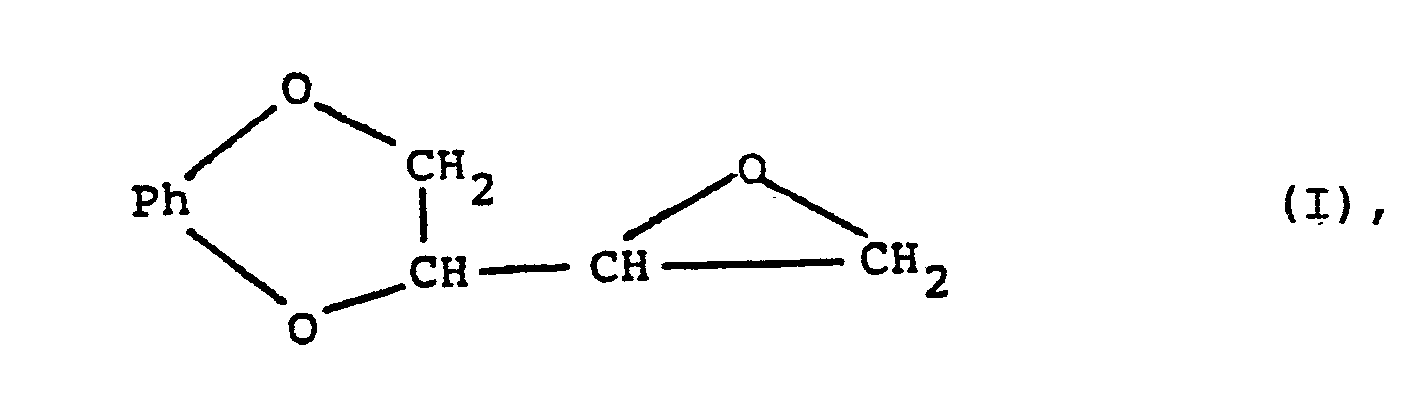
- the present invention relates to a new stereospecific process for the preparation of 2-oxiranyl-l, 4-benzodioxanes of the general formula I.
- Ph is 1,2-phenylene, which can be substituted by one to three identical or different substituents from the group consisting of lower alkyl, lower alkoxy, lower alkylenedioxy, benzyloxy, halogen, trifluoromethyl or nitro.
- These compounds are valuable starting materials for the production of therapeutically useful products, for example those which have ⁇ -adrenergic blocking or antihypertensive effects.
- the products obtained according to the invention are d, l-erythro or d, l-threo compounds.
- the oxygen atom of the oxirane ring is in a relative erythro orientation with respect to the neighboring oxygen atom of the dioxane ring.
- the relative orientation of the two oxygen atoms is threo.
- the stereospecific method of the invention is that in the presence of a strong base, a compound of general formula II condensed, wherein R is formyl or M, M is the residue of a strong quaternary organic nitrogen-containing base or an alkali metal atom M a , one of the symbols Y and Z is hydrogen and the other is X-CH 2 , where X is a halogen atom means, or when R is M, the symbol X also means another reactive esterified hydroxy group.
- the substituents of the oxirane ring in the starting material of the formula II can be in a cis configuration (Z means hydrogen) or in a trans configuration (Z stands for the group CH 2 X).
- Z means hydrogen
- Z stands for the group CH 2 X.
- the first-mentioned isomer leads to the threo compounds of the formula I, while the trans starting materials give erythro products of the formula I.
- the strong base is characterized by the formula M ⁇ OH ⁇ , where M ⁇ is the cation derived from M.
- M ⁇ is the cation derived from M.
- M is in particular the remainder of a quaternary organic nitrogen-containing compound or an alkali metal atom such as lithium, sodium or preferably potassium.
- a quaternary organic nitrogen-containing compound is, for example, a tetra-lower alkylammonium, such as tetraethylammonium, tetrabutylammonium, trimethyl-butylammonium, but also a benzyl-tri-lower alkylammonium, for example benzyl-trimethyl ammonium radical, or an analog saturated heterocyclic group, for example an N, N-1, -methyl-piperidinium or N, N-dimethyl-pyrrolidinium or an aryl-tri-lower alkylammonium, for example a phenyl-trimethylammonium radical.
- a tetra-lower alkylammonium such as tetraethylammonium, tetrabutylammonium, trimethyl-butylammonium
- benzyl-tri-lower alkylammonium for example benzyl-trimethyl ammonium radical
- a reactive esterified hydroxy group X is preferably a halogen atom, in particular chlorine, but also bromine or iodine; or an aliphatic or aromatic sulfonyloxy group, e.g. Methanesulfonyloxy, benzenesulfonyloxy, toluenesulfonyloxy or bromobenzenesulfonyloxy group.
- the 1,2-phenylene radical Ph is preferably unsubstituted or monosubstituted. Its substituents are illustrated by the following groups: lower alkyl, e.g. Methyl, ethyl, n- or isopropyl or butyl; Lower alkoxy, e.g. Methoxy, ethoxy, n- or isopropoxy or butoxy; Lower alkylenedioxy, e.g. Methylenedioxy, 1,1- or 1,2-ethylenedioxy; Benzyloxy; Halogen, e.g. Fluorine, chlorine or bromine, trifluoromethyl or nitro.
- lower alkyl e.g. Methyl, ethyl, n- or isopropyl or butyl
- Lower alkoxy e.g. Methoxy, ethoxy, n- or isopropoxy or butoxy
- Lower alkylenedioxy e.g. Methylenedioxy, 1,1-
- Preferred compounds are those of the formula I in which Ph is 1,2-phenylene which can be monosubstituted by alkyl or alkoxy each having 1-4 carbon atoms, alkylenedioxy having 1 or 2 carbon atoms, benzyloxy, fluorine, chlorine, bromine, trifluoromethyl or nitro .
- Ph 1,2-phenylene, which may be monosubstituted by methyl, methoxy, methylenedioxy, benzyloxy, fluorine, chlorine, trifluoromethyl or nitro.
- the starting materials of formula II can be prepared according to the following process steps: wherein My represents alkali metal atom, X represents a halogen atom, one of the symbols Y and Z represents hydrogen and the other represents CH 2X; wherein R 2 is lower alkanoyl, halogenated lower alkanoyl, HPhCO, HOOC-C 2 H 4 -CO or HOOC-Ph-CO.
- Y in a starting material of the formula II denotes hydrogen (which starting material has been obtained from the trans-olefin), erythro products of the formula I are obtained. If one starts from compounds of the formula II in which the symbol Z represents hydrogen (which compounds come from cis-olefins), threo compounds are obtained as products of the formula I.
- both the Baeyer-Villiger reaction and the epoxidation use one molar equivalent of one of the above-mentioned peracids, for example peracetic, pertrifluoroacetic, perbenzoic, 3-chloro-perbenzoic, perberstein or monoperphthalic acid.
- peracetic, pertrifluoroacetic, perbenzoic, 3-chloro-perbenzoic, perberstein or monoperphthalic acid for example peracetic, pertrifluoroacetic, perbenzoic, 3-chloro-perbenzoic, perberstein or monoperphthalic acid.
- peracetic, pertrifluoroacetic, perbenzoic, 3-chloro-perbenzoic, perberstein or monoperphthalic acid for example peracetic, pertrifluoroacetic, perbenzoic, 3-chloro-perbenzoic, perberstein or monoperphthalic acid.
- the stereo is guaranteed specific course of the procedure.
- the starting materials for reaction 1) are known or, if new, they can be prepared according to methods known per se.
- reaction steps are carried out according to methods known per se, in the presence or absence of diluents, preferably in those which are inert to and dissolve the reagents, catalysts, condensation agents or other agents mentioned above and / or in an inert atmosphere Cooling, carried out at room temperature or at elevated temperatures, preferably at the boiling point of the solvent used, at normal or elevated pressure.
- phase transfer catalysts e.g. Tetra-lower alkylammonium hydroxides, e.g. Tetrabutylammonium hydroxide, or crown ether
- lower alkanols e.g.
- Peroxidation is carried out in low boiling haloalkanes, e.g. Methylene chloride for the aromatic peracids mentioned; Lower alkyl alkanoates, e.g. Ethyl acetate for aliphatic peracids; Dimethylformamide for succinoyl peroxide.
- An alkali metal bicarbonate, e.g. Potassium bicarbonate or carbonate can be used with pertrifluoroacetic acid, which destroys the excess peracid after the olefin has been consumed.
- the invention also relates to modifications of the present process, according to which an intermediate obtained at any stage of the process is used as the starting material and the remaining process steps are carried out, or the process is terminated at any stage, or according to which a starting material is formed under the reaction conditions, or in which a Starting material in the form of a salt or optically pure antipodes is used.
- the starting materials of the formula II can thus be formed under the reaction conditions of the main process according to the following process step 3): where all symbols have the meanings given above.
- the oxirane reagent V is either in cis or in trans form.
- the former compound gives threo compounds of formula I in the reaction of the main process, while erythro process products result from the trans form.
- Preferred compounds of the formula V are the trans isomers, ie those in which Y is hydrogen and Z is the group CH 2 X.
- Reaction 3 is particularly suitable for the in situ preparation of starting materials in which the 1,2-phenylene ring is unsubstituted or symmetrically substituted.
- starting materials in which the 1,2-phenylene ring is unsubstituted or symmetrically substituted.
- Ph denotes 1,2 - phenylene or, for example, 3,6- or 4,5-dimethoxy-1,2-phenylene.
- the condensation of reaction 3) is, as described above, in an aqueous medium, which is preferably a phase transfer catalyst, e.g. Tetra-lower alkylammonium hydroxide, e.g. Tetrabutylammonium hydroxide, or contains crown ether, performed. It can also be in the presence of diluents, preferably those which are inert to and dissolve the reagents, e.g.
- the starting materials of the formulas IV and V are known or, if new, they can be prepared according to methods known per se.
- the salts of compounds of the formula IV are prepared starting from corresponding catechins and strong bases, such as alkali metal hydroxides, lower alkoxides or hydrides or tri-lower alkyl benzylammonium hydroxides.
- the oxiranes of the formula V can be prepared by conventional methods, starting from corresponding cis- or trans-butadiene dihalides and epoxidation with aliphatic or preferably aromatic peracids, for example peracetic, perbernstein, perbenzoic, m-chloro-perbenzoic or monoperphthalic acid.
- the excess peracid can be destroyed, for example with sodium sulfite, after the oxidation of the olefin.
- the oxiranes mentioned can also be obtained by catalytic oxidation with air or oxygen in the vapor phase, for example with silver, platinum or palladium catalysts.
- Example 1 4.6 g of the latter compound are closed.
- the d, e-erythro-2-oxiranyl-1,4-benzodioxane of the formula is obtained which boils at 120 ° / 0.2 mmHg.
- the product crystallizes and melts at 51-52 °.
- a mixture of 1.7 g of cis-2,3-bis-chloromethyl-oxirane, 1.1 g of catechol and 2 ml of isopropanol is heated to 65 ° and with a solution of 0.8 g of sodium hydroxide in 2 ml of water, with stirring , added dropwise.
- the reaction mixture is heated to 85 ° for 60 minutes, cooled and diluted with benzene. It is washed with water, dried and evaporated.
- a mixture is obtained which contains 48% of the epoxide used as starting material, 40% of the desired d, fl-threo-2-oxiranyl-benzodioxane (melting point 45 °) and 10% 2-chloromethyl-3-hydroxymethyl-benzodioxane ( determined by mass spectroscopy).
- the mixture is separated by bulb tube distillation. The fraction boiling at 120 ° / 0.2 mmHg is collected. It is the desired threo connection.
- the starting material is prepared as follows: A solution of 25 g of cis-l, 4-dichloro-2-butene in 50 ml of methylene chloride is added to a 0.2 molar solution of 3-chloroperbenzoic acid in 275 ml of methylene chloride. The mixture is stirred at room temperature for 4 days, filtered and the filtrate is stirred for 30 minutes with 100 ml of a 10% aqueous sodium sulfite solution. The organic layer is separated, washed with cold 12% aqueous sodium hydroxide solution and water, dried and evaporated. The 2,3-chloromethyl oxirane is obtained, which boils at 83-85 ° / 25 mmHg.
- a solution of 1.32 g of catechol in 15 ml of dimethyl sulfoxide is mixed in a nitrogen atmosphere with stirring at 55 ° with 0.8 g of sodium hydroxide tablets. After 4 hours, the dark green liquid is mixed with 1.5 g of trans-2,3-bis-chloromethyl-oxirane and stirring is continued at 55-60 ° for 4 hours. After cooling to room temperature, the mixture is diluted with 100 ml of water and extracted with diethyl ether. The extract is washed with aqueous sodium hydroxide solution and saturated aqueous sodium chloride solution, dried and evaporated. A light yellow oil is obtained, which is chromatographed on silica gel and eluted with chloroform.
- the starting material is prepared as follows: A solution of 25 g of trans-l, 4-dichloro-2-butene in 50 ml of methylene chloride is added to a solution of 0.2 molar m-chloroperbenzoic acid in 275 ml of methylene chloride. The mixture is stirred at room temperature for 4 days, filtered and the filtrate is stirred for 30 minutes with 100 ml of a 10% aqueous sodium sulfite solution. The organic layer is separated, washed with cold 12% aqueous sodium hydroxide solution and water, dried and evaporated. The trans-2,3-bis-chloromethyl-oxirane is obtained, which boils at 85-88 ° / 25 mmHg.
- a mixture of 2.5 gd, l-erythro-2-oxiranyl-1,4-benzodioxane, 1.7 g of 4- (2-0xo-l-benzimidazolinyl) piperidine and 15 ml of isopropanol is boiled under reflux for 4 hours and concentrated to a small volume.
- the concentrate is diluted with benzene and with 5% chlorine extracted seric acid.
- the extract is left to stand in the cold, the gummy precipitate is filtered off and triturated with aqueous ammonia and chloroform.
- the organic solution is separated off, dried, evaporated and the residue is recrystallized from ethyl acetate.
- the d, e-threo compound obtained analogously melts at 110-115 °.
Landscapes
- Chemical & Material Sciences (AREA)
- Organic Chemistry (AREA)
- Epoxy Compounds (AREA)
- Plural Heterocyclic Compounds (AREA)
Abstract
Description
- In den USA-Patenten Nos. 3,101,345; 3,312,592; 3,910,930 und 3,914,238 sind pharmakologisch wirksame 2-(2-Amino-l-hydroxyäthyl)-1,4-benzodioxane offenbart. Diese werden verfahrensgemäss als Gemische von Diastereoisomeren erhalten, welche man lediglich nach schwerfälligen Methoden auftrennen kann. Die vorliegende Erfindung stellt ein Verfahren bereit, welches Zwischenprodukte für die genannten Verbindungen in reinen erythro- und threo-Formen ergibt und lediglich einfache und billige Ausgangsstoffe benötigt. Ueberdies ist das neue Verfahren besonders geeignet für die einfache Herstellung von 1,4-Benzodioxanen, welche im o-Phenylenring substituiert sind. Diese Verbindungen sind wertvolle Ausgangsstoffe für die Herstellung von neuen erythro-2-(2-Aralkylamino-l-hydroxyäthyl)-l,4-benzodioxanen.
- Die vorliegende Erfindung betrifft ein neues stereospezifisches Verfahren für die Herstellung von 2-Oxiranyl-l,4-benzodioxanen der allgemeinen Formel I

- Die erfindungsgemäss erhaltenen Produkte sind d,ℓ-erythro- oder d,ℓ-threo-Verbindungen. Im erythro-Isomeren ist das Sauerstoffatom des Oxiranringes in Bezug auf das benachbarte Sauerstoffatom des Dioxanrings in relativer erythro-Orientierung. Im threo-Isomeren ist die relative Orientierung der beiden Sauerstoffatome threo.
- Das stereospezifische Verfahren der Erfindung besteht darin, dass man in Gegenwart einer starken Base, eine Verbindung der allgemeinen Formel II

- Die Umwandlung der gemäss der Erfindung erhaltenen Verbindungen der Formel I in therapeutisch wertvolle Produkte ist in den oben genannten Patenten offenbart, jedoch ohne Hinweis auf stereochemisch einheitliche Gruppen, von welchen überraschenderweise diejenigen mit erythro-Form fast die ganze pharmakologische Wirkung aufweisen.
- Die Substituenten des Oxiranrings im Ausgangsstoff der Formel II können zueinander in cis-Konfiguration (Z bedeutet Wasserstoff) oder in trans-Konfiguration (Z steht für die Gruppe CH2X) sein. Das zuerst genannte Isomere führt zu den threo-Verbindungen der Formel I, während die trans-Ausgangsstoffe erythro-Produkte der Formel I ergeben.
- Die starke Base wird durch die Formel M⊕OH⊖ charakterisiert, worin M⊕ das vom M abgeleitete Kation ist. Das Symbol M ist insbesondere der Rest einer quaternären organischen Stickstoff enthaltenden Verbindung oder ein Alkalimetallatom, wie Lithium, Natrium oder vorzugsweise Kalium. Der Rest einer quaternären organischen Stickstoff enthaltenden Verbindung ist z.B. ein Tetra--niederalkylammonium-, wie Tetraäthylammonium-, Tetrabutylammonium-, Trimethyl-butylammonium-, aber auch ein Benzyl-triniederalkylammonium-, z.B. Benzyl-trimethylammoniumrest, oder eine analoge gesättigte heterocyclische Gruppe, z.B. ein N,N-1,-methyl-piperidinium oder N,N-Dimethyl-pyrrolidinium- oder ein Aryl-triniederalkylammonium-, z.B ein Phenyl-trimethylammoniumrest.
- Eine reaktionsfähige veresterte Hydroxygruppe X ist vorzugsweise ein Halogenatom, insbesondere Chlor, aber auch Brom oder Jod; oder eine aliphatische oder aromatische Sulfonyloxygruppe, z.B. Methansulfonyloxy-, Benzolsulfonyloxy, Toluolsulfonyloxy- oder Brombenzolsulfonyloxygruppe.
- Der 1,2-Phenylenrest Ph ist vorzugsweise unsubstituiert oder monosubstituiert. Seine Substituenten sind durch die folgenden Gruppen illustriert: Niederalkyl, z.B. Methyl, Aethyl, n- oder Isopropyl oder -Butyl; Niederalkoxy, z.B. Methoxy, Aethoxy, n- oder Isopropoxy oder -Butoxy; Niederalkylendioxy, z.B. Methylendioxy, 1,1- oder 1,2-Aethylendioxy; Benzyloxy; Halogen, z.B. Fluor, Chlor oder Brom, Trifluormethyl oder Nitro.
- Bevorzugte Verbindungen sind diejenigen der Formel I, worin Ph 1,2-Phenylen bedeutet, welches durch Alkyl oder Alkoxy mit jeweils 1-4 Kohlenstoffatomen, Alkylendioxy mit 1 oder 2 Kohlenstoffatomen, Benzyloxy, Fluor, Chlor, Brom, Trifluormethyl oder Nitro monosubstituiert sein kann.
- Besonders hervorzuheben sind Verbindungen der Formel I, worin Ph für 1,2-Phenylen steht, welches durch Methyl, Methoxy, Methylendioxy, Benzyloxy, Fluor, Chlor, Trifluormethyl oder Nitro monosubstituiert sein kann.
- Die Ausgangsstoffe der Formel II können gemäss den folgenden Verfahrensschritten hergestellt werden:


- Wenn Y in einem Ausgangsstoff der Formel II Wasserstoff bedeutet (welcher Ausgangsstoff ausgehend vom trans-Olefin erhalten worden ist), so werden erythro-Produkte der Formel I erhalten. Geht man von Verbindungen der Formel II aus, in welchen das Symbol Z für Wasserstoff steht (welche Verbindungen von cis-Olefinen stammen), so erhält man threo-Verbindungen als Produkte der Formel I.
- Im Verfahrensschritt 2) verbraucht sowohl die Baeyer-Villiger Reaktion als auch die Epoxydation ein Moläquivalent einer der oben genannten Persäuren, z.B. Peressig-, Pertrifluoressig-, Perbenzoe-, 3-Chlor-perbenzoe-, Perbernstein- oder Monoperphthalsäure. Je nach der Verwendung von cis- oder trans-Olefinen ist der stereospezifische Verlauf des Verfahrens gewährleistet.
- Die Ausgangsstoffe der Reaktion'1) sind bekannt oder, wenn neu, können sie gemäss den an sich bekannten Methoden hergestellt werden.
- Die oben genannten Reaktionsschritte werden nach an sich bekannten Methoden, in Gegenwart oder Abwesenheit von Verdünnungsmitteln, vorzugsweise in solchen, welche gegenüber den Reagenzien inert sind und diese lösen, Katalysatoren, Kondensations- oder anderen oben genannten Mitteln und/oder in einer inerten Atmosphäre, unter Kühlung, bei Zimmertemperatur oder bei erhöhten Temperaturen, vorzugsweise beim Siedepunkt des verwendeten Lösungsmittels, bei normalem oder erhöhtem Druck durchgeführt. So werden z.B. der Kondensationsschritt 1) und die Kondensation gemäss der Reaktion der vorliegenden Erfindung in einem wässerigen Medium, welches Phasentransferkatalysatoren, z.B. Tetra-niederalkylammonium-hydroxyde, z.B. Tetrabutylammonium-hydroxyd, oder Kronenäther, und/oder Niederalkanolen, z.B. Methanols Aethanol oder Isopropanol durchgeführt.
- Die Peroxydation wird in niedrig siedenden Halogenalkanen, z.B. Methylenchlorid für die genannten aromatischen Persäuren; Niederalkylalkanoaten, z.B. Essigsäureäthylester für aliphatische Persäuren; Dimethylformamid für Succinoylperoxyd, vorgenommen. Ein Alkalimetallhydrogencarbonat, z.B. Kaliumhydrogencarbonat oder -carbonat kann mit Pertrifluoressigsäure verwendet werden, welches die überschüssige Persäure, nach dem Verbrauch des Olefins, zerstört.
- Die Erfindung betrifft ebenfalls Abänderungen des vorliegenden Verfahrens, wonach ein auf irgendeiner Stufe des Verfahrens erhaltenes Zwischenprodukt als Ausgangsmaterial verwendet wird und die verbleibenden Verfahrensschritte durchgeführt werden, oder das Verfahren auf irgendeiner Stufe abgebrochen wird, oder wonach ein Ausgangsmaterial unter den Reaktionsbedingungen gebildet, oder worin ein Ausgangsstoff in Form eines Salzes oder optisch reinen Antipoden, verwendet wird.
- So können die Ausgangsstoffe der Formel II unter den Reaktionsbedingungen des Hauptverfahrens gemäss dem folgenden Verfahrensschritt 3) gebildet werden:

- Das Oxiran-Reagens V ist entweder in cis- oder in trans-Form. Die erstgenannte Verbindung ergibt in der Reaktion des Hauptverfahrens threo-Verbindungen der Formel I, während aus der trans-Form erythro-Verfahrensprodukte entstehen. Bevorzugte Verbindungen der Formel V sind die trans-Isomeren, d.h. solche, in welchen Y Wasserstoff bedeutet und Z für die Gruppe CH2X steht.
- In der Reaktion des Verfahrensschrittes 3) werden vorzugsweise solche Ausgangsstoffe verwendet, in welchen M Natrium bedeutet und X für ein Chloratom steht.
- Die Reaktion 3) ist insbesondere für die in situ Vorbereitung von solchen Ausgangsstoffen geeignet, in welchen der 1,2-Phenylenring unsubstituiert oder symmetrisch substituiert ist. Solche sind Verbindungen der Formel II, worin Ph 1,2-Phenylen oder z.B. 3,6- oder 4,5-Dimethoxy- l,2-phenylen bedeutet.
- Die Kondensation der Reaktion 3) wird, wie oben beschrieben, in einem wässerigen Medium, welches vorzugsweise ein Phasentransferkatalysator, z.B. Tetra-niederalkylammonium-hydroxyd, z.B. Tetrabutylammonium-hydroxyd, oder Kronenäther enthält, durchgeführt. Sie kann auch in Anwesenheit von Verdünnungsmitteln, vorzugsweise in solchen, welche gegenüber den Reagenzien inert sind und diese lösen, z.B. in Niederalkyl-formamiden oder -sulfoxiden, wie Dimethylformamid oder -sulfoxid, von Katalysatoren, Kondensationsmitteln und/oder inerten Atmosphären, unter Kühlung, bei Zimmertemperatur oder bei erhöhten Temperaturen, vorzugsweise zwischen ungefähr 50° und ungefähr 70° C, bei normalem oder erhöhtem Druck durchgeführt.
- Die Ausgangsstoffe der Formeln IV und V sind bekannt oder, wenn neu, können sie gemäss den an sich bekannten Methoden hergestellt werden. So können z.B. die Salze von Verbindungen der Formel IV, ausgehend von entsprechenden Catechinen und starken Basen, wie Alkalimetallhydroxiden, -niederalkoxiden oder -hydriden oder Tri-niederalkyl-benzylammonium-hydroxiden hergestellt werden.
- Die Oxirane der Formel V können nach konventionellen Methoden, ausgehend von entsprechenden cis- oder trans-Butadien-dihalogeniden und Epoxydation mit aliphatischen oder vorzugsweise aromatischen Persäuren, z.B. Peressig-, Perbernstein-, Perbenzoe-, m-Chlor-perbenzoe-oder Monoperphthalsäure hergestellt werden. Die überschüssige Persäure kann, nach der Oxydation des Olefins, z.B. mit Natriumsulfit zerstört werden. Die genannten Oxirane können auch durch katalytische Oxydation mit Luft oder Sauerstoff in der Dampfphase, z.B. mit Silber-, Platin- oder Palladiumkatalysatoren, erhalten werden.
- Im Verfahren der vorliegenden Anmeluung werden vorteilhafterweise solche Ausgangsstoffe verwendet, welche zu den im vorstehenden als besonders wertvoll beschriebenen Verbindungen, z.B. zu den in den obigen Patenten genannten Produkten, führen.
- Die folgenden Beispiele dienen zur Illustration der Erfindung. Temperaturen werden in Celsiusgraden angegeben, und die Angaben über Teile betreffen Gewichtsteile. Wenn nicht anders definiert, wird das Eindampfen von Lösungsmitteln unter vermindertem Druck, z.B. zwischen ungefähr 15 und 100 mmHg, durchgeführt.
- Man lässt 1200 ml Wasser unter Rückfluss kochen und versetzt es unter kräftigem Rühren mit 1 m 40%igem wässerigem Tetrabutylammonium-hydroxyd, 125 ml Salicylaldehyd und 150 ml cis-l,4-Dichlor-2-buten. Das Reaktionsgemisch wird dann durch tropfenweise Zugabe einer Lösung von 42 g Natriumhydroxyd in 200 ml Wasser bei einem pH-Wert zwischen 7 und 8 gehalten, unter Rückfluss bis zum pH-Wert 7 gekocht, abgekühlt und mit Methylenchlorid extrahiert. Der Extrakt wird mit 5%iger wässeriger Natriumhydroxydlösung gewaschen, getrocknet und eingedampft. Der Rückstand wird destilliert und die bei 137-140°/0,1 mmHg siedende Fraktion aufgefangen. Man erhält den 2-(4-Chlor-cis-2-butenyloxy)-benzalde- hyd.
- Eine Lösung von 24 g der letztgenannten Verbindung in 500 ml Methylenchlorid wird mit 0,2 g 2,4,6-Tributylphenol und 55 g 85%iger 3-Chlor-perbenzoesäure versetzt und das Gemisch 3 Tage unter Rückfluss gekocht. Das Reaktionsgemisch wird abgekühlt, filtriert, das Filtrat mit 5%iger wässeriger Natriumsulfitlösung und 5%iger wässeriger Natriumhydrogencarbonatlösung gewaschen, getrocknet und eingedampft. Man erhält das 2-(4-Chlor-cis-2,3-epoxy- butyloxy)-phenol-formiat,welches im NMR-Spektrum "Peaks" bei 3,4, 3,6, 4,2, 6,9 und 8,25 ppm aufweist.
- Eine Lösung von 4,6 g der letztgenannten Verbindung in 24 ml Methanol wird in einer Stickstoffatmosphäre unter Rühren mit 24 ml einer lO%igen wässerigen Kaliumhydroxydlösung tropfenweise versetzt, wobei man die Temperatur unter 30° hält. Das Reaktionsgemisch wird 18 Stunden bei Zimmertemperatur gerührt, dann zum Teil eingedampft, der Rückstand in Wasser aufgenommen, und das Gemisch mit Diäthyläther extrahiert. Der Extrakt wird mit Wasser gewaschen, getrocknet und eingedampft. Der Rückstand wird destilliert und die bei 120°/0,2 mmHg siedende Fraktion aufgefangen. Man erhält das d,ℓ-threo-2-Oxiranyl-1,4-benzodioxan der Formel

- Ersetzt man im Beispiel 1 das cis-1,4-Dichlor-2-buten durch die gleiche Menge trans-1,4-Dichlor-2-buten und arbeitet man gemäss dem genannten Beispiel, so erhält man den 2-(4-Chlor-trans-2-butenyloxy)-benzaldehyd, welcher bei 147-148°/0,15 mmHg siedet. (Diese Verbindung ist im deutschen Patent 1,926,023 genannt worden.)
- Die Oxydation gemäss Beispiel l von 24 g der letztgenannten Verbindung ergibt das 2-(4-Chlor-trans-2,3-epoxy- butyloxy)-phenol-formiat, welches NMR-"Peaks" bei 3,2, 3,5, 4,1, 7,0 und 8,2 ppm aufweist.
- Gemäss Beispiel 1 werden 4,6 g der letztgenannten Verbindung ringgeschlossen. Man erhält das d,e-erythro-2-Oxiranyl-l,4-benzodioxan der Formel

- Man lässt 2000 ml Wasser unter Rückfluss kochen und versetzt es unter kräftigem Rühren mit 3 ml 40%igem wässerigem Tetrabutylammoniun-hydroxyd, 250 ml Salicylaldehyd und 280 ml trans-l,4-Dichlor-2-buten. Das Reaktionsgemisch wird dann durch tropfenweise Zugabe einer Lösung von 83 g Natriumhydroxyd in 400 ml Wasser bei einem pH-Wert zwischen 7 und 8 gehalten (ungefähr 25 Minuten). Nachher wird das Reaktionsgemisch ungefähr 6 Minuten, bis der pH-Wert ungefähr 7 ist, unter Rückfluss gekocht, auf 20° gekühlt und die wässerige Schicht mit Diäthyläther extrahiert. Der Extrakt wird mit der organischen Schicht vereinigt, mit 5%iger wässeriger Natriumhydroxydlösung gewaschen, getrocknet und eingedampft. Der Rückstand wird destilliert und die bei 141-147°/0,7 mmHg siedende Fraktion aufgefangen. Man erhält den 2-(4-Chlor-trans-2-butenyloxy)-benzaldehyd.
- Eine Lösung von 155,7 g der letztgenannten Verbindung in 3800 ml Methylenchlorid wird mit 357 g 85%iger 3-Chlorperbenzoesäure versetzt, das Gemisch eine Stunde gerührt und 4 Tage unter Rückfluss gekocht. Das Reaktionsgemisch wird gekühlt, filtriert, das Filtrat mit Methylenchlorid und gesättigter wässeriger Natriumhydrogencarbonatlösung gewaschen, getrocknet und unter 40° eingedampft. Man erhält das 2-(4-Chlor-trans-2,3-epoxybutyloxy)-phenol-formiat,welches im NMR-Spektrum "Peaks" bei 3,2, 3,5, 4,1, 7,0 und 8,2 ppm zeigt.
- Eine Lösung von 229,4 g der letztgenannten Verbindung in 900 ml Methanol wird unter Rühren in einer Stickstoffatmosphäre tropfenweise mit 1100 ml einer 10%igen wässerigen Kaliumhydroxydlösung versetzt, wobei man die Temperatur zwischen 8° und 15° hält. Das Reaktionsgemisch wird über Nacht bei Zimmertemperatur gerührt, dann vom erhaltenen Niederschlag dekantiert und die Flüssigkeit mit Diäthyläther extrahiert. Der Niederschlag und der Extrakt werden vereinigt und das Gemisch wird mit Wasser gewaschen, getrocknet und eingedampft. Der Rückstand wird aus Diäthyläther umkristallisiert. Man erhält das d,e-erythro-2-0xira- nyl-l,4-benzodioxan, welches bei 51-52° schmilzt. Das Produkt ist mit demjenigen des Beispiels 2 identisch.
- Man lässt 1200 ml Wasser unter Rückfluss kochen und versetzt es unter kräftigem Rühren mit 1 ml 40%igem wässerigem Tetrabutylammonium-hydroxyd, 160 g 5-Chlor-salicylaldehyd und 140 ml trans-l,4-Dichlor-2-buten. Das Reaktionsgemisch wird dann durch tropfenweise Zugabe einer Lösung von 42 g Natriumhydroxyd in 200 ml Wasser bei einem pH-Wert zwischen 7 und 8 gehalten, unter Rückfluss bis zum pH-Wert 7 gekocht, abgekühlt und mit Methylenchlorid extrahiert. Der Extrakt wird mit 5%iger wässeriger Natriumhydroxydlösung gewaschen, getrocknet und eingedampft. Zum Abdampfen des überschüssigen 1,4-Dichlor-2-butens wird der Rückstand bei 0,1 mmHg auf 30° erwärmt. Der Rückstand wird in 1000 ml Diäthyläther aufgenommen, die Lösung filtriert, das Filtrat eingedampft und der Rückstand aus Essigsäureäthylester umkristallisiert. Man erhält den 5-Chlor-2-(4-chlor-trans-2-butenyloxy)-benzaldehyd, der bei 62-63° schmilzt.
- Ein Gemisch von 6 g der letztgenannten Verbindung, 20 g 3-Chlor-perbenzoesäure und 200 ml Methylenchlorid wird 3 Tage unter Rückfluss gekocht. Das Reaktionsgemisch wird abgekühlt, filtriert und das Filtrat mit 5%iger wässeriger Natriumsulfitlösung und mit 5%iger wässeriger Natriumhydrogencarbonatlösung gewaschen, getrocknet und eingedampft. Man erhält das 5-Chlor-2-(4-chlor-trans-2,3-epoxybutyloxy)-phenol-formiat,welches im NMR-Spektrum "Peaks" bei 3,3, 3,6, 4,2 und 8,2 ppm aufweist.
- Eine Lösung von 7 g der letztgenannten Verbindung in 25 ml Methanol wird unter Kühlen mit 30 ml einer 1,75- normalen wässerigen Kaliumhydroxydlösung versetzt, das Gemisch bei Zimmertemperatur 18 Stunden gerührt, mit Wasser verdünnt und mit Diäthyläther extrahiert. Der Extrakt wird mit Wasser gewaschen, getrocknet und eingedampft. Man erhält das d,6-erythro-6-Chlor-2-oxiranyl-l,4-benzodioxan als ein Oel, welches im NMR-Spektrum "Peaks" bei 2,8, 3,0 und 6,4 ppm aufweist und bei einer Kugelrohrdestillation bei 130°/ 0,2 mmHg siedet.
- Ersetzt man den 4-Chlor-salicylaldehyd durch 152 g o-Vanillin und geht man genau gemäss Beispiel 4 vor, so wird der 2-(4-Chlor-trans-2-butenyloxy)-3-methoxy-benzalde- hyd erhalten, welcher bei 165°/O,15 mmHg siedet.
- Ein Gemisch von 7 g der letztgenannten Verbindung, 21 g 3-Chlor-perbenzoesäure und 250 ml Methylenchlorid wird 3 Tage unter Rückfluss gekocht. Das Reaktionsgemisch wird abgekühlt, filtriert und das Filtrat mit 5%iger wässeriger Natriumsulfitlösung und mit 5%iger wässeriger Natriumhydrogencarbonatlösung gewaschen, getrocknet und eingedampft. Man erhält das 2-(4-Chlor-trans-2,3-epoxybutyl- oxy)-3-methoxy-phenol-formiat,welches im NMR-Spektrum "Peaks" bei 3,2, 3,6, 3,9, 4,15 und 8,3 ppm zeigt.
- Eine Lösung von 8 g der letztgenannten Verbindung in 20 ml Methanol wird unter Rühren und Kühlen mit 35 ml einer 1,75-normalen Kaliumhydroxydlösung versetzt, das Gemisch 18 Stunden bei Zimmertemperatur gerührt, auf ungefähr sein halbes Volumen konzentriert, mit 50 ml Wasser verdünnt und mit Diäthyläther extrahiert. Der Extrakt wird mit Wasser gewaschen, getrocknet und eingedampft. Man erhält das d,ℓ-erythro-8-Methoxy-2-oxiranyl-1,4-benzodioxan als ein Oel, welches im NMR-Spektrum "Peaks" bei 2,8, 3,1, 3,8 und 6,5 ppm aufweist.
- Ein Gemisch von 1,7 g cis-2,3-bis-Chlormethyl-oxiran, 1,1 g Brenzcatechin und 2 ml Isopropanol wird auf 65° erhitzt und mit einer Lösung von 0,8 g Natriumhydroxyd in 2 ml Wasser, unter Rühren, tropfenweise versetzt. Das Reaktionsgemisch wird 60 Minuten auf 85° erhitzt, abgekühlt und mit Benzol verdünnt. Es wird mit Wasser gewaschen, getrocknet und eingedampft. Man erhält ein Gemisch, welches 48% des als Ausgangsmaterial verwendeten Epoxids, 40% des gewünschten d,fl-threo-2-Oxiranyl-benzodioxans (Schmelzpunkt 45°) und 10% 2-Chlormethyl-3-hydroxymethyl-benzodio- xan enthält (durch Massenspektroskopie bestimmt). Das Gemisch wird durch Kugelrohr-Destillation aufgetrennt. Die bei 120°/0,2 mmHg siedende Fraktion wird aufgefangen. Sie ist die gewünschte threo-Verbindung.
- Der Ausgangsstoff wird wie folgt hergestellt: Eine 0,2-molare Lösung von 3-Chlor-perbenzoesäure in 275 ml Methylenchlorid wird unter Rühren mit einer Lösung von 25 g cis-l,4-Dichlor-2-buten in 50 ml Methylenchlorid versetzt. Das Gemisch wird bei Zimmertemperatur 4 Tage gerührt, filtriert und das Filtrat 30 Minuten mit 100 ml einer 10%igen wässerigen Natriumsulfitlösung gerührt. Die organische Schicht wird abgetrennt, mit kalter 12%iger wässeriger Natriumhydroxydlösung und Wasser gewaschen, getrocknet und eingedampft. Man erhält das 2,3-bis-Chlormethyl-oxiran, welches bei 83-85°/25 mmHg siedet.
- Eine Lösung won 1,32 g brnzcatechin in 15 ml Dimethylsulfoxid wird in einer stickstoffatmosphäre, unter Rühren bei 55°, mit 0.8 g Natriumhydropxyd Tableten versetzt. Nach 4 Stunden wird die dunkelgrüne Flüssigkeit mit 1,5 g trans-2,3-bis-Chlormethyl-oxiran versetzt und bei 55-60° 4 Stunden weitergerührt. Nach Abkühlung auf Zimmertemperatur wird das Gemisch mit 100 ml Wasser verdünnt und mit Diäthyläther extrahiert. Der Extrakt wird mit wässeriger Natriumhydroxydlösung und gesättigter wässeriger Natriumchloridlösung gewaschen, getrocknet und eingedampft. Man erhält ein hellgelbes Oel, welches auf Silicagel chromatographiert und mit Chloroform eluiert wird. Nach Eindampfen erhält man ein farbloses Oel, welches nach Stehenlassen fest wird. Das Material wird aus Diäthyläther umkristallisiert. Man erhält das d,e-erythro- oder (R-S)(S-R)-2-Oxira- nyl-l,4-benzodioxan der Formel

- Der Ausgangsstoff wird wie folgt hergestellt: Eine Lösung von 0,2 molarer m-Chlor-perbenzoesäure in 275 ml Methylenchlorid wird unter Rühren mit einer Lösung von 25 g trans-l,4-Dichlor-2-buten in 50 ml Methylenchlorid versetzt. Das Gemisch wird bei Zimmertemperatur 4 Tage gerührt, filtriert und das Filtrat 30 Minuten mit 100 ml einer 10%igen wässerigen Natriumsulfitlösung gerührt. Die organische Schicht wird abgetrennt, mit kalter 12%iger wässeriger Natriumhydroxydlösung und Wasser gewaschen, getrocknet und eingedampft. Man erhält das trans-2,3-bis-Chlormethyl-oxiran, welches bei 85-88°/25 mmHg siedet.
- Eine Lösung von 1,32 g Brenzcatechin in 60 ml Dimethylformamid wird in einer Stickstoffatmosphäre unter Rühren bei 50-55° mit 0,96 g einer 50%igen Suspension von Natriumhydrid in Mineralöl versetzt. Nach 30 Minuten wird eine Lösung von 1,5 g cis-2,3-bis-Chlormethyl-oxiran in 5 ml Dimethylformamid zugegeben und das Gemisch 2 1/2 Stunden weiter erwärmt und gerührt. Das Reaktionsgemisch wird abgekühlt und gemäss Beispiel 7 aufgearbeitet. Man erhält das d,e-threo- oder (R-R)(S-S)-2-Oxiranyl-l,4-benzodioxan der Formel

- Ein Gemisch von 3 g d,ℓ-erythro-2-Oxiranyl-1,4-benzodioxan, 1,9 g 4-Hydroxy-4-phenylpiperidin und 20 ml Isopropanol wird 7 Stunden unter Rückfluss gekocht. Nach Abkühlung auf Zimmertemperatur gibt man unter Rühren 0,7 ml Methansulfonsäure dazu und lässt das Gemisch über Nacht im Kühlschrank stehen. Man erhält das d,e-erythro-2-[2-(4-Hydroxy-4-phenylpiperidino)-1-hydroxyäthyl]-1,4-benzodioxan- methansulfonat, welches nach Umkristallisation aus wässerigem Isopropanol-Diäthyläther bei 212-213° schmilzt.
- Man suspendiert 1 g der erhaltenen Verbindung in 20 ml Wasser, macht das Gemisch mit wässerigem Natriumhydroxyd basisch und extrahiert es mit Methylenchlorid. Der Extrakt wird getrocknet, eingedampft und der Rückstand aus Isopropanol umkristallisiert. Man erhält die freie Base, welche bei 118° schmilzt. Sie ist identisch mit derjenigen. die im US-Patent 3,914,238 beschrieben worden ist.
- Ein Gemisch von 3 g d,e-threo-2-Oxiranyl-1,4-benzo- dioxan und 20 ml tert.-Butylamin wird in einem Einschmelzrohr 10 Stunden bei 100° erhitzt und dann eingedampft. Der Rückstand wird in wässerigem Ammoniak aufgenommen, das Gemisch mit Chloroform extrahiert, der Extrakt getrocknet, eingedampft und der Rückstand aus Petroläther umkristallisiert. Man erhält das d,e-threo-2-(2-tert.-Butylamino-l-hydroxyäthyl)-benzodioxan, welches bei 84-85° schmilzt.
- Die letztgenannte Verbindung wird in einer minimalen Menge Aethanol gelöst, die Lösung mit Chlorwasserstoff in Aethanol angesäuert und mit Diäthyläther verdünnt. Man erhält das entsprechende Hydrochlorid, welches nach Umkristallisation aus Aethanol bei 192-194° schmilzt. Das Produkt ist mit demjenigen, welches im US-Patent 3,312,592 beschrieben worden.ist, identisch.
- Ersetzt man das oben genannte d,ℓ-threo-2-Oxiranyl-1,4-benzodioxan durch die gleiche Menge des erythro-Enantiomeren, so erhält man das d,e-erythro-2-(2-tert.-Butyl- amino-1-hydroxyäthyl)-benzodioxan, welches bei 93-96° schmilzt. Sein Hydrochlorid schmilzt bei 155-157°.
- Ein Gemisch von 2,5 g d,ℓ-erythro-2-Oxiranyl-1,4-benzodioxan, 1,7 g 4-(2-0xo-l-benzimidazolinyl)-piperidin und 15 ml Isopropanol wird 4 Stunden unter Rückfluss gekocht und zu einem kleinen Volumen konzentriert. Das Konzentrat wird mit Benzol verdünnt und mit 5%iger Chlorwasserstoffsäure extrahiert. Man lässt den Extrakt in der Kälte stehen, filtriert den gummiartigen Niederschlag ab und trituriert ihn mit wässerigem Ammoniak und Chloroform. Die organische Lösung wird abgetrennt, getrocknet, eingedampft und der Rückstand aus Essigsäureäthylester umkristallisiert. Man erhält das d,e-erythro-2-[2-(4-(2-Oxo-l-benz- imidazolinyl)-piperidino)-1-hydroxyäthyl]-1,4-benzodioxan, welches bei 188-190° schmilzt. Das Produkt ist mit demjenigen des deutschen Patents 2,400,094 identisch.
- Die analog erhaltene d,e-threo-Verbindung schmilzt bei 110-115°.
Claims (11)

Applications Claiming Priority (2)
| Application Number | Priority Date | Filing Date | Title |
|---|---|---|---|
| US87345678A | 1978-01-30 | 1978-01-30 | |
| US873456 | 1978-01-30 |
Publications (3)
| Publication Number | Publication Date |
|---|---|
| EP0003316A2 true EP0003316A2 (de) | 1979-08-08 |
| EP0003316A3 EP0003316A3 (en) | 1979-08-22 |
| EP0003316B1 EP0003316B1 (de) | 1981-12-30 |
Family
ID=25361672
Family Applications (1)
| Application Number | Title | Priority Date | Filing Date |
|---|---|---|---|
| EP19790100133 Expired EP0003316B1 (de) | 1978-01-30 | 1979-01-17 | Stereospezifisches Verfahren für die Herstellung von 2-Oxiranyl-1,4-benzodioxanen |
Country Status (4)
| Country | Link |
|---|---|
| EP (1) | EP0003316B1 (de) |
| JP (1) | JPS54103878A (de) |
| DE (1) | DE2961625D1 (de) |
| DK (1) | DK36679A (de) |
Cited By (1)
| Publication number | Priority date | Publication date | Assignee | Title |
|---|---|---|---|---|
| US4837336A (en) * | 1985-10-23 | 1989-06-06 | Glaxo Group Limited | Process for preparing heterocyclic compounds |
Families Citing this family (1)
| Publication number | Priority date | Publication date | Assignee | Title |
|---|---|---|---|---|
| JP5310495B2 (ja) * | 2009-11-10 | 2013-10-09 | Jsr株式会社 | 新規重合体およびその製造方法、新規化合物およびその製造方法、ならびに該重合体および該化合物から選ばれる少なくとも一種を含有する電解質 |
-
1979
- 1979-01-12 JP JP139179A patent/JPS54103878A/ja active Pending
- 1979-01-17 DE DE7979100133T patent/DE2961625D1/de not_active Expired
- 1979-01-17 EP EP19790100133 patent/EP0003316B1/de not_active Expired
- 1979-01-29 DK DK36679A patent/DK36679A/da not_active Application Discontinuation
Non-Patent Citations (1)
| Title |
|---|
| Keine Entgegenhaltungen. * |
Cited By (1)
| Publication number | Priority date | Publication date | Assignee | Title |
|---|---|---|---|---|
| US4837336A (en) * | 1985-10-23 | 1989-06-06 | Glaxo Group Limited | Process for preparing heterocyclic compounds |
Also Published As
| Publication number | Publication date |
|---|---|
| DK36679A (da) | 1979-07-31 |
| DE2961625D1 (en) | 1982-02-18 |
| EP0003316A3 (en) | 1979-08-22 |
| JPS54103878A (en) | 1979-08-15 |
| EP0003316B1 (de) | 1981-12-30 |
Similar Documents
| Publication | Publication Date | Title |
|---|---|---|
| CH624102A5 (de) | ||
| DE2024001B2 (de) | Tetrahydrofurfuryloxyphenoxypropanolamine und deren pharmakologisch verträgliche Säureadditionssalze und Verfahren zu deren Herstellung sowie diese Verbindungen enthaltende Arzneimittel | |
| DE1138779B (de) | Verfahren zur Herstellung von in der Aminogruppe substituierten 10-(Aminoalkyl)-trifluormethyl-phenthiazinderivaten. | |
| US3818017A (en) | 1-{8 1-(2-hydroxy-3-aryloxypropyl)-4-piperidyl{9 -2-benzimidazolinones and related compounds | |
| US3894030A (en) | 1-{8 1-(2-Hydroxy-3-aryloxypropyl)-4-piperidyl{9 -2-benzimidazolinones and related compounds | |
| CH633249A5 (de) | Verfahren zur herstellung von neuen polyprenylderivaten. | |
| CH622769A5 (de) | ||
| EP0003316B1 (de) | Stereospezifisches Verfahren für die Herstellung von 2-Oxiranyl-1,4-benzodioxanen | |
| DE2543870A1 (de) | Verfahren zur herstellung von 5-fluor-2-methyl-1-(p-methyl-sulfinylbenzyliden)-indenyl-3-essigsaeure | |
| EP0030380A1 (de) | 2,3-Indoldionderivate, Verfahren zu ihrer Herstellung, Zwischenprodukte, Arzneimittel enthaltend solche 2,3-Indoldionderivate und ihre pharmazeutische Verwendung | |
| CH666031A5 (de) | Naphthoxazine, ihre herstellung und pharmazeutische zusammensetzungen. | |
| CH646968A5 (de) | 1,4-dioxaspiro(4,5)decen-verbindungen sowie verfahren zur herstellung von 2-hydroxy-3-substituierten propylarylaethern. | |
| DE3606947A1 (de) | Verfahren zur herstellung von phenoxyalkanoltriazolverbindungen und zwischenprodukte hierfuer | |
| EP0543346B1 (de) | Verfahren zur Herstellung von substituierten Pentaalkylchromenen | |
| AT258280B (de) | Verfahren zur Herstellung von neuen Benzofuranderivaten und ihren Salzen | |
| AT267516B (de) | Verfahren zur Herstellung von neuen Benzofuranderivaten und ihren Salzen | |
| EP0003359B1 (de) | Spezifische optische Isomeren von 2-Aminoäthyl-1,4-benzodioxanen, Verfahren zu ihrer Herstellung, sowie pharmazeutische Präparate enthaltend diese Verbindungen | |
| DE69108587T2 (de) | Verfahren und Zwischenprodukte zur Herstellung von optisch aktiven Chromanderivaten. | |
| EP0037062A2 (de) | Substituierte 3-Aryl-2-cycloalken-1-one, Verfahren zu ihrer Herstellung und ihre Verwendung als Arzneimittel | |
| DE1593895A1 (de) | Verfahren zur Herstellung von Benzofuranderivaten | |
| AT262273B (de) | Verfahren zur Herstellung von neuen Benzofuranderivaten und ihren Salzen | |
| AT260920B (de) | Verfahren zur Herstellung von neuen Benzofuranderivaten und ihren Salzen | |
| DE2362877A1 (de) | 5,8-dihydro-5,8-methanonaphthaline mit kardiovaskulaerer wirkung | |
| AT360528B (de) | Verfahren zur herstellung von neuen bicyc- lischen thia-diaza-verbindungen und von deren salzen und optisch aktiven isomeren | |
| DE2950479A1 (de) | N-(3-alkylamino-2-hydroxypropoxy-phenyl)-lactame, deren herstellungsverfahren und arzneimitttel auf deren basis |
Legal Events
| Date | Code | Title | Description |
|---|---|---|---|
| PUAI | Public reference made under article 153(3) epc to a published international application that has entered the european phase |
Free format text: ORIGINAL CODE: 0009012 |
|
| PUAL | Search report despatched |
Free format text: ORIGINAL CODE: 0009013 |
|
| AK | Designated contracting states |
Designated state(s): BE CH DE FR GB IT NL SE |
|
| AK | Designated contracting states |
Designated state(s): BE CH DE FR GB IT NL SE |
|
| 17P | Request for examination filed | ||
| ITF | It: translation for a ep patent filed | ||
| GRAA | (expected) grant |
Free format text: ORIGINAL CODE: 0009210 |
|
| AK | Designated contracting states |
Designated state(s): BE CH DE FR GB IT NL SE |
|
| REF | Corresponds to: |
Ref document number: 2961625 Country of ref document: DE Date of ref document: 19820218 |
|
| PGFP | Annual fee paid to national office [announced via postgrant information from national office to epo] |
Ref country code: CH Payment date: 19831228 Year of fee payment: 6 |
|
| PGFP | Annual fee paid to national office [announced via postgrant information from national office to epo] |
Ref country code: FR Payment date: 19831230 Year of fee payment: 6 |
|
| PGFP | Annual fee paid to national office [announced via postgrant information from national office to epo] |
Ref country code: SE Payment date: 19831231 Year of fee payment: 6 |
|
| PGFP | Annual fee paid to national office [announced via postgrant information from national office to epo] |
Ref country code: BE Payment date: 19840331 Year of fee payment: 6 |
|
| PGFP | Annual fee paid to national office [announced via postgrant information from national office to epo] |
Ref country code: DE Payment date: 19841214 Year of fee payment: 7 |
|
| PG25 | Lapsed in a contracting state [announced via postgrant information from national office to epo] |
Ref country code: SE Effective date: 19850118 |
|
| PGFP | Annual fee paid to national office [announced via postgrant information from national office to epo] |
Ref country code: NL Payment date: 19860131 Year of fee payment: 8 |
|
| PG25 | Lapsed in a contracting state [announced via postgrant information from national office to epo] |
Ref country code: CH Effective date: 19870131 |
|
| BERE | Be: lapsed |
Owner name: CIBA-GEIGY A.G. Effective date: 19870131 |
|
| PG25 | Lapsed in a contracting state [announced via postgrant information from national office to epo] |
Ref country code: NL Effective date: 19870801 |
|
| GBPC | Gb: european patent ceased through non-payment of renewal fee | ||
| NLV4 | Nl: lapsed or anulled due to non-payment of the annual fee | ||
| PG25 | Lapsed in a contracting state [announced via postgrant information from national office to epo] |
Ref country code: FR Free format text: LAPSE BECAUSE OF NON-PAYMENT OF DUE FEES Effective date: 19870930 |
|
| REG | Reference to a national code |
Ref country code: CH Ref legal event code: PL |
|
| PG25 | Lapsed in a contracting state [announced via postgrant information from national office to epo] |
Ref country code: DE Effective date: 19871001 |
|
| REG | Reference to a national code |
Ref country code: FR Ref legal event code: ST |
|
| PG25 | Lapsed in a contracting state [announced via postgrant information from national office to epo] |
Ref country code: GB Effective date: 19881117 |
|
| PG25 | Lapsed in a contracting state [announced via postgrant information from national office to epo] |
Ref country code: BE Effective date: 19890131 |
|
| EUG | Se: european patent has lapsed |
Ref document number: 79100133.2 Effective date: 19860129 |
|
| PLBE | No opposition filed within time limit |
Free format text: ORIGINAL CODE: 0009261 |
|
| STAA | Information on the status of an ep patent application or granted ep patent |
Free format text: STATUS: NO OPPOSITION FILED WITHIN TIME LIMIT |