EP0003860B1 - Verfahren zur Beschichtung einer Materialbahn mit mehreren übereinander angeordneten photographischen Schichten, nach dem Vorhang-Beschichtungs-Verfahren - Google Patents
Verfahren zur Beschichtung einer Materialbahn mit mehreren übereinander angeordneten photographischen Schichten, nach dem Vorhang-Beschichtungs-Verfahren Download PDFInfo
- Publication number
- EP0003860B1 EP0003860B1 EP79200078A EP79200078A EP0003860B1 EP 0003860 B1 EP0003860 B1 EP 0003860B1 EP 79200078 A EP79200078 A EP 79200078A EP 79200078 A EP79200078 A EP 79200078A EP 0003860 B1 EP0003860 B1 EP 0003860B1
- Authority
- EP
- European Patent Office
- Prior art keywords
- curtain
- web
- width
- layers
- coating
- Prior art date
- Legal status (The legal status is an assumption and is not a legal conclusion. Google has not performed a legal analysis and makes no representation as to the accuracy of the status listed.)
- Expired
Links
- 238000000034 method Methods 0.000 title claims description 25
- 238000007766 curtain coating Methods 0.000 title description 12
- 238000000576 coating method Methods 0.000 claims description 79
- 239000011248 coating agent Substances 0.000 claims description 78
- 239000008199 coating composition Substances 0.000 claims description 29
- 239000007788 liquid Substances 0.000 claims description 29
- 239000002131 composite material Substances 0.000 claims description 12
- 230000001464 adherent effect Effects 0.000 claims description 6
- 239000010410 layer Substances 0.000 description 170
- 239000000203 mixture Substances 0.000 description 28
- 230000015572 biosynthetic process Effects 0.000 description 17
- -1 silver halide compounds Chemical class 0.000 description 17
- 229910052709 silver Inorganic materials 0.000 description 14
- 239000004332 silver Substances 0.000 description 14
- 239000000080 wetting agent Substances 0.000 description 14
- 239000000463 material Substances 0.000 description 12
- 239000007787 solid Substances 0.000 description 10
- 230000002180 anti-stress Effects 0.000 description 9
- 239000006185 dispersion Substances 0.000 description 9
- 230000003068 static effect Effects 0.000 description 9
- SBIRNPJIWVWCEG-UHFFFAOYSA-N 12-methyltridecyl hydrogen sulfate Chemical compound CC(C)CCCCCCCCCCCOS(O)(=O)=O SBIRNPJIWVWCEG-UHFFFAOYSA-N 0.000 description 7
- DGAQECJNVWCQMB-PUAWFVPOSA-M Ilexoside XXIX Chemical compound C[C@@H]1CC[C@@]2(CC[C@@]3(C(=CC[C@H]4[C@]3(CC[C@@H]5[C@@]4(CC[C@@H](C5(C)C)OS(=O)(=O)[O-])C)C)[C@@H]2[C@]1(C)O)C)C(=O)O[C@H]6[C@@H]([C@H]([C@@H]([C@H](O6)CO)O)O)O.[Na+] DGAQECJNVWCQMB-PUAWFVPOSA-M 0.000 description 7
- 238000001035 drying Methods 0.000 description 7
- 238000004519 manufacturing process Methods 0.000 description 7
- 229910052708 sodium Inorganic materials 0.000 description 7
- 239000011734 sodium Substances 0.000 description 7
- 108010010803 Gelatin Proteins 0.000 description 6
- 229920000159 gelatin Polymers 0.000 description 6
- 239000008273 gelatin Substances 0.000 description 6
- 235000019322 gelatine Nutrition 0.000 description 6
- 235000011852 gelatine desserts Nutrition 0.000 description 6
- 239000000470 constituent Substances 0.000 description 5
- 230000000694 effects Effects 0.000 description 5
- 238000009434 installation Methods 0.000 description 5
- 230000002829 reductive effect Effects 0.000 description 5
- 239000002699 waste material Substances 0.000 description 5
- 238000001125 extrusion Methods 0.000 description 4
- 230000036961 partial effect Effects 0.000 description 4
- 239000004033 plastic Substances 0.000 description 4
- 229920003023 plastic Polymers 0.000 description 4
- 229920000139 polyethylene terephthalate Polymers 0.000 description 4
- 239000005020 polyethylene terephthalate Substances 0.000 description 4
- IAYPIBMASNFSPL-UHFFFAOYSA-N Ethylene oxide Chemical group C1CO1 IAYPIBMASNFSPL-UHFFFAOYSA-N 0.000 description 3
- 239000002202 Polyethylene glycol Substances 0.000 description 3
- 230000009977 dual effect Effects 0.000 description 3
- ZPIRTVJRHUMMOI-UHFFFAOYSA-N octoxybenzene Chemical class CCCCCCCCOC1=CC=CC=C1 ZPIRTVJRHUMMOI-UHFFFAOYSA-N 0.000 description 3
- 229920001223 polyethylene glycol Polymers 0.000 description 3
- 238000009736 wetting Methods 0.000 description 3
- 101100260020 Caenorhabditis elegans mls-1 gene Proteins 0.000 description 2
- 238000004140 cleaning Methods 0.000 description 2
- 238000010276 construction Methods 0.000 description 2
- 230000003247 decreasing effect Effects 0.000 description 2
- 239000000839 emulsion Substances 0.000 description 2
- 229910052751 metal Inorganic materials 0.000 description 2
- 239000002184 metal Substances 0.000 description 2
- 239000002356 single layer Substances 0.000 description 2
- 229920002284 Cellulose triacetate Polymers 0.000 description 1
- OWYWGLHRNBIFJP-UHFFFAOYSA-N Ipazine Chemical compound CCN(CC)C1=NC(Cl)=NC(NC(C)C)=N1 OWYWGLHRNBIFJP-UHFFFAOYSA-N 0.000 description 1
- 239000004677 Nylon Substances 0.000 description 1
- 229920001328 Polyvinylidene chloride Polymers 0.000 description 1
- BQCADISMDOOEFD-UHFFFAOYSA-N Silver Chemical compound [Ag] BQCADISMDOOEFD-UHFFFAOYSA-N 0.000 description 1
- NNLVGZFZQQXQNW-ADJNRHBOSA-N [(2r,3r,4s,5r,6s)-4,5-diacetyloxy-3-[(2s,3r,4s,5r,6r)-3,4,5-triacetyloxy-6-(acetyloxymethyl)oxan-2-yl]oxy-6-[(2r,3r,4s,5r,6s)-4,5,6-triacetyloxy-2-(acetyloxymethyl)oxan-3-yl]oxyoxan-2-yl]methyl acetate Chemical compound O([C@@H]1O[C@@H]([C@H]([C@H](OC(C)=O)[C@H]1OC(C)=O)O[C@H]1[C@@H]([C@@H](OC(C)=O)[C@H](OC(C)=O)[C@@H](COC(C)=O)O1)OC(C)=O)COC(=O)C)[C@@H]1[C@@H](COC(C)=O)O[C@@H](OC(C)=O)[C@H](OC(C)=O)[C@H]1OC(C)=O NNLVGZFZQQXQNW-ADJNRHBOSA-N 0.000 description 1
- 230000008901 benefit Effects 0.000 description 1
- 239000003795 chemical substances by application Substances 0.000 description 1
- 238000004891 communication Methods 0.000 description 1
- 150000001875 compounds Chemical class 0.000 description 1
- 238000006073 displacement reaction Methods 0.000 description 1
- 239000012530 fluid Substances 0.000 description 1
- 230000005484 gravity Effects 0.000 description 1
- 238000010438 heat treatment Methods 0.000 description 1
- 230000006872 improvement Effects 0.000 description 1
- 230000031700 light absorption Effects 0.000 description 1
- 230000000670 limiting effect Effects 0.000 description 1
- 230000007246 mechanism Effects 0.000 description 1
- 229920001778 nylon Polymers 0.000 description 1
- 239000002245 particle Substances 0.000 description 1
- 239000000049 pigment Substances 0.000 description 1
- 239000005033 polyvinylidene chloride Substances 0.000 description 1
- 238000002360 preparation method Methods 0.000 description 1
- 230000008569 process Effects 0.000 description 1
- 230000005855 radiation Effects 0.000 description 1
- 238000011084 recovery Methods 0.000 description 1
- 230000009467 reduction Effects 0.000 description 1
- 230000004044 response Effects 0.000 description 1
- 230000002441 reversible effect Effects 0.000 description 1
- 238000000926 separation method Methods 0.000 description 1
- 230000006641 stabilisation Effects 0.000 description 1
- 238000011105 stabilization Methods 0.000 description 1
- 230000000153 supplemental effect Effects 0.000 description 1
Images

Classifications
-
- B—PERFORMING OPERATIONS; TRANSPORTING
- B05—SPRAYING OR ATOMISING IN GENERAL; APPLYING FLUENT MATERIALS TO SURFACES, IN GENERAL
- B05D—PROCESSES FOR APPLYING FLUENT MATERIALS TO SURFACES, IN GENERAL
- B05D1/00—Processes for applying liquids or other fluent materials
- B05D1/34—Applying different liquids or other fluent materials simultaneously
-
- B—PERFORMING OPERATIONS; TRANSPORTING
- B05—SPRAYING OR ATOMISING IN GENERAL; APPLYING FLUENT MATERIALS TO SURFACES, IN GENERAL
- B05C—APPARATUS FOR APPLYING FLUENT MATERIALS TO SURFACES, IN GENERAL
- B05C5/00—Apparatus in which liquid or other fluent material is projected, poured or allowed to flow on to the surface of the work
- B05C5/005—Curtain coaters
-
- B—PERFORMING OPERATIONS; TRANSPORTING
- B05—SPRAYING OR ATOMISING IN GENERAL; APPLYING FLUENT MATERIALS TO SURFACES, IN GENERAL
- B05C—APPARATUS FOR APPLYING FLUENT MATERIALS TO SURFACES, IN GENERAL
- B05C5/00—Apparatus in which liquid or other fluent material is projected, poured or allowed to flow on to the surface of the work
- B05C5/007—Slide-hopper coaters, i.e. apparatus in which the liquid or other fluent material flows freely on an inclined surface before contacting the work
- B05C5/008—Slide-hopper curtain coaters
-
- B—PERFORMING OPERATIONS; TRANSPORTING
- B05—SPRAYING OR ATOMISING IN GENERAL; APPLYING FLUENT MATERIALS TO SURFACES, IN GENERAL
- B05C—APPARATUS FOR APPLYING FLUENT MATERIALS TO SURFACES, IN GENERAL
- B05C9/00—Apparatus or plant for applying liquid or other fluent material to surfaces by means not covered by any preceding group, or in which the means of applying the liquid or other fluent material is not important
- B05C9/06—Apparatus or plant for applying liquid or other fluent material to surfaces by means not covered by any preceding group, or in which the means of applying the liquid or other fluent material is not important for applying two different liquids or other fluent materials, or the same liquid or other fluent material twice, to the same side of the work
-
- G—PHYSICS
- G03—PHOTOGRAPHY; CINEMATOGRAPHY; ANALOGOUS TECHNIQUES USING WAVES OTHER THAN OPTICAL WAVES; ELECTROGRAPHY; HOLOGRAPHY
- G03C—PHOTOSENSITIVE MATERIALS FOR PHOTOGRAPHIC PURPOSES; PHOTOGRAPHIC PROCESSES, e.g. CINE, X-RAY, COLOUR, STEREO-PHOTOGRAPHIC PROCESSES; AUXILIARY PROCESSES IN PHOTOGRAPHY
- G03C1/00—Photosensitive materials
- G03C1/74—Applying photosensitive compositions to the base; Drying processes therefor
-
- G—PHYSICS
- G03—PHOTOGRAPHY; CINEMATOGRAPHY; ANALOGOUS TECHNIQUES USING WAVES OTHER THAN OPTICAL WAVES; ELECTROGRAPHY; HOLOGRAPHY
- G03C—PHOTOSENSITIVE MATERIALS FOR PHOTOGRAPHIC PURPOSES; PHOTOGRAPHIC PROCESSES, e.g. CINE, X-RAY, COLOUR, STEREO-PHOTOGRAPHIC PROCESSES; AUXILIARY PROCESSES IN PHOTOGRAPHY
- G03C1/00—Photosensitive materials
- G03C1/74—Applying photosensitive compositions to the base; Drying processes therefor
- G03C2001/7433—Curtain coating
-
- Y—GENERAL TAGGING OF NEW TECHNOLOGICAL DEVELOPMENTS; GENERAL TAGGING OF CROSS-SECTIONAL TECHNOLOGIES SPANNING OVER SEVERAL SECTIONS OF THE IPC; TECHNICAL SUBJECTS COVERED BY FORMER USPC CROSS-REFERENCE ART COLLECTIONS [XRACs] AND DIGESTS
- Y10—TECHNICAL SUBJECTS COVERED BY FORMER USPC
- Y10S—TECHNICAL SUBJECTS COVERED BY FORMER USPC CROSS-REFERENCE ART COLLECTIONS [XRACs] AND DIGESTS
- Y10S118/00—Coating apparatus
- Y10S118/04—Curtain coater
-
- Y—GENERAL TAGGING OF NEW TECHNOLOGICAL DEVELOPMENTS; GENERAL TAGGING OF CROSS-SECTIONAL TECHNOLOGIES SPANNING OVER SEVERAL SECTIONS OF THE IPC; TECHNICAL SUBJECTS COVERED BY FORMER USPC CROSS-REFERENCE ART COLLECTIONS [XRACs] AND DIGESTS
- Y10—TECHNICAL SUBJECTS COVERED BY FORMER USPC
- Y10S—TECHNICAL SUBJECTS COVERED BY FORMER USPC CROSS-REFERENCE ART COLLECTIONS [XRACs] AND DIGESTS
- Y10S430/00—Radiation imagery chemistry: process, composition, or product thereof
- Y10S430/136—Coating process making radiation sensitive element
Definitions
- the present invention relates to a method for coating a travelling web with a plurality of layers of photographic coating composition, by means of curtain coating.
- curtain coating a travelling web is coated by a free-falling curtain of coating liquid that is caused to impinge onto the travelling web to form a layer thereon.
- the formation of one layer on a web by curtain coating has long been known.
- the formation of a plurality of distinct layers on a web is disclosed in British Patent Specification 1,276,381 filed June 3, 1969 by Eastman Kodak Company, that deals in particular with the production of multilayer photographic material.
- edge guides which define the lateral boundaries of the curtain.
- Said edge guides are stationary members that extend downwardly from the initial point of free fall of the curtain and that may occasionally slightly converge. In the absence of edge guides, the tendency towards a lower state of energy would cause the curtain to neck in appreciably, or to split up into a number of strands and attainment of the lowest energy state would correspond with a circular cross-section of such strands.
- the wetting contact of the edges of the curtain with the guides causes non-uniformities of the coating when the full width of the curtain is applied to the moving web.
- the coating liquid at the margins of the curtain which overflows the edges of the travelling web may be collected and recirculated into the coating liquid supply.
- the liquid overflows at the edges of the web are in fact mixtures of two or more different compositions and thus cannot be recirculated.
- a curtain coating method for overcoming the aforementioned waste of material.
- a method for coating a travelling web with at least one layer of liquid composition comprising the steps of moving the web along a path through a coating zone and forming at the coating zone a free-falling vertical curtain which extends transversely of the path and impinges on the travelling web to deposit thereon a coating, the free-falling curtain being composed of at least two separately formed free-falling partial curtains which are joined edge to edge, one partial curtain constituting an edge region of the integral curtain and the other or others constituting a central region and another edge region of the integral curtain.
- Preferably three partial curtains are provided which constitute the central region and the two edge regions of the integral curtain respectively.
- the method enables the use, in the edge regions, of cheap liquids that are compatible with the main coating liquid or liquids used in the central region and thus when they overflow the edges of the web being coated, they need not necessarily be collected for recirculation.
- the liquid that overflows the edges of the web may preferably be collected and recirculated into the coating liquid supply for the formation of the edge regions.
- the described method shows the following inconveniences.
- the rheological properties of the liquid composition used for the formation of the edge regions of the curtain must be compatible with the rheological properties of the liquid or liquids or the central region of the curtain.
- the adjustment of the mentioned rheological properties, and in particular of the wetting power, does not raise great difficulties where the central region of the curtain comprises only one layer.
- the central region of the curtain comprises only one layer.
- a method of coating a travelling web with a plurality of layers of photographic coating composition comprises moving said web along a path through a coating zone, forming distinct flowing layers of liquid photographic coating compositions, flowing said layers into face-to-face contact with one another to form a composite layer and forming from said composite layer within the coating zone a free-falling curtain which extends transversely of said path and is held so by adherent contact of its lateral edges with curtain guides, and which curtain impinges on said moving web thereby forming thereon a coating comprised of distinct superposed layers of said coating compositions, is characterized thereby that at least one but not all of said plurality of layers has or have a width that is greater than the width of the web, and that the width of the other(s) of said plurality of layers is smaller than the overall width of the curtain, and at least one but not all of said pluraliy of layers having a width exceeding that of the web layer, is in adherent contact with the curtain guides.
- web denotes lengths of photographic supports such as paper, cellulose triacetate and polyethylene terephthalate of several hundreds of meters in length, but it encompasses also striplike supports as well as flexible or rigid sheets that lend themselves to curtain coating by their appropriate transport through the coating zone.
- width of the layer or layers denote, unless otherwise specified, the width of such layer(s) or such curtain measured on the line of intersection of them with the web, i.e. on the line of impingement on the web.
- the coating composition of the wider layer that overflows the edges of the web can be collected and recirculated into the coating liquid supply of said one layer.
- the width of the central region of the curtain is smaller than the width of the web.
- allowance is made for minor variations of the width of the web, and for small deviations of the devices that control the lateral steering of the running web, so that under no reasonable circumstances the risk exists for the composite curtain layerrs for overflowing the web edges.
- the width of said central curtain region corresponds with the width measured on the web between the knurled edge regions of the web, in the case of a knurled web.
- the liquid that overflows the edges of the web does not need any adjustment of its rheological properties in view of the properties of the central region of the curtain, since the edge regions of the curtain simply form an integral part of the corresponding layer of the central region of the curtain, that had already previously been adjusted to be compatible with the corresponding superposed layer.
- Said liquid of one layer that overflows the edges of the web need not be a cheap liquid but it may be an expensive liquid such as an aqueous silver halide gelatin dispersion, and the overflows of which may be collected and recirculated to the supply for the formation of said one layer of greater width.
- Said mentioned value of 50 mls- 1 m- 1 is a lower limit that in practice, in particular in the coating of aqueous dispersions, can often not be obtained, as we have found, and therefore a value of 70 to 90 mls-1 m- 1 should be considered in a great number of coating procedures as the lower limit of the flow rate.
- the flow rate of the wider layer(s) of the curtain may be made greater at the edge regions of the curtain than at the central region of the curtain.
- This measure can be carried out by locally increasing the lip spacing of the slotlike orifices through which a wider curtain layer is formed.
- one or both walls that determine the orifice can be provided with a recessed portion at the lateral ends with a length corresponding with the width of the desired edge region of the curtain.
- Suchlike local increase of the lip spacing of the orifice will be small, considering that the rate of flow is proportional to the third power of the orifice width.
- two or more face-to-face layers may extend over the full curtain width. Whereas in such a way a sufficiently great flow rate may be obtained at the edge regions of the curtain, the advantage of recirculation of the liquid that overflows the edges of the web is lost since the collected liquid will be a mixture of at least two different coating compositions. This fact does not necessarily mean that the method causes considerable waste since by appropriate selection of the layers of a composite curtain that will overflow the edges of the web to be coated, losses of expensive coating compositions may yet be kept low.
- the yellow filter layer and the antistress layer may be formed at the full curtain widths whereas the three other, expensive silver-containing layers may be formed at a width that is slightly smaller than the width of the web so that in fact only the two less expensive layers must be considered as a loss of coating material.
- the viscosity of the layer or of the layers as the case may be, that will establish the full curtain width may be increased to provide an increased support for the edge regions of the curtain.
- the surface tension of the layer, or of the layers, of greater width is higher than the surface tension of the other layers that have a width equal to the central region of the curtain.
- the central region of the curtain will get a profile with slightly diverging edges.
- the thickness of the central region of the curtain will be slightly decreased near its edges so that, as the curtain has been coated on the travelling web, surface tension effects at the edges of the coating on the web that tend to form beaded edges, may have less pronounced effects whereby the beaded edges of the web coating may be less pronounced and the coating thickness be more uniform near the edges of the web.
- the non-uniformity as such of the web coating at the edges of the web is not of paramount importance, since in practice said non-uniformity is nearly always confined within the edge knurling of a film and the marginal film portion comprising the edge knurling is trimmed off after the drying of the coated material.
- the mentioned beaded edges of the web coating represent an additional amount of liquid vehicle that must be evaporated in the drying of the coatings and thus the drying capacity of a drying installation may put a limit on the coating speed.
- a suitable apparatus for performing the method according to the invention comprises a hopper provided with a plurality of separate cavities to which the distinct coating compo- ; sitions may be fed, a plurality of elongate slotlike orifices communicating respectively with the plurality of cavities, means for bringing the layers of coating composition that have been formed by the flowing of the compositions through the orifices, in superposed contact with each other to form a composite layer that flows as a free-falling curtain which extends traversely of the path of movement of the web through the coating zone and that is in adherent contact at its lateral boundaries, with downwardly extending curtain guides, at least one but not all of said plurality of slotlike orifices having a length that is substantially equal to the initial distance between the curtain guides, the length of the other(s) of said plurality of slotlike orifices being smaller than the length of said at least one orifice.
- both or all of such longer orifices preferably have a length equal to the initial distance between the curtain guides.
- length of the slotlike orifices denotes the dimension of said orifices that runs parallel with a transverse line on the web running through the installation, and that determines in consequence the width of the produced curtain layer.
- lip spacing denotes the distance between two lips that together define a slotlike orifice, and said term is consequently directly related to the thickness of the produced layers.
- the centres of said plurality of orifices are disposed in one common center plane.
- One slotlike orifice only has a length that equals the distance between the curtain guides, all the other orifices being shorter than said one orifice.
- At least one of said slotlike orifices that has a length that corresponds with the initial distance between the curtain guides, has edge regions of increased lip spacing thereby to produce in operation at said edge regions a rate of flow that is greater than the rate of flow at the corresponding central region of said orifice.
- the term "initial distance" of the curtain guides points to the distance measured at the point where the guides start to freely extend from the coating hopper.
- photographic coating compositions points in this connection to compositions that are light- or radiation-sensitive, such as aqueous silver halide dispersions used for the formation of light-sensitive recording layers, as well as to compositions that are not light-sensitive but that serve for the formation of layers such as antistress layers, filter layers and antihalation layers, that are used in combination with the light-sensitive layers.
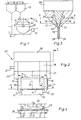
- a coating head 10 of the extrusion-type is arranged for the simultaneous coating of two photographic layers on a moving web 11.
- the web 11 is moved through the coating zone along a path that is determined by a web-supporting roller 12 to which the web is advanced over a guide roller 13.
- the web has a width that is greater than the width of the roller 12, so that it extends at both sides over the roller.
- the coating head is arranged for movement from an inoperative position shown in broken lines, into an operative position shown in drawn lines. In the inoperative position, the deaeration of the coating head and its related supply circuit, and the starting of the formation of the curtain may occur.
- the coating composition that flows downwardly during this step of the coating procedure is collected in a pan 14 and is to be considered as waste since the compositions for the two layers have become intermixed. Occasionally, critical or expensive constituents may be recovered from the collected mass of liquid.
- the coating head may be moved by suitable means into the operative position. In that position the composite curtain flows on the web at a position in the coating zone that is situated in the upper left-hand quadrant of the web-supporting roller 12.
- the curtain is held during its free fall with its edges in adherent contact with stationary curtain guides 15 and 16 as may be seen in Fig. 2.
- the curtain guides consisted of metal rods that were provided with a sleeve of plastic that showed good wetting properties with respect to the coating composition, namely nylon.
- the curtain guides have been illustrated parallel with each other in the drawing, but they may also converge towards each other, depending on the rheological properties and the rate of flow of the curtain.
- the coating head comprises essentially a central wedge-like lip 17 and two outer lips 18 and 19 that determine two elongate parallel orifices 22 and 23, side walls such as 20 and 21, and a supporting mechanism 58 that has been illustrated as a block but that actually comprises means that permit the outer lips 18 and 19 to be swung away from the central lip for cleaning the head, for the installation of small strips of plastic, metal or the like at the lateral extremities of one of the orifices to reduce the effective length thereof.
- the coating compositions are fed to the cavities 25 and 26 of the coating head via a lateral connection such as 27 shown in Fig. 2.
- a lateral connection such as 27 shown in Fig. 2.
- the length of the orifice 22 is illustrated by a, whereas the length of the orifice 23 is illustrated by b. Said lengths correspond practically with the initial widths of the respective layers 28 and 29 of the curtain. The edges of the layer 29 are indicated in broken lines in Fig. 2.
- the orifices 22 and 23 have a common centre line as indicated by the dash and dot line 33.
- the width of the two layers of the curtain at the moment they contact the web is indicated in Fig. 4 by c for the layer 28 and by d for the layer 29.
- the width of the web 11 is indicated by e.
- the arrow 30 indicates the direction of movement of the web 11 and it is thus clear that in the illustrated embodiment the wider layer 28 of the curtain will enter into contact with the web. It should be noted that for the sake of clarity, the line 4-4 has been drawn separated from the upper surface of the web 11 in Fig. 2; in fact said line should coincide with said surface.
- the coating composition of the curtain that overflows the edges of the web is collected in pans 31 and 32 and may be directly recirculated to the supply tank of coating composition that is in communication with the manifold 25. Such recirculation is possible since it is only the liquid of the edge regions of the wider curtain layer 28 that overflows the edges of the web.
- the layer 29, on the contrary, is integrally applied to the web.
- Fig. 5 The recirculation of the coating composition that overflows the edges of the web has been illustrated in Fig. 5 wherein 34 is a supply tank, for the coating composition, 35 is a deaeration apparatus, 36 is a positive displacement type pump, for instance a gear pump, 37 is a device for measuring the rate of flow and 38 is a controller for controlling the pump 36 in response to the output signal from the flow meter 37, and 10 is the curtain coater.
- the coating composition that overflows the edges of the web 11 is collected in the pans 31 and 32 and recirculated by a pump 39, for instance a centrifugal type pump, to the deaeration apparatus 35.
- the installation comprises a second supply vessel and its associated elements, not shown in the drawing, for the feeding of the coating composition for the formation of the layer that has a width that does not exceed the width of the web and that consequently is integrally coated to the web.
- Fig. 6 illustrates a modified coating head according to Figs. 2 and 3 that may be used in case the rate of flow of the curtain, more in particular of the edge regions of the curtain, is unsufficiently great to maintain a stable curtain.
- the lip spacing at the orifice of the coating head through which the wider layer of the curtain is formed may be locally increased at the edge regions, as indicated by the recessed zone 33 in Fig. 6 for one lateral side of the coating head.
- the increase of the lip spacing has been shown exaggeratedly in the drawing for the sake of clearness; in practice such an increase will be small in accordance with the law that governs the rate of flow through an orifice, as mentioned already hereinbefore in the specification.
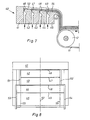
- FIGs. 7 and 8 A second embodiment of an apparatus for performing the method according to the present invention is shown in Figs. 7 and 8.
- the apparatus is a photographic curtain coating apparatus of the slide hopper type that is arranged for the formation of four layers that are applied successively onto each other.
- Slide hoppers of the mentioned type are described in more details, for instance in British Patent Specifications 1,276,144 and 1,276,381, both filed June 3, 1969 by Eastman Kodak Company.
- the hopper 40 comprises five constituent elements 41 to 45 that determine four parallel elongate orifices 46 to 49 for the formation of the successive layers.
- the coating compositions for the formation of the distinct layers are pumped in the coating head through corresponding ducts indicated by the corresponding arrows.
- the foremost element 45 terminates in a lip 50 from which the superposed layers may fall downwardly as a curtain onto a web 11 conveyed through the coating zone about a roller 12.
- the slotlike orifices of the coating head have different lengths as may be seen in Fig. 8, wherein the orifices 46 and 47 have a length that is smaller than the length of the lower orifices 48 and 49.
- the centres of the four orifices lie in a common centre plane, as indicated by the dash and dot line 57.
- the layers of coating compositions formed through the first two orifices are in contact with their lateral boundaries with edge guides 51 and 52 whereas the next two layers are in contact with edge guides 53 and 54.
- the layers formed through the orifices 46 and 47 overflow the layers formed through orifices 48 and 49 and may maintain their initial width, as indicated by the broken lines 55 and 56.
- the edge guides 53 and 54 extend beyond the lip 50 vertically downwardly and thereby form the edge guides for the free falling curtain.
- the width of the web may correspond with, or be slightly narrower or broader than the width of the central region of the curtain that is within the broken lines 55 and 56.
- the edge regions of the curtain that overflow the edges of the web 11 may be collected in suitable pans as described hereinbefore with reference to the extrusion-type hopper, but they are unsuited for recirculation since they are in fact a mixture of at least two different coating compositions.
- the purpose of the described layer configuration is to have in the edge regions of the curtain a rate of flow that is the combination of the rates of flow of two layers whereby, notably in these cases wherein relative thin layers are coated, the individual layer rate of flow is too small to maintain a stable curtain, whereas the combined rate of flow of two layers does maintain a stable curtain.
- the described arrangement does not permit the recirculation of the collected edge regions of the curtain, it does permit significant reduction of the waste of coating material since in a conventional curtain coater of the described type the collected edge regions of the curtain would be a mixture of the coating compositions of the four layers.
- the ratio between the width of the edge regions of a curtain and the width of the complete curtain being rather variable in practice, it should yet be taken into account that edge regions are seldom narrower than 5% of the total width of the curtain, and a reasonable lowest limit for the width of an edge region of the curtain is 10 mm in the coating of relative small webs, say up to 200 mm, and 50 mm in the coating of wider webs, say up to 1700 mm.
- An additional factor that should be considered is the accuracy of the lateral guidance of the web through the coating zone and in case relatively important deviations of the web from its intended path may occur, allowance should be made for such deviations in determining the width of the edge regions of the curtain.
- a two layer coating was made on a polyethylene terephthalate web that was provided with a suitable subbing layer.
- the web had a width of 240 mm and was moved at a speed of 2 ms- 1 .
- the angle between the radius of the roller running through the point of impingement of the curtain on the web, and the horizontal through the roller centre, as indicated by the angle a in Fig. 1, amounted to 60 degrees.
- the height of the curtain amounted to 60 mm.
- the bottom layer 28 was an aqueous silver halide dispersion as used in the manufacturing of photographic film for graphic purposes, with a solid content of 250 gl- 1 and a viscosity of 16 mPas at 36°C.
- the dispersion contained carboxymethylated octylphenylether of polyethylene glycol containing 8 recurring ethylene oxide units as wetting agent in an amount of 0.5 gl -1 .
- the static surface tension of the composition was measured by means of a Wilhelmy plate and amounted to 36 mNm-'.
- the top layer 29 was a so-called antistress layer with a solid contents of 40 gl- 1 and a viscosity of 4 mPas at 36°C.
- the composition contained sodium isotetradecyl sulphate as wetting agent in an amount of 0.17 gl -1 .
- the static surface tension amounted to 34 mNm-'.
- the wet layer thickness of the bottom layer was 50 ⁇ m, whereas the wet layer thickness of the top layer was 33 ⁇ m.
- the flow rate of the bottom layer was 75 mls -1 m -1 , whereas the flow rate of the top layer was 41 mls -1 m -1 .
- a photomicrograph of a cross section of the dried coating showed a distinct separation between the two layers.
- the rate of flow of the top layer had to be increased to 100 mls -1 m -1 in order to prevent the edge regions of the curtain from becoming unstable.
- the corresponding minimum speed of the web to obtain a wet layer thickness of 33 ⁇ m for said layer had to be increased to 3 ms -1 .
- the rate of flow of the silver halide bottom layer had correspondingly to be increased to 187 mls -1 m -1 in order to obtain the same wet layer thickness as in Example 1, namely 50 ⁇ m.
- the rate of flow through the orifice 23 was correspondingly decreased to obtain finally the same wet layer thickness of 33 ⁇ m for said top layer.
- the dry layer thickness of the two layers amounted to 10.2 ⁇ m measured at the centre of the web, and to 11.0 ,um measured at a position situated 5 mm inwardly of an edge of the web, in the coating of Example 1.
- the dry layer thickness at the centre was 10.2 ⁇ m, whereas said thickness amounted to 10.1 ,um measured at said position situated 5 mm inwardly of an edge of the web.
- a two-layer coating was made on a polyethylene terephthalate web, provided with a suitable subbing layer, to form an antihalation layer for a so-called graphic film.
- the bottom layer was an aqueous gelatin dispersion containing pigment particles for absorption of light that could penetrate through the web upon exposure of a light-sensitive layer on the reverse side of the web.
- the solid contents of the composition was 80 gl- 1 and the viscosity was 11 mPas at 36°C.
- the composition contained sodium isotetradecyl sulphate as wetting agent in an amount of 0.21 gl- 1 , and the static surface tension of the composition amounted to 34 mNm- 1 .
- the top layer was an antistress layer with a solid contents of 30 gl- 1 and a viscosity of 3 mPas at 36°C.
- the composition contained sodium isotetradecyl sulphate as wetting agent in an amount of 0.56 gl -1 .
- the static surface tension amounted to 29 mNm- 1 .
- the wet layer thickness of the bottom layer was 50 um whereas the wet layer thickness of the top layer was 20 ⁇ m.
- the rate of flow of said top layer composition had to be greater than 100 mls -1 m -1 in order to obtain stable edge regions of the curtain.
- the web speed that was required in these circumstances to obtain a wet layer thickness of 20 ⁇ m was 5 ms -1 .
- the marginal end regions 33 of the orifice 22 of the extrusion type head 10, see Fig. 6 were widened by 0.1 mm to locally increase the rate of flow at said regions.
- the nominal width of the orifice 22 was 0.4 mm.
- a two-layer coating was made on a polyethylene terephthalate web provided with a suitable subbing layer, to illustrate the effect of the viscosity of the layers on the curtain stability.
- the bottom layer was an aqueous gelatin dispersion with a solid contents of 100 gl- 1 and a viscosity of 150 mPas at 36°C.
- the composition contained sodium isotetradecyl sulphate as wetting agent in an amount of 0.21 gl -1 , and the static surface tension of the composition amounted to 30 mNm- 1 .
- the top layer was an aqueous gelatin dispersion with a solid contents of 50 gl- 1 and a viscosity of 10 mPas at 36°C.
- the composition contained sodium isotetradecyl sulphate as wetting agent, in an amount of 0.14 gl -1 , and the static surface tension of the composition amounted to 32 mNm- 1 .
- the bottom layer was coated at full curtain width, whereas the top layer formed the central curtain region according to the dimensions a to e mentioned in Example 1.
- the wet layer thickness of the bottom layer amounted 50 ⁇ m and that of the top layer to 24 ⁇ m.
- the web speed was 1.5 ms- 1 .
- the viscosity of the composition for the formation of the bottom layer was increased by the addition of suitable rheological compounds to 200 mPas, the solid contents remaining substantially unaltered. It was now found that the coating could proceed satisfactorily without any need to increase the rate of flow of said bottom layer.
- a three layer coating was made on a suitable film support for the production of a light-sensitive photographic material that is rapidly developable according to the so-called stabilization process.
- the slide hopper was provided with three parallel outlet orifices, two orifices having equal lengths and one orifice being 50 mm shorter and being also disposed on the slide surface between the two longer orifices. Edge dams or guides were only provided for the longer orifices and extended downwardly over the lip 50 to form the curtain guides.
- the bottom layer was an aqueous gelatin composition with a viscosity of 9 mPas at 36°C and a solid contents of 64 gl -1 .
- the wetting agent was carboxymethylated octylphenylether of polyethyleneglycol containing 8 recurring ethylene oxide units at a rate of 0.25 gl-' whereby a static surface tension of 37.5 mNm- 1 was obtained.
- the function of said layer is to form a water-permeable layer between the film support and the silver halide emulsion layer whereby a rapid transfer of the developing agent through the silver halide emulsion layer is obtained upon processing.
- the middle layer was an aqueous silver halide composition and had a viscosity of 10 mPas at 36°C, and a solid contents of 270 gl-'.
- As wetting agent was added sodium isotetradecyl sulphate in an amount of 0.17 gl- 1 and carboxymethylated octylphenylether of polyethylene glycol containing 8 recurring ethylene oxide units in an amount of 0.75 gl- 1 whereby a static surface tension of 30 mNm-' was obtained.
- the top layer was a gelatin anti-stress layer with a viscosity of 3 mPas at 36°C, and a solid contents of 31 gl-'.
- the wetting agent contained in the composition was sodium isotetradecyl sulphate in an amount of 0.28 gl- 1.
- the wet layer thickness of the bottom, the middle and the top layer was 62 ⁇ m, 42 ⁇ m and 33 ⁇ m respectively.
- This condition is applicable to any curtain coater, and it may thus be seen that for a desired wet layer thickness, the velocity of the web may be lower in proportion to the rate of flow R.
- the minimum web speed at which satisfactory coating could occur was 1 ms- 1 , which points to a rate of flow of 90 ms -1 m -1 of the edge regions of the curtain.
- the limiting of the edge regions of the-curtain to one layer only would increase the minimum web speed to 2 ms- 1 , if the bottom layer only should form the edge regions of the curtain, and to 3ms -1 in case the top layer only should form the edge regions of the curtain.
Landscapes
- Chemical & Material Sciences (AREA)
- Engineering & Computer Science (AREA)
- Materials Engineering (AREA)
- Physics & Mathematics (AREA)
- General Physics & Mathematics (AREA)
- Application Of Or Painting With Fluid Materials (AREA)
- Coating Apparatus (AREA)
Claims (6)
Applications Claiming Priority (2)
| Application Number | Priority Date | Filing Date | Title |
|---|---|---|---|
| GB811578 | 1978-03-01 | ||
| GB811578 | 1978-03-01 |
Publications (2)
| Publication Number | Publication Date |
|---|---|
| EP0003860A1 EP0003860A1 (de) | 1979-09-05 |
| EP0003860B1 true EP0003860B1 (de) | 1982-03-24 |
Family
ID=9846057
Family Applications (1)
| Application Number | Title | Priority Date | Filing Date |
|---|---|---|---|
| EP79200078A Expired EP0003860B1 (de) | 1978-03-01 | 1979-02-14 | Verfahren zur Beschichtung einer Materialbahn mit mehreren übereinander angeordneten photographischen Schichten, nach dem Vorhang-Beschichtungs-Verfahren |
Country Status (3)
| Country | Link |
|---|---|
| US (1) | US4233346A (de) |
| EP (1) | EP0003860B1 (de) |
| DE (1) | DE2962311D1 (de) |
Families Citing this family (34)
| Publication number | Priority date | Publication date | Assignee | Title |
|---|---|---|---|---|
| CA1140001A (en) * | 1979-04-19 | 1983-01-25 | Karel S. Willemsens | Method and device for slide hopper multilayer coating |
| JPS583672A (ja) * | 1981-06-30 | 1983-01-10 | Fuji Photo Film Co Ltd | 塗布方法 |
| DE3238905C2 (de) * | 1982-10-21 | 1986-01-23 | Agfa-Gevaert Ag, 5090 Leverkusen | Verfahren zur Mehrfachbeschichtung von bewegten Gegenständen oder Bahnen |
| DE3300150A1 (de) * | 1983-01-04 | 1984-07-05 | Agfa-Gevaert Ag, 5090 Leverkusen | Verfahren und vorrichtung zur stabilisierung von frei fallenden fluessigkeitsvorhaengen |
| JPH0661518B2 (ja) * | 1986-09-22 | 1994-08-17 | 富士写真フイルム株式会社 | 塗布方法及び装置 |
| US4774109A (en) * | 1987-07-21 | 1988-09-27 | Nordson Corporation | Method and apparatus for applying narrow, closely spaced beads of viscous liquid to a substrate |
| US4844004A (en) * | 1987-07-21 | 1989-07-04 | Nordson Corporation | Method and apparatus for applying narrow, closely spaced beads of viscous liquid to a substrate |
| JP2646251B2 (ja) * | 1987-10-20 | 1997-08-27 | 富士写真フイルム株式会社 | 多層同時塗布方法及び装置 |
| US4830887A (en) * | 1988-04-22 | 1989-05-16 | Eastman Kodak Company | Curtain coating method and apparatus |
| JP2562941B2 (ja) * | 1988-06-02 | 1996-12-11 | 富士写真フイルム株式会社 | 塗布装置 |
| JP2849836B2 (ja) * | 1989-10-31 | 1999-01-27 | 富士写真フイルム株式会社 | 塗布方法 |
| WO1994008272A1 (en) * | 1992-10-05 | 1994-04-14 | Eastman Kodak Company | Hopper edge guide system |
| US5488480A (en) * | 1994-02-16 | 1996-01-30 | Cmd Corporation | Apparatus and method for detecting a heat seal in a moving plastic film |
| EP0649054B1 (de) * | 1993-10-18 | 2001-04-25 | Eastman Kodak Company | Vorrichtung und Verfahren für interne Kantenführungsstreifen |
| US5728430A (en) * | 1995-06-07 | 1998-03-17 | Avery Dennison Corporation | Method for multilayer coating using pressure gradient regulation |
| US5962075A (en) * | 1995-06-07 | 1999-10-05 | Avery Dennison | Method of multilayer die coating using viscosity adjustment techniques |
| US6824828B2 (en) * | 1995-06-07 | 2004-11-30 | Avery Dennison Corporation | Method for forming multilayer release liners |
| DE19606459A1 (de) * | 1996-02-21 | 1997-08-28 | Voith Sulzer Papiermasch Gmbh | Verfahren und Vorrichtungen zum Auftragen eines flüssigen oder pastösen Mediums auf eine laufende Materialbahn |
| FI110274B (fi) * | 1996-11-04 | 2002-12-31 | Metso Paper Inc | Menetelmä ja sovitelma liikkuvan kartonkiradan päällystämiseksi |
| DE10320146A1 (de) * | 2003-05-06 | 2004-11-25 | Voith Paper Patent Gmbh | Mehrschicht-Auftragsvorrichtung zum Auftragen von Auftragsmedium im Wege wenigstens eines mehrschichtigen Vorhangs oder Schleiers |
| DE10349117A1 (de) * | 2003-10-22 | 2005-05-25 | Voith Paper Patent Gmbh | Maschine zum Auftragen eines flüssigen oder pastösen Auftragsmediums auf die Oberfläche einer laufenden Materialbahn |
| TWI228462B (en) * | 2003-12-23 | 2005-03-01 | Asustek Comp Inc | Surface treating method |
| FI6411U1 (fi) * | 2004-07-02 | 2004-10-12 | Metso Paper Inc | Verhopäällystin |
| WO2006062214A1 (ja) * | 2004-12-08 | 2006-06-15 | Nippon Steel Corporation | プレコート金属板およびプレコート金属板の製造方法 |
| JP4683968B2 (ja) * | 2005-03-11 | 2011-05-18 | ボイス ペ−パ− パテント ゲ−エムベ−ハ− | カーテン式コータ |
| JP4746894B2 (ja) * | 2005-03-14 | 2011-08-10 | ボイス ペ−パ− パテント ゲ−エムベ−ハ− | 塗工装置 |
| JP4902983B2 (ja) * | 2005-11-01 | 2012-03-21 | ボイス ペ−パ− パテント ゲ−エムベ−ハ− | 塗工装置および塗工方法 |
| FR2904246B1 (fr) * | 2006-07-27 | 2009-11-06 | Arjowiggins Soc Par Actions | Appareil et procede de couchage a rideau multicouche |
| JP2009136751A (ja) * | 2007-12-05 | 2009-06-25 | Voith Patent Gmbh | カーテンコータ |
| US8789492B2 (en) * | 2008-07-15 | 2014-07-29 | Awi Licensing Company | Coating apparatus and method |
| US20100314333A1 (en) * | 2009-06-10 | 2010-12-16 | Hollingsworth & Vose Company | Flutable fiber webs with low surface electrical resistivity for filtration |
| US8236082B2 (en) * | 2009-06-19 | 2012-08-07 | Hollingsworth & Vose Company | Flutable fiber webs with high dust holding capacity |
| JP6473837B1 (ja) * | 2018-03-19 | 2019-02-20 | 日東電工株式会社 | 塗工装置及び塗工膜の製造方法 |
| DE102022129598A1 (de) * | 2021-11-12 | 2023-05-17 | Valmet Technologies Oy | Faserbahnproduktionslinie |
Family Cites Families (18)
| Publication number | Priority date | Publication date | Assignee | Title |
|---|---|---|---|---|
| US2238013A (en) * | 1939-07-24 | 1941-04-08 | Dow Chemical Co | Coating process |
| GB908653A (en) * | 1960-02-29 | 1962-10-24 | Metal Box Co Ltd | A method of and apparatus for forming a liquid curtain for coating articles |
| FR1367155A (fr) * | 1962-08-20 | 1964-07-17 | Kodak Pathe | Procédé pour l'application simultanée de plusieurs couches sur un support |
| DE1577622B2 (de) * | 1964-07-24 | 1973-07-05 | Artos Dr Ing Meier Windhorst KG, 2000 Hamburg | Vorrichtung zum beschichten von laufenden warenbahnen |
| US3398431A (en) * | 1964-10-23 | 1968-08-27 | Nat Distillers And Chemicals C | Laminating extrusion die |
| US3448183A (en) * | 1966-08-05 | 1969-06-03 | Dow Chemical Co | Method for the preparation of multilayer film |
| US3632374A (en) * | 1968-06-03 | 1972-01-04 | Eastman Kodak Co | Method of making photographic elements |
| US3508947A (en) * | 1968-06-03 | 1970-04-28 | Eastman Kodak Co | Method for simultaneously applying a plurality of coated layers by forming a stable multilayer free-falling vertical curtain |
| US3867901A (en) * | 1968-06-03 | 1975-02-25 | Eastman Kodak Co | Apparatus for production of photographic elements |
| US3968772A (en) * | 1969-03-26 | 1976-07-13 | Eastman Kodak Company | Curtain coating apparatus |
| GB1279817A (en) * | 1969-11-14 | 1972-06-28 | Capseals Packaging Prod | Coating of web materials |
| GB1429260A (en) * | 1973-10-12 | 1976-03-24 | Ciba Geigy Ag | Coating apparatus |
| FR2285931A1 (fr) * | 1974-11-04 | 1976-04-23 | Ciba Geigy Ag | Appareil de revetement par rideau liquide |
| CH591902A5 (de) * | 1975-05-14 | 1977-10-14 | Ciba Geigy Ag | |
| US4135477A (en) * | 1975-09-22 | 1979-01-23 | Ciba-Geigy Ag | Curtain coating apparatus |
| DE2550553B2 (de) * | 1975-11-11 | 1978-01-19 | Ausscheidung im 25 59 775 Reifenhäuser KG, 5210 Troisdorf | Vorrichtung zum coextrudieren einer verbundbahn |
| GB1508198A (en) * | 1976-08-09 | 1978-04-19 | Ciba Geigy Ag | Slide hopper curtain coating |
| US4060649A (en) * | 1976-12-06 | 1977-11-29 | Sprague Electric Company | Paint curtain machine and method of painting |
-
1979
- 1979-02-14 EP EP79200078A patent/EP0003860B1/de not_active Expired
- 1979-02-14 DE DE7979200078T patent/DE2962311D1/de not_active Expired
- 1979-02-26 US US06/015,147 patent/US4233346A/en not_active Expired - Lifetime
Also Published As
| Publication number | Publication date |
|---|---|
| DE2962311D1 (en) | 1982-04-29 |
| US4233346A (en) | 1980-11-11 |
| EP0003860A1 (de) | 1979-09-05 |
Similar Documents
| Publication | Publication Date | Title |
|---|---|---|
| US4233346A (en) | Method and apparatus for applying a plurality of superposed layers to a web by curtain coating | |
| US2761417A (en) | Multiple coating apparatus | |
| US4572849A (en) | Process for the multiple coating of moving webs | |
| US4977852A (en) | Method of simultaneous multilayer application | |
| US3526528A (en) | Multiple doctor coating process and apparatus | |
| US4569863A (en) | Process for the multiple coating of moving objects or webs | |
| US2941898A (en) | Production of multilayer photographic materials | |
| US4001024A (en) | Method of multi-layer coating | |
| JPS635151B2 (de) | ||
| EP0390774B1 (de) | Verfahren und vorrichtung zum schnellbeschichten nach dem vorhangsverfahren | |
| US3993019A (en) | Apparatus for coating a substrate | |
| US4313980A (en) | Method and device for slide hopper multilayer coating | |
| US3928678A (en) | Method and apparatus for coating a substrate | |
| US3533833A (en) | Coating process | |
| US20020160121A1 (en) | Method of curtain coating | |
| US3289632A (en) | Cascade coating apparatus for applying plural layers of coating material to a moving web | |
| JP3118095B2 (ja) | 写真用被覆装置のための液体分布装置 | |
| US4348432A (en) | Method for coating with radially-propagating, free, liquid sheets | |
| US3928679A (en) | Method and apparatus for coating a multiple number of layers onto a substrate | |
| US4143190A (en) | Method and apparatus for coating webs | |
| JP4120913B2 (ja) | 塗布方法 | |
| US4510882A (en) | Coating apparatus and method for the curtain coating of liquid compositions using it | |
| US4921729A (en) | Two-layer coating method | |
| JPS6247075B2 (de) | ||
| US5545256A (en) | Coating apparatus |
Legal Events
| Date | Code | Title | Description |
|---|---|---|---|
| PUAI | Public reference made under article 153(3) epc to a published international application that has entered the european phase |
Free format text: ORIGINAL CODE: 0009012 |
|
| AK | Designated contracting states |
Designated state(s): BE CH DE FR GB |
|
| 17P | Request for examination filed | ||
| GRAA | (expected) grant |
Free format text: ORIGINAL CODE: 0009210 |
|
| AK | Designated contracting states |
Designated state(s): BE CH DE FR GB |
|
| REF | Corresponds to: |
Ref document number: 2962311 Country of ref document: DE Date of ref document: 19820429 |
|
| REG | Reference to a national code |
Ref country code: GB Ref legal event code: 746 |
|
| REG | Reference to a national code |
Ref country code: FR Ref legal event code: DL |
|
| PGFP | Annual fee paid to national office [announced via postgrant information from national office to epo] |
Ref country code: FR Payment date: 19951214 Year of fee payment: 18 Ref country code: BE Payment date: 19951214 Year of fee payment: 18 |
|
| PGFP | Annual fee paid to national office [announced via postgrant information from national office to epo] |
Ref country code: DE Payment date: 19951216 Year of fee payment: 18 |
|
| PGFP | Annual fee paid to national office [announced via postgrant information from national office to epo] |
Ref country code: CH Payment date: 19960403 Year of fee payment: 18 |
|
| PGFP | Annual fee paid to national office [announced via postgrant information from national office to epo] |
Ref country code: GB Payment date: 19961205 Year of fee payment: 19 |
|
| PG25 | Lapsed in a contracting state [announced via postgrant information from national office to epo] |
Ref country code: CH Effective date: 19970228 Ref country code: BE Effective date: 19970228 |
|
| BERE | Be: lapsed |
Owner name: AGFA-GEVAERT N.V. Effective date: 19970228 |
|
| REG | Reference to a national code |
Ref country code: CH Ref legal event code: PL |
|
| PG25 | Lapsed in a contracting state [announced via postgrant information from national office to epo] |
Ref country code: FR Effective date: 19971030 |
|
| PG25 | Lapsed in a contracting state [announced via postgrant information from national office to epo] |
Ref country code: DE Effective date: 19971101 |
|
| REG | Reference to a national code |
Ref country code: FR Ref legal event code: ST |
|
| PG25 | Lapsed in a contracting state [announced via postgrant information from national office to epo] |
Ref country code: GB Free format text: LAPSE BECAUSE OF NON-PAYMENT OF DUE FEES Effective date: 19980214 |
|
| GBPC | Gb: european patent ceased through non-payment of renewal fee |
Effective date: 19980214 |
|
| PLBE | No opposition filed within time limit |
Free format text: ORIGINAL CODE: 0009261 |
|
| STAA | Information on the status of an ep patent application or granted ep patent |
Free format text: STATUS: NO OPPOSITION FILED WITHIN TIME LIMIT |