EP0004602A1 - Nichtbrennbarer Dämmstoff - Google Patents
Nichtbrennbarer Dämmstoff Download PDFInfo
- Publication number
- EP0004602A1 EP0004602A1 EP79100867A EP79100867A EP0004602A1 EP 0004602 A1 EP0004602 A1 EP 0004602A1 EP 79100867 A EP79100867 A EP 79100867A EP 79100867 A EP79100867 A EP 79100867A EP 0004602 A1 EP0004602 A1 EP 0004602A1
- Authority
- EP
- European Patent Office
- Prior art keywords
- weight
- insulating material
- material according
- iron
- combustible
- Prior art date
- Legal status (The legal status is an assumption and is not a legal conclusion. Google has not performed a legal analysis and makes no representation as to the accuracy of the status listed.)
- Withdrawn
Links
- 239000011810 insulating material Substances 0.000 title claims abstract description 12
- 239000011230 binding agent Substances 0.000 claims abstract description 18
- 239000000654 additive Substances 0.000 claims abstract description 14
- 239000002245 particle Substances 0.000 claims abstract description 11
- 150000001875 compounds Chemical class 0.000 claims abstract description 8
- 229910052723 transition metal Inorganic materials 0.000 claims abstract description 4
- 150000003624 transition metals Chemical class 0.000 claims abstract description 4
- QPLDLSVMHZLSFG-UHFFFAOYSA-N Copper oxide Chemical compound [Cu]=O QPLDLSVMHZLSFG-UHFFFAOYSA-N 0.000 claims abstract 6
- NUJOXMJBOLGQSY-UHFFFAOYSA-N manganese dioxide Chemical compound O=[Mn]=O NUJOXMJBOLGQSY-UHFFFAOYSA-N 0.000 claims abstract 4
- QGPQTSCLUYMZHL-UHFFFAOYSA-N iron(3+);oxygen(2-);hydrate Chemical compound O.[O-2].[O-2].[O-2].[Fe+3].[Fe+3] QGPQTSCLUYMZHL-UHFFFAOYSA-N 0.000 claims abstract 2
- WSFSSNUMVMOOMR-UHFFFAOYSA-N Formaldehyde Chemical compound O=C WSFSSNUMVMOOMR-UHFFFAOYSA-N 0.000 claims description 12
- 239000012774 insulation material Substances 0.000 claims description 12
- XEEYBQQBJWHFJM-UHFFFAOYSA-N Iron Chemical compound [Fe] XEEYBQQBJWHFJM-UHFFFAOYSA-N 0.000 claims description 5
- 238000009413 insulation Methods 0.000 claims description 5
- 150000003623 transition metal compounds Chemical class 0.000 claims description 5
- ISWSIDIOOBJBQZ-UHFFFAOYSA-N Phenol Chemical compound OC1=CC=CC=C1 ISWSIDIOOBJBQZ-UHFFFAOYSA-N 0.000 claims description 4
- VYZAMTAEIAYCRO-UHFFFAOYSA-N Chromium Chemical compound [Cr] VYZAMTAEIAYCRO-UHFFFAOYSA-N 0.000 claims description 2
- RYGMFSIKBFXOCR-UHFFFAOYSA-N Copper Chemical compound [Cu] RYGMFSIKBFXOCR-UHFFFAOYSA-N 0.000 claims description 2
- 229920000877 Melamine resin Polymers 0.000 claims description 2
- XSQUKJJJFZCRTK-UHFFFAOYSA-N Urea Chemical compound NC(N)=O XSQUKJJJFZCRTK-UHFFFAOYSA-N 0.000 claims description 2
- HCHKCACWOHOZIP-UHFFFAOYSA-N Zinc Chemical compound [Zn] HCHKCACWOHOZIP-UHFFFAOYSA-N 0.000 claims description 2
- 239000004202 carbamide Substances 0.000 claims description 2
- 229910052804 chromium Inorganic materials 0.000 claims description 2
- 239000011651 chromium Substances 0.000 claims description 2
- 229910017052 cobalt Inorganic materials 0.000 claims description 2
- 239000010941 cobalt Substances 0.000 claims description 2
- GUTLYIVDDKVIGB-UHFFFAOYSA-N cobalt atom Chemical compound [Co] GUTLYIVDDKVIGB-UHFFFAOYSA-N 0.000 claims description 2
- 229910052802 copper Inorganic materials 0.000 claims description 2
- 239000010949 copper Substances 0.000 claims description 2
- 239000003365 glass fiber Substances 0.000 claims description 2
- 229910052742 iron Inorganic materials 0.000 claims description 2
- PVFSDGKDKFSOTB-UHFFFAOYSA-K iron(3+);triacetate Chemical compound [Fe+3].CC([O-])=O.CC([O-])=O.CC([O-])=O PVFSDGKDKFSOTB-UHFFFAOYSA-K 0.000 claims description 2
- JDSHMPZPIAZGSV-UHFFFAOYSA-N melamine Chemical compound NC1=NC(N)=NC(N)=N1 JDSHMPZPIAZGSV-UHFFFAOYSA-N 0.000 claims description 2
- 229910052720 vanadium Inorganic materials 0.000 claims description 2
- GPPXJZIENCGNKB-UHFFFAOYSA-N vanadium Chemical compound [V]#[V] GPPXJZIENCGNKB-UHFFFAOYSA-N 0.000 claims description 2
- 239000010455 vermiculite Substances 0.000 claims description 2
- 229910052902 vermiculite Inorganic materials 0.000 claims description 2
- 235000019354 vermiculite Nutrition 0.000 claims description 2
- 239000011701 zinc Substances 0.000 claims description 2
- 229910052725 zinc Inorganic materials 0.000 claims description 2
- WPBNNNQJVZRUHP-UHFFFAOYSA-L manganese(2+);methyl n-[[2-(methoxycarbonylcarbamothioylamino)phenyl]carbamothioyl]carbamate;n-[2-(sulfidocarbothioylamino)ethyl]carbamodithioate Chemical compound [Mn+2].[S-]C(=S)NCCNC([S-])=S.COC(=O)NC(=S)NC1=CC=CC=C1NC(=S)NC(=O)OC WPBNNNQJVZRUHP-UHFFFAOYSA-L 0.000 claims 1
- 239000010451 perlite Substances 0.000 claims 1
- 235000019362 perlite Nutrition 0.000 claims 1
- 239000002341 toxic gas Substances 0.000 abstract description 5
- LNOZJRCUHSPCDZ-UHFFFAOYSA-L iron(ii) acetate Chemical compound [Fe+2].CC([O-])=O.CC([O-])=O LNOZJRCUHSPCDZ-UHFFFAOYSA-L 0.000 abstract 1
- 239000000203 mixture Substances 0.000 description 6
- 238000003763 carbonization Methods 0.000 description 4
- 239000006185 dispersion Substances 0.000 description 4
- 239000007789 gas Substances 0.000 description 4
- 238000004519 manufacturing process Methods 0.000 description 4
- 239000004566 building material Substances 0.000 description 3
- 239000000126 substance Substances 0.000 description 3
- 230000015572 biosynthetic process Effects 0.000 description 2
- 229910002091 carbon monoxide Inorganic materials 0.000 description 2
- 239000003054 catalyst Substances 0.000 description 2
- 239000003431 cross linking reagent Substances 0.000 description 2
- 239000010440 gypsum Substances 0.000 description 2
- 229910052602 gypsum Inorganic materials 0.000 description 2
- 239000011490 mineral wool Substances 0.000 description 2
- 229920000642 polymer Polymers 0.000 description 2
- POILWHVDKZOXJZ-ARJAWSKDSA-M (z)-4-oxopent-2-en-2-olate Chemical compound C\C([O-])=C\C(C)=O POILWHVDKZOXJZ-ARJAWSKDSA-M 0.000 description 1
- GOXQRTZXKQZDDN-UHFFFAOYSA-N 2-Ethylhexyl acrylate Chemical compound CCCCC(CC)COC(=O)C=C GOXQRTZXKQZDDN-UHFFFAOYSA-N 0.000 description 1
- PWHULOQIROXLJO-UHFFFAOYSA-N Manganese Chemical compound [Mn] PWHULOQIROXLJO-UHFFFAOYSA-N 0.000 description 1
- BPQQTUXANYXVAA-UHFFFAOYSA-N Orthosilicate Chemical compound [O-][Si]([O-])([O-])[O-] BPQQTUXANYXVAA-UHFFFAOYSA-N 0.000 description 1
- 239000004952 Polyamide Substances 0.000 description 1
- 239000004962 Polyamide-imide Substances 0.000 description 1
- 239000004642 Polyimide Substances 0.000 description 1
- CKUAXEQHGKSLHN-UHFFFAOYSA-N [C].[N] Chemical compound [C].[N] CKUAXEQHGKSLHN-UHFFFAOYSA-N 0.000 description 1
- NIXOWILDQLNWCW-UHFFFAOYSA-N acrylic acid group Chemical group C(C=C)(=O)O NIXOWILDQLNWCW-UHFFFAOYSA-N 0.000 description 1
- 229910052910 alkali metal silicate Inorganic materials 0.000 description 1
- 239000010425 asbestos Substances 0.000 description 1
- 230000036760 body temperature Effects 0.000 description 1
- 229910021538 borax Inorganic materials 0.000 description 1
- CQEYYJKEWSMYFG-UHFFFAOYSA-N butyl acrylate Chemical compound CCCCOC(=O)C=C CQEYYJKEWSMYFG-UHFFFAOYSA-N 0.000 description 1
- 230000003197 catalytic effect Effects 0.000 description 1
- 239000004568 cement Substances 0.000 description 1
- 239000003795 chemical substances by application Substances 0.000 description 1
- 230000000052 comparative effect Effects 0.000 description 1
- 239000002131 composite material Substances 0.000 description 1
- 238000009833 condensation Methods 0.000 description 1
- 230000005494 condensation Effects 0.000 description 1
- 238000010276 construction Methods 0.000 description 1
- 229920001577 copolymer Polymers 0.000 description 1
- 238000004132 cross linking Methods 0.000 description 1
- 238000001035 drying Methods 0.000 description 1
- UIWXSTHGICQLQT-UHFFFAOYSA-N ethenyl propanoate Chemical compound CCC(=O)OC=C UIWXSTHGICQLQT-UHFFFAOYSA-N 0.000 description 1
- VEPSWGHMGZQCIN-UHFFFAOYSA-H ferric oxalate Chemical compound [Fe+3].[Fe+3].[O-]C(=O)C([O-])=O.[O-]C(=O)C([O-])=O.[O-]C(=O)C([O-])=O VEPSWGHMGZQCIN-UHFFFAOYSA-H 0.000 description 1
- KTWOOEGAPBSYNW-UHFFFAOYSA-N ferrocene Chemical compound [Fe+2].C=1C=C[CH-]C=1.C=1C=C[CH-]C=1 KTWOOEGAPBSYNW-UHFFFAOYSA-N 0.000 description 1
- 239000000835 fiber Substances 0.000 description 1
- 239000010881 fly ash Substances 0.000 description 1
- 239000011494 foam glass Substances 0.000 description 1
- 229910052748 manganese Inorganic materials 0.000 description 1
- 239000011572 manganese Substances 0.000 description 1
- 239000000463 material Substances 0.000 description 1
- 229910052751 metal Inorganic materials 0.000 description 1
- 239000002184 metal Substances 0.000 description 1
- 238000000034 method Methods 0.000 description 1
- 238000002156 mixing Methods 0.000 description 1
- 231100000252 nontoxic Toxicity 0.000 description 1
- 230000003000 nontoxic effect Effects 0.000 description 1
- 230000001590 oxidative effect Effects 0.000 description 1
- 229910001562 pearlite Inorganic materials 0.000 description 1
- 230000000737 periodic effect Effects 0.000 description 1
- 229920003055 poly(ester-imide) Polymers 0.000 description 1
- 229920002647 polyamide Polymers 0.000 description 1
- 229920002312 polyamide-imide Polymers 0.000 description 1
- 229920000728 polyester Polymers 0.000 description 1
- 229920001721 polyimide Polymers 0.000 description 1
- 229920005596 polymer binder Polymers 0.000 description 1
- 239000002491 polymer binding agent Substances 0.000 description 1
- 238000003825 pressing Methods 0.000 description 1
- 230000001681 protective effect Effects 0.000 description 1
- 230000002787 reinforcement Effects 0.000 description 1
- 229910052895 riebeckite Inorganic materials 0.000 description 1
- 150000004760 silicates Chemical class 0.000 description 1
- 239000004328 sodium tetraborate Substances 0.000 description 1
- 235000010339 sodium tetraborate Nutrition 0.000 description 1
- 239000007787 solid Substances 0.000 description 1
- 238000001179 sorption measurement Methods 0.000 description 1
- 239000003381 stabilizer Substances 0.000 description 1
- 239000000454 talc Substances 0.000 description 1
- 229910052623 talc Inorganic materials 0.000 description 1
- 229920001567 vinyl ester resin Polymers 0.000 description 1
- 125000000391 vinyl group Chemical group [H]C([*])=C([H])[H] 0.000 description 1
- XLYOFNOQVPJJNP-UHFFFAOYSA-N water Substances O XLYOFNOQVPJJNP-UHFFFAOYSA-N 0.000 description 1
- 238000009736 wetting Methods 0.000 description 1
Classifications
-
- C—CHEMISTRY; METALLURGY
- C08—ORGANIC MACROMOLECULAR COMPOUNDS; THEIR PREPARATION OR CHEMICAL WORKING-UP; COMPOSITIONS BASED THEREON
- C08K—Use of inorganic or non-macromolecular organic substances as compounding ingredients
- C08K5/00—Use of organic ingredients
- C08K5/04—Oxygen-containing compounds
- C08K5/09—Carboxylic acids; Metal salts thereof; Anhydrides thereof
- C08K5/098—Metal salts of carboxylic acids
-
- C—CHEMISTRY; METALLURGY
- C04—CEMENTS; CONCRETE; ARTIFICIAL STONE; CERAMICS; REFRACTORIES
- C04B—LIME, MAGNESIA; SLAG; CEMENTS; COMPOSITIONS THEREOF, e.g. MORTARS, CONCRETE OR LIKE BUILDING MATERIALS; ARTIFICIAL STONE; CERAMICS; REFRACTORIES; TREATMENT OF NATURAL STONE
- C04B26/00—Compositions of mortars, concrete or artificial stone, containing only organic binders, e.g. polymer or resin concrete
- C04B26/02—Macromolecular compounds
- C04B26/10—Macromolecular compounds obtained otherwise than by reactions only involving carbon-to-carbon unsaturated bonds
- C04B26/12—Condensation polymers of aldehydes or ketones
-
- C—CHEMISTRY; METALLURGY
- C08—ORGANIC MACROMOLECULAR COMPOUNDS; THEIR PREPARATION OR CHEMICAL WORKING-UP; COMPOSITIONS BASED THEREON
- C08K—Use of inorganic or non-macromolecular organic substances as compounding ingredients
- C08K3/00—Use of inorganic substances as compounding ingredients
- C08K3/18—Oxygen-containing compounds, e.g. metal carbonyls
- C08K3/20—Oxides; Hydroxides
- C08K3/22—Oxides; Hydroxides of metals
Definitions
- the invention relates to non-combustible insulation materials for construction and insulation purposes based on inorganic light particles which are connected to one another by polymeric organic binders.
- Such insulation materials are e.g. described in DE-OS 25 45 728 and 26 30 834.
- the organic binders burn or smolder, with larger or smaller amounts of toxic gases, e.g., depending on the temperature and air supply and the type and amount of the binder. Can form CO or HCN.
- the content of toxic gases in the carbonization products must not exceed certain values.
- the invention was therefore based on the object of reducing the content of toxic gases in the carbonization products of insulating materials. This object is achieved according to the invention by adding transition metal compounds.
- transition metal compounds have a catalytic effect on the formation and further reaction of the gases 00 and HCN formed from the carbon- and nitrogen-containing binders.
- a shift in the Boudouard equilibrium 2CO ⁇ CO 2 + C and the water gas equilibrium CO + H 2 O ⁇ CO 2 + H 2 towards a C0 2 formation is conceivable.
- the insulation materials do not differ significantly from those described in DE-OS 25 45 728 and 26 30 834.
- the inorganic light particles A preferably have an average particle diameter between 0.05 and 3 mm and a bulk density between 30 and 150 g / l.
- Silicate materials are preferably used, such as water-insoluble alkali silicates or silicates of the 2nd and 3rd main group of the periodic table. Expanded pearlite or vermiculite are particularly preferred, but expanded foam glass, fly ash or expanded gypsum are also suitable.
- the insulation materials can optionally contain up to 40% by weight of fibrous or granular inorganic additives B.
- Fibrous additives improve the elastic modulus of the building materials.
- the fibers should have a length of 2 mm to 3 cm. Glass fibers which are used in amounts of 2 to 10% by weight and rock or mineral wool which are used in amounts of 5 to 30% by weight, based in each case on the total mixture, are preferred.
- Granular additives improve the strength of the building materials.
- the grains should have a diameter of 1 to 100 ⁇ m. Talc or gypsum are preferred, which are used in amounts of 15 to 30% by weight.
- the light particles and any additives are bonded to one another by 1 to 30, preferably 2 to 20,% by weight of an organic, polymeric binder C.
- the binders are preferably polycondensates with a continuous use temperature according to DIN 53 466 of more than 100 ° C.
- the continuous use temperature is the temperature at which the substance in question can be stored in air for 25,000 hours without its properties changing noticeably. In principle, however, polymers can also be used as binders.
- aqueous, dispersions or solutions of precondensates curable to form the high-polymeric binder C are preferably used in the production of the insulating materials, and the usual dispersion stabilizers, crosslinking agents, catalysts, leveling agents or other additives are used in small amounts can contain.
- the precondensates harden at elevated temperatures, if appropriate in the presence of crosslinking agents or crosslinking catalysts with further condensation or wetting to the high polymer binder C. In principle, however, it is also possible to use dispersions or solutions of those binders C which are already in high molecular weight.
- Preferred binders C are condensates of formaldehyde with phenol, urea and melamine or with their derivatives, in particular a phenol / formaldehyde condensate which contains 1 to 30% by weight of an alkylphenol / phenol / formaldehyde candate product.
- Polyesterimides, polyamideimides, polyimides, polyesters, polyamides and polymers of acrylic esters and vinyl esters, in particular copolymers based on vinyl propionate, butyl acrylate or ethylhexyl acrylate, are also very suitable.
- a - preferably oxidizing - compound of a transition metal is used as component D.
- all possible compounds can be used. However, it is expedient to use those which are cheap, are themselves non-toxic and do not deliver any toxic gases at an elevated temperature.
- the compounds should also preferably be stable under the manufacturing conditions and conditions of use of the insulating materials.
- Preferred compounds are those of iron, copper and manganese; In addition, compounds of vanadium, chromium, cobalt and zinc have also proven to be effective.
- the substances FeO (OH), Mn0 2 , CuO, Fe 2 O 3 , V 2 O 5 , ZnO and CoO, iron (III) acetate, acetylacetonate and iron (III) oxalate, and ferrocene are particularly preferred . Mixtures of these substances with one another or with H 3 BO 3 , B203 or borax can also be used.
- the insulation materials can contain top, protective and reinforcement layers, e.g. made of asbestos cement, plasterboard or metal sheets.
- Composite insulation materials according to DE-OS 27 00 608 and 17 00 217 are also to be included here.
- the insulation materials preferably have a thickness of 10 mm to 100 mm, in particular 10 to 60 mm. Their density is preferably between 70 and 300 g / l.
- the insulation materials are preferably produced by the processes described in DE-OS 26 31 727 or 26 30 834 by mixing inorganic light particles A and, if appropriate, additives B with an aqueous dispersion or solution of the binder C or one which can be hardened to form the binder C. Pre-condensate, drying and pressing the mixture and curing if necessary.
- Insulation boards of the following composition were used in the examples: In the production of the plates, the amounts of additives D given in the examples were added to 100 parts of the mixtures.
- Insulation boards were produced in accordance with composition a, with varying amounts of different additives being added. The plates were subjected to the above-described carbonization and the resulting gases were measured. See Table 2 for results.
- Insulation boards of types b to e were manufactured and tested with various additives D. See Table 3 for results.
Landscapes
- Chemical & Material Sciences (AREA)
- Chemical Kinetics & Catalysis (AREA)
- Organic Chemistry (AREA)
- Engineering & Computer Science (AREA)
- Ceramic Engineering (AREA)
- Health & Medical Sciences (AREA)
- Medicinal Chemistry (AREA)
- Polymers & Plastics (AREA)
- Materials Engineering (AREA)
- Structural Engineering (AREA)
- Compositions Of Macromolecular Compounds (AREA)
- Building Environments (AREA)
Abstract
Der nichtbrennbare Dämmstoff enthält anorganische Leichtpartikel und gegebenenfalls faserige oder körnige anorganische Zusatzstoffe, die durch organische polymere Bindemittel miteinander verbunden sind. Um die Entwicklung toxischer Gase im Brandfall zu unterdrücken, sind dem Dämmstoff 0,1 bis 15 Gewichtsprozent eine Verbindung eines Übergangsmetalls, vorzugsweise Kupfer(II)-oxid, Eisen(III)-oxidhydrat, Eisen(II)-acetat oder Mangan(IV)-oxid zugemischt.
Description
- Die Erfindung betrifft nichtbrennbare Dämmstoffe für Bau-und Isolierzwecke auf Basis von anorganischen Leichtpartikeln, die durch polymere organische Bindemittel miteinander verbunden sind. Solche Dämmstoffe sind z.B. in den DE-OS 25 45 728 und 26 30 834 beschrieben. Im Brandfall verbrennen oder verschwelen die organischen Bindemittel, wobei sich je nach Temperatur und Luftzufuhr, sowie nach Art und Menge des Bindemittels größere oder kleinere Mengen toxischer Gase, z.B. CO oder HCN bilden können. Damit die Dämmstoffe den in DIN 4102 festgelegten Anforderungen für Baustoffe der Klasse A 2 genügen, darf der Gehalt an toxischen Gasen in den Verschwelungsprodukten bestimmte Werte nicht überschreiten.
- Der Erfindung lag also die Aufgabe zugrunde, den Gehalt an toxischen Gasen in den Verschwelungsprodukten von Dämmstoffen herabzusetzen. Diese Aufgabe wird erfindungsgemäß durch den Zusatz von Übergangsmetallverbinäungen gelöst.
- Gegenstand der Erfindung ist demzufolge ein nichtbrenn- barer Dämmstoff, enthaltend
- A) 98,9 bis 50 Gew.% anorganischer Leichtpartikel,
- B) 0 bis 40 Gew.% faseriger oder körniger anorganischer Zusatzstoffe,
- C) 1 bis 30 Gew.% eines organischen, polymeren Bindemittels sowie
- D) 0,1 bis 15 Gew.% einer Verbindung eines Übergangsmetalls.
- Es kann angenommen werden, daß die Übergangsmetallverbindungen die Bildung und Weiterreaktion der aus den kohlenstoff- und stickstoffhaltigen Bindemitteln entstehenden Gase 00 und HCN katalytisch beeinflussen. So ist z.B. eine Verschiebung des Boudouard-Gleichgewichtes 2CO⇄CO2 + C und des Wassergas-Gleichgewichtes CO + H2O⇄ CO2 + H2 in Richtung auf eine C02-Bildung denkbar.
- In Bezug auf die. Art der Leichtpartikel A, der Zusatzstoffe B und der-Bindemittel C unterscheiden sich die Dämmstoffe nicht wesentlich von den in den DE-OS 25 45 728 und 26 30 834 beschriebenen.
- Die anorganischen Leichtpartikel A haben vorzugsweise einen mittleren Teilchendurchmesser zwischen 0,05 und 3 mm und eine Schüttdichte zwischen 30 und 150 g/l. Bevorzugt werden silikatische Materialien verwendet, wie wasserunlösliche Alkalisilikate oder Silikate der 2. und 3. Hauptgruppe des Periodensystems. Besonders bevorzugt sind geblähter Perlit oder Vermiculit geeignet sind aber auch geblähtes Schaumglas, Flugasche oder geblähter Gips.
- Die Dämmstoffe können gegebenenfalls bis zu 40 Gew.% ' faseriger oder körniger anorganischer Zusatzstoffe B enthalten. Faserige Zusatzstoffe verbessern den Elastizitätsmodul der Baustoffe. Die Fasern sollen dabei eine Länge von 2 mm bis 3 cm aufweisen. Bevorzugt sind Glasfasern, die in Mengen von 2 bis 10 Gew.%, und Stein- oder Mineralwolle, die in Mengen von 5 bis 30 Gew.%, jeweils bezogen auf die Gesamtmischung, eingesetzt werden. Körnige Zusätze verbessern die Festigkeit der Baustoffe. Die Körner sollen einen Durchmesser von 1 bis 100µm aufweisen. Bevorzugt sind Talkum oder Gips, die in Mengen von 15 bis 30 Gew.% eingesetzt werden.
- Die Leichtpartikel und gegebenenfalls Zusatzstoffe sind durch 1 bis 30, vorzugsweise 2 bis 20 Gew.% eines organischen, polymeren Bindemittel C miteinander verbunden. Die Bindemittel sind vorzugsweise Polykondensate mit einer Dauergebrauchstemperatur nach DIN 53 466 von mehr als 100°C. Als Dauergebrauchstemperatur ist die Temperatur definiert, bei welcher der betreffende Stoff 25 000 Stunden an der Luft gelagert werden kann, ohne daß sich seine Eigenschaften erkennbar ändern. Prinzipiell können jedoch auch Polymerisate als Bindemittel eingesetzt werden.
- Bei der Herstellung der Dämmstoffe werden bevorzugt 10 bis 85, vorzugsweise 40 bis 75 gew.%ige, vorzugsweise wäßrige Dispersionen oder Lösungen von zum hochpolymeren Bindemittel C aushärtbaren Vorkondensaten eingesetzt, die gegebenenfalls übliche Dispergierstabilisatoren, Vernetzungsmittel, Katalysatoren, Verlaufmittel oder andere Zusatzstoffe in geringen Mengen enthalten können. Die Vorkondensate härten bei erhöhten Temperaturen, gegebenenfalls in Gegenwart von Vernetzungsmitteln oder Vernetzungskatalysatoren unter Weiterkondensation bzw. Ver- netzung zum hochpolymeren Bindemittel C aus. Grundsätzlich können aber auch Dispersionen oder Lösungen von solchen Bindemitteln C eingesetzt werden, die bereits in hochmolekularer Form vorliegen.
- Bevorzugte Bindemittel C sind Kondensate des Formaldehyds mit Phenol, Harnstoff und Melamin bzw. mit deren Derivaten, insbesondere ein Phenol/Formaldehyd-Kondensat, welches 1 bis 30 Gew.% eines Alkylphenol/Phenol/Formaldehyd-Kandensationsproduktes enthält. Gut geeignet sind ferner Polyesterimide, Polyamidimide, Polyimide, Polyester, Polyamide sowie Polymerisate von Acrylestern und Vinylestern, insbesondere Copolymerisate auf Basis von Vinylpropionat, Butylacrylat oder Äthylhexylacrylat.
- Als Komponente D wird eine - vorzugsweise oxidierend wirkende -Verbindung eines übergangsmetalls eingesetzt.. Grundsätzlich können alle in Frage kommenden Verbindungen verwendet werden. Zweckmäßigerweise werden jedoch solche eingesetzt, die billig sind, selbst nicht toxisch sind und bei erhöhter Temperatur auch keine toxischen Gase liefern. Die Verbindungen sollen ferner vorzugsweise unter den Herstellbedingungen und Anwendungsbedingungen der Dämmstoffe stabil sein.
- Bevorzugte Verbindungen sind solche des Eisens, Kupfers und Mangans; daneben haben sich auch Verbindungen des Vanadins, Chroms, Kobalts und des Zinks als wirksam erwiesen. Besonders bevorzugt sind die Substanzen FeO(OH), Mn02, CuO, Fe2O3, V2O5, ZnO und CoO, ferner Eisen(III)--acetat, -acetylacetonat und Eisen(III)-oxalat, sowie Ferrocen. Außerdem können Mischungen dieser Substanzen miteinander oder mit H3BO3, B203 oder Borax verwendet werden.
- Die Dämmstoffe können in der Praxisanwendung übliche Deck-, Schutz- und Verstärkungsschichten enthalten, wie z.B. aus Asbestzement, Gipskarton oder Metallblechen. Auch Verbund-Dämmstoffe nach den DE-OS 27 00 608 und 17 00 217 sollen hier mitumfaßt sein.
- Die Dämmstoffe haben vorzugsweise eine Stärke von 10 mm bis 100 mm, insbesondere von 10 bis 60 mm. Ihre Dichte liegt vorzugsweise zwischen 70 und 300 g/l.
- Die Herstellung der Dämmstoffe geschieht vorzugsweise nach den in den DE-OS 26 31 727 bzw. 26 30 834 beschriebenen Verfahren durch Vermischen von anorganischen Leichtpartikeln A und ggf. Zusatzstoffen B mit einer wäßrigen Dispersion oder Lösung des Bindemittels C bzw. eines zum Bindemittel C aushärtbaren Vorkondensats, Trocknen und Verpressen der Mischung sowie ggf. Aushärten.
- Es hat sich als zweckmäßig erwiesen, bei der Herstellung der Dämmstoffe die Übergangsmetallverbindung D als Feststoff zusammen mit den anorganischen Leichtpartikeln A einzumischen.
- Die in den Beispielen genannten Teile und Prozente beziehen sich auf das Gewicht.
- In den Beispielen wurden jeweils 60 x 2 x 1,5 cm große Proben der Dämmstoffe getestet. Sie wurden in Anlehnung an DIN 53 436 E in einem Verschwelungsrohr bei 400°C Vergleichskörpertemperatur in einem Luftstrom von 300 1/h verschwelt. Die in den Verschwelungsgasen enthaltenen Mengen an CO, CO2 und HCN wurden mittels Adsorptionsröhrchen der Fa. Dräger bestimmt.
- In den Beispielen wurden Dämmplatten folgender Zusammensetzung eingesetzt:

- Es wurden Dämmplatten entsprechend der Zusammensetzung a hergestellt, wobei wechselnde Mengen verschiedener Zusatzstoffe zugesetzt wurden. Die Platten wurden der oben beschriebenen Verschwelung unterworfen und die entstehenden Gase gemessen. Ergebnisse siehe Tabelle 2.
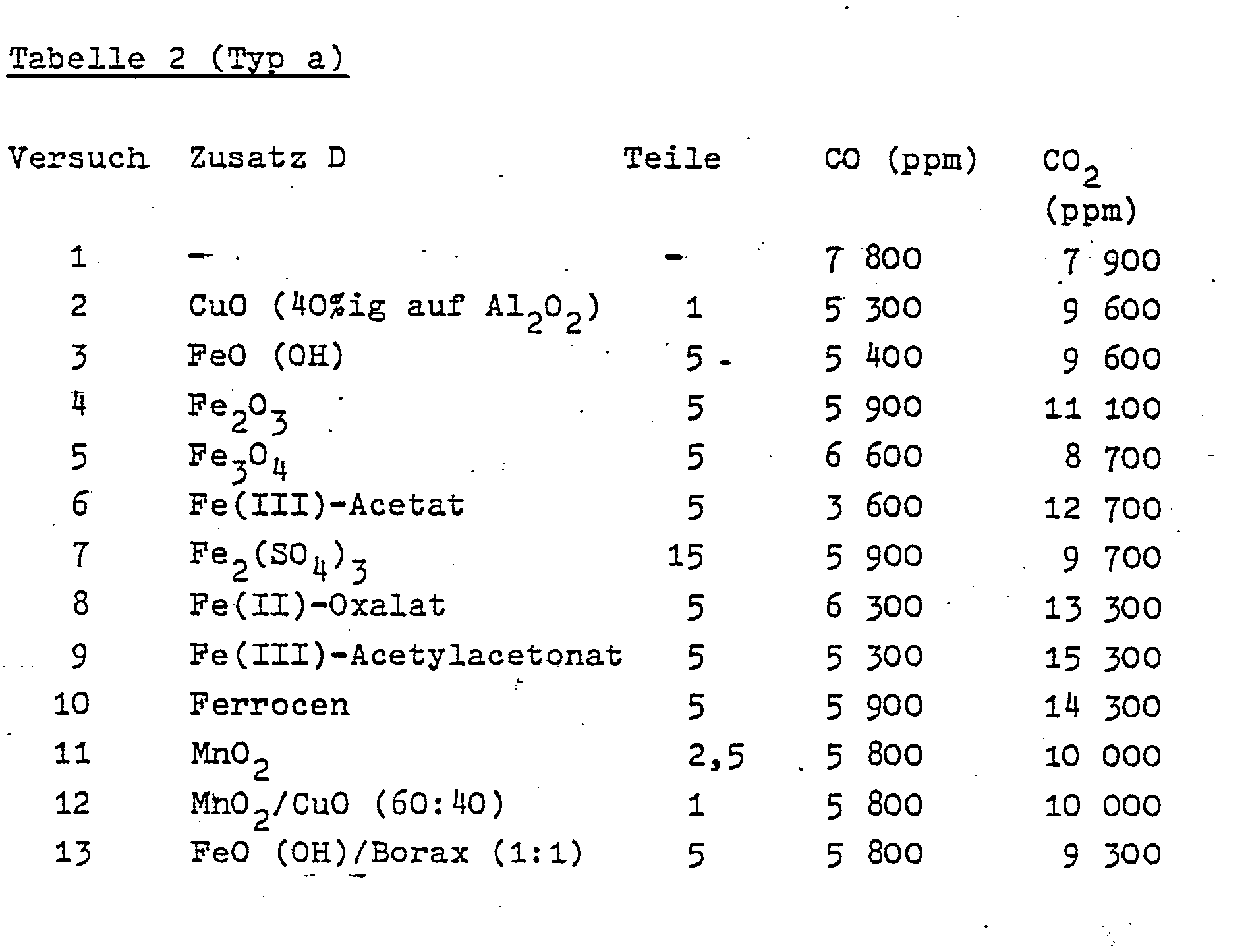
- Dämmplatten der Typen b bis e wurden mit verschiedenen Zusätzen D hergestellt und geprüft. Ergebnisse siehe Tabelle 3.

Claims (7)
1. Nichtbrennbarer Dämmstoff enthaltend
A) 98,9 bis 50 Gew.% anorganische Leichtpartikel,
B) 0 bis 40 Gew.% faseriger oder körniger anorganischer Zusatzstoffe,
C) 1 bis 30 Gew.% eines organischen, polymeren Bindemittels,
gekennzeichnet durch den Zusatz von
D) 0,1 bis 15 Gew.% einer Verbindung eines Übergangsmetalls.
2. Nichtbrennbarer Dämmstoff nach Anspruch 1, dadurch gekennzeichnet, daß die anorganischen Leichtpartikel A geblähter Perlit oder Vermiculit sind.
3. Nichtbrennbarer Dämmstoff nach Anspruch 1, dadurch gekennzeichnet, daß die Zusatzstoffe B Glasfasern einer Länge zwischen 2 mm und 5 cm sind.
4. Nichtbrennbarer Dämmstoff nach Anspruch 1, dadurch gekennzeichnet, daß die Bindemittel C Polykondensate sind.
5. Nichtbrennbarer Dämmstoff nach Anspruch 1, dadurch gekennzeichnet, daß die Bindemittel C Kondensate des Formaldehyds mit Phenol, Harnstoff, Melamin oder deren Derivaten sind.
6. Nichtbrennbarer Dämmstoff nach Anspruch 1, dadurch gekennzeichnet, daß die Übergangsmetallverbindung D eine Verbindung des Eisens, Kupfers, Mangans, Kobalts, Vanadins, Chroms oder Zinks ist.
7. Nichtbrennbarer Dämmstoff nach Anspruch 1, dadurch gekennzeichnet, daß die Übergangsmetallverbindung D Kupfer(II)-oxid, Eisen(III)-oxidhydrat, Eisen(III)--acetat oder Mangan(IV)-oxid ist.
Applications Claiming Priority (2)
| Application Number | Priority Date | Filing Date | Title |
|---|---|---|---|
| DE2814814 | 1978-04-06 | ||
| DE19782814814 DE2814814A1 (de) | 1978-04-06 | 1978-04-06 | Nichtbrennbarer daemmstoff |
Publications (1)
| Publication Number | Publication Date |
|---|---|
| EP0004602A1 true EP0004602A1 (de) | 1979-10-17 |
Family
ID=6036270
Family Applications (1)
| Application Number | Title | Priority Date | Filing Date |
|---|---|---|---|
| EP79100867A Withdrawn EP0004602A1 (de) | 1978-04-06 | 1979-03-22 | Nichtbrennbarer Dämmstoff |
Country Status (2)
| Country | Link |
|---|---|
| EP (1) | EP0004602A1 (de) |
| DE (1) | DE2814814A1 (de) |
Cited By (7)
| Publication number | Priority date | Publication date | Assignee | Title |
|---|---|---|---|---|
| EP0313907A3 (de) * | 1987-10-17 | 1991-01-16 | BASF Aktiengesellschaft | Verwendung von resolierten Polymerdispersionen als Bindemittel für Isolierplatten und -einsätze sowie exotherme Massen für den Metallguss |
| EP0625544A3 (de) * | 1993-05-21 | 1996-05-22 | Gen Electric | Feuerbeständige Verbundwerkstoffe. |
| WO2001051428A1 (en) * | 2000-01-13 | 2001-07-19 | Balmoral Technologies (Proprietary) Limited | Method of making a product from an expanded mineral |
| US20130129963A1 (en) * | 2011-11-18 | 2013-05-23 | Unifrax I Llc | Fire barrier layer and fire barrier film laminate |
| US9708052B2 (en) | 2010-11-19 | 2017-07-18 | Unifrax I Llc | Fire barrier layer and fire barrier film laminate |
| CN109679279A (zh) * | 2018-12-18 | 2019-04-26 | 陕西科技大学 | 一种硅烷化碳纤维/纳米二氧化锰增强树脂基复合材料的制备方法 |
| US10434755B2 (en) | 2010-11-19 | 2019-10-08 | Unifrax I, Llc | Fire barrier layer and fire barrier film laminate |
Families Citing this family (1)
| Publication number | Priority date | Publication date | Assignee | Title |
|---|---|---|---|---|
| DE102004002560B4 (de) * | 2004-01-17 | 2007-02-08 | Lkt Gmbh | Formkörper |
Citations (4)
| Publication number | Priority date | Publication date | Assignee | Title |
|---|---|---|---|---|
| GB1080468A (en) * | 1963-08-30 | 1967-08-23 | Burns & Russell Co | Polymerizable coating composition and treatment of building materials therewith |
| GB1158591A (en) * | 1965-07-14 | 1969-07-16 | Cyril Aubrey Redfarn | Improvements in Thermal Insulation |
| FR2236893A1 (de) * | 1973-07-12 | 1975-02-07 | Ferro Corp | |
| US3933731A (en) * | 1972-09-05 | 1976-01-20 | Japan Atomic Energy Research Institute | Plastic composition liberating reduced amounts of toxic gas |
-
1978
- 1978-04-06 DE DE19782814814 patent/DE2814814A1/de not_active Withdrawn
-
1979
- 1979-03-22 EP EP79100867A patent/EP0004602A1/de not_active Withdrawn
Patent Citations (4)
| Publication number | Priority date | Publication date | Assignee | Title |
|---|---|---|---|---|
| GB1080468A (en) * | 1963-08-30 | 1967-08-23 | Burns & Russell Co | Polymerizable coating composition and treatment of building materials therewith |
| GB1158591A (en) * | 1965-07-14 | 1969-07-16 | Cyril Aubrey Redfarn | Improvements in Thermal Insulation |
| US3933731A (en) * | 1972-09-05 | 1976-01-20 | Japan Atomic Energy Research Institute | Plastic composition liberating reduced amounts of toxic gas |
| FR2236893A1 (de) * | 1973-07-12 | 1975-02-07 | Ferro Corp |
Cited By (9)
| Publication number | Priority date | Publication date | Assignee | Title |
|---|---|---|---|---|
| EP0313907A3 (de) * | 1987-10-17 | 1991-01-16 | BASF Aktiengesellschaft | Verwendung von resolierten Polymerdispersionen als Bindemittel für Isolierplatten und -einsätze sowie exotherme Massen für den Metallguss |
| EP0625544A3 (de) * | 1993-05-21 | 1996-05-22 | Gen Electric | Feuerbeständige Verbundwerkstoffe. |
| WO2001051428A1 (en) * | 2000-01-13 | 2001-07-19 | Balmoral Technologies (Proprietary) Limited | Method of making a product from an expanded mineral |
| US9708052B2 (en) | 2010-11-19 | 2017-07-18 | Unifrax I Llc | Fire barrier layer and fire barrier film laminate |
| US9919790B2 (en) | 2010-11-19 | 2018-03-20 | Unifrax I Llc | Fire barrier layer and fire barrier film laminate |
| US10434755B2 (en) | 2010-11-19 | 2019-10-08 | Unifrax I, Llc | Fire barrier layer and fire barrier film laminate |
| US20130129963A1 (en) * | 2011-11-18 | 2013-05-23 | Unifrax I Llc | Fire barrier layer and fire barrier film laminate |
| CN109679279A (zh) * | 2018-12-18 | 2019-04-26 | 陕西科技大学 | 一种硅烷化碳纤维/纳米二氧化锰增强树脂基复合材料的制备方法 |
| CN109679279B (zh) * | 2018-12-18 | 2021-08-31 | 陕西科技大学 | 一种硅烷化碳纤维/纳米二氧化锰增强树脂基复合材料的制备方法 |
Also Published As
| Publication number | Publication date |
|---|---|
| DE2814814A1 (de) | 1979-10-18 |
Similar Documents
| Publication | Publication Date | Title |
|---|---|---|
| DE69304052T2 (de) | Binderzusammensetzungen für glasfasern, verfahren zur bindung von glasfasern und glasfaserzusammensetzungen | |
| DE2703159C2 (de) | ||
| DD216479A5 (de) | Brennstoffbriketts | |
| DE2745076C3 (de) | Massen auf Polyamidbasis | |
| DD202280A5 (de) | Glaszusammensetzung zur herstellung von fasern | |
| DD201765A5 (de) | Verbundfaserstoffe sowie deren herstellung und anwendung | |
| DE3238443A1 (de) | Aktiviertes ammoniumpolyphosphat sowie verfahren zu seiner herstellung und seine verwendung | |
| EP0061073A1 (de) | Faserwerkstoff | |
| EP0113004B1 (de) | Nicht brennbarer Hartschaum und seine Verwendung als Baustoff | |
| DE2814814A1 (de) | Nichtbrennbarer daemmstoff | |
| EP0004634A1 (de) | Nichtbrennbarer Dämmstoff | |
| DE2225323C2 (de) | Flammwidrige Formmassen auf der Basis von Polyolefinen | |
| DE2700374A1 (de) | Feuerfeste isolierungszusammensetzung und verfahren zu ihrer herstellung | |
| DE2748793C2 (de) | Verfahren zur Herstellung einer Bornitrid-Fasermatte | |
| DE2745750B2 (de) | Zementfreie Mörtelmischung und ihre Verwendung | |
| DE2748853C2 (de) | Verfahren zur Herstellung einer Fasermatte aus Bornitrid-Fasern | |
| DE3536650C2 (de) | ||
| DE3046405A1 (de) | Feuerdaemmender und waermespeichernder leichtbeton | |
| DE822524C (de) | Formkoerper aus Mineralfasern | |
| DE4018439A1 (de) | Verfahren zur herstellung eines gegenueber wasser bestaendigen, brennbaren agglomerats | |
| AT275392B (de) | Verfahren zur Erhöhung der Lagerungsbeständigkeit von feuerfesten Steinen | |
| EP1646593B1 (de) | Festbeton sowie frischbeton zur herstellung eines festbetons und verwendung eines betons zur herstellung eines bauteiles mit höherer temperaturbeständigkeit | |
| DE3224125C1 (de) | Baustoffplatten und Baustofformteile auf Zementbasis | |
| DE1669804C3 (de) | Verfahren zur Herstellung von zug- und druckfesten, dehnbaren PolyolefinpreBmassen | |
| DE3939018C1 (en) | Method of making furnace briquettes - has raw sand and carbon carrying material mixes before heating |
Legal Events
| Date | Code | Title | Description |
|---|---|---|---|
| PUAI | Public reference made under article 153(3) epc to a published international application that has entered the european phase |
Free format text: ORIGINAL CODE: 0009012 |
|
| AK | Designated contracting states |
Designated state(s): CH DE FR GB |
|
| STAA | Information on the status of an ep patent application or granted ep patent |
Free format text: STATUS: THE APPLICATION HAS BEEN WITHDRAWN |
|
| 18W | Application withdrawn | ||
| RIN1 | Information on inventor provided before grant (corrected) |
Inventor name: TRAUTZ, VOLKER, DR. Inventor name: GEIERHAAS, HERBERT, DR. Inventor name: WOERNER, FRANK PETER, DR. Inventor name: SAND, HERMANN, DR. Inventor name: WEBER, HEINZ, DR. Inventor name: MAHNKE, HARALD, DR. |