EP0005207B1 - Colorants de chrome bis-1:2 disazo-bisazométhiniques, leur préparation et leur utilisation pour la teinture du cuir - Google Patents
Colorants de chrome bis-1:2 disazo-bisazométhiniques, leur préparation et leur utilisation pour la teinture du cuir Download PDFInfo
- Publication number
- EP0005207B1 EP0005207B1 EP79101160A EP79101160A EP0005207B1 EP 0005207 B1 EP0005207 B1 EP 0005207B1 EP 79101160 A EP79101160 A EP 79101160A EP 79101160 A EP79101160 A EP 79101160A EP 0005207 B1 EP0005207 B1 EP 0005207B1
- Authority
- EP
- European Patent Office
- Prior art keywords
- formula
- sulfo
- substituted
- radical
- chromium complex
- Prior art date
- Legal status (The legal status is an assumption and is not a legal conclusion. Google has not performed a legal analysis and makes no representation as to the accuracy of the status listed.)
- Expired
Links
- SFUTWHHEMHFDDI-VOTSOKGWSA-N CC/N=N/C(C)=C Chemical compound CC/N=N/C(C)=C SFUTWHHEMHFDDI-VOTSOKGWSA-N 0.000 description 1
Classifications
-
- C—CHEMISTRY; METALLURGY
- C09—DYES; PAINTS; POLISHES; NATURAL RESINS; ADHESIVES; COMPOSITIONS NOT OTHERWISE PROVIDED FOR; APPLICATIONS OF MATERIALS NOT OTHERWISE PROVIDED FOR
- C09B—ORGANIC DYES OR CLOSELY-RELATED COMPOUNDS FOR PRODUCING DYES, e.g. PIGMENTS; MORDANTS; LAKES
- C09B45/00—Complex metal compounds of azo dyes
- C09B45/02—Preparation from dyes containing in o-position a hydroxy group and in o'-position hydroxy, alkoxy, carboxyl, amino or keto groups
- C09B45/24—Disazo or polyazo compounds
- C09B45/26—Disazo or polyazo compounds containing chromium
-
- C—CHEMISTRY; METALLURGY
- C09—DYES; PAINTS; POLISHES; NATURAL RESINS; ADHESIVES; COMPOSITIONS NOT OTHERWISE PROVIDED FOR; APPLICATIONS OF MATERIALS NOT OTHERWISE PROVIDED FOR
- C09B—ORGANIC DYES OR CLOSELY-RELATED COMPOUNDS FOR PRODUCING DYES, e.g. PIGMENTS; MORDANTS; LAKES
- C09B56/00—Azo dyes containing other chromophoric systems
- C09B56/02—Azomethine-azo dyes
-
- D—TEXTILES; PAPER
- D06—TREATMENT OF TEXTILES OR THE LIKE; LAUNDERING; FLEXIBLE MATERIALS NOT OTHERWISE PROVIDED FOR
- D06P—DYEING OR PRINTING TEXTILES; DYEING LEATHER, FURS OR SOLID MACROMOLECULAR SUBSTANCES IN ANY FORM
- D06P1/00—General processes of dyeing or printing textiles, or general processes of dyeing leather, furs, or solid macromolecular substances in any form, classified according to the dyes, pigments, or auxiliary substances employed
- D06P1/02—General processes of dyeing or printing textiles, or general processes of dyeing leather, furs, or solid macromolecular substances in any form, classified according to the dyes, pigments, or auxiliary substances employed using azo dyes
- D06P1/10—General processes of dyeing or printing textiles, or general processes of dyeing leather, furs, or solid macromolecular substances in any form, classified according to the dyes, pigments, or auxiliary substances employed using azo dyes containing metal
Definitions
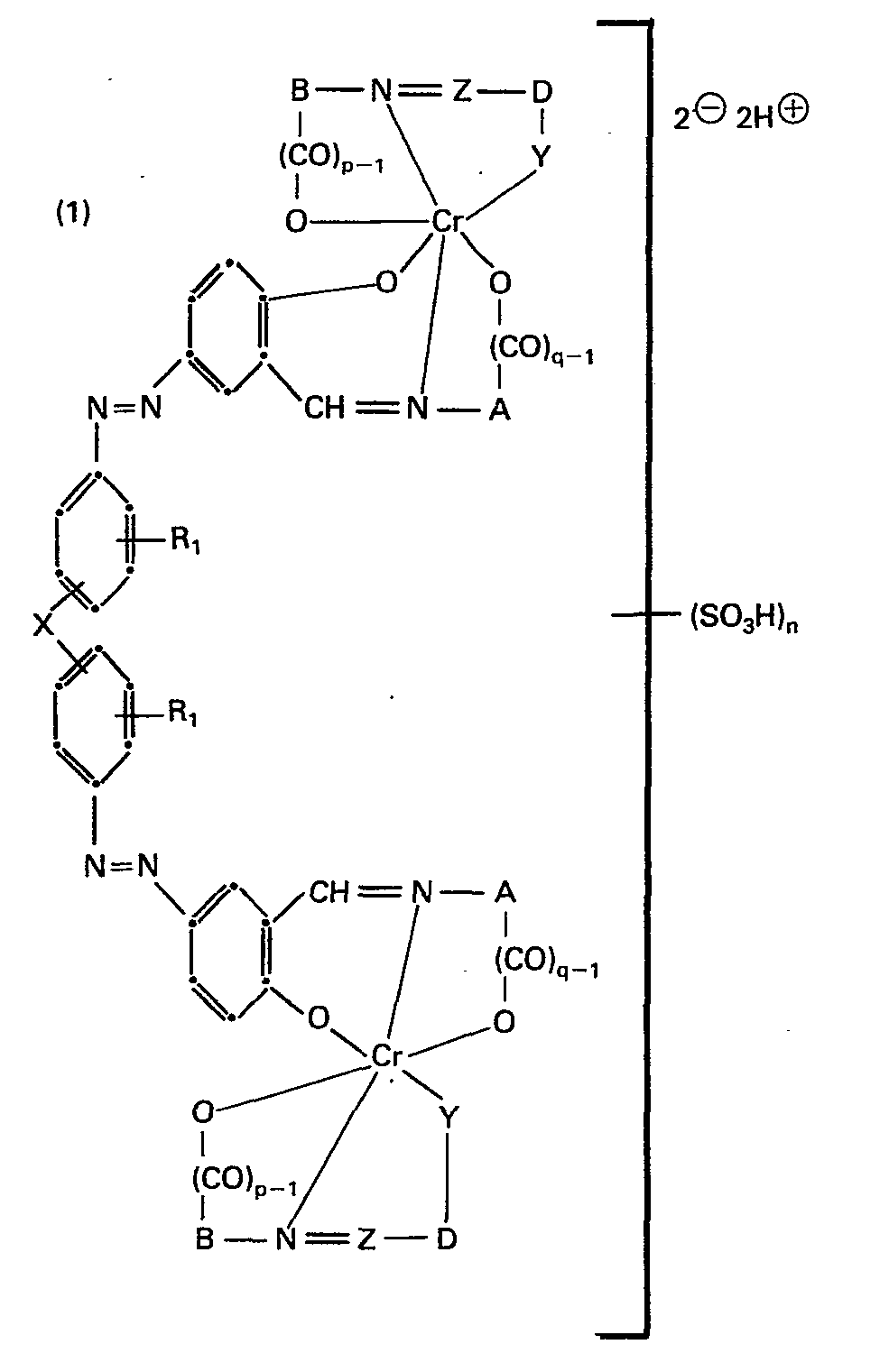
- the present invention relates to chromium complex compounds in the form of the free acid of the formula correspond in which X is a direct bond or a bridge member, Z independently of one another a nitrogen atom or a CH group, p and q independently of one another 1 or 2, Y independently of one another an oxygen atom or a group of the formula -NR-, where R is hydrogen or low molecular weight C 1 -C 5 alkyl, where, if Z is a CH group, Y must be an oxygen atom, R, independently of one another, each represents hydrogen or a substituent, B independently of one another each represents a benzene or naphthalene radical, D independently of one another the remainder of one o-hydroxyaldehyde when Z is the -CH group or when Z is a nitrogen atom, the remainder of a coupling component which is in the o-position to Y or an acetoacetic acid amide, n is an integer from 2-8, preferably 2-6, and A each independently represents a
- the radical R in addition to hydrogen, are in particular the sulfo and carboxy groups, halogen, in particular chlorine, and also low molecular weight alkyl and alkoxy.
- low molecular weight denotes here and at the other points in the description and claims residues with up to 5 carbon atoms.
- the radicals B can carry one or more sulfo groups and can also be further substituted, e.g. with low molecular weight alkyl, alkoxy, alkylsulfonyl, sulfonamido, low molecular weight N-alkyl- or N, N-dialkylsulfonamido, chlorine, bromine, nitro, cyano, arylazo, in particular phenylazo, sulfophenylazo or sulfonaphthylazo and arylazoarylenazo, such as sulfophenylazophenazo-phenylazo-phenylazophenylazo.
- the rest -D-Y- is derived primarily from the following coupling components: phenols, naphthols, naphthylamines, pyrazolones, pyrazolimines, pyridones and acetoacetic acid amides, in particular anilides, and also barbituric acid derivatives and hydroxyquinolines.
- A is an alkenylene radical, it is e.g. the vinylene radical or the phenyl vinylene radical.
- the cyclohexylene group is particularly suitable as the cycloalkylene radical.
- ⁇ -amino acids ie A is preferably an optionally substituted methylene or ethylene radical.
- Suitable amino acids are e.g. described in Greenstein and Winitz, Chemistry of Amino Acids, Wiley (1961).
- “Acylamino” denotes low-molecular alkanoylamino, alkylsulfonylamino and alkoxycarbonylamino residues as well as aroylamino and arylsulfonylamino residues
- aryl mainly includes naphthyl, naphthyl substituted with 1 or 3 sulfo groups and especially phenyl and with chlorine, bromine, methyl, ethyl Methoxy, nitro or sulfo substituted phenyl.
- the new compounds are made by using a compound of formula or where R "X, Y, Z, A, B, D, p and q mean the same as in formula (1), with a chromium donating agent for 1: 1 chromium complex or in the case of formula (4) for 2 atoms chromium reacted per molecule containing chromium complex and then reacted with the non-metallized compound of formula (4) or (3), the starting products must contain 2 to 8 sulfo groups.
- the 1: 1 chromium complex of the compound of the formula (3) is preferably first prepared and this is reacted with the bisazomethine of the formula (4) in a ratio of 2: 1.
- the latter becomes expedient prepared in situ in the reaction mixture.
- the 1: 1 chromium complex of the compound of the formula (3) is mixed with a mixture of a dialdehyde of the formula and 2 equivalents of an amine or an amino acid of the formula wherein X, R i , q and A have the same meaning as in formula (1).
- a ' is preferably a phenyl radical substituted by nitro or sulfo or nitro and sulfo.
- the starting compounds of formula (3) are prepared in the usual way. If Z is a nitrogen atom, an amine of the formula diazotized and on a coupling component of the formula coupled.
- Suitable diazo components of the formula (7) are, for example: anthranilic acid, 4- or -5-sulfo and 4- or -5-sulfoamido-anthranilic acid, 2-amino-1-hydroxybenzene, 4-chloro and 4,6-dichloro- 2-amino-1-hydroxybenzene, 4- or 5-nitro-2-amino-1-hydroxybenzene, 4-chloro and 4-methyl and 4-acetylamino-6-nitro-2-amino-1-hydroxybenzene , 6-acetylamino and 6-chloro-4-nitro-2-amino-1-hydroxybenzene, 4-cyan-2-amino-1-hydroxybenzene, 4-methoxy-2-amino-1-hydroxybenzene, 2-amino- l-hydroxybenzene-5-methyl and 5-benzyl sulfone, 2-amino-1-hydroxybenzene-4-methyl, ethyl, chloromethyl and butyl sulfone, 5-nitro and 6-
- suitable methoxy compounds are also suitable as diazo components, such as anisidine, 4- or 5-chloroanisidine, 4- or 5-nitroanisidine or anisidine-4- or 5-sulfonic acid, the methoxy group in the Chromation is converted into an OH group.
- B or B ' is a nitro- and / or sulfo-containing phenyl or naphthyl radical.
- the radical D or D ' is derived in particular from the following groups of coupling components: naphthols which are optionally substituted with chlorine, acylamino, amino, sulfo, sulfonamido, N-mono- or N, N-disubstituted sulfonamido groups and sulfone groups are, these groups having the same meanings given above.
- Naphthylamines which are optionally substituted with sulfo, sulfonamido, mono- or disubstituted sulfonamido or sulfone groups.
- 5-pyrazolones or 5-aminopyrazoles which in the 1-position preferably have a phenyl or naphthyl radical optionally substituted with chlorine, nitro, low molecular weight alkyl and alkoxy groups, sulfonamido, N-alkylated sulfonamide groups, sulfone or in particular sulfo groups.
- Acetoacetic anilides which may be substituted in the anilide core with chlorine, bromine, low molecular weight alkyl, alkoxy, sulfone, sulfonamido, N-mono or N, N-disubstituted sulfonamido groups and sulfo groups.
- Phenols which are substituted with low molecular weight acylamino groups and / or with alkyl groups preferably containing 1 to 5 carbon atoms and couple in the o-position.
- 2,6-dihydroxy-3-cyano- or carbonamido-4-alkylpyridine and 6-hydroxy-2-pyridones which are in the 1-position by optionally substituted alkyl, e.g. Methyl, isopropyl, ⁇ -hydroxyethyl, ⁇ -aminoethyl or y-isopropoxypropyl are substituted, in the 3-position carry a cyano or carbonamido group and in the 4-position a low molecular weight alkyl group, especially methyl.
- Barbituric acid and barbituric acids substituted on the nitrogen atoms with low molecular weight alkyl or aryl, especially phenyl. Dihydroxyquinolines.
- Examples of such coupling components are: 2-naphthol, 1,3- or 1,5-dihydroxynaphthalene, 2-naphthol-6-ß-hydroxyethylsulfone, 1-naphthol, 1-acetylamino-7-naphthol, 1-propionylamino-7-naphthol, 1-carbomethoxyamino-7-naphthol, 1-carboethoxyamino-7-naphthol, 1-carbopropoxyoxy-7-naphthol, 1-dimethylaminosulfonylamino-7-naphthol, 6-acetyl-2-naphthol, 2-naphthol-3- , -4-, -5-, -6-, -7- or -8-sulfonic acid, 1-naphthol-3-, -4- or -5-sulfonic acid, 4-methyl-1-naphthol, 4-meth
- D or D ' is preferably a naphthyl radical optionally substituted with sulfo or amino and sulfo or a phenyl radical optionally substituted with low molecular weight alkyl.
- Suitable aldehydes are, for example: 2-hydroxy-1-naphthaldehyde, 1-hydroxy-2-naphthaldehyde, 2-hydroxybenzaldehyde, 3- and 5-methyl-2-hydroxybenzaldehyde, 3,5-dimethyl-2-hydroxybenzaldehyde, 5-butyl 2-hydroxybenzaldehyde, 5-chloro or 5-bromo-2-hydroxybenzaldehyde, 3-chloro-2-hydroxybenzaldehyde, 3,5-dichloro-2-hydroxybenzaldehyde, 5-sulfo-2-hydroxybenzaldehyde, 3-methyl-5-chloro -2-hydroxybenzaldehyde, and the derivable aldehydes substituted with arylazo or arylazoarylenazo.
- dialdehydes of formula (5) are obtained by using a diamine of formula tetrazotized and coupled with 2 equivalents of salicyladehyde.
- Suitable diamines of formula (9) are e.g. 4,4'-diaminodiphenyl, 2,2'-diaminodiphenyl-4,4'-disulfonic acid, 4,4'-diaminodiphenyl-3-sulfonic acid, 4,4'-diaminodiphenyl-2,2'- or 3,3'- disulfonic acid, 4,4'-diamino-3,3'-dimethoxydiphenyl, 4,4'-diamino-3,3 'or 2,2'-dimethyldiphenyl, 3,3'- or 4,4'-diaminodiphenylsulfone, 4, 4'-diamino-benzophenone, 4,4'-diaminodiphenyl ether, 4,4'-diaminodiphenyl sulfide, 4,4'-diamino-diphenyl sulfoxide, 4,4'-dia
- the dialdehydes of the formula (5) are mixed with 2 equivalents of an amine or an amino acid of the formula (6) condensed.
- Suitable compounds of the formula (6) are, on the one hand, the same aromatic amines as for the diazo components of the formula (7) and, on the other hand, aliphatic or cycloaliphatic amino acids.
- amino acids examples include Glycolkoll, a-alanine, ⁇ -alanine, 4-aminobutyric acid, 5-aminovaleric acid, 6-aminocaproic acid, 7-aminoheptanoic acid, 8-aminocaprylic acid, 11-aminoundecanoic acid, 12-aminolauric acid, serine, 5-benzylcysteine , Phenylglycine, phenylalanine, norleucine, norvaline, leucine, lysine, methionine, methionine sulfone, threonine, histidine, tryptophan, tyrosine, 2-aminocyclohexane carboxylic acid.
- Glycocoll, a- and ⁇ -alanine are particularly preferred as amino acids of formula (6).
- the starting products are preferably chosen so that the finished complex contains 2 to 6 sulfo groups.
- the 1: 1 chromium complex of the compound of formula (3) or (4) is prepared by conventional methods known per se, e.g. by reacting in an acid medium with a salt of trivalent chromium, such as chromium formate, chromium sulfate, chromium chloride hexahydrate or chromium fluoride, at the boiling point or, if appropriate, at temperatures exceeding 100 ° C.
- Trivalent chromium can also be found in the reaction mixture of chromium VI compounds, e.g. Chromate, if you add a reducing agent at the same time.
- the metallization can be carried out in aqueous, organic-aqueous or in purely organic solvents, such as alcohols or ketones, optionally with the addition of solubilizing or chromium-accelerating substances.
- the one-pot reaction between a 1: 1 chromium complex of a compound of the formula (3), an amine or an amino acid of the formula (6) and a dialdehyde of the formula (5) is advantageously carried out in neutral to weakly alkaline medium, in an open or closed vessel, at elevated temperature, e.g. at temperatures between 50 and 120 ° C.
- organic solvents e.g. Alcohols or ketones work or in aqueous solution, with additions of solvents such as e.g. of alcohols, formamide, etc., can possibly promote the implementation.
- the new chromium-containing mixed complexes obtainable by the above processes are advantageously isolated in the form of their salts, in particular alkali metal salts, such as lithium, potassium, but above all sodium salts, or also ammonium salts. They are suitable for dyeing a wide variety of natural or synthetic polyamide materials, such as wool, synthetic polyamide fibers, but in particular for dyeing leather.
- the new connections are strong in color and cover well. They have good drawability with good fastness properties such as fastness to washing, water, welding, rubbing, diffusion, light and alkali. Worthy of special mention is the good build-up ability on the various types of leather, both on pure chrome and on leather retanned with vegetable or synthetic tanning agents. You get strong orange to brown and olive shades.
- the resulting solution of the chromium complex of the type 1 atom chromium: 1 molecule of dye is then at 80 to 85 with 23.4 parts of 4-nitro-2-amino-1-hydroxybenzene-6-sulfonic acid, 31.8 parts of coupling product from tetrazotized 4, 4'-Diaminostilben-2,2'-disulfonic acid and salicylaldehyde are added and kept at this temperature until the addition reaction has ended.
- the pH of the reaction mixture is adjusted to a pH of 7 to 7.5 and maintained by adding 5N sodium hydroxide solution.
- the new, chromium-containing dye is then precipitated by adding saturated sodium chloride solution, filtered off and carefully dried.
- the new, chromium-containing dye is precipitated by adding sodium chloride. Then it is filtered off and washed out with dilute sodium chloride solution. After drying, it is a dark powder that dissolves in water with a brown color and dyes leather in brown shades of generally good fastness properties.
- sulfonic acid and 2-amino-5-hydroxynaphthalene-7-sulfonic acid corresponds with 13.7 parts of 2-aminobenzoic acid and 31.8 parts of disazo dye from 4,4'-diaminostilbene-2,2'-disulfonic acid and salicylaldehyde.
- the mixture is then heated to 80 to 85 and the pH of the suspension is increased to 7 to 7.5 by adding 5N sodium hydroxide solution and is kept at this temperature and constant pH by further adding 5N sodium hydroxide solution until the starting products Have disappeared.
- the new chromium-containing dye obtained is then precipitated by adding sodium chloride. It is filtered off and dried. After drying, it is a dark powder that dissolves in water with an olive color and dyes leather in olive tones.
- the mixture is then heated to 80 to 85 ° and the pH of the solution obtained is increased to 7 to 7.5 by adding 5N sodium hydroxide solution and is kept at this temperature and constant pH by further adding 5N sodium hydroxide solution until the starting products have disappeared.
- the new chromium-containing dye obtained is isolated by evaporating the solution. After drying, it is a dark powder that dyes leather from an acid bath in brown shades of generally good fastness properties.
- the new, chromium-containing dye is precipitated by adding sodium chloride. Then it is filtered off and washed out with dilute sodium chloride solution. After drying, it is a dark powder that dissolves in water with a brown color and dyes leather in brown shades of generally good fastness properties.
- the new, chromium-containing dye is precipitated by adding sodium chloride. Then it is filtered off and washed out with dilute sodium chloride solution. After drying, it is a dark powder that dissolves in water with a brown color and dyes leather in brown shades of good fastness properties.
- the mixture is heated to 80 to 85 ° and at the same time the pH of the suspension is increased to 7 to 7.5 by adding 5N sodium hydroxide solution and kept at this temperature and constant pH by further adding 5N sodium hydroxide solution until the Starting products have disappeared.
- the new chromium-containing dye is precipitated by adding sodium chloride; it is filtered off and dried. After drying, it is a dark powder that dissolves in water with an olive color and dyes leather in olive tones.
- the olive dyeings obtained in this way are distinguished by good fastness properties and good hiding power.
Landscapes
- Chemical & Material Sciences (AREA)
- Organic Chemistry (AREA)
- Engineering & Computer Science (AREA)
- Textile Engineering (AREA)
- Coloring (AREA)
Claims (26)


Applications Claiming Priority (4)
| Application Number | Priority Date | Filing Date | Title |
|---|---|---|---|
| CH4448/78 | 1978-04-25 | ||
| CH444878 | 1978-04-25 | ||
| CH1239678 | 1978-12-05 | ||
| CH12396/78 | 1978-12-05 |
Publications (3)
| Publication Number | Publication Date |
|---|---|
| EP0005207A2 EP0005207A2 (fr) | 1979-11-14 |
| EP0005207A3 EP0005207A3 (en) | 1979-11-28 |
| EP0005207B1 true EP0005207B1 (fr) | 1981-12-09 |
Family
ID=25695497
Family Applications (1)
| Application Number | Title | Priority Date | Filing Date |
|---|---|---|---|
| EP79101160A Expired EP0005207B1 (fr) | 1978-04-25 | 1979-04-17 | Colorants de chrome bis-1:2 disazo-bisazométhiniques, leur préparation et leur utilisation pour la teinture du cuir |
Country Status (7)
| Country | Link |
|---|---|
| US (1) | US4256633A (fr) |
| EP (1) | EP0005207B1 (fr) |
| JP (1) | JPS54142235A (fr) |
| BR (1) | BR7902515A (fr) |
| DE (1) | DE2961536D1 (fr) |
| ES (1) | ES479848A1 (fr) |
| PT (1) | PT69539A (fr) |
Families Citing this family (6)
| Publication number | Priority date | Publication date | Assignee | Title |
|---|---|---|---|---|
| CH658665A5 (de) * | 1984-04-05 | 1986-11-28 | Ciba Geigy Ag | Chromkomplexfarbstoffe. |
| CH662357A5 (de) * | 1984-04-06 | 1987-09-30 | Ciba Geigy Ag | Faserreaktive chrom- oder kobaltkomplexe und deren herstellung. |
| CH661276A5 (de) * | 1984-04-06 | 1987-07-15 | Ciba Geigy Ag | Chrom- oder kobaltkomplexe und deren herstellung. |
| CH658666A5 (de) * | 1984-05-10 | 1986-11-28 | Ciba Geigy Ag | Chromkomplexfarbstoffe. |
| US7226661B2 (en) * | 2003-02-03 | 2007-06-05 | Board Of Regents, The University Of Texas System | Synthesis of quinones and phenols on solid support |
| KR100872097B1 (ko) | 2007-07-04 | 2008-12-05 | 주식회사 디케이씨코포레이션 | 비대칭성 아조계 금속 착제 염료, 이의 제조 방법 및 이를포함하는 산성 염료 조성물 |
Family Cites Families (9)
| Publication number | Priority date | Publication date | Assignee | Title |
|---|---|---|---|---|
| FR1442837A (fr) * | 1964-07-31 | 1966-06-17 | Geigy Ag J R | Nouveaux colorants azoïques, leur préparation et leurs applications |
| US3562246A (en) * | 1967-09-25 | 1971-02-09 | Martin Marietta Corp | Mono- and disazo dyes and the 1:1 and 1:2 metal complexes thereof containing one or more thiosulfate groups |
| CH519051A (de) * | 1967-10-09 | 1971-09-30 | Ciba Geigy Ag | Verfahren zum Färben und Bedrucken von textilem Polyamidmaterial mit Gemischen chromhaltiger Azofarbstoffe |
| US4158003A (en) * | 1968-12-10 | 1979-06-12 | Ciba-Geigy Ag | Metallized bis-formazans |
| US3975369A (en) * | 1969-08-07 | 1976-08-17 | Sandoz Ltd. | 2:1 Metal complexes of 2,2',4'-trihydroxy-3,5-dinitroazobenzene bound to a diphenylamine through an azo bridge |
| US3879336A (en) * | 1972-07-05 | 1975-04-22 | Hodogaya Chemical Co Ltd | Process for preparing colored synthetic leather |
| CH599307A5 (fr) * | 1974-05-09 | 1978-05-31 | Ciba Geigy Ag | |
| CH624979A5 (fr) * | 1975-05-14 | 1981-08-31 | Ciba Geigy Ag | |
| CH606324A5 (fr) * | 1976-05-31 | 1978-10-31 | Sandoz Ag |
-
1979
- 1979-04-16 US US06/030,413 patent/US4256633A/en not_active Expired - Lifetime
- 1979-04-17 DE DE7979101160T patent/DE2961536D1/de not_active Expired
- 1979-04-17 EP EP79101160A patent/EP0005207B1/fr not_active Expired
- 1979-04-24 ES ES479848A patent/ES479848A1/es not_active Expired
- 1979-04-24 PT PT69539A patent/PT69539A/pt unknown
- 1979-04-24 BR BR7902515A patent/BR7902515A/pt unknown
- 1979-04-25 JP JP5038079A patent/JPS54142235A/ja active Pending
Also Published As
| Publication number | Publication date |
|---|---|
| DE2961536D1 (en) | 1982-02-04 |
| PT69539A (en) | 1979-05-01 |
| EP0005207A3 (en) | 1979-11-28 |
| US4256633A (en) | 1981-03-17 |
| EP0005207A2 (fr) | 1979-11-14 |
| JPS54142235A (en) | 1979-11-06 |
| ES479848A1 (es) | 1980-08-16 |
| BR7902515A (pt) | 1979-10-30 |
Similar Documents
| Publication | Publication Date | Title |
|---|---|---|
| DE2620981C2 (fr) | ||
| DE2520526C2 (de) | Neue Chromkomplexfarbstoffe, deren Herstellung und Verwendung | |
| EP0005207A2 (fr) | Colorants de chrome bis-1:2 disazo-bisazométhiniques, leur préparation et leur utilisation pour la teinture du cuir | |
| EP0009466B1 (fr) | Colorants 1 : 2-bis-complexes de chrome de composés polyazo- ou disazo-azométhiniques, leur préparation et leur utilisation | |
| EP0110825B1 (fr) | Colorants à complexe de chrome 1:2 asymétrique contenant un composé azoique et un composé azométhinique | |
| DE2637921A1 (de) | Organische verbindungen, deren herstellung und verwendung | |
| EP0019851B1 (fr) | Colorants complexes de chrome 1:2 de la série azométhine et/ou azoique, leur préparation et utilisation pour la teinture et l'impression de matériaux en polyamide ou cellulose | |
| EP0260561B1 (fr) | Procédé de teinture du cuir avec des mélanges de colorants | |
| EP0082117A1 (fr) | Complexes de chrome de colorants polyazoiques | |
| EP0181836B1 (fr) | Procédé d'amélioration de la solidité à la lumière de cuirs teints | |
| DE2529798C2 (de) | Neue Chromkomplexe, deren Herstellung und Verwendung | |
| EP0079858B1 (fr) | Colorants azoiques, complexes de métaux de ces colorants, leur préparation et leur utilisation | |
| EP0048693B1 (fr) | Colorants disazoiques, leurs complexes métalliques, leur préparation et leur utilisation | |
| EP0148120B1 (fr) | Colorants 1:2 complexes de chrome asymétriques | |
| EP0100297B1 (fr) | Bi-complexes de chrome 1:2 de colorants disazoiques, leur préparation et leur utilisation | |
| DE3601655A1 (de) | Unsymmetrische 1:2-chromkomplexfarbstoffe | |
| EP0150676B1 (fr) | Colorants 1:2 complexes de chrome | |
| DE2723155A1 (de) | 1 zu 2-chromkomplexfarbstoffe | |
| EP0087715B1 (fr) | Complexes de colorants métallifères dépourvus de groupes amino et sulfonamide | |
| DE3703361A1 (de) | Unsymmetrische 1:2-chromkomplexfarbstoffe | |
| DE3512078A1 (de) | Chromkomplexfarbstoffe, deren herstellung und verwendung | |
| DE2457590A1 (de) | Neue metallkomplexe, deren herstellung und verwendung | |
| EP0151369B1 (fr) | Complexes de chrome 1:2 asymétriques contenant un composé azoîque et un composé azométhinique | |
| EP0037377A1 (fr) | Colorants azoiques métallisés, leur préparation et leur utilisation | |
| DE2039737A1 (de) | Azoverbindungen,deren Herstellung und Verwendung |
Legal Events
| Date | Code | Title | Description |
|---|---|---|---|
| PUAI | Public reference made under article 153(3) epc to a published international application that has entered the european phase |
Free format text: ORIGINAL CODE: 0009012 |
|
| PUAL | Search report despatched |
Free format text: ORIGINAL CODE: 0009013 |
|
| 17P | Request for examination filed | ||
| AK | Designated contracting states |
Designated state(s): BE CH DE FR GB IT |
|
| AK | Designated contracting states |
Designated state(s): BE CH DE FR GB IT |
|
| ITF | It: translation for a ep patent filed | ||
| GRAA | (expected) grant |
Free format text: ORIGINAL CODE: 0009210 |
|
| AK | Designated contracting states |
Designated state(s): BE CH DE FR GB IT |
|
| REF | Corresponds to: |
Ref document number: 2961536 Country of ref document: DE Date of ref document: 19820204 |
|
| PGFP | Annual fee paid to national office [announced via postgrant information from national office to epo] |
Ref country code: BE Payment date: 19840630 Year of fee payment: 6 |
|
| BERE | Be: lapsed |
Owner name: CIBA-GEIGY A.G. Effective date: 19880430 |
|
| PG25 | Lapsed in a contracting state [announced via postgrant information from national office to epo] |
Ref country code: BE Effective date: 19890430 |
|
| PGFP | Annual fee paid to national office [announced via postgrant information from national office to epo] |
Ref country code: FR Payment date: 19910215 Year of fee payment: 13 |
|
| PGFP | Annual fee paid to national office [announced via postgrant information from national office to epo] |
Ref country code: DE Payment date: 19910307 Year of fee payment: 13 |
|
| PGFP | Annual fee paid to national office [announced via postgrant information from national office to epo] |
Ref country code: GB Payment date: 19910320 Year of fee payment: 13 |
|
| PGFP | Annual fee paid to national office [announced via postgrant information from national office to epo] |
Ref country code: CH Payment date: 19910327 Year of fee payment: 13 |
|
| PG25 | Lapsed in a contracting state [announced via postgrant information from national office to epo] |
Ref country code: GB Effective date: 19920417 |
|
| PG25 | Lapsed in a contracting state [announced via postgrant information from national office to epo] |
Ref country code: CH Effective date: 19920430 |
|
| GBPC | Gb: european patent ceased through non-payment of renewal fee | ||
| PG25 | Lapsed in a contracting state [announced via postgrant information from national office to epo] |
Ref country code: FR Effective date: 19921230 |
|
| REG | Reference to a national code |
Ref country code: CH Ref legal event code: PL |
|
| PG25 | Lapsed in a contracting state [announced via postgrant information from national office to epo] |
Ref country code: DE Effective date: 19930101 |
|
| REG | Reference to a national code |
Ref country code: FR Ref legal event code: ST |
|
| PLBE | No opposition filed within time limit |
Free format text: ORIGINAL CODE: 0009261 |
|
| STAA | Information on the status of an ep patent application or granted ep patent |
Free format text: STATUS: NO OPPOSITION FILED WITHIN TIME LIMIT |