EP0006061A1 - Médicament constitué par un dérivé de cyclopentyl-aldéhyde - Google Patents
Médicament constitué par un dérivé de cyclopentyl-aldéhyde Download PDFInfo
- Publication number
- EP0006061A1 EP0006061A1 EP79400340A EP79400340A EP0006061A1 EP 0006061 A1 EP0006061 A1 EP 0006061A1 EP 79400340 A EP79400340 A EP 79400340A EP 79400340 A EP79400340 A EP 79400340A EP 0006061 A1 EP0006061 A1 EP 0006061A1
- Authority
- EP
- European Patent Office
- Prior art keywords
- cyclopentyl
- cis
- aldehyde
- trans
- derivative
- Prior art date
- Legal status (The legal status is an assumption and is not a legal conclusion. Google has not performed a legal analysis and makes no representation as to the accuracy of the status listed.)
- Granted
Links
Classifications
-
- C—CHEMISTRY; METALLURGY
- C07—ORGANIC CHEMISTRY
- C07C—ACYCLIC OR CARBOCYCLIC COMPOUNDS
- C07C33/00—Unsaturated compounds having hydroxy or O-metal groups bound to acyclic carbon atoms
- C07C33/05—Alcohols containing rings other than six-membered aromatic rings
- C07C33/12—Alcohols containing rings other than six-membered aromatic rings containing five-membered rings
-
- A—HUMAN NECESSITIES
- A61—MEDICAL OR VETERINARY SCIENCE; HYGIENE
- A61P—SPECIFIC THERAPEUTIC ACTIVITY OF CHEMICAL COMPOUNDS OR MEDICINAL PREPARATIONS
- A61P29/00—Non-central analgesic, antipyretic or antiinflammatory agents, e.g. antirheumatic agents; Non-steroidal antiinflammatory drugs [NSAID]
-
- A—HUMAN NECESSITIES
- A61—MEDICAL OR VETERINARY SCIENCE; HYGIENE
- A61P—SPECIFIC THERAPEUTIC ACTIVITY OF CHEMICAL COMPOUNDS OR MEDICINAL PREPARATIONS
- A61P31/00—Antiinfectives, i.e. antibiotics, antiseptics, chemotherapeutics
- A61P31/04—Antibacterial agents
-
- A—HUMAN NECESSITIES
- A61—MEDICAL OR VETERINARY SCIENCE; HYGIENE
- A61P—SPECIFIC THERAPEUTIC ACTIVITY OF CHEMICAL COMPOUNDS OR MEDICINAL PREPARATIONS
- A61P37/00—Drugs for immunological or allergic disorders
- A61P37/08—Antiallergic agents
-
- C—CHEMISTRY; METALLURGY
- C07—ORGANIC CHEMISTRY
- C07C—ACYCLIC OR CARBOCYCLIC COMPOUNDS
- C07C29/00—Preparation of compounds having hydroxy or O-metal groups bound to a carbon atom not belonging to a six-membered aromatic ring
- C07C29/132—Preparation of compounds having hydroxy or O-metal groups bound to a carbon atom not belonging to a six-membered aromatic ring by reduction of an oxygen containing functional group
- C07C29/136—Preparation of compounds having hydroxy or O-metal groups bound to a carbon atom not belonging to a six-membered aromatic ring by reduction of an oxygen containing functional group of >C=O containing groups, e.g. —COOH
- C07C29/14—Preparation of compounds having hydroxy or O-metal groups bound to a carbon atom not belonging to a six-membered aromatic ring by reduction of an oxygen containing functional group of >C=O containing groups, e.g. —COOH of a —CHO group
-
- C—CHEMISTRY; METALLURGY
- C07—ORGANIC CHEMISTRY
- C07C—ACYCLIC OR CARBOCYCLIC COMPOUNDS
- C07C29/00—Preparation of compounds having hydroxy or O-metal groups bound to a carbon atom not belonging to a six-membered aromatic ring
- C07C29/17—Preparation of compounds having hydroxy or O-metal groups bound to a carbon atom not belonging to a six-membered aromatic ring by hydrogenation of carbon-to-carbon double or triple bonds
- C07C29/172—Preparation of compounds having hydroxy or O-metal groups bound to a carbon atom not belonging to a six-membered aromatic ring by hydrogenation of carbon-to-carbon double or triple bonds with the obtention of a fully saturated alcohol
-
- C—CHEMISTRY; METALLURGY
- C07—ORGANIC CHEMISTRY
- C07C—ACYCLIC OR CARBOCYCLIC COMPOUNDS
- C07C31/00—Saturated compounds having hydroxy or O-metal groups bound to acyclic carbon atoms
- C07C31/27—Polyhydroxylic alcohols containing saturated rings
- C07C31/272—Monocyclic
- C07C31/274—Monocyclic with a three to five-membered ring
-
- C—CHEMISTRY; METALLURGY
- C07—ORGANIC CHEMISTRY
- C07C—ACYCLIC OR CARBOCYCLIC COMPOUNDS
- C07C47/00—Compounds having —CHO groups
- C07C47/28—Saturated compounds having —CHO groups bound to carbon atoms of rings other than six—membered aromatic rings
- C07C47/30—Saturated compounds having —CHO groups bound to carbon atoms of rings other than six—membered aromatic rings with a five-membered ring
-
- C—CHEMISTRY; METALLURGY
- C07—ORGANIC CHEMISTRY
- C07C—ACYCLIC OR CARBOCYCLIC COMPOUNDS
- C07C47/00—Compounds having —CHO groups
- C07C47/38—Unsaturated compounds having —CHO groups bound to carbon atoms of rings other than six—membered aromatic rings
- C07C47/45—Unsaturated compounds having —CHO groups bound to carbon atoms of rings other than six—membered aromatic rings having unsaturation outside the rings
-
- C—CHEMISTRY; METALLURGY
- C07—ORGANIC CHEMISTRY
- C07C—ACYCLIC OR CARBOCYCLIC COMPOUNDS
- C07C61/00—Compounds having carboxyl groups bound to carbon atoms of rings other than six-membered aromatic rings
- C07C61/06—Saturated compounds having a carboxyl group bound to a five-membered ring
-
- C—CHEMISTRY; METALLURGY
- C07—ORGANIC CHEMISTRY
- C07C—ACYCLIC OR CARBOCYCLIC COMPOUNDS
- C07C61/00—Compounds having carboxyl groups bound to carbon atoms of rings other than six-membered aromatic rings
- C07C61/16—Unsaturated compounds
- C07C61/35—Unsaturated compounds having unsaturation outside the rings
-
- C—CHEMISTRY; METALLURGY
- C07—ORGANIC CHEMISTRY
- C07C—ACYCLIC OR CARBOCYCLIC COMPOUNDS
- C07C2601/00—Systems containing only non-condensed rings
- C07C2601/06—Systems containing only non-condensed rings with a five-membered ring
- C07C2601/08—Systems containing only non-condensed rings with a five-membered ring the ring being saturated
Definitions
- the present invention relates to a new drug which consists of a derivative belonging to the family of cyclopentyl-aldehydes.
- the invention also relates to the therapeutic composition containing a cyclopentyl-aldehyde derivative as an active ingredient.
- the compounds of formula I are known substances which can be prepared either by synthesis or by extraction from a plant belonging to the family of Labiaceae such as the species Teucrium marum, Teucrium polium and Teucrium montanum. For example, they can be extracted from Teucrium marum according to the process described by PAGNONI et al., in Aust. J. Chem., (1976), 29, pages 1375-1381, article in which their pharmaceutical properties are not described.
- cyclopentyl aldehyde derivatives of formula I are (i) active as bacteriostatic, bactericidal, antispasmodic, antianaphylactic and anti-inflammatory agents, and (ii) useful in particular in the treatment of humans and warm-blooded animals suffering from infectious diseases caused by Gram (+) and Gram (-) germs, and allergies such as hay fever and asthma.
- cyclopentyl-aldehyde derivatives of formula I are more advantageous, from the pharmaceutical point of view, than the extracts of Teucrium marum according to American patent No. 4,151,278.
- the preferred compounds are those of Examples 1 and 4.
- the most interesting, from the pharmaceutical point of view, is the compound of Example 4.
- the compounds in which A is ⁇ CH (CH 3 ) such as the product of Example 7, are obtained by catalytic hydrogenation.
- the compounds in which A is CH 2 are prepared in particular by synthesis according to a method known per se.
- the animals are then individually exposed to a histamine aerosol (3 g / 1 of histamine in an aqueous medium containing 200 g / 1 of glycerin).
- the criterion chosen is the time elapsed between the start of exposure to histamine and apnea, accompanied by the fall of the animal.
- the control batch receives only the histamine aerosol.
- the results are given in Table II and show that the product of Example 4 has a bronchodilator effect which is opposed to the bronchoconstrictor effect of histamine:
- mice Male guinea pigs are sensitized by an i.p. 100 mg / kg ovalbumin in an equal volume of Freund's adjuvant. Four weeks later, the animals are sacrificed, each ileum is collected which is placed at 33 ° C in a Thyrode bath. A contraction is caused by adding a dose of 200 ⁇ g of albumin to the survival fluid. The amplitude of the contractions of the controls is compared to the amplitude of the contractions after bringing the product of Example 4 into contact for 2 min. The results given in Table III show that the product of Example 4 reduces the amplitude of the contractions of the isolated guinea pig ileum, this reduction being statistically significant.
- Guinea pigs male or female are sensitized to ovalbumin four weeks before the start of the experiment. Each animal is exposed to an aerosol of ovalbumin (obtained from an aqueous medium containing 50 g / l of ovalbumin). Anaphylactic shock is manifested by the appearance of intense dyspnea. The onset times of dyspnea are compared between control batch and batches previously treated with an aerosol of the product of Example 4 (50 g / 1 in a water-ethanol solution). The results given in Table IV show that the product of Example 4 reduces the time of onset of respiratory disorders caused by the aerosol of ovalbumin.
- Example 4 The anti-inflammatory activity of Example 4 was studied in the female rat (weighing 100 g) according to the carrageenan edema test. The results are given in Table IV where Indomethacin is used as reference product:
- a therapeutic composition comprising, in association with a physiologically acceptable excipient, a pharmaceutically effective amount of a cyclopentyl-aldehyde derivative of formula I.
- Such a composition can be administered orally in the form of tablets, dragees, syrup and drinkable ampoules, by injection and in the form of an aerosol.
- the compound of Example 4 or its "cis-trans" isomer preferably in the form of an aerosol, is administered to humans and warm-blooded animals. dissolved in carbitol or suspended in freon or a freon-alcohol mixture).
- the aerosol composition will contain 0.1 to 10% of the product of Example 4 or of its "cis-trans" isomer.
- Example 4 The product of Example 4 and its "cis-trans" isomer can also be administered orally in the form of soft capsules (the active ingredient being in oily solution), of capsules (the active ingredient being associated with a viscous or solid excipient), the preferred excipient for the capsules being in particular a mixture of oleic polyoxyethylene glycerides obtained by alcoholysis of natural vegetable oil and which are sold under the name LABRAFIL.
Landscapes
- Chemical & Material Sciences (AREA)
- Organic Chemistry (AREA)
- Health & Medical Sciences (AREA)
- General Health & Medical Sciences (AREA)
- Veterinary Medicine (AREA)
- General Chemical & Material Sciences (AREA)
- Medicinal Chemistry (AREA)
- Nuclear Medicine, Radiotherapy & Molecular Imaging (AREA)
- Chemical Kinetics & Catalysis (AREA)
- Pharmacology & Pharmacy (AREA)
- Life Sciences & Earth Sciences (AREA)
- Animal Behavior & Ethology (AREA)
- Public Health (AREA)
- Pain & Pain Management (AREA)
- Oncology (AREA)
- Pulmonology (AREA)
- Engineering & Computer Science (AREA)
- Bioinformatics & Cheminformatics (AREA)
- Immunology (AREA)
- Communicable Diseases (AREA)
- Rheumatology (AREA)
- Acyclic And Carbocyclic Compounds In Medicinal Compositions (AREA)
- Organic Low-Molecular-Weight Compounds And Preparation Thereof (AREA)
- Medicinal Preparation (AREA)
- Agricultural Chemicals And Associated Chemicals (AREA)
- Pharmaceuticals Containing Other Organic And Inorganic Compounds (AREA)
Abstract
- a/ les dérivés de formule
- b/ leurs isomères géométriques.
Description
- La présente invention a trait à un nouveau médicament qui est constitué par un dérivé appartenant à la famille des cyclopentyl-aldéhydes. L'invention concerne également la composition thérapeutique renfermant un dérivé cyclopentyl-aldéhyde en tant qu'ingrédient actif.
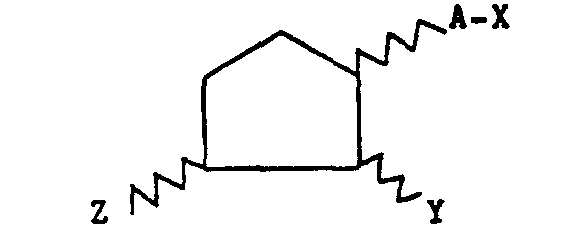
- Plus précisemment, l'invention a trait à un dérivé cyclopentyl-aldéhyde utile en thérapeutique qui est choisi parmi l'ensemble constitué par :
- a/ les composés de formule générale


- Les composés de formule I sont des substances connues qui peuvent être préparées soit par synthèse, soit par extraction à partir d'une plante appartenant à la famille des Labiacées telles que les espèces Teucrium marum, Teucrium polium et Teucrium montanum. Par exemple, ils peuvent être extraits du Teucrium marum selon le procédé décrit par PAGNONI et al., dans Aust. J. Chem., (1976), 29, pages 1375-1381, article dans lequel leurs propriétés pharmaceutiques ne sont pas décrites. Il a été à présent trouvé de façon surprenante, que les dérivés de cyclopentyl-aldéhyde de formule I sont (i) actifs en tant qu'agents bactériostatiques, bactéricides, antispasmodiques, antianaphylactiques et anti-inflammatoires, et (ii) utiles en particulier dans le traitement des êtres humains et des animaux à sang chaud souffrant de maladies infectieuses provoquées par des germes Gram (+) et Gram (-), et des allergies telles que le rhume des foins et l'asthme.
- Par ailleurs, les dérivés de cyclopentyl-aldéhyde de formule I sont plus intéressants, du point de vue pharmaceutique, que les extraits de Teucrium marum selon le brevet américain No 4 151 278.
- Parmi les composés inclus dans la définition de la formule I, on peut notamment citer les composés suivants :
- - Ex. 1 :α-(2-formyl-3-méthyl-cyclopentyl)-acétaldéhyde (X = Y-CHO; A = CH2; Z = CH 3),
- - Ex. 2 : 2-(2-hydroxyméthyl-3-méthyl-cyclopentyl)-éthanol ( X = Y = CH20; A = CH2; Z = CH3),
- - Ex. 3 : acide α-(2-carboxy-3-méthyl-cyclopentyl)-acétique (X - Y = COOH; A = CH2; Z = CH3),
- - Ex. 4 :α-(2-formyl-3-méthyl-cyclopentyl)-acrylaldéhyde (X = Y = CHO; A = C = CH2; Z = CH3),
- - Ex. 5 : 2- (2-hydroxyméthyl-3-méthyl-cyclopentyl)-2-propène-1-ol (X = Y = CH2OH; A =C = CH2; Z = CH3),
- - Ex. 6 : acide α-(2-carboxy-3-méthyl-cyclopentyl)-acrylique (X = Y = COOH; A = C = CH2; Z = CH3), et
- - Ex. 7 : 2-(2-hydroxyméthyl-3-méthyl-cyclopentyl)-propan-1-ol [X= Y = CH2OH; A=CH(CH3); Z = CH3], qui correspondent tous à la formule suivante :


- Les composés préférés sont ceux des exemples 1 et 4. Le plus intéressant, du point de vue pharmaceutique, est le composé de l'exemple 4.
- Le mode préféré pour préparer les composés "acryle" (où A est C = CH2) consiste à extraire le α-(2-formyl-3- méthyl-cyclopentyl)-acrylaldéhyde à partir d'une espèce de Teucrium tels que les Teucrium marum, Teucrium polium, Teucrium montanum, d'une part, et à transformer CHO en CH20H par réduction ou en COOH par oxydation, d'autre part. Les composés dans lesquels A est CH(CH3) tel que le produit de l'exemple 7, sont obtenus par hydrogénation catalytique. Les composés dans lesquels A est CH2 sont préparés en particulier par synthèse selon une méthode connue en soi.
- 1210 g de Teucrium polium (plante entière) séchés et broyés sont extraits dans une colonne avec successivement 7,35 litres d'hexane et 7,25 litres de chloroforme. L'extrait chloroformique est évaporé à sec sous vide et le résidu ainsi obtenu (45 g) est entraîné à la vapeur d'eau. Le distillat est saturé avec du chlórure de sodium, puis extrait au chloroforme après séchage sur Na2SO4;le chloroforme est élimité par distillation sous pression réduite (0,3 mm Hg) pour donner 7,3 g (rendement 0,6 %) d'une huile jaune (

- 89 % en poids de

- 11 % en poids de

- 25 kg de Teucrium marum (plante entière) séchés et broyés sont extraits par lixiviation dans une colonne en verre (hauteur : 2 m ; 0 : 0,225 m) remplie de solvant au moyen d'une pompe ayant un débit de 10 1/h. Deux solvants sont utilisés successivement : hexane (170 litres) puis chloroforme (170 litres). L'extrait à l'hèxane est écarté. L'extrait chloroformique est évaporé à sec sous vide pour donner un résidu huileux brun (640 g) qui est entraîné à la vapeur. Le distillat est saturé avec NaCl puis extrait au chloroforme. La phase chloroformique est - séchée sur NaS04, le solvant est évaporé et l'huile restante est distillée (sous 1 mm Hg à 60-78°C) pour donner 42 g d'une huile jaune (

- - 87 % en poids d'isomère "cis-trans"
- - 13 % en poids d'isomère "trans-cis"
- Par réduction de l'isomère "cis-trans" de l'exemple 4 (1,4 g) en solution dans CH3OH (25 ml) avec NaBH4 (1,7 g), l'isomère "cis-trans" de l'exemple 5 (1,19 g) est obtenu sous la forme d'une huile. Selon la même technique, on prépare l'isomère "trans-cis" de l'exemple 5 à partir de 1' isomère "trans-cis" de l'exemple 4.
- Les isomères "cis-trans" et "trans-cis" de l'exemple 7 sont obtenus par hydrogénation sur PtO2 des isomères correspondant du produit de l'exemple 5 selon la technique décrite par PAGNONI et al.
- Les essais pharmaceutiques qui ont été mis en oeuvre avec les produits des exemples 1 et 4, ont été résumés ci-après :
- 1°/ essais avec l'exemple 1
- a/ activité bactériostatique L' α-(2-formyl-3-méthyl-cyclopentyl)-acétal- déhyde inhibe les bactéries Gram (+) et Gram (-). Les CMI (concentration minimale inhibitrice) sont les suivantes : 0,75 mg/ml sur Staphylococcus aureus Londres, 1,2 mg/ml sur Escherichia coli, et 1,5 mg/ml sur Proteus
- b/ activité antispasmodique : Les DE-50 du produit de l'exemple 1 ont été déterminés
- (i) in vitro sur iléon isolé de cobaye vis à vis de l'histamine : DE - 50 = 50 γ/ml;
- (ii) in vivo sur l'animal vivant selon la méthode de KONZETT & ROESLLER : DE - 50 = 2,6 mg/kg par administration i.v.
- c/ activité antianaphylactique : Des cobayes mâles sont sensibilisés par deux injections de 0,5 ml d'une solution d'albumine à 2 g/1, à deux jours d'intervalle. Quatre semaines aprës,le choc anaphylactique mortel est provoqué par injection i.v. de 0,2 ml d'une solution aqueuse d'ovalbumine à 2 g/1. Les produits à tester sont administrés 30 mn avant (administration i.p.) ou en même temps (administration i.v.) que l'injection provoquant ledit choc anaphylactique. Les résultats sont donnés dans le tableau I pour le produit de l'exemple 1 et la Prométhazine en tant que produit de référence :

- 2°/ essais avec le produit de l'exemple 4 (constitué par un mélange de 87 % en poids d'isomère "cis-trans" et 13 % en poids d'isomère "trans-cis).
- a/ activité bactériostatigue :
Le produit de l'exemple 4 inhibe les bactéries Gram (+) et Gram (-). Ses CMI sont les suivantes :- 1,5 mg/m sur Staphylococcus aureus, Londres
- 1 mg/ml sur Escherichia coli (souche 548)
- 1,75 mg/ml sur Proteus vulgaris (souche 1557)
- 2,5 mg/ml sur Klebsiella pneumoniae (souche 433),
- 1 mg/ml sur Salmonella typhi murium (souche IP),
- 1,5 mg/ml sur Staphylococcus aureus (souche 634),
- 1,25 mg/ml sur Streptococcus (souche 1178)
- 1,25 mg/ml sur Bacillus substilis,
(les souches 548, 1557, 433, 634, et 1178 étant celles du catalogue de la collection du "Centre International de Distribution de Souches et d'Information sur les Types Microbiens" de . Lausanne, et la souche "IP" provenant de l'Institut Pasteur de Paris. - b/ activité bactéricide
Le produit de l'exemple 4 détruit les bactéries Gram (+) et Gram (-). Ses CMB (concentration minimalebactéricide) déterminées sur milieu solide (quand moins de 0,01% de germes survivent) sont :- 1,75 mg/ml sur Staphylococcus aureus Londres
- 1,5 mg/ml sur Escherichia coli (souche 548)
- 2 mg/ml sur Proteus vulgaris (souche 1557)
- 3 mg/ml sur Klebsiella pneumoniae (souche 433),
- 1,25 mg/ml sur Salmonella typhi murium (souche I.P.)
- 1,75 mg/ml sur Staphylococcus aureus (souche 634)
- 2 mg/ml sur Streptococcus (souche 1178)
- 2,5 mg/ml sur Bacillus substilis.
- c/ activité bronchospatique Des cobayes mâles ou femelles [20 animaux (pesant 300-500 g) par dose et par produit à tester] sont exposés à un aérosol de l'exemple 4 (50 g/l en solution eau-éthanol) ou de Prométhazine (produit de référence) pendant 10 mn.
- a/ activité bactériostatigue :
- Les animaux sont ensuite exposés individuellement à un aérosol d'histamine (3 g/1 d'histamine dans un milieu aqueux contenant 200 g/1 de glycérine).
- Le critère choisi est le temps écoulé entre le début de l'exposition à l'histamine et l'apnée, accompagnée de chute de l'animal.
- Le lot témoins ne reçoit que l'aérosol d'histamine. Les résultats ont été donnés dans le tableau II et montrent que le produit de l'exemple 4 possède un effet bronchodilatateur qui s'oppose à l'effet bronchoconstricteur de l'histamine :

- Des cobayes mâles sont sensibilises par une injection i.p. de 100 mg/kg d'ovalbumine dans un volume égal d'adjuvant de Freund. Quatre semaines après, les animaux sont sacrifiés, on recueille chaque iléon qui est placé à 33°C dans un bain de Thyrode. Une contraction est provoquée par addition d'une dose de 200 µg d'albumine au liquide de survie. L'amplitude des contractions des témoins est comparée à l'amplitude des contractions après mise en contact du produit de l'exemple 4 pendant 2 mn. Les résultats donnés dans le tableau III montrent que le produit de l'exemple 4 réduit l'amplitude des contractions de l'iléon isolé de cobaye , cette réduction étant statistiquement significative.
- Des cobayes (mâles ou femelles) sont sensibilisés à l'ovalbumine quatre semaines avant le début de l'expérience. Chaque animal est exposé à un aérosol d'ovalbumine (obtenu à partir d'un milieu aqueux contenant 50 g/1 d'ovalbumine). Le choc anaphylactique se manifeste par l'apparition d'une dyspnée intense. Les temps d'apparition de la dyspnée sont comparés entre lot témoin et lots préalablement traités avec un aérosol du produit de l'exemple 4 (50 g/1 dans une solution eau-éthanol). Les résultats donnés dans le tableau IV, montrent que le produit de l'exemple 4 diminue le temps d'apparition des troubles respiratoires provoqués par l'aérosol d'ovalbumine .


- L'activité anti-inflammatoire de l'exemple 4 a été étudiée chez le rat femelle (de poids 100 g) selon le test de l'oedème à la carragéenine.Les résultats sont donnés dans le tableau IV où l'Indométacine est utilisée comme produit de référence :


- L'activité antispasmodique du produit de l'exemple 4 a été étudiée sur le duodénum isolé de rat vis à vis de l'acétvlcholine et du chlorure de baryum. Les DE-50 du produit de l'exemple 4 sont :
- (i) 13 µg/ml vis à vis de l'acétycholine (0,2 µg/ml), et
- (ii) 10 µg/ml vis à vis de BaCl2 (0,3 µg/ml).
- Les DL-50 du poids de l'exemple 4 chez la souris sont les suivantes :
- DL-50 i.p. = 18 ± 3 mg/kg
- DL-50 i.v. - 20 ± 3 mg/kg
- DL-50 p.o. = 282 ± 3 mg/kg
- DL-50 s.c. > 1000 mg/kg
- DL-50 aérosol = 22 ± 3 mg/kg
- Selon l'invention, on préconise une composition thérapeutique comprenant, en association avec un excipient physiologiquement acceptable, une quantité pharmaceutiquement efficace d'un dérivé cyclopentyl-aldéhyde de formule I.
- Une telle composition peut être administrée oralement sous forme de comprimés, dragées, sirop et ampoules buvables, par injection et sous forme d'aérosol.
- Selon le mode préféré de mise en oeuvre de l'invention, on administre aux êtres humains et aux animaux à sang chaud, le composé de l'exemple 4 ou son isomère "cis-trans", de préférence sous la forme d'aérosol (en solution dans le carbitol ou en suspension dans le fréon ou un mélange fréon-alcool).
- De façon avantageuse, la composition aérosol renfermera 0,1 à 10 % du produit de l'exemple 4 ou de son isomère "cis-trans".
- Le produit de l'exemple 4 et son isomère "cis-trans" peuvent également être administrés par voie orale sous la forme de capsules molles (l'ingrédient actif étant en solution huileuse), de gélules (l'ingrédient actif étant associé à un excipient visqueux ou solide), l'excipient préféré pour les gélules étant notamment un mélange de glycérides oléiquespolyoxyéthylènés obtenus par alcoolyse d'huile végétale naturelle et qui sont vendus sous le nom de LABRAFIL.
g/ toxicité
Claims (6)


Priority Applications (1)
| Application Number | Priority Date | Filing Date | Title |
|---|---|---|---|
| AT79400340T ATE715T1 (de) | 1978-06-03 | 1979-05-29 | Arzneimittel mit einem gehalt an einem cyclopentylaldehyd-derivat. |
Applications Claiming Priority (2)
| Application Number | Priority Date | Filing Date | Title |
|---|---|---|---|
| GB2631678 | 1978-06-03 | ||
| GB7826316 | 1978-06-03 |
Publications (2)
| Publication Number | Publication Date |
|---|---|
| EP0006061A1 true EP0006061A1 (fr) | 1979-12-12 |
| EP0006061B1 EP0006061B1 (fr) | 1982-02-24 |
Family
ID=10497850
Family Applications (1)
| Application Number | Title | Priority Date | Filing Date |
|---|---|---|---|
| EP79400340A Expired EP0006061B1 (fr) | 1978-06-03 | 1979-05-29 | Médicament constitué par un dérivé de cyclopentyl-aldéhyde |
Country Status (16)
| Country | Link |
|---|---|
| EP (1) | EP0006061B1 (fr) |
| JP (1) | JPS5513269A (fr) |
| AT (1) | ATE715T1 (fr) |
| AU (1) | AU4760079A (fr) |
| BE (1) | BE876713A (fr) |
| CA (1) | CA1107761A (fr) |
| CH (1) | CH639929A5 (fr) |
| DE (1) | DE2962180D1 (fr) |
| FR (1) | FR2427094B1 (fr) |
| GB (1) | GB2022413B (fr) |
| IE (1) | IE48343B1 (fr) |
| IL (1) | IL57433A (fr) |
| IT (1) | IT1120984B (fr) |
| LU (1) | LU81352A1 (fr) |
| NZ (1) | NZ190628A (fr) |
| ZA (1) | ZA792678B (fr) |
Cited By (1)
| Publication number | Priority date | Publication date | Assignee | Title |
|---|---|---|---|---|
| WO2021209397A1 (fr) * | 2020-04-14 | 2021-10-21 | Firmenich Sa | Substance odorante au parfum de muguet |
Families Citing this family (3)
| Publication number | Priority date | Publication date | Assignee | Title |
|---|---|---|---|---|
| EP0505572A4 (en) * | 1990-10-09 | 1993-03-10 | Tsumura & Co. | Iridoide derivative and its use as medicine |
| CN102942605B (zh) * | 2012-11-30 | 2016-06-15 | 沈阳药科大学 | 清香藤中环烯醚萜类化合物的制备方法及其应用 |
| BR102017003318A2 (pt) * | 2017-02-17 | 2018-10-30 | Aché Laboratórios Farmacêuticos S.A. | compostos, processo de produção de compostos, extrato enriquecido, frações ativas de extrato enriquecido, processo de produção de extrato enriquecido, método de seleção de biomassa vegetal para produção de extrato enriquecido, composição e uso para tratamento de desordens imunológicas |
-
1979
- 1979-05-29 CH CH500979A patent/CH639929A5/fr not_active IP Right Cessation
- 1979-05-29 EP EP79400340A patent/EP0006061B1/fr not_active Expired
- 1979-05-29 DE DE7979400340T patent/DE2962180D1/de not_active Expired
- 1979-05-29 AT AT79400340T patent/ATE715T1/de not_active IP Right Cessation
- 1979-05-29 IL IL57433A patent/IL57433A/xx unknown
- 1979-05-30 ZA ZA792678A patent/ZA792678B/xx unknown
- 1979-05-30 CA CA328,873A patent/CA1107761A/fr not_active Expired
- 1979-05-30 AU AU47600/79A patent/AU4760079A/en not_active Abandoned
- 1979-05-31 FR FR7914041A patent/FR2427094B1/fr not_active Expired
- 1979-06-01 NZ NZ190628A patent/NZ190628A/en unknown
- 1979-06-01 IT IT68189/79A patent/IT1120984B/it active
- 1979-06-01 BE BE2/57846A patent/BE876713A/fr not_active IP Right Cessation
- 1979-06-01 LU LU81352A patent/LU81352A1/fr unknown
- 1979-06-04 JP JP6980179A patent/JPS5513269A/ja active Pending
- 1979-06-04 GB GB7919435A patent/GB2022413B/en not_active Expired
- 1979-08-08 IE IE1087/79A patent/IE48343B1/en unknown
Non-Patent Citations (1)
| Title |
|---|
| CHEMICAL ABSTRACTS, Vol. 88, 1978 ref.: 11723f, page 286 Columbus, Ohio (US) & RIV. ITAL. ESSENZE, PROFUMI, PIANTE OFF., AROMI, SAPONI, COSMET., AEROSOL 1977, 59 (8), 369-73 C. BEAUPIN: "The essential oil from Teucrium marum Linneaus of Corsica" * abrege * * |
Cited By (1)
| Publication number | Priority date | Publication date | Assignee | Title |
|---|---|---|---|---|
| WO2021209397A1 (fr) * | 2020-04-14 | 2021-10-21 | Firmenich Sa | Substance odorante au parfum de muguet |
Also Published As
| Publication number | Publication date |
|---|---|
| IE48343B1 (en) | 1984-12-12 |
| FR2427094A1 (fr) | 1979-12-28 |
| GB2022413B (en) | 1983-02-16 |
| CH639929A5 (fr) | 1983-12-15 |
| IE791087L (en) | 1979-12-03 |
| IL57433A0 (en) | 1979-09-30 |
| JPS5513269A (en) | 1980-01-30 |
| LU81352A1 (fr) | 1980-01-22 |
| DE2962180D1 (en) | 1982-03-25 |
| CA1107761A (fr) | 1981-08-25 |
| EP0006061B1 (fr) | 1982-02-24 |
| BE876713A (fr) | 1979-12-03 |
| NZ190628A (en) | 1984-11-09 |
| AU4760079A (en) | 1979-12-13 |
| IT1120984B (it) | 1986-03-26 |
| IT7968189A0 (it) | 1979-06-01 |
| FR2427094B1 (fr) | 1986-07-25 |
| ZA792678B (en) | 1980-08-27 |
| IL57433A (en) | 1982-08-31 |
| GB2022413A (en) | 1979-12-19 |
| ATE715T1 (de) | 1982-03-15 |
Similar Documents
| Publication | Publication Date | Title |
|---|---|---|
| US4988733A (en) | N-[1-(3-phenoxyphenyl)ethyl]acetohydroxamic acid compounds which are useful anti-inflammatory agents | |
| FR2491060A1 (fr) | Esters d'acides cyclopropanes carboxyliques apparentes a l'acide pyrethrique, leur procede de preparation et leur application a la lutte contre les parasites | |
| BE895724A (fr) | Nouvelle utilisation therapeutique de la dihydrocyclosporine d | |
| FR2484832A1 (fr) | Composition pharmaceutique utile pour le traitement de l'allergie | |
| EP1014927B1 (fr) | Utilisation des shogaols et des gingerols pour la preparation de compositions deodorantes | |
| EP0006061B1 (fr) | Médicament constitué par un dérivé de cyclopentyl-aldéhyde | |
| FR2481271A1 (fr) | Derives de la nonaprenylamine, leurs sels acides d'addition et leur utilisation dans des compositions pharmaceutiques | |
| EP1067938A1 (fr) | Voacamine en tant qu'agent anti-paludeen et agent anti-paludeen contenant de la voacamine | |
| EP0317453A1 (fr) | Compositions médicamenteuses à base de flavonoides et de saponines extraits de chrysanthellum, leur procédé de préparation et applications thérapeutiques | |
| JPH0319207B2 (fr) | ||
| FR2559771A1 (fr) | Derives de la 3-pyrrolidinopropiophenone et procede pour leur preparation | |
| EP0135510B1 (fr) | Nouveaux medicaments appartenant a la famille des derives d'halo genobenzophenone-oxime | |
| US7129366B2 (en) | Group of a novel anti-cancer compounds with specific structure | |
| US20050203180A1 (en) | Cinnamic acid dimers, their preparation and the use thereof for treating neurodegenerative disease | |
| FR2470110A1 (fr) | Derives de la decrapenylamine, leurs sels acides d'addition et composition pharmaceutique renfermant ces produits | |
| EP0001947A1 (fr) | Dérivés de l'amino-2 thiazoline, procédé de préparation et compositions pharmaceutiques les contenant | |
| FR2518537A1 (fr) | Nouveaux derives de l'acide phenylacetique, leur preparation et compositions les contenant | |
| EP0482993A1 (fr) | Dérivés N,O spirocycliques de cyclotriphosphazènes, leur préparation et leur application en thérapeutique | |
| FR2505825A1 (fr) | Derives d'isoprenylamine et leur utilisation dans des compositions pharmaceutiques | |
| FR2516793A1 (fr) | Nouveaux medicaments immunomodulateurs contenant un derive de trithiazolepentamethylidene-cyanine | |
| JP3857428B2 (ja) | 抗真菌剤 | |
| EP0063508B1 (fr) | Dérivés de 4-phénoxy-3-hydroxy-butyramidoxime, leur procédé de préparation et leur utilisation en thérapeutique | |
| FR2584715A1 (fr) | Phenyl-(3-hexamethyleneiminopropyl)-cetone, procede de preparation et utilisation en therapeutique | |
| CH652386A5 (fr) | Derives d'acides phenyl aliphatique carboxyliques comme medicaments. | |
| EP0017525B1 (fr) | Nouveaux dérivés tétrahydroalstoniques, leur préparation et leur application en tant que médicaments |
Legal Events
| Date | Code | Title | Description |
|---|---|---|---|
| PUAI | Public reference made under article 153(3) epc to a published international application that has entered the european phase |
Free format text: ORIGINAL CODE: 0009012 |
|
| AK | Designated contracting states |
Kind code of ref document: A1 Designated state(s): AT DE NL SE |
|
| 17P | Request for examination filed | ||
| GRAA | (expected) grant |
Free format text: ORIGINAL CODE: 0009210 |
|
| AK | Designated contracting states |
Designated state(s): AT DE NL SE |
|
| REF | Corresponds to: |
Ref document number: 715 Country of ref document: AT Date of ref document: 19820315 Kind code of ref document: T |
|
| REF | Corresponds to: |
Ref document number: 2962180 Country of ref document: DE Date of ref document: 19820325 |
|
| PG25 | Lapsed in a contracting state [announced via postgrant information from national office to epo] |
Ref country code: AT Effective date: 19820401 |
|
| PGFP | Annual fee paid to national office [announced via postgrant information from national office to epo] |
Ref country code: DE Payment date: 19840421 Year of fee payment: 6 |
|
| PGFP | Annual fee paid to national office [announced via postgrant information from national office to epo] |
Ref country code: SE Payment date: 19840630 Year of fee payment: 6 |
|
| PGFP | Annual fee paid to national office [announced via postgrant information from national office to epo] |
Ref country code: NL Payment date: 19870531 Year of fee payment: 9 |
|
| PG25 | Lapsed in a contracting state [announced via postgrant information from national office to epo] |
Ref country code: SE Effective date: 19880530 |
|
| PG25 | Lapsed in a contracting state [announced via postgrant information from national office to epo] |
Ref country code: NL Effective date: 19881201 |
|
| NLV4 | Nl: lapsed or anulled due to non-payment of the annual fee | ||
| PG25 | Lapsed in a contracting state [announced via postgrant information from national office to epo] |
Ref country code: DE Effective date: 19890201 |
|
| EUG | Se: european patent has lapsed |
Ref document number: 79400340.0 Effective date: 19890510 |
|
| PLBE | No opposition filed within time limit |
Free format text: ORIGINAL CODE: 0009261 |
|
| STAA | Information on the status of an ep patent application or granted ep patent |
Free format text: STATUS: NO OPPOSITION FILED WITHIN TIME LIMIT |