EP0006552A1 - Verwendung von modifizierten Cellulosehydratfasern bei der Herstellung gebundener Faservliese und derart hergestellte Produkte - Google Patents
Verwendung von modifizierten Cellulosehydratfasern bei der Herstellung gebundener Faservliese und derart hergestellte Produkte Download PDFInfo
- Publication number
- EP0006552A1 EP0006552A1 EP79101964A EP79101964A EP0006552A1 EP 0006552 A1 EP0006552 A1 EP 0006552A1 EP 79101964 A EP79101964 A EP 79101964A EP 79101964 A EP79101964 A EP 79101964A EP 0006552 A1 EP0006552 A1 EP 0006552A1
- Authority
- EP
- European Patent Office
- Prior art keywords
- fibers
- cellulose hydrate
- water vapor
- modified cellulose
- use according
- Prior art date
- Legal status (The legal status is an assumption and is not a legal conclusion. Google has not performed a legal analysis and makes no representation as to the accuracy of the status listed.)
- Withdrawn
Links
- 239000000835 fiber Substances 0.000 title claims abstract description 40
- 229920002678 cellulose Polymers 0.000 title claims abstract description 29
- 239000001913 cellulose Substances 0.000 title claims abstract description 29
- 238000004519 manufacturing process Methods 0.000 title claims abstract description 12
- 239000004745 nonwoven fabric Substances 0.000 claims abstract description 27
- XLYOFNOQVPJJNP-UHFFFAOYSA-N water Chemical compound O XLYOFNOQVPJJNP-UHFFFAOYSA-N 0.000 claims abstract description 14
- 239000003607 modifier Substances 0.000 claims abstract description 9
- 229920000297 Rayon Polymers 0.000 claims abstract description 8
- 239000000203 mixture Substances 0.000 claims abstract description 8
- 229920000642 polymer Polymers 0.000 claims abstract description 8
- 229920001282 polysaccharide Polymers 0.000 claims abstract description 6
- 239000005017 polysaccharide Substances 0.000 claims abstract description 6
- NIXOWILDQLNWCW-UHFFFAOYSA-N acrylic acid group Chemical group C(C=C)(=O)O NIXOWILDQLNWCW-UHFFFAOYSA-N 0.000 claims abstract description 4
- 238000007493 shaping process Methods 0.000 claims abstract description 3
- 150000004676 glycans Chemical class 0.000 claims abstract 4
- 229920002125 Sokalan® Polymers 0.000 claims description 6
- 229920000615 alginic acid Polymers 0.000 claims description 5
- 235000010443 alginic acid Nutrition 0.000 claims description 5
- 239000004584 polyacrylic acid Substances 0.000 claims description 5
- 229920002239 polyacrylonitrile Polymers 0.000 claims description 4
- 244000007835 Cyamopsis tetragonoloba Species 0.000 claims description 3
- 229920002472 Starch Polymers 0.000 claims description 3
- 239000003795 chemical substances by application Substances 0.000 claims description 3
- 239000008107 starch Substances 0.000 claims description 3
- 235000019698 starch Nutrition 0.000 claims description 3
- 229920002845 Poly(methacrylic acid) Polymers 0.000 claims description 2
- 239000002250 absorbent Substances 0.000 claims description 2
- 229920002401 polyacrylamide Polymers 0.000 claims description 2
- 150000003839 salts Chemical group 0.000 claims description 2
- RTZKZFJDLAIYFH-UHFFFAOYSA-N Diethyl ether Chemical compound CCOCC RTZKZFJDLAIYFH-UHFFFAOYSA-N 0.000 claims 2
- FHVDTGUDJYJELY-UHFFFAOYSA-N 6-{[2-carboxy-4,5-dihydroxy-6-(phosphanyloxy)oxan-3-yl]oxy}-4,5-dihydroxy-3-phosphanyloxane-2-carboxylic acid Chemical compound O1C(C(O)=O)C(P)C(O)C(O)C1OC1C(C(O)=O)OC(OP)C(O)C1O FHVDTGUDJYJELY-UHFFFAOYSA-N 0.000 claims 1
- CERQOIWHTDAKMF-UHFFFAOYSA-M Methacrylate Chemical compound CC(=C)C([O-])=O CERQOIWHTDAKMF-UHFFFAOYSA-M 0.000 claims 1
- 229940072056 alginate Drugs 0.000 claims 1
- 125000005395 methacrylic acid group Chemical group 0.000 abstract description 2
- 239000000243 solution Substances 0.000 description 9
- 239000000523 sample Substances 0.000 description 8
- HEMHJVSKTPXQMS-UHFFFAOYSA-M Sodium hydroxide Chemical compound [OH-].[Na+] HEMHJVSKTPXQMS-UHFFFAOYSA-M 0.000 description 6
- 238000000576 coating method Methods 0.000 description 6
- 239000010985 leather Substances 0.000 description 6
- 239000011159 matrix material Substances 0.000 description 6
- 238000000034 method Methods 0.000 description 6
- 238000010521 absorption reaction Methods 0.000 description 5
- 229920000728 polyester Polymers 0.000 description 5
- 238000009987 spinning Methods 0.000 description 5
- 239000011230 binding agent Substances 0.000 description 4
- 229920002635 polyurethane Polymers 0.000 description 4
- 239000004814 polyurethane Substances 0.000 description 4
- 239000011248 coating agent Substances 0.000 description 3
- 229920000058 polyacrylate Polymers 0.000 description 3
- 239000004753 textile Substances 0.000 description 3
- 229920003043 Cellulose fiber Polymers 0.000 description 2
- CERQOIWHTDAKMF-UHFFFAOYSA-N Methacrylic acid Chemical compound CC(=C)C(O)=O CERQOIWHTDAKMF-UHFFFAOYSA-N 0.000 description 2
- DPXJVFZANSGRMM-UHFFFAOYSA-N acetic acid;2,3,4,5,6-pentahydroxyhexanal;sodium Chemical compound [Na].CC(O)=O.OCC(O)C(O)C(O)C(O)C=O DPXJVFZANSGRMM-UHFFFAOYSA-N 0.000 description 2
- 239000000783 alginic acid Substances 0.000 description 2
- 229960001126 alginic acid Drugs 0.000 description 2
- 150000004781 alginic acids Chemical class 0.000 description 2
- 230000000694 effects Effects 0.000 description 2
- 150000002170 ethers Chemical class 0.000 description 2
- 239000004816 latex Substances 0.000 description 2
- 229920000126 latex Polymers 0.000 description 2
- 238000002156 mixing Methods 0.000 description 2
- 150000004804 polysaccharides Chemical class 0.000 description 2
- 229920000915 polyvinyl chloride Polymers 0.000 description 2
- 239000004800 polyvinyl chloride Substances 0.000 description 2
- 239000004627 regenerated cellulose Substances 0.000 description 2
- 235000019812 sodium carboxymethyl cellulose Nutrition 0.000 description 2
- 239000000126 substance Substances 0.000 description 2
- SMZOUWXMTYCWNB-UHFFFAOYSA-N 2-(2-methoxy-5-methylphenyl)ethanamine Chemical compound COC1=CC=C(C)C=C1CCN SMZOUWXMTYCWNB-UHFFFAOYSA-N 0.000 description 1
- QTBSBXVTEAMEQO-UHFFFAOYSA-M Acetate Chemical compound CC([O-])=O QTBSBXVTEAMEQO-UHFFFAOYSA-M 0.000 description 1
- 229920000189 Arabinogalactan Polymers 0.000 description 1
- 229920002134 Carboxymethyl cellulose Polymers 0.000 description 1
- 102000008186 Collagen Human genes 0.000 description 1
- 108010035532 Collagen Proteins 0.000 description 1
- 229920000742 Cotton Polymers 0.000 description 1
- LFQSCWFLJHTTHZ-UHFFFAOYSA-N Ethanol Chemical compound CCO LFQSCWFLJHTTHZ-UHFFFAOYSA-N 0.000 description 1
- 229920000926 Galactomannan Polymers 0.000 description 1
- 229920013648 Perbunan Polymers 0.000 description 1
- 239000004952 Polyamide Substances 0.000 description 1
- 230000002745 absorbent Effects 0.000 description 1
- 230000002378 acidificating effect Effects 0.000 description 1
- 229910052783 alkali metal Inorganic materials 0.000 description 1
- -1 alkali metal salt Chemical class 0.000 description 1
- 150000001447 alkali salts Chemical class 0.000 description 1
- 235000019312 arabinogalactan Nutrition 0.000 description 1
- 239000001768 carboxy methyl cellulose Substances 0.000 description 1
- 235000010948 carboxy methyl cellulose Nutrition 0.000 description 1
- 239000012876 carrier material Substances 0.000 description 1
- 229920003086 cellulose ether Polymers 0.000 description 1
- 238000004140 cleaning Methods 0.000 description 1
- 229920001436 collagen Polymers 0.000 description 1
- 230000000052 comparative effect Effects 0.000 description 1
- 230000000295 complement effect Effects 0.000 description 1
- 239000000470 constituent Substances 0.000 description 1
- 238000001816 cooling Methods 0.000 description 1
- 229920001577 copolymer Polymers 0.000 description 1
- 230000001419 dependent effect Effects 0.000 description 1
- 238000009826 distribution Methods 0.000 description 1
- 238000001035 drying Methods 0.000 description 1
- ZOOODBUHSVUZEM-UHFFFAOYSA-N ethoxymethanedithioic acid Chemical compound CCOC(S)=S ZOOODBUHSVUZEM-UHFFFAOYSA-N 0.000 description 1
- 238000007380 fibre production Methods 0.000 description 1
- 238000010438 heat treatment Methods 0.000 description 1
- 238000007654 immersion Methods 0.000 description 1
- 238000005470 impregnation Methods 0.000 description 1
- 239000002649 leather substitute Substances 0.000 description 1
- 239000000463 material Substances 0.000 description 1
- 238000005259 measurement Methods 0.000 description 1
- 229920000620 organic polymer Polymers 0.000 description 1
- 239000001814 pectin Substances 0.000 description 1
- 229920001277 pectin Polymers 0.000 description 1
- 235000010987 pectin Nutrition 0.000 description 1
- 230000035699 permeability Effects 0.000 description 1
- 229920003023 plastic Polymers 0.000 description 1
- 239000004033 plastic Substances 0.000 description 1
- 229920002647 polyamide Polymers 0.000 description 1
- 239000002243 precursor Substances 0.000 description 1
- 239000002964 rayon Substances 0.000 description 1
- 230000008929 regeneration Effects 0.000 description 1
- 238000011069 regeneration method Methods 0.000 description 1
- 229920001027 sodium carboxymethylcellulose Polymers 0.000 description 1
- 159000000000 sodium salts Chemical class 0.000 description 1
- RPACBEVZENYWOL-XFULWGLBSA-M sodium;(2r)-2-[6-(4-chlorophenoxy)hexyl]oxirane-2-carboxylate Chemical compound [Na+].C=1C=C(Cl)C=CC=1OCCCCCC[C@]1(C(=O)[O-])CO1 RPACBEVZENYWOL-XFULWGLBSA-M 0.000 description 1
- 229920002994 synthetic fiber Polymers 0.000 description 1
- 230000004580 weight loss Effects 0.000 description 1
- 239000012991 xanthate Substances 0.000 description 1
Classifications
-
- D—TEXTILES; PAPER
- D04—BRAIDING; LACE-MAKING; KNITTING; TRIMMINGS; NON-WOVEN FABRICS
- D04H—MAKING TEXTILE FABRICS, e.g. FROM FIBRES OR FILAMENTARY MATERIAL; FABRICS MADE BY SUCH PROCESSES OR APPARATUS, e.g. FELTS, NON-WOVEN FABRICS; COTTON-WOOL; WADDING ; NON-WOVEN FABRICS FROM STAPLE FIBRES, FILAMENTS OR YARNS, BONDED WITH AT LEAST ONE WEB-LIKE MATERIAL DURING THEIR CONSOLIDATION
- D04H1/00—Non-woven fabrics formed wholly or mainly of staple fibres or like relatively short fibres
- D04H1/40—Non-woven fabrics formed wholly or mainly of staple fibres or like relatively short fibres from fleeces or layers composed of fibres without existing or potential cohesive properties
- D04H1/58—Non-woven fabrics formed wholly or mainly of staple fibres or like relatively short fibres from fleeces or layers composed of fibres without existing or potential cohesive properties by applying, incorporating or activating chemical or thermoplastic bonding agents, e.g. adhesives
- D04H1/587—Non-woven fabrics formed wholly or mainly of staple fibres or like relatively short fibres from fleeces or layers composed of fibres without existing or potential cohesive properties by applying, incorporating or activating chemical or thermoplastic bonding agents, e.g. adhesives characterised by the bonding agents used
-
- D—TEXTILES; PAPER
- D04—BRAIDING; LACE-MAKING; KNITTING; TRIMMINGS; NON-WOVEN FABRICS
- D04H—MAKING TEXTILE FABRICS, e.g. FROM FIBRES OR FILAMENTARY MATERIAL; FABRICS MADE BY SUCH PROCESSES OR APPARATUS, e.g. FELTS, NON-WOVEN FABRICS; COTTON-WOOL; WADDING ; NON-WOVEN FABRICS FROM STAPLE FIBRES, FILAMENTS OR YARNS, BONDED WITH AT LEAST ONE WEB-LIKE MATERIAL DURING THEIR CONSOLIDATION
- D04H1/00—Non-woven fabrics formed wholly or mainly of staple fibres or like relatively short fibres
- D04H1/40—Non-woven fabrics formed wholly or mainly of staple fibres or like relatively short fibres from fleeces or layers composed of fibres without existing or potential cohesive properties
- D04H1/42—Non-woven fabrics formed wholly or mainly of staple fibres or like relatively short fibres from fleeces or layers composed of fibres without existing or potential cohesive properties characterised by the use of certain kinds of fibres insofar as this use has no preponderant influence on the consolidation of the fleece
- D04H1/425—Cellulose series
-
- D—TEXTILES; PAPER
- D04—BRAIDING; LACE-MAKING; KNITTING; TRIMMINGS; NON-WOVEN FABRICS
- D04H—MAKING TEXTILE FABRICS, e.g. FROM FIBRES OR FILAMENTARY MATERIAL; FABRICS MADE BY SUCH PROCESSES OR APPARATUS, e.g. FELTS, NON-WOVEN FABRICS; COTTON-WOOL; WADDING ; NON-WOVEN FABRICS FROM STAPLE FIBRES, FILAMENTS OR YARNS, BONDED WITH AT LEAST ONE WEB-LIKE MATERIAL DURING THEIR CONSOLIDATION
- D04H1/00—Non-woven fabrics formed wholly or mainly of staple fibres or like relatively short fibres
- D04H1/40—Non-woven fabrics formed wholly or mainly of staple fibres or like relatively short fibres from fleeces or layers composed of fibres without existing or potential cohesive properties
- D04H1/42—Non-woven fabrics formed wholly or mainly of staple fibres or like relatively short fibres from fleeces or layers composed of fibres without existing or potential cohesive properties characterised by the use of certain kinds of fibres insofar as this use has no preponderant influence on the consolidation of the fleece
- D04H1/425—Cellulose series
- D04H1/4258—Regenerated cellulose series
-
- D—TEXTILES; PAPER
- D04—BRAIDING; LACE-MAKING; KNITTING; TRIMMINGS; NON-WOVEN FABRICS
- D04H—MAKING TEXTILE FABRICS, e.g. FROM FIBRES OR FILAMENTARY MATERIAL; FABRICS MADE BY SUCH PROCESSES OR APPARATUS, e.g. FELTS, NON-WOVEN FABRICS; COTTON-WOOL; WADDING ; NON-WOVEN FABRICS FROM STAPLE FIBRES, FILAMENTS OR YARNS, BONDED WITH AT LEAST ONE WEB-LIKE MATERIAL DURING THEIR CONSOLIDATION
- D04H1/00—Non-woven fabrics formed wholly or mainly of staple fibres or like relatively short fibres
- D04H1/40—Non-woven fabrics formed wholly or mainly of staple fibres or like relatively short fibres from fleeces or layers composed of fibres without existing or potential cohesive properties
- D04H1/42—Non-woven fabrics formed wholly or mainly of staple fibres or like relatively short fibres from fleeces or layers composed of fibres without existing or potential cohesive properties characterised by the use of certain kinds of fibres insofar as this use has no preponderant influence on the consolidation of the fleece
- D04H1/4326—Condensation or reaction polymers
- D04H1/435—Polyesters
-
- D—TEXTILES; PAPER
- D04—BRAIDING; LACE-MAKING; KNITTING; TRIMMINGS; NON-WOVEN FABRICS
- D04H—MAKING TEXTILE FABRICS, e.g. FROM FIBRES OR FILAMENTARY MATERIAL; FABRICS MADE BY SUCH PROCESSES OR APPARATUS, e.g. FELTS, NON-WOVEN FABRICS; COTTON-WOOL; WADDING ; NON-WOVEN FABRICS FROM STAPLE FIBRES, FILAMENTS OR YARNS, BONDED WITH AT LEAST ONE WEB-LIKE MATERIAL DURING THEIR CONSOLIDATION
- D04H1/00—Non-woven fabrics formed wholly or mainly of staple fibres or like relatively short fibres
- D04H1/40—Non-woven fabrics formed wholly or mainly of staple fibres or like relatively short fibres from fleeces or layers composed of fibres without existing or potential cohesive properties
- D04H1/42—Non-woven fabrics formed wholly or mainly of staple fibres or like relatively short fibres from fleeces or layers composed of fibres without existing or potential cohesive properties characterised by the use of certain kinds of fibres insofar as this use has no preponderant influence on the consolidation of the fleece
- D04H1/4382—Stretched reticular film fibres; Composite fibres; Mixed fibres; Ultrafine fibres; Fibres for artificial leather
- D04H1/43835—Mixed fibres, e.g. at least two chemically different fibres or fibre blends
-
- Y—GENERAL TAGGING OF NEW TECHNOLOGICAL DEVELOPMENTS; GENERAL TAGGING OF CROSS-SECTIONAL TECHNOLOGIES SPANNING OVER SEVERAL SECTIONS OF THE IPC; TECHNICAL SUBJECTS COVERED BY FORMER USPC CROSS-REFERENCE ART COLLECTIONS [XRACs] AND DIGESTS
- Y10—TECHNICAL SUBJECTS COVERED BY FORMER USPC
- Y10S—TECHNICAL SUBJECTS COVERED BY FORMER USPC CROSS-REFERENCE ART COLLECTIONS [XRACs] AND DIGESTS
- Y10S428/00—Stock material or miscellaneous articles
- Y10S428/904—Artificial leather
-
- Y—GENERAL TAGGING OF NEW TECHNOLOGICAL DEVELOPMENTS; GENERAL TAGGING OF CROSS-SECTIONAL TECHNOLOGIES SPANNING OVER SEVERAL SECTIONS OF THE IPC; TECHNICAL SUBJECTS COVERED BY FORMER USPC CROSS-REFERENCE ART COLLECTIONS [XRACs] AND DIGESTS
- Y10—TECHNICAL SUBJECTS COVERED BY FORMER USPC
- Y10T—TECHNICAL SUBJECTS COVERED BY FORMER US CLASSIFICATION
- Y10T428/00—Stock material or miscellaneous articles
- Y10T428/31504—Composite [nonstructural laminate]
- Y10T428/31971—Of carbohydrate
- Y10T428/31975—Of cellulosic next to another carbohydrate
- Y10T428/31978—Cellulosic next to another cellulosic
- Y10T428/31986—Regenerated or modified
-
- Y—GENERAL TAGGING OF NEW TECHNOLOGICAL DEVELOPMENTS; GENERAL TAGGING OF CROSS-SECTIONAL TECHNOLOGIES SPANNING OVER SEVERAL SECTIONS OF THE IPC; TECHNICAL SUBJECTS COVERED BY FORMER USPC CROSS-REFERENCE ART COLLECTIONS [XRACs] AND DIGESTS
- Y10—TECHNICAL SUBJECTS COVERED BY FORMER USPC
- Y10T—TECHNICAL SUBJECTS COVERED BY FORMER US CLASSIFICATION
- Y10T442/00—Fabric [woven, knitted, or nonwoven textile or cloth, etc.]
- Y10T442/60—Nonwoven fabric [i.e., nonwoven strand or fiber material]
- Y10T442/697—Containing at least two chemically different strand or fiber materials
Definitions
- the invention relates to the use of fibers made from modified cellulose hydrate in the production of bound nonwoven fabrics capable of absorbing water vapor, and to products produced in this way.
- Bound non-woven fabrics i.e. H.
- Nonwoven fabrics bound by chemical binders are of interest for various technical fields of application, including their substitute applications, above all for leather or certain textiles in their fields of application, eg. B. for shoes, (shoe upper, lining, soles), bags, upholstery, outer clothing (“leather” and all-weather clothing) or for textiles or household aids (tablecloths, window “leather”, wipes), but also their combined or complementary Applications with materials such as leather or textiles that can be used in these areas in addition to the nonwovens.
- the use of bonded nonwovens in these areas has been known for a long time.
- the invention is based on the object of proposing the use of such modified cellulose hydrate fibers in which they have their characteristic properties To be valid.
- This object is achieved according to the invention by the use of fibers made of cellulose hydrate modified by an organic, polymeric compound in the production of bonded nonwovens capable of absorbing water vapor, alone or in a mixture with synthetic, natural or regenerated fibers.
- nonwovens For the production of water vapor absorbent bonded nonwovens, reference is made to DE-OS 27 10 874.
- methods for the production of nonwovens are carded nonwovens, nonwovens obtained by pneumatic means, spunbonded nonwovens or nonwovens which are used in the wet way, for. B. manufactured in a paper machine called.
- the basic constituent of the nonwovens according to the invention can be synthetic, natural or regenerated fibers, in particular of polyester, polyamide, polyacrylonitrile, polyvinyl chloride, acetate, alcohol, cotton, rayon, collagen, regenerated cellulose, polyurethane or mixtures thereof.
- the fibers of modified cellulose hydrate are added to these fibers before or during the production of the nonwoven and are evenly incorporated therein.
- Suitable fibers for the use according to the invention are, in particular, those in which the viscose modifying agent or a comparable stage is added to the fiber during the manufacture prior to shaping (regeneration). Provided that it is water-soluble and alkali-soluble, this modifier is only added shortly before the spinneret or, if it is water-insoluble and alkali-insoluble, even before the cellulose is xanthated.
- organic polymers such as water- and / or alkali-soluble or water- and / or alkali-insoluble natural or synthetic polysaccharides or polysaccharide derivatives based on starch, cellulose, guar, alginic acid and alginates, galactomannans, arabinogalactanes or pectins (see for example AALawrence "Edible Gums and Related Substances", Noyes Data Corp., Park Ridge / New Jersey, 1973), in particular these are cellulose ethers such as CMC, HEC, MC, EC or their mixed ethers, corresponding starch or guar ethers and alginates; Acrylic polymers, methacrylic polymers or their mixed polymers, in particular polyacrylic acid, polymethacrylic acid, partially hydrolyzed polyacrylamides, partially hydrolyzed polyacrylonitriles or the corresponding salt forms.
- organic polymers such as water- and / or alkali-soluble or water- and / or al
- the coating can be carried out in one operation with the binding of the nonwoven - in particular according to the method described above
- these coating processes are generally known and are described, for example, in Plastics Handbook, Volume VII, "Polyurethane", by R. Vieweg and A. Höchtlen, Carl Hanser Verlag, Kunststoff (1966) or Volume II (Parts 1 and 2), "Polyvinylchloride” K. Krekeler and G. Wick, Carl Hanser Verlag, Kunststoff (1963).
- the nonwovens according to the invention have good water vapor absorption and permeability, which goes beyond a pure transport effect of the incorporated fibers from modified cellulose hydrate.
- the nonwovens are also able to release the absorbed water vapor under certain conditions, such as staying in a different climate.
- the mentioned properties of the bonded nonwovens are not based solely on the significantly detectable effect due to the addition of the fibers from modified cellulose hydrate, but rather a. are also dependent on the thickness of the nonwovens, these are expediently produced in a thickness of about 0.1 to 5 mm or split to this thickness.
- the bonded nonwovens according to the invention with the properties mentioned are suitable, for example, as self-supporting nonwovens (e.g. as shoe linings, insoles) or as supports for coatings with synthetic materials for use as shoe uppers, upholstery covers, baggage goods and outerwear ("leather" and all-weather clothing) , in particular as a carrier for coatings to a synthetic leather.
- Example 1 The procedure of Example 1 is followed, but with 90 g of a partially hydrolyzed polyacrylonitrile as modifier and with a weight ratio of cellulose hydrate to modifier such as 7.33 to 1.
- Example 1 The procedure of Example 1 is followed, but with 100 g of the sodium salt of carboxymethyl cellulose as a modifier and with a weight ratio of cellulose hydrate to modifier such as 3.17 to 1.
- Example 1 The procedure of Example 1 is followed, but with 25% of the modified cellulose hydrate fibers and 75% of the polyester fibers.
- Example 2 The procedure of Example 2 is followed, but with 25% of the modified cellulose hydrate fibers and 75% of the polyester fibers.
- the modified cellulose hydrate fibers produced as described in Example 1 are bound with an unmodified fiber without prior mixing.
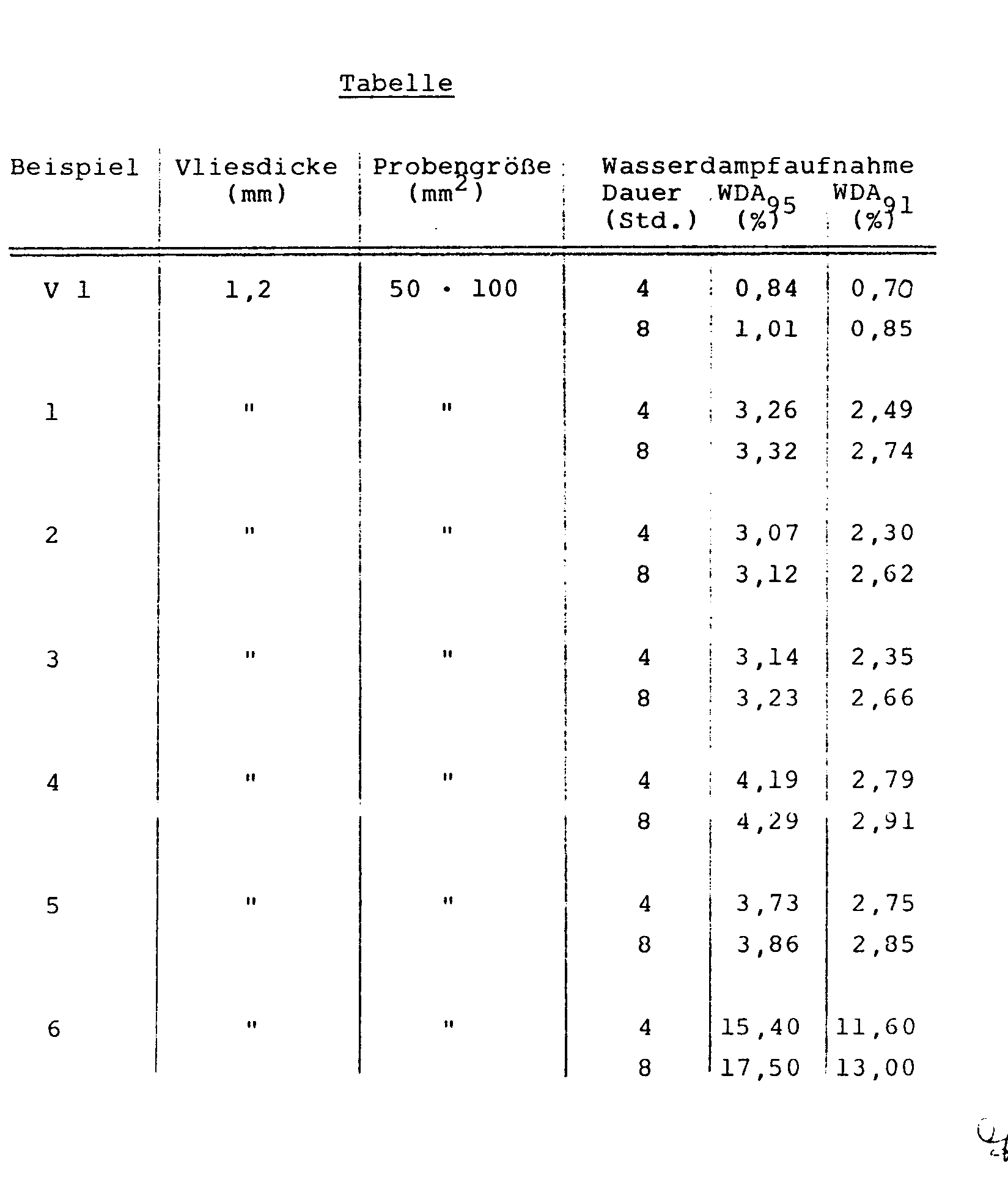
- bonded nonwovens of Examples 1 to 6 are compared in their water vapor absorption capacity with a bonded nonwoven (100% polyester fibers, 1.7 dtex, 40 mm long) which contains no modified cellulose hydrate fibers (Comparative Example V1).
- WDA 95 means that the sample is exposed to a relative humidity of 95% at a temperature of 23 ° C starting from a relative humidity of 50% for a certain period (4 or 8 hours).
- WDA 91 then means a relative humidity accordingly of 91%.
Landscapes
- Engineering & Computer Science (AREA)
- Textile Engineering (AREA)
- Chemical & Material Sciences (AREA)
- Chemical Kinetics & Catalysis (AREA)
- Nonwoven Fabrics (AREA)
- Treatments For Attaching Organic Compounds To Fibrous Goods (AREA)
- Chemical Or Physical Treatment Of Fibers (AREA)
- Artificial Filaments (AREA)
Abstract
Die Erfindung betrifft die Verwendung von Fasern aus durch mindestens eine organische, polymere Verbindung modifiziertem Cellulosehydrat bei der Herstellung von wasserdampfaufnahmefähigen gebundenen Faservliesen allein oder im Gemisch mit synthetischen, natürlichen oder regenerierten Fasern. Das Modifizierungsmittel wird zweckmässig der Viskose oder einer damit vergleichbaren Stufe vor der Formgebung zur Faser zugesetzt und ist insbesondere ein Polysaccharid, ein Polysaccharidderivat oder ein Acryl- oder Methacrylpolymeres. Die Erfindung betrifft auch ein derart erzeugtes wasserdampfaufnahmefähiges gebundenes Faservlies.
Description
- Die Erfindung betrifft die Verwendung von Fasern aus modifiziertem Cellulosehydrat bei der Herstellung von wasserdampfaufnahmefähigen gebundenen Faservliesen und derart hergestellte Produkte.
- Gebundene Faservliese, d. h. durch chemische Bindemittel gebundene Faservliese, sind für verschiedene technische Anwendungsgebiete von Interesse, dazu zählen ihre substituierenden Anwendungen vor allem für Leder oder bestimmte Textilien auf deren Anwendungsgebieten, z. B. für Schuhe, (Schuhobermaterial, Futter, Sohlen), Täschnerwaren, Polsterbezüge, Oberbekleidung ("Leder-" und Allwetterkleidung) oder für Textilien bzw. Haushaltshilfsmittel (Tischdecken, Fenster-"Leder", Wischtücher), aber auch ihre kombinierten oder ergänzenden Anwendungen mit den auf diesen Gebieten außer den Vliesen verwendbaren Materialien wie Leder oder Textilien. Der Einsatz von gebundenen Vliesen auf diesen Gebieten ist seit längerer Zeit bekannt.
- Die Herstellung von Fasern aus modifiziertem Cellulosehydrat ist an sich bekannt, beispielsweise aus:
- - der DE-OS 26 38 654, in der beschrieben wird, daß man aus Cellulose-xanthogenat durch Auflösen in wäßriger Natronlauge und Reifenlassen der Lösung eine viskose
- Spinnlösung herstellt, der Spinnlösung 5 bis 20 Gew.-% wasserlösliche Natrium-carboxymethylcellulose zusetzt, diese derart modifizierte Spinnlösung in ein saures Spinnbad spinnt und abschließend die entstandenen Fäden reinigt, gegebenenfalls teilvernetzt und trocknet;
- - der DE-OS 26 34 994, in der eine Cellulosefaser mit eingelagertem Acrylpolymerisat beschrieben wird, die dadurch hergestellt wird, daß die Cellulosefaser aus einer Viskoselösung, in die in einer Menge von 2 bis 30 Gew.-%, bezogen auf die Cellulose, ein Copolymerisat aus Acrylsäure und Methacrylsäure eingemischt ist, regeneriert wird;
- - der DE-AS 23 24 589, in der eine trockene alkalische Mischfaser beschrieben wird, die so hergestellt wird, daß man eine überwiegende Menge einer faserbildenden Viskose mit dem Alkalisalz einer Polyacrylsäure mischt, die Mischung zu Fasern verformt, die Fasern koaguliert und regeneriert und die Fasern in alkalischem Zustand trocknet (siehe auch FR-OS 22 16 387),
- - der US-PS 4 063 558, in der Fasern aus einer Matrix aus regenerierter Cellulose beschrieben werden, die ein Alkalimetallsalz der Alginsäure in feiner Verteilung innerhalb dieser Matrix enthalten.
- Der Erfindung liegt die Aufgabe zugrunde, eine Verwendung derartig modifizierter Cellulosehydratfasern vorzuschlagen, in der diese ihre charakteristischen Eigenschaften zur Geltung bringen können. Diese Aufgabe wird erfindungsgemäß gelöst durch die Verwendung von Fasern aus durch eine organische, polymere Verbindung modifiziertem Cellulosehydrat bei der Herstellung von wasserdampfaufnahmefähigen gebundenen Faservliesen allein oder im Gemisch mit synthetischen, natürlichen oder regenerierten Fasern.
- Zur Herstellung von wasserdampfaufnahmefähigen gebundenen Faservliesen wird auf die DE-OS 27 10 874 verwiesen. Als Methoden zur Vliesherstellung seien Krempelvliese, auf pneumatischem Wege gewonnene Vliese, Spinnvliese oder Vliese, die auf nassem Wege z. B. in einer Papiermaschine hergestellt werden, genannt. Der Basisbestandteil der erfindungsgemäßen Vliese können synthetische, natürliche oder regenerierte Fasern sein, insbesondere aus Polyester, Polyamid, Polyacrylnitril, Polyvinylchlorid, -acetat, -alkohol, Baumwolle, Zellwolle, Kollagen, regenerierter Cellulose, Polyurethan oder deren Mischungen. Zu diesen Fasern werden vor oder während der Vliesherstellung die Fasern aus modifiziertem Cellulosehydrat zugesetzt und darin gleichmäßig eingearbeitet. Es besteht auch die Möglichkeit einer alleinigen Verwendung der Fasern aus modifiziertem Cellulosehydrat bei der Vliesherstellung. Das Binden der Fasern oder des Fasergemisches kann dann beispielsweise durch Tauch-Imprägnierung oder durch Behandlung auf einer Matrix ausgeführt werden. Als Bindemittel werden meist Syntheselatex, Polyurethan oder Polyurethanvorstufen oder Polyacrylate verwendet. Genauere Einzelheiten siehe in der eingangs erwähnten DE-OS 27 10 874.
- Als Fasern für die erfindungsgemäße Verwendung kommen insbesondere solche in Frage, bei denen bei ihrer Herstellung das Modifizierungsmittel der Viskose oder einer damit vergleichbaren Stufe vor der Formgebung (der Regenerierung) zur Faser zugesetzt wird. Dieses Modifizierungsmittel wird, sofern es wasserlöslich und alkalilöslich ist, erst kurz vor der Spinndüse zugemischt oder, sofern es wasser- und alkaliunlöslich ist, bereits vor der Xanthogenierung der Cellulose. Als Modifizierungsmittel kommen vorzugsweise zum Einsatz: organische Polymere wie wasser- und/oder alkalilösliche oder wasser- und/oder alkaliunlösliche natürliche oder synthetische Polysaccharide oder Polysaccharidderivate auf der Basis von Stärke, Cellulose, Guar, Alginsäure und Alginaten, Galactomannanen, Arabinogalactanen oder Pectinen (siehe beispielsweise A.A.Lawrence "Edible Gums and Related Substances", Noyes Data Corp., Park Ridge / New Jersey, 1973), insbesondere sind dies Celluloseether wie CMC, HEC, MC, EC oder deren Mischether, entsprechende Stärke- oder Guarether und Alginate; Acrylpolymere, Methacrylpolymere oder deren Mischpolymere, insbesondere Polyacrylsäure, Polymethacrylsäure, teilhydrolysierte Polyacrylamide, teilhydrolysierte Polyacrylnitrile oder die entsprechenden Salzformen.
- Sollen die erfindungsgemäßen gebundenen Vliese insbesondere auf den Anwendungsgebieten im Bereich der Schuhindustrie, beispielsweise als Trägermaterial für synthetische Oberleder eingesetzt werden, so kann die Beschichtung in einem Arbeitsgang mit dem Binden des Vlieses vorgenommen werden - insbesondere nach dem weiter oben beschriebenen Verfahren des Aufbringens des Beschichtungs- und/oder Bindemittels auf eine Matrix - oder aber durch Beschichtung des bereits gebundenen Vlieses; diese Beschichtungsverfahren sind allgemein bekannt und werden beispielsweise im Kunststoffhandbuch, Band VII, "Polyurethane", von R. Vieweg und A. Höchtlen, Carl Hanser Verlag, München (1966) oder Band II (Teile 1 und 2), "Polyvinylchlorid", von K. Krekeler und G. Wick, Carl Hanser Verlag, München (1963) beschrieben.
- Die erfindungsgemäßen Vliese weisen eine gute Fähigkeit zur Wasserdampfaufnahme und zur -durchlässigkeit auf, die über einen reinen Transporteffekt der eingearbeiteten Fasern aus modifiziertem Cellulosehydrat hinausgeht. Darüber hinaus sind die Vliese auch dazu in der Lage, den aufgenommenen Wasserdampf unter bestimmten Bedingungen, beispielsweise Aufenthalt in einem andersartigen Klima, wieder abzugeben.
- Da die genannten Eigenschaften der gebundenen Vliese nicht allein auf dem signifikant nachweisbaren Effekt durch den Zusatz der Fasern aus modifiziertem Cellulosehydrat beruhen, sondern u. a. auch von der Stärke der Vliese abhängig sind, werden diese zweckmäßig in einer Stärke von etwa 0,1 bis 5 mm hergestellt oder auf diese Stärke gespalten.
- Die erfindungsgemäßen gebundenen Vliese mit den genannten Eigenschaften sind beispielsweise als selbsttragendes Vlies (z. B. als Schuhfutter, Einlegesohle) oder als Träger für Beschichtungen mit synthetischen Materialien zur Verwendung als Schuhobermaterial, Polsterbezüge, Täschnerwaren und Oberbekleidung ("Leder"- und Allwetterkleidung) geeignet, insbesondere als Träger für Beschichtungen zu einem Syntheseleder.
- Unter den in den folgenden Beispielen zur Charakterisierung der erfindungsgemäßen Vliese verwendeten Parametern ist folgendes zu verstehen:
- WDA Die Wasserdampfaufnahme wird über den Gewichtsverlust einer unter den Bedingungen nach DIN 53 304 (Ausgabe vom Mai 1968) bei 102° C ± 2° C bis zur Gewichtskonstanz getrockneten Probe, bezogen auf das ursprüngliche Gewicht, ermittelt. Dabei wird zunächst die Probe im Anlieferungszustand sofort nach Entnahme aus einem wasserdampfdichten Behälter auf 0,001 g genau gewogen. Die Probestücke werden dann im Wärmeschrank hängend bei 102° C ± 2° C während 15 h getrocknet und nach dem Abkühlen auf Raumtemperatur ebenfalls auf 0,001 g genau gewogen. Um die Wasserdampfaufnahmefähigkeit von Proben unter verschiedenen Bedingungen ausprüfen zu können, werden die jeweiligen Proben in verschiedene Klimata gehängt und nach bestimmten Zeiten werden die Proben entnommen und dann deren Wasserdampfaufnahme in Gew.-%, bezogen auf ihr Anfangsgewicht zu Beginn der jeweiligen Messung, ermittelt.
- Die Prozentangaben sind als Gew.-% zu verstehen.
- Es werden 80 g des Na-Salzes der Polyacrylsäure in 1 ltr. einer 5 %igen wäßrigen NaOH-Lösung gelöst und vor der Spinndüse über eine Dosierpumpe in die Viskose enthaltende Leitung einer Cellulosehydratfaser-Herstellungsanlage gegeben. Die derart modifizierte Viskose wird wie üblich versponnen,
- weiterbehandelt und konfektioniert. Die Gewichtsteile Cellulosehydrat zu Na-Salz der Polyacrylsäure verhalten sich wie 2,33 zu 1.
- Von diesen modifizierten Cellulosehydratfasern (3,6 dtex, 30 mm lang) werden 15 % mit 85 % einer Polyesterfaser (1,7 dtex, 40 mm lang) gewolft und über eine Mischkammer gegeben, das Gemisch wird abschließend gekrempelt, genadelt und das entstandene Vlies mit einer Perbunan-Latex so gebunden, daß der Binderanteil im gebundenen Vlies etwa 50 % beträgt.
- Es wird nach den Angaben des Beispiels 1 verfahren, aber mit 90 g eines teilverseiften Polyacrylnitrils als Modifizierungsmittel und bei einem Gewichtsverhältnis von Cellulosehydrat zu Modifizierungsmittel wie 7,33 zu 1.
- Es wird nach den Angaben des Beispiels 1 verfahren, aber mit 100 g des Na-Salzes der Carboxymethylcellulose als Modifizierungsmittel und bei einem Gewichtsverhältnis von Cellulosehydrat zu Modifizierungsmittel wie 3,17 zu 1.
- Es wird nach den Angaben des Beispiels 1 verfahren, aber mit 25 % der modifizierten Cellulosehydratfasern und 75 % der Polyesterfasern.
- Es wird nach den Angaben des Beispiels 2 verfahren, aber mit 25 % der modifizierten Cellulosehydratfasern und 75 % der Polyesterfasern.
- Die nach den Angaben des Beispiels 1 hergestellten modifizierten Cellulosehydratfasern werden ohne vorherige Abmischung mit einer unmodifizierten Faser gebunden.
- In der folgenden Tabelle werden die gebundenen Vliese der Beispiele 1 bis 6 in ihrer Wasserdampfaufnahmefähigkeit mit einem gebundenen Vlies (100 % Polyesterfasern, 1,7 dtex, 40 mm lang) verglichen, das keine modifizierten Cellulosehydratfasern (Vergleichsbeispiel V 1) enthält. WDA95 bedeutet, daß die Probe bei einer Temperatur von 23° C ausgehend von einer relativen Feuchte von 50 % über einen bestimmten Zeitraum (4 oder 8 Std.) einer relativen Feuchte von 95 % ausgesetzt wird, WDA91 bedeutet dann entsprechend eine relative Feuchte von 91 %.
-
Claims (6)
1. Verwendung von Fasern aus durch mindestens eine organische, polymere Verbindung modifiziertem Cellulosehydrat bei der Herstellung von wasserdampfaufnahmefähigen gebundenen Faservliesen allein oder im Gemisch mit synthetischen, natürlichen oder regenerierten Fasern.
2. Verwendung nach Anspruch 1, dadurch gekennzeichnet, daß bei der Herstellung der Fasern aus modifiziertem Cellulosehydrat das Modifizierungsmittel der Viskose oder einer damit vergleichbaren Stufe vor der Formgebung zur Faser zugesetzt wird.
3. Verwendung nach Anspruch 2, dadurch gekennzeichnet, daß das Modifizierungsmittel ein Polysaccharid, ein Polysaccharidderivat Jder ein Acryl- oder Mecthacrylpoiymeres ist.
4. Verwendung nach Anspruch 3, dadurch gekennzeichnet, daß das Modifizierungsmittel ein Cellulose-, Stärke- oder Guarether oder ein Alginat ist.
5. Verwendung nach Anspruch 3, dadurch gekennzeichnet, daß das Modifizierungsmittel Polyacrylsäure, Polymethacrylsäure, ein teilhydrolysiertes Polyacrylamid, ein teilhydrolysiertes Polyacrylnitril oder eine entsprechende Salzform ist.
6. Wasserdampfaufnahmefähiges gebundenes Faservlies enthaltend Fasern aus durch mindestens eine organische, polymere Verbindung modifiziertem Cellulosehydrat allein oder im Gemisch mit synthetischen, natürlichen oder regenerierten Fasern.
Applications Claiming Priority (2)
| Application Number | Priority Date | Filing Date | Title |
|---|---|---|---|
| DE19782827804 DE2827804A1 (de) | 1978-06-24 | 1978-06-24 | Verwendung von modifizierten cellulosehydratfasern fuer gebundene faservliese |
| DE2827804 | 1978-06-24 |
Publications (1)
| Publication Number | Publication Date |
|---|---|
| EP0006552A1 true EP0006552A1 (de) | 1980-01-09 |
Family
ID=6042668
Family Applications (1)
| Application Number | Title | Priority Date | Filing Date |
|---|---|---|---|
| EP79101964A Withdrawn EP0006552A1 (de) | 1978-06-24 | 1979-06-15 | Verwendung von modifizierten Cellulosehydratfasern bei der Herstellung gebundener Faservliese und derart hergestellte Produkte |
Country Status (8)
| Country | Link |
|---|---|
| US (1) | US4336299A (de) |
| EP (1) | EP0006552A1 (de) |
| JP (1) | JPS556590A (de) |
| CS (1) | CS212323B2 (de) |
| DD (1) | DD144428A5 (de) |
| DE (1) | DE2827804A1 (de) |
| PL (1) | PL119457B1 (de) |
| SU (1) | SU841599A3 (de) |
Families Citing this family (6)
| Publication number | Priority date | Publication date | Assignee | Title |
|---|---|---|---|---|
| DE3630937A1 (de) * | 1986-09-11 | 1988-03-24 | Rehau Ag & Co | Verwendung von natuerlichen cellulosefasern als beimischung zu polyvinylchlorid |
| US5266250A (en) * | 1990-05-09 | 1993-11-30 | Kroyer K K K | Method of modifying cellulosic wood fibers and using said fibers for producing fibrous products |
| JP3170366B2 (ja) * | 1992-11-09 | 2001-05-28 | カネボウ株式会社 | 鮮度保持シート |
| US5688923A (en) * | 1996-02-15 | 1997-11-18 | Hercules Incorporated | Pectin fibers |
| US6146655A (en) * | 1997-08-29 | 2000-11-14 | Softy-Flex Inc. | Flexible intra-oral bandage and drug delivery system |
| US6689242B2 (en) | 2001-03-26 | 2004-02-10 | First Quality Nonwovens, Inc. | Acquisition/distribution layer and method of making same |
Citations (1)
| Publication number | Priority date | Publication date | Assignee | Title |
|---|---|---|---|---|
| FR2383257A1 (fr) * | 1977-03-12 | 1978-10-06 | Hoechst Ag | Nappe de fibres liee absorbant la vapeur d'eau |
Family Cites Families (8)
| Publication number | Priority date | Publication date | Assignee | Title |
|---|---|---|---|---|
| JPS491241B1 (de) * | 1969-10-24 | 1974-01-12 | ||
| US3844287A (en) * | 1972-06-05 | 1974-10-29 | Fmc Corp | Absorbent mass of alloy fibers of regenerated cellulose and polyacrylic acid salt of alkali-metals or ammonium |
| US4136697A (en) * | 1972-11-24 | 1979-01-30 | Avtex Fibers Inc. | Fibers of high fluid-holding capacity |
| US3872196A (en) * | 1972-12-04 | 1975-03-18 | Tee Pak Inc | Process for plasticizing and partially drying tubular film casings for edible products |
| US4066584A (en) * | 1975-08-11 | 1978-01-03 | Akzona Incorporated | Alloy fibers of rayon and copolymers of acrylic and methacrylic acids |
| US4063558A (en) * | 1975-11-07 | 1977-12-20 | Avtex Fibers Inc. | Article and method for making high fluid-holding fiber mass |
| US4104214A (en) * | 1976-12-01 | 1978-08-01 | Akzona Incorporated | Fluid absorbent cellulose fibers containing alkaline salts of polymers of acrylic acid, methacrylic acid or an acryloamidoalkane sulfonic acid with aliphatic esters of acrylic acid or methacrylic acid |
| US4169121A (en) * | 1977-09-09 | 1979-09-25 | Helmut Pietsch | Absorbent material for aqueous physiological fluids and process for its production |
-
1978
- 1978-06-24 DE DE19782827804 patent/DE2827804A1/de not_active Withdrawn
-
1979
- 1979-06-15 EP EP79101964A patent/EP0006552A1/de not_active Withdrawn
- 1979-06-20 US US06/050,148 patent/US4336299A/en not_active Expired - Lifetime
- 1979-06-21 DD DD79213812A patent/DD144428A5/de unknown
- 1979-06-21 CS CS794287A patent/CS212323B2/cs unknown
- 1979-06-21 SU SU792788602A patent/SU841599A3/ru active
- 1979-06-22 JP JP7823279A patent/JPS556590A/ja active Pending
- 1979-06-23 PL PL1979216554A patent/PL119457B1/pl unknown
Patent Citations (1)
| Publication number | Priority date | Publication date | Assignee | Title |
|---|---|---|---|---|
| FR2383257A1 (fr) * | 1977-03-12 | 1978-10-06 | Hoechst Ag | Nappe de fibres liee absorbant la vapeur d'eau |
Also Published As
| Publication number | Publication date |
|---|---|
| SU841599A3 (ru) | 1981-06-23 |
| DD144428A5 (de) | 1980-10-15 |
| PL216554A1 (de) | 1980-03-10 |
| DE2827804A1 (de) | 1980-01-10 |
| CS212323B2 (en) | 1982-03-26 |
| US4336299A (en) | 1982-06-22 |
| JPS556590A (en) | 1980-01-18 |
| PL119457B1 (en) | 1982-01-30 |
Similar Documents
| Publication | Publication Date | Title |
|---|---|---|
| DE2710874A1 (de) | Wasserdampfaufnahmefaehiges gebundenes faservlies | |
| DE3020611C2 (de) | Verfahren zur Herstellung von Kollagenmaterial für chirurgische Zwecke | |
| AU667068B2 (en) | Cellulosic fibres | |
| WO2003018166A1 (de) | Verfahren zur entfernung von schwermetallen aus schwermetallhaltigen medien unter verwendung eines lyocell-formkörpers sowie cellulosischer formkörper mit adsorbierten schwermetallen und deren verwendung | |
| DD144062A5 (de) | Verfahren und vorrichtung zur herstellung von quellfaehiger,vernetzter carboxyalkylcellulose | |
| WO2014201484A1 (de) | Hochsaugfähige polysaccharidfaser und ihre verwendung | |
| TW201330880A (zh) | 具有疏水性和高柔軟度之纖維素纖維及其製造方法 | |
| DE2324589B2 (de) | Trockene alkalische mischfaser, verfahren zu ihrer herstellung und deren verwendung zur herstellung einer hochsaugfaehigen masse | |
| DE2823757C2 (de) | Verfahren zur Herstellung von quellfähigen Fasern oder quellfähigen textilen Flächengebilden | |
| JP2003089924A (ja) | アクリル系複合繊維及びその製造方法ならびに同繊維を使った繊維複合体 | |
| EP0047962B1 (de) | Verfahren zur Herstellung von quellfähigen Fäden, Fasern und geformten Gebilden aus Acrylpolymeren sowie die dabei erhaltenen Produkte | |
| EP0006552A1 (de) | Verwendung von modifizierten Cellulosehydratfasern bei der Herstellung gebundener Faservliese und derart hergestellte Produkte | |
| WO2021023594A1 (de) | Verfahren zur herstellung von lyocell-stapelfasern | |
| DD144063A5 (de) | Verfahren zur herstellung von quellfaehiger,vernetzter carboxyalkylcellulose in faserform | |
| AT413824B (de) | Verfahren zur behandlung von lösungsmittelgesponnenen cellulosischen fasern | |
| Reid et al. | The Preparation and Properties of Alkali-Soluble Metal Carboxymethylcellulose Fibers | |
| CA1112824A (en) | Alloy rayon (cmc) | |
| SU896119A1 (ru) | Состав дл огнезащитной обработки текстильных материалов | |
| DE1947142A1 (de) | Textiles Flaechengebilde und Verfahren zu dessen Herstellung | |
| DE1119816B (de) | Verfahren zur Herstellung von Vliesstoffen | |
| EP0054573B1 (de) | Verfahren zum Verfestigen von Fasergebilden mit Kunststoffdispersionen | |
| AT371161B (de) | Verwendung von neuen kondensierten polymeren phosphazenen zum flammfestausruesten von textilgut aus regenerierter cellulose | |
| DE320177C (de) | Verfahren zum Feuersichermachen von Baumwollwaren und anderen leicht brennbaren Stoffen durch Abscheidung unloeslicher Metallhydroxyde auf der Faser | |
| DE1932007A1 (de) | Flammfestmachendes Mittel | |
| CN116837533A (zh) | 一种含植物提取物的多功能粘胶纤维被的制备方法 |
Legal Events
| Date | Code | Title | Description |
|---|---|---|---|
| PUAI | Public reference made under article 153(3) epc to a published international application that has entered the european phase |
Free format text: ORIGINAL CODE: 0009012 |
|
| AK | Designated contracting states |
Designated state(s): AT DE FR GB IT NL |
|
| 17P | Request for examination filed | ||
| STAA | Information on the status of an ep patent application or granted ep patent |
Free format text: STATUS: THE APPLICATION HAS BEEN WITHDRAWN |
|
| 18W | Application withdrawn |
Withdrawal date: 19811222 |
|
| RIN1 | Information on inventor provided before grant (corrected) |
Inventor name: MAYER, REINHART Inventor name: FISCHER, WILHELM, DR. Inventor name: HOLST, ARNO, DR. |