EP0007248A2 - Vorrichtung und Verfahren zur Klassifizierung von leeren Getränkebehältern - Google Patents
Vorrichtung und Verfahren zur Klassifizierung von leeren Getränkebehältern Download PDFInfo
- Publication number
- EP0007248A2 EP0007248A2 EP79301419A EP79301419A EP0007248A2 EP 0007248 A2 EP0007248 A2 EP 0007248A2 EP 79301419 A EP79301419 A EP 79301419A EP 79301419 A EP79301419 A EP 79301419A EP 0007248 A2 EP0007248 A2 EP 0007248A2
- Authority
- EP
- European Patent Office
- Prior art keywords
- signal
- cartons
- containers
- generating
- count
- Prior art date
- Legal status (The legal status is an assumption and is not a legal conclusion. Google has not performed a legal analysis and makes no representation as to the accuracy of the status listed.)
- Granted
Links
Images



Classifications
-
- G—PHYSICS
- G07—CHECKING-DEVICES
- G07F—COIN-FREED OR LIKE APPARATUS
- G07F7/00—Mechanisms actuated by objects other than coins to free or to actuate vending, hiring, coin or paper currency dispensing or refunding apparatus
- G07F7/06—Mechanisms actuated by objects other than coins to free or to actuate vending, hiring, coin or paper currency dispensing or refunding apparatus by returnable containers, i.e. reverse vending systems in which a user is rewarded for returning a container that serves as a token of value, e.g. bottles
- G07F7/0609—Mechanisms actuated by objects other than coins to free or to actuate vending, hiring, coin or paper currency dispensing or refunding apparatus by returnable containers, i.e. reverse vending systems in which a user is rewarded for returning a container that serves as a token of value, e.g. bottles by fluid containers, e.g. bottles, cups, gas containers
-
- B—PERFORMING OPERATIONS; TRANSPORTING
- B07—SEPARATING SOLIDS FROM SOLIDS; SORTING
- B07C—POSTAL SORTING; SORTING INDIVIDUAL ARTICLES, OR BULK MATERIAL FIT TO BE SORTED PIECE-MEAL, e.g. BY PICKING
- B07C5/00—Sorting according to a characteristic or feature of the articles or material being sorted, e.g. by control effected by devices which detect or measure such characteristic or feature; Sorting by manually actuated devices, e.g. switches
- B07C5/04—Sorting according to size
- B07C5/12—Sorting according to size characterised by the application to particular articles, not otherwise provided for
- B07C5/122—Sorting according to size characterised by the application to particular articles, not otherwise provided for for bottles, ampoules, jars and other glassware
- B07C5/126—Sorting according to size characterised by the application to particular articles, not otherwise provided for for bottles, ampoules, jars and other glassware by means of photo-electric sensors, e.g. according to colour
-
- B—PERFORMING OPERATIONS; TRANSPORTING
- B65—CONVEYING; PACKING; STORING; HANDLING THIN OR FILAMENTARY MATERIAL
- B65G—TRANSPORT OR STORAGE DEVICES, e.g. CONVEYORS FOR LOADING OR TIPPING, SHOP CONVEYOR SYSTEMS OR PNEUMATIC TUBE CONVEYORS
- B65G2201/00—Indexing codes relating to handling devices, e.g. conveyors, characterised by the type of product or load being conveyed or handled
- B65G2201/02—Articles
- B65G2201/0235—Containers
- B65G2201/0244—Bottles
Definitions
- This invention relates to systems for receiving and evaluating empty beverage containers of a type known in the trade as returnable. These are containers, usually glass bottles, for which the beverage purchaser is charged a deposit fee at the time of purchase. When the purchaser returns the empty container to a designated redemption centre, the deposit fee is refunded. Most beverage sales outlets also operate redemption centres, and the operation of these centres is usually a troublesome matter which takes clerks away from other more profitable tasks.
- Beverages are commonly sold in containers of many different sizes, and in cartons containing groups of six or eight such containers.
- the customer may return the containers either individually or in cartons and may mix different types of containers in a single carton. It is the task of the redemption centre clerk to sort or classify the containers in accordance with their deposit values and to calculate the refund which is due.
- the clerk may make an actual refund or may give the customer a refund slip which can be redeemed at another location. This operation is so unprofitable that many supermarkets simply operate on an honor system, whereby customers stack their empties at a receiving location and report the return to a checkout clerk, who makes the appropriate refund.
- An alternative to the above described redemption techniques is an automatic system such as a system of the type described in Planke U.S. Patent 3.955,179.
- This system has a pair of conveyors, one for individual empty bottles and one for cartons.
- the customer places the returned bottles and cartons on the appropriate conveyor for transportation through an illumination station.
- the containers are illuminated by a beam of collimated light, and a shadow of the containers is projected against an array of photo-detectors.
- the containers are identified by their shadows. This identification results in control signals for a logic network which computes the amount of the refund and controls the printing of a refund slip by an associated printer.
- the present invention relates to apparatus for receiving empty beverage containers and classifying them into value groups based upon observations made by a group of photocells arranged in a single vertically extending line.
- the empty containers are placed upon a conveyor, which has an attachment for generating clock signals based upon conveyor movement.
- Identification of the empty containers is made by identification means, which receive output signals from the photocells and evaluates those signals under gating control of the clock signals from the conveyor.
- a series of registration circuits within the identification means are enabled when an empty container first crosses the line of photocells, and all of the circuits begin counting conveyor clock pulses at that time.
- Each registration circuit has a gating arrangement which is enabled during a predetermined count range.
- the registration circuit transmits a registration signal to a money select circuit.
- the system provides a value count corresponding to the total value of the containers which are "registered" by the registration circuits.
- Registration circuits are provided for registering pairs of empty containers contained within cartons, so that both individual containers and cartons of containers may be received upon a common conveyor. Means are provided for separating cartons from individual bottles. Other means separate properly filled cartons from improperly filled cartons. Improperly filled cartons are returned to a point near the receiving end of the conveyor.
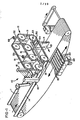
- a conveyor arrangement 10 in accordance with this invention may be constructed as schematically illustrated in Figure 1.
- the arrangement includes a conveyor belt 11, with associated driving elements, an aligning mechanism as indicated generally at 15, and a paddle arrangement as indicated generally at 12.
- the co-operating operation of conveyor belt 11, peddle arrangement 12, and aligning mechanism 15 can best be understood by reference to Figure 2.
- Movement of belt 11 is initiated by pushing a start button on a control panel (not illustrated).
- a customer who whishes to obtain a refund for empty beverage containers pushes the start button and thereafter loads individual empty containers 23 and cartons of empty containers 24 upon belt 11. Loading is performed at a receiving station, which is separated from the major portions of conveyor 10 by a wall 25.
- a ratchet arrangement causes arm 27 to oscillate back and forth as illustrated generally by the arrow 28, and this urges the aontainers and cartons sidewardly against sideboard 14.
- Sideboard 14 has a friction surface, which retards forward movement of the containers and cartons. The containers and cartons are trapped against sideboard 14 and behind arm 27 until released by outward movement of the arm.
- a blade 29 is pivotally attached to arm 27 and is urged against the cartons and containers by a spring mechanism 30. This produces seperation between the cartons and containers in the direction of belt movement.
- the containers and cartons After movement past sligaing mechanism 15, the containers and cartons pass a series of microswitches (not illustrated), which are positioned so as to be actuated only by cartons.
- Illuminating spparatus 16 generates a series of illuminating beams 17, which are directed angularly with respect to the direction transverse to the direction of conveyor movement.
- the angle between the beam direction and the transverse direction is preferably in the order of about 18 degrees, so that the identification circuits can recognize pairs of containers within a carton.
- Each beam 17 is directed toward an individual photocell 31 ( Figure 3), and the beams are preferably beans of collimated infrared light produced by TIL 31 infrared light sources and collimating lenses.
- each bean 17 has a diameter in the order of about one-quarter inch.
- Paddle arrangement 12 After passage through the illuminating station the containers and cartons pass under psddle arrangement 12.
- Paddle arrangement 12 includes a series of paddles 13, which may be actuated to move in the direction indicated by the arrow 21. Paddle arrangement 12 is actuated whenever a carton 24 is positioned thereunder. As mentioned previously, the system is conditioned by a series of switches to discriminate between cartons and individual containers. Thus peddle arrangement 12 is never actuated during passage of an individual container thereunder, so that individual containers are carried along to a bottle storage area.
- paddle arrangement 12 When paddle arrangement 12 is actuated, a paddle 13 is brought into contact with the side of a carton, and the carton is pushed transversely onto a separating station 19.
- Paddles 13 swing freely in ferris wheel fashion on chains 51, but during the lower quadrant of their movement, they are held rigidly downward by arms 52 which include a roller 53 for bearing against a track 54. This enables the paddles to push sidewardly against cartons.
- Separating station 19 comprises a series of rollers 20, which are driven either forwardly or reversely by a drive motor 22. If the system recognizes the carton as being properly loaded, then drive motor 22 drives rollers forwardly, and the carton is accepted. If the carton is improperly loaded with bottles of different size or has empty cells, then motor 22 drives rollers 22 reversely, and the carton is rejected.
- each photocell 31 has an output line 32, which transmits an electrical signal corresponding to light and dark conditions at the photocell.
- the illustrated photocell 31a may be the first photocell to sense the presence of the container 23. This causes a transition in the output signal from line 32a as indicated at 33.
- a second photocell 31b has a light to dark transition somewhat later in time, followed at a still later time by a dark to light transition, both transitions being indicated by the output signal on line 32b.
- Lines 32 are connected through a series of gates to different ones of a plurality of registration circuits.
- one such registration circuit is connected to lines 32a and 32b and is configured in such a manner as to generate a registration pulse if the transition 34 occurs after time t 1 and before time t 2 .
- the tine period between t 1 and t 2 is established by counting a series of clock pulses 35 generated by an encoder 36 arranged for viewing an optical disc 37 mounted on the drive motor 38. Output pulses from encoder 36 are carried by line 39.
- clock pulses 35 occur in synchronism with the actual physical movement of container 23.
- such an encoding arrangenent may generate a new clock pulse 35 each time container 23 moves a distance of 0.01 inches.
- the registration circuitry responds to beverage containers having a particular horizontal dimension within some predetermined dimensional range.
- a particular registration circuit may be configured for recognizing bottles having an illustrated dimension X equal to 2.5 inches. A bottle meeting this criterion would cause the transition 34 to occur on line 32b at a point in time determined by counting 250 of the clock pulses 35.
- a registration "window" of perhaps 20 clock pulses might be employed. This would cause generation of a registration signal for bottles having a dimension X ranging between 2.4 inches and 2.6 inches. It is apparent that a system constructed in accordance with this invention could be made to recognize a great many different registration conditions.
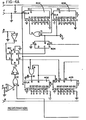
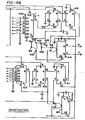
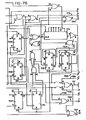
- FIG. 4A, 4B, 5A, 5B, 6A, 6B, 7A, and 7B Electrical circuitry for controlling the apparatus of Figures 1 and 2 and generating container value signals is illustrated in Figures 4A, 4B, 5A, 5B, 6A, 6B, 7A, and 7B.
- the apparatus utilizes fairly conventional power supplies, display controls, transmission lines, clock eignal generators, photosensor drivers, and amplifiers.
- Table 1 lists circuit types for integrated circuits illustrated in the detailed electrical schematics presented herein.
- Figures 4A and 4B illustrate the registration circuitry, which generates the above mentioned registration pulses.
- the circuitry of Figures 4A and 4B generates a registration signal for a container having particular dimension within some predetermined range or for different containers having the specified dimension within that range.
- empty containers can be grouped in groups having some common dimensional characteristic within a relatively small dimensional range and a common refund value.
- the circuitry of Figures 4A and 4B would generate a registration signal for all such containers, and this registration signal would appear at output terminals 6 and 7 of integrated circuit 413.
- Containers having a different common dimensional characteristic are identified by registration circuitry similar to the circuitry of Figures 4A and 4B but programmed in a different manner as hereinafter described.
- Additional registration circuits are provided for recognizing pairs of containers positioned within cartons. For such pairs of containers the recognition count begins at the leading edge of one container and terminates at the trailing edge of the other container. This type of recognition or registration is performed by observing those portions of the container pairs which extend upwardly above the sides of the carton.
- Conveyor clock pulses 35 are received at terminal J of the registration circuitry and are applied to the clock terminals of counters 402 and 403. Counting of such clock pulses is enabled by a signal at terminal B, and this signal may be the transition 33 appearing on line 32a as described above with reference to Figure 3.
- the signal level at terminal C also controls conveyor clock counting. Terminal C is connected to that one of photocells 31 which is located at a height immediately over the top of the container. The photocell which is connected to terminal C must be illuminated to order for counting to be enabled.
- counter 402 is connected to a counter 405 in serial fashion, so that an output appears at terminal 10 of counter 405 after a predertermined number of conveyor clock pulses have been counted.
- This count which takes place during a time period t l as illustrated in Figure 3, is controlled by presetting the counting control terminals of counters 402 and 405.
- flip-flop 411 While clock 407 is counting, input terminal 5 of flip-flop 411 is HI, so that the flip-flop is conditioned to respond to a signal transition, such as the transition 34, appearing on input terminal H. If the signal transition occurs at terminal H during the registration window, then flip-flop 411 is triggered to produce an output for application to gate portion 416 of integrated circuit 413. Integrated circuit 413 produces registration output signals on its N and P terminals.
- terminals 421 through 426 are provided for added counting flexibility.
- a jumper is attached between terminals 421 and 423, and another jumper is attached between terminals 425 and 426.
- Different jumper connections may be made in order to enable registration on the basis of photocell transitions appearing at both of terminals D and H.
- counters 403, 406 and 408 are utilized. These counters work in a manner similar to counters 402, 405, and 407 for controlling flip-flops 410 and 412.
- a sequential count registration condition can be made by placing a jumper between terminals 421 and 423 and another jumper between terminals 424 and 426.
- the money select circuitry When registration signals are generated by the registration circuitry, they are applied to input terminals for money select circuitry as illustrated in Figures 6A and 6B. Connections to this circuitry in general depend upon the types of containers expected. For instance, in a market area wherein there are only 10 cent bottles and 20 cent bottles to be received, the money select circuitry may be connected to receive registration inputs only from terminals M-1 through M-4 as illustrated. Terminal M-1 might be connected to receive registration signals from registration circuitry which recognizes individual 10 cent bottles, while terminal M-2 might be connected to receive registration signals only from circuitry which recognizes pairs of 10 cent bottles arranged side by side in cartons. Similarly, input terminals M-3 and M-4 may receive registration signals for individual 20 cent bottles and 20 cent bottle pairs respectively.
- money counts are added by integrated circuits 602 and 605 and later counted down serially through a counting chain comprising counters 607, 608 and 609.
- integrated circuits 601, 603, 604 and 606 are not utilized.
- Counting of the stored money value is initiated by a signal at line 611, which is generated by the calculation circuitry of Figures 7A and 7B and appears as an c.tput at line 715 thereof.
- the money select circuitry counts 100 KHz clock pulses appearing at line 610, and when the count- derm is completed a DONE signal appears at line 612.
- FIGS 5A and 5B illustrate the carton latch circuitry, whi:h conditions other circuitry for recognizing and handling carton registration infcrmation.
- Carton recognition information information is provided by three microswitches located on the convlyor and by the lower most of photocells 31. The three microswitches are illustrated schematically on Figure 5A as switches 508, 509 and 410.
- the input signal from the lowermost photocell is received by the carton latch circuitry on line 512.
- an output from gate 511 sets flip-flop 504.
- gate 515 is activated to permit later shutdown of the system.
- flip-flop 504 When flip-flop 504 is set, the reset output at pin 12 enables counter 505 to begin counting conveyor clock pulses 35 received on line 513.
- the output count from counter 505 is applied to a small bottle gate 516 and a large bottle gate 517.
- gate 516 When the output count from counter 505 indicates a distance equal to the maximum dimension of a pair of small bottles, then gate 516 enables another gate 518. If at that time gate 518 is also sensing a small bottle output signal from pin 2 of flip-flop 506, then flip-flop 507 is set to provide failure signals on lines 519 and 520.
- gate 517 creates large bottle failure signals through gate 521 and flip-flop 507. This enables the circuitry of Figures 5A and 5B to provide a failure signal on lines 519 and 520 if a carton is detected and one of the carton cells is empty.
- Registration signals for bottle pairs are transmitted from the registration circuits to the carton latch circuitry on lines 522 through 524, while registration circuits for small bottle pairs are connected to lines 525 through 528. Signals on lines 522 through 528 control the setting of flip-flop 506 through gate 529.
- a signal is also generated on line 531 for inhibiting latches 501 and 502 and preventing transmission of registration signals by line 530.
- the carton latch circuitry also utilizes a carton registration delay signal, which it receives on line 532 and a master clear signal, which it receives on line 514.
- the calculation circuitry of Figures 7A and 7B generally controls other circuitry, not illustrated, which operate displays, printers, coin changers, or the like.
- the output signal for controlling such peripheral equipment appears as a series of pulses on line 717.
- Line 717 transmits one pulse for each cent to be printed, indicated or displayed.
- the calculation circuitry is able to generate the correct number of pulses by counting master clock pulses (100 KHz) on line 718. The counting is carried out synchronously with the money count in the money select circuitry. As stated previously the money select count is initiated by a signal on line 715 of the calculation circuitry and terminates when counters 607 through 609 have been counted down.
- the DONE signal which appears on line 612 to signify end of count, is transmitted to the calculation-circuitry for reception by line 719.
- the calculation circuitry receives other input signals on lines 720 through 724.
- the signal on line 720 is a delayed registration signal. Whenever the system senses an individual empty container and generates a registration signal at the output of one of the registration circuits, the registration signal is also applied to delay circuitry, not illustrated. After a suitable delay in the order of about 5 microseconds, the registration signal is applied to line 720.
- Line 721 receives a carton recognition signal from line 533 of the carton latch circuit. This carton recognition signal prevents double registration when a carton is present.
- Line 722 is connected to receive carton registration pulses from line 530 of the carton latch circuit. As stated previously, these pulses represent carton bottle pairs.
- Line 723 receives a master clear LO signal from status' circuitry, not illustrated.
- the signal on line 723 goes LO 250 milliseconds after power is applied to the system.
- Line 724 receives delayed carton registration signals from delay circuitry, not illustrated. This signal is required for processing carton having a single row of tandem bottles. The bottle count for single containers is doubled in the bottle select circuitry. The signal on line 724 informs the calculation circuitry that the multiplication need not be performed, even though a carton is present. The multiplication operation is performed through interconnection between flip-flop 712 and counter 713.
- Output line 725 carries a bottle count. Line 725 transmits one pulse for each empty beverage container which is recognized by the system. If the containers are carried by a carton, line 725 tranmits one pulse for each container in the carton.
- Output lines 726 and 727 are connected to the money select circuitry of Figure 6.
- Line 726 supplies the clock signal, which is received by the money select circuitry on line 610.
- Line 727 provides a latch reset signal, which is received by the money select circuitry on line 613.
- Lines 728 through 731 are optional calculation output lines for use in computing sales tax.
- the money count division which has been referred to above, is carried out by flip-flop 709. This division provides a true return value for individual empty containers.
Landscapes
- Physics & Mathematics (AREA)
- General Physics & Mathematics (AREA)
- Sorting Of Articles (AREA)
- Making Paper Articles (AREA)
- Supplying Of Containers To The Packaging Station (AREA)
- Auxiliary Devices For And Details Of Packaging Control (AREA)
Priority Applications (1)
| Application Number | Priority Date | Filing Date | Title |
|---|---|---|---|
| AT79301419T ATE3914T1 (de) | 1978-07-17 | 1979-07-17 | Vorrichtung und verfahren zur klassifizierung von leeren getraenkebehaeltern. |
Applications Claiming Priority (4)
| Application Number | Priority Date | Filing Date | Title |
|---|---|---|---|
| US92485478A | 1978-07-17 | 1978-07-17 | |
| US924854 | 1978-07-17 | ||
| US05/924,855 US4276467A (en) | 1978-07-17 | 1978-07-17 | Apparatus for receiving empty beverage containers |
| US924855 | 1978-07-17 |
Publications (3)
| Publication Number | Publication Date |
|---|---|
| EP0007248A2 true EP0007248A2 (de) | 1980-01-23 |
| EP0007248A3 EP0007248A3 (en) | 1980-02-06 |
| EP0007248B1 EP0007248B1 (de) | 1983-06-22 |
Family
ID=27129896
Family Applications (1)
| Application Number | Title | Priority Date | Filing Date |
|---|---|---|---|
| EP79301419A Expired EP0007248B1 (de) | 1978-07-17 | 1979-07-17 | Vorrichtung und Verfahren zur Klassifizierung von leeren Getränkebehältern |
Country Status (4)
| Country | Link |
|---|---|
| EP (1) | EP0007248B1 (de) |
| DE (1) | DE2965726D1 (de) |
| ES (2) | ES482532A1 (de) |
| NO (1) | NO792325L (de) |
Cited By (8)
| Publication number | Priority date | Publication date | Assignee | Title |
|---|---|---|---|---|
| EP0020108A1 (de) * | 1979-05-25 | 1980-12-10 | The Mead Corporation | Apparat und Verfahren zur Erkennung von Behältern |
| WO1986006661A1 (en) * | 1985-05-14 | 1986-11-20 | Regionala Stiftelsen I Värmland Med Firma Erress | Apparatus for sorting cutlery |
| FR2620053A1 (fr) * | 1987-09-04 | 1989-03-10 | Maintenance Manutention Sarl | Dispositif de tri de livres et petits objets |
| FR2620054A1 (fr) * | 1987-09-07 | 1989-03-10 | Maintenance Manutention Sarl | Dispositif de tri de colis moyens " type colis postaux " |
| US5314072A (en) * | 1992-09-02 | 1994-05-24 | Rutgers, The State University | Sorting plastic bottles for recycling |
| WO2013123228A1 (en) * | 2012-02-14 | 2013-08-22 | Miyashiro Thomas H | Apparatus for counting deposit beverage containers |
| US20220300892A1 (en) * | 2021-01-25 | 2022-09-22 | Trackonomy Systems, Inc. | Method for Detecting and Tracking Groups of Assets and System Thereof |
| US12475339B2 (en) | 2020-05-25 | 2025-11-18 | Trackonomy Systems, Inc. | System and method for enhanced asset tracking and security for border protection and other applications |
Family Cites Families (6)
| Publication number | Priority date | Publication date | Assignee | Title |
|---|---|---|---|---|
| US3343638A (en) * | 1961-05-31 | 1967-09-26 | Taylor Mfg | Article receiving and storage apparatus |
| US3549890A (en) * | 1969-01-16 | 1970-12-22 | Emhart Corp | Article inspection apparatus |
| US3955179A (en) * | 1971-12-14 | 1976-05-04 | Tore Planke | Apparatus for automatic pattern recognition and registration of empty bottles |
| US3837486A (en) * | 1973-07-09 | 1974-09-24 | Emhart Corp | Article inspection system |
| SE7511591L (sv) * | 1975-10-16 | 1977-04-17 | Ab Platmanufaktur | Mottagare for artiklar placerade i lagringsorgan |
| US4120403A (en) * | 1976-06-28 | 1978-10-17 | George E. Lauer | Photoelectric apparatus for sorting variegated articles according to size |
-
1979
- 1979-07-12 NO NO792325A patent/NO792325L/no unknown
- 1979-07-17 EP EP79301419A patent/EP0007248B1/de not_active Expired
- 1979-07-17 DE DE7979301419T patent/DE2965726D1/de not_active Expired
- 1979-07-17 ES ES482532A patent/ES482532A1/es not_active Expired
- 1979-11-22 ES ES486243A patent/ES486243A1/es not_active Expired
Cited By (11)
| Publication number | Priority date | Publication date | Assignee | Title |
|---|---|---|---|---|
| EP0020108A1 (de) * | 1979-05-25 | 1980-12-10 | The Mead Corporation | Apparat und Verfahren zur Erkennung von Behältern |
| WO1986006661A1 (en) * | 1985-05-14 | 1986-11-20 | Regionala Stiftelsen I Värmland Med Firma Erress | Apparatus for sorting cutlery |
| US4750621A (en) * | 1985-05-14 | 1988-06-14 | Regionala Stiftenlsen i Varmland med firma ERRESS | Apparatus for sorting cutlery |
| FR2620053A1 (fr) * | 1987-09-04 | 1989-03-10 | Maintenance Manutention Sarl | Dispositif de tri de livres et petits objets |
| FR2620054A1 (fr) * | 1987-09-07 | 1989-03-10 | Maintenance Manutention Sarl | Dispositif de tri de colis moyens " type colis postaux " |
| US5314072A (en) * | 1992-09-02 | 1994-05-24 | Rutgers, The State University | Sorting plastic bottles for recycling |
| WO2013123228A1 (en) * | 2012-02-14 | 2013-08-22 | Miyashiro Thomas H | Apparatus for counting deposit beverage containers |
| US8919521B2 (en) | 2012-02-14 | 2014-12-30 | Thomas H. Miyashiro | Apparatus for counting deposit beverage containers |
| US12475339B2 (en) | 2020-05-25 | 2025-11-18 | Trackonomy Systems, Inc. | System and method for enhanced asset tracking and security for border protection and other applications |
| US20220300892A1 (en) * | 2021-01-25 | 2022-09-22 | Trackonomy Systems, Inc. | Method for Detecting and Tracking Groups of Assets and System Thereof |
| US11954639B2 (en) * | 2021-01-25 | 2024-04-09 | Trackonomy Systems, Inc. | Method for detecting and tracking groups of assets and system thereof |
Also Published As
| Publication number | Publication date |
|---|---|
| EP0007248A3 (en) | 1980-02-06 |
| ES486243A1 (es) | 1980-05-16 |
| NO792325L (no) | 1980-01-18 |
| ES482532A1 (es) | 1980-02-16 |
| DE2965726D1 (en) | 1983-07-28 |
| EP0007248B1 (de) | 1983-06-22 |
Similar Documents
| Publication | Publication Date | Title |
|---|---|---|
| US4253573A (en) | Apparatus for handling empty beverage containers | |
| JP7631443B2 (ja) | 運搬車両を有する材料取り扱い装置 | |
| US3955179A (en) | Apparatus for automatic pattern recognition and registration of empty bottles | |
| US5934440A (en) | Conveyor device for inspecting containers and transporting them to selected destinations | |
| US4707251A (en) | Container scanning and accounting device | |
| US4717026A (en) | Container scanning and accounting device | |
| US3819012A (en) | Merchandise handling and identifying system | |
| US6540062B2 (en) | Method for controlling items belonging to a commissioning order and a device for carrying out said method | |
| US6012588A (en) | Device for a conveyor means | |
| US4042113A (en) | Sorting device for magazine or the like | |
| EP0007248B1 (de) | Vorrichtung und Verfahren zur Klassifizierung von leeren Getränkebehältern | |
| US4276467A (en) | Apparatus for receiving empty beverage containers | |
| JPS62502853A (ja) | ナイフフオ−ク類食器の仕分け装置 | |
| EP0036769A1 (de) | Abrechnungssystem | |
| CA1149333A (en) | Single and cartonned beverage container depository and refund determining system | |
| WO1998002255A1 (en) | Sorting device for a reverse vending apparatus | |
| GB2074022A (en) | Supermarket checkout system | |
| NZ744108B2 (en) | Material handling apparatus with delivery vehicles | |
| NZ769138B2 (en) | Material handling apparatus with delivery vehicles | |
| JP2010086238A (ja) | 空容器回収装置 |
Legal Events
| Date | Code | Title | Description |
|---|---|---|---|
| PUAI | Public reference made under article 153(3) epc to a published international application that has entered the european phase |
Free format text: ORIGINAL CODE: 0009012 |
|
| PUAL | Search report despatched |
Free format text: ORIGINAL CODE: 0009013 |
|
| AK | Designated contracting states |
Designated state(s): AT BE CH DE FR GB IT LU NL SE |
|
| AK | Designated contracting states |
Designated state(s): AT BE CH DE FR GB IT LU NL SE |
|
| 17P | Request for examination filed | ||
| ITF | It: translation for a ep patent filed | ||
| GRAA | (expected) grant |
Free format text: ORIGINAL CODE: 0009210 |
|
| AK | Designated contracting states |
Designated state(s): AT BE CH DE FR GB IT LU NL SE |
|
| REF | Corresponds to: |
Ref document number: 3914 Country of ref document: AT Date of ref document: 19830715 Kind code of ref document: T |
|
| REF | Corresponds to: |
Ref document number: 2965726 Country of ref document: DE Date of ref document: 19830728 |
|
| ET | Fr: translation filed | ||
| PLBE | No opposition filed within time limit |
Free format text: ORIGINAL CODE: 0009261 |
|
| STAA | Information on the status of an ep patent application or granted ep patent |
Free format text: STATUS: NO OPPOSITION FILED WITHIN TIME LIMIT |
|
| PGFP | Annual fee paid to national office [announced via postgrant information from national office to epo] |
Ref country code: CH Payment date: 19840618 Year of fee payment: 6 |
|
| PGFP | Annual fee paid to national office [announced via postgrant information from national office to epo] |
Ref country code: DE Payment date: 19840622 Year of fee payment: 6 |
|
| 26N | No opposition filed | ||
| PGFP | Annual fee paid to national office [announced via postgrant information from national office to epo] |
Ref country code: SE Payment date: 19840630 Year of fee payment: 6 |
|
| PGFP | Annual fee paid to national office [announced via postgrant information from national office to epo] |
Ref country code: AT Payment date: 19850610 Year of fee payment: 7 |
|
| PG25 | Lapsed in a contracting state [announced via postgrant information from national office to epo] |
Ref country code: AT Effective date: 19860717 |
|
| PG25 | Lapsed in a contracting state [announced via postgrant information from national office to epo] |
Ref country code: SE Effective date: 19860718 |
|
| PG25 | Lapsed in a contracting state [announced via postgrant information from national office to epo] |
Ref country code: CH Effective date: 19860731 |
|
| REG | Reference to a national code |
Ref country code: CH Ref legal event code: PL |
|
| PG25 | Lapsed in a contracting state [announced via postgrant information from national office to epo] |
Ref country code: DE Effective date: 19870401 |
|
| GBPC | Gb: european patent ceased through non-payment of renewal fee | ||
| PG25 | Lapsed in a contracting state [announced via postgrant information from national office to epo] |
Ref country code: GB Effective date: 19881118 |
|
| EPTA | Lu: last paid annual fee | ||
| EUG | Se: european patent has lapsed |
Ref document number: 79301419.2 Effective date: 19870518 |
|
| PGFP | Annual fee paid to national office [announced via postgrant information from national office to epo] |
Ref country code: FR Payment date: 19980611 Year of fee payment: 20 |
|
| PGFP | Annual fee paid to national office [announced via postgrant information from national office to epo] |
Ref country code: NL Payment date: 19980629 Year of fee payment: 20 |
|
| PGFP | Annual fee paid to national office [announced via postgrant information from national office to epo] |
Ref country code: LU Payment date: 19980701 Year of fee payment: 20 |
|
| PGFP | Annual fee paid to national office [announced via postgrant information from national office to epo] |
Ref country code: BE Payment date: 19980713 Year of fee payment: 20 |
|
| BE20 | Be: patent expired |
Free format text: 19990717 THE *MEAD CORP. |
|
| PG25 | Lapsed in a contracting state [announced via postgrant information from national office to epo] |
Ref country code: NL Free format text: LAPSE BECAUSE OF EXPIRATION OF PROTECTION Effective date: 19990717 Ref country code: LU Free format text: LAPSE BECAUSE OF EXPIRATION OF PROTECTION Effective date: 19990717 |
|
| NLV7 | Nl: ceased due to reaching the maximum lifetime of a patent |
Effective date: 19990717 |