EP0007532B2 - Wässrige Isocyanat-Emulsionen, Verfahren zu deren Herstellung und deren Verwendung für die Verleimung von Holz - Google Patents
Wässrige Isocyanat-Emulsionen, Verfahren zu deren Herstellung und deren Verwendung für die Verleimung von Holz Download PDFInfo
- Publication number
- EP0007532B2 EP0007532B2 EP79102432A EP79102432A EP0007532B2 EP 0007532 B2 EP0007532 B2 EP 0007532B2 EP 79102432 A EP79102432 A EP 79102432A EP 79102432 A EP79102432 A EP 79102432A EP 0007532 B2 EP0007532 B2 EP 0007532B2
- Authority
- EP
- European Patent Office
- Prior art keywords
- water
- emulsion
- aqueous
- polyisocyanate
- diisocyanate
- Prior art date
- Legal status (The legal status is an assumption and is not a legal conclusion. Google has not performed a legal analysis and makes no representation as to the accuracy of the status listed.)
- Expired - Lifetime
Links
- 239000000839 emulsion Substances 0.000 title claims abstract description 31
- 238000002360 preparation method Methods 0.000 title claims description 8
- 238000000034 method Methods 0.000 title claims description 7
- 239000002023 wood Substances 0.000 title claims description 6
- 238000004026 adhesive bonding Methods 0.000 title claims description 3
- 239000012948 isocyanate Substances 0.000 title description 26
- 150000002513 isocyanates Chemical class 0.000 title description 23
- 229920001228 polyisocyanate Polymers 0.000 claims abstract description 26
- 239000005056 polyisocyanate Substances 0.000 claims abstract description 26
- 239000003995 emulsifying agent Substances 0.000 claims description 20
- XLYOFNOQVPJJNP-UHFFFAOYSA-N water Substances O XLYOFNOQVPJJNP-UHFFFAOYSA-N 0.000 claims description 14
- 239000000203 mixture Substances 0.000 claims description 13
- 229920000036 polyvinylpyrrolidone Polymers 0.000 claims description 10
- 239000001267 polyvinylpyrrolidone Substances 0.000 claims description 7
- 235000013855 polyvinylpyrrolidone Nutrition 0.000 claims description 7
- WSFSSNUMVMOOMR-UHFFFAOYSA-N Formaldehyde Chemical compound O=C WSFSSNUMVMOOMR-UHFFFAOYSA-N 0.000 claims description 6
- 230000001804 emulsifying effect Effects 0.000 claims description 6
- PAYRUJLWNCNPSJ-UHFFFAOYSA-N Aniline Chemical compound NC1=CC=CC=C1 PAYRUJLWNCNPSJ-UHFFFAOYSA-N 0.000 claims description 4
- 238000004519 manufacturing process Methods 0.000 claims description 4
- 239000000463 material Substances 0.000 claims description 4
- 239000002245 particle Substances 0.000 claims description 4
- 229920002554 vinyl polymer Polymers 0.000 claims description 4
- HIFVAOIJYDXIJG-UHFFFAOYSA-N benzylbenzene;isocyanic acid Chemical class N=C=O.N=C=O.C=1C=CC=CC=1CC1=CC=CC=C1 HIFVAOIJYDXIJG-UHFFFAOYSA-N 0.000 claims description 3
- 238000006243 chemical reaction Methods 0.000 claims description 3
- 229920002239 polyacrylonitrile Polymers 0.000 claims description 3
- 238000006116 polymerization reaction Methods 0.000 claims description 3
- 239000007795 chemical reaction product Substances 0.000 claims description 2
- 125000003917 carbamoyl group Chemical class [H]N([H])C(*)=O 0.000 claims 4
- 230000007062 hydrolysis Effects 0.000 claims 2
- 238000006460 hydrolysis reaction Methods 0.000 claims 2
- 239000004952 Polyamide Substances 0.000 abstract description 2
- 239000003795 chemical substances by application Substances 0.000 abstract description 2
- 229920002647 polyamide Polymers 0.000 abstract description 2
- 238000004945 emulsification Methods 0.000 abstract 1
- 239000000243 solution Substances 0.000 description 12
- UPMLOUAZCHDJJD-UHFFFAOYSA-N 4,4'-Diphenylmethane Diisocyanate Chemical compound C1=CC(N=C=O)=CC=C1CC1=CC=C(N=C=O)C=C1 UPMLOUAZCHDJJD-UHFFFAOYSA-N 0.000 description 10
- WHNWPMSKXPGLAX-UHFFFAOYSA-N N-Vinyl-2-pyrrolidone Chemical compound C=CN1CCCC1=O WHNWPMSKXPGLAX-UHFFFAOYSA-N 0.000 description 8
- 239000000047 product Substances 0.000 description 7
- 125000005442 diisocyanate group Chemical group 0.000 description 6
- 239000011230 binding agent Substances 0.000 description 5
- 125000002887 hydroxy group Chemical group [H]O* 0.000 description 5
- IQPQWNKOIGAROB-UHFFFAOYSA-N isocyanate group Chemical group [N-]=C=O IQPQWNKOIGAROB-UHFFFAOYSA-N 0.000 description 4
- 229920000191 poly(N-vinyl pyrrolidone) Polymers 0.000 description 4
- 229920005862 polyol Polymers 0.000 description 4
- 150000003077 polyols Chemical class 0.000 description 4
- 229920006389 polyphenyl polymer Polymers 0.000 description 4
- YMWUJEATGCHHMB-UHFFFAOYSA-N Dichloromethane Chemical compound ClCCl YMWUJEATGCHHMB-UHFFFAOYSA-N 0.000 description 3
- LYCAIKOWRPUZTN-UHFFFAOYSA-N Ethylene glycol Chemical compound OCCO LYCAIKOWRPUZTN-UHFFFAOYSA-N 0.000 description 3
- 239000000853 adhesive Substances 0.000 description 3
- 230000001070 adhesive effect Effects 0.000 description 3
- -1 alkylphenols Chemical class 0.000 description 3
- 239000011093 chipboard Substances 0.000 description 3
- 239000000084 colloidal system Substances 0.000 description 3
- 150000001875 compounds Chemical class 0.000 description 3
- 229920001223 polyethylene glycol Polymers 0.000 description 3
- VEXZGXHMUGYJMC-UHFFFAOYSA-N Hydrochloric acid Chemical compound Cl VEXZGXHMUGYJMC-UHFFFAOYSA-N 0.000 description 2
- 229920002266 Pluriol® Polymers 0.000 description 2
- 239000002202 Polyethylene glycol Substances 0.000 description 2
- 150000001412 amines Chemical class 0.000 description 2
- 239000007864 aqueous solution Substances 0.000 description 2
- 150000001732 carboxylic acid derivatives Chemical class 0.000 description 2
- 239000001913 cellulose Substances 0.000 description 2
- 229920002678 cellulose Polymers 0.000 description 2
- JQVDAXLFBXTEQA-UHFFFAOYSA-N dibutylamine Chemical compound CCCCNCCCC JQVDAXLFBXTEQA-UHFFFAOYSA-N 0.000 description 2
- USIUVYZYUHIAEV-UHFFFAOYSA-N diphenyl ether Chemical compound C=1C=CC=CC=1OC1=CC=CC=C1 USIUVYZYUHIAEV-UHFFFAOYSA-N 0.000 description 2
- 239000006185 dispersion Substances 0.000 description 2
- 230000000694 effects Effects 0.000 description 2
- 239000003292 glue Substances 0.000 description 2
- 229920000728 polyester Polymers 0.000 description 2
- 229920000570 polyether Polymers 0.000 description 2
- 230000001681 protective effect Effects 0.000 description 2
- 229920005989 resin Polymers 0.000 description 2
- 239000011347 resin Substances 0.000 description 2
- 239000002904 solvent Substances 0.000 description 2
- 238000012360 testing method Methods 0.000 description 2
- PFUKECZPRROVOD-UHFFFAOYSA-N 1,3,5-triisocyanato-2-methylbenzene Chemical compound CC1=C(N=C=O)C=C(N=C=O)C=C1N=C=O PFUKECZPRROVOD-UHFFFAOYSA-N 0.000 description 1
- VGHSXKTVMPXHNG-UHFFFAOYSA-N 1,3-diisocyanatobenzene Chemical compound O=C=NC1=CC=CC(N=C=O)=C1 VGHSXKTVMPXHNG-UHFFFAOYSA-N 0.000 description 1
- ALQLPWJFHRMHIU-UHFFFAOYSA-N 1,4-diisocyanatobenzene Chemical compound O=C=NC1=CC=C(N=C=O)C=C1 ALQLPWJFHRMHIU-UHFFFAOYSA-N 0.000 description 1
- MXRGSJAOLKBZLU-UHFFFAOYSA-N 3-ethenylazepan-2-one Chemical compound C=CC1CCCCNC1=O MXRGSJAOLKBZLU-UHFFFAOYSA-N 0.000 description 1
- HRPVXLWXLXDGHG-UHFFFAOYSA-N Acrylamide Chemical compound NC(=O)C=C HRPVXLWXLXDGHG-UHFFFAOYSA-N 0.000 description 1
- 241000196324 Embryophyta Species 0.000 description 1
- IAYPIBMASNFSPL-UHFFFAOYSA-N Ethylene oxide Chemical class C1CO1 IAYPIBMASNFSPL-UHFFFAOYSA-N 0.000 description 1
- WMTLVUCMBWBYSO-UHFFFAOYSA-N N=C=O.N=C=O.C=1C=CC=CC=1OC1=CC=CC=C1 Chemical compound N=C=O.N=C=O.C=1C=CC=CC=1OC1=CC=CC=C1 WMTLVUCMBWBYSO-UHFFFAOYSA-N 0.000 description 1
- 241000218657 Picea Species 0.000 description 1
- 239000004721 Polyphenylene oxide Substances 0.000 description 1
- 239000004372 Polyvinyl alcohol Substances 0.000 description 1
- ZJCCRDAZUWHFQH-UHFFFAOYSA-N Trimethylolpropane Chemical compound CCC(CO)(CO)CO ZJCCRDAZUWHFQH-UHFFFAOYSA-N 0.000 description 1
- 125000002777 acetyl group Chemical class [H]C([H])([H])C(*)=O 0.000 description 1
- UDSAIICHUKSCKT-UHFFFAOYSA-N bromophenol blue Chemical compound C1=C(Br)C(O)=C(Br)C=C1C1(C=2C=C(Br)C(O)=C(Br)C=2)C2=CC=CC=C2S(=O)(=O)O1 UDSAIICHUKSCKT-UHFFFAOYSA-N 0.000 description 1
- CDQSJQSWAWPGKG-UHFFFAOYSA-N butane-1,1-diol Chemical compound CCCC(O)O CDQSJQSWAWPGKG-UHFFFAOYSA-N 0.000 description 1
- 239000006227 byproduct Substances 0.000 description 1
- 150000003857 carboxamides Chemical class 0.000 description 1
- 150000001733 carboxylic acid esters Chemical class 0.000 description 1
- 238000009833 condensation Methods 0.000 description 1
- 230000005494 condensation Effects 0.000 description 1
- 239000000470 constituent Substances 0.000 description 1
- 235000014113 dietary fatty acids Nutrition 0.000 description 1
- 150000002148 esters Chemical class 0.000 description 1
- 238000002474 experimental method Methods 0.000 description 1
- 239000000194 fatty acid Substances 0.000 description 1
- 229930195729 fatty acid Natural products 0.000 description 1
- 150000004665 fatty acids Chemical class 0.000 description 1
- 150000002191 fatty alcohols Chemical class 0.000 description 1
- 230000002349 favourable effect Effects 0.000 description 1
- 239000002657 fibrous material Substances 0.000 description 1
- DYDNPESBYVVLBO-UHFFFAOYSA-N formanilide Chemical compound O=CNC1=CC=CC=C1 DYDNPESBYVVLBO-UHFFFAOYSA-N 0.000 description 1
- 150000002334 glycols Chemical class 0.000 description 1
- 230000002209 hydrophobic effect Effects 0.000 description 1
- 230000001771 impaired effect Effects 0.000 description 1
- 238000005470 impregnation Methods 0.000 description 1
- 239000012263 liquid product Substances 0.000 description 1
- 238000005259 measurement Methods 0.000 description 1
- FQPSGWSUVKBHSU-UHFFFAOYSA-N methacrylamide Chemical compound CC(=C)C(N)=O FQPSGWSUVKBHSU-UHFFFAOYSA-N 0.000 description 1
- 125000000325 methylidene group Chemical group [H]C([H])=* 0.000 description 1
- 238000002156 mixing Methods 0.000 description 1
- 239000000178 monomer Substances 0.000 description 1
- 150000002790 naphthalenes Chemical class 0.000 description 1
- 239000003960 organic solvent Substances 0.000 description 1
- 239000000123 paper Substances 0.000 description 1
- 239000012188 paraffin wax Substances 0.000 description 1
- 229920000768 polyamine Polymers 0.000 description 1
- 229920000151 polyglycol Polymers 0.000 description 1
- 239000010695 polyglycol Substances 0.000 description 1
- 229920000642 polymer Polymers 0.000 description 1
- 230000000379 polymerizing effect Effects 0.000 description 1
- 229920001451 polypropylene glycol Polymers 0.000 description 1
- 229920002451 polyvinyl alcohol Polymers 0.000 description 1
- 238000003825 pressing Methods 0.000 description 1
- 125000002924 primary amino group Chemical group [H]N([H])* 0.000 description 1
- 238000012545 processing Methods 0.000 description 1
- 230000002940 repellent Effects 0.000 description 1
- 239000005871 repellent Substances 0.000 description 1
- 238000007127 saponification reaction Methods 0.000 description 1
- 239000007787 solid Substances 0.000 description 1
- 238000003756 stirring Methods 0.000 description 1
- 150000003460 sulfonic acids Chemical class 0.000 description 1
- 239000004094 surface-active agent Substances 0.000 description 1
- 238000004448 titration Methods 0.000 description 1
- DVKJHBMWWAPEIU-UHFFFAOYSA-N toluene 2,4-diisocyanate Chemical class CC1=CC=C(N=C=O)C=C1N=C=O DVKJHBMWWAPEIU-UHFFFAOYSA-N 0.000 description 1
- 230000002110 toxicologic effect Effects 0.000 description 1
- 231100000027 toxicology Toxicity 0.000 description 1
- 239000001993 wax Substances 0.000 description 1
Classifications
-
- C—CHEMISTRY; METALLURGY
- C08—ORGANIC MACROMOLECULAR COMPOUNDS; THEIR PREPARATION OR CHEMICAL WORKING-UP; COMPOSITIONS BASED THEREON
- C08L—COMPOSITIONS OF MACROMOLECULAR COMPOUNDS
- C08L97/00—Compositions of lignin-containing materials
- C08L97/02—Lignocellulosic material, e.g. wood, straw or bagasse
-
- C—CHEMISTRY; METALLURGY
- C07—ORGANIC CHEMISTRY
- C07C—ACYCLIC OR CARBOCYCLIC COMPOUNDS
- C07C263/00—Preparation of derivatives of isocyanic acid
- C07C263/18—Separation; Purification; Stabilisation; Use of additives
-
- C—CHEMISTRY; METALLURGY
- C08—ORGANIC MACROMOLECULAR COMPOUNDS; THEIR PREPARATION OR CHEMICAL WORKING-UP; COMPOSITIONS BASED THEREON
- C08G—MACROMOLECULAR COMPOUNDS OBTAINED OTHERWISE THAN BY REACTIONS ONLY INVOLVING UNSATURATED CARBON-TO-CARBON BONDS
- C08G18/00—Polymeric products of isocyanates or isothiocyanates
- C08G18/06—Polymeric products of isocyanates or isothiocyanates with compounds having active hydrogen
- C08G18/70—Polymeric products of isocyanates or isothiocyanates with compounds having active hydrogen characterised by the isocyanates or isothiocyanates used
- C08G18/703—Isocyanates or isothiocyanates transformed in a latent form by physical means
- C08G18/705—Dispersions of isocyanates or isothiocyanates in a liquid medium
- C08G18/706—Dispersions of isocyanates or isothiocyanates in a liquid medium the liquid medium being water
-
- C—CHEMISTRY; METALLURGY
- C08—ORGANIC MACROMOLECULAR COMPOUNDS; THEIR PREPARATION OR CHEMICAL WORKING-UP; COMPOSITIONS BASED THEREON
- C08G—MACROMOLECULAR COMPOUNDS OBTAINED OTHERWISE THAN BY REACTIONS ONLY INVOLVING UNSATURATED CARBON-TO-CARBON BONDS
- C08G18/00—Polymeric products of isocyanates or isothiocyanates
- C08G18/06—Polymeric products of isocyanates or isothiocyanates with compounds having active hydrogen
- C08G18/70—Polymeric products of isocyanates or isothiocyanates with compounds having active hydrogen characterised by the isocyanates or isothiocyanates used
- C08G18/72—Polyisocyanates or polyisothiocyanates
- C08G18/74—Polyisocyanates or polyisothiocyanates cyclic
- C08G18/76—Polyisocyanates or polyisothiocyanates cyclic aromatic
- C08G18/7657—Polyisocyanates or polyisothiocyanates cyclic aromatic containing two or more aromatic rings
-
- C—CHEMISTRY; METALLURGY
- C09—DYES; PAINTS; POLISHES; NATURAL RESINS; ADHESIVES; COMPOSITIONS NOT OTHERWISE PROVIDED FOR; APPLICATIONS OF MATERIALS NOT OTHERWISE PROVIDED FOR
- C09J—ADHESIVES; NON-MECHANICAL ASPECTS OF ADHESIVE PROCESSES IN GENERAL; ADHESIVE PROCESSES NOT PROVIDED FOR ELSEWHERE; USE OF MATERIALS AS ADHESIVES
- C09J175/00—Adhesives based on polyureas or polyurethanes; Adhesives based on derivatives of such polymers
- C09J175/04—Polyurethanes
- C09J175/08—Polyurethanes from polyethers
-
- C—CHEMISTRY; METALLURGY
- C08—ORGANIC MACROMOLECULAR COMPOUNDS; THEIR PREPARATION OR CHEMICAL WORKING-UP; COMPOSITIONS BASED THEREON
- C08G—MACROMOLECULAR COMPOUNDS OBTAINED OTHERWISE THAN BY REACTIONS ONLY INVOLVING UNSATURATED CARBON-TO-CARBON BONDS
- C08G2170/00—Compositions for adhesives
- C08G2170/80—Compositions for aqueous adhesives
Definitions
- isocyanates as particle board binders is known (see e.g. H. J. Deppe and K. Ernst, Holz als Roh- und Werkstoff, vol. 29, p. 45, 1971). Binders based on technical mixtures of diphenylmethane diisocyanates are particularly known. They can be used as solvent-free liquid products in the processing plants customary in the wood industry.
- DE-B 853 438 already registered in 1942, describes the use of aqueous polyisocyanate dispersions for the impregnation of fibrous materials, hides and skins, which are combined with emulsifiers such as ethylene oxide adducts of higher fatty alcohols, alkylphenols, sulfonic acids of alkylated naphthalenes, esters of higher fatty acids, and glue , Polyvinyl alcohol or water-soluble cellulose products can be produced. Some of the emulsifiers mentioned are difficult to produce with constant quality, and in some cases they react with the polyisocyanates. The early teaching did not lead to a satisfactory commercial technical utilization of the polyisocyanate dispersions in the production of wood-based materials such as chipboard.
- isocyanates which are suitable as binders (adhesives) for lignol cellulose-containing particles as an aqueous emulsion.
- binders adheresives
- special requirements must be placed on the isocyanates themselves and on the emulsifying agents.
- Preferred (poly) isocyanates are prepolymers, i.e. H. Reaction products of actual polyisocyanates with polyester or polyether polyols, which still have isocyanate end groups, are used.
- Non-ionogenic products are used as emulsifiers and surface-active agents, which products should also be free from hydroxyl, amino or carboxylic acid esters. Apparently, it is despite considerable amounts of special hydrophobic polyols that are used to produce the above-mentioned. Prepolymers are used, it is not possible to obtain emulsions which have a sufficient shelf life; on the contrary, it is shown that the loss of isocyanate groups in the emulsion over a period of two hours at room temperature in the most favorable case is about 14 to 17%, in more unfavorable cases over 50%.
- the object is therefore to create aqueous isocyanate preparations which do not have the disadvantages mentioned or have them to a significantly lesser extent, i.e. H. the creation of storable aqueous emulsions of polyisocyanates.
- the invention relates to the preparation of aqueous sufficiently storable polyisocyanate emulsions by dispersing or emulsifying the polyisocyanates in water in the presence of an emulsifier on the basis of a water-soluble polymeric carboxylic acid amide formed by polymerizing an olefinically unsaturated carboxylic acid amide or by polymer-analogous reaction of other vinyl polymers.
- organic polyisocyanates which can be used in the process according to the invention are aromatic isocyanates, in particular diisocyanates such as m- and p-phenylene diisocyanate, tolylene-2,4- and -2,6-diisocyanate, diphenylmethane-4,4 ' diisocyanate, chlorophenylene-2,4-diisocyanate, naphthylene-1,5-diisocyanate, diphenylene-4,4'-diisocyanate, 4,4'-diisocyanate-3,3'-dimethyldiphenyl, 3-methyl-diphenylmethane-4, 4'-diisocyanate, diphenyl ether diisocyanate and triisocyanates such as 2,4,6-triisocyanatotoluene and 2,4,4'-triisocyanate diphenyl ether.
- diisocyanates such as m- and p-phenylene diiso
- isocyanates are, for example, the commercially available mixtures of 2,4- and 2,6-isomers of tolylene diisocyanate and the mixtures of di- and higher polyisocyanates which are prepared by phosgenation of aniline-formaldehyde codensates.
- Such mixtures are well known in practice and include the crude phosgenation products which contain mixtures of methylene bridged polyphenyl polyisocyanates including diisocyanate, triisocyanate and higher polyisocyanates together with the phosgenation by-products.
- Preferred polyisocyanates which can be used according to the invention are those in which the isocyanate is an aromatic diisocyanate or polyisocyanate with a higher functionality
- Lity is, in particular technical mixtures of polyphenyl polyisocyanates containing methylene bridges, which contain diisocyanates, triisocyanates or polyisocyanates with higher functionality.
- Polyphenyl polyisocanates containing methylene bridges are generally known and have the general formula where n is more than 1 and in the case of technical mixtures is an average of more than 1. These compounds are prepared by phosgenating corresponding mixtures of polyamines, such as those obtained by the condensation of aniline and formaldehyde. It is customary to refer to technical mixtures of methylene-bridged polyphenyl polyisocyanates which contain diisocyanate, triisocyanate and polyisocycnates with higher functionality as MDI.
- Suitable organic isocyanates which can be used according to the invention are prepolymers containing isocyanate radicals, which are prepared by reacting an excess of diisocyanate or a polyisocyanate with higher functionality with a polyester or hydroxyl ends with hydroxyl ends.
- Polyethers and products which are obtained by reacting an excess of diisocyanate or polyisocyanate of higher functionality with monomeric polyol or a mixture of monomeric polyols, such as ethylene glycol, trimethylolpropane and butanediol.
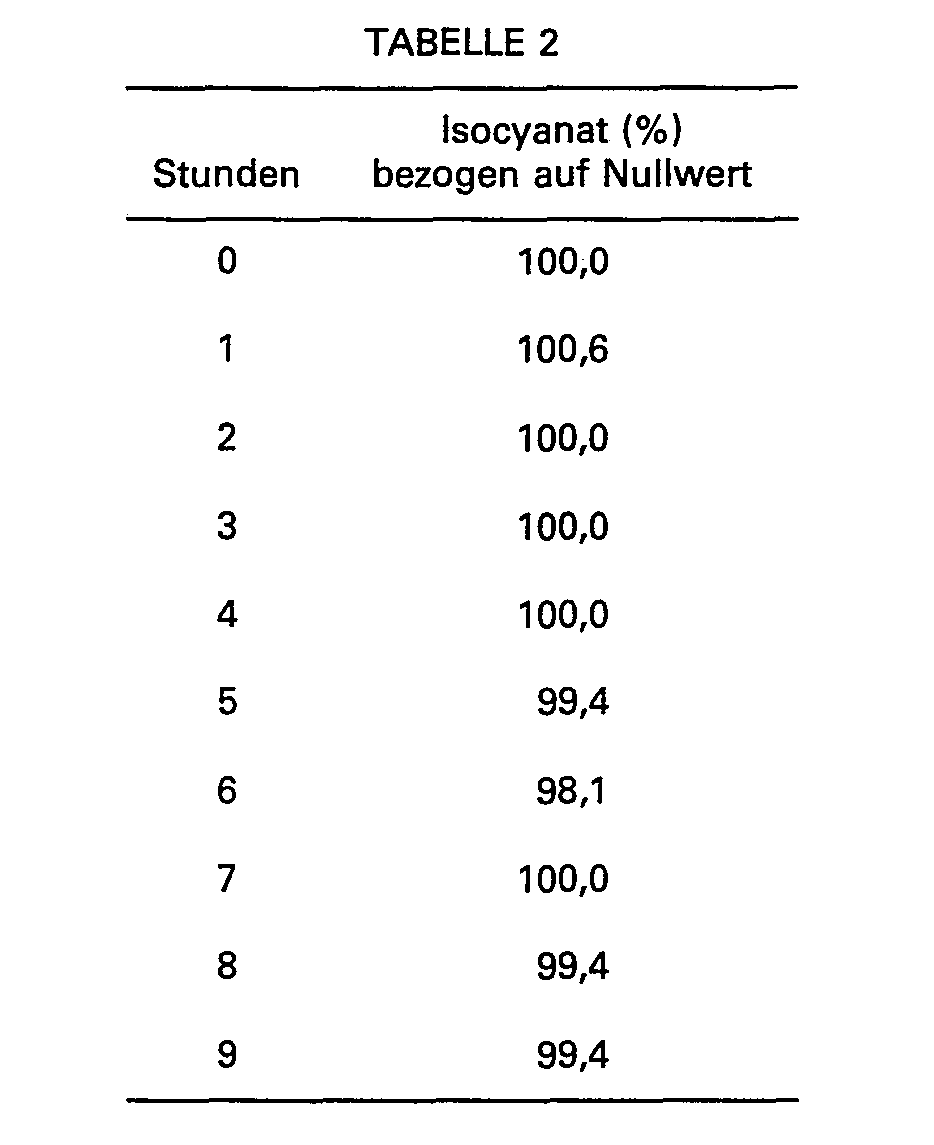
- an amount of about 0.5 to 5% of the water-soluble polycarboxamide (for example polyvinylpyrrolidone), based on the total emulsion weight, is sufficient to produce an emulsion whose titrable isocyanate group content drops by no more than about 1% in 10 hours .
- the table below which was set up with the emulsion of the preparation example, shows this.
- Polyvinylpyrrolidone of a suitable molecular weight range (e.g. from 20,000 to 1,000,000) is commercially available and requires no further explanation. It is preferably added to the emulsifying water in an appropriate concentration and permits a high emulsifying rate.
- polymeric carboxamides which are obtained by customary polymerization of olefinically unsaturated monomers are - for example the polymers of vinylcaprolactam, acrylamide, methacrylamide. You can e.g. T. can also be obtained by polymer-analogous implementation of other vinyl polymers, for example by saponification from polyacrylonitrile.
- the use of several emulsifiers next to each other is advantageous.
- the additional use is also recommended, e.g. of protective colloids. Since it is quite uncertain in individual cases (when using several emulsifying agents) which of the agents is to be regarded as an emulsifier and which is to be regarded as a protective colloid, the invention should be understood in its broadest sense in such a way that the use of smaller, effective amounts of the polyamide together with another emulsifying agent, which may also be present in higher amounts, is intended to be included therein.
- emulsifying agents include e.g. Higher molecular weight polyglycols, in particular polyethylene glycols, polypropylene glycols and mixed glycols with molecular weights between 4,000 and 20,000, preferably between 6,000 and 12,000.
- the emulsions contain e.g. 5 to 70% polyisocyanate, a sufficient amount of emulsifier and in the usual water. They are obtained in the manner customary for emulsions by stirring the constituents with suitable devices.
- the stability of isocyanate emulsions can be determined by known methods, e.g. can be measured by titration against bromophenol blue. For this purpose, samples of the emulsion are taken at certain intervals, excess dibutylamine solution is added and unused amine is backtreated with methanolic hydrochloric acid. The ratio is selected as the key figure "R":
- the R value of pure isocyanate is determined and set to 100%.
- the R values of the aqueous isocyanate emulsion are measured continuously and the decrease in average R values (in% of the initial value) is plotted as the ordinate against time as the abscissa.
- the emulsions are practically stable within 7 hours.
- the fluctuations are in the range of the error limit of the measuring method.
- the emulsions show no loss of isocyanate activity within 9 hours within the measurement error.
- an emulsion is prepared using a 3% aqueous emulsifier solution.
- the 3% aqueous emulsifier solution was obtained by dissolving polyethylene glycol and polyvinylc-caprolactam available under the trade name Lubasin S in a weight ratio of 30: 1 in an appropriate amount of water at room temperature.
- Emulsions of 50 parts of diphenylmethane-4,4'-diisocyanate and 50 parts of 3% aqueous emulsifier solution can be kept for 6 hours without a measurable drop in isocyanate activity.
- Example 1 With the emulsion of Example 1 and a slightly less concentrated preparation, chipboard is produced and its technological application is tested.
- spruce chips which had been produced under technical conditions and have a moisture content of approx. 4%, are treated with the adhesive mixtures in a conventional gluing device (Drais mixer).
- a 50% paraffin emulsion serves as a water repellent; in all cases the amount is 1% solid wax on absolutely dry chips.
- the necessary amount of water is sprayed onto the chips before the resin is applied.
- the adhesive emulsion is distributed on the chips using a mixer so that 4% isocyanate, based on the wood content, is used. As a comparison, the test is carried out with non-emulsified isocyanate.
- the chips pretreated in this way are turned into a chip cake in a test hopper shaped.
- the press temperature is 165 ° C with a press time of 4 minutes and a specific pressure of 2.5 N / mm 2 . Because of the tendency of the isocyanates to attach to the press cake, release papers are used.
- the thickness of the chipboard produced is 18.5 mm, the density approx. 610 kg / m 3 .
Landscapes
- Chemical & Material Sciences (AREA)
- Organic Chemistry (AREA)
- Polymers & Plastics (AREA)
- Health & Medical Sciences (AREA)
- Chemical Kinetics & Catalysis (AREA)
- Medicinal Chemistry (AREA)
- Engineering & Computer Science (AREA)
- Wood Science & Technology (AREA)
- Materials Engineering (AREA)
- Life Sciences & Earth Sciences (AREA)
- Dispersion Chemistry (AREA)
- Polyurethanes Or Polyureas (AREA)
- Adhesives Or Adhesive Processes (AREA)
- Dry Formation Of Fiberboard And The Like (AREA)
Description
- Die Verwendungen von Isocyanaten als Spanplattenbindemittel ist bekannt (vgl. z.B. H. J. Deppe und K. Ernst, Holz als Roh- und Werkstoff, Jahrg. 29, S. 45, 1971). Besonders bekannt sind Bindemittel auf der Grundlage technischer Gemische von Diphenylmethandiisocynaten. Als lösungsmittelfreie flüssige Produkte kann man sie in den in der Holzindustrie üblichen Verarbeitungsanlagen einsetzen.
- Es ist jedoch ein Nachteil, insbesondere bei niedrigen Dosierungen, dass sich Bindemittel auf der Grundlage von Isocyanaten nur schwer auf dem Spanmaterial gleichmässig verteilen lassen. Dadurch können die technologischen Eigenschaften der fertigen Spanplatte hinsichtlich der Festigkeit verschlechtert werden. Auch ist nachteilig, dass sich mit Isocyanat verunreinigte Geräte bzw. Maschinenteile mit Wasser nicht ohne weiteres reinigen lassen. Es ist zwar bekannt, zur Verdünnung von Isocyanaten organische Lösungsmittel anzuwenden. Geeignete Lösungsmittel wie Dichlormethan u.a. sind aber aus toxikoligischen Gründen, andere Lösungmittel wie Acetale wegen der Feuergefährlichkeit praktisch nicht anwendbar.
- In der bereits 1942 angemeldeten DE-B 853 438 ist beschrieben, zum Imprägnieren von Faserstoffen, Häuten und Fellen wäßrige Polyisocyanat-Dispersionen zu verwenden, die mit Emulgiermitteln wie Ethylenoxid-Addukten von höheren Fettalkoholen, Alkylphenolen, Sulfosäuren alkylierter Naphthaline, Ester höherer Fettsäuren, Leim, Polyvinylalkohol oder wasserlösliche Celluloseprodukte hergestellt werden können. Die angegebenen Emulgiermittel sind teils schlecht mit gleichbleibender Qualität herstellbar, teils reagieren sie mit den Polyisocyanaten. Die frühe Lehre hat nicht zu einer befriedigenden kommerziellen technischen Verwertung der Polyisocyanat-Dispersionen bei der Herstellung von Holzwerkstoffen wie Spanplatten geführt.
- Es ist in der DE-OS 26 10 552 bzw. der FR-PS 23 03 661 der Vorschlag gemacht worden, Isocyanate, die als Bindemittel (Klebstoffe) für lignolcellulosehaltige Partikel in Frage kommen, als wässrige Emulsion zu verwenden. Allerdings müssen dabei - so das Ergebnis der dort abgehandelten Experimente - an die Isocyanate selbst und an die Emulgierhilfsstoffe besondere Anforderungen gestellt werden. Als (Poly)-isocyanate werden bevorzugt Präpolymere, d. h. Umsetzungsprodukte von eigentlichen Polyisocyanaten mit Polyester- bzw. Polyätherpolyolen, die noch Isocyanat-Endgruppen aufweisen, verwendet. Als Emulgatoren bzw. oberflächenaktive Mittel werden nichtionogene Produkte verwendet, die ausserdem frei sein sollen von Hydroxyl-, Amino- oder Carbonsäureestern. Offenbar ist es aber trotz beträchtlicher Mengen spezieller hydrophober Polyole, die zur Herstellung der o.g. Präpolymeren eingesetzt werden, nicht möglich, Emulsionen zu erhalten, die eine genügende Haltbarkeit aufweisen; es zeigt sich vielmehr, dass der Verlust an Isocyanatgruppen in der Emulsion im Verlaufe von jeweils zwei Stunden bei Raumtemperatur im günstigsten Falle etwa 14 bis 17%, in ungünstigeren Fällen über 50% beträgt.
- Für den Fachmann auf dem Gebiet der Herstellung von Holzwerkstoffen ergibt sich daraus, dass ein solches Bindemittel ohne praktischen Wert ist, weil die technisch notwendigen Wartezeiten zwischen dem Ansetzen einer Emulsion und dem Verpressen, die durch die Kapazität der Vorrats-. behälter für Leim und beleimtes Spänegut gegeben sind, nicht erreicht werden.
- Es besteht daher die Aufgabe, wässrige lsocyanat-Zubereitungen zu schaffen, die die erwähnten Nachteile nicht oder in wesentlich geringerem Masse besitzen, d. h. die Schaffung lagerfähiger wässriger Emulsionen von Polyisocyanaten.
- Die Erfindung betrifft die Hestellung wässriger ausreichend lagerfähiger Polyisocyanat-Emusionen dadurch, dass man die Polyisocyanate in Gegenwart eines Emulgators auf der Grundlage eines durch Polymerisation eines olefinisch un gesättigten Carbonsäureamids oder durch polymeranaloge Umsetzung anderer Vinylpolymerisate gebildeten wasserlöslichen polymeren carbonsäureamids in Wasser dispergiert bzw. emulgiert.
- Das Ergebnis der Erfindung ist überraschend da - nicht zuletzt aus den genannten Druckschriften - bekannt ist, dass gerade aromatische lsocyanate mit Wasser schnell reagieren; lagerfähige Emulsionen solcher Isocyanate sind bisher nicht beschrieben worden.
- Beispiele von organischen Polyisocyanaten, welche bei dem erfindungsgemässen Verfahren verwendet werden können, sind aromatische Isocyanate, insbesondere Diisocyanate wie m- und p-Phenylendiisocyanat, Tolylen-2,4- und -2,6-dii- socyante, Diphenylmethan-4,4'-diisocyanat, Chlorphenylen-2,4-diisocyanat, Naphthylen-1,5-diisocyanat, Diphenylen-4,4'-diisocyanat, 4,4'-Diisocyanat-3,3'-dimethyldiphenyl, 3-Methyl- diphenylmethan-4,4'-diisocyanat, Diphenylätherdiisocyanat und Triisocyanate, wie 2,4,6-Triisocyanatotoluol und 2,4,4'-Triisocyanatdiphenyläther. Sie werden i. a. durch Phosgenierung entsprechender Amine in bekannter Weise erhalten. Mischungen von Isocyanaten sind beispielsweise die im Handel verfügbaren Mischungen von 2,4-und 2,6-lsomeren des Tolylendiisocyanats sowie die Mischungen von Di- und höheren Polyisocyanaten, welche durch Phosgenierung von Anilin-Formaldehyd-Kodnensaten hergestellt werden. Solche Mischungen sind in der Praxis allgemein bekannt und sie schliessen die rohen Phosgenierungsprodukte ein, welche Mischungen von Methylenbrücken aufweisenden Polyphenylpolyisocyanaten, einschliesslich Diisocyanat, Triisocyanat und höhere Polyisocyanate zusammen mit den Phosgenierungsnebenprodukten enthalten.
- Bevorzugte Polyisocyanate, welche erfindungsgemäss verwendet werden können, sind diejenigen, worin das Isocyanat ein aromatisches Diisocyanat oder Polyisocyanat mit höherer Funktionalität ist, insbesondere technische Mischungen von Methylenbrücken aufweisenden Polyphenylpolyisocyanaten, welche Diisocyanate, Triisocyanate oder Polyisocyanate mit höherer Funktionalität enthalten. Methylenbrücken aufweisende Polyphenylpolyisocanate sind allgemein bekannt, und sie besitzen die allgemeine Formel

- Weniger geeignete organische Isocyanate, welche erfindungsgemäss verwendet werden können, sind Isocyanatreste aufweisende Vorpolymere, die hergestellt sind durch Umsetzen eines Überschusses von Diisocyanat oder einem Polyisocyanat mit höherer Funktionalität mit einem Hydroxylenden aufweisenden Polyester oder Hydroxylenden aufweisenden. Polyäther sowie Produkte, welche durch Umsetzen eines Überschusses von Diisocyanat oder Polyisocyanat höherer Funktionalität mit monomerem Polyol oder einer Mischung von monomeren Polyolen, wie Äthylenglykol, Trimethylolpropan und Butandiol erhalten werden.
- Es ist allerdings möglich, dass sich solche Vorpolymere (Präpolymere) im Verlauf des erfindungsgemässen Herstellverfahrens in geringen Mengen bilden.
- Im allgemeinen ist eine Menge von etwa 0,5 bis 5% des wasserlöslichen Polycarbonsäureamids (z.B. Polyvinylpyrrolidon), bezogen auf das gesamte Emulsionsgewicht, ausreichend, um eine Emulsion herzustellen, deren titrierbarer Gehalt an Isocyanatgruppen in 10 Stunden um nicht mehr als etwa 1 % abfällt. Die nachstehende Tabelle, die mit der Emulsion des Herstellbeispiels aufgestellt wurde, zeigt dies.
- Polyvinylpyrrolidon eines geeigneten Molgewichtsbereiches (z.B. von 20 000 bis 1 000 000) ist handelsüblich und bedarf keiner näheren Erläuterung. Es wird bevorzugt dem Emulgierwasser in entsprechender Konzentration zugesetzt und lässt eine hohe Emulgiergeschwindigkeit zu.
- Andere polymere Carbonsäureamide, die durch übliche Polymerisation von olefinisch ungesättigten Monomeren erhalten werden, sind-z.B. die Polymeren des Vinylcaprolactams, des Acrylamids, Methacrylamids. Sie können z. T. auch durch polymeranloge Umsetzung anderer Vinylpolymerisate, z.B. durch Verseifen aus Polyacrylnitril erhalten werden.
- In manchen Fällen ist die Verwendng von mehreren Emulgatoren nebeneinander von Vorteil. Ebenfalls empfehlenswert ist die zusätzliche Verwendung z.B. von Schutzkolloiden. Da in einzelnen Fällen durchaus ungewiss ist (bei Verwendung mehrerer emulgierender Mittel), welchs der Mittel als Emulgator und welches als Schutzkolloid anzusehen ist, soll die Erfindung in ihrem weitesten Sinne so verstanden werden, dass die Verwendung auch geringerer, wirksamer Mengen des Polyamids zusammen mit einem anderen emulgierenden Mittel, das auch in höherer Menge vorliegen kann, hiervon umfasst sein soll.
- Als andere emulgierende Mittel kommen z.B. höhermolekulare Polyglykole, insbesondere Polyäthylenglykole, Polypropylenglykole sowie gemischte Glykole mit Molekulargewichten zwischen 4 000 und 20 000, vorzugsweise zwischen 6 000 und 12 000 in Betracht.
- Die Emulsionen enthalten z.B. 5 bis 70% Polyisocyanat, eine ausreichende Menge Emulgator und im übigen Wasser. Sie werden in der für Emulsionen üblichen Weise durch Verrühren der Bestandteile mit geeigneten Vorrichtungen erhalten.
- Zur Unterscheidung der Erfindung von dem, was schon bekannt ist, muss im Zusammenhang mit der Herstellung der Emulsion auf folgendes hingewiesen werden:
- Da es bekannt ist, dass hydroxylgruppenhaltige Verbindungen mit Isocyanaten reagieren, sollen solche Verbindungen nur in solchen Mengen mitverwendet werden, dass die vorhandenen Hydroxylgruppen nur einen Bruchteil, z.B. nicht mehr als 10 bis höchstens 40% der zur Verfügung stehenden Isocyanatgruppen ausmachen.
- Die Stabilität von Isocyanat-Emulsionen kann nach bekannten Verfahren, z.B. durch Titration gegen Bromphenolblau gemessen werden. Hierzu werden in bestimten Zeitabständen Proben der Emulsion entnommen, mit überschüssiger Dibutylamin-Lösung versetzt und nicht verbrauchtes Amin mit methanolischer Salzsäure zurücktriert. Als Kennzahl "R" wird das Verhältnis gewählt:
-

- Zur Auswertung der Stabilität wird der R-Wert von reinem Isocyanat bestimmt und gleich 100% gesetzt. Die R-Werte der wässrigen Isocyanat-Emulsion werden laufend gemessen und die Abnahme jeweils gemittelter R-Werte (in % vom Anfangswert) als Ordinate gegen die Zeit als Abszisse aufgetragen.
- Die den Beispielen beigegebenen Tabellen zeigen die Abnahme des Isocyanat-Gehaltes bei einer Temperatur von 23°C in Anhängigkeit von der Zeit.
- Eine typische Emulsion wird aus 50 Teilen technischem Diphenylmethandiisocyanat (MDI) und 50 Teilen 4%iger wässriger Emulgator-Lösung in folgender Weise erhalten:
- Es wird eine 4%ige wässrige Lösung von Polyvinylpyrrolidon hergestellt, indem das unter dem Handelsnamen Luviskol K 90 erhältliche) Polyvinylpyrrolidon warm in Wasser gelöst wird. In die abgekühlte Lösung wird Diphenylmethan-4,4'-diisocyanat eingerührt. Das Emulgieren mittels eines hochtourigen Rührwerks erfordert ca. 10 bis 30 Sekunden.
- Die Emulsionen sind praktisch innerhalb von 7 Stunden stabil. Die Schwankungen liegen im Bereich der Fehlergrenze der Messmethode.

- Eine Emulsion wird aus 50 Teilen technischem Diphenylmethandiisocyanat (MDI) und 50 Teilen 1%iger wässriger Emulgator-Lösung wie folgt erhalten:
- Es wird eine 1%ige wässrige Lösung eines Emulgator-Schutzkolloid-Systems hergerstellt, indem man Polyäthylenglykol das unter dem Handelsnamen Pluriol E 9000 erhältliche Produkt) und Polyvinylpyrrolidon (das unter dem Handelsnamen Luviskol K 90 erhältliche Produkt) im Gewichtsverhältnis 19:1 warm in Wasser löst. In die abgekühlte Lösung wird Diphenylmethandiisocyanat eingerührt. Das Emulgieren mittels eines hochtourigen Rührwerks erfordert ca. 10 bis 30 Sekunden.
- Die Emulsionen weisen innerhalb von 9 Stunden innerhalb des Messfehlers keinen Verlust an Isocyanat-Aktivität auf.
- Wie vorstehend beschrieben, wird unter Verwendung einer 3%igen wässrigen Emulgator-Lösung eine Emulsion hergestellt. Die 3%ige wässrige Emulgator-Lösung wurde erhalten, indem man Polyäthylenglykol und unter dem Handelsnamen Lubasin S erhältliches Polyvinylc-caprolactam im Gewichtsverhältnis 30:1 bei Raumtemperatur in entsprechender Menge Wasser löst.
- Emulsionen aus 50 Teilen Diphenylmethan-4,4'-diisocyanat und 50 Teilen 3%iger wässriger Emulgator-Lösung sind 6 Stunden ohne messabaren Abfall der Isocyanat-Aktivität haltbar.
- Mit der Emulsion des Beispiels 1 und einer etwas weniger konzentrierten Zubereitung werden Spanplatten hergestellt und ihre technologische Anwendung geprüft. Hierzu werden Fichtenspäne, die unter Technikumsbedingungen hergestellt worden waren und einen Feuchtigkeitsgehalt von ca. 4% haben, in einer üblichen Beleimungsvorrichtung (Drais-Mischer) mit den Klebstoffmischungen behandelt. Als Hydrophobiermittel dient eine 50%ige Parrafinemulsion; die Menge beträgt in allen Fällen 1 % Festwachs auf absolut trockene Späne. Zur Einstellung eines Feuchtigkeitsgehaltes der beharzten Späne von ca. 12% wird jeweils die notwendige Menge an Wasser vor der Beharzung auf die Späne gesprüht.
- Die Klebstoffemulsion wird mittels eines Mischers so auf den Spänen verteilt, dass jeweils 4% Isocyanat, bezogen auf den Holzanteil, verwendet werden. Als Vergleich wird der Versuch mit nichtemulgiertem Isocyanat durchgeführt.
- Die so vorbehandelten Späne werden in einer Versuchsschüttanlage zu einem Spankuchen geformt. Die Presstemperatur beträgt 165°C bei einer Presszeit von 4 Minuten und einem spezifischen Druck von 2,5 N/mm2. Wegen der Neigung der Isocyanate, an den Presskuchen anzuhängen, wird mit Trennpapieren gearbeitet. Die Dicke der gefertigten Spanplatten beträgt 18,5 mm, die Dichte ca. 610 kg/m 3.

Claims (6)
Priority Applications (1)
| Application Number | Priority Date | Filing Date | Title |
|---|---|---|---|
| AT79102432T ATE163T1 (de) | 1978-07-19 | 1979-07-13 | Waessrige isocyanat-emulsionen, verfahren zu deren herstellung und deren verwendung fuer die verleimung von holz. |
Applications Claiming Priority (2)
| Application Number | Priority Date | Filing Date | Title |
|---|---|---|---|
| DE2831674 | 1978-07-19 | ||
| DE19782831674 DE2831674A1 (de) | 1978-07-19 | 1978-07-19 | Waessrige isocyanat-emulsionen fuer die verleimung von spanplatten |
Publications (3)
| Publication Number | Publication Date |
|---|---|
| EP0007532A1 EP0007532A1 (de) | 1980-02-06 |
| EP0007532B1 EP0007532B1 (de) | 1981-08-26 |
| EP0007532B2 true EP0007532B2 (de) | 1990-11-07 |
Family
ID=6044765
Family Applications (1)
| Application Number | Title | Priority Date | Filing Date |
|---|---|---|---|
| EP79102432A Expired - Lifetime EP0007532B2 (de) | 1978-07-19 | 1979-07-13 | Wässrige Isocyanat-Emulsionen, Verfahren zu deren Herstellung und deren Verwendung für die Verleimung von Holz |
Country Status (6)
| Country | Link |
|---|---|
| US (1) | US4260532A (de) |
| EP (1) | EP0007532B2 (de) |
| AT (1) | ATE163T1 (de) |
| CA (1) | CA1107422A (de) |
| DE (2) | DE2831674A1 (de) |
| DK (1) | DK149598C (de) |
Families Citing this family (14)
| Publication number | Priority date | Publication date | Assignee | Title |
|---|---|---|---|---|
| GB2076414A (en) * | 1980-04-30 | 1981-12-02 | Ici Ltd | Isocyanate reactions |
| DE3201111A1 (de) * | 1982-01-15 | 1983-07-28 | Bayer Ag, 5090 Leverkusen | Neue waessrige polysocyanat-emulsionen sowie deren verwendung als bindemitel zur herstellung von formkoerpern |
| USRE34093E (en) * | 1982-05-24 | 1992-10-06 | Aqueous adhesive compositions | |
| US4480070A (en) * | 1982-05-28 | 1984-10-30 | The Upjohn Company | Compositions and process |
| DE3438527A1 (de) * | 1984-10-20 | 1986-04-24 | Bayer Ag, 5090 Leverkusen | Verfahren zur herstellung von harnstoffgruppen enthaltenden polyisocyanaten |
| DE3638148A1 (de) * | 1986-11-08 | 1988-05-11 | Bayer Ag | Verfahren zur herstellung von feinteiligen harnstoffgruppen enthaltenden polyisocyanaten |
| DK77287D0 (da) * | 1987-02-16 | 1987-02-16 | Novopan Traeindustri | Spaanplade og fremgangsmaade til fremstilling deraf |
| IT1218202B (it) * | 1988-03-30 | 1990-04-12 | Mini Ricerca Scient Tecnolog | Emulsioni acquose di poliisocianati e procedimento per la loro preparazione |
| DE19526079A1 (de) * | 1995-07-18 | 1997-01-23 | Basf Ag | Wasseremulgierbare Polyisocyanate |
| PL3131940T3 (pl) * | 2014-04-17 | 2019-07-31 | Covestro Deutschland Ag | Sposób wytwarzania materiałów prasowanych |
| CN108865038B (zh) * | 2017-05-16 | 2020-05-08 | 万华化学集团股份有限公司 | 异氰酸酯基木质材料粘合剂及其应用方法 |
| CN107779165B (zh) * | 2017-11-07 | 2021-02-02 | 大亚人造板集团有限公司 | 一种无醛纤维板的制造工艺 |
| CN111566140A (zh) * | 2017-12-21 | 2020-08-21 | 科思创德国股份有限公司 | 基于多异氰酸酯的耐冻粘合剂 |
| US11124672B2 (en) | 2017-12-21 | 2021-09-21 | Covestro Deutschland Ag | Frost-resistant water paints based on polyisocyanates |
Family Cites Families (3)
| Publication number | Priority date | Publication date | Assignee | Title |
|---|---|---|---|---|
| US3401135A (en) * | 1964-07-21 | 1968-09-10 | Takeda Chemical Industries Ltd | Adhesive composition of an interpolymer containing ethylene glycol monomethacrylate admixed with a blocked polyisocyanate |
| JPS5130577B2 (de) * | 1972-08-05 | 1976-09-01 | ||
| GB1523601A (en) * | 1975-03-12 | 1978-09-06 | Ici Ltd | Sheets or moulded bodies |
-
1978
- 1978-07-19 DE DE19782831674 patent/DE2831674A1/de not_active Withdrawn
-
1979
- 1979-07-11 US US06/056,525 patent/US4260532A/en not_active Expired - Lifetime
- 1979-07-13 EP EP79102432A patent/EP0007532B2/de not_active Expired - Lifetime
- 1979-07-13 AT AT79102432T patent/ATE163T1/de active
- 1979-07-13 DE DE7979102432T patent/DE2960693D1/de not_active Expired
- 1979-07-18 CA CA332,074A patent/CA1107422A/en not_active Expired
- 1979-07-18 DK DK302279A patent/DK149598C/da not_active IP Right Cessation
Also Published As
| Publication number | Publication date |
|---|---|
| DE2960693D1 (en) | 1981-11-19 |
| CA1107422A (en) | 1981-08-18 |
| US4260532A (en) | 1981-04-07 |
| DE2831674A1 (de) | 1980-02-07 |
| EP0007532B1 (de) | 1981-08-26 |
| EP0007532A1 (de) | 1980-02-06 |
| DK149598C (da) | 1987-01-12 |
| DK302279A (da) | 1980-01-20 |
| ATE163T1 (de) | 1981-09-15 |
| DK149598B (da) | 1986-08-04 |
Similar Documents
| Publication | Publication Date | Title |
|---|---|---|
| EP0007532B1 (de) | Wässrige Isocyanat-Emulsionen, Verfahren zu deren Herstellung und deren Verwendung für die Verleimung von Holz | |
| DE3150626C2 (de) | ||
| EP0486881B1 (de) | Nichtwässrige Polyisocyanatzubereitung | |
| EP0234459B1 (de) | Wässrige, Polyisocyanat-haltige Leimflottendispersionen, deren Herstellung und deren Verwendung | |
| CH619975A5 (en) | Process for producing shaped articles | |
| DE69407306T2 (de) | Feuchtigkeitsaktivierbare klebstoffzusammensetzungen | |
| DE3522659C1 (de) | Verfahren zur Herstellung von Spanplatten | |
| DE2948670C2 (de) | ||
| DE2263125C2 (de) | Verfahren zur kontinuierlichen Herstellung von Harnstoff-Formaldehyd-Kondensaten | |
| DE2703271C3 (de) | Herstellung wäßriger Isocyanatemulsionen | |
| CH648575A5 (de) | Verfahren zur herstellung von platten aus teilchenfoermigem organischem material sowie lagerungsstabile, als bindemittel verwendbare masse. | |
| DE2719720A1 (de) | Verfahren zur herstellung von verklebungen | |
| DE1165987B (de) | Verfahren zur Verbesserung der physikalischen Eigenschaften von Papierbahnen | |
| EP2791244B1 (de) | Klebstoffzusammensetzungen und deren verwendung | |
| DE3128808A1 (de) | Klebstoffmasse und ihre verwendung | |
| EP0039663A2 (de) | Verfahren zur Herstellung vernetzter, ungesättigter Polymere und diese Polymere | |
| DE2262197A1 (de) | Verfahren zur kontinuierlichen herstellung von harnstoff-formaldehyd-kondensaten | |
| EP0018061A1 (de) | Verfahren zur Herstellung von Folien oder Formkörpern | |
| DE1299416B (de) | Waessrige Klebstofldispersionen zum Verkleben von Kautschuk mit faserigen Materialien | |
| CH633303A5 (en) | Process for the preparation of aqueous polyisocyanate emulsions | |
| DE69104916T2 (de) | Verfahren zur Herstellung von wässrigen Polyisocynatemulsionen sowie damit hergestellte Emulsionen. | |
| DE69407593T2 (de) | Polyisocyanatzusammensetzung | |
| DE68903518T2 (de) | Waesserige polyisocyanat-emulsionen und verfahren zu ihrer herstellung. | |
| EP0028781B1 (de) | Polyisocyanatgemische der Diphenylmethanreihe und ihre Verwendung als Zusatzmittel in Klebstoffen | |
| DE69014058T2 (de) | Bindemittelzusammensetzungen zur Herstellung von lignozellulosehaltigen Verbundstoffen. |
Legal Events
| Date | Code | Title | Description |
|---|---|---|---|
| PUAI | Public reference made under article 153(3) epc to a published international application that has entered the european phase |
Free format text: ORIGINAL CODE: 0009012 |
|
| AK | Designated contracting states |
Designated state(s): AT BE CH DE IT NL SE |
|
| 17P | Request for examination filed | ||
| ITF | It: translation for a ep patent filed | ||
| GRAA | (expected) grant |
Free format text: ORIGINAL CODE: 0009210 |
|
| AK | Designated contracting states |
Designated state(s): AT BE CH DE IT NL SE |
|
| REF | Corresponds to: |
Ref document number: 163 Country of ref document: AT Date of ref document: 19810915 Kind code of ref document: T |
|
| REF | Corresponds to: |
Ref document number: 2960693 Country of ref document: DE Date of ref document: 19811119 |
|
| KL | Correction list |
Free format text: 82/03 |
|
| PLBI | Opposition filed |
Free format text: ORIGINAL CODE: 0009260 |
|
| 26 | Opposition filed |
Opponent name: BAYER AG, LEVERKUSEN ZENTRALBEREICH PATENTE, MARKE Effective date: 19820522 |
|
| PUAH | Patent maintained in amended form |
Free format text: ORIGINAL CODE: 0009272 |
|
| STAA | Information on the status of an ep patent application or granted ep patent |
Free format text: STATUS: PATENT MAINTAINED AS AMENDED |
|
| 27A | Patent maintained in amended form |
Effective date: 19901107 |
|
| AK | Designated contracting states |
Kind code of ref document: B2 Designated state(s): AT BE CH DE IT NL SE |
|
| ITF | It: translation for a ep patent filed | ||
| NLR2 | Nl: decision of opposition | ||
| NLR3 | Nl: receipt of modified translations in the netherlands language after an opposition procedure | ||
| ITTA | It: last paid annual fee | ||
| EAL | Se: european patent in force in sweden |
Ref document number: 79102432.6 |
|
| PGFP | Annual fee paid to national office [announced via postgrant information from national office to epo] |
Ref country code: SE Payment date: 19980626 Year of fee payment: 20 |
|
| PGFP | Annual fee paid to national office [announced via postgrant information from national office to epo] |
Ref country code: AT Payment date: 19980706 Year of fee payment: 20 |
|
| PGFP | Annual fee paid to national office [announced via postgrant information from national office to epo] |
Ref country code: CH Payment date: 19980707 Year of fee payment: 20 |
|
| PGFP | Annual fee paid to national office [announced via postgrant information from national office to epo] |
Ref country code: NL Payment date: 19980728 Year of fee payment: 20 Ref country code: DE Payment date: 19980728 Year of fee payment: 20 |
|
| PGFP | Annual fee paid to national office [announced via postgrant information from national office to epo] |
Ref country code: BE Payment date: 19980806 Year of fee payment: 20 |
|
| BE20 | Be: patent expired |
Free format text: 19990713 *BASF A.G. |
|
| PG25 | Lapsed in a contracting state [announced via postgrant information from national office to epo] |
Ref country code: CH Free format text: LAPSE BECAUSE OF EXPIRATION OF PROTECTION Effective date: 19990712 |
|
| PG25 | Lapsed in a contracting state [announced via postgrant information from national office to epo] |
Ref country code: NL Free format text: LAPSE BECAUSE OF EXPIRATION OF PROTECTION Effective date: 19990713 Ref country code: AT Free format text: LAPSE BECAUSE OF EXPIRATION OF PROTECTION Effective date: 19990713 |
|
| PG25 | Lapsed in a contracting state [announced via postgrant information from national office to epo] |
Ref country code: SE Free format text: LAPSE BECAUSE OF NON-PAYMENT OF DUE FEES Effective date: 19990714 |
|
| REG | Reference to a national code |
Ref country code: CH Ref legal event code: PL |
|
| NLV7 | Nl: ceased due to reaching the maximum lifetime of a patent |
Effective date: 19990713 |