EP0008273B2 - Verfahren zur Behandlung von von der Wiederaufbereitung von bestrahlten Kernbrennstoffen stammenden Abströmgasen - Google Patents
Verfahren zur Behandlung von von der Wiederaufbereitung von bestrahlten Kernbrennstoffen stammenden Abströmgasen Download PDFInfo
- Publication number
- EP0008273B2 EP0008273B2 EP79400556A EP79400556A EP0008273B2 EP 0008273 B2 EP0008273 B2 EP 0008273B2 EP 79400556 A EP79400556 A EP 79400556A EP 79400556 A EP79400556 A EP 79400556A EP 0008273 B2 EP0008273 B2 EP 0008273B2
- Authority
- EP
- European Patent Office
- Prior art keywords
- krypton
- xenon
- stage
- mixture
- argon
- Prior art date
- Legal status (The legal status is an assumption and is not a legal conclusion. Google has not performed a legal analysis and makes no representation as to the accuracy of the status listed.)
- Expired
Links
- 238000000034 method Methods 0.000 title claims description 35
- 239000007789 gas Substances 0.000 title claims description 28
- 230000008569 process Effects 0.000 title claims description 27
- 239000003758 nuclear fuel Substances 0.000 title claims description 5
- 238000012958 reprocessing Methods 0.000 title description 9
- XKRFYHLGVUSROY-UHFFFAOYSA-N Argon Chemical compound [Ar] XKRFYHLGVUSROY-UHFFFAOYSA-N 0.000 claims description 92
- 229910052743 krypton Inorganic materials 0.000 claims description 72
- DNNSSWSSYDEUBZ-UHFFFAOYSA-N krypton atom Chemical compound [Kr] DNNSSWSSYDEUBZ-UHFFFAOYSA-N 0.000 claims description 72
- 239000000203 mixture Substances 0.000 claims description 71
- 229910052724 xenon Inorganic materials 0.000 claims description 66
- FHNFHKCVQCLJFQ-UHFFFAOYSA-N xenon atom Chemical compound [Xe] FHNFHKCVQCLJFQ-UHFFFAOYSA-N 0.000 claims description 66
- IJGRMHOSHXDMSA-UHFFFAOYSA-N Atomic nitrogen Chemical compound N#N IJGRMHOSHXDMSA-UHFFFAOYSA-N 0.000 claims description 58
- 229910052786 argon Inorganic materials 0.000 claims description 46
- 238000004821 distillation Methods 0.000 claims description 34
- 229910052757 nitrogen Inorganic materials 0.000 claims description 27
- MWUXSHHQAYIFBG-UHFFFAOYSA-N nitrogen oxide Inorganic materials O=[N] MWUXSHHQAYIFBG-UHFFFAOYSA-N 0.000 claims description 27
- 239000007788 liquid Substances 0.000 claims description 26
- QVGXLLKOCUKJST-UHFFFAOYSA-N atomic oxygen Chemical compound [O] QVGXLLKOCUKJST-UHFFFAOYSA-N 0.000 claims description 25
- 239000001301 oxygen Substances 0.000 claims description 25
- 229910052760 oxygen Inorganic materials 0.000 claims description 25
- CURLTUGMZLYLDI-UHFFFAOYSA-N Carbon dioxide Chemical compound O=C=O CURLTUGMZLYLDI-UHFFFAOYSA-N 0.000 claims description 16
- XLYOFNOQVPJJNP-UHFFFAOYSA-N water Substances O XLYOFNOQVPJJNP-UHFFFAOYSA-N 0.000 claims description 14
- 229930195733 hydrocarbon Natural products 0.000 claims description 12
- 150000002430 hydrocarbons Chemical class 0.000 claims description 12
- 229910002092 carbon dioxide Inorganic materials 0.000 claims description 8
- 239000001569 carbon dioxide Substances 0.000 claims description 8
- 238000010531 catalytic reduction reaction Methods 0.000 claims description 8
- 239000008246 gaseous mixture Substances 0.000 claims description 8
- 239000012535 impurity Substances 0.000 claims description 8
- 238000000926 separation method Methods 0.000 claims description 7
- 229910001868 water Inorganic materials 0.000 claims description 7
- 230000003197 catalytic effect Effects 0.000 claims description 6
- 230000002285 radioactive effect Effects 0.000 claims description 5
- 239000002808 molecular sieve Substances 0.000 claims description 4
- URGAHOPLAPQHLN-UHFFFAOYSA-N sodium aluminosilicate Chemical compound [Na+].[Al+3].[O-][Si]([O-])=O.[O-][Si]([O-])=O URGAHOPLAPQHLN-UHFFFAOYSA-N 0.000 claims description 4
- VYPSYNLAJGMNEJ-UHFFFAOYSA-N Silicium dioxide Chemical compound O=[Si]=O VYPSYNLAJGMNEJ-UHFFFAOYSA-N 0.000 claims description 3
- 230000003647 oxidation Effects 0.000 claims description 3
- 238000007254 oxidation reaction Methods 0.000 claims description 3
- 239000000741 silica gel Substances 0.000 claims description 3
- 229910002027 silica gel Inorganic materials 0.000 claims description 3
- VUZPPFZMUPKLLV-UHFFFAOYSA-N methane;hydrate Chemical compound C.O VUZPPFZMUPKLLV-UHFFFAOYSA-N 0.000 claims 2
- 238000011268 retreatment Methods 0.000 claims 1
- 239000001257 hydrogen Substances 0.000 description 7
- 229910052739 hydrogen Inorganic materials 0.000 description 7
- 238000009434 installation Methods 0.000 description 7
- 238000004094 preconcentration Methods 0.000 description 7
- CBENFWSGALASAD-UHFFFAOYSA-N Ozone Chemical compound [O-][O+]=O CBENFWSGALASAD-UHFFFAOYSA-N 0.000 description 6
- 230000008030 elimination Effects 0.000 description 6
- 238000003379 elimination reaction Methods 0.000 description 6
- 239000000446 fuel Substances 0.000 description 6
- 238000002425 crystallisation Methods 0.000 description 5
- 230000008025 crystallization Effects 0.000 description 5
- 238000004880 explosion Methods 0.000 description 5
- KDLHZDBZIXYQEI-UHFFFAOYSA-N Palladium Chemical compound [Pd] KDLHZDBZIXYQEI-UHFFFAOYSA-N 0.000 description 4
- 150000002431 hydrogen Chemical class 0.000 description 4
- 241000196324 Embryophyta Species 0.000 description 3
- UFHFLCQGNIYNRP-UHFFFAOYSA-N Hydrogen Chemical compound [H][H] UFHFLCQGNIYNRP-UHFFFAOYSA-N 0.000 description 3
- 230000008901 benefit Effects 0.000 description 3
- 230000015572 biosynthetic process Effects 0.000 description 3
- 239000003054 catalyst Substances 0.000 description 3
- MYMOFIZGZYHOMD-UHFFFAOYSA-N Dioxygen Chemical compound O=O MYMOFIZGZYHOMD-UHFFFAOYSA-N 0.000 description 2
- GQPLMRYTRLFLPF-UHFFFAOYSA-N Nitrous Oxide Chemical compound [O-][N+]#N GQPLMRYTRLFLPF-UHFFFAOYSA-N 0.000 description 2
- 239000006096 absorbing agent Substances 0.000 description 2
- 239000012141 concentrate Substances 0.000 description 2
- 238000010494 dissociation reaction Methods 0.000 description 2
- 230000005593 dissociations Effects 0.000 description 2
- 238000005485 electric heating Methods 0.000 description 2
- 238000010438 heat treatment Methods 0.000 description 2
- 239000007791 liquid phase Substances 0.000 description 2
- 229910052763 palladium Inorganic materials 0.000 description 2
- BASFCYQUMIYNBI-UHFFFAOYSA-N platinum Chemical compound [Pt] BASFCYQUMIYNBI-UHFFFAOYSA-N 0.000 description 2
- 238000000746 purification Methods 0.000 description 2
- 238000011084 recovery Methods 0.000 description 2
- 238000010992 reflux Methods 0.000 description 2
- 239000010948 rhodium Substances 0.000 description 2
- 229910052703 rhodium Inorganic materials 0.000 description 2
- MHOVAHRLVXNVSD-UHFFFAOYSA-N rhodium atom Chemical compound [Rh] MHOVAHRLVXNVSD-UHFFFAOYSA-N 0.000 description 2
- 239000002904 solvent Substances 0.000 description 2
- 239000004215 Carbon black (E152) Substances 0.000 description 1
- VOPWNXZWBYDODV-UHFFFAOYSA-N Chlorodifluoromethane Chemical compound FC(F)Cl VOPWNXZWBYDODV-UHFFFAOYSA-N 0.000 description 1
- 241001080024 Telles Species 0.000 description 1
- 240000008042 Zea mays Species 0.000 description 1
- FFYUGJCEFMSZKN-UHFFFAOYSA-N [N].[Xe] Chemical compound [N].[Xe] FFYUGJCEFMSZKN-UHFFFAOYSA-N 0.000 description 1
- UJLFQHSVIUGIOA-UHFFFAOYSA-N [O].[Xe] Chemical compound [O].[Xe] UJLFQHSVIUGIOA-UHFFFAOYSA-N 0.000 description 1
- 230000009471 action Effects 0.000 description 1
- 239000003463 adsorbent Substances 0.000 description 1
- 239000003570 air Substances 0.000 description 1
- DGJPLFUDZQEBFH-UHFFFAOYSA-N argon xenon Chemical compound [Ar].[Xe] DGJPLFUDZQEBFH-UHFFFAOYSA-N 0.000 description 1
- 238000006555 catalytic reaction Methods 0.000 description 1
- 239000000470 constituent Substances 0.000 description 1
- 230000006378 damage Effects 0.000 description 1
- 230000018109 developmental process Effects 0.000 description 1
- 229910001873 dinitrogen Inorganic materials 0.000 description 1
- 238000004090 dissolution Methods 0.000 description 1
- 238000011065 in-situ storage Methods 0.000 description 1
- 238000002156 mixing Methods 0.000 description 1
- 239000001272 nitrous oxide Substances 0.000 description 1
- 229910052697 platinum Inorganic materials 0.000 description 1
- 238000012545 processing Methods 0.000 description 1
- 238000004064 recycling Methods 0.000 description 1
- 230000008929 regeneration Effects 0.000 description 1
- 238000011069 regeneration method Methods 0.000 description 1
- 230000008439 repair process Effects 0.000 description 1
Images

Classifications
-
- F—MECHANICAL ENGINEERING; LIGHTING; HEATING; WEAPONS; BLASTING
- F25—REFRIGERATION OR COOLING; COMBINED HEATING AND REFRIGERATION SYSTEMS; HEAT PUMP SYSTEMS; MANUFACTURE OR STORAGE OF ICE; LIQUEFACTION SOLIDIFICATION OF GASES
- F25J—LIQUEFACTION, SOLIDIFICATION OR SEPARATION OF GASES OR GASEOUS OR LIQUEFIED GASEOUS MIXTURES BY PRESSURE AND COLD TREATMENT OR BY BRINGING THEM INTO THE SUPERCRITICAL STATE
- F25J3/00—Processes or apparatus for separating the constituents of gaseous or liquefied gaseous mixtures involving the use of liquefaction or solidification
- F25J3/02—Processes or apparatus for separating the constituents of gaseous or liquefied gaseous mixtures involving the use of liquefaction or solidification by rectification, i.e. by continuous interchange of heat and material between a vapour stream and a liquid stream
- F25J3/0228—Processes or apparatus for separating the constituents of gaseous or liquefied gaseous mixtures involving the use of liquefaction or solidification by rectification, i.e. by continuous interchange of heat and material between a vapour stream and a liquid stream characterised by the separated product stream
- F25J3/028—Processes or apparatus for separating the constituents of gaseous or liquefied gaseous mixtures involving the use of liquefaction or solidification by rectification, i.e. by continuous interchange of heat and material between a vapour stream and a liquid stream characterised by the separated product stream separation of noble gases
-
- G—PHYSICS
- G21—NUCLEAR PHYSICS; NUCLEAR ENGINEERING
- G21F—PROTECTION AGAINST X-RADIATION, GAMMA RADIATION, CORPUSCULAR RADIATION OR PARTICLE BOMBARDMENT; TREATING RADIOACTIVELY CONTAMINATED MATERIAL; DECONTAMINATION ARRANGEMENTS THEREFOR
- G21F9/00—Treating radioactively contaminated material; Decontamination arrangements therefor
- G21F9/02—Treating gases
-
- F—MECHANICAL ENGINEERING; LIGHTING; HEATING; WEAPONS; BLASTING
- F25—REFRIGERATION OR COOLING; COMBINED HEATING AND REFRIGERATION SYSTEMS; HEAT PUMP SYSTEMS; MANUFACTURE OR STORAGE OF ICE; LIQUEFACTION SOLIDIFICATION OF GASES
- F25J—LIQUEFACTION, SOLIDIFICATION OR SEPARATION OF GASES OR GASEOUS OR LIQUEFIED GASEOUS MIXTURES BY PRESSURE AND COLD TREATMENT OR BY BRINGING THEM INTO THE SUPERCRITICAL STATE
- F25J2205/00—Processes or apparatus using other separation and/or other processing means
- F25J2205/40—Processes or apparatus using other separation and/or other processing means using hybrid system, i.e. combining cryogenic and non-cryogenic separation techniques
-
- F—MECHANICAL ENGINEERING; LIGHTING; HEATING; WEAPONS; BLASTING
- F25—REFRIGERATION OR COOLING; COMBINED HEATING AND REFRIGERATION SYSTEMS; HEAT PUMP SYSTEMS; MANUFACTURE OR STORAGE OF ICE; LIQUEFACTION SOLIDIFICATION OF GASES
- F25J—LIQUEFACTION, SOLIDIFICATION OR SEPARATION OF GASES OR GASEOUS OR LIQUEFIED GASEOUS MIXTURES BY PRESSURE AND COLD TREATMENT OR BY BRINGING THEM INTO THE SUPERCRITICAL STATE
- F25J2205/00—Processes or apparatus using other separation and/or other processing means
- F25J2205/82—Processes or apparatus using other separation and/or other processing means using a reactor with combustion or catalytic reaction
-
- F—MECHANICAL ENGINEERING; LIGHTING; HEATING; WEAPONS; BLASTING
- F25—REFRIGERATION OR COOLING; COMBINED HEATING AND REFRIGERATION SYSTEMS; HEAT PUMP SYSTEMS; MANUFACTURE OR STORAGE OF ICE; LIQUEFACTION SOLIDIFICATION OF GASES
- F25J—LIQUEFACTION, SOLIDIFICATION OR SEPARATION OF GASES OR GASEOUS OR LIQUEFIED GASEOUS MIXTURES BY PRESSURE AND COLD TREATMENT OR BY BRINGING THEM INTO THE SUPERCRITICAL STATE
- F25J2210/00—Processes characterised by the type or other details of the feed stream
- F25J2210/40—Air or oxygen enriched air, i.e. generally less than 30mol% of O2
-
- F—MECHANICAL ENGINEERING; LIGHTING; HEATING; WEAPONS; BLASTING
- F25—REFRIGERATION OR COOLING; COMBINED HEATING AND REFRIGERATION SYSTEMS; HEAT PUMP SYSTEMS; MANUFACTURE OR STORAGE OF ICE; LIQUEFACTION SOLIDIFICATION OF GASES
- F25J—LIQUEFACTION, SOLIDIFICATION OR SEPARATION OF GASES OR GASEOUS OR LIQUEFIED GASEOUS MIXTURES BY PRESSURE AND COLD TREATMENT OR BY BRINGING THEM INTO THE SUPERCRITICAL STATE
- F25J2215/00—Processes characterised by the type or other details of the product stream
- F25J2215/34—Krypton
-
- F—MECHANICAL ENGINEERING; LIGHTING; HEATING; WEAPONS; BLASTING
- F25—REFRIGERATION OR COOLING; COMBINED HEATING AND REFRIGERATION SYSTEMS; HEAT PUMP SYSTEMS; MANUFACTURE OR STORAGE OF ICE; LIQUEFACTION SOLIDIFICATION OF GASES
- F25J—LIQUEFACTION, SOLIDIFICATION OR SEPARATION OF GASES OR GASEOUS OR LIQUEFIED GASEOUS MIXTURES BY PRESSURE AND COLD TREATMENT OR BY BRINGING THEM INTO THE SUPERCRITICAL STATE
- F25J2215/00—Processes characterised by the type or other details of the product stream
- F25J2215/36—Xenon
-
- Y—GENERAL TAGGING OF NEW TECHNOLOGICAL DEVELOPMENTS; GENERAL TAGGING OF CROSS-SECTIONAL TECHNOLOGIES SPANNING OVER SEVERAL SECTIONS OF THE IPC; TECHNICAL SUBJECTS COVERED BY FORMER USPC CROSS-REFERENCE ART COLLECTIONS [XRACs] AND DIGESTS
- Y10—TECHNICAL SUBJECTS COVERED BY FORMER USPC
- Y10S—TECHNICAL SUBJECTS COVERED BY FORMER USPC CROSS-REFERENCE ART COLLECTIONS [XRACs] AND DIGESTS
- Y10S62/00—Refrigeration
- Y10S62/923—Inert gas
- Y10S62/925—Xenon or krypton
Definitions
- the subject of the present invention is a process for the treatment of gaseous effluents originating from the reprocessing of irradiated nuclear fuels, consisting of a mixture containing at least radioactive krypton and xenon in air, such treatment also having the aim of recovering the xenon that these mixtures contain.
- Gaseous effluents from plants for the reprocessing of irradiated fuels consist essentially of air, the oxygen content of which can be lower than the natural content, of rare gases such as xenon and krypton, and generally contain vapor of water, carbon dioxide, traces of hydrocarbons, and also nitrogen oxides whose presence is due to the dissolution of fuels carried out in a nitric medium.
- Also known from American patent 4012490 is a process for treating gaseous mixtures containing mainly air, oxygen, hydrogen, krypton and radioactive xenon, according to which oxygen is first separated of the mixture by catalytic reaction, the xenon and the carbon dioxide are then separated by fixing on an adsorbent and the resulting gas mixture which contains hydrogen, nitrogen and radioactive krypton is then subjected to cryogenic distillation in a column to separate and liquefy the krypton.
- this preconcentration step is carried out, after catalytic reduction of all the oxygen in the mixture with hydrogen, by concentration of the rare gases in a fraction of the nitrogen. by cryogenic distillation. Then the mixture of krypton and xenon in nitrogen is then subjected to another cryogenic distillation to separate the krypton and the nitrogen from the xenon.
- This procedure has the disadvantage that, given the poor solubility of xenon in liquid nitrogen, blockages occur in the distillation columns which are due to crystallization of the xenon.
- this preconcentration is carried out by removing all of the nitrogen from the mixture and part of the oxygen by cryogenic distillation.
- the mixture of krypton and xenon concentrated in oxygen then obtained is first subjected to a step of catalytic reduction of oxygen with hydrogen, then to a cryogenic distillation step to separate the krypton from the xenon.
- This method has, compared to the preconcentration process in nitrogen, the advantage that the solubility of xenon is much higher in liquid oxygen than in liquid nitrogen.
- ozone is formed in the boiler of the distillation column; this presence of ozone creates the risk of explosion.
- the subject of the present invention is precisely a process for the treatment of gaseous effluents originating from the reprocessing of irradiated fuels, which overcomes the drawbacks mentioned above; in fact, during the implementation of the process considered, there is no formation of ozone, and therefore no risk of explosion; as for the problems of crystallization of xenon, they can easily be avoided.
- the applicant has studied the behavior of xenon from the point of view of solubility in three cryogenic solvents, namely oxygen, nitrogen and argon.
- the applicant studied what was the maximum pressure such that the solid-liquid-vapor xenon-solvent balance could exist. It was therefore important, in order to avoid any risk of crystallization of the xenon, to operate the preconcentration step at a pressure higher than this remarkable pressure mentioned above.
- the applicant has researched and discovered that for an oxygen-xenon system, this remarkable pressure is 17 bars absolute, that for an argon-xenon system, this remarkable pressure is of 18.5 bar absolute, and that for a nitrogen-xenon system, this remarkable pressure would be notably higher, for example, of the order of 35 bar absolute.
- document DE-A-1 667 639 describes a process for recovering a mixture of krypton and xenon from the oxygen-rich fraction of a conventional air repair unit.
- argon is used to concentrate krypton and xenon in order to avoid the risks of explosion due to the presence of hydrocarbon-based impurities in the oxygen-rich fraction subjected to the concentration.
- the risk of explosion results from the presence of hydrocarbons and not from the formation of ozone.
- the mixture of rare gases comes from the air and the problem of a possible crystallization of xenon in the liquid phase does not arise because there is much more krypton than xenon in the air , the Kr / Xe ratio being generally 10 while in the gaseous effluents coming from the reprocessing of irradiated fuels, there is more xenon than krypton, the Kr / Xe ratio being for example 0.1.
- a part of the krypton separated from the xenon and obtained during the fifth step is taken, and said part is introduced into the mixture before proceeding to the third step of concentrating the xenon and the krypton. in solution in liquid argon.
- the invention also extends to installations suitable for carrying out the method.
- installations include in particular catalytic reactors and cryogenic distillation columns with all their ancillary equipment, in themselves known, dispersed and connected by circulation conduits of the various products, so as to allow the successive operations of the defined process to be carried out above.
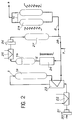
- the first step of removing oxygen and any impurities contained in the starting gas mixture comprises a first step of removing hydrocarbons by catalytic oxidation (and also catalytic dissociation of the oxide of nitrogen N 2 0), which takes place in the unit shown in 1a; a second stage of elimination of oxygen and nitrogen oxides by catalytic reduction, which takes place in the unit shown in 1 b; and a third stage of elimination of carbon dioxide and water vapor by passage over a molecular sieve and / or silica gel, which takes place in the unit shown in 1 c.
- the gas mixture to be treated is first introduced at 5 into unit 1a and leaves this unit free of hydrocarbons. It is then introduced, at 6, into unit 1b where catalytic reduction takes place in the presence of palladium by the action of hydrogen supplied at 7. It res leaves this unit 1b, freed from oxygen and nitrogen oxides and is introduced at 8, into unit 1c where it is freed from carbon dioxide and water vapor by passage over a molecular sieve.
- the mixture introduced at 9 in column 2 is a mixture of nitrogen, xenon and krypton to which argon at 10 is added beforehand, before entering column 2.
- a portion of krypton eliminated in 17 is taken, and it is recycled in 19 to reintroduce it at the inlet of column 2, so as to be able to carry out the cryogenic distillation at a pressure weaker.
- the pressure at which the cryogenic distillation is carried out in column 2 is at most 18 bars
- the pressure at which the cryogenic distillation is carried out in column 4 is approximately 3 bars
- the pressure at which performs the cryogenic distillation in column 3 is between the pressure of column 4 and the pressure of column 2.
- the gaseous mixture to be treated coming from the irradiated fuel reprocessing plant, is first introduced at 20 into a compressor 21, then is cooled by a circulation of water in a refrigerant 22 and, after passing through an exchanger 23, is introduced in 5 into unit 1a which contains a platinum or rhodium catalyst: in this unit 1a, the hydrocarbons are eliminated from the gas mixture by catalytic oxidation and there is also elimination of the nitrous oxide N 2 0 by dissociation catalytic of the latter.
- An external heating device ensures that a maximum temperature of 700 ° C is maintained in this unit 1 a.
- the gaseous mixture freed from hydrocarbons passes through the exchanger 23 then, after mixing with part of the gaseous mixture coming from the water separator 27, into an electric heating system 24 which brings it to a temperature of 100 ° C. and is introduced, at 6, into unit 1b; in this unit 1b, the oxygen and the nitrogen oxides are eliminated by catalytic reduction, the unit 1b containing a palladium catalyst and optionally a rhodium and hydrogen catalyst being introduced at 7, so as to maintain a slight excess of this gas at the outlet of unit 1 b.
- the gas mixture freed from oxygen and nitrogen oxides, is cooled in a water cooler 25, then passes through a fan 26.
- part of the mixture gaseous, after passing through a water separator 27 is recycled at 28 to unit 1b and the other part is directed at 8, to unit 1c.
- the mixture introduced at 8 into unit 1c is freed from water vapor and traces of C0 2 by passing over a molecular sieve and / or silica gel in one of the two absorbers 29 arranged in parallel; these two absorbers 29 periodically and alternately undergo regeneration by heating and circulation of nitrogen.
- the distillation column 2 operates at a pressure of at most 18 bar.
- the lower part of column 2 is maintained at the necessary temperature using an electric heating device 31.
- reflux is provided by a condenser 32, cooled by liquid nitrogen supplied at 33.
- a gaseous mixture containing mainly nitrogen and possibly a fraction of argon is extracted from the upper part of column 2, at 11; this mixture can be recycled in the shear scanning circuit or discharged into the atmosphere; it is heated beforehand by passing through the exchanger 30, from which it exits at 34.
- a liquid mixture of argon concentrated in krypton and xenon is extracted and it is introduced at 13 into the column distillation 3.
- column 3 which operates at a pressure between the pressure of column 4 and the pressure of column 2, the argon in gaseous state is separated by cryogenic distillation at 14 and the liquid mixture of krypton is collected and xenon at the bottom of column 3.
- the argon can be recycled, leaving at 14 from column 3, at the inlet of column 2.
- the liquid mixture of krypton and xenon leaving the bottom of column 3 is introduced at 16 into column 4, where the separation of krypton and xenon is carried out by cryogenic distillation: krypton is obtained in gaseous form at 17, at the top of column 4, and the xenon in liquid form at 18, at the bottom of column 4.
- part of the krypton obtained in 17 and 19 is recycled to the inlet of column 2; this makes it possible to increase the relative content of krypton in the feed gas mixture and to carry out the first cryogenic distillation in column 2 at a pressure notably less than 18 bars; for example, with a krypton to xenon ratio of 1, obtained with a reflux of 10 of krypton, the operating pressure of column 2 can be lowered to a value of 10 bars.
- the pure xenon obtained in 18 is marketable.
- the gaseous mixture to be treated to which a determined amount of argon has been added has the following composition: 81% nitrogen, 11% oxygen, 8% argon, 150 ppm krypton, and 1500 ppm xenon, hydrocarbons, oxides of nitrogen, water vapor and carbon dioxide; it is introduced in 5, at a flow rate of 21.8 m 3 per hour, into unit 1a.
- the mixture freed from hydrocarbons is introduced at 6 into unit 1b and hydrogen is introduced at 7 at a flow rate of 4.8 m 3 per hour.
- the mixture, freed from oxygen and nitrogen oxides is introduced at 8 into unit 1c.
- the gaseous mixture freed of water vapor and of CO 2
- the mixture has the following composition: 88% nitrogen, 12 % argon, 150 ppm krypton and 1500 ppm xenon; it is introduced into column 2.
- a gas mixture of 91% nitrogen and 9% argon is recovered at 11.
- a liquid mixture of 94.5% argon, 0.5% krypton and 5% xenon is recovered. This mixture is introduced at 13 into column 3.
- argon gas is recovered at 14 at a flow rate of 600 l / h and at the bottom of this column 3, a liquid mixture of 10 is recovered % krypton and 90% xenon. This mixture is introduced at 16 into column 4.
- gaseous krypton is recovered at 17 at a flow rate of 3 1 / h and at the bottom of column 4, liquid xenon at a flow rate of 301 / h.
- the values given above relate to the case where part of the krypton obtained in 17 is not recycled at the entry of column 2.
- the gas mixture introduced at 9 at the inlet of column 2 then has the following composition: 88% nitrogen, 12% argon, 1500 ppm krypton and 1500 ppm xenon. This makes it possible to be able to operate column 2 at a pressure of the order of 10 bars instead of 18 bars.
Landscapes
- Engineering & Computer Science (AREA)
- Physics & Mathematics (AREA)
- General Engineering & Computer Science (AREA)
- Mechanical Engineering (AREA)
- Thermal Sciences (AREA)
- High Energy & Nuclear Physics (AREA)
- Separation By Low-Temperature Treatments (AREA)
- Treating Waste Gases (AREA)
Claims (5)
Applications Claiming Priority (2)
| Application Number | Priority Date | Filing Date | Title |
|---|---|---|---|
| FR7823735 | 1978-08-11 | ||
| FR7823735A FR2433229A1 (fr) | 1978-08-11 | 1978-08-11 | Procede de traitement d'un melange d'air avec des gaz rares |
Publications (3)
| Publication Number | Publication Date |
|---|---|
| EP0008273A1 EP0008273A1 (de) | 1980-02-20 |
| EP0008273B1 EP0008273B1 (de) | 1982-03-24 |
| EP0008273B2 true EP0008273B2 (de) | 1988-01-27 |
Family
ID=9211793
Family Applications (1)
| Application Number | Title | Priority Date | Filing Date |
|---|---|---|---|
| EP79400556A Expired EP0008273B2 (de) | 1978-08-11 | 1979-08-06 | Verfahren zur Behandlung von von der Wiederaufbereitung von bestrahlten Kernbrennstoffen stammenden Abströmgasen |
Country Status (5)
| Country | Link |
|---|---|
| US (1) | US4277363A (de) |
| EP (1) | EP0008273B2 (de) |
| JP (1) | JPS5853320B2 (de) |
| DE (1) | DE2962341D1 (de) |
| FR (1) | FR2433229A1 (de) |
Families Citing this family (13)
| Publication number | Priority date | Publication date | Assignee | Title |
|---|---|---|---|---|
| JPS6091511A (ja) * | 1983-10-24 | 1985-05-22 | 豊田合成株式会社 | ステアリングホイ−ル |
| JPS6093240U (ja) * | 1983-12-01 | 1985-06-25 | エスエムケイ株式会社 | 複合スイツチ |
| JPS6157427U (de) * | 1984-09-21 | 1986-04-17 | ||
| JPS6160421U (de) * | 1984-09-25 | 1986-04-23 | ||
| JPS62107321U (de) * | 1985-12-26 | 1987-07-09 | ||
| JPH01121230U (de) * | 1988-02-10 | 1989-08-17 | ||
| JPH04130999U (ja) * | 1991-05-24 | 1992-12-01 | 株式会社河合楽器製作所 | 鍵盤スイツチ |
| FR2798076B1 (fr) * | 1999-09-06 | 2002-05-24 | Air Liquide | Procede d'elimination par permeation des composes fluores ou fluorosoufres d'un flux de xenon et/ou de krypton |
| JP3572548B2 (ja) * | 2002-05-24 | 2004-10-06 | 日本酸素株式会社 | ガス精製方法及び装置 |
| US6694775B1 (en) * | 2002-12-12 | 2004-02-24 | Air Products And Chemicals, Inc. | Process and apparatus for the recovery of krypton and/or xenon |
| DE102005037576A1 (de) * | 2005-08-09 | 2007-02-15 | Linde Ag | Verfahren und Vorrichtung zur Gewinnung von Krypton und/oder Xenon |
| CN114735666A (zh) * | 2022-06-09 | 2022-07-12 | 北京化工大学 | 一种分离精制稀有气体的工艺 |
| CN120437802B (zh) * | 2025-07-08 | 2025-09-19 | 杭州湘亭科技有限公司 | 一种Kr富集分离设备控制方法及系统 |
Family Cites Families (10)
| Publication number | Priority date | Publication date | Assignee | Title |
|---|---|---|---|---|
| US3155469A (en) * | 1962-01-05 | 1964-11-03 | Linde Eismasch Ag | Process for removing trace admixtures from reactor coolant gas |
| US3404067A (en) * | 1965-02-12 | 1968-10-01 | Air Reduction | Process for removing radioactive materials from the environment of an atomic reactor |
| DE1667639A1 (de) * | 1968-03-15 | 1971-07-08 | Messer Griesheim Gmbh | Verfahren zum Gewinnen eines Krypton-Xenon-Gemisches aus Luft |
| US4078907A (en) * | 1970-02-18 | 1978-03-14 | The United States Of America As Represented By The United States Department Of Energy | Separation and purification of xenon |
| DE2131507C3 (de) * | 1971-06-25 | 1980-01-10 | Kernforschungsanlage Juelich Gmbh, 5170 Juelich | Verfahren und Vorrichtung zur Absicherung von Edelgasspuren, insbesondere Krypton, aus einer Kohlendioxid als Bestandteil enthaltenden Gasmischung |
| JPS503480B2 (de) * | 1972-02-25 | 1975-02-05 | ||
| US4012490A (en) * | 1972-07-25 | 1977-03-15 | Airco, Inc. | Removing radioactive noble gases from nuclear process off-gases |
| GB1509581A (en) * | 1974-07-31 | 1978-05-04 | Commissariat Energie Atomique | Method of eliminating radioactivity from air containing radioactive rare gases |
| FR2280954B1 (fr) * | 1974-07-31 | 1977-01-07 | Commissariat Energie Atomique | Procede de traitement de melanges d'air et de gaz rares au moins partiellement radio-actifs |
| JPS5263188A (en) * | 1975-11-18 | 1977-05-25 | Terukatsu Miyauchi | Method of separating mixed gas |
-
1978
- 1978-08-11 FR FR7823735A patent/FR2433229A1/fr active Granted
-
1979
- 1979-08-06 EP EP79400556A patent/EP0008273B2/de not_active Expired
- 1979-08-06 DE DE7979400556T patent/DE2962341D1/de not_active Expired
- 1979-08-09 JP JP54100829A patent/JPS5853320B2/ja not_active Expired
- 1979-08-13 US US06/066,103 patent/US4277363A/en not_active Expired - Lifetime
Also Published As
| Publication number | Publication date |
|---|---|
| EP0008273A1 (de) | 1980-02-20 |
| US4277363A (en) | 1981-07-07 |
| JPS5853320B2 (ja) | 1983-11-28 |
| FR2433229B1 (de) | 1981-01-30 |
| FR2433229A1 (fr) | 1980-03-07 |
| EP0008273B1 (de) | 1982-03-24 |
| JPS5547499A (en) | 1980-04-03 |
| DE2962341D1 (en) | 1982-04-29 |
Similar Documents
| Publication | Publication Date | Title |
|---|---|---|
| EP0008273B2 (de) | Verfahren zur Behandlung von von der Wiederaufbereitung von bestrahlten Kernbrennstoffen stammenden Abströmgasen | |
| CA2174290C (fr) | Procede et dispositif d'elimination d'au moins un gaz acide par un solvant, pour l'epuration du gaz naturel | |
| JPS6349147B2 (de) | ||
| FR2485945A1 (fr) | Procede pour la separation selective d'hydrogene sulfure a partir de melanges gazeux contenant egalement du gaz carbonique | |
| CH656871A5 (fr) | Procede de preparation d'ethylene glycol. | |
| FR2573671A1 (fr) | Procede pour extraire de facon selective le sulfure d'hydrogene de melanges gazeux contenant aussi du dioxyde de carbone. | |
| US4421536A (en) | Process for producing krypton and xenon | |
| EP0454531A1 (de) | Verfahren und Einrichtung zur Herstellung von ultrareinem Stickstoff | |
| FR2655873A1 (fr) | Procede et dispositif d'elimination par permeation du monoxyde de carbone dans un melange gazeux a base d'hydrogene. | |
| JPH0576326B2 (de) | ||
| JPH10245210A (ja) | クリプトン・キセノン製造法 | |
| WO1992020431A1 (en) | Treatment of acid gas using hybrid membrane separation systems | |
| FR3035656A1 (fr) | Production d'helium a partir d'un courant gazeux contenant de l'hydrogene | |
| JPH06234511A (ja) | 圧縮熱を使用する精製方法及び装置 | |
| US4055625A (en) | Method of treatment of a mixture of air and at least partially radioactive rare gases | |
| EP1002763B1 (de) | Verfahren und Vorrichtung zur Behandlung von Schwefelwasserstoff und Schwefeldioxyd enthaltenden Gasen mit einer Entfernungsstufe für Nebenprodukte | |
| EP1067346A1 (de) | Verfahren und Vorrichtung zur Rückgewinnung von Xenon oder einem Gemisch von Krypton und Xenon aus Luft | |
| EP0017560A1 (de) | Verfahren und Anlage zur Herstellung von Nitroparaffinen durch Nitrierung von Kohlenwasserstoffen in der Gasphase | |
| EP1450935A1 (de) | Verfahren zur trennung einer gasmischung durch eine permeationsmembran-einheit | |
| HUT52736A (en) | Process for simultanous production and equipment of hydrogen and carbonic oxid | |
| FR2896509A1 (fr) | Procede de capture des mercaptans contenus dans un gaz naturel par concentration. | |
| EP0019303B1 (de) | Verfahren zur Extrahierung von Xenon und/oder Krypton aus einem Trägergas | |
| JP2726828B2 (ja) | 高度不飽和脂肪酸またはそのエステルの濃縮分別装置とその濃縮分別法 | |
| US5209913A (en) | Process for the production of natural gas condensate having a reduced amount of mercury from a mercury-containing natural gas wellstream | |
| US5130108A (en) | Process for the production of natural gas condensate having a reduced amount of mercury from a mercury-containing natural gas wellstream |
Legal Events
| Date | Code | Title | Description |
|---|---|---|---|
| PUAI | Public reference made under article 153(3) epc to a published international application that has entered the european phase |
Free format text: ORIGINAL CODE: 0009012 |
|
| AK | Designated contracting states |
Designated state(s): BE DE GB |
|
| 17P | Request for examination filed | ||
| GRAA | (expected) grant |
Free format text: ORIGINAL CODE: 0009210 |
|
| AK | Designated contracting states |
Designated state(s): BE DE GB |
|
| REF | Corresponds to: |
Ref document number: 2962341 Country of ref document: DE Date of ref document: 19820429 |
|
| PLBI | Opposition filed |
Free format text: ORIGINAL CODE: 0009260 |
|
| 26 | Opposition filed |
Opponent name: LINDE AKTIENGESELLSCHAFT, WIESBADEN Effective date: 19821216 |
|
| R28E | Request filed for re-establishment of rights after grant (corrected) |
Effective date: 19861227 |
|
| PUAH | Patent maintained in amended form |
Free format text: ORIGINAL CODE: 0009272 |
|
| STAA | Information on the status of an ep patent application or granted ep patent |
Free format text: STATUS: PATENT MAINTAINED AS AMENDED |
|
| 27A | Patent maintained in amended form |
Effective date: 19880127 |
|
| AK | Designated contracting states |
Kind code of ref document: B2 Designated state(s): BE DE GB |
|
| PGFP | Annual fee paid to national office [announced via postgrant information from national office to epo] |
Ref country code: DE Payment date: 19890727 Year of fee payment: 11 |
|
| PGFP | Annual fee paid to national office [announced via postgrant information from national office to epo] |
Ref country code: BE Payment date: 19890816 Year of fee payment: 11 |
|
| PGFP | Annual fee paid to national office [announced via postgrant information from national office to epo] |
Ref country code: GB Payment date: 19890831 Year of fee payment: 11 |
|
| PG25 | Lapsed in a contracting state [announced via postgrant information from national office to epo] |
Ref country code: GB Effective date: 19900806 |
|
| PG25 | Lapsed in a contracting state [announced via postgrant information from national office to epo] |
Ref country code: BE Effective date: 19900831 |
|
| BERE | Be: lapsed |
Owner name: COMMISSARIAT A L'ENERGIE ATOMIQUE ETS DE CARACTER Effective date: 19900831 |
|
| GBPC | Gb: european patent ceased through non-payment of renewal fee | ||
| PG25 | Lapsed in a contracting state [announced via postgrant information from national office to epo] |
Ref country code: DE Effective date: 19910501 |