EP0009936B1 - Polymères retardateurs de flammes et procédé pour préparer lesdits polymères - Google Patents
Polymères retardateurs de flammes et procédé pour préparer lesdits polymères Download PDFInfo
- Publication number
- EP0009936B1 EP0009936B1 EP19790302028 EP79302028A EP0009936B1 EP 0009936 B1 EP0009936 B1 EP 0009936B1 EP 19790302028 EP19790302028 EP 19790302028 EP 79302028 A EP79302028 A EP 79302028A EP 0009936 B1 EP0009936 B1 EP 0009936B1
- Authority
- EP
- European Patent Office
- Prior art keywords
- additive
- polymer
- weight
- solubilization
- fire
- Prior art date
- Legal status (The legal status is an assumption and is not a legal conclusion. Google has not performed a legal analysis and makes no representation as to the accuracy of the status listed.)
- Expired
Links
Images


Classifications
-
- C—CHEMISTRY; METALLURGY
- C08—ORGANIC MACROMOLECULAR COMPOUNDS; THEIR PREPARATION OR CHEMICAL WORKING-UP; COMPOSITIONS BASED THEREON
- C08K—Use of inorganic or non-macromolecular organic substances as compounding ingredients
- C08K5/00—Use of organic ingredients
- C08K5/0008—Organic ingredients according to more than one of the "one dot" groups of C08K5/01 - C08K5/59
- C08K5/0066—Flame-proofing or flame-retarding additives
-
- C—CHEMISTRY; METALLURGY
- C08—ORGANIC MACROMOLECULAR COMPOUNDS; THEIR PREPARATION OR CHEMICAL WORKING-UP; COMPOSITIONS BASED THEREON
- C08K—Use of inorganic or non-macromolecular organic substances as compounding ingredients
- C08K5/00—Use of organic ingredients
Definitions
- This invention relates to fire retardant polymer compositions and specifically compositions comprising a blend of additives chosen to optimize both the efficiency of the fire retardant and the physical properties of the polymer.
- Ts solubilization temperature
- the effect is illustrated in the graph of percent light transmission against temperature that appears as Figure 1 which is more fully described in Example 1 below. Note that upon cooling the percent light transmission does not fall substantially indicating that virtually all the additive remains dissolved. Complete solubilization is not immediately reached at Ts but over a period the length of which depends on the amount by which Ts is exceeded. Ts marks the lowest temperature at which solubilization can be achieved. Ts is dependent on the polymer, the additive and the amount of additive used. Certain additives in certain polymers show the above effect but upon cooling, the light transmission falls indicating increasing re-separation. For the purposes of this specification such an effect is not regarded as "solubilization" which is herein used to indicate a stable state not affected by subsequent temperature variations.
- additives such as anti-static additives, UV stabilizers and antioxidants which are usually employed in amounts of up to one percent are not those where solubilization is a critical factor in property retention.
- additives can never be solubilized in organic polymers because of their inorganic character.
- additives include antimony oxide fire-retardant synergists, smoke suppressants such as calcium oxide, dawsonite, borates and the like, fillers and pigments such as titanium dioxide, calcium carbonate and carbon black, and mineral reinforcing additives such as glass fibers, talc and the like.
- solubilization is therefore of use only with compatible organic additives incorporated into thermoplastic polymers in significant amounts, i.e., about 5 percent or more based on the polymer weight.
- plasticizers are specifically chosen for their ability to modify certain physical properties.
- it proves impossible or impracticable to incorporate an effective amount in the polymer with complete solubilization This can be because the solubilization temperature of that amount of the additive in the polymer is above the decomposition temperature of either the additive or the polymer or because the time taken to achieve complete solubilization at the practicable processing temperatures is . impracticably long. This has the effect of eliminating a range of potentially useful additives because of the property penalty involved in their use.
- the present invention provides a way in which these formerly disfavored additives can be used without having to accept a property penalty.
- the invention provides a means of incorporating organic fire-retardant additives into thermoplastic polymers with maximum retention of the physical properties of the polymer while requiring a reduced time under processing conditions before solubilization is achieved.
- the invention described herein flows from the surprising discovery that the solubilization temperature of a given amount of a fire-retardant additive in a polymer can be reduced substantially if it is added along with a compatible organic additive having a substantially lower solubilization temperature.
- the combination of additives has a "combined solubilization temperature" that lies somewhere intermediate the solubilization temperatures of the individual additives.
- This invention therefore provides fire-retardant polymer compositions that suffer from little or no diminution of their physical properties as a result of the presence of the fire-retardant additives.
- fire retardant additive as it is used in this specification is understood to relate to halogen-containing, monomeric or oligomeric organic compounds which have the property of releasing halogen when they decompose. It is thus not intended that the term cover metal-containing fire-retardant synergists such as zinc oxide and antimony oxide and the like. Likewise, additives whose primary purpose is to reduce the evolution of smoke or noxious gases from burning polymers are not regarded as fire retardants for the purposes of this invention.
- the invention disclosed herein comprises a polymeric composition comprising a thermoplastic polymer and, dissolved therein with complete solubilization, an additive combination comprising:
- the invention also comprises a process for the production of a fire-retardant polymeric composition which comprises incorporating into a thermoplastic polymer an additive composition comprising:
- compatible organic additive as used herein is intended to include those additives that can be completely solubilized in the polymer.
- the function of such an additive is, in combination with the fire-retardant additive (A) to give a combined solubilization temperature at least 10°C. below Ts, it needs to be one that can be added in comparable quantities.
- fire-retardant additive A
- such additives are usually, but not by any means exclusively, fire-retardants or perhaps plasticizers.
- (B) is one or more flame retardants
- the polymer that is rendered fire-retardant by the process herein described can be any thermoplastic polymer that has a tendency to burn when exposed to flame.
- Such polymers include styrenic polymers such as polystyrene, rubber-modified polystyrene (HIPS), copolymers of styrene or a substituted styrene with any one or more of an unsaturated nitrile, an acrylate ester, a methacrylate ester, an unsaturated anhydride, a diene such as butadiene as well as rubber-modified versions of such copolymers including ABS; polyamides such as nylon 66, and nylon 6; polyolefins such as polyethylene and polypropylene; copolymers of olefins with unsaturated esters and alcohols; and polyesters such as polyethylene terephthalate, polybutylene terephthalate, polymethyl methacrylate and polyvinyl acetate.
- halogen-containing organic fire-retardants are available commercially. Most are based on halogen-substituted aromatic compounds and it is in precisely this group that high solubilization temperatures are encountered.
- Dechlorane +25 is identified by CAS Registry No. 13560-89-9 and its formula is 1, 2, 3, 4, 7, 8, 9, 10, 13, 13, 14, 14, -dodecachloro- 1, 4, 4a, 5, 6, 6a, 7,10, 1 Oa, 11, 12, 12a -dodecahydro -1,4:7,10-dimethanodibenzo (a,e,) cyclooctene.
- Dechlorane 602 is a different adduct of the basic Dechlorane +25 molecule the exact structure of which is not known.
- Citex BC-26 has the formula
- thermoplastic polymers as has been indicated above, varies somewhat with the concentration.
- concentration there is often a limit on the amount that can actually be solubilized which, it should be recalled, implies that the additive stays substantially completely in solution even when the temperature drops below the solubilization temperature (Ts).
- the fire-retardant additives that are most difficult to incorporate into HIPS in effective amounts without operating at close to or above the top end of the commercial processing temperature range are Dechlorane +25 and decabromodiphenyl ether. These additives are also highly effective additives and Dechlorane +25 is useful in conferring a degree of U.V. stability as well as fire-retardance. Additive combinations according to the invention including either of these additives are therefore particularly preferred.
- Preferred compatible organic additives can readily be determined from a consideration of the extensive data presented in the Examples.
- the compatible organic additive is one that is effective when used in the appropriate amount, in reducing the solubilization temperature of the fire-retardant additive in the thermoplastic polymer by at least 10°C. It is very frequently advantageous to reduce the amount of the fire-retardant additive and provide that the compatible organic additive is itself also a fire-retardant, though one with a somewhat lower solubilization temperature in the polymer, so as to maintain the level of fire-retardance of the overall composition.
- the compatible organic additive can be a different type of additive such as a plasticizer.
- plasticizers are not preferred since they tend to have a rather more modest effect on the combined solubilization temperature than fire-retardants.
- suitable plasticizers include esters of acids such as phthalic, benzoic, adipic, and higher fatty acids with aliphatic alcohols, or polyhydroxylic hydrocarbons, such as glycol or glycerol.
- DBDPO standard fire-retardant against which the other fire-retardants are to be assessed in determining their efficiency.
- the co-additive must make up (8.7 ⁇ 4.15) phr or 4.55 phr of effective halogen supplied.
- Figure 1 is a graph of percentage light transmission against temperature for a composition comprising a high impact polystyrene and 10% of decabromodiphenyl ether.
- Figure 2. is a graph of multiaxial impact strength against percentage of additive solubilized using the same combination as formed the base for Figure 1.
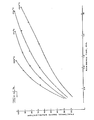
- Figure 3. is a graph showing a family of curves obtained by plotting fractional additive solubilization against residence time at four different temperatures.
- a high impact polystyrene with a rubber level between 7.5 and 9.5% and a weight average molecular weight between 160,000 and 250,000 was used as the base thermoplastic polymer in the following experiments which are designed to explain the pheonomenon of solubilization more clearly and to illustrate the dependence of multiaxial impact strength on the degree to which solubilization has occurred.
- a composition comprising the above HIPS base polymer and 10% by weight of DBDPO blended together at a temperature below the Ts and samples were microtomed to about .5 mm thickness.
- the sample was then placed in the thermal optical analysis equipment described above and a beam of monochromatic light was passed through the sample. The fraction of light transmitted by the sample is monitored as the temperature of the sample is raised at a rate of 20°C. per minute.
- the light transmission readings were plotted against temperature and the graph appearing as Figure 1 was obtained. As can be seen, the transmission stays at a uniform low level for a period before beginning a sharp rise (at the solubilization temperature, Ts) until a point is reached at which the trace levels out. The maximum level is the complete, 100%, solubilization point and the uniform low level before the sharp rise is taken as 0% solubilization. A calibration of the light transmission is therefore obtained which permits correlation of the light transmission with degree of solubilization.
- the graph presented as Figure 3 shows a family of curves obtained using the same polymer/additive system described above for which the solubilization temperature is 255°C.
- the rate at which complete solubilization occurs depends on the degree to which the solubilization temperature is exceeded. This is clearly a significant factor since, if Ts can be reduced, processing at the same temperature will achieve more rapid solubilization thus reducing the length of time the composition is exposed to potentially degrading conditions.
- This Example illustrates the invention described herein in terms of combinations of two fire retardants added to the HIPS polymer used in Example 1.
- the solubilization temperatures were measured in the manner described in Example 1.
- Additive A (the fire retardant additive) is Dechiorane +25 and Additive B (the compatible organic additive - in this case also a fire-retardant additive) is Dechlorane 602.
- the solubilization temperature for the compositions were then determined using the technique described in Example 1. The results are set forth in Table 5 below. From this data it can clearly be seen that the presence of Additive B substantially reduces the solubilization temperature by comparison with that for Additive A alone.
- the Ts obtained using the thermal optical analysis technique cannot be used directly to predict a precise processing temperature since it is obtained using a static system rather than a dynamic agitated system such as exists in an extruder for example.
- the effect of such agitation is to reduce the effective solubilization temperature by an amount that depends on the intensity of the mixing.
- composition 4 in Table 6 it is clear from the improvement in impact strength that the processing temperature is somewhere above the temperature at which solubilization can occur. This is so even though Ts measured using the static thermal optical analysis technique is some 24°C. higher.
- Example 8 This Example is constructed in the same way as Example 4 except that different compounds were selected as fire-retardant additive. The reporting of the results obtained is otherwise identical and appears as Table 8.
- thermoplastic polymer used is a rubber-modified styrene/maleic anhydride copolymer containing about 8% maleic anhydride. Otherwise the presentation of the data follows the pattern of the above Examples 4 to 6.
- fire-retardant additives can be solubilized in any given thermoplastic polymer. As indicated above some come out of solution on cooling and some never reach solubilization because of decomposition of the polymer or the additive or because of a more fundamental incompatibility. In general however the effective ranges of addition of the fire-retardant additive combinations are as set forth in Table 12 below.
Landscapes
- Chemical & Material Sciences (AREA)
- Health & Medical Sciences (AREA)
- Chemical Kinetics & Catalysis (AREA)
- Medicinal Chemistry (AREA)
- Polymers & Plastics (AREA)
- Organic Chemistry (AREA)
- Compositions Of Macromolecular Compounds (AREA)
- Processes Of Treating Macromolecular Substances (AREA)
Claims (18)
Applications Claiming Priority (2)
| Application Number | Priority Date | Filing Date | Title |
|---|---|---|---|
| US94779878A | 1978-10-02 | 1978-10-02 | |
| US947798 | 1997-10-09 |
Publications (2)
| Publication Number | Publication Date |
|---|---|
| EP0009936A1 EP0009936A1 (fr) | 1980-04-16 |
| EP0009936B1 true EP0009936B1 (fr) | 1983-02-23 |
Family
ID=25486793
Family Applications (1)
| Application Number | Title | Priority Date | Filing Date |
|---|---|---|---|
| EP19790302028 Expired EP0009936B1 (fr) | 1978-10-02 | 1979-09-28 | Polymères retardateurs de flammes et procédé pour préparer lesdits polymères |
Country Status (5)
| Country | Link |
|---|---|
| EP (1) | EP0009936B1 (fr) |
| JP (1) | JPS5550037A (fr) |
| AU (1) | AU529884B2 (fr) |
| CA (1) | CA1155574A (fr) |
| DE (1) | DE2964910D1 (fr) |
Families Citing this family (2)
| Publication number | Priority date | Publication date | Assignee | Title |
|---|---|---|---|---|
| JPS57158247A (en) * | 1981-03-24 | 1982-09-30 | Tokuyama Soda Co Ltd | Flame retardant polyolefin composition |
| US6489390B1 (en) | 2001-05-18 | 2002-12-03 | Albemarle Corporation | Flame retardants and flame retardant compositions formed therewith |
Family Cites Families (7)
| Publication number | Priority date | Publication date | Assignee | Title |
|---|---|---|---|---|
| NL92901C (fr) * | 1954-01-20 | |||
| DE1282938B (de) * | 1963-08-17 | 1968-11-14 | Basf Ag | Flammwidrige verschaeumbare Formmassen aus Styrolpolymerisaten |
| CH510703A (de) * | 1966-06-23 | 1971-07-31 | Basf Ag | Schwerentflammbare thermoplastische Formmasse |
| US3530083A (en) * | 1968-06-07 | 1970-09-22 | Hooker Chemical Corp | Fire retardant polymer compositions |
| US3530090A (en) * | 1968-07-01 | 1970-09-22 | American Cyanamid Co | Synergistic flame-retardant compositions |
| US4000114A (en) * | 1975-02-24 | 1976-12-28 | Hooker Chemicals & Plastics Corporation | Fire retardant polymer compositions with improved physical properties |
| US4067930A (en) * | 1976-11-26 | 1978-01-10 | Cities Service Company | Flame-retardant composition |
-
1979
- 1979-09-28 DE DE7979302028T patent/DE2964910D1/de not_active Expired
- 1979-09-28 EP EP19790302028 patent/EP0009936B1/fr not_active Expired
- 1979-10-01 AU AU51336/79A patent/AU529884B2/en not_active Ceased
- 1979-10-01 JP JP12726279A patent/JPS5550037A/ja active Pending
- 1979-10-01 CA CA000336729A patent/CA1155574A/fr not_active Expired
Also Published As
| Publication number | Publication date |
|---|---|
| AU5133679A (en) | 1980-04-17 |
| DE2964910D1 (en) | 1983-03-31 |
| AU529884B2 (en) | 1983-06-23 |
| JPS5550037A (en) | 1980-04-11 |
| EP0009936A1 (fr) | 1980-04-16 |
| CA1155574A (fr) | 1983-10-18 |
Similar Documents
| Publication | Publication Date | Title |
|---|---|---|
| CA1073578A (fr) | Produits retardateurs de flamme a base d'un polymere styrenique a grande resistance aux chocs | |
| US3846469A (en) | Isopropylidene bis(2,6-dihalo-p-phenylene) bis(poly-halophenyl) carbonates | |
| JPH0225381B2 (fr) | ||
| US4038245A (en) | Char-forming polymer compositions | |
| US4111885A (en) | Synergistic fire retardant additives for plasticized polyvinyl chloride consisting essential of boric acid and zinc oxide or zinc phosphate | |
| CA1310783C (fr) | Compositions polymeriques ignifuges | |
| EP0009936A1 (fr) | Polymères retardateurs de flammes et procédé pour préparer lesdits polymères | |
| US4707510A (en) | Flame retardant resin composition | |
| WO2005120165A2 (fr) | Formulations ignifuges | |
| CA1284244C (fr) | Composition de polymere resistant a l'embrasement | |
| US3956399A (en) | Halogenated-methylbenzyl phenyl ethers | |
| EP0934356A1 (fr) | Compositions de polyolefine resistantes au feu | |
| US4224217A (en) | Combustion resistant aromatic polymers containing char-forming benzyl and/or allyl moieties | |
| US4780496A (en) | Flame retardant thermoplastic polyolefin compositions | |
| US5008323A (en) | Flame retardant PVC resin compositions | |
| US4165309A (en) | Flame retardant polymer composition | |
| EP0383978A1 (fr) | Résines de polyester ignifiques | |
| US4028335A (en) | Thermally stable flame-retardant thermoplastic molding composition | |
| US4240956A (en) | Tri(dibromoneopentyl) antimonite flame retardants | |
| US3547876A (en) | Synergistic flame-retardant compositions | |
| EP0156219B1 (fr) | Composition de résine ignifugeante | |
| US4175071A (en) | Titanium dioxide as a U.V. screen in fire retardant vinyl polymers | |
| CA1055634A (fr) | Produit de moulage thermoplastique thermiquement stable, retardant la combustion | |
| US3562208A (en) | Additives for reducing the inflammability of high organic polymers | |
| US4714729A (en) | Ultraviolet light-stable ignition resistant thermoplastic molding compositions |
Legal Events
| Date | Code | Title | Description |
|---|---|---|---|
| PUAI | Public reference made under article 153(3) epc to a published international application that has entered the european phase |
Free format text: ORIGINAL CODE: 0009012 |
|
| AK | Designated contracting states |
Designated state(s): BE DE FR GB IT NL |
|
| 17P | Request for examination filed |
Effective date: 19801015 |
|
| ITF | It: translation for a ep patent filed | ||
| GRAA | (expected) grant |
Free format text: ORIGINAL CODE: 0009210 |
|
| AK | Designated contracting states |
Designated state(s): BE DE FR GB IT NL |
|
| ET | Fr: translation filed | ||
| REF | Corresponds to: |
Ref document number: 2964910 Country of ref document: DE Date of ref document: 19830331 |
|
| PGFP | Annual fee paid to national office [announced via postgrant information from national office to epo] |
Ref country code: NL Payment date: 19840816 Year of fee payment: 6 Ref country code: FR Payment date: 19840816 Year of fee payment: 6 |
|
| PGFP | Annual fee paid to national office [announced via postgrant information from national office to epo] |
Ref country code: DE Payment date: 19840820 Year of fee payment: 6 |
|
| PGFP | Annual fee paid to national office [announced via postgrant information from national office to epo] |
Ref country code: BE Payment date: 19840930 Year of fee payment: 6 |
|
| PG25 | Lapsed in a contracting state [announced via postgrant information from national office to epo] |
Ref country code: BE Effective date: 19850930 |
|
| BERE | Be: lapsed |
Owner name: MONSANTO CY Effective date: 19850928 |
|
| PG25 | Lapsed in a contracting state [announced via postgrant information from national office to epo] |
Ref country code: NL Effective date: 19860401 |
|
| GBPC | Gb: european patent ceased through non-payment of renewal fee | ||
| NLV4 | Nl: lapsed or anulled due to non-payment of the annual fee | ||
| PG25 | Lapsed in a contracting state [announced via postgrant information from national office to epo] |
Ref country code: FR Free format text: LAPSE BECAUSE OF NON-PAYMENT OF DUE FEES Effective date: 19860530 |
|
| REG | Reference to a national code |
Ref country code: FR Ref legal event code: ST |
|
| PG25 | Lapsed in a contracting state [announced via postgrant information from national office to epo] |
Ref country code: DE Effective date: 19861001 |
|
| PG25 | Lapsed in a contracting state [announced via postgrant information from national office to epo] |
Ref country code: GB Effective date: 19881118 |
|
| PLBE | No opposition filed within time limit |
Free format text: ORIGINAL CODE: 0009261 |
|
| STAA | Information on the status of an ep patent application or granted ep patent |
Free format text: STATUS: NO OPPOSITION FILED WITHIN TIME LIMIT |