EP0011371A1 - Procédé et dispositif pour ouvrir des filets fibrillés - Google Patents
Procédé et dispositif pour ouvrir des filets fibrillés Download PDFInfo
- Publication number
- EP0011371A1 EP0011371A1 EP79302161A EP79302161A EP0011371A1 EP 0011371 A1 EP0011371 A1 EP 0011371A1 EP 79302161 A EP79302161 A EP 79302161A EP 79302161 A EP79302161 A EP 79302161A EP 0011371 A1 EP0011371 A1 EP 0011371A1
- Authority
- EP
- European Patent Office
- Prior art keywords
- film
- fibrillated
- former
- opened
- network
- Prior art date
- Legal status (The legal status is an assumption and is not a legal conclusion. Google has not performed a legal analysis and makes no representation as to the accuracy of the status listed.)
- Granted
Links
- 238000000034 method Methods 0.000 title claims description 26
- 230000008602 contraction Effects 0.000 claims description 3
- 238000010438 heat treatment Methods 0.000 claims description 3
- 239000000463 material Substances 0.000 claims description 3
- 239000004033 plastic Substances 0.000 claims description 3
- 229920003023 plastic Polymers 0.000 claims description 3
- 238000005516 engineering process Methods 0.000 claims description 2
- 206010061592 cardiac fibrillation Diseases 0.000 description 9
- 230000002600 fibrillogenic effect Effects 0.000 description 9
- VYPSYNLAJGMNEJ-UHFFFAOYSA-N Silicium dioxide Chemical compound O=[Si]=O VYPSYNLAJGMNEJ-UHFFFAOYSA-N 0.000 description 8
- CPLXHLVBOLITMK-UHFFFAOYSA-N Magnesium oxide Chemical compound [Mg]=O CPLXHLVBOLITMK-UHFFFAOYSA-N 0.000 description 4
- 239000004743 Polypropylene Substances 0.000 description 4
- 229920000642 polymer Polymers 0.000 description 4
- -1 polypropylene Polymers 0.000 description 4
- 229920001155 polypropylene Polymers 0.000 description 4
- 239000000377 silicon dioxide Substances 0.000 description 4
- 239000000654 additive Substances 0.000 description 3
- 229920001577 copolymer Polymers 0.000 description 3
- OKTJSMMVPCPJKN-UHFFFAOYSA-N Carbon Chemical compound [C] OKTJSMMVPCPJKN-UHFFFAOYSA-N 0.000 description 2
- 239000004372 Polyvinyl alcohol Substances 0.000 description 2
- 239000004964 aerogel Substances 0.000 description 2
- 229910052799 carbon Inorganic materials 0.000 description 2
- 150000004649 carbonic acid derivatives Chemical class 0.000 description 2
- 239000003795 chemical substances by application Substances 0.000 description 2
- LYCAIKOWRPUZTN-UHFFFAOYSA-N ethylene glycol Natural products OCCO LYCAIKOWRPUZTN-UHFFFAOYSA-N 0.000 description 2
- 239000000499 gel Substances 0.000 description 2
- WGCNASOHLSPBMP-UHFFFAOYSA-N hydroxyacetaldehyde Natural products OCC=O WGCNASOHLSPBMP-UHFFFAOYSA-N 0.000 description 2
- 238000010348 incorporation Methods 0.000 description 2
- 239000000395 magnesium oxide Substances 0.000 description 2
- 239000011159 matrix material Substances 0.000 description 2
- 239000000203 mixture Substances 0.000 description 2
- 229920001296 polysiloxane Polymers 0.000 description 2
- 235000019422 polyvinyl alcohol Nutrition 0.000 description 2
- 229920002451 polyvinyl alcohol Polymers 0.000 description 2
- 150000004756 silanes Chemical class 0.000 description 2
- 230000006641 stabilisation Effects 0.000 description 2
- 238000011105 stabilization Methods 0.000 description 2
- 238000004381 surface treatment Methods 0.000 description 2
- XLYOFNOQVPJJNP-UHFFFAOYSA-N water Substances O XLYOFNOQVPJJNP-UHFFFAOYSA-N 0.000 description 2
- WBHAUHHMPXBZCQ-UHFFFAOYSA-N 2-methoxy-6-methylphenol Chemical compound COC1=CC=CC(C)=C1O WBHAUHHMPXBZCQ-UHFFFAOYSA-N 0.000 description 1
- XDLMVUHYZWKMMD-UHFFFAOYSA-N 3-trimethoxysilylpropyl 2-methylprop-2-enoate Chemical compound CO[Si](OC)(OC)CCCOC(=O)C(C)=C XDLMVUHYZWKMMD-UHFFFAOYSA-N 0.000 description 1
- VGGSQFUCUMXWEO-UHFFFAOYSA-N Ethene Chemical compound C=C VGGSQFUCUMXWEO-UHFFFAOYSA-N 0.000 description 1
- 239000005977 Ethylene Substances 0.000 description 1
- BLRPTPMANUNPDV-UHFFFAOYSA-N Silane Chemical compound [SiH4] BLRPTPMANUNPDV-UHFFFAOYSA-N 0.000 description 1
- 150000001336 alkenes Chemical class 0.000 description 1
- XAGFODPZIPBFFR-UHFFFAOYSA-N aluminium Chemical compound [Al] XAGFODPZIPBFFR-UHFFFAOYSA-N 0.000 description 1
- 229910052782 aluminium Inorganic materials 0.000 description 1
- 239000004411 aluminium Substances 0.000 description 1
- PNEYBMLMFCGWSK-UHFFFAOYSA-N aluminium oxide Inorganic materials [O-2].[O-2].[O-2].[Al+3].[Al+3] PNEYBMLMFCGWSK-UHFFFAOYSA-N 0.000 description 1
- 238000000137 annealing Methods 0.000 description 1
- 239000004568 cement Substances 0.000 description 1
- 238000010276 construction Methods 0.000 description 1
- 238000006073 displacement reaction Methods 0.000 description 1
- 125000001495 ethyl group Chemical group [H]C([H])([H])C([H])([H])* 0.000 description 1
- 238000001125 extrusion Methods 0.000 description 1
- 238000001914 filtration Methods 0.000 description 1
- 239000012530 fluid Substances 0.000 description 1
- 238000004519 manufacturing process Methods 0.000 description 1
- 239000004745 nonwoven fabric Substances 0.000 description 1
- JRZJOMJEPLMPRA-UHFFFAOYSA-N olefin Natural products CCCCCCCC=C JRZJOMJEPLMPRA-UHFFFAOYSA-N 0.000 description 1
- 229920000098 polyolefin Polymers 0.000 description 1
- 229920005606 polypropylene copolymer Polymers 0.000 description 1
- 230000002787 reinforcement Effects 0.000 description 1
- 230000003014 reinforcing effect Effects 0.000 description 1
- 229910000077 silane Inorganic materials 0.000 description 1
- 239000007787 solid Substances 0.000 description 1
- 239000004094 surface-active agent Substances 0.000 description 1
- 239000004753 textile Substances 0.000 description 1
- 238000012876 topography Methods 0.000 description 1
- 238000011282 treatment Methods 0.000 description 1
Images

Classifications
-
- B—PERFORMING OPERATIONS; TRANSPORTING
- B29—WORKING OF PLASTICS; WORKING OF SUBSTANCES IN A PLASTIC STATE IN GENERAL
- B29D—PRODUCING PARTICULAR ARTICLES FROM PLASTICS OR FROM SUBSTANCES IN A PLASTIC STATE
- B29D28/00—Producing nets or the like, e.g. meshes, lattices
-
- B—PERFORMING OPERATIONS; TRANSPORTING
- B29—WORKING OF PLASTICS; WORKING OF SUBSTANCES IN A PLASTIC STATE IN GENERAL
- B29C—SHAPING OR JOINING OF PLASTICS; SHAPING OF MATERIAL IN A PLASTIC STATE, NOT OTHERWISE PROVIDED FOR; AFTER-TREATMENT OF THE SHAPED PRODUCTS, e.g. REPAIRING
- B29C71/00—After-treatment of articles without altering their shape; Apparatus therefor
- B29C71/02—Thermal after-treatment
Definitions
- the present invention relates to a method and apparatus for opening fibrillated film networks.
- the present invention relates to a method and apparatus for opening a fibrillated tubular film formed by any suitable process.
- Fibrillated tubular films may be opened by gripping the network at each side edge e.g. stentering, and stretching the network transversely to its length.
- a fibrillated film is opened in the transverse direction there is a contraction in the length of the film and this reduction in length is, as will be appreciated, difficult to compensate for in a continuous operation wnerein the side edges of the network are gripped. Also such methods of gripping necessarily limit the width of the film which may be fully and evenly opened.
- the aim of the present invention is to provide a method and apparatus by means of which a fibrillated tubular network can be evenly and fully opened on a continuous basis, it being a simple matter to continuously compensate for the reduced length output in comparison with the input.
- a method of opening fibrillated film networks comprising passing a fibrillated tubular film over a former which is tapered out from an initial circumference of less than or equal to the circumference of the unopened fibrillated tube, to a larger circumference appropriate to the degree of opening required of the fibrillated film.
- the tubular film may be produced by the conventional processes of blown film technology when a suitable synthetic plastics material may be extruded through an annular ring die.
- the tubular film may be cooled by a controlled air current.
- the tubular film is then collapsed to a double-layer sheet by passing over rollers and further orientation of polymer chains in the film is effected in a stretching operation.
- the synthetic plastics material is a polypropylene or a copolymer of propylene with another olefin such as ethylene or mixtures of such polymers and/or copolymers or a mixture of polypropylene with another polyolefin such as polyethyleneo
- Fibrillation of the two layer film is achieved by any suitable fibrillating process.
- One such process is described in our British Patent Specification No. 1,073,741 wherein fibrillation is achieved by passing the film over a rotating pinned roller.
- the fibrillation process chosen is controlled so that the two layers of film are not broken completely apart at the side edges of the film.
- fibrillation may be limited to the central area of the two layer film leaving an unfibrillated film at each edge. Fibrillation may also be limited to other specific areas to leave other unfibrillated stripso
- the fibrillated tubular film may alternatively be manufactured by curling a flat film which has already been fibrillated by any suitable method, into a tube.
- the fibrillated tubular film is then passed over the tapered former to open the film network.
- the input speed of the unopened film is higher than that of the output speed of the opened film by an amount to allow for the contraction in length of the film.
- this method of opening guarantees that the full width of the fibrillated film is opened. Further, the opening is even across the circumference of the former.
- apparatus for opening a tubular fibrillated film network comprising a tapered former over which the tube of fibrillated film is passed, the former being tapered out from an initial circumference of less than or equal to that of the unopened fibrillated tube to a larger circumference appropriate to the degree of opening required of the fibrillated film.
- the former may be a smooth rounded cone, a combination of elliptical rings, a flat elliptical plate or a bowed bar. It is however essential that the displacement of the network be kept to a minimum in one plane e.g. the horizontal plane. Thus bowed bars, plates and formers with ellipsoidal shape of minimal minor axis are preferredo
- the topography of the former is designed that each element of the opened network travels the same distance over the former.
- the shape of the former after the largest value of minor axis must be developed so that this is possible, all points on the former at a specific transverse section being equidistant from the said initial circumference of the formero
- the opening properties of the tubular fibrillated films and their handling and bonding properties in the final matrix being reinforced may be enhanced by incorporation in the polymer of silanes, such as ethyl polysilicates and methacryloxypropyltrimethoxy silane types, silica (precipitated or aerogel), silicone glycol copolymer and polyvinylalcohol.
- silanes such as ethyl polysilicates and methacryloxypropyltrimethoxy silane types, silica (precipitated or aerogel), silicone glycol copolymer and polyvinylalcohol.
- silanes such as ethyl polysilicates and methacryloxypropyltrimethoxy silane types, silica (precipitated or aerogel), silicone glycol copolymer and polyvinylalcohol.
- These additives may be hydrophobed or not.
- Other additives include chalk, carbon, alumina, magnesia and other naturally occurring oxides
- the opened tubular web may be separated into two separate layers by the provision of a slitting device.
- a slitting device This may, for example, take the form of a hot blade or other mechanical cutting device.
- Such opened fibrillated networks may be used for reinforcing a water-hardening moss e.g. cement, resins, paper and other media, which are sufficiently low in viscosity in their state before curing or dewatering.
- moss e.g. cement, resins, paper and other media
- These networks also have interested general textile properties which make them attractive. for non-woven fabric end-uses which include interlinings, waddings and filtration cloths.
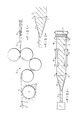
- Fig. 1 Apparatus for producing an opened web network from a tubular film is diagrammatically illustrated in Fig. 1.
- the tubular film 1 which is fed in the direction indicated by arrow A is formed by any suitable method. It can be produced by extrusion through an annular ring die (not shown) or by curling a flat film into a tube.
- the tubular film is collapsed to a double-layer sheet 2 by, for example, being passed over rollers (not shown), and is passed over a rotating fibrillating roller 3 which has outwardly projecting pins 4 which create stag- .- gered slits in the sheet 2.
- This form of fibrillation is described in detail in our British Patent Specification No. 1,073,741.
- alternative fibrillation methods may be used as desired.
- the fibrillated sheet may be formed from one or more fibrillated sheets which are curled or joined to form the tube which is subsequently flattened.
- the fibrillated double-layer sheet 2 is then passed around a number of guide rollers generally designated 5, and is engaged over the tapered former 6.
- the generally conical shape of former 6 causes the tubular film to expand resulting in the slits formed by fibrillation, opening to form an opened tubular network.
- Cutters 7 in the form of heated blades slit the sides of the opened tube as it leaves former 6, thus converting the opened tubular network into two generally planar opened networks which may be collected together as at 8 in Fig o 3, and passed to a winder assembly, as indicated at 9 in Fig. 4.
- winder assembly 9 collects the opened network at a slower rate than the rate at which the fibrillated film 2 is fed to former 6 by feeder F.
- This differential speed arrangement together with the tapered former 6 of the present invention thus simply overcomes the problems experienced in prior art constructions, wherein lateral stretching is produced by outside gripping means.
- the opened network can be treated with, for example, heat or the side edges 10 of the film can be gripped by suitable means such as the caterpillar grips 11 shown in Figs. 4, 5 and 6.
- the caterpillar grips 11 each comprise two endless belts 12 between which the film passes, the belts being guided around rollers 13 and 14.
- the belts 12 have regularly spaced projections 15 on their outer surface and these projections 15 engage in the opened out slits 16 in the film, produced by fibrillation, and thus hold the film in its expanded state.
- Fig. 7 shows a perspective view of the former ; 6 which is tapered to a smooth point 17 and has a very small depth in comparison with its width. Whilst the illustrated former is solid it may alternatively be hollow and if so, the former can be filled with a heated fluid e.g. oil or water, to assist heating and stabilization of the opened web.
- a heated fluid e.g. oil or water
- Fig. 8 shows an alternative embodiment of former which comprises a combination of different size elliptical hoops 18. Whilst the minor axes of the hoops 18 are approximately the same, the major axes of the hoops vary so as to provide an overall configuration similar to that of the former of Fig. 7. This has the advantage that it is cheap to manufacture. However, it is difficult to provide uniform heating for the web from the frame. However heat can be supplied directly to the web by convective and/or radiative transfer e.g. hot air and/or radiant heaters respectively.
- the opening properties of the tubular fibrillated film and their handling and bonding properties in the final matrix being reinforced can be enhanced by the incorporation in the polymer of silanes, such as polysilicates and methacryloxyproplytrimethoxy silane types, silica (precipitated or aerogel), silicone glycol copolymer and polyvinylalcohol.
- silanes such as polysilicates and methacryloxyproplytrimethoxy silane types, silica (precipitated or aerogel), silicone glycol copolymer and polyvinylalcohol.
- Other possible additives include chalk, carbon, aluminium, magnesia and other naturally occurring oxides and carbonates.
- Surface Treatments may also be applied such as typical surfactan and antistat agents suitable for treating polypropylene and silica gels Once opened the network can be stabilis by treatment with heat or it may be held open by mechanic means as described hereabove.
- the present invention thus provides a simple but effective method and apparatus for opening fibrillated film networks. These networks are especially useful either singly or in multi layer arrangements, as a reinforcement in water hardening masses.
Landscapes
- Engineering & Computer Science (AREA)
- Mechanical Engineering (AREA)
- Physics & Mathematics (AREA)
- Thermal Sciences (AREA)
- Shaping By String And By Release Of Stress In Plastics And The Like (AREA)
- Shaping Of Tube Ends By Bending Or Straightening (AREA)
- Control And Other Processes For Unpacking Of Materials (AREA)
Priority Applications (1)
| Application Number | Priority Date | Filing Date | Title |
|---|---|---|---|
| AT79302161T ATE3828T1 (de) | 1978-10-21 | 1979-10-10 | Verfahren und vorrichtung zum oeffnen von splitfasernetzen. |
Applications Claiming Priority (2)
| Application Number | Priority Date | Filing Date | Title |
|---|---|---|---|
| GB4147878 | 1978-10-21 | ||
| GB7841478 | 1978-10-21 |
Publications (2)
| Publication Number | Publication Date |
|---|---|
| EP0011371A1 true EP0011371A1 (fr) | 1980-05-28 |
| EP0011371B1 EP0011371B1 (fr) | 1983-06-22 |
Family
ID=10500505
Family Applications (1)
| Application Number | Title | Priority Date | Filing Date |
|---|---|---|---|
| EP79302161A Expired EP0011371B1 (fr) | 1978-10-21 | 1979-10-10 | Procédé et dispositif pour ouvrir des filets fibrillés |
Country Status (4)
| Country | Link |
|---|---|
| EP (1) | EP0011371B1 (fr) |
| JP (1) | JPS5563220A (fr) |
| AT (1) | ATE3828T1 (fr) |
| DE (1) | DE2965747D1 (fr) |
Cited By (2)
| Publication number | Priority date | Publication date | Assignee | Title |
|---|---|---|---|---|
| US8119695B2 (en) | 2003-09-18 | 2012-02-21 | City Of Hope | Compounds and methods for treating breast cancer and other diseases |
| US20160008181A1 (en) * | 2011-02-16 | 2016-01-14 | 3M Innovative Properties Company | Method of making a mechanical fastening strip and reticulated mechanical fastening strip therefrom |
Citations (4)
| Publication number | Priority date | Publication date | Assignee | Title |
|---|---|---|---|---|
| US3140330A (en) * | 1961-12-15 | 1964-07-07 | Union Carbide Corp | Process for stretching plastic net |
| US3222440A (en) * | 1962-07-30 | 1965-12-07 | Union Carbide Corp | Process and apparatus for the production of oriented plastic net |
| GB1073741A (en) * | 1962-08-30 | 1967-06-28 | Plasticisers Ltd | Process and apparatus for producing multifilament material and products produced therefrom |
| GB1470196A (en) * | 1974-11-13 | 1977-04-14 | Cooling Dev Ltd | Contact packing |
-
1979
- 1979-10-10 DE DE7979302161T patent/DE2965747D1/de not_active Expired
- 1979-10-10 AT AT79302161T patent/ATE3828T1/de not_active IP Right Cessation
- 1979-10-10 EP EP79302161A patent/EP0011371B1/fr not_active Expired
- 1979-10-22 JP JP13628579A patent/JPS5563220A/ja active Pending
Patent Citations (5)
| Publication number | Priority date | Publication date | Assignee | Title |
|---|---|---|---|---|
| US3140330A (en) * | 1961-12-15 | 1964-07-07 | Union Carbide Corp | Process for stretching plastic net |
| GB987090A (en) * | 1961-12-15 | 1965-03-24 | Union Carbide Corp | Process and apparatus for stretching plastic net |
| US3222440A (en) * | 1962-07-30 | 1965-12-07 | Union Carbide Corp | Process and apparatus for the production of oriented plastic net |
| GB1073741A (en) * | 1962-08-30 | 1967-06-28 | Plasticisers Ltd | Process and apparatus for producing multifilament material and products produced therefrom |
| GB1470196A (en) * | 1974-11-13 | 1977-04-14 | Cooling Dev Ltd | Contact packing |
Cited By (3)
| Publication number | Priority date | Publication date | Assignee | Title |
|---|---|---|---|---|
| US8119695B2 (en) | 2003-09-18 | 2012-02-21 | City Of Hope | Compounds and methods for treating breast cancer and other diseases |
| US20160008181A1 (en) * | 2011-02-16 | 2016-01-14 | 3M Innovative Properties Company | Method of making a mechanical fastening strip and reticulated mechanical fastening strip therefrom |
| US10456303B2 (en) * | 2011-02-16 | 2019-10-29 | 3M Innovative Properties Company | Method of making a mechanical fastening strip and reticulated mechanical fastening strip therefrom |
Also Published As
| Publication number | Publication date |
|---|---|
| JPS5563220A (en) | 1980-05-13 |
| ATE3828T1 (de) | 1983-07-15 |
| EP0011371B1 (fr) | 1983-06-22 |
| DE2965747D1 (en) | 1983-07-28 |
Similar Documents
| Publication | Publication Date | Title |
|---|---|---|
| EP0099184A1 (fr) | Méthode et appareil pour l'étirage d'un film ou d'une nappe fibreuse | |
| US2429177A (en) | Stretching and laminating film | |
| US3501565A (en) | Method of transverse stretching orientable sheet material | |
| US3790652A (en) | Method for producing a thermoplastic net by slitting and shrinking operations | |
| US5290377A (en) | Method for producing reticular nonwoven fabric | |
| AU2010244381B2 (en) | Method for longitudinal stretching a film in solid state and apparatus to carry out the method | |
| EP0061931B1 (fr) | Procédé et dispositif pour étirer des feuilles de polymères thermoplastiques | |
| US4336638A (en) | Apparatus for stretching plastic webs | |
| EP0004092A2 (fr) | Procédé et appareil pour la fabrication à chaud et en continu des articles moulés en matériau thermoplastique orienté | |
| MXPA00007050A (es) | Linea de estiramiento de quinta generacion. | |
| JPH06262681A (ja) | 開口部のあるフィルム布帛の製造方法及びそれによって製造された布帛 | |
| US4331624A (en) | Method and apparatus for biaxially stretching a tubular film | |
| EP0011371B1 (fr) | Procédé et dispositif pour ouvrir des filets fibrillés | |
| US4426343A (en) | Process for producing composite reticular structures | |
| JP2703504B2 (ja) | 流体処理用浸透フイルタの充填材およびその製造方法 | |
| CA1080419A (fr) | Tissu reticule | |
| US3713190A (en) | Method for developing and converging a band of fibers or threads | |
| US4056418A (en) | Process for making hollow fibers | |
| US3268640A (en) | Production of film from organic thermoplastic material | |
| US4029539A (en) | Apparatus for forming a stretchable tubular packaging material | |
| CA1162372A (fr) | Methode et dispositif de preparation de corps composites reticules | |
| JPS5838541B2 (ja) | プラスチックフィルムからの布はく製造法 | |
| US3356783A (en) | Process for preparing filamentary microtapes of labyrinthian cross section | |
| US3843485A (en) | Method of forming a stretchable tubular packaging material | |
| EP0075306B1 (fr) | Procédé pour ouvrir en forme de filet des films fibrillés |
Legal Events
| Date | Code | Title | Description |
|---|---|---|---|
| PUAI | Public reference made under article 153(3) epc to a published international application that has entered the european phase |
Free format text: ORIGINAL CODE: 0009012 |
|
| AK | Designated contracting states |
Designated state(s): AT BE CH DE FR GB IT LU NL SE |
|
| 17P | Request for examination filed |
Effective date: 19800704 |
|
| ITF | It: translation for a ep patent filed | ||
| GRAA | (expected) grant |
Free format text: ORIGINAL CODE: 0009210 |
|
| AK | Designated contracting states |
Designated state(s): AT BE CH DE FR GB IT LU NL SE |
|
| REF | Corresponds to: |
Ref document number: 3828 Country of ref document: AT Date of ref document: 19830715 Kind code of ref document: T |
|
| REF | Corresponds to: |
Ref document number: 2965747 Country of ref document: DE Date of ref document: 19830728 |
|
| ET | Fr: translation filed | ||
| PGFP | Annual fee paid to national office [announced via postgrant information from national office to epo] |
Ref country code: LU Payment date: 19831017 Year of fee payment: 5 |
|
| PG25 | Lapsed in a contracting state [announced via postgrant information from national office to epo] |
Ref country code: LU Free format text: LAPSE BECAUSE OF NON-PAYMENT OF DUE FEES Effective date: 19831031 |
|
| PLBE | No opposition filed within time limit |
Free format text: ORIGINAL CODE: 0009261 |
|
| STAA | Information on the status of an ep patent application or granted ep patent |
Free format text: STATUS: NO OPPOSITION FILED WITHIN TIME LIMIT |
|
| 26N | No opposition filed | ||
| PGFP | Annual fee paid to national office [announced via postgrant information from national office to epo] |
Ref country code: AT Payment date: 19840911 Year of fee payment: 6 |
|
| PGFP | Annual fee paid to national office [announced via postgrant information from national office to epo] |
Ref country code: FR Payment date: 19841009 Year of fee payment: 6 |
|
| PGFP | Annual fee paid to national office [announced via postgrant information from national office to epo] |
Ref country code: CH Payment date: 19841022 Year of fee payment: 6 |
|
| PGFP | Annual fee paid to national office [announced via postgrant information from national office to epo] |
Ref country code: NL Payment date: 19841031 Year of fee payment: 6 |
|
| PGFP | Annual fee paid to national office [announced via postgrant information from national office to epo] |
Ref country code: DE Payment date: 19841106 Year of fee payment: 6 |
|
| PGFP | Annual fee paid to national office [announced via postgrant information from national office to epo] |
Ref country code: SE Payment date: 19841231 Year of fee payment: 6 Ref country code: BE Payment date: 19841231 Year of fee payment: 6 |
|
| PG25 | Lapsed in a contracting state [announced via postgrant information from national office to epo] |
Ref country code: AT Effective date: 19851010 |
|
| PG25 | Lapsed in a contracting state [announced via postgrant information from national office to epo] |
Ref country code: SE Effective date: 19851011 |
|
| PG25 | Lapsed in a contracting state [announced via postgrant information from national office to epo] |
Ref country code: CH Effective date: 19851031 Ref country code: BE Effective date: 19851031 |
|
| BERE | Be: lapsed |
Owner name: PLASTICISERS LTD Effective date: 19851031 |
|
| PG25 | Lapsed in a contracting state [announced via postgrant information from national office to epo] |
Ref country code: NL Effective date: 19860501 |
|
| GBPC | Gb: european patent ceased through non-payment of renewal fee | ||
| PG25 | Lapsed in a contracting state [announced via postgrant information from national office to epo] |
Ref country code: FR Free format text: LAPSE BECAUSE OF NON-PAYMENT OF DUE FEES Effective date: 19860630 |
|
| REG | Reference to a national code |
Ref country code: CH Ref legal event code: PL |
|
| PG25 | Lapsed in a contracting state [announced via postgrant information from national office to epo] |
Ref country code: DE Effective date: 19860701 |
|
| NLV4 | Nl: lapsed or anulled due to non-payment of the annual fee | ||
| REG | Reference to a national code |
Ref country code: FR Ref legal event code: ST |
|
| PG25 | Lapsed in a contracting state [announced via postgrant information from national office to epo] |
Ref country code: GB Effective date: 19881118 |
|
| EUG | Se: european patent has lapsed |
Ref document number: 79302161.9 Effective date: 19860730 |