EP0014346A1 - Enveloppes tubulaires liées, procédé et dispositif pour leur fabrication et utilisation des enveloppes tubulaires comme emballage - Google Patents
Enveloppes tubulaires liées, procédé et dispositif pour leur fabrication et utilisation des enveloppes tubulaires comme emballage Download PDFInfo
- Publication number
- EP0014346A1 EP0014346A1 EP80100214A EP80100214A EP0014346A1 EP 0014346 A1 EP0014346 A1 EP 0014346A1 EP 80100214 A EP80100214 A EP 80100214A EP 80100214 A EP80100214 A EP 80100214A EP 0014346 A1 EP0014346 A1 EP 0014346A1
- Authority
- EP
- European Patent Office
- Prior art keywords
- coupled
- tubular casing
- hose
- film
- coupling
- Prior art date
- Legal status (The legal status is an assumption and is not a legal conclusion. Google has not performed a legal analysis and makes no representation as to the accuracy of the status listed.)
- Granted
Links
Images

Classifications
-
- B—PERFORMING OPERATIONS; TRANSPORTING
- B29—WORKING OF PLASTICS; WORKING OF SUBSTANCES IN A PLASTIC STATE IN GENERAL
- B29C—SHAPING OR JOINING OF PLASTICS; SHAPING OF MATERIAL IN A PLASTIC STATE, NOT OTHERWISE PROVIDED FOR; AFTER-TREATMENT OF THE SHAPED PRODUCTS, e.g. REPAIRING
- B29C66/00—General aspects of processes or apparatus for joining preformed parts
- B29C66/01—General aspects dealing with the joint area or with the area to be joined
- B29C66/05—Particular design of joint configurations
- B29C66/10—Particular design of joint configurations particular design of the joint cross-sections
- B29C66/11—Joint cross-sections comprising a single joint-segment, i.e. one of the parts to be joined comprising a single joint-segment in the joint cross-section
- B29C66/114—Single butt joints
- B29C66/1142—Single butt to butt joints
-
- A—HUMAN NECESSITIES
- A22—BUTCHERING; MEAT TREATMENT; PROCESSING POULTRY OR FISH
- A22C—PROCESSING MEAT, POULTRY, OR FISH
- A22C13/00—Sausage casings
-
- B—PERFORMING OPERATIONS; TRANSPORTING
- B29—WORKING OF PLASTICS; WORKING OF SUBSTANCES IN A PLASTIC STATE IN GENERAL
- B29C—SHAPING OR JOINING OF PLASTICS; SHAPING OF MATERIAL IN A PLASTIC STATE, NOT OTHERWISE PROVIDED FOR; AFTER-TREATMENT OF THE SHAPED PRODUCTS, e.g. REPAIRING
- B29C65/00—Joining or sealing of preformed parts, e.g. welding of plastics materials; Apparatus therefor
- B29C65/48—Joining or sealing of preformed parts, e.g. welding of plastics materials; Apparatus therefor using adhesives, i.e. using supplementary joining material; solvent bonding
- B29C65/50—Joining or sealing of preformed parts, e.g. welding of plastics materials; Apparatus therefor using adhesives, i.e. using supplementary joining material; solvent bonding using adhesive tape, e.g. thermoplastic tape; using threads or the like
- B29C65/5007—Joining or sealing of preformed parts, e.g. welding of plastics materials; Apparatus therefor using adhesives, i.e. using supplementary joining material; solvent bonding using adhesive tape, e.g. thermoplastic tape; using threads or the like characterised by the structure of said adhesive tape, threads or the like
- B29C65/5021—Joining or sealing of preformed parts, e.g. welding of plastics materials; Apparatus therefor using adhesives, i.e. using supplementary joining material; solvent bonding using adhesive tape, e.g. thermoplastic tape; using threads or the like characterised by the structure of said adhesive tape, threads or the like being multi-layered
-
- B—PERFORMING OPERATIONS; TRANSPORTING
- B29—WORKING OF PLASTICS; WORKING OF SUBSTANCES IN A PLASTIC STATE IN GENERAL
- B29C—SHAPING OR JOINING OF PLASTICS; SHAPING OF MATERIAL IN A PLASTIC STATE, NOT OTHERWISE PROVIDED FOR; AFTER-TREATMENT OF THE SHAPED PRODUCTS, e.g. REPAIRING
- B29C65/00—Joining or sealing of preformed parts, e.g. welding of plastics materials; Apparatus therefor
- B29C65/48—Joining or sealing of preformed parts, e.g. welding of plastics materials; Apparatus therefor using adhesives, i.e. using supplementary joining material; solvent bonding
- B29C65/50—Joining or sealing of preformed parts, e.g. welding of plastics materials; Apparatus therefor using adhesives, i.e. using supplementary joining material; solvent bonding using adhesive tape, e.g. thermoplastic tape; using threads or the like
- B29C65/5042—Joining or sealing of preformed parts, e.g. welding of plastics materials; Apparatus therefor using adhesives, i.e. using supplementary joining material; solvent bonding using adhesive tape, e.g. thermoplastic tape; using threads or the like covering both elements to be joined
-
- B—PERFORMING OPERATIONS; TRANSPORTING
- B29—WORKING OF PLASTICS; WORKING OF SUBSTANCES IN A PLASTIC STATE IN GENERAL
- B29C—SHAPING OR JOINING OF PLASTICS; SHAPING OF MATERIAL IN A PLASTIC STATE, NOT OTHERWISE PROVIDED FOR; AFTER-TREATMENT OF THE SHAPED PRODUCTS, e.g. REPAIRING
- B29C66/00—General aspects of processes or apparatus for joining preformed parts
- B29C66/40—General aspects of joining substantially flat articles, e.g. plates, sheets or web-like materials; Making flat seams in tubular or hollow articles; Joining single elements to substantially flat surfaces
- B29C66/41—Joining substantially flat articles ; Making flat seams in tubular or hollow articles
- B29C66/43—Joining a relatively small portion of the surface of said articles
-
- B—PERFORMING OPERATIONS; TRANSPORTING
- B29—WORKING OF PLASTICS; WORKING OF SUBSTANCES IN A PLASTIC STATE IN GENERAL
- B29C—SHAPING OR JOINING OF PLASTICS; SHAPING OF MATERIAL IN A PLASTIC STATE, NOT OTHERWISE PROVIDED FOR; AFTER-TREATMENT OF THE SHAPED PRODUCTS, e.g. REPAIRING
- B29C66/00—General aspects of processes or apparatus for joining preformed parts
- B29C66/40—General aspects of joining substantially flat articles, e.g. plates, sheets or web-like materials; Making flat seams in tubular or hollow articles; Joining single elements to substantially flat surfaces
- B29C66/41—Joining substantially flat articles ; Making flat seams in tubular or hollow articles
- B29C66/43—Joining a relatively small portion of the surface of said articles
- B29C66/431—Joining the articles to themselves
- B29C66/4312—Joining the articles to themselves for making flat seams in tubular or hollow articles, e.g. transversal seams
- B29C66/43129—Joining the articles to themselves for making flat seams in tubular or hollow articles, e.g. transversal seams said flat seams being transversal but non-orthogonal with respect to the tubular or hollow articles, i.e. oblique
-
- B—PERFORMING OPERATIONS; TRANSPORTING
- B29—WORKING OF PLASTICS; WORKING OF SUBSTANCES IN A PLASTIC STATE IN GENERAL
- B29C—SHAPING OR JOINING OF PLASTICS; SHAPING OF MATERIAL IN A PLASTIC STATE, NOT OTHERWISE PROVIDED FOR; AFTER-TREATMENT OF THE SHAPED PRODUCTS, e.g. REPAIRING
- B29C66/00—General aspects of processes or apparatus for joining preformed parts
- B29C66/50—General aspects of joining tubular articles; General aspects of joining long products, i.e. bars or profiled elements; General aspects of joining single elements to tubular articles, hollow articles or bars; General aspects of joining several hollow-preforms to form hollow or tubular articles
- B29C66/51—Joining tubular articles, profiled elements or bars; Joining single elements to tubular articles, hollow articles or bars; Joining several hollow-preforms to form hollow or tubular articles
- B29C66/52—Joining tubular articles, bars or profiled elements
- B29C66/522—Joining tubular articles
- B29C66/5221—Joining tubular articles for forming coaxial connections, i.e. the tubular articles to be joined forming a zero angle relative to each other
-
- B—PERFORMING OPERATIONS; TRANSPORTING
- B29—WORKING OF PLASTICS; WORKING OF SUBSTANCES IN A PLASTIC STATE IN GENERAL
- B29C—SHAPING OR JOINING OF PLASTICS; SHAPING OF MATERIAL IN A PLASTIC STATE, NOT OTHERWISE PROVIDED FOR; AFTER-TREATMENT OF THE SHAPED PRODUCTS, e.g. REPAIRING
- B29C66/00—General aspects of processes or apparatus for joining preformed parts
- B29C66/70—General aspects of processes or apparatus for joining preformed parts characterised by the composition, physical properties or the structure of the material of the parts to be joined; Joining with non-plastics material
- B29C66/72—General aspects of processes or apparatus for joining preformed parts characterised by the composition, physical properties or the structure of the material of the parts to be joined; Joining with non-plastics material characterised by the structure of the material of the parts to be joined
- B29C66/723—General aspects of processes or apparatus for joining preformed parts characterised by the composition, physical properties or the structure of the material of the parts to be joined; Joining with non-plastics material characterised by the structure of the material of the parts to be joined being multi-layered
- B29C66/7232—General aspects of processes or apparatus for joining preformed parts characterised by the composition, physical properties or the structure of the material of the parts to be joined; Joining with non-plastics material characterised by the structure of the material of the parts to be joined being multi-layered comprising a non-plastics layer
- B29C66/72327—General aspects of processes or apparatus for joining preformed parts characterised by the composition, physical properties or the structure of the material of the parts to be joined; Joining with non-plastics material characterised by the structure of the material of the parts to be joined being multi-layered comprising a non-plastics layer consisting of natural products or their composites, not provided for in B29C66/72321 - B29C66/72324
-
- B—PERFORMING OPERATIONS; TRANSPORTING
- B29—WORKING OF PLASTICS; WORKING OF SUBSTANCES IN A PLASTIC STATE IN GENERAL
- B29C—SHAPING OR JOINING OF PLASTICS; SHAPING OF MATERIAL IN A PLASTIC STATE, NOT OTHERWISE PROVIDED FOR; AFTER-TREATMENT OF THE SHAPED PRODUCTS, e.g. REPAIRING
- B29C66/00—General aspects of processes or apparatus for joining preformed parts
- B29C66/70—General aspects of processes or apparatus for joining preformed parts characterised by the composition, physical properties or the structure of the material of the parts to be joined; Joining with non-plastics material
- B29C66/73—General aspects of processes or apparatus for joining preformed parts characterised by the composition, physical properties or the structure of the material of the parts to be joined; Joining with non-plastics material characterised by the intensive physical properties of the material of the parts to be joined, by the optical properties of the material of the parts to be joined, by the extensive physical properties of the parts to be joined, by the state of the material of the parts to be joined or by the material of the parts to be joined being a thermoplastic or a thermoset
- B29C66/739—General aspects of processes or apparatus for joining preformed parts characterised by the composition, physical properties or the structure of the material of the parts to be joined; Joining with non-plastics material characterised by the intensive physical properties of the material of the parts to be joined, by the optical properties of the material of the parts to be joined, by the extensive physical properties of the parts to be joined, by the state of the material of the parts to be joined or by the material of the parts to be joined being a thermoplastic or a thermoset characterised by the material of the parts to be joined being a thermoplastic or a thermoset
- B29C66/7392—General aspects of processes or apparatus for joining preformed parts characterised by the composition, physical properties or the structure of the material of the parts to be joined; Joining with non-plastics material characterised by the intensive physical properties of the material of the parts to be joined, by the optical properties of the material of the parts to be joined, by the extensive physical properties of the parts to be joined, by the state of the material of the parts to be joined or by the material of the parts to be joined being a thermoplastic or a thermoset characterised by the material of the parts to be joined being a thermoplastic or a thermoset characterised by the material of at least one of the parts being a thermoplastic
-
- B—PERFORMING OPERATIONS; TRANSPORTING
- B29—WORKING OF PLASTICS; WORKING OF SUBSTANCES IN A PLASTIC STATE IN GENERAL
- B29C—SHAPING OR JOINING OF PLASTICS; SHAPING OF MATERIAL IN A PLASTIC STATE, NOT OTHERWISE PROVIDED FOR; AFTER-TREATMENT OF THE SHAPED PRODUCTS, e.g. REPAIRING
- B29C66/00—General aspects of processes or apparatus for joining preformed parts
- B29C66/80—General aspects of machine operations or constructions and parts thereof
- B29C66/82—Pressure application arrangements, e.g. transmission or actuating mechanisms for joining tools or clamps
- B29C66/824—Actuating mechanisms
- B29C66/8242—Pneumatic or hydraulic drives
-
- B—PERFORMING OPERATIONS; TRANSPORTING
- B29—WORKING OF PLASTICS; WORKING OF SUBSTANCES IN A PLASTIC STATE IN GENERAL
- B29C—SHAPING OR JOINING OF PLASTICS; SHAPING OF MATERIAL IN A PLASTIC STATE, NOT OTHERWISE PROVIDED FOR; AFTER-TREATMENT OF THE SHAPED PRODUCTS, e.g. REPAIRING
- B29C66/00—General aspects of processes or apparatus for joining preformed parts
- B29C66/80—General aspects of machine operations or constructions and parts thereof
- B29C66/83—General aspects of machine operations or constructions and parts thereof characterised by the movement of the joining or pressing tools
- B29C66/832—Reciprocating joining or pressing tools
- B29C66/8322—Joining or pressing tools reciprocating along one axis
-
- B—PERFORMING OPERATIONS; TRANSPORTING
- B29—WORKING OF PLASTICS; WORKING OF SUBSTANCES IN A PLASTIC STATE IN GENERAL
- B29C—SHAPING OR JOINING OF PLASTICS; SHAPING OF MATERIAL IN A PLASTIC STATE, NOT OTHERWISE PROVIDED FOR; AFTER-TREATMENT OF THE SHAPED PRODUCTS, e.g. REPAIRING
- B29C65/00—Joining or sealing of preformed parts, e.g. welding of plastics materials; Apparatus therefor
- B29C65/48—Joining or sealing of preformed parts, e.g. welding of plastics materials; Apparatus therefor using adhesives, i.e. using supplementary joining material; solvent bonding
- B29C65/4805—Joining or sealing of preformed parts, e.g. welding of plastics materials; Apparatus therefor using adhesives, i.e. using supplementary joining material; solvent bonding characterised by the type of adhesives
- B29C65/481—Non-reactive adhesives, e.g. physically hardening adhesives
- B29C65/4815—Hot melt adhesives, e.g. thermoplastic adhesives
-
- B—PERFORMING OPERATIONS; TRANSPORTING
- B29—WORKING OF PLASTICS; WORKING OF SUBSTANCES IN A PLASTIC STATE IN GENERAL
- B29C—SHAPING OR JOINING OF PLASTICS; SHAPING OF MATERIAL IN A PLASTIC STATE, NOT OTHERWISE PROVIDED FOR; AFTER-TREATMENT OF THE SHAPED PRODUCTS, e.g. REPAIRING
- B29C65/00—Joining or sealing of preformed parts, e.g. welding of plastics materials; Apparatus therefor
- B29C65/48—Joining or sealing of preformed parts, e.g. welding of plastics materials; Apparatus therefor using adhesives, i.e. using supplementary joining material; solvent bonding
- B29C65/4805—Joining or sealing of preformed parts, e.g. welding of plastics materials; Apparatus therefor using adhesives, i.e. using supplementary joining material; solvent bonding characterised by the type of adhesives
- B29C65/481—Non-reactive adhesives, e.g. physically hardening adhesives
- B29C65/482—Drying adhesives, e.g. solvent based adhesives
-
- B—PERFORMING OPERATIONS; TRANSPORTING
- B29—WORKING OF PLASTICS; WORKING OF SUBSTANCES IN A PLASTIC STATE IN GENERAL
- B29C—SHAPING OR JOINING OF PLASTICS; SHAPING OF MATERIAL IN A PLASTIC STATE, NOT OTHERWISE PROVIDED FOR; AFTER-TREATMENT OF THE SHAPED PRODUCTS, e.g. REPAIRING
- B29C66/00—General aspects of processes or apparatus for joining preformed parts
- B29C66/70—General aspects of processes or apparatus for joining preformed parts characterised by the composition, physical properties or the structure of the material of the parts to be joined; Joining with non-plastics material
- B29C66/71—General aspects of processes or apparatus for joining preformed parts characterised by the composition, physical properties or the structure of the material of the parts to be joined; Joining with non-plastics material characterised by the composition of the plastics material of the parts to be joined
-
- B—PERFORMING OPERATIONS; TRANSPORTING
- B29—WORKING OF PLASTICS; WORKING OF SUBSTANCES IN A PLASTIC STATE IN GENERAL
- B29C—SHAPING OR JOINING OF PLASTICS; SHAPING OF MATERIAL IN A PLASTIC STATE, NOT OTHERWISE PROVIDED FOR; AFTER-TREATMENT OF THE SHAPED PRODUCTS, e.g. REPAIRING
- B29C66/00—General aspects of processes or apparatus for joining preformed parts
- B29C66/70—General aspects of processes or apparatus for joining preformed parts characterised by the composition, physical properties or the structure of the material of the parts to be joined; Joining with non-plastics material
- B29C66/72—General aspects of processes or apparatus for joining preformed parts characterised by the composition, physical properties or the structure of the material of the parts to be joined; Joining with non-plastics material characterised by the structure of the material of the parts to be joined
- B29C66/721—Fibre-reinforced materials
-
- B—PERFORMING OPERATIONS; TRANSPORTING
- B29—WORKING OF PLASTICS; WORKING OF SUBSTANCES IN A PLASTIC STATE IN GENERAL
- B29L—INDEXING SCHEME ASSOCIATED WITH SUBCLASS B29C, RELATING TO PARTICULAR ARTICLES
- B29L2009/00—Layered products
-
- B—PERFORMING OPERATIONS; TRANSPORTING
- B29—WORKING OF PLASTICS; WORKING OF SUBSTANCES IN A PLASTIC STATE IN GENERAL
- B29L—INDEXING SCHEME ASSOCIATED WITH SUBCLASS B29C, RELATING TO PARTICULAR ARTICLES
- B29L2023/00—Tubular articles
- B29L2023/001—Tubular films, sleeves
- B29L2023/002—Sausage casings
-
- Y—GENERAL TAGGING OF NEW TECHNOLOGICAL DEVELOPMENTS; GENERAL TAGGING OF CROSS-SECTIONAL TECHNOLOGIES SPANNING OVER SEVERAL SECTIONS OF THE IPC; TECHNICAL SUBJECTS COVERED BY FORMER USPC CROSS-REFERENCE ART COLLECTIONS [XRACs] AND DIGESTS
- Y10—TECHNICAL SUBJECTS COVERED BY FORMER USPC
- Y10S—TECHNICAL SUBJECTS COVERED BY FORMER USPC CROSS-REFERENCE ART COLLECTIONS [XRACs] AND DIGESTS
- Y10S285/00—Pipe joints or couplings
- Y10S285/915—Mastic
Definitions
- the invention relates to a coupled tubular casing, its production method, the device used for this and the use of tubular casing as packaging.
- Coupled tubular sleeves are known per se. From the French patent application No. 75 27312 (2 322 732) a coupled hose sleeve can be seen, in which two hose sleeve end pieces are inserted into one another, for example according to FIGS. 1 and 2, and the plug-in coupling thus produced is wrapped in a protective film sleeve. As an alternative, however, as can be seen from FIGS. 3 and 4, the tubular film pieces to be connected cannot be inserted into one another, but can only be guided against one another without being inserted, and then the overlapping edges of the tubular sleeve that are in contact overlap can again be wrapped with a protective sleeve sleeve.
- Coupled tubular casings of this type are certainly difficult to use when choosing relatively sensitive casing material, if one fills these tubular casings with pasty goods to be packed and allows them to pass through in order to achieve a firm "intestinal brake".
- the filled sleeves are guided through a narrowed but flexible lumen and the sleeves are braked on their outer circumference so that they can only "escape" the internal pressure acting through the filler sleeve on the inside of the tube by means of pasty goods .
- the considerable stress on the tubular casing material that occurs when using known tubular casing couplings, for example of the aforementioned type, has always resulted in the fact that, in the case of not particularly robust tubular casings, they tear open at the coupling points and thus interrupt the mostly tactically oriented, continuous filling process for some time. If you use coupled tubular casings at shorter spatial distances, which often occurs with regard to the optimal use of the tubular casing use, the cycle-oriented filling process breaks down at the coupling point.
- shirred sticks which are very popular on the market.
- the length of the shirred caterpillar is further processed into filled tubular casings by the geometric requirements of those used automatic, batch-wise filling and closing machines. Since the above-mentioned production lengths do not exactly result in an integral multiple of the desired shirred sticks, hose connection points are necessary which are carried out according to the prior art described above.
- the coupling sleeves usually consist of adhesive tapes. However, this often results in an approximately three-fold thickening of the tubular casing, which leads to the disadvantageous tears described above during further processing.
- the hose sleeve couplings currently on the market or known cause a strong deformation of the printing plate during subsequent printing of the hose sleeve in high pressure due to their relatively strong wall seepage at the coupling point, the regression of this pressure plate deformation taking a certain time, which also means that poorer pressure Incorrect production sections arise on the tubular casing, for this reason there is also the task of creating a correspondingly improved tubular casing.
- the coupling piece represents a two-dimensional seamless or seam-containing tubular sleeve end pieces, the juxtaposed sleeve end piece edges of which form an angle of 10 ° to 80 ° with the imaginary tubular sleeve axis, and form a securely connecting surface structure that overlaps on the inner side of the sleeve end pieces.
- This hose cover coupling according to the invention thus has, as shown above, a coupling seam running at an angle or at an angle to the imaginary longitudinal axis of the hose cover, as a result of which the change in the thickness profile due to the coupling, for example when passing the above-mentioned "intestinal brake", gradually leads to an additional load on the "brake” that occurs only as a function of time filled hose cover leads.
- a thin, sealable unit advantageously designed as a multilayer film, whose sealing layer is opposite the sealing layer of the hose cover end pieces to be connected or coupled, is expediently used as the inner fabric-coupling piece cuff.
- the invention can be implemented, for example, with hose cover end pieces to be coupled, as described as a hose cover in DE-AS 13 02 384, that is to say they have a cellulose regenerated hose cover with a sealable inner coating.
- This tubular casing can also be pigmented, as described in DE-OS 25 39 706. It is also possible to use hose sleeves which can be sealed outside and which have been turned over according to DE-PS 14 79 836, so that the sealable layer is then arranged on the inside of this hose sleeve as the hose sleeves to be coupled.
- the coupling sleeve arranged in the interior of the coupled tubular sleeve can advantageously be designed in the form of a sheet-like coupling piece as a multilayer film with at least one carrier layer, at least one sealing layer and optionally at least one adhesion promoter layer.
- a coupling piece Layered films can, for example, show a material structure such as that described in DE-OS 19 05 539, DE-OS 19 65 479, DE-OS 24 23 423, DE-OS 20 20 344 or DE-OS 22 09 242 is described.
- the substance of the carrier layer from which the multilayer coupling sleeve according to the invention is constructed can be selected from a group to which the customary known polyamides, for example 6-polyamide, 6,6-polyamide, 6-11 polyamide, or else other polyamide compounds belong, as described for example in DE-OS 17 70 406, DE-OS 18 16 509, DE-OS 19 03 266 and DE-OS 19 44 619.
- suitable carrier film substances for the inner clutch collar are, for example, polyolefins as described in connection with adhesion promoters, for example in DE-AS 16 46 200 and in DE-PS 20 34.257.
- supports made of polyethylene terephthalates, polycarbonates and other substances are also to be used.
- the opposite sealing layers on the one hand the inner coupling sleeve and on the other hand the outer hose sleeve to be coupled are expediently selected from a group of substances, to which nitrocellulose and polyethylene, as described in the already cited DE-AS 13 02 384, belong.
- Such polyvinylidene halides are described for example in DE-AS 16 46 200, DE-OS 16 45 675, DE-PS 16 69 069, DE-OS 16 69 070, DE-PS 19 45 970, DE-OS 20 20 344, DE-PS 20 34 257, DE-OS 24 23 423 and DE-OS 27 25 586.
- This intermediate layer which is therefore also referred to as the adhesion promoter layer, can consist of substances which are selected from a group which includes carboxamide-N - methylol derivatives, polyacrylic compounds, polyethyleneimine condensates, melamine-formaldehyde condensates and urea-formaldehyde condensates.
- adhesion promoter substances which can be used in the context of the present invention are described in the literature both as components of so-called “one-coat” lacquers and as components of so-called “two-stroke” lacquers, in DE - AS 13 02 384, DE-OS 14 71 730, DE-OS 15 94 317, DE-AS 16 46 200, DE-OS 16 69 069, DE-PS 16 69 070, DE-OS 20 20 344, DE-OS 22 09 242, DE-OS 24 23 423 and DE-OS 27 25 586.
- the coupled tubular casing is such that, while the casing is still lying flat, the coupling piece film is known as a so-called "double-layer film" is formed with two inner carrier layers connected by a releasable adhesive, for example in the form of a commercially available paraffin oil, and outer sealing layers arranged facing away from one another.
- a releasable adhesive for example in the form of a commercially available paraffin oil
- the invention can generally be used with coupled hose sleeves, in which the sleeve end piece edges running next to one another form an angle of 10-80 ° with the imaginary hose sleeve axis, a corresponding angle of 30-60 and especially an angle of 40-50 is within the scope of this invention ° or even 45 ° preferred. It is expedient if the coupling film piece represents a structure with an approximately parallelogram-shaped surface expansion and has corner angles enclosed by the film side edges, the angular amounts of which correspond to those or complement them by 180 °, which have the angles formed by sleeve end piece cents with the imaginary hose sleeve axis.
- the edges of the inner coupling sleeve are aligned with the edges of the sleeve end pieces, which, depending on the stability of the inner coupling sleeves selected thin sheet material, the width of the coupling sleeve can be kept relatively small in a cost-saving manner.
- the above-mentioned coupled hose cover according to the invention is characterized by a high bond strength and thus a great durability because of the opposing sealing layers of the hose cover and coupling sleeve to be coupled, which is why the subject of the invention, as already mentioned above, is excellent for the further treatment of such coupled hose covers whose filling and finishing is suitable. Even strong mechanical or long-term thermal stresses survive the hose cover coupled according to the invention much more favorably than the previously known coupled hose covers.
- the preferred procedure for producing the coupled tubular casing according to the invention is that first of all an optionally corona-pretreated polymer film carrier layer, and second one thereon layered conventional adhesion promoter layer and 3. a sealable top coat layer optionally applied thereon from dispersion or from solution, thus a sealable design Layer film is formed.
- This multilayer film can either be in this form which can be sealed on one side or it can be coated on the carrier film side with a customary releasable adhesive, for example in the form of a paraffin oil.
- a film is formed from two films that were originally only sealable on one side, but instead sealable on both sides in the form of a so-called "duplex film”.
- the film thus prepared is then broken down either in their sealable on one side or on both sides in their shape in the so-called clutch-sealable film pieces of suitable width.
- an internally sealable tubular sleeve end piece the edges of which have been cut to be plane-parallel, is then pushed onto such an isolated coupling film piece until the two parallel aligned tubular sleeve end piece edges meet.
- the relevant hose cover end pieces are sealed onto the coupling film piece underneath, optionally using pressure and / or heat.
- a tubular sleeve coupling piece is sufficient, which has an expansion that corresponds to only half of the inner circumference of the two tubular sleeve end pieces to be coupled.
- Such a double film inner sleeve has the advantage of smaller dimensions, it is easier to fit into the film end pieces and easily separates during the subsequent further processing of the tubular casing when it is inflated.
- 6,6-polyamide, polycaprolactam, 11-polyamide, 12-polyamide, polyethylene terephthalate, polypropylene and cellulose regenerate with and without fiber reinforcement are preferably used as the carrier layer component of the coupling film piece.
- Polyvinylidene chloride and polyvinylidene fluoride and their copolymers, nitrocellulose and polyethylene are preferably used as the sealing layer component of the coupling film piece.
- Carboxylic acid amide-N-methylol derivatives, polyacrylic compounds, polyethylene are preferred as possible additional adhesion promoter layer components of the coupling film piece imine condensates, melamine-formaldehyde condensates and urea-formaldehyde condensates are used.
- the process according to the invention for producing the sealable multilayer film used for the coupling film pieces can be carried out particularly advantageously if the adhesion promoter layer component in an amount of 0.2-5 g basis weight per square meter of carrier film area, and the sealing layer component in an amount of 5-50 g , Basis weight per square meter of carrier film area, is applied in succession to the carrier in a manner known per se and solidified to form an adherent, sealable lacquer coating on the carrier.
- the hose sleeves both with one another and with respect to the coupling film pieces, have a cutting angle of 10 - 80 °, preferably 30 - 60 ° , particularly advantageously 40-50 °, and best 45 0 , based on the imaginary axis of the tubular casing.
- the above method according to the invention can be carried out particularly advantageously with an associated device which is described further below.
- the coupled hose cover achieved in this way can now be z. B. without the interposition of a commercial, with the help of Rafforganen according to DE-PS 12 53 093 performed shirring process as packaging for the production of divided, filled and then closed and isolated tubular casings, as described for example in DE-OS 27 21 392, use.
- Due to the excellent stability of the hose sleeve coupling, hose sleeves coupled in this way according to the invention can, however, also be subjected to a customary hose sleeve gathering process in a particularly advantageous manner and only then, as usual, fill, divide and seal.
- the coupled hose sleeves according to the invention can also be used for the production of empty and / or filled hose chains, as described for example in DE-OS 27 32 919.
- the stability of the coupled tubular casings according to the invention also permits the correct use of bindings which, although they can possibly strain the tubular casing, protect the goods packaged in the casing particularly well, as described in more detail, for example, in DE-PS 23 46 134 or in DE -OS 25 05 672 is described. Even internal pressure loads, as is the case in the manufacture of sausage turbines, described in more detail in DE-OS 27 27271, are survived without damage as a result of the stability of the coupled tubular casings according to the invention.
- a coupling film was produced in which a 15 ⁇ thick commercial biaxially stretched polyamide film (described for example in DE-OS 18 16 509 or DE-OS 19 05 539) was first pretreated electrically by means of corona discharge.
- a corona treatment can be achieved with devices such as are described, for example, in DE-PS 11 83 232, in DE-OS 16 15 515 and in German Utility Model No.
- biaxially stretched polyamide film, an adhesion promoter of the type Adcote 31 A 37 was then applied in an amount of 1.5 g / m 2 on a commercially available painting machine from Jagenberg in Düsseldorf and finally the top coat in the form of an aqueous polyvinylidene chloride Ae 17 ® copolymer dispersion (Wolff Walsrode AG, manufactured according to DE-PS 20 34 257) was applied and dried to a sealing wax with a basis weight of 20 g per square meter.
- the tubular sleeve coupling film produced in this way had a total thickness of 30 ⁇ and was cut into suitable bevel cut surface coupling pieces with a cutting angle of 45 ° and a strip width of 36 mm (parallelogram edge spacing).
- the watered hose cover coupled according to the invention was then filled with pasty material on a commercially available FCA filling machine under customary processing conditions.
- a 25 cm long piece of hose cover was placed on the corresponding filler nozzle, which had a diameter of 28 mm, pulled and filled the contents after one-sided closure of the tubular casing from this 28 mm diameter filling nozzle at a screw rotation of the filling system of 235 revolutions per minute.
- the tubular casing was pressed through the "casing brake", the load (spring balance measurement) being 7.5 kp static and 9 kp dynamic.
- the coupling and tubular sleeve according to the invention were produced and used in the same manner as in Example 1, but with the modification that instead of the coupling piece film which was sealable on one side, a double-sided sealable duplex film was used and used in the sense of the above description. All other data are the same as in Example 1.
- the method according to the invention could be simplified even further because the tendency to roll up which can occasionally be observed in the case of coupling piece films which can only be sealed on one side is largely eliminated in the duplex film, and the excellent plane parallelism thus achieved makes it easier to use this duplex film in the inventive sense is possible.
- a sample A which represents a commercially available tubular casing, manufactured according to DE-AS 13 02 384
- a sample B which represents a coupled tubular casing according to the invention
- the comparison relates to the parameters of stiffness and a modulus of elasticity to be observed for further processing in the above sense.
- the modulus of elasticity is expressed in kilo-Newtons per qmm: E [kN / mn 2 ] and is determined on the basis of the bend. Both the stiffness and the modulus of elasticity are measured using a dry specimen and a watered specimen.
- the coupling zone area which is inclined at an angle to the hose casing axis running direction, leads to only a very flat increase in the passage through the casing brake, corresponding to the increase in the thickness profile.
- Strength in F. 4 shows a thickness profile sketch of the coupled tubular casing according to the invention, in which the increase in thickness from 18 to 21.5 mm 2 is plotted on the ordinate and the tubular casing length of 53 mm is plotted on the abscissa. 10 corresponds to the overlap peak.
- the tensile forces thus acting on the tubular casing in the casing brake are thus considerably more favorable than in the case of the coupling sleeves which are evident from the prior art and which run transversely to the imaginary tubular casing axis and are also located on the outside of the casing, as the thickness profile diagram according to FIG. 5 shows .
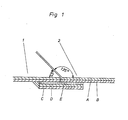
- FIG. 1 A schematic sketch of the tubular casing according to the invention is shown in FIG. 1.
- the tubular sleeve 1 is composed of the coupled sleeve pieces 1 a and 1 b. They are separated by means of a parallel, abutting cut 2, which runs at an angle of 45 °, but with each other by the coupling sleeve arranged on the inside of the tubular casing reliably connected.
- A is the fiber-reinforced Celluloseregenerataußen kg of the tubular casing
- B is the polyvinyl l ylidenchlorid Vietnamese inner layer of the tubular casing
- C is the carrier foil layer from biaxialgerecktem commercially available polyamide of the coupling sleeve
- D the anchor layer between the carrier sheet and film of the coupling sleeve
- E is the seaming against the PVDC inner layer of the tubular casing PVDC durable outer layer of the coupling sleeve.
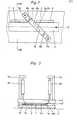
- the smooth sealing jaws of 20 cm in length shown in the figures permit diagonal sealing under an oblique diagonal of 45 ° up to the tubular casing caliber 75.
- the sealing jaws are heated on both sides.
- the sealing device is adjustable up to 5 kp per qcm depending on the requirements.
- the sealing temperature can be finely adjusted from 100 - 200 ° C.
- the sealing time can also be regulated up to 10 seconds.
- the hose sleeve coupling piece is optimally sealed when the inner sleeve film is arranged so that it overlaps with itself, with the sleeve film adhering particularly well to itself in the overlap area when using a single-layer adhesive coating. This fluctuates even if the caliber, i.e. in the case of fluctuations in the hose sleeve diameter, the width of the overlap area, but this does not affect the tightness of the hose sleeve in the coupling area if the optimal overlap width is selected as a precaution.
Landscapes
- Engineering & Computer Science (AREA)
- Mechanical Engineering (AREA)
- Life Sciences & Earth Sciences (AREA)
- Zoology (AREA)
- Composite Materials (AREA)
- Wood Science & Technology (AREA)
- Chemical & Material Sciences (AREA)
- Food Science & Technology (AREA)
- Physics & Mathematics (AREA)
- Fluid Mechanics (AREA)
- Processing Of Meat And Fish (AREA)
- Containers And Plastic Fillers For Packaging (AREA)
- Lining Or Joining Of Plastics Or The Like (AREA)
- Tubes (AREA)
- Packages (AREA)
Priority Applications (1)
| Application Number | Priority Date | Filing Date | Title |
|---|---|---|---|
| AT80100214T ATE1171T1 (de) | 1979-01-27 | 1980-01-17 | Gekuppelte schlauchhuelle, verfahren zu ihrer herstellung, vorrichtung zur ausuebung des verfahrens und verwendung der schlauchhuelle als verpackungsmittel. |
Applications Claiming Priority (2)
| Application Number | Priority Date | Filing Date | Title |
|---|---|---|---|
| DE19792903117 DE2903117A1 (de) | 1979-01-27 | 1979-01-27 | Gekuppelte schlauchhuelle, verfahren zu ihrer herstellung, vorrichtung zur ausuebung des verfahrens und verwendung der schlauchhuelle als verpackungsmittel |
| DE2903117 | 1979-01-27 |
Publications (2)
| Publication Number | Publication Date |
|---|---|
| EP0014346A1 true EP0014346A1 (fr) | 1980-08-20 |
| EP0014346B1 EP0014346B1 (fr) | 1982-06-09 |
Family
ID=6061509
Family Applications (1)
| Application Number | Title | Priority Date | Filing Date |
|---|---|---|---|
| EP80100214A Expired EP0014346B1 (fr) | 1979-01-27 | 1980-01-17 | Enveloppes tubulaires liées, procédé et dispositif pour leur fabrication et utilisation des enveloppes tubulaires comme emballage |
Country Status (7)
| Country | Link |
|---|---|
| US (1) | US4391302A (fr) |
| EP (1) | EP0014346B1 (fr) |
| JP (1) | JPS561841A (fr) |
| AT (1) | ATE1171T1 (fr) |
| CA (1) | CA1143996A (fr) |
| DE (2) | DE2903117A1 (fr) |
| FI (1) | FI800213A7 (fr) |
Cited By (7)
| Publication number | Priority date | Publication date | Assignee | Title |
|---|---|---|---|---|
| EP0037543A3 (en) * | 1980-04-05 | 1981-12-30 | Hoechst Aktiengesellschaft | Tubular casings with an adhesive seam for foodstuffs, especially sausages, and process for its manufacture |
| EP0050702A1 (fr) * | 1980-10-25 | 1982-05-05 | Hoechst Aktiengesellschaft | Enveloppe tubulaire à joint adhésif pour aliments, et en particulier pour saucisses, son procédé de fabrication et son application pour la fabrication de saucisses courbées ou annulaires |
| EP0054162A1 (fr) * | 1980-11-29 | 1982-06-23 | Hoechst Aktiengesellschaft | Enveloppe tubulaire, en particulier pour boyaux de saucisses, renfermant un revêtement imperméable à la vapeur d'eau, son procédé de fabrication et son application |
| EP0058240A1 (fr) * | 1981-02-17 | 1982-08-25 | Hoechst Aktiengesellschaft | Enveloppe tubulaire à joint adhésif, perméable à la vapeur, pour aliments, et en particulier pour saucisses et son procédé de fabrication |
| NL8701443A (nl) * | 1986-06-25 | 1988-01-18 | Proveedora Hispan Holandes Sa | Kunstverpakking voor vleesprodukten en dergelijke. |
| EP0733461A3 (fr) * | 1995-03-23 | 1997-02-26 | Shonan Gosei Jushi Seisakusho | Revêtement tubulaire et procédé pour raccorder les extrémités de deux revêtements tubulaires |
| WO1997020684A1 (fr) * | 1995-12-07 | 1997-06-12 | British United Shoe Machinery Ltd. | Fabrication de produits tubulaires |
Families Citing this family (12)
| Publication number | Priority date | Publication date | Assignee | Title |
|---|---|---|---|---|
| ZA83848B (en) * | 1982-03-15 | 1984-08-29 | Grace W R & Co | Quenched nylon multilayer casings |
| JPS5938266U (ja) * | 1982-09-01 | 1984-03-10 | 日本特許管理株式会社 | 収縮ナイロン製ケ−シングの背貼り構造 |
| JPH0629990Y2 (ja) * | 1985-03-06 | 1994-08-17 | 日本特許管理株式会社 | ソ−セ−ジ用ケ−シング |
| US4736775A (en) * | 1986-12-24 | 1988-04-12 | Viskase Corporation | Food casing splice having dual pressure sensitive tapes |
| DE3713479A1 (de) * | 1987-04-22 | 1988-11-10 | Hoechst Ag | Schlauch, insbesondere kuenstliche wursthuelle, aus miteinander verbundenen abschnitten |
| US4842022A (en) * | 1988-03-31 | 1989-06-27 | Viskase Corporation | Spliced stuffable cellulosic food casing |
| DE4001131C2 (de) * | 1990-01-17 | 1999-04-08 | Hoechst Ag | Mehrschichtige künstliche Wursthülle auf Polyamidbasis |
| US5772641A (en) | 1995-12-12 | 1998-06-30 | Medi-Dyne Inc. | Overlapping welds for catheter constructions |
| US5951929A (en) * | 1995-12-12 | 1999-09-14 | Medi-Dyne Inc. | Method for forming a catheter having overlapping welds |
| US6103037A (en) * | 1995-12-12 | 2000-08-15 | Medi-Dyne Inc. | Method for making a catheter having overlapping welds |
| US20040062834A1 (en) * | 2002-09-26 | 2004-04-01 | Casematic, S.A. De C.V. | Polyamide-based sausage casing |
| DE10339802A1 (de) * | 2003-08-27 | 2005-03-24 | Kalle Gmbh & Co. Kg | Eigenstabile Raffraupe aus einer schlauchförmigen Nahrungsmittelhülle auf Basis von synthetischen Polymeren und deren Verwendung |
Citations (11)
| Publication number | Priority date | Publication date | Assignee | Title |
|---|---|---|---|---|
| DE141054C (fr) * | ||||
| GB171508A (en) * | 1920-08-26 | 1921-11-24 | Frank Creassey | A new or improved process of manufacturing endless tubes from rubber compound or thelike |
| DE679748C (de) * | 1937-06-22 | 1939-08-12 | Arnold Kunze | Verfahren zur Herstellung von langen Wursthuellen |
| US3112516A (en) * | 1960-09-19 | 1963-12-03 | Tee Pak Inc | Control for shirring machine |
| US3121655A (en) * | 1961-07-11 | 1964-02-18 | Western Electric Co | Apparatus for forming rings from flexible tubing |
| US3158492A (en) * | 1962-08-08 | 1964-11-24 | Tee Pak Inc | Sausage casing with release coating |
| US3503093A (en) * | 1967-08-18 | 1970-03-31 | Union Carbide Corp | Apparatus for producing shirred food casings |
| US3799823A (en) * | 1972-03-30 | 1974-03-26 | Tee Pak Inc | Method for splicing collagen casing |
| FR2282776A7 (fr) * | 1974-08-22 | 1976-03-19 | Glarus Stanzwerk Ag | Element de montage de conduits tubulaires |
| FR2283383A1 (fr) * | 1974-08-28 | 1976-03-26 | Air Liquide | Dispositif de jonction pour canalisation de fluide cryogenique |
| FR2322732A1 (fr) * | 1975-09-05 | 1977-04-01 | Viscora Sa | Procede d'aboutage de troncons tubulaires pour former des enveloppes tubulaires a communication longitudinale continue, et articles obtenus par ce procede |
Family Cites Families (4)
| Publication number | Priority date | Publication date | Assignee | Title |
|---|---|---|---|---|
| US662618A (en) * | 1900-09-06 | 1900-11-27 | Horace B Camp | Coupling for stoneware pipes. |
| US2050023A (en) * | 1931-08-03 | 1936-08-04 | Slayter Games | Pipe joint |
| BE560918A (fr) * | 1956-09-22 | |||
| DE1650239A1 (de) * | 1967-09-30 | 1970-12-17 | Montagewerk Leipzig Veb | Verfahren zur Herstellung von Klebeverbindungen bei Hohlkoerpern und -profilen,insbesondere von ausgekleideten und/oder innenisolierten Rohren |
-
1979
- 1979-01-27 DE DE19792903117 patent/DE2903117A1/de not_active Withdrawn
-
1980
- 1980-01-17 DE DE8080100214T patent/DE3060506D1/de not_active Expired
- 1980-01-17 AT AT80100214T patent/ATE1171T1/de not_active IP Right Cessation
- 1980-01-17 EP EP80100214A patent/EP0014346B1/fr not_active Expired
- 1980-01-23 US US06/114,655 patent/US4391302A/en not_active Expired - Lifetime
- 1980-01-24 FI FI800213A patent/FI800213A7/fi not_active Application Discontinuation
- 1980-01-25 CA CA000344411A patent/CA1143996A/fr not_active Expired
- 1980-01-25 JP JP701180A patent/JPS561841A/ja active Pending
Patent Citations (11)
| Publication number | Priority date | Publication date | Assignee | Title |
|---|---|---|---|---|
| DE141054C (fr) * | ||||
| GB171508A (en) * | 1920-08-26 | 1921-11-24 | Frank Creassey | A new or improved process of manufacturing endless tubes from rubber compound or thelike |
| DE679748C (de) * | 1937-06-22 | 1939-08-12 | Arnold Kunze | Verfahren zur Herstellung von langen Wursthuellen |
| US3112516A (en) * | 1960-09-19 | 1963-12-03 | Tee Pak Inc | Control for shirring machine |
| US3121655A (en) * | 1961-07-11 | 1964-02-18 | Western Electric Co | Apparatus for forming rings from flexible tubing |
| US3158492A (en) * | 1962-08-08 | 1964-11-24 | Tee Pak Inc | Sausage casing with release coating |
| US3503093A (en) * | 1967-08-18 | 1970-03-31 | Union Carbide Corp | Apparatus for producing shirred food casings |
| US3799823A (en) * | 1972-03-30 | 1974-03-26 | Tee Pak Inc | Method for splicing collagen casing |
| FR2282776A7 (fr) * | 1974-08-22 | 1976-03-19 | Glarus Stanzwerk Ag | Element de montage de conduits tubulaires |
| FR2283383A1 (fr) * | 1974-08-28 | 1976-03-26 | Air Liquide | Dispositif de jonction pour canalisation de fluide cryogenique |
| FR2322732A1 (fr) * | 1975-09-05 | 1977-04-01 | Viscora Sa | Procede d'aboutage de troncons tubulaires pour former des enveloppes tubulaires a communication longitudinale continue, et articles obtenus par ce procede |
Cited By (7)
| Publication number | Priority date | Publication date | Assignee | Title |
|---|---|---|---|---|
| EP0037543A3 (en) * | 1980-04-05 | 1981-12-30 | Hoechst Aktiengesellschaft | Tubular casings with an adhesive seam for foodstuffs, especially sausages, and process for its manufacture |
| EP0050702A1 (fr) * | 1980-10-25 | 1982-05-05 | Hoechst Aktiengesellschaft | Enveloppe tubulaire à joint adhésif pour aliments, et en particulier pour saucisses, son procédé de fabrication et son application pour la fabrication de saucisses courbées ou annulaires |
| EP0054162A1 (fr) * | 1980-11-29 | 1982-06-23 | Hoechst Aktiengesellschaft | Enveloppe tubulaire, en particulier pour boyaux de saucisses, renfermant un revêtement imperméable à la vapeur d'eau, son procédé de fabrication et son application |
| EP0058240A1 (fr) * | 1981-02-17 | 1982-08-25 | Hoechst Aktiengesellschaft | Enveloppe tubulaire à joint adhésif, perméable à la vapeur, pour aliments, et en particulier pour saucisses et son procédé de fabrication |
| NL8701443A (nl) * | 1986-06-25 | 1988-01-18 | Proveedora Hispan Holandes Sa | Kunstverpakking voor vleesprodukten en dergelijke. |
| EP0733461A3 (fr) * | 1995-03-23 | 1997-02-26 | Shonan Gosei Jushi Seisakusho | Revêtement tubulaire et procédé pour raccorder les extrémités de deux revêtements tubulaires |
| WO1997020684A1 (fr) * | 1995-12-07 | 1997-06-12 | British United Shoe Machinery Ltd. | Fabrication de produits tubulaires |
Also Published As
| Publication number | Publication date |
|---|---|
| EP0014346B1 (fr) | 1982-06-09 |
| DE2903117A1 (de) | 1980-08-14 |
| US4391302A (en) | 1983-07-05 |
| DE3060506D1 (en) | 1982-07-29 |
| FI800213A7 (fi) | 1981-01-01 |
| ATE1171T1 (de) | 1982-06-15 |
| JPS561841A (en) | 1981-01-10 |
| CA1143996A (fr) | 1983-04-05 |
Similar Documents
| Publication | Publication Date | Title |
|---|---|---|
| EP0014346B1 (fr) | Enveloppes tubulaires liées, procédé et dispositif pour leur fabrication et utilisation des enveloppes tubulaires comme emballage | |
| DE2900262C2 (de) | Flexibles Verpackungsmaterial zum Herstellen dichter Verpackungen | |
| DE69913034T2 (de) | Hermetisch dichter Verbundbehälter und Verfahren zur Herstellung eines hermetisch dichten Verbundbehälters | |
| DE19626157C2 (de) | Verfahren und Verpackungsvorrichtung zum Verpacken kleinstückiger Artikel | |
| DE2521846C3 (de) | Schlauchfolie mit einer rutschfesten Abbindung mit Anhängeschlaufe für die Umhüllung von Lebensmitteln sowie Verfahren zu ihrer Herstellung | |
| DE1948128A1 (de) | Verpackung fuer Nahrungsmittel in Scheiben und Verfahren zu deren Herstellung | |
| EP0166226B1 (fr) | Procédé pour la fabrication d'un boyau plissé de section tubulaire pour son utilisation ulterieure comme de peau à peler dans la fabrication de saucisses ainsi qu'un boyau ainsi fabriqué | |
| DE2826680A1 (de) | Zusammendrueckbarer spendbehaelter und verfahren zu seiner herstellung | |
| EP0528374B1 (fr) | Enveloppe tubulaire pour aliments ayant une adhérence améliorée à la masse de remplissage | |
| DE2848987C2 (de) | Wurst und Verfahren zu ihrer Herstellung | |
| DE2155667B2 (de) | Querstromfilter und Verfahren und Vorrichtung zu dessen Herstellung | |
| EP0014353A1 (fr) | Procédé de liaison d'enveloppes tubulaires et utilisation des enveloppes tubulaires liées comme emballage | |
| DE69320318T2 (de) | Verfahren und Material zum Verbinden von röhrenförmigen Nahrungsmittelhüllen | |
| DE3208625A1 (de) | Verfahren zur herstellung von tuben | |
| DE3319120A1 (de) | Kabelmuffe aus schrumpfbarem material mit einer einlage | |
| DE19845519A1 (de) | Schrumpffähige, kaschierte Folie mit verbesserter Barrierewirkung und daraus hergestellte Schlauchfolie mit Siegelnaht | |
| DE69101419T2 (de) | Verfahren und vorrichtung zur herstellung von mit einem schutzüberzug versehenen kantenschutzleisten aus karton und so hergestellte kantenschutzleisten. | |
| DE7902202U1 (de) | Gekuppelte Schlauchhuelle | |
| EP0013375A1 (fr) | Gaine en forme de tuyau | |
| DE2540046C2 (de) | Verfahren und Vorrichtung zum Abdichten der inneren Mantelkante beschichteter Papierbecher | |
| EP0014354A1 (fr) | Liaison d'enveloppes tubulaires et utilisation des enveloppes tubulaires liées comme emballage | |
| DE896621C (de) | Metallbehaelter mit Innenverkleidung und Verfahren zu seiner Herstellung | |
| DE2309361A1 (de) | Verfahren zur bildung von mit aufreissoeffnungsteilen versehenen umhuellungen fuer pastoese und/oder klebrige produkte, insbesondere lebensmittelprodukte | |
| EP0287939A2 (fr) | Tuyau souple, en particulier gaine artificielle pour saucisses, se composant de différentes sections connectées entre elles | |
| DE2365159A1 (de) | Mehrschichtschlauchfolie, vorzugsweise zur verwendung als wursthuelle fuer koch- und bruehwuerste, und verfahren zu ihrer herstellung |
Legal Events
| Date | Code | Title | Description |
|---|---|---|---|
| PUAI | Public reference made under article 153(3) epc to a published international application that has entered the european phase |
Free format text: ORIGINAL CODE: 0009012 |
|
| 17P | Request for examination filed | ||
| AK | Designated contracting states |
Designated state(s): AT BE DE FR NL |
|
| GRAA | (expected) grant |
Free format text: ORIGINAL CODE: 0009210 |
|
| AK | Designated contracting states |
Designated state(s): AT BE DE FR NL |
|
| REF | Corresponds to: |
Ref document number: 1171 Country of ref document: AT Date of ref document: 19820615 Kind code of ref document: T |
|
| REF | Corresponds to: |
Ref document number: 3060506 Country of ref document: DE Date of ref document: 19820729 |
|
| PGFP | Annual fee paid to national office [announced via postgrant information from national office to epo] |
Ref country code: FR Payment date: 19831230 Year of fee payment: 5 |
|
| PGFP | Annual fee paid to national office [announced via postgrant information from national office to epo] |
Ref country code: DE Payment date: 19841218 Year of fee payment: 6 |
|
| PGFP | Annual fee paid to national office [announced via postgrant information from national office to epo] |
Ref country code: BE Payment date: 19841231 Year of fee payment: 6 |
|
| PGFP | Annual fee paid to national office [announced via postgrant information from national office to epo] |
Ref country code: AT Payment date: 19870112 Year of fee payment: 8 |
|
| PGFP | Annual fee paid to national office [announced via postgrant information from national office to epo] |
Ref country code: NL Payment date: 19870131 Year of fee payment: 8 |
|
| PG25 | Lapsed in a contracting state [announced via postgrant information from national office to epo] |
Ref country code: AT Effective date: 19880117 |
|
| BERE | Be: lapsed |
Owner name: WOLFF WALSRODE A.G. Effective date: 19880131 |
|
| PG25 | Lapsed in a contracting state [announced via postgrant information from national office to epo] |
Ref country code: NL Effective date: 19880801 |
|
| NLV4 | Nl: lapsed or anulled due to non-payment of the annual fee | ||
| PG25 | Lapsed in a contracting state [announced via postgrant information from national office to epo] |
Ref country code: FR Free format text: LAPSE BECAUSE OF NON-PAYMENT OF DUE FEES Effective date: 19880930 |
|
| PG25 | Lapsed in a contracting state [announced via postgrant information from national office to epo] |
Ref country code: DE Effective date: 19881001 |
|
| REG | Reference to a national code |
Ref country code: FR Ref legal event code: ST |
|
| PG25 | Lapsed in a contracting state [announced via postgrant information from national office to epo] |
Ref country code: BE Effective date: 19890131 |
|
| PLBE | No opposition filed within time limit |
Free format text: ORIGINAL CODE: 0009261 |
|
| STAA | Information on the status of an ep patent application or granted ep patent |
Free format text: STATUS: NO OPPOSITION FILED WITHIN TIME LIMIT |