EP0014663A1 - Verfahren und Vorrichtung zur Regelung des Strahlendurchganges einer transparenten Wand und Anwendung dieses Verfahrens - Google Patents
Verfahren und Vorrichtung zur Regelung des Strahlendurchganges einer transparenten Wand und Anwendung dieses Verfahrens Download PDFInfo
- Publication number
- EP0014663A1 EP0014663A1 EP80400195A EP80400195A EP0014663A1 EP 0014663 A1 EP0014663 A1 EP 0014663A1 EP 80400195 A EP80400195 A EP 80400195A EP 80400195 A EP80400195 A EP 80400195A EP 0014663 A1 EP0014663 A1 EP 0014663A1
- Authority
- EP
- European Patent Office
- Prior art keywords
- transparent
- fluid
- liquid
- emulsion
- opacifying
- Prior art date
- Legal status (The legal status is an assumption and is not a legal conclusion. Google has not performed a legal analysis and makes no representation as to the accuracy of the status listed.)
- Withdrawn
Links
- 238000000034 method Methods 0.000 title claims description 37
- 230000005855 radiation Effects 0.000 title claims description 19
- 230000004907 flux Effects 0.000 title claims description 10
- 230000008569 process Effects 0.000 title description 4
- 239000007788 liquid Substances 0.000 claims abstract description 43
- 239000012530 fluid Substances 0.000 claims abstract description 40
- 239000000839 emulsion Substances 0.000 claims abstract description 39
- 239000003795 chemical substances by application Substances 0.000 claims description 23
- XLYOFNOQVPJJNP-UHFFFAOYSA-N water Substances O XLYOFNOQVPJJNP-UHFFFAOYSA-N 0.000 claims description 14
- 238000010521 absorption reaction Methods 0.000 claims description 7
- 239000003995 emulsifying agent Substances 0.000 claims description 7
- 239000006260 foam Substances 0.000 claims description 7
- 239000007787 solid Substances 0.000 claims description 7
- 239000012141 concentrate Substances 0.000 claims description 6
- 230000001105 regulatory effect Effects 0.000 claims description 6
- 239000002245 particle Substances 0.000 claims description 5
- 229920002120 photoresistant polymer Polymers 0.000 claims description 5
- -1 polypropylene Polymers 0.000 claims description 4
- 238000011144 upstream manufacturing Methods 0.000 claims description 4
- 239000004743 Polypropylene Substances 0.000 claims description 3
- 238000004378 air conditioning Methods 0.000 claims description 3
- 239000003350 kerosene Substances 0.000 claims description 3
- 239000011325 microbead Substances 0.000 claims description 3
- 229920001155 polypropylene Polymers 0.000 claims description 3
- 238000011084 recovery Methods 0.000 claims description 3
- 235000015112 vegetable and seed oil Nutrition 0.000 claims description 3
- 239000008158 vegetable oil Substances 0.000 claims description 3
- 230000002745 absorbent Effects 0.000 claims description 2
- 239000002250 absorbent Substances 0.000 claims description 2
- 239000000203 mixture Substances 0.000 claims description 2
- 239000003921 oil Substances 0.000 claims description 2
- 235000019198 oils Nutrition 0.000 claims description 2
- 230000017260 vegetative to reproductive phase transition of meristem Effects 0.000 claims description 2
- 238000006243 chemical reaction Methods 0.000 claims 1
- 125000004122 cyclic group Chemical group 0.000 claims 1
- 229910052500 inorganic mineral Inorganic materials 0.000 claims 1
- 239000011707 mineral Substances 0.000 claims 1
- 239000000047 product Substances 0.000 description 28
- 238000010438 heat treatment Methods 0.000 description 7
- 239000013529 heat transfer fluid Substances 0.000 description 6
- 244000309464 bull Species 0.000 description 5
- 238000009434 installation Methods 0.000 description 5
- 239000004094 surface-active agent Substances 0.000 description 5
- 230000033228 biological regulation Effects 0.000 description 4
- 230000000694 effects Effects 0.000 description 4
- 239000011521 glass Substances 0.000 description 4
- 229920003023 plastic Polymers 0.000 description 4
- 230000009471 action Effects 0.000 description 3
- 230000008901 benefit Effects 0.000 description 3
- 238000001914 filtration Methods 0.000 description 3
- 230000004048 modification Effects 0.000 description 3
- 238000012986 modification Methods 0.000 description 3
- 239000004033 plastic Substances 0.000 description 3
- CURLTUGMZLYLDI-UHFFFAOYSA-N Carbon dioxide Chemical compound O=C=O CURLTUGMZLYLDI-UHFFFAOYSA-N 0.000 description 2
- 208000035874 Excoriation Diseases 0.000 description 2
- 238000005299 abrasion Methods 0.000 description 2
- 239000011449 brick Substances 0.000 description 2
- 238000009833 condensation Methods 0.000 description 2
- 230000005494 condensation Effects 0.000 description 2
- 230000001276 controlling effect Effects 0.000 description 2
- 238000010586 diagram Methods 0.000 description 2
- 238000009792 diffusion process Methods 0.000 description 2
- 238000005265 energy consumption Methods 0.000 description 2
- 230000002349 favourable effect Effects 0.000 description 2
- 239000002184 metal Substances 0.000 description 2
- 239000002480 mineral oil Substances 0.000 description 2
- 235000010446 mineral oil Nutrition 0.000 description 2
- 241000894007 species Species 0.000 description 2
- 238000012360 testing method Methods 0.000 description 2
- 238000012546 transfer Methods 0.000 description 2
- 239000004698 Polyethylene Substances 0.000 description 1
- 238000009825 accumulation Methods 0.000 description 1
- 230000006978 adaptation Effects 0.000 description 1
- 239000002518 antifoaming agent Substances 0.000 description 1
- 230000003416 augmentation Effects 0.000 description 1
- 230000015572 biosynthetic process Effects 0.000 description 1
- 229910002092 carbon dioxide Inorganic materials 0.000 description 1
- 239000001569 carbon dioxide Substances 0.000 description 1
- 239000011248 coating agent Substances 0.000 description 1
- 238000000576 coating method Methods 0.000 description 1
- 239000000470 constituent Substances 0.000 description 1
- 239000002826 coolant Substances 0.000 description 1
- 238000013461 design Methods 0.000 description 1
- 238000004090 dissolution Methods 0.000 description 1
- 238000010891 electric arc Methods 0.000 description 1
- 238000004146 energy storage Methods 0.000 description 1
- 238000001125 extrusion Methods 0.000 description 1
- 239000010419 fine particle Substances 0.000 description 1
- 235000013305 food Nutrition 0.000 description 1
- 239000000446 fuel Substances 0.000 description 1
- 230000005484 gravity Effects 0.000 description 1
- 230000012447 hatching Effects 0.000 description 1
- 238000005338 heat storage Methods 0.000 description 1
- 238000003898 horticulture Methods 0.000 description 1
- 230000002209 hydrophobic effect Effects 0.000 description 1
- 238000005286 illumination Methods 0.000 description 1
- 238000002347 injection Methods 0.000 description 1
- 239000007924 injection Substances 0.000 description 1
- 238000009413 insulation Methods 0.000 description 1
- 238000002955 isolation Methods 0.000 description 1
- 239000012263 liquid product Substances 0.000 description 1
- 230000014759 maintenance of location Effects 0.000 description 1
- 239000000463 material Substances 0.000 description 1
- 239000012528 membrane Substances 0.000 description 1
- 239000013528 metallic particle Substances 0.000 description 1
- 238000002156 mixing Methods 0.000 description 1
- 238000013021 overheating Methods 0.000 description 1
- 230000010363 phase shift Effects 0.000 description 1
- 239000002985 plastic film Substances 0.000 description 1
- 239000004417 polycarbonate Substances 0.000 description 1
- 229920000515 polycarbonate Polymers 0.000 description 1
- 229920000573 polyethylene Polymers 0.000 description 1
- 239000004800 polyvinyl chloride Substances 0.000 description 1
- 238000004064 recycling Methods 0.000 description 1
- 230000009467 reduction Effects 0.000 description 1
- 239000003507 refrigerant Substances 0.000 description 1
- 239000000523 sample Substances 0.000 description 1
- 238000000926 separation method Methods 0.000 description 1
- 238000001228 spectrum Methods 0.000 description 1
- 230000003068 static effect Effects 0.000 description 1
- 230000001629 suppression Effects 0.000 description 1
- 239000000725 suspension Substances 0.000 description 1
- 238000003786 synthesis reaction Methods 0.000 description 1
- 229920002994 synthetic fiber Polymers 0.000 description 1
- 230000009466 transformation Effects 0.000 description 1
- 239000002699 waste material Substances 0.000 description 1
Images

Classifications
-
- G—PHYSICS
- G05—CONTROLLING; REGULATING
- G05D—SYSTEMS FOR CONTROLLING OR REGULATING NON-ELECTRIC VARIABLES
- G05D23/00—Control of temperature
- G05D23/01—Control of temperature without auxiliary power
-
- A—HUMAN NECESSITIES
- A01—AGRICULTURE; FORESTRY; ANIMAL HUSBANDRY; HUNTING; TRAPPING; FISHING
- A01G—HORTICULTURE; CULTIVATION OF VEGETABLES, FLOWERS, RICE, FRUIT, VINES, HOPS OR SEAWEED; FORESTRY; WATERING
- A01G9/00—Cultivation in receptacles, forcing-frames or greenhouses; Edging for beds, lawn or the like
- A01G9/24—Devices or systems for heating, ventilating, regulating temperature, illuminating, or watering, in greenhouses, forcing-frames, or the like
- A01G9/243—Collecting solar energy
-
- F—MECHANICAL ENGINEERING; LIGHTING; HEATING; WEAPONS; BLASTING
- F24—HEATING; RANGES; VENTILATING
- F24S—SOLAR HEAT COLLECTORS; SOLAR HEAT SYSTEMS
- F24S50/00—Arrangements for controlling solar heat collectors
- F24S50/80—Arrangements for controlling solar heat collectors for controlling collection or absorption of solar radiation
-
- Y—GENERAL TAGGING OF NEW TECHNOLOGICAL DEVELOPMENTS; GENERAL TAGGING OF CROSS-SECTIONAL TECHNOLOGIES SPANNING OVER SEVERAL SECTIONS OF THE IPC; TECHNICAL SUBJECTS COVERED BY FORMER USPC CROSS-REFERENCE ART COLLECTIONS [XRACs] AND DIGESTS
- Y02—TECHNOLOGIES OR APPLICATIONS FOR MITIGATION OR ADAPTATION AGAINST CLIMATE CHANGE
- Y02A—TECHNOLOGIES FOR ADAPTATION TO CLIMATE CHANGE
- Y02A40/00—Adaptation technologies in agriculture, forestry, livestock or agroalimentary production
- Y02A40/10—Adaptation technologies in agriculture, forestry, livestock or agroalimentary production in agriculture
- Y02A40/25—Greenhouse technology, e.g. cooling systems therefor
-
- Y—GENERAL TAGGING OF NEW TECHNOLOGICAL DEVELOPMENTS; GENERAL TAGGING OF CROSS-SECTIONAL TECHNOLOGIES SPANNING OVER SEVERAL SECTIONS OF THE IPC; TECHNICAL SUBJECTS COVERED BY FORMER USPC CROSS-REFERENCE ART COLLECTIONS [XRACs] AND DIGESTS
- Y02—TECHNOLOGIES OR APPLICATIONS FOR MITIGATION OR ADAPTATION AGAINST CLIMATE CHANGE
- Y02E—REDUCTION OF GREENHOUSE GAS [GHG] EMISSIONS, RELATED TO ENERGY GENERATION, TRANSMISSION OR DISTRIBUTION
- Y02E10/00—Energy generation through renewable energy sources
- Y02E10/40—Solar thermal energy, e.g. solar towers
-
- Y—GENERAL TAGGING OF NEW TECHNOLOGICAL DEVELOPMENTS; GENERAL TAGGING OF CROSS-SECTIONAL TECHNOLOGIES SPANNING OVER SEVERAL SECTIONS OF THE IPC; TECHNICAL SUBJECTS COVERED BY FORMER USPC CROSS-REFERENCE ART COLLECTIONS [XRACs] AND DIGESTS
- Y02—TECHNOLOGIES OR APPLICATIONS FOR MITIGATION OR ADAPTATION AGAINST CLIMATE CHANGE
- Y02P—CLIMATE CHANGE MITIGATION TECHNOLOGIES IN THE PRODUCTION OR PROCESSING OF GOODS
- Y02P60/00—Technologies relating to agriculture, livestock or agroalimentary industries
- Y02P60/12—Technologies relating to agriculture, livestock or agroalimentary industries using renewable energies, e.g. solar water pumping
Definitions
- the present invention relates to a method and a device for regulating the flux of radiation (sunlight for example ) which passes through a transparent wall, and for recovering the energy intercepted during said regulation.
- the greenhouses used up to now are usually of two types: on the one hand, envelopes made of synthetic material such as polyvinyl chloride (PVC), polyethylene, held by hoops for intensive use, in particular at market gardeners, and on the other hand glass canopies used more particularly in horticulture.
- PVC polyvinyl chloride
- These latter greenhouses generally include internal heating means, usually central heating and humidification, in order to maintain a well-determined temperature and hygrometry according to the cultivated species.
- Glasshouses of the glass type with central heating incorporated are provided with means indicating the temperature and the humidity percentage inside the enclosure; thus, a thermostat system regulates the temperature during the hours of lighting and exposure of the sun having the effect of lowering energy consumption during said hours.
- an apparatus of the type of that of this patent constitutes an energy recuperator rather than an apparatus for regulating radiation flux.
- the present invention finds an application both during hours of low sunshine and intense sunshine; it also has the advantage of being able to be implemented in conjunction with already existing installations with little or no modifications.
- the basic idea of the present invention is to obtain an adjustment of the variations of the photonic flux emitted by the sun and, consequently, of the density of the light admitted into an enclosure such as a greenhouse in a simple and effective with a relatively low cost price, adjustment which has not been obtained until now by the means of the prior art.
- the present invention provides a simple process, easy to implement, eliminating the various aforementioned drawbacks, finding a particular application, in particular for the air conditioning of greenhouses by means of a closed circuit device of a very rational and very suitable design.
- the method of the invention is based on a simple and functional principle allowing the temperature of an enclosure heated by solar energy to be adjusted at low cost by increasing or reducing the rate of absorption of the photonic flux, thereby controlling. the light energy introduced into an enclosure such as a greenhouse, and to recover said energy.
- the present invention provides a method for regulating the flux of radiation, sunlight for example, which passes through a transparent wall, and for recovering the energy intercepted during said regulation, method in which one makes circulating a fluid in a circuit comprising a passage between transparent surfaces, for example transparent tubes, or a space between two transparent walls, placed to constitute said wall traversed by the radiation, and in which a transparent liquid is circulated as heat transfer fluid loaded with an opacifying agent, the quantity of opacifying agent introduced into the liquid is acted upon to adjust the absorbency of the liquid sent into said transparent tubes or between said transparent blades and, consequently, the amount of energy absorbed or reflected .
- the transparent liquid and the opacifying agent are separated after they have passed through said tubes or between said blades, and one and / or the other of these products is recycled, in proportions corresponding to the absorbing power. or reflective desired for the fluid.
- THE opacifying product can form with the transparent liquid an emulsion with high reflecting power.
- the opacifying agent is a gas
- an emulsion of this gas is formed in the transparent liquid, and the relative proportions of gas in the liquid are changed, and / or the size of the bubbles in the emulsion in order to make vary the absorbing and / or reflecting power of the fluid.
- the transparent liquid is water and the opacifying product is a liquid immiscible with water and capable of absorbing high bant such as mineral oil, vegetable oil or tinted kerosene.
- the opacifying product consists of fine solid particles, such as polypropylene microbeads, from 1 to 400 microns.
- the energy absorbed by said fluid is recovered during its passage through said transparent tubes or between said transparent blades.
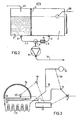
- the two tanks 1 and 2 each include a product outlet designated respectively by 4 for the transparent fluid and by 5 for the opacifying product.
- the transparent liquid leaving the outlet 4 is routed through line 6 to a pump 8.
- the opacifying product is directed from outlet 5, via a line 7, to a metering or metering device 9 regulating the quantity desired according to needs, as determined by a photoresist cell 10 located outside the device and connected by any suitable means 11 (illustrated very schematically) to the metering device 9. The role and operation of said cell will be described more away in more detail.
- the opacifying product, via line 12 joins at junction 13, in line 14, the transparent immiscible fluid, and the suspension formed at a concentration determined by the photoresist cell 10 is directed by said line 14, via line 15, in the direction of the solar collector 16.
- the transparent fluid which is a heat transfer fluid with a variable amount of immiscible opacifying agent, can then, at the outlet of the pipe 15, move around the periphery of the solar collector 16 where it has a radiation modulation effect, it absorbs a certain amount of heat and then enters the circuit 17 in which it can transfer the absorbed energy, for example, to heat storage bricks symbolized by the reference B in Figure 1 or any other suitable means.
- the transparent fluid with a predetermined variable quantity of opacifying agent, rid of the energy which it has absorbed, then returns, by means of the pipe 18, towards a separator 19 constituted, for example, by a simple filtration device, (in another embodiment, the separator is constituted by a filtering wall placed between the tanks 1 and 2).
- a separator 19 constituted, for example, by a simple filtration device, (in another embodiment, the separator is constituted by a filtering wall placed between the tanks 1 and 2).
- This filtration device makes it possible to easily separate the transparent fluid emulsion-opacifying agent and each elementary constituent is reintroduced by the respective conduits 20 and 21 into the corresponding reservoirs 1 and 2.
- the device for implementing the method according to the present invention operates continuously, in a self-contained closed circuit. me, and that said operation is based on the information collected by the photoresist cell 10 placed outside the enclosure 22 such as a greenhouse.
- This cell 10 has the characteristic of being provided with an adjustment plate making it possible to determine the function of the metering device 9, the role of which is to admit into the circuit of the heat-transfer fluid a variable quantity of immiscible opacifying agent; thus, the he increase in light intensity modifies the function or position of the metering device which admits a greater opacifying agent flow rate.
- FIG. 2 represents, on a larger scale, the tank or tank assembly according to a mounting variant.
- 1 designates the transparent fluid reservoir
- 2 the reservoir with opacifying product
- 3 the separator assembly.
- the two products leave the tanks or reservoirs 1 and 2 through the respective outlets 4.5 to be introduced into the pipes 6.7; however, in this case, a filter F is provided upstream of the metering device 9, the role of which is to additionally rid, if necessary, the transparent fluid of the last traces of opacifying product before it passes through the metering device 9.
- the transparent fluid can be any suitable heat transfer fluid; however, in the use described here, it is preferred, for cost reasons, to use water which is, in general, of a lower cost price.
- the opacifying product can be liquid or solid.
- a liquid product it can be chosen from the group comprising kerosene, a mineral oil or a vegetable oil; however, it can also be solid and be in the form of fine particles.
- they may be microbeads of polypropylene or the like with a diameter included in the range of 250 to 400 microns.
- the solar collector 16 is preferably made from self-supporting multi-tubular plastic profiles, profiles which are transparent and perfectly permeable to solar radiation and which allow good circulation of the coolant. loaded or not with opacifying product.
- the fluid can also circulate between two parallel transparent surfaces constituting a flattened tube.
- circuit 17 the heat transfer fluid transfers the energy it has absorbed to any means of heat accumulation, for example bricks B illustrated diagrammatically; circuit 17 for recovering energy can be suitably protected by any coating R, shown by hatching in Figure l, of any suitable kind.
- the method according to the present invention and the devices that have just been described make it possible to dose the light energy entering an enclosure, for example a greenhouse, at will, and in this case to orient the photo phenomena in a perfectly adapted range. -synthesis.
- They can also be used to limit and / or regulate the light energy entering an enclosure or there are objects which do not tolerate excessive heat or lighting, such as certain food products. They can also be used for air conditioning in premises or workshops.
- the device essentially functions as an adjustable opacity screen, and the recovery of solar energy is only a secondary aspect that can sometimes be overlooked, the circuit 17 then being designed as a simple refrigerant intended to avoid excessive heating of the liquid.
- FIG 3 there is shown schematically an alternative embodiment of a part of the device according to the invention, variant in which there is provided, inside the enclosure 22, another cell 10 'similar to cell 10 placed outside and which is connected to a calculation unit 23, said assembly 23, also in connection with cell 10, being able to act according to the information received from one or the other cell or both on the metering device 9 in order to regulate the circulation of the fluid in the device.
- the two cells 10 and 10 ' can also be connected by any suitable means. These means are symbolized in Figure 3 by dotted lines.
- the operation of the device of the present invention makes it possible to eliminate inertia as much as possible and to follow, with as small a phase shift as possible, the variations in the photonic flux emitted by the sun and, consequently, the density of light admitted into the 'pregnant.
- the agent for moderating and regulating the photonic flux is only opacifying and, in this case, its proportion in the circuit creates a more or less large and infinitely adjustable screen.
- an opacifying agent having selective characteristics admitting inside the enclosure (greenhouse for example) only certain wavelengths of the solar spectrum.
- the device according to the invention in addition to the fact that its operation can be combined in the case of a greenhouse with the dosage of carbon dioxide and the percentage of humidity, allows, in a satisfactory manner, to regulate the luminous flux received, to capture energy and to restore it thereafter.
- a different application of the process of the invention consists not in absorbing solar radiation to protect it or to use it for heating purposes but in limiting the energy consumption used for lighting, and possibly heating Locals.
- an opacifying product which gives the fluid a strong reflecting power. This can be achieved, for example, with metallic particles or by forming an emulsion with a gas or with an immiscible liquid. The glass surfaces thus become, at night, surfaces with high reflectance.
- both the liquid and the opacifying product are recycled. If one and / or the other of these products is inexpensive and can then be rejected or recovered, the installations will be easily simplified. This will be the case, for example, for a gas-water emulsion like the one we have just mentioned. This can also be the case for example if we use as clouding products colored products, such as; liquid fuels, waste oils etc ... which are then burned or otherwise treated, after separation if necessary.
- the device comprises, in addition to the transparent tubes or blades, only the outlet pipes and the metering device with the light flow sensor which controls it.
- a pump is only necessary if the supply cannot be done by gravity or by thermosiphon.
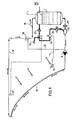
- FIG. 4 describes another device for implementing the method according to the preferred method of the invention, and in which the heat transfer fluid is an air in water emulsion.
- the same members as in Figures 1 to 3 bear the same references
- the device comprises a closed fluid circulation circuit with a closed water tank 1, a circulation pump 8, a double-walled transparent surface 16 and a return pipe 18.
- an emulsifier 30 consisting of a cylindrical tube traversed by water, inside which is placed a bicone coaxial with the tube and forming a venturi, in the axis of which opens, a pipe 31 supplying compressed air.
- the venturi is extended by a converging piece of porous sintered metal.
- the compressed air comes either from the outside or from the upper part of the tank 1 and is sent to the injector by a pump 32, with variable flow rate controlled by a photoelectric sensor 10.
- Filters 33 ensure a supply of dust-free air free of abrasive particles, and the liquid also passes through a filter 34, which ensures a long service life for the installation and in particular for transparent surfaces even if they are made of plastic.
- baffle emulsion breaker 35 On the return line 18 is interposed a baffle emulsion breaker 35.
- means are provided for sending into the circuit, in place of the emulsion, clean and dry air, so as to avoid condensation during shutdown periods. These means include an air heater 36, placed between the pump 32 and the foam concentrate 30.
- a thermometric probe 37 placed on the pipe 18, then controls, as a function of the temperature, and therefore of the vapor content of air, the distribution between the recycled air and the air collected outside.
- a valve 38 for adjusting the pressure in the circuit is placed on the line 18, upstream of the emulsion breaker 35. It makes it possible to vary the pressure, in particular in the transparent surface 16, and consequently to act on the bubbles form the emulsion; indeed, an increase in pressure. causes a reduction in the size of the bubbles by dissolution of the gas in the liquid.
- a test installation conforming to this scheme worked under the following conditions: transparent surface of 2 m 2 constituted by a multitubular polycarbonate profile comprising 200 channels of 5 x 5 mm, pump flow 8: 8 m 3 / h - pressure in the circuit: 20 m of water - volume of the tank: 50 liters.
- the speed of circulation of the fluid in the suction pipe of the pump 8 was found to be suitable between 0.3 and 1 meter per second.
- the emulsion once started, can be maintained indefinitely under the effect of turbulence and sudden pressure variations, with a slight increase in the proportion of surfactant, variable according to the size of the circuit and the speed of circulation.
- the proportion of surfactant is determined by taking as a rule that the time at the end of which the emulsion separates when it is at rest is approximately 1.5 to 5 times the time that the emulsion takes to travel the circuit.
- the basic idea of the present invention is to act on the quantity or the form of the opacifying agent to modify the absorption or regulation properties of fluids.
- Hydrophobic membranes can be used in particular in perforated and treated plastic sheet, which are commercially available.
- the applications of the method according to the invention are not limited to what has been described above; it can also be used to prevent condensation on transparent surfaces, and even make them play a role of radiator. It can also be used to color or conceal certain surfaces for aesthetic, privacy, or security purposes.
Landscapes
- Engineering & Computer Science (AREA)
- Life Sciences & Earth Sciences (AREA)
- Physics & Mathematics (AREA)
- Sustainable Development (AREA)
- Sustainable Energy (AREA)
- Combustion & Propulsion (AREA)
- Thermal Sciences (AREA)
- Chemical & Material Sciences (AREA)
- Environmental Sciences (AREA)
- Mechanical Engineering (AREA)
- General Engineering & Computer Science (AREA)
- General Physics & Mathematics (AREA)
- Automation & Control Theory (AREA)
- Physical Or Chemical Processes And Apparatus (AREA)
- Apparatus Associated With Microorganisms And Enzymes (AREA)
- Cultivation Of Plants (AREA)
Applications Claiming Priority (2)
| Application Number | Priority Date | Filing Date | Title |
|---|---|---|---|
| FR7903130 | 1979-02-07 | ||
| FR7903130A FR2448748A1 (fr) | 1979-02-07 | 1979-02-07 | Procede et dispositif de regulation de la temperature et/ou de l'eclairement d'une enceinte soumise a un rayonnement |
Publications (1)
| Publication Number | Publication Date |
|---|---|
| EP0014663A1 true EP0014663A1 (de) | 1980-08-20 |
Family
ID=9221697
Family Applications (1)
| Application Number | Title | Priority Date | Filing Date |
|---|---|---|---|
| EP80400195A Withdrawn EP0014663A1 (de) | 1979-02-07 | 1980-02-07 | Verfahren und Vorrichtung zur Regelung des Strahlendurchganges einer transparenten Wand und Anwendung dieses Verfahrens |
Country Status (2)
| Country | Link |
|---|---|
| EP (1) | EP0014663A1 (de) |
| FR (1) | FR2448748A1 (de) |
Cited By (2)
| Publication number | Priority date | Publication date | Assignee | Title |
|---|---|---|---|---|
| WO1994007193A1 (en) * | 1992-09-11 | 1994-03-31 | Michael David Carr | Methods and apparatus for controlling temperature |
| CN117981609A (zh) * | 2024-03-25 | 2024-05-07 | 渭南市农业科学研究院 | 一种西藏高原设施大棚育苗用遮阳装置 |
Citations (5)
| Publication number | Priority date | Publication date | Assignee | Title |
|---|---|---|---|---|
| BE550914A (de) * | ||||
| US3107052A (en) * | 1959-05-08 | 1963-10-15 | Joel F Garrison | Radiation collectors |
| DE2608302A1 (de) * | 1976-02-28 | 1977-09-08 | Geb Speiser Ingrid Schwarz | Verfahren und vorrichtung zum auffangen von sonnenenergie |
| FR2344217A1 (fr) * | 1976-03-18 | 1977-10-14 | Trimboli Longetto Antonino | Nouveau systeme de serre, pour toute culture, avec utilisation de la radiation solaire |
| EP0003944A1 (de) * | 1978-02-17 | 1979-09-05 | ANVAR Agence Nationale de Valorisation de la Recherche | Verfahren und Vorrichtung für die Klimaregulierung in Gewächshäusern |
Family Cites Families (1)
| Publication number | Priority date | Publication date | Assignee | Title |
|---|---|---|---|---|
| FR2271763A1 (en) * | 1974-05-22 | 1975-12-19 | Commissariat Energie Atomique | Air conditioning process for greenhouse - has double walls filtering long wavelengths and holding liquid flow |
-
1979
- 1979-02-07 FR FR7903130A patent/FR2448748A1/fr not_active Withdrawn
-
1980
- 1980-02-07 EP EP80400195A patent/EP0014663A1/de not_active Withdrawn
Patent Citations (5)
| Publication number | Priority date | Publication date | Assignee | Title |
|---|---|---|---|---|
| BE550914A (de) * | ||||
| US3107052A (en) * | 1959-05-08 | 1963-10-15 | Joel F Garrison | Radiation collectors |
| DE2608302A1 (de) * | 1976-02-28 | 1977-09-08 | Geb Speiser Ingrid Schwarz | Verfahren und vorrichtung zum auffangen von sonnenenergie |
| FR2344217A1 (fr) * | 1976-03-18 | 1977-10-14 | Trimboli Longetto Antonino | Nouveau systeme de serre, pour toute culture, avec utilisation de la radiation solaire |
| EP0003944A1 (de) * | 1978-02-17 | 1979-09-05 | ANVAR Agence Nationale de Valorisation de la Recherche | Verfahren und Vorrichtung für die Klimaregulierung in Gewächshäusern |
Cited By (2)
| Publication number | Priority date | Publication date | Assignee | Title |
|---|---|---|---|---|
| WO1994007193A1 (en) * | 1992-09-11 | 1994-03-31 | Michael David Carr | Methods and apparatus for controlling temperature |
| CN117981609A (zh) * | 2024-03-25 | 2024-05-07 | 渭南市农业科学研究院 | 一种西藏高原设施大棚育苗用遮阳装置 |
Also Published As
| Publication number | Publication date |
|---|---|
| FR2448748A1 (fr) | 1980-09-05 |
Similar Documents
| Publication | Publication Date | Title |
|---|---|---|
| EP0003944B1 (de) | Verfahren und Vorrichtung für die Klimaregulierung in Gewächshäusern | |
| WO2014195103A1 (fr) | Ensemble de traitement d'eau avec évaporateur solaire | |
| EP0083548B1 (de) | Vorrichtung zur Sammlung und Verwendung der gesamten Sonnenstrahlung | |
| FR2941227A1 (fr) | Procede de dessalement ou d'epuration d'eau par distillation d'un spray | |
| CA2785495A1 (fr) | Procede et installation de sechage de matieres pateuses, en particulier de boues de stations d'epuration, avec generation d'energie thermique | |
| CA2932511C (fr) | Dispositif de production d'un flux d'air a travers un volume de liquide | |
| FR2978159A1 (fr) | Photo-bioreacteur pour la production d'une solution algale concentree et dispositif d'exposition de la solution, en particulier pour un tel photo-bioreacteur | |
| EP2440648A2 (de) | Fotobioreaktor, im besonderen zur züchtung und entwicklung fotosynthetischer und heterotropher mikroorganismen | |
| Tina et al. | Numerical and experimental analysis of photovoltaic cells under a water layer and natural and artificial light | |
| EP0014663A1 (de) | Verfahren und Vorrichtung zur Regelung des Strahlendurchganges einer transparenten Wand und Anwendung dieses Verfahrens | |
| FR3040774A1 (fr) | Sechoir solaire pour produits agricoles ou marins. | |
| FR2561637A1 (fr) | Procede et dispositif pour produire de l'eau distillee a partir d'eau de mer | |
| EP2483384B1 (de) | Dünnschicht-Photobioreaktor mit höher Produktivität | |
| EP2616534B1 (de) | Vorrichtung zur temperaturregelung eines sonnenphotobioreaktors mit direktbeleuchtung | |
| WO2014045241A2 (fr) | Procédé de durcissement d'un revêtement d'un élément de capteur solaire, et éléments obtenus au moyen de ce procédé | |
| FR2941224A1 (fr) | Procede de dessalement ou d'epuration d'eau par distillation d'un spray (pompe a spray) spa | |
| FR2533905A1 (fr) | Dispositif a un seul etage pour produire so3 gazeux a partir de soufre fondu, convenant pour des installations de sulfonation et particulierement pour des installations d'additivation utilisant so3 pour precipiter des cendres de fumee de fours ordinaires | |
| WO2012069622A9 (fr) | Photobioréacteur solaire à dilution contrôlée du flux en volume | |
| Wei et al. | Hybrid solar photovoltaic conversion and water desalination via quad-band fano-resonant optical coatings and superwicking cooling | |
| BE1026279B1 (fr) | Systeme de torrefaction | |
| WO2017032863A1 (fr) | Dispositif de purification de l'eau | |
| FR2581738A1 (fr) | Procede et installation pour la climatisation de batiments a double paroi | |
| FR3054562A1 (fr) | Instalation pour la culture en bassin de microorganismes photosynthetiques et notamment de micro-algues | |
| FR2557678A1 (fr) | Procede et installation pour chauffer des batiments par exploitation de l'energie solaire | |
| FR3014113A1 (fr) | Systeme de culture de micro-organismes photosynthetiques a rendement ameliore |
Legal Events
| Date | Code | Title | Description |
|---|---|---|---|
| PUAI | Public reference made under article 153(3) epc to a published international application that has entered the european phase |
Free format text: ORIGINAL CODE: 0009012 |
|
| AK | Designated contracting states |
Designated state(s): AT BE CH DE FR GB IT LU NL SE |
|
| 17P | Request for examination filed |
Effective date: 19810210 |
|
| 111L | Licence recorded |
Free format text: 0100 HELIOPIN INTERNATIONAL |
|
| STAA | Information on the status of an ep patent application or granted ep patent |
Free format text: STATUS: THE APPLICATION IS DEEMED TO BE WITHDRAWN |
|
| 18D | Application deemed to be withdrawn |
Effective date: 19840109 |