EP0014901A2 - Procédé d'impression d'un substrat résistant à une chaleur supérieure à 220 degrés C - Google Patents
Procédé d'impression d'un substrat résistant à une chaleur supérieure à 220 degrés C Download PDFInfo
- Publication number
- EP0014901A2 EP0014901A2 EP80100607A EP80100607A EP0014901A2 EP 0014901 A2 EP0014901 A2 EP 0014901A2 EP 80100607 A EP80100607 A EP 80100607A EP 80100607 A EP80100607 A EP 80100607A EP 0014901 A2 EP0014901 A2 EP 0014901A2
- Authority
- EP
- European Patent Office
- Prior art keywords
- resins
- coating
- plastic
- dyes
- printing
- Prior art date
- Legal status (The legal status is an assumption and is not a legal conclusion. Google has not performed a legal analysis and makes no representation as to the accuracy of the status listed.)
- Granted
Links
Images
Classifications
-
- B—PERFORMING OPERATIONS; TRANSPORTING
- B41—PRINTING; LINING MACHINES; TYPEWRITERS; STAMPS
- B41M—PRINTING, DUPLICATING, MARKING, OR COPYING PROCESSES; COLOUR PRINTING
- B41M1/00—Inking and printing with a printer's forme
- B41M1/26—Printing on other surfaces than ordinary paper
-
- B—PERFORMING OPERATIONS; TRANSPORTING
- B41—PRINTING; LINING MACHINES; TYPEWRITERS; STAMPS
- B41M—PRINTING, DUPLICATING, MARKING, OR COPYING PROCESSES; COLOUR PRINTING
- B41M5/00—Duplicating or marking methods; Sheet materials for use therein
- B41M5/025—Duplicating or marking methods; Sheet materials for use therein by transferring ink from the master sheet
- B41M5/035—Duplicating or marking methods; Sheet materials for use therein by transferring ink from the master sheet by sublimation or volatilisation of pre-printed design, e.g. sublistatic
- B41M5/0355—Duplicating or marking methods; Sheet materials for use therein by transferring ink from the master sheet by sublimation or volatilisation of pre-printed design, e.g. sublistatic characterised by the macromolecular coating or impregnation used to obtain dye receptive properties
Definitions
- auxiliary substrates in particular paper or aluminum foils
- the auxiliary carriers are placed with the printed side on the textiles to be printed, after which the dyes are sublimed onto the textile material by heating the auxiliary carrier on the non-printed side to about 160 to 220 ° C.
- the textile material consists of cotton fabric, according to the publications mentioned, special measures are used to bind the dyes on the cotton.
- the object on which the invention is based was therefore to obtain a new method for printing on substrates which are stable when heated above 220.degree. C., which leads to flawlessly clear printed images which also do not blur with time, not even with continuous heating or short-term heating by migration or be blurred and not yellowing either.
- the substrates printed by the process according to the invention can be exposed to shock temperature stresses above 220 ° C. and long-term permanent temperature stresses, for example to 150 ° C., without any dye migration being recognizable.
- the substrates can consist of metals such as aluminum or steel, glass, ceramic materials, natural or artificial stone products, heat-resistant plastic or the like.
- ceramic tiles which could previously only be decorated using the screen printing process, can now be printed using halftone technology with pictures that are true to the photograph, and such tiles can be used even in heated areas, such as on hot tables, as stove tiles or as floor tiles in rooms with underfloor heating, without using Migration of the photographic print would be blurred.
- the ceramic tiles can consist of conventional tile materials such as clay, earthenware, stoneware, porcelain, chamotte or the like.
- the substrates can also be slabs made of natural stones, such as granite, marble, slate, dolomite or any other natural stone, or of a plastic material made of wood or metal.
- Other substrates can, for example, be molded articles phenolic resins reacted with organic di- and / or polyisocyanates, especially those made from foams according to DE-OS 2 542 900.
- substrates that can be printed using the method according to the invention are materials in web form that can be coated and printed in strip form. These can in turn consist of metal, plastic or the like.
- the method is also exposed to temporary or long-term elevated temperatures for printing a wide variety household appliances, such as K ochgeschirren all kinds, toasters, hot plates, waffle irons, grills, insulated containers and heating equipment. All of these are coated at least on their visible sides with the thermosetting plastic or first with another plastic and finally with the thermosetting plastic before the decoration is printed on using the transfer printing process.
- K ochgeschirren all kinds, toasters, hot plates, waffle irons, grills, insulated containers and heating equipment. All of these are coated at least on their visible sides with the thermosetting plastic or first with another plastic and finally with the thermosetting plastic before the decoration is printed on using the transfer printing process.
- cookware When we are talking about cookware, this includes all containers of any shape, with or without a handle or handle, as used in the home and kitchen. For example, there are saucepans, frying pans, quick-action pots, kettles, milk jugs, roasting pans, saucepans, bowls, each with or without a lid, and other containers which serve to heat food or beverages.
- Such cookware is usually made of metal, such as steel, aluminum, enamelled steel, but can also consist of ceramic material or, above all, fire-resistant glass.
- the heating plates can be printed with decor on their heating surface without this losing quality due to the heating.
- the thermal surface can be made of any thermally conductive material, such as steel or ceramic.
- thermos containers can be in the form of bottles, jugs, mugs, mugs or boxes or in other ways forms for this purpose. They are generally used to store drinks or food in the home, but can also be used for technical purposes.
- heating devices to be printed according to the invention with a housing and at least one visible side are known.
- it can be oil ovens, gas ovens, coal ovens, electric ovens or heat stores. It is essential that all of these heaters have a housing which is generally essentially cuboid with at least one visible side.
- This housing is generally made of metal, but can also be covered or supplemented in certain areas with ceramic plates, plastic plates, wooden plates or the like.
- thermosets used according to the invention can be crosslinked in different ways.
- Crosslinking agents are used which are capable of converting the linear molecular chains of the precursor of the crosslinked thermoset, which has reactive centers, onto the substrate by forming intermolecular bridges into networks of three-dimensional structure.
- the crosslinking agents can either themselves be built into the network as intermolecular bridges or activate a direct combination of reactive centers from chain to chain.
- the network can be formed by polyaddition reactions or polycondensation reactions, but also by radical, peroxide-catalyzed polymerization.
- Accelerators such as cobalt octanoate, dimethylaniline or peroxides can be added to influence the hardening of the thermosets.
- thermosets are that of Silicone resins, especially those with methyl, ethyl and phenyl substituents, such as methylphenyl silicone resins. Depending on the substituents, they are water-repellent and flame-retardant, show good dimensional stability at high temperatures and have good surface hardness in addition to excellent affinity for the disperse dyes to be used. Silicone polyester resins are also very suitable.
- thermosets Another means of crosslinking the thermosets is to use crosslinking radiation, such as infrared rays, ultraviolet rays or ionizing radiation, such as gamma rays, X-rays or electron beams.
- crosslinking radiation such as infrared rays, ultraviolet rays or ionizing radiation, such as gamma rays, X-rays or electron beams.
- This method is known per se and is described, for example, in "defazet Deutsche Wegburg-Zeitschrift” 1977, pages 257 to 264 and in “münremen", Würzburg, 84 (1978), 64, pages 1249 to 1252.
- the advantages of this networking method are the very high production speed and the uniformity of the networking.
- the curing or crosslinking takes place at room temperature. Pigmented and unpigmented systems can be used equally.
- the wet paint film is covered with a protective gas. Good inerting combined with high ionization density due to the electron radiation leads to a high degree of cross-linking of the thermoset molecules. After a hardening time of approx. 0.2 seconds, the products are immediately stackable and can be processed further. This technology enables greater surface hardness, increased abrasion resistance, increased density, improved resistance to chemicals, good dye affinity, reduced flammability and high throughput speeds.
- Unsaturated acrylate resins and unsaturated polyester resins are particularly suitable for this crosslinking method by irradiation will.
- the procedure is usually such that the substrate is first provided with a precursor of the crosslinked thermosetting plastic at least on the surface to be printed. This can be done by dipping, brushing, spraying, brushing on or rolling on a solution or dispersion of the precursor of the thermoset. Instead, it can also be applied without solvent by extrusion, lamination or powder coating.
- an intermediate layer suitable for achieving colored effects or for improving the surface quality can also be applied under the precursor coating.
- thermosetting surface coating After the precursor of the thermoset has been applied, crosslinking or curing takes place in a manner known per se, a hard and resistant coating being obtained on the substrate.
- the printed subcarrier is now placed on this surface layer with the printed side facing this layer, whereupon the dispersion colors are transferred by sublimation onto and into the thermosetting surface coating of the substrate by heating from the unprinted side of the subcarrier.
- thermosets used according to the invention those which have sufficient affinity for the dispersion dyes used in particular can easily be selected with a few preliminary tests. Such routine tests are within the ability of the average person skilled in the art.
- the disperse dyes used are suitably those which sublime above 200, especially above 220 ° C.
- the disperse dyes used according to the invention expediently sublimate above 250 ° C., preferably above 300 ° C., particularly above 350 ° C. For reasons of equipment, however, it is expedient to select such dyes that do not first exceed 500 ° C., preferably not above 400 ° C. , sublimate.
- the disperse dyes used are expediently high-molecular disperse dyes with molecular weights above 280, preferably above 340 and up to molecular weights of 1000.
- a preferred group of such disperse dyes are certain anthraquinone, monoazo and azomethine dyes, but the process according to the invention is not for these groups of dyes limited.
- the dyes previously used for transfer printing processes could not contain any ionic, highly water-solubilizing groups such as -S0 3 H or -COOH, such dyes can be used successfully in the process according to the invention.
- alkyl-substituted amino groups such as isobutylamino groups, linear residues can also be present, which has hitherto been avoided in the transfer printing process.
- cyno groups are preferable to nitro groups, and fluorine atoms are more suitable than chlorine atoms. Trimethylsilyl groups can increase the vapor pressure in the azo dyes.
- sublimation-resistant disperse dyes can now be used in the process according to the invention.
- Anthraquinone, monoazo and azomethine dyes are preferred, the molecules of which strongly contain amino, alkoxy, oxalkyl, nitro, halogen and cyano groups sets are. These dye groups are defined in Color Index, Volume 1, pages 1655 to 1742.
- Preferred examples of dyes used in the present invention are those of the following formulas. These dyes were not usable in the previous transfer printing processes.
- the subcarrier can be printed with these dyes continuously in gravure printing or discontinuously in offset printing, with images or patterns having to be printed in reverse. You can use the finest screening. Printing can also be done using the classic screen printing process or on rotary film printing machines.
- the auxiliary carriers such as transfer papers, should have a weight of at least 60 g / m 2 and a maximum of 12 0 g / m.
- the tear length should be at 5000 m, the burst pressure at approx. 3 to 3.5 kg / cm 2 , the absorption at 60 to 80 g of water per square meter in 60 seconds (according to Kobb) and the porosity at 40 ml / sec. lie.
- metal foils and possibly elastic but not dye-affine plastic foils can also be used as auxiliary carriers, provided they can withstand the transfer printing temperatures above 220 ° C.
- the cooling zone is switched off, the aluminum sheet can be passed over a calender roll simultaneously with transfer paper.
- the drying heat of 250 C in the aluminum enables the transfer to the aluminum without additional energy supply.
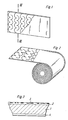
- a tile or plate is shown in perspective, which can be coated and printed as a single plate.
- the coating can be carried out by dipping processes, spraying processes or other known coating processes.
- the tiles can be plastic-coated on one side on the visible side or on both sides.
- FIG. 2 shows a correspondingly printed strip-shaped metal web in roll form that is suitable for being coated on a strip.
- FIG. 3 of the drawing shows the cross section of an object printed according to the invention using the example of the tile or plate of FIG. 1.
- the substrate 1 made of metal or another material customary for tiles or plates, such as ceramic material, is on both sides with the plastic coating 2 and a thermosetting coating 4 provided.
- the thermosetting coating 2 lies on the visible side of the tile or plate and lies directly on the substrate 1.
- Dyes 3 are embedded in the thermosetting coating 2 in such a way that they adjoin the free surface thereof, but in the illustrated case only extend over a limited part of the thickness of the thermosetting coating, the latter being free of dyes in its area directly adjacent to the substrate 1 .
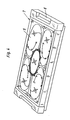
- the heating plate 7 shown in FIG. 4 of the drawing has a grip strip 6 at each of its two ends, between which the heating part 5 with the printed heating surface is located.
- Example 7 of DE-OS 2 642 350 a steel sheet with a thickness of 0.5 mm was matted with titanium dioxide thermoplastic polyester resin surface coated.
- a transfer paper which was printed with the usual emulsion colors sublimed below 220 C, an image was printed on this polyester resin coating using the transfer printing process at 200 ° C for 30 seconds.
- the product only showed pressure fidelity in the temperature range between 0 and 80 ° C. Significant dye migration occurred above 80 to 110 ° C, which was shown by blurring of the surface. Above 110 ° C, the halftone fabrics migrated in the sense of trigromy or quadrogromy migrated to a gray value without figure.
- An aluminum sheet was pretreated with an organic grease solvent to make its surface free of grease and other contaminants. Then the pre-cleaned aluminum sheet was first coated with a white primer layer with a layer thickness of 40 ⁇ 10 ⁇ m using a spray process. The coating was then dried in a continuous oven at 180 ° C. for 10 minutes. Then a colorless clear lacquer layer based on silicone polyester was also applied by spraying with a layer thickness of 15 ⁇ 10 ⁇ m. The Troc k - drying was carried out for 10 minutes at 250 ° C.
- the coated sheets which were still hot, were brought into contact with a transfer printing paper which had been printed with dyes which sublimated above 220 ° C. using the offset process.
- the printing process was heated to 250 ° C.
- the printed aluminum sheets obtained in this way were distinguished by very good heat resistance and service temperatures above 150 ° C. and by high resistance to all stresses, such as, for example occur in the household sector.
- Biscuit tiles were first sprayed with a two-component polyurethane barrier primer, which was dry at room temperature, because the tiles were very absorbent.
- This pretreatment agent was based on aliphatic urethane acrylate.
- a plastic coating made of polyacrylate was applied in the casting process.
- the top coat layer was applied with a layer thickness of 50 + 10 / um solvent-free.
- the crosslinking took place within fractions of a second at room temperature by electron beam curing.
- the coating had an exceptional scratch resistance and hardness for plastic surfaces.
- the coated tiles which were still hot, were brought into contact with a transfer printing medium which was printed with high-pressure printing with dyes sublimating above 220 ° C., the transfer printing was carried out at 240 ° C.
- tinplate was coated directly with a coating system based on a saturated polyester and a self-crosslinking acrylic resin.
- a white primer based on a saturated polyester was applied as a base coat in a layer thickness corresponding to 20 to 30 g / m, after which it was dried at 160 ° C. for about 8 minutes.
- a colorless clear lacquer layer based on a self-crosslinking acrylate resin was then applied in a layer thickness corresponding to 10 to 20 g / m 2 . Drying took place within 10 minutes at 190 ° C.
- the tinplate was added at a later date 250 ° C with a transfer printing medium, which was screen printed with dyes that sublime above 220 ° C, printed.
- Particle boards were first subjected to a sanding with a grain size of 80 to 120.
- the coating system consisted of a material based on an unsaturated polyester with a co-accelerator and organic peroxide as a catalyst.
- a white primer layer in an amount of 400 g / m 2 was sprayed on with a cup gun at an air pressure of 3 to 3.5 bar and a nozzle size of 2 to 3 mm.
- the drying was carried out at room temperature until grindability for 4 to 6 hours or at a temperature of about 80 0 C for 20 minutes.
- the grit was then sanded with 280 to 320 grit before the top coat.
- a colorless clear coat was applied with the same cup gun in an amount of 150 to 300 g / m 2 .
- the drying was carried out at room temperature for 8 to 10 hours or at a temperature of about 80 ° C for 10 to 15 minutes.
- the chipboard coated in this way was printed with a transfer printing medium which was printed with dyes which sublimated above 220 ° C.
- the printed products obtained in all four examples had excellent image clarity even after long use and temporary heating to 200 ° C and in long term heating for several hours at 150 0 C. A migration of the dyes was not detectable in spite of heating and remained the printed images completely clear.
Landscapes
- Printing Methods (AREA)
Priority Applications (1)
| Application Number | Priority Date | Filing Date | Title |
|---|---|---|---|
| AT80100607T ATE8120T1 (de) | 1979-02-09 | 1980-02-06 | Verfahren zum bedrucken eines beim erhitzen ueber 220 grad c bestaendigen substrates. |
Applications Claiming Priority (18)
| Application Number | Priority Date | Filing Date | Title |
|---|---|---|---|
| DE19797903604U DE7903604U1 (de) | 1979-02-09 | 1979-02-09 | Fliese |
| DE7903604U | 1979-02-09 | ||
| DE19792914704 DE2914704A1 (de) | 1979-04-11 | 1979-04-11 | Verfahren zum bedrucken eines beim erhitzen ueber 220 grad c bestaendigen substrates |
| DE2914704 | 1979-04-11 | ||
| DE19797919807 DE7919807U1 (de) | 1979-07-11 | 1979-07-11 | Waffel- und/oder grillgeraet |
| DE7919853U | 1979-07-11 | ||
| DE7919777U | 1979-07-11 | ||
| DE7919836U | 1979-07-11 | ||
| DE7919807U | 1979-07-11 | ||
| DE19797919791 DE7919791U1 (de) | 1979-07-11 | 1979-07-11 | Verkleidungsplatte |
| DE7919806U | 1979-07-11 | ||
| DE7919792U | 1979-07-11 | ||
| DE19797919806 DE7919806U1 (de) | 1979-07-11 | 1979-07-11 | Kochgeschirr |
| DE19797919792 DE7919792U1 (de) | 1979-07-11 | 1979-07-11 | Toaster |
| DE7919791U | 1979-07-11 | ||
| DE19797919853 DE7919853U1 (de) | 1979-07-11 | 1979-07-11 | Heizgeraet |
| DE19797919836 DE7919836U1 (de) | 1979-07-11 | 1979-07-11 | Waermeplatte |
| DE19797919777 DE7919777U1 (de) | 1979-07-11 | 1979-07-11 | Thermosbehaelter |
Publications (3)
| Publication Number | Publication Date |
|---|---|
| EP0014901A2 true EP0014901A2 (fr) | 1980-09-03 |
| EP0014901A3 EP0014901A3 (en) | 1981-07-22 |
| EP0014901B1 EP0014901B1 (fr) | 1984-06-27 |
Family
ID=27575876
Family Applications (1)
| Application Number | Title | Priority Date | Filing Date |
|---|---|---|---|
| EP80100607A Expired EP0014901B1 (fr) | 1979-02-09 | 1980-02-06 | Procédé d'impression d'un substrat résistant à une chaleur supérieure à 220 degrés C |
Country Status (2)
| Country | Link |
|---|---|
| EP (1) | EP0014901B1 (fr) |
| DE (1) | DE3068333D1 (fr) |
Cited By (18)
| Publication number | Priority date | Publication date | Assignee | Title |
|---|---|---|---|---|
| EP0060107A2 (fr) | 1981-03-10 | 1982-09-15 | British Steel Corporation | Impression par transfert |
| FR2509668A1 (fr) * | 1981-07-14 | 1983-01-21 | Metal Box Plc | Articles decores |
| FR2521489A1 (fr) * | 1982-02-18 | 1983-08-19 | Schuhl Jean | Procede pour imprimer certains supports par la voie du thermo-transfert de colorants ou d'encres sublimables, et produit ainsi obtenus |
| GB2117320A (en) * | 1982-03-27 | 1983-10-12 | Terance Kliszcz | Transfer printing on articles having flat, curved or irregularly- shaped surfaces |
| EP0119548A3 (en) * | 1983-03-21 | 1985-10-23 | Schulzen, Herbert | Process for printing on supports by the transfer process |
| US4664672A (en) * | 1982-12-01 | 1987-05-12 | Rohm Gmbh Chemische Fabrik | Transfer printing process for solid objects employing high-pressure gas |
| FR2593743A1 (fr) * | 1986-01-31 | 1987-08-07 | Selnor | Procede de decoration d'un meuble menager et meuble decore par ce procede |
| EP0218168A3 (en) * | 1985-10-09 | 1988-09-21 | Rohm Gmbh | Transfer-printing process |
| EP0488484A1 (fr) * | 1990-11-28 | 1992-06-03 | Adolf Sievers | Feuille de colorant pour l'estampage pour le marquage des supports d'images ou d'écriture, particulièrement des panneaux indicateurs pour des véhicules automobiles |
| US5362703A (en) * | 1983-07-25 | 1994-11-08 | Dai Nippon Insatsu Kabushiki Kaisha | Heat transferable sheet |
| EP0734880A1 (fr) * | 1995-03-28 | 1996-10-02 | Zippo Manufacturing Company | Méthode pour l'impression sur substrats métalliques par transfert par la chaleur et produits ainsi fabriqués |
| EP0791476A1 (fr) * | 1996-02-26 | 1997-08-27 | Danilo Todeschini | Article comprenant une image ou un motif en surface obtenu par transfert thermique d'une surface imprimée sur du papier |
| US5997677A (en) * | 1990-05-08 | 1999-12-07 | General Electric Company | Method to apply a colored decorative design on a substrate of plastics |
| WO2000032420A1 (fr) * | 1998-12-03 | 2000-06-08 | Akzo Nobel N.V. | Procede de preparation d'un substrat decore |
| DE10032555A1 (de) * | 2000-07-05 | 2002-01-24 | Prepatex Gmbh | Verfahren zum Bedrucken von Holz |
| WO2008087674A1 (fr) * | 2007-01-20 | 2008-07-24 | Bialetti Industrie S.P.A. | Cafetière décorée et procédé de décoration de celle-ci |
| US9850669B2 (en) | 2000-06-13 | 2017-12-26 | Flooring Industries Limited, Sarl | Floor covering panel |
| CN116496659A (zh) * | 2023-04-28 | 2023-07-28 | 英科卡乐油墨(湖北)有限公司 | 一种卷烟接装材料耐高温水性油墨 |
Family Cites Families (8)
| Publication number | Priority date | Publication date | Assignee | Title |
|---|---|---|---|---|
| GB1444368A (en) * | 1973-03-20 | 1976-07-28 | Ici Ltd | Colouration process |
| BE815402A (fr) * | 1973-05-24 | 1974-11-22 | Procede de coloration de surfaces metalliques ou rigides par transfert a sec et produits obtenus | |
| US3952131A (en) * | 1973-07-10 | 1976-04-20 | Sideman Carl E | Heat transfer print sheet and printed product |
| ZA752573B (en) * | 1975-04-22 | 1976-04-28 | British Industrial Plastics | Improvements in or relating to colour printing |
| US4354851A (en) * | 1977-02-17 | 1982-10-19 | United States Gypsum Company | Method for making a decorated, water-resistant, rigid panel and the product made thereby: transfer dye process onto rigid panel |
| GB1517832A (en) * | 1977-04-12 | 1978-07-12 | Reed International Ltd | Method of printing |
| US4395263A (en) * | 1977-04-21 | 1983-07-26 | Davis R Elbert | Unitary laminate with permanent indicia pattern: transfer printings onto plastic-coated rigid panels |
| US4201821A (en) * | 1978-12-22 | 1980-05-06 | Howard A. Fromson | Decorated anodized aluminum article |
-
1980
- 1980-02-06 DE DE8080100607T patent/DE3068333D1/de not_active Expired
- 1980-02-06 EP EP80100607A patent/EP0014901B1/fr not_active Expired
Cited By (23)
| Publication number | Priority date | Publication date | Assignee | Title |
|---|---|---|---|---|
| EP0060107A3 (en) * | 1981-03-10 | 1983-02-23 | British Steel Corporation | Transfer printing |
| EP0060107A2 (fr) | 1981-03-10 | 1982-09-15 | British Steel Corporation | Impression par transfert |
| FR2509668A1 (fr) * | 1981-07-14 | 1983-01-21 | Metal Box Plc | Articles decores |
| FR2521489A1 (fr) * | 1982-02-18 | 1983-08-19 | Schuhl Jean | Procede pour imprimer certains supports par la voie du thermo-transfert de colorants ou d'encres sublimables, et produit ainsi obtenus |
| GB2117320A (en) * | 1982-03-27 | 1983-10-12 | Terance Kliszcz | Transfer printing on articles having flat, curved or irregularly- shaped surfaces |
| US4664672A (en) * | 1982-12-01 | 1987-05-12 | Rohm Gmbh Chemische Fabrik | Transfer printing process for solid objects employing high-pressure gas |
| EP0119548A3 (en) * | 1983-03-21 | 1985-10-23 | Schulzen, Herbert | Process for printing on supports by the transfer process |
| US4681034A (en) * | 1983-03-21 | 1987-07-21 | Herbert Schulzen | Process for printing a substrate by the hot-transfer printing method |
| US5614463A (en) * | 1983-07-25 | 1997-03-25 | Dai Nippon Insatsu Kabushiki Kaisha | Heat transferable sheet |
| US5362703A (en) * | 1983-07-25 | 1994-11-08 | Dai Nippon Insatsu Kabushiki Kaisha | Heat transferable sheet |
| EP0218168A3 (en) * | 1985-10-09 | 1988-09-21 | Rohm Gmbh | Transfer-printing process |
| FR2593743A1 (fr) * | 1986-01-31 | 1987-08-07 | Selnor | Procede de decoration d'un meuble menager et meuble decore par ce procede |
| US5997677A (en) * | 1990-05-08 | 1999-12-07 | General Electric Company | Method to apply a colored decorative design on a substrate of plastics |
| EP0488484A1 (fr) * | 1990-11-28 | 1992-06-03 | Adolf Sievers | Feuille de colorant pour l'estampage pour le marquage des supports d'images ou d'écriture, particulièrement des panneaux indicateurs pour des véhicules automobiles |
| EP0734880A1 (fr) * | 1995-03-28 | 1996-10-02 | Zippo Manufacturing Company | Méthode pour l'impression sur substrats métalliques par transfert par la chaleur et produits ainsi fabriqués |
| EP0791476A1 (fr) * | 1996-02-26 | 1997-08-27 | Danilo Todeschini | Article comprenant une image ou un motif en surface obtenu par transfert thermique d'une surface imprimée sur du papier |
| WO2000032420A1 (fr) * | 1998-12-03 | 2000-06-08 | Akzo Nobel N.V. | Procede de preparation d'un substrat decore |
| US6635142B1 (en) | 1998-12-03 | 2003-10-21 | Akzo Nobel N.V. | Process for the preparation of a decorated substrate |
| US9850669B2 (en) | 2000-06-13 | 2017-12-26 | Flooring Industries Limited, Sarl | Floor covering panel |
| US9970198B2 (en) | 2000-06-13 | 2018-05-15 | Flooring Industries Limited, Sarl | Floor covering, floor panels for forming such floor covering, and method for realizing such floor panels |
| DE10032555A1 (de) * | 2000-07-05 | 2002-01-24 | Prepatex Gmbh | Verfahren zum Bedrucken von Holz |
| WO2008087674A1 (fr) * | 2007-01-20 | 2008-07-24 | Bialetti Industrie S.P.A. | Cafetière décorée et procédé de décoration de celle-ci |
| CN116496659A (zh) * | 2023-04-28 | 2023-07-28 | 英科卡乐油墨(湖北)有限公司 | 一种卷烟接装材料耐高温水性油墨 |
Also Published As
| Publication number | Publication date |
|---|---|
| EP0014901B1 (fr) | 1984-06-27 |
| EP0014901A3 (en) | 1981-07-22 |
| DE3068333D1 (en) | 1984-08-02 |
Similar Documents
| Publication | Publication Date | Title |
|---|---|---|
| EP0014901B1 (fr) | Procédé d'impression d'un substrat résistant à une chaleur supérieure à 220 degrés C | |
| DE69431424T2 (de) | Verfahren zur Herstellung von Kunstholzhalbzeug | |
| DE69602184T2 (de) | Verfahren zur herstellung von dekorierten, stranggepressten profielen | |
| DE2817566A1 (de) | Sublimationsuebertragungsfaerbeverfahren | |
| US4259375A (en) | Decorative process | |
| DE69809035T2 (de) | Verfahren und vorrichtung zur behandlung von glas | |
| DE69906374T2 (de) | Verfahren zur herstellung eines dekorierten substrats | |
| WO1991017053A1 (fr) | Procede et dispositif pour l'application d'une decoration en couleurs sur un substrat en plastique, ainsi que substrat en plastique decore | |
| DE202017006418U1 (de) | Gegenstand aus Glas, insbesondere Glaskeramik | |
| EP2942207B1 (fr) | Procédé de fabrication de plaques en bois décorées et panneau de sol fabriqué à partir de celles-ci | |
| DE3024919A1 (de) | Dekoratives laminat und verfahren zu dessen herstellung | |
| KR20160094392A (ko) | 플렉소그래피에 의해 열 안정성 코팅을 포함하는 물품을 장식하기 위한 방법 | |
| DE3781974T2 (de) | Duennes, biegsames blatt mit einer marmordurchscheinenden dekoration und verfahren zu seiner herstellung. | |
| DE2914704C2 (fr) | ||
| DE3325641A1 (de) | Dekorativer fussbodenbelag in form von kunststofffliesen und verfahren zu seiner herstellung | |
| DE69423890T2 (de) | Verfahren zur herstellung von mustern auf gegenständen, insbesondere auf keramischen gegenständen | |
| DE69810430T2 (de) | Dekorationsverfahren | |
| DE2248871A1 (de) | Verfahren zur herstellung eines ueberglasur-keramikabziehbildes | |
| AT209053B (de) | Verfahren zur Herstellung von Verkleidungsplatten, insbesondere für Wände, Tische u. dgl. | |
| DE3730051C1 (de) | Fuer den Transferdruck geeignete Traegerbahn zur dekorativen Oberflaechenbeschichtung von flaechigen Werkstoffen | |
| DE7919806U1 (de) | Kochgeschirr | |
| KR20140066313A (ko) | 도막 엠보스 칼라강판 및 그 제조방법 | |
| GB1602120A (en) | Process for applying a patterned coating to substrates | |
| US1741471A (en) | Art or process of transferring natural-wood-grain designs of a wood panel to anotherarticle | |
| JPH06337117A (ja) | 高温調理機器用皮膜およびその製造方法 |
Legal Events
| Date | Code | Title | Description |
|---|---|---|---|
| PUAI | Public reference made under article 153(3) epc to a published international application that has entered the european phase |
Free format text: ORIGINAL CODE: 0009012 |
|
| AK | Designated contracting states |
Designated state(s): AT BE CH DE FR GB IT LU NL SE |
|
| ITCL | It: translation for ep claims filed |
Representative=s name: NOTARBARTOLO & GERVASI S.R.L. |
|
| 17P | Request for examination filed |
Effective date: 19810115 |
|
| PUAL | Search report despatched |
Free format text: ORIGINAL CODE: 0009013 |
|
| AK | Designated contracting states |
Designated state(s): AT BE CH DE FR GB IT LU NL SE |
|
| RAP1 | Party data changed (applicant data changed or rights of an application transferred) |
Owner name: KOLLOID-CHEMIE G.M.B.H. |
|
| ITF | It: translation for a ep patent filed | ||
| GRAA | (expected) grant |
Free format text: ORIGINAL CODE: 0009210 |
|
| AK | Designated contracting states |
Designated state(s): AT BE CH DE FR GB IT LU NL SE |
|
| REF | Corresponds to: |
Ref document number: 8120 Country of ref document: AT Date of ref document: 19840715 Kind code of ref document: T |
|
| REF | Corresponds to: |
Ref document number: 3068333 Country of ref document: DE Date of ref document: 19840802 |
|
| ET | Fr: translation filed | ||
| PLBI | Opposition filed |
Free format text: ORIGINAL CODE: 0009260 |
|
| BECN | Be: change of holder's name |
Effective date: 19840627 |
|
| 26 | Opposition filed |
Opponent name: TRANSFERTEX GMBH & CO. THERMODRUCK KG Effective date: 19841106 |
|
| NLR1 | Nl: opposition has been filed with the epo |
Opponent name: TRANSFERTEX GMBH & CO. THERMODRUCK KG. |
|
| RAP2 | Party data changed (patent owner data changed or rights of a patent transferred) |
Owner name: NORTECH CHEMIE GMBH & CO. KG |
|
| NLT2 | Nl: modifications (of names), taken from the european patent patent bulletin |
Owner name: NORTECH CHEMIE GMBH & CO. KG TE HAMBURG, BONDSREPU |
|
| REG | Reference to a national code |
Ref country code: CH Ref legal event code: PUE Owner name: NORTECH CHEMIE GMBH & CO. KG |
|
| REG | Reference to a national code |
Ref country code: FR Ref legal event code: TP |
|
| NLS | Nl: assignments of ep-patents |
Owner name: NORTECH CHEMIE GMBH & CO. KG TE HAMBURG, BONDSREPU |
|
| ITPR | It: changes in ownership of a european patent |
Owner name: CESSIONE;NORTECH - CHEMIE GMBH E CO. KG |
|
| PLBM | Termination of opposition procedure: date of legal effect published |
Free format text: ORIGINAL CODE: 0009276 |
|
| STAA | Information on the status of an ep patent application or granted ep patent |
Free format text: STATUS: OPPOSITION PROCEDURE CLOSED |
|
| 27C | Opposition proceedings terminated |
Effective date: 19870427 |
|
| REG | Reference to a national code |
Ref country code: GB Ref legal event code: 732 |
|
| REG | Reference to a national code |
Ref country code: LU Ref legal event code: TP Owner name: NORTECH CHEMIE GMBH & CO. KG HAMBURG Effective date: 19861201 |
|
| REG | Reference to a national code |
Ref country code: CH Ref legal event code: PUE Owner name: CAROLIN BEUTELROCK |
|
| NLS | Nl: assignments of ep-patents |
Owner name: CAROLIN BEUTELROCK TE LUEBECK, BONDSREPUBLIEK DUIT |
|
| REG | Reference to a national code |
Ref country code: GB Ref legal event code: 732 |
|
| ITPR | It: changes in ownership of a european patent |
Owner name: CESSIONE;CAROLIN BEUTELROCK |
|
| REG | Reference to a national code |
Ref country code: FR Ref legal event code: TP |
|
| ITTA | It: last paid annual fee | ||
| EPTA | Lu: last paid annual fee | ||
| NLR2 | Nl: decision of opposition | ||
| EAL | Se: european patent in force in sweden |
Ref document number: 80100607.3 |
|
| REG | Reference to a national code |
Ref country code: CH Ref legal event code: PUE Owner name: OSTERMANN & SCHEIWE GMBH & CO. |
|
| REG | Reference to a national code |
Ref country code: FR Ref legal event code: TP |
|
| REG | Reference to a national code |
Ref country code: GB Ref legal event code: 732E |
|
| NLS | Nl: assignments of ep-patents |
Owner name: OSTERMANN & SCHEIWE GMBH & CO. |
|
| PGFP | Annual fee paid to national office [announced via postgrant information from national office to epo] |
Ref country code: GB Payment date: 19970113 Year of fee payment: 18 |
|
| PGFP | Annual fee paid to national office [announced via postgrant information from national office to epo] |
Ref country code: FR Payment date: 19970114 Year of fee payment: 18 |
|
| PGFP | Annual fee paid to national office [announced via postgrant information from national office to epo] |
Ref country code: BE Payment date: 19970116 Year of fee payment: 18 |
|
| PGFP | Annual fee paid to national office [announced via postgrant information from national office to epo] |
Ref country code: SE Payment date: 19970123 Year of fee payment: 18 |
|
| PGFP | Annual fee paid to national office [announced via postgrant information from national office to epo] |
Ref country code: AT Payment date: 19970128 Year of fee payment: 18 |
|
| PGFP | Annual fee paid to national office [announced via postgrant information from national office to epo] |
Ref country code: NL Payment date: 19970130 Year of fee payment: 18 Ref country code: CH Payment date: 19970130 Year of fee payment: 18 |
|
| PGFP | Annual fee paid to national office [announced via postgrant information from national office to epo] |
Ref country code: LU Payment date: 19970206 Year of fee payment: 18 |
|
| PGFP | Annual fee paid to national office [announced via postgrant information from national office to epo] |
Ref country code: DE Payment date: 19970321 Year of fee payment: 18 |
|
| PG25 | Lapsed in a contracting state [announced via postgrant information from national office to epo] |
Ref country code: LU Free format text: LAPSE BECAUSE OF NON-PAYMENT OF DUE FEES Effective date: 19980206 Ref country code: GB Free format text: LAPSE BECAUSE OF NON-PAYMENT OF DUE FEES Effective date: 19980206 Ref country code: AT Free format text: LAPSE BECAUSE OF NON-PAYMENT OF DUE FEES Effective date: 19980206 |
|
| PG25 | Lapsed in a contracting state [announced via postgrant information from national office to epo] |
Ref country code: SE Free format text: LAPSE BECAUSE OF NON-PAYMENT OF DUE FEES Effective date: 19980207 |
|
| PG25 | Lapsed in a contracting state [announced via postgrant information from national office to epo] |
Ref country code: FR Free format text: THE PATENT HAS BEEN ANNULLED BY A DECISION OF A NATIONAL AUTHORITY Effective date: 19980228 Ref country code: CH Free format text: LAPSE BECAUSE OF NON-PAYMENT OF DUE FEES Effective date: 19980228 Ref country code: BE Free format text: LAPSE BECAUSE OF NON-PAYMENT OF DUE FEES Effective date: 19980228 |
|
| BERE | Be: lapsed |
Owner name: OSTERMAN & SHEIWE G.M.B.H. & CO. Effective date: 19980228 |
|
| PG25 | Lapsed in a contracting state [announced via postgrant information from national office to epo] |
Ref country code: NL Free format text: LAPSE BECAUSE OF NON-PAYMENT OF DUE FEES Effective date: 19980901 |
|
| GBPC | Gb: european patent ceased through non-payment of renewal fee |
Effective date: 19980206 |
|
| REG | Reference to a national code |
Ref country code: CH Ref legal event code: PL |
|
| EUG | Se: european patent has lapsed |
Ref document number: 80100607.3 |
|
| NLV4 | Nl: lapsed or anulled due to non-payment of the annual fee |
Effective date: 19980901 |
|
| PG25 | Lapsed in a contracting state [announced via postgrant information from national office to epo] |
Ref country code: DE Free format text: LAPSE BECAUSE OF NON-PAYMENT OF DUE FEES Effective date: 19981103 |
|
| REG | Reference to a national code |
Ref country code: FR Ref legal event code: ST |