EP0015006A2 - Verfahren zur Kondensation von Feststoffen sowie Vorrichtung zur Durchführung des Verfahrens - Google Patents
Verfahren zur Kondensation von Feststoffen sowie Vorrichtung zur Durchführung des Verfahrens Download PDFInfo
- Publication number
- EP0015006A2 EP0015006A2 EP80100893A EP80100893A EP0015006A2 EP 0015006 A2 EP0015006 A2 EP 0015006A2 EP 80100893 A EP80100893 A EP 80100893A EP 80100893 A EP80100893 A EP 80100893A EP 0015006 A2 EP0015006 A2 EP 0015006A2
- Authority
- EP
- European Patent Office
- Prior art keywords
- reactor
- condensation
- housing
- condensed
- wall
- Prior art date
- Legal status (The legal status is an assumption and is not a legal conclusion. Google has not performed a legal analysis and makes no representation as to the accuracy of the status listed.)
- Granted
Links
Images


Classifications
-
- C—CHEMISTRY; METALLURGY
- C01—INORGANIC CHEMISTRY
- C01B—NON-METALLIC ELEMENTS; COMPOUNDS THEREOF; METALLOIDS OR COMPOUNDS THEREOF NOT COVERED BY SUBCLASS C01C
- C01B25/00—Phosphorus; Compounds thereof
- C01B25/16—Oxyacids of phosphorus; Salts thereof
- C01B25/26—Phosphates
- C01B25/38—Condensed phosphates
-
- B—PERFORMING OPERATIONS; TRANSPORTING
- B01—PHYSICAL OR CHEMICAL PROCESSES OR APPARATUS IN GENERAL
- B01J—CHEMICAL OR PHYSICAL PROCESSES, e.g. CATALYSIS OR COLLOID CHEMISTRY; THEIR RELEVANT APPARATUS
- B01J10/00—Chemical processes in general for reacting liquid with gaseous media other than in the presence of solid particles, or apparatus specially adapted therefor
- B01J10/005—Chemical processes in general for reacting liquid with gaseous media other than in the presence of solid particles, or apparatus specially adapted therefor carried out at high temperatures in the presence of a molten material
-
- B—PERFORMING OPERATIONS; TRANSPORTING
- B01—PHYSICAL OR CHEMICAL PROCESSES OR APPARATUS IN GENERAL
- B01J—CHEMICAL OR PHYSICAL PROCESSES, e.g. CATALYSIS OR COLLOID CHEMISTRY; THEIR RELEVANT APPARATUS
- B01J19/00—Chemical, physical or physico-chemical processes in general; Their relevant apparatus
- B01J19/18—Stationary reactors having moving elements inside
- B01J19/1887—Stationary reactors having moving elements inside forming a thin film
-
- C—CHEMISTRY; METALLURGY
- C01—INORGANIC CHEMISTRY
- C01B—NON-METALLIC ELEMENTS; COMPOUNDS THEREOF; METALLOIDS OR COMPOUNDS THEREOF NOT COVERED BY SUBCLASS C01C
- C01B25/00—Phosphorus; Compounds thereof
- C01B25/16—Oxyacids of phosphorus; Salts thereof
- C01B25/26—Phosphates
- C01B25/38—Condensed phosphates
- C01B25/40—Polyphosphates
-
- B—PERFORMING OPERATIONS; TRANSPORTING
- B01—PHYSICAL OR CHEMICAL PROCESSES OR APPARATUS IN GENERAL
- B01J—CHEMICAL OR PHYSICAL PROCESSES, e.g. CATALYSIS OR COLLOID CHEMISTRY; THEIR RELEVANT APPARATUS
- B01J2219/00—Chemical, physical or physico-chemical processes in general; Their relevant apparatus
- B01J2219/18—Details relating to the spatial orientation of the reactor
- B01J2219/182—Details relating to the spatial orientation of the reactor horizontal
Definitions
- the present invention relates to a process for the condensation of solids, in particular phosphates, which tend to sinter and / or stick during the condensation in a reactor with the supply of heat.
- Such processes are the condensation of acidic alkali, alkaline earth and heavy metal monophosphates or ammonium metal monophosphates to the corresponding polyphosphates, e.g. the condensation of monosodium monophosphate to disodium diphosphate and further to Maddrell's salt or trimetaphosphate, from disodium monophosphate to tetrasodium diphosphate, from lithium monophosphates to the corresponding di- and polyphosphates, from monocalcium and monomagnesium monophosphates to the diphosphates.
- Further examples are the production of boron phosphate by condensation of boric acid with ammonium phosphate and the formation of ammonium polyphosphate from urea phosphate or the production of melamine polyphosphates.
- mixing machines which have a cylindrical or trough-shaped housing which with agitators as well Kneading bars and / or disk-shaped mixing elements is equipped. In the mixing machines mentioned, only those processes can be carried out in which a temperature of about 350 ° C. is not exceeded.
- the process according to the invention and the device according to the invention enable condensation to be carried out at temperatures of up to about 700 ° C. if the contents of the reactor are pressed after mixing in a thin layer against the reactor wall and then the condensed (hard) layer is removed again Detaching the reactor wall and bringing it back inside.
- a salt or metal melt is used for heat transfer in the present method.
- the heat is supplied to the condensed layer by means of the melt through the reactor wall and then to the inside of the reactor by peeling off this condensed layer.
- a device which consists of a reactor housing 1 which is trough-shaped and is freely movable in the longitudinal direction on cross members 14, the cross members 14 being supported on longitudinal members 13 via slide bearings 15.
- the reactor housing there is a rotating shaft 2, on which paddles 3 are attached to paddle carriers 4 in several planes.
- the paddles 3 are arranged at an angle to the shaft axis and thereby accomplish the axial transport of the product.
- the upper side of the reactor housing is provided with lids 1a, to which a wiper bracket 5 is attached between two paddle levels, which cleans the shaft and the paddle carrier from adhering product.
- the inlet 6 is provided for introducing the reaction components, the outlet 7 is used for discharging the reaction product.
- the shaft 2 is sealed off from the end housing covers 9 by the stuffing boxes 10.
- a paddle with attached knife 11 is arranged in each paddle plane, with which the condensed layer is peeled off from the reactor wall. This enables optimal heat transfer from the heating surface to the product.
- the paddle knives 11 are designed such that only a minimal amount of energy is required for the cleaning process due to the peeling action and cutting effect.
- multi-part heating pockets 12 are attached, which are designed so that they can be acted on with heating media of different temperatures. They are also able to compensate for the differences in the thermal expansion of the reactor housing on the one hand and the heating pocket walls on the other.
- abutments 16 are arranged on the underside of the housing, consisting of two parts 16a, b, one of which 16a on the housing and the other 16b on the supporting structure 17 is strengthened, the two parts 16a and 16b being displaceable relative to one another in the longitudinal direction.
- the substance to be condensed is introduced into the reactor via the filler neck 6 by means of a feed screw, conveyor belt or cellular wheel sluice.
- the filling level of the reactor is optimally used for the respective product. For example, it makes sense to aim for products with a tendency to foam that only slightly extend beyond shaft 2.
- the filling level is regulated by a weir 8 attached in front of the discharge and by varying the speed of the shaft 2 or by varying the inclination of the paddle.
- the material in the reactor housing is pressed by means of the paddles in the first phase onto the reactor housing wall, which is heated with molten salt, in a thin layer.
- the heated and partially condensed material is scraped off the walls of the reactor and mixed with the product located inside the reactor by the peeling knife following in the respective paddle level, while at the same time heat is transferred from the heated reactor wall through the peeled material to the inside.
- the quantity of product introduced is such that this process is repeated until the reaction product, which is in the last part before the discharge, has the reaction temperature at which the condensation has completely expired.
- the end product obtained in this way is conveyed via the weir 8 to the outlet 7 and discharged there.
- heating pockets which can be charged with heating media of different temperatures.
- a reactor according to the invention with a trough length of 320 cm is charged in one hour with 70 to 75 kg of a mixture of 98.8 parts by weight of crystallized or spray-dried monosodium phosphate and 1.2 parts by weight of monoammonium phosphate.
- a 1% solution of the monosodium phosphate should have a pH of 4.5. If the product temperature at the discharge nozzle is kept at 355 to 360 ° C, which requires a molten salt temperature of 450 to 470 ° C, a sodium polyphosphate with a content of at least 98.5% Maddrell salt is obtained.
- a capacity of 300 to 320 kg / h can be achieved with a reactor whose trough has a length of 600 cm and a diameter of 70 cm.
- the reactor described above is fed through a metering device, e.g. Dosing belt weigher, with 30.6 kg calcium hydroxide and a spray device above the kneader shaft with 66 liters of 75 percent phosphoric acid per hour.
- a molten salt temperature of 520 ° C With a molten salt temperature of 520 ° C, a product temperature of 280 to 290 ° C occurs at the discharge from the reactor.
- a calcium pyrophosphate with an hourly output of 90 kg is obtained, which showed a loss on ignition of 8.8%.
- a laboratory reactor of the type described above with a trough length of 80 cm and a trough diameter of 18 cm is charged with 10 kg of monolithium orthonhosphate at 150 ° C. After the temperature of the heating medium has been raised to 400 to 420 ° C., 6 to 7 kg of a lithium orthophosphate solution, which has been prepared from lithium hydroxide and 75 percent phosphoric acid, are introduced hourly via a nozzle pipe into the front part of the reactor via a metering pump. The lithium polyphosphate formed, which is sparingly soluble in water, leaves the reactor as a free-flowing product at a temperature of 320 to 350.degree.
- a mixture of 44.6% dicyandiamide, 3.7% phosphorus pentoxide and 17.7% urea is produced with the exclusion of moisture.
- the reactor system described in Example 1 is charged with 55 to 60 kg of this mixture every hour with exclusion of moisture, the heating jacket of the reactor on the entry side being kept at a temperature of 250 to 260 ° C. in the first third, while the remaining two thirds with heating medium from 420 to 460 ° C.
- a PNC connection is obtained, which is used for flame retardant thermo plastic molding compounds, such as polyamide, according to DE-OS 26 40 120, are particularly suitable.
- Example 1 To produce cyanuric acid, the reactor described in Example 1 is used, the heating jacket of which is divided into three zones. Zone 1 at the entry is kept at 160 ° C, zone 2 at 260 ° C and zone 3 with a molten salt of 360 ° C. Four outlets are provided along the cover, through which the ammonia formed during the condensation can be removed and fed to a wet scrubber for absorption.
- the reactor is fed with an amount of 80 kg of urea per hour, a speed of 12 rpm being set on the shaft.
- the condensation product leaves the reactor at a temperature of 290 to 305 ° C and contains 97.6% cyanuric acid.
- the melamine diphosphate is condensed in a second reaction step using urea.
- the reactor is kept at a jacket temperature of 180 ° C in the first third, while the rest of the heating jacket is charged with a salt melt which has a temperature of 380 ° C in the flow.
- a mixture of 107 kg of melamine diphosphate and 15.5 kg of urea / h is introduced by means of a metering channel, the speed of the reactor shaft being 10 to 12 rpm.
- Example 1 The reactor described in Example 1, which is heated with a molten salt having a flow temperature of 440 ° C., is filled with 120 kg of aluminum tripolyphosphate. As soon as the filling has reached a temperature of 380 ° C, one begins with the injection of a 80 to 90 ° hot aluminum orthophosphate solution, which is prepared from aluminum oxyhydrate and 75 percent phosphoric acid at 80 to 90 ° C. The quantity of orthophosphate solution entered via a piston pump is metered in such a way that a product temperature of 370 to 380 ° C. is established at the discharge. The aluminum phosphate obtained showed an ignition loss of 6.5% at 600 ° C. The procedure for producing aluminum metaphosphate is similar, except that a heating temperature of 540 ° C. and a product temperature of 460 ° C. are set.
- the laboratory reactor described above is slowly filled with 3.25 kg of zinc oxide at a heating bath temperature of 160 ° C. at a shaft speed of 12 rpm, 10.45 kg of 75 percent phosphoric acid being metered in at the same time.
- the temperature of the heating medium in the zone facing the entry is then increased to 250 ° C. and in the two other zones facing the exit to 450 ° C., and 6 to 8 kg of a solution of zinc orthophosphate Zn (H 2 P0 4 ) 2 are metered in every hour obtained by adding zinc oxide to hot 75 percent phosphoric acid.
- the first 15 kg of zinc polyphosphate, which leave the reactor, are pasted with twice the amount of the zinc orthophosphate solution and also introduced into the reactor.
- the reactor can also be charged with 10 kg zinc polyphosphate for the initial filling and then the zinc polyphosphate solution can then be pumped in.
Landscapes
- Chemical & Material Sciences (AREA)
- Organic Chemistry (AREA)
- Chemical Kinetics & Catalysis (AREA)
- Inorganic Chemistry (AREA)
- Physical Or Chemical Processes And Apparatus (AREA)
- Manufacture And Refinement Of Metals (AREA)
- Processing Of Solid Wastes (AREA)
- Organic Low-Molecular-Weight Compounds And Preparation Thereof (AREA)
Abstract
Description
- Gegenstand der vorliegenden Erfindung ist ein Verfahren zur Kondensation von Feststoffen, insbesondere Phosphaten, die während der Kondensation zum Sintern und/oder Verkleben neigen, in einem Reaktor unter Wärmezufuhr.
- Derartige Verfahren sind die Kondensation von sauren Alkali-, Erdalkali- und Schwermetall-monophosphaten oder Ammonium-Metallmonophosphaten zu den entsprechenden Polyphosphaten, z.B. die Kondensation von Mononatriummonophosphat zu Dinatrium-diphosphat und weiter zu Maddrellschem Salz oder Trimetaphosphat, von Dinatriummonophosphat zu Tetranatrium-diphosphat, von Lithiummonophosphaten zu den entsprechenden Di- und Polyphosphaten,von Monocalcium- und Monomagnesium-monophosphaten über die Diphosphate zu den entsprechenden Polyphosphaten.
- Als Beispiele für die Umsetzung von Schwermetall-monophosphaten wären zu nennen:
- Die Herstellung von Aluminium-tripoly-phosphat bzw. Aluminium-metaphosphat aus Aluminium-monophosphat sowie die Kondensation von Zink-, Mangan- oder Kupfer-diphosphat aus den entsprechenden Monophosphaten.
- Weitere Beispiele sind die Gewinnung von Borphosphat durch Kondensation von Borsäure mit Ammonium-phosphat sowie die Bildung von Ammonium-polyphosphat aus Harnstoff-phosphat oder die Herstellung von Melamin-polyphosphaten.
- Auch bei der Kondensation von Harnstoff zu Cyanursäure und bei der Bildung von Phosphor-nitridoxid bzw. Phosphor-nitridsulfid bereitet das Verkleben der Produkte beträchtliche Schwierigkeiten, die darin bestehen, daß das an den Reaktorwänden anhaftende Endprodukt die Wärmeübertragung erschwert und so der Umsatzgrad entscheidend beeinflußt wird.
- Aus der DE-OS 15 42 016 ist ein Verfahren und eine Vorrichtung zur Durchführung von Hochtemperaturprozessen bei Temperaturen über 300°C bekannt, bei dem in einer Schneckenmaschine mit einer oder mehreren Schneckenwellen das Ausgangsprodukt zunächst überwiegend durch mechanische innere Reibungsarbeit soweit erwärmt wird, daß es über einen zähpastösen Zustand in eine weniger viskose Masse übergeführt wird, der dann von außen durch direkte Wärmeübertragung die erforderliche Wärme zugeführt wird. Solche Einrichtungen sind zur Durchführung von Kondensationsreaktionen im Prinzip ungeeignet, weil der Mischeffekt zu gering ist und somit die Umsetzung nicht vollständig abläuft.
- Des weiteren sind aus den DE-OSen 15 57 119 und 20 12 294 Mischmaschinen bekannt, die ein zylindrisches oder trogförmiges Gehäuse aufweisen, das mit Rührwerken sowie Knetbarren und/oder scheibenförmigen Mischelementen ausgestattet ist. In den genannten Mischmaschinen lassen sich nur solche Verfahren durchführen, bei denen eine Temperatur von etwa 350°C nicht überschritten wird.
- Im Gegensatz hierzu gelingt es nach dem erfindungsgemäßen Verfahren und mit Hilfe der erfindungsgemäßen Vorrichtung Kondensationen bei Temperaturen bis etwa 700°C durchzuführen, wenn man den Reaktorinhalt nach dem Mischen in dünner Schicht an die Reaktorwand drückt und anschließend die kondensierte (harte) Schicht wieder von der Reaktorwand ablöst und ins Innere zurückbringt.
- Zweckmäßigerweise bedient man sich zur Wärmeübertragung bei dem vorliegenden Verfahren einer Salz- oder Metallschmelze. Dabei wird die Wärme mittels der Schmelze durch die Reaktorwandung zunächst der kondensierten Schicht und danach durch Abschälen dieser kondensierten Schicht dem Inneren des Reaktors zugeführt.
- Wird zur Durchführung des Verfahrens ein Reaktor verwandt, der mit mehreren Heiztaschen ausgerüstet ist, so ist es ohne weiteres möglich, über die Länge des Reaktors mit verschiedenen Temperaturen zu beaufschlagen.
- Die bei der Kondensation sich bildenden Reaktionsabgase werden abgesaugt, mit Luft verdünnt und das in den Abgasen mitgerissene Reaktionsprodukt wird abgeschieden und gegebenenfalls in den Reaktor zurückgeführt. Nachstehend wird die Erfindung unter Bezug auf Zeichnungen näher erläutert. Es zeigen:
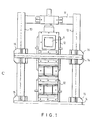
- Fig.al eine Draufsicht eines Teils des erfindungsgemäßen Reaktors,
- Fig. 2 einen Querschnitt durch den erfindungsgemäßen Reaktor gemäß Fig. 1, und
- Fig. 3 eine Längsansicht, teilweise im Schnitt, des erfindungsgemäßen Reaktors von Fig. 1.
- Zur Durchführung des erfindungsgemäßen Verfahrens bedient man sich einer Vorrichtung, die aus einem Reaktorgehäuse 1 besteht, das trogförmig ausgebildet ist und an Querträgern 14 in Längsrichtung frei beweglich aufgehängt ist, wobei sich die Querträger 14 über Gleitlager 15 auf Längsträgern 13 abstützen.
- In dem Reaktorgehäuse befindet sich eine rotierende Welle 2, auf der in mehreren,Ebenen Paddeln 3 auf Paddelträgern 4 befestigt sind. Die Paddeln 3 sind zur Wellenachse schräg angeordnet und bewerkstelligen dadurch den axialen Transport des Produktes. Die obere Seite des Reaktorgehäuses ist mit Deckeln 1a versehen, an denen zwischen je zwei Paddelebenen ein Abstreifbügel 5 befestigt ist, der die Welle und die Paddelträger von anhaftendem Produkt reinigt.
- Zur Einbringung der Reaktionskomponenten ist der Einlauf 6 vorgesehen, der Auslauf 7 dient zur Austragung des Reaktionsproduktes.
- Die Abdichtung der Welle 2 zu den stirnseitigen Gehäusedeckeln 9 erfolgt durch die Stopfbüchsen 10.
- In jeder Paddelebene ist ein Paddel mit aufgesetztem Messer 11 angeordnet, mit dem die kondensierte Schicht von der Reaktorwandung abgeschält wird. So wird ein optimaler Wärmeübergang von der Heizfläche an das Produkt ermöglicht. Die Paddelmesser 11 sind so ausgebildet, daß für den Reinigungsvorgang durch Schälwirkung und Schneide-Effekt nur ein minimaler Energieaufwand erforderlich wird.
- Am Reaktorgehäuse 1 sind mehrteilige Heiztaschen 12 angebracht, die so ausgebildet sind, daß sie mit Heizmedien verschiedener Temperatur beaufschlagt werden können. Auch sind sie in der Lage, die Unterschiede der Wärmedehnungen des Reaktorgehäuses einerseits und der Heiztaschenwände andererseits zu kompensieren.
- Zur Aufnahme der Torsionskräfte des Reaktorgehäuses sind an der Unterseite des Gehäuses Widerlager 16 angeordnet, bestehend aus 2 Teilen 16a, b, deren eines 16a am Gehäuse und deren anderes 16b an der Tragkonstruktion 17 befestigt ist, wobei die beiden Teile 16a und 16b in Längsrichtung gegeneinander verschiebbar sind. Bei der praktischen Durchführung des Verfahrens wird die zu kondensierende Substanz über den Einfüllstutzen 6 in den Reaktor mittels Eintragsschnecke, Förderband oder Zellenradschleuse eingebracht. Dabei ist zu beachten, daß das Füllniveau des Reaktors dem jeweiligen Produkt entsprechend optimal genutzt wird. So ist es z.B. sinnvoll, bei stark zum Schäumen neigenden Produkten eine Füllhöhe anzustreben, die nur wenig über die Welle 2 hinausreicht. Die Regulierung der Füllhöhe erfolgt über ein vor dem Austrag angebrachtes Stauwehr 8 und durch Variation der Drehzahl der Welle 2 bzw. durch Variieren der Paddelneigung. Das im Reaktorgehäuse befindliche Material wird mittels der Paddeln in der ersten Phase an die von außen mit Schmelzsalz beheizte Reaktorgehäusewand in dünner Schicht angedrückt.
- Durch das in der jeweiligen Paddelebene nachfolgende Schälmesser wird das aufgeheizte und teilkondensierte Material von den Wänden des Reaktors abgeschabt und mit dem im Innern des Reaktors befindlichen Produkt vermischt, wobei gleichzeitig eine Wärmeübertragung von der beheizten Reaktorwand durch das abgeschälte Material in das Innere erfolgt.
- Die Produkteintragsmenge wird dabei so bemessen, daß sich dieser Vorgang so lange wiederholt, bis das Reaktionsprodukt, das sich im letzten Teil vor dem Austrag befindet, die Reaktionstemperatur aufweist, bei der die Kondensation vollständig abgelaufen ist. Das so erhaltene Endprodukt wird über das Stauwehr 8 zu dem Auslauf 7 gefördert und dort ausgetragen.
- Bei der Durchführung solcher Reaktionen, bei denen die Temperatur im Reaktionsverlauf variabel sein soll, ist zur Einstellung des Temperaturgradienten der Heizmantel in Sektoren, sogenannte Heiztaschen, unterteilt, die mit Heizmedien verschiedener Temperatur beaufschlagt werden können.
- Ein erfindungsgemäßer Reaktor mit einer Troglänge von 320 cm wird in einer Stunde mit 70 bis 75 kg einer Mischung aus 98,8 Gewichtsteilen kristallisiertem oder sprühgetrocknetem Mononatrium-phosphat und 1,2 Gewichtsteilen Monoammonium-phosphat beschickt. Eine 1- prozentige Lösung des Mononatrium-phosphats sollte einen pH von 4,5 aufweisen. Wird die Produkttemperatur am Austragstutzen bei 355 bis 360°C gehalten, was eine Salzschmelzen-Temperatur von 450 bis 470°C erfordert, so erhält man ein Natriumpolyphosphat mit einem Gehalt von mindestens 98,5% Maddrellschem Salz. Eine Leistung von 300 bis 320 kg/h erreicht man mit einem Reaktor, dessen Trog eine Länge von 600 cm und einen Durchmesser von 70 cm besitzt.
- In einem Mischer werden 100 Gewichtsteile Mononatrium-phosphat mit 1,5 Gewichtsteilen Natriumcarbonat gut vermischt. Über eine Dosierrinne und eine Eintragsschnecke oder eine Zellradschleuse wird diese Vormischung kontinuierlich mit einer Leistung von 60 kg/h in einen erfindungsgemäßen Reaktor mit einer Troglänge von 320 cm eingetragen. Bei Salzschmelztemperaturen von 470 bis 520°C stellen sich Produkttemperaturen zwischen 380 und 440°C ein. Man erhält ein Natriumtrimetaphosphat, das zwischen 0,5 und 2% wasserunlösliche Bestandteile enthält, gemessen in 5prozentiger Aufschlämmung. Daneben konnten noch Spuren Pentanatrium-tripolyphosphat nachgewiesen werden.
- Der oben beschriebene Reaktor wird über eine Dosiereinrichtung, z.B. Dosierbandwaage, mit 30,6 kg Calciumhydroxiä und über eine Sprüheinrichtung oberhalb der Kneterwelle mit 66 Liter 75prozentiger Phosphorsäure pro Stunde beschickt. Mit einer Salzschmelzen-Temperatur von 520°C stellt sich am Austrag des Reaktors eine Produkttemperatur von 280 bis 290°C ein.Man erhält ein Calciumpyrophosphat mit einer Stundenleistung von 90 kg, das einen Glühverlust von 8,8% zeigte.
- Ein Laborreaktor oben beschriebener Ausführung mit einer Troglänge von 80 cm und einem Trogdurchmesser von 18 cm wird bei 150°C mit 10 kg Monolithiumorthonhosnhat beschickt. Nach Erhöhen der Temperatur des Heizmediums auf 400 bis 420°C werden über eine Dosierpumpe stündlich 6 bis 7 kg einer Lithiumorthophosphat-Lösung, die man sich aus Lithiumhydroxid und 75prozentiger Phosphorsäure bereitet hat, über ein Düsenrohr in den vorderen Teil des Reaktors eingetragen. Das gebildete, in Wasser schwerlösliche Lithiumpolyphosphat verläßt als rieselfähiges Produkt den Reaktor mit einer Temperatur von 320 bis 350°C.
- Unter Feuchtigkeitsausschluß wird eine Mischung aus 44,6% Dicyandiamid, 3,7% Phosphorpentoxid und 17,7% Harnstoff hergestellt. Man beschickt die in Beispiel 1 beschriebene Reaktoranlage unter Feuchtigkeitsausschluß stündlich mit 55 bis 60 kg dieser Mischung, wobei man den Heizmantel des Reaktors auf der Eintragseite im ersten Drittel bei einer Temperatur von 250 bis 260°C hält, während die restlichen zwei Drittel mit Heizmedium von 420 bis 460°C beschickt werden. Man erhält eine PNC-Verbindung, die sich zur flammhemmenden Ausrüstung von thermoplastischen Formmassen, wie Polyamid, gemäß DE-OS 26 40 120, besonders eignet.
- In einem Laborreaktor (Troglänge 80 cm), dessen Heizmantel im vorderen Teil bei 250°C und im hinteren Teil am Austragstutzen bei 500°C gehalten wird, werden stündlich 5 kg einer Mischung aus 35 Gewichtsprozent Borsäure und 65 GewichtsprozentAmmoniumorthophosphat eingetragen. Das gebildete Borphosphat verläßt den Reaktor mit einer Temperatur von 410 bis 420°C und besitzt einen wasserlöslichen Anteil der unter 2% liegt. Bei Verwendung eines größeren Reaktors, wie er in Beispiel 1 beschrieben ist, kann man auf die Zubereitung einer Vormischung verzichten und über getrennte Dosiereinrichtungen gleichzeitig Borsäure und Monoammoniumphosphat im Gewichtsverhältnis von 30:65 eintragen, wobei die pro Stunde durchsetzbare Menge ungefähr 60 kg beträgt.
- Zur Herstellung von Cyanursäure benutzt man den in Beispiel 1 beschriebenen Reaktor, dessen Heizmantel in drei Zonen unterteilt ist. Zone 1 am Eintrag wird bei 160°C gehalten, Zone 2 auf 260°C und Zone 3 wird mit einer Salzschmelze von 360°C beaufschlagt. Entlang der Abdekkung sind vier Abgänge angebracht, über die das bei der Kondensation gebildete Ammoniak abgeführt und zur Absorption einem Naßwäscher zugeleitet werden kann. Der Reaktor wird mit einer Menge von 80 kg Harnstoff pro Stunde beschickt, wobei an der Welle eine Drehzahl von 12 U/min eingestellt wird. Das Kondensationsprodukt verläßt mit einer Temperatur von 290 bis 305°C den Reaktor und enthält 97,6% Cyanursäure.
- In einem Reaktor mit einer Troglänge von 320 cm, dessen Mantel mit einer Salzschmelze auf 340 bis 370°C beschickt wird, trägt man über eine Schnecke 42,05 kg Melamin/h ein. Gleichzeitig wird mittels einer Kolbenpumpe über ein Rohr mit vier Düsen 43,55 kg 75prozentige Phosphorsäure/h zudosiert. Der gebildete Wasserdampf verläßt den Reaktor über zwei Gasabgangsstutzen. Die Heiztemperatur ist so einzustellen, daß das gebildete Melamindiphosphat vor Verlassen des Reaktors eine Temperatur von 265 bis 275°C besitzt.
- Zur Herstellung von Melamin-polyphosphat kondensiert man in einem zweiten Reaktionsschritt das Melamin-diphosphat mittels Harnstoff. Der Reaktor wird hierzu im ersten Drittel auf einer Manteltemperatur von 180°C gehalten, während der Rest des Heizmantels mit einer Salzschmelze beaufschlagt wird, die im Vorlauf eine Temperatur von 380°C besitzt. Mittels Dosierrinne trägt man eine Mischung von 107 kg Melamin-diphosphat und 15,5 kg Harnstoff/h ein, wobei die Drehzahl der Reaktorwelle 10 bis 12 U/min betragen sollte.
- Der in Beispiel 1 beschriebene Reaktor, der mit einer Salzschmelze mit einer Vorlauftemperatur von 440°C beheizt ist, wird mit 120 kg Aluminium-tripolyphosphat gefüllt. Sobald die Füllung eine Temperatur von 380°C erreicht hat, beginnt man mit dem Eindüsen einer 80 bis 90° heißen Aluminium-orthophosphatlösung, die man aus Aluminium-oxyhydrat und 75prozentiger Phosphorsäure bei 80 bis 90°C bereitet. Die über eine Kolbenpumpe eingetragene Menge an Orthophosphatlösung wird so dosiert, daß sich am Austrag eine Produkttemperatur von 370 bis 380°C einstellt. Das erhaltene Aluminium-phosphat zeigte bei 600°C einen-Glühverlust von 6,5%. Zur Herstellung von Aluminium-metaphosphat verfährt man in ähnlicher Weise, stellt jedoch eine Heiztemperatur von 540°C und eine Produkttemperatur von 460°C ein.
- Der oben beschriebene Laborreaktor wird bei einer Heizbadtemperatur von 160°C bei einer Drehzahl der Welle von 12 U/min langsam mit 3,25 kg Zinkoxid gefüllt, wobei man gleichzeitig 10,45 kg 75prozentige Phosphorsäure zudosiert. Anschließend steigert man die Temperatur des Heizmediums in der dem Eintrag zugewandten Zone auf 250°C und in den beiden übrigen dem Austrag zugewandten Zonen auf 450°C und dosiert stündlich 6 bis 8 kg einer Lösung von Zinkorthophosphat Zn(H2P04)2 zu, die durch Eintragen von Zinkoxid in heiße 75prozentige Phosphorsäure gewonnen wurde. Die ersten 15 kg Zinkpolyphosphat, die den Reaktor verlassen, werden mit der doppelten Menge der Zinkorthophosphat-Lösung angeteigt und ebenfalls in den Reaktor eingetragen. Natürlich kann der Reaktor zur Erstbefüllung auch mit 10 kg Zinkpolyphosphat beschickt und die Zinkpolyphosphatlösung dann anschließend eingepumpt werden.
Claims (10)
dadurch gekennzeichnet,
daß man den Reaktorinhalt mischt, in dünner Schicht an die Reaktorwandung drückt und anschließend die kondensierte (harte) Schicht wieder von der Reaktorwandung abschält und ins Innere zurückbringt.
Priority Applications (1)
| Application Number | Priority Date | Filing Date | Title |
|---|---|---|---|
| AT80100893T ATE7684T1 (de) | 1979-02-26 | 1980-02-22 | Verfahren zur kondensation von feststoffen sowie vorrichtung zur durchfuehrung des verfahrens. |
Applications Claiming Priority (2)
| Application Number | Priority Date | Filing Date | Title |
|---|---|---|---|
| DE19792907453 DE2907453A1 (de) | 1979-02-26 | 1979-02-26 | Verfahren zur kondensation von feststoffen sowie vorrichtung zur durchfuehrung des verfahrens |
| DE2907453 | 1979-02-26 |
Publications (3)
| Publication Number | Publication Date |
|---|---|
| EP0015006A2 true EP0015006A2 (de) | 1980-09-03 |
| EP0015006A3 EP0015006A3 (en) | 1980-10-15 |
| EP0015006B1 EP0015006B1 (de) | 1984-05-30 |
Family
ID=6063933
Family Applications (1)
| Application Number | Title | Priority Date | Filing Date |
|---|---|---|---|
| EP80100893A Expired EP0015006B1 (de) | 1979-02-26 | 1980-02-22 | Verfahren zur Kondensation von Feststoffen sowie Vorrichtung zur Durchführung des Verfahrens |
Country Status (5)
| Country | Link |
|---|---|
| US (2) | US4293526A (de) |
| EP (1) | EP0015006B1 (de) |
| AT (1) | ATE7684T1 (de) |
| CA (1) | CA1141143A (de) |
| DE (2) | DE2907453A1 (de) |
Cited By (2)
| Publication number | Priority date | Publication date | Assignee | Title |
|---|---|---|---|---|
| EP0350607A3 (de) * | 1988-06-14 | 1990-04-25 | Benckiser-Knapsack GmbH | Verwendung von Calciumdihydrogendiphosphat als Backtriebsäure für langsam reagierende Triebsysteme und Verfahren zu seiner Herstellung |
| NL1009588C2 (nl) * | 1998-07-08 | 2000-01-11 | Dsm Nv | Polyfosfaatzout van een 1,3,5-triazineverbinding met hoge condensatiegraad, een werkwijze voor de bereiding ervan en de toepassing als vlamdover in polymeersamenstellingen. |
Families Citing this family (1)
| Publication number | Priority date | Publication date | Assignee | Title |
|---|---|---|---|---|
| AU8003082A (en) * | 1981-11-30 | 1983-06-17 | Grove F Allen | Structure for continuous-line coal desulfurization reaction |
Family Cites Families (13)
| Publication number | Priority date | Publication date | Assignee | Title |
|---|---|---|---|---|
| DE764763C (de) | 1934-06-17 | 1952-05-23 | Albert Ag Chem Werke | Herstellung von Polyphosphaten oder Polyphosphatgemischen |
| DE818801C (de) | 1948-10-02 | 1951-10-29 | Metallgesellschaft Ag | Verfahren zur Herstellung von Pyrophosphaten, Metaphosphaten und Polyphosphaten |
| DE972118C (de) | 1954-04-08 | 1959-05-27 | Chem Fab Budenheim Ag | Verfahren zur Herstellung von kondensierten Phosphaten |
| US2883272A (en) * | 1955-09-13 | 1959-04-21 | Gen Electric | Apparatus for the continuous polymerization of organopolysiloxanes |
| GB1128802A (en) * | 1964-11-16 | 1968-10-02 | Occidental Res & Eng | Improvements relating to the ammoniation of phosphoric acids |
| CH434208A (de) | 1965-08-14 | 1967-04-30 | List Heinz | Misch- und Knetmaschine mit scheibenförmigen Knetelementen |
| DE1542016A1 (de) | 1966-06-27 | 1970-04-16 | Buss Ag | Verfahren zur Durchfuehrung von Hochtemperaturprozessen insbesondere bei Temperaturen ueber 300 deg. und Einrichtung zur Ausuebung des Verfahrens |
| DE1542151C3 (de) * | 1966-12-27 | 1975-07-17 | Bayer Ag, 5090 Leverkusen | Wischer für Dünnschichtreaktions- oder -verdampf errohr |
| JPS5021992B1 (de) * | 1968-02-17 | 1975-07-26 | ||
| CH506322A (de) | 1969-03-17 | 1971-04-30 | List Heinz | Mehrspindelige Misch- und Knetmaschine |
| US3682091A (en) * | 1970-03-16 | 1972-08-08 | French Oil Mill Machinery | Rendering cooker |
| JPS5021514B2 (de) * | 1972-04-12 | 1975-07-23 | ||
| JPS5341676B2 (de) * | 1973-10-05 | 1978-11-06 |
-
1979
- 1979-02-26 DE DE19792907453 patent/DE2907453A1/de not_active Withdrawn
-
1980
- 1980-02-15 CA CA000345778A patent/CA1141143A/en not_active Expired
- 1980-02-22 AT AT80100893T patent/ATE7684T1/de active
- 1980-02-22 US US06/123,754 patent/US4293526A/en not_active Expired - Lifetime
- 1980-02-22 EP EP80100893A patent/EP0015006B1/de not_active Expired
- 1980-02-22 DE DE8080100893T patent/DE3067994D1/de not_active Expired
-
1981
- 1981-03-03 US US06/239,975 patent/US4343779A/en not_active Expired - Lifetime
Cited By (5)
| Publication number | Priority date | Publication date | Assignee | Title |
|---|---|---|---|---|
| EP0350607A3 (de) * | 1988-06-14 | 1990-04-25 | Benckiser-Knapsack GmbH | Verwendung von Calciumdihydrogendiphosphat als Backtriebsäure für langsam reagierende Triebsysteme und Verfahren zu seiner Herstellung |
| NL1009588C2 (nl) * | 1998-07-08 | 2000-01-11 | Dsm Nv | Polyfosfaatzout van een 1,3,5-triazineverbinding met hoge condensatiegraad, een werkwijze voor de bereiding ervan en de toepassing als vlamdover in polymeersamenstellingen. |
| WO2000002869A1 (en) * | 1998-07-08 | 2000-01-20 | Dsm N.V. | Polyphosphate salt of a 1,3,5-triazine compound with a high degree of condensation and its use as flame retardant in polymer compositions |
| US6369137B2 (en) | 1998-07-08 | 2002-04-09 | Dsm N.V. | Polyphosphate salt of a 1, 3, 5-triazine compound with a high degree of condensation, a process for its preparation and use as flame retardant in polymer compositions |
| US6653474B1 (en) | 1998-07-08 | 2003-11-25 | Ciba Specialty Chemicals Corporation | Polyphosphate salt of a 1,3,5-triazine compound with a high degree of condensation, a process for its preparation and use as flame retardant in polymer compositions |
Also Published As
| Publication number | Publication date |
|---|---|
| US4343779A (en) | 1982-08-10 |
| DE2907453A1 (de) | 1980-09-04 |
| DE3067994D1 (en) | 1984-07-05 |
| ATE7684T1 (de) | 1984-06-15 |
| EP0015006A3 (en) | 1980-10-15 |
| CA1141143A (en) | 1983-02-15 |
| US4293526A (en) | 1981-10-06 |
| EP0015006B1 (de) | 1984-05-30 |
Similar Documents
| Publication | Publication Date | Title |
|---|---|---|
| EP2593415B1 (de) | Verfahren zum herstellen von ammoniumnitrat enthaltenden pastillen | |
| DE1567692B1 (de) | Verfahren zur herstellung von praktisch wasserunloesli chen kristallinen ammoniumpolyphosphaten | |
| DE2622994A1 (de) | Verfahren und vorrichtung zum brennen von gips | |
| US2618547A (en) | Manufacture of mixed fertilizers | |
| US3978195A (en) | Process for the production of substantially water-insoluble linear ammonium polyphosphates | |
| EP0015006B1 (de) | Verfahren zur Kondensation von Feststoffen sowie Vorrichtung zur Durchführung des Verfahrens | |
| US3467495A (en) | Preparation of calcium phosphates | |
| DE1044121B (de) | Kontinuierliches Verfahren zur Herstellung von lagerbestaendigen, frei fliessenden Mehrnaehrstoffduengemitteln | |
| DE1567732B1 (de) | Verfahren zum kontinuierlichen Umsetzen einer nach dem Nassverfahren gewonnenen,hochkonzentrierten Phosphorsaeure mit wasserfreiem Ammoniak | |
| DE1194383B (de) | Verfahren zur Herstellung von Alkali- und/oder Erdalkaliphosphaten | |
| US3125435A (en) | hzsox | |
| DE1542425A1 (de) | Verfahren zum Herstellen fester,trockener,koerniger,chemischer Produkte | |
| DE1767784C3 (de) | Verfahren zur Herstellung graumilierter Düngemittel | |
| DE1199246B (de) | Verfahren und Vorrichtung zur Herstellung von Alkali- und/oder Erdalkaliphosphaten | |
| EP0446676B1 (de) | Anlage zur Herstellung von Ammoniumpolyphosphat | |
| US1989756A (en) | Process of producing concentrated fertilizer | |
| DE2322114A1 (de) | Verfahren zur herstellung von anorganischen saeureadditionssalzen des harnstoffs | |
| DE2939978A1 (de) | Verfahren zur herstellung von citridinsaeure-loeslichem kaliumsilikatduenger und vorrichtung zur durchfuehrung des verfahrens | |
| DE1817587B2 (de) | Verfahren zur herstellung von monoammoniumphosphat | |
| DE1767833C (de) | Verfahren zur Herstellung eines PK-Mischdüngemittels | |
| DE2100413C3 (de) | Verfahren zur Herstellung von Reaktionsprodukten aus Phosphorsäure, Harnstoff und Ammoniak | |
| DE2164730A1 (de) | Verfahren zum herstellen saurer, rieselfaehiger granulate mit geringem wassergehalt, bestehend aus dinatriumdihydrogen-diphosphat, natrium-dihydrogenphosphat und phosphorsaeure | |
| PL138341B2 (en) | Method of obtaining a molten composition of condensed ammonium phosphates and flow-through reactor therefor | |
| DE2330174C3 (de) | Verfahren und Vorrichtung zur Herstellung von im wesentlichen wasserunlöslichen, kettenförmigen Ammoniumpolyphosphaten | |
| DE292173C (de) |
Legal Events
| Date | Code | Title | Description |
|---|---|---|---|
| PUAI | Public reference made under article 153(3) epc to a published international application that has entered the european phase |
Free format text: ORIGINAL CODE: 0009012 |
|
| PUAL | Search report despatched |
Free format text: ORIGINAL CODE: 0009013 |
|
| AK | Designated contracting states |
Designated state(s): AT BE CH DE FR GB IT LU NL SE |
|
| AK | Designated contracting states |
Designated state(s): AT BE CH DE FR GB IT LU NL SE |
|
| 17P | Request for examination filed |
Effective date: 19810401 |
|
| ITF | It: translation for a ep patent filed | ||
| GRAA | (expected) grant |
Free format text: ORIGINAL CODE: 0009210 |
|
| AK | Designated contracting states |
Designated state(s): AT BE CH DE FR GB IT LU NL SE |
|
| REF | Corresponds to: |
Ref document number: 7684 Country of ref document: AT Date of ref document: 19840615 Kind code of ref document: T |
|
| REF | Corresponds to: |
Ref document number: 3067994 Country of ref document: DE Date of ref document: 19840705 |
|
| ET | Fr: translation filed | ||
| PG25 | Lapsed in a contracting state [announced via postgrant information from national office to epo] |
Ref country code: LU Free format text: LAPSE BECAUSE OF NON-PAYMENT OF DUE FEES Effective date: 19850228 |
|
| PLBE | No opposition filed within time limit |
Free format text: ORIGINAL CODE: 0009261 |
|
| STAA | Information on the status of an ep patent application or granted ep patent |
Free format text: STATUS: NO OPPOSITION FILED WITHIN TIME LIMIT |
|
| 26N | No opposition filed | ||
| PGFP | Annual fee paid to national office [announced via postgrant information from national office to epo] |
Ref country code: SE Payment date: 19890208 Year of fee payment: 10 |
|
| PGFP | Annual fee paid to national office [announced via postgrant information from national office to epo] |
Ref country code: FR Payment date: 19890209 Year of fee payment: 10 Ref country code: AT Payment date: 19890209 Year of fee payment: 10 |
|
| PGFP | Annual fee paid to national office [announced via postgrant information from national office to epo] |
Ref country code: CH Payment date: 19890221 Year of fee payment: 10 |
|
| ITTA | It: last paid annual fee | ||
| PGFP | Annual fee paid to national office [announced via postgrant information from national office to epo] |
Ref country code: NL Payment date: 19890228 Year of fee payment: 10 Ref country code: GB Payment date: 19890228 Year of fee payment: 10 |
|
| PGFP | Annual fee paid to national office [announced via postgrant information from national office to epo] |
Ref country code: LU Payment date: 19890301 Year of fee payment: 10 |
|
| PGFP | Annual fee paid to national office [announced via postgrant information from national office to epo] |
Ref country code: BE Payment date: 19890317 Year of fee payment: 10 |
|
| PGFP | Annual fee paid to national office [announced via postgrant information from national office to epo] |
Ref country code: DE Payment date: 19890330 Year of fee payment: 10 |
|
| PG25 | Lapsed in a contracting state [announced via postgrant information from national office to epo] |
Ref country code: GB Effective date: 19900222 Ref country code: AT Effective date: 19900222 |
|
| PG25 | Lapsed in a contracting state [announced via postgrant information from national office to epo] |
Ref country code: SE Effective date: 19900223 |
|
| PG25 | Lapsed in a contracting state [announced via postgrant information from national office to epo] |
Ref country code: CH Effective date: 19900228 Ref country code: BE Effective date: 19900228 |
|
| BERE | Be: lapsed |
Owner name: BENCKISER-KNAPSACK G.M.B.H. Effective date: 19900228 |
|
| PG25 | Lapsed in a contracting state [announced via postgrant information from national office to epo] |
Ref country code: NL Effective date: 19900901 |
|
| NLV4 | Nl: lapsed or anulled due to non-payment of the annual fee | ||
| GBPC | Gb: european patent ceased through non-payment of renewal fee | ||
| PG25 | Lapsed in a contracting state [announced via postgrant information from national office to epo] |
Ref country code: FR Effective date: 19901031 |
|
| REG | Reference to a national code |
Ref country code: CH Ref legal event code: PL |
|
| PG25 | Lapsed in a contracting state [announced via postgrant information from national office to epo] |
Ref country code: DE Effective date: 19901101 |
|
| REG | Reference to a national code |
Ref country code: FR Ref legal event code: ST |
|
| EUG | Se: european patent has lapsed |
Ref document number: 80100893.9 Effective date: 19901107 |