EP0015006A2 - Procédé de condensation de matières solides et dispositif pour la mise en oeuvre de ce procédé - Google Patents
Procédé de condensation de matières solides et dispositif pour la mise en oeuvre de ce procédé Download PDFInfo
- Publication number
- EP0015006A2 EP0015006A2 EP80100893A EP80100893A EP0015006A2 EP 0015006 A2 EP0015006 A2 EP 0015006A2 EP 80100893 A EP80100893 A EP 80100893A EP 80100893 A EP80100893 A EP 80100893A EP 0015006 A2 EP0015006 A2 EP 0015006A2
- Authority
- EP
- European Patent Office
- Prior art keywords
- reactor
- condensation
- housing
- condensed
- wall
- Prior art date
- Legal status (The legal status is an assumption and is not a legal conclusion. Google has not performed a legal analysis and makes no representation as to the accuracy of the status listed.)
- Granted
Links
Images


Classifications
-
- C—CHEMISTRY; METALLURGY
- C01—INORGANIC CHEMISTRY
- C01B—NON-METALLIC ELEMENTS; COMPOUNDS THEREOF; METALLOIDS OR COMPOUNDS THEREOF NOT COVERED BY SUBCLASS C01C
- C01B25/00—Phosphorus; Compounds thereof
- C01B25/16—Oxyacids of phosphorus; Salts thereof
- C01B25/26—Phosphates
- C01B25/38—Condensed phosphates
-
- B—PERFORMING OPERATIONS; TRANSPORTING
- B01—PHYSICAL OR CHEMICAL PROCESSES OR APPARATUS IN GENERAL
- B01J—CHEMICAL OR PHYSICAL PROCESSES, e.g. CATALYSIS OR COLLOID CHEMISTRY; THEIR RELEVANT APPARATUS
- B01J10/00—Chemical processes in general for reacting liquid with gaseous media other than in the presence of solid particles, or apparatus specially adapted therefor
- B01J10/005—Chemical processes in general for reacting liquid with gaseous media other than in the presence of solid particles, or apparatus specially adapted therefor carried out at high temperatures in the presence of a molten material
-
- B—PERFORMING OPERATIONS; TRANSPORTING
- B01—PHYSICAL OR CHEMICAL PROCESSES OR APPARATUS IN GENERAL
- B01J—CHEMICAL OR PHYSICAL PROCESSES, e.g. CATALYSIS OR COLLOID CHEMISTRY; THEIR RELEVANT APPARATUS
- B01J19/00—Chemical, physical or physico-chemical processes in general; Their relevant apparatus
- B01J19/18—Stationary reactors having moving elements inside
- B01J19/1887—Stationary reactors having moving elements inside forming a thin film
-
- C—CHEMISTRY; METALLURGY
- C01—INORGANIC CHEMISTRY
- C01B—NON-METALLIC ELEMENTS; COMPOUNDS THEREOF; METALLOIDS OR COMPOUNDS THEREOF NOT COVERED BY SUBCLASS C01C
- C01B25/00—Phosphorus; Compounds thereof
- C01B25/16—Oxyacids of phosphorus; Salts thereof
- C01B25/26—Phosphates
- C01B25/38—Condensed phosphates
- C01B25/40—Polyphosphates
-
- B—PERFORMING OPERATIONS; TRANSPORTING
- B01—PHYSICAL OR CHEMICAL PROCESSES OR APPARATUS IN GENERAL
- B01J—CHEMICAL OR PHYSICAL PROCESSES, e.g. CATALYSIS OR COLLOID CHEMISTRY; THEIR RELEVANT APPARATUS
- B01J2219/00—Chemical, physical or physico-chemical processes in general; Their relevant apparatus
- B01J2219/18—Details relating to the spatial orientation of the reactor
- B01J2219/182—Details relating to the spatial orientation of the reactor horizontal
Definitions
- the present invention relates to a process for the condensation of solids, in particular phosphates, which tend to sinter and / or stick during the condensation in a reactor with the supply of heat.
- Such processes are the condensation of acidic alkali, alkaline earth and heavy metal monophosphates or ammonium metal monophosphates to the corresponding polyphosphates, e.g. the condensation of monosodium monophosphate to disodium diphosphate and further to Maddrell's salt or trimetaphosphate, from disodium monophosphate to tetrasodium diphosphate, from lithium monophosphates to the corresponding di- and polyphosphates, from monocalcium and monomagnesium monophosphates to the diphosphates.
- Further examples are the production of boron phosphate by condensation of boric acid with ammonium phosphate and the formation of ammonium polyphosphate from urea phosphate or the production of melamine polyphosphates.
- mixing machines which have a cylindrical or trough-shaped housing which with agitators as well Kneading bars and / or disk-shaped mixing elements is equipped. In the mixing machines mentioned, only those processes can be carried out in which a temperature of about 350 ° C. is not exceeded.
- the process according to the invention and the device according to the invention enable condensation to be carried out at temperatures of up to about 700 ° C. if the contents of the reactor are pressed after mixing in a thin layer against the reactor wall and then the condensed (hard) layer is removed again Detaching the reactor wall and bringing it back inside.
- a salt or metal melt is used for heat transfer in the present method.
- the heat is supplied to the condensed layer by means of the melt through the reactor wall and then to the inside of the reactor by peeling off this condensed layer.
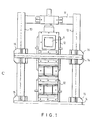
- a device which consists of a reactor housing 1 which is trough-shaped and is freely movable in the longitudinal direction on cross members 14, the cross members 14 being supported on longitudinal members 13 via slide bearings 15.
- the reactor housing there is a rotating shaft 2, on which paddles 3 are attached to paddle carriers 4 in several planes.
- the paddles 3 are arranged at an angle to the shaft axis and thereby accomplish the axial transport of the product.
- the upper side of the reactor housing is provided with lids 1a, to which a wiper bracket 5 is attached between two paddle levels, which cleans the shaft and the paddle carrier from adhering product.
- the inlet 6 is provided for introducing the reaction components, the outlet 7 is used for discharging the reaction product.
- the shaft 2 is sealed off from the end housing covers 9 by the stuffing boxes 10.
- a paddle with attached knife 11 is arranged in each paddle plane, with which the condensed layer is peeled off from the reactor wall. This enables optimal heat transfer from the heating surface to the product.
- the paddle knives 11 are designed such that only a minimal amount of energy is required for the cleaning process due to the peeling action and cutting effect.
- multi-part heating pockets 12 are attached, which are designed so that they can be acted on with heating media of different temperatures. They are also able to compensate for the differences in the thermal expansion of the reactor housing on the one hand and the heating pocket walls on the other.
- abutments 16 are arranged on the underside of the housing, consisting of two parts 16a, b, one of which 16a on the housing and the other 16b on the supporting structure 17 is strengthened, the two parts 16a and 16b being displaceable relative to one another in the longitudinal direction.
- the substance to be condensed is introduced into the reactor via the filler neck 6 by means of a feed screw, conveyor belt or cellular wheel sluice.
- the filling level of the reactor is optimally used for the respective product. For example, it makes sense to aim for products with a tendency to foam that only slightly extend beyond shaft 2.
- the filling level is regulated by a weir 8 attached in front of the discharge and by varying the speed of the shaft 2 or by varying the inclination of the paddle.
- the material in the reactor housing is pressed by means of the paddles in the first phase onto the reactor housing wall, which is heated with molten salt, in a thin layer.
- the heated and partially condensed material is scraped off the walls of the reactor and mixed with the product located inside the reactor by the peeling knife following in the respective paddle level, while at the same time heat is transferred from the heated reactor wall through the peeled material to the inside.
- the quantity of product introduced is such that this process is repeated until the reaction product, which is in the last part before the discharge, has the reaction temperature at which the condensation has completely expired.
- the end product obtained in this way is conveyed via the weir 8 to the outlet 7 and discharged there.
- heating pockets which can be charged with heating media of different temperatures.
- a reactor according to the invention with a trough length of 320 cm is charged in one hour with 70 to 75 kg of a mixture of 98.8 parts by weight of crystallized or spray-dried monosodium phosphate and 1.2 parts by weight of monoammonium phosphate.
- a 1% solution of the monosodium phosphate should have a pH of 4.5. If the product temperature at the discharge nozzle is kept at 355 to 360 ° C, which requires a molten salt temperature of 450 to 470 ° C, a sodium polyphosphate with a content of at least 98.5% Maddrell salt is obtained.
- a capacity of 300 to 320 kg / h can be achieved with a reactor whose trough has a length of 600 cm and a diameter of 70 cm.
- the reactor described above is fed through a metering device, e.g. Dosing belt weigher, with 30.6 kg calcium hydroxide and a spray device above the kneader shaft with 66 liters of 75 percent phosphoric acid per hour.
- a molten salt temperature of 520 ° C With a molten salt temperature of 520 ° C, a product temperature of 280 to 290 ° C occurs at the discharge from the reactor.
- a calcium pyrophosphate with an hourly output of 90 kg is obtained, which showed a loss on ignition of 8.8%.
- a laboratory reactor of the type described above with a trough length of 80 cm and a trough diameter of 18 cm is charged with 10 kg of monolithium orthonhosphate at 150 ° C. After the temperature of the heating medium has been raised to 400 to 420 ° C., 6 to 7 kg of a lithium orthophosphate solution, which has been prepared from lithium hydroxide and 75 percent phosphoric acid, are introduced hourly via a nozzle pipe into the front part of the reactor via a metering pump. The lithium polyphosphate formed, which is sparingly soluble in water, leaves the reactor as a free-flowing product at a temperature of 320 to 350.degree.
- a mixture of 44.6% dicyandiamide, 3.7% phosphorus pentoxide and 17.7% urea is produced with the exclusion of moisture.
- the reactor system described in Example 1 is charged with 55 to 60 kg of this mixture every hour with exclusion of moisture, the heating jacket of the reactor on the entry side being kept at a temperature of 250 to 260 ° C. in the first third, while the remaining two thirds with heating medium from 420 to 460 ° C.
- a PNC connection is obtained, which is used for flame retardant thermo plastic molding compounds, such as polyamide, according to DE-OS 26 40 120, are particularly suitable.
- Example 1 To produce cyanuric acid, the reactor described in Example 1 is used, the heating jacket of which is divided into three zones. Zone 1 at the entry is kept at 160 ° C, zone 2 at 260 ° C and zone 3 with a molten salt of 360 ° C. Four outlets are provided along the cover, through which the ammonia formed during the condensation can be removed and fed to a wet scrubber for absorption.
- the reactor is fed with an amount of 80 kg of urea per hour, a speed of 12 rpm being set on the shaft.
- the condensation product leaves the reactor at a temperature of 290 to 305 ° C and contains 97.6% cyanuric acid.
- the melamine diphosphate is condensed in a second reaction step using urea.
- the reactor is kept at a jacket temperature of 180 ° C in the first third, while the rest of the heating jacket is charged with a salt melt which has a temperature of 380 ° C in the flow.
- a mixture of 107 kg of melamine diphosphate and 15.5 kg of urea / h is introduced by means of a metering channel, the speed of the reactor shaft being 10 to 12 rpm.
- Example 1 The reactor described in Example 1, which is heated with a molten salt having a flow temperature of 440 ° C., is filled with 120 kg of aluminum tripolyphosphate. As soon as the filling has reached a temperature of 380 ° C, one begins with the injection of a 80 to 90 ° hot aluminum orthophosphate solution, which is prepared from aluminum oxyhydrate and 75 percent phosphoric acid at 80 to 90 ° C. The quantity of orthophosphate solution entered via a piston pump is metered in such a way that a product temperature of 370 to 380 ° C. is established at the discharge. The aluminum phosphate obtained showed an ignition loss of 6.5% at 600 ° C. The procedure for producing aluminum metaphosphate is similar, except that a heating temperature of 540 ° C. and a product temperature of 460 ° C. are set.
- the laboratory reactor described above is slowly filled with 3.25 kg of zinc oxide at a heating bath temperature of 160 ° C. at a shaft speed of 12 rpm, 10.45 kg of 75 percent phosphoric acid being metered in at the same time.
- the temperature of the heating medium in the zone facing the entry is then increased to 250 ° C. and in the two other zones facing the exit to 450 ° C., and 6 to 8 kg of a solution of zinc orthophosphate Zn (H 2 P0 4 ) 2 are metered in every hour obtained by adding zinc oxide to hot 75 percent phosphoric acid.
- the first 15 kg of zinc polyphosphate, which leave the reactor, are pasted with twice the amount of the zinc orthophosphate solution and also introduced into the reactor.
- the reactor can also be charged with 10 kg zinc polyphosphate for the initial filling and then the zinc polyphosphate solution can then be pumped in.
Landscapes
- Chemical & Material Sciences (AREA)
- Organic Chemistry (AREA)
- Chemical Kinetics & Catalysis (AREA)
- Inorganic Chemistry (AREA)
- Physical Or Chemical Processes And Apparatus (AREA)
- Manufacture And Refinement Of Metals (AREA)
- Processing Of Solid Wastes (AREA)
- Organic Low-Molecular-Weight Compounds And Preparation Thereof (AREA)
Priority Applications (1)
| Application Number | Priority Date | Filing Date | Title |
|---|---|---|---|
| AT80100893T ATE7684T1 (de) | 1979-02-26 | 1980-02-22 | Verfahren zur kondensation von feststoffen sowie vorrichtung zur durchfuehrung des verfahrens. |
Applications Claiming Priority (2)
| Application Number | Priority Date | Filing Date | Title |
|---|---|---|---|
| DE19792907453 DE2907453A1 (de) | 1979-02-26 | 1979-02-26 | Verfahren zur kondensation von feststoffen sowie vorrichtung zur durchfuehrung des verfahrens |
| DE2907453 | 1979-02-26 |
Publications (3)
| Publication Number | Publication Date |
|---|---|
| EP0015006A2 true EP0015006A2 (fr) | 1980-09-03 |
| EP0015006A3 EP0015006A3 (en) | 1980-10-15 |
| EP0015006B1 EP0015006B1 (fr) | 1984-05-30 |
Family
ID=6063933
Family Applications (1)
| Application Number | Title | Priority Date | Filing Date |
|---|---|---|---|
| EP80100893A Expired EP0015006B1 (fr) | 1979-02-26 | 1980-02-22 | Procédé de condensation de matières solides et dispositif pour la mise en oeuvre de ce procédé |
Country Status (5)
| Country | Link |
|---|---|
| US (2) | US4293526A (fr) |
| EP (1) | EP0015006B1 (fr) |
| AT (1) | ATE7684T1 (fr) |
| CA (1) | CA1141143A (fr) |
| DE (2) | DE2907453A1 (fr) |
Cited By (2)
| Publication number | Priority date | Publication date | Assignee | Title |
|---|---|---|---|---|
| EP0350607A3 (fr) * | 1988-06-14 | 1990-04-25 | Benckiser-Knapsack GmbH | Utilisation de pyrophosphate bicalcique comme matière acide dans des levures chimiques et méthode pour sa préparation |
| NL1009588C2 (nl) * | 1998-07-08 | 2000-01-11 | Dsm Nv | Polyfosfaatzout van een 1,3,5-triazineverbinding met hoge condensatiegraad, een werkwijze voor de bereiding ervan en de toepassing als vlamdover in polymeersamenstellingen. |
Families Citing this family (1)
| Publication number | Priority date | Publication date | Assignee | Title |
|---|---|---|---|---|
| AU8003082A (en) * | 1981-11-30 | 1983-06-17 | Grove F Allen | Structure for continuous-line coal desulfurization reaction |
Family Cites Families (13)
| Publication number | Priority date | Publication date | Assignee | Title |
|---|---|---|---|---|
| DE764763C (de) | 1934-06-17 | 1952-05-23 | Albert Ag Chem Werke | Herstellung von Polyphosphaten oder Polyphosphatgemischen |
| DE818801C (de) | 1948-10-02 | 1951-10-29 | Metallgesellschaft Ag | Verfahren zur Herstellung von Pyrophosphaten, Metaphosphaten und Polyphosphaten |
| DE972118C (de) | 1954-04-08 | 1959-05-27 | Chem Fab Budenheim Ag | Verfahren zur Herstellung von kondensierten Phosphaten |
| US2883272A (en) * | 1955-09-13 | 1959-04-21 | Gen Electric | Apparatus for the continuous polymerization of organopolysiloxanes |
| GB1128802A (en) * | 1964-11-16 | 1968-10-02 | Occidental Res & Eng | Improvements relating to the ammoniation of phosphoric acids |
| CH434208A (de) | 1965-08-14 | 1967-04-30 | List Heinz | Misch- und Knetmaschine mit scheibenförmigen Knetelementen |
| DE1542016A1 (de) | 1966-06-27 | 1970-04-16 | Buss Ag | Verfahren zur Durchfuehrung von Hochtemperaturprozessen insbesondere bei Temperaturen ueber 300 deg. und Einrichtung zur Ausuebung des Verfahrens |
| DE1542151C3 (de) * | 1966-12-27 | 1975-07-17 | Bayer Ag, 5090 Leverkusen | Wischer für Dünnschichtreaktions- oder -verdampf errohr |
| JPS5021992B1 (fr) * | 1968-02-17 | 1975-07-26 | ||
| CH506322A (de) | 1969-03-17 | 1971-04-30 | List Heinz | Mehrspindelige Misch- und Knetmaschine |
| US3682091A (en) * | 1970-03-16 | 1972-08-08 | French Oil Mill Machinery | Rendering cooker |
| JPS5021514B2 (fr) * | 1972-04-12 | 1975-07-23 | ||
| JPS5341676B2 (fr) * | 1973-10-05 | 1978-11-06 |
-
1979
- 1979-02-26 DE DE19792907453 patent/DE2907453A1/de not_active Withdrawn
-
1980
- 1980-02-15 CA CA000345778A patent/CA1141143A/fr not_active Expired
- 1980-02-22 AT AT80100893T patent/ATE7684T1/de active
- 1980-02-22 US US06/123,754 patent/US4293526A/en not_active Expired - Lifetime
- 1980-02-22 EP EP80100893A patent/EP0015006B1/fr not_active Expired
- 1980-02-22 DE DE8080100893T patent/DE3067994D1/de not_active Expired
-
1981
- 1981-03-03 US US06/239,975 patent/US4343779A/en not_active Expired - Lifetime
Cited By (5)
| Publication number | Priority date | Publication date | Assignee | Title |
|---|---|---|---|---|
| EP0350607A3 (fr) * | 1988-06-14 | 1990-04-25 | Benckiser-Knapsack GmbH | Utilisation de pyrophosphate bicalcique comme matière acide dans des levures chimiques et méthode pour sa préparation |
| NL1009588C2 (nl) * | 1998-07-08 | 2000-01-11 | Dsm Nv | Polyfosfaatzout van een 1,3,5-triazineverbinding met hoge condensatiegraad, een werkwijze voor de bereiding ervan en de toepassing als vlamdover in polymeersamenstellingen. |
| WO2000002869A1 (fr) * | 1998-07-08 | 2000-01-20 | Dsm N.V. | Sel polyphosphate d'un compose 1,3,5-triazine avec un degre eleve d'ions de condensat et son utilisation comme charge ignifugeante dans des compositions polymeres |
| US6369137B2 (en) | 1998-07-08 | 2002-04-09 | Dsm N.V. | Polyphosphate salt of a 1, 3, 5-triazine compound with a high degree of condensation, a process for its preparation and use as flame retardant in polymer compositions |
| US6653474B1 (en) | 1998-07-08 | 2003-11-25 | Ciba Specialty Chemicals Corporation | Polyphosphate salt of a 1,3,5-triazine compound with a high degree of condensation, a process for its preparation and use as flame retardant in polymer compositions |
Also Published As
| Publication number | Publication date |
|---|---|
| US4343779A (en) | 1982-08-10 |
| DE2907453A1 (de) | 1980-09-04 |
| DE3067994D1 (en) | 1984-07-05 |
| ATE7684T1 (de) | 1984-06-15 |
| EP0015006A3 (en) | 1980-10-15 |
| CA1141143A (fr) | 1983-02-15 |
| US4293526A (en) | 1981-10-06 |
| EP0015006B1 (fr) | 1984-05-30 |
Similar Documents
| Publication | Publication Date | Title |
|---|---|---|
| EP2593415B1 (fr) | Procédé de production de pastilles contenant du nitrate d'ammonium | |
| DE1567692B1 (de) | Verfahren zur herstellung von praktisch wasserunloesli chen kristallinen ammoniumpolyphosphaten | |
| DE2622994A1 (de) | Verfahren und vorrichtung zum brennen von gips | |
| US2618547A (en) | Manufacture of mixed fertilizers | |
| US3978195A (en) | Process for the production of substantially water-insoluble linear ammonium polyphosphates | |
| EP0015006B1 (fr) | Procédé de condensation de matières solides et dispositif pour la mise en oeuvre de ce procédé | |
| US3467495A (en) | Preparation of calcium phosphates | |
| DE1044121B (de) | Kontinuierliches Verfahren zur Herstellung von lagerbestaendigen, frei fliessenden Mehrnaehrstoffduengemitteln | |
| DE1567732B1 (de) | Verfahren zum kontinuierlichen Umsetzen einer nach dem Nassverfahren gewonnenen,hochkonzentrierten Phosphorsaeure mit wasserfreiem Ammoniak | |
| DE1194383B (de) | Verfahren zur Herstellung von Alkali- und/oder Erdalkaliphosphaten | |
| US3125435A (en) | hzsox | |
| DE1542425A1 (de) | Verfahren zum Herstellen fester,trockener,koerniger,chemischer Produkte | |
| DE1767784C3 (de) | Verfahren zur Herstellung graumilierter Düngemittel | |
| DE1199246B (de) | Verfahren und Vorrichtung zur Herstellung von Alkali- und/oder Erdalkaliphosphaten | |
| EP0446676B1 (fr) | Installation de fabrication de polyphosphate d'ammonium | |
| US1989756A (en) | Process of producing concentrated fertilizer | |
| DE2322114A1 (de) | Verfahren zur herstellung von anorganischen saeureadditionssalzen des harnstoffs | |
| DE2939978A1 (de) | Verfahren zur herstellung von citridinsaeure-loeslichem kaliumsilikatduenger und vorrichtung zur durchfuehrung des verfahrens | |
| DE1817587B2 (de) | Verfahren zur herstellung von monoammoniumphosphat | |
| DE1767833C (de) | Verfahren zur Herstellung eines PK-Mischdüngemittels | |
| DE2100413C3 (de) | Verfahren zur Herstellung von Reaktionsprodukten aus Phosphorsäure, Harnstoff und Ammoniak | |
| DE2164730A1 (de) | Verfahren zum herstellen saurer, rieselfaehiger granulate mit geringem wassergehalt, bestehend aus dinatriumdihydrogen-diphosphat, natrium-dihydrogenphosphat und phosphorsaeure | |
| PL138341B2 (en) | Method of obtaining a molten composition of condensed ammonium phosphates and flow-through reactor therefor | |
| DE2330174C3 (de) | Verfahren und Vorrichtung zur Herstellung von im wesentlichen wasserunlöslichen, kettenförmigen Ammoniumpolyphosphaten | |
| DE292173C (fr) |
Legal Events
| Date | Code | Title | Description |
|---|---|---|---|
| PUAI | Public reference made under article 153(3) epc to a published international application that has entered the european phase |
Free format text: ORIGINAL CODE: 0009012 |
|
| PUAL | Search report despatched |
Free format text: ORIGINAL CODE: 0009013 |
|
| AK | Designated contracting states |
Designated state(s): AT BE CH DE FR GB IT LU NL SE |
|
| AK | Designated contracting states |
Designated state(s): AT BE CH DE FR GB IT LU NL SE |
|
| 17P | Request for examination filed |
Effective date: 19810401 |
|
| ITF | It: translation for a ep patent filed | ||
| GRAA | (expected) grant |
Free format text: ORIGINAL CODE: 0009210 |
|
| AK | Designated contracting states |
Designated state(s): AT BE CH DE FR GB IT LU NL SE |
|
| REF | Corresponds to: |
Ref document number: 7684 Country of ref document: AT Date of ref document: 19840615 Kind code of ref document: T |
|
| REF | Corresponds to: |
Ref document number: 3067994 Country of ref document: DE Date of ref document: 19840705 |
|
| ET | Fr: translation filed | ||
| PG25 | Lapsed in a contracting state [announced via postgrant information from national office to epo] |
Ref country code: LU Free format text: LAPSE BECAUSE OF NON-PAYMENT OF DUE FEES Effective date: 19850228 |
|
| PLBE | No opposition filed within time limit |
Free format text: ORIGINAL CODE: 0009261 |
|
| STAA | Information on the status of an ep patent application or granted ep patent |
Free format text: STATUS: NO OPPOSITION FILED WITHIN TIME LIMIT |
|
| 26N | No opposition filed | ||
| PGFP | Annual fee paid to national office [announced via postgrant information from national office to epo] |
Ref country code: SE Payment date: 19890208 Year of fee payment: 10 |
|
| PGFP | Annual fee paid to national office [announced via postgrant information from national office to epo] |
Ref country code: FR Payment date: 19890209 Year of fee payment: 10 Ref country code: AT Payment date: 19890209 Year of fee payment: 10 |
|
| PGFP | Annual fee paid to national office [announced via postgrant information from national office to epo] |
Ref country code: CH Payment date: 19890221 Year of fee payment: 10 |
|
| ITTA | It: last paid annual fee | ||
| PGFP | Annual fee paid to national office [announced via postgrant information from national office to epo] |
Ref country code: NL Payment date: 19890228 Year of fee payment: 10 Ref country code: GB Payment date: 19890228 Year of fee payment: 10 |
|
| PGFP | Annual fee paid to national office [announced via postgrant information from national office to epo] |
Ref country code: LU Payment date: 19890301 Year of fee payment: 10 |
|
| PGFP | Annual fee paid to national office [announced via postgrant information from national office to epo] |
Ref country code: BE Payment date: 19890317 Year of fee payment: 10 |
|
| PGFP | Annual fee paid to national office [announced via postgrant information from national office to epo] |
Ref country code: DE Payment date: 19890330 Year of fee payment: 10 |
|
| PG25 | Lapsed in a contracting state [announced via postgrant information from national office to epo] |
Ref country code: GB Effective date: 19900222 Ref country code: AT Effective date: 19900222 |
|
| PG25 | Lapsed in a contracting state [announced via postgrant information from national office to epo] |
Ref country code: SE Effective date: 19900223 |
|
| PG25 | Lapsed in a contracting state [announced via postgrant information from national office to epo] |
Ref country code: CH Effective date: 19900228 Ref country code: BE Effective date: 19900228 |
|
| BERE | Be: lapsed |
Owner name: BENCKISER-KNAPSACK G.M.B.H. Effective date: 19900228 |
|
| PG25 | Lapsed in a contracting state [announced via postgrant information from national office to epo] |
Ref country code: NL Effective date: 19900901 |
|
| NLV4 | Nl: lapsed or anulled due to non-payment of the annual fee | ||
| GBPC | Gb: european patent ceased through non-payment of renewal fee | ||
| PG25 | Lapsed in a contracting state [announced via postgrant information from national office to epo] |
Ref country code: FR Effective date: 19901031 |
|
| REG | Reference to a national code |
Ref country code: CH Ref legal event code: PL |
|
| PG25 | Lapsed in a contracting state [announced via postgrant information from national office to epo] |
Ref country code: DE Effective date: 19901101 |
|
| REG | Reference to a national code |
Ref country code: FR Ref legal event code: ST |
|
| EUG | Se: european patent has lapsed |
Ref document number: 80100893.9 Effective date: 19901107 |