EP0016731A1 - Meta-Cyanoalkoxy-Phenylharnstoffe mit herbizider Wirkung, deren Herstellung und sie enthaltende Mittel - Google Patents
Meta-Cyanoalkoxy-Phenylharnstoffe mit herbizider Wirkung, deren Herstellung und sie enthaltende Mittel Download PDFInfo
- Publication number
- EP0016731A1 EP0016731A1 EP80810090A EP80810090A EP0016731A1 EP 0016731 A1 EP0016731 A1 EP 0016731A1 EP 80810090 A EP80810090 A EP 80810090A EP 80810090 A EP80810090 A EP 80810090A EP 0016731 A1 EP0016731 A1 EP 0016731A1
- Authority
- EP
- European Patent Office
- Prior art keywords
- formula
- phenoxy
- cyanoalkoxy
- hydrogen
- meta
- Prior art date
- Legal status (The legal status is an assumption and is not a legal conclusion. Google has not performed a legal analysis and makes no representation as to the accuracy of the status listed.)
- Granted
Links
Classifications
-
- C—CHEMISTRY; METALLURGY
- C07—ORGANIC CHEMISTRY
- C07D—HETEROCYCLIC COMPOUNDS
- C07D295/00—Heterocyclic compounds containing polymethylene-imine rings with at least five ring members, 3-azabicyclo [3.2.2] nonane, piperazine, morpholine or thiomorpholine rings, having only hydrogen atoms directly attached to the ring carbon atoms
- C07D295/16—Heterocyclic compounds containing polymethylene-imine rings with at least five ring members, 3-azabicyclo [3.2.2] nonane, piperazine, morpholine or thiomorpholine rings, having only hydrogen atoms directly attached to the ring carbon atoms acylated on ring nitrogen atoms
- C07D295/20—Heterocyclic compounds containing polymethylene-imine rings with at least five ring members, 3-azabicyclo [3.2.2] nonane, piperazine, morpholine or thiomorpholine rings, having only hydrogen atoms directly attached to the ring carbon atoms acylated on ring nitrogen atoms by radicals derived from carbonic acid, or sulfur or nitrogen analogues thereof
- C07D295/215—Radicals derived from nitrogen analogues of carbonic acid
-
- A—HUMAN NECESSITIES
- A01—AGRICULTURE; FORESTRY; ANIMAL HUSBANDRY; HUNTING; TRAPPING; FISHING
- A01N—PRESERVATION OF BODIES OF HUMANS OR ANIMALS OR PLANTS OR PARTS THEREOF; BIOCIDES, e.g. AS DISINFECTANTS, AS PESTICIDES OR AS HERBICIDES; PEST REPELLANTS OR ATTRACTANTS; PLANT GROWTH REGULATORS
- A01N47/00—Biocides, pest repellants or attractants, or plant growth regulators containing organic compounds containing a carbon atom not being member of a ring and having no bond to a carbon or hydrogen atom, e.g. derivatives of carbonic acid
- A01N47/08—Biocides, pest repellants or attractants, or plant growth regulators containing organic compounds containing a carbon atom not being member of a ring and having no bond to a carbon or hydrogen atom, e.g. derivatives of carbonic acid the carbon atom having one or more single bonds to nitrogen atoms
- A01N47/28—Ureas or thioureas containing the groups >N—CO—N< or >N—CS—N<
- A01N47/30—Derivatives containing the group >N—CO—N aryl or >N—CS—N—aryl
-
- A—HUMAN NECESSITIES
- A01—AGRICULTURE; FORESTRY; ANIMAL HUSBANDRY; HUNTING; TRAPPING; FISHING
- A01N—PRESERVATION OF BODIES OF HUMANS OR ANIMALS OR PLANTS OR PARTS THEREOF; BIOCIDES, e.g. AS DISINFECTANTS, AS PESTICIDES OR AS HERBICIDES; PEST REPELLANTS OR ATTRACTANTS; PLANT GROWTH REGULATORS
- A01N47/00—Biocides, pest repellants or attractants, or plant growth regulators containing organic compounds containing a carbon atom not being member of a ring and having no bond to a carbon or hydrogen atom, e.g. derivatives of carbonic acid
- A01N47/08—Biocides, pest repellants or attractants, or plant growth regulators containing organic compounds containing a carbon atom not being member of a ring and having no bond to a carbon or hydrogen atom, e.g. derivatives of carbonic acid the carbon atom having one or more single bonds to nitrogen atoms
- A01N47/28—Ureas or thioureas containing the groups >N—CO—N< or >N—CS—N<
- A01N47/38—Ureas or thioureas containing the groups >N—CO—N< or >N—CS—N< containing the group >N—CO—N< where at least one nitrogen atom is part of a heterocyclic ring; Thio analogues thereof
-
- C—CHEMISTRY; METALLURGY
- C07—ORGANIC CHEMISTRY
- C07C—ACYCLIC OR CARBOCYCLIC COMPOUNDS
- C07C275/00—Derivatives of urea, i.e. compounds containing any of the groups, the nitrogen atoms not being part of nitro or nitroso groups
- C07C275/28—Derivatives of urea, i.e. compounds containing any of the groups, the nitrogen atoms not being part of nitro or nitroso groups having nitrogen atoms of urea groups bound to carbon atoms of six-membered aromatic rings of a carbon skeleton
- C07C275/32—Derivatives of urea, i.e. compounds containing any of the groups, the nitrogen atoms not being part of nitro or nitroso groups having nitrogen atoms of urea groups bound to carbon atoms of six-membered aromatic rings of a carbon skeleton being further substituted by singly-bound oxygen atoms
- C07C275/34—Derivatives of urea, i.e. compounds containing any of the groups, the nitrogen atoms not being part of nitro or nitroso groups having nitrogen atoms of urea groups bound to carbon atoms of six-membered aromatic rings of a carbon skeleton being further substituted by singly-bound oxygen atoms having nitrogen atoms of urea groups and singly-bound oxygen atoms bound to carbon atoms of the same non-condensed six-membered aromatic ring
-
- C—CHEMISTRY; METALLURGY
- C07—ORGANIC CHEMISTRY
- C07C—ACYCLIC OR CARBOCYCLIC COMPOUNDS
- C07C275/00—Derivatives of urea, i.e. compounds containing any of the groups, the nitrogen atoms not being part of nitro or nitroso groups
- C07C275/64—Derivatives of urea, i.e. compounds containing any of the groups, the nitrogen atoms not being part of nitro or nitroso groups having nitrogen atoms of urea groups singly-bound to oxygen atoms
Definitions
- the present invention relates to new meta-cyanoalkoxy-phenylureas with herbicidal activity, their preparation, compositions containing them and their use for controlling unwanted plant growth.
- the compounds of the formula I generally have extremely selective herbicidal properties and have proven to be particularly advantageous for controlling weeds in crops of useful plants, in particular in crops of soybeans, cotton, cereals, maize and sugar beets. Individual compounds act selectively in oilseed rape.
- the application can be carried out both pre-emergence and post-emergence.
- the application rates can vary within wide limits, e.g. between 0.1 to 10 kg of active ingredient per hectare, but preferably 0.5 to 5 kg of active ingredient per hectare.
- the agents according to the invention contain a suitable carrier and / or other additives.
- suitable carriers and additives can be solid or liquid and correspond to the substances commonly used in formulation technology, e.g. natural or regenerated mineral substances, solvents, thinners, dispersants, emulsifiers, wetting agents, adhesives, thickeners, binders and / or fertilizers.
- the compound of the formula 1 can be processed as a dusting agent, emulsion concentrate, as granules, dispersion or else as a solution or slurry in a customary formulation.
- the compounds of the formula I are prepared by methods known per se, for example by reaction of an appropriately substituted phenyl of the formula II with an amine of formula III wherein R 2 , R 3 , X and Y have the meaning given under formula I, while A and B are radicals which form ureas under addition or condensation.
- One of the two groups A and B represents an amine, while the other represents a urethane, a carbamoyl halide, a urea group, or in particular the isocyanate radical.
- meta-hydroxyphenylureas of the formula IV with a cyanoalkyl halide of formula V be implemented in the presence of an acid-binding agent.
- X, n, R 1 , R 2 , R 3 , R 4 , R 5 , R 6 and R 7 have the meaning given under formula I.
- a cyanoalkyl halide does not necessarily have to be reacted with the meta-hydroxyphenylurea, since the cyano group can only be introduced into the molecule in situ, for example via the following synthesis steps, which are shown schematically here:
- a meta-hydroxyphenyl urea is condensed therein with a haloalkane carboxylic acid ester.
- the ester group is then saponified and the free carboxyl group is then converted into the amide via the mixed acid anhydride with ammonia and this is converted to the cyanoalkoxy group using a dehydrating agent.
- reaction temperatures are between 0 ° C and 150 ° C, practically between room temperature and the boiling point of the reaction mixture.
- work is carried out under normal pressure; larger quantities can advantageously also be produced in pressure vessels.
- the compounds of formula 1 are not very toxic to warm-blooded animals, their handling does not require any precautionary measures. They are relatively good in the usual organic solvents and poorly soluble in water. They can easily be precipitated by adding water to the reaction solution. They can only be formulated as liquid herbicidal agents with the aid of special solubilizers and / or dispersants.
- the new active compounds of the formula I are stable compounds which are soluble in customary organic solvents, such as alcohols, ethers, ketones, dimethylformamide, dimethyl sulfoxide, etc.
- the active substance concentrations in the agents according to the invention are 1 to 80 percent by weight and, if appropriate, can also be present in small concentrations, such as 0.05 to 1%, when used.
- biocidal active substances or agents can be added to the agents according to the invention.
- the new agents can e.g. Contain insecticides, fungicides, bactericides, fungistatics, bacteriostatics, nematocides or other herbicides to broaden the spectrum of activity.
- This acid can also be produced as follows:
- Example 3 The compounds of the formula I can be prepared into use forms which can be used for agriculture, for example in accordance with the following regulations:
- the specified active ingredient is drawn onto the corresponding carrier substances (kaolin and chalk) and then mixed and ground with the other constituents. Spray powder of excellent wettability and suspension is obtained. From such wettable powders, suspensions of 0.1-8% active ingredient can be obtained by dilution with water, which are suitable for weed control in plant crops.
- the active ingredient is intimately mixed and ground with the additives in suitable devices.
- a paste is obtained, from which suspensions of any desired concentration can be prepared by dilution with water.
- This concentrate can be diluted with water to emulsions to suitable concentrations of, for example, 0.1%.
- emulsions are suitable for controlling weeds in crops.
- the active substance is intimately mixed and ground with the additives in suitable devices.
- a paste is obtained, from which suspensions of any desired concentration can be prepared by dilution with water.
- Example 4 The following test methods are used to demonstrate the usability as herbicides (pre- and post-emergent):
- the earth's surface is obtained in the greenhouse with an aqueous dispersion of the active ingredients, obtained from a 25% emulsion concentrate or from a 25% wettable powder containing active ingredients which, owing to insufficient solubility, do not can be prepared as an emulsion concentrate.
- aqueous dispersion of the active ingredients obtained from a 25% emulsion concentrate or from a 25% wettable powder containing active ingredients which, owing to insufficient solubility, do not can be prepared as an emulsion concentrate.
- Different series of concentrations were used, corresponding to 2 and 1 kg of active substance per hectare.
- the seed pans are in the greenhouse at 22-25 ° C and 50-70% rel. Humidity and the test evaluated after 3 weeks and the results were rated according to the following grading scale:
- the compounds of the formula I showed excellent activity against the broad-leaved and most of the grass-like weeds, the crop maize, the cereals barley, millet and rice, as well as cotton and soy, not being damaged or only with a higher application rate of active ingredient.
Landscapes
- Chemical & Material Sciences (AREA)
- Organic Chemistry (AREA)
- Life Sciences & Earth Sciences (AREA)
- Agronomy & Crop Science (AREA)
- Pest Control & Pesticides (AREA)
- Plant Pathology (AREA)
- Health & Medical Sciences (AREA)
- Engineering & Computer Science (AREA)
- Dentistry (AREA)
- General Health & Medical Sciences (AREA)
- Wood Science & Technology (AREA)
- Zoology (AREA)
- Environmental Sciences (AREA)
- Agricultural Chemicals And Associated Chemicals (AREA)
- Organic Low-Molecular-Weight Compounds And Preparation Thereof (AREA)
- Hydrogenated Pyridines (AREA)
- Plural Heterocyclic Compounds (AREA)
Abstract
Description
- Die vorliegende Erfindung betrifft neue meta-Cyanoalkoxy-Phenylharnstoffe mit herbizider Wirkung, deren Herstellung, sie enthaltende Mittel sowie deren Verwendung zur Bekämpfung unerwünschten Pflanzenwachstums.
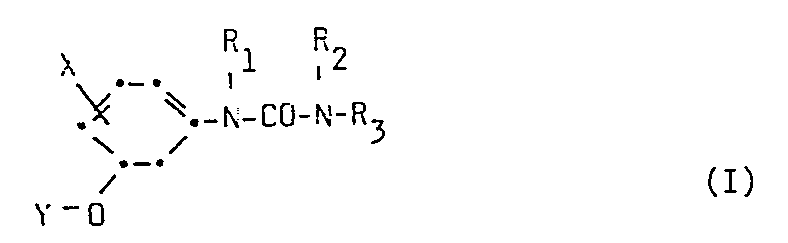
- Die meta-Cyanoalkoxy-Phenylharnstoffe entsprechen der allgemeinen Formel


- R1 Wasserstoff oder Niederalkyl,
- R2 Wasserstoff, Alkyl, Alkenyl, Alkinyl oder Alkoxy,
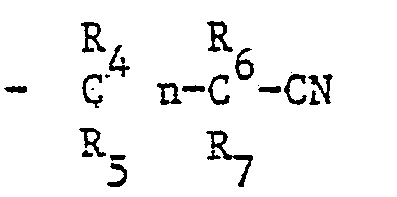
- R3 Wasserstoff, Alkyl oder Alkenyl oder R2 und R3 zusammen mit dem Stickstoffatom an das sie gebunden sind, auch einen 5-6 gliedrigen Heterocyclus, der noch ein zweites Sauerstoff- oder Schwefelatom oder eine Iminogruppe enthalten kann, R4, R5 und R7 unabhängig voneinander je Wasserstoff oder Niederalkyl,
- R6 Wasserstoff, Niederalkyl; Niederalkoxy oder Niederalkoxyalkyl.
- Die Verbindungen der Formel I weisen ausgesprochen selektivherbizide Eigenschaften im allgemeinen auf und erweisen sich als besonders vorteilhaft zum Bekämpfen von Unkräutern in Kulturen von Nutzpflanzen, insbesondere in Kulturen von Soja, Baumwolle, Getreide, Mais und Zuckerrüben. Einzelne Verbindungen wirken selektiv in Raps.
- Bei genügend grosser Aufwandmenge ist jedoch auch totalherbizide Wirkung vorhanden. Die Anwendung kann sowohl im Vorauflaufwie im Nachauflaufverfahren vorgenommen werden. Dabei können die Aufwandmengen in weiten Grenzen schwanken, z.B. zwischen 0,1 bis 10 kg Wirkstoff pro Hektare, vorzugsweise werden jedoch 0,5 bis 5 kg Wirkstoff pro Hektare eingesetzt.
- Die erfindungemässen Mittel enthalten ausser dem Wirkstoff der Formel I einen geeigneten Träger und/oder andere Zuschlagstoffe. Geeignete Träger und Zuschlagstoffe können fest oder flüssig sein und entsprechen den in der Formulierungstechnik üblichen Stoffen wie z.B. natürlichen oder regenerierten mineralischen Stoffen, Lösungs-, Verdünnungs-, Dispergier-, Emulgier-, Netz-, Haft-, Verdickungs-, Binde- und/oder Düngmitteln.
- Zur Verwendung in herbiziden Mitteln kann die Verbindung der Formel 1 als Stäubemittel, Emulsionskonzentrat, als Granulat, Dispersion oder auch als Lösung oder Aufschlämmung in üblicher Formulierung verarbeitet werden.
- Die Herstellung der Verbindungen der Formel I erfolgt nach an sich bekannten Methoden, z.B. durch Reaktion eines entsprechend substituierten Phenyls der Formel II


- Ferner können ebenfalls meta-Hydroxyphenyl-harnstoffe der Formel IV


- Es braucht nicht unbedingt ein Cyanoalkylhalogenid mit dem meta-Hydroxyphenylharnstoff umgesetzt werden, da die Cyanogruppe auch erst in situ in das Molekül eingeführt werden kann, zum Beispiel über die folgenden, hier schematisch wiedergegebenen Syntheseschritte:

- Darin wird ein meta-Hydroxyphenyl-Harnstoff mit einen Halogenalkancarbonsäureester kondensiert. Die Estergruppe wird dann verseift und die freie Carboxylgruppe anschliessend über das gemischte Säureanhydrid mit Ammoniak in das Amid verwandelt und dieses mit einem wasserentziehenden Mittel zur Cyanoalkoxygruppe umgewandelt.
- Diese Umsetzungen werden vorteilhafterweise in mit Wasser mischbaren organischen Lösungsmitteln wie Aceton, Butanon, Dimethylsulfoxid, Dimethylformamid usw. vorgenommen. Die Reaktionstemperaturen sind zwischen 0°C und 150°C gelegen, praktisch zwischen der Raumtemperatur und dem Siedepunkt des Reaktionsgemisches. Im allgemeinen wird unter Normaldruck gearbeitet, grössere Mengen können mit Vorteil auch in Druckgefässen hergestellt.werden.
- Die Verbindungen der Formel 1 sind für Warmblüter wenig giftig, ihre Handhabung bedarf keiner vorsorglicher Massnahmen. Sie sind in den üblichen organischen Lösungsmitteln relativ gut und in Wasser schlecht löslich. Sie können durch Zugeben von Wasser zur Reaktionslösung leicht ausgefällt werden. Ihre Formulierung als flüssige herbizide Mittel gelingt nur mit Hilfe besonderer Lösungsvermittler und/oder Dispergiermittel.
- Die neuen Wirkstoffe der Formel I sind stabile Verbindungen, welche in üblichen organischen Lösungsmitteln, wie Alkoholen, Aethern, Ketonen, Dimethylformamid, Dimethylsulfoxyd etc. löslich sind.
- Die Herstellung erfindungsgemässer Mittel erfolgt in an sich bekannter Weise durch inniges Vermischen und Vermahlen von Wirkstoffen der allgemeinen Formel I mit geeigneten Trägerstoffen und/oder Verteilungsmitteln, gegebenenfalls unter Zusatz von gegenüber den Wirkstoffen inerten Antischaum-, Netz-, Dispersions- und/oder Lösungsmitteln. Die Wirkstoffe können in den folgenden Aufarbeitungsformen vorliegen und angewendet werden:
- Feste Aufarbeitungsformen: Stäubemittel, Streumittel, Granulate, Umhüllungsgranulate, Imprägniergranulate und Homogengranulate;
- In Wasser dispergierbare Wirkstoffkonzentrate:
- Spritzpulver (wettable powder), Pasten
- Emulsionen; Emulsionskonzentrate
- Flüssige Aufarbeitungsformen:
- Lösungen.
- Die Wirkstoffkonzentrationen betragen in den erfindungsgemässen Mitteln 1 bis 80 Gewichtsprozent und können gegebenenfalls bei der Anwendung auch in geringen Konzentrationen wie etwa 0,05 bis 1% vorliegen.
- Den erfindungsgemässen Mitteln lassen sich andere biozide Wirkstoffe oder Mittel beimischen. So können die neuen Mittel ausser den genannten Verbindungen der allgemeinen Formel I z.B. Insektizide, Fungizide, Bakterizide, Fungistatika, Bakteriostatika, Nematozide oder weitere Herbizide zur Verbreiterung des Wirkungsspektrums enthalten.
- Die folgenden Beispiele sollen die Herstellung der erfindungsgemässen Phenylharnstoffe der Formel I näher erläutern. Weitere in analoger Weise hergestellte Verbindungen sind in der sich dem Beispiel 2 anschliessenden Tabelle aufgeführt. Die Temperaturen sind in Celsiusgraden angegeben, Teile und Prozentangaben beziehen sich auf das Gewicht. Druckangaben sind in mm Hg (Torricelli = 1.33 millibar) angegeben. In weiteren Beispielen wird die Aufbereitung der Wirkstoffe zu technisch verwendbaren Verabreichungsformen sowie Versuche zur Demonstration der herbiziden Wirkung beschrieben.
- Ein Gemisch von 9 g N-(m-Hydroxyphenyl)-N',N'-dimethylharnstoff, 7,5 g wasserfreiem Kaliumcarbonat, 6,7 g a-Brompropionitril und 100 ml Methyläthylketon wird 48 Stunden unter Rühren am Rückfluss erhitzt. Nach Abkühlen wird das Reaktionsgemisch filtriert und mit Methyläthylketon gewaschen. Nach dem Eindampfen im Vakuum erhält man 7,6 g Titelprodukt vom Schmelzpunkt 144-145°.
- a) Ein Gemisch von 180,2 g N-(m-Hydroxyphenyl)-N',N'-dimethylharnstoff, 140 g wasserfreiem Kaliumcarbonat, 197 g a-Brom-isobuttersäureäthylester und 1000 ml Methyläthylketon wird 5 Tage lang unter Rühren zum Rückfluss erhitzt. Nach dem Abkühlen wird das Reaktionsgemisch filtriert und mit Methyläthylketon gewaschen, im Vakuum eingedampft und in Toluollösung mit Aktivkohle behandelt. Nach dem Abfiltrieren und Eindampfen im Vakuum erhält man 119 g a-[m-(3,3-Dime- thylureido)-phenoxy]-isobuttersäureäthylester vom Schmelzpunkt 62-63°.
- b) 73 g des unter a) beschriebenen Esters werden in 330 ml Methanol gelöst und mit 78 ml 3,5 N Natronlauge tropfenweise versetzt. Nach vierstündigem Rühren bei Raumtemperatur ist die Verseifung beendet. Nach dem Abdestillieren des Methanols wird das Reaktionsprodukt mit 2 N Salzsäure sauer gestellt wobei die freie Säure ausfällt. Man erhält 53,3 g α-[m-(3,3-Dimethylureido)-phenoxy]-isobuttersäure vom Schmelzpunkt 155-156°.
- Man kann diese Säure auch wie folgt herstellen:
- Ein Gemisch von 18g N-(m-Hydroxyphenyl)-N',N'-dimethylham- stoff, 24 g pulverisiertem Natriumhydroxyd und 250 ml Aceton wird ca. 1 Stunde am Rückfluss erhitzt. Danach entfernt man das Wasserbad und tropft unter starkem Rühren eine Mischung von 36 g Chloroform und 50 ml Aceton dazu in solcher Weise, dass der Rückfluss während der Zugabe aufrecherhalten wird. Nach Beendigung dieser Zugabe wird das Reaktionsgemisch noch 4 Stunden unter Rückfluss weitergerührt. Anschliessend wird eingedampft, der Rückstand in 300 ml 2N Natronlauge aufgenommen, der unlösliche Teil mit Essigester extrahiert und die getrennte basisch-wässrige Lösung mit verdünnter Salzsäure angesäuert, wobei die freie Säure ausfällt. Nach dem Abnutschen und Trocknen erhält man 20 g α-[m-(3,3-Dimethylureido)-phenoxy]-isobuttersäure vom Schmelzpunkt 196-197°.
- c) 12 g der unter b) hergestellten Säure werden in 50 ml Dioxan vorgelegt und mit 10.7 ml Tri-n-butylamin vermischt, wobei ein Teil der Säure in Lösung geht. Die Mischung wird auf 10° gebracht und bei dieser Temperatur unter Rühren mit 4,3 ml Chlorameisensäureäthylester tropfenweise versetzt. Anschliessend wird 10 Minuten weitergerührt.
- Nun wird ebenfalls bei 10° ein Ueberschuss an Ammoniak eingeleitet und 1 Stunde lang bei Raumtemperatur nachgerührt. Zum Schluss wird das Amid durch Zugabe von 50 ml Aether gefällt und abgenutscht. Die Ausbeute beträgt 10,5 g α-[m-(3,3-Dimethylureido)-phenoxy]-isobut- tersäureamid vom Schmelzpunkt 155-6°C.
- d) Ein Gemisch von 14 g des unter c) beschriebenen Amides, 29,4 g Triphenylphosphin, 10,8 ml Tetrachlorkohlenstoff, 24 ml Triäthylamin und 210 ml Aethylenchlorid wird 3 Stunden unter Rühren und unter Stickstoff bei einer Badtemperatur von 60° gehalten. Anschliessend wird eingedampft, mit Essigester extrahiert und erneut eingedampft. Der Rückstand wird aus Aceton/Hexan umkristallisiert. Man erhält so 10,5 g α-[m-(3,3-Dimethylureido)-phenoxy]-isobutyronitril vom Schmelzpunkt 110°.


- Beispiel 3: Das Aufbereiten der Verbindungen der Formel I zu für die Landwirtschaft brauchbaren Anwendungsformen kann beispielsweise gemäss den folgenden Vorschriften erfolgen:
- Zur Herstellung eines a) 70%igen und b) 10%igen Spritzpulvers werden folgende Bestandteile verwendet:
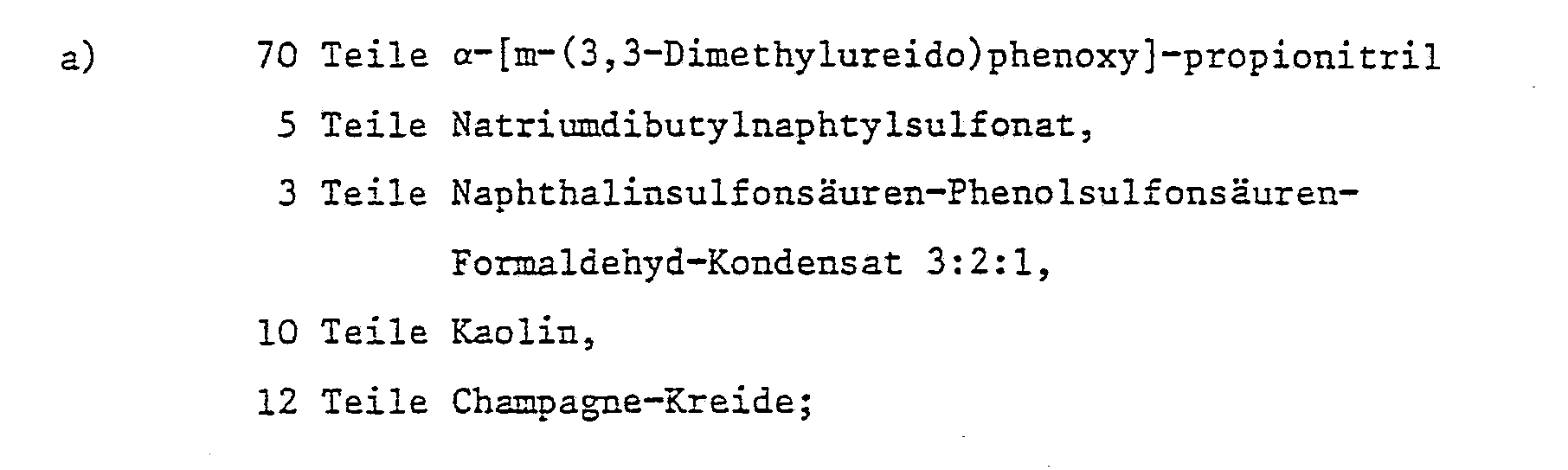

- Der angegebene Wirkstoff wird auf die entsprechenden Trägerstoffe (Kaolin und Kreide) aufgezogen und anschliessend vermischt und vermahlen mit den übrigen Bestandteilen. Man erhält Spritzpulver von vorzüglicher Benetzbarkeit und Schwebefähigkeit. Aus solchen Spritzpulvern können durch Verdünnen mit Wasser Suspensionen von 0,1-8% Wirkstoff erhalten werden, die sich zur Unkrautbekämpfung in Pflanzenkulturen eignen.
- Zur Herstellung einer 45%igen Paste werden folgende Stoffe verwendet:

- Der Wirkstoff wird mit den Zuschlagstoffen in dazu geeigneten Geräten innig vermischt und vermahlen. Man erhält eine Paste, aus der sich durch Verdünnen mit Wasser Suspensionen jeder gewünschten Konzentration herstellen lassen.
- Zur Herstellung eines 25%iges Emulsionskonzentrates werden

- Zur Herstellung eines 45%igen Flowables werden folgende Stoffe verwendet:

- Die Aktivsubstanz wird mit den Zuschlagstoffen in dazu geeigneten Geräten innig vermischt und vermahlen. Man erhält eine Paste, aus der sich durch Verdünnen mit Wasser Suspensionen jeder gewünschten Konzentration herstellen lassen.
- Beispiel 4: Zum Nachweis der Brauchbarkeit als Herbizide (pre- und post-emergent) dienen folgende Testmethoden:
- Im Gewächshaus wird unmittelbar nach der Einsaat der Versuchspflanzen in Saatschalen die Erdoberfläche mit einer wässrigen Dispersion der Wirkstoffe, erhalten aus einem 25%-igen Emulsionskon- z.entrat resp.. aus einem 25%-igen Spritzpulver mit Wirkstoffen, die wegen ungenügender Löslichkeit nicht als Emulsionskonzentrat hergestellt werden können, behandelt. Es wurden verschiedene Konzentrationsreihen angewendet, entsprechend 2 und 1 kg Wirksubstanz pro Hektar. Die Saatschalen werden im Gewächshaus bei 22-25°C und 50-70% rel. Luftfeuchtigkeit gehalten und der Versuch nach 3 Wochen ausgewertet und die Resultate nach folgender Notenskala bonitiert:

- Eine grössere Anzahl Unkräuter und Kulturpflanzen, sowohl monocotyle wie dicotyle, wurden nach dem Auflaufen (in 4-bis-6-Blattstadium) mit einer wässrigen Wirkstoffdispersion in Dosierungen von 0,5, 1, 2, und 4 kg Wirksubstanz pro Hektar auf die Pflanzen gespritzt und diese bei 24° - 26°C und 45-60% relativer Luftfeuchtigkeit gehalten. Mindestens 15 Tage nach der Behandlung wird der Versuch ausgewertet und das Ergebnis wie im pre-emergent-Versuch nach derselben Notenskala bonitiert.
- Auch in diesem Versuch zeigten die Verbindungen der Formel I ausgezeichnet Wirkung gegen die breitblättrigen und die meisten der grasartigen Unkräutern, wobei die Kulturpflanze Mais, die Getreidearten Gerste, Hirse und Reis wie auch Baumwolle und Soja nicht oder erst mit höheren Aufwandmenge Wirkstoff geschädigt wurden.
- Ergebnisse aus diesen Versuchen sind in den folgenden Tabellen zusammengefasst.
- Vorauflauf

- Nachauflauf

Claims (15)





Priority Applications (1)
| Application Number | Priority Date | Filing Date | Title |
|---|---|---|---|
| AT80810090T ATE2515T1 (de) | 1979-03-26 | 1980-03-20 | Meta-cyanoalkoxy-phenylharnstoffe mit herbizider wirkung, deren herstellung und sie enthaltende mittel. |
Applications Claiming Priority (2)
| Application Number | Priority Date | Filing Date | Title |
|---|---|---|---|
| CH2786/79 | 1979-03-26 | ||
| CH278679 | 1979-03-26 |
Publications (2)
| Publication Number | Publication Date |
|---|---|
| EP0016731A1 true EP0016731A1 (de) | 1980-10-01 |
| EP0016731B1 EP0016731B1 (de) | 1983-02-16 |
Family
ID=4241560
Family Applications (1)
| Application Number | Title | Priority Date | Filing Date |
|---|---|---|---|
| EP80810090A Expired EP0016731B1 (de) | 1979-03-26 | 1980-03-20 | Meta-Cyanoalkoxy-Phenylharnstoffe mit herbizider Wirkung, deren Herstellung und sie enthaltende Mittel |
Country Status (14)
| Country | Link |
|---|---|
| US (1) | US4400205A (de) |
| EP (1) | EP0016731B1 (de) |
| JP (1) | JPS55130951A (de) |
| AT (1) | ATE2515T1 (de) |
| BR (1) | BR8001790A (de) |
| CA (1) | CA1136145A (de) |
| CS (1) | CS212228B2 (de) |
| DD (1) | DD160173A5 (de) |
| DE (1) | DE3061970D1 (de) |
| DK (1) | DK128080A (de) |
| IL (1) | IL59699A (de) |
| PL (1) | PL123156B1 (de) |
| RO (1) | RO79500A (de) |
| ZA (1) | ZA801739B (de) |
Cited By (1)
| Publication number | Priority date | Publication date | Assignee | Title |
|---|---|---|---|---|
| EP0029617A1 (de) * | 1979-11-27 | 1981-06-03 | C.F. Spiess & Sohn GmbH & Co. Chemische Fabrik | Verwendung tertiärer heterocyclischer Amine als Potenzierungsmittel für Insektizide; Cyclo-Amin-Derivate |
Citations (1)
| Publication number | Priority date | Publication date | Assignee | Title |
|---|---|---|---|---|
| DE2044735A1 (de) * | 1969-09-19 | 1971-05-06 | CIBA Geigy AG, Basel (Schweiz) | Schädlingsbekämpfungsmittel |
Family Cites Families (1)
| Publication number | Priority date | Publication date | Assignee | Title |
|---|---|---|---|---|
| US4046797A (en) * | 1975-06-06 | 1977-09-06 | American Cyanamid Company | 1-Methoxy-1-methyl-3-{p-[(1,1-dimethyl-2-propynyloxy)-methoxy]phenyl}urea |
-
1980
- 1980-03-20 EP EP80810090A patent/EP0016731B1/de not_active Expired
- 1980-03-20 AT AT80810090T patent/ATE2515T1/de not_active IP Right Cessation
- 1980-03-20 DE DE8080810090T patent/DE3061970D1/de not_active Expired
- 1980-03-24 DD DD80219876A patent/DD160173A5/de unknown
- 1980-03-24 PL PL1980222970A patent/PL123156B1/pl unknown
- 1980-03-24 CA CA000348261A patent/CA1136145A/en not_active Expired
- 1980-03-24 IL IL59699A patent/IL59699A/xx unknown
- 1980-03-25 DK DK128080A patent/DK128080A/da not_active Application Discontinuation
- 1980-03-25 BR BR8001790A patent/BR8001790A/pt unknown
- 1980-03-25 ZA ZA00801739A patent/ZA801739B/xx unknown
- 1980-03-25 CS CS802058A patent/CS212228B2/cs unknown
- 1980-03-26 JP JP3880180A patent/JPS55130951A/ja active Pending
- 1980-03-26 RO RO80100629A patent/RO79500A/ro unknown
-
1982
- 1982-01-18 US US06/340,166 patent/US4400205A/en not_active Expired - Fee Related
Patent Citations (1)
| Publication number | Priority date | Publication date | Assignee | Title |
|---|---|---|---|---|
| DE2044735A1 (de) * | 1969-09-19 | 1971-05-06 | CIBA Geigy AG, Basel (Schweiz) | Schädlingsbekämpfungsmittel |
Cited By (1)
| Publication number | Priority date | Publication date | Assignee | Title |
|---|---|---|---|---|
| EP0029617A1 (de) * | 1979-11-27 | 1981-06-03 | C.F. Spiess & Sohn GmbH & Co. Chemische Fabrik | Verwendung tertiärer heterocyclischer Amine als Potenzierungsmittel für Insektizide; Cyclo-Amin-Derivate |
Also Published As
| Publication number | Publication date |
|---|---|
| PL123156B1 (en) | 1982-09-30 |
| DK128080A (da) | 1980-09-27 |
| EP0016731B1 (de) | 1983-02-16 |
| IL59699A0 (en) | 1980-06-30 |
| PL222970A1 (de) | 1980-12-15 |
| CA1136145A (en) | 1982-11-23 |
| IL59699A (en) | 1984-03-30 |
| RO79500A (ro) | 1982-07-06 |
| ATE2515T1 (de) | 1983-03-15 |
| DD160173A5 (de) | 1983-05-11 |
| US4400205A (en) | 1983-08-23 |
| DE3061970D1 (en) | 1983-03-24 |
| CS212228B2 (en) | 1982-03-26 |
| BR8001790A (pt) | 1980-11-18 |
| ZA801739B (en) | 1981-11-25 |
| JPS55130951A (en) | 1980-10-11 |
Similar Documents
| Publication | Publication Date | Title |
|---|---|---|
| DE68906668T2 (de) | Guanidin-derivate, ihre herstellung und insektizide. | |
| EP0003313B1 (de) | Neue Pyridyloxy-phenoxy-alpha-propionsäure-aminoalkyl-ester mit herbizider Wirkung,ihre Herstellung, sie enthaltende Mittel und deren Verwendung | |
| EP0004317B1 (de) | Neue Phenoxy-alkancarbonsäurederivate, deren Herstellung, sie enthaltende herbizide Mittel und deren Verwendung | |
| EP0003114A1 (de) | Herbizid wirksame ungesättigte Ester von 4-(3',5'-Dihalogenpyridyl -(2')-oxy)-alpha-phenoxypropionsäuren, Verfahren zu ihrer Herstellung sowie sie enthaltende herbizide Mittel und deren Verwendung | |
| EP0036390A2 (de) | Diphenyläther-Harnstoffe mit herbizider Wirkung | |
| DE2231909A1 (de) | Oxazolin-derivate | |
| EP0024259B1 (de) | Derivate der 5-(Pyridyl-2-oxy)-2-nitrobenzoesäure, deren Herstellung und sie enthaltende herbizide Mittel | |
| DE1901501B2 (de) | M- trifluormethylphenylharnstoffe und diese enthaltende herbizide mittel | |
| EP0008624B1 (de) | Ester von O-(Pyridyloxy-phenyl)-milchsäuren, Verfahren zu ihrer Herstellung und ihre Verwendung als Herbizide und Pflanzenwachstumsregulatoren | |
| DE2921002A1 (de) | Cyclohexen-1,2-dicarbonsaeurediamide, verfahren zu ihrer herstellung und ihre verwendung zur bekaempfung von unkraeutern | |
| EP0035972B1 (de) | Cyanoalkyl-Phenylharnstoffe mit selektiver herbizider Wirkung, deren Herstellung und sie enthaltende Mittel | |
| EP0030922B1 (de) | Äthinyl-Phenylharnstoffe, Verfahren zu deren Herstellung und deren Verwendung als Herbizide | |
| EP0013660A1 (de) | Aminoalkylester der 2-Nitro-5-(ortho-chlor-para-trifluor-methylphenoxy)-benzoesäure, deren Herstellung, sie als Wirkstoff enthaltende herbizide Mittel und deren Verwendung | |
| DE2044735C3 (de) | Phenylharnstoffe, Verfahren zu ihrer Herstellung und diese enthaltende Schädlingsbekämpfungsmittel | |
| EP0002812A2 (de) | Phenoxy-alkyl-oxazoline, ihre Herstellung, sie enthaltende Mittel sowie deren Verwendung als Herbizide | |
| EP0016731B1 (de) | Meta-Cyanoalkoxy-Phenylharnstoffe mit herbizider Wirkung, deren Herstellung und sie enthaltende Mittel | |
| DE2242420B2 (de) | Halogenacetanilide, Verfahren zu ihrer Herstellung und Selektivherbizide mit den Halogenacetaniliden als Wirkstoff | |
| DE3885316T2 (de) | Glycinverbindungen. | |
| EP0003297A1 (de) | Neue Phenoxy-alkyl-oxazoline, deren Herstellung, sie enthaltende herbizide Mittel und deren Verwendung | |
| EP0013542B1 (de) | Alpha-Phenoxy-propionsäure-gamma-butyrolactonester und -thioester mit herbizider Wirkung, deren Herstellung,sie als Wirkstoffe enthaltende Mittel und deren Verwendung | |
| DE2163381A1 (de) | Herbizide Komposition | |
| EP0071572A2 (de) | Derivate der 2-Nitro-4- oder 5-Pyridyloxy-phenylphosphonsäure, Verfahren zu ihrer Herstellung, ihre Verwendung als Herbizide und/oder Pflanzenwachstumsregulatoren und/oder Mikrobizide, sowie zur Herstellung der Derivate verwendete Zwischenprodukte, Verfahren zu deren Herstellung und deren Verwendung als Herbizide | |
| EP0032366B1 (de) | Verwendung von 4-Thioparabansäure-Derivaten als herbizide Wirkstoffe | |
| DE2850902A1 (de) | Neue phenoxy-phenoxi-propionsaeureamide und ihre verwendung als herbizide | |
| DE2348022A1 (de) | Sulfonamid-zubereitungen fuer herbicide |
Legal Events
| Date | Code | Title | Description |
|---|---|---|---|
| PUAI | Public reference made under article 153(3) epc to a published international application that has entered the european phase |
Free format text: ORIGINAL CODE: 0009012 |
|
| 17P | Request for examination filed | ||
| AK | Designated contracting states |
Designated state(s): AT BE CH DE FR GB IT NL SE |
|
| ITF | It: translation for a ep patent filed | ||
| GRAA | (expected) grant |
Free format text: ORIGINAL CODE: 0009210 |
|
| AK | Designated contracting states |
Designated state(s): AT BE CH DE FR GB IT NL SE |
|
| REF | Corresponds to: |
Ref document number: 2515 Country of ref document: AT Date of ref document: 19830315 Kind code of ref document: T |
|
| REF | Corresponds to: |
Ref document number: 3061970 Country of ref document: DE Date of ref document: 19830324 |
|
| ET | Fr: translation filed | ||
| PGFP | Annual fee paid to national office [announced via postgrant information from national office to epo] |
Ref country code: DE Payment date: 19840210 Year of fee payment: 5 |
|
| PGFP | Annual fee paid to national office [announced via postgrant information from national office to epo] |
Ref country code: FR Payment date: 19840229 Year of fee payment: 5 |
|
| PGFP | Annual fee paid to national office [announced via postgrant information from national office to epo] |
Ref country code: CH Payment date: 19840326 Year of fee payment: 5 |
|
| PGFP | Annual fee paid to national office [announced via postgrant information from national office to epo] |
Ref country code: SE Payment date: 19840331 Year of fee payment: 5 Ref country code: BE Payment date: 19840331 Year of fee payment: 5 |
|
| PGFP | Annual fee paid to national office [announced via postgrant information from national office to epo] |
Ref country code: AT Payment date: 19850219 Year of fee payment: 6 |
|
| PGFP | Annual fee paid to national office [announced via postgrant information from national office to epo] |
Ref country code: NL Payment date: 19850331 Year of fee payment: 6 |
|
| PG25 | Lapsed in a contracting state [announced via postgrant information from national office to epo] |
Ref country code: AT Effective date: 19860320 |
|
| PG25 | Lapsed in a contracting state [announced via postgrant information from national office to epo] |
Ref country code: SE Effective date: 19860321 |
|
| PG25 | Lapsed in a contracting state [announced via postgrant information from national office to epo] |
Ref country code: CH Effective date: 19860331 Ref country code: BE Effective date: 19860331 |
|
| BERE | Be: lapsed |
Owner name: CIBA-GEIGY A.G. Effective date: 19860331 |
|
| PG25 | Lapsed in a contracting state [announced via postgrant information from national office to epo] |
Ref country code: NL Effective date: 19861001 |
|
| GBPC | Gb: european patent ceased through non-payment of renewal fee | ||
| PG25 | Lapsed in a contracting state [announced via postgrant information from national office to epo] |
Ref country code: FR Free format text: LAPSE BECAUSE OF NON-PAYMENT OF DUE FEES Effective date: 19861128 |
|
| REG | Reference to a national code |
Ref country code: CH Ref legal event code: PL |
|
| PG25 | Lapsed in a contracting state [announced via postgrant information from national office to epo] |
Ref country code: DE Effective date: 19861202 |
|
| NLV4 | Nl: lapsed or anulled due to non-payment of the annual fee | ||
| REG | Reference to a national code |
Ref country code: FR Ref legal event code: ST |
|
| PG25 | Lapsed in a contracting state [announced via postgrant information from national office to epo] |
Ref country code: GB Effective date: 19881118 |
|
| EUG | Se: european patent has lapsed |
Ref document number: 80810090.3 Effective date: 19870223 |
|
| PLBE | No opposition filed within time limit |
Free format text: ORIGINAL CODE: 0009261 |
|
| STAA | Information on the status of an ep patent application or granted ep patent |
Free format text: STATUS: NO OPPOSITION FILED WITHIN TIME LIMIT |