EP0017800A2 - Verfahren zur Herstellung von Cyclohexenderivaten sowie ein Zwischenprodukt in diesem Verfahren - Google Patents
Verfahren zur Herstellung von Cyclohexenderivaten sowie ein Zwischenprodukt in diesem Verfahren Download PDFInfo
- Publication number
- EP0017800A2 EP0017800A2 EP80101545A EP80101545A EP0017800A2 EP 0017800 A2 EP0017800 A2 EP 0017800A2 EP 80101545 A EP80101545 A EP 80101545A EP 80101545 A EP80101545 A EP 80101545A EP 0017800 A2 EP0017800 A2 EP 0017800A2
- Authority
- EP
- European Patent Office
- Prior art keywords
- formula
- compound
- reaction
- aluminum
- acetone
- Prior art date
- Legal status (The legal status is an assumption and is not a legal conclusion. Google has not performed a legal analysis and makes no representation as to the accuracy of the status listed.)
- Granted
Links
Classifications
-
- C—CHEMISTRY; METALLURGY
- C07—ORGANIC CHEMISTRY
- C07C—ACYCLIC OR CARBOCYCLIC COMPOUNDS
- C07C403/00—Derivatives of cyclohexane or of a cyclohexene or of cyclohexadiene, having a side-chain containing an acyclic unsaturated part of at least four carbon atoms, this part being directly attached to the cyclohexane or cyclohexene or cyclohexadiene rings, e.g. vitamin A, beta-carotene, beta-ionone
- C07C403/24—Derivatives of cyclohexane or of a cyclohexene or of cyclohexadiene, having a side-chain containing an acyclic unsaturated part of at least four carbon atoms, this part being directly attached to the cyclohexane or cyclohexene or cyclohexadiene rings, e.g. vitamin A, beta-carotene, beta-ionone having side-chains substituted by six-membered non-aromatic rings, e.g. beta-carotene
-
- C—CHEMISTRY; METALLURGY
- C07—ORGANIC CHEMISTRY
- C07C—ACYCLIC OR CARBOCYCLIC COMPOUNDS
- C07C403/00—Derivatives of cyclohexane or of a cyclohexene or of cyclohexadiene, having a side-chain containing an acyclic unsaturated part of at least four carbon atoms, this part being directly attached to the cyclohexane or cyclohexene or cyclohexadiene rings, e.g. vitamin A, beta-carotene, beta-ionone
- C07C403/06—Derivatives of cyclohexane or of a cyclohexene or of cyclohexadiene, having a side-chain containing an acyclic unsaturated part of at least four carbon atoms, this part being directly attached to the cyclohexane or cyclohexene or cyclohexadiene rings, e.g. vitamin A, beta-carotene, beta-ionone having side-chains substituted by singly-bound oxygen atoms
- C07C403/08—Derivatives of cyclohexane or of a cyclohexene or of cyclohexadiene, having a side-chain containing an acyclic unsaturated part of at least four carbon atoms, this part being directly attached to the cyclohexane or cyclohexene or cyclohexadiene rings, e.g. vitamin A, beta-carotene, beta-ionone having side-chains substituted by singly-bound oxygen atoms by hydroxy groups
-
- C—CHEMISTRY; METALLURGY
- C07—ORGANIC CHEMISTRY
- C07C—ACYCLIC OR CARBOCYCLIC COMPOUNDS
- C07C403/00—Derivatives of cyclohexane or of a cyclohexene or of cyclohexadiene, having a side-chain containing an acyclic unsaturated part of at least four carbon atoms, this part being directly attached to the cyclohexane or cyclohexene or cyclohexadiene rings, e.g. vitamin A, beta-carotene, beta-ionone
- C07C403/14—Derivatives of cyclohexane or of a cyclohexene or of cyclohexadiene, having a side-chain containing an acyclic unsaturated part of at least four carbon atoms, this part being directly attached to the cyclohexane or cyclohexene or cyclohexadiene rings, e.g. vitamin A, beta-carotene, beta-ionone having side-chains substituted by doubly-bound oxygen atoms
- C07C403/16—Derivatives of cyclohexane or of a cyclohexene or of cyclohexadiene, having a side-chain containing an acyclic unsaturated part of at least four carbon atoms, this part being directly attached to the cyclohexane or cyclohexene or cyclohexadiene rings, e.g. vitamin A, beta-carotene, beta-ionone having side-chains substituted by doubly-bound oxygen atoms not being part of —CHO groups
-
- C—CHEMISTRY; METALLURGY
- C07—ORGANIC CHEMISTRY
- C07C—ACYCLIC OR CARBOCYCLIC COMPOUNDS
- C07C2601/00—Systems containing only non-condensed rings
- C07C2601/12—Systems containing only non-condensed rings with a six-membered ring
- C07C2601/16—Systems containing only non-condensed rings with a six-membered ring the ring being unsaturated
Definitions
- the present invention relates to a new process for the preparation of intermediates in the total synthesis of canthaxanthin.
- the invention further relates to new compounds in this process.
- the process according to the invention is characterized in that the compound of the formula reacted with an oxidizing agent and that, if desired, the compound of the formula thus obtained selectively hydrogenated to the compound of formula
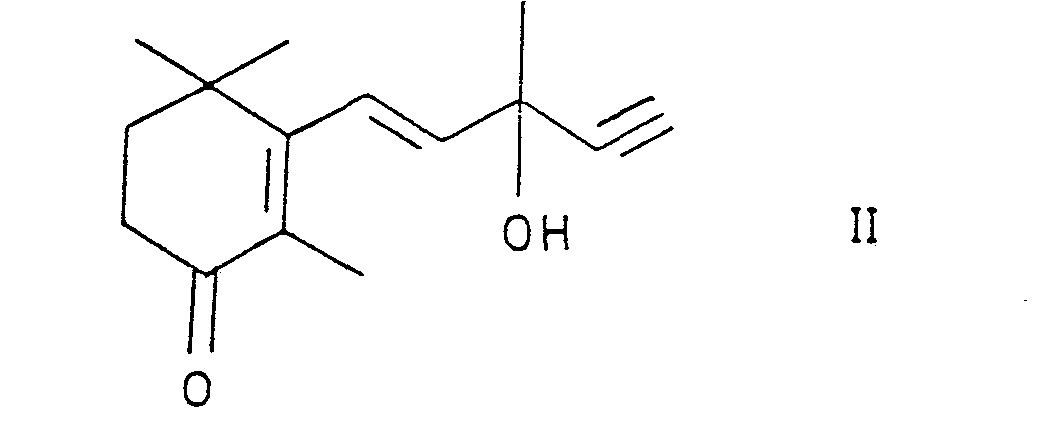
- the compound of formula II is new and part of the present invention.
- the compound of formula III is known. According to US patent no. 4,098,827 has previously been the compound of the formula III from the compound of the formula I via the intermediate of the formula produced. However, this process has the disadvantage that the compound of formula III is obtained as an impure mixture. Since the compound of formula III is an intermediate for the well-known food coloring agent canthaxanthin, which has to be used in pure form in food, it is important that the intermediate product is produced in the purest form possible. Therefore, the compound of formula III, if it is prepared via the intermediate of formula IV, must be purified by conventional means before it can be used in the further synthesis of canthaxanthin.
- the compound of the formula III is obtained in a purity of at least 96% without further purification if it is obtained from the compound of the formula I via the intermediate of Formula II is produced. In fact, this purity is obtained regardless of the purity of the formula I starting material used.
- the method according to the invention therefore enables the production of a pure intermediate product without expensive and time-consuming cleaning methods, even if impure starting materials are used.
- the compound of formula I is reacted with an oxidizing agent to the compound of formula II.
- the reaction can be carried out using any conventional oxidizing agent.
- the preferred oxidizing agents include manganese dioxide, chromium trioxide and chromate oxidizing agents, such as the Jones reagent, and acetone in the presence of an aluminum alkoxide.
- the reaction can be carried out under any conditions commonly used in such oxidations.
- Oxidation of the compound of formula I to the compound of formula II with acetone in the presence of an aluminum alkoxide is particularly preferred.
- Any of the usual aluminum alkoxides can be used, such as aluminum lower alkoxides, i.e. those in which the alkoxy groups contain 1 to 7 carbon atoms.
- Preferred aluminum alkoxides are aluminum isopropoxide and aluminum t-butoxide.
- the aluminum alkoxide can be present in catalytic amounts in this reaction, i.e. in amounts of at least about 0.1 mole percent of the amount of the compound of formula I.
- the aluminum alkoxide can also be present in amounts of about 100 mole percent compared to the compound of formula I, and even a large excess does not adversely affect the reaction .
- the aluminum alkoxide will preferably be used in an amount of about 0.1 to about 100 mole percent.
- the oxidation is carried out with acetone and an aluminum alkoxide in acetone as the organic solvent medium.
- the reaction medium may contain additional solvents such as benzene and toluene; however, any inert organic solvent mixed with acetone can actually be used.
- the reaction can also be carried out in acetone without the addition of an inert organic solvent. The reaction is generally carried out at the reflux temperature of the reaction mixture.
- the compound of formula II is obtained as a crystalline substance and can be easily separated from the reaction mixture.
- the usual crystallization methods can be used, and the compound of formula II can be easily crystallized from common non-polar solvents.
- Preferred non-polar solvents are e.g. Hexane, petroleum ether and the like.
- the reaction of the compound of formula II to the compound of formula III by partial hydrogenation of the compound of formula II can be carried out in a manner known per se.
- This reaction can be carried out with any of the catalysts commonly used for the partial hydrogenation of triple bonds to double bonds.
- Preferred catalysts are the partially poisoned palladium catalysts (for example Lindlar catalysts), as described, for example, in Helvetica Chimica Acta 35, 440 (1952).
- the compound of the formula II is dissolved in an inert organic solvent. Any of the common inert organic solvents can be used.
- Preferred inert organic solvents are ethyl acetate, toluene, petroleum ether, methylene chloride and the like.
- reaction poisons such as 1,2-bis (2-hydroxyethylthio) ethane can be used to further deactivate the catalyst.
- Temperature and pressure are not critical issues in this reaction. The reaction can be carried out at room temperature and atmospheric pressure, but higher or lower temperatures can be used if desired. Generally, a reaction temperature of about 10 ° C to about 70 ° C is preferred.
- the compound of the formula III prepared by selective hydrogenation is obtained in at least 96% purity.
- the compound of formula I is known and can be prepared by known methods. However, it can also be prepared in high yields according to the following reaction scheme, in which R denotes a hydrolyzable protective group.
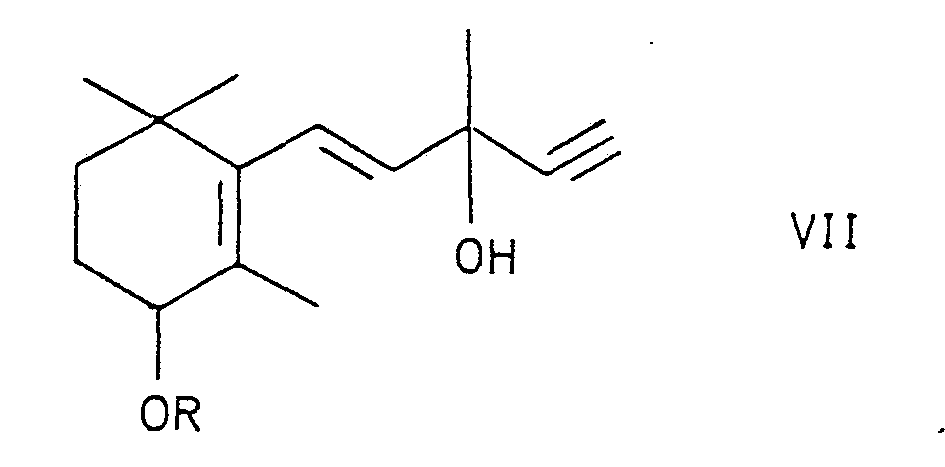
- Preferred protective groups R in the compounds of the formulas VI and VII are benzyl, t-butyl, tetrahydropyranyl and the groups of the formula wherein R 1 is lower alkyl and R 2 and R 3 are hydrogen or lower alkyl.
- lower alkyl means an alkyl group having 1 to 7 carbon atoms, such as methyl, ethyl, isopropyl, n-butyl, t-butyl and the like.
- the compound of formula V can be used with a compound of the general formula in which R 1 and R 2 have the above meaning and R 4 represents hydrogen or an alkyl group having 1 to 6 carbon atoms, be implemented.
- This ether formation can be carried out in the presence of a strong acid.
- Preferred inorganic acids are the hydrohalic acids (for example hydrogen bromide) and other strong inorganic acids, for example sulfuric acid.
- the preferred organic acids include p-toluenesulfonic acid.
- the reaction is usually carried out in an inert organic solvent.
- Preferred organic solvents are aprotic solvents such as tetrahydrofuran, dimethoxyethane and the like.
- the compound of formula V be converted into the compound of the formula VI by any known method of ether formation.
- a preferred method is the reaction of the compound of formula V with an alcohol or a reactive derivative thereof, for example a halide, under the conditions customary for such reactions.
- the reaction of a ketone of the formula VI with lithium acetylide can be carried out in a manner known per se.
- the compound of formula VII thus obtained can be further reacted in a manner known per se by aqueous acid hydrolysis to give the compound of formula I.
- the acidic hydrolysis is preferably carried out using aqueous, strong inorganic acids, for example hydrochloric acid, aqueous sulfuric acid or aqueous hydrobromic acid.
- Temperature and pressure are not critical issues in this reaction and the reaction can be carried out at room temperature and atmospheric pressure. A temperature of from about 0 ° C. to about 50 ° C. is preferably used.
- the compound of formula I can be produced from the compound of formula V in approximately twice the yield compared to the direct ethynylation of the compound of formula V with sodium acetylide according to US Pat. 4,098,827.
- the compound of formula V can also be reacted to the compound of formula I by reacting the compound of formula V with acetylene in the presence of an alkali metal hydroxide in liquid ammonia at a temperature from about -40 ° C to about + 30 ° C.
- an alkali metal hydroxide preferably sodium or potassium hydroxide
- Potassium hydroxide is particularly preferred.
- the reaction is preferably carried out in a temperature range of about -30 ° C to about +5 0 C, particularly preferably at about 0 ° C, and at a pressure of about 1 to about 9 atmospheres, more preferably at about 8 atmospheres performed.
- the alkali metal hydroxide is usually used in this reaction in catalytic amounts from about 0.1 to about 20 mole percent, preferably in an amount of about 10 mole percent, of the amount of the compound of formula V used. However, the alkali metal hydroxide can also be used in larger amounts, i.e. up to about 100 mole percent can be used, although no significant advantage is achieved.
- the alkali metal hydroxide is generally used as an aqueous solution or as a solution in a lower alkanol.
- the term "lower alkanol" herein means straight and branched chain alcohols having 1 to 7 carbon atoms.
- Preferred alcoholic solutions are methanolic solutions.
- the catalyst can be treated with a mineral acid or a lower alkane carboxylic acid, i.e. a carboxylic acid with 1 to 7 carbon atoms.
- Preferred acids are sulfuric acid, nitric acid, hydrochloric acid, acetic acid and the like.
- the organic phase was washed successively with 300 ml of salt water, 500 ml of saturated aqueous sodium bicarbonate solution and 300 ml of salt water.
- the aqueous phase and the washing solutions were extracted in the same order with 400 ml of toluene.
- the combined organic phases were dried over magnesium sulfate. After concentration on a rotary evaporator (40 ° C / 25 mmHg), a viscous oil (290 g) was obtained, which crystallized on standing at room temperature. This substance was dissolved in 350 ml of warm toluene and the solution was allowed to cool to room temperature. Then 500 ml of hexane were added with stirring and the clear, yellow solution was stirred overnight at room temperature.
- the cooler and the gas inlet pipe were then replaced by a thermometer and a three-way pipe with a dropping funnel and gas outlet. Then 100 ml of tetrahydrofuran were slowly added, the flask was placed in an acetone bath and the ammonia was thereby largely evaporated off within 2.5 hours. During the evaporation, the evaporated ammonia was continuously replaced by the dropwise addition of 700 ml of tetrahydrofuran. After the internal temperature had reached + 7 ° C, the white suspension was stirred at this temperature for 20 minutes.
- reaction mixture was stirred vigorously for a further 6 hours and acetylene was introduced at a constant rate. Then 150 ml of dry ether was added and the ammonia was evaporated overnight. Then 50 ml of saline were added and the ether phase was washed three times with 100 ml of saline. The ticassri- g en washings were dried again with 100 ml of ether and the combined organic phases over magnesium sulfate. After concentrating on a rotary evaporator, 7.00 g of light brown, viscous oil (purity about 70%) were obtained.
Landscapes
- Chemical & Material Sciences (AREA)
- Organic Chemistry (AREA)
- Organic Low-Molecular-Weight Compounds And Preparation Thereof (AREA)
- Pyrane Compounds (AREA)
- Low-Molecular Organic Synthesis Reactions Using Catalysts (AREA)
Abstract


Description
- Die vorliegende Erfindung betrifft ein neues Verfahren zur Herstellung von Zwischenprodukten in der Totalsynthese von Canthaxanthin. Die Erfindung betrifft ferner neue Verbindungen in diesem Verfahren.
- Das erfindungsgemässe Verfahren ist dadurch gekennzeichnet, dass man die Verbindung der'Formel


- Die Verbindung der Formel II ist neu und Teil der vorliegenden Erfindung.
- Die Verbindung der Formel III ist bekannt. Gemäss US-Patent No. 4 098 827 wurde die Verbindung der Formel III bisher aus der Verbindung der Formel I über das Zwischenprodukt der Formel

- Es wurde nun überraschenderweise gefunden, dass die Verbindung der Formel III ohne weitere Reinigung in einer Reinheit von mindestens 96% erhalten wird, wenn sie aus der Verbindung der Formel I über das Zwischenprodukt der Formel II hergestellt wird. Tatsächlich wird diese Reinheit unabhängig von der Reinheit des verwendeten Ausgangsmaterials der Formel I erhalten. Das erfindungsgemässe Verfahren ermöglicht daher, ohne teure und zeitraubende Reinigungsverfahren, die Herstellung, eines reinen Zwischenproduktes, selbst wenn dabei unreine Ausgangsmaterialien verwendet werden.
- Gemäss dem erfindungsgemässen Verfahren wird die Verbindung der Formel I mit einem Oxidationsmittel zur Verbindung der Formel II umgesetzt. Die Umsetzung kann mit irgendeinem üblichen Oxidationsmittel erfolgen. Zu den bevorzugten Oxidationsmitteln gehören Mangandioxid, Chromtrioxid und Chromat-Oxidationsmittel, wie das Jones-Reagens, sowie Aceton in Gegenwart eines Aluminiumalkoxids. Die Umsetzung kann bei irgendwelchen, in solchen Oxidationen üblicherweise angewendeten Bedingungen durchgeführt werden.
- Besonders bevorzugt ist die Oxidation der Verbindung der Formel I zur Verbindung der Formel II mit Aceton in Gegenwart eines Aluminiumalkoxids. Dabei können irgendwelche üblichen Aluminiumalkoxide verwendet werden, wie Aluminium-nieder-alkoxide, d.h. solche worin die Alkoxygruppen 1 bis 7 Kohlenstoffatome enthalten. Bevorzugte Aluminiumalkoxide sind Aluminiumisopropoxid und Aluminium-t-butoxid. Das Aluminiumalkoxid kann in dieser Reaktion in katalytischen Mengen vorliegen, d.h. in Mengen von mindestens etwa 0,1 Molprozent der Menge der Verbindung der Formel I. Das Aluminiumalkoxid kann aber gewünschtenfalls auch in Mengen von etwa 100 Molprozenten, verglichen mit der Verbindung der Formel I, vorliegen, und auch ein grosser Ueberschuss beeinflusst die Reaktion nicht nachteilig. Aus Gründen der Wirtschaftlichkeit wird man jedoch das Aluminiumalkoxid bevorzugt in einer Menge von etwa 0,1 bis etwa 100 Molprozenten verwenden.
- Im allgemeinen wird die Oxidation mit Aceton und einem Aluminiumalkoxid in Aceton als organisches Lösungsmittelmedium ausgeführt. Gewünschtenfalls kann das Reaktionsmedium zusätzliche Lösungsmittel wie Benzol und Toluol enthalten; es kann aber tatsächlich irgendein inertes organisches Lösungsmittel im Gemisch mit Aceton verwendet werden. Anderseits kann die Reaktion auch in Aceton ohne Zusatz eines inerten organischen Lösungsmittels ausgeführt werden. Die Reaktion wird im allgemeinen bei der Rückflusstemperatur des Reaktionsgemisches durchgeführt.
- Gemäss dem erfindungsgemässen Verfahren wird die Verbindung der Formel II als kristalline Substanz erhalten und kann leicht aus dem Reaktionsgemisch abgetrennt werden. Es können die üblichen Kristallisationsmethoden angewendet werden, und die Verbindung der Formel II kann leicht kristallisiert werden aus gebräuchlichen unpolaren Lösungsmitteln. Bevorzugte unpolare Lösungsmittel sind z.B. Hexan, Petroläther und dergleichen.
- Die Umsetzung der Verbindung der Formel II zur Verbindung der Formel III durch teilweise Hydrierung der Verbindung der Formel II kann in an sich bekannter Weise erfolgen. Diese Umsetzung kann mit irgendeinem der Katalysatoren ausgeführt werden, die üblicherweise für die teilweise Hydrierung von Dreifachbindungen zu Doppelbindungen verwendet werden. Bevorzugte Katalysatoren sind die teilweise vergifteten Palladium-Katalysatoren (z.B. Lindlar-Katalysatoren), wie sie beispielsweise in Helvetica Chimica Acta 35, 440 (1952) beschrieben sind. Zur Durchführung dieser Reaktion wird die Verbindung der Formel II in einem inerten organischen Lösungsmittel gelöst. Es kann irgendeines der gebräuchlichen inerten organischen Lösungsmittel verwendet werden. Bevorzugte inerte organische Lösungsmittel sind Aethylacetat, Toluol, Petroläther, Methylenchlorid und dergleichen. Gewünschtenfalls können weitere gebräuchliche Katalysatorgifte, wie 1,2-Bis-(2-hydroxyäthylthio)äthan, verwendet werden, um den Katalysator weiter zu desaktivieren. Temperatur und Druck sind keine kritischen Aspekte in dieser Reaktion. Die Reaktion kann bei Raumtemperatur und Atmosphärendruck durchgeführt werden, gewünschtenfalls können aber höhere oder tiefere Temperaturen angewendet werden. Im allgemeinen wird eine Reaktionstemperatur von etwa 10°C bis etwa 70°C bevorzugt.
- Gemäss dem erfindungsgemässen Verfahren wird die durch selektive Hydrierung hergestellte Verbindung der Formel III in mindestens 96%iger Reinheit erhalten.
- Die Verbindung der Formel I ist bekannt und kann nach bekannten Methoden hergestellt werden. Sie kann jedoch in hohen Ausbeuten auch nach dem'folgenden Reaktionsschema, worin R eine hydrolysierbare Schutzgruppe bedeutet, hergestellt werden.
-

- Bevorzugte Schutzgruppen R in den Verbindungen der Formeln VI und VII sind Benzyl, t-Butyl, Tetrahydropyranyl und die Gruppen der Formel

- Im Rahmen der vorliegenden Erfindung bedeutet der Ausdruck "nieder-Alkyl" eine Alkylgruppe mit 1 bis 7 Kohlenstoffatomen, wie Methyl, Aethyl, Isopropyl, n-Butyl, t-Butyl und dergleichen.
- Zur Bildung der Gruppe der Formel IX kann die Verbindung der Formel V mit einer Verbindung der allgemeinen Formel

.umgesetzt werden. - .Diese Aetherbildung kann in Gegenwart einer starken Säure ausgeführt werden. Bevorzugte anorganische Säuren sind die Halogenwasserstoffsäuren (z.B. Bromwasserstoff) und andere starke anorganische Säuren, beispielsweise Schwefelsäure. Zu den bevorzugten organischen Säuren gehört die p-Toluolsulfosäure. Die Reaktion wird gewöhnlich in einem inerten organischen Lösungsmittel durchgeführt. Bevorzugte organische Lösungsmittel sind aprotische Lösungsmittel, wie Tetrahydrofuran, Dimethoxyäthan und dergleichen. Anderseits kann die Verbindung der Formel V nach irgendeiner an sich bekannten Methode der Aetherbildung zur Verbindung der Formel VI umgesetzt werden. Eine bevorzugte Methode ist die Umsetzung der Verbindung der Formel V mit einem Alkohol oder einem reaktionsfähigen Derivat hiervon, beispielsweise einem Halogenid, unter den für solche Reaktionen üblichen Bedingungen.
- Die Reaktion eines Ketons der Formel VI mit Lithiumacetylid kann in an sich bekannter Weise erfolgen. Die so erhaltene Verbindung der Formel VII kann in an sich bekannter Weise durch wässrige saure Hydrolyse zur Verbindung der Formel I weiter umgesetzt werden. Die saure Hydrolyse wird bevorzugt mit wässrigen, starken anorganischen Säuren, beispielsweise Salzsäure, wässriger Schwefelsäure oder wässriger Bromwasserstoffsäure ausgeführt. Temperatur und Druck sind keine kritischen Aspekte in dieser Reaktion, und die Reaktion kann bei Raumtemperatur und Atmosphärendruck durchgeführt werden. Bevorzugt wird eine Temperatur von,etwa 0°C bis etwa 50°C angewendet.
- Gemäss diesem Verfahren kann die Verbindung der Formel I aus der Verbindung der Formel V in etwa doppelt so hoher Ausbeute hergestellt werden, verglichen mit der direkten Aethinylierung der Verbindung der Formel V mit Natriumacetylid gemäss US-Patent No. 4 098 827.
- Die Verbindungen der Formel VII sind neu und bilden ebenfalls Gegenstand der vorliegenden Erfindung.
- Die neuen Verbindungen der Formeln II und.VII können durch die allgemeine Formel

dargestellt werden. - Die Verbindung der Formel V kann ebenfalls zur Verbindung der Formel I umgesetzt werden durch Reaktion der Verbindung der Formel V mit Acetylen in Gegenwart eines Alkalimetallhydroxids in flüssigem Ammoniak bei einer Temperatur von etwa -40 C bis etwa +30°C. In diesem Verfahren kann irgendein gebräuchliches Alkalimetallhydroxid, vorzugsweise Natrium- oder Kaliumhydroxid, verwendet werden. Besonders bevorzugt ist Kaliumhydroxid. Die Reaktion wird bevorzugt in einem Temperaturbereich von etwa -30°C bis etwa +50C, besonders bevorzugt bei etwa 0°C, und bei einem Druck von etwa 1 bis etwa 9 Atmosphären, besonders bevorzugt bei etwa 8 Atmosphären, durchgeführt.
- Das Alkalimetallhydroxid wird in dieser Reaktion gewöhnlich in katalytischen Mengen von etwa 0,1 bis etwa 20 Molprozenten, vorzugsweise in einer Menge von etwa 10 Molprozenten, der eingesetzten Menge der Verbindung der Formel V verwendet. Das Alkalimetallhydroxid kann jedoch auch in grösseren Mengen, d.h. bis zu etwa 100 Molprozenten, verwendet werden, obwohl dadurch kein wesentlicher Vorteil erreicht wird. Das Alkalimetallhydroxid wird im allgemeinen als wässrige Lösung oder als Lösung in einem nieder-Alkanol verwendet. Der Ausdruck "nieder-Alkanol" bedeutet hierin geradkettige und verzweigtkettige Alkohole mit 1 bis 7 Kohlenstoffatomen. Bevorzugte alkoholische Lösungen sind methanolische Lösungen. Nach beendeter'Reaktion kann der Katalysator mit einer Mineralsäure oder einer nieder-Alkancarbonsäure, d.h. einer Carbonsäure mit 1 bis 7 Kohlenstoffatomen, neutralisiert werden. Bevorzugte Säuren sind Schwefelsäure, Salpetersäure, Salzsäure, Essigsäure und dergleichen.
- Die Erfindung wird durch die folgenden Beispiele weiter veranschaulicht.
- In einen 5-Liter-Dreihalskolben mit Rührer, Thermometer und Rückflusskühler wurden unter Stickstoff 255 g (1 Mol) 1-(3-Hydroxy-2,6,6-trimethyl-1-cyclohexen-1-yl)-3-methyl-1-penten-4-in-3-ol, 0,7 1 Aceton, 1,2 1 Toluol und 80 g (0,39 Mol) Aluniiniumisopropoxid eingebracht. Die Mischung wurde gerührt und 2,5 Stunden zum Rückfluss erhitzt. Der gekühlte Kolbeninhalt wurde in ein Gemisch von 67 g (0,65 Mol) konzentrierter(96%) Schwefelsäure und 1,2 1 Eiswasser gegossen und 5 Minuten gerührt. Die organische Phase wurde nacheinander mit 300 ml Salzwasser, 500 ml gesättigter wässriger Natriumbicarbonat-Lösung und 300 ml Salzwasser gewaschen. Die wässrige Phase und die Waschlösungen wurden in der gleichen Reihenfolge mit 400 ml Toluol extrahiert. Die vereinigten organischen Phasen wurden über Magnesiumsulfat getrocknet. Nach dem Einengen am Rotationsverdampfer (40°C/25 mmHg) wurde ein viskoses Oel (290 g) erhalten, das beim Stehenlassen bei Raumtemperatur auskristallisierte. Diese Substanz wurde in 350 ml warmen Toluol gelöst, und die Lösung auf Raumtemperatur abkühlen gelassen. Dann wurden unter Rühren 500 ml Hexan zugegeben und die klare, gelbe Lösung über Nacht bei Raumtemperatur gerührt. Das kristalline Material wurde genutscht, mit 400 ml Hexan/Toluol.3:1 gewaschen und am Vakuum getrocknet (bis zu konstantem Gewicht). Es wurden 147,9 g (63,7%) 1-(3-0xo-2,6,6-trimethyl-1-cyclohexen-1-yl)-3-methyl-1-penten-4-in-3-ol als schwach gelbliche Kristalle erhalten; Smp. 86-88°C. Die Mutterlauge wurde am Rotationsverdampfer eingeengt und das zurückbleibende Oel (89 g) bei 130-165°C/0,05 mmHg destilliert. Dabei wurden 69,8 g dunkelgelbes Destillat erhalten. Dieses wurde in 100 ml Toluol gelöst, 250 ml Hexan zugegeben und die erhaltene gelbe Lösung angeimpft und über Nacht bei Raumtemperatur gerührt. Der Niederschlag wurde abfiltriert, mit 75 ml Hexan/Toluol 3:1 gewaschen und am Vakuum getrocknet. Dabei wurden zusätzliche 17,9 g (7,7%) 1-(3-0xo-2,6,6-trimethyl-1-cyclohexen-1-yl)-3-methyl-1-penten-4-in-3-ol als weisse Kristalle erhalten; Smp. 86-88°C.
- In einen 2-Liter-Dreihalskolben mit Rührer und Gaseinlass und -auslass wurden unter Stickstoff 500 ml Methylenchlorid und 8,25 g Lindlar-Katalysator eingebracht. Unter Rühren wurden eine Lösung von 84 mg 1,2-Bis-(2-hydroxyäthylthio)äthan in 17 ml Methylenchlorid, gefolgt von 10 ml Triäthylamin zugegeben. Anschliessend wurde eine Lösung von 164,7 g (0,709 Mol) 1-(3-Oxo-2,6,6-trimethyl-1-cyclohexen-1-yl)-3-methyl-1-penten-4-in-3-ol in 350 ml Methylenchlorid zugegeben und der Kolben mit Wasserstoff gespült. Die Mischung wurde dann bei Raumtemperatur und 790 mmHg hydriert, bis die Wasserstoffaufnahme beendet war (8 Stunden). Die Mischung wurde filtriert und das klare hellgelbe Filtrat am Rotationsverdampfer eingeengt (zuerst 350C/25 mmHg und dann 35 C/-2 mmHg). Dabei wurden 167,2 g (100,7%) reines (über 96%- iges) 1-(3-0xo-2,6,6-trimethyl-1-cyclohexen-1-yl)-3-methyl-1,4-pentadien-3-ol als gelbes viskoses Oel erhalten.
- In einen 1-Liter-Dreihalskolben mit Thermometer, Rührer und Tropftrichter wurden unter Stickstoff 208,3 g (1,0 Mol) 4-(3-Hydroxy-2,6,6-trimethyl-1-cyclohexen-1-yl)-3-buten-2-on, 100,8 g (1,4 Mol) Isopropenylmethyläther und 160 ml Tetrahydrofuran eingebracht. Die Mischung wurde gerührt, bis eine homogene Lösung erhalten wurde, und dann in einem Eisbad auf 3°C abgekühlt. Anschliessend wurde während 1.25 Stunden bei 3-6°C eine Lösung von 1,4 g (7,4 mMol) p-Toluolsulfosäure-Monohydrat in 20 ml Tetrahydrofuran zugegeben. Nachdem die Mischung weitere 20 Minuten bei 3°C gerührt worden war, wurden 3,0 ml Triäthylamin zugegeben. Die erhaltene klare, hellgelbe Lösung von 4-[3-(1-Methoxy-1-methyläthoxy)-2,6,6-trimethyl-1-cyclohexen-1-yl]-.3-buten-2-on wurde im Kühlschrank aufbewahrt, bevor sie weiterverwendet wurde.
- Ein Dreihalskolben mit Gaseinlassrohr, Rührer und Kühler (Trockeneis/Aceton) wurde, durch den Kühler, mit Stickstoff gespült. Dann wurden 1,0 1 wasserfreier flüssiger Ammoniak eingebracht, 10,4 g (1,50 Mol) Lithiumdraht (in Stücke von 4 cm geschnitten) zugegeben und die blaue Mischung während 10 Minuten unter Rückfluss langsam gerührt. Anschliessend wurde Acetylengas mit einer Geschwindigkeit von ca. 700 ml/Min. in das Reaktionsgefäss geleitet. Nachdem die blaue Farbe verschwunden war (nach ca. 1,25 Stunden), wurde noch weitere 15 Minuten mit gleicher Geschwindigkeit Acetylen in das Reaktionsgefäss eingeleitet. Anschliessend wurden der Kühler und das Gaseinlassrohr durch ein Thermometer und ein Dreiwegrohr mit Tropftrichter und Gasauslass ersetzt. Dann wurden langsam 100 ml Tetrahydrofuran zugegeben, der Kolben in ein Acetonbad gestellt und dadurch innert 2,5 Stunden der Ammoniak grösstenteils abgedampft. Während des Abdampfens wurde der abgedampfte Ammoniak laufend ersetzt durch Zutropfen weiterer 700 ml Tetrahydrofuran. Nachdem die Innentemperatur +7°C erreicht hatte, wurde die weisse Suspension 20 Minuten bei dieser Temperatur gerührt. Dann wurde unter Stickstoff bei 5-7°C innert 15 Minuten die oben hergestellte Lösung von 4-[3-(1-Methoxy-1-methyläthoxy)-2,6,6-trimethyl-1-cyclohexen-1-yl]-3-buten-2-on zugegeben und dabei die Lithiumacetylid-Suspension gut gerührt. Die Mischung wurde noch 1 Stunde bei Raumtemperatur gerührt, wobei eine Lösung von 1-[3-(1-Methoxy-1-methyläthoxy)-2,6,6-trimethyl-1-cyclohexen-1-yl]-3-methyl-l-penten-4-in-3-ol in Tetrahydrofuran erhalten wurde.
- Diese Lösung wurde in 750 g Eiswasser gegossen. Nach Zugabe von 10 mg Bromphenolblau wurde das 2-PhasenGemisch unter Rühren und Kühlung mit einem Eisbad (Temperatur <20°C) langsam mit 6N Salzsäure versetzt bis zum Farbumschlag von grünblau nach gelb (pH 3). Dazu wurden 560 ml 6N Salzsäure benötigt. Dann wurde durch Zugabe weiterer 10 ml 6N Salzsäure der pH-Wert der wässrigen Phase auf 1,4 gesenkt und die Mischung 40 Minuten bei Raumtemperatur gerührt. Anschliessend wurde 1,0 1 Toluol zugegeben, die organische Phase abgetrennt und mit 250 ml gesättigter wässriger Natriumbicarbonat-Lösung und 500 ml Kochsalzlösung gewaschen. Die wässrige Phase und die Waschlösungen wurden in der gleichen Reihenfolge mit 400 ml Toluol extrahiert, die vereinigten organischen Phasen über Magnesiumsulfat getrocknet und am Rotationsverdampfer eingeengt. Dabei wurden 255 g (109%) 1-(3-Hydroxy-2,6,6-trimethyl-l-cyclohexen-1-yl)-3-methyl-1-penten-4-in-3-ol als rohes, gelbes, viskoses Oel (Reinheit etwa 70%) erhalten.
- In einen 1-Liter-Dreihalskolben mit Gaseinlassrohr, Kühler (Trockeneis/Aceton), Thermometer und Rührer wurden unter Stickstoff 440 ml wasserfreier flüssiger Ammoniak eingebracht. Unter starkem Rühren und Rückfluss des Ammoniaks wurde tropfenweise 1,0 ml 42%ige (Gew./Gew.) wässrige Kaliumhydroxid-Lösung zugegeben. Anschliessend wurde mit einer Geschwindigkeit von 2,6 1/Min. Acetylengas in das Reaktionsgefäss eingeleitet. Nach 25 Minuten wurde eine Lösung von 5,80 g (27,8 mMol) 4-(3-Hydroxy-2,6,6-trimethyl-1-cyclohexen-1-yl)-3-buten-2-on in 5 ml trockenem Aether zugegeben. Das Reaktionsgemisch wurde noch 6 Stunden kräftig gerührt und mit gleichbleibender Geschwindigkeit Acety- leh eingeleitet. Dann wurden 150 ml trockener Aether zugegeben und über Nacht der Ammoniak verdampfen gelassen. Dann wurden 50 ml Kochsalzlösung zugegeben und die Aetherphase dreimal mit je 100 ml Kochsalzlösung gewaschen. Die wässri- gen Waschlösungen wurden nochmals mit 100 ml Aether extrahiert und die vereinigten organischen Phasen über Magnesiumsulfat getrocknet. Nach dem Einengen am Rotationsverdampfer wurden 7,00 g hellbraunes, viskoses Oel (Reinheit etwa 70%) erhalten.
Claims (10)



Priority Applications (1)
| Application Number | Priority Date | Filing Date | Title |
|---|---|---|---|
| AT80101545T ATE2069T1 (de) | 1979-03-27 | 1980-03-24 | Verfahren zur herstellung von cyclohexenderivaten sowie ein zwischenprodukt in diesem verfahren. |
Applications Claiming Priority (2)
| Application Number | Priority Date | Filing Date | Title |
|---|---|---|---|
| US2429679A | 1979-03-27 | 1979-03-27 | |
| US24296 | 1993-03-01 |
Publications (3)
| Publication Number | Publication Date |
|---|---|
| EP0017800A2 true EP0017800A2 (de) | 1980-10-29 |
| EP0017800A3 EP0017800A3 (en) | 1981-01-14 |
| EP0017800B1 EP0017800B1 (de) | 1982-12-22 |
Family
ID=21819865
Family Applications (1)
| Application Number | Title | Priority Date | Filing Date |
|---|---|---|---|
| EP80101545A Expired EP0017800B1 (de) | 1979-03-27 | 1980-03-24 | Verfahren zur Herstellung von Cyclohexenderivaten sowie ein Zwischenprodukt in diesem Verfahren |
Country Status (4)
| Country | Link |
|---|---|
| EP (1) | EP0017800B1 (de) |
| JP (1) | JPS55133325A (de) |
| AT (1) | ATE2069T1 (de) |
| DE (1) | DE3061393D1 (de) |
Cited By (3)
| Publication number | Priority date | Publication date | Assignee | Title |
|---|---|---|---|---|
| US5437853A (en) * | 1993-10-21 | 1995-08-01 | Alliedsignal Inc. | Disposal of hydrazine propellants |
| US5682270A (en) * | 1994-11-08 | 1997-10-28 | Kabushiki Kaisha Yamaguchi Kaisha | Light reflecting and accumulating member |
| CN113429277A (zh) * | 2021-05-06 | 2021-09-24 | 广州巨元生化有限公司 | 一种用于制备斑蝥黄素的c15醇的两步合成方法 |
Family Cites Families (2)
| Publication number | Priority date | Publication date | Assignee | Title |
|---|---|---|---|---|
| US4045476A (en) * | 1975-06-09 | 1977-08-30 | Hoffmann-La Roche Inc. | 1-(2,6,6-Trimethyl-3-hydroxy or lower alkanoyloxycyclohexen-1-yl)-3-methyl-4-penten-1-yn-3-ol compound |
| US4098827A (en) * | 1977-01-17 | 1978-07-04 | Hoffmann-La Roche Inc. | 1-(2,6,6-Trimethyl-3-hydroxy-1-cyclohexen-1-yl)-3-methyl-penta-1,4-diene[or 1-yn-4-EN]-3-ols |
-
1980
- 1980-03-24 DE DE8080101545T patent/DE3061393D1/de not_active Expired
- 1980-03-24 AT AT80101545T patent/ATE2069T1/de not_active IP Right Cessation
- 1980-03-24 EP EP80101545A patent/EP0017800B1/de not_active Expired
- 1980-03-25 JP JP3700180A patent/JPS55133325A/ja active Granted
Cited By (4)
| Publication number | Priority date | Publication date | Assignee | Title |
|---|---|---|---|---|
| US5437853A (en) * | 1993-10-21 | 1995-08-01 | Alliedsignal Inc. | Disposal of hydrazine propellants |
| US5682270A (en) * | 1994-11-08 | 1997-10-28 | Kabushiki Kaisha Yamaguchi Kaisha | Light reflecting and accumulating member |
| CN113429277A (zh) * | 2021-05-06 | 2021-09-24 | 广州巨元生化有限公司 | 一种用于制备斑蝥黄素的c15醇的两步合成方法 |
| CN113429277B (zh) * | 2021-05-06 | 2025-02-11 | 广州巨元生化有限公司 | 一种用于制备斑蝥黄素的c15醇的两步合成方法 |
Also Published As
| Publication number | Publication date |
|---|---|
| JPH0147464B2 (de) | 1989-10-13 |
| JPS55133325A (en) | 1980-10-17 |
| DE3061393D1 (en) | 1983-01-27 |
| EP0017800B1 (de) | 1982-12-22 |
| EP0017800A3 (en) | 1981-01-14 |
| ATE2069T1 (de) | 1983-01-15 |
Similar Documents
| Publication | Publication Date | Title |
|---|---|---|
| DE2419970C3 (de) | 3-<l-Pyrrolidinyl)-4-phenoxy-5sulfamoylbenzoesäure und Verfahren zu ihrer Herstellung | |
| DE2726064A1 (de) | Verfahren zur herstellung von 2-phenyl-aethanol-derivaten | |
| DD153835A5 (de) | Verfahren zur herstellung von 5-carbonyl-10-oxo-10,11-dihydro-5h-dibenz[b,f]azepin | |
| EP1197483B1 (de) | Verfahren zur katalytischen Reduktion von Alkinverbindungen | |
| DE60002949T2 (de) | Verfahren zur Herstellung des Neuraminidase-Inhibitoren ro-64-0796 | |
| DE2132761A1 (de) | 2-AEthynylcyclopropanverbindungen und Verfahren zur Herstellung derselben | |
| DE1961778A1 (de) | Verfahren zur Herstellung von Brenzcatechin-Derivaten | |
| EP0644186B1 (de) | Verfahren zur Herstellung von 13-(Z)-Retinsäure | |
| EP0017800A2 (de) | Verfahren zur Herstellung von Cyclohexenderivaten sowie ein Zwischenprodukt in diesem Verfahren | |
| DD239591A5 (de) | Verfahren zur herstellung von 2,4-dichlor-5-fluor-benzoesaeure | |
| EP0031875B1 (de) | Verfahren zur Herstellung von Cyclohexenderivaten | |
| DE69903498T2 (de) | Verfahren zur Herstellung von 13-cis-Retinsäure | |
| CH619955A5 (de) | ||
| DE3018575C2 (de) | Verfahren zur Herstellung eines Alkalimetallsalzes einer 3-(17&beta;-Hydroxyandrosten-3-on-acetal-17&alpha;-yl)-propiolsäure | |
| EP0131130B1 (de) | Verfahren zur Herstellung von Cycloalkenylalkinen | |
| EP0882709A1 (de) | Verfahren zur Herstellung von Zeaxanthin, Zwischenprodukte für dieses Verfahren und Verfahren zu deren Herstellung | |
| US4296259A (en) | Preparation of a 1,4-pentadien-3-ol | |
| EP0036651B1 (de) | Verfahren zur Herstellung von 3-Oxo-alpha-jonon | |
| EP0008752B1 (de) | Verfahren zur Herstellung von 2,3-Dihydro-2-äthylbenzofuran-5-ylessigsäure | |
| EP0179217A2 (de) | Verfahren zur Herstellung von 2-Hydroxy-5,6,7,8-tetrahydrocarbazol, die Alkali- und Erdalkalisalze des 2-Hydroxy-5,6,7,8-tetrahydrocarbazols und deren Verwendung | |
| AT325600B (de) | Verfahren zur herstellung von arylalkylpyrrylaminoäthanolen und ihren salzen | |
| DE19934231B4 (de) | Verfahren zur Herstellung von 1-substituierten 5-Hydroxy-imidazolin-2,4-dionen und 1-substituierten 5-Alkoxy-imidazolin-2,4-dionen | |
| DE2912052A1 (de) | Verfahren zur herstellung von 2eckige klammer auf 4-(thienylcarbonyl)phenyl eckige klammer zu -propionsaeure | |
| CH654832A5 (de) | Stickstoffhaltige prostaglandin/prostacyclin-synthone und verfahren zu ihrer herstellung. | |
| DD151161A5 (de) | Verfahren zur herstellung von 2,2-dialkyl-4-methyl-5,5-dialkyl-3-formyl-3-pyrrolin |
Legal Events
| Date | Code | Title | Description |
|---|---|---|---|
| PUAI | Public reference made under article 153(3) epc to a published international application that has entered the european phase |
Free format text: ORIGINAL CODE: 0009012 |
|
| AK | Designated contracting states |
Designated state(s): AT BE CH DE FR GB IT NL |
|
| PUAL | Search report despatched |
Free format text: ORIGINAL CODE: 0009013 |
|
| AK | Designated contracting states |
Designated state(s): AT BE CH DE FR GB IT NL |
|
| 17P | Request for examination filed |
Effective date: 19800324 |
|
| ITF | It: translation for a ep patent filed | ||
| GRAA | (expected) grant |
Free format text: ORIGINAL CODE: 0009210 |
|
| AK | Designated contracting states |
Designated state(s): AT BE CH DE FR GB IT NL |
|
| REF | Corresponds to: |
Ref document number: 2069 Country of ref document: AT Date of ref document: 19830115 Kind code of ref document: T |
|
| REF | Corresponds to: |
Ref document number: 3061393 Country of ref document: DE Date of ref document: 19830127 |
|
| ET | Fr: translation filed | ||
| ITPR | It: changes in ownership of a european patent |
Owner name: CESSIONE;F. HOFFMANN - LA ROCHE AG |
|
| NLS | Nl: assignments of ep-patents |
Owner name: F. HOFFMANN-LA ROCHE AG TE BAZEL, ZWITSERLAND. |
|
| REG | Reference to a national code |
Ref country code: FR Ref legal event code: TP |
|
| REG | Reference to a national code |
Ref country code: CH Ref legal event code: PUE Owner name: F. HOFFMANN-LA ROCHE AG |
|
| REG | Reference to a national code |
Ref country code: GB Ref legal event code: 732 |
|
| ITTA | It: last paid annual fee | ||
| PGFP | Annual fee paid to national office [announced via postgrant information from national office to epo] |
Ref country code: AT Payment date: 19960329 Year of fee payment: 17 |
|
| PG25 | Lapsed in a contracting state [announced via postgrant information from national office to epo] |
Ref country code: AT Effective date: 19970324 |
|
| PGFP | Annual fee paid to national office [announced via postgrant information from national office to epo] |
Ref country code: GB Payment date: 19980211 Year of fee payment: 19 |
|
| PGFP | Annual fee paid to national office [announced via postgrant information from national office to epo] |
Ref country code: FR Payment date: 19980213 Year of fee payment: 19 |
|
| PGFP | Annual fee paid to national office [announced via postgrant information from national office to epo] |
Ref country code: BE Payment date: 19980217 Year of fee payment: 19 |
|
| PGFP | Annual fee paid to national office [announced via postgrant information from national office to epo] |
Ref country code: CH Payment date: 19980318 Year of fee payment: 19 |
|
| PGFP | Annual fee paid to national office [announced via postgrant information from national office to epo] |
Ref country code: DE Payment date: 19980321 Year of fee payment: 19 |
|
| PGFP | Annual fee paid to national office [announced via postgrant information from national office to epo] |
Ref country code: NL Payment date: 19980331 Year of fee payment: 19 |
|
| PG25 | Lapsed in a contracting state [announced via postgrant information from national office to epo] |
Ref country code: GB Free format text: LAPSE BECAUSE OF NON-PAYMENT OF DUE FEES Effective date: 19990324 |
|
| PG25 | Lapsed in a contracting state [announced via postgrant information from national office to epo] |
Ref country code: CH Free format text: LAPSE BECAUSE OF NON-PAYMENT OF DUE FEES Effective date: 19990331 Ref country code: BE Free format text: LAPSE BECAUSE OF NON-PAYMENT OF DUE FEES Effective date: 19990331 |
|
| BERE | Be: lapsed |
Owner name: F. HOFFMANN-LA ROCHE A.G. Effective date: 19990331 |
|
| PG25 | Lapsed in a contracting state [announced via postgrant information from national office to epo] |
Ref country code: NL Free format text: LAPSE BECAUSE OF NON-PAYMENT OF DUE FEES Effective date: 19991001 |
|
| REG | Reference to a national code |
Ref country code: CH Ref legal event code: PL |
|
| GBPC | Gb: european patent ceased through non-payment of renewal fee |
Effective date: 19990324 |
|
| PG25 | Lapsed in a contracting state [announced via postgrant information from national office to epo] |
Ref country code: FR Free format text: LAPSE BECAUSE OF NON-PAYMENT OF DUE FEES Effective date: 19991130 |
|
| NLV4 | Nl: lapsed or anulled due to non-payment of the annual fee |
Effective date: 19991001 |
|
| REG | Reference to a national code |
Ref country code: FR Ref legal event code: ST |
|
| PG25 | Lapsed in a contracting state [announced via postgrant information from national office to epo] |
Ref country code: DE Free format text: LAPSE BECAUSE OF NON-PAYMENT OF DUE FEES Effective date: 20000101 |
|
| PLBE | No opposition filed within time limit |
Free format text: ORIGINAL CODE: 0009261 |
|
| STAA | Information on the status of an ep patent application or granted ep patent |
Free format text: STATUS: NO OPPOSITION FILED WITHIN TIME LIMIT |