EP0021082A1 - N-heterocyclyl thienamycins, process for preparing and antibiotic pharmaceutical composition containing the same - Google Patents
N-heterocyclyl thienamycins, process for preparing and antibiotic pharmaceutical composition containing the same Download PDFInfo
- Publication number
- EP0021082A1 EP0021082A1 EP80102965A EP80102965A EP0021082A1 EP 0021082 A1 EP0021082 A1 EP 0021082A1 EP 80102965 A EP80102965 A EP 80102965A EP 80102965 A EP80102965 A EP 80102965A EP 0021082 A1 EP0021082 A1 EP 0021082A1
- Authority
- EP
- European Patent Office
- Prior art keywords
- carbon atoms
- alkyl
- carboxyl
- substituted
- hydrogen
- Prior art date
- Legal status (The legal status is an assumption and is not a legal conclusion. Google has not performed a legal analysis and makes no representation as to the accuracy of the status listed.)
- Granted
Links
- 0 CCNC(C)=CC=CC=* Chemical compound CCNC(C)=CC=CC=* 0.000 description 12
- WOMGQJDMFFMWEC-UHFFFAOYSA-N CC1=CC=CCN1C Chemical compound CC1=CC=CCN1C WOMGQJDMFFMWEC-UHFFFAOYSA-N 0.000 description 1
Classifications
-
- C—CHEMISTRY; METALLURGY
- C07—ORGANIC CHEMISTRY
- C07D—HETEROCYCLIC COMPOUNDS
- C07D477/00—Heterocyclic compounds containing 1-azabicyclo [3.2.0] heptane ring systems, i.e. compounds containing a ring system of the formula:, e.g. carbapenicillins, thienamycins; Such ring systems being further condensed, e.g. 2,3-condensed with an oxygen-, nitrogen- or sulphur-containing hetero ring
- C07D477/10—Heterocyclic compounds containing 1-azabicyclo [3.2.0] heptane ring systems, i.e. compounds containing a ring system of the formula:, e.g. carbapenicillins, thienamycins; Such ring systems being further condensed, e.g. 2,3-condensed with an oxygen-, nitrogen- or sulphur-containing hetero ring with hydrogen atoms, hydrocarbon or substituted hydrocarbon radicals, directly attached in position 4, and with a carbon atom having three bonds to hetero atoms with at the most one bond to halogen, e.g. an ester or nitrile radical, directly attached in position 2
- C07D477/12—Heterocyclic compounds containing 1-azabicyclo [3.2.0] heptane ring systems, i.e. compounds containing a ring system of the formula:, e.g. carbapenicillins, thienamycins; Such ring systems being further condensed, e.g. 2,3-condensed with an oxygen-, nitrogen- or sulphur-containing hetero ring with hydrogen atoms, hydrocarbon or substituted hydrocarbon radicals, directly attached in position 4, and with a carbon atom having three bonds to hetero atoms with at the most one bond to halogen, e.g. an ester or nitrile radical, directly attached in position 2 with hydrogen atoms, hydrocarbon or substituted hydrocarbon radicals, attached in position 6
- C07D477/16—Heterocyclic compounds containing 1-azabicyclo [3.2.0] heptane ring systems, i.e. compounds containing a ring system of the formula:, e.g. carbapenicillins, thienamycins; Such ring systems being further condensed, e.g. 2,3-condensed with an oxygen-, nitrogen- or sulphur-containing hetero ring with hydrogen atoms, hydrocarbon or substituted hydrocarbon radicals, directly attached in position 4, and with a carbon atom having three bonds to hetero atoms with at the most one bond to halogen, e.g. an ester or nitrile radical, directly attached in position 2 with hydrogen atoms, hydrocarbon or substituted hydrocarbon radicals, attached in position 6 with hetero atoms or carbon atoms having three bonds to hetero atoms with at the most one bond to halogen, e.g. an ester or nitrile radical, directly attached in position 3
- C07D477/20—Sulfur atoms
-
- A—HUMAN NECESSITIES
- A61—MEDICAL OR VETERINARY SCIENCE; HYGIENE
- A61P—SPECIFIC THERAPEUTIC ACTIVITY OF CHEMICAL COMPOUNDS OR MEDICINAL PREPARATIONS
- A61P31/00—Antiinfectives, i.e. antibiotics, antiseptics, chemotherapeutics
- A61P31/04—Antibacterial agents
Definitions
- a magnetically stirred solution of thienamycin (1) in water is adjusted to pH 7 to pH 7.5 at 20°C.
- the product Id is then isolated directly from the reaction solution at pH 6-7 by preparative reverse phast HPLC as already described.
- the preferred values for the radical R which is directly attached to the ring nitrogen atom are: hydrogen; loweralkyl having from 1-10 carbon atoms; substituted alkyl wherein the substituent is chloro, fluoro, hydroxyl, alkoxy, substituted alkoxy, carboxyl, amino, sulfo and mono- and dialkylamino wherein each alkyl has 1-6 carbon atoms; phenylalkyl (alkyl moiety having 1-6 carbon atoms) and substituted phenylalkyl wherein the substituents art selected from chloro, fluoro, carboxyl, amino, hydroxyl, lower alkoxyl having from 1-6 carbon atoms, sulfo, - (OR°) 2 and - (OR°) 2 (R° is hydrogen or alkyl having 1-6 carbon atoms).
- the quinolizinium and indolizinium examples are a special category of preferred values of R, in that R is there an integral part
Landscapes
- Chemical & Material Sciences (AREA)
- Organic Chemistry (AREA)
- Health & Medical Sciences (AREA)
- Nuclear Medicine, Radiotherapy & Molecular Imaging (AREA)
- Life Sciences & Earth Sciences (AREA)
- Chemical Kinetics & Catalysis (AREA)
- General Chemical & Material Sciences (AREA)
- Medicinal Chemistry (AREA)
- Communicable Diseases (AREA)
- Pharmacology & Pharmacy (AREA)
- Oncology (AREA)
- Animal Behavior & Ethology (AREA)
- General Health & Medical Sciences (AREA)
- Public Health (AREA)
- Veterinary Medicine (AREA)
- Pharmaceuticals Containing Other Organic And Inorganic Compounds (AREA)
- Nitrogen Condensed Heterocyclic Rings (AREA)
- Nitrogen And Oxygen Or Sulfur-Condensed Heterocyclic Ring Systems (AREA)
Abstract

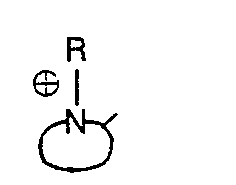
R is, inter alia, hydrogen, substituted and unsubstituted: alkyl, aryl, alkenyl, heterocyclylalkenyl, aralkenyl, heterocyclylalkyl, aralkyl, -NR2, COOR, CONR2, -OR, or CN.
Description
- This invention relates to a new class of thienamycins (I) and their pharmaceutically acceptable salts and esters which are useful as antibiotics:
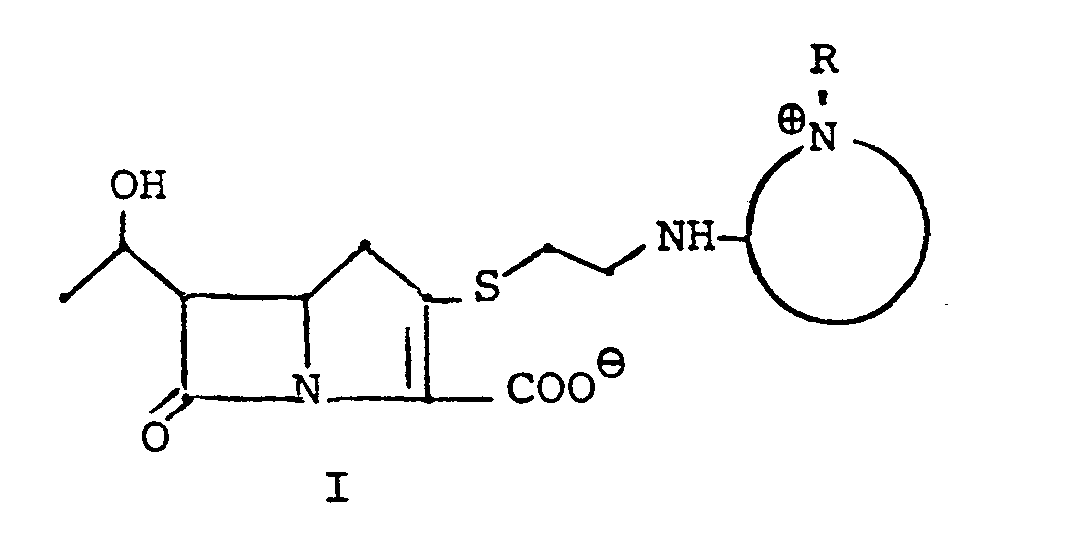

- Thienamycin and all of its isomers are known and are described by structure 1, below. In this regard, reference is made to U.S. Patent 3,950,357 issued 4-13-76 which is directed to thienamycin and to co-pending, commonly assigned U.S. Patent Application 17680 filed March 5, 1979 which is directed to the total synthesis of thienamycin and all of its isomers. To the extent that the cited patent and application provides starting materials for the practice of the present invention, they are incorporated herein by reference.

- The compounds of the present invention are most conveniently isolated as the zwitterionic species demonstrated by structure I.
- This invention also relates to processes for the preparation of such compounds (I); pharmaceutical compositions comprising such compounds; and to methods of treatment comprising administering such compounds and compositions when an antibiotic effect is indicated.
- There is a continuing need for new antibiotics. For unfortunately, there is no static effectiveness of any given antibiotic because continued wide scale usage selectively gives rise to resistant strains of pathogens. In addition, the known antibiotics suffer from the disadvantage of being effective only against certain types of microorganisms. Accordingly, the search for new antibiotics continues.
- Thus, it is an object of the present invention to provide a novel class of antibiotics which are useful in animal and human therapy and in inanimate systems. These antibiotics are active against a broad range of pathogens which representatively include both gram positive bacteria such as S. aureus, Strep. pyogenes, and B. subtilis, and gram negative bacteria such as E. coli, Pseudomonas, Proteus morganii, Serratia, and Klebsiella. Further objects of this invention are to provide chemical processes for the preparation of such antibiotics and their non-toxic pharmaceutically acceptable salts and esters; pharmaceutical compositions comprising such antibiotics; and to provide methods of treatment comprising administering such antibiotics and compositions when an antibiotic effect is indicated.
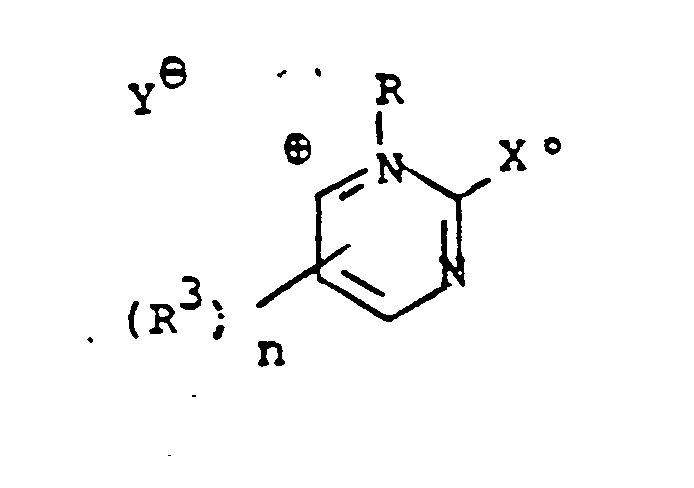
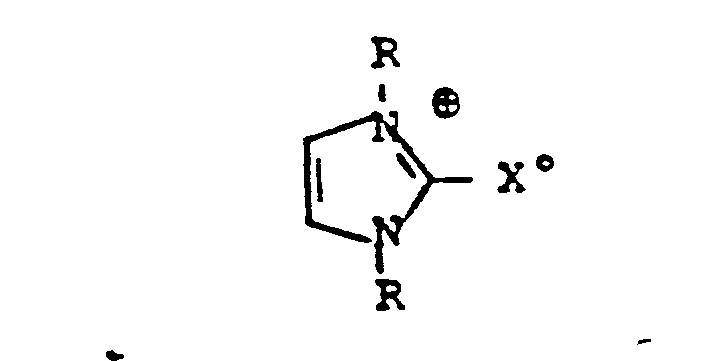
- The compounds of the present invention are prepared by reacting thienamycin (1) with a chosen electrophilic N-heterocyclic reagent (2 or 3) calculated to provide the species of the present invention I. The following reaction diagram conveniently summarizes this process and introduces the precise identity of such electrophilic reagents and the nature of the products of this reaction (I,above).

- wherein:
- B is, inter alia, the residue of a 5-, or a 6-membered aromatic heterocycle; or a 5,5-, 6,5-; or 6,6- bicyclic aromatic heterocycle; wherein the additional ring atoms are chosen either entirely as carbon, or include one or more atoms selected from S, N and 0. The carbon and nitrogen atoms of any such ring may carry substituents such as substituted and unsubstituted: alkyl and alkenyl having 1-6 carbon atoms, phenyl, phenylalkyl having 1-6 carbon atoms in the alkyl moiety, 5- or 6-membered heterocyclyl wherein the hetero atom or atoms are selected from O, N or S, -OR2, -NR2, -COOR, -CONR2, -CN, halo, -SR, -SO.R3, -S02R, -NHCONH2, -SO3R, -SO2NR2 (R is defined immediately below), -(OR°)2, -S(OR°)2 (R° is hydrogen or alkyl having 1-6 carbon atoms); wherein the substituent or substituents are selected from halogen such as chlorine or fluorine, hydroxyl, phenyl, alkyl, alkoxyl, carboxyl and phenylalkyl (each alkyl having 1-6 carbon atoms);

- R is selected from H; substituted and unsubstituted: alkyl having 1-10 carbon atoms, alkenyl having 2-10 carbon atoms, phenyl, phenylalkyl, phenylalkenyl having 7-12 carbon atoms, 5-or 6-membered heterocyclylalkyl wherein the hetero atom or atoms are selected from O, N or S and the alkyl has 1-6 carbon atoms, NR2, OR, COOR, CN, and CONR2 (R is defined here); wherein the substituent or substituents on R are selected from halogen such as chloro and fluoro, hydroxyl, OR, NR2, COOR, CONR2, CN, -P (OR°)2, -S(OR°)2 -SR, -SO.R, -SO2R, (R° is hydrogen or alkyl having 1-6 carbon atoms), and alkyl having 1-6 carbon atoms;

- R and B together may be joined to yield 6,5- and 6,6- bicyclic heterocycles in which the is at a bridgehead;

- X. is a leaving group such as halogen, preferably fluorine; other leaving groups include: OCH3, SCH3; OSO2OCH3 OSO2OCF3 ,

- Y is a non-critical counter anion and representatively is: Cl⊖, Br⊖, I⊖,

- M⊕ is H, or an alkali or alkaline earth metal cation such as Na+ or K+, a tertiary amine salt, or the like;
- In general words relative to the above reaction diagram, thienemycin (1) or a salt thereof in a solvent such as water at pH 7 to 8, tetrahydrofuran (THF), dimethylformamide (DMF) or the like or aqueous mixtures thereof (ideally such nonaqueous systems contain a base such as triethylamine, methyldiisopropylamine, or the like, to neutralize the acid HX produced by the addition/elimination reaction) is treated with a stoichiometric to four-fold excess of the illustrated electrophilic reagent (2 or 3) calculated to provide the desired product. Typically, the reaction is conducted at a temperature of from 0° to 40°C and is accomplished within 1 to 5 hours. As demonstrated by the following examples, there are no undue criticalities in the parameters of reaction. More specifically, relative to the above reaction scheme, a set of representative conditions may be recited to illustrate a convenient preparation of the compounds of the present invention (I); such recitation, however, is solely for purposes of demonstration and is not to be construed as introducing any undue criticalities of reaction.
- Using a pH meter coupled to an automatic burette containing 1.0 to 2.5N aqueous sodium hydroxide, a magnetically stirred solution of thienamycin (1) in water is adjusted to pH 7 to pH 7.5 at 20°C.
- The heterocyclic reagent (stoichiometric to twofold excess) is dissolved in water at 20°C and added to the above solution. Alkali is automatically added to maintain the selected pH in the range 7 to 7.5, the rate of addition being a measure of the extent of reaction. The reaction may also be monitored by removing aliquots at timed intervals for analysis. A particularly suitable analytical scheme is liquid chromatography, for example, high pressure liquid chromatography (HPLC) over a reverse phase column of octadecylsilane (ODS) bonded to silica, using a U. V. detector and aqueous THF (tetrahydrofuran) solution (1 to 30%) as the mobile phase.
- The reaction typically takes from 15 minutes to 5 hours at 20°C. The resulting reaction solution at pH 7 is worked up by partition chromatography over a column of Amberlite XAD-2 resin, eluting with aqueous THF solutions (up to 20%) and monitoring the fractions by HPLC as above. However, with the increasing availability of large scale ODS silica columns, the preferred method of product isolation is by preparative reverse phase HPLC directly on the reaction solution at the zwitterionic pH. The appropriate fractions are combined, evaporated to small volume and lyophilized to yield the product, which is conveniently characterized by I.R., U.V., N.M.R., and analytical HPLC.
- In certain cases, the products are sufficiently insoluble in water to separate from the reaction solution at pH 7, and may be isolated simply by filtration.
- Finally, a special circumstance should be mentioned. In the basic reaction, first described, the condensation of the thienamycin starting material and the reagent of choice does not occur readily when the group R, attached directly to the ring nitrogen of the reagent is hydrogen. In such circumstance, it is preferred to employ a quaternized ring nitrogen prior to reaction. The quaternizing group may be removed after the amino heterocycle bond has been formed to yield species of the present invention, I, wherein R is hydrogen:


- The product Id is then isolated directly from the reaction solution at pH 6-7 by preparative reverse phast HPLC as already described.
- The necessary electrophilic, N-heterocyclic reagents 2 and 3 are known and commercially available or may be prepared according to known procedures; see, for example: Advances in Heterocyclic Chemistry, pp. 1-56, Vol. 3 (1964) and pp. 71-121, Vol. 22 (1978); Academic Press.
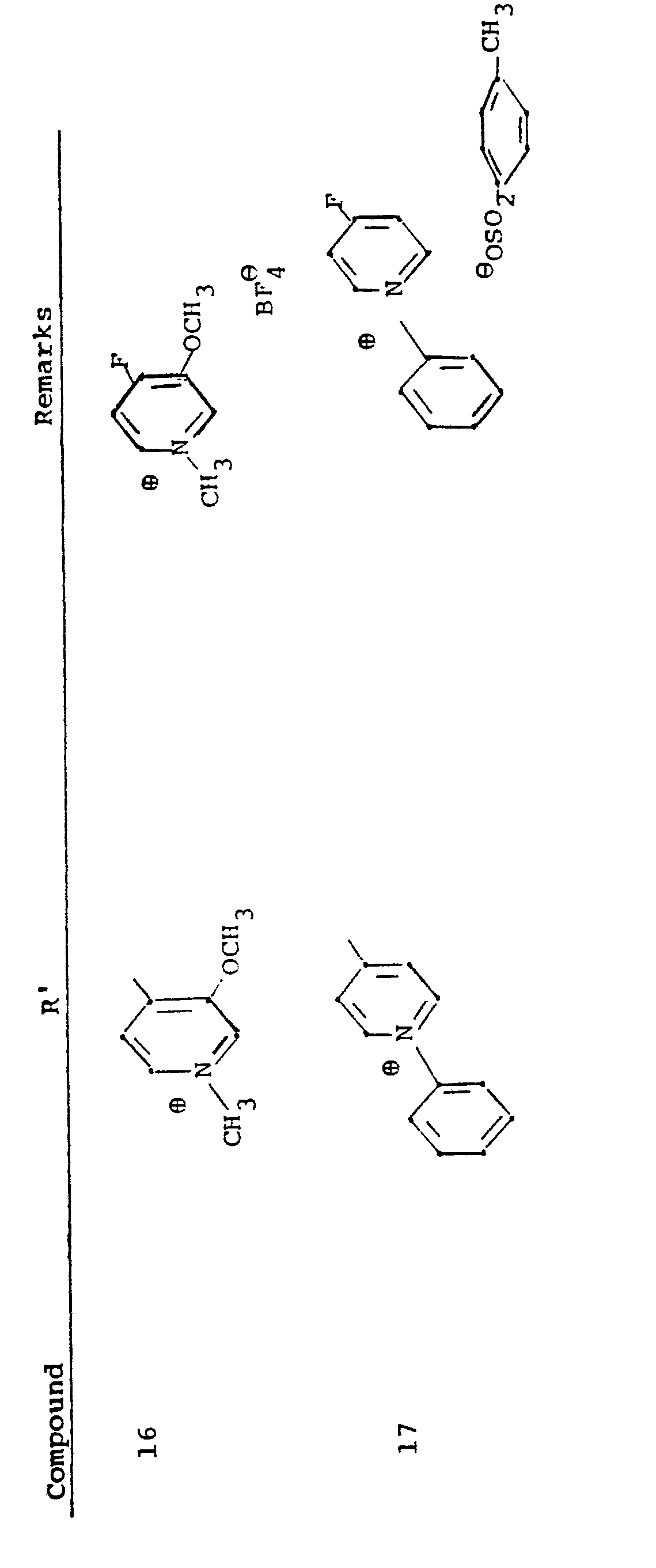
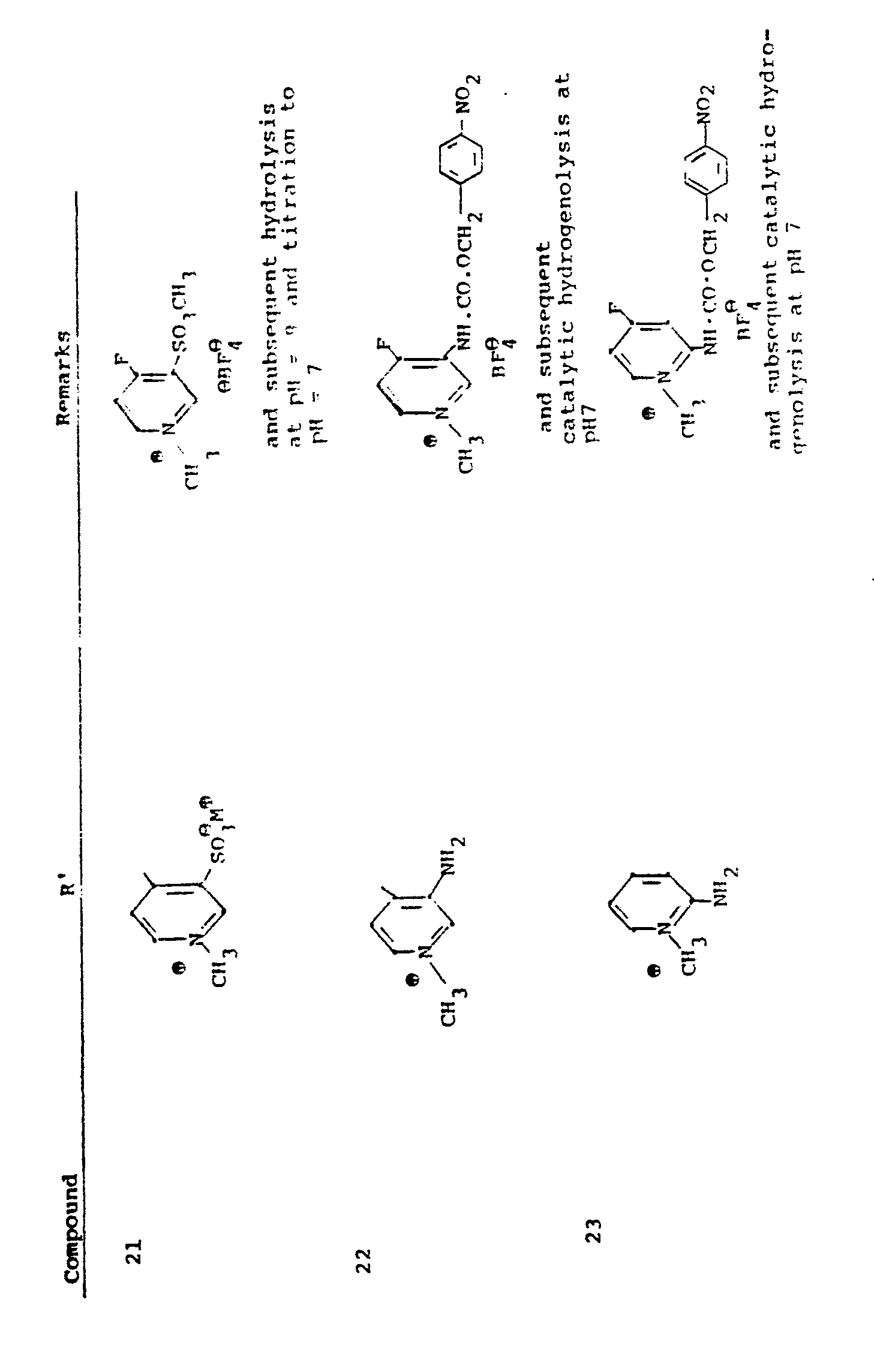
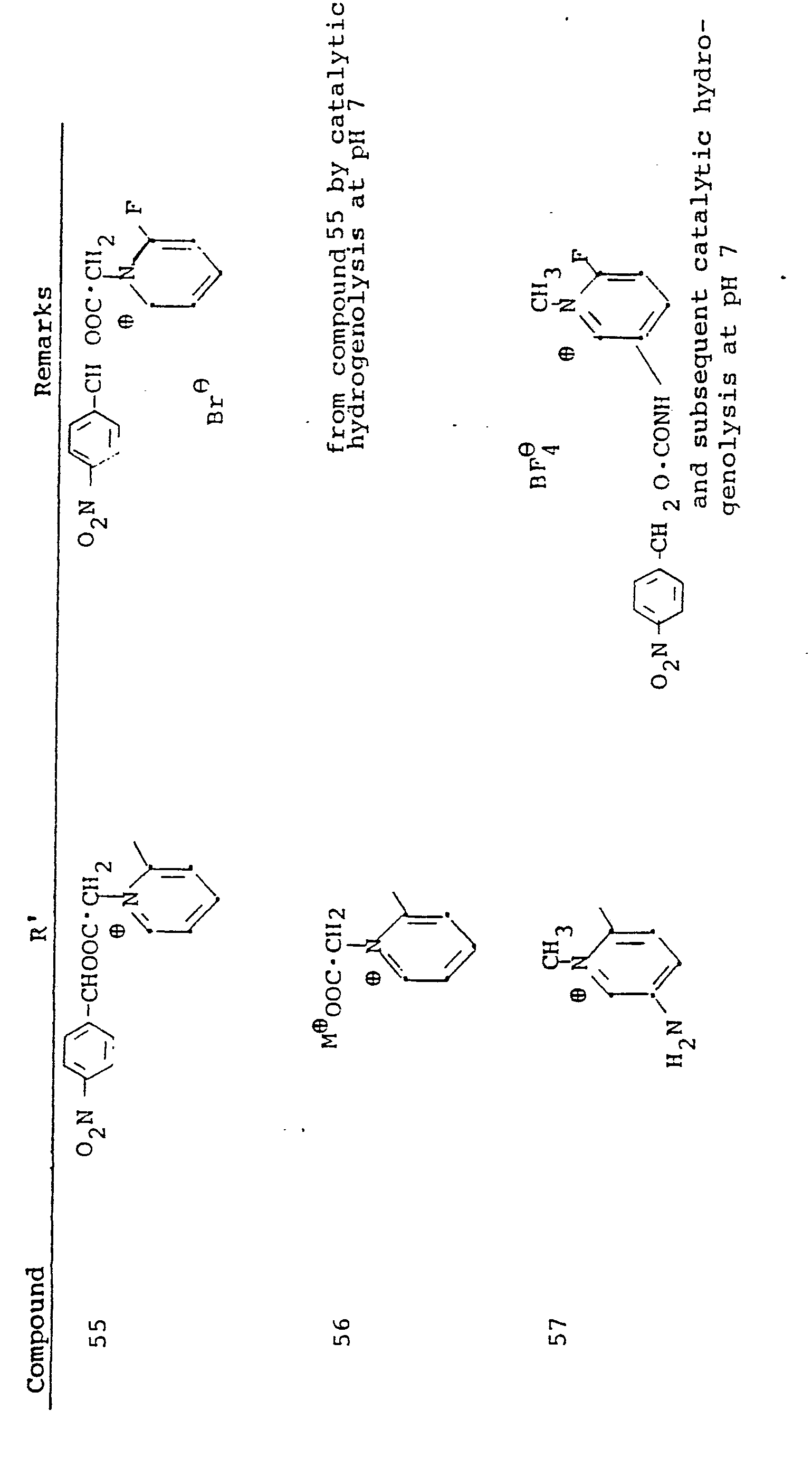
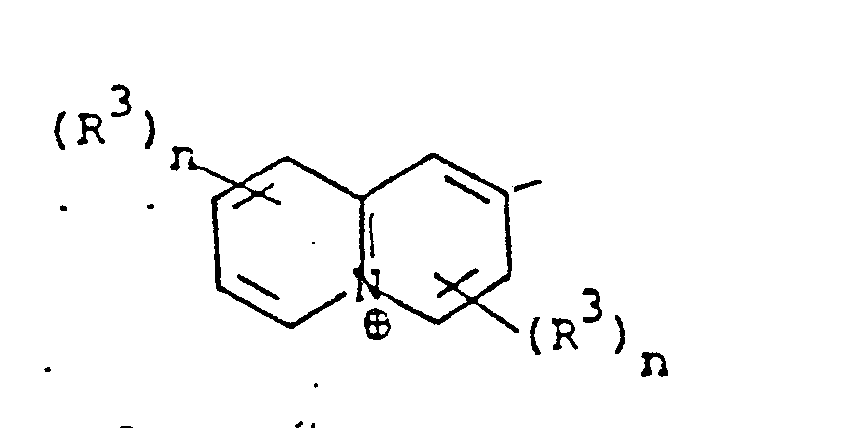
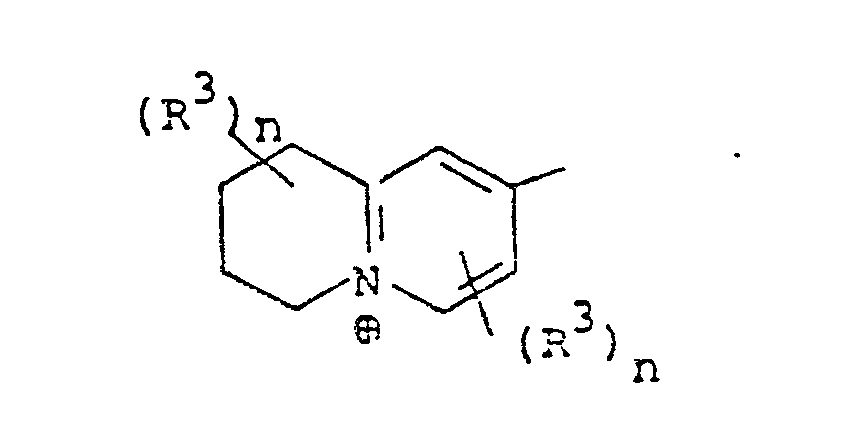
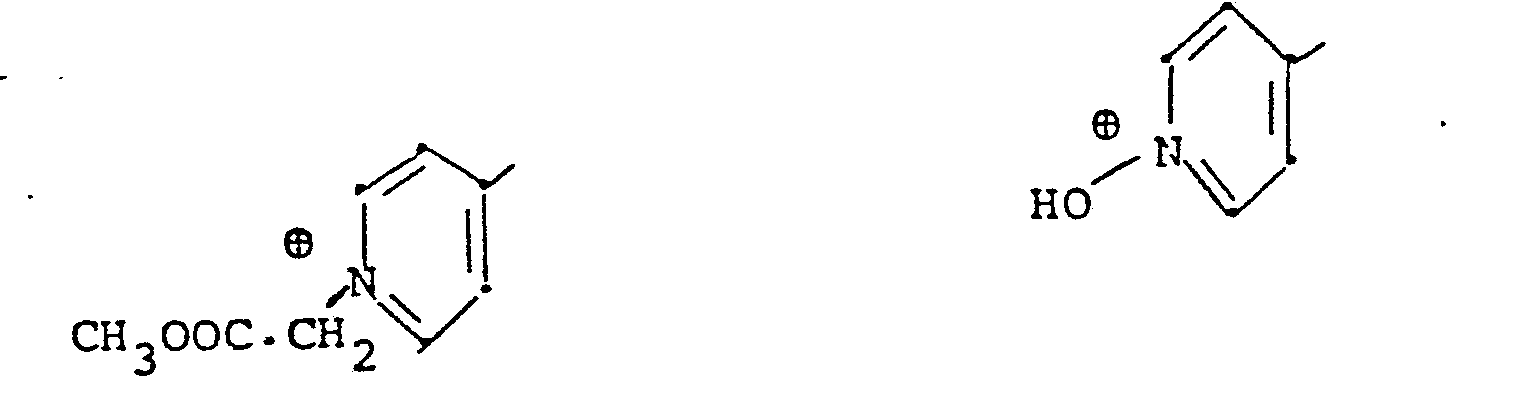
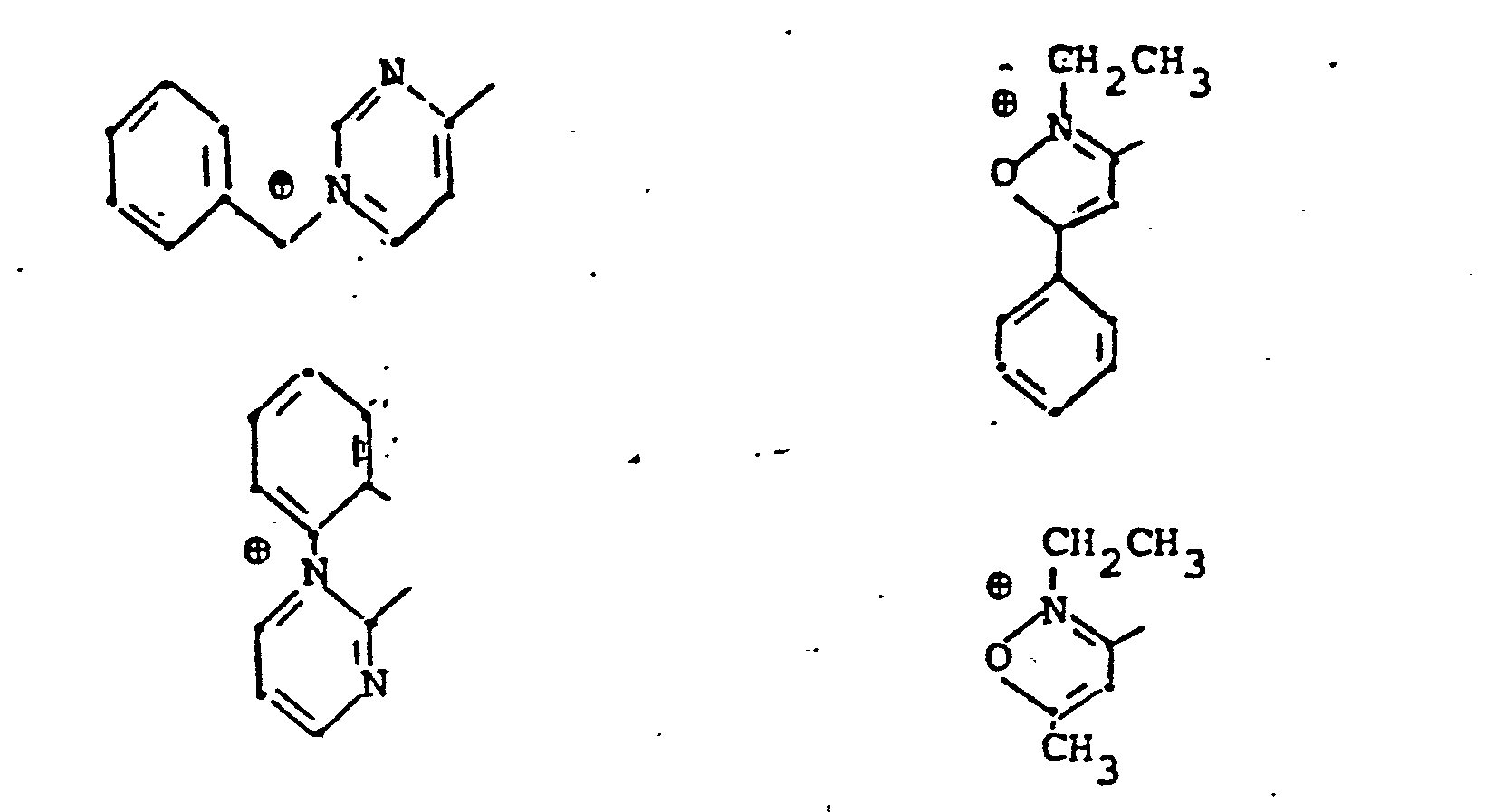
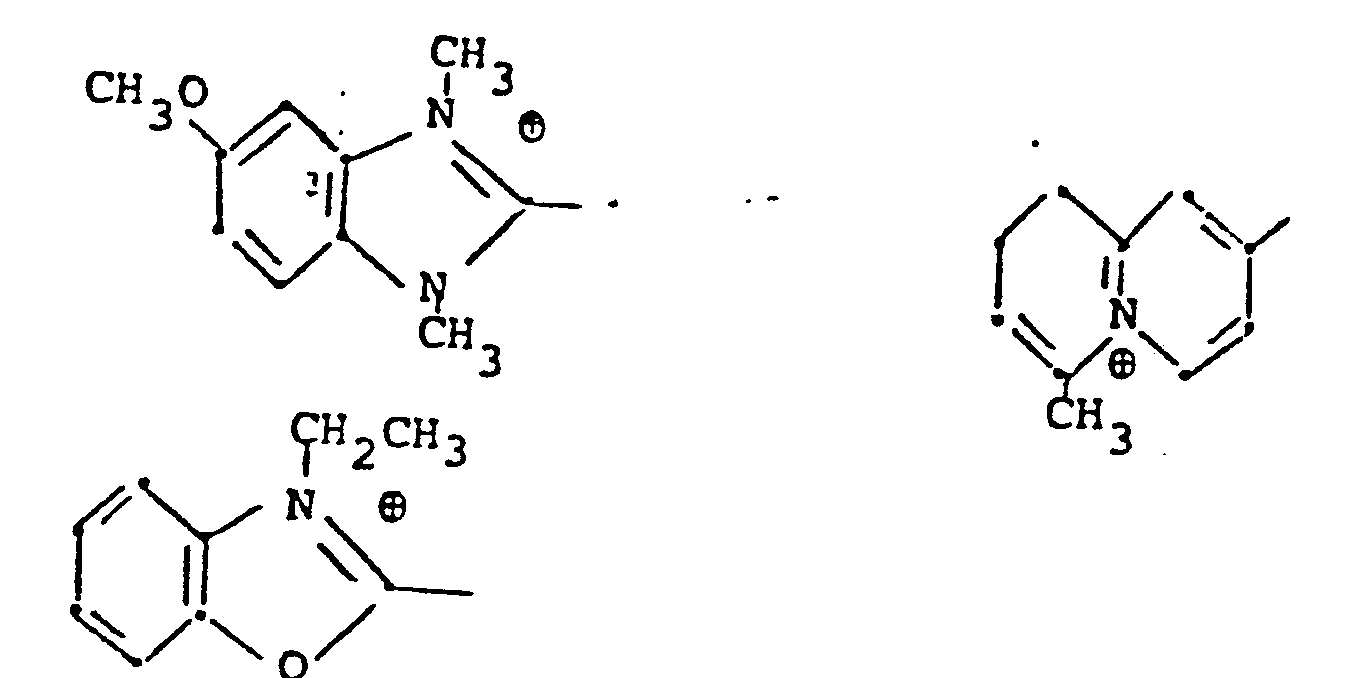
- The following list representatively illustrates such reagents.

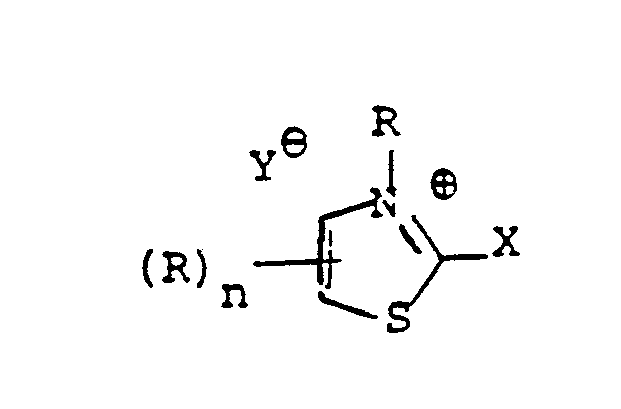


- Relative to the above-listed reagents, the preferred values for the radical R which is directly attached to the ring nitrogen atom are: hydrogen; loweralkyl having from 1-10 carbon atoms; substituted alkyl wherein the substituent is chloro, fluoro, hydroxyl, alkoxy, substituted alkoxy, carboxyl, amino, sulfo and mono- and dialkylamino wherein each alkyl has 1-6 carbon atoms; phenylalkyl (alkyl moiety having 1-6 carbon atoms) and substituted phenylalkyl wherein the substituents art selected from chloro, fluoro, carboxyl, amino, hydroxyl, lower alkoxyl having from 1-6 carbon atoms, sulfo, -(OR°)2 and -
 (OR°)2 (R° is hydrogen or alkyl having 1-6 carbon atoms). The quinolizinium and indolizinium examples are a special category of preferred values of R, in that R is there an integral part of a bicyclic system (R', defined above).
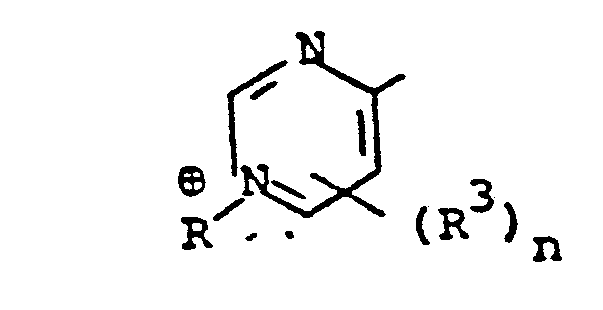
- The preferred values for the other, non-position- specific ring substituent R are: chloro, fluoro, carboxyl and loweralkyl having from 1-6 carbon atoms; substituted lower alkyl wherein the substituent is carboxyl, cyano, alkoxyl having 1-6 carbon atoms, phenyl, and phenyloxy; the preferred value for n is 0 or 1. The preferred leaving group X is chloro or fluoro.
- The compounds of the present invention (I) are valuable antibiotics active against various gram-positive and gram-negative bacteria and accordingly find utility in human and veterinary medicine. Representative pathogens which are sensitive to antibiotics I include: Staphyloccus aureus, Escherichia coli, Klebsiella pneumoniae, Bacillus subtilis, Salmonella typhosa, Psuedomonas and Bacterium proteus. The antibacterials of the invention are not limited to utility as medicaments; they may be used in all manner of industry, for example: additives to animal feed, preservation of food, disinfectants, and in other industrial systems where control of bacterial growth is.desired.
- For example, they may be employed in aqueous compositions in concentrations ranging from 0.1 to 100 parts of antibiotic per million parts of solution in order to destroy and inhibit the growth of harmful bacteria on medical and dental equipment and as bactericides in industrial applications, for example in waterbased paints and in the white water of paper mills to inhibit the growth of harmful bacteria.
- The products of this invention may be used in any of a variety of pharmaceutical preparations. They may be employed in capsule, powder form, in liquid solution, or in suspension. They may be administered by a variety of means; those of principal interest include: orally, topically or parenterally by injection (intravenously or intramuscularly).
- Such tablets and capsules, designed for oral administration, may be in unit dosage form, and may contain conventional excipients, such as binding agents, for example, syrup, acacia, gelatin, sorbitol, tragacanth, or polyvinylpyrrolidone; fillers, for example, lactose, sugar, cornstarch, calcium phosphate, sorbitol, or glycine; lubricants, for example, magnesium stearate, talc, polyethylene glycol, silica; disintegrants, for example, potato starch;or acceptable wetting agents such as sodium lauryl sulphate. The tablets may be coated according to methods well known in the art. Oral liquid preparations may be in the form of aqueous or oily suspensions, or solutions, or they may be presented as a dry product for reconstitution with water or other suitable vehicle before use. Such liquid preparations may contain conventional additives such as suspending agents, for example, sorbitol, methyl cellulose, glucose/sugar syrup, gelatin, hydroxyethylcellulose, or carboxymethyl cellulose. Suppositories will contain conventional suppository bases, such as cocoa butter or other glycerides.
- Compositions for injection, the preferred route of delivery, may be prepared in unit dosage form in ampules, cr in multidose containers. The compositions may take such forms as suspensions, solutions, or emulsions in oily or aqueous vehicles, and may contain formulatory agents such as suspending, stabilizing and/or dispersing agents. Alternatively, the active ingredient may be in powder form for reconstitution, at the time of delivery, with a suitable vehicle, such as sterile water.
- The compositions may also be prepared in suitable forms for absorption through the mucous membranes of the nose and throat or bronchial tissues and may conveniently take the form of liquid sprays or inhalants, lozenges, or throat paints. For medication of the eyes or ears, the preparation may be presented in liquid or semi-solid form. Topical applications may be formulated in hydrophobic or hydrophilic bases as ointments, creams, lotions, paints, or powders.
- The dosage to be administered depends to a large extent upon the condition and size of the subject being treated as well as the route and frequency of administration -- the parenteral route by injection being preferred for generalized infections. Such matters, however, are left to the routine discretion of the therapist according to principles of treatment well known in the antibiotic art. In general, a daily dosage consists of from about 5 to about 600 mg of active ingredient per kg. of body weight of the subject in one or more treatments per day. A preferred daily dosage for adult humans lies in the range of from about 10 to 240 mg. of active ingredient per kg. of body weight. Another factor influencing the precise dosage regimen, apart from the nature of the infection and peculiar identity of the individual being treated, is the molecular weight of the chosen species of this invention (I).
- The compositions for human delivery per unit dosage, whether liquid or solid, may contain from 0.1% to 99% of active material, the preferred range being from about 10-60k. The composition will generally contain from about 15 mg. to about 1500 mg. of the active ingredient; however, in general, it is preferable to employ a dosage amount in the range of from about 250 mg to 1000 mg. In parenteral administration, the unit dosage is usually the pure zwitterionic compound in sterile water solution or in the form of a soluble powder intended for solution. The pH of such solutions typically will correspond to the zwitterionic point; however, consideration of individual properties of solubility and stability may require such aqueous solutions to have a pH other than that of the zwitterionic point, for example in the range of 5.5 to 8.2
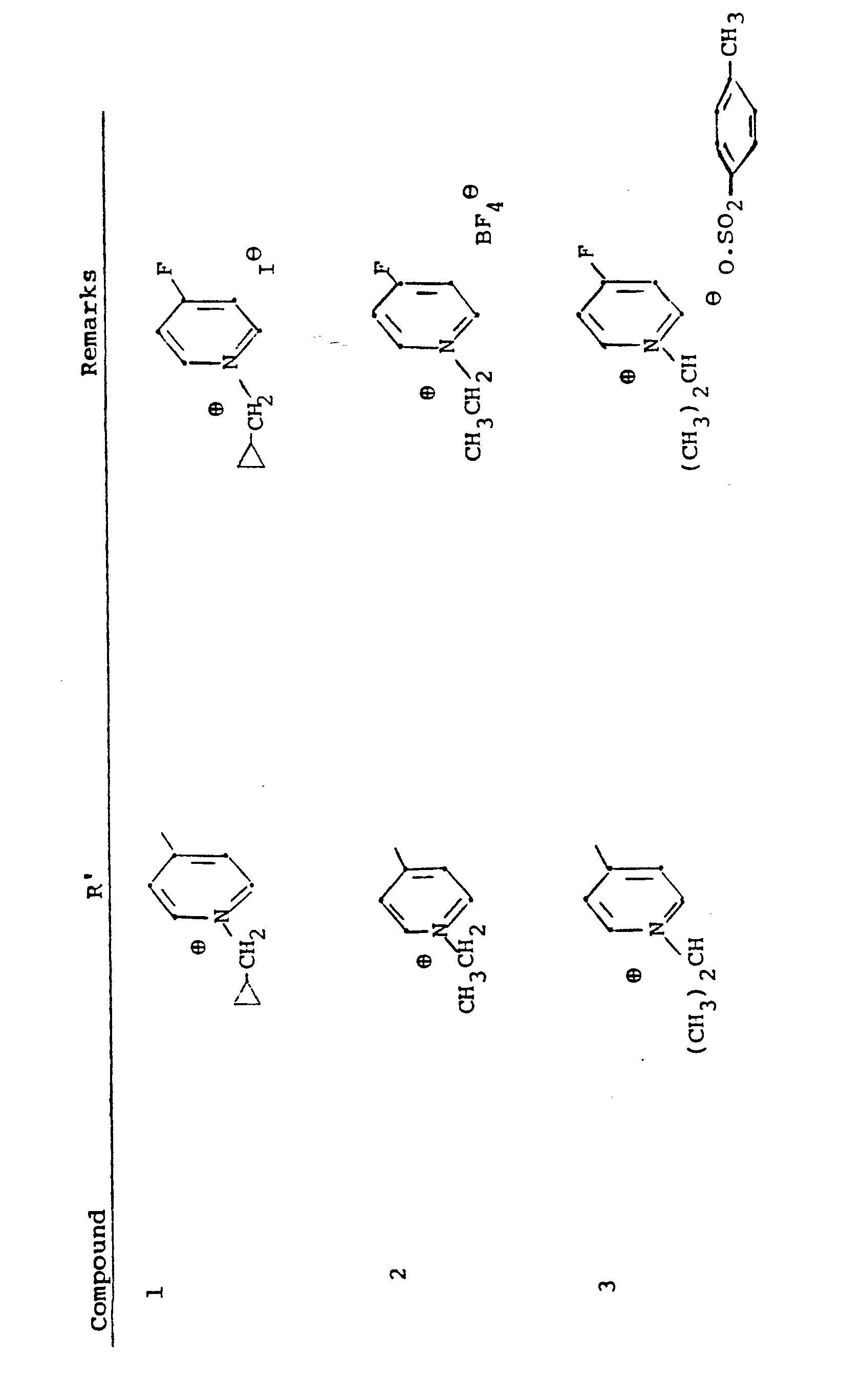
- The following examples, illustrate but do not limit the product, process, compositional or method of treatment aspects of the present invention. All reaction temperatures are in °C. Finally, attention is drawn to a-co-pending European Patent Application Serial Number 80102203.9 of John Hannah. Such pending Hannah application is directed to 7-N-heterocyclylcephalosporins which are in analogy to the thienamycin compounds of the present invention. Thus, to the extent that the identified application recites common procedures and starting materials, it is hereby incorporated by reference.
-

- IR: β-lactam at 1764 cm-1.
- U.V.:λmax (H2O) 198; 233; and 305 nm ( 25,180; 13,300; and 14,960 respectively).
- NMR (300 MHz) (D2O) : δ1.26 (d, 3H, J=6Hz, CH3-9); 3.04-3.27 (m, 4H, CH2-4 and CH2-11); 3.36 (dd, 1H, J=2.8 and 6Hz H6); 3.78 (t, 2H, J=6Hz, CH2-12); 3.82 (s, 3H, NCH3) ; 4.12 (m, 1H, H5); 4.22 (m, 1H, H9) ; 6.96 (dd, 1H, J=7 and 7Hz, H5,); 7.24 (d, 1H, J=9Hz, H3,) ; 7.96 (m, 2H, H4, and H6,) .

-

- IR.: β-lactam at 1761 cm .
- U.V.: λmax (H20) 198; 211; and 281 nm.
- NMR: (300 MHz) (D2O) : δ1.24 (d, 3H, J=6Hz, CH3-9); 2.97 - 3.31 (m, 5H, CH2-4 : CH2-11; and H6); 3.67 (m, CH2-12); 3.87 (s, 3H, NCH3 4.07 (m, 1H, H5); 4.18 (m, 1H, H9.)

-









-

- One such unit dosage form comprises a blend of 120 mg of 1 with 20 mg of lactose and 5 mg of magnesium stearate which is placed in a No. 3 gelatin capsule. Similarly, by employing more of the active ingredient and less lactose, other dosage forms can be prepared; should it be necessary to mix more than 145 mg. of ingredients together, larger capsules may be employed. Equivalently, compressed tablets and pills can be prepared. The following examples are further illustrative of the preparation of pharmaceutical formulations:

- The above ingredients are combined and the mixture is compressed into tablets, approximately 0.5 inch in diameter each weighing 800 mg.
Claims (5)
















Applications Claiming Priority (2)
| Application Number | Priority Date | Filing Date | Title |
|---|---|---|---|
| US43087 | 1979-05-29 | ||
| US06/043,087 US4376774A (en) | 1979-05-29 | 1979-05-29 | Antibiotic N-heterocyclyl thienamycin |
Publications (2)
| Publication Number | Publication Date |
|---|---|
| EP0021082A1 true EP0021082A1 (en) | 1981-01-07 |
| EP0021082B1 EP0021082B1 (en) | 1987-08-12 |
Family
ID=21925433
Family Applications (1)
| Application Number | Title | Priority Date | Filing Date |
|---|---|---|---|
| EP80102965A Expired EP0021082B1 (en) | 1979-05-29 | 1980-05-28 | N-heterocyclyl thienamycins, process for preparing and antibiotic pharmaceutical composition containing the same |
Country Status (8)
| Country | Link |
|---|---|
| US (1) | US4376774A (en) |
| EP (1) | EP0021082B1 (en) |
| JP (1) | JPS55160777A (en) |
| DE (1) | DE3072004D1 (en) |
| DK (1) | DK229980A (en) |
| ES (1) | ES491944A0 (en) |
| GR (1) | GR68521B (en) |
| PT (1) | PT71315B (en) |
Cited By (18)
| Publication number | Priority date | Publication date | Assignee | Title |
|---|---|---|---|---|
| EP0061231A1 (en) * | 1981-02-04 | 1982-09-29 | Beecham Group Plc | Process for the preparation of azabicyclo(3.2.0)-hept-2-ene derivatives |
| DE3312533A1 (en) * | 1982-04-09 | 1983-10-13 | Bristol-Myers Co., 10154 New York, N.Y. | CARBAPENEM DERIVATIVES, METHOD FOR THE PRODUCTION THEREOF AND PHARMACEUTICAL AGENTS THAT CONTAIN THESE COMPOUNDS |
| EP0093915A1 (en) * | 1982-05-10 | 1983-11-16 | Gruppo Lepetit S.P.A. | Novel beta-lactam derivatives |
| EP0024832B1 (en) * | 1979-08-10 | 1985-03-13 | Beecham Group Plc | Beta-lactam antibiotics, their preparation, pharmaceutical compositions containing them and their preparation |
| US4536335A (en) * | 1982-06-18 | 1985-08-20 | Bristol-Myers Company | Carbapenem antibiotics |
| EP0167139A1 (en) * | 1984-07-02 | 1986-01-08 | Merck & Co. Inc. | Carbapenems having an externally alkylated 2-quaternary pyridiniumalkylthio substituent |
| EP0170073A1 (en) * | 1984-07-02 | 1986-02-05 | Merck & Co. Inc. | 1-Methylcarbapenems having an externally alkylated mono- or bicyclic 2-quaternary heteroarylalkylthio substituent |
| US4640799A (en) * | 1982-06-18 | 1987-02-03 | Bristol-Myers Company | Carbapenem antibiotics |
| US4642341A (en) * | 1982-04-09 | 1987-02-10 | Bristol-Myers Company | Carbapenem antibiotics |
| US4665169A (en) * | 1985-09-11 | 1987-05-12 | Bristol-Myers Company | Carbapenem antibiotics |
| US4665170A (en) * | 1982-06-18 | 1987-05-12 | Bristol-Myers Company | Carbapenem antibiotics |
| FR2590574A1 (en) * | 1985-11-22 | 1987-05-29 | Bristol Myers Co | CARBAPENEMS SUBSTITUTED IN POSITION 2 BY A GROUP HETEROTHIOALKYLTHIO QUATERNIZED |
| US4683301A (en) * | 1982-04-08 | 1987-07-28 | Bristol-Myers Company | Carbapenem antibiotics |
| US4710568A (en) * | 1982-04-09 | 1987-12-01 | Bristol-Myers Company | Carbapenem antibiotics |
| US4732977A (en) * | 1982-09-28 | 1988-03-22 | Bristol Myers Company | Carbapenem antibiotics |
| EP0242134A3 (en) * | 1986-04-15 | 1988-05-04 | Merck & Co. Inc. | N-amino quaternized heteroarylium carbapenem antibacterial agents |
| US4746736A (en) * | 1982-09-28 | 1988-05-24 | Bristol-Myers Company | Carbapenem antibiotics |
| EP0184842A3 (en) * | 1984-12-13 | 1988-09-14 | Merck & Co. Inc. | Carbapenems having an internally or externally alkylated mono- or bicyclic 2-quaternary heteroarylalkyl heteromethyl substituent |
Families Citing this family (4)
| Publication number | Priority date | Publication date | Assignee | Title |
|---|---|---|---|---|
| ZA832412B (en) * | 1982-04-09 | 1983-12-28 | Bristol Myers Co | Carbapenem antibiotics |
| ZA836966B (en) * | 1982-09-28 | 1984-04-25 | Bristol Myers Co | Carbapenem antibiotics |
| ZM1484A1 (en) * | 1983-03-08 | 1984-12-21 | Bristol Myers Co | Carbapenem process |
| CA1285940C (en) * | 1984-07-02 | 1991-07-09 | Merck & Co., Inc. | Carbapenems having a 2-quaternary heteroarylalkylthio substituent |
Citations (3)
| Publication number | Priority date | Publication date | Assignee | Title |
|---|---|---|---|---|
| US3950357A (en) * | 1974-11-25 | 1976-04-13 | Merck & Co., Inc. | Antibiotics |
| DE2652676A1 (en) * | 1975-11-21 | 1977-06-02 | Merck & Co Inc | N-ALKYLATED DERIVATIVES OF THIENAMYCINE, THE PROCESS FOR THEIR MANUFACTURING AND MEDICINAL PRODUCTS CONTAINING THESE |
| EP0001627A1 (en) * | 1977-10-19 | 1979-05-02 | Merck & Co. Inc. | 3-Substituted-6-(1'hydroxethyl)-7-oxo-1-azabicyclo(3.2.0.)-hept-2-ene-2-carboxylic acid, its preparation and pharmaceutical compositions containing it |
Family Cites Families (4)
| Publication number | Priority date | Publication date | Assignee | Title |
|---|---|---|---|---|
| US4235920A (en) * | 1975-11-21 | 1980-11-25 | Merck & Co., Inc. | N-Alkylated derivatives of thienamycin |
| BE848545A (en) | 1975-11-21 | 1977-05-20 | N-METHYLENE DERIVATIVES SUBSTITUTES THIENAMYCINE, | |
| US4235917A (en) * | 1977-05-05 | 1980-11-25 | Merck & Co., Inc. | N-Alkyl-N-acyl derivatives of thienamycin |
| US4150145A (en) * | 1977-09-15 | 1979-04-17 | Merck & Co., Inc. | N-alkylated derivatives of thienamycin sulfoxide and sulfone |
-
1979
- 1979-05-29 US US06/043,087 patent/US4376774A/en not_active Expired - Lifetime
-
1980
- 1980-05-22 GR GR62026A patent/GR68521B/el unknown
- 1980-05-28 DE DE8080102965T patent/DE3072004D1/en not_active Expired
- 1980-05-28 EP EP80102965A patent/EP0021082B1/en not_active Expired
- 1980-05-28 ES ES491944A patent/ES491944A0/en active Granted
- 1980-05-28 DK DK229980A patent/DK229980A/en unknown
- 1980-05-28 PT PT71315A patent/PT71315B/en unknown
- 1980-05-29 JP JP7092180A patent/JPS55160777A/en active Granted
Patent Citations (3)
| Publication number | Priority date | Publication date | Assignee | Title |
|---|---|---|---|---|
| US3950357A (en) * | 1974-11-25 | 1976-04-13 | Merck & Co., Inc. | Antibiotics |
| DE2652676A1 (en) * | 1975-11-21 | 1977-06-02 | Merck & Co Inc | N-ALKYLATED DERIVATIVES OF THIENAMYCINE, THE PROCESS FOR THEIR MANUFACTURING AND MEDICINAL PRODUCTS CONTAINING THESE |
| EP0001627A1 (en) * | 1977-10-19 | 1979-05-02 | Merck & Co. Inc. | 3-Substituted-6-(1'hydroxethyl)-7-oxo-1-azabicyclo(3.2.0.)-hept-2-ene-2-carboxylic acid, its preparation and pharmaceutical compositions containing it |
Cited By (19)
| Publication number | Priority date | Publication date | Assignee | Title |
|---|---|---|---|---|
| EP0024832B1 (en) * | 1979-08-10 | 1985-03-13 | Beecham Group Plc | Beta-lactam antibiotics, their preparation, pharmaceutical compositions containing them and their preparation |
| EP0061231A1 (en) * | 1981-02-04 | 1982-09-29 | Beecham Group Plc | Process for the preparation of azabicyclo(3.2.0)-hept-2-ene derivatives |
| US4683301A (en) * | 1982-04-08 | 1987-07-28 | Bristol-Myers Company | Carbapenem antibiotics |
| DE3312533A1 (en) * | 1982-04-09 | 1983-10-13 | Bristol-Myers Co., 10154 New York, N.Y. | CARBAPENEM DERIVATIVES, METHOD FOR THE PRODUCTION THEREOF AND PHARMACEUTICAL AGENTS THAT CONTAIN THESE COMPOUNDS |
| FR2524890A1 (en) * | 1982-04-09 | 1983-10-14 | Bristol Myers Co | NOVEL CARBAPENEM DERIVATIVES, PHARMACEUTICAL COMPOSITIONS CONTAINING SAME, INTERMEDIATE COMPOUNDS FOR THEIR PREPARATION, AND PROCESSES FOR THEIR PRODUCTION |
| US4710568A (en) * | 1982-04-09 | 1987-12-01 | Bristol-Myers Company | Carbapenem antibiotics |
| US4642341A (en) * | 1982-04-09 | 1987-02-10 | Bristol-Myers Company | Carbapenem antibiotics |
| EP0093915A1 (en) * | 1982-05-10 | 1983-11-16 | Gruppo Lepetit S.P.A. | Novel beta-lactam derivatives |
| US4640799A (en) * | 1982-06-18 | 1987-02-03 | Bristol-Myers Company | Carbapenem antibiotics |
| US4665170A (en) * | 1982-06-18 | 1987-05-12 | Bristol-Myers Company | Carbapenem antibiotics |
| US4536335A (en) * | 1982-06-18 | 1985-08-20 | Bristol-Myers Company | Carbapenem antibiotics |
| US4732977A (en) * | 1982-09-28 | 1988-03-22 | Bristol Myers Company | Carbapenem antibiotics |
| US4746736A (en) * | 1982-09-28 | 1988-05-24 | Bristol-Myers Company | Carbapenem antibiotics |
| EP0170073A1 (en) * | 1984-07-02 | 1986-02-05 | Merck & Co. Inc. | 1-Methylcarbapenems having an externally alkylated mono- or bicyclic 2-quaternary heteroarylalkylthio substituent |
| EP0167139A1 (en) * | 1984-07-02 | 1986-01-08 | Merck & Co. Inc. | Carbapenems having an externally alkylated 2-quaternary pyridiniumalkylthio substituent |
| EP0184842A3 (en) * | 1984-12-13 | 1988-09-14 | Merck & Co. Inc. | Carbapenems having an internally or externally alkylated mono- or bicyclic 2-quaternary heteroarylalkyl heteromethyl substituent |
| US4665169A (en) * | 1985-09-11 | 1987-05-12 | Bristol-Myers Company | Carbapenem antibiotics |
| FR2590574A1 (en) * | 1985-11-22 | 1987-05-29 | Bristol Myers Co | CARBAPENEMS SUBSTITUTED IN POSITION 2 BY A GROUP HETEROTHIOALKYLTHIO QUATERNIZED |
| EP0242134A3 (en) * | 1986-04-15 | 1988-05-04 | Merck & Co. Inc. | N-amino quaternized heteroarylium carbapenem antibacterial agents |
Also Published As
| Publication number | Publication date |
|---|---|
| JPH0340030B2 (en) | 1991-06-17 |
| GR68521B (en) | 1982-01-11 |
| PT71315B (en) | 1981-09-21 |
| PT71315A (en) | 1980-06-01 |
| ES8105320A1 (en) | 1981-05-16 |
| ES491944A0 (en) | 1981-05-16 |
| JPS55160777A (en) | 1980-12-13 |
| DE3072004D1 (en) | 1987-09-17 |
| EP0021082B1 (en) | 1987-08-12 |
| US4376774A (en) | 1983-03-15 |
| DK229980A (en) | 1980-11-30 |
Similar Documents
| Publication | Publication Date | Title |
|---|---|---|
| EP0021082B1 (en) | N-heterocyclyl thienamycins, process for preparing and antibiotic pharmaceutical composition containing the same | |
| US4168314A (en) | 6-(1'-Hydroxyethyl)-2-aminoethylthio-pen-2-em-3-carboxylic acid | |
| EP0050334B1 (en) | 2-carbamimidoyl-6-substituted-1-carbadethiapen-2-em-3-carboxylic acids, a process for preparing and an antibiotic composition comprising the same | |
| EP0185315B1 (en) | Carbapenems and 1-methylcarbapenems having a 2-heteroaryliumaliphatic substituent | |
| JPH0222076B2 (en) | ||
| US4189493A (en) | N-heterocyclic derivatives of thienamycin | |
| EP0167139B1 (en) | Carbapenems having an externally alkylated 2-quaternary pyridiniumalkylthio substituent | |
| US4203902A (en) | Process for preparing 6- and 2-substituted-1-carbadethiapen-2-em-3-carboxylic acids | |
| US4123539A (en) | 6-Ethylpenicillanic acid | |
| EP0161541B1 (en) | 6-[1-Hydroxyethyl]-2-SR8-1-methyl-1-carba-dethiapen-2-em-3-carboxylic acids | |
| EP0018595B1 (en) | 7-n-heterocyclyl cephalosporins, a process for preparing and a pharmaceutical composition comprising the same | |
| US4374848A (en) | 6-(1-Hydroxyethyl)cyclonocardicin | |
| US4235922A (en) | 3-(2-Aminoethylthio)-6-ethyl-7-oxo-1-azabicyclo [3.2.0]hept-2-ene-2-carboxylic acid | |
| EP0235823B1 (en) | Carbapenem antibiotics, a process for preparing them and pharmaceutical compositions containing them | |
| US4880922A (en) | Carbapenems with quaternized heterothioalkylthio substitution at position 2 | |
| US4277482A (en) | 3-Substituted thio-6-amido-7-oxo-1-azabicyclo[3.2.0]-hept-2-ene-2-carboxylic acid s-oxides | |
| US4172895A (en) | 6-(1'-Hydroxyethyl)-2-aminoethylthio-oxapen-2-em-3-carboxylic acid | |
| US4650794A (en) | 6-(1-hydroxyethyl)-2-carbamimidoyl-pen-2-em-3-carboxylic acids | |
| US4428960A (en) | 3-Amino-6-substituted thio-1-azabicyclo(3.2.0)hept-6-en-2-one-7-carboxylic acids | |
| US4505915A (en) | 6-N-Heterocyclyl penicillins | |
| US4372965A (en) | 6-, 1- And 2-substituted-thio-1-carbadethiapen-2-em-3-carboxylic acid S-oxides | |
| US4283402A (en) | 6-N-Heterocyclyl-3-tetrazolyl-penicillins | |
| US4255424A (en) | 7-N-Heterocyclyl 1-oxa, 1-aza, and 1-carbadethiacephalosporins | |
| US4282219A (en) | 7-N-Heterocyclyl cephalosporins and antibiotic pharmaceutical compositions containing them | |
| GB2118183A (en) | Carbapenem antibiotics |
Legal Events
| Date | Code | Title | Description |
|---|---|---|---|
| PUAI | Public reference made under article 153(3) epc to a published international application that has entered the european phase |
Free format text: ORIGINAL CODE: 0009012 |
|
| AK | Designated contracting states |
Designated state(s): AT BE CH DE FR GB IT LU NL SE |
|
| ITCL | It: translation for ep claims filed |
Representative=s name: SOCIETA' ITALIANA BREVETTI S.P.A. |
|
| 17P | Request for examination filed |
Effective date: 19810706 |
|
| GRAA | (expected) grant |
Free format text: ORIGINAL CODE: 0009210 |
|
| AK | Designated contracting states |
Kind code of ref document: B1 Designated state(s): CH DE FR GB IT LI NL |
|
| REF | Corresponds to: |
Ref document number: 3072004 Country of ref document: DE Date of ref document: 19870917 |
|
| ET | Fr: translation filed | ||
| ITF | It: translation for a ep patent filed | ||
| PLBE | No opposition filed within time limit |
Free format text: ORIGINAL CODE: 0009261 |
|
| STAA | Information on the status of an ep patent application or granted ep patent |
Free format text: STATUS: NO OPPOSITION FILED WITHIN TIME LIMIT |
|
| 26N | No opposition filed | ||
| PGFP | Annual fee paid to national office [announced via postgrant information from national office to epo] |
Ref country code: CH Payment date: 19920303 Year of fee payment: 13 |
|
| PGFP | Annual fee paid to national office [announced via postgrant information from national office to epo] |
Ref country code: FR Payment date: 19920327 Year of fee payment: 13 |
|
| PGFP | Annual fee paid to national office [announced via postgrant information from national office to epo] |
Ref country code: GB Payment date: 19920401 Year of fee payment: 13 |
|
| PGFP | Annual fee paid to national office [announced via postgrant information from national office to epo] |
Ref country code: DE Payment date: 19920527 Year of fee payment: 13 |
|
| ITTA | It: last paid annual fee | ||
| PGFP | Annual fee paid to national office [announced via postgrant information from national office to epo] |
Ref country code: NL Payment date: 19920531 Year of fee payment: 13 |
|
| PG25 | Lapsed in a contracting state [announced via postgrant information from national office to epo] |
Ref country code: GB Effective date: 19930528 |
|
| PG25 | Lapsed in a contracting state [announced via postgrant information from national office to epo] |
Ref country code: LI Effective date: 19930531 Ref country code: CH Effective date: 19930531 |
|
| PG25 | Lapsed in a contracting state [announced via postgrant information from national office to epo] |
Ref country code: NL Effective date: 19931201 |
|
| NLV4 | Nl: lapsed or anulled due to non-payment of the annual fee | ||
| GBPC | Gb: european patent ceased through non-payment of renewal fee |
Effective date: 19930528 |
|
| PG25 | Lapsed in a contracting state [announced via postgrant information from national office to epo] |
Ref country code: FR Effective date: 19940131 |
|
| REG | Reference to a national code |
Ref country code: CH Ref legal event code: PL |
|
| PG25 | Lapsed in a contracting state [announced via postgrant information from national office to epo] |
Ref country code: DE Effective date: 19940201 |
|
| REG | Reference to a national code |
Ref country code: FR Ref legal event code: ST |
|
| EUG | Se: european patent has lapsed |
Ref document number: 80102965.3 Effective date: 19861210 |