EP0061231A1 - Process for the preparation of azabicyclo(3.2.0)-hept-2-ene derivatives - Google Patents
Process for the preparation of azabicyclo(3.2.0)-hept-2-ene derivatives Download PDFInfo
- Publication number
- EP0061231A1 EP0061231A1 EP82300408A EP82300408A EP0061231A1 EP 0061231 A1 EP0061231 A1 EP 0061231A1 EP 82300408 A EP82300408 A EP 82300408A EP 82300408 A EP82300408 A EP 82300408A EP 0061231 A1 EP0061231 A1 EP 0061231A1
- Authority
- EP
- European Patent Office
- Prior art keywords
- hept
- formula
- ene
- oxo
- azabicyclo
- Prior art date
- Legal status (The legal status is an assumption and is not a legal conclusion. Google has not performed a legal analysis and makes no representation as to the accuracy of the status listed.)
- Withdrawn
Links
- 238000000034 method Methods 0.000 title claims abstract description 30
- 238000002360 preparation method Methods 0.000 title claims abstract description 10
- 150000001875 compounds Chemical class 0.000 claims abstract description 48
- 150000003839 salts Chemical class 0.000 claims abstract description 31
- 150000002148 esters Chemical class 0.000 claims abstract description 30
- 125000003118 aryl group Chemical group 0.000 claims abstract description 25
- 125000001072 heteroaryl group Chemical group 0.000 claims abstract description 9
- 239000001257 hydrogen Substances 0.000 claims abstract description 7
- 229910052739 hydrogen Inorganic materials 0.000 claims abstract description 7
- 125000000962 organic group Chemical group 0.000 claims abstract description 3
- -1 phenylthio, sulfamoyl Chemical group 0.000 claims description 49
- 125000004435 hydrogen atom Chemical group [H]* 0.000 claims description 21
- 125000001997 phenyl group Chemical group [H]C1=C([H])C([H])=C(*)C([H])=C1[H] 0.000 claims description 18
- 125000003396 thiol group Chemical class [H]S* 0.000 claims description 17
- 238000006243 chemical reaction Methods 0.000 claims description 15
- 239000000203 mixture Substances 0.000 claims description 15
- 125000006503 p-nitrobenzyl group Chemical group [H]C1=C([H])C(=C([H])C([H])=C1[N+]([O-])=O)C([H])([H])* 0.000 claims description 14
- 125000004432 carbon atom Chemical group C* 0.000 claims description 13
- 238000001727 in vivo Methods 0.000 claims description 12
- 125000001424 substituent group Chemical group 0.000 claims description 12
- BWHMMNNQKKPAPP-UHFFFAOYSA-L potassium carbonate Chemical compound [K+].[K+].[O-]C([O-])=O BWHMMNNQKKPAPP-UHFFFAOYSA-L 0.000 claims description 8
- 125000000217 alkyl group Chemical group 0.000 claims description 7
- 125000000623 heterocyclic group Chemical group 0.000 claims description 7
- IJGRMHOSHXDMSA-UHFFFAOYSA-N Atomic nitrogen Chemical compound N#N IJGRMHOSHXDMSA-UHFFFAOYSA-N 0.000 claims description 6
- 125000001246 bromo group Chemical group Br* 0.000 claims description 6
- 125000003178 carboxy group Chemical group [H]OC(*)=O 0.000 claims description 6
- 125000005842 heteroatom Chemical group 0.000 claims description 5
- 229910052708 sodium Inorganic materials 0.000 claims description 5
- 239000011734 sodium Substances 0.000 claims description 5
- 125000000446 sulfanediyl group Chemical group *S* 0.000 claims description 5
- DGAQECJNVWCQMB-PUAWFVPOSA-M Ilexoside XXIX Chemical compound C[C@@H]1CC[C@@]2(CC[C@@]3(C(=CC[C@H]4[C@]3(CC[C@@H]5[C@@]4(CC[C@@H](C5(C)C)OS(=O)(=O)[O-])C)C)[C@@H]2[C@]1(C)O)C)C(=O)O[C@H]6[C@@H]([C@H]([C@@H]([C@H](O6)CO)O)O)O.[Na+] DGAQECJNVWCQMB-PUAWFVPOSA-M 0.000 claims description 4
- 125000003545 alkoxy group Chemical group 0.000 claims description 4
- 125000004429 atom Chemical group 0.000 claims description 4
- QVGXLLKOCUKJST-UHFFFAOYSA-N atomic oxygen Chemical compound [O] QVGXLLKOCUKJST-UHFFFAOYSA-N 0.000 claims description 4
- 125000001309 chloro group Chemical group Cl* 0.000 claims description 4
- 125000000753 cycloalkyl group Chemical group 0.000 claims description 4
- 239000001301 oxygen Substances 0.000 claims description 4
- 229910052760 oxygen Inorganic materials 0.000 claims description 4
- 229910000027 potassium carbonate Inorganic materials 0.000 claims description 4
- 159000000000 sodium salts Chemical class 0.000 claims description 4
- 125000004306 triazinyl group Chemical group 0.000 claims description 4
- NINIDFKCEFEMDL-UHFFFAOYSA-N Sulfur Chemical group [S] NINIDFKCEFEMDL-UHFFFAOYSA-N 0.000 claims description 3
- 125000003342 alkenyl group Chemical group 0.000 claims description 3
- 125000000304 alkynyl group Chemical group 0.000 claims description 3
- 125000005110 aryl thio group Chemical group 0.000 claims description 3
- 125000001589 carboacyl group Chemical group 0.000 claims description 3
- 125000004093 cyano group Chemical group *C#N 0.000 claims description 3
- 125000000449 nitro group Chemical group [O-][N+](*)=O 0.000 claims description 3
- 229910052757 nitrogen Inorganic materials 0.000 claims description 3
- 239000003444 phase transfer catalyst Substances 0.000 claims description 3
- 125000002924 primary amino group Chemical group [H]N([H])* 0.000 claims description 3
- DZLFLBLQUQXARW-UHFFFAOYSA-N tetrabutylammonium Chemical class CCCC[N+](CCCC)(CCCC)CCCC DZLFLBLQUQXARW-UHFFFAOYSA-N 0.000 claims description 3
- 125000000335 thiazolyl group Chemical group 0.000 claims description 3
- ULOOFNOOJRJUEP-FABXCBLPSA-N (4-nitrophenyl)methyl (5r,6s)-3-(4-chloro-6-methylpyrimidin-2-yl)sulfanyl-6-[(1s)-1-hydroxyethyl]-7-oxo-1-azabicyclo[3.2.0]hept-2-ene-2-carboxylate Chemical compound C([C@@H]1[C@H](C(N1C=1C(=O)OCC=2C=CC(=CC=2)[N+]([O-])=O)=O)[C@@H](O)C)C=1SC1=NC(C)=CC(Cl)=N1 ULOOFNOOJRJUEP-FABXCBLPSA-N 0.000 claims description 2
- LGPLCYPUWYJMPI-BBVRLYRLSA-N (5r,6r)-3-[(4,6-dimethoxy-1,3,5-triazin-2-yl)sulfanyl]-6-[(1s)-1-hydroxyethyl]-7-oxo-1-azabicyclo[3.2.0]hept-2-ene-2-carboxylic acid Chemical compound COC1=NC(OC)=NC(SC=2C[C@H]3N(C([C@H]3[C@H](C)O)=O)C=2C(O)=O)=N1 LGPLCYPUWYJMPI-BBVRLYRLSA-N 0.000 claims description 2
- AFVFQIVMOAPDHO-UHFFFAOYSA-N Methanesulfonic acid Chemical group CS(O)(=O)=O AFVFQIVMOAPDHO-UHFFFAOYSA-N 0.000 claims description 2
- 229910006069 SO3H Chemical group 0.000 claims description 2
- 125000005119 alkyl cycloalkyl group Chemical group 0.000 claims description 2
- 125000004414 alkyl thio group Chemical group 0.000 claims description 2
- 125000003710 aryl alkyl group Chemical group 0.000 claims description 2
- 125000005129 aryl carbonyl group Chemical group 0.000 claims description 2
- 125000004104 aryloxy group Chemical group 0.000 claims description 2
- 125000001164 benzothiazolyl group Chemical group S1C(=NC2=C1C=CC=C2)* 0.000 claims description 2
- 125000003917 carbamoyl group Chemical group [H]N([H])C(*)=O 0.000 claims description 2
- 125000001316 cycloalkyl alkyl group Chemical group 0.000 claims description 2
- 239000003937 drug carrier Substances 0.000 claims description 2
- 125000001153 fluoro group Chemical group F* 0.000 claims description 2
- 125000002541 furyl group Chemical group 0.000 claims description 2
- 125000004475 heteroaralkyl group Chemical group 0.000 claims description 2
- 125000004415 heterocyclylalkyl group Chemical group 0.000 claims description 2
- 125000002887 hydroxy group Chemical group [H]O* 0.000 claims description 2
- 125000002768 hydroxyalkyl group Chemical group 0.000 claims description 2
- 125000002883 imidazolyl group Chemical group 0.000 claims description 2
- 125000002971 oxazolyl group Chemical group 0.000 claims description 2
- 125000004076 pyridyl group Chemical group 0.000 claims description 2
- 125000000714 pyrimidinyl group Chemical group 0.000 claims description 2
- 125000000020 sulfo group Chemical group O=S(=O)([*])O[H] 0.000 claims description 2
- 125000001113 thiadiazolyl group Chemical group 0.000 claims description 2
- 125000004954 trialkylamino group Chemical group 0.000 claims description 2
- 125000002023 trifluoromethyl group Chemical group FC(F)(F)* 0.000 claims description 2
- HSMNBWTUCXOATP-UAKXVISKSA-N (4-nitrophenyl)methyl (5R,6R)-3-[(5-nitro-1,3-thiazol-2-yl)sulfanyl]-7-oxo-6-[(1S)-1-sulfooxyethyl]-1-azabicyclo[3.2.0]hept-2-ene-2-carboxylate Chemical compound OS(=O)(=O)O[C@@H](C)[C@H]1[C@H]2CC(=C(N2C1=O)C(=O)OCC1=CC=C(C=C1)[N+](=O)[O-])SC=1SC(=CN1)[N+](=O)[O-] HSMNBWTUCXOATP-UAKXVISKSA-N 0.000 claims 1
- YFUOJQAQDYDEGX-UAKXVISKSA-N (4-nitrophenyl)methyl (5r,6r)-6-[(1s)-1-hydroxyethyl]-3-[(5-nitro-1,3-thiazol-2-yl)sulfanyl]-7-oxo-1-azabicyclo[3.2.0]hept-2-ene-2-carboxylate Chemical compound C([C@@H]1[C@@H](C(N1C=1C(=O)OCC=2C=CC(=CC=2)[N+]([O-])=O)=O)[C@@H](O)C)C=1SC1=NC=C([N+]([O-])=O)S1 YFUOJQAQDYDEGX-UAKXVISKSA-N 0.000 claims 1
- RLYIKSPUZZBHSU-KWPFTWCOSA-N (5r,6r)-3-(5-aminopyrimidin-2-yl)sulfanyl-6-[(1s)-1-hydroxyethyl]-7-oxo-1-azabicyclo[3.2.0]hept-2-ene-2-carboxylic acid Chemical compound C([C@@H]1[C@@H](C(N1C=1C(O)=O)=O)[C@@H](O)C)C=1SC1=NC=C(N)C=N1 RLYIKSPUZZBHSU-KWPFTWCOSA-N 0.000 claims 1
- QPYWTEPJJSGXST-UHFFFAOYSA-N 2-chloro-4-methylbenzenesulfonyl bromide Chemical group ClC1=C(S(=O)(=O)Br)C=CC(=C1)C QPYWTEPJJSGXST-UHFFFAOYSA-N 0.000 claims 1
- 125000003785 benzimidazolyl group Chemical group N1=C(NC2=C1C=CC=C2)* 0.000 claims 1
- 125000004122 cyclic group Chemical group 0.000 claims 1
- UFHFLCQGNIYNRP-UHFFFAOYSA-N Hydrogen Chemical compound [H][H] UFHFLCQGNIYNRP-UHFFFAOYSA-N 0.000 abstract description 3
- HEDRZPFGACZZDS-UHFFFAOYSA-N Chloroform Chemical compound ClC(Cl)Cl HEDRZPFGACZZDS-UHFFFAOYSA-N 0.000 description 32
- 239000000243 solution Substances 0.000 description 27
- LFQSCWFLJHTTHZ-UHFFFAOYSA-N Ethanol Chemical compound CCO LFQSCWFLJHTTHZ-UHFFFAOYSA-N 0.000 description 24
- XEKOWRVHYACXOJ-UHFFFAOYSA-N Ethyl acetate Chemical compound CCOC(C)=O XEKOWRVHYACXOJ-UHFFFAOYSA-N 0.000 description 18
- ZMXDDKWLCZADIW-UHFFFAOYSA-N N,N-Dimethylformamide Chemical compound CN(C)C=O ZMXDDKWLCZADIW-UHFFFAOYSA-N 0.000 description 17
- CSNNHWWHGAXBCP-UHFFFAOYSA-L Magnesium sulfate Chemical compound [Mg+2].[O-][S+2]([O-])([O-])[O-] CSNNHWWHGAXBCP-UHFFFAOYSA-L 0.000 description 12
- XLYOFNOQVPJJNP-UHFFFAOYSA-N water Substances O XLYOFNOQVPJJNP-UHFFFAOYSA-N 0.000 description 12
- RYHBNJHYFVUHQT-UHFFFAOYSA-N 1,4-Dioxane Chemical compound C1COCCO1 RYHBNJHYFVUHQT-UHFFFAOYSA-N 0.000 description 11
- 239000002253 acid Substances 0.000 description 10
- 239000002904 solvent Substances 0.000 description 10
- HEMHJVSKTPXQMS-UHFFFAOYSA-M Sodium hydroxide Chemical compound [OH-].[Na+] HEMHJVSKTPXQMS-UHFFFAOYSA-M 0.000 description 9
- 239000007787 solid Substances 0.000 description 9
- UUFQTNFCRMXOAE-UHFFFAOYSA-N 1-methylmethylene Chemical compound C[CH] UUFQTNFCRMXOAE-UHFFFAOYSA-N 0.000 description 8
- YMWUJEATGCHHMB-UHFFFAOYSA-N Dichloromethane Chemical compound ClCCl YMWUJEATGCHHMB-UHFFFAOYSA-N 0.000 description 8
- 229910052943 magnesium sulfate Inorganic materials 0.000 description 8
- VYPSYNLAJGMNEJ-UHFFFAOYSA-N Silicium dioxide Chemical compound O=[Si]=O VYPSYNLAJGMNEJ-UHFFFAOYSA-N 0.000 description 7
- 125000002496 methyl group Chemical group [H]C([H])([H])* 0.000 description 7
- IJFZFEDXRGAAMV-WRWXZLMKSA-N (4-nitrophenyl)methyl (5r,6r)-3-[(e)-2-acetamidoethenyl]sulfanyl-6-[(1s)-1-hydroxyethyl]-7-oxo-1-azabicyclo[3.2.0]hept-2-ene-2-carboxylate Chemical compound C([C@@H]1[C@@H](C(N11)=O)[C@@H](O)C)C(S\C=C\NC(C)=O)=C1C(=O)OCC1=CC=C([N+]([O-])=O)C=C1 IJFZFEDXRGAAMV-WRWXZLMKSA-N 0.000 description 6
- 125000004178 (C1-C4) alkyl group Chemical group 0.000 description 6
- HEDRZPFGACZZDS-MICDWDOJSA-N Trichloro(2H)methane Chemical compound [2H]C(Cl)(Cl)Cl HEDRZPFGACZZDS-MICDWDOJSA-N 0.000 description 6
- RTZKZFJDLAIYFH-UHFFFAOYSA-N ether Substances CCOCC RTZKZFJDLAIYFH-UHFFFAOYSA-N 0.000 description 6
- 238000001914 filtration Methods 0.000 description 6
- 230000007062 hydrolysis Effects 0.000 description 6
- 238000006460 hydrolysis reaction Methods 0.000 description 6
- 239000012044 organic layer Substances 0.000 description 6
- 239000000047 product Substances 0.000 description 6
- KDLHZDBZIXYQEI-UHFFFAOYSA-N Palladium Chemical compound [Pd] KDLHZDBZIXYQEI-UHFFFAOYSA-N 0.000 description 5
- 239000006260 foam Substances 0.000 description 5
- 125000000956 methoxy group Chemical group [H]C([H])([H])O* 0.000 description 5
- 239000000741 silica gel Substances 0.000 description 5
- 229910002027 silica gel Inorganic materials 0.000 description 5
- 229960001866 silicon dioxide Drugs 0.000 description 5
- 0 *C1*CCCC1 Chemical compound *C1*CCCC1 0.000 description 4
- CSCPPACGZOOCGX-UHFFFAOYSA-N Acetone Chemical compound CC(C)=O CSCPPACGZOOCGX-UHFFFAOYSA-N 0.000 description 4
- FAPWRFPIFSIZLT-UHFFFAOYSA-M Sodium chloride Chemical class [Na+].[Cl-] FAPWRFPIFSIZLT-UHFFFAOYSA-M 0.000 description 4
- 239000007864 aqueous solution Substances 0.000 description 4
- 238000010828 elution Methods 0.000 description 4
- 238000001704 evaporation Methods 0.000 description 4
- 230000008020 evaporation Effects 0.000 description 4
- 238000007327 hydrogenolysis reaction Methods 0.000 description 4
- 235000019341 magnesium sulphate Nutrition 0.000 description 4
- VBTQNRFWXBXZQR-UHFFFAOYSA-N n-bromoacetamide Chemical compound CC(=O)NBr VBTQNRFWXBXZQR-UHFFFAOYSA-N 0.000 description 4
- 150000003242 quaternary ammonium salts Chemical class 0.000 description 4
- 241001465754 Metazoa Species 0.000 description 3
- CZPWVGJYEJSRLH-UHFFFAOYSA-N Pyrimidine Chemical compound C1=CN=CN=C1 CZPWVGJYEJSRLH-UHFFFAOYSA-N 0.000 description 3
- ZMANZCXQSJIPKH-UHFFFAOYSA-N Triethylamine Chemical compound CCN(CC)CC ZMANZCXQSJIPKH-UHFFFAOYSA-N 0.000 description 3
- 241001342522 Vampyrum spectrum Species 0.000 description 3
- 239000002585 base Substances 0.000 description 3
- 239000012267 brine Substances 0.000 description 3
- 125000001495 ethyl group Chemical group [H]C([H])([H])C([H])([H])* 0.000 description 3
- 125000000636 p-nitrophenyl group Chemical group [H]C1=C([H])C(=C([H])C([H])=C1*)[N+]([O-])=O 0.000 description 3
- 239000008363 phosphate buffer Substances 0.000 description 3
- 125000005633 phthalidyl group Chemical group 0.000 description 3
- FVAUCKIRQBBSSJ-UHFFFAOYSA-M sodium iodide Chemical compound [Na+].[I-] FVAUCKIRQBBSSJ-UHFFFAOYSA-M 0.000 description 3
- HPALAKNZSZLMCH-UHFFFAOYSA-M sodium;chloride;hydrate Chemical compound O.[Na+].[Cl-] HPALAKNZSZLMCH-UHFFFAOYSA-M 0.000 description 3
- 125000004169 (C1-C6) alkyl group Chemical group 0.000 description 2
- BSIMZHVOQZIAOY-SCSAIBSYSA-N 1-carbapenem-3-carboxylic acid Chemical class OC(=O)C1=CC[C@@H]2CC(=O)N12 BSIMZHVOQZIAOY-SCSAIBSYSA-N 0.000 description 2
- ANIJFZVZXZQFDH-UHFFFAOYSA-N 2-bromo-5-nitro-1,3-thiazole Chemical compound [O-][N+](=O)C1=CN=C(Br)S1 ANIJFZVZXZQFDH-UHFFFAOYSA-N 0.000 description 2
- KKODFXJVTSZBIP-UHFFFAOYSA-N 2-chloro-4,6-dimethoxy-1h-triazine Chemical compound COC1=CC(OC)=NN(Cl)N1 KKODFXJVTSZBIP-UHFFFAOYSA-N 0.000 description 2
- OFCBNMYNAHUDGE-UHFFFAOYSA-N 2-chloro-5-nitropyrimidine Chemical compound [O-][N+](=O)C1=CN=C(Cl)N=C1 OFCBNMYNAHUDGE-UHFFFAOYSA-N 0.000 description 2
- WKBOTKDWSSQWDR-UHFFFAOYSA-N Bromine atom Chemical group [Br] WKBOTKDWSSQWDR-UHFFFAOYSA-N 0.000 description 2
- KZBUYRJDOAKODT-UHFFFAOYSA-N Chlorine Chemical compound ClCl KZBUYRJDOAKODT-UHFFFAOYSA-N 0.000 description 2
- PXGOKWXKJXAPGV-UHFFFAOYSA-N Fluorine Chemical compound FF PXGOKWXKJXAPGV-UHFFFAOYSA-N 0.000 description 2
- ZMXDDKWLCZADIW-YYWVXINBSA-N N,N-dimethylformamide-d7 Chemical compound [2H]C(=O)N(C([2H])([2H])[2H])C([2H])([2H])[2H] ZMXDDKWLCZADIW-YYWVXINBSA-N 0.000 description 2
- WYURNTSHIVDZCO-UHFFFAOYSA-N Tetrahydrofuran Chemical compound C1CCOC1 WYURNTSHIVDZCO-UHFFFAOYSA-N 0.000 description 2
- 229910052783 alkali metal Inorganic materials 0.000 description 2
- 229910052784 alkaline earth metal Inorganic materials 0.000 description 2
- 125000001797 benzyl group Chemical group [H]C1=C([H])C([H])=C(C([H])=C1[H])C([H])([H])* 0.000 description 2
- 239000007853 buffer solution Substances 0.000 description 2
- 150000001732 carboxylic acid derivatives Chemical class 0.000 description 2
- 239000000460 chlorine Substances 0.000 description 2
- 229910052801 chlorine Inorganic materials 0.000 description 2
- UXTMROKLAAOEQO-UHFFFAOYSA-N chloroform;ethanol Chemical compound CCO.ClC(Cl)Cl UXTMROKLAAOEQO-UHFFFAOYSA-N 0.000 description 2
- 239000012043 crude product Substances 0.000 description 2
- 238000005868 electrolysis reaction Methods 0.000 description 2
- 125000004185 ester group Chemical group 0.000 description 2
- 239000011737 fluorine Substances 0.000 description 2
- 229910052731 fluorine Inorganic materials 0.000 description 2
- 208000015181 infectious disease Diseases 0.000 description 2
- HQKMJHAJHXVSDF-UHFFFAOYSA-L magnesium stearate Chemical compound [Mg+2].CCCCCCCCCCCCCCCCCC([O-])=O.CCCCCCCCCCCCCCCCCC([O-])=O HQKMJHAJHXVSDF-UHFFFAOYSA-L 0.000 description 2
- 125000004184 methoxymethyl group Chemical group [H]C([H])([H])OC([H])([H])* 0.000 description 2
- 125000004123 n-propyl group Chemical group [H]C([H])([H])C([H])([H])C([H])([H])* 0.000 description 2
- 239000012074 organic phase Substances 0.000 description 2
- 238000006303 photolysis reaction Methods 0.000 description 2
- 230000015843 photosynthesis, light reaction Effects 0.000 description 2
- 150000003254 radicals Chemical class 0.000 description 2
- 125000000999 tert-butyl group Chemical group [H]C([H])([H])C(*)(C([H])([H])[H])C([H])([H])[H] 0.000 description 2
- 125000000391 vinyl group Chemical group [H]C([*])=C([H])[H] 0.000 description 2
- 238000005406 washing Methods 0.000 description 2
- AYTQJNQOSPNBSC-ZBINZKHDSA-N (4-nitrophenyl)methyl (5R,6R)-3-[(4,6-dimethoxy-1,3,5-triazin-2-yl)sulfanyl]-6-[(1S)-1-hydroxyethyl]-7-oxo-1-azabicyclo[3.2.0]hept-2-ene-2-carboxylate Chemical compound COC1=NC(=NC(=N1)OC)SC1=C(N2C([C@H]([C@H]2C1)[C@H](C)O)=O)C(=O)OCC1=CC=C(C=C1)[N+](=O)[O-] AYTQJNQOSPNBSC-ZBINZKHDSA-N 0.000 description 1
- 125000000229 (C1-C4)alkoxy group Chemical group 0.000 description 1
- 125000004191 (C1-C6) alkoxy group Chemical group 0.000 description 1
- 125000006700 (C1-C6) alkylthio group Chemical group 0.000 description 1
- JYEUMXHLPRZUAT-UHFFFAOYSA-N 1,2,3-triazine Chemical group C1=CN=NN=C1 JYEUMXHLPRZUAT-UHFFFAOYSA-N 0.000 description 1
- RXYPXQSKLGGKOL-UHFFFAOYSA-N 1,4-dimethylpiperazine Chemical compound CN1CCN(C)CC1 RXYPXQSKLGGKOL-UHFFFAOYSA-N 0.000 description 1
- 125000000453 2,2,2-trichloroethyl group Chemical group [H]C([H])(*)C(Cl)(Cl)Cl 0.000 description 1
- BTLKROSJMNFSQZ-UHFFFAOYSA-N 2,4-dichloro-6-methylpyrimidine Chemical compound CC1=CC(Cl)=NC(Cl)=N1 BTLKROSJMNFSQZ-UHFFFAOYSA-N 0.000 description 1
- HIXDQWDOVZUNNA-UHFFFAOYSA-N 2-(3,4-dimethoxyphenyl)-5-hydroxy-7-methoxychromen-4-one Chemical compound C=1C(OC)=CC(O)=C(C(C=2)=O)C=1OC=2C1=CC=C(OC)C(OC)=C1 HIXDQWDOVZUNNA-UHFFFAOYSA-N 0.000 description 1
- BWSQKOKULIALEW-UHFFFAOYSA-N 2-[2-[4-fluoro-3-(trifluoromethyl)phenyl]-3-[2-(piperidin-3-ylamino)pyrimidin-4-yl]imidazol-4-yl]acetonitrile Chemical compound FC1=C(C=C(C=C1)C=1N(C(=CN=1)CC#N)C1=NC(=NC=C1)NC1CNCCC1)C(F)(F)F BWSQKOKULIALEW-UHFFFAOYSA-N 0.000 description 1
- BAZVFQBTJPBRTJ-UHFFFAOYSA-N 2-chloro-5-nitropyridine Chemical compound [O-][N+](=O)C1=CC=C(Cl)N=C1 BAZVFQBTJPBRTJ-UHFFFAOYSA-N 0.000 description 1
- FYZUENZXIZCLAZ-UHFFFAOYSA-N 2-methylhept-2-enoic acid Chemical compound CCCCC=C(C)C(O)=O FYZUENZXIZCLAZ-UHFFFAOYSA-N 0.000 description 1
- CLMSHAWYULIVFQ-UHFFFAOYSA-N 3-bromo-3h-2-benzofuran-1-one Chemical compound C1=CC=C2C(Br)OC(=O)C2=C1 CLMSHAWYULIVFQ-UHFFFAOYSA-N 0.000 description 1
- 125000004800 4-bromophenyl group Chemical group [H]C1=C([H])C(*)=C([H])C([H])=C1Br 0.000 description 1
- 125000004172 4-methoxyphenyl group Chemical group [H]C1=C([H])C(OC([H])([H])[H])=C([H])C([H])=C1* 0.000 description 1
- 241000416162 Astragalus gummifer Species 0.000 description 1
- 208000035143 Bacterial infection Diseases 0.000 description 1
- BVKZGUZCCUSVTD-UHFFFAOYSA-M Bicarbonate Chemical compound OC([O-])=O BVKZGUZCCUSVTD-UHFFFAOYSA-M 0.000 description 1
- 241000283690 Bos taurus Species 0.000 description 1
- 125000000882 C2-C6 alkenyl group Chemical group 0.000 description 1
- BVKZGUZCCUSVTD-UHFFFAOYSA-L Carbonate Chemical compound [O-]C([O-])=O BVKZGUZCCUSVTD-UHFFFAOYSA-L 0.000 description 1
- FBPFZTCFMRRESA-FSIIMWSLSA-N D-Glucitol Natural products OC[C@H](O)[C@H](O)[C@@H](O)[C@H](O)CO FBPFZTCFMRRESA-FSIIMWSLSA-N 0.000 description 1
- FBPFZTCFMRRESA-JGWLITMVSA-N D-glucitol Chemical compound OC[C@H](O)[C@@H](O)[C@H](O)[C@H](O)CO FBPFZTCFMRRESA-JGWLITMVSA-N 0.000 description 1
- XTHFKEDIFFGKHM-UHFFFAOYSA-N Dimethoxyethane Chemical compound COCCOC XTHFKEDIFFGKHM-UHFFFAOYSA-N 0.000 description 1
- 108010010803 Gelatin Proteins 0.000 description 1
- GUBGYTABKSRVRQ-QKKXKWKRSA-N Lactose Natural products OC[C@H]1O[C@@H](O[C@H]2[C@H](O)[C@@H](O)C(O)O[C@@H]2CO)[C@H](O)[C@@H](O)[C@H]1O GUBGYTABKSRVRQ-QKKXKWKRSA-N 0.000 description 1
- 235000010643 Leucaena leucocephala Nutrition 0.000 description 1
- 240000007472 Leucaena leucocephala Species 0.000 description 1
- WHXSMMKQMYFTQS-UHFFFAOYSA-N Lithium Chemical compound [Li] WHXSMMKQMYFTQS-UHFFFAOYSA-N 0.000 description 1
- 241000124008 Mammalia Species 0.000 description 1
- HTLZVHNRZJPSMI-UHFFFAOYSA-N N-ethylpiperidine Chemical compound CCN1CCCCC1 HTLZVHNRZJPSMI-UHFFFAOYSA-N 0.000 description 1
- OAICVXFJPJFONN-UHFFFAOYSA-N Phosphorus Chemical compound [P] OAICVXFJPJFONN-UHFFFAOYSA-N 0.000 description 1
- ZLMJMSJWJFRBEC-UHFFFAOYSA-N Potassium Chemical compound [K] ZLMJMSJWJFRBEC-UHFFFAOYSA-N 0.000 description 1
- JUJWROOIHBZHMG-UHFFFAOYSA-N Pyridine Chemical group C1=CC=NC=C1 JUJWROOIHBZHMG-UHFFFAOYSA-N 0.000 description 1
- DBMJMQXJHONAFJ-UHFFFAOYSA-M Sodium laurylsulphate Chemical compound [Na+].CCCCCCCCCCCCOS([O-])(=O)=O DBMJMQXJHONAFJ-UHFFFAOYSA-M 0.000 description 1
- 239000004141 Sodium laurylsulphate Substances 0.000 description 1
- 229920002472 Starch Polymers 0.000 description 1
- CZMRCDWAGMRECN-UGDNZRGBSA-N Sucrose Chemical compound O[C@H]1[C@H](O)[C@@H](CO)O[C@@]1(CO)O[C@@H]1[C@H](O)[C@@H](O)[C@H](O)[C@@H](CO)O1 CZMRCDWAGMRECN-UGDNZRGBSA-N 0.000 description 1
- 229930006000 Sucrose Natural products 0.000 description 1
- 239000005864 Sulphur Substances 0.000 description 1
- 229920001615 Tragacanth Polymers 0.000 description 1
- XAKBSHICSHRJCL-UHFFFAOYSA-N [CH2]C(=O)C1=CC=CC=C1 Chemical group [CH2]C(=O)C1=CC=CC=C1 XAKBSHICSHRJCL-UHFFFAOYSA-N 0.000 description 1
- DGYIJVNZSDYBOE-UHFFFAOYSA-N [CH2]C1=CC=NC=C1 Chemical group [CH2]C1=CC=NC=C1 DGYIJVNZSDYBOE-UHFFFAOYSA-N 0.000 description 1
- 125000001539 acetonyl group Chemical group [H]C([H])([H])C(=O)C([H])([H])* 0.000 description 1
- 125000005073 adamantyl group Chemical group C12(CC3CC(CC(C1)C3)C2)* 0.000 description 1
- 239000003513 alkali Substances 0.000 description 1
- 150000001342 alkaline earth metals Chemical class 0.000 description 1
- 125000005236 alkanoylamino group Chemical group 0.000 description 1
- 125000003282 alkyl amino group Chemical group 0.000 description 1
- 150000008064 anhydrides Chemical class 0.000 description 1
- 239000003242 anti bacterial agent Substances 0.000 description 1
- 230000000844 anti-bacterial effect Effects 0.000 description 1
- 229940088710 antibiotic agent Drugs 0.000 description 1
- 208000022362 bacterial infectious disease Diseases 0.000 description 1
- DLNWMWYCSOQYSQ-UHFFFAOYSA-M benzyl-hexadecyl-dimethylazanium;bromide Chemical compound [Br-].CCCCCCCCCCCCCCCC[N+](C)(C)CC1=CC=CC=C1 DLNWMWYCSOQYSQ-UHFFFAOYSA-M 0.000 description 1
- 125000003460 beta-lactamyl group Chemical group 0.000 description 1
- 125000002619 bicyclic group Chemical group 0.000 description 1
- 239000011230 binding agent Substances 0.000 description 1
- 230000003115 biocidal effect Effects 0.000 description 1
- 238000010170 biological method Methods 0.000 description 1
- 210000001124 body fluid Anatomy 0.000 description 1
- 239000010839 body fluid Substances 0.000 description 1
- 239000011575 calcium Substances 0.000 description 1
- 239000001506 calcium phosphate Substances 0.000 description 1
- 229910000389 calcium phosphate Inorganic materials 0.000 description 1
- 235000011010 calcium phosphates Nutrition 0.000 description 1
- 239000002775 capsule Substances 0.000 description 1
- 229940041011 carbapenems Drugs 0.000 description 1
- 239000000969 carrier Substances 0.000 description 1
- 230000015556 catabolic process Effects 0.000 description 1
- 239000003054 catalyst Substances 0.000 description 1
- UOCJDOLVGGIYIQ-PBFPGSCMSA-N cefatrizine Chemical group S([C@@H]1[C@@H](C(N1C=1C(O)=O)=O)NC(=O)[C@H](N)C=2C=CC(O)=CC=2)CC=1CSC=1C=NNN=1 UOCJDOLVGGIYIQ-PBFPGSCMSA-N 0.000 description 1
- SXPWTBGAZSPLHA-UHFFFAOYSA-M cetalkonium chloride Chemical compound [Cl-].CCCCCCCCCCCCCCCC[N+](C)(C)CC1=CC=CC=C1 SXPWTBGAZSPLHA-UHFFFAOYSA-M 0.000 description 1
- 229960000228 cetalkonium chloride Drugs 0.000 description 1
- 238000001311 chemical methods and process Methods 0.000 description 1
- 239000003795 chemical substances by application Substances 0.000 description 1
- 125000000068 chlorophenyl group Chemical group 0.000 description 1
- 239000003086 colorant Substances 0.000 description 1
- 238000007796 conventional method Methods 0.000 description 1
- 238000002425 crystallisation Methods 0.000 description 1
- 238000006731 degradation reaction Methods 0.000 description 1
- 239000003085 diluting agent Substances 0.000 description 1
- 239000012971 dimethylpiperazine Substances 0.000 description 1
- 125000005982 diphenylmethyl group Chemical group [H]C1=C([H])C([H])=C(C([H])=C1[H])C([H])(*)C1=C([H])C([H])=C([H])C([H])=C1[H] 0.000 description 1
- KCIDZIIHRGYJAE-YGFYJFDDSA-L dipotassium;[(2r,3r,4s,5r,6r)-3,4,5-trihydroxy-6-(hydroxymethyl)oxan-2-yl] phosphate Chemical class [K+].[K+].OC[C@H]1O[C@H](OP([O-])([O-])=O)[C@H](O)[C@@H](O)[C@H]1O KCIDZIIHRGYJAE-YGFYJFDDSA-L 0.000 description 1
- 239000007884 disintegrant Substances 0.000 description 1
- 239000003814 drug Substances 0.000 description 1
- 230000032050 esterification Effects 0.000 description 1
- 238000005886 esterification reaction Methods 0.000 description 1
- 125000001301 ethoxy group Chemical group [H]C([H])([H])C([H])([H])O* 0.000 description 1
- 239000000706 filtrate Substances 0.000 description 1
- 239000000796 flavoring agent Substances 0.000 description 1
- 235000013355 food flavoring agent Nutrition 0.000 description 1
- 229920000159 gelatin Polymers 0.000 description 1
- 239000008273 gelatin Substances 0.000 description 1
- 235000019322 gelatine Nutrition 0.000 description 1
- 235000011852 gelatine desserts Nutrition 0.000 description 1
- 150000004820 halides Chemical class 0.000 description 1
- 125000005843 halogen group Chemical group 0.000 description 1
- GNOIPBMMFNIUFM-UHFFFAOYSA-N hexamethylphosphoric triamide Chemical compound CN(C)P(=O)(N(C)C)N(C)C GNOIPBMMFNIUFM-UHFFFAOYSA-N 0.000 description 1
- 238000005984 hydrogenation reaction Methods 0.000 description 1
- 238000002347 injection Methods 0.000 description 1
- 239000007924 injection Substances 0.000 description 1
- 238000001990 intravenous administration Methods 0.000 description 1
- 239000008101 lactose Substances 0.000 description 1
- 239000010410 layer Substances 0.000 description 1
- 229910052744 lithium Inorganic materials 0.000 description 1
- 229910003002 lithium salt Inorganic materials 0.000 description 1
- 159000000002 lithium salts Chemical class 0.000 description 1
- 239000000314 lubricant Substances 0.000 description 1
- 235000019359 magnesium stearate Nutrition 0.000 description 1
- 208000004396 mastitis Diseases 0.000 description 1
- 229910052751 metal Inorganic materials 0.000 description 1
- 239000002184 metal Substances 0.000 description 1
- 125000004433 nitrogen atom Chemical group N* 0.000 description 1
- 125000006501 nitrophenyl group Chemical group 0.000 description 1
- 125000001181 organosilyl group Chemical group [SiH3]* 0.000 description 1
- 229910052763 palladium Inorganic materials 0.000 description 1
- 238000007911 parenteral administration Methods 0.000 description 1
- 239000008194 pharmaceutical composition Substances 0.000 description 1
- 239000012071 phase Substances 0.000 description 1
- 239000008055 phosphate buffer solution Substances 0.000 description 1
- 229910052698 phosphorus Inorganic materials 0.000 description 1
- 239000011574 phosphorus Substances 0.000 description 1
- 239000003495 polar organic solvent Substances 0.000 description 1
- 239000001253 polyvinylpolypyrrolidone Substances 0.000 description 1
- 235000013809 polyvinylpolypyrrolidone Nutrition 0.000 description 1
- 229920000523 polyvinylpolypyrrolidone Polymers 0.000 description 1
- 239000001267 polyvinylpyrrolidone Substances 0.000 description 1
- 229920000036 polyvinylpyrrolidone Polymers 0.000 description 1
- 235000013855 polyvinylpyrrolidone Nutrition 0.000 description 1
- 229910052700 potassium Inorganic materials 0.000 description 1
- 239000011591 potassium Substances 0.000 description 1
- 159000000001 potassium salts Chemical class 0.000 description 1
- 229920001592 potato starch Polymers 0.000 description 1
- 239000003755 preservative agent Substances 0.000 description 1
- 210000002345 respiratory system Anatomy 0.000 description 1
- 125000006413 ring segment Chemical group 0.000 description 1
- 229910052709 silver Inorganic materials 0.000 description 1
- 239000004332 silver Substances 0.000 description 1
- 235000009518 sodium iodide Nutrition 0.000 description 1
- 235000019333 sodium laurylsulphate Nutrition 0.000 description 1
- 229910001495 sodium tetrafluoroborate Inorganic materials 0.000 description 1
- 210000004872 soft tissue Anatomy 0.000 description 1
- 235000010356 sorbitol Nutrition 0.000 description 1
- 239000000600 sorbitol Substances 0.000 description 1
- 125000003638 stannyl group Chemical group [H][Sn]([H])([H])* 0.000 description 1
- 239000008107 starch Substances 0.000 description 1
- 235000019698 starch Nutrition 0.000 description 1
- 238000003756 stirring Methods 0.000 description 1
- 239000000126 substance Substances 0.000 description 1
- 239000005720 sucrose Substances 0.000 description 1
- 239000000725 suspension Substances 0.000 description 1
- 125000001981 tert-butyldimethylsilyl group Chemical group [H]C([H])([H])[Si]([H])(C([H])([H])[H])[*]C(C([H])([H])[H])(C([H])([H])[H])C([H])([H])[H] 0.000 description 1
- 125000000037 tert-butyldiphenylsilyl group Chemical group [H]C1=C([H])C([H])=C([H])C([H])=C1[Si]([H])([*]C(C([H])([H])[H])(C([H])([H])[H])C([H])([H])[H])C1=C([H])C([H])=C([H])C([H])=C1[H] 0.000 description 1
- JRMUNVKIHCOMHV-UHFFFAOYSA-M tetrabutylammonium bromide Chemical compound [Br-].CCCC[N+](CCCC)(CCCC)CCCC JRMUNVKIHCOMHV-UHFFFAOYSA-M 0.000 description 1
- YLQBMQCUIZJEEH-UHFFFAOYSA-N tetrahydrofuran Natural products C=1C=COC=1 YLQBMQCUIZJEEH-UHFFFAOYSA-N 0.000 description 1
- 125000004187 tetrahydropyran-2-yl group Chemical group [H]C1([H])OC([H])(*)C([H])([H])C([H])([H])C1([H])[H] 0.000 description 1
- 229940124597 therapeutic agent Drugs 0.000 description 1
- JOXIMZWYDAKGHI-UHFFFAOYSA-N toluene-4-sulfonic acid Chemical compound CC1=CC=C(S(O)(=O)=O)C=C1 JOXIMZWYDAKGHI-UHFFFAOYSA-N 0.000 description 1
- 238000011200 topical administration Methods 0.000 description 1
- 230000000699 topical effect Effects 0.000 description 1
- 235000010487 tragacanth Nutrition 0.000 description 1
- 239000000196 tragacanth Substances 0.000 description 1
- 229940116362 tragacanth Drugs 0.000 description 1
- QORWJWZARLRLPR-UHFFFAOYSA-H tricalcium bis(phosphate) Chemical compound [Ca+2].[Ca+2].[Ca+2].[O-]P([O-])([O-])=O.[O-]P([O-])([O-])=O QORWJWZARLRLPR-UHFFFAOYSA-H 0.000 description 1
- 125000000026 trimethylsilyl group Chemical group [H]C([H])([H])[Si]([*])(C([H])([H])[H])C([H])([H])[H] 0.000 description 1
- 238000001665 trituration Methods 0.000 description 1
- 125000002221 trityl group Chemical group [H]C1=C([H])C([H])=C([H])C([H])=C1C([*])(C1=C(C(=C(C(=C1[H])[H])[H])[H])[H])C1=C([H])C([H])=C([H])C([H])=C1[H] 0.000 description 1
- 210000001635 urinary tract Anatomy 0.000 description 1
- 229920002554 vinyl polymer Polymers 0.000 description 1
Classifications
-
- C—CHEMISTRY; METALLURGY
- C07—ORGANIC CHEMISTRY
- C07D—HETEROCYCLIC COMPOUNDS
- C07D477/00—Heterocyclic compounds containing 1-azabicyclo [3.2.0] heptane ring systems, i.e. compounds containing a ring system of the formula:, e.g. carbapenicillins, thienamycins; Such ring systems being further condensed, e.g. 2,3-condensed with an oxygen-, nitrogen- or sulphur-containing hetero ring
- C07D477/02—Preparation
-
- A—HUMAN NECESSITIES
- A61—MEDICAL OR VETERINARY SCIENCE; HYGIENE
- A61P—SPECIFIC THERAPEUTIC ACTIVITY OF CHEMICAL COMPOUNDS OR MEDICINAL PREPARATIONS
- A61P31/00—Antiinfectives, i.e. antibiotics, antiseptics, chemotherapeutics
- A61P31/04—Antibacterial agents
Definitions
- This invention relates to a chemical process for preparing carbapenem derivatives and in particular to 3-substituted thio carbapenem derivatives. These carbapenems are useful in the treatment of antibacterial infection either alone or in combination with other therapeutic agents.
- the present invention provides a process for the preparation of a compound of the formula (I): and pharmaceutically acceptable salts and in-vivo hydrolysable esters thereof wherein R 1 and R 2 independently represent a hydrogen atom or an organic group, and R 3 representsan optionally substituted aromatic or heteroaromatic moiety; which process comprises the reaction of a compound of the formula (II): or reactive derivative thereof, wherein R 1 and R 2 are as defined in relation to formula (I) and R a is a carboxy-blocking group or a hydrogen atom; with a compound of the formula (III): wherein X is a displaceable group, and thereafter if necessary:
- the process of this invention may be carried out in any solvent that is substantially inert during the reaction, for example tetrahydrofuran, dimethylformamide, dioxan, dimethoxyethane, dimethoxydiethyl-ether or hexamethylphosphoramide. Of these solvents dimethylformamide is preferred.
- the reaction is normally carried out in the presence of an acid acceptor, for example a carbonate or bicarbonate such as anhydrous potassium carbonate.
- an acid acceptor for example a carbonate or bicarbonate such as anhydrous potassium carbonate.
- phase transfer catalysts include tetrabutylammonium bromide and benzyldimethyl-n-hexadecyl ammonium bromide.
- suitable solvents include halogenated water-immiscible solvents such as chloroform and dichloromethane in the presence of aqueous base such as aqueous sodium hydroxide.
- the reaction is normally performed at a non- extreme temperature, for example -30°C to +60°C, more suitably -10°C to +40°C and preferably at ambient temperature.
- the reaction may employ either a compound of the formula (II) or a reactive derivative thereof.
- X is a halo moiety such as bromo or chloro or is a sulphonate ester moiety such as a tosylate or mesylate. Of these preferably X is a chloro or bromo moiety.
- a reactive derivative of the thiol may be used, preferably the reactive derivative is a salt of the thiol, in particular an alkali metal salt such as sodium or potassium.
- the amount of compound of the formula (III) is generally between 1.0 and 2.0 moles per mole equivalent of the thiol of the formula (II) or reactive derivative thereof.
- the group R 3 in the compound of the formulae (I) and (III) may be an optionally substituted aromatic or heteroaromatic moiety. Suitable substituents include those which are electron-withdrawing.
- Suitable electron-withdrawing substituents include nitro, cyano, chloro, fluoro, iodo, bromo, esterified sulphonyloxy or esterified carboxy wherein the ester group includes those of formula (a) - (f) as hereinafter defined, alkanoyl, arylcarbonyl, C l-6 alkoxy, aryloxy, aralkoxy, sulphonamido, trifluoromethyl and and carbamoyl.
- the group R 3 optionally may have further substituents either alone or in addition to one or more electron-withdrawing substituents, provided that they are not sufficiently electron-attracting so that they deactivate the aromatic or heteroaromatic nucleus and prevent reaction from occurring.
- substituents include C 1-6 alkyl, C 2-6 alkenyl, aryl such as phenyl, aryl (C 1-6 ) alkyl, aryl (C 2-6 ) alkenyl, heteroaryl, heteroaryl (C 1-6 ) alkyl, heterocyclyl, heterocyclyl (C 1-6 ) alkyl, C 1-6 alkylthio, arylthio such as phenylthio, hydroxy, mercapto, amino and protected amino such as C l-6 alkylamino, di-C l-6 -alkylamino and C l-6 alkanoylamino: wherein the hetero atom or atoms in the above-named heterocyclic and heteroaryl moie
- Preferred substituents include C 1-6 alkyl such as methyl and ethyl, nitro, C 1-6 alkoxy such as methoxy and ethoxy, chloro, bromo, iodo and cyano.
- R 3 being an aromatic moiety is phenyl.
- R 3 is a heteroaromatic moiety it is a 5 to 7 membered ring, preferably a 5- or 6-membered ring wherein the hetero atom or hetero atoms are selected from 1 to 4 oxygen, nitrogen or sulphut atoms.
- such a heteroaromatic moiety may be fused to another ring, for example a phenyl ring, so as to form a bicyclic aromatic ring system.
- heteroaromatic ring systems examples include pyrimidinyl, triazinyl, thiazolyl, pyridyl, thiadiazolyl, oxazolyl, imidazolyl, benzimidazoyl, furyl and benzothiazolyl.
- R 3 is an optionally substituted phenyl, pyrimidine or triazine group.
- R 3 is favourably an optionally substituted thiazolyl or pyridine group.
- R 1 or R 2 is a hydrogen atom.
- both R 1 and R 2 are hydrogen atoms.
- R1 or R 2 represents an organic radical, it may be substituted and unsubstituted: alkyl, alkenyl, and alkynyl, having from 1-10 carbon atoms; cycloalkyl, cycloalkylalkyl, and alkylcycloalkyl, having 3-6 carbon atoms in the cycloalkyl ring and 1-6 carbon atoms in the alkyl moieties; aryl, such as phenyl; aralkyl, aralkenyl, and aralkynyl wherein the aryl moiety is phenyl and the linear chain has 1-6 carbon atoms; heteroaralkyl, heterocyclyl and heterocyclylalkyl wherein the substituent or substituents relative to the above-named radicals are selected from the group consisting of: amino, mono-, di- and tri-alkylamino, hydroxyl, alkoxyl, mercapto, alkylthio, arylthio such
- R 1 and R 2 are a hydrogen atom and the other is sulphonato-oxyethyl or hydroxyalkyl containing up to 6 carbon atoms, in particular a-hydroxyethyl or a-hydroxypropyl.
- one of R 1 and R 2 is hydrogen and the other is sulphonato-oxyethyl or ⁇ -hydroxyethyl.
- Suitable carboxyl-blocking derivatives for the group -CO 2 R a in formula (II) include salts, esters, and anhydride derivatives of the carboxylic acid.
- the derivative is one which may readily be cleaved at a later stage of the reaction.
- the salts need not be pharmaceutically acceptable.
- Suitable salts include inorganic salts, for example metal salts such as silver or mercuric salt, or alkali metal salts such as the lithium or sodium salt, tertiary amine salts, such as those with tri-lower-alkylamines, N-ethylpiperidine, dimethylpiperazine.
- a preferred salt is with triethylamine.
- Suitable ester-forming carboxyl-blocking groups are those which may be removed under conventional conditions.
- Such groups for R a include benzyl, p-methoxybenzyl, 2,4,6-trimethylbenzyl, 3,5-di-t-butyl-4-hydroxybenzyl, benzoylmethyl, p-nitrobenzyl, 4-pyridylmethyl, 2,2,2-trichloroethyl, 2,2,2-tribromoethyl, t-butyl, t-amyl, diphenylmethyl, triphenylmethyl, adamantyl, 2-benzyloxyphenyl, 4-methylthiophenyl, tetra- hydrofur-2-yl, tetrahydropyran-2-yl, pentachlorophenyl, p-toluenesulphonylethyl, methoxymethyl, a silyl, stannyl or phosphorus-containing group, an oxime radical of formula -
- the carboxyl group may be regenerated from any of the above esters by usual methods appropriate to the particular R a group, for example, acid - and base - catalysed hydrolysis, or by enzymically - catalysed hydrolysis, or by hydrogenation.
- the hydrolysis must of course be carried out under conditions to which the groups on the rest of the molecule are stable.
- a compound of formula (II) is generally employed wherein R is a carboxyl-blocking group.
- R represents the desired ester group.
- the process of this invention is performed on a compound of the formula (II) wherein R a is an ester-forming group.
- Suitable esters of the compounds of the formula (II) for use in the process of this invention include those cleavable by biological methods and by chemical methods such as hydrogenolysis, hydrolysis, electrolysis or photolysis.
- the carboxylic acid is esterified by a group of the sub-formula (a), ( b ), ( c ), (d), (e) or (f): wherein A is a hydrogen atom, C 1-6 alkanoyl or an alkyl, alkenyl or alkynyl group of up to 3 carbon atoms; A 2 is a hydrogen atom or a methyl group; A 3 is a phenyl group or a phenyl group substituted by a fluorine, chlorine or bromine atom or a nitro, methyl or methoxy group; A4 is a hydrogen atom or a phenyl group or a phenyl group substituted by a fluorine, chlorine or bromine atom or a nitro, methyl or methoxy group; A 5 is a hydrogen atom or a methyl group; A 6 is a C 1-4 alkyl, phenyl or C 1-4 alkoxy group or A 5 is joined to A to form
- Favourably A 1 is a hydrogen atom or a methyl, ethyl, vinyl or ethenyl group.
- Favourably A 2 is a hydrogen atom.
- Favourably A 3 is a phenyl, p-bromophenyl, p-methoxyphenyl or p-nitrophenyl group.
- Favourably A 4 is a hydrogen atom.
- Favourably A 6 is a methyl, t-butyl or ethoxy group or is joined to A 5 .
- Favourably A 7 is a methyl group.
- Preferred groups of the sub-formula (a) include the methyl, ethyl and acetonyl groups.
- Preferred groups of the sub-formula (b) include the benzyl and p-nitrobenzyl groups.
- Preferred groups of the sub-formula (c) include the acetoxymethyl, pivaloyloxymethyl, ⁇ -ethoxycarbonyloxymethyl and phthalidyl groups.
- a preferred group of the sub-formula (d) is the methoxymethyl group.
- Preferred groups of the sub-formula (e) include the trimethylsilyl, tert-butyldimethylsilyl and tert- butyldiphenylsilyl groups.
- a preferred group of the sub-formula (f) is p-methoxycarbonylbenzyl.
- esterifying groups are the p-nitrobenzyl and phthalidyl groups.
- esters which hydrolyse in the human body to produce the parent acid or its salt.
- esters may be identified by administration to a test animal such as a rat or mouse by intravenous administration and thereafter examining the test animal's body fluids for the presence of the compound of the formula (I) or its salt.
- Suitable esters of this type include those of sub-formula (c) as hereinbefore defined.
- Suitable pharmaceutically acceptable salts include those of the alkali and alkaline earth metals, of these the sodium and potassium salts are preferred. These pharmaceutically acceptable salts may be formed at the C-2 carboxy and/or at the C-6 sulphonato-oxyethyl moiety (if present).
- compounds of the formula (I) wherein R 1 contains a OS0 3 H group or pharmaceutically acceptable salt thereof may be in the form of a di-salt such as the di-sodium or dipotassium salt, or may be in the form of a mono-salt of an in-vivo hydrolysable ester, or may be in the form of a mono-salt of an acid or may be in the form of a di-acid.
- Non-pharmaceutically acceptable salts of compounds of the formula (I) are also of use as they may be converted to pharmaceutically acceptable salts or in-vivo hydrolysable esters.
- An example of such a salt is the lithium salt.
- Esters may be converted to the free acid or a salt of the formula (I) by methods appropriate to the particular ester, for example by acid - and base - catalysed hydrolysis or by enzymically-catalysed hydrolysis or via hydrogenolysis, electrolysis or photolysis.
- the conditions selected must of course not cause substantial degradation of the rest of the molecule.
- the compounds of the formula (II) may be prepared by the methods of European Patent Application Publication Nos. 0001627 and 0001628 and European Patent Application No. 80302659.0. (Publication No. 0024832).
- a pharmaceutical composition which comprises a compound of the formula (IV) or a pharmaceutically acceptable salt or in-vivo hydrolysable ester and a pharmaceutically acceptable carrier.
- compositions of this invention may be prepared by conventional methods of preparing antibiotic compositions and in conventional manner may.be adapted for oral, topical or parenteral administration.
- compositions of this invention are in the form of a unit-dose composition adapted for oral administration.
- compositions of this invention are in the form of a unit-dose composition adapted for administration by injection.
- Unit dose forms according to this invention will normally contain from 50 to 500mgs of a compound of this invention, for example about 62.5, 100, 125, 150, 200, 250 or 300mgs. Such compositions may be administered from 1 to 6 times a day or more conveniently 2, 3 or 4 times a day so that the total daily dose fora 70kg adult is about 200 to 2000mgs, for example about 400, 600, 750, 1000 or 1500mgs.
- compositions of this invention may be used to treat bacterial infection, in animals such as mammals including humans, for example infections of the respiratory tract, urinary tract or soft tissues, or mastitis in cattle.
- the carriers used in the compositions of this invention may include diluents, binders, disintegrants, lubricants, colours, flavouring agents or preservatives in conventional manner.
- suitable agents include lactose, starch, sucrose, calcium phosphate, sorbitol, polyvinylpyrrolidone, acacia, gelatin, tragacanth, potato starch or polyvinylpolypyrrolidone, magnesium stearate or sodium lauryl sulphate.
- compositions of this invention are most suitably in the form of unit-dose units such as tablets or capsules.
- the title compound (e7) (95 mg) was prepared as a white crystalline solid by reaction of the thiol (e6), derived from p-nitrobenzyl (5R,6R)-3-(E-2-acetamidoethenyl- thio)-6-[(S)-1-hydroxyethyl]-7-oxo-1-azabicyclo[3.2.0]hept-2-ene-2-carboxylate (e5) (250 mg) with 2-chloro-4,6-dimethoxy-triazine by the procedure described in example 1., ⁇ max (EtOH) 310 nm (Em 12468) 260 nm (Em 13501), v max (KBr) 3400, 1780, 1700, 1607, 1530 (broad), 1350 cm -1 (broad), d H (d 7 -DMF) 8.27 (2H, d, aromatic protons), 7.82 (2H, d, aromatic protons), 5.49 (2H, q, CH2Ar),
- hept-2-ene-2-carboxylate (e5) (250 mg; 0.56 mM) was dissolved in 1,4-dioxan (5 ml) containing water (15 drops). A solution of N-bromoacetamide (78.5 mg; 0.56 mM) in 1,4-dioxan (3 ml) was then added and the solution stirred at room temperature for 4.5 minutes.
- aqueous solution containing the title compound (elO) was obtained by hydrogenolysis of the ester e(9) (15 mg).
- the procedure outlined in example 4 was followed with the exceptions that the hydrogenolysis time was extended to 4 hours and 10% palladium on carbon catalyst was used.
- the solution was estimated to contain 10.7 mg of product based on Em 12,000 at ⁇ max 305 nm in the u.v. spectrum, ⁇ max (H 2 0) 3O5 nm, 267 nm.
- aqueous layer was further concentrated to small volume and then chromatographed on a column of Biogel P2 (3.5 x 25 cm) eluting with water. Fractions containing chromophores at ⁇ max (H 2 0) 304 and 268 nm in the u.v. spectrum were combined to afford an aqueous solution of the title compound (e14). A portion of the solution was freeze- dried to afford the product as a solid.
- the cetylbenzyldimethylammonium salt (e15) (1.47) was dissolved in 15% aqueous dioxan (23 ml) and to the solution was added a solution of N-bromoacetamide (229 mg) in dioxan (1 ml). After strring at room temperature for 4.5 min. the solution was diluted with chloroform (70 ml) and the organic layer was washed with pH 7 buffer solution (50 ml) and dilute brine (30 ml). Evaporation of the dried (MgSO 4 ) organic layer afford a foam which contained the thiol (e16).
- step A The product from step A was dissolved in DMF (20 ml) and the solution was stirred with 5-nitro-2-bromothiazole (570 mg) and dry potassium carbonate (229 mg) for 25 min. Ethyl acetate (70 ml) was added and the solution was washed with dilute brine (3 x 70 ml). Evaporation of the dried (MgS0 4 ) solution gave a foam which was chromatographed on a column of silica gel using a gradient elution of chloroform to 20% ethanol-chloroform.
- the quaternary ammonium salt (e17) was obtained as a yellow foam (400 mg); ⁇ max (EtOH) 365, 288sh and 267 nm ⁇ max (CHC1 3 ) 1780 1720sh and 1700cm -1 .
- step B The product from step B was dissolved in acetone (4 ml) and to this solution was added a solution of sodium iodide (80 mg) in acetone (1 ml). Precipititation of the salt (e18) could not be induced, so the solvent was evaporated in vacuo, and the residue was chromatographed on a column of silica gel eluting with a gradient of chloroform to 25% ethanol-chloroform. Early fractions contained recovered quaternary ammonium salt (el7) which could be recycled, whilst later fractions contained only the desired sodium salt (e18).
Landscapes
- Health & Medical Sciences (AREA)
- Organic Chemistry (AREA)
- Chemical & Material Sciences (AREA)
- Life Sciences & Earth Sciences (AREA)
- Chemical Kinetics & Catalysis (AREA)
- Animal Behavior & Ethology (AREA)
- Medicinal Chemistry (AREA)
- Nuclear Medicine, Radiotherapy & Molecular Imaging (AREA)
- Oncology (AREA)
- Pharmacology & Pharmacy (AREA)
- Communicable Diseases (AREA)
- General Chemical & Material Sciences (AREA)
- General Health & Medical Sciences (AREA)
- Public Health (AREA)
- Veterinary Medicine (AREA)
- Molecular Biology (AREA)
- Pharmaceuticals Containing Other Organic And Inorganic Compounds (AREA)
- Nitrogen Condensed Heterocyclic Rings (AREA)
Abstract
A process for the preparation of an antibacterially active compound of the formula (I):
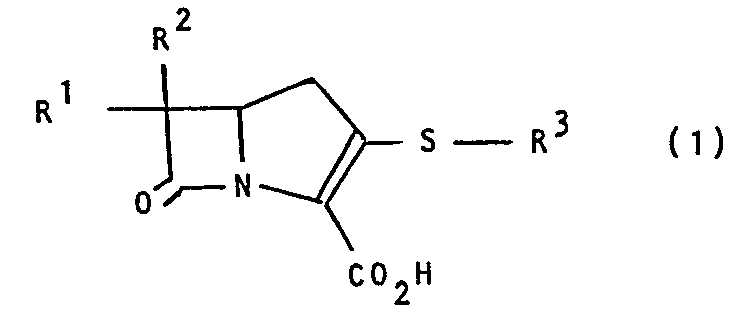
and salts and esters thereof wherein R1 and R2 independently represent hydrogen or an organic group, and R3 is an optionally substituted aromatic or heteroaromatic moiety, which comprises reacting a compound of the formula (II):

wherein Ra is hydrogen or a carboxy-biocking group, with X-R3 wherein X is a displaceable group, In addition certain compounds within the formula (II) are novel.
Description
- This invention relates to a chemical process for preparing carbapenem derivatives and in particular to 3-substituted thio carbapenem derivatives. These carbapenems are useful in the treatment of antibacterial infection either alone or in combination with other therapeutic agents.
- European Patent Application Publication Nos. 0001627, 0001628, 0008514, 017970 and 017992 disclose a wide variety of carbapenem derivatives. We have found a new process for the preparation of certain of these compounds.
- Accordingly the present invention provides a process for the preparation of a compound of the formula (I):


- i) removing any carboxy-blocking group Ra,
- ii) converting the product into a pharmaceutically acceptable salt or in-vivo hydrolysable ester.
- The process of this invention may be carried out in any solvent that is substantially inert during the reaction, for example tetrahydrofuran, dimethylformamide, dioxan, dimethoxyethane, dimethoxydiethyl-ether or hexamethylphosphoramide. Of these solvents dimethylformamide is preferred.
- When the thiol compound of the formula (II) is used, the reaction is normally carried out in the presence of an acid acceptor, for example a carbonate or bicarbonate such as anhydrous potassium carbonate.
- Alternatively we have found it useful to use a phase transfer catalyst. Particularly suitable phase transfer catalysts include tetrabutylammonium bromide and benzyldimethyl-n-hexadecyl ammonium bromide. Suitable solvents include halogenated water-immiscible solvents such as chloroform and dichloromethane in the presence of aqueous base such as aqueous sodium hydroxide.
- The reaction is normally performed at a non- extreme temperature, for example -30°C to +60°C, more suitably -10°C to +40°C and preferably at ambient temperature.
- The reaction may employ either a compound of the formula (II) or a reactive derivative thereof.
- Suitably X is a halo moiety such as bromo or chloro or is a sulphonate ester moiety such as a tosylate or mesylate. Of these preferably X is a chloro or bromo moiety.
- Instead of using an acid acceptor in the reaction, a reactive derivative of the thiol may be used, preferably the reactive derivative is a salt of the thiol, in particular an alkali metal salt such as sodium or potassium.
- The amount of compound of the formula (III) is generally between 1.0 and 2.0 moles per mole equivalent of the thiol of the formula (II) or reactive derivative thereof.
- The group R3 in the compound of the formulae (I) and (III) may be an optionally substituted aromatic or heteroaromatic moiety. Suitable substituents include those which are electron-withdrawing.
- Examples of suitable electron-withdrawing substituents include nitro, cyano, chloro, fluoro, iodo, bromo, esterified sulphonyloxy or esterified carboxy wherein the ester group includes those of formula (a) - (f) as hereinafter defined, alkanoyl, arylcarbonyl, Cl-6 alkoxy, aryloxy, aralkoxy, sulphonamido, trifluoromethyl and and carbamoyl.
- The group R3 optionally may have further substituents either alone or in addition to one or more electron-withdrawing substituents, provided that they are not sufficiently electron-attracting so that they deactivate the aromatic or heteroaromatic nucleus and prevent reaction from occurring. For example further suitable substituents include C1-6 alkyl, C2-6 alkenyl, aryl such as phenyl, aryl (C1-6) alkyl, aryl (C2-6) alkenyl, heteroaryl, heteroaryl (C1-6) alkyl, heterocyclyl, heterocyclyl (C1-6) alkyl, C1-6 alkylthio, arylthio such as phenylthio, hydroxy, mercapto, amino and protected amino such as Cl-6 alkylamino, di-Cl-6-alkylamino and C l-6 alkanoylamino: wherein the hetero atom or atoms in the above-named heterocyclic and heteroaryl moieties are selected from one to four oxygen, sulphur or nitrogen atoms and the ring contains not greater than ten ring atoms.
- Preferred substituents include C1-6 alkyl such as methyl and ethyl, nitro, C1-6 alkoxy such as methoxy and ethoxy, chloro, bromo, iodo and cyano.
- An example of R3 being an aromatic moiety is phenyl. Suitably when R3 is a heteroaromatic moiety it is a 5 to 7 membered ring, preferably a 5- or 6-membered ring wherein the hetero atom or hetero atoms are selected from 1 to 4 oxygen, nitrogen or sulphut atoms. In one suitable aspect such a heteroaromatic moiety may be fused to another ring, for example a phenyl ring, so as to form a bicyclic aromatic ring system. Examples of suitable heteroaromatic ring systems include pyrimidinyl, triazinyl, thiazolyl, pyridyl, thiadiazolyl, oxazolyl, imidazolyl, benzimidazoyl, furyl and benzothiazolyl.
- Preferably R3 is an optionally substituted phenyl, pyrimidine or triazine group. In a further aspect R3 is favourably an optionally substituted thiazolyl or pyridine group.
- Preferably in the compounds of the formulae (I) and (II) either R1 or R 2 is a hydrogen atom. In an alternative aspect both R1 and R2 are hydrogen atoms.
- When the group R1 or R2 represents an organic radical, it may be substituted and unsubstituted: alkyl, alkenyl, and alkynyl, having from 1-10 carbon atoms; cycloalkyl, cycloalkylalkyl, and alkylcycloalkyl, having 3-6 carbon atoms in the cycloalkyl ring and 1-6 carbon atoms in the alkyl moieties; aryl, such as phenyl; aralkyl, aralkenyl, and aralkynyl wherein the aryl moiety is phenyl and the linear chain has 1-6 carbon atoms; heteroaralkyl, heterocyclyl and heterocyclylalkyl wherein the substituent or substituents relative to the above-named radicals are selected from the group consisting of: amino, mono-, di- and tri-alkylamino, hydroxyl, alkoxyl, mercapto, alkylthio, arylthio such as phenylthio, sulfamoyl, amidino, guanidino, nitro, chloro, bromo, fluoro, cyano and carboxy, and wherein the hetero atom or atoms in the above-named heterocyclic moieties are selected from the group consisting of 1-4 oxygen, nitrogen or sulphur atoms, and wherein the alkyl moieties of the above-recited substituents have 1-6 carbon atoms.
- Preferably one of R1 and R 2 is a hydrogen atom and the other is sulphonato-oxyethyl or hydroxyalkyl containing up to 6 carbon atoms, in particular a-hydroxyethyl or a-hydroxypropyl. In a favoured aspect one of R1 and R2 is hydrogen and the other is sulphonato-oxyethyl or α-hydroxyethyl.
- In the compounds of the formulae (I) and (II) if R 1 is a hydrogen atom and R2 is not a hydrogen atom, or vice versa, then said compounds may have the cis- or trans- configuration about the β-lactam ring, that is to say they have the (5R,6R) or 5R,6S) configuration. Alternatively the compounds of the formulae (I) and (II) may be presented in the form of a cis/trans mixture.
- Suitable carboxyl-blocking derivatives for the group -CO2Ra in formula (II) include salts, esters, and anhydride derivatives of the carboxylic acid. The derivative is one which may readily be cleaved at a later stage of the reaction. The salts need not be pharmaceutically acceptable. Suitable salts include inorganic salts, for example metal salts such as silver or mercuric salt, or alkali metal salts such as the lithium or sodium salt, tertiary amine salts, such as those with tri-lower-alkylamines, N-ethylpiperidine, dimethylpiperazine. A preferred salt is with triethylamine.
- Suitable ester-forming carboxyl-blocking groups are those which may be removed under conventional conditions. Such groups for Ra include benzyl, p-methoxybenzyl, 2,4,6-trimethylbenzyl, 3,5-di-t-butyl-4-hydroxybenzyl, benzoylmethyl, p-nitrobenzyl, 4-pyridylmethyl, 2,2,2-trichloroethyl, 2,2,2-tribromoethyl, t-butyl, t-amyl, diphenylmethyl, triphenylmethyl, adamantyl, 2-benzyloxyphenyl, 4-methylthiophenyl, tetra- hydrofur-2-yl, tetrahydropyran-2-yl, pentachlorophenyl, p-toluenesulphonylethyl, methoxymethyl, a silyl, stannyl or phosphorus-containing group, an oxime radical of formula -N=CHR° where R° is aryl or heterocyclic, or an in vivo hydrolysable ester.
- The carboxyl group may be regenerated from any of the above esters by usual methods appropriate to the particular Ra group, for example, acid - and base - catalysed hydrolysis, or by enzymically - catalysed hydrolysis, or by hydrogenation. The hydrolysis must of course be carried out under conditions to which the groups on the rest of the molecule are stable.
- When it is desired to produce a compound of formula (I) in the form of a free acid or salt by the process of this invention, a compound of formula (II) is generally employed wherein R is a carboxyl-blocking group. For the preparation of a compound of formula (I) in the form of a pharmaceutically acceptable ester, it is convenient to employ a compound of formula (II) wherein R represents the desired ester group.
- Preferably the process of this invention is performed on a compound of the formula (II) wherein Ra is an ester-forming group.
- Suitable esters of the compounds of the formula (II) for use in the process of this invention include those cleavable by biological methods and by chemical methods such as hydrogenolysis, hydrolysis, electrolysis or photolysis.
- Suitably the carboxylic acid is esterified by a group of the sub-formula (a), (b), (c), (d), (e) or (f):


- Favourably A1 is a hydrogen atom or a methyl, ethyl, vinyl or ethenyl group. Favourably A2 is a hydrogen atom. Favourably A3 is a phenyl, p-bromophenyl, p-methoxyphenyl or p-nitrophenyl group. Favourably A4 is a hydrogen atom. Favourably A6 is a methyl, t-butyl or ethoxy group or is joined to A5. Favourably A7 is a methyl group.
- Preferred groups of the sub-formula (a) include the methyl, ethyl and acetonyl groups.
- Preferred groups of the sub-formula (b) include the benzyl and p-nitrobenzyl groups.
- Preferred groups of the sub-formula (c) include the acetoxymethyl, pivaloyloxymethyl, α-ethoxycarbonyloxymethyl and phthalidyl groups.
- A preferred group of the sub-formula (d) is the methoxymethyl group.
- Preferred groups of the sub-formula (e) include the trimethylsilyl, tert-butyldimethylsilyl and tert- butyldiphenylsilyl groups.
- A preferred group of the sub-formula (f) is p-methoxycarbonylbenzyl.
- Particularly preferred esterifying groups are the p-nitrobenzyl and phthalidyl groups.
- Pharmaceutically accptable in-vivo hydrolysable esters are those esters which hydrolyse in the human body to produce the parent acid or its salt. Such esters may be identified by administration to a test animal such as a rat or mouse by intravenous administration and thereafter examining the test animal's body fluids for the presence of the compound of the formula (I) or its salt.
- Suitable esters of this type include those of sub-formula (c) as hereinbefore defined.
- Suitable pharmaceutically acceptable salts include those of the alkali and alkaline earth metals, of these the sodium and potassium salts are preferred. These pharmaceutically acceptable salts may be formed at the C-2 carboxy and/or at the C-6 sulphonato-oxyethyl moiety (if present). Thus compounds of the formula (I) wherein R1 contains a OS03H group or pharmaceutically acceptable salt thereof, may be in the form of a di-salt such as the di-sodium or dipotassium salt, or may be in the form of a mono-salt of an in-vivo hydrolysable ester, or may be in the form of a mono-salt of an acid or may be in the form of a di-acid.
- Non-pharmaceutically acceptable salts of compounds of the formula (I) are also of use as they may be converted to pharmaceutically acceptable salts or in-vivo hydrolysable esters. An example of such a salt is the lithium salt.
- Esters may be converted to the free acid or a salt of the formula (I) by methods appropriate to the particular ester, for example by acid - and base - catalysed hydrolysis or by enzymically-catalysed hydrolysis or via hydrogenolysis, electrolysis or photolysis. The conditions selected must of course not cause substantial degradation of the rest of the molecule.
- Compounds of the formula (I) when in the form of an in-vivo ester, may be prepared from the free acid or salt thereof by esterification using methods known to those skilled in the art. A convenient method is often reaction with a reactive halide, for example bromophthalide in solution in a polar organic solvent such as dimethylformamide.
- The compounds of the formula (II) may be prepared by the methods of European Patent Application Publication Nos. 0001627 and 0001628 and European Patent Application No. 80302659.0. (Publication No. 0024832).
- In another aspect of this invention we provide a compound of the formula (IV) or a pharmaceutically acceptable salt or in-vivo hydrolysable ester thereof:

- In a further aspect of this invention, therefore there is provided a pharmaceutical composition which comprises a compound of the formula (IV) or a pharmaceutically acceptable salt or in-vivo hydrolysable ester and a pharmaceutically acceptable carrier.
- The compositions of this invention may be prepared by conventional methods of preparing antibiotic compositions and in conventional manner may.be adapted for oral, topical or parenteral administration.
- Aptly, the compositions of this invention are in the form of a unit-dose composition adapted for oral administration.
- Alternatively the compositions of this invention are in the form of a unit-dose composition adapted for administration by injection.
- Unit dose forms according to this invention will normally contain from 50 to 500mgs of a compound of this invention, for example about 62.5, 100, 125, 150, 200, 250 or 300mgs. Such compositions may be administered from 1 to 6 times a day or more conveniently 2, 3 or 4 times a day so that the total daily dose fora 70kg adult is about 200 to 2000mgs, for example about 400, 600, 750, 1000 or 1500mgs.
- The compositions of this invention may be used to treat bacterial infection, in animals such as mammals including humans, for example infections of the respiratory tract, urinary tract or soft tissues, or mastitis in cattle.
- The carriers used in the compositions of this invention may include diluents, binders, disintegrants, lubricants, colours, flavouring agents or preservatives in conventional manner. Thus suitable agents include lactose, starch, sucrose, calcium phosphate, sorbitol, polyvinylpyrrolidone, acacia, gelatin, tragacanth, potato starch or polyvinylpolypyrrolidone, magnesium stearate or sodium lauryl sulphate.
- Orally administrable forms of the compositions of this invention are most suitably in the form of unit-dose units such as tablets or capsules.
- The following Examples illustrate the invention.
-

- - p-Nitrobenzyl (5R,6S)-3-[E-2-acetamidoethenyl- thio]-6-((S)-1-hydroxyethyl]-7-oxo-1-azabicyclo[3.2.0]-hept-2-ene-2-carboxylate (el) (500 mg; 1.119 mm) was dissolved in 1,4-dioxan (10 ml) containing water (30 drops). A solution of N-bromoacetamide (155 mg, 1.119 mm) in 1,4-dioxan (5 ml) was then added and the solution stirred at room temperature for 4.5 minutes. Chloroform (50 ml) was added and the organic phase was washed with pH 7.0, 0.05M phosphate buffer, saturated sodium chloride solution and dried over anhydrous magnesium sulphate. Filtration and removal of the solvent at reduced pressure yielded the crude thiol (e2) as a gum, v max (CHCl3) 1780, 1730, 1700 cm 1 .
- The crude thiol was dissolved in dry dimethyl formamide (10 ml) and stirred at room temperature for 25 minutes with anhydrous potassium carbonate (155 mg) and 2,4-dichloro-6-methylpyrimidine (182 mg; 1.119 mm). Ethyl acetate was added and the organic solution washed with water, saturated sodium chloride solution and dried over anhydrous magnesium sulphate. After filtration, the solvent was removed at reduced pressure to yield the crude product, which was chromatographed over silica gel (40 gm). Elution with 2% ethanol/chloroform afforded the title compound (e3) as a white solid. This solid was triturated with ethyl acetate/diethyl ether and collected by filtration (102 mg) νmax (KBr) 3400, 1802, 1714, 1610, 1565, 1512, 1350, 1332 cm-1, λ max (EtOH) 326 nm (Em 14,530), 265 nm (Em 13,510), δH (δ7 - DMF) 8.27 (2H, d, aromatic protons), 7.82 (2H, d, aromatic protons), 7.61 (1H, S, pyrimidine proton), 5.52 (2H, q, CH2Ar), 5.23 (1H, d, OH, exchanges with D20), 4.42 (1H, dt, 5-CH), 4.15 (lH, broad res., 8-CH), 3.1-3.8 (3H, t + ABX, 6-CH + 4-CH2), 2.48 (3H, s, pyrimidine CH3), 1.31 (3H, d, CH3CH), m/s (relative intensity %) 490.0703 (2) (C21H19N4O6SCl required 490.0710), 446(8), 407(38), 405(100), 361(10), 287(50), 286(40), 266(45), 160(45), 136(70), 107(60), 106(70).
-

- The title compound (e4) (75 mg) was obtained as a white crystalline solid by the reaction of the thiol (e2), derived from the ester (el) (250 mg) with 2-chloro-4,6-dimethoxytriazine, by the method described in example 1., λ max (EtOH) 310 nm (Em 12441), 260 nm (Em 13436), νmax (KBr) 3415 (broad), 1782, 1693, 1605 cm-1, dH (d7-DMF) 8.25 (2H, d, aromatic H), 7.81 (2H, d, aromatic H), 5.50 (2H, q, CH2Ar), 5.22 (1H, d, OH), 4.0-4.5 (2H, m, 5-CH + 8-CH), 4.00 (6H, s, 2 x OCH3), 3.2-3.9 (2H, ABX, 4-CH2), 3.66 (lH, t, 6-CH), 1.31 (3H, d, CH3CH), m/e (relative intensity %) 503.1135 (M+, 20%, C21N5O8S requires 503.1110), 459 (5), 418 (60),330 (20), 286 (70), 279 (30), 173 (100), 136 (45), 106 (55).
-
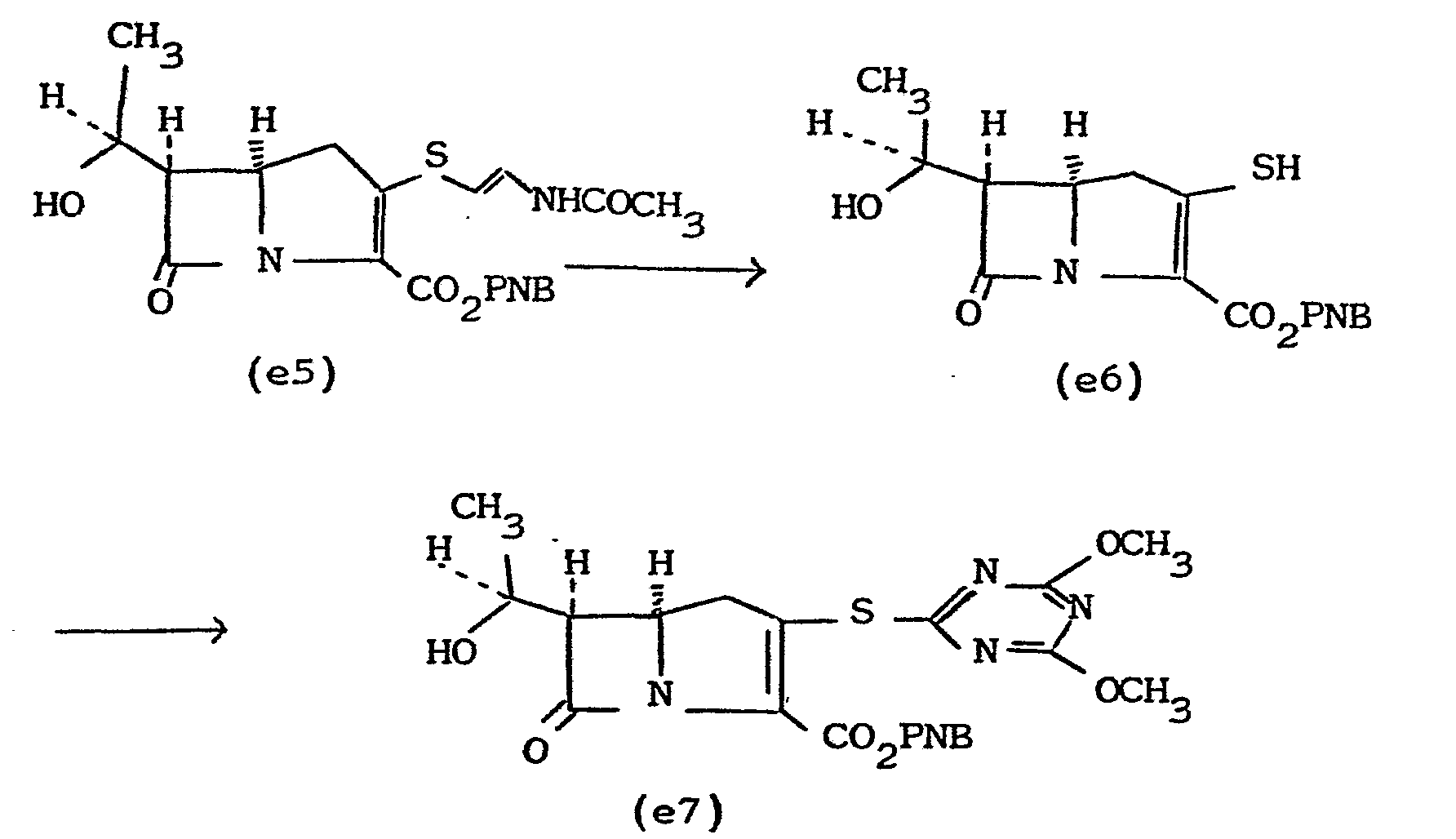
- The title compound (e7) (95 mg) was prepared as a white crystalline solid by reaction of the thiol (e6), derived from p-nitrobenzyl (5R,6R)-3-(E-2-acetamidoethenyl- thio)-6-[(S)-1-hydroxyethyl]-7-oxo-1-azabicyclo[3.2.0]hept-2-ene-2-carboxylate (e5) (250 mg) with 2-chloro-4,6-dimethoxy-triazine by the procedure described in example 1., λ max (EtOH) 310 nm (Em 12468) 260 nm (Em 13501), v max (KBr) 3400, 1780, 1700, 1607, 1530 (broad), 1350 cm-1 (broad), dH (d7-DMF) 8.27 (2H, d, aromatic protons), 7.82 (2H, d, aromatic protons), 5.49 (2H, q, CH2Ar), 5.09 (lH, d, OH, exchanges with D20), 4.0-4.6 (2H, m, 5-CH + 8-CH), 4.0 (6H, s, 2 x OCH3), 3.6-3.9 (3H, m, 4-CH2 + 6-CH), 1.31 (3H, d, CH3CH), m/e (relative intensity %) 503.1086 (M+, 4%, C21H21N5O8S requires 503.1110), 459 (5), 418 (50), 368 (25), 330 (25), 286 (56), 279 (30), 173 (100).
-

- A solution of the ester (e7) (40 mg) in 1,4-dioxan (10 ml), water (1.5 ml), ethanol (0.4 ml) and 0.05 M pH 7.0 phosphate buffer (2 ml) was hydrogenated in the presence of 5% palladium on carbon (60 mg) for 2 hours. The suspension was then filtered over Celite, washing well with water (25 ml). The filtrate was concentrated to approximately 20 ml and washed with ethyl acetate (3 x 25 ml). The resulting aqueous solution was estimated to contain 20 mg of the title compound (e8), based on Em 9,500 at X max 291 nm in the U.V. spectrum.
-

- p-Nitrobenzyl (5R,6R)-3-[E-2-acetamidoethenyl- thio]-6-[(S)-1-hydroxyethyl]-7-oxo-1-azabicyclo[3.2.0] hept-2-ene-2-carboxylate (e5) (250 mg; 0.56 mM) was dissolved in 1,4-dioxan (5 ml) containing water (15 drops). A solution of N-bromoacetamide (78.5 mg; 0.56 mM) in 1,4-dioxan (3 ml) was then added and the solution stirred at room temperature for 4.5 minutes. Chloroform (25 ml) was added and the organic phase was washed with pH 7.0, 0.05 M phosphate buffer, saturated sodium chloride solution and dried over anhydrous magnesium sulphate. Filtration and removal of the solvent at reduced pressure yielded the crude thiol (e6) as a gum. The thiol was then dissolved in chloroform (20 ml) and layered with water (15 ml). 2-Chloro-5-nitropyrimidine (180 mg; 1.119 mM), cetyl-dimethylbenzyl ammonium chloride (50 mg) and O.IN sodium hydroxide solution (5.6 ml; 0.56 mM) were added and the two phase system stirred vigorously at room temperature for 35 minutes.
- The mixture was diluted with dichloromethane (100 ml) and water (100 ml) and the organic layer washed with saturated sodium chloride solution, and dried over anhydrous magnesium sulphate. Filtration and removal of the solvent at reduced pressure gave the crude product, which was chromatographed over silica gel (15 gm). Elution with chloroform yielded the title compound (e9) as a yellow foam. Crystallisation from ethyl acetate/ether gave a bright yellow solid (75 mg), λmax (EtOH) 340 nm (Em 13850), 267 nm (Em 15810), v max (KBr) 3510 (broad), 1776, 1709, 1603,.1578, 1560, 1512, 1341, 1322 cm-1, δH (CDC13) 9.27 (2H, s, pyrimidine protons), 8.22 (2H, d, aromatic protons), 7.63 (2H, d, aromatic protons), 5.38 (2H, q, CH2Ar), 4.0-4.65 (2H, m, 5-CH + 8-CH), 3.55-3.80 (3H, m, 4-CH2 + 6-CH), 1.79 (lH, d, OH), 1.44 (3H, d, CH3CH), m/e (relative intensity %) 443 (2), 401.0397 (5%, C16H11N5O6S requires 401.0430), 330 (5), 286 (25), 263 (15), 221 (16), 157 (30), 136 (45), 106 (70), 78 (100).
-

- An aqueous solution containing the title compound (elO) was obtained by hydrogenolysis of the ester e(9) (15 mg). The procedure outlined in example 4, was followed with the exceptions that the hydrogenolysis time was extended to 4 hours and 10% palladium on carbon catalyst was used. The solution was estimated to contain 10.7 mg of product based on Em 12,000 at λ max 305 nm in the u.v. spectrum, λ max (H20) 3O5 nm, 267 nm.
-

- The tetra-n-butylammonium salt (ell) (200 mg) in 15% aqueous dioxan was treated with N-bromoacetamide (36 mg) in dioxan. After stirring at room temperature the solution was diluted with chloroform, and the organic layer was washed with pH7 buffer solution and dilute brine. Evaporation of the dried (MgS04) organic layer yielded the thiol (e12) as a foam (156 mg); v max (CHCl3) 1780 and 1705 cm-1.
-

- A solution of the thiol (e12) and 5-nitro-2-chloropyrimidine (55 mg) in chloroform (5 ml) was stirred vigorously with an aqueous solution of sodium hydroxide (9 mg in 2.25 ml). After 40 min at room temperature, chloroform (30 ml) was added and the organic layer was washed with water (30 ml) add dried (MgSO4). The solution was evaporated in vacuo and the residue was chromatographed on silica-gel using a gradient elution from chloroform to 20% ethanol in chloroform. Fractions containing the product were collected and evaporated in vacuo to afford the title compound (e13) as a gum (34 mg); λ max (EtOH) 336 and 267 nm; v max (CHC13) 1780 and 1725 cm-1; δ (CDCl3) 0.99 (12H, t, J Hz, 4 x CH3CH2CH2), 1.43 (8H, m, 4 x CH2CH2CH3), 1.63 (11H, m, 4 x CH2CH2CH3 and CH3CH), 3.25 (8H, m, 4 x NCH2CH2), 3.52 (lH, dd, J 10.5 and 19.5 Hz, 4-CHa), 3.83 (1H, dd, J 5.5 and 11 Hz, 6-CH), 4.07 (lH, dd, J 19.5 and 9.5 Hz, 4-CHb), 4.51 (lH, dt, J, 5.5 5.5 and 9.5 Hz, 5-CH), 4.85 (lH, m, CHCH3), 5.28 and 5.50 (each 1H, d, J 14 Hz, CH2C6H4NO2), 7.65 and 8.22 (each 2H, d, J 9 Hz, C6H4NO2) and 9.31 (2H, s, 2 x pyrimidyl-CH).
-

- A mixture of the mono-ester (e13) (180 mg), 10% Pd on C (180 mg), dioxan (15 ml) water (5 ml) and 0.05 M pH7 phosphate buffer solution (5 ml) was shaken under hydrogen for 3.5 h. To the mixture was added a solution of sodium tetrafluoroborate (24 mg) in water (1 ml), before filtering over Celite washing well with water (40 ml). The solution was concentrated in vacuo to a volume of Ca 35 ml and was then washed with ethyl acetate (3 x 59 ml). The aqueous layer was further concentrated to small volume and then chromatographed on a column of Biogel P2 (3.5 x 25 cm) eluting with water. Fractions containing chromophores at λ max (H20) 304 and 268 nm in the u.v. spectrum were combined to afford an aqueous solution of the title compound (e14). A portion of the solution was freeze- dried to afford the product as a solid.
-

- Reaction of the thiol (e6) derived from the ester (e5) (200 mg) with 2-bromo-5-nitrothiazole, following the procedure outlined in Example 1, afforded the title compound (e9) as a yellow crystalline solid (35 mg), λ max (EtOH) 366 nm (εm 8718), 293 nm (Em 12,839), 266 nm (εm 13948), νmax (CH2Cl2) 3590, 1779, 1700, 1602, 1522, 1330 cm , δH (CDC13) 8.50 (lH, s, triazole-CH), 8.26 (2H, d, aromatic protons), 7.67 (2H, d, aromatic protons), 5.42 (2H, q, CH2Ar), 4.41 (1H, dq, 5-CH), 4.23 (lH, m, 8-CH), 3.66 (1H, dd, J56 5.9Hz, J68 8.3Hz, 6-CH), 3.22-3.61 (2H, ABX, 4-CH2, J4a5 8·9Hz, J4b5 10.0Hz, J4a4b 18.2Hz), 1.43 (3H, d, CH3CH), m/e (relative intensity%) 330 (24), 286 (37), 259 (8), 194 (15), 162 (100), 152 (32), 136 (65), 106 (90), 78 (85), no M+.
-

-

- The cetylbenzyldimethylammonium salt (e15) (1.47) was dissolved in 15% aqueous dioxan (23 ml) and to the solution was added a solution of N-bromoacetamide (229 mg) in dioxan (1 ml). After strring at room temperature for 4.5 min. the solution was diluted with chloroform (70 ml) and the organic layer was washed with pH 7 buffer solution (50 ml) and dilute brine (30 ml). Evaporation of the dried (MgSO4) organic layer afford a foam which contained the thiol (e16).
-

- The product from step A was dissolved in DMF (20 ml) and the solution was stirred with 5-nitro-2-bromothiazole (570 mg) and dry potassium carbonate (229 mg) for 25 min. Ethyl acetate (70 ml) was added and the solution was washed with dilute brine (3 x 70 ml). Evaporation of the dried (MgS04) solution gave a foam which was chromatographed on a column of silica gel using a gradient elution of chloroform to 20% ethanol-chloroform. The quaternary ammonium salt (e17) was obtained as a yellow foam (400 mg); λmax (EtOH) 365, 288sh and 267 nm νmax (CHC13) 1780 1720sh and 1700cm-1.
-

- The product from step B was dissolved in acetone (4 ml) and to this solution was added a solution of sodium iodide (80 mg) in acetone (1 ml). Precipititation of the salt (e18) could not be induced, so the solvent was evaporated in vacuo, and the residue was chromatographed on a column of silica gel eluting with a gradient of chloroform to 25% ethanol-chloroform. Early fractions contained recovered quaternary ammonium salt (el7) which could be recycled, whilst later fractions contained only the desired sodium salt (e18). Evaporation of the solvents and trituration with ehter afforded the title compound (el8) as a yellow solid (85 mg); λmax (EtOH) 364 (9,294) ca. 292 (12,822) and 266 nm (13,847); νmax (KBr) 1780, 1720 and 1705 cm-1; δ(DMF-d7) 1.45 (3H, d, J 6.5 Hz, MeCH), 3.19 (1H, dd, J 10.5 and 19.5 Hz, 4-CHa), 3.83 (1H, dd, J 19.5 and 9Hz, 4-CHb), 3.85 (1H, dd, J 5.5 and 10.5 Hz, 6-CH), 4.45 (1H, m, 5-CH), 4.62 (lH, m, CHMe), 5.46 and 5.62 (each 1H, d, J 13.5Hz, CH2Ar), 7.83 and 8.29 (each 2H, d, J 9Hz, C6H4NO2), and 8.84 (lH, s, thiazole-CH).
Claims (11)
1. A process for the preparation of a compound of the formula (I):

or a pharmaceutically acceptable salt or in-vivo hydrolysable ester thereof wherein R 1 and R 2 independently represent a hydrogen atom or an organic group, and R3 represents an optionally substituted aromatic or heteroaromatic moiety; which process comprises the reaction of a compound of the formula (II):

or reactive derivative thereof, wherein R1 and R2 are as defined in relation to formula (I) and Ra is a carboxy-blocking group or a hydrogen atom; with a compound of the formula (III):

wherein X is a displaceable group, and thereafter if necessary:
i) removing any carboxy-blocking group Ra,
ii) converting the product into a pharmaceutically acceptable salt or in-vivo hydrolysable ester.
2. A process as claimed in claim 1 adapted for the preparation of a compound of the formula (I) wherein R and R2 are independently selected from hydrogen or substituted and unsubstituted: alkyl, alkenyl, and alkynyl, having from 1-10 carbon atoms; cycloalkyl, cycloalkylalkyl, and alkylcycloalkyl, having 3-6 carbon atoms in the cycloalkyl ring and 1-6 carbon atoms in the alkyl moieties; aryl, such as phenyl; aralkyl, aralkenyl, and aralkynyl wherein the aryl moiety is phenyl and the linear chain has 1-6 carbon atoms; heteroaralkyl, heterocyclyl and heterocyclylalkyl wherein the substituent or substituents relative to the above-named radicals are selected from the group consisting of: amino, mono-, di- and tri-alkylamino, hydroxyl, alkoxyl, mercapto, alkylthio, arylthio such as phenylthio, sulfamoyl, amidino, guanidino, nitro, chloro, bromo, fluoro, cyano and carboxy, and wherein the hetero atom or atoms in the above-named heterocyclic moieties are selected from the group consisting of 1-4 oxygen, nitrogen or sulphur atoms, and wherein the alkyl moieties of the above-recited substituents have 1-6 carbon atoms.
3. A process as claimed in claim 2 adapted for the preparation of a compound of the formula (I) wherein one of R1 and R2 is a hydrogen atom and the other is sulphonato-oxyethyl or hydroxyalkyl containing up to 6 carbon atoms.
4. A process as claimed in any of claims 1 to 3 adapted for the preparation of a compound of the formula (I) wherein R3 is an optionally substituted ring system selected from phenyl, pyrimidinyl, triazinyl, thiazolyl, pyridyl, thiadiazolyl, oxazolyl, imidazolyl, benzimidazolyl, furyl or benzothiazolyl.
5. A process as claimed in any of claims 1 to 4 wherein R3 is substituted by one or more groups selected from nitro, cyano, chloro, fluoro, iodo, bromo, esterified sulphonyloxy, esterified carboxy, alkanoyl, arylcarbonyl, Cl-6 alkoxy, aryloxy, aralkoxy, sulphonamido, trifluoromethyl and carbamoyl.
6. A process as claimed in any of claims 1 to 5 wherein X is a chloro, bromo, tosylate or mesylate moiety.
7. A process as claimed in any of claims 1 to 6 wherein the reaction is performed on a thiol of the formula (II) in the presence of anhydrous potassium carbonate.
8. A process as claimed in any of claims 1 to 7 wherein a phase transfer catalyst is present.
9. A process as claimed in claim 1 for the preparation of:
p-Nitrobenzyl (5R,6S)-3-[(4-chloro-6-methyl-pyrimidin-2-yl)-thio]-6-[(S)-1-hydroxyethyl]-7-oxo-1-azabicyclo[3.2.0]-hept-2-ene-2-carboxylate;
p-nitrobenzyl (5R,6S)-3-[4,6-dimethyoxy-l,3,5-triazin-2- ylthio]-6-(S)-1-hydroxyethyl]-7-oxo-1-azabicyclo[3.2.0]-hept-2-ene-2-carboxylate;
p-nitrobenzyl (5R,6R)-3-[4,6-dimethoxy-l,3,5-triazin-2- ylthio]-6-[(S)-1-hydroxyethyl]-7-oxo-1-azabicyclo[3.2.0]-hept-2-ene-2-carboxylate;
(5R,6R)-3-[4,6-dimethoxy-1,3,5-triazin-2-ylthio]-6-[(S)-1-hydroxyethyl]-7-oxo-l-azabicyclo[3.2.0]hept-2-ene-2-carboxylic acid;
p-nitrobenzyl (5R,6R)-3-[5-nitropyrimid-2-yl)thio]-6-[(S)-1-hydroxyethyl]-7-oxo-1-azabicyclo[3.2.0]hept-2- ene-2-carboxylate;
(5R,6R)-3-[(5-aminopyrimid-2-yl)thio]-6-[(S)-1-hydroxyethyl]-7-oxo-1-azabicyclo[3.2.0]hept-2-ene-2-carboxylic acid;
tetra-n-butylammonium salt of p-nitrobenzyl (5R,6R)-6-[(S)-1-hydroxysulphonyloxyethyl]-3-(5-nitropyrimid-2- ylthiol)-7-oxo-l-azabicyclo [3.2.0]hept-2-ene-2-carboxylate; sodium (5R,6R)-3-(5-aminopyrimidyl-2-thio)-6-[(S)-1-hydroxysulphonyloxyethyl]-7-oxo-1-azabicyclo [3.2.0]hept-2-ene-carboxylate;
p-nitrobenzyl (5R, 6R)-3-[(5-nitrothiazol-2-yl)thio]-6-[(S)-1-hydroxyethyl]-7-oxo-1-azabicyclo[3.2.0]hept-2- ene-2-carboxylate;
p-nitrobenzyl (5R,6R)-3-[(5R,6R)-3-[(5-nitropyrid-2-yl)-thio]-6-[(S)-1-hydroxyethyl]-7-oxo-1-aza-bicyclo[3.2.0]-hept-2-ene-2-carboxylate;
sodium salt of p-nitrobenzyl (5R,6R)-6-[(S)-l-hydroxy- sulphonyloxyethyl]-3-(5-nitrothiazol-2-ylthio)-7-oxo-1-azabicyclo [3.2.0]hept-2-ene-2-carboxylate.
10. A compound of the formula (IV) or a pharmaceutically acceptable salt or in-vivo hydrolysable ester thereof:

wherein R4 is hydrogen or a SO3H moiety, and R5 is an optionally substituted triazinyl group.
11. A pharmaceutically composition which comprises a compound as claimed in claim 10 and a pharmaceutically acceptable carrier.
Applications Claiming Priority (2)
| Application Number | Priority Date | Filing Date | Title |
|---|---|---|---|
| GB8103349 | 1981-02-04 | ||
| GB8103349 | 1981-02-04 |
Publications (1)
| Publication Number | Publication Date |
|---|---|
| EP0061231A1 true EP0061231A1 (en) | 1982-09-29 |
Family
ID=10519433
Family Applications (1)
| Application Number | Title | Priority Date | Filing Date |
|---|---|---|---|
| EP82300408A Withdrawn EP0061231A1 (en) | 1981-02-04 | 1982-01-27 | Process for the preparation of azabicyclo(3.2.0)-hept-2-ene derivatives |
Country Status (8)
| Country | Link |
|---|---|
| EP (1) | EP0061231A1 (en) |
| JP (1) | JPS57146779A (en) |
| AU (1) | AU8011782A (en) |
| ES (1) | ES509436A0 (en) |
| GR (1) | GR74744B (en) |
| IE (1) | IE820239L (en) |
| PT (1) | PT74366B (en) |
| ZA (1) | ZA82552B (en) |
Cited By (8)
| Publication number | Priority date | Publication date | Assignee | Title |
|---|---|---|---|---|
| EP0090366A1 (en) * | 1982-03-29 | 1983-10-05 | Fujisawa Pharmaceutical Co., Ltd. | 1-Azabicyclo(3.2.0)hept-2-ene-2-carboxylic acid derivatives, processes for the preparation thereof and pharmaceutical compositions containing them |
| EP0144825A1 (en) * | 1983-11-21 | 1985-06-19 | Merck & Co. Inc. | Cyclic guanidinyl thio carbapenems |
| US4943569A (en) * | 1983-05-09 | 1990-07-24 | Sumitomo Pharmaceuticals Co., Ltd. | B-lactam compounds |
| EP0587436A1 (en) * | 1992-09-09 | 1994-03-16 | Sankyo Company Limited | Process for preparing carbapenem and penem compounds and new compounds involved in that process |
| US5496816A (en) * | 1994-03-14 | 1996-03-05 | Merck & Co., Inc. | Carbapenem antibacterial compounds, compositions containing such compounds and methods of treatment |
| US5541317A (en) * | 1991-05-31 | 1996-07-30 | Sankyo Company, Limited | Azetidinone compounds useful in the preparation of carbapenem antibiotics and process for preparing carbapenem and penem compounds |
| EP0826687A1 (en) * | 1996-08-16 | 1998-03-04 | Suntory Limited | Carbapenem derivatives and antimicrobial agents comprising the same |
| EP0934942A4 (en) * | 1996-09-04 | 2000-01-19 | Sumitomo Pharma | NOVEL BETA-LACTAMINES AND THEIR MANUFACTURING PROCESS |
Citations (3)
| Publication number | Priority date | Publication date | Assignee | Title |
|---|---|---|---|---|
| EP0008888A1 (en) * | 1978-08-23 | 1980-03-19 | Beecham Group Plc | Beta-lactam antibacterial compounds, their preparation and pharmaceutical compositions containing them |
| US4232036A (en) * | 1978-10-24 | 1980-11-04 | Merck & Co., Inc. | 6-, 1- and 2-Substituted-1-carbadethiapen-2-em-3-carboxylic acids |
| EP0021082A1 (en) * | 1979-05-29 | 1981-01-07 | Merck & Co. Inc. | N-heterocyclyl thienamycins, process for preparing and antibiotic pharmaceutical composition containing the same |
-
1982
- 1982-01-27 EP EP82300408A patent/EP0061231A1/en not_active Withdrawn
- 1982-01-28 ZA ZA82552A patent/ZA82552B/en unknown
- 1982-02-01 PT PT74366A patent/PT74366B/en unknown
- 1982-02-01 GR GR67164A patent/GR74744B/el unknown
- 1982-02-02 AU AU80117/82A patent/AU8011782A/en not_active Abandoned
- 1982-02-03 IE IE820239A patent/IE820239L/en unknown
- 1982-02-04 ES ES509436A patent/ES509436A0/en active Granted
- 1982-02-04 JP JP57017394A patent/JPS57146779A/en active Pending
Patent Citations (3)
| Publication number | Priority date | Publication date | Assignee | Title |
|---|---|---|---|---|
| EP0008888A1 (en) * | 1978-08-23 | 1980-03-19 | Beecham Group Plc | Beta-lactam antibacterial compounds, their preparation and pharmaceutical compositions containing them |
| US4232036A (en) * | 1978-10-24 | 1980-11-04 | Merck & Co., Inc. | 6-, 1- and 2-Substituted-1-carbadethiapen-2-em-3-carboxylic acids |
| EP0021082A1 (en) * | 1979-05-29 | 1981-01-07 | Merck & Co. Inc. | N-heterocyclyl thienamycins, process for preparing and antibiotic pharmaceutical composition containing the same |
Non-Patent Citations (1)
| Title |
|---|
| HOUBEN-WEYL, MULLER, "Methoden der organischen Chemie", 4. Auflage, Band IX, 1955, GEORG THIEME VERLAG, Stuttgart, Pages 102, 103, 117. * |
Cited By (14)
| Publication number | Priority date | Publication date | Assignee | Title |
|---|---|---|---|---|
| EP0090366A1 (en) * | 1982-03-29 | 1983-10-05 | Fujisawa Pharmaceutical Co., Ltd. | 1-Azabicyclo(3.2.0)hept-2-ene-2-carboxylic acid derivatives, processes for the preparation thereof and pharmaceutical compositions containing them |
| US4943569A (en) * | 1983-05-09 | 1990-07-24 | Sumitomo Pharmaceuticals Co., Ltd. | B-lactam compounds |
| EP0144825A1 (en) * | 1983-11-21 | 1985-06-19 | Merck & Co. Inc. | Cyclic guanidinyl thio carbapenems |
| US5681951A (en) * | 1991-05-31 | 1997-10-28 | Sankyo Company, Limited | Metal catalyzed displacement process |
| US5719275A (en) * | 1991-05-31 | 1998-02-17 | Sankyo Company, Limited | Silyl enol ether alkylation process |
| US5541317A (en) * | 1991-05-31 | 1996-07-30 | Sankyo Company, Limited | Azetidinone compounds useful in the preparation of carbapenem antibiotics and process for preparing carbapenem and penem compounds |
| US5614624A (en) * | 1991-05-31 | 1997-03-25 | Sankyo Company, Limited | Carbapenem |
| EP0587436A1 (en) * | 1992-09-09 | 1994-03-16 | Sankyo Company Limited | Process for preparing carbapenem and penem compounds and new compounds involved in that process |
| CN1048494C (en) * | 1992-09-09 | 2000-01-19 | 三共株式会社 | Process for preparing carbapenen and penem compounds and new compounds involved in that process |
| US5496816A (en) * | 1994-03-14 | 1996-03-05 | Merck & Co., Inc. | Carbapenem antibacterial compounds, compositions containing such compounds and methods of treatment |
| EP0826687A1 (en) * | 1996-08-16 | 1998-03-04 | Suntory Limited | Carbapenem derivatives and antimicrobial agents comprising the same |
| US6051569A (en) * | 1996-08-16 | 2000-04-18 | Suntory Limited | 1'S, 5R, 6R-carbapenem derivatives and antimicrobial agents comprising the same |
| EP0934942A4 (en) * | 1996-09-04 | 2000-01-19 | Sumitomo Pharma | NOVEL BETA-LACTAMINES AND THEIR MANUFACTURING PROCESS |
| US6265396B1 (en) | 1996-09-04 | 2001-07-24 | Sumitomo Pharmaceuticals Co., Ltd. | β-lactam compounds and process for preparing the same |
Also Published As
| Publication number | Publication date |
|---|---|
| JPS57146779A (en) | 1982-09-10 |
| ES8304971A1 (en) | 1983-03-16 |
| PT74366A (en) | 1982-03-01 |
| ZA82552B (en) | 1983-04-27 |
| IE820239L (en) | 1982-08-04 |
| AU8011782A (en) | 1982-08-12 |
| ES509436A0 (en) | 1983-03-16 |
| PT74366B (en) | 1983-08-16 |
| GR74744B (en) | 1984-07-11 |
Similar Documents
| Publication | Publication Date | Title |
|---|---|---|
| EP0041768B1 (en) | Beta-lactam compounds, their preparation and use | |
| US4413000A (en) | β-Lactam antibiotics, their preparation and use | |
| NO159656B (en) | ANALOGY PROCEDURE FOR THE PREPARATION OF THERAPEUTICALLY ACTIVE CARBAPENNAM DERIVATIVES. | |
| EP0055990B1 (en) | Beta-lactam antibiotics, their preparation and use | |
| US4477662A (en) | 2-Substituted thio carbapenem derivatives | |
| EP0011173B1 (en) | Process for producing antibiotic beta-lactam compounds | |
| DE3109086C2 (en) | ||
| AU609488B2 (en) | (5r, 6s, 1r)-6-(1-hydroxyethyl)-2-(methoxymethyl)penem-3- carboxylic acid derivatives | |
| CA1104139A (en) | Antibacterial compounds | |
| DE3317742C2 (en) | ||
| US4410533A (en) | β-Lactam antibiotics, their preparation and use | |
| NZ199487A (en) | Azabicycloheptene derivatives,intermediates and pharmaceutical compositions | |
| EP0050927B1 (en) | The preparation of beta-lactam antibiotics | |
| KR880001055B1 (en) | Method for preparing carbapenem derivatives | |
| KR910009270B1 (en) | Method for preparing Kabafenem antibiotic | |
| US6265396B1 (en) | β-lactam compounds and process for preparing the same | |
| JPS63310888A (en) | Novel compound, manufacture and medicinal composition | |
| US4897476A (en) | Process for preparing penems | |
| US4923856A (en) | Penem compounds | |
| US4349551A (en) | Penicillin derivatives and compositions containing them | |
| EP0086590A1 (en) | Antibacterial agents, their preparation and use | |
| CH661730A5 (en) | PENEM CARBONIC ACIDS AND METHOD FOR THE PRODUCTION THEREOF. | |
| KR100246953B1 (en) | New Carbapenem Antibiotics | |
| JP2832742B2 (en) | Carbapenem derivatives | |
| KR100246952B1 (en) | New Carbapenem Antibiotics |
Legal Events
| Date | Code | Title | Description |
|---|---|---|---|
| PUAI | Public reference made under article 153(3) epc to a published international application that has entered the european phase |
Free format text: ORIGINAL CODE: 0009012 |
|
| AK | Designated contracting states |
Designated state(s): BE CH DE FR GB IT LU NL SE |
|
| 17P | Request for examination filed |
Effective date: 19821028 |
|
| STAA | Information on the status of an ep patent application or granted ep patent |
Free format text: STATUS: THE APPLICATION IS DEEMED TO BE WITHDRAWN |
|
| 18D | Application deemed to be withdrawn |
Effective date: 19840522 |
|
| RIN1 | Information on inventor provided before grant (corrected) |
Inventor name: COULTON, STEVEN Inventor name: EGLINTON, ALFRED JOHN Inventor name: CORBETT, DAVID FRANCIS |