EP0022744A2 - Trijodierte Basen, deren Herstellung und diese enthaltendes Röntgenkontrastmittel - Google Patents
Trijodierte Basen, deren Herstellung und diese enthaltendes Röntgenkontrastmittel Download PDFInfo
- Publication number
- EP0022744A2 EP0022744A2 EP80730043A EP80730043A EP0022744A2 EP 0022744 A2 EP0022744 A2 EP 0022744A2 EP 80730043 A EP80730043 A EP 80730043A EP 80730043 A EP80730043 A EP 80730043A EP 0022744 A2 EP0022744 A2 EP 0022744A2
- Authority
- EP
- European Patent Office
- Prior art keywords
- diamide
- hydrogen
- dihydroxypropyl
- lower alkyl
- methyl
- Prior art date
- Legal status (The legal status is an assumption and is not a legal conclusion. Google has not performed a legal analysis and makes no representation as to the accuracy of the status listed.)
- Granted
Links
- 239000002872 contrast media Substances 0.000 title claims abstract description 29
- 238000002360 preparation method Methods 0.000 title claims description 10
- UFHFLCQGNIYNRP-UHFFFAOYSA-N Hydrogen Chemical group [H][H] UFHFLCQGNIYNRP-UHFFFAOYSA-N 0.000 claims abstract description 24
- 239000002253 acid Substances 0.000 claims abstract description 23
- 150000003839 salts Chemical class 0.000 claims abstract description 18
- 150000001875 compounds Chemical class 0.000 claims abstract description 17
- 229910052739 hydrogen Inorganic materials 0.000 claims abstract description 16
- 239000001257 hydrogen Substances 0.000 claims abstract description 16
- 150000007513 acids Chemical class 0.000 claims abstract description 9
- 239000000126 substance Substances 0.000 claims abstract description 5
- JEZJSNULLBSYHV-UHFFFAOYSA-N 5-amino-2,4,6-triiodobenzene-1,3-dicarboxylic acid Chemical compound NC1=C(I)C(C(O)=O)=C(I)C(C(O)=O)=C1I JEZJSNULLBSYHV-UHFFFAOYSA-N 0.000 claims abstract 2
- 125000004435 hydrogen atom Chemical group [H]* 0.000 claims abstract 2
- OAKJQQAXSVQMHS-UHFFFAOYSA-N Hydrazine Chemical compound NN OAKJQQAXSVQMHS-UHFFFAOYSA-N 0.000 claims description 41
- 238000000034 method Methods 0.000 claims description 13
- FUOXCOHIWKJOMU-UHFFFAOYSA-N 5-[(2-aminoacetyl)amino]-2,4,6-triiodobenzene-1,3-dicarboxylic acid Chemical compound NCC(=O)NC1=C(I)C(C(O)=O)=C(I)C(C(O)=O)=C1I FUOXCOHIWKJOMU-UHFFFAOYSA-N 0.000 claims description 11
- 125000000954 2-hydroxyethyl group Chemical group [H]C([*])([H])C([H])([H])O[H] 0.000 claims description 9
- UXIGWFXRQKWHHA-UHFFFAOYSA-N Iotalamic acid Chemical class CNC(=O)C1=C(I)C(NC(C)=O)=C(I)C(C(O)=O)=C1I UXIGWFXRQKWHHA-UHFFFAOYSA-N 0.000 claims description 8
- 150000001470 diamides Chemical class 0.000 claims description 7
- 125000002887 hydroxy group Chemical group [H]O* 0.000 claims description 7
- 150000001412 amines Chemical class 0.000 claims description 6
- 229960000929 iotalamic acid Drugs 0.000 claims description 5
- 238000006698 hydrazinolysis reaction Methods 0.000 claims description 4
- YVPYQUNUQOZFHG-UHFFFAOYSA-N amidotrizoic acid Chemical compound CC(=O)NC1=C(I)C(NC(C)=O)=C(I)C(C(O)=O)=C1I YVPYQUNUQOZFHG-UHFFFAOYSA-N 0.000 claims description 3
- WKBOTKDWSSQWDR-UHFFFAOYSA-N Bromine atom Chemical group [Br] WKBOTKDWSSQWDR-UHFFFAOYSA-N 0.000 claims description 2
- KZBUYRJDOAKODT-UHFFFAOYSA-N Chlorine Chemical compound ClCl KZBUYRJDOAKODT-UHFFFAOYSA-N 0.000 claims description 2
- 229910052801 chlorine Inorganic materials 0.000 claims description 2
- 239000000460 chlorine Substances 0.000 claims description 2
- UCBPBIDRSKKNCD-UHFFFAOYSA-N 3-acetamidooxycarbonyl-5-amino-2,4,6-triiodobenzoic acid Chemical compound NC=1C(=C(C(=C(C(=O)ONC(C)=O)C=1I)I)C(=O)O)I UCBPBIDRSKKNCD-UHFFFAOYSA-N 0.000 claims 1
- 229940039231 contrast media Drugs 0.000 abstract description 3
- 230000000144 pharmacologic effect Effects 0.000 abstract description 2
- -1 alkylene radical Chemical class 0.000 description 57
- 239000000243 solution Substances 0.000 description 43
- 238000000354 decomposition reaction Methods 0.000 description 39
- XLYOFNOQVPJJNP-UHFFFAOYSA-N water Substances O XLYOFNOQVPJJNP-UHFFFAOYSA-N 0.000 description 22
- XEKOWRVHYACXOJ-UHFFFAOYSA-N Ethyl acetate Chemical compound CCOC(C)=O XEKOWRVHYACXOJ-UHFFFAOYSA-N 0.000 description 15
- 238000006243 chemical reaction Methods 0.000 description 13
- YMWUJEATGCHHMB-UHFFFAOYSA-N Dichloromethane Chemical compound ClCCl YMWUJEATGCHHMB-UHFFFAOYSA-N 0.000 description 12
- LFQSCWFLJHTTHZ-UHFFFAOYSA-N Ethanol Chemical compound CCO LFQSCWFLJHTTHZ-UHFFFAOYSA-N 0.000 description 12
- OKKJLVBELUTLKV-UHFFFAOYSA-N Methanol Chemical compound OC OKKJLVBELUTLKV-UHFFFAOYSA-N 0.000 description 12
- 150000001768 cations Chemical class 0.000 description 11
- ASBGVYOIJLROJS-UHFFFAOYSA-N 5-[(2-chloroacetyl)amino]-2,4,6-triiodobenzene-1,3-dicarboxylic acid Chemical compound OC(=O)C1=C(I)C(NC(=O)CCl)=C(I)C(C(O)=O)=C1I ASBGVYOIJLROJS-UHFFFAOYSA-N 0.000 description 9
- FXHOOIRPVKKKFG-UHFFFAOYSA-N N,N-Dimethylacetamide Chemical compound CN(C)C(C)=O FXHOOIRPVKKKFG-UHFFFAOYSA-N 0.000 description 9
- 239000000203 mixture Substances 0.000 description 9
- 238000003756 stirring Methods 0.000 description 9
- 239000002244 precipitate Substances 0.000 description 8
- 230000003204 osmotic effect Effects 0.000 description 7
- 239000002904 solvent Substances 0.000 description 7
- RYHBNJHYFVUHQT-UHFFFAOYSA-N 1,4-Dioxane Chemical compound C1COCCO1 RYHBNJHYFVUHQT-UHFFFAOYSA-N 0.000 description 6
- HZAXFHJVJLSVMW-UHFFFAOYSA-N 2-Aminoethan-1-ol Chemical compound NCCO HZAXFHJVJLSVMW-UHFFFAOYSA-N 0.000 description 6
- ZCYVEMRRCGMTRW-UHFFFAOYSA-N 7553-56-2 Chemical compound [I] ZCYVEMRRCGMTRW-UHFFFAOYSA-N 0.000 description 6
- QGZKDVFQNNGYKY-UHFFFAOYSA-N Ammonia Chemical compound N QGZKDVFQNNGYKY-UHFFFAOYSA-N 0.000 description 6
- OKTJSMMVPCPJKN-UHFFFAOYSA-N Carbon Chemical compound [C] OKTJSMMVPCPJKN-UHFFFAOYSA-N 0.000 description 6
- RTZKZFJDLAIYFH-UHFFFAOYSA-N Diethyl ether Chemical compound CCOCC RTZKZFJDLAIYFH-UHFFFAOYSA-N 0.000 description 6
- ZMXDDKWLCZADIW-UHFFFAOYSA-N N,N-Dimethylformamide Chemical compound CN(C)C=O ZMXDDKWLCZADIW-UHFFFAOYSA-N 0.000 description 6
- 229910052740 iodine Inorganic materials 0.000 description 6
- 239000011630 iodine Substances 0.000 description 6
- 239000012266 salt solution Substances 0.000 description 6
- 238000007112 amidation reaction Methods 0.000 description 5
- 150000001450 anions Chemical class 0.000 description 5
- 239000000047 product Substances 0.000 description 5
- 239000011541 reaction mixture Substances 0.000 description 5
- VEXZGXHMUGYJMC-UHFFFAOYSA-N Hydrochloric acid Chemical compound Cl VEXZGXHMUGYJMC-UHFFFAOYSA-N 0.000 description 4
- LRHPLDYGYMQRHN-UHFFFAOYSA-N N-Butanol Chemical compound CCCCO LRHPLDYGYMQRHN-UHFFFAOYSA-N 0.000 description 4
- MBBZMMPHUWSWHV-BDVNFPICSA-N N-methylglucamine Chemical compound CNC[C@H](O)[C@@H](O)[C@H](O)[C@H](O)CO MBBZMMPHUWSWHV-BDVNFPICSA-N 0.000 description 4
- 125000000217 alkyl group Chemical group 0.000 description 4
- 230000001580 bacterial effect Effects 0.000 description 4
- 238000001816 cooling Methods 0.000 description 4
- 238000011049 filling Methods 0.000 description 4
- 239000000706 filtrate Substances 0.000 description 4
- 125000006239 protecting group Chemical group 0.000 description 4
- 239000011734 sodium Substances 0.000 description 4
- HWPJOWDGPXJRRY-UHFFFAOYSA-N 5-(1,3-dioxoisoindol-2-yl)-4,6-diiodo-2-[(2-iodoacetyl)amino]benzene-1,3-dicarboxylic acid Chemical compound ICC(=O)NC1=C(C(=O)O)C(=C(C(=C1C(=O)O)I)N1C(C=2C(C1=O)=CC=CC=2)=O)I HWPJOWDGPXJRRY-UHFFFAOYSA-N 0.000 description 3
- VYOOHKHKCXPMGS-UHFFFAOYSA-N 5-[[2-(1,3-dioxoisoindol-2-yl)acetyl]amino]-2,4,6-triiodobenzene-1,3-dicarboxylic acid Chemical compound OC(=O)C1=C(I)C(C(=O)O)=C(I)C(NC(=O)CN2C(C3=CC=CC=C3C2=O)=O)=C1I VYOOHKHKCXPMGS-UHFFFAOYSA-N 0.000 description 3
- CSCPPACGZOOCGX-UHFFFAOYSA-N Acetone Chemical compound CC(C)=O CSCPPACGZOOCGX-UHFFFAOYSA-N 0.000 description 3
- ZMANZCXQSJIPKH-UHFFFAOYSA-N Triethylamine Chemical compound CCN(CC)CC ZMANZCXQSJIPKH-UHFFFAOYSA-N 0.000 description 3
- 229910021529 ammonia Inorganic materials 0.000 description 3
- 230000015572 biosynthetic process Effects 0.000 description 3
- 125000004432 carbon atom Chemical group C* 0.000 description 3
- 238000002844 melting Methods 0.000 description 3
- 230000008018 melting Effects 0.000 description 3
- 150000003254 radicals Chemical class 0.000 description 3
- CPDMSMMXVNTHLC-UHFFFAOYSA-N 2,4,6-triiodo-5-[[2-(methylamino)acetyl]amino]benzene-1,3-dicarboxylic acid Chemical compound CNCC(=O)NC1=C(I)C(C(O)=O)=C(I)C(C(O)=O)=C1I CPDMSMMXVNTHLC-UHFFFAOYSA-N 0.000 description 2
- NGNBDVOYPDDBFK-UHFFFAOYSA-N 2-[2,4-di(pentan-2-yl)phenoxy]acetyl chloride Chemical compound CCCC(C)C1=CC=C(OCC(Cl)=O)C(C(C)CCC)=C1 NGNBDVOYPDDBFK-UHFFFAOYSA-N 0.000 description 2
- OWLPKHRSZQWPON-UHFFFAOYSA-N 3-(methylamino)propane-1,2-diol;hydrochloride Chemical compound Cl.CNCC(O)CO OWLPKHRSZQWPON-UHFFFAOYSA-N 0.000 description 2
- QOXOZONBQWIKDA-UHFFFAOYSA-N 3-hydroxypropyl Chemical group [CH2]CCO QOXOZONBQWIKDA-UHFFFAOYSA-N 0.000 description 2
- WOMTYMDHLQTCHY-UHFFFAOYSA-N 3-methylamino-1,2-propanediol Chemical compound CNCC(O)CO WOMTYMDHLQTCHY-UHFFFAOYSA-N 0.000 description 2
- YQOFPDVBJWLKIZ-UHFFFAOYSA-N 5-(2-aminopropanoylamino)-2,4,6-triiodobenzene-1,3-dicarboxylic acid Chemical compound CC(N)C(=O)NC1=C(I)C(C(O)=O)=C(I)C(C(O)=O)=C1I YQOFPDVBJWLKIZ-UHFFFAOYSA-N 0.000 description 2
- GEBVOUQKIMSWJH-UHFFFAOYSA-N 5-(3-aminopropanoylamino)-2,4,6-triiodobenzene-1,3-dicarboxylic acid Chemical compound NCCC(=O)NC1=C(I)C(C(O)=O)=C(I)C(C(O)=O)=C1I GEBVOUQKIMSWJH-UHFFFAOYSA-N 0.000 description 2
- ZDPKPVZLNQECET-UHFFFAOYSA-N 5-[(2-chloroacetyl)amino]-2,4,6-triiodobenzene-1,3-dicarbonyl chloride Chemical compound ClCC(=O)NC1=C(I)C(C(Cl)=O)=C(I)C(C(Cl)=O)=C1I ZDPKPVZLNQECET-UHFFFAOYSA-N 0.000 description 2
- WEMFOEZLMVUKAN-UHFFFAOYSA-N 5-[3-(1,3-dioxoisoindol-2-yl)propanoylamino]-2,4,6-triiodobenzene-1,3-dicarboxylic acid Chemical compound OC(=O)C1=C(I)C(C(=O)O)=C(I)C(NC(=O)CCN2C(C3=CC=CC=C3C2=O)=O)=C1I WEMFOEZLMVUKAN-UHFFFAOYSA-N 0.000 description 2
- DOIQOEIAIWFUHI-UHFFFAOYSA-N 5-[[2-(1,3-dioxoisoindol-2-yl)acetyl]amino]-2,4,6-triiodobenzene-1,3-dicarbonyl chloride Chemical compound ClC(=O)C1=C(I)C(C(=O)Cl)=C(I)C(NC(=O)CN2C(C3=CC=CC=C3C2=O)=O)=C1I DOIQOEIAIWFUHI-UHFFFAOYSA-N 0.000 description 2
- ODKSFYDXXFIFQN-UHFFFAOYSA-N Arginine Chemical compound OC(=O)C(N)CCCNC(N)=N ODKSFYDXXFIFQN-UHFFFAOYSA-N 0.000 description 2
- 0 CC(c(cccc1)c1C(I=*)=O)=O Chemical compound CC(c(cccc1)c1C(I=*)=O)=O 0.000 description 2
- KFZMGEQAYNKOFK-UHFFFAOYSA-N Isopropanol Chemical compound CC(C)O KFZMGEQAYNKOFK-UHFFFAOYSA-N 0.000 description 2
- KDXKERNSBIXSRK-YFKPBYRVSA-N L-lysine Chemical compound NCCCC[C@H](N)C(O)=O KDXKERNSBIXSRK-YFKPBYRVSA-N 0.000 description 2
- KDXKERNSBIXSRK-UHFFFAOYSA-N Lysine Natural products NCCCCC(N)C(O)=O KDXKERNSBIXSRK-UHFFFAOYSA-N 0.000 description 2
- 238000007126 N-alkylation reaction Methods 0.000 description 2
- GYVCLAPTMJVOBS-UHFFFAOYSA-N OCCNCC(=O)NC1=C(I)C(C(O)=O)=C(I)C(C(O)=O)=C1I Chemical compound OCCNCC(=O)NC1=C(I)C(C(O)=O)=C(I)C(C(O)=O)=C1I GYVCLAPTMJVOBS-UHFFFAOYSA-N 0.000 description 2
- 208000002193 Pain Diseases 0.000 description 2
- JUJWROOIHBZHMG-UHFFFAOYSA-N Pyridine Chemical compound C1=CC=NC=C1 JUJWROOIHBZHMG-UHFFFAOYSA-N 0.000 description 2
- WYURNTSHIVDZCO-UHFFFAOYSA-N Tetrahydrofuran Chemical compound C1CCOC1 WYURNTSHIVDZCO-UHFFFAOYSA-N 0.000 description 2
- 239000000370 acceptor Substances 0.000 description 2
- 125000002777 acetyl group Chemical group [H]C([H])([H])C(*)=O 0.000 description 2
- 230000009435 amidation Effects 0.000 description 2
- 125000003277 amino group Chemical group 0.000 description 2
- 238000002583 angiography Methods 0.000 description 2
- 239000007864 aqueous solution Substances 0.000 description 2
- 229920001429 chelating resin Polymers 0.000 description 2
- 238000001035 drying Methods 0.000 description 2
- 238000003384 imaging method Methods 0.000 description 2
- 150000002500 ions Chemical class 0.000 description 2
- 229940029378 iothalamate Drugs 0.000 description 2
- 231100000053 low toxicity Toxicity 0.000 description 2
- NFHFRUOZVGFOOS-UHFFFAOYSA-N palladium;triphenylphosphane Chemical compound [Pd].C1=CC=CC=C1P(C=1C=CC=CC=1)C1=CC=CC=C1.C1=CC=CC=C1P(C=1C=CC=CC=1)C1=CC=CC=C1.C1=CC=CC=C1P(C=1C=CC=CC=1)C1=CC=CC=C1.C1=CC=CC=C1P(C=1C=CC=CC=1)C1=CC=CC=C1 NFHFRUOZVGFOOS-UHFFFAOYSA-N 0.000 description 2
- 239000002798 polar solvent Substances 0.000 description 2
- 238000010992 reflux Methods 0.000 description 2
- 229920006395 saturated elastomer Polymers 0.000 description 2
- 231100000331 toxic Toxicity 0.000 description 2
- 230000002588 toxic effect Effects 0.000 description 2
- IMFACGCPASFAPR-UHFFFAOYSA-N tributylamine Chemical compound CCCCN(CCCC)CCCC IMFACGCPASFAPR-UHFFFAOYSA-N 0.000 description 2
- 238000007487 urography Methods 0.000 description 2
- 230000024883 vasodilation Effects 0.000 description 2
- NWZSZGALRFJKBT-KNIFDHDWSA-N (2s)-2,6-diaminohexanoic acid;(2s)-2-hydroxybutanedioic acid Chemical compound OC(=O)[C@@H](O)CC(O)=O.NCCCC[C@H](N)C(O)=O NWZSZGALRFJKBT-KNIFDHDWSA-N 0.000 description 1
- IPHVGAPABXWWLO-UHFFFAOYSA-N 2,4,6-triiodobenzene-1,3-dicarboxylic acid Chemical class OC(=O)C1=C(I)C=C(I)C(C(O)=O)=C1I IPHVGAPABXWWLO-UHFFFAOYSA-N 0.000 description 1
- WUBMNHCGXAPZGV-UHFFFAOYSA-N 2-[(2-chloro-2-oxoethyl)carbamoyl]benzoic acid Chemical compound OC(=O)C1=CC=CC=C1C(=O)NCC(Cl)=O WUBMNHCGXAPZGV-UHFFFAOYSA-N 0.000 description 1
- KQIGMPWTAHJUMN-UHFFFAOYSA-N 3-aminopropane-1,2-diol Chemical compound NCC(O)CO KQIGMPWTAHJUMN-UHFFFAOYSA-N 0.000 description 1
- LFNDMOOUPUTUIN-UHFFFAOYSA-N 5-(2-chloropropanoylamino)-2,4,6-triiodobenzene-1,3-dicarboxylic acid Chemical compound CC(Cl)C(=O)NC1=C(I)C(C(O)=O)=C(I)C(C(O)=O)=C1I LFNDMOOUPUTUIN-UHFFFAOYSA-N 0.000 description 1
- WFKCSJFBRFZCBN-UHFFFAOYSA-N 5-(3-chloropropanoylamino)-2,4,6-triiodobenzene-1,3-dicarboxylic acid Chemical compound OC(=O)C1=C(I)C(NC(=O)CCCl)=C(I)C(C(O)=O)=C1I WFKCSJFBRFZCBN-UHFFFAOYSA-N 0.000 description 1
- NQDZMQFEKRXBPA-UHFFFAOYSA-N 5-[(2-bromoacetyl)amino]-2,4,6-triiodobenzene-1,3-dicarboxylic acid Chemical compound OC(=O)C1=C(I)C(NC(=O)CBr)=C(I)C(C(O)=O)=C1I NQDZMQFEKRXBPA-UHFFFAOYSA-N 0.000 description 1
- FBJVWRITWDYUAC-UHFFFAOYSA-N 5-amino-2,4,6-triiodobenzene-1,3-dicarbonyl chloride Chemical compound NC1=C(I)C(C(Cl)=O)=C(I)C(C(Cl)=O)=C1I FBJVWRITWDYUAC-UHFFFAOYSA-N 0.000 description 1
- WJXXCTSBMNYHHS-UHFFFAOYSA-N 5-aminobenzene-1,3-dicarbonyl chloride Chemical compound NC1=CC(C(Cl)=O)=CC(C(Cl)=O)=C1 WJXXCTSBMNYHHS-UHFFFAOYSA-N 0.000 description 1
- 241001136792 Alle Species 0.000 description 1
- 239000004475 Arginine Substances 0.000 description 1
- CPELXLSAUQHCOX-UHFFFAOYSA-M Bromide Chemical compound [Br-] CPELXLSAUQHCOX-UHFFFAOYSA-M 0.000 description 1
- VGCXGMAHQTYDJK-UHFFFAOYSA-N Chloroacetyl chloride Chemical compound ClCC(Cl)=O VGCXGMAHQTYDJK-UHFFFAOYSA-N 0.000 description 1
- BUDQDWGNQVEFAC-UHFFFAOYSA-N Dihydropyran Chemical compound C1COC=CC1 BUDQDWGNQVEFAC-UHFFFAOYSA-N 0.000 description 1
- DGAQECJNVWCQMB-PUAWFVPOSA-M Ilexoside XXIX Chemical compound C[C@@H]1CC[C@@]2(CC[C@@]3(C(=CC[C@H]4[C@]3(CC[C@@H]5[C@@]4(CC[C@@H](C5(C)C)OS(=O)(=O)[O-])C)C)[C@@H]2[C@]1(C)O)C)C(=O)O[C@H]6[C@@H]([C@H]([C@@H]([C@H](O6)CO)O)O)O.[Na+] DGAQECJNVWCQMB-PUAWFVPOSA-M 0.000 description 1
- SMQYOVYWPWASGU-UHFFFAOYSA-N Iocarmic acid Chemical compound OC(=O)C1=C(I)C(C(=O)NC)=C(I)C(NC(=O)CCCCC(=O)NC=2C(=C(C(=O)NC)C(I)=C(C(O)=O)C=2I)I)=C1I SMQYOVYWPWASGU-UHFFFAOYSA-N 0.000 description 1
- ODKSFYDXXFIFQN-BYPYZUCNSA-P L-argininium(2+) Chemical compound NC(=[NH2+])NCCC[C@H]([NH3+])C(O)=O ODKSFYDXXFIFQN-BYPYZUCNSA-P 0.000 description 1
- 239000004472 Lysine Substances 0.000 description 1
- OFOBLEOULBTSOW-UHFFFAOYSA-N Malonic acid Chemical compound OC(=O)CC(O)=O OFOBLEOULBTSOW-UHFFFAOYSA-N 0.000 description 1
- BAQCROVBDNBEEB-UBYUBLNFSA-N Metrizamide Chemical compound CC(=O)N(C)C1=C(I)C(NC(C)=O)=C(I)C(C(=O)N[C@@H]2[C@H]([C@H](O)[C@@H](CO)OC2O)O)=C1I BAQCROVBDNBEEB-UBYUBLNFSA-N 0.000 description 1
- 208000004880 Polyuria Diseases 0.000 description 1
- PMZURENOXWZQFD-UHFFFAOYSA-L Sodium Sulfate Chemical compound [Na+].[Na+].[O-]S([O-])(=O)=O PMZURENOXWZQFD-UHFFFAOYSA-L 0.000 description 1
- UIIMBOGNXHQVGW-UHFFFAOYSA-M Sodium bicarbonate Chemical class [Na+].OC([O-])=O UIIMBOGNXHQVGW-UHFFFAOYSA-M 0.000 description 1
- 206010047095 Vascular pain Diseases 0.000 description 1
- FZNCGRZWXLXZSZ-CIQUZCHMSA-N Voglibose Chemical compound OCC(CO)N[C@H]1C[C@](O)(CO)[C@@H](O)[C@H](O)[C@H]1O FZNCGRZWXLXZSZ-CIQUZCHMSA-N 0.000 description 1
- IKHGUXGNUITLKF-XPULMUKRSA-N acetaldehyde Chemical compound [14CH]([14CH3])=O IKHGUXGNUITLKF-XPULMUKRSA-N 0.000 description 1
- DHKHKXVYLBGOIT-UHFFFAOYSA-N acetaldehyde Diethyl Acetal Natural products CCOC(C)OCC DHKHKXVYLBGOIT-UHFFFAOYSA-N 0.000 description 1
- 238000006359 acetalization reaction Methods 0.000 description 1
- 238000005903 acid hydrolysis reaction Methods 0.000 description 1
- 125000002252 acyl group Chemical group 0.000 description 1
- 230000010933 acylation Effects 0.000 description 1
- 238000005917 acylation reaction Methods 0.000 description 1
- 239000003463 adsorbent Substances 0.000 description 1
- 230000001476 alcoholic effect Effects 0.000 description 1
- 150000001298 alcohols Chemical class 0.000 description 1
- 239000012670 alkaline solution Substances 0.000 description 1
- 150000001350 alkyl halides Chemical class 0.000 description 1
- 150000008051 alkyl sulfates Chemical class 0.000 description 1
- 150000001413 amino acids Chemical class 0.000 description 1
- 210000000709 aorta Anatomy 0.000 description 1
- 239000012223 aqueous fraction Substances 0.000 description 1
- 125000003118 aryl group Chemical group 0.000 description 1
- 150000001559 benzoic acids Chemical class 0.000 description 1
- 125000001797 benzyl group Chemical group [H]C1=C([H])C([H])=C(C([H])=C1[H])C([H])([H])* 0.000 description 1
- 230000008499 blood brain barrier function Effects 0.000 description 1
- 210000001218 blood-brain barrier Anatomy 0.000 description 1
- 125000003178 carboxy group Chemical group [H]OC(*)=O 0.000 description 1
- 239000007795 chemical reaction product Substances 0.000 description 1
- 239000003795 chemical substances by application Substances 0.000 description 1
- 229920001577 copolymer Chemical group 0.000 description 1
- 239000012043 crude product Substances 0.000 description 1
- 238000002425 crystallisation Methods 0.000 description 1
- 230000008025 crystallization Effects 0.000 description 1
- 238000010612 desalination reaction Methods 0.000 description 1
- 235000014113 dietary fatty acids Nutrition 0.000 description 1
- 238000010790 dilution Methods 0.000 description 1
- 239000012895 dilution Substances 0.000 description 1
- 239000000539 dimer Substances 0.000 description 1
- 230000001882 diuretic effect Effects 0.000 description 1
- 230000000694 effects Effects 0.000 description 1
- 230000008030 elimination Effects 0.000 description 1
- 238000003379 elimination reaction Methods 0.000 description 1
- 230000032050 esterification Effects 0.000 description 1
- 238000005886 esterification reaction Methods 0.000 description 1
- 125000001033 ether group Chemical group 0.000 description 1
- 238000006266 etherification reaction Methods 0.000 description 1
- 125000001495 ethyl group Chemical group [H]C([H])([H])C([H])([H])* 0.000 description 1
- 238000001704 evaporation Methods 0.000 description 1
- 229930195729 fatty acid Natural products 0.000 description 1
- 239000000194 fatty acid Substances 0.000 description 1
- 230000002349 favourable effect Effects 0.000 description 1
- 238000001914 filtration Methods 0.000 description 1
- 229910052736 halogen Inorganic materials 0.000 description 1
- 238000010438 heat treatment Methods 0.000 description 1
- GNOIPBMMFNIUFM-UHFFFAOYSA-N hexamethylphosphoric triamide Chemical compound CN(C)P(=O)(N(C)C)N(C)C GNOIPBMMFNIUFM-UHFFFAOYSA-N 0.000 description 1
- 231100000171 higher toxicity Toxicity 0.000 description 1
- IKDUDTNKRLTJSI-UHFFFAOYSA-N hydrazine monohydrate Substances O.NN IKDUDTNKRLTJSI-UHFFFAOYSA-N 0.000 description 1
- IXCSERBJSXMMFS-UHFFFAOYSA-N hydrogen chloride Substances Cl.Cl IXCSERBJSXMMFS-UHFFFAOYSA-N 0.000 description 1
- 229910000041 hydrogen chloride Inorganic materials 0.000 description 1
- 238000001990 intravenous administration Methods 0.000 description 1
- 229960002517 iocarmic acid Drugs 0.000 description 1
- VVDGWALACJEJKG-UHFFFAOYSA-N iodamide Chemical compound CC(=O)NCC1=C(I)C(NC(C)=O)=C(I)C(C(O)=O)=C1I VVDGWALACJEJKG-UHFFFAOYSA-N 0.000 description 1
- 229960004901 iodamide Drugs 0.000 description 1
- HHFIATHHSBFCBY-UHFFFAOYSA-N ioglicic acid Chemical compound CNC(=O)CNC(=O)C1=C(I)C(NC(C)=O)=C(I)C(C(O)=O)=C1I HHFIATHHSBFCBY-UHFFFAOYSA-N 0.000 description 1
- 229960004877 ioglicic acid Drugs 0.000 description 1
- 238000005342 ion exchange Methods 0.000 description 1
- OLAOYPRJVHUHCF-UHFFFAOYSA-N iooxitalamic acid Chemical compound CC(=O)NC1=C(I)C(C(O)=O)=C(I)C(C(=O)NCCO)=C1I OLAOYPRJVHUHCF-UHFFFAOYSA-N 0.000 description 1
- 125000001449 isopropyl group Chemical group [H]C([H])([H])C([H])(*)C([H])([H])[H] 0.000 description 1
- 238000005907 ketalization reaction Methods 0.000 description 1
- 238000004519 manufacturing process Methods 0.000 description 1
- 229960003194 meglumine Drugs 0.000 description 1
- 125000000956 methoxy group Chemical group [H]C([H])([H])O* 0.000 description 1
- WCYWZMWISLQXQU-UHFFFAOYSA-N methyl Chemical compound [CH3] WCYWZMWISLQXQU-UHFFFAOYSA-N 0.000 description 1
- 125000000250 methylamino group Chemical group [H]N(*)C([H])([H])[H] 0.000 description 1
- 229960000554 metrizamide Drugs 0.000 description 1
- 230000004089 microcirculation Effects 0.000 description 1
- 150000002763 monocarboxylic acids Chemical class 0.000 description 1
- 125000004123 n-propyl group Chemical group [H]C([H])([H])C([H])([H])C([H])([H])* 0.000 description 1
- 230000007935 neutral effect Effects 0.000 description 1
- 150000007524 organic acids Chemical class 0.000 description 1
- 239000003960 organic solvent Substances 0.000 description 1
- 230000000704 physical effect Effects 0.000 description 1
- 238000001556 precipitation Methods 0.000 description 1
- UMJSCPRVCHMLSP-UHFFFAOYSA-N pyridine Natural products COC1=CC=CN=C1 UMJSCPRVCHMLSP-UHFFFAOYSA-N 0.000 description 1
- 230000000717 retained effect Effects 0.000 description 1
- 230000002441 reversible effect Effects 0.000 description 1
- 229910052708 sodium Inorganic materials 0.000 description 1
- 229910001415 sodium ion Inorganic materials 0.000 description 1
- 229940083604 sodium iothalamate Drugs 0.000 description 1
- 159000000000 sodium salts Chemical class 0.000 description 1
- 229910052938 sodium sulfate Inorganic materials 0.000 description 1
- 235000011152 sodium sulphate Nutrition 0.000 description 1
- WCIMWHNSWLLELS-ZMWPDAOESA-M sodium;3-acetamido-2,6-bis(iodanyl)-4-iodo-5-(methylcarbamoyl)benzoate Chemical compound [Na+].CNC(=O)C1=C(I)C(NC(C)=O)=C([125I])C(C([O-])=O)=C1[125I] WCIMWHNSWLLELS-ZMWPDAOESA-M 0.000 description 1
- 239000007858 starting material Substances 0.000 description 1
- 239000000725 suspension Substances 0.000 description 1
- 150000003512 tertiary amines Chemical class 0.000 description 1
- YLQBMQCUIZJEEH-UHFFFAOYSA-N tetrahydrofuran Natural products C=1C=COC=1 YLQBMQCUIZJEEH-UHFFFAOYSA-N 0.000 description 1
- 125000002221 trityl group Chemical group [H]C1=C([H])C([H])=C([H])C([H])=C1C([*])(C1=C(C(=C(C(=C1[H])[H])[H])[H])[H])C1=C([H])C([H])=C([H])C([H])=C1[H] 0.000 description 1
- 210000001635 urinary tract Anatomy 0.000 description 1
- 230000002792 vascular Effects 0.000 description 1
- 238000005406 washing Methods 0.000 description 1
Classifications
-
- C—CHEMISTRY; METALLURGY
- C07—ORGANIC CHEMISTRY
- C07D—HETEROCYCLIC COMPOUNDS
- C07D209/00—Heterocyclic compounds containing five-membered rings, condensed with other rings, with one nitrogen atom as the only ring hetero atom
- C07D209/02—Heterocyclic compounds containing five-membered rings, condensed with other rings, with one nitrogen atom as the only ring hetero atom condensed with one carbocyclic ring
- C07D209/44—Iso-indoles; Hydrogenated iso-indoles
- C07D209/48—Iso-indoles; Hydrogenated iso-indoles with oxygen atoms in positions 1 and 3, e.g. phthalimide
Definitions
- the present invention includes the subjects characterized in the claims.
- contrast medium solutions For complete X-ray imaging of e.g. 'Essential parts of the vascular system, such as the aorta, or the complete presentation of the draining urinary tract, contrast medium solutions must be applied in high concentrations in order to obtain good contrast in the system to be examined.
- the high contrast agent concentrations require a very good water solubility from the contrast agents, with low toxicity and good tolerance at the same time.
- the compounds according to the invention suitable for cation formation show on the one hand the advantages of the comparable compounds previously used for cation formation and on the other hand avoid their disadvantages. They are characterized by the following properties: The electrical charge as a carrier of hydrophilic properties and as the cause of the extraordinarily good solubility of the triiodoaromatics is retained.
- the osmotic pressure of the contrast medium solutions is significantly reduced because the portion of the osmotic pressure originating from the contrastless cation is eliminated.
- the viscosity is significantly reduced; since with the same iodine concentration the salt concentration is significantly reduced. This allows the production of highly concentrated, yet very little viscous solutions. A lower viscosity of the solutions facilitates their application and has a favorable effect in selective angiography than when microcirculation is less affected than by viscous solutions.
- 2,4,6-triiodoisophthalic acid derivatives are considered as bases which have the required low toxicity and are suitable for forming readily water-soluble salts with contrast agent acids.
- the lower alkyl groups can be straight or branched and contain 1-4 C atoms.
- the methyl radical is preferred.
- alkyl groups such as, for example, the ethyl, n-propyl or iso-propyl group, are also suitable.
- hydroxy-substituted they can also be straight-chain or branched-chain. They contain 2-4, preferably 2-3 C atoms and 1-3, preferably 2 hydroxyl groups in the alkyl radical.
- suitable hydroxyalkyl radicals are: 2-hydroxypropyl, 3-hydroxypropyl 1- (hydroxymethyl) ethyl, 2,3-dihydroxybutyl, 2,4-dihydroxybutyl, 3,4-dihydroxybutyl, 2,3-dihydroxy methyl propyl (trishydroxymethyl) methyl, 2, 3, 4-trihydroxyoutyl, 1,3,4-trihydroxybuty, and preferably 2-hydroxyethyl, 1,3-dihydroxyisopropyl, 2,3-dihydroxypropyl.
- the aminoacyl radical R 1 , R 2 .NX-CO- (R 1 and R 2 have the meaning given above) is derived from synthetic and natural amino acids known per se.
- X thus represents a straight-chain or branched-chain alkylene radical which can optionally be substituted by a hydroxyl, methoxy or amino group.
- Preferred radicals X are straight-chain or branched-chain, lower alkylene radicals having 1-4, in particular 1-2, carbon atoms, such as, for example, methylene, ethylene, propylene, butylene, methylmethylene, methylethylene, methylpropylene, methylbutylene and ethyl propylene, hydroxy ethylene, hydroxymethyl methylene, methoxymethyl methylene.
- the compounds of the formula I according to the invention are also used in particular to convert X-ray contrast medium acids into their salts.
- iodine-containing contrast agent acids currently used for urography and angiography and the imaging of the body cavities, such as mononuclear triiodinated benzoic acids such as amidotrizoic acid, iodamide, lothalamic acid, ioxithalamic acid, ioglicic acid and others.
- Binuclear hexa-iodinated monocarboxylic acids such as ioxaglicic acid and others. and dinuclear hexajodated dicarboxylic acid such as iocarmic acid and others.
- the salts according to the invention which consist of a triiodinated cation and a known iodinated contrast agent acid anion, are notable for the stability known from salt solutions and excellent compatibility, as can be seen from the table below using the example of the 5-aminoacetamido-2,6-triiodine according to the invention.
- the table above shows that the new compounds are distinguished by a particularly high iodine content, which is otherwise only achieved for the less well-tolerated sodium salts. It can also be seen that the viscosity of a solution of the salts according to the invention is particularly low and that the molarity and thus the osmotic pressure of the salt solution is significantly lower than the molarity and the osmotic pressure of Na and meglumine salt solutions. The tolerance of the compounds according to the invention in mouse and rat is clearly better than that of the known sodium or meglumine salts.
- shadowing substances can be used in the form of their salt solutions in concentrations of 20 to 500 mg J / ml solution.
- reaction of the starting product of general formula II with the amine of formula III is carried out according to methods known per se in the presence of a suitable solvent at 0-100 ° C., preferably at 0-60 ° C.
- the reaction temperature is essentially determined by the physical properties of the amine used. If the amine is volatile, the reaction is expediently carried out at room temperature or below room temperature. If the amine used is less volatile, the reaction can also take place at a higher reaction temperature.
- Suitable solvents are, in particular, polar solvents such as water, dioxane, dimethylformamide, dimethylacetamide, lower Alcohols such as methanol, ethanol, isopropanol and others and their mixtures.
- the starting product of the general formula IV is, for example, dissolved in an organic, preferably water-miscible, solvent (for example methanol or ethanol) and reacted with hydrazine in a preferably alcoholic solution, the hydrazine advantageously being used in excess.
- an organic, preferably water-miscible, solvent for example methanol or ethanol
- hydrazine advantageously being used in excess.
- the subsequent introduction of an alkyl or hydroxy-substituted alkyl group a 3 likewise takes place according to the N-alkylation methods known per se to the person skilled in the art, for example by reacting in alkaline solution with the corresponding alkyl sulfate or alkyl halide, preferably bromide, at room temperature.
- Hydroxyl group protection can also be accomplished by ketalization or acetalization, e.g. by means of acetaldehyde, acetone or dihydropyran.
- the subsequent splitting off of the intermediately introduced protective groups with release of the ultimately desired hydroxyl groups also takes place according to methods which are generally familiar to the person skilled in the art.
- the protective groups can thus be split off without a special reaction step by working up and isolating the reaction products. However, it can also be carried out in a customary manner in a separate reaction stage.
- Acyl protecting groups can be split off, for example, by alkaline and acetal, ketal or ether protecting groups by acid hydrolysis.
- the salts described according to the invention are prepared in a manner known per se, for example by the iodine-containing organic acid is reacted with the base in water in equivalent weight ratios.
- the salts according to the invention can be isolated from the aqueous solution by the customary methods, for example by evaporating off the solvent or by precipitation with the aid of organic solvents.
- the 5- (R 3- amino) -2,4,6-triiodoisophthalic acid dihalide is N-acylated in a conventional manner with the corresponding halogen fatty acid chloride Hal ⁇ X ⁇ COCl (in which Hal and X have the meaning given above).
- the two carboxyl groups are then amidated by reacting the acid chloride with HN ⁇ R 4 R 5 or HN ⁇ R 6 R 7 according to methods known per se.
- the two amidation reactions take place in a suitable solvent at 0-100 ° C, preferably at 20-80 ° C.
- suitable solvents include polar solvents such as water, dioxane, tetrahydrofuran, dimethylformamide, dimethylacetamide, hexametapol etc. and their mixtures. Since the amidation reaction is exothermic, it may be appropriate to cool the reaction mixture slightly in order to be able to keep the reaction temperature at about 50 ° C. to 60 ° C.
- the hydrogen chloride liberated during the amidation reaction is bound either by a corresponding excess of base HN.R 4 R 5 or HNR 6 R 7 or by adding a conventional proton acceptor.
- Tertiary amines such as triethylamine, tributylamine or pyridine are advantageously used as proton acceptors.
- the inorganic or organic salts obtained in the course of the reaction are separated off in a known manner, advantageously e.g. using conventional ion exchange columns or by filtration through known adsorbents such as e.g. Diaion or Amberlite XAD-2 and 4.
- the starting product of the general formula IV is likewise prepared from 5- (R 3 -amino) -2,4,6-triiodo-isophthalic acid dichloride by acylation of the 5-position aromatic amino group with the corresponding N-phthaloyl-X-COCl ( X has the meaning given above) according to methods known per se and subsequent amidation of the 1- and 3-position acid chloride groups as described above.
- the preparation of the starting product of the general formula IV is shown in detail using the example of the preparation of 2,4,6-triiodo-5-phthalimido-acetamido-isophthalic acid bis (N-methyl-2,3-hydroxypropyl) diamide:
- N-phthaloylglycine chloride 178.9 g of N-phthaloylglycine chloride are added in portions to an ice-cooled solution of 119.1 g (0.2 mol) of 5-amino-isophthalic acid dichloride in 0.5 liter of dimethylacetamide, with stirring for a few hours, and then over Stirred at room temperature overnight. Then the reaction solution is slowly stirred into about 10 liters of water, stirred for 45 minutes, the precipitate is filtered off with suction, washed with water and taken up in 3 liters of ethyl acetate.
- the substituents -CO-N ⁇ R 3 R 2 and -CONR 6 R 7 in the compounds of the formula I according to the invention can also be different.
- the amidation of the 1 and 3-CCCC grurries also takes place according to the working methods given above, but in stages, ie first with the base HN-R 4 R 5 and then with the different base HN-R 6 R 7 , as exemplified for the preparation of 2,4,6-triiodo-5-phthalimidoacetamido-isophthalic acid - [(2,3-dihydroxypropyl) - (N-methyl-2,3-dihydroxypropyl)] - diamide in detail :
- the reaction mixture is then stirred at room temperature for 1 hour, the precipitate is filtered off with suction, the filtrate is freed from the ethanol in vacuo and the remaining aqueous solution is filtered through a basic ion exchanger.
- the filtrate is then concentrated in vacuo, the residue is stirred with 300 ml of n-butanol while heating under reflux and stirred at room temperature.
- the precipitate is filtered off, treated with cold n-butanol and dried in vacuo at 50 ° C. Yield: 62.4 g (79% of theory), mp. ⁇ 263 ° C (with decomposition).
- the solution Before filling, the solution is adjusted to a pH of 6.5-7.5, if necessary, by adding a small amount of the corresponding acid or base, and the solution is filtered through a bacterial filter, filled and sterilized. It contains 380 mg J / ml.
- the solution Before filling, the solution is adjusted to a pH of 6.5-7.5, if necessary, by adding a small amount of the corresponding acid or base, and the solution is filtered through a bacterial filter, filled and sterilized. It contains 380 ml J / ml.
- the solution Before filling, the solution is adjusted to a pH of 6.5-7.5 by adding a small amount of the appropriate acid or base, and the solution is filtered through a bacterial filter, filled and sterilized. It contains 30 0 mg J / ml.
- the solution Before filling, the solution is adjusted to a pH of 6.5-7.5, if necessary, by adding a small amount of the corresponding acid or base. The solution is then filtered over a bacterial filter, filled and sterilized. It contains 300 mg J / ml solution.
Landscapes
- Chemical & Material Sciences (AREA)
- Organic Chemistry (AREA)
- Organic Low-Molecular-Weight Compounds And Preparation Thereof (AREA)
- Medicines Containing Antibodies Or Antigens For Use As Internal Diagnostic Agents (AREA)
- Macromolecular Compounds Obtained By Forming Nitrogen-Containing Linkages In General (AREA)
- Saccharide Compounds (AREA)
- Transition And Organic Metals Composition Catalysts For Addition Polymerization (AREA)
- Acyclic And Carbocyclic Compounds In Medicinal Compositions (AREA)
- Steroid Compounds (AREA)
- Polymers With Sulfur, Phosphorus Or Metals In The Main Chain (AREA)
- Dental Preparations (AREA)
Abstract
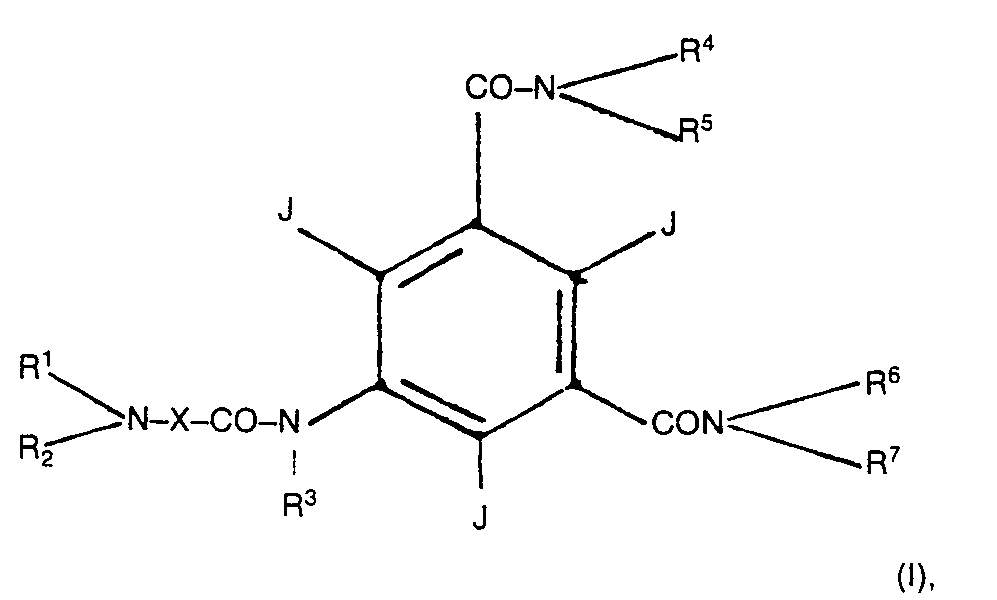
- X=ein niederer Alkylenrest,
- R1 =Wasserstoff oder ein niederer Alkylrest,
- R2=Wasserstoff oder ein gegebenenfalls hydroxylierter niederer Alkylrest,
- R3=Wasserstoff oder ein gegebenenfalls hydroxylierter niederer Alkylrest,
- R4=Wasserstoff oder ein gegebenenfalls hydroxylierter niederer Alkylrest,
- R5= niederer Mono- oder Polyhydroxyalkylrest, R6=Wasserstoff oder ein gegebenenfalls hydroxylierter niederer Alkylrest,
- R7=niederer Mono- oder Polyhydroxyalkylrest, und deren Salze mit Kontrastmittelsäuren.
Description
- Die vorliegende Erfindung umfaßt die in den Ansprüchen gekennzeichneten Gegenstände.
- Zur vollständigen röntgenologischen Darstellung von z.B. 'wesentlichen Teilen des Gefäßsystems, wie beispielsweise der Aorta, oder der vollständigen Darstellung der ableitenden Harnwege müssen Kontrastmittellösungen in hohen Konzentrationen appliziert werden, um einen guten Kontrast in dem zu untersuchenden System zu erhalten. Die hohen Kontrastmittelkonzentrationen erfordern von den Kontrastmitteln eine sehr gute Wasserlöslichkeit bei gleichzeitig niedriger Toxizität und guter Verträglichkeit.
- Es ist bekannt, daß die allgemeine Verträglichkeit der Röntgenkontrastmittel von deren hydrophilen Charakter abhängig ist (P.K. Knoefel, Radiocontrast agents, Vol.Pergamon Press 1971, page 133fr) und daß die elektrische Ladung des Kations und Anions zu einem wesentlichen Teil zur Verminderung der lipophil -toxischen Wirkungen insbesondere der trijodierten Aromaten beiträgt.
- Bei den zur Zeit gebräuchlichen Röntgenkontrastmittelsalzlösungen ist das Anion der Jod-enthaltende, kontrastgebende Teil, während das Kation keine für die Röntgendarstellung erforderliche Aufgabe erfüllt. Von den verwendeten Kationen gehen im Gegenteil eine Reihe von unerwünschten Wirkungen aus:
- So tragen alle Ionen zum osmotischen Druck der Röntgenkontrastmittel-Salzlösungen im Verhältnis ihrer molaren Konzentration bei, d.h. zum Beispiel, daß in den Salzen der substituierten Trijodbenzoesäuren die Hälfte des osmotischen Druckes vom jodfreien und damit kontmast- wirkungslosen Kation herrührt. Der hohe osmotische Druck konzentrierter Röntgenkontrastmittellösungen ist für eine Reihe unerwünschter pharmakologischer Effekte verantwortlich, wie zum Beispiel für Vasodilation, Schmerz sowie für diuretische Wirkung und damit Verdünnung des ausgeschiedenen Kontrastmittels in der Urographie. Ferner erhöhen die üblichen Kationen aus jodfreien Basen mit hohem Molekulargewichte wie beispielsweise Meglumin, Glucamin Lysin, Arginin u.a. die Viskosität der Kontrastmittellösungen beträchtlich.
- Kationen mit geringerem Molekulargewicht erhöhen die Viskosität der Kontrastmittellösungen zwar nur wenig, wirken dafür aber toxisch. So wird eine Schädigung der Blut-Eirn-Schranke und Auslösung von Gefäßschmerz durch Na-Ionen und eine höhere Toxizität von Äthanolamin (EVILL, C.A. und G.T. BENNESS: Metrizamide as a non-ionic urographic agent, a comparison with sodium iothalamate and its dimer, Invest Radiol 9: 434-437 (1974), HILAL, S.K.: Trends in preparation of new Angiographic contrast media with special emphasis on polymeric derivatives, Invest Radiol 5: 458-468 (1970)) beschrieben.
- Die zur Kationenbildung geeigneten erfindungsgemäßen Verbindungen zeigen einerseits die Vorteile der vergleichbaren bisher zur Kationenbildung verwendeten Verbindungen und vermeiden andererseits deren Nachteile. Sie zeichnen sich durch folgende Eigenschaften aus: Die elektrische Ladung als Träger hydrophiler Eigenschaften und als Ursache für die außerordentlich gute Löslichkeit der Trijodaromaten wird beibehalten.
- Der osmotische Druck der Kontrastmittellösungen wird bedeutend vermindert, weil der vom kontrastlosen Kation stammende Anteil am osmotischen Druck entfällt.
- Die Viskosität wird bedeutend vermindert; da bei gleicher Jodkonzentration die Salzkonzentration erheblich gesenkt wird. Das erlaubt die Herstellung hoch konzentrierter und dennoch sehr wenig visköser Lösungen. Eine geringere Viskosität der Lösungen erleichtert deren Applikation und wirkt sich in der selektiven Angiographie insofern günstig aus, als die Mikrocirculation weniger beeinträchtigt wird als durch visköse Lösungen.
- Erfindungsgemäß kommen als Basen 2,4,6-Trijod- isophthalsäurederivate in Betracht, die die erforderliche niedrige Toxizität aufweisen und geeignet sind mit Kontrastmittelsäuren leicht wasserlösliche Salze zu bilden.
- Besonders geeignet sind die neuen Verbindungen der allge-

- X = ein niederer Alkylenrest,
- R1 = Wasserstoff oder ein niederer Alkylrest,
- R2 = Wasserstoff oder ein gegebenenfalls hydroxylierter niederer Alkylrest,
- R3 = Wasserstoff oder ein gegebenenfalls hydroxylierter niederer Alkylrest,
- R4 = Wasserstoff oder ein gegebenenfalls hydroxylierter niederer Alkylrest,
- R5 = niederer Mono- oder Polyhydroxyalkylrest,
- R6 = Wasserstoff oder ein gegebenenfalls hydroxylierter niederer Alkylrest,
- R7 = niederer Mono- oder Polyhydroxyalkylrest und deren Salze mit Kontrastmittelsäuren.
- Die niederen Alkylgruppen können gerad- oder verzweigtkettig sein und enthalten 1-4 C-Atome. Bevorzugt ist der Methylrest. Infrage kommen aber auch Alkylgruppen, wie beispielsweise die Äthyl-, n-Propyl- oder iso-Propylgruppe.
- Sind diese hydroxysubstituiert, so können auch diese geradkettig oder verzweigtkettig sein. Sie enthalten 2-4, vorzugsweise 2-3 C-Atome und 1-3, vorzugsweise 2 Hydroxylgruppen im Alkylrest. Als geeignete Hydroxyalkylreste seien beispielsweise genannt: 2-Hydroxy-propyl , 3-Hydroxy-propyl 1-(Hydroxymethyl)-äthyl, 2,3-Dihydroxybutyl, 2,4-Dihydroxybutyl, 3,4-Dihydroxybutyl, 2,3-Dihydroxy-methyl-propyl (Trishydroxymethyl)-methyl, 2, 3, 4-Trihydroxyoutyl, 1,3,4-Trihydroxybuty, und vorzugsweise 2-Hydroxyäthyl, 1,3-Dihydroxyisopropyl, 2,3-Dihydroxypropyl.
- Der Aminoacylrest R1, R2·N-X-CO- (R1 und R2 haben die oben angegebene Bedeutung) leitet sich von an sich bekannten synthetischen und natürlichen Aminosäuren ab. X steht somit für einen gerad- oder verzweigtkettigen Alkylenrest, der gegebenenfalls durch eine Hydroxy-, Methoxy- oder Aminogruppe substituiert sein kann. Bevorzugte Reste X sind gerad- oder verzweigtkettige, niedere Alkylenreste mit 1-4, insbesondere 1-2 C-Atomen, wie zum Beispiel Methylen, Äthylen, Propylen, Butylen, Methyl-methylen, Methyl-äthylen, Methyl-propylen, Methyl-butylen und Äthyl-propylen, Hydroxyäthylen, Hydroxymethyl-methylen, Methoxymethyl-methylen.
- Die erfindungsgemässen Verbindungen gemäss Formel I werden insbesondere auch verwendet um Röntgenkontrastmittelsäuren in ihre Salze zu überführen.
- Zur Salzbildung sind grundsätzlich alle bekannten intravenös anwendbaren Kontrastmittelsäuren geeignet. Bevorzugt seien die zur Zeit für die Uro- und Angiographie und die Darstellung der Körperhöhlen gebräuchlichen jodhaltigen Kontrastmittelsäuren genannt wie zum Beispiel einkernige trijodierte Benzoesäuren wie Amidotrizoesäure, Jodamid, lothalamsäure, Ioxithalamsäure, Ioglicinsäure u.a.,
- Zweikernige hexajodierte Monocarbonsäuren wie zum Beispiel Ioxaglicinsäure u.a. und zweikernige hexajodierte Dicarbonsäure wie zum Beispiel Iocarminsäure u.a..
- Die erfindungsgemässen Salze, die aus einem trijodierten Kation und einem bekannten jodierten Kontrastmittelsäureanion bestehen, zeichnen sich durch die von Salzlösungen bekannte Stabilität und eine hervorragende Verträglichkeit aus, wie sich aus der nachfolgenden Tabelle am Beispiel des erfindungsgemäßen 5-Aminoacetamido-2, 6-trijod-isophthalsäure-bis-(2-hydroxyäthyl)amid - Iothalamat (A-Iothalamat) und des erfindungsgemäßen 5-Amidoacetamido-2,4,6-isophthalsäure-bis-(N-methyl-2,3-dihydroxypropyl)-diamid-Amidotrizoat (B-Amidotrizoat).

- So zeigt die obige Tabelle am Beispiel des erfindungsgemässen Iothalamatsalzes, dass sich die neuen Verbindungen durch einen besonders hohen Jodgehalt, wie er sonst nur für die weniger gut verträglichen Natriumsalze erreicht wird, auszeichnen. Ferner ist zu sehen, dass die Viskosität einer Lösung der erfindungsgemässen Salze besonders niedrig ist und dass die Molarität und damit der osmotische Druck der Salzlösung wesentlich geringer ist als die Molarität und der osmotische Druck von Na- und Megluminsalzlösungen. Auch ist die Verträglichkeit der erfindungsgemässen Verbindungen bei Maus uns Ratte eindeutig besser als diejenige der bekannten Natrium- oder Megluminsalze.
- Die ausgezeichnete Verträglichkeit der neuen Salze in Verbindung mit ihrer niedrigen Viskosität ermöglicht es, hochkonzentrierte und trotzdem leicht injizierbare Röntgenkontrastmittellösungen herzustellen. Gemäß der Erfindung können schattengebende Substanzen in Form ihrer Salzlösungen in Konzentrationen von 20 bis 500 mg J/ml Lösung Anwendung finden.
- Die Erfindung betrifft ferner ein Verfahren zur Herstellung der Verbindungen der allgemeinen Formel I, dadurch gekennzeichnet, daß man in an sich bekannter Weise
- a) eine Verbindung der allgemeinen Formel II


- b) eine Verbindung der allgemeinen Formel IV

- Die Umsetzung des Ausgangsprodukts der allgemeinen Formel II mit dem Amin der Formel III (Verfahrensvariante a) erfolgt nach an sich bekannten Methoden in Gegenwart eines geeigneten Lösungsmittel bei 0-100°C, vorzugsweise bei 0-60°C. Die Reaktionstemperatur wird im wesentlichen von den physikalischen Eigenschaften des eingesetzten Amins bestimmt. Ist das Amin leicht flüchtig, setzt man zweckmäßigerweise bei Raumtemperatur oder auch unterhalb Raumtemperatur um. Ist das eingesetzte Amin weniger flüchtig, kann die Umsetzung auch bei höherer Reaktionstemperatur erfolgen. Geeignete Lösungsmittel sind insbesondere polare Lösungsmittel wie beispielsweise Wasser, Dioxan, Dimethylformamid, Dimethylacetamid, niedere Alkohole, wie zum Beispiel Methanol, Äthanol, Isopropanol u.a. und deren Gemische.
- Verbindungen der Formel I, in denen R1 und R2 gleichzeitig Wasserstoff bedeuten, erhält man vorteilhaft gemäß Verfahrensvariante b) aus Verbindungen der allgemeinen Formel IV durch Hydrazinolyse. Die Durchführung der Hydrazinolyse erfolgt nach Meuboden wie sie allgemein bekannt sind [vgl. z.B. DOS 2 523 567, J.Am.Chem.Soc. 71 1856 (1949), J. Chem. Soc. 2343, 1926, Chem.Ber. 83, 244 (1950)]. Dazu wird das Ausgangsprodukt der allgemeinen Formel IV beispielsweise in einem organischen, vorzugsweise mit Wasser mischbaren Lösungsmittel (z.B. Methanol oder Äthanol) gelöst und mit Hydrazin in vorzugsweise alkoholiocher Lösung zur Reaktion gebracht, wobei das Hydrazin zweckmäBigerweise im Überschuß angewandt wird. Die nachträgliche Einführung einer Alkyl- oder hydroxysubstituierten Alkylgruppe a3 erfolgt ebenfalls nach den dem Fachmann an sich bekannten N-Alkylierungsmethoden, z.B. in dem man in alkalischer Lösung mit dem entsprechenden Alkylsulfat oder Alkylhalogenid, vorzugsweise Bromid, bei Raumtemperatur, umsetzt.
- Ist es für den Reaktionsverlauf vorteilhaft vor der N-Alkylierung im Molekül anwesende freie Hydroxylgruppen intermediär zu schützen, so erfolgt dies nach üblichen Methoden durch leicht reversible Gruppen. Die Einführung solcher Schutzgruppen kann z.B. erfolgen durch Veresterung (z.B. Einführung eines vorzugsweisen Acetylrestes oder Benzylrestes) oder durch Verätherung (z.B. Einführung des Triphenylmethylrestes).
- Der Hydroxylgruppenschutz kann auch durch Ketalisierung oder Acetalisierung, z.B. mittels Acetaldehyd, Aceton oder Dihydropyran, erreicht werden.
- Die spätere Abspaltung der intermediär eingeführten Schutzgruppen unter Freisetzung der letztlich gewünschten Hydroxylgruppen erfolgt ebenfalls nach Methoden, die dem Fachmann allgemein geläufig sind. So kann die Abspaltung der Schutzgruppen ohne besondere Reaktionsstufe mit der Aufarbeitung und Isolierung der Umsetzungsprodukte erfolgen. Sie kann aber auch in üblicher Weise in einer getrennten Reaktionsstufe durchgeführt werden. Acylschutzgruppen können beispielsweise durch alkalische und Acetal-, Ketal- oder Ätherschutzgruppen durch saure Hydrolyse abgespalten werden.
- Die Herstellung der erfind ungsgemäß beschriebenen Salze erfolgt in an sich bekannter Weise, indem man z.B. die jodhaltige organische Säure mit der Base in Wasser in äquivalenten Gewichtsverhältnissen umsetzt. Aus der wäßrigen Lösung können die erfindungsgemäßen Salze nach den üblichen Methoden, wie beispielsweise durch Abdampfen des Lösungsmittels oder durch Fällung mit Hilfe organischer Lösungsmittel, isoliert werden.
- Die neuen Ausgangsverbindungen der allgemeinen Formel II bzw. IV werden zweckmäßigerweise aus dem bekannten 5-Amino- bzw. 5-Alkylamino-2,4,6-trijod-isophthalsäuredichlorid (Alkyl = CH3 oder C2H5) nach an sich bekannten Methoden hergestellt.
- Im ersten Reaktionsschritt wird das 5-(R3-Amino)-2,4,6- trijod-isophthalsäuredihalogenid in üblicher Weise mit dem entsprechenden Halogenfettsäurechlorid Hal·X·COCl (worin Hal und X die oben angegebene Bedeutung haben) N-acyliert.
- Im zweiten Reaktionsschritt erfolgt dann die Amidierung der beiden Carboxylgruppen durch Umsetzung des Säurechlorids mit HN·R4R5 bzw. HN·R6R7 nach an sich bekannten Methoden. So erfolgen beispielsweise die beiden Amidierungsreaktionen in einem geeigneten Lösungsmittel bei 0-100°C, vorzugsweise bei 20-80°C. Geeignete Lösungsmittel sind u.a. polare Lösungsmittel wie z.B. Wasser, Dioxan, Tetra--hydrofuran, Dimethylformamid, Dimethylacetamid, Hexametapol u.ä. und deren Gemische. Da die Amidierungsreaktion exotherm verläuft, ist es gegebenenfalls zweckmäßig, das Reaktionsgemisch leicht zu kühlen, um die Reaktionstemperatur auf etwa 50°C bis 60°C halten zu können. Der während der Amidierungsreaktion freiwerdende Chlorwasserstoff wird entweder durch einen entsprechenden Überschuß an Base HN·R4R5 bzw. HNR6R7 oder durch Zusatz eines üblichen Protonenakzeptors gebunden. Als Protonenakzeptoren verwendet man vorteilhaft tertiäre Amine, wie z.B. Triäthylamin, Tributylamin oder Pyridin.
- Die im Reaktionsverlauf anfallenden anorganischen oder organischen Salze werden in bekannter Weise abgetrennt, vorteilhaft z.B. mit Hilfe üblicher Ionenaustauscher-Säulen oder durch Filtration über bekannte Adsorbentien wie z.B. Diaion oder Amberlite XAD-2 und 4.
- Im einzelnen sei die Herstellung des Ausgangsproduktes der Formel II am Beispiel für die Herstellung von 5-Chlor- acetamido-2,4,6-trijod-isophthalsäure-bis(N-methyl-2,3-dihydroxypropyl)-diamid erläutert:
- Zu einer Lösung von 119,1 g (0,2 Mol) 5-Amino-2,4,6-tri- jod-isophthalsäuredichlorid in 400 ml Dimethylacetamid werden bei maximal 10°C innerhalb von 20 Minuten unter Rühren 67,7 g (0,6 Mol) Chloracetylchlorid zugetropft, 1 Stunde unter Eiskühlung und danach über Nacht bei Raumtemperatur weiterverrührt. Das Reaktionsgemisch wird dann mit 6 Liter Wasser behandelt, der entstandene Niederschlag abgesaugt und dieser in 3,5 Liter Essigester gelöst. Die Essigesterlösung wird mit 400 ml gesättigter NaHCO3-Lösung und 2 mal mit Wasser neutral gewaschen, mit Na2S04 getrocknet und im Vakuum eingeengt. Der Rückstand wird mit 800 ml Äther behandelt und im Vakuum bei 50°C getrocknet. Man erhält so 100,8 g (75 % der Theorie) 5-Chloracetamido-2,4,6-trijod-isophthalsäure-dichlorid vom Schmelzpunkt 254-256°C (Zersetzung).
- Zu einer Lösung von 490,7 g (0,73 Mol) 5-Chloracet- amido-2,4,6-trijod-isophthalsäure-dichlorid in 5,8 Liter Dioxan werden unter Rühren bei Raumtemperatur innerhalb von 40 Minuten 322,3 g (3,07 Mol) N-Methylaminopropan-2,3- diol in 1,46 Liter Dioxan zugetropft und danach über Nacht weiterverrührt. Dann wird das lösungsmittel abdestilliert, der Rückstand 2 mal mit Dioxan gewaschen, in 1,1 Liter Wasser gelöst und über einen Kationenaustauscher und einem Anionenaustauscher filtriert. Nach Behandeln der wäßrigen Fraktion mit Aktivkohle wird im Vakuum eingeengt und der Rückstand bei 50°C im Vakuum getrocknet.. Man erhält so 396 g (67 %) 5-Chlor- acetamido-2,4,6-trijod-isophthalsäure-bis(N-methyl-2,3-dihydroxypropyl)-diamid vom Schmelzpunkt ~290°C (Zersetzung).
- Die Herstellung des Ausgangsproduktes der allgemeinen Formel IV erfolgt gleichfalls aus 5-(R3-Amino)-2,4,6- trijod-isophthalsäure-dichlorid durch Acylierung der 5-ständigen aromatischen Aminogruppe mit dem entsprechenden N-Phthaloyl-X-COCl (X hat die oben angegebene Bedeutung) nach an sich bekannten Methoden und anschließender Amidierung der 1- und 3-ständigen Säurechloridgruppen wie oben beschrieben. Im einzelnen sei die Herstellung des Ausgangsproduktes der allgemeinen Formel IV am Beispiel der Herstellung von 2,4,6-Trijod-5-phthalimido- acetamido-isophthalsäure-bis(N-methyl-2,3-hydroxypropyl)-diamid dargestellt:
- Zu einer eisgekühlten Lösung von 119,1 g (0,2 Mol) 5-Amino-isophthalsäure-dichlorid in 0,5 Liter Dimethylacetamid werden unter Rühren 178,9 g N-Phthaloylglycin-chlorid portionsweise zugefügt, einige Stunden unter Eiskühlung und danach über Nachtbei Raumtemperatur verrührt. Sodann wird die Reaktionslösung langsam in etwa 10 Liter Wasser eingerührt, 45 Minuten nachgerührt, der Niederschlag abgesaugt, dieser mit Wasser nachgewaschen und in 3 Liter Essigester aufgenommen.
- Die filtrierte Essigesterphase wird mit halbgesättigten Natriumbicarbonatlösung und 2 mal mit Wasser gewaschen, mit Natriumsulfat getrocknet und im Vakuum eingeengt. Der Rückstand wird nachfolgend mit Äther behandelt und im Vakuum bei 50°C getrocknet. Man erhält so 127,3 g (81 %) 2,4,6-Trijod-5-phthalimidoacetamido-isophthalsäure-dichlorid vom Schmelzpunkt ~255°C (Zersetzung).
- Zu einer auf 50°C erwärmten Lösung von 78,3 g (0,1 Mol) 2,4,6-Trijod-5-phthalimidoacetamido-isophthalsäuredichlorid in 0,25 Liter Dimethylacetamid werden unter Verrühren langsam eine Lösung von 31,5 g N-Methylamino- proran-2,3-diol in 0,15 Liter Dimethylacetamid zugetropft. Nach Abklingen der Wärmetönung werden sodann 71,3 ml Tributylamin zugefügt und eine weitere Stunde bei 50°C verrührt. Nach Abkühlen auf Raumtemperatur wird die Lösung im Vakuum eingeengt, der Rückstand 1 Stunde mit 2 Liter Methylenchlorid behandelt, der Niederschlag abgetrennt, mit Methylenchlorid nachgewaschen, nochmals mit 2 Liter Methylenchlorid nachbehandelt, die Substanz abgesaugt und im Vakuum bei 50°C getrocknet. Das Rohprodukt wird sodann unter Rühren mit Wasser erhitzt, wobei Kristallisation eintritt. Nach Erkalten unter Rühren wird der Niederschlag abgesaugt, mit Wasser nachgewaschen und bei 50°C im Vakuum getrocknet. Man erhält so 66,0 g (72 %) 2,4,6-Trijod-5-phthalimido-acetamido-isophthalsäure- bis(N-methyl-2,3-hydroxypropyl)-diamid. Fp. 303°C (Zersetzung.
- Definitionsgemäß können die Substituenten -CO-N·R3R2 und -CONR6R7 in den erfirdungsgemäßen Verbindungen der Formel I auch verschieden sein. In diesem Falle erfolgt die Amidierung der 1- und 3-ständigen -CCCl-Grurren ebenfalls nach den oben angegebenen Arbeitsmethoden, jedoch stufenweise, d.h. zunächst mit der Base HN-R4R5 und anschließend mit der ver- schiedenen Base HN-R6R7, wie am Beispiel der Herstellung von 2,4,6-Trijod-5-phthalimidoacetamido-isophthalsäure-[(2,3-dihydroxypropyl)-(N-methyl-2,3-dihydroxypropyl)]-diamid im einzelnen ausgeführt sei:
- Zu einer auf 60°C erwärmten Lösung von 42,1 g (0,4 Mol) N-Methylaminopropan-2,3-diol in 1 Liter Diokan werden unter Rühren 156,6 g (0,2 Mol) 2,4,6-Trijod-5-phthal- imidoacetamido-isophthalsäure-dichlorid zugefügt, 3 Stunden bei 60°C weiterverrührt, filtriert und das Filtrat im Vakuum eingeengt. Der Rückstand wird sodann 30 Minuten mit 2,5 Liter Wasser verrührt, der abgetrennte Niederschlag in 3 Liter Essigester mit je 1 Liter gesättigter NaHCO3-Lösung und 1 Liter Wasser ausgeschüttelt, mit Na2SO4 getrocknet und im Vakuum eingeengt. Der Rückstand wird mit Äther nachbehandelt. Nach Trocknen im Vakuum bei 50°C erhält man so 108,4 g (64 %) 2,4,6-Trijod-5-phthalimidoacetamido-isophthalsäure-(N-methyl-2,3-dihydroxypropyl)-amid-chlorid, Fp. 268-272°C (Zersetzung).
- Zu einer auf 60°C erwärmten Lösung von 68,0 g 2,4,6-Trijod-5-phthalimidoacetamido-isophthalsäure-(N-methyl-2,3-dihydroxypropyl)-amid-chlorid in 1,5 Liter Dimethylacetamid werden unter Rühren tropfenweise 18,2 g 1-Amino-2,3-propandiol in 100 ml Dimethylacetamid zugefügt, 2 Stunden bei 50°C nachgerührt und das Dimethylacetamid imTVakuum entfernt. Der Rückstand wird zweimal mit Methylenchlorid behandelt, abgesaugt und im Vakuum bei 50°C getrocknet. Man erhält so 2,4,6-Trijod-5-phthal- imidoacetamido-isophthalsäure-[(2,3-dihydroxypropyl)- (N-methyl-2,3-dihydroxypropyl)]-diamid, Ausbeute: 38,3 g (56 %) Fp. 286-289°C (unter Zersetzung).
- 50,0 g 5-Chloracetamido-2,4,6-trijod-isophthalsäure-bis (N-methyl-2,3-dihydroxypropyl)-diamid (Fp. 290°C unter Zersetzung) werden in 370 ml 25 %igem Ammoniak unter Zusatz von 250 ml Wasser 7 Tage bei Raumtemperatur verrührt. Danach wird die Lösung eingeengt, mehrmals mit Wasser nachdestilliert, der Rückstand in 130 ml Wasser aufgenommen, die Lösung über einen Anionenaustauscher gegeben, das Filtrat mit Aktivkohle behandelt und im Vakuum eingeengt. Nach mehrmaligem Nachdestillierer mit Wasser wird das Präparat im Vakuum bei 50°C getrocknet. Ausbeute: 41,9 g (86 %), Fp.~259°C (unter Zersetzung).
- In analoger Weise wurden hergestellt:
- a) 5-(Aminoacetamido-N-methyl)-2,4,6-trijod-isophthalsäure- bis(N-methyl-2,3-dihydroxypropyl)-diamid. Ausbeute 95 % der Theorie, Fp. 235°C (unter Zersetzung) aus 5-(Chloracetamido-N-methyl)-2,4,6-trijod- isophthalsäure-bis(N-methyl-2,3-dihydroxypropyl)-diamid, Fp. 305°C (Zersetzung)
- b) 5-Aminoacetamido-2,4,6-trijod-isophthalsäure-bis(2,3-dihydroxypropyl)-diamid, Ausbeute 68 % der Theorie, Fp. 244 - 246°C (Zersetzung) aus 5-Chloracetamido-2,4,6-trijod-isophthalsäure- bis(2,3-dihydroxypropyl)-diamid, Fp. 313°C (Zersetzung)
- c) 5-(Aminoacetamido-N-methyl)-2,4,6-trijod-isophthalsäure- bis(2,3-dihydroxypropyl)-diamid, Ausbeute 91 % der Theorie, Fp. 235°C (Zersetzung) aus 5-(Chloracetamido-N-methyl)-2,4,6-trijod- isophthalsäure-bis(2,3-dihydroxypropyl)-diamid, Fp. 235°C (Zersetzung)
- d) 5-Aminoacetamido-2,4,6-trijod-isophthalsäure-bis(2-hydroxy-1-hydroxymethyläthyl)-diamid, Ausbeute 81 % d. Th., Fp. 280°C (Zersetzung) aus 5-Chloracetamido-2,4,6-trijodisophthalsäure- bis(2-hydroxy-1-hydroxy-methyläthyl)-diamid, Fp. 300°C (Zersetzung)
- e) 5-(2-Amino-propionamido)-2,4,6-trijod-isophthalsäure- bis(2-hydroxy-l-hydroxymethyl-äthyl)-diamid, Ausbeute 39 % d. Th., Fp. 278°C (Zersetzung) aus 5-(2-Chlorpropionamido)-2,4,6-trjod-isophthalsäure-bis[2-hydroxy-1-hydroxymethyl-äthyl]-diamid, Fp. 314°C (Zersetzung)
- f) 5-(3-Aminopropionamido)-2,4,6-trijod-isophthalsäure- bis(N-methyl-2,3-dihydroxypropyl)-diamid, Fp. 275°C (Zersetzung) aus 5-(3-Chlorpropionamido)-2,4,6-trijod-isophthalsäure-bis (N-methyl-2,3-dihydroxypropyl)-diamid, Fp. 252°C (Zersetzung)
- g) 5-(Aminoacetamido-N-methyl)-2,4,6-trijod-isophthalsäure- bis(2-hydroxy-l-hydroxymethyl-äthyl)-diamid, Ausbeute 57 % d. Th., Fp. 263°C (Zersetzung) aus 5-(Chloracetamido-N-methyl)-2,4,6-trijodiso- phthalsäure-bis(2-hydroxy-1-hydroxymethyl-äthyl)-diamid, Fp. 320°C (Zersetzung).
- 40,5 g (0,05 Mol) 5-Chloracetamido-2,4,6-trijod-isophthalsäure-bis(N-methyl-2,3-dihydroxypropyl)-diamid (Fp. 290°C, Zersetzung) werden mit 300 ml 40 %iger wäßriger Methylaminolösung und Zusatz von 200 ml Wasser 7 Tage bei Raumtemperatur verrührt. Die Aufarbeitung des Reaktionsgemisches erfolgt wie in Beispiel 1 beschrieben. Ausbeute 24,2 g (60 %), Fp. ~ 245°C (unter Zersetzung).
- In analoger Weise wurden hergestellt:
- a) 2,4,6-Trijod-5-methylaminoacetamido-isophthalsäure-bis (2,3-dihydroxypropyl)-diamid, Ausbeute 73 % d. Th., Fp. 265°C (Zersetzung) aus 5-Chloracetamido-2,4,6-trijod-isophthalsäure- bis(2,3-dihydroxypropyl)-diamid, Fp. 313°C (Zers.)
- b) 2,4,6-Trijod-5-methylaminoacetamido-N-methyl-isophthalsäure-bis(2,3-dihydroxypropyl)-diamid, Ausbeute 67 % der Theorie, Fp. 265°C (Zersetzung) aus 5-(Chloracetamido-N-methyl)-2,4,6-trijod-isophthalsäure-bis(2,3-dihydroxy-propyl)-diamid, Fp. 305°C (Zersetzung).
- In eine Lösung von 348,9 ml Äthanolamin in 375 ml Methanol werden unter Rühren 36,1 g 5-Chloracetamido-2,4,6-trijod- isophthalsäure-bis(2-hydroxyäthyl)-diamid (bis 320°C nicht geschmolzen bzw. zersetzt) eingetragen und 48 Stunden bei Raumtemperatur verrührt. Sodann wird im Vakuum eingeengt, der ölige Rückstand mit 187 ml Wasser über Nacht verrührt, der Niederschlag abgesaugt und im Vakuum bei 50° C getrocknet. Ausbeute 19,5 g (52 %), Fp. 242 - 244°C (unter Zersetzung).
- Zu einer Lösung von 40,5 g 5-Chloracetamido-2,4,6-trijod- isophthalsäure-bis(N-methyl-2,3-dihydroxy-propyl)-diamid (Fp. 290°, Zersetzung) in 300 ml Methanol werden 299,5 ml Äthanolamin zugefügt, 48 Stunden bei Raumtemperatur verrührt. Die Lösung wird dann im Vakuum eingeengt, der Rückstand wird in 250 ml Wasser gelöst, die Lösung mit verdünnter Salzsäure auf pH 7 eingestellt, zur Entsalzung über Amberlite XAD-4 filtriert und die salzfreie Lösung nach Behandeln mit Aktivkohle im Vakuum eingeengt. Der Rückstand wird bei 50°C im Vakuum getrocknet. Ausbeute: 18,0 g (43 %), Fp. ca. 250°C (unter Zersetzung).
- 50,4 g = 50 mMol 5-BromAcetamido-2,4,6-trijod-isophthalsäure-bis-(Broaacetoxy-äthylamid) werden in 500 ml 8 n Ammoniak suspendiert. Nach mehrstündigem Rühren wird die Lösung im Vakuum zur Trockne eingeengt, mit 150 ml Wasser versetzt, mit verdünntem Ammoniak auf pH 8 - 9 eingestellt und 1 - 2 Tage bis zur völligen Ausfällung gerührt. Ausbeute an Titelverbindung nach Absaugen, Waschen und Trocknen 25,5 g = 72,6 % der Theorie. Zersetzung unter - Jodabspaltung ab 270°C.
- Zu einer Suspension von 92,0 g 2,4,6-Trijod-5-phthalimido- acetamido-isonhthalsäure-bis(N-methyl-2,3-dihydroxy-propyl)-diamid (Fp. ~303°C Zersetzung) in 600 ml Äthanol werden bei Raumtemperatur unter Rühren 18,2 ml 80 %iges Hydrazinhydrat zugetropft und danach 2 Stunden am Rückfluß erwärmt. Nach dem Erkalten werden zur Reaktionsmischung 300 ml 1 n Salzsäure zugefügt. Anschließend wird das Reaktionsgemisch 1 Stunde bei Raumtemperatur gerührt, der Niederschlag abgesaugt, das Filtrat vom Äthanol im Vakuum befreit und die verbleibende wäßrige Lösung über einen basischen Ionenaustauscher filtriert. Das Filtrat wird dann im Vakuum eingeengt, der Rückstand mit 300 ml n-Butanol unter Erwärmen am Rückfluß verrührt und bei Raumtemperatur nachgerührt. Der Niederschlag wird abgesaugt, mit kaltem n-Butanol nachbehandelt und im Vakuum bei 50° C getrocknet. Ausbeute: 62,4 g (79 % d. Theorie), Fp. ~ 263°C (unter Zersetzung).
- In analoger Weise wurde hergestellt:
- 5-Aminoacetamido-2,4,6-trijod-isophthalsäure-[(2,3-dihydroxypropyl)-(N-methyl-2,3-dihydroxypropyl)7-diamid, Fp. 251° C (Zersetzung) aus 2,4,6-Trijod-5-phthalimidoacetamido-isophthalsäure-[(2,3-dihydroxypropyl)-(N-methyl-2,3-dihydroxypropyl)]-diamid, Fp. 286-289°C (Zersetzung).
- b) 5-(2-Amino-propionamido)-2,4,6-trijod-isophthalsäure- bis(2,3-dihydroxypropyl)-diamid; Ausbeute 49 % der Theorie, Fp.: 248°C (Zersetzung) aus 2,4,6-Trijod-5-phthalimidopropionamido- isophthalsäure-bis(2,3-dihydroxypropyl)-diamid, Fp.:~ 298°C (Zersetzung),
- c) 5-(3-Amino-propionamido)-2,4,6-trijod-isophthalsäure-bis-(2,3-dihydroxypropyl)-diamid; Ausbeute 26 % der Theorie; Fp.: 278-281°C (Zersetzung) aus 2,4,6-Trijod-5-phthalimidopropionamido- isophthalsäure-bis(2,3-dihydroxypropyl)-diamid, Fp.: 298-300°C (Zersetzung),
- d) 5-Aminoacetamido-2,4,6-trijod-isophthalsäure-tetrakis-(2-hydroxyäthyl)-diamid; Ausbeute 44 % der Theorie; Fp. 262-263°C (Zersetzung) aus 2,4,6-Trijod-5-phthalimido-acetamido-isophthalsäure-tetrakis(2-hydroxyäthyl)-diamid; Fp.: 283-285°C (Zersetzung)
-

- Vor dem Auffüllen wird die Lösung gegebenenfalls durch Zugabe einer geringen Menge der entsprechenden Säure bzw. Base auf ein pH von 6,5 - 7,5 eingestellt, die Lösung durch ein Bakterienfilter filtriert, abgefüllt und sterilisiert. Sie enthält 380 mg J/ml.
-

- Vor dem Auffüllen wird die Lösung gegebenenfalls durch Zugabe einer geringen Menge der entsprechenden Säure bzw. Base auf ein pH von 6,5 - 7,5 eingestellt, die Lösung durch ein Bakterienfilter filtriert, abgefüllt und sterilisiert. Sie enthält 380 ml J/ml.
-

- Vor dem Auffüllen wird die Lösung gegebenenfalls durch Zugabe einer geringen Menge der entsprechenden Säure bzw. Base auf ein pH von 6,5 - 7,5 eingestellt, die Lösung durch ein Bakterienfilter filtriert, abgefüllt und sterilisiert. Sie enthält 300 mg J/ml.
-

- Vor dem Auffüllen wird die Lösung gegebenenfalls durch Zugabe einer geringen Menge der entsprechenden Säure bzw.. Base auf ein pH von 6,5 - 7,5 eingestellt. Anschließend wird die Lösung über einem Bakterienfilter filtriert, abgefüllt und sterilisiert. Sie enthält 300 mg J/ml Lösung.
und die so erhaltene Base gewünschtenfalls anschließend, gegebenenfalls unter intermediärem Schutz freier Hydroxylgruppen,N-alkyliert und/oder mit einer Röntgenkontrastmittelsäure in das Salz überführt.
Claims (9)


Priority Applications (1)
| Application Number | Priority Date | Filing Date | Title |
|---|---|---|---|
| AT80730043T ATE2834T1 (de) | 1979-07-12 | 1980-06-27 | Trijodierte basen, deren herstellung und diese enthaltendes roentgenkontrastmittel. |
Applications Claiming Priority (2)
| Application Number | Priority Date | Filing Date | Title |
|---|---|---|---|
| DE2928417 | 1979-07-12 | ||
| DE19792928417 DE2928417A1 (de) | 1979-07-12 | 1979-07-12 | Trijodierte basen |
Publications (3)
| Publication Number | Publication Date |
|---|---|
| EP0022744A2 true EP0022744A2 (de) | 1981-01-21 |
| EP0022744A3 EP0022744A3 (en) | 1981-03-11 |
| EP0022744B1 EP0022744B1 (de) | 1983-03-23 |
Family
ID=6075678
Family Applications (1)
| Application Number | Title | Priority Date | Filing Date |
|---|---|---|---|
| EP80730043A Expired EP0022744B1 (de) | 1979-07-12 | 1980-06-27 | Trijodierte Basen, deren Herstellung und diese enthaltendes Röntgenkontrastmittel |
Country Status (21)
| Country | Link |
|---|---|
| US (1) | US4283381A (de) |
| EP (1) | EP0022744B1 (de) |
| JP (1) | JPS5659717A (de) |
| AT (1) | ATE2834T1 (de) |
| AU (1) | AU536426B2 (de) |
| CA (1) | CA1129438A (de) |
| CS (1) | CS214834B2 (de) |
| DE (2) | DE2928417A1 (de) |
| DK (1) | DK154501C (de) |
| EG (1) | EG14884A (de) |
| ES (2) | ES493302A0 (de) |
| FI (1) | FI68042C (de) |
| GR (1) | GR69303B (de) |
| HU (1) | HU182154B (de) |
| IE (1) | IE50064B1 (de) |
| IL (1) | IL60517A (de) |
| NO (1) | NO150719C (de) |
| PH (1) | PH16651A (de) |
| PT (1) | PT71547A (de) |
| YU (1) | YU177980A (de) |
| ZA (1) | ZA804192B (de) |
Cited By (5)
| Publication number | Priority date | Publication date | Assignee | Title |
|---|---|---|---|---|
| FR2541676A1 (fr) * | 1983-02-25 | 1984-08-31 | Guerbet Sa | Composes non-ioniques a structures benzenique iodee ou bromee et produits opacifiants en contenant |
| EP0082804B1 (de) * | 1981-12-18 | 1987-08-12 | Schering Aktiengesellschaft | 2-Amino-1-(1,3-dioxolan-4-yl)-ethanol-Verbindungen, deren Herstellung und Verwendung zur Weiterverarbeitung |
| EP0431838A1 (de) * | 1989-11-29 | 1991-06-12 | Bracco International B.V. | Nichtionische radiographische Kontrastmittel |
| US5278311A (en) * | 1992-06-05 | 1994-01-11 | E. R. Squibb & Sons, Inc. | Nonionic radiographic contrast agents |
| US5614638A (en) * | 1989-11-29 | 1997-03-25 | Bracco International B.V. | Nonionic radiographic contrast agents |
Families Citing this family (11)
| Publication number | Priority date | Publication date | Assignee | Title |
|---|---|---|---|---|
| DE3038853A1 (de) | 1980-10-10 | 1982-05-27 | Schering Ag, 1000 Berlin Und 4619 Bergkamen | Neue n-hydroxy-alkylierte dicarbonsaeure-bis-(3,5-dicarbamoyl-2,4,6-trijodanilide), deren herstellung und diese enthaltende roentgenkonstrastmittel (ii) |
| GB8906130D0 (en) * | 1989-03-17 | 1989-05-04 | Nycomed As | Compositions |
| US5232685A (en) * | 1989-11-03 | 1993-08-03 | Schering Aktiengesellschaft | Nonionic x-ray contrast medium with high iodine content |
| GB9020091D0 (en) * | 1990-09-14 | 1990-10-24 | Nycomed As | Contrast media |
| ATE181547T1 (de) * | 1994-09-22 | 1999-07-15 | Guerbet Sa | Iodo-verbindungen, ihre herstellung und verwendung als kontrastmittel für röntgen- radiologie |
| IT1299202B1 (it) * | 1998-05-08 | 2000-02-29 | Dibra Spa | Processo per la preparazione della s-n,n'-bis (2-idrossi-1- (idrossimetil)etil) -5-((2-idrossi-1-ossopropil)ammino)-2,4,6-triiodo |
| IT1312569B1 (it) * | 1999-05-21 | 2002-04-22 | Raffaele Ansovini | Uso dell'enzima gssg reduttasi per il trattamento terapeutico e laprofilassi di pazienti infettati da hiv. |
| US7790141B2 (en) * | 2003-08-11 | 2010-09-07 | Pathak Holdings, Llc | Radio-opaque compounds, compositions containing same and methods of their synthesis and use |
| CN101654417B (zh) * | 2009-09-01 | 2012-06-20 | 江苏省原子医学研究所 | X线造影剂碘佛醇中间体的制备方法 |
| CN105461581A (zh) * | 2015-11-17 | 2016-04-06 | 浙江海洲制药有限公司 | 碘帕醇杂质a和杂质b的合成方法 |
| CN115806498B (zh) * | 2021-09-15 | 2024-09-10 | 大道隆达(北京)医药科技发展有限公司 | 5-氯乙酰胺基-2,4,6-三碘异酞酰氯的合成方法 |
Family Cites Families (7)
| Publication number | Priority date | Publication date | Assignee | Title |
|---|---|---|---|---|
| US2776241A (en) * | 1952-08-06 | 1957-01-01 | Schering Ag | Injectable x-ray contrast agents comprising salts of n-acyl derivatives of 2, 4, 6-triiodo-3-aminobenzoic acid |
| US3178473A (en) * | 1962-03-02 | 1965-04-13 | Nyegaard & Co As | Process for the n-alkylation of acyl anilides halogen substituted in the nucleus |
| US4021481A (en) * | 1969-06-27 | 1977-05-03 | Nyegaard & Co. A/S | Amido derivatives of 2,4,6-triiodobenzoic acids containing at least one N-hydroxyalkyl and at least two hydroxyl groups |
| DE2031724C3 (de) * | 1969-06-27 | 1979-06-28 | Nyegaard & Co. A/S., Oslo | N-substituierte Trijodbenz- bzw. Jodmethansulfon-am'ide, Verfahren zu deren Herstellung und radiologische Zusammensetzungen |
| BE795555A (fr) * | 1972-02-16 | 1973-08-16 | Schering Ag | Amides de triiodo-isophtaloyl-monoamino-acide, leur procede de preparation et leur utilisation |
| GB1548594A (en) * | 1976-06-11 | 1979-07-18 | Nyegaard & Co As | Triiodoisophthalic acid amides |
| US4192859A (en) * | 1978-09-29 | 1980-03-11 | E. R. Squibb & Sons, Inc. | Contrast media containing liposomes as carriers |
-
1979
- 1979-07-12 DE DE19792928417 patent/DE2928417A1/de not_active Withdrawn
-
1980
- 1980-06-27 DE DE8080730043T patent/DE3062428D1/de not_active Expired
- 1980-06-27 EP EP80730043A patent/EP0022744B1/de not_active Expired
- 1980-06-27 AT AT80730043T patent/ATE2834T1/de not_active IP Right Cessation
- 1980-07-08 IL IL60517A patent/IL60517A/xx unknown
- 1980-07-10 CA CA355,900A patent/CA1129438A/en not_active Expired
- 1980-07-10 PH PH24273A patent/PH16651A/en unknown
- 1980-07-10 CS CS804924A patent/CS214834B2/cs unknown
- 1980-07-10 FI FI802215A patent/FI68042C/fi not_active IP Right Cessation
- 1980-07-10 YU YU01779/80A patent/YU177980A/xx unknown
- 1980-07-10 AU AU60294/80A patent/AU536426B2/en not_active Ceased
- 1980-07-10 GR GR62426A patent/GR69303B/el unknown
- 1980-07-11 ES ES493302A patent/ES493302A0/es active Granted
- 1980-07-11 NO NO802102A patent/NO150719C/no unknown
- 1980-07-11 HU HU801748A patent/HU182154B/hu unknown
- 1980-07-11 IE IE1441/80A patent/IE50064B1/en unknown
- 1980-07-11 ZA ZA00804192A patent/ZA804192B/xx unknown
- 1980-07-11 DK DK300680A patent/DK154501C/da not_active IP Right Cessation
- 1980-07-11 PT PT71547A patent/PT71547A/pt unknown
- 1980-07-11 JP JP9406480A patent/JPS5659717A/ja active Pending
- 1980-07-11 ES ES493301A patent/ES8104791A1/es not_active Expired
- 1980-07-11 US US06/167,597 patent/US4283381A/en not_active Expired - Lifetime
- 1980-07-12 EG EG412/80A patent/EG14884A/xx active
Cited By (7)
| Publication number | Priority date | Publication date | Assignee | Title |
|---|---|---|---|---|
| EP0082804B1 (de) * | 1981-12-18 | 1987-08-12 | Schering Aktiengesellschaft | 2-Amino-1-(1,3-dioxolan-4-yl)-ethanol-Verbindungen, deren Herstellung und Verwendung zur Weiterverarbeitung |
| FR2541676A1 (fr) * | 1983-02-25 | 1984-08-31 | Guerbet Sa | Composes non-ioniques a structures benzenique iodee ou bromee et produits opacifiants en contenant |
| EP0118347A1 (de) * | 1983-02-25 | 1984-09-12 | Guerbet S.A. | Nicht-ionische Verbindungen mit iodierter oder bromierter benzenischer Struktur und diese enthaltende opazifizierende Produkte |
| EP0431838A1 (de) * | 1989-11-29 | 1991-06-12 | Bracco International B.V. | Nichtionische radiographische Kontrastmittel |
| US5614638A (en) * | 1989-11-29 | 1997-03-25 | Bracco International B.V. | Nonionic radiographic contrast agents |
| US5628980A (en) * | 1989-11-29 | 1997-05-13 | Bracco International B.V. | Nonionic radiographic contrast agents |
| US5278311A (en) * | 1992-06-05 | 1994-01-11 | E. R. Squibb & Sons, Inc. | Nonionic radiographic contrast agents |
Also Published As
| Publication number | Publication date |
|---|---|
| JPS5659717A (en) | 1981-05-23 |
| IE50064B1 (en) | 1986-02-05 |
| EG14884A (en) | 1985-06-30 |
| EP0022744B1 (de) | 1983-03-23 |
| CS214834B2 (en) | 1982-06-25 |
| ES493301A0 (es) | 1981-05-16 |
| PT71547A (en) | 1980-08-01 |
| DK154501B (da) | 1988-11-21 |
| IE801441L (en) | 1981-01-12 |
| DE2928417A1 (de) | 1981-01-29 |
| NO802102L (no) | 1981-01-13 |
| FI68042B (fi) | 1985-03-29 |
| NO150719B (no) | 1984-08-27 |
| GR69303B (de) | 1982-05-14 |
| DK154501C (da) | 1989-04-10 |
| FI68042C (fi) | 1985-07-10 |
| YU177980A (en) | 1983-12-31 |
| NO150719C (no) | 1984-12-05 |
| DK300680A (da) | 1981-01-13 |
| ES8104792A1 (es) | 1981-05-16 |
| HU182154B (en) | 1983-12-28 |
| IL60517A (en) | 1984-06-29 |
| DE3062428D1 (en) | 1983-04-28 |
| EP0022744A3 (en) | 1981-03-11 |
| ES493302A0 (es) | 1981-05-16 |
| FI802215A7 (fi) | 1981-01-13 |
| ES8104791A1 (es) | 1981-05-16 |
| CA1129438A (en) | 1982-08-10 |
| ATE2834T1 (de) | 1983-04-15 |
| PH16651A (en) | 1983-12-06 |
| AU6029480A (en) | 1981-01-15 |
| ZA804192B (en) | 1981-07-29 |
| AU536426B2 (en) | 1984-05-10 |
| US4283381A (en) | 1981-08-11 |
| IL60517A0 (en) | 1980-09-16 |
Similar Documents
| Publication | Publication Date | Title |
|---|---|---|
| DE2031724C3 (de) | N-substituierte Trijodbenz- bzw. Jodmethansulfon-am'ide, Verfahren zu deren Herstellung und radiologische Zusammensetzungen | |
| EP0022744B1 (de) | Trijodierte Basen, deren Herstellung und diese enthaltendes Röntgenkontrastmittel | |
| EP0015867B1 (de) | Trijodierte Isophthalsäurediamide, deren Herstellung und diese enthaltende Röntgenkontrastmittel | |
| DE2726196C2 (de) | 2,4,6-Trijod-N,N'-bis(2,3-dihydroxypropyl)-isophthalamide, Verfahren zu deren Herstellung und diese enthaltende radiologische Mittel | |
| EP0022056B1 (de) | Dimere trijodierte Isophthalsäurediamide, deren Herstellung, diese enthaltendes Röntgenkontrastmittel, und dimere trijodierte Isophthalsäure-chloride | |
| EP0049745B1 (de) | Neue N-Hydroxy-alkylierte Dicarbonsäure-bis-(3,5-dicarbamoyl-2,4,6-trijodanilide), deren Herstellung und diese enthaltende Röntgenkontrastmittel | |
| DE2624153C2 (de) | N,N'-acylamido-trijod-benzoylierte Alkylendiamine, Verfahren zu ihrer Herstellung und ihre Verwendung als Kontrastmittel für Röntgenaufnahmen | |
| DE2523567C2 (de) | 2,4,6-Trijodbenzoesäure-Derivate und deren Verwendung als Röntgenkontrastmittel | |
| EP0026281A1 (de) | Neue Derivate der 2,4,6-Trijod-isophthalsäure, Verfahren zu deren Herstellung und diese enthaltende Röntgenkontrastmittel | |
| DE69104059T2 (de) | 1,3-bis-[3-(mono-[oder polyhydroxy)acylamino-5-(mono- oder polyhydroxyalkyl)aminocarbonyl-2,4,6-trijodobenzoylamino]-hydroxy- oder hydroxyalkyl-propane, deren herstellung und diese enthaltende röntgenkontrastmittel. | |
| DE3731542A1 (de) | Neue dicarbonsaeure-bis(3,5-dicarbamoyl-2,4,6-triiod-anilide), verfahren zu deren herstellung sowie diese enthaltende roentgenkontrastmittel | |
| EP0406992B1 (de) | Neue, nicht-ionische Carboxamid-Kontrastmittel | |
| EP0317492B1 (de) | Neue substituierte Dicarbonsäure-bis(3,5-dicarbamoyl-2,4,6-triiodanilide), Verfahren zu deren Herstellung sowie diese enthaltende Röntgenkontrastmittel | |
| DE2629228A1 (de) | Neue jodierte isophthalamsaeure-derivate | |
| DD205892A5 (de) | Verfahren zur herstellung von in kontrastmitteln verwendbaren brom-verbindungen | |
| DE2547789C3 (de) | 5-Hydroxypropionylamino-2,4,6-trijodisophthalsäure-bis-(dihydroxypropylamide), Verfahren zu ihrer Herstellung und diese enthaltende Röntgenkontrastmittel | |
| CH627653A5 (en) | Non-ionic X-ray contrast media and process for the preparation of their radiopaque components | |
| DE2132614A1 (de) | Jodierte N-Acyl-Derivate von aromatischen Amino-Carbonsaeuren | |
| EP0673922A1 (de) | Neue nicht ionische iodhaltige Dimeren als Kontrastmittel für Röntgenbilder, Verfahren zu ihrer Herstellung und pharmazeutische Zusammensetzungen, die sie enthalten | |
| DE2628042B2 (de) | 3-Amino-tricyclo [53.1.0.3A1 -undecan, dessen Säureadditionssalze und Verfahren zur Herstellung dieser Verbindungen | |
| DE2405652C3 (de) | 3,6,9-Trioxaundecan-1,11 -dioyl-bis-(3-carboxy-2,4,6-trijod-anilid), dessen Salze mit physiologisch verträglichen Basen, Verfahren zur Herstellung dieser Verbindungen und diese Verbindungen enthaltende Röntgenkontrastmittel | |
| DE1493979C3 (de) | Bis-(5-amino-2,4,6-trijod-N-alkylisophthalsäureamid) -Derivate von Dicarbonsäuren, deren Salze mit pharmazeutisch verwendbaren Kationen, Verfahren zur Herstellung dieser Verbindungen und diese enthaltende Röntgenkontrastmittel | |
| AT309669B (de) | Röntgenkontrastmittel | |
| AT248416B (de) | Verfahren zur Herstellung von neuen substituierten Hydrazinverbindungen und deren Salzen | |
| AT202134B (de) | Verfahren zur Herstellung von gemischten, sekundären Aminen und deren Salzen |
Legal Events
| Date | Code | Title | Description |
|---|---|---|---|
| PUAI | Public reference made under article 153(3) epc to a published international application that has entered the european phase |
Free format text: ORIGINAL CODE: 0009012 |
|
| PUAL | Search report despatched |
Free format text: ORIGINAL CODE: 0009013 |
|
| 17P | Request for examination filed |
Effective date: 19800712 |
|
| AK | Designated contracting states |
Designated state(s): AT BE CH DE FR GB IT LU NL SE |
|
| AK | Designated contracting states |
Designated state(s): AT BE CH DE FR GB IT LU NL SE |
|
| ITF | It: translation for a ep patent filed | ||
| GRAA | (expected) grant |
Free format text: ORIGINAL CODE: 0009210 |
|
| AK | Designated contracting states |
Designated state(s): AT BE CH DE FR GB IT LI LU NL SE |
|
| REF | Corresponds to: |
Ref document number: 2834 Country of ref document: AT Date of ref document: 19830415 Kind code of ref document: T |
|
| REF | Corresponds to: |
Ref document number: 3062428 Country of ref document: DE Date of ref document: 19830428 |
|
| PGFP | Annual fee paid to national office [announced via postgrant information from national office to epo] |
Ref country code: LU Payment date: 19830602 Year of fee payment: 4 |
|
| ET | Fr: translation filed | ||
| PG25 | Lapsed in a contracting state [announced via postgrant information from national office to epo] |
Ref country code: LU Free format text: LAPSE BECAUSE OF NON-PAYMENT OF DUE FEES Effective date: 19830630 |
|
| PGFP | Annual fee paid to national office [announced via postgrant information from national office to epo] |
Ref country code: CH Payment date: 19840514 Year of fee payment: 5 |
|
| PGFP | Annual fee paid to national office [announced via postgrant information from national office to epo] |
Ref country code: FR Payment date: 19840515 Year of fee payment: 5 |
|
| PGFP | Annual fee paid to national office [announced via postgrant information from national office to epo] |
Ref country code: DE Payment date: 19840519 Year of fee payment: 5 |
|
| PGFP | Annual fee paid to national office [announced via postgrant information from national office to epo] |
Ref country code: SE Payment date: 19840630 Year of fee payment: 5 Ref country code: BE Payment date: 19840630 Year of fee payment: 5 |
|
| PGFP | Annual fee paid to national office [announced via postgrant information from national office to epo] |
Ref country code: AT Payment date: 19860509 Year of fee payment: 7 |
|
| PGFP | Annual fee paid to national office [announced via postgrant information from national office to epo] |
Ref country code: NL Payment date: 19870630 Year of fee payment: 8 |
|
| PG25 | Lapsed in a contracting state [announced via postgrant information from national office to epo] |
Ref country code: GB Effective date: 19890627 Ref country code: AT Effective date: 19890627 |
|
| PG25 | Lapsed in a contracting state [announced via postgrant information from national office to epo] |
Ref country code: SE Effective date: 19890628 |
|
| PG25 | Lapsed in a contracting state [announced via postgrant information from national office to epo] |
Ref country code: LI Effective date: 19890630 Ref country code: CH Effective date: 19890630 Ref country code: BE Effective date: 19890630 |
|
| BERE | Be: lapsed |
Owner name: SCHERING A.G. BERLIN UND BERGKAMEN Effective date: 19890630 |
|
| PG25 | Lapsed in a contracting state [announced via postgrant information from national office to epo] |
Ref country code: NL Effective date: 19900101 |
|
| NLV4 | Nl: lapsed or anulled due to non-payment of the annual fee | ||
| GBPC | Gb: european patent ceased through non-payment of renewal fee | ||
| PG25 | Lapsed in a contracting state [announced via postgrant information from national office to epo] |
Ref country code: FR Free format text: LAPSE BECAUSE OF NON-PAYMENT OF DUE FEES Effective date: 19900228 |
|
| REG | Reference to a national code |
Ref country code: CH Ref legal event code: PL |
|
| PG25 | Lapsed in a contracting state [announced via postgrant information from national office to epo] |
Ref country code: DE Effective date: 19900301 |
|
| REG | Reference to a national code |
Ref country code: FR Ref legal event code: ST |
|
| ITTA | It: last paid annual fee | ||
| EUG | Se: european patent has lapsed |
Ref document number: 80730043.9 Effective date: 19900412 |
|
| PLBE | No opposition filed within time limit |
Free format text: ORIGINAL CODE: 0009261 |
|
| STAA | Information on the status of an ep patent application or granted ep patent |
Free format text: STATUS: NO OPPOSITION FILED WITHIN TIME LIMIT |